Isuzu Elf box truck was repurposed into a cozy room.
Inside are a wooden floor, shelves, a couch, and table.
Isuzu has also built camper and pickup versions of it.
Forget the cold, hard plastics and hose-down austerity usually associated with commercial vehicle interiors. Isuzu’s latest creation flips that script, turning its Multi Utility Vehicle into something that lets you park your living room almost anywhere, preferably somewhere with a view worth staring at.
The concept is based on the standard cab version of the Isuzu Elf, featuring a black exterior with gold accents and aerodynamic panels on the roof and sides. But the real talking point is what Isuzu has done with the cargo area out back.
A gullwing door and a drop-down side panel swing open to reveal a snug space that looks more theatre set than box truck. There is a wooden floor, lashing rails, modular shelving and actual furniture. A drop-down table is set up for brewing your coffee of choice, best enjoyed from the comfort of a proper couch rather than a fold-out stool.
It feels tailor-made for a pop-up coffee shop, though in reality it would probably serve primarily as a promotional showpiece. In the accompanying video, one occupant seems perfectly content sipping his drink while watching the sun dip below the horizon.
The Elf MUV was created in collaboration with bodywork specialists Nippon Fruehauf and was exhibited at the Tokyo Auto Salon 2026. It is not heading for showrooms any time soon, but it highlights how much imagination can be squeezed out of a humble commercial vehicle.
What About The Other Rooms?
If you like the idea of escaping into nature but would rather bring more than a sofa, Isuzu has another answer. The Be-Cam GeoRoam sits somewhere between camper and motorhome and was developed with Nippon Tokushu Body.
This build rides on the wide-cab, long-wheelbase Elf, which frees up a far more generous rear section. It also throws in some proper adventure kit, including a bull bar, roof rack and extra LEDs, giving it a stance that says it is ready to head well past the campsite entrance.
The interior looks like a mini apartment, with warm tones and plenty of wood surfaces. You get a dining area, a fully equipped kitchen, a sofa that converts into a bed and a separate rear bedroom, complete with a projector for late-night film sessions.
The Rugged Workhorse
Isuzu has also rolled out a more work-focused take on the Elf. The Elfmio Cross Style Concept is a dropside pickup that swaps lounge vibes for a tougher look, helped along by new wheels and optional add-ons such as the rear metal frame. It is based on the Space Cab bodystyle, which means it can be driven in Japan with a standard driver’s license.
Across all three concepts, the mechanical bits are lifted straight from the regular Elf. That means a 3.0-liter turbodiesel paired with a nine-speed dual-clutch automatic and the option of 4WD. Output stands at either 148 hp or 173 hp. Alternatively, there is a zero-emission Elf powered by a 161 hp electric motor, drawing from a modular battery pack offered in 60, 100 or 180 kWh capacities.
Below are the official videos showcasing the different use-case scenarios. Which one would you take home?
Ford’s upcoming $30k electric truck reveals new details.
Sketches show an ultra-aerodynamic, wind-cheating shape.
Radical tech cuts weight, trims costs, and simplifies wiring.
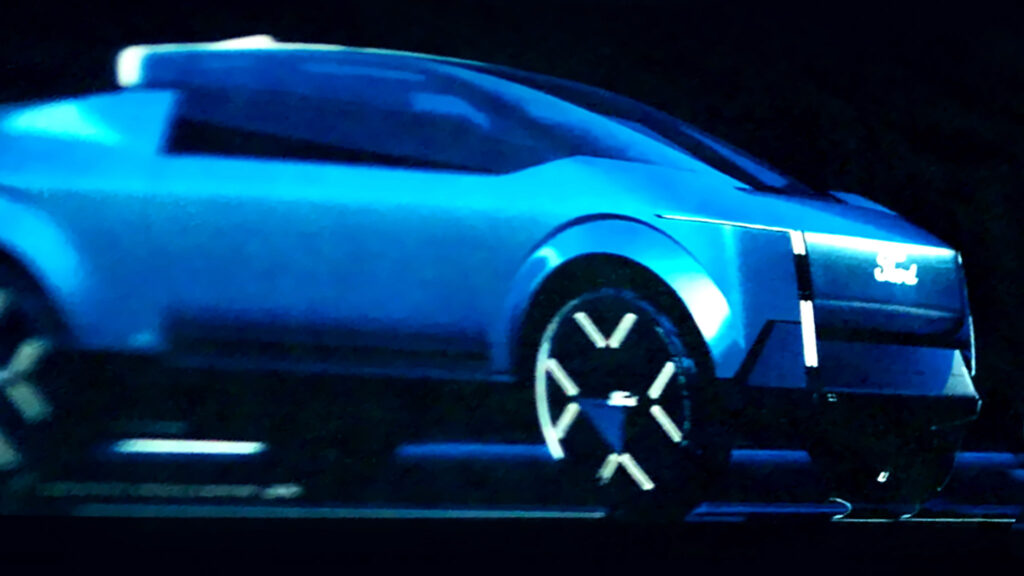
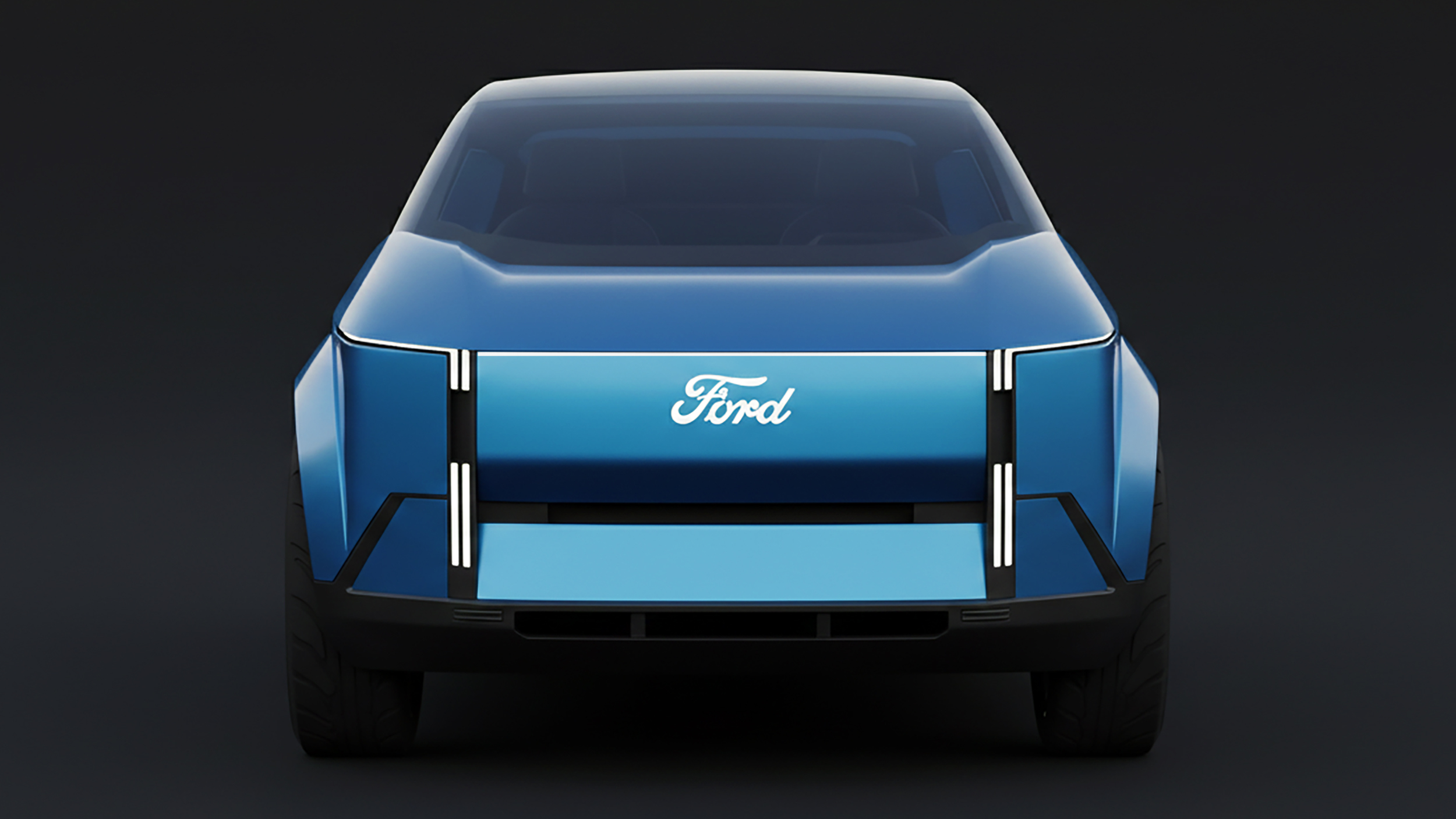
Ford has lifted the lid a little further on its so-called “Universal Electric Vehicle” project, the one tasked with delivering a brand-new $30,000 electric midsize truck in 2027. The tech breakdown in the 14-minute teaser packs plenty of stuff, but it is the design sketches that really grab your attention, offering the first glimpse of what this thing might look like in the metal.
From those early drawings, which also align with the ghost images seen so far, the truck appears slippery and futuristic. Think of it as a softer, more rounded take on the larger Tesla Cybertruck, minus the origami and unpolished edges, not to mention with a far more reasonable entry price. Up front, there are slim vertical LEDs, an illuminated Ford badge, and horizontal intakes carved into the bumper.
The windshield stretches deep into the hood and flows into an integrated roof spoiler at the rear. Despite the futuristic surfacing, this is still (likely) a Ranger-sized pickup with a traditional dual-cab layout. Practicality has not been shown the door.
Ford
Low Drag Is Key
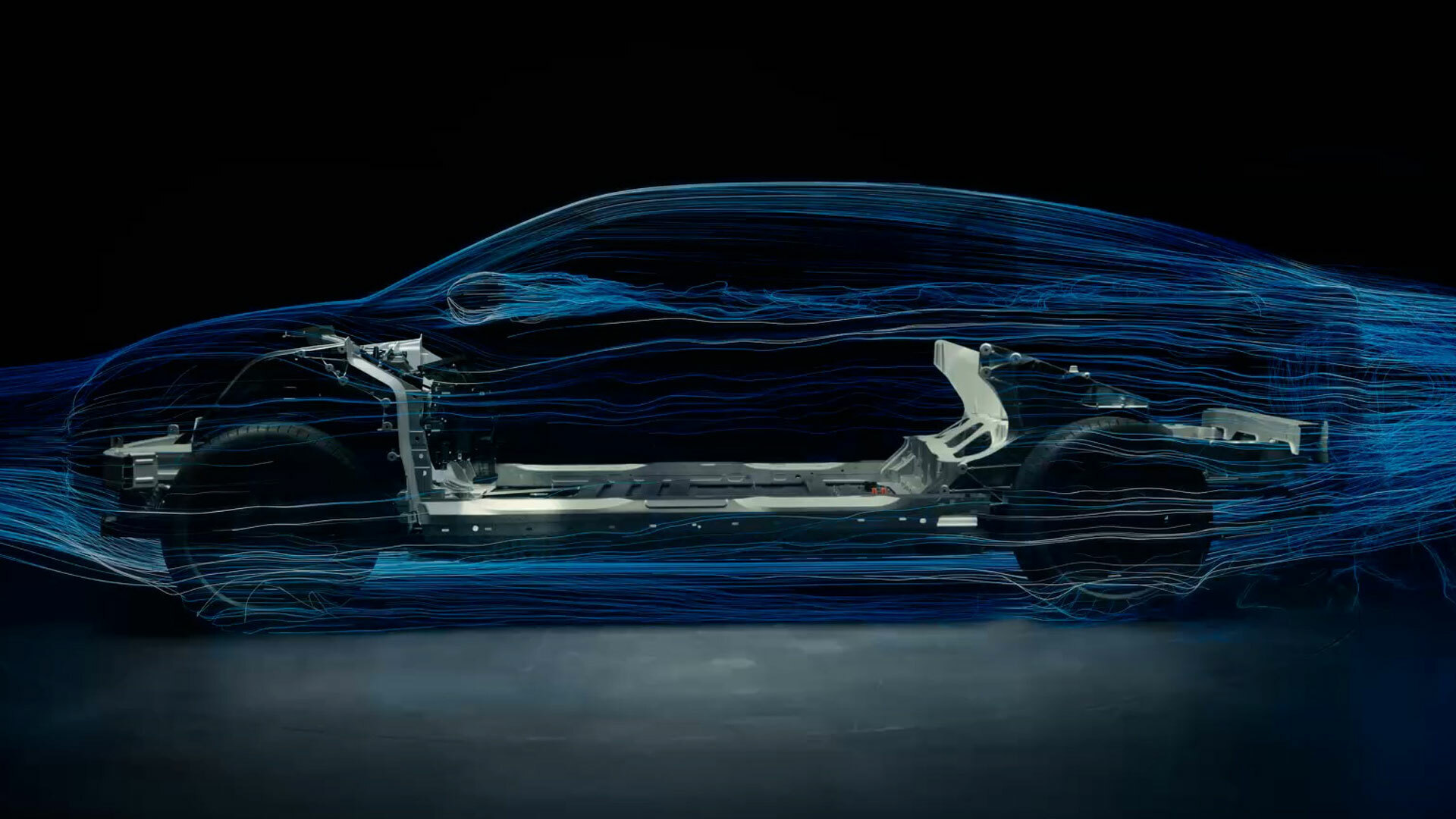
Unsurprisingly, the aerodynamics team had a heavy hand in shaping this truck, with former F1 experts brought in to chase every last fraction of efficiency. The mission was simple: slash drag hard enough that smaller batteries could deliver the required range, keeping production costs in check.
The curved roof reportedly reduces the turbulence typically created by a pickup bed. The side mirrors are 20 percent smaller than standard items, adding 1.5 miles (2.4 km) of range, while specially designed underbody panels contribute another 4.5 miles (7.2 km).
In total, Ford estimates these measures deliver 50 miles (80 km) of additional range compared to a similarly sized truck with a more conventional shape. That is not a rounding error.
Aerodynamics are only half the story. Ford has also focused heavily on reducing manufacturing complexity. The company will use large aluminum unicastings, broadly similar in principle to Tesla’s gigacasting method. Structural components drop from 146 pieces in today’s Ford Maverick to just two, and overall weight is said to be 27 percent lower than rival offerings.
Fewer parts and fewer joints mean fewer robots on the line, which Ford claims results in “measurable gains” in both build quality and production efficiency.
it also appears that Ford engineers have borrowed lessons from reverse-engineering Chinese and Tesla EVs. The new truck’s wiring is 4,000 feet (1.2 km) shorter than that of the Mustang Mach-E crossover, trimming 22 pounds (10 kg). It will run prismatic lithium iron-phosphate (LFP) battery cells and a separate 48V system for auxiliary functions.
The skunkworks team behind Ford’s next generation of EVs is led by former Tesla executive Alan Clarke, bringing 12 years of experience from the rival automaker.
As for the name, Ford is staying quiet. A recent patent filing hints at a possible return of the Ranchero badge, though nothing is confirmed. The affordable pickup is due in 2027 and will be followed by additional affordable EVs, with a sedan reportedly on the wish list.
Ford has released a new teaser video for their mid-size electric truck.
Arrives next year with an aerodynamic design and a focus on efficiency.
It will have LFP batteries as well as a new 48-volt low-voltage system.
Ford swung and missed with the F-150 Lightning, but the company continues to pour billions into electric vehicles. We’re starting to see some of the fruits of their labor as they’ve revealed more details about their next-generation of electric vehicles based on the new Universal EV platform.
Set to be launched on a mid-size electric truck in 2027, Ford is promoting the project with a 14 minute video that provides a few glimpses of the vehicle as well as a lot of talk without saying much.
The end result feels like a waste of time, but there are a few interesting nuggets of information including that the model’s “aerodynamic efficiency is more than 15% better than any other pickup truck on the market today and will ultimately result in longer range and lower cost for our customers.”
We can see a rounded front end as well as a curved roof, which enables air to ‘skip’ over the bed. The model also has 20% smaller side mirrors that result in an extra 1.5 miles of range.
The video goes onto say the truck will have large aluminum unicastings that deliver a 27% advantage in casting weight compared to competitors. The model will also have two structural components compared to the Maverick’s 146.
Ford then talks about the truck’s cost-effective lithium iron phosphate battery pack and mentions an upgraded regenerative braking system, which reportedly saves $100 in battery costs.
Digging Deeper
Putting the video aside, Ford noted most automakers have tackled range anxiety by adding large battery packs. This adds range, but it introduces a host of new problems as batteries account for roughly 40% of an EV’s total cost as well as around 25% of their total weight. As a result, bigger batteries mean heavy and expensive vehicles.
To keep prices low, Ford is betting on a small battery and a focus on efficiency. The latter saw them keep a close watch on weight, drag, and rolling resistance.
Ford also introduced a bounties system when developing the truck, which focused on “evaluating tradeoffs.” While there are always competing goals in vehicle development, Ford connected changes to a “specific value tied to the range and battery cost.”
How Much Is 1 mm Worth?
As the automaker explained, their aerodynamic and interior teams could easily see that “adding even 1 mm to the roof height would mean $1.30 in additional battery cost or .055 miles of range. ”This process repeated itself over and over again in other areas, allowing Ford to create an efficient and affordable pickup.
The focus on efficiency didn’t stop there as the Blue Oval noted “power conversion within an electric vehicle platform can account for a surprising amount of wasted energy in a vehicle while charging or even taking energy from the 400V battery and converting it to 48V for the low-voltage devices.” To address this, the truck has a “fully electric vehicle charging ecosystem” that was designed in-house and uses their own software.
This promises to increase efficiency, reduce charging times, and maximize the lifespan of the battery. The company also revealed the model has a bi-directional charging capability and the company’s first 48-volt low-voltage system. Furthermore, the model’s wire harness is 4,000 feet (1,219 meters) shorter and 22 lbs (10 kg) lighter than on their first-generation of electric vehicles.
January’s average new car price hit a record as incentives quietly pulled back.
Affordable models still exist, but true entry-level cars keep disappearing.
Electric car prices slip slightly, but EV sales have taken a dramatic slide.
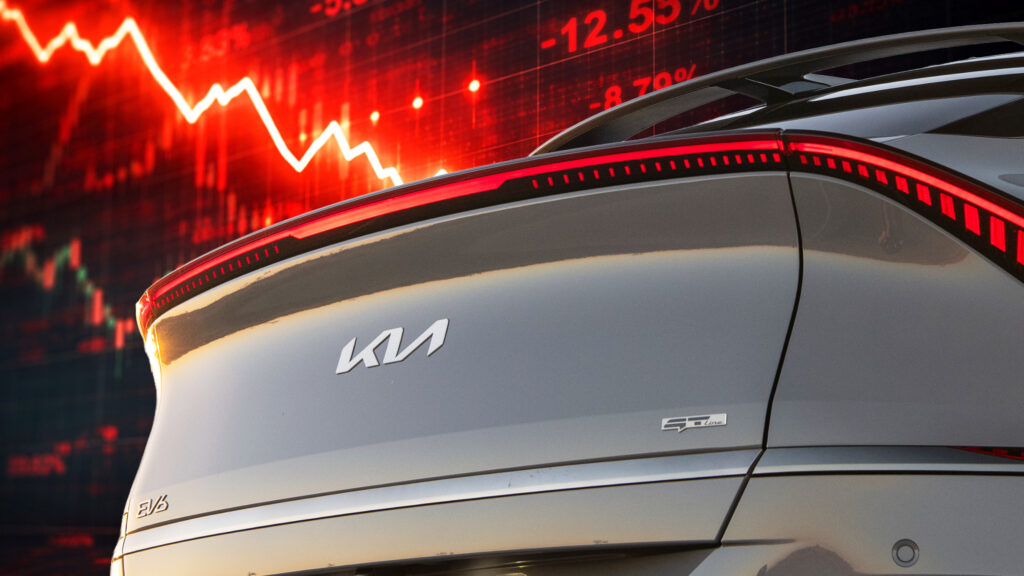
You might have set a New Year’s resolution to slim down, but new-car prices made no such commitment. According to fresh industry data, prices just set another record for January, proving that handing over $50k for a virgin vehicle is basically normal now. But the number of people who think buying an EV is the normal thing to do has dropped dramatically.
The average transaction price in January reached $49,191, up nearly 2 percent from a year earlier and the highest ever recorded for the month, according to KBB. Although prices dipped slightly from December, Cox Automotive called the drop “seasonally normal,” explaining that the market usually “takes a breather” after year-end, when luxury vehicles make up a larger share of sales.
The average new-vehicle manufacturer’s suggested retail price (MSRP), commonly called “the asking price,” also kept climbing, now sitting at $51,288 and staying north of fifty grand for 10 straight months.
New-Vehicle Average Transaction Price
Last month’s pricing uptick came even as sales mix shifted away from year-end luxury volumes. “We hit a new January high even as prices naturally pulled back from December’s luxury-heavy finish,” said Erin Keating, executive analyst at Cox Automotive.
“Consumers are still finding plenty of options below the industry average, especially in core segments like best-selling compact SUVs, but the disappearance of true entry-level vehicles continues to lift the floor higher.”
Incentives Pull Back Hard
Incentives fell to about 6.5 percent of transaction prices, down from higher levels late last year, meaning buyers are shouldering the burden of those higher prices. Automakers are clearly in margin-protection mode, offering just enough in the way of deals to keep metal moving but not enough to feel generous.
Luxury models and big pickups got the juiciest offers, while compact and midsize cars were left mostly to fend for themselves.
Few Bargains Remain
Compact SUVs remain the value choice. With average prices around $36,000 and down 0.6 percent, they sit well below the industry average and continue to dominate sales. Meanwhile, true bargain basement cars are basically extinct. With the Mitsubishi Mirage gone and the recently axed Nissan Versa reduced to whatever stock is still hanging around, the US market has waved goodbye to the sub $20,000 new car.
At the other end of the spectrum, full-size pickups are still living large. Average prices in that segment remain comfortably above $70,000, and buyers are still lining up, with more than 150,000 big trucks finding homes last month.
January marked the fifth consecutive month where full-size pickups averaged over $70K, reinforcing their outsized role in propping up the market average. Subcompact cars, by contrast, struggle to attract more than a few thousand takers a month. Fewer than 4,000 were sold industry-wide last month.
EVs Shunned
Electric vehicle prices actually slipped to around $55,700, down 0.6 percent lower than a year ago, although Tesla’s fell 2.2 percent in the same period. Incentives for EVs also cooled sharply, dropping to 12.4 percent of ATP, down from 18.3 percent in December. Even at those reduced levels, they remain well above the industry average.
However, we wouldn’t be surprised if they are kicked back in to shore up demand, which has dropped alarmingly, according to the data.
KBB says only 66,000 EVs were sold in January, being down a fifth from January 2025, and you can bet the loss of tax credits from October played a big role. In fact, that total reflects a nearly 30 percent year-over-year drop and a 20 percent decline from December. Tesla accounted for about 60 percent of total EV sales.
Slate’s EV truck will be built in a repurposed Indiana factory.
Old printing plant now features robots and anti-slip flooring.
Talks with suppliers next week may bring cost-cutting updates.
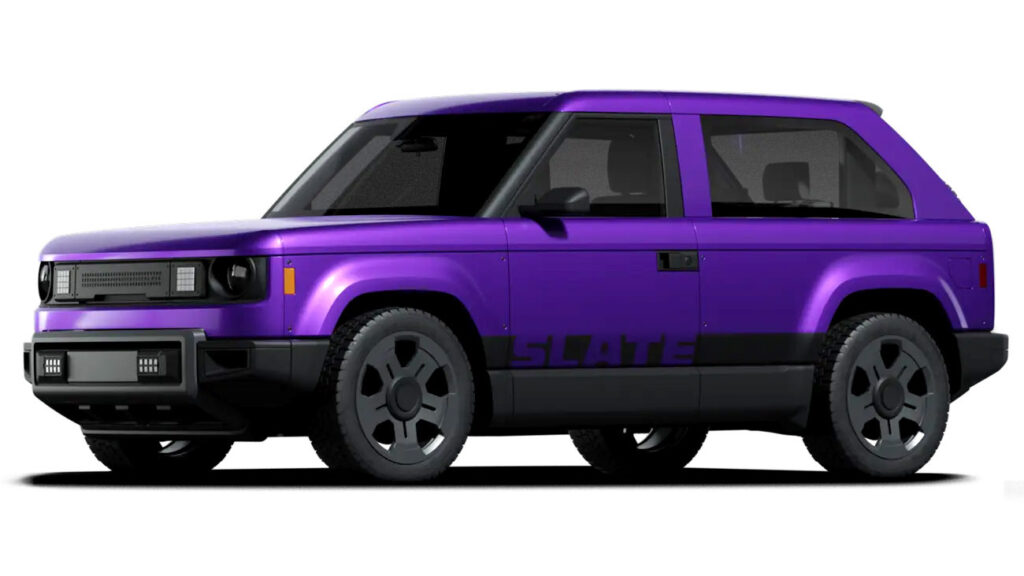
Breaking into the car market with an all-new vehicle is one of the hardest plays in the industry, even more so for a company with no legacy network whatsoever or any prior production history. But Slate Auto is pressing ahead with its plan to launch an affordable, all-electric pickup truck.
While key details about the production version, including pricing, are still being ironed out, the company has shared progress from the plant where it’ll be built.
Rather than building the truck overseas, perhaps somewhere where labor costs are lower, Slate Auto is manufacturing it right here in the US. It’s being brought to life at a plant in Warsaw, Indiana, which for decades served as a major printing facility, employing up to 500 people.
A Factory Transformed
As you can imagine, repurposing the site into an electric vehicle facility involves some extensive changes. Among them, 630,000 square feet of anti-slip flooring is being laid to accommodate the factory’s new layout and safety protocols.
Automation is already underway, with robotic laser welders and large-format 3D laser scanners arriving on site. According to Slate, production of its EV pickup is still scheduled to begin before the end of the year.
What Happens Without the Tax Credit?
The truck’s ultimate reception will no doubt hinge on its price. Originally, Slate Auto said it would start below $20,000 when factoring in the now-defunct $7,500 federal EV tax credit. But with that credit now scrapped under the Trump administration, the EV won’t be as cheap as originally promised.
A few months later, the company quietly updated its website to say the “Blank Slate is expected to be priced in the mid-twenties.” Although no further details were provided, the update was widely thought to reflect the anticipated changes to the federal EV tax credit at the time.
When asked about the change, Slate Auto CEO Chris Barman brushed off the concern, saying “it doesn’t matter,” and insisting the truck remains affordable. She didn’t elaborate further.
“We’re still working really closely with our suppliers to see what opportunities we have to continue to bring costs down, to see what we can do to pass along to the customer before we announce final pricing,” she said.
Slate’s CEO also mentioned that pricing will be a central part of the discussions at a meeting with the company’s suppliers scheduled for next week.
“A big part of that is going to be talking about, are there more opportunities for cost reduction? And the way we’re looking at that is we want to pass it on to the customer,” she said.
Genesis shared a design study for a US-targeted electric pickup.
The concept used a ladder frame and fully electric drivetrain.
Design sketches showed production-like wheels and detailing.
Genesis’s designers have had their hands full lately, dreaming up all kinds of projects that could eventually lead to production cars. Some we’ve already seen up close, like the G90 Magma Performance Wagon and the Magma GT, their mid-engine Corvette rival, but others have stayed behind closed doors. Until now.
We’ve already told you about the minivan and the hydrogen SUV studies, but there’s one more you wouldn’t usually expect from a premium brand, a project simply known as “The Pickup.” It’s a design exercise for a fully electric model aimed at the North American market. The project has been shelved for now, but it’s not entirely off the table for the future.
Hyundai Motor Group’s Chief Creative Officer, Luc Donckerwolke, recently acknowledged that Genesis had been exploring the idea. Ultimately, though, the team felt “it was not the right time,” choosing instead to focus on performance-focused Magma models.
First Glimpse of a Truck That Might Have Been
Most concepts like this stay buried inside design studios, rarely seeing the light of day. This time, however, Genesis opted to pull back the curtain slightly, sharing official sketches and renderings. The images originally appeared in the January/February issue of Auto&Designmagazine, but Genesis has also released them directly to Carscoops.
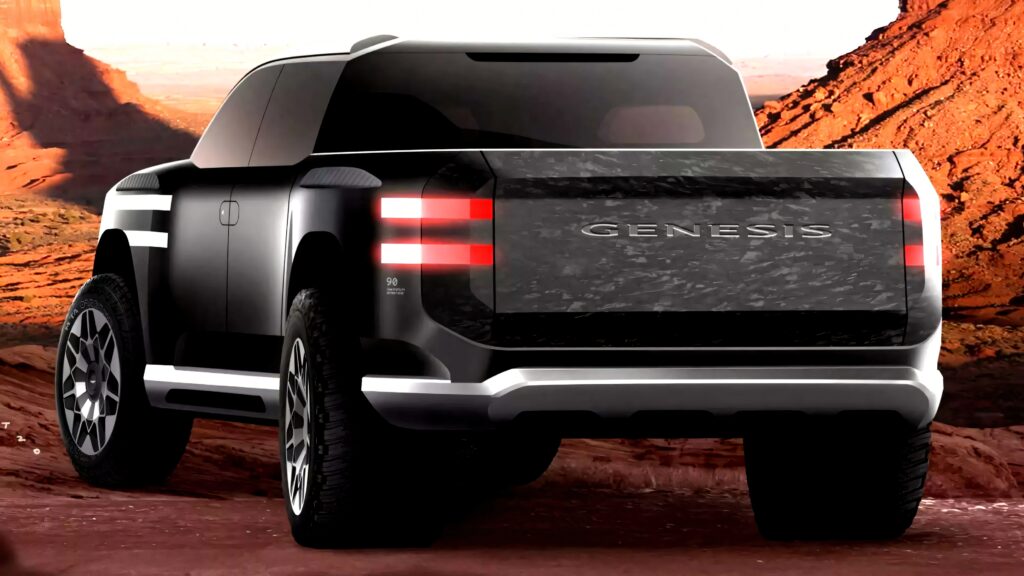
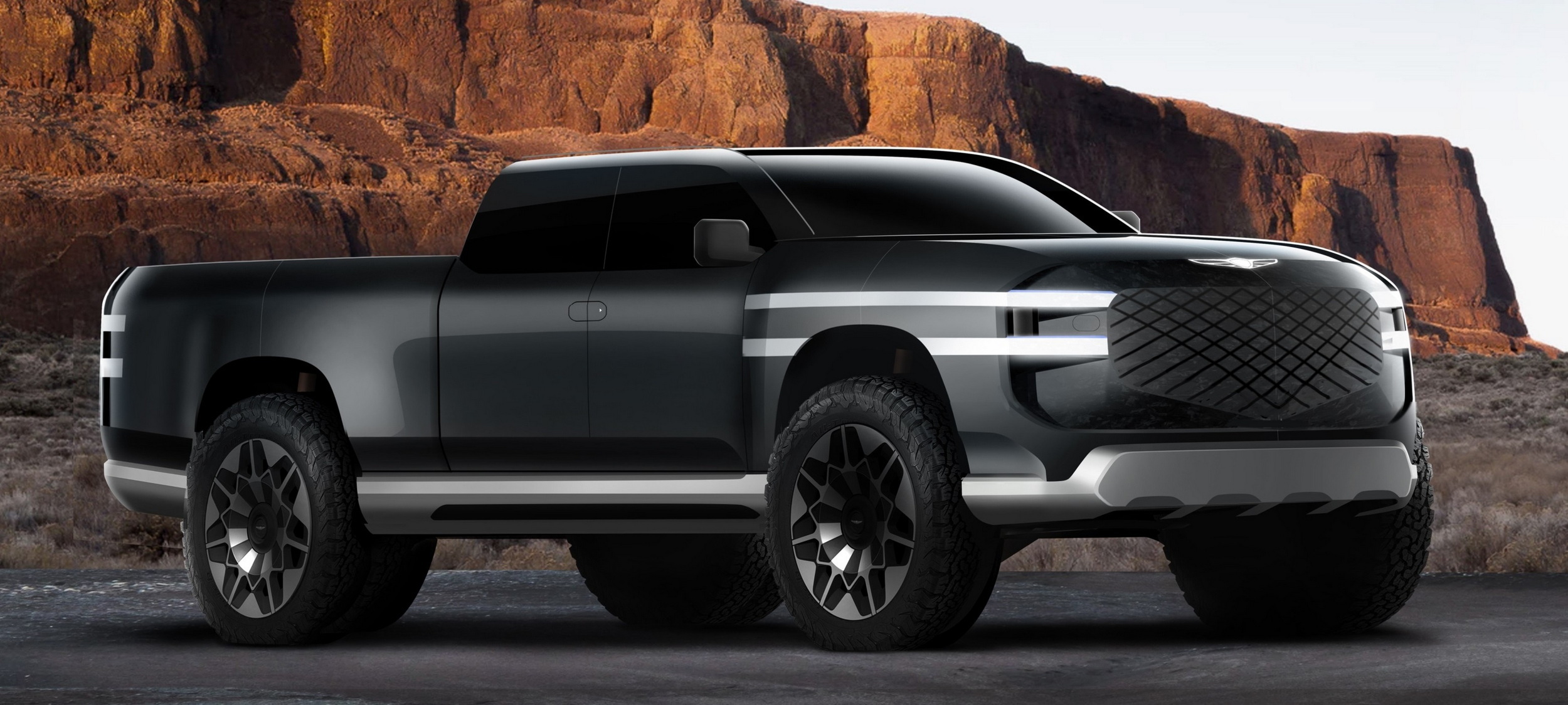
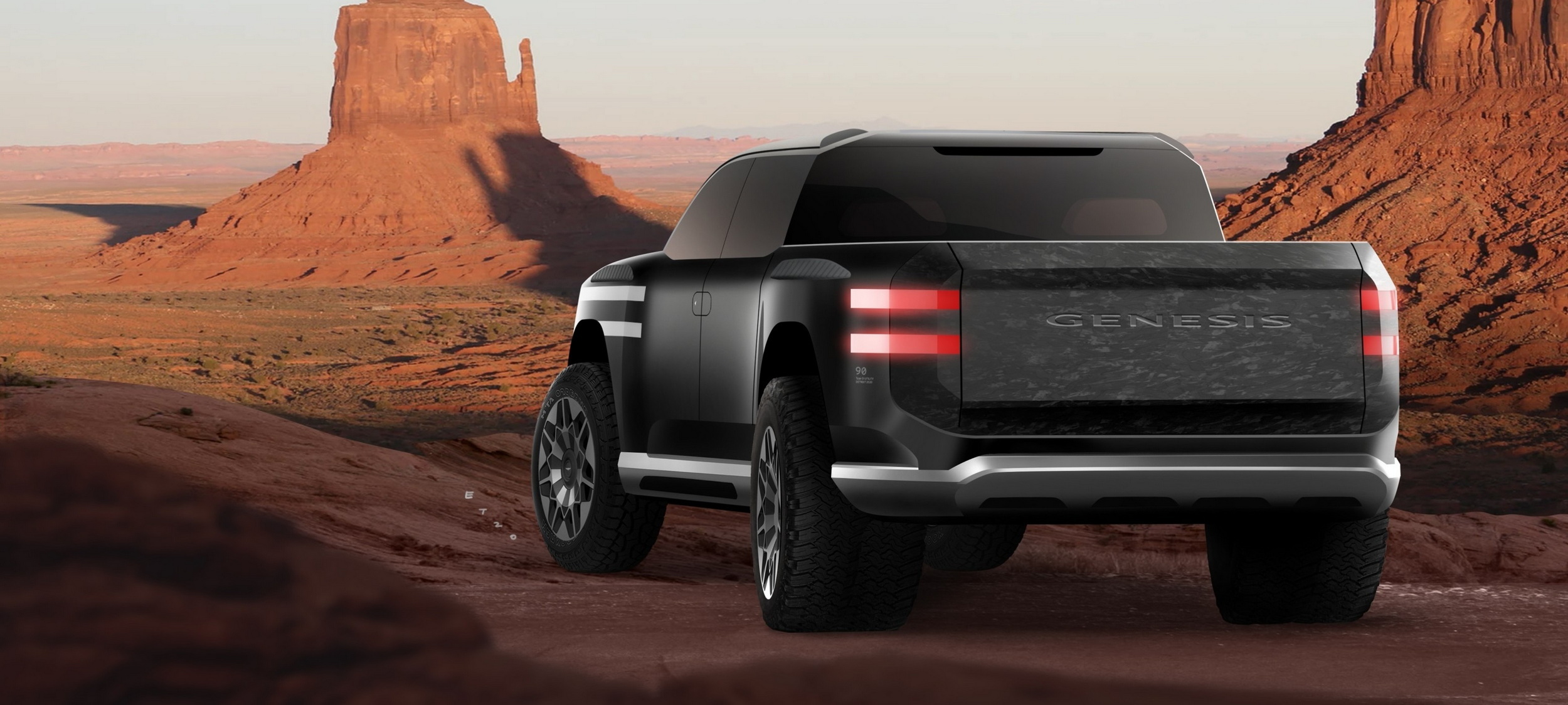
Visually, the design stays rooted in Genesis’s familiar language. Two-Line LED headlights sweep back into pronounced front fenders, mirrored by the taillight design at the rear. The large Crest grille remains a focal point, flanked by sleek side intakes and a sturdy aluminum skid plate anchoring the front bumper.
The profile is defined by imposing proportions, with a tall hood, a sizable rear bed, and an aerodynamic greenhouse. The sketches also show oversized wheels fitted with futuristic alloy designs and chunky, high-grip tires.
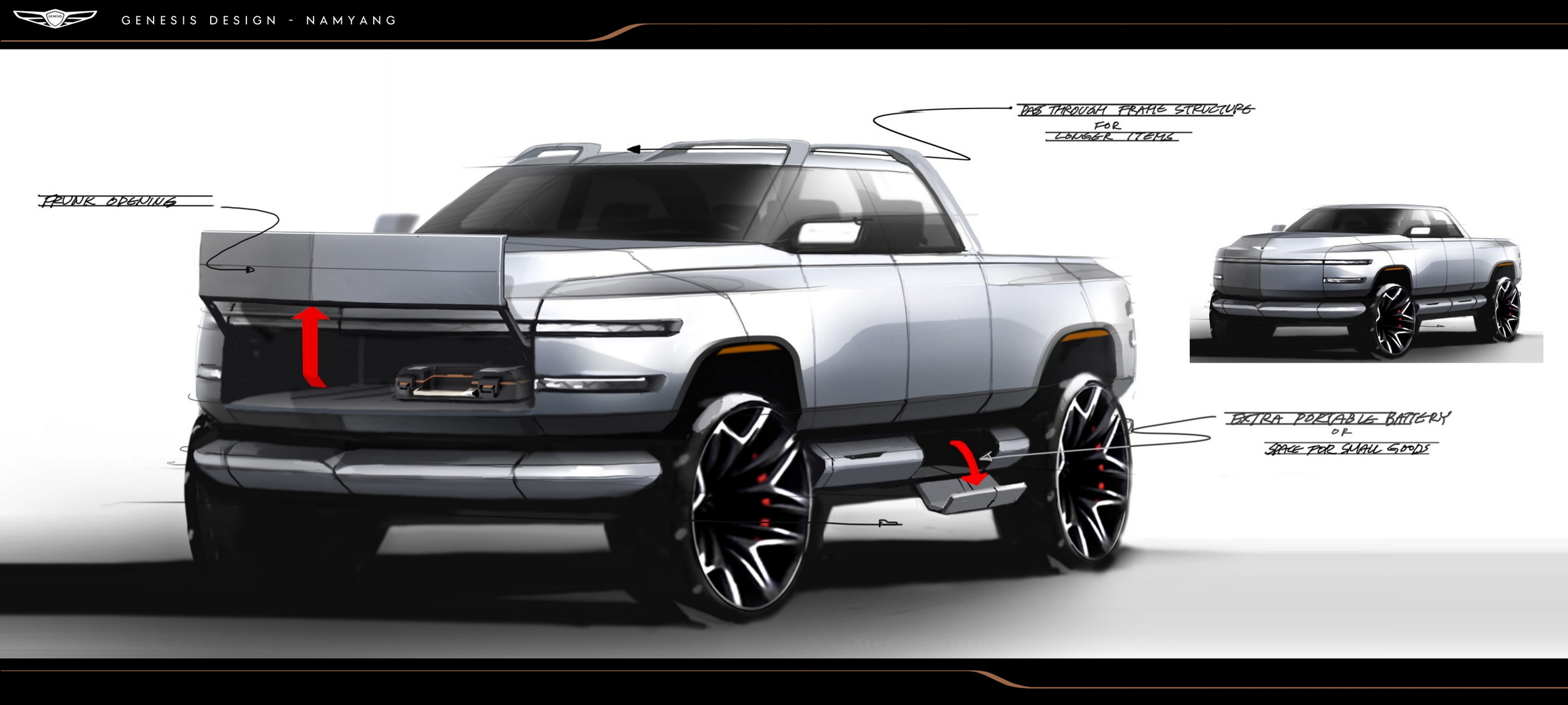
Another variation of the concept study features a flip-up panel on the nose that reveals a storage compartment, along with added space in the side skirts for portable batteries or other small items. This version takes a more minimalist approach to the styling, paired with more pronounced fenders for a bolder stance.
Designed for Americans
Genesis confirms the concept was developed with the American market in mind, and had it gone further, it would have ridden on the same ladder-frame chassis as the X Gran Equator Concept. That would mean better off-road capability and hauling strength than you’d get from a unibody setup.
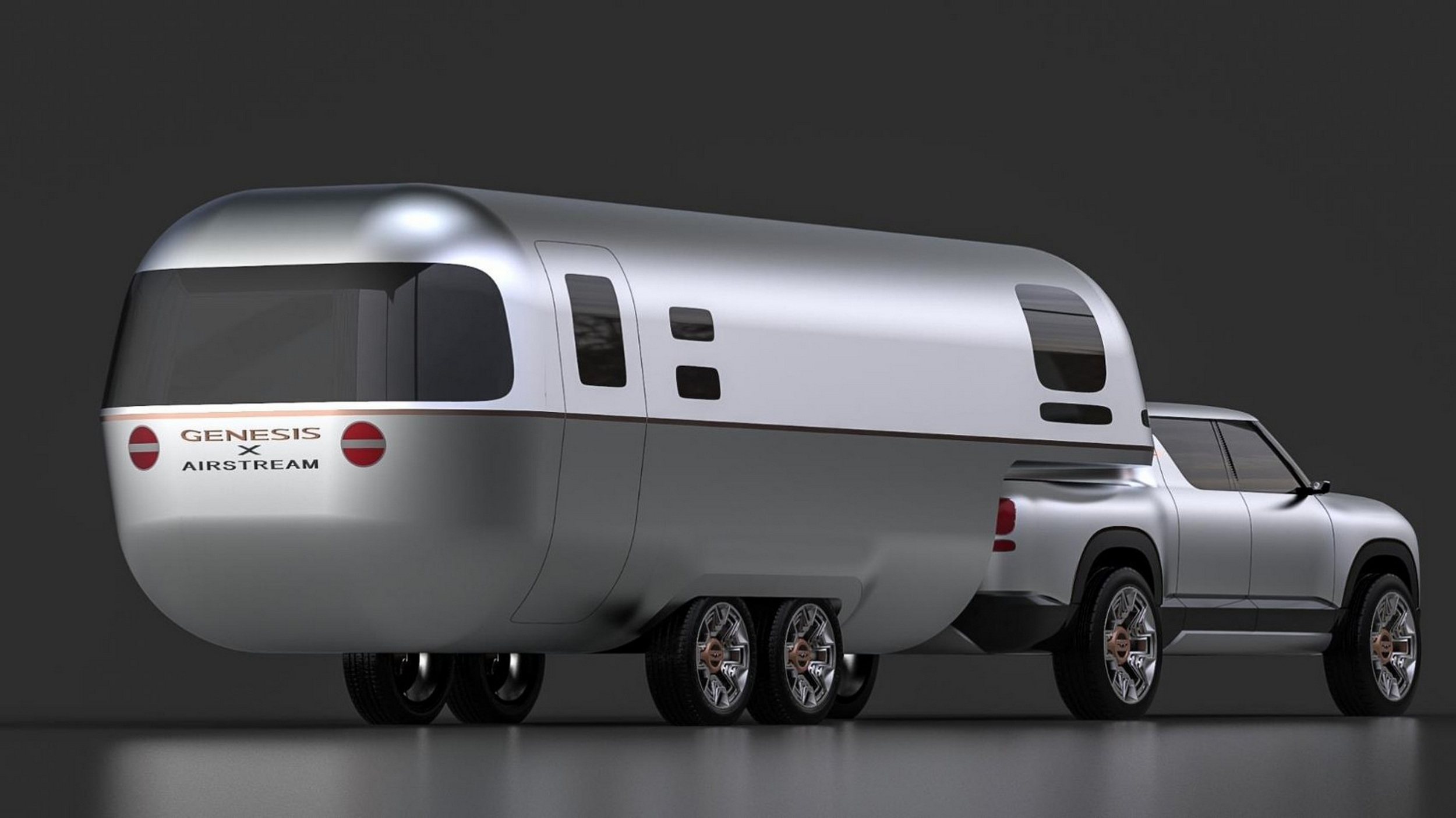
No specific power or range figures have been shared, though it’s safe to assume the EV platform would support all-wheel drive. In one rendering, the truck is shown towing a custom-designed Airstream camper, suggesting it was at least envisioned with serious towing capability in mind.
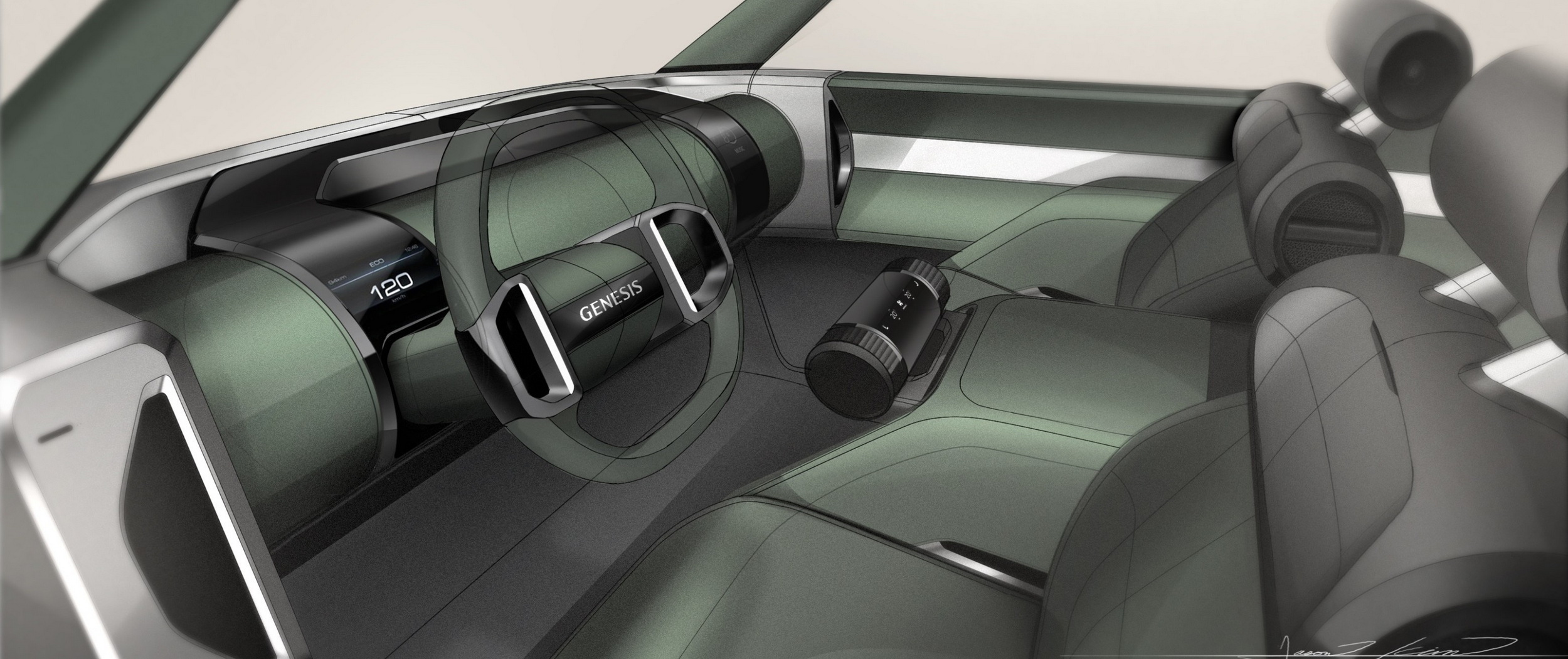
The cabin gets a brief preview as well. One sketch shows a five-seater layout with a mix of soft, cylindrical forms across the dash, console, and seats. A two-spoke steering wheel and slim digital instrument panel create a minimalistic front row, with a curved passenger display extending the width of the dashboard.
However, Donckerwolke’s more recent comments to Auto&Design suggest the idea isn’t entirely off the table. “An electricpickup truck? Why not?” he said. “Then we discarded it because we had to focus on different projects. Maybe in the future, who knows.”
It wouldn’t be surprising if Genesis revisits the truck segment down the line, possibly sharing underpinnings with one of Hyundai’s upcoming pickups. The Korean automaker is already developing an electric truck that could slot into the Ioniq lineup, along with ladder-frame midsize pickups for the U.S. and Australian markets, some of which may use a range-extender powertrain.
In a comment to Carscoops, a Genesis spokesperson clarified how these internal projects often unfold. “Genesis often undertakes future design exercises to explore possibilities for our ever-expanding portfolio,” he told us. “While some of these concepts ultimately don’t move forward to production, this showcases the broad capabilities and strengths of the Genesis design team.”
Tesla Cybertruck starts at $110,000 in the United Arab Emirates.
U.S. sales fell 48.1 percent to 20,237 units during 2025.
Elon Musk once predicted 500,000 annual Cybertruck sales.
Prior to launching the Tesla Cybertruck, Elon Musk suggested they could sell as many as 500,000 of them per year. However, as sales of the electric pickup never really picked up in the United States, Tesla has started selling the Cybertruck in more markets, the latest being the Middle East.
Earlier this month, the first Cybertrucks were delivered to customers in the United Arab Emirates (UAE). Roughly 60 units were handed over during a launch event held for the occasion.
While much of the early hype surrounding the electric truck has died down in the US, it’s a hot ticket in the Middle East, with many having already been imported into the region by enthusiastic buyers before Tesla made it official. Of course, the UAE and the broader Middle East remain relatively small markets and won’t help Tesla get anywhere near its early estimates for the Cybertruck.
As one of the world’s top oil producers, the UAE enjoys some of the lowest fuel prices globally, which makes electric vehicles a harder sell. With cheap gas and a strong car culture rooted in performance and presence, the appeal of a futuristic EV like the Cybertruck has more to do with novelty than necessity.
How Much Is a Cybertruck in Dubai?
Tesla Europe & Middle East/Twitter
In the UAE, pricing starts at AED404,900 for the dual-motor variant, roughly $110,000. That’s significantly more than the $79,990 price tag in the U.S. The top-end tri-motor Cyberbeast comes in at AED454,900, or about $123,000, which represents a smaller markup over its American counterpart at $114,900.
American Sales Crater
Back in the U.S., sales of the Cybertruck tumbled in 2025. Tesla moved just 20,237 units, down 48.1 percent from the 38,965 sold in 2024, the vehicle’s first full year on the market. The final quarter was especially tough, with only 4,140 trucks delivered. That’s a 68.1 percent drop compared to the 12,991 units shifted in Q4 of the previous year.

 Login
Login