Normal view

There are new articles available, click to refresh the page.
Yesterday — 11 January 2026Main stream

Toyota Debuts Electric Pickup For Europe, And It’s Just The Beginning

  • Toyota revealed the Euro-spec Hilux at Brussels Motor Show.
  • New EV version joins the mild-hybrid diesel in the lineup.
  • Hilux BEV offers 160-mile range with dual-motor AWD setup.

The Hilux has spent decades surviving anything the world throws at it, from mud and floods to plummeting from a Top Gear crane – though not being dropped from a helicopter. Now Toyota is testing its most famous small pickup with a more complicated challenge: staying relevant in an electric future.

Related: New Toyota Hilux Brings Sumo-Inspired Looks And EV Option

Toyota unveiled the Euro-spec ninth-generation Hilux in mild-hybrid and fully electric Hilux BEV form at this week’s Brussels Motor Show, months after both trucks debuted in Asia. The first ever EV Hilux is big news, but soon it won’t be the only version of the unstoppable truck that doesn’t emit any tailpipe nasties.

As we reported last year, Toyota Toyota hasn’t just confirmed that it’s working on a hydrogen-powered Hilux that will arrive later, it’s already testing them out in the open. Yes, the same pickup that built its legend hauling bricks and sheep is about get a fuel-cell stack.

Multipath Meets Multipurpose

\\\\\\\\\\

Toyota calls this its multipath strategy, though for many buyers little will change. Because they’ll still be able to get a truck with the same 201 hp (204 PS) 2.8 litre diesel mild hybrid (shown above) that made its debut in the previous generation Hilux’s twilight years. Some less-developed European countries will even get a non-hybrid diesel.

In the UK and Europe the 48-volt oil burner is expected to be the volume seller even after the EV’s arrival. It keeps up the old model’s 1,000 kg (2,205 lbs) payload and 3,500 kg (7,720 lbs) tow ratings, while being smoother and slightly cleaner than before.

Electric But Still Unbreakable

\\\\\\\\\\\\

But business-owning truck buyers with an eye on cutting running costs and tax bills will want to give the Hilux BEV a look. It uses a 59.2 kWh battery with motors on both axles for permanent all-wheel drive.

The front motor makes 151 lb-ft (205 Nm) and the rear 198 lb-ft (268 Nm), and Toyota quotes a WLTP range of 160 miles (258 km), which sounds unimpressive in a passenger-car context, but that climbs to 236 miles (380 km) in urban use.

Payload drops to 715 kg (1,580 lbs) and towing to 1,600 kg (3,530 lbs) in the EV, but the fundamentals remain. You’re getting the same body-on-frame construction, 212 mm (8.4 inches) of ground clearance and 700 mm (27.6 inches) of wading depth, whichever power source you choose. And the BEV gets a special off road drive mode tuned for electric torque and braking.

All In the Grilles
 Toyota Debuts Electric Pickup For Europe, And It’s Just The Beginning

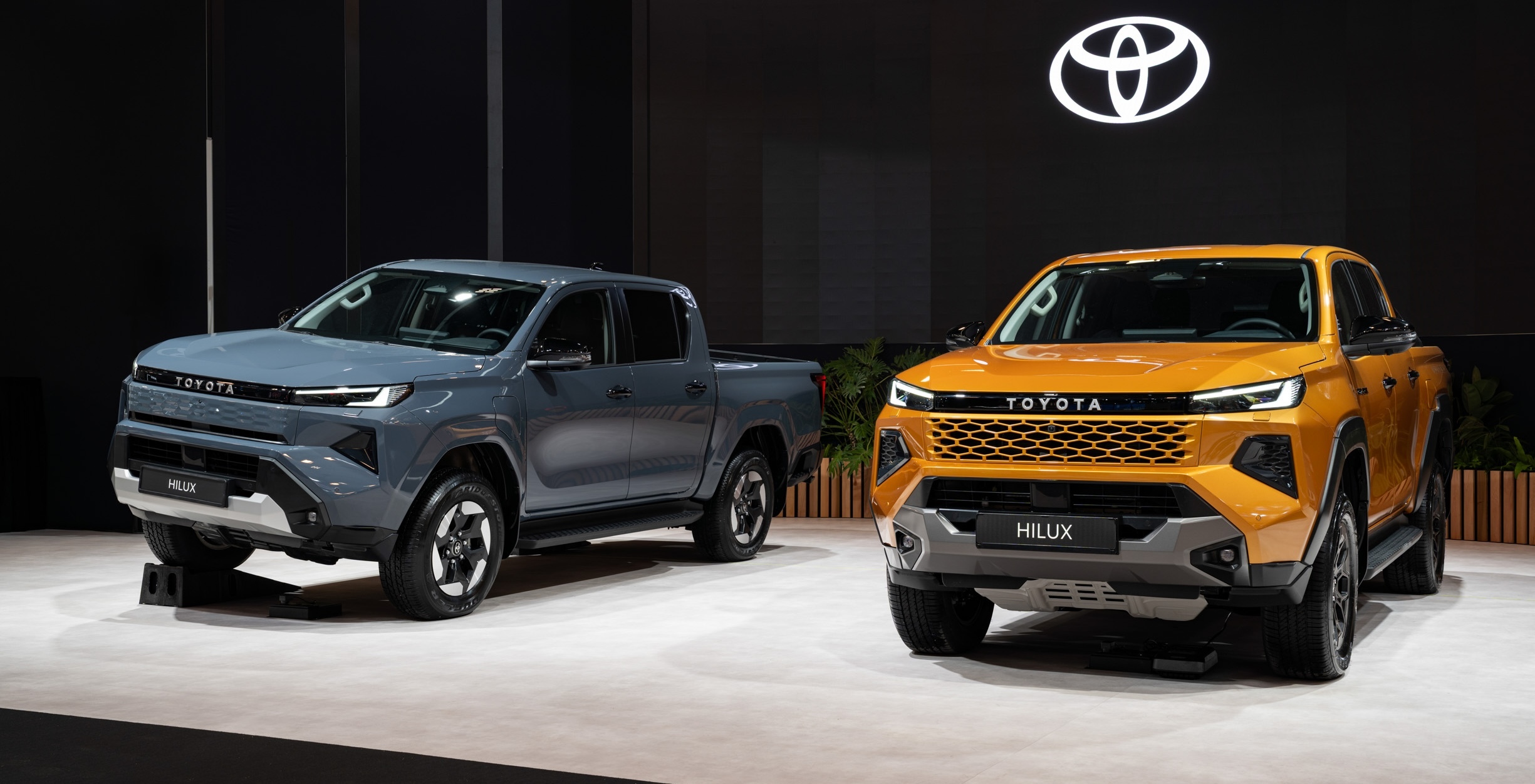
Both hybrid and BEV models adopt the same new Cyber Sumo design that was reportedly developed by Toyota’s Australian team. Characterized by stronger angles and flatter surfaces, it gives the Hilux and more modern, big-truck look, though it seems not everyone loves it. The EV is easily identified by its hole-free grille panel and (less obvious) re-shaped silver bumper insert.

Also: Toyota’s Most Expensive Supercar Has Something In Common With Lexus’ Cheapest Sedan

The modern makeover continues inside the crew cab-only interior where drivers and passengers are treated to a 12.3-inch digital gauge pack and same-sized tablet touchscreen, plus a steering wheel from the new Land Cruiser.

\\\\\\\\\\\\\\\

There are dual storage compartments on the passenger side, dashboard-mounted cupholders, and a full suite of electronic safety gadgets, but Toyota remembered to cram in plenty of physical switches for regularly-used functions.

UK sales start in June, Toyota says, and prices – guaranteed to be higher than for the outgoing truck – will be revealed within the next few months.

\\\\\\\\

Toyota

Before yesterdayMain stream

California Has A New Way To Make EV Owners Pay

  • California may charge EV drivers up to 4 cents per mile driven.
  • Gas tax funds 80 percent of state road maintenance costs today.
  • Officials are testing new ways to fund roads as EV use grows.

California has set an ambitious goal of reaching carbon neutrality by 2045. That path runs straight through mass electric vehicle adoption, which means saying goodbye to traditional gas-powered cars, and with them, a major chunk of how the state pays for its roads.

With gas tax revenue poised to shrink, officials are now exploring a new alternative: a per-mile road tax for EV drivers.

Also: Plug-In Hybrid And EV Drivers Face Pay-Per-Mile Tax In The UK

As it stands, approximately 80 percent of California’s road maintenance budget is funded through a gas tax. For every gallon pumped at the station, around 61 cents goes toward keeping the state’s vast network of highways, freeways, and local roads in working order.

How Will EVs Pay Their Share?

Obviously, as more and more people shift to EVs, this revenue stream will slowly dry up. This is where the road tax could come into play. California recently completed a pilot program for a road tax earlier this year, charging EV owners between 2 and 4 cents for every mile that they drive.

In theory, it’s a straightforward way to recover the funds needed for upkeep without relying on fossil fuels. But implementation may be anything but simple.

For one, it could end up costing quite a bit to set up and run. For another, drivers who rack up serious mileage, often those in rural areas or with long commutes, might bear the brunt of the expense.

 California Has A New Way To Make EV Owners Pay

As noted by Fox 26 News, a commuter traveling daily between Hanford and Fresno could face around $11 a week under the proposed system. Multiply that over a month or a year, and it becomes a noticeable new cost for people who may not have easy alternatives.

Then there’s the question of how the state would monitor each vehicle’s mileage. One proposed method involves installing a tracking device that plugs into the car and logs the miles traveled.

That could get expensive fast, especially if it needs to be rolled out across every EV on California’s roads. And even if the technology is viable, it brings up a different kind of cost, one to driver privacy.

Read: California EV Drivers Now Risk A $490 Fine Under New Rules

Many Californians would likely have reasonable concerns about being monitored so directly, especially if the data is handled by third parties or used beyond just tax purposes. Balancing effective tracking with individual privacy rights could prove to be a sticking point.

According to David Kline from the California Taxpayers Association, the logic behind the tax is simple: “Someone’s got to pay for the roads,” he said. “It should be the people who use the roads.”

However, he is concerned that the road tax could end up “switching the burden to different people,” questioning whether some of those who have to drive long distances can afford the new tax. That tension between fairness and practicality remains unresolved as the state weighs its next move.

 California Has A New Way To Make EV Owners Pay

Ford’s CEO Applauds Trump’s CAFE Rollback, Says They Were Forced Into EVs

  • Farley says tougher fuel rules made low cost cars harder to build.
  • Ford expects lower prices as new standards cut compliance costs.
  • The CEO says the reset lets customers choose their preferred models.

Ford CEO Jim Farley has joined several of his American counterparts in supporting the Trump administration’s decision to reset federal fuel-economy standards.

The move, Farley says, gives automakers the breathing room to produce more affordable vehicles in the United States without walking away from electric innovation or efficiency goals.

Farley’s core argument seems to be that regulations were so strict that they effectively squeezed automakers out of the low-cost segments so many buyers still rely on.

Read: Trump Admin Pushes Fuel Economy Shakeup And The Impact Could Be Huge

Speaking at a press conference with President Donald J. Trump on Thursday, Farley called the update “a victory for affordability and common sense,” adding that Ford will now be able to offer cheaper versions of its most popular models and launch new price-focused products.

“We believe that people should be able to make a choice, as you said, Mr. President,” Farley said. “And we will invest more in affordable vehicles. This allows us to invest in affordable vehicles made in the U.S., which we will take the lead on and will allow us to make vehicles more affordable.”

Trump, sitting beside him, said, “People were brainwashed. This is a ‘green new scam.’ And people were paying too much for a car that didn’t work as well. And now they’re gonna have a great car that’s gonna be environmentally friendly, but it’s gonna cost you a lot less and it’s gonna work great. All of the nonsense is being taken out of the cars.”

Political Theater or Market Reality?

Farley stopped short of framing the move as an ideological shift, instead focusing on the economics. He argued that the tightened CAFE standards under the previous administration imposed costs that made entry-level vehicles much harder to justify.

That pressure, he said, pushed automakers toward higher-margin EVs and hybrids simply to meet fleet targets.

“What you should know is that this is a victory for affordability and common sense. As the president said, we will be able to offer more affordability on our popular models, and we’ll be able to launch new vehicles built in America that are more affordable because of this rule change,” Farley said later in an interview on “Fox & Friends” Thursday.

Farley added that the earlier fuel-economy system “was totally out of touch with market reality.” Automakers, he said, were forced to sell EVs and other vehicles to stay compliant, even when customer demand wasn’t there.

“We were forced to sell EVs and other vehicles. We’re not going back to gas-guzzlers,” he continued. “We have a lot of EVs and a lot of hybrids at Ford, but now customers get a chance to choose what they want, not by what we force on them.”

Balancing Choice and Compliance

 Ford’s CEO Applauds Trump’s CAFE Rollback, Says They Were Forced Into EVs

Ford’s CEO also clarified that the company isn’t returning to inefficient gas models, noting it already sells a wide range of EVs and hybrids. GM’s CEO Mary Barra recently made similar comments.

Also: GM’s Mary Barra Promises Cleaner Engines, But Looser Rules Fuel More Gas Guzzlers

The reset rolls back the steep increases introduced under the Biden administration, which raised fuel-economy requirements by 8% for 2024 and 2025 and 10% for 2026. Federal officials previously estimated those rules would add nearly $1,000 to the average new-car price.

By contrast, the new standard lowers compliance costs and, according to the White House, will save American families a combined $109 billion. Now, the market waits to see if automakers really do deliver on their promises of rolling out more affordable models.

Photo Whitehouse/YouTube

Trump Admin Pushes Fuel Economy Shakeup And The Impact Could Be Huge

  • Trump administration plans to significantly reduce fuel economy standards.
  • New proposal targets an average of 34.5 mpg by the 2031 model year.
  • EV credits would be removed and crossovers reclassified as passenger cars.

President Trump has announced plans to reset the “costly and unlawful Corporate Average Fuel Economy (CAFE) standards” enacted by the previous administration.

A fact sheet put out by the White House was light on specifics, but said Trump was “returning CAFE standards to levels that can actually be met with conventional gasoline and diesel vehicles.”

They said this stands in contrast to the “unrealistic fuel economy targets” that the Biden Administration had approved, which would have “effectively resulted in an electric vehicle mandate.”

More: 50.4 MPG Is The Magic Number As New Fuel Economy Standards Announced

The White House went on to claim the previous standards were impossible to meet with available technologies for gas cars and would have “compelled widespread shifts to EVs that American consumers did not ask for, accompanied by significant cost-of-living increases.”

They went on to say the average cost of a new car would have risen by nearly $1,000 when compared to the standards announced today.

Speaking of savings, the government said the move will save Americans $109 billion over the next five years. The White House also suggested that by enabling more people to buy newer and safer vehicles, the “reset is projected to save more than 1,500 lives and prevent nearly a quarter-million serious injuries through 2050.”

Big Changes, Less Efficiency

 Trump Admin Pushes Fuel Economy Shakeup And The Impact Could Be Huge

The Department of Transportation was more forthcoming as they revealed the Freedom Means Affordable Cars proposal. It calls for resetting CAFE standards for model years 2022-2031.

The new standards would be “developed without consideration of electric vehicles and credit trading,” and would call for a modest fuel economy increase.

For passenger vehicles, the proposal calls for an increase of 0.5% annually for model years 2023 through 2026. It would then dip to a 0.35% increase for the 2027 model year and a 0.25% increase for the 2029 to 2031 model years.

For light trucks, the National Highway Traffic Safety Administration is proposing a 0.5% increase for the 2023-2026 model years. It would be followed by a 0.7% increase for 2027, and then a lower 0.25% improvement for the 2029 to 2031 model years.

 Trump Admin Pushes Fuel Economy Shakeup And The Impact Could Be Huge

What the New Math Means

While it’s hard to wrap fuel economy figures around percentages, the Department of Transportation said the proposal would result in a fleet average fuel economy rating of 34.5 mpg by the 2031 model year. CAFE credit trading would also be eliminated in the 2028 model year, significantly hurting EV companies such as Tesla.

Furthermore, the proposal would “reclassify crossovers and small SUVs as passenger automobiles instead of light trucks.” In essence, it’ll be like making vehicles on ‘easy mode.’

Once the proposal is published in the Federal Register, it will kick off a 45-day public comment period. The move will likely prove divisive, but it has become increasingly clear that Americans aren’t ready to go fully electric and the transition will be far more gradual than many proponents hoped for.

 Trump Admin Pushes Fuel Economy Shakeup And The Impact Could Be Huge

Jeep’s $65,000 Recon Is Surprisingly Fast, But Can It Outrun The EV Slowdown?

  • 2026 Recon is fully electric with dual motors, 650 hp and 620 lb-ft.
  • Trail-rated Jeep does zero to 60 mph in 3.6 secs, has 250-mile range.
  • Launches with $65,000 Moab trim: 33-inch tires, 9.1 inches clearance.

Jeep is taking another swing at zero emissions adventure with the 2026 Recon, the first fully electric, Trail Rated Jeep, one that packs sports car-level acceleration, and promises real off-road ability. But the timing might raise eyebrows.

With EV sales slowing, companies like Ram scrapping planned electric utilities and Jeep’s first EV, the Wagoneer S struggling for sales, is this the right moment to launch a $65,000 electric off-roader?

Also: The 2026 Grand Cherokee’s Biggest Surprise Is Hiding Under The Hood

The Recon range will expand in time but for now Jeep is launching with just one trim, the dirt-lovin’ Moab. It comes with a single motor mounted at each end of the 112.9-inch (2,870 mm) wheelbase platform, the pair together pushing out numbers that are strong, even if they don’t set any EV records.

What Powers Jeep’s Electric Trail Machine?

\\\\\\\\\\\

The Recon delivers 650 hp (659 PS) and 620 lb-ft (841 Nm) of torque, which is 50 hp (51 PS) and 3 lb-ft (4 Nm) more than the priciest version of Jeep’s first US EV, the road-biased Wagoneer S that rides on the same STLA Large platform.

It also hits 60 mph (97 kmh) in a speedy 3.6 seconds and claims a 250-mile (155 km) range from its 100 kWh battery, compared with 3.4 seconds and 294 miles (473 km) for the Launch Edition Wagoneer S. But that inconsequential difference in acceleration, and rather more worrying range gap is the price you pay for genuine off-road chops.

Only the Recon gets Jeep’s Trail Rated stamp of approval, the one you’ll have seen on vehicles like the Wrangler, meaning it’s passed a series of tough tests to prove its ability to ford water and clear obstacles that would make a crossover cry.

Mud or Midtown?

To earn that Trail Rated badge the Moab features 33-inch tires and a 15:1 final drive at the rear for extra torque multiplication when things get messy. It has selectable locking differentials Selec-Terrain driving modes, including a Rock mode that’s exclusive to the Moab, and Selec-Speed Control to make light work of steep inclines or rocks.

The 100-kWh battery is protected by a full set of steel skid plates, and suspension components like large CV joints and half shafts have been beefed up to handle all that torque.

Unlike the solid-axle Wrangler, the Recon’s suspension is independent via short-long arm (SLA) at the front and integral link at the back. And it skips the combustion SUV’s vague recirculating ball steering for a modern rack and pinion setup.

\\\\\\\

That bodes well for on-road comfort, where the Recon operates mostly as a RWD vehicle, but what about those all important off-road angles? A 33.8-degree approach, 23.3-degree ramp and 33.1-degree departure angle are no match for the new V8-powered Wrangler Moab 392’s 46.7, 24.5 and 39.8-degree stats.

Some of that can be chalked up to the 193.3-inch (4,911 mm) Recon being almost exactly the same length as a Wrangler, but riding on a 5.5-inch (140 mm) shorter wheelbase, and having far less daylight beneath its floorpan.

The Recon loses the ground clearance battle by a big margin, 9.1 (231 mm) inches playing 11.1 inches (282 mm) in the Wrangler Moab, and up to 12.9 inches/328 mm on other Wranglers.

Classic Jeep Design With a Modern Edge

 Jeep’s $65,000 Recon Is Surprisingly Fast, But Can It Outrun The EV Slowdown?

Still, that’s more trail ability than 99 percent of people will ever need, and at least the Recon looks the part. The design stays true to Jeep’s roots with a boxy stance, upright grille and four-square proportions.

The illuminated grille rings, flush door handles, and contrast roof options give it a modern edge without losing the heritage feel, buyers also getting the option to replace the standard dual-plane sunroof for an optional Sky One-Touch power top.

And yes, you can remove the doors, the swing gate glass and the quarter windows, for those really hardcore adventures without needing any special tools.

Try that in your Rivian R1S. Moab trim brings a few design tricks of its own, including tough-looking black coloring for the front and rear fascias, the fender flares, uniquer badge and an anti-glare hood graphic.

Jeep’s Biggest Screen

\\\\\\\\\\\\\\\

The cabin sticks to the adventure theme, blending durable materials with forward-looking tech and looking nothing like the inside of a Wagoneer S. A horizontal dashboard layout and grab handle nod to classic Jeep interiors, but a 26-inch digital display area stretches across the dash made up of a 12.3-inch digital cluster and 14.5-inch touchscreen – the biggest in any Jeep – running Uconnect 5.

That screen’s generous dimensions should make it easier to see the pitch and roll mapping on the automaker’s Trails App, as well as checking out the camera views. And if you want to bring your own camera, a modular accessory rail is ready for your GoPro.

Related: Stellantis Spends $13 Billion To Revive Jeep And Dodge In America

Audio comes from a standard Alpine system, and Jeep has even relocated the speakers under the seats so the sound doesn’t vanish when you pop the doors off.

How Much Does It Cost?

The 2026 Jeep Recon EV will be built at Jeep’s Toluca Assembly Plant starting early next year, priced at $65,000 for the Moab trim. But expect that price to fall later as other trims, and less powerful motor setups become available – or just through massive discounts if the Recon proves as tricky to sell as the Wagoneer S.

No doubt, Jeep is taking a bold bet on a market that’s still figuring out what it wants. How do you rate the Recon’s chances?

 Jeep’s $65,000 Recon Is Surprisingly Fast, But Can It Outrun The EV Slowdown?

Sure, You Can Replace Ioniq N Brakes, But Only With Hyundai’s $6K Tool Or A $2K Locked Workaround

  • Ioniq 5 and 5 N need official software to replace rear pads safely.
  • Hyundai defends the system, citing safety and secure service access.
  • Right-to-repair advocates say it limits owners’ maintenance rights.

Maintaining your own car has long been a badge of pride for some and a financial necessity for many others. Swapping fluids, filters, or brake pads is part of the standard weekend maintenance ritual for countless drivers.

But for one Hyundai Ioniq 5 N owner, that sense of self-reliance recently hit a wall, or more precisely, a brake caliper. He discovered that replacing the rear pads on his EV wasn’t as simple as it used to be. Now, Hyundai has responded.

More: Apparently You Need Hyundai’s Permission To Change Your Own Brakes

It might seem odd that someone has already burned through their rear pads, especially on an EV, but it happened because the owner drove this car the way Hyundai wants owners to: hard and on the track.

When he tried to replace these pads, he learned that he needed to retract the electronic parking brake. That’s where this easy DIY job took a scary turn.

When Maintenance Gets Complicated

 Sure, You Can Replace Ioniq N Brakes, But Only With Hyundai’s $6K Tool Or A $2K Locked Workaround
Aftermarket J2534 Diagnostic Tool from DG Technologies

One way to retract the brake is to use Hyundai’s Global Dynamic System (GDS). That software and the hardware that goes with it can cost almost $6,000, as we’ve seen online. Don’t worry, though, there’s another option called the J2534 Diagnostic Tool, which Hyundai supports, as seen in an official document discovered by TheDrive.

According to the owner, Redditor u/SoultronicPear, the software costs $60 a week (or less on average for longer time periods) and requires the use of a J2534 adapter that can be found for around $2,000.

Hyundai currently approves only three options for this tool: the CarDAQ Plus 3, Bosch’s MTS 6531 and DG Technologies’ d-briDGe PRO, adding that, “under no circumstances do we recommend the use of a
non-approved J2534 device”. So be warned.

Credentials Required

More importantly, beyond that, using the tool requires special National Automotive Service Task Force (NASTF) authentication and a constant internet connection.

But here’s the kicker. Only certified repair shops or repair businesses are supposed to get access to that software. NASTF told the owner that “NASTF credentials are for use by qualified technicians, mechanics or locksmiths working in businesses providing repair or replacement services.”

Hyundai Speaks Up

Before publishing our first coverage of this issue, we reached out to Hyundai for comment. After the story went live, the automaker responded with the following statement to Carscoops:

“Hyundai is committed to supporting both our dealer network and independent repair facilities with safe, secure, and accessible service solutions. For vehicles equipped with electronic parking brakes, including the Ioniq 5 and Ioniq 5 N, the official repair procedure requires placing the rear calipers in service mode using either our Global Diagnostic System (GDS) or the J2534 application.

This ensures proper functionality and customer safety. Hyundai recently expanded access through an update to our J2534 application, enabling aftermarket users to perform functions previously restricted by the GDS secure gateway.

While authentication through NASTF is required for sensitive operations, this step helps maintain security and accountability. Our official dealer tool (GDS) is also available for purchase by anyone. Hyundai is actively exploring ways to make routine maintenance easier for all customers while upholding safety standards.

We appreciate the interest in DIY repairs and will continue working toward solutions that balance convenience with security.”

 Sure, You Can Replace Ioniq N Brakes, But Only With Hyundai’s $6K Tool Or A $2K Locked Workaround

Seeking more detail, we pushed Hyundai to clarify whether a skilled owner could realistically do the job at home. The company followed up with this explanation:

“DIYers can replace brake pads on the Hyundai Ioniq 5 and Ioniq 5 N, but it requires specific steps and tools. Because these vehicles use electronic parking brakes, the rear calipers must be placed in service mode using either Hyundai’s Global Diagnostic System (GDS) or the J2534 application with a compatible pass-through device.

Both tools are publicly available, though GDS is more expensive and J2534 requires NASTF authentication for secure functions. Without these tools, the job cannot be done safely, as manual retraction could damage components.

Hyundai is not restricting DIY repairs, in fact, recent updates have expanded access, and we continue to explore ways to make routine maintenance easier while maintaining safety and security.”


So, yes, it can be done. But unless you already own the specialized tools or have deep pockets, the process can cost about as much as a tired old hatchback from the classifieds.

For now, at least until a cheaper workaround surfaces (we’re looking into it, so stay tuned), the Ioniq 5 N’s rear brakes may remain one of those maintenance jobs probably best left to the professionals.

 Sure, You Can Replace Ioniq N Brakes, But Only With Hyundai’s $6K Tool Or A $2K Locked Workaround

China Plans To Limit How Fast Your Car Accelerates To 62 MPH At Startup

  • China’s draft rule could require cars to take longer to reach 100 km/h (62 mph).
  • Drivers would need to manually enable faster acceleration after every startup.
  • Regulation targets all passenger cars, but quick EVs would feel the biggest hit.

The electric car age has rewritten the meaning of quick, with even family runabouts now capable of supercar-style launches from a set of lights. What once belonged to exotic badges has become a party trick for mid-range sedans and crossovers alike.

Now China’s latest draft vehicle regulation looks set to spoil the fun, or at least delay it. Under a proposed update to the National Standard, every passenger car would need a default mode in which it takes no less than five seconds to reach 100 km/h (62 mph) at startup, unless the driver manually selects a quicker setting.

The draft title “Technical Specifications for Power-Driven Vehicles Operating on Roads” appears to be part of a broader safety and road behavior initiative in China. It is intended to replace the current GB 7258-2017 standard that didn’t impose such restrictions.

More: China Might Kill Electric Flush Door Handles With These New Rules

Section 10.5.4 of the new proposal states: “After each power-on/ignition of a passenger vehicle (excluding automatic engine start-stop), the vehicle should be in a state where the 100 km/h acceleration time is not less than 5 seconds.”

The default performance-restricting mode at startup could work much like the output-limiting Eco setting found in most EVs, managed entirely through software. Drivers could still switch to a faster mode, though they’d need to repeat the process every time they power on the car.

Europe has a somewhat parallel rule, requiring cars to have speed limit warnings, although those systems only alert rather than restrict.

 China Plans To Limit How Fast Your Car Accelerates To 62 MPH At Startup
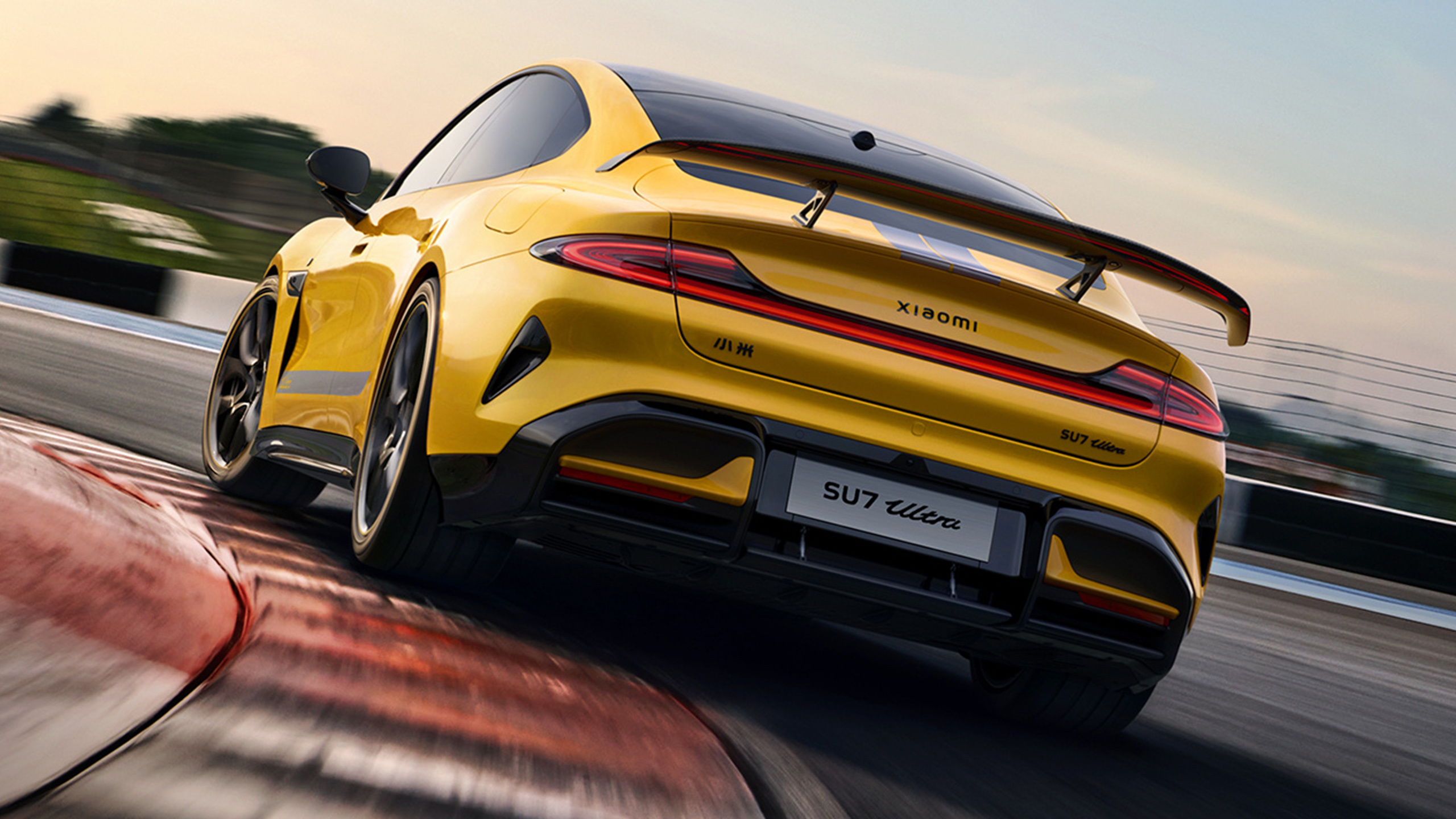
Xiaomi SU7 Ultra

If approved, the rule would apply to all passenger cars in China regardless of powertrain, though it would most affect the growing fleet of lightning-fast EVs.

Models like the Xiaomi SU7 Ultra (1.98 seconds to 100 km/h), Zeekr 001 FR (2.02 seconds), Tesla Model S Plaid (2.1 seconds), and BYD Yangwang U9 (2.36 seconds) would all fall under the new restriction, even if only temporarily after startup.

Speed Warnings On Your Limo

A separate draft titled “Safety Specifications for Power-Driven Vehicles Operating on Roads” includes another speed-related rule, this time targeting longer passenger models.

Section 10.5.1 reads: “Passenger vehicles with a length of 6 m or more shall have an overspeed alarm function, capable of triggering an alarm via visual or audible signals when the speed exceeds the maximum permissible speed (the maximum permissible speed shall not exceed 100km/h), except for those with compliant speed limiting functions or devices.”

While most large SUVs and minivans stay below the six-meter mark, the rule could apply to stretched limousines. One such example is the previous-generation Rolls-Royce Phantom VII Extended Wheelbase, which measures 6,092 mm (239.8 in). Its successor, slightly shorter at 5,982 mm (235.5 in), would just avoid triggering the alarm requirement.

 China Plans To Limit How Fast Your Car Accelerates To 62 MPH At Startup
Rolls-Royce Phantom EWB

Kia Suddenly Pulls Its Tesla Model 3 Rival Right Before US Launch

  • The EV4 sedan was scheduled to arrive in the US in early 2026.
  • Kia had confirmed 58.3 kWh and 81.4 kWh battery pack options.
  • Pricing likely would have started at roughly the low $30,000s

The Kia EV4 made its debut at the New York International Auto Show back in April, touted as Kia’s straightest shot yet at the Tesla Model 3. It seemed poised to stir up the affordable EV segment, but that momentum has stalled before it even reached the showroom.

According to the Korean automaker, the EV4’s American launch has been postponed “until further notice,” a decision that leaves would-be buyers of reasonably priced EVs with one less option in an already tightening field.

Read: Kia’s First Electric Sedan Is Here To Beat The Model 3 At Its Own Game

Kia had engineered both sedan and hatchback versions of the EV4 for different markets. The United States was due to receive only the sedan, while Europe and several other regions would get both body styles.

What seemed like a straightforward rollout has since collided with market realities. The American car landscape looks markedly different from when the EV4 was unveiled in April, and even more so from when Kia first mapped out its export plans.

\\\\\\\\\\\\\\\\\\\\\\\

“Kia’s full range of vehicles offers meaningful value and inspiring performance to customers,” a Kia spokesman told InsideEVs. “However, as market conditions for EVs have changed, the release of the upcoming EV4 electric sedan will be delayed until further notice.”

What Could Have Been

The EV4 sedan had been set to land in local dealerships in the first quarter of 2026. Kia never got to the point of announcing local prices for it, but with the $7,500 federal EV tax credit now a thing of the past, the math likely stopped adding up.

Without that incentive, the EV4 would have faced a steep uphill battle against more established competitors.

As in other regions, the American-spec EV4, built on Kia’s E-GMP platform, would have come with a 58.3 kWh battery and a 201 hp motor powering the front wheels. That setup promises about 235 miles of range, or roughly 378 kilometers.

Above it sit the Wind and GT-Line models, both equipped with an 81.4 kWh pack capable of up to 330 miles (531 km) on a charge. These figures placed the EV4 squarely in Tesla’s neighborhood, at least, that was the plan before the pause.

\\\\\\\\

Ex-Tesla Engineers Just Built A Speedster Before Elon Finished His Roadster

  • Longbow has completed its first prototype in just six months.
  • The Speedster weighs only 895 kg and hits 62 mph in 3.5 seconds.
  • Deliveries will evidently begin in 2026, with prices starting at £84,995.

Look around the EV landscape, and one thing stands out: these cars are heavy. Even relatively compact models like the Kia EV6 tip the scales at more than 4,000 pounds (1,814 kg).

British startup Longbow, founded by two former Tesla engineers, Daniel Davy and Mark Tapscott, together with the ex-CEO of an electric boat company and a few others who joined later, wants to change that in the name of performance.

Read: Ex-Tesla Alums Debut New Electric Roadster Named To Taunt Elon Musk

Taking guidance from Colin Chapman’s ethos of “simplify and add lightness,” the Longbow Speedster and and its upcoming closed-top sibling that cheekily, and perhaps not coincidentally, called the Roadster, aim to offer blistering performance without being overweight.

Now, just six months after announcing the two cars, the company has developed its first dynamic demonstrator based on the roofless and windowless Speedster.

Pursuing Lightness

 Ex-Tesla Engineers Just Built A Speedster Before Elon Finished His Roadster

Longbow calls this the first-ever “Featherweight Electric Vehicle” (FEV) – a name that’s fully justified as the Speedster weighs just 895 kg (1,973 lbs). The production version will sprint from 0-62 mph (0-100 km/h) in 3.5 seconds and still offer 275 miles of range (per WLTP).

Pricing for the Speedster will start at £84,995, or $111,732 at current exchange rates (incl. VAT), while for those preferring a roof, the upcoming Roadster will follow with a lower £64,995 ($85,438) base price.

Built From Scratch

Those are attractive stats considering that they’re basically unmatched (as a group) in the EV world. The Speedster rides on a unique aluminum chassis with a light, compact electric motor and “module-to-chassis” battery design aimed at maximizing stiffness and minimizing weight.

Longbow states the car was engineered entirely from a clean sheet, representing a “spiritual successor” to icons like the Lotus Elise and Jaguar E-Type.

Co-founder and CEO Daniel Davey said the Speedster “seems to have struck a chord with enthusiasts,” adding that its creation was “no truer illustration of our Speed of Lightness approach.”

 Ex-Tesla Engineers Just Built A Speedster Before Elon Finished His Roadster

The prototype, called an Aesthetic Dynamic Demonstrator, was revealed in London to a crowd of early customers and collaborators, with first deliveries planned for 2026.

Weight is a huge issue for any car with high-performance goals. Longbow highlighted that when it announced that it would build this car. “Weight invites complexity, blunts agility, and dulls the senses,” it said.

More: Ex-McLaren And Alpine Bosses Join Ex-Tesla Alums To Build EV Roadster Before Tesla Does

The dynamic demonstrator will be a major piece of development as the brand aims to deliver production cars next year. If it pulls it off, it could really dampen the part Tesla says it’s throwing for the (extremely delayed) Roadster later this year, especially if the latter doesn’t enter production until 2027.

Adding some extra weight to its ambitions, Longbow hasn’t been shy about stacking its deck with industry veterans. Former McLaren boss Mike Flewitt, ex-Lotus Europe chief Dan Balmer, and Michael van der Sande, whose CV meanders through Lucid Europe, JLR’s skunkworks, and the top job at Alpine, now sit on its advisory board.

\\\\\\\\\
❌
❌