Normal view

There are new articles available, click to refresh the page.
Before yesterdayMain stream

The Gap Between What Tesla Built And What It Sold Just Broke A Company Record

  • Tesla grew Q1 deliveries year over year, but missed analyst expectations.
  • Production outpaced sales, creating the largest inventory gap in years.
  • Shares dropped more than 4 percent after the company’s delivery report.

Tesla’s global sales edged up in the first quarter of 2026, but that did little to calm investors. Despite the increase, the company’s production and delivery figures sent shares down more than 5 percent on Thursday, marking their sharpest drop of the year. The stock is now down about 20 percent in 2026.

Read: Tesla’s Sales Collapsed By Nearly 90% In The Land Of EVs

In total, Tesla sold 358,023 vehicles worldwide in Q1 2026. That marks a 6 percent increase over the same quarter last year, when it delivered 336,681 vehicles. The bigger contrast comes against the previous quarter. Deliveries are down 14.3 percent from the 418,227 vehicles handed over in Q4 2025.

US Sales Range Estimates

The company has not released a detailed breakdown for the US, but estimates from Autonews and Cox Automotive put first-quarter deliveries somewhere between 110,000 and 122,196 units. That range points to a decline of roughly 4.6 percent to 15 percent in its home market, depending on where the final number lands.

According to Morningstar analyst Seth Goldstein, there are two key reasons to explain why sales fell.

“Tesla’s first-quarter deliveries reflect the U.S. tax credit expiration as well as FSD ​not yet being approved in the EU,” he told Reuters. “These factors will likely continue to weigh on deliveries until Tesla gets EU approval and until we enter the fourth quarter in the U.S.”
 The Gap Between What Tesla Built And What It Sold Just Broke A Company Record

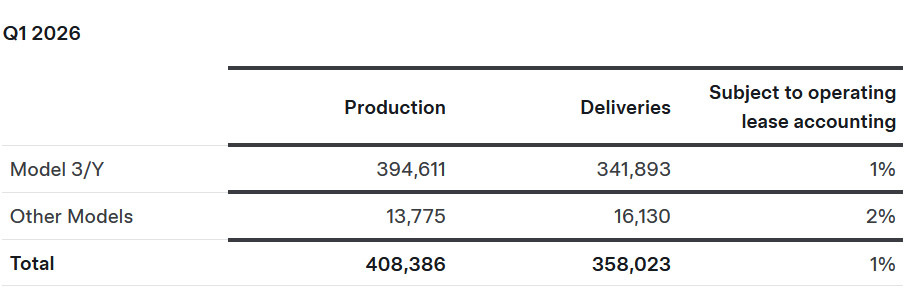
As deliveries softened compared to the previous quarter, the gap between vehicles produced and sold widened to its largest level in four years. Tesla ended the quarter with 408,386 vehicles built, leaving a surplus of 50,363 units in inventory.

Data cited by Business Insider shows this is the largest gap between production and deliveries the company has recorded. That stands out for a business that has typically kept supply and demand closely aligned. The closest comparison comes from the same period in 2024, when production exceeded deliveries by around 46,500 vehicles.

Lower Than Analyst Expectations
 The Gap Between What Tesla Built And What It Sold Just Broke A Company Record

The carmaker began to temper expectations for the first quarter last week, publishing a delivery consensus based on estimates from more than a dozen analysts. This suggests Tesla would end the quarter with 365,645 deliveries, but it fell short of that. Separate estimates from StreetAccount had projected around 370,000 deliveries.

The analysts also predicted Tesla would deploy 14.4 GWh worth of energy storage, but it actually delivered just 8.8 GWh of energy storage products. That figure is also down from 10.4 GWh in Q1 2025 and 14.2 GWh in Q4 2025.

As we’ve come to expect, the Model 3 and Model Y account for the bulk of the company’s sales, with 341,893 finding new homes. The remaining 16,130 vehicles delivered included a mix of the Cybertruck, Semi and the now-discontinued Model S and Model X.
\\\\\\

Tesla’s Third Row Is Back, And It’ll Cost UK Families £12,500 To Get There

  • Brits can now order a seven-seat Tesla Model Y for £54,490.
  • Option is only available on the pricey Long Range AWD trim.
  • Seven-seats are already available in America and in Europe.

The Tesla Model Y is trying to win back big families and maybe a few lost sales rankings too. Tesla has quietly slipped a seven-seat option back into the UK lineup, and it might be just the nudge the crossover needs.

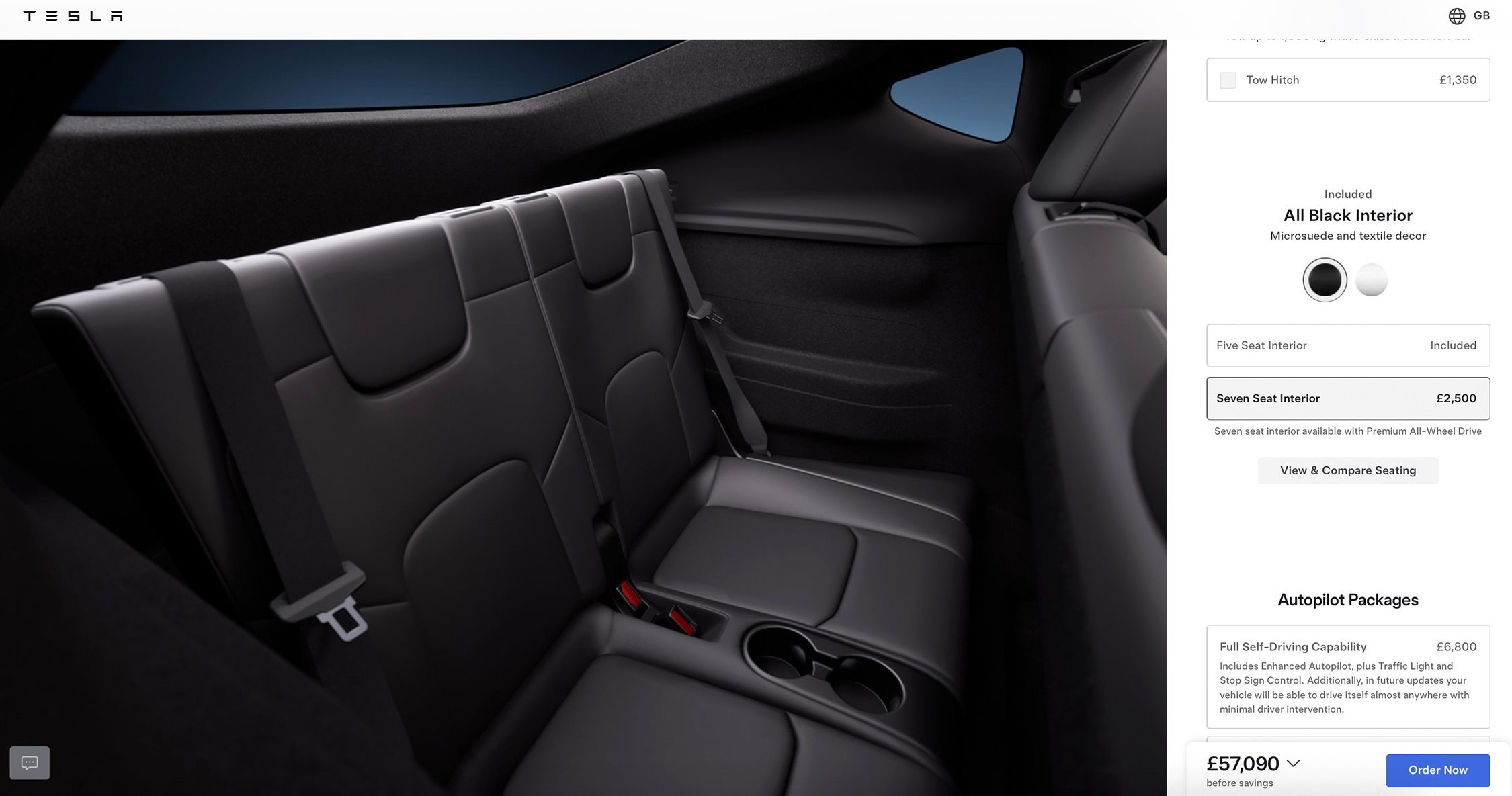
For £54,490 (equal to $68,500 at current rates), buyers get a pair of extra seats tucked neatly into the boot, an option already available in the US and the EU. That is £2,500 ($3,100) more than the regular version, versus $2,500 in the US, but that’s not the real catch. The bummer here is you can only have those extra chairs if you also choose the Long Range All-Wheel Drive model which costs £10k ($12,500) more than the entry-level single-motor SUV.

Related: Jim Farley Promises A New Affordable Ford EV To Take On Tesla’s Model 3 And Y

At least it means you still get plenty of punch to move seven bodies around. Twin motors deliver brisk acceleration, hitting 60 mph (97 kmh) in about 4.6 seconds, which is quicker than most people need when ferrying kids to school.

Tesla’s online configurator shows an identical sprint time for the five-seat version, and also suggests both are rated at 391 miles (630 km) WLTP. But UK websites like Auto Express claim the extra chairs cut the electric range to 372 miles (599 km). Even if that lower number is true, the Model Y would still be among the longest-legged seven-seat electric SUVs.

 Tesla’s Third Row Is Back, And It’ll Cost UK Families £12,500 To Get There

With all seven seats up, there is still room for a couple of carry-on suitcases, plus extra storage in the frunk. Fold the rearmost row flat and the Model Y turns back into a load-lugging champ. But the third row itself is best described as optimistic. Tesla admits it is more suited to children, and the lack of Isofix points limits its usefulness for younger passengers. Still, there are USB-C ports and cupholders, so at least those in the back will not feel entirely forgotten.

Not The Only Seven-Seat EV

This move also drops the Model Y back into the ring with rivals like the Peugeot E-5008 and Mercedes EQB, both of which have been courting family buyers looking for electric practicality with three rows of seats.

The bigger question is whether this is enough to boost Tesla’s fortunes in the UK. The Model Y used to dominate sales charts but slipped out of the top ten in 2025 despite a facelift. Adding two extra seats might not sound revolutionary, but for growing families it could be exactly what was missing.

 Tesla’s Third Row Is Back, And It’ll Cost UK Families £12,500 To Get There

Tesla

Tesla’s Next Model “Way Cooler Than A Minivan”, And That’s All Musk Will Say

  • Elon Musk teased a new Tesla model described as “cooler than a minivan”.
  • Tesla is discontinuing the Model S and Model X by the end of the year.
  • A Cybertruck-derived three-row SUV appeared as a clay model in 2025.

Elon Musk has confirmed that Tesla is working on a new model, and the internet has done what the internet does: immediately begun speculating. The leading theory involves a rugged, three-row SUV inspired by the Cybertruck.

Unless, of course, the big reveal turns out to be the three-row Model Y L recently spotted at Gigafactory Texas, in which case Musk’s gift for generating hype will have once again conjured a drum roll worthy of a stadium concert. Wouldn’t be the first time.

But we digress. On March 24, the Tesla CEO shared a post on X noting that the Cybertruck’s rear bench is large enough to fit three child seats or three adults. A follower then suggested he “make a minivan,” to which Musk replied: “Something way cooler than a minivan is coming.”

More: Tesla Roadster Delayed Again, Weeks Late But Years Behind

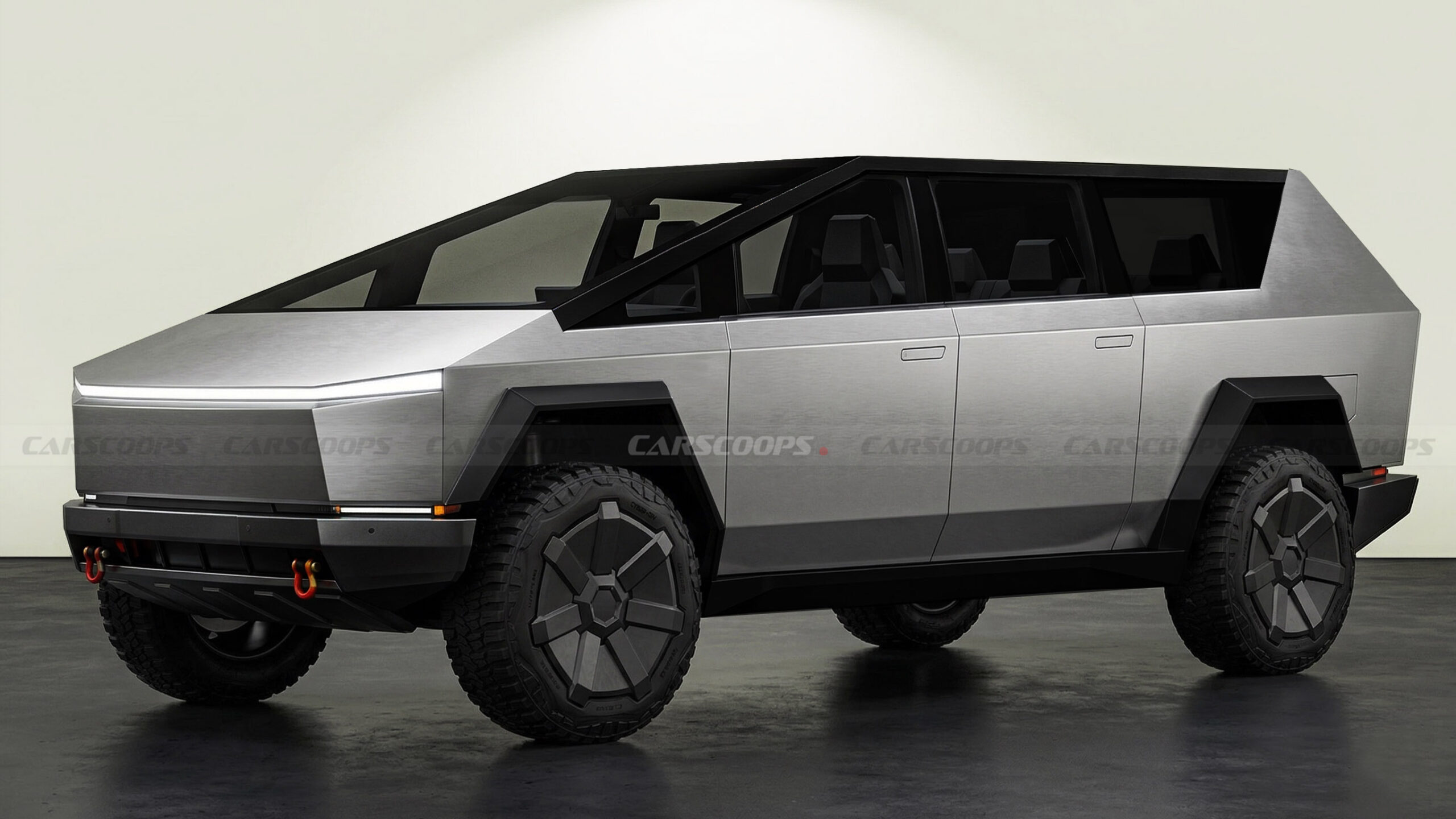
One credible scenario involves what has been dubbed by the internet, the CyberSUV. Back in September 2025, a clay model appeared in the background of an official Tesla video, suggesting a potential SUV sibling to the Cybertruck.

 Tesla’s Next Model “Way Cooler Than A Minivan”, And That’s All Musk Will Say
Our rendering of a Cybertruck-derived SUV (above) based on the clay model from last year (below).
 Tesla’s Next Model “Way Cooler Than A Minivan”, And That’s All Musk Will Say

The mockup featured a redesigned roofline and greenhouse, while the front-end design, full-width LED bar, and flat stainless steel surfacing appeared to carry over from the truck.

The timing matters, too, since Tesla is winding down production of the Model S and Model X this year, leaving a conspicuous gap in its production capacity.

More: Musk Lectures Legacy Brands On Cars, Even As Tesla Drifts Beyond Them

A CyberSUV would be larger and more spacious than the Model Y and Model X, positioning it against full-size SUVs such as the Cadillac Escalade.

Repurposing the Cybertruck platform for an SUV makes strategic sense. Sales of the electric truck are abysmal, given initial expectations, and an SUV twin could help Tesla increase production at Giga Texas while tapping a segment that American buyers never stopped loving. Keeping R&D costs down would be another advantage, particularly if the new model shared its underpinnings along with numerous exterior and interior components with the Cybertruck.

Could It Be A Longer Model Y?

Well this is interesting at Giga Texas today … what do YOU think this is? 🤔😎 pic.twitter.com/U9pLvqbf7L

— Joe Tegtmeyer 🚀 🤠🛸😎 (@JoeTegtmeyer) March 23, 2026

As we mentioned, another possibility is a stretched Model Y heading to North America. Last year, Musk stated that this model wouldn’t enter US production until late 2026, if at all. Footage from outside Gigafactory Texas, however, tells a somewhat different story.

More: Musk Said The U.S. Wouldn’t Get This Tesla. Texas Factory Footage Disagrees

Drone pilot Joe Tegtmeyer captured a large vehicle shell wrapped in blue plastic and sitting inside a wooden crate. Many believe the shell belongs to the Tesla Model Y L, already sold in China with extended bodywork and six-seat seating.

Whether the new Tesla will actually be cooler than a minivan remains to be seen. Hopefully, Tesla will clear up the mystery soon.

Something way cooler than a minivan is coming

— Elon Musk (@elonmusk) March 25, 2026

EV Speed Comes At A Price, So Where’s The Sweet Spot?

  • A Tesla owner performed a series of real range tests in his single-motor Model Y.
  • He drove the same route 30-mile route at 50 mph, 60mph, 70 mph and 80 mph.
  • Going 80 mph vs 50 mph cut time by 38% but dropped range by same amount.

Speed or efficiency? For as long as there have been cars, drivers have had to weigh up that decision. Going faster means getting from A to B sooner, but is going to burn through more fuel, costing you more money.

And now, in the EV age, there are added pressures. Some electric cars are only good for 250 real-world miles (402 km), and BYD’s new 1,500 kW chargers aren’t here yet, meaning that if you need to stop mid-journey you can easily add 15-30 minutes to your trip, more than wiping out the time you saved by flexing your right ankle.

Related: Tesla’s Budget Model Y Gets Grip And Grit For $2K More, But Don’t Call It Standard

So what’s the sweet spot? That’s what one Tesla-owning YouTuber behind the Carwire channel decided to find out by conducting a series of test runs in his single-motor, rear-wheel drive Model Y.

He ran the same 30-mile (50 km) looping route along local multi-lane freeways (dual-carriageways in UK-speak) at 50 mph (81 km/h), 60 mph (96 km/h), 70 mph (113 km/h) and 80 mph (129 km/h), noting the Wh/mile efficiency for each trip.

Taking those numbers and assuming a 75 kWh usable battery capacity, he was able to extrapolate realistic freeway-type range figures, plus a hypothetical time for a 200-mile (302 km) journey based on the time taken to complete each loop at the different speeds. While this isn’t exactly super-scientific, it still delivers a useful comparison that highlights the huge effects different speeds have on efficiency and journey time.

The first loop, taken at a steady 50 mph, would result in 200-mile trip in the Model Y taking four hours. But the excellent 224.7 Wh/mi efficiency gives a calculated 333-mile (536 km) range, meaning you’d get to your destination with stacks of charge to spare.

80 MPH Decimates Range

At the other end of the scale, the 80 mph run crashed efficiency to 366.2 Wh/mi, and the range to just 204 miles (328 km). So while technically you could handle the 200-mile journey in one go, and in only 2 hours and 30 minutes, few people would risk not filling up before they hit the finish line.

The sweet spot, as Carwire concludes, seems to be somewhere between 60 and 70 mph. Bumping the speed up to 60 mph cuts a handy 40 minutes off the 50 mph journey time, yet the 300-mile (483 km) range is only 33 miles (53 km) lower.

Pushing the needle up to 70 mph cuts another half hour from the trip, and though the efficiency starts to tumble the 248-mile calculated range would still let you comfortably complete your 200-mile run without charging, or stressing that you probably ought to.

Speed Versus Time And Efficiency
50 mph60 mph70 mph80 mph
Journey time4 hours3 hours 20 mins2 hours 51 mins2 hours 30 mins
Efficiency224.7 Wh/mi249.9 Wh/mi302.2 Wh/mi366 Wh/mi
Calculated range333 miles300 miles248 miles204 miles
SWIPE

Carwire

Feds Expand Tesla FSD Investigation After Visibility Failures

  • NHTSA upgrades FSD probe to engineering analysis stage.
  • Over 3.2 million Tesla vehicles are included in investigation.
  • FSD may fail to detect vehicles in low visibility conditions

The NHTSA has intensified its scrutiny of Tesla’s Full-Self Driving system, focusing on how it copes when visibility drops. That escalation pushes the probe closer to a potential recall, one that could affect more than 3.2 million vehicles across the United States.

The agency first opened a preliminary evaluation in October 2024 to assess FSD’s ability to detect and respond appropriately in reduced roadway visibility. That probe has now been upgraded to an engineering analysis, which will examine how the vision-only system behaves in adverse conditions and whether it can alert drivers with enough time to react.

Read: Tesla Owners Furious After FSD Transfer Rules Change Again

According to regulators, Tesla developed and implemented a degradation detection system after transitioning to its camera-based vision setup in mid-2021, abandoning radar and other sensors. The company began working on an update to this system in June 2024, following a report of a fatal crash involving one of its vehicles on November 28, 2023

Rain Is FSD’s Enemy

 Feds Expand Tesla FSD Investigation After Visibility Failures

In its preliminary evaluation, the NHTSA began piecing together how Tesla’s Full Self-Driving system behaves in less-than-ideal conditions. The agency learned from Tesla that FSD’s ability to detect and respond to poor road conditions may have contributed to 3 of the 9 incidents identified by the Office of Defects Investigation (ODI).

In the crashes reviewed, the system failed to recognize common roadway conditions that affected camera visibility and did not issue alerts when camera performance degraded until just before impact.

A subsequent review of Tesla’s responses uncovered other crashes that occurred under similar circumstances. In these cases, the FSD system also lost track or “never detected a lead vehicle in its path.” The NHTSA also notes that Tesla says internal data and labeling limitations have prevented a uniform identification and analysis of crash events with the system engaged, meaning there is a possibility of under-reporting crashes.

The probe covers an estimated 3,203,754 Tesla vehicles, including the 2016-2026 Model S and X, 2017-2026 Model 3, 2020-2026 Model Y, and 2023-2026 Cybertruck models equipped with FSD.

 Feds Expand Tesla FSD Investigation After Visibility Failures

Texas PD Tests Model Y To See If Gas SUVs Really Cost Up To $12,000 More A Year

  • Murphy PD in Texas now runs the 2026 Model Y Juniper.
  • Each unit saves $4,100 to $12,000 a year in fuel and upkeep.
  • Its electric drivetrain could double the car’s service life.

The Murphy Police Department in North Texas has become the first agency to roll out the refreshed 2026 Tesla Model Y Patrol, upgraded by Unplugged Performance. Instead of committing to a full fleet replacement, the department is running the EV in real-world conditions to see how it holds up to daily patrol duty.

Officials say the more persuasive case is financial. Each cruiser is projected to deliver measurable savings compared to a traditional ICE-powered patrol vehicle.

More: There’s A New Contender For The World’s Coolest Police Car

According to data from the City of Murphy, projected annual savings per vehicle range from $4,100 for single-officer units to as much as $12,000 for shared-shift cars clocking more than 140 hours per week. The bulk of that comes from eliminating fuel purchases, though the department will still incur electricity costs, along with a 75% reduction in maintenance compared to gasoline vehicles such as the Chevrolet Tahoe and Ford Explorer.

\\\\\\\\

No Idling Wear

The savings story does not stop at fuel and oil changes. EVs do not suffer engine wear from constant idling, which accounts for roughly 60% of a patrol car’s working life. As a result, they are expected to remain in service for up to twice as long as an ICE-powered equivalent.

More: Tesla Cybertruck Joins The Police, May Pull You Over This Year (If It Doesn’t Break Down)

Given that every hour spent idling is effectively equal to 33-35 miles (53-56 km) of driving wear, that difference adds up quickly. Without a combustion engine ticking away under the hood, the Model Y can sit on scene running lights, laptops, and climate control off its battery, without quietly shortening its lifespan.

Juniper Patrol Cars

\\\\\\\\\\\\\\\\\\\\

On the hardware front, the facelifted Tesla Model Y Juniper has been converted into a patrol unit by UP.FIT, the specialized fleet division of Unplugged Performance. Compared to the road-going version, it gains a front push bar, additional LEDs at the front and sides, a roof-mounted siren, and 18-inch forged aluminum wheels wrapped in pursuit-rated tires.

The police car is offered in RWD and AWD configurations, using the standard electric powertrains and delivering between 321-357 miles (517-574 km) of range per charge. That is more than enough for routine duty. And because police work occasionally involves pursuits, braking performance has been upgraded with six-piston calipers, stainless steel brake lines, specialized fluids, thermally upgraded components, and uprated rotors.

More: A Traffic Cop Just Got A 1,001 HP Company Car

Inside, officers get ventilated seats and improved sound insulation. Each vehicle is retrofitted with a customizable center console, a laptop mount, two weapon mounts, upgraded interior lighting, and a single rear prisoner partition.

Optional extras include ballistic protection for the front doors and custom reflective graphics.

UP.FIT has not disclosed the final MSRP for the Murphy units, though it insists the total cost of ownership undercuts everything else in the segment. Beyond the Model Y crossover, the company also offers police-ready conversions for the Cybertruck, Model S/X, and Model 3, in case your local department prefers its patrol cars in a different shape.

\\\\\

UP.FIT / Unplugged Performance

❌
❌