Normal view

There are new articles available, click to refresh the page.
Before yesterdayMain stream

The Gap Between What Tesla Built And What It Sold Just Broke A Company Record

  • Tesla grew Q1 deliveries year over year, but missed analyst expectations.
  • Production outpaced sales, creating the largest inventory gap in years.
  • Shares dropped more than 4 percent after the company’s delivery report.

Tesla’s global sales edged up in the first quarter of 2026, but that did little to calm investors. Despite the increase, the company’s production and delivery figures sent shares down more than 5 percent on Thursday, marking their sharpest drop of the year. The stock is now down about 20 percent in 2026.

Read: Tesla’s Sales Collapsed By Nearly 90% In The Land Of EVs

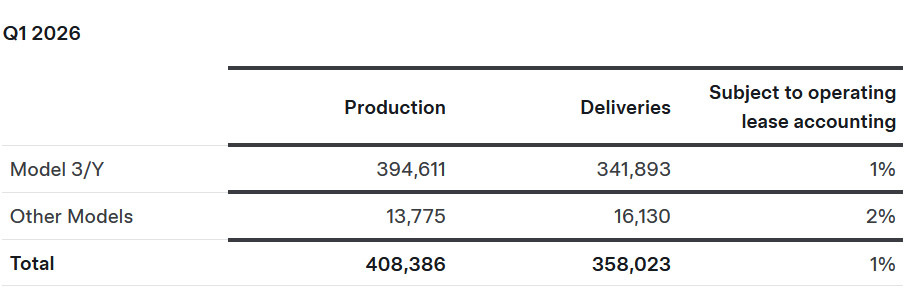
In total, Tesla sold 358,023 vehicles worldwide in Q1 2026. That marks a 6 percent increase over the same quarter last year, when it delivered 336,681 vehicles. The bigger contrast comes against the previous quarter. Deliveries are down 14.3 percent from the 418,227 vehicles handed over in Q4 2025.

US Sales Range Estimates

The company has not released a detailed breakdown for the US, but estimates from Autonews and Cox Automotive put first-quarter deliveries somewhere between 110,000 and 122,196 units. That range points to a decline of roughly 4.6 percent to 15 percent in its home market, depending on where the final number lands.

According to Morningstar analyst Seth Goldstein, there are two key reasons to explain why sales fell.

“Tesla’s first-quarter deliveries reflect the U.S. tax credit expiration as well as FSD ​not yet being approved in the EU,” he told Reuters. “These factors will likely continue to weigh on deliveries until Tesla gets EU approval and until we enter the fourth quarter in the U.S.”
 The Gap Between What Tesla Built And What It Sold Just Broke A Company Record

As deliveries softened compared to the previous quarter, the gap between vehicles produced and sold widened to its largest level in four years. Tesla ended the quarter with 408,386 vehicles built, leaving a surplus of 50,363 units in inventory.

Data cited by Business Insider shows this is the largest gap between production and deliveries the company has recorded. That stands out for a business that has typically kept supply and demand closely aligned. The closest comparison comes from the same period in 2024, when production exceeded deliveries by around 46,500 vehicles.

Lower Than Analyst Expectations
 The Gap Between What Tesla Built And What It Sold Just Broke A Company Record

The carmaker began to temper expectations for the first quarter last week, publishing a delivery consensus based on estimates from more than a dozen analysts. This suggests Tesla would end the quarter with 365,645 deliveries, but it fell short of that. Separate estimates from StreetAccount had projected around 370,000 deliveries.

The analysts also predicted Tesla would deploy 14.4 GWh worth of energy storage, but it actually delivered just 8.8 GWh of energy storage products. That figure is also down from 10.4 GWh in Q1 2025 and 14.2 GWh in Q4 2025.

As we’ve come to expect, the Model 3 and Model Y account for the bulk of the company’s sales, with 341,893 finding new homes. The remaining 16,130 vehicles delivered included a mix of the Cybertruck, Semi and the now-discontinued Model S and Model X.
\\\\\\

Tesla’s Next Model “Way Cooler Than A Minivan”, And That’s All Musk Will Say

  • Elon Musk teased a new Tesla model described as “cooler than a minivan”.
  • Tesla is discontinuing the Model S and Model X by the end of the year.
  • A Cybertruck-derived three-row SUV appeared as a clay model in 2025.

Elon Musk has confirmed that Tesla is working on a new model, and the internet has done what the internet does: immediately begun speculating. The leading theory involves a rugged, three-row SUV inspired by the Cybertruck.

Unless, of course, the big reveal turns out to be the three-row Model Y L recently spotted at Gigafactory Texas, in which case Musk’s gift for generating hype will have once again conjured a drum roll worthy of a stadium concert. Wouldn’t be the first time.

But we digress. On March 24, the Tesla CEO shared a post on X noting that the Cybertruck’s rear bench is large enough to fit three child seats or three adults. A follower then suggested he “make a minivan,” to which Musk replied: “Something way cooler than a minivan is coming.”

More: Tesla Roadster Delayed Again, Weeks Late But Years Behind

One credible scenario involves what has been dubbed by the internet, the CyberSUV. Back in September 2025, a clay model appeared in the background of an official Tesla video, suggesting a potential SUV sibling to the Cybertruck.

 Tesla’s Next Model “Way Cooler Than A Minivan”, And That’s All Musk Will Say
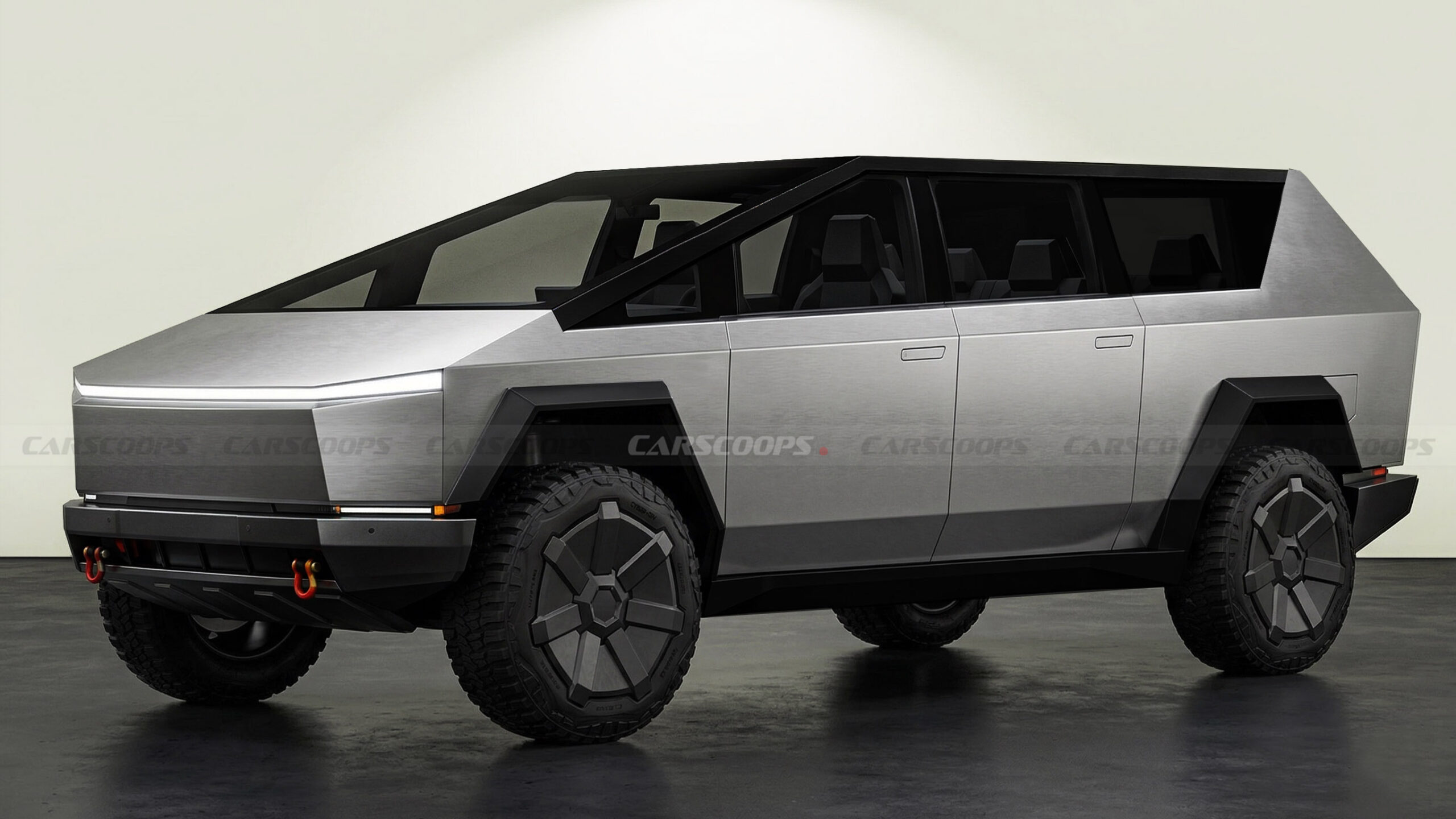
Our rendering of a Cybertruck-derived SUV (above) based on the clay model from last year (below).
 Tesla’s Next Model “Way Cooler Than A Minivan”, And That’s All Musk Will Say

The mockup featured a redesigned roofline and greenhouse, while the front-end design, full-width LED bar, and flat stainless steel surfacing appeared to carry over from the truck.

The timing matters, too, since Tesla is winding down production of the Model S and Model X this year, leaving a conspicuous gap in its production capacity.

More: Musk Lectures Legacy Brands On Cars, Even As Tesla Drifts Beyond Them

A CyberSUV would be larger and more spacious than the Model Y and Model X, positioning it against full-size SUVs such as the Cadillac Escalade.

Repurposing the Cybertruck platform for an SUV makes strategic sense. Sales of the electric truck are abysmal, given initial expectations, and an SUV twin could help Tesla increase production at Giga Texas while tapping a segment that American buyers never stopped loving. Keeping R&D costs down would be another advantage, particularly if the new model shared its underpinnings along with numerous exterior and interior components with the Cybertruck.

Could It Be A Longer Model Y?

Well this is interesting at Giga Texas today … what do YOU think this is? 🤔😎 pic.twitter.com/U9pLvqbf7L

— Joe Tegtmeyer 🚀 🤠🛸😎 (@JoeTegtmeyer) March 23, 2026

As we mentioned, another possibility is a stretched Model Y heading to North America. Last year, Musk stated that this model wouldn’t enter US production until late 2026, if at all. Footage from outside Gigafactory Texas, however, tells a somewhat different story.

More: Musk Said The U.S. Wouldn’t Get This Tesla. Texas Factory Footage Disagrees

Drone pilot Joe Tegtmeyer captured a large vehicle shell wrapped in blue plastic and sitting inside a wooden crate. Many believe the shell belongs to the Tesla Model Y L, already sold in China with extended bodywork and six-seat seating.

Whether the new Tesla will actually be cooler than a minivan remains to be seen. Hopefully, Tesla will clear up the mystery soon.

Something way cooler than a minivan is coming

— Elon Musk (@elonmusk) March 25, 2026

The Cybertruck Nobody Wanted New Is Now The One Nobody Wants Used

  • The Cybertruck Long Range RWD was only built for a limited time last year.
  • This pickup has a single electric motor and a 123 kWh battery pack.
  • Tesla lowered the Cybertruck’s towing capacity from 11,000 lbs to 7,500 lbs.

The Tesla Cybertruck’s Long Range RWD variant was short-lived, produced for less than six months, yet that rarity has done little to shield it from steep depreciation. Just look at this 2025 example, which recently changed hands for just $56,500.

Tesla introduced the Cybertruck Long Range RWD last year, pricing it from $69,990 and undercutting the All-Wheel Drive model by $10,000. However, it never proved particularly popular as Tesla cut out some important features to achieve the somewhat more approachable price tag.

 The Cybertruck Nobody Wanted New Is Now The One Nobody Wants Used

To get there, Tesla stripped back more than just an electric motor. The front axle is left unpowered, and buyers also miss out on a powered tonneau cover, 120/240V outlets, and the premium 15-speaker sound system, replaced here by a basic seven-speaker setup. The interior takes another step down with textile seats instead of leather and no rear touchscreen.

Capability takes a hit too. Towing drops from 11,000 lbs (4,989 kg) to 7,500 lbs (3,401 kg), while payload falls from 2,500 lbs (1,133 kg) to 2,006 lbs (910 kg). It’s a long list, and not the kind that quietly disappears once you’ve signed the paperwork.

Read: New Video Shows Tesla Nearly Going Off Overpass With Mom And Baby Inside

With this in mind, it’s perhaps no surprise that demand for used examples isn’t particularly strong. This Cybertruck was sold on Cars & Bids earlier this week, falling well short of its original price tag of $73,490, which included optional $3,500 20-inch Cyber wheels with 35-inch tires.

The Least Desirable Cybertruck?

\\\\\\\\

Cars & Bids

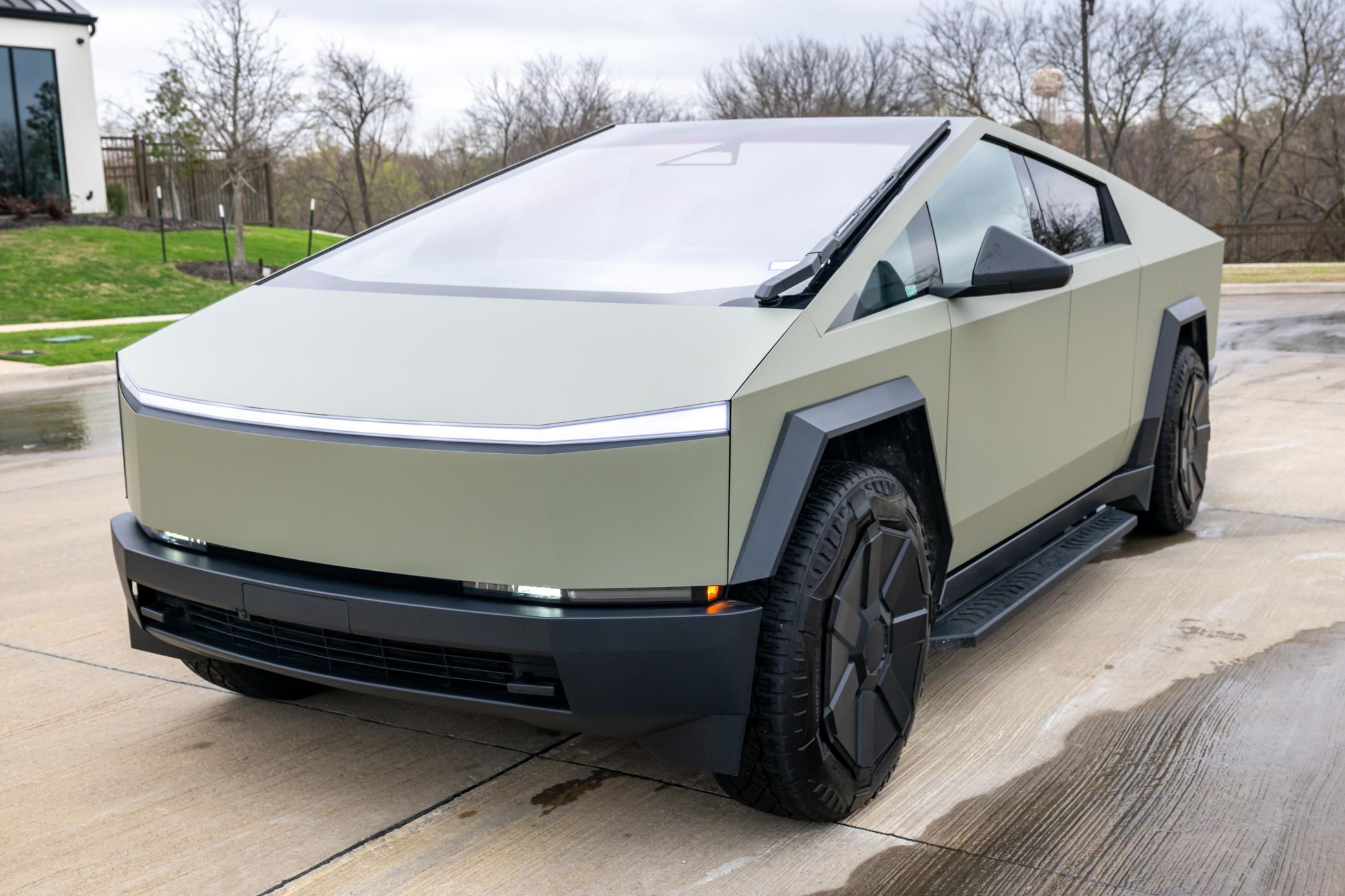
The fact that the owner also spent several thousand dollars to wrap the truck in Halo Green, add aftermarket side steps, and fit leather seat covers doesn’t seem to have boosted interest. It has just 5,800 miles (9,334 km) on the clock, which should have helped its value, but clearly hasn’t made much difference.

There is, at least, one clear strength. The RWD Long Range model carries a sizeable 123 kWh battery pack, giving it the best range of any Cybertruck at an EPA-rated 350 miles (563 km). That should be a headline advantage. Still, pairing that range with a rear-wheel-drive setup in a pickup limits how useful it feels in the real world, especially for buyers who expect capability to match the look.

In the end, this version lands in an awkward middle ground. It is cheaper, yet not cheap enough. It goes farther, yet gives up too much along the way. And in a segment where image and ability matter just as much as numbers, that balance does not seem to be working.

\\\\\\\\\\\\\\\\\\

Cars & Bids

Feds Expand Tesla FSD Investigation After Visibility Failures

  • NHTSA upgrades FSD probe to engineering analysis stage.
  • Over 3.2 million Tesla vehicles are included in investigation.
  • FSD may fail to detect vehicles in low visibility conditions

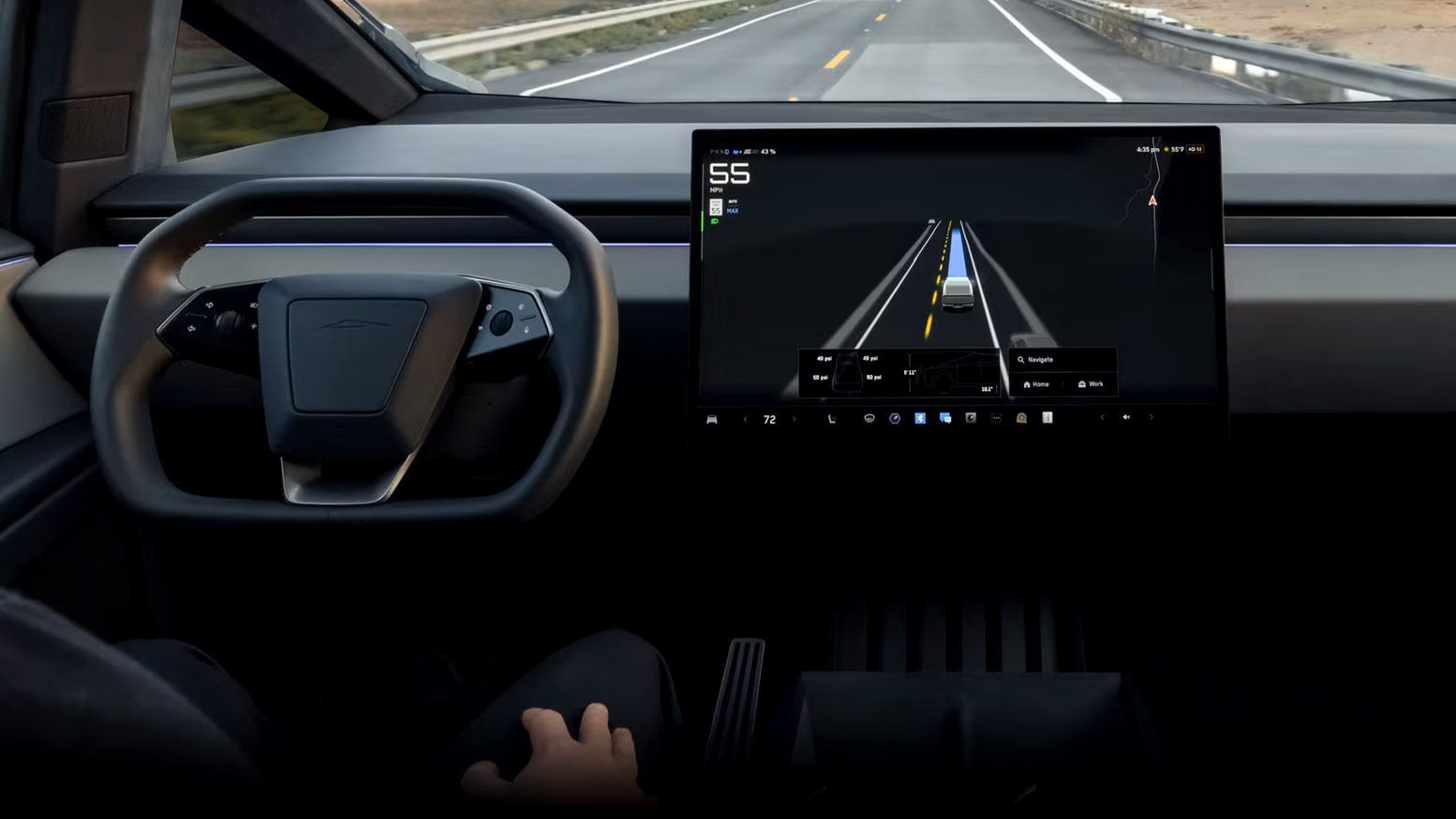
The NHTSA has intensified its scrutiny of Tesla’s Full-Self Driving system, focusing on how it copes when visibility drops. That escalation pushes the probe closer to a potential recall, one that could affect more than 3.2 million vehicles across the United States.

The agency first opened a preliminary evaluation in October 2024 to assess FSD’s ability to detect and respond appropriately in reduced roadway visibility. That probe has now been upgraded to an engineering analysis, which will examine how the vision-only system behaves in adverse conditions and whether it can alert drivers with enough time to react.

Read: Tesla Owners Furious After FSD Transfer Rules Change Again

According to regulators, Tesla developed and implemented a degradation detection system after transitioning to its camera-based vision setup in mid-2021, abandoning radar and other sensors. The company began working on an update to this system in June 2024, following a report of a fatal crash involving one of its vehicles on November 28, 2023

Rain Is FSD’s Enemy

 Feds Expand Tesla FSD Investigation After Visibility Failures

In its preliminary evaluation, the NHTSA began piecing together how Tesla’s Full Self-Driving system behaves in less-than-ideal conditions. The agency learned from Tesla that FSD’s ability to detect and respond to poor road conditions may have contributed to 3 of the 9 incidents identified by the Office of Defects Investigation (ODI).

In the crashes reviewed, the system failed to recognize common roadway conditions that affected camera visibility and did not issue alerts when camera performance degraded until just before impact.

A subsequent review of Tesla’s responses uncovered other crashes that occurred under similar circumstances. In these cases, the FSD system also lost track or “never detected a lead vehicle in its path.” The NHTSA also notes that Tesla says internal data and labeling limitations have prevented a uniform identification and analysis of crash events with the system engaged, meaning there is a possibility of under-reporting crashes.

The probe covers an estimated 3,203,754 Tesla vehicles, including the 2016-2026 Model S and X, 2017-2026 Model 3, 2020-2026 Model Y, and 2023-2026 Cybertruck models equipped with FSD.

 Feds Expand Tesla FSD Investigation After Visibility Failures

New Video Shows Tesla Nearly Going Off Overpass With Mom And Baby Inside

  • Texas lawsuit says Tesla FSD steered a Cybertruck into barrier.
  • Driver says the system aimed straight at a concrete divider.
  • The crash allegedly caused spinal injuries and wrist damage.

Update: There’s now video of the Houston Cybertruck crash. Footage shared by Hilliard Law, which represents the woman in the lawsuit, shows the electric truck, reportedly operating in self-driving mode, failing to follow a right-hand curve and continuing straight toward an overpass barrier. The driver attempts to intervene, but it is already too late, and the impact is severe. She is now suing Tesla for $1 million, alleging the system did not perform as promised.

'TERRIFYING': Dashcam video shows the moment a Tesla Cybertruck, allegedly operating in self-driving mode, nearly sent a Houston mom and her infant off a bridge before violently crashing into an overpass barrier.

The woman claims she suffered multiple injuries from the incident… pic.twitter.com/DgcnHp2FtZ

— Fox News (@FoxNews) March 17, 2026

Tesla’s Full-Self Driving (Supervised) system has placed advanced semi-autonomous capability in the hands of thousands of owners across the United States. The technology remains one of the most closely watched developments in the industry. Yet despite its promise, the system is still far from flawless, and according to a recent lawsuit filed against Tesla, it can also be dangerous.

The suit, filed in Harris County Court in Houston, Texas, alleges that Tesla Cybertruck owner Justine Saint Amour was using the FSD system in August last year while traveling along the 69 Eastex Freeway. As the electric pickup approached a Y-shaped junction near the Houston Metro 256 Eastex Park & Ride, the vehicle’s onboard systems should have followed the right-hand curve of the freeway.

FSD Navigation Error Alleged

Instead, the lawsuit claims the Tesla attempted to continue straight ahead toward a concrete barrier. The driver reportedly took control just before impact but was unable to avoid the obstacle, with the Cybertruck striking the barrier head-on. A 1-year-old child was also in the back seat at the time but was not injured.

Read: Tesla On FSD Suddenly Swerves And Crashes Into A Tree, Claims Driver

The impact reportedly left the woman with two herniated discs in her lower back, a herniated disc in her neck, sprained wrist tendons, and neuropathy. Chron reports that dashcam footage captured the crash, showing the Cybertruck attempting to negotiate the curve at the interchange but ultimately hitting the barriers.

\\\\\\\

Camera Only System Criticized

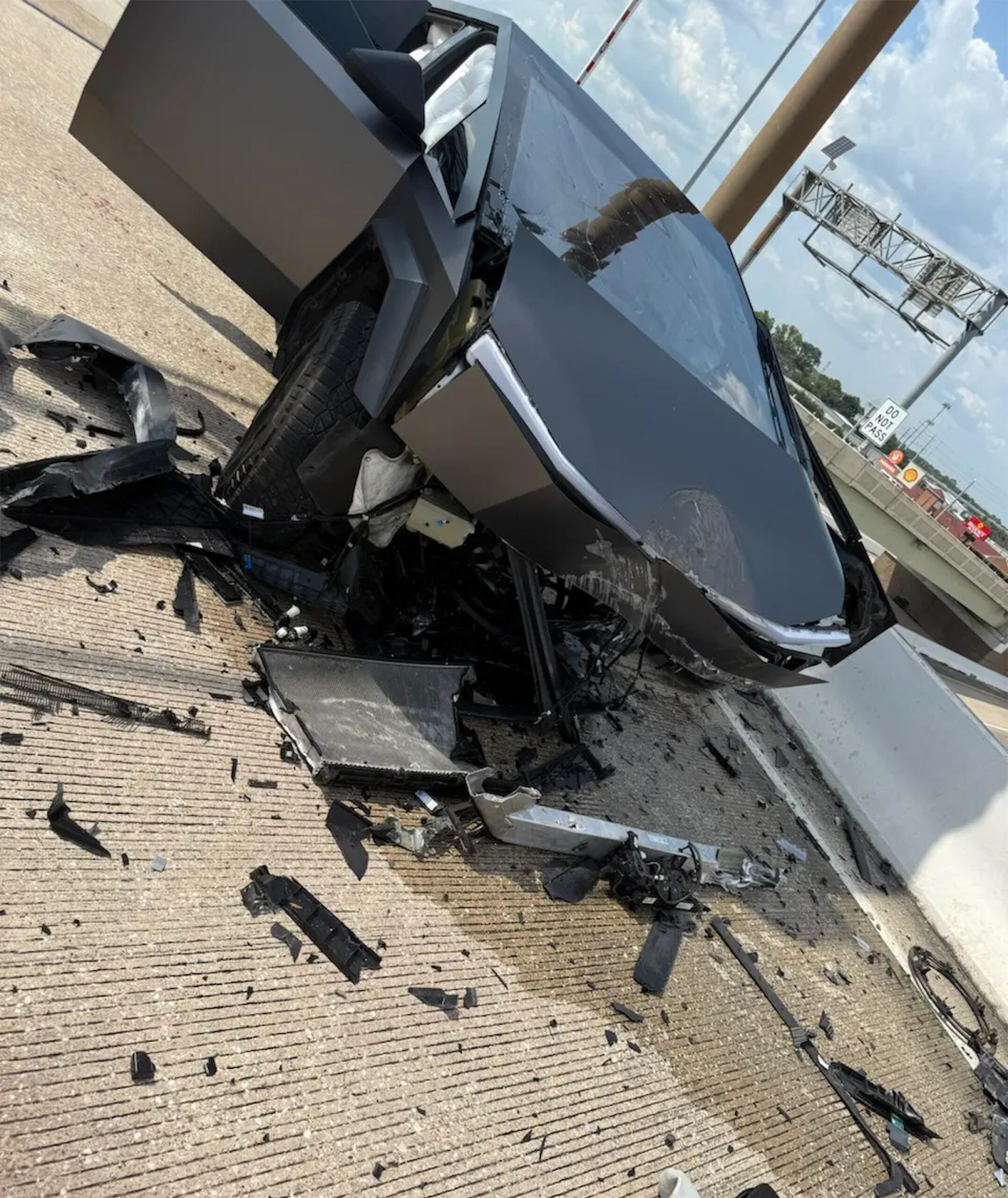
An image taken after the crash shows that the front of the blacked-out Cybertruck took a serious hit, and that the front bumper shattered, leaving pieces of bodywork strewn across the road.

The lawsuit further alleges that Tesla’s decision to rely exclusively on a camera-based system for its self-driving technology, rather than incorporating radar or LiDAR sensors, contributed to the crash. It also claims Elon Musk is “an aggressive and irresponsible salesman” with a history of “making dangerous design choices.”

“Tesla’s decisions made Justine’s accident inevitable,” Saint Amour’s lawyer, Bob Hilliard, told Chron. “This company wants drivers to believe and trust their life on a lie: that the vehicle can self-drive and that it can do so safely. It can’t, and it doesn’t.”

The lawsuit accuses Tesla of negligence and seeks more than $1 million in damages.

 New Video Shows Tesla Nearly Going Off Overpass With Mom And Baby Inside
Hilliard Law Firm
❌
❌