Lucid’s second Gravity recall stems from a supplier change no one approved.
A seatbelt anchor weld falls short of federal safety requirements in most SUVs.
Affected owners will have their seats repaired or replaced at no charge.
Just a few months after the Lucid Gravity was recalled over seat covers that could prevent the airbag from functioning properly, the electric luxury SUV has been recalled yet again. This time, it’s due to a potential defect in the second-row seatbelt anchors.
The EV maker says that during internal tests for another issue, it discovered the outboard lap belt anchor bracket weld in the second row is shorter than it should be and not positioned correctly. The reason? Lucid says seat manufacturer Camaco made a change to the manufacturing process without notifying the company or obtaining its approval.
Vehicles with an insufficiently welded lap belt anchor fail to comply with Federal Motor Vehicle Safety Standards and may increase the risk of injury in a crash. Unlike December’s recall, which impacted just 66 vehicles, this one is much more widespread.
In fact, the recall involves 4,476 Lucid Gravity models built from December 2, 2024, to February 3, 2026, and listed as 2025-2026 model year vehicles. Of these, 97 percent are estimated to have the issue.
What Happens Next?
This recall comes shortly after Lucid issued a brief stop-sale for the Gravity earlier this year as it ran tests to determine whether the seat belts could meet safety standards with or without a reinforcing bracket. Even with a bracket, they failed to meet load requirements, prompting Lucid to ensure the components sourced from Camaco meet its standards.
Lucid will start informing its owners of the recall on May 22. Dealers will inspect impacted vehicles, and if a non-conforming weld is found, it will be repaired with either a reinforcing bracket and adhesive or, if necessary, the entire seat will be replaced free of charge.
BMW’s iX3 took home two trophies at the 2026 World Car Awards.
Lucid’s Gravity SUV beat the Cadillac Vistiq for a major global title.
Gas-powered cars didn’t win a single category at this year’s event.
Electric vehicles have dominated the World Car Awards as they’ve won every single category this year. This is hardly surprising as many of the finalists were EVs, but it likely won’t alleviate criticism.
Top honors went to the BMW iX3 which was named 2026 World Car of the Year as well as World Electric Vehicle. In the former category, it beat out the redesigned Hyundai Palisade and Nissan Leaf. The Leaf was also up for being named World Electric Vehicle, but it and the Mercedes CLA lost to the German crossover.
Speaking of luxury brands, the Lucid Gravity was named World Luxury Car. The electric crossover, which offers up to 450 miles (724 km) of range, bested the Cadillac Vistiq and Volvo ES90.
That brings us to the most controversial award, which is World Performance Car. Here, the Hyundai Ioniq 6 N beat the BMW M2 CS and Chevrolet Corvette E-Ray.
While a 641 hp (478 kW / 650 PS) Hyundai is certainly impressive, is it really more of a performance car than a 523 hp (390 kW / 530 PS) coupe that accelerates from 0-60 mph (0-96 km/h) in 3.7 seconds and laps the Nordschleife in 7:25.534? The E-Ray, on the other hand, has all-wheel drive, an EV-only mode, and a combined output of 655 hp (488 kW / 664 PS).
Since you’re probably still stewing over that, we’ll finish up with the two categories little care about. World Urban Car went to the Nio Firefly, which beat out the Hyundai Venue as well as the Baojun Yep Plus / Chevrolet Spark EUV.
There’s also World Car Design of the Year, which was apparently decided by Mr. Magoo. The Mazda 6e / EZ-6 took home the prize as it won over the Kia PV5 and Volvo ES90. None of them are particularly pretty, but the 6e isn’t too shabby and the finalists were chosen by a design panel of people you’ve probably never heard of before.
The Air Dream Edition Performance carried a hefty $170,500 MSRP.
After 22,000 miles, the depreciation works out to nearly $5 per mile.
Despite that, the luxury EV still sprints to 60 mph in just 2.5 seconds.
Luxury EVs have developed a nasty reputation for losing value at a frightening rate over the past few years, especially in the upper end of the market. However, you may be surprised to learn just how much this Lucid Air has depreciated since it was delivered in March of 2022.
The Air you’re looking at is the Dream Edition Performance, which was introduced as the flagship iteration of the all-electric sedan. With the exception of the almighty Sapphire, it’s the highest-powered version of the Air that’s been sold, thumping out a ridiculous 1,111 hp and 1,025 lb-ft of torque.
A look at the window sticker reveals the original owner paid $170,500 for the car. Given the performance it offers, the sleek exterior styling, and the upmarket interior, that’s not an unreasonable amount of money. But, after being driven 22,000 miles (35,000 km) over the past four years, the car’s value has plummeted, recently selling for $67,067 in Cars & Bids.
A Six Figure EV Bargain
Cars & Bids
The result is a staggering $103,433 wiped off the price. Spread across the 22,000 miles it covered, that works out to just under $5 lost for every mile driven.
For a sense of scale, that drop would cover a substantial chunk of a home in some US states. Bankrate data puts the median house price at about $282,400 in Alabama, $255,300 in Arkansas, $285,600 in Illinois, $230,600 in Iowa, $301,000 in Pennsylvania, and $249,300 in Michigan, to name a few. In other words, the money lost on this one car equals well over a third of a typical home in those places.
While it’s hard not to feel bad for the original owner, it’s nice to see a car as good as the Air becoming more accessible. The listing reveals the performance sedan has been fastidiously maintained over the past four years, and has had several parts replaced and numerous recall campaigns completed.
Cars & Bids
Off the line, the Air Dream Edition Performance can hit 60 mph (96 km/h) in just 2.5 seconds and storm down the quarter-mile in 9.9 seconds. Thanks to the sizeable 118 kWh battery pack, it can also travel up to 451 miles on a charge when equipped with the 21-inch wheels like this one.
Then there’s the cabin. While the Air may often be compared to the Tesla Model S, its interior is more luxurious and better equipped. Key features include Nappa full-grain leather upholstery, heated and ventilated front massage seats, a 34-inch infotainment and gauge cluster display, and a 21-speaker sound system. This Air also includes the Santa Monica interior trim, combining dark blue and light cream-colored leather.
Bad news for the first owner, great news for the next one. So the question is, would you buy a used Lucid Air knowing just how quickly these things depreciate?
The Gravity Dream Edition packs 1,070 hp and 909 lb-ft.
Early resale prices show the luxury EV losing value quickly.
The base version starts under $80,000 with 560 hp.
If you were among those who rushed to buy a new Lucid Gravity, you may want to look away now. Early resale results can reveal a lot about how the market values a new model. A flagship Dream Edition with just 3,500 miles (5,632 km) has sold for $96,000, nearly $46,000 below its original MSRP, offering a clear snapshot of how buyers currently price the SUV on the used market.
There’s a lot to like about the Gravity, particularly the Dream Edition model. It features a 123 kWh battery pack, four electric motors, and a combined 1,070 hp and 909 lb-ft of torque. Does anyone need an SUV with this much power? No, but being able to hit 60 mph (96 km/h) in 3.1 seconds and storm down the quarter-mile in 10.6 seconds in a luxury SUV is still pretty cool.
The Dream Edition is also equipped with all the luxury features you could ever want, including the Comfort and Convenience Package, which adds soft-close doors and power rear window shades, alongside an AR HUG, dynamic ambient lighting, and Nappa leather upholstery and seats with heated, ventilated, and massaging functions.
Cars & Bids
Perhaps the biggest downside of the Dream Edition is the cost. In the US, it has an MSRP of $141,550, including destination charges, which feels like a lot, particularly given that the entry-level Gravity Touring with 560 hp is available from just $79,900.
Sure, it has roughly half the power, but most of the same features. Additionally, the 828-hp Gravity Grand Touring starts at $94,900, and also seems like a relatively bargain compared to the Dream Edition.
As the Cars & Bids auction shows, depreciation has been significant. This particular example was registered in early December and driven just 3,500 miles, yet it lost $45,550 in value. That works out to roughly $13 lost for every mile driven.
Lucid adds CarPlay and Android Auto to Gravity via OTA update.
New Gravity models get it standard, and the Air already has it.
The update addresses a long running request from many owners.
Every automaker has its own take on how infotainment should work. Android Auto and Apple CarPlay make that experience far more uniform. Up until now, though, Lucid Gravity owners haven’t had access to either. Now, a big software update is coming, and it’ll remedy the situation for the luxury SUV owners.
The update is part of the latest version of Lucid’s software, and it allows drivers to connect their phones to access navigation, music, messages, and apps directly through the vehicle’s infotainment display. Both wireless and wired connections are supported, depending on the device. According to Lucid, the rollout begins in North America first, with other markets expected to follow shortly after.
CarPlay And Android Auto Arrive
The addition of smartphone mirroring may seem like a small update, but it’s a big deal for owners. Apple CarPlay and Android Auto are among the most requested features in modern vehicles, and their absence has been a frequent complaint from Lucid customers despite the company’s otherwise advanced software system.
“Apple CarPlay and Android Auto are two of the most sought-after features by our customers,” said Emad Dlala, SVP of Engineering and Software at Lucid. “We are now providing a seamless connection between mobile devices and the Lucid Gravity. We’re excited to introduce these features to Lucid Gravity, which now offers even greater comfort and convenience for owners.”
From here on, every new Gravity leaving the factory will include Apple CarPlay and Android Auto as standard equipment. The Air sedan already lists both systems on its infotainment menu, so the SUV was the obvious next step.
Do Older Gravity Models Get It?
Yes, existing Gravity owners will receive the capability through the OTA update without needing to visit a dealer. This is a key selling point for the brand; not just these pieces of software themselves, but the ability to update the car.
According to Lucid, more than 95 percent of the vehicle’s functions can be refined or expanded through over-the-air updates. Put another way, it hopes to consistently introduce new capabilities without hardware changes. This move will no doubt add value to potential buyers.
Lucid previewed a midsize EV platform for models under $50K.
Cosmos and Earth lead the lineup, with more variants ahead.
The new architecture is central to lowering EV production costs.
Lucid’s investor day made a serious splash in several ways. The automaker confirmed that autonomy subscriptions are coming, it’s kicking off a robotaxi program, and it’s launching Android Auto and Apple CarPlay. None of that might be as immediately impactful as the new revelations concerning the brand’s midsize platform and the cars it’ll spawn.
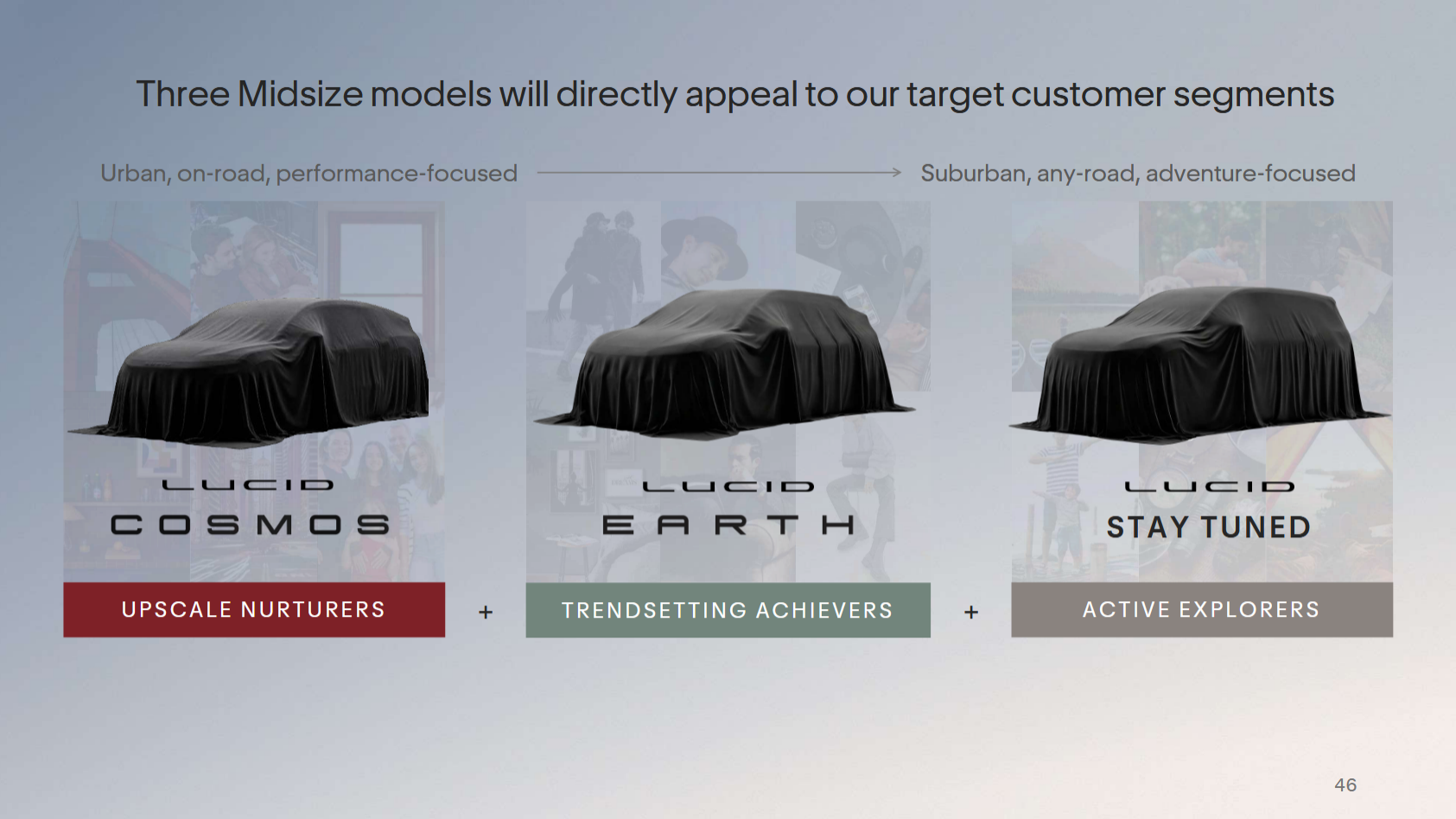
According to Lucid, the midsize platform will support several vehicles. That was already known. What we didn’t know was just about everything else. The first two cars on this platform will be named the Cosmos and the Earth. Both will sit below the Gravity and Air in terms of lineup position and pricing. A third model will come online later, though there are no details on its name just yet.
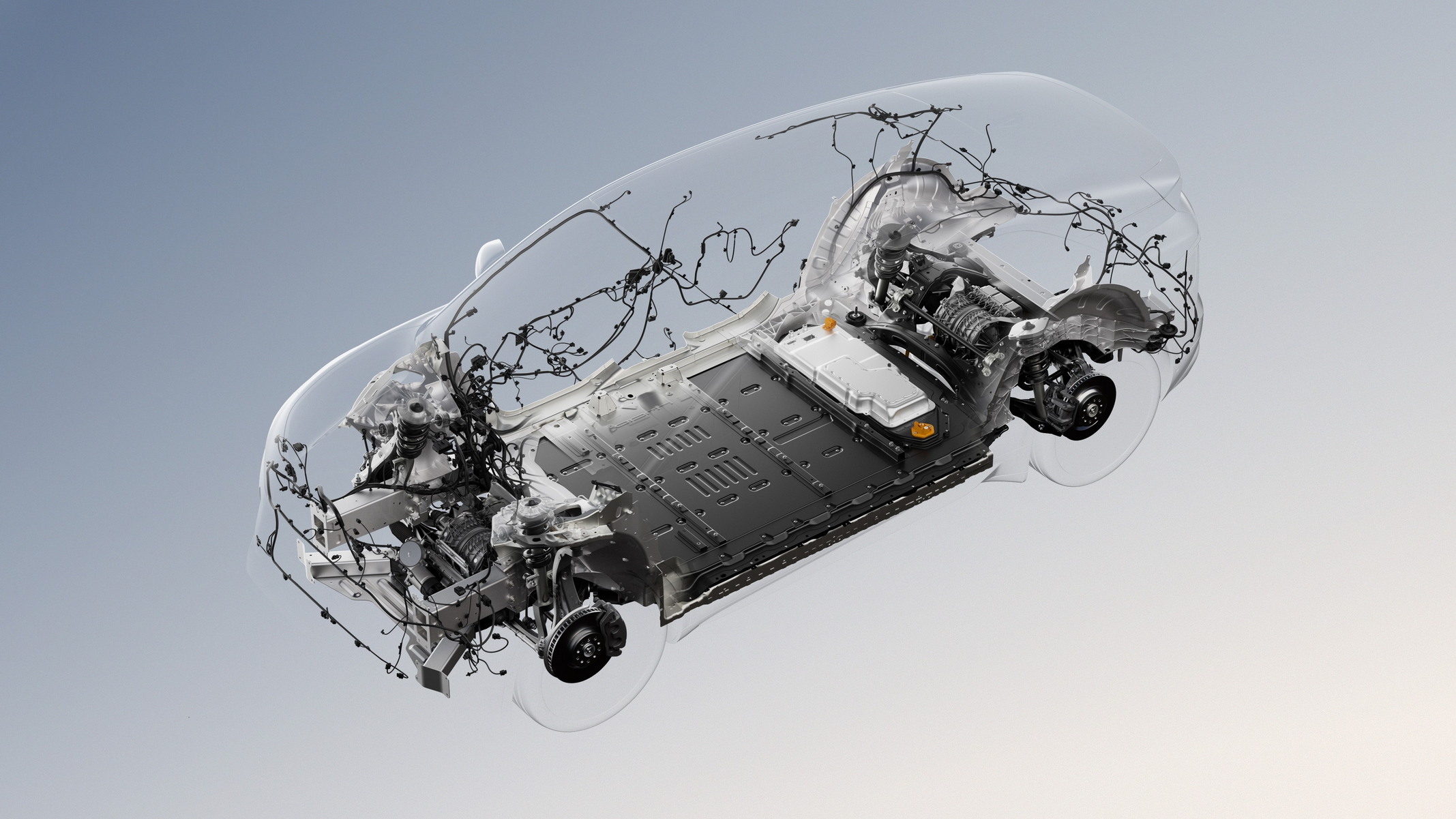
Lucid says the new platform keeps the same core philosophy as its current cars. That means high efficiency, strong performance, and lots of interior space, but with a much greater focus on cost reduction. Engineers redesigned the vehicle architecture to use fewer parts, smaller battery packs, and simpler manufacturing processes, all of which should lower production costs while maintaining range and performance.
Atlas Electric Drive Unit
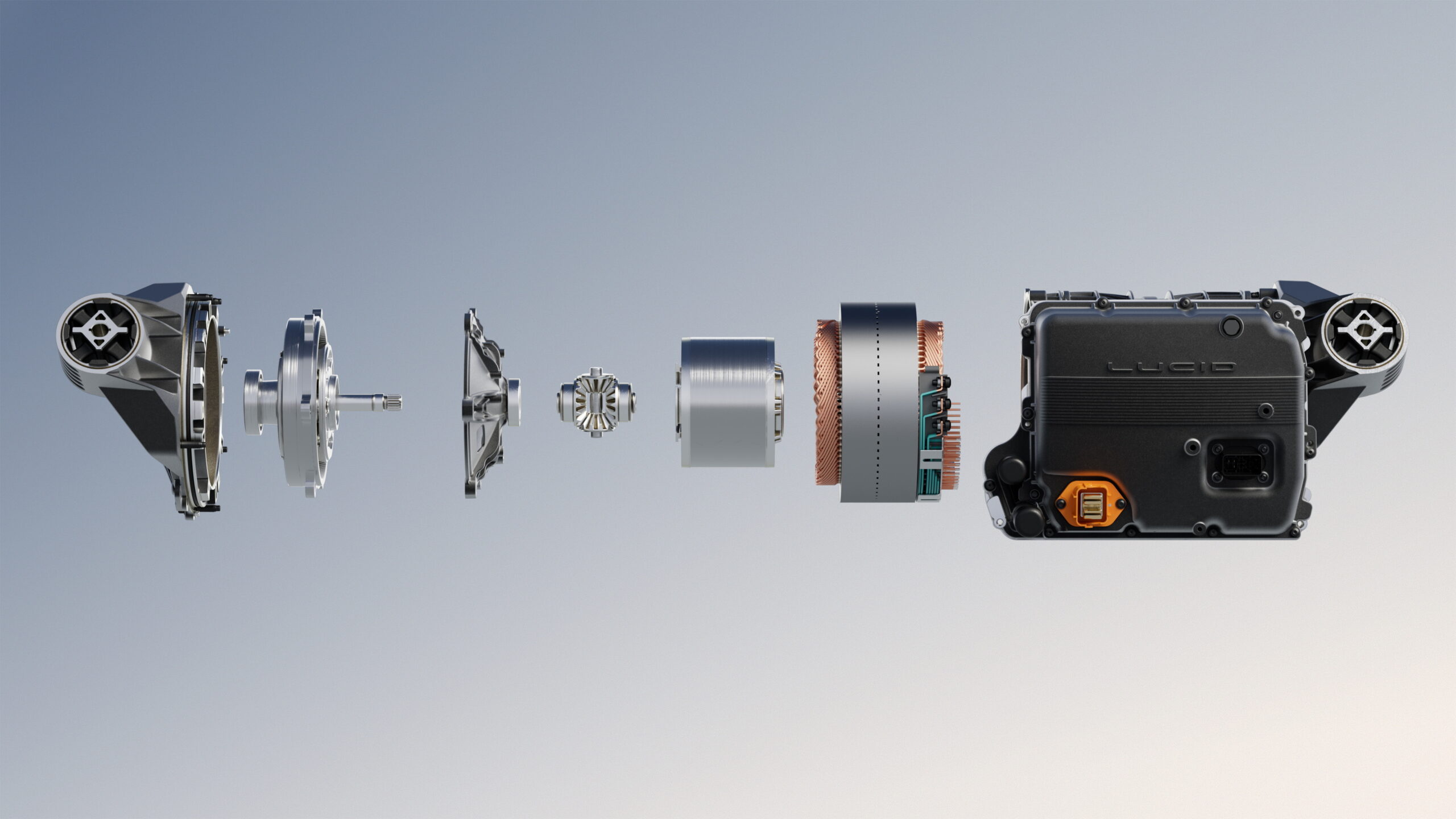
One of the biggest changes is a new electric drive unit called Atlas, which Lucid says is smaller, lighter, and cheaper to build than the current motor used in the Air and Gravity. The company claims the design has more than 30 percent fewer parts and significantly lower material cost, helping reduce the overall price of future vehicles.
Battery size is another area where Lucid expects savings. Because the company focuses heavily on efficiency, it says its midsize vehicles can achieve the same range as competitors while using smaller battery packs, which remain one of the most expensive components in any EV. That alone could cut thousands of dollars from the cost of each vehicle.
Pricing And Production Strategy
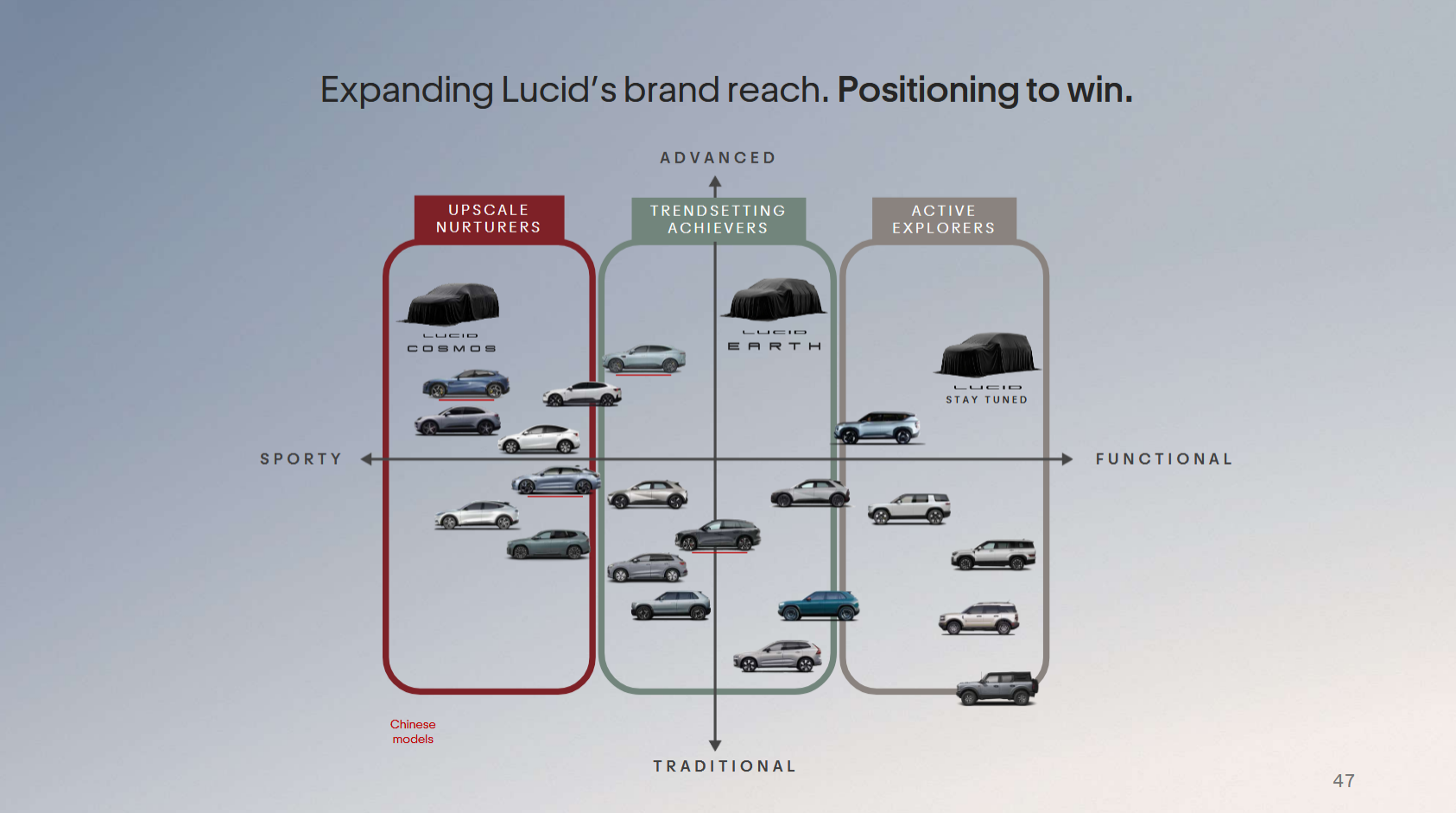
Lucid tells investors that the Cosmos and Earth will appeal to adventure-seekers. That’s a buzz term these days, but it’s worth looking at how the brand sees these products in the greater market. In a slide featuring a graph of “sporty to functional” and “Advanced to traditional,” it plotted each of its three upcoming midsize offerings.
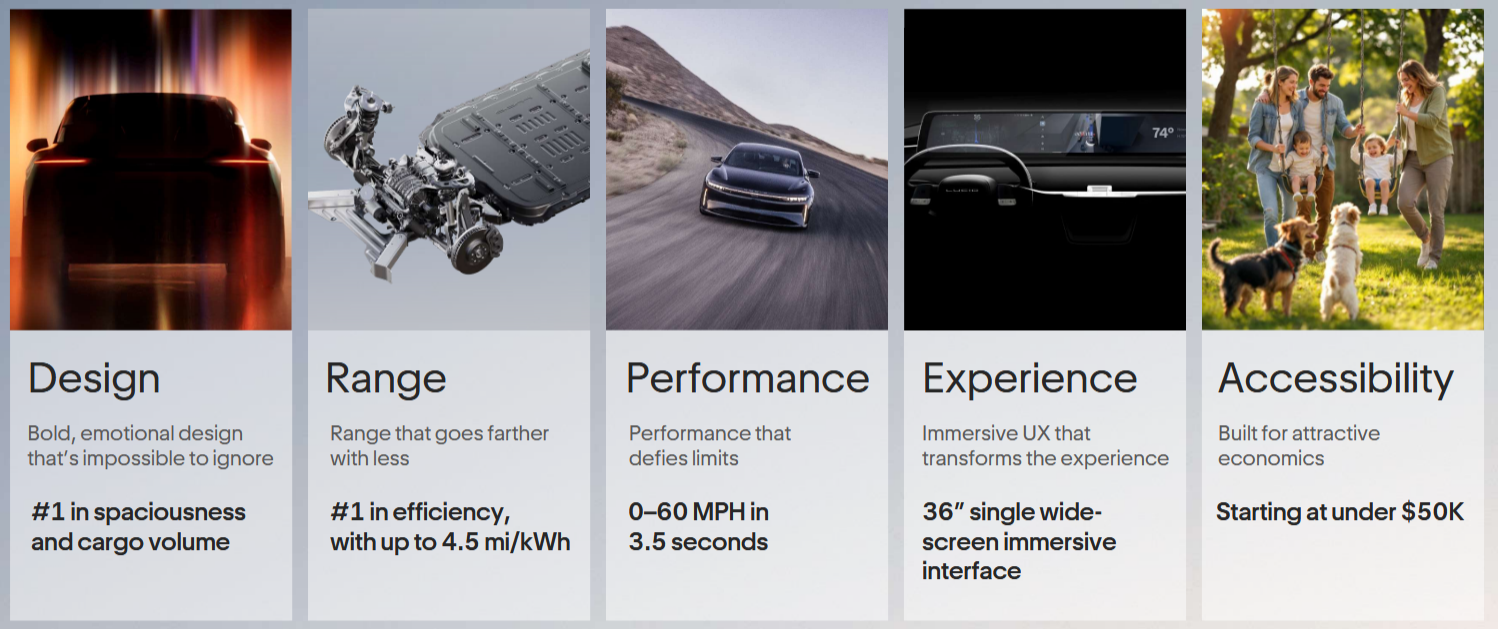
The Cosmos is slated to be the performance vehicle in the fleet. Lucid places it high on “advanced and sporty” in its graph that appears to feature some very strange cars around it. Lucid claims a 0-60 mph time of 3.5 seconds or less. The Earth appears just as advanced in the company’s presentation but leans more toward the functional side of the spectrum.
The unnamed third Lucid model will be the most functional of the bunch and about as far from sporty as it can get. Will that be a van then? Only time will tell, but it does look quite large.
That said, expect vehicles on the platform to start at under $50,000 once available. It’s unclear at this point when those models will arrive. If Lucid does things the same way it did with the Gravity and Air, the expensive top trims will drop first with the lower-cost options showing up much later.
A Giant Role
Earth and Cosmos might sound like names that are too big for their britches, but for Lucid, they’re fitting because these cars and this platform could be what makes or breaks the brand. The company’s robotaxi plans rest on the architecture, as do its autonomy hopes. That includes monthly subscriptions, which are what the brand calls the best monetization opportunity ahead.
In addition, by moving into lower price segments and sharing components across multiple models, the company expects to increase production volume, reduce costs, and generate the kind of margins it hasn’t been able to achieve with low-volume luxury cars alone.
If the plan works, Lucid’s future lineup will look very different from today’s. Instead of just a high-end sedan and SUV, the brand could soon have a full range of vehicles, from premium luxury models to more affordable EVs, plus autonomous variants built for ride-hailing fleets.
Lucid revealed a two-seat robotaxi and autonomy pricing.
Monthly autonomy subscriptions will run from $69 to $199.
The robotaxi concept rides on Lucid’s new midsize platform.
Lucid is officially joining the robotaxi race, and it’s doing so with all-new products. During its investor day presentation on Thursday, the EV startup revealed a two-seat autonomous concept to insiders. Then, it confirmed plans to charge monthly subscription fees for advanced driver-assist and self-driving features in future cars.
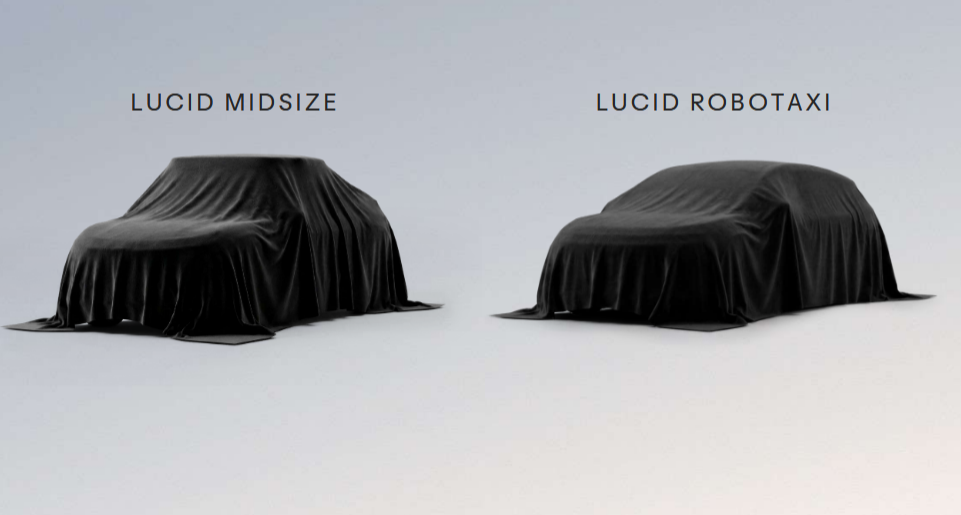
The concept, called Lunar, is a purpose-built robotaxi designed without pedals or a steering wheel. It clearly signals that Lucid is serious about fully autonomous ride-hailing rather than just driver-assist technology. This puts the company on the same path as Tesla’s Cybercab program and similar efforts from other EV makers trying to turn autonomy into a long-term revenue stream.
Beyond the prototype reveal, Lucid shared very little technical detail about the Lunar. What it did emphasize is efficiency. The company is targeting between 5.5 and 6 miles per kWh, a figure that could translate to a theoretical range of around 400 miles.
Reaching that number will depend largely on low-drag aerodynamics and a carefully optimized body. Fast charging is also part of the equation, with Lucid claiming the robotaxi could gain more than 200 miles of range in about 15 minutes.
Whether the Lunar ever makes it past the concept stage is less certain, though. For now, the company already has plenty on its plate preparing its upcoming midsize EV lineup for launch, which carries far more weight for the company’s near-term finances.
Subscription Fees For Self Driving
Speaking of revenue, Lucid calls autonomy subscriptions “the single biggest software monetization opportunity.” As such, it’s going to start charging customers to use DreamDrive Pro, the brand’s in-car autonomy suite, on a monthly basis. Starting in the first half of 2027, owners will have to pay anywhere from $69 to $199 a month, depending on the level of autonomy they want.
Lucid says that it has a “Level 4-ready platform available directly from the factory.” While it hasn’t unveiled it to the public, it’ll ride on the brand’s midsize architecture that underpins a few new products heading to market. Lunar will only seat two individuals, so we expect it to have plenty of room for cargo.
That’ll work well with one of Lucid’s partners, Uber. The two are in talks to use the midsize platform in the way that they do Gravity with its robotaxi program.
Timelines
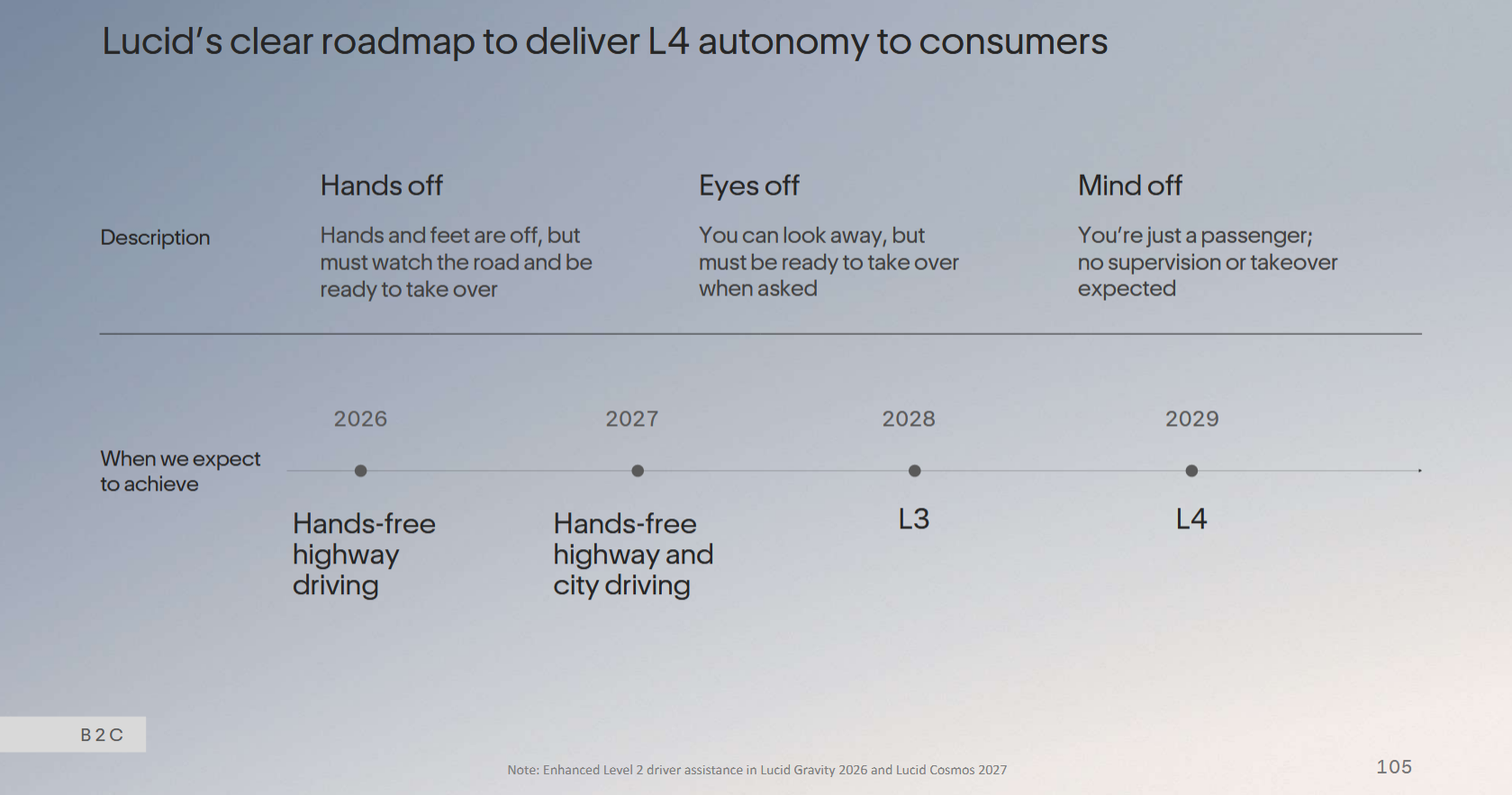
Lucid went as far as to openly lay out its timeline roadmap as well. This year, it believes it’ll offer hands-free highway driving to customers. Next year, it hopes to offer hands-free highway and city driving. In 2028, it wants to achieve Level 3 autonomy. That’s where drivers still need to be ready to take over but the car can mostly navigate on its own.
Level 4, something Lucid is aiming for in 2029, would allow drivers to take their eyes off of the road. Whether or not all of this comes to pass is up for debate, but at least now we know the plan.

 Login
Login