Wisconsin Watch, a nonprofit news organization that uses journalism to make communities strong, informed and connected, is seeking a Pathways to Success Reporter focused on southeast Wisconsin. This reporter will explore what’s needed for residents to build thriving careers in the future economy — and what’s standing in the way. That includes expanding coverage of postsecondary education and workforce training, focusing on how education and economic trends impact people’s lives. The role centers on solution-oriented journalism that serves the public, strengthens community life, and holds those in power accountable.
This Milwaukee-based reporter will join a four-person pathways-focused team that includes an editor, Madison-based statewide reporter and northeast Wisconsin reporter in Green Bay.
About Wisconsin Watch and Milwaukee Neighborhood News Service
Founded in 2009, Wisconsin Watch is a nonprofit news organization dedicated to producing nonpartisan journalism that makes the communities of Wisconsin strong, informed and connected. We believe that access to local representative news is critical to a healthy democracy and to finding solutions to the most pressing problems of everyday life. Under the Wisconsin Watch umbrella, we have three independent news divisions, a statewide investigative newsroom, a regional collaboration in Northeast Wisconsin called the NEW News Lab, and the Milwaukee Neighborhood News Service (NNS). All three divisions maintain their unique reporting areas and together are positioned to grow and serve our communities with greater efficiency and impact.
About this position
The ideal candidate will have at least 2 years of experience researching, reporting, and writing original published new stories, bring a public service mindset and a demonstrated commitment to nonpartisan journalism ethics, including a commitment to abide by Wisconsin Watch’s ethics policies, and have experience working collaboratively to report stories that explore solutions to challenges residents face.
Location: The reporter will be based in Milwaukee. They will have space to work in the Milwaukee NNS newsroom (NNS is a division of Wisconsin Watch).
Salary and benefits: The salary range is $45,500-$64,500. Final offer amounts will carefully consider multiple factors, and higher compensation may be available for someone with advanced skills and/or experience. Wisconsin Watch offers competitive benefits, including generous vacation (five weeks), a retirement fund contribution, paid sick days, paid family and caregiver leave, subsidized medical and dental premiums, vision coverage, and more.
To apply: Please submit a PDF of your resume, work samples and answer some brief questions in this application form. If you’d like to chat about the job before applying, contact Northeast Wisconsin/Pathways Editor Jennifer Zettel-Vandenhouten at jzvandenhouten@wisconsinwatch.org.
Deadline: Applications will be accepted until the position is filled. Apply by Jan. 9, 2026 for best consideration.
Wisconsin Watch is dedicated to improving our newsroom by better reflecting the people we cover. We are committed to fostering an equitable workplace that reflects, understands, and listens to the people we serve. We are an equal-opportunity employer and prohibit discrimination and harassment of any kind. All employment decisions are made without regard to race, color, religion, sex, sexual orientation, national origin, age, or any other status protected under applicable law.
Wisconsin Watch published 83 original fact briefs this year. Fact briefs are 150-word answers to yes/no questions based on surprising or dubious statements made by politicians or other information influencers.
We tend to focus on statements made by Wisconsin politicians, though their statements can range from local to national issues. Many of those are based on statements made about what’s in the news. They’re timely, relevant and easy to digest.
Other fact briefs shed light on topics that remain relevant weeks, months or years after the initial statement was made. Here’s a look at some of those from 2025.
National focus
Do unauthorized immigrants have constitutional rights?Yes. The U.S. Supreme Court has held that all people in the U.S. have constitutional protections, though citizens have additional rights, such as voting.
Is violent crime in the U.S. higher than 25 years ago?No. Violent crime rates, nationally and in major cities, are lower than they were 25 years ago.
Are airline flights the safest mode of transportation in the U.S.?Yes. Federal data show that airline flights are safer than other major transportation modes in the U.S.
Are National Guard troops generally trained in law enforcement? No. National Guard troops, like those President Donald Trump has used to crack down on big-city crime, generally are not trained in law enforcement.
Do tens of millions of unauthorized immigrants receive federal health benefits? No. Unauthorized immigrants are not eligible to enroll in federally funded health coverage.
Is there evidence linking marijuana use to psychosis?Yes. Peer-reviewed research has found links between marijuana use and psychosis — the loss of contact with reality, experienced as delusions or hallucinations.
Does Medicare Advantage cost more than traditional Medicare? Yes. The federal Medicare program spends more per beneficiary for a person on Medicare Advantage than if the person were on traditional Medicare. The difference is projected at 20% higher, or $84 billion, in 2025.
Do recent studies link water fluoridation with less dental decay in children?Yes. Peer-reviewed studies published in the past several years connect water fluoridation with less dental decay in children.
Are homosexual acts criminalized in 65 countries?Yes. Homosexual acts are illegal in 65 countries, including seven that impose the death penalty.
Is there a U.S. law that bans the Communist Party?Yes. The Communist Control Act of 1954 bans the Communist Party. It remains part of the U.S. Code, but has rarely been enforced, and Congress has repealed most of its provisions.
Are interstate truckers required to read and speak English? Yes. Interstate truckers in the U.S. are required to read and speak English under guidance by the Federal Motor Carrier Safety Administration.
Does the typical public housing tenant in the U.S. stay in public housing 12 years?No. The median stay in public housing in the U.S. is four years, a 2024 study of U.S. Housing and Urban Development Department data found. Median means half the tenants in public housing projects stayed more than four years, and half stayed less.
Is the majority of federal government spending mandatory?Yes. About 60% of federal spending is mandatory — appropriations are automatic. About 27% is discretionary spending, and about 13% pays federal debt interest.
Wisconsin focus
Have Wisconsin electricity price increases exceeded the Midwest average for 20 years?Yes. Wisconsin electricity rates — for residential, industrial and commercial users — have exceeded regional averages annually for 20 years.
Can Wisconsin require state jobs go only to Americans?No. The U.S. Supreme Court has held that states cannot restrict public employment to citizens. Both public and private employers are generally barred by federal law from treating people differently based on national origin or ethnicity.
Does Wisconsin require daily exercise for K-12 students?No. Wisconsin doesn’t require daily exercise for students, though there are non-daily requirements for physical education.
Has biennial state funding for the Wisconsin DNR dropped by $100 million over 30 years?Yes. State funding of the Wisconsin Department of Natural Resources has been reduced by more than $100 million per biennium (two-year budget periods) in the past 30 years, though a key factor is smaller debt payments.
Wisconsin Watch is a nonprofit, nonpartisan newsroom. Subscribe to our newsletters for original stories and our Friday news roundup.
Reading Time: 7minutesClick here to read highlights from the story
Dementia Innovations, a nonprofit started in Sheboygan County, is developing what it describes as the first U.S. village where people diagnosed with dementia will live and own homes.
Unlike a traditional risk-averse memory care facility with locked doors, homeowners at Livasu, short for “living as usual,” will be free to navigate the village with support from staff.
It’s similar to a European model. Experts say the village care model is difficult to replicate in the litigious U.S., but Livasu’s founders hope the village will show it can work in Wisconsin and other states.
To limit costs, the village is using manufactured homes, a more affordable alternative to site-built options.
A row of footprints followed John and Terri Cooper, both 70, as they carefully navigated an icy road near Sheboygan, Wisconsin. They stopped at a row of concrete slabs.
“This is our house,” John said, waving at the first snow-covered block.
“It’s pretty big,” Terri added while standing on the foundation.
As they do every Sunday, the Coopers had driven around 20 miles from their independent living community to the construction site of their soon-to-be home. John flies a drone over the neighborhood taking shape around it, which will include a grocery store, a spa and a gym. He photographs progress on the 45-acre development designed specifically for people like Terri, who has Alzheimer’s disease.
John and Terri Cooper stand in the construction zone where their home will be placed in Livasu, a Sheboygan County, Wis. village built to allow people with dementia to live freely, Dec. 7, 2025. (Addie Costello / WPR and Wisconsin Watch)
The couple has moved a lot during their 50-year marriage. But this summer’s move will be different from all the others.
Dementia Innovations, a nonprofit started in Sheboygan County, is developing what it describes as the first U.S. village where people diagnosed with dementia will live and own homes. It’s similar to a European model that encourages people with memory loss to remain more independent. The Sheboygan County village, Livasu, short for “living as usual,” will allow people with dementia to live alone or with loved ones and continue typical routines from their homes as their disease progresses.
Applauded for years in other countries, experts say the village care model is difficult to replicate in the U.S. Livasu’s founders hope the estimated $14 million village will show it can work in Wisconsin and other states.
A drone’s view of the construction of Livasu, a Sheboygan County village emphasizing dignity in dementia care. (Courtesy of John Cooper)
To limit costs, the village is using manufactured homes, a more affordable alternative to site-built options. People will buy their home and set hours of caregiving, depending on their level of need.
Unlike a traditional risk-averse memory care facility with locked doors, homeowners will be free to travel throughout the village with support from staff.
“We all take risks every day, but as we age, and especially as we age with dementia, there’s a safety-at-all-cost approach,” said Livasu’s project lead, Mary Pitsch. “That cost is actually a loss of personhood.”
Rather than a fence surrounding the village or automatically locking doors, landscaping will direct people from their home toward the community’s “downtown.” People living in the village’s 124 houses will have access to a lodge with support staff and a place to eat meals with neighbors and to watch the Packers, Pitsch said.
The village will eventually feature a public grocery store and a restaurant.
“We are changing the way we are thinking about care and support,” Pitsch said.
Aging at home — together
The Coopers met in college.
“I picked Terri out almost immediately. It took me some months to convince her that I was the right guy,” John joked.
“Thankfully,” Terri chimed in with a laugh.
As the couple raised two daughters, John worked different technology jobs and photographed sporting events like triathlons on the weekends. Terri was a structural steel detailer.
After watching her mother battle Alzheimer’s, Terri made sure to eat healthy and exercise to prevent herself from getting the same disease. But in 2019, John started noticing changes. Two years later, Terri was officially diagnosed.
“I mean right now,” she asked John outside of the Livasu construction site, “I think I’m OK, right?”
“Yeah, you’re great!” he responded emphatically, prompting another round of laughs.
Terri shook her head.
“This is what I live with,” she said.
The couple moved into an independent living center over a year ago after John was diagnosed with two forms of cancer that are now in remission.
“We wanted to be someplace where, if I was gone, Terri could live and have people take care of her,” John said. “That’s still the goal.”
Unlike institutional settings, Livasu will allow them to age in their home together.
An illustrated map of the future Livasu village is on display, Dec. 3, 2025, in the Town of Wilson, Wis. (Angela Major / WPR)
Manufactured housing brings savings
The Coopers are excited to again own a home, even if it’s smaller than they’re used to.
First they left their 2,400 square foot home in Neenah for a 1,500 square foot duplex. Their future manufactured home in Livasu measures just 1,140 square feet, John said. But unlike the independent living duplex they rented, they are purchasing this home.
Home prices in Livasu currently range between $95,000 and $175,000 — less than traditional site-built houses.
Like with any manufactured homes, savings come from finding scale in mass production, with factories buying materials in bulk and cutting down material waste through computer design.
A model home showcases what a residence at Livasu could look like, Dec. 3, 2025, in the town of Wilson, Wis. When installed, the homes will be flush with the ground to be accessible to people with dementia and their families. (Angela Major / WPR)
The Livasu homes are built off-site, limiting construction time and noise as people move in at different times, Pitsch said. The homes have a title, similar to a car, instead of a traditional deed. That will make transferring the homes between owners easier.
Terri Cooper lived in a mobile home during one year at college, John recalled. But today’s manufactured homes are higher quality, he said.
“They’re actually built pretty nice,” he said.
Every detail is designed for someone aging with dementia, Pitsch explained while walking through a model home placed outside the Livasu construction zone.
More lights in each house help aging eyes. Dark door handles contrast to lightly painted doors. The homes feature safer electric stoves instead of gas.
A model home showcases what a residence at Livasu could look like, Dec. 3, 2025, in the town of Wilson, Wis. (Angela Major / WPR)
While homes in most manufactured housing communities — traditionally called “mobile home parks” — have stairs, Livasus will place homes at ground level.
Bedrooms will have a direct line of sight to the toilet, which can help prevent incontinence.
“The shower was a big discussion. Do you have glass doors? Do you have a shower curtain?” Pitsch remembered debating with the other designers.
“Lots of conversations about some things that would seem really simple, were long conversations,” she said, “and we made the best decisions we could.”
Dignity in dementia care
Pitsch, a social worker, developed her passion for this work while working with older adults. She has run an at-home care company with her husband for close to 20 years. She learned Sheboygan-area law enforcement often responded to emergencies involving people with dementia.
She and other community members started a task force to evaluate the county’s response to residents with dementia. That prompted changes in the county’s emergency protocols and the creation of Dementia Innovations.
“I’m kind of one of those people that if it’s not me, then who’s going to do it?” Pitsch said.
Livasu project lead Mary Pitsch stands inside a model home, Dec. 3, 2025, in the town of Wilson, Wis. (Angela Major / WPR)
Pitsch and others started planning a way to better care for people with dementia and to prevent emergency situations in the first place. They learned about Hogeweyk, the world’s first dementia village in the Netherlands.
“We are far behind other countries in a better, humanistic way of providing care for those with dementia,” Pitsch said.
Dementia care in the U.S. tends to prioritize safety above all else, said Emily Roberts, an associate professor at Oklahoma State University who researches the connection between older adults and their physical environment.
Creating environments where people can make choices and take risks can be expensive, especially in a litigious country like the U.S., she said.
Support staff in Livasu will regularly monitor the grounds. Cameras can alert them if someone walks in or out of the village through an unexpected area.
Construction of the Livasu village is underway, Dec. 3, 2025, in the town of Wilson, Wis. (Angela Major / WPR)
Creating a home-like environment also prevents people from wanting to leave, Roberts said. As the number of people with dementia continues to grow, the country will need more environments that support people with dementia, she said. That’s especially true in aging Wisconsin.
A private room in a nursing home cost $127,750 on average in the U.S., according to the Alzheimer’s Association — more than a smaller home at Livasu. Village residents will pay for care as they need it, similar to at-home care, and potential homeowners discuss their finances with Livasu volunteers, Pitsch said.
Livasu raised more than $8 million dollars for the first phase of construction. It still needs to raise around $6 million more to complete the entire village, but the first houses are already waiting to get placed on foundations.
Pitsch recently watched as a construction crew drove excavators and bulldozers over the giant field where a restaurant, post office, and ice cream shop will eventually go.
“I pinch myself,” Pisch said. “It gets pretty emotional actually, to see that it’s actually happening,”
A sign labels the future site of Livasu as construction work is ongoing Wednesday, Dec. 3, 2025, in the Town of Wilson, Wis. Angela Major/WPR
‘Wherever she goes, I go’
When the Coopers move in, they don’t expect to need any caretaking. They still make weekly visits to see their grandkids and take weeks-long hiking, camping and cycling excursions.
“Wherever I go, she goes, wherever she goes, I go. Except in the women’s bathroom,” John said, eliciting more laughs from Terri.
“We kind of like each other, so that’s OK.”
As the couple finished checking in on construction of their future community, they carefully walked back to their car — holding hands the entire way.
John and Terri Cooper hold hands as they walk together on the road next to their future home in Livasu, a Sheboygan County village built specifically to accommodate people living with dementia. Photo taken Dec. 7, 2025. (Addie Costello / WPR and Wisconsin Watch)
Wisconsin Watch is a nonprofit, nonpartisan newsroom. Subscribe to our newsletters for original stories and our Friday news roundup.
If Democrats win a majority in one or both chambers of the Legislature in 2026, the party will have more power to govern than any time in more than 15 years.
Senate Minority Leader Dianne Hesselbein, D-Middleton, said she saw a sign of what that future could look like during the state budget-writing process earlier this year. With just a three-seat advantage in the Senate, Republicans needed to work across the aisle to advance the budget, and Senate Democrats had a seat at the negotiating table, Hesselbein said.
For the past 15 years of Republican majorities in the Senate and the Assembly, GOP lawmakers have been able to operate largely without input from legislative Democrats. In 2011, following the Republican midterm surge during President Barack Obama’s presidency, a GOP trifecta in the Legislature and the governor’s office advanced legislation aimed at cementing a permanent majority.
They passed laws such as Act 10, which dismantled Democratic-supporting public sector unions; strict voter ID, which made it harder for students and low-income people to vote; and partisan redistricting, which kept legislative Republicans in power with near super-majorities even after Democrats won all statewide offices in 2018.
“We have an open door policy as Democrats in the state Senate. We will work with anybody with a good idea,” she said. “So we will try to continue to work with Republicans when we can and seek common values to really help people in the state of Wisconsin.”
Newly redrawn legislative maps put into play during last year’s elections, when President Donald Trump won Wisconsin, resulted in 14 flipped legislative seats in favor of Democrats. Following those gains in 2024, Senate Democrats need to flip two seats and hold onto Senate District 31, held by Sen. Jeff Smith, D-Brunswick, to win a majority next year.
The party’s campaign committee is eyeing flip opportunities in seats occupied by Republican Sens. Howard Marklein, R-Spring Green; Rob Hutton, R-Brookfield; and Van Wanggaard, R-Racine, which are all districts that former Vice President Kamala Harris won in 2024, according to an analysis last year by John Johnson, a Lubar Center Research fellow at Marquette University.
Senate Majority Leader Devin LeMahieu, R-Oostburg, in an email to Wisconsin Watch said a Democratic majority in the chamber “won’t happen.”
With political winds during a midterm year typically favoring the party not in control of the White House, Democrats could see gains in the Assembly as well, although there are more challenges than in the Senate. All of the Assembly seats were tested under the new maps last year, but Democrats still made gains during an election year when Trump’s name on ballots boosted Republicans. Minority Leader Greta Neubauer, D-Racine, told the Milwaukee Journal Sentinel earlier this month that she is “optimistic” about chances to flip the Assembly, where five seats would give Democrats control of the chamber for the first time since 2010.
Assembly Speaker Robin Vos did not respond to questions from Wisconsin Watch about how Republicans might work with Democrats if the party wins a majority next year.
If there is a power shift in the Capitol in 2026, few lawmakers have experienced anything but Republican control of the Legislature. Just 11 of the 132 members across both political parties previously held office at a time when Democrats controlled both legislative chambers.
Some of the longest-serving Democrats said they agree with restoring more bipartisanship in the legislative process if the party gains power in 2026.
“I don’t want to repeat the same mistakes as the Republicans did,” said Sen. Tim Carpenter, D-Milwaukee, who was elected to the Assembly in 1984 and the Senate in 2002. “We have to give them an opportunity to work on things.”
Carpenter and Rep. Christine Sinicki, D-Milwaukee, who was elected to the Assembly in 1998, said if the party wins one or both majorities they want to make sure members are prepared for governing responsibilities they’ve never experienced, like leading a committee.
“It’s a lot more work,” Sinicki said of being in the majority. “But it’s very fulfilling work to actually be able to go home at night and say, ‘I did this today.’”
Senate Minority Leader Dianne Hesselbein, D-Middleton, speaks during a Senate floor session Oct. 14, 2025, at the State Capitol in Madison, Wis. (Joe Timmerman / Wisconsin Watch)
Hesselbein said if Senate Democrats secure power in their chamber next year, members will continue to focus on affordability issues that they’ve proposed during the current session. Some of those bills included providing free meals at breakfast and lunch to students in Wisconsin schools, lowering the cost of prescription drugs and expanding access to the homestead tax credit.
LeMahieu, though, said Democrats have “no credibility” on affordability issues.
“Senate Republicans delivered the second largest income tax cut in state history to put more money in Wisconsin families’ pockets for gas and groceries while Senate Democrats propose sales and income tax hikes to pay for a radical agenda nobody can afford,” he said.
Senate Democrats in the meantime are holding listening sessions across the state and working on a list of future bills to be ready to lead “on day one,” Hesselbein said. “If we are fortunate enough.”
Wisconsin Watch is a nonprofit, nonpartisan newsroom. Subscribe to our newsletters for original stories and our Friday news roundup.
Obsolete power plants continue to cost ratepayers. Now, the push to generate
unprecedented amounts of electricity for data centers risks creating another $1 billion in "stranded assets."
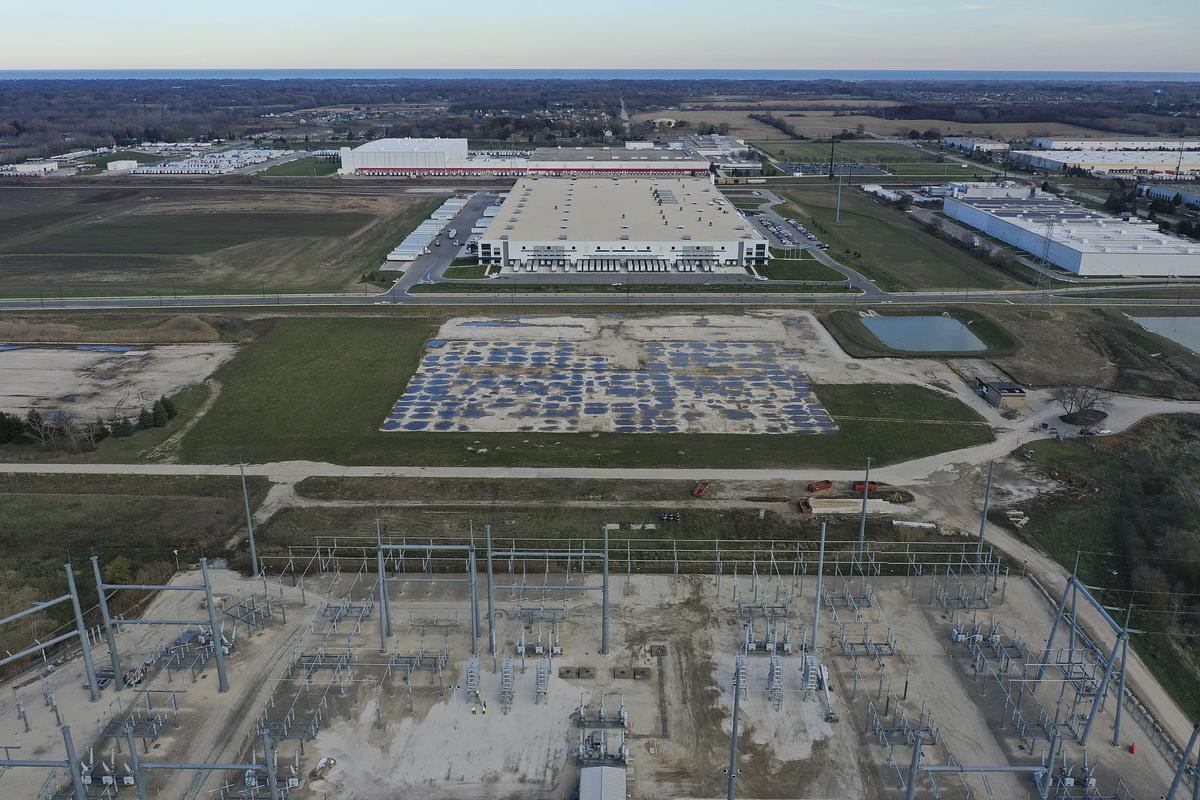
The former site of the We Energies Power Plant on Nov. 13, 2025, in Pleasant Prairie, Wis. (Photo by Joe Timmerman/Wisconsin Watch)
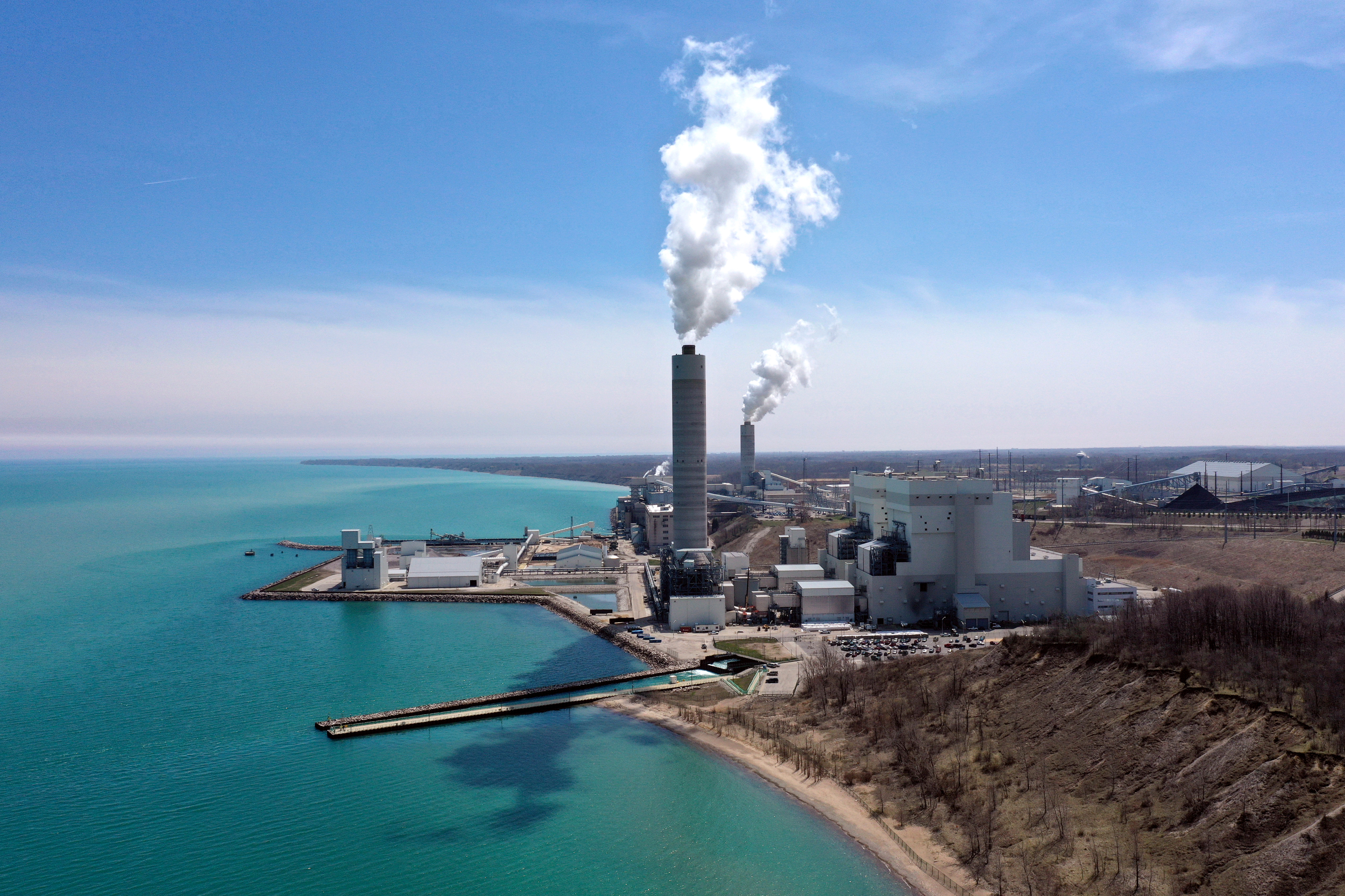
By some measures, the Pleasant Prairie Power Plant, once regarded locally as an “iconic industrial landmark,” had a good run.
Opened in 1980 near Lake Michigan in Kenosha County, it became Wisconsin’s largest generating plant, burning enough Wyoming coal, some 13,000 tons a day, to provide electricity for up to 1 million homes.
But over time, the plant became too expensive to operate. The owner, We Energies, shut it down after 38 years, in 2018.
We Energies customers, however, are still on the hook.
A portion of their monthly bills will continue to pay for Pleasant Prairie until 2039 — 21 years after the plant stopped producing electricity.
In fact, residential and business utility customers throughout Wisconsin owe nearly $1 billion on “stranded assets” — power plants like Pleasant Prairie that have been or will soon be shut down, a Wisconsin Watch investigation found.
That total will likely grow over the next five years with additional coal plants scheduled to cease operations.
Customers must pay not only for the debt taken on to build and upgrade the plants themselves, but also an essentially guaranteed rate of return for their utility company owners, long after the plants stop generating revenue themselves.
“We really have a hard time with utilities profiting off of dead power plants for decades,” said Todd Stuart, executive director of the Wisconsin Industrial Energy Group.
The $1 billion tab looms as Wisconsin utility companies aim to generate unprecedented amounts of electricity for at least seven major high-tech data centers that are proposed, approved or under construction. By one estimate, just two of the data centers, which are being built to support the growth of artificial intelligence, would use more electricity than all Wisconsin homes combined.
All of which raises an important question in Wisconsin, where electricity rates have exceeded the Midwest average for 20 years.
What happens to residents and other ratepayers if AI and data centers don’t pan out as planned, creating a new generation of stranded assets?
How much do Wisconsin ratepayers owe on stranded assets?
Of the five major investor-owned utilities operating in Wisconsin, two — We Energies and Wisconsin Public Service Corp. — have stranded assets on the books. Both companies are subsidiaries of Milwaukee-based WEC Energy Group.
As of December 2024, when the company released its most recent annual report, We Energies estimated a remaining value of more than $700 million across three power plants with recently retired units: Pleasant Prairie, Oak Creek and Presque Isle, a plant on Michigan’s Upper Peninsula.
Wisconsin Public Service Corp.’s December 2024 report listed roughly $30 million in remaining value on recently retired units at two power plants.
In total, utilities owned by WEC Energy Group will likely have over $1 billion in recently retired assets by the end of 2026.
The company also noted a remaining value of just under $250 million for its share of units at Columbia Generating Station slated to retire in 2029, alongside a remaining value of roughly $650 million for units at Oak Creek scheduled to retire next year.
Its customers will pay off that total, plus a rate of return, for years to come.
The company estimates that closing the Pleasant Prairie plant alone saved $2.5 billion, largely by avoiding future operating and maintenance costs and additional capital investments.
Both Wisconsin Power and Light and Madison Gas and Electric also own portions of the Columbia Energy Center, and Wisconsin Power and Light also operates a unit at the Edgewater Generating Station scheduled for retirement before the end of the decade. Neither company provided estimates of the values of those facilities at time of retirement. Andrew Stoddard, a spokesman for Alliant Energy, Wisconsin Power and Light’s parent company, argued against treating plants scheduled for retirement with value on the books as future stranded assets.
How stranded assets occurred: overcommitting to coal
In 1907, Wisconsin became one of the first states to regulate public utilities. The idea was that having competing companies installing separate gas or electric lines was inefficient, but giving companies regional monopolies would require regulation.
Utility companies get permission to build or expand power plants and to raise rates from the three-member state Public Service Commission. The commissioners, appointed by the governor, are charged with protecting ratepayers as well as utility company investors.
A demolition sign is posted at the former site of the We Energies Power Plant on Nov. 13, 2025, in Pleasant Prairie, Wis. (Photo by Joe Timmerman/Wisconsin Watch)
Stranded assets have occurred across the nation, partly because of the cost of complying with pollution control regulations. But another factor is that, while other utilities around the country moved to alternative sources of energy, Wisconsin utilities and, in turn, the PSC overbet on how long coal-fired plants would operate efficiently:
In the years before We Energies pulled the plug on Pleasant Prairie, the plant had mostly gone dark in spring and fall. Not only had coal become more expensive than natural gas and renewables, but energy consumption stayed flat. By 2016, two years before Pleasant Prairie’s closure, natural gas eclipsed coal for electricity generation nationally.
In 2011, We Energies invested nearly $1 billion into its coal-fired Oak Creek plant south of Milwaukee to keep it running for 30 more years. The plant, which began operating in 1965 and later became one of the largest in the country, is now scheduled to completely retire in 2026 — with $650 million on the books still owed. That will cost individual ratepayers nearly $30 per year for the next 17 years, according to RMI, a think tank specializing in clean energy policy. The majority of the debt tied to those units stems from “environmental controls we were required to install to meet federal and state rules,” WEC Energy Group spokesperson Brendan Conway said.
In 2013, to settle pollution violations, Alliant Energy announced an investment of more than $800 million in the Columbia Energy Center plant in Portage, north of Madison. But by 2021, Alliant announced plans to begin closing the plant, though now it is expected to operate until at least 2029.
Various factors encourage construction and upgrades of power plants.
Building a plant can create upwards of 1,000 construction jobs, popular with politicians. Moreover, the Public Service Commission, being a quasi-judicial body, is governed by precedent. For example, if the PSC determined it was prudent to allow construction of a utility plant, that finding would argue in favor of approving a later expansion of that plant.
The PSC allowed utility companies “to overbuild the system,” said Tom Content, executive director of the Wisconsin Citizens Utility Board, a nonprofit advocate for utility customers. “I think the mistake was that we allowed so much investment, and continuing to double down on coal when it was becoming less economic.”
Utilities “profit off of everything they build or acquire,” Stuart said, “and so there is a strong motivation to put steel in the ground and perhaps to even overbuild.”
Conway, the WEC Energy Group spokesperson, argued that the utilities’ plans to retire plants amount to a net positive for customers.
“We began our power generation reshaping plan about a decade ago,” he wrote in an email. “That includes closing older, less-efficient power plants and building new renewable energy facilities and clean, efficient natural gas plants. This plan reduces emissions and is expected to provide customers significant savings — hundreds of millions of dollars — over the life of the plan.”
Guaranteed profits add to ratepayer burden
The built-in profits that utility companies enjoy, typically 9.8%, add to the stranded assets tab.
When the Public Service Commission approves construction of a new power plant, it allows the utility company to levy electricity rates high enough to recover its investment plus the specified rate of return — even after a plant becomes a stranded asset.
The former site of the We Energies Power Plant on Nov. 13, 2025, in Pleasant Prairie, Wis. (Photo by Joe Timmerman/Wisconsin Watch)
“We give them this license to have a monopoly, but the challenge is there’s no incentive for them to do the least-cost option,” Content said. “So, in terms of building new plants, there’s an incentive to build more … and there’s incentive to build too much.”
When the Pleasant Prairie plant was shut down in 2018, the PSC ruled that ratepayers would continue to pay We Energies to cover the cost of the plant itself, plus the nearly 10% profit. The plant’s remaining value, initially pegged at nearly $1 billion, remained at roughly $500 million as of December 2024.
Eliminating profits on closed plants would save ratepayers $300 million on debt payments due to be made into the early 2040s, according to Content’s group.
New ‘stranded assets’ threat: data centers
As artificial intelligence pervades society, it’s hard to fathom how much more electricity will have to be generated to power all of the data centers under construction or being proposed in Wisconsin.
We Energies alone wants to add enough energy to power more than 2 million homes. That effort is largely to serve one Microsoft data center under construction in Mount Pleasant, between Milwaukee and Racine, and a data center approved north of Milwaukee in Port Washington to serve OpenAI and Oracle AI programs. Microsoft calls the Mount Pleasant facility “the world’s most powerful data center.”
Data centers are also proposed for Beaver Dam, Dane County, Janesville, Kenosha and Menomonie.
The energy demand raises the risk of more stranded assets, should the data centers turn out to be a bubble rather than boom.
“The great fear is, you build all these power plants and transmission lines and then one of these data centers only is there for a couple years, or isn’t as big as promised, and then everybody’s left holding the bag,” Stuart said.
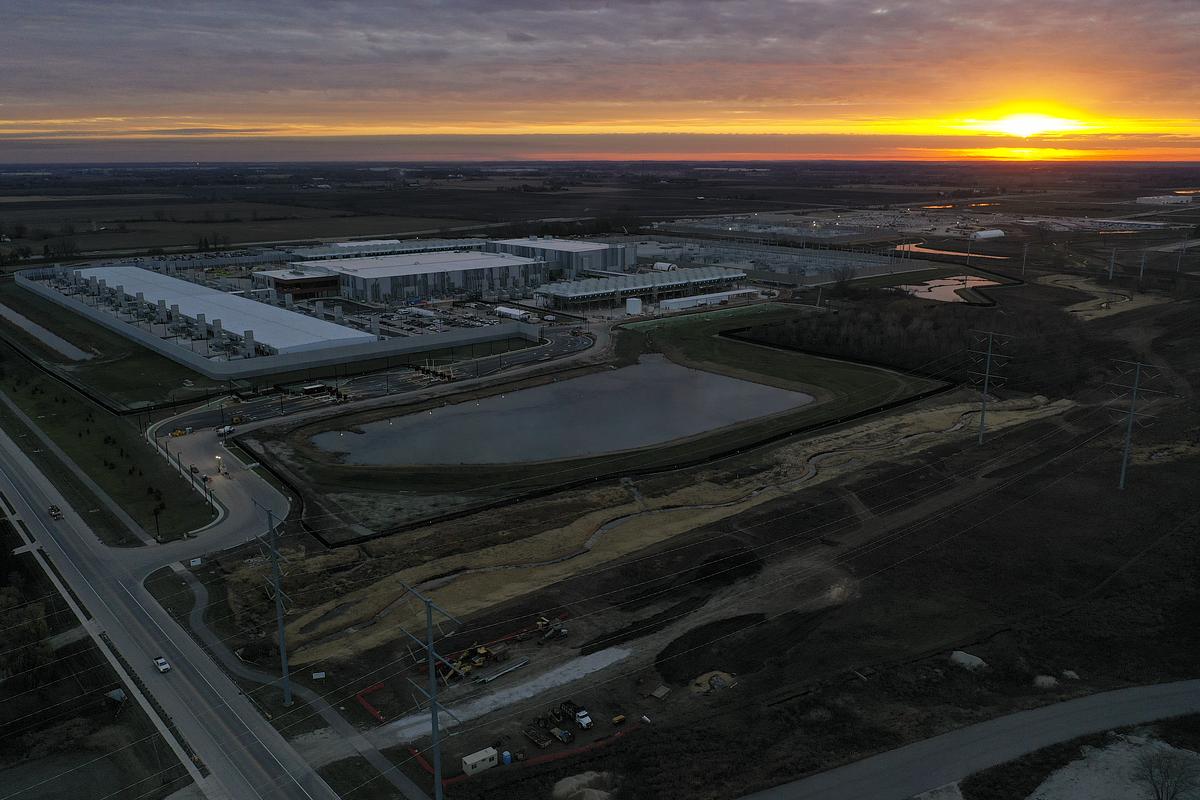
The sun sets as construction continues at Microsoft’s data center project on Nov. 13, 2025, in Mount Pleasant, Wis. (Photo by Joe Timmerman/Wisconsin Watch)
In an October Marquette Law School poll, 55% of those surveyed said the costs of data centers outweigh the benefits. Environmental groups have called for a pause on all data center approvals. Democratic and Republican leaders are calling for data centers to pay their own way and not rely on utility ratepayers or taxpayers to pay for their electricity needs.
Opposition in one community led nearly 10,000 people to become members of the Stop the Menomonie Data Center group on Facebook. In Janesville, voters are trying to require referendums for data centers. In Port Washington, opposition to the data center there led to three arrests during a city council meeting.
Utilities are scheduled in early 2026 to request permission from the Public Service Commission to build new power plants or expand existing plants to accommodate data centers.
Some states, such as Minnesota, have adopted laws prohibiting the costs of stranded assets from data centers being passed onto ratepayers.
Wisconsin has no such laws.
Shifting cost burden to utility companies
Currently, ratepayers are on the hook for paying off the full debt of stranded assets — unless a financial tool called securitization reduces the burden on ratepayers.
Securitization is similar to refinancing a mortgage. With the state’s permission, utilities can convert a stranded asset — which isn’t typically a tradeable financial product — into a specialized bond.
Utility customers must still pay back the bond. But the interest rate on the bond is lower than the utility’s standard profit margin, meaning customers save money.
A 2024 National Association of Regulatory Utility Commissioners report noted that utilities’ shareholders may prefer a “status quo” scenario in which customers pay stranded asset debts and the standard rate of return. Persuading utilities to agree to securitization can require incentives from regulators or lawmakers, the report added.
In some states, utilities can securitize the remaining value of an entire power plant. Michigan utility Consumers Energy, for instance, securitized two coal generating units retired in 2023, saving its customers more than $120 million.
In Wisconsin, however, utilities can securitize only the cost of pollution control equipment on power plants — added to older coal plants during the Obama administration, when utilities opted to retrofit existing plants rather than switching to new power sources.
The Oak Creek Power Plant and Elm Road Generating Station, seen here on April 25, 2019, in Oak Creek, Wis., near Milwaukee, are coal-fired electrical power stations. (Photo by Coburn Dukehart/Wisconsin Watch)
In 2023, two Republican state senators, Robert Cowles of Green Bay and Duey Stroebel of Saukville, introduced legislation to allow the Public Service Commission to order securitization and allow securitization to be used to refinance all debt on stranded assets. The bill attracted some Democratic cosponsors, but was opposed by the Wisconsin Utilities Association and did not get a hearing.
Democratic Gov. Tony Evers proposed additional securitization in his 2025-27 budget, but the Legislature’s Republican-controlled Joint Finance Committee later scrapped the provision.
Even Wisconsin’s narrow approach to securitization is optional, however, and most utilities have chosen not to use it.
We Energies was the first Wisconsin utility to do so, opting in 2020 to securitize the costs of pollution control equipment at the Pleasant Prairie plant. Wisconsin’s Public Service Commission approved the request, saving an estimated $40 million. “We will continue to explore that option in the future,” Conway said.
But the PSC expressed “disappointment” in 2024 when We Energies “was not willing to pursue securitization” to save customers $117.5 million on its soon-to-retire Oak Creek coal plant. The utility noted state law doesn’t require securitization.
Stuart said that if utilities won’t agree to more securitization, they should accept a lower profit rate once an asset becomes stranded.
“It would be nice to ease that burden,” he said. “Just to say, hey, consumers got to suck it up and deal with it, that doesn’t sound right. The issue of stranded assets, like cost overruns, is certainly ripe for investigation.”
Comprehensive planning required elsewhere — but not Wisconsin
Avoiding future stranded assets could require a level of planning impossible under Wisconsin’s current regulatory structure.
When the state’s utilities propose new power plants, PSC rules require the commission to consider each new plant alone, rather than in the context of other proposed new plants and the state’s future energy needs. Operating without what is known as an integrated resource plan, or IRP, opened the PSC to overbuilding and creating more stranded assets. IRPs are touted as an orderly way to plan for future energy needs.
“There’s no real comprehensive look in Wisconsin,” Stuart said. “We’re one of the few regulated states that really doesn’t have a comprehensive plan for our utilities.
”We’ve been doing some of these projects kind of piecemeal, without looking at the bigger picture.”
Protesters speak against a proposed natural gas power plant in Oak Creek, Wis., on March 25, 2025. (Photo by Julius Shieh/Milwaukee Neighborhood News Service)
Structured planning tools like IRPs date back to the 1980s, when concerns about cost overruns, fuel price volatility and overbuilding prompted regulators to step in. Minnesota and Michigan require utilities to file IRPs, as do a majority of states nationwide.
Evers proposed IRPs in his 2025-27 state budget, but Republican lawmakers removed that provision because it was a nonfiscal policy issue.
Northern States Power Company, which operates in Wisconsin and four other Midwestern states, is required by both Michigan and Minnesota to develop IRPs. “Because of these rules, we create a multi-state IRP every few years,” said Chris Ouellette, a spokesperson for Xcel Energy, the utility’s parent company.
Madison Gas and Electric, which only operates in Wisconsin, argued that its current planning process is superior to the IRP requirements in neighboring states. “A formal IRP mandate would add process without improving outcomes,” spokesperson Steve Schultz said. “Wisconsin’s current framework allows us to move quickly, maintain industry-leading reliability and protect customer costs during a period of rapid change.”
How to influence decisions relating to stranded assets
The devil will be in the details on whether the Public Service Commission adopts strong policies to prevent the expected wave of new power plant capacity from becoming stranded assets, consumer advocates say.
The current members, all appointed by Evers, are: chairperson Summer Strand, Kristy Nieto and Marcus Hawkins.
The public can comment on pending cases before the PSC via its website, by mail or at a public hearing. The commission posts notices of its public hearings, which can be streamed via YouTube.
Barbed wire fence surrounds the former site of the We Energies Power Plant on Nov. 13, 2025, in Pleasant Prairie, Wis. (Photo by Joe Timmerman/Wisconsin Watch)
Among the upcoming hearings on requests by utilities to generate more electricity for data centers:
Feb. 12: We Energies’ request to service data centers in Mount Pleasant and Port Washington. We Energies says the fees it proposes, known as tariffs, will prevent costs from being shifted from the data centers to other customers. The “party” hearing is not for public comment, but for interaction between PSC staff and parties in the case, such as We Energies and public interest groups.
Feb. 26: Another party hearing for a case in which Alliant Energy also said its proposed tariffs won’t benefit the data center in Beaver Dam at the expense of other customers.
To keep abreast of case developments, the PSC offers email notifications for document filings and meetings of the commission.
The PSC would not provide an official to be interviewed for this article. It issued a statement noting that utilities can opt to do securitization to ease the financial burden on ratepayers, adding:
“Beyond that, the commission has a limited set of tools provided under state law to protect customers from costs that arise from early power plant retirements. It would be up to the state Legislature to make changes to state law that would provide the commission with additional tools.”
On Nov. 6, state Sen. Jodi Habush Sinykin, D-Whitefish Bay, and Rep. Angela Stroud, D-Ashland, announced wide-ranging data center legislation. One provision of their proposal aims to ensure that data centers don’t push electricity costs onto other ratepayers.
Unauthorized immigrants are not eligible for federally or state-funded health coverage in Wisconsin.
That includes Medicaid, Medicare and the Children’s Health Insurance Program (CHIP), and coverage purchased through the Affordable Care Act (Obamacare) marketplaces.
Unauthorized immigrants also are not eligible for Wisconsin Medicaid or BadgerCare Plus.
Fourteen states, including Illinois and Minnesota, use state Medicaid funds to cover unauthorized immigrants, but Wisconsin does not.
Democratic Gov. Tony Evers on Dec. 5 vetoed a Republican-backed bill that would have banned public money from going toward health care coverage for unauthorized immigrants.
Republicans said the bill was meant to be pre-emptive.
On Dec. 10, Republican U.S. Rep. Tom Tiffany, who is running for governor in 2026, incorrectly said Evers’ veto allowed unauthorized immigrants “to continue to get taxpayer-funded health care.”
When Evers vetoed the bill he criticized it for “trying to push polarizing political rhetoric.”
This fact brief is responsive to conversations such as this one.
Reading Time: 6minutesClick here to read highlights from the story
More than a month since an immigration judge agreed to grant a Sheboygan Falls mother a green card, she was still sitting in an ICE jail waiting for a required background check, which Department of Homeland Security officials said staffing issues had delayed.
The predicament illustrates how President Donald Trump’s immigration crackdown has strained some of the immigration system’s most basic infrastructure. Immigration attorneys say increased pressure from mass arrests has “exponentially inflamed” many of its long-standing flaws.
Defendants in felony cases have been deported before a judge can issue a verdict, fast-changing asylum rules have led to inconsistent outcomes, and inefficiencies like the mother’s background check delay have dramatically affected residents’ lives.
Update, Dec. 19, 2025, 12:50 p.m.:
Cleveland immigration court Judge Richard Drucker cancelled Elvira Benitez’s removal from the country on Friday, her attorney Marc Christopher told Wisconsin Watch. The U.S. Department of Homeland Security reserved the right to appeal his ruling within the next 30 days, but Christopher expects she will be able to return to Wisconsin before the end of the year.
Original story:
Elvira Benitez of Sheboygan Falls is just one step away from receiving her green card.
But more than a month since an immigration judge agreed to grant her permanent residence pending a biometric background check, she’s still sitting in a U.S. Immigration and Customs Enforcement detention facility in Ohio, where she has spent half of 2025.
The reason? The Department of Homeland Security, ICE’s parent agency, told an immigration court judge that a staffing shortage delayed the background check, which requires running her fingerprints through a national registry.
The ongoing immigration crackdown has strained some of the immigration system’s most basic infrastructure, and Benitez is one of many stuck as a result. Many immigration attorneys, including Benitez’s, say increased pressure on the system from mounting arrest numbers and rapidly shifting policies has “exponentially inflamed” many of its long-standing flaws, even as the Trump administration spends billions trying to keep up with its own demands.
Those flaws have appeared in many forms: defendants in felony cases deported before a judge can issue a verdict, inconsistent application of ever-changing asylum rules and inefficiencies that cost the administration little while dramatically affecting the lives of people like Benitez.
How has that played out in Wisconsin? Wisconsin Watch has documented the shifting landscape in a range of stories during a chaotic year for immigration policy.
Accidental Canadian trip triggers arrest
Benitez, 50, fled an abusive home in Michoacán, Mexico, as a teenager, crossing the border with her 8-year-old sister and making her way to the Midwest, said Crystal Aguilar, Benitez’s eldest daughter. She lived without legal status for more than three decades, entering the immigration court system only after her arrest this year.
She landed in ICE custody in July after accidentally crossing the Canadian border due to a GPS mixup during a family road trip in Michigan. In her absence, her two adult daughters – both U.S. citizens – took charge of their school-age siblings and the family’s painting and cleaning business.
“I have four kids of my own,” Aguilar said. “So we’re kind of just all over the place, taking turns.”
Elvira Benitez, a Sheboygan Falls resident, waited over a month in custody for federal immigration authorities to complete a biometric background check, extending her time in detention as she awaits a possible green card. She is shown at a birthday party. (Courtesy of Crystal Aguilar)
Benitez was among more than 25,000 people ICE arrested in July alone, a Wisconsin Watch analysis found. Monthly arrests eclipsed 30,000 by September, including at least 143 in Wisconsin. Relatively few of those detainees have remained in the U.S. More than 65% of those arrested from January through mid-October have already left the U.S., either through deportation or, less frequently, voluntary departure.
The Dodge County jail in Juneau, for instance, held an average of more than 100 ICE detainees per day in September – the most recent complete month of detention data.
Other county sheriffs have supported ICE enforcement efforts by honoring agency detainer requests by holding inmates suspected of immigration violations past their scheduled release dates, buying time for ICE agents to take them into custody. The Wisconsin Supreme Court this month agreed to hear a lawsuit challenging the legality of such practices.
While Trump’s border czar, Tom Homan, has claimed the administration is prioritizing “the worst first” for deportation, just over 40% of immigrants arrested by ICE nationwide between January and mid-October had prior criminal convictions, and nearly a third had no prior criminal history or pending charges.
In Wisconsin, however, nearly 60% of immigrants arrested by ICE during that period had at least one prior criminal conviction, while less than 20% had no prior criminal history or pending charges.
Most immigrants with prior convictions or pending charges arrested by ICE in Wisconsin this year have been deported. Roughly half of arrested immigrants with no criminal record — such as Benitez — have not.
But even the quicker deportations of immigrants facing pending criminal charges pose challenges. When defendants land in ICE custody, their criminal cases generally go on without them, often with no explanation of their absence.
The immigration crackdown has left Wisconsin courts with loose ends: missing defendants, victims without a chance to testify and thousands of dollars in forfeited bail. For some defendants facing serious prison time, Dane County District Attorney Ismael Ozanne argued that deportation can serve as a “get-out-of-jail-free card.”
Asylum seekers face legal whiplash
Immigrants with no criminal history have often landed in drawn-out legal proceedings complicated by sudden rule changes.
Reversing decades of precedent, DHS announced in July that most immigrants in ICE custody would be ineligible for bond and instead subject to “mandatory detention.” Benitez, whose arrest nearly coincided with the rollout of the policy, was among the detainees unable to leave custody as a result.
In November, DHS prosecutors moved to deport the Nicaraguan asylum seeker arrested in Manitowoc to Honduras. His attorney said he ultimately chose to return to Nicaragua, where he risks retaliation for his involvement in protests against authoritarian President Daniel Ortega, to avoid landing in Honduras, where he spent only a few days on his trek north to the U.S.
But DHS did not suggest third-country deportation when a fellow ICE detainee in Dodge County appeared in court just over a week later.
Diego Ugarte-Arenas, a 31-year-old asylum seeker from Venezuela, was arrested alongside his wife during a routine check-in at a DHS office in Milwaukee in late October. An immigration court judge in Chicago granted the couple asylum last week, though Ugarte-Arenas will remain in ICE custody while DHS appeals the judge’s ruling. Meanwhile, his wife, Dailin Pacheco-Acosta, just returned to Madison, where the couple has lived since 2021. Pacheco-Acosta spent the past two months in an ICE detention facility in Kentucky, but a federal judge approved her release earlier this month.
“When you move this quickly and have this volume of cases, not every case gets treated the same,” said Ben Crouse, an attorney representing the Venezuelan couple. The inconsistency, Crouse added, reflects the “crazy arbitrariness of the system.”
Arrest brings opportunity
The peculiarities of federal immigration law turned Benitez’s arrest into an opportunity to secure permanent residency. She had few pathways to legal status as an undocumented immigrant, her attorney Marc Christopher said, but her placement in deportation proceedings brought her before a judge who could cancel her removal and issue her a green card.
Judge Richard Drucker of the immigration court in Cleveland signaled his intent to do just that on Nov. 6, citing the hardships Benitez’s absence would impose on her U.S.-born children.
But the long-delayed background check stood in the way.
DHS notified the court on Wednesday that it was finally complete, setting the stage for what may be Benitez’s last hearing by the end of this week.
The agency did not respond to Wisconsin Watch’s questions about whether staffing shortages were delaying background checks systemwide.
Aguilar says the step forward in her mother’s case does not resolve the systemic problems that have kept her jailed.
“The disorganization surrounding my mom’s detention underscores a broader failure,” she wrote to Wisconsin Watch. “When families cannot get basic information or timelines, it reflects a system that has lost its ability to function responsibly.”
Wisconsin Watch is a nonprofit, nonpartisan newsroom. Subscribe to our newsletters for original stories and our Friday news roundup.
Reading Time: 11minutesClick here to read highlights from the story
Wisconsin utility ratepayers owe nearly $1 billion on coal power plants that have been or soon will be shut down. That includes debt taken on to build and upgrade the plants, plus a guaranteed rate of return of nearly 10% for the utility companies that own the plants.
Other states have found ways to limit the effect on ratepayers, such as allowing debt to be securitized at a lower rate than the guaranteed investment return and having comprehensive planning processes that reduce the likelihood of overbuilding.
Wisconsin utility groups have pushed back on bipartisan proposals, and Republicans have blocked efforts by Gov. Tony Evers to reduce costs for ratepayers.
By some measures, the Pleasant Prairie Power Plant, once regarded locally as an “iconic industrial landmark,” had a good run.
Opened in 1980 near Lake Michigan in Kenosha County, it became Wisconsin’s largest generating plant, burning enough Wyoming coal, some 13,000 tons a day, to provide electricity for up to 1 million homes.
But over time, the plant became too expensive to operate. The owner, We Energies, shut it down after 38 years, in 2018.
We Energies customers, however, are still on the hook.
A portion of their monthly bills will continue to pay for Pleasant Prairie until 2039 — 21 years after the plant stopped producing electricity.
In fact, residential and business utility customers throughout Wisconsin owe nearly $1 billion on “stranded assets” — power plants like Pleasant Prairie that have been or will soon be shut down, a Wisconsin Watch investigation found.
That total will likely grow over the next five years with additional coal plants scheduled to cease operations.
Customers must pay not only for the debt taken on to build and upgrade the plants themselves, but also an essentially guaranteed rate of return for their utility company owners, long after the plants stop generating revenue themselves.
“We really have a hard time with utilities profiting off of dead power plants for decades,” said Todd Stuart, executive director of the Wisconsin Industrial Energy Group.
The $1 billion tab looms as Wisconsin utility companies aim to generate unprecedented amounts of electricity for at least seven major high-tech data centers that are proposed, approved or under construction. By one estimate, just two of the data centers, which are being built to support the growth of artificial intelligence, would use more electricity than all Wisconsin homes combined.
All of which raises an important question in Wisconsin, where electricity rates have exceeded the Midwest average for 20 years.
What happens to residents and other ratepayers if AI and data centers don’t pan out as planned, creating a new generation of stranded assets?
How much do Wisconsin ratepayers owe on stranded assets?
Of the five major investor-owned utilities operating in Wisconsin, two — We Energies and Wisconsin Public Service Corp. — have stranded assets on the books. Both companies are subsidiaries of Milwaukee-based WEC Energy Group.
As of December 2024, when the company released its most recent annual report, We Energies estimated a remaining value of more than $700 million across three power plants with recently retired units: Pleasant Prairie, Oak Creek and Presque Isle, a plant on Michigan’s Upper Peninsula.
Wisconsin Public Service Corp.’s December 2024 report listed roughly $30 million in remaining value on recently retired units at two power plants.
In total, utilities owned by WEC Energy Group will likely have over $1 billion in recently retired assets by the end of 2026.
The company also noted a remaining value of just under $250 million for its share of units at Columbia Generating Station slated to retire in 2029, alongside a remaining value of roughly $650 million for units at Oak Creek scheduled to retire next year.
Its customers will pay off that total, plus a rate of return, for years to come.
The company estimates that closing the Pleasant Prairie plant alone saved $2.5 billion, largely by avoiding future operating and maintenance costs and additional capital investments.
Both Wisconsin Power and Light and Madison Gas and Electric also own portions of the Columbia Energy Center, and Wisconsin Power and Light also operates a unit at the Edgewater Generating Station scheduled for retirement before the end of the decade. Neither company provided estimates of the values of those facilities at time of retirement. Andrew Stoddard, a spokesman for Alliant Energy, Wisconsin Power and Light’s parent company, argued against treating plants scheduled for retirement with value on the books as future stranded assets.
How stranded assets occurred: overcommitting to coal
In 1907, Wisconsin became one of the first states to regulate public utilities. The idea was that having competing companies installing separate gas or electric lines was inefficient, but giving companies regional monopolies would require regulation.
Utility companies get permission to build or expand power plants and to raise rates from the three-member state Public Service Commission. The commissioners, appointed by the governor, are charged with protecting ratepayers as well as utility company investors.
A demolition sign is posted at the former site of the We Energies Power Plant on Nov. 13, 2025, in Pleasant Prairie, Wis. (Joe Timmerman / Wisconsin Watch)
Stranded assets have occurred across the nation, partly because of the cost of complying with pollution control regulations. But another factor is that, while other utilities around the country moved to alternative sources of energy, Wisconsin utilities and, in turn, the PSC overbet on how long coal-fired plants would operate efficiently:
In the years before We Energies pulled the plug on Pleasant Prairie, the plant had mostly gone dark in spring and fall. Not only had coal become more expensive than natural gas and renewables, but energy consumption stayed flat. By 2016, two years before Pleasant Prairie’s closure, natural gas eclipsed coal for electricity generation nationally.
In 2011, We Energies invested nearly $1 billion into its coal-fired Oak Creek plant south of Milwaukee to keep it running for 30 more years. The plant, which began operating in 1965 and later became one of the largest in the country, is now scheduled to completely retire in 2026 — with $650 million on the books still owed. That will cost individual ratepayers nearly $30 per year for the next 17 years, according to RMI, a think tank specializing in clean energy policy. The majority of the debt tied to those units stems from “environmental controls we were required to install to meet federal and state rules,” WEC Energy Group spokesperson Brendan Conway said.
In 2013, to settle pollution violations, Alliant Energy announced an investment of more than $800 million in the Columbia Energy Center plant in Portage, north of Madison. But by 2021, Alliant announced plans to begin closing the plant, though now it is expected to operate until at least 2029.
Various factors encourage construction and upgrades of power plants.
Building a plant can create upwards of 1,000 construction jobs, popular with politicians. Moreover, the Public Service Commission, being a quasi-judicial body, is governed by precedent. For example, if the PSC determined it was prudent to allow construction of a utility plant, that finding would argue in favor of approving a later expansion of that plant.
The PSC allowed utility companies “to overbuild the system,” said Tom Content, executive director of the Wisconsin Citizens Utility Board, a nonprofit advocate for utility customers. “I think the mistake was that we allowed so much investment, and continuing to double down on coal when it was becoming less economic.”
Utilities “profit off of everything they build or acquire,” Stuart said, “and so there is a strong motivation to put steel in the ground and perhaps to even overbuild.”
Conway, the WEC Energy Group spokesperson, argued that the utilities’ plans to retire plants amount to a net positive for customers.
“We began our power generation reshaping plan about a decade ago,” he wrote in an email. “That includes closing older, less-efficient power plants and building new renewable energy facilities and clean, efficient natural gas plants. This plan reduces emissions and is expected to provide customers significant savings — hundreds of millions of dollars — over the life of the plan.”
Guaranteed profits add to ratepayer burden
The built-in profits that utility companies enjoy, typically 9.8%, add to the stranded assets tab.
When the Public Service Commission approves construction of a new power plant, it allows the utility company to levy electricity rates high enough to recover its investment plus the specified rate of return — even after a plant becomes a stranded asset.
The former site of the We Energies Power Plant on Nov. 13, 2025, in Pleasant Prairie, Wis. (Joe Timmerman / Wisconsin Watch)
“We give them this license to have a monopoly, but the challenge is there’s no incentive for them to do the least-cost option,” Content said. “So, in terms of building new plants, there’s an incentive to build more … and there’s incentive to build too much.”
When the Pleasant Prairie plant was shut down in 2018, the PSC ruled that ratepayers would continue to pay We Energies to cover the cost of the plant itself, plus the nearly 10% profit. The plant’s remaining value, initially pegged at nearly $1 billion, remained at roughly $500 million as of December 2024.
Eliminating profits on closed plants would save ratepayers $300 million on debt payments due to be made into the early 2040s, according to Content’s group.
New ‘stranded assets’ threat: data centers
As artificial intelligence pervades society, it’s hard to fathom how much more electricity will have to be generated to power all of the data centers under construction or being proposed in Wisconsin.
We Energies alone wants to add enough energy to power more than 2 million homes. That effort is largely to serve one Microsoft data center under construction in Mount Pleasant, between Milwaukee and Racine, and a data center approved north of Milwaukee in Port Washington to serve OpenAI and Oracle AI programs. Microsoft calls the Mount Pleasant facility “the world’s most powerful data center.”
Data centers are also proposed for Beaver Dam, Dane County, Janesville, Kenosha and Menomonie.
The energy demand raises the risk of more stranded assets, should the data centers turn out to be a bubble rather than boom.
“The great fear is, you build all these power plants and transmission lines and then one of these data centers only is there for a couple years, or isn’t as big as promised, and then everybody’s left holding the bag,” Stuart said.
The sun sets as construction continues at Microsoft’s data center project on Nov. 13, 2025, in Mount Pleasant, Wis. (Joe Timmerman / Wisconsin Watch)
In an October Marquette Law School poll, 55% of those surveyed said the costs of data centers outweigh the benefits. Environmental groups have called for a pause on all data center approvals. Democratic and Republican leaders are calling for data centers to pay their own way and not rely on utility ratepayers or taxpayers to pay for their electricity needs.
Opposition in one community led nearly 10,000 people to become members of the Stop the Menomonie Data Center group on Facebook. In Janesville, voters are trying to require referendums for data centers. In Port Washington, opposition to the data center there led to three arrests during a city council meeting.
Utilities are scheduled in early 2026 to request permission from the Public Service Commission to build new power plants or expand existing plants to accommodate data centers.
Some states, such as Minnesota, have adopted laws prohibiting the costs of stranded assets from data centers being passed onto ratepayers.
Wisconsin has no such laws.
Shifting cost burden to utility companies
Currently, ratepayers are on the hook for paying off the full debt of stranded assets — unless a financial tool called securitization reduces the burden on ratepayers.
Securitization is similar to refinancing a mortgage. With the state’s permission, utilities can convert a stranded asset — which isn’t typically a tradeable financial product — into a specialized bond.
Utility customers must still pay back the bond. But the interest rate on the bond is lower than the utility’s standard profit margin, meaning customers save money.
A 2024 National Association of Regulatory Utility Commissioners report noted that utilities’ shareholders may prefer a “status quo” scenario in which customers pay stranded asset debts and the standard rate of return. Persuading utilities to agree to securitization can require incentives from regulators or lawmakers, the report added.
In some states, utilities can securitize the remaining value of an entire power plant. Michigan utility Consumers Energy, for instance, securitized two coal generating units retired in 2023, saving its customers more than $120 million.
In Wisconsin, however, utilities can securitize only the cost of pollution control equipment on power plants — added to older coal plants during the Obama administration, when utilities opted to retrofit existing plants rather than switching to new power sources.
The Oak Creek Power Plant and Elm Road Generating Station, seen here on April 25, 2019, in Oak Creek, Wis., near Milwaukee, are coal-fired electrical power stations. (Coburn Dukehart / Wisconsin Watch)
In 2023, two Republican state senators, Robert Cowles of Green Bay and Duey Stroebel of Saukville, introduced legislation to allow the Public Service Commission to order securitization and allow securitization to be used to refinance all debt on stranded assets. The bill attracted some Democratic cosponsors, but was opposed by the Wisconsin Utilities Association and did not get a hearing.
Democratic Gov. Tony Evers proposed additional securitization in his 2025-27 budget, but the Legislature’s Republican-controlled Joint Finance Committee later scrapped the provision.
Even Wisconsin’s narrow approach to securitization is optional, however, and most utilities have chosen not to use it.
We Energies was the first Wisconsin utility to do so, opting in 2020 to securitize the costs of pollution control equipment at the Pleasant Prairie plant. Wisconsin’s Public Service Commission approved the request, saving an estimated $40 million. “We will continue to explore that option in the future,” Conway said.
But the PSC expressed “disappointment” in 2024 when We Energies “was not willing to pursue securitization” to save customers $117.5 million on its soon-to-retire Oak Creek coal plant. The utility noted state law doesn’t require securitization.
Stuart said that if utilities won’t agree to more securitization, they should accept a lower profit rate once an asset becomes stranded.
“It would be nice to ease that burden,” he said. “Just to say, hey, consumers got to suck it up and deal with it, that doesn’t sound right. The issue of stranded assets, like cost overruns, is certainly ripe for investigation.”
Comprehensive planning required elsewhere — but not Wisconsin
Avoiding future stranded assets could require a level of planning impossible under Wisconsin’s current regulatory structure.
When the state’s utilities propose new power plants, PSC rules require the commission to consider each new plant alone, rather than in the context of other proposed new plants and the state’s future energy needs. Operating without what is known as an integrated resource plan, or IRP, opened the PSC to overbuilding and creating more stranded assets. IRPs are touted as an orderly way to plan for future energy needs.
“There’s no real comprehensive look in Wisconsin,” Stuart said. “We’re one of the few regulated states that really doesn’t have a comprehensive plan for our utilities.
”We’ve been doing some of these projects kind of piecemeal, without looking at the bigger picture.”
Protesters speak against a proposed natural gas power plant in Oak Creek, Wis., on March 25, 2025. (Julius Shieh / Milwaukee Neighborhood News Service)
Structured planning tools like IRPs date back to the 1980s, when concerns about cost overruns, fuel price volatility and overbuilding prompted regulators to step in. Minnesota and Michigan require utilities to file IRPs, as do a majority of states nationwide.
Evers proposed IRPs in his 2025-27 state budget, but Republican lawmakers removed that provision because it was a nonfiscal policy issue.
Northern States Power Company, which operates in Wisconsin and four other Midwestern states, is required by both Michigan and Minnesota to develop IRPs. “Because of these rules, we create a multi-state IRP every few years,” said Chris Ouellette, a spokesperson for Xcel Energy, the utility’s parent company.
Madison Gas and Electric, which only operates in Wisconsin, argued that its current planning process is superior to the IRP requirements in neighboring states. “A formal IRP mandate would add process without improving outcomes,” spokesperson Steve Schultz said. “Wisconsin’s current framework allows us to move quickly, maintain industry-leading reliability and protect customer costs during a period of rapid change.”
How to influence decisions relating to stranded assets
The devil will be in the details on whether the Public Service Commission adopts strong policies to prevent the expected wave of new power plant capacity from becoming stranded assets, consumer advocates say.
The current members, all appointed by Evers, are: chairperson Summer Strand, Kristy Nieto and Marcus Hawkins.
The public can comment on pending cases before the PSC via its website, by mail or at a public hearing. The commission posts notices of its public hearings, which can be streamed via YouTube.
Barbed wire fence surrounds the former site of the We Energies Power Plant on Nov. 13, 2025, in Pleasant Prairie, Wis. (Joe Timmerman / Wisconsin Watch)
Among the upcoming hearings on requests by utilities to generate more electricity for data centers:
Feb. 12: We Energies’ request to service data centers in Mount Pleasant and Port Washington. We Energies says the fees it proposes, known as tariffs, will prevent costs from being shifted from the data centers to other customers. The “party” hearing is not for public comment, but for interaction between PSC staff and parties in the case, such as We Energies and public interest groups.
Feb. 26: Another party hearing for a case in which Alliant Energy also said its proposed tariffs won’t benefit the data center in Beaver Dam at the expense of other customers.
To keep abreast of case developments, the PSC offers email notifications for document filings and meetings of the commission.
The PSC would not provide an official to be interviewed for this article. It issued a statement noting that utilities can opt to do securitization to ease the financial burden on ratepayers, adding:
“Beyond that, the commission has a limited set of tools provided under state law to protect customers from costs that arise from early power plant retirements. It would be up to the state Legislature to make changes to state law that would provide the commission with additional tools.”
On Nov. 6, state Sen. Jodi Habush Sinykin, D-Whitefish Bay, and Rep. Angela Stroud, D-Ashland, announced wide-ranging data center legislation. One provision of their proposal aims to ensure that data centers don’t push electricity costs onto other ratepayers.
But there is no provision on stranded assets.
Wisconsin Watch is a nonprofit, nonpartisan newsroom. Subscribe to our newsletters for original stories and our Friday news roundup.
Larry Sandler sits down with Wisconsin Watch video journalist Trisha Young to break down why Wisconsin is an outlier in Supreme Court spending and what’s next for the state. (Video by Trisha Young / Wisconsin Watch)
As journalism continues to evolve, we’re experimenting with alternative storytelling formats to help the public access important information they might not find anywhere else.
Earlier this month Wisconsin Watch published Supreme Costs, a three-part series by freelancer Larry Sandler explaining why our state’s Supreme Court elections are so expensive and what can be done about it. The series included graphics from data reporter Hongyu Liu highlighting how astronomical the $144.5 million spent on the 2025 race was compared with past elections.
Last week we published a condensed version of the nearly 11,000-word series for those who are into the whole brevity thing. The short version clocked in at about 2,600 words.
Today we’re condensing the story even further with a short video of Larry explaining the key points of his series. The video was created by Wisconsin Watch video producer Trisha Young.
Whether you want to dive deep into a subject, peruse the highlights or only have five minutes to spare, Wisconsin Watch has a story for you.
A Wisconsin judge ruled Monday there is enough evidence to proceed to trial in a felony forgery case against an attorney and an aide to President Donald Trump for their role in the 2020 fake elector scheme.
Dane County Circuit Judge John Hyland ruled that there was probable cause to proceed with the 11 felony forgery charges against Jim Troupis, who was Trump’s campaign attorney in Wisconsin, and Mike Roman, Trump’s director of Election Day operations in 2020.
The preliminary hearing of a third person charged, former Trump attorney Ken Chesebro, was postponed amid questions about what statements the man made to prosecutors that could be admitted in court.
— Scott Bauer, The Associated Press
Original story:
Five years after the 2020 presidential election, state-led cases against individuals involved in “fake elector” plans to overturn that year’s election results in favor of President Donald Trump have hit roadblocks.
Just this fall, a judge in Michigan dismissed the state’s case against 15 people accused of falsely acting as electors to certify the presidential election for Trump in 2020. A Georgia prosecutor, who took over that state’s case in November after the district attorney was removed, dropped the charges against Trump and other people who were accused of 2020 election interference in the state.
But unlike Michigan and Georgia, Wisconsin’s criminal case has not faced such legal stumbles so far. A preliminary hearing in the criminal case against former Trump campaign attorneys Kenneth Chesebro and Jim Troupis and former campaign aide Michael Roman was held Monday morning in Dane County Circuit Court.
Legal experts said Wisconsin’s case at this point differs from those in Michigan and Georgia in key ways. There have been no major scandals so far, no changes have been made to people overseeing the case, and Wisconsin’s prosecution has a narrower focus than those in other states, said Lori Ringhand, a constitutional and election law professor at the University of Georgia School of Law.
“The prosecution isn’t of the electors,” Ringhand said. “It’s of the actual people, the very high-level Trump campaign people, attorneys who are accused of facilitating the entire scheme.”
Democratic Wisconsin Attorney General Josh Kaul in June 2024 charged Chesebro, Troupis and Roman with 11 felony forgery counts each for generating documents that falsely claimed Trump won Wisconsin in 2020. The three men allegedly originated the fake electors plan in Wisconsin that spread to other swing states across the country with close vote margins between Trump and former President Joe Biden.
Wisconsin’s focus on Chesebro, Troupis and Roman could be a stronger case than if the state focused on the slate of false electors, Ringhand said. That’s because it’s hard to prove intent in the cases targeting just electors.
In the Michigan case, the Associated Press reported the judge in September said that the state failed to prove the electors had intended to commit fraud. A majority of the Wisconsin false electors said they did not believe their signatures certifying a Trump election in the state would be sent to Washington, D.C., according to an amended criminal complaint filed in December 2024.
“Against the electors themselves, I think it was going to be difficult to prove that they were intending to do something false or fraudulent, as opposed to just creating backup slates,” Ringhand said. “That evidence may look different with these people who are the very high-level organizers of the kind of nationwide effort to create these slates in order to perpetuate this narrative or create challenges or confusion on the House floor.”
The case in Georgia, which included Trump as a defendant, was marred by scandal as Fulton County District Attorney Fani Willis was ultimately disqualified after news surfaced that she had a romantic relationship with a member of her prosecution team. That slowed the legal process, Ringhand said, and the new prosecutor saw challenges in the time delays and potentially prosecuting a sitting president.
While Wisconsin’s case hasn’t faced these obstacles, some could surface in the future, said Jeff Mandell, general counsel and co-founder of Law Forward. The organization filed a civil case against the state’s false electors, which was settled in 2023.
Assistant Attorney General Adrienne Blais, left, and Assistant Attorney General Jacob Corr, right, represent the state of Wisconsin as Jim Troupis, a GOP attorney and former judge, makes his initial appearance in court Dec. 12, 2024, at the Dane County Courthouse in Madison, Wis. (Joe Timmerman / Wisconsin Watch)
Mandell pointed out that it’s already taken the state a year and a half to just reach a preliminary hearing. The defendants this year have sought multiple times to dismiss the charges. Troupis, a former Dane County judge, last week requested all Dane County judges be prohibited from overseeing the case “to avoid the appearance of bias or impropriety.” Additionally, the Associated Press reported Friday that Wisconsin U.S. Sen. Ron Johnson asked the U.S. Department of Justice to investigate allegations from Troupis that the judge overseeing his case is guilty of misconduct.
More efforts to delay and “throw sand in the gears” could show up as the Wisconsin case advances, Mandell said.
“It wouldn’t surprise me in the least if one of the things the defendants have in mind is trying to make sure they don’t go to trial until after the 2026 election,” Mandell said. “Maybe they think there’s going to be a new attorney general who will drop the charge.”
Kaul is seeking reelection as attorney general next year. Fond du Lac County District Attorney Eric Toney, a Republican who ran against Kaul in 2022, announced in October his plan to challenge Kaul again in 2026.
Trump in November pardoned those involved in efforts to overturn the 2020 election results, including the three from Wisconsin still facing prosecution, but that action only protects those people from federal prosecutions.
Wisconsin Watch is a nonprofit, nonpartisan newsroom. Subscribe to our newsletters for original stories and our Friday news roundup.
Reading Time: 8minutesClick here to read highlights from the story
Prisoners say there aren’t nearly enough work release jobs to go around, and officials at the Department of Corrections say they’re not keeping count.
Several neighboring states routinely track how many people have work release jobs or are eligible for them.
One prisoner told Wisconsin Watch he believes less than a third of those eligible at his facility have work release jobs.
Officials at the Wisconsin Department of Corrections say not everyone who is eligible for work release wants to work. Some are in education, therapy or substance use treatment programs that don’t allow them to work full time.
Most of the jobs available to Wisconsin prisoners are paid not in dollars, but cents. Minimum wage laws don’t apply behind bars, so some people scrub toilets for less than a quarter an hour.
But one type of job lets people leave prison for the day to earn the same wages as anyone else.
Wisconsin was the first state to offer this opportunity, known as work release. The century-old program matches the lowest-risk prisoners with approved employers, who are required by law to pay them as much as any other worker. In some cases, that’s more than $15 an hour.
Through those jobs, prisoners boost their resumes, pay court costs and save up for their release. Employers find needed workers. And taxpayers save money, since work release participants must pay room and board.
Ten of the state’s 16 minimum-security correctional centers are dedicated to work release. But prisoners at those facilities say there aren’t nearly enough of those jobs to go around, and officials at the Department of Corrections say they’re not keeping count.
Sturtevant Transitional Facility is shown Oct. 2, 2025, in Sturtevant, Wis. It includes a minimum-security unit focused on work/study release, which includes matching lowest-risk prisoners with approved employers. (Jonathan Aguilar / Milwaukee Neighborhood News Service / CatchLight Local)
One prisoner told Wisconsin Watch he believes less than a third of those eligible at his facility have such work release jobs. Prisoners routinely wait many months for the opportunity, he said, and many never get it at all.
“Having that money saved up to, say, get an apartment or get furniture, or even money for transportation?” said Ben Kingsley, 47, who wrote to Wisconsin Watch in August from Winnebago Correctional Center, a work release center in Oshkosh. “These guys know what’s at stake … They want to go out to work.”
Only prison officials can add more positions, and he questions whether they’re trying. This summer, he began lobbying prison officials and lawmakers to expand the opportunity.
“The DOC/State employees are doing the bare minimum in trying to put more people out to work,” he wrote to legislators in October.
Work release jobs are scarce, prisoners say
To qualify for work release in Wisconsin, a prisoner must be classified in the lowest custody level (“community custody”) and have permission from prison officials. In some states, eligible prisoners search for jobs on their own and can work in any role that meets Department of Corrections standards. In Iowa, for example, work release participants are barred from bartending or working in massage parlors.
In Wisconsin, prison officials hold the cards. Here, people approved for work release can work only for one of the Department of Corrections’ partner employers.
“Placements cannot be guaranteed for all eligible inmates,” reads Winnebago Correctional Center’s official webpage. “Work release and offsite opportunities are a privilege, not a right, and are provided at the discretion of the center superintendent and warden.”
About 70% of eligible people incarcerated at Winnebago don’t have work release jobs, Kingsley estimates.
Kingsley, who hopes to qualify for work release after his custody status is reevaluated next year, said he began advocating for more jobs after hearing from eligible prisoners waiting to be “put out to work.”
To find out how many people were working, he asked prisoners who work as drivers, shuttling work release participants to and from their jobs.
Of the 295 people incarcerated at Winnebago at the end of October, 224 had the lowest custody status, which is required for work release, according to the Department of Corrections. By Kingsley’s calculations, just 67 have work release jobs. That’s less than one in three.
“Oh gosh, it’s a huge concern,” Kingsley said.
Officials offer explanations. Not everyone who’s eligible wants a work release job, said Department of Corrections spokesperson Beth Hardtke. Some are in education, therapy or substance use treatment programs that don’t allow them to work full time. And those who seek work release must first work at least 90 days in a prison job, followed by a stint on a “project crew” supervised by Corrections staff, before getting permission from the warden or superintendent.
“The capacity of the work release program is not just about the number of jobs available,” Hardtke said when asked whether the department is looking to add more jobs. “The program must be limited to the number of individuals that DOC staff can safely support and in settings where we can safely support them.” As Wisconsin Watch has previously reported, the Department of Corrections has been plagued by crippling staff shortages in recent years.
Additionally, Hardtke said, some can’t do manual labor. “Some individuals may not meet the employer requirements or standards, and some individuals may not have the level of training or skills necessary to complete certain tasks or jobs … As the prison population ages, some individuals may not be able to succeed in those types of work or have an interest in doing work that can have a physical toll.”
Officials and prisoners tout benefits
Progressive Republican lawmaker Henry Allen Huber as shown in the Wisconsin Blue Book. His “Huber Law” created work release opportunities at county jails.
Work release got its start in 1913 when the Huber Law, named for Progressive Republican lawmaker Henry Allen Huber, created the opportunity at Wisconsin’s county jails. It later spread to state prisons and to nearly every state in the country.
More than a century later, Wisconsin prison leaders continue to extol the virtues of letting people leave prison and return at the end of their shifts.
“Work release gives the men and women in our care the opportunity to feel like they belong to something, to feel like they’re part of a positive contribution to the community, to feel like they belong in the workplace,” said Sarah Cooper, then-administrator of the Division of Adult Institutions, at a virtual presentation for prospective employers in 2022.
Research suggests people who participate in work release programs are less likely to return to prison. A study of former prisoners in Illinois from 2016 to 2021 found those who had held work release jobs were about 15% less likely to be rearrested and 37% less likely to be reincarcerated.
“Work release really is a significant part of keeping our community safe,” Cooper said.
Work release also offsets some of the taxpayer costs of imprisonment. Each participating prisoner must pay $750 a month for room and board, about 20% of the roughly $3,650 a month the state pays to incarcerate each prisoner in the minimum-security system. They must also use their wages to make any legally mandated payments, including child support and victim restitution.
In 2010, for example, 1,726 work release prisoners collectively paid more than $2 million in room, board and travel costs; more than $320,000 in child support and more than $350,000 in court-ordered payments, according to a department report.
Work release jobs aren’t without controversy. In Alabama, a 2024 investigation by the Associated Press revealed prisoners were being pressured to work and faced retribution if they refused. Some were denied parole, despite working for years in fast-food restaurants and other jobs in the community. Critics argue the program is a modern version of the post-Civil War practice of convict leasing, in which prisons rented incarcerated people out for forced labor.
In many states, including Wisconsin, work release participants aren’t classified as employees and don’t have all the same workplace rights. But advocates for incarcerated workers told the AP that many people behind bars want to work and that eliminating the program would only hurt them.
For men in Wisconsin prisons, work release jobs are usually in manufacturing. For women, there are jobs in food service or cosmetology too. They’re “low-level, intensive labor jobs,” Kingsley said, but people are eager for the chance to start saving, especially since a criminal record and gaps in work history could make it tough to find work when they get out.
“When you get locked up, you lose everything,” Kingsley said. “You lose all your possessions, your … credit score goes down, all your bills go unpaid … The benefit (of working) far outweighs the negatives.”
No statewide data available
How many prisoners participate in work release statewide? Corrections officials don’t consistently keep track, Hardtke said.
An Oct. 7, 1965, Green Bay Press-Gazette story, written shortly before the Wisconsin Senate ultimately approved legislation to allow prisoners to work in a delayed apple harvest.
The department’s public data dashboards show prisoner demographics, recidivism rates and enrollment in educational or treatment programs, among other things. Employment numbers are not included.
Prison staff record each prisoner’s jobs and privileges in the person’s individual file but don’t routinely gather that data across the system, Hardtke said.
“What’s important from a correctional standpoint is that you know where everybody is,” Hardtke said, adding that such jobs data “would need to be compiled from multiple sources.”
The latest numbers Wisconsin Watch could find are from 2024. Responding to a Legislative Fiscal Bureau request for a report on state prisons, the department’s research team manually calculated that 781 people had work release jobs in July 2024, Hardtke said.
Asked for a current figure, Hardtke said “that number is not something we have readily available nor is it something you could accurately pull from a single source or document.”
Officials also don’t track how many people are eligible for work release. As of Oct. 31, 2,778 Wisconsin prisoners were at the department’s lowest custody level.
Several neighboring states routinely track how many people have work release jobs or are eligible for them. Of the 11 other Midwestern states Wisconsin Watch asked, seven responded.
Four said they track the number of participants but not the number of people eligible: Minnesota (186), Missouri (202), North Dakota (13) and South Dakota (183).
Iowa officials said they track eligibility (418) but don’t track how many people have work release jobs.
Nebraska officials said they track both: 378 were eligible, and 374 were working.
Officials in Michigan said they don’t offer work release.
Prisoner pushes for more jobs
In July, Kingsley wrote to Warden Clinton Bryant, who oversees the men’s minimum-security centers, asking him to add 100 more work release jobs.
“By writing you first, I hope that changes can be made. Changes that not only benefit the guys here or at other centers, but also the DOC and the state as a whole,” Kingsley wrote. Adding those jobs would generate $75,000 a month in room and board payments, along with state taxes, he wrote.
Bryant responded that Winnebago Correctional Center “collaborates with community employers on a daily basis” and that prison officials can’t require employers to hire anyone.
Jobs aren’t particularly hard to find near Winnebago Correctional Center. Like the rest of the state, Winnebago County faces a growing worker shortage as baby boomers retire. Prisoners aside, the share of the county’s population that’s working or actively looking for work has fallen 7.4% since 2000, according to the Department of Workforce Development.
Winnebago County’s unemployment rate — which excludes people in prison — was among the lowest in the state in 2024, according to DWD data.
Wisconsin’s labor market has softened since last year but remains strong, said Dave Shaw, a regional director of the Department of Workforce Development’s Bureau of Job Service, which manages the state website that matches employers and job seekers.
“It’s still fairly easy to find work, and there are a lot of jobs out there,” Shaw said.
It can be harder to find a job with a criminal record, but Shaw said his team works with a variety of companies that are “interested in giving individuals a second chance” to get back in the workforce.
“There are employers all around the state who are willing to do that,” Shaw said, noting that the state offers tax credits and free insurance to employers who hire people with criminal records.
When Kingsley contacted Bryant again, urging the department to establish minimum job placement rates for work release centers, the warden ended the conversation.
“My office addressed these matters and provided you a response,” Bryant wrote. “No further correspondence on these matters will be addressed by my office.”
So Kingsley took the issue to the State Capitol. In May, Republican lawmakers introduced legislation that would give bonuses to probation and parole officers who increase the employment rate among the people they supervise. Kingsley asked them to do the same for work release centers.
All of the bill’s authors and cosponsors either declined Wisconsin Watch’s request for comment or did not respond.
As of publication of this story, Kingsley has yet to receive a reply.
Help Wisconsin Watch report on work release
Have you served time and qualified for work release? Or do you know someone who has? We’d like to hear about your time working or waiting for work. We’re also looking for any other story ideas about jobs and education behind bars. And we’d like to hear perspectives from those who have hired people with criminal records. Click here to fill out a short form. Your answers will not be published without your permission.
Natalie Yahr reports on pathways to success statewide for Wisconsin Watch, working in partnership with Open Campus. Email her at nyahr@wisconsinwatch.org.
Wisconsin Watch is a nonprofit, nonpartisan newsroom. Subscribe to our newsletters for original stories and our Friday news roundup.
Reading Time: 5minutesClick here to read highlights from the story
Since its debut in March, the “Plaster + Patina” podcast has inspired excitement in Green Bay’s Astor neighborhood.
Residents have pitched stories about their historic homes to the podcast team and opened their homes to them.
The first season focused on homes between Monroe Avenue and the Fox River.
The team does extensive research and searches for interesting stories about the properties they feature.
Inside Skip Heverly’s modified Dutch Colonial home, five people thaw from the near-freezing November evening by a green-tiled fireplace. Between them, a coffee table is littered with loose-leaf newspaper clippings, notepads and snacks.
The group members, all residents of Green Bay’s Astor neighborhood, are preparing to spend the evening trading bits of local lore and hatching ideas that could make for an interesting deep dive.
The neighbors run “Plaster + Patina,” a podcast series that digs up long-buried — and sometimes spooky — tales tied to the historic homes in Astor, one of Green Bay’s oldest neighborhoods. Through the project, they hope to create a shared sense of wonder and community among neighbors while memorializing the area’s history.
“Slowly but surely, I think we’re kind of seeing how this is really helping to bring the community together,” said Morgan Fisher, podcast chief editor and treasurer of the Astor Neighborhood Association. Each person on the podcast team is also a volunteer member of the association, which advocates for the area to local government and organizes events.
From left, Jim Gucwa, Paul Jacobson, Al Valentin, Skip Heverly and Morgan Fisher discuss ideas for an upcoming episode of the “Plaster and Patina” podcast team on Nov. 16, 2025, in Green Bay. (Mike Roemer for Wisconsin Watch)
After debuting in March, the series has inspired excitement around the neighborhood, with residents pitching their own houses to be featured and opening their homes to the team. At the mid-November brainstorm, the group invited longtime local civic leader Jim Gucwa to share stories he’s collected and spark inspiration for a future episode.
The first season of “Plaster + Patina” uncovered a forgotten spring water bottling business; examined architectural changes that speak to larger societal shifts; and told tales of ghosts, among other topics.
Each person has a unique role in the process, from digging through yellowed archives to splicing audio. Several enrolled in nearby community college to learn the skills they use. The project doesn’t currently have sponsors or advertisers to generate revenue, or plans to do so. The team pools resources, leveraging each others’ connections, interests and skills.
“That’s what a neighborhood’s about,” said Paul Jacobson, the podcast’s historian.
Bringing people out of their homes — and into others’
Between the 1830s and 1920s, a high, dry slope running parallel to the Fox River — colloquially known as “The Hill” — was an attractive place for doctors, lawyers and other businessmen to build their homes.
Today, the houses in the affluent neighborhood still reflect the period in which they were constructed. A 1980 historic district designation, championed with Gucwa’s help, preserves the homes’ exteriors from being substantially altered, among other protections.
A postcard of Salvator Springs is pictured. The “Plaster and Patina” podcast featured the mineral spring on episode 6.
Astor’s design encourages social connection. Homes with large front porches sit close to the sidewalks lining each street. Parks host an ice rink, a wading pool and a shell where local bands regularly perform.
“People have kind of gone into their (homes),” Fisher said. “They’re not on their porches anymore. They’re not out meeting their neighbors as much.”
When the Astor Neighborhood Association coalesced in 1974, it started as a way to improve the area and combat crime. It now focuses on maintaining a sense of community among residents, Fisher said.
The “Plaster and Patina” podcast created an episode about how this Italianate home in Green Bay’s Astor neighborhood is marked by tragedy and connected to prominent Green Bay figures. (Miranda Dunlap / Wisconsin Watch)
This home on Lawe Street in Green Bay’s Astor neighborhood served as the subject for the sixth “Plaster and Patina” podcast episode. (Miranda Dunlap / Wisconsin Watch)
The corner of Spring Street and Madison Street in Green Bay’s Astor neighborhood. (Miranda Dunlap / Wisconsin Watch)
Attendees gather for a free concert at St. James Park in Green Bay’s Astor neighborhood in July 2025. (Miranda Dunlap / Wisconsin Watch)
To do that, last summer several neighborhood association members discussed creating something where people could walk around the area, learn the stories behind the architecture they see and feel more connected to its past and present.
“What better way to do that than a podcast?” Jacobson said.
Tales of ghosts, lost springs and … alligators?
At first, the group was nervous about how the endeavor would turn out. But once they started chatting about history and architecture, old stories of folks from the area, “everyone just lit up,” said Heverly, the producer of “Plaster + Patina.”
The first season focused on homes nestled between Monroe Avenue and the Fox River.
Al Valentin, right, and Paul Jacobson look through documents on Nov. 16, 2025, in Green Bay as the “Plaster and Patina” podcast team works on ideas for an upcoming episode. (Mike Roemer for Wisconsin Watch)
“It’s nice to stay within an area, just to kind of really lay out that area,” host Al Valentin said. “We want to create a visual while you’re listening to it of what the neighborhood looked like at that time.”
Once they choose a home, Jacobson digs up the stories behind it. He dives into a slew of online resources, including newspaper archives, historical atlases and — his favorite — fire insurance maps, which include detailed hand drawings of buildings in the area dating back to the 1880s.
After Jacobson goes “down a rabbit hole,” they zoom out and choose the most interesting event or detail he found. “Otherwise, you could spend five hours on one particular home,” Valentin said.
The team then drafts a rough script, a bullet-point list of topics they want to hit during the show. Finally, they record the episode for free in a studio at Northeast Wisconsin Technical College. They invite homeowners or people connected to the stories to appear as guests for a live interview.
“We kind of shoot from the hip,” Valentin said. “When you hear us converse on the podcast, it’s pretty real, with our knowledge and expertise.”
An example of the Sanborn Fire Insurance Maps the podcast team uses to learn more about homes in the Astor neighborhood. (Courtesy of the Library of Congress)
Lastly, Heverly edits out “ums,” “uhs” and any mistakes made during recording. He learned the skill at NWTC, where he studied audio editing, video editing, social media marketing and how to use Adobe applications.
Since March, the team has created eight episodes.
In one, Jacobson shared the story of a forgotten mineral spring he unearthed when scouring old hand-drawn maps. Residents bottled and sold the water, marketing it as a natural health remedy, he discovered.
In another, they explored how the neighborhood’s first backyard pool signaled the shift of leisure from front porches to more private backyards — and was once home to an alligator.
An excerpt from the eighth episode of “Plaster + Patina.” (Miranda Dunlap / Wisconsin Watch)
For a Halloween edition, Valentin interviewed a paranormal investigator who shared supernatural experiences at Astor’s Hazelwood House — including an apparition descending stairs, a baby cradle rocking on its own and echoes of drums played by the Native Americans who first called the area home.
Throughout the season, local support for the project has grown.
Lawn signs advertising the show sprouted up in front yards across the neighborhood. People asked for their home to be featured. Residents opened up their homes to the crew, giving them tours to aid the podcast.
Green Bay’s historic Hazelwood house, pictured from the Fox River Trail, was featured in a “Plaster and Patina” podcast episode about ghost stories and rumored hauntings. (Miranda Dunlap / Wisconsin Watch)
“Especially in today’s world, we’re all looking for that connection. We want to be a part of something that’s bigger than ourselves,” marketing and writing director Maddy Szymanski explained in the podcast’s first episode. “When you live in an old neighborhood — or a new neighborhood, really anywhere — you’re a part of something that is bigger than you. You’re a part of a community and you can build that connection.”
The team is currently producing a final episode before moving onto the podcast’s second season. Find the episodes here.
Miranda Dunlap reports on pathways to success in northeast Wisconsin, working in partnership with Open Campus. Email her at mdunlap@wisconsinwatch.org.
Wisconsin Watch is a nonprofit, nonpartisan newsroom. Subscribe to our newsletters for original stories and our Friday news roundup.
Reading Time: 6minutesClick here to read highlights from the story
Free clinics like Bread of Healing in Milwaukee and Open Arms Free Clinic in Walworth County serve as a final safety net for community members who can’t afford health care.
They are bracing for higher demand as more residents are expected to forgo insurance as a crucial tax credit is set to expire and premiums spike.
Clinic staff say they may need more resources to meet demand.
The U.S. Senate on Thursday rejected dueling plans related to helping people pay for plans on the federal marketplace.
Listen to Addie Costello’s story from WPR.
Editor’s note: This story has been updated to note the U.S. Senate’s rejection on Thursday of legislation to address the expected rise in health care premiums.
Cars filled the small parking lot outside of Milwaukee’s Cross Lutheran Church on a recent Monday afternoon. The church’s pews sat empty, but downstairs visitors waited around folding tables. Not to hear a sermon, but to see a volunteer physician.
Staff and volunteers walked patients past a row of dividers used to separate the “waiting room” from the folding tables where doctors and counselors filled out paperwork.
In front of the free health clinic’s four exam rooms, two phones rang.
“This is the Bread of Healing Clinic. Can you hold for a moment?” asked Diane Hill Horton, the free health clinic’s assistant.
Across from Hill Horton, another staff member scheduled an appointment in Spanish.
On a typical Monday, the clinic sees up to 30 patients. Bread of Healing treated 2,400 patients in 2024 across three clinics it runs in Milwaukee. Patients typically lack any health coverage and aren’t asked to pay for their visits.
“We don’t turn anyone away,” Hill Horton said.
Diane Hill Horton talks with a patient at the Bread of Healing Clinic, Nov. 24, 2025, in Milwaukee. (Jonathan Aguilar / Milwaukee Neighborhood News Service / CatchLight Local)
Dr. Greg Von Roenn talks with Dr. Barbara Horner-Ibler at the Bread of Healing Clinic, Nov. 24, 2025, in Milwaukee. (Jonathan Aguilar / Milwaukee Neighborhood News Service / CatchLight Local)
But without action from lawmakers in Washington, clinic staff worry that it will become harder to answer every call.
Free clinics like Bread of Healing serve as a final safety net for community members who can’t afford health care. They are bracing for higher demand as more residents are expected to forgo insurance as a crucial tax credit is set to expire and premiums spike.
Affordable Care Act premiums in Wisconsin will increase on average by 17.4% next year, a previous Wisconsin Watch analysis showed, with wide variation depending on age, income, family status and geography. Meanwhile, experts estimate more than 270,000 Wisconsinites rely on the enhanced premium tax credit to make insurance more affordable. It will expire at the end of the month without intervention.
People without insurance are less likely to get preventative care. Bread of Healing focuses on treating chronic conditions to prevent people from overwhelming emergency rooms, said Executive Director Erica Wright.
“If we don’t try our best to move with that demand, we’re not going to be able to see as many people, and there’s going to be a lot of folks falling through the cracks,” she said.
Wright oversees all three Bread of Healing locations. While the clinics have some room to take on more patients right now, she wants to significantly increase their capacity over the next year — adding money and volunteers to serve a possible “monsoon” of demand.
“We’re never going to be able to serve everybody, we know that,” Wright said. “But I don’t want it to be where our phones are ringing off the hook and we just can’t meet at least a good chunk of the demand.”
Executive Director Erica Wright is shown at the Bread of Healing Clinic in Milwaukee, Nov. 24, 2025. (Jonathan Aguilar / Milwaukee Neighborhood News Service / CatchLight Local)
Higher premiums and shrinking options
Ashley Bratz paid about $545 a month for a low-deductible marketplace plan this year. That same plan cost over $700 when she went to sign up for 2026.
Even with her job at Open Arms Free Clinic in Walworth County covering a portion of her health care costs, the only option in Bratz’s price range had deductibles higher than what she expects to spend.
“It’s supposed to be reasonable, and this is not reasonable,” Bratz said.
The names of clinic volunteers are shown on a board at Open Arms Free Clinic in Elkhorn, Wis., Dec. 2, 2025. (Addie Costello / WPR and Wisconsin Watch)
Bratz, who works as the nurse clinic coordinator, said she did not receive enhanced marketplace subsidies this year. Those who did will face a particular shock as the tax credit expires — while also confronting rising prices and shrinking options.
The income-based tax credits have lowered some marketplace enrollees’ monthly premium payments since they became available in 2014.
In 2021, the federal government expanded those subsidies, further bringing costs down for lower-income enrollees and extending smaller subsidies to people making over four times the federal poverty level — $62,600 a year for one person in 2025.
Without an extension, monthly premiums are expected to more than double on average nationally for subsidized enrollees, according to KFF, an independent source for health policy research.
A quarter of enrollees surveyed by KFF said they were “very likely” to go without insurance if their premiums doubled.
The U.S. Senate on Thursday rejected a Democratic plan to extend marketplace subsidies. Republicans, who have long criticized the Affordable Care Act (ACA), have instead called for a broader overhaul. The Senate also rejected a Republican plan that would have expanded access to high-deductible insurance plans and deposit $1,000 to $1,500 in enrollees’ health savings accounts — without renewing enhanced subsidies.
Sara Nichols, Open Arms Free Clinic executive director, is shown Dec. 2, 2025, in Elkhorn, Wis. (Addie Costello / WPR and Wisconsin Watch)
Sara Nichols, Open Arms Clinic executive director, is forging ahead regardless. When Bratz told her about her shrinking affordable coverage options, Nichols started working with an insurance broker to find a new plan for the clinic’s small team of paid staff.
“We cannot have health care workers not have health insurance,” Nichols said.
The move left Bratz relieved. Now she’s preparing to help more clients who can’t afford coverage or just need help navigating the complicated system.
They face challenges beyond lost subsidies and premium hikes. President Donald Trump’s “big” bill-turned law included additional changes to Medicaid funding and the ACA that are expected to increase the number of people without insurance by 10 million over the next decade, according to the Congressional Budget Office.
“We always take what is thrown at us and we figure out how to handle it,” Bratz said. “Do I think we could also use more help? Yes.”
Resources needed to meet demand
Open Arms Free Clinic is already seeing higher demand, Nichols said.
It operates a dental clinic five days a week, and she’s considering whether further demand would require opening its medical clinic for an additional day.
That would take more volunteers and money.
While the Legislature sent state dollars to free clinics in its latest budget, private grants and donations have been harder to secure this year, Nichols said. She expects the clinic will have to get even leaner next year.
But she won’t start turning patients away.
The clinic provides dental, medical and behavioral health to low-income people who live and work in Walworth County. Its 250 volunteers help with things like translating, nursing, greeting patients and connecting people to the clinic. They also provide vision and pharmacy services.
“I know that we have enough smart people and kind people that we’re going to come up with a solution to anything that comes up,” Nichols said.
Steven Thompson counts out a patient’s medication at the Bread of Healing Clinic, Nov. 24, 2025, in Milwaukee. (Jonathan Aguilar / Milwaukee Neighborhood News Service / CatchLight Local)
This is far from the first time Wisconsin’s free clinics have faced big changes, said Dennis Skrajewski, the executive director of the Wisconsin Association of Free and Charitable Clinics.
Free clinics adapted to the COVID-19 pandemic, operating with fewer volunteers and switching to telehealth services and opening vaccine programs, Skrajewski said. Then clinics prepped for increased demand in 2023 after Medicaid unwinding.
“We’re used to waking up and the world changed yesterday, so we’ll adjust,” Skrajewski said.
Wisconsin’s free and charitable clinic association is collaborating with other safety net health providers as part of the Wisconsin Owns Wellbeing initiative, which will host statewide planning meetings to strengthen the state’s safety net services.
Clinic co-founder: ‘I just wish it weren’t needed’
Rick Cesar started working as a parish nurse at Cross Lutheran Church in the 1990s. He took people’s blood pressure at a weekly food pantry and ran an HIV testing site and needle exchange out of the church’s basement.
He helped co-found the Bread of Healing Clinic in 2000, a decade before the ACA passed.
“There were so many people that had no coverage,” Cesar said.
An exam room is shown at the Bread of Healing Clinic in Milwaukee, Nov. 24, 2025. (Jonathan Aguilar / Milwaukee Neighborhood News Service / CatchLight Local)
Brochures sit on shelves at the Bread of Healing Clinic in Milwaukee, Nov. 24, 2025. (Jonathan Aguilar / Milwaukee Neighborhood News Service / CatchLight Local)
Demand for free services persisted even after more people enrolled in marketplace plans. The clinic expanded to two other locations and hired paid staff. Cesar retired from nursing in 2019 but still regularly volunteers. He feels proud watching the clinic grow.
“I just wish it weren’t needed,” he said.
The clinic is adaptable, Cesar said, whether it’s responding to a pandemic with vaccine drives or helping clients navigate ACA changes.
“We’re going to be here and do as much as we can,” Cesar said. “But those resources, you never know how long they are going to last when the demand is so great.”
Looking for a free clinic?
Find a map of free or charitable clinics near you at wafcclinics.org.
Wisconsin Watch is a nonprofit, nonpartisan newsroom. Subscribe to our newsletters for original stories and our Friday news roundup.
Homosexual acts are illegal in 65 countries, according to several reports.
U.S. Rep. Mark Pocan, a Madison-area Democrat, alluded to the number Dec. 3.
Human Dignity Trust, which uses litigation to challenge laws that target people based on sexual orientation or gender identity, says all or parts of 65 countries criminalize same-sex, consensual sexual activity. All criminalize men; 41 criminalize women.
The continent with the most bans is Africa, with 32 countries.
In North America, the maximum punishment in Jamaica, Grenada and Saint Vincent is 10 years imprisonment.
The ILGA World advocacy group also counts 65 countries, including seven that impose the death penalty: Brunei, Iran, Mauritania, parts of Nigeria, Saudi Arabia, Uganda and Yemen. 76crimes.com, which tracks anti-LGBTI laws, says 65 is down from 92 in 2006. The latest to criminalize homosexuality was Burkina Faso in West Africa on Sept. 1, 2025.
This fact brief is responsive to conversations such as this one.
It’s hard to believe how much Wisconsin Watch has evolved since I joined in 2019, initially as investigations editor. We had just seven full-time staff members and a cycle of fellows and interns who powered most of our journalism. Weeks and even months would pass between publication of our investigative and explanatory stories as we pursued our mission of increasing the quality and quantity of investigative reporting in Wisconsin.
Six years later, we’re a far different, much bigger organization. We have about 30 editorial and business staff across multiple newsrooms, and we’re responding to community needs in real time through a more frequent mix of stories. Although investigative journalism remains our strength, our broadened mission is to use journalism to make Wisconsin communities strong, informed and connected.
So it’s worth a reminder of all the places where you can find our free reporting every day:
On the air, whether it’s through our partnerships with WPR, Civic Media or other broadcasters.
In print! We still share our work for free with newspapers across the state and country. If you’re in Madison this month, check out the latest issue of Isthmus to see the first in our three-part series on how spending on Supreme Court elections shattered national records.
What’s your favorite way to interact with us? And where else would you like to see us? We’d love to hear from you as we consider where to grow next. You can reach me at jmalewitz@wisconsinwatch.org.
Wisconsin Watch is a nonprofit, nonpartisan newsroom. Subscribe to our newsletters for original stories and our Friday news roundup.
The U.S. District Court for the Eastern District of Kentucky directed Immigration and Customs Enforcement to release Dailin Pacheco-Acosta from custody on Wednesday, less than a day after an immigration court judge in Chicago granted asylum to Pacheco-Acosta and her husband, Diego Ugarte-Arenas.
Pacheco-Acosta did not immediately leave Campbell County Detention Center in Kentucky, which contracts with ICE to hold detainees facing immigration charges. The couple’s attorney, Ben Crouse, told Wisconsin Watch he filed a new bond motion for Pacheco-Acosta on Wednesday afternoon, and she will return to Madison once the immigration court approves her bond.
But her husband will remain in custody in the Dodge County Jail while awaiting the U.S. Department of Homeland Security’s potential appeal of the couple’s asylum claim.
If DHS appeals and Ugarte-Arenas remains in custody, their next legal phase could take another 6 months. But Crouse noted another lawsuit winding through federal courts could reopen the more straightforward path for immigrants in ICE custody to be released on bond. That case sits in the 7th Circuit U.S. Court of Appeals, whose jurisdiction includes Wisconsin.
If ICE releases Ugarte-Arenas from the Dodge County Jail, the couple’s case would shift to the immigration court system’s “non-detained docket,” Crouse said, where cases move far slower than those of immigrants in custody.
Judge Eva Saltzman sided with Dailin Pacheco-Acosta and Diego Ugarte-Arenas on Tuesday afternoon, but the Department of Homeland Security (DHS) – ICE’s parent agency – reserved the right to appeal.
The ruling does not automatically free the couple from ICE custody.
“It’s not over,” said Ben Crouse, the couple’s Milwaukee-based attorney.
Ugarte-Arenas remains in the Dodge County jail, which contracts with ICE to hold immigrants facing deportation, and Pacheco-Acosta sits in a county jail in northern Kentucky. A recent Trump administration policy has prevented them from posting bond and continuing their asylum case from Madison, where they settled in 2021 after fleeing Venezuela.
The couple crossed the U.S.-Mexico border without a visa, but because of a clerical error by Customs and Border Patrol officers they encountered near Eagle Pass, Texas, they did not initially land before an immigration court and were instead able to file for asylum with U.S. Citizenship and Immigration Services upon reaching Wisconsin. The couple refiled for asylum with the immigration court in Chicago after their arrests in October. Neither has a past criminal conviction nor a pending criminal charge.
As they await the next step in their legal battle, the Trump administration is defending the policy that has kept the couple in custody for more than a month, even after a federal judge in California challenged its legality. How higher courts rule will determine whether thousands of immigrants in ICE custody can post bond for the first time in months.
A U.S. Immigration and Customs Enforcement field office at 310 E. Knapp St. in Milwaukee. (Jonathan Aguilar / Milwaukee Neighborhood News Service / CatchLight Local)
Trump officials seek ‘mandatory detention’
Reversing decades of precedent, DHS announced in July that most immigrants in ICE custody would be ineligible for bond and are instead subject to “mandatory detention.” The Board of Immigration Appeals, a body within the U.S. Department of Justice (DOJ) that sets rules for immigration courts, sided with DHS in September.
But a Nov. 20 ruling by U.S. Judge Sunshine Sykes of the Central District of California gave the Madison couple and ICE detainees nationwide a moment of optimism.
Sykes partially ruled on the side of four undocumented immigrants ICE picked up during a June immigration raid in Los Angeles. The four immigrants, represented by attorneys from multiple immigrant rights organizations, had filed a class action lawsuit challenging the rule after they were denied bond.
But both DHS and DOJ, which oversees immigration court judges, argue Sykes’ decision doesn’t apply to all immigrants in similar positions nationwide. Many immigration court judges, including in Chicago, the court with jurisdiction over most immigrants detained in Wisconsin, have continued to deny bond hearings for immigrants in custody, citing the administration’s reasoning.
DOJ spokesperson Kathryn Mattingly said department leaders are not instructing immigration judges to specifically reject bond motions.
“Immigration judges are independent adjudicators and decide all matters before them on a case-by-case basis,” Mattingly wrote in a statement to Wisconsin Watch.
Next steps for Madison couple
Crouse, the couple’s attorney, filed motions seeking the Madison couple’s bond before the California ruling. Their motions, even if futile, could help clarify the scope of Sykes’ ruling, he said.
Crouse and other attorneys are separately testing the last remaining pathway to release: filing “habeas petitions” asking judges to rule on the lawfulness of their clients’ detention. A district court judge in Milwaukee denied a petition for Ugarte-Arenas on Monday, and Pacheco-Acosta is still awaiting a decision from a judge in Kentucky. If Pacheco-Acosta’s petition is successful, she will receive a bond hearing.
Back in Chicago, Judge Saltzman is preparing a written order outlining her reasoning for granting the couple asylum. DHS signaled plans to challenge her decision before the Board of Immigration appeals. It has 30 days to do so after Saltzman releases her written order.
Though Crouse called the couple’s case strong — not least because of mounting U.S. military actions in Venezuela — he noted that recent board decisions siding with DHS mean nothing is assured.
Wisconsin Watch is a nonprofit, nonpartisan newsroom. Subscribe to our newsletters for original stories and our Friday news roundup.
State funding of the Wisconsin Department of Natural Resources has been reduced by more than $100 million per biennium in the past 30 years.
A key factor: smaller debt payments.
DNR received $334.3 million in state general purpose revenue in the 1995-97 state budget and $226.2 million in 2025-27.
That’s a reduction of $108.1 million, or 32%.
Between the two periods, debt service dropped from $234.7 million to $103.4 million.
A Wisconsin Reddit user posted Nov. 22 about the cuts.
A 2023 report on DNR by the nonpartisan Wisconsin Policy Forum said those savings have been used to fund Medicaid, K-12 schools, prisons and tax cuts. Republicans have controlled all or part of the state budget process for all but one cycle since 1995.
The DNR is charged with protecting and enhancing air, land, water, forests, wildlife, fish and plants and provides outdoor recreational activities.
This fact brief is responsive to conversations such as this one.
Reading Time: 6minutesClick here to read highlights from the story
Undergraduate students can major in public policy starting in fall 2026.
Officials say that it’s the first public policy major in Wisconsin and that it may be the only one in the country focused on teaching students how to engage in civil dialogue and find common ground.
More and more students were interested in undergraduate certificates from the La Follette School of Public Affairs, which caused leaders to investigate whether there would be demand for a major.
Students will learn how to use curiosity to connect with people, as well as how to evaluate the effectiveness of policies.
At a time when American politics are increasingly polarized and partisan, the University of Wisconsin-Madison is launching a new undergraduate major focused on working across those divides to create evidence-based public policy.
The public policy major, debuting in fall 2026, is the first undergraduate major from the La Follette School of Public Affairs. The Wisconsin Legislature created the school in 1983 to educate future public servants for state and local government. In 2019, after decades of offering only graduate programs, the school added undergraduate certificates — UW-Madison’s version of a minor — in public policy and later in health policy.
Today, they’re among the most popular certificates on campus, said La Follette School Director Susan Webb Yackee. The animosity and gridlock that plague American politics hasn’t discouraged students. In fact, she thinks it’s only made them more interested.
“This could be a time when our young people are running away from our policy problems, but many of them are running toward them,” Yackee said, noting that she’s seen particular interest in policies about health, environment and climate change.
With the new major, those young people will have the option to make public policy their primary focus. School leaders say that it’s the first public policy major in Wisconsin and that it may be the only one in the country focused on teaching students how to engage in civil dialogue and find common ground.
Those are the skills society needs today, Yackee said.
“In a 50-50 state like Wisconsin, in a 50-50 country like the United States, we won’t be able to solve our big public policy problems by simply taking the point of view that one might agree with,” Yackee said. “We will have to work across the political aisle to make real change.”
Yackee spoke to Wisconsin Watch about how she hopes the new program will transform students, campus and the future of policymaking in the United States.
The following interview has been edited for length and clarity.
What exactly is public policy, and how is it different from political science?
Public policy is the study of government institutions as well as decision making that affects everyone’s lives. That differs from political science in the sense that we’re interested in not just the politics of how those decisions get made, but also whether public policies that go into effect work or not. Evaluating what works and what doesn’t in existing public policy, as well as predicting what kinds of policies may work and why, is a terrifically important part of our faculty research, as well as the classes that students take….
I’m a political scientist, but most of our faculty at the La Follette School are economists. They’re oftentimes much more focused on … Does that policy work? How is it different than policies in other states? If there’s a policy change, did that change actually match what legislators or practitioners wanted to see happen?
UW-Madison’s new public policy major will teach students how to evaluate government institutions and the policies that shape life, Susan Webb Yackee told Wisconsin Watch. (Joe Timmerman / Wisconsin Watch)
Why did the faculty decide to focus the new curriculum on civil dialogue and finding common ground?
Our mission is evidence-based policymaking, and we quickly identified that to get to our mission, people had to be able to sit down in the same room and talk about it. You have to be able to talk before you can talk about evidence … That was a need we felt we could serve particularly well within our major … That’s also a skill that a lot of our undergraduate students on campus, who might not be public policy majors, could also benefit from.
For some people, this feels like a sort of dismal time for politics or public policy. What are you hearing from students about why they’re interested in public policy and what kinds of problems they want to solve?
It’s absolutely true that politics and our current public policy atmosphere turns off a lot of people right now. But very interestingly, we’re seeing huge student engagement in public policy on campus …
A lot of UW-Madison students are interested in working in the nonprofit sector. Many nonprofits need to be able to evaluate their programs to see if they work or not … We teach classes in: How would we understand the goals of the program? How would we quantify them? … So the kind of skills-based classes that we teach have a lot of translation into other fields beyond just government service.
Do you hear students expressing frustration with politicians today?
I think there’s a lot of frustration with inaction, and I think that’s normal for traditionally aged college students. Is that any different today than it was in the 1970s or the 1950s? They’re impatient for change, and good for them. I am too, and I love their impatience.
“If we can position students with (these) skills … and they can be trained and ready to go when our country arguably needs them more than ever, then we will have done our job as educators,” Susan Webb Yackee says. (Joe Timmerman / Wisconsin Watch)
Let me give you a concrete example of a class I taught … It was for students to do applied policy analysis with real-world clients. This class happened to have three real-world clients, and they were all sitting Wisconsin legislators…
The first day of class was me saying, “Some of you are going to get assigned to work with a Republican (client), and some of you are going to get assigned to work with a Democrat … and if that’s a problem for you in this class, then you ought not to take it, because we are going to provide the best nonpartisan analysis that we can possibly provide to these elected members so that they can make the best decisions they can make for our state.”
It was sort of like a pin drop when I said that. Nobody dropped the class. Those students did a fabulous job … A lot of those students were bio majors or chem majors — they weren’t political science majors. They did these reports on these topics, and some of them have now been passed into state law. So they were part of the ecosystem which created real change.
The students … (also) testified in one of the Senate committee rooms in the Wisconsin Legislature… They presented. They were asked questions. Afterwards, one of the students came up to grab me and said, “Dr. Yackee, this is the professional thrill of my lifetime” …
That class is sort of a nutshell of what we’re hoping to accomplish in this undergraduate major.
What do we know about how to promote civil dialogue and find common ground and about how to teach people to do that?
One of the things that we know about teaching classes on talking across the political divide is the importance of establishing ground rules in terms of how those conversations are going to take place. One of our current faculty members, Associate Professor Amber Wichowsky, very much emphasizes curiosity. One of the ground rules for her classes is you need to be curious about how and why people feel differently than yourself …
It’s innate human behavior to put people in different camps of “us” and “them” … If we come into conversations with that framing, we will not be successful. If we come in with a framing of curiosity and an openness to new perspectives and ideas — it is not that we’re looking to change people’s values, but we are looking to humanize the other because that is one step toward being able to listen to other people’s points of view and work across the political divide.
Free speech on campus is a hot topic these days. How do you hope the major and the skills that you’re providing students might create the kind of environment that you’d like to see on campus?
Great question. I think of it like my bicep: I don’t work out as much as I should, but the more I work out that muscle, the stronger it gets. I think we don’t have enough opportunities for students to engage with people that are different than them and think differently than them.
Books are organized in Susan Webb Yackee’s office on Dec. 3, 2025, at UW-Madison. (Joe Timmerman / Wisconsin Watch)
Let me submit that a university is a place of ideas, so the most important kind of diversity is the diversity of ideas. It should be a fundamental job of ours to encourage those interactions … We’re going to do that in our classes, but we’re also going to do that by hosting politicians and practitioners and journalists that have different points of view. We’ve done that now for years, and we will continue to do that.
So if this major is successful, how do you picture the campus will be different?
We hope that it would provide an outlet for students who are interested in applied politics and policy and careers in that space to have a fuller and richer UW-Madison educational experience …
If we can position students with (these) skills … and they can be trained and ready to go when our country arguably needs them more than ever, then we will have done our job as educators, but we’ll also have done our job in promoting the Wisconsin Idea in a really important way.
Have a question about jobs or job training in Wisconsin? Or want to tell a reporter about your struggle to find the right job or the right workers? Email reporter Natalie Yahr, nyahr@wisconsinwatch.org, or call or text her at 608-616-0752.
Yahr reports on pathways to success statewide for Wisconsin Watch, working in partnership with Open Campus.
Reading Time: 10minutesClick here to read highlights from the series
A record $144.5 million was spent on Wisconsin’s 2025 Supreme Court election. That’s more than every state Supreme Court election in 2021-22 combined, and far more than the $45.6 million spent in 2000 on all state Supreme Court elections that caused court watchers to warn about “a new and ominous politics of judicial elections.”
Wisconsin’s two major political parties are now the largest donors to judicial candidates. The state has also seen an unprecedented level of out-of-state spending in recent years.
Wisconsin’s narrow political divide, hot-button political issues like abortion and collective bargaining, loose campaign finance laws, lax recusal rules for justices and even holding elections in the spring are all contributing to Wisconsin’s unique spending situation.
Wisconsin is one of 22 states that initially elect justices. The majority of states appoint them with some adding retention elections.
Public financing of elections has failed twice here, and the public remains strongly in favor of elections. Other states have found ways to combine merit selection or some other form of appointment vetting with retention elections to ensure justices are beholden to the law, rather than interest groups or political whims.
A quarter-century ago, the total cost of every state Supreme Court race in the country reached an unprecedented $45.6 million, prompting the Brennan Center for Justice at New York University to warn “a new and ominous politics of judicial elections” posed a “threat to fair and impartial justice.”
Yet in 2025, spending on one Wisconsin Supreme Court seat reached $144.5 million, even more than the $100.8 million spent on 68 state high court contests in the nation in 2021 and 2022.
At the same time, this state’s two major political parties have become the largest donors to the candidates for an officially nonpartisan office. And the last two justices elected in Wisconsin received most of their individual campaign contributions from outside the state.
State Supreme Court races have become everything they were never meant to be — highly partisan, astronomically expensive national political battles in which candidate ideologies overshadow qualifications for an office requiring them to “administer justice … faithfully and impartially.”
Several factors are driving the massive spending in Wisconsin, one of 22 states that elect justices rather than appoint them. The factors include:
Hot-button issues that turn on ideological control of the high court, such as abortion.
Wisconsin’s narrowly divided electorate, state government and court composition.
Campaign finance laws and federal court rulings that have loosened campaign finance limits.
Lax recusal rules for justices in cases involving their major political donors.
Electing justices in April, which grew out of an early desire for a nonpartisan judiciary.
Some of those factors have pushed up spending in high court races in other states into the eight-figure range, but only Wisconsin — the first to see nine-figure spending on a court contest — has them all.
“It’s the whole picture that makes us so obscene,” said Jay Heck, executive director of Common Cause Wisconsin, which advocates for transparent and accountable government.
Voters could be in for more of the same, facing a high court election every spring for the next four years. And even if the 2026 race doesn’t break records, it’s shaping up to be another multimillion-dollar contest.
High costs for high courts
In Wisconsin, high court candidates in the 1990s typically spent around $250,000 each. The first million-dollar campaign featuring negative TV ads was in 1999, but the next year candidates pledged to run positive campaigns and it only cost $430,963.
Howard Schweber, professor emeritus of political science and legal studies at the University of Wisconsin-Madison, called those earlier races “gentlemanly” and “low-key affairs.”
But such spending exploded after Justice Louis Butler wrote a landmark 2005 product liability decision, holding that a lead paint poisoning victim could sue product manufacturers without proving which company was responsible.
Wisconsin Manufacturers and Commerce spent an estimated $2.2 million to elect conservative Annette Ziegler in 2007 and $1.8 million to help Michael Gableman unseat Butler the next year. Both races set state records at almost $6 million apiece.
Similar story lines have played out nationwide as big-money donors target court races to influence specific cases or issues, said Douglas Keith, deputy director of the judiciary program at the Brennan Center. In the latest Wisconsin election, Elon Musk spent $55.9 million to boost conservative Waukesha County Judge Brad Schimel, who lost to liberal Dane County Judge Susan Crawford. Musk’s Tesla Inc. was suing to overturn the state law prohibiting auto manufacturers from owning their dealerships, a key part of Tesla’s business model.
Wisconsin Supreme Court Justice-elect Susan Crawford celebrates her win against Waukesha County Circuit Court Judge Brad Schimel in the the spring election, April 1, 2025, in Madison, Wis. (Joe Timmerman / Wisconsin Watch)
Big spenders are rarely transparent about their agendas, instead pouring their money into television advertising with lurid accusations about how candidates handled criminal cases that have little connection to what the Supreme Court does.
Big donors are reinforcing a growing feeling among voters that “the court is just one more institution to obtain the policies that we (the voters) want,” said conservative former Justice Dan Kelly, who lost multimillion-dollar races in 2020 and 2023.
The stakes range all the way up to control of the White House. In 2020, President Donald Trump contested more than 220,000 absentee ballots from Milwaukee and Dane County. The state Supreme Court ruled 4-3 to toss the suit.
The 2020 presidential election was part of a nationwide record five times in 24 years that Wisconsin was decided by less than one percentage point. The same swing-state energy pumps up both sides in high court races — even though only two of the last 12 contested court elections were that close.
And while conservatives ruled the court for 15 years after Gableman’s election, their majority was never more than five of seven seats, meaning that a change in ideological control could be just one or two elections away. That’s one of the most common factors driving big-spending court elections nationwide, Keith said.
Parties crash in with cash
Wisconsin has tried to keep partisan politics out of court elections since its founding. The first state constitution prohibited electing judges at the same time as most other state officials, aiming to discourage parties from nominating judicial candidates.
Wisconsin is one of only four states that hold judicial elections in the spring or summer. Candidates in other states running in the fall are competing for donations with many other high-profile races, Keith noted.
Another major factor that has supercharged spending in Wisconsin came in 2015, when a Republican campaign finance overhaul allowed unlimited donations to political parties and unlimited contributions from parties to candidates.
Donations from state and local Republican parties jumped more than fivefold, from $75,926 in 2016 to $423,615 in 2018. After fundraising powerhouse Ben Wikler took over as state Democratic Party chair in 2019, state, local and national Democratic parties gave their preferred candidates $1.4 million in 2020, $9.9 million in 2023 and $11.8 million in 2025.
Together, the two major parties spent $34.9 million on officially nonpartisan Supreme Court races from 2007 through 2025, almost all of it in the last three campaigns. Democrats outspent Republicans nearly 2 to 1.
In February, the Marquette Law School Poll found 61% of Wisconsin voters believe party contributions reduce judicial independence, compared with 38% who think partisan support gives voters useful information about candidates.
Party contributions represent less than one-quarter of the $161.5 million that special interests spent on the last 12 Supreme Court races. Conservative organizations and business interests spent $80.2 million supporting conservative candidates, while progressive groups and unions spent $46.4 million backing liberal candidates.
For the entire 2007-2025 period, spending on so-called “issue ads” — which try to persuade voters without explicitly endorsing a candidate — totaled $40.2 million, $31.8 million for conservatives and $8.4 million for liberals.
Out-of-state donors didn’t play a major role in high court elections until relatively recently. From 2007 through 2018, most Supreme Court candidates received more than 90% of their individual donations from state residents, with Gableman being the biggest exception at 32%, according to the Wisconsin Democracy Campaign, a campaign finance watchdog.
But the out-of-state cash exploded for liberals after 2022, when the U.S. Supreme Court allowed each state to regulate abortions.
Milwaukee County Judge Janet Protasiewicz positioned herself as the abortion rights candidate and took in a record $3.6 million — 57% of individual contributions — from donors outside Wisconsin. Crawford, who had represented Planned Parenthood, received $14.6 million from out-of-state donors or 69% of her individual contributions.
Public financing fails
Wisconsin has tried and failed to stem the tide of judicial spending.
After the U.S. Supreme Court’s 1976 decision saying campaign spending limits violate the First Amendment, the Legislature enacted the nation’s most comprehensive public financing law. Taxpayers could check a box on their income tax returns to designate $1 of their taxes for public financing.
That system “worked extremely well for over a decade,” according to a 2002 analysis by the Wisconsin Democracy Campaign. However, in 1986 the Legislature stopped adjusting maximum campaign grants for inflation. Taxpayer participation waned from 19.7% in 1979 to 5% in 2002.
After the record-spending 2007 campaign, all seven justices called for “realistic, meaningful public financing for Supreme Court elections.”
But the system Democrats passed in 2009 lasted for just one Supreme Court campaign before Republicans repealed it in 2011. New Mexico is now the only state funding judicial campaigns with taxpayer dollars.
State Sen. Kelda Roys, D-Madison, wants to revive the law, which she calls “really important to preserving judicial integrity.”
Roys, who is running for governor, said she’s considering amounts 10 times higher than what she called the “laughably low” original grants of $100,000 for primary candidates and $300,000 for general election candidates.
Conflict over conflicts of interest
Public financing doesn’t stop special interests from spending big on issue ads or through independent expenditures on ads that clearly state who they favor or oppose, but strict recusal rules for judges could disincentivize such expenditures.
After the 2007 and 2008 elections, justices fielded four petitions asking them to clarify recusal rules. The petitions from groups such as the League of Women Voters of Wisconsin urged the court to set thresholds for when donations or outside spending by a litigant or attorney would require a justice to recuse. Conversely, WMC and the Realtors Association called for rules that would not require justices to recuse based only on how much a litigant or attorney had spent supporting their campaigns.
The court voted 4-3 in 2010 to adopt verbatim the rules backed by WMC. Explaining the new rules, the court majority argued that disqualifying judges based on legal campaign donations “would create the impression that receipt of a contribution automatically impairs a judge’s integrity.”
By contrast, several states and the American Bar Association’s Model Code of Judicial Conduct “require judges to recuse when a party or a party’s lawyer have contributed more than a specific amount to a judge’s campaign.” A few other states call for recusal based on campaign contributions but don’t set a specific dollar limit.
The Wisconsin Supreme Court hearing room is seen Sept. 7, 2023, at the State Capitol in Madison, Wis. (Andy Manis for Wisconsin Watch)
In 2017, 54 retired judges petitioned the high court to toughen recusal rules. When the 2010 rules were adopted, the petition noted, the majority contended that direct donations were too small to influence justices because contributions were capped at $1,000 from individuals and political action committees. But the 2015 campaign finance law boosted the donation limits to $20,000 for individuals and $18,000 for PACs.
Similarly, the petition said, the 2010 majority had argued that judicial candidates couldn’t be held responsible for groups making independent expenditures and running issue ads because at the time they were legally barred from coordinating with those groups. But the 2015 law also loosened the coordination rules.
The retired judges wanted to require litigants and their attorneys to disclose their contributions to the judges hearing their cases at each level. Supreme Court justices would be required to recuse if they received contributions or benefited from outside spending of more than $10,000, with lower amounts for lower court judges.
But the Supreme Court rejected the petition on a 5-2 vote along ideological lines. Most of the conservative justices in the majority said they trusted judges to decide when to recuse.
The issue could be revived. Liberal Chief Justice Jill Karofsky said at a WisPolitics event in October she is committed to holding an “open” and “transparent” hearing about establishing new court recusal rules.
Alternatives to electing judges
In the current legal environment, holding down spending on Supreme Court campaigns could remain challenging as long as Wisconsin elects justices.
Not all of the other systems succeed in taking the politics out of choosing judges. The process of appointing federal judges is widely viewed as partisan, particularly for the U.S. Supreme Court. And even some retention elections have become multimillion-dollar contests, as activists try to change the ideological balance of state high courts.
However, 11 states have set up independent nonpartisan or bipartisan nominating commissions to choose justices by merit. Many other countries select judges through civil service systems. And 12 states use independent performance reviews of judges to help voters or appointing authorities decide whether judges should keep their jobs.
In 1940, Missouri voters approved an appointment system in which a nominating commission screens judicial applicants based on merit. The governor then chooses a judge from a list of potential nominees presented by the commission. Newly appointed judges typically serve a relatively short first term before facing voters in a yes-or-no retention election to keep their jobs for a longer second term.
Some form of commission-based gubernatorial appointment is now in place in 22 states.
Wisconsin is one of 10 states that don’t require their governors to consult a nominating commission or seek confirmation for a high court appointee.
Although 57% of all Wisconsin Supreme Court justices were first appointed by governors to fill vacancies, past efforts to switch to appointing justices faced pushback.
Former Justice Janine Geske said that she had long supported elections because they “made justices more human and someone who people can identify with.” But her perspective has changed.
“People are so sick of these terrible ads that relate to issues that the court doesn’t decide,” Geske said.
Geske said she leans toward appointment if nominees are screened by a bipartisan commission and if the governor must choose from the commission’s list.
Kelly, the former conservative justice, also said he supports appointment with Senate confirmation. Kelly said judges “must reject politics entirely” in their rulings, and appointment offers “much more protection against politics” than elections.
February’s Marquette poll found 90% support for continuing to elect justices, with relatively minor differences by party.
Nonpartisan or partisan elections?
Since 2000, all eight states with fully partisan elections have had million-dollar court contests, while only nine of the 13 states with nonpartisan elections — including Wisconsin — have had one.
In October, the Marquette poll found 56% of state voters thought high court races have become so partisan that candidates should run with party labels. Nearly two-thirds of Republicans backed the idea, with Democrats and independents almost evenly split.
After liberals won four of the last five Supreme Court races, Wisconsin Republican U.S. Rep. Derrick Van Orden called for moving all spring elections to the fall of even-numbered years.
Washington County Executive Josh Schoemann, a GOP gubernatorial candidate, is calling for shifting only the statewide contests for Supreme Court and superintendent of public instruction to fall and moving primaries for fall races from August to April.
Schoemann said he didn’t have a strong feeling about whether high court elections should remain nonpartisan, but he added, “Everybody acknowledges that they’re largely partisan races anyway. … Let’s be honest about what they are.”
To keep or not to keep
Most states with independent commissions skip the confirmation process and wait for voters to decide the justices’ future in retention elections. Altogether, 20 states use retention elections for at least some high court races.
As an alternative to incumbent justices facing voters the Brennan Center advocates for a single term of 14 to 18 years, and the State Bar of Wisconsin has called for a single 16-year term, compared with Wisconsin’s current 10-year terms.
Although no state restricts justices to a single long term, Rhode Island justices are appointed for life, like federal judges; Massachusetts and New Hampshire justices serve until mandatory retirement at 70; and Hawaii has an independent commission that decides whether to reappoint justices after an initial 10-year term.
Brennan Center data show four states with head-to-head judicial elections have escaped the national trend of high-spending races: Minnesota, Oregon, Idaho and North Dakota.
In Minnesota, candidates and their supporters spent just $637,011 to elect 10 justices from 2013 through 2022 — a period when Wisconsin candidates and their allies spent almost $33 million, according to the Brennan Center and the Wisconsin Democracy Campaign.
Both states share a history of nonpartisan elections, but unlike Wisconsin, Minnesota elects justices in the fall for six-year terms, with no restrictions on how many seats can be on the ballot in the same election.
Wisconsin Watch is a nonprofit, nonpartisan newsroom. Subscribe to our newsletters for original stories and our Friday news roundup.

 Login
Login