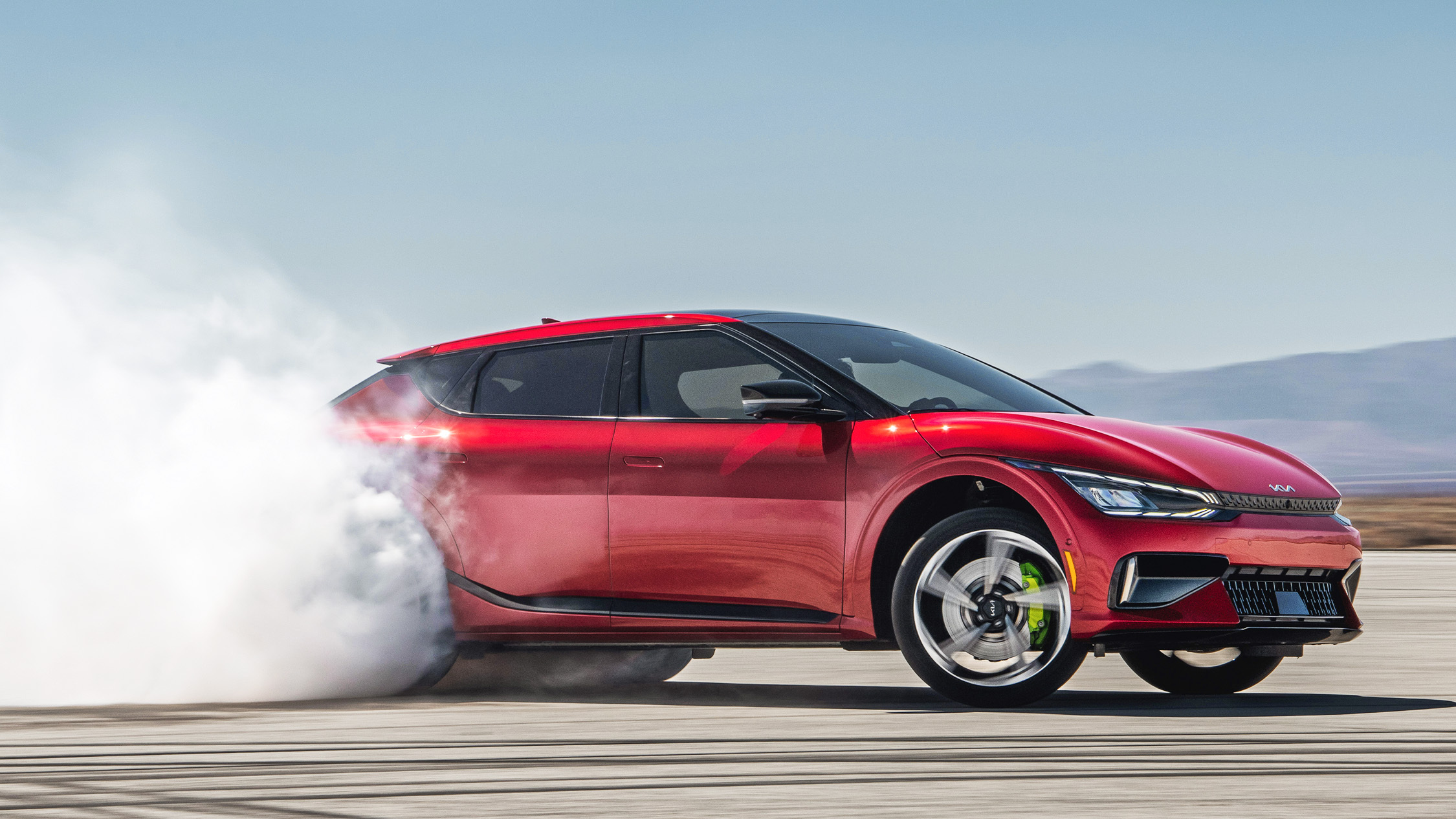
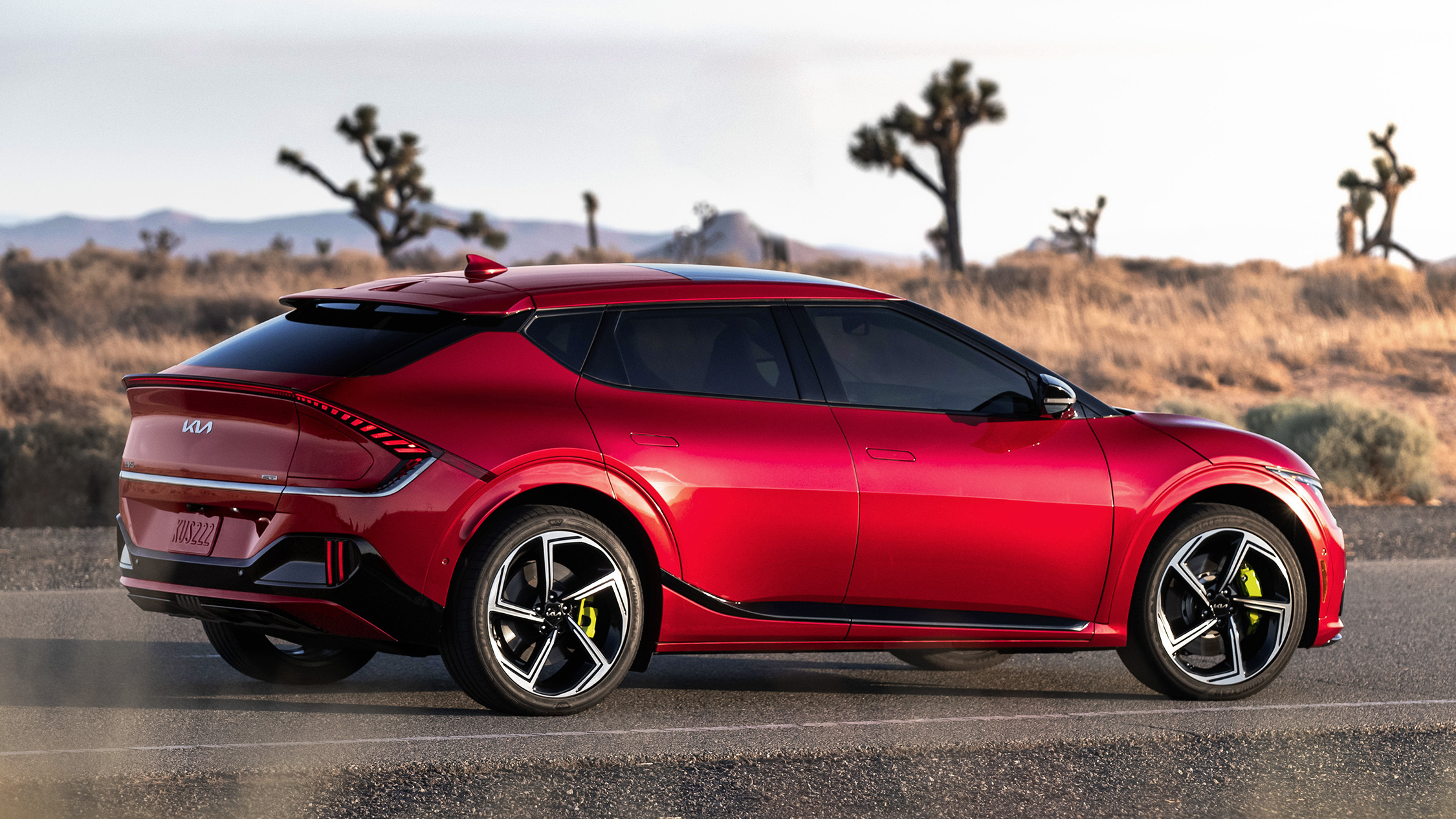
Smart has shared more photos of the #6 ahead of its market launch in China.
The flagship fastback sedan adopts shark-inspired styling cues and active aero.
It will be initially available with a PHEV powertrain offering a 1,125-mile range.
Smart may be best known for its pint-sized two-door hatchbacks, but its lineup has been steadily expanding to include SUVs and coupe-style crossovers. Now it is pushing further upmarket with something entirely different. The Geely and Mercedes-backed brand has unveiled its first fastback, pairing an aerodynamic silhouette with what it describes as, “shark-inspired” styling cues.
Following its earlier appearance in regulatory filings, Smart has now released a fresh batch of images of the #6 EHD. Mercedes-Benz was responsible for the exterior, and Smart says the whole thing takes its cues from marine predators.
At the front, the hood integrates functional air channels that Smart has branded “Bionic Shark-Gills.” Around the rear, a four-stage adjustable spoiler is said to echo the movement of a shark’s tail Or so the company claims, so take that with a pinch of seal salt.
Other details include tightly drawn body surfacing along the profile, aggressive LED headlights linked by a central grille element, and full-width LED taillights set within a sculpted rear panel.
At 4,906 mm (193.1 in) long, the #6 sits in executive sedan territory, being closer to a Mercedes E-Class or BMW 5-Series than anything Smart used to build. The 2,926 mm (115.2 in) wheelbase is the longest the brand has put into production, which should pay dividends for cabin space.
The interior has yet to be revealed, but spy shots suggest it will feature a tall center tunnel and a large infotainment display with the latest tech, similar to the Smart #5 SUV.
Electrified Powertrains
The Smart #6 sits on Geely’s PMA2+ architecture, a further development of the widely used SEA platform that also underpins models like the Zeekr 007 and its GT counterpart. It will debut as a plug-in hybrid, with fully electric versions set to follow, including a range-topping Brabus variant.
The EHD, short for Extended Hybrid Drive, uses Geely’s NordThor 2.0 system. It pairs a turbocharged 1.5-liter gasoline engine with a front-mounted electric motor, delivering a combined 429 hp (320 kW / 435 PS). The headline figure is range, with a claimed 1,810 km (1,125 miles) on the CLTC cycle, including up to 285 km (177 miles) in electric-only driving.
The Smart #6 EHD is scheduled to launch in China in the coming months, ahead of a global rollout. Pricing will be announced at a later date.
Wisconsin Supreme Court candidate Chris Taylor speaks at a March 18 forum hosted by the Marquette University Law School. (Henry Redman | Wisconsin Examiner)
For the third state Supreme Court election in a row, the conservative supported candidate is running a campaign based largely on accusations that the liberal candidate will be a partisan actor on the bench. But this year, the target of that accusation, who is running to secure a 5-2 liberal majority on the Court, served as a Democrat in the Wisconsin Assembly for nine years and previously worked as the state policy director for Planned Parenthood of Wisconsin.
“I don’t come with a political agenda to the bench,” says Appeals Court Judge Chris Taylor, who, after serving in the Assembly, was appointed to the Dane County Circuit Court by Democratic Gov. Tony Evers and then elected to the District IV Court of Appeals. “My agenda is to make sure every person has justice under the law, to make sure that everyone’s held accountable when they violate the law, regardless of how powerful or privileged they are and to be independent. And I saw in the Legislature how important it was to have an independent court. You don’t want a court to be a rubber stamp for any party or the Legislature or the federal government.”
Taylor’s opponent, Appeals Court Judge Maria Lazar, has spent more time as a judge and throughout the campaign has accused Taylor of being a partisan actor.
Lazar’s initial race for the Court of Appeals and her race this year have involved the support of some of the state’s most prominent election deniers. Taylor said that support and Lazar’s ruling in favor of the Wisconsin Voter Alliance are important signals for a race whose winner will likely be involved in deciding election law challenges in the 2028 presidential race.
“I certainly don’t have confidence that she would act to protect our elections if it didn’t go the way that the right wing wants it to go,” she told the Examiner. “So yes, I would be very worried about that, and people should with her record, and they should have no such worry with me, because I will make sure that unmeritorious attacks on our elections are struck down or are rejected.”
After the 2023 and 2025 campaigns for the Court set national records for judicial campaign fundraising, the 2026 race between Taylor and Lazar is comparatively sleepy. Taylor said at a forum hosted by Marquette Law School Wednesday that it’s probably a good thing that the temperature has been brought down a bit on the Wisconsin Supreme Court.
But with less money involved — and the ideological lean of the Court not at stake — less attention has been paid to the race. A Marquette Law poll released last month found that Taylor had a slight lead in the race, but that most people had not yet started paying attention or learned who either candidate was.
Taylor said she believes her campaign’s work over the past month has changed that, and that Wisconsin voters are “overwhelmed” by the state of the country.
“The people [of Wisconsin] are so engaged in government. They are hungry for a government that works for them. They are hungry for a court that stands up for them and protects their rights,” Taylor said at the Marquette event. “Now I will say I think people are overwhelmed. I really do. I think they’re overwhelmed because it’s hard right now. I think working families are struggling with high costs, gas prices have gone up so much. You know, there’s a lot going on in the world. Sometimes it feels very overwhelming. It’s very hard to see sometimes where you can make a difference and what you should be doing. But I tell people, this is a way to make a difference, is show up and vote.”
She said that if elected, she wants the Court to be better at engaging with regular Wisconsinites, pointing to oral arguments the Court held recently in Richland County rather than its Madison chambers as an example of something that should happen more. She also said that the Court needs to take more cases — a regular critique of the liberal-majority Court is that its caseload has dropped significantly.
“I have a duty to be independent, but I do not want to be isolated from the public,” she said. “I’m part of the community, and I want to be out in the community, doing what I can to do my part to make sure people know what we do in the judiciary, we have confidence in what we do. I think the more we can talk about it and invite people in, the more confidence people will have in our process.”
Both candidates in this year’s race for an open seat on the Wisconsin Supreme Court have served as circuit and appeals court judges. But Taylor says the difference between them is that she’s “never been reversed” by a higher court.
But Taylor points to the instances in which Lazar’s decisions have been overturned as evidence that the former Waukesha County judge is more likely to tilt her rulings toward one side.
“The only person, though, who has brought politics to the bench is my opponent,” Taylor told the Wisconsin Examiner. “And you look at the cases she has decided and thankfully been reversed on and you can see it.”
Last year, the Supreme Court overturned Lazar’s decision in a lawsuit filed by the Wisconsin Voter Alliance, a group that has been heavily involved in the effort to discredit Wisconsin’s election administration system since the 2020 election. The group had sued to force the release of voter registration files for people who had been declared incompetent to vote by a judge.
A previous appeals court decision had ruled the records weren’t able to be released, yet in a second lawsuit Lazar ruled otherwise — even though Wisconsin’s appeals courts don’t have the authority to overturn precedent.
“I have never seen that be done on the Court of Appeals. My colleagues, who’ve been there, some of them, over a decade, have never seen such a blatant disregard of precedent,” Taylor said. “Maria Lazar put her thumb on the scale. She didn’t like the result. She has brought politics to this bench.”
Taylor told the Examiner that in an era in which people across Wisconsin are worried about the Trump administration’s effects on their livelihoods and safety, the exact ideological swing of the Court is less important than having a Court that isn’t afraid to stand up on behalf of the Wisconsin people.
“People don’t care about what the ideology is on the court, they want justices who are going to protect their rights, who are going to stand up for our democracy and our elections, stand up to the federal government and make sure people get justice,” she said. “That’s what they want. That’s what my opponent does not understand. People want justices that are going to be fair and are going to protect them and have their back. My opponent has not ever done that in her life. That is not her priority like it is for me, it’s not ever been her priority.”
Appeals Court Judge Maria Lazar speaks at a Feb. 17 forum at the Marquette University law school. (Henry Redman | Wisconsin Examiner)
Appeals Court Judge Maria Lazar, the conservative candidate in the race for an open seat on the Wisconsin Supreme Court, has built her campaign around the idea that she will be an independent justice while her opponent, Appeals Court Judge and former Democratic legislator Chris Taylor, will be a partisan actor on the bench.
Lazar has frequently said on the campaign trail that she’s “never been a member of a political party” — a claim aided by the fact that Lazar has never served in partisan office and Wisconsin voters don’t register their party affiliation — while at a recent event Taylor, who served in the state Assembly for nine years, affirmed that she’s a Democrat.
The argument of the Lazar campaign closely mirrors the arguments made by the last two conservative candidates for the Court.
Last year, former Republican Attorney General Brad Schimel frequently said that as a justice he’d be like a baseball umpire, simply calling balls and strikes about the law. During the 2023 race, former Supreme Court Justice Dan Kelly said that if he was elected Wisconsin would have “the rule of law” while if his opponent Janet Protasiewicz were elected Wisconsin would have the “rule of Janet.”
Schimel and Kelly both brought long histories of work on behalf of the Republican party, its allies and its causes to their races. Both rode the argument that they would be impartial arbiters of the law to double digit losses.
But in both of the last two Wisconsin Supreme Court campaigns, the ideological balance of the Court was at stake after years in which Republicans had held control of most of the state’s political levers. Those races broke fundraising records and drew national attention.
Lazar is making her argument this year in a much sleepier race as part of an effort to prevent the Court’s liberals from securing a 5-2 majority. Lazar says it’s important to protect ideological diversity on the Court.
“You don’t want a court that has a point of view, one point of view,” Lazar said at an event in Brown County earlier this month. “You might as well have one judge, one justice. You need people there to be that diversity of thought.”
But like Kelly and Schimel, Lazar’s opponents have argued she’s not as non-partisan as she claims.
Lazar has been endorsed by some of the state’s leading anti-abortion groups, prominent 2020 election deniers and all six of Wisconsin’s Republican members of the House of Representatives. She’s received financial support from major GOP donors including Richard and Liz Uihlein. She has also regularly appeared with far right national political figures and has spoken to right-wing groups across the state.
Her campaign staff includes consultants with deep ties to Wisconsin Republican politics.
“I don’t really care if you’re a member of the Green Party, the Constitution Party, or any party,” Lazar told the Wisconsin Examiner. “You cannot be a member of a party at any point in time and be a judge, because everyone will rightly say, ‘Where are your interests? Are you ruling for the law, or are you ruling for your party?’”
As an attorney for the state Department of Justice, she defended Republican lawmakers in a lawsuit alleging they violated the state’s open meetings laws while passing the controversial anti-union measure that became Act 10. She also defended the gerrymandered 2011 electoral maps that locked in Republican control of the Legislature for more than a decade.
At an event earlier this month, Chief Justice Jill Karofsky said that as a Department of Justice attorney, Lazar carried “the flag of the right-wing interests.”
After the 2020 presidential election, the state Supreme Court, then controlled by a conservative majority, ruled in a 4-3 decision not to hear a lawsuit from the campaign of President Donald Trump challenging Wisconsin’s election results.
With the Trump White House signaling a willingness to interfere in the conduct of state election systems, Democrats and left-leaning organizations have argued the Supreme Court race this year will build an important barrier against Republicans copying the 2020 playbook in the 2028 presidential election.
Earlier this month, Lazar told PBS Wisconsin she wouldn’t weigh in on the merits of that Trump 2020 case, but that she believes “every legal, valid vote should be counted.”
But in the election disputes that have simmered in Wisconsin during the six years since Trump’s Stop the Steal effort culminated in the Jan. 6, 2021 attack on the U.S. Capitol, the debate has often centered exactly on the question of what counts as a legal, valid vote — a question that the Supreme Court may be called on to answer.
Lazar said it would be shortsighted for a judge or justice to decide an election case “because it helps the side that you most personally align with.”
“A vote is a vote, and I’m not going to get into all the ins and outs of what judges have to look at when they’re determining what’s a legal, valid vote,” she told the Examiner. “But my concern is — and I’m seeing it not just in Wisconsin, I’m seeing it nationally — I’m seeing that this is being treated like a game. It’s a very serious right, and I think it’s an obligation that people vote, and I don’t like seeing anyone disenfranchised for any reason whatsoever.”
The effort to cast doubt on election results was sparked by Trump and led in Wisconsin by Republicans and former conservative Supreme Court justices Currently, Republican members of Congress are debating a bill that could drastically restrict access to the ballot to people unable to produce a certified copy of a birth certificate or other documents proving U.S. citizenship. But Lazar said she sees judges on both sides trying to help their side win.
“I don’t like the fact that courts and justices and judicial candidates are making these arguments and winking and nudging on both sides and saying, ‘Oh, if you elect me, I’m going to make sure that your party is going to win,’ or ‘if you elect me, I’ll make sure this doesn’t happen, or this does.’ That’s inappropriate,” she said.
Observers representing a range of political views have lamented the massive amount of money that has flowed into Wisconsin’s Supreme Court races, which has accelerated the perception that the body is more partisan than it used to be.
Under Wisconsin’s divided government, the Supreme Court has been regularly tasked with deciding disputes over the separation of power between the governor and Legislature. With an open race for governor and competitive legislative races across the state, November’s elections could result in one party trifecta control of the lawmaking branches or give state government a big shakeup that results in a still-divided government under a different layout.
Lazar said a justice deciding these separation of power cases shouldn’t try to game out which party will be helped because in Wisconsin’s swing state politics, the shoe could just as quickly be on the other foot.
“Be careful what you wish for,” she said. “You have to have a long view, and the courts really have the longest view. And we should be looking not to what helps someone today, but we should be saying, ‘how do we affect the appropriate law for generations?’”
In recent years, and especially since the start of Trump’s second term, conservative leaning candidates have not fared well in non-major elections. Democrats and left-leaning judges have performed far better when turnout is lower through a combination of higher motivation against a liberal base eager to cast a protest vote against the unpopular president’s party and the lower engagement in state and local politics among a Republican base that only turns out en masse when Trump is on the ballot.
Lazar said she understands that’s a barrier she has to overcome.
“It does seem to be non-major election years that the April elections seem to be a little sleepier, or they possibly even trend a little bit away from the more conservative candidate, or the more independent, in this case, candidate, and we recognize that,” she said. “Everyone in this state should be looking at this race and looking at what rights they have, and to making sure that they take steps so that they have someone that they can have faith in.”
A Marquette Law School poll released in February found that a large swathe of Wisconsin voters still had very little information about the Supreme Court race. With six weeks before Election Day, 66% of voters said they were still undecided. Among those polled who had decided, Taylor had a slight edge.
But despite Taylor’s slight lead in the poll, Lazar said her takeaway was that the Taylor campaign’s TV ads in the state’s largest metro areas had done little to move the public.
“My opponent has spent a lot of money, run a lot of ads and not gaining any traction,” Lazar said. “And I think it shows that the state of Wisconsin is saying we want to take a step back, maybe a little bit of election fatigue from last year, and we want to take a step back to really make a good, wise decision on who we want to give a 10-year term on this Court.”
A banner of President Donald Trump is hung on the Department of Justice in February. The Justice Department is arguing it needs access to states’ voter data to ensure the security of the midterm elections. (Photo by Heather Diehl/Getty Images)
The U.S. Department of Justice has begun connecting its push to obtain sensitive personal data on millions of voters to whether the upcoming midterm elections will be fair and secure, laying the groundwork for the Trump administration to potentially cast doubt on the results.
The Justice Department has sued 29 states and the District of Columbia over their refusal to provide unredacted voter rolls that include the driver’s license and partial Social Security numbers of voters. The department has lost three of those lawsuits so far this year.
But as the Justice Department begins appealing the losses, it has filed emergency motions warning the “security and sanctity of elections” would be questioned in those states — California, Michigan and Oregon — without immediate rulings.
Election experts told Stateline that federal appellate courts are unlikely to move quickly for the Justice Department. Instead, the department’s court filings suggest that without the data, the Trump administration may question the validity of the midterm elections in November.
“Absent a final Court determination on this matter there is no other process to ensure a fair election in 2026,” the Trump administration’s motions say.
President Donald Trump has made identifying noncitizen voting, an extremely rare occurrence, a priority of his administration, and the Justice Department has said the detailed personal data is necessary to ensure states are properly maintaining their voter rolls. At least a dozen Republican-led states have provided the information.
Democratic election officials, and some Republicans, have condemned the demands as an invasion of voters’ privacy and have voiced concerns the Trump administration plans to use the information to target political opponents or create a national voter list. Other Republican election officials and the Trump administration and have downplayed privacy concerns and said the data will help ensure only eligible voters cast ballots.
The DOJ’s sense of urgency comes after the department spent months sending letters to state officials demanding voter data, followed by successive rounds of lawsuits against states that refused to comply — all in what department officials said was the pursuit of noncitizen voters.
“We know this isn’t a big problem nationwide,” said David Becker, executive director of the nonpartisan Center for Election Innovation & Research and a former senior trial attorney in the Justice Department’s Voting Section during the Clinton and George W. Bush administrations.
“We know the states have adequate safeguards,” Becker said. “We see Republicans — Republicans — coming out and saying this repeatedly. So there is no problem that urgently needs to be solved in advance of the election.”
But the Trump administration has increased its attention on elections in recent weeks. In early February, Trump voiced a desire to “nationalize” elections. He demanded Congress pass a proof of citizenship voter registration requirement and strict voter ID rules. The U.S. Senate is expected to debate the bill next week, but it is unlikely to have enough votes to advance.
The FBI has also seized ballots from the 2020 election in Fulton County, Georgia, and the Arizona Senate complied with a federal grand jury subpoena for records related to its 2020 audit of that year’s election results in Maricopa County, Arizona.
Michigan responded to the Justice Department in a March 6 court filing by asserting that its case involves no emergency. Lawyers representing Michigan Secretary of State Jocelyn Benson, a Democrat, wrote that the appeal doesn’t challenge any state election law or rule and that the outcome of the case would have little to no effect on the 2026 election.
In response to an interview request, Benson’s office referred Stateline to a news release that quoted the secretary as urging election officials across the country “to stand up to the federal government’s overreach and to safeguard citizens’ private voting information we’ve been entrusted to protect.”
Oregon Democratic Secretary of State Tobias Read said in an emailed statement to Stateline that he’s “confident in our case, and trust the courts will continue to uphold the Constitution and the privacy rights of all Oregonians.”
California Democratic Secretary of State Shirley Weber didn’t respond to an interview request.
Race against time
Federal judges have so far ruled that even though states must perform maintenance on their voter rolls, federal law doesn’t give the Justice Department authority to obtain full voter lists.
While the Justice Department now claims the security and sanctity of upcoming elections necessitates the need for speed, the department hasn’t alleged any states are violating federal voter list maintenance requirements, said Derek Clinger, senior counsel and director of partnerships at the State Democracy Research Initiative at the University of Wisconsin Law School.
“This is the first time in all the litigation that DOJ has claimed that there’s an urgent need to resolve the cases,” said Clinger, who is tracking the voter data lawsuits.
This is the first time in all the litigation that DOJ has claimed that there’s an urgent need to resolve the cases.
– Derek Clinger, State Democracy Research Initiative at the University of Wisconsin Law School
Even if courts ultimately determine that states must provide the voter data, it’s not clear that the Justice Department could make effective use of it before the midterms.
Federal law generally prohibits states from conducting significant purges of registered voters less than 90 days before primary and general elections. For example, that period will begin in Michigan on May 6 ahead of the state’s Aug. 4 primary election.
The Justice Department has asked for all court documents in its Michigan appeal to be filed by April 1. Even if the appellate court immediately ruled in the department’s favor, only 35 days would be left until the pre-primary blackout period.
Lawyers for Michigan wrote in its court filing that it is “dubious” that any serious assessment of the state’s 7.3 million voters could occur in that time frame.
Still, Rosario Palacios, a naturalized U.S. citizen who leads the good-government group Common Cause Georgia, said she’s worried the federal government could wrongly flag her or others like her as noncitizens if the Justice Department eventually obtains her state’s unredacted voter roll.
The U.S. Department of Homeland Security operates a powerful online program called SAVE (Systematic Alien Verification for Entitlements) that it uses to verify citizenship. It has previously invited states to run their voter rolls through the program, and the Trump administration in September confirmed the Justice Department is sharing state voter roll data with Homeland Security. But SAVE has faced criticism from some election officials for mistakenly flagging U.S. citizens for review.
After the department sued Georgia for refusing to turn over its data, Palacios and Common Cause intervened in the lawsuit to oppose the demand.
Palacios said in an interview she’s worried some may choose not to participate in the election. “The fear alone of this is going to make people withdraw.”
Some GOP states share voter data
The Justice Department has offered few details about how it intends to analyze the voter data it obtains. The agency didn’t answer questions from Stateline and declined to comment.
Idaho Republican Secretary of State Phil McGrane last month said he wouldn’t turn over voter data. McGrane declined an interview request, but in a Feb. 26 letter to the Justice Department he raised concerns about data security.
“While I appreciate the Department’s representations that Idaho’s data will be safeguarded, I cannot take that now-apparent risk in the absence of clear legal duty to do so,” McGrane wrote.
Some Republican election officials have decided to share their state’s data, however.
Eric Neff, the acting chief of the Justice Department’s Voting Section, wrote in a March 2 court filing that 18 states had either shared voter data or planned to do so soon. He didn’t name those states.
The Brennan Center for Justice at New York University, which tracks the voter data requests, has identified at least a dozen states that have provided the data: Alaska, Arkansas, Indiana, Kansas, Louisiana, Mississippi, Nebraska, Ohio, South Dakota, Tennessee, Texas and Wyoming.
Two of those states — Alaska and Texas — provided their voter rolls after signing a memorandum of understanding, or MOU, with the Justice Department.
The document, marked confidential, says that after the state provides its voter roll, the department agrees to test, analyze and assess the information. Each state agrees to “clean” its voter roll within 45 days by removing any ineligible voters. States would then resubmit their list.
Tennessee Elections Coordinator Mark Goins, who works under Tennessee Republican Secretary of State Tre Hargett, said in an interview that the state had shared its voter data after concluding that DOJ was entitled to it as part of its authority to enforce federal voting law. But Goins said Tennessee had decided against signing the memorandum of understanding because of concerns that the agreement conflicted with the National Voter Registration Act, which sets rules on when election officials can remove voters from their lists.
“When you’re dealing with this much data, and we have 4 million registered voters here, there could be a false flag and you certainly don’t remove anyone improperly,” Goins said.
In Texas, it’s unclear when the Justice Department will provide feedback on the state’s voter list. The state is currently in the preelection blackout period on sweeping changes to its voter registration list ahead of a May 26 primary runoff election, a spokesperson for Texas Republican Secretary of State Jane Nelson told Stateline.
Texas already ran its voter roll of more than 18 million voters through Homeland Security’s SAVE program last year, identifying 2,724 potential noncitizens registered to vote. County election officials were then left to investigate the flagged voters.
Christopher McGinn, executive director of the Texas Association of County Election Officials, said he’s unsure what would happen now, given that the state’s voter roll was recently examined by SAVE.
“Especially since those noncitizens were, in theory, cleaned up,” McGinn said.
In Alaska, the decision to share voter data has produced blowback from some state lawmakers. The state constitution guarantees a right to privacy that “shall not be infringed.”
Alaska Director of Elections Carol Beecher faced skeptical lawmakers during hearings last week that probed her refusal to waive attorney-client privilege to divulge the legal advice she received before providing the voter roll. In response to questions from Stateline, Beecher’s office referred back to her remarks to lawmakers.
“At this point, I am not willing to waive that privilege,” Beecher said at an Alaska Senate hearing.
Alaska state Sen. Bill Wielechowski, a Democrat who was among those who questioned Beecher, in an interview predicted the state will soon face lawsuits challenging the data sharing. He also said lawmakers are looking into pursuing legislation that would direct state officials to seek the return of the information from the Justice Department.
“I just think there’s a total lack of trust in what the federal government will do with this information,” Wielechowski said.
This story was originally produced by Stateline, which is part of States Newsroom, a nonprofit news network which includes Wisconsin Examiner, and is supported by grants and a coalition of donors as a 501c(3) public charity.
Kia has dropped the Niro EV as focus shifts to dedicated EVs.
The refreshed Niro will now be sold only as a hybrid in Korea.
Rising competition made the electric Niro harder to justify.
Update: Kia America has responded to our request for comment, telling Carscoops that “Kia America has made no formal announcement regarding the Niro EV and it remains as an important element in our lineup of ICE and electrified vehicles.” That statement suggests the discontinuation confirmed for South Korea may not apply to the U.S. market, at least for now.
Original Story Follows
The latest Kia Niro has been around for almost half of a decade. When it launched, it was unique in the segment. It had an unconventional slashed body panel at the rear and came in hybrid, PHEV, and EV versions. The plug-in died recently, and now, as a facelift nears release, the EV version is also going the way of the Dodo.
The automaker confirmed the change for the Korean market. “The Niro EV, which had been produced until the previous model, has been discontinued,” Jung Yoon-kyung, a senior marketing manager at Kia, told The Korea Herald. “We plan to sell the remaining inventory available.” Carscoops reached out to the automaker to confirm the change in the U.S. market as well.
If this is indeed the situation for the States, it won’t be all that surprising. The Niro EV has always been a bit of an oddball in the family. Unlike the other EVs in the lineup, it was designed around a gas-burning powertrain. The others, all built exclusively as EVs, feature faster charging, longer range, and better overall packaging. Some even offered all of this for less than the price of the Niro EV. That’s a key piece of the puzzle here.
“Kia is strongly focusing on electrification. Starting with the EV3 and continuing through EV9, we have a range of vehicles with strong electrification capabilities and improved product competitiveness,” Yoon-kyung said. “In order to concentrate more on those models, we decided to discontinue the (Niro EV).” Those models are ones that are already set up for the U.S. market.
Now, Kia can better focus on those vehicles and streamline the Niro lineup at the same time. While we loved the Niro PHEV, EV, and Hybrid at launch, it was clear last year that they were beginning to show their age. This new shift in powertrains signals a tighter focus for the brand.
Texas lawsuit says Tesla FSD steered a Cybertruck into barrier.
Driver says the system aimed straight at a concrete divider.
The crash allegedly caused spinal injuries and wrist damage.
Update: There’s now video of the Houston Cybertruck crash. Footage shared by Hilliard Law, which represents the woman in the lawsuit, shows the electric truck, reportedly operating in self-driving mode, failing to follow a right-hand curve and continuing straight toward an overpass barrier. The driver attempts to intervene, but it is already too late, and the impact is severe. She is now suing Tesla for $1 million, alleging the system did not perform as promised.
'TERRIFYING': Dashcam video shows the moment a Tesla Cybertruck, allegedly operating in self-driving mode, nearly sent a Houston mom and her infant off a bridge before violently crashing into an overpass barrier.
Tesla’s Full-Self Driving (Supervised) system has placed advanced semi-autonomous capability in the hands of thousands of owners across the United States. The technology remains one of the most closely watched developments in the industry. Yet despite its promise, the system is still far from flawless, and according to a recent lawsuit filed against Tesla, it can also be dangerous.
The suit, filed in Harris County Court in Houston, Texas, alleges that Tesla Cybertruck owner Justine Saint Amour was using the FSD system in August last year while traveling along the 69 Eastex Freeway. As the electric pickup approached a Y-shaped junction near the Houston Metro 256 Eastex Park & Ride, the vehicle’s onboard systems should have followed the right-hand curve of the freeway.
FSD Navigation Error Alleged
Instead, the lawsuit claims the Tesla attempted to continue straight ahead toward a concrete barrier. The driver reportedly took control just before impact but was unable to avoid the obstacle, with the Cybertruck striking the barrier head-on. A 1-year-old child was also in the back seat at the time but was not injured.
The impact reportedly left the woman with two herniated discs in her lower back, a herniated disc in her neck, sprained wrist tendons, and neuropathy. Chron reports that dashcam footage captured the crash, showing the Cybertruck attempting to negotiate the curve at the interchange but ultimately hitting the barriers.
Camera Only System Criticized
An image taken after the crash shows that the front of the blacked-out Cybertruck took a serious hit, and that the front bumper shattered, leaving pieces of bodywork strewn across the road.
The lawsuit further alleges that Tesla’s decision to rely exclusively on a camera-based system for its self-driving technology, rather than incorporating radar or LiDAR sensors, contributed to the crash. It also claims Elon Musk is “an aggressive and irresponsible salesman” with a history of “making dangerous design choices.”
“Tesla’s decisions made Justine’s accident inevitable,” Saint Amour’s lawyer, Bob Hilliard, told Chron. “This company wants drivers to believe and trust their life on a lie: that the vehicle can self-drive and that it can do so safely. It can’t, and it doesn’t.”
The lawsuit accuses Tesla of negligence and seeks more than $1 million in damages.
While the likes of Tesla can sleep easily in the US, largely insulated from the surge of Chinese EVs sweeping through global markets, the situation looks very different overseas. In places like Malaysia, where we’re currently experiencing the BYD lineup firsthand, the competitive landscape is far more intense.
You’re probably already aware that brands like BYD have moved quickly to market with smaller and more affordable electric vehicles. What’s becoming clearer, however, is that they also seem to have an answer for nearly every category Tesla occupies.
Take the Sealion 7. In East Asia, it’s a mid size electric SUV that carries the Ocean Series legacy into a more premium segment. Available in both rear wheel drive and all wheel drive Performance variants, the Sealion 7 brings BYD’s e Platform 3.0 Evo, Blade Battery, and its so called Ocean Aesthetics design language into a very capable package.
QUICK FACTS
› Model:
2026 BYD Sealion 7 Performance
› Dimensions:
190.2 L x 75.8 W x 63.8 in H (4,830 x 1,925 x 1,620 mm)
› Wheelbase:
115.4 in (2,930 mm)
› Curb Weight:
2,340 kg (5,159 lbs)
› Powertrain:
Dual electric motors / 82.56 kWh battery
› Output:
290 kW / 690 Nm (509 lb-ft) of torque
› Performance:
4.5 seconds 0–62 mph (0–100 km/h)*
› Charging
Rapid Charger (150 kW DC)
› Range
283 miles (456 km) WLTP*
› On Sale:
Now
SWIPE
*Manufacturer
Or, if we strip away the brochure language, it may simply represent the next major headache for the Tesla Model Y.
But with the EV market at its most competitive, and BYD no longer alone in its export ambitions, the real question is whether the Sealion 7 can go toe to toe not just with Tesla, but with the growing wave of Chinese rivals also establishing themselves abroad.
Sealion? Ocean Aesthetics? What Does Any Of That Mean?
Photos Sam D. Smith / Carscoops
Okay, it’s a bit complex, but let’s try to break it down: BYD has multiple lines. For the domestic market, it has models under the Dynasty lines, and then you have the Ocean series, which, as the name implies, takes aquatic styling cues with sea-creature-based names. Seagull, Dolphin, and yes, Sealion. There are multiple Sealions as well, with the 5 being a Honda HR-V-sized competitor that’s also available with a hybrid drivetrain, and the Sealion 6 being a larger SUV in the vein of the Nissan Rogue.
The Sealion 7 is more akin to the Audi Q8, a more stylish approach for those who care about such things. And while the front end is very much BYD, in the fact that it’s a tad anonymous but inoffensive, the rear end has actually grown on me.
Rather than trying to make a bold, but frankly pointless statement by being objectionably coupe-like (I’m looking at you, Porsche Cayenne Coupe and BMW X6), it’s a more cohesive, perhaps egg-like, shape. Again, it’s not revolutionary, but nor is it different for the sake of being different either. It’s streamlined and more put-together in its execution, avoiding the awkward proportions that so many other “sporty” SUVs seem to cling to.
That Low Tapering Roofline Can’t Be Very Practical, Can It?
Photos Sam D. Smith / Carscoops
Well, rear-seat passengers don’t have to sacrifice too much in terms of headroom, which is a plus. However, after several airport runs, it was soon clear that boot space, or rather the shape of it, is not the Sealion 7’s strong suit.
That rounded-off rear does look nice, but when it comes to getting it to close when stuffed to the brim, you’re going to have to end up playing some suitcase tetris…or, in our case, moving some luggage to the passenger compartment instead.
Photos Sam D. Smith / Carscoops
It’s a common tradeoff: looks at the expense of practicality. But it’s also worth noting if you’re trying to decide between the more conventional Sealion 6 or the Sealion 7. Plus, it’s not all style over substance. There are some nice functional features too, such as proper air curtains in the front bumper, which help with airflow around the wheels.
It’s Still A Chinese Car, Right? How Stylish Can It Be?
You’d be surprised. Yes, there are still a fair few (how should we put this?) “inspired” designs throughout the Chinese market, with the Land Rover Defender and Range Rover seemingly being the most imitated. The Sealion 7, though, looks to be cutting its own mold in many respects.
It’s the interior that really shines. Unlike the Atto 3 we tested earlier, this is a much more “conventional” setup. The interior quality feels premium, with soft-touch plastics everywhere, while the layout won’t have you scratching your head.
It still lacks physical AC controls, except there’s a button to turn the fan on and off. Not fan speed. Not temperature. Just on and off. Why?
Now, having spent some time with BYD products, I’m going to label the rotating screen as gimmicky. At 15.6 inches, it’s large enough for anything you’d want, and the hardware is beefy enough for the system to be super snappy and responsive. However, if you do use wireless CarPlay or Android Auto, as 90 percent of users will, the screen will force you to use it in its landscape orientation. Go figure.
Photos Sam D. Smith / Carscoops
Still, there’s some great integration with the super-legible driver’s display and head-up display, the latter of which supports turn-by-turn navigation when using Google Maps. Both screens also do an excellent job of displaying info for the lane-keep assist and cruise control functions, which are noticeably less intrusive than earlier attempts from BYD.
The electric seats feature lumbar and adjustable under-thigh support, helping these chairs feel supportive, but not overly bolstered. The front seats are also ventilated, with up to three speeds of cooled air channeled to combat any hint of back sweat.
If you want to see more of the outside, there’s a full-length panoramic roof with an electrically controlled sunshade, and there are physical switches for drive modes and regen.
So, How Does It Drive?
In a single sentence, it feels mature, but still not as polished as I’d have hoped. BYD may have had a few missteps in the past, but their premium product offerings are starting to feel closer to the semi-premium image they’re chasing in the way they drive.
The Performance AWD model we got to the keys to packs a dual-motor setup for AWD, producing 390kW (523 hp) and 690 Nm of torque. To get from 0-100 km/h (0-62 mph) you need just 4.5 seconds. That’s faster than a Porsche Cayenne Coupe S, all while offering an integrated battery, fast charging up to 230 kW, and being able to top up from 10-80 percent in around 24 minutes.
While figures are all well and good, there’s proper substance when you’re behind the wheel. While a proper enthusiast may want a quicker ratio rack, the Sealion 7’s steering is nicely weighted, and does a decent job of providing the kind of feedback that you need with 500+ hp under your right foot.
The car also handles better than expected. There’s a trend for Chinese SUVs to be a bit over-damped, with the ensuing wallow meaning that true confidence can’t be found. But the Sealion 7’s chassis not only feels dynamic through a set of quick corners, it also remains planted, more sedan-like than you may expect.
There’s one huge penalty, though, experienced while driving on Malaysia’s roads. Over bigger, faster imperfections, such as expansion joints, the ride feels almost crashy. It’s the one chink in this BYD’s armor that would otherwise have convinced us that the Germans themselves had tuned this suspension. But alas, there’s still a lack of composure there.
But at slower speeds, and over smaller humps, the Sealion 7 maintains a well-damped composure that you’d expect from something upmarket, and that’s despite riding on 19-inch rims. Also of note is that the Performance version of the Sealion 7 comes equipped with Michelin Pilot Sport EV tires, again, another sign that BYD is taking this segment of SUV seriously, rather than cheaping out on lesser-known rubber, as has been seen in the past.
You also get several drive modes, and they behave pretty much as expected. However, despite offering selectable “normal” and “larger” regenerative braking settings, there’s still no proper one-pedal driving mode. It’s not a dealbreaker, but it does feel like something future versions of the Sealion should include if it’s going to go head-to-head with Tesla
Verdict
For the Malaysian market, the Sealion 07 comes in at RM 183,800 (equal to $25,900 a current rates) for the Premium model, or RM 199,800 ($28,100) for the AWD Performance. The latter undercuts Tesla’s Model Y Long Range AWD (RM 242,450) significantly, which is slower (0-62 mph in 4.8 seconds vs 4.5 seconds for the BYD), and has less range on the WLTP cycle.
But with more aggressive entries planned for East Asia, including the likes of Chery and Changan, the Sealion 7 is about to come up against tough competition. It highlights the fast-moving pace of the EV industry, particularly spurred on by the Chinese automakers who are keen to find market share outside of their home playing field.
U.S. Immigration and Customs Enforcement officers detain an observer after making arrests in January in Minneapolis. Bills in more than half a dozen states would prohibit ICE agents at the polls, which is already illegal under federal law. (Photo by Stephen Maturen/Getty Images)
Several Democratic states are moving to bar federal immigration agents from being near polling places and other election sites, amid persistent worries that President Donald Trump will use federal law enforcement or the military to disrupt the midterm elections.
Measures to restrict federal agents from operating at or near election-related locations have been offered in more than half a dozen states, according to a Stateline count. While the proposals vary, they broadly seek to combat the prospect of chaotic confrontations between federal agents and voters this November.
A federal law dating to the end of the Civil War already bans sending the military or other “armed men” to polling places, except to repel armed enemies of the United States. The U.S. Constitution also gives states — not the president or federal government — the responsibility for running elections.
But Trump’s calls to nationalize elections, his promise to impose voting restrictions with or without Congress, and his history of working to overturn the 2020 presidential election is prompting some Democratic state lawmakers to act. Adding to lawmakers’ fears is the FBI’s January seizure of ballots from the 2020 election in Fulton County, Georgia, and U.S. Department of Justice lawsuits against dozens of states for copies of their voter rolls that include sensitive personal information.
The president’s party typically loses ground in Congress in midterm elections. Given that, Democrats fear Trump is laying the groundwork to block or cast doubt on a losing outcome.
“When the president says he’s going to break the law, I actually believe him,” said California state Sen. Tom Umberg, a Democrat who has introduced legislation that would prohibit federal immigration enforcement within 200 feet of polling places. He said Trump’s call to “nationalize” elections was the “triggering event” that prompted him to offer the bill.
Legislation to restrict immigration enforcement or the presence of federal forces near polling places and other election sites has been offered or announced in California, Connecticut, New Mexico, Pennsylvania, Rhode Island, Virginia and Washington. A bill has also been introduced in Kansas, which has a Democratic governor, but the measure is unlikely to pass in the Republican-controlled legislature.
The bills focus on immigration enforcement, but the New Mexico legislation would go further, prohibiting the military or any armed federal personnel from polling locations.
I think this is just prudent, wise policy to do what we all know is right, which is to protect polling places.
– Virginia Democratic state Del. Katrina Callsen
The Trump administration and its supporters have suggested that the president might order U.S. Immigration and Customs Enforcement, or ICE, to the polls. After former Trump adviser Steve Bannon in early February said ICE will surround polling places, White House press secretary Karolina Leavitt said she couldn’t guarantee an ICE agent wouldn’t be near a polling place
Trump allies have also circulated a draft executive order that Trump could sign declaring a national emergency and attempting to assert broad powers over elections, The Washington Post reported last week. Trump told reporters on Friday that he had never heard of the draft order.
But during a conference call last week for election officials from across the country, the Department of Homeland Security committed to not placing ICE agents at any polling places in 2026, according to both Republican and Democratic secretaries of state who were on the call.
Homeland Security told Stateline in a statement that ICE isn’t planning operations “targeting” polling places, but could arrest individuals if an active public safety threat endangered a polling location.
“There’s no reason for us to deploy to a polling facility,” ICE’s current leader, Todd Lyons, told Congress in February.
Democratic state lawmakers calling for election-related restrictions on ICE in state law say they don’t want to take any chances.
“I think this is just prudent, wise policy to do what we all know is right, which is to protect polling places,” said Virginia Democratic state Del. Katrina Callsen, the chief sponsor of a bill that would prohibit federal civil immigration enforcement within 40 feet of polling places and voting counting sites.
The New Mexico legislature in February passed a measure that largely mirrors restrictions in federal law against armed federal personnel at polling places. The bill is now before Democratic Gov. Michelle Lujan Grisham.
The bill says officials generally cannot order or bring troops or other armed federal agents to polling places or parking areas for polling places beginning 28 days before Election Day, when early in-person voting begins. It also would prohibit officials from changing who is qualified to vote contrary to New Mexico law or from imposing election rules that conflict with state law. Violators would be guilty of a felony.
New Mexico lawmakers offered the legislation the day after Trump’s initial remarks about wanting to nationalize elections. New Mexico Democratic state Sen. Katy Duhigg, the bill’s lead sponsor, said she wanted a measure that wouldn’t run into issues with the U.S. Constitution’s supremacy clause, which says federal law supersedes state law.
“I think a lot of states, frankly, are trying to figure out what to do right now,” Duhigg said, adding that courts will likely be asked to sort through new state-level limits on federal forces. “This seems like a reasonable approach to try.”
Republican lawmakers opposed
Some Republican state lawmakers are dismissive of the Democratic measures, casting them as unnecessary.
“I just cannot imagine the president, as much as you might dislike him, ordering federal troops to seize New Mexico elections by armed force,” New Mexico Republican state Sen. William Sharer, the minority leader, said during debate. Sharer didn’t respond to an interview request from Stateline.
In Washington state, one bill would require local election officials to block anyone from accessing areas where ballots are processed or counted for the purposes of immigration enforcement. Law enforcement could be allowed access with a judicial warrant or court order, however.
Washington state Rep. Jim Walsh, a Republican who also chairs the state party, characterized the proposal as “fearmongering” and a solution in search of a problem — unless its supporters acknowledge that people in the country illegally are voting. And he claims Washington doesn’t have the authority to legally bar ICE from areas of an election office.
Washington Democratic state Sen. Drew Hansen, the bill’s lead sponsor, said election workers counting ballots deserve to be able to perform their task without interference from federal immigration authorities. Hansen noted that ICE “does not have a perfect track record, to say the least, of only detaining extremely dangerous, violent noncitizens.”
More than 170 U.S. citizens have been held by immigration agents during Trump’s second term, ProPublica reported in October. A December report by Democrats on the U.S. Senate Permanent Subcommittee on Investigations identified at least seven U.S. citizens who were held for more than 24 hours.
In Arizona, some Republicans want to encourage an ICE presence at the polls. In February, Republican state Sen. Jake Hoffman offered a bill that would require counties to sign an agreement with ICE to provide a federal law enforcement presence at polling places.
Hoffman didn’t respond to an interview request from Stateline. A scheduled committee hearing on the measure was canceled in February, likely killing the bill. Still, the underlying proposal could be resurrected, Arizona Mirror reported.
“Arizonans deserve to know that election laws are not just written in statute but actually enforced in practice,” Hoffman said in a news release.
Existing federal laws against federal election interference are specific and straightforward, said Sean Morales-Doyle, director of the Voting Rights and Elections program at the left-leaning Brennan Center for Justice at New York University. States such as Arizona don’t get a “free pass” to violate federal law, either, he said.
Options exist to hold people accountable under federal law, Morales-Doyle said. If ICE agents deployed to polling places, federal prosecutors would have five years to bring charges against ICE personnel under the statute of limitations. While the Justice Department under the Trump administration would be unlikely to bring charges, he noted, the time limit extends into the next presidential administration.
Still, Morales-Doyle said he understands why people are skeptical, given how ICE and other elements of the Trump administration have behaved.
“So it is, I think, important to think about what state legal mechanisms there are for holding people accountable,” he said.
Local enforcement
Some of the state legislative proposals would place local election workers on the front lines of resisting federal interference.
The Washington state measure would instruct multiple election workers, when possible, to document incidents in which they deny permission to enter areas that are off limits to immigration enforcement. The New Mexico bill would allow county clerks and voters who experienced intimidation to sue over alleged violations, in addition to state officials.
The California legislation goes perhaps the furthest in empowering local election officials. It would allow county election officials to keep polls open if they determine that voting was disrupted because of violations of a ban on federal immigration enforcement nearby.
Some local election officials appear hesitant to discuss the proposals and whether they are preparing for the possibility of federal interference. The president of the California Association of County Clerks and Elected Officials and the clerks chair of New Mexico Counties, a statewide advocacy group for county officials, didn’t respond to requests for interviews. The Washington State Association of County Auditors declined to comment.
More broadly, other election officials have said the possibility of federal interference is informing their preparations for the midterm elections. Scott McDonell, the Democratic clerk of Dane County, Wisconsin, which includes Madison, told Stateline in February that while Trump’s desire to “nationalize” elections isn’t possible under the Constitution, he is paying attention to agencies that answer to Trump.
“What does the president actually control? The FBI, National Guard, ICE, DOJ in general. That’s far more concerning,” McDonell said. (State national guards can be federalized by the president.)
Barbara Richardson Crouch, the Republican registrar of voters in the Town of Sprague, Connecticut, said she prefers no law enforcement at polling places — whether local, state or federal.
In Connecticut, legislators plan to offer a measure to restrict federal immigration enforcement within 250 feet of a polling place or other election site. Crouch, who has been involved in election administration for nearly two decades, said she has long dealt with concerns surrounding law enforcement at voting sites, but that those fears in the past centered on state and local police.
Crouch said a state trooper typically comes through her polling place in the early morning as election workers are setting up, and then again when polls close. Law enforcement is on call, but Crouch said she believes that if someone sees law enforcement, it sends a message that the area isn’t safe.
“I personally have never liked police at election places, even local police,” Crouch said.
This story was originally produced by Stateline, which is part of States Newsroom, a nonprofit news network which includes Wisconsin Examiner, and is supported by grants and a coalition of donors as a 501c(3) public charity.
Wisconsin’s Supreme Court race could have spurred another bank-breaking election cycle. Instead, national super donors have kept their pocketbooks closed, and with only a month until the election, the liberal candidate appears to be sailing ahead in contributions.
Wisconsin Court of Appeals Judge Chris Taylor, the liberal candidate, has raised more than $3.8 million over the past year, compared to the $438,000 conservative candidate Maria Lazar, who is also an appellate judge, has brought in.
The low-key nature of this year’s race is a sharp reversal from the 2025 state Supreme Court contest, in which the candidate campaigns, political parties, outside interest groups and mega billionaire Elon Musk combined to spend a record $144.5 million on the contest. Brad Schimel lost to Susan Crawford, maintaining the liberal majority on the court.
But the financial landscape of the election is not a done deal, both camps say.
“We can’t take anything for granted on our side,” said Sam Roecker, a Taylor adviser. “We know that there are supporters of (Lazar’s) who have the capacity to dump a lot of money in this race, and we saw what happened last time around when tens of millions of dollars got poured in.”
And as more voters start paying attention to the race, Lazar has a “window of opportunity” in the weeks leading up to the April 7 election, Republican strategist Bill McCoshen said.
“The truth is a lot of folks on the conservative side thought that our candidate wasn’t going to have a very strong chance a month ago. Now we think she could actually win,” McCoshen said.
Without big spending, this year’s state Supreme Court campaigns aren’t breaking through to voters like they did in 2025. Just 6% of voters said they had heard a lot about the election, compared to 39% at the same time last year, according to a Marquette Law School Poll released last month.
Despite Taylor’s wide fundraising advantage and outsize TV advertising, about two-thirds of voters are undecided, the same poll found. Taylor polled 5 percentage points higher than Lazar among voters who have made a decision, narrowly outside the margin of error.
“The real point is it’s not getting through to voters, or voters haven’t tuned into it. But you know, that’s more than a six to one greater awareness a year ago than it is today,” said Charles Franklin, the director of the Marquette Law School Poll. “I’m not saying that we’ll go into election day without anybody having heard anything, but it was an earlier campaign last year and with more resources behind it.”
Generally, liberal candidates have an advantage in spring judicial elections, Franklin said. College graduates and older voters, who have shifted leftward over the past several decades, are the primary voting blocs in spring court elections.
The stakes are different this cycle. The court’s liberal majority is secure. The winner will replace retiring conservative Justice Rebecca Bradley. Still, losing this race would make it even harder for conservatives to regain power on the state’s high court. If they lose this year, they would have to retain the seats held by conservatives Annette Ziegler next year and Brian Hagedorn in 2029 and then flip seats held by liberals Rebecca Dallet and Jill Karofsky in 2028 and 2030.
“Last year’s was to determine which ideological faction will have control of a majority of the court, and this year’s won’t change that. This year’s is to replace a conservative on a court that leans liberal already,” said Jeff Mandell, the co-founder of the progressive organization Law Forward.
Janine Geske. a former Wisconsin Supreme Court justice, said that liberal voters have been galvanized to turn out for judicial elections by hot-button national issues like abortion and gerrymandering that have taken center stage in the state’s highest court.
“Those issues became really the issues on the ballot versus the candidates themselves. As a result, I think we had more progressive candidates,” Geske said.
It’s a playbook that was adopted by Supreme Court Justice Janet Protasiewicz, who won Wisconsin’s high-profile race in 2023 on a platform of sharing her “values” regarding political issues that were likely to come before the court.
Lazar just might find success with that strategy, too, McCoshen said.
“Judge Lazar is doing a better job of at least tipping her hat to what her conservative leanings may be so that voters have a better understanding of what they’re voting for,” McCoshen said.
This story was produced and originally published by Wisconsin Watch and NOTUS, a publication from the nonprofit, nonpartisan Allbritton Journalism Institute.
Kia has paused imports of the high-performance EV6 GT.
Tariffs made the pricey electric hot hatch harder to sell.
Other EV6 trims are still built in Georgia and sold here.
If you want the wildest version of Kia’s EV6, you’d better be fine with someone else having already enjoyed its Porsche-eating performance before you take the keys. The high-performance EV6 GT has quietly disappeared from the American market, at least for now, leaving the rest of the lineup to carry the electric torch, and GT fans looking to the used market.
“Due to changing market conditions, the 2026 EV6 GT will be delayed until further notice,” Kia told Road & Track. “This delay does not impact the availability of other trims in the EV6 lineup, which are proudly assembled in our world-class facility in West Point, Georgia.”
Origin Matters
Unlike the regular EV6 models that are assembled in Georgia, the GT is built in Korea. That means it gets hit with the full tariff impact before it reaches a showroom, making it hard for Kia to trim down a price that looked salty at over $65,000 for the MY25 GT.
It’s a shame because the EV6 GT isn’t just another electric crossover with a sporty badge slapped on it. With up to 641 hp (650 PS / 478 kW), neck-snapping acceleration and a torque-vectoring all-wheel drive system, it’s one of the most entertaining EVs currently on sale.
But 2026 is no time for Kia to make heart-led decisions, not when its recent EV sales have been such a car crash. Demand for the EV6 plummeted 53 percent in February, versus the same month last year, and the EV9 slid 40 percent. That downturn, and the ongoing tariff problems, explain why Kia has also put a hold on US launches for the EV4 hatchback and sedan, and the EV3 SUV.
Role Reversal
Strangely, over at Kia’s sister brand Hyundai, the exact opposite is happening. The regular Ioniq 6 sedan, which shares its 800-volt E-GMP platform and electric hardware with Kia’s EV, is being dropped for MY26, but the high-performance Ioniq 6N is still available. Sales of the plain Ioniq 6 fell 61 percent in January, while its chunkier Ioniq 5 brother only experienced a 6 percent decline.
Crisis pregnancy centers have been the beneficiary of at least a half-billion dollars since the U.S. Supreme Court ended federal abortion protections in June 2022, a States Newsroom investigation found. The centers discourage women from seeking abortion and contraception, which medical experts say compromises public health. (Illustration by David Jack Browning for States Newsroom)
Editor’s note: This is the first report in an ongoing series.
The patient came in with a belly full of blood, Dr. Leilah Zahedi-Spung recalled. Her pregnancy was ectopic, no longer viable, and could have killed her if left untreated. But when she went to a mobile pregnancy help center offering free care in an RV in St. Louis, she was told the pregnancy could be saved.
By the time she saw Zahedi-Spung days later, her fallopian tube had ruptured.
In North Lauderdale, Florida, Ieshia Scott was pregnant and in the throes of postpartum depression. She thought she’d arrived at an abortion clinic. She told the staff she might hurt herself if she had another baby. They told her God would give her strength.
A woman and her partner in Sheboygan, Wisconsin, went to a pregnancy help center by mistake. When they made it to a Planned Parenthood clinic across the street, the pregnant patient handed Dr. Kristin Lyerly a copy of the sonogram. But the scan was not of her uterus. It was her bladder.
All three patients had gone to crisis pregnancy centers, organizations that advertise free pregnancy tests and ultrasounds but dissuade women from pursuing abortions and contraceptive options. Since the U.S. Supreme Court ended national abortion access in June 2022, the centers have seen an infusion of taxpayer dollars in many Republican-led states. But medical experts have urged lawmakers to reconsider the state support, as the centers can endanger public health by “causing delays in accessing legitimate health care,” according to the American College of Obstetricians and Gynecologists.
States Newsroom conducted a 50-state investigation examining state and federal budgets, as well as the tax records of these organizations, finding that while the magnitude of public funding for them is growing, oversight is not.
Twenty-one states funneled nearly a half-billion dollars, or $491 million, of taxpayer money to crisis pregnancy center organizations between fiscal years 2022 and 2025. That figure does not include millions some states diverted from federal programs like Temporary Assistance for Needy Families, and it does not include multimillion-dollar tax credit programs launched after federal protections for abortion rights were overturned.
Nearly $1.3 billion in local, state or federal government grants were awarded to 1,259 crisis pregnancy centers in total between 2019 and 2024, according to States Newsroom’s analysis of tax records. The actual figure may be higher, as digital records are not comprehensive or entirely up to date.
Yet that largesse hasn’t been matched by corresponding regulation. Oversight of taxpayer funding remains weak, either blocked by legislators or ignored by state agencies.
The centers are most often faith-based nonprofits that say they provide much-needed support for pregnant clients at no cost. An estimated 2,633 crisis pregnancy centers were operating in the United States as of March 31, 2024, according to research from the University of Georgia.
John Mize, CEO of Americans United for Life, argues that pregnancy centers are important for people who really don’t want an abortion, and for anyone who regrets their abortion to find support.
“I am strongly of the opinion that most women that have abortions do it because they don’t feel like they have any other option,” Mize said.
But critics and researchers say the pregnancy centers mislead potential clients about their services or pose as medical clinics despite lacking proper licensure. They sometimes promote treatments like abortion pill reversal, which is unproven and potentially dangerous.
“Often, patients are lured in by this idea of getting free care,” said Dr. Rachel Jensen, Darney-Landy complex family planning fellow at the American College of Obstetricians and Gynecologists. “It’s free, because it’s often subsidized by taxpayer dollars. Free health care sounds amazing. It should be available to all people. But the problem is, then, that the CPCs are unregulated — and they operate outside of ethical principles and best care practices.”
Indiana state Sen. Shelli Yoder, a Democrat, said access to maternal health care in her state continues to decrease while support for crisis pregnancy centers increases. Indiana boosted its budget for the centers from $250,000 in 2021 to $2 million, then doubled it to $4 million by 2024. The state’s maternal mortality rate is among the worst in the country.
“It’s not that these centers don’t serve a purpose. But they certainly are not a replacement for maternal health care, and they are not health care centers, and yet our state is using taxpayer money to fund them as if they are,” Yoder said. “And we are sending a message to moms, or to women, that they are health care centers, and they are not.”
Zahedi-Spung was working an emergency room shift in 2019 at a St. Louis hospital, not too far from the pregnancy center housed in an RV and frequently parked in front of a Planned Parenthood clinic. She said she was horrified to learn the patient with the ruptured ectopic pregnancy had been told at the mobile crisis pregnancy center a few days before that it could be saved. A tubal ectopic pregnancy is never viable.
Dr. Leilah Zahedi-Spung said she treated a patient with an ectopic pregnancy, which could have killed her if left untreated, while working in a St. Louis emergency room. She said the patient had gone to a mobile pregnancy help center offering free care. (Photo by Lindsey Toomer/Colorado Newsline)
Today, Zahedi-Spung works in Colorado as a high-risk OB-GYN. But that experience in the ER still haunts her.
“They’re a private organization providing medical care without a medical license, so they are not liable for anything they tell anyone,” she said.
Andrea Trudden, spokesperson for Heartbeat International, one of the largest pregnancy center networks in the U.S., said that as of 2025, more than 75% of Heartbeat affiliates offer medical services and are different from pregnancy resource centers, which offer parenting classes and material aid but not medical services.
“Medical affiliates that provide limited obstetrical ultrasound or other services follow applicable state laws, professional standards, and clinical protocols,” Trudden said in a written statement.
According to a report from the Charlotte Lozier Institute, 37% of 2,775 crisis pregnancy centers provided testing for sexually transmitted infections, and 29% provided STI treatment in 2024. The institute, which is the research arm of one of the largest anti-abortion policy groups, Susan B. Anthony Pro-Life America, found that 81% of surveyed centers provided ultrasound services in 2024. The report notes that 28% of paid center staff have medical licenses, along with 12% of volunteers.
The only option for miles
In North Florida’s largely rural Wakulla County, there are no full-time practicing OB-GYNs. Wakulla Pregnancy Center is in Crawfordville, the county seat of about 4,800 people. Many women in the area lack transportation, said the center’s director, Pam Pilkinton. They have to travel about 20 miles north to Tallahassee for prenatal care.
Run by a local ministry, the center has a blue-and-white sign that advertises “Free Pregnancy Tests.” Inside, a cozy living room furnished with sofas leads to a counseling room and donation space, where moms peruse a range of free baby clothes and supplies. Most of the center’s clients have low incomes, and are on Medicaid or uninsured.
Crisis pregnancy centers offer clothing, diapers, strollers, toys and other items. Anti-abortion policymakers present the centers as a solution to help women through health and financial crises, although most do not offer birth control, cancer screenings, or sexually transmitted infection testing and treatment. (Photo by Nada Hassanein/Stateline)
When Florida passed a six-week abortion ban in 2023, legislators simultaneously increased state funding for crisis pregnancy centers by 455% — from $4.5 million to $25 million. The following legislative session, they added another $4.5 million.
The funds go to the Florida Pregnancy Care Network, which manages contracts with more than 100 crisis pregnancy centers across the state. The organization is required to report the amount and types of services provided and the expenditures to the governor and state legislature once a year. But it is not required to make any noncompliance findings public.
The public money for centers in Florida doesn’t end there. Wakulla Pregnancy Center received a separate allocation in the 2025 budget of $136,000. According to the funding request, $60,000 is allocated for a building asbestos issue, and $58,000 pays for the salary and benefits of the executive director and client coordinator. The rest is for pregnancy tests, educational materials, ultrasound referrals and other supplies.
But Pilkinton is clear about one point: The center does not provide medical care in this maternal health care desert.
Wakulla Pregnancy Center in Crawfordville, Florida, provides material support, education, information and peer counseling, not medical care, according to Director Pam Pilkinton. (Photo by Nada Hassanein/Stateline)
“We’re not a medical facility, and that is something that we let everyone know up front,” Pilkinton said. “We provide material support, education, information and peer counseling.”
That doesn’t include practices like referring a patient to an OB-GYN for prenatal care after a positive test, for example, “because we’re not a medical facility,” she said.
Wakulla County’s severe maternal hospitalization rates ranked among the worst in the state in 2023 and 2024.
Like in other states, maternal health care has continued to flounder in Florida — and shortages are likely to worsen. Nearly half of 1,500 OB-GYNs who responded to a state survey say they plan to stop delivering babies within the next two years.
The money Florida allocated for pregnancy centers might have covered more maternity care across the state, said Democratic state Rep. Anna V. Eskamani.
“We do need to strengthen our safety nets when it comes to supporting new moms,” Eskamani said. “Instead of addressing those gaps and investing in those areas, we continue to dole out millions of dollars to these unregulated and often religiously affiliated anti-abortion centers that are not addressing any of these disparities.”
Florida state Rep. Anna V. Eskamani. (Florida House of Representatives photo)
In previous legislative sessions, Eskamani filed bills to repeal state funding and introduce regulation of existing centers. The bills have yet to receive a hearing, but she and her colleagues have filed them again.
“These not-for-profit organizations run with very little federal or state oversight, and sometimes they don’t even have licensed medical staff on site,” she said. “At this point, it’s a blank check.”
Big checks, little oversight
Much of the state funding for pregnancy centers did not exist before the U.S. Supreme Court’s Dobbs v. Jackson Women’s Health Organization decision ended federal protections for abortion rights in June 2022.
Conservative-led states — such as Texas — that already allocated tens of millions to pregnancy centers have doubled or tripled their budgets for pregnancy resource groups since 2022. In Missouri, lawmakers have budgeted nearly $50 million since fiscal year 2022 from the general fund and federal block grant dollars. Texas’ allocation ballooned from $140 million in fiscal years 2024 and 2025 to $180 million in 2026 and 2027.
Louisiana lawmakers directed $4 million from the state’s general fund to pregnancy centers for 2025, as part of its Pregnancy and Baby Care Initiative. But an audit found the state doled out the maximum amount per center allowed by state law — $100,800 — to most of the groups without requiring them to fully document how they spent it.
Auditors were concerned Louisiana paid the centers more than the cost of the actual services provided.
In Oklahoma, state auditors discovered in 2022 that an anti-abortion nonprofit called Oklahoma Pregnancy Care Network disbursed less than 7% of the $1.6 million it promised to nonprofits under the state’s Choosing Childbirth program. A month and a half before its contract was scheduled to end, the group had served 524 women, less than 6% of the 9,300 Oklahoma women it initially projected it would serve. An administrator with the nonprofit told The Oklahoman she was unaware there were problems.
Despite those findings, state lawmakers later directed nearly $18 million — a quarter of the state health department’s entire budget — toward Choosing Childbirth through November 2027. More than $4 million of it went to the Oklahoma Pregnancy Care Network. The network did not respond to States Newsroom’s requests for comment.
Inner workings
Lyerly, the OB-GYN in Sheboygan, Wisconsin, said the couple with the mislabeled sonogram came into her Planned Parenthood clinic in the early months of 2022. It wasn’t uncommon for patients with appointments at Planned Parenthood to accidentally go to the crisis pregnancy center across the street. This couple sought an abortion, she said, but came in with the ultrasound image of the woman’s bladder rather than her uterus. On top of the mislabeled ultrasound, they felt misled, because they were told the pregnancy was just a few weeks along when it was much more advanced.
Dr. Kristin Lyerly had to tell a couple that an ultrasound image taken at a crisis pregnancy center was not of the woman’s uterus but her bladder. (Photo courtesy of Dr. Kristin Lyerly)
“This was a challenging situation for them, was emotional and frustrating and upsetting to them, and it was so unnecessary,” said Lyerly. She stopped providing abortions in Wisconsin later that year when a state law banning the procedure went back into effect after the Dobbs decision.
Many centers are affiliated with umbrella organizations, including Care Net, Heartbeat International (formerly Alternatives to Abortion International) and National Institute of Family and Life Advocates, but often do not disclose that connection on their website. The parent companies provide guidance for operations, including yearly conferences, along with training for limited ultrasounds and other services. Training and funding for many of these centers’ ultrasound programs also come from national religious groups like Focus on the Family and the Knights of Columbus.
Heartbeat International is the largest of the three, with more than 4,000 affiliated service providers across the U.S. and in more than 100 countries, according to Trudden.
Trudden said Heartbeat International offers professional training and practical resources for affiliates, who determine their own governance, leadership and location and must agree to a set of standards also shared by Care Net and the National Institute of Family and Life Advocates. Those standards include practicing honesty and confidentiality with clients and complying with all legal and regulatory requirements.
Some pregnancy centers are staffed with licensed professionals trained in sonography. The National Institute of Family and Life Advocates says it has trained more than 6,000 health care professionals “in the medical and legal ‘how to’s’ of limited obstetrical ultrasound.” But at its national conference last year, leaders discouraged centers from performing ultrasounds on women who they suspect have ectopic pregnancies to avoid liability. The guidance came in the wake of a lawsuit against a Massachusetts center, in which the plaintiffs alleged that center staff failed to diagnose an ectopic pregnancy that ruptured, prompting emergency surgery. The clinic reached a settlement with the patient.
Some centers offer more medical services, like prenatal support and testing and treatment for STIs, such as Idaho’s Stanton Healthcare, which is accredited by the Accreditation Association for Ambulatory Health Care and does not receive any public funding.
“We have caught ectopic pregnancies. … I can think of three in the last eight months off the top of my head,” said Angela Dwyer, Stanton’s director of client services.
Stanton Healthcare of Idaho says it operates “life-affirming women’s medical clinics” with centers in Oregon, California and Belfast, Northern Ireland. While it does not accept state and federal funding, CEO and founder Brandi Swindell said pregnancy centers like hers should be able to apply for public funding. (Photo by Otto Kitsinger for States Newsroom)
But advocacy groups such as Campaign for Accountability have raised alarms about how many clinics do not have to follow federal health privacy laws, including the Health Insurance Portability and Accountability Act, known as HIPAA.
Clinics that offer free services and do not bill insurance face no penalty for disclosing a client’s information.
In contrast, Jessica Scharfenberg, CEO of Healthfirst Network in central Wisconsin, said if any of her 10 reproductive health clinics violated HIPAA, they would face steep federal fines and possible jail time for staffers.
“If my entity broke HIPAA, we would have federal consequences, even though we also have an internal policy for it,” Scharfenberg said. “They have their internal policies. They break HIPAA, there’s no consequences for it.”
The websites of some centers give the appearance of being HIPAA compliant even though they aren’t, States Newsroom has reported.
The other two main umbrella organizations did not respond to multiple requests for comment by email and phone.
‘So much help’
In North Lauderdale, Ieshia Scott would stare at her 6-month-old, unable to hold the baby when she cried. Scott, who also had a 10-year-old, felt overwhelmed by a constant cloud of stress and sadness, all while trying to keep up with college classes.
When she found out she was pregnant again, Scott searched for an abortion clinic in the city, and a pregnancy resource center came up in the search results. That 2018 visit would last nearly three hours, during which she fielded dozens of questions about why she wanted an abortion. Scott had suicidal thoughts and was depressed but felt totally unheard.
Ieshia Scott. (Photo courtesy of Ieshia Scott)
“I really was disregarded,” said Scott, now 36. “I was actually saying to her, like — ‘I don’t know, I might hurt myself, I might hurt the baby.’”
The center didn’t refer her to a psychiatrist, therapist or OB-GYN. The staff member instead reminded her of the Ten Commandments.
“I’m literally telling her, I can’t — I can’t do it. And she was like, ‘You can, you can. And there’s so much help.’”
Scott eventually went to a clinic to get the care she needed. But she worries for women who can’t.
More than a dozen states passed abortion bans after Dobbs, and efforts continue nationwide to dismantle what access remains. Several states with abortion bans — including Missouri, South Carolina and Texas — have moved to cut Planned Parenthood out of state Medicaid programs as well, after the U.S. Supreme Court ruled last year that excluding the organization did not violate Medicaid’s provision requiring freedom of choice in providers. Florida legislators are also discussing cutting Planned Parenthood out of the state Medicaid program.
In 2025, at least 51 Planned Parenthood locations closed or limited medical services after losing state and federal support. Those communities lost access not only to abortion services but also to other reproductive and primary medical care. Independent clinics such as Maine Family Planning stopped offering primary care services for about 600 patients because of a funding loss of about $1.9 million, even though none of the Medicaid dollars were used for abortion.
‘Government handouts’
Lawmakers are not only opening public coffers to provide direct financial support to pregnancy centers, but they’re also creating tax breaks, drawing on federal sources and shifting funds meant to help low-income families to aid the anti-abortion organizations — with few regulations.
Some legislators have resisted stronger oversight.
In Missouri, state Rep. Warwick opposed a colleague’s suggestion to require the centers to report how they spend their donations in a tax credit program, saying he wanted to limit bureaucracy. He said in a February 2025 legislative hearing that the tax credit keeps the state from having to “verify what programs work.”
Missouri state Rep. Christopher Warwick. (Missouri House of Representatives photo)
“I don’t think they’re funded enough to be able to mishandle their money,” he told States Newsroom in December. “At least not the ones I’m familiar with.”
Warwick proposed raising the tax credit for pregnancy center donations from 70% to 100% in 2025, meaning someone donating to a pregnancy center could reduce their state tax bill by the exact amount donated.
The credits that Missourians redeemed shot up from about $2 million to an average of more than $7 million per year after lawmakers removed a cap on credits in 2021, according to a fiscal note attached to Warwick’s bill. State officials estimated a 100% tax credit just for pregnancy center donations would cost the state more than $10.7 million in the first year.
Missouri also funnels more than $2 million per year in state and federal dollars to pregnancy resource centers and similar organizations through its Alternatives to Abortion program. That’s in addition to what the centers receive from Missouri’s federal Temporary Assistance for Needy Families fund — $10.3 million in this fiscal year.
Although Warwick’s 100% pregnancy center tax credit failed, he plans to try again in this year’s session. “I don’t think it (a 100% tax credit) would significantly hurt the state, especially when we’re talking about protecting life, protecting the birth of children,” he said.
Nebraska Sen. Joni Albrecht, a Republican who also sponsored a six-week abortion ban, said the centers were a valuable investment when she sought to create a $10 million tax credit program that was revised down to $1 million in 2024.
Of the 13 pregnancy centers approved for tax credits in Nebraska, four provided less than $150,000 in services, according to tax returns, and one had three consecutive state audit reports with findings of deficiencies in controlling and complying with federal grant funding requirements.
In Montana, a state without an abortion ban, Republican Gov. Greg Gianforte found another way to give taxpayer money to pregnancy centers by donating a portion of his annual salary. In 2020, he pledged to give his salary to nonprofit organizations and charities, and has for the past three years included pregnancy centers in that list for a total of more than $60,000.
Montana Gov. Greg Gianforte has donated more than $60,000 of his annual salary to pregnancy centers over the past three years. (Photo by Blair Miller for Daily Montanan)
Idaho state Sen. Ben Adams, a Republican who sponsored a bill to establish a grant fund of $1 million for crisis pregnancy centers in 2025, told States Newsroom he felt it was important to put resources into helping people choose to have a baby.
“We have, for a very long time, primarily through the federal government, essentially funded abortion through funding for Planned Parenthood and all these different organizations,” Adams said. “We say we’re going to restrict a woman’s access to abortion and that we’re pro-life. Well then, we actually have to be investing in those folks who are choosing life and show them that we mean it when we say we want them to choose life.”
For decades, the Hyde Amendment, a provision Congress has renewed annually, has prohibited the use of federal funding for abortions, except in cases of rape, incest and to save the mother’s life.
Idaho is one of a few states with an abortion ban that isn’t providing government support for crisis pregnancy centers. Adams’ bill failed by one vote in committee and faced opposition from many constituents, including a former board chairman of a crisis pregnancy center in Idaho who said subsidizing nonprofit entities with taxpayer dollars is not the proper role of government.
“Providing taxpayer funds on either side of this moral question is inappropriate,” said John Crowder in his testimony to the legislative committee, prefacing his comments by saying he is a Christian who believes life begins at conception. “Such decisions to lend financial support should be left to churches and individuals, not the government.”
Based on his knowledge of the finances of that center, Crowder said, it was clear they could meet the goals of their mission with the donations they received and “without government handouts.”
Stateline reporter Amanda Watford contributed to this report.
States Newsroom’s investigation is ongoing. If you have had an experience with a crisis pregnancy center, please get in touch at cpcproject@statesnewsroom.com.
METHODOLOGY: To identify government grant funding received by nonprofit crisis pregnancy centers (CPCs), a team of States Newsroom reporters used multiple data sources. Reporters reviewed state and federal budgets and legislation to identify public funding allocated to CPCs between 2019 and 2025, with a particular focus on the period following the U.S. Supreme Court’s Dobbs v. Jackson Women’s Health Organization decision in June 2022, as well as in prior years, as applicable. The team did not include federal funding from sources such as Temporary Assistance for Needy Families in the nationwide analysis, and state tax credit programs were also excluded.
Data reporter Amanda Watford cleaned and analyzed a publicly available dataset of CPCs originally collected by the nonprofit advocacy group Reproductive Health and Freedom Watch. Organizations that appeared to be permanently closed or did not report enough revenue to file a full IRS Form 990 were removed from the States Newsroom analysis. Watford extracted filings from ProPublica’s Nonprofit Explorer for about 2,000 organizations, covering 2019 to 2025. Government grant totals were only available for 217 organizations for 2023 and 2024 due to data infrastructure limitations. A separate analysis using the GivingTuesday 990 database captured basic financial and government grant data for 1,243 organizations between 2019 and 2023. Watford combined the 2019-2023 GivingTuesday data and 2023-2024 ProPublica data. The total amount of government funding provided to CPCs was calculated for each year, yielding a grand total of nearly $1.3 billion across 1,259 CPCs between 2019 and 2024.
This analysis is not comprehensive. Some IRS Form 990 filings were unavailable digitally, and some organizations did not report any government grant funding, so grant funding reported outside the available electronic filings was not fully captured. Financial information available through IRS Form 990 filings is self-reported by organizations to the IRS and is not independently audited. Additionally, there is a lag between when organizations are expected to file returns and when filings are publicly available. Due to these factors, the States Newsroom findings likely undercount the total amount of public, government funding directed to CPCs. An estimated 2,633 CPCs were operating in the United States in 2024, according to research from the University of Georgia.
This story was originally produced by News From The States, which is part of States Newsroom, a nonprofit news network which includes Wisconsin Examiner, and is supported by grants and a coalition of donors as a 501c(3) public charity.
More than half of the money sent to crisis pregnancy centers in Missouri comes from the federal Temporary Assistance for Needy Families program, which is meant to provide aid to families who are struggling financially. In 2026, the centers will receive $10.3 million in TANF funds — a significant increase from the $4.3 million budgeted the year before. (Photo by Amanda Watford/Stateline)
The bulk of the money Missouri gives to its crisis pregnancy centers comes from federal funds meant to assist families experiencing poverty with basic necessities and child care, Republican Rep. Jason Smith said on the U.S. House floor in January.
As many as $3 of every $4 for pregnancy centers in Missouri was from the federal Temporary Assistance for Needy Families program in 2024, and in the 2026 fiscal year, it will be $2 out of $3. The amount of TANF funding has steadily increased since 2022, from $4.3 million then to $10.3 million in fiscal year 2026.
At least eight states have given TANF funds to crisis pregnancy centers in recent years, even before the U.S. Supreme Court overturned federal protections for abortion rights in 2022. According to data from the consulting firm Health Management Associates, more than $102 million from TANF went to the centers in those eight states between 2017 and 2023, including $22.5 million in Ohio, $11.75 million in Indiana and $12 million in Texas.
The federal government gives TANF funds to each state as a lump sum, and states get to decide how to spend it. There are broad rules for how the funds can be used, but federal law specifies they should assist with facilitating housing or employment; prevent and reduce “out-of-wedlock pregnancies”; and help form and maintain two-parent families. The U.S. House passed a bill in January that would explicitly lay out that crisis pregnancy centers can be a recipient of the funds. It hasn’t been taken up by the Senate yet.
Diana Rodin, associate principal at Health Management Associates, said block grants like the ones associated with TANF can be used broadly, and there isn’t much oversight after the funds are distributed.
“You have some states that might say in their state plan, ‘We are spending this much on our Alternatives to Abortion program,’ but there’s some states where it’s going to them (crisis pregnancy centers), but there’s nothing you can find,” Rodin said.
Conservative advocacy groups and lawmakers say anti-abortion crisis pregnancy centers provide many free goods and services and are deserving of TANF funds.
Former Democratic President Joe Biden’s administration proposed regulatory changes that would have required states to show how allocations to pregnancy centers accomplished the purpose of TANF but withdrew them in early January 2025, shortly before Republican President Donald Trump was sworn in.
On the House floor, Smith said that if the Biden administration had been successful, it would have been detrimental. Yet most crisis pregnancy centers do not provide any medical services beyond nondiagnostic ultrasounds and do not provide prenatal care from physicians.
“Think of what would’ve happened to maternal care in this country,” Smith said. “One of the few places women can get care and support would have been closed.”
U.S. Rep. Jason Smith, R-Missouri, spoke on the House floor in January in support of a bill that would designate crisis pregnancy centers as appropriate recipients of federal Temporary Assistance for Needy Families funds. That bill passed the House, but has not yet been considered by the U.S. Senate. (Photo by Kayla Bartkowski/Getty Images)
More money on the way
Crisis pregnancy centers are nonprofit organizations, often affiliated with religious groups, that have a mission of preventing people from terminating a pregnancy. A nationwide States Newsroom analysis found that 21 states funneled nearly a half-billion dollars in public money to crisis pregnancy center organizations between 2022 and 2025, and more in the form of tax credit programs. That figure did not include the millions in TANF distributions allocated by those eight states.
More pregnancy centers are also tapping into federal sources, such as grants for abstinence-only education programs, teen pregnancy prevention, and U.S. Housing and Urban Development funds.
Medical organizations, including the American College of Obstetricians and Gynecologists, object to the misleading and deceptive practices of many pregnancy centers. Federal audits have also shown that some are not properly managing the public funds they receive.
Two centers in California and Washington identified in States Newsroom’s analysis doubled the amount of grants received for abstinence-focused sex education programs in the past two years, according to federal records. In Louisiana, the Department of Children and Family Services shifted $2.26 million in TANF funds to its pregnancy center grant program for fiscal year 2026 after lawmakers cut the program’s state funding by the same amount because more than two-thirds of it went unused, according to a recent state audit.
Millions more in federal dollars are likely to be accessible if the Trump administration changes rules for Title X family planning funding, as it did during the first term in 2019, allowing organizations to receive funds without offering birth control. Under current rules, Title X requires clinics to prescribe birth control and provide other family planning services to low-income populations for free or at low cost. Most pregnancy centers do not prescribe or refer for birth control, which is considered an essential aspect of reproductive health care by the medical community.
Clare Coleman, president and CEO of the National Family Planning and Reproductive Health Association, said she and her staff are prepared for the administration to propose a rule change that would allow providers to not offer or refer for birth control, abortion or other family planning services as a condition of receiving the funding.
“We’re expecting it any day now,” she said.
Crisis pregnancy centers and other anti-birth control organizations will be better prepared to apply for the funding if the change is adopted, Coleman said. “And that’s not something our folks really had to deal with before, so we’re quite concerned.”
Audit finds mismanagement
Federal records show millions of federal dollars flow to crisis pregnancy centers under the Title V Sexual Risk Avoidance Education program, which focuses on abstinence and relationship development for teens. Some states apply for the grant dollars, but individual organizations can also apply for a portion of the funding in a competitive award process.
A major recipient is The Obria Group and its affiliates, including RealOptions in California. Obria, a chain of pregnancy centers that offers some medical services like testing and treatment for sexually transmitted infections, operates largely in states with strong protections for reproductive rights. Those states typically do not provide state funding for pregnancy centers, but the centers have tapped into federal funding. Under the first Trump administration, Obria received a $1.7 million grant from the Title X program, with the possibility of two more years of funding for a total of $5.1 million, despite Obria’s unwillingness to provide birth control.
Obria did not respond to a request for comment from States Newsroom.
RealOptions has received nearly $4 million in Title V funding for an abstinence-only education program since 2020, federal records show, including $900,000 in 2024 and 2025 — double the amount received in prior years.
A routine federal audit published in October found RealOptions had placed more than $127,000 of the funding in the wrong budget year. The company did not have adequate policies and procedures for ensuring federal awards were tracked, according to the audit, and RealOptions also failed to complete a form detailing how grant funds were spent as required by law.
In their findings, auditors said the lack of sufficient oversight on the funds created a “high risk” that the company would be out of compliance with federal regulations, and the errors would not be caught or corrected in a timely manner.
RealOptions did not respond to questions from States Newsroom about the audit.
Sex ed funding
In Washington state, a crisis pregnancy center called Life Choices of Yakima runs a program with abstinence-focused funding called Think Twice Yakima. It has received at least $335,000 per year in Title V federal funding for the program since 2019, and partners with several local schools to administer the curriculum. In early December, the website included the logo of the Washington State Department of Children, Youth & Families in a list of its partners.
When States Newsroom reached out to the state agency to ask about the partnership, spokesperson Nancy Gutierrez said it was not a partner, and the organization was asked to remove the logo, which it did.
Life Choices of Yakima did not respond to a request for comment from States Newsroom.
Like many of the abstinence programs, Life Choices uses a curriculum from the Dibble Institute, a nonprofit organization in Berkeley, California, that provides a spectrum of sex education materials for licensing. Kay Reed, president and executive director of the institute, said clients include Planned Parenthood and centers like Life Choices, as well as various universities and colleges. The Dibble Institute recently released an abstinence-only curriculum to align with executive orders from the Trump administration.
The funding, Reed said, dates back to former President George H.W. Bush, a Republican.
“It’s been around a long time, and it’s part of the push and pull between Republicans and Democrats,” she said.
But the curriculum has grown more restrictive now than with prior administrations, Reed said, pushing for abstinence only “until marriage.”
Federal housing dollars
Other crisis pregnancy center groups are moving into less common areas of federal funding. Georgia Wellness Group received $450,000 from U.S. Housing and Urban Development block grant funds in July to help build a maternity home in the Atlanta area. County commissioners approved the grant despite vocal opposition from community members, who called it a fake clinic and alleged it deceives people about its true anti-abortion intentions.
At a public hearing in August, Georgia Wellness CEO Robin Mauck said the grant will be used to purchase a residential home to accommodate up to six women and their children for up to eight months after birth. In January, the group applied for nearly $636,000 in new HUD grant funding for the 2026 cycle, which is under consideration by the county.
The organization used to be affiliated with The Obria Group, a national chain of crisis pregnancy centers that has been criticized for its practices, including by a former leader of the organization. Mauck said at the August hearing that it was a relationship they used to help them “transition to prenatal care.”
In addition to the HUD dollars, Georgia Wellness Group received more than $1.27 million from the Title V Sexual Risk Avoidance Education program between 2021 and 2023, and another $445,000 in 2024. U.S. Rep. Lucy McBath, a Georgia Democrat, helped the organization apply for the federal funding that year with a letter of support, when it was still affiliated with Obria Medical Clinics. The program received another grant of the same amount in 2025.
Attorneys for Georgia Wellness Group sent cease-and-desist letters to people for tying them to Obria during public hearings and for saying the group misleads patients about the services they provide. One of those letters was sent to Allison Glass, state campaign director for the Amplify Georgia Collaborative, a group of reproductive rights advocacy organizations. She shared a copy with States Newsroom.
“There’s a huge housing need in Georgia, and especially around Atlanta, for affordable housing, but that should not come with the shame and deception,” Glass said. “They are so good at being so deceptive about who they are and truly what kind of services they provide and what credentials they have, that they really have unfortunately been able to really dupe a lot of stakeholders and decision-makers in Georgia.”
Glass said this is the first time she and other advocates know of in which a crisis pregnancy center has received HUD funding.
Mauck did not respond to a request for comment from States Newsroom.
The group is one of few crisis pregnancy centers that says it has medical professionals who are fully licensed and overseen by a board-certified OB-GYN, offering many more health services, including breast and cervical cancer screenings, sexually transmitted infection testing and treatment, and prenatal care. But Georgia Wellness does not list birth control as an offered service, only IUD removal.
A former medical director for the organization, Dr. Marc Jean-Gilles, has said the clinic is misleading people about its ability to provide obstetrical care, because it does not have admitting privileges and patients are told to seek emergency services elsewhere when they are in labor. He also said surrounding hospitals refuse to coordinate care with the organization because of alleged unethical practices. Those statements were read aloud at the August public hearing to approve the first installment of HUD funding.
Jean-Gilles told States Newsroom in February that he has no problem with the organization receiving HUD funding if they are using it to shelter people, but from a patient safety standpoint, he said all clinics providing prenatal care should be able to coordinate with local hospitals.
“My whole take is, it doesn’t matter if you’re a crisis pregnancy center or not. I think when you delve into the realm of prenatal care and delivery, if you can’t provide a provider who’s going to deliver … then you’re doing a disservice to the patients,” Jean-Gilles said.
Grant Adams, a staff member at Georgia Wellness, said any allegations that the organization misleads anyone about its clinical capabilities are false, as are claims that the youth outreach program is “abstinence only.” During the August public hearing, Adams, who teaches the program to Atlanta-area middle and high school students, said the curriculum includes “medically accurate information about contraception” and tells young people about the risks of early sexual activity so they can make healthy decisions.
“It doesn’t matter how loud a claim is made, that doesn’t make it true. It doesn’t matter how often a claim is made, that doesn’t make it true,” he said.
Stateline reporter Anna Claire Vollers contributed to this report.
States Newsroom’s investigation is ongoing. If you have had an experience with a crisis pregnancy center, please get in touch at cpcproject@statesnewsroom.com.
This story was originally produced by News From The States, which is part of States Newsroom, a nonprofit news network which includes Wisconsin Examiner, and is supported by grants and a coalition of donors as a 501c(3) public charity.
A supply room at Stanton Healthcare, a crisis pregnancy center in Meridian, Idaho. At many centers, necessities like diapers and wipes can be earned by completing certain tasks like watching parenting videos. (Photo by Otto Kitsinger for States Newsroom)
For nearly 60 years, crisis pregnancy centers have been a pillar of the anti-abortion movement.
Largely staffed by volunteers or part-time workers, these centers — sometimes referred to as pregnancy resource centers — offer limited services related to pregnancy and are guided by a religious mission to stop people from considering abortion.
States Newsroom conducted a 50-state investigation examining state and federal funding for these centers. Between 2022, when the U.S. Supreme Court overturned federal protections for abortion rights, and the end of fiscal year 2025, 21 states have funneled nearly a half-billion dollars to crisis pregnancy centers. Physicians and researchers told reporters they’re concerned about the magnitude of public money crisis pregnancy centers are receiving while Planned Parenthood clinics and other community clinics offering reproductive health care are defunded.
As part of an ongoing series to shed light on the issue, States Newsroom spoke with dozens of doctors, patients and people who found themselves in crisis pregnancy centers. These are some of their stories.
Alabama
When Valkyrie Brodt, 30, became pregnant for the first time last year, she did an online search to find a clinic that would take someone without insurance. She and her husband were waiting to be approved for health insurance, and she was hoping to find a provider who would confirm her pregnancy and check that it looked healthy so far. In her search results, she found what she thought was a pregnancy-focused medical clinic a couple of blocks from the hospital in her hometown of Huntsville, Alabama. She booked an appointment.
The couple arrived and began to fill out the clinic’s paperwork, but Brodt said something felt off.
“A lot of the questions were less about medical history and more so faith-based questions, and other questions like, ‘What’s your relationship with the baby’s father?’ ‘What’s your plan for this pregnancy?’ I think it did specifically ask what your religion was.
“At that point I realized, OK, this is clearly a Christian-run kind of place. I grew up Church of Christ, and I have a lot of religious trauma from the way that I grew up. I would not consider myself religious at this point. I’m very open-minded towards people who are religious, no bias other than just not wanting it shoved on me.
“I was also under the impression they were going to do the blood test analysis to confirm pregnancy, but it was just another urine sample. And I was like, well, I’ve already done four of these, and they were all positive.
“Then when they called us back, she (the clinic staffer) literally used the words ‘divide and conquer.’’’
Brodt was taken to one room, while a male counselor took her husband to another room. She said she understands why staff might want to separate them, in case of concerns about possible domestic violence or coercion. But Brodt said she was never asked about the couple’s relationship or whether she felt safe. The counselor confirmed that Brodt wanted to keep the baby, asked more faith-related questions, and told her that if she attended counseling sessions she could earn “baby bucks” to redeem on baby items from their store.
“At one point, towards the end, she (the counselor) said, ‘Well, if you know anybody who’s thinking about getting an abortion, send them our way.’ So it was very clear at that point that that was their goal. They gave us probably three or four different pamphlets, and only one of them was a piece of paper with the pregnancy confirmation on it. The rest was ministry stuff, like faith-based parenting classes.”
The clinic scheduled an ultrasound for her, but she and her husband decided not to go back.
“It felt very predatory to me as a 30-year-old woman that’s married. So I can’t imagine how it would feel to a teen mom or a single mom having to walk in there by herself.”
Dr. Cate Heil knew people in her hometown who worked at crisis pregnancy centers, and she didn’t have much of an opinion about the centers, other than they seemed like good places for pregnancy counseling.
That perspective changed.
During her training to become a family medicine physician in Idaho in 2020, she saw a 17-year-old patient who had gone to a pregnancy center, where she received a transabdominal ultrasound. The center told the patient there was “a lot of fluid.”
“Based on her period, she would’ve been about eight weeks and three days. It didn’t seem like they told her much else.
“We did a transvaginal ultrasound and saw some concerning things. This patient had a molar pregnancy, which shows up pretty characteristically on ultrasound and is considered a pre-malignancy. Her uterus at supposedly eight weeks was 1 centimeter above her pubic bone, which is much larger than would be expected. She underwent surgery the next week.
“It was concerning to me that this wasn’t recognized as something that’s abnormal. This is not quite an emergency, but it’s something that needs to be managed within a week or so, or needs immediate referral for a surgeon — and that made me nervous.
“Is there other stuff that we’re missing? This is a fairly rare thing, but it’s not unheard of, and it should be able to be recognized by people who are operating an ultrasound, in my opinion. … It made me want to double-check things when someone has gone to a crisis pregnancy center.”
Oregon
Emily Gartman wanted to keep her baby. Unexpectedly pregnant at 21, a friend recommended a pregnancy center, saying nice people would quickly confirm the pregnancy without an appointment. She took a test there, but before the results came back, Gartman said the staff asked her what she would do if she were pregnant.
They showed her pictures of how an embryo develops into a fetus and told her that it would respond to painful stimuli at 13 weeks, an idea that is not supported by science. Multiple studies have shown that a fetus does not have the capacity to experience pain until at least 24 weeks’ gestation.
Emily Gartman said a friend suggested that she go to a pregnancy center when she suspected she was pregnant to get confirmation. (Photo by Amanda Loman for States Newsroom)
“They just kept driving home that if I got an abortion, my baby would be in pain. That it would feel itself being chopped up.
“I was 11 weeks pregnant, and they were clearly trying to make me feel like a piece of s— if I did get an abortion because I was hurting the baby. I wasn’t sure what I wanted to do, but they basically told me if I waited any longer, I wouldn’t have a choice.
“There’s a very high chance that I would’ve kept it. The person I was pregnant by had Marfan syndrome, and the thing I wanted to wait for was an amniocentesis.”
Severe forms of Marfan syndrome, a connective tissue disorder, can cause fatal heart problems. Gartman had wanted more information about her options. An amniocentesis is typically performed between 15 and 20 weeks of pregnancy.
“I ended up having that abortion three days later. I felt like if I didn’t do it right away, I was going to have no choice, and that they’d be right, that I would be a monster.”
Despite many years passing, Gartman, 45, of Portland, said the trauma she endured is one of the main reasons she never had any children. The shame stuck with her, she said, and she thought she had no right to try to have another baby after having an abortion.
“Seeing public money going to these places pisses me off a lot. That’s my money. I don’t want my money being used to do this to someone else.
“My experience with them has been to just tell everybody I know who’s going to go to them to just not do it. I would never set foot in one of those places again.”
North Carolina
After Carley Causey discovered she was pregnant last year, she wanted to know how far along she was.
So she searched online for a place to “get an ultrasound to try and date how pregnant” she was.
Causey, 36, said she had originally called an OB-GYN’s office, but she was told that she couldn’t get an appointment for at least seven weeks.
“Well, most doctors’ offices won’t see you until you’re, like, 12 weeks pregnant. I did call, and they were like, like, not very helpful, because they were like, ‘You’re not far enough along,’” Causey said.
So she ended up calling a crisis pregnancy center.
“And this place is totally free. If you wanted to go to the ER and get an ultrasound, that’s like hundreds of dollars. And this is a community resource that charges you nothing, right?”
Causey said center volunteers told her that it may be too early to do an ultrasound and that she could potentially have an ectopic pregnancy for which she would have to go to the emergency room. But she wanted a transvaginal ultrasound, and she found out that she was almost two months pregnant.
Causey said her mom used to volunteer at “pregnancy support centers,” and she felt more comfortable going there. And as a Christian woman and family ministries director at a church in Durham, North Carolina, she said she felt awkward going to a place like Planned Parenthood, which she associated with abortion, although it offers a range of medical services.
“I know that they (pregnancy centers) totally have this reputation of trying to scare women into not having abortions, but that’s just not been my experience with the people who work there,” Causey said. “And I want to give space for that, because I don’t know all these Christian pregnancy centers, but the truth is like, yeah, they do value life, but they also want to provide resources that make it seem possible.”
Florida
Taylor Biro was sleeping under bridges all over Tallahassee when she found out she was pregnant in 2006. She called a local pregnancy center, telling them she was homeless and seeking an abortion.
Taylor Biro. (Courtesy of Taylor Biro)
“I was 19 … I was pregnant, and I had no business having a child — I had a lot of difficult things going on around me at the time.
“I remember being very clear. I talked to them on the phone. I told them what I wanted to do. They said, ‘Great, come on in.’
“I went in, and they counseled me — and it ended up not being an actual place that helps, or had any means to help, with abortions. They were more like a faith-based group and wasted a lot of my time. I ended up passing the window when I was able to get an abortion.’’
It was “degrading” when she’d have to attend their classes to earn “mommy bucks” before she could have a few diapers — not even a full pack, she said.
“Less than a week after I gave birth, I was working at a sandwich shop. I remember standing there taking someone’s lunch order, hoping the pad in my underwear was thick enough to last till my break. For the first five years of my son’s life, I worked four jobs and made less than $11,000 a year. I was exhausted and trying to hold on to some version of myself before all this.”
Being pregnant and giving birth as a homeless teen, Biro experienced violence.
“It forces you to play into relationships that you probably never would have had to endure. You don’t have all the safety nets. It opened me up to domestic violence; it opened me up to sexual violence.”
Biro went on to start her own drop-in center for runaway and homeless youth. She and her team raised money for teens who needed abortions and provided Plan B for those over age 18.
After her experience with the crisis pregnancy center, she made diapers much more accessible for the new parents who came to the drop-in center, telling them: “You want to take five packs of diapers? Take six.”
She also worked with officers investigating sexual violence and human trafficking of youth, and helped write legislation requiring special training for law enforcement interviewing victims of sexual assault. Biro works with the National LGBTQ Task Force, and also founded Bread and Roses Collective, a team of grant writers for social justice organizations. Her child is now 18.
“It took me years to understand that the shame was never mine to carry. A Christian organization manipulated a homeless teenager into having a child when it was not safe, but (I) should be embarrassed? I know now that my struggle and trauma was not some penance for being young and irresponsible. But that experience, being tricked out of health care, was my origin story.
“It’s strange that even now, I feel compelled to preface it all by saying how much I love my son. As if naming my trauma or the loss of my autonomy could mean I love him less. That guilt buries stories like mine. We hear more about how a child ‘saved’ someone, when the truth is my life had meaning on its own.”
States Newsroom’s investigation is ongoing. If you have had an experience with a crisis pregnancy center, please get in touch at cpcproject@statesnewsroom.com.
This story was originally produced by News From The States, which is part of States Newsroom, a nonprofit news network which includes Wisconsin Examiner, and is supported by grants and a coalition of donors as a 501c(3) public charity.
Texas U.S. Senate Democratic candidate James Talarico addresses supporters on election night on March 03, 2026 in Austin, Texas. (Photo by John Moore/Getty Images)
In a critical 2026 battle for control of the U.S. Senate, The Associated Press early Wednesday declared James Talarico the winner of the Democratic primary in Texas, while incumbent Republican Sen. John Cornyn and Attorney General Ken Paxton will spend weeks to come competing in a runoff election.
The AP called Talarico as the victor over U.S. Rep. Jasmine Crockett at 2:37 a.m. in a closely watched race that offered candidates with contrasting styles and was seen as an indicator of Democrats’ approach to the midterms.
As of later Wednesday morning, Talarico led Crockett, 53% to 45.7%, with 91% of the votes counted. But Crockett raised questions Tuesday night about vote tabulation in her home base of Dallas County, blaming Republicans for targeting the county with a rules change about where voters could cast ballots.
On the Republican side, Cornyn had eked out a single percentage-point lead over Paxton in the GOP primary as of Wednesday morning, with the AP reporting he had 41.9% of the vote and Paxton had 40.8%, with 93% of the votes counted.
With U.S. Rep. Wesley Hunt pulling in about 13.5% of the vote in the Republican primary, neither Cornyn nor Paxton earned the more-than 50% needed to avoid a runoff, set for May 26. President Donald Trump has so far not made an endorsement, which both candidates would treasure.
No Democrat since Lloyd Bentsen
Whoever emerges as the Republican nominee will be considered the favorite in a state that has not elected a Democrat to the U.S. Senate since the late Lloyd Bentsen in 1988. Democrats would likely need to win the race to have any chance of taking control of the Senate, which is now dominated by Republicans with 53 seats and would require Democrats to net four new seats nationwide.
But a Paxton-Talarico matchup would likely provide Democrats with their best chance to win over independents.
Paxton has drawn comparisons to Trump for his unapologetic conservative streak on cultural issues — and a propensity for controversy. A favorite of hard-right Texas Republicans, Paxton was attacked relentlessly in the primary for scandals related to bribery and infidelity.
Those controversies could turn off the moderate voters Talarico courted in the Democratic primary more than the base-driven Crockett.
Democrats in Washington praised the outcome. “James Talarico spent his time in the State House fighting for working families and standing against the corrupt special interests making life unaffordable for Texans. That record is exactly what this moment calls for — and what neither Ken Paxton nor John Cornyn can offer,” said Lauren French, a spokesperson for the Senate Majority PAC, the campaign arm for Senate Democrats, in a statement.
‘Judgment Day is coming’
The GOP primary pitted an establishment figure in Cornyn against a MAGA favorite in Paxton and has been bitterly fought.
The runoff appeared likely to be just as heated, with Cornyn making a direct appeal to electability, saying Paxton would likely drag down House races, and blasting the attorney general as an unworthy standard-bearer.
“I refuse to allow a flawed, self-centered and shameless candidate like Ken Paxton risk everything we’ve worked so hard to build over these many years,” he said. “If he’s nominated, there’s a high risk that Paxton would lose this Senate seat, taking five congressional seats down with him … Ken Paxton as the nominee would be a dead weight at the top of the ticket.”
Cornyn previewed a no-holds-barred approach to the last 12 weeks of the race.
“Texas Republican primary voters will hear more about my record of delivering conservative victories in the United States Senate and learn more about Ken’s indefensible personal behavior and failures in office,” he said. “Judgment Day is coming for Ken Paxton.”
‘Change won’
Paxton counterattacked in his own speech Tuesday night, criticizing Cornyn as insufficiently loyal to Trump and assailing him for sponsoring a gun safety law after a 2022 school shooting that killed 19 in Uvalde, Texas.
Paxton noted that most GOP primary voters cast ballots against the incumbent, despite the record spending Cornyn and allied groups poured into the race.
“Nearly 60% of Texas voters who have known Cornyn for over 40 years, after hearing $100 million worth of ads, chose to vote against the incumbent,” he said. “That’s historic.”
“Tonight, change was on the ballot and change won,” he said. “Texans want new leadership. They want someone with a proven record of fighting and winning for them, and that’s exactly what I’m going to deliver.”
House races in Texas deliver some surprises
State legislators in Texas redrew their U.S. House maps last year, a rare mid-decade redistricting that scrambled some incumbents’ districts.
One casualty appears to be Rep. Dan Crenshaw, a four-term incumbent Republican from the Houston area.
Crenshaw is a reliable conservative who nonetheless has at times gotten on the wrong side of Trump. Crenshaw was the only Texas U.S. House Republican incumbent whom Trump did not endorse.
Beleaguered Republican Rep. Tony Gonzales is headed to a runoff against challenger Brandon Herrera, The Associated Press said early Wednesday. Sordid details of Gonzales’ affair with a married staffer, who later died by suicide, surfaced and dogged his campaign in the race’s closing weeks.
The House Ethics Committee announced Wednesday morning its members had voted to create an investigative subcommittee to look into allegations that Gonzales “engaged in sexual misconduct towards an individual employed in his congressional office” and “discriminated unfairly by dispensing special favors or privileges.”
The members of that subcommittee will be announced once they are chosen.
The Ethics Committee, a 10-member panel made up of an equal number of Republicans and Democrats, wrote in the press release announcing its investigation into Gonzales that the creation of a subcommittee “does not itself indicate that any violation has occurred.”
A Democratic incumbent-against-incumbent race in the Houston area also appeared runoff-bound, with Rep. Christian Menefee leading Rep. Al Green 45.9% to 44.4% with 87% of the votes counted by early Wednesday. The state’s redistricting threw the two House members into the same district.
North Carolina, Arkansas
The Tuesday primaries in Texas, North Carolina and Arkansas marked the first elections of the midterm year.
In the North Carolina race to replace Sen. Thom Tillis, who is retiring, Democratic former Gov. Roy Cooper and former state GOP Chair Michael Whatley easily earned their party’s nominations.
The race, seen as one of very few considered a true tossup, like Texas will be crucial to which party controls the Senate next year.
In a closely watched U.S. House race, incumbent Democrat Valerie Foushee narrowly led challenger Nida Allam by a single percentage point, 49.22% to 48.21%.
In Arkansas, Sen. Tom Cotton easily won his primary and will be heavily favored to beat Hallie Shoffner, a sixth-generation farmer who won the Democratic nomination Tuesday.
Seventy-two Wisconsin school districts are going to referendum in April seeking just over $1 billion from taxpayers at a time when voters indicate they are less likely to support increased funding for schools.
A record high 60% of registered voters said reducing property taxes was more important than increasing spending on public schools, according to the recent Marquette University Law School poll conducted in February. Fifty-seven percent of voters in the same poll said they would vote against a school referendum, same as October, but a reversal from six years ago when 57% said they would support one.
The public concern about property taxes creates an especially difficult environment this year for the school districts seeking financial approvals from voters. Sixty-two districts are pursuing operational referendums this spring, according to data from the Department of Public Instruction. Operational questions ask voters to approve whether school districts can increase taxes to pay for things such as educational programs, technology and transportation services.
The rest of the referendums in April would allow districts to borrow money for capital construction projects. Two districts, Howard-Suamico and Sauk Prairie, are asking voters to approve both capital and operational referendums.
Approval rates for districts have declined since 2018, according to research from the Wisconsin Policy Forum. A record number of school districts proposed referendum questions to voters in 2024, but the 70% approval rate was the lowest passage rate for referendums in a midterm or presidential election year since 2014. More than 20% of the districts going to referendum this April are returning to voters after failed referendums in 2025.
In the meantime, debates continue at the Capitol over state funding for public schools. Gov. Tony Evers and Republican legislative leaders are expected to continue negotiating over how to use the state’s $2.4 billion surplus and what amount should be used to lower property taxes and support public schools. Just last week, a group of Wisconsin parents, four teacher unions and five school districts sued the Legislature arguing it’s failing to fund public schools. The Necedah Area School District, one of the plaintiffs in the case, is asking voters in April to approve a $5.8 million operational referendum across the next four school years.
Meanwhile, Wisconsin school districts continue to battle with the financial impacts of declining enrollments and rising costs as district leaders say state funding they receive has not kept up with inflation. The Appleton Area School District is seeking a $60 million operating referendum spread out over the next four years, which would fund efforts to help students struggling with poverty and mental health issues and plug a $13 million operating deficit that formed over three years of high inflation rates that outpaced available funding, Superintendent Greg Hartjes said.
“Certainly the timing is not good,” Hartjes said of Appleton’s operating referendum. “But it is because of that three years of high inflation that we can’t sustain another year. If we don’t pass a referendum, we are going to cut $13 million from our budget next year. And that’s a lot of services for kids.”
Why a school district goes to referendum
The two main sources of revenue for Wisconsin school districts are state funding and property taxes. In 1993, Wisconsin lawmakers put limits on how much school districts can increase funding from those two revenue sources. State law allows districts to go to referendum to ask voters to exceed the revenue limits with additional property taxes.
“It sometimes gets talked about as if it’s a fluke, or if it necessarily means that something bad is happening. That isn’t always the case,” said Sara Shaw, the deputy research director at the Wisconsin Policy Forum. “You might have an instance where a local community says, ‘Actually we’re fine with this. You tax us more. We have the means to be taxed more and we have the desire to fund education more.’”
School district revenue limits were connected to inflation until 2009, during the Great Recession, when a Democratic-controlled Legislature and Democratic governor chose to decouple them. Since then, as Republicans took control of state government in 2011, state education spending has not kept pace with inflation or the national average, according to the Policy Forum.
In recent years, the lack of inflationary increases to revenue limits and declining school district enrollment are among the main reasons why districts have gone to referendum, said Dan Rossmiller, the executive director of the Wisconsin Association of School Boards.
“At the same time, your fixed costs, such as transportation, heating, lighting, insurance, health insurance for your employees and the salaries of your employees and the portion you pay toward their retirement are all coming up generally,” Rossmiller said. “So that puts school districts in a bit of a vice.”
The Wisconsin Rapids School District, which is asking voters to support a $19 million operating referendum over the next five years, is one of those examples. The district has an existing five-year operating referendum approved in 2021 that expires this school year, but was boosted by pandemic-related funds that are no longer available. Inflation, rising insurance costs and declining enrollment have put the district in a difficult position, said Wisconsin Rapids Superintendent Ronald Rasmussen.
“The district is in a situation now where our expenses exceed our revenue,” Rasmussen said.
But referendums are about compromise, Sen. Romaine Quinn, R-Birchwood, said at a February meeting of the Legislature’s budget-writing committee. It’s also not just schools that are feeling the impacts of inflation, Quinn said.
“There isn’t anybody in their family budget, a local entity unit of government or state government that can afford to keep up with the inflation that we’ve had to endure over the last four to six years,” Quinn said.
What about the 400-year veto?
During the 2023-25 state budget process, Evers used the governor’s veto powers to provide an annual $325 per pupil increase to school district revenue limits for 400 years.
Republicans have repeatedly slammed the veto and advanced proposals seeking to limit the governor’s partial veto powers in the future. In February, the Legislature added to the November ballot a constitutional amendment to prevent the governor from using veto powers to increase taxes or fees. It’s unclear if the proposed language would have affected the 400-year veto because the veto didn’t directly increase taxes or fees. Instead, it gave school districts more discretion to increase property taxes.
School leaders say they’re appreciative of the revenue authority coming from the 400-year veto, but it doesn’t make up for the lack of consistent inflationary increases since 2009. Districts are also still dependent on how the Legislature acts on revenue limits or general state aid.
“The more state aid we get means we get less property taxes,” Rasmussen said. “And this year, the revenue limit changed by $325, but the aid we got from the state that line stayed the same, so the difference was made up by local property taxes.”
Hartjes and Rasmussen said they are approaching frustration about property taxes by trying to inform residents about the basics of school funding, being transparent with potential voters about district finances and breaking down the cost of the referendum on a typical home in their community.
Districts across the state that are going to referendum this spring are holding similar information sessions to answer questions from potential voters and creating webpages for people seeking more information.
It’s not an easy task, especially as the cost of living remains the top issue for Wisconsin voters this year.
“Your price of everything else that you have to buy as a consumer is difficult,” Hartjes said. “And then to ask to have your property taxes raised? We understand the challenge for families.”
The election is April 7. Early voting starts March 24.
Wisconsin Watch is a nonprofit, nonpartisan newsroom. Subscribe to our newsletters for original stories and our Friday news roundup.
In other words, Wisconsin voters won’t see Hong on the ballot until late summer.
A Marquette University Law School poll – published the same day as the misleading post – found 11% of Wisconsin voters said they plan to vote for Hong in the primary, compared to 10% for Mandela Barnes. A majority of voters, 65%, were undecided.
Polls do not determine election outcomes, and there is no guarantee that Hong will maintain that lead over the next six months.
This fact brief is responsive to conversations such as this one.
Wisconsin Watch has a new partner in the fight for facts.
Ahead of another pivotal election year, the Milwaukee Journal Sentinel and Wisconsin Watch are teaming up to produce more Fact Briefs, 150-word answers to yes/no questions based on claims made in the infosphere.
Wisconsin Watch has partnered with Gigafact since 2022 to produce more than 600 bite-sized fact checks. We’re part of a network of 18 nonprofit newsrooms across the country working to equip the public with accurate information to inform civic discussion.
The Journal Sentinel, part of the USA Today Network and the largest newsroom in Wisconsin, was an early adopter of PolitiFact, the Pulitzer Prize-winning fact-checking nonprofit founded in 2007.
As Journal Sentinel Editor Greg Borowski writes in a column today at jsonline.com, the switch to Fact Briefs will appeal to readers seeking accurate information quickly and with a clearer true-or-false format, rather than PolitiFact’s six-tiered “score card” for assessing whether a claimant is telling the truth. Fact Briefs focus less on the claimant, and more on the claim itself.
“This partnership will increase the number of Wisconsin-focused items and allow us to present them more quickly and in ways we think readers most want to get them,” Borowski writes.
The facts matter, even more so in a world where politicians and media influencers seem to habitually get away with bending, breaking or simply disregarding the truth. Fighting for the facts isn’t about picking a political side or committing to a particular worldview, it’s about nurturing a shared reality that forms the basis of a free and civilized society.
That’s why the courts, teachers, scientists, the folks managing your investment accounts and even the refs checking the instant replay cameras take the facts so seriously. Why should our political discourse be any different?
We’re excited to grow our capacity to keep the public informed, but we continue to need the public’s support. Whether this new partnership will continue after the November election will depend on support from Wisconsin Watch donors. Click here to find out more about how you can support the fight for facts.
Wisconsin Watch is a nonprofit, nonpartisan newsroom. Subscribe to our newsletters for original stories and our Friday news roundup.
The U.S. Capitol with snow and ice on the steps on Jan. 29, 2026. (Photo by Jennifer Shutt/States Newsroom)
WASHINGTON — Republicans and Democrats will spend billions of dollars and countless hours campaigning throughout the country ahead of November’s midterm elections, even though control of Congress likely will be decided by a relatively small number of toss-up races and the voters who actually turn out to cast a ballot for their preferred candidate.
There are just four Senate races out of 35 and 18 House districts out of 435 where each candidate has even odds of winning, according to analysis from The Cook Political Report with Amy Walter. The rest are categorized as leaning, likely or solidly for one party or the other. Some ratings potentially will still shift in a turbulent election year.
When combined with the generally low turnout for midterm elections, which only topped 50% once during the last century, an especially narrow margin of Americans could determine whether President Donald Trump and Republicans retain their trifecta political control of Washington for the last two years of Trump’s term.
A Senate flip from Republican to Democratic control would have sweeping impacts, including which nominees for vacancies in the Trump administration, federal judgeships and any openings on the Supreme Court are confirmed.
A House shift from red to blue would likely determine whether Trump and possibly members of his Cabinet face impeachment proceedings in that chamber.
The most likely outcome experts see at this early stage is for Republicans to lose the House and keep the Senate, possibly with a slimmer majority in the upper chamber. However, that could change in the months ahead as primary election results determine which candidates advance to the November general elections.
The first primaries are scheduled for March 3 and roll through September, with 16 in June alone.
Highly publicized efforts by several Republican and Democratic state legislatures to redraw the boundaries of their U.S. House seats could also be a variable. But, so far, neither party has gained any real advantage, according to analysis from Erin Covey, Cook Political Report’s editor for the House.
“While it’s not clear how many states will have new maps in 2026, we project that the likeliest scenario is a wash, with neither party netting seats due to redistricting,” she wrote.
The stakes will be high for the handful of competitive general election races and the attention there will be intense. Leaders from both political parties, as well as outside groups, are likely to focus their spending and campaign ads on those relatively few contests and voters that will determine control of Congress.
Trump impeachment fears
Trump has repeatedly lamented the historic norm that a president’s party tends to lose seats during the midterms, including in January when he addressed House Republicans at the Kennedy Center.
“Whether it’s a Republican or a Democrat, whoever wins the presidency, the other party wins the midterm,” he said. “And it doesn’t make sense because … we’ve had the most successful first year of any president in history.”
Trump also warned that if Republicans lose the House, he’ll face impeachment proceedings for the third time. He was impeached twice during his first administration.
“You got to win the midterms because if we don’t win the midterms, it’s just going to be, I mean, they’ll find a reason to impeach me,” he said. “I’ll get impeached.”
Speaker Mike Johnson, R-La., and Senate Majority Leader John Thune, R-S.D., are confident GOP candidates will win enough races to ensure they maintain control over what bills come to the floor and which are held back from debate.
“I think they’re going to give it to the grown-ups,” Johnson said during a press conference in early February. “I think the Republicans will be able to continue and grow our majority to keep governing.”
U.S. House Speaker Mike Johnson, R-La., talks with reporters inside the Capitol building in Washington, D.C., on Tuesday, Oct. 21, 2025. (Photo by Jennifer Shutt/States Newsroom)
Johnson said during a separate press conference he believes Americans should have confidence in the results of the midterm elections, but pressed for the Senate to pass a new, nationwide voter ID requirement that House lawmakers recently approved.
“I think we can trust the outcome of the election but what I will tell you is there is still a great concern that in certain pockets of the country that there’s not strict enforcement of the laws,” Johnson said.
It is illegal for noncitizens to vote in federal elections and anyone found guilty could face fines and up to a year in prison. There are limited instances of people not eligible to vote actually casting a ballot, according to analysis from the Bipartisan Policy Center of data compiled by the Heritage Foundation, an especially conservative think tank.
BPC’s examination “found only 77 instances of noncitizens voting between 1999 and 2023” and that “there is no evidence that noncitizen voting has ever been significant enough to impact an election’s outcome.”
Democrats battle for control
House Minority Leader Hakeem Jeffries and Senate Minority Leader Chuck Schumer, both from New York, are equally as confident as their GOP counterparts that Democrats will regain power, though primary elections are a factor.
Jeffries said during a mid-February press conference he supports every single House Democrat seeking reelection, calling primaries “a reality” of the country’s political system while also taking a swipe at the Senate.
U.S. House Minority Leader Hakeem Jeffries of New York speaks during a rally outside the U.S. Capitol just hours before a federal government shutdown on Tuesday, Sept. 30, 2025. (Photo by Ashley Murray/States Newsroom)
“Every two years we have to go back to the people to make an argument, to persuade them to renew our two-year employment contract. That’s just a way of life,” he said. “It must be nice to have a six-year term. But we don’t have the luxury, so that’s going to mean in many districts across the country that there will be active primaries.”
Democrats need to pick up four more Senate seats to retake control of that chamber, particularly long odds given this year’s map.
The Cook Political Report classifies Senate races in Georgia, Maine, Michigan and North Carolina as toss-ups, giving Democrats two possible additions if they can hold onto the open seat in the Wolverine State and Sen. Jon Ossoff of Georgia secures reelection.
The open New Hampshire seat leans toward remaining in the hands of a Democrat, while Alaska Sen. Dan Sullivan and Ohio Sen. Jon Husted’s seats lean toward those Republicans securing reelection.
The open Minnesota seat will likely remain blue, the report forecasts. The open Iowa seat and Texas are likely to stay Republican. The remainder of the Senate campaigns are rated as solid for Democrats or Republicans.
Besides the 18 House seats categorized as toss-ups by Cook, another 14 lean toward Democrats and four lean toward Republicans. That means just 8% of House races are truly or somewhat competitive, though that is likely to fluctuate after the primaries determine which candidates advance to the general election.
The GOP holds a very thin 218-214 House majority, with three vacancies, making even a few Republican losses highly problematic for that party’s leadership team and beneficial for Democrats.
‘Even a few seats might make a difference’
Timothy M. Hagle, associate professor of political science at the University of Iowa, said during midterm elections “the party that’s not in control of the White House usually does pretty well, picks up some seats and so forth.
“And so, given how closely divided the U.S. House and Senate are, even a few seats might make a difference.”
Hagle said people who don’t feel strongly about one political party or another, often referred to as independent or swing voters, will expect candidates to provide solutions for “kitchen table issues,” like jobs, health care and the cost of living.
“You’ve got to reach beyond your base if you expect to win an election,” he said.
But Hagle noted it’s increasingly difficult for politicians to convince people to vote, even as the internet and social media have become woven into everyday life, giving candidates a better chance to have their messages heard directly.
Voter turnout data from the University of Florida Election Lab shows fewer than half of eligible voters cast ballots in midterm elections during the last century, with the exception of 2018, when it reached a peak of 50.1%.
“And one aspect of this that’s a little more on the modern side is that our politics today is so partisan, it’s hyper-partisan, and I think it has turned a lot of people off,” Hagle said. “And so they really just don’t want to get involved in it.”
When that’s rolled in with mid-cycle redistricting in several states and the longer term decline in competitive seats due to gerrymandering, Hagle said, it’s led some politicians to change how they communicate with voters.
“You do see attempts by the parties to talk about … things they’ve accomplished,” he said. “Republicans are in control, so they have to do this. And Democrats will say, ‘Well, here’s sort of what we want to do.’ But one problem there is that it’s often easier to motivate people through fear.”
“In other words, if a party is doing a good job, people will say, ‘Okay, good. That’s sort of what you were hired to do. So keep at it.’ Whereas if you say, ‘Oh, this party, if you leave them in control or put them in control, they’re going to do these horrible things.’ That tends to motivate,” Hagle added. “And that’s one of the reasons why you see such toxic messaging.”
Mazda says the CX-6e is a clear step beyond the 6e.
Working with Changan brought a steep learning curve.
Those lessons will shape Mazda’s future in-house EVs.
Mazda has moved on from the niche MX-30 crossover, reshuffling its fully electric lineup in China and select global markets, though not North America, with the 6e sedan and the CX-6e SUV. The two mechanically related EVs arrived in quick succession, yet a senior Mazda Europe executive says there is a noticeable development gap between them, largely due to the steep learning curve that came with partnering up with Changan.
Christian Schultze, Director of Technology Research at Mazda Europe, explained the process in an interview with AutoRAI. Both models are heavily based on the Deepal L07 sedan and S07 SUV from Changan’s dedicated EV brand, adapted for global markets under the Mazda joint venture.
Bridging Cultures Through Engineering
So what actually separates the Mazda 6e, launched in 2024, from the CX-6e that arrived a year later? According to Schultze, progress came in increments.
“I’d say we’ve taken another half-step forward. The 6e was the first joint development with our partner Changan Mazda Automobile for a car that would be sold in Europe. That was a huge learning experience for them, because they had never before developed a car specifically for the European market. It was also a learning experience for us, because we suddenly had to explain much more than we were used to heading into Hiroshima.”
Schultze explained that while the R&D center in Hiroshima works seamlessly with the European team, adding Changan Mazda Automobile changed the dynamic. The shared understanding required for such projects had to be built from the ground up, a process that took more time and effort than Mazda initially expected.
Despite looking almost identical to the Chinese-spec Mazda EZ-6 sedan and EZ-60 SUV, the European versions had to meet different regulations. That proved challenging for engineers unfamiliar with European requirements.
“When we develop a car together with Hiroshima, we essentially already get about 98 percent of what we’re looking for. Then it’s mainly just fine-tuning here and there. With Changan Mazda Automobile, we had to go much further back to basics,” he said.
“For example, they had never created a setup for European radar systems. We had to explain the requirements and why they were important. What we appreciated was how quickly they responded and how willing they were to understand. But we first have to convey that understanding.”
Schultze noted that the SUV’s electric motor is a “further development,” offering “greater efficiency and a higher continuous power output” than the sedan. That fits with Mazda’s philosophy of making each new model incrementally better.
The Mazda 6e sedan currently sold in mainland Europe and the UK produces 255 hp (190 kW / 258 PS) in Standard Range form and 241 hp (180 kW / 245 PS) in Long Range trim. The CX-6e retains the higher output with the larger 80 kWh battery.
“We’re pursuing a strategy where we collaborate with partners, for example, in the field of electric vehicles, and develop our own electric models. Our roadmap shows that one of the next EVs will be based on a fully Mazda-owned platform. Moreover, our insights are growing every day, thanks in part to market feedback. For example, we learned a lot from the reactions to the Mazda 3, and those insights have been incorporated into our internal objectives. The same applies to the lessons we’re learning from the CX-6e.”
He also highlighted how modern technology allows continuous improvement without waiting for a facelift or full generational change.
“The great advantage of today’s world is that many systems are digital or electronic. This means we can implement improvements even during ongoing production. In the past, in the purely mechanical world, if a switch felt too heavy, it would stay that way for four years until the next model change. Fortunately, those days are behind us.”
It is not only Tesla that struggles to turn a halo roadster into reality. The production version of Polestar’s stunning, two-door 02 Concept, known as the 6, was supposed to hit the market later this year. That’s no longer happening, and those who have already placed an order will have to wait until at least 2029 to take delivery.
Polestar, like many other young car manufacturers, has ambitions for a massive family of models, but it remains a relatively small player in the burgeoning, ultra-competitive EV market. With this in mind, the firm has put the Polestar 6 on the back burner for now, allowing it to prioritize the updated 2 and its next all-new product, the Polestar 7 small SUV.
While speaking with Auto Express at a recent company event in Gothenburg, Sweden, Polestar chief executive Michael Loscheller described the Polestar 6 as a “small volume” product, meaning customers will have to wait.
“We are targeting the big-profit potential of segments and that’s what we should have done in the first place,” he revealed. “We are working on the 6 as a high-end product. The 6 is still in the plan, but plans can change.”
The Next Tesla Roadster?
Delays like this aren’t uncommon in the automotive industry, but Polestar seems to be following the unfortunate lead of Tesla in this case. It’s been over eight years since the second-generation Tesla Roadster was unveiled, and those who placed $50,000 deposits have yet to receive their cars.
Similarly, Polestar began accepting $25,000 deposits for the limited-run 6 LA Concept, capped at just 500 units, in 2022 with the promise of launching it in 2026. Those who have locked in an order will now be waiting at least seven years for their car, and that’s only if the 2029 timeline doesn’t blow out further.
Just like the Polestar 5, the new 6 will be based around an 800-volt electric architecture and a 112 kWh battery pack. The flagship Polestar 5 Performance pairs this with two electric motors delivering 872 hp and 749 lb-ft (1,015 Nm), the same figures expected for the 6.

 Login
Login