Normal view

There are new articles available, click to refresh the page.
Before yesterdayMain stream

Germany’s EV Market Was In Freefall A Year Ago, Now EVs Are Outselling Gas Cars

  • New EVs are now out-selling petrol-powered cars in the country.
  • On January 1, Germany reintroduced subsidies for electric cars.
  • Sales of hybrid and plug-in hybrid models are also on the rise.

It hasn’t taken long for the EV pendulum to swing back in Germany. Less than a year after Europe’s biggest car market pulled the plug on EV subsidies and watched demand stumble, fresh incentives have stepped in and buyers are piling back in like the discount aisle just reopened.

Despite economic jitters tied to trade tensions and the war in Iran, Germany’s car market picked up pace in March, with registrations rising 16 percent compared to the previous month. A total of 294,161 vehicles were registered, and a striking 24 percent of them were battery-electric. That translates to 70,663 EVs sold during the month.

Read: EV Buyers Just Got A Huge Break In Germany That Lasts Ten Years

This surge has pushed EVs ahead of both petrol and diesel models, which now account for 22.8 percent and 12.8 percent of the market, respectively.

This represents a significant 66.2 percent increase over the 42,521 sold in March of last year. Year-to-date, a total of 159,630 BEVs have been sold, up 41.3 percent from the 112,968 sold across the January-March period in 2025.

Hybrids Join The Party
 Germany’s EV Market Was In Freefall A Year Ago, Now EVs Are Outselling Gas Cars

It’s not just EVs that have surged in popularity this year. Sales of hybrid models, including plug-in hybrids, climbed 16.2 percent in March to 117,845 units. First-quarter figures are up as well, rising 10.4 percent to 282,600 units. Hybrids now account for 40.1 percent of all new car registrations in the country.

Several brands contributed to the surge in electrified vehicle sales. For example, BYD sold 3,438 vehicles in March, up 327.1 percent from the year prior. Sales from Leapmotor also rose 318.1 percent to 1,388, and Tesla sales climbed 315.1 percent to 9,252 units. This year, 12,829 new Tesla models have been sold in Germany, up 160 percent from the same period last year.

Among established brands, Opel (+43.0%), Audi (+25.0%), and BMW (+16.5%) posted strong gains in March, while Skoda reached an 8.4 percent market share, making it the top import brand.

As of January 1, new electric vehicles registered in Germany are exempt from motor vehicle tax until December 31, 2035. Additionally, EVs are eligible for a base subsidy of €3,000 ($3,500) and up to €6,000 ($7,000) for lower-income households. Similarities, plug-in hybrids, and extended-range EVs can receive subsidies of up to €4,500 ($5,200).

Overall registrations for the first quarter of the year rose by 5.2 percent compared to the same period last year.

Germany Car Sales March 2026
BrandMar-26Market
Share
Mar-26
Diff. vs
Mar-25
Jan-Mar
26
Market
Share
YTD-26
Diff. vs
YTD-25
ALFA ROMEO5270.2-26.11,3520.2-30.1
ALPINE1240138.53660.1145.6
ASTON MARTIN6801420
AUDI22,0137.52551,5867.47.1
BENTLEY520131240-24.4
BMW24,3088.316.558,5478.48.1
BYD3,4381,2327.19,1201.3644.5
CADILLAC9050180-35.7
CITROEN4,9631.712.113,0551.912
DACIA6,5522.2-5.213,7702-21.1
DAF TRUCKS1020
DEEPAL80210
DS1930.1-45.34550.1-60.3
FERRARI1890.10.54210.1-8.3
FIAT6,5482.22917,0312.465.6
FORD9,5113.28.723,9053.4-7.4
GWM1830.136.63300-42.5
HONDA1,2700.4262,1920.310.3
HYUNDAI10,2733.529.523,7063.416.5
INEOS240-38.58601.2
IVECO127033.7271015.8
JAC1010
JAECOO80100
JEEP1,3110.48.52,8430.4-14.3
KGM3010.122.96400.1-20.7
KIA6,1722.133.314,3762.13.5
LADA20
LAMBORGHINI1350-17.23380-8.6
LAND ROVER1,6780.635.13,8010.514
LEAPMOTOR1,3880.5318.13,1680.5370.7
LEXUS3020.1-227940.1-26.5
LOTUS38018.8780-20.4
LUCID170142.9350
LYNK & CO13602640633.3
MAN880-47.63120-14.3
MASERATI450-44.41070-28.2
MAXUS10-92.330-86.4
MAZDA6,7522.327.612,8301.820.8
MERCEDES23,7108.17.559,0958.4-2.4
MG ROEWE2,5590.921.96,1770.912.3
MINI3,5401,242.39,1341.336.3
MITSUBISHI1,3770.5-233,0570.4-40.3
MORGAN16045.522015.8
NIO20-90.580-87.5
NISSAN4,2061.4-149,0781.3-3.2
OMODA1010
OPEL13,6974.74333,5644.838.9
PEUGEOT6,2192.13.515,4282.2-0.9
POLESTAR4560.227.71,2840.250.2
PORSCHE2,8351-12.18,3601,25
RENAULT6,1952.1413,3921.9-3.7
ROLLS ROYCE270-15.6750-25.7
SEAT16,3605.6-4.937,4435.4-14.6
SKODA24,8548.43462,4388.924.6
SMART6950.2189.61,5170.250
SUBARU3310.1-27.97950.1-26.5
SUZUKI2,7620.93.96,1900.91.5
TESLA9,2523.1315.112,8291.8160
TOGG330X950X
TOYOTA7,2832.5-1.415,7062.2-14.9
VINFAST17088.961010.9
VOLVO4,6521.6-10.412,6011.8-22.4
VW52,55617.93.2131,01218.7-5.3
XPENG5490.2211.91,2070.2179.4
ZEEKR80300
OTHER1,2150.47.92,7030.4
TOTAL294,161100%16%699,404100%5%
SWIPE
 Germany’s EV Market Was In Freefall A Year Ago, Now EVs Are Outselling Gas Cars

Europe’s ICE Car Sales Collapsed 23% In A Single Month, As EVs Surge

  • EVs accounted for 18.8 percent of EU sales in the first two months of 2025.
  • Petrol car registrations collapsed 23.3 percent in February across the bloc.
  • BYD doubled its European sales while matching Tesla’s 1.8 percent market share.

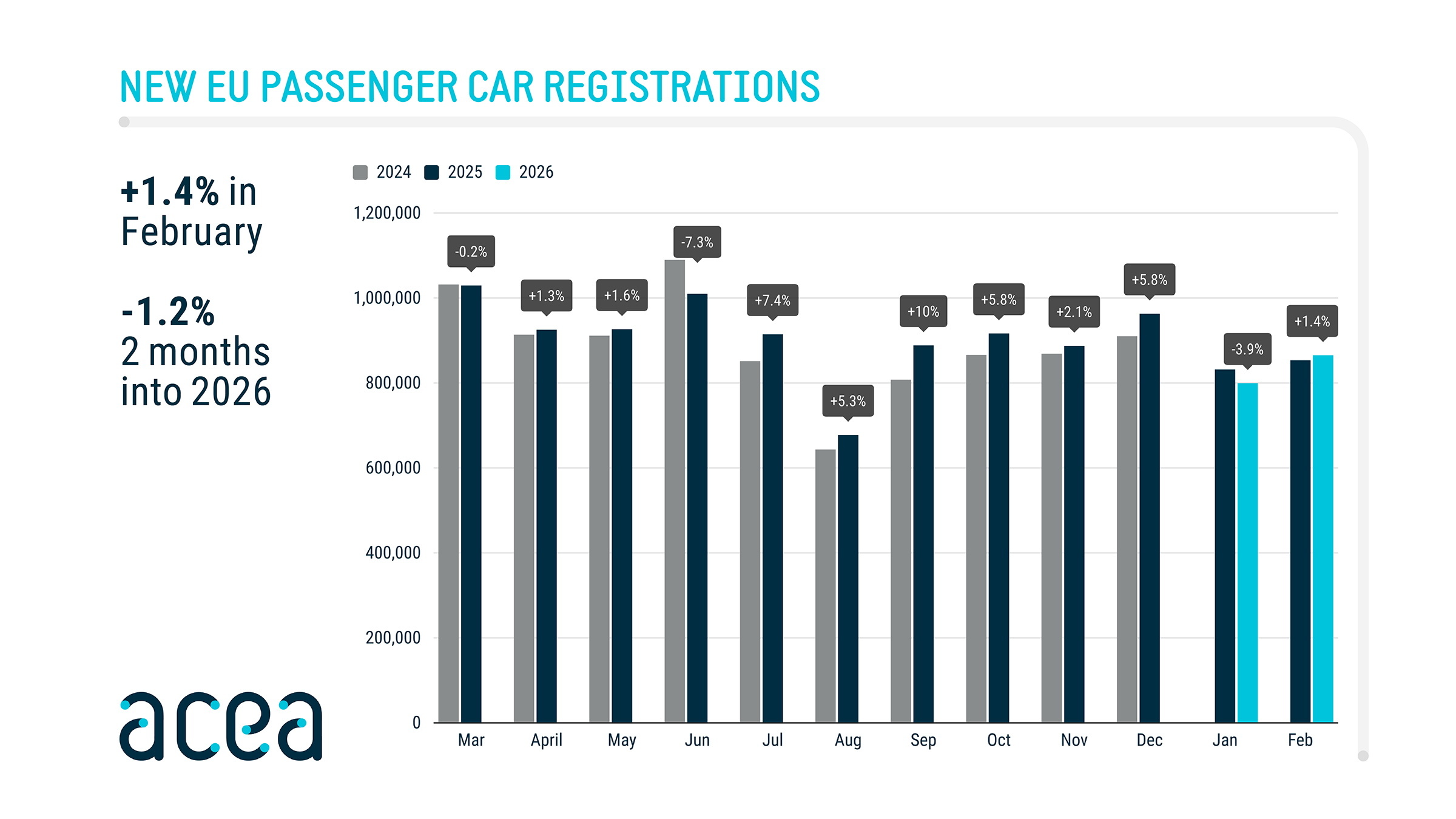
Sales of battery-electric vehicles across the European Union continue to rise and are now nipping at the heels of petrol-powered cars. Due to the ongoing war in Iran and spiking oil prices, EV demand could jump even further. However, market conditions remain mixed, with total car registrations across the EU, Britain, and EFTA rising just 1.7 percent in February to 979,321 units, signaling only modest overall growth.

Registration data from Europe’s ACEA reveals that EVs accounted for 18.8 percent of the new car market across January and February, a notable increase from 15.2 percent over the same period last year. A total of 312,369 EVs were registered in the first two months of the year, thanks in part to France (38.5 percent increase) and Germany (26.3 percent increase).

Read: EV Buyers Didn’t Disappear, They Just Moved Somewhere Automakers Don’t Love

This growth has been supported by a surge of more affordable EV models and national incentive programs that continue to encourage adoption. However, not every European country bought more electric vehicles. In fact, EV sales declined by a significant 34.9 percent in the Netherlands and 11 percent in Belgium.

 Europe’s ICE Car Sales Collapsed 23% In A Single Month, As EVs Surge

Notably, Tesla’s registrations rose 11.8 percent year-on-year, snapping a prolonged decline, though it still trailed BYD by a slim margin. Both brands held a 1.8 percent market share, while BYD’s sales more than doubled over the same period, highlighting growing pressure at the top of the EV segment.

Hybrid Boost

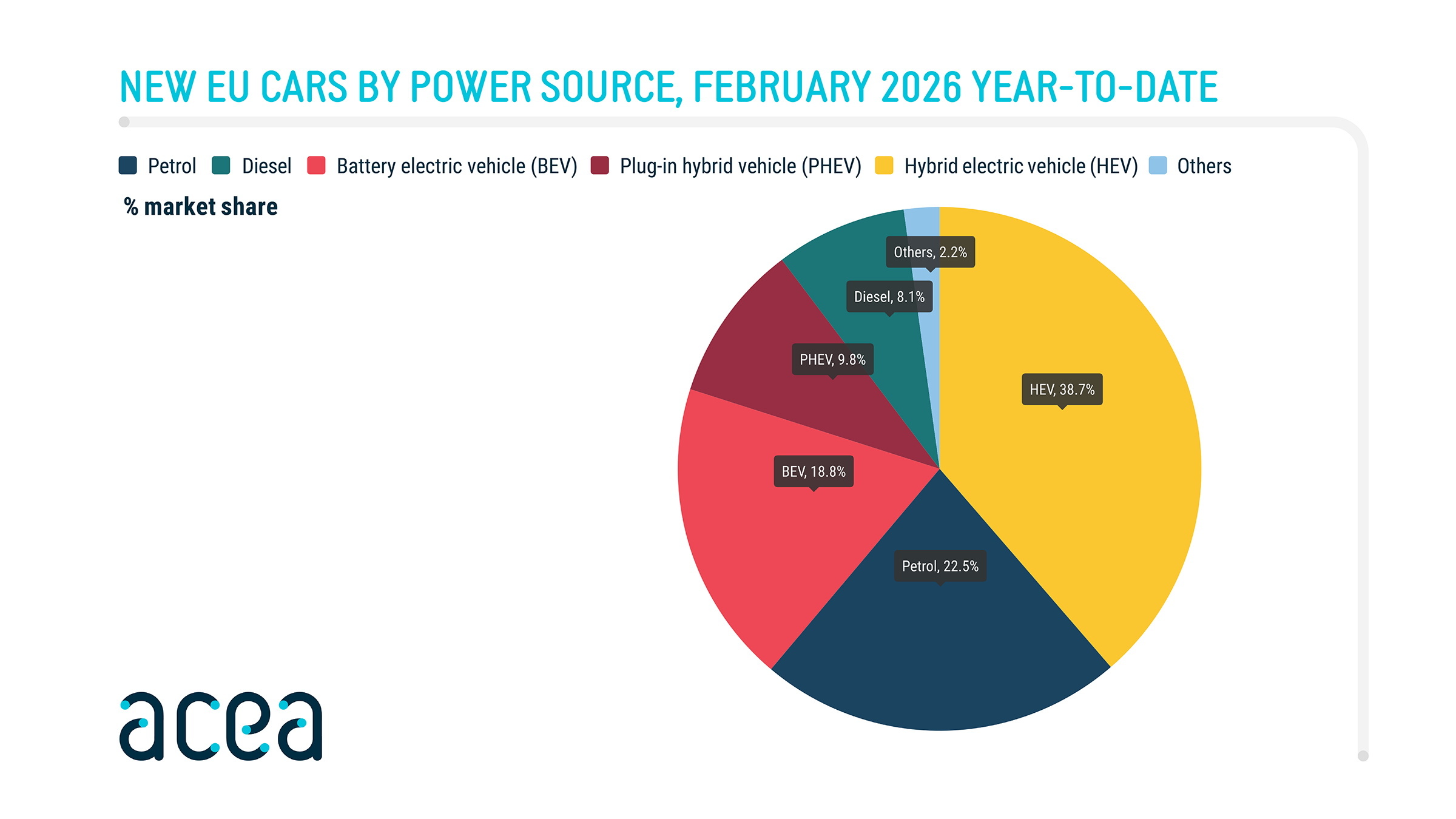
Hybrid vehicles remain the most popular powertrain choice in Europe, accounting for 38.7 percent of the market. This placed HEVs well ahead of cars powered solely by petrol, which have accounted for 22.5 percent of new car registrations this year.

Across February alone, battery-electric, plug-in hybrid, and hybrid vehicles together represented 67 percent of registrations, up from 58.5 percent a year earlier.

 Europe’s ICE Car Sales Collapsed 23% In A Single Month, As EVs Surge
ACEA

Petrol car sales are also on a downward trajectory, dropping 23.3 percent in February, with France reporting a massive 48.5 percent decrease. Registrations also dropped 22.8 percent in Germany, 20.8 percent in Spain, and 18.6 percent in Italy. Last year, petrol cars had a 29 percent share of the market, and this time next year, EVs may have overtaken them if current trends continue.

Plug-in hybrids were behind HEVs, petrol cars, and EVs as the fourth most popular powertrain choice, securing a 9.8 percent share of the market, over 7.4 percent last year. Sales reached 162,751 in the first two months, thanks in part to Italy (116.1 percent increase), Spain (71.5 percent increase), and Germany (23.8 percent increase). Trailing behind PHEVs are diesel vehicles with an 8.1 percent share, down 17.7 percent, and ‘others’ with a 2.2 percent share.

 Europe’s ICE Car Sales Collapsed 23% In A Single Month, As EVs Surge

EPA Commences Webinar Series as Clean School Bus Program Returns

By: Ryan Gray
4 March 2026 at 06:00

The U.S. Environmental Protection Agency (EPA) held the first of three webinars to share information on the proposed expansion of eligible fuels under the  revamped Clean School Bus Program (CSBP) and to solicit comment from student transportation stakeholders.

The EPA webinar on Tuesday highlighted last week’s Request for Information, which seeks public comment on the feasibility of adding biodiesel and renewable diesel as fundable fuels. A source familiar with the program told School Transportation News following EPA’s announcement of the RFI that the inclusion of liquefied natural gas and hydrogen, which are not currently available options for school buses, satisfy language contained in the 2021 Infrastructure Investment and Jobs Act that created the CSBP.

EPA did not provide a date for the unveiling of the next CSBP funding round, but representatives indicated an announcement would be made following the public comment period, which remains open until early April.

Several webinar participants commented during the webinar on stated EPA focal points of the new funding round. One industry professional recommended that EPA limit the number of entities that are considered to be third parties allowed to work with school districts to secure grant funding. Another participant pointed out that regulatory language can confuse the terms sales order and sales receipt, as the verbiage can result in a reimbursement to a a “poor” school district that instead needs the funds up front.

A representative of school bus dealer noted that some school districts are unable to apply for Clean School Bus Program funds because they don’t have 2010 or older model-year school buses to retire, which the regulatory language calls for.

Other participants championed electric school buses in light of EPA’s new focus on funding more biofuel blends, renewable diesel and propane that increase tailpipe emissions, even if nominally. Another participant said propane makes the most sense for his district’s fleet, citing a concern for the cost of battery replacements in electric school buses.

Wednesday’s webinar is designed to give school districts and bus companies the next steps in finalizing clean school bus projects funded by the 2023 rebate program with an overview of the close out form.

A March 10 webinar will share additional information on the 2023 project close outs EPA said is necessary to complete programs “effectively and efficiently while also ensuring they meet the conditions of their funding opportunity.”

Specifically, EPA said it is targeting potential waste, fraud and abuse by sharing guidance school districts and bus companies should use as they wrap up their projects.


Related: EPA ‘Revamping’ Clean School Bus Program
Related: Government Accountability Office Highlights FCC’s E-Rate Program for Fraud Prevention Measures
Related: Funding Among Potential Impacts of U.S. Education Department Dismantling on School Transportation

The post EPA Commences Webinar Series as Clean School Bus Program Returns appeared first on School Transportation News.

Updated: EPA Seeks to Expand Fuel Scope of Clean School Bus Program

By: Ryan Gray
20 February 2026 at 01:29

The U.S. Environmental Protection Agency is issuing a request for information from school bus industry stakeholders as it seeks to add biodiesel, renewable diesel (RD) and liquefied natural gas (LNG) as funding options to a revised Clean School Bus Program.

EPA also said it will not be awarding funds for the 2024 CSB Rebate Program. “EPA thanks applicants for their interest and encourages them to apply for the new grant program,” EPA said in a press release Thursday. “The agency will provide more details on the 2026 grants and eligibility requirements in the near future through a Notice of Funding Opportunity.”

In a follow-up email sent by School Transportation News asking for clarification on foregoing the 2024 rebate awards and if those same applications would be recycled, EPA referred to its original statement.

Meanwhile, Thursday’s RFI also mentions hydrogen as an eligible fuel listed by the Investing in Infrastructure and Jobs Act, which created the five-year, $5 billion fund. But there are currently no hydrogen school buses in production. The same goes for liquefied natural gas, which differs from propane. The IIJA also mentions CNG, which won a handful of awards, but manufacturers don’t currently produce that fuel option, either.

Diesel-powered school buses do exist in large numbers nationwide, estimated at about 80 percent of the national fleet of approximately 450,000 vehicles. Many operate with biodiesel blended with regular diesel. The RFI specifically states EPA seeks information on B20, or 20 percent biofuel blend with diesel.

Renewable diesel, or RD, is different from biodiesel as the former is produced by a hydrotreating process, making it a hydrocarbon fuel. Because it is otherwise nearly identical to petroleum diesel, RD is a drop-in fuel alternative that diesel engine manufacturers certify for use in their engines without voiding warranties. But RD is more expensive than petroleum diesel except in California, Oregon, New Mexico and Washington, where Low Carbon Fuel Standard credits are at play.

Electric school buses are not a focus of the RFI because EPA said it has sufficient information on its infrastructure, availability and performance.

EPA added electric school buses have accounted for 90 percent of Clean School Bus Program awards to date, and the next funding round should target other allowed alternative fuels “to allow for the maximum number of affordable bus choices to fit school districts’ specific needs.”

What’s in the RFI?

EPA is asking the current availability and anticipated purchasing within the next year to five years of biodiesel, RD, E85 flex fuel, CNG, LNG, propane or any other biofuel and if those school buses are fueled at the school district facility, an offsite private fueling station, or an offsite public station. EPA also wants to know about fuel supplier arrangements.
Specifically for biodiesel and RD, EPA is asking for details on how the blends or drop-in fuels are used.

It requests information on fueling system components, pricing, construction and installation requirements, performance, domestic content, and other practical considerations.

The RFI also states EPA wants information on how it can further safeguard taxpayer dollars. The agency completed an internal review to assess financial management practices and said it uncovered inconsistent documentation, incomplete adherence to reporting an award conditions, improper or premature drawdowns of funds, and insufficient internal controls by certain awardees, including for profit recipients.

EPA said it is “evaluating additional safeguards and conditions for for-profit entities,” which includes audits of financial statements and conflict of interest policies. It is also considering verification tools or documentation to ensure appropriate bus usage and routes before funds are disbursed; milestone-based payment structures, reimbursement-only models, or phased disbursement mechanisms tied to verified delivery to reduce risk and improve accountability; and enforcement mechanisms such as repayment obligations or clawback provisions in cases of nonperformance, noncompliance, or misuse of funds.

The Clean School Bus Program is set to expire at the end of the current fiscal year, which would require the remaining $2 billion that has yet to be awarded needing to rollout over the next six months.

Public comments are due within 45 days of EPA publishing the RFI in the Federal Register. A webinar is scheduled for March 3.


Related: EPA ‘Revamping’ Clean School Bus Program
Related: Engine, Truck Manufacturers Support EPA Easing Derate of SCR Diesel Emissions Controls
Related: Deploying Electric School Buses in Rural and Suburban Districts

The post Updated: EPA Seeks to Expand Fuel Scope of Clean School Bus Program appeared first on School Transportation News.

RNG-Fueled Fleets in California Mark Five Years of Carbon-Free Outcomes

By: newenergy
4 September 2025 at 00:41

RNG Remains the Most Immediate, Cost-Effective Way to Decarbonize Heavy-Duty Transportation Washington, DC – Last calendar year marked the fifth consecutive year that commercial fleets in the State of California fueled by bio-CNG (renewable natural gas, or RNG) achieved a carbon-negative transportation outcome, according to a report released today by The Transport Project (TTP) and RNG Coalition alongside partner California Renewable Transportation Alliance (CRTA). Lowest …

The post RNG-Fueled Fleets in California Mark Five Years of Carbon-Free Outcomes appeared first on Alternative Energy HQ.

World’s first fully electric ferry celebrates 10 years of success

By: newenergy
17 February 2025 at 22:56

Bergen, Norway February 17th, 2025 — Since going into service in 2015, the MF Ampere has now sailed an astonishing distance equivalent to 17 times around the equator on batteries alone, solidifying its place as a groundbreaking achievement in sustainable maritime transport. A decade on and the Ampere continues to showcase the transformative potential of electric …

The post World’s first fully electric ferry celebrates 10 years of success appeared first on Alternative Energy HQ.

Merging Net Zero With Zero Waste: One solution to biofuel feedstock shortage

By: newenergy
16 July 2024 at 18:48

The international biofuels industry has found an unlikely ally in the waste management sector. A heightened global urgency to reduce greenhouse gas emissions (GHGs) is incentivizing renewable fuels production like never before, but the International Energy Agency (IEA) recently warned of an impending feedstock shortage for biodiesel, renewable diesel and biojet (aviation fuel) production, estimated …

The post Merging Net Zero With Zero Waste: One solution to biofuel feedstock shortage appeared first on Alternative Energy HQ.

❌
❌