A 13-year-old boy remains in critical condition after the mini-dirt bike he was riding collided with a school bus, reported KTVB 7.
The crash reportedly occurred Monday shortly after 4 p.m. at an intersection in Caldwell, Idaho. State police said v the school bus was traveling south on Colorado Avenue when the teen, identified by his family as Daniel, struck the bus while riding the mini-dirt bike.
Daniel underwent surgery and sustained multiple broken bones and injuries to his brain and lungs, his family told local news reporters. His brother, David Corral, asked the community to pray for Daniel, their family and everyone involved.
“At the end of the day, all that matters to me and my family right now is Daniel’s health,” Corral said. “We hope God does a miracle.”
The bus had eight students and two adults on board, including the driver, at the time of the collision. All occupants were wearing seatbelts, the type unspecified, and no one aboard the bus was reportedly injured. State police said Daniel was not wearing a helmet while riding the mini-dirt bike.
Caldwell Mayor Eric Phillips said he met with Daniel’s family Monday night and prayed with them. Phillips emphasized that Daniel is a child and said the immediate priority should be helping him recover.
Authorities are also investigating how Daniel obtained the mini-dirt bike. David Snider said that Daniel took the mini-dirt bike from his son before the crash. Snider explained that Daniel approached his son and another child, asked to ride the bike, and then pushed them away before leaving with it.
Daniel’s family disputed that account. Authorities have not announced any charges related to the allegations.
Snider said his son was shaken by the incident but sympathized with Daniel and did not wish him harm.
The intersection remained closed for approximately an hour as first responders worked at the scene. Both the collision and the allegations involving the dirt bike remain under investigation.
School bus service was disrupted after multiple buses were reportedly vandalized at a contractor Durham School Services’ transportation lot over the holiday weekend, reported CBS News.
The Schenectady Police Department said Tuesday that officers responded at approximately 5:40 a.m. after Durham officials reported that multiple school buses had been damaged at its facility.
At least two school buses at the lot reportedly had damaged windows with what appeared to be impact marks, possibly caused by rocks or another object. Police said the vandalism likely occurred sometime during the holiday weekend.
According to the news report, the Schenectady City School District described the damage as severe and said it affected Durham’s entire fleet, preventing the transportation contractor from operating its regularly scheduled morning routes.
The district reportedly notified families of the disruption Tuesday morning and advised parents and guardians that morning transportation would be unavailable. It did not immediately specify how many buses were damaged, how many routes were affected, or the estimated cost of repairs.
Despite the morning cancellations, the district said Durham would provide afternoon transportation for all students who normally receive school bus service.
All after-school programs were also expected to operate as scheduled, with transportation available to participating students.
However, the district warned families that buses could arrive later than usual because of the vandalism and resulting operational changes. “We are asking for your patience as buses may be arriving at stops later than expected,” the district stated via the article.
The Schenectady Police Department is investigating the incident. No information about potential suspects or arrests was immediately available.
The district did not indicate whether surveillance footage captured the vandalism or whether additional buses would be brought in to restore normal service. It also had not announced whether regular morning routes were expected to resume Wednesday.
Families were encouraged to monitor communications from the district for additional transportation updates. Further information about the investigation and the extent of the fleet damage was not immediately released.
Authorities are seeking the driver of a pickup truck that struck two 16-year-old students with its side mirror as they waited to board a school bus, reported WCVB News.
Carver police said via the news report that the students, who attend Old Colony Regional Vocational Technical High School in Rochester in Massachusetts, were injured Thursday when a dark-colored pickup truck passed their bus stop. The driver fled the scene, and investigators are asking the public for information that could help identify the vehicle or the person behind the wheel.
According to the article, the school bus was approaching the stop with its yellow warning lights flashing when the truck struck the teenagers. Police described the pickup as having LED lights.
Officers were reportedly notified of the incident at approximately 7:20 a.m. by Old Colony Bus Company. The authorities asked anyone who was in the Forest Street area around 6 a.m. to contact investigators.
One student was taken right after the incident to a hospital by a family member, received treatment, and was released. Family members took the second student to a hospital later in the day for treatment. Both teenagers are expected to recover, and the extent of the injuries were not disclosed.
Aaron Polansky, superintendent-director of Old Colony Regional Vocational Technical High School, said the school had contacted the students’ families following the collision.
“We have reached out to the families of the injured students,” Polansky told local news reporters. “We are keeping both students and their families in our thoughts and wish them a fast and full recovery.”
Polansky also urged community members to help investigators locate the driver. “We encourage members of the community to assist the Carver Police Department with their investigation in any way possible,” he said.
The description released by investigators identifies the truck’s dark color and LED lights. Police are asking people with information about the vehicle to share it as they work to identify the driver.
A 13-year-old student is facing an assault charge after she allegedly punched a Guilford County Schools bus driver in the head while the driver was picking up students, reported FOX 8.
The incident reportedly occurred Monday morning as the 59-year-old driver was operating a route serving Southwest Guilford Middle School in High Point, North Carolina.
High Point police officers received a report at approximately 7:35 a.m. that a school bus driver had been assaulted at a bus stop on Brentwood Street. A school resource officer responded and met with the bus driver to investigate the report.
The driver told the officer that she had stopped the bus to pick up several students, when one of the students began punching her in the head.
The driver reportedly sustained minor visible injuries during the alleged assault and told the officer that she planned to seek medical treatment. Police said they did not have additional information regarding her condition following the incident.
The school resource officer subsequently filed a juvenile petition for assault against the student. Authorities also obtained a secure custody order for the 13-year-old girl. Because the suspect is a juvenile, police did not release her name.
In North Carolina’s juvenile justice system, a secure custody order allows a juvenile to be temporarily held in a secure facility under circumstances established by state law while the case proceeds. It was not immediately clear what reportedly led to the confrontation or whether other students were on board the bus when the alleged assault occurred. Authorities also did not say whether the bus route continued following the incident or whether another driver was assigned to transport the students.
Guilford County Schools and the High Point Police Department are investigating the incident.
U.S. Rep. Tom Tiffany, the Republican nominee for Wisconsin governor, has not supported defunding the police — an effort to reduce law enforcement funding by shifting it to other programs.
Milwaukee County Executive David Crowley, the Democratic nominee, claimed Tiffany voted six times to defund the police.
None of those House votes would have taken money away from law enforcement.
Tiffany voted against a bill that would have directly funded local police departments.
Other measures he opposed were different, including:
Funding more than a dozen federal agencies, including NASA and the Commerce and Justice departments.
Health and Human Services grants for violence intervention programs.
Grants for mental health professionals, rather than law enforcement, to respond to certain emergencies.
We found no evidence that Tiffany backed reducing police funding.
In 2022, Tiffany said “it’s time to stop the defund the police movement.” In 2026 he criticized the movement.
This Fact Brief is responsive to conversations such as this one.
The UK’s National Highways Traffic Officers are civilians, not police.
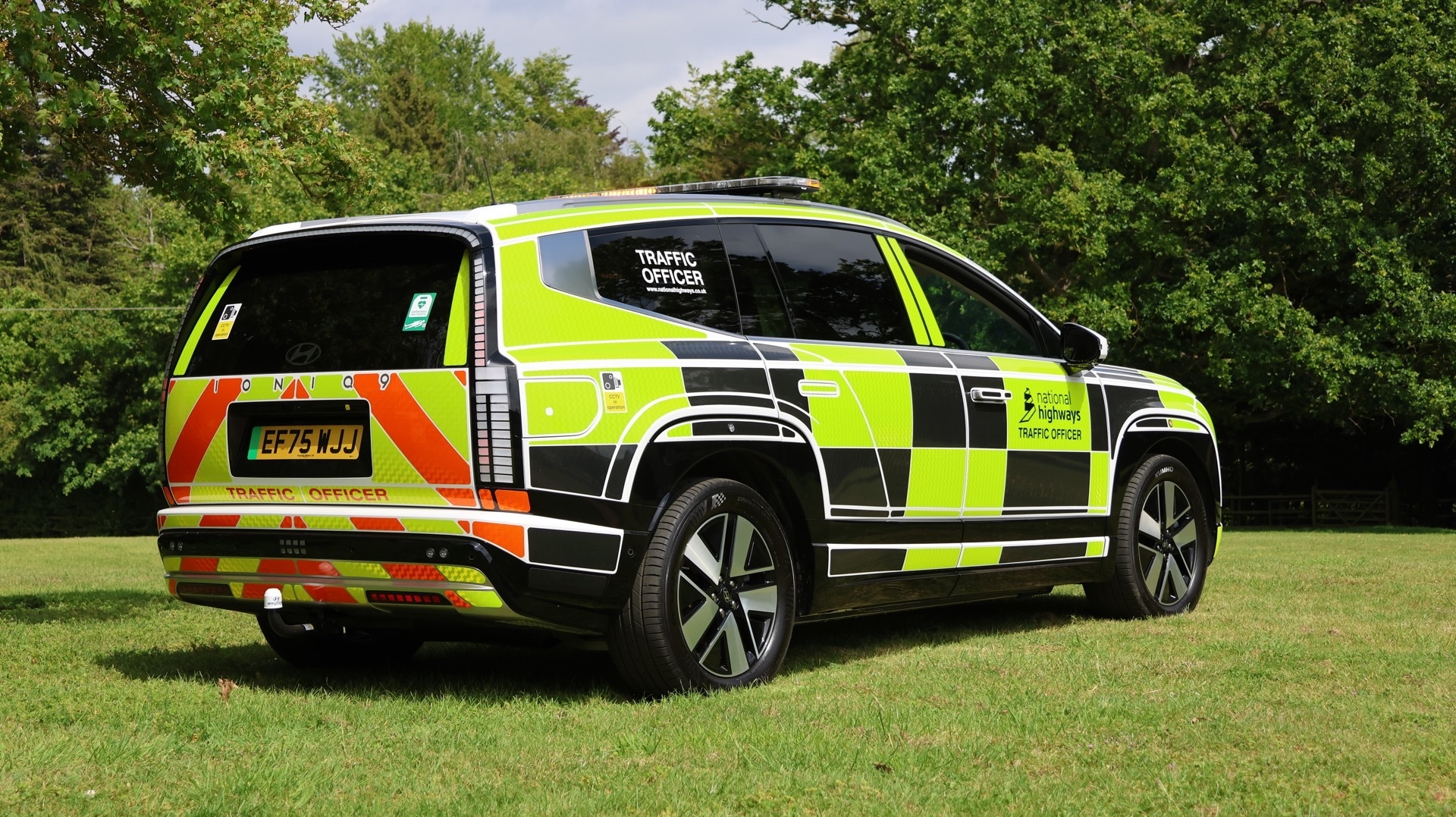
The Ioniq 9s have been converted for frontline duty, with additional lights, horns, and cameras.
The agency is looking at further purchases this year, if the trials are successful.
The UK’s Traffic Officers are looking for an all-new, all-electric tool for their fleet, as National Highways runs testing on the Hyundai Ioniq 9. Four examples of the full-size electric SUV have been commissioned for use by the agency and are currently deployed for evaluation on England’s motorways and major A-roads.
These seven-seaters from Hyundai have been decked out in the highway agency’s traditional high-visibility livery, with reflective decals and the all-important emergency lighting systems. In addition to the low-profile amber and red LED light bar, there are additional warning lights installed in the rear windscreen, side mirrors, front bumper, and tailgate, plus a programmable LED signboard for good measure.
Add the lighting, CCTV, a 100W bullhorn, and the additional juice needed for the full suite of on-board equipment for patrolling the UK’s roads, and you’re looking at some significant power draw. Normally, that would be especially concerning for an EV. However, the folks at Richell Vehicle Conversions, who handled the conversion, thought of that and have fitted the on-test Ioniq 9s with their own dedicated 240 Ah auxiliary battery system.
Even though the auxiliary battery system is kept separate from the 110 kWh battery that powers the rest of the car, it’s still not clear what the extra draw and added weight (plus the aerodynamic penalty of the lightbar) will do to the Ioniq 9’s 385-mile (620 km) electric range. Still, at least the Ioniq 9 comes with rapid charging thanks to its 800-volt architecture.
Although they may look like police cars at a passing glance, National Highways Traffic Officers and their vehicles aren’t actually affiliated with the UK police force. However, despite the role of a traffic officer being one of a civilian, officers are allowed to stop and direct traffic, pull drivers over for safety reasons, and close lanes of a motorway. What they can’t do is arrest or charge drivers or search vehicles.
Either way, if the tests are successful, UK roadgoers may be seeing a lot more of these EVs, provided they’re up to the task. The trail is being used as the UK’s National Highways is considering further purchases during 2026.
Officers from the Tennessee Highway Patrol and the U.S. Department of Homeland Security at a traffic stop in Memphis in October, 2025. (Photo by John Partipilo/Tennessee Lookout)
WASHINGTON — This summer, arrests of immigrants in the United States soared to the highest levels since President Donald Trump returned to office.
An unprecedented increase in cooperation between local and state law enforcement and federal immigration officers through collaborations known as 287(g) agreements helped drive numbers up.
The agreements allow state and local law enforcement agencies to enforce parts of federal immigration law and have become an arm of Trump’s mass deportation campaign. Republicans in Congress have provided billions in federal funding for local departments that accept the agreements, creating a deluge of new partners.
Theresa Cardinal Brown, a senior Department of Homeland Security official during the George W. Bush and Barack Obama administrations, said the billions in new funding has helped the program grow.
“Mostly, 287(g) agreements were voluntary, and the costs were borne by the state and local government to train their own people,” she said. “Now, the federal government has money to pay them, and so that’s encouraging more states and localities to do it because it’s a budget plus-up.”
In June, U.S. Immigration and Customs Enforcement recorded roughly 43,000 immigration arrests, followed by 49,000 in July and nearly 51,000 in August. ICE does not distinguish between arrests initially made by local law enforcement or federal officials.
Those three months also saw the most new 287(g) agreements signed since Trump took office, according to a States Newsroom analysis of government data.
“ICE has increased efforts with state and local law enforcement to assist federal immigration officers in our efforts to make America safe again,” a Department of Homeland Security spokesperson said in a statement to States Newsroom.
But those efforts have generatedprotests in some of the communities where they’ve appeared.
Democrats in Maryland and Maine passed laws restricting cooperation between local police and ICE. The Maryland measure’s supporters said it would reduce distrust of police.
Skyrocketing growth
The president’s signature 2025 domestic policy bill, the “One, Big Beautiful” Act, set aside about $4 billion for state and local governments to conduct immigration enforcement, including 287(g) programs. The Secure America Act passed in June allocated more than $31 billion to implement those agreements as well.
Both packages were passed by Republicans through a legislative maneuver known as reconciliation that did not need Democratic votes.
The funds incentivized massive growth.
Before Trump took office in January 2025, the federal government had agreements with 135 state and local police departments. As of Oct. 1, those agreements skyrocketed to 2,608, according to DHS data.
Local departments or state agencies in 38 states have 287(g) agreements, with the highest numbers in Texas and Florida, where there are state laws requiring local law enforcement to partake in the program.
The Wall Street Journal reported Thursday the Florida Highway Patrol was eligible for $26 million in reimbursements from the federal government for arrests from April through June.
“My educated guess would be that a large number of the arrests and detentions that we’ve seen increasing in recent months in the summer were because there was an increase in 287(g) agreements in Texas and Florida, but other parts of the country as well,” said Ariel G. Ruiz Soto, a senior policy analyst at the Migration Policy Institute, a think tank that studies global migration.
ICE does not always specify when an immigration arrest is made through the partnership program, but the Deportation Data Project, a project of the University of California schools in Berkeley and Los Angeles that analyzes government immigration enforcement data, has attributed at least 6,150 arrests in July, about 12.5% of all arrests for that month.
Only 12 states have no such agreements. They are California, Connecticut, Delaware, Hawaii, Illinois, Maine, Maryland, New Jersey, Oregon, Rhode Island, Vermont and Washington state.
Three models
The partnership program was created in a 1996 law, but not actively used until the 9/11 terrorist attacks. It first received federal appropriations in 2006.
Three types of partnerships operate within the program.
The loosest type of agreement is the jail enforcement model, where deputized officers can inquire about the immigration status of people arrested on state or local charges, as well as hold a noncitizen for ICE to pick up for up to 48 hours.
In another model, the warrants service officer model, ICE trains, certifies and allows state and local law enforcement to issue administrative warrants, which are not signed by a judge, but by an ICE official requesting the arrest of a noncitizen. Local law enforcement officers under this model do not inquire about immigration status.
The task force model, which involves the greatest immigration enforcement by local officers, allows for immigration officials to deputize local officers to partake in immigration duties such as asking about immigration status or even detaining people and transferring them to ICE.
As part of its immigration crackdown, the second Trump administration revived the task force model after the Obama administration discontinued it in 2012 over concerns of racial profiling.
It has seen the largest increase under Trump, Ruiz Soto said.
More than 71% of 287(g) agreements now use the task force model, according to Titus Consulting, a firm that tracks the agreements. About 7% use the jail enforcement model and more than 21% use the warrant model.
The task force model is “hands down,” the most effective method in arresting noncitizens, said Todd Bensmen, a senior research fellow for the Border Security and Immigration Center at The Heritage Foundation, a conservative think tank.
“If they’re not deputized under that, they just come into contact with people that are fully … deportable, and then just leave them be,” he said of local law enforcement. “They can just arrest them on the spot and call ICE, and that way you have a really dramatic force multiplier and ICE doesn’t have to do anything but come and pick them up.”
Program changes
In 2006, the Bush administration took an interest in exploring 287(g) programs, specifically the jail enforcement model because it was easy for ICE to identify people who are subject to an immigration arrest, said Brown.
“If your job is to find people, wow, that’s the easiest thing to do,” she said of the jail model.
Brown said that spurred the idea for the Secure Communities program. Under the program, the FBI automatically sent fingerprints of a person booked in custody to DHS to check against its immigration database. If the person was a noncitizen who was unauthorized in the U.S., then ICE was notified.
The program was voluntary, but there was pushback from immigration advocates during the Obama administration, Brown said.
“There was a concern that this was mixing criminal enforcement and immigration enforcement in ways they weren’t meant to, (and) it was creating fear among immigration communities of reporting crimes for fear that they would be arrested,” she said.
The Obama administration pulled back and redirected the Secure Communities program to a federal government model.
“They turned it from like a community-by-community rollout to just a federal-to-federal information sharing agreement that remains in place today,” she said.
Brown said the difference now is that some communities have decided when ICE is notified, if at all, and whether or not to honor detainers, which are requests from ICE to hold an immigrant until federal immigration officers arrive.
Local governments that have not wanted to participate in federal immigration enforcement have been dubbed sanctuary cities.
The Trump administration has threatened to pull federal funding from those cities that don’t want to aid in immigration enforcement and has offered an influx of cash to states and local governments that have agreed to participate.
The Republican Congress has funded the program for the next three years, Ruiz Soto noted.
“It would then come to … what a future administration or a future Congress would do to continue expanding this or not fulfill them anymore,” he said. “But clearly right now ICE has significant funding to last for 287(g) and much more other enforcement in the near future.”
A 4-year-old student was dragged approximately 15 feet by a Cato-Meridian Central School District bus in New York after her backpack became caught in the door as the vehicle began moving, highlighting the importance of safety in the danger zone, especially as School Bus Safety Week approaches this month.
According to New York State Police the incident occurred Sept. 23. Investigators determined that the child’s backpack remained caught in the door after she exited the bus and that the driver traveled approximately 15 feet before realizing what had happened and stopping.
The student was not injured, State Police said.
Donna Cooper, the child’s grandmother and legal guardian, told local news reporters that she was waiting outside the family’s home on Follett Road when her granddaughter, Riley, arrived home from school.
Cooper said the bus doors closed after Riley stepped outside while her backpack was still caught inside. She and her husband ran after the bus and screamed for the driver to stop. The bus eventually stopped between their driveway and the next driveway, she said.
“The bus driver closes the door, catches her backpack in the door and then just drives right away, dragging her,” Cooper told the news outlet.
Cooper recalled watching Riley attempt to move forward before the bus pulled away.
“All I see is her face when the door closed,” Cooper said. “I’m watching it in slow motion and I can see her trying to step forward. But then the bus takes off and just the look on her face.”
Cooper said the driver briefly apologized but did not exit the bus to check on Riley. The family took the prekindergarten student to an urgent care facility, which confirmed that she had not been physically injured.
Riley’s grandfather called 911 and later met State Police at the school. State Police told School Transportation News that investigators reviewed video of the incident and spoke with those involved. The school district was notified and began its own administrative investigation.
“Following a review of the circumstances, no criminal charges will be filed,” State Police said. “The Cayuga County District Attorney’s Office also reviewed the incident and declined prosecution.”
The district has not publicly disclosed the driver’s employment status, citing restrictions on discussing individual personnel matters. Riley’s family told local reporters that the driver had not returned to the route following the incident.
In a statement provided to local news reporters, the district said student safety and well-being remain its highest priority. The district said it was reviewing the circumstances, cooperating with law enforcement and had procedures in place to prevent another occurrence.
“We remain deeply committed to ensuring every child arrives home safely each day,” the district stated.
STN contacted the district for its official statement and additional information about the driver’s status and the preventive procedures but did not receive a response as of publication.
Cooper questioned why school bus doors do not use sensors that prevent them from closing when an object is caught between them, similar to systems used on elevators and automatic doors. Several companies have displayed such technology at STN EXPO trade shows, though adoption is minimal.
“My main goal here is I want awareness brought to this,” Cooper said. “I mean, both my husband and I have done a lot of research online, and this happens a lot, way more than it should. And nobody’s talking about it.”
A school bus driver was removed from a Massachusetts school district’s routes after reportedly throwing several empty liquor bottles from a bus window while transporting students Tuesday morning, reported Coastal ABC News.
Somerset Berkley Regional High School officials informed families that a motorist traveling behind the school bus saw several empty miniature liquor bottles, commonly known as “nips,” being thrown from a window during the morning pickup route. The witness reported the incident to the Somerset Police Department.
Police officers located and stopped the bus. The driver admitted discarding the bottles and cooperated with the ensuing investigation.
Authorities determined that the bottles belonged to the busdriver but had not been consumed Tuesday morning. Officials also said the driver was not impaired.
“SPD engaged with the driver, who cooperated with the investigation, and it was determined that the bottles were in her possession, but they were not consumed this morning, and she was not impaired in any way,” school officials stated via the article.
Fisher Bus, the district’s transportation contractor, dispatched a replacement bus following the police response. The 14 students on board the original bus were transferred and transported safely to Somerset Berkley Regional High School. No injuries were reported.
The school subsequently asked Fisher Bus not to assign the driver to any of the district’s transportation routes. Officials did not identify the driver or indicate whether she could face criminal charges or disciplinary action from the bus company.
“The presence of alcohol containers on a school bus, by anyone, is unacceptable,” the school stated via the news report. “Our students and families must have complete confidence in the people responsible for transporting them, and we take this matter very seriously.”
School officials also thanked the motorist who contacted authorities and the officers who responded. “We are grateful to the attentive community member who reported what they saw and to the Somerset Police Department for their swift response,” the district reportedly stated.
Additional information about the origin of the bottles and how long they had been aboard the bus was not immediately available.
Members of Milwaukee’s Community Collaborative Commission are looking to Baltimore as they work to give residents a greater voice in how policing is carried out in Milwaukee.
Community policing, a core focus of the commission’s work, calls for police and residents to work together to identify and respond to neighborhood problems.
Baltimore’s “Community Policing Plan” spells out who is responsible for that work, what it involves and how it can be put into practice.
“What works in Baltimore may or may not work in similar ways here,” said Tim Baack, president and CEO of Pathfinders, an organization that supports homeless and runaway children, and a member of the commission. “But there’s enough of the framework that it’s not like we have to start from scratch.”
In recent years, the commission has worked on police policy reform, community-oriented policing and oversight of other reforms. Its members include community activists and leaders of local nonprofits.
Earlier this summer, the group said it was in the late stages of completing a community policing plan for Milwaukee.
Community policing already happening, Milwaukee Police Department says
Milwaukee police officers table at the All In, All Youth, All Summer resource and employment fair in April. (Jonathan Aguilar / Milwaukee Neighborhood News Service / CatchLight Local)
The Milwaukee Police Department says it has already implemented the framework for community policing in the city.
The department has a community-oriented policing policy and has worked with the Community Collaborative Commission to gather community input and develop a plan.
“MPD has always been a part of the conversation with the (Community Collaborative Commission)” in developing the plan, a spokesperson for the department said.
Here are four lessons from Baltimore and how they compare with what MPD is already doing.
1. Every officer is responsible for community policing
Baltimore’s plan states that “every officer is a community policing officer.”
In other words, community policing is not supposed to be limited to officers with specialized community-related duties.
“Community policing should shape everyday interactions/enforcement encounters/training and decision-making across the department,” said Bridget Whitaker, executive director of Safe & Sound and a member of the commission.
Safe & Sound is an organization that works to unite residents, youths and law enforcement.
MPD has an official policy that requires all department members to engage in community and problem-oriented policing daily.
The department is “committed to the principle that community policing is the responsibility of every officer,” a spokesperson for MPD said.
However, the Fire and Police Commission has questioned how fully that principle has been put into practice.
In a January memo to the Milwaukee Board of Fire and Police Commissioners and MPD command staff, the Fire and Police Commission argued that MPD relies too heavily on command staff and specialized community liaison officers for community engagement.
2. There’s a difference between engagement and being present
Baltimore’s plan distinguishes police simply being visible in a neighborhood from engaging with the people who live there. Officers are expected to have informal conversations with residents to help build relationships.
“Presence matters, but meaningful engagement requires interaction, listening, relationship building and collaboration,” Whitaker said.
MPD’s 2025 review similarly says community events alone do not amount to community-oriented policing.
However, the review says such events can still contribute to community policing by allowing residents and police to exchange information and develop solutions together.
The Fire and Police Commission memo makes a distinction between community involvement and collaboration.
With involvement, police largely identify problems and decide what to do. With collaboration, residents help identify problems, shape responses and determine whether they worked.
MPD says residents already participate in that process through district crime and safety meetings, community partnership units, community organizations and various other forums.
Ralikh Hayes, deputy director and co-founder of Baltimore-based Organizing Black, a grassroots civil rights and advocacy group, said his city’s residents still lack a formal way to ensure their input influences what the city actually does.
“There’s no formal mechanism of ‘we want this specifically,’ and then accountability if they see it or don’t,” Hayes said.
3. Focus on root causes
Problem-oriented policing focuses on the root causes of crime, rather than only enforcing laws or responding to individual incidents.
Baltimore uses a four-step process: identify the problem; analyze its causes; develop a response; and assess whether it worked.
MPD said it already uses the same approach, known as the SARA model.
Baack said Milwaukee will still have to adapt ideas from other cities to Milwaukee’s own circumstances.
“One thing we realized in looking at what works and sometimes what didn’t work in other communities — it’s never really an apples to apples,” he said.
Hayes said even different neighborhoods within Baltimore require different approaches.
“Baltimore is not a one-size-fits-all place,” he said. “Every neighborhood is different and has different issues.”
4. Reward officers for community policing work
Baltimore makes community policing part of how officers are evaluated, including annual performance reviews and promotions.
That stood out to Whitaker.
“Organizations ultimately demonstrate their priorities through what they measure, reward and hold people accountable for,” she said.
The Fire and Police Commission memo recommends problem-solving work should factor into performance evaluations, promotions and transfers.
Baack said the ultimate measure should be what residents think.
“The plan will be successful when the community says it’s successful,” he said.
Jonathan Aguilar is a visual journalist at Milwaukee Neighborhood News Service who is supported through a partnership betweenCatchLight LocalandReport for America.
A Texas man hired to canvas neighborhoods for Republican candidate for governor Tom Tiffany has been charged with hitting a bicyclist with his car while intoxicated in a hit and run incident in Washington County, before fleeing police.
Duane Maiden, 32, was hired by Echo Canyon Consulting, a Phoenix-based political campaign and public affairs firm. The firm confirmed Maiden’s employment, the Milwaukee Journal Sentinel reported.
The firm had received $2.5 million from the Florida-based Restoration of America PAC to support canvassing operations for Tiffany, according to campaign finance records, according to the Journal Sentinel. The PAC is heavily funded by the billionaire Richard Uihlein, cofounder and CEO of the shipping company Uline, based in Pleasant Prairie, Wisconsin.
On Sept. 3, a Washington County sheriff deputy responded to a crash involving a car and a bicycle in the town of Jackson. The victim sustained injuries including fractures to his leg, pelvis, and spine. Witnesses said they saw a car “flying eastbound on Western Avenue,” blowing through a stop sign before striking the bicyclist and continuing on without stopping. A coworker of Maiden’s called 911 to say that he was with the driver and identified Maiden.
Deputies went to the Town of Cedarburg where the coworker had been dropped off, the Journal Sentinel reported. The coworker said that he and Maiden had come to Wisconsin to canvas for political campaigns. They planned to be in Wisconsin for the next two months before traveling to New York and Florida. They were working the morning of the crash. The coworker said that Maiden bought and drank from a bottle of Vodka before stopping for pizza and gas.
After the hit and run, the coworker said, he asked to be let out of the car and then called both 911 and his supervisor
Deputies spotted Maiden’s car while talking to the coworker and chased him into Ozaukee County where they arrested him and took him to jail. Maiden said he started drinking and driving because he had to wait too long between assignments. Maiden denied knowing that he hit the bicyclist.
Although Echo Canyon Consulting claimed Maiden was not working for the firm during the hit and run, court records contradict those claims, according to the Journal Sentinel.
Tiffany’s campaign denied any connection to Maiden.
Maiden was charged on Sept. 4 in Ozaukee County Circuit Court for felony fleeing an officer and misdemeanor resisting. Then on Sept. 11, he was charged in Washington County Circuit Court for felony hit and run involving great bodily harm and felony intoxicated use of a vehicle. He faces more than 27 years in prison and up to $95,000 in fines.
The South Dakota Highway Patrol is conducting a three-day School Bus Safety Outreach event to increase public awareness and reinforce safe driving practices around school buses statewide, reported KXGL News.
The initiative running Sept. 8-10 includes partnerships between state troopers and local school districts. Troopers are observing school bus routes and loading zones while monitoring whether motorists comply with South Dakota’s school bus stopping laws.
According to the news report, marked patrol vehicles are visible near school bus stops, loading areas and high-traffic routes where students board and exit buses. The increased presence is intended to remind drivers about their responsibilities, discourage dangerous behavior and help protect children traveling to and from school.
“School bus safety is a shared responsibility,” Highway Patrol Capt. Jon Stahl said via the article. “Our presence during these three days is meant to educate drivers, support school districts and reinforce that stopping for school buses isn’t optional, it’s essential for protecting children.”
As part of the outreach, troopers are following select school buses along their regular routes to observe how nearby motorists respond. They will also position marked patrol vehicles near loading zones to increase law enforcement visibility.
Additionally, troopers are conducting targeted safety operations to identify violations and encourage motorists to comply with school bus safety laws. The South Dakota Highway Patrol will provide safety reminders and information to community members and news media throughout the initiative.
Motorists should remain alert when approaching school buses and anticipate frequent stops, particularly during morning and afternoon travel times. Drivers should slow down around buses and watch carefully for students who may be walking near the roadway or crossing the street.
The South Dakota Highway Patrol also reminded motorists that they must stop when a school bus displays flashing red lights. Drivers should remain stopped until the lights are deactivated, and it is safe to continue traveling.
Officials said seemingly small actions behind the wheel, including reducing speed, avoiding distractions and stopping as required, can prevent potentially tragic incidents.
The outreach reflects the South Dakota Highway Patrol’s effort to work alongside school districts and communities to promote safer travel for students across the state at the beginning of the school year.
A Flock camera on the Lac Courte Orielles Reservation in SawYer County. (Photo by Frank Zufall/Wisconsin Examiner)
Stevens Point, Winnebago County, Fond du Lac County and Sheboygan are among the Wisconsin communities that have recently moved away from Flock license plate reader cameras. On Tuesday, city staff in Stevens Point began covering the cameras while local elected leaders determine whether they can cancel their Flock contract altogether.
Meanwhile Sheboygan broke ties with Flock after the company reportedly attempted to sell the city back traffic data it was unaware the multi-billion dollar surveillance company was even collecting. Flock cameras capture images of vehicles and their license plates on the roadways. Law enforcement officers can search the data to see where a vehicle has traveled.
The Wisconsin Examiner’s Criminal Justice Reporting Project shines a light on incarceration, law enforcement and criminal justice issues with support from the Public Welfare Foundation.
Investigative reporting has shown that the cameras can also recognize human features. Over 5,000 agencies had Flock contracts in late 2025, creating a network of tens of thousands of cameras that can be queried simultaneously. Police often say that the technology has been invaluable in solving crimes including carjackings, kidnappings, homicide, drug trafficking and gun violence. The cameras are also used for less serious reasons such as for traffic enforcement and in policing evictions.
“Reports are surfacing all over the country about the system being misused by municipal and state employees who have access to the data,” said Stevens Point Mayor Mike Wiza in a press release late last week.
A few of those cases have played out in Wisconsin courts, police departments and sheriff’s offices. Four officers across Wisconsin have been charged with misconduct in public office and other offenses for misusing Flock cameras.
Josue Ayala of the Milwaukee Police Department (MPD) was given a year of probation and avoided jail time earlier this year after misusing Flock. Cristian Morales of the Menasha Police Department was sentenced to six months in jail and three years probation for a similar infraction. In Kenosha County, former sheriff’s deputy Frank McGrath was charged with misconduct in public office last month for misuse of the surveillance technology. In July, Milwaukee police detective Tehrangi Chapman — who worked the internal affairs investigation into Ayala’s Flock misuse — was charged with misusing the system to track someone he had been monitoring since 2019, years before Flock came to Milwaukee. Chapman and McGrath are still going through court proceedings.
Ayala, Morales and McGrath all used Flock to monitor their current or former romantic partners. The exact relationship Chapman has to the people he allegedly monitored is not mentioned in available court records. McGrath used Flock and a squad car tracking system called Polaris to monitor his girlfriend, who was also a Kenosha County Sheriff’s deputy. Chapman allegedly employed both Flock cameras and car-mounted GPS trackers. McGrath was caught after a supervisor noticed some suspicious Flock searches in an audit, while Ayala and Chapman were both reported to police by the victims themselves.
People fill up a Milwaukee Fire and Police Commission meeting to call for an end to Flock in the city. (Photo by Isiah Holmes/Wisconsin Examiner)
Numerous other officers have been investigated or charged with misusing Flock around the country. In Racine County, the district attorney admitted that a few unnamed officers have been investigated for their use of Flock cameras.
The rash of misuse is not the only thing motivating local communities to drop Flock. When the city of Verona decided to cover its cameras in February, Mayor Diaz said that while the community trusted its police department, it no longer trusted Flock Safety. At that time the first cases of misconduct were beginning to emerge in Wisconsin, and many people had expressed fears about how the federal government — especially immigration enforcement — could leverage local Flock networks for its own priorities. Trust was also broken in Oshkosh months later, after the police chief learned that the cameras could create heatmaps of vehicle movements, contrary to what a company representative had said.
The sheriffs and police departments in Fond du Lac County recently announced they will cancel their contracts because out of state agencies had used open records requests to obtain audit data the sheriff said was confidential and in some cases linked with ongoing investigations. Journalists and other citizens nationwide had begun requesting Flock audit data from local police departments to learn how the cameras were being used.
In 2025, a Wisconsin Examiner analysis showed that at least 221 law enforcement agencies were using Flock in Wisconsin. Many of the searches used vague search terms such as “investigation,” “suspicious,” or non-law-enforcement terms such as “cooch,” or single characters such as “.” or “s”. Some of these vague search terms have appeared in confirmed misconduct cases. Officers in other parts of the country have also used Flock for controversial reasons, such as tracking women suspected of traveling out of state to get an abortion.
A police officer uses the Flock Safety license plate reader system. (Photo courtesy of Flock Safety)
Flock Safety has struggled to adapt to canceled contracts and misconduct investigations. Although the company has released new features including requiring case numbers when searching the database, fixed options for search terms, and the ability to flag suspicious searches, it has also worked to hide information in the audit data such as officers’ names. Flock Safety has claimed that people have used the audit data to identify undercover officers. However, the information which Flock is making harder to view is also the very information that allowed citizens and journalists to detect instances of misconduct.
Winnebago County, Neenah, Menasha, and Chetek have each canceled a Flock contract, are considering it or have covered up their cameras. In Chetek, the police chief responded to public criticism of Flock cameras by threatening to run background checks on citizens who disagreed with his use of the cameras. Other Wisconsin communities including Kaukauna, Sturgeon Bay, Appleton, Dane County, Stoughton and Manitowoc which have also canceled their Flock contracts.
Other communities have chosen to heighten oversight of their Flock cameras In Milwaukee, County Executive David Crowley asked that all Flock operations on county property be paused until new transparency and oversight measures could be developed.
Milwaukee County Sup. Justin Bielinski, who is also chairman of the Committee on Judiciary, Law Enforcement, and General Services, has also called on the Milwaukee County Sheriff’s Office to disable its Flock network. “Residents should not have to wait for another disclosure before we act,” said Bielinksi. “Even if you have confidence in the Sheriff’s Department’s use of Flock, the question remains: do we trust Flock itself with this information?”
A Flock camera outside of Washington Park in Milwaukee. (Photo by Isiah Holmes/Wisconsin Examiner)
The Milwaukee Police Department has restricted its Flock network from other local agencies, limited access to the system to supervisors only, and launched a new Flock transparency portal. The portal notes that data captured by Flock cameras in Milwaukee is only retained for seven days, and that there were 983 “search sessions” over the last 30 days. It also keeps track of the number of “hot list hits” over the last 30 days. Hot lists are lists of vehicles which law enforcement have flagged in the system. When a camera sees the flagged vehicle, a notification goes out to police in the area. The Milwaukee police transparency portal does not track the number of vehicles detected, unlike a transparency portal released by the Green Bay Police Department.
“This effort underscores the commitments MPD has made in partnership with the Mayor to establish appropriate guardrails for the use of this technology while providing greater public understanding of how Flock [Automatic License Plate Reader] technology is used to support public safety,” the Milwaukee department said in a press release. “MPD remains committed to transparency, accountability, and the responsible use of technology. Through this new resource, MPD is continuing its efforts to provide the public with meaningful information about the tools we use to support the safety of the Milwaukee community.”
People in the community continue to push back against the cameras. Last Thursday, dozens of residents filled a Fire and Police Commission meeting to capacity in Milwaukee. An overflow room was opened to accommodate all the people who showed up to testify, unanimously rejecting Flock and calling for the city to cancel its contract. Speakers argued that Flock is a form of indiscriminate mass surveillance which can and has been used in abusive ways by police. Many of the speakers expressed deep frustration with the commission, city government and police, saying that they’d called for an end to Flock for months only to see some of their fears realized.
Napoleon Jones holds a picture of his vehicle in captured by Flock. (Photo by Isiah Holmes/Wisconsin Examiner)
Napoleon Jones, 32, was one of those people. Although Jones is from Sussex, he came to the Milwaukee FPC meeting to describe his experience of Flock surveillance. Jones, a Navy veteran, was stopped by a Waukesha County Sheriff’s deputy after filming a traffic stop. Jones was arrested and taken to jail, only to be released without charges. When he filed a complaint about the deputy’s conduct, according to a federal lawsuit, Jones became the target of a Flock search by that deputy, who was directed by his supervisor to conduct the searches.
“When I first found out I was just super surprised,” Jones told the Examiner. “I never thought it would happen to me. And when I found out and I got the records and seen how many different searches there were, I was at a loss of words because it’s hundreds and hundreds and hundreds of searches and the network is so big on these Flock cameras.” Jones added that “I drive all around. If this guy really wanted to put together a timeline of where I’m at, or who I know, or whose house I’m at, he could have done it.”
He added, “I drive past these things all the time. Everyone does.”
An 11-year-old Connecticut student died Wednesday morning after his bicycle collided with a school bus in North Stonington.
Police identified the student as Torren O’Grady of North Stonington. The Sept. 2 collision occurred near the intersection of Old Colony and Pinecrest roads shortly before the start of the school day. The crash occurred less than a mile from North Stonington Elementary School.
According to a preliminary crash report released by Connecticut State Police, a Blue Bird school bus was traveling east on Old Colony Road at approximately 8:27 a.m. O’Grady was riding a mountain bike east behind the bus as both approached Pinecrest Road.
Old Colony Road traffic entering Pinecrest Road is controlled by a stop sign, the summary states. Police said the school bus made a left turn and entered the northbound lane of Pinecrest Road as O’Grady also entered the intersection.
O’Grady’s bicycle collided with the left front wheel and tire of the school bus, according to investigators. A “run-over event” subsequently occurred, and O’Grady sustained fatal injuries, police stated.
The preliminary summary identifies the bus driver as a 76-year-old Stonington resident. State police had not announced any charges or citations as of Friday.
The investigation remains active. Police asked anyone who witnessed the collision or has information related to it to contact Connecticut State Police Troop E in Montville at 860-848-6500.
O’Grady was a member of the Stonington Bears Youth Lacrosse and wore No. 49. The organization described him as a teammate, friend and member of a family extending far beyond the playing field.
The youth lacrosse organization asked area families, community members and local sports leagues to place lacrosse sticks outside their homes and leave their porch lights on in O’Grady’s memory.
“Let every porch light shine for Torren,” the organization stated. “Let every lacrosse stick remind his family that they are surrounded by a community standing beside them in love and support.”
The organization encouraged neighboring towns to participate in the tribute, writing, “From one field, one team and one collective community, we remember #49.”
Gov. Ned Lamont expressed condolences to O’Grady’s family, friends, classmates, teachers, and the North Stonington community. He said Connecticut State Police and the state Department of Education were prepared to support the schools and students affected by the death.
Lamont also urged drivers throughout Connecticut to exercise additional caution around school buses, school zones, bicyclists and children traveling to and from school.
“Slow down and help keep our students safe as they start this new school year,” Lamont stated.
State Rep. Greg Howard, whose district includes North Stonington, said he had communicated with local emergency services, law enforcement and the Connecticut Department of Education following the collision.
Howard said state resources were being made available to help North Stonington cope with the loss. He also thanked the first responders, firefighters, medical personnel, school and town officials, and law enforcement officers who responded to the scene.
“I know our community is hurting right now; but I also recognize the way in which North Stonington knows how to pull together,” Howard stated. “Please keep this family in your thoughts and let us all hold our loved ones a little closer tonight.”
Reading Time: 7minutesClick here to read highlights from the story
A UW-Madison police officer received a letter of reprimand after a student journalist in April 2025 brought to light allegations of inappropriate behavior.
The behavior included late-night texts and flirtatious conversations with female students while on duty and relaying confidential police information to help students avoid consequences for underage drinking.
The internal police investigation into the officer’s behavior included no interviews with students.
Two students reported the officer’s behavior to Greek life officials in October 2024. Greek life discussed the concerns with the officer, but did not alert UWPD.
A University of Wisconsin-Madison police officer received a letter of reprimand last summer after a student journalist alerted UWPD about allegations of the officer’s inappropriate conduct with sorority and fraternity members. A follow-up Wisconsin Watch investigation has found UWPD interviewed no students as part of its internal review.
Additionally, six months before the student journalist alerted police, two former sorority executives reported the officer’s unsettling behavior to UW-Madison’s Greek life staff, who discussed the matter with the officer but did not forward the complaint to UWPD.
Wisconsin Watch first reported in July 2025 on allegations that UWPD Officer Diego Lema Hernandez had initiated late-night texting conversations, asked female students on coffee dates while on duty and relayed confidential police information to help students avoid consequences for underage drinking.
Wisconsin Watch is now naming Lema Hernandez because UWPD confirmed he received a letter of reprimand in June 2025. Lema Hernandez did not respond to requests for comment.
UWPD investigators found that Lema Hernandez failed to exercise good judgment in communicating with students about his knowledge of when Madison police would check bars for underage patrons.
Other allegations, which are fully redacted from the final report, were not sustained.
Lema Hernandez, who joined UWPD in 2017, remains a downtown community liaison officer for the department.
Student journalist prompts investigation
UWPD learned of allegations against Lema Hernandez in April 2025 from a UW-Madison student journalist, who spoke with 11 students on the condition of anonymity.
“We took these concerns and allegations very seriously and launched an internal investigation based on the information provided to us,” UWPD spokesperson Marc Lovicott said in an email.
UW-Madison Police Officer Diego Lema Hernandez received a letter of reprimand after a UWPD investigation into allegations he was sending inappropriate text messages to students. (UW-Madison)
According to the internal investigative report obtained under the state’s public records law, UWPD conducted two interviews with Lema Hernandez and a five-minute phone call with a Madison police officer. Investigators also reviewed dozens of Lema Hernandez’s text conversations and identified 70 that related to bar checks, often followed by short phone calls.
Referred to as “raids” by students, bar checks are police inspections of drinking establishments for compliance with alcohol laws, including age and capacity restrictions.
In one February 2025 example, a student texted Lema Hernandez about whether Whiskey Jacks Saloon would be checked that night and if they should leave. Lema Hernandez responded that he could call in five minutes. They spoke for about a minute, and the student later thanked him on the way home.
In other texts when asked about bar checks, Lema Hernandez responded with phrases like “likelihood is high tonight,” “nothing for tonight that I know of,” and “yesterday and tonight run a good probability.”
When questioned, Lema Hernandez told investigators that he called students to tell them he did not have information about when or where bar checks would occur — and that even if he did, he would not share it.
Throughout UWPD interviews, Lema Hernandez recognized that a lot of the text messages “look bad” when it comes to sharing information about bar checks. He also acknowledged the optics of a male officer meeting with sorority members and said he does not want to put himself or UWPD “in that position.”
An excerpt from the call log for University of Wisconsin-Madison Police Officer Diego Lema Hernandez that was reviewed as part of an internal disciplinary review. (UW-Madison Police Department)
“Better judgement should have been used in the language to convey what information you do and don’t have in several areas,” UWPD Assistant Chief Kari Sasso wrote in Lema Hernandez’s June 2025 letter of discipline. “You know you should have been more direct in your text messages sharing that you do not have information on where and when bars will be checked.”
“Your verbal and written communications must be clear to ensure there are no misunderstandings. You are a valued member of the department. You go above and beyond to be a resource for your community, providing safety tips, meeting with community members, and assuring students have a sounding board to guide them through tough situations.”
UWPD concluded its investigation before Wisconsin Watch published the student journalist’s report in July 2025. The department did not interview any of the students who made the allegations, according to the investigative report.
Lovicott said UWPD still has not received any formal complaints from any campus department or students about Lema Hernandez. He said UWPD could not interview students because the student journalist did not provide the sources’ identities. He did not respond to a question about whether police attempted to use the text message records to contact students.
“Based on the findings of our investigation, there was no new information in the article that warranted reopening the investigation,” he said in an email.
University policy unclear on reporting police complaints
After last year’s article was published, Wisconsin Watch spoke with two former student sorority executives who said they brought concerns about Lema Hernandez to staff at the UW-Madison Office of Fraternity and Sorority Life (FSL) in October 2024 — six months before UWPD learned about separate allegations from the student journalist.
Both requested anonymity because they feared potential consequences for speaking publicly about former colleagues. Neither was among the 11 anonymous sources who were interviewed for the Wisconsin Watch article.
“I really appreciate you all making a story about this, I think this officer has made so many women feel this way,” one of the women wrote to Wisconsin Watch in response to the article.
She said Lema Hernandez was openly flirtatious, calling her sweetheart in conversation and texting her late at night.
“I had gone back and forth so many times, wondering, ‘Am I overreacting? Am I in the wrong? Is this my fault?’” she said later in an interview. “It became more and more clear to me that he was creating a power dynamic and really stepping over the line of being a professional resource.”
Her friend, another sorority executive, recalled one incident when Lema Hernandez spent the entire day hanging out at the Fraternity and Sorority Life office. When arrests came up in conversation, Lema Hernandez offered to “arrest” her, she said. She agreed, thinking it was funny — but left the interaction “physically, mentally and emotionally” uncomfortable after he handcuffed her hands behind her back. Wisconsin Watch reviewed a copy of a photo of the incident.
The women reported Lema Hernandez’s behavior to FSL staff, and their concerns were escalated to director Maggie Hayes, who told them later that month that she would reach out to Lema Hernandez directly, the sorority executive said.
In an email, Hayes initially told Wisconsin Watch that the complaint was shared “with the UWPD team.” After UWPD said it was not contacted about the complaint, she clarified that the office called Lema Hernandez directly to discuss the complaint.
Two sorority members contacted University of Wisconsin-Madison Greek life officials about Diego Lema Hernandez in October 2024, six months before UWPD learned about his behavior. Greek life officials contacted Lema Hernandez about the complaint, but not UWPD. (Joe Timmerman / Wisconsin Watch)
UW-Madison’s Office of Student Affairs said in a statement that the complaint did not meet Title IX reporting requirements for sexual harassment or rise to the level of notifying Lema Hernandez’s supervisors or UWPD.
UWPD policy creates a clear internal reporting process once a complaint reaches UWPD. UW-Madison’s university-wide reporting policies, however, do not appear to require employees to forward non-Title IX complaints about UWPD officer conduct to the department.
“The FSL team confirmed that the described behavior did not meet the criteria for mandatory staff reporting,” said Jenny Bernhardt, director of communications for the university’s Office of Student Affairs. “With the student’s consent, (FSL) addressed the general issue directly with Officer Lema Hernandez as concerns raised by a larger group of FSL student leaders.”
Bernhardt spoke on behalf of Hayes, who did not respond when asked why she initially said FSL spoke with the UWPD team. Bernhardt confirmed FSL did not further escalate the information after speaking with Lema Hernandez.
“In the FSL staff conversation with Lema Hernandez in October 2024, it was agreed that his future communications with FSL students would be related to safety, security, and event management only, conveyed through UW-Madison channels, and include FSL Office staff,” Bernhardt said.
UWPD records show Lema Hernandez communicated with students about bar checks about two dozen times between the October 2024 conversation and when UWPD launched its internal investigation in April 2025.
‘Who do you hold responsible?’
Lema Hernandez often visited sorority houses to give presentations covering campus safety, medical amnesty and behavior-based policing.
The student journalist who wrote the original Wisconsin Watch article attended one of Lema Hernandez’s sorority presentations and recorded audio in which Lema Hernandez told freshmen and sophomores, “Every now and then I might hold whatever door I’m manning open for the three or four of you to leave without any real consequences — but don’t tell my boss that. I say that because I’ve actually done it.”
UWPD investigators did not review the recording itself, but asked Lema Hernandez about the student journalist’s account of it. He told investigators he probably said something like he would “rather hold the door” but it’s not something he can or would do.
He also told investigators that part of his role as an officer is to ensure the Greek life community is following the university approval process when hosting social events at bars.
University of Wisconsin-Madison sorority houses along Langdon Street in this photo illustration on June 4, 2025, in Madison, Wis. A UW-Madison police officer, who serves as a downtown liaison community officer for an area that includes Langdon Street, is under investigation after a student journalist presented allegations the officer engaged in unsolicited text communications with students and offered to help students avoid underage drinking tickets. (Joe Timmerman / Wisconsin Watch)
Sylvia Butters, another student journalist, interviewed Lema Hernandez for a class project in February 2025. In a recording Butters provided to Wisconsin Watch, Lema Hernandez described how students would alert him about planned social events at bars, which he would relay to Madison police. He said he would then personally monitor the events and tell Madison police not to worry about checking them.
He mentioned a February 2024 fraternity event at 7 Iron Social, a since-closed sports bar on State Street. The event appears to match one where police found 106 of the 125 patrons were underage, according to an official city report on the incident.
“I (told the officers), from 9 to 11, there’s an event, it’s been checked. I will continue doing my checks. Essentially, don’t touch it until at least 11:30,” he told Butters.
Lema Hernandez told Butters that Madison police entered 7 Iron Social at 11:46 p.m. after an intoxicated individual “stumbled into a group of cops” who were planning to check a different bar. They found no one checking IDs or monitoring capacity at 7 Iron Social, he said.
“Who do you hold responsible?” Lema Hernandez told Butters. “For Officer Diego, like, y’all were good until 11:30 … Then, I have a conversation with the (fraternity), like, ‘I had you up until I couldn’t have you anymore.’”
“There’s a lot of things that I can do for people,” Lema Hernandez added. “I take, obviously, a big risk when I do it.”
Asked if Lema Hernandez was authorized to communicate with Madison police in the manner he described — including conveying when officers should or should not conduct a bar check — Lovicott said UWPD officers routinely work with Madison police.
“That is precisely what happened in this instance; information sharing helps our partners know about official events and where they’re located,” Lovicott wrote in an email. “It is purely information sharing, and has nothing to do with how MPD conducts patrols or enforcement actions.”
Wisconsin Watch is a nonprofit, nonpartisan newsroom. Subscribe to our newsletters for original stories and our Friday news roundup.
Sheboygan’s police chief and city administrator plan to ask the common council to terminate the police department’s contract with Flock Safety during an upcoming meeting, according to an Aug. 25 statement.
The statement said the police department has been using automated license plate reader technology for over 10 years, while 15 Flock Safety cameras have been used since 2024.
“ALPR (automated license plate reader) technology and Flock-captured data have been successfully used to solve several serious criminal cases in the City,” the statement said.
Last month, the police department “became aware of actions by Flock Safety believed to be inconsistent with the terms and expectations of the City’s contract and which undermine trust in the services provided,” according to the statement.
“The Police Department confirmed the circumstances and will therefore ask the Common Council to terminate the contract,” the statement said.
Sheboygan Police Chief Kurt Zempel said the use of technology “is an important part of our effectiveness in providing justice and safety for our community.”
“But as with any system that involves access to powerful technology or sensitive information, strong internal controls and community trust are vital,” Zempel said. “That trust must extend to the partners who provide those services.”
The common council could vote to terminate the contract during a Sept. 8 meeting. Sheboygan Mayor Ryan Sorenson said public works staff have wrapped the cameras in plastic ahead of that meeting.
Sorenson said he supports the decision by the police chief and city administrator.
“Fundamentally, this is a bigger conversation that you’re seeing across the country,” Sorenson said. “And when you have powerful AI tools, we want to make sure that our community feels safe and trusted.”
Sorenson said the police chief has told him the technology has been used to help solve a few crimes.
“The crux of the decision that we’re making on this primarily comes from an erosion of trust from Flock itself and how they were using our data,” Sorenson said.
Sheboygan Ald. Susie Boorse, the common council president, said she also has concerns around the data usage related to the technology.
“I guess it boils down to the fact that we just can’t be too careful about how our data is being used,” Boorse said. “And in the end, while we obviously want public safety to be a priority, I think that we have to make those judgment calls about the way that we go about doing that, to the best of our capabilities.”
Meanwhile, Brookfield Ald. Catherine Kahler is asking the city to “review its use of automated license plate reader (ALPR) technology and participation in the Flock Safety network before our current agreement automatically renews in July 2027,” according to an Aug. 26 statement.
“I think we should understand how information collected through the system can be accessed and shared, what rights the vendor has regarding that information, how the technology and its capabilities are evolving, and whether our existing safeguards and oversight are sufficient,” Kahler said in the statement. “I also think it is appropriate to consider the implications of using public funds to participate in a privately operated system of this scale.”
Letter from Milwaukee council members calls for further reforms
This week, members of the Milwaukee Common Council sent a letter to Milwaukee Police Chief Jeffrey Norman and the Milwaukee Fire and Police Commission, or FPC, about the use of the camera system by the police department.
It comes after the department announced changes to department access to the system and changes to its audit process this year. Those changes were made after a former Milwaukee police officer was charged with using the system to check the location of the vehicle of the person he was dating and that person’s ex.
The letter requested the commission look into more reforms related to the system and asked for a “complete history of all searches conducted by outside agencies using MPD camera data or conducted by MPD officers on behalf of outside agencies.”
It also asked that a policy be adopted to suspend access to the Flock system, “when there is credible evidence of intentional personal or unauthorized use.”
“This is an urgent moment, and a problem that will not correct itself,” the letter said.
In response to that letter, a spokesperson for the department said MPD “respects and values the concerns and positions of our elected officials.”
“We will work with the FPC to address our Council members’ concerns and respond to the Council after we have carefully reviewed their request and can provide a factual and thoughtful response,” the statement said. “The exchange of information, positions and ideas between MPD and our elected officials is important as we both serve the same community. MPD is committed to transparency and engaging in important dialogue such as this.”
The Warren Police Department partnered with Fitzgerald Public Schools to collect classroom essentials for students during a “Stuff-A-Bus” school supply drive, reported C & G News.
The donations supported the second annual “Operation Back 2 School” event, which provides backpacks filled with supplies to students in preschool through 12th grade who may otherwise struggle to obtain the materials they need.
Community members reportedly donated backpacks, notebooks, crayons, pens, pencils, glue sticks and other supplies. Warren police officer Bryce Moon, the department’s community policing officer, said the initiative holds personal meaning for him.
“I know what it was like to struggle with (going) back to school, coming up myself,” Moon said via the article. “I’m in a position to help now, so I love to do it.”
Approximately 600 backpacks filled with school supplies were distributed to students last year. Organizers hoped to increase that number to about 1,000 backpacks this year, Moon told local news reporters
Fitzgerald Public Schools Superintendent Elizabeth Jensen said via the article that providing essential resources can help students begin the academic year with confidence and focus on learning. “If we can provide them safety and resources, then they know that they can come to school feeling confident and ready to start the first day and be the best learner they can be,” Jensen said.
Moon said the drive also demonstrates the value of cooperation between law enforcement and the community. “It just shows us the strong community ties,” he reportedly said. “It’s great when the community and police can come together and give back to the youth.”
Warren Mayor Lori Stone reportedly described the initiative as “community policing at its best,” adding that it strengthens relationships, builds trust and shows young people that the community supports their success.
Organizers continued accepting donations after the Stuff-A-Bus event. Supplies could be delivered to Fitzgerald High School or the district administration building at 23200 Ryan Road, Warren City Hall or the Warren Police Department.
Backpacks were scheduled to be distributed Aug. 23 at Fitzgerald High School. The family event was also set to feature demonstrations from the Warren police and fire departments, bounce houses and other activities.
Police officers will ride on some school buses in a Middle Tennessee school district as part of a new effort to identify motorists who violate traffic laws near buses and put students at risk, reported WSMC News.
According to the news report, the Nolensville Police Department announced the initiative in collaboration with Williamson County Schools and the district’s transportation department. Officers will accompany students on selected bus routes and watch traffic around the vehicles during daily trips.
Police said the officers’ role will focus exclusively on unsafe driving outside the buses. They will not become involved in student behavior, school discipline, or other activities taking place aboard the vehicles.
“Our only purpose is to identify unsafe driving around school buses and help ensure that every student arrives at school and returns home safely,” Police Chief Dale Armour said via the news report.
Armour reminded drivers that they are required to stop when a school bus activates its flashing warning lights and extends its stop arm. Motorists must remain stopped while the signals are active. “A few moments of patience can prevent a tragedy,” Armour said.
The initiative is intended to give officers a direct view of motorists’ actions from inside school buses. By riding along with students, police will be positioned to observe traffic violations that occur as buses stop to pick up or unload children.
Police have reportedly not announced when the program will officially begin. The department also did not provide additional details about which routes will be selected, how frequently officers will ride, or how long it will continue.
Reading Time: 6minutesClick here to read highlights from the story
Wisconsin collects statewide data on serious police uses of force, but inconsistent reporting standards make it difficult to reliably compare departments.
Police departments differ in what they define use of force, with some tracking actions — such as dog bites, pointing firearms or vehicle maneuvers — that others do not.
One expert says inconsistent statewide standards can make agencies that report more comprehensively appear more force-prone, potentially discouraging transparency.
A Madison police officer’s fatal shooting of 38-year-old Corey Ruiz last month was the department’s first in more than five years.
Madison police officers are less likely to open fire during an arrest than officers in most similarly sized departments nationwide. But police shootings account for only a tiny fraction of all uses of force in Madison and elsewhere.
How does Madison’s broader use-of-force record compare with other departments? Inconsistent state-level data makes that question difficult to answer.
State lawmakers laid the groundwork for such comparisons in 2021 — one of many police oversight reforms enacted nationwide after a Minneapolis police officer killed George Floyd a year earlier. Wisconsin lawmakers voted to require the state Department of Justice to catalog serious uses of force by police departments and sheriffs’ offices. The DOJ now maintains a public Use-of-Force and Arrest-Related Death database, but the underlying law leaves room for law enforcement agencies to differ in the types of force they report to the state.
The result: The data offers apples-to-oranges comparisons that make it difficult to meaningfully weigh one agency’s record against another’s.
Departments vary in rules for use-of-force tracking
Law enforcement agencies generally require officers to report uses of force to their chain of command.
Most agencies compile those records into internal datasets or annual reports, but they vary widely in the types of incidents they track.
The Green Bay Police Department, for instance, requires officers to file an after-action report if they use their police car to block, pin or strike another moving vehicle. The Milwaukee Police Department requires officers to file a similar report after conducting a “forcible blood draw.” Madison Police Department guidelines mention neither type of incident.
Types of force that require reporting, as shown in the Madison Police Department’s standard operating procedure.
Both the Madison and Milwaukee police departments, however, require officers to file after-action reports if they point their firearms at a person, regardless of whether they fire a shot. Green Bay’s department does not.
“There’s really no uniformity,” said Matt Graham, a senior data analyst with the nonprofit Center for Policing Equity.
While some states — New Jersey, for instance — have standardized use-of-force reporting rules for law enforcement, Graham said, Wisconsin’s patchwork of policies more closely resembles the national norm.
Though internal use-of-force data can’t be used to compare agencies, a single police department can still use its own data to “analyze whether any racial or other demographic disparities exist in their use of force patterns” and evaluate whether policies and training effectively limit unnecessary use of force, said Meghan Stroshine, associate director of Marquette University’s Criminal Justice Data Analytics program.
Internal Madison Police Department records show more than 2,300 uses of force between 2020 and the first quarter of 2026, sometimes listing more than one use of force for a single police encounter. Most incidents involved bodily force alone, though officers reported using Tasers 197 times and pepper spray 127 times. The department averaged roughly 185,000 annual calls per service in recent years.
The Department of Justice database is more complete than Madison’s internal records in at least one instance.
Madison use-of-force records include an entry matching the December 2024 arrest of 32-year-old Richard Johnson in a hotel parking lot. Officers tackled Johnson while investigating a reported car theft; the department’s entry describes his resulting injury as an “abrasion.” It does not note that Johnson went into cardiac arrest and died at a hospital the following day.
The Dane County medical examiner ruled the death an accident, citing Johnson’s cocaine use as the primary cause of his heart attack. Madison’s Office of the Independent Police Monitor disputed that finding in June, arguing that Johnson’s death should be treated as a homicide.
Unlike the internal Madison records, the DOJ’s database includes Johnson’s “arrest related death.”
The 2021 state law behind the DOJ’s use-of-force tracking efforts requires the agency to collect records only on incidents resulting in “great bodily harm or death” and those involving gunfire — either an officer shooting at a civilian or vice versa. A separate law requires the agency to log any cases in which a person “dies while detained, arrested, or in the course of being arrested,” even if the death isn’t a direct result of a use of force. The DOJ combines both sets of records in its database.
That dataset lists 70 arrest-related deaths between 2022 and 2025. The Rock County Sheriff’s Office reported five of those deaths, all but one of which took place in the county’s jail. Though the database doesn’t specify causes of arrest-related deaths, the sheriff’s office characterized one death as a suicide and another as an accidental drug overdose.
The DOJ’s records are far from a perfect measuring stick. The DOJ relies on law enforcement agencies to provide up-to-date reports of serious uses of force, but agencies differ in the types of force they consider serious enough to report to the state.
While the agency “works continuously with agencies to train on proper data entry and usage of the form, as well as performs incident audits,” DOJ spokesperson Riley Vetterkind wrote, “the responsibility to report accurate, up-to-date data falls on each law enforcement agency.”
“Ultimately, even when relying upon a rigid definition, human judgement is still a factor,” he added.
What is ‘great bodily harm’?
Wisconsin Statutes define “great bodily harm” as “bodily injury which creates a substantial risk of death, or which causes serious permanent disfigurement, or which causes a permanent or protracted loss or impairment of the function of any bodily member or organ or other serious bodily injury.”
Those variations can skew the number of incidents a given department reports to the state.
Green Bay police, for instance, reported 31 serious use-of-force incidents to the DOJ between 2022 and 2025 — second only to Milwaukee’s police department, which reported 35 incidents in the same period.
Milwaukee employs roughly 1,500 sworn police officers and received over 1 million calls for service over that four-year span, compared to Green Bay’s 176 sworn officers and roughly 270,000 calls for service.
The Kenosha Police Department, with more sworn officers serving a city only slightly less populous than Green Bay, reported only five incidents.
Those figures do not include arrest-related deaths, including the February 2024 suicide of 40-year-old Steve Evaristo Ventura after a shootout with Green Bay police officers.
But Green Bay may not be as much of an outlier as it appears. All but three of the department’s use-of-force incidents in the state database involve police dog bites.
Madison’s police department has not reported any dog bites to the DOJ since 2022, though its internal records list 27 incidents involving dog bites in the past four years — most of which sent the bitten person to the emergency room. A Madison Police Department spokesperson did not respond to questions about the department’s threshold for reporting uses of force to the state.
The Milwaukee Police Department likewise reported no dog bites to the DOJ between 2022 and 2025, though the department’s own use-of-force records list nearly a dozen dog bite incidents — many of them accidental.
Green Bay Police Chief Chris Davis told Wisconsin Watch he can’t neatly explain his department’s relatively high use-of-force tally without first reviewing peer agencies’ standards for reporting to the DOJ.
“Our intention is to report everything to the state that we’re required to under the law,” he said, “because I think it’s good for the public to know.”
Most Wisconsin law enforcement agencies reported no uses of force to the DOJ. Among those that reported at least one incident, a third exclusively reported incidents in which a police officer discharged a firearm.
The mismatch in use-of-force reporting standards across departments limits the usefulness of the DOJ’s data.
“If you’re able to actually compare across departments, you could have a good idea of what reforms (or) what interventions are actually reducing use of force,” Graham said. “So far, that’s generally not possible in most places in the U.S.”
In the meantime, agencies that report a broader range of use-of-force incidents to the DOJ risk appearing more force-prone than agencies with narrower reporting standards, Stroshine said.
“Without an insider’s understanding of the data and what it represents, one could make any number of erroneous conclusions about a department, its culture, or the nature and frequency of its officers’ use of force,” Stroshine said. “As a consequence, one could argue that nonstandardization creates a disincentive for data transparency.”
The 2021 state law left some discretion for law enforcement agencies to decide which incidents to report to the state.
Some of that flexibility was intentional, said Scott Kelly, chief of staff for state Sen. Van Wanggaard, R-Racine, the bill’s prime sponsor.
“One of the things that was discussed was that different departments do record uses of force differently,” he said, “and we didn’t want to change how they dealt with it themselves.”
With law enforcement agencies already under heightened scrutiny at the time, pushing departments to standardize their use-of-force reporting could have been too much to ask, he said. “That’s for a future legislature to decide.”
Davis, the Green Bay chief, says consistent statewide reporting is an achievable goal.
“We already use the same standards for use-of-force training and policy throughout the state,” he said, “so I think it’s not too far to jump to get to the same standards for use-of-force reporting.”
Wisconsin Watch is a nonprofit, nonpartisan newsroom. Subscribe to our newsletters for original stories and our Friday news roundup.
A 50-year-old Missouri man was charged with stealing a Liberty Public Schools (Kansas) bus after authorities said he broke into a district building, drove the vehicle to Independence and abandoned it as police closed in, reported KSHB News.
According to the news report, Clay County prosecutors charged Randolph L. Schmidt of St. James with second-degree burglary and stealing a motor vehicle. A judge set his bond at $75,000.
The theft reportedly began shortly after 7 p.m. Aug. 11 at the district’s Support Services Building. Schmidt entered the building and took a school bus. Members of the district’s safety team worked with Liberty police to review surveillance video from the building. Authorities then used the bus’s onboard GPS system to follow its movement.
The district said via the article that the bus was recovered within an hour of the break-in after a coordinated tracking by school safety officials and police.
About 50 minutes after the break-in was reported, Independence police received a call about a school bus being driven recklessly. The caller reported seeing the bus heading south at about 7:50 p.m. Officers reportedly located the bus near Hidden Valley Road in Independence. The vehicle had been abandoned by the time the police arrived.
Police searched the surrounding area and reportedly found Schmidt nearby. Officers took him into custody. Authorities did not provide details about its route, whether the bus was damaged or whether anyone was aboard when it was stolen. No injuries were reported. Officials also did not say how Schmidt gained entry. No initial court date was announced.

 Login
Login