GM product chief Sterling Anderson is seen as a possible future CEO.
His success depends on fixing GM software, autonomy, and EV profits.
Mary Barra and Mark Reuss stay in charge with no succession timeline.
General Motors is looking to the future and planning ahead. Some of its biggest targets surround software innovation, EV profitability, and autonomy. To help make those goals a reality, it has brought in Sterling Anderson, a former Tesla executive and Aurora co-founder with a strong track record in exactly those areas.
If he manages to lead GM to success in those targets, he could very well be the next CEO of the entire brand.
Anderson officially joined the team in June of 2025, and according to people familiar with the matter, he did so with the CEO’s chair in mind. That’s according to Bloomberg, which also received official comment from GM stating that no succession plan is currently in place.
Anderson himself also declined to engage in CEO chatter, saying his focus remains squarely on his current responsibilities. “My focus is on what I’m doing. I’ve got plenty work to do where I am,” he said.
Succession Speculation Inside GM
Current GM CEO, Mary Barra, turns 64 soon and is under no obligation to hang it up. GM President Mark Reuss, 62, is also very much in the mix, underscoring that Anderson’s potential rise, if it happens at all, is likely years away.
That all said, Anderson could make all the sense in the world if he really does manage to successfully help GM achieve EV profitability while pushing its software and autonomy far ahead of where they stand today.
Anderson is 42 and before GM, he was chief product officer at Aurora Innovation, where he helped steer the company away from robotaxis toward fully autonomous freight trucks now operating in Texas. Before that, he led development of Tesla’s Model X and played a major role in the early Autopilot system.
From Tesla to Trucks
He ultimately left Tesla following disagreements over how Autopilot was being developed and deployed, a technology that has since drawn scrutiny from federal safety regulators. So far, his strategy at GM has been to listen first and change later.
As he put it, “You simply cannot afford to break a company and hope to pull the pieces back together. What you want to do, and what I told Mark was my intent, is understand how it works and then start to surgically make changes across the company to where they needed to be made. And that’s been the attack, that’s been the approach.”
Expect several changes over time, including more software subscriptions, SuperCruise-style autonomy taking on urban environments, and changes to EV supply chains and materials. If those changes lead to success over time, he could be the next person at the top of one of the nation’s largest automakers.
Average transaction price hovers near $50K with no slowdown.
Affordable cars fade as luxury trucks and SUVs dominate sales.
EV prices soften slightly but rely heavily on rising incentives.
If you were hoping falling interest rates, bigger incentives, or sheer consumer exhaustion might finally drag new-car prices back to Earth, number-crunching industry experts have some bad news.
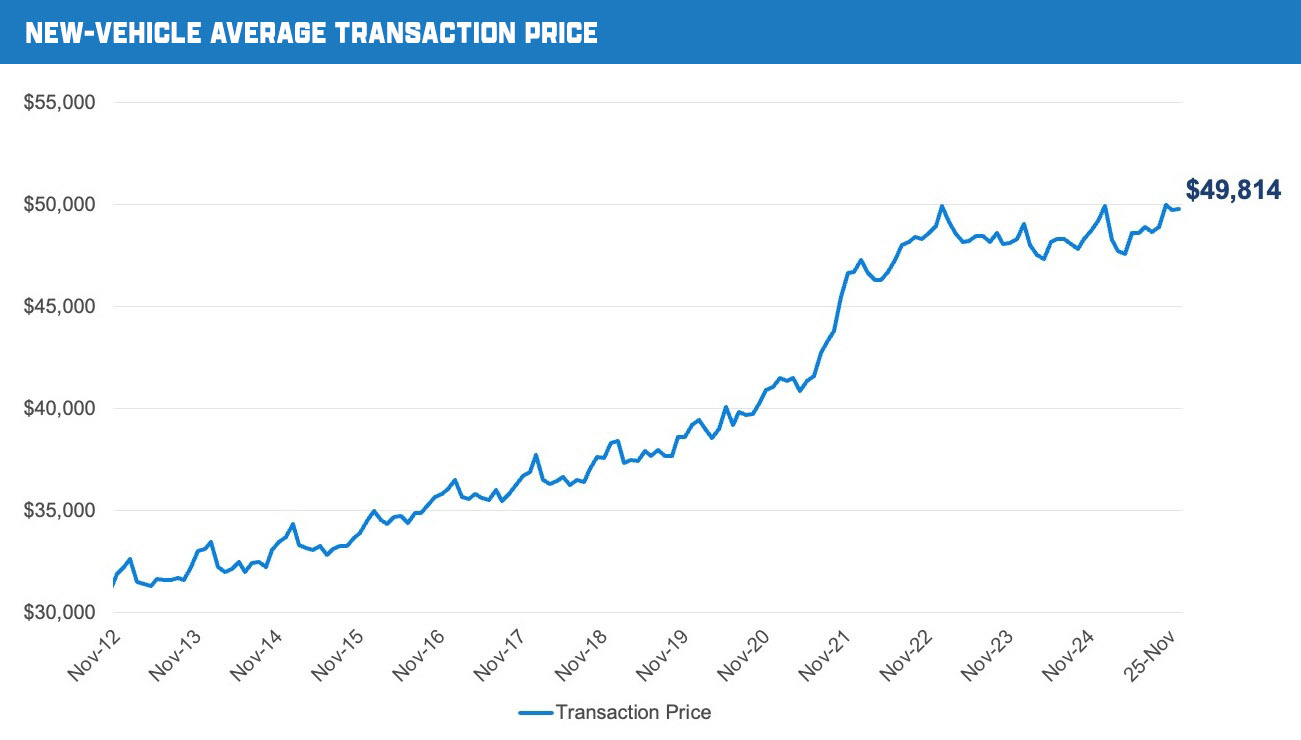
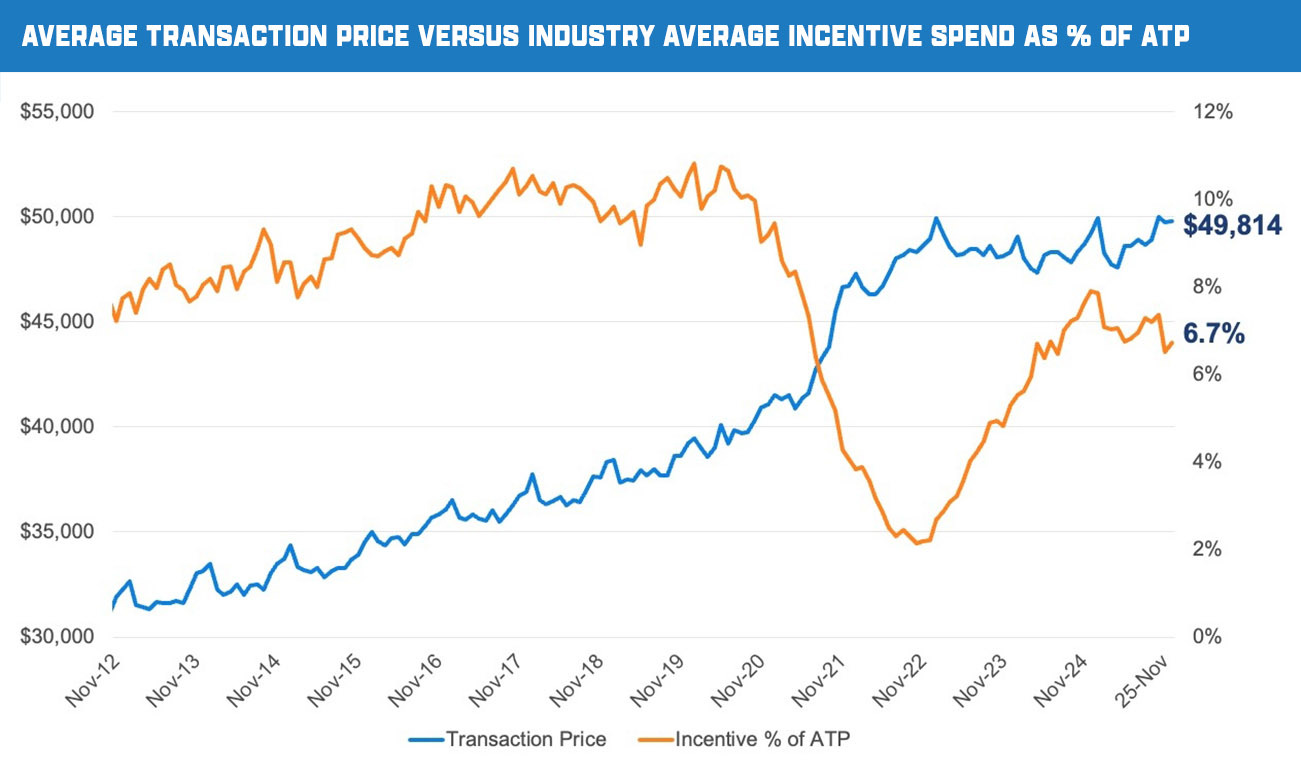
According to the latest Kelley Blue Book data, the average transaction price of a new vehicle in the US hit $49,814 in November, and it’s showing no real sign of dropping.
That figure is up 1.3 percent year over year and effectively unchanged from October, suggesting the industry has settled into a comfortable rhythm where fifty grand is the new normal.
Cox Automotive says prices usually peak in December, meaning the holiday season could push things even higher as buyers gravitate toward well-optioned trucks, luxury SUVs, and vehicles that require six figures of income and very little financial anxiety.
Fewer Incentives
Incentives are still around, but they are not doing the heavy lifting they once did. In November, incentives averaged 6.7 percent of average transaction prices, down from nearly 8 percent a year ago.
Automakers simply do not need to discount aggressively when buyers keep selecting expensive trims with panoramic roofs, giant screens, and fancy wheels.
The data makes one thing clear. Cheap cars are disappearing from the sales mix. Vehicles with MSRPs under $30,000 accounted for just 7.5 percent of November sales, down sharply from 10.3 percent a year earlier.
Meanwhile, more than one in 10 vehicles sold cost over $75,000. The most popular sub-$30K survivors remain familiar names like the Toyota Corolla, Chevrolet Trax, and Hyundai Elantra, clinging on like endangered species.
While transaction prices may have leveled off for now, average MSRPs, commonly known as the asking price, are still inching upward, reaching $51,986 in November. That marks a 1.7 percent increase over last year.
Blame Pricey Trucks
Trucks continue to be a major contributor to price inflation. Full-size pickups now average more than $70,000 for the third month in a row and accounted for over 14 percent of all sales in November, with nearly 183,000 units delivered. That helps explain why the industry average keeps floating upward even when compact and midsize segments remain relatively stable.
Electric vehicles add another twist. The average EV transaction price fell slightly month over month to $58,638, but remains up 3.7 percent year over year. Incentives jumped to over 13 percent of prices as sales softened again, dropping more than 40 percent compared with last year.
Tesla’s average transaction price rose to $54,310 in November, even as sales fell 22.7% year over year, largely due to sharp declines in Model 3 demand. Prices for the Model Y, the best-selling EV in the U.S., edged up slightly. Cybertruck sales fell to 1,194 units, their lowest monthly total of 2025, though its average price rose to $94,254.
Who’s Really to Blame?
According to Cox Automotive Executive Analyst Erin Keating, today’s prices aren’t just the result of inflation or supply hangovers, but they reflect what consumers are choosing to buy.
“It’s important to remember that the KBB ATP reflects what consumers choose to buy, not what’s available,” she explained.
“Many new-car buyers today are in their peak earning years and are less price-sensitive, opting for vehicles at the higher end of the market to get the features and experiences they value most. In November, sales of vehicles priced above $75,000 outpaced those below $30,000, underscoring this preference for premium products” Keating added.
The takeaway is simple. Prices are high because buyers keep buying high. Until that changes, the average US driveway will continue to look alarmingly expensive.
We just have to hope the trend doesn’t discourage automakers from developing and building the more affordable models that less affluent Americans still need.
Chevrolet is quietly clearing out its canceled BrightDrop vans.
Buyers get $21,500 in cash plus major dealer discounts.
Some BrightDrop 400 vans are listed over $28,000 off MSRP.
After a botched rollout and years of lackluster demand, General Motors announced plans to end production of the slow-selling BrightDrop vans. The announcement was made in October and it appears dealers are having a fire sale to get rid of remaining inventory.
I originally noticed this after a local Chevy dealer was advertising a van for roughly $22,000 below MSRP. However, that’s a drop in the bucket as Chevrolet of Troy, Ohio has knocked $28,315 off a 2025 BrightDrop 400. This means you can get the $68,310 EV for as little as $39,995.
That’s barely more than a Ford Mustang Mach-E, which starts at $37,995. More importantly, it undercuts the Ford E-Transit Cargo by $13,265.
Of course, that’s far from the only example as Miami’s Bomnin Chevrolet has their $69,435 BrightDrop 400 listed for $40,435. That’s a discount of $29,000, which means you can buy a 2027 Chevrolet Bolt with the savings.
Ray Chevrolet of Fox Lake, Illinois isn’t as generous, but they’ve marked their BrightDrop 400 down $28,348. That means you can get the $69,935 delivery van for just $41,587.
If the standard model is too small for your liking, you can always upgrade to the BrightDrop 600. Kool Chevrolet has a very cool discount of $23,600 on theirs, meaning you can get it for $47,450. That’s significantly better than the original MSRP of $71,050.
It’s a similar story at Columbus’ Ricart Chevrolet, which has slashed $25,253 off the price of their 2025 BrightDrop 600. As a result, the $73,430 EV can be had for $48,177.
These huge discounts are made possible thanks to $21,500 in customer cash. The offer requires buyers to take retail delivery by January 2, so you might want to act fast if you want to own a testament to GM’s ill-fated belief in EVs.
GM says strict fuel rules nearly forced it to cut gasoline models.
CEO claims compliance pressure could have closed GM plants.
Trump rollback eases targets automakers struggled to meet fully.
General Motors CEO Mary Barra recently acknowledged that federal fuel efficiency standards were set so aggressively under the Biden administration that her company would have been forced to scale back production of internal combustion engine vehicles just to stay compliant.
Barra shared this during a conversation at a high-profile industry conference hosted by The New York Times, where she discussed the internal pressures major automakers face under the current regulatory environment.
Timing matters, of course, as her comments came shortly after President Donald Trump confirmed that fuel efficiency standards are being rolled back, reducing the pressure on automakers to build EVs and providing them with more flexibility to manufacture and sell more combustion-powered models.
“Had to Start Shutting Down Plants”
Under the Biden-era rules, automakers would have been required to reach a fleet-wide fuel economy average of 50 miles per gallon by 2031. According to Bloomberg, achieving that would have meant electric vehicles making up more than half of all sales by that point.
If GM couldn’t meet those benchmarks, and if the administration didn’t revise the rules to reflect market realities, Barra claims that the company would have had little choice but to curtail sales of its gasoline-powered lineup.
She added that internal forecasts indicated the company would have “had to start shutting down plants” if its EV sales didn’t grow quickly enough.
Barra also touched on several other topics with Andrew Ross Sorkin, the interviewer and the founder and editor at large of DealBook. At one point, he asked her about GM flip-flopping in supporting policies during the first Trump administration, again when Joe Biden was elected, and once more after Trump returned to the White House in January.
Bending The Knee Or Business As Usual?
Barra responded by framing GM’s approach as pragmatic, not political. The company, she said, wants to build vehicles people want to buy, and it simply has to work within the regulatory frameworks set by whoever is in office.
Now, thanks to the rollback of CAFE standards, it will have the freedom to better manufacturer vehicles based on what their customers want, rather than simply what they must build to meet regulatory requirements.
How this will impact the American car industry remains to be seen, but if those rules remain in place in the future, we don’t expect to see EVs accounting for a significant share of the market any time soon.
Biden excluded Tesla from the 2021 White House EV summit.
GM was wrongly credited for leading the EV transformation.
Mary Barra privately told Biden Tesla deserved more credit.
In 2021, a high-profile EV summit at the White House brought together some of the biggest names in the auto industry. Hosted by then-President Joe Biden, the event was pitched as a landmark moment for the nation’s transition to electric vehicles. Executives from GM, Ford, and Stellantis were all present.
But conspicuously absent? Elon Musk, or anyone from Tesla, for that matter. That absence didn’t go unnoticed, especially when Biden publicly credited GM with leading the EV revolution.
As history has shown, Musk likes to hold a grudge. And while it may have seemed like a fleeting political oversight at the time, the snub may have had consequences that extended far beyond the Beltway.
What Was Behind the Snub?
Little has been said publicly about the summit in the years since, but during an interview at the 2025 New York Times DealBook Summit, GM president Mary Barra shed new light on what happened behind the scenes. According to Barra, she spoke privately with President Biden at the event to redirect some of the praise being sent her way.
“He was crediting me and I said, ‘Actually, I think a lot of that credit goes to Elon and Tesla,’” Barra told the audience. “You know me, Andrew. I don’t want to take credit for things.”
The snub was thought to have been done in part to throw the White House’s support behind the United Auto Workers and GM, Ford, and Stellantis, all of which have unionized labor. Tesla, on the other hand, doesn’t. Musk has been openly critical of labor unions for years, a stance that’s often put him at odds with Democratic policymakers.
The Fallout That Followed
The story didn’t end there. As reported by the Business Insider, in her recent memoir, then-Vice President Kamala Harris acknowledged that leaving Musk off the invite list was, in hindsight, a misstep.
“If you are convening the nation’s manufacturers of electric vehicles and the biggest player in the field is not there, it simply doesn’t make sense,” she wrote. “Musk never forgave it.”
Speaking in a separate interview, Harris reflected further: “So, I thought that was a mistake, and I don’t know Elon Musk, but I have to assume that that was something that hit him hard and had an impact on his perspective,” she said, according to Fox News.
It’s hard to quantify exactly how much the snub shaped Musk’s political outlook, but for years, the Tesla CEO had aligned himself with Democratic candidates, casting votes for figures like Barack Obama and Hillary Clinton.
But around 2022, Musk’s political leanings began shifting to the right, and he would go on to play a significant role in helping elect Donald Trump to a second term. Whether things might have turned out differently if Biden had acknowledged him is anyone’s guess.
Let’s not forget the White House giving Tesla the cold shoulder, excluding us from the EV summit and crediting GM with “leading the electric car revolution” in the same quarter that they delivered 26 electric cars (not a typo) and Tesla delivered 300 thousand.
Trump refuses to repay automakers for EV-related spending.
Rollback removes key EV incentives from future planning.
Ford and GM support looser fuel economy requirements.
The Trump administration is rolling back fuel-economy standards in the United States, encouraging car manufacturers to build more combustion-powered vehicles and reducing their impetus to build EVs. It’s a move that’s been a long time coming.
While companies like Ford, Stellantis, and GM have thrown their support behind the new “common sense” rules, they shouldn’t expect any handouts from the government to offset the billions they invested in EVs under Biden-era regulations.
During the recent CAFE standards announcement at the White House, a reporter from the Detroit Free Press asked President Trump whether automakers deserved compensation for those investments, given that they were made under policies assuming continued federal support for EV sales.
“No, I’m not doing it,” President Trump quickly replied, triggering laughter among those standing behind the Resolute Desk. “Nope, no, I’m not letting them recoup, they’re going to do just fine. You know how they recoup? From this point forward they’ll do very well.”
During the same presentation, the President suggested that thanks to his controversial tariffs, Stellantis, Ford, and GM are all coming back to the United States.
“The people that are up here from Stellantis and Ford and General Motors, great companies … they wouldn’t be here today if we didn’t have tariffs,” Trump claimed.
“They’d be building their plants in Mexico and other places. They’re leaving Mexico and they’re leaving Canada. They’re leaving because they ripped off our country, they took our businesses away from us. And now because of tariffs they’re all coming back, so it’s a great thing,” the president added.
Ford CEO Thrilled With Changes
According to Ford chief executive Jim Farley, previous CAFE standards “was totally out of touch with market reality,” claiming that “we were forced to sell EVs and other vehicles.”
He noted that Ford wants to give customers the freedom to choose, noting “we have a lot of EVs and a lot of hybrids at Ford, but now customers get a chance to choose what they want, not by what we force on them.”
Farley added that the rollback will allow it to “offer more affordability on our popular models, and we’ll be able to launch new vehicles built in America that are more affordable because of this rule change.”
GM vows to keep improving engine efficiency as federal standards weaken.
Looser rules may push automakers toward more profitable trucks and SUVs.
Barra says GM’s EV commitment stands despite lower sales after credits ended.
This year has been a strange one for automakers, but many of them just caught a break. The EPA effectively wiped out penalties for missing fuel-economy targets, a move that could easily trigger another surge in high-margin full-size trucks and SUVs.
With less regulatory pressure, engines don’t have to get cleaner or more efficient, yet GM CEO Mary Barra insists the company will keep pushing them in that direction anyway.
She maintains that GM will improve every combustion engine it invests in, no matter what the rulebook says. Whether that commitment holds once the market leans even harder toward big, profitable gas-guzzlers is another matter entirely.
How Long Will Progress Last?
Innovation is no doubt key for all automakers, so the promise of continued development is promising on paper. That’s what Barra provided at the New York Time’s DealBook Summit on Wednesday, saying, “Every engine we invest in, we work to have a significant improvement.”
It seems clear that tougher fuel economy standards have led to huge costs for automakers. A recent report indicates that many of the larger recalls from the past two years can be linked to those standards.
Whether or not GM and other automakers will continue to push fuel economy as hard as they have is a worthy consideration.
What’s the Incentive Now?
For decades, automakers have intentionally steered consumers toward larger SUVs and trucks because they offer the largest profits and require the least stringent fuel economy standards.
It’s unclear why that strategy would change now that the penalties are gone altogether. Still, something positive could come from new regulations in Barra’s eyes.
Barra also supported Trump’s move to strip California of tougher clean-air authority, pushing instead for one national standard that doesn’t “get in front of the consumer.” However, automakers helped create today’s SUV-heavy demand, so that argument only goes so far.
Looser rules also ease pressure on EVs, a convenient shift for GM as sales dip after tax credits expired and its electric lineup remains unprofitable. Barra insists the company is still committed.
She was more positive on tariffs, calling recent policies “a more level playing field” after years of uneven barriers. GM may keep refining engines, but with weaker rules and a market built around giant SUVs, it’s hard to imagine Detroit walking away from its biggest profit margins.
AlixPartners predicts EV battery capacity will triple global demand by 2030.
Ford cuts its planned battery capacity by 35 percent amid lower EV sales.
Panasonic’s expansion stalls as Tesla demand dips in North America.
Many automakers spent the past few years racing to electrify their lineups, betting heavily that global demand for electric vehicles would surge. The industry poured billions into new EV battery plants across the world, particularly in North America.
Now, a new report suggests that much of that production capacity could end up sitting idle by the end of the decade.
Overcapacity Ahead
AlixPartners speculates that global production of EV batteries will be roughly three times greater than demand for EVs in 2030. By that time, EV battery production capacity in North America is expected to roughly quadruple.
According to Nikkei Asia, many manufacturers are already scaling back their ambitious battery production plans. Ford, one of the most aggressive investors in U.S. battery manufacturing, is a prime example. The company is building a $5.8 billion facility in Kentucky with its partner SK On, which is expected to employ about 5,500 people by 2030.
However, the Blue Oval already reduced its planned battery capacity by 35 percent. It also recently halted production of the F-150 Lightning indefinitely due to dwindling demand in North America.
General Motors has also been forced to make changes. It has been confirmed that 1,550 workers at the battery plants it operates alongside LG Energy Solution in Ohio and Tennessee will be sacked due to “slower near-term EV adoption and an evolving regulatory environment.”
Nikkei Asia also reports that Panasonic opened a new battery factory in Kansas in July, but has yet to say when it will reach full-scale production. Initially, it was expected to hit this mark by the end of the 2026 fiscal year. However, as a major supplier to Tesla, it has been affected by the fall in demand for EVs as well.
Slowing EV sales in the States have led to the cancellation of some endeavors entirely. T1 Energy was planning to build a battery plant in Georgia, but has since canned the project.
Changing Policy Winds
The Trump administration’s policies have further tilted the scales toward internal combustion vehicles. By removing the $7,500 federal EV tax credit and scrapping penalties for missing emissions targets, the government has made it easier for carmakers to ramp up traditional ICE production once again.
GM invests $550 million to boost U.S. output of gas-powered vehicles.
Chevrolet Blazer production moves from Mexico to Spring Hill in 2027.
Orion Assembly retools for Silverado, Sierra, and Escalade production.
General Motors is doubling down on its US operations with a fresh round of investment aimed at boosting local production of internal combustion models at its Ohio and Michigan plants. The automaker has announced $550 million in new spending as part of nearly $5.5 billion set aside for wider production expansion across its network.
Roughly $250 million of that sum is headed to GM’s Parma Metal Center in Ohio, a facility central to the company’s manufacturing backbone. The added funding will support higher output of sheet metal stampings and assemblies.
Currently, the Parma site produces more than 100 million parts each year and handles over 400 tons of steel daily. It supplies components for a wide range of GM vehicles built across North America, making it one of the company’s most productive operations.
“Our commitment to Parma Metal Center isn’t just about upgrading equipment—it’s about investing in the people who make it all happen,” GM senior vice president of global manufacturing, Mike Trevorrow, said.
“Our manufacturing teams are the driving force behind GM’s success, and we’re committed to giving them the tools and training they need to excel in today’s advanced manufacturing world. When we invest in our workforce, we’re not only building great vehicles—we’re helping secure the future of American manufacturing.”
Other Investments
Beyond Ohio, GM is allocating $300 million to its Romulus Propulsion Systems plant near Detroit. The upgrade will expand output of the company’s 10-speed automatic transmissions, the same units found in its full-size pickups and SUVs.
Shifting consumer demands have forced GM to make significant production changes. Its Orion Assembly plant has been down since 2023 and was originally being retooled to build electric pickup trucks, but it will now instead handle production of gas-powered Chevrolet Silverado, GMC Sierra, and Cadillac Escalade models.
Looking further ahead, GM confirmed that production of the gas-powered Chevrolet Blazer will move from Mexico to its Spring Hill plant in Tennessee in 2027.
There, it will join the Cadillac XT5, Lyriq, and Vistiq on the production line, another sign that while GM’s electric future is still in motion, its gasoline-powered present remains very much alive.
GM’s China studio created a sporty EV concept for local market appeal.
Sketches show a grille-less SUV with arrow cues and wraparound glass.
The design may inspire future Chevrolet models for Chinese customers.
The world’s largest automotive market has become a linchpin for General Motors, a place where nearly all its brands are striving to secure a stronger presence. To that end, GM’s China Advanced Design studio has unveiled another fresh concept study, a “sporty EV” created specifically with Chinese buyers in mind.
The exploration sketches and renderings were made by GM designer Charles Huang at the company’s Shanghai facilities. They show what looks like a small crossover – some might even see shades of a future Bolt – with oversized wheels and a contrasting bi-tone paint scheme.
At the front, the concept trades a traditional grille for a clean, enclosed surface with split LED headlights and a Chevrolet emblem that may light up. The bodywork is restrained, defined by crisp lines and minimal decorative detailing.
The most striking element is the wraparound glasshouse, framed by a thick C-pillar that seems to clasp the rear of the vehicle. The contrast between the deep blue and black tones amplifies this visual tension.
GM Design / Instagram
According to the designer, the profile is inspired by a “released arrow”, an idea most evident in the early sketches. The later, photorealistic renderings dial the drama back, edging closer to something feasible for production.
In fact, it’s easy to picture this crossover parked in a Chevrolet showroom, fitted with regular mirrors and door handles, of course, assuming those still have a place in modern EV design.
The presentation on the GM Design Instagram profile doesn’t include any sketches of the interior. We don’t have any specs, either, although a rear-mounted electric motor and a medium-sized battery pack would probably do the job.
The EV seems to have a similar length to the Chinese-spec Chevrolet Tracker RS and the US-spec Bolt. That puts it below the Trailblazer, Trax, Equinox EV, and Blazer currently sold in the States.
While the Chevrolet concept is just a design study with no production intent, GM is working on multiple affordable EVs for the future. It is safe to assume that at least some of them will adopt an SUV bodystyle, possibly similar to the “sporty EV” depicted in the sketches.
Though GM describes the project as a design study with no immediate production intent, it arrives at a time when the company is actively developing several affordable EVs for many markets. It’s likely that some of those models will borrow cues from this study, especially the SUV silhouete.
GM Design revealed two new Buick concept vehicles created in China.
One of them is a family-oriented compact SUV with modern styling.
The other is a sleek crossover with a sporty estate stance and suicide doors.
Buick is enjoying solid momentum in China, with consistent demand for the Envision SUV, LaCrosse sedan, and GL8 minivan keeping showrooms busy. Even so, the design team continues to push forward, developing fresh ideas and refining future models.
Two of these design studies just appeared on the General Motors Design Instagram account: one is a family compact SUV, the other a sportier crossover estate. Different takes, but both look unusually ready for production.
Both concepts were developed at the GM Advanced Design studio in Shanghai, China. One is designed by Sangmin Kim, while the other is designed by Yixuan Feng.
GM Design / Instagram
Starting with the more conventional concept, it’s described as “a fun, family-oriented premium Buick design study” created around the theme “driving in comfort.”
Up front, split LED headlights feature futuristic internal graphics, compensating neatly for the absence of a traditional grille. Along the sides, large bi-tone alloy wheels fill the arches, framed by glossy black cladding and muscular fenders.
The thick C-pillars flow into a rear spoiler that wraps around the back window, where the taillights are integrated beneath the glass. The rear also features a wide tailgate and a sculpted bumper with a discreet diffuser. Despite modest ground clearance, the upright front end, roof rails, and protective cladding lend it an SUV stance reminiscent of the Kia Niro.
Buick hasn’t revealed technical details, but the proportions seem to place this concept between the 171.4 inches (4,355 mm) of the Encore GX and the 182.7 inches (4,645 mm) of the Envision.
GM Design / Instagram
The next concept is described as a “small, expressive premium Buick design study” built around the idea of “driving pleasure.” It adopts an aerodynamic crossover hatchback or estate profile, complete with suicide doors and a split tailgate.
The front end features an illuminated grille, slim headlights, and ADAS sensors hidden in the bumper intakes. The forged aluminum wheels have shiny chrome accents, while the surfacing in front of the toned rear shoulders looks inspired by Lexus.
Other highlights include the panoramic sunroof, the flying buttresses, the swooping rear glass, and the reflective taillights. Overall, the model appears to be smaller in size compared to the Electra-L Shooting Brake concept from 2024.
What’s Next For Buick?
Buick’s design language is shifting toward New Energy Vehicles (NEV), and both of these concepts seem well-suited to fully electric or range-extender setups.
While the models are labeled as design studies, they could easily pass for production vehicles, as they don’t have any wildly futuristic features. Buick is reportedly working on an electric subcompact crossover, which is set to arrive before 2029, followed by a new generation of the Encore GX.
Ford GM and Stellantis CEOs to testify before Congress in January.
Hearing focuses on pricing, regulations, EV policy, and trade talks.
Senator Ted Cruz calls it a reality check on affordability rules.
For the first time in nearly twenty years, the CEOs of Ford, General Motors, and Stellantis may once again share a table before Congress. The Senate Commerce Committee has called on Ford’s Jim Farley, GM’s Mary Barra, and Stellantis’ Antonio Filosa to testify on January 14 in a high-profile hearing exploring the auto industry’s outlook on federal transportation policy and vehicle affordability.
The session will also delve into the uneasy transition toward electrification, a subject that continues to divide policymakers and automakers alike. Tesla’s VP of Vehicle Engineering, Lars Moravy, has been invited to join the discussion, adding an electric perspective to the mix.
The last time all three Detroit bosses appeared together on Capitol Hill was late 2008 during the financial crisis, bailout negotiations, and a moment when the industry’s future looked genuinely uncertain. This time, the pressure points are different but no less significant.
Why Bring Them Together Now?
Senator Ted Cruz, who’s spearheading the hearing, has titled it “Pedal to the Policy: The Views of the American Auto Industry on the Upcoming Surface Transportation Reauthorization.”
Based on reporting from the Union-Bulletin, the sessions will probe fuel economy and emissions mandates, tariffs, federal EV policy, new-vehicle pricing, and how automakers plan to navigate the next decade. Cruz frames the meeting as a long-overdue reality check on affordability.
“The average price of a car has more than doubled in the past decade,” said Cruz, blaming “onerous government-mandated technologies and radical environmental regulations.”
What’s Driving Up Costs?
No doubt, the average transaction price (ATP) of a new car is quite high these days. Data from Cox Automotive shows that it surpassed $50,000 in September.
A decade ago, that figure was in the low $30,000s. Notably, analysts think the shift is due to several factors, including, but not limited to, regulation. Inflation, tariffs, higher-end trims, and the introduction of more EVs all have a part to play.
Republicans say policy changes earlier this year, including repealing federal EV mandates and CAFE targets under the One Big Beautiful Bill Act, are steps toward lowering prices. However, Cruz argues lawmakers need to go further. This is all happening at a critical point in the U.S. automotive industry too.
The debate comes at a pivotal moment for the U.S. auto sector. The United States-Mexico-Canada Agreement (USMCA) faces renewal or renegotiation by July 1. If it lapses, the fallout alone could drive vehicle costs higher, regardless of any new legislation.
The 1969 512 Electric Experimental shows how long GM’s pursued EVs.
Just 86 inches long, the fiberglass microcar used an 84-volt battery.
A household charge took seven hours and delivered 58 miles of range.
In 1969, the automotive world was a study in contrasts. Two concept cars, each wearing the same 512 badge yet conceived on opposite sides of the globe, were redefining what “experimental” could mean.
One was the competition-inspired V12-powered Ferrari 512 S Berlinetta Speciale, a supercar wedge that pre-dated the Lamborghini Countach concept by two years and looked like it could break the sound barrier. The other was a tiny orange ball of an EV from GM that could barely break the speed limit outside a school.
We’ve taken a look at GM’s 512 Electric Experimental before, but the automaker has really jumped on the modern EV trend since then and has a new Chevy Bolt out for 2027, so the time feels right to throw the spotlight on it again.
Designed strictly for urban duties and part of an entire family of experimental GM microcars displayed at the Transpo ’72 trade show that used a mix of electric, petrol and hybrid engines, the 512E was every bit as tiny as it looks in these pictures.
Measuring just 86.3 inches (2,190 mm) long and 56 inches (1,420 mm) wide, it was an incredible foot (300 mm) shorter than an original Smart ForTwo and 3 inches (75 mm) narrower.
Access to its two seats was through a weird combination of a lift-up canopy that makes it look like a helmet with the visor up and side-hinged front door that reminds us of one of those grandma bathtubs for the mobility impaired.
Tiny wheels are pushed into each corner and wear fat rubber, like the kind of thing you’d see on tuned Mini in 1969.
The wraparound canopy must make for excellent visibility, though even if it had A-pillars like elephants legs you’d have plenty of time to look around them.
Slow And Steady Power
The top speed is just 30 mph and it takes 12 seconds to get there, which sounds terrible until you remember that the Citroen Ami, the modern incarnation of this very idea, is also restricted to a similar speed (28 mph / 45 kmh).
Citroen quotes a 47-mile range, which the 512E beats by 11 miles (though certainly measured differently), but the Ami can be fully charged in four hours compared with seven hours for the GM satsuma.
Where they differ most, of course, is in the design of the batteries providing those range miles. Like all modern EVs, the Ami uses lithium ion batteries, whereas the 512E relies on old-fashioned lead-acid packs from Delco-Remy.
The fiberglass-bodied GM car is still surprisingly light at 1,250 lbs (567 kg), though the Ami is lighter still at 1,065 lbs (483 kg).
The 512E project didn’t put a tiny EV in Chevy showrooms during the 1970s or 1980s, but the fact that GM unveiled the Impact EV concept, and put it into production as the EV1 six years later, proved that it hadn’t given up on the idea of small electric cars.
Half a century later, GM is still in that game, this time with the upcoming 2027 Bolt, though one can’t help but wonder how much more fun it’d be with a flip-up canopy and a hint of that 1970s optimism.

 Login
Login