Reading view

There are new articles available, click to refresh the page.

Only 7 Percent Of Cars Sold Last Month Cost Under $30,000

  • Average transaction price hovers near $50K with no slowdown.
  • Affordable cars fade as luxury trucks and SUVs dominate sales.
  • EV prices soften slightly but rely heavily on rising incentives.

If you were hoping falling interest rates, bigger incentives, or sheer consumer exhaustion might finally drag new-car prices back to Earth, number-crunching industry experts have some bad news.

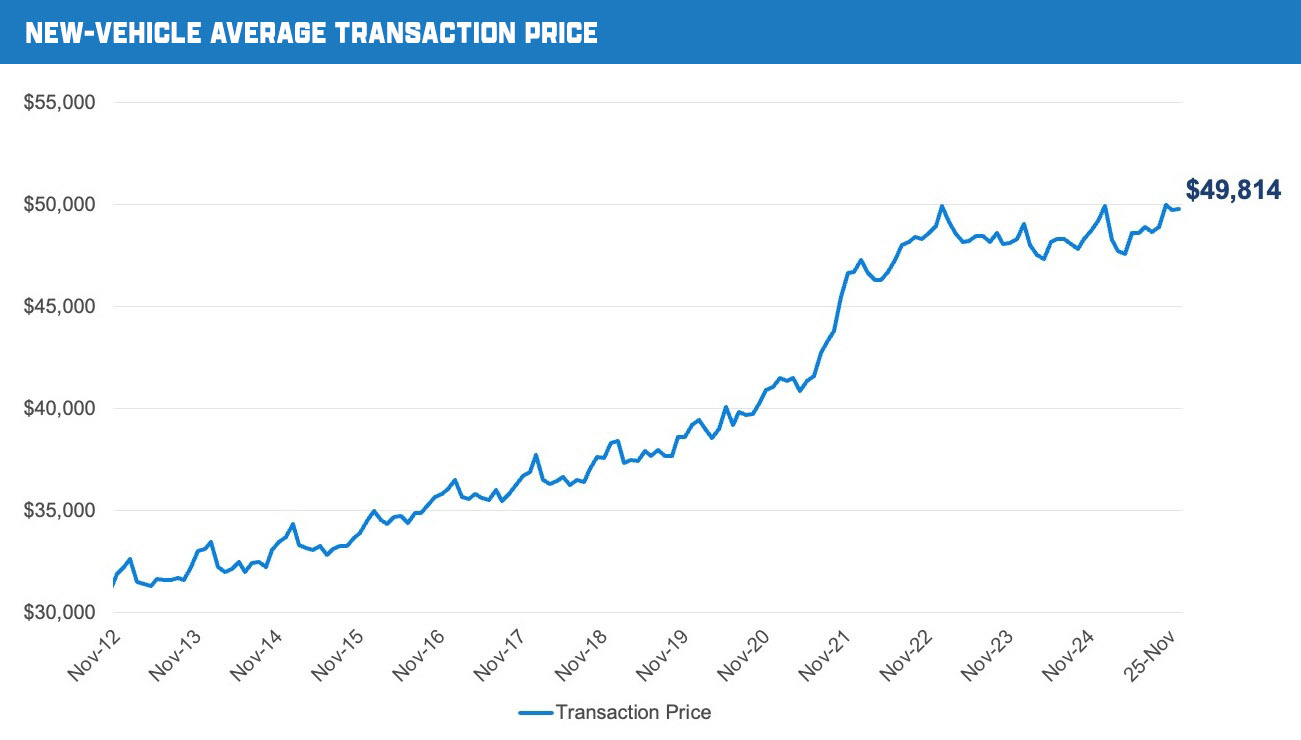
According to the latest Kelley Blue Book data, the average transaction price of a new vehicle in the US hit $49,814 in November, and it’s showing no real sign of dropping.

Also: Nobody Wants These 2024 Models And Dealers Are Drowning In Inventory

That figure is up 1.3 percent year over year and effectively unchanged from October, suggesting the industry has settled into a comfortable rhythm where fifty grand is the new normal.

Cox Automotive says prices usually peak in December, meaning the holiday season could push things even higher as buyers gravitate toward well-optioned trucks, luxury SUVs, and vehicles that require six figures of income and very little financial anxiety.

Fewer Incentives

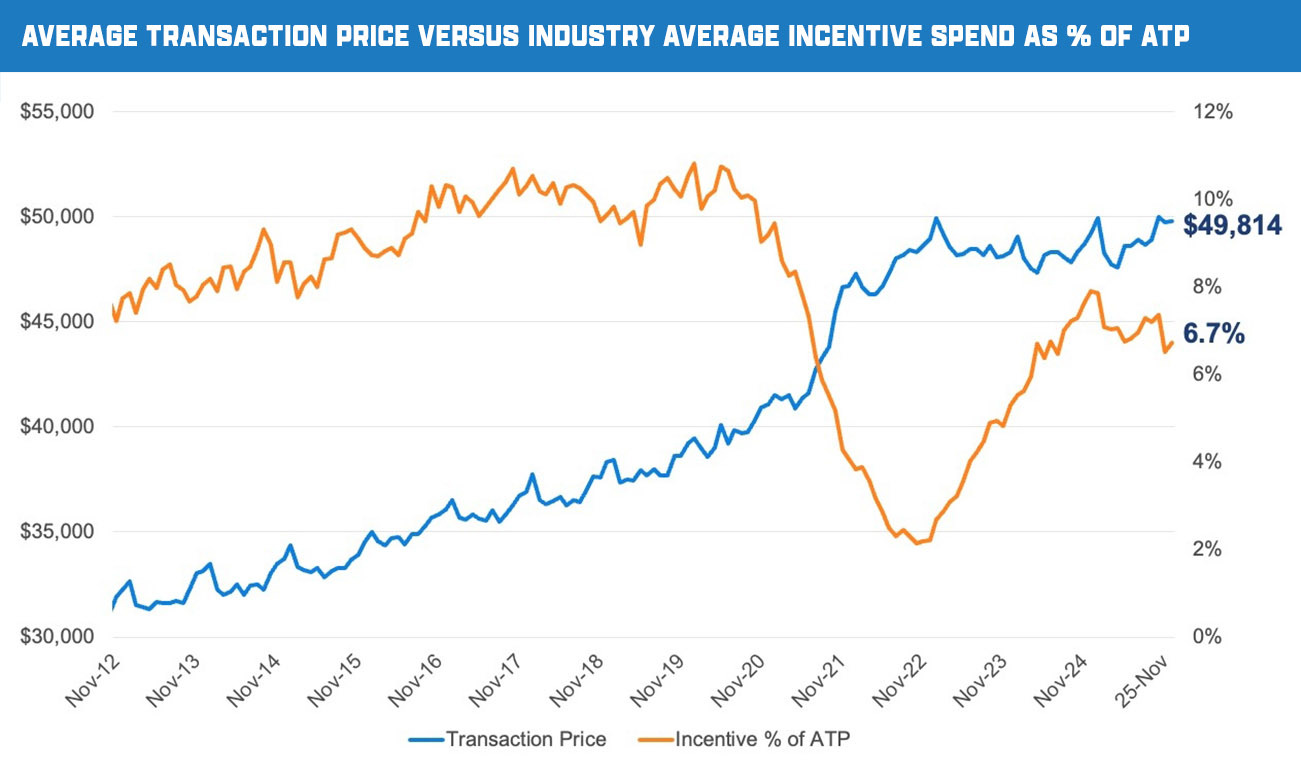
Incentives are still around, but they are not doing the heavy lifting they once did. In November, incentives averaged 6.7 percent of average transaction prices, down from nearly 8 percent a year ago.

Automakers simply do not need to discount aggressively when buyers keep selecting expensive trims with panoramic roofs, giant screens, and fancy wheels.
 Only 7 Percent Of Cars Sold Last Month Cost Under $30,000
Cox/KBB

The data makes one thing clear. Cheap cars are disappearing from the sales mix. Vehicles with MSRPs under $30,000 accounted for just 7.5 percent of November sales, down sharply from 10.3 percent a year earlier.

Meanwhile, more than one in 10 vehicles sold cost over $75,000. The most popular sub-$30K survivors remain familiar names like the Toyota Corolla, Chevrolet Trax, and Hyundai Elantra, clinging on like endangered species.

While transaction prices may have leveled off for now, average MSRPs, commonly known as the asking price, are still inching upward, reaching $51,986 in November. That marks a 1.7 percent increase over last year.

Blame Pricey Trucks
 Only 7 Percent Of Cars Sold Last Month Cost Under $30,000

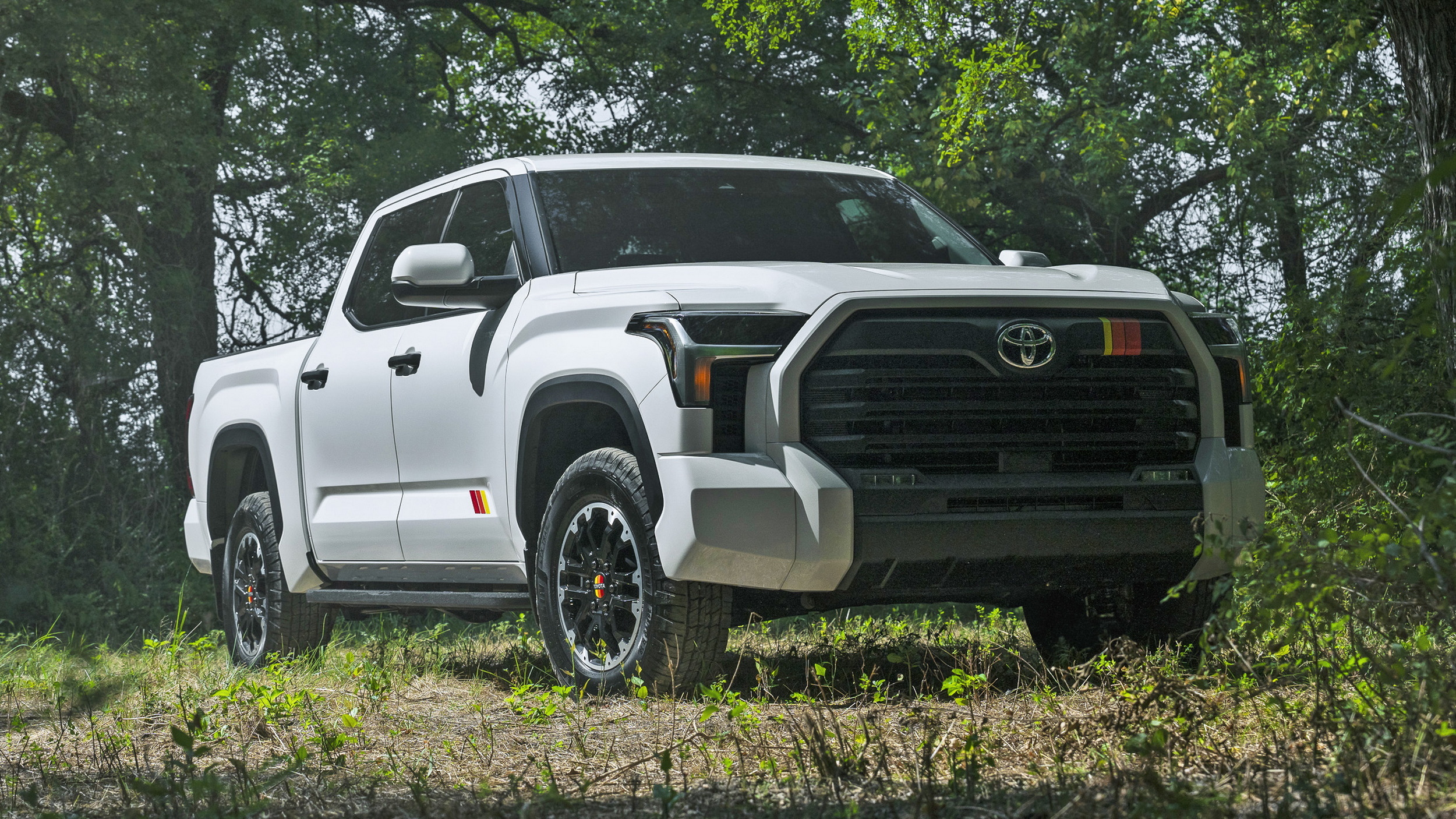
Trucks continue to be a major contributor to price inflation. Full-size pickups now average more than $70,000 for the third month in a row and accounted for over 14 percent of all sales in November, with nearly 183,000 units delivered. That helps explain why the industry average keeps floating upward even when compact and midsize segments remain relatively stable.

Read: Senators Want Cheaper Cars, Even If It Means Getting Rid Of Automatic Braking

Electric vehicles add another twist. The average EV transaction price fell slightly month over month to $58,638, but remains up 3.7 percent year over year. Incentives jumped to over 13 percent of prices as sales softened again, dropping more than 40 percent compared with last year.

Tesla’s average transaction price rose to $54,310 in November, even as sales fell 22.7% year over year, largely due to sharp declines in Model 3 demand. Prices for the Model Y, the best-selling EV in the U.S., edged up slightly. Cybertruck sales fell to 1,194 units, their lowest monthly total of 2025, though its average price rose to $94,254.

Who’s Really to Blame?

According to Cox Automotive Executive Analyst Erin Keating, today’s prices aren’t just the result of inflation or supply hangovers, but they reflect what consumers are choosing to buy.

“It’s important to remember that the KBB ATP reflects what consumers choose to buy, not what’s available,” she explained.

“Many new-car buyers today are in their peak earning years and are less price-sensitive, opting for vehicles at the higher end of the market to get the features and experiences they value most. In November, sales of vehicles priced above $75,000 outpaced those below $30,000, underscoring this preference for premium products” Keating added.
 Only 7 Percent Of Cars Sold Last Month Cost Under $30,000
Cox/KBB

The takeaway is simple. Prices are high because buyers keep buying high. Until that changes, the average US driveway will continue to look alarmingly expensive.

We just have to hope the trend doesn’t discourage automakers from developing and building the more affordable models that less affluent Americans still need.

Average Transaction Price by Automaker Group
GroupNOV-25OCT-25NOV-24MoM % ChangeYoY %
Change
BMW$70,864$70,037$71,2421.2%-0.5%
Ford Motor Company$57,639$57,724$57,079-0.1%1.0%
Geely Auto Group$60,759$59,480$60,2692.2%0.8%
General Motors$55,778$56,173$53,443-0.7%4.4%
Honda Motor Company$38,819$38,839$39,384-0.1%-1.4%
Hyundai Motor Group$38,966$38,331$38,9131.7%0.1%
Mazda Motor Corporation$36,134$35,179$36,2312.7%-0.3%
Mercedes-Benz Group AG$75,000$74,421$77,2220.8%-2.9%
Renault-Nissan-Mitsubishi Alliance$37,330$37,326$35,3810.0%5.5%
Stellantis$55,803$54,513$56,3872.4%-1.0%
Subaru Corporation$36,521$36,146$34,8091.0%4.9%
Tata Motors$103,768$104,662$101,878-0.9%1.9%
Tesla Motors$54,310$53,528$55,2471.5%-1.7%
Toyota Motor Corporation$45,265$45,249$44,2750.0%2.2%
Volkswagen Group$56,590$58,280$53,463-2.9%5.8%
Industry$49,814$49,760$49,1850.1%1.3%
SWIPE
Average Transaction Price by Brand
MakeNOV-25OCT-25NOV-24MoM % ChangeYoY %
Change
Acura$49,083$49,275$54,009-0.4%-9.1%
Audi$64,902$65,072$62,972-0.3%3.1%
BMW$72,616$71,973$73,5160.9%-1.2%
Buick$36,694$36,324$34,9881.0%4.9%
Cadillac$87,739$84,566$68,0253.8%29.0%
Chevrolet$50,759$51,064$48,944-0.6%3.7%
Chrysler$47,101$46,917$48,1460.4%-2.2%
Dodge$47,899$49,232$51,390-2.7%-6.8%
Ford$57,010$57,120$56,512-0.2%0.9%
Genesis$65,574$64,343$62,1951.9%5.4%
GMC$66,430$66,555$66,339-0.2%0.1%
Honda$37,559$37,685$37,869-0.3%-0.8%
Hyundai$38,272$37,934$37,6760.9%1.6%
Infiniti$68,484$65,863$63,2054.0%8.4%
Jeep$52,421$49,772$51,9955.3%0.8%
Kia$36,719$36,090$37,5971.7%-2.3%
Land Rover$105,767$106,505$104,318-0.7%1.4%
Lexus$61,901$62,406$59,147-0.8%4.7%
Lincoln$69,713$70,110$66,624-0.6%4.6%
Mazda$36,134$35,179$36,2312.7%-0.3%
Mercedes-Benz$75,000$74,421$77,2220.8%-2.9%
MINI$41,148$40,810$40,7110.8%1.1%
Mitsubishi$32,840$32,366$29,7651.5%10.3%
Nissan$35,567$35,721$34,039-0.4%4.5%
Porsche$122,674$125,071$113,107-1.9%8.5%
Ram$64,724$65,301$63,744-0.9%1.5%
Subaru$36,521$36,146$34,8091.0%4.9%
Tesla$54,310$53,528$55,2471.5%-1.7%
Toyota$42,344$42,393$41,368-0.1%2.4%
Volkswagen$38,266$38,133$36,3230.3%5.3%
Industry$49,814$49,760$49,1850.1%1.3%
SWIPE
Average Transaction Price by Segment
CategoryNOV-25OCT-25NOV-24MoM % ChangeYoY %
Change
Compact Car$26,949$26,982$27,094-0.1%-0.5%
Compact SUV/Crossover$36,329$36,208$36,8730.3%-1.5%
Entry-level Luxury Car$57,414$56,997$56,3730.7%1.8%
Full-size Car$55,335$53,694$44,7623.1%23.6%
Full-size Pickup Truck$66,192$66,439$65,459-0.4%1.1%
Full-size SUV/Crossover$78,623$79,529$75,444-1.1%4.2%
High Performance Car$134,538$134,786$124,500-0.2%8.1%
High-end Luxury Car$125,823$129,114$116,321-2.5%8.2%
Luxury Car$62,636$60,961$58,8052.7%6.5%
Luxury Compact SUV/Crossover$52,587$52,298$52,6380.6%-0.1%
Luxury Full-size SUV/Crossover$98,538$99,519$103,338-1.0%-4.6%
Luxury Mid-size SUV/Crossover$74,082$73,799$73,6620.4%0.6%
Luxury Subcompact SUV/Crossover$40,982$41,269$41,581-0.7%-1.4%
Mid-size Car$33,958$33,814$33,1850.4%2.3%
Mid-size SUV/Crossover$49,272$49,361$48,501-0.2%1.6%
Minivan$47,575$47,388$48,2310.4%-1.4%
Small/Mid-size Pickup Truck$43,805$43,752$43,5260.1%0.6%
Sports Car$49,723$51,423$48,489-3.3%2.5%
Subcompact Car$25,791$25,862$22,393-0.3%15.2%
Subcompact SUV/Crossover$30,962$30,646$29,8621.0%3.7%
Van$59,984$61,051$57,789-1.7%3.8%
Industry$49,814$49,760$49,1850.1%1.3%
SWIPE

Data Cox Automotive / KBB

We Imagined Stellantis’ Tiny EV As Jeep, Dodge, And Chrysler Oddballs

  • Fiat will bring its smallest EV to America, and it’s not even a car.
  • We visualize Jeep, Dodge, and Chrysler versions of the tiny EV.
  • Each brand gets its own styling twist on the same platform.

Americans aren’t exactly spoiled for choice when it comes to pint-sized urban runabouts. Those Kei cars from Japan that caught Donald Trump’s attention recently are off-limits, and Europe’s laughably compact quadricycles are considered too tiny to share the road with trucks and SUVs.

Still, Stellantis seems ready to test the limits of what American drivers will accept, choosing to bring over the Fiat Topolino, a vehicle so small, it makes the already diminutive 500 look like a family hauler.

Read: Fiat’s Bringing An EV To America So Small It Makes Kei Cars Look Like Cadillacs

To give you a sense of scale, the Topolino measures just 2.53 meters long (99.6 inches), making it seven inches shorter than the already tiny Smart Fortwo. That car, if you remember, looked like a Little Tikes Cozy Coupe next to your average truck.

 We Imagined Stellantis’ Tiny EV As Jeep, Dodge, And Chrysler Oddballs

Stellantis has been dabbling in the heavy quadricycle category since 2020, starting with the Citroen Ami, followed by the Opel Rocks Electric in 2021, and most recently the Fiat Topolino in 2023. All three share the same platform, and all three are designed with urban mobility in mind rather than highway cruising.

That got us wondering: what if this squat little EV were rebadged as a Dodge, Chrysler, or Jeep? Would American buyers warm up to it with a familiar name on the front?

Officially, Stellantis has no plans to expand the model lineup in North America. But given how freely these micro-EVs swap badges in Europe, it’s not much of a leap to imagine a domestic version. Maybe if it wore the right logo, this pocket-sized commuter could stand a better chance on American streets.

So we sketched out a few ideas: what would it look like if Dodge, Jeep, and Chrysler each took a swing at the format?

Jeep TrailBug: Like A Golf Cart For The Apocalypse

 We Imagined Stellantis’ Tiny EV As Jeep, Dodge, And Chrysler Oddballs
Illustrations Thanos Pappas / CarScoops

Based on the rugged Citroen Ami Buggy – more specifically, the Rip Curl concept with grippy tires, an LED roof bar, frame doors, and other accessories – the Jeep version was an easy win.

Using the Citroen Ami Buggy as a starting point, and specifically, the Rip Curl edition with its chunky tires, roof-mounted LEDs, and open-air doors, we imagined a Jeep-branded version that leans fully into rugged charm.

More: 2025 Citroen Ami Gets Funkier With Bulging Eyes And 2CV-Style Gills

The reworked front fascia includes a five-slot grille (sorry folks, room constraints nixed the full seven), with circular Wrangler-style LED headlights and Jeep-branded alloys. Matte plastic panels and a spartan cabin keep it functional, while the aesthetic reads more off-road pit crew than farmer’s market errand runner.

No, it wouldn’t come with Trail Rated credentials, but the TrailBug could still inject some Jeep attitude into cul-de-sac crawls and campground loops.

Dodge Lil’ Demon: Tiny Muscle Car Attitude

 We Imagined Stellantis’ Tiny EV As Jeep, Dodge, And Chrysler Oddballs
Illustrations Thanos Pappas / CarScoops

Our Dodge concept starts from the Opel Rocks Electric but pushes it in a more aggressive direction. The front gains a retro-style Cross Hair grille and a sharper lower bumper design.

More: Updated Opel Rocks Is A Mild Refresh Of The Citroen Ami Twin

Other touches pull directly from the brand’s muscle playbook, including Challenger-inspired quad headlights, Charger Daytona wheels, and a red paint scheme with full-length black stripes.

Chrysler AeroMini: A Retro Armchair On Wheels

The Chrysler version stays closest to the Fiat Topolino, as the retro aesthetic works great regardless of badge. We added a Chrysler wing emblem up front, U.S.-spec yellow indicators, chrome disc wheels, whitewall tires, and vintage mirrors.

The result is part mid-century cruiser, part bubble car. Its glossy navy finish paired with satin silver accents looks more like something from an airport lounge in 1958 than a modern EV.

 We Imagined Stellantis’ Tiny EV As Jeep, Dodge, And Chrysler Oddballs
Illustrations Thanos Pappas / CarScoops

As with their European siblings, all three of our fictional variants would share the same EV drivetrain and hardware underneath.

More: Tiny Jeep Dune Digital Concept Wants To Conquer Your Sidewalks

A single electric motor puts out 8 hp (6 kW / 8 PS), drawing power from a 5.4 kWh battery that offers up to 46 miles (75 km) of range. Hardly numbers that will worry Tesla, but then again, this thing looks more like a powered shopping cart than a proper car , and it performs accordingly.

In the US, these would likely fall into the “Neighborhood Electric Vehicle” category. They’re legal on certain public roads, but only at low speeds. European regulations follow a similar pattern, as under the L6e quadricycle class, models like this are capped at 28 mph and must weigh under 425 kg (without the battery).

So, from our imaginary garage, which of the three would you bring home? Would you take the Jeep TrailBug with its post-apocalyptic vibe, the sporty Dodge Lil’ Demon, or the Chrysler AeroMini channeling the Eisenhower era? Let us know which one you’d most like to wheel down the block.

Who knows, maybe someone from Stellantis is listening.

\\\\\\\

Photos Stellantis, Illustrations Thanos Pappas for CarScoops

Trump Just Made It Clear Who’s Paying For Detroit’s EV Investments

  • Trump refuses to repay automakers for EV-related spending.
  • Rollback removes key EV incentives from future planning.
  • Ford and GM support looser fuel economy requirements.

The Trump administration is rolling back fuel-economy standards in the United States, encouraging car manufacturers to build more combustion-powered vehicles and reducing their impetus to build EVs. It’s a move that’s been a long time coming.

While companies like Ford, Stellantis, and GM have thrown their support behind the new “common sense” rules, they shouldn’t expect any handouts from the government to offset the billions they invested in EVs under Biden-era regulations.

Read: Trump Admin Pushes Fuel Economy Shakeup And The Impact Could Be Huge

During the recent CAFE standards announcement at the White House, a reporter from the Detroit Free Press asked President Trump whether automakers deserved compensation for those investments, given that they were made under policies assuming continued federal support for EV sales.

“No, I’m not doing it,” President Trump quickly replied, triggering laughter among those standing behind the Resolute Desk. “Nope, no, I’m not letting them recoup, they’re going to do just fine. You know how they recoup? From this point forward they’ll do very well.”

During the same presentation, the President suggested that thanks to his controversial tariffs, Stellantis, Ford, and GM are all coming back to the United States.

“The people that are up here from Stellantis and Ford and General Motors, great companies … they wouldn’t be here today if we didn’t have tariffs,” Trump claimed.

“They’d be building their plants in Mexico and other places. They’re leaving Mexico and they’re leaving Canada. They’re leaving because they ripped off our country, they took our businesses away from us. And now because of tariffs they’re all coming back, so it’s a great thing,” the president added.

Ford CEO Thrilled With Changes

According to Ford chief executive Jim Farley, previous CAFE standards “was totally out of touch with market reality,” claiming that “we were forced to sell EVs and other vehicles.”

More: Ford’s CEO Applauds Trump’s CAFE Rollback, Says They Were Forced Into EVs

He noted that Ford wants to give customers the freedom to choose, noting “we have a lot of EVs and a lot of hybrids at Ford, but now customers get a chance to choose what they want, not by what we force on them.”

Farley added that the rollback will allow it to “offer more affordability on our popular models, and we’ll be able to launch new vehicles built in America that are more affordable because of this rule change.”

 Trump Just Made It Clear Who’s Paying For Detroit’s EV Investments

Source: Detroit Free Press

Stellantis Furious At Influencers Who Tore Apart Recon Interior To Mock Its Build Quality

  • Influencers tore apart a Jeep Recon interior at the LA Auto Show.
  • Stellantis called the act destructive, citing a pre-production model.
  • The viral TikTok drew over 1.1 million views and 2,300 comments.

Stellantis has publicly condemned two influencers after a viral video showed them dismantling parts of the new fully-electric Jeep Recon during the 2025 Los Angeles Auto Show. The clip, which spread quickly across social media, reopened the debate over how pre-production prototypes ought to be treated at auto shows.

The automaker explained that the show car mocked for its poor build quality was a hand-assembled pre-production prototype, not the finished model, describing the creators’ actions as “destructive.”

Online Outrage or Honest Critique?

The viral video, posted by an LA-based channel called “The Middle Lane,” has drawn more than 1.1 million views and 2,300 comments on TikTok since November 22. It reportedly appeared on YouTube and Instagram as well, though it has since been removed from both platforms.

More: Jeep’s $65,000 Recon Is Surprisingly Fast, But Can It Outrun The EV Slowdown?

The creators blasted the build quality of the latest Jeep, saying they expected better fit and finish for a vehicle with an MSRP of $65,000. They are shown removing and then reattaching plastic pieces from the Recon’s interior, including trim around the center console and above the digital instrument cluster.

They also zoom in on uneven gaps between materials on the door panels and wiggle the infotainment screen and passenger grab handle, saying they were simulating “off-road use.”

@themiddlelanes Jeep Recon Moab build quality… #laautoshow #tiktokcartalkcontest #electriccar #buildquality ♬ original sound – The Middle Lane

Stellantis Responds

In response, Stellantis released a statement: “The vehicle in question is a preproduction show car, built exclusively for reveals and events to highlight the design inspiration for the final product. These prototype units are typically hand-built and not intended to demonstrate final production, durability, quality, or integrity of materials.”

More: Jeep’s Latest Special Edition Honors A Classic Military Truck

Kaileen Connelly, Senior Vice President of North America Communications at Stellantis, added in an email to the Detroit Free Press: “The actions taken to disassemble the all-new Jeep Recon on display at the LA Auto Show were both destructive and unprofessional.”

What the Creators Say

The Detroit Free Press later spoke with Luke Miani, founder of “The Middle Lane,” who said they were surprised by the video’s reach and the conversation it triggered. According to Miani, their intention had simply been to share “thoughts on many different cars.”

Addressing Stellantis’ statement, he explained, “I want to push back on the claims of ‘destructive’ conduct as the video clearly shows the clips holding certain interior parts together were loose and the parts easily pop out by hand without damage.”

He added that he looks forward to seeing the production version of the Recon, hoping that “the build quality is indeed improved.”

\\\\\\\\\\\\

How the Public Reacted

Reaction online has been mixed. Some commenters expressed disappointment with what they perceived as poor craftsmanship, placing blame on Stellantis. Others defended the automaker, noting that the vehicle was a pre-production demo unit brought to LA for the show and never intended for close physical inspection.

The story also gained traction on Reddit, where many users criticized the influencers for “unprofessionalism,” while others argued that automakers should be more discerning about who gets access to display cars.

One self-identified “interior trim engineer” commented that building pre-production models is “way different” from production, describing a process where “employees are working on a table with a drill and some screws” long before an assembly line is operational.

The electric 2026 Jeep Recon is scheduled to enter production in early 2026 at Stellantis’ Toluca plant in Mexico. Initial deliveries in North America are expected shortly after, with global rollout planned for the final quarter of the year. The first version, a Moab trim exclusive to the US and Canada, will start at $65,000, with more affordable variants to follow

\\\\\\\\\\\\

Opel Bets This Facelift Will Keep Buyers Away From SUVs

  • Opel reveals facelifted Astra hatchback and Sports Tourer.
  • Sharper design gains illuminated grille and sportier bumper.
  • Powertrain options include diesel, hybrid, PHEV, and electric.

Update: We’ve added official images and technical details for the facelifted Astra and Astra Sports Tourer, just released by Opel.

SUVs may dominate sales charts across Europe, yet compact hatchbacks still hold a quiet appeal that refuses to fade. Following the facelift of the Peugeot 308, Stellantis is turning its attention to the updated Opel Astra, a sibling in spirit and a direct contender for the VW Golf’s enduring territory.

The sixth-generation Astra (L), launched in 2021, marked a clean break from its GM past, adopting Stellantis architecture for the first time. Four years on, it’s due for a mid-lifecycle update designed to keep it relevant in buyers’ minds and strengthen its position against Opel’s steadily expanding SUV range.

More: Irmscher Wants To Turn Opel Astra Into A Widebody Hot Hatch

The model remains instantly recognisable, with changes focused on the front end. The Opel Vizor grille now incorporates broader LED elements framing the illuminated Opel Blitz badge. Together, these create what the company refers to as the Opel Compass, a design signature that will appear across the lineup.

The Astra has also gained a redesigned bumper with glossy black trim between the intakes. The profile and rear end remain largely unchanged, but the new 17 and 18-inch alloy wheels add a fresh note.

\\\\\\\\

Besides the traditional five-door hatchback, Opel has applied the facelift to the Astra Sports Tourer. Other wagons in the compact segment include the Peugeot 308 SW, Toyota Corolla Touring Sports, Hyundai i30 Wagon, VW Golf Variant, Seat Leon ST, and Skoda Octavia Combi.

More: Stellantis Wants To Rebrand Chinese EVs For Europe

The interior is basically the same, but the ergonomically designed Intelli-Seats that were previously limited to high-spec trims are now standard across the range offering greater comfort. The seats are upholstered in a recycled and recyclable material called ReNewKnit, and are available with multi-stage heating, electro-pneumatic lumbar support, massage, and memory functions.

While the Astra retains the dual 10-inch displays, Opel says that the cockpit and user interface of the infotainment have been made “clearer and more intuitive”.

\\\\\\

Powertrain Parity

Opel didn’t get into details about the powertrain lineup, which is expected to mirror the facelifted Peugeot 308. That range includes a 1.5-liter turbodiesel producing 129 hp (96 kW / 130 PS), a mild-hybrid 1.2-liter turbo petrol with 143 hp (107 kW / 145 PS), a 1.6-liter plug-in hybrid delivering a combined 192 hp (143 kW / 195 PS), and a fully electric version rated at 154 hp (115 kW / 156 PS).

More: We Imagined Stellantis’ Tiny EV As Jeep, Dodge, And Chrysler Oddballs

The Astra Electric benefits from a larger 58 kWh battery that increases the WLTP range by 34 km (21 miles) to a more respectable 454 km (282 miles) and supports V2L (Vehicle to Load) functions for charging external devices.

The facelifted Astra will make its public debut at the Brussels Motor Show in January 9 ahead of its market launch in European markets. Details on pricing and availability will be announced soon.

The compact model faces a competitive field still led by the VW Golf and the related Peugeot 308, while also contending with the Toyota Corolla and Hyundai i30, as traditional players like the Ford Focus and the Renault Megane have recently abandoned the segment.

 Opel Bets This Facelift Will Keep Buyers Away From SUVs
The facelifted Astra lineup (above) compared to the outgoing models (below).
 Opel Bets This Facelift Will Keep Buyers Away From SUVs

Detroit 3 CEOs And Tesla Exec To Face Congress Over Soaring Car Prices

  • Ford GM and Stellantis CEOs to testify before Congress in January.
  • Hearing focuses on pricing, regulations, EV policy, and trade talks.
  • Senator Ted Cruz calls it a reality check on affordability rules.

For the first time in nearly twenty years, the CEOs of Ford, General Motors, and Stellantis may once again share a table before Congress. The Senate Commerce Committee has called on Ford’s Jim Farley, GM’s Mary Barra, and Stellantis’ Antonio Filosa to testify on January 14 in a high-profile hearing exploring the auto industry’s outlook on federal transportation policy and vehicle affordability.

The session will also delve into the uneasy transition toward electrification, a subject that continues to divide policymakers and automakers alike. Tesla’s VP of Vehicle Engineering, Lars Moravy, has been invited to join the discussion, adding an electric perspective to the mix.

More: Lawmakers Demand Answers From Hertz On AI Rental Damages System

The last time all three Detroit bosses appeared together on Capitol Hill was late 2008 during the financial crisis, bailout negotiations, and a moment when the industry’s future looked genuinely uncertain. This time, the pressure points are different but no less significant.

Why Bring Them Together Now?

Senator Ted Cruz, who’s spearheading the hearing, has titled it “Pedal to the Policy: The Views of the American Auto Industry on the Upcoming Surface Transportation Reauthorization.”

Based on reporting from the Union-Bulletin, the sessions will probe fuel economy and emissions mandates, tariffs, federal EV policy, new-vehicle pricing, and how automakers plan to navigate the next decade. Cruz frames the meeting as a long-overdue reality check on affordability.

“The average price of a car has more than doubled in the past decade,” said Cruz, blaming “onerous government-mandated technologies and radical environmental regulations.”

What’s Driving Up Costs?

 Detroit 3 CEOs And Tesla Exec To Face Congress Over Soaring Car Prices

No doubt, the average transaction price (ATP) of a new car is quite high these days. Data from Cox Automotive shows that it surpassed $50,000 in September.

A decade ago, that figure was in the low $30,000s. Notably, analysts think the shift is due to several factors, including, but not limited to, regulation. Inflation, tariffs, higher-end trims, and the introduction of more EVs all have a part to play.

Also: EVs Now Sell Faster Than Gas Cars In The Used Market

Republicans say policy changes earlier this year, including repealing federal EV mandates and CAFE targets under the One Big Beautiful Bill Act, are steps toward lowering prices. However, Cruz argues lawmakers need to go further. This is all happening at a critical point in the U.S. automotive industry too.

The debate comes at a pivotal moment for the U.S. auto sector. The United States-Mexico-Canada Agreement (USMCA) faces renewal or renegotiation by July 1. If it lapses, the fallout alone could drive vehicle costs higher, regardless of any new legislation.

 Detroit 3 CEOs And Tesla Exec To Face Congress Over Soaring Car Prices

Source: Union-Bulletin

Jeep’s Next Renegade Isn’t Going All-Electric After All

  • Second-generation Jeep Renegade will debut within the next two years.
  • SUV keeps a similar footprint, placed between the Avenger and Compass.
  • It will offer multiple powertrains, including a fully electric BEV version.

The Jeep Renegade first appeared in 2014, carving out its place as a compact SUV with global reach. Over the years it has seen updates and regional variations across Europe and South America, but time has caught up with it.

More: Jeep Avenger Vs Dacia Duster – Which Budget Small SUV Deserves Your Money?

Jeep is now developing a long-anticipated successor, scheduled to arrive by 2027, aiming to refresh the smallest member of its off-road family without losing the character that defined the original.

Between Avenger and Compass

The upcoming Renegade will be sold in both North America and Europe, marking the nameplate’s return to the US market after the current generation was discontinued following the 2023 model year. It will slot beneath the Compass as Jeep’s most compact American offering, while sitting just above the Avenger in the European lineup.

Marco Montepeloso, Head of Jeep Product Planning in Europe, recently spoke with Auto Express about the Renegade’s future role.

He confirmed that the next generation will keep a similar footprint to today’s model, which measures 4,236 mm (166.8 inches) in length. This size positions it neatly between the 4,084 mm Avenger (160.8 inches) and the 4,550 mm Compass (179.1 inches), placing it toward the upper end of the sub-compact SUV class.

\\\\\\\

The current Jeep Renegade e-Hybrid in Europe after the 2024 facelift.

Montepeloso drew a clear line between the Avenger and the Renegade, noting that customer data shows little overlap.

“Looking at the customer analysis, there is a clear difference between a four-metre-long car that mainly addresses the needs of compactness for some European buyers, and a bigger 4.25 to 4.3-metre-long vehicle that caters more to young families or active lifestyles,” he told Auto Express. “These people need extra space, whether it’s in the second row or the boot.”

He added that the two models serve distinct audiences, leaving a healthy gap for the Renegade to occupy. “I don’t see a risk of cannibalisation,” he said. “There are clear differences in customers, and that’s exactly why there’s a strong opportunity for the Renegade between Avenger and Compass.”

Design Direction

\\\\\\\\

Jeep Renegade concept study created by independent designer Marco Maltese

Jeep has yet to reveal the design of the next Renegade, but its visual cues will likely align with the brand’s evolving aesthetic. Expect a compact, upright stance anchored by the familiar seven-slot grille, framed by modern LED lighting and more defined wheel arches.

Short overhangs and a solid ground clearance should preserve the Renegade’s capable look, while the cabin is expected to balance technology and practicality with durable materials and physical controls alongside a digital display setup.

Earlier this year, independent designer Marco Maltese imagined his own take on a next-generation Renegade through a digital study, blending Jeep’s rugged styling cues with sharper, more contemporary proportions.

Updated Foundations and Powertrain

The next Renegade will finally move away from its aging FCA-era underpinnings in favor of a more advanced Stellantis architecture. The leading candidate is the STLA Small platform, a development of the CMP and eCMP structures already used for the Avenger and several other compact vehicles across the group.

More: Canada’s Furious As Stellantis Boss Gets Grilled Over Jeep Move

While originally planned as an EV-only, Jeep’s European boss strongly hinted that it won’t be the sole option. Mild-hybrid variants with both front- and all-wheel-drive configurations are expected, helping the brand navigate an increasingly unpredictable market landscape.

Montepeloso described this as a core principle for Europe, saying that “Freedom of Choice” remains central to Jeep’s approach. “If you want to be relevant in all markets, you need to have a wide offering of powertrains,” he said. “We need to stick with this philosophy, giving customers freedom. It’s essential for sales and for staying adaptable as regulations evolve.”

Pricing and Competition

 Jeep’s Next Renegade Isn’t Going All-Electric After All
The Jeep Avenger (above) and the new Compass (below)
 Jeep’s Next Renegade Isn’t Going All-Electric After All

The Jeep Renegade is set to stand among the more rugged contenders in the subcompact / B-SUV segment, sharing that space with the Dacia Duster.

Its competition will also include Stellantis stablemates like the Citroëen C3 Aircross and Opel Frontera, though those models lean more toward budget-minded buyers. Beyond that, the new Renegade will have to go up against the VW T-Roc, the next-generation Peugeot 2008, and the fully electric Renault 4 E-Tech.

Jeep has stated that the electric Renegade will reach North America by 2027 with a starting price below $25,000. However, since that figure previously included the now-discontinued $7,500 tax credit, the real-world starting price will likely climb to just over $30,000.

In Europe, the model will sit between the Avenger and Compass in the lineup, with pricing expected to begin below €30,000 (around $35,000).

 Jeep’s Next Renegade Isn’t Going All-Electric After All

Source: Auto Express

Stellantis’ Secret Weapon Against Chinese EVs In Europe Turns Out To Be A Chinese EV

  • Leapmotor has introduced a smaller fully electric SUV, named A10/B03x.
  • It will be sold in China and Europe with a range of up to 311 miles.
  • A related small electric hatchback will reportedly join the lineup soon.

Update: This story now includes new photos and fresh details on the Leapmotor A10 / B03x, following its world premiere at the Guangzhou Auto Show in China and Stellantis’ confirmation of its launch in Europe.

Stellantis’ Chinese partner Leapmotor continues to expand its model lineup, this time setting its sights on one of the most competitive corners of the market: small SUVs. Its latest offering is called A10 in China and B03x in Europe, positioned below the slightly larger B10.

The new EV made its first public outing at the Guangzhou Auto Show and has also been confirmed by Stellantis for European markets including Germany. The SUV is expected to be joined by a mechanically-related small hatchback set to be unveiled in 2026.

More: Stellantis Wants To Rebrand Chinese EVs For Europe

The bodywork reflects the smooth surfacing and rounded contours seen across Leapmotor’s lineup, complemented by a Citroen-like wraparound greenhouse, discreet plastic cladding, and LED lighting with darkened clusters. The graphics on the taillights look like smiling emojis, adding a playful note to the rather generic design.

The model rides on 18-inch alloy wheels and will be available in six shades – including the pictured Seaweed Green and Acorn Brown. A roof-mounted Lidar unit and visible sensors along the profile indicate that the model will include a full suite of advanced driver-assistance systems.

New Platform And Modern Tech

\\\\\\\\\

According to the company, the SUV measures over 4,200 mm (165.4 inches) long, 1,800 mm (70.9 inches) wide, and 1,600 mm (63 inches) tall, with a wheelbase of over 2,600 mm (102.4 inches), placing it within the small SUVs segment.

More importantly, the A10/B03x is the first model to ride on Leapmotor’s new global A-Segment platform. While technical details remain undisclosed, the EV will be fitted with an “extremely high-energy-density LFP battery” offering a CLTC range of 500 km (311 miles), most likely combined with a single electric motor.

More: Stellantis’ Leapmotor Found An Unlikely Ally In Germany’s Tuning Scene

While no interior photos were released and the show car’s windows remained heavily tinted, the cabin is expected to carry on Leapmotor’s familiar minimalist theme, combining a large infotainment display with a clean, uncluttered dashboard and seating for five. The company promises generous space inside, an AI-driven cockpit, and full over-the-air update capability throughout the vehicle’s life cycle.

The A10/B03x and the related supermini are both planned for European release, joining the T03, B05, B10, and C10 already offered there. In China, Leapmotor’s lineup is broader, spanning the B01 and C01 sedans along with the C11, C16, and D19 SUVs.

Who It’s Up Against?

 Stellantis’ Secret Weapon Against Chinese EVs In Europe Turns Out To Be A Chinese EV

At home, the A10 will go head-to-head with the BYD Yuan Up (also known as the Atto 2), priced between ¥96,800 and ¥119,800 (equivalent to about $13,600–$16,900 at current exchange rates).

In Europe, it will enter a crowded field of compact electric crossovers including the Citroen e-C3 Aircross, Opel Frontera Electric, Renault 4 E-Tech, Kia EV3, Peugeot E-2008, Fiat 600e, Jeep Avenger, Alfa Romeo Junior, Ford Puma Gen-E, and the forthcoming VW ID.Cross and Skoda Epiq.

Stellantis says the B03x is intended for “rational customers who are looking for an affordable yet high-quality second vehicle, as well as newcomers to electric mobility who are switching from a compact car with a combustion engine, without wanting to compromise on safety, space or intelligent technology.”

Joint Venture And Growth

 Stellantis’ Secret Weapon Against Chinese EVs In Europe Turns Out To Be A Chinese EV

Stellantis holds a controlling 51 percent stake in Leapmotor International, the joint venture managing the Chinese brand’s distribution across Europe, Southeast Asia, and other regions outside China. The partnership followed Stellantis’ €1.5 billion ($1.73 billion) investment in Leapmotor back in 2023.

Between January and September 2025, Leapmotor delivered 395,516 vehicles globally, a 129% increase year-on-year that pushed its cumulative sales past the one-million mark. October extended its winning streak to a sixth consecutive month of record-breaking results, with 70,289 units sold.

\\\\\\\\\

Peugeot’s Next 208 Wants To Reinvent The Wheel

  • Peugeot teases Polygon concept ahead of next week’s official reveal.
  • Two-door hatch features supercar rake and rectangular steering wheel.
  • Steer-by-wire tech from Polygon will reach future Peugeot models.

If you thought Peugeot planned to just tweak its designs for the next chapter, think again. The French brand has dropped a single teaser image of its new “Polygon” concept, a strong preview not just of the coming generation of its big-selling 208, but of an entire reinvention of its design language.

Related: Hypersquare Steering On Road Cars By 2026, Peugeot CEO Says

There’s no half-measure here. Peugeot’s current lineup of cars and SUVs is already distinctive, but the company’s designers seem to have no qualms about moving on with an even more futuristic theme.

Hints of the Past, Vision of the Future

However, you can still see echoes of the classic 205 in the triangular-shaped B-pillar and its pill-shaped badges. That’s about where the retro cues end, though.

The Polygon’s long, near-horizontal windshield looks like the kind of thing you’d expect to see on a mid-engined exotic, not a humble subcompact, and the wheels are pushed so far out you can almost feel the tension in the doorskin, which is pinched to exaggerate a lean, muscular look.

The grille-less nose tells us this is an EV and could be carried over to production mostly intact, though we doubt the partially-glazed roof will manage the same kind of transition.

 Peugeot’s Next 208 Wants To Reinvent The Wheel

Steer-by-Wire Takes Center Stage

One aspect that definitely will, though, is the steer-by-wire system, which Peugeot says is “central to the driving pleasure of future Peugeot vehicles and the Polygon concept itself.”

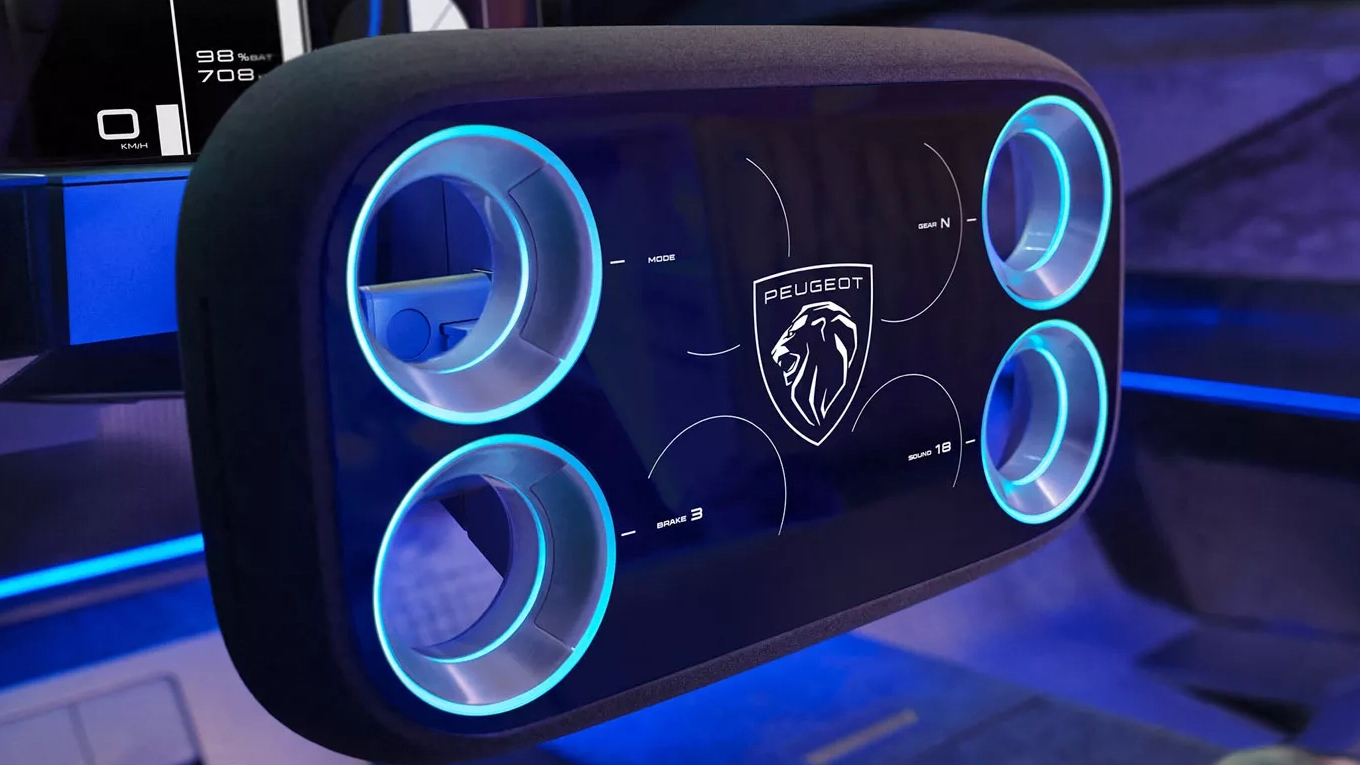
The high-tech steering system – Lexus uses something similar on the RZ – gets a suitably futuristic new steering wheel, that we can’t really see on this teaser image, but were introduced to on a previous Peugeot concept in 2023.

Called Hypersquare (though actually rectangular), the wheel has four holes, a design echoed in the four road wheels.

 Peugeot’s Next 208 Wants To Reinvent The Wheel

Shared DNA Across Stellantis Brands

Like its Stellantis cousin, the next Vauxhall/Opel Corsa, which was previewed in August by the 789 hp (800 PS / 588 kW) GSE Vision Gran Turismo concept, the production 208 is expected to ride on the new STLA Small platform when its unveiled late in 2026.

We’ll have to wait for the full Polygon reveal next week to get our hands on any tech spec, but don’t be surprised if it’s packing the same 82 kWh battery the GSE promised, something that would represent a big step up over the 52 kWh pack in the current e-208.

\\\\\

Peugeot’s 2023 Inception concept teased the Hypersquare steering wheel

Maserati Finds A Clever Trick To Give The Grecale EV More Range

  • Maserati unveils the 2026 Grecale Folgore with a 360-mile range.
  • New AWD-Disconnect adds an extra 50 miles of driving range.
  • The full 2026 Grecale lineup gains broader customization choices.

Maserati might be battling with slow sales, but they’re not giving up on their most popular SUV, the Grecale. The Trident brand has rolled out a series of updates for the 2026 model year, with most of the attention on the fully electric Folgore trim, which can now travel farther between charges.

The Grecale Folgore was launched in 2023 with dual electric motors producing 550 hp (410 kW / 557 PS) and a 105 kWh battery offering 500 km (311 miles) of WLTP range.

What’s New?

While the electric powertrain’s core specifications remain unchanged for 2026, Maserati has introduced a new AWD-Disconnect system said to boost range to 580 km (360 miles).

More: Maserati Can’t Sell The Grecale In Numbers So It’s Selling Them One By One

Their solution is simple: when AWD is not required, the system sends power to the rear wheels only, bringing a significant reduction in energy consumption that results in an extra 80 km (50 miles) of zero-emission range.

The shift happens automatically in just 500 milliseconds and physically disengages the front axle shafts from the hubs. Maserati says this method is more efficient than disconnecting at the motor or differential.

\\\\\\\\\\\\\

Algorithms To The Rescure

To determine when AWD should engage or disengage, the vehicle relies on a network of sensors and algorithms that continuously monitor several variables.

Depending on torque demand, brake temperature, road gradient, instantaneous speed and acceleration, selected driving mode, outside temperature, and activation of vehicle dynamic control systems, the system makes sure drivers get the performance they need from the electric SUV.

The Folgore accelerates from 0-100 km/h (0-62 mph) in 4.1 seconds, making it the second quickest Grecale behind the V6-powered Trofeo that completes the same sprint in 3.8 seconds. The EV, however, has the lowest top speed in the lineup, capped at 220 km/h (137 mph).

More: Maserati’s $50,000 Discounts Reveal How Bad Things Really Are

The electric Grecale retains its remote climate control, automatic battery preconditioning, and EV Routing functions. The latter now includes a Dynamic Range Mapping feature that visually displays how far the car can travel on its remaining charge within the built-in navigation system.

\\\\\\

More Customization Options

Alongside the Folgore’s efficiency upgrades, Maserati has expanded personalization options across the entire 2026 Grecale range.

The exterior palette now includes 11 colors, plus 32 additional shades from the Fuoriserie Programme, six of which are new. Inside, buyers can choose from eight interior hues, eight seat designs, four brake caliper finishes, and six alloy wheel patterns, including a set exclusive to the Folgore.

Maserati has yet to confirm pricing for the 2026 Grecale lineup, though given how its sales have been going, it’s probably safe to assume the figures won’t stray far from last year’s. After all, it’s hard to raise prices when the cars aren’t exactly flying off the lot.

\\\\\\\

Carlos Tavares Says Stellantis Could Be Swallowed Whole By Its Chinese Partner

  • Carlos Tavares predicts only five or six global carmakers will survive.
  • Ex-Stellantis CEO warns Chinese automakers could rescue Europe.
  • He claims EU’s 2035 combustion ban has hurt Europe’s auto industry.

Chinese automakers are no longer content with regional dominance, as they’re eyeing the world stage. And if you ask Carlos Tavares, the former head of Stellantis, they might actually pull it off.

The outspoken executive believes Chinese manufacturers could end up rescuing Europe’s car industry from its slow decline. Names like BYD and Geely, he says, may not just survive the global shake-up but emerge as the last few standing.

Read: The Guy Who Broke Stellantis Now Thinks It Might Break Up

Since stepping down from Stellantis nearly a year ago, Tavares has spent his time writing a memoir and touring the press circuit to promote it, offering a steady stream of predictions about where the auto industry is headed.

Will China Save Europe’s Factories?

He’s claimed that Stellantis itself might split apart and even floated the idea that Tesla could exit the car business entirely. Now he’s suggesting that within the next 10 to 15 years, Chinese brands could step in to save Europe’s automotive sector, though not without cost.

“There are lots of nice windows being opened up for the Chinese,” he told The Financial Times. “The day a western carmaker is in severe difficulty, with factories on the verge of closing and demonstrations in the street, a Chinese carmaker will come and say ‘I’ll take it and keep the jobs’, and they’ll be considered saviors.”

Tavares has experience dealing with Chinese car firms. He orchestrated Stellantis buying a 20 percent share of Leapmotor to help launch it into international markets. He also acknowledges that Leapmotor likely entered the deal because “they want to swallow us [Stellantis] some day.”

 Carlos Tavares Says Stellantis Could Be Swallowed Whole By Its Chinese Partner
Leapmotor D19

Trouble in Europe’s Auto Core

The former Stellantis boss hasn’t softened his criticism of Europe’s automotive policy. He argues that the European Union’s ban on new internal combustion cars by 2035 has forced local automakers into massive, and potentially wasted, investment.

According to Tavares, European car companies have poured more than €100 billion into electrification since the rule was introduced. He now predicts the EU will backtrack on the plan entirely.

More: Carlos Tavares Thinks Tesla Might Not Exist In 10 Years

“Who is holding the EU to account for the €100bn of investments that won’t be used? No one,” he said.

The global car industry is in such a dramatic state of flux that Tavares thinks most current brands won’t survive. In fact, he predicts that as few as five or six carmakers will survive.

These could include Toyota, Hyundai, BYD, and likely another Chinese firm, possibly Geely. In this scenario, the rest of the brands would likely be gobbled up by these conglomerates.

Interestingly, Tavares doesn’t include Stellantis among the survivors. Whether that’s professional detachment or a parting shot from a man who knows too much is anyone’s guess.

 Carlos Tavares Says Stellantis Could Be Swallowed Whole By Its Chinese Partner
BYD Dolphin
❌