Normal view

There are new articles available, click to refresh the page.
Yesterday — 14 December 2025Main stream

Only 7 Percent Of Cars Sold Last Month Cost Under $30,000

  • Average transaction price hovers near $50K with no slowdown.
  • Affordable cars fade as luxury trucks and SUVs dominate sales.
  • EV prices soften slightly but rely heavily on rising incentives.

If you were hoping falling interest rates, bigger incentives, or sheer consumer exhaustion might finally drag new-car prices back to Earth, number-crunching industry experts have some bad news.

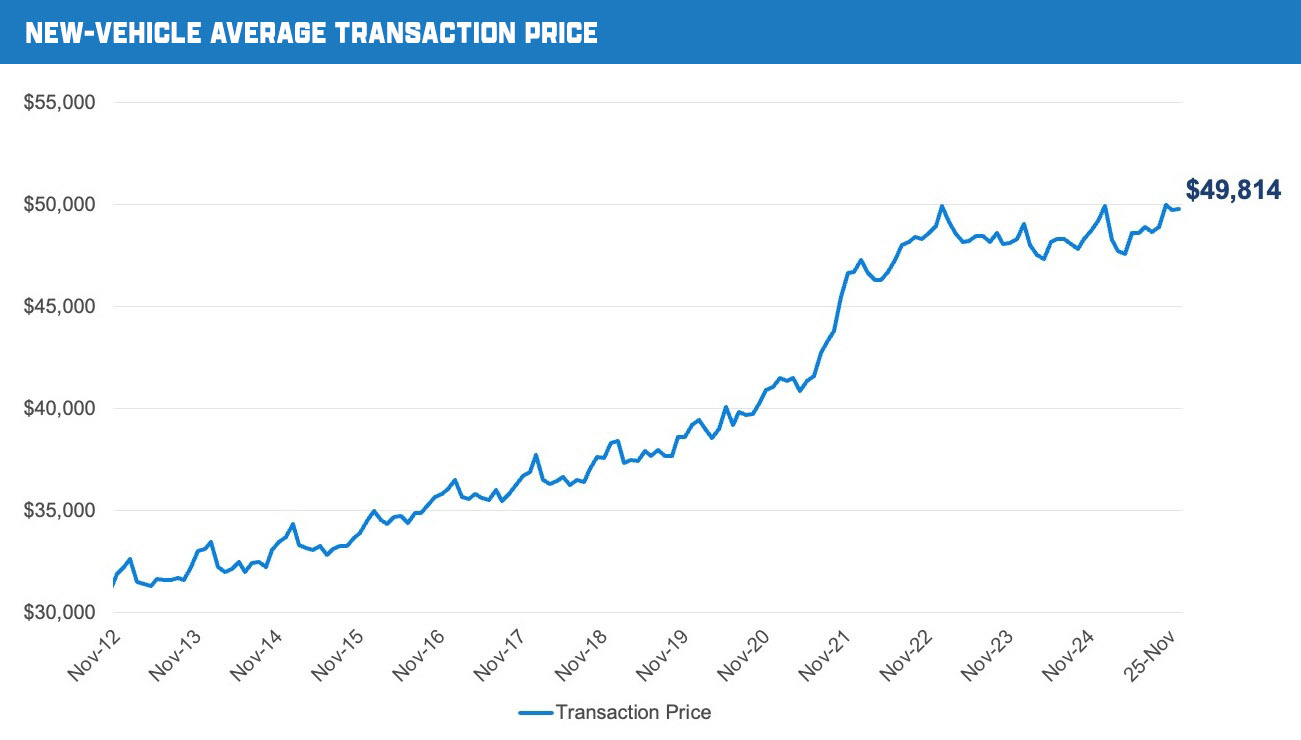
According to the latest Kelley Blue Book data, the average transaction price of a new vehicle in the US hit $49,814 in November, and it’s showing no real sign of dropping.

Also: Nobody Wants These 2024 Models And Dealers Are Drowning In Inventory

That figure is up 1.3 percent year over year and effectively unchanged from October, suggesting the industry has settled into a comfortable rhythm where fifty grand is the new normal.

Cox Automotive says prices usually peak in December, meaning the holiday season could push things even higher as buyers gravitate toward well-optioned trucks, luxury SUVs, and vehicles that require six figures of income and very little financial anxiety.

Fewer Incentives

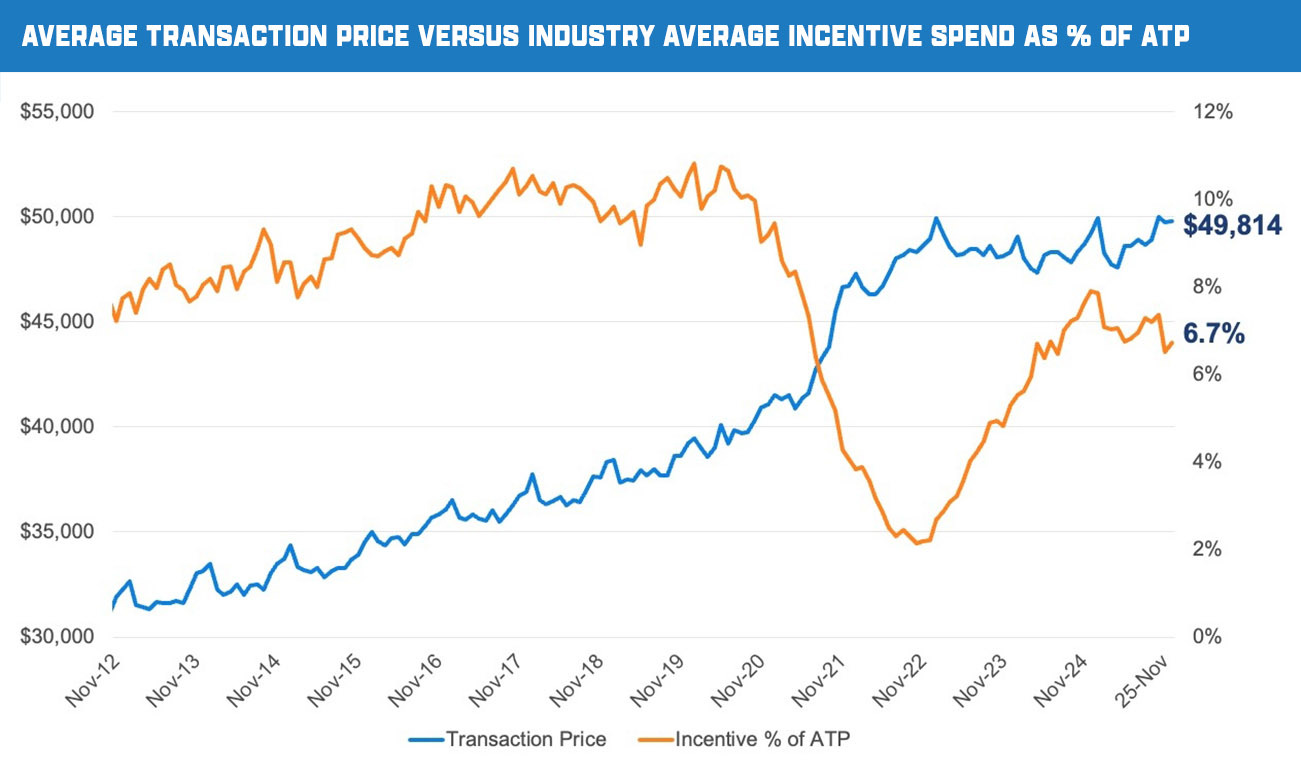
Incentives are still around, but they are not doing the heavy lifting they once did. In November, incentives averaged 6.7 percent of average transaction prices, down from nearly 8 percent a year ago.

Automakers simply do not need to discount aggressively when buyers keep selecting expensive trims with panoramic roofs, giant screens, and fancy wheels.
 Only 7 Percent Of Cars Sold Last Month Cost Under $30,000
Cox/KBB

The data makes one thing clear. Cheap cars are disappearing from the sales mix. Vehicles with MSRPs under $30,000 accounted for just 7.5 percent of November sales, down sharply from 10.3 percent a year earlier.

Meanwhile, more than one in 10 vehicles sold cost over $75,000. The most popular sub-$30K survivors remain familiar names like the Toyota Corolla, Chevrolet Trax, and Hyundai Elantra, clinging on like endangered species.

While transaction prices may have leveled off for now, average MSRPs, commonly known as the asking price, are still inching upward, reaching $51,986 in November. That marks a 1.7 percent increase over last year.

Blame Pricey Trucks
 Only 7 Percent Of Cars Sold Last Month Cost Under $30,000

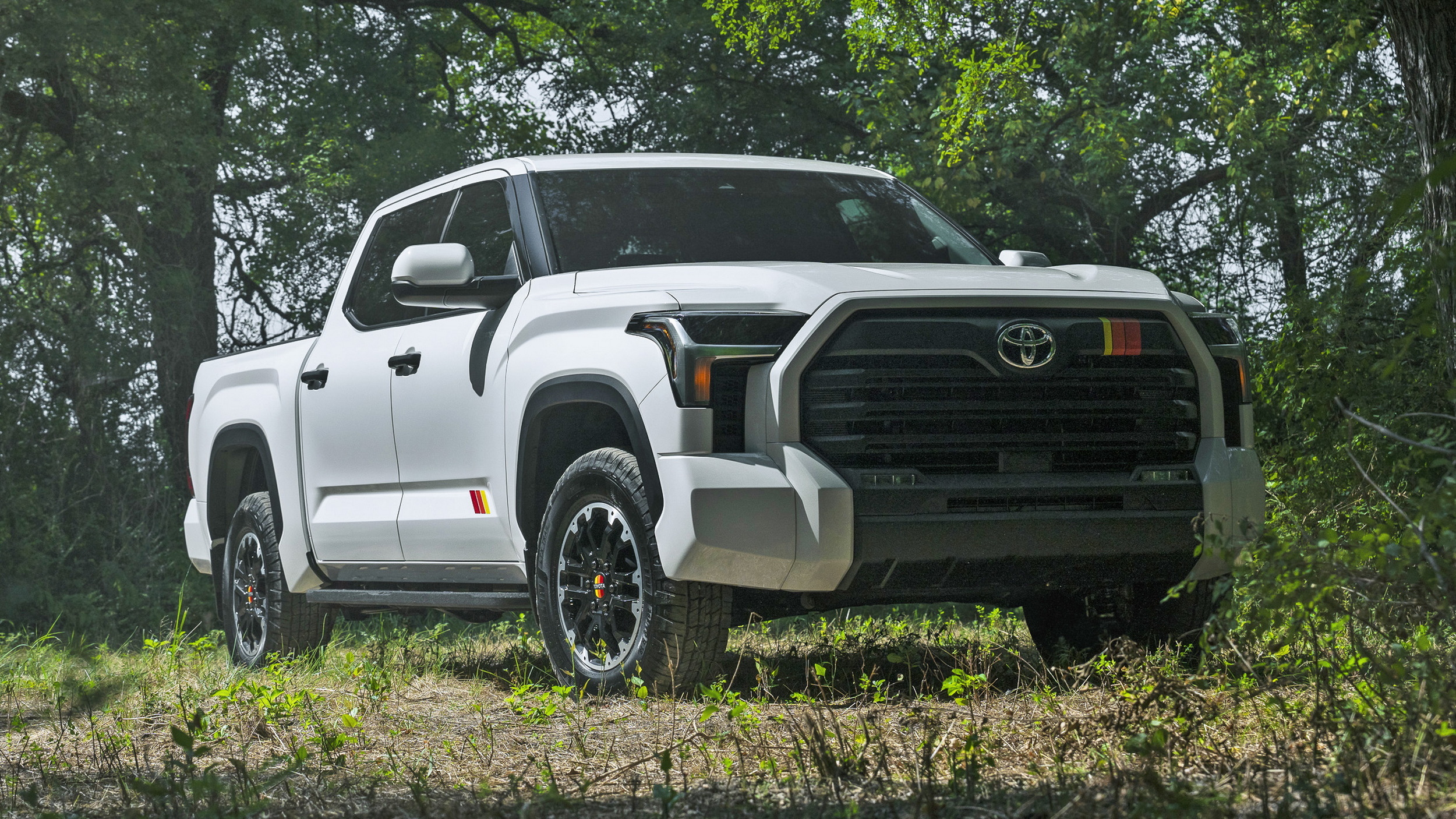
Trucks continue to be a major contributor to price inflation. Full-size pickups now average more than $70,000 for the third month in a row and accounted for over 14 percent of all sales in November, with nearly 183,000 units delivered. That helps explain why the industry average keeps floating upward even when compact and midsize segments remain relatively stable.

Read: Senators Want Cheaper Cars, Even If It Means Getting Rid Of Automatic Braking

Electric vehicles add another twist. The average EV transaction price fell slightly month over month to $58,638, but remains up 3.7 percent year over year. Incentives jumped to over 13 percent of prices as sales softened again, dropping more than 40 percent compared with last year.

Tesla’s average transaction price rose to $54,310 in November, even as sales fell 22.7% year over year, largely due to sharp declines in Model 3 demand. Prices for the Model Y, the best-selling EV in the U.S., edged up slightly. Cybertruck sales fell to 1,194 units, their lowest monthly total of 2025, though its average price rose to $94,254.

Who’s Really to Blame?

According to Cox Automotive Executive Analyst Erin Keating, today’s prices aren’t just the result of inflation or supply hangovers, but they reflect what consumers are choosing to buy.

“It’s important to remember that the KBB ATP reflects what consumers choose to buy, not what’s available,” she explained.

“Many new-car buyers today are in their peak earning years and are less price-sensitive, opting for vehicles at the higher end of the market to get the features and experiences they value most. In November, sales of vehicles priced above $75,000 outpaced those below $30,000, underscoring this preference for premium products” Keating added.
 Only 7 Percent Of Cars Sold Last Month Cost Under $30,000
Cox/KBB

The takeaway is simple. Prices are high because buyers keep buying high. Until that changes, the average US driveway will continue to look alarmingly expensive.

We just have to hope the trend doesn’t discourage automakers from developing and building the more affordable models that less affluent Americans still need.

Average Transaction Price by Automaker Group
GroupNOV-25OCT-25NOV-24MoM % ChangeYoY %
Change
BMW$70,864$70,037$71,2421.2%-0.5%
Ford Motor Company$57,639$57,724$57,079-0.1%1.0%
Geely Auto Group$60,759$59,480$60,2692.2%0.8%
General Motors$55,778$56,173$53,443-0.7%4.4%
Honda Motor Company$38,819$38,839$39,384-0.1%-1.4%
Hyundai Motor Group$38,966$38,331$38,9131.7%0.1%
Mazda Motor Corporation$36,134$35,179$36,2312.7%-0.3%
Mercedes-Benz Group AG$75,000$74,421$77,2220.8%-2.9%
Renault-Nissan-Mitsubishi Alliance$37,330$37,326$35,3810.0%5.5%
Stellantis$55,803$54,513$56,3872.4%-1.0%
Subaru Corporation$36,521$36,146$34,8091.0%4.9%
Tata Motors$103,768$104,662$101,878-0.9%1.9%
Tesla Motors$54,310$53,528$55,2471.5%-1.7%
Toyota Motor Corporation$45,265$45,249$44,2750.0%2.2%
Volkswagen Group$56,590$58,280$53,463-2.9%5.8%
Industry$49,814$49,760$49,1850.1%1.3%
SWIPE
Average Transaction Price by Brand
MakeNOV-25OCT-25NOV-24MoM % ChangeYoY %
Change
Acura$49,083$49,275$54,009-0.4%-9.1%
Audi$64,902$65,072$62,972-0.3%3.1%
BMW$72,616$71,973$73,5160.9%-1.2%
Buick$36,694$36,324$34,9881.0%4.9%
Cadillac$87,739$84,566$68,0253.8%29.0%
Chevrolet$50,759$51,064$48,944-0.6%3.7%
Chrysler$47,101$46,917$48,1460.4%-2.2%
Dodge$47,899$49,232$51,390-2.7%-6.8%
Ford$57,010$57,120$56,512-0.2%0.9%
Genesis$65,574$64,343$62,1951.9%5.4%
GMC$66,430$66,555$66,339-0.2%0.1%
Honda$37,559$37,685$37,869-0.3%-0.8%
Hyundai$38,272$37,934$37,6760.9%1.6%
Infiniti$68,484$65,863$63,2054.0%8.4%
Jeep$52,421$49,772$51,9955.3%0.8%
Kia$36,719$36,090$37,5971.7%-2.3%
Land Rover$105,767$106,505$104,318-0.7%1.4%
Lexus$61,901$62,406$59,147-0.8%4.7%
Lincoln$69,713$70,110$66,624-0.6%4.6%
Mazda$36,134$35,179$36,2312.7%-0.3%
Mercedes-Benz$75,000$74,421$77,2220.8%-2.9%
MINI$41,148$40,810$40,7110.8%1.1%
Mitsubishi$32,840$32,366$29,7651.5%10.3%
Nissan$35,567$35,721$34,039-0.4%4.5%
Porsche$122,674$125,071$113,107-1.9%8.5%
Ram$64,724$65,301$63,744-0.9%1.5%
Subaru$36,521$36,146$34,8091.0%4.9%
Tesla$54,310$53,528$55,2471.5%-1.7%
Toyota$42,344$42,393$41,368-0.1%2.4%
Volkswagen$38,266$38,133$36,3230.3%5.3%
Industry$49,814$49,760$49,1850.1%1.3%
SWIPE
Average Transaction Price by Segment
CategoryNOV-25OCT-25NOV-24MoM % ChangeYoY %
Change
Compact Car$26,949$26,982$27,094-0.1%-0.5%
Compact SUV/Crossover$36,329$36,208$36,8730.3%-1.5%
Entry-level Luxury Car$57,414$56,997$56,3730.7%1.8%
Full-size Car$55,335$53,694$44,7623.1%23.6%
Full-size Pickup Truck$66,192$66,439$65,459-0.4%1.1%
Full-size SUV/Crossover$78,623$79,529$75,444-1.1%4.2%
High Performance Car$134,538$134,786$124,500-0.2%8.1%
High-end Luxury Car$125,823$129,114$116,321-2.5%8.2%
Luxury Car$62,636$60,961$58,8052.7%6.5%
Luxury Compact SUV/Crossover$52,587$52,298$52,6380.6%-0.1%
Luxury Full-size SUV/Crossover$98,538$99,519$103,338-1.0%-4.6%
Luxury Mid-size SUV/Crossover$74,082$73,799$73,6620.4%0.6%
Luxury Subcompact SUV/Crossover$40,982$41,269$41,581-0.7%-1.4%
Mid-size Car$33,958$33,814$33,1850.4%2.3%
Mid-size SUV/Crossover$49,272$49,361$48,501-0.2%1.6%
Minivan$47,575$47,388$48,2310.4%-1.4%
Small/Mid-size Pickup Truck$43,805$43,752$43,5260.1%0.6%
Sports Car$49,723$51,423$48,489-3.3%2.5%
Subcompact Car$25,791$25,862$22,393-0.3%15.2%
Subcompact SUV/Crossover$30,962$30,646$29,8621.0%3.7%
Van$59,984$61,051$57,789-1.7%3.8%
Industry$49,814$49,760$49,1850.1%1.3%
SWIPE

Data Cox Automotive / KBB

Before yesterdayMain stream

This Innocent Bug Hits 60 Faster Than A Porsche 911 GT3

  • Classic VW Beetle hides Tesla motor and Porsche battery power.
  • Built by Knepper Bugs & More after rescuing it from a junkyard.
  • Over 600 hp and 2.9s 0–62 mph make it supercar-shaming fast.

Electric power has opened up a new world of possibilities for tuners, letting them stuff serious performance into cars that were never designed for big engines in the first place.

Take this unassuming classic VW Beetle, for example. While it still looks like something you’d see puttering through a sleepy village, it’s packing the kind of firepower that will put a modern supercar on edge.

Read: This Puny Bug Pulled Nearly $100K After Triggering A Bidding Frenzy

Built by Knepper Bugs & More in Germany, this VW Beetle was originally discovered rotting in a California salvage yard. Knepper bought the car and shipped it home, then began the long process of rebuilding it, ripping out the original powertrain in favor of something much more powerful, and more fitting of the times.

A Classic with a Modern Heart

\\\\\\\\\\

Knepper Bugs & More

The motor now driving the Beetle is the same unit found on the rear axle of a Tesla Model S. However, it’s been modified to run at a higher voltage, which boosts output to more than 600 horsepower and 516 lb-ft (700 Nm) of torque. That’s not a misprint. This thing has nearly triple the power of some modern hot hatches.

Power delivery is handled by a set of Porsche 930 drive shafts, while energy comes from 17 battery modules sourced from a Porsche Taycan. It’s a Frankenstein’s monster of high-end EV tech, all crammed into a car originally designed to max out around 50 horsepower.

There’s no word on how much weight the electric conversion has added, but it has turned this Beetle into an absolute weapon.

 This Innocent Bug Hits 60 Faster Than A Porsche 911 GT3

According to Knepper, it takes just 2.9 seconds for the Beetle to hit 100 km/h (62 mph). That’s deep into supercar territory, for those keeping score. The new Lamborghini Temerario, armed with a twin-turbo V8 hybrid setup, does the same sprint in 2.7 seconds. The latest Porsche 911 GT3? It needs 3.4 seconds, which means it’ll be shrinking fast in the Beetle’s rearview mirror.

On a full charge, it can travel about 250 kilometers (155 miles). Drive it like it was built to be driven, and range drops to closer to 100 kilometers (62 miles). Not that anyone will be counting.

Also: Toyota Revives Classic Land Cruiser With A Modern Twin Turbo Surprise

To help it cope with the massive performance bump, much of the suspension and braking hardware has been lifted from Porsche 944s. There are also several parts from KW and Bilstein to ensure the VW is capable of handling all of its extra grunt.

It’s Not Just the Powertrain

\\\\\\\\\

Knepper Bugs & More

Extensive work has been done to the exterior of the Beetle, and it’s now finished in a lovely shade of Marathon Blue. It also sits on classic Porsche wheels and the ride height has been lowered, giving it a more aggressive stance on the road.

There’s also a small carbon fiber spoiler, but nothing else to suggest that this Bug is packing nearly as much power as a Lamborghini Huracan.

More: The Weirdest Mustang You’ll Ever See Is Actually A Porsche 911 In Disguise

The cabin remains impressively simple. It retains the original gauge cluster and dashboard, now refinished but still true to the car’s roots, and has been fitted with a pair of Recaro seats sourced from a BMW 2002. The old shifter has also been replaced with a small digital touchscreen to select the appropriate gear.

Eager to show how well-built the car is, Knepper’s found took it on an 8,000 km (~5,000 km) journey earlier this year through Belgium, France, Spain, Portugal, Luxembourg, and even across the Strait of Gibraltar to North Africa.

\\\\\\\\\\\\\\\\

Knepper Bugs & More

VW Has A Plan To Save EVs And It Involves Gas Engines

  • Volkswagen is exploring new range-extended EVs for future models.
  • The setup could power upcoming sedans and crossover offerings.
  • Range-extenders may debut within Volkswagen’s next EV architecture.

Volkswagen had high hopes for EVs as the company pivoted in the wake of the Dieselgate scandal. The ID.4 marked a solid start, but things quickly went wrong from there.

Plans to sell the ID.7 in America were abandoned, while the ID. Buzz failed to live up to expectations. As a result, huge markups have now given way to discounts of nearly $20,000.

More: VW Scraps ID.7 For North America Due To Frosty EV Climate

The company is now said to be considering offering range-extended powertrains in sedans and crossovers for Europe and the United States. The discussions are reportedly part of a larger conversation as the automaker is preparing a new five-year investment plan.

Bloomberg reports the details of these investments will be announced in March of next year. That’s a ways off, but a spokesperson told the publication they’re “monitoring market developments and has reserved the range extender concept for its future EV platform.”

They added that consumer demand will ultimately determine when and where range-extended vehicles are offered.

 VW Has A Plan To Save EVs And It Involves Gas Engines

While we’ve seen a few range-extended vehicles in the United States, a number of new models are on the horizon. Besides the Scout Terra and Traveler, Stellantis is gearing up to launch range-extended versions of the Jeep Grand Wagoneer and Ram 1500.

Ford CEO Jim Farley has also praised them as he said they give customers an electric experience without range anxiety. More importantly, they enable companies to offer an “electric vehicle that’s fully comparable to an ICE vehicle in terms of cost.”

This is largely due to the fact that range-extended EVs can use a significantly smaller and cheaper battery pack. This is made possible by an engine, which acts as a generator.

 VW Has A Plan To Save EVs And It Involves Gas Engines

VW Offers $10K Off ID.Buzz, Dealers Say Hold My Beer

  • VW increased ID Buzz incentives, offering up to $10,000 off.
  • Many dealers list new ID Buzz Pro S models well below MSRP.
  • Some Colorado stores advertise ID Buzz units in the $30,000s.

2,469 cars. That’s the number of ID. Buzz EVs Volkswagen moved in the first nine months of the year, a figure that makes it the weakest seller in its American lineup, unless you separate out the Golf R and Golf GTI, which, realistically, you shouldn’t.

Read: The Buzz Is Gone As VW Quietly Pauses Production

Given that, it’s no real surprise that VW dealers continue to sweeten the pot on the electric van as the year winds down and they look to clear inventory ahead of the new model year.

What’s VW Offering Now?

If you’ve had your eye on the ID.Buzz, now might be the time to move. Just before the end of November, VW bumped up its Retail Customer Bonus on the ID. Buzz from $2,500 to a way more generous $7,500. While the promotion was introduced as part of Black Friday, it’s sticking around well into January. And that’s not the only offer on the table either.

 VW Offers $10K Off ID.Buzz, Dealers Say Hold My Beer

The ID. Buzz is also eligible for a separate $2,500 Dealer Bonus. That brings potential savings to $10,000, at least in theory. As noted by Cars Direct, the dealer incentive isn’t guaranteed to make it into the buyer’s column. Dealers are within their rights to retain the $2,500 themselves.

So if you’re serious about landing a deal, expect to negotiate. Whether or not that bonus is passed along may come down to how convincingly you make your case.

Both bonuses appear to apply across all trims. The ID. Buzz starts at $59,995 for the Pro S variant, not including the $1,550 destination and delivery fee. Subtract the incentives, and the starting figure can dip to $51,545.

It’s Worth Shopping Around

\\\\\\\\\

That’s a solid cut, but as we discovered on Autotrader ourselves, shop around and you’ll find even more aggressive pricing. Several VW dealerships across the country are listing base ID. Buzz Pro S models well under MSRP.

For example, Tynan’s Volkswagen in Aurora, Colorado, has three 2025 Pro S models in its inventory, all with asking prices of just $36,695, a massive $25,500 off the $62,195 stickler. All three have 15 miles or fewer on their odometers.

These aren’t the only cheap ID.Buzz Pro S models available. Karen Radley Volkswagen in Woodbridge, Virginia, has two listed for sale through Autotrader, both available for $45,195 and with a total of zero miles on the clock, for a substantial $17,000 discount from the original $62,195 MSRP.

There are dozens of other Pro S models available across the US for less than $48,000, so if you’re hunting for a deal, there are plenty of good options.

\\\\\\\\\\\

Source: Cars Direct

Audi Fixes One Of Its Most Hated Interior Features For 2026

  • Audi restores physical steering controls across its 2026 lineup.
  • Dynamic Plus mode adds sharper handling to S5 and S6 e-tron.
  • Autonomous lane-change feature joins Audi’s advanced driver aids.

Audi is preparing a host of upgrades for the 2026 model year, covering the A5, A6, Q5, A6 e-tron, and Q6 e-tron. It’s not just a set of software tweaks or safety updates either. The brand says these revisions are designed to make some of its most popular models more enjoyable behind the wheel.

Read: Audi’s AUDI Bets Big On China With A 671 HP Electric SUV That Means Business

However, Audi hasn’t yet said whether these updates will cross the Atlantic for American buyers, leaving the U.S. lineup unchanged for now.

What’s Changing Inside?

The biggest transformations happen inside. Like Volkswagen, Audi has come to appreciate that customers never really warmed to capacitive steering-wheel buttons. So from 2026 onward, all affected models will adopt a redesigned wheel fitted with two physical scroll controls, restoring the tactile precision that many drivers missed.

One of the upgrades that’s bound to be enjoyed by S5 and S6 e-tron customers will be the addition of a Dynamic Plus driving mode. Audi says that this will maximize the dynamics of both models, allowing for controlled oversteer despite their advanced quattro all-wheel drive systems and brake torque vectoring.

For all models built on the Premium Platform Electric (PPE), the regenerative braking system receives further refinement. Drivers will be able to use true one-pedal operation, bringing the car smoothly to a halt without engaging the friction brakes.

Smarter Tech

\\\\\\\\\\

Audi is also introducing a more advanced version of its driver-assistance system across its PPE and PPC models. From next year, these cars will include an autonomous lane-change function where the driver simply needs to toggle the turn signal, and the car will automatically change lane.

Following BMW’s lead, Audi will introduce a trained parking feature capable of autonomously navigating up to 200 meters on private property, retracing a saved route to or from a parking space.

Moreover, starting next year, the new A6 will come equipped with digital matrix LED headlights and digital OLED taillights that include configurable light signatures.

\\\\\\\\

Select models will gain the option of an integrated dashcam mounted at the base of the rear-view mirror. The 4K camera records both driving and parking footage, offering a built-in alternative to aftermarket systems.

Audi has also introduced several mood scenarios, or what it calls ‘experience worlds,’ into the cabin, which adjust the interior lighting, sound, climate control settings, and massage functions. Updates have also been made to the onboard gaming system, meaning controllers can now be paired over Bluetooth.

\\\\\\\\

VW’s Chinese EVs Cost Half As Much And They’re Coming For The Rest Of The World

  • VW can build Chinese EVs for half the cost of European production.
  • Lower labor and faster R&D cut time by 30 percent at its Hefei hub.
  • Tariffs make exporting to Europe less viable for now, VW admits.

Volkswagen is leaning further into its Chinese operations, looking to export more vehicles built there to overseas markets. albeit with the notable exception of Europe. The strategy hinges on a striking cost advantage that makes developing cars in China significantly cheaper than in other regions.

As established European carmakers face growing pressure from newer Eastern brands, many are beginning to shift attention toward their Chinese production networks. For legacy manufacturers like VW, the appeal is increasingly hard to ignore.

Read: VW Will Start Selling Its Chinese Models Overseas

According to a report from the Financial Times, Volkswagen says it can develop and build a new electric vehicle in China from scratch for about half the cost of doing so elsewhere.

What Makes China So Efficient?

 VW’s Chinese EVs Cost Half As Much And They’re Coming For The Rest Of The World

Volkswagen has invested billions of dollars into the local market, and, thanks to things like lower labor costs, shorter development periods, better battery procurement, and supply chain efficiencies, costs can be reduced by 50 percent.

Part of this efficiency comes from VW’s new research and development hub in Hefei, which is playing a key role in shaping the company’s next-generation EVs. By optimizing integration across teams and disciplines, the automaker now claims it can develop a new electric model in roughly 30 percent less time than before, a process that would traditionally take around 50 months.

Thomas Ulbrich, chief technology officer at Volkswagen Group China, described the facility as offering “an entirely new level of integration,” with software, hardware, and vehicle validation processes all running in parallel.

“We can now run software, hardware and full-vehicle validation processes in parallel, shorten decision loops and bring innovations to maturity much faster,” he told the Financial Times.

 VW’s Chinese EVs Cost Half As Much And They’re Coming For The Rest Of The World
VW ID.Unyx 08

VW has already begun shipping Chinese-built petrol sedans to the Middle East, and Ulbrich confirmed the company is exploring similar exports to countries across Southeast and Central Asia. That said, there are no plans to bring these China-built vehicles to Europe.

The reason is twofold. First, the electronic architecture of China-developed vehicles doesn’t align with European standards. Second, tariffs on Chinese-made EVs would likely negate any cost benefits, undermining the very strategy that makes this approach viable elsewhere.

VW’s Chinese Plans

VW plans to release 30 new EV models in China over the next five years. These models will be crucial in helping the automaker regain market share in China.

Data reported by The Financial Times reveals that VW does not rank among the top 10 battery-electric or even plug-in hybrid brands in China, although it still holds a 20 percent share of pure ICE model sales.

 VW’s Chinese EVs Cost Half As Much And They’re Coming For The Rest Of The World

Source: Financial Times

VW Doesn’t Think Its Capacitive Buttons Deserve A Day In Court

  • VW faces a lawsuit over ID.4 steering wheel touch button safety issues.
  • Drivers claim light contact can trigger ACC and cause sudden acceleration.
  • One plaintiff says her EV struck a tree after brushing the ACC button.

Several months after VW was sued in the United States over claims the capacitive steering wheel buttons of the ID. 4 pose a safety risk, the company has filed a motion to dismiss.

A case like this can gather momentum long before it reaches a courtroom, so VW is trying to shut it down before it turns into a long, expensive tangle.

Read: VW Drivers Say They’re Terrified Of Touching Their Steering Wheels, So They’re Suing

The class-action lawsuit, filed in the U.S. District Court for the District of New Jersey, argues that drivers can inadvertently trigger Adaptive Cruise Control with a light pass of the hand over the steering wheel’s capacitive controls.

The two plaintiffs named in the lawsuit say they are “terrified and hesitant” to drive their vehicles because of this risk.

What Does VW Say?

 VW Doesn’t Think Its Capacitive Buttons Deserve A Day In Court

While no doubt inadvertently engaging a vehicle’s Adaptive Cruise Control system could be a little unnerving, VW has noted that neither of the two plaintiffs has had to stop driving their vehicles because of the alleged fault.

One plaintiff, Janice Beecher, says she brushed the ACC button while pulling into a parking space, claiming the ID.4 then accelerated and struck a tree. VW counters that Beecher never stated she applied the brakes during the incident.

The company adds that although Beecher reported the issue, the ID.4’s event data recorder did not capture any sign that the event occurred.

As for the second plaintiff, Omar Hakkaoui, he says his wife damaged their ID.4 after it suddenly accelerated in their driveway. However, according to VW, Hakkaoui has not claimed that his wife touched the ACC controls on the steering wheel.

 VW Doesn’t Think Its Capacitive Buttons Deserve A Day In Court

The German automaker argues that the class action’s warranty claims fall short and that the plaintiffs have not clearly identified the defect they believe affects the electric crossover.

It also maintains that the lawsuit should not go forward as a class action because the plaintiffs live in Massachusetts and Connecticut and cannot represent owners who live outside those states.

\\\\\\\\\\\\\

VW’s Make-Or-Break Small Electric SUV Steps Out For The First Time

  • VW’s 2025 ID.Cross concept is being developed into a production EV.
  • Electric counterpart to subcompact T-Cross ushers in new VW design.
  • Concept had a front-mounted 208 hp motor and a 261-mile range.

Volkswagen’s smallest electric SUV has crawled out of the concept studio and onto public roads. Our spy photographers just snagged the very first shots of the ID.Cross prototype, giving us an early look at the subcompact EV that VW previewed with the ID.Cross concept at last September’s Munich Auto Show.

It’s still wrapped in camouflage, but even through the swirls, the production version looks remarkably close to the original concept.

Related: VW Revives Classic Nameplates With A New Mission To Fight Off China’s EV Surge

The proportions look almost copy-and-paste. The ID.Cross sits has short overhangs, a rounded nose and a slightly pinched tail that mirrors the concept’s “urban-friendly” footprint.

Expect the real thing to land close to the concept’s numbers, which were designed to squeeze maximum cabin space from a small footprint: roughly 4,160 mm (163.8 inches) in length, making it shorter than America’s Taos and right in the heart of the subcompact EV class.

\\\\\\\\\\

Even under wrap, the headlight and taillight outlines look familiar from the Munich show, hinting at VW’s newest light-bar family face. And though we can’t see them, we’re sure the three illuminated rectangles embedded in the concept’s black C-pillar have also made the cut.

The concept’s whimsical yoga-studio-on-wheels interior probably won’t survive 100 percent unchanged, though, so don’t expect pastel mood lighting or Zen-garden textures in the base model.

But VW’s latest compact cabin architecture, with a bigger infotainment screen and improved physical switchgear, should appear here.

What Powers It?

\\\\\

SH Proshots

Under the skin, the ID.Cross rides on the latest evolution of the MEB platform, tweaked for a new front-wheel-drive generation of small EVs including the ID.Polo.

The concept was pitched with a single-motor setup producing around 208 hp (211 PS / 155 kW), and that’s a believable target for the production version, though we expect to also see less powerful versions join the lineup to improve accessibility.

VW didn’t give a battery size for the concept but claimed it could deliver a 261-mile (420 km) WLTP electric range, and again, that’s a solid indicator about the kind of touring ability we’ll get from the real thing when it makes its global debut next year.

Will The US Get It?

US sales are yet to be confirmed, but in Europe the ID.Cross will cost from around £25k/€28k ($32k) when it goes head to head with other electric crossovers like the Kia EV2, Toyota Urban Cruiser, and its VW Group cousins, the Skoda Epiq and Cupra Raval.

\\\\\\\\\\\\\\\\\

Stefan Baldauf, Guido ten Brink, VW

Ford Quietly Ends Focus Production After 27 Years Without Even Saying Goodbye

  • The last Ford Focus has quietly rolled off the assembly line in Germany.
  • The Focus was launched in 1998 and generated millions of sales.
  • It could potentially be replaced in Europe by a new mid-size crossover.

Ford’s war on cars has claimed another victim and this time it’s the Focus. While the model exited North America in 2018, it has survived overseas.

Unfortunately, the grim reaper has returned as the final Focus has reportedly rolled off the assembly line in Saarlouis, Germany. Ford hasn’t officially announced the end of production, but workers have been morning the loss of the car by describing its death as “painful” and “sad.”

Even worse, the future of the Saarlouis plant looks bleak. Two years ago, Ford said they “conducted an extensive search” for a suitor and signed a non-binding agreement with a potential investor in June of 2023. However, the unnamed investor dropped out following a “rigorous due diligence process and negotiation.”

Ford Europe’s Future Comes Into Focus

\\\\\\\\

The Focus’ death is the latest blow to the company’s European arm, which has seen sales plummet in recent years. There have also been painful job cuts as well as a disastrous collaboration with Volkswagen.

More: Ford Could Be Preparing To Fill A Focus-Sized Hole In Their Lineup

Amid this background, Ford of Europe has a new president with tough decisions to make. Autonews said Jim Baumbick will need to decide if the company’s new Universal EV Platform, which will be launched on a mid-size truck, would make sense for Europe.

 Ford Quietly Ends Focus Production After 27 Years Without Even Saying Goodbye

If he rules that out, the publication suggested Baumbick could double-down on the Volkswagen partnership. In particular, they suggested Ford could potentially offer a new Fiesta based on the ID. Polo. The latter rides on the new MEB Entry platform and is targeted to cost less than €25,000 ($28,973).

While it remains to be seen if that idea will come to fruition, Ford has already announced plans for a new “multi-energy” vehicle that will be built in Valencia, Spain. Previous reports have suggested the mystery model will arrive in 2027 and be a Focus-sized crossover.

The model is rumored to be built alongside the Kuga and will reportedly share some components to help keep costs down. The crossover is also expected to offer hybrid and electric powertrains.

Trauig 😔

Posted by Frank Neukirch on Tuesday, November 11, 2025

Sources: Autonews, Facebook

VW Bets On Rivian To Fix Its Gas Car Software Struggles Too

  • VW and Rivian’s joint venture employs 1,500 engineers on new software.
  • VW’s first car with Rivian tech will be the all-electric ID.Every1 model.
  • Several upcoming Rivian models will share the new software system.

It’s been a year since Rivian and Volkswagen joined forces on a new zonal electronic architecture for their future electric models. Initially, the partnership only called for future EVs to use the American brand’s software, and while this will still happen, VW has said it may also use the software for its upcoming ICE models as well.

The software stack itself is being developed by the joint venture known as RV Tech, which has set up shop in Berlin and already counts 1,500 employees.

The team is preparing for its first major milestone: winter testing in early 2026, using vehicles from VW, Audi, and Scout to ensure the new system performs reliably in freezing conditions.

Read: VW’s Future EVs Might Run On A Platform It Didn’t Even Build

One of the first vehicles to benefit from the new system will be the all-electric VW ID.Every1 that’s scheduled to hit the market in 2027.

VW will also use the same RV Tech technology stack for other EVs based on its new SSP platform, which can support up to 30 million vehicles. Further down the line, ICE models could follow, using the same software.

 VW Bets On Rivian To Fix Its Gas Car Software Struggles Too

“For sure, it is an extremely capable architecture and we could allow for future use to also use it for ICE, but as we already outlined our clear focus is on BEV implementation and whatever comes after that is to be decided at a later stage,” co-chief executive of the RV Tech joint venture, Carsten Helbing, told Autonews.

“The architecture is highly capable of also driving additional drivetrain configurations. So we do not see a huge issue there, but of course, it’s additional work on the component side and on the platform side.”

Rivian Models Also Getting The New Tech

Of course, it’s not just VW models that will use the new system. Rivian will also use the technologies being developed by RV Tech for its R2, R3, and R3X models and will update its current fleet with the latest software.

“We remain incredibly excited by the work coming out of our joint venture with Volkswagen Group,” Rivian boss RJ Scaringe noted.

“RV Tech has gone from strength to strength over the last 12 months and is raising the bar in automotive technology. We’re incredibly excited about the launch of R2 in the first half of next year, which will showcase the advancements the joint venture has made,” he added.

 VW Bets On Rivian To Fix Its Gas Car Software Struggles Too

Source: Autonews

VW’s First Electric SUV With Xpeng Has A Glowing Wolf Logo

  • VW unveiled the ID. Unyx 08 in China, based on the ID.EVO concept.
  • The196.9 inch-long electric SUV closely retains the concept’s design.
  • Offered with single or dual motors, it delivers up to 435 miles of range.

Six months after unveiling the ID.EVO at the 2025 Shanghai Auto Show, Volkswagen has released photos of the production version, now officially named the ID. Unyx 08.

It’s a fully electric SUV scheduled to go on sale next year, joining VW’s steadily growing electric lineup in China. The introduction of this model reflects the brand’s continued push into the world’s largest EV market, where new entries arrive at a relentless pace.

More: VW’s Next Electric Sedan Looks Nothing Like You’d Expect

The ID. Unyx 08 is the newest model to roll out of Volkswagen Anhui, the joint venture between JAC Motors and the German automaker. The EV was developed through Volkswagen’s collaboration with Xpeng, with more models to follow in the near future including an electric sedan.

The exterior design stays remarkably close to the original concept, retaining its clean, sculpted surfaces, frameless doors, blacked-out A-pillars, and prominent rear shoulders. A cool touch is the illuminated wolf badge on the third brake light under the rear spoiler.

 VW’s First Electric SUV With Xpeng Has A Glowing Wolf Logo

How Much Has Changed From The Concept?

A closer look reveals only minor changes for production. The headlights and taillights have been reshaped slightly, while new shut lines appear on the hood and tailgate. You’ll also spot visible ADAS sensors, flush-fitting door handles, and light adjustments to the front bumper intake and rear diffuser.

In one of the official images, the SUV sits on the same five-spoke alloy wheels as the concept, featuring a copper diamond-cut finish and Brembo brake calipers.

Volkswagen hasn’t released interior photos yet but confirmed that the Unyx 08 will feature an onboard AI assistant and L2++ driver assistance. Based on current trends in China’s EV sector, it’s safe to expect a large central infotainment display complemented by a compact digital instrument cluster behind the steering wheel.

 VW’s First Electric SUV With Xpeng Has A Glowing Wolf Logo
The production-spec ID. Unyx 08 (above) compared to the ID. EVO concept (below).
 VW’s First Electric SUV With Xpeng Has A Glowing Wolf Logo

Specifications

The SUV measures 5,000 mm (196.9 inches) in length, 1,954 mm (76.9 inches) in width, and 1,688 mm (66.5 inches) in height, with a wheelbase stretching 3,030 mm (119.3 inches).

That makes it 318 mm (12.5 inches) longer than the U.S.-spec Tiguan and 101 mm (4 inches) shorter than the Atlas, though its wheelbase surpasses both.

More: VW Ending Its Longest-Running SUV After Two Decades With A Farewell Edition

Unlike some rivals offering range-extender setups, the ID. Unyx 08 will be sold exclusively as a battery-electric model. It’s built on an 800V electrical architecture and will come in single- and dual-motor versions, promising a CLTC range of more than 700 km (435 miles).

\\\\\\\\\

Data from China’s Ministry of Industry and Information Technology (MIIT) lists the rear motor at 308 hp (230 kW / 313 PS) and the front motor at 188 hp (140 kW / 190 PS), producing a combined 496 hp (370 kW / 503 PS) in the all-wheel-drive configuration.

Power comes from a CATL-supplied lithium-iron-phosphate battery, though capacity details remain undisclosed.

When it goes on sale in 2026, the ID. Unyx 08 will become the third model in the expanding Volkswagen Anhui lineup, joining the smaller ID. Unyx 06 crossover, which is based on the Cupra Tavascan, and the ID. Unyx 07 sedan.

It will soon be joined by another electric sedan with similar styling that will share its underpinnings with the Xpeng P7.

Volkswagen plans to launch 30 new models through its joint ventures in China, with 20 of them being electrified.

\\\\\\\\\\\

VW Quietly Walks Away From Electrified Pickup Plans

  • VW canceled plans to offer electrified versions of the Amarok.
  • Current model shares its underpinnings with Ford’s Ranger.
  • Hybrid Amarok on Chinese underpinnings to launch in South America.

Volkswagen has stepped back from its earlier plans to introduce fully electric or plug-in hybrid versions of the global-spec Amarok, choosing instead to stick with its familiar lineup of diesel and gasoline powertrains for now. The decision keeps the pickup rooted in its traditional formula, at least for this generation.

Unlike the South American Amarok, which still rides on Volkswagen’s own ladder-frame platform, the global model is built on the same underpinnings as the Ford Ranger.

More: VW Just Dropped An Electric Pickup And It’s Not The One You’re Expecting

Ford’s pickup truck already offers a plug-in hybrid setup combining a turbocharged 2.3-liter gasoline engine with a single electric motor, producing 277 hp (207 kW / 281 PS). A modest 11.8 kWh battery enables around 40 km (25 miles) of electric-only driving.

Why Skip Electrification?

Earlier this year, reports suggested Volkswagen was seriously evaluating an electrified Amarok, especially given it already had access to the Ranger’s compatible hybrid system. Yet that interest appears to have faded.

According to Australian outlet CarExpert, Nathan Johnson, Volkswagen Commercial Vehicles’ brand director, explained that CEO Stefan Mecha “made it clear … the PHEV and BEV Amarok is no longer being discussed at this point in time, in this generation,” emphasizing that it’s a global decision.

 VW Quietly Walks Away From Electrified Pickup Plans
The current second-gen VW Amarok in the range-topping Panamericana trim.

That doesn’t mean the idea is gone for good. Johnson hinted that the door remains open for the next Amarok, which could arrive near the end of the decade.

The current generation debuted in 2022, so a successor is still some years off, but by then electrification will likely be standard practice among midsize pickups, making a hybrid or electric version all but inevitable.

Another Hybrid Amarok Is Under Development

Volkswagen’s approach looks different in South America. There, the company continues to evolve the first-generation Amarok, which remains in production on VW’s original chassis. A refreshed version of that truck launched last year, and an all-new hybrid successor is already scheduled for 2027.

More: VW’s New Pickup Shares DNA With A Chinese Pickup You’ve Never Heard Of

The upcoming truck will ride on a ladder-frame chassis sourced from Chinese automaker SAIC, as part of its collaboration with Volkswagen. However, it will be manufactured at the General Pacheco factory in Argentina, backed by a $580 million investment.

Early teasers point to a close relationship with the Maxus Interstellar X, LDV Terron 9, and MGU9 pickup twins, though Volkswagen will apply its own design language to set it apart. The new hybrid Amarok will be limited to South American markets, sidestepping overlap with the global version.

 VW Quietly Walks Away From Electrified Pickup Plans
The official teaser for the upcoming hybrid Amarok that will debut in South America in 2027.

VW’s Next Electric Sedan Looks Nothing Like You’d Expect

  • Xpeng and VW are collaborating on a new ID electric sedan.
  • Based on the Xpeng P7, it features a unique exterior design,
  • VW plans 30 new models for China, including 20 electrified ones.

If anyone needed a reminder of just how central China has become to the global car industry, look no further than to Volkswagen’s partnership with Xpeng.

Announced last year, the collaboration centers on a next-generation electrical architecture set to support a wide range of future models, from pure EVs to traditional combustion and plug-in hybrid vehicles.

Read: VW’s Concepts Mark The Start Of 30 New Models For China’s EV Future

This joint effort is already bearing fruit. Among the first of these shared creations is an as-yet-unnamed sedan from Volkswagen that’s expected to join the ID family.

What Does It Look Like?

Recently seen testing under camouflage on Chinese roads, the upcoming electric sedan is believed to be based on the Xpeng P7, whose second generation debuted only a few months ago, while also reflecting design elements from Volkswagen’s ID. Aura and ID. Evo concepts showcased earlier this year.

\\\\\

Sugar Design

Digital artist Sugar Design produced a series of renderings based on those camouflaged prototypes, and there’s no denying that, compared with several Volkswagen models currently sold in Western markets, it has a distinctly sleeker and sportier presence.

At the front, it features split LED headlights and a small illuminated badge in the center, as well as a large open black grille and smooth lines. It’s nowhere near as radical as the sharp-looking second-gen P7, but for the German brand, it’s still quite a bold shift in style.

The side profile is particularly eye-catching, highlighted by its pronounced rear haunches and a smooth, flowing roofline. At the back, intricate LED taillights frame a softly illuminated VW badge, with a discreet black diffuser completing the look.

What Could Power It

Whether Volkswagen’s upcoming sedan will mirror the Xpeng P7’s specifications is still uncertain, but the P7 itself measures 197.5 inches (5,017 mm) in length and offers two battery options: a 74.9 kWh pack and a larger 92.9 kWh version.

 VW’s Next Electric Sedan Looks Nothing Like You’d Expect
The new Xpeng P7 | Photo Stefan Baldauf & Guido ten Brink

The standard rear-wheel-drive layout produces 362 hp (270 kW) from a single motor, while the all-wheel-drive setup adds a front unit for a combined 586 hp (437 kW). The AWD variant is expected to hit 62 mph in 3.7 seconds and reach a top speed of 142 mph.

Range depends on configuration, from roughly 436 miles (702 km) in base form to 509 miles (820 km) for the long-range RWD model.

VW’s Chinese Plans

VW is taking the Chinese market extremely seriously. Beyond confirming that its jointly developed electrical and electronic architecture with Xpeng will underpin future EVs, the company has made clear that the same foundation will serve combustion and plug-in hybrid models.

\\\\

Sugar Design

The new system won’t simply enable over-the-air updates; it’s also designed to streamline vehicle development, cutting production timelines and allowing faster adaptation to market trends.

The German brand has committed to launching more than 30 new models in China, including 20 new-energy vehicles. In addition to working with Xpeng to make these a reality, it is collaborating with partners through the FAW-Volkswagen and Volkswagen Anhui joint ventures.

\\\\

Sugar Design

❌
❌