BMW’s next-gen X5 adopts a new face with a simplified grille.
Neue Klasse styling elements appear throughout the X5’s design.
A wide mix of gas, diesel, plug-in hybrid, and EVs will be on offer.
The X5 has never been BMW’s wildest design, but it’s managed to avoid the extremes seen elsewhere in the lineup. Still, the oversized kidney grilles on the current model don’t do it many favors. They don’t sink the look entirely, but they certainly don’t flatter it either.
The good news is that a new generation is on the way, and early signs suggest a cleaner direction, along with a range of powertrain options that stretches well beyond what most would expect.
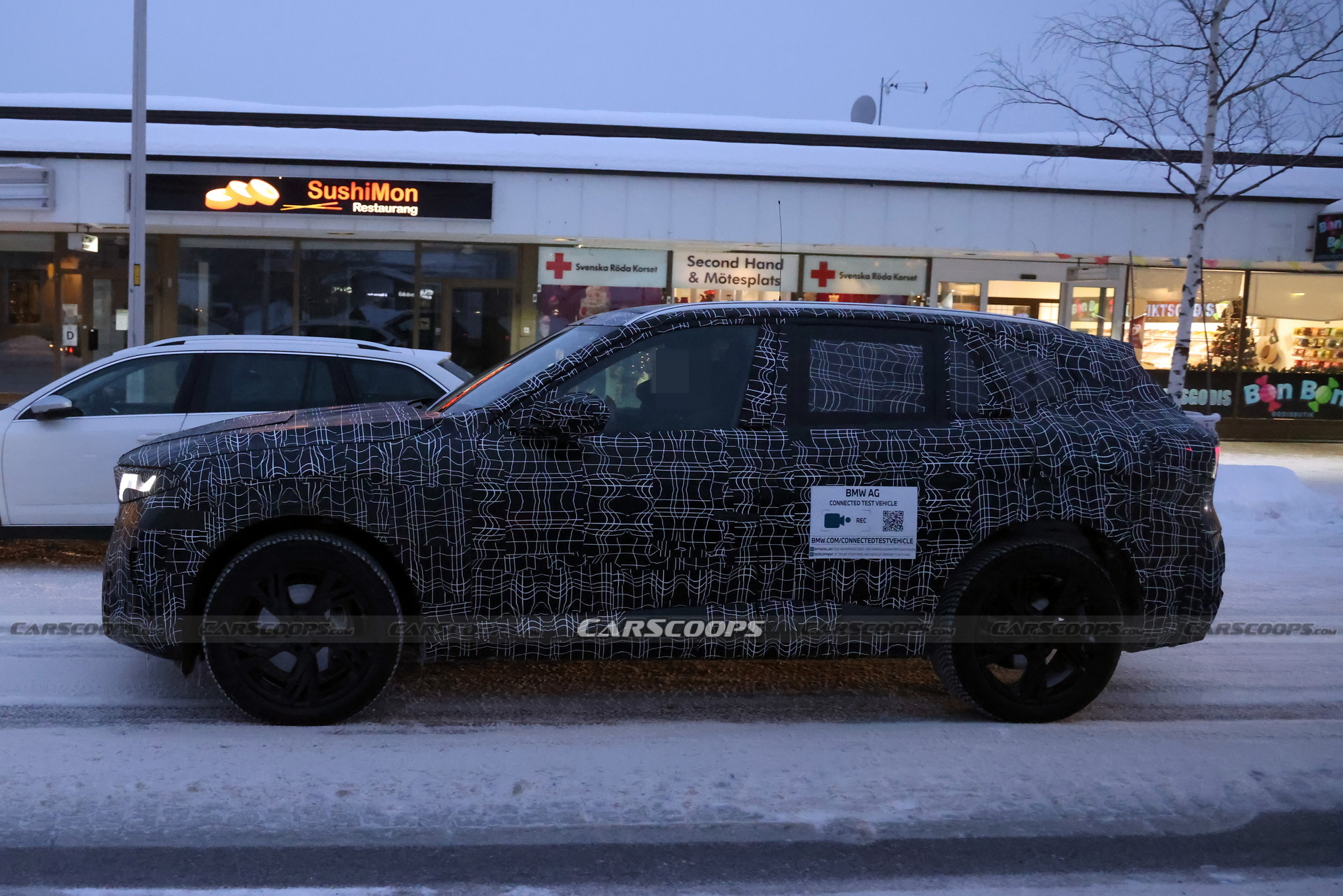
BMW has begun testing the upcoming X5, internally designated G65, and sent a prototype north to Sweden for winter trials. While still clad in camouflage, it’s already clear that the SUV will wear design elements from BMW’s Neue Klasse era.
Neue Klasse Meets X5
Like the second-generation iX3, the new X5 sports reworked headlights with sharply defined daytime running lights and a more technical front-end aesthetic. A gloss-black panel extends toward the center of the fascia, echoing the EV’s layout, and will house a pair of vertically oriented kidney grilles. Though still concealed by camouflage on this prototype, their shape is clearly visible beneath the surface.
SHproshots
The rear end of the new X5 will also be a dramatic departure from the current model. It ditches the traditional taillights of the outgoing model and replaces them with thin, horizontal LED units that appear reminiscent of those used by the XM. This prototype also has a curvy rear spoiler stretching out above the window, adding to the striking new design.
Interior Changes
SHproshots
The cabin is also in line for a thorough redesign. Recent spy shots have confirmed that the new X5 will adopt the same Panoramic iDrive setup as the iX3. This includes a narrow display spanning the base of the A-pillars, paired with a sharply angled central infotainment screen.
While the steering wheel on this prototype may differ from the iX3’s squared-off four-spoke unit, it looks likely to use a more conventional two-spoke design, with enough visual weight to stand out on its own.
Powertrain Options
SHproshots
Beneath it all, the G65 X5 will continue to ride on BMW’s CLAR architecture, albeit in an updated form. This means a familiar chassis with enough flexibility to support combustion, hybrid, and electric variants without needing to reinvent the platform.
According to CarScoops sources, the combustion model will be sold in 40, 40 xDrive, 40d xDrive, 50e xDrive, M60 xDrive, and M60e xDrive forms. A potent X5 M version also seems inevitable. In addition to selling a slew of combustion-powered models, the brand will introduce an all-electric iX5 model, set to be sold in 50 xDrive, 60 xDrive, and M70 xDrive forms.
The powertrain options won’t end there. In addition to the gas, diesel, plug-in hybrid, and electric models, there could be a range-extended version of the iX5, dubbed the Rex, complete with a driving range of up to 621 miles (1,000 km). The new X5 will also be BMW’s first mass-market model available with a hydrogen fuel-cell powertrain.
Porsche’s 1,019 hp Taycan Turbo GT failed to meet reserve price.
EV depreciation hit hard, echoing trends in luxury segments.
Faster than Plaid and SF90, yet buyers barely showed interest.
It’s far from unusual for high-performance models from Porsche’s exclusive GT division to appreciate in value the moment they leave the showroom. That’s been the case with the current 911 GT3 RS, and it’s often true for limited-run, motorsport-infused builds.
But the electric Taycan Turbo GT isn’t following that playbook. Despite its credentials, it seems to be moving in lockstep with the value drop seen across the wider Taycan range.
The standard Taycan, just like its corporate cousin from Audi, the e-tron GT, has taken a beating in resale value since launch. EVs in general depreciate faster than most combustion cars, but the Taycan has faced a particularly steep drop.
Earlier this week, a near-new Taycan Turbo GT went up for auction and came in a staggering $82,000 below its original MSRP before the bidding stopped.
A Bad Day for Taycan Values
Bring a Trailer
The high-performance sedan was listed for auction on Bring a Trailer by Gaudin Classic, a Porsche dealer in Nevada. Prior to the auction, it had never been sold to a private owner and had just 141 miles (227 km) on the clock. It is also equipped with the Weissach package that includes a fixed rear wing, no rear seats, and more pieces made from lightweight carbon fiber.
A look at the car’s window sticker reveals it has an MSRP of $238,300, bolstered by nearly $10,000 in additional options. Among them is a $2,950 Shade Green Metallic paint finish, $1,380 satin black wheels, and $1,760 race-tex-finished inner door-sill guards. As Taycans go, this one ticks every box, but the final bid landed at just $167,000.
Harsh Market Reality
According to the seller, bidding came close to meeting the reserve, and they plan to negotiate with the top bidder to see if a deal can still be made. Whether or not it sells, the takeaway is as clear as ever. That’s a brutal level of depreciation for a car that hasn’t even gone through its first full charge cycle.
For as impressive as the Taycan Turbo GT is, there may not be many buyers eager to spend that much on a track-focused electric sedan that, for most owners, will likely never see a circuit. The Weissach package also means it has two fewer seats than some 911s, so it’s not exactly practical either.
What Makes This EV Special?
To be fair, the specs are hard to argue with. The Taycan Turbo GT uses dual electric motors to deliver 1,019 hp with launch control, peaking at 1,092 hp in two-second bursts.
Earlier this year, MotorTrend launched the Weissach model to 60 mph (96 km/h) in just 1.89 seconds using a one-foot rollout, making it the quickest car the publication has ever tested in its 76-year history.
Without rollout, the time comes to 2.1 seconds, beating the Tesla Model S Plaid, Ferrari SF90 Stradale Assetto Fiorano, and even the Lucid Air Sapphire.
Mercedes GLB replaces EQB and launches with electric-only options.
85 kWh battery enables 392 miles in single-motor, 382 in dual-motor.
Next year, an entry-level EV will be introduced, as will several hybrids.
A new generation of the Mercedes-Benz GLB has arrived, and while the silhouette remains true to the blocky, upright form of the original, there’s quite a bit going on beneath the surface.
Offered in both 5- and 7-seat configurations, the 2026 GLB debuts as an all-electric model and, for now, serves as a replacement for the EQB in everything but name. Hybrid versions will follow later, but the first wave is electric-only.
Two versions of the new generation GLB are launching out of the gate. The first, labeled GLB 250+ with EQ Technology, features an 85 kWh lithium-ion battery and adopts an 800-volt electric architecture.
It powers a single rear-mounted motor rated at 268 hp and 247 lb-ft of continuous torque, with a short-term boost up to 335 lb-ft. Acceleration from 0–62 mph (100 km/h) takes 7.4 seconds, and range is quoted at 392 miles (630 km) on a full charge, olid figures for a compact SUV in this category.
Sitting above the 250+ is the 350 4Matic with EQ Technology. The name might not stick in your memory, but the numbers probably will. This dual-motor variant adds a front axle motor for all-wheel drive, producing a combined 349 hp and 380 lb-ft of torque.
Range takes a slight dip to 382 miles (615 km), but the extra grunt cuts the 0–62 mph time down to 5.5 seconds.
Mercedes has also confirmed a more affordable electric entry-level version will join the lineup next year, followed by a hybrid variant using 48-volt architecture. Three power levels will be available across front- and all-wheel drive formats.
Starry Eyed
Like other new-generation Mercedes models (think CLA and GLC EQ), the GLB adopts a more expressive front end. A large grille dominates the nose, flanked by redesigned headlights with intricate star-shaped DRLs and a full-width light bar. It’s not a particularly handsome looking SUV, but neither is the outgoing model.
The rear-end is perhaps the most controversial angle of the 2026 GLB. The taillight treatment leans into the styling language seen on the brand’s EQXX Concept from a few years back, with vertically oriented clusters connected by a slim light bar. The signature star pattern makes another appearance here.
How Much Bigger Is It?
The new electric GLB has grown in nearly every direction compared to both the previous EQB and the combustion-powered GLB it effectively replaces in this segment. At 4,732 mm (186.3 inches) in length, it’s 48 mm (1.9 inches) longer than the EQB and a full 98 mm (3.9 inches) longer than the earlier GLB. Width is up as well, now measuring 1,861 mm (73.3 inches), 27 mm (1.1 inches) wider than both predecessors.
Interestingly, height has gone the other way, dropping slightly to 1,687 mm (66.4 inches), which makes it 14 mm (0.6 inches) lower than the previous models.
The wheelbase sees the most notable stretch, now sitting at 2,889 mm (113.7 inches), a 60 mm (2.4 inches) increase over earlier versions. That extra length between the axles should improve interior space, particularly in the second row.
One small trade-off comes in maneuverability: the turning circle has grown marginally, from 11.7 m (38.4 feet) in the old GLB to 11.9 m (39.0 feet) in the new electric version. Boot capacity is also up, with 667 liters (23.6 cubic feet) available in the rear and 127 liters at the front (frunk).
An All-New Cabin
A big step into the future has also been made with the GLB’s interior. Like the CLA, it can be optioned with the Mercedes Superscreen, consisting of a 10.25-inch driver display, a 14-inch infotainment screen, and a 14-inch display for the passenger.
As with other new Mercedes-Benz interiors, the dash of the GLB is almost completely flat, largely free of any interesting design details.
It runs on the fourth-generation MBUX system that includes Microsoft and Google artificial intelligence. The screen runs on the Unity Game Engine and includes the MBUX Virtual Assistant, based on ChatGPT4o. Clearly, Mercedes was eager to make the GLB as tech-focused as possible.
At this point, pricing is confirmed only for Germany. The GLB 250+ with EQ Technology starts at €59,048 ($68,700), while the 350 4Matic comes in at €62,178 ($72,400). US pricing hasn’t been announced yet, but expect a similar spread when it arrives in other markets next year.
Electric SUVs have come a long way in a short time, but in the three-row space, progress has been surprisingly slow. Hyundai made a big impression on the EV market when it unveiled the striking Ioniq 5 in early 2021. A month later, Kia unveiled its related EV6.
However, following the debut of the Ioniq 5 and the later arrival of the Ioniq 6, Hyundai’s rollout of next-generation EVs has slowed, especially compared to Kia. In the same span, Kia has steadily grown its lineup, recently adding the EV3, EV4, EV5, and EV9 to its expanding electric stable.
This makes the launch of the new Hyundai Ioniq 9 all the more important. You see, it’s related to the three-row Kia EV9, but that model was launched more than 18 months before it, meaning Hyundai has to catch up ground.
QUICK FACTS
› Model:
2026 Hyundai Ioniq 9 Calligraphy
› Starting Price:
AU$128,413 (US$84,000)
› Dimensions:
5,060 mm (199.2 in.) Length
1,980 mm (77.9 in.) Width
1,790 mm (70.4 in.) Height
3,130 mm (123.2 in) Wheelbase
› Curb Weight:
2,721 kg (5,998 lbs)
› Powertrain:
Dual electric motors | 110.3 kWh battery
› Output:
421 hp (314 kW) / 516 lb-ft (700 Nm)
› 0-62 mph
5.2 seconds (0-100 km/h)
› Transmission:
Single-speed
› Efficiency:
22 kWh/100 km as tested
› On Sale:
Now
SWIPE
Working in Hyundai’s favor is the fact that not much has changed in the three-row electric SUV segment since the EV9 launched. Few contenders have emerged in this particular bracket, especially at the price point where both the EV9 and Ioniq 9 are playing.
We recently had the opportunity to spend a full week living with the Hyundai Ioniq 9 in Calligraphy trim, putting it through its paces not just to see how it stacks up against the EV9, but also to ask a tougher question: can it justify its position as the most expensive Hyundai ever sold?
What Does it Cost?
Photos Brad Anderson/Carscoops
While Kia offers several versions of the EV9 in Australia, Hyundai has only launched a single trim variant of the Ioniq 9, known as the Calligraphy. Buyers can choose between six or seven seats, and pricing starts at AU$128,413 (equal to US$84,000 at current exchange rates) including on-road costs.
There’s no denying that’s a lot of cash for a Hyundai. However, it’s surprisingly good value compared to the Kia EV9 GT-Line, the nearest equivalent to the Calligraphy, which is priced from AU$138,915 ($90,700).
Shoppers in the US looking to pick up the keys to the new Ioniq 9 can purchase it for as little as US$58,955. The flagship Performance Calligraphy Design tops out at the range, starting at US$76,490. Although Australia’s Calligraphy model lacks the word ‘Performance’ in its name, it has the same powertrain as the American model.
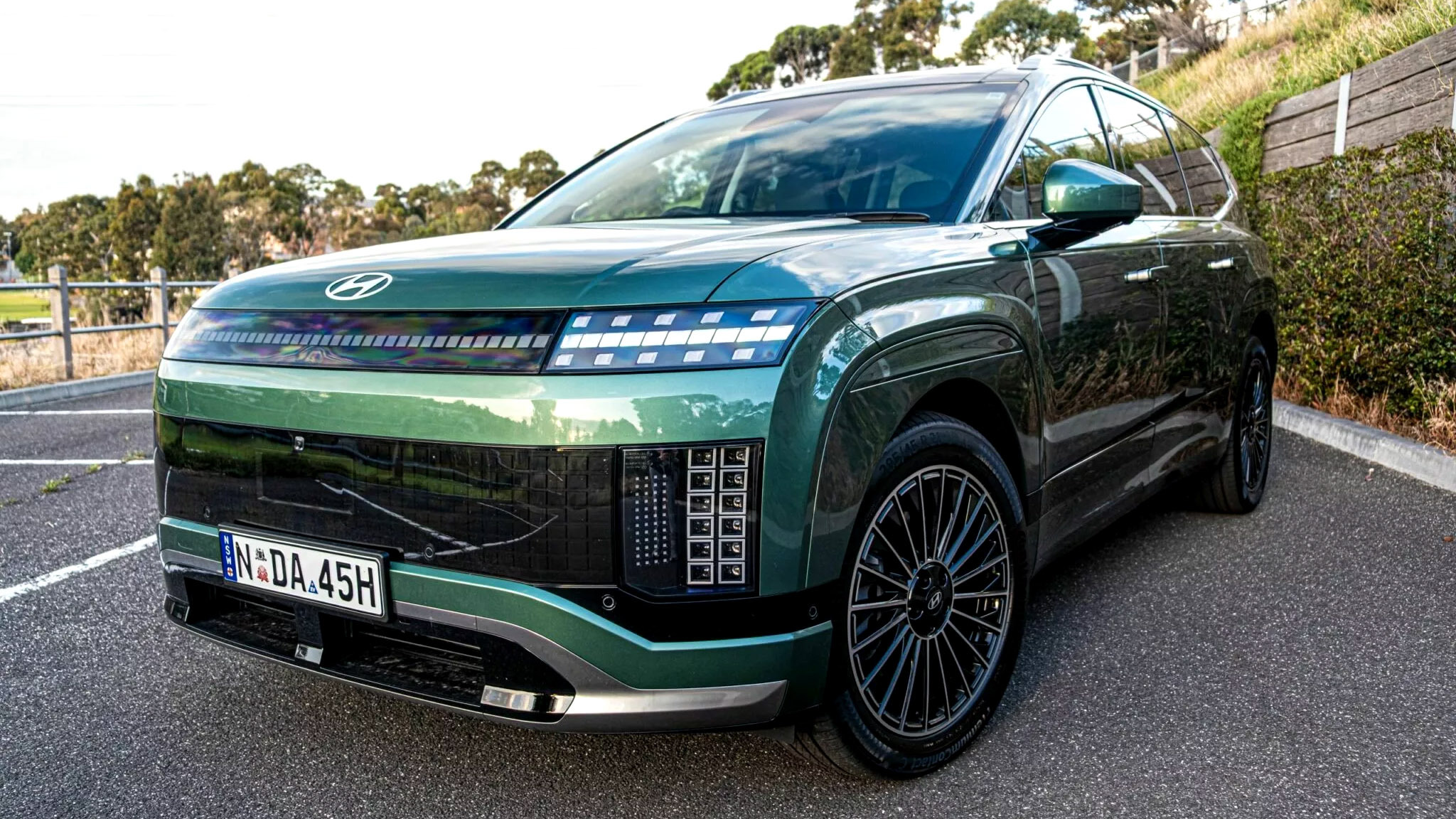
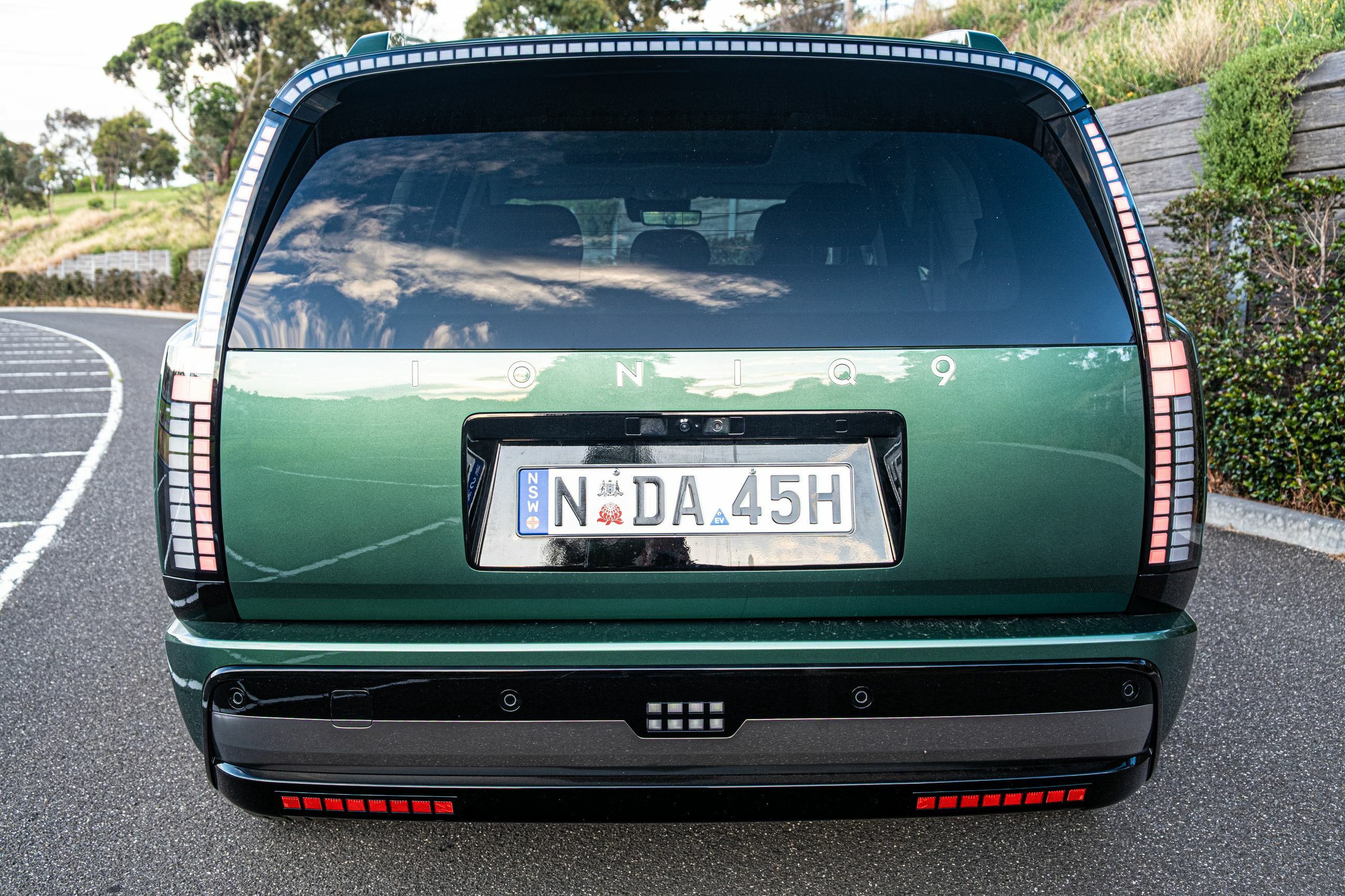
Beneath the concept-car-like looks of the Ioniq 9 is a huge 110.3 kWh battery, larger than the flagship 99.8 kWh pack in the EV9. This battery feeds a pair of electric motors, each rated at 157 kW (210 hp), or a combined 314 kW (421 hp) and 700 Nm (516 lb-ft) of torque. That gives it a healthy edge over the EV9 GT-Line’s 283 kW (380 hp), although torque remains identical.
A High-Class Cabin
Photo Credits: Brad Anderson/Carscoops
As you’d expect for a vehicle at this price point, the Ioniq 9 Calligraphy’s cabin is exceptionally plush and feels more premium than the EV9, which has too much plastic for our liking.
Like other Hyundai models, there are two 12.3-inch screens in front of the driver, housed within a single curved display that supports wireless Apple CarPlay and Android Auto. Whereas Kia insists on continuing to employ an inconveniently located third screen on the dash for the climate controls, the Ioniq 9 uses a dedicated display under the dash with a touch panel and physical temperature dials.
Our Ioniq 9 was equipped with the eye-catching Dark Wine and Dove Grey two-tone Nappa leather, one of three available two-tone options for those not interested in the standard Obsidian Black trim. The Ioniq 9 is available with digital wing mirrors, but fortunately, our car didn’t have them. By comparison, the EV9 GT-Line is sold exclusively with cameras instead of mirrors.
There are plenty of luxuries found within the cabin, making the Ioniq 9 perfectly suited to any kind of journey. This includes a heated steering wheel, heated, ventilated, and massaging front seats and a wireless phone charger.
Photos Brad Anderson/Carscoops
There’s also a panoramic sunroof, tri-zone climate control, configurable ambient lighting, and a head-up display. Tech enthusiasts will be pleased to know that in addition to having two high-powered 100-watt USB-C ports in the dash, there are also 100-watt USB-C ports on the backs of the front seats for rear passengers.
Those seeking the ultimate in comfort would be wise to opt for the six-seat version, as it replaces the second-row bench seat with a pair of captain’s chairs, which are very similar to the front seats.
However, even in 7-seat guise, the Ioniq 9’s second row is more than large enough to carry three adults in comfort. Even the third row is surprisingly practical. I’m 6’2” (189 cm) and my hair only brushed the headliner, but I did have to slide the second-row seats forward to get any leg room.
There’s no question this ranks among the most premium interiors Hyundai has ever put together. Even so, it doesn’t feel dramatically more upscale than the far more affordable Santa Fe. It shares quite a few components too, including the dual screens, steering wheel, and HVAC controls. Cabin space is only slightly more generous as well. The latest Palisade, for that matter, feels every bit as polished as the Ioniq 9.
Performance and Comfort
Despite not being marketed as a performance vehicle in Australia, that’s exactly what the Ioniq 9 feels like, at least in a straight line. It can hit 100 km/h (62 mph) in 5.2 seconds, an impressive figure considering the seven-seater weighs a portly 2,721 kg (5,998 lbs). Pin the throttle and it lurches forward, squatting at the rear and leaving hot hatches for dead.
However, show the Ioniq 9 a set of corners, and it doesn’t match the surprising agility of the EV9 GT-Line. That isn’t to say it can’t be hustled through corners at impressive speeds, as it can, thanks in part to the Continental PremiumContact tires. But the Ioniq 9 clearly prefers a calmer approach, and with the massaging seats doing their thing, it feels most at ease settling into a smooth cruise.
Hyundai has done a good job of calibrating the steering of its new flagship SUV and it is beautifully light, perfect for a vehicle of this size, ensuring it’s easy to park. While driving the Ioniq 9, I quickly forgot about its weight, although it was a little harder to forget about the sheer size of the thing.
Measuring it at 5,060 mm (199.2 inches) long, it’s 50 mm (1.9 inches) longer than the EV9, and matches the Kia’s 1,980 mm (77.9-inch) width. It’s even 8mm (0.3 inches) longer than a full-size Range Rover.
Range to Match The Speed
Photos Brad Anderson/Carscoops
Thanks to the big battery pack and respectable efficiency, the Ioniq 9 has good, real-world driving range. Hyundai claims it can travel up to 600 km (373 miles) between stops and quotes average efficiency of 20.6 kWh/100 km. During my week with the Ioniq 9, I averaged 22 kWh/100 km, traveled 210 km (130 miles), and had 298 km of remaining range (185 miles).
As with other EVs from Hyundai, Kia, and Genesis, charging is a strong suit of the Ioniq 9. It supports charging speeds of up to 233 kW, meaning the battery can be topped up from 10-80 percent in 24 minutes through a 350 kW charger. AC charging is capped at 10.5 kWh, which is enough for an overnight charge at home.
Given the Ioniq 9’s considerable weight, I expected the ride to be on the firmer side, as is often the case with electric vehicles. Instead, it turned out to be surprisingly comfortable and noticeably softer than the EV9 GT-Line. That said, the lighter and more compact Santa Fe still manages to deliver an even smoother ride.
Brake regeneration is handled by paddle shifters behind the steering wheel, allowing you to cycle between four different levels, including a one-pedal driving mode which works superbly.
Hyundai has also equipped the Ioniq 9 Calligraphy with its Highway Driving Assist 2 system, which includes radar cruise control and an automatic lane-change function. It can even shift the EV to the edge of the lane when passing a truck for added safety. As we’ve come to expect from the South Koreans, the HDA2 system works flawlessly on the highway.
Verdict
As a standalone EV, especially when stacked against pricier rivals like the troubled Volvo EX90, the Hyundai Ioniq 9 makes a compelling case for itself. Yes, it carries a price more commonly tied to Hyundai’s luxury arm, Genesis, but large electric SUVs come at a premium, particularly those that blend comfort, refinement, and capability as well as this one.
However, as we saw with the Kia EV9, it is the competition from within Hyundai’s own lineup that will likely limit the Ioniq 9’s appeal.
For roughly AU$50,000 (US$32,600) less, you can get a seven-seat Santa Fe Hybrid Calligraphy. And if you’re looking for something larger, the all-new Palisade is available as a seven-seater or even an eight-seater, and costs around AU$30,000 (US$19,500) less. Still, if you’re dead set on an electric SUV for the family, the Ioniq 9 is an easy one to recommend.
Porsche reveals ’26 Cayenne Electric and Cayenne Turbo Electric.
Base car makes up to 435 hp, Turbo kicks out a massive 1,139 hp.
Adaptive air suspension is standard, inductive charging optional.
The original Cayenne supercharged Porsche’s sales, and 23 years later, the third-generation car is still the brand’s best-seller. But now the nameplate is heading into new territory with the launch of the 2026 Cayenne Electric, a battery-powered twist on the formula using lessons learned from the smaller Macan EV.
This isn’t just an electrified version of the familiar Cayenne. The new electric models ride on an entirely different platform, a version of the PPE architecture used in the Macan Electric, but stretched 5.1 inches (130 mm) to give a 119-inch (3,020 mm) wheelbase.
That wheelbase is also longer than the combustion Cayenne’s by the same amount, resulting in a healthy increase in rear legroom for passengers.
But enough about what the ruler says. Does the Cayenne Electric rule over its ICE brother when the light turns green? Damn right, it does.
There are two flavors at launch: the Cayenne Electric and the mighty Cayenne Turbo Electric. Both are all-wheel-drive, both are loaded with tech, and both are clearly designed to make you question why you ever cared about cylinders.
Most Powerful Porsche Ever
Let’s start with the showstopper. The $163,000 (plus $2,350 dest) Cayenne Turbo Electric’s dual-motor powertrain generates 844 hp (857 PS / 630 kW) in normal driving, but the Push-to-Pass boost, activated by a button on the steering wheel, throws in an additional 173 hp (177 PS / 130 kW) for 10 seconds at a time.
And the madness doesn’t end there, because with Launch Control activated, you can unleash up to 850 kW, which translates to 1,139 hp (1,155 PS) and 1,106 lb-ft (1,500 Nm) of torque.
Porsche says its most powerful production car ever goes zero to 60 mph (97 kmh) in 2.4 seconds – versus 3.1 seconds for the fastest combustion Cayenne, the Turbo GT – and gobbles up the standing quarter-mile in 9.9 seconds. Top speed? An ample 162 mph (260 km/h). Welcome to Porsche’s new performance reality.
The ‘regular’ $109,000 Cayenne Electric is plenty slower, but hardly tame. It produces 402 hp (408 PS / 300 kW) in normal driving and up to 435 hp (441 PS / 324 kW) when Launch Control is engaged. That output, and the 615 lb-ft (834 Nm) that goes with it, delivers you to 60 mph in 4.5 seconds and a top speed of 143 mph (230 km/h).
Brakes Optional
Both trims also deliver serious energy recuperation, with braking that can feed up to 600 kW back into the battery. Porsche claims that about 97 percent of routine braking situations never need to involve the physical brakes, though you can still opt for PCCB carbon rotors if you feel inclined.
Adaptive air suspension with Porsche Active Suspension Management is standard, and the Turbo adds a torque-vectoring rear differential. Both variants can be optioned with rear-axle steering and Porsche Active Ride, using active anti-roll bars, as on the Taycan, is also available.
The new 113 kWh battery pack is the heart of both models and is 13 kWh bigger than the one in the Macan Electric. Thanks to 800-volt architecture and improved cooling, the Cayenne Electric can charge at up to 400 kW under ideal conditions. A jump from 10 to 80 percent takes less than 16 minutes.
Porsche is also introducing optional inductive charging, becoming the first automaker to offer the tech on an EV in the US. Pull into your garage, park over the floor pad, and the SUV starts charging by itself at up to 11 kW.
Like A Scaled-Up Macan Electric
On the styling front, Porsche resisted the temptation to reinvent the Cayenne silhouette too radically. Instead, it sharpened it, bringing in some tricks from the Macan EV. The bonnet sits lower, the headlights are slimmer, the body lines crisper, and the doors feature frameless glass.
Out back, a 3D-effect light bar and illuminated Porsche lettering add nighttime pizzazz. Turbo Electric models get extra contrasting bits in a color called Turbonite, which sounds like something a Marvel villain would wear.
The Cayenne Electric’s new shape isn’t just for show. A drag coefficient of 0.25 makes it one of the most slippery SUVs in its class. Hidden aero flaps, a smart roof spoiler, and trick aero blades help it slice through the air and squeeze out more range. Porsche says the system constantly adjusts to changing speeds and loads, adding grip when needed and cutting drag when it’s not.
And if you’re more interested in cutting through rock trails than cutting through the air, an Off-Road Design package brings different front and rear bumpers to improve the approach and departure angles.
Inside, rear passengers get more legroom and electric seat adjustment as standard, interior surface heating, and a panoramic roof that uses liquid-crystal tech to alter its opacity.
Then there’s the digital experience. The new Flow Display stretches across the dash with two large OLED screens for gauge cluster and infotainment duties. A 14.9-inch passenger display is optional.
There’s also an epic 87-inch head-up display with augmented reality guidance available, a new AI-driven Voice Pilot, and an upgraded app system with streaming and gaming baked in. That’s a lot of tech, but at least Porsche kept physical buttons for things like climate and volume.
A Long Wait
US deliveries of the 2026 Cayenne Electric start in late summer 2026, by which time we’ll be able to fill in blanks that include those all-important EPA range figures and maybe confirmation of the rumored mid-ranking Cayenne S with around 592 hp (600 PS / 441 kW), designed to bridge the gap between the two launch models. We’re also expecting to see the GTS badge appear at some point, as it has recently on the Macan Electric.
But don’t worry, if you’re a committed ICE fan, the combustion and plug-in hybrid versions of the Cayenne aren’t going anywhere, as they will live on well into the 2030s.
All the pictures above show the Cayenne Turbo Electric. The images in the gallery below are of the regular Cayenne Electric.
2026 Recon is fully electric with dual motors, 650 hp and 620 lb-ft.
Trail-rated Jeep does zero to 60 mph in 3.6 secs, has 250-mile range.
Launches with $65,000 Moab trim: 33-inch tires, 9.1 inches clearance.
Jeep is taking another swing at zero emissions adventure with the 2026 Recon, the first fully electric, Trail Rated Jeep, one that packs sports car-level acceleration, and promises real off-road ability. But the timing might raise eyebrows.
With EV sales slowing, companies like Ram scrapping planned electric utilities and Jeep’s first EV, the Wagoneer S struggling for sales, is this the right moment to launch a $65,000 electric off-roader?
The Recon range will expand in time but for now Jeep is launching with just one trim, the dirt-lovin’ Moab. It comes with a single motor mounted at each end of the 112.9-inch (2,870 mm) wheelbase platform, the pair together pushing out numbers that are strong, even if they don’t set any EV records.
What Powers Jeep’s Electric Trail Machine?
The Recon delivers 650 hp (659 PS) and 620 lb-ft (841 Nm) of torque, which is 50 hp (51 PS) and 3 lb-ft (4 Nm) more than the priciest version of Jeep’s first US EV, the road-biased Wagoneer S that rides on the same STLA Large platform.
It also hits 60 mph (97 kmh) in a speedy 3.6 seconds and claims a 250-mile (155 km) range from its 100 kWh battery, compared with 3.4 seconds and 294 miles (473 km) for the Launch Edition Wagoneer S. But that inconsequential difference in acceleration, and rather more worrying range gap is the price you pay for genuine off-road chops.
Only the Recon gets Jeep’s Trail Rated stamp of approval, the one you’ll have seen on vehicles like the Wrangler, meaning it’s passed a series of tough tests to prove its ability to ford water and clear obstacles that would make a crossover cry.
Mud or Midtown?
To earn that Trail Rated badge the Moab features 33-inch tires and a 15:1 final drive at the rear for extra torque multiplication when things get messy. It has selectable locking differentials Selec-Terrain driving modes, including a Rock mode that’s exclusive to the Moab, and Selec-Speed Control to make light work of steep inclines or rocks.
The 100-kWh battery is protected by a full set of steel skid plates, and suspension components like large CV joints and half shafts have been beefed up to handle all that torque.
Unlike the solid-axle Wrangler, the Recon’s suspension is independent via short-long arm (SLA) at the front and integral link at the back. And it skips the combustion SUV’s vague recirculating ball steering for a modern rack and pinion setup.
That bodes well for on-road comfort, where the Recon operates mostly as a RWD vehicle, but what about those all important off-road angles? A 33.8-degree approach, 23.3-degree ramp and 33.1-degree departure angle are no match for the new V8-powered Wrangler Moab 392’s 46.7, 24.5 and 39.8-degree stats.
Some of that can be chalked up to the 193.3-inch (4,911 mm) Recon being almost exactly the same length as a Wrangler, but riding on a 5.5-inch (140 mm) shorter wheelbase, and having far less daylight beneath its floorpan.
The Recon loses the ground clearance battle by a big margin, 9.1 (231 mm) inches playing 11.1 inches (282 mm) in the Wrangler Moab, and up to 12.9 inches/328 mm on other Wranglers.
Classic Jeep Design With a Modern Edge
Still, that’s more trail ability than 99 percent of people will ever need, and at least the Recon looks the part. The design stays true to Jeep’s roots with a boxy stance, upright grille and four-square proportions.
The illuminated grille rings, flush door handles, and contrast roof options give it a modern edge without losing the heritage feel, buyers also getting the option to replace the standard dual-plane sunroof for an optional Sky One-Touch power top.
And yes, you can remove the doors, the swing gate glass and the quarter windows, for those really hardcore adventures without needing any special tools.
Try that in your Rivian R1S. Moab trim brings a few design tricks of its own, including tough-looking black coloring for the front and rear fascias, the fender flares, uniquer badge and an anti-glare hood graphic.
Jeep’s Biggest Screen
The cabin sticks to the adventure theme, blending durable materials with forward-looking tech and looking nothing like the inside of a Wagoneer S. A horizontal dashboard layout and grab handle nod to classic Jeep interiors, but a 26-inch digital display area stretches across the dash made up of a 12.3-inch digital cluster and 14.5-inch touchscreen – the biggest in any Jeep – running Uconnect 5.
That screen’s generous dimensions should make it easier to see the pitch and roll mapping on the automaker’s Trails App, as well as checking out the camera views. And if you want to bring your own camera, a modular accessory rail is ready for your GoPro.
Audio comes from a standard Alpine system, and Jeep has even relocated the speakers under the seats so the sound doesn’t vanish when you pop the doors off.
How Much Does It Cost?
The 2026 Jeep Recon EV will be built at Jeep’s Toluca Assembly Plant starting early next year, priced at $65,000 for the Moab trim. But expect that price to fall later as other trims, and less powerful motor setups become available – or just through massive discounts if the Recon proves as tricky to sell as the Wagoneer S.
No doubt, Jeep is taking a bold bet on a market that’s still figuring out what it wants. How do you rate the Recon’s chances?

 Login
Login