Normal view

There are new articles available, click to refresh the page.
Today — 15 March 2026Main stream

Bike and walking trails lose hundreds of millions under Trump

14 March 2026 at 15:00
Atlanta Beltline's Southwest Trail runs under MARTA heavy rail tracks. The Atlanta Regional Commission is continuing to work with local governments and other community partners to plan and develop the Flint River Gateway Trails network. Plans call for the Beltline to connect to the Flint River Gateway Trails.

Atlanta Beltline's Southwest Trail runs under MARTA heavy rail tracks. The Atlanta Regional Commission is continuing to work with local governments and other community partners to plan and develop the Flint River Gateway Trails network. Plans call for the Beltline to connect to the Flint River Gateway Trails. (Photo courtesy of Atlanta Regional Commission)

Cities and states are filing lawsuits and scrambling for alternative sources of money as the Trump administration seeks to shut off the federal funding spigot for biking and walking trails.

Since the early 1990s, there has been fairly consistent — and largely bipartisan — federal support for bicycle and pedestrian projects. Federal funding for such projects reached new heights during the Biden administration, as major spending measures in 2021 and 2022 included billions in new money for them.

But in his efforts to eliminate what he perceives as diversity, equity and inclusion initiatives — and to roll back anything associated with his predecessor — President Donald Trump has targeted hundreds of millions in federal grants for biking and pedestrian projects. And further cuts could be coming.

The broad tax and spending measure Trump signed last summer rescinded $2.4 billion from the Biden administration’s Neighborhood Access and Equity Program, money included in the 2022 Inflation Reduction Act to address long-standing safety issues stemming from past infrastructure projects, including interstate highways that split minority communities.

Of that total, at least $750 million was specifically earmarked for trails, walking paths and bike lane projects, according to data on grant recipients collected by Rails to Trails Conservancy, a nonprofit that advocates for trails and the construction of multiuse paths in abandoned railroad corridors.

Mark Treskon, a principal research associate at the nonprofit Urban Institute, said the administration seems to view bike and pedestrian trails as “a policy thing that people on the left like,” and is cutting funding as a “knee-jerk reaction” to former President Joe Biden’s policy priorities.

But Nate Sizemore, a spokesperson for the U.S. Department of Transportation, said the Trump administration is simply “getting back to basics” by “building the essential infrastructure needed to safely move people and commerce.”

“As grant programs become available for applicants, we will ensure that every taxpayer dollar is reinvested into rebuilding the roads and bridges our economy demands. … This decision reflects a significant shift away from the previous administration’s costly social and climate initiatives that deprioritized the needs of American drivers and increased congestion risks,” Sizemore wrote in an email.

Already reeling from the $750 million in cuts included in Trump’s One Big Beautiful Bill Act, cities and states that are counting on federal money for biking and pedestrian projects are worried about further cuts when Congress reauthorizes a broad transportation funding law that expires on Sept. 30. Biden’s 2021 infrastructure measure boosted the amount of money available for bike and pedestrian projects under that law.

“Everything is on the table, and there’s lots of risks to not only some of these grants that have been given under the last transportation bill … but it also implicates programs that are like the bread and butter of building trails, walking and biking infrastructure that have been around for many decades,” said Kevin Mills, vice president of policy at Rails to Trails Conservancy.

“We’ve heard warning signs from the administration, from leaders in Congress and from the heads of state transportation departments that they are looking to focus more on cars and less on active transportation, and sometimes less on transit as well.”

Seeking alternatives

In the aftermath of last year’s cuts and uncertainty over the future of federal funding, some states and cities have seen their projects completely stall, while others have found ways to move forward while decreasing their reliance on federal support.

In Connecticut, Rick Dunne, the executive director of the Naugatuck Valley Council of Governments, the federal metropolitan planning organization in that area of Connecticut, said the Trump administration pulled $5.7 million in funding to build around 9 miles on a 42-mile trail project known as the Naugatuck River Greenway Trail last September.

“It would have leveraged a whole bunch of state money and local dollars to build these sections,” Dunne said, noting that the council was hoping to use the federal funds to get matching dollars locally. “It would have advanced all of the activities on the trail and built major sections using other state, federal and local funding for construction.”

Dunne said Connecticut is limited in how it raises transportation funds because it doesn’t have counties.

“It’s either paid for by those small local towns, 10,000 to 20,000 people, or it’s paid for by the state,” Dunne said. “But once we lose the federal funding, then we start losing some of the state funding and local funding that would have matched it.”

Dunne said the council has not received any further communication from the U.S. Department of Transportation.

In Albuquerque, New Mexico, Terry Brunner, director of the city’s Metropolitan Redevelopment Agency, said the Trump administration last September pulled an $11.5 million grant to build part of a 7.5-mile pedestrian and bike lane around the city’s downtown.

The city decided to sue the administration in November to get those funds back, and the case is still wrapped up in court.

“We’re hoping we get a positive outcome on the lawsuit,” Brunner said. “We’ve also got a backup plan to ask for another federal funding source, or try to get funding from the state of New Mexico to the city of Albuquerque to complete the section, because we were about 90% done with the design of this trail.”

Brunner said Albuquerque has one of the highest pedestrian and cyclist death rates in the country, so getting people off the streets onto a safe trail is a priority for the city.

I don't think they're going to stop us, but they'll delay us.

– — Terry Brunner, director of the Metropolitan Redevelopment Agency in Albuquerque, N.M.

“I don’t think they’re going to stop us, but they’ll delay us,” he said, noting that the city is lucky because the state is offering funding and that the city budget may have some flexibility.

“Historically, we’ve always had a good partnership in Albuquerque with the federal government, and this is taking away a little bit of that shine and making us feel as if the federal government just really doesn’t care about Albuquerque.”

Projects in Republican-led states

The Trump administration also rescinded a $147 million grant for Jacksonville, Florida, to complete the 30-mile urban Emerald Trail.

Kay Ehas, CEO of Groundwork Jacksonville, the city’s nonprofit partner in building the Emerald Trail and restoring Hogans and McCoys creeks, says the group is continuing to work with the city “to identify funding to replace the federal grant that was rescinded last year.”

“We are enlisting the support of corporate and private donors to fund design, which keeps the project moving while we seek government dollars for construction,” Ehas told Stateline.

Meanwhile, in Georgia, the Atlanta Regional Commission is continuing to plan and develop Flint River Gateway Trails, said Josh Phillipson, principal program specialist at ARC. The 31-mile network of bike and pedestrian paths would connect communities along the Flint River in the southern portion of the metro Atlanta area. The commission tapped into the area’s annual allocation of federal transportation funding to cover the cost of the $1.5 million master planning effort, which includes a 20% local match from ARC, despite losing a $65 million federal grant.

“We are not doing anything on the construction because we don’t have those dollars at this point,” Phillipson said. “We’re stepping back a little bit more into our traditional role of doing the long-range planning, but we’re going to be sticking with this project, committed for the next few years.”

Mills, of Rails to Trails Conservancy, lamented the loss of the Neighborhood Access and Equity grants, which would have helped areas “where historic transportation investments had split communities in two,” cutting off residents from economic opportunities and their neighbors.

In Atlanta, for example, Phillipson said the trails project was meant to “bridge over core infrastructure decisions of the last century that were overwhelmingly impacting more diverse communities,” making it “difficult now to walk or ride a bike between two adjacent communities.”

Treskon, of the Urban Institute, said cities and states will be hard-pressed to replace all the federal money they lost.

“It’s a pretty big hit across the board for the places that had built that into their financial plans,” he said.

Stateline reporter Shalina Chatlani can be reached at schatlani@stateline.org.

This story was originally produced by Stateline, which is part of States Newsroom, a nonprofit news network which includes Wisconsin Examiner, and is supported by grants and a coalition of donors as a 501c(3) public charity.
America’s Used EV Market Is Heating Up For One Simple Reason

  • Used EV sales rose 21 percent year over year in January.
  • Resale values fell sharply as lease returns expanded supply.
  • Battery durability data helps ease buyer reliability fears.

While the world continues to grapple with virtually universal rises in pump prices, could we be in for an EV renaissance? As automakers wrestle with long-term electrification strategies, another trend is gaining attention, the growing acceptance of used electric vehicles in the USA.

Yes, EVs are no longer just for first adopters. In the States, the falling resale value and a rising number of used cars in inventory are introducing normal consumers to the used EV marketplace much faster than expected. What may previously have felt like an experiment now looks like a practical solution to stubbornly high new car prices.

Read: These Used EVs Are Selling Faster Than Gas Cars In Today’s Market

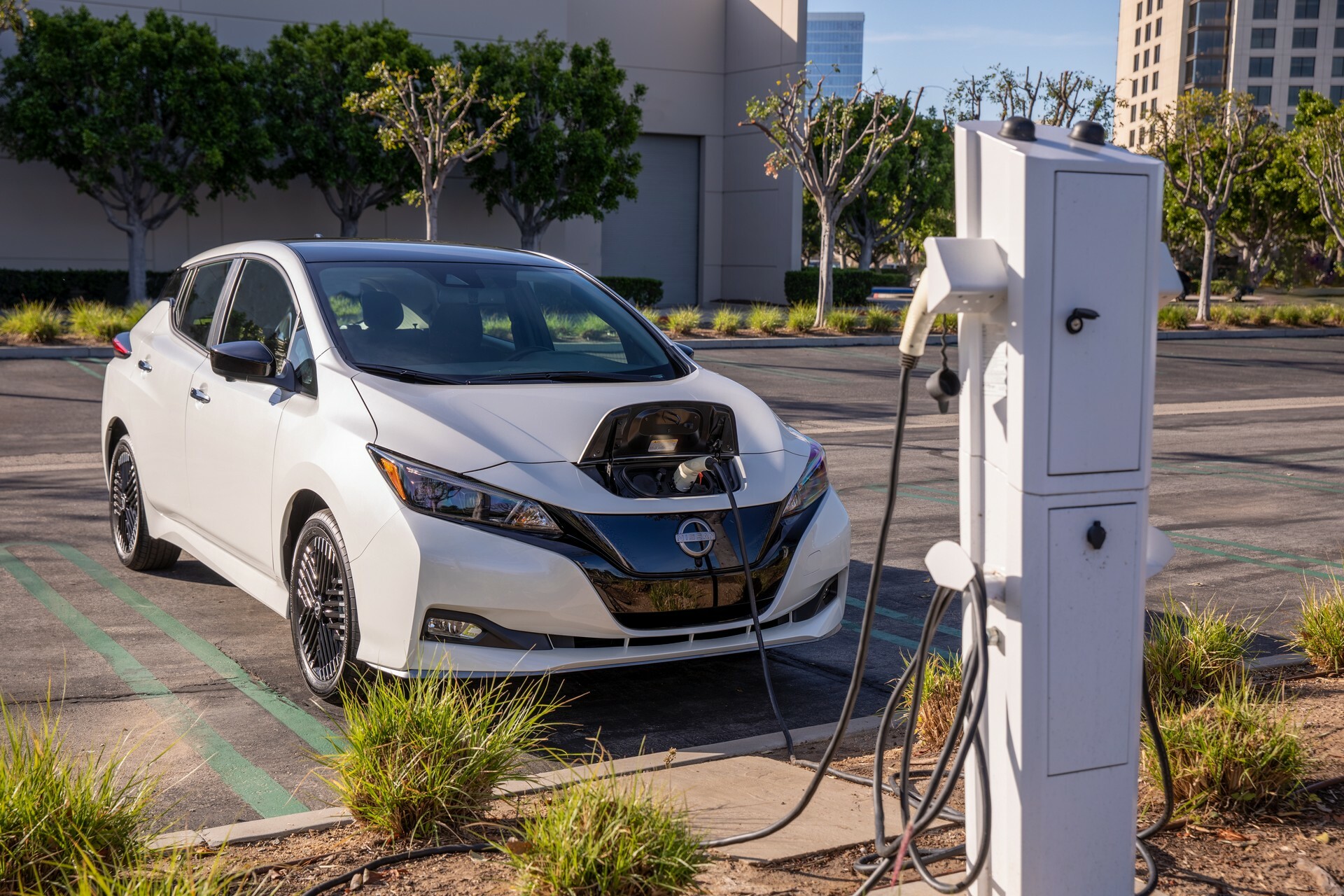
Used EV demand is climbing at a noticeable pace. In January alone, sales were 21 percent higher than a year earlier. Figures cited by Reuters show the trend stretching across the entire year, with used EV sales in 2025 ending up 35 percent higher than in 2024.

EV Depreciation Is Real

 America’s Used EV Market Is Heating Up For One Simple Reason

Price movement is a major reason. Data from Cox Automotive, gathered across major automotive marketplaces, indicates that the decline in prices for used EVs has been much sharper in the past year, narrowing the gap between them and comparable gas-powered vehicles.

The premium for used EVs over comparable gasoline vehicles narrowed to $1,376 in January from $2,591 in December. Analysts attribute that change to a glut of lease returns, deep discounts on new electric models, and federal tax credits that are evolving how shoppers crunch the numbers.

Best-Selling Used EVs In The U.S. In 2025
VehicleUnits Sold
Tesla Model 372,673
Tesla Model Y53,847
Tesla Model S18,257
Ford Mach-E16,355
Chevy Bolt14,103
SWIPE

Source: Cox Automotive (Tesla totals exclude vehicles the company sold directly)

It was not only Tesla showrooms that were impacted when Tesla reduced the prices of three new models in 2023 and 2024. These reductions lowered resale in the entire electric market. When the new cars had gone cheaper, used cars were forced to be drop their prices too.

Add to that ‌car rental firm Hertz’s large-scale sale of Teslas, and you suddenly have many more second-hand options in the used EV market.

Confidence in EV Ownership Is Improving

Affordability helps, but confidence is just as important. Data on battery performance still continues to show that modern packs are built to last well past 100,000 miles. Most manufacturers offer long battery warranties, which gives peace of mind to shoppers who fear costly repairs.

Charging access has also improved. Public fast charging stations are being added along highways and in urban areas with the help of both private companies and federal funding. With increased visibility and reliability of infrastructure, the fear of being stranded with a low battery for many drivers is a thing of the past.

 America’s Used EV Market Is Heating Up For One Simple Reason
Yesterday — 14 March 2026Main stream

Avatr’s Electric Wagon Packs Supercar Power And A Backup Gas Engine

  • Avatr previews the 06T electric shooting brake for China market.
  • The wagon body looks better balanced than the sedan version.
  • Battery EV models offer up to 955 hp in the range topping trim.

Sleek estate cars have become somewhat of a rarity these days. Buyers keep drifting toward crossovers and SUVs, and manufacturers have largely followed the money. Traditional wagons, especially the low and sporty ones, now feel like a niche choice. China, however, still has a few brands willing to keep the format alive. Avatr is one of them.

The company has now previewed its newest addition, a wagon called the 06T. Similar in size and profile to the Zeekr 007 GT, Avatr’s new model will be sold both as a range-extender and as a fully-electric wagon. It also has a seductive Shooting Brake shape that should get many car enthusiasts excited.

Read: Avatr Just Extended The 06 In More Ways Than One

Measuring 4,940 mm (194.4 inches) long, 1,960 mm (77.1 inches) wide, and 1,475 mm (58 inches) tall, the 06T rides on a 2,940 mm (115.7-inch) wheelbase and shares its underpinnings with the existing 06 sedan. The sedan’s rear design has always looked a bit awkward, but stretching the roof into a wagon shape helps smooth out the proportions and gives the overall profile a more natural look.

The Juicy Details

\\\\\

Pictured here in a new color known as Liujin Orange, the fully electric version uses an 89.33 kWh battery pack. Buyers will have two rear-wheel-drive EV options to choose from. The entry model uses a pair of 302 hp (225 kW) motors, while the more powerful version upgrades to two 337 hp (251 kW) units.

Sitting above these two variants in the range will be an all-wheel drive variant. In addition to having the two 337 hp motors at the rear, it also includes a 282 hp (210 kW) unit at the front, combining to produce 955 hp (712 kW). There’s no word on how quickly it’ll hit 60 mph (96 km/h), but we know all models will be capped at a 149 mph (240 km/h) top speed.

\\\\\

Avatr will offer the three EV variants alongside an extended-range version of the 06T. This model uses a 1.6-liter turbocharged engine producing 154 hp (115 kW), which functions solely as a generator for the battery pack. Propulsion comes from two 248 hp (185 kW) electric motors mounted at the rear axle. Battery capacity has not yet been disclosed, and there is still no information on either the combined driving range or the all-electric range.

\\\\\\\\\\\

Gravity Dragged This Lucid’s Value Down $46,000 In Just 3 Months

  • The Gravity Dream Edition packs 1,070 hp and 909 lb-ft.
  • Early resale prices show the luxury EV losing value quickly.
  • The base version starts under $80,000 with 560 hp.

If you were among those who rushed to buy a new Lucid Gravity, you may want to look away now. Early resale results can reveal a lot about how the market values a new model. A flagship Dream Edition with just 3,500 miles (5,632 km) has sold for $96,000, nearly $46,000 below its original MSRP, offering a clear snapshot of how buyers currently price the SUV on the used market.

There’s a lot to like about the Gravity, particularly the Dream Edition model. It features a 123 kWh battery pack, four electric motors, and a combined 1,070 hp and 909 lb-ft of torque. Does anyone need an SUV with this much power? No, but being able to hit 60 mph (96 km/h) in 3.1 seconds and storm down the quarter-mile in 10.6 seconds in a luxury SUV is still pretty cool.

Read: He Sold His $142K Lucid At A Huge Loss After Just 400 Miles Of EV Reality

The Dream Edition is also equipped with all the luxury features you could ever want, including the Comfort and Convenience Package, which adds soft-close doors and power rear window shades, alongside an AR HUG, dynamic ambient lighting, and Nappa leather upholstery and seats with heated, ventilated, and massaging functions.

\\\\\\\\\\\\\\

Cars & Bids

Perhaps the biggest downside of the Dream Edition is the cost. In the US, it has an MSRP of $141,550, including destination charges, which feels like a lot, particularly given that the entry-level Gravity Touring with 560 hp is available from just $79,900.

Sure, it has roughly half the power, but most of the same features. Additionally, the 828-hp Gravity Grand Touring starts at $94,900, and also seems like a relatively bargain compared to the Dream Edition.

As the Cars & Bids auction shows, depreciation has been significant. This particular example was registered in early December and driven just 3,500 miles, yet it lost $45,550 in value. That works out to roughly $13 lost for every mile driven.

\\\\\\\\\\\\\\\\\

Cars & Bids

Before yesterdayMain stream

Rivian’s Most Affordable Model Arrives First In Its Most Expensive Form

  • Rivian’s R2 packs up to 656 hp and hits 60 mph in 3.6 seconds.
  • The electric crossover can travel up to 330 miles per charge.
  • Multiple trims launch first, with a cheaper version due in 2027.

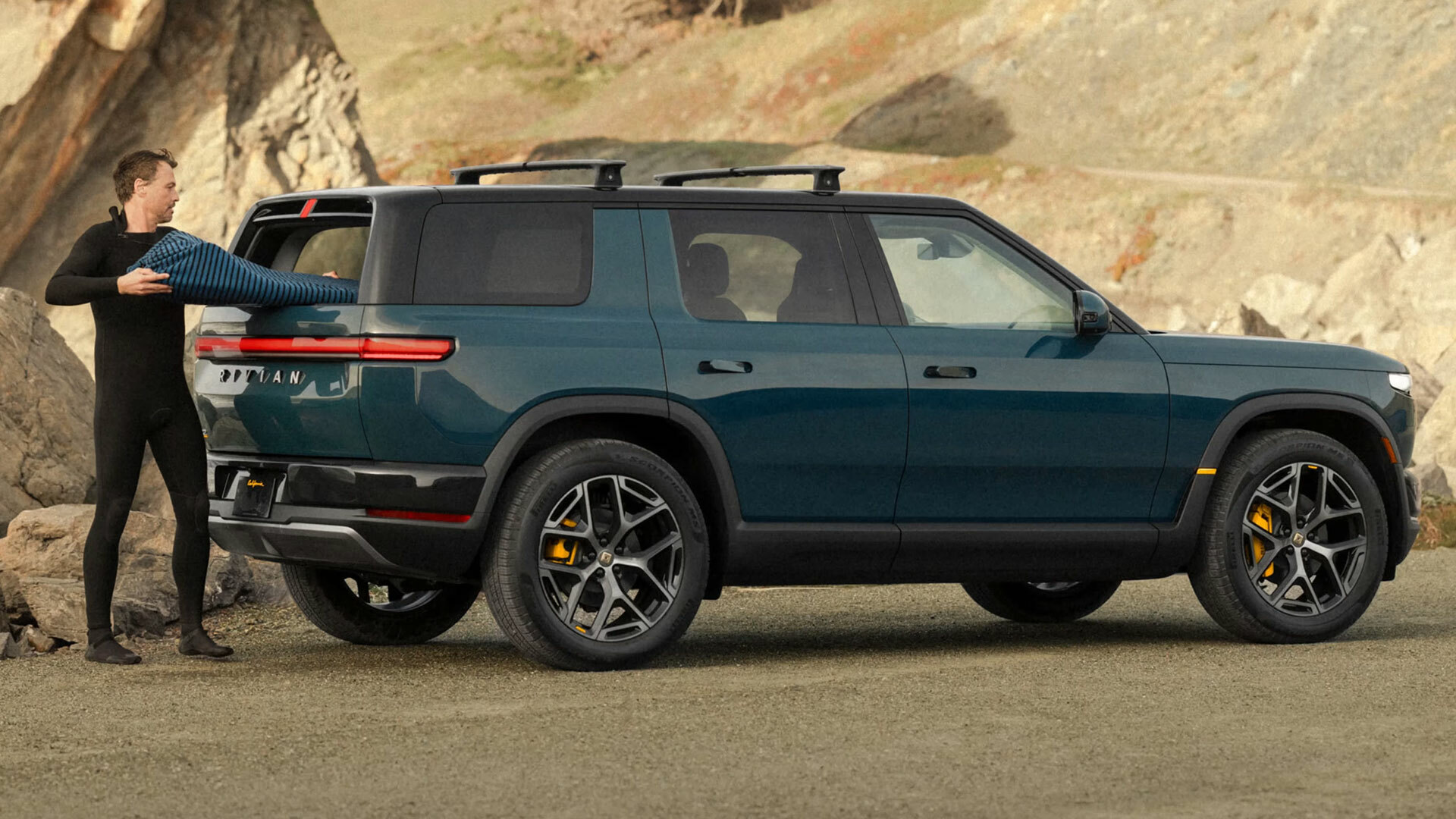
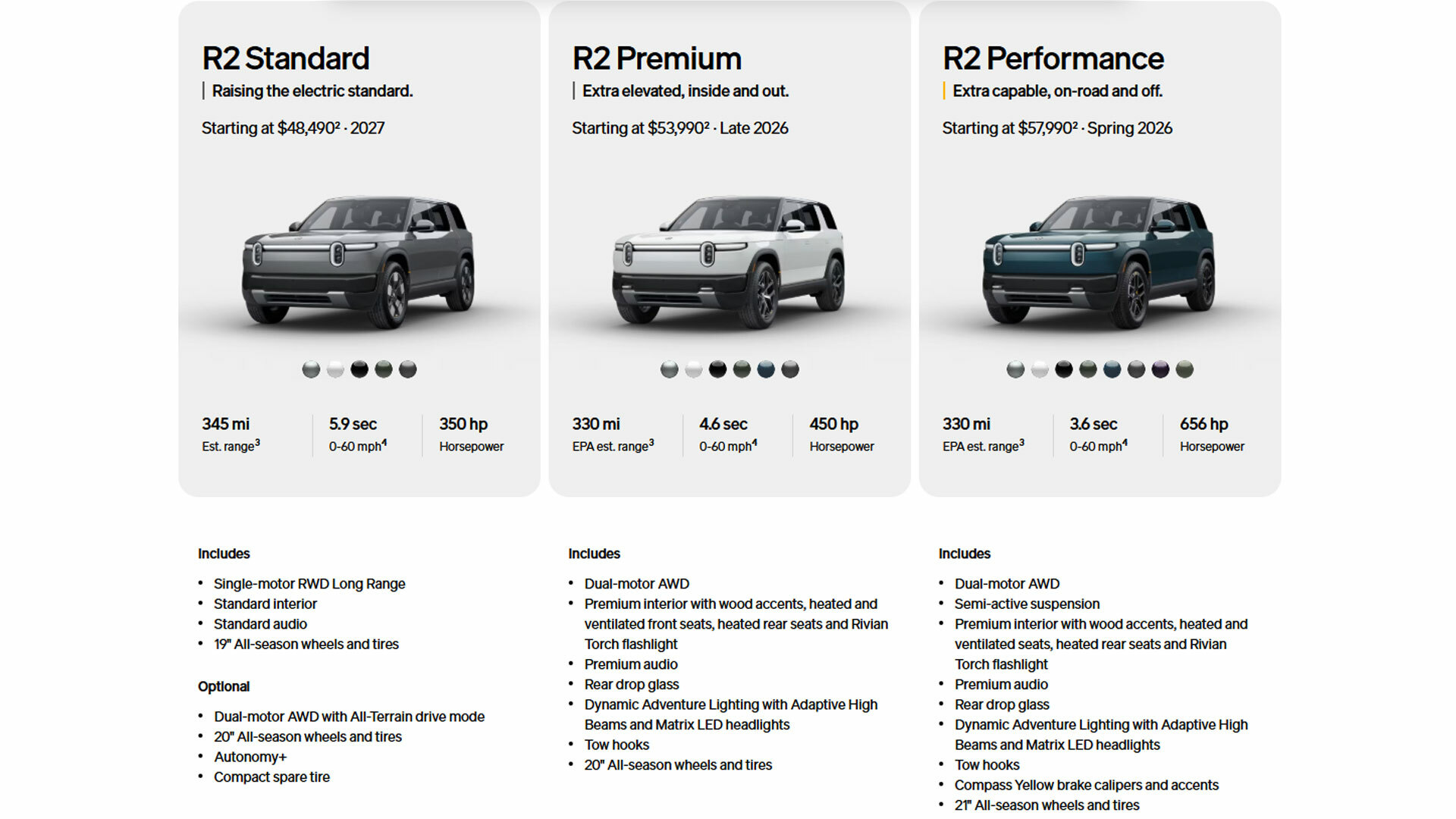
Following yesterday’s leak, Rivian has officially introduced the R2. It arrives this spring with a $57,990 price tag, although an entry-level model is slated to arrive in late 2027 and cost around $45,000.

The R2 rides on an all-new platform and is being launched in Performance guise, which has a dual-motor all-wheel drive system producing 656 hp (489 kW / 665 PS) and 609 lb-ft (825 Nm) of torque. This enables the model to accelerate from 0–60 mph (0-96 km/h) in as little as 3.6 seconds.

More: Rivian Is Killing Off The Entry-Level R1 Just Before R2 Launch

The crossover is said to have a 87.9 kWh battery pack, which enables it to have a range of up to 330 miles (531 km). When the battery is low, it can reportedly go from a 10-80% charge in as little as 29 minutes. Other highlights include a semi-active suspension and eight drive modes known as All-Purpose, All-Terrain, Conserve, Launch, Rally, Snow, Soft Sand, and Sport.

The model comes standard with an Esker Silver exterior that sports 21-inch Liquid Tungsten wheels as well as Compass Yellow brake calipers and exterior badging. They’re joined by Matrix LED headlights, integrated tow hooks, and a rear liftgate with drop down glass.

Moving inside, there’s a Black Crater Signature interior with Birch wood trim. Buyers will also find 12-way power front seats with heating and ventilation. They’re joined by heated rear seats as well as a heated steering wheel. Other niceties include a nine-speaker premium audio system and a flashlight integrated into the driver’s door.

An assortment of options will be available including Borealis, Catalina Cove, Forest Green, Glacier White, Half Moon Grey, and Midnight paint jobs. They can be paired with black 20-inch wheels wrapped in all-terrain tires. Customers can also get a Coastal Cloud Signature interior, a 4,400 lb (1,996 kg) towing package, and an Autonomy+ subscription that offers monthly or one-time options.

Early models come with a limited edition Launch Package that includes a lifetime subscription to Autonomy+ as well as the aforementioned towing package. There’s also a green anodized key fob and an exclusive Launch Green exterior color, but that’ll cost you extra.

R2 Premium

\\\\\\\\\\\\\\\\\\\\

The $53,990 R2 Premium will follow later this year with a downgraded all-wheel drive system producing 450 hp (356 kW / 456 PS) and 537 lb-ft (727 Nm) of torque. This enables the crossover to accelerate from 0-60 mph (0-96 km/h) in 4.6 seconds and travel up to 330 miles (531 km) on a single charge.

Equipment largely echoes the Performance variant, but the Premium rides on smaller 20-inch wheels with a Bicolor Carbon finish. Drivers also have to make do with five drive modes known as All-Purpose, All-Terrain, Conserve, Sport, and Snow.

R2 Standard Long Range

\\\\\\\\\\\\

The R2 Standard Long Range will arrive in the first half of 2027 and cost $48,490. It comes standard with a rear-mounted motor producing 350 hp (261 kW / 355 PS) and 355 lb-ft (481 Nm) of torque. This enables the model to hit 60 mph (96 km/h) in 5.9 seconds and have a Rivian-estimated range of up to 345 miles (555 km).

However, customers can get an optional all-wheel drive system that produces 450 hp (356 kW / 456 PS) and 537 lb-ft (727 Nm) of torque. It echoes the R2 Premium, so expect a 0-60 mph (0-96 km/h) time of 4.6 seconds and a reduced range of 330 miles (531 km).

\\\\\\\

In order to achieve the lower price tag, a number of features have been dropped. This appears to include the fancy lighting system, tow hooks, and drop down rear window. The model also rides on smaller 19-inch wheels.

The cuts continue inside with a cheaper Black Crater interior sporting a basic five-speaker audio system. The front passenger seat also gets downgraded to 8-way power adjustment, while there’s only heated front seats and a heated steering wheel. Buyers also lose the flashlight and All-Terrain drive mode.

R2 Standard Short Range

Rivian’s much-hyped entry-level model is coming in late 2027 and it will start “around $45,000.” The company isn’t saying much about it, but promised a range in excess of 275 miles (443 km).

Odds And Ends

\\\\\\

While Rivian hasn’t released full details, the R2 appears to be surprisingly spacious as there’s 40.4 inches (1,026 mm) of rear-seat legroom as well as 28.7 cubic feet (813 liters) of cargo space. That expands to 79.4 cubic feet (2,248 liters) by folding the rear seats down. Speaking of space, the model has dual glove boxes and a frunk that provides 5.2 cubic feet (147 liters) of room.

Rivian also touched on capability as the R2 has 9.6 inches (244 mm) of ground clearance as well as approach, departure, and breakover angles of 25°, 26°, and 20.6° respectively. The model also has 32-inch tires and is nearly 2,000 lbs (907 kg) lighter than the R1.

 Rivian’s Most Affordable Model Arrives First In Its Most Expensive Form

Rounding out the highlights are a panoramic glass roof, digital key technology, and a “Haptic Halo” steering wheel with two large scroll wheels. The R2 also has an NACS port as well as a “Field Outlet” that transforms the charging port into a power station with two 120V outlets.

Rivian is currently accepting reservations for a $100 refundable deposit.

 Rivian’s Most Affordable Model Arrives First In Its Most Expensive Form

These Used EVs Are Selling Faster Than Gas Cars In Today’s Market

  • New study shows used EVs are selling quicker than used ICE models.
  • In February, the average used car took 53 days to sell in the US.
  • The Tesla Model X was the quickest-selling used car last month.

We all know that new car prices have surged over the past six years, but they’re not alone. The used market has followed the same trajectory. Prices have risen sharply, and vehicles are now lingering on dealer lots longer than before, partly because many owners are not shopping for cars and are holding on to their current ones. Even so, one automaker seems largely unaffected by the slowdown

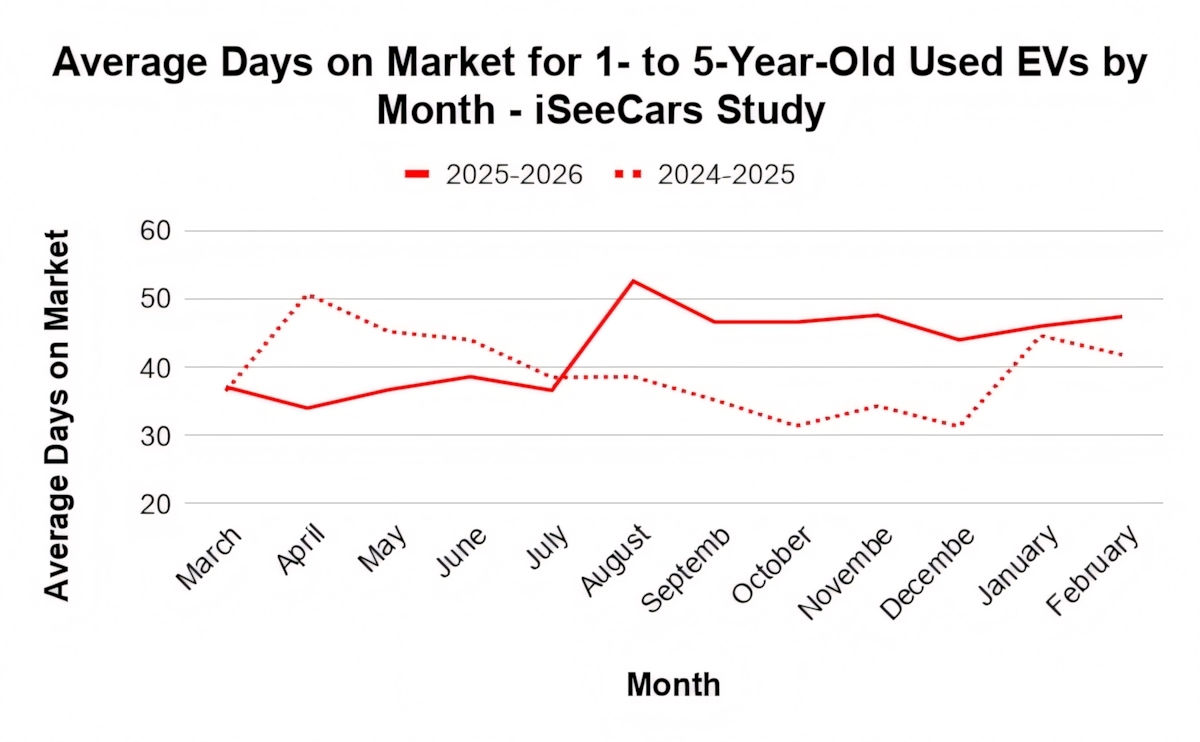
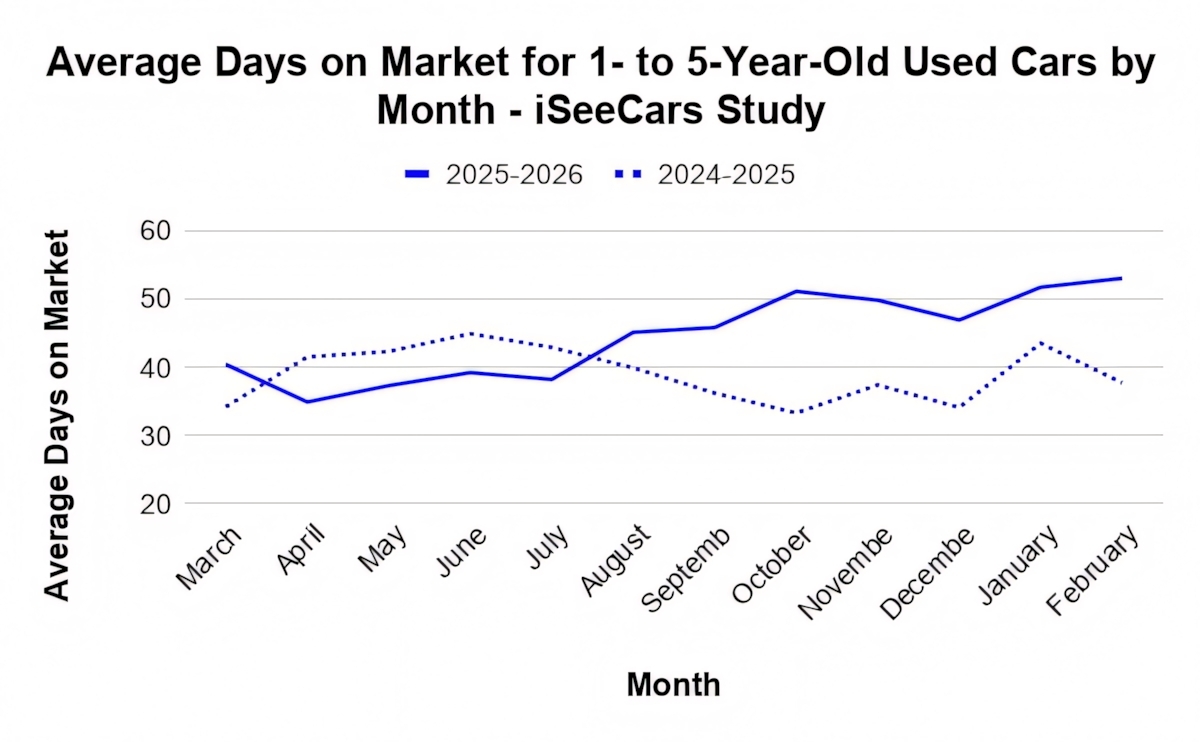
Fresh data from iSeeCars sheds some light on the trend. It examined more than 960,000 transactions involving used vehicles between one and five years old during February. Across that sample, the typical used car sat on the market for 53 days before finding a buyer. A year earlier the average was just 37.7 days in the US, which means selling times have stretched by roughly 40 percent in only twelve months.

Read: Tesla’s Sales Collapsed By Nearly 90% In The Land Of EVs

Used electric models, interestingly, are moving a bit faster than their gasoline counterparts. In February, the typical used EV took 47.4 days to sell. That figure has increased from last year’s 41.8-day average, but the 13.4 percent rise is modest compared with the broader used market.

 These Used EVs Are Selling Faster Than Gas Cars In Today’s Market
iSeeCars
 These Used EVs Are Selling Faster Than Gas Cars In Today’s Market

Tesla Bucks The Trend

However, there’s a little more to these figures than may first meet the eye. Because Teslas still account for the vast majority of EV sales, their typically quick resale times drag down the overall market average. Remove Tesla from the equation and the picture changes. Without those models included, the typical used EV took 57.3 days to sell in February, a 15.1 percent increase from the 49.8-day average recorded at the same time last year.

So which models disappear from listings the fastest? Comfortably leading the pack is the Tesla Model X, needing an average of just 22.6 days to sell. Surprisingly, it was followed by the Mercedes-Benz EQS SUV, at an average of 26.9 days, and then the Tesla Cybertruck, at 27.4 days.

Fastest-Selling Used Cars In February 2026
RankModelDays on MarketCompared to Average
1Tesla Model X22.60.43x
2Mercedes-Benz EQS (SUV)26.90.51x
3Tesla Cybertruck27.40.52x
4Mazda MX-5 Miata RF29.30.55x
5Toyota GR Supra30.00.57x
6Genesis G9030.40.57x
7Rivian R1S30.80.58x
8Toyota GR Corolla31.10.59x
9Hyundai Kona Electric31.40.59x
10Volkswagen Golf R31.80.60x
11Lexus GX 55032.40.61x
12Lexus RX 500h33.00.62x
13Tesla Model 333.10.62x
14Nissan LEAF33.80.64x
15Honda Civic Hybrid34.80.66x
16Tesla Model Y34.90.66x
17Toyota GR8635.10.66x
18BMW M235.40.67x
19BMW X5 M35.50.67x
20Cadillac Escalade-V35.60.67x
Overall Average53.0
SWIPE

Other strong performers uncovered by the iSeeCars study included the Mazda MX-5 Miata RF at 29.3 days, the Toyota GR Supra at 30 days, the Genesis G90 at 30.4 days, the Rivian R1S at 30.8 days, and the Toyota GR Corolla at 31.1 days. Several of these cars lean toward the enthusiast end of the spectrum, which likely helps keep demand strong.

Tesla’s higher-volume models appear a little further down the rankings. The Model 3 lands in 13th place with an average of 33.1 days on the market, while the Model Y sits in 16th at 34.9 days. However, it’s worth noting that far more Model 3s and Model Ys are sold monthly than the likes of the GR Supra, G90, R1S, and MX-5 Miata, so they help to sway the overall market.

The opposite end of the list looks very different. Some vehicles sit for months before finding a buyer. The Volvo XC60 is the slowest mover in the study, lingering for an average of 170.2 days. The BMW i5 is not far behind at 153 days, followed by the Dodge Hornet at 123.7 days and the Lincoln Nautilus Hybrid at 118 days.

Slowest-Selling Used Cars In February 2026
RankModelDays on MarketCompared to Average
1Volvo XC60 (hybrid)170.23.21x
2BMW i5 (electric)153.02.89x
3Dodge Hornet (hybrid)123.72.33x
4Lincoln Nautilus Hybrid118.02.23x
5GMC Sierra EV116.12.19x
6Ford Escape Plug-In Hybrid112.32.12x
7Volvo XC90 (hybrid)108.72.05x
8Nissan Z107.92.04x
9Genesis GV60101.61.92x
10Land Rover Discovery101.51.92x
11Dodge Charger (electric)96.71.82x
12Chevrolet Blazer EV96.31.82x
13Cadillac Escalade IQ93.81.77x
14Cadillac XT691.61.73x
15BMW 8 Series91.41.72x
16Lincoln Corsair (hybrid)90.61.71x
17Chevrolet Silverado EV87.71.65x
18Cadillac LYRIQ87.41.65x
19GMC HUMMER EV (SUV)87.21.65x
20Dodge Hornet87.21.65x
Overall Average53.0
SWIPE

MG 4X Packs 317 Miles Into A Surprisingly Small Semi-Solid-State Battery

  • MG unveils the MG4X electric SUV with semi-solid-state tech.
  • New battery chemistry targets better range and heat stability.
  • Shares E3 electronic architecture with the MG4 hatchback.

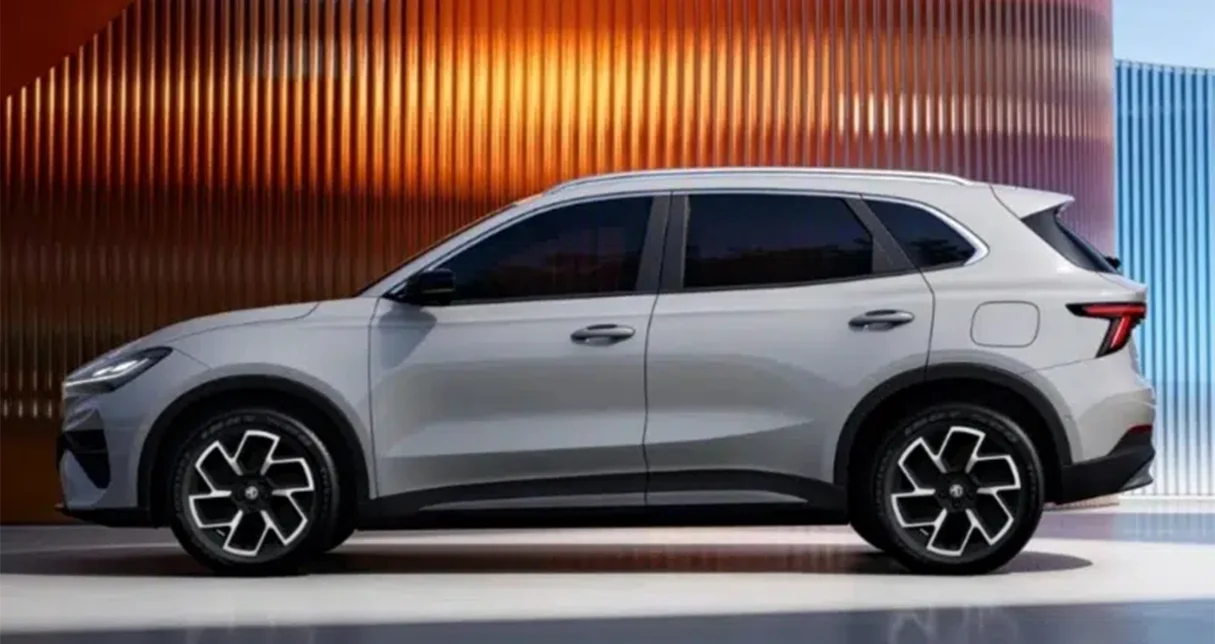
The new MG 4 lineup is expanding with a slightly larger addition called the MG 4X. Positioned as a higher-riding SUV counterpart to the hatchback, the model brings one particularly notable feature with it. Like its smaller sibling, the MG4X uses an advanced semi-solid-state battery pack.

Sitting between the axles is a 53.95 kWh battery that contains only 5 percent liquid electrolyte, which is why MG classifies it as semi-solid-state. The chemistry is intended to improve thermal stability and cope better with both very cold and very hot conditions. Even with a battery that is not especially large by modern EV standards, MG says the setup is good for a driving range of 317 miles (510 km).

Read: New MG4 Electric Hatch Draws Inspiration From Cyberster

For now, MG is keeping the performance figures to itself. Power output remains undisclosed, and there is still no word on the electric motor or motors that will power the SUV. What has been confirmed is the underlying tech. The MG4X runs on the same E3 electronic architecture as the latest MG4 hatchback, and it is clearly aimed at competitors like the BYD Atto 2.

A BYD Rival

 MG 4X Packs 317 Miles Into A Surprisingly Small Semi-Solid-State Battery

It is 4,395 mm (173 inches) long, 1,842 mm (72.5 inches) wide, 1,551 mm (61 inches) tall, and sits on a 2,750 mm (108.2-inch) wheelbase. It also has a curb weight of just 1,485 kg (3,273 lbs). Visually, it resembles the hatchback but has its own unique style.

The front end is quite imposing, complete with large air intakes and a lower grille, as well as triangular headlights with a thin light bar. Early images of the SUV also show it rocking black wing mirrors, a large panoramic glass roof, and sharp taillights, appearing to be similar in shape to the current MG S5, which sits right above it in MG’s range.

We don’t yet know what the cabin of the MG 4X will be like, but it’s safe to assume it will share parts with the hatchback. This could include the same central infotainment display, co-developed with smartphone manufacturer Oppo. It may also feature a handful of proper physical buttons on the steering wheel and console, ensuring that it’s not too minimalist.

\\\\

Rivian R2 Starts At $57,990, But Cheaper Versions Are Still Coming

  • Details about the Rivian R2 have leaked ahead of its debut.
  • Launch model starts at $57,990, and offers 330 miles of range.
  • Affordable variants will follow, including a base model for $45K.

Rivian is gearing up to introduce the highly anticipated R2, but waiting is so overrated. Arstechnica knows that feeling all too well as they jumped the gun and published full details of the crossover a day early.

While the article was quickly removed, the internet never forgets and it was archived for posterity. Thanks to this, we know virtually everything about the upcoming model.

More: Rivian Is Killing Off The Entry-Level R1 Just Before R2 Launch

Set to arrive this spring, the R2 will be launched in Performance guise that starts at $57,990 before a $1,495 destination fee. The range-topping model reportedly has a 87.9 kWh battery pack, which powers a dual-motor all-wheel drive system producing 656 hp (489 kW / 665 PS) and 609 lb-ft (825 Nm) of torque.

The R2 Performance is said to have a semi-active suspension and a range of up to 330 miles (531 km). We can also expect a fast charging capability that will take the battery from 10-80% in as little as 29 minutes.

\\\\\\\\

In terms of equipment, we can expect a stylish interior with birch wood trim as well as heated and ventilated front seats. The rear seats are also heated, while other highlights include a nine-speaker audio system and a flashlight that’s integrated into the front door. They’re joined by matrix LED headlights and 21-inch alloy wheels.

Options include the company’s recently announced Autonomy+ semi-autonomous driving subscription and a tow package that enables the model to haul up to 4,400 lbs (1,996 kg).

R2 Premium

 Rivian R2 Starts At $57,990, But Cheaper Versions Are Still Coming

A more affordable R2 Premium is scheduled to arrive later this year for $53,990. Its powertrain largely echoes the Performance variant, but it has weaker motors producing 450 hp (356 kW /  456 PS) and 537 lb-ft (727 Nm) of torque.

Those aren’t the only tradeoffs as the model reportedly eschews the fancy suspension and rides on smaller 20-inch wheels. Buyers will also find three fewer drive modes.

R2 Standard

 Rivian R2 Starts At $57,990, But Cheaper Versions Are Still Coming

If that’s still too pricey, you can hold off until the R2 Standard arrives in 2027. It retains the 87.9 kWh battery, but it’s paired to a rear-mounted motor producing 350 hp (261 kW / 355 PS) and 355 lb-ft (481 Nm) of torque. This helps the model to be slightly more efficient as the range climbs to 345 miles (555 km).

The equipment list gets shorter as there’s a basic five-speaker audio system, heated front seats, and an “all-black” interior. The drop-down rear window is also absent, while the crossover is shod in smaller 19-inch wheels.

The base R2 is set to arrive in late 2027 with a smaller battery that provides around 265 miles (426 km) of range. Little else is known about this variant, but it’ll cost $45,000.

Other Details

 Rivian R2 Starts At $57,990, But Cheaper Versions Are Still Coming

Trims aside, the model measures 185.9 inches (4,722 mm) long, 78.1 inches (1,984 mm) wide, and 66.9 inches (1,699 mm) tall with a wheelbase that spans 115.6 inches (2,936 mm). The R2 is also said to have up to 9.6 inches (244 mm) of ground clearance.

Other highlights include a NACS charging port and a cargo capacity of up to 79.4 cubic feet (2,248 liters). However, that falls to 28.7 cubic feet (813 liters) with the rear seats up.

A separate leak also suggested the model will be offered in eight colors known as Borealis, Catalina Cove, Esker Silver, Forest Green, Glacier White, Half Moon Grey, Launch Green, and Midnight.

 Rivian R2 Starts At $57,990, But Cheaper Versions Are Still Coming
Photos Rivian

A New Range Rover Velar Is Coming, But It Doesn’t Look Like An SUV Anymore

  • The next-gen Range Rover Velar will be sold only as an EV.
  • The new model will ride on JLR’s EMA electric platform.
  • Land Rover is reshaping the Velar into a high-riding sedan.

An all-new Range Rover Velar is just around the corner, and it will be very different from the model we know today in more ways than one. The next generation will switch to EV-only power, marking a seismic change for the nameplate. It will also look quite different. Land Rover will move away from the traditional SUV silhouette of the current version and adopt a lower-slung shape that resembles a high-riding sedan.

Read: New Velar Starts Looking More Like A Range Rover Sedan

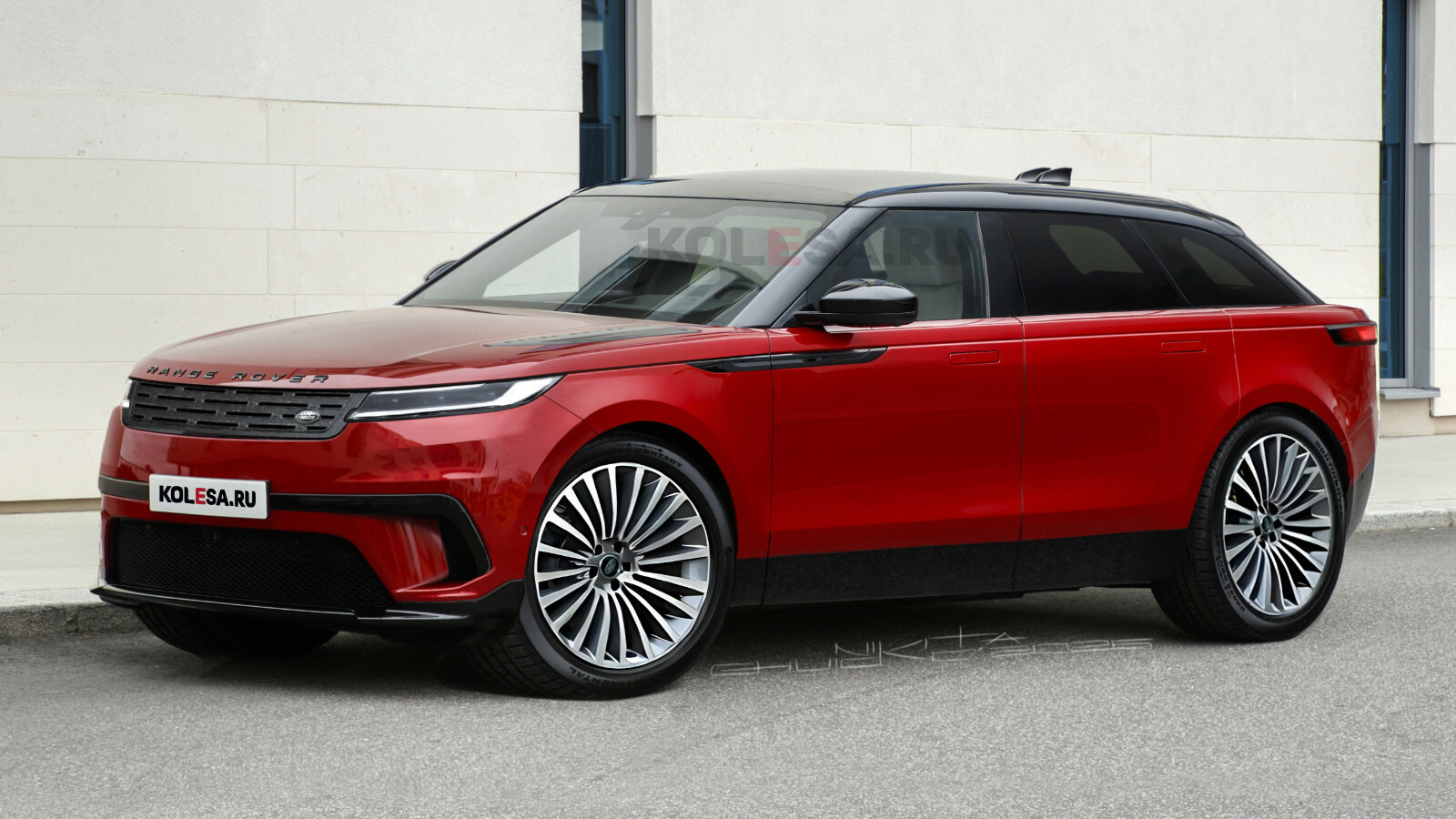
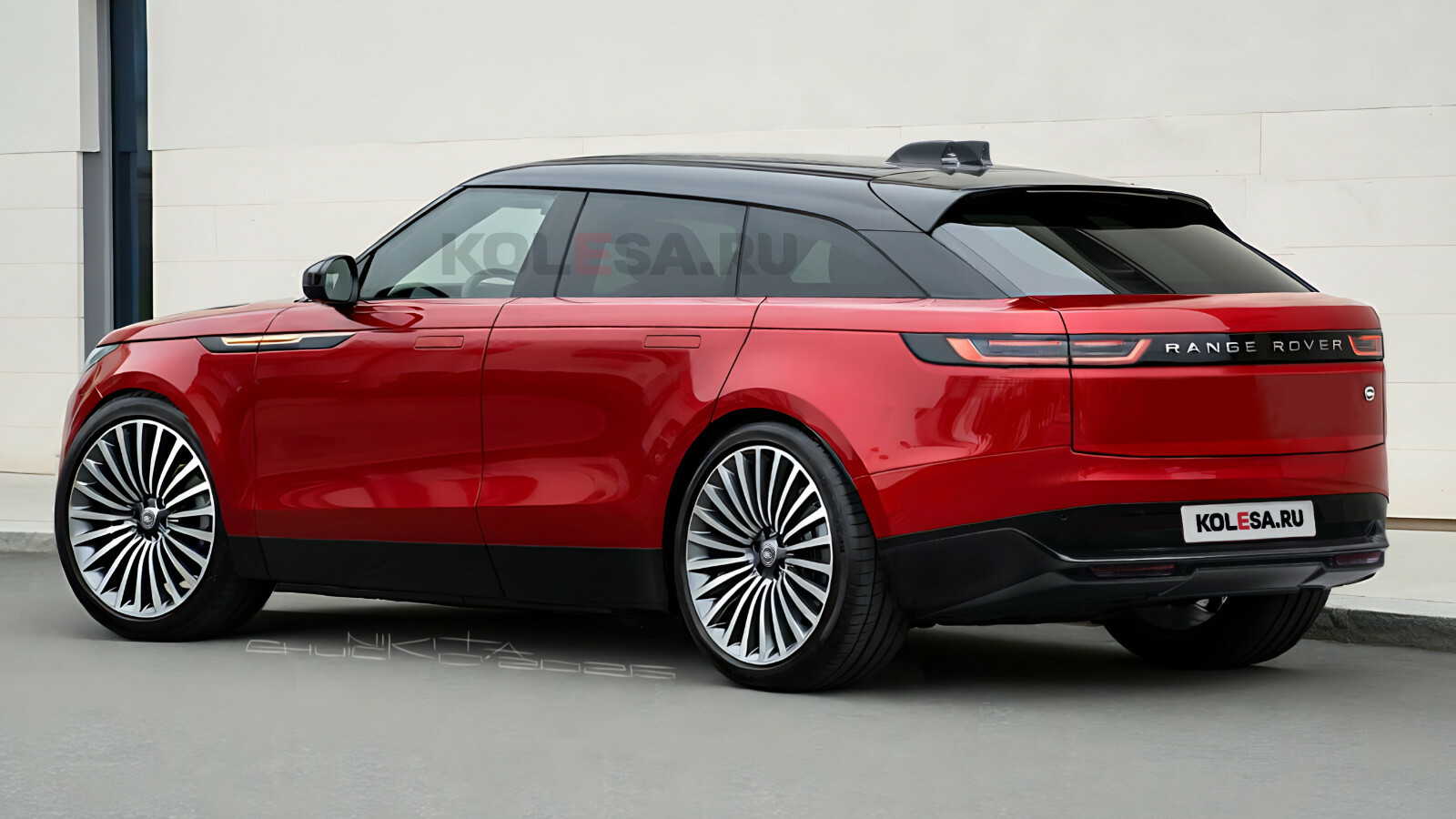
Hot on the heels of a camouflaged prototype of the new Velar testing in the European snow, a pair of fresh renderings previewing the model has surfaced. We will have to wait and see whether the second-generation Velar looks like this when it reaches production, but if it does, it will certainly stand apart.

 A New Range Rover Velar Is Coming, But It Doesn’t Look Like An SUV Anymore
Illustrations Nikita Chuyko/Kolesa

These images, created by Nikita Chuyko for Kolesa, suggest the next Velar will retain a few recognizable cues from today’s model, though they have been reshaped into something closer to the Volvo ES90’s fastback-like profile. Up front, it still looks unmistakably Range Rover, with slim LED headlights and a relatively small upper grille defining the face

Future Cars: Ford Killed Fiesta For A Crossover, Now It Might Return Like This

The body itself sits noticeably lower. That would be controversial on something like a Land Rover Defender, but it is unlikely to trouble most Velar buyers. Realistically, few owners ever take their vehicles off-road, so the move toward a sleeker, road-focused profile may make sense.

 A New Range Rover Velar Is Coming, But It Doesn’t Look Like An SUV Anymore
Illustrations Nikita Chuyko/Kolesa

No doubt the most curious element of the redesigned Velar will be its rear. As spy shots have shown, there’s a short and stubby decklid, as well as a steeply raked rear window, which looks a little odd. Also visible in these renders are slim LED taillights and a blacked-out lower bumper.

The Juicy Details

Underpinning the new Velar will be the new Electrified Modular Architecture (EMA), as it will be sold exclusively as an EV. It could debut with the same 117 kWh battery pack planned for the full-size Range Rover Electric, although a slightly smaller pack remains possible. Either way, engineers will face pressure to ensure it delivers enough range and performance to replace the outgoing combustion-powered version.

\\\\\\\\\\

Mercedes VLE Might Be The Most Luxurious Minivan America Has Ever Seen

  • Mercedes has taken the wraps off the fully electric VLE.
  • It has a 115 kWh battery pack as well as up to 409 hp.
  • Van offers private jet-style seats and 31.3-inch rear display.

Mercedes-Benz has introduced the new 2028 VLE, which is being billed as a “grand limousine.” Marketing hyperbole aside, it’s essentially a luxurious electric minivan that should appeal to everyone from families to executives when it goes on sale in the United States in 2027.

Looking sleek and modern, the model has a bold grille with an available illuminated surround. It’s flanked by starry lighting units and a power dome hood with a tri-star ornament. Customers can also opt for an AMG package that adds a sportier bumper as well as a revised grille with a star emblem in the center.

More: Mercedes Confirms Plans For Ultra-Luxury VLS Van

Moving down the sides, we can see streamlined bodywork and flush-mounted door handles. They’re joined by power sliding doors with fully retractable windows.

\\\\\\\\\\\\\\\\\\\\\\\\\\\\\\\\\

Designers also gave the van an expansive greenhouse and wheels ranging in sizes from 19- to 22-inches. Other highlights include a low drag coefficient of 0.25 and an upright rear end with arc‑shaped taillights that are integrated into the van’s spoiler. The model also has an opening rear window and an odd charging port that opens downward.

It’s pretty big too. The minivan measures 209.0 inches (5,309 mm) long, 78.7 inches (1,999 mm) wide, and 76.5 inches (1,943 mm) tall. The wheelbase spans 131.6 inches (3,342 mm). A longer version arriving later will stretch to 215.9 inches (5,484 mm) overall and ride on a 138.5-inch (3,517 mm) wheelbase.

For some perspective, the standard Cadillac Escalade measures 211.9 inches (5,382 mm) long with a 120.9-inch (3,071 mm) wheelbase, while the Chrysler Pacifica minivan is 204.3 inches (5,189 mm) long and rides on a 121.6-inch (3,089 mm) wheelbase.

Fancy Seats And Screens Galore

\\\\\\\\\\\\\\\\\\\\\\\\\\\\\\\

The interior is luxurious and high-tech as it offers an optional MBUX Superscreen, which consists of a 10.25-inch digital instrument cluster, a 14-inch infotainment system, and a 14-inch front passenger display. Customers can also get a rear entertainment system that has a 31.3-inch panoramic screen that deploys from the headliner. It echoes the one found in the BMW 7-Series and features 8K resolution, split-screen functionality, and an eight-megapixel camera for use with teleconferencing software.

Other highlights include a 22-speaker Burmester 3D surround sound system and a Sky View panoramic fix glass roof with an ambient lighting surround. The van also has folding tables and an assortment of consoles that offer wireless smartphone chargers as well as heated/cooled compartments.

\\\\\\\\\\\\\\\\\\\\\\\\\\\\\\\\\\\\\\

The VLE will be offered with six to eight seats as customers can get second- and third-row captain’s chairs, second-row captain’s chairs, and two rear benches. Mercedes is particularly proud about the seats and manually operated ones have four integrated wheels, which allow them to be moved effortlessly both inside and outside the vehicle.

Higher-end variants have power seats, which can be controlled by the infotainment system or a smartphone app. Mercedes said adjusting them is “almost like choreographing a ballet.”

Speaking of higher-end variants, the company offers Premium Comfort and Grand Comfort seats. The latter are worthy of a private jet as they have a foot rest, lumbar support, a massage function, a pillow, and a wireless phone charger.

Two Powertrains And 435 Miles Of Range

Mercedes only released a handful of powertrain details, but confirmed the first model out of the gate will be the VLE 300. It has a 115 kWh NMC battery pack and a front-mounted motor producing 272 hp (203 kW / 276 PS). This setup promises a class-leading WLTP range in excess of 435 miles (700 km).

A VLE 400 4MATIC will follow with a dual-motor all-wheel drive system producing a combined output of 409 hp (305 kW / 415 PS). This will enable the van to accelerate from 0-60 mph (0-96 km/h) in just 6.4 seconds.

When the battery is low, owners will be thankful for the model’s 800-volt technology and 300+ kW DC fast charging capability. It allows the van to get up to 221 miles (355 km) of range in as little as 15 minutes.

\\\\\\\\\\\\\\\\\\\\\\\\

Rounding out the highlights are an AirMatic air suspension and a rear-axle steering system, which enables the wheels to turn up to 7 degrees. This enables the VLE to have a turning circle of 35.75 feet (10.9 meters), which is comparable to the CLA.

The van will also have 12 ultrasonic sensors, 10 cameras, and five radar sensors. They provide information to the available MB.Drive Assist Pro system, which allows for hands-free operation in cities as well as on highways.

Mercedes has not revealed pricing yet. Still, considering the technology on board, the lavish interior, and its self-described “grand limousine” positioning, it is unlikely to land anywhere near the affordable end of the spectrum. Expect more details to surface closer to launch next year.

\\\\\\\\\\\\\\\\\\\\

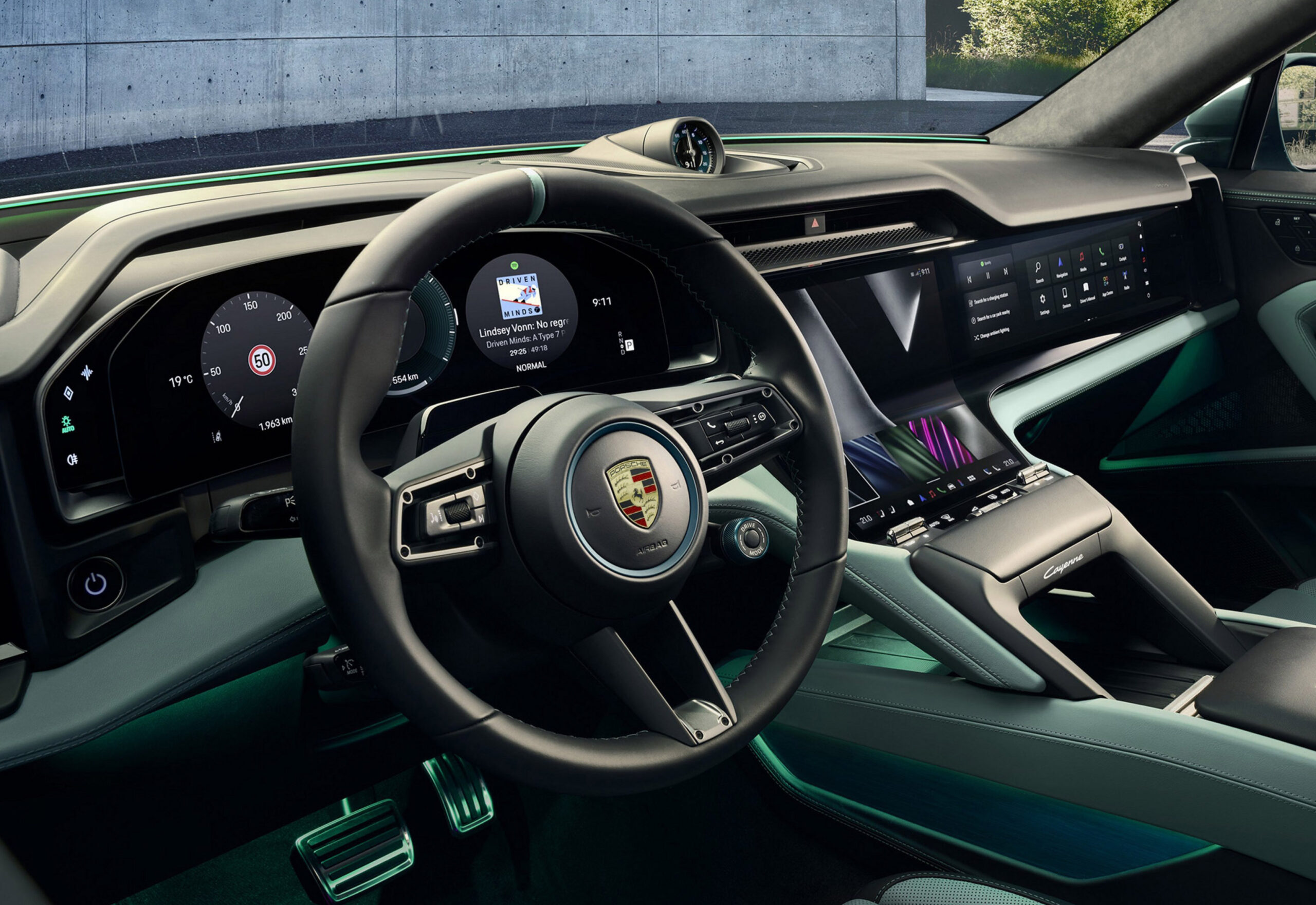
Porsche Cayenne Electric Lineup Just Got A Powerful New Middle Child

  • The Cayenne S Electric sits between the base and Turbo models.
  • Dual motors deliver up to 657 hp with Launch Control.
  • New trim starts at $126,300 with summer 2026 deliveries.

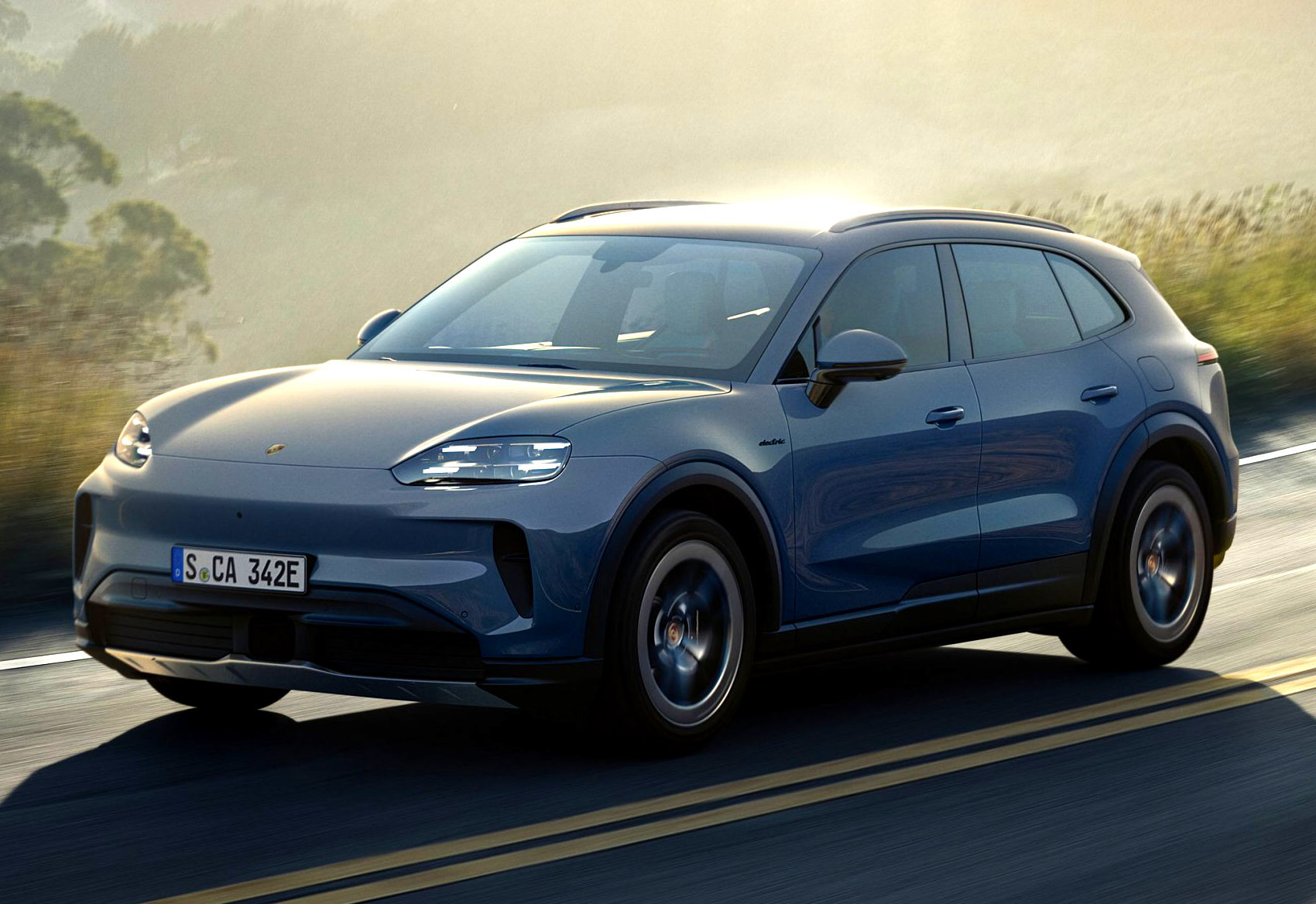
Sometimes the most interesting vehicle in a lineup is not the flagship. Porsche understands this well, which explains the broad mix of trims across much of its range. Now the electric Cayenne gains another variant called simply the S.

Unveiled as the third member of the family, it sits between the base model and the Cayenne Turbo Electric. Even so, it still delivers the sort of power and pace normally associated with something far less practical.

More: Porsche Turns Cayenne EV Coupe Into A Hypercar Hunter

On paper, at least, the numbers are strong. The dual-motor all-wheel-drive setup produces 536 hp (400 kW) in normal operation and up to 657 hp (490 kW) when Launch Control is activated. That’s enough to send the large electric SUV from 0–60 mph (0-96 km/h) in just 3.6 seconds, with a top speed of 155 mph (250 km/h). That’s serious oomph for a large family hauler, and Porsche managed it by borrowing a bit from the top trim.

 Porsche Cayenne Electric Lineup Just Got A Powerful New Middle Child

In comparison, the base Porsche Cayenne Electric produces 435 hp. Engage the overboost function and it will run from 0-60 mph in 4.5 seconds, cover the quarter mile in 13.2 seconds, and eventually top out at 143 mph (230 km/h).

Both electric motors are permanent-magnet synchronous units, and the rear one uses direct oil cooling to manage heat under heavy loads. Unlike most EV motor cooling systems, Porsche’s setup extracts heat directly from current-carrying components. That helps the car sustain performance through better efficiency. The rear inverter also uses silicon-carbide semiconductors that can handle a current of up to 620 amps.

Those looking to really make their new Cayenne S shine can add a few different packages, including Porsche Active Ride suspension, Porsche Torque Vectoring Plus, Porsche Ceramic Composite Brakes, and the Sport Chrono Package with push-to-pass. Notably, that last one boosts output by an additional 120 hp (90 kW) for up to ten seconds.

Charging And Design

\\\\\

The Cayenne S is not only quick off the line. It is also fast at the charger. It uses a 113 kWh battery pack that can charge from 10 to 80 percent in under 16 minutes when connected to a suitable high-speed charger, matching the base model.

The system supports charging speeds of up to 400 kW. The vehicle features a NACS-style connector on the driver’s side and a J1772 port on the passenger side, while a a CCS adapter is also provided with each vehicle. The automaker has yet to confirm the driving range.

 Porsche Cayenne Electric Lineup Just Got A Powerful New Middle Child

Visually, the S gets model-specific touches such as Volcano Grey Metallic trim on the front and rear fascias and 20-inch Cayenne S Aero wheels. Buyers can choose from 13 exterior colors along with multiple interior customization options. One new personalization option is the “Interior Style Package,” a curated design from Porsche Exclusive Manufaktur that mixes black leather with green accents and matching stitching throughout the cabin.

How Much Does It Cost?

The new Cayenne S Electric is now available to order, priced from $126,300 before a $2,350 delivery fee, with U.S. deliveries expected to begin in late summer 2026. That’s $17,300 more than the base Cayenne Electric. Porsche has also confirmed the 1,139 hp Cayenne Electric Turbo, which is due to arrive later this summer at a price yet to be announced.

\\\\\

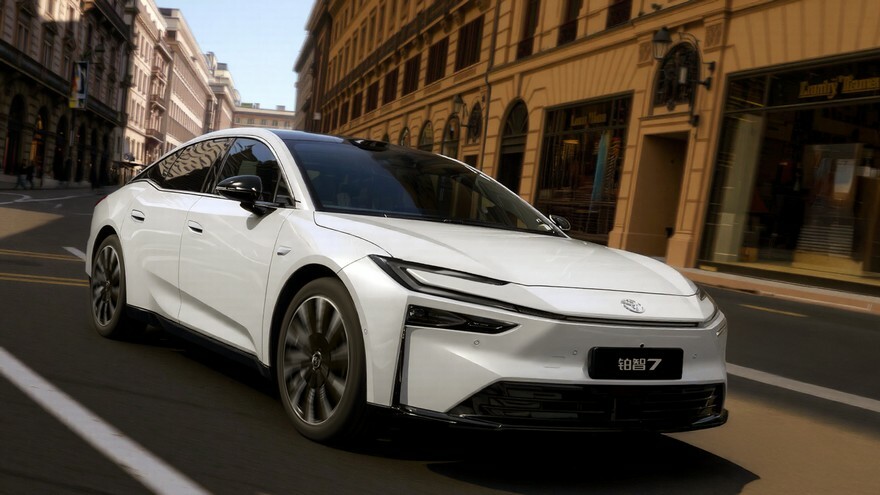
Toyota’s Flagship Electric Sedan Undercuts Tesla Model S By Nearly $96,000 In China

  • Toyota adopts Huawei HarmonyOS Cockpit for connectivity.
  • The bZ7 also syncs with Xiaomi smart home devices easily.
  • Starting from $26,000, it’s about the same size as a Model S.

Toyota has officially opened pre-sales of its new all-electric bZ7 in China, priced between 179,800 and 239,800 yuan for the 600 Pro and 710 Ultra LiDAR trims respectively, or roughly $26,000 to nearly $34,800 depending on the version. That aggressive entry point immediately puts it in the thick of China’s hotly competitive EV market.

But this launch is not only about affordability. It represents a clear change in the way that Toyota is approaching electric vehicles in the region.

Read: Toyota’s New Flagship Electric Sedan Is Here But Not For Us

The bZ7 has a sleek fastback design, modern without being too dramatic. At just over 5.1 meters (200.8 inches) long, 1,965 mm (77.3 inches) wide, and 1,506 mm (59.2 inches) tall, with a 3,020 mm (118.9 inches) wheelbase, it carries the proportions of a proper executive sedan. Those dimensions place it squarely alongside rivals such as the Tesla Model S, BYD Han L, and BMW i5.

 Toyota’s Flagship Electric Sedan Undercuts Tesla Model S By Nearly $96,000 In China

Inside, the layout is clean and technology-focused. A huge 15.6-inch central display is located at the center of the dashboard, backed by the compact driver screen and head-up display. The system runs off Huawei’s HarmonyOS Cockpit 5.0, something that is important for Toyota.

Legacy automakers have long struggled to get on top of Chinese-centric ecosystems which buyers love. The adoption of HarmonyOS Cockpit not only offers sharp graphics, quick response times, and voice control features, but it will also be able to natively integrate with China’s own ecosystem of connected apps and services.

A Serious Push Into China’s Connected Car era

\\\\

Toyota’s integration with Xiaomi’s smart ecosystem means that the car itself is intended to integrate with compatible Xiaomi home devices. Drivers can control select functions of a smart home directly from the interface in the vehicle and also sync personal preferences across devices. It makes the car part of a wider digital lifestyle rather than being simply a transport tool.

Advanced driver assistance comes from Momenta’s R6 system, which uses a combination of sensors and roof-mounted lidar. Features include navigation-assisted driving support and automated parking features. Higher trims focus strongly on comfort too with zero gravity seats, massage and ventilation, a premium audio system, rear seat tray tables and even a built-in refrigerator focused on rear passengers.

Powering the bZ7 is Huawei’s DriveONE electric system in conjunction with lithium iron phosphate battery packs. Depending on the trim, Toyota is claiming a driving range of between about 600-710 km (373-441 miles) under CLTC standards (so take that with a grain of salt). Still, that puts it squarely in line with important domestic competitors. That’s paired with a 207 kW (277 hp) electric motor that provides motive power.

That headline range also nudges it into the territory of the dual-motor Model S AWD, at least on paper. The Tesla, of course, operates in a very different league when it comes to outright performance, with roughly 670 hp on tap. It also sits in a completely different price bracket, starting at 842,900 yuan, or around $122,000. That works out to roughly 4.6 times the base bZ7 and about 3.5 times the price of the top-spec version.

\\\\\\\\\\\\\\\\\\\

CEO Mocks VW After Adopting Range-Extender Tech It Once Dismissed

  • Two different powertrains will be offered for the VW ID. Era 9X.
  • The ID. Era 9X is similar in size to the BMW X7 and has up to 510 hp.
  • VW once criticized EREV tech as environmentally unfriendly in 2020.

The VW Group began selling its EA211 engine in 2011, offering it in both three- and four-cylinder forms across a wide range of models. Over the years, it has powered familiar names such as the VW Golf, Seat Ibiza, Skoda Fabia, VW T-Roc, Audi Q2, and Seat Leon.

Now the company has updated and adapted this long-running engine for an entirely new role, serving as the range-extender in its first extended-range electric vehicle in China, the ID. Era 9X.

Read: VW Built A Bigger ID SUV Than The X7 And You Can’t Have It

VW presented its new flagship SUV, co-developed with SAIC, earlier this year. At the time, we knew it would use a range-extender powertrain, but few technical details were available. Earlier this month, VW confirmed that the ID. Era 9X uses a 1.5-liter turbocharged EA211 engine, although several notable revisions have been made to prepare it for this application.

What’s Different?

\\\\\\

For example, the updated engine now includes a new variable-geometry turbocharger to seamlessly adjust airflow, depending on the driving conditions. VW has also improved thermal efficiency and reduced emissions, while also installing a water-cooled intercooler for cooler intake temperatures. The upgraded engine is being built in China.

EREVs are enjoying something of a resurgence at the moment, though VW was not always enthusiastic about the concept. Six years ago, VW China executives described EREVs as “very environmentally unfriendly.”

 CEO Mocks VW After Adopting Range-Extender Tech It Once Dismissed

As reported by CarNewsChina, shortly after announcing production of the new EA211 range-extender, Li Auto’s social media director reminded VW of this statement, writing on social media, “Congratulations to Volkswagen for successfully mass-producing a technology that is ‘outdated, very environmentally unfriendly, and had little development potential’ in just 6 years!”

The tension dates to September 2020, when Volkswagen China CEO Stephan Wöllenstein criticized gasoline-powered range-extenders as environmentally unfriendly. Around the same time, the company’s China R&D chief, Wiedmann, described the technology as outdated with limited long-term potential.

The Juicy Details

\\\\

The VW ID. Era 9X is slightly longer, a touch narrower, and has a marginally shorter wheelbase than a BMW X7. It is one of several China-only Volkswagen models that could likely find an audience elsewhere if it were ever sold internationally.

In addition to the EA211 range-extender, the base model features a rear-mounted electric motor producing 295 hp and a 51.1 kWh LFP battery. This setup delivers an all-electric driving range of up to 166 miles (267 km). A version with a larger 65.2 kWh battery and up to 211 miles (340 km) of electric range will also be offered, along with a rear-wheel-drive twin-motor variant producing 510 hp.

\\\\\\\\\\

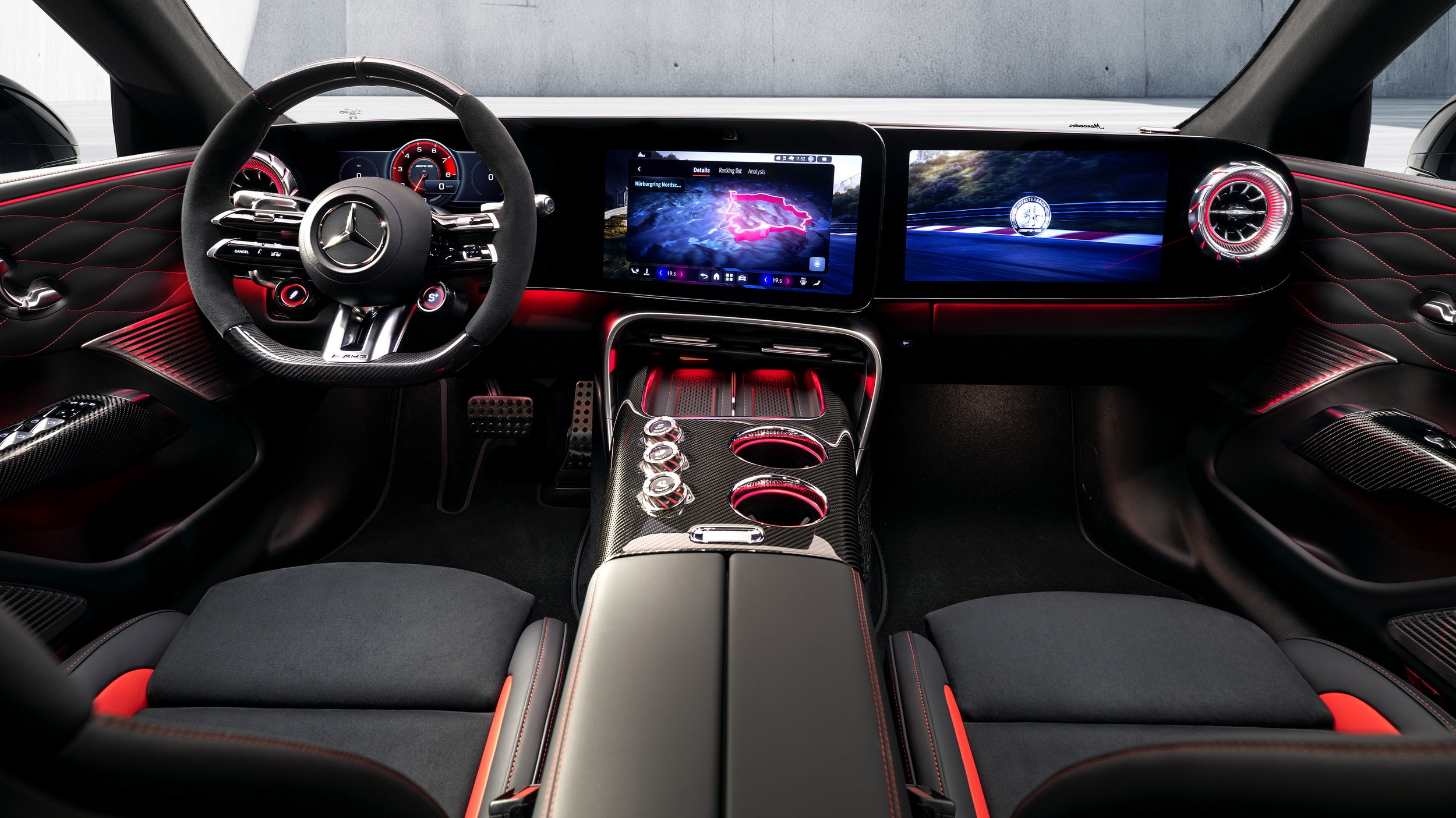
Drivers Want More Buttons, So Mercedes-AMG’s New Super Sedan Removes Most Of Them

  • Mercedes shows the cabin of the new AMG 4-Door Coupe.
  • Inside sits a triple-screen layout and three rotary dials.
  • The high-performance EV is set for a full debut this spring.

Mercedes-AMG has pulled the covers off the interior of its upcoming electric super-sedan. The next-generation AMG GT 4-Door Coupe is effectively the production version of last year’s AMG GT XX concept, aimed at the Porsche Taycan and the growing pack of high-performance EVs trying to redefine what a fast four-door should be.

Unlike the symmetrical hyperscreen layouts used across the regular EQ lineup and the latest S-Class, the AMG’s center console is angled toward the driver. A 14-inch infotainment display dominates the layout, leaning just enough in the driver’s direction to remind you this is supposed to be the sporty one. That screen works alongside a 10.2-inch digital instrument cluster, with an optional 14-inch display available for the passenger.

More: Mercedes Teases A Flood Of New Models Coming Soon

Mercedes says the operating logic is “balanced,” blending haptic buttons, touchscreen inputs, and voice control. In practice, though, it seems AMG didn’t fully buy into the recent return to physical controls that several rivals have started embracing. The most obvious casualty is the climate system, which remains buried inside the MBUX infotainment menus

 Drivers Want More Buttons, So Mercedes-AMG’s New Super Sedan Removes Most Of Them
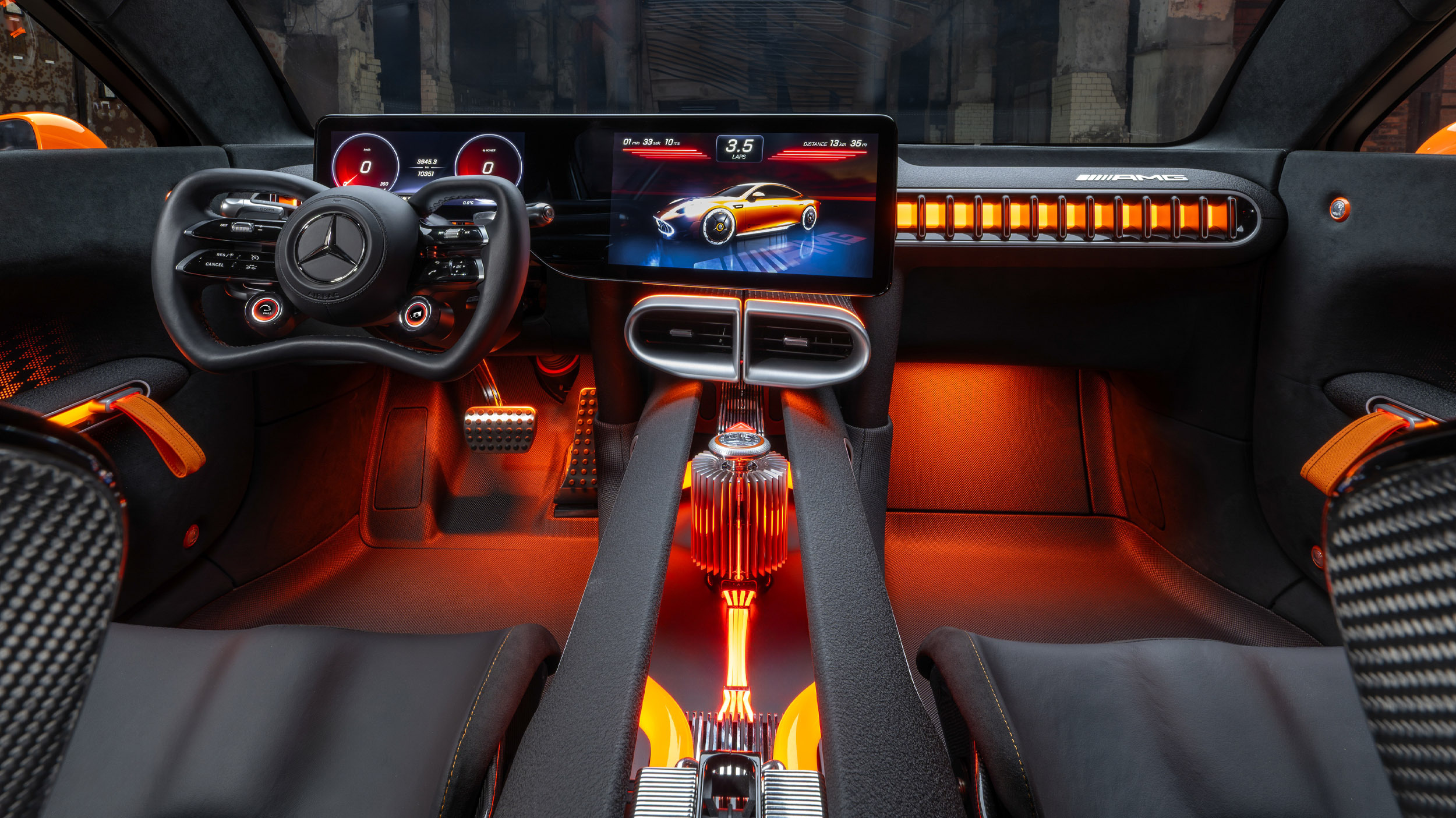
Production AMG GT 4-Door Coupe interior (above) vs. AMG GT XX Concept (below).
 Drivers Want More Buttons, So Mercedes-AMG’s New Super Sedan Removes Most Of Them

AMG-specific touches include illuminated climate vents styled to resemble jet engines, a flat-bottom steering wheel with carbon accents and haptic feedback, optional AMG Performance seats, and a metal-like wing element stretching across the center console.

Also: Mercedes Can’t Stop, Won’t Stop With Massive Screens

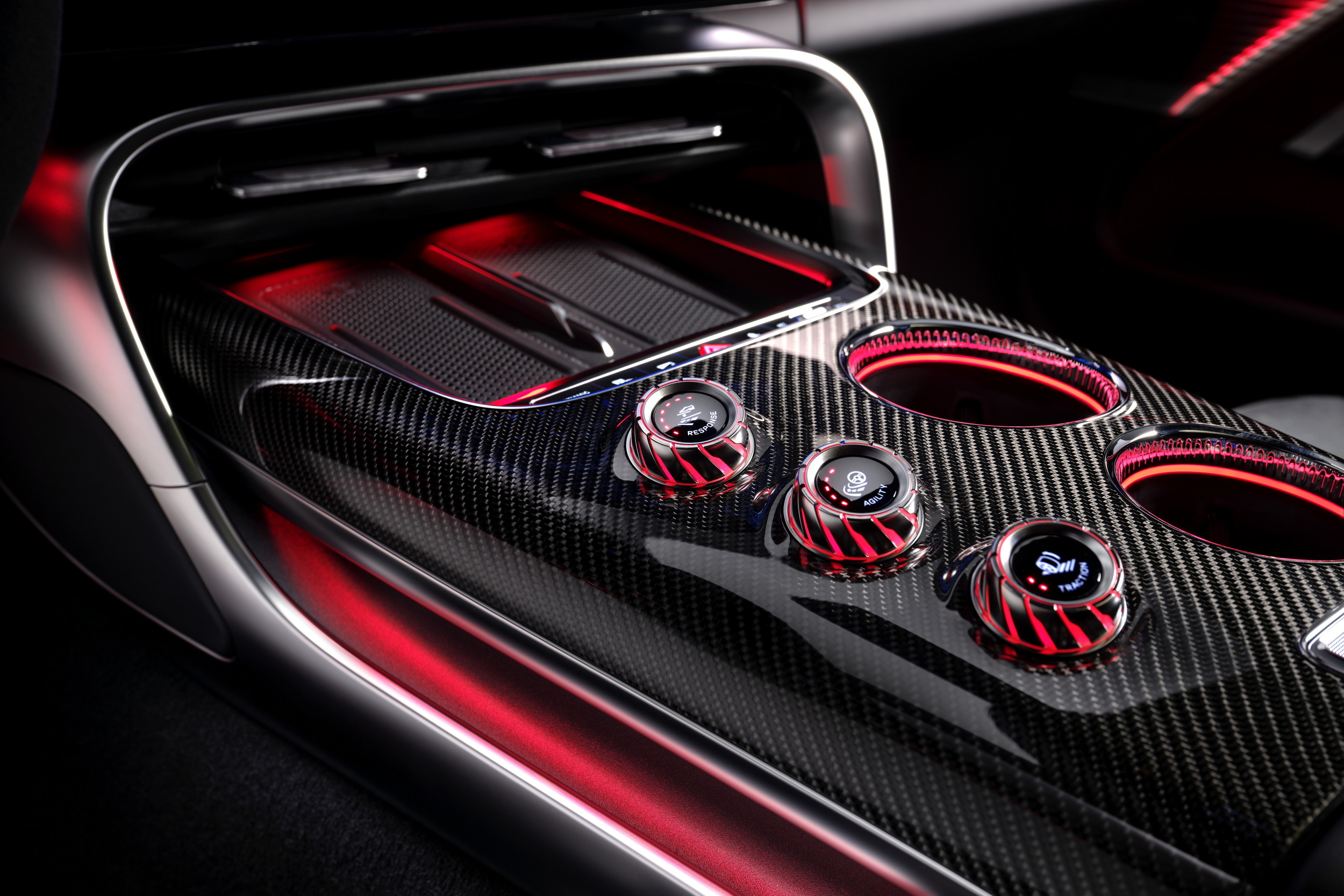
You also get three chunky rotary controllers on the center tunnel. Apparently, even in the EV age, AMG still believes drivers should have something physical to fiddle with.

Those dials tie directly into the car’s driving dynamics. Response Control adjusts the behavior of the e-motors and accelerator pedal, Agility Control tweaks cornering characteristics, and Traction Control offers nine stages of intervention through the new AMG Race Engineer system. The driver can also jump straight to key functions using two steering wheel buttons that feature their own LCD displays.

 Drivers Want More Buttons, So Mercedes-AMG’s New Super Sedan Removes Most Of Them

Smart Glass Roof Party Trick

One of the more eye-catching tech features is the Sky Control panoramic glass roof, which can switch between transparent and opaque states. At night, it can also project AMG emblems or racing stripes across the glass, matched to the colors of the ambient lighting system.

More: Mercedes Design Boss Admits “Screens Aren’t Luxury” And The Software’s Not Great Either

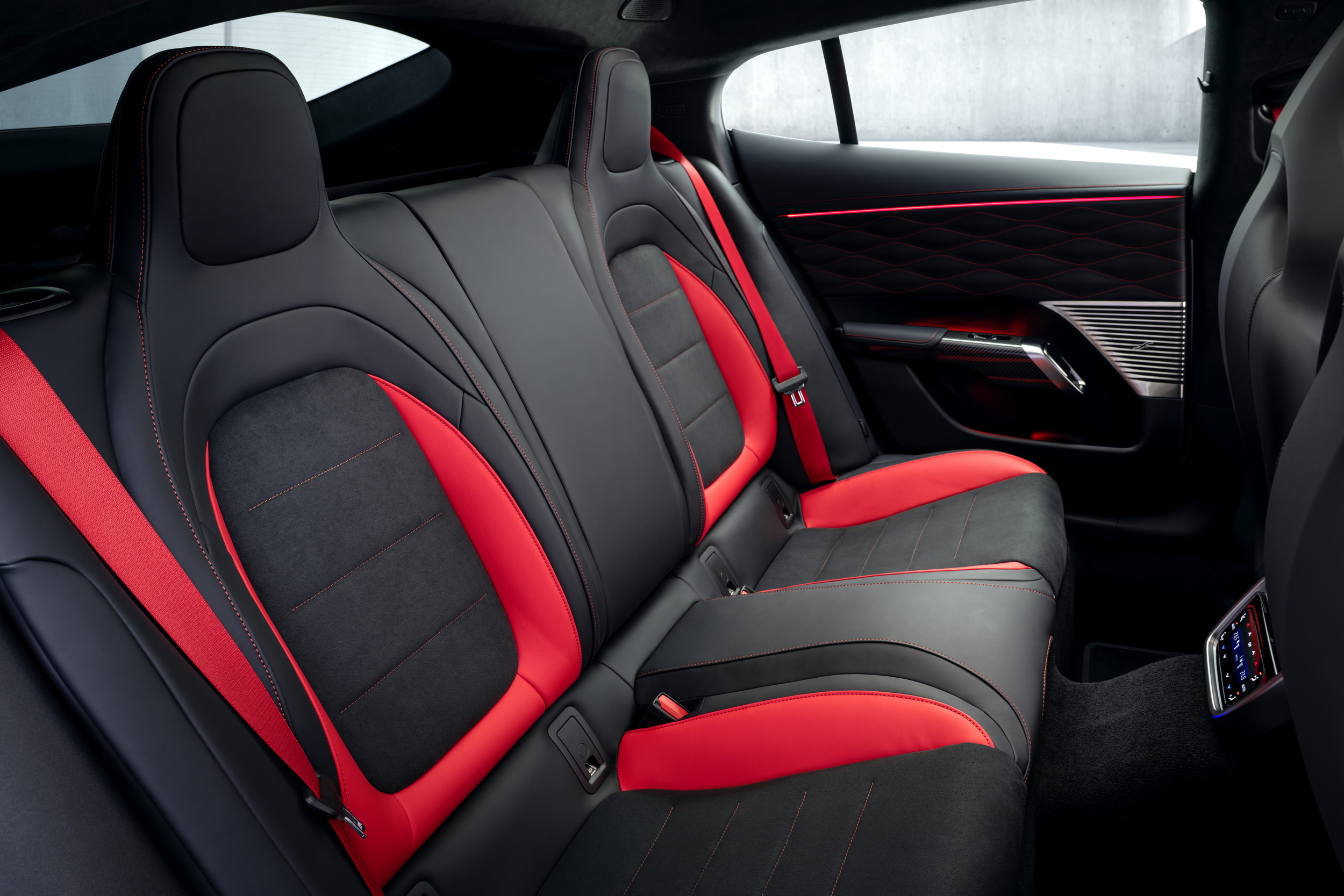
Up front, practicality gets a small but noticeable boost with illuminated cup holders and dual wireless charging trays. In the back, Mercedes promises “generous legroom, pleasant headroom, and a naturally comfortable knee angle,” all aimed at making longer journeys a bit less taxing. The standard layout is a four-seater, although buyers will also be able to opt for a five-seat configuration.

 Drivers Want More Buttons, So Mercedes-AMG’s New Super Sedan Removes Most Of Them

Coming Soon

The full reveal of the new AMG GT 4-Door Coupe is expected this spring, with deliveries scheduled to begin later in the year. The high-performance EV will also become the first production model to ride on Mercedes-AMG’s dedicated AMG.EA platform, which is being developed specifically for future electric performance cars.

More: AMG Hyper EV Circles The Globe In Seven Days And Smashes 25 Records

The concept version arrived with some properly serious numbers. It used three axial-flux motors producing a combined 1,341 hp (1,000 kW / 1,360 PS), complete with synthetic V8 sound. The battery pack also featured Formula 1-derived cooling technology and ultra-fast charging capability, allowing it to add 249 miles (400 km) of range in just five minutes

\\\\\\\\\\\\

Mercedes-AMG

BYD’s New Flagship Great Tang Charges From 10 To 97% In 9 Minutes

  • This is the first BYD model with its second-gen Blade battery.
  • It rides on brand’s new Super e platform with 1000-volt tech.
  • Both rear-wheel drive and all-wheel drive versions are offered.

BYD has a new flagship SUV, and it’s called the Great Tang. The name may sound a little unusual, but underneath sits the Chinese giant’s latest electric platform, built to take on high-end rivals like the Zeekr 9X and IM LS9, along with more familiar names from Europe and Asia such as the Volvo EX90 and Hyundai Ioniq 9.

More: BYD Says Its New Battery Can Recharge As Fast As Filling Up Your Gas Tank

First previewed by the Chinese Ministry of Industry and Information Technology earlier this year and now revealed in full, the Great Tang is bigger than even the Denza B8. It stretches to 5,302 mm (208.7 inches) in length, measures 1,999 mm (78.7 inches) across, stands up to 1,800 mm (70.8 inches) tall, and rides on a generous 3,130 mm (123.2-inch) wheelbase. The SUV also forms part of BYD’s new premium Dynasty series of models.

Design-wise, it looks quite smart, particularly with the two-tone red-and-silver paint scheme it was presented with. The front end shares similarities with existing BYD models, complete with a flowing light bar, a black lower grille, and vertical headlamps neatly integrated into the fascia.

Class-Leading EV Tech

But the real story isn’t the styling. It’s the technology lurking underneath. The Great Tang rides on BYD’s new Super e platform and uses the company’s second-generation Blade battery. According to BYD, those cells can charge from 10 percent to 97 percent in just nine minutes, provided you plug into one of its new 1,500 kW charging stations. The SUV also runs a 1000-volt electrical architecture, which helps make those charging claims possible.

\\\\\\

There’s still no word on the size of the SUV’s battery pack, but BYD has confirmed a few key drivetrain details. A single-motor version will be offered with either 402 hp or 496 hp. If that sounds a bit restrained for something this large, there is also a dual-motor setup delivering 784 hp.

Even so, the numbers that matter most for a family-sized electric barge are the range figures. Despite weighing as much as 2,970 kg (6,547 lbs), BYD claims the rear-motor version can travel up to 590 miles (950 km) on the CLTC cycle. Opt for the punchier dual-motor model and the figure drops slightly to around 528 miles (850 km) on a charge. Still, for something this big, that is not exactly a short leash.

\\\\\\\\\

A glance inside reveals a 2+2+3 seating layout and pretty much every luxury extra you’d expect in a flagship family hauler. The dashboard is dominated by a large central infotainment display, joined by separate screens for the driver and front passenger. You also get wireless phone chargers, a built-in fridge, and a fold-down screen in the ceiling to keep rear passengers entertained on longer trips.

In China, prices are expected to start just above 400,000 yuan, which works out to roughly $58,000.

\\\\\\

Porsche Charges $133K For This Look, Now China Sells It For $36K

  • SAIC unveils the Z7 EV in sedan and Shooting Brake forms.
  • Its design shows clear similarities to Porsche’s Taycan.
  • Expected pricing ranges from $36,200 to about $50,700.

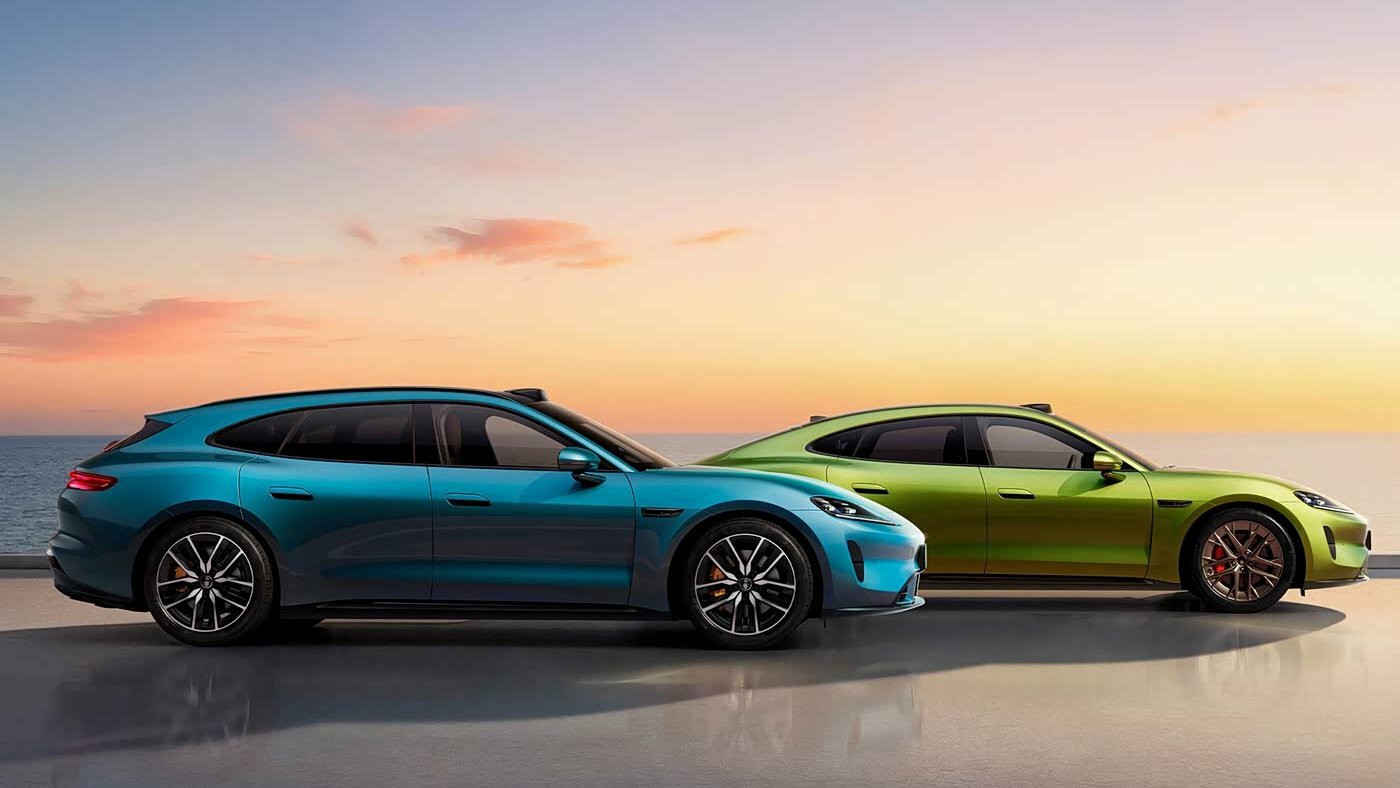
Thought the Xiaomi SU7 looked a little too much like a Porsche Taycan? Apparently that was just the warm-up act. Fellow Chinese carmaker SAIC has now pushed the idea of “imitation is the sincerest form of flattery” a step further, revealing an electric sedan and Shooting Brake that, from most angles, could easily have Porsche fans doing a double take.

Developed under the Harmony Intelligent Mobility Alliance (HIMA) and led by Huawei, the SAIC Z7 was teased earlier this year and has finally been shown in full. Several key details remain under wraps, but pricing is expected to land between 250,000 and 350,000 yuan ($36,200 – $50,700).

That is slightly higher than some early estimates suggested, though still a long way from Taycan money. Porsche’s electric sedan currently starts at 918,000 yuan (equal to around $133,000 at current rates).

Read: China’s $28K Taycan Clone Is Coming Whether Porsche Likes It Or Not

Viewed from the front, both the sedan and Shooting Brake models look somewhat distinctive, with sharp LED headlights and a black lower grille. But cast your eyes beyond the front fenders, and the similarities to the Taycan are impossible to ignore. The shape of the doors, the roofline, the wing mirrors, and the door handles look like they’ve been ripped straight from a Porsche parts catalog.

 Porsche Charges $133K For This Look, Now China Sells It For $36K
 Porsche Charges $133K For This Look, Now China Sells It For $36K
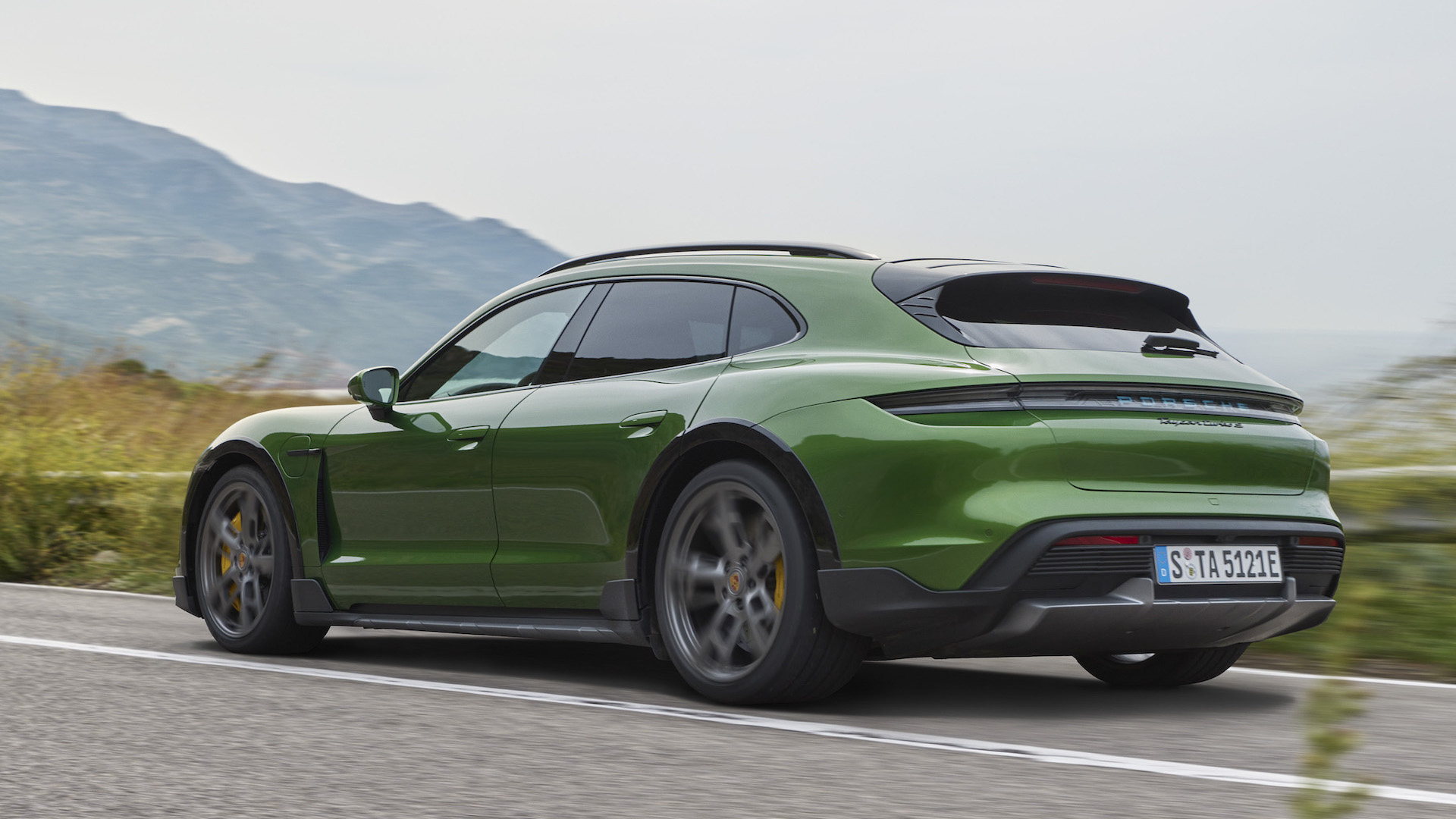
Porsche Taycan Cross Turismo

The resemblance becomes even more obvious when you walk around to the rear. Much like the Taycan, the Z7 features a full-width LED light bar with an intricate lighting signature. The tailgate design also looks remarkably similar to Porsche’s electric sedan.

And then there is the Shooting Brake. Its overall shape and side profile track very closely with the Taycan Sport Turismo, to the point where the silhouette alone could cause a moment of confusion.

Perhaps in a direct shot at the Xiaomi SU7, the Z7 has also been showcased in a bright shade of pink with black wheels and matching pink outer rims. As fate would have it, the Xiaomi SU7 15th Anniversary Edition presented in early 2025 had an identical finish.

 Porsche Charges $133K For This Look, Now China Sells It For $36K

Only a handful of interior images have been released so far. They reveal a thin digital instrument cluster, a large central infotainment display, and an additional screen for the passenger. In other words, the sort of setup that has become standard fare across many modern Chinese EVs.

There are also two wireless charging pads and a sporty flat-bottom steering wheel, rounding out a cabin that feels very much in line with current trends.

Technical specifications for the Z7 have not yet been confirmed. However, Chinese media reports suggest the EV could arrive with 80 kWh and 100 kWh battery packs, along with both rear-wheel-drive and all-wheel-drive configurations. More concrete details are expected to be released in the next few weeks.

\\\\\\\\\\\\\\\

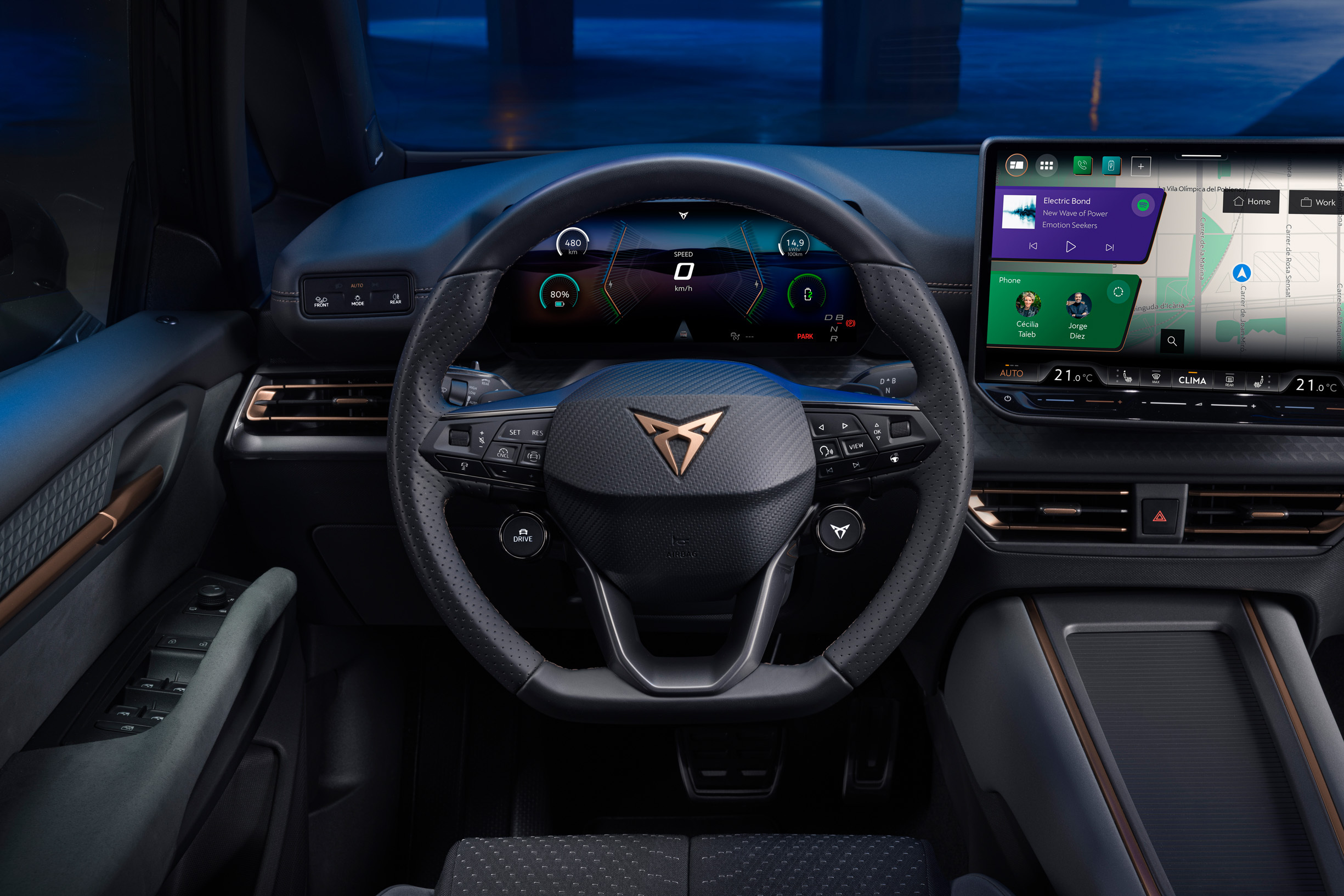
Cupra Born Again With Real Buttons And A New Face

  • Cupra refreshes Born EV with new family face, upgraded tech.
  • Steering wheel swaps hated haptic controls for physical buttons.
  • Sportiest VZ version packs 322 hp and offers a 372-mile range.

The Cupra Born has always been the cooler, more rebellious cousin in Volkswagen’s electric hatchback family. Now the Spanish brand has given it a facelift that sharpens the looks, upgrades the cabin and adds a bit more range, while quietly fixing one of the few annoying features from the original ID.3 twin.

The makeover starts on the outside, where the Born now adopts Cupra’s latest design language. The nose gets a more aggressive shark-like shape and new triangular Matrix LED headlights that echo the styling of newer models like the Tavascan and Formentor.

Related: Cupra’s Smallest EV Just Drove Around Naked Hoping Nobody Would Notice

Taillights now include an illuminated Cupra logo integrated into a full light bar and new wheels arrive in 19 and 20-inch sizes wrapped in wider 235 mm tires. Cupra says the extra rubber helps improve grip and handling, which was already great, though it did come at the expense of a firm-ish ride.

Real Buttons

 Cupra Born Again With Real Buttons And A New Face

But inside is where one of the most welcome changes happens. The previous car’s frustrating haptic steering wheel controls have been replaced with actual physical buttons. It’s a shame Cupra didn’t replace the nasty touch-slider temperature controls on the main screen while they were at it, but that’s the drawback of sharing tech between multiple brands.

That 12.9-inch touchscreen introduced in a 2024 update is carried over, but gains a new Android based operating system. The digital gauge cluster has grown, though, from a tiny 5.3 inch display to a much more usable 10.25 inch screen.

Material quality, which was always better in the Born than in the VW ID.3, has also been further improved with redesigned door panels, softer surfaces and recycled textiles made from marine plastics. Rear passengers now get air vents as well, which might not sound exciting but is something the previous model lacked.

Less Power, More Miles

\\\\\\

Under the skin the Born still rides on Volkswagen Group’s MEB electric platform, but the powertrain lineup has been tweaked, and now comes with a one-pedal driving mode. The entry-level Born Plus uses a 58 kWh battery and a 187 hp (190 PS / 140 kW) motor, down from 201 hp (204 PS / 150 kW) before. The payoff is in range, which increases from 264 miles (425 km) to 280 miles (450 km).

Step up to the larger 79 kWh battery in the Endurance and you’ll get around 372 miles of range (600 km) – up from 366 miles (590 km) – along with faster 185 kW charging and a power boost to 228 hp (231 PS / 170 kW). That grows to 322 hp (326 PS / 240 kW) in the VZ hot hatch, and since you get to keep all of the Endurance’s 372 range miles while gaining nearly 100 horses, it looks like the pick of the lineup.

The new-look Born hits European dealers this summer, but it better enjoy the spotlight while it can, because this year Cupra launches its little brother, the all-new Raval.

\\\\\

Cupra

Lotus Built A 939 HP Hybrid SUV For Me, Apparently

  • Lotus reveals a plug-in hybrid Eletre called For Me in China.
  • The SUV uses a 900-volt system and a large 70 kWh battery.
  • Total output reaches 939 hp, edging past the Eletre R.

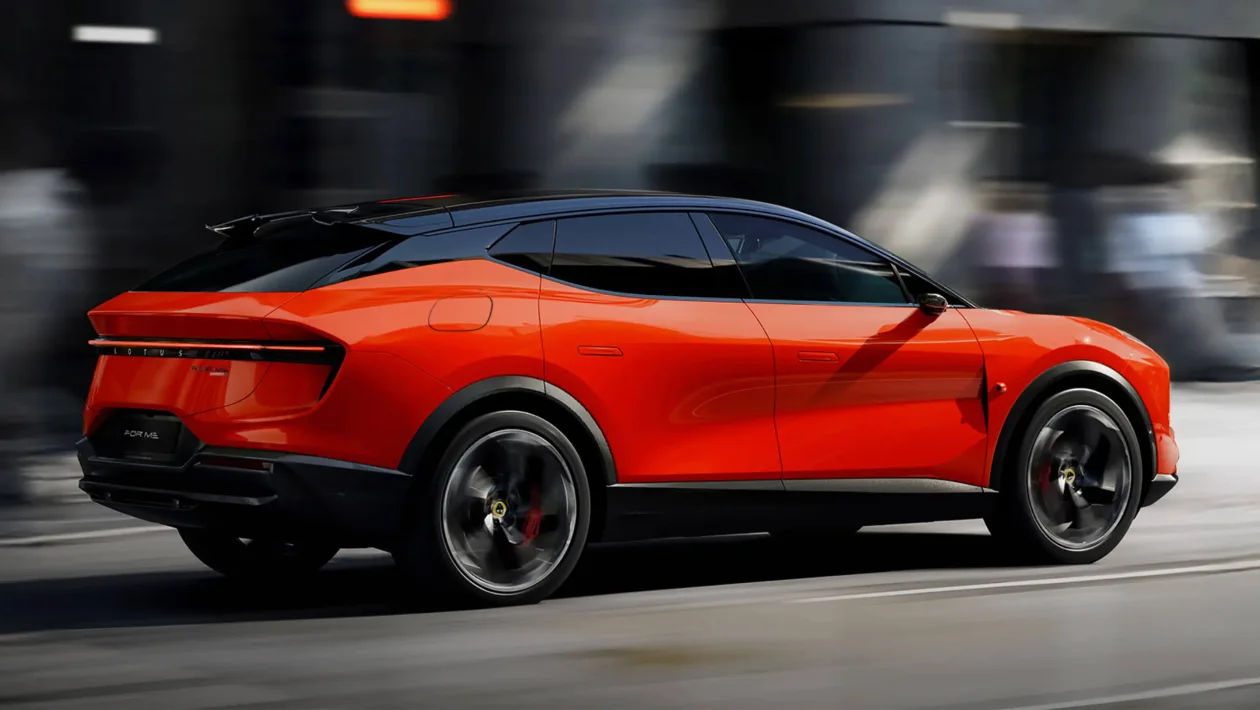
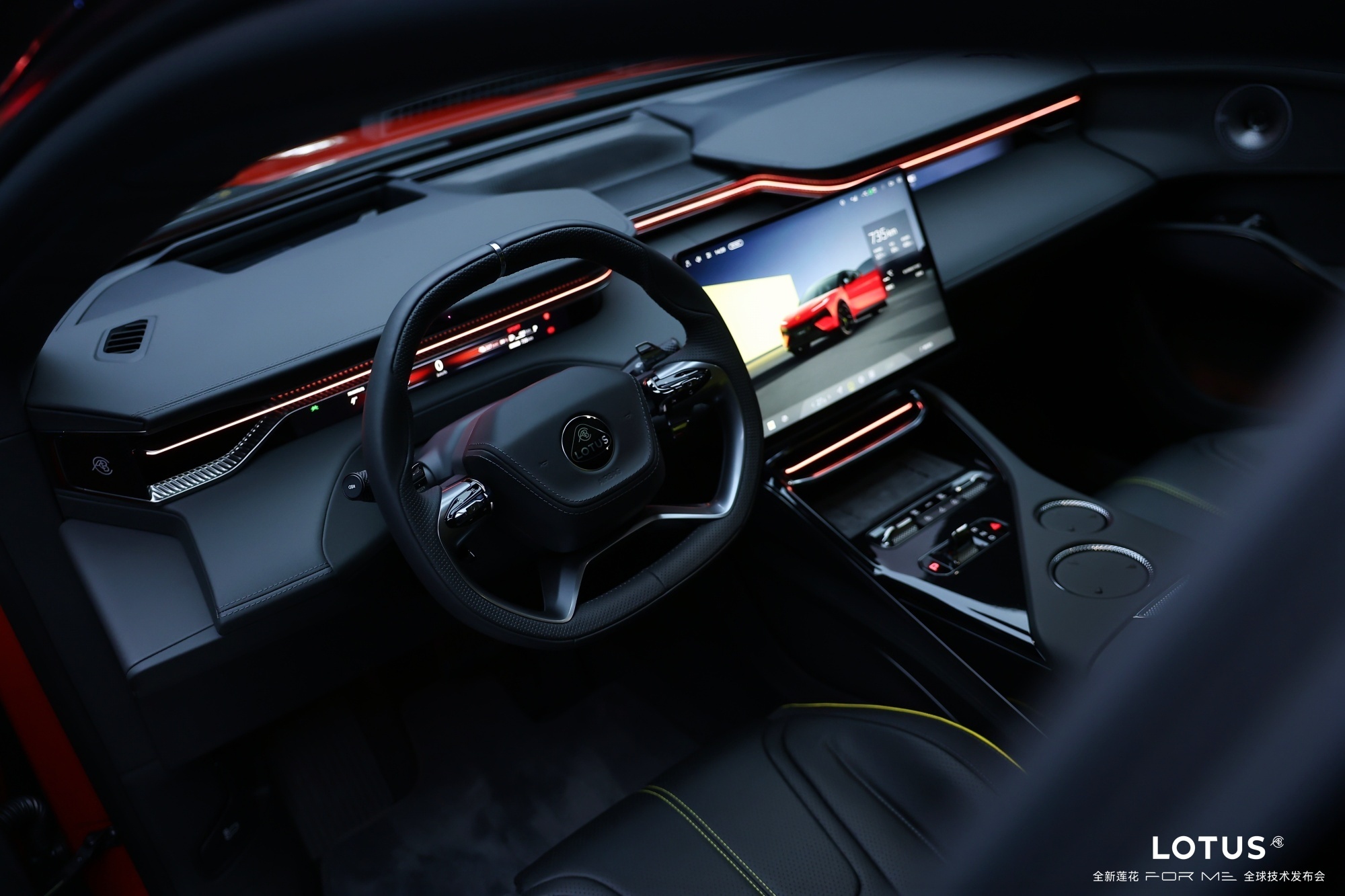
Lotus has been quite open about plans to introduce a plug-in hybrid version of the Eletre in China. What slipped under the radar until now is the name change. Meet the Lotus For Me. Yes, that really is the official name for the Chinese market. Thankfully, the rest of the world will not have to explain it at dinner parties.

The automaker calls the PHEV a “hyper-SUV,” built around its new X-Hybrid architecture. The setup uses a 900-volt electrical system paired with a 70 kWh battery pack and two electric motors. Combined output lands at 939 hp, which is slightly more than the flagship all-electric Eletre R. A 2.0-liter turbocharged four-cylinder is also part of the powertrain, stepping in when the battery needs backup.

Read: Lotus Might Slash Eletre’s Price In Half In Canada

Off the line, the For Me reaches 100 km/h (62 mph) in just 3.3 seconds. It continues to 200 km/h (124 mph) in 10.5 seconds and clears the quarter-mile in 11.16 seconds.

Electric Range And Charging Capability

More surprising are the range claims. Lotus says the SUV can travel 260 miles (418 km) on electricity alone and more than 870 miles (1,400 km) when the hybrid system is working together. WLTP-rated fuel consumption is quoted at just 0.07 l/100 km under ideal test conditions, which is impressive on paper and, as usual, a bit harder to match outside a laboratory.

 Lotus Built A 939 HP Hybrid SUV For Me, Apparently

The battery pack supports 6C charging rates, which means it can jump from 30-80 percent in just eight minutes.

What Else Is New?

Visually, there is almost nothing separating the new For Me from the regular Eletre. Aside from fresh badges, functional exhaust pipes, and a few extra cooling vents up front, the design remains largely unchanged.

Under the skin, the same 48-volt active anti-roll bars as the Eletre have been retained, as has the trick dual-chamber air suspension and dual-valve adaptive dampers. Despite the fitment of a new plug-in hybrid system, the For Me weighs roughly the same as the Eletre, varying between 2,575 kg (5,676 lbs) and 2,626 kg (5,789 lbs), depending on the specification.

 Lotus Built A 939 HP Hybrid SUV For Me, Apparently

Lotus says the For Me will go on sale in China later this month. Europe is next in line in mid-2026, followed by North America, the Middle East, Asia Pacific, and other markets before the end of the year.

What Is Lotus Tuned Specification?

Its debut also coincides with Lotus introducing a new internal standard called Lotus Tuned Specification (LTS). According to the company, LTS is a proprietary engineering and dynamic tuning framework that brings several core systems under one coordinated development process. Lotus engineers worked alongside key suppliers to co-develop components such as the brakes, active stabilizer bars, and suspension hardware.

\\\\\\\\\\\\\\\\

After Failing To Crack America, VinFast Wants A Crack At Rolls-Royce Buyers

  • VinFast has revealed two new Lac Hong models.
  • 800S and 900S draw cues from Rolls and Maybach.
  • Both electric flagships are due to arrive in 2027.

VinFast may be struggling to crack the world’s most lucrative market here in the US, but that is not stopping it from aiming higher up the food chain. The company has unveiled a pair of flagship ultra-luxury models intended to push its image far beyond the mainstream EV space.

The 800S SUV and the 900S sedan join the existing 900 LX in the Lac Hong high-end lineup, taking aim at the Rolls-Royce Cullinan and the Mercedes-Maybach S-Class, or at least daring to.

The new models feature a large grille with vertical slats inspired by Vietnamese bamboo, flanked by split LED headlights. A gold ornament on the hood depicts the mythical Lac bird, which also appears on the D-pillars and rear emblem. According to VinFast, the Lac Hong lettering on the tailgate is crafted from a genuine gold-plated alloy.

More: VinFast’s American Dream Is Cracking From The Inside Out

The 900S sedan rides on a massive wheelbase and adopts a sculpted profile accented with aluminum trim, while its black wheels look lifted straight from the Maybach playbook. A sloping roofline flows into a fastback-style rear end with T-shaped LED taillights and a pair of vents.

\\\\\

The 800S SUV, by contrast, mirrors the upright proportions of the Rolls-Royce Cullinan, with straight character lines, silver accents, multi-spoke wheels, and a thick D-pillar that reinforces its imposing stance.

Cabin Materials And Interface Layout

Inside, both models combine wood veneers with Nappa leather and gold-plated inserts. The dashboard integrates a single display that houses both the digital instrument cluster and infotainment system. A cylindrical knob on the center console recalls BMW’s iDrive controller. Dual wireless charging pads, manual controls for the power-adjustable seats, and gold-plated speaker grilles round out the presentation.

\\\\\\\

While both cars share much of their dashboard architecture, the 900S sedan shifts the spotlight firmly to those in the back. It promises generous rear legroom, zero-gravity executive seating, automatic power-assisted doors, and an available partition housing a large-format projection entertainment system and a foldable executive workstation. There is also a starry night headliner and warm ambient lighting to seal the deal.

Tri-Motor Power And Fully Active Suspension

Both models are fitted with an electric powertrain. The tri-motor option produces a combined 617 hp (460 kW / 625 PS), sending power to all four wheels. VinFast has not shared details on battery capacity or range, but it does promise an all-new fully active suspension system engineered to deliver exceptional ride comfort and dynamic stability. The EVs will also feature advanced intelligent technologies and comprehensive safety systems.

More: BMW And Porsche Just Lost China’s Luxury Market To A $100,000 Newcomer

 After Failing To Crack America, VinFast Wants A Crack At Rolls-Royce Buyers

The VinFast Lac Hong 800S and 900S are scheduled to go on sale in 2027. Pricing remains under wraps, though it is safe to assume a healthy step up from the brand’s VF mainstream passenger EVs and Green commercial mobility lines.

And it is not just Rolls-Royce, Maybach, and Bentley in the crosshairs. VinFast’s Lac Hong range will also have to contend with Chinese players such as the Huawei-backed Maextro, which promise similar presence and tech at far more competitive prices.

\\\\\

VinFast

Tesla Owners Furious After FSD Transfer Rules Change Again

  • Tesla had said FSD transfers applied to orders by March 31.
  • Now it requires vehicles be delivered by March 31 instead.
  • Many buyers chose the base Cybertruck expecting FSD transfers.

Few, if any, car manufacturers change their prices and sales policies as abruptly as Tesla, and it has become part of the brand’s public persona. The company famously reversed its resale ban for the Cybertruck a couple of years ago, and it has now unsettled customers again with its latest Full Self-Driving-related revision.

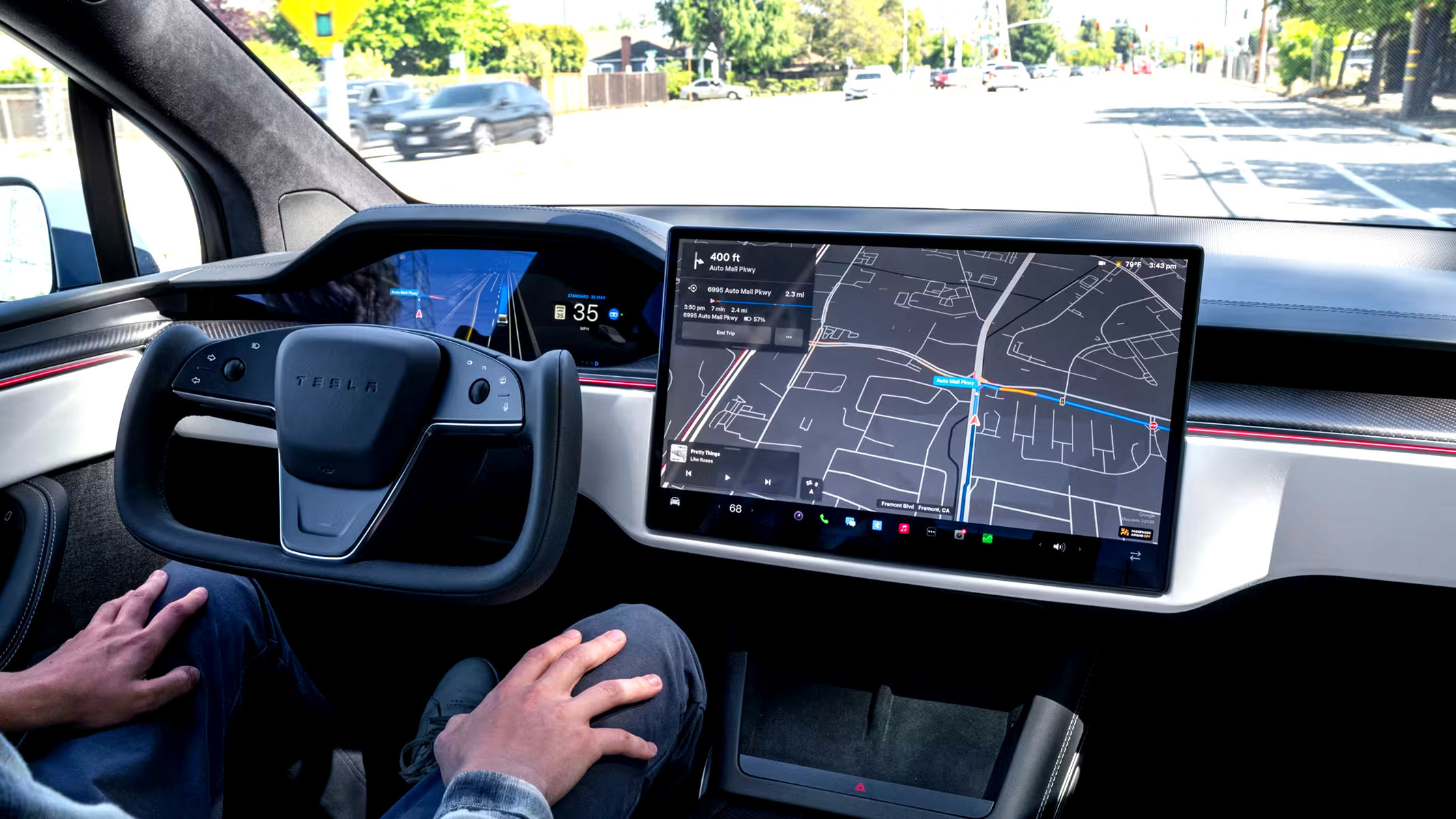
As Carscoops reported earlier this year, Tesla no longer offers Full Self-Driving (Supervised) as a one-time purchase and has shifted entirely to a monthly subscription model. It also announced that owners who had previously paid upfront for FSD would only be able to transfer it to their next vehicle if they took delivery of a new Tesla by March 31.

Read: That $8,000 Tesla Upgrade Won’t Be Yours Much Longer

Soon after this announcement, Tesla revised the wording of its FSD Transfer program terms, stating that customers simply needed to place an order by March 31 to qualify for a transfer. That revision took effect on January 20, 2026, temporarily replacing the delivery-by deadline with an order-by cutoff and giving buyers more flexibility, especially those trying to secure one of the final custom-built Model S or Model X vehicles before production winds down.

It has now reversed that change, once again requiring vehicles to be delivered by March 31 rather than merely ordered by that date.

 Tesla Owners Furious After FSD Transfer Rules Change Again

It is understood that customers who placed an order and received an expected delivery window on or before March 31 will remain eligible for an FSD transfer, even if delivery slips into April because of delays on Tesla’s side. However, those who placed an order but were given a delivery window beyond March 31 will not have their FSD transfer honored.

Bad News For Cybertruck Buyers

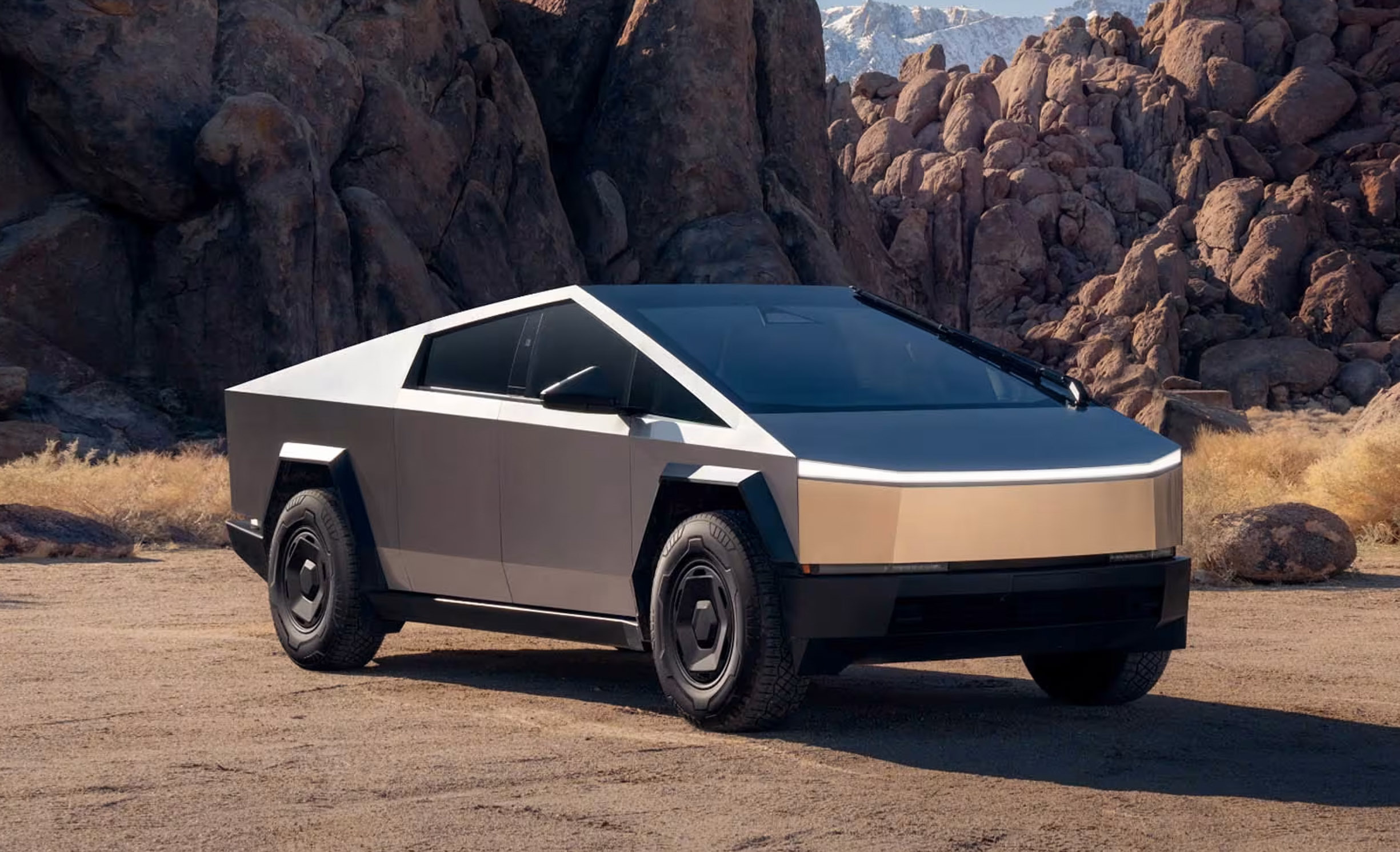
Those who placed an order for the new Tesla Model Cybertruck Dual-Motor AWD are likely to be most affected. After Tesla updated its policy to simply require an order placed by March 31, Not a Tesla App reports many shoppers placed orders for the new entry-level Cybertruck at its introductory price of $59,999, fully expecting to be able to transfer their FSD system, despite many deliveries not expected until next year. Now, those buyers appear to be out of luck.

Furthermore, that introductory price has since increased to $69,990, and deliveries for this specific trim are not expected to begin until the summer, effectively excluding all current order holders from the transfer window under the reinstated delivery rule.

Compounding the issue, there are no readily available Dual-Motor AWD Cybertruck units in existing inventory that would allow customers to pivot their transfer to an in-stock alternative.

In what seems to be an effort to ease frustration, Tesla is offering full refunds, including the $250 order fee, which is typically non-refundable.

 Tesla Owners Furious After FSD Transfer Rules Change Again
❌
❌