Normal view

There are new articles available, click to refresh the page.
Yesterday — 13 April 2026Main stream

BYD’s 200 Software Updates Last Year Made Toyota’s 8 Look Like A Rounding Error

  • Chinese brands are outpacing Western automakers on updates.
  • Legacy manufacturers are struggling to keep up, says report.
  • Despite this, Chinese marques are struggling to monetize software.

In an era where cars are less mechanical than they are tech showpieces on wheels, your car is becoming more akin to your phone in terms of how its lifecycle is updated. Modern vehicles are packed with screens and features, all governed by software, software that can be updated, refined, and patched with relative ease. According to one report, there’s a company that understands that better than any others.

That company is none other than BYD, the Chinese New Energy Vehicle specialist that continues to make headlines, both good and bad. In this instance, the firm is employing over-the-air (OTA) software updates to increase vehicle performance and the life cycle of its models.

See Also: China Does What Many Drivers Wish Someone Would Do About Car Screens

In mid-February, BYD released the fourth OTA update to its Han L sedan, a flagship vehicle of the Dynasty family, which was first unveiled in April 2025. The upgrade will introduce an enhanced driver assistance system, which is end-to-end AI-driven to improve its perception and decision-making in complex driving scenarios.

The new features will take about two hours to install, and owners will be in a position to utilize the new features without going to an automobile dealership.

Chinese Lead In OTA Updates
 BYD’s 200 Software Updates Last Year Made Toyota’s 8 Look Like A Rounding Error

Chinese manufacturers, such as BYD, seem to be leading in the OTA update sphere. While the concept may have been pioneered by brands such as Tesla, the evidence would suggest that Western manufacturers are lagging.

In the past, vehicles would receive only minor changes, often via facelifts and perhaps even several years after being introduced. OTA technology has broken this pattern and enabled the cycle of continuous improvements to keep vehicles updated throughout their lifetime in a similar manner as smartphones.

BYD leads this change with its active strategy of updates. In 2025, Nikkei Asia reports that the company released about 200 software updates on its Ocean and Dynasty brands. Other brands like Aito, a creation of Huawei Technologies and Seres Group, and startups like Leapmotor have become more prolific when it comes to OTA updates. Tesla, by comparison, only had 16 OTA updates last year. Toyota and VW didn’t fair any better, with eight and five respectively.
 BYD’s 200 Software Updates Last Year Made Toyota’s 8 Look Like A Rounding Error

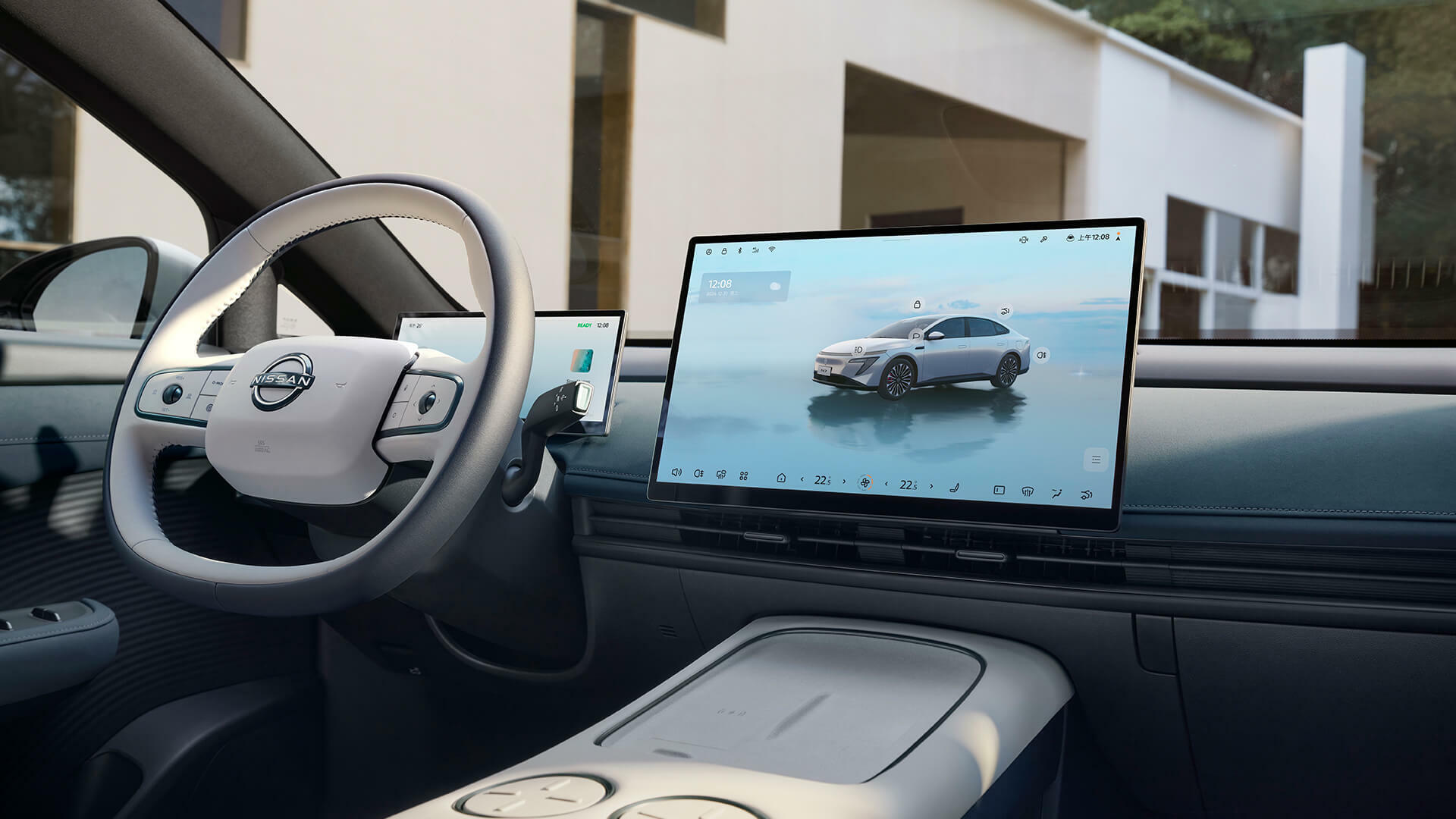
Nissan, with its new N7 electric car, however, managed to push out its first update just two months after its launch, unlocking new applications and longer voice recognition capabilities. “OTA updates must be developed even before product launch as part of the car’s lifecycle, in order to keep up,” said Isao Sekiguchi, managing director of Dongfeng Nissan.

There is a catch. The N7 is not a clean-sheet Nissan effort, but a joint project with Dongfeng Motor Corporation, built on the Chinese partner’s eπ 007 platform.

Less Opportunities To Monetize Updates
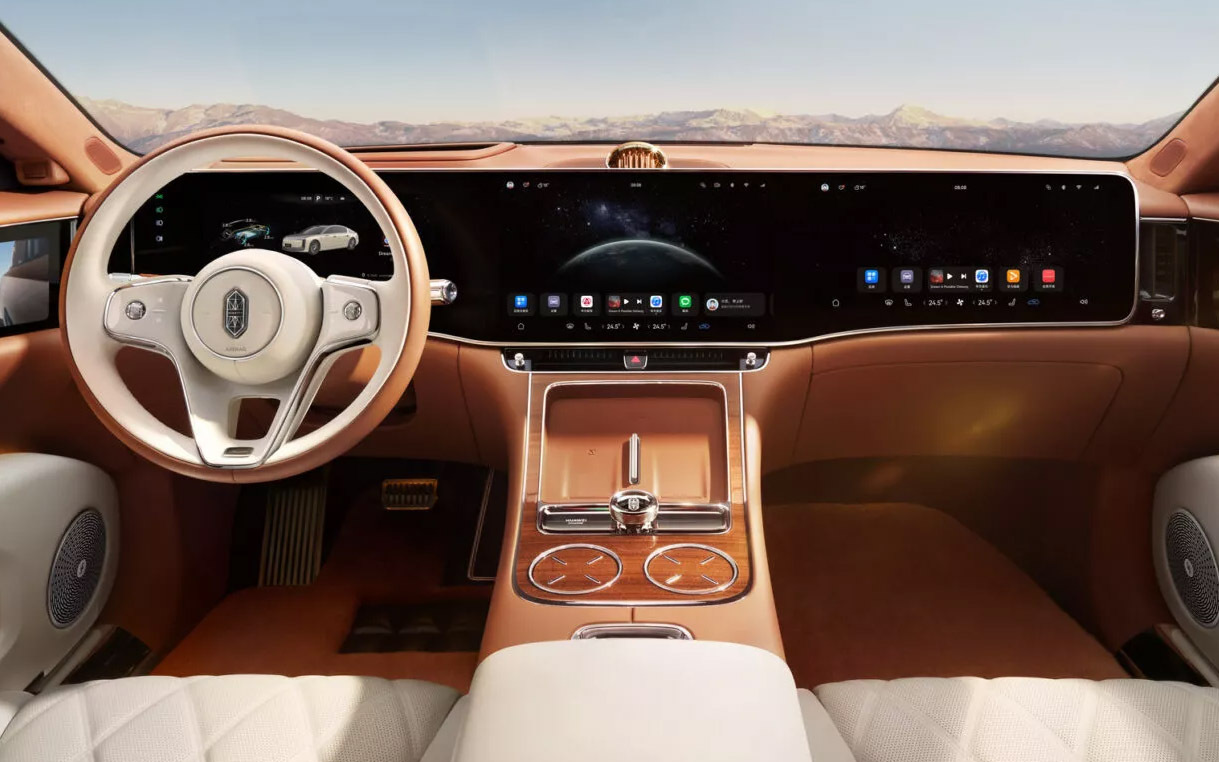
 BYD’s 200 Software Updates Last Year Made Toyota’s 8 Look Like A Rounding Error

BYD’s rapid rate may be explained by the vertical integration development model, i.e. in-house design of semiconductors, operating systems, and hardware, designed by BYD. Such control allows the company to update it at a very high speed and efficiently without modifying the user experience.

However, OTA updates have an economic cost. It’s not just the cost incurred in developing and rolling out each update. While the extension of technological relevance of a vehicle may enhance the resale values and decrease the occurrence of complete model redesigns, OTA technology is difficult to commercialize.

In China, updates are generally free of charge, which rules out the opportunity to add to a company’s bottom line. Instead, Tesla-like subscription-based solutions are being considered by the industry. XPeng is mulling over more advanced levels of autonomous driving, particularly Level 4 technology, which could be marketed as an extra service. This would mirror the strategy Tesla already used with its Full Self-Driving subscription in North America.
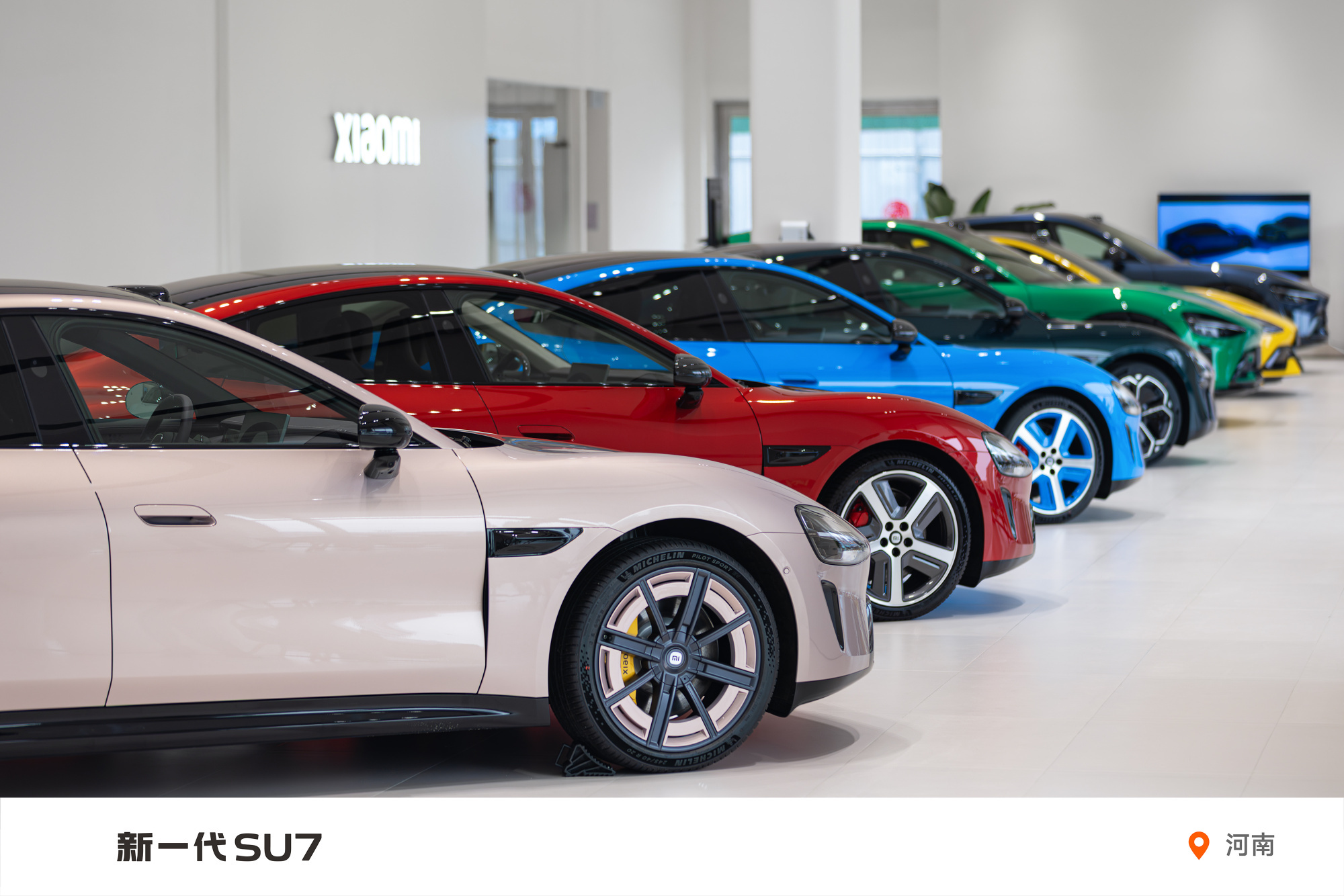
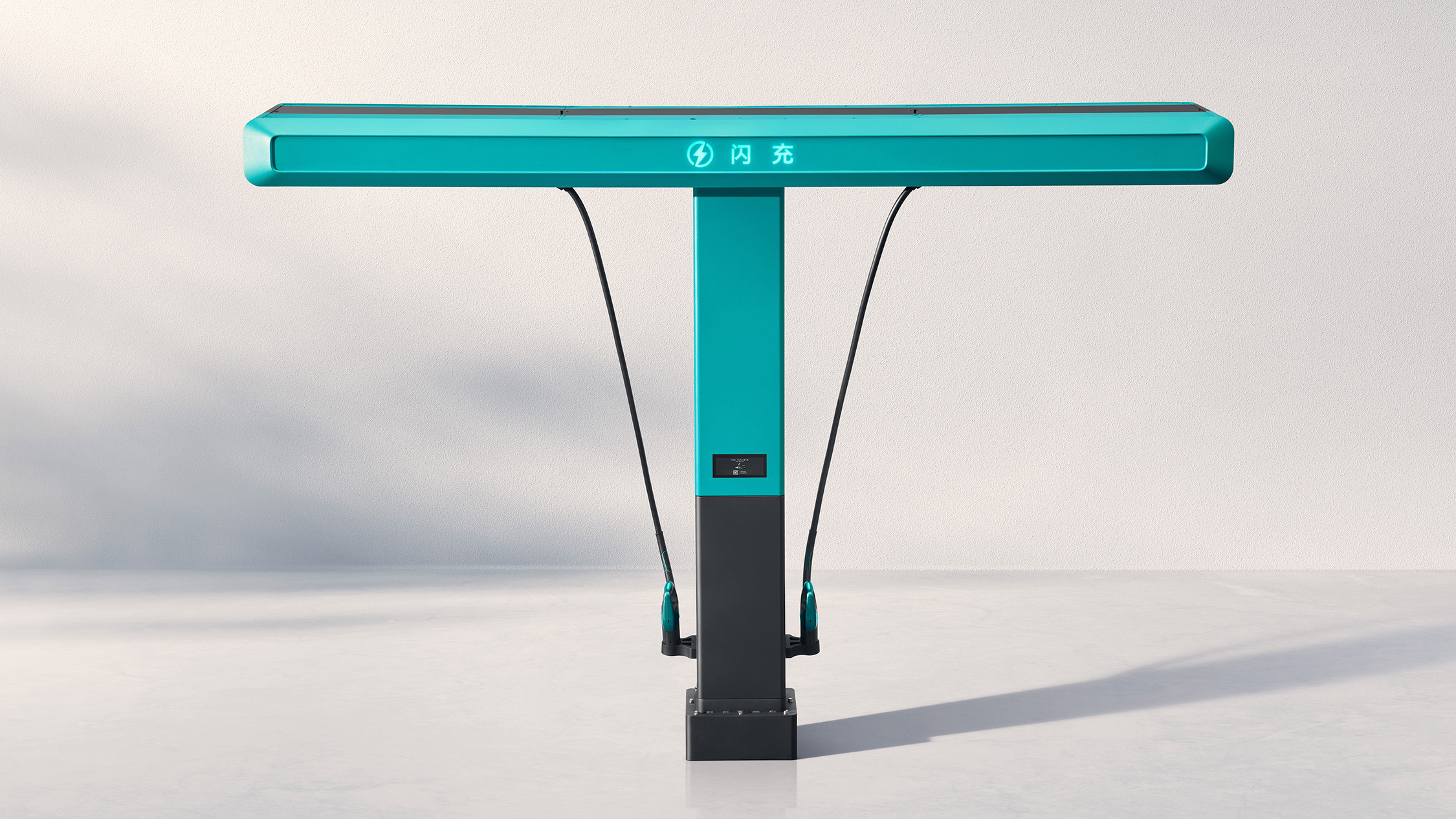
 BYD’s 200 Software Updates Last Year Made Toyota’s 8 Look Like A Rounding Error

BYD’s New Megawatt Flash Chargers Are Coming To Europe, And They’ll Be Open To Everyone

  • BYD will roll out ultra fast chargers in Europe delivering up to 1,500 kW.
  • Europe gets 3,000 Flash Charging stations within the next 12 months.
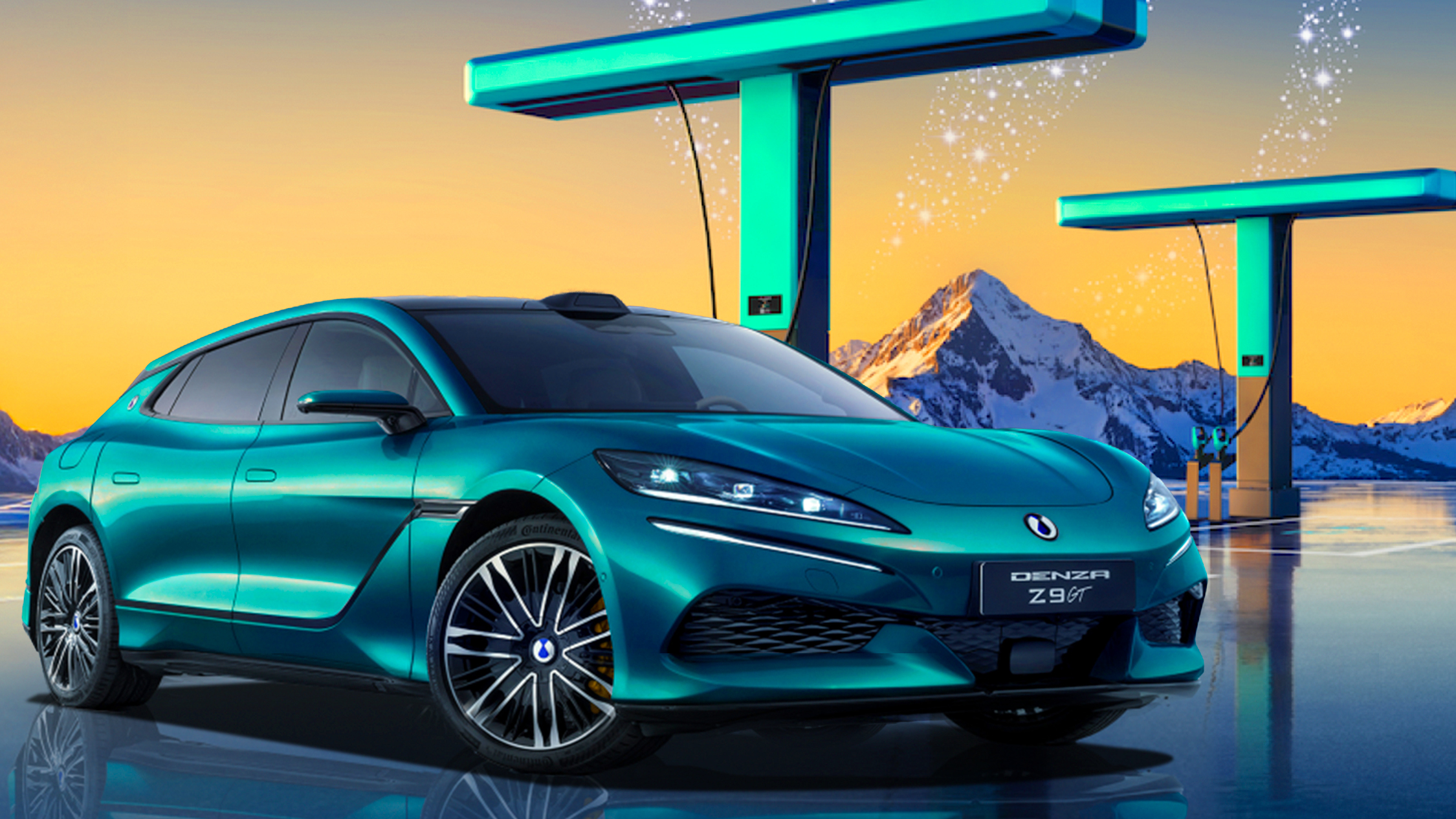
  • Denza EVs and even hybrids will both exploit very short top-up times.

BYD has officially confirmed that its absurdly powerful new charging tech is headed to Europe, which means the phrase “rapid charger” may soon need a slightly more ambitious definition. Across the next 12 months, the company plans 6,000 Flash Charging stations outside China, including 3,000 across Europe.

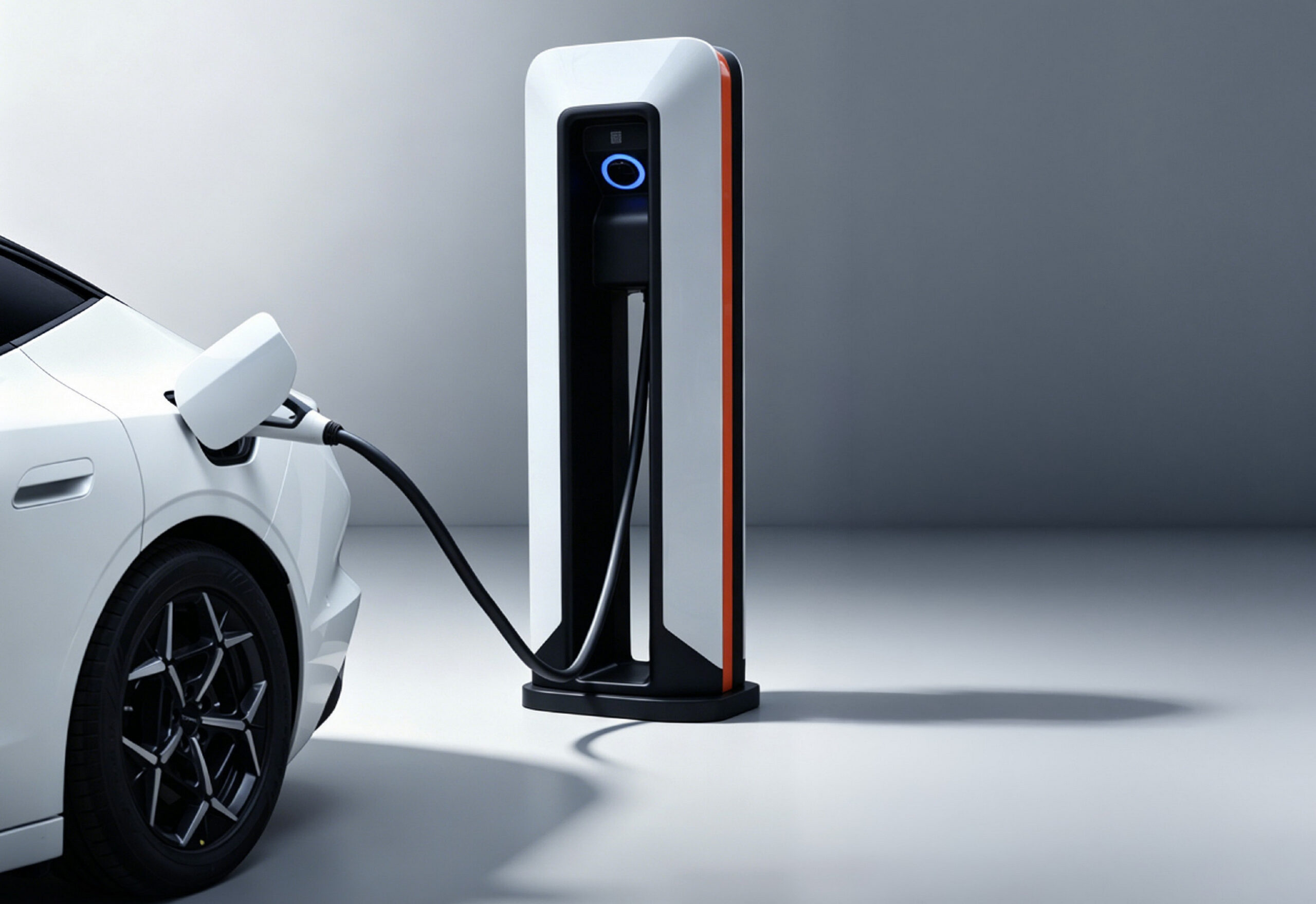
Europe already has thousands of EV fill-up stations, but these BYD Flash Charge devices don’t just edge past today’s fastest public chargers, they absolutely body-slam them. BYD says the new hardware can deliver up to 1,500 kW, making it comfortably the quickest charging setup announced for Europe so far.

Related: Geely’s Golden Brick Battery Charges Faster Than BYD, But Good Luck Finding A Plug For It

Better yet, this won’t be some members-only club for BYD owners. The chargers are set to use CCS2 connectors and should be open to other brands too. Dealers selling BYD’s posh Denza vehicles will get their own branded versions, while public sites elsewhere will simply wear the Flash name. BYD is also planning to work with existing charging locations rather than starting from scratch every time.

The headline numbers are predictably bonkers. BYD says its newest battery tech can take compatible cars from 10 to 70 percent in five minutes, and from 10 to 97 percent in nine. That’s less charging stop, and more pause for breath.

Denza Leads The Charge

\\\\\\

The first big beneficiaries in Europe will be the Denza Z9GT and the D9 DM-i. The Z9GT is the flashy one, a tri-motor, fully-electric shooting brake with a 123 kWh battery and enough shove to hit 62 mph in 2.7 seconds.

The D9 DM-i minivan, meanwhile, proves plug-in hybrids can join the party too. Its 58.5 kWh battery can accept up to 559 kW, allowing the same five-minute run from 10 to 70 percent and nine minutes from 10 to 97. That’s especially handy in a giant seven-seat MPV with 130 miles (209 km) of electric range and a 590-mile (950 km) total figure when the petrol tank is full. In contrast, some PHEVs from other brands still don’t accept DC charging at all.

\\\

Of course, BYD isn’t the only one throwing elbows. Earlier this week, Geely claimed its latest chargers and Golden Brick battery tech were even quicker still, because apparently the industry has decided the best way to sell EVs is through stopwatch violence.

BMW Says Non To Charging War

BMW, though, isn’t buying the hype. “You always have to be careful with those kinds of announcements,” the company’s battery production boss Markus Fallböhmer told Car Sales recently, suggesting battery longevity and reliability could be at stake.

“It is possible to optimize one single performance indicator, but you have to make compromises on other sides. We could also increase our charging speed, but then you have to reduce other important factors of a battery.”

 BYD’s New Megawatt Flash Chargers Are Coming To Europe, And They’ll Be Open To Everyone

BYD

Before yesterdayMain stream

Geely’s Golden Brick Battery Charges Faster Than BYD, But Good Luck Finding A Plug For It

  • Geely claims its latest batteries charge faster than BYD’s mk2 Blades.
  • Energee Golden Brick charges from 10-70 % in just 4 minutes 22 secs.
  • BMW warns extreme charging speeds could bring durability trade-offs.

Forget zero to 60 mph (97 kmh) times, the EV world has a new kind of electric performance battleground and China’s Geely just claimed top honors. It says its new batteries can charge even faster than the BYD batteries that sent us into a spin last month with their crazy top-up times.

Geely’s Lynk and Co brand says its latest 95 kWh battery – the hopefully not prophetically named 900V Energee Golden Brick – can charge from 10 to 70 percent in just 4 minutes 22 seconds. That compares with BYD’s megawatt flash charging results of 5 minutes for the same race, an achievement that itself is way ahead of anything European or American automakers can deliver.

Related: BYD Says Its New Battery Can Recharge As Fast As Filling Up Your Gas Tank

Stretch the experiment from 10-80 percent and the Geely EV does the job in 5 minutes 32 seconds, and even going from 10-97 percent, which takes account of batteries charging more slowly as they get close to full, the clock only registers 8 minutes 42 seconds. BYD’s second-generation blade battery needs 9 minutes to get to 97 percent when hooked up to one of the company’s new megawatt flash chargers.

Destroys Western EVs

The secret sauce is a high voltage setup paired with seriously beefy charging hardware. We’re talking peak power of around 1,100 kW with strong input of more than 500 kW at 75 percent charged, and 350 kW at 97 percent. That 350 kW figure is higher than the peak charge rate achieved by all but the fastest-charging Western EVs.

There is a catch though, or more likely several. These charge speeds rely on next level charging stations that aren’t exactly everywhere yet. Geely’s network is growing, but it’s way behind BYD in terms of super-fast rollout, being about one quarter the size, Car News China reports. So while Geely may have bragging rights today, the real winner could still be whoever builds the infrastructure fastest.

 Geely’s Golden Brick Battery Charges Faster Than BYD, But Good Luck Finding A Plug For It

BMW Not Convinced

Not everyone’s convinced this race is worth winning anyway. BMW has been openly skeptical about the obsession with ever faster charging.

“You always have to be careful with those kinds of announcements,” BMW’s battery production boss, Markus Fallböhmer told Carsales last month. “It is possible to optimize one single performance indicator, but you have to make compromises on other sides.”

That’s BMW’s polite way of saying there’s no free lunch. Push charging speeds high enough and something else may give, whether that’s longevity, cost, or overall performance.

 Geely’s Golden Brick Battery Charges Faster Than BYD, But Good Luck Finding A Plug For It
Geely

BYD Says Five-Minute Charging Adds 310 Miles, BMW Says Read The Fine Print

  • The Denza Z9GT can add 310 miles (500 km) of range in just five minutes.
  • BMW execs claim that pursuing quick charging forces other compromises.
  • The iX3 and i3 are BMW’s fast-charging EVs, supporting 400 kW speeds.

BYD sent a jolt through the EV space with its ultra-fast charging push, though not everyone is ready to buy in. The Chinese automaker unveiled a 1,500 kW flash-charging system in China, promising speeds that edge close to refueling a combustion car. Despite the extraordinary claims, BMW remains unconvinced.

According to BYD, the Denza Z9GT can add roughly 310 miles (500 km) of range in just five minutes, thanks to its 1,500 kW charging technology and the second-generation Blade Battery.

Read: BYD’s New EV Chargers Are So Fast They’re Arranged Like Gas Station Pumps

The system also relies on megawatt-level charging hardware and extremely high current delivery to reach those peak rates. It all sounds pretty incredible, but BMW battery production boss Markus Fallböhmer says pursuing charging speeds like this has compromises.

“You always have to be careful with those kinds of announcements,” he told Car Sales. “It is possible to optimize one single performance indicator, but you have to make compromises on other sides. We could also increase our charging speed, but then you have to reduce other important factors of a battery. It is a blanket – if you pull it at one side.”

BMW’s New EVs Are No Charging Slouches

\\\\\\

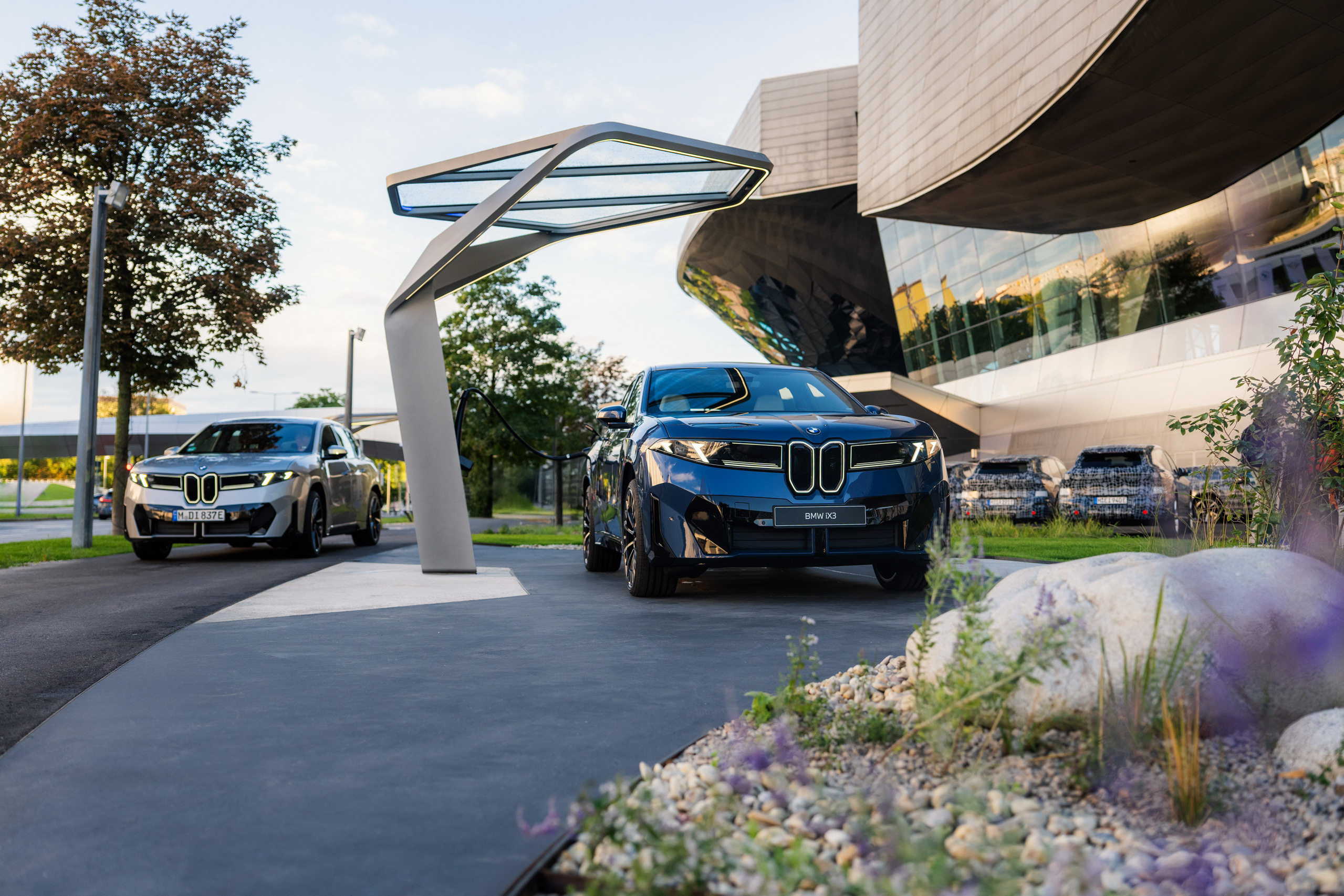
The second-generation iX3 and the new i3 are the quickest-charging BMWs released to date, supporting peak 400 kW speeds. This is quick enough to top up the i3 with 400 km of range in just 10 minutes. BMW says it can guarantee “quality and safety” at these charging speeds, and appeared to question whether BYD can do the same.

Also: BMW Showed Just Enough Of The i3 Touring For Someone Else To Finish The Job

BMW executives also indicated that pushing beyond these speeds would bring trade-offs in battery durability, range, and affordability, which they see as unnecessary for most real-world use.

 BYD Says Five-Minute Charging Adds 310 Miles, BMW Says Read The Fine Print

“We look to decrease charging time more and more, but you have to look at range, durability, reliability,” the head of BMW’s Neue Klasse models, Mike Reichelt, added. “All of these facts, we guarantee. We look at the speed of the Chinese market… but on the other side, we guarantee quality and safety. That is a topic that we do not [negotiate] with anyone.”

The race to improve charging times in the EV world is much the same as we’ve seen among smartphone manufacturers looking to uprate charging speeds of their devices, with the Chinese often leading the charge. Boost charging speeds too much, and batteries can get hot, including the risk of thermal management issues, which is clearly something BMW would like to avoid.

\\\\\\\\\\

US Senator Calls Chinese Cars “Cancer,” Wants Permanent Ban

  • US lawmaker wants permanent block on Chinese cars, software, and partnerships.
  • Industry groups back ban, citing security fears and unfair competition concerns.
  • Trump previously signaled openness to Chinese brands building factories in US.

Chinese-brand cars now account for one in 10 new cars sold in Europe, but you won’t find a BYD or Xiaomi on sale in the US, and one Ohio senator is determined to maintain that situation. He wants to make absolutely sure Chinese car brands never make it to America in the form of auto imports, partnerships, or even just lines of code buried in software.

Senator Bernie Moreno is preparing legislation that goes beyond the current restrictions introduced in early 2025 by the Biden administration. Those rules already shut out Chinese passenger cars over concerns they could harvest sensitive driver data. Moreno’s proposal aims to slam every remaining door, then double lock them just in case.

More: Toyota Is Selling A New EV In China For Less Than A 15-Year-Old Used Corolla

Speaking at an automotive event ahead of the New York International Auto Show, he didn’t exactly hold back, as Reuters reported.

“We don’t allow Huawei to come into our telecommunications infrastructure,” Moreno said, referencing the US block on the Asian tech giant. “We’re not going to allow Chinese automakers into this market. We’re going to prevent the cancer from coming into our market, and we’re going to need the other countries to do chemotherapy.”

Appealing To Other Nations

Subtle? Not exactly. Effective at grabbing attention? Absolutely. The plan isn’t just about imports. Moreno wants to block anything with Chinese ties, including software integrations and joint ventures. In other words, even a hint of Chinese involvement could be enough to disqualify a vehicle from US roads under his vision. He also hopes Mexico, Latin America, Canada and even Europe will follow suit.

 US Senator Calls Chinese Cars “Cancer,” Wants Permanent Ban
Xiaomi

Unsurprisingly, American automakers and industry groups are on board. They’ve been lobbying hard to keep the barriers high, arguing it protects both national security and domestic jobs. It also conveniently keeps a wave of competitively priced EVs from shaking up the market.

An Attack On Fair Trade

China, for its part, isn’t thrilled. Officials have pushed back, calling the approach protectionist and accusing the US of stacking the deck against fair competition. That tension adds another layer to an already delicate economic relationship between the two countries.

And there’s an added complication here. Donald Trump has previously said he’d welcome Chinese automakers building factories in the US, as long as they hire American workers.

Michelin’s New EV Tire Promises 10% More Range, And ICE Drivers Get Something Too

  • Michelin has launched new EV-focused tires, including a special Pilot Sport.
  • Despite boosting efficiency, the new tires also provide improved performance.
  • Both use new elastomers and resins to balance resistance and wet performance.

In the world of electric cars, efficiency is one of the most important priorities. The further you can drive, the less charging is required, so it’s hardly a surprise that so many carmakers are fixated on improving aerodynamics, ensuring their EVs can slice through the air with as little resistance as possible. Tires also play a crucial role in efficiency, and Michelin looks to have made a major step forward with EV-specific tires.

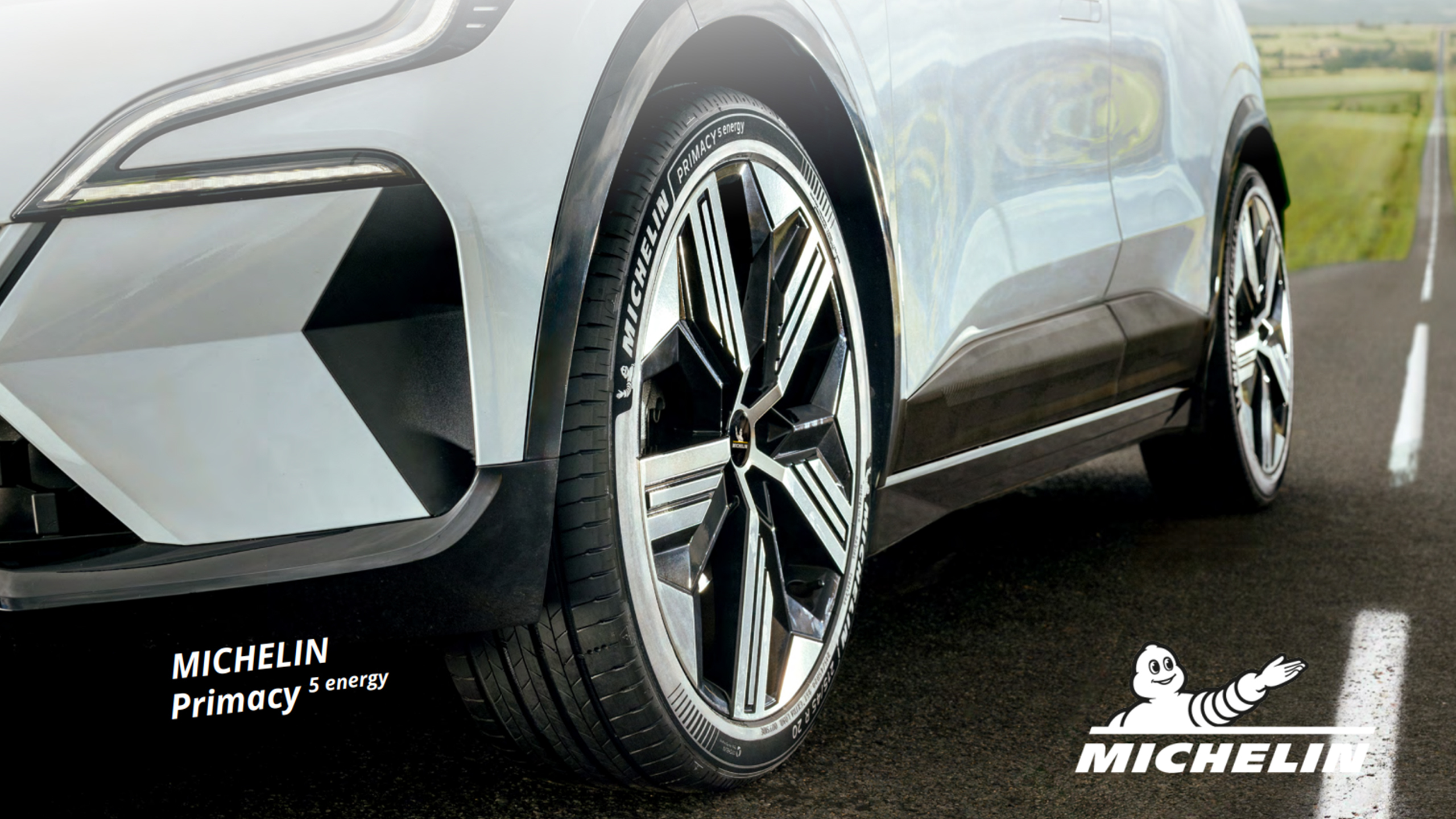
The French company has just unveiled its new Michelin Primacy 5 Energy and Michelin Pilot Sport 5 Energy, two summer tires that will be available in a number of different sizes, making them ideal for a broad spectrum of EVs.

Read: AMG Hyper EV Circles The Globe In Seven Days And Smashes 25 Records

Those fixated on efficiency will be most interested in the Primacy 5 Energy. It is rated A for rolling resistance and, when fitted to an EV, is said to boost the range by up to 10 percent, adding up to 43 miles (70 km) of driving range. On an ICE model, it can improve fuel efficiency by as much as 6 percent, or roughly 1.3 mpg (0.3 l/100 km).

When tested for longevity on a VW ID.3, the tire outperformed the Bridgestone Turanza 6, Continental PremiumContact 7, Goodyear Efficient Grip Performance 2, and Pirelli Cinturato P7C3.

Michelin hasn’t sacrificed performance, either. Compared to its predecessor, braking distances are improved by up to 8 percent, both when fresh off the shelf and when it has just 2 mm of tread remaining. Aiding in the tire’s improved performance are functionalized elastomers, new resins, and an improved tread architecture. The tire is available in 33 sizes from 16 to 19 inches.

An Efficient Pilot Sport

 Michelin’s New EV Tire Promises 10% More Range, And ICE Drivers Get Something Too

Car owners looking for a more performance-focused tire, yet one that is still efficient, would be wise to check out the new Pilot Sport 5 Energy. It includes a new Energy Passive compound on the shoulders to reduce rolling resistance and is the same tire Mercedes-AMG used with its record-breaking GT XX Concept.

When tested on a Tesla Model Y, this tire performed better in wet and dry braking than the Hankook iON Evo SUV and Pirelli P Zero E, while also outperforming those two options in longevity. With electric vehicle adoption being on the rise, it’s good to see that tire companies are tailoring their products to match the specific needs of EVs.

\\\\\\\\\\\

Google Maps Now Plans EV Charging Stops Automatically, But Not For Every Car

  • Google Maps is rolling out new trip planning features for EVs.
  • Users can now see how much battery usage trips will take.
  • Drivers will also see recommended charging stops along the way.

Electric vehicle owners are in for a treat as Google Maps is bringing new trip planning features to more than 350 vehicles with Android Auto. This promises to make long-distance trips less stressful as drivers won’t have to worry about running out of juice or bouncing between multiple apps to find a charging station.

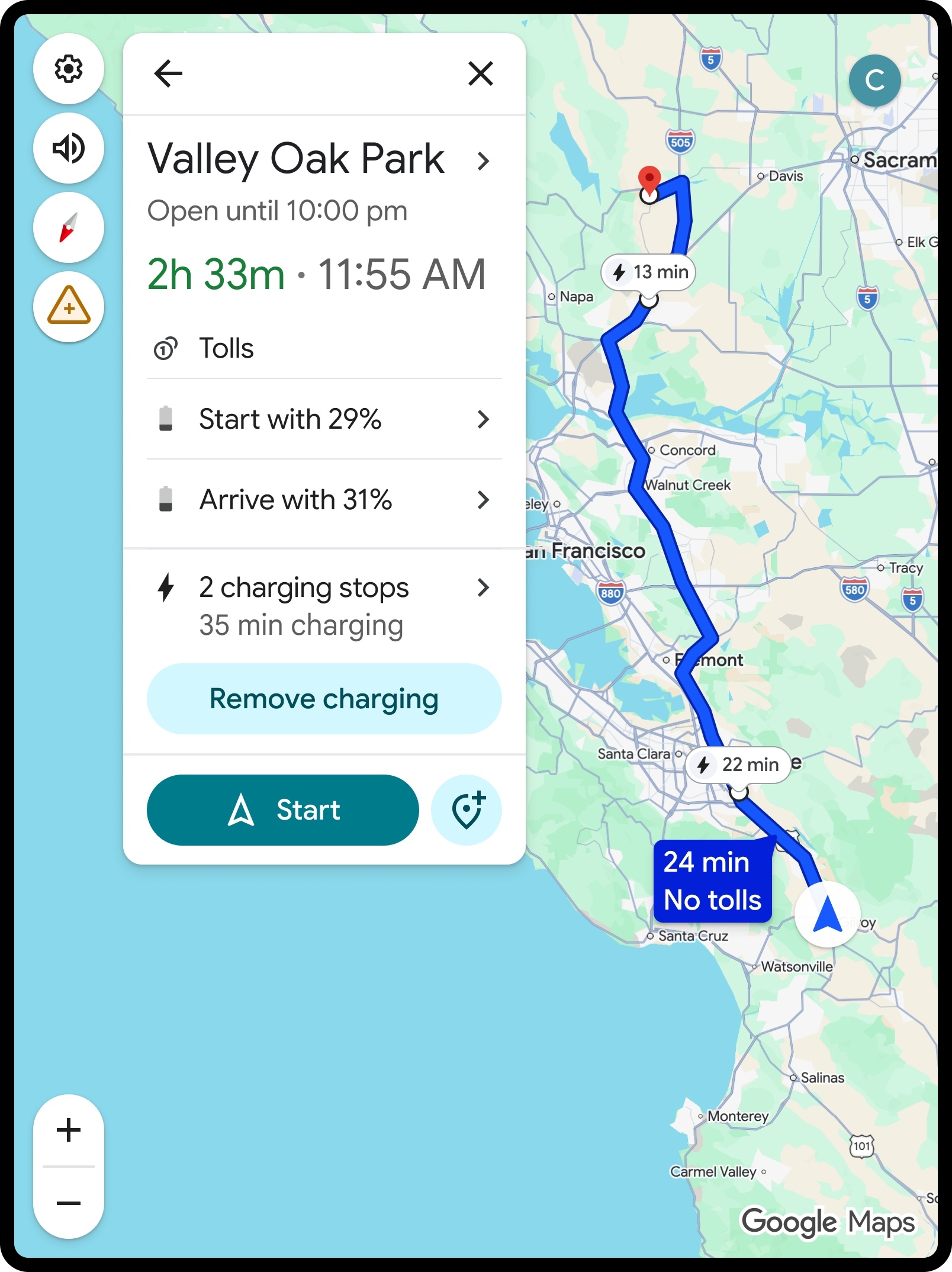
To use the new features, owners need to add their vehicle to Google Maps. This can be done by opening the app, selecting your profile, scrolling down to Settings, and tapping Your Vehicles. They can then select Electric and add their make and model of EV.

More: Google Maps Biggest Update In A Decade Looks Great And Can Even Plan Trips

With this information in hand, Google Maps can use vehicle information to calculate several important details. For example, when you set a destination, the app will estimate battery usage for the trip.

Users can add their current battery level to unlock more features, including recommended charging stops, estimated arrival battery level, and an updated ETA based on charging time. There’s even an option that allows you to select how much battery charge you want left when you arrive at your destination, so you’re not immediately forced to recharge.

 Google Maps Now Plans EV Charging Stops Automatically, But Not For Every Car

This sounds like a pretty handy update, and the tech giant said the predictions are made possible by a combination of AI and “advanced energy models that analyze vehicle details, like weight and battery size, alongside Maps’ real-time information about traffic, road elevation, and weather.” All of this means drivers will be well-informed and won’t have to worry about planning routes or charging stops ahead of time.

The new features are rolling out today in the United States and will support 16 brands, with additional companies coming in the future. As of now, that list includes Audi, BMW, Chevrolet, Fiat, Genesis, Hyundai, Jaguar, Kia, Lexus, Lucid, Mercedes, Nissan, Porsche, Subaru, Toyota, and Volkswagen.

\\\\

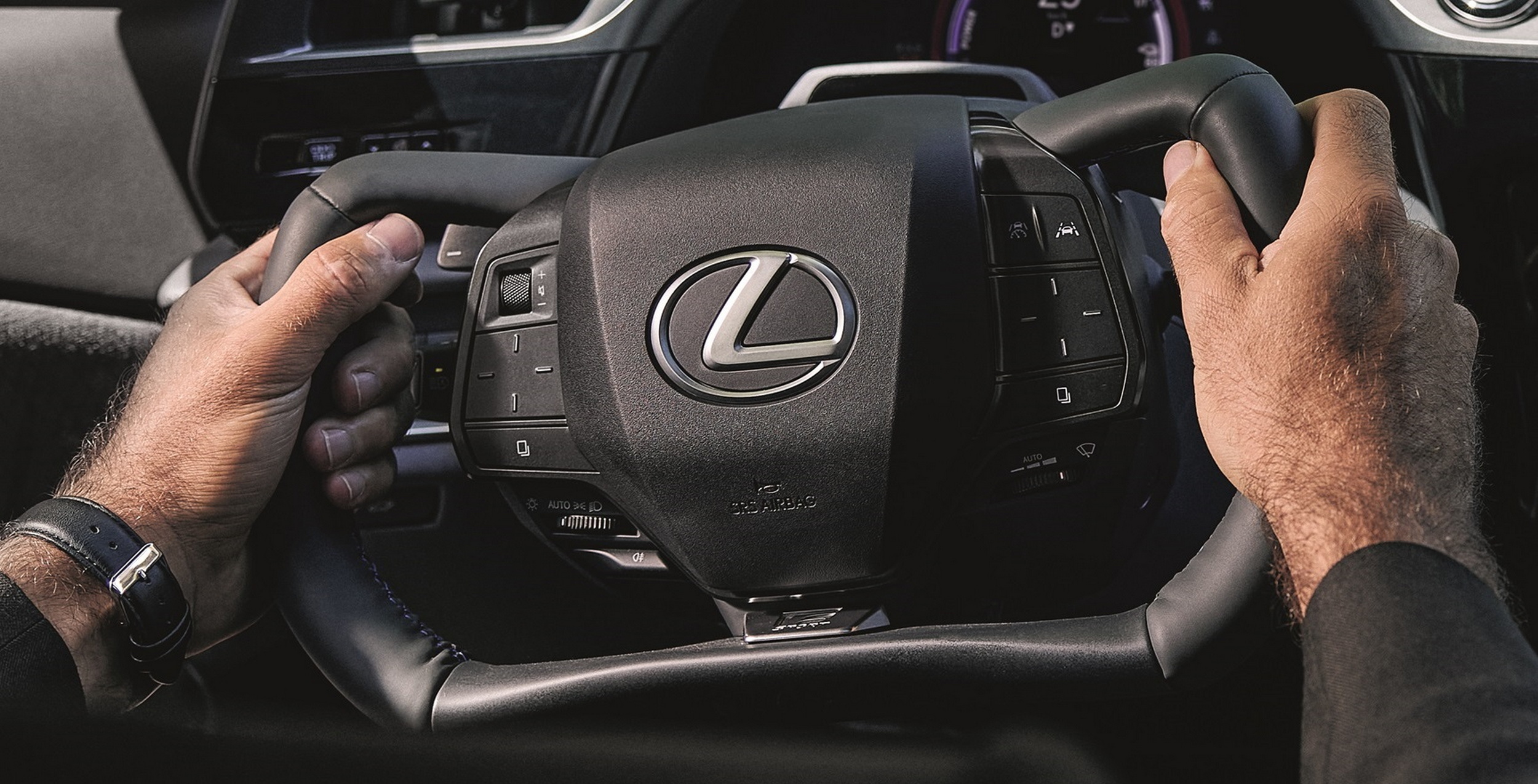
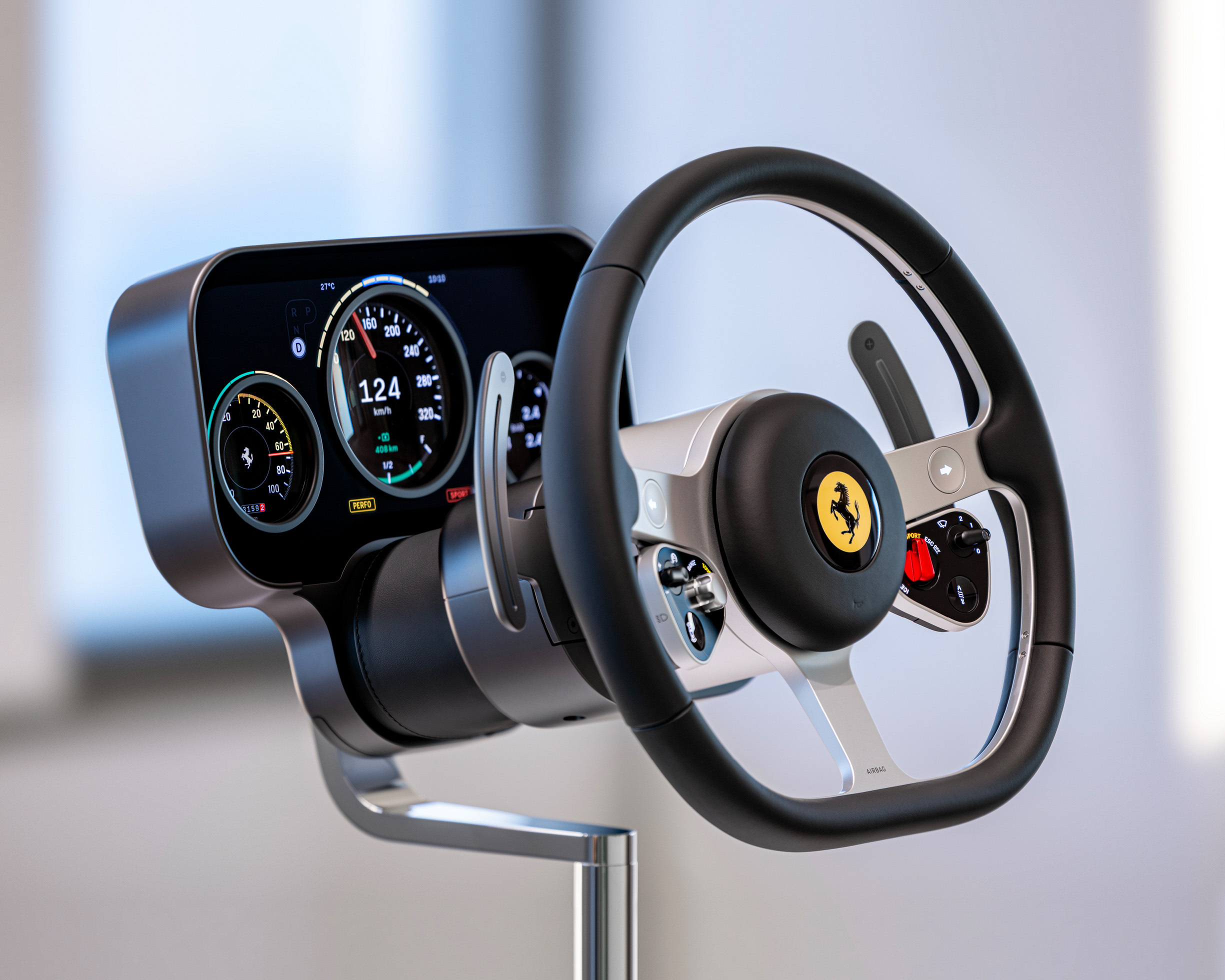
Lexus Cures Europe’s EV Engagement Problem With Fake Gears And Half A Steering Wheel

  • Lexus brings its Interactive Manual Drive system to European RZ models this spring.
  • The setup simulates eight gears via paddles, complete with torque interruptions.
  • F Sport trims also gain steer-by-wire using a yoke with a 200-degree lock-to-lock ratio.

Lexus is bringing its Interactive Manual Drive system to Europe, following its debut in Japan. The technology simulates a manual gearshift feel in an electrified powertrain, giving drivers a sense of mechanical engagement the brand says was lost in the transition away of combustion.

The system comes standard on F Sport trims of the updated Lexus RZ, which was detailed in Europe exactly one year ago, with first deliveries scheduled to begin this spring. Earlier prototypes previewed in 2022 featured a physical clutch and gear lever, but the production version leans heavily on software, making it closer in feel to a simulated automatic than a real manual.

More: Lexus Quietly Killed Its Smallest EV, And Hardly Anyone Noticed

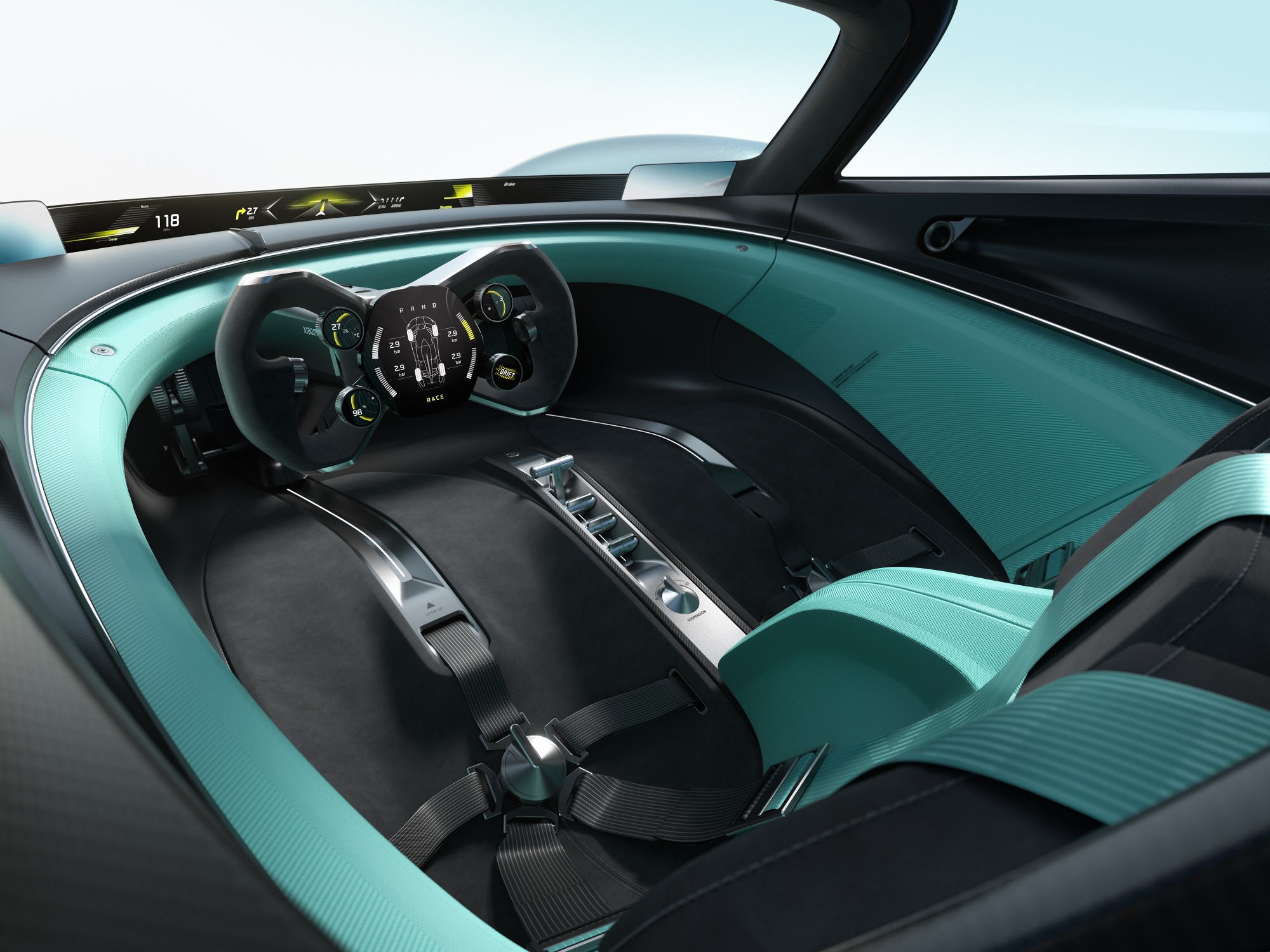
Using steering-wheel-mounted paddle shifters, drivers can cycle through eight virtual gears, with a digital tachometer indicating optimal shift points. They can also choose between three levels of synthetic engine sound, each synced to the simulated gear changes.

Similar to the Honda Prelude’s S+ Shift gear system, it goes further than just noise. The setup calculates virtual torque based on throttle input and vehicle speed, then feeds that back through the drivetrain. The result is an illusion of real shifts, complete with torque interruptions, engine braking, and even a hint of G-force nudging you along. At least, that’s the theory Lexus is selling.

 Lexus Cures Europe’s EV Engagement Problem With Fake Gears And Half A Steering Wheel

Lexus is not alone in attempting to bring a more engaging gear-changing experience to electrified models. Similar systems are already offered by other automakers, including Hyundai with the fully electric Ioniq 5 N.

Steer-By-Wire

Lexus is also introducing its steer-by-wire system in Europe after years of delays. Standard on F Sport models and optional on the rest of the lineup, it replaces the mechanical steering column with a yoke-style controller and a fully digital connection.

More: Yoke’s Over, Say Chinese Lawmakers

The futuristic steering setup features a tight 200-degree lock-to-lock ratio. In practice, that means no hand-over-hand turning during a U-turn, something that would otherwise be awkward with a yoke.

 Lexus Cures Europe’s EV Engagement Problem With Fake Gears And Half A Steering Wheel

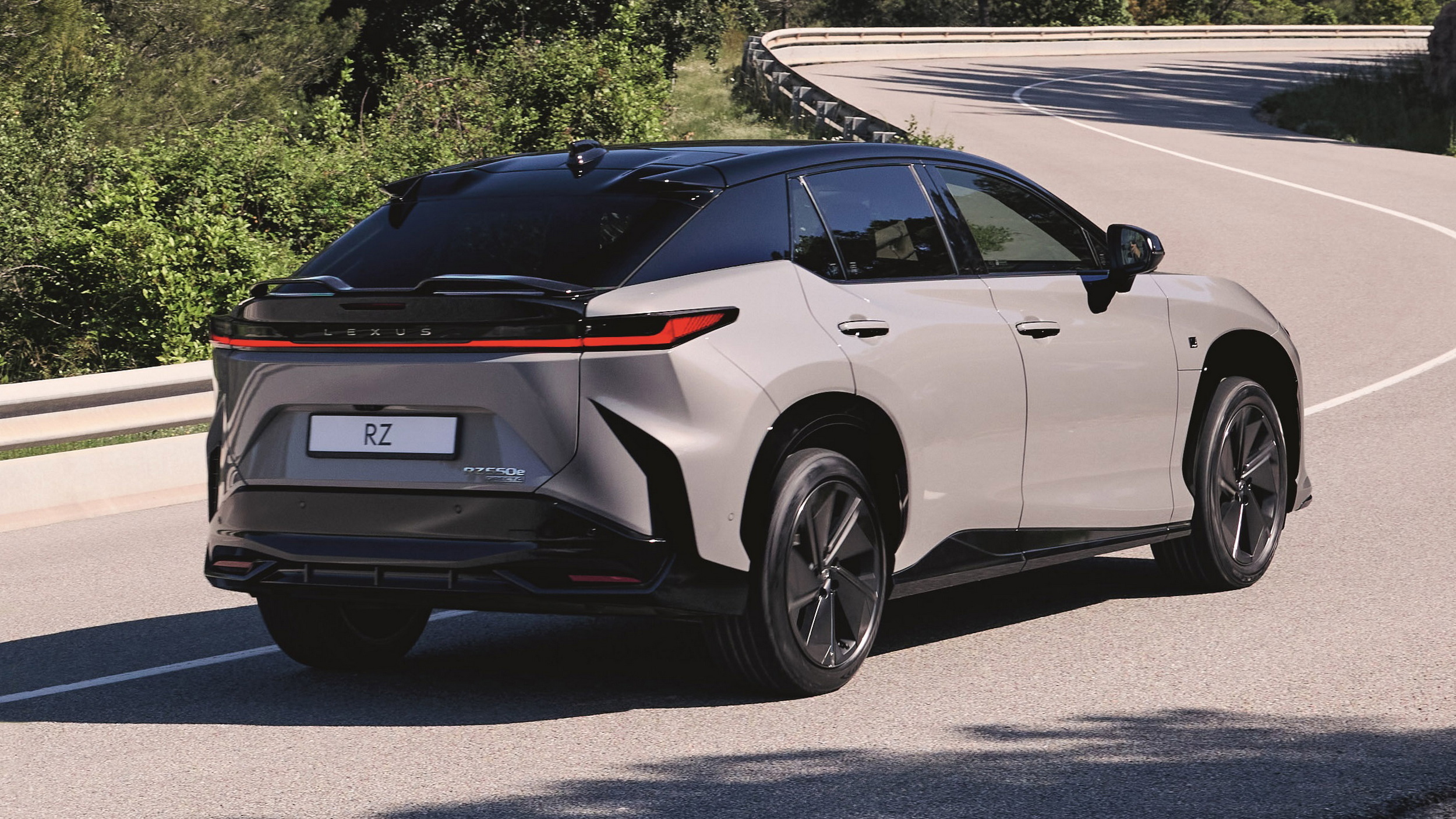
The most powerful version of Lexus’ electric crossover in Europe is the RZ 550e F Sport AWD, producing a combined 402 hp (300 kW / 408 PS). While this can’t match the 424 hp (313 kW / 426 PS) of the Japanes-spec RZ 600e Sport Performance, it is enough to offer a 0-100 km/h (0-62 mph) acceleration in a respectable 4.4 seconds.

More: The Next Lexus IS May Go In A Very Different Direction

The latest update to the RZ lineup introduced a larger 77 kWh battery pack, delivering a WLTP range of up to 568 km (353 miles) for the entry-level RZ 350e FWD. Additional updates include a battery preconditioning system and a standard 22 kW onboard AC charger.

What About The US?

The Interactive Manual Drive system is also included as standard equipment on the US-spec RZ 550e F Sport. However, the steer-by-wire setup with the yoke will not be offered in North America.
\\\\\\\\\\\\

Lexus RZ 550e F Sport AWD

Feds Expand Tesla FSD Investigation After Visibility Failures

  • NHTSA upgrades FSD probe to engineering analysis stage.
  • Over 3.2 million Tesla vehicles are included in investigation.
  • FSD may fail to detect vehicles in low visibility conditions

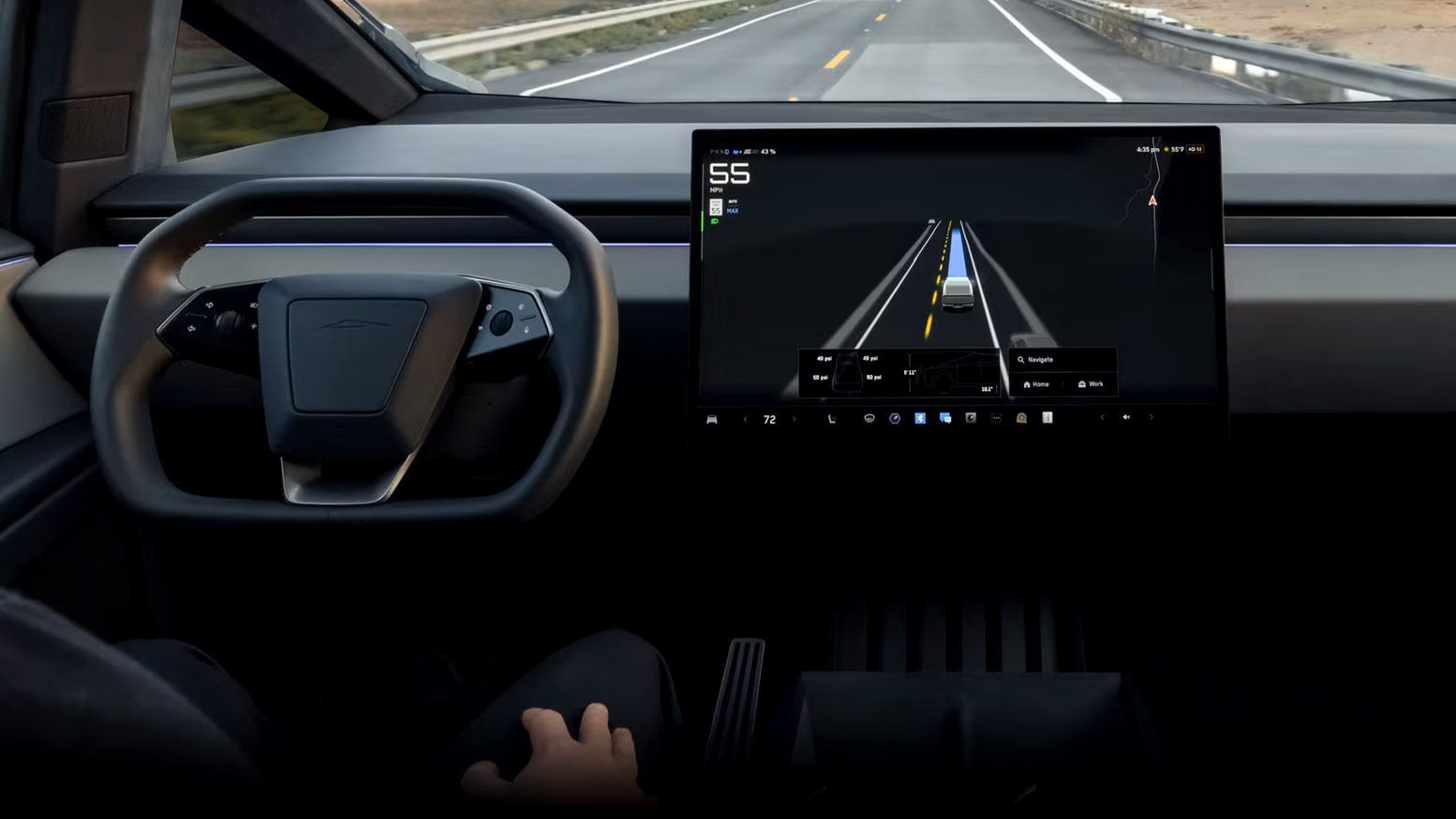
The NHTSA has intensified its scrutiny of Tesla’s Full-Self Driving system, focusing on how it copes when visibility drops. That escalation pushes the probe closer to a potential recall, one that could affect more than 3.2 million vehicles across the United States.

The agency first opened a preliminary evaluation in October 2024 to assess FSD’s ability to detect and respond appropriately in reduced roadway visibility. That probe has now been upgraded to an engineering analysis, which will examine how the vision-only system behaves in adverse conditions and whether it can alert drivers with enough time to react.

Read: Tesla Owners Furious After FSD Transfer Rules Change Again

According to regulators, Tesla developed and implemented a degradation detection system after transitioning to its camera-based vision setup in mid-2021, abandoning radar and other sensors. The company began working on an update to this system in June 2024, following a report of a fatal crash involving one of its vehicles on November 28, 2023

Rain Is FSD’s Enemy

 Feds Expand Tesla FSD Investigation After Visibility Failures

In its preliminary evaluation, the NHTSA began piecing together how Tesla’s Full Self-Driving system behaves in less-than-ideal conditions. The agency learned from Tesla that FSD’s ability to detect and respond to poor road conditions may have contributed to 3 of the 9 incidents identified by the Office of Defects Investigation (ODI).

In the crashes reviewed, the system failed to recognize common roadway conditions that affected camera visibility and did not issue alerts when camera performance degraded until just before impact.

A subsequent review of Tesla’s responses uncovered other crashes that occurred under similar circumstances. In these cases, the FSD system also lost track or “never detected a lead vehicle in its path.” The NHTSA also notes that Tesla says internal data and labeling limitations have prevented a uniform identification and analysis of crash events with the system engaged, meaning there is a possibility of under-reporting crashes.

The probe covers an estimated 3,203,754 Tesla vehicles, including the 2016-2026 Model S and X, 2017-2026 Model 3, 2020-2026 Model Y, and 2023-2026 Cybertruck models equipped with FSD.

 Feds Expand Tesla FSD Investigation After Visibility Failures

NASA Helped Ferrari Fix The Luce EV’s “Disturbing” Acceleration

  • The Ferrari Luce has paddle shifters to adjust the torque deployment.
  • Ferrari will also enhance the motors’ sounds for added auditory pleasure.
  • Unlike some of the brand’s other cars, the Luce won’t be a track model.

The high-end EV market is facing some struggles, but despite this, Ferrari is plowing ahead with its first-ever electric car, the aptly named Luce. While the brand is perhaps the last you’d ever expect to enter the EV world, it’s confident the model will offer all the driving thrills expected of a Prancing Horse.

During a recent interview, Ferrari chief executive Benedetto Vigna insisted that the Luce will deliver each of the five key drivers of driving thrills, ensuring it is befitting of the brand’s badge and can succeed where some EVs have failed: to tug at the emotional heartstrings.

Read: Ferrari Breaks Its Silence On Luce Trademark Rights After Mazda Filing

Speaking with Autocar India, Vigna said one element “is longitudinal acceleration,” agreeing with the interviewer that perhaps this acceleration in EVs is too linear, and also “too much, because sometimes it’s disturbing our brain.” He went on to reveal that Ferrari has worked with NASA to “understand what is the level of acceleration that is disturbing people,” and that too much acceleration is not a good thing.

Sounds And Shifts

\\\\\\\\\\\\\\

SHProshots

Another important contributor to driving thrills is “transversal acceleration, followed by the braking experience, the gearshift, and the sound. As recent images of the Luce’s interior revealed, it will include paddle shifters, and unlike some EVs, these won’t be used to adjust the level of brake regeneration but instead to adjust the level of torque engagement.

Vigna stopped short of confirming that the system will mimic traditional shifts, as in the Hyundai Ioniq 5 N, but it certainly sounds like that is what Ferrari is aiming for. Then there’s the all-important sound.

 NASA Helped Ferrari Fix The Luce EV’s “Disturbing” Acceleration

As patents have revealed, Ferrari won’t aim to mimic the sound of an internal combustion engine with the Luce, and instead will amplify the sounds of the electric motor.

“The electric motor is not silent,” he said, “there is a sound there. The problem sometimes today [is that] most of us associate the sound of electric motor with something high frequency that is disturbing. But, there are also low frequency, there are also ways to pick up the sound in an authentic way, in the original way, to avoid the two looking like a DJ.”

Vigna went on to add that the Luce will have a driving range of over 311 miles (500 km), and while that may not sound all that impressive, he noted it has not been designed with track use in mind, indicating that the battery technology is not in a place to make such cars achievable.

700 Laid-Off Workers Rehired As GM Changes What Its Battery Plant Builds

  • The facility now builds LFP cells for grid and data use.
  • Retooling the plant cost the joint venture tens of millions.
  • LG is also shifting other battery plants to storage facilities.

Just a few months after Ford announced that one of its battery plants, originally destined for EV batteries, would instead start making batteries for energy storage systems, General Motors has done the same.

The car manufacturer, in partnership with LG Energy Solution, operates the Ultium Cells LLC joint venture and runs a large factory in Tennessee. This site opened in 2024, making cells for the Cadillac Lyriq and Vistiq, and the Acura ZDX. Late last year, more than 700 employees were laid off from the plant as GM, like its competitors, pulled back its EV investments.

Read: GM’s EV Plant Will Now Build The Gas Models People Actually Want

Now, Ultium’s vice president of operations, Tom Gallagher, said that these workers will be rehired and return to work by the end of April, as the site is switching to lithium-iron phosphate cells for grid and data center customers.

An Expensive Pivot

 700 Laid-Off Workers Rehired As GM Changes What Its Battery Plant Builds

Bloomberg reports that retooling the plant has cost the joint venture tens of millions of dollars, but will help prevent hemorrhaging even more money from its EV pivot. It will also help LG, which is also retooling four other EV battery plants in North America, including two in Michigan, one in Canada formed through a joint venture with Stellantis, and an Ohio plant established with Honda. All of these sites will now begin manufacturing LFP cells for storage systems.

“Having these facilities that are able to be converted in less than a year means that we can react and we can actually get up to capacity,” chief product officer from LG’s systems integration unit, Vertech, Tristan Doherty said. “We’re going to be supplying the majority of the US market with domestic cells.”

GM says staff at the joint venture battery plant will be retrained as part of the shift. But the car manufacturer is remaining silent about its longer-term plans for the site, having previously stated that it’d start producing lithium manganese-rich batteries in Tennessee by 2028.

 700 Laid-Off Workers Rehired As GM Changes What Its Battery Plant Builds

700 Laid-Off Workers Rehired As GM Changes What Its Battery Plant Builds

  • The facility now builds LFP cells for grid and data use.
  • Retooling the plant cost the joint venture tens of millions.
  • LG is also shifting other battery plants to storage facilities.

Just a few months after Ford announced that one of its battery plants, originally destined for EV batteries, would instead start making batteries for energy storage systems, General Motors has done the same.

The car manufacturer, in partnership with LG Energy Solution, operates the Ultium Cells LLC joint venture and runs a large factory in Tennessee. This site opened in 2024, making cells for the Cadillac Lyriq and Vistiq, and the Acura ZDX. Late last year, more than 700 employees were laid off from the plant as GM, like its competitors, pulled back its EV investments.

Read: GM’s EV Plant Will Now Build The Gas Models People Actually Want

Now, Ultium’s vice president of operations, Tom Gallagher, said that these workers will be rehired and return to work by the end of April, as the site is switching to lithium-iron phosphate cells for grid and data center customers.

An Expensive Pivot

 700 Laid-Off Workers Rehired As GM Changes What Its Battery Plant Builds

Bloomberg reports that retooling the plant has cost the joint venture tens of millions of dollars, but will help prevent hemorrhaging even more money from its EV pivot. It will also help LG, which is also retooling four other EV battery plants in North America, including two in Michigan, one in Canada formed through a joint venture with Stellantis, and an Ohio plant established with Honda. All of these sites will now begin manufacturing LFP cells for storage systems.

“Having these facilities that are able to be converted in less than a year means that we can react and we can actually get up to capacity,” chief product officer from LG’s systems integration unit, Vertech, Tristan Doherty said. “We’re going to be supplying the majority of the US market with domestic cells.”

GM says staff at the joint venture battery plant will be retrained as part of the shift. But the car manufacturer is remaining silent about its longer-term plans for the site, having previously stated that it’d start producing lithium manganese-rich batteries in Tennessee by 2028.

 700 Laid-Off Workers Rehired As GM Changes What Its Battery Plant Builds

This Air-Cooled Battery Changes What Fast Charging Means For Electric Bikes

  • The Verge’s motorcycle has an 18 kWh capacity and supports fast charging.
  • A recent test shows the Donut Lab battery sitting at over 100 kW while charging.
  • Crucially, the motorcycle’s battery is air-cooled, rather than being liquid-cooled.

Electric motorcycles haven’t gained widespread acceptance to the same extent as electric cars. However, with solid-state battery packs now just around the corner, the motorbike industry is on the precipice of a revolution, one which could be led by Verge Motorcycles and Finnish firm Donut Lab.

Verge unveiled its new TS Pro electric two-wheeler earlier this year, promising up to 186 miles (299 km) of range in as little as 10 minutes when plugged into a 200 kW NACS charger. Eager to show the world just how quickly the bike can charge, Donut Lab conducted a live test at a public charging station as part of the company’s ongoing series to address the critics.

Read: Donut Lab’s Solid-State Battery Lost Just 2.3% Charge In 10 Days As Critics Watch

The model from Verge Motorcycles in this test is a previous-generation model that’s been upgraded with the latest Donut Lab battery pack. It has a capacity of 18 kWh, and the test showed peak charging rates of over 100 kW, allowing it to charge from 10-70 percent in a touch over 9 minutes, and then 10-80 percent in 12 minutes.

According to Donut Lab, the battery pack charges three times faster than Verge’s previous-generation pack. On the surface, having a battery pack that charges at a touch over 100 kW may not seem very impressive, particularly compared to some 1,500 kW charging systems being deployed by Chinese brands like BYD, Geely, and Zeekr.

An Air-Cooled Battery

\\\\\\\\\\\\\\\\\\\\\

However, it’s important to note that electric cars capable of extraordinarily fast charging use liquid cooling systems to prevent the battery pack from overheating. By comparison, Verge’s battery is air-cooled, which is why the charging rates aren’t as high. Donut Lab also says its battery will charge more quickly once Verge fully optimizes it.

“This is the first test we have published to a wider audience that demonstrates the performance and behaviour of multiple battery cells in a real vehicle environment,” Donut Lab chief technology officer Ville Piippo said. “The high energy density of our battery technology enables flexible battery pack design and superior performance even in more challenging applications, such as motorcycles, where space is limited and system simplicity is key.”

\\\\\\\\

Lucid Shows Its Pedal-Free Future As It Confirms Subscription For Its Current Cars

  • Lucid revealed a two-seat robotaxi and autonomy pricing.
  • Monthly autonomy subscriptions will run from $69 to $199.
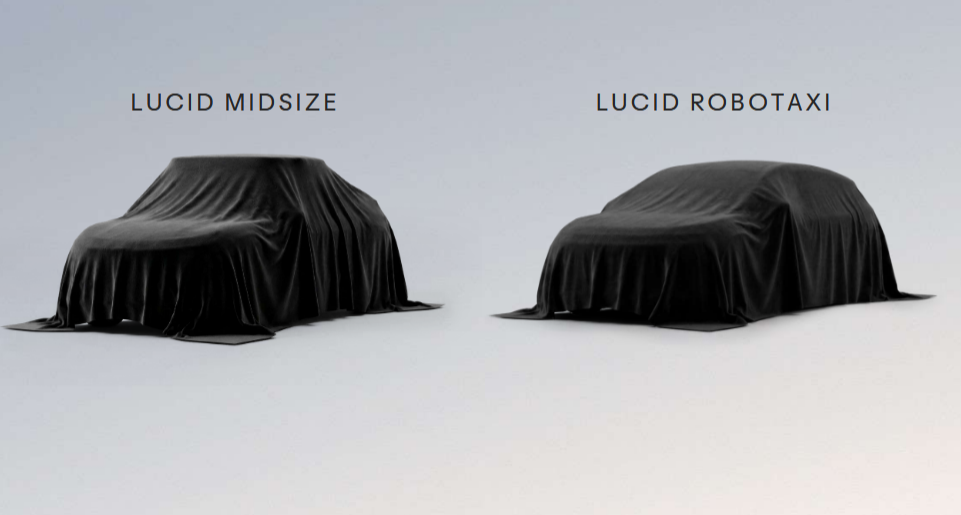
  • The robotaxi concept rides on Lucid’s new midsize platform.

Lucid is officially joining the robotaxi race, and it’s doing so with all-new products. During its investor day presentation on Thursday, the EV startup revealed a two-seat autonomous concept to insiders. Then, it confirmed plans to charge monthly subscription fees for advanced driver-assist and self-driving features in future cars.

More: Lucid Cuts 12% Of Its Workforce As The EV Shakeout Intensifies

The concept, called Lunar, is a purpose-built robotaxi designed without pedals or a steering wheel. It clearly signals that Lucid is serious about fully autonomous ride-hailing rather than just driver-assist technology. This puts the company on the same path as Tesla’s Cybercab program and similar efforts from other EV makers trying to turn autonomy into a long-term revenue stream.

Beyond the prototype reveal, Lucid shared very little technical detail about the Lunar. What it did emphasize is efficiency. The company is targeting between 5.5 and 6 miles per kWh, a figure that could translate to a theoretical range of around 400 miles.

\\\\\

Reaching that number will depend largely on low-drag aerodynamics and a carefully optimized body. Fast charging is also part of the equation, with Lucid claiming the robotaxi could gain more than 200 miles of range in about 15 minutes.

Whether the Lunar ever makes it past the concept stage is less certain, though. For now, the company already has plenty on its plate preparing its upcoming midsize EV lineup for launch, which carries far more weight for the company’s near-term finances.

Subscription Fees For Self Driving

Speaking of revenue, Lucid calls autonomy subscriptions “the single biggest software monetization opportunity.” As such, it’s going to start charging customers to use DreamDrive Pro, the brand’s in-car autonomy suite, on a monthly basis. Starting in the first half of 2027, owners will have to pay anywhere from $69 to $199 a month, depending on the level of autonomy they want.

Lucid says that it has a “Level 4-ready platform available directly from the factory.” While it hasn’t unveiled it to the public, it’ll ride on the brand’s midsize architecture that underpins a few new products heading to market. Lunar will only seat two individuals, so we expect it to have plenty of room for cargo.

That’ll work well with one of Lucid’s partners, Uber. The two are in talks to use the midsize platform in the way that they do Gravity with its robotaxi program.

Timelines

 Lucid Shows Its Pedal-Free Future As It Confirms Subscription For Its Current Cars

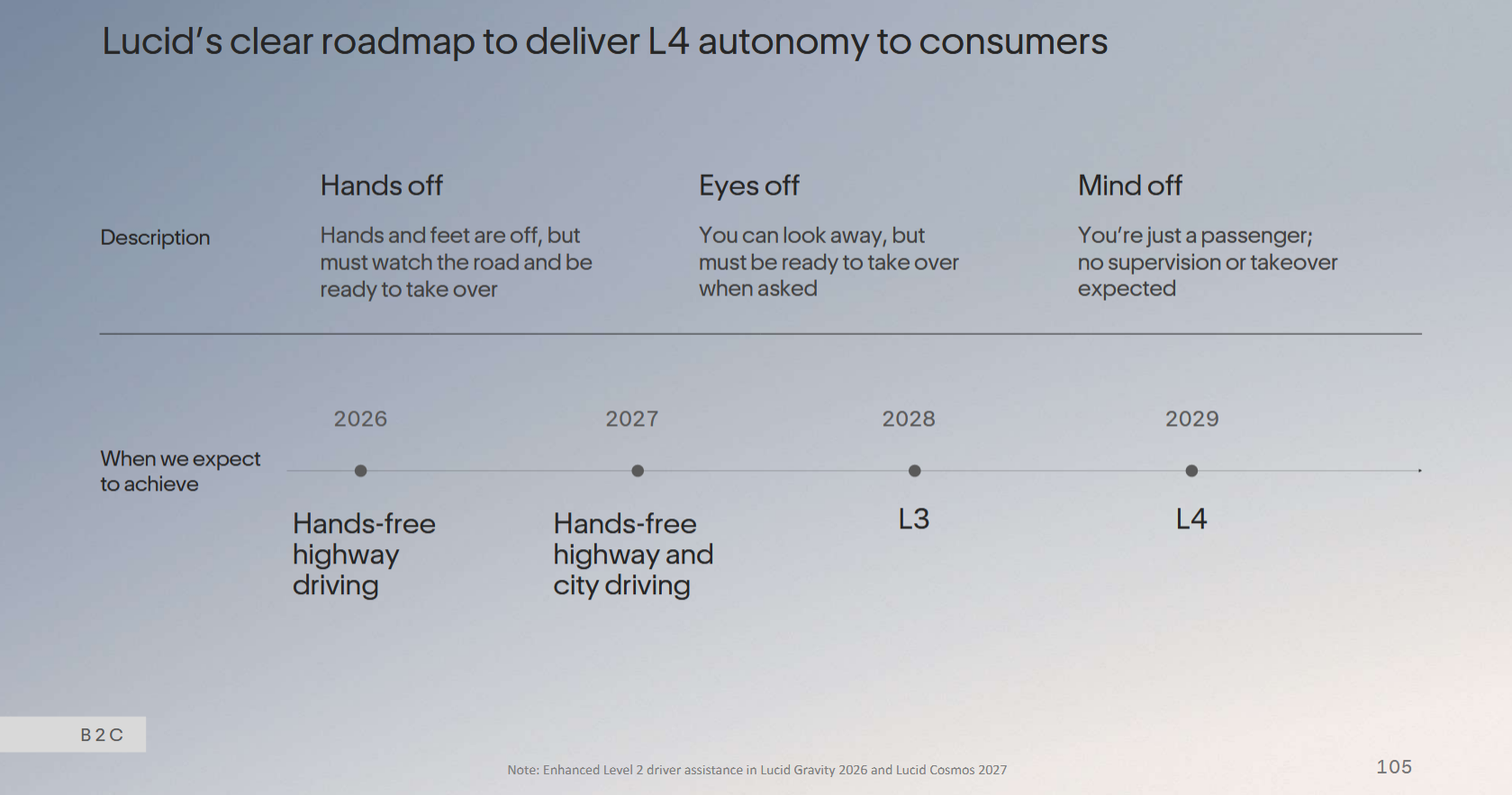
Lucid went as far as to openly lay out its timeline roadmap as well. This year, it believes it’ll offer hands-free highway driving to customers. Next year, it hopes to offer hands-free highway and city driving. In 2028, it wants to achieve Level 3 autonomy. That’s where drivers still need to be ready to take over but the car can mostly navigate on its own.

Level 4, something Lucid is aiming for in 2029, would allow drivers to take their eyes off of the road. Whether or not all of this comes to pass is up for debate, but at least now we know the plan.

 Lucid Shows Its Pedal-Free Future As It Confirms Subscription For Its Current Cars

Donut Lab’s Solid-State Battery Lost Just 2.3% Charge In 10 Days As Critics Watch

  • The solid-state battery kept 97.7% charge in ten days.
  • Donut Lab faced claims its tech was just supercapacitors.
  • Independent test conducted by Finnish Technical Research Centre.

Donut Lab, a small Finnish startup claiming to have developed the first solid-state battery for electric vehicles, has released results from a new test aimed at addressing doubts about its technology. The company says the data shows its battery retains 97.7 percent of its charged capacity after sitting idle for 10 days. Even so, skeptics may still need convincing.

Read: Donut Lab Claims It Verified A 7-Minute Solid-State EV Battery Charge

This third test follows Donut Lab’s recent demonstration of how quickly its solid-state cells can charge. It is intended to counter reports suggesting the company has not built a true battery at all, but rather a supercapacitor. To address those claims, Donut Lab worked with the Finnish Technical Research Centre (VTT) to measure how slowly the cell loses charge while idle.

Measuring Idle Voltage Loss

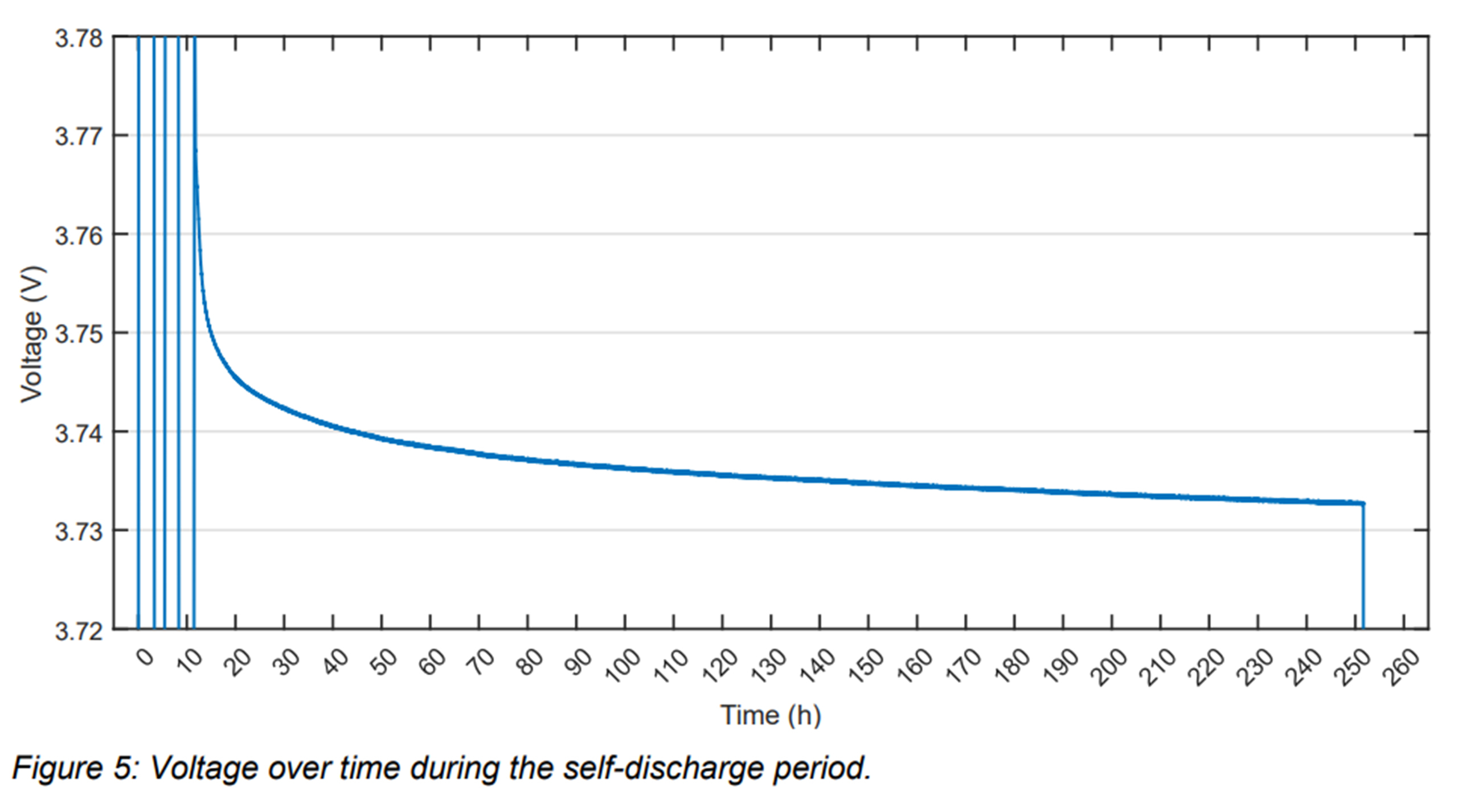
For the self-discharge test, a cell was charged to approximately 50 percent and then left idle for 240 hours. During the test, temperatures ranged between 22-28°C, and the cell’s voltage was recorded every 10 seconds.

The results are interesting. During the first hour, the battery’s voltage dropped by 103 mV, though the company says this is largely due to voltage relaxation rather than true self-discharge. By the end of the 240-hour test, the voltage had fallen by an additional 12 mV, representing a total loss of 2.3 percent over the 10-day period.

While this is a solid result, it’s not incredible. Typical lithium-ion battery cells can lose around 5 percent of their charge within the first 24 hours, after which the self-discharge rate typically slows to between 1-2 percent per month. Donut Lab argues the results still demonstrate that the technology is not a supercapacitor, which would normally lose far more charge when idle.

 Donut Lab’s Solid-State Battery Lost Just 2.3% Charge In 10 Days As Critics Watch

“Since we unveiled the Donut Battery, there has been a lot of speculation and theories about whether it is a supercapacitor,” Donut Lab chief technology officer Ville Piippo said. “In all its simplicity, this test proves that it is a battery. Supercapacitors charge and discharge quickly, but they also lose their charge quickly when not in use. The Donut Battery behaves like a battery and can maintain a charge for significantly longer.”

\\\\\\

Toyota’s Flagship Electric Sedan Undercuts Tesla Model S By Nearly $96,000 In China

  • Toyota adopts Huawei HarmonyOS Cockpit for connectivity.
  • The bZ7 also syncs with Xiaomi smart home devices easily.
  • Starting from $26,000, it’s about the same size as a Model S.

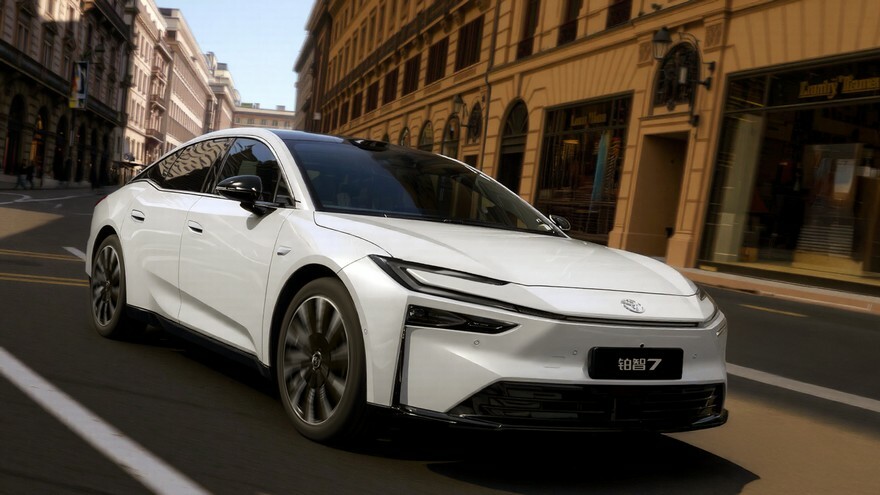
Toyota has officially opened pre-sales of its new all-electric bZ7 in China, priced between 179,800 and 239,800 yuan for the 600 Pro and 710 Ultra LiDAR trims respectively, or roughly $26,000 to nearly $34,800 depending on the version. That aggressive entry point immediately puts it in the thick of China’s hotly competitive EV market.

But this launch is not only about affordability. It represents a clear change in the way that Toyota is approaching electric vehicles in the region.

Read: Toyota’s New Flagship Electric Sedan Is Here But Not For Us

The bZ7 has a sleek fastback design, modern without being too dramatic. At just over 5.1 meters (200.8 inches) long, 1,965 mm (77.3 inches) wide, and 1,506 mm (59.2 inches) tall, with a 3,020 mm (118.9 inches) wheelbase, it carries the proportions of a proper executive sedan. Those dimensions place it squarely alongside rivals such as the Tesla Model S, BYD Han L, and BMW i5.

 Toyota’s Flagship Electric Sedan Undercuts Tesla Model S By Nearly $96,000 In China

Inside, the layout is clean and technology-focused. A huge 15.6-inch central display is located at the center of the dashboard, backed by the compact driver screen and head-up display. The system runs off Huawei’s HarmonyOS Cockpit 5.0, something that is important for Toyota.

Legacy automakers have long struggled to get on top of Chinese-centric ecosystems which buyers love. The adoption of HarmonyOS Cockpit not only offers sharp graphics, quick response times, and voice control features, but it will also be able to natively integrate with China’s own ecosystem of connected apps and services.

A Serious Push Into China’s Connected Car era

\\\\

Toyota’s integration with Xiaomi’s smart ecosystem means that the car itself is intended to integrate with compatible Xiaomi home devices. Drivers can control select functions of a smart home directly from the interface in the vehicle and also sync personal preferences across devices. It makes the car part of a wider digital lifestyle rather than being simply a transport tool.

Advanced driver assistance comes from Momenta’s R6 system, which uses a combination of sensors and roof-mounted lidar. Features include navigation-assisted driving support and automated parking features. Higher trims focus strongly on comfort too with zero gravity seats, massage and ventilation, a premium audio system, rear seat tray tables and even a built-in refrigerator focused on rear passengers.

Powering the bZ7 is Huawei’s DriveONE electric system in conjunction with lithium iron phosphate battery packs. Depending on the trim, Toyota is claiming a driving range of between about 600-710 km (373-441 miles) under CLTC standards (so take that with a grain of salt). Still, that puts it squarely in line with important domestic competitors. That’s paired with a 207 kW (277 hp) electric motor that provides motive power.

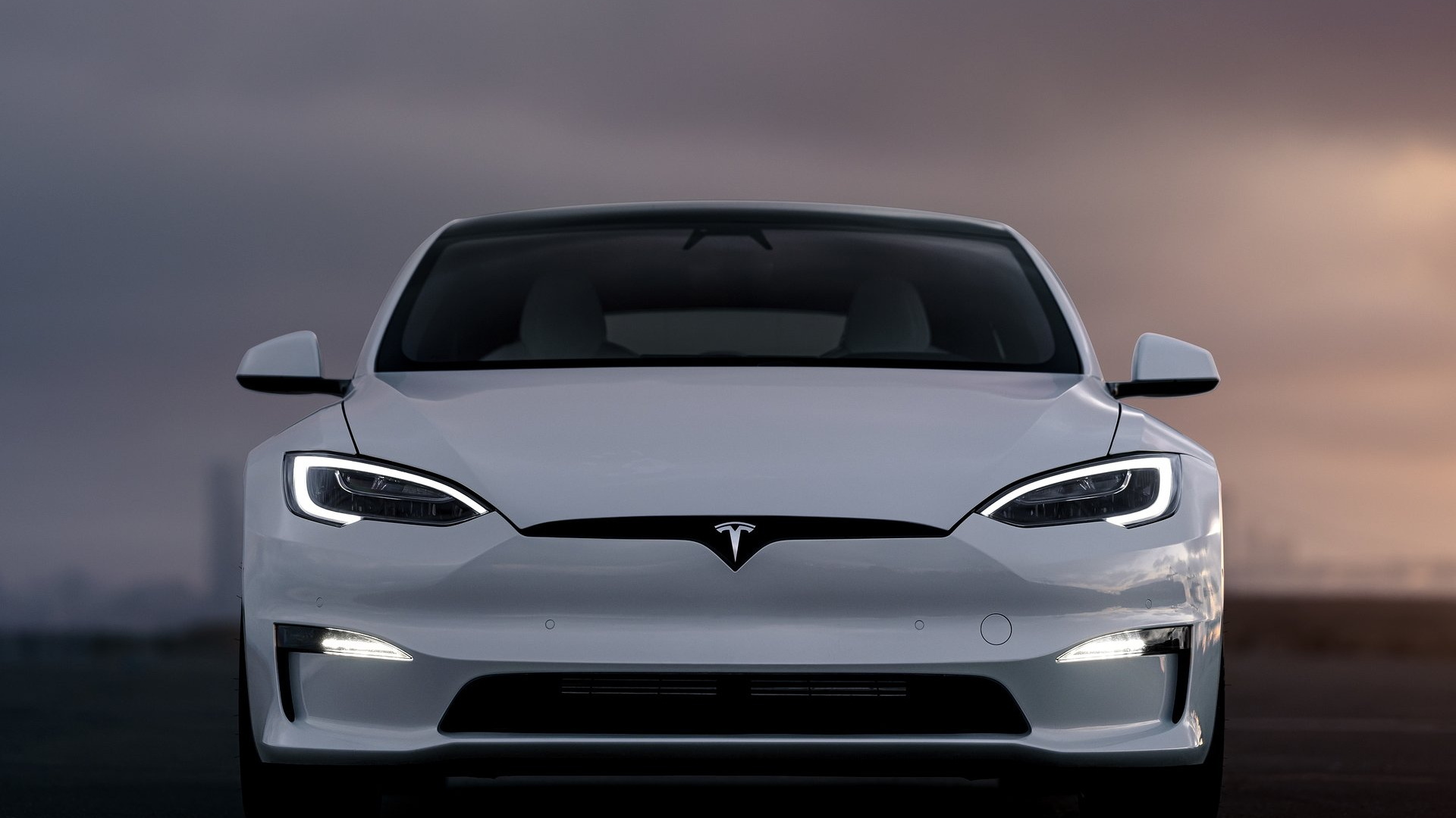
That headline range also nudges it into the territory of the dual-motor Model S AWD, at least on paper. The Tesla, of course, operates in a very different league when it comes to outright performance, with roughly 670 hp on tap. It also sits in a completely different price bracket, starting at 842,900 yuan, or around $122,000. That works out to roughly 4.6 times the base bZ7 and about 3.5 times the price of the top-spec version.

\\\\\\\\\\\\\\\\\\\

CEO Mocks VW After Adopting Range-Extender Tech It Once Dismissed

  • Two different powertrains will be offered for the VW ID. Era 9X.
  • The ID. Era 9X is similar in size to the BMW X7 and has up to 510 hp.
  • VW once criticized EREV tech as environmentally unfriendly in 2020.

The VW Group began selling its EA211 engine in 2011, offering it in both three- and four-cylinder forms across a wide range of models. Over the years, it has powered familiar names such as the VW Golf, Seat Ibiza, Skoda Fabia, VW T-Roc, Audi Q2, and Seat Leon.

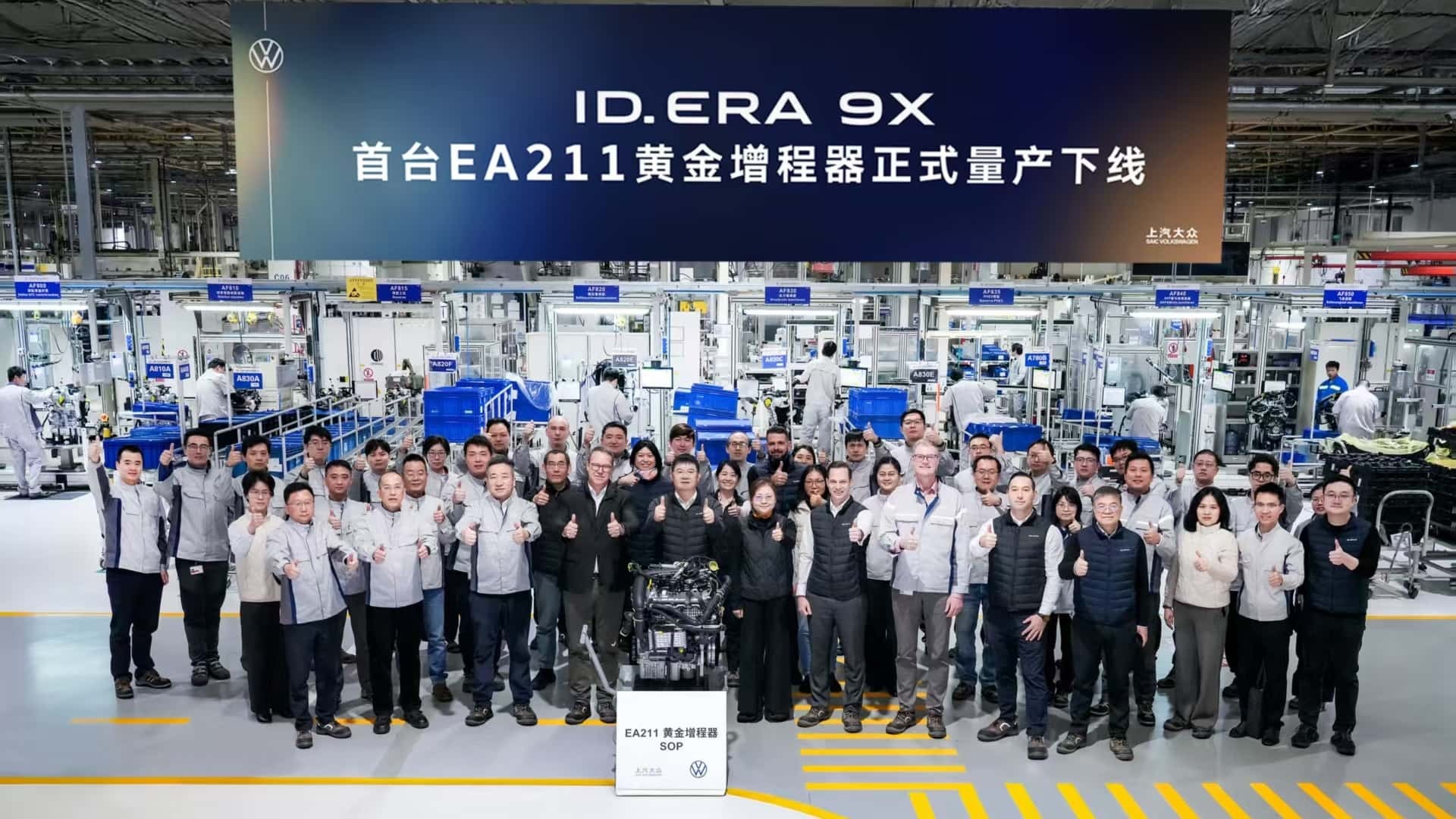
Now the company has updated and adapted this long-running engine for an entirely new role, serving as the range-extender in its first extended-range electric vehicle in China, the ID. Era 9X.

Read: VW Built A Bigger ID SUV Than The X7 And You Can’t Have It

VW presented its new flagship SUV, co-developed with SAIC, earlier this year. At the time, we knew it would use a range-extender powertrain, but few technical details were available. Earlier this month, VW confirmed that the ID. Era 9X uses a 1.5-liter turbocharged EA211 engine, although several notable revisions have been made to prepare it for this application.

What’s Different?

\\\\\\

For example, the updated engine now includes a new variable-geometry turbocharger to seamlessly adjust airflow, depending on the driving conditions. VW has also improved thermal efficiency and reduced emissions, while also installing a water-cooled intercooler for cooler intake temperatures. The upgraded engine is being built in China.

EREVs are enjoying something of a resurgence at the moment, though VW was not always enthusiastic about the concept. Six years ago, VW China executives described EREVs as “very environmentally unfriendly.”

 CEO Mocks VW After Adopting Range-Extender Tech It Once Dismissed

As reported by CarNewsChina, shortly after announcing production of the new EA211 range-extender, Li Auto’s social media director reminded VW of this statement, writing on social media, “Congratulations to Volkswagen for successfully mass-producing a technology that is ‘outdated, very environmentally unfriendly, and had little development potential’ in just 6 years!”

The tension dates to September 2020, when Volkswagen China CEO Stephan Wöllenstein criticized gasoline-powered range-extenders as environmentally unfriendly. Around the same time, the company’s China R&D chief, Wiedmann, described the technology as outdated with limited long-term potential.

The Juicy Details

\\\\

The VW ID. Era 9X is slightly longer, a touch narrower, and has a marginally shorter wheelbase than a BMW X7. It is one of several China-only Volkswagen models that could likely find an audience elsewhere if it were ever sold internationally.

In addition to the EA211 range-extender, the base model features a rear-mounted electric motor producing 295 hp and a 51.1 kWh LFP battery. This setup delivers an all-electric driving range of up to 166 miles (267 km). A version with a larger 65.2 kWh battery and up to 211 miles (340 km) of electric range will also be offered, along with a rear-wheel-drive twin-motor variant producing 510 hp.

\\\\\\\\\\

Musk Lectures Legacy Brands On Cars, Even As Tesla Drifts Beyond Them

  • Musk says legacy automakers resist electrification efforts.
  • He argues EVs are simpler, cleaner, more efficient by design.
  • CEO warns traditional brands risk extinction if they stall.

There’s no denying it. For all Elon Musk’s foibles, he and Tesla have played an instrumental role in accelerating the car industry’s shift towards electrification and autonomy. Love him or loathe him, the trajectory has shifted on his watch. Now, the controversial CEO says any legacy automaker that refuses to follow Tesla’s lead risks going the way of the dinosaurs.

Last week, the world’s richest man sat down with André Thierig, head of Tesla’s Gigafactory Berlin, for a deep dive into where Tesla is heading and where the wider industry should be going. In Musk’s telling, it has been obvious for more than 20 years that the endgame is fully electric, fully autonomous transport. The surprise, at least to him, is that some rivals still appear reluctant to accept it.

Read: Nearly Half Of Jury Pool Dismissed As Musk’s Lawyer Claims So Many ‘Hate Him’

“The automotive industry has strongly rejected electrification,” Musk said during the interview. “They’ve dragged their feet, and they’ve had to be pushed there by the government, and whenever they have any opportunity to reduce the production of electric vehicles, they’ve done so. This is not a good strategic…like it doesn’t make sense.”

He went on to argue that the need for the car industry to shift to electrification would be true even “without environmental concerns.” Musk believes that “an electric vehicle is a fundamentally better architecture than a gasoline or combustion vehicle. It is much simpler, it is more efficient, it’s quieter, there’s no pollution in cities, so really all ground transport should be electric.”

What’s next for Giga Berlin? Glad you asked pic.twitter.com/aaiBOOBxuu

— Tesla Manufacturing (@gigafactories) February 26, 2026

“The future does not contain combustion vehicles, and there will be very few vehicles that are not autonomous. If the automotive industry does not move in that direction, they will be left out,” Musk added.

Carmakers Aren’t Doing Enough, Musk Says

When Thierig asked whether Tesla could learn anything from legacy automakers, or whether it should simply keep its head down and focus on its own path, Musk conceded, “You can always learn something from some competitors.” Still, he quickly returned to familiar territory. “Strategically, they’re heading in the direction of the dinosaurs, so they’re not heading in a good place. Dinosaurs are not around anymore.”

As for the risk of traditional brands copying Tesla’s ideas, he dismissed it, arguing that you cannot simply force a good idea onto companies that are not ready to embrace it.

None of this is especially new. Musk has long criticized established carmakers for moving too slowly, and with Tesla’s business tied so closely to EVs and autonomous driving systems, he has every reason to underline the advantages of both. It also does not hurt when that message reinforces confidence in Tesla’s long-term prospects.

Perhaps more intriguing is Tesla’s evolving self-image. The company no longer presents itself purely as an EV manufacturer, and some observers believe it may not even be building cars in a decade, shifting instead toward robotics.

 Musk Lectures Legacy Brands On Cars, Even As Tesla Drifts Beyond Them

Chinese Phone Giant Is Hunting For Hypercar Cred On Gran Turismo

  • Xiaomi unveiled its Vision Gran Turismo concept at MWC 2026.
  • Like the Aston Martin Valkyrie, it uses huge venturi tunnels.
  • The cocoon-like cockpit makes just enough space for two.

Chinese smartphone and consumer electronics giant Xiaomi, now very much a car manufacturer too, has become the first Chinese brand to unveil its own Vision Gran Turismo concept. Presented at the Mobile World Congress 2026 in Barcelona, Spain, the car is bold and offers a glimpse of what a legitimate hypercar from the tech juggernaut might look like if it ever reached production.

Underpinning the Vision GT is the company’s 900-volt Silicon Carbide platform. While no performance specifications have been released, it could deliver upwards of 1,900 hp from its electric powertrain. Most of the details shared by Xiaomi focus on the car’s design and aerodynamic intent.

Read: Trapped Driver Died After Xiaomi’s Electronic Doors Reportedly Failed

According to Xiaomi’s head of automotive design, Li Tianyuan, the Vision GT concept posts a drag coefficient of 0.29 and has effectively been sculpted by the wind.

\\\\\\

Like track-obsessed machines such as the Aston Martin Valkyrie and Red Bull RB17, the Vision GT runs vast venturi tunnels beneath its bodywork. They channel air through the underfloor and eject it at the rear, creating a dramatic tail section that works to pin the car to the tarmac at speed.

There’s no word on how much downforce it could have, but it’d inevitably be enough to warp your face while going around corners. The front-end includes a motorsport-inspired carbon fiber splitter and unobtrusive LED headlights. As mentioned, the rear is dominated by the huge venturi tunnels, but the LED taillight wrapping around the entire back of the car is also very striking.

Xiaomi has also imagined the Vision GT with a set of very intriguing wheels. Sitting over a set of carbon-ceramic brakes, the concept has a set of turbine fan rims with a floating cover over them, making it appear as though the wheels aren’t moving when the car is driving.

A Cabin From Another World

 Chinese Phone Giant Is Hunting For Hypercar Cred On Gran Turismo

The cabin looks tight, but futuristic. Occupants sit in a pair of seats stuffed into the carbon fiber monocoque. There’s a panoramic head-up display similar to the new BMW iX3, as well as a steering wheel straight out of racing with five large circular screens, including a toggle for a drift mode.

There’s no word on when the car will be added to Gran Turismo, but it should be made available in the coming weeks. Will it influence a future road-going supercar from Xiaomi? Not likely, at least in that extreme form, but only time will tell.

\\\\\\\\

China’s Rolling Out Solid-State Batteries This Year And The Range Claim Is Wild

  • The new battery delivers 400 Wh/kg energy density.
  • Mass production is planned to begin next year.
  • BYD, SAIC, GAC, and CATL are developing similar packs.

Solid-state batteries have been “just around the corner” for what feels like an entire EV generation. Now, they might actually be arriving. In the third quarter of this year, China’s Changan will begin fitting its new solid-state packs to robots and EVs, with full mass production slated for 2027.

According to Chinese media, Changan claims its new solid-state battery has an energy density of 400 Wh/kg, and EVs using it will be able to travel upwards of 932 miles (1,500 km) on a single charge. While you could argue that this much range borders on excessive, it would make future Changan models far better suited to long road trips through remote areas where charging infrastructure remains sparse.

Breakthrough Energy Density

 China’s Rolling Out Solid-State Batteries This Year And The Range Claim Is Wild

The pack is called the Golden Bell. Aside from being very energy-dense, it is said to be 70 percent safer than a conventional EV battery and, because this is 2026, it also uses artificial intelligence for remote diagnostics. Smarter batteries, apparently, are part of the plan.

Read: Avatr Just Extended The 06 In More Ways Than One

Changan will build these units under its new Jingzhongzhao solid-state battery brand. The company intends to manufacture fully solid-state packs while also producing liquid and semi-solid-state batteries that rely on a liquid electrolyte.

 China’s Rolling Out Solid-State Batteries This Year And The Range Claim Is Wild

China’s Solid-State Push

It is not alone. Other Chinese brands are also edging closer to making solid-state batteries mainstream. Earlier this year, Dongfeng Motor began testing its own solid-state battery in extreme cold weather. It has an energy density of 350 Wh/kg and a claimed range exceeding 620 miles (1,000 km). It also plans to roll them out in production cars this year, aiming for September.

BYD, Chery, SAIC, GAC, and CATL are all chasing similar breakthroughs. So are legacy names such as Mercedes-Benz, VW, BMW, Toyota, Nissan, Hyundai, and Honda. After years of promising headlines and laboratory milestones, solid-state batteries may finally be edging toward something tangible. If they deliver on even half of these promises, combustion engines will have one more reason to feel nervous.

 China’s Rolling Out Solid-State Batteries This Year And The Range Claim Is Wild

Sources: Changan, Carnewschina

❌
❌