RivianOS 2 is rolling out to every R1, including first-generation models.
Overhaul brings new interface, navigation alerts, and voice features.
Newer R1s get Unreal Engine 5 graphics, while older ones remain on Unreal Engine 4.
One of the better arguments for buying a software-defined vehicle is that, theoretically, the ride sitting in your driveway can get meaningfully better years after you bought it. Rivian is putting that promise to the test with what it calls the biggest software transformation the R1 has received yet. Importantly, even first-gen models will get this big new shiny update.
The automaker has begun rolling out software update 2026.31, which moves every R1T and R1S onto RivianOS 2. Again, Rivian isn’t leaving early adopters behind. Both first- and second-generation R1 vehicles get the new operating system, putting them onto the same underlying software stack as the newer R2. The most obvious changes come in the form of layout adjustments.
Rivian redesigned the interface with configurable quick controls and a media player that can be positioned on either side of the center display. There’s also a new vertical status bar and a substantially reworked settings menu with universal search and context-sensitive controls.
Graphics get an overhaul, too, although this is where hardware differences start to matter. Gen 2 R1s and the R2 use Unreal Engine 5 for real-time 3D vehicle and surroundings visualizations. First-generation R1s stick with Unreal Engine 4, which Rivian says allows it to maintain responsiveness on the older display hardware. That seems like a reasonable compromise. Early R1 owners can’t automatically gain the hardware compute that newer ones have, and yet, they still get many new benefits.
Google Maps And Waze Data Come Along For The Ride
Perhaps more useful than prettier graphics are the new navigation alerts. Rivian is integrating Google Maps information about police presence and speed cameras directly into its navigation system. That information can come from local authorities and third-party sources, along with real-time reports submitted through Google Maps and Waze. On top of that, Connect+ subscribers get even more.
There’s now a dedicated weather app with current conditions, air-quality information, and a 10-day forecast. Subscribers can also create, view, and modify active vehicle trips through the Rivian mobile app. Underneath all of this is what Rivian calls its “Unified Intelligence” platform. Gen 2 R1s and R2s have enough onboard computing power for more local processing, while both generations of R1 receive expanded cloud-assisted voice functionality and refreshed driver-display layouts.
Privacy Settings Made The Cut
Privacy controls haven’t disappeared in the AI shuffle, either. Rivian says owners can disable hotword wake-word functionality, restrict location sharing, and change driver-profile data settings. Perhaps the most interesting part isn’t any individual feature, though. It’s that a first-generation R1 is getting essentially the same software design language as a brand-new R2.
That’s exactly what OTA updates were supposed to make possible, and it’s considerably more compelling than an update that merely moves a few icons around. The 2026.31 update is rolling out now to eligible R1 and R2 vehicles, though Rivian says availability can vary by vehicle.
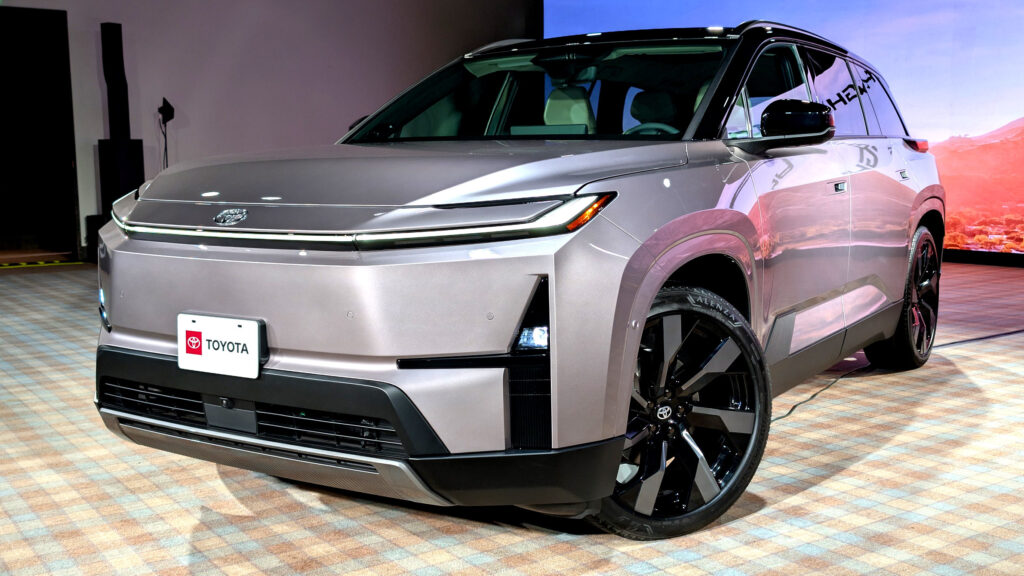
Nikkei Asia reported that Toyota Highlander EV production slipped again.
Kentucky assembly is reported to start in January 2027 “at the earliest.”
Toyota tells Carscoops nothing has changed since its July announcement.
Update: A Toyota spokesperson in the US told Carscoops the company has not changed the timeline it announced back in July, which targets a 2027 launch, likely within the first months of the year. That framing sits at odds with Nikkei Asia’s report of a fresh delay to “2027 or later”. Revised article follows below.
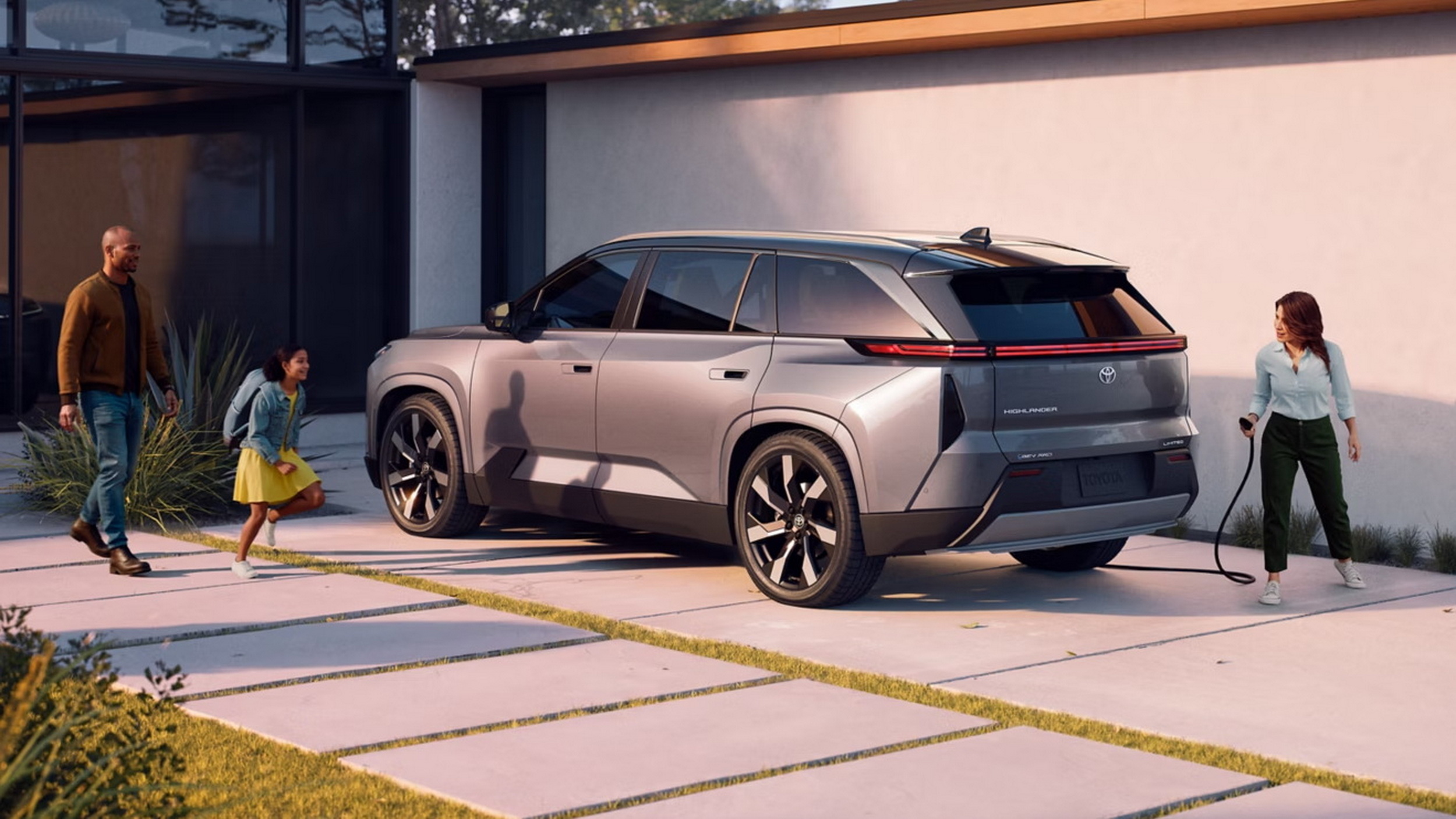
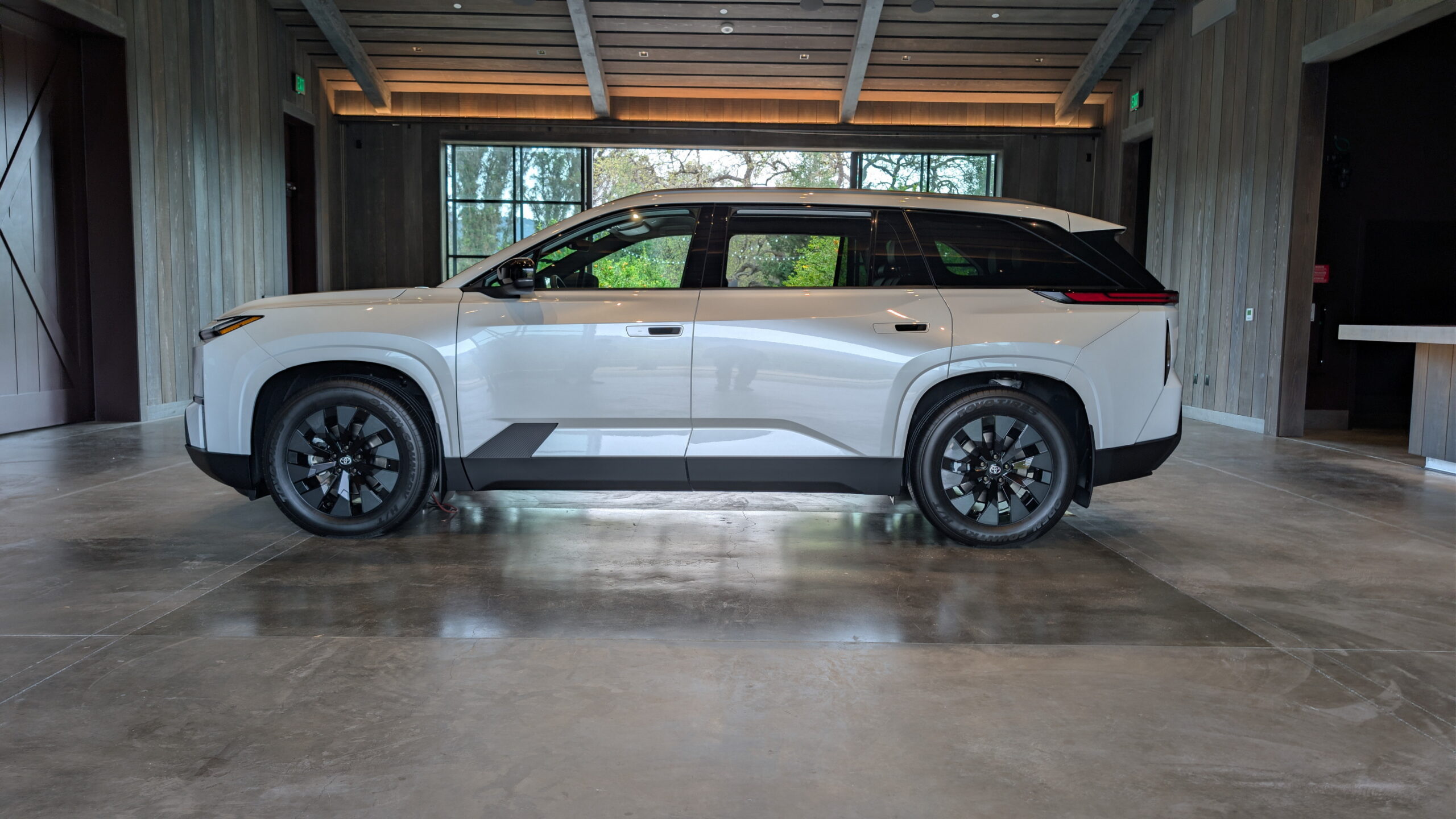
The Highlander EV will be built in Georgetown, Kentucky. According to Nikkei Asia, the three-row SUV is expected to reach the line in January 2027 “at the earliest.” The same publication says Toyota has already notified its supplier network about the revised schedule. A January start would sit inside the early-2027 window Toyota says it has been working toward all along.
A representative for Toyota’s North American division clarified that the extra time is allocated to final checks and quality validation before rolling out full-scale production. This aligns with the automaker’s previous stance in July, when a media preview was postponed.
Subaru’s Getaway Is Stuck Too
Toyota has insisted that the holdup has nothing to do with EV demand in the US, and points out that its EV sales are “still growing.” The numbers back that up, to a point, as US EV sales fell 21% year-over-year in Q2, while Toyota’s own EV deliveries more than tripled over the same stretch. Growing from a small base is easier when the lineup keeps expanding, which is exactly what Toyota has been doing in the region.
The Highlander EV shares its bones with the Subaru Getaway, and both three-row EVs will be built on the same Georgetown line. Subaru confirmed its own delay in July, saying production would slip “to allow sufficient time for final adjustments before launch.” Toyota used almost identical wording, which suggests the two are moving in step. Subaru still hasn’t named a new date or said whether deliveries will shift.
Illinoisans and Minnesotans are buying about the same amount of waterfront property in Wisconsin.
A long-running resentment in Wisconsin is how Illinois residents behave when visiting the Badger State. Another common belief is Illinoisans buy up all the vacation property in Wisconsin, particularly near water.
But that’s exaggerated.
Wisconsin Property Map, an independent project, posted an article examining state property transfer records for sales of waterfront property.
The article stated that from 2021 through mid-2026, Minnesotans bought 9.5% of Wisconsin waterfront property, compared with Illinoisans’ 9.4%.
Wisconsin Watch did its own analysis and found nearly the same figures, with Minnesota edging Illinois by no more than 1 percentage point.
Illinoisans might gain resentment partly because of the type of property they buy.
They bought 17.6% of every $1 million-plus lakefront sale during the period, according to the article.
This Fact Brief is responsive to conversations such as this one.
A surge in sales helped Tesla secure a 55 percent market share in July.
The Tesla Model Y alone accounts for 37 percent of all EVs sold in the US in July.
Through the second quarter, Chevy had a 6 percent share, followed by Hyundai.
Tesla remains far and away the biggest seller of electric cars in the United States, and despite rivals’ efforts, very little progress has been made in eroding the EV leader’s commanding market share.
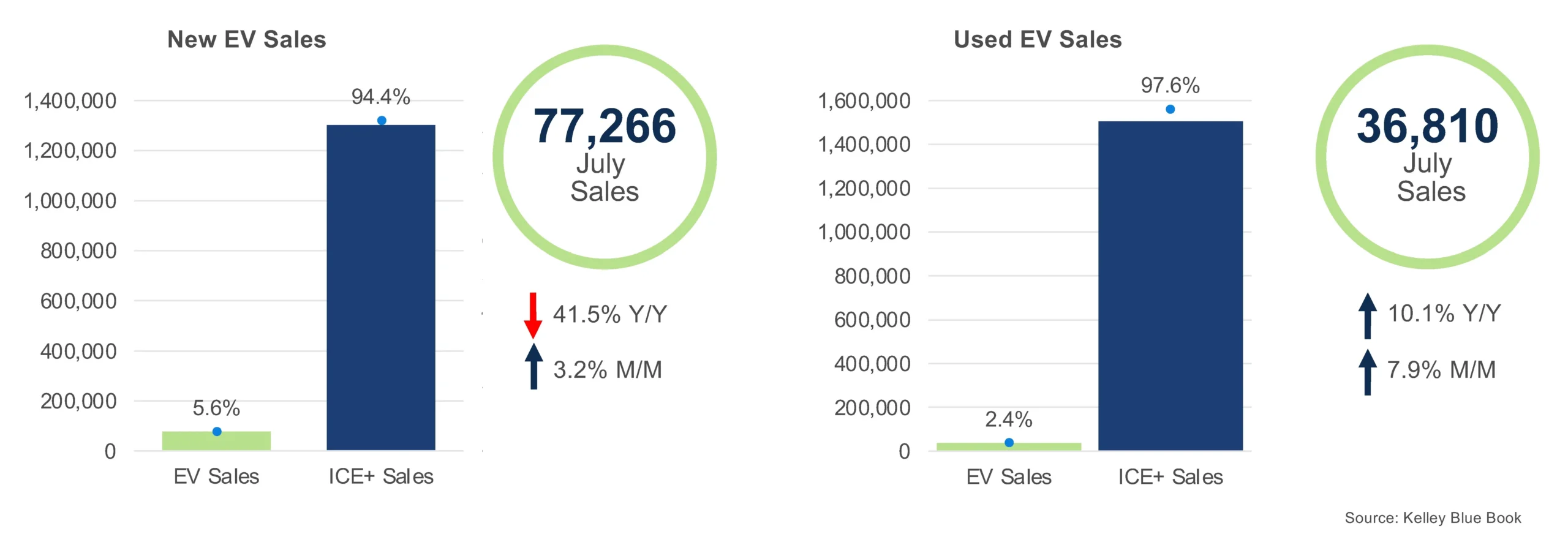
July brought 77,266 new EV sales, up 3.2 percent from June and down 41.5 percent from the same month last year. Electric models made up 5.6 percent of all new-vehicle sales. The year-over-year drop has a simple explanation. In July 2025, the federal EV tax credit was still alive, and buyers rushed to cash it in before the Trump administration killed the incentive in September.
Of last month’s electric cars, 42,435 were Teslas, according to Cox Automotive, good for 55 percent of the market. Tesla’s volume climbed 4.9 percent from June. The Model Y did the heavy lifting, as it always does, accounting for 37 percent of every new EV sold in the country. Basically, the nameplate outsold every rival automaker’s entire electric portfolio.
Tesla’s share throughout the entire second quarter was slightly lower at 50.5 percent, with the company selling a total of 124,800 EVs in the US during this period, down 13.1 percent from last year, when 143,535 were sold. In Q2, the brand with the next-largest slice of the EV pie was Chevrolet at 6 percent, followed by Hyundai at 5.8 percent, Cadillac at 4.9 percent, Toyota at 4.8 percent, and Rivian at 4.6 percent. Ford’s share remains a disappointing 3.9 percent, although its July sales were up 18.9 percent from June.
Hyundai posted the strongest month-over-month gain among the major brands in July, up 36 percent. Kia also moved higher, largely on the strength of the EV9.
Sales Surge Pinches Supply
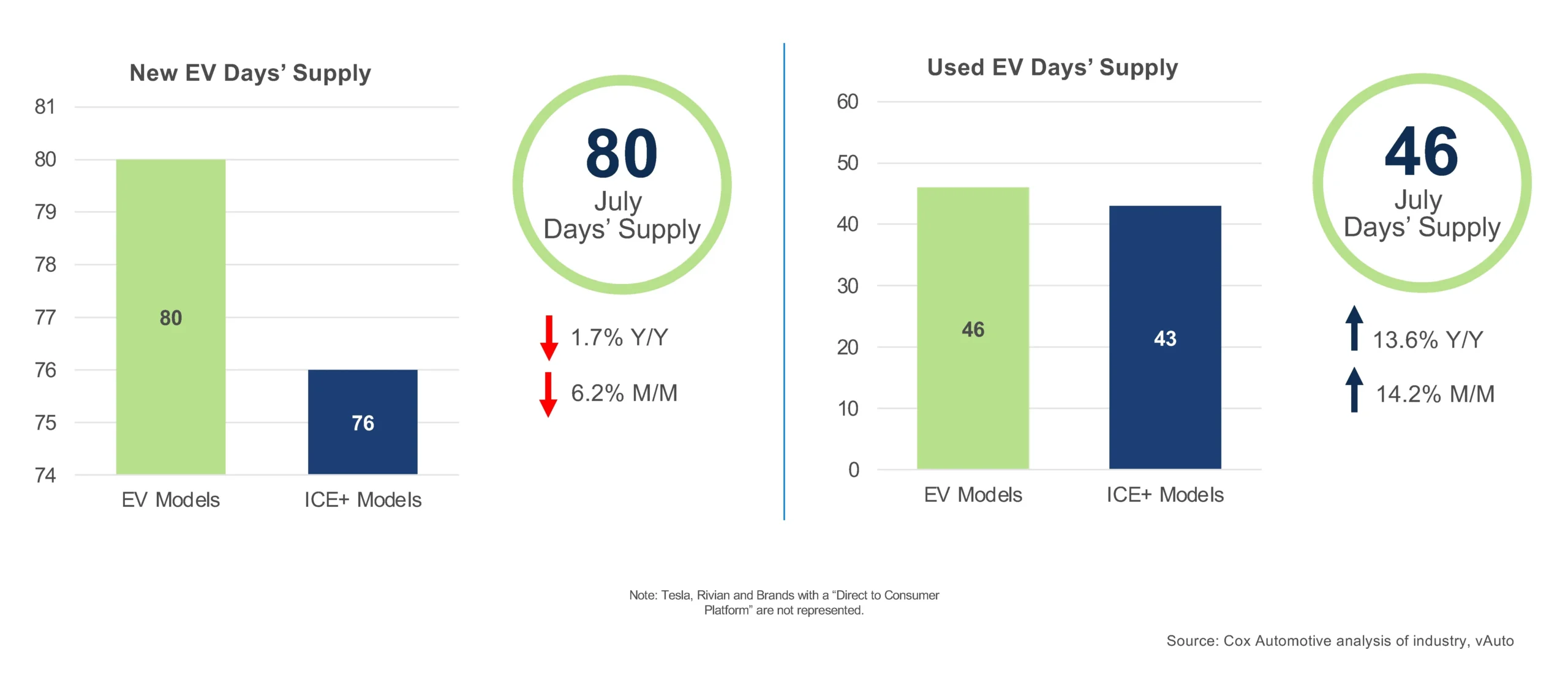
As EV sales climbed in July, the average days’ supply of new EVs fell 6.2 percent month over month to 80 days, and 1.7 percent below where it sat a year earlier. Electric inventory now runs four days above ICE models, down from a nine-day gap in June. Volkswagen carried the heaviest load at 147 days, with Porsche at 138 and Nissan at 133. Subaru ran leanest at 46 days, then Hyundai at 52, and Lexus at 58. Used EVs moved the other way, rising 14.2 percent from June to 46 days, above ICE models for the first time since February 2026.
Used EV sales rose 7.9 percent month over month to 36,810 in July, 10.1 percent better than a year ago. Secondhand electrics took 2.4 percent of the market.
The Price Gap Hasn’t Closed
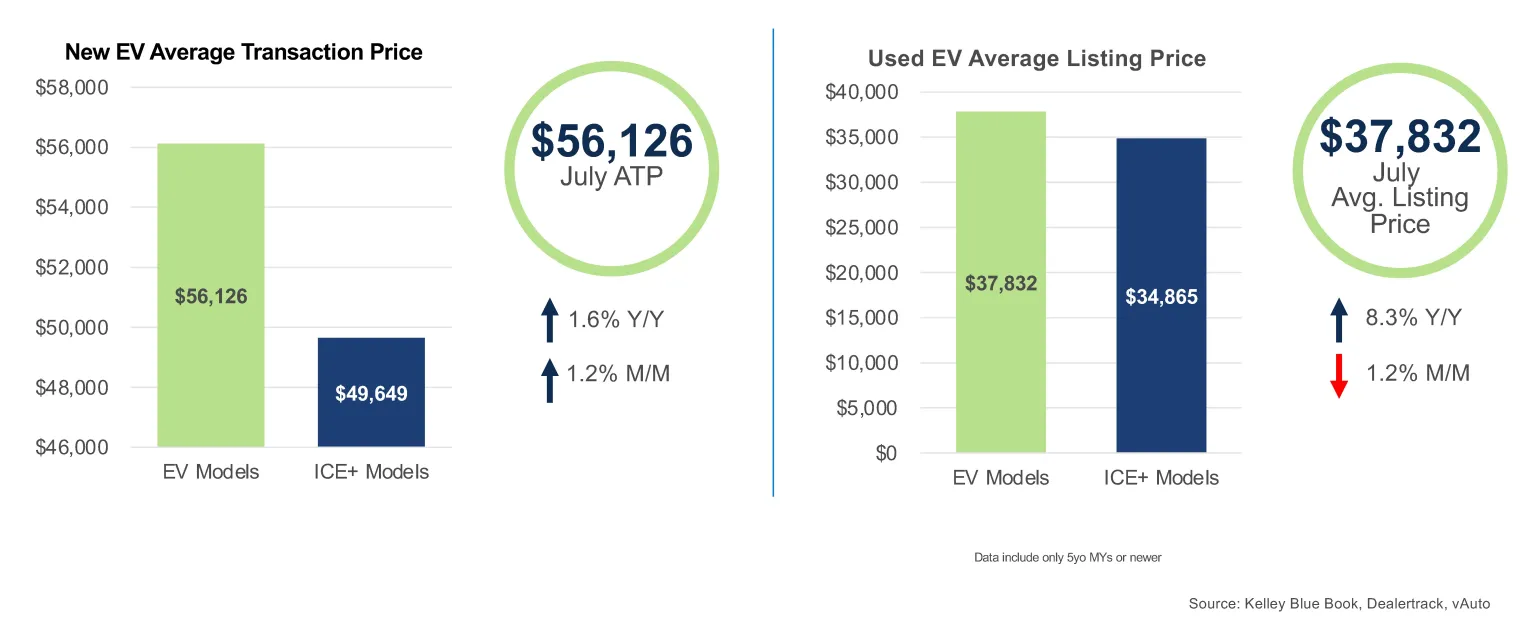
Electric cars remain the more expensive choice on both the new and used side. Average transaction prices for new EVs rose 1.2 percent in July to $56,126, against $49,649 for the average combustion model, and 1.6 percent higher than a year earlier. Incentives shrank over the same stretch, from 13.1 percent of ATP, or $7,290 per vehicle, in June to 11.8 percent, or roughly $6,626, in July. Used electrics average $37,832 against $34,865 for gas equivalents. Those prices slipped 1.2 percent from June but hold 8.3 percent above where they were a year ago.
King Yang, 3, dances in the rain at his brother Yaay Aden Yang’s graduation party at Lorraine Park in South St. Paul on June 28, 2026. Their father, Zong Yang, was deported to Laos in May. (Aaron Nesheim / Sahan Journal)
Yaay Yang held onto his 3-year-old brother King’s hand as the two walked home on a sunny June afternoon. Their mom had caught King playing in a muddy puddle and asked the eldest of her five boys to escort him home for a change of clothes.
A few blocks away, Yaay’s relatives sat under a pavilion at Lorraine Park in South St. Paul, waiting for his return so they could celebrate his high school graduation.
“I do understand it … being the role model,” Yaay, 17, said on the walk home. “It’s what I have to do. Even if I’m really not the best, I still want to be a good one for them.”
Yaay’s life turned upside down five months ago when his dad, Zong Yang, 48, was detained by U.S. Immigration and Customs Enforcement in February. Yaay, who also goes by his middle name Aden, found himself stepping into his father’s shoes. His mother, Linda Yang, became a single parent overnight, raising five sons without Zong – King, 3; Titan, 7; Everest, 8; Kenji, 15; Yaay, 17.
“I don’t want to disappoint them,” Yaay said of his younger brothers.
Yaay Aden Yang, who often goes by his middle name, cuts a cake at his high school graduation party at Lorraine Park in South St. Paul on June 28, 2026. (Aaron Nesheim / Sahan Journal)
Days after his dad was detained, he started falling behind in school. He eventually bounced back and started caring for his brothers after school. He’s taken on more house chores and cooks for his brothers.
“Admittedly, I’m not that good,” he said of his cooking skills, a slight smile on his face.
Zong had impressed on Yaay the importance of being a strong leader for his brothers long before federal immigration agents flooded Minnesota in late 2025.
“He wants to make sure that I’m ready, and that I have everything all figured out,” Yaay said. “I know that he does care deep down, and I do see that with myself too.”
Relatives embrace Yang family
Yaay helped unload food from relatives’ cars earlier in the day at Lorraine Park as others finished setting up his graduation party. Luna, a black puppy, sat nearby under a picnic bench. The family bought Luna about a year and a half ago for Titan, but Yaay wound up as her main caretaker.
Yaay Aden Yang’s maternal uncle, Genue Lor, prepares the coals for grilling at Yaay’s high school graduation party. (Aaron Nesheim / Sahan Journal)
In between greeting guests, Yaay found a quiet moment to check on King as he sat with cousins on a bench and gently rubbed the side of his cheek.
Family members from North Carolina and Minnesota gathered after a heavy rain in the morning left puddles. Pop music played loudly over a speaker as guests ate pasta and Cheetos while Yaay’s uncle, Genue Lor, grilled sausages. While the mood was joyful, tears punctuated the day, as it was the first time the family had gathered in such large numbers since Zong’s deportation in May.
As news of immigration agents arresting Hmong residents emerged last year, Zong’s potential deportation began looming over the family. Yaay said his dad had held onto the hope that he could avoid detention and deportation so he could attend the graduation events.
Yaay pictured seeing both of his parents sitting among other families as he walked across the stage in his graduation cap and gown.
“It does hurt,” he said of his dad’s absence from his graduation ceremony in early June. “A lot.”
Yaay Aden Yang poses for pictures with his mother, Linda Yang, after graduating from South St. Paul Secondary School on June 4, 2026. (Aaron Nesheim / Sahan Journal)
Zong was deported due to a felony burglary conviction from his early 20s and is one of many Hmong and Southeast Asian residents from Minnesota and elsewhere who were deported during Operation Metro Surge.
“He’s the glue that kept everybody together,” Linda said of Zong at the graduation party. “He’s kind of a jokester, and he likes to keep everybody entertained. If anything, he would be with everybody just drinking with them.”
Dozens of children and adults danced to the music at the party. A large handmade sign hung in the background, reading “Congratulations” in large cursive red and white letters – Yaay’s high school colors.
“It’s really big,” Yaay said of the party. “Can’t believe this is actually for me.”
Linda’s older brother, John Lor, who lives in Inver Grove Heights, came with his wife and children. He was in the Yang family’s backyard with Zong when Linda called Zong on Feb. 4 to inform him that federal agents had abruptly cut her off on her way to work, and that they planned to pick him up the next morning.
“I stayed with the family that day,” Lor said. “It was really heartbreaking. I try my best now to help my brother-in-law and my sister.”
Linda’s younger sister, Mai Cua Lor, who was at the party, looked up to Linda her entire life as a model for how to be a wife and mom.
“She and her husband – they made such a big impact in our lives, showing us what love is and how to care for one another and putting family first,” Mai Cua said, adding that Linda is a “strong, independent woman.”
But losing Zong has taken a toll on Linda, Mai Cua said.
“She don’t ever ask for help. She don’t ever cry. She don’t ever show her weakness. So, when she turns to us and says, ‘I need help. I need support,’ it breaks my heart,” she said, her voice breaking. “Cause that’s my sister; she don’t ever ask for anything.”
Mai Cua, who lives in North Carolina, felt helpless that she couldn’t do anything when Zong was detained, but she told Linda and her sons to never hesitate to ask for help.
Pa Houa Lo, one of Linda’s three sisters, lives in Elk River and drives down often to lift Linda’s spirits.
“She’s so strong for her kids, and she doesn’t want her kids to see her cry, but then she turns to us,” Pa Houa said, breaking into a sob, ”and she just tells us she’s broken, ‘cause her rock is gone.”
Yaay Aden Yang’s maternal aunts, Pa Houa Lo, left, and Mai Cua Lor, right, at his graduation party at Lorraine Park in South St. Paul on June 28, 2026. (Aaron Nesheim / Sahan Journal)
Linda grew up in North Carolina and was living there when a mutual friend introduced her to Zong, who lived in Minneapolis at the time. They kept in touch until they met in person in 2007; they married a year later.
Linda’s brother, Genue Lor, drove 18 hours from North Carolina with his two children to support her. He said he’ll always support his sister and brother-in-law, but understands why opinions are divided over the reason for Zong’s deportation.
Linda knew about Zong’s past. He attended regular check-ins with federal immigration officials for 20 years. Since Laos historically refused to accept deportees from the United States, Linda and Zong never imagined he would be sent abroad. But things started to change last year as Laos shifted its stance due to political pressure from President Donald Trump’s administration. Reality settled in.
Linda told Sahan Journal she plans to move to Laos after their children are grown.
“I believe in my sister, and she believes in the law of the system, too,” Genue said. “They really do believe in the American system. That’s why she still has hope that, one day, things will be better. Maybe not in the short-term, but in the long-term, because it’s just the hope of returning together and seeing each other again.”
A dad’s toast from abroad
Surrounded by Yaay and her parents, who flew in from North Carolina, Linda delivered a short speech in the afternoon, thanking Yaay for stepping up to care for his brothers while also dealing with the pressures of being a high school senior.
She smiled as tears ran down her face.
“We haven’t done much for you, but you’ve done so much for us,” she said in a trembling voice.
Linda Yang, left, tears up as she plays a pre-recorded message from her husband, Zong Yang, at their son Yaay Aden Yang’s high school graduation party at Lorraine Park in South St. Paul on June 28, 2026. Zong was deported to Laos in May. Yaay, right, plans to attend Winona State University this fall. (Aaron Nesheim / Sahan Journal)
She paused for a breath.
“And now you’re leaving me!” she said before bursting into laughter.
Yaay wrapped his arm around his mom in a hug, prompting smiles among the guests. She leaned her head on his chest. Then, she announced a pre-recorded video toast from Zong.
“But this toast isn’t my toast, ‘kay?” she said, her voice cracking. “This is Zong’s toast to everybody, ‘kay?”
She held up her phone, and Zong’s face appeared on the screen.
“I just want to do a little toast,” he said as cars zoomed by in the background.
He thanked the guests for their attendance and said he was proud of Yaay. Speaking in Hmong, he said his heart cries when he thinks of the distance between himself and his family.
“Aden, I’m very proud of you, son,” he said in English. “You did it. You made it. … It tears me up every time to think about you guys.”
Yaay choked back tears as he stood next to his mom with his arms behind his back, his hands clasped together. Chong Lo, Yaay’s 65-year-old maternal grandmother, gave him a hug. Linda’s sister, Pa Houa, buried her face in her scarf. Everest, Yaay’s 8-year-old brother, cried as he listened to Zong’s recording.
“Just want to say I love you — miss you man,” Zong said in the video, addressing Yaay. “I wish I could be there, but I can’t.”
Zong held up a can of beer.
“Remember, do the right thing in life,” he told Yaay. “Cheers you guys.”
He downed the drink. Guests at the party lifted their beers and drank them all in one go.
‘I’m not doing good’
Zong told Sahan Journal in an interview later that he couldn’t appear at the party via a livestream because seeing his family’s faces and hearing their questions would have flooded him with emotions.
“I knew if I came live, I would have just been crying,” he said. “I would just be bawling, so I couldn’t do it like that.”
He couldn’t bear the thought of his family asking him how he was doing.
“I’m not doing good,” he said in a shaky voice. “I miss my wife, I miss my kids – so that’s why I couldn’t do it live.”
The Yang family is shown in an undated photo taken at a family event. Back row left to right: Linda, Yaay, Kenji and Zong. Front row left to right: Titan, King and Everest. (Courtesy of Linda Yang)
Zong was born in a refugee camp in Thailand and was never issued citizenship in Thailand, Laos or the United States. He received a green card when he immigrated to the United States with his family as a child and said he never applied for citizenship because he assumed that his green card secured lifelong residency in the country because it said, “Permanent Resident.”
His family first settled in California, where most of his siblings and his mom still live. He has an older brother in Minnesota. His dad died several years ago from a sudden illness.
Zong was convicted of felony burglary in Wisconsin in 1999 for stealing several semi-automatic handguns from the Gander Mountain store in Appleton, Wisconsin, when he was 21. He was sentenced to 12 years in prison, serving about seven years before he was released at the end of 2006, according to court records. His criminal record also includes a conviction for drug possession in 2019.
Yaay Aden Yang’s relatives gathered in late June to celebrate his high school graduation. His father, Zong Yang, appeared at the party in a pre-recorded message because he was deported to Laos in May. Our partners at @SahanJournal followed Aden in the latest installment of an occasional series documenting how deportation reshapes families long after a loved one leaves. #Hmong#Deportation#MetroSurge#SouthStPaul#Minnesota#Midwest
The burglary conviction is considered a removal offense by the federal government and stripped Zong of his green card and prevented him from ever applying for U.S. citizenship. It also resulted in a final order for deportation against him that required him to regularly check in with ICE at the Bishop Henry Whipple Federal Building at the discretion of his immigration officer, or until the government could find a country that would accept him as a deportee.
Zong spent about four months earlier this year in immigration detention facilities in Texas and Louisiana, before he was put on a flight to Laos. When he arrived in Laos on May 9, he was moved to a detention facility operated by the Lao government. He was later released because a local sponsor vouched for him, which is required of U.S. deportees before they leave Lao custody.
“Nervousness is still there,” he said of his slow assimilation to life in Laos, a country he had never stepped foot in before.
These days, he’s less intimidated buying food from local vendors, or when meeting new people. He’s making small steps to care for himself: He often goes to the gym with a friend and recently opened up a bank account.
He lives alone in an apartment located 15 minutes from the National University of Laos in Vientiane, the country’s capital.
“It’s like watching your life just live before you, and you can’t do nothing about it, just go on without you, you know? Like I was supposed to be in the picture,” Zong said of why he didn’t appear live at Yaay’s graduation party. “I’m not supposed to be 2,000 miles away. I’m not supposed to be in the Eastern Hemisphere, you know? I’m supposed to be right there with them.”
Yaay prepares for college
After Zong’s toast, Linda passed the microphone to Yaay, who was caught by surprise. Yaay told the guests he plans to attend Winona State University this fall and study chemistry.
“I’m just going to go and see what life has planned for me,” he said, holding tightly onto the microphone as he nervously glanced at the ground.
“You got it baby!” his maternal aunt, Pa Houa, shouted.
Yaay graduated on June 4, walking across the stage in his red cap and gown as his dad watched live on WhatsApp through Linda’s cellphone. Zong, who didn’t attend college, always reminded his children to focus on education.
Yaay walked with about 200 high school seniors. He wore a red stole with a Hmong design of the elephant foot motif and his name written in Hmong, “Yej Yaj.” Some of the student and teacher commencement speakers briefly addressed the federal immigration operation that rippled across Minnesota from late 2025 through early 2026.
“It is a city built on the backs of immigrants, and it continues to be a community where we are strengthened by our immigrant families,” student speaker Jackson Schultz said about South St. Paul.
Yaay was one of the last students called on stage. Linda zoomed in on him to give Zong a better view. Linda’s sister, Pa Houa, and Zong’s cousin, Mai Zoua, cheered loudly.
“It’s emotional,” Linda said at the graduation ceremony. “I know his dad wanted to be here; it’s another one of those bittersweet moments.”
Linda Yang holds her youngest son King, 3, in her lap as she watches her eldest, Yaay Aden Yang, graduate from South St. Paul Secondary School on June 4, 2026. (Aaron Nesheim / Sahan Journal)
Yaay, filled with a mix of excitement and nervous energy, found his family when the ceremony ended.
“It’s the first time that my life’s not really being directed by going to the next school grade,” he said. “It’s going into college and moving up and living on my own. It’s adulting, basically.”
Yaay smiled happily for photos, holding a bouquet of flowers and a string of balloons. He’s relied on close school friends to cope with his dad’s deportation.
“It is a big accomplishment and obviously with all this stuff going on, I wish my dad was here to witness me do this, and just be here with me in this moment,” he said. “Being able to make my parents proud and being able to live up to their expectations, even how basic it is, it’s still heartwarming.”
More than 7,000 miles away, Zong watched from Laos at about 8 a.m. as Yaay walked across the stage at 8 p.m. Minnesota time.
“I was just happy to see people that still love us to go support even though I wasn’t there,” Zong told Sahan Journal in an interview later, his voice cracking. “It was hard, but it’s just something that I was happy to see.”
He hopes to find ways to still be a part of his sons’ lives during big and small milestones.
“I hope that as they get older, they will understand the whole situation,” he said. “I hope that they do not hold on to say that I left willingly, that you know, that I had a choice, and I just went. That’s what’s going to hurt me the most.”
Not dead, but gone
Yaay’s maternal grandfather, Nhia Ying Lo, 67, also gave a speech at Yaay’s graduation party, telling Linda to have a big heart, and that she has a family to rely on. He bent over and cried into his hand at times, overcome with emotions.
Nhia Ying told Sahan Journal in an interview that what happened to Zong is unfair, given how the United States enlisted Hmong allies to fight in the Vietnam War.
The United States started to recruit Hmong men and boys in 1961 to fight in a CIA-backed operation against Vietnamese communists. An estimated one-fourth of the Hmong men and boys who were recruited died in service, according to the Minnesota Historical Society.
Following the end of the Vietnam War, Hmong people fled political persecution prompted by their alliance with the United States. Many ended up in Thai refugee camps. Many Hmong, including Zong, were born in the camps and later immigrated to the United States.
That generation of Hmong people don’t know the Lao culture or language, Nhia Ying said, and only have familiarity with the Hmong community in the United States.
“Why would they take people like this, with access to jobs, to go live in Laos? They know we are people who don’t know anything (in Laos),” he said.
When it was time for her speech, Yaay’s maternal grandmother, Chong Lo, 65, stood in front of him, one hand clasped over his shoulder.
“Help each other,” she said in Hmong. “Love your mom.”
Yaay Aden Yang is congratulated by friends and family members after graduating from South St. Paul High School on June 4, 2026. His dad’s cousin, Mai Zoua, is pictured at left. (Aaron Nesheim / Sahan Journal)
She cried every time she talked about Zong, or heard his name mentioned at the party.
“I want people to see this, to know what the pain is like, that his life – he’s not dead, but he’s gone,” she said in an interview.
She pressed a tissue to her nose.
“For a family to actually survive this, the parent with the children has to work double — double shifts,” she said, crying so hard she could barely finish her sentence.
Seeing Yaay and Kenji helping Linda gives her some relief, she added. Linda’s sister and brother, Pa Houa and John Lor, who live in Minnesota, regularly visit the Yang family to help with the children.
“We’re never going to be able to replicate his dad, but we’re here to just show our love and support in every way possible, because he’s (Yayy) as much as our son, and that’s (Zong) as much as our father as well,” Pa Houa said. “It’s good to see (Yaay) pass his milestone, but it’s also a little bitter because you wish everyone could join you.”
Most of their family members were playing volleyball when Yaay and King returned to his graduation party after a 10-minute absence to change Yaay out of his muddy clothes. Yaay let go of King’s hand. King took a few steps and glanced back at Yaay with a look of uncertainty on his face.
“Go,” Yaay said softly, motioning to the playground.
Dozens of relatives from both sides of the family awaited them.
“Seeing everyone here,” Yaay said, “it’s nice, and I think I also needed this – just to see all the people who are there to back me up, and help me, and just give me something to work for and not fail.”
A northern Minnesota woman was sentenced to probation after pleading guilty in connection with a 2024 crash that injured 21 students and a school bus driver, reported KSTP News.
According to the news report, Svea Lynn Snickers, 20, was sentenced Monday to three years of supervised probation after previously pleading guilty to two counts of criminal vehicular operation stemming from the Sept. 12, 2024, crash involving a Hibbing school bus.
As part of her sentence, Snickers must reportedly complete 200 hours of community service. According to the terms of her probation, she will receive two hours of community service credit for every hour she spends speaking publicly about the dangers of distracted driving. She was also ordered to pay $10,267.38 in restitution.
The crash reportedly occurred at the intersection of Highway 5 and Townline Road when Snickers, driving a Toyota RAV4, ran a stop sign and struck the side of the school bus. The impact caused the bus to skid sideways before rolling into a ditch.
Authorities said via the article that 21 students were injured in the crash, and 10 of them, along with both drivers, were transported to a hospital for treatment. No fatalities were reported.
Investigators reportedly determined that Snickers had been recording a video on Snapchat in the moments leading up to the collision. During an interview with Minnesota State Patrol troopers, she admitted to using the social media app immediately before the crash.
Following sentencing, Snickers expressed remorse for the incident, telling local news reporters that she wished the crash had never happened.
During the sentencing hearing, a parent of one of the injured students addressed Snickers directly, offering forgiveness.
“We are not mad at you. We forgive you,” the parent said. “We know this was an accident, and you’ve learned many life lessons.”
The case serves as another reminder of the dangers of distracted driving, particularly around school buses transporting students.
A Land Cruiser prototype was photographed standing beside the GR Sport.
A Toyota Europe executive shared the image and called it a legend evolving.
The photo points to the electric unibody model previewed back in 2023.
Update: Toyota Motor Europe has asked Carscoops to remove the image, noting that it was shared from a personal Facebook account. The photo has been taken down, and Toyota has not commented on the prototype itself.
A Toyota executive may have handed us our first look at the next branch of the Land Cruiser family, after the baby FJ Cruiser built for Asian markets. The camouflaged prototype standing next to the current Land Cruiser GR Sport could be the first Land Cruiser to pair an electric powertrain with a unibody chassis, and it most likely got photographed during benchmarking and development testing.
The mystery SUV appeared in a photo shared on Facebook by a Toyota Europe executive. The caption referenced the Land Cruiser and the Tahara plant, leaving little doubt about what we’re looking at.
The shot was taken at the Tahara manufacturing facility in Japan, which is home to production for the Land Cruiser 250 Series, the closely related Lexus GX, and the Toyota 4Runner.
The unnamed prototype is wrapped in camouflage, with cutouts for the headlights and cooling intakes. The team members posing in front of it block much of the view, but a couple of interesting details still come through.
The position of the horizontally arranged headlights and the lower bumper area are consistent with the Land Cruiser Se concept from 2023, but the prototype has a new opening on the nose. Ground clearance also looks slightly lower than on the Land Cruiser Series 300, though the overall height won’t come across as much different.
The 2023 Land Cruiser Se concept measured 5,150 mm (202.8 inches) long with a 3,050 mm (120.1 inches) wheelbase. That makes it 35 mm (1.4 inches) longer than the 300 Series, with an extra 200 mm (7.9 inches) between the axles. Whether the production version keeps that footprint remains to be seen.
Unibody Underpinnings
2023 Toyota Land Cruiser Se
Overall, the mysterious SUV could be similar in size to the Toyota Grand Highlander. It also rides on multi-spoke alloy wheels similar to those found on the luxurious Century SUV. The thread tying those models together is their unibody architecture (TNGA-K).
That same construction is expected to headline the fully electric Land Cruiser, which could use the e-TNGA platform or an evolved version of it. Switching to a unibody chassis will likely make this the best-handling Land Cruiser yet, though it will inevitably cost something in off-road capability against the ladder-frame stablemates like the FJ, 70 Series, 250 Series, and 300 Series.
On the powertrain side, and as Australia’s Drive reports, a battery-electric setup will likely outperform the current ICE and hybrid Land Cruisers. There have also been reports of a possible range-extender option, and the cooling intake on the front bumper makes that scenario sound credible.
The most potent Land Cruiser to date is the self-charging hybrid variant of the Series 300, with a combined output of 457 hp (341 kW / 464 PS) and 790 Nm (583 lb-ft) of torque from a twin-turbo 3.5-liter V6 and a single electric motor.
Toyota is not planning to roll out a Hilux PHEV anytime soon.
The PHEV powertrain would compromise towing and payload.
The Ford Ranger and Chinese rivals already offer PHEV options.
While Chinese automakers reel in buyers with their plug-in hybrid trucks, Toyota is charting a different course. The automotive giant reckons plug-in powertrain technology is not ready for the heavy-duty grind of the pickup segment, so it is sticking with more traditional solutions for now.
The Toyota Hilux entered a new generation last year with diesel, mild-hybrid, and fully electric variants, and an FCEV is due to join the range in 2028. That sets it apart from the rival Ford Ranger, which already comes with a PHEV powertrain in markets outside North America, alongside its non-electrified diesel and gasoline options.
Other plug-in hybrid midsize pickups include the BYD Shark 6, the GWM Cannon Alpha, the Nissan Frontier Pro, as well as the upcoming Chery Stockman from China. Toyota has deep expertise in hybrids and PHEVs, yet it has no interest in bringing the technology to its best-selling truck, at least in its current state.
Ray Munday, Toyota Australia senior manager of product planning and pricing, spoke to local media CarExpert about the potential of a Hilux PHEV.
“We definitely recognize that there’s some strong competition in that area, and we are looking into it, but until the technology is ready, we’re not going to release something that’s rushed. At the moment, typically the challenge with PHEV or any electrification is added mass, which reduces payload and then also the ability to tow. The systems aren’t necessarily developed at the moment to be able to meet our standards of what heavy towing means for a HiLux customer.”
“The expectation of the Toyota and HiLux brand is very high, probably higher than it is on other products,” he added.” We really respect that, and that adds a challenge.”
In other words, Toyota is worried that a Hilux PHEV could not match the 3,500 kg (7,716 lbs) towing capacity and 1-tonne (2,205 lbs) payload of its diesel counterpart, at least in real-world use. Consider that the dual-motor Hilux BEV carries a towing rating of just 2,000 kg (4,409 lbs), which all but confirms the automaker’s fears.
As a result, Toyota’s future PHEV plans will remain focused on its passenger cars and SUVs, at least until the technology matures enough for heavy-duty applications. In a similar context, John Pappas, vice president of sales, marketing, and franchise operations at Toyota Australia, said:
“We’re always looking at these types of powertrain solutions, we’re not just sitting back, but they need to be able to meet the needs of the customer. We’ve got those lifestyle ute options available now in other HiLux grades, but we want to be able to make sure that if we’re going to bring these types of powertrains to market through our very large investment in research and development, that they’re right for our market.”
Toyota and Joby Aviation are forming a new manufacturing joint venture.
It’s focused on building an electric vertical take-off and landing aircraft.
The model is designed to be an air taxi that can haul up to four passengers.
Toyota has been pouring hundreds of millions of dollars into Joby Aviation since 2020, so it comes as little surprise the companies have announced a “strategic manufacturing alliance.” The agreement will see the two firms establish a joint venture known as the Joby Toyota Aero Manufacturing Preparation Company.
While the name doesn’t exactly roll off the tongue, the joint venture will be based in California and Toyota will own a controlling 51% stake in the new company. The ultimate goal is to combine Joby’s “pioneering work in electric aviation with Toyota’s globally recognized expertise in production systems and operational excellence.”
The companies didn’t delve into specifics, but said the joint venture will initially be focused on laying the groundwork for commercial production. They’ll also strive for “manufacturing excellence, with particular emphasis on further improving productivity, quality, and cost.” More importantly, the joint venture will increase Joby’s production capacity and enable them to better meet the anticipated demand for their electric vertical take-off and landing aircraft.
Toyota Chairman Akio Toyoda remarked, “Since our founding, we’ve been guided by the philosophy of providing mobility for all. We see air mobility as a natural extension of that philosophy – from the ground into the sky – and as a way to bring new value to people’s lives and to society. It’s really meaningful for us to take on this challenge together with Joby, a partner that shares the same vision. We believe this strengthened relationship is an important step forward in realizing the future mobility society.”
As a refresher, Joby is focused on creating air taxis and aims to have a “seamless, end-to-end experience that connects ground transportation and air travel in a single journey” thanks to partnerships with companies such as Delta and Uber.
Their six rotor aircraft can carry four passengers and a pilot, and hit speeds of up to 200 mph (322 km/h). The model also has four batteries, rotating propellers, and multiple redundancies to enhance safety.
This story comes to you from Sahan Journal, a nonprofit newsroom dedicated to covering Minnesota’s immigrants and communities of color. Sign up for a free newsletter to receive Sahan’s stories in your inbox.
Linda Yang was driving to work on a cold February morning when a large white van seemingly appeared out of nowhere and cut her off. Other vehicles suddenly rushed in, blocking her on all sides.
U.S. Immigration and Customs Enforcement (ICE) agents jumped out and approached her. They asked if they could go to her home and pick up her husband, Zong.
On Feb. 4, 2026, Immigration and Customs enforcement agents confronted Linda Yang with news to deport her husband Zong a day before he was due for one of his regular check-ins at the Bishop Henry Whipple Federal Building in Minnesota. But Linda refused to turn her husband over, demanding her and their children get one last day with Zong. Read more about their family’s deportation story at the link in bio. Video by Dymanh Chhoun #ice#immigration#deportation#hmong#twincities
She refused. He was home with their youngest sons. She wouldn’t let things get messy in front of them. She wouldn’t let them take away the father of her five sons until they could say their goodbyes.
The agents told her they would come for Zong at 9 a.m. the next morning. Linda rushed to pick up her older sons from school. She called Zong.
“‘ICE is coming to get you,” she said. “They’re going to come tomorrow morning.”
Until recently, they had never thought Zong, 48, would be deported due to a felony burglary conviction from his 20s, which led to a final order of deportation. The couple felt safe from that possibility most of their marriage. But that sense of security shattered last year when local news outlets reported that Hmong residents from Minnesota and elsewhere were being deported to Laos.
Federal immigration agents had been watching their South St. Paul home. They confronted Linda on Feb. 4, a day before Zong was due for one of his regular check-ins with the ICE office at the Bishop Henry Whipple Federal building.
A few months after agents swarmed Linda’s car, Zong was deported to Laos, a country he had never stepped foot in before. Overnight, Linda, 41, was turned into a single mother of five sons — King, 3; Titan, 7; Everest, 8; Kenji, 15; Yaay, 17.
“I guess it was just kind of like, ‘It’s real. It’s happening,’ you know?” a teary-eyed Linda told Sahan Journal. “The day that we thought that would never happen, happened.”
One last day
Linda Yang holds her youngest son, King, 3, in her arms at their South St. Paul home on May 6, 2026. Linda’s husband, Zong Yang, was deported to Laos in early May, leaving her alone to raise their five sons. (Aaron Nesheim / Sahan Journal)
Several relatives trickled through Linda and Zong’s house for hours the day Linda was stopped by ICE, crying and joking at times in an attempt to lighten the mood until 2 a.m. Some of their siblings, cousins and Zong’s son from a previous marriage gave Zong a pep talk, assuring him they would support his family while he was in Laos.
Linda and Zong received several calls from an unknown number throughout the morning after Linda’s encounter with ICE. She finally picked up the call around noon. A federal agent was on the other end. ICE agents would take Zong to his check-in the next morning so he could fill out paperwork, and then he would be “released,” she said the agent told her. They also said they planned to take Zong to a different location instead of the Whipple building because of ongoing protests.
She let out a sigh of relief — Zong would return home, she thought. Still, questions lingered: Could she trust federal agents to tell the truth? ICE agents had never accompanied Zong to an appointment in the past.
Yaay, who family members refer to by his middle name, Aden, spent most of the day in his room like he would any other day, thinking his dad would return home after his immigration check-in the next day.
Zong sensed that his three youngest sons felt the heavy atmosphere in their house. They didn’t know why everyone had gathered, and Zong couldn’t bring himself to explain the situation. Instead, he told Everest, Titan and King multiple times that he loved them, and that he had to go away.
He told his two oldest sons, Yaay and Kenji, that he was facing potential deportation because of a felony conviction. They understood the gravity, having seen news coverage of Operation Metro Surge. He asked all of his sons for forgiveness, explaining that he was being taken away and not leaving them by choice.
Zong Yang, left, and Linda Yang, right, are shown in an undated picture displayed in their South St. Paul home, photographed on May 6, 2026. (Dymanh Chhoun / Sahan Journal)
“It’s nothing that you guys or mom did. It’s something I did – a mistake, way back before I met your mom, and now I have to face the consequences of it,” he told them.
Linda and Zong had discussed the deportation process with their oldest sons in the past year to prepare them for the possibility.
“I was more aware of it and knew what was going to happen, so I was already able to mentally prepare myself while they still can’t really grasp it,” said Yaay, referring to his younger brothers. “They’ll have to go through a lot more of their lives, compared to mine, without our dad.”
Part of Linda and Zong held onto some hope that federal agents would take Zong to his check-in the next morning and bring him home instead of detaining him for deportation. The other part slowly began accepting the painful reality that it could be Zong’s final hours with his family on U.S. soil.
Linda packed underwear, pants, shirts, socks and shorts for Zong. Zong grabbed his essentials: allergy medicine, hydrocortisone cream, contact lenses and his glasses. They laughed later when Zong found that Linda had packed only three shirts.
Thoughts of running away crept into Zong’s mind as family and friends continued arriving to say their goodbyes, but he told himself he couldn’t get away from his past.
“I just need to take it head on,” he told himself, comforted by the knowledge that Linda and his sons were by his side.
“That’s what really, really helped me mentally, too, but even at that, we’re all still human — we want to be with family, your kids, your wife, and it was a tug of war,” Zong said later as he reflected on the last night with his family.
Linda and Zong made breakfast for their sons the next morning. Linda’s phone buzzed again with a call from a federal agent. They wanted to detain Zong before 9 a.m. She refused. She didn’t want her sons’ last image of their father to be of him walking away with federal agents.
Wait until the boys board their buses and leave for school, she told the agent.
She felt relieved when the agent obliged. The agent told her they would send no more than two agents to the house and agreed not to put Zong in handcuffs.
Yaay, Everest and Titan boarded their buses soon after the call as federal agents sat in vehicles idling nearby. Kenji, 15, stayed home to see his father off. About 9 a.m., less than 30 minutes after the last boys left, two federal agents came to the door. Zong grabbed his duffel bag and backpack. Linda and Zong hugged and kissed.
“What are the chances that you guys are really releasing him back to me?” she asked the agents.
They brushed her off, she said, saying they needed Zong for paperwork. She pressed on.
“Can I come with you?” she asked.
They wouldn’t allow her to get in their vehicle. She worried they would bring Zong to a “random warehouse.” But the federal agent on her front porch told her they were taking him to the Whipple building, contradicting what another agent had told her over the phone the previous day.
As the two agents drove off with Zong, five other vehicles parked on the same street quickly pulled away, said Linda, who was stunned that more agents had been concealed and waiting.
Linda’s brother sat in a vehicle nearby, ready to give chase. She joined him, eager to see Zong walk out of the Whipple building free to go home.
The past catches up
Everest Yang, center back, 8, wrestles with his younger brother King, center front, 3, at the family’s South St. Paul home on May 6, 2026. Their father, Zong Yang, was deported to Laos in early May. ( Aaron Nesheim / Sahan Journal)
Linda and Zong started looking for attorneys early last year as news began circulating that Hmong residents were being deported. They worried that Zong could be next and closely followed news about other cases, comparing them to his case.
“It (the detention of Hmong residents) didn’t bother me, but maybe it should’ve, but also maybe it was best that it didn’t get to me, because I would’ve ran or hid,” Zong told Sahan Journal in a video interview from Laos. “I didn’t know anything like this would happen. I wasn’t thinking of this side of the consequences.”
Laos historically refused to accept deportees from the United States, but shifted its stance early last year due to political pressure from President Donald Trump’s administration. It’s unclear how many Hmong and Southeast Asian residents have been deported to Laos. However, several Hmong Minnesotans have publicly documented loved ones’ deportations to Laos through Facebook or GoFundMe campaigns, as did the family of South Milwaukee, Wisconsin, resident Ma Yang after her deportation to Laos in 2025.
Linda and Zong held onto hope after seeing a few cases where Hmong detainees were released from federal custody. Michigan Gov. Gretchen Whitmer issued a pardon last year for Lue Yang, a father of six whose criminal conviction had been expunged, putting a stop to his deportation. Minnesota resident Thi Dua Vang, a refugee, was detained for two weeks in January before being released on bond.
But attorneys told the Yang family there was nothing they could do. The legal costs and severity of Zong’s criminal conviction made it difficult to change his fate.
An undated photo of Zong and Linda Yang hangs in the family’s South St. Paul home, photographed on May 6, 2026. (Dymanh Chhoun / Sahan Journal)
Zong arrived in the United States with his family at age 3 after they fled Laos as refugees in the wake of the Vietnam War. Many Hmong, including children, had been recruited by the United States to serve as CIA-backed soldiers to fight against communists and to rescue downed American pilots and injured soldiers. As the U.S. military fled after the war, the Pathet Lao and North Vietnamese militaries retaliated against the Hmong community for aiding the Americans, according to the Minnesota Historical Society.
Zong was born in a refugee camp in Thailand and had never been issued citizenship in Thailand, Laos or the United States. He received a green card when he immigrated to the United States and said he never applied for citizenship because he assumed that since his green card said “Permanent Resident,” it secured his lifelong residency in the country.
He was convicted of felony burglary in Wisconsin in 1999 for stealing several semi-automatic handguns from the Gander Mountain store in Appleton, Wisconsin, when he was 21. He was sentenced to 12 years in prison, serving about seven years before he was released at the end of 2006, according to court records. His criminal record also includes a conviction for drug possession in 2019.
The burglary conviction is considered a removal offense by the federal government, stripping Zong of his green card and preventing him from ever applying for U.S. citizenship. It also resulted in a final order for deportation against him that required him to regularly check in with ICE at the Whipple building at the discretion of his immigration officer, or until the government could find a country that would accept him as a deportee.
“I should have not done anything like that, taking somebody else’s stuff. It was wrong,” Zong told Sahan Journal. “At that time, my mind was just, I was away from home, but my mind was just not where it was supposed to be.”
Zong moved to Minnesota for a job and met Linda in 2007 through a mutual friend. She eventually moved to Minnesota from North Carolina, and the two married about a year later. They bought a house where their sons tussled on the living room floor.
Zong never kept his past from Linda. He attended his check-ins at the Whipple building for 20 years. Initially, he checked in every three months, but it varied from every six months to twice a year back to every three months.
Their prior sense of security against Zong’s deportation started falling apart when federal immigration agents started flooding Minnesota last year. In an effort to lighten the mood, they started joking about Zong being deported to Laos, imagining him in different careers and soaking up the warm weather, and Linda visiting on vacation.
She pictured growing old with him in Laos after the children had all grown up. They’d retire and buy a house there.
Zong makes a plea for his spirit
Bishop Henry Whipple Federal Building, pictured on May 14, 2026. (Dymanh Chhoun / Sahan Journal)
Zong arrived at the Whipple building for the last time on Feb. 5, 2026, a chilly Thursday morning. Linda and her brother parked outside the building for about an hour and a half, waiting to pick him up after his check-in.
Federal agents put shackles around Zong’s ankles and brought him into a room with other shackled detainees. He knew he would never return home.
He called Linda, who was still waiting outside. She broke down in tears. He was shipped to Camp East Montana in El Paso, Texas, a few hours later.
The U.S. Department of Homeland Security and ICE did not respond to questions about federal agents’ interactions with the Yang family.
Zong said there was no time to file any legal challenges in hopes of keeping him in the country or releasing him from custody, or to arrange a visit with an attorney before he was deported.
Zong met about 50 other Hmong, Lao and Vietnamese men while detained in Texas. They were all later transferred to the El Paso Processing Center, where he said they were held for two months.
“It’s just so many thoughts and emotions running through my head,” Zong said of his state of mind while in federal custody. “It was just more of like, ‘This is it.’”
Zong still gets overwhelmed with emotions thinking about the day he was detained and the three months he spent in federal custody. He’s angry that federal agents tried to pick him up a day before his regular ICE check-in and falsely give his family hope that he would return home after the check-in. But he’s also grateful that he was able to say goodbye.
“It was better than just getting snatched up and not spending time with my kids and my wife, you know?” Zong said of his last day with his family.
In many cases, federal agents detained people at work, during traffic stops or while they were fueling their cars at the gas station. Agents detained people at bus stops, and while visiting businesses door-to-door in immigrant-dense neighborhoods. They detained children on their way home from school, broke into homes without warrants and arrested U.S. citizens, chasing and tackling people in the streets and snow.
Zong, who practices traditional Hmong shamanism, looked out the airplane window on his deportation flight in early May and pleaded to the heavens to allow his spirit to follow him to Laos, and to let his family know that he did not choose to leave them.
“I would never ever be able to step on this American soil again. I would never ever see my kids on American soil, where we built our home,” he recalled thinking at the time.
Yaay Yang, left, 17, who also goes by his middle name, Aden, and his mother, Linda Yang, right, sit on the family’s porch in South St. Paul on May 7, 2026. (Aaron Nesheim / Sahan Journal)
The Yang family’s new chapter
Zong arrived in the Lao capital, Vientiane, on May 9 and was moved into a detention facility for U.S. deportees run by the Lao government. He found a sponsor, who is Hmong and a Lao citizen, to help vouch for him so he could move out into independent housing. Laos requires deportees to find a sponsor, complete multiple rounds of interviews with Lao officials and finish paperwork before leaving the detention facility.
Zong was intimidated buying food at the local market his first few days because he doesn’t speak the Lao language. But he’s settling in, and making an effort to get to know other deportees. He spends his days going on walks, exploring the city and building up his confidence.
He now lives in an apartment about 15 minutes from the National University of Laos in Vientiane. He calls Linda and their sons every day on Facebook or WhatsApp around 7 p.m. Minnesota time, or 7 a.m. Lao time, and once more before he goes to sleep.
Zong and Linda are coping with the turmoil of his deportation by documenting their journey on Facebook to help others going through the same experience, and to help their younger sons understand their father’s story one day. They’ve shared more than 50 posts through written entries, videos and photos chronicling their family’s separation.
Linda, an accountant, has always been the family breadwinner, but Zong’s absence has added financial strain on their family. Zong was working as an overnight freight worker at Home Depot in Inver Grove Heights when he was deported.
She got rid of one of their vehicles to cut costs and finds comfort in the support she’s received from family members. Her nephew and aunt have helped babysit King. Relatives visit more often these days to check on her family. But there’s only so much other family members can do to shore up Zong’s absence.
Linda and Zong’s eldest son, Yaay, graduates from South St. Paul Secondary this year and plans to attend Winona State University this fall.
“It is hard just going through all this without him,” said Yaay, 17. “I was expecting to go through all this with him, and for him to be there during my achievements. But it honestly has pushed me a little in some aspects just to do better, and be better.”
Linda and Yaay sat on a sofa in the family’s home in early May as Everest and Titan played with their cousins upstairs. King napped in another room. They cried and laughed as they recalled the last few months and thought about the year ahead without Zong. They didn’t know what the future would bring, but one thing was certain — they wouldn’t let an ocean keep their family apart.
Linda Yang reads messages from her husband, Zong Yang, on May 6, 2026. Zong was deported to Laos in early May, leaving Linda to raise their five sons, ages 3 to 17, alone. (Aaron Nesheim / Sahan Journal)
A long-running local government collaboration in southwestern Minnesota is helping to insulate the region from the kind of controversies and misinformation that have plagued rural clean energy projects in other states.
The Rural Minnesota Energy Board has its origins in a regional task force that was set up during the mid-1990s as the state’s first wind farms were being built. The task force was instrumental in persuading state legislators in 2002 to create a wind energy production tax, which today generates millions of dollars in annual revenue for counties and townships that host wind projects.
The group’s scope and membership has since gradually expanded to include 18 rural counties that pay monthly dues for support on energy policy and permitting. The board represents members at the state legislature and in Public Utilities Commission proceedings. At home, it facilitates community meetings with project developers, helps draft energy-related ordinances, and educates members and the public on the benefits of energy projects.
The result, say clean energy advocates and developers, has been a uniquely consistent approach to local energy policy and permitting that makes it easier for renewable companies to do business in the region.
“The rural energy board has been a critical, important body and one of the major reasons why renewable energy has been successful in southwestern Minnesota,” said Adam Sokolski, director of regulatory and legislative affairs at EDF Renewables North America. “Their policies have encouraged good decision-making over the years and led to a stable and productive region for energy development.”
EDF Renewables has worked with the board on at least nine projects in the region. Sokolski said he’s come to admire its approach to policy making, its support for transmission projects, and its efforts to educate members on clean energy.
“It’s positive to have county leaders talking to each other about energy projects, about how … they can approach those projects so they best benefit their constituents and the public,” he said.
Southwest Minnesota has the state’s densest concentration of wind turbines and is increasingly attracting solar developers, too. Wind turbines account for more than 4,500 megawatts, or around 22%, of the state’s generation capacity, making Minnesota a top 10 state for wind production.
‘It’s all economic development’
The board counts the wind production tax among its most significant accomplishments. Large wind farms pay $1.20 per megawatt-hour of generation. Counties receive 80% of the revenue, with the remainder going to townships. A similar fee also exists for large solar projects.
The fee delivers millions of dollars annually, allowing local governments to construct buildings and repair bridges and roads without raising their levies for years. According to American Clean Power, Minnesota municipalities receive $44 million annually in taxes, and private landowners receive nearly $41 million in lease payments from wind and solar companies.
That has enabled counties to stave off opposition by pointing out that turbines and solar are economic development, according to Jason Walker, community development director for the Southwest Regional Development Commission, which manages the board, said the local government revenue generated from wind and solar projects has helped reduce opposition to projects.
“It’s all economic development here,” Walker said.
When opposition does emerge, such as around a recent 160 megawatt solar project in Rock County in the state’s far southwest corner, the board works with commissioners to make sure local leaders have factual information as opposed to misinformation.
Peder Mewis, regional policy director for the Clean Grid Alliance, praised the board for creating an information-sharing culture among members that helps prepare them for clean energy development. He said many developers appreciate that the region’s ordinances are similar because of the board, and that they have maintained good relationships with members over the years.
“There are other parts of the state that are thinking, ‘Is there something here that we could replicate or duplicate?’” Mewis said.
Jay Trusty, executive director of the Southwest Regional Development Commission, said the board plays an essential role in lobbying for state policy to support clean energy development. In addition to the production taxes, the board regularly defends the local distribution of those funds when lawmakers consider other uses for the revenue. The board more recently lobbied for changes to the state transmission permitting process, which were approved this year, and it supported an expansion for Xcel Energy’s CapX 2020 high-voltage transmission project before state utility regulators.
Minnesota Public Utilities Commissioner John Tuma recalled the board’s support for the state’s 2008 renewable energy standard, which gave Republican Gov. Tim Pawlenty important rural support for signing the legislation.
“They bring an economic voice to the table,” Tuma said, adding that the board continues to be active in conversations about regional grid policies.
Nobles County Commissioner Gene Metz has served on the board for 12 years. The region’s decades of experience and collaboration on wind energy has helped make residents more comfortable with clean energy projects, he said, leading to fewer controversies.
In counties outside the board’s territory, “they’re getting more pushback, especially on solar projects,” he said.
Gene’s cousin, Chad Metz, serves as a commissioner in Traverse County, which is not a member and has a mortarium on clean energy projects. Chad Metz sees clean energy as inevitable and wants the county to join the rural energy board to protect its economic interests. “The benefits outweigh the negatives, and it will just become part of life,” he said.
Amid a surge in utility shutoffs, and in the face of a groundbreaking study finding racial disparities in those outcomes, Minnesota’s largest utility is taking a closer look at the issue.
In a November agreement with consumer groups and the state’s Public Utilities Commission, Xcel Energy has outlined a series of steps to provide more information to customers and make it easier for them to restore service.
Xcel also agreed to hire an outside consultant to conduct a one-year study of disparity issues related to disconnections and outages and, separately, do its own analysis of outages. The move came in response to a University of Minnesota study released earlier this year that found that people of color were more likely than White households to have their service disconnected for falling behind on bills, even when controlling for income and home ownership status.
The agreement falls short of a demand from the Minnesota Attorney General’s Office for Xcel to institute a temporary moratorium on shutoffs until racial disparities are addressed, based on a recommendation from Fresh Energy and a coalition formed by Cooperative Energy Futures, Environmental Law & Policy Center, Sierra Club, and Vote Solar.
Erica McConnell, staff attorney for the Environmental Law & Policy Center, represented the clean energy organizations advocating for grid equity. She supported the agreement but believes it will do little to help reduce disparities in shutoffs.
“These are very important improvements that don’t really address — and the commission didn’t discuss — the disparate impacts and the racial disparity (of disconnections) and how to address that specifically,” she said.
A temporary moratorium on disconnections would have allowed for time to study disparities and find ways to address them.
“The commission didn’t talk about that,” McConnell said. “They didn’t address it at all, so that was disappointing. I understand it’s uncomfortable and it’s a tough issue, but it’s disappointing they shied away taking it head on.”
Shutoffs soaring
Beyond the challenge of disparities, Xcel’s number of service disconnections has skyrocketed. More than 45,000 Xcel customers saw their power shut off this year, a number that has grown significantly over the last two decades.
Xcel agreed to many proposals from the Citizens Utility Board of Minnesota, the Energy CENTS Coalition, clean energy organizations and the Public Utilities Commission to create more consumer protection against shutoffs.
Xcel Energy’s involuntary disconnection notices began rising significantly in 2023 before skyrocketing in 2024, when shutoffs doubled the prior year’s total for May through July. Despite Minnesota’s cold weather protection rules that limit disconnections during the winter through April 30, shutoffs even grew during the winter months.
This chart, based on Xcel Energy data and submitted by consumer and clean energy groups to the Minnesota Public Utilities Commission, shows a sharp increase in utility shutoffs in 2023 and 2024, which the groups attribute to the utility’s new ability to use smart meters to disconnect customers remotely. Credit: Minnesota PUC Docket E002/M-24-27
Clean energy and consumer organizations point to Xcel’s ability to remotely disconnect customers who have smart meters as a major reason for the shutoffs, along with inflation, escalating rate increases and challenging repayment requirements. Xcel had demanded customers pay 50% of what they owe to reconnect, which may have violated Minnesota law, according to the Citizens Utility Board.
Xcel’s pact with the Citizens Utility Board and Energy CENTS “is going to make payment agreements more affordable and hopefully help households that are behind on their bills avoid getting shut off and get caught back up,” said Annie Levenson-Falk, executive director of the Citizens Utility Board of Minnesota.
The utility board and Energy CENTS Coalition forged the agreement with Xcel under the purview of the Public Utilities Commission, which will issue a final order later. The agreement requires the following:
Customers will pay 10% of what they owe to have the power turned back on, instead of 50%.
The amount due will have to be at least $180 before Xcel can send a disconnect notice.
Xcel cannot shut off power until a customer reaches a $300 past due balance. Xcel’s data from this year showed disconnected customers were $441 in arrears on average in October and much higher in other months.
The utility must wait at least 10 days after a shutoff notice has been sent to disconnect, up from five days.
Xcel must post clear disconnection and payment policies on its website, along with information about customers’ right to develop an affordable repayment plan. Any changes Xcel makes to shutoff policies and repayments have to be reported to the commission, and it must collect data on repayments and customer agreements.
A variance allowing remote disconnections without field visits from Xcel remains, but the utility must contact customers via voicemail and use at least one other form of electronic communication.
Xcel spokesperson Kevin Coss said the utility believes “this agreement is a great step toward reducing disconnections for some of our customers who continue to struggle economically.”
Options for customers
George Shardlow, Energy CENTS executive director, said he thought a clearer explanation of the disconnection process on Xcel’s website brings a transparency that had been lacking.
“I don’t think the average person even knows that they have a right to negotiate when they’re struggling to pay their bills,” he said. “It’s all sort of opaque. We’re excited to see better documentation of people’s rights on Xcel’s website.”
Minnesota law says utility customers are “entitled” to a payment plan they can afford, Shardlow said. Customers who cannot afford the 10% down payment can still negotiate for a settlement that fits their budget, he added.
Shutoffs have been growing. This year Xcel sent disconnection notices to 51,000 customers in January and 71,000 in July. But not all notices result in shutoffs. The highest month for disconnections, May, saw more than 10,000 shutoffs. By August, slightly more than 8,400 customers had been disconnected.
Coss said Xcel works with customers to avoid disconnection by starting a nine-week process of contacting them through multiple channels to “point them to available options for energy assistance — both through the federal Low Income Home Energy Assistance Program and our own affordability programs — and offer flexible payment plans tailored to their circumstances.”
Minnesota also has cold weather protections that greatly reduce utilities’ ability to disconnect customers in winter months. But people who fail to pay their bills in winter see their balances grow, leading to higher disconnections in summer when they fail to catch up.
Xcel agreed to monitor progress and collect more data on racial disparities involving customers involuntarily shut off. The utility has already hired a third party evaluator, as the agreement requires, to study its shutoff policies and hold stakeholder engagement meetings during the year-long process.
Coss said disparities result in inequities throughout society and Xcel has been doing its part to address them. The utility has worked with the study’s authors and advocacy groups to identify actions to reduce disparities, he said.
Earlier this year, the commission also approved a proposal by Xcel for a pilot program that will provide bill credits to select census tracts with high levels of disconnections. Coss said Xcel will provide $500 bill credits to customers in low-income census areas who have a greater than $2,000 past-due balance, using money available from a quality of service program.
Minnesota Public Utilities Commissioner Joe Sullivan said he believed the agreement negotiated among the nonprofits and utility would reduce the financial strain on households facing disconnections and assist Xcel in recovering debt.
“I thought that in that docket people came together and were constructive,” he said. “I feel like I’m hopeful that the order will make some progress.”
PUC Chair Katie Sieben said the commission is “always looking at affordability, and especially as it pertains to low-income customers, I think we have a great track record on working with stakeholders and with utilities to provide robust low-income assistance to customers.”
She mentioned the commission’s role in approving an Xcel pilot to decrease payments for low-income, low-usage customers and a September decision that used a penalty for the utility’s service quality underperformance to provide bill credits to around 1,000 customers with the oldest outstanding balances in low-income census tracts.
‘Still more work to do’
The agreement does not solve the problem of low-income customers struggling to pay utility bills. Shardlow said Energy CENTS and the Citizens Utility Board lobbied the state legislature to allow households to apply for energy assistance funding the entire year instead of the current policy of having a deadline of May 31. Only 20% of eligible Minnesota households participate in the program, he said.
Levenson-Falk wants Xcel to consider eliminating the 1.5% late fee it charges customers on their balance, or consider donating the money to affordability programs.
The Citizens Utility Board also wants Xcel to develop a plan to reconnect customers quickly on days of high heat or poor air quality. Coss said Xcel will evaluate reconnecting customers disconnected during days of air quality alerts.
Levenson-Falk said the agreement at least makes progress. “I think we resolved everything that we had discussed with Xcel but that’s not to say that we think this is going to solve the problem, because, of course, there are still going to be continuing shutoffs, and those are still very concerning,” she said. “There’s still more work to do.”
This story was updated to include a statement from Minnesota Public Utilities Commission Chair Katie Sieben.
Fresh Energy staff, board members and funders do not have access to or oversight of the Energy News Network’s editorial process. More about our relationship with Fresh Energy can be found in our code of ethics.
Massive data centers used for cloud computing and artificial intelligence are consuming enormous amounts of energy, and developers are eyeing South Dakota as a potential location, regulators say.
These “hyperscale data centers,” or “hyperscalers,” are designed to handle immense computing demands and are often operated by tech giants. The centers are characterized by their large size — often tens of thousands of square feet — and thousands of computer servers that require significant energy to operate.
Nick Phillips with Applied Digital in Texas, a developer of the centers, highlighted South Dakota’s appeal: a cold climate that cuts down on cooling a room full of hot servers, and abundant wind energy that’s considered one of the most cost-effective renewable energy sources, which can help keep operating costs down.
State regulators are not aware of any hyperscale data centers currently operating in South Dakota.
“There isn’t a requirement to report hyperscale data centers to the commission, so we don’t have a formal method to track that information,” said Leah Mohr with the Public Utilities Commission.
Commissioner Kristie Fiegen noted that the state’s largest proposed data center is a 50-megawatt facility in Leola.
“We don’t know what’s coming,” she said. “But the utilities are getting calls every week from people trying to see if they have the megawatts available.”
The commission recently hosted a meeting in Pierre with representatives from regional utilities, regional power grid associations and data centers. The goal was to understand the emerging demands and facilitate an information exchange.
Bob Sahr, a former public utilities commissioner and current CEO of East River Electric Cooperative in Madison, emphasized the scale of energy needed.
“We’re talking loads that eclipse some of the largest cities in South Dakota,” he said.
A single data center campus can require anywhere from 300 to 500 megawatts of electricity to operate. One megawatt can power hundreds of homes. By one estimate, there are over 1,000 hyperscalers worldwide, with the U.S. hosting just over half of them.
Ryan Long, president of Xcel Energy, headquartered in Minneapolis, illustrated the extreme nature of the demand.
“We now have, I would say, north of seven gigawatts of requests across the Xcel Energy footprint for data centers to locate in one of our eight states,” he said. “And I’ll be very frank that there’s no way that we’re going to be able to serve all of that in a reasonable amount of time.”
Protecting existing customers from potential costs or energy shortages is another shared concern. Utility representatives emphasized the need for coal and natural gas to maintain a reliable “base load” when renewable sources like wind and solar are unavailable. Arick Sears of Iowa-based MidAmerican Energy underscored the point, noting that costs for each data center should depend on how much energy it consumes.
“We need to ensure that large-scale energy users are paying their fair share,” he said.
Utilities also flagged the risk of “stranded costs,” referring to a data center ceasing operations, leaving a utility with added infrastructure to meet a demand that no longer exists. They said financial safeguards will need to be written into power agreements with hyperscalers.
Speed of deployment is another pressing issue. Representatives from Montana-Dakota Utilities, headquartered in North Dakota, and NorthWestern Energy, headquartered in Sioux Falls, noted that some facilities expect to be operational within months of making a deal, straining infrastructure, planning and resources.
Grid managers Brian Tulloh of Indiana-based Midcontinent Independent System Operator and Lanny Nickell of Arkansas-based Southwest Power Pool echoed those concerns. They warned that data center growth is outpacing the grid’s ability to meet demand and cautioned against decommissioning coal power plants too quickly. Setting aside how much it would cost to produce the required energy, Tulloh estimated that MISO needs $30 billion in electric transmission infrastructure to support the demand from hyperscalers.
“The grid wasn’t designed for that,” Public Utilities Commissioner Chris Nelson told South Dakota Searchlight after the meeting.
Nelson was glad to hear the data centers will include backup generators, similar to hospitals, for power outages or when homes need prioritization. He said some even aim to have huge batteries to power the plant until the generators get going. They would consume massive amounts of diesel and natural gas until the outage is over.
Nelson said all of this makes modern nuclear energy facilities more attractive. He said few alternative “base load” options remain, and the public has little appetite for ramping up coal power.
NorthWestern Energy is exploring the possibility of constructing a small nuclear power plant in South Dakota, with an estimated cost of $1.2 billion to $1.6 billion for a 320-megawatt facility. The plant would be the first in the state since a test facility near Sioux Falls in the 1960s.
The company is conducting a study, partially funded by the Department of Energy. Details about the study and potential plant sites remain confidential.
Additionally, South Dakota’s Legislature has shown interest in nuclear energy, passing a resolution for further study on the topic that led to the publication of an issue memorandum by the Legislative Research Council.
A top executive with Minnesota’s largest utility says data center growth will not prevent it from meeting the state’s 100% clean electricity law, but it may extend the life of natural gas power plants into the next decade.
“As we take all of that coal off the system — even if you didn’t add data centers into the mix — I think we may have been looking to extend some gas (contracts) on our system to get us through a portion of the 2030s,” said Ryan Long, president of Xcel Energy’s division serving Minnesota and the Dakotas. “Adding data centers could increase the likelihood of that, to be perfectly honest.”
Long made the comments at a Minnesota Public Utilities Commission conference this fall exploring the potential impact of data centers on the state’s 2040 clean electricity mandate.
The expansion of power-hungry data centers, driven by artificial intelligence, has caused anxiety across the country among utility planners and regulators. The trend is moving the goalposts for states’ clean electricity targets and raising questions about whether clean energy capacity can keep up with demand as society also tries to electrify transportation and building heat.
Minnesota PUC commissioner Joe Sullivan organized last month’s conference in response to multiple new data centers projects, including a $700 million facility by Facebook’s parent company Meta that’s under construction in suburban Rosemount. Microsoft and Amazon have each acquired property near a retiring Xcel coal plant in central Minnesota.
“We need to ensure that our system is able to serve these companies if they come,” Sullivan said, “and that it can serve them with clean resources consistent with state law.”
Alongside concerns about whether clean energy can keep up with new electricity demand, there’s also an emerging view that data centers — if properly regulated — could become grid assets that help accelerate the transition to carbon-free power. Several stakeholders at the Oct. 31 event shared that view, including Xcel’s regional president.
A 100-megawatt data center could generate as much as $64 million in annual revenue for Xcel, enough to help temper rate increases or cover the cost of other projects on the system, Long said. He said the company wants to attract 1.3 gigawatts worth of data centers to its territory by 2032, and it thinks it can absorb all of that demand without harming progress toward its 2040 clean energy requirement.
Long said data center expansion will not change the company’s plans to close all of its remaining coal-fired power plants by 2040, but it may cause them to try to keep gas plans operating longer. Ultimately, meeting the needs of data centers will require more renewable generation, battery storage, and grid-enhancing technology, but rising costs and supply chain issues have slowed deployment of those solutions.
Other utilities echoed that optimism. Julie Pierce, Minnesota Power’s vice president for strategy and planning said the company has experience serving large customers such as mines in northeastern Minnesota and would be ready to serve data centers. Great River Energy’s resource planning director Zachary Ruzycki said the generation and transmission cooperative “has a lot of arrows in its quiver” to accommodate data centers.
Ruzycki noted, too, that much of the interest it has received from data center developers is because of the state’s commitment to clean energy. Many large data center operators have made corporate commitments to power them on 100% carbon-free electricity, whether from renewables or nuclear power.
Pete Wyckoff, deputy commissioner for energy at the Minnesota Department of Commerce, expressed doubts about the ability to meet unchecked demand from data centers. Even with the state’s recent permitting reforms, utilities are unlikely to be able to deliver “power of any sort — much less clean power — in the size and timeframes that data centers are likely to request.”
He sees hydrogen, long-duration batteries, carbon capture, and advanced nuclear among the solutions that will eventually be needed, but in the short-term the grid could serve more data centers with investments in transmission upgrades, virtual power plants, and other demand response programs.
“These solutions can be deployed faster and cheaper than building all new transmission and large clean energy facilities, though we’ll need those, too,” Wyckoff said.
Aaron Tinjum, director of energy policy and regulatory affairs for the Data Center Coalition, said data centers provide the computing power for things like smart meters, demand response, and other grid technologies. The national trade group represents the country’s largest technology and data center companies.
“We can’t simply view data centers as a significant consumer of energy if they’re all helping us become more efficient, and helping us save on our utility bills,” Tinjum said.
He also pointed to data centers’ role in driving clean energy development. A recent report from S&P Global Commodity Insights found that data centers account for half of all U.S. corporate clean energy procurement.
The true impact of data centers on emissions and the grid is complicated, though. Meta, which participated in the recent Minnesota conference, says it matches all of its annual electricity use with renewable energy, but environmental groups say there is evidence that its data centers are increasing fossil fuel use and emissions in the local markets where they are built.
Amelia Vohs, climate program director with the Minnesota Center for Environmental Advocacy, raised concerns at the conference about whether data center growth will make it harder to electrify transportation and heating. She pointed to neighboring Wisconsin, where utilities are proposing to build new gas plants to power data centers.
“This commission and the stakeholders here today have all done a ton of work and made great progress in decarbonizing the electric sector in our state,” Vohs said. “I worry about possibly rolling that back if we all of a sudden have a large load that needs to be served with fossil fuels, or [require] a fossil fuel backup.”
The Minnesota Attorney General’s Office argued that state regulators need to scrutinize data center deals to make sure developers are paying the total cost of their impact on the system, including additional regulatory, operational and maintenance work that might be required on the grid.
In an interview, Sullivan said he was impressed by tech companies’ interest in having data centers in Minnesota because of the 2040 net zero goal, not despite it. They want to buy electricity from Minnesota utilities rather than build their own power systems or locate in neighboring states, he added, and the October meeting left him confident that “we can deal with this.”
A solar-powered microgrid project backed with funding from the Biden administration aims to reduce energy burdens and provide backup power to a tiny northern Minnesota tribal community.
The Pine Point Resilience Hub would serve an elementary school and community center in Pine Point, an Anishinaabe village of about 330 people on the White Earth Reservation.
In June, the project was selected to receive $1.75 million from the U.S. Department of Energy’s Energy Storage for Social Equity (ES4SE) Program, which helps underserved and frontline communities leverage energy storage to make electricity more affordable and reliable. It’s part of a slew of Biden administration funding related to grid resilience and energy equity that has spurred several tribal microgrid projects across the country.
The developers, locally owned 8th Fire Solar and San Francisco-based 10Power, hope to finish the project next year, and have also secured funding from Minnesota’s Solar for Schools program and foundation grants but said they still need to raise about $1 million. They’re also counting on receiving about $1.5 million in federal tax credits, which face an uncertain future with the incoming Trump administration.
“The idea of the microgrid is to help with infrastructure,” said Gwe Gasco, a member of the White Earth Nation and the program coordinator with 8th Fire Solar, a thermal solar company based on the reservation.
Tribal communities were largely bypassed during the massive, federally funded push under the Rural Electrification Act of 1936 to bring electricity to remote rural areas of the country. As a result, grid infrastructure on many reservations remains insufficient to this day, with an estimated 1 in 7 Native American households on reservations lacking electricity connections, and many more contending with unreliable service.
On top of higher-than-average electric reliability issues, tribal communities also generally pay higher rates for electricity and face higher energy burdens due to poverty and substandard housing.
On the White Earth Reservation, these challenges are most pronounced in Pine Point, where one-third of residents live in poverty. Gasco said the area is among the first to suffer from outages, with eleven occurring over the last five years, according to the Itasca-Mantrap Electric Cooperative that serves the area.
The Pine Point School on the White Earth Reservation in Minnesota. Credit: 10Power
The Pine Point Resilience Hub project will build on an existing 21-kilowatt solar array, adding another 500 kilowatts of solar capacity along with a 2.76 megawatt-hour battery storage system, enough to provide about 12 hours worth of backup power for residents to be able to charge cell phones, power medical equipment, or stay warm in the event of a power outage.
Gasco said the microgrid could be especially important in the winter, given the area’s “brutally cold” weather and reliance on electric heat. They also hope it will reduce utility costs, though they are still negotiating with the local electric co-op on rates for power the system sends and receives from the utility’s grid. Itasca-Mantrap President and CEO Christine Fox said it doesn’t set net metering rates, which are determined by its electricity supplier.
The project developers hope to qualify for additional federal tax credits by using equipment largely produced in the U.S., including Minnesota-built Heliene solar panels, inverters made in Massachusetts, and Ohio-produced solar racks.
The developers have partnered with the Pine Point School District, which plans to incorporate the microgrid into an Ojibwe-language curriculum on renewable energy. A monitoring interface will allow students to see real-time data in the classroom.
“It’s powerful to me that this (project) is at a school where we’re hoping to inspire the next generation of kids,” said Sandra Kwak, CEO and founder of 10Power, a for-profit company that specializes in developing renewable energy projects in tribal communities.
Corey Orehek, senior business developer for Ziegler Energy Solutions, which has been hired to do the installation, said they plan to work with a local community college to train students for solar jobs.
“One of the things that we want to drive in this is workforce development,” Orehek said. “We want to leave something that’s not only a project that’ll last 30 years but provide the training and experience for community members to either start their own energy companies or become contractors in the clean energy workforce.”
The resilience hub is the second such project announced by a Minnesota tribe in just recent months. The Red Lake Nation received $3.15 million from the U.S. Department of Energy’s Local Government Energy Program in late September for a behind-the-meter microgrid project at a secondary school.
The Shakopee Mdewakanton Sioux Community is also working with Minnesota Valley Electric Cooperative to build a $9 million microgrid with U.S. Department of Energy funding. The electric cooperative will install a 4 megawatt-hour energy storage system and add a 1 megawatt solar system at the reservation in suburban Minneapolis.
It’s unclear whether federal funding for such projects will continue in President-elect Trump’s second term, but for now tribal energy advocates see microgrids as a good solution to both lower energy burdens and improve reliability.
“This is a great opportunity to create a success story in terms of leveraging cutting-edge technology, being able to help frontline communities, and for tribes and co-ops to work together,” Kwak said.
A year-old state law is helping to bring new voices before the Minnesota Public Utilities Commission, and advocates and officials hope its impact will grow as more organizations learn about its existence.
Since 2007, small nonprofits have been able to seek financial compensation to help pay for expert testimony they provide in utility rate cases. State lawmakers last year expanded the concept to cover a broader range of cases, including utility pilot programs, infrastructure projects, and performance measures.
“It’s really about getting voices to the table to present us with new arguments and new issues for us to consider,” said Commissioner Joe Sullivan.
Since the law took effect in May 2023, the commission has authorized $124,318 in payments to four organizations, including two groups — Community Power and Minnesota Interfaith Power & Light — that had never before requested or received compensation for expert testimony. The other recipients were the Citizens Utility Board of Minnesota and Energy CENTS Coalition, which advocates for low-income ratepayers.
Under the previous rules, some years, including 2019, 2021, and 2022, saw no payouts at all. In 2023, regulators approved $96,000 for testimony under the old program before state lawmakers expanded its scope.
“We’re glad to see broadening participation due to the change in this intervenor compensation law,” said state Sen. Nick Frentz, a Democrat from North Mankato who supported the legislation. “Our hope is that the more voices that contribute, the better the quality of the eventual PUC decisions.”
Where the money goes
Anyone can comment on utility commission matters, but having a significant impact requires investing in staff time and experts — precious commodities unavailable to many smaller nonprofits.
The compensation process involves nonprofits submitting documentation and a sum for testimony related to a specific case. Rules require the nonprofits to have a payroll of no more than $600,000 for participation in commission proceedings and 30 full-time or fewer employees for the previous three years. The commission judges the merits of reimbursement based on six criteria that focus on whether the organization’s testimony materially impacted its decision.
Once nonprofits receive approval for compensation from the commission, the utility involved in that case pays them. The Legislature set a maximum limit on how much any utility will pay annually to intervenors, ranging from $1.25 million for Xcel Energy to $100,000 for Otter Tail Power and other smaller utilities.
Although the new law broadened the types of cases in which nonprofits could seek compensation, three of the six 2024 awards went to organizations testifying in the Xcel Energy rate case. However, the Citizens Utility Board received the largest amount for its recommendations in an integrated gas resource planning docket, an issue that would not have been eligible for compensation in the past.
Nonprofits typically use the money to offset the high costs of expert testimony or staff time related to cases where utilities usually spend millions to influence the commission’s decisions. Other intervenors often include larger nonprofits, industrial organizations, chambers of commerce, labor unions, national associations and, on occasion, cities and counties.
Frentz, who chairs the Senate’s Energy, Utilities, Environment and Climate Committee, said he thinks more organizations are out there that could provide testimony at the commission. But they must have the resources available before intervening, and believe their input will influence the Public Utilities Commission, he said.
Commissioner Sullivan said regulators have “seen a little bit more utilization” of the compensation law. The 2023 law specifically encouraged tribal participation, though no tribes have done so yet. Barriers may include a lack of familiarity with the commission or the need for a local budget to hire experts or allocate staff time to complex cases, Sullivan said.
‘A difficult needle to thread’
Solar entrepreneur and tribal clean energy advocate Robert Blake said he was not surprised to hear tribal nations had not participated in the expanded intervenor law. He said many are administratively stretched thin and focused on taking advantage of federal and state opportunities to fund clean energy projects on reservations.
Also, many of the issues that come before the commission involve large utilities that do not serve reservations, which often also get electricity from locally owned cooperatives, Blake said.
Community Power and Minnesota Interfaith Power & Light each received $17,984 after each requested nearly $26,000. Community Power employee Alice Madden said the money paid for expert witnesses who “cost hundreds of dollars per hour” but did not cover the staff time of either organization, which involved door-knocking and collecting more than 1,000 ratepayers’ comments.
“The intervenor compensation works for covering narrow costs but does not help people intervene and front the costs of that,” Madden said. “It accomplished allowing us to have extra witnesses, but it does not cover the full cost of intervening, nor of organizing to get community voices to the table.”
Minnesota Interfaith Power & Light Executive Director Julia Nerbonne was disappointed that the commission only partially reimbursed what it had requested, but she decided against appealing the decision. The organization has been involved in several dockets outside of rate cases and may someday ask for compensation for expert witnesses.
“I feel like the PUC has a difficult needle to thread, and I appreciate that they did that (provided compensation),” Nerbonne said. “I want to say thumbs up for expanding it.”
In its order, the commission granted compensation to the two organizations because they “made a unique contribution to the record, promoting public policies and representing interests of people of color and low-wealth households that would not otherwise have been adequately represented. The evidence and arguments they presented would not otherwise have been part of the record and were an important factor in producing a fair decision.”
Citizens Utility Board Executive Director Annie Levenson-Falk said the compensation received in 2024 was the amount it would have been for similar testimony in the past. The commission granted it compensation in two dockets, the largest of which was $41,385, for promoting a requirement that natural gas providers file periodic integrated resource plans that the commission has required from electric companies. The money paid for some of the expense of outside experts to research and testify on behalf of the organization.
In an order approving payment in the natural gas case, the commission said it had adopted the Citizens Utility Board’s recommendation that the state’s three natural gas utilities develop integrated resource plans. The commission determined how much each utility would pay the board, with Xcel providing nearly $30,000.
The prospect of compensation does not impact the Citizens Utility Board’s decisions on whether to intervene in commission matters. “It is something we keep in mind at the end if the PUC (Public Utilities Commission) has adopted a position we advocated,” Levenson-Falk said.
Levenson-Falk said she was unsurprised that organizations new to regulatory proceedings have yet to often participate in hearings or ask for reimbursements. “I think it is more difficult for a group that does not have utility regulatory professionals,” she said. “We have a team of folks who do this kind of work, but if it’s your first time coming to the PUC, it’s a challenging statute to take advantage of. It’s not easy.”
Energy CENTS Coalition received $36,785, the second largest disbursement under the new law, for testimony in the Xcel rate case that led the commission to adopt a “low-income, low-usage” discount. The organization provided “an important factor in producing a fair decision and would not otherwise have been part of the record,” the commission said in its order.
Executive Director George Shardlow wants to expand the organization’s involvement beyond rate cases to other issues. “It’s very helpful for a small consumer advocacy organization to have this added support to play in dockets over and above rate cases where consumer advocates need to show up,” he said.
The commission is required to issue a report on the intervenor law to the Legislature by July 2025.
Consumers ‘Bang the Gong’ to celebrate the arrival of their new Toyota at Smart Toyota Madison WI.
Since early 2020, American consumers have had to come to terms with a new kind of normal. Products and services are not as plentiful as we’ve grown accustomed to. Covid-19 and the occasional freak weather patterns have wreaked havoc on a number of industries in many ways, especially in terms of shortages. The restaurant industry is struggling to hire viable and reliable employees. Grocery stores are out of products, specifically goods originating from meat-packing plants. And we all know how paper products like toilet paper were hard to come by for many months. Nearly all industries are having some growing pains adapting to the unavoidable changes taking place, including automobile manufacturers.
Madisonians have noticed the dearth of new vehicles for the past several months when they pass by Smart Toyota on Odana Road. What has been a car lot brimming with options for decades has suddenly become a sort of ghost town with only a handful or so of vehicles on the lot.
“It’s a very noticeable difference,” says Smart Toyota’s sales director Justin Jackson. “We normally have 400 or more new vehicles on the lot, but since mid-April 2021 we’ve seen a steady decline in the number of New Toyotas we have on the lot. Now we only have maybe 5 to 10 new vehicles physically at the store.”
Justin Jackson Sales Director Smart Toyota – Madison, WI
Jackson says the pandemic is partially to blame for the shortage because modern vehicles rely on computer chips which became scarce due to manufacturers reallocating them to industries other than automotive. Then, early in 2021 the issue in new vehicle manufacturing were winter storms that crippled Texas-based businesses that are critical in the manufacturing of foam for seats.
“If it’s not one thing it’s another,” says Jackson. “We’ve got the chips, but because of the power issues Texas faced in the Spring of 2021, we didn’t have enough foam padding for the seats, and today, as production ramps up, it’s supply chain and logistical issues.”
It’s Not All Doom and Gloom
Those looking to purchase a new vehicle seem to understand the slow-down in global manufacturing, Jackson says. Instead of getting upset they can’t drive off the lot with a vehicle they think is “good enough,” consumers are now more apt to customize and pre-order a vehicle specifically made to their specifications.
“It’s kind of cool how people have adapted,” says Jackson. “They might not get that prior sense of immediate gratification of new car ownership, but they get to experience something else: personalization.”
Jackson explains the process of pre-ordering has been well-received for a few reasons, one of which is the compassion the consumer feels about simple logistics as they relate to inventory issues in this day and age.
Vehicle Customization increases satisfaction
“They also really like the fact we can get them exactly what they want; from safety features and amenities, to color preference,” says Jackson. “And when their customized vehicle comes in – usually in about 45 days – they are over the moon when they see the Happy New Car Day sign bearing their name saying the car was made specifically for them. It takes ‘ownership’ to a whole new level.”
Custom Pre-Orders on the Rise
Jackson says about five percent of Smart’s new vehicle sales used to be custom ordered. Today the percentage has skyrocketed to about 50 percent of the dealership’s monthly new car sales. And, Jackson notes, when a consumer has all the customizable options at his or her disposal, no one opts for a base model in order to save a buck or two.
“Often times, though, it’s not options that are the most appealing aspect of pre-ordering,” says Jackson. “Instead, currently, there has been a surge in hybrid vehicle sales. And now in winter, AWD (all-wheel drive) vehicles will see a spike in popularity.”
If you know you are going to order a customized vehicle, Jackson says it might be best to do a little homework prior to meeting with a sales consultant.
“People take a lot of amenities for granted, but if you’re customizing, you should consider some of the following options,” he says.
Custom Pre-Order Checklist
Entertainment & Communications: think about your stereo system. Do you still need a CD player? How about satellite radio capability? Hands-free phone control? A video system? Navigation?
Comfort & Convenience: this includes upholstery, heated/cooled seats, power door locks, keyless entry, dual climate control, etc.
Safety: the simple rule of thumb is the more you can install, the more secure you’ll feel. If you can, opt for dual air bags, anti-lock brakes, traction control, cruise control, and parking assist systems.
Appearance: the most enjoyable aspect of customizing is picking out your paint, trim, and wheels.
Performance: what do you need to get from point A to point B in your daily life? A larger engine? Sport suspension? 4-wheel drive? Automatic transmission or stick?
Jackson says while customers are not complaining right now about having to customize and then wait for their new ride, he anticipates their patience won’t last forever. However, he also doesn’t see new vehicle inventory returning to “normal” in the immediate future, and with customer satisfaction currently at such a high level he’s not overly anxious about it.
“At this point, we do not see ‘ground stock’ (vehicles physically on the lot) back to our previously average levels before the end of the year,” he says. “That could change, but we really don’t see it happening until late 2022.”

 Login
Login