A family says their Model X accelerated from a red light without driver input.
The lawsuit claims the driver could not stop or control the electric vehicle.
NHTSA previously linked Tesla acceleration complaints to pedal misapplication.
Imagine sitting at a red light when suddenly and without warning, your car accelerates on its own. In fact, it does so at such a pace that it “bursts” its own tires and then fights back when you attempt to take control. That’s what one family in Washington alleges happened with their Tesla Model X. The incident is at the heart of a new lawsuit, and only data from the car may be able to prove or disprove the claim.
As KING 5 reports, Linh Nguyen was stopped at the intersection of 144th Street Northeast and 124th Avenue Northeast in Kirkland on June 29, 2023. His then-14-year-old daughter was riding with him. The complaint alleges that their 2023 Model X suddenly accelerated into the intersection, then struck a curb. Thankfully, no other vehicle was hit.
According to Nguyen, he sustained injuries to his neck, back, shoulder, knees, and left side, while suffering from dizziness and confusion. The complaint says his daughter was injured too, and suffered severe emotional distress. The family is seeking damages from Tesla, including compensation for medical treatment and other losses.
The lawsuit points to Autopilot, alleging the system failed to keep the SUV stopped, accelerated without Nguyen’s input, and prevented him from regaining control by braking or steering.
Nguyen also says he paid roughly $15,000 extra for the technology, which brings up another question. Tesla has never required that type of payment for Autopilot. On the other hand, it has indeed priced its Full Self-Driving (Supervised) tech suite at that figure. So to that end, we’re left wondering what system Nguyen alleges created the crash. That said, the allegations here aren’t without precedent.
After investigating a fatal 2018 Model X crash in California, the NTSB concluded that Autopilot steered the SUV into a highway gore area. The board also cited the driver’s failure to respond. Obviously, swerving into a lane while moving is quite different from what sounds like a car attempting its own 0-60 test without warning. That’s where the vehicle logs and event data could prove either vindicating or damning.
The public account doesn’t include data like accelerator position, brake application, speed, steering input, and the status of its assistance systems. Each of those would say a lot about what went down.
In an earlier review of Tesla sudden-acceleration complaints, NHTSA analyzed crash data from 118 incidents. It found that the crashes for which event data was available were caused by pedal misapplication, with no evidence of a vehicle fault or ineffective brakes in those cases. Until the data comes out, plenty of folks could assume this is another similar case.
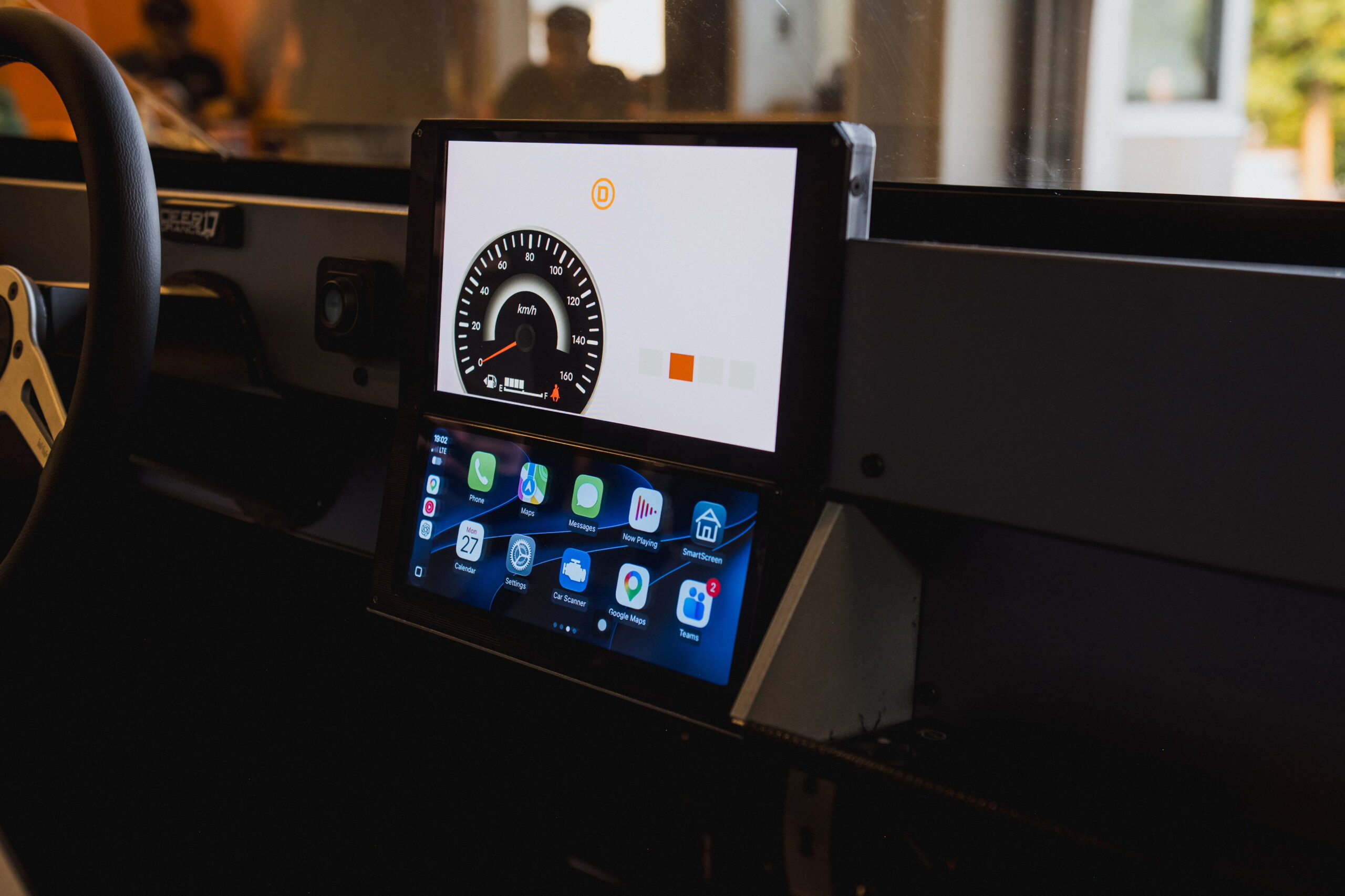
GV90’s OLED display rises 3.5 inches when parked, increasing viewing area by 70 percent.
Genesis tested the motorized mechanism for more than 100,000 cycles.
The screen retracts when the SUV moves to avoid interfering with the passenger airbag.
The Genesis GV90 already has a ton of interesting features to talk about. One version has no visible B-pillar. It’s available with front seats that rotate 180 degrees. There’s even one with full-on airplane-style tray tables for rear-seat occupants. If those things weren’t luxury enough, it also has a trick infotainment screen. Park the electric SUV, and a hidden portion of the display rises out of the dashboard, exposing more screen real estate for movies and streaming. Genesis’ latest look behind the dash shows how much engineering it took to make that work.
In its normal position, the OLED display presents a wide, 23.6-inch view for driving information, navigation, and media. Press a button on the center fascia while parked, and it climbs 90 mm (3.5 inches), revealing the full 24.6-inch screen. The diagonal measurement barely changes, but Genesis says the usable viewing area grows by approximately 70 percent.
The expanded panel measures 584.1 mm by 219 mm (23.0 by 8.6 inches) and has a resolution of 3840 by 1440. The display switches to a Media Home interface for streaming services and live channels, while an available 25-speaker Bang & Olufsen system handles the sound. Genesis also fitted a 25-inch head-up display to keep key driving information in the driver’s view when the vehicle is moving. In other words, there are several things to pay attention. What’s perhaps most interesting is how engineers worked around challenges a moving screen presents.
The assembly uses a brushless motor, a rack-and-pinion gear, and guides to move the panel. Genesis says the added weight raised concerns about vibration, so engineers mounted the display directly to the cowl crossbar. The company says the mechanism completed more than 100,000 test cycles, with operating noise below 40 decibels across a range of temperatures. Those are Genesis’ claims. How it feels after years on rough roads is something owners will find out. How a third- or fourth-owner will handle things when a component inevitably fails is another matter.
Also worth mentioning are the two reasons why the screen only works when the GV90 is in park. The obvious one is that Genesis doesn’t want to distract drivers. The less obvious one is that it could interfere with the front airbag. To that end, it’ll retract itself if the driver begins moving the car when the screen is fully deployed.
The GV90 is the first Genesis to use the group’s Pleos Connect infotainment platform. Its wide driving layout gives the driver and front passenger separate menu bars, while physical buttons still provide shortcuts to apps and commonly used vehicle settings. That mix all sounds sensible on paper. We can’t wait to see how owners find the experience. Hopefully, we’ll get a chance to test it ourselves soon.
Tesla says new Semi deliveries are beginning this week.
The truck offers claimed ranges of 325 or 500 miles.
Tesla didn’t disclose pricing or current production rates.
Almost a decade ago, Tesla unveiled the Semi as its answer to diesel-powered trucking. PepsiCo took delivery of the first trucks in 2022, but the rollout remained limited. The first Semi didn’t roll off Tesla’s new high-volume production line until this April. Now deliveries from its dedicated Nevada factory are beginning, and the question is how many trucks it can actually put on the road.
At an event Thursday night in Sparks, Nevada, Tesla presented trucks wearing the logos of PepsiCo, DHL, and US Foods. Executives said deliveries to an initial group of customers were beginning, Reuters reports. Tesla didn’t disclose a price, a current production rate, or a delivery target for the year. It reiterated that the plant is intended to build 50,000 Semis annually, but gave no date for reaching that level.
It’s a real step forward, though hardly the Semi’s first delivery. PepsiCo began receiving trucks in late 2022, three years after Tesla originally expected production to start. The difference now is the dedicated factory, which is supposed to take the Semi beyond the limited rollout seen so far. Tesla said in April that the first truck had come off its high-volume line. Its July shareholder update, however, described Semi production as beginning in 2026 and dropped an earlier forecast for volume production this year.
Tesla claims the loaded long-range Semi can cover 500 miles (805 km) on a charge, while a standard-range version is rated for 325 miles (523 km). Dan Priestley, Tesla’s director of Semi truck engineering, said customers had validated the 500-mile figure in use. The company’s Semi page lists energy consumption of 1.7 kWh per mile. That’s an impressive figure considering the size and weight of the vehicle.
The good news for Tesla is that despite apparent delays, there’s still demand. The same report says a shipper coalition placed an order for 2,500 Semis this week, while freight technology company Einride announced plans last month to add 500 Semis to its fleet. Orders and factory capacity sound great. Deliveries will be the one figure that shows whether Tesla can finally make good on the Semi’s long-delayed rollout.
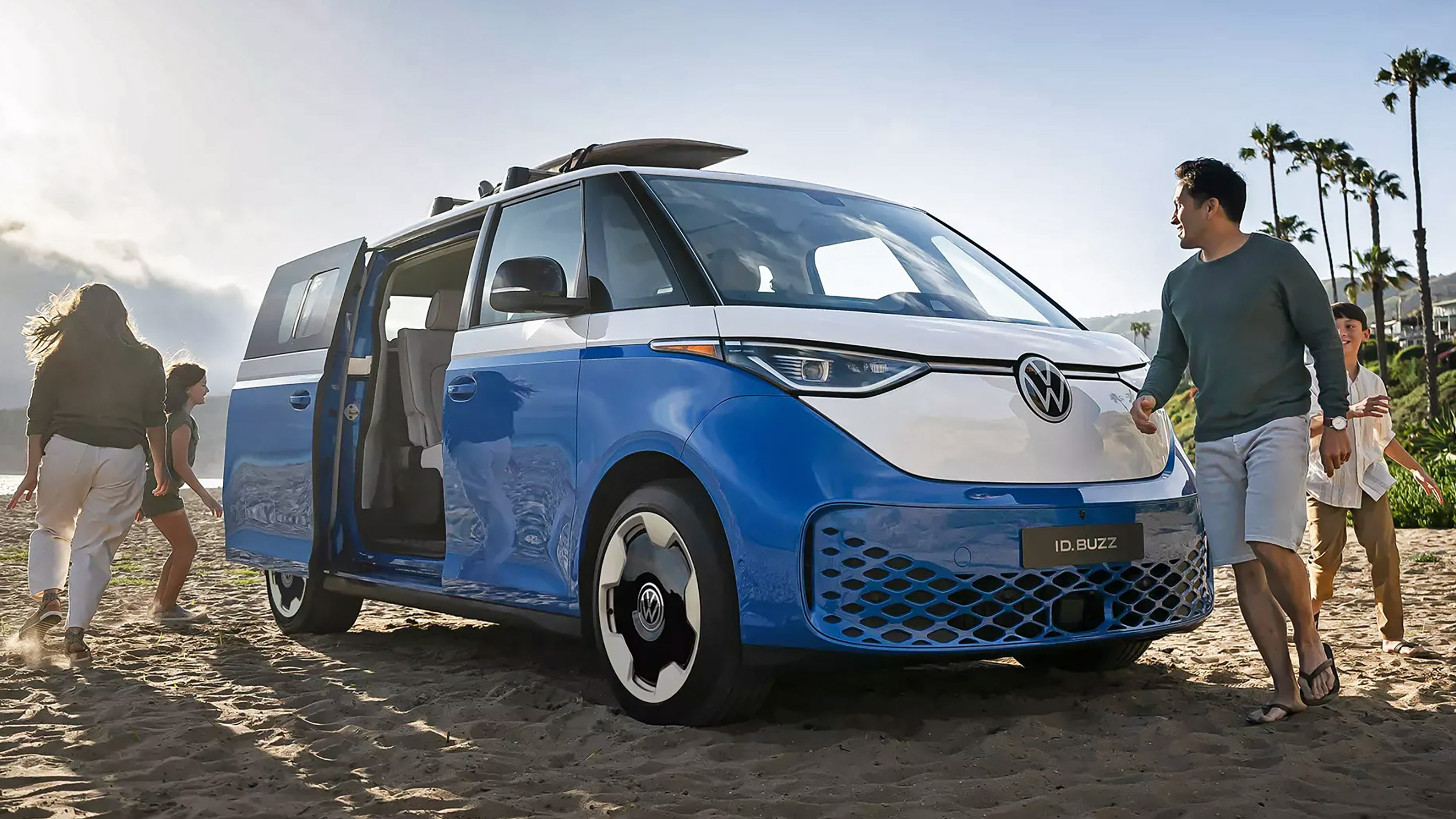
VW’s ID. Buzz will skip both the 2026 and 2027 U.S. model years.
The electric van is now expected in the first half of 2027.
VW promises new software, vehicle-to-load capability, and a digital key.
Volkswagen’s ID. Buzz comeback has hit another delay. After skipping the 2026 model year in the U.S., the electric van was supposed to return this fall as a 2027 model. VW even announced the updated lineup in May, but it turns out that the plan was a bit too ambitious. Buyers will now have to wait until the first half of 2027 for a van wearing a 2028 model-year badge.
Volkswagen informed its U.S. dealers of the change on September 24, according to Automotive News. That means the Buzz will skip two consecutive model years here. That’s an awkward turn, as the vehicle only reached American showrooms in November 2024. That’s a remarkably long pause for a van VW spent several years hyping up before it even went on sale.
The company says the changes it previously announced for the 2027 van will carry over. Those include a camping-focused Tourer trim, two-tone paint, physical buttons on the steering wheel, and North American Charging Standard capability. The 2028 model will also gain updated software, vehicle-to-load functionality, and a digital key. The brand is pitching this as a way to bring several upgrades out at the same time.
“The 2028 ID Buzz brings together meaningful customer-focused enhancements in a single launch,” the automaker said. Notably, it didn’t mention exactly what caused the delay, nor did it share any other details such as pricing. Those pieces are key because, again, this isn’t the first shift in the timeline. VW told dealers in December of 2025 that it would skip the 2026 model year before the announcement in May.
Let’s face it: this isn’t all that shocking given the industry pressures at play. Without a Federal EV tax credit, the ID.Buzz’s high price makes even less sense than it did with that discount. The van arrived some 20 years after VW initially teased the idea and did so with extremely limited range, limited trims, and a very high price. Those conditions led to just 6,140 sales during 2025 and 2,481 in the first half of this year. Now tariffs are no doubt also something VW has to consider.
That all said, it’s clear that the van isn’t dead. Americans will get what sounds like a significantly updated version in the not-too-distant future if VW can stay on track this time. Will the automaker manage to sweeten the deal so much that this big break turns out to be worth it for dealers and customers? Probably not if the price continues to climb.
Bentley’s first EV offers up to 876 hp and 996 lb-ft.
The Torcal S hits 60 mph in just 2.8 seconds.
A 113-kWh battery delivers up to 375 miles of WLTP range.
After several years in the making, Bentley just unwrapped its very first EV for the world to see. Dubbed the Torcal, the new SUV packs up to 888 PS (876 hp / 653 kW), 996 lb-ft (1,350 Nm) of torque, and enough battery to travel as far as 375 miles (600 km) on the WLTP cycle. More importantly, this isn’t simply an electric Bentayga. The Torcal becomes Bentley’s fourth model line and introduces a new design language the company says will influence future models regardless of what’s under the hood. In other words, the Torcal signals a new chapter for Bentley.
The automaker will offer two versions at launch. The standard Torcal develops 821 PS (810 hp / 604 kW) and 881 lb-ft (1,194 Nm), enough to hit 60 mph (96 km/h) in 3.3 seconds before topping out at 155 mph (250 km/h). The Torcal S turns things up to 888 PS (875 hp) and 996 lb-ft when Launch Control is active.
That drops the 0-60 mph run to 2.8 seconds and raises top speed to 162 mph (260 km/h). Curiously, Bentley could have apparently pushed things even further but deliberately chose not to. Its engineers concluded that acceleration beyond this point becomes uncomfortable for most customers. Considering there’s a certain obsession with breathtaking EV acceleration figures, that’s an interesting line to draw. Having recently driven the Porsche Cayenne Electric, we can confirm that 0-60 in 2.4 seconds is potentially uncomfortable for some.
Both versions use a pair of permanent-magnet synchronous motors and an 800-volt electrical architecture. Between them sits a 113-kWh usable battery backed by a 10-year, 100,000-mile warranty. Bentley claims as much as 375 miles (600 km) of WLTP range. Find a sufficiently powerful DC charger, and the Torcal can accept up to 400 kW, taking the battery from 10 to 80 percent in under 20 minutes.
More impressively, Bentley says approximately 100 miles (161 km) can be added in seven minutes. Again, though, these figures require a charger that can achieve such speeds. That’s probably not a giant issue, given that most Torcal owners will charge almost exclusively at their mansion, or palace, or whatever building houses the car most nights.
Somehow, the Torcal is actually Bentley’s shortest four-door model despite measuring five meters (196.9 inches) long. There’s 460 liters (16.2 cu-ft) of cargo capacity out back and another 90 liters (3.2 cu-ft) beneath the hood. Visually, there’s little chance of mistaking it for anything else.
An enormous illuminated diamond grille dominates the nose, but the split headlights and razor-thin daytime running lights introduce a dramatically different face. The rear is cleaner, with slim horizontal lamps and vertical elements framing the tailgate. Bentley says it deliberately reduced the number of lines across the body, instead allowing its proportions, surfaces, and muscular rear haunches to do the talking. Ultimately, though, it’s the changes under the body that are most significant about this particular Bentley.
Replacement controllers can falsely report battery health.
Ford warns of power loss and potential fire risk.
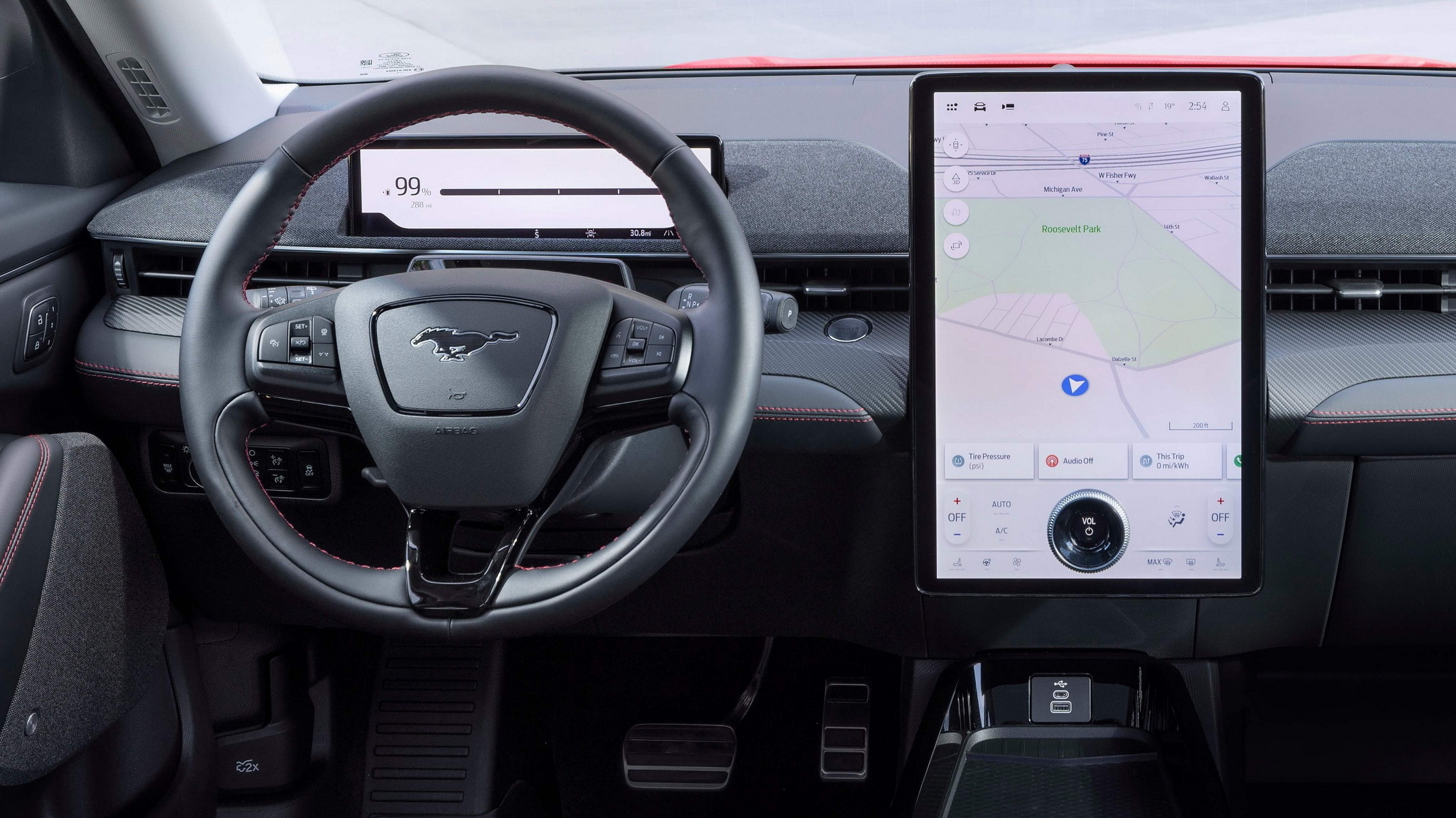
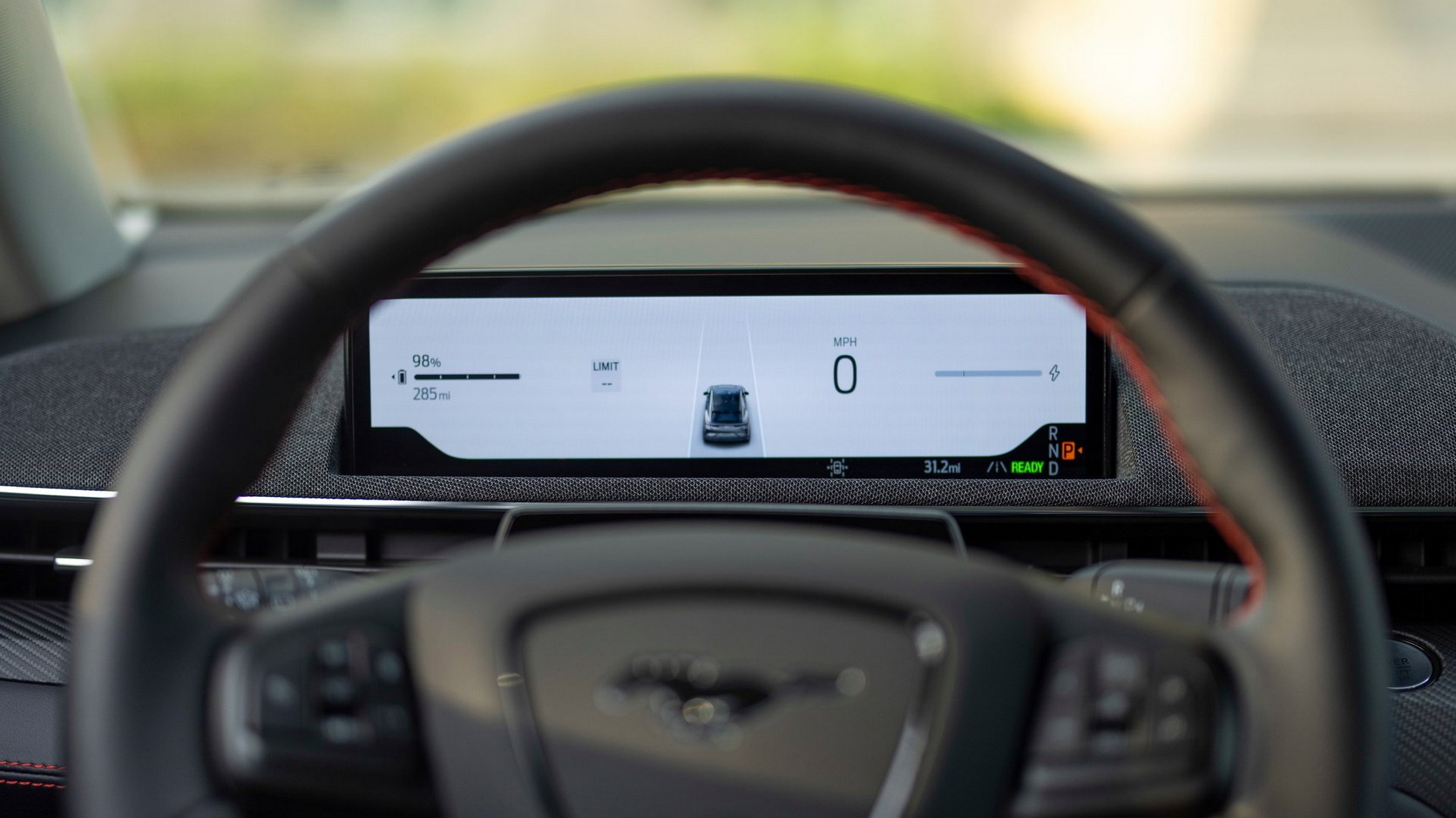
There are few things an EV driver needs to trust more than the little number telling them how much battery is left. Unfortunately, 86 Ford Mustang Mach-E owners may have discovered an unusually creative way for that number to lie. Ironically, the problem only exists because their cars were previously repaired.
Ford is recalling certain 2023-2025 Mustang Mach-Es equipped with lithium iron phosphate (LFP) batteries after discovering an issue involving replacement Battery Energy Control Modules, or BECMs. According to the automaker, every one of the 86 vehicles included in the recall is estimated to have the defect.
The problem is almost comically simple. When a replacement BECM was installed, it initialized the battery’s State of Health at a fresh-from-the-factory 100 percent instead of inheriting the actual State of Health from the battery already in the vehicle. That’s considerably more consequential than simply being off by a percentage or two.
Since the car believes its battery is healthier than it really is, Ford says it can also display an artificially high State of Charge on the instrument cluster. In other words, the Mach-E can tell its driver that there’s more juice in the tank than there actually is. That discrepancy can eventually cause unexpected power limitation and ultimately a complete loss of motive power. Drivers may see a wrench or turtle warning light as the vehicle begins limiting power.
There is another, potentially more serious concern. Ford says the incorrect State of Health calculation may increase lithium plating within the battery cells as DC fast-charging cycles accumulate. Severe lithium plating can increase the risk of thermal venting and, potentially, a vehicle fire. Thankfully, there’s no indication that things have reached that point. As of its filing, Ford said it wasn’t aware of any crashes, injuries, or fires related to the issue. It also hadn’t identified any field reports specifically tied to the State of Health overestimation problem.
The solution is a simple software update that will allow the BCEM to recognize and then use the actual state of health that the corresponding battery has. It’s an extremely small recall, but also a fascinating reminder of just how much modern EVs rely on software knowing exactly what’s happening inside the battery.
Powered doors can close when the driver buckles up or presses the brake.
Wireless charging delivers up to 11 kW with roughly 90 percent efficiency.
Paint to Sample expands the Cayenne Electric’s palette to 105 colors.
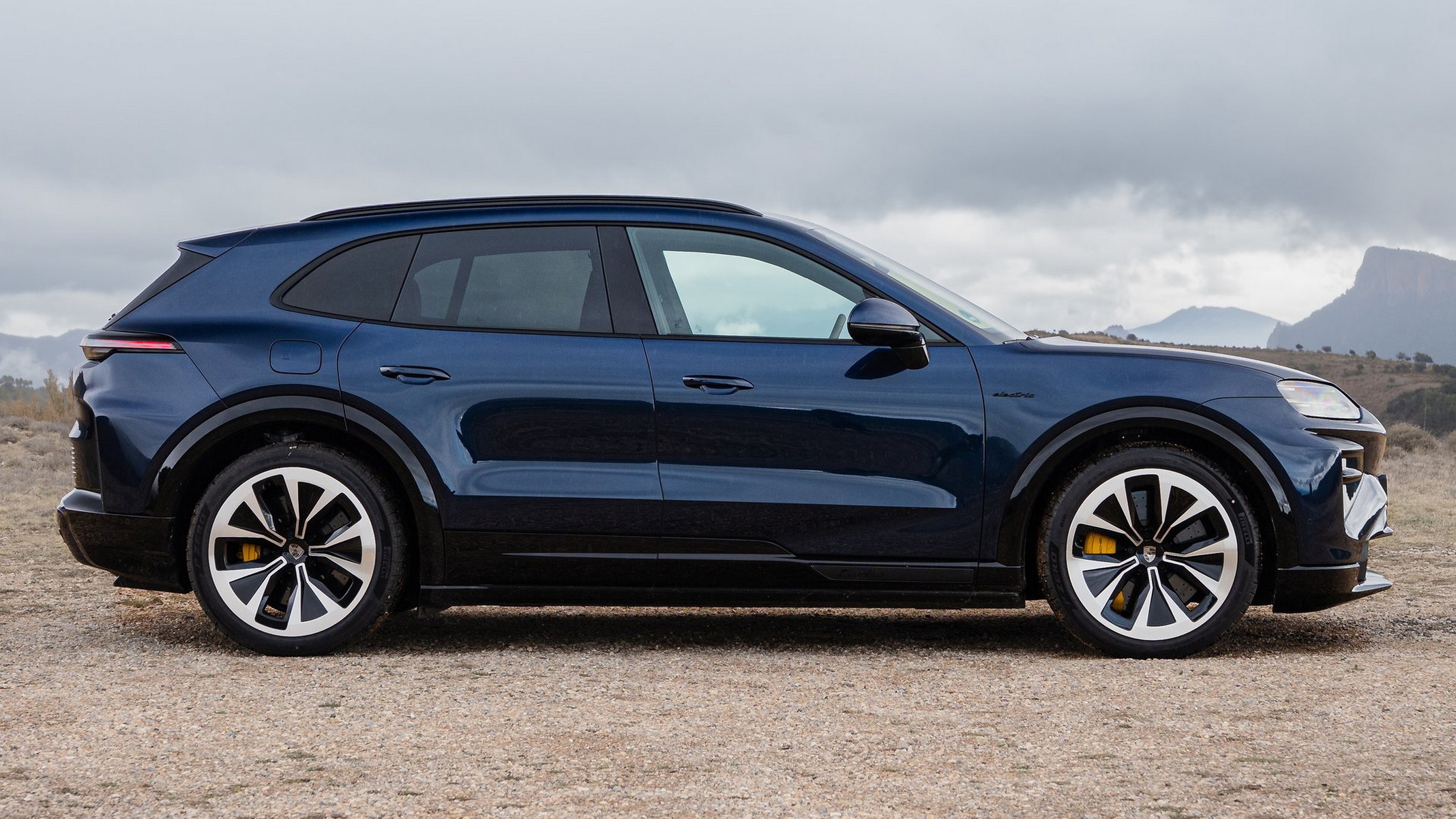
The Porsche Cayenne Electric is learning some new tricks, including some aimed squarely at drivers who find closing doors and connecting charging cables unduly exhausting. For the new model year, Porsche is adding electrically operated doors, wireless home charging, and an even more elaborate massage system. Buyers can also select from 105 exterior colors. Of those features, however, it’s the self-closing driver’s door that may attract the most attention.
The optional powered doors use servo motors to open and close automatically after a brief pull of the handle. They can also be controlled through buttons inside the cabin, the infotainment system, exterior handles, or Porsche’s Digital Key. Drivers won’t necessarily need to reach for any of those controls, as the Cayenne can close its driver’s door when the seat belt is fastened, or the brake pedal is pressed, making the start-up process feel a little more private jet than family SUV. They also feature one cool and vital trick.
Sensors monitor the surrounding area and halt the doors if they detect a person or obstacle. The system also works with the vehicle’s exit warning technology to prevent a door from opening into approaching traffic. Porsche says the powered mechanism can function on inclines, while conventional manual operation remains available.
Another new option removes the charging cable from the equation. Porsche Wireless Charging uses a weatherproof ground pad that can be installed indoors or outside. Once the Cayenne is positioned correctly, charging starts automatically at up to 11 kW. Porsche claims approximately 90 percent energy-transfer efficiency.
Motion sensors and foreign-object detection can interrupt charging if a person or animal approaches, or if a metallic object lands on the pad and begins heating up. The system is now available to order in Germany and certain European markets, with a broader rollout planned in stages. Porsche has not yet detailed US availability or pricing.
Massage Seats That Feel The Music
The front seats can now be fitted with 16 air cushions and six sound actuators apiece. Five massage programs are offered, while the actuators produce vibrations synchronized with music for what Porsche calls a “4D” audio experience. Three additional wellness modes combine massage, vibration, and curated soundscapes.
Finally, Paint to Sample adds 92 shades to the Cayenne Electric’s 13 regular colors, bringing the total to 105. Porsche hasn’t revealed what all these indulgences will cost, but expecting restraint from the options sheet would probably be optimistic.
RivianOS 2 is rolling out to every R1, including first-generation models.
Overhaul brings new interface, navigation alerts, and voice features.
Newer R1s get Unreal Engine 5 graphics, while older ones remain on Unreal Engine 4.
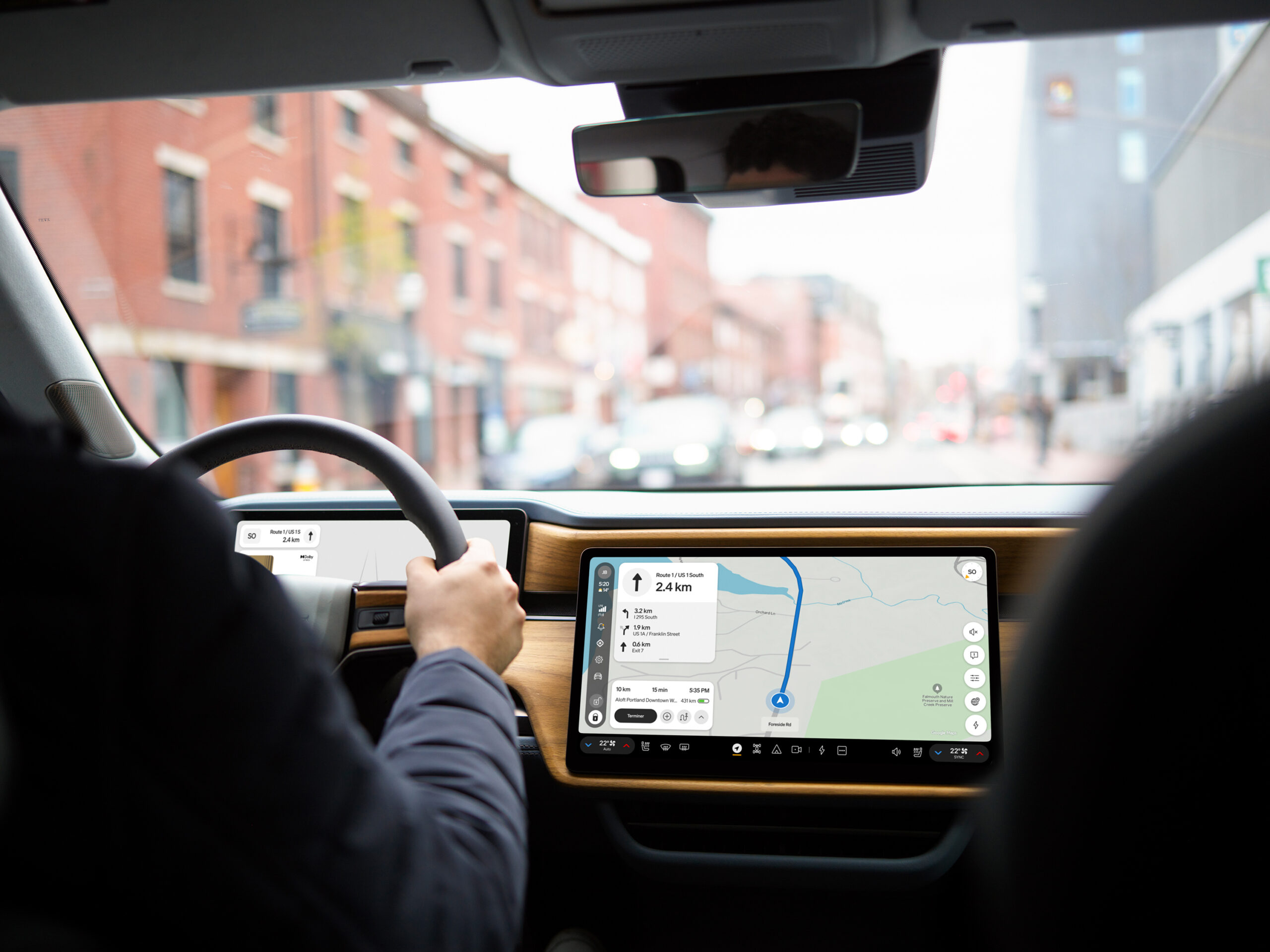
One of the better arguments for buying a software-defined vehicle is that, theoretically, the ride sitting in your driveway can get meaningfully better years after you bought it. Rivian is putting that promise to the test with what it calls the biggest software transformation the R1 has received yet. Importantly, even first-gen models will get this big new shiny update.
The automaker has begun rolling out software update 2026.31, which moves every R1T and R1S onto RivianOS 2. Again, Rivian isn’t leaving early adopters behind. Both first- and second-generation R1 vehicles get the new operating system, putting them onto the same underlying software stack as the newer R2. The most obvious changes come in the form of layout adjustments.
Rivian redesigned the interface with configurable quick controls and a media player that can be positioned on either side of the center display. There’s also a new vertical status bar and a substantially reworked settings menu with universal search and context-sensitive controls.
Graphics get an overhaul, too, although this is where hardware differences start to matter. Gen 2 R1s and the R2 use Unreal Engine 5 for real-time 3D vehicle and surroundings visualizations. First-generation R1s stick with Unreal Engine 4, which Rivian says allows it to maintain responsiveness on the older display hardware. That seems like a reasonable compromise. Early R1 owners can’t automatically gain the hardware compute that newer ones have, and yet, they still get many new benefits.
Google Maps And Waze Data Come Along For The Ride
Perhaps more useful than prettier graphics are the new navigation alerts. Rivian is integrating Google Maps information about police presence and speed cameras directly into its navigation system. That information can come from local authorities and third-party sources, along with real-time reports submitted through Google Maps and Waze. On top of that, Connect+ subscribers get even more.
There’s now a dedicated weather app with current conditions, air-quality information, and a 10-day forecast. Subscribers can also create, view, and modify active vehicle trips through the Rivian mobile app. Underneath all of this is what Rivian calls its “Unified Intelligence” platform. Gen 2 R1s and R2s have enough onboard computing power for more local processing, while both generations of R1 receive expanded cloud-assisted voice functionality and refreshed driver-display layouts.
Privacy Settings Made The Cut
Privacy controls haven’t disappeared in the AI shuffle, either. Rivian says owners can disable hotword wake-word functionality, restrict location sharing, and change driver-profile data settings. Perhaps the most interesting part isn’t any individual feature, though. It’s that a first-generation R1 is getting essentially the same software design language as a brand-new R2.
That’s exactly what OTA updates were supposed to make possible, and it’s considerably more compelling than an update that merely moves a few icons around. The 2026.31 update is rolling out now to eligible R1 and R2 vehicles, though Rivian says availability can vary by vehicle.
Porsche wasn’t the first automaker to sell an SUV that felt quick. It was, however, the first to prove that an SUV could be truly athletic on pavement. The original Cayenne was somewhat unloved by many in the automotive sphere, but it set a new bar for an SUV that could do more than hustle down a straight road with a loud exhaust and too much body roll. It could attack curves in a way no other similar vehicle could.
Now Porsche has a different, arguably tougher job. The 2027 Cayenne Electric arrives in a market already full of expensive electric SUVs, including the Lucid Gravity, Cadillac Vistiq, Volvo EX90, Mercedes EQS SUV, and BMW’s upcoming iX5. This time, being fast is not enough. The question is whether Porsche can make an EV SUV feel special enough to rewrite the rulebook again.
The Cayenne Turbo Electric certainly has the hardware to try. Its dual-motor system produces 1,139 hp and 1,106 lb-ft of torque with Launch Control engaged. That is four-figure power in a five-seat family SUV. The real question isn’t just whether or not the driving experience will be memorable. It’s whether it’ll be memorable enough and engaging enough to be a true sales success for the brand at a time when Americans are overlooking impressive EVs all over the market.
Quick Facts
› Model:
2027 Porsche Cayenne Turbo Electric
› Starting Price:
$165,350, including destination ($198,180 as tested)
› Dimensions:
196.3 x 78.0 x 65.9 in (4,985 x 1,980 x 1,674 mm)
› Wheelbase:
119.0 in (3,023 mm)
› Curb Weight:
5,860 lbs (2,658 kg)
› Powertrain:
Dual electric motors / AWD / 113-kWh battery
› Output:
Up to 1,139 hp (850 kW) / 1,106 lb-ft (1,500 Nm)
› 0-62 mph
2.4 seconds (0-100 km/h)
› Transmission:
Single speed
› Range:
Up to 298 miles
› Towing Capacity:
7,716 lbs (3,500 kg)
› On Sale:
Now
SWIPE
Styling Befitting A Cayenne
Credit: Stephen Rivers for Carscoops
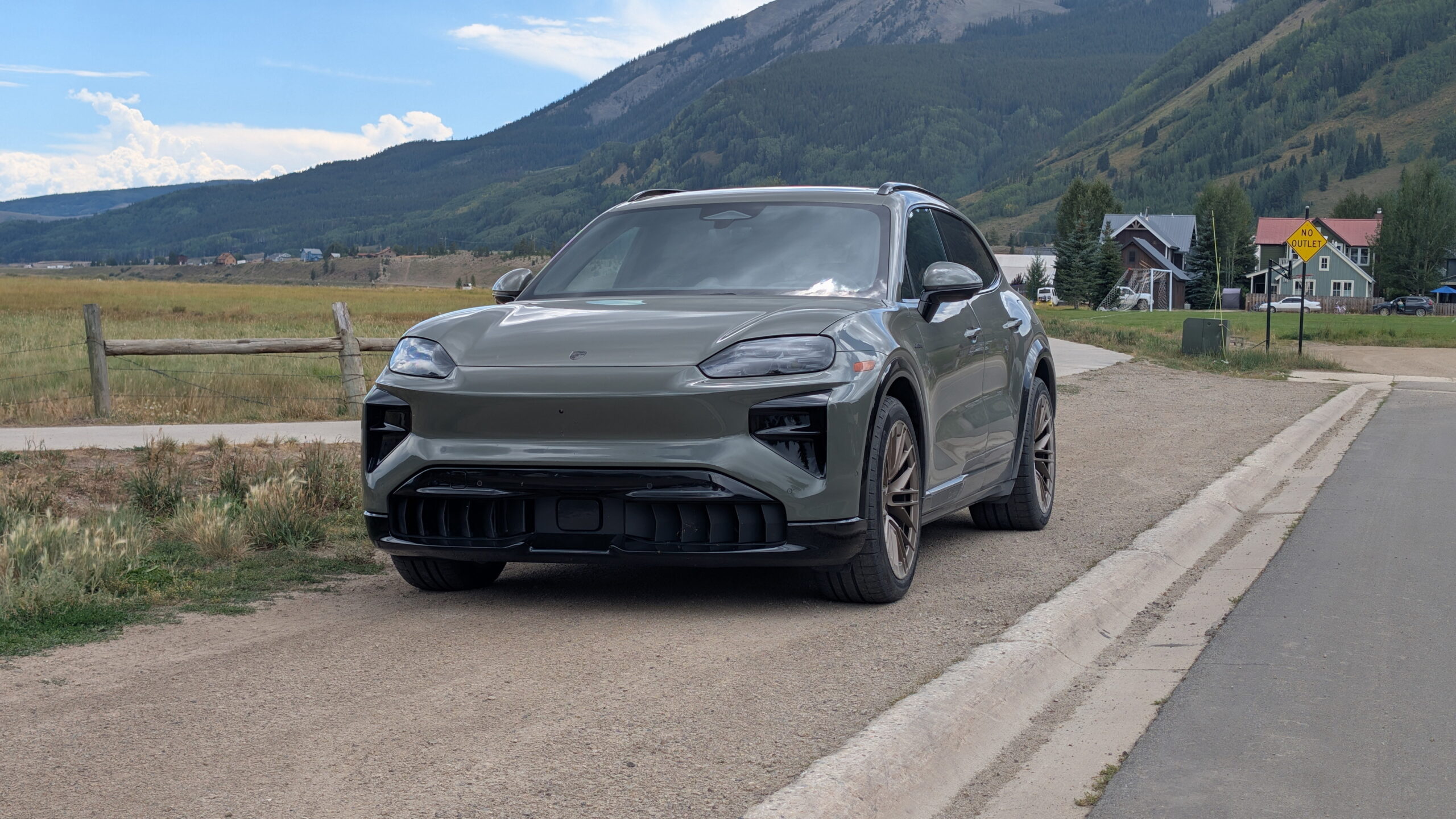
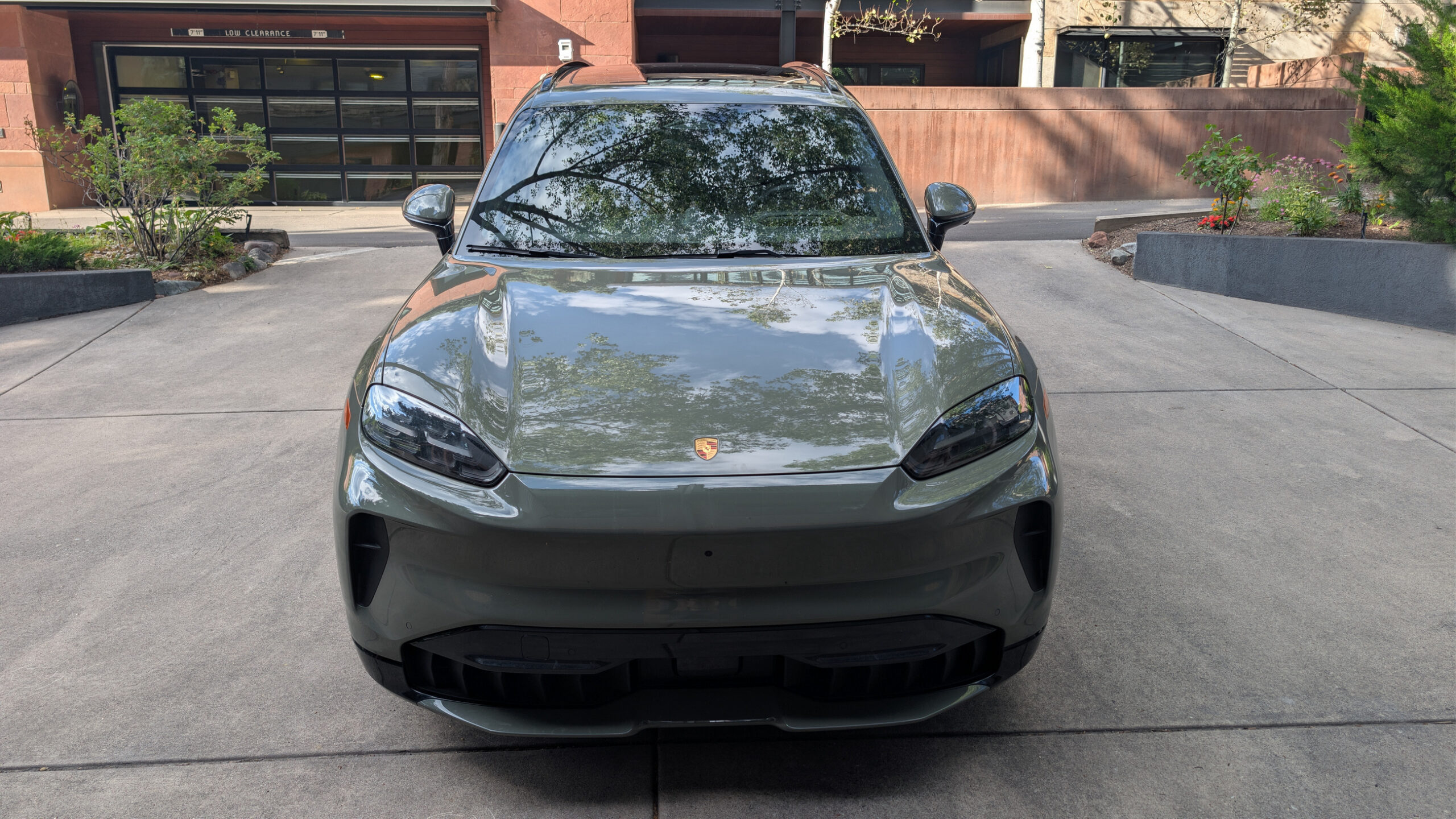
The overall look of the Cayenne Electric is stately. Not everyone will love the changes made in favor of identity and aerodynamics, but at least it doesn’t feel overstyled or too much like a jelly bean. Simple designs tend to age the best. That does not guarantee the Cayenne Electric will become a classic, but it has a much better shot than many.
The headlights are the one element I am still not fully sold on. They are technically impressive and help emphasize the Cayenne’s width, but they do not have quite the same immediate warmth as the best Porsche lighting signatures. Everything else works. On the Turbo, the active aerodynamic blades at the rear even extend at speed to clean up airflow. You will never see them work from the driver’s seat, of course, but they are genuinely cool.
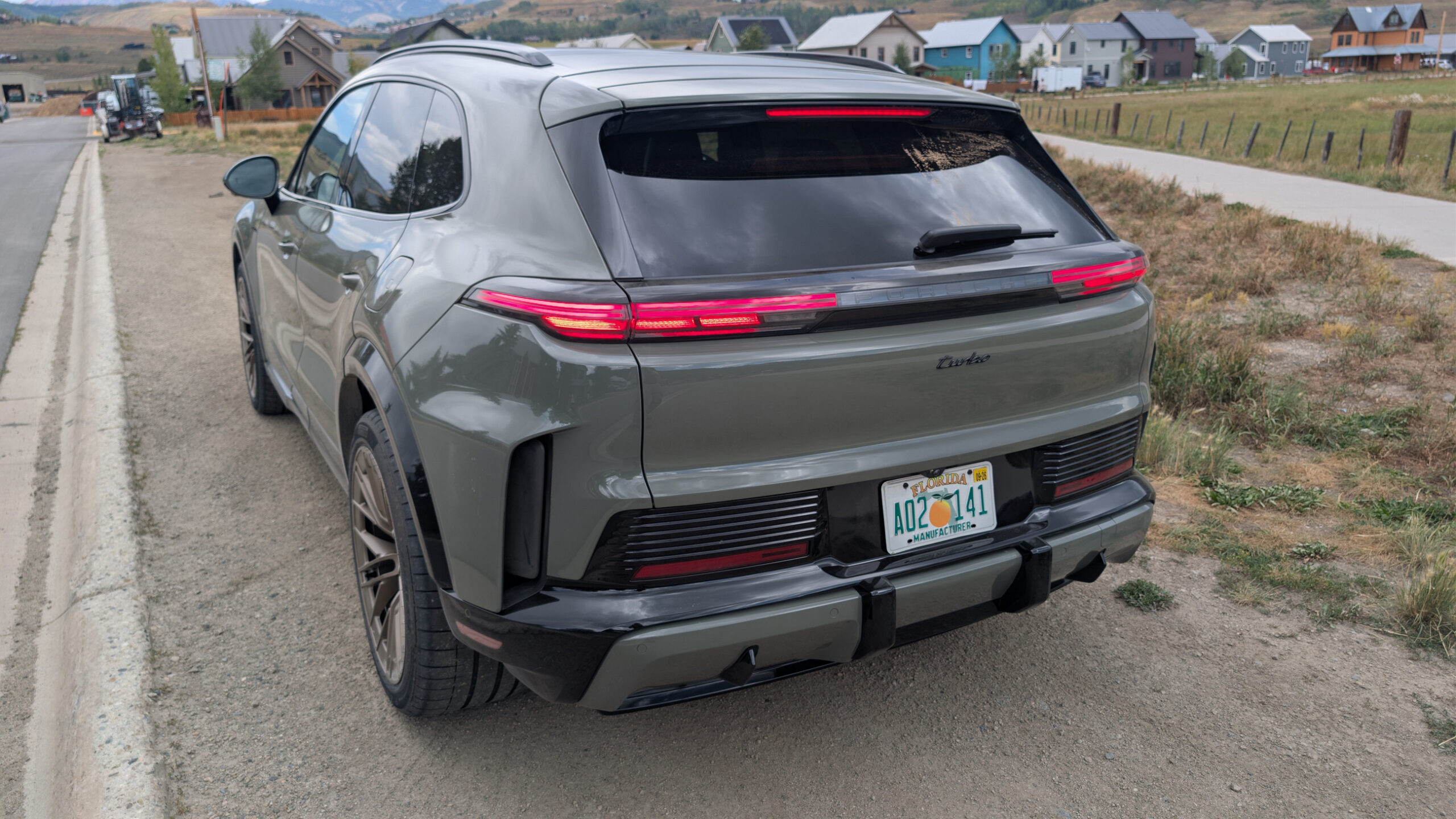
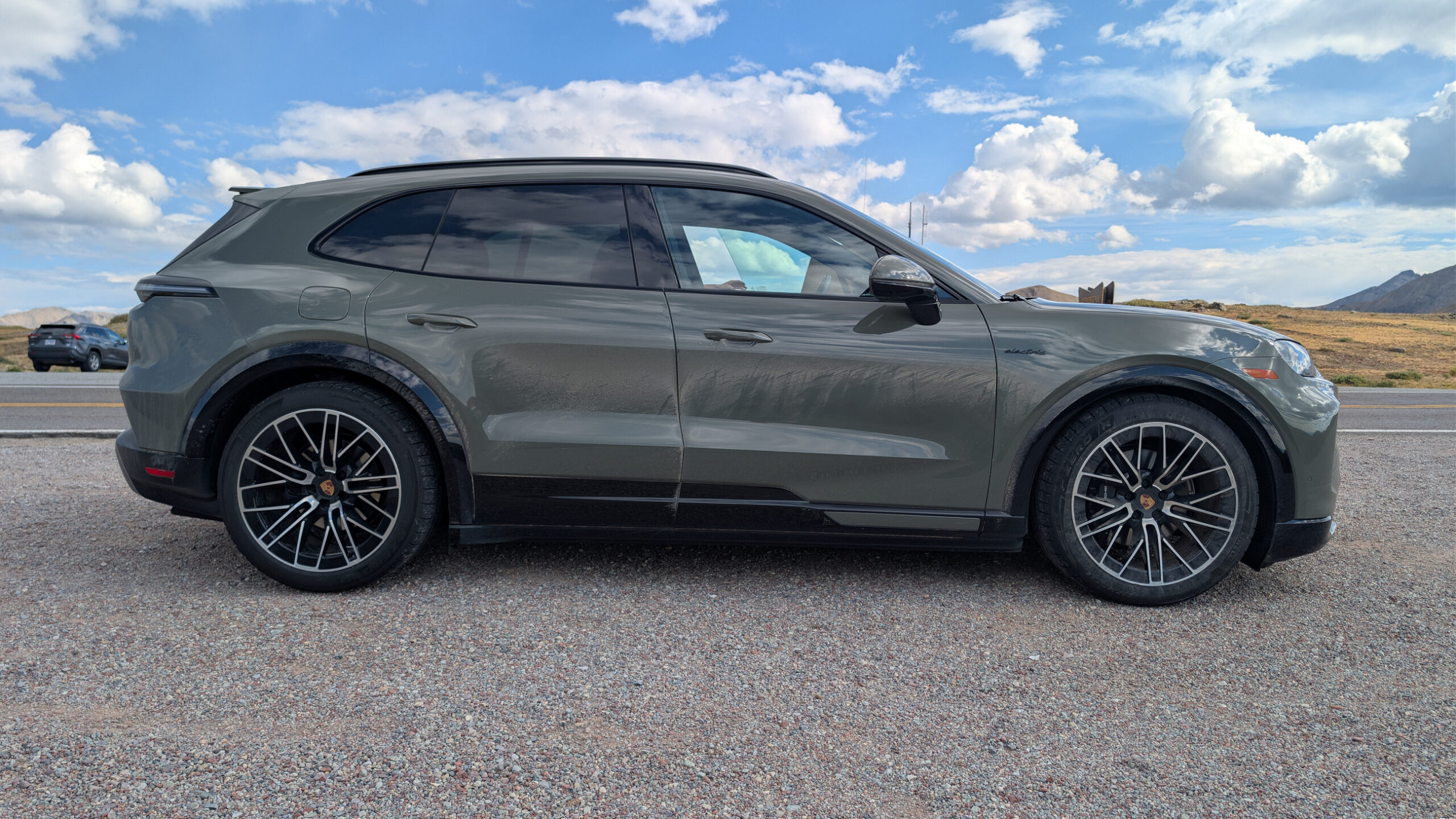
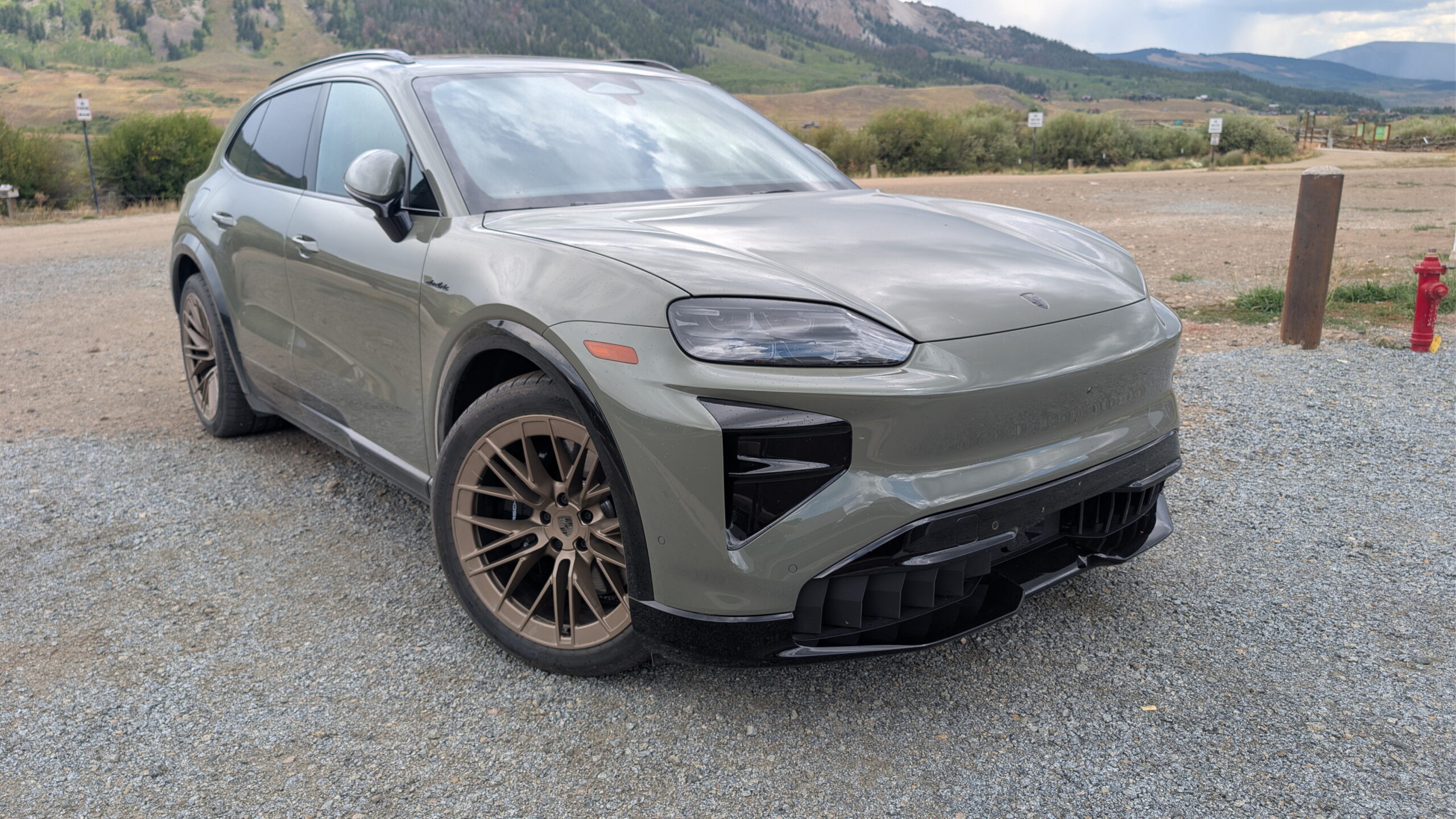
The reference vehicle here wears Monteverde Metallic over a brown Espresso leather cabin with black accents. It also gets rear-axle steering, Porsche Active Ride, the SportDesign package, 22-inch SportTechno wheels, performance summer tires, HD-Matrix headlights, a panoramic roof, and the Premium Package. The $163,000 starting point climbs to $198,180 quickly. That is Porsche ownership in a single sentence.
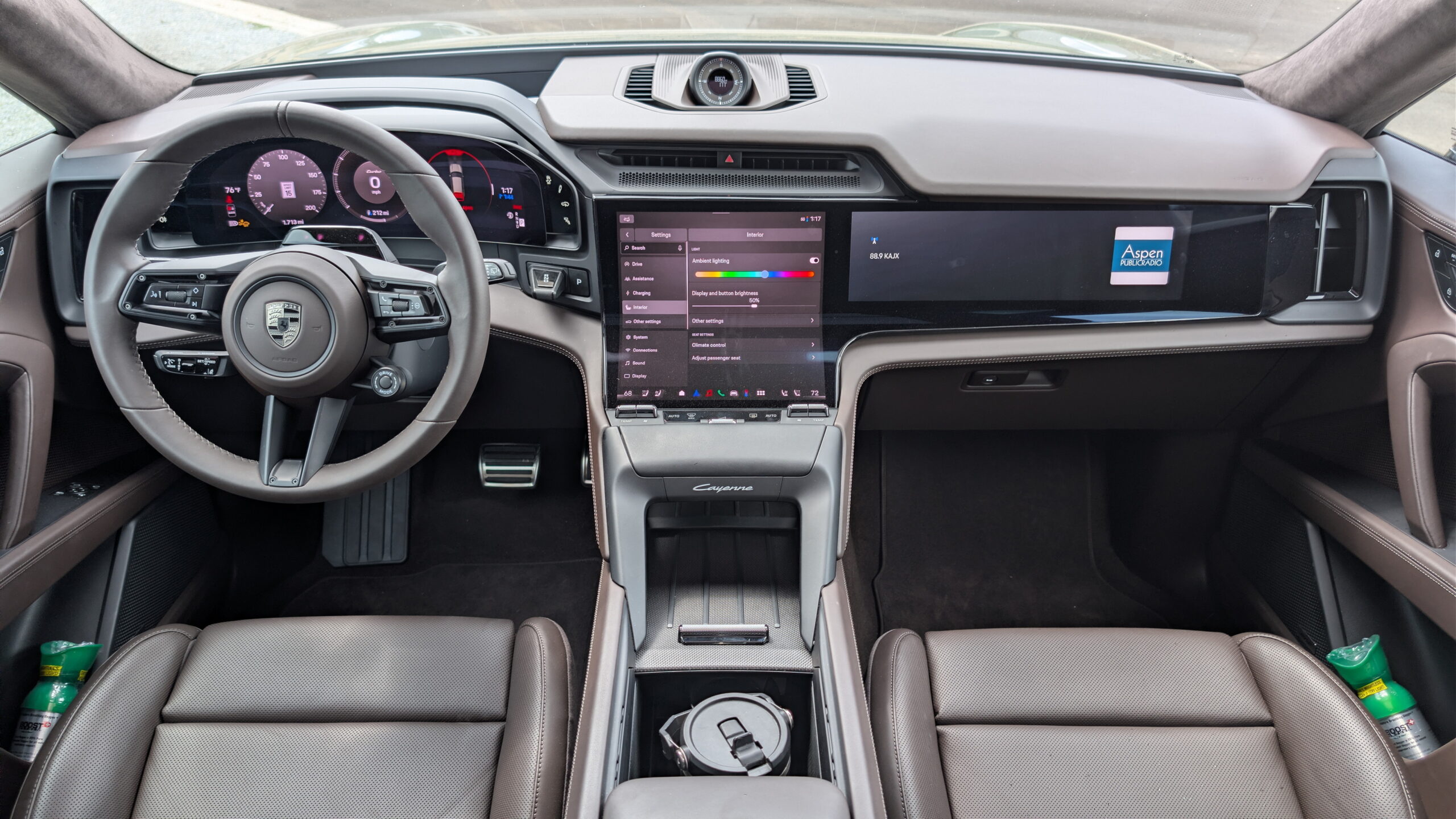
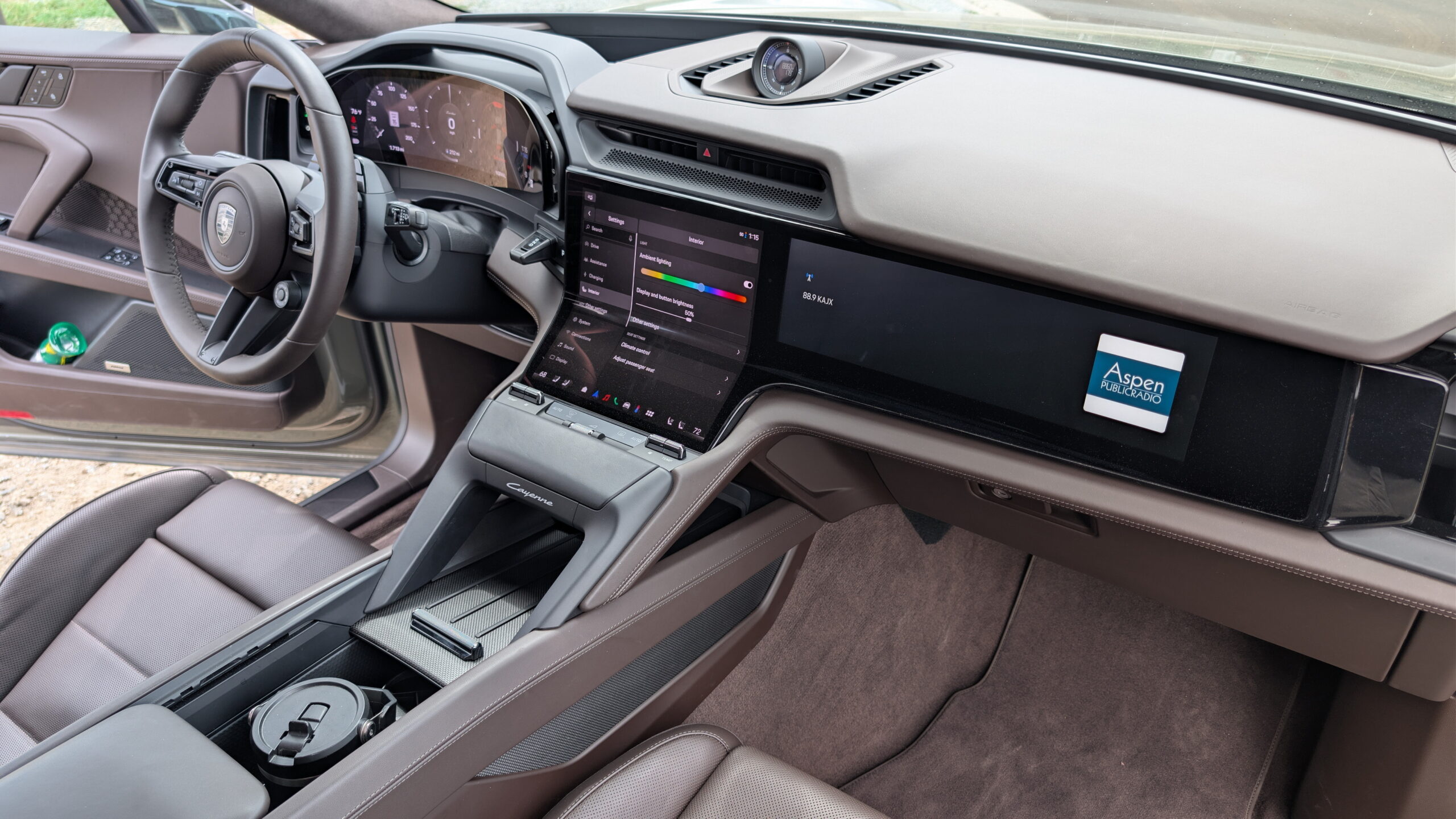
There are plenty of nods to the original Cayenne inside. The high center tunnel is still there. The steering wheel is recognizably Porsche. The seating position remains appropriately sporty for a Porsche, not just an SUV. It’s capable of settling in quite low, and that’s a big win. The chairs could plausibly come from one of Porsche’s sports cars, excluding the most hardcore GT models. They are supportive, comfortable, and genuinely attractive. The dashboard itself is a different deal entirely.
The centerpiece is Porsche’s curved Flow Display, which stretches down from the center stack toward the physical climate controls. It looks theatrical but is actually very functional in practice. The wrist rest below it enables genuinely easy use as the controls typically sit on the lower portion of the screen while the upper level shows the occupants what they’re managing. Many automakers expect drivers to operate giant touchscreens with one hand floating in mid-air. The wrist rest fixes that issue.
Some buyers will absolutely decide there is too much screen here. They will not be wrong. In 10 years, this cabin could look dated in the same way early digital dashboards eventually do. Or it could develop the occasional electrical gremlin that turns its futuristic charm into a very expensive service appointment.
Right now, though, it feels appropriately over the top. The optional passenger display is one of the more feature-rich units in the business, and it reacts quickly enough that it does not feel like a tablet trapped in a dashboard. Users can connect bluetooth headphones, watch YouTube, and other things while their phone charges on the wireless dock in the console.
Porsche also put the physical volume control in the middle of the climate controls, where the passenger can reach it without leaning across the cabin. More automakers need to figure this out. There is no reason the passenger should need to reach toward the driver’s side for a knob when the driver already has audio controls on the steering wheel.
Credit: Stephen Rivers for Carscoops
The seats, upholstery, and major touchpoints feel appropriately expensive. The physical switchgear works well and provides a really nice tactile sensation during use. Some of it feels a little underwhelming, perhaps with its flat black color, but it should age well. The rear seats aren’t what I’d call spacious, but at six-foot-six, I still fit back there without feeling cramped. The seats themselves also offer quite a bit more lateral bolstering than just about everything else on the market. More performance-slanted SUVs should take note.
Finally, the cargo space is genuinely useful. The Turbo model offers 26.4 cubic feet of space, while the Base and S versions offer 27.6 cubic feet. The Coupe models see a significant drop-off to 18.9 for Base and S and just 17.7 for the Turbo.
Range And Charging
The Cayenne Turbo Electric is EPA-rated for 298 miles of range, or 303 miles with its range-oriented tire. That is fine. Not great, not embarrassing, just fine. The base Cayenne does better at 317 miles, while the Cayenne S is rated at 299 miles. Those are respectable numbers, but the Lucid Gravity makes the Porsche’s range look merely ordinary with up to 450 miles in Grand Touring form.
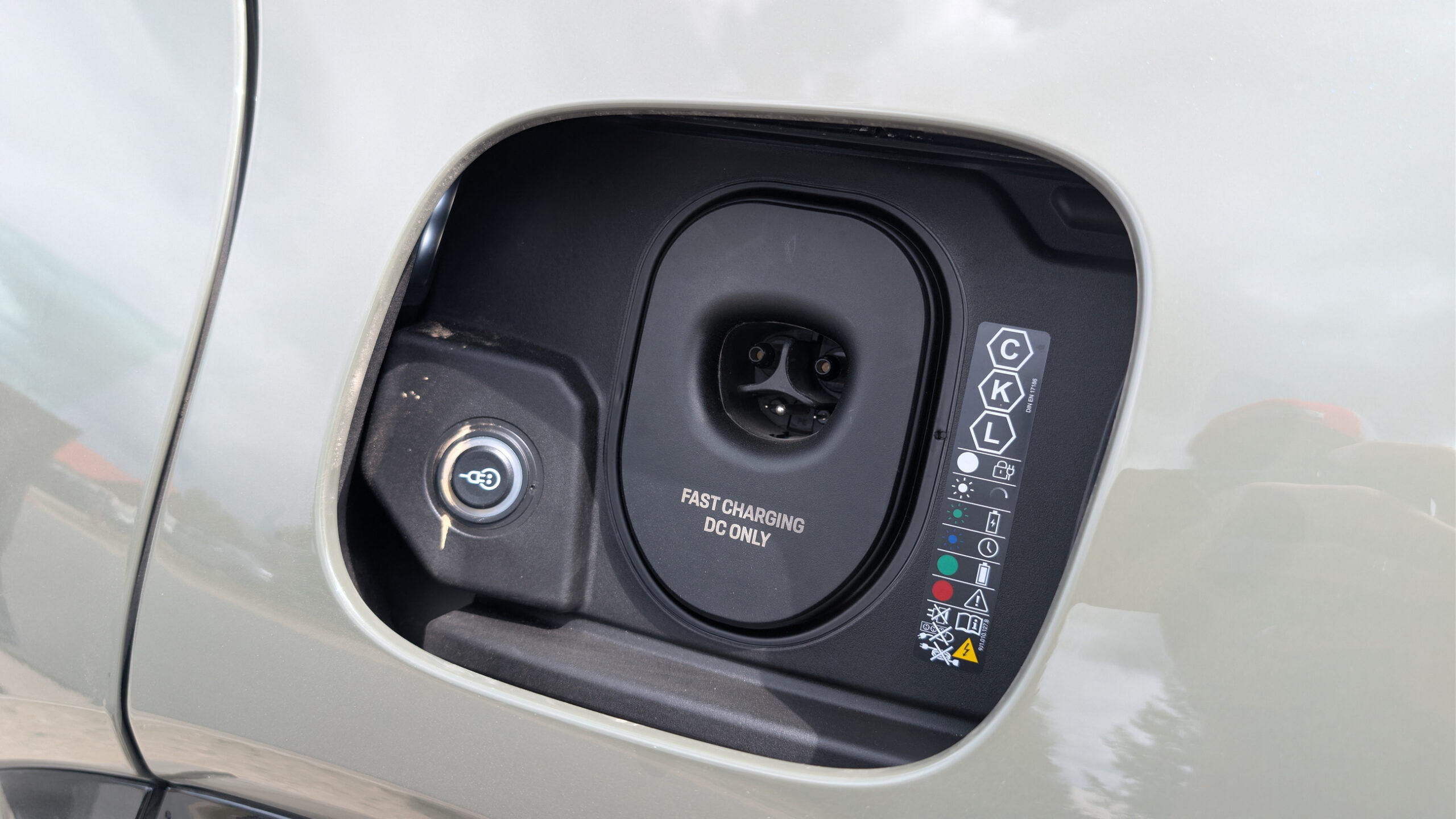
Where Porsche fights back is charging. Its 800-volt architecture can accept up to 400 kW under ideal conditions, allowing a 10-80 percent charge in as little as 16 minutes. That requires the right charger and the right battery conditions, obviously, but the capability matters. The Cayenne is built for drivers who will use it hard and cover long distances, not just people who want a fast commute appliance.
Driving Impressions: A Serious Testing Space
Speaking of driving hard over long distances. Of all the places to test an EV, several mountain passes in the Colorado Rocky Mountains aren’t what most would consider ideal. After all, range is heavily affected by the environment, and climbing can diminish it quickly. Despite that, Porsche brought us out to Aspen, Colorado, to test these cars and then sent us on a 234-mile trek through Crested Butte and Buena Vista as well as over Independence and Cottonwood Pass.
Driving the Turbo variant, with up to 1,139 hp (850 kW) when using launch control, the most immediate sensation is just how comfortable, quiet, and composed the car feels. Thanks to the active suspension, the Cayenne Turbo is almost always adjusting to suit the moment. By that, I mean that it has features that attempt, and almost always succeed, in countering any forces that a lesser SUV would feel under normal driving actions.
Under medium acceleration, the rear suspension actually lifts up very gently while the front lowers to keep the body level and cancel out the nose lift that is typical in just about every other vehicle, period. On braking, the opposite happens as the nose lifts rather than dips. In turns, the outer suspension lifts and the inner lowers.
This is what Porsche called “helicoptering,” and while it sounds like a party trick, it basically eliminates the sometimes jarring feeling that an EV can create with its instant torque and regen. It also never makes the car feel disconnected, numb, or artificial, which could be the most impressive bit of that technology.
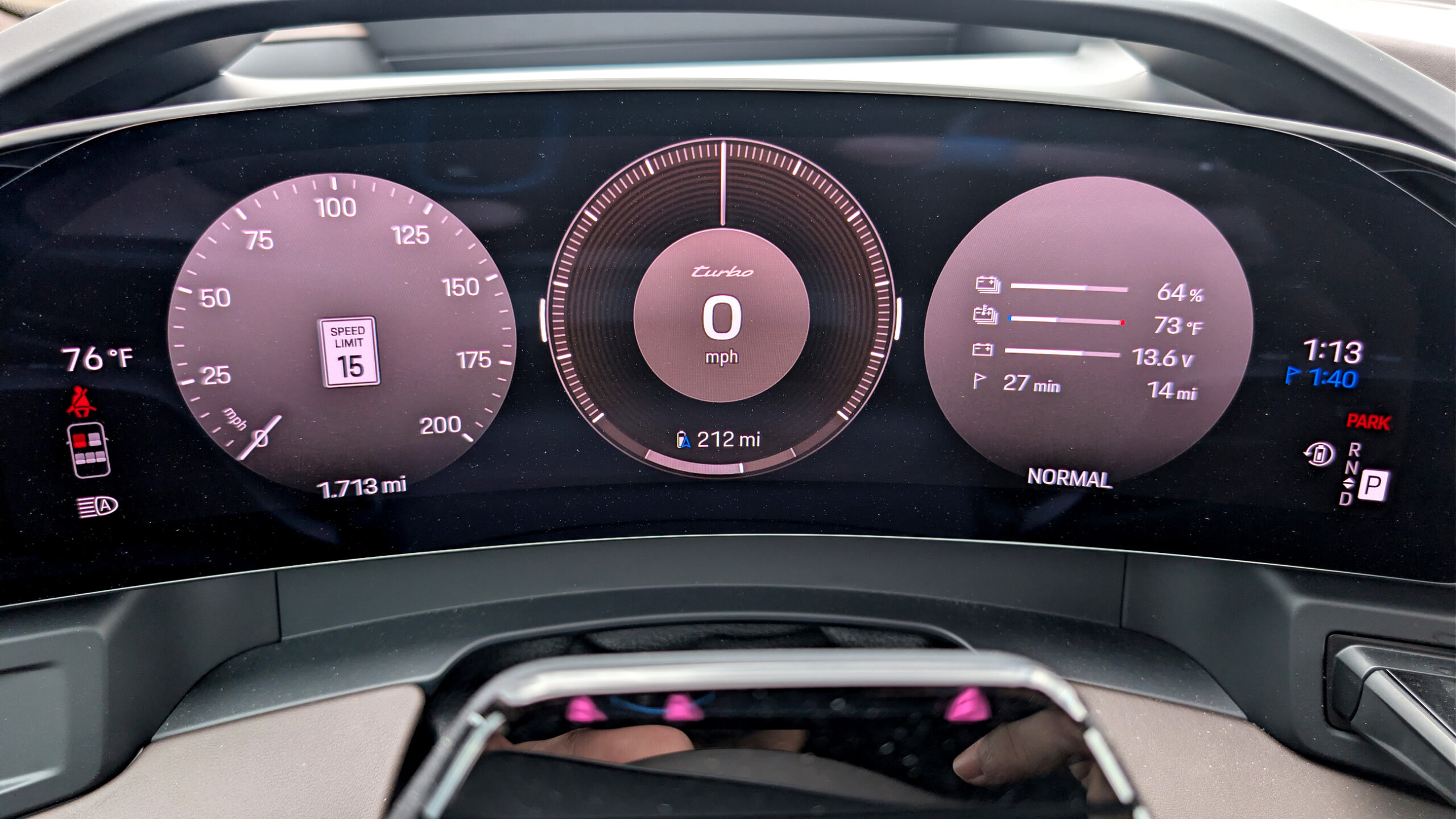
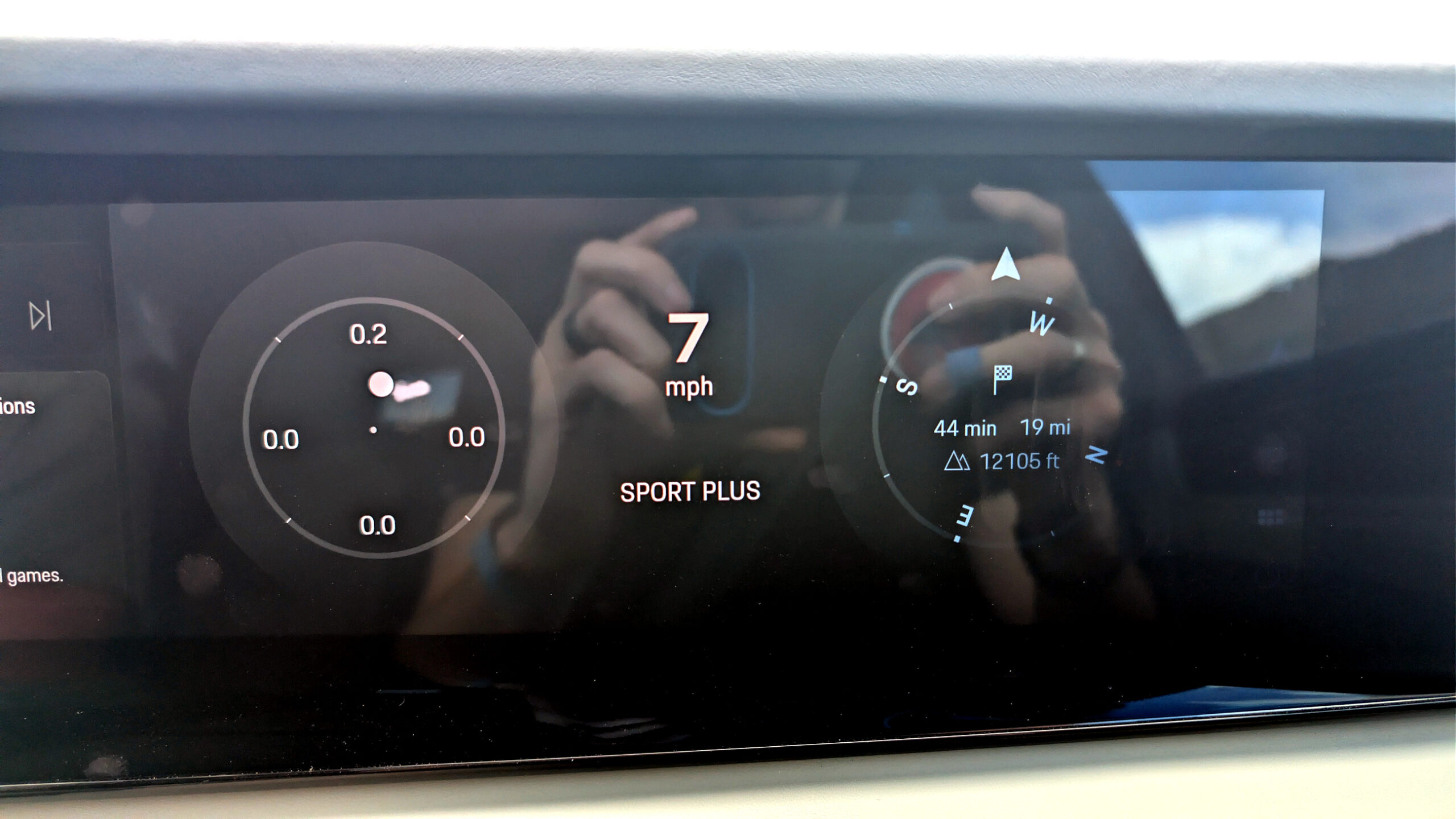
Then, there’s the real party trick in this SUV: its ability to go from stately five-passenger luxury cruiser to an absolute maniac. Spin the dial into Sport Plus, come to a stop, mash the brake, then the accelerator, let go of the brake, and it’ll do 0-60 in the real world in 2.4 seconds. Importantly, Porsche claims that figure, but we tested it on a real road literally less than a minute after driving on gravel, and it delivered a 2.5-second 0-60 time that registered as 2.3 when subtracting rollout.
Porsche tells us it managed its run on a prepared surface. Car And Driver recently managed 2.1 seconds, also on a prepared surface. We intentionally tested on a real road and are happy to tell you that this car will basically do its published number whether you’re at the track or not. Still, those numbers alone really cannot express properly just how insane that type of acceleration feels.
The Cayenne needed under 116 feet to go from not moving to highway speed. The feeling from the driver’s seat is akin to being shot out of a cannon at your local Six Flags. Perhaps the most impressive bit, though, is that it requires basically zero skill to pull this off. Hold the wheel straight, and the clever differentials and motors will ensure the car does the job. Don’t get me wrong. A car that requires the driver to have genuine skill to pilot it at the very edge is far more enjoyable and engaging, but if you want a car that helps someone with less skill to catch the bug for improving their own ability, this is a serious gateway drug.
The fun doesn’t stop when the straight lines run out, though. When not using launch control, the car moves around with a constant 844 hp (630 kW) on tap. The roads we drove were about as curvy and elevation-varied as they get. The Cayenne never ever felt overly heavy despite a curb weight similar to some full-size pickup trucks. In fact, the car feels much smaller than its wheelbase would suggest.
Then, there’s the braking situation. Porsche doesn’t offer one-foot driving. That singular statement is somewhat intentional. The brand wants to encourage engagement and the way this car brakes demonstrates that. Often, the transition from regen to friction braking can be jittery or jarring. In the Cayenne, it’s indistinguishable. That level of granular control feels like it’s a part of everything this SUV does. Rear-wheel steering makes the SUV feel more nimble both on mountain roads and in town when a slightly tighter turning radius can make a gigantic difference.
The Base Cayenne with 435 hp (325 kW) doesn’t come with all the same party tricks. It lacks the active suspension, the active aero, and rear-axle steering. Still, it feels properly composed and quick. In one section with a Turbo version both ahead and behind us, it didn’t feel overpowered or incapable of managing serious pace with its more powerful siblings.
One more note. Porsche will sell the Cayenne with an off-road package and while we didn’t truly test it off-road, we did take it on several dedicated gravel roads where it continued to feel composed and confidence-inspiring. For those who want or need it, the SUV can tow 7,716 pounds (3,500 kg).
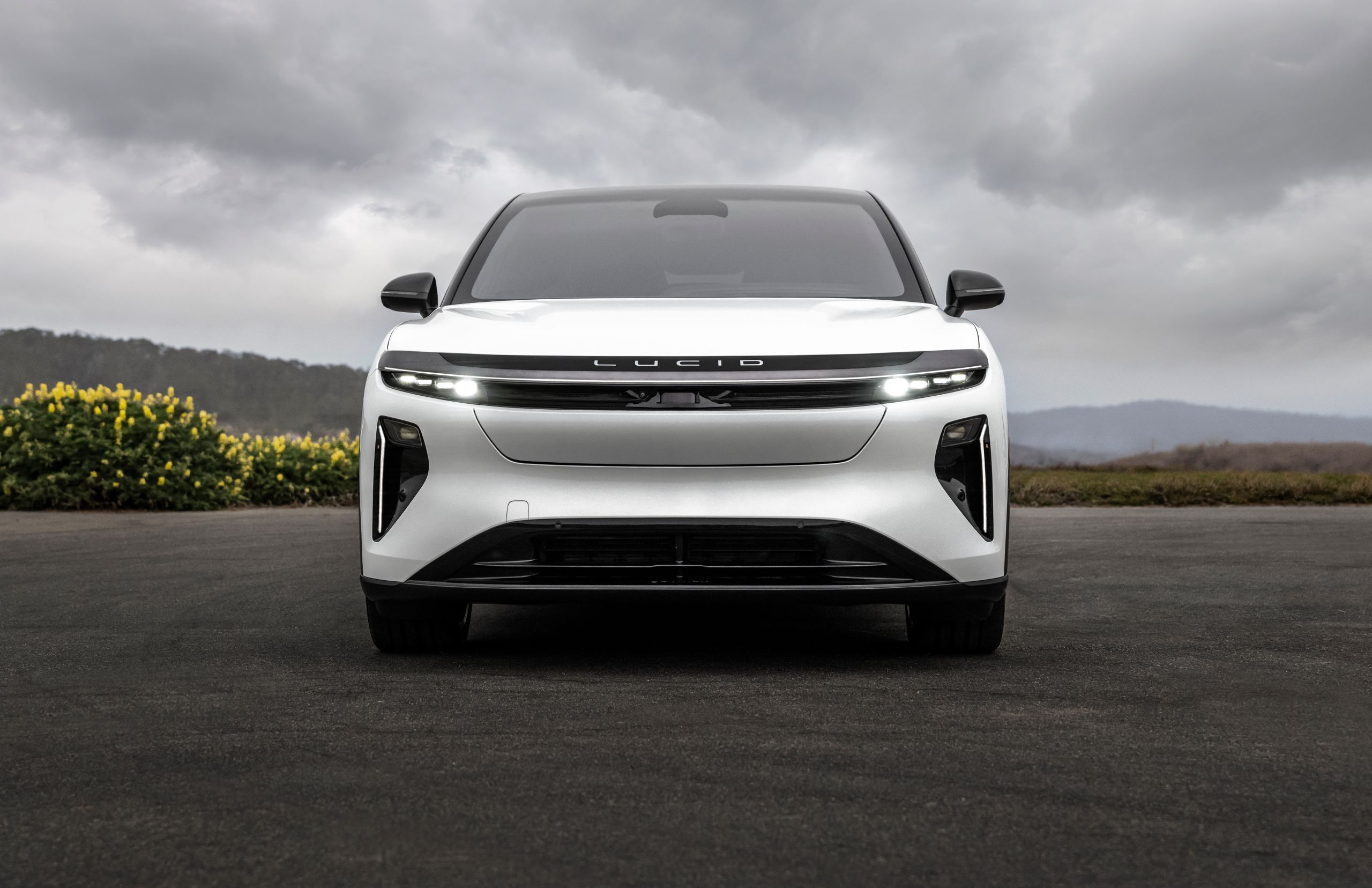
The Lucid Gravity is the Cayenne Electric’s biggest problem. It starts at $79,900 in Touring form, while the 828-hp Grand Touring starts at $98,900 and promises as much as 450 miles of range. Even the new 1,070-hp GT-S starts at $125,900, hits 60 mph in 3.1 seconds, and offers room for up to seven people along with a claimed 120 cubic feet of cargo space.
The Lucid cannot match the Cayenne Turbo’s 2.4-second sprint, nor does it have the same decades-long performance pedigree. But it makes a far more convincing case as the one EV in a well-off family’s garage that can genuinely do everything. It is quicker than almost anything needs to be, dramatically roomier, and better suited to long trips. Porsche has the badge, the chassis, and the more compelling driving experience. Lucid has the more rational argument.
Cadillac’s Vistiq makes a different kind of case. It starts at $77,395, offers three rows, up to 305 miles of range, 615 hp, a 3.7-second sprint to 60 mph, and standard Super Cruise. It is nowhere near as athletic or outrageous as the Cayenne Turbo, but it does much of the luxury-EV job for a lot less money. The Volvo EX90 takes an even calmer route. It is a safety-first, three-row family hauler with up to 305 miles of range and, in Twin Motor Performance form, 670 hp. Neither will tempt someone looking for a Porsche sports car in SUV form, but both make a strong argument for spending less.
Before BMW pulled it from America earlier this year, the iX was the closest traditional German alternative, particularly in M70 guise. The replacement is the new iX5, though Americans have to wait twice over, once for its Stateside launch next year, and again for the hotter M Performance and full-fat M versions, since the launch car tops out at 570 hp in iX5 60 AWD form. Mercedes’ EQS SUV leans harder into quietness and comfort. Both are good luxury EVs. None of these, though, feels as if they was engineered by people who spent their lunch breaks figuring out how to make a 5,860-pound SUV behave on a mountain road.
The Cayenne Turbo Electric does not make physics disappear. It is still enormously heavy, very expensive, and only fine when it comes to range. Its cabin also leans heavily into screens at a time when some buyers are already suffering from digital fatigue. And as impressive as the whole thing is, Porsche cannot ignore the ugly depreciation story surrounding some of its other EVs.
But it absolutely feels like a Porsche.
That might sound like faint praise in a vehicle with 1,139 hp, but it is not. Making an EV absurdly fast is easy compared with making one feel engaging, predictable, and genuinely enjoyable on a road that does not point straight ahead. The Cayenne manages that trick. It has the acceleration of a supercar, the composure of a luxury SUV, enough off-road ability to be more than a pavement princess, and the sort of granular brake and chassis control that makes driving it hard feel rewarding rather than intimidating.
No, it probably will not rewrite the rulebook in quite the same way the original Cayenne did. The electric-SUV market is too crowded, and too good, for that. But Porsche has built one of the first electric SUVs that feels like it has a legitimate reason to exist beyond its powertrain.
The harder question is whether buyers will pay $110,000 – $200,000 for it—and whether they will still want to own it once the newness wears off. That part isn’t up to Porsche’s engineers anymore, but regardless of what happens next, they should be proud of what they’ve created.
Genesis says a range-extended GV90 remains technically possible.
Customer demand will decide whether the EREV actually happens.
Future Genesis models will offer hybrid, EREV, and EV choices.
Genesis just revealed the GV90, its massive new electric flagship with 657 hp, a 123.5 kWh battery, and a cabin designed to make a chauffeured Rolls-Royce owner take notice. Every version is strictly battery-electric at launch. But that may only be true for now. At the GV90’s San Francisco debut, Genesis Chief Creative Officer Luc Donckerwolke made it clear that an extended-range electric version has not been ruled out. Asked directly about the possibility, he said: “Why not? It’s compatible. It’s another discussion.”
Donckerwolke also made the case for keeping the new flagship fully electric in the present tense. “We believe today that the electric powertrain is ideal for this type of vehicle because of the torque delivery, the silence, and luxury buyers,” he said.
Photos: Stephen Rivers for Carscoops
That makes perfect sense. The GV90 is exactly the sort of machine where instant torque, nearly silent operation, and a flat-floor cabin matter. Its 123.5 kWh pack is the largest yet used by Hyundai Motor Group. Genesis claims roughly 310 miles of range from the seven-seat version and a 10-to-80 percent fast-charge time of 22 minutes.
Still, an EREV could make a lot of sense here. Unlike a conventional hybrid, a range-extended EV uses electric motors to drive the wheels, while a gas engine works primarily as an onboard generator. In theory, it could preserve the quiet, effortless character Genesis is chasing while taking some of the pressure out of longer trips and sparse charging infrastructure. That’s something other large luxury EVs like Cadillac’s Escalade IQ don’t have.
Sean (Sihyeok) Lee later echoed Donckerwolke’s comments, saying that “In the future, the EREV door is still open. We will explore all opportunities depending on customer demand.” He went further, too. “GV90 is the only one that’s BEV only for now,” Lee said. “All the other cars in the lineup are going to be available with different options: hybrid, EREV, and also battery electric. All those options will be available for the rest of the lineup.”
That said, it’s far from a production announcement. Genesis hasn’t even confirmed when orders will open or pricing for the BEV GV90. But it’s also more than a vague corporate non-answer. The company’s top executives have said the SUV is compatible with EREV and that its future depends on whether buyers demand it loudly enough.
Donckerwolke, for his part, remains emphatic about the long game. “EVs are the future,” he said. “Combustion is going to be obsolete. It’ll disappear.”
He conceded that combustion might endure in exotic vehicles, but argued that most EV limitations and fears come from people who have never actually driven one. He may well be right. But what happens 10 or 20 years from now matters less than what luxury-SUV buyers want when the GV90 reaches dealerships next year. Genesis is betting they will embrace a BEV-only flagship. If they don’t, the company has made clear that the EREV door is there. It just might need to open sooner than planned.
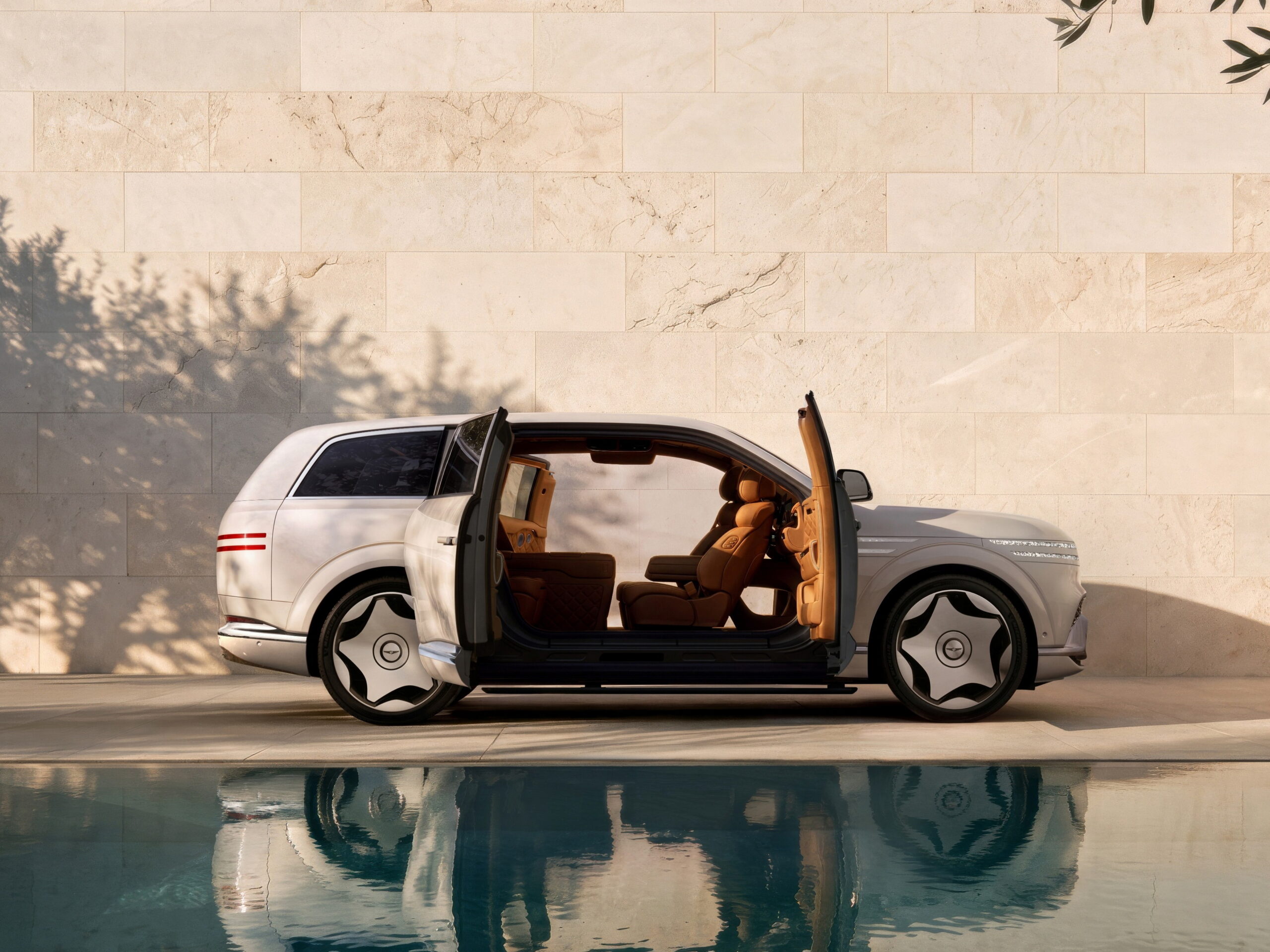
The electric Genesis GV90 combines coach doors, swivel seats, and a properly plush cabin.
The 657 hp flagship claims around 311 miles of range from a 123.5-kWh battery.
Genesis hasn’t announced U.S. pricing, and that could make or break the entire proposition.
Update: Our own Stephen Rivers was on the ground for the GV90’s debut in San Francisco and has sent through a set of live photos, which we’ve added below. They show the production model from angles the official gallery skipped, including a closer look at the cabin and the detailing around the grille and lighting signature.
Genesis has spent a decade proving it can make luxury cars that belong in the same sentence as BMW, Mercedes, and Audi. The GV90 might be the vehicle that lets it start a much louder conversation. At least on first look, this thing is seriously good. It’s big, clean, properly expensive-looking, and its cabin appears to have been designed by people who understand that a flagship SUV should feel like more than a row of screens wrapped in quilted leather. There’s just one big catch, though: Genesis has yet to say how much it will cost.
Photos Stephen Rivers / Carscoops
That matters because the GV90 is not another slightly nicer electric SUV. It’s Genesis’ new flagship, a 208.1-inch-long electric luxury barge with a 127.8-inch wheelbase, 657 hp, 590 lb-ft (800 Nm) of torque, a 123.5-kWh battery, air suspension, rear-wheel steering, and dual electronic limited-slip differentials. The company says its seven-seat version can travel roughly 500 km, or 311 miles, on a charge, although that figure comes from internal testing rather than the EPA. Oh, and that’s before we get to the interesting bits.
The Coach Doors Aren’t Just A Party Trick
The range-topping GV90 Neolun gets what Genesis calls the Neolun Arch Gate. These are coach doors with no conventional visible B-pillar. It’s the sort of thing that looks great in a concept-car rendering and usually disappears before production because engineers, crash regulations, and reality tend to get involved. That’s not the case here.
Genesis says it has made the arrangement work by integrating high-strength steel beams into the door-and-body structure. In addition, it’s added a concealed roll-cage-like arrangement with thicker framing, steel tubes, and structural foam. The rear door also uses a dual-motion hinge that first pushes it outward before it swings open, allowing it to operate independently rather than requiring the front door to be opened first.
Photos Stephen Rivers / Carscoops
In practice, it’s more impressive than it might, at first, seem. Getting into the second row is far more classy and seamless than in pretty much any other SUV at this price point. The experience matters, and it’s pretty special here. Still, this is one of those cases where the engineering explanation matters as much as the visual effect. We still need to drive and test one of these in the real world to get a better idea of everyday pleasures and pain points.
Photos Stephen Rivers / Carscoops
The standard GV90 uses conventional swing doors, which may end up being the smarter choice for many buyers. But the Neolun gives Genesis a proper halo feature that BMW, Mercedes, and Audi don’t have. Quite simply, it adds a layer of luxury that only brands like Rolls-Royce offer, but possibly for hundreds of thousands less.
It’s A Lounge First, An SUV Second
Photos Stephen Rivers / Carscoops
The cabin may be the GV90’s real knockout punch. Genesis describes it as a “bespoke living space,” which is normally the sort of phrase that should trigger an immediate eye roll. Here, though, the experience, again, the most important part, makes a convincing case.
There’s a wide pop-up OLED display that expands from 23.6 to 24.6 inches when parked, a 25-inch head-up display in place of a conventional instrument cluster, real-glass crystal controls, motorized vents, a 25-speaker Bang & Olufsen sound system, and seats with 15 air cells and pulse-vibration massage functions.
Photos Stephen Rivers / Carscoops
Then there are the motorized swiveling front seats. While parked, they can rotate a full 180 degrees to face the second row. That turns the GV90 Neolun into an actual lounge rather than a brochure’s vague promise of one. A 1960s Imperial and a Mercedes camper van are about the only U.S.-market precedents for front seats that fully face rearward. Genesis is bringing the idea to a modern luxury SUV.
Add the available four-seat Executive Suite with real wood flooring, a refrigerator, tables, a partition, and a six-zone electronically tintable roof, and Genesis is plainly aiming at the sort of buyer who sees a long drive as an opportunity to disappear from the world for a while. That’s also where the electric powertrain makes real sense.
Nobody buying a six-figure GV90 is likely trying to figure out public charging while living paycheck to paycheck in an apartment complex. These buyers are more likely to have home charging, other vehicles, and the means to arrange their lives around the rare trip that exceeds an EV’s comfort zone. In return, they get the silence, smoothness, instant torque, flat-floor packaging, and general serenity that make an EV particularly well suited to a luxury flagship.
Photos Stephen Rivers / Carscoops
But that doesn’t mean the EV-only decision is risk-free. A buyer cross-shopping a Mercedes GLS, BMW X7, Range Rover, or gas-powered Escalade may still want the freedom to drive all day, tow without anxiety, or simply avoid planning around charging. Genesis is betting those compromises will matter less than the benefits of an electric flagship. For its target customer, it may be right. But it is still leaving some very wealthy people on the table.
The Price Has To Be Right
Photos Stephen Rivers / Carscoops
The market has already set some uncomfortable benchmarks. Lucid’s Gravity Touring starts at $79,900, while Cadillac’s Escalade IQ begins at more than $127,000. The Kia EV9 starts far lower, though it isn’t a genuine equivalent; the Genesis is roughly 11 inches longer and uses a flagship-exclusive eMP platform.
That leaves Genesis with a narrow but potentially lucrative lane. If the standard GV90 starts around $100,000, it could look like an astonishing amount of luxury SUV for the money. Push it into the $120,000 range, though, and the brand will have to justify not only the vehicle itself, but also the entire Genesis ownership experience. At that point, buyers won’t just compare leather quality, rear-seat space, and charging times.
Photos Stephen Rivers / Carscoops
They’ll compare dealer treatment, service convenience, resale confidence, and whether the Genesis badge carries enough weight beside a three-pointed star or a Range Rover grille. The Neolun, and especially the four-seat First Edition, can probably command more. Those are the versions for buyers who want something their neighbors cannot casually duplicate. But the regular GV90 has the chance to be the important one.
Genesis may have built the kind of flagship SUV that makes the established luxury players uncomfortable. It looks fantastic, the interior feels genuinely special, and the coach doors, wood flooring, and rotating seats give it a personality beyond another expensive electric SUV with a giant screen. Now we just need Genesis to put a number on it. That number will decide whether the GV90 is a masterstroke or merely a very handsome missed opportunity.
Ford gutted Louisville Assembly Plant for its new Fathom electric truck.
Three parallel sub-assemblies replace a conventional linear final-assembly line.
Ford expects the new system to improve speed, ergonomics, and quality.
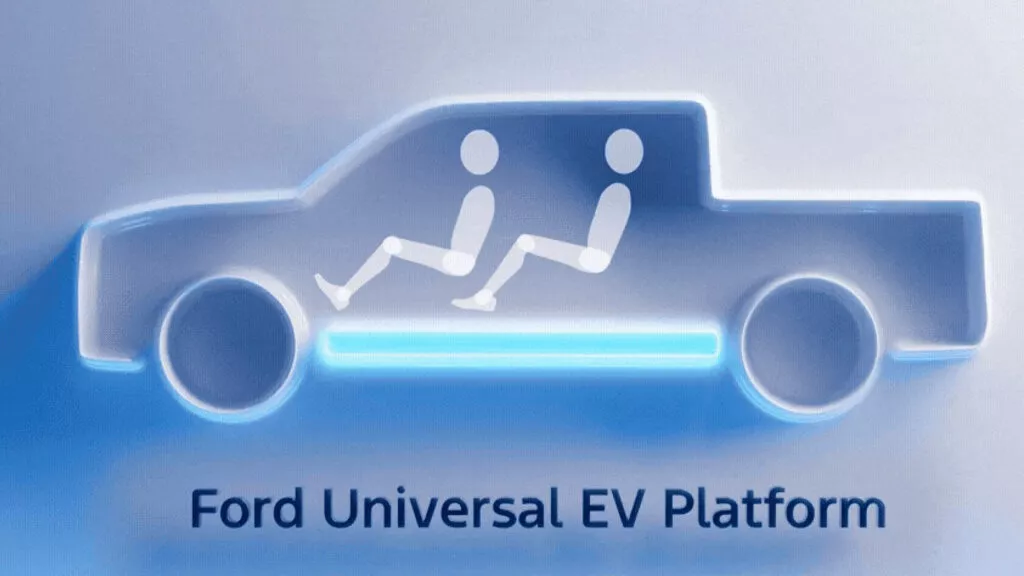
Ford’s long-promised affordable EV program has finally taken physical form. The 3-million-square-foot Louisville Assembly Plant that once built gas-powered vehicles is no longer just a familiar factory with a few new robots. Ford stripped it to its shell, spent $2 billion rebuilding it, and is now preparing it for the $28,350 Fathom electric pickup. The result is a very expensive experiment.
According to Ford’s latest progress update, production-qualified Fathom prototypes should begin rolling off the line in the first quarter of 2027. Customer trucks will follow later that year. The Fathom is the first vehicle on Ford’s new Universal EV platform and carries a $28,350 starting MSRP before its $1,595 destination charge. Ford still hasn’t revealed the range, payload, towing capacity, or most of the other figures truck buyers will care about.
For now, the story is the factory and how production will work. Instead of sending a mostly complete body shell down one long line, Ford splits each Fathom into three sections: the front clip, rear clip, and a structural battery-and-interior assembly. Workers outfit those sections in parallel, then bolt and bond them into a finished truck.
The front and rear sections rely on large aluminum unicastings that replace dozens of stamped and welded components. Meanwhile, the battery serves as the truck’s structural floor. That means workers can install a seat before there’s even a cabin structure in the way, rather than squeezing through a doorway with tools in hand.
There’s real potential here beyond the usual manufacturing buzzwords. Ford says the system reduces the need to reach over a fender by 84 percent. It also says the Fathom’s wiring harness is more than 4,000 feet shorter and 22 pounds lighter than the one in its first-generation electric SUV. Less twisting, less reaching, fewer parts, and fewer chances to mess something up all sound like wins. Especially for a brand so closely associated with recalls of late.
Ford says the plant will allow it to build cars 15 percent faster than its current Louisville products. A new software-flash station can even update modules while the truck moves through the plant rather than holding it up after assembly. Now, we just have to wait and see if this new production plan pays off. It’ll take a lot of $30k EV pickup truck sales to make a $2B investment look smart. But the real play here could be insight and experience that could spread to other Ford products.
MIT finds EVs cut lifecycle emissions 40 to 60 percent in most locations.
Even the dirtiest US grid fails to make an EV the worse option.
A gas car burns the same fuel forever, while the grid keeps improving.
Well, there’s no way that this information will be controversial at all. A new study out of MIT appears to completely crush the claim that EVs simply move pollution from the tailpipe to a smokestack. The analysis tackled the variables usually missing from that argument, like where drivers live, what powers their grid, what they drive, how far they travel, and even the weather.
Its conclusion isn’t that EVs are perfect. It’s that battery-electric vehicles beat comparable gas cars on lifecycle emissions across the U.S., including where electricity still comes heavily from fossil fuels.
Published in Environmental Research Letters, the MIT-led research first reported by InsideEVs found that EVs cut emissions by 40 to 60 percent in most locations. That’s not cherry-picking statistics either. The researchers considered vehicle and battery manufacturing, fuel and electricity production, regional grids, local temperatures, vehicle types, and how people actually drive. Re-read that maybe, because that’s an abundance of variables and considerations.
The reason is pretty simple. Internal-combustion engines waste an enormous amount of the fuel they burn as heat. EVs lose energy too, including at the power plant and during transmission, but electric motors are so much more efficient that they retain a massive advantage even after those losses are counted. A dirty grid narrows the gap. It doesn’t magically erase it.
Before the angry comments come in, though, it’s worth being clear about what this study does and doesn’t say. It is a lifecycle greenhouse-gas analysis, so battery production is already in the equation. But it doesn’t claim EVs have no environmental cost, nor does it settle every issue people may cram under the word “green.”
Mining, water use, local air pollution, labor practices, battery recycling, and grid reliability all deserve their own scrutiny. Like every model, its results also depend on assumptions about battery life, manufacturing, charging behavior, and future electricity mixes. Those details can affect the size of an EV’s advantage from place to place.
Still, the core finding holds. Even with the country’s most carbon-intensive electricity mix, the researchers found battery EVs do not increase lifecycle emissions compared to combustion vehicles. That’s a remarkably direct answer to the smokestack argument.
The Grid Only Gets Cleaner
And the picture should keep improving. The EIA says wind and solar accounted for a record 19 percent of U.S. electricity generation in 2025. Every cleaner kilowatt-hour makes the EV already in your driveway cleaner to run. A gas car gets no such upgrade. It just keeps burning gas. You can prefer an ICE car. That’s fine. Plenty of us do. But pretending a fossil-fueled grid turns an EV into a gas car isn’t skepticism. At this point, it’s simply ignoring the evidence.
Chinese analysts expect cars from there to go on sale in the US despite tariffs.
Ford expects Chinese automakers could reach America within five to 10 years.
Tariffs and technology rules block direct entry, but affordability could change the politics.
Yale Zhang is the managing director at the consultancy Automotive Foresight in Shanghai. He’s well-versed in the Chinese auto industry, and he knows all about the tariffs that keep its cars out of the USA. Despite them, he believes that Americans will force politicians to let Chinese cars into the USA sooner rather than later. Mexicans and Canadians with access to more affordable Chinese EVs could help sway them, too.
“[US carmakers] would face complaints from consumers who are supposed to enjoy affordable smart EVs [made by Chinese companies],” Zhang told the South China Morning Post. Mexico already has access to Chinese cars and benefits from the lower prices they can come with. Canada is also now opening up the way to sell Chinese cars after the start of a trade war with the USA.
Washington has made it abundantly clear that it sees Chinese vehicles as both an economic and a national-security concern. Chinese-built EVs face a 100 percent tariff, and connected-car rules make direct entry still harder. A Chinese badge on an American dealer lot is not exactly around the corner.
Plenty of new cars are wildly expensive, and affordable EVs remain even harder to find. Ford CEO Jim Farley recently told employees that Chinese automakers could enter the U.S. within five to 10 years. Ford is trying to get ahead of that with its own affordable EV program, but Farley has been more candid than most about the ground Detroit needs to make up.
Canada’s decision to permit up to 49,000 Chinese-made EVs each year and Mexico’s growing appetite for Chinese brands will give American buyers plenty of nearby examples. That does not mean the U.S. will suddenly throw open the gates. It may never happen through simple imports, either. Local assembly, familiar brand names, partnerships, and Chinese-built technology could all be part of the route in.
For now, tariffs can buy domestic automakers time, but they can’t build a compelling $25,000 EV. If the Big Three can’t figure out how to do that fast enough, consumers might get impatient and unwilling to wait any longer.
Electric LSVs promise prices around $15,000, far below the average new vehicle.
Fiat and Chip see demand for small neighborhood runabouts in places such as Miami.
Yet 25-mph vehicles cannot replace the highway-capable cars most Americans actually need.
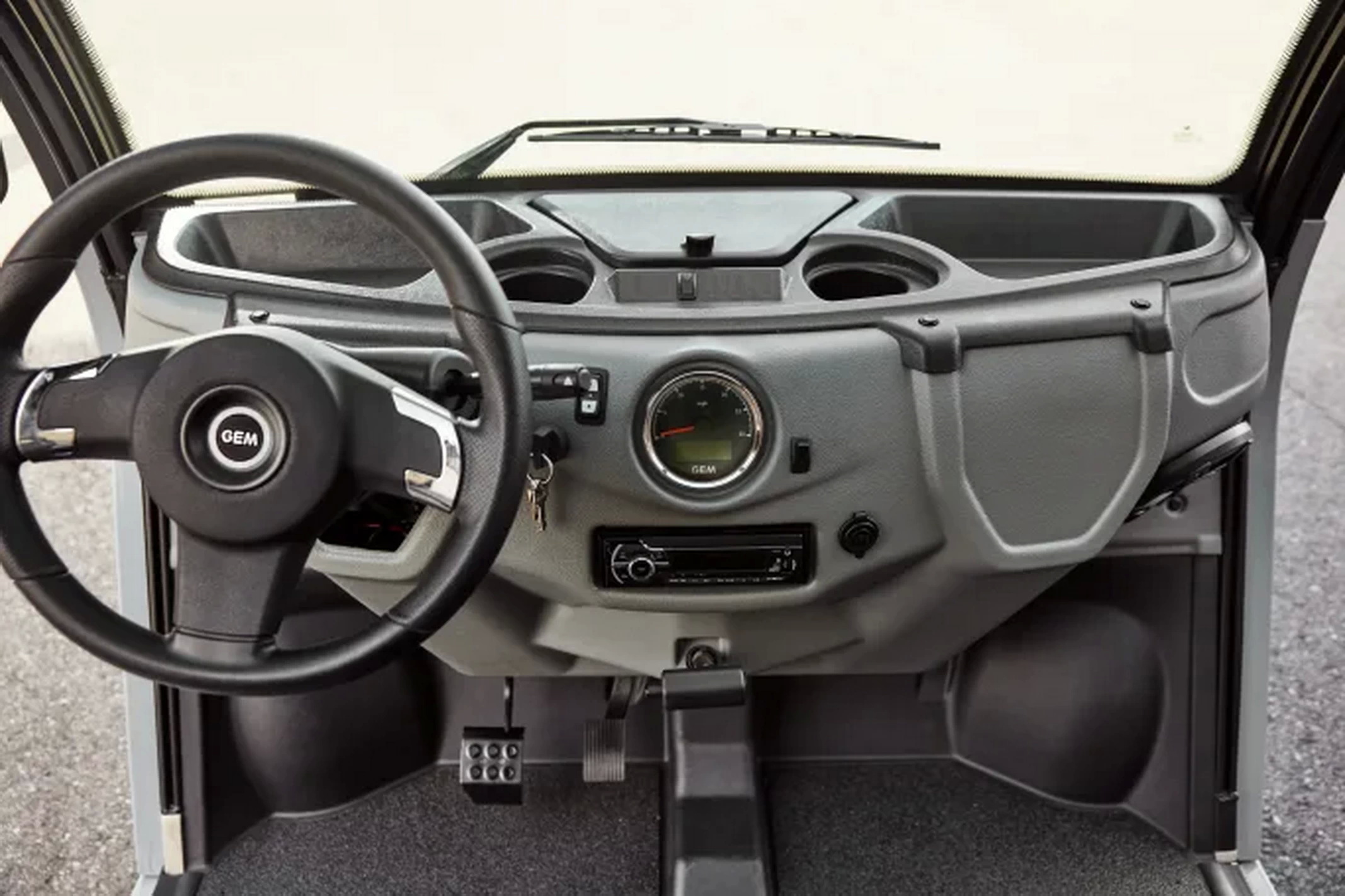
Americans are understandably tired of hearing why a new vehicle now costs the better part of $50,000. Automakers did not totally invent the country’s appetite for SUVs and pickups. But there’s no doubt that they have spent decades feeding it, moving buyers into bigger, plusher, and far more profitable machines. Their newest answer to affordability may be a $15,000 electric low-speed vehicle. In other words, when America asks for a cheaper car, the industry may offer a more convincing golf cart.
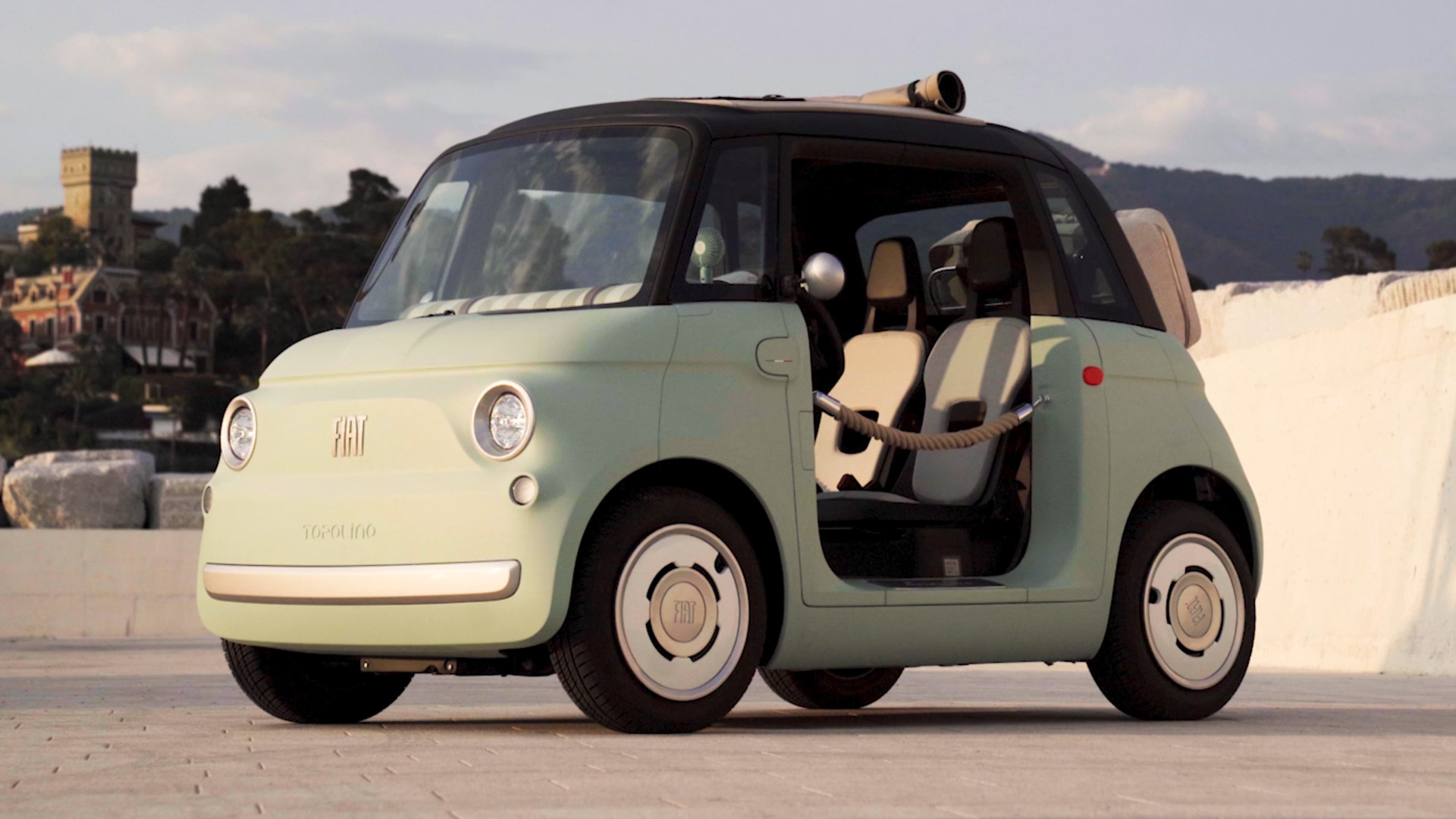
As CNBC reports, companies including Stellantis’ Fiat, Waev, and startup Chip Motors, see an opening for electric LSVs. Fiat is using Miami to test its tiny Topolino quadricycle, while Chip plans to begin production of a four- or six-seat vehicle next year. Both are expected to start at roughly $15,000, a figure that suddenly looks interesting in today’s market.
There is a real use case here. An LSV can be ideal in some spaces. Think of a retirement community, a beach town, a resort, or a dense development where the grocery store, restaurant, and mailbox are all a few miles away. They can generally charge from a normal household outlet, cost less than a conventional EV, and offer more weather protection than a typical golf cart. As a second vehicle, that sounds perfectly sensible and even a little fun.
Still, it takes a remarkable amount of optimism to frame one as an answer to America’s broader transportation problem. Federal rules generally limit LSVs to 25 mph, and states may allow them only on roads posted up to 35 mph. They need lights, mirrors, turn signals, and a compliant windshield, but airbags are not required. That is not a cheap replacement for a normal family car. It is a vehicle for people whose lives happen to fit inside a very narrow operating envelope.
That is where the affordability pitch begins to wobble. America does not need another clever way to sell a vehicle that cannot safely handle the daily realities of American driving. It needs genuinely affordable, highway-capable cars with enough room, safety equipment, and range of ability to serve as a household’s primary transportation.
LSVs may become a healthy niche, and good for them if they do. The roads will be more whimsical with them there. But they are cheaper precisely because they are less capable and subject to fewer requirements than a normal car. Sell them honestly as fun, useful local runabouts, and there is a case to make. Sell them as the industry’s answer to soaring vehicle prices, and it starts to look like the affordability crisis has been answered with a loophole.
Clemson’s Deep Orange 17 wraps more than 1,700 solar cells around its ultra-light body.
The 1,212-pound coupe claims a surplus after a 12-mile daily urban commute.
BMW-backed research explores solar power as a part of an EV’s propulsion strategy.
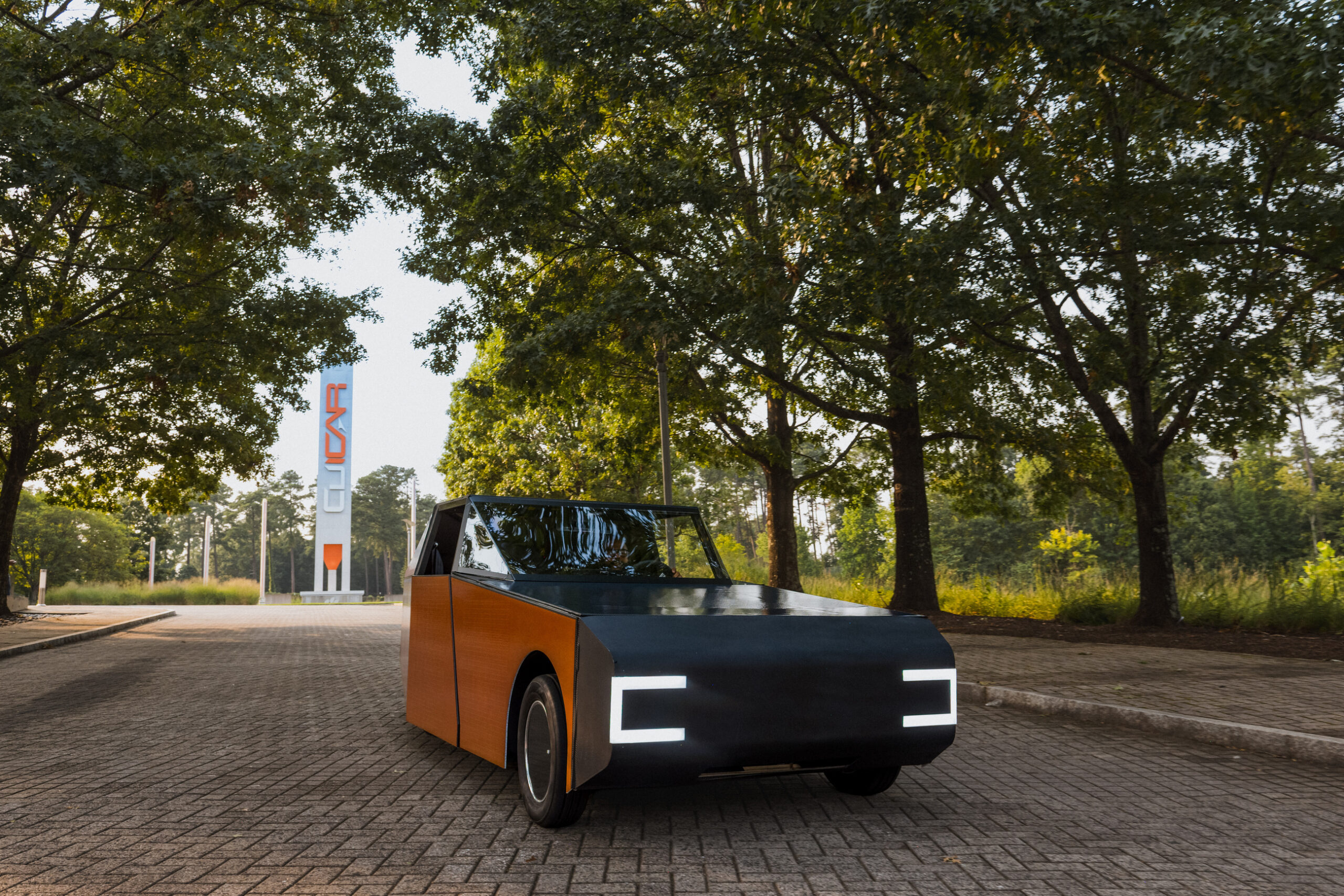
Solar panels on an EV are usually the kind of feature that sounds far more useful than it turns out to be. Clemson University’s Deep Orange 17 might actually flip that on its ear. The team there worked with BMW to wrap more than 1,700 photovoltaic cells around a tiny EV coupe that looks like a homemade Cybertruck, and the result, they say, adds more energy than it uses over a normal day of urban driving. Don’t get too stoked yet, though; there’s a lot to break down.
Developed by 16 graduate students alongside BMW’s research and development team, the prototype is called the Luminetta. Clemson says it was designed around a 12-mile (20 km) daily commute. It’s unclear how many folks have just a 12-mile commute but it clearly doesn’t apply to most. That said, the car is designed to soak up sunlight both when parked and when moving.
The big issue, of course, is that this is not remotely a normal car. In the metal it’s all flat angles and improvised paneling. Deep Orange 17 weighs just 1,212 pounds (550 kg), or roughly a quarter of the mass of many similarly sized production vehicles. Its multi-material structure combines steel, aluminum, carbon fiber, and 3D-printed metal joints, while regenerative braking, torque distribution, and optimized drivetrain controls all work toward the same goal of using as little energy as possible.
Clemson and its Fraunhofer Institute for Solar Energy Systems ISE partners modeled sunlight and environmental conditions in Greenville, South Carolina; Frankfurt, Germany; Madrid, Spain; and Mumbai, India. Across those locations, the university says the solar system could generate enough surplus electricity to add an average of 31 miles (50 km) of driving range per day. That’s groundbreaking regardless of all the other caveats here.
Sure, it’ll take a bevy of other innovations to apply this sort of thing to a modern production vehicle. But rather than simply being able to power a car with the sun, this one is proving that it’s technically possible to gain more energy than one would use on a very short… commute.
Trump called EV range anxiety a “disease” during remarks in Las Vegas.
No federal rule ever required Americans to purchase an electric vehicle.
EVs held a 5.8 percent U.S. market share in the second quarter.
Electric cars do not work for everybody. They can be a terrible fit for apartment dwellers without dependable charging, certain rural routes, and buyers who regularly tow long distances. But President Trump took the familiar issue of range anxiety and turned it into “a disease” during remarks in Las Vegas on Wednesday.
Speaking at the Red Rock Resort, Trump claimed he had “ended the electric mandate,” before suggesting that previous policy would have required everyone to drive an EV “within a very short period of time.” He said EV drivers begin worrying about where to charge when their battery is still three-quarters full, calling them “crazy.” These are real statements that were said out loud.
There is a real point buried beneath all the theatrics. Public charging still needs work, especially outside major metro areas and on parts of America’s vast rural highway network. Someone who cannot charge at home has a very different EV ownership experience than someone who plugs in every night, and long-distance travel requires more planning than filling a gas tank.
Still, calling that a disease is silly. A driver who sees a charger 89 miles off-route might reasonably factor that into the trip, but three-quarters of a battery is generally not panic territory in a modern EV. For most people who can charge at home, it is barely something they think about day to day.
The claim that there was “no way” to charge electric cars does not hold up either. The Department of Energy’s charging database now shows more than 250,000 public charging ports nationwide. That does not make the network perfect, reliable, or evenly distributed, but it is a far cry from nonexistent.
Trump also said EVs account for 7 percent of U.S. vehicle sales. The latest Kelley Blue Book estimates put the second-quarter figure at 5.8 percent, so the larger point is fair. EV demand has cooled sharply since its 2025 peak. That is a real market correction automakers cannot ignore. But it’s also partially a byproduct of Trump’s move to end the $7,500 federal EV tax credit.
What is not accurate is the idea that Americans faced a federal order to buy an electric car by 2030. Biden’s policy set a 50 percent target for new zero-emission vehicle sales, while emissions and fuel-economy rules pressured automakers to sell more of them. Trump’s own 2025 executive order targeted those policies, subsidies, and California’s waiver, not a retail rule forcing somebody to trade their F-150 for a Model Y. EVs are not a universal answer. Neither is pretending the people who buy them are sick.
The Spéirling PURE makes 1,000 hp and 2,000 kg of standstill downforce.
Production car adds a bigger battery, wider cockpit, new fans, and 95% new parts.
Only 100 will be built, with deliveries starting later this year from $1.3 million.
We’re all living in a golden era of supercars and hypercars, but almost all of them use the same ingredients. Tons of power, typically some power adders like turbos or superchargers, active aero, trick suspension bits, and a price tag so high it becomes part of the experience. Even electric hypercars are a thing now, and they have their own fancy feats. None seem to be as raw, smart, and rule-breaking as this: the McMurtry Spéirling PURE. Now, it’s about to make its public debut at Monterey.
The secret is hidden underneath. Twin fans and a sealing skirt create a low-pressure zone beneath the car, generating up to 2,000 kg (4,400 lb) of downforce from zero mph. Unlike a conventional wing, the system doesn’t need speed to work. The Spéirling can arrive at a corner already carrying race-car levels of grip.
That advantage was demonstrated at Laguna Seca in 2024, when a non-professional driver set an outright EV lap record with a 1:18.413. He wasn’t chasing a record. He was simply participating in a 10-minute demonstration while running just 50 percent power and downforce. The very first flying lap time was 6.3 seconds quicker than the production-car record set by a Czinger 21C.
Fan cars are not new. The Chaparral 2J and Brabham BT46B explored the idea decades ago. McMurtry has simply developed it into a modern, customer-ready track car. Prototype versions have also set records at Goodwood and the Top Gear Test Track, while one demonstrated enough suction to drive upside down.
The production PURE gets 95 percent new components, including a larger 100-kWh battery, new Helix motors, an upgraded gearbox, improved cooling, and a more durable fan system. It produces 1,000 bhp (746 kW), reaches 60 mph in 1.55 seconds, and tops out at 190 mph (305 km/h). It weighs approximately 1,350 kg (2,980 lb) and can generate 3g in both cornering and braking.
McMurtry says the PURE can be operated by a driver and a competent friend or technician rather than a full race team. That’s important because the car costs £995,000 or $1.3 million before taxes, shipping, and options. Only 100 examples will be built.
The Spéirling PURE will appear at The Quail on August 14 before heading to Laguna Seca on August 15. Let’s hope somebody gives it another chance to set a record without even trying.
Beachman restored a blown 1974 Honda CB500 with a custom electric drivetrain.
The one-off build is fully road legal and highway capable in Ontario.
Project launches Beachman’s new Special Vehicles Division for custom commissions.
Few things in the classic vehicle space are as controversial as EV restomods or electromods as some call them. Purists see it as sacrilege, while EV enthusiasts often end up with conversions that look more like science projects than timeless machines. Somehow, this 1974 Honda CB500 manages to avoid both pitfalls.
Built by Canadian company Beachman Bikes, the motorcycle marks the debut of its new Special Vehicles Division (SVD). It will focus on rescuing worn-out vintage motorcycles by replacing their tired gasoline engines with modern electric drivetrains. Importantly, this wasn’t a healthy classic sacrificed in the name of progress. According to Beachman, the donor CB500 arrived with a blown engine and failed clutch, making it an ideal candidate for a second life instead of a trip to the scrapyard.
Beachman says it completely restored the original frame before redesigning it around an electric powertrain. The centerpiece is a custom-built 72-volt, 200 Ah lithium-ion battery pack developed specifically for the Honda after the company digitally scanned the chassis and designed cells to maximize the available space while maintaining the bike’s balance.
The best part is that this bike isn’t limited to low-speed espresso runs. Beachman says it’ll cruise on the highway without issue and offers everyday usability and reliability. That said, it hasn’t announced things like range, performance figures, charging times, or output specifications, so take everything here with a grain of salt. That said, from a visual perspective, the bike looks great.
The cream-colored fuel tank, quilted brown saddle, wire-spoke wheels, round headlight, and classic proportions all remain intact, while the battery enclosure fills the space where the inline-four once lived without looking overly bulky. Even the charging port was designed with a vintage aesthetic so it doesn’t immediately give away what’s hiding underneath. The details line up well enough that the bike reads as a coherent build rather than a hack job.
The completed motorcycle also passed Ontario’s DriveON safety inspection, making it fully road certified before being handed over to its private owner. Beachman might not have a bunch of specs and figures for us yet, but it’s clear that it’s figured out one big aspect of electromodding motorcycles. Making them electric doesn’t require removing their classic good looks.
Porsche’s electric Cayenne reached 60 mph in just 2.1 seconds in independent testing.
It outpaced the Corvette ZR1 while setting multiple SUV performance records.
Carbon-ceramic brakes also helped it stop as quickly as America’s latest supercar.
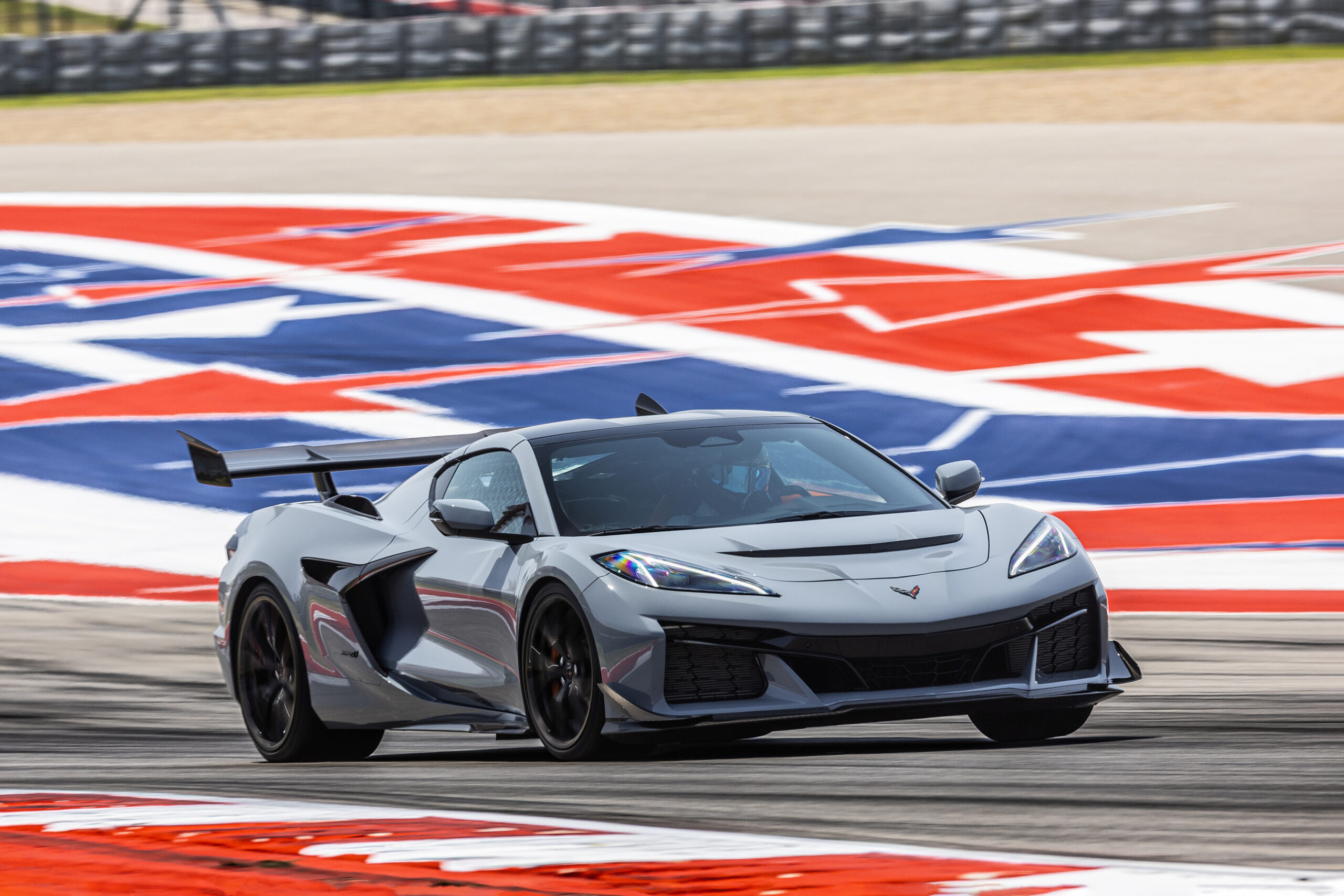
Electric vehicles have spent the last few years proving that weight doesn’t necessarily prevent eye-watering acceleration. That said, Porsche’s latest Cayenne may have just shattered the rulebook altogether. Despite tipping the scales at nearly 6,000 pounds, the new Cayenne Turbo Electric has posted numbers that would have seemed impossible for an SUV just a few years ago. The most startling fact? It’s actually quicker to 60 mph than Chevrolet’s mighty 1,064-hp (793 kW) Corvette ZR1.
According to Car and Driver testing, the 2026 Porsche Cayenne Turbo Electric sprinted from 0-60 mph (0-96 km/h) in just 2.1 seconds, edging out the Corvette ZR1 by a tenth of a second. That’s enough to make it the quickest SUV the publication has ever tested. It also beat the Lamborghini Revuelto to 60 mph by the same margin.
Where the Numbers Come From
The Cayenne Turbo EV’s performance comes courtesy of dual electric motors producing a combined 1,139 hp (849 kW) and 1,106 lb-ft (1,500 Nm) of torque when launch control is activated. All-wheel drive helps put every bit of that power to the pavement, allowing the big Porsche to shrug off its 5,960-pound (2,703-kg) curb weight.
And the fireworks don’t stop after 60 mph (96 km/h). The electric Porsche reaches 100 mph (161 km/h) in 4.5 seconds, storms through the quarter mile in 9.5 seconds at 146 mph (235 km/h), and continues pulling hard all the way to 150 mph (241 km/h) in 10.1 seconds. Passing performance is every bit as violent, with the Cayenne needing 1.1 seconds to go from 30 to 50 mph (48-80 km/h) and 1.4 seconds from 50 to 70 mph (80-113 km/h).
That quarter-mile run was also 1.1 seconds quicker than the Lucid Gravity and two-tenths ahead of the Lamborghini Revuelto. That’s supercar numbers, from a Porsche family SUV.
Stops Like a Supercar Too
Perhaps even more surprising is that the Cayenne doesn’t sacrifice braking or handling in the pursuit of straight-line speed. Equipped with optional $10,900 carbon-ceramic brakes, it stopped from 70 mph (113 km/h) in 140 feet (42.7 m), the same distance Car and Driver recorded for the Corvette ZR1 despite the Porsche weighing roughly 2,100 pounds (953 kg) more.
It also stopped 10 feet (3 meters) shorter than the Cayenne Turbo GT and 12 feet (3.7 meters) sooner than the Lamborghini Urus Performante. Even those who truly hate EVs can’t deny how impressive these figures are. And get this… there’s even more to gawk at.
The SUV also pulled 1.05 g on the skidpad, another record for an SUV in the magazine’s testing. That narrowly beats the Lamborghini Urus Performante’s 1.04 g and leaves rivals like the Rivian R1S and Lucid Gravity well behind, the Rivian at 0.80 g and the Lucid at 0.90 g. Car and Driver credited the Cayenne’s Pirelli P Zero R tires and Porsche Active Ride suspension for the result.
Of course, none of this comes cheaply. The Cayenne Turbo Electric starts at $165,350 with delivery fees, while the example tested carried a sticker of $194,600 thanks to options like its carbon-ceramic brakes. One could argue that for all the Cayenne Turbo Electric can do, it’s almost worth it.

 Login
Login