Normal view

There are new articles available, click to refresh the page.
Today — 30 April 2026Electric Vehicles - Latest News | Carscoops

The Nissan Primera Is Coming Back As A Rebadged Chinese EV

  • The Nissan Primera will return in the form of a large electric sedan.
  • A listing on the Department of Energy Philippines reveals more details.
  • The technical specifications confirm it will be a rebadged Nissan N7.

The Nissan Primera appears to be making a comeback after spending almost two decades in hibernation. While the automaker has yet to confirm the news, the nameplate has appeared in the Philippines’ Department of Energy (DOE), pointing out to a very specific electric sedan.

The details in the government filing suggest that the new Primera will have a fully electric powertrain. They also reveal the dimensions, including a Camry-beating length of 4,930 mm (194.1 inches) and a 2,915 mm (114.8-inch) wheelbase. Those specs all but confirm earlier reports and speculation that the model would be a rebadged version of the Dongfeng Nissan N7 from China.

More: Nissan’s New Electric Sedan Is As Big As A Maxima, Cheap As A Versa

As reported by Top Gear Philippines citing the DOE-certified specs, the new Primera will be fitted with a single electric motor producing 215 hp (160 kW / 218 PS) and 305 Nm (225 lb-ft) of torque. This is identical to the entry-level N7, although the 60 kWh battery pack is slightly different, promising to offer 500 km (311 miles) of range.

\\\\\\\\\\\\\\

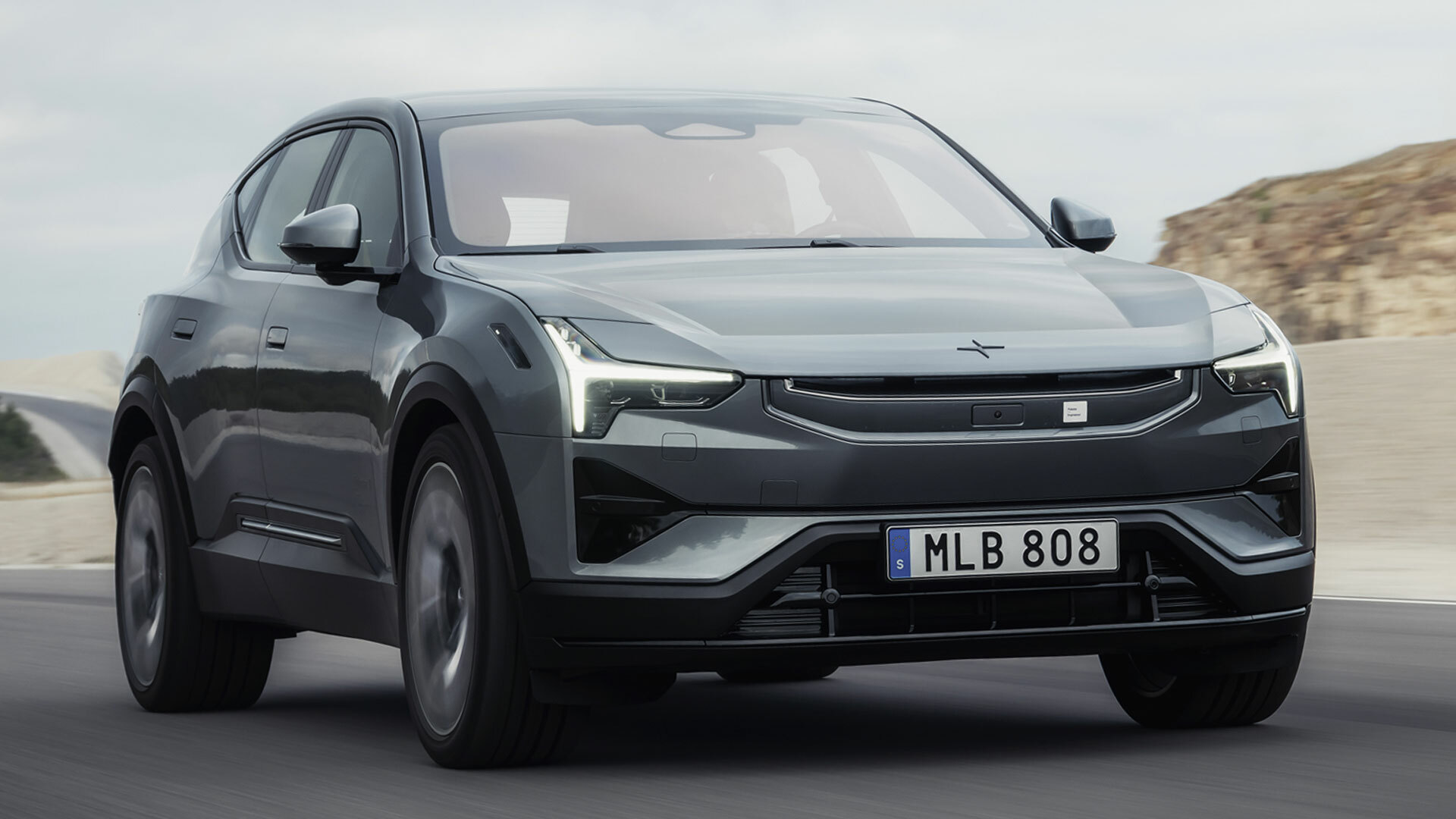
Judging from the shared footprint, we don’t expect any styling changes compared to the Nissan N7 besides a new Primera script on the tailgate. The interior will most likely be carried over, including the 15.6-inch infotainment display on the minimalist dashboard.

More: Nissan’s New Sedan Drives Like An EV But Runs On Gas

While Nissan is keeping its cards closed on a specific launch date, it has been officially confirmed that the N7 will be offered in export markets. The model is produced at the Dongfeng Nissan Huadu plant in Guangzhou, alongside the smaller N6 and the NX8 SUV.

The DOE filing suggests that the Primera’s revival is imminent in the Philippines. It will be interesting to see whether the same name will be used in other export markets, something that makes sense as it is far more recognizable than the N7.

\\\\\\\\\\\

A Short History Lesson

The Nissan Primera debuted in 1990 as a mid-size sedan for Japan and Europe, spanning three generations until its discontinuation in 2007. Available in sedan, liftback, and wagon forms, the model earned motorsport fame by winning the BTCC championship in 1998 and 1999.

More: Nissan’s New Terrano Is Coming For The Land Cruiser, And This Time It Has 429 HP And A Plug

While primarily a Japanese and European staple, the first two generations of the Primera were also sold in North America as the Infiniti G20 until 2002. In recent years, the Altima took over the role of the Primera in certain markets. Still, the nameplate remains a well-remembered part of Nissan’s heritage in Europe and Asia, which explains the company’s decision to bring it back.
\\\\\\\\\

Nissan

Dealers Can’t Move The 500e At $15,000 Off. Fiat’s Response Is A $5,200 Price Hike

  • Fiat has finally introduced the 2026MY 500e.
  • Despite slow sales, pricing shoots up $5,200.
  • There’s a new color and a revised lineup.

Automakers have been introducing 2027 models for months, but the 2026 Fiat 500e has been curiously absent. Given this, we reached out to the brand last week to see if the hatchback was going on hiatus like the Jeep Wagoneer S.

Fiat told us the 2026 model would be announced soon and they’ve finally followed through by introducing a vehicle that virtually no one wants. Given the low demand of less than one per day, the updates are unsurprisingly minor.

More: Fiat Dealers Slapping $15,000 Discounts On Slow-Selling 500e

When the 2026 500e arrives this summer, customers will find empty showrooms and a new Miami Sunset exterior. That isn’t the only change as the new Pop trim features a body-color dashboard, instead of the pearl one found on the Icona.

The only other major change appears to be access to Tesla’s Supercharger network. However, this requires using a NACS adaptor that costs $230.

Other than that, it’s your typical overpriced and underwhelming 500e. That being said, the lineup has been adjusted for 2026 as the 500e Giorgio Armani Edition is dead.

\\\\\\\\\\\

On top of that, the entry-level Pop begins at $35,700 which is a huge jump from the previous starting price of $30,500 for the INSPI(RED). That trim is apparently dead, although Fiat did mention a (RED) Edition, which appears to be a package.

The Icona trim returns for 2026, but it now starts at $37,700. That’s $5,200 more than the 2025 model and it’s a hilarious ask considering dealers are struggling to get rid of existing vehicles even with discounts of $15,000.

\\\

While no one in their right mind would buy a 500e, we’ll remind you the car has a 42 kWh battery pack that feeds an electric motor developing 117 hp (87 kW / 119 PS) and 162 lb-ft (219 Nm) of torque. It enables the model to accelerate from 0-60 mph (0-96 km/h) in 8.5 seconds and have a range of approximately 149 miles (240 km).

Needless to say, there are far better options including the $27,600 Chevrolet Bolt with 262 miles (422 km) of range. Shoppers should also check out the $29,990 Nissan Leaf, which can travel 303 miles (488 km) between charges

2026 Fiat 500e Pricing
TrimMSRP 
Pop$35,700
Icona$37,700
SWIPE

Prices exclude an undisclosed destination fee

Democrats Rarely Back Trump’s Tariffs, Until China’s Automakers Came Up

  • More than 70 Democrats have called for a harder stance against Chinese automakers.
  • They want tougher tariffs and trade enforcement as well as a production ban.
  • Move comes after Trump suggested he was open to Chinese automakers in America.

Bipartisanship is rare in Washington, but there’s one issue that Democrats and Republicans can seemingly agree on. We’re talking about the threat of cheap Chinese cars, which are slowly spreading across the globe.

The Biden and Trump administrations have setup a series of roadblocks including huge tariffs and a ban on connected vehicles, but some in Congress want even more action. As a result, dozens of House Democrats sent President Trump a letter expressing “significant concern” with his remarks “about allowing Chinese automakers access to the United States market.”

More: Chinese Cars Get Cheaper And Better, So U.S. Automakers Want Them Banned Even If They’re Made Here

The letter came in response to a speech Trump made at the Detroit Economic Club in January, where he said if Chinese automakers “want to ​come in and build a plant and hire you and hire your ​friends and ⁠your neighbors, that’s great, I love that.”

While those remarks were made months ago, the letter was apparently sent now because Trump is set to meet Chinese President Xi Jinping next month. Democrats apparently fear the President could give Chinese automakers the green light in exchange for a possible trade deal or agreement.

 Democrats Rarely Back Trump’s Tariffs, Until China’s Automakers Came Up

Getting back to the letter, it urged Trump to “take any and all decisive action necessary” to prevent Chinese automakers from gaining access to the United States. Signers went on to say “any effort to lower barriers for Chinese automobiles or otherwise facilitate their entry into the U.S. market would pose a direct threat to American manufacturing, workers, and national security.”

It went on to claim the American automotive industry supports approximately 10 million jobs and accounts for five percent of the gross domestic product. The letter then said the “Chinese auto industry does not compete on a level playing field” as it is “driven by a state-directed strategy to dominate global markets through government subsidies, below-market financing, and non-market behavior across the supply chain.”

It went onto suggest the entry of Chinese vehicles into Canada and Mexico could create a “backdoor into the United States under the United States-Mexico-Canada Agreement.” The letter added, “Chinese-owned or controlled vehicles, regardless of where they are assembled, must not be permitted to enter our market through USMCA or any other mechanism.”

 Democrats Rarely Back Trump’s Tariffs, Until China’s Automakers Came Up

That’s a little awkward for Polestar and Volvo, but the message called for Trump to “maintain and strengthen existing tariffs and trade enforcement measures on Chinese automakers and automobiles” as well as prevent them from establishing manufacturing operations in America. Democrats went on to ask that vehicles produced by Chinese-owned or controlled entities in Canada or Mexico be explicitly prohibited from qualifying for USMCA benefits or entering the United States. On top of that, they want the government to “accelerate and expand restrictions on Chinese-connected vehicle technologies.”

Reuters reached out to the White House and was told, “While the administration is always working to secure more investment into America’s industrial resurgence, any notion that we would ever ​compromise our national ​security to do so ⁠is baseless and false.”

 Democrats Rarely Back Trump’s Tariffs, Until China’s Automakers Came Up

For their part, the Chinese Embassy called for officials to “stop overstretching the concept of national security, cease discriminatory and exclusionary measures, and provide a fair, transparent, and non-discriminatory business environment.”

However, that seems unlikely as fear of Chinese automakers is one thing that almost all politicians can get behind.

 Democrats Rarely Back Trump’s Tariffs, Until China’s Automakers Came Up

Hyundai Extends Warranty On The Part That Bricks Its EVs, But Owners Aren’t Convinced

  • Hyundai increased ICCU warranty coverage to 15 years or 180,000 miles for certain EVs.
  • Many Ioniq 5 owners say Hyundai’s VIN lookup tool still shows no ICCU coverage.
  • Drivers want proof Hyundai fixed the faulty part and some are swearing off the brand.

Hyundai EV owners just received a little more peace of mind over a part that some say has a 10 percent failure rate. This isn’t a backup camera, a loose windshield wiper, or a missing cotter pin either. It’s a part called the Integrated Charging Control Unit (ICCU), and when it fails, it basically strands the car.

The South Korean company has now extended warranty coverage to 15 years or 180,000 miles for some EVs with ICCU issues. That sounds great, but there’s more to the story unfolding right now.

Read: Hyundai Fixed His ICCU Then Let Thieves Total The Rest Before He Even Saw It

As we’ve highlighted both in the past and even this week, ICCU concerns are a big deal for Hyundai, Kia, and Genesis owners. The ICCU is one of those parts most owners never think about until it fails. It manages onboard charging and helps keep the 12-volt battery alive. It’s basically the EV equivalent of the old-school alternator’s job. When it dies, the car can lose power, stop charging properly, or simply refuse to start, and plenty of owners have been there.

Recently, Hyundai extended its warranty coverage on affected vehicles in Europe. According to a statement provided by Hyundai Motor America to Torque News, the automaker has approved a warranty extension for the ICCU on certain affected U.S. EVs, stretching coverage to 15 years or 180,000 miles, whichever comes first. That’s a major jump from the previous 10-year/100,000-mile protection. There are a couple of notable caveats to consider, though.

What About Kia And Genesis?

 Hyundai Extends Warranty On The Part That Bricks Its EVs, But Owners Aren’t Convinced

First, there’s no word from Kia or Genesis yet about if they’re also going to extend coverage on affected cars. While it’s highly likely that each will end up extending their coverage, too, an official statement would be nice. Carscoops reached out to both brands but didn’t receive a response at the time of writing. The second concern is how Hyundai’s warranty tool works.

Hyundai says affected owners should check their VIN through Hyundai Motor America’s campaign lookup tool and contact dealers if they see warning lights, charging issues, or reduced power. Sounds simple enough, but when many owners check the site, they get nothing.

Multiple commenters on the original report say they’ve entered VINs for 2022, 2023, and even recently failed 2025 Ioniq 5s, only to see no ICCU campaign listed at all. Finally, there’s reason to wonder if Hyundai has fixed the ICCU issue altogether or if the potential replacement parts will one day fail as well. That’s at the heart of a new lawsuit that Hyundai hasn’t yet responded to. At this point, no one knows, but owners surely hope this isn’t the case.

 Hyundai Extends Warranty On The Part That Bricks Its EVs, But Owners Aren’t Convinced

VW Ruled China For 25 Years, Now Young Buyers Call It Their Parents’ Car

  • VW’s China boss admits young buyers now see it as a brand for parents.
  • German market share in China fell from 26 percent to 16 percent since 2019.
  • BYD overtook VW in 2024, and Geely pushed it to third the year after.

For more than two decades, a German badge in China was shorthand for arrival. That equation no longer holds. China remains one of the most important markets for German automakers. The trouble is they are now struggling to compete with local rivals who have captured the hearts and minds of young buyers.

The boss of VW in China, Robert Cisek, admitted that the rapid change in China’s car market has been “beyond imagination,” and means that now, “some younger customers perceive us as the brand for the parents.” For more than 25 years, VW was the best-selling carmaker in China, but was overtaken by BYD in 2024, and dropped to third in 2025 behind Geely.

Read: China Is Getting A Jetta SUV For Less Than A Used Corolla Costs In America

Automotive consultant Felipe Munoz says German brands “didn’t see this big change coming, and they didn’t see the speed at which it came.” While overall new car sales in China continue to climb, the market share of German brands slipped from 26 percent in 2019 to 16 percent in 2025, when they sold 3.9 million vehicles.

Germans Race To Compete

 VW Ruled China For 25 Years, Now Young Buyers Call It Their Parents’ Car
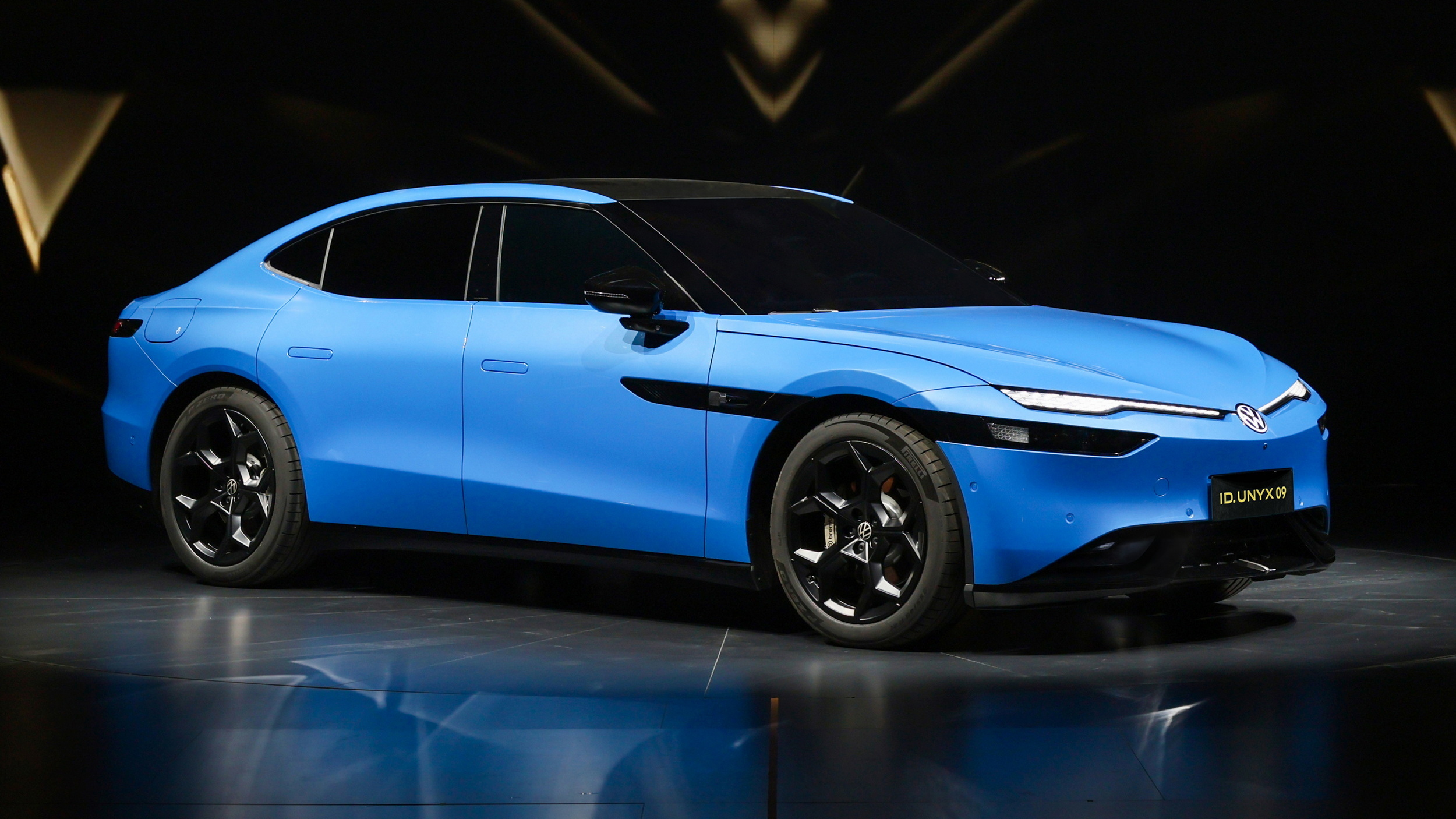
VW ID. Unyx 09

In times gone by, companies like VW could sell their vehicles in China thanks to their build quality, high-end materials, and strong reputations. However, this is no longer enough, Reuters reports.

To try and claw back some ground, the Volkswagen Group will launch 20 new-energy vehicles in China this year, including several battery-electric models, plug-in hybrids, and EVs. Many of these new models were recently unveiled at the Beijing Auto Show, including the ID. Aura T6, which was built in partnership with FAW, the ID. Unyx 09, created alongside Xpeng, and the all-electric AUDI E7X from the firm’s SAIC joint venture.

It remains to be seen if vehicles like these will be enough. According to a recent survey from AlixPartners, young buyers in China are more likely to avoid German cars, despite the ‘Made in Germany’ tagline holding strong appeal in many other countries.

 VW Ruled China For 25 Years, Now Young Buyers Call It Their Parents’ Car

Stellantis’ Cheapest New EV Is Chinese, Made In Europe, And $15K Under Its Own Peugeot

  • Leapmotor’s new B05 starts at €26,900 in Italy before any local incentives apply.
  • The Chinese-designed hatchback is built at a Stellantis plant in Zaragoza, Spain.
  • Local assembly lets the B05 sidestep the EU tariffs aimed at Chinese-made EVs.

As European EV buyers grow more price-sensitive, new entrants are finding sharper ways to undercut established players without giving up headline specs. Stellantis is putting its strategic partnership with Leapmotor to work, launching the new B05 across Europe as a fully electric hatch aimed squarely at the freshly updated VW ID.3 Neo. A hotter Ultra variant will follow, with the next GTI in its sights.

Aggressive Pricing

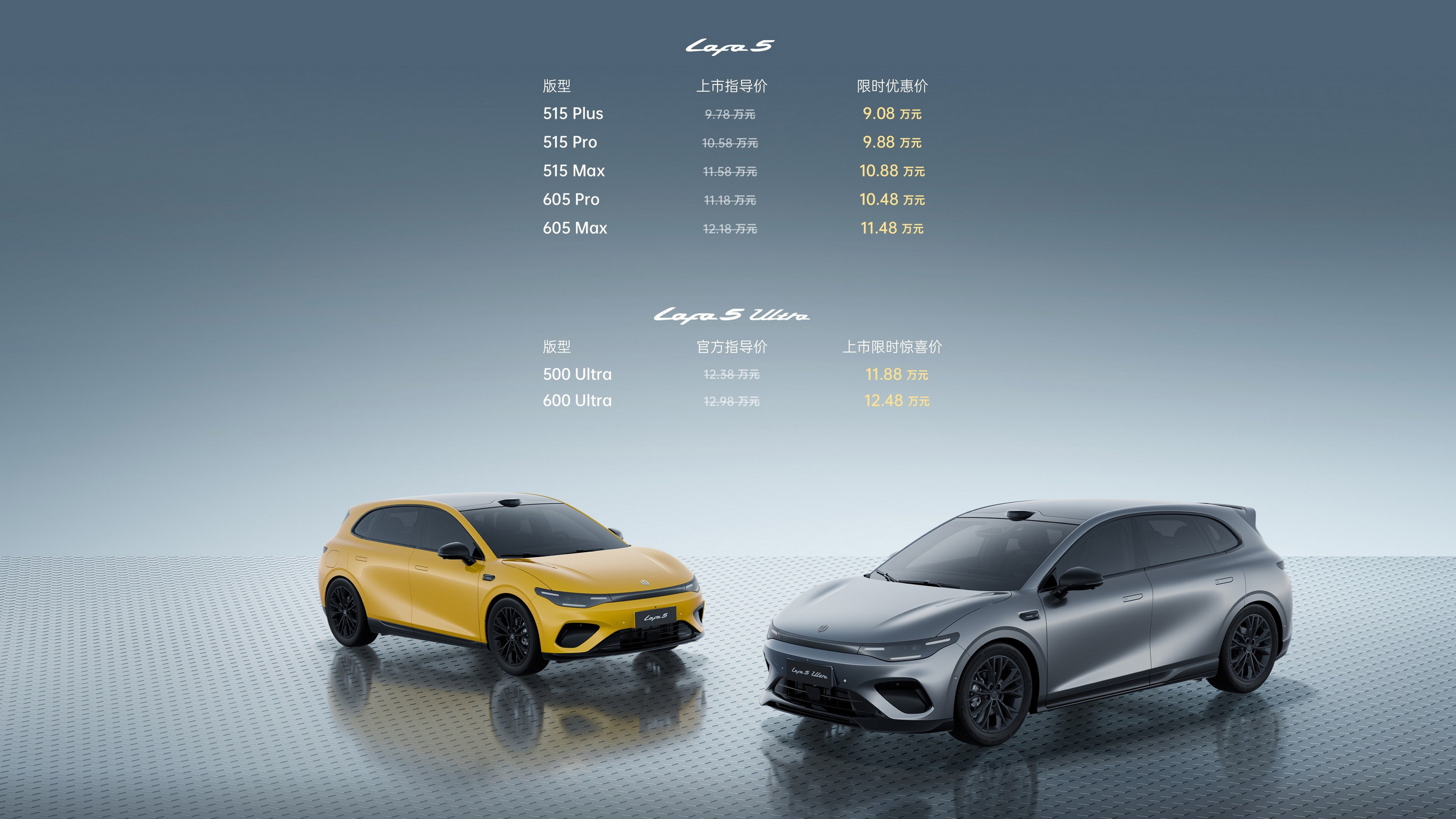
The Leapmotor B05, known as the Lafa 5 in China, first appeared in Europe last September at the Munich Auto Show, then a static prototype. It is now on sale in European markets, priced in Italy from €26,900 ($31,500) to €30,900 ($36,200) before local incentives.

More: Stellantis’ Secret Weapon Against Chinese EVs In Europe Turns Out To Be A Chinese EV

This places the entry-level version €9,600 ($11,200) below the pre-facelifted VW ID.3 in Italy. The Leapmotor B05 also comes in €11,450 ($13,400) under the Renault Megane E-Tech and €13,080 ($15,400) less than Stellantis’ own Peugeot E-308 in the same market.

\\\\\\\\\\

The EU-spec Leapmotor B05 is currently being assembled at Stellantis’ Figueruelas plant in Zaragoza, Spain. Producing the car locally allows the company to avoid steep EU tariffs on Chinese-built EVs, helping it land at a price point that undercuts even the now-discontinued MG4.

Competitive Specs

Measuring 4,430 mm (174.4-inch) long, the EV rides on Leapmotor’s “LEAP 3.0” architecture and uses Cell-to-Chassis (CTC) technology. This setup integrates the battery into the structure, improving rigidity. The company also claims a 50:50 weight distribution and notes that the suspension was co-tuned with Stellantis’ global engineering teams.

More: Opel And Alfa Romeo’s Next EVs May Be Built Around Chinese Tech, Not German Or Italian

European buyers can choose between two LFP battery packs: a 56.2 kWh Pro unit with a WLTP range of 401 km (249 miles), or a 67.1 kWh Pro Max pack offering up to 482 km (300 miles). DC fast charging peaks at 174 kW, allowing a 30-80% charge in as little as 17 minutes.

\\\\\\\\\

The Leapmotor B05 is fitted with a rear-mounted electric motor offering 215 hp (160 kW / 218 PS) and 240 Nm (177 lb-ft) of torque. For those seeking better performance, the upcoming B05 Ultra bumps the output figures to 241 hp (180 kW / 245 PS) and 255 Nm (188 lb-ft), combined with a lowered suspension, fatter anti-roll bars, beefier brakes, a more aggressive bodykit, and performance tires.

Generous Equipment

Despite its budget pricing, the Leapmotor B05 is packed with tech. The entry-level Life trim has a comprehensive list of standard equipment, including a 14.6-inch touchscreen, an 8.8-inch digital instrument cluster, an AI-powered voice assistant with facial recognition, dual-zone climate control, a 360-degree camera, a panoramic glass roof, and a full ADAS suite.

More: This Leapmotor Packs Lamborghini Huracan Power Into A $38K Family SUV

The flagship Design trim adds 19-inch alloy wheels instead of 18-inch units, along with a heated steering wheel and heated, ventilated seats trimmed in eco-leather. It also brings 256-color ambient lighting that reacts to music, plus a more advanced ADAS package.

\\\\\\\\\\\\\\\\

The B06 Ultra has not yet been detailed for Europe, though the Chinese version includes a front splitter, side skirts, a rear spoiler, and a rear diffuser, along with unique 19-inch wheels. Inside, it adds sport seats with a massaging function, suede-style upholstery, and LiDAR-based driver assistance systems.

More: Stellantis Turns A Tiny Chinese Hatch Into A Delivery Van That’s Light On The Van Part

In China, the Leapmotor Lafa 5 is even cheaper compared to its EU-spec B05 twin, currently priced between ¥90,800-114,800 ($13,300-16,800). The Lafa 5 Ultra sits at the top of the lineup, priced between 118,800-124,800 ($17,400-18,300). However, it is worth noting that the entry-level variants of the Chinese-spec model have lower output and a smaller battery pack.

 Stellantis’ Cheapest New EV Is Chinese, Made In Europe, And $15K Under Its Own Peugeot

VW’s New ID. Polo Starts Under $30K And Comes With Massage Seats

  • Pre-sales of the VW ID. Polo EV kick off this week starting at €24,995.
  • Three power outputs and two batteries offer up to 283 miles of range.
  • Interior features retro-style digital display and pneumatic seat massagers.

Over 20 million Polos have found homes since the nameplate launched more than 50 years ago. Now Volkswagen’s rebooting the whole thing as the ID. Polo, a fully electric seventh-generation hatch built on the new MEB+ EV platform with front-wheel drive, up to 283 miles (455 km) of range and a starting price that keeps it firmly in affordable territory.

More: VW’s 2026 ID. Buzz Adds 335 HP And Real Buttons, America Gets Neither

Pre-sales are already live in Germany, where the entry-level Trend trim kicks off at €24,995 ($29,300). That’s the headline number Volkswagen‘s been keen to shout about, though if you want one right now, the only available order is the mid-spec Life trim, which starts at €33,795 ($39,600). More variants follow in the summer.

\\\\\\\

There are three power outputs at launch. The 114 hp (116 PS / 85 kW) and 133 hp (135 PS / 99 kW) versions come with a 37 kWh lithium iron phosphate battery offering up to 204 miles (329 km) of range and DC fast charging at up to 90 kW, with a 10-to-80 charge taking around 27 minutes.

The 208 hp (211 PS / 155 kW) variant steps up to a 52 kWh nickel-manganese-cobalt pack, pushing range to a provisional 283 miles (455 km) and accepting up to 105 kW DC charging, shaving that charge window down to roughly 24 minutes. A GTI variant with 223 hp (226 PS / 166 kW) is coming in 2027.

New Front-Wheel Drive Platform

The switch to the front-wheel drive MEB+ platform pays dividends in terms of space because unlike the bigger ID.3 Neo, there’s no motor stashed under the cargo bay floor. Luggage volume jumps 25 percent over the combustion Polo, from 351 to 441 liters, and with the rear seats folded you’re looking at 1,243 liters. The interior also gains 19 mm of extra space that passengers will actually notice, particularly those in the back.

VW’s tape measure says the Polo comes in at 4,053 mm (159.6 inches) long, 1,816 mm (71.5 inches) wide and 1,530 mm tall on a 2,600 mm (102.4 inches) wheelbase. That makes 131 mm (5.2 inches) shorter and 42 mm (1.7 inches) narrower than its most obvious rival, the Renault 5 E-Tech, but as good as identical in size to the Cupra Raval, which like the Skoda Epiq, shares the Polo’s platform and running gear.

On the outside the handsomely chiselled ID. Polo looks almost identical to the 2023 ID.2all concept, right down to its fat five-spoke wheels and blue paint. The rear door handles are hidden near the C-pillar to clean up the lines, and a wide transverse light bar at the tail is crowned with an illuminated red VW roundel to finish what the white lit logo at the front started.

Retro-Digital Interior

\\\\\\\\\\\\\\\\\

Inside, Volkswagen’s “Pure Positive” design language makes its production debut. Chief Designer Andreas Mindt says he wanted the cabin to feel like a familiar friend, and the approach blends a 10-inch digital cockpit with a 13-inch infotainment center touchscreen.

Physical buttons handle climate control, there’s a rotary audio dial between the front seats, and a “retro display” mode transforms the instruments into something that looks straight out of a post-facelift Mk1 Golf, complete with a classic speedo and a power gauge standing in for the rev counter. Nice touch.

Three trim levels cover the range. The Trend gets LED headlights, Side Assist, Lane Assist and a standard 90 kW DC charging capability. Life adds Adaptive Cruise Control, a rear camera, CarPlay, Android Auto and wireless phone charging. Style goes further with IQ.LIGHT LED matrix headlights, 3D tail lights, an illuminated VW logo front and rear, sport comfort seats, two-zone climate and the upgraded ID. Light strip that now runs into the door panels.

Massage Seats

\\\\\\\\\\\

Optional tech potentially worth splashing for includes a 425-watt Harman Kardon sound system, a panoramic glass roof and something genuinely unusual for this class: a pneumatic massage function for the electrically adjustable 12-way front seats, with three programs to choose from. That’s a premium-saloon feature in a sub-€25,000 hatchback.

Also: VW Spent Years Removing Knobs From Its Cars, The ID.3 Neo Puts Them Back

The ID. Polo also supports Vehicle-to-Load as standard, meaning it’ll push up to 3.6 kW out through a Schuko adapter to charge e-bikes or run outdoor kit. Depending on spec, it can tow up to 1,200 kg too.

Cut-Price Charging

\\\\\\\\\\\\\\\\\\

On the charging side, Volkswagen’s subsidiary Elli is launching a new city tariff at €0.39 per kWh for public AC charging across more than a million European charge points, aiming to make street charging as predictable and affordable as a home wallbox. A dynamic home tariff called Naturstrom Flex can cut home charging costs by up to 30 percent by automatically charging when electricity prices are lowest.

Aside from next year’s GTI, shown below in disguised form, the ID. Polo lineup feels pretty complete for a launch. It’s practical, it’s priced right, and that retro display alone might sell a few cars.

\\\\\\\\

VW

Yesterday — 29 April 2026Electric Vehicles - Latest News | Carscoops

The ID. Polo Is VW Back To Its Best

  • Pre-sales of the VW ID. Polo EV kick off this week starting at €24,995.
  • Three power outputs and two batteries offer up to 283 miles of range.
  • Interior features retro-style digital display and pneumatic seat massagers.

Over 20 million Polos have found homes since the nameplate launched more than 50 years ago. Now Volkswagen’s rebooting the whole thing as the ID. Polo, a fully electric seventh-generation hatch built on the new MEB+ EV platform with front-wheel drive, up to 283 miles (455 km) of range and a starting price that keeps it firmly in affordable territory.

Pre-sales are already live in Germany, where the entry-level Trend trim kicks off at €24,995. That’s the headline number Volkswagen‘s been keen to shout about, though if you want one right now, the only available order is the mid-spec Life trim, which starts at €33,795. More variants follow in the summer.

Related: VW’s 2026 ID. Buzz Adds 335 HP And Real Buttons, America Gets Neither

There are three power outputs at launch. The 114 hp (116 PS / 85 kW) and 133 hp (135 PS / 99 kW) versions come with a 37 kWh lithium iron phosphate battery offering up to 204 miles (329 km) of range and DC fast charging at up to 90 kW, with a 10-to-80 charge taking around 27 minutes.

The 208 hp (211 PS / 155 kW) variant steps up to a 52 kWh nickel-manganese-cobalt pack, pushing range to a provisional 283 miles (455 km) and accepting up to 105 kW DC charging, shaving that charge window down to roughly 24 minutes. A GTI variant with 223 hp (226 PS / 166 kW) is coming in 2027.

New Front-Wheel Drive Platform

The switch to the front-wheel drive MEB+ platform pays dividends in terms of space because unlike the bigger ID.3 Neo, there’s no motor stashed under the cargo bay floor. Luggage volume jumps 25 percent over the combustion Polo, from 351 to 441 liters, and with the rear seats folded you’re looking at 1,243 liters. The interior also gains 19 mm of extra space that passengers will actually notice, particularly those in the back.

VW’s tape measure says the Polo comes in at 4,053 mm (159.6 inches) long, 1,816 mm (71.5 inches) wide and 1,530 mm tall on a 2,600 mm (102.4 inches) wheelbase. That makes 131 mm (5.2 inches) shorter and 42 mm (1.7 inches) narrower than its most obvious rival, the Renault 5 E-Tech, but as good as identical in size to the Cupra Raval, which like the Skoda Epiq, shares the Polo’s platform and running gear.

On the outside the handsomely chiselled ID. Polo looks almost identical to the 2023 ID.2all concept, right down to its fat five-spoke wheels and blue paint. The rear door handles are hidden near the C-pillar to clean up the lines, and a wide transverse light bar at the tail is crowned with an illuminated red VW roundel to finish what the white lit logo at the front started.

Retro-Digital Interior

\\\\\\\\\\\\\\\\\

Inside, Volkswagen’s “Pure Positive” design language makes its production debut. Chief Designer Andreas Mindt says he wanted the cabin to feel like a familiar friend, and the approach blends a 10-inch digital cockpit with a 13-inch infotainment center touchscreen.

Physical buttons handle climate control, there’s a rotary audio dial between the front seats, and a “retro display” mode transforms the instruments into something that looks straight out of a post-facelift Mk1 Golf, complete with a classic speedo and a power gauge standing in for the rev counter. Nice touch.

Three trim levels cover the range. The Trend gets LED headlights, Side Assist, Lane Assist and a standard 90 kW DC charging capability. Life adds Adaptive Cruise Control, a rear camera, CarPlay, Android Auto and wireless phone charging. Style goes further with IQ.LIGHT LED matrix headlights, 3D tail lights, an illuminated VW logo front and rear, sport comfort seats, two-zone climate and the upgraded ID. Light strip that now runs into the door panels.

Massage Seats

\\\\\\\\\\\\\\\\\\

Related: VW Spent Years Removing Knobs From Its Cars, The ID.3 Neo Puts Them Back

Optional tech potentially worth splashing for includes a 425-watt Harman Kardon sound system, a panoramic glass roof and something genuinely unusual for this class: a pneumatic massage function for the electrically adjustable 12-way front seats, with three programs to choose from. That’s a premium-saloon feature in a sub-€25,000 hatchback.

The ID. Polo also supports Vehicle-to-Load as standard, meaning it’ll push up to 3.6 kW out through a Schuko adapter to charge e-bikes or run outdoor kit. Depending on spec, it can tow up to 1,200 kg too.

Cut-Price Charging

\\\\\\\\\\\\\\\\\\

On the charging side, Volkswagen’s subsidiary Elli is launching a new city tariff at €0.39 per kWh for public AC charging across more than a million European charge points, aiming to make street charging as predictable and affordable as a home wallbox. A dynamic home tariff called Naturstrom Flex can cut home charging costs by up to 30 percent by automatically charging when electricity prices are lowest.

Aside from next year’s GTI, shown below in disguised form, the ID. Polo lineup feels pretty complete for a launch. It’s practical, it’s priced right, and that retro display alone might sell a few cars.

\\\\\\\\

VW

Rivian’s R2 Launch Edition Throws In Something Buyers Usually Pay $2,500 For

  • Rivian’s R2 Performance Launch Package rewards the early buyers.
  • Features a unique key fob and a lifetime Autonomy+ subscription.
  • Sports a tow package as well as an available Launch Green exterior.

When Rivian unveiled the production R2 last month, the company briefly mentioned a Launch Package. With production now underway, the automaker has circled back and provided a few more details.

For a “limited time,” the Launch Package comes standard on the R2 Performance and effectively rewards early owners for their vote of confidence. As their way of saying thanks, Rivian throws in a handful of extra features at no-cost.

More: Rivian R2 Goes Into Production As A Make Or Break Electric Vehicle

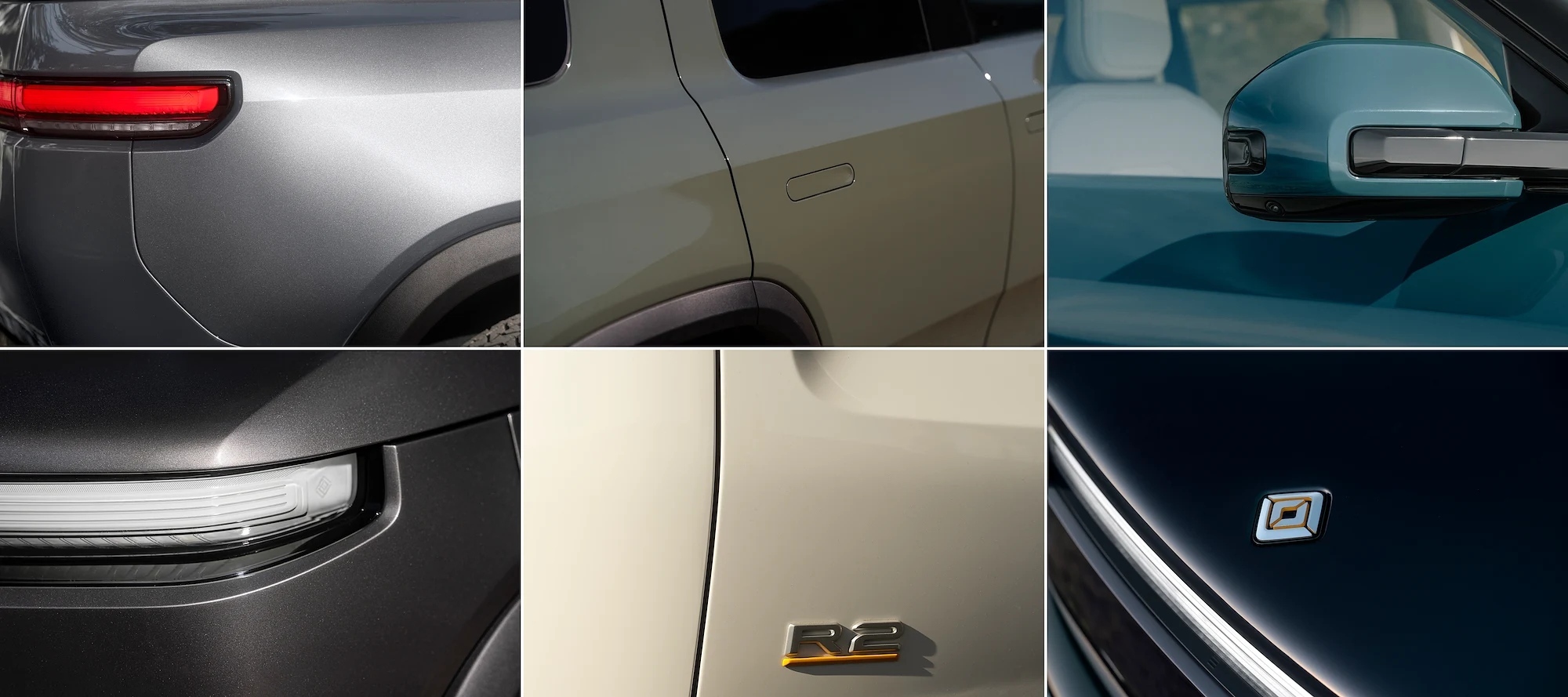
Most of the upgrades are relatively minor, but consumers will receive a special key fob that resembles a carabiner and features a green anodized finish. It appears to be contrasted by a golden accent on the lower half.

Customers will also find a standard tow package, which is typically an option on the R2 Performance. It enables the electric crossover to tow up to 4,400 lbs (1,996 kg), which is considerably more than the Jeep Recon’s rating of 3,300 lbs (1,497 kg).

\\\\

One of the biggest upgrades is a lifetime subscription to Autonomy+. This provides Universal Hands-Free driving on over 3.5 million miles (5.6 million km) of roads in the United States and Canada.

Autonomy+ normally costs $49.99 per month or $2,500 as part of a one-time purchase. As a result, it’s free inclusion in the Launch Package is a pretty big deal.

Last but not least, customers can get their R2 in Launch Green. The hue debuted on Launch versions of the R1 and will be an extra cost upgrade. Rivian hasn’t said how much it will cost, but noted the model will also be offered in Esker Silver, Catalina Cove, Half Moon Grey, Glacier White, Midnight, and Forest Green.

 Rivian’s R2 Launch Edition Throws In Something Buyers Usually Pay $2,500 For

As a refresher, the R2 Performance starts at $57,990 and features a dual-motor all-wheel drive system developing 656 hp (489 kW / 665 PS) and 609 lb-ft (825 Nm) of torque. It enables the crossover to accelerate from 0–60 mph (0-96 km/h) in 3.6 seconds and travel up to 330 miles (531 km) on a single charge.

Other highlights include Matrix LED headlights, integrated tow hooks, and a rear liftgate with drop down glass. They’re joined by Compass Yellow accents and 21-inch wheels.

The interior is available in two colors known as Black Crater and Coastal Cloud. Both feature Birch wood trim and “soft textile accents.” They’re joined by 12-way power front seats with heating and ventilation as well as heated rear seats and a heated steering wheel. Buyers will also find a nine-speaker premium audio system and a flashlight integrated into the driver’s door.

\\\

Hyundai’s $75K Ioniq 9 Calligraphy Just Got A Sibling That Makes It Look Like The Cheap One

  • Hyundai has introduced the 2027 Ioniq 9 Performance Calligraphy Black Ink.
  • The range-topping electric crossover has a blacked out exterior and cabin.
  • Model sports a dual-motor all-wheel drive system with 422 hp and 516 lb-ft.

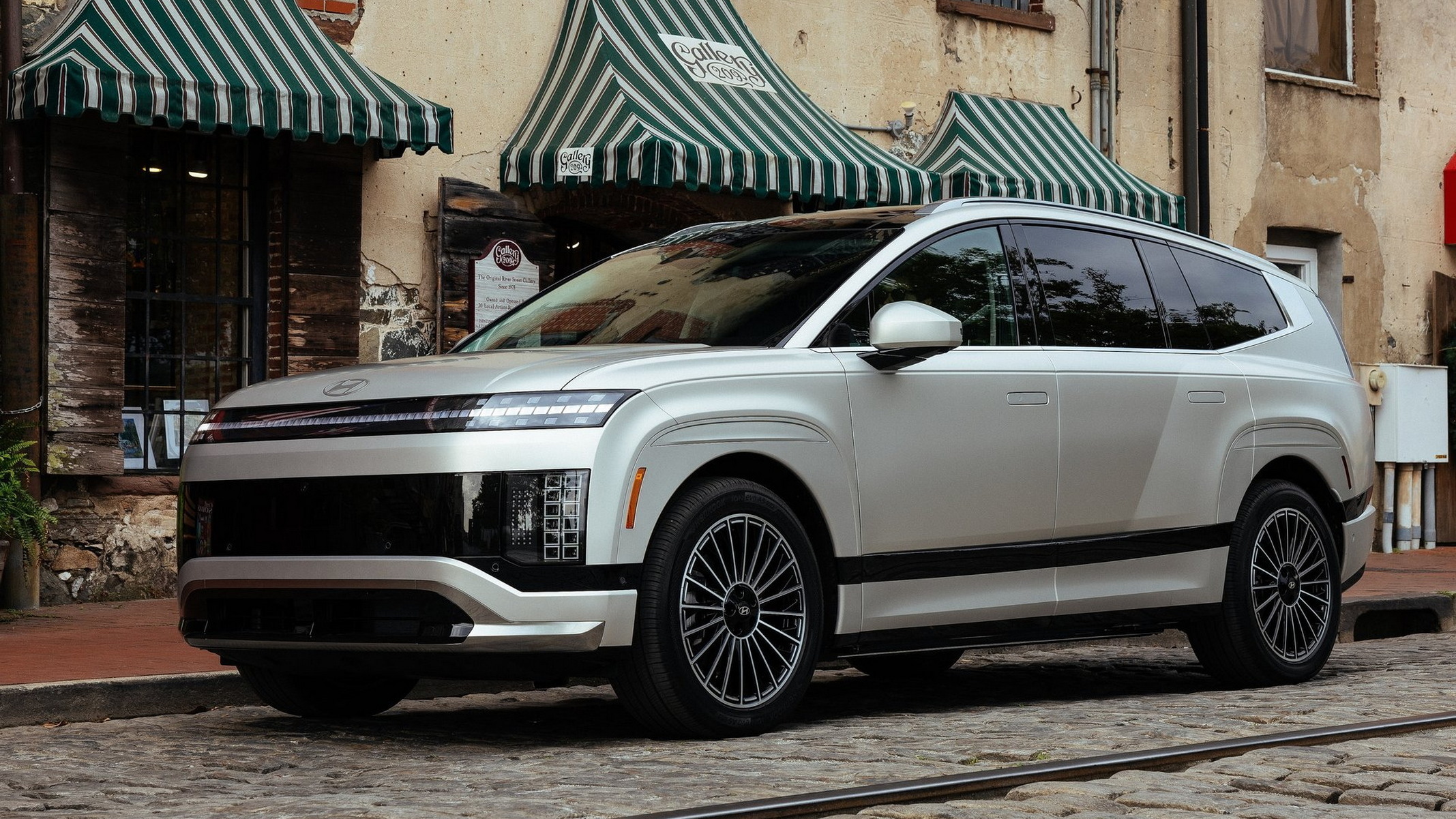
Hyundai has introduced their “most luxurious electric SUV to date.” It’s the 2027 Ioniq 9 Performance Calligraphy Black Ink and it comes with a spec sheet almost as long as its name.

Designed to appeal to customers seeking “maximum luxury, exclusive design, and top‑tier performance,” the range-topping trim embraces the blackout trend as it sports a black chrome front skid plate, black badging, and black window surrounds. They’re joined by gloss black roof rails and black 21-inch wheels that are exclusive to the model and sport a turbine-style design. If that isn’t black enough, you can order the crossover in Abyss Black Pearl.

Review: The 2026 Ioniq 9 Calligraphy’s Biggest Threat Is Hyundai Itself

The dark theme continues inside, where customers will find a black H-Tex interior with black aluminum trim. Hyundai didn’t say much about equipment, but the crossover has a six-seat cabin with “Relaxation Seats” in the first- and second-row. They feature power adjustment, heating, and ventilation. There’s also a heated third-row.

Other highlights include an eco‑suede headliner, a digital rearview mirror, and a panoramic glass roof. They’re joined by a 14-speaker Bose premium audio system and a 10-inch head-up display.

Customers can also expect a 12.3-inch digital instrument cluster, a 12.3-inch infotainment system, and a wireless smartphone charger. Other highlights should include a heated steering wheel and a power liftgate.

\\\\\\\\\\\\\\\\\\\

Power comes from a 110.3 kWh battery pack that feeds a dual-motor all-wheel drive system producing 422 hp (315 kW / 428 PS) and 516 lb-ft (699 Nm) of torque. This should enable the model to have a range of approximately 311 miles (501 km) on a single charge. When the battery is low, a 350 kW DC fast charger can take it from 10% to 80% in as little as 24 minutes.

The 2027 Ioniq 9 Performance Calligraphy Black Ink will arrive at dealerships this summer and pricing will be announced closer to launch. However, we can expect the model to be even more expensive than the 2026 Ioniq 9 Calligraphy, which begins at $74,990 before a $1,600 destination fee.

\\\\\\\\\\\\\\\\\\\\\\\\\\\\

Hyundai’s Ioniq 5 N Party Tricks Are Coming To Cars That Aren’t N

  • Hyundai will expand fake gearshifts and sounds beyond its performance EVs.
  • The tech is already being tested in non-N models like the Ioniq 9 SUV.
  • Lower-output EVs won’t get it, as the illusion depends heavily on power.

The Hyundai Ioniq 5 N made the driving experience engaging, playful, and more akin to the experience of a combustion car. After plenty of praise surrounding the fake gearshifts and engine noise used in this model, Hyundai expanded the tech to the 6 N and Ioniq 9. Soon, it’ll find its way into more mainstream Hyundai EVs.

More: Hyundai’s N Rule Was Simple Until The Ioniq 3 Made It Inconvenient

“We really want to have a proper [driving] experience – not just the sound, but a bit of the boost,” Hyundai Europe product vice president Raf van Nuffel told Carsales. What he’s referring to is that Hyundai doesn’t just use fake engine sounds. It manages power so that when drivers call for a ‘gear shift’, the car feels like a clutch engaged and released.

The system can be switched off, so drivers won’t have to use it. That said, it’s a defining feature of models like the 5 N, and most enthusiasts seem to enjoy it. Introducing the feature to the Ioniq 9 and other mainstream cars down the road could help Hyundai stand out from a crowd of otherwise silent contenders. Importantly, the brand says it won’t extend the features to base models, but there’s a reason for that.

 Hyundai’s Ioniq 5 N Party Tricks Are Coming To Cars That Aren’t N

“It is not something that we limit to N, but we have certain requirements – we do need a minimum level of power to have this clutch-type feeling. We are not going to offer it across the range, but definitely [there is] more to come without always having to go for 600 horsepower,” van Nuffel said.

There’s little doubt that fake engine sounds have been divisive. Despite that, plenty of automakers use them now, and they’re not just limited to EVs. Combustion cars often pipe in faux exhaust noise to “enhance” the driving experience. Hyundai is taking that approach and adding in more than just audible sensations. Considering that owners can choose if they want them or not, this seems like a win-win.

 Hyundai’s Ioniq 5 N Party Tricks Are Coming To Cars That Aren’t N

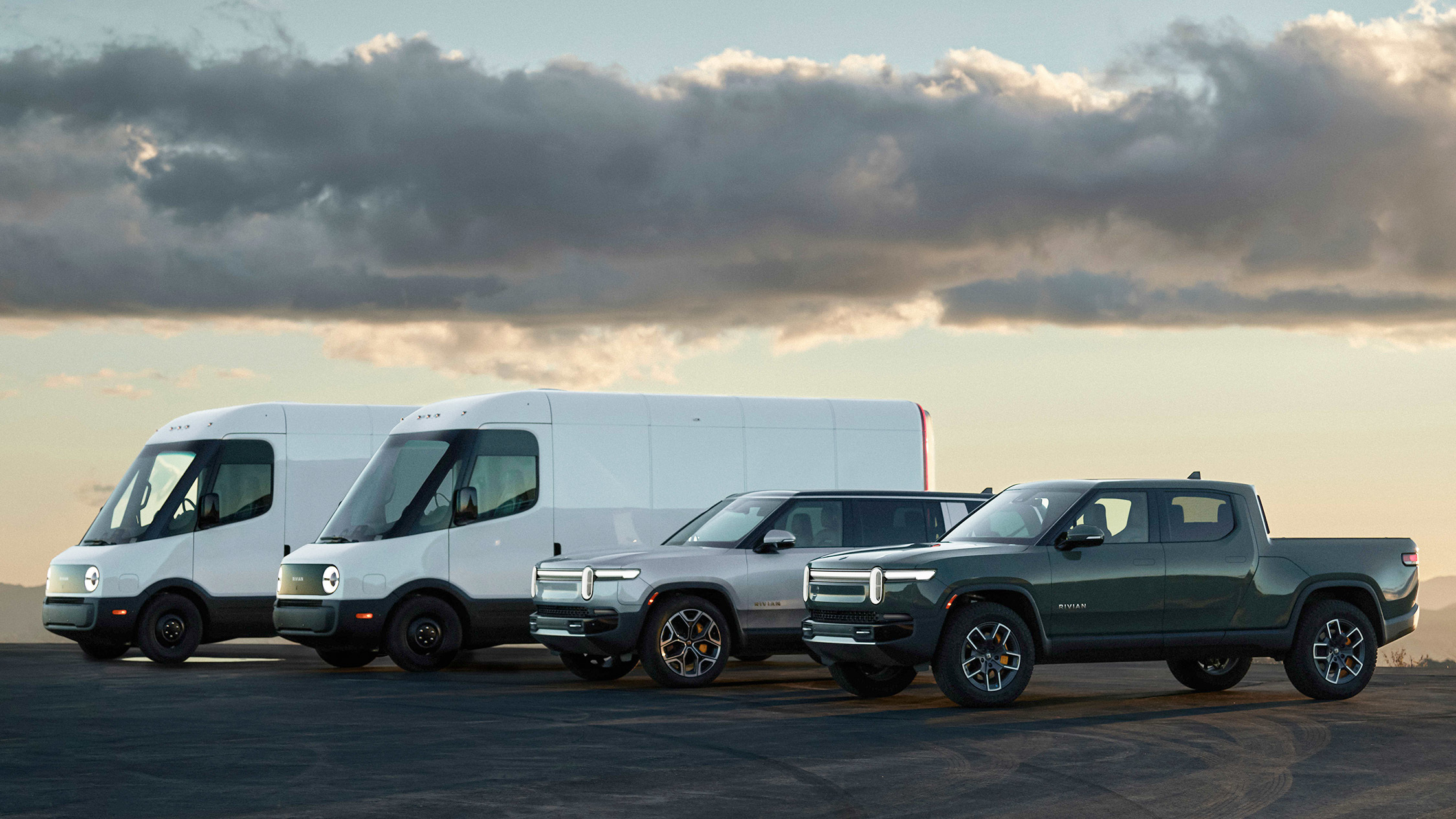
Rivian Sold 42,247 Cars And Paid Its CEO $403 Million, Or 15 Jim Farleys

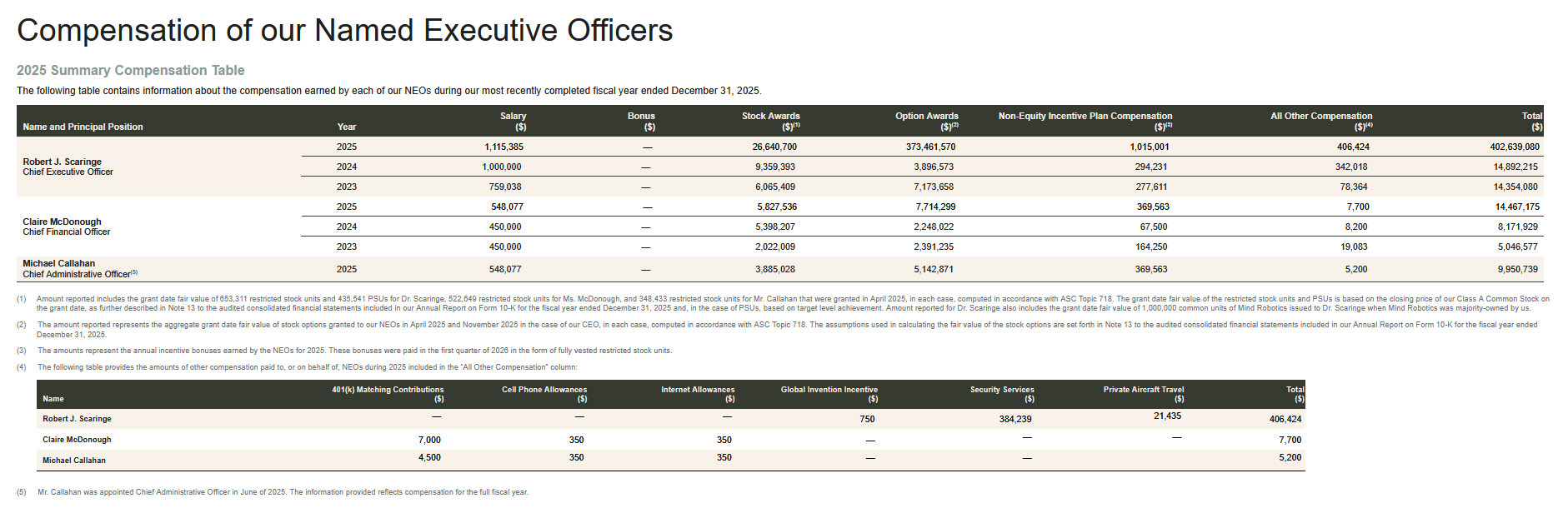
  • Rivian’s CEO received $373.5 million in options and $26.6 million in stock awards in 2025.
  • Those benefits come on top of a salary of around $1.12 million, according to filings.
  • The Elon Musk-style award compares with “just” $27.5 million for Ford CEO Jim Farley.

Top Detroit automaker CEOs like Ford’s Jim Farley and GM’s Mary Barra earn hundreds of times what their company’s line workers do, but they look like they’re living on the bread line compared with Rivian’s boss.

Rivian founder and CEO RJ Scaringe was paid a shocking $403 million last year, company filings reveal. That compares with $27.5 million for Farley and $29.9 million for Barra over the same period. Rivian delivered 42,247 EVs in the United States last year, while Ford moved 2.2 million vehicles, GM 2.85 million domestically, and Tesla sold roughly 1.65 million globally in 2025.

Related: Mary Barra’s $29.9 Million Payday Came In The Same Year GM Lost $7.9 Billion On EVs

That makes Scaringe one of the most highly paid automaker bosses in the world, and means his pay package is thousands of times the size of the one awarded to the men and women who make Rivian’s cars and trucks. It’s not quite up there with Tesla CEO Elon Musk’s pay package, which could net him $1 trillion over the next decade, but it’s still huge.

 Rivian Sold 42,247 Cars And Paid Its CEO $403 Million, Or 15 Jim Farleys

Sales Down, CEO Pay Up

What makes Scaringe’s pay award all the more shocking is that it comes at a time when Rivian hasn’t exactly been going from strength to strength. Yes, it managed to post its first-ever gross profit in 2025 by cutting costs, and began production of the smaller R2 SUV, but its stock price is still way down from its 2021 peak, and sales slumped last year.

 Rivian Sold 42,247 Cars And Paid Its CEO $403 Million, Or 15 Jim Farleys

Of course, Scaringe didn’t scoop the whole $403 million in cash. The award consisted of $373.5 million in stock options, $26.6 million in stock awards, and a more modest $1.12 million taken as a salary.

Pay Could Hit $4.6 Billion

Rivian’s board last November voted to scrap a previous performance-related pay structure for Scaringe, laid out in 2021, that was later deemed unrealistically ambitious. Under the terms of the new deal, his salary is set to increase to $2 million, and he could net $4.6 billion through stock options if he grows the company’s stock price to $140 over the next 10 years.

But given that the stock has mostly hovered below $20 for the past three years, down from $130 when Rivian went public in 2021, Scaringe has his work cut out.

 Rivian Sold 42,247 Cars And Paid Its CEO $403 Million, Or 15 Jim Farleys
 Rivian Sold 42,247 Cars And Paid Its CEO $403 Million, Or 15 Jim Farleys
Rivian

The Brand Behind Your Robot Vacuum Strapped Rockets To Its EV Claiming 0-62 In 0.9 Seconds

  • Dreame unveiled a concept EV with jet power at an event in Silicon Valley.
  • Rocket-assisted sedan promises 0-100 kmh (62 mph) in less than a second.
  • Concept also features solid state batteries and Lidar that works at 600 m.

Chinese consumer electronics brand turned carmaker Dreame hasn’t even delivered its first vehicle, but it’s already talking about what comes next, and it might have rockets attached.

Dreame unveiled the Nebula NEXT 01 JET Edition during the company’s DREAME NEXT event in San Francisco, and yes it looks just like the Nebula Next 01X EV we’ve reported on before, and which is earmarked for sale in 2027.

Also: The Chinese Vacuum Brand That Built A 1,973-HP Sedan Just Showed Up At Berkeley With It

But compared with the production supercar-shaped four-door sedan, this one looks rather different at the rear. That’s where you’ll find a pair of rocket boosters that give the concept a claimed 0-62 mph (100 kmh) time of just 0.9 seconds.

\\\\\\\\\\\

Dreame says the concept, which explores where the company’s car development could go in future, represents more than a decade of development in autonomous systems, motors, AI, and robotics. It also represents someone in marketing being allowed unsupervised access to caffeine and hallucinogenics.

Twin Jets

The headline feature is that custom dual solid-fuel rocket setup mounted to assist acceleration. Dreame claims the system reacts in 150 milliseconds and produces up to 100 kN of thrust. But there’s plenty of other modern or futuristic tech onboard that isn’t just concept nonsense, including steer- and brake-by-wire, and solid-state batteries with an energy density above 450 Wh/kg that Dreame says is nearing production readiness.

For ADAS duties, the company introduced its DHX1 LiDAR unit. Dreame says it can detect objects from up to 600 m (1,970 ft) away, Autohome reports, and deliver detail clarity rather than traditional rough outlines of obstacles. The plan includes advanced assisted L2+ driving and eventually more advanced L3 autonomy.

Inside, the car is intended to act as a rolling smart-home hub. Dreame’s AI assistant is designed to connect with robots, appliances, and other devices, turning the vehicle into a mobile command center for your gadgets. Perhaps surprisingly for a car from a brand famous for its vacuum cleaner and robot window washers, the car isn’t capable of washing itself.

Dreame says vehicle manufacturing begins in 2027, but don’t expect rockets to be part of the specification when those first cars hit the road.

\\\\\\\\\\\

Dreame

Renault’s Electric Scenic Is Already Getting A Refresh Just Over Two Years In

  • Spy shots reveal upcoming changes to the Scenic E-Tech’s lights front and rear.
  • Tweaks to the electric SUV’s grille and front fascia also appear to be on the list.
  • Buyers currently get a choice of 60 kWh or 87 kWh battery packs in the lineup.

It’s only been a little over two years since Renault pulled the wraps off the all-electric Scenic E-Tech, and already an update is on the way. The model, positioned a rung above the Megane in Renault’s expanding EVs lineup, is in line for some modest visual tweaks ahead of going on sale next year.

This camouflage-clad prototype was recently spotted on the streets of Europe, looking very similar to the refreshed Megane E-Tech we also saw recently. While most of the front fascia is shielded from view, we understand Renault’s designers have tweaked the Scenic E-Tech headlights, although we are rather fond of the current model’s lights.

Read: Renault’s Struggling Electric Crossover Is Getting A Second Chance

It appears that Renault has also adjusted the design of the SUV’s LED daytime running lights, which are stacked vertically below the headlights. The bumper looks slightly different too, though both it and the grille keep much of their current shape and proportion.

No obvious changes have been made to the sides of the SUV, which still sport flush door handles and sharp silver C-pillars. At the rear, there will be new LED taillights, although their final design remains hidden.

What Else Will Change?

\\\\\

Baldauf

The current Renault Scenic E-Tech is based on the firm’s AmpR Medium architecture, also underpinning the Nissan Ariya and Nissan Leaf. Powering the base model is a 168 hp electric motor and a 60 kWh battery, giving it a range of over 260 miles (418 km). A punchier version is also offered, delivering 215 hp and 221 lb-ft (300 Nm) of torque, and using a larger 87 kWh battery, boosting range to over 379 miles (610 km).

Given that these figures remain relatively competitive, particularly for the 87 kWh version, we don’t expect to see any significant changes made. With that being said, recent reports suggest the Megane E-Tech will switch from LG-sourced batteries to AESC ones. If this is the case, then it’s possible the Scenic E-Tech could make the same shift.

\\\\\

Baldauf

Failed EV Startup Bollinger Is Auctioning Its Last 20 Trucks As Michigan Wants Its Money Back

  • Manufacturing equipment and 20 electric trucks from Bollinger will be sold.
  • The Michigan Economic Development Corp is also looking to recoup $1 million.
  • Bollinger’s founder recently bought back the company’s IP for two of its EVs.

While the modern era of electric cars has led to the successful establishment of several new brands, such as Rivian and Lucid, many others have tried and failed. One of them is Bollinger Motors, a small company that had wanted to launch a pair of utilitarian, electric off-roaders and a delivery truck.

After struggling to get off the ground, Bollinger officially merged with California-based Mullen Automotive last year, but even that apparently wasn’t enough to save it. A US court recently ordered the auction of Bollinger’s assets because it had failed to pay several suppliers.

Read: Bollinger Gets A Patent For Their Unique Passthrough And Frunkgate

Key manufacturing equipment from Bollinger will be sold through an online auction. This will include battery testing and validation systems used by the car manufacturer, as well as vehicle lifts and tooling. More importantly, 20 examples of the Bollinger B4 Class 4 electric truck that had a list price of nearly $160,000 will be available, along with other vehicles, shop equipment, and inventory.

A Tale Of Troubles

 Failed EV Startup Bollinger Is Auctioning Its Last 20 Trucks As Michigan Wants Its Money Back
Bollinger B4

Not only is Bollinger being forced to liquidate its assets, but the company is also being investigated by the Department of Labor and Economic Opportunity following dozens of complaints about unpaid wages or benefits.

As reported by Crains Detroit, the Michigan Economic Development Corp is also seeking to be repaid roughly $1 million of a $3 million award that was disbursed to the company in 2023. At the time, Bollinger said it’d invest $44 million into the state and create 237 jobs in Detroit.

Bollinger may not be gone forever, though. Last month, company founder and former chief executive Robert Bollinger bought back the intellectual property and prototypes of the original B1 and B2 electric off-roaders for less than $250,000. He was able to buy back these important assets after the company was ordered into receivership by a judge in Ohio. It’s unclear if Robert Bollinger plans to try to revive the B1 and B2, but he recently told The Detroit News that he believes there’s an opening in the EV market for vehicles like them.

\\\\\\\\\\
Before yesterdayElectric Vehicles - Latest News | Carscoops

Failed EV Startup Bollinger Forced To Sell Off Its Assets

  • Manufacturing equipment and 20 electric trucks from Bollinger will be sold.
  • The Michigan Economic Development Corp is also looking to recoup $1 million.
  • Bollinger’s founder recently bought back the company’s IP for two of its EVs.

While the modern era of electric cars has led to the successful establishment of several new brands, such as Rivian and Lucid, many others have tried and failed. One of them is Bollinger Motors, a small company that had wanted to launch a pair of utilitarian, electric off-roaders.

After struggling to get off the ground, Bollinger officially merged with California-based Mullen Automotive last year, but even that apparently wasn’t enough to save it. A US court recently ordered the auction of Bollinger’s assets because it had failed to pay several suppliers.

Read: Bollinger Gets A Patent For Their Unique Passthrough And Frunkgate

Key manufacturing equipment from Bollinger will be sold through an online auction. This will include battery testing and validation systems used by the car manufacturer, as well as vehicle lifts and tooling. More importantly, 20 examples of the Bollinger B4 Class 4 electric truck will be available, along with other vehicles, shop equipment, and inventory.

A Tale Of Troubles

 Failed EV Startup Bollinger Forced To Sell Off Its Assets
Bollinger B4

Not only is Bollinger being forced to liquidate its assets, but the company is also being investigated by the Department of Labor and Economic Opportunity following dozens of complaints about unpaid wages or benefits.

As reported by Crains Detroit, the Michigan Economic Development Corp is also seeking to be repaid roughly $1 million of a $3 million award that was disbursed to the company in 2023. At the time, Bollinger said it’d invest $44 million into the state and create 237 jobs in Detroit.

Bollinger may not be gone forever, though. Last month, company founder and former chief executive Robert Bollinger bought back the intellectual property and prototypes of the original B1 and B2 electric off-roaders for less than $250,000. He was able to buy back these important assets after the company was ordered into receivership by a judge in Ohio. It’s unclear if Robert Bollinger plans to try to revive the B1 and B2, but he recently told The Detroit News that he believes there’s an opening in the EV market for vehicles like them.

\\\\\\\\\\

Slate’s Electric Truck Debuted A Year Ago, The Silence Is Becoming Deafening

  • Last week marked one year since Slate introduced their electric truck.
  • The company hasn’t said much since then, but has over 160,000 reservations.
  • Pricing begins in the mid-$20,000 range and deliveries are set for late 2026.

Slate Auto burst onto the scene a year ago as they introduced their affordable electric truck on April 24, 2025. It generated a ton of interest thanks to a starting price of under $20,000 after federal incentives.

Fast forward a year and the company hasn’t said much since then. Sure, they post flashy videos on social media, but there’s a concerning lack of substance for a vehicle that’s supposed to be launched in the coming months.

More: Slate’s $28K EV Truck Is So Basic Even The Repair Network Is DIY

The last update came on April 16, when Slate revealed they received $650 million in funding and have secured over 160,000 reservations. That’s a lot, but you can reserve the vehicle for $50 and the fee is fully refundable. Furthermore, as we’ve seen with the Tesla Cybertruck, a huge number of reservations doesn’t always pan out to be a ton of orders – especially when the price jumps significantly.

Despite a lack of meaningful updates, the company has previously said the truck will have a 52.7 kWh battery that feeds a rear-mounted motor producing 201 hp (150 kW / 204 PS) and 195 lb-ft (264 Nm) of torque. That should enable the model to accelerate from 0-60 mph (0-96 km/h) in eight seconds, before hitting a top speed of 90 mph (145 km/h).

Swipe to see us go topless.

Posted by Slate Auto on Friday, April 3, 2026

This is said to give the truck a range of 150 miles (241 km), but the company has mentioned an optional 84.3 kWh battery pack that increases the distance to 240 miles (386 km). When the battery is low, a 120 kW DC fast charger can take it from 20-80% in less than 30 minutes.

While we know a number of specifications, additional details are hazy. However, Slate has said the model will have 17-inch steel wheels, crank windows, and a universal phone mount as your smartphone will function as the infotainment system.

The company has also touted a handful of driver assistance systems such as active emergency braking, forward collision warning, and up to 8 airbags. More notably, the truck will be offered with a flat-pack accessory kit that transforms the vehicle into an SUV complete with a roll cage and a rear seat. The company has also promised over 100 accessories and an assortment of wraps.

\\\\\\\

While the silence is becoming deafening, Slate has promised to reveal more details in June. That’s when final pricing will be announced and when customers can begin pre-ordering the truck.

With the federal tax credit eliminated, Slate now says the model is expected to begin in the “mid-$20,000’s.” That’s significantly more than the original estimate of under $20,000 and it’s roughly on par with the $28,145 Ford Maverick. More worryingly for Slate, the Blue Oval is also working on a $30,000 electric truck, but they’ve been pretty tight-lipped about it themselves.

 Slate’s Electric Truck Debuted A Year Ago, The Silence Is Becoming Deafening

Hyundai’s ICCU Recall Was Supposed To Close The Book On Stranded EV Owners, A Lawsuit Says It Reopened It

  • Hyundai, Kia, and Genesis EV owners say ICCU failures are still stranding drivers.
  • Lawsuit claims replacement ICCUs may be just as defective as the originals.
  • 12-volt battery drain, limp mode, and total power loss remain key complaints.

Hyundai and Kia have built some genuinely impressive electric vehicles over the last few years but one issue continues to plague many owners. A single part called the Integrated Charging Control Unit, or ICCU for short, manages charging between the high-voltage battery and the 12-volt system to ensure both systems work properly and in harmony.

The thing is that when the ICCU fails, the car can largely become a giant brick. Hyundai and Kia have issued recalls to fix ICCU-related issues but now a class action lawsuit claims that the fix is just using more bad parts.

More: Hyundai Fixed His ICCU Then Let Thieves Total The Rest Before He Even Saw It

The lawsuit, filed in U.S. District Court for the District of New Jersey, targets Hyundai Motor Company, Kia, Genesis Motor, and Hyundai Kefico, the supplier behind the charging control units. Affected vehicles include the 2022–2024 Kia EV6, 2022–2024 Hyundai IONIQ 5, 2023–2025 Hyundai IONIQ 6, 2023–2025 Genesis GV60, 2023–2025 Genesis Electrified GV70, and 2023–2024 Genesis Electrified GV80.

 Hyundai’s ICCU Recall Was Supposed To Close The Book On Stranded EV Owners, A Lawsuit Says It Reopened It

According to the filing reviewed by Carcomplaints, the central grievance isn’t that these cars have problems. It’s that they allegedly keep having them after a recall was meant to put the matter to rest. Two plaintiffs, Hayes Young of New Jersey and Roy Williams of Kentucky, say their recall service accomplished nothing.

Young says his 2023 IONIQ 5 SEL suffered a dead 12-volt battery in December 2025 that required replacement under warranty. He claims the problem returned, and his dealer allegedly pointed to the ICCU as the cause, yet no replacement was offered.

 Hyundai’s ICCU Recall Was Supposed To Close The Book On Stranded EV Owners, A Lawsuit Says It Reopened It
Stephen Rivers for Carscoops

Williams says his leased 2025 EV6 entered limp mode after a loud bang, requiring a tow to the dealer. After battery charging, software updates, and eventually a battery replacement failed to solve things, the ICCU was reportedly replaced in March 2026.

The lawsuit also cites owner complaints involving charging plug damage during home charging and dashboard warnings like “Check Electric Vehicle System” and “12-volt battery voltage low stop safely.”

Importantly, none of the defendants (Hyundai, Kia, etc) has responded to the suit. Typically in cases like this, the automaker(s) will file a motion to dismiss but it may be several days or longer before the next step in the process takes place.

 Hyundai’s ICCU Recall Was Supposed To Close The Book On Stranded EV Owners, A Lawsuit Says It Reopened It

Tesla’s California Sales Fell 24 Percent, Nearly Everyone Else Got Crushed

  • California EV sales dropped 40% year over year in the first quarter.
  • Tesla shed the most volume yet gained share as rivals fared worse.
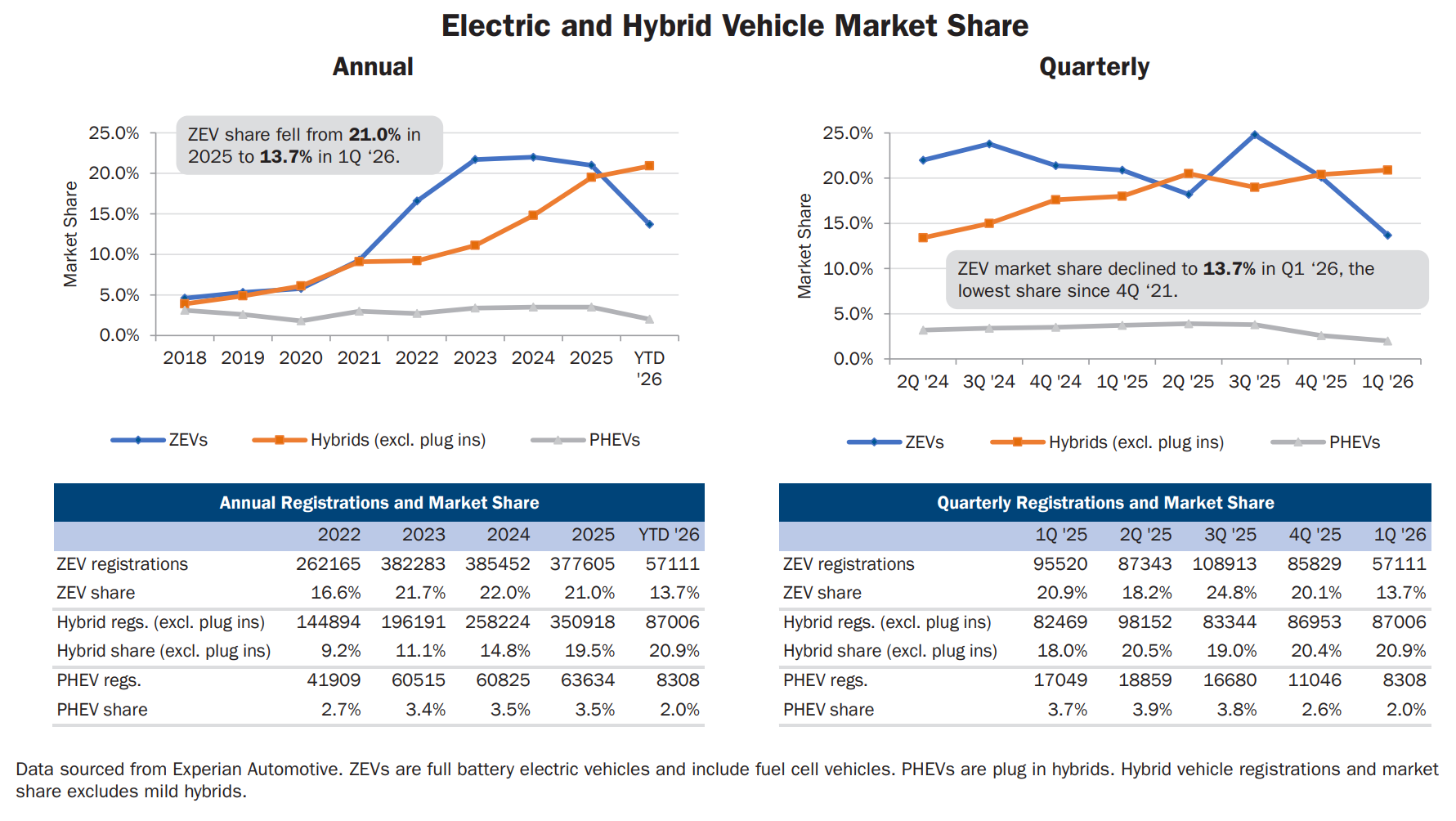
  • ZEV market share across the state has slipped to just 13.7%.

For years, California has set the pace for EV adoption in America, the bellwether other states watched. Now the bellwether is wobbling. Recent sales data reveal a significant decline in the state’s EV registrations through the first quarter of the year, driven by a sharp drop in demand for new Tesla models.

So far this year, a total of 57,111 zero-emission vehicles (ZEV) have been sold across the Golden State. This represents a significant 40.2 percent decline from the 95,520 sold over the same period last year, and comes on the back of an overall drop in new car registrations of 8.9 percent, falling from 457,525 to 416,810.

Read: Rivian Beat Four Major Automakers In EV Sales, And Its Biggest Model Hasn’t Even Launched Yet

The decline in demand for ZEVs means they accounted for just 13.7 percent of the total market in Q1 2026. By comparison, they had a 16.6 percent share in Q1 2022, peaking at 22 percent in Q1 2024 before falling slightly to 21 percent in Q1 2025.

Things look particularly troubling for Tesla. First-quarter registrations fell 24.3 percent to 31,958, down from 42,211 a year earlier. In raw volume, no brand lost more. In percentage terms, Tesla actually weathered the storm better than most of its rivals. Despite its own losses, Tesla’s slice of the EV pie grew from 44.2 percent in Q1 2025 to 56 percent last quarter, less because Tesla improved than because everyone else collapsed around it.

 Tesla’s California Sales Fell 24 Percent, Nearly Everyone Else Got Crushed

Most Brands Suffer

The collapse around Tesla is brutal. Over at Acura, ZEV sales fell from 1,279 to just 11 units in Q1, down 99.1 percent. Audi managed 210 registrations against 2,319 a year earlier, down 90.9 percent. BMW fell 58.9 percent, from 5,301 to 2,180. Chevrolet dropped 59.6 percent to 1,875. Ford was off 58.8 percent at 2,374. Honda plunged 81.6 percent to 832. Dodge mustered 16 units, down 79.7 percent. Hyundai held up comparatively well, off 30.4 percent at 3,586.

Only a handful of brands moved the other way. Lexus posted the standout figure, climbing 192.1 percent to 1,405 units, while Toyota grew 37.8 percent to 2,599 and Lucid added 37.1 percent to reach 1,315. Cadillac edged up 17.1 percent to 1,771.

Several factors have fed into the decline. Affordability concerns remain prevalent across the state, as they are throughout the country, while financing costs remain high due to current interest rates. Additionally, tariffs have driven higher prices, and overall inflation has spiked, while the phase-out of the federal tax credit has done the rest. None of this is mysterious, it all adds up.

Top 25 Selling Hybrid, ZEV, and PHEV Models
RankModelSales
1Tesla Model Y22,907
2Toyota Camry14,903
3Honda CR-V8,315
4Tesla Model 35,688
5Honda Civic5,507
6Toyota RAV44,770
7Honda Accord4,330
8Toyota Corolla3,639
9Toyota Sienna3,252
10Toyota Grand Highlander3,027
11Hyundai Ioniq 52,778
12Lexus RX2,714
13Ford Maverick2,631
14Kia Sportage2,588
15Toyota bZ4X2,527
16Hyundai Santa Fe2,201
17Hyundai Tucson2,194
18Toyota Prius2,139
19Mazda CX-501,963
20Lexus NX1,827
21Kia Niro1,805
22Subaru Forester1,704
23Tesla Model X1,652
24Ford Mustang Mach-E1,578
25Rivian R1S1,520
SWIPE
California ZEV Sales 2026
MakeQ1-25Q1-26% Diff.
Acura1,27911-99.1
Audi2,319210-90.9
BMW5,3012,180-58.9
Cadillac1,5121,77117.1
Chevrolet4,6411,875-59.6
Dodge7916-79.7
Ford5,7582,374-58.8
Genesis54692-83.2
GMC913376-58.8
Honda4,510832-81.6
Hyundai5,1563,586-30.4
Jeep14742-71.4
Kia3,0021,554-48.2
Lexus4811,405192.1
Lucid9591,31537.1
Mazda20-100.0
Mercedes-Benz3,617654-81.9
MINI20761-70.5
Nissan1,447150-89.6
Other1,059133-87.4
Polestar316219-30.7
Porsche1,335409-69.4
Ram1141,300.0
Rivian2,8721,841-35.9
Subaru924465-49.7
Tesla42,21131,958-24.3
Toyota1,8862,59937.8
Volkswagen2,404445-81.5
Volvo636524-17.6
TOTAL95,52057,111-40.2
SWIPE

A 550 HP Inline-Six From The Charger Could End Up In Alfa’s Next Giulia And Stelvio

  • The redesigned Alfa Romeo Giulia and Stelvio are due in 2028.
  • They’ll be offered with conventional, electric, and plug-in hybrid power.
  • Models reportedly had to be reengineered to allow for engine cooling.

Alfa Romeo was set to launch redesigned versions of the Giulia and Stelvio this year. However, the company got cold feet after seeing other automakers deal with lackluster demand for electric vehicles.

Instead of pushing the models out and hoping for the best, Alfa embraced a radical rethink and is delaying the vehicles to give them additional powertrains. While the redesigned sedan and crossover ride on the STLA Large platform, which underpins the Dodge Challenger and allows for both ICE and electric powertrains, things are more complicated than just installing an engine.

More: Alfa Romeo Scraps New Giulia And Stelvio Plans To Start Fresh

According to Autocar, the vehicles had to be reengineered to “allow more cooling for combustion powertrains.” As part of the makeover, the models will reportedly be equipped with new fascias as well as a functional grille.

\\\\\\

The exact details remain to be seen, but patent images of the Stelvio surfaced last year and showed the model would have slender headlights and a small V-shaped grille. The crossover also had sizable intakes, although they appeared to be largely blocked off.

Elsewhere, there was streamlined bodywork, pronounced wheel arches, plastic body cladding, and a rounded roof. The original Stelvio design also included an angular rear window, a large spoiler, and a distinctive taillight area.

A Powertrain For Everyone

 A 550 HP Inline-Six From The Charger Could End Up In Alfa’s Next Giulia And Stelvio

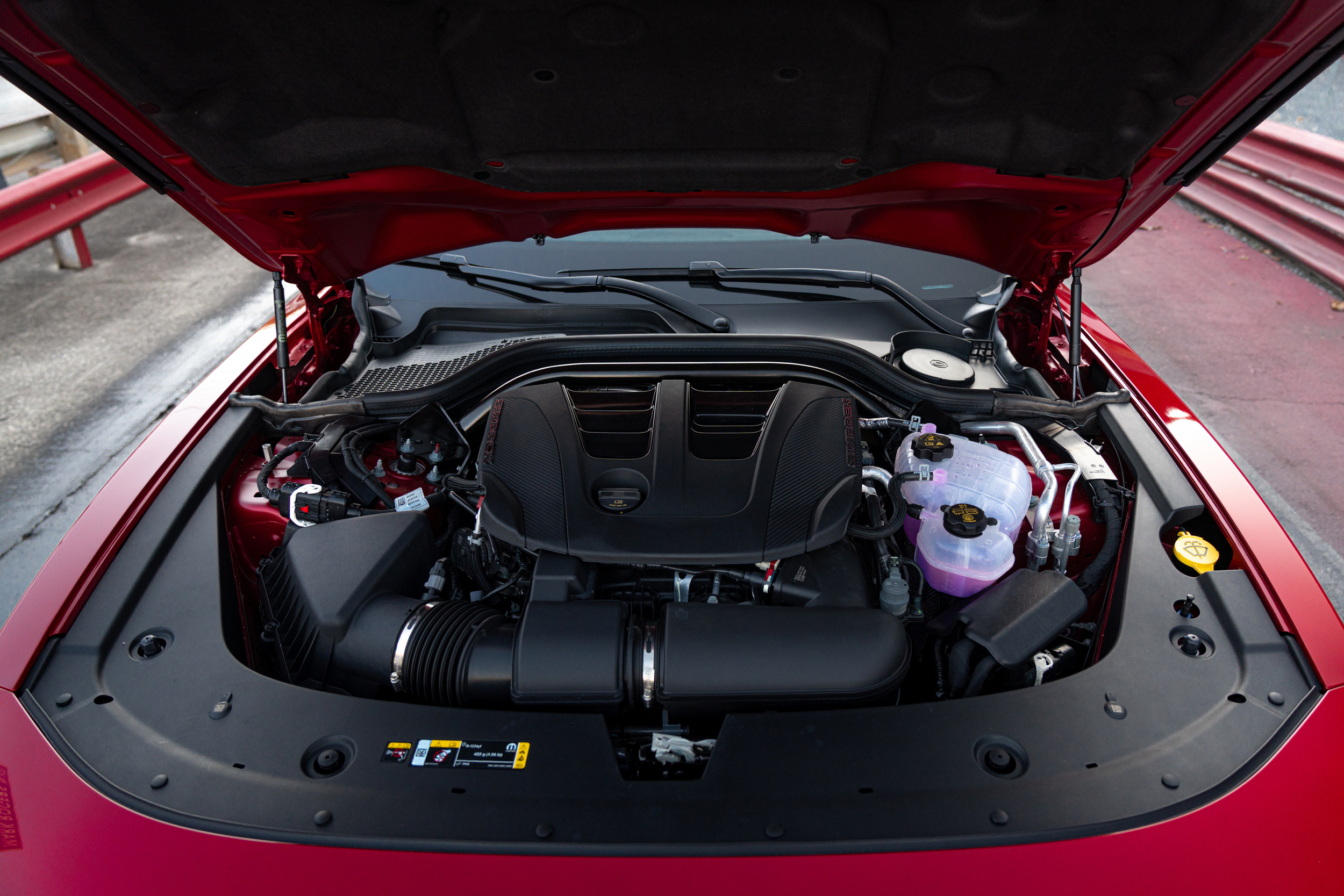
The Giulia and Stelvio will reportedly be offered with an assortment of different powertrains. The lineup will reportedly kick off with turbocharged four-cylinder engines with mild-hybrid technology. The company is also said to be looking at the twin-turbo 3.0-liter inline-six that powers the Charger Scat Pack and produces 550 hp (410 kW / 558 PS).

Customers will also be able to opt for plug-in hybrid and electric options. Little is known about them, but the PHEVs could echo other Stellantis models.

The electric variants are also mysterious, but the automaker has previously said the STLA Large platform can accommodate 101-118 kWh battery packs as well as electric motors with outputs ranging from 168 hp (125 kW / 170 PS) to 443 hp (330 kW / 449 PS). While earlier reports claimed the Quadrifoglio variants could have a tri-motor powertrain producing more than 1,000 hp (746 kW / 1,014 PS), the publication threw water on that idea and noted “no model in the Stellantis stable currently produces that much power.”

\\\\\\\\

That being said, the Maserati GranTurismo Folgore has a tri-motor powertrain producing 751 hp (560 kW / 761 PS) and 995 lb-ft (1,348 Nm) of torque. This enables the model to rocket from 0-60 mph (0-96 km/h) in 2.6 seconds and onto a top speed of 202 mph (325 km/h).

Numerous questions remain, but Alfa Romeo seems to believe that delaying the launch was the right move. As CEO Santo Ficili explained, “We need to consider the entire world because the brand is global” and not every market is ready to go fully electric. He went on to say, “We need to find a way to satisfy the needs of our customers” and that means electric, plug-in hybrid, and ICE options.

\\\\\\\\\\
❌
❌