❌

Normal view

There are new articles available, click to refresh the page.
Before yesterdayVehicles

Mitsubishi’s Taiwanese EV Has More Grunt Than The Most Powerful Evo Ever

  • The ASX VR-e GSR has two electric motors that combine for 459 horsepower.
  • This all-wheel-drive version can sprint to 62 mph (100 km/h) in just 3.9 seconds.
  • Mitsubishi will also sell three different rear-wheel-drive versions of the ASX VR-e.

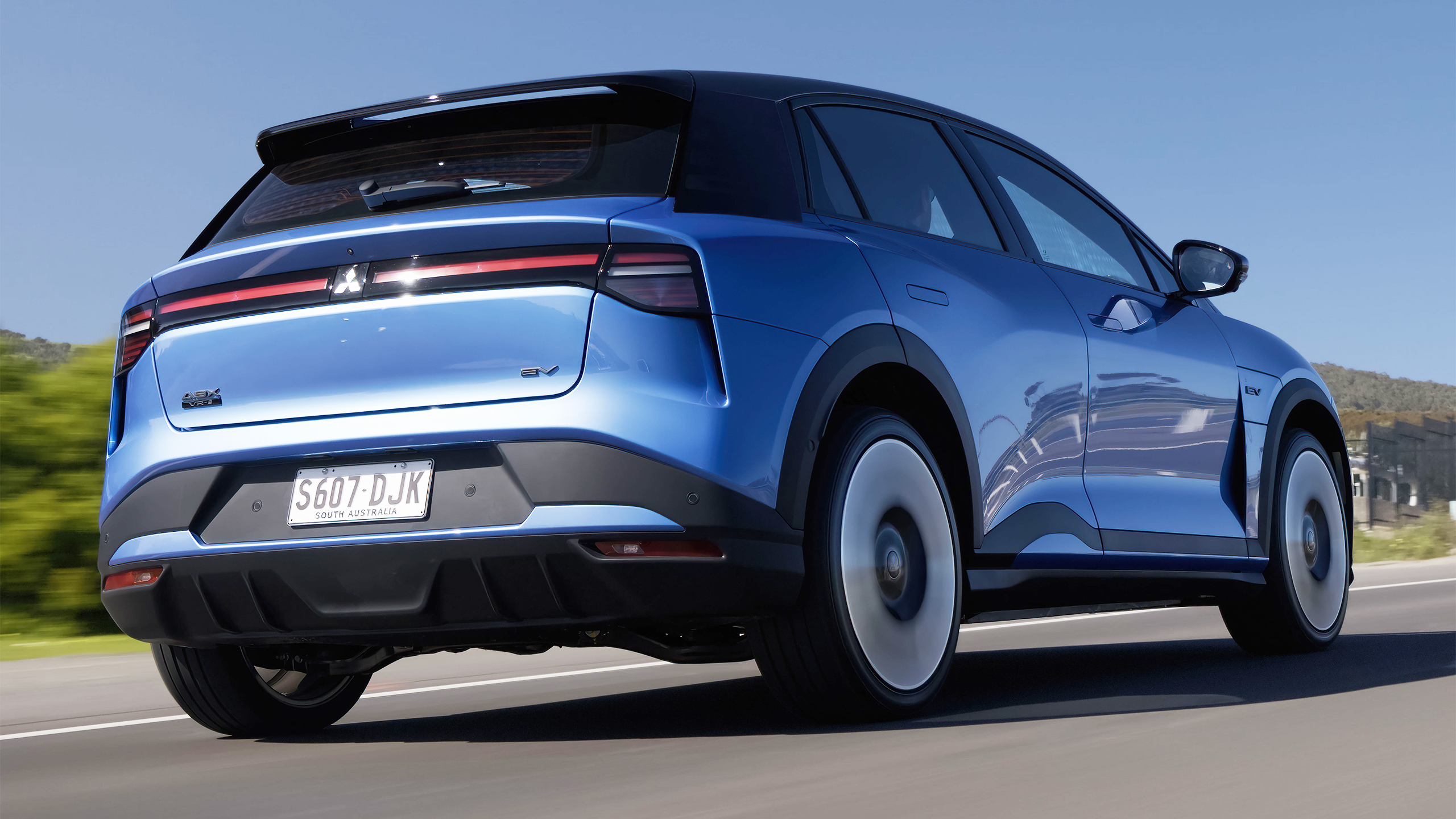
It’s no secret that Mitsubishi has lagged behind its competitors in the electric vehicle space. Rather than go it alone and develop and build a bespoke EV from the ground up, it has instead tapped Taiwanese manufacturer Foxconn and launched a rebranded version of its Foxtron Bria. This new Mitsubishi, badged the ASX VR-e and initially launching in Australia, is unlike any other vehicle from the Japanese brand.

The highlight is obviously the powertrain. All versions of the ASX VR-e will use the same 57.7-kWh lithium-ion battery, which is relatively small in the current EV space. The LS, Aspire, and Exceed will all pair this battery with a single rear-mounted electric motor delivering 229 horsepower (171 kW) and 258 pound-feet (350 Nm) of torque. Those figures are enough to send it to 62 mph (100 km/h) in a respectable 6.8 seconds.

Read: An All-New Mitsubishi Outlander May Launch In 2028

Power-hungry buyers will be pleased to hear Mitsubishi has them covered. The flagship GSR model combines the standard car’s rear-mounted motor with one at the front, lifting combined output to a frankly staggering 459 hp (342 kW) and 516 lb-ft (700 Nm) of torque. To put that into perspective, that’s more than the craziest Mitsubishi Lancer Evo ever built, the UK-only Evo X FQ-440 MR with its 440 hp and 412 lb-ft (559 Nm). While the new ASX VR-e may not appeal to all the same enthusiasts who love the legendary Evo, it has plenty of performance to thrill, hitting 62 mph (100 km/h) in 3.9 seconds.

Mitsubishi says all four versions will include Eco, Comfort, and Sport models, and in the GSR, the Sport model will automatically adjust the power delivery between 50/50 and 30/70 front-to-rear.
 Mitsubishi’s Taiwanese EV Has More Grunt Than The Most Powerful Evo Ever

All-important range details remain a mystery, but given the small pack, prospective owners shouldn’t expect figures much beyond 248 miles (400 km). While it’s hard to argue with the performance on offer, charging is below par. Mitsubishi says DC fast charging is capped at just 134 kW while AC charging is limited to 6.6 kW.

As the ASX VR-e’s design is lifted directly from the Foxtron Bria, which was styled by Pininfarina, it obviously looks different from any other Mitsubishi to come before it. That’s hardly a criticism, as the Japanese brand hasn’t built a beautiful car for years. We wouldn’t go as far as to say the ASX VR-e is beautiful, but it’s certainly stylish and has a European flavor to it.

What About The Cabin?
 Mitsubishi’s Taiwanese EV Has More Grunt Than The Most Powerful Evo Ever

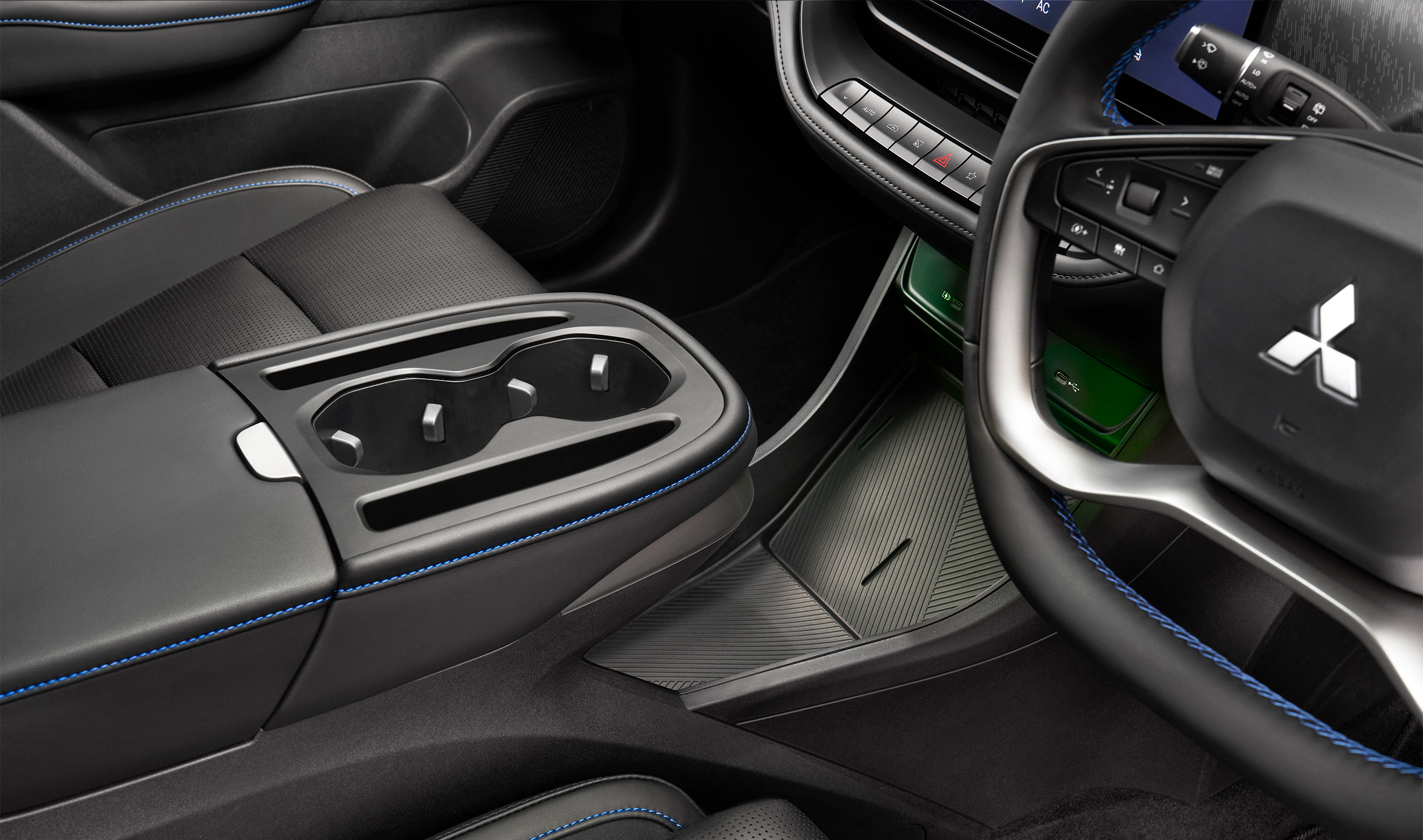
The cabin features a 15.6-inch central infotainment display, a 9.2-inch digital driver display, and a sporty steering wheel. Other key features include configurable ambient lighting, a Surround View Monitor, leather or cloth seats depending on configuration, and autonomous parking.

Mitsubishi has also confirmed the Exceed and GSR models will ship as standard with a panoramic glass roof, electric tailgate, and 12-speaker audio system. The cabin won’t be particularly flamboyant as it’ll only be available in grey or black with blue stitching.

While some customers will no doubt be wary of buying a Mitsubishi that’s really an EV from a Taiwanese brand with no history of building cars, the ASX VR-e will be delivered with a 5-year / 100,000 km (62,000-mile) warranty. This warranty can be extended to 10 years / 200,000 km (124,000 miles) if all scheduled services are completed at a Mitsubishi dealership. Regardless of servicing, the battery pack is warrantied for eight years or 160,000 km (99,400 miles). Prices will be announced later this year as the EV starts to arrive at dealerships.

\\\\\\\\\\\\

Mitsubishi’s New EV Eclipses The Leaf On Price

  • Mitsubishi has announced the new Eclipse Sportback will start at $37,745.
  • That’s $7,755 more than the similar Nissan Leaf, but it comes better equipped.
  • Model has 75 kWh battery that powers an electric motor developing 214 hp.

Mitsubishi introduced the 2027 Eclipse Sportback this summer, and now the company has announced that pricing will begin at $37,745 before a $1,995 destination fee. That’s pretty steep considering the 2026 Nissan Leaf it’s based off of starts at $29,990 and has a significantly lower delivery charge of $1,575.

While it’s not cheap, the Eclipse Sportback arrives later this month in one “exceptionally well-equipped” trim. Mitsubishi hasn’t released detailed specifications, but the badge-engineered EV features lightly revised bumpers and a unique grille. The model also sports LED lighting units, flush-mounted door handles, and exclusive 18-inch wheels.

More: Good News, There’s A New Mitsubishi Eclipse. Bad News, It’s A Rebadged Nissan Leaf

The interior carries over virtually untouched from the Leaf, aside from obvious logo changes. While there’s not much to get excited about, the Eclipse Sportback has black synthetic leather seats with heating in both rows. Other highlights include a 14.3-inch digital instrument cluster, a 14.3-inch infotainment system, and a six-speaker audio system.

Only one option will be available and it’s a $2,600 Technology Package. It adds roof rails, a hands-free power liftgate, and a 10-speaker Bose premium audio system. More notably, the package includes a panoramic glass roof with an electrochromic dimming function. It transitions from transparent to opaque at the touch of a button, which is something you rarely find at this price point.

\\\\\\\\\\\

Like the Leaf, the Eclipse Sportback has a 75 kWh battery pack that feeds an electric motor developing 214 hp (160 kW / 218 PS) and 261 lb-ft (353 Nm) of torque. This enables the model to travel 282 miles (454 km) on a single charge, which is slightly less than the Nissan’s maximum range of 303 miles (488 km).

When the battery is low, owners can recharge via CCS and NACS charging ports. This funky setup carries over from the Leaf and provides Level 1 and Level 2 charging from the CCS port. To use DC fast charging, you’ll need to use the Tesla-style connector on the front passenger side.

The latter allows the Eclipse Sportback to use Tesla Superchargers and recharge at rates up to 150 kW. This enables the model to go from 10% to 80% in around 35 minutes.

\\\\\\\\\\\

Suzuki’s Smallest EV Is A Kei Car With A Sub-$10k Price Tag

  • The Suzuki eSky debuts in Japan with factory styling packages.
  • It offers 193 miles (310 km) of range from a 26 kWh battery.
  • The EV starts at under $10k if you account for local subsidies.

Suzuki has introduced its first fully electric passenger kei car in Japan ahead of its market launch in Europe and the UK. The all-new Suzuki eSky brings an impressive range for the size of its battery, aided by its lightweight design and efficient e-Axle. More importantly local EV subsidies lower the starting price of the pint-sized hatchback to ¥1,552,000 ($9,800).

The eSky was revealed in August 2026 as an evolution of the Vision e-Sky from 2025. The kei car retains the five-door silhouette and compact footprint of the concept, but its lighting units and bumpers have been redesigned for production, as with the wheels, door handles, and mirror caps.

More: Think You Know The Suzuki Alto? There Are Five Different Versions On Sale Right Now

The four-seater cabin is focused on practicality with various storage solutions and a tray on the dashboard. The driver has access to a digital instrument cluster, a 10.1-inch infotainment on the flagship trim, and a separate panel for climate controls.

\\\\\\\\\\\\

Suzuki eSky Mild Sporty Package

For owners who want to personalize the EV, Suzuki offers a range of optional accessories. The catalogue includes a pair of styling packages with colorful accents, a recyclable floor mat made entirely of polyester, and various charging items.

The Mild Sporty package adds pink, blue, and gray decals on the bodywork alongside white mirror caps, while the Neo Future package opts for a yellow and black theme. Both are combined with matching stickers for the dashboard and LED fog lights. Those who want something more subtle could get the quarter garnish in eight different colors. Suzuki is also offering three playful decals for the tailgate.

\\\\\\\\\\\\\

Suzuki eSky Neo Future Package

The eSky rides on the Heartect e platform and comes fitted with Suzuki’s new e-Axle (electric motor, inverter, and reduction unit) powering the front wheels. The electric motor is capable of producing 94 hp (70 kW / 95 PS) but the output of the Japanese-spec model will most likely be limited to 63 hp (47 kW / 64 PS) in order to comply with kei car regulations.

More: Suzuki Confirms Light Range Extender Setup Alongside More Efficient Hybrids

The floor-mounted 26 kWh lithium iron phosphate (LFP) battery pack promises a WLTC range of 193 miles (310 km), and has 50 kW DC charging capabilities.

\\\\\\\\\\\\\\\\\\\\\\\

Suzuki eSky

The Suzuki eSky will reach Japanese dealers on November 16 with the company setting a sales target of 1,000 units per month. The entry-level A trim starts at ¥2,120,000 ($13,400), while the flagship X grade climbs to ¥2,790,000 ($17,600). Still, buyers are eligible for a local government subsidy of up to ¥568,000 ($3,600), which lowers the entry point to ¥1,552,000 ($9,800).

More: Suzuki’s Decade-Old $6,500 Hatch Loses A Cylinder To Chase Mileage

As for the optional catalogue, the Mild Sporty styling kit costs ¥103,840 ($660), the Neo Future kit ¥116,160 ($730), and the eco-friendly floor mats are listed for ¥28,600 ($180).

Suzuki’s smallest EV yet will also be exported to Europe and the UK, starting in 2027. There it will join the eVitara, and compete with Europe’s A-Segment EVs such as the Renault Twingo, Dacia Spring EV, Nissan Pixo, Fiat 500, and VW ID. Up!.

\\\\\\\\\\\\\\\\\\\\\\\\\\\

Suzuki eSky

As VW Kills Off The ID.4, It Launches A $12,500 Discount In The US

  • VW is offering generous discounts for the 2025 ID.4 and 2026 ID.4.
  • Customer bonuses of $6,000 and $12,500 are available in the US.
  • Sales of the ID.4 have plummeted from the all-time high in 2023.

Hot on the heels of Volkswagen announcing the ID. Tiguan will replace both the ID.4 and the ID.5, the brand has announced some generous incentives to clear remaining inventory in the United States.

The most sizeable offer is for the 2025 ID.4. From now until November 2, anyone who purchases or leases a new ID.4 will receive a $12,500 ‘customer bonus’ that’s applied directly to the sticker price.

Read: VW Confirms ID. Tiguan To Replace The ID.4 And ID.5

VW’s local inventory search tool doesn’t allow you to select the model year, so it’s hard to know how many 2025 versions are sitting around at VW dealership lots across the country. What we can see is that there are hundreds of ID.4 models available across the 2025 and 2026 model years, so there’s certainly no shortage of options.

If you’re unable to find a 2025 model nearby, there’s also an offer available for 2026 ID.4s. This one is worth $6,000, and it is also available until November 2. Prices for the 2026 ID.4 start at $45,095 for the entry-level Pro excluding destination, or $46,570 including destination.

\\\\\\\\

This isn’t the only offer available for the 2026 ID.4, either. Military members, veterans, and first responders can also receive a $500 discount when they purchase the outgoing EV, cutting the price even further.

US sales of the ID.4 peaked in 2023 when 37,789 units were sold but then plummeted to 17,021 units the following year. In 2025, sales rebounded to 22,373 units, but that clearly wasn’t enough to convince VW to keep selling the model for the long term. Through the first six months of this year, just 2,205 were sold, following the end of local production in Chattanooga, Tennessee, in April.

What Comes Next?

 As VW Kills Off The ID.4, It Launches A $12,500 Discount In The US

Once VW clears inventory of ID.4 models, it will be able to turn its attention to the ID. Tiguan. Lightly camouflaged prototypes have revealed it will look radically different than the ID.4 and, instead, look more similar to the gas-powered Tiguan. VW has confirmed it will start European sales of the new model at the start of next year, before launching it in the United States.

Limited technical details are known about the new ID. Tiguan, but it’s believed to be based on VW’s MEB+ platform and should be offered with new and improved battery packs. The current ID.4 is sold with 58 kWh and 79 kWh packs, providing it with a peak driving range of just 292 miles (470 km) in the US.

\\\\\\\\\\\\\\\

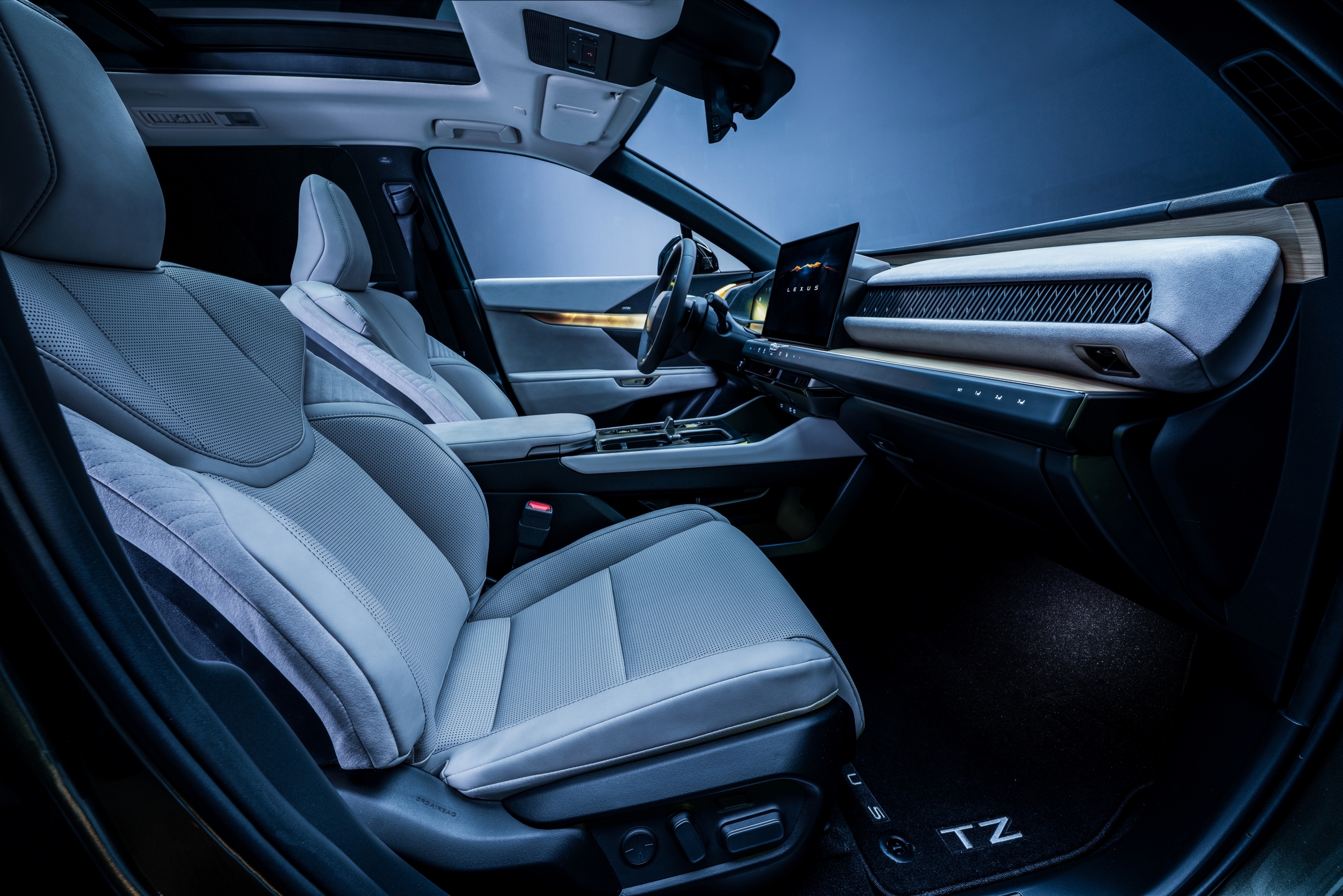
2027 Lexus TZ Starts At $64k And Offers Up To 315 Miles Of Range

  • The 2027 Lexus TZ will be priced from $64,050.
  • Entry-level variant has 308 hp and 253 miles of range.
  • Higher-end versions can travel up to 315 miles per charge.

When Lexus introduced the 2027 TZ in May, the company was coy on specifications. However, the automaker has quietly updated their press kit with pricing and powertrain information.

Kicking things off is the TZ 450e Premium, which begins at $64,050 including a $1,550 destination fee. That’s cheaper than some versions of the Kia EV9 and it’s only $3,960 more than the gas-powered TX 350 AWD.

First Look: Lexus’ New TZ Trades Fake Ruggedness For Quiet Luxury

Since we’ve already seen the crossover before, we’ll briefly mention the entry-level variant comes equipped with an acoustic windshield and flush-mounted door handles. They’re joined by 20-inch wheels and an illuminated logo on the grille .

Stepping inside reveals a minimalist interior with a 12.3-inch digital instrument cluster, a 14-inch infotainment system, and a dual wireless smartphone charger. They’re joined by a panoramic glass roof, thematic ambient lighting, and a 12-speaker audio system.

The crossover has heated and ventilated front seats, second-row captain’s chairs with power recline, and a power-folding third-row. When the latter two rows are folded down, there’s 91.5 cubic feet (2,591 liters) of cargo space.

\\\\\\\

Motivation is provided by a dual-motor all-wheel drive system that produces a combined output of 308 hp (230 kW / 312 PS) and 323 lb-ft (437 Nm) of torque. It’s fed by a 77 kWh battery pack, which provides an EPA-estimated range of 253 miles (407 km).

The crossover can accelerate from 0-60 mph (0-96 km/h) in 6.2 seconds, before hitting a top speed of 112 mph (180 km/h). The Premium also has a NACS port, a bi-directional charging capability, and a towing capacity of 2,400 lbs (1,089 kg).

The TZ comes equipped with the Lexus Safety System+ 4.0 suite of driver assistance systems, which includes Full-Speed Dynamic Radar Cruise Control, Lane Tracing Assist, and a Pre-Collision System with Pedestrian Detection. There’s also Emergency Steer Assist, Intersection Turn Assist, and Lane Departure Alert with Steering Assist. Other functions include Road Sign Assist, Proactive Driving Assist, and Traffic Jam Assist.

TZ Premium Touring

\\\\\\\\\\\\\\\\\\\

The $72,050 Premium Touring ups the ante with a larger 96 kWh battery, which increases the range to 315 miles (507 km). However, the extra weight increases the 0-60 mph (0-96 km/h) time to 6.5 seconds. While that’s a bummer, the top speed remains unchanged and the towing capacity increases to 3,500 lbs (1,588 kg).

Lexus didn’t say much else about the mid-level variant, but it does come with additional features including rear steering and a “rear comfort drive mode.”

TZ Luxury

\\\\\\\

Lastly, there’s the $80,550 Luxury variant. It has the same powertrain as the Premium Touring, but the range drops to 279 miles (449 km).

This can largely be blamed on the use of 22-inch wheels. They’re backed up by a beefier braking system, which features six-piston front calipers that grab onto discs measuring 15.8 inches (401 mm). This stands in contrast to lesser variants, which have two-piston calipers and 13.4 inch (340 mm) discs.

 2027 Lexus TZ Starts At $64k And Offers Up To 315 Miles Of Range

Besides the larger wheels, the Luxury variant should have a quieter cabin thanks to acoustic glass on the windshield as well as the front and rear doors. Other highlights include a 21-speaker Mark Levinson premium audio system, a front radiant heater, and a unique “shimmering effect” for the ambient lighting system.

The upgrades don’t end there as the range-topping variant comes equipped with heated and ventilated second-row seats as well as a heated third-row. Lexus also mentioned an ottoman for the front passenger as well as the second-row captain’s chairs. People residing in the latter will also find manual sunshades.

If everything goes according to plan, the 2027 Lexus TZ should be launched late this year.

2027 Lexus TZ Pricing
ModelMSRP
TZ Premium AWD$64,050
TZ Premium Touring AWD$72,050
TZ Luxury AWD$80,550
SWIPE

H/T to Car & Driver

Rivian Says R3 Will Be Priced “Materially Lower” Than R2

  • The Rivian R3 will be followed by an even cheaper model known as the R4.
  • Rivian’s boss believes tariffs are needed to protect the US industry from China.
  • The R3 will be sold with two battery options and three motor configurations.

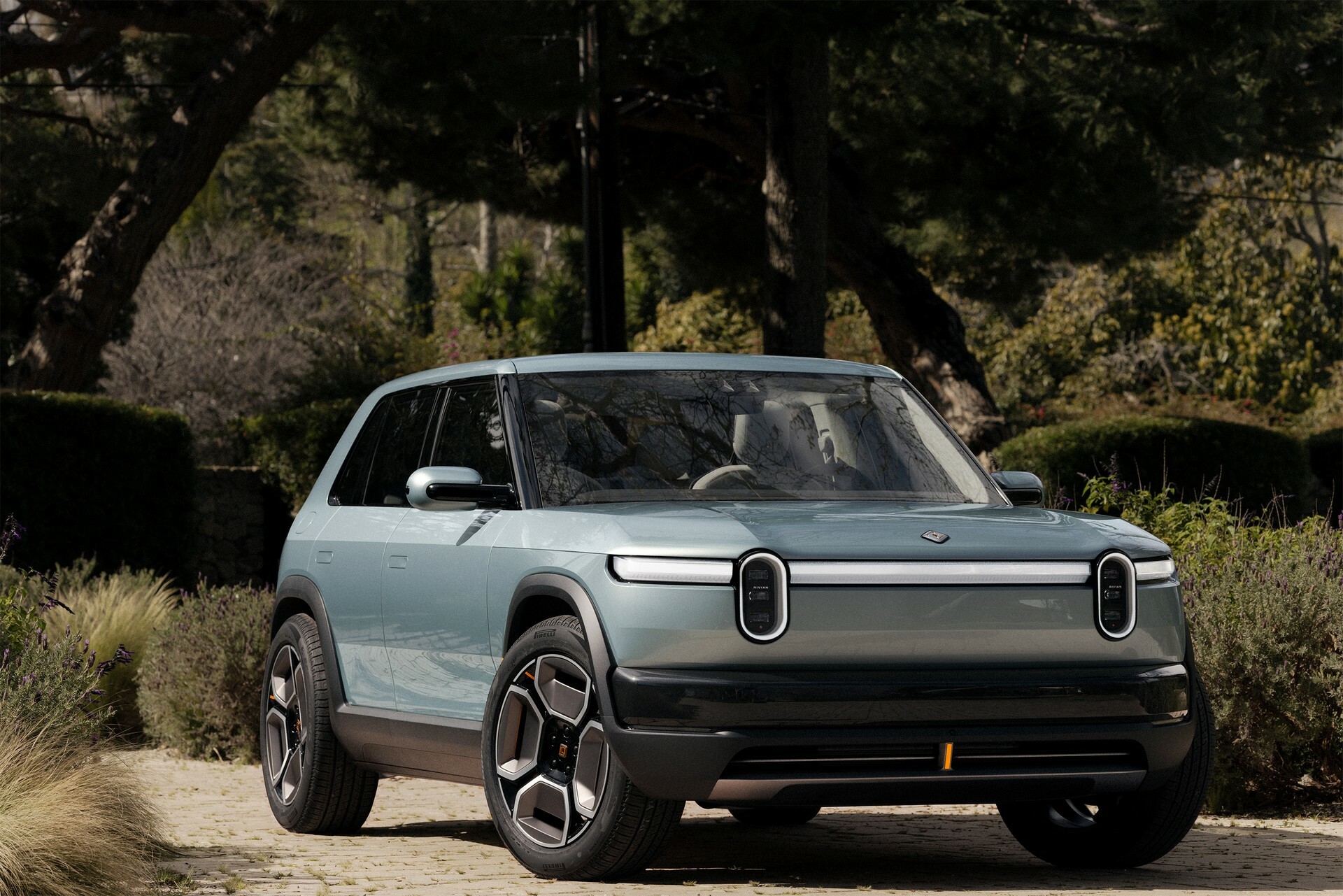
It’s been two and a half years since Rivian shocked the world when it unveiled not only its mid-size R2, but also the smaller R3 and R3X. While production and customer deliveries of the R2 have started, the R3 is still a little ways off, but when it does finally launch, it has the potential to be the brand’s highest-volume seller.

With prices starting at $45,000 and going up to $57,990, Rivian now has a legitimate rival to the best-selling Tesla Model Y in its line-up. Given how difficult it is for new car manufacturers to crack into the affordable, mass-market, no one could blame the brand for calling it a day with the R1 and R2 models, satisfied with selling a few hundred thousand vehicles a year.

Read: Rivian’s Secret Plans Might Include A Lot More Than Just The R2 And R3

That’s not how Rivian chief executive RJ Scaringe thinks. During a recent interview with The New York Times, the brand’s founder spoke about the R3 and how the US can remain competitive against new electric vehicles emerging out of China.

 Rivian Says R3 Will Be Priced “Materially Lower” Than R2

According to Scaringe, the R3 will be priced “materially lower” than the R2, although the company is not yet ready to announce pricing for it. It’s unlikely the compact SUV will be able to rival something like the $29,990 Nissan Leaf on price, but Rivian could have a winner on its hands if it prices it between $35,000 and $40,000.

More: Rivian Has Already Issued The First Recall For The R2

Things won’t even stop with the R3, as Scaringe added there are also plans for an R4, “which again moves” the price point down lower.

When the R3 was first previewed, Rivian said it will be offered with two different battery packs and be sold in single-, dual-, and tri-motor configurations. The most range-focused model should be able to travel more than 300 miles (483 km) on a single charge, while the quickest should hit 60 mph (96 km/h) in less than 3 seconds.

Scaringe Says He Supports Tariffs On Chinese Cars

 Rivian Says R3 Will Be Priced “Materially Lower” Than R2

Moving forward, Scaringe added that America needs make proactive efforts to ensure local car manufacturers can remain competitive despite the threat from Chinese firms. He told the NYT that “we should assume that in the fullness of time, China will likely be able to sell here.” If that happens, more needs to be done to balance the different in input costs between the two countries.

More: US Lawmakers Push For A Permanent Ban On Chinese Cars

In China, labor costs are much lower, as are capital costs. Important input costs like electricity and utilities also cost significantly less, enabling Chinese automakers to sell EVs at price points that Western brands have failed to match. To help level the playing field, Scaringe says tariffs are an important tool. Without them, “we have to be honest that a lot of manufacturing capacity is going to move to China.”

\\\\\\\\\\\\\\\\

Has Mercedes’ New Entry-Level C 300 Electric Just Made The C 400 Redundant?

  • Mercedes debuts new entry-level C 300 electric with 416 hp instead of C 400’s 483 hp.
  • Zero to 62 mph takes 4.5 seconds, and range falls from 473 to 429 miles.
  • C300 is $5,500 cheaper in Germany, but even more affordable RWD models land soon.

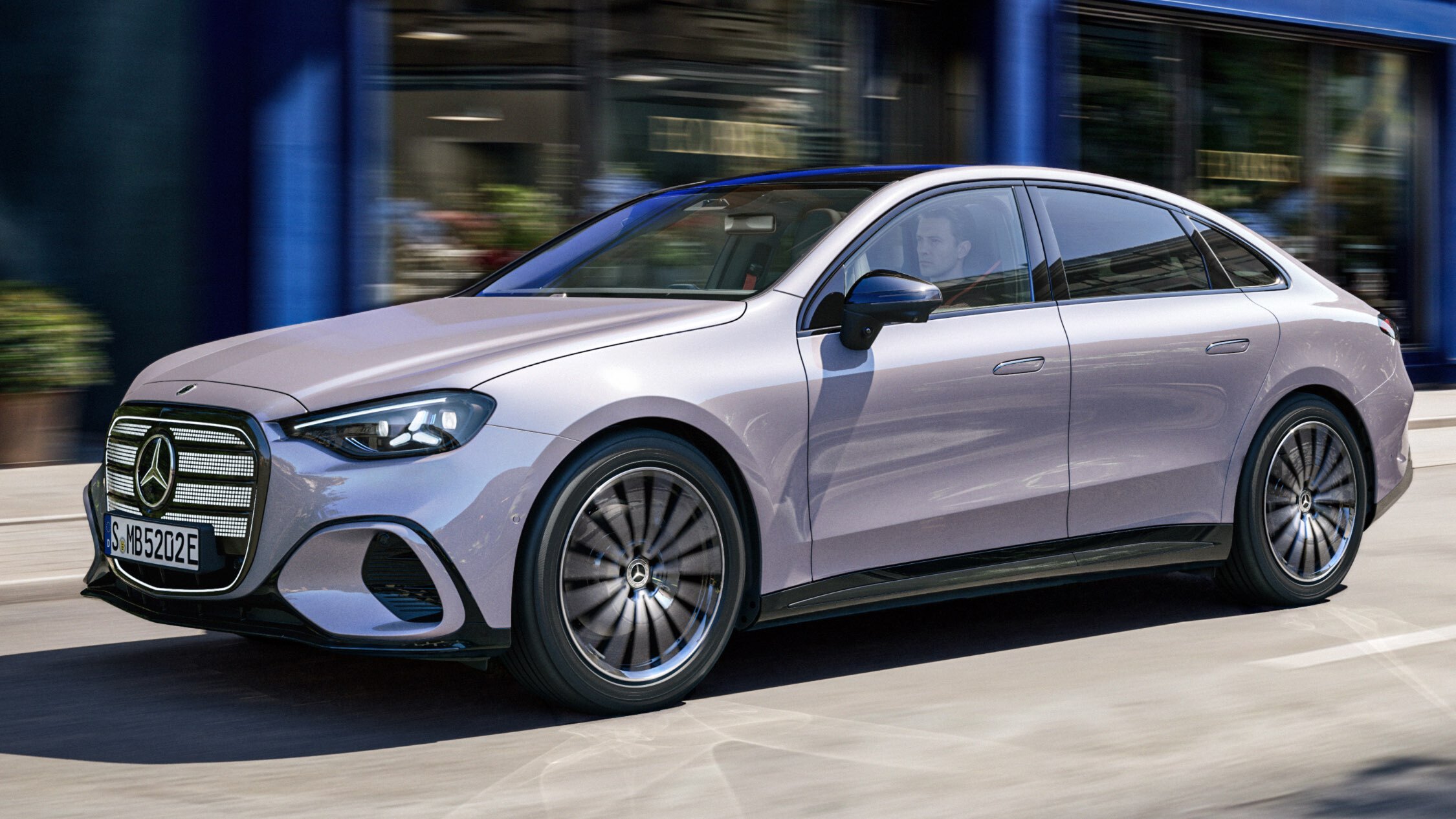
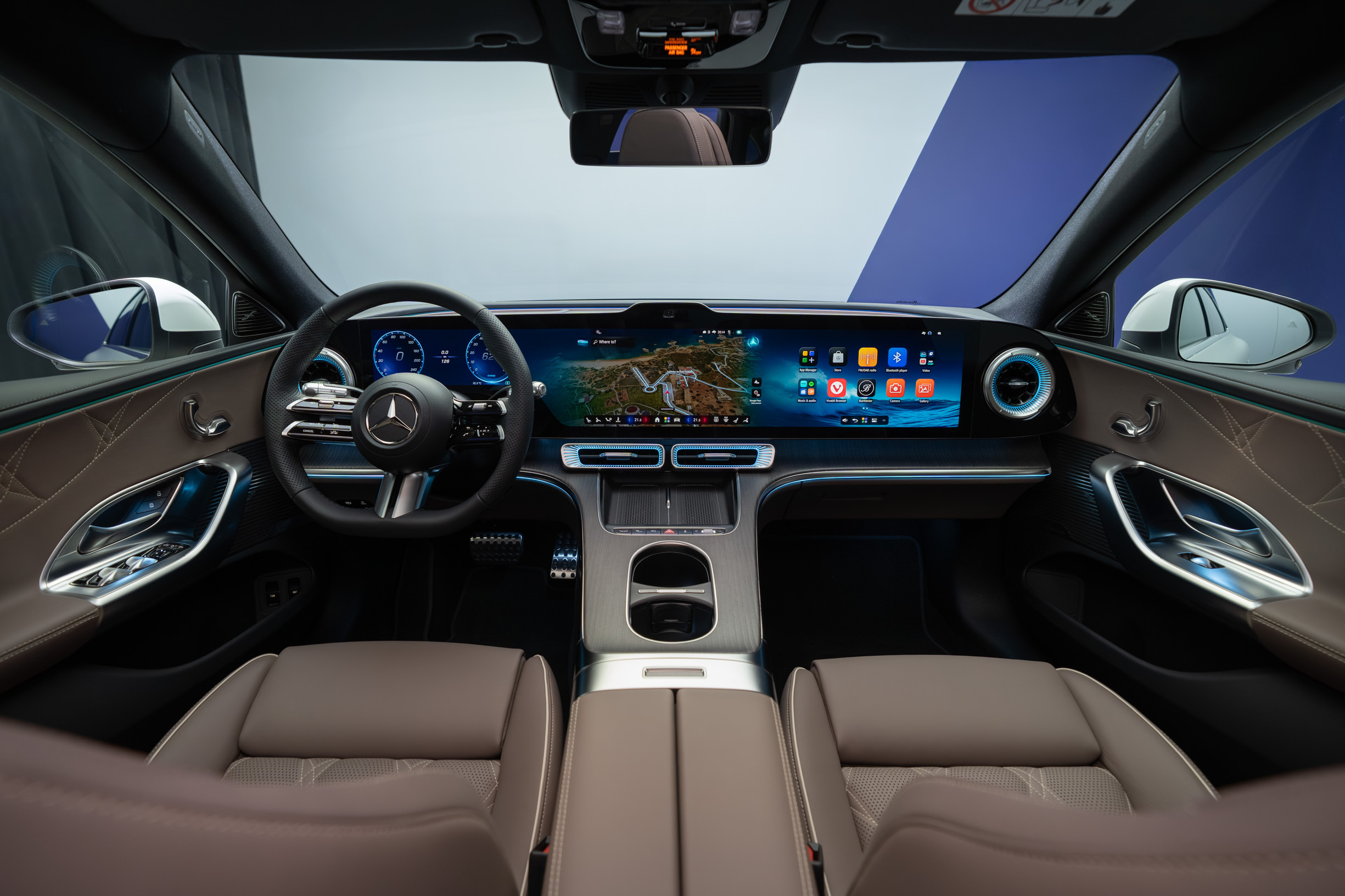
Mercedes pulled the covers off its first-ever electric C-Class sedan back in April, but so far we’ve only seen one flavor. That was the C 400 4Matic electric, a bi-motor, all-wheel-drive version of the compact luxury car. Now it’s joined by a more affordable C 300, but the specs are so close it feels like one of those cars is pointless. But which one?

First, let’s quickly recap the C 400 specs. It makes 482 hp (490 PS / 360 kW), gets to 62 mph (100 km/h) in 4.0 seconds, can charge at 330 kW, and claims a 473-mile (762 km) range from a 94 kWh (usable) battery.

Related: The Mercedes-AMG CLE 646 Will Demolish An M4, But You Can’t Buy One

Now the C 300. You still get two electric motors and all-wheel drive, plus the same 590 lb-ft (800 Nm) of torque. But output falls to 416 hp (422 PS / 310 kW) and the 62 mph trip takes 4.5 seconds, so half a second longer. That’s still plenty of power and performance though, and even the range holds its own, despite a drop in battery capacity to 85 kWh.

180 Miles Added In A Bathroom Break

 Has Mercedes’ New Entry-Level C 300 Electric Just Made The C 400 Redundant?

Mercedes says it’ll manage 429 miles (690 km), and while the max charge rate is slightly slower, from 330 to 320 kW, the C 300’s ability to add 180 miles (290 km) of range in 10 minutes isn’t that far off the 202 miles (325 km) the C 400 gains in the same time.

If you want that plush air-spring ride, a passenger-side screen, and more than 18 inches of wheel, you’ll have to hit the options list in both cars, so there’s no big difference in spec that we can see. But in Germany, where C-Class electric prices have been announced, the C 300’s €62,951 ($72,700) sticker saves you €4,760 ($5,500) versus going for the €67,711 ($78,200) C 400. In the US, the C 400 is expected to cost around $65,000.

Worth The Premium?

 Has Mercedes’ New Entry-Level C 300 Electric Just Made The C 400 Redundant?

The C 400 pulls rank in every key area, but to be honest, we’re surprised how close the C 300 gets. It’s still brisk, still has a really usable electric range, and also the security of all-wheel drive. For plenty of buyers who can look past the kudos of the C 400’s badge, the C 300 looks like the better value option.

But that’s not the end of the C-Class electric story. Mercedes says even more affordable single-motor, rear-wheel-drive cars will follow, and at the other end of the spectrum, AMG is working on a tri-motor rival for BMW’s electric M3 with at least 671 hp (680 PS / 500 kW). Which would you pick – C 300 or C 400?

\\\\\\\\\\\\\

Mercedes

Kia’s EV9 Fire Sale Could Save You $16,000 Off MSRP

  • Some dealers are offering the Kia EV9 for $16,000 under sticker.
  • One of the cheapest new models in America costs just $40,694.
  • Higher-end variants and Long Range models also have big discounts.

Kia had high hopes for the EV9, and this wasn’t surprising as Americans love three-row crossovers. However, sales dropped 33% last month to a disappointing 1,789 units. That pales in comparison to the 12,693 Tellurides sold in August and even the smaller Niro.

While that’s bad news for the automaker, dealers are slapping huge discounts on the EV. If you’re willing to do a little research and some travel, you can score more than $16,000 off a brand-new EV9.

More: Gas Prices Send Buyers To RAV4 Hybrids, Toyota Dealers Hit Them With $15,000 Markups

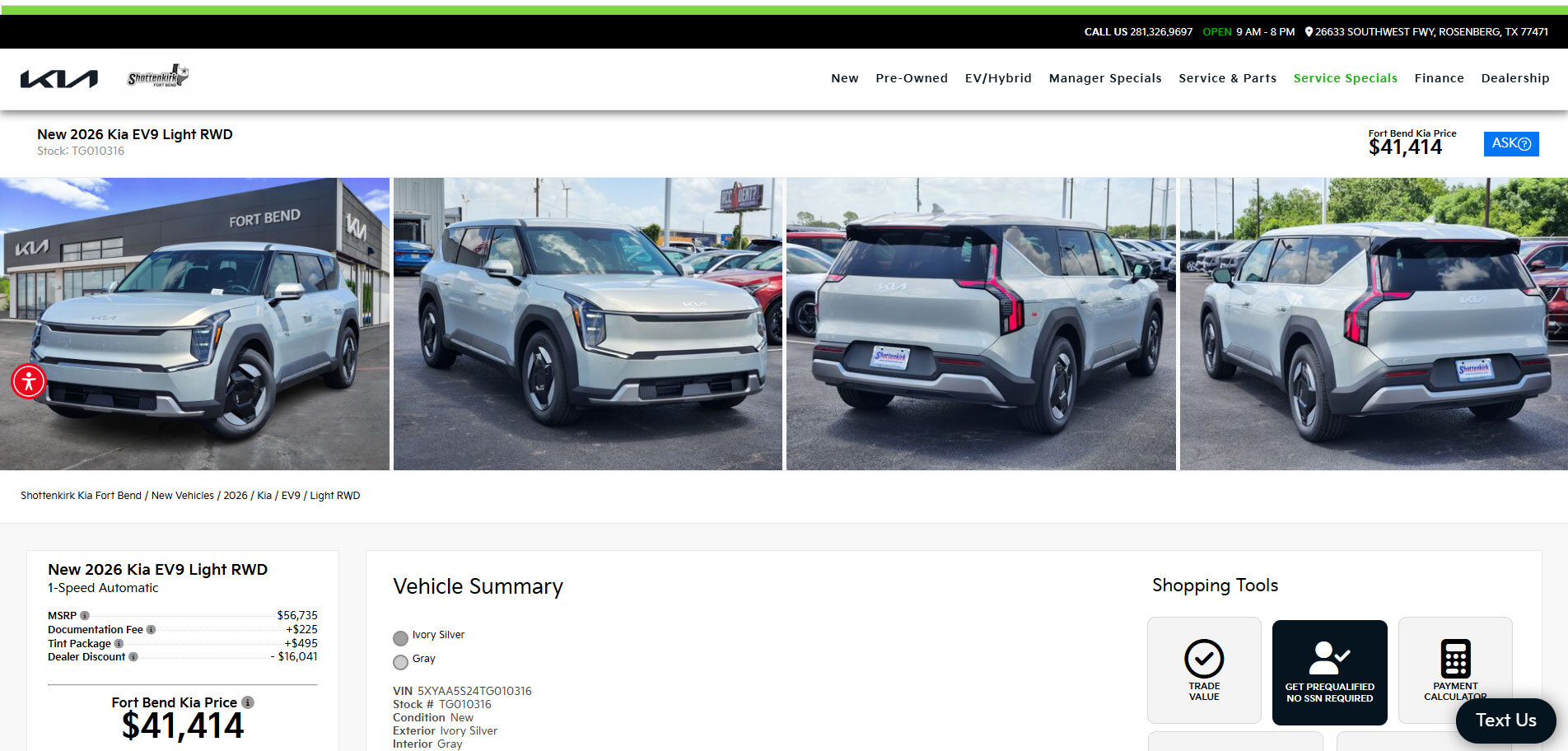
Shottenkirk Kia of Fort Bend has one of the cheapest EV9s in America as their Light RWD model has been marked down by $16,041. This lowers the sticker price from $56,735 to $40,694. That sounds like a bargain considering the Telluride Hybrid begins at $46,490 before a $1,545 destination fee.

 Kia’s EV9 Fire Sale Could Save You $16,000 Off MSRP

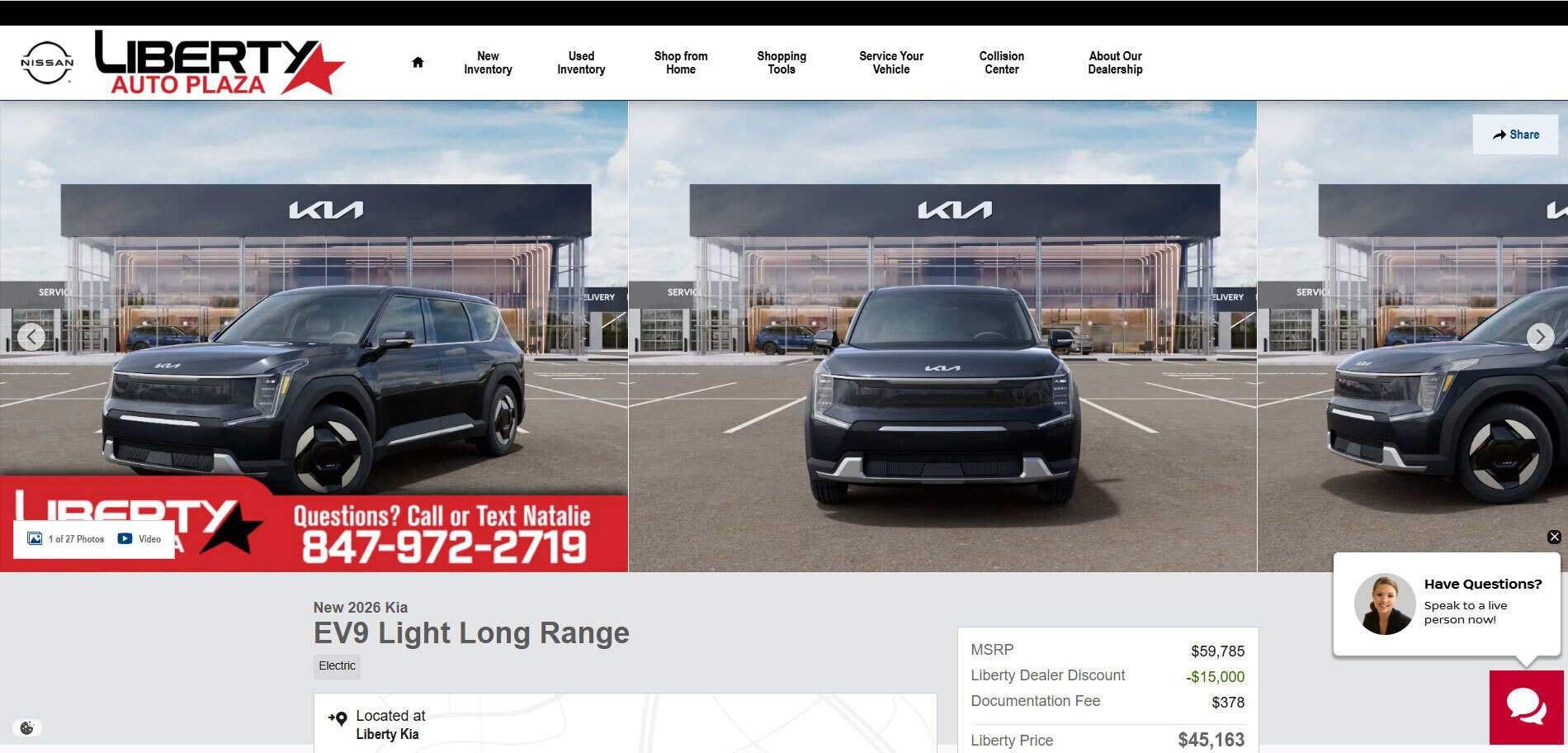
Liberty Auto Plaza in Libertyville, Illinois also has steep discounts on their EV9s. An EV9 Light Short Range has been slashed from $57,480 to $42,480 thanks to a $15,000 discount.

If 230 miles (370 km) of range isn’t enough, the dealer also has an EV9 Light Long Range with a similar $15,000 markdown. This means the 304-mile (489 km) crossover can be yours for $44,785 instead of $59,785.

 Kia’s EV9 Fire Sale Could Save You $16,000 Off MSRP

If you’re in the market for a classier variant, Crain Kia of Bentonville has a $66,820 EV9 Wind for $52,370. This is due to $10,000 in customer cash from Kia and a $4,450 dealer discount.

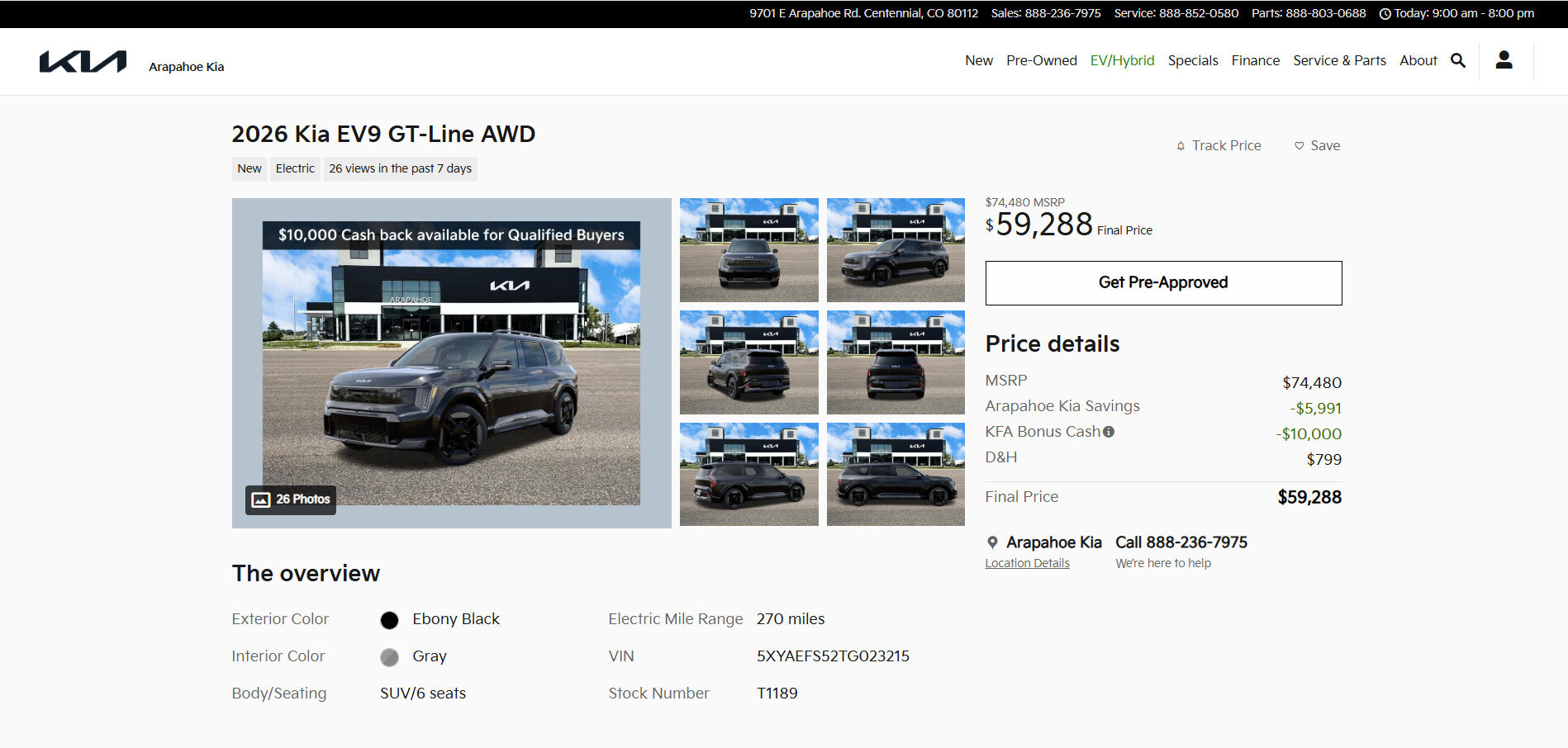
It’s a similar situation at Arapahoe Kia, where an EV9 GT-Line AWD is nearly $16,000 off. Thanks to a combination of Kia customer cash and a $5,991 discount, the model is priced from $58,489 before fees.

 Kia’s EV9 Fire Sale Could Save You $16,000 Off MSRP

Hyundai’s New Nine-Seat Electric Van Matches The ID. Buzz On Price And Beats It On Size

  • Hyundai opens European orders for the new Staria Electric.
  • It packs an 84 kWh battery and offers up to 430 km of range.
  • The electric van is priced from €57,450 ($66,800) in Germany.

The Hyundai Staria Electric arrived in Korea earlier this year alongside the rest of the facelifted lineup, and the spaceship-shaped van has now made it to Europe, where Hyundai is positioning it against the VW ID. Buzz. The Staria is the bigger vehicle in every dimension that counts, with more room inside for people and their luggage.

Picking the Staria Electric out from its gasoline and hybrid siblings takes a look at the nose, where a redesigned front bumper hides the grille behind a smooth panel, adds a charging port, and puts active shutters in the lower intake. Aero wheels and a dedicated badge on the enormous tailgate finish the job.

More: Electric Kia PV7 Is Coming For The Ford Transit

At 5,253 mm (206.8 in) long, the Staria towers over the VW ID. Buzz and the Kia PV5. It also out-measures the standard Ford E-Tourneo Custom, VW e-Caravelle, Peugeot e-Traveller, Citroen e-Spacetourer, Opel Zafira-e Life, and Fiat E-Ulysse, though the long-wheelbase versions of those go further. It’s the same story with the new Mercedes-Benz VLE executive shuttle.

Generous Equipment

\\\\\

In Europe, the Staria Electric is available in three trim levels, called Trend, Prime, and Calligraphy. The base version comes standard with full-LED headlights, dual 12.3-inch displays, heated front seats, parking sensors, a reversing camera, a few ADAS and a three-row nine-seater layout.

More: Hyundai Is Now Charging You Extra For A Damn Gauge Cluster

The optional assistance package adds navigation, highway assist and a V2L adapter, while the premium package adds electric sliding doors and tailgate, sliding windows, sunshades, acoustic and heat-insulating privacy glass, plus a wireless charging pad. All of those come standard in the Staria Electric Prime which adds leather upholstery and ventilated front seats while offering an optional sliding roof for the first row and fixed panoramic roof for the second row.

 Hyundai’s New Nine-Seat Electric Van Matches The ID. Buzz On Price And Beats It On Size
The Staria Electric Trend and Prime (left) have a different look compared to the Caligraphy (right).

The pictured Staria Electric Calligraphy is the only version with a seven-seat layout, built around a pair of comfort seats in the second row with heating, ventilation, and relaxation functions. The flagship also gets ambient lighting, a Bose sound system, a 360-degree camera, a suede-style headliner, Nappa leather, and the Passenger View and Talk system.

More: You Can Sleep And Even Wash Your Dishes In This Hyundai Van, But You Can’t Buy It Yet

Outside, the Calligraphy separates itself with a different front bumper housing larger projection headlights, Parametric Pixel LED taillight towers that climb to the roofline, and an exclusive Galaxy Maroon paint option.

Space For Nine And Their Luggage

\\\\

Cargo capacity runs to 1,303 liters (46.0 cu ft) behind the third row in the nine-seater, with a 24-liter (0.85 cu ft) frunk for the charging cables. Towing capacity is 2,000 kg (4,409 lbs) and maximum payload is 750 kg (1,653 lbs).

More: Kia Brought Its Electric Van To America As Something New York Actually Needs

Under the skin, the van is powered by a single front-mounted electric motor producing 215 hp (160 kW / 218 PS). Energy is stored in a 84 kWh battery pack allowing WLTP range of up to 430 km (267 miles) between charges. Thanks to the 800-volt architecture, the Staria Electric can charge from 10-80% in approximately 20 minutes when connected to a DC charger, while it also gets a standard heat pump and battery heating system.

German Pricing

\\\\

In Germany, the the Hyundai Staria Electric starts at €57,450 ($66,800) for the entry-level Trend trim, €63,650 ($74,000) for the mid-tire Prime, and €66,950 ($77,800) for the flagship Calligraphy. The assistance and premium packages add €2,100 ($2,400) each, while the panorama package adds €1,300 ($1,500).

By comparison, the smaller VW ID. Buzz Pro with the long wheelbase and the 86 kWh battery starts at €57,887 ($67,300) in the same market. On the other hand, the VW e-Caravelle starts at €66,080 ($76,800) with the short-wheelbase and the 70.9 kWh battery.

\\\\

Hyundai

Jeep Recon EV Has More Power Than Originally Announced

  • Jeep has quietly updated the performance specs for the Recon.
  • It produces an extra 20 hp, but the range remains pretty bad.
  • Model starts at $65,000, but some dealers already list discounts.

The Jeep Wagoneer S was an overpriced flop and dealers are still struggling to get rid of 2025 models. A quick search online reveals a number of massive discounts including one model that stickered for $67,590 being listed for $40,855. That’s a savings of $26,735 and it even includes an $855 documentation fee.

Unfortunately for Jeep, the Wagoneer S is closely related to the upcoming Recon. It starts at $65,000 before a $1,995 destination fee.

More: Jeep’s $65,000 Recon Is Surprisingly Fast, But Can It Outrun The EV Slowdown?

The hefty price tag puts the model in an awkward spot as it will arrive shortly after the smaller Rivian R2. It costs $57,990 in Performance guise and will be followed by a more affordable Premium – which begins at $53,990 – later this year.

While we’ve already compared the two models, it appears some Jeep dealers are worried about history repeating itself. As a result, they’re already slapping discounts on the Recon ahead of launch.

 Jeep Recon EV Has More Power Than Originally Announced

These aren’t anything to write home about and they’re nowhere close to the massive markdowns we’ve seen on the Wagoneer S. However, Jeff Wyler Chrysler Dodge Jeep Ram of Columbus shows a $720 discount on their Recon Moab.

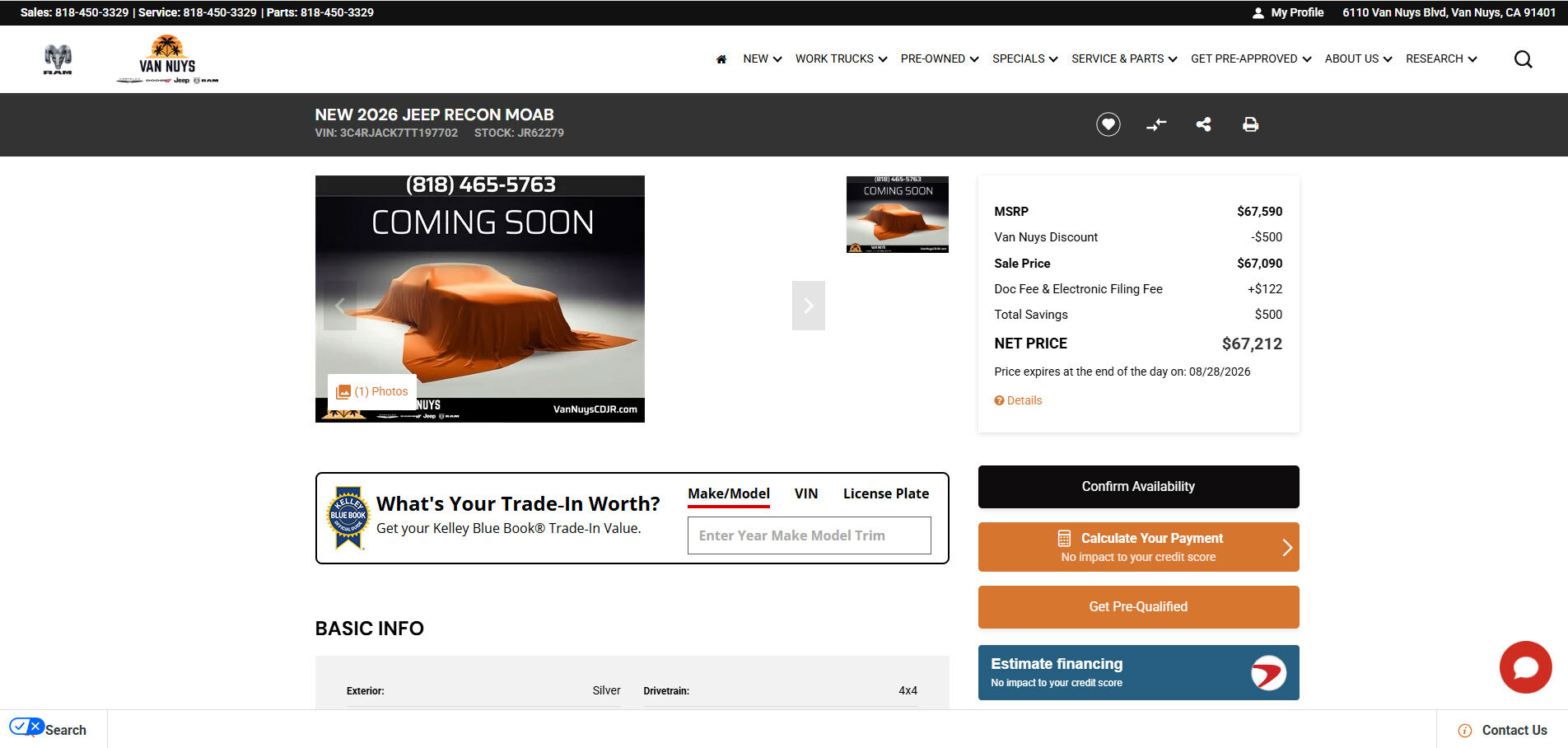
Over in California, Van Nuys Chrysler Dodge Jeep Ram has a $500 discount on their Moab. This means the $67,590 MSRP has been knocked down to $67,090 before a $122 document and electric filing fee.

 Jeep Recon EV Has More Power Than Originally Announced

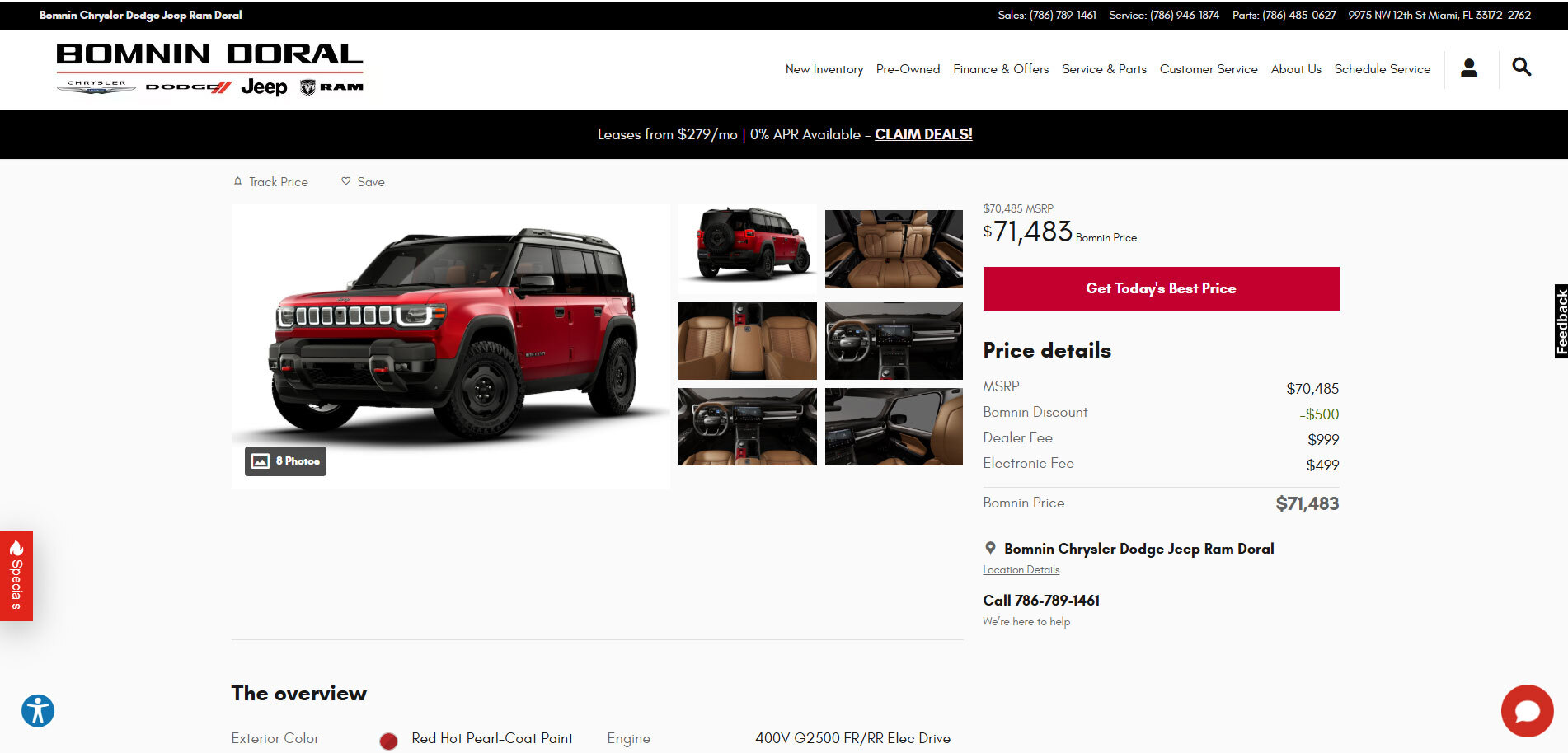
Bomnin Chrysler Dodge Jeep Ram Doral also has a $500 discount on their incoming Recon, but the savings is more than offset by massive fees. This includes a $999 dealer fee as well as a $499 electronic fee.

As for the handful of other vehicles listed online, they’re largely priced at MSRP. That being said, it’s too early to read into anything as the crossover hasn’t even launched yet.

Recon Has More Power Than Originally Announced

\\\\\\\\\\

Digging a little deeper, we discovered that Jeep quietly updated specifications for the Recon. When the model was introduced in 2025, it was rated at 650 hp (485 kW / 659 PS) and 620 lb-ft (840 Nm) of torque.

The company has now bumped the output up to 670 hp (500 kW / 679 PS). This will enable the crossover to accelerate from 0-60 mph (0-96 km/h) in as little as 3.6 seconds, before hitting a top speed of 112 mph (180 km/h).

Besides having an additional 20 hp (15 kW / 20 PS), Jeep has tweaked the range estimate. It originally stood at 250 miles (402 km), before being lowered to a maximum of 230 miles (370 km).

Jeep now lists the range as 222 miles (357 km) for the Recon Moab and 240 miles (386 km) for the Overland trim. The latter will arrive sometime after launch and details remain to be seen.

\\\\\\\\

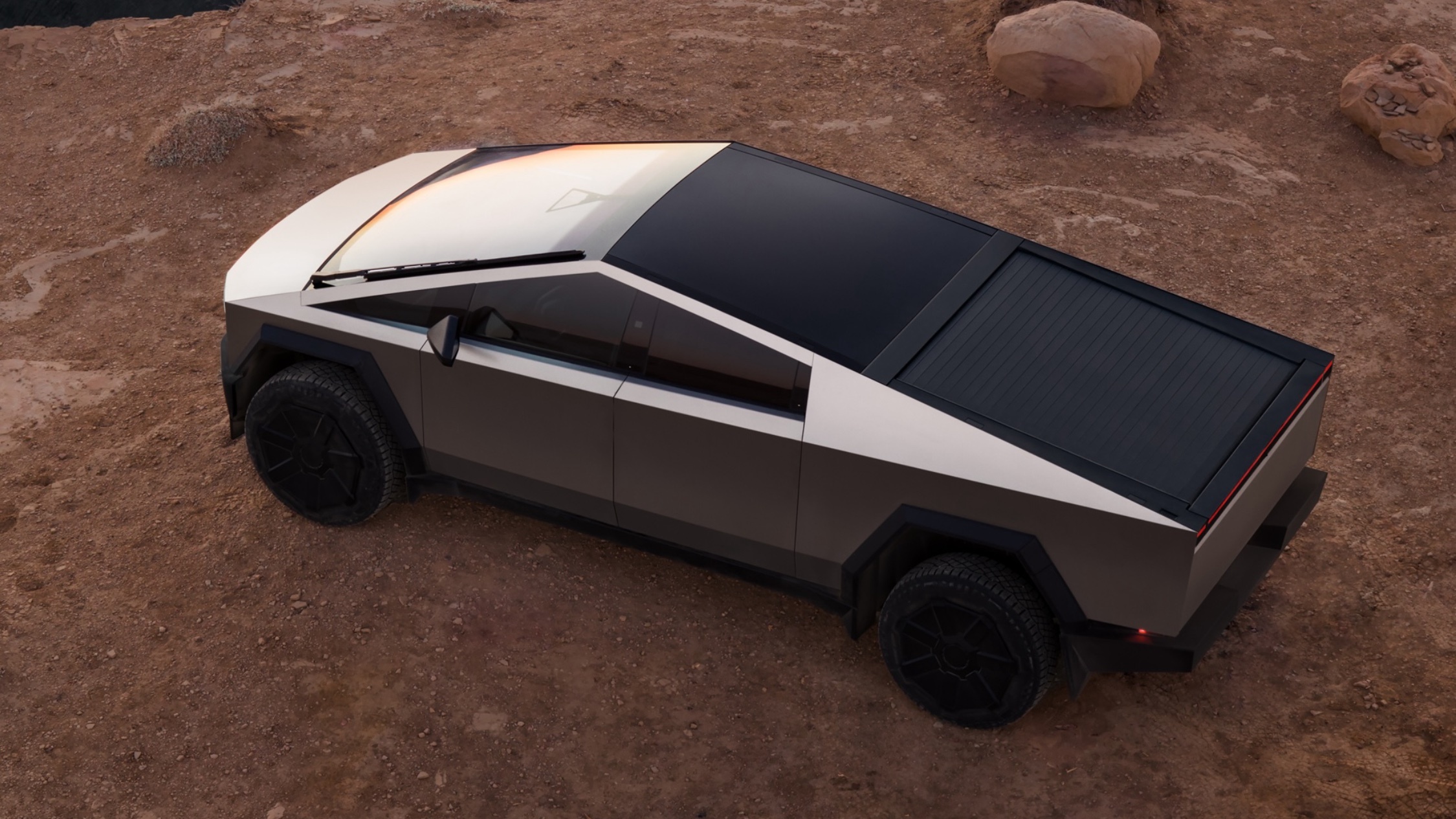
Tesla’s Cybertruck Isn’t Selling, So Naturally It Now Costs $5,000 More

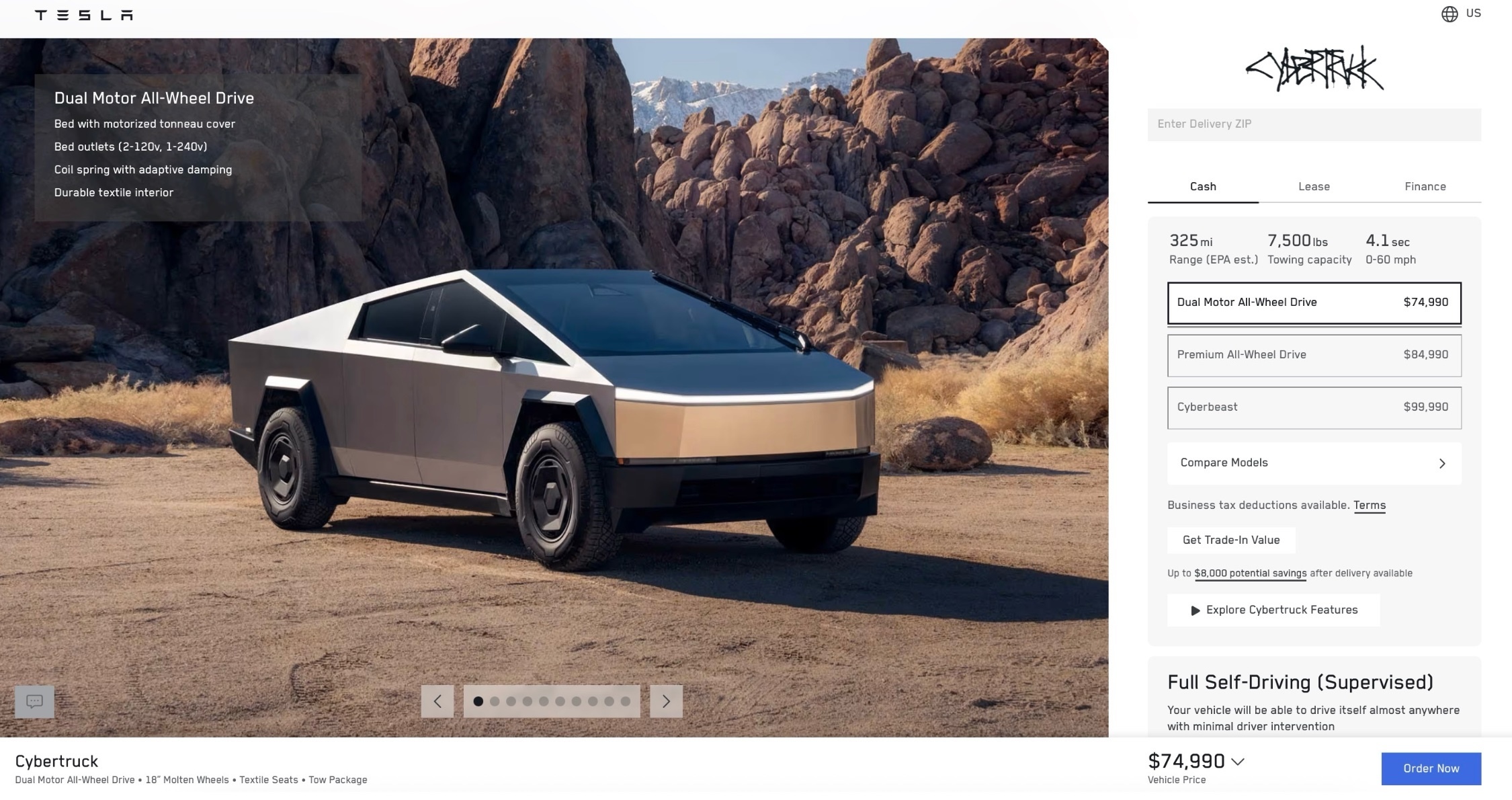
  • Tesla’s entry-level AWD Cybertruck now costs $74,990, up from $69,990.
  • Price of Premium AWD trim also increases by $5,000, taking it to $84,990.
  • The increase arrives as Cybertruck sales remain far below Tesla’s ambitions.

Usually when a product isn’t selling as well as hoped, companies make it more affordable to persuade drivers to give it consideration. Tesla seems to have found that approach too conventional. Despite the Cybertruck struggling to attract buyers so badly it makes Ford’s Edsel look like a smash hit, two versions have just become $5,000 more expensive.

The Dual Motor AWD now starts at $74,990, up from $69,990, while the Premium AWD climbs from $79,990 to $84,990. Nothing else about the models appears to have changed.

Related: This Is All That’s Left Of A Ford F-150 After A Cybertruck T-Boned It At 111 MPH

The Dual Motor Cybertruck still claims 325 miles (523 km) of range, can tow 7,500 lbs (3,400 kg), and reaches 60 mph (97 km/h) in 4.1 seconds. The Premium promises the same 593 hp (600 PS / 441 kW), electric range and performance, but is able to tow 11,000 lbs (4,990 kg).

Tesla doesn’t break out Cybertruck deliveries, but third-party estimates paint an uncomfortable picture. Cox Automotive reckons US sales fell 48 percent in 2025 to 20,237 units, while first-quarter 2026 sales dropped 45 percent year over year to 3,519, Investor’s Business Daily reports. Those numbers look tiny beside CEO Elon Musk’s earlier suggestion that annual demand might eventually support more than 250,000 Cybertrucks.

Cybertruck pricing has been a roller coaster from the start, the first production models debuting in late 2024 with MSRPs far higher than originally promised. Tesla introduced a cheaper Dual Motor for $59,990 in February 2026 as a short-lived promotion, but that later returned to $69,990 and has now reached $74,990. That’s a $15,000 journey in only a few months for fundamentally the same truck. Tesla briefly offered a single-motor Cybertruck during 2025, but it was quickly axed due to weak demand.

Cyberbeast Now Within Reach

 Tesla’s Cybertruck Isn’t Selling, So Naturally It Now Costs $5,000 More

The flagship Cyberbeast is the one Cybertruck trim to escape this latest increase. A tri-motor, 845 hp (857 PS / 630 kW) monster capable of reaching 60 mph in 2.6 seconds, it’s still listed on Tesla’s website at $99,990. That means the Premium AWD now sits only $15,000 below the range-topper, making the Beast look like a better deal than last week.

Tesla has already scrapped the Model S and Model X to clear the way for production of the company’s Optimus robots, and between that and the Cybercab robotaxi, it feels like Tesla is focused on a new path. The Cybertruck is just being left to fade away, a rather embarrassing failure that serves to remind us that not everything Elon Musk touches turns to gold.

Maybe slapping $5k on the price will really help make the Cybertruck more profitable because it covers rising production costs and Tesla figures it won’t really affect sales. Or maybe it’s just one of Musk’s impish experiments, you know, just to see how much worse things can get.

 Tesla’s Cybertruck Isn’t Selling, So Naturally It Now Costs $5,000 More

Tesla

Hyundai’s Ioniq V Looks Like A Lambo, Is As Big As A Camry, And Costs Less Than America’s Cheapest New Car

  • Hyundai’s new electric Ioniq V starts at the equivalent of just $17,800 in China.
  • Top-spec Long Range version claims 404-mile range yet still costs only $20,800.
  • China’s V not available in US or Europe gets huge screens, Lambo-look styling.

When Hyundai launched the original Ioniq Hybrid in America in 2017, it started at $22,200. Almost a decade later, Chinese buyers can order an entirely new, fully electric Ioniq sedan for less. The wedgy Ioniq V has entered pre-sales at just 119,900 yuan, which equates to only $17,800 at current exchange rates. That’s nearly $3,000 less than the cheapest new car in America right now, which also happens to be a Hyundai, the Venue.

That’s for the Standard Edition. Upping the spend to 129,900 yuan ($19,300) gets the Smart Driving Edition, while 139,900 yuan ($20,800) buys the Long Range model, Auto Home reports. Those are some startling numbers when viewed from America or Europe, and remind us how cutthroat the competition is in the Chinese car market.

Related: Police Are Slipping Warning Cards Under Hyundai And Kia Wipers Again

\\\\\\\

The Ioniq V is a China-focused model developed under Beijing Hyundai, and despite what the prices suggest, it’s no cramped subcompact. At 4,900 mm (193 inches) long with a 2,900 mm (114-inch) wheelbase, it occupies roughly the same footprint as a Hyundai Sonata or a Toyota Camry. The Sonata measures 193.3 inches long on a 111.8-inch wheelbase; the Camry 193.5 inches on a 111.2-inch wheelbase.

 Hyundai’s Ioniq V Looks Like A Lambo, Is As Big As A Camry, And Costs Less Than America’s Cheapest New Car

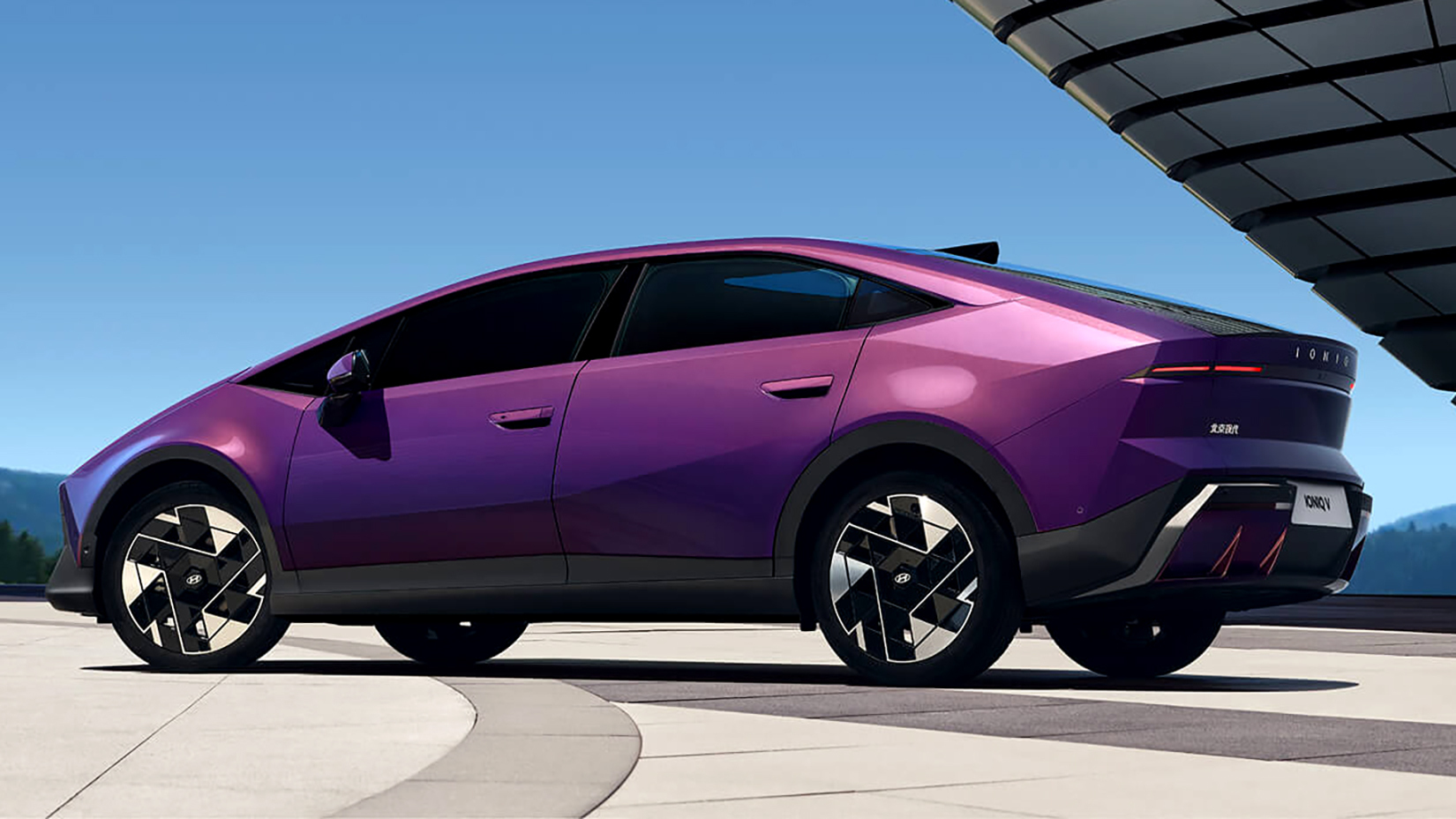
The Ioniq V wraps frameless doors and fastback proportions around some properly cyberpunk styling, and the paint chart runs eight colors deep, well past the silvers and grays Western buyers get stuck with. Cyber Gold, Gamma Green and a funky Dimensional Purple are all on the list.

Inside, there’s a vast 27-inch 4K display running Qualcomm’s Snapdragon 8295 chip, plus a head-up display. Hyundai has also thrown Chinese AI models from Baidu and ByteDance into the infotainment system, while Momenta supplies the driver-assistance technology. Hyundai’s site additionally boasts nine airbags and extensive active safety equipment.

404 Miles Of Range, But Not Really

\\\\\\\

Power comes from a single electric motor with either 188 hp (191 PS / 140 kW) or 225 hp (228 PS / 178 kW). CATL supplies 53.5 kWh and 66.8 kWh LFP batteries, producing four claimed CLTC ranges spanning 323 to 404 miles (520 to 650 km). Those optimistic Chinese-cycle numbers don’t translate directly into equivalent EPA range, naturally, but even if they’re 20 percent lower the value proposition is difficult to ignore.

There’s no guarantee the Ioniq V will ever reach Western showrooms, much less at anything resembling Chinese pricing. Or that Hyundai will ever create the N version to capitalize on that Lamborghini-esque design, even though our own renders suggest it would look fantastic. But $17,800 for a brand-new electric sedan this stylish sounds like a great deal whichever side of the Pacific you’re on.

\\\\\\\

Hyundai

Ferrari Made Luxeed Prove Its RX Was Designed By A Ferrari Guy, So It Named Him

  • Ferrari challenged Luxeed to name the designer behind its new RX.
  • The SUV’s styling borrows heavily from Ferrari’s Purosangue playbook.
  • It starts at $44,550, undercutting many Western performance EVs.

Earlier this year, China’s Luxeed brand made a claim it didn’t expect to have to back up, announcing that the RX, its answer to the Xiaomi YU7, had been penned by a former Ferrari designer. Ferrari’s Chinese arm read that and asked the obvious follow-up question, which was, fine, what’s his name? Luxeed has supplied one, and while it was at it, the company also put a starting price on the electric SUV.

The name came from Zhao Changjiang, executive director and executive vice president of Luxeed, in a Weibo post rounding up the brand’s latest progress. The designer is Werner Gruber, and the resume holds up. He spent time at Ferrari and worked on the LaFerrari, the FXX-K, and the Portofino, which is a strong set of credits. While the RX certainly has plenty of similarities to other performance SUVs like Ferrari’s own Purosangue and the Xiaomi YU7, there’s no denying it looks nice.

Read: China Built A 585-HP EV That Looks Like A Ferrari And Sounds Like A Lexus

\\\\\

Luxeed was created through a partnership between Chery and Huawei, and pre-sales of the RX kicked off in China earlier this week. Prices start at 299,800 yuan ($44,550), making it more expensive than the YU7, which starts at 253,500 yuan ($37,700), yet compared with the prices we pay for high-performance electric SUVs in the West, the RX remains relatively cheap.

Several versions are available, provided with 81.1 kWh, 100.25 kWh, and 100.42 kWh battery packs. Entry-level models feature a single rear-mounted electric motor producing 371 hp, while power-hungry buyers can also order the RX with dual motors producing 586 hp and all-wheel drive.

A Chassis From AMG’s Former Boss

\\\\\\\

It’s not just impressive performance that could win over buyers. The RX also comes equipped with 38 sensors, including four LiDARs, enabling autonomous driving between addresses. Importantly, the system officially remains at Level 2, so drivers will need to remain attentive and ready to take over control at a moment’s notice.

As it turns out, Gruber isn’t the only European industry veteran to have a hand in bringing the RX to life. In the same social media post, Zhao said that former Aston Martin chief executive and ex-AMG boss Tobias Moers tuned the chassis in a new role as chief dynamic performance advisor for the Luxeed brand, and added that former BMW engineers have joined the effort as well.

\\\\\\

Source:

Rivian, Hyundai, Toyota, And Cadillac Are Fighting For Tesla’s Scraps

  • A surge in sales helped Tesla secure a 55 percent market share in July.
  • The Tesla Model Y alone accounts for 37 percent of all EVs sold in the US in July.
  • Through the second quarter, Chevy had a 6 percent share, followed by Hyundai.

Tesla remains far and away the biggest seller of electric cars in the United States, and despite rivals’ efforts, very little progress has been made in eroding the EV leader’s commanding market share.

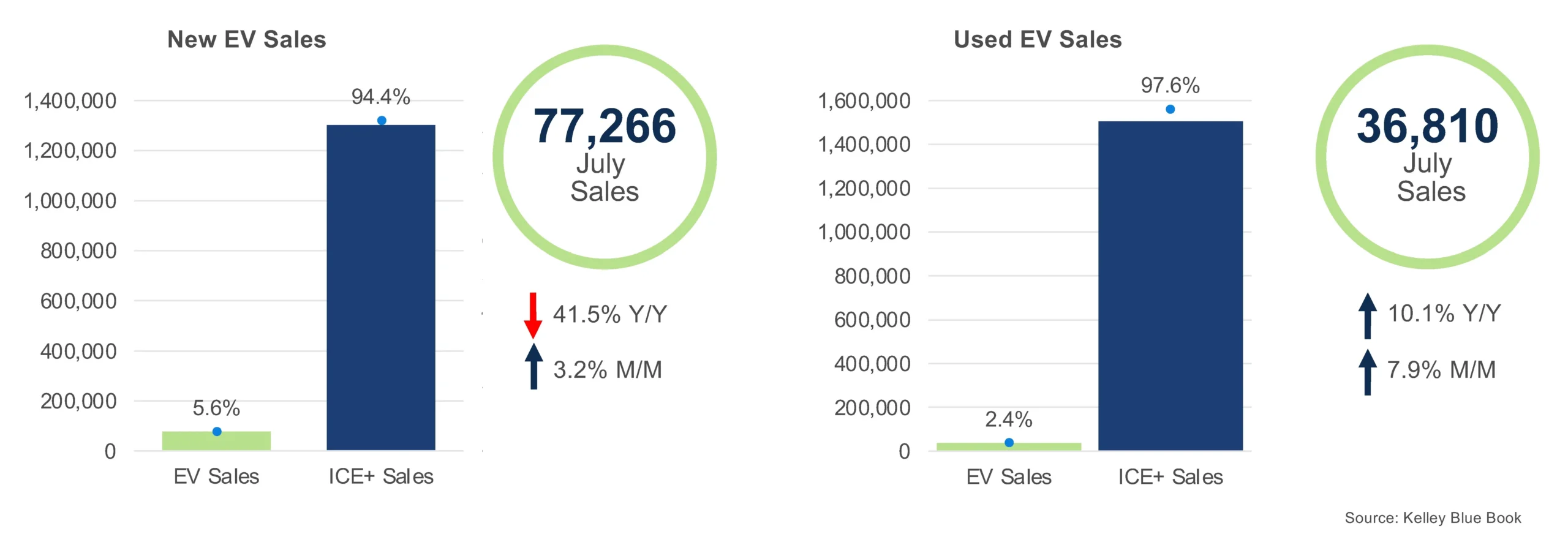
July brought 77,266 new EV sales, up 3.2 percent from June and down 41.5 percent from the same month last year. Electric models made up 5.6 percent of all new-vehicle sales. The year-over-year drop has a simple explanation. In July 2025, the federal EV tax credit was still alive, and buyers rushed to cash it in before the Trump administration killed the incentive in September.

Read: Tesla Delivered More Cars Than Any Q2 Ever, And Its Stock Had The Worst Day Ever

Of last month’s electric cars, 42,435 were Teslas, according to Cox Automotive, good for 55 percent of the market. Tesla’s volume climbed 4.9 percent from June. The Model Y did the heavy lifting, as it always does, accounting for 37 percent of every new EV sold in the country. Basically, the nameplate outsold every rival automaker’s entire electric portfolio.

 Rivian, Hyundai, Toyota, And Cadillac Are Fighting For Tesla’s Scraps

Tesla’s share throughout the entire second quarter was slightly lower at 50.5 percent, with the company selling a total of 124,800 EVs in the US during this period, down 13.1 percent from last year, when 143,535 were sold. In Q2, the brand with the next-largest slice of the EV pie was Chevrolet at 6 percent, followed by Hyundai at 5.8 percent, Cadillac at 4.9 percent, Toyota at 4.8 percent, and Rivian at 4.6 percent. Ford’s share remains a disappointing 3.9 percent, although its July sales were up 18.9 percent from June.

Hyundai posted the strongest month-over-month gain among the major brands in July, up 36 percent. Kia also moved higher, largely on the strength of the EV9.

 Rivian, Hyundai, Toyota, And Cadillac Are Fighting For Tesla’s Scraps

Sales Surge Pinches Supply

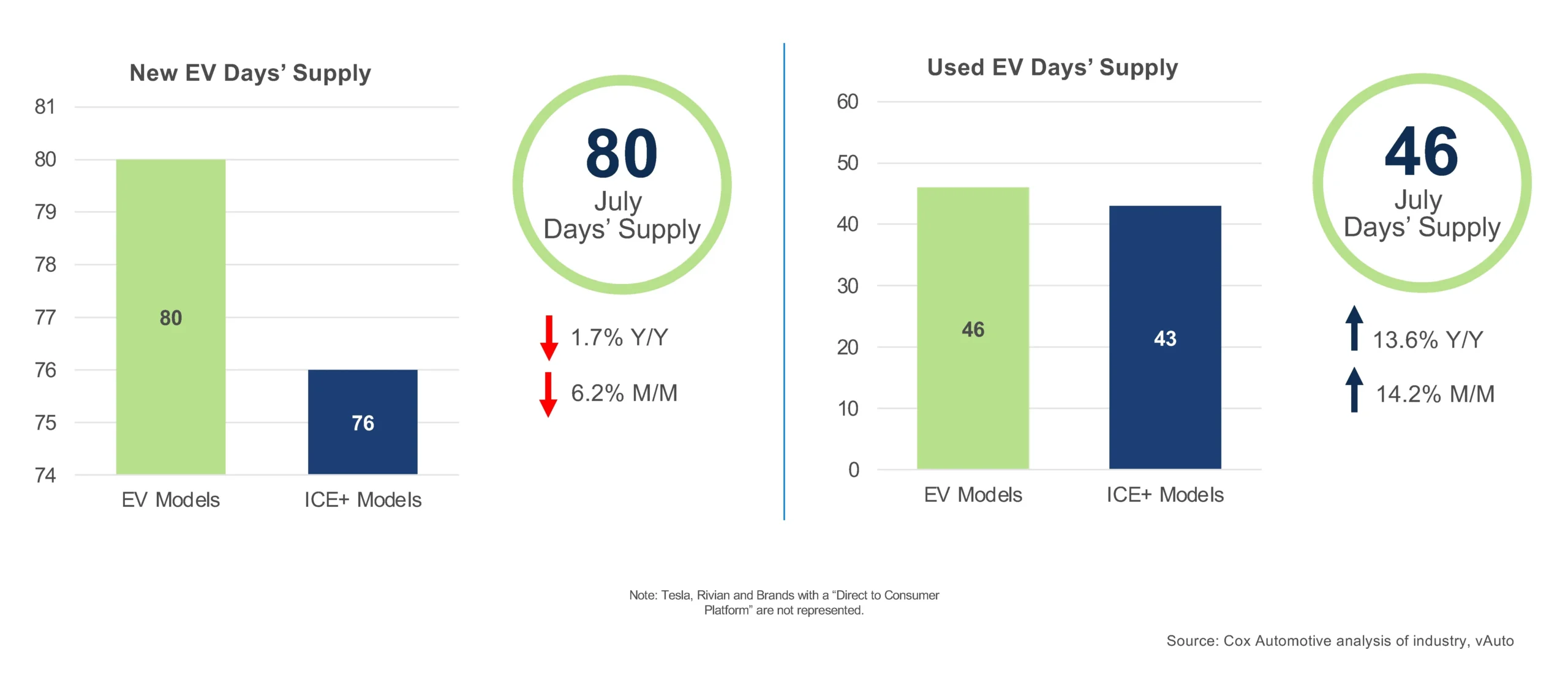
As EV sales climbed in July, the average days’ supply of new EVs fell 6.2 percent month over month to 80 days, and 1.7 percent below where it sat a year earlier. Electric inventory now runs four days above ICE models, down from a nine-day gap in June. Volkswagen carried the heaviest load at 147 days, with Porsche at 138 and Nissan at 133. Subaru ran leanest at 46 days, then Hyundai at 52, and Lexus at 58. Used EVs moved the other way, rising 14.2 percent from June to 46 days, above ICE models for the first time since February 2026.

Used EV sales rose 7.9 percent month over month to 36,810 in July, 10.1 percent better than a year ago. Secondhand electrics took 2.4 percent of the market.

The Price Gap Hasn’t Closed

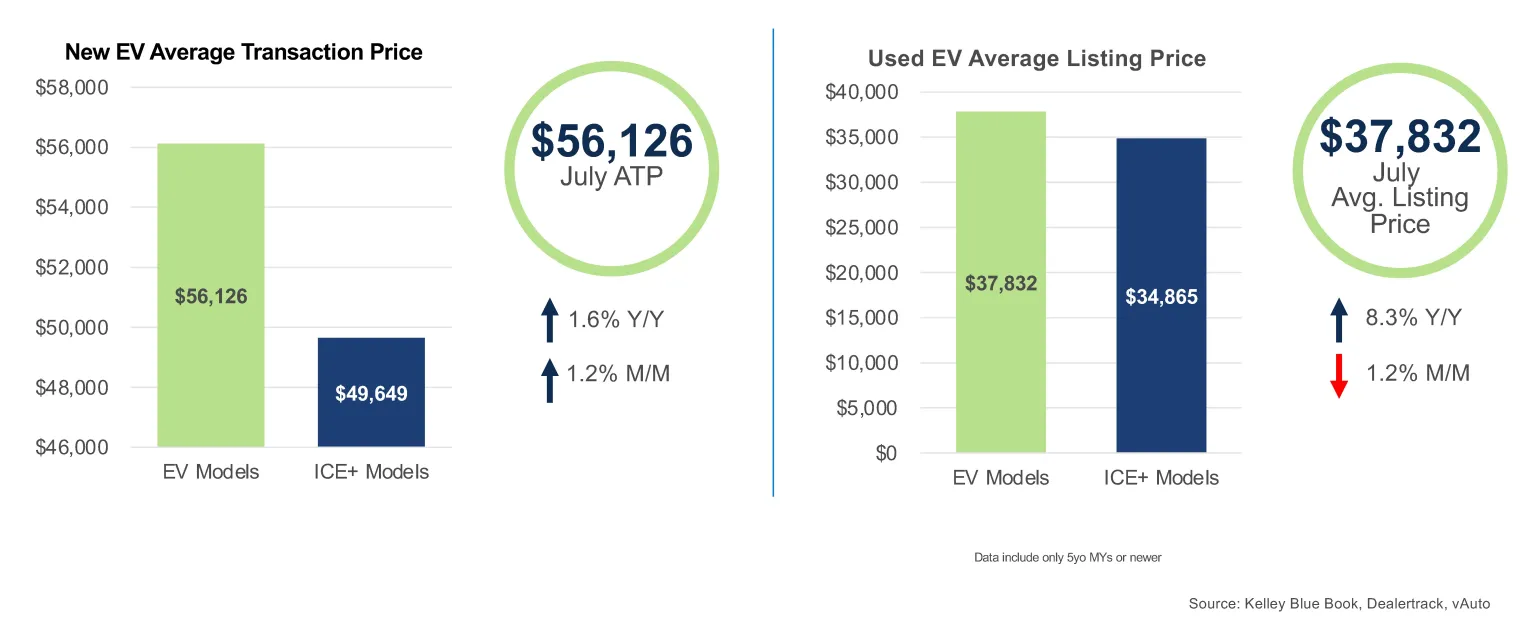
Electric cars remain the more expensive choice on both the new and used side. Average transaction prices for new EVs rose 1.2 percent in July to $56,126, against $49,649 for the average combustion model, and 1.6 percent higher than a year earlier. Incentives shrank over the same stretch, from 13.1 percent of ATP, or $7,290 per vehicle, in June to 11.8 percent, or roughly $6,626, in July. Used electrics average $37,832 against $34,865 for gas equivalents. Those prices slipped 1.2 percent from June but hold 8.3 percent above where they were a year ago.

 Rivian, Hyundai, Toyota, And Cadillac Are Fighting For Tesla’s Scraps
❌
❌