Lucid adds CarPlay and Android Auto to Gravity via OTA update.
New Gravity models get it standard, and the Air already has it.
The update addresses a long running request from many owners.
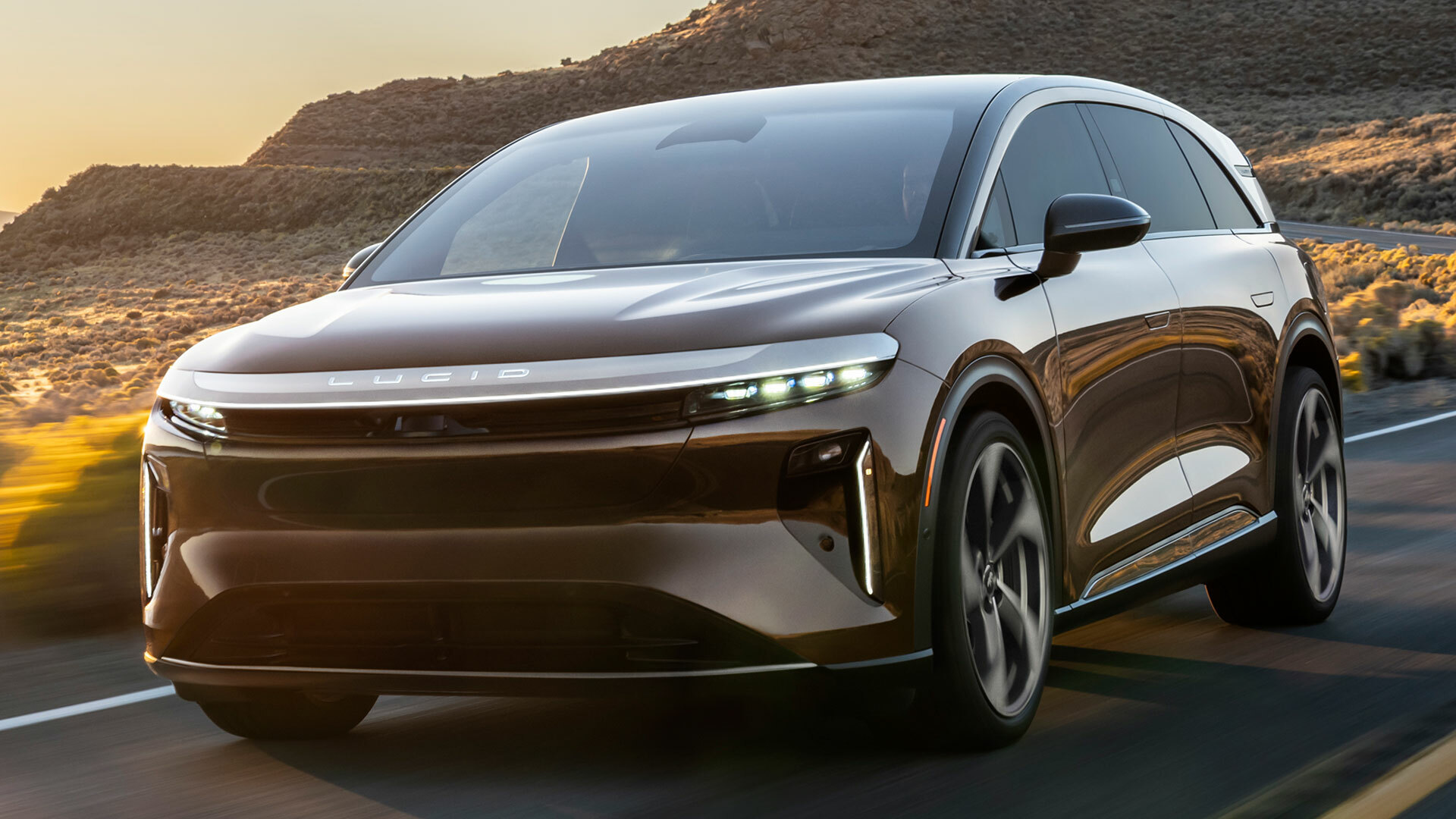
Every automaker has its own take on how infotainment should work. Android Auto and Apple CarPlay make that experience far more uniform. Up until now, though, Lucid Gravity owners haven’t had access to either. Now, a big software update is coming, and it’ll remedy the situation for the luxury SUV owners.
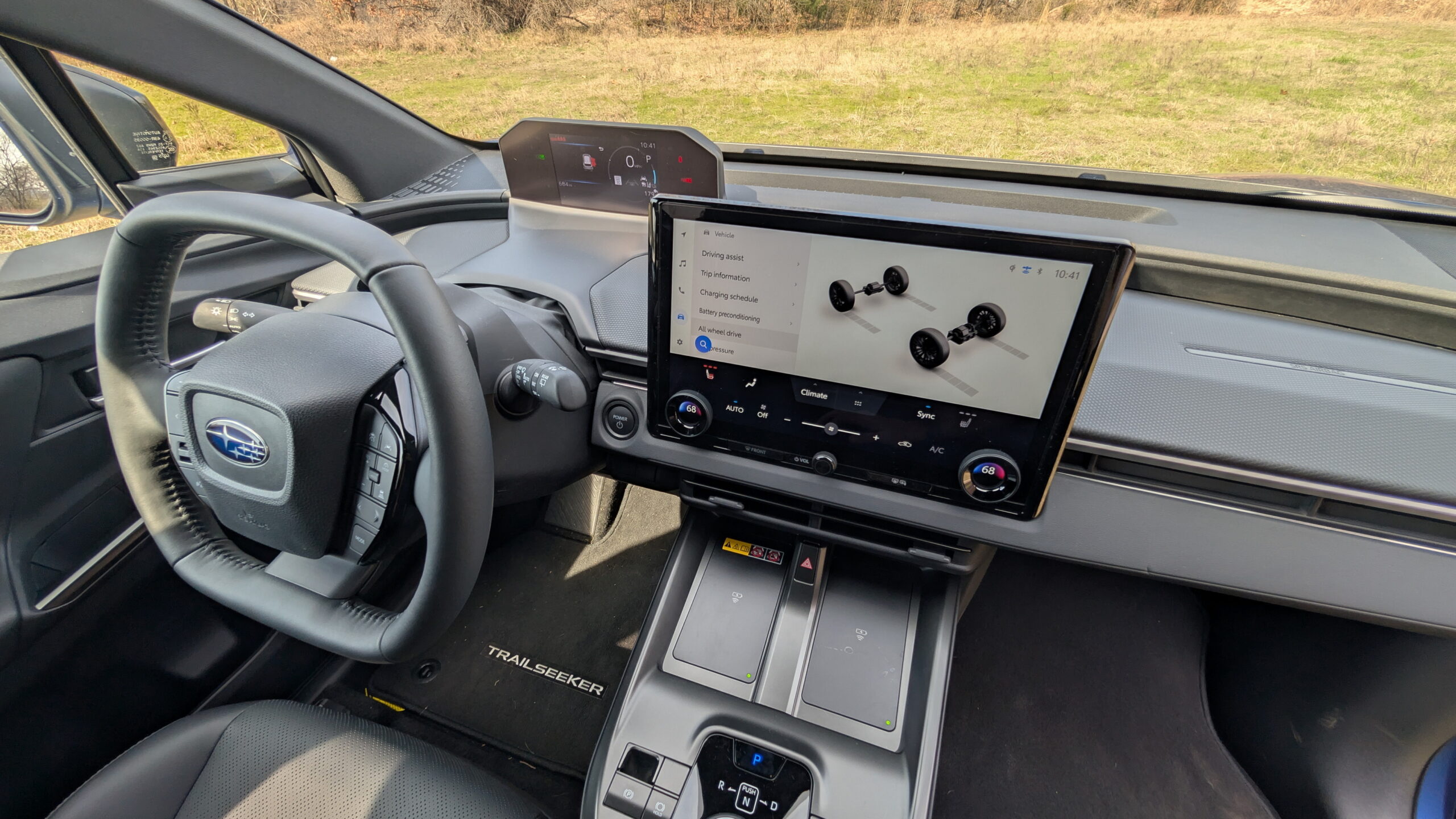
The update is part of the latest version of Lucid’s software, and it allows drivers to connect their phones to access navigation, music, messages, and apps directly through the vehicle’s infotainment display. Both wireless and wired connections are supported, depending on the device. According to Lucid, the rollout begins in North America first, with other markets expected to follow shortly after.
CarPlay And Android Auto Arrive
The addition of smartphone mirroring may seem like a small update, but it’s a big deal for owners. Apple CarPlay and Android Auto are among the most requested features in modern vehicles, and their absence has been a frequent complaint from Lucid customers despite the company’s otherwise advanced software system.
“Apple CarPlay and Android Auto are two of the most sought-after features by our customers,” said Emad Dlala, SVP of Engineering and Software at Lucid. “We are now providing a seamless connection between mobile devices and the Lucid Gravity. We’re excited to introduce these features to Lucid Gravity, which now offers even greater comfort and convenience for owners.”
From here on, every new Gravity leaving the factory will include Apple CarPlay and Android Auto as standard equipment. The Air sedan already lists both systems on its infotainment menu, so the SUV was the obvious next step.
Do Older Gravity Models Get It?
Yes, existing Gravity owners will receive the capability through the OTA update without needing to visit a dealer. This is a key selling point for the brand; not just these pieces of software themselves, but the ability to update the car.
According to Lucid, more than 95 percent of the vehicle’s functions can be refined or expanded through over-the-air updates. Put another way, it hopes to consistently introduce new capabilities without hardware changes. This move will no doubt add value to potential buyers.
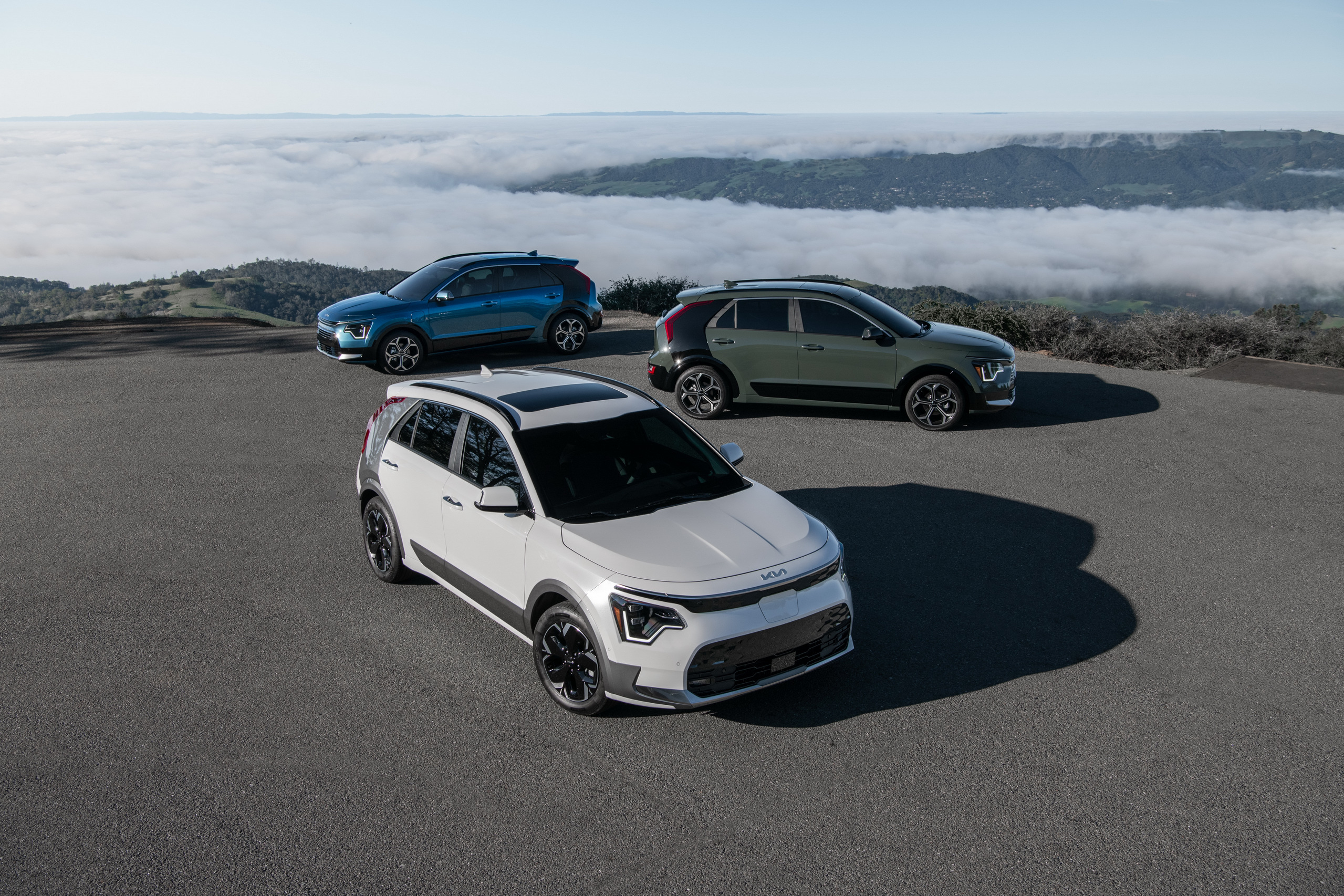
Kia has dropped the Niro EV as focus shifts to dedicated EVs.
The refreshed Niro will now be sold only as a hybrid in Korea.
Rising competition made the electric Niro harder to justify.
The latest Kia Niro has been around for almost half of a decade. When it launched, it was unique in the segment. It had an unconventional slashed body panel at the rear and came in hybrid, PHEV, and EV versions. The plug-in died recently, and now, as a facelift nears release, the EV version is also going the way of the Dodo.
The automaker confirmed the change for the Korean market. “The Niro EV, which had been produced until the previous model, has been discontinued,” Jung Yoon-kyung, a senior marketing manager at Kia, told The Korea Herald. “We plan to sell the remaining inventory available.” Carscoops reached out to the automaker to confirm the change in the U.S. market as well.
If this is indeed the situation for the States, it won’t be all that surprising. The Niro EV has always been a bit of an oddball in the family. Unlike the other EVs in the lineup, it was designed around a gas-burning powertrain. The others, all built exclusively as EVs, feature faster charging, longer range, and better overall packaging. Some even offered all of this for less than the price of the Niro EV. That’s a key piece of the puzzle here.
“Kia is strongly focusing on electrification. Starting with the EV3 and continuing through EV9, we have a range of vehicles with strong electrification capabilities and improved product competitiveness,” Yoon-kyung said. “In order to concentrate more on those models, we decided to discontinue the (Niro EV).” Those models are ones that are already set up for the U.S. market.
Now, Kia can better focus on those vehicles and streamline the Niro lineup at the same time. While we loved the Niro PHEV, EV, and Hybrid at launch, it was clear last year that they were beginning to show their age. This new shift in powertrains signals a tighter focus for the brand.
Lucid previewed a midsize EV platform for models under $50K.
Cosmos and Earth lead the lineup, with more variants ahead.
The new architecture is central to lowering EV production costs.
Lucid’s investor day made a serious splash in several ways. The automaker confirmed that autonomy subscriptions are coming, it’s kicking off a robotaxi program, and it’s launching Android Auto and Apple CarPlay. None of that might be as immediately impactful as the new revelations concerning the brand’s midsize platform and the cars it’ll spawn.
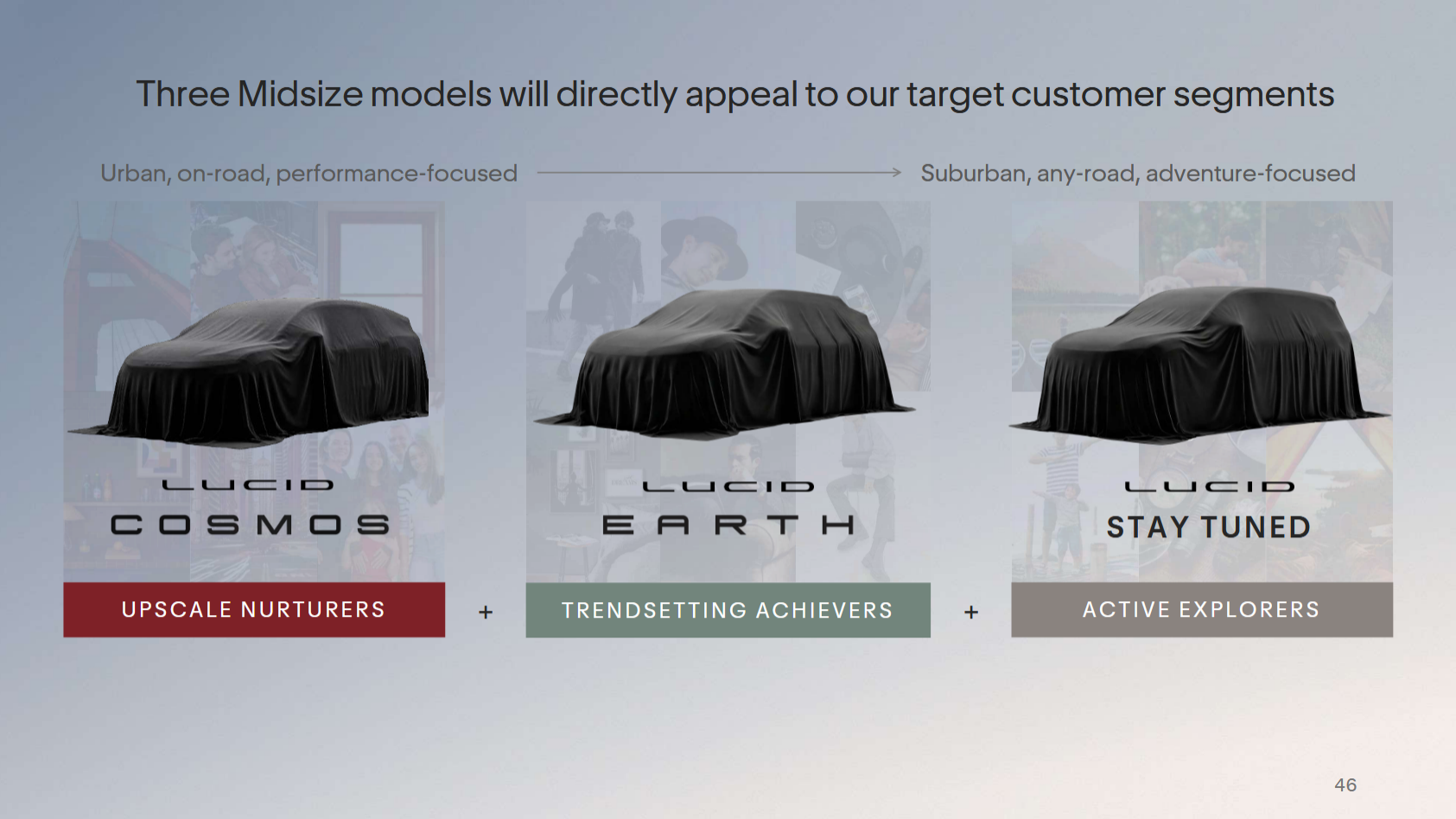
According to Lucid, the midsize platform will support several vehicles. That was already known. What we didn’t know was just about everything else. The first two cars on this platform will be named the Cosmos and the Earth. Both will sit below the Gravity and Air in terms of lineup position and pricing. A third model will come online later, though there are no details on its name just yet.
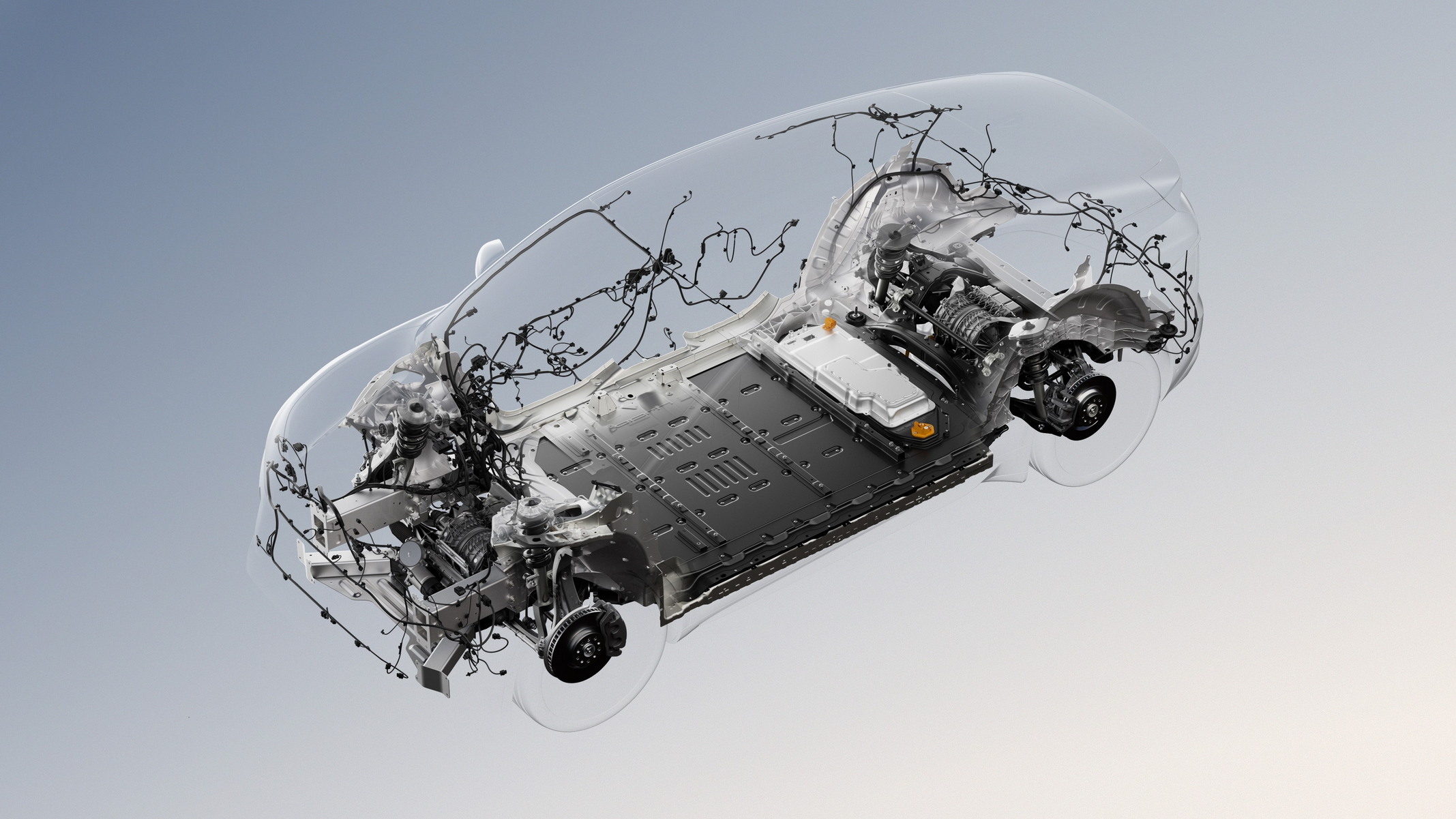
Lucid says the new platform keeps the same core philosophy as its current cars. That means high efficiency, strong performance, and lots of interior space, but with a much greater focus on cost reduction. Engineers redesigned the vehicle architecture to use fewer parts, smaller battery packs, and simpler manufacturing processes, all of which should lower production costs while maintaining range and performance.
Atlas Electric Drive Unit
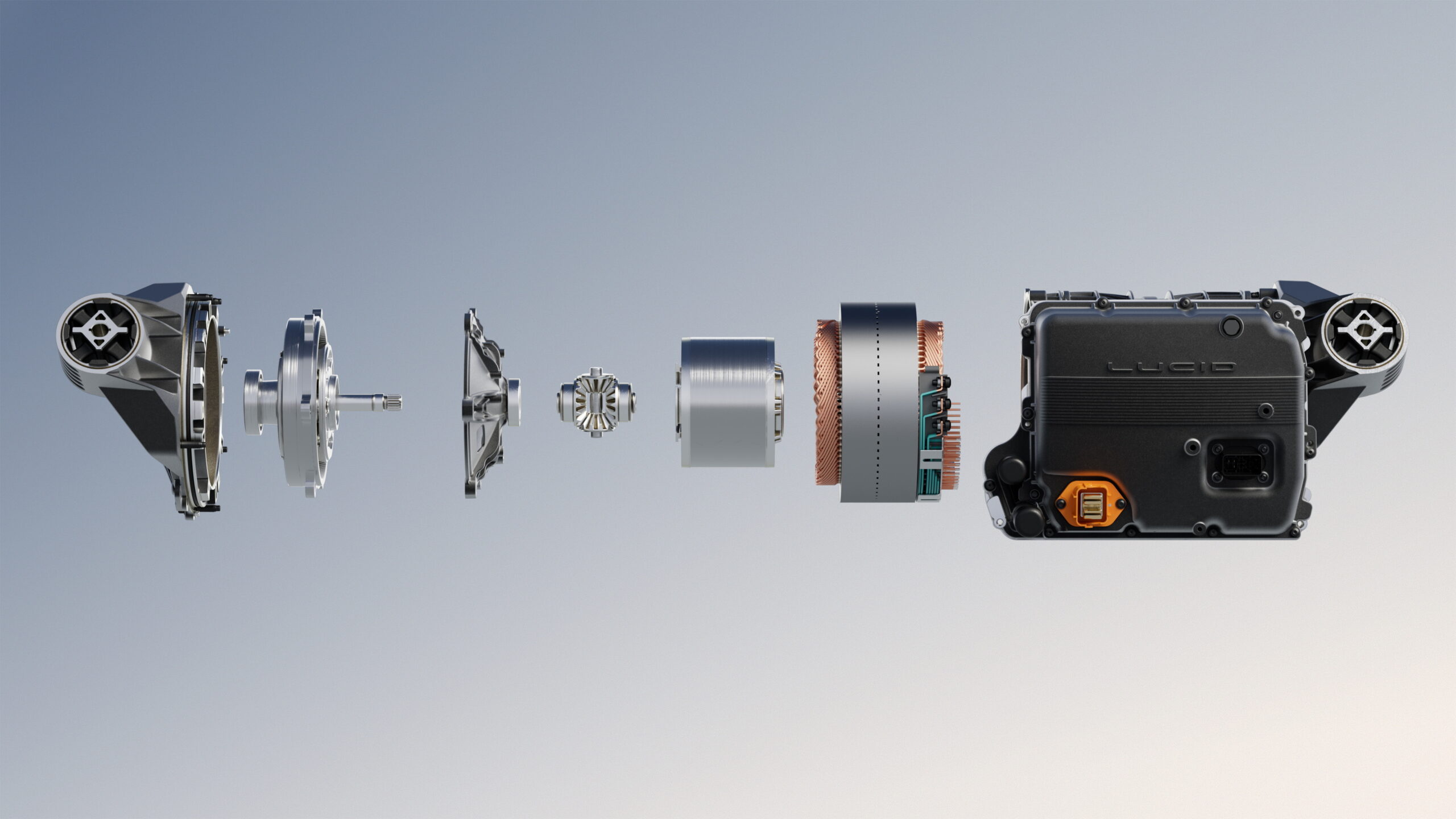
One of the biggest changes is a new electric drive unit called Atlas, which Lucid says is smaller, lighter, and cheaper to build than the current motor used in the Air and Gravity. The company claims the design has more than 30 percent fewer parts and significantly lower material cost, helping reduce the overall price of future vehicles.
Battery size is another area where Lucid expects savings. Because the company focuses heavily on efficiency, it says its midsize vehicles can achieve the same range as competitors while using smaller battery packs, which remain one of the most expensive components in any EV. That alone could cut thousands of dollars from the cost of each vehicle.
Pricing And Production Strategy
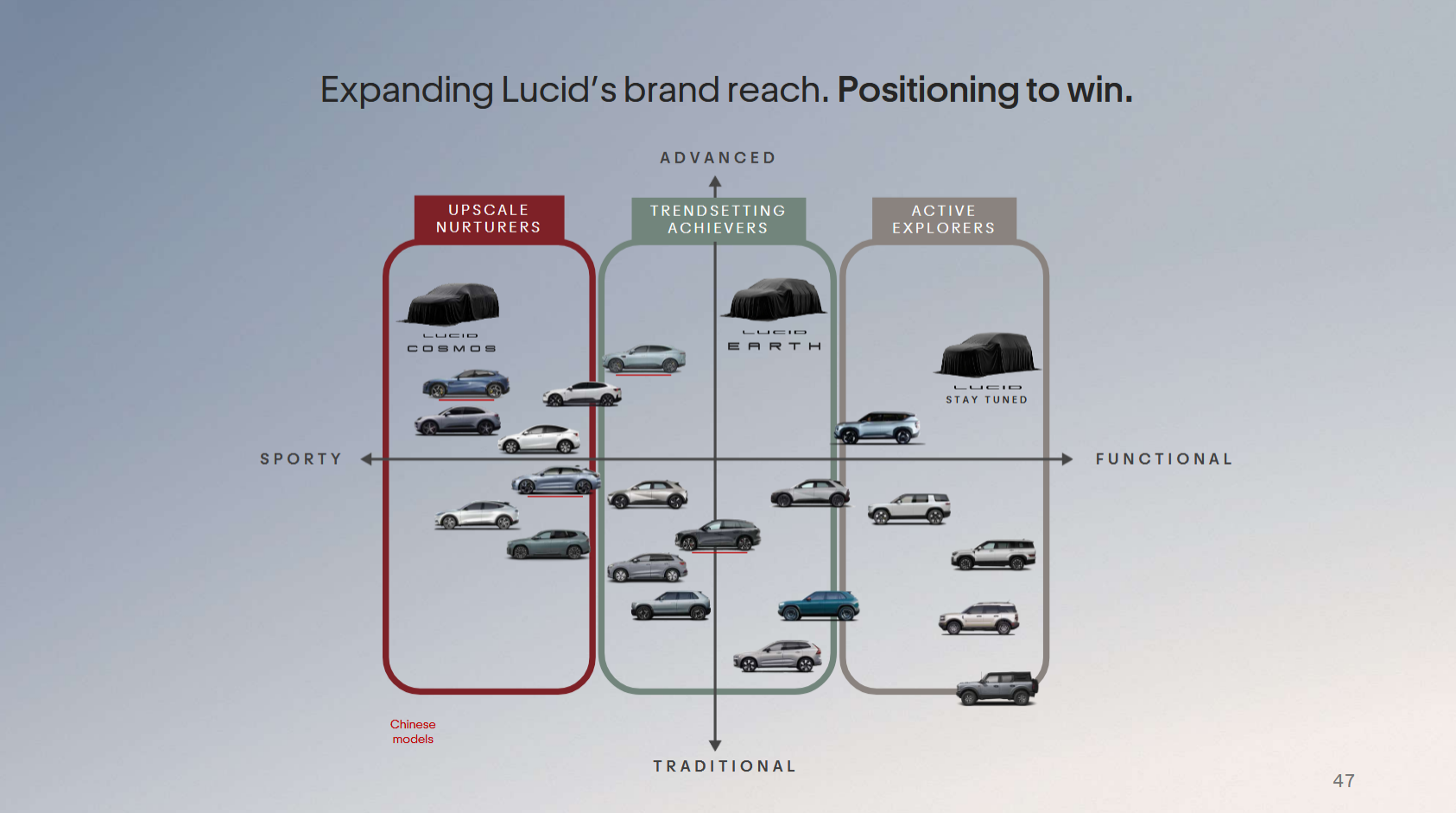
Lucid tells investors that the Cosmos and Earth will appeal to adventure-seekers. That’s a buzz term these days, but it’s worth looking at how the brand sees these products in the greater market. In a slide featuring a graph of “sporty to functional” and “Advanced to traditional,” it plotted each of its three upcoming midsize offerings.
The Cosmos is slated to be the performance vehicle in the fleet. Lucid places it high on “advanced and sporty” in its graph that appears to feature some very strange cars around it. Lucid claims a 0-60 mph time of 3.5 seconds or less. The Earth appears just as advanced in the company’s presentation but leans more toward the functional side of the spectrum.
The unnamed third Lucid model will be the most functional of the bunch and about as far from sporty as it can get. Will that be a van then? Only time will tell, but it does look quite large.
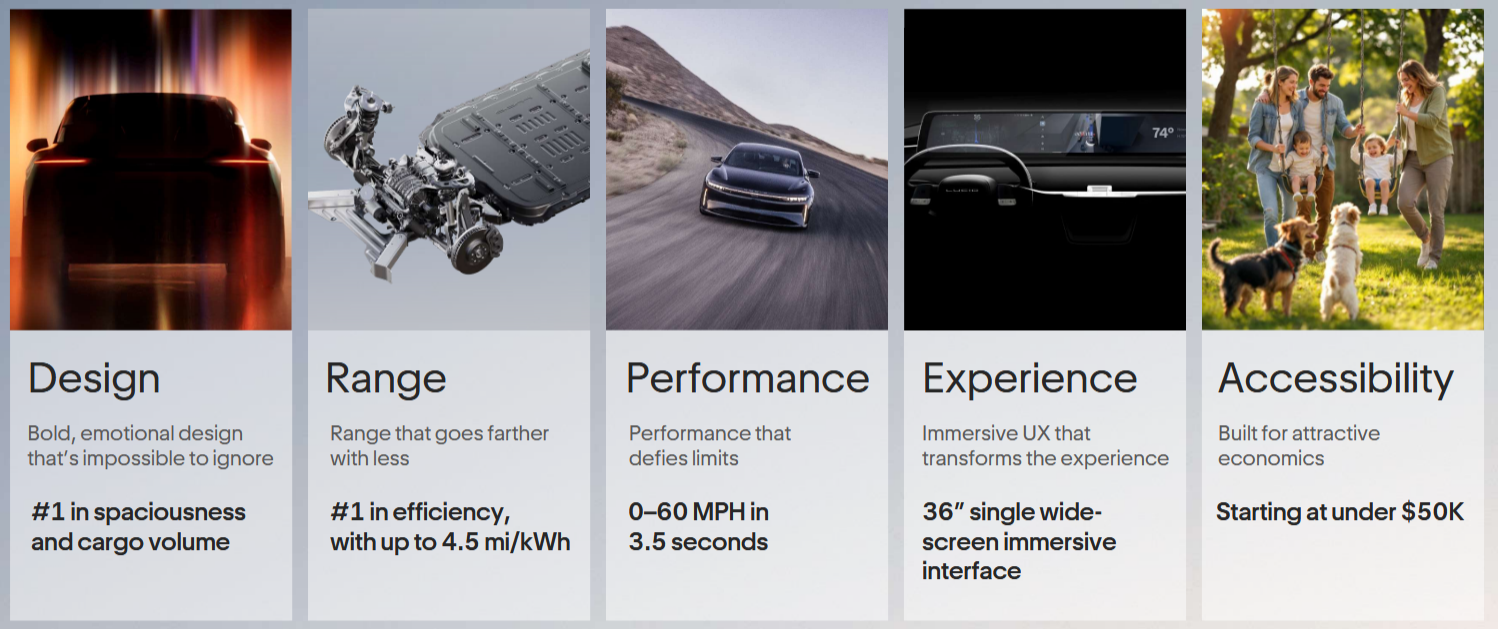
That said, expect vehicles on the platform to start at under $50,000 once available. It’s unclear at this point when those models will arrive. If Lucid does things the same way it did with the Gravity and Air, the expensive top trims will drop first with the lower-cost options showing up much later.
A Giant Role
Earth and Cosmos might sound like names that are too big for their britches, but for Lucid, they’re fitting because these cars and this platform could be what makes or breaks the brand. The company’s robotaxi plans rest on the architecture, as do its autonomy hopes. That includes monthly subscriptions, which are what the brand calls the best monetization opportunity ahead.
In addition, by moving into lower price segments and sharing components across multiple models, the company expects to increase production volume, reduce costs, and generate the kind of margins it hasn’t been able to achieve with low-volume luxury cars alone.
If the plan works, Lucid’s future lineup will look very different from today’s. Instead of just a high-end sedan and SUV, the brand could soon have a full range of vehicles, from premium luxury models to more affordable EVs, plus autonomous variants built for ride-hailing fleets.
Lucid revealed a two-seat robotaxi and autonomy pricing.
Monthly autonomy subscriptions will run from $69 to $199.
The robotaxi concept rides on Lucid’s new midsize platform.
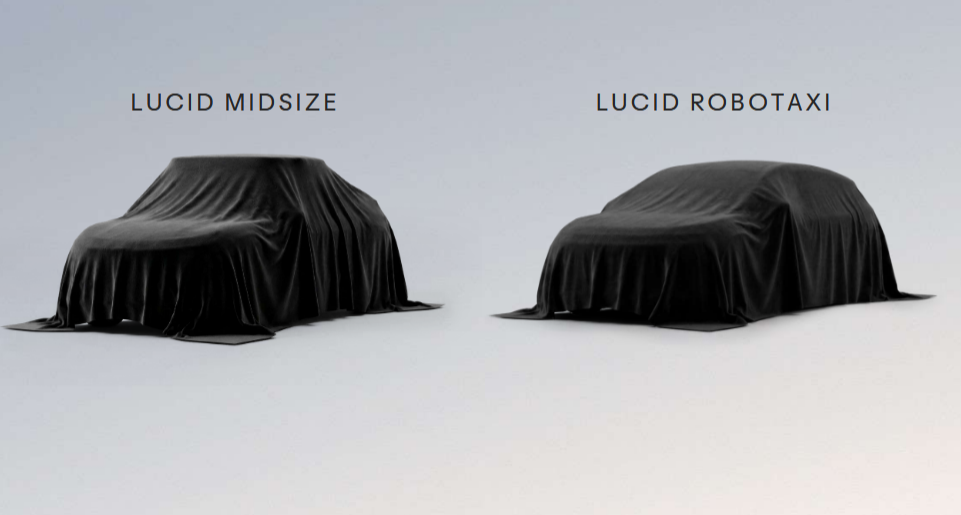
Lucid is officially joining the robotaxi race, and it’s doing so with all-new products. During its investor day presentation on Thursday, the EV startup revealed a two-seat autonomous concept to insiders. Then, it confirmed plans to charge monthly subscription fees for advanced driver-assist and self-driving features in future cars.
The concept, called Lunar, is a purpose-built robotaxi designed without pedals or a steering wheel. It clearly signals that Lucid is serious about fully autonomous ride-hailing rather than just driver-assist technology. This puts the company on the same path as Tesla’s Cybercab program and similar efforts from other EV makers trying to turn autonomy into a long-term revenue stream.
Beyond the prototype reveal, Lucid shared very little technical detail about the Lunar. What it did emphasize is efficiency. The company is targeting between 5.5 and 6 miles per kWh, a figure that could translate to a theoretical range of around 400 miles.
Reaching that number will depend largely on low-drag aerodynamics and a carefully optimized body. Fast charging is also part of the equation, with Lucid claiming the robotaxi could gain more than 200 miles of range in about 15 minutes.
Whether the Lunar ever makes it past the concept stage is less certain, though. For now, the company already has plenty on its plate preparing its upcoming midsize EV lineup for launch, which carries far more weight for the company’s near-term finances.
Subscription Fees For Self Driving
Speaking of revenue, Lucid calls autonomy subscriptions “the single biggest software monetization opportunity.” As such, it’s going to start charging customers to use DreamDrive Pro, the brand’s in-car autonomy suite, on a monthly basis. Starting in the first half of 2027, owners will have to pay anywhere from $69 to $199 a month, depending on the level of autonomy they want.
Lucid says that it has a “Level 4-ready platform available directly from the factory.” While it hasn’t unveiled it to the public, it’ll ride on the brand’s midsize architecture that underpins a few new products heading to market. Lunar will only seat two individuals, so we expect it to have plenty of room for cargo.
That’ll work well with one of Lucid’s partners, Uber. The two are in talks to use the midsize platform in the way that they do Gravity with its robotaxi program.
Timelines
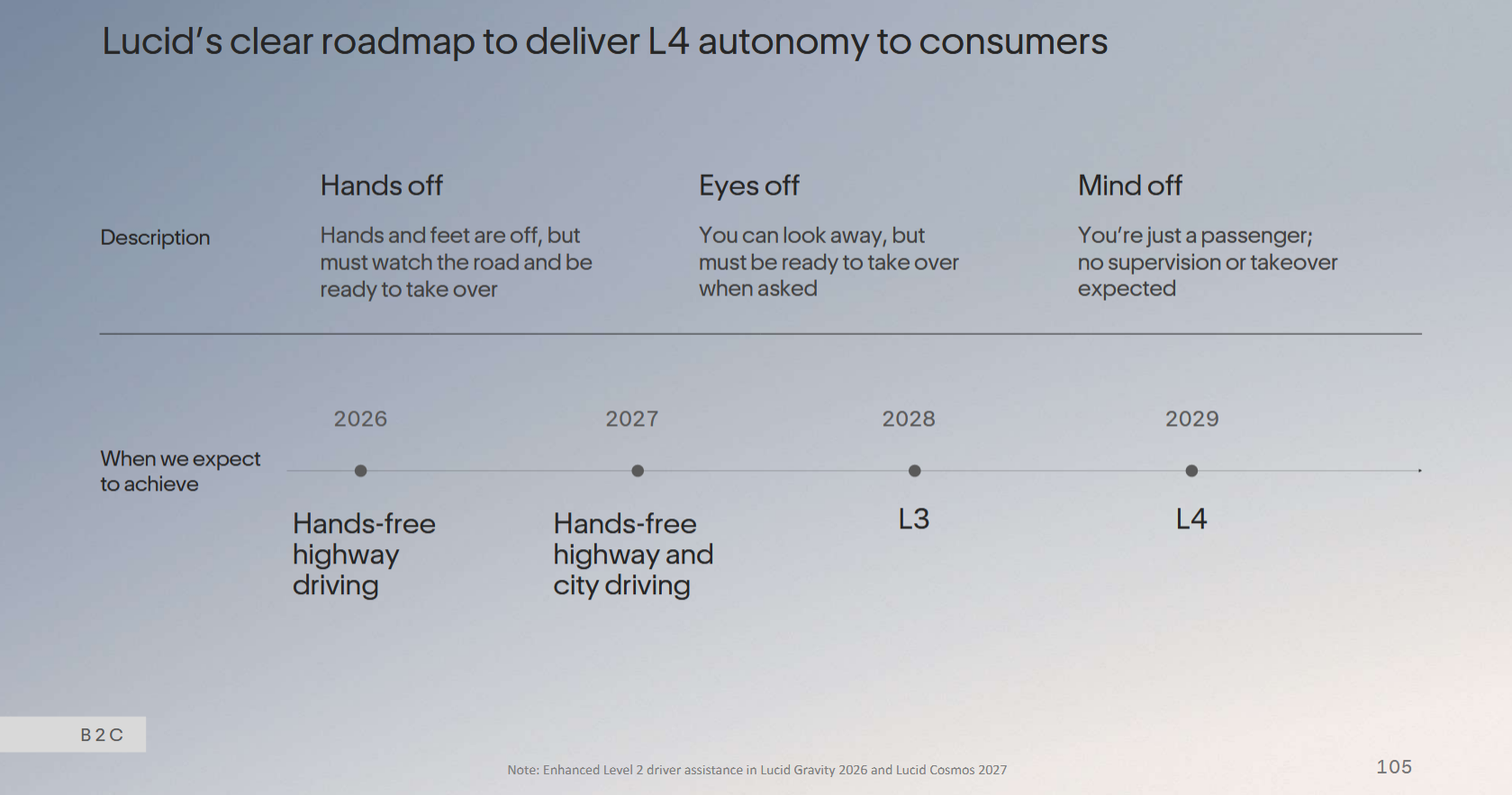
Lucid went as far as to openly lay out its timeline roadmap as well. This year, it believes it’ll offer hands-free highway driving to customers. Next year, it hopes to offer hands-free highway and city driving. In 2028, it wants to achieve Level 3 autonomy. That’s where drivers still need to be ready to take over but the car can mostly navigate on its own.
Level 4, something Lucid is aiming for in 2029, would allow drivers to take their eyes off of the road. Whether or not all of this comes to pass is up for debate, but at least now we know the plan.
Slate Auto appoints former Amazon executive Peter Faricy as CEO.
Chris Barman stays on as President of Vehicles at the EV startup.
Leadership shift arrives before launch of its budget EV pickup.
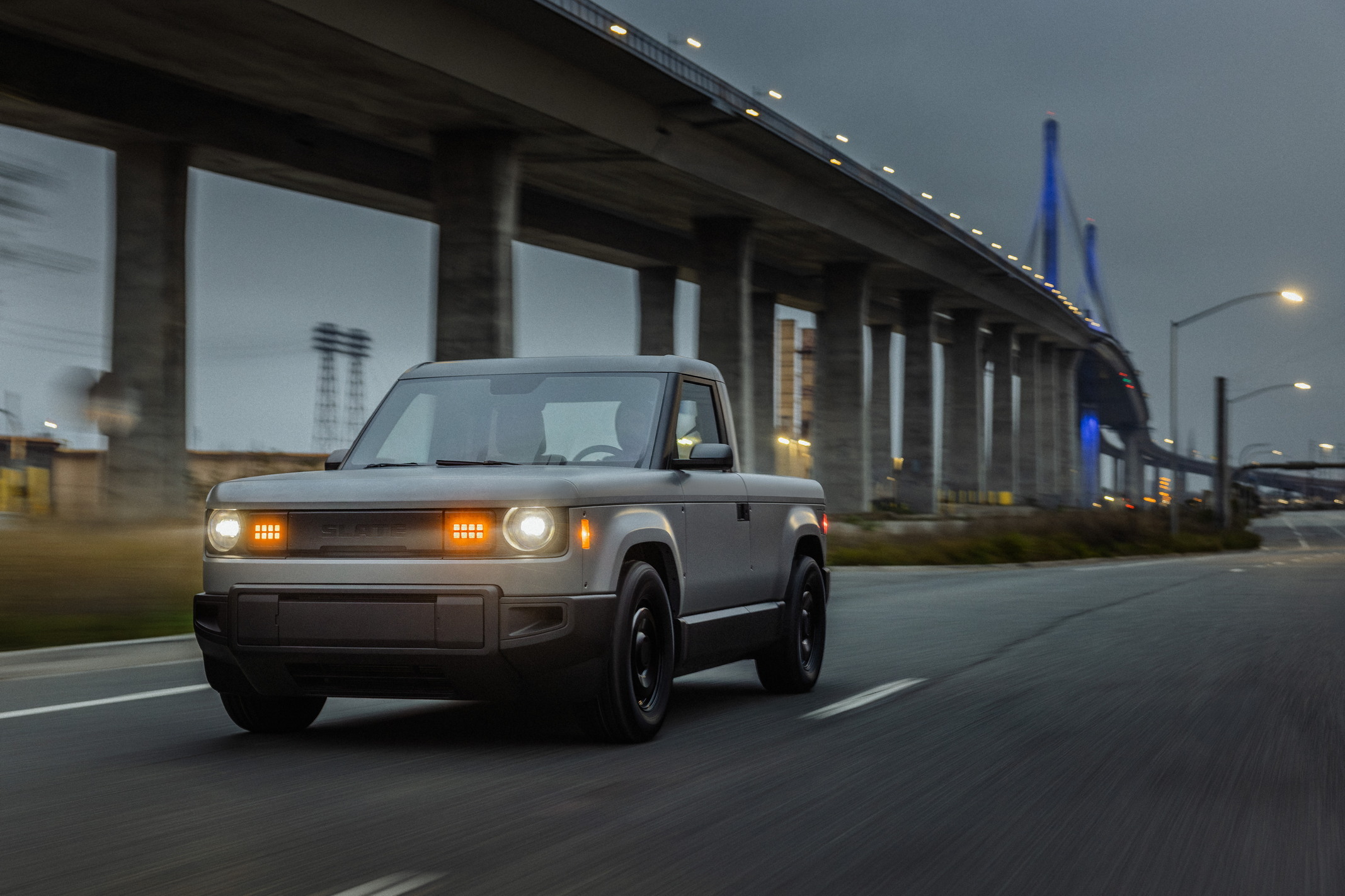
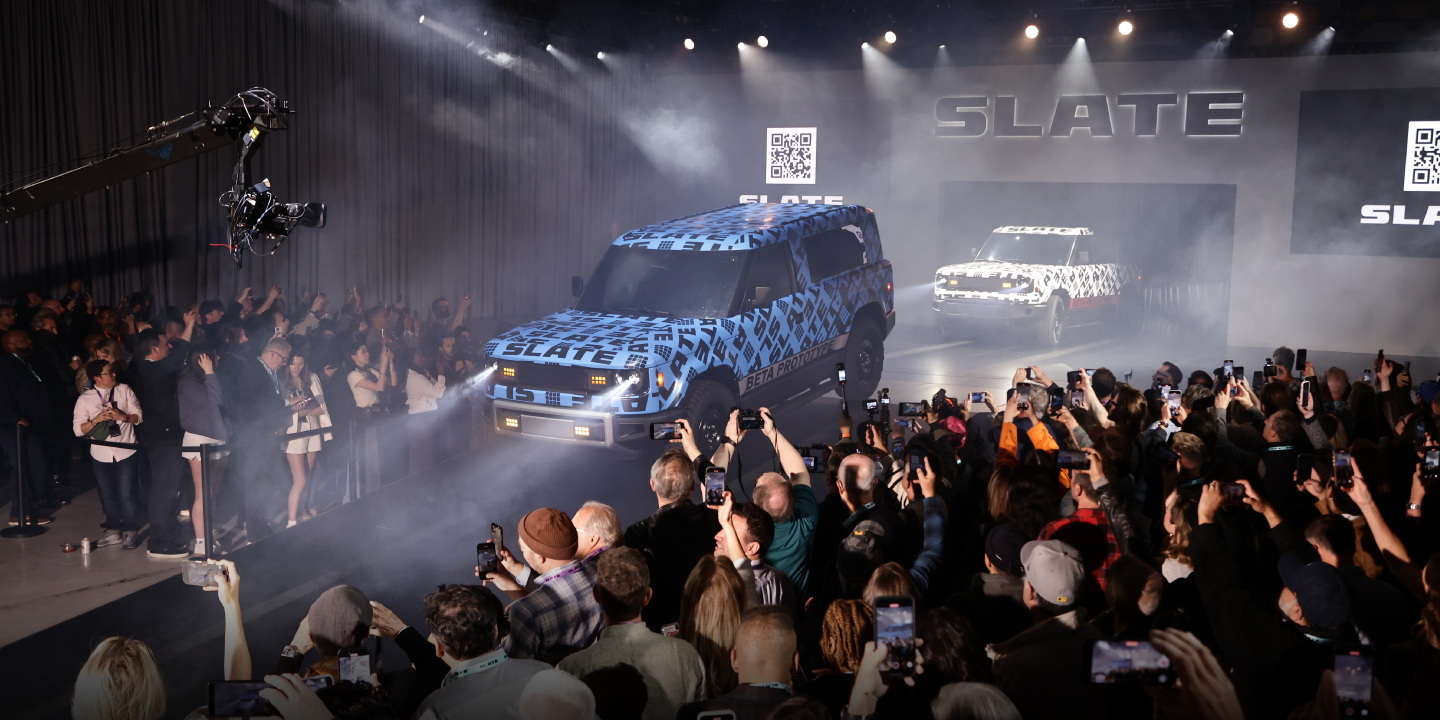
Slate Auto is becoming an example of what a small startup can do with vast amounts of cash. It’s navigated several trials and tribulations and market shifts that other, less well-funded EV startups simply couldn’t survive. Now, it’s handling another as it appoints a new CEO just months before launching its first product, a heavily promoted $25,000-$30,000 electric truck.
The company announced that Peter Faricy, a former Amazon executive, has taken over as Chief Executive Officer, Newsweek reported. He replaces longtime Chrysler veteran Chris Barman, who will remain at the company as President of Vehicles with a focus on engineering, manufacturing, and product development. Keep in mind that Amazon founder Jeff Bezos is an investor in Slate Auto.
The leadership shift comes as Slate prepares to switch from development mode to real-world sales. The startup says customers will soon be able to configure and order their vehicles, with reservations expected to convert into orders by the end of the year.
The Slate Auto pickup is stripped down and simplified to what some would call an extreme degree. For example, it doesn’t have an infotainment screen, it features crank windows, and customers are offered several options to add after initial purchase. The company said it has around 160,000 reservations and believes it can build 150,000 trucks annually at its Indiana manufacturing plant.
The CEO Shift
Slate is going to sell cars direct-to-consumer the same way Rivian, Tesla, and Lucid do. To that end, the shift to Faricy begins to make more sense. He previously worked at Ford before moving through roles at Borders and eventually Amazon, where he spent more than a decade helping build the company’s Marketplace platform into a global ecosystem for third-party sellers.
He later served as CEO of solar company SunPower from 2021 to 2024 and most recently worked with venture capital firm Bessemer Venture Partners.
According to Newsweek, Faricy will oversee the company’s commercial operations, digital strategy, finance, HR, legal, and IT divisions, while Barman focuses on building and delivering the vehicles. One thing is certain: an undertaking of this magnitude can only benefit from more hands on deck.
The Cayenne S Electric sits between the base and Turbo models.
Dual motors deliver up to 657 hp with Launch Control.
New trim starts at $126,300 with summer 2026 deliveries.
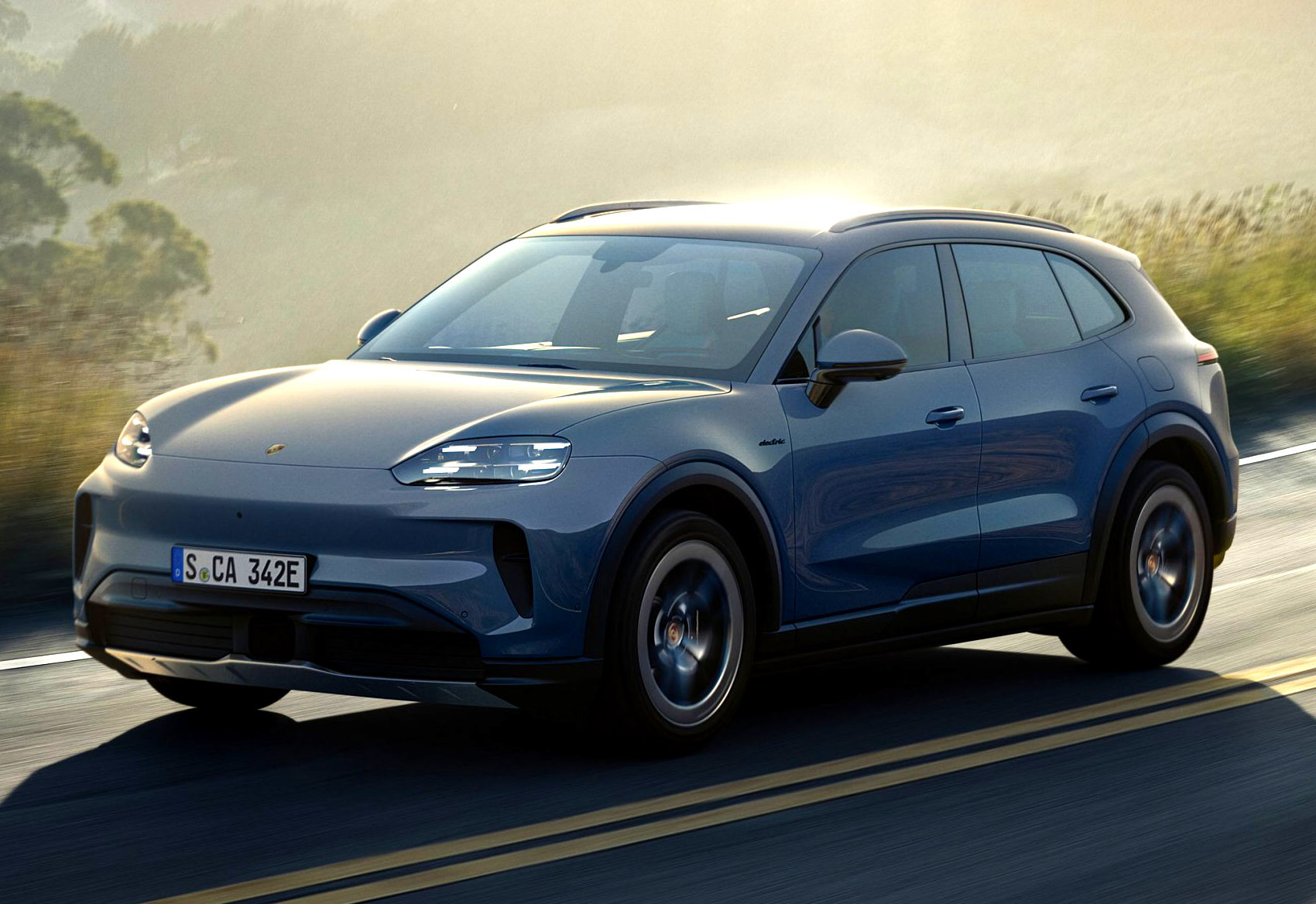
Sometimes the most interesting vehicle in a lineup is not the flagship. Porsche understands this well, which explains the broad mix of trims across much of its range. Now the electric Cayenne gains another variant called simply the S.
Unveiled as the third member of the family, it sits between the base model and the Cayenne Turbo Electric. Even so, it still delivers the sort of power and pace normally associated with something far less practical.
On paper, at least, the numbers are strong. The dual-motor all-wheel-drive setup produces 536 hp (400 kW) in normal operation and up to 657 hp (490 kW) when Launch Control is activated. That’s enough to send the large electric SUV from 0–60 mph (0-96 km/h) in just 3.6 seconds, with a top speed of 155 mph (250 km/h). That’s serious oomph for a large family hauler, and Porsche managed it by borrowing a bit from the top trim.
In comparison, the base Porsche Cayenne Electric produces 435 hp. Engage the overboost function and it will run from 0-60 mph in 4.5 seconds, cover the quarter mile in 13.2 seconds, and eventually top out at 143 mph (230 km/h).
Both electric motors are permanent-magnet synchronous units, and the rear one uses direct oil cooling to manage heat under heavy loads. Unlike most EV motor cooling systems, Porsche’s setup extracts heat directly from current-carrying components. That helps the car sustain performance through better efficiency. The rear inverter also uses silicon-carbide semiconductors that can handle a current of up to 620 amps.
Those looking to really make their new Cayenne S shine can add a few different packages, including Porsche Active Ride suspension, Porsche Torque Vectoring Plus, Porsche Ceramic Composite Brakes, and the Sport Chrono Package with push-to-pass. Notably, that last one boosts output by an additional 120 hp (90 kW) for up to ten seconds.
Charging And Design
The Cayenne S is not only quick off the line. It is also fast at the charger. It uses a 113 kWh battery pack that can charge from 10 to 80 percent in under 16 minutes when connected to a suitable high-speed charger, matching the base model.
The system supports charging speeds of up to 400 kW. The vehicle features a NACS-style connector on the driver’s side and a J1772 port on the passenger side, while a a CCS adapter is also provided with each vehicle. The automaker has yet to confirm the driving range.
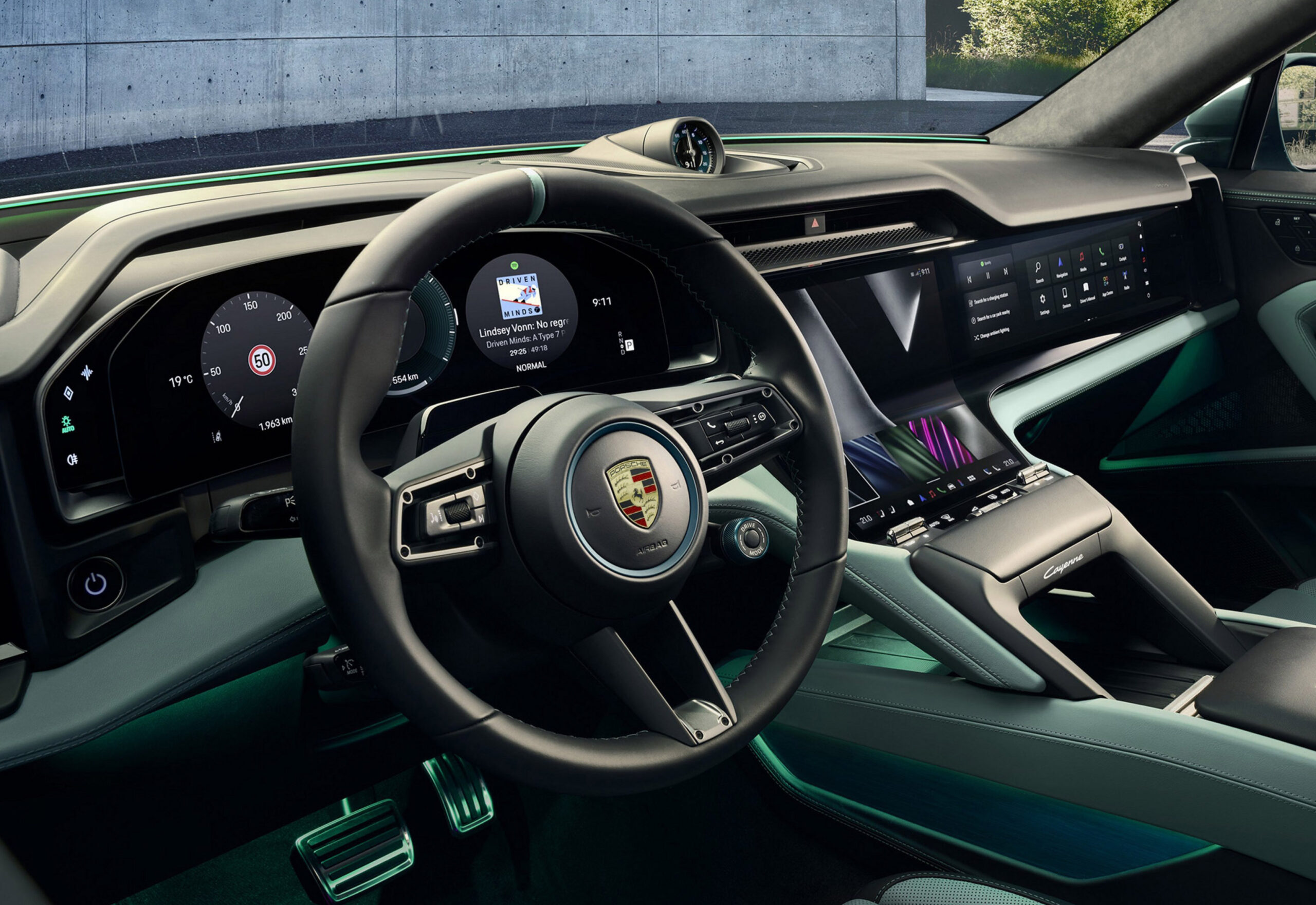
Visually, the S gets model-specific touches such as Volcano Grey Metallic trim on the front and rear fascias and 20-inch Cayenne S Aero wheels. Buyers can choose from 13 exterior colors along with multiple interior customization options. One new personalization option is the “Interior Style Package,” a curated design from Porsche Exclusive Manufaktur that mixes black leather with green accents and matching stitching throughout the cabin.
How Much Does It Cost?
The new Cayenne S Electric is now available to order, priced from $126,300 before a $2,350 delivery fee, with U.S. deliveries expected to begin in late summer 2026. That’s $17,300 more than the base Cayenne Electric. Porsche has also confirmed the 1,139 hp Cayenne Electric Turbo, which is due to arrive later this summer at a price yet to be announced.
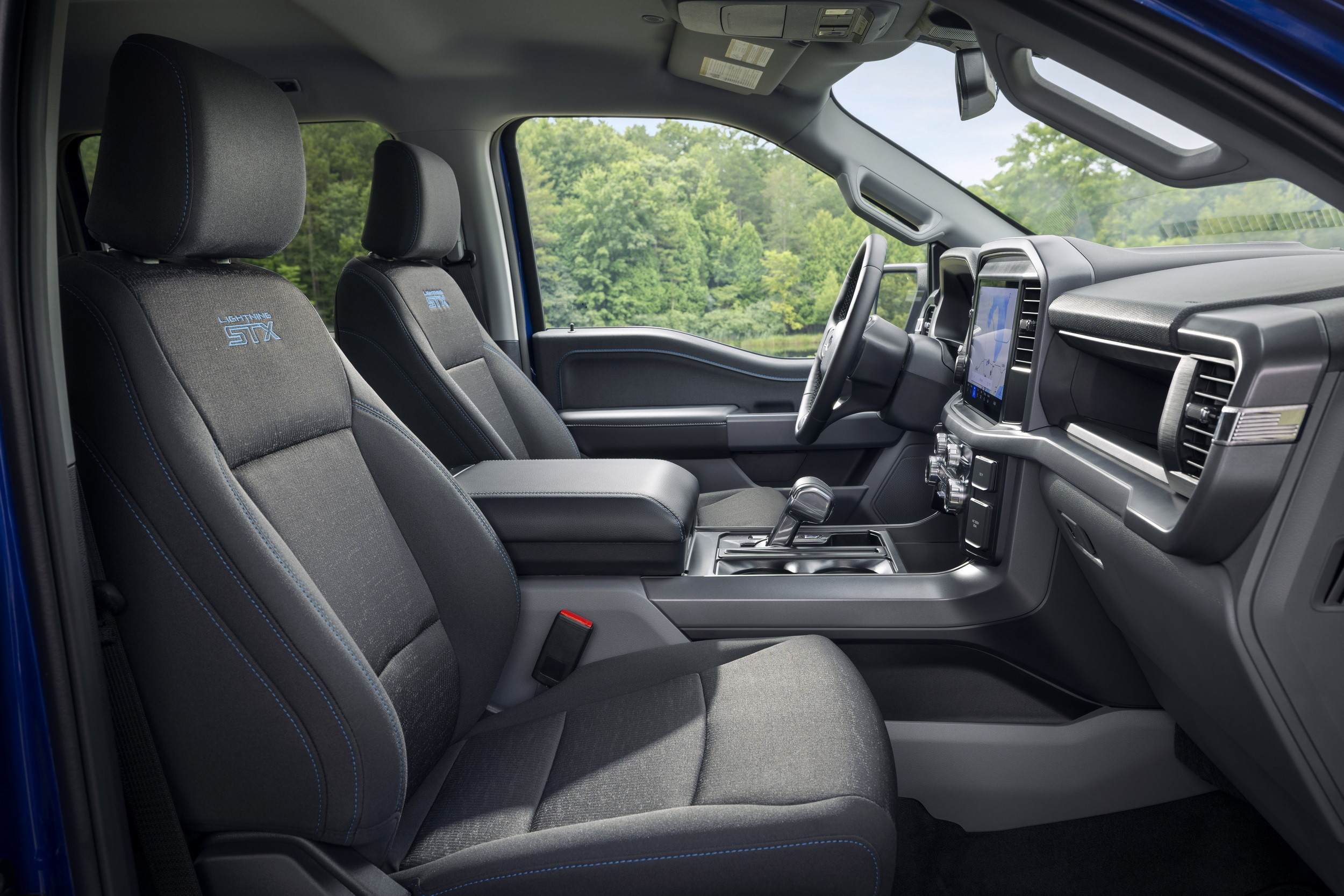
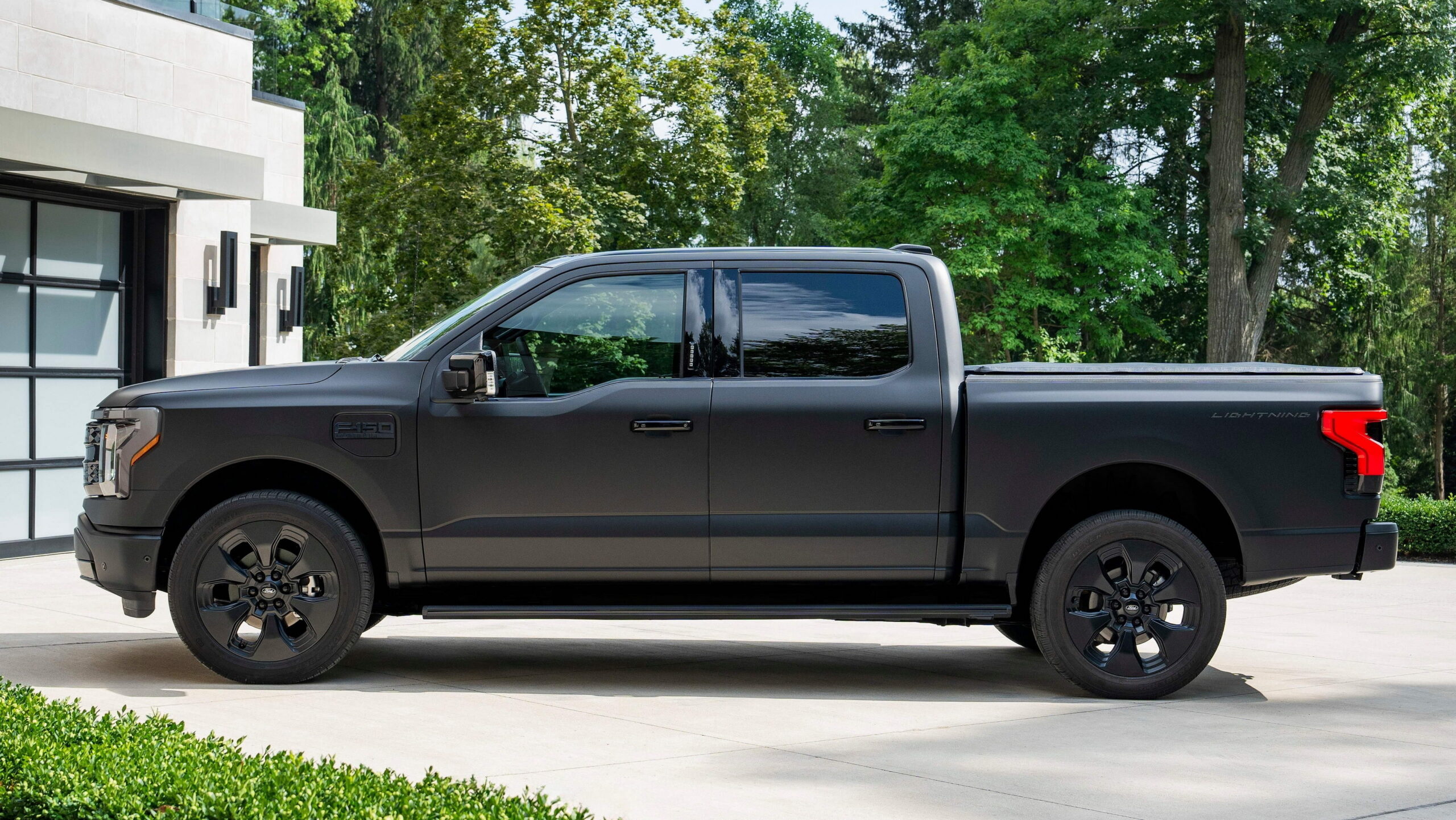
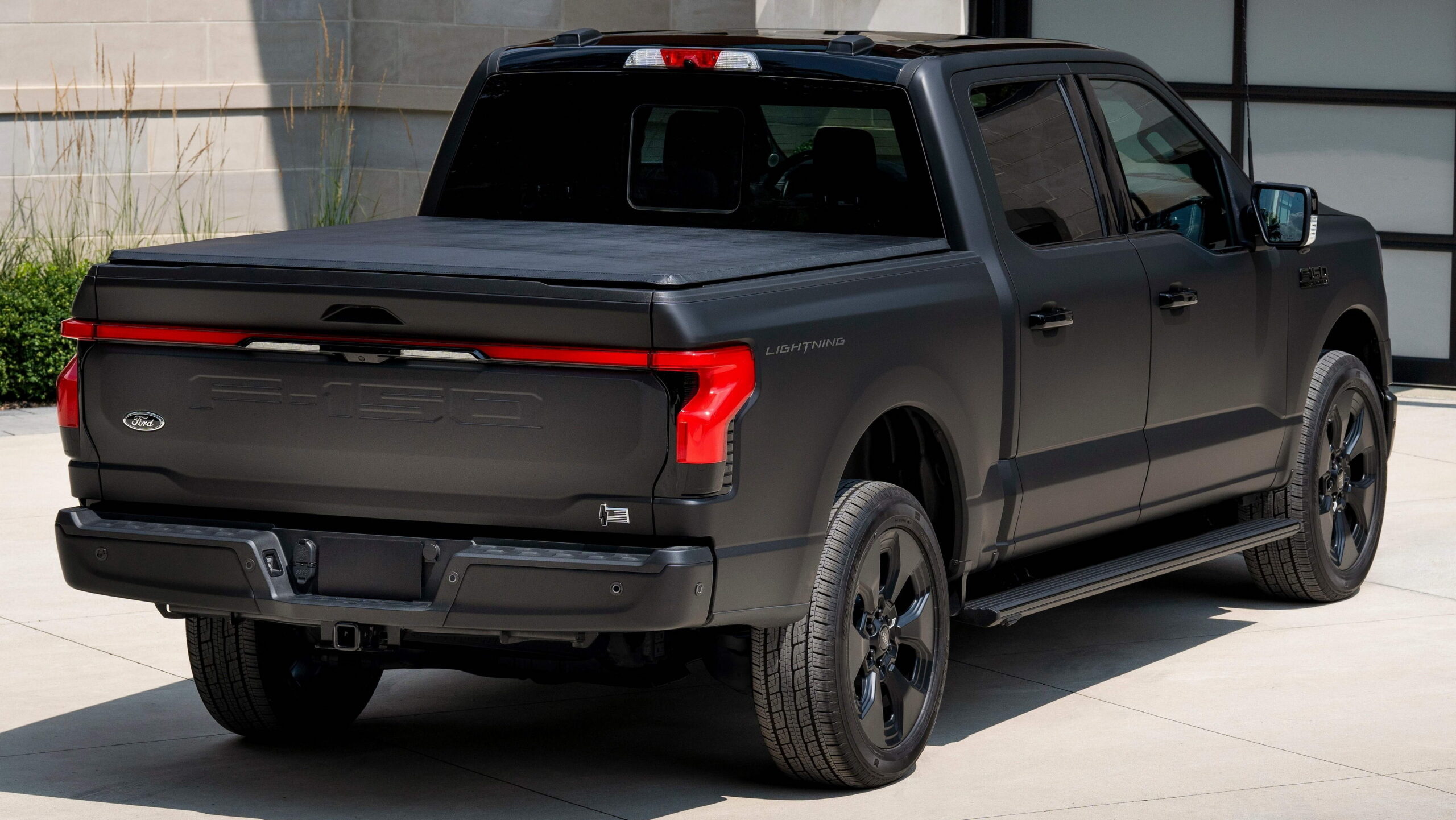
Jim Farley says Ford misread post-pandemic EV demand signals.
The F-150 Lightning will return as a 700-mile extended-range truck.
Ford’s new strategy prioritizes cost control and mainstream practicality.
The last decade has seen the automotive industry tipped on its head, and it hasn’t completely righted itself even now. Ford’s CEO Jim Farley says that shift is part of what led the brand to take missteps as he now sees them around the F-150 Lightning.
Now that the brand is pivoting to an extended range version of the truck, he’s spilling details on how the first Lightning got off to a hot start and then burned out fast.
After losing billions on its first-generation electric vehicles, Ford has scrapped its next-gen electric truck, canceled multiple three-row EV crossovers, and pulled the plug on a next-generation van. All of those choices have come down to what Farley says was an initial mis-reading of the market.
In a recent interview with CarAndDriver, he admits about the F-150 Lighting, “I totally would’ve done it differently. I mean, look, we didn’t know what we didn’t know… COVID totally was a false signal. Post-COVID, and during the chip crisis that was a result of it, there was such high demand for all vehicles. If you could build a vehicle, you were going to sell it basically at 30 or 40 percent higher prices than before COVID.”
Despite that big boom in profit, the reality was that production costs were too high to remain sustainable, says Farley. “I guess it didn’t take us long to learn that our internal-combustion-engine prejudice was so high that we hadn’t designed the [electric] cars right. We had a Mustang [Mach-E], we had an E-Transit, we had a Lightning, and people loved these products. The problem was they were never going to pay the cost we put into the vehicle.”
Tesla’s Big Assists
How did Farley come to this realization? As it turns out, Tesla had a hand in it.
“When we ripped apart a Tesla with Doug Field [Ford’s chief officer for EVs, digital, and design, formerly of Apple and Tesla], I was just absolutely flabbergasted,” Farley told the magazine.
“The Mach-E’s wiring harness was 70 pounds heavier and 1.6 kilometers longer. We didn’t know what was going on in [Tesla engineers’ ] minds. But now we understand. They had no prejudice. We had prejudice. We’d gone to our supply-chain person and said, ‘Buy another wiring harness.’ [Tesla] said, ‘Let’s design the vehicle for the lowest, smallest battery.’ Totally different approach.”
That shift might have played a role in Ford moving to a 48v architecture for its upcoming EV pickup. Tesla famously sent an instruction manual on building such a vehicle to Ford and other competitors. Not only does it help the brand save money on material costs, but it should also help the final product weigh less and have a longer range as a result.
While the first-gen Lightning might be something Ford wishes it could redo, it’s clear that the brand is going into the second generation with an all-new vision.
Rivian is offering $749 per month leases on 2026 R1 models.
Select configurations also qualify for a $3,000 lease bonus.
Approval by March 19 and delivery by March 31 are required.
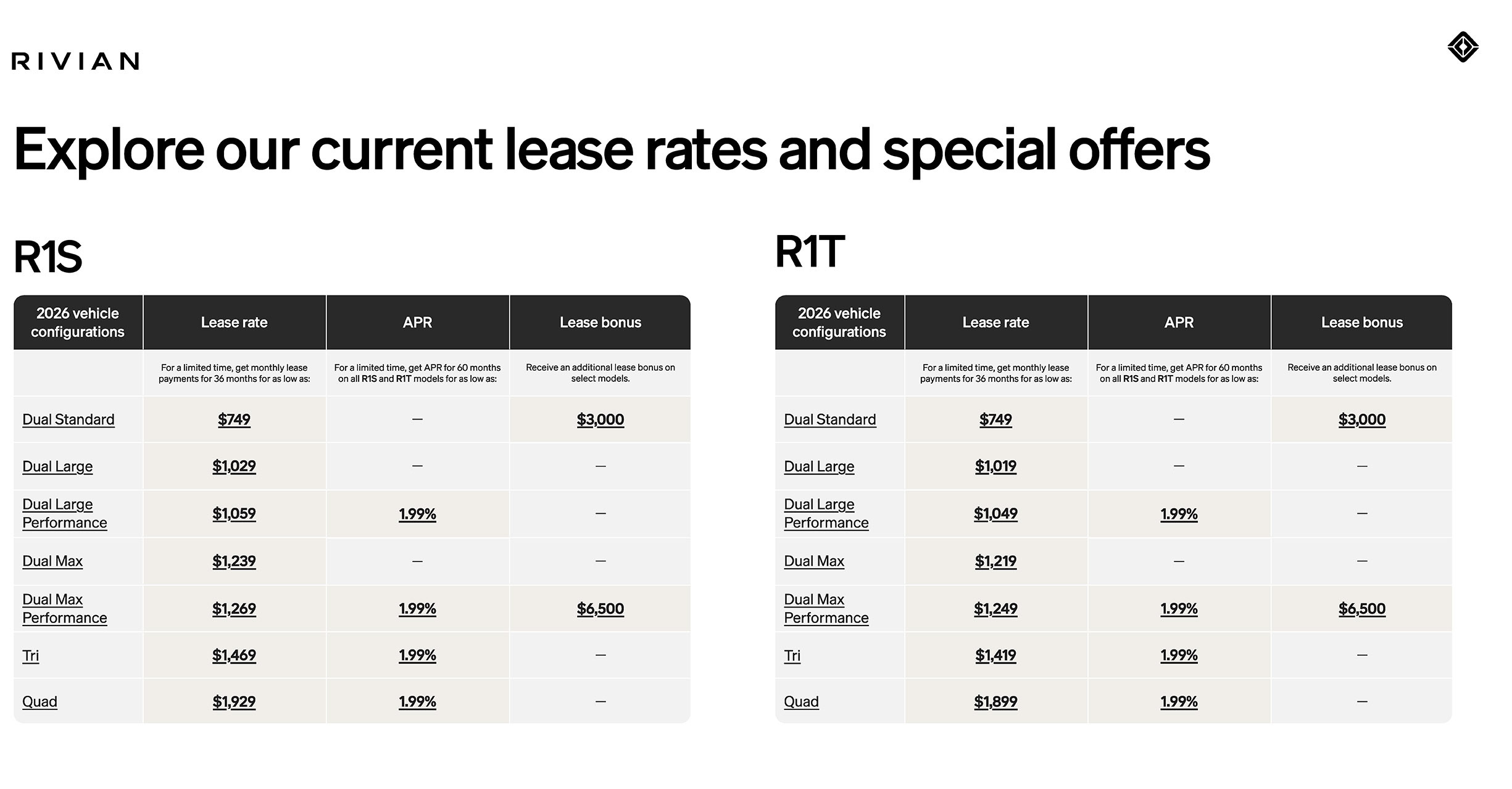
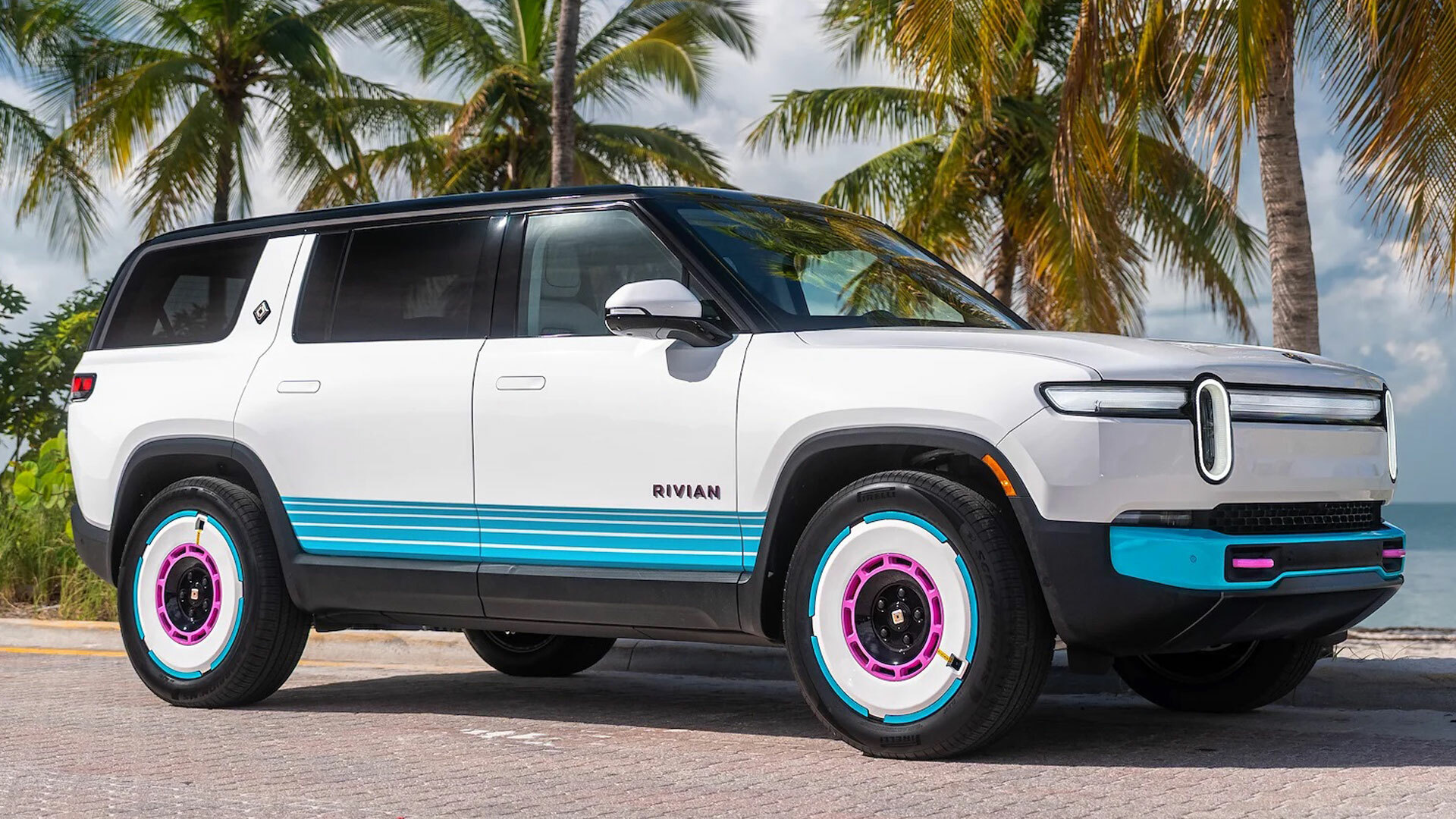
Electric pickups aren’t exactly inexpensive at this stage in history. Now, Rivian, the first automaker to bring an electric truck to market, is trying to lower the barrier to entry. It’s doing so by extending a short-term deal on its 2026 R1 lineup. Buyers can now get monthly payments starting at $749 for 36 months, along with a $3,000 lease bonus on certain configurations.
Naturally, as with most lease deals splashed across a homepage, the headline number only tells part of the story. To secure that $749 per month figure, you need to opt for the Dual Standard versions of the 2026 R1T pickup or R1S SUV, which start at $72,990 and $76,990, respectively.
The Bit They Do Not Put In The Big Font
Then there is the small issue of $5,644 due at signing, and that is assuming you qualify for Rivian’s $3,000 lease contribution. Miss out on that incentive and the down payment climbs to $8,644.
Run the numbers and the effective monthly cost lands closer to $906, or $989 if you do not get the $3,000 contribution. In other words, still competitive for a six-figure-adjacent electric truck or SUV, but far from the tidier $749 the banner suggests.
As we have said before, down payments on leases are best avoided. If something unfortunate happens five minutes after you leave the lot, that upfront cash is effectively gone, even if insurance covers the vehicle itself.
Wait, There’s More
Also keep in mind that none of those numbers include the usual extras due at signing, including tax, title, license, registration, and lessor documentation fees. As ever, the asterisk is doing a fair bit of work.
Just as importantly, these trims represent the most affordable way into Rivian’s electric adventure lineup. If you cannot find a base model, the price only moves in one direction. Furthermore, there’s a deadline looming. To qualify, customers must have their lease approved by March 19 and take delivery by March 31. That leaves a fairly tight window to spec it, sign it, and actually get the keys.
This Deal Doesn’t Apply To More Expensive Models
Don’t expect this payment plan to help out on the more luxurious and desirable R1 vehicles. For example, the Dual Large battery versions start around $1,019–$1,029 per month with a hefty downpayment, while stepping into Dual Max models pushes payments past $1,200 monthly. The performance-oriented trims climb even higher.
Rivian lists the Tri-motor versions starting around $1,419–$1,469 per month, again with a downpayment, and it doesn’t stop there. The flagship Quad-motor models approach $1,900 per month, depending on whether you choose the truck or SUV. For buyers considering financing instead of leasing, Rivian is also offering APR rates as low as 1.99 percent for 60 months on some configurations.
All of this is no doubt one more example of an electric automaker doing what it can to make payments manageable in a market with cooling demand. That said, interested buyers need to sign up before March 19th if they want to take advantage of the deal.
About 31.5 percent of tested chargers fell outside limits.
Some units delivered far less energy than shown.
Public charging costs and taxes add to driver concerns.
Refueling is something most drivers don’t think about too much. They plug in or insert a fuel nozzle, press go, and wait to see how bad the bank account damage is in the end. Now, EV drivers in the UK might be thinking twice before they plug in at a public charging station. A new study found that almost one in three mis-calculated the energy provided during a session.
According to independent inspection provider EVCI Global, 31.5 percent of the chargers it reviewed either overestimated or underestimated the energy transferred to vehicles. In roughly 15 percent of cases, errors exceeded five percent, with a small number showing what the company described as “materially larger deviations.”
EVCI says this effectively leaves EV drivers carrying more financial risk than petrol car owners, who enjoy far tighter oversight every time they pull up to a pump.
The study, first reported by The Telegraph, highlights how different standards are for EV chargers when compared to gas or diesel fuel pumps. Fuel dispensers are subject to strict statutory verification and typically must operate within a tolerance of -0.5 to +1 percent.
By contrast, most public EV charge point meters are allowed a margin of error of up to +2 percent. Even so, EVCI says nearly a third of the units it tested fell outside that permitted window.
The company argues that public chargers should be brought under a formal verification regime similar to fuel pumps. It has also raised the issue with relevant government departments, pushing for clearer oversight and enforcement.
Extreme Cases And Industry Response
In one extreme case cited by CEO Craig Marsden, a charger was found to be delivering 37 percent less electricity than the figure displayed on-screen. Importantly, there were also cases where the chargers actually under-valued the amount of juice they provided, so drivers paid less. The findings have been presented to the Transport Select Committee.
“People with EVs need to know that they’re getting what they’re paying for, the same way that they do at petrol pumps,” Marsden said.
EVCI argues that this situation creates a two-tiered situation where EV owners are at greater risk of losing money. That’s especially true for those who don’t have access to off-street parking and home charging networks. Such individuals rely heavily on public charging infrastructure and could end up paying more than their fair share. A long charging session can exceed £70, and annual costs may approach £2,000. That’s without the errors included.
Industry Response To Accuracy Claims
Industry body ChargeUK has pushed back on the report, saying that the inaccuracies are isolated cases. It also pointed out that measuring electricity transfer is more complex than measuring liquid fuel.
A spokesperson for the Department for Transport told the newspaper that public EV charge points are expected to measure and supply exactly the electricity they claim to deliver. They added that meters at most public chargers are regulated to ensure accuracy within 2 percent.
That said, EV drivers will no doubt want to see a dramatic improvement in the next EVCI report. Otherwise, adoption rates could take a hit.
PROS ›› Lots of utility, genuinely quick, NACS charging CONS ›› Odd shifter, questionable styling, sub-330-mile range
Subaru’s first EV, the Solterra, didn’t exactly set the world alight. Lukewarm demand and an awkward early recall made it feel more like a cautious toe-dip into electrification than a confident leap.
The 2026 Trailseeker is the opposite. It’s bigger, quicker, and more capable. And somehow, almost by accident, it has become the most powerful and fastest production Subaru ever built.
That alone would make it worth a look. But here’s where it gets interesting. We didn’t test the loaded Touring trim dripping in features. We didn’t even grab the mid-tier Limited. Instead, we spent a full week with the Trailseeker Premium, which, despite the name, is actually the base model. Yes, “Premium” is doing some heavy lifting here. This is the $39,995 version most buyers will realistically consider.
Quick Facts
› Model:
2026 Subaru Trailseeker Premium
› Starting Price:
$39,995 (excluding destination)
› Dimensions:
190.8 L x 73.2 W x 65.9 in H (4,846 x 1,860 x 1,674 mm)
› Wheelbase:
112.2 in (2,850 mm)
› Curb Weight:
4,376–4,453 pounds (1,985–2,020 kg)
› Powertrain:
Dual electric motors / 74.7 kWh battery
› Output:
375 hp (280 kW)
› 0-60 mph:
3.9 seconds (GPS verified)
› Transmission:
Single speed
› Range:
280 miles (452 km)
› On Sale:
First-half of 2026
SWIPE
On paper, it reads like a greatest-hits list for Subaru loyalists. Standard Symmetrical AWD, 8.5 inches (216 mm) of ground clearance, 3,500 pounds of towing, and 375 horsepower (280 kW). That’s not exactly timid. Subaru claims 0-60 mph in 4.4 seconds. We tested it. It’s quicker than that. And after a proper stretch behind the wheel, we’re fairly convinced this so-called base model might be the smartest pick in the entire lineup.
Does It Look The Part?
Photos Stephen Rivers / Carscoops
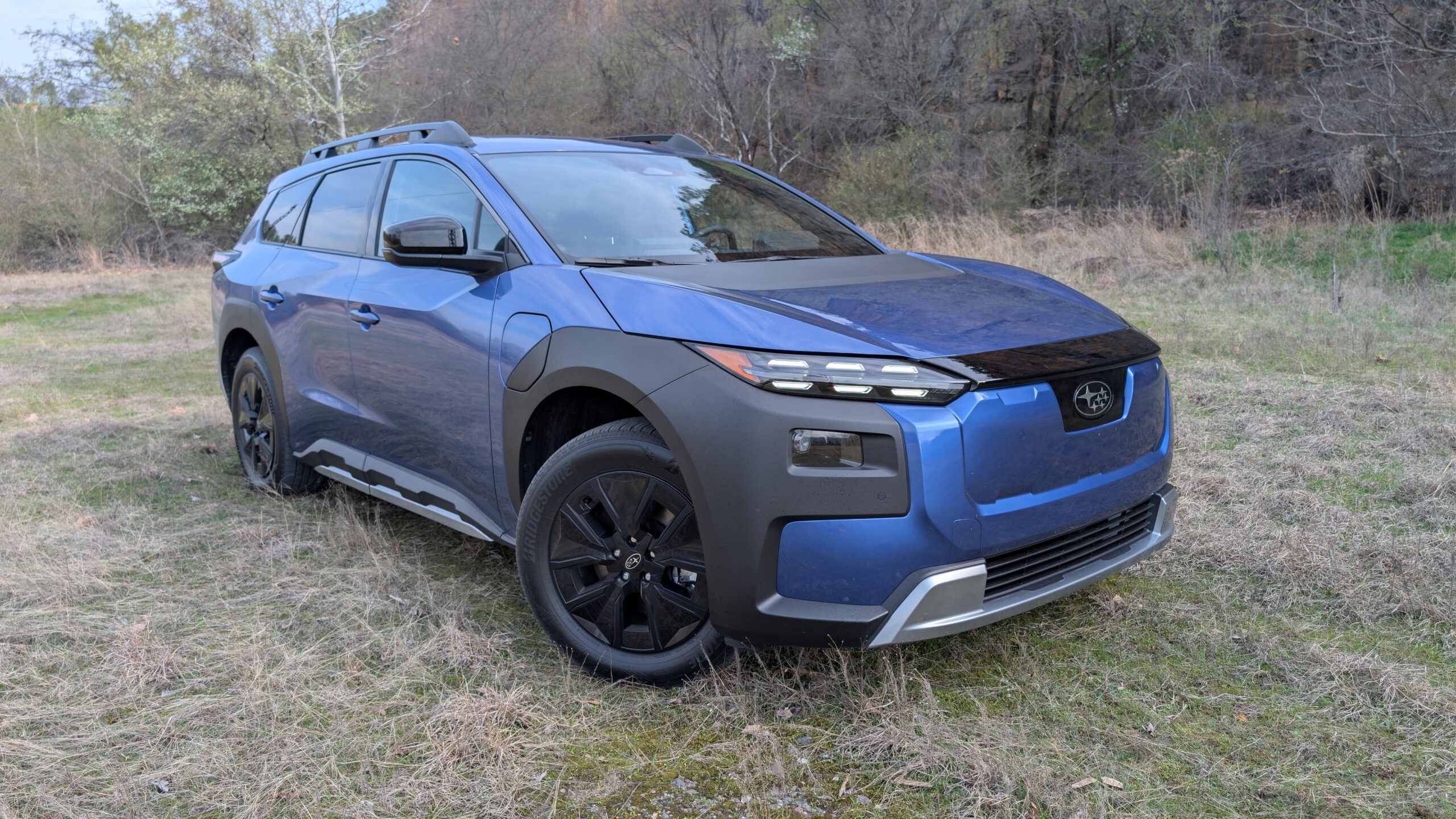
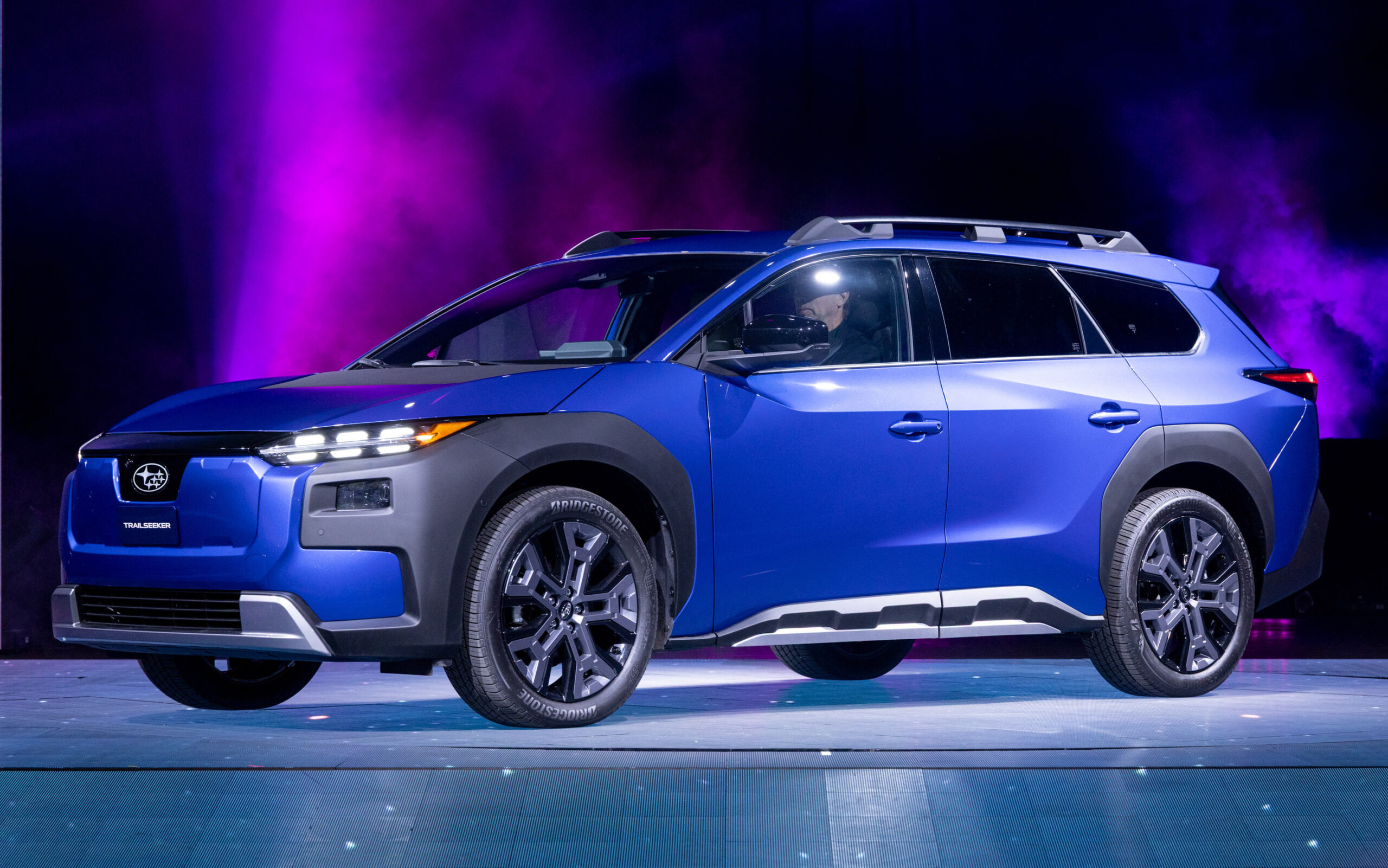
The Trailseeker looks like it belongs on a trailhead, not outside a charging station. Black lower cladding, ladder-style roof rails, squared-off proportions, and a clean light bar give it a tougher presence than the Solterra. It measures 190.8 inches (4,846 mm) long on a 112.2-inch (2,850 mm) wheelbase, stands 65.9 inches (1,674 mm) tall, and rides with best-in-class 8.5 inches (216 mm) of clearance.
That clearance number matters. It puts the Trailseeker Premium ahead of rivals like the VW ID.4, Hyundai Ioniq 5 XRT, and Chevy Blazer EV AWD in pure ride height. That’s something Subaru emphasized heavily in its capability comparison charts. For buyers, it means worrying less when going over deeply rutted paths or rocky roads.
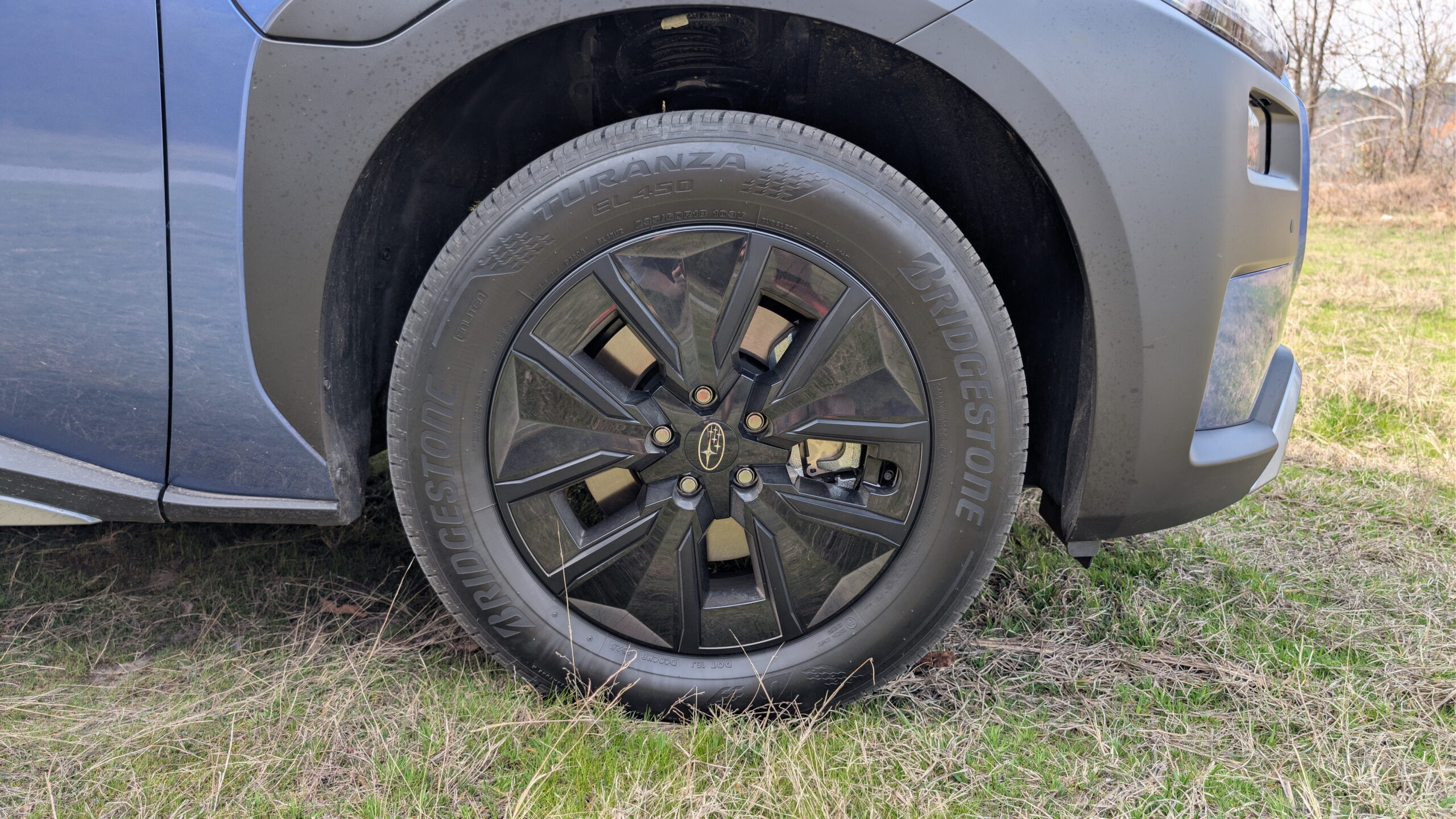
Even on 18-inch wheels with aerodynamic covers (Premium trim), it doesn’t look cheap. If anything, the smaller wheels add sidewall and reinforce the rugged vibe. Having now driven both this and the bZ Woodland, the Subaru appears a bit more cohesive in person. I’m still not sold on all of the plastic cladding, but I’d rather be seen in this than the Toyota personally.
Tell Me About The Interior
Photos Stephen Rivers / Carscoops
This base Trailseeker had me searching for decontenting because it starts at $39,995. As we’ve covered, that’s thousands less than the base bZ Woodland. Despite my efforts, I never found anything that felt like a big letdown compared to the Toyota I tested a few weeks ago. Sure, we don’t have ventilated seats, heated outboard rear seats, or a panoramic sunroof, but honestly, those are luxuries, and what’s already here is pretty great for the money.
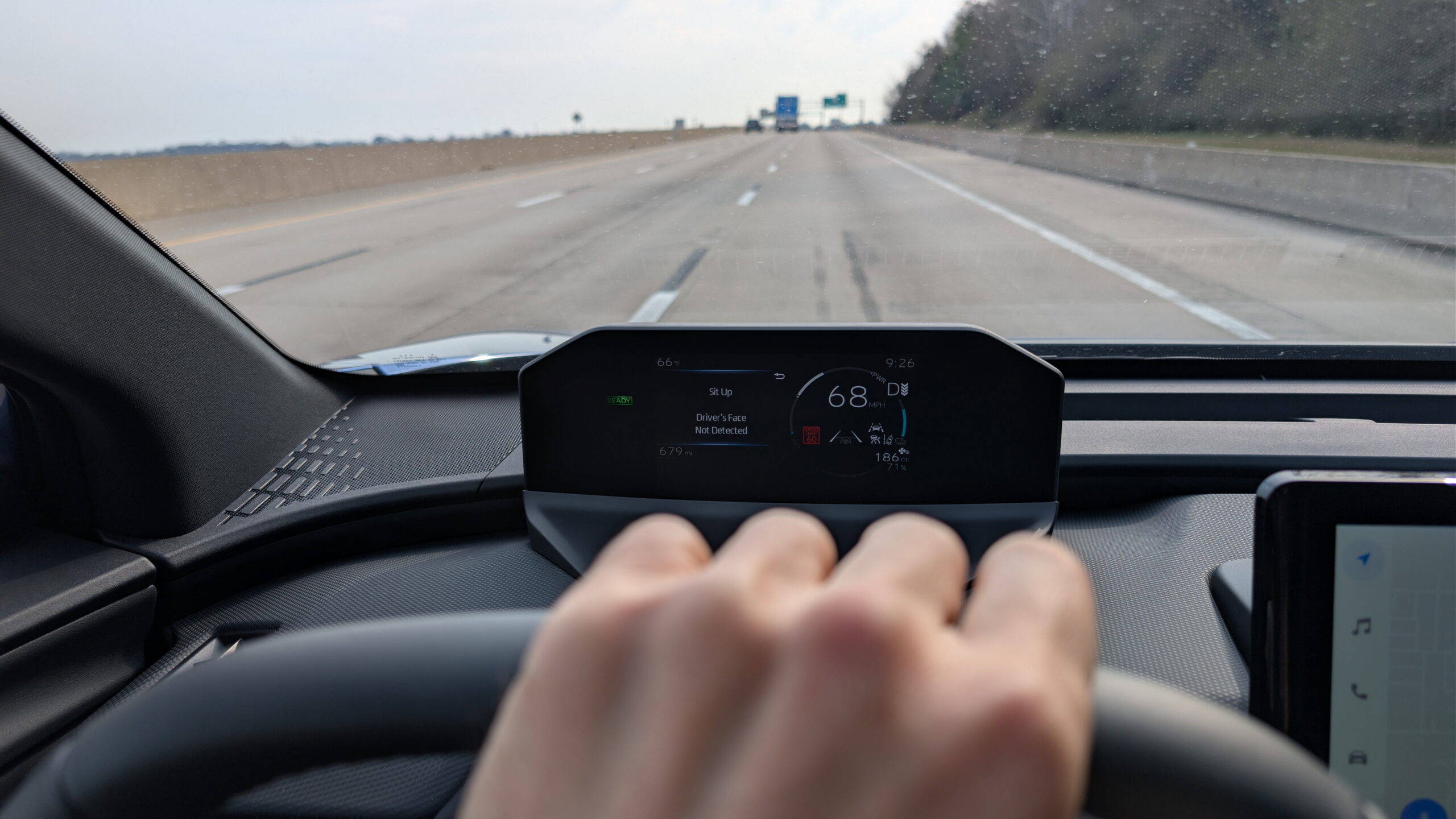
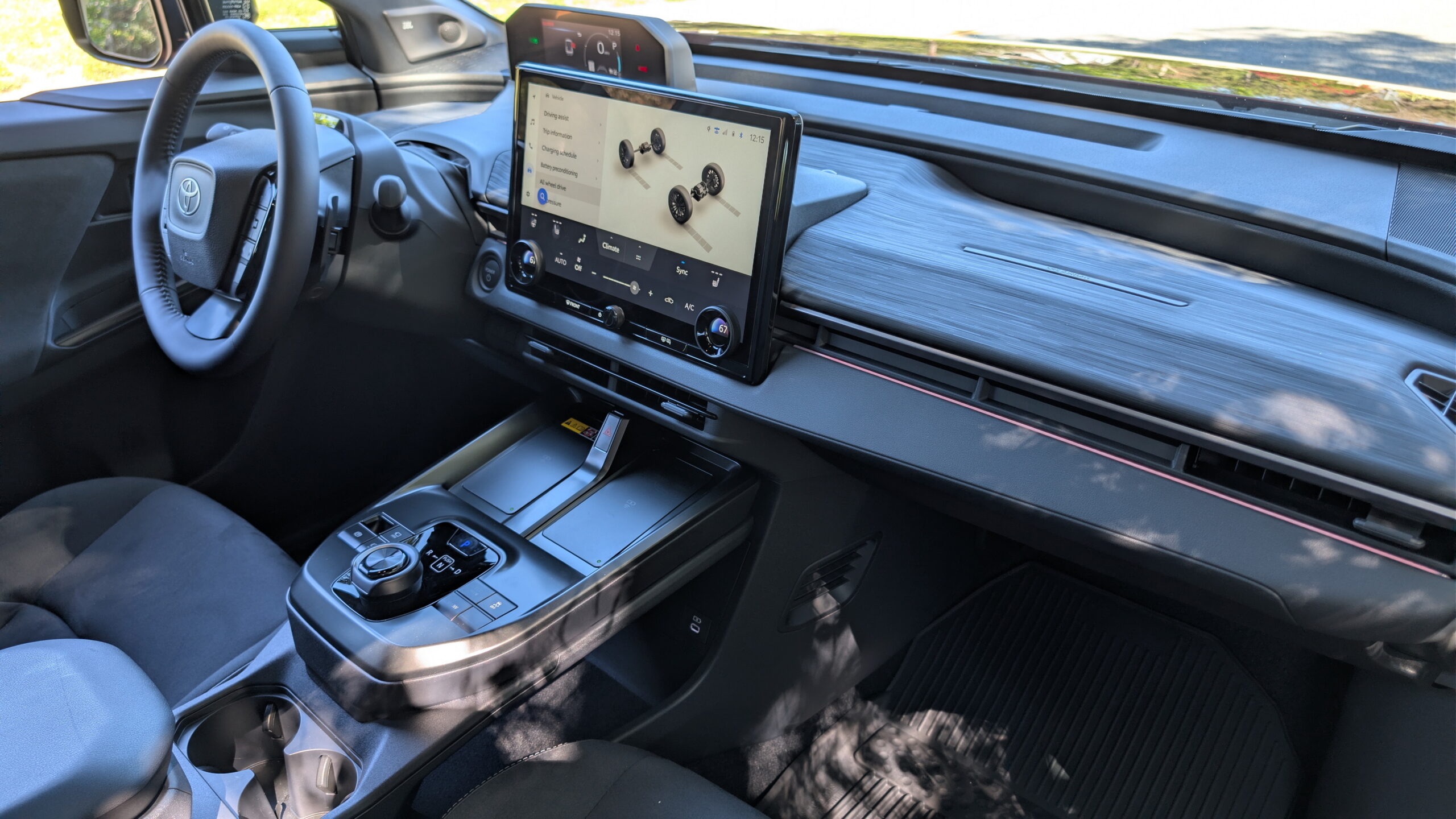
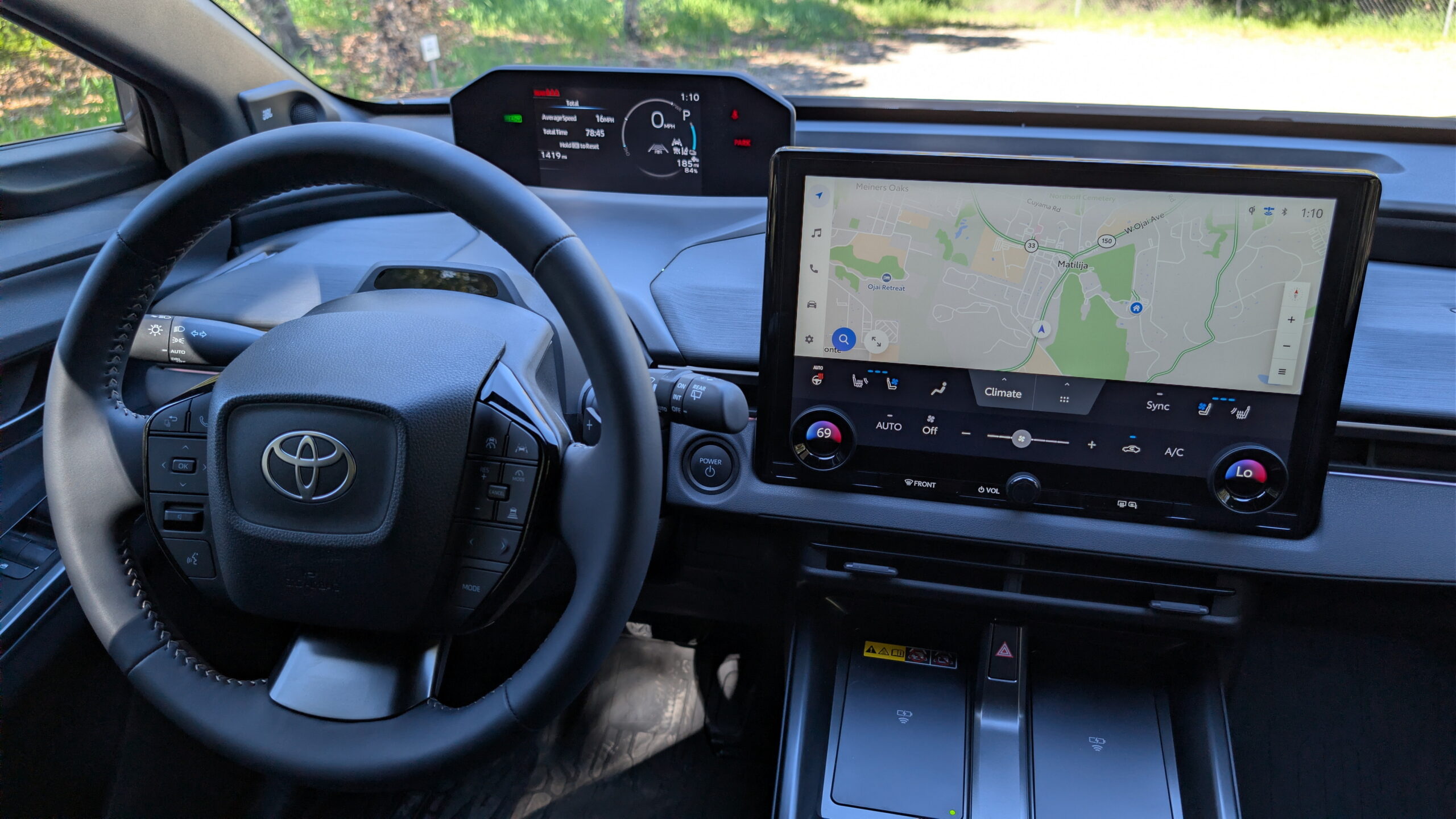
The dash has nice texturing, the steering wheel feels like it’s from the future, and the 14-inch infotainment screen is a massive leap forward for Subaru (thanks, Toyota!). The menu is intuitive and easy to navigate. Physical buttons exist for the volume, media on/off, defrost, hazards, and climate temperature. Fan speed, air flow direction, and heated seat settings are all in the touchscreen itself. It’s not as nice as having physical controls for everything, but it’s better than having none at all.
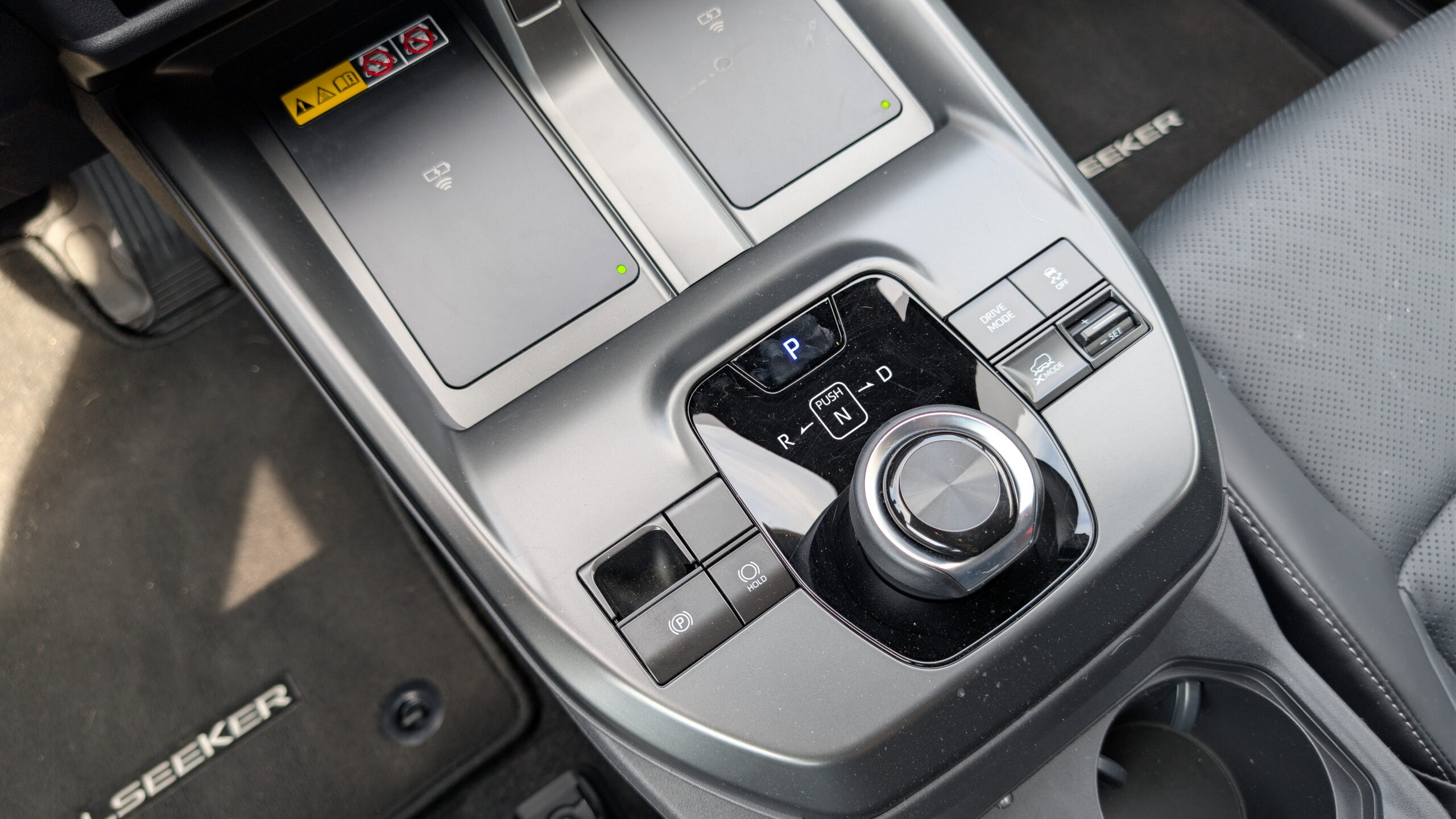
There are dual 15w wireless chargers under the screen, along with a parcel shelf underneath that. It’s key because there’s no glove box, so expect to store things differently in this car than in most others. A small ‘magic’ storage console sits behind the shifter and allows both front seat passengers to open it from their side, which is great. It doesn’t flip over like the one we tested in the latest Toyota RAV4. Speaking of that shifter, it’s one of the weirdest and perhaps least positive parts of this car.
To use it, the driver pushes a ring down and then twists it left or right. Once you’re used to it it’s no big deal, but it does take getting used to. Everyone I handed the keys to needed a quick tutorial. Subaru places driving modes, of which there are three, normal, eco, and power, to the right of the shifter, along with X-Mode, a low-speed cruise control built for off-roading.
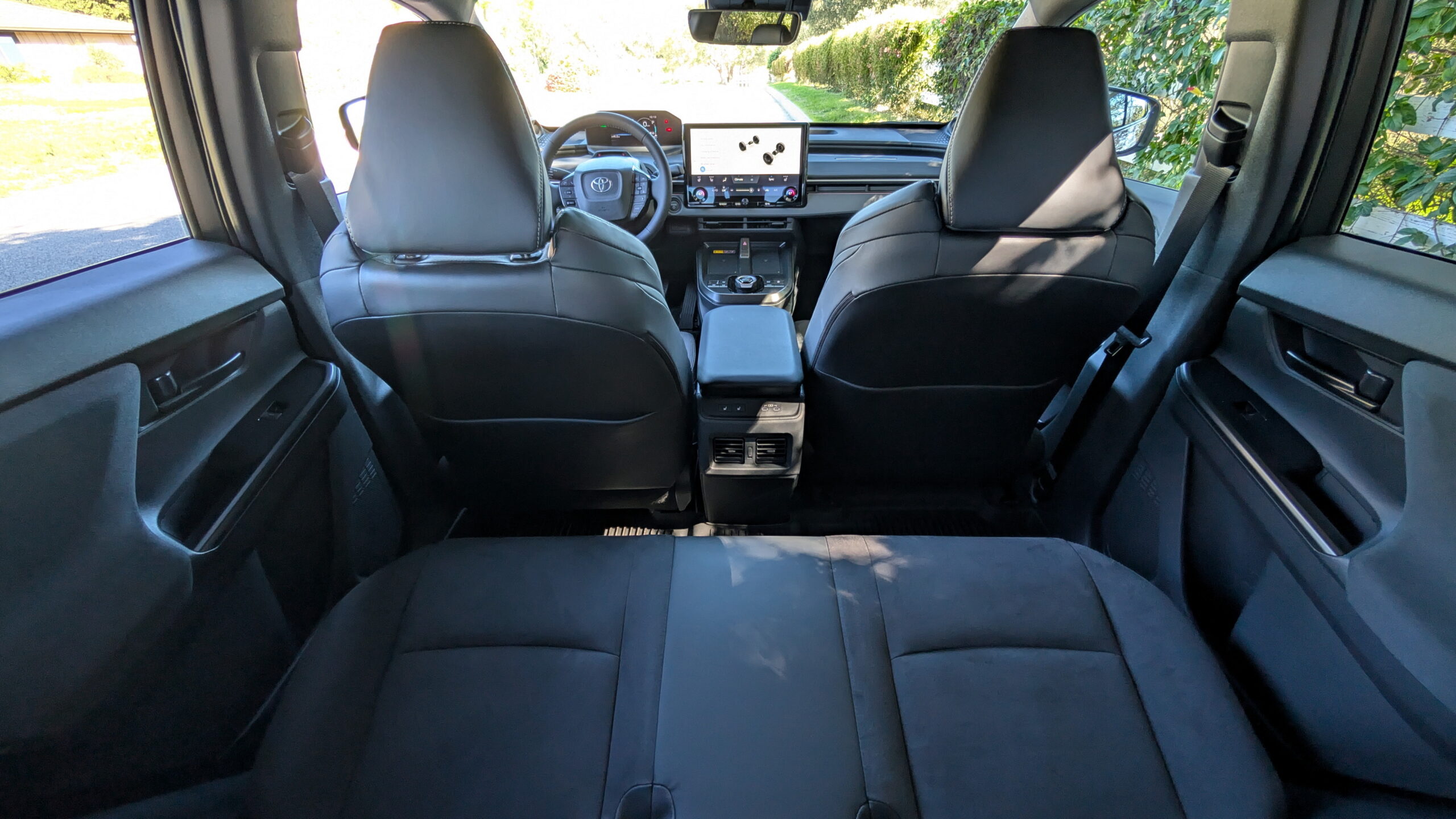
The seating is supportive and comfortable, but lacks the deep adjustability found in more expensive vehicles. That said, I’m happy to report that the Trailseeker can easily accommodate four adults who are above average height. The rear seats have just enough headroom for me at 6’6 to comfortably sit behind my own driving position in front. That’s impressive, though we should note that adding the panoramic sunroof detracts a bit of headroom.
Photos Stephen Rivers / Carscoops
Speaking of space, there are over 30 cubic feet to use in the back of the Trailseeker. That’s a strong figure and reminds us why wagons are so practical in a world full of oversized SUVs. Fold the seats down, and cargo space more than doubles to over 70 cubic feet. That’s not half bad, though we wish Subaru had included a front truck to make that figure even bigger. Those who need even more space can tow up to 3,500 pounds.
Shockingly Quick In Practice
Leave it to Subaru to cook up what it has in the Trailseeker from a driver’s perspective because it’s on two very different ends of the spectrum at the same time. For everyday pilots of this vehicle, it’ll feel totally normal, totally placid, and at times… it just seems to lack much character. Somehow, Subaru also just happened to make this the most powerful and quickest production car that it’s ever built.
The steering is quick and communicative, the accelerator and brakes offer good linear feedback, and the chassis handles directional changes with composure and high aptitude. It even manages bad road conditions, gravel roads, rock-filled trails, and some off-road trails with ease and comfort.
There aren’t even any STI badges to show that performance envelope off. Every Trailseeker gets a dual AC synchronous motor setup with a combined 375 horsepower (280 kW). It leverages a 74.7 kWh battery pack, and Subaru says this wagon will rocket from 0-60 mph in just 4.4 seconds. It’s wrong about that, and we have the data to prove it.
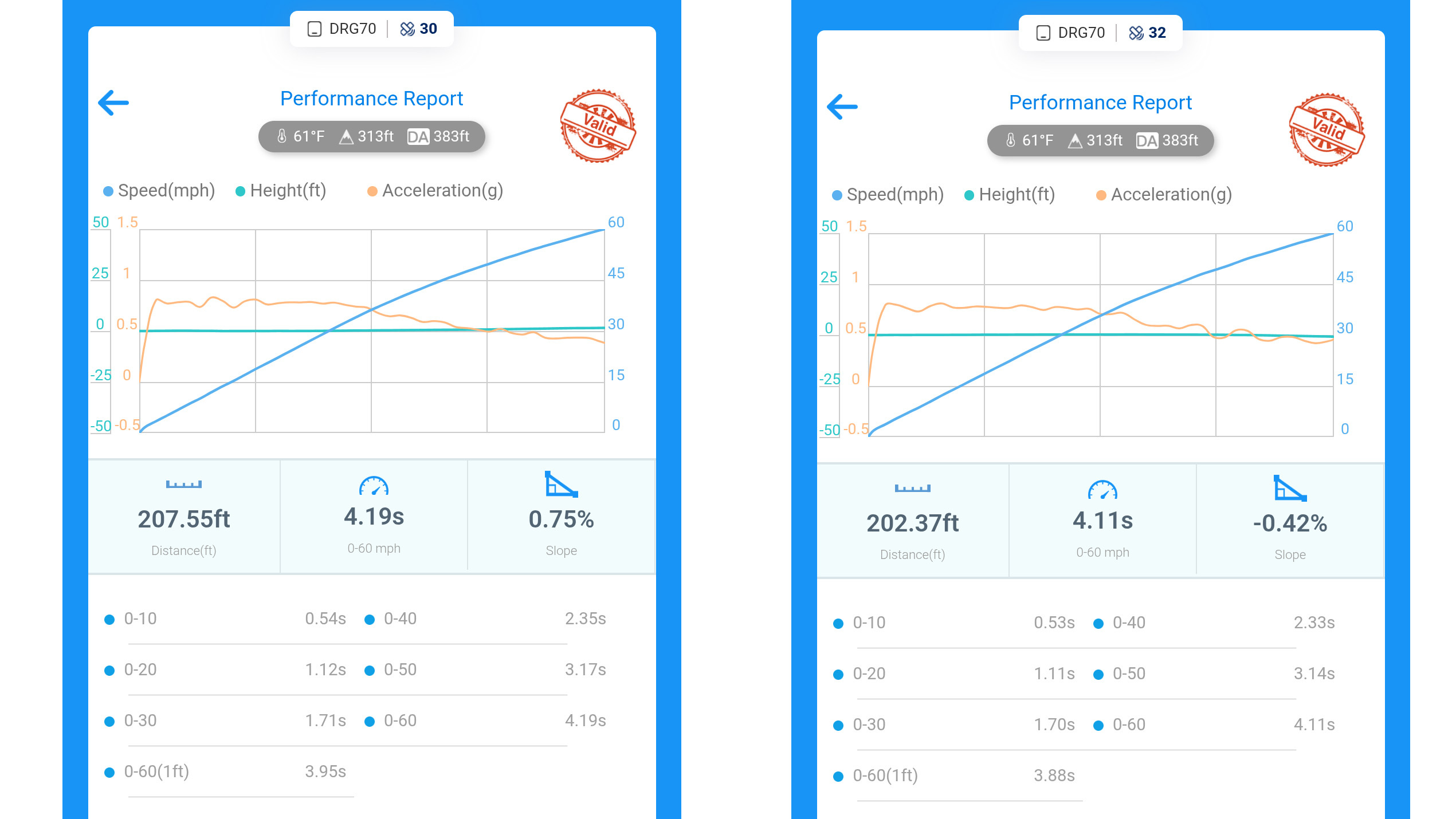
In the real world, we strapped a Dragy GPS tracker to ours and recorded multiple launches. With one foot of rollout, the quickest run came in at 3.88 seconds. Without rollout, it ran 4.11 seconds. You can read the full breakdown of our testing methodology and slope corrections in our separate acceleration analysis.
That’s properly quick. Not “quick for a Subaru.” Just quick. In fact, it’s the fastest production Subaru we’ve ever tested.
More importantly, the updated AWD logic gives it a stable, confidence-inspiring feel. It uses independent front and rear motors with variable power distribution, plus X-Mode with Snow/Dirt and Deep Snow/Mud settings. Grip is immediate and predictable, even when you provoke it.
Braking is handled by 12.9-inch front rotors and 12.5-inch rears, and regenerative braking offers multiple levels via paddles. It’s not WRX-level fun, but it’s far more engaging than most mid-size electric crossovers.
EPA-estimated range is 281 miles (452 km) for the Premium, slightly higher than the 274 miles quoted for Limited and Touring trims. Charging from 10–80 percent takes as little as 28 minutes at up to 150 kW, and it uses a standard NACS port for Supercharger access. We achieved a maximum estimated range of 239 miles as we achieved 3.2 miles per kW, but that’s with our 0-60 testing included. Drive like an adult, and the Trailseeker will almost certainly hit its 280-mile range.
Plenty Of Competition
Subaru benchmarks the Trailseeker against the Kia EV6, Volkswagen ID.4, and Honda Prologue, but the reality is broader than that.
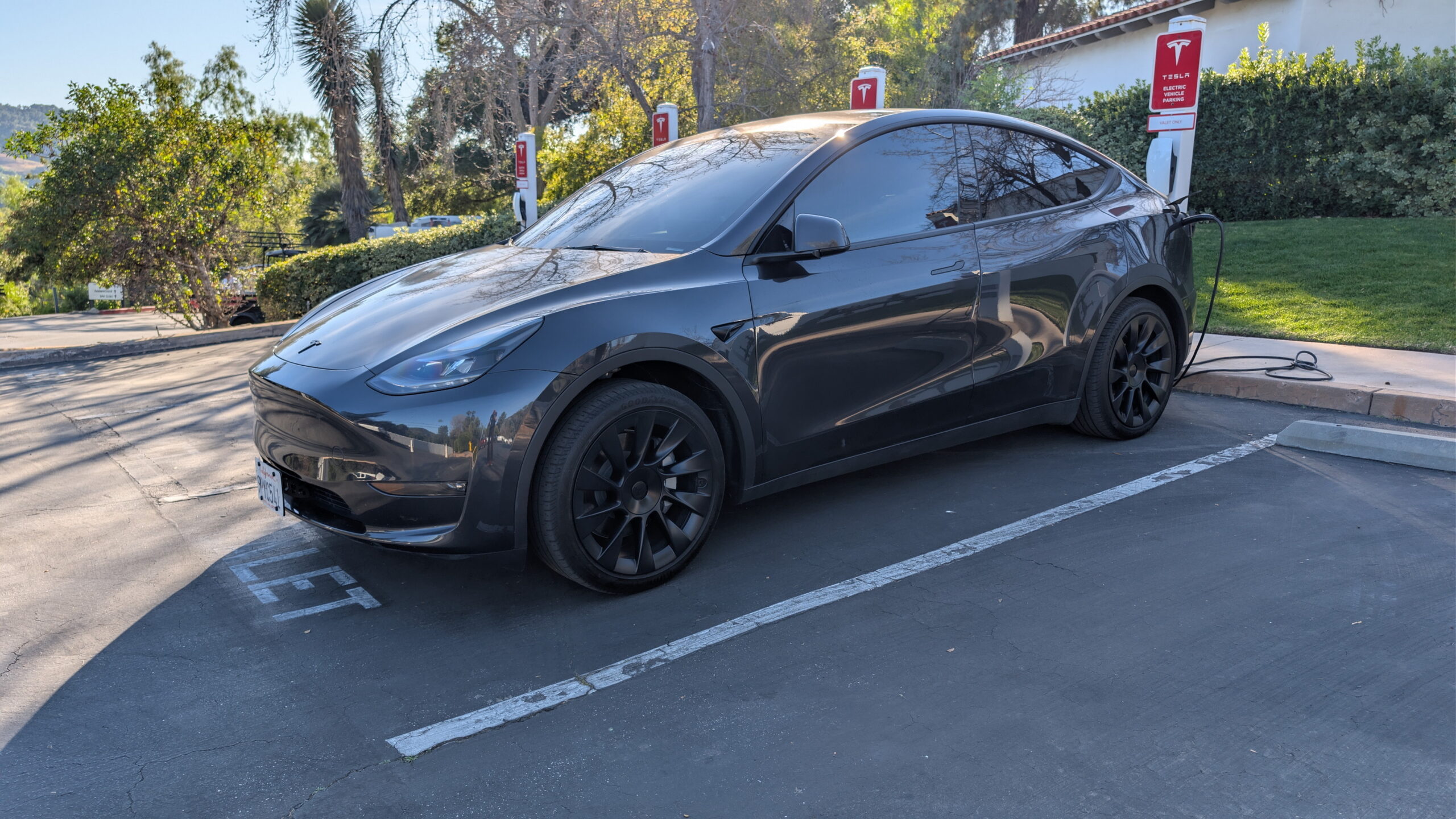
Tesla Model Y is the most obvious rival. In Long Range form, it offers more range and arguably better software. It also matches the Trailseeker’s 3,500-pound towing capacity and adds a usable frunk, something the Subaru notably lacks.
But the Model Y rides lower, lacks meaningful ground clearance, and doesn’t pretend to be trail-capable. If you want tech and efficiency first, Tesla wins. If you want capability baked into the chassis, Subaru has the edge.
Kia’s EV6 leans sportier. It feels lower, sharper, and more road-focused. In GT-Line or GT form, it’s quicker in a straight line, but it sacrifices ride height and off-road pretense. It’s the enthusiast’s EV crossover. The Trailseeker is the practical adventurer.
The Hyundai Ioniq 5 XRT gets closer philosophically. It adds rugged styling and a slight lift, but it still can’t match the Subaru’s 8.5 inches of clearance or 3,500-pound tow rating. Hyundai wins on interior tech polish and charging speed consistency. Subaru counters with real-world trail confidence.
The Toyota bZ Woodland is mechanically nearly identical. Same bones. Same dual-motor layout. Same basic mission. But in person, the Subaru feels more cohesive and slightly better resolved. And crucially, it undercuts the Toyota on price in base form. That matters.
The Trailseeker doesn’t dominate on range. It doesn’t dominate in outright interior luxury. What it does is combine quick acceleration, meaningful ground clearance, real towing capacity, and sub-$40,000 pricing in a way very few EVs currently do. That niche may be small, but it’s distinctly Subaru.
Final Thoughts
Here’s the surprising part: I’m not convinced you need to step up to the Limited or Touring. The Premium delivers the full 375-hp experience, the full AWD system, the full ground clearance, the same fast charging, and nearly identical range. The features it lacks feel like luxuries, not necessities.
That’s rare in today’s trim-walk world. If Subaru’s goal was to make its second EV feel unapologetically like a Subaru, capable, practical, quick, and ready for something more than commuting, it nailed it. And the base model might just be the smartest version in the lineup.
For those with just $5,000 extra to spend, they have their pick of the lineup… and the fastest production Subaru in history without giving up a shred of practicality.
U.S. consumers are sharply divided on Chinese vehicle brands.
Dealers show strong resistance despite notable shopper curiosity.
Price incentives could sway buyers, but trust remains critical.
If you spend any time in automotive comment sections, you’ve seen it. Someone inevitably points to a cutting-edge EV from China and declares it superior to whatever U.S.-market model is under discussion. There’s a huge catch, though: that vehicle doesn’t actually exist in the American marketplace.
It’s not federally certified, not sold through U.S. dealers, not supported by a domestic service network, and not priced with tariffs factored in. It’s a theoretical alternative, not a real one, and new research helps explain why this dynamic exists. Americans are forming opinions about Chinese automakers before most have ever seen one in person.
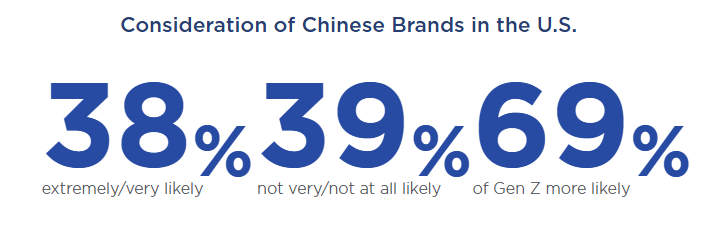
According to a study from Cox Automotive, consumers are heavily divided. Around 38 percent of shoppers say that they’re extremely or very likely to consider a Chinese brand. Another 39 percent says the opposite, that they’re extremely unlikely to do so. Among Gen Z buyers, the openness jumps to a whopping 69 percent, so if this ever does happen, expect the marketing to skew toward younger folks.
That split implies any early traction would likely be concentrated within specific demographics rather than spread across the broader market, creating both opportunity and risk for established players.
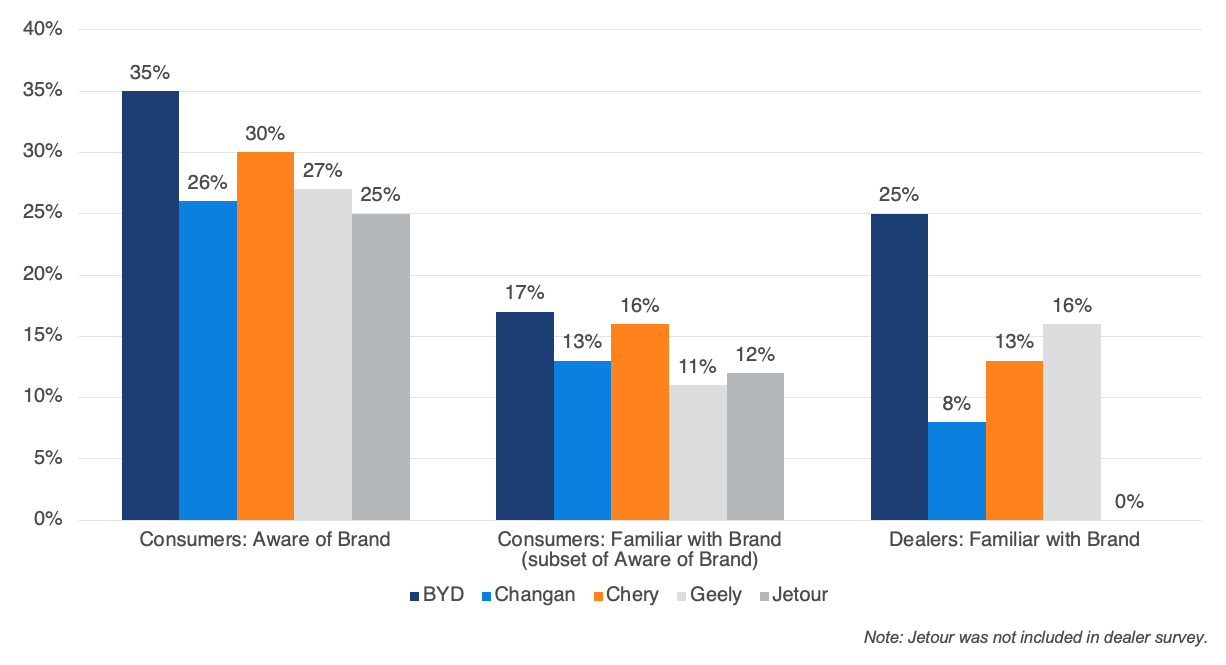
That said, actual awareness is thin. Nearly half of those surveyed said they were familiar with Chinese brands, but actual brand knowledge falls off a cliff quickly. BYD is the brand most are familiar with and that made up just over one-third of respondents. In total, only 17 percent said they had a deeper awareness of it. That’s a pretty big insight gap.
Dealer familiarity lags even further behind, with only about a quarter reporting any awareness of BYD, a reminder of how preliminary this conversation still is at the retail level.
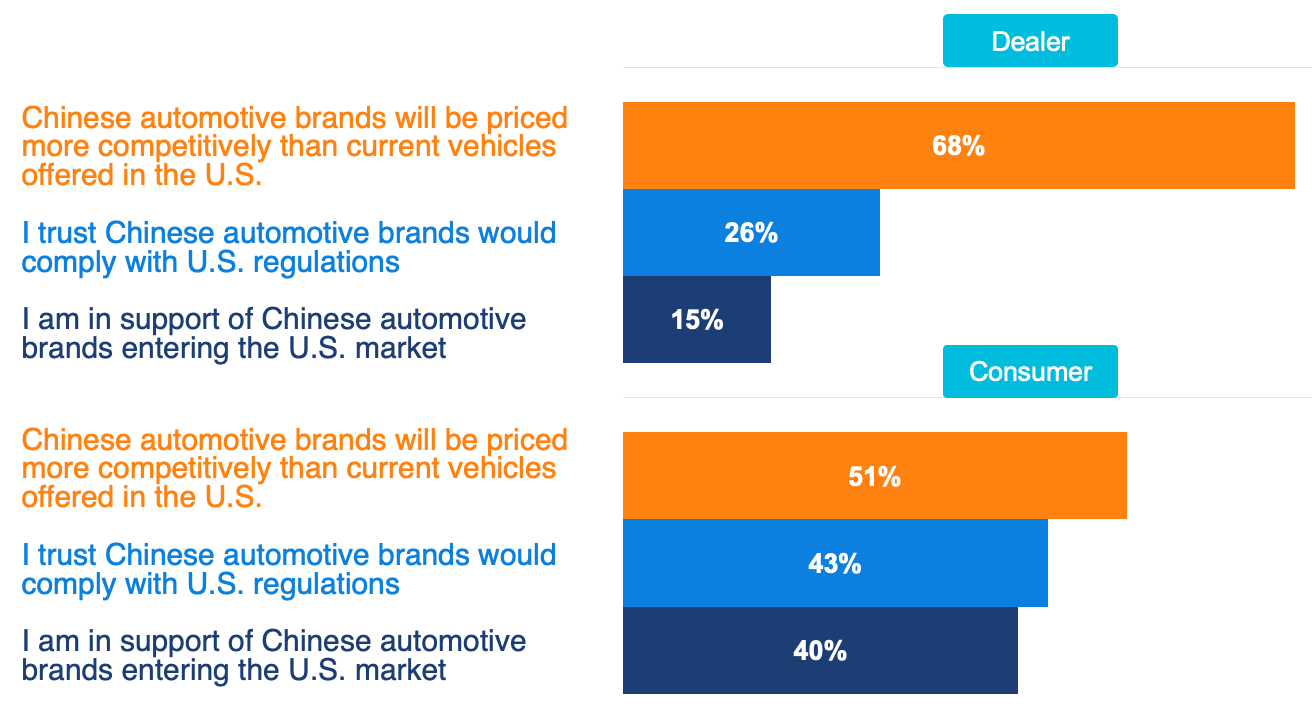
While around 40 percent of consumers say that they’re interested in Chinese brands coming to America, dealers, the ones with the real power, aren’t so hot on it. Only 15 percent said they’d like these brands in the USA. In fact, 92 percent of dealers reported concerns about selling Chinese vehicles. They cited everything from reliability to safety to long-term viability. That hesitation matters even more than the fact that some 60 percent of buyers aren’t interested.
The research also found that roughly 70 percent of dealers would adjust their business strategies if Chinese brands entered the market, suggesting preparation may follow skepticism.
Partnerships could shift the equation, though. When consumers were asked to consider a Chinese automaker aligned with an established U.S. brand, purchase consideration rose sharply to 76 percent, indicating that brand pairing may influence acceptance as much as pricing or product.
The Attraction
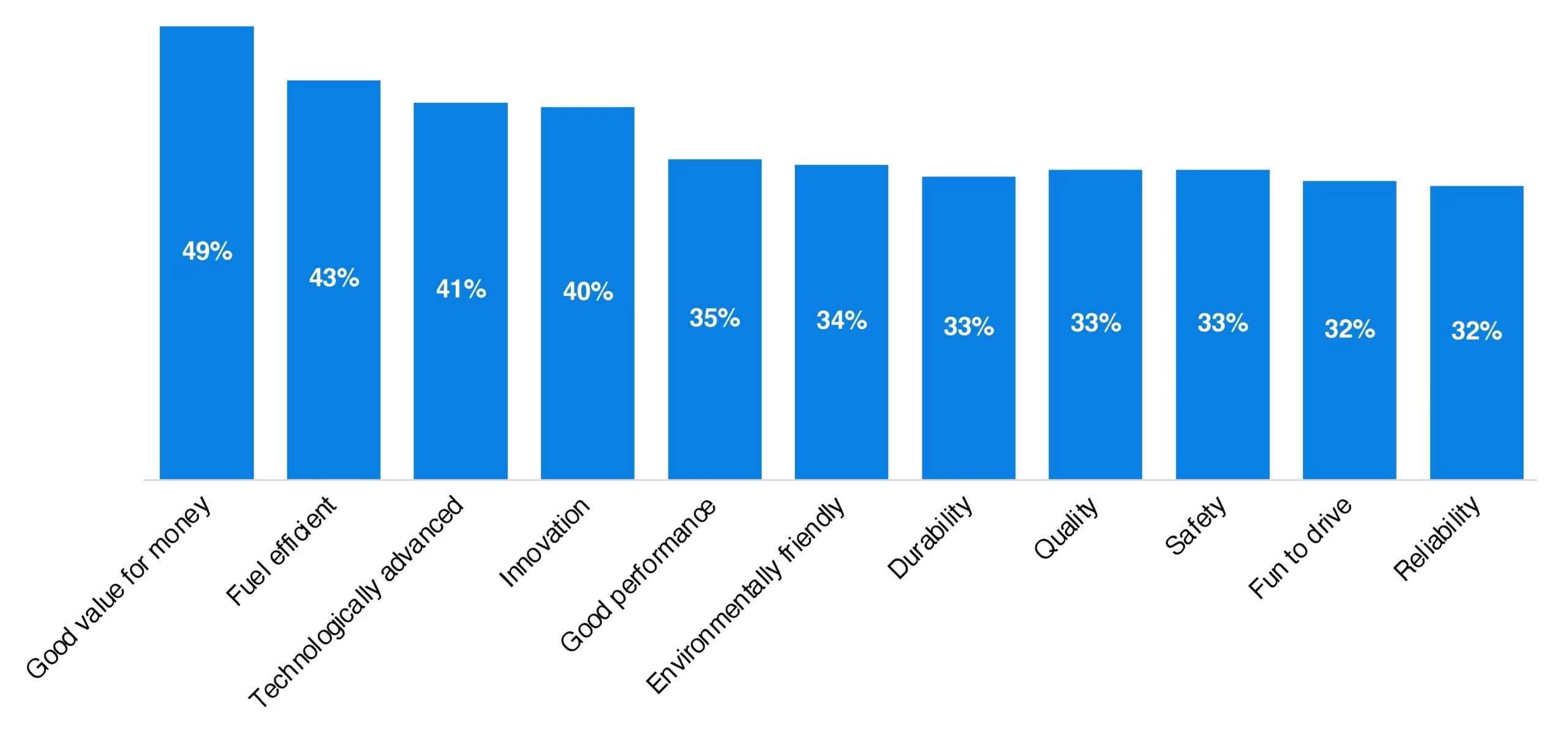
Interest does not appear to hinge on technology, styling, or practicality. It comes down to price. Nearly half of consumers rate them positively for affordability, and 35 percent give strong marks for performance. No doubt, we’ve seen pricing for Chinese automobiles undercut just about every other brand. But durability, safety, quality, and reliability fall short, and those are precisely the fundamentals that drive mainstream purchase decisions.
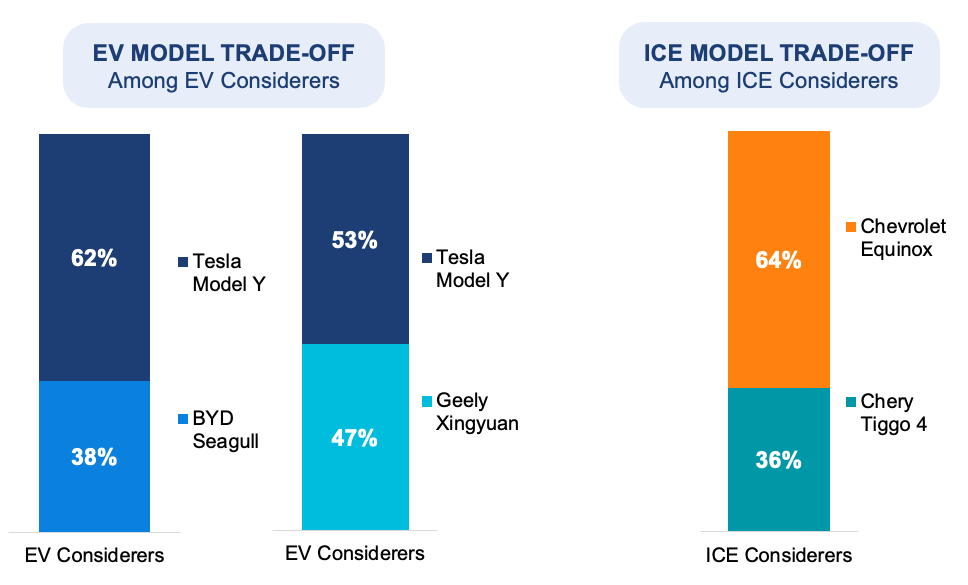
When consumers directly compared specific models, Tesla’s Model Y maintained a clear edge among EV shoppers, and the Chevrolet Equinox led among ICE vehicles, reinforcing the staying power of established nameplates.
However, when steep price discounts were introduced into side-by-side comparisons, a meaningful share of buyers indicated they would switch, particularly among lower-income and more price-sensitive groups.
Dealer and Consumer Comparisons (Strongly or Somewhat Agree)
Established U.S. brands still hold the advantage, buoyed by trust and familiarity. Price can narrow that gap, especially among more cost-sensitive buyers, but it doesn’t erase it. And it’s why those folks in the comment section suggesting that readers get a BYD Dolphin instead of whatever is actually available might have to wait a while longer before that comment makes any sense.
Consumers Rate Chinese Brands Lower on Buying Criteria (Durability, Quality, Safety and Reliability)
Toyota offers up to $6,500 in incentives on the new bZ Woodland.
Buyers can choose $5,000 cash or 0% financing with bonus cash.
Subaru’s Trailseeker remains cheaper despite Toyota’s early discounts.
The new Toyota bZ Woodland arrives at a complicated moment for electric SUVs. Conceptualized and likely sent into a production cycle with federal tax credits in mind, the electric crossover is here without those credits to rely on. On top of that, its near identical Subaru twin, the Trailseeker, costs thousands less. Now, Toyota is putting discounts of up to $6,500 on its brand-new electric model to sweeten the deal.
According to Cars.com, the deals aren’t exactly hidden or subtle, either. Buyers can score $5,000 in customer cash, lessees get $6,500 in lease cash, and those with pristine credit can opt for 0% APR for 72 months plus $3,500 cash back. Not bad for a model that effectively just arrived on dealer lots.
Here’s how it breaks down. The $5,000 customer cash incentive functions like a rebate and lowers the price or amount financed. The $6,500 lease cash deal reduces the capitalized cost of the lease, which means lower monthly payments. The $3,500 cash back deal with 0 percent APR is exactly what it sounds like. A discount on the price and no interest on payments for six years. All deals expire on March 2nd.
With pricing starting at $46,750 (including $1,450 destination) and climbing to $48,850 for the Premium, Toyota clearly felt some pressure to keep this wagon-like EV competitive in a cooling segment. These deals should help, considering that the bZ Woodland seems incredibly similar to Subaru’s Trailseeker.
Pricing Pressure From Subaru
For its part, the Trailseeker starts at $39,995 before destination, and that’s without discounts. So even with $5,000 on the hood, the Toyota still plays in a higher price bracket. That means the Woodland’s biggest advantage may come down to brand loyalty, dealer networks, and whether buyers prefer Toyota’s design and packaging.
Again, Toyota probably cooked up this car when it thought the $7,500 federal EV subsidies would still exist at launch. With that in mind, this feels like an almost necessary move to keep the car moving off dealer lots.
Highlander EV uses an electronic popper with hidden manual release.
A small tab inside the handle serves as a built-in mechanical backup.
The setup reflects growing focus on EV safety and everyday usability.
Spend five minutes around a modern car, especially an electric one, and you will notice something curious. Door handles have morphed into design statements, tech showcases, and sometimes awkward little puzzle games that feel one step away from becoming a liability.
Some pop out theatrically, some sit flush until summoned, others attempt both, and an increasing number rely entirely on electronic latches that only function when the car has full power. Toyota’s new Highlander appears ready to break new ground with a hidden feature few will notice at first.
During our time up close and personal with the SUV, one small feature stood out. The main exterior handle leverages a small pad to activate an electric door latch. That’s not groundbreaking, but what’s next to it might be.
Did You Notice The Tiny Tab?
Photos Stephen Rivers/Carscoops
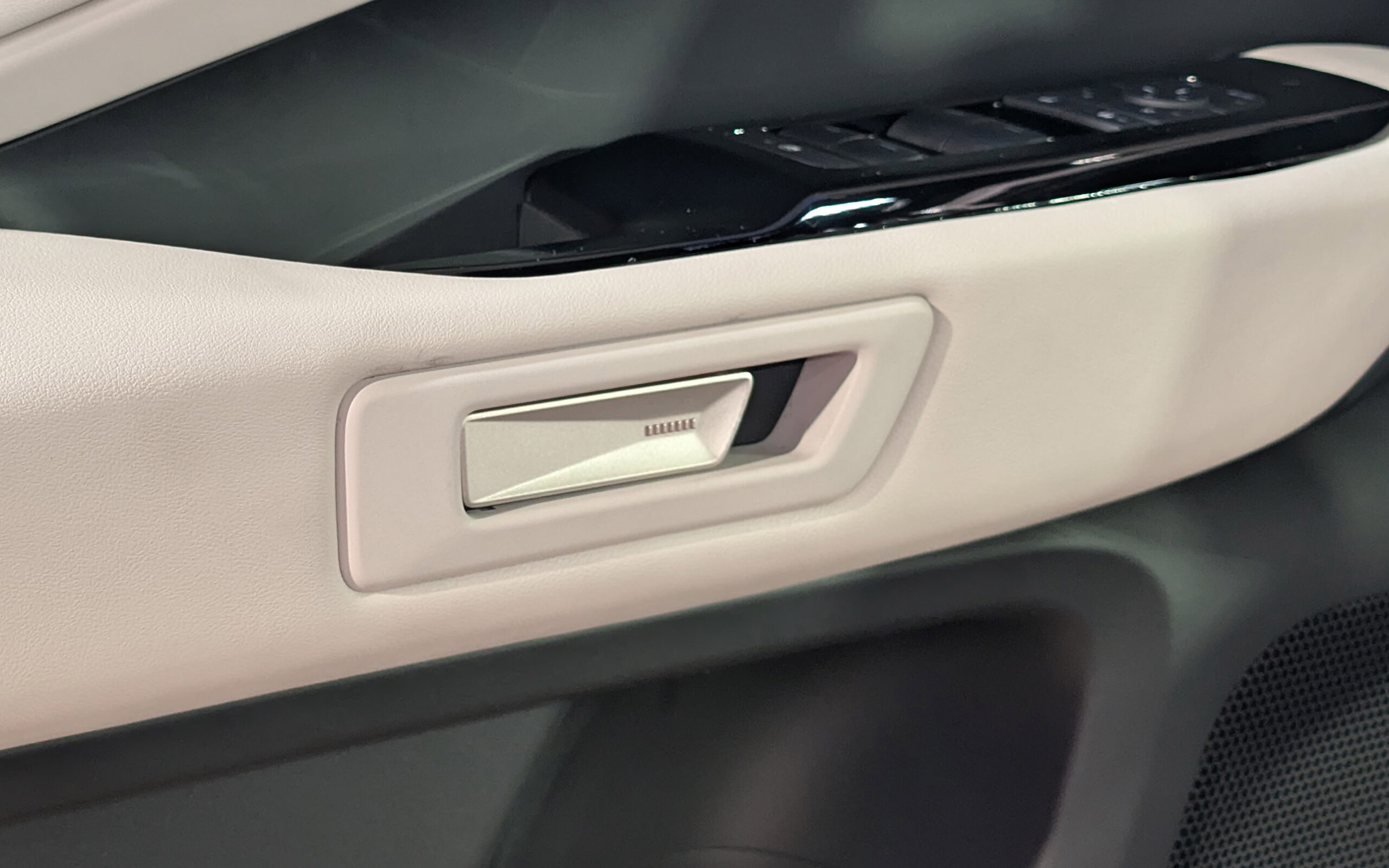
Inside of the stationary recessed door handle lies a tiny tab. Roughly the size of a postage stamp, it’s designed to be pulled independently by someone outside the car, including, knock on wood, emergency crews. Unlike the main handle, the tiny piece has a clear pictogram suggesting it’s a manual release.
Next to it is a removable section for a keyhole. Getting into this electric SUV, should it ever lose power, is as easy as inserting a key, engaging the manual latch, and pulling on it. Notably, the pull tab did nothing for us when we were in person and tinkering around with it.
Photos Stephen Rivers/Carscoops
Toyota clarified to Carscoops that the prototypes didn’t have functional versions of the handle. The production car will work via a two-step process. Pull once, and the tab will unlock the door. Pull twice, and it’ll manually open the door. That’s clever, and it’s worth noting that it’s not just the exterior handles that have this sort of feature.
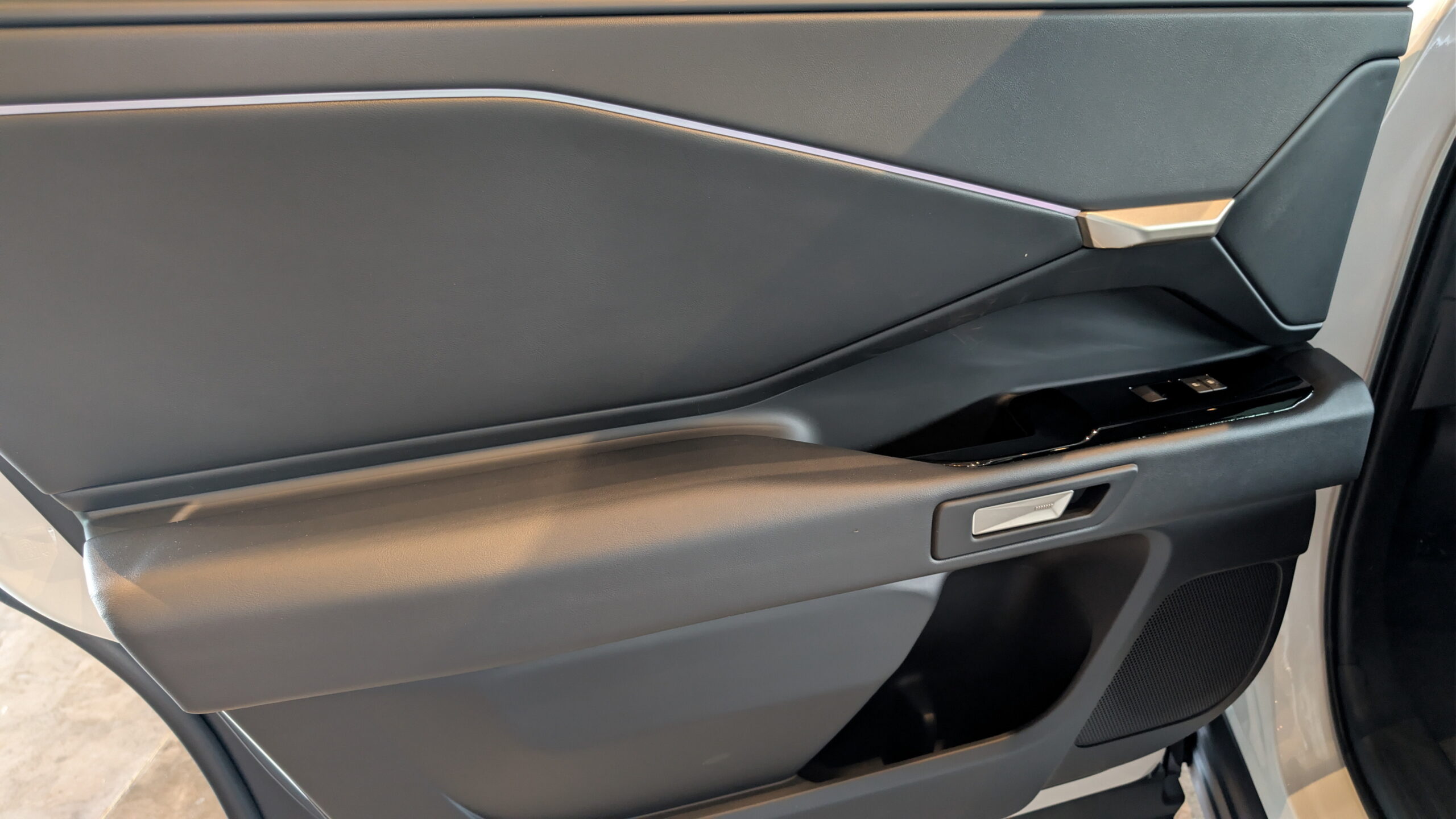
The inside handles are similar to the ones we’ve seen on Lexus vehicles for some time. Users can push the door button for the electric latch to release, or they can pull it to manually open the latch. That’s just one more piece of safety baked into the all-new Highlander.
In a world where even door handles have gone digital, a simple mechanical fallback feels less like nostalgia and more like common sense. Toyota’s solution is not flashy, and it does not need to be. As cars pile on electronics for even the most basic tasks, a simple physical solution may turn out to be the smartest feature of all.
Slate Auto is only a few months away from what could become the most consequential moment in its brief existence. It will soon tell the world exactly how much its trucklet will cost. We already know it is targeting the “mid-$20,000 range,” but whether or not that’ll be cheap enough for widespread adoption is an open question.
This week, the startup teased on social media that final pricing for its two-door EV will arrive in late June. In the video, CEO Chris Barman reiterates that the base “Blank Slate” model is still expected to land in the mid-$20,000 bracket.
“We’ve been working tirelessly to get the lowest price possible,” Barman said. “While we’re not pencils down just yet, we’re wrapping negotiations on final parts with suppliers. We’re on track to share new info on the price in June. We think it’ll be worth the wait.”
Obviously, the mid-$20,000 range is a break from Slate’s initial promise of a truck that starts under $20,000. That said, its initial promise relied heavily on the now-defunct $7,500 federal EV tax credit. Without it, breaking that price barrier was always going to be a stretch given material costs and industry margins. The updated estimate sounds a lot more realistic, but also far less revolutionary.
The Reality Ahead
Let’s say that the trucklet launches with relatively approachable MSRP. Slate will still need to nail the details. Execution at the manufacturing, service support, parts supply, and consumer education level will be paramount. Other startup automakers have failed on fewer issues.
Then, there’s the competition. We’ve pointed out just how unattractive a $25,000-$28,000 Slate might appear next to something like the Ford Maverick. That isn’t the only compact truck in the market and the Blue Oval brand is already working on an electric version of its own, which it promises to start from $30,000.
And while we’re still light on specifics, it is hard to imagine Ford delivering something as unapologetically stripped back as the Slate, which famously does without even basic features like integrated speakers and power windows.
That all said, a small, affordable, modular EV with tons of personality might just manage to escape the fray. Production is supposed to begin by the end of the year in Indiana.
The automotive industry never slows down, and EV brands feel that pressure more than most. Lucid is responding to the market and to its own position by cutting 12 percent of its workforce. The move comes as it attempts to tighten spending and move closer to profitability as it ramps up Gravity production.
The layoffs were confirmed to Bloomberg in an emailed statement, following the leak of an internal memo from interim CEO Marc Winterhoff that circulated within the company and was seen by Techcrunch.
In the memo, Lucid addresses the cuts head on. “Saying goodbye to colleagues is never easy,” Winterhoff wrote. “We are grateful for the contributions of those impacted by today’s actions, and we are providing severance, bonus, continued health benefits, and transition support to help them through this period.”
Bloomberg reports that the majority of workers affected are salaried and corporate roles. Hourly workers tied directly to manufacturing, logistics, and quality operations at Lucid’s Arizona facility are not expected to be part of this reduction. That’s not all that shocking, given the brand’s need to ramp up production of the Gravity SUV and continue development of its Midsize platform.
“Importantly, today’s actions do not affect our strategy,” Winterhoff wrote. “Our core priorities remain unchanged, and we continue to focus on the start of production of our Midsize platform. With disciplined execution, we are also focused on further expansion into the robotaxi market, continued ADAS and software development, and growth in sales of Lucid Gravity and Air across existing and new geographies.”
A Murky Future
Right now, Lucid’s momentum is almost entirely pinned on the Gravity SUV. It undoubtedly broadens appeal beyond the ultra-luxury Air sedan expanding its reach to a more popular segment. That said, it’s not exactly what most buyers would consider mainstream or affordable.
That’s why the Midsize platform is so key to Lucid’s future. Tesla’s Model 3 and Model Y turned a niche player into a volume powerhouse, and Lucid is hoping for a similar inflection point.
Rivian is following a similar playbook with the R2. By the end of the year, we should have a clearer picture of who is getting closer to that goal. In a cooling US EV market, profitability is no longer a nice to have. It is the whole game.
Tesla says the first Cybercab has left the Texas line.
Musk still targets a sub-$30,000 version by 2027.
Milestone revived MKBHD’s viral head-shaving bet.
Don’t look now, but Tesla might actually be on schedule, if not slightly ahead, at least for now, with its Cybercab program. The automaker says the first production example rolled off the line on Tuesday, more than a month earlier than Elon Musk previously suggested. Its CEO also confirmed pricing.
Of course, plenty of hurdles remain if Tesla plans to sell one before the end of the decade. And yes, at least one major YouTuber could end up shaving his head if Musk’s team pulls it off.
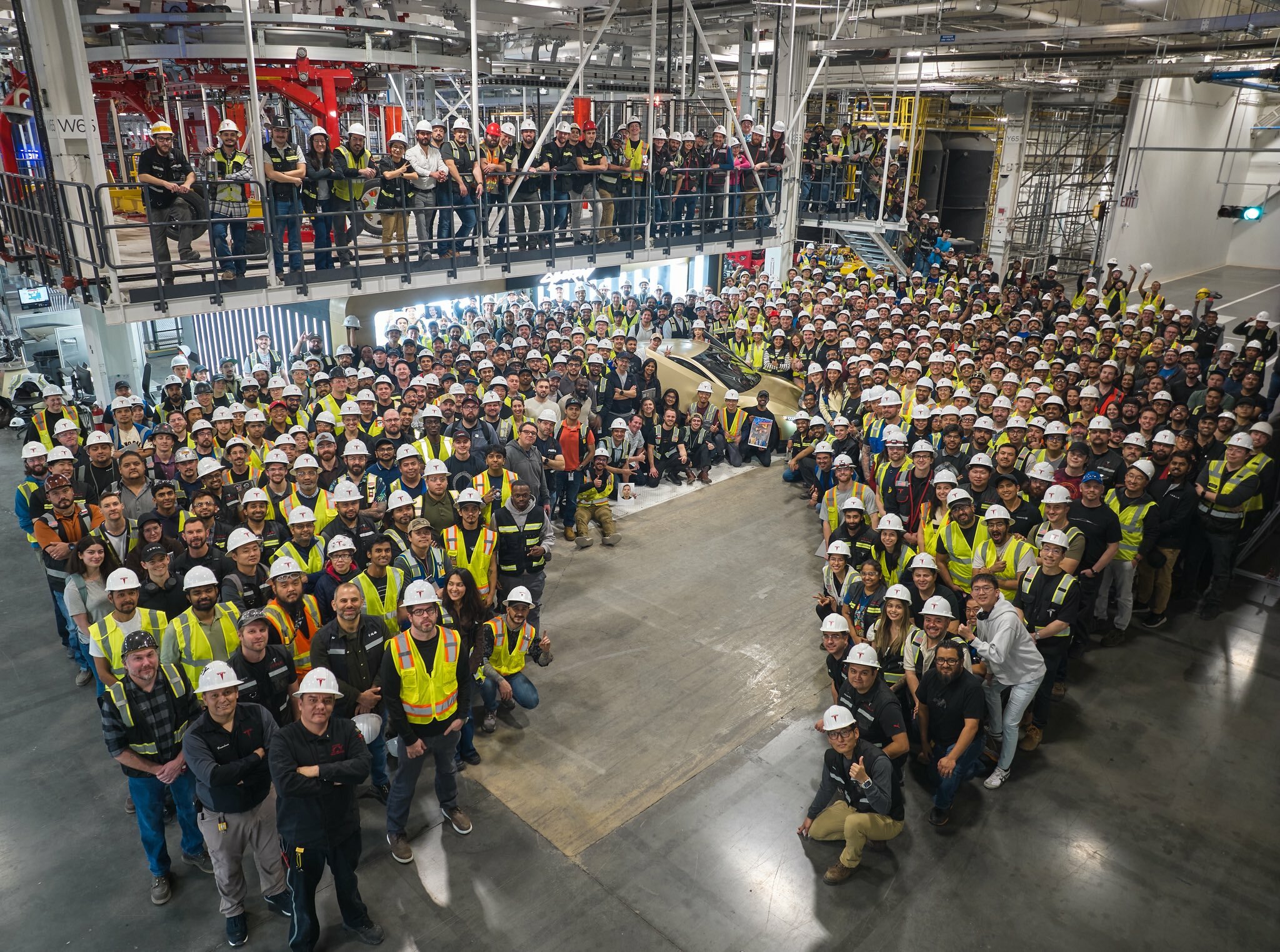
Tesla posted a photo on February 17 showing the team at Gigafactory Texas surrounding the first production Cybercab. While there’s still no clear timetable for full-scale production, Musk previously indicated that manufacturing wouldn’t even begin until April. I double-checked my calendar, and it still says February.
Importantly, this is almost certainly a pilot build and not a car destined for a customer. That said, it’s a significant step forward for a brand often associated with shifting timelines.
Public Bets And Pricing
That reputation likely played a role in Marques Brownlee (MKBHD) saying in 2024 that if Tesla launched the car before 2027 at a price below $30,000, he’d shave his head on camera.
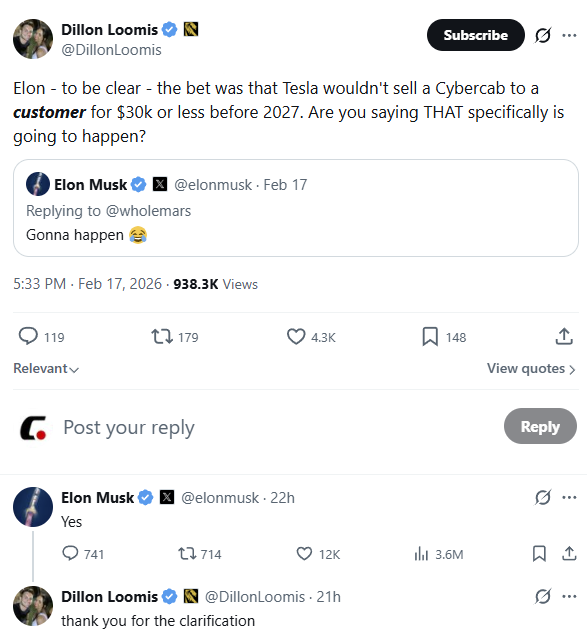
After Tesla announced the milestone, meme versions of a bald MKBHD quickly spread across X. Musk joined in, replying “Gonna happen 😂” to one such post. In a separate exchange, he also confirmed that Tesla still plans to sell a consumer version of the Cybercab before 2027 for “$30,000 or less”.
Hurdles Ahead
That all sounds promising, but Tesla has to do more than simply build the car. The Cybercab is meant to be the brand’s first true autonomous vehicle sold without a steering wheel or pedals. Since unveiling it, however, Tesla has hinted that those controls could return if regulations require them.
And that’s where the real challenge begins. Federal vehicle safety standards assume a human driver is present, and insurance frameworks do too. The NHTSA may need to grant exemptions for certain rules, while individual states could impose their own restrictions on autonomous vehicles operating on public roads.
In other words, building the Cybercab might prove easier than getting it legally approved. Whether Tesla can clear those hurdles before 2027 remains an open question.
Jony Ive admits anxiety before the Luce’s big reveal.
Ferrari’s first EV pursues a singular, radical design.
It debuts in May ahead of its planned 2028 launch.
Ferrari is no stranger to controversy, and it rarely shies away from it either. Its upcoming all-electric Luce could turn out to be the most polarizing project yet. The man behind the design, Jony Ive, Apple’s former design chief who shaped the iPhone and several other era-defining products, admits he is feeling the pressure.
That seems like a perfectly reasonable response with a historic unveiling just two months away, especially when you are tasked with redefining what a Ferrari is supposed to be in the modern era.
This isn’t just another EV launch after all. It is Ferrari, a brand built on racing at the highest levels and on exciting V12 supercars, sometimes only obtainable through wild buying rituals, and now venturing into the silent world of EVs.
A Defining Electric Debut
SHProshots
Calling it a big deal would be a massive understatement, which is probably why Ferrari hired Ive and fellow designer Marc Newson for the task of shaping the Luce.
The exterior, in fact, has been penned by LoveFrom, the design house founded by Ive and Australian designer Newson, which makes this less a routine Ferrari project and more a collision between Maranello and Silicon Valley minimalism.
Speaking to Autocar, Ive openly admitted that he’s “anxious” about revealing the car to the world. It’s not concern over the design itself that sparks that feeling, but instead the gravity of just how big this moment is for Ferrari. He called it “still clearly a Ferrari,” but went on to say that “It’s a different manifestation based on some of the beliefs around simplicity and the inherent beauty of something.”
On the flip side, his co-designer, Newson, highlighted the freedom offered with such a project. “One of the great and serendipitous sort of things is that this is an electric vehicle, the first electric Ferrari, right? So that afforded us a degree of freedom that perhaps we would otherwise have not had: literal physical freedom or creative freedom… on many levels here,” he said.
Inside The Luce Philosophy
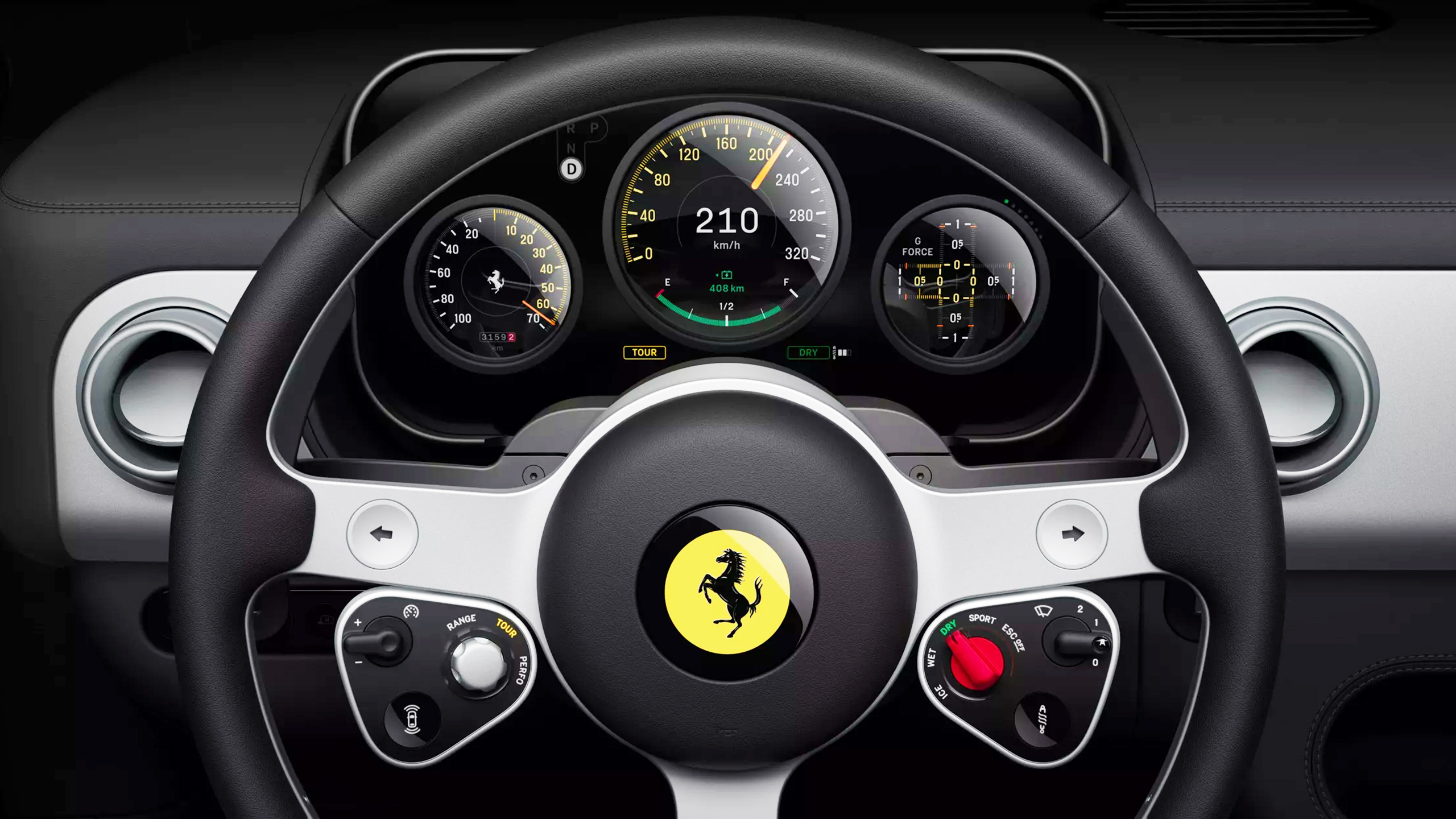
At this stage, we’ve already seen official bits of the interior. The brand unveiled the dash earlier this month. It’s quite the departure from other modern Ferraris. That’s key because Ive and Newson say that the entire car has a “consistency and a singularity” about it.
Ive has also stressed that there is “no disconnection” between the exterior and interior, noting that both were designed simultaneously rather than by separate departments. In his view, that approach results in a complete package that feels cohesive rather than pieced together.
What we also know so far is that the Luce will be a four-door, four-seat GT with a ride height similar to the Purosangue, and that it will feature a 1000hp four-motor powertrain. Ive has hinted that the car will be “big” in its proportions and just as radical on the outside as it is within.
Will The Luce Use Rear-Hinged Doors?
SHProshots
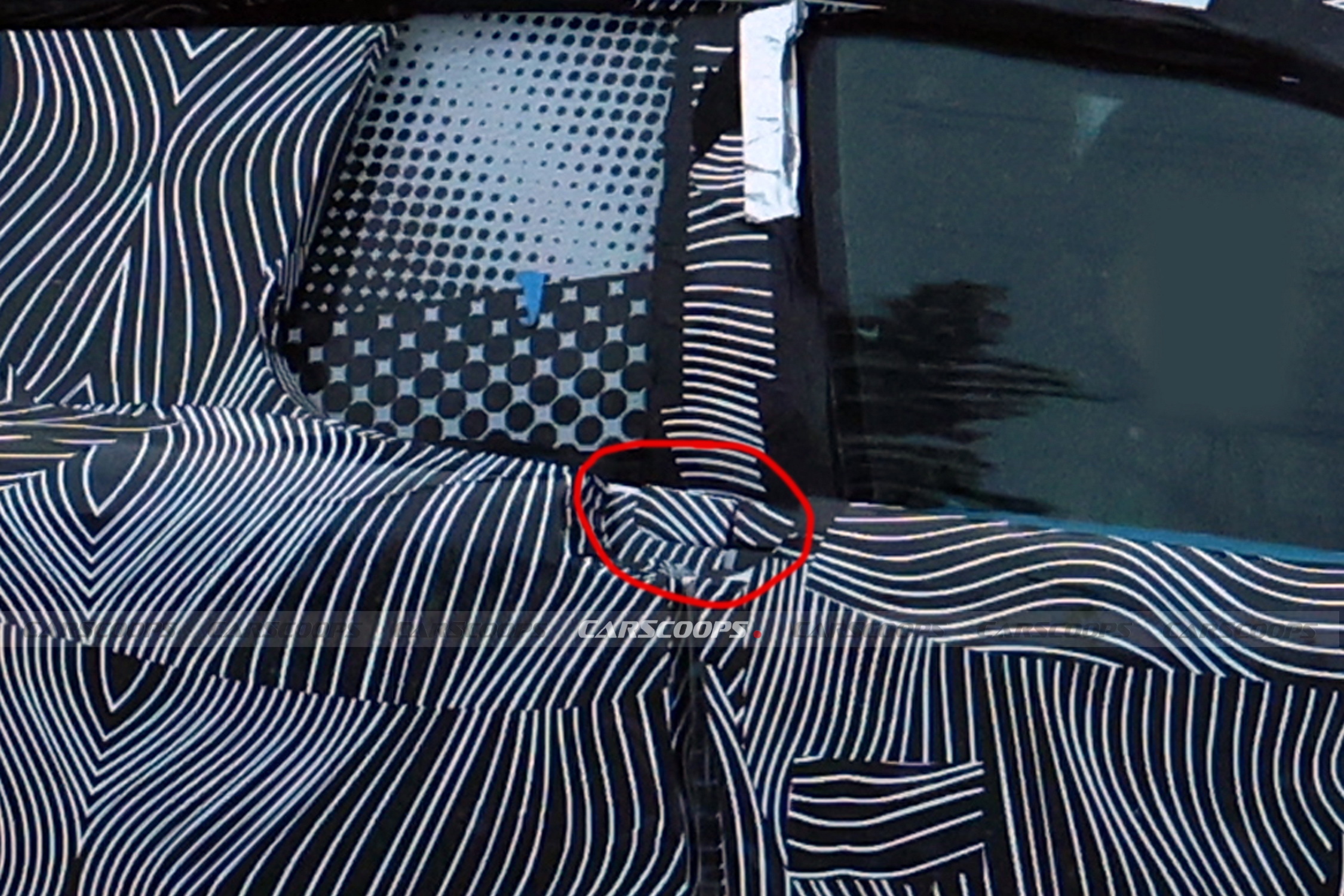
To that end, we wonder if the exterior will be far more retro-futurist than previously expected. While Ive was talking about the new Luce, our spies caught another heavily disguised prototype undergoing testing in northern Sweden this week.
Like earlier Luce testers, this one was wrapped in makeshift panels from top to bottom, making it extremely difficult to interpret what is happening underneath beyond a general sense of its proportions and size.
One detail our photographers did catch appears to be a set of door handles, circled in red, positioned just under the B-column in the middle section. According to our photographer, the Luce may be using suicide-style rear doors that open toward the front of the vehicle, similar to the Purosangue. This has not been officially confirmed, and it could just as easily be Ferrari engaging in a bit of cheeky misdirection.
We will know for certain in May, when Ferrari finally unveils its first EV.
PROS ›› Genuinely quick, nimble handling, faithful design features CONS ›› Tight rear seating, Uncharted undercuts it, limited cargo space
A quick look around the automotive industry would have most thinking that EV adoption is slowing down. Whether that perception holds true or not, Toyota is moving ahead full steam with not one, but three new electric vehicles, and the C-HR might be the most playful of the bunch. Yesterday, we talked about how the bZ Woodland is a great improvement on the old bZ4x.
Today, the focus shifts to the C-HR, a revived nameplate that now returns exclusively as an EV. It’s a huge deal beyond just the fact that it’s going electric. It’s the first formerly gas-powered Toyota nameplate to go fully electric. Sure, it only beat the new Highlander by a few months, but that’s more than enough. Both will have a big impact on Toyota moving forward.
While we don’t know what the Highlander will end up selling for, the C-HR is clearly aimed at a different demographic. With a starting price shy of $38,000 before destination and handling, it’s aimed at Tesla Model Y buyers wanting something a touch smaller. Packing standard all-wheel drive, 338 hp (252 kW), and almost 300 miles of range, it’s a new face in the segment that will no doubt blow up one day.
Quick Facts
› Model:
2026 Toyota C-HR
› Starting Price:
$37,000 (excluding destination)
› Dimensions:
177.9 L x 73.6 W x 63.8 in H (4,519 x 1,870 x 1,621 mm)
› Wheelbase:
108.3 in (2,751 mm)
› Curb Weight:
4,322 lbs (1,960 kg)
› Powertrain:
Dual electric motors / 74.7 kWh battery
› Output:
338 hp (252 kW)
› 0-60 mph
4.9 seconds
› Transmission:
Single speed
› Range:
Up to 287 Miles
› On Sale:
First-half of 2026
SWIPE
Now, all that’s left is to figure out if it’s good enough that it’ll gain a foothold for a long ride, or if it’s still a battery cell or two away from a fully-formed EV. Thankfully, a week of testing it in hilly Ojai, California, helped us figure out the good from the bad.
Styling
Photos Stephen Rivers/Carscoops
Let’s not play coy. While the C-HR’s nomenclature has always invited comparisons to Honda’s HR-V, the exterior designs couldn’t have been much more different when it first arrived. We’re happy to report that the same playful attitude carries over to this new electric version of the crossover.
The front end adopts Toyota’s newer hammerhead design language, with a low, aggressive nose and slim lights that visually widen the car. The coupe-like roofline flows cleanly into the rear, and from certain angles, the C-HR almost looks more hatchback than crossover, which works in its favor. It feels athletic despite being clearly compromised on that front.
Compared to the bZ Woodland, the C-HR looks tighter and more urban. It’s clearly aimed at buyers who want something sporty and expressive rather than rugged or adventurous. The wheel options help sell that image, too, with 18-inch alloys on the SE and aggressive 20-inch wheels on higher trims.
If the old C-HR was bold but polarizing, this one is more mature. It’s still stylish, but it’s less desperate for attention and more apt to provide an experience worthy of an offbeat appearance.
Cabin Space
Photos Stephen Rivers/Carscoops
Toyota told us early on that we’d see a lot of crossover between this and the bZ Woodland, and it was right. It leverages supportive front seats, an intuitive infotainment setup, a steering wheel that feels good in your hands, and visibility that’s better than the sloping roofline suggests. The driver’s position feels good, though; we’d love a little more adjustability from the steering wheel.
Photos Stephen Rivers/Carscoops
The 14-inch touchscreen dominates the dashboard and comes standard across the lineup. It’s responsive, cleanly laid out, and avoids the over-complicated UI issues that plague some competitors. Dual wireless charging pads and practical storage touches reinforce that Toyota still knows how to design for daily life.
Material quality is a step up from Toyota’s earlier EV efforts, too. Soft-touch surfaces and ambient lighting keep things modern without crossing into gimmicky territory. And then you climb into the rear seats. Things go from perfectly livable to suddenly only for the smallest around us.
How Tight Is Too Tight?
I get that as a taller-than-average guy, I won’t fit everywhere, but I was sincerely shocked at just how tight the back seats of the C-HR are. This is a compact crossover, and that’s clear as soon as we compare it to another new crossover in the form of the Mazda CX-5.
The Mazda has a wheelbase that is just 2.5 inches (63 mm) longer. Despite that, the CX-5 offers 7.7 inches (195 mm) of additional legroom, up to 2.8 inches of headroom, and in total over 10 cubic feet of extra space in the rear seats. Put simply, rear-seat occupants won’t be happy in the C-HR unless they’re relatively small. That said, they’ll fit kids just fine.
Cargo space fares better, with 25.3 cubic feet behind the rear seats and nearly 60 cubic feet with them folded. That’s perfectly usable for daily life, but the passenger packaging tells you clearly where Toyota’s priorities were.
Driving Impressions
Here’s where the plot thickens, in the best way possible. EVs are well-known for their instant torque, but that doesn’t automatically make one good to drive. The way the C-HR moves about the world is with more authority than one might expect. It’s sharp. The short wheelbase helps it manage bends with confidence. And the steering is more communicative than in the larger bZ Woodland.
Toyota claims 0-60 mph in 4.9 seconds, and it absolutely feels believable. This thing moves… not with the aggressive chaos of a GR Corolla, but with the smooth, relentless urgency only an EV can deliver. In fact, this might be the quickest pseudo-practical car in Toyota’s lineup right now. It’s not trying to be a sports car, yet it’s faster in a straight line than many cars that are.
The low battery placement keeps the center of gravity down, and the chassis feels planted through corners. Steering is light but accurate enough that you want to push a little harder than you probably expected. There’s a maturity to the tuning. It’s composed, predictable, and easy to trust. The brakes are excellent, too.
The regenerative braking paddles let you adjust deceleration on the fly, which adds a layer of driver involvement often missing from mainstream EVs. It’s not revolutionary, but it does make the driving experience feel more interactive.
Ride quality strikes a nice balance, too. It’s firm enough to feel sporty without punishing you over rough pavement. The C-HR doesn’t feel like a small SUV pretending to be sporty. It just feels like a well-sorted EV with some genuine personality. No, it’s a far cry from a Hyundai Ioniq 5 N or a Tesla Model Y Performance, but it’s the EV I’d pick from Toyota’s lineup if driving feel was all that mattered.
From a more practical standpoint, range tops out at 287 miles on the SE trim, dropping slightly with the larger wheels. Charging speeds max out at 150 kW DC fast charging. That’s enough to go from 10–80 percent in roughly 30 minutes under ideal conditions. As we’ve seen in the past, ideal conditions can be rare, but the inclusion of Tesla’s NACS port should help.
The C-HR lands in an increasingly crowded space, but its personality gives it, like the bZ Woodland, a unique angle. The Tesla Model Y remains the benchmark for space and usability. It’s roomier, more versatile, and easier to live with if rear-seat comfort matters. The Model 3, while technically a sedan, also beats the C-HR for rear-seat comfort despite looking smaller.
Frankly, comparing it on paper to most cars in the segment makes the C-HR look like a middling choice at best. Even pairing it against its badge-engineered sibling, the Subaru Uncharted, it costs more and isn’t available with front-wheel drive, which unlocks more range. That said, I’m not about to start complaining that we need more front-wheel drive cars.
Where the C-HR stands out is key, though. All-wheel drive is something that plenty of folks want and or need where they live. Second, it’s probably the easiest car in the segment to park, thanks to great sightlines and one of the shortest wheelbases here. That matters.
No, it’s not the quickest, cheapest, or most spacious. Instead, it’s leaning into the vibe of a compact, economical electric vehicle to the best of its ability in its current form. And that form just so happens to be quite attractive and fun.
The Verdict
Toyota just launched the new Highlander in all-electric form, which is a huge deal in itself, but let’s not forget that this new C-HR is the first formerly gas-powered Toyota to go all-EV in America. That’s also a big deal, and it makes this little commuter car an important inflection point in history.
To that end, it’s great to see that Toyota didn’t hold back here regarding performance. The C-HR is properly quick, genuinely fun to pilot, and even fun to look at. The front seats, infotainment, and overall driving position are all excellent, and on the road, it feels composed, lively, and far more engaging than many electric crossovers in its segment.
That said, it’s not without compromise. Rear-seat space is tight enough to be a real consideration, especially if you regularly carry adults. This is a crossover that prioritizes style and driving feel over maximum practicality. And honestly, that might be exactly the point. Here, the fun comes first, and the practicality, while important, comes in second place. Will it be a mix that sells well? Only time will tell.
PROS ›› Lots of utility, genuinely quick, quiet cabin CONS ›› Tight rear space, Trailseeker is cheaper, divisive styling
Toyota is one of the few brands that still seems intent on giving enthusiasts something to get excited about. Vehicles like the Land Cruiser, GR Corolla, and GR Supra make that clear. But what about the eco-conscious buyer with a family? Until now, that same energy hasn’t really carried over to its EV lineup. The bZ Woodland is meant to change that.
It would be easy to look at it and assume this is just another trim level dressed up with black plastic cladding and a roof rack meant to suggest capability more than deliver it. After all, Toyota is still a long way from securing a serious foothold in the all-electric space. This SUV, which actually looks more like a wagon on stilts, not dissimilar to older Subaru Outbacks, pushes the brand more squarely into the conversation.
190.2 L x 73.2 W x 63.8 in H (4,830 x 1,860 x 1,620 mm)
› Wheelbase:
112.2 in (2,850 mm)
› Curb Weight:
4,376–4,453 pounds (1,985–2,020 kg)
› Powertrain:
Dual electric motors / 74.7 kWh battery
› Output:
375 hp (280 kW)
› 0-60 mph:
4.4 seconds (97 kmh)
› Transmission:
Single speed
› Efficiency:
21.0 kWh/100 km as tested
› On Sale:
First-half of 2026
SWIPE
On paper, this could be the vehicle to move Toyota’s EV aspirations higher. It’s a family hauler. It sounds like it’ll be reasonably capable off-road. Clearly, on-road performance is something the automaker considered as well. Does it all actually pay off in the real world, though? That’s what we went all the way to California to find out.
Rugged Cues With Familiar DNA
Photos Stephen Rivers/Carscoops
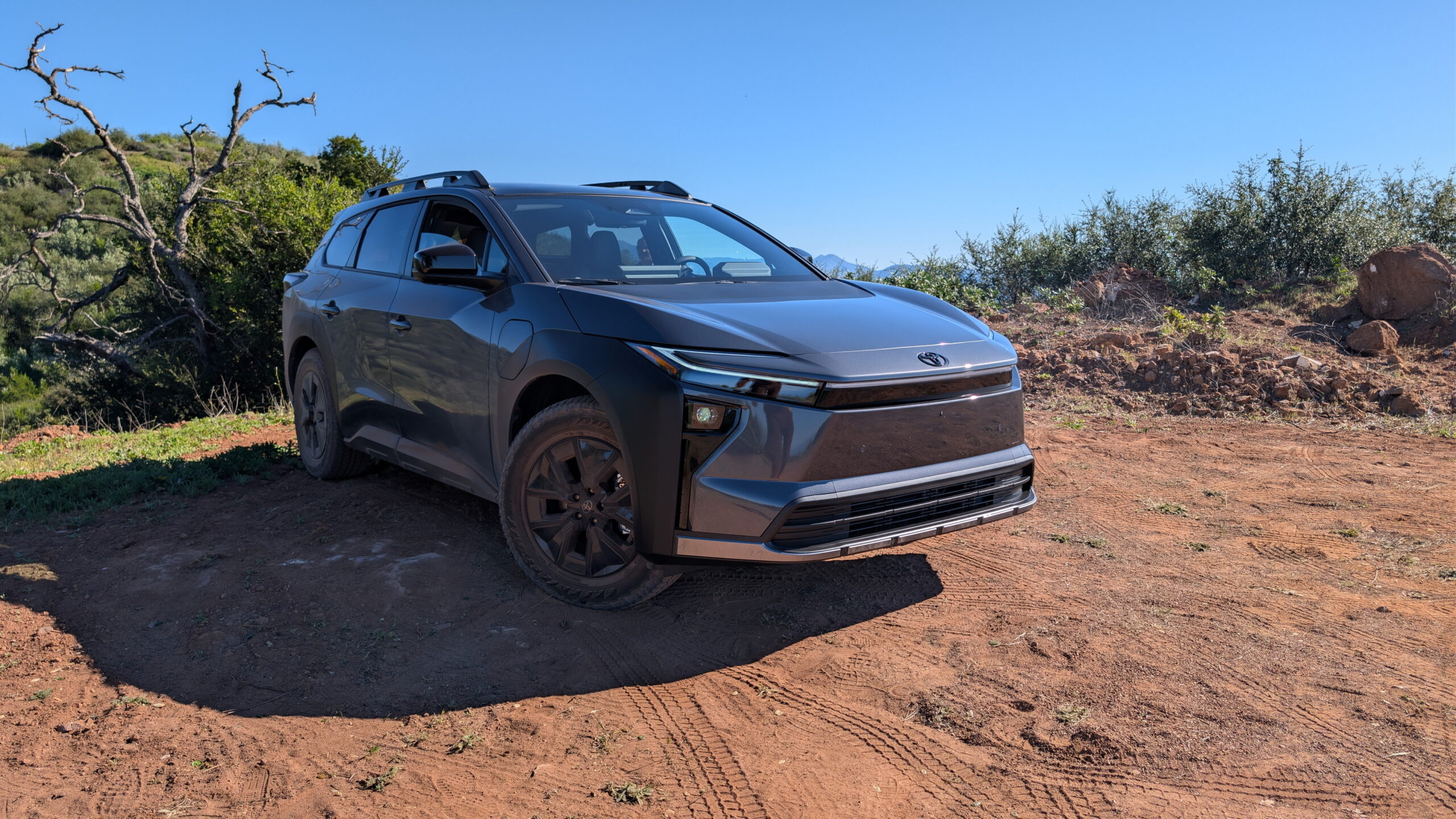
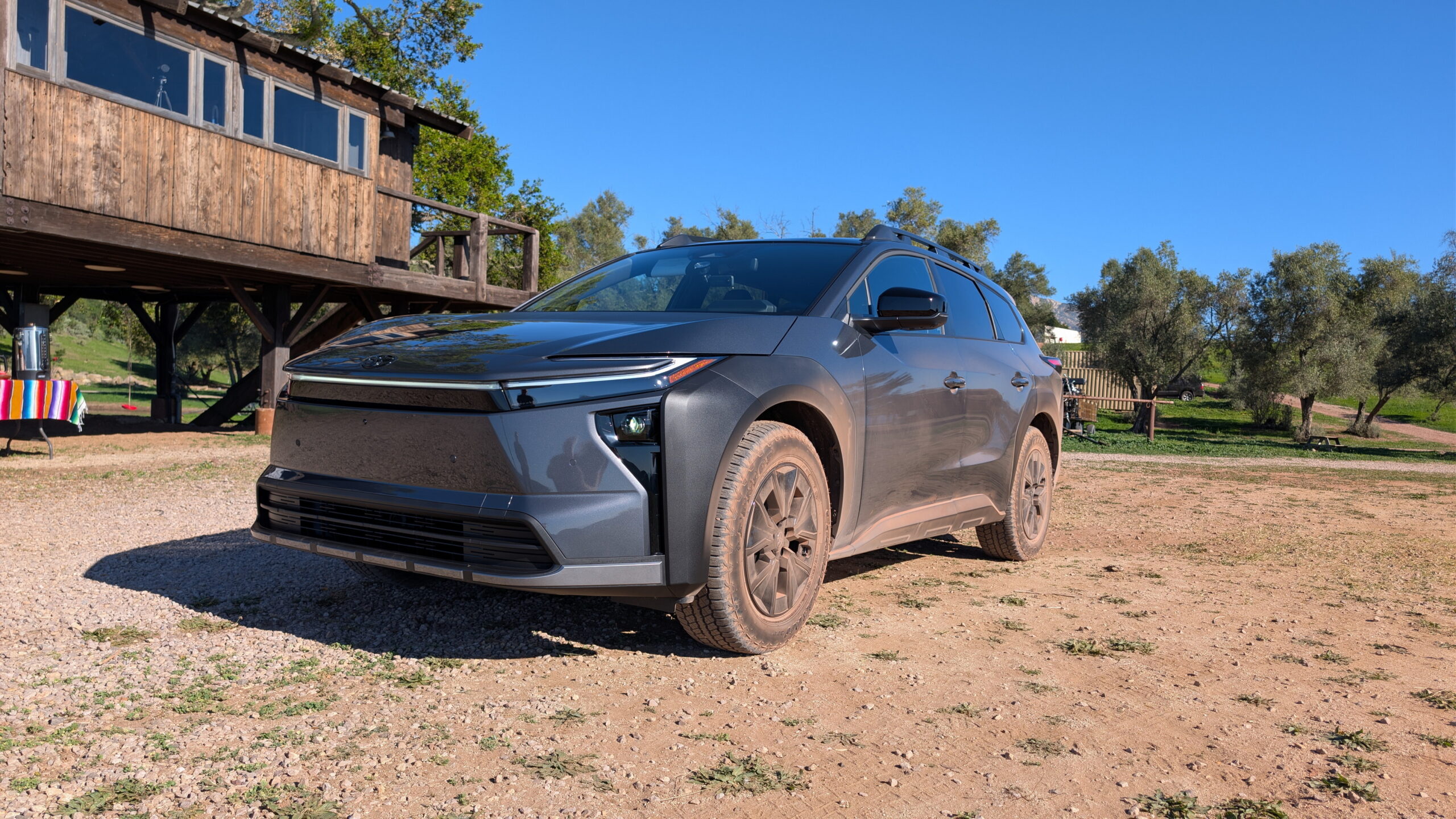
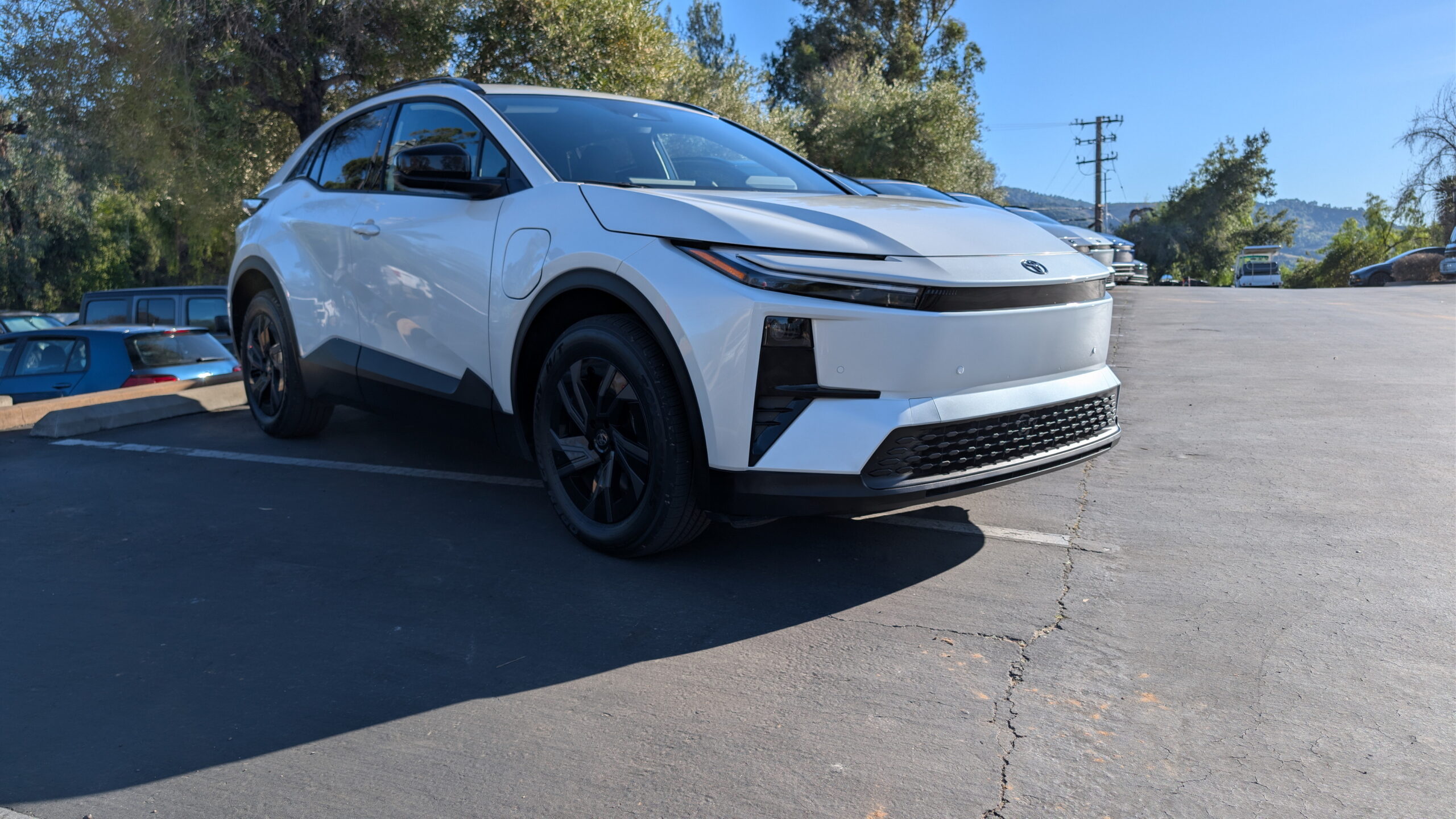
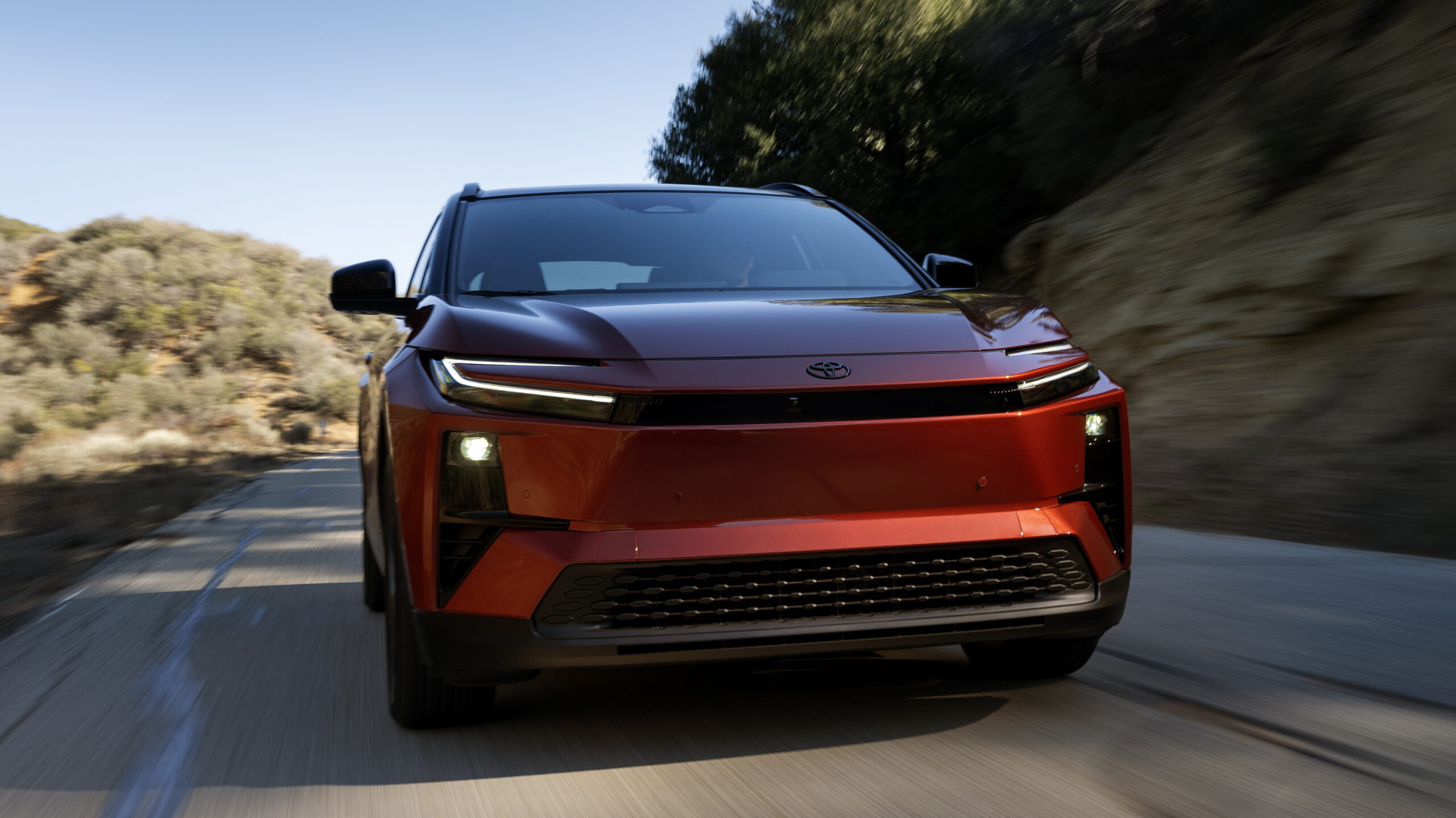
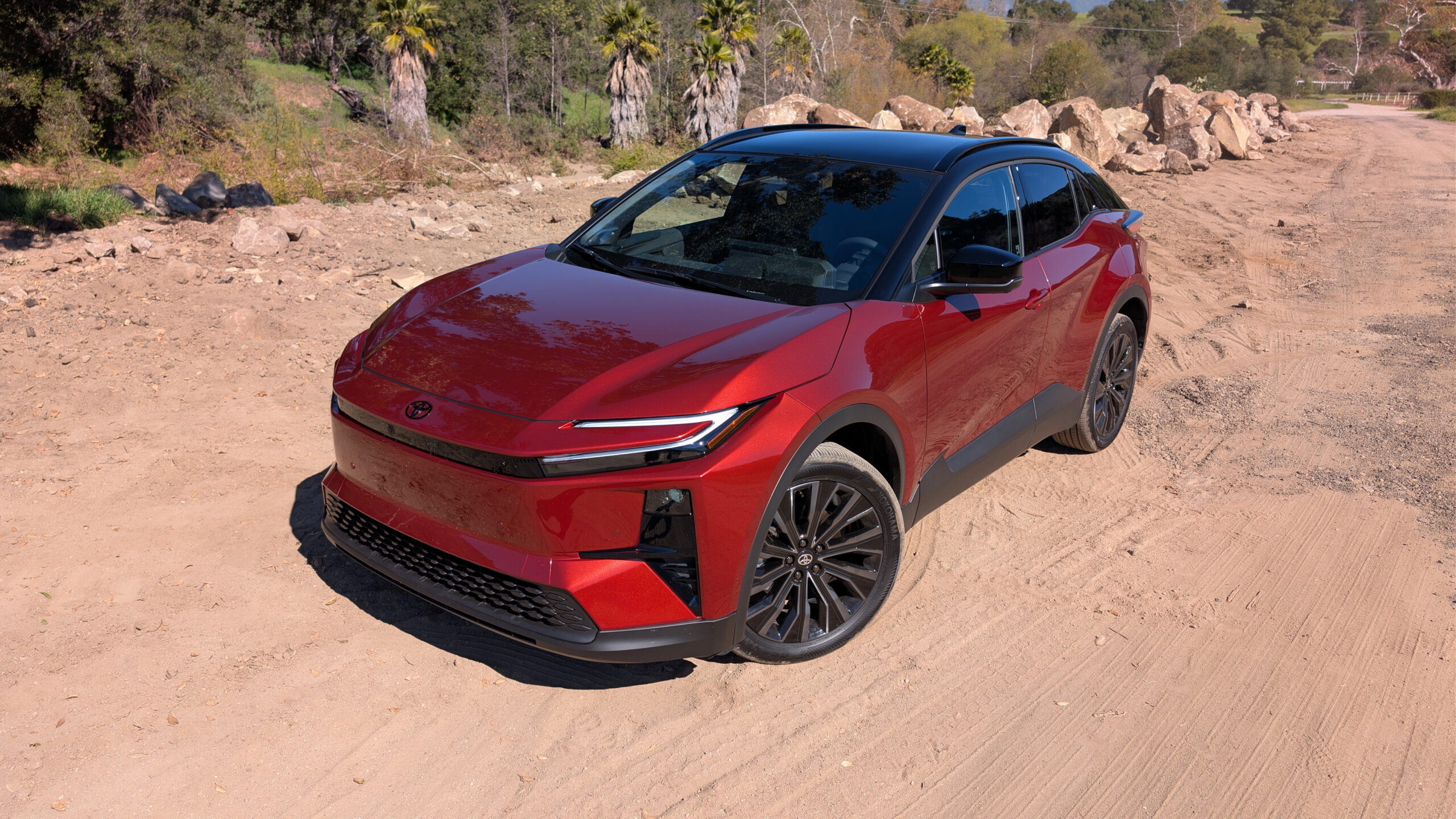
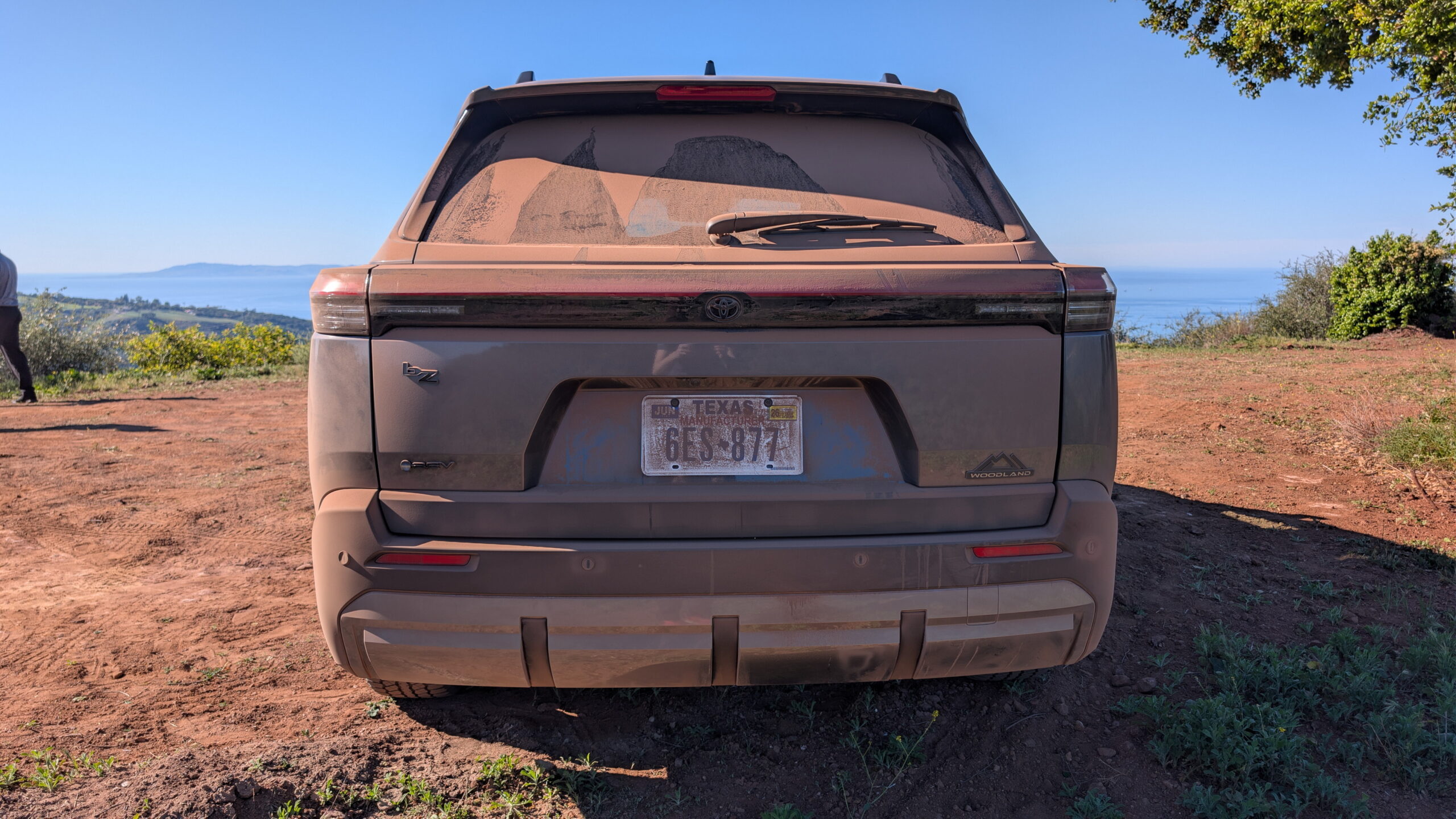
From afar, the bZ Woodland looks like it’s gone out into the world in a monotone plaid shirt. It’s trying to stand out and appear rugged, but not shouting for others to look at it. Some will love it and appreciate the understatedness, and others will think it’s trying too hard and is a bit overdone. Personally, I’m not sure the black plastic cladding is doing much good, but once it has some dirt on it, the overall package does appear appropriate.
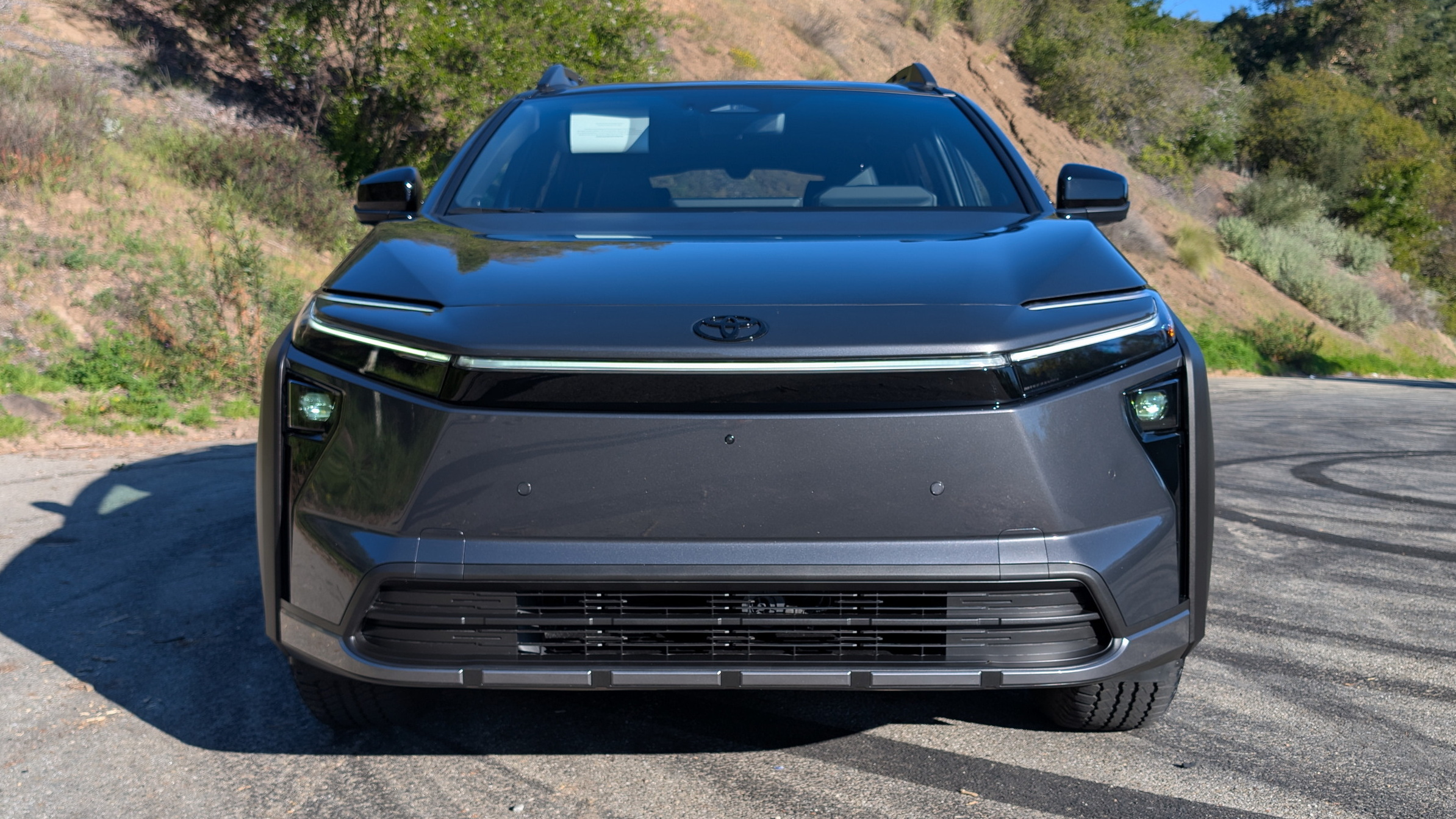
That said, it’s far from a departure from Toyota’s previous design efforts. The hammerhead nose, first introduced on the widely-loved new Prius design, is here and is complemented by a full-width LED lightbar and DRLs. The sideskirts and rear of the car offer more cladding and even a faux diffuser treatment below another full-width LED lightbar.
Photos Stephen Rivers/Carscoops
If you’re getting Subaru vibes from the shape, don’t feel bad. This SUV rolls off a Subaru production line with that brand’s Trailseeker SUV. The two share just about everything under the skin, but compare them side to side, and to my eye, it’s the Toyota that seems to have a more cohesive design overall.
Cabin Design And Layout
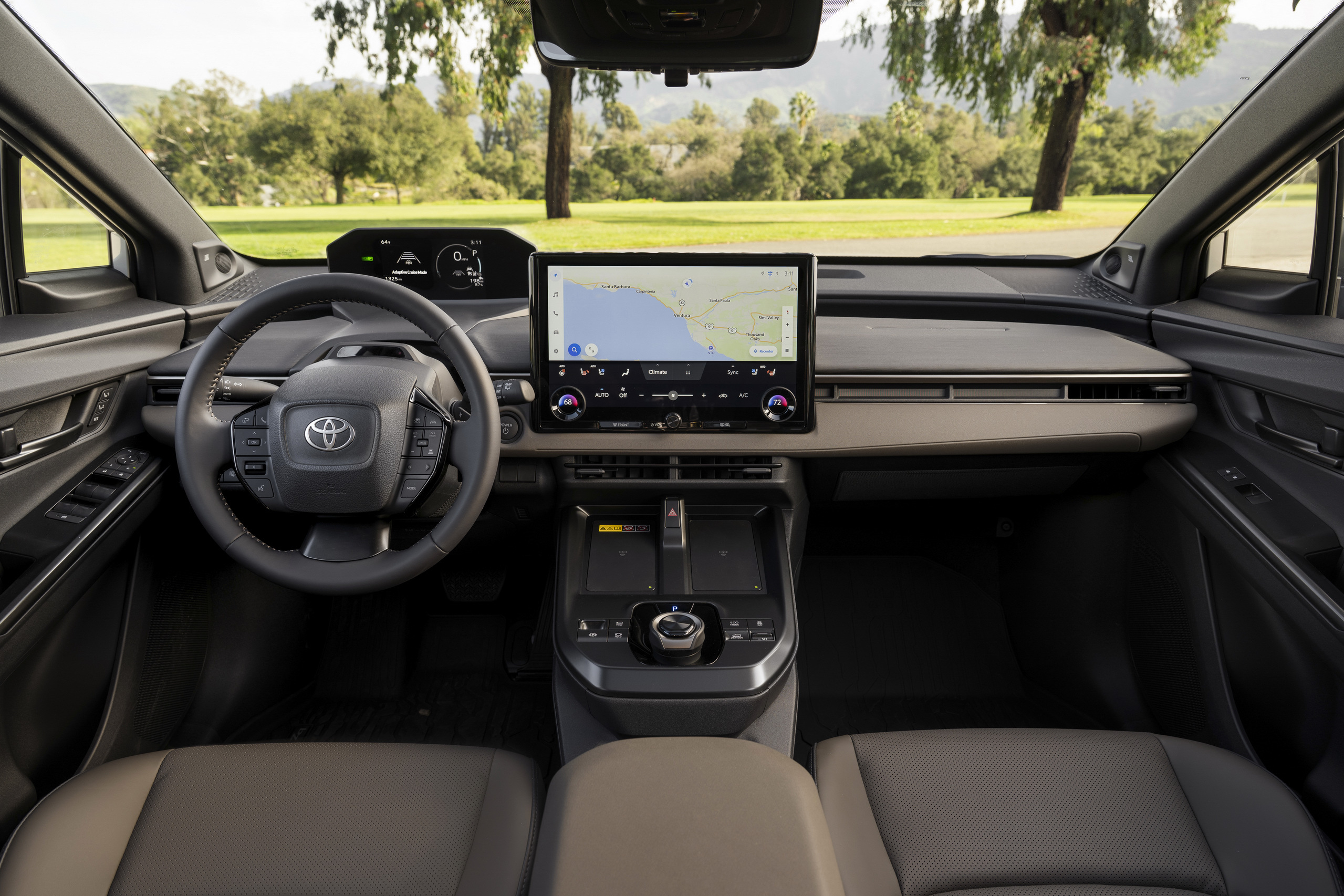
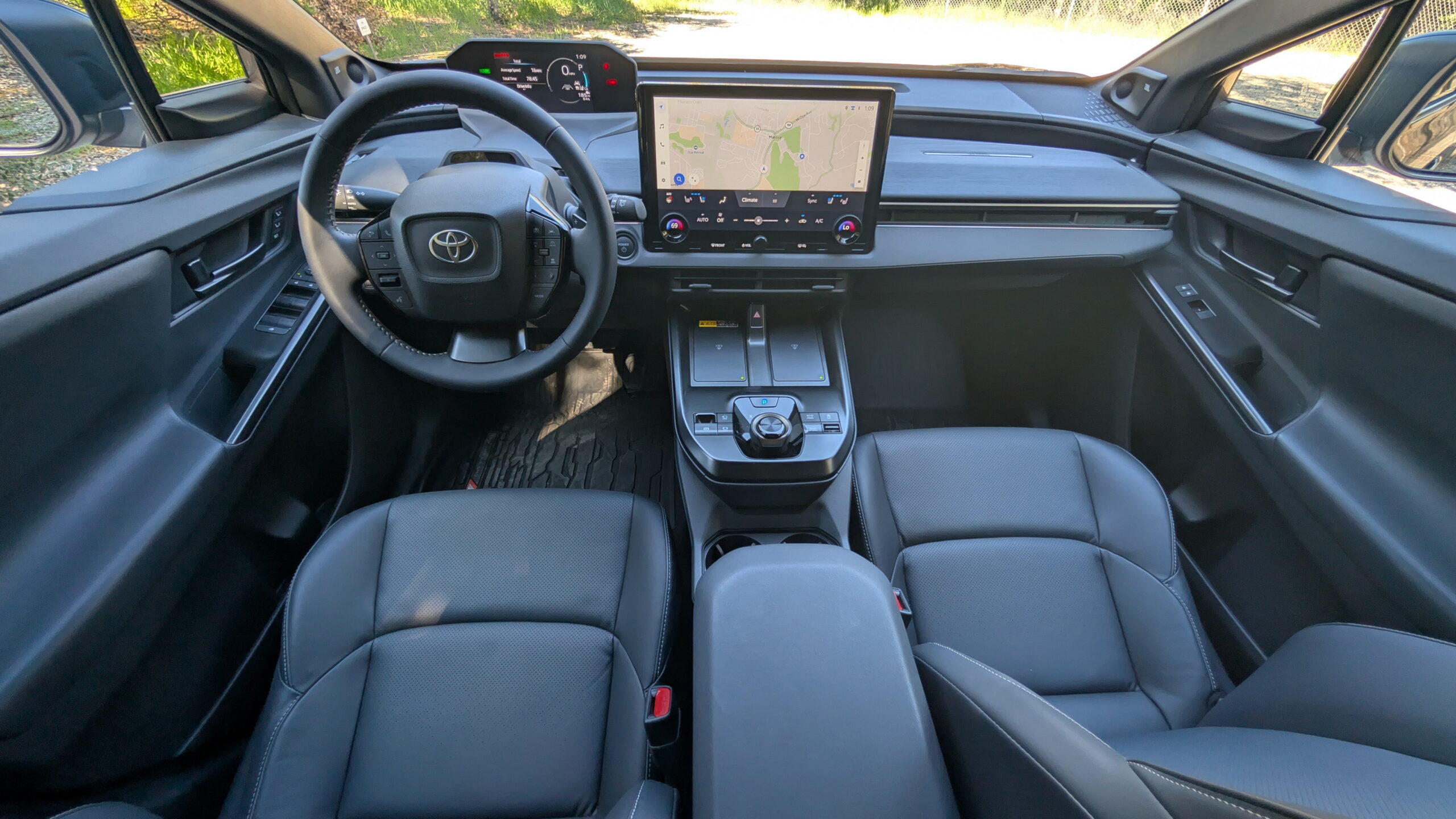
In the cabin, this crossover walks a fine line between rugged and refined. The materials feel good overall. They’re not luxurious or even what I’d call premium necessarily, but there’s a lot of thoughtful little touches to enjoy. Take, for example, the visual texturizing of the dashboard edges and upper door cards.
It elevates what could otherwise be a very plain space. That said, it’s all monotone. Black and more black, unless you opt for Stone Brown. I wish there were a little more visual drama inside, but from a business standpoint, Toyota probably made the smart call.
The cabin layout is straightforward to the point of being almost clinical. The 14-inch infotainment screen dominates the dash. It’s fast, intuitive, and thankfully backed up by integrated physical controls for key functions. The steering wheel feels tech-forward, with buttons for lane centering, voice commands, regenerative braking adjustments, and more. It’s busy, but logical.
Ergonomics And Everyday Usability
Photos Stephen Rivers/Carscoops
One potential issue, especially for shorter drivers, is that the steering wheel doesn’t have much in the way of maneuverability. My drive partner, Jason Torchinsky from our friends over at The Autopian, specifically remarked on how shorter drivers will struggle to see the entire gauge cluster without having the wheel block a significant portion of it.
In other words, shorter drivers might have to pick between seeing the whole road or seeing the whole gauge cluster because doing both at once might be impossible.
Another strange choice is the shifter knob. You have to press down on a ring and then rotate it in the direction you want. It’s not terrible. But it’s not intuitive, either. And it doesn’t feel like it adds anything meaningful. That space could’ve been used more creatively. Ahead of it, dual wireless chargers are a genuinely nice touch. It’s the kind of small usability win that makes daily life easier.
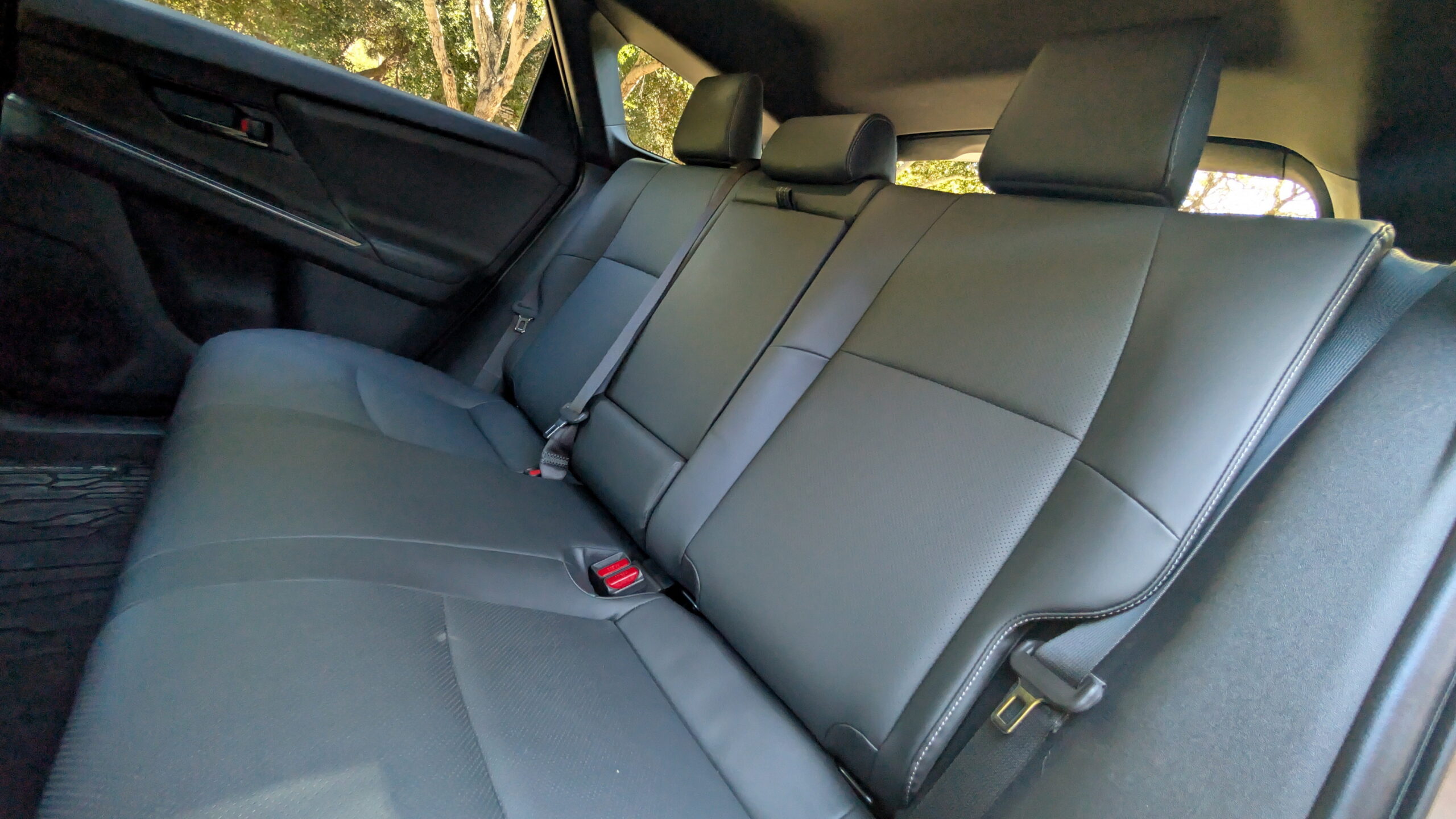
Rear seat space is where reality sets in. For a relatively large crossover, comparable in footprint to something like a Crown Signia, it’s tight back there. At 6’6″, I’ve endured my share of cramped rear benches, but I wasn’t expecting to have to slouch this much. Average-sized adults will be fine. Taller passengers should absolutely call shotgun.
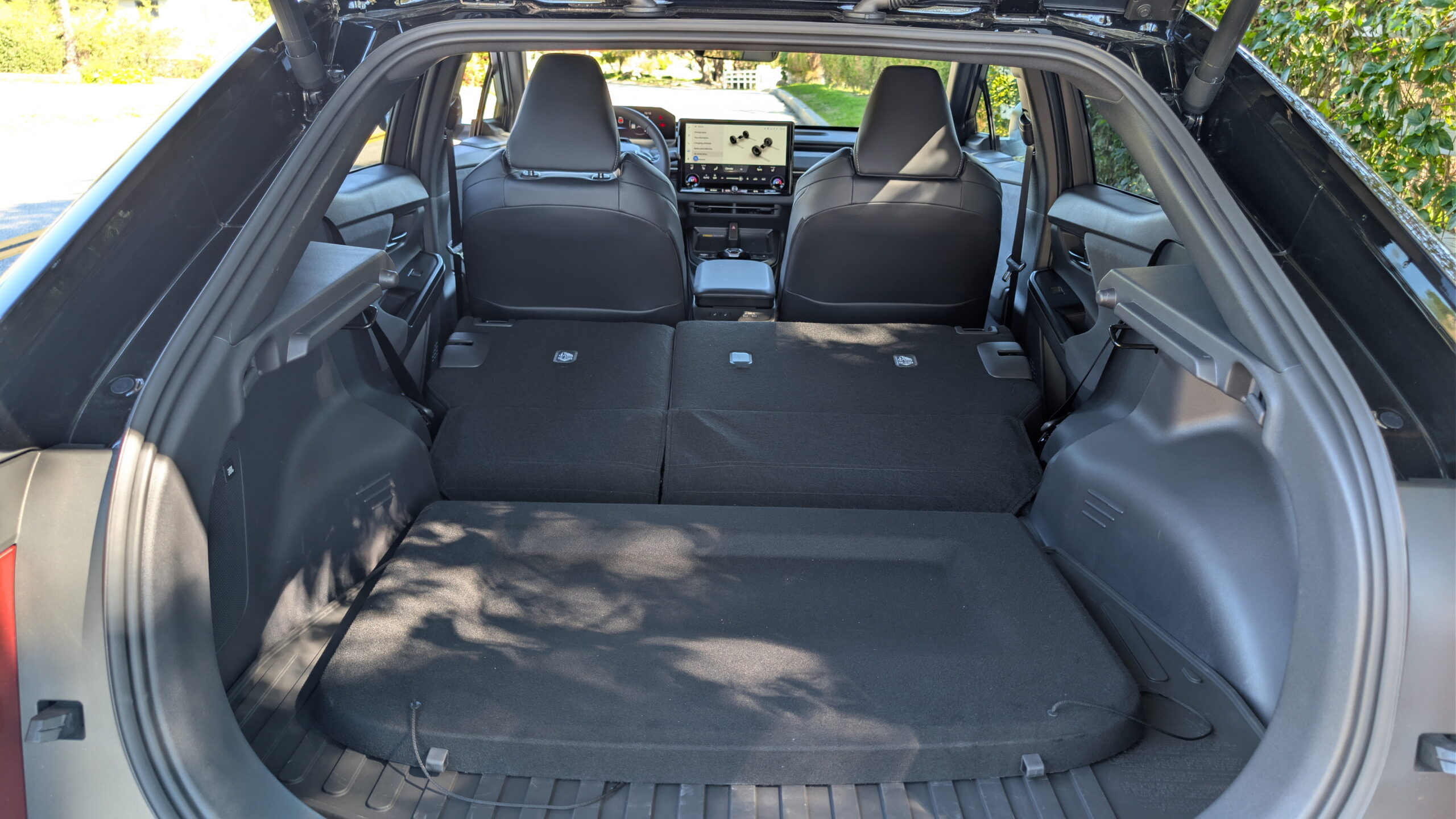
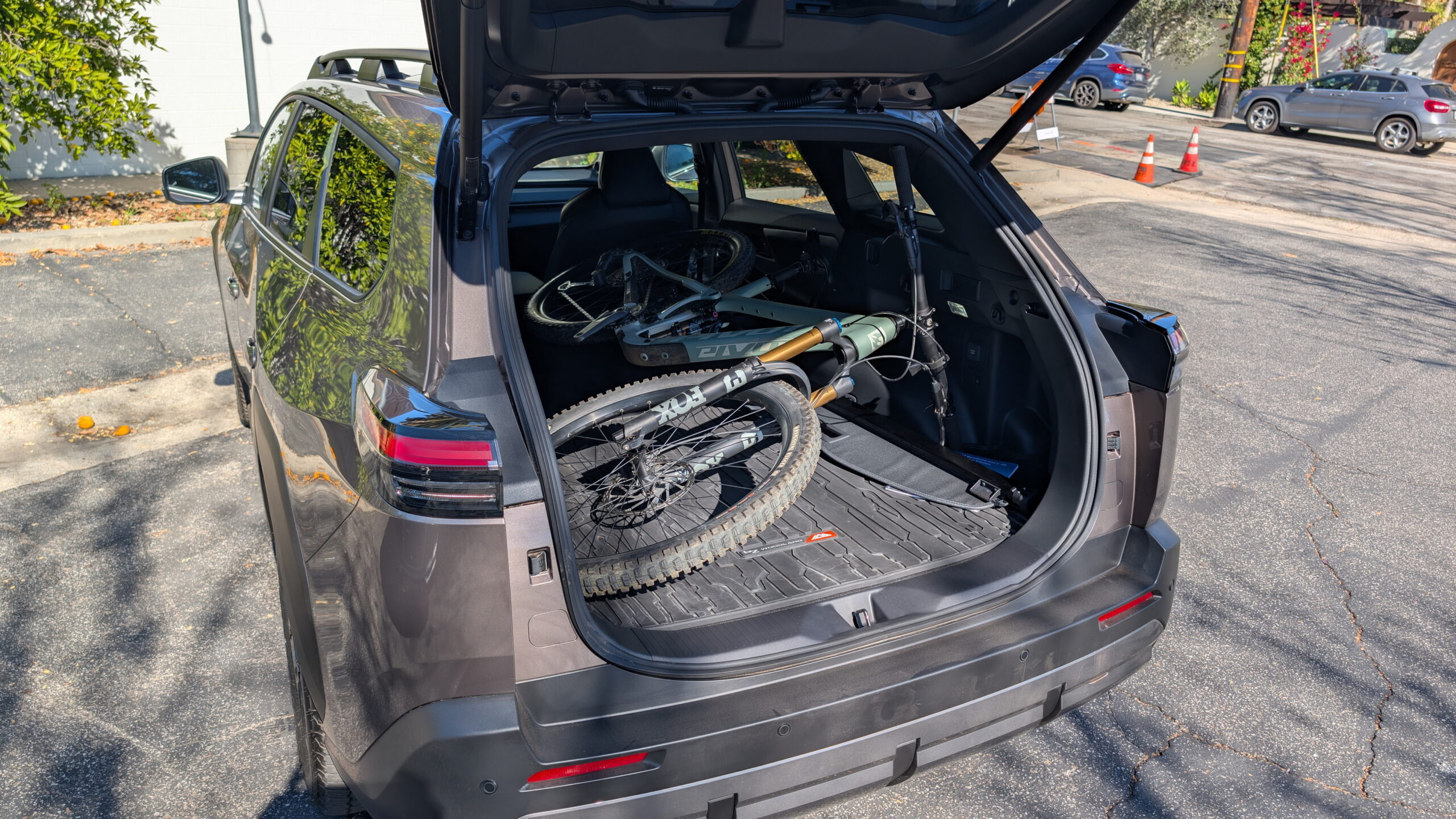
Cargo space makes up for it. With 74.9 cubic feet available with the seats folded, it’s genuinely cavernous. I fit a full-size, full-suspension mountain bike in the back, thanks to The Mob Shop, without removing the front wheel. That’s impressive.
It speaks not only to total volume but to how large and usable the rear opening is. If it swallows a modern mountain bike that I could ride whole, it’ll handle just about anything else you throw at it. If that’s not enough, it can also tow up to 3,500 pounds (1,588 kg).
Technology And Charging
Toyota loads the Woodland well. The 14-inch touchscreen runs Toyota’s latest multimedia software with wireless Apple CarPlay and Android Auto. The system is quick and easy to navigate. Dual Bluetooth pairing, Wi-Fi hotspot capability, and available JBL audio round things out nicely.
Charging is handled via a North American Charging Standard (NACS) port, giving access to a broad network of fast chargers. Under ideal conditions, Toyota says it’ll go from 10% to 80% in around 30 minutes. There’s also battery preconditioning and Plug & Charge capability to simplify public charging. That alone is a huge step in the right direction.
Steering-wheel-mounted paddles allow you to adjust regenerative braking intensity on the fly. It’s a useful way to fine-tune the driving experience depending on terrain or traffic. Toyota Safety Sense 3.0 comes standard, along with features like Blind Spot Monitoring, Rear Cross-Traffic Alert, Panoramic View Monitor with Multi-Terrain Monitor, and Safe Exit Alert.
It’s a comprehensive package that just about all buyers will benefit from.
Drive Impressions
Here’s where things take another unexpected turn, and this time, it’s decidedly for the better. Testing crossovers often means evaluating a vehicle that starts out compromised by design. What you don’t expect is something that does so many things at an above-average level, but that’s exactly where the bZ Woodland lands from a driver’s perspective.
Within 60 seconds of the opening presentation surrounding this vehicle, Toyota was proudly boasting that it has a 0-60 time of just 4.4 seconds. That’s unusual both in how it’s positioned and in terms of outright quickness.
For context, that’s quick enough to leave a GR Corolla (4.8 seconds) for dead and to almost keep up with a GR Supra manual (4.2 seconds). It actually beats the older four-cylinder version of the Supra (5.0 seconds). That said, this car isn’t really about outright speed. It’s about well-rounded capability.
Photos Stephen Rivers/Carscoops
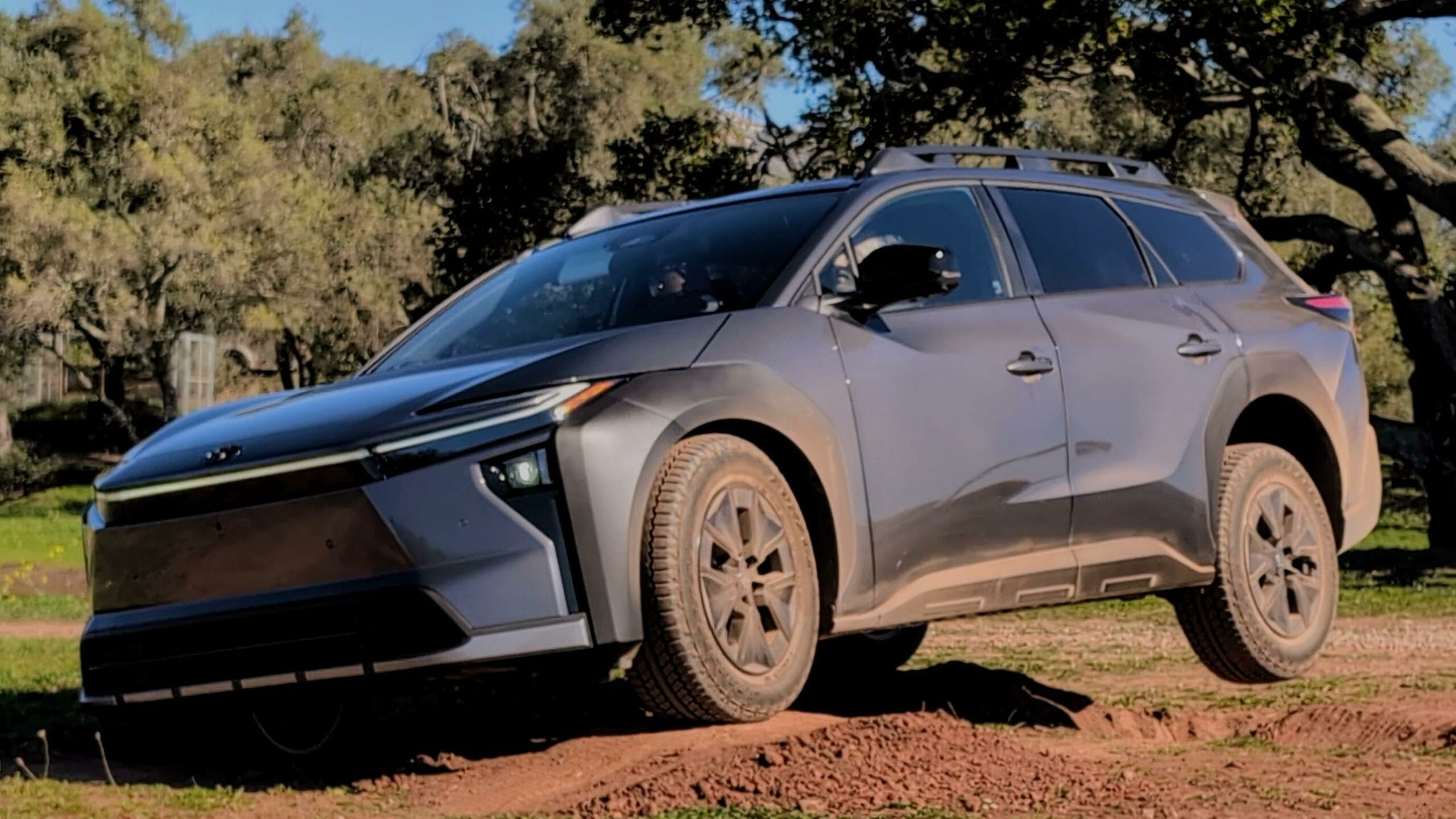
What matters is how broad its competence is. On steep dirt roads, even with minimal momentum, the Woodland climbed confidently. On an off-road course with deep ruts that frequently lifted a wheel into the air, it slowly and methodically found traction and worked its way forward.
Grip Control functions like a low-speed cruise control for rough terrain, maintaining a steady crawl (roughly 3–5 mph or 5–8 km/h)) without constant throttle or brake input. In my testing, it wasn’t strictly necessary, but I can see it being useful on tight trails where steering precision matters more than pedal modulation.
On pavement, it’s exactly what most buyers want. Quiet. Smooth. Stable. Even on the optional all-terrain tires, road noise is impressively subdued.
Is it engaging? Not really. It’s more forgettable than fun. But it’s also sharp enough and consistent enough that you won’t complain. Visibility is good. Controls are balanced. Feedback is predictable. It’s faster than most people need, more capable off-road than most buyers will ever test, and more comfortable in daily driving than you’d expect from something with this much performance on tap. That’s a pretty compelling blend.
Range And Real World Efficiency
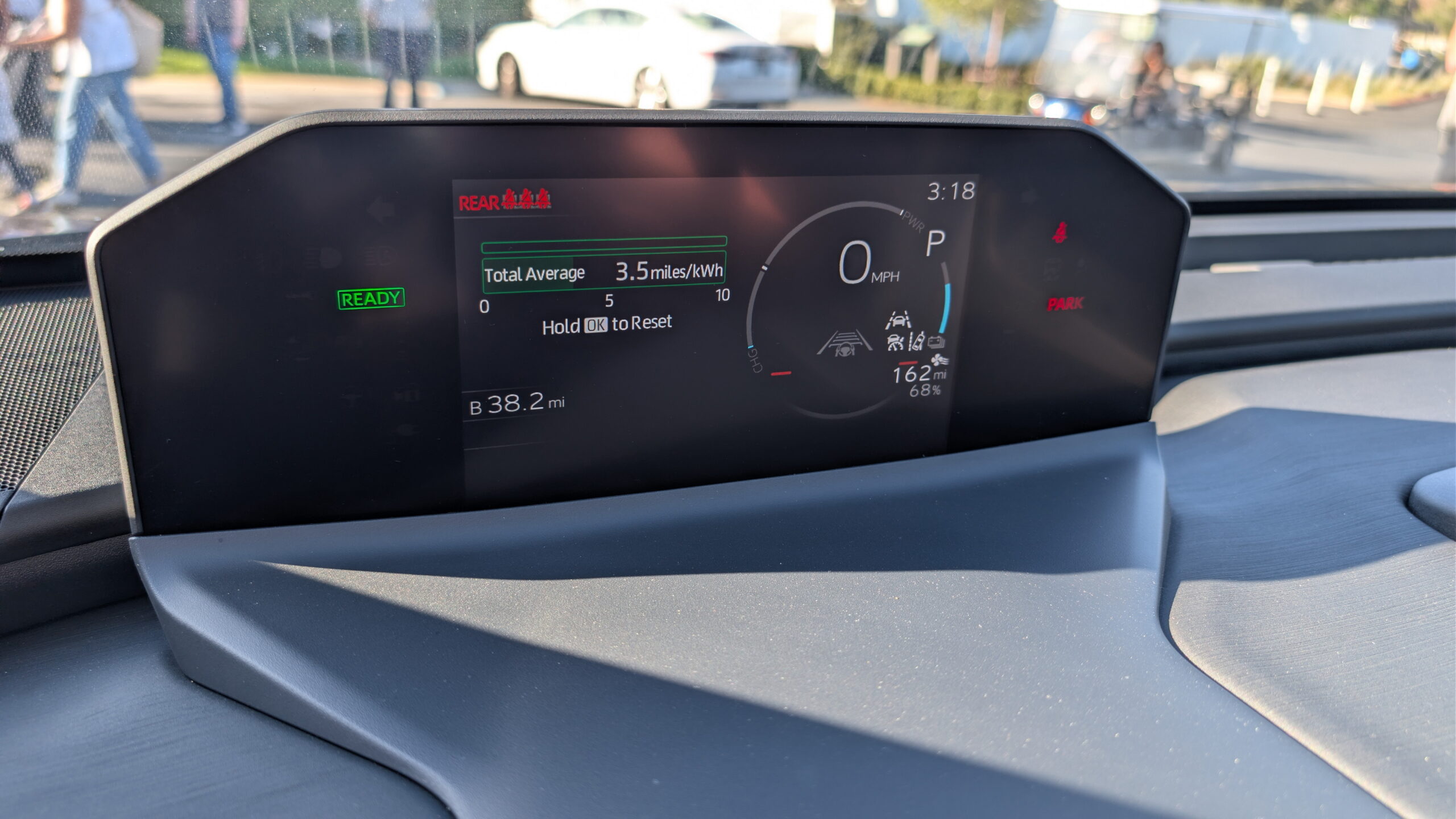
Toyota says the bZ Woodland will get up to 281 miles of range or 260 with its $0 optional all-terrain rubber. We drove different versions to different degrees of accelerator pedal excess, but managed one key finding in the end. During one restrained trip on a car equipped with all-terrain tires, we managed 3.5 miles per kWh.
Considering the 74.7 kWh battery pack under the floor, that works out to a potential 261 miles (420 km) on a single charge, assuming conditions stayed consistent. It’s difficult to view that as anything but a win, especially given that this wasn’t a tightly controlled test facility but real-world driving in Ojai, California, where the roads are rarely flat or straight.
Sure, we’d love even more range, but for now, we’ll take just barely beating an EPA estimate. After all, few folks will use up 260 miles of range in a day anyway.
Market Rivals And Positioning
Unquestionably, the biggest competition for the bZ Woodland will be from the Subaru Trailseeker. Positioned as an electric version of the well-loved Outback, the Trailseeker starts at around $5,000 less ($39,995) than the bZ Woodland ($45,300) and features the same underpinnings, battery, and AWD system. We haven’t sat in one, but based on photos, the cabin looks very similar. We expect the two to drive and handle almost identically as well.
Beyond the Subaru, there aren’t many EVs in this same niche. Rivian’s upcoming $45,000 R2 is likely the closest as it attempts to pair off-road capability with a premium cabin and on-road performance. Even so, it lacks the brand loyalty and recognition Toyota commands, along with the broader availability and ownership advantages, including a vast dealership network and established service infrastructure, that come with choosing a legacy automaker rather than a startup still finding its footing.
Other automakers like Tesla, Ford, Chevrolet, and Honda all have two-row crossovers or SUVs that could go up against the bZ Woodland on the road. None of them really has the same off-road capability angle to their game, though. Some, like Tesla, can’t come close to matching Toyota’s 3,500-lb towing capacity either. We expect that it’ll help Toyota capture a portion of the market that these others simply can’t touch.
Final Thoughts
The bZ Woodland reminds me of something like the Ford F-150. It’s very capable, but very few folks will ever use it to eight tenths of its performance envelope, much less ten tenths. That said, it’s hard to ignore just how much of Toyota’s DNA and ethos managed to find its way into this crossover. The original bZ4x never really felt all that akin to the brand from an identity standpoint.
Toyota’s newest EV offers serious practicality, objective soft-roading capability, and even a bit of serious performance on paved roads. Yes, the rear seat is tight for tall passengers. Yes, the shifter is odd. And yes, the interior could use a little more visual excitement.
But taken as a whole, the bZ Woodland is a genuinely well-rounded electric crossover that does more things well than it does poorly. And for a first serious swing at an adventurous, all-electric Toyota SUV, that’s a strong place to start.
The company wants EVs to feel like sports cars not tech showcases.
For many modern electric vehicles, progress has come to mean more. More batteries, more screens, more driver aids, and more weight. Longbow doesn’t see that as a requirement, or even desirable, for that matter.
The company was founded in 2023 by Daniel Davey and Mark Tapscott, both veterans of Tesla and Lucid, so they have seen firsthand how ambitious EV concepts hold up once they leave the presentation slide. At the end of 2025, former X Shore CEO Jenny Keisu joined the leadership team, bringing experience from the electric marine world into the mix.
Speaking exclusively with Carscoops, Tapscott outlined an engineering philosophy rooted in first principles, lightweight design, and a rejection of the idea that electrification must automatically lead to oversized, tech-heavy vehicles.
Does Every EV Need To Be Built From Scratch?
“I think it’s just a strengthening of resolve, to be honest,” Tapscott said when asked whether shifting industry conditions had forced a rethink. Rather than chasing vertical integration or speculative future technologies, Longbow is focused on building a sports car using proven components that already exist.
That mindset was reinforced early on through conversations with one of Tesla’s original co-founders, Tapscott told us, though he did not specify which one. Tesla was founded in 2003 by Martin Eberhard and Marc Tarpenning. “He sort of explained to us… that it’s exactly how they wanted to build Tesla 15–20 years ago,” Tapscott said. Back then, the supply chain simply wasn’t ready. Today, it is.
Instead of pouring resources into building motors or factories from scratch, Longbow is deliberately sourcing components with millions of miles of validation behind them. “There are so many suppliers making incredible products that we can take advantage of,” he explained. “The industry is helping us in what it’s doing.”
Physics First, Always
Tapscott says Longbow didn’t need to “unlearn” much when forming the company, largely because its founders came from motorsport, startups, and consultancy work rather than traditional OEM bureaucracy. What they did adopt, and continuously return to, is physics-based thinking.
“We always come back to that, which is the ‘why’ every single time,” he said. “It’s always ‘why this, ok, why that,’ until we get to that physics first-principle reason. And very often, there isn’t a reason—it’s just a choice.” A clear example is Longbow’s battery architecture. Instead of layering cells inside multiple cases and mounts, the company questioned whether those layers were truly necessary.
“Cells go into a case. That case is in another case. And then it goes into the vehicle, which is another case,” Tapscott explained. “So you end up having these extra layers of unnecessary weight and volume.”
By stripping those layers away and integrating the battery structure directly into the chassis, Longbow says it has achieved significant stiffness gains. According to Tapscott, the resulting structure is “at least twice as stiff as the Lotus chassis,” often cited as a benchmark for lightweight aluminum sports cars.
Clearing The Air On In-Wheel Motors
Longbow’s CES appearance sparked plenty of conversation around in-wheel motors. The brand touted a potential output of 900 horsepower, but it left us wondering how those motors would affect unsprung mass. Tapscott was quick to clarify that what was shown was a demonstration, not a production specification.
“The vehicle that we showed at CES… was really a demonstration,” he said. The goal was to highlight the flexibility of the underlying chassis rather than preview a finalized drivetrain. For production, Longbow is sticking with what Tapscott described as a “beautifully engineered, tiny little watchmaker’s motor” mounted within the vehicle. Still, he sees long-term potential in hub motors, particularly as technology matures.
“There is development work to be done on in-wheel motors,” he said. “We do think there is definitely a future for them… because it gives you so much more opportunity within the vehicle.” So for now, put a pin in the hub motors, but don’t forget them. They could pop back up in a future Longbow product.
Weight Loss As A Daily Discipline
Ask where weight was spent most reluctantly, and Tapscott doesn’t point to a single component. Instead, he describes an internal philosophy that governs every decision. “Our engineers are given two tasks,” he said. “Every day, they need to lose at least one gram from anything they’re designing. And the second is the best design they can do is no design at all.”
That ethos borrows heavily from Colin Chapman, whose influence Tapscott freely acknowledges. Still, Longbow isn’t pursuing minimalism at all costs. Some elements, like a physical shifter, exist purely to enhance the experience. “There are things we’re adding… for the theatrics,” he said. “Customer enjoyment is important.”
Additive Manufacturing And A Different Production Model
One of the most under-the-radar aspects of Longbow’s approach may be how it’s using additive manufacturing beyond prototyping. “At the moment, a lot of the development prototype cars we’ve been producing have been fully 3D printed on the exterior,” Tapscott said, noting how it enables rapid iteration during development.
Looking ahead, he sees additive manufacturing changing how low-volume cars are supported and customized. Instead of maintaining warehouses full of body panels across different markets, parts could be printed locally, on demand.
“You can actually just have one printer that can print off that part in that country immediately, without any delay,” he said. The same approach could also enable personalization without the cost typically associated with bespoke programs. “It could be entirely personalized to you,” Tapscott added. “That’s something that hasn’t been explored as much in production automotive.”
An EV That Puts The Driver First
Ultimately, Longbow’s message is that electrification doesn’t have to erase driver engagement. “An EV powertrain doesn’t mean a D-segment SUV with all of the extra cameras and weight and everything else,” Tapscott said. “Those two things are different.”
Longbow wants its car to be a tool – powerful, precise, and rewarding- but only when paired with an engaged driver. Or, as Tapscott put it, borrowing from the company’s own name: the weapon matters, but the archer matters more. Modern EVs are often defined by their tech-heavy approach, but that leads directly to just being outright heavy. Longbow’s approach to cutting out the fat might be its sharpest edge in the market.

 Login
Login