Christine Neumann-Ortiz, executive director of Voces de la Frontera, the Milwaukee-based immigrant workers’ rights group, said during a press conference last week in the Wisconsin State Capitol that this year’s May Day is unique. (Photo by Baylor Spears/Wisconsin Examiner)
May Day protests for immigrant and workers’ rights are planned for Friday in Wisconsin.
Voces de la Frontera is organizing the “Day Without Immigrants” actions in Madison and Milwaukee. The marches are part of the May Day Strong nationwide day of action. Organizers are calling for “No work. No school. No shopping.”
In Milwaukee, protesters will meet at the Voces offices in Milwaukee at 10 a.m. and march to the Federal Building. Protesters in Madison plan to meet at Library Mall on the University of Wisconsin-Madison campus at noon and march to the state Capitol.
Madison Public Schools has canceled classes Friday due to anticipated absences. Members of Madison Teachers Inc., the union that represents teachers and staff, are participating in the walkout which their union officially endorsed, as did the South Central Federation of Labor AFL-CIO.
In a statement, MTI said on its website that it is “aligning with Voces de la Frontera’s demands .. . while calling attention to the state’s failure to live up to its obligations to Wisconsin public school students.”
“MTI members voted overwhelmingly to take this action because our country is in crisis, and our vulnerable communities are paying the price.” The statement said, adding, “Our students are experiencing heightened anxiety, leading to absences and trouble concentrating at school. They are afraid that ICE agents will come for them, their parents, or their friends—a heavy burden no child should have to bear.”
Christine Neumann-Ortiz, executive director of Voces de la Frontera, the Milwaukee-based immigrant workers’ rights group, said during a press conference last week in the Wisconsin State Capitol that this year’s May Day is unique.
“It represents a very important national escalation of resistance against the growing inequality between the ultra rich and working people,” Neumann said. “It lifts up the national demands of abolish ICE, citizenship for all, an economy for all, and it includes the state demands of abolishing 287g” — agreements with local law enforcement agencies to aid federal immigration enforcement — “which has been aggressively growing like a cancer in our state, and the closing of the ICE processing facility in Milwaukee.”
Neumann added that it is a day of “solidarity with immigrant workers and their families who are being terrorized by militarized operations, the use of physical violence, racial profiling, warrantless arrests, and deadly conditions and detention centers” and “to defend our basic constitutional rights that are being challenged, regardless of immigration status.”
According to a map on the May Day Strong website, there are actions planned in nearly 40 locations across Wisconsin.
A demonstrator carries a sign reading 'My Dreams Are Not Illegal' near American flags as immigrants rights supporters march in Los Angeles on March 1, 2025. The march was organized by faith groups along with immigrants rights organizations as a peaceful protest over the Trump administration's immigration policies. (Photo by Mario Tama/Getty Images)
WASHINGTON — Members of the Congressional Hispanic Caucus raised serious concerns Thursday about the impact of a recent Department of Justice decision that will make it easier to deport hundreds of thousands of people brought into the country unlawfully as children, referred to as Dreamers.
Texas Democratic Rep. Joaquin Castro said the April 24 decision from the Department of Justice’s Board of Immigration Appeals, “put a target for deportation on every single Dreamer in this country.”
The decision from the BIA found that having Deferred Action for Childhood Arrivals, or DACA, status is not enough to prevent a deportation, making it easier for Dreamers to be removed from the U.S. There are roughly 500,000 DACA recipients.
The case before the three-judge panel stemmed from an appeal from immigration attorneys from the Department of Homeland Security after an immigration judge terminated removal proceedings for a DACA recipient, Catalina “Xóchitl” Santiago that cited her status as reason she could not be deported.
While the decision does not mean Santiago will be immediately deported, it does set precedent for similar cases.
Separately, immigration advocates have warned that DACA recipients have been swept up in President Donald Trump’s mass deportation drive and have been detained despite their legal status.
Congressional Hispanic Caucus Chair Adriano Espaillat said the decision will allow immigration judges to remove DACA recipients first without terminating their status.
“Before, you had to terminate their DACA status, before they got deported,” the New York Democrat said. “Now they could go straight ahead and do this egregious action by the Board of Immigration Appeals. This is a serious escalation (of) the assault against DACA recipients.”
Spokespeople for the Justice Department did not return a message seeking comment Thursday.
Trump ‘crusade’ against DACA
Democratic Sen. Catherine Cortez Masto of Nevada said the recent decision “is the Trump administration’s latest move to attack Dreamers.” She criticized Trump for going back on his comments that he would “work with the Democrats on a plan,” to keep DACA recipients in the country.
“That is just an indefensible decision,” she said. “Their ruling on DACA is a clear escalation in President Trump’s crusade to strip protections from DACA recipients. He is attacking the program from every angle.”
DACA was created by President Barack Obama’s administration in 2012 to protect eligible residents from deportation and allow them to obtain temporary work permits, driver’s licenses and to qualify for in-state tuition for higher education.
In Trump’s first term, he tried to rescind the program in 2017 by halting new applications and sending hundreds of thousands of recipients across the country into limbo. The Supreme Court eventually ruled against the Trump administration.
Some Republican-led states have challenged the legality of DACA and an appeals court allowed for work permits to expire in Texas, but kept deportation protections.
Federal immigration officers were at the Hartsfield-Jackson Atlanta International Airport on March 23, 2026 during the Department of Homeland Security shutdown to help with airport security. On April 30, 2026, Congress finally passed a bill funding most of the department for the rest of the year. (Photo by Ross Williams/Georgia Recorder)
WASHINGTON — President Donald Trump signed a bill Thursday that will fund almost every agency in the Department of Homeland Security for the next five months, ending the shutdown that began in mid-February.
The House approved the bill, which doesn’t include additional spending on Immigration and Customs Enforcement or the Border Patrol, on a voice vote earlier in the day.
The DHS shutdown, the third funding lapse in the last year, stalled paychecks for federal employees throughout much of the department, including those at the Federal Emergency Management Agency and the Transportation Security Administration.
Trump enacting the DHS appropriations bill finally marks an end to the annual government funding process that was supposed to be wrapped up before the end of September.
Connecticut Democratic Rep. Rosa DeLauro, ranking member on the Appropriations Committee, said during brief floor debate it was “about damn time” Republican leaders brought the bill to the floor.
DeLauro said that “from the outset” Democrats wanted to negotiate with Republicans to address “armed, masked agents marauding our streets and terrorizing people in our communities.”
“It has been the Republicans (who) have been intransigent and not willing to do that,” she said. “But there we go. Today we’re going to do it. It could have been done 76 days ago. I’ll take it today.”
Texas Republican Rep. Chip Roy said separating out funding for Immigration and Customs Enforcement and the Border Patrol from the DHS funding bill “is offensive to the men and women who serve” in those agencies.
“While we are all unified in funding the rest of DHS, we are absolutely horrified that we are blowing up the appropriations process to target those brave men and women who are doing the Lord’s work to keep us safe from cartels, from dangerous actors and from illegal aliens across the streets of America that have been endangering the American people,” he said.
Republicans plan to use the complex budget reconciliation process to fund ICE and the Border Patrol for the rest of Trump’s term without negotiating any new guardrails on immigration agents.
One shutdown after another
Instead of completing the dozen annual government funding bills before their Oct. 1 deadline, lawmakers’ stark differences over funding and policy led to a trio of shutdowns that stalled paychecks for federal employees and wreaked havoc on hundreds of programs.
The first shutdown, which affected much of the federal government, lasted 43 days as Democrats tried unsuccessfully to extend the enhanced tax credits for people who purchase their health insurance from the Affordable Care Act marketplace.
A partial shutdown lasting four days ended in early February when lawmakers approved a stopgap spending bill for the Department of Homeland Security alongside the remaining full-year appropriations bills for other departments.
But lawmakers failed to reach a bipartisan agreement to place constraints on federal immigration agents before the temporary funding bill for DHS expired on Feb. 14, leading to a third shutdown for the department.
Senate Democrats demanded several restrictions on immigration agents after federal officers shot and killed two U.S. citizens in Minneapolis in January. While Republicans control both chambers of Congress, most bills cannot move through the Senate without the support of at least 60 lawmakers.
After nearly six weeks, Senate Republican leaders agreed to remove funding for Immigration and Customs Enforcement and the Border Patrol from the DHS appropriations bill, unanimously sending it to the House for approval in late March.
House hangup
Speaker Mike Johnson, R-La., said at the time a plan to use the complex budget reconciliation process to provide three years of funding for ICE and Border Patrol wasn’t acceptable. He refused to put the Senate-passed bill on the House floor for a vote.
The Senate tried again in early April, sending an identical bill to the House, which Johnson declined to schedule a vote on until Thursday.
The House vote on the DHS appropriations bill happened less than a day after Republicans in that chamber voted to adopt the budget resolution that unlocks the reconciliation process. Republican senators approved the tax and spending blueprint earlier this month.
Congress’ budget resolution isn’t a bill and doesn’t need to go to the president for his signature in order to take effect. It doesn’t actually fund anything, but is designed to help lawmakers plan tax and spending policy for the next decade.
GOP lawmakers intend to use the reconciliation process the budget resolution provides to approve a bill in the coming weeks that will provide up to $140 billion for ICE and Border Patrol. That avoids the need to place any new constraints on federal immigration officers in order to get Democrats’ votes to limit Senate debate.
Members of Congress will, however, still need to find agreement on funding for the rest of government ahead of the next fiscal year, which will begin on Oct. 1.
Another impasse will mean another shutdown, just weeks before the November midterm elections.
President Donald Trump gives a speech at the World Economic Forum on Jan. 21, 2026 in Davos, Switzerland. (Photo by Chip Somodevilla/Getty Images)
President Donald Trump on Thursday moved to capitalize on a U.S. Supreme Court decision weakening the federal Voting Rights Act as he urged one governor to gerrymander his state and praised another for suspending an approaching primary.
The court’s decision on Wednesday struck down Louisiana’s congressional map as unconstitutional and empowered other Republican states to break apart districts where most residents are Black for a partisan advantage.
The opinion could reinvigorate Trump’s push for states to redraw their maps to give Republicans an edge in the November midterm elections. The president’s party typically performs poorly in the midterms and Trump’s approval has fallen in polls, making Democrats hopeful they can retake the U.S. House.
Louisiana Gov. Jeff Landry and state Attorney General Liz Murrill announced on Thursday that the state’s congressional primary election, set for mid-May, would be suspended. The pause gives state lawmakers time to draw a new map aimed at ousting at least one, if not two, Black Democrats.
Trump thanked Landry on his social media platform, Truth Social, for “moving so quickly to fix the Unconstitutionality” of the state’s map. In a separate post, Trump wrote that he had spoken with Tennessee Republican Gov. Bill Lee, who faces calls to immediately gerrymander the state.
“I had a very good conversation with Governor Bill Lee, of Tennessee, this morning, wherein he stated that he would work hard to correct the unconstitutional flaw in the Congressional Maps of the Great State of Tennessee,” Trump wrote.
A spokesperson for Lee didn’t immediately respond to a request for comment.
The redistricting rush
Historically, states draw new maps once a decade after each census but eight states have now broken that norm after Trump urged Republicans to gerrymander.
Texas, Missouri, North Carolina, Ohio and Utah have drawn fresh GOP-leaning maps, as well as Florida, whose legislature approved a gerrymander hours after the Supreme Court’s decision. California and Virginia have enacted new maps favorable to Democrats.
Before Wednesday, the redistricting war was essentially a wash. But the court’s decision gives Republicans more options to gain the upper hand this year, if states can move quickly.
Alabama, Georgia, Missouri and Tennessee are among the red states with upcoming primaries where lawmakers could theoretically still act. In some states — like Georgia and Tennessee — top Republicans haven’t ruled out action. In others, like Alabama and Georgia, GOP leaders have ruled out or played down the possibility of action this year.
U.S. House Speaker Mike Johnson, a Louisiana Republican, urged states to gerrymander their maps before the midterm elections.
“I think all states that have unconstitutional maps should look at that very carefully and I think they should do it before the midterms,” Johnson told CNN on Thursday.
Dems also talk gerrymandering
Democrats have also floated the possibility of additional gerrymanders — whether this year or ahead of the 2028 election.
New York Gov. Kathy Hochul said on social media after the court’s decision that she would work with the legislature to change the state’s redistricting process. New York currently uses a commission system to draw maps, limiting opportunities for partisan gerrymandering.
At a news conference hosted by the Congressional Black Caucus on Wednesday, Rep. Terri Sewell, an Alabama Democrat, suggested she would support additional Democratic gerrymanders.
“It values partisan politics over discrimination,” Sewell said of the court’s decision. “It’s really, really, really — I mean, it takes us back. So to the extent it’s urging, it’s inviting red states to totally take away all of the Democratic seats and be totally red, it also encourages blue states to do exactly the same.”
A heavy equipment operator works at the site of the new Wisconsin Historical Society building in Madison. Wisconsin construction jobs have been growing over the last year, although they declined some in March, according to the Department of Workforce Development. (Photo by Erik Gunn/Wisconsin Examiner)
Wisconsin’s economic growth is continuing to slow down, with job numbers down from a year ago and unemployment up slightly, the state labor department reported Thursday.
“The Wisconsin labor market has cooled a bit along with the national economy,” said Scott Hodek, section chief in the office of economic advisors at the Wisconsin Department of Workforce Development. “But unemployment remains historically low.”
Jobs and employment data are collected through two separate surveys conducted by the federal government.
The number of jobs reported each month is projected based on a federal survey of employers’ payrolls. The number of people listed as employed or unemployed is projected based on a survey of U.S. households each month.
With the release of data for March on Thursday, Wisconsin now has the jobs and employment picture for the full first quarter of 2026. The release of January and February data was delayed until earlier in April while DWD adjusted its data calculations in comparison with unemployment insurance tax collections. That annual benchmarking process was delayed further due to the October 2025 federal government shutdown.
“Through 2025 and now into ‘26, we are seeing continued growth still, but it does seem to be decelerating some,” Hodek said.
The number of jobs reported each month is projected based on a federal survey of employers’ payrolls. The number of people listed as employed or unemployed is projected based on a survey of U.S. households each month.
The household survey results projected 109,500 people were unemployed in March, an increase of 2,200 from February and an increase of 8,400 from March 2025. The unemployment rate — the percentage of people who report they are actively seeking work — went up to 3.5% in March. It has increased by a tenth of a percentage point each month for the last three months.
Wisconsin had a projected 3,021,600 jobs in March, about 1,200 more than February of this year but a loss of more than 17,000 since March 2025. Hodek said that echoed an increase in the number of jobs nationally from February to March.
The construction industry, which has been doing well in Wisconsin, showed a projected 151,800 jobs in March, 1,800 fewer than in February, but a gain of 6,600 jobs from March 2025.
“There are a lot of jobs there still, and if anything, the employment trend over the last year has likely accelerated,” Hodek said.
A challenge has been a continued shortage of workers. “What we’re seeing is demand still outstripping supply,” Hodek said. “There’s not enough crews to go around.”
The number of jobs in manufacturing was projected at 453,600 in March, 1,800 more than in February but a loss of 5,200 jobs from March 2025.
There were a projected 437,500 jobs in healthcare and social assistance in March, a gain of 300 from February and a gain of 4,900 from March 2025.
Sen. André Jacque (left) of New Franken announced he won't run for reelection Monday. Jacque and Rep. Barbara Dittrich (R-Oconomowoc) testify on a bill to regulating the use of student names and pronouns. (Photo by Baylor Spears/Wisconsin Examiner)
Sen. André Jacque (R-New Franken) announced Monday he’ll retire from office at the end of his term.
Jacque’s decision means a third of the Republican Senate caucus is not seeking reelection, including Sen. Rob Hutton (R-Brookfield) and Sen. Van Wanggaard (R-Racine), who both represent key districts that will determine control of the body in November, as well as Senate Majority Leader Devin LeMahieu (R-Oostburg).
Sen. Andre Jacque (official photo)
“My passion for serving our community has not waned, but after much discussion with family and friends I have decided that I will not be seeking re-election to the State Senate this fall,” Jacque, 45, said in a statement.
The wave of retirements comes in an election year where odd-numbered Senate seats will be up for election for the first time under the legislative maps that were adopted in 2024. There are also eight Republicans who have so far announced their retirements.
Jacque has represented Senate District 1 since 2019. The solidly-red district under the maps adopted in 2024 encompasses Door and Kewaunee counties as well as parts of Calumet, Brown, Manitowoc and Outagamie counties. After the new maps were adopted, Jacque ran in the GOP primary for Wisconsin’s 8th Congressional District, losing to U.S. Rep. Tony Wied, who received the endorsement of President Donald Trump in the three-way primary.
Jacque said he is not sure what he will do after leaving the Legislature, but “this is not farewell — there is still much to be done and I will always work for a brighter future for our state and the advancement of those worthy ideas that never quite made it all the way through the legislative process.” He added that he has been “greatly blessed, and God’s not done with me yet.”
Democrats will have the chance to win control of the Senate for the first time since the 2009-11 legislative session. State Senate Democratic Campaign Committee spokesperson Will Karcz said in a statement that the Republican caucus was “retiring en masse to avoid losing at the ballot box in November.”
“While Republicans jump off their sinking ship, Senate Democrats are focused on the issues that Wisconsinites care about and are making it clear they have a plan to deliver results when they win a majority in November,” Karcz said.
Jacob VandenPlas, a combat veteran, farmer and former leader of DC Farm for Vets, a veterans nonprofit, announced his campaign for Jacque’s seat on April 17.
Independent Mark Becker is also running for the seat. Becker, a small business owner, was formerly the chair of the Brown County Republican Party. He has hosted a podcast on Civic Media called “Rational Revolution” since 2024, though he has stepped away from that to campaign.
New Jersey Turnpike (Photo by Mario Tama/Getty Images)
Four Republican members of Congress, including gubernatorial frontrunner Tom Tiffany, have introduced a bill that would exempt vehicles in southeast Wisconsin from federally mandated emissions testing.
The bill was introduced by U.S. Rep. Bryan Steil (R-Janesville) and co-sponsored by Reps. Glenn Grothman, Scott Fitzgerald and Tiffany. Tiffany, the only member whose district does not include the affected area of Milwaukee, Kenosha, Ozaukee, Racine, Sheboygan, Washington and Waukesha counties, also brought the issue up on the campaign trail late last month.
Seven Wisconsin counties, including Milwaukee, are designated ozone nonattainment areas by the EPA under the Clean Air Act, which subjects vehicle owners in the area to additional regulations such as biennial emissions testing. Federal law allows a state to apply for the waiver if it can prove air pollution originates from out-of-state.
The bill authors point to a Department of Natural Resources report that showed 10% of the ozone measured in the area comes from Wisconsin while more than a third of it comes across Lake Michigan from Illinois and Indiana.
“Because of outdated federal rules, hundreds of thousands of Wisconsin drivers in seven counties are forced to complete emissions tests every two years just to renew their registration,” Tiffany said in a statement. “Wisconsin families should not be punished with costly and time-consuming mandates because of pollution drifting in from Illinois and Indiana.”
Studies have shown the highest sources of ozone in the region come from the urban centers of Chicago and Milwaukee.
Waukesha County Judge Brad Schimel delivers his concession speech in the Wisconsin Supreme Court race. (Henry Redman | Wisconsin Examiner)
U.S. Sens. Tammy Baldwin and Ron Johnson sent a letter to the White House Wednesday recommending their nominees for U.S. Attorney in Wisconsin’s two federal court districts.
The appointment process for the two jobs has become more politically fraught than in the past after the commission was unable to agree on a nominee for the state’s Eastern District. The administration of President Donald Trump named former Republican attorney general and failed state Supreme Court candidate Brad Schimel as the interim U.S. Attorney in Milwaukee last year, which allowed him to serve for a limited time. The district’s judges ruled earlier this year that Schimel could no longer serve in his interim role, but former U.S. Attorney General gave him a new title that allowed him to continue working in the office.
“I appreciate the hard work and dedication of Brad Schimel, who continues to serve the people of Wisconsin and remains fully committed to his role as first assistant U.S. attorney in the Eastern District of Wisconsin,” Johnson said in a statement. “My bipartisan nominating commission with Sen. Baldwin submitted two well-qualified U.S. attorneys for the President’s consideration. Peter Smyczek and Chadwick Elgersma will apply the rule of law and serve the people of Wisconsin’s Eastern and Western districts well.”
Historically, the two senators from a state each appoint people to a bipartisan nominating commission which selects candidates to be recommended to the president. Presidents usually adhere to the recommendations of a state’s senators. The Wisconsin nominating commission had broken down but was restarted after Democrats objected to Schimel’s appointment.
Baldwin and Johnson named Peter Smyczek and Chadwick Elgersma to be the state’s top federal prosecutors. Smyczek has been an assistant U.S. attorney in the Milwaukee office while Elgersma was named to the job in January after working as an assistant prosecutor in the Madison office.
“This is proof that the hard work of this commission and finding common ground can work,” Baldwin said. “The candidates that the commission put forward appear well qualified, to have relevant experience, and committed to delivering justice impartially, and I support them moving through the next stage of the nomination process. Wisconsinites want these top law enforcement officials to work for them and uphold the constitution without fear or favor, and I will vet these candidates to ensure they meet that criteria and do right by Wisconsin families.”
The E. Barrett Prettyman U.S. Courthouse in Washington, D.C., home of the U.S. District Court for the District of Columbia, on July 14, 2025. (Photo by Jacob Fischler/States Newsroom)
WASHINGTON — The man who allegedly targeted President Donald Trump at the White House Correspondents’ Dinner agreed in federal court Thursday to remain jailed as the Department of Justice continues its investigation, including examining ballistics to prove a single shot fired at a Secret Service agent came from the defendant’s weapon.
Cole Tomas Allen, 31, of California, appeared before U.S. District Magistrate Judge Moxila A. Upadhyaya in Washington, D.C., five days after he allegedly charged security one level above the Washington Hilton ballroom where Trump, Vice President JD Vance and several Cabinet officials were attending the annual black-tie event that dates back a century.
Allen is charged with attempting to assassinate the president, interstate transportation of a firearm with intent to commit a felony and discharge of a firearm during a crime of violence.
He faces up to life in prison if convicted of attempting to kill the president. Trump, first lady Melania Trump and Cabinet members all safely evacuated the ballroom. A Secret Service agent was hit by gun fire, but was protected by his bulletproof vest.
Government prosecutors argued Wednesday in a court filing Allen prepared for a mass casualty event. Allen was allegedly armed with a 12-gauge pump-action shotgun with one spent cartridge in the barrel and eight unfired rounds in the magazine.
The defendant also had on him 16 unfired cartridges, attached to his body with Velcro and in a small bag, plus a .38 caliber pistol loaded with 10 rounds, and two other handgun magazines, each with nine rounds, according to the government.
The filing also alleges Allen carried “two knives, four daggers, multiple sheaths, multiple holsters, needle nose pliers, (and) wire cutters.”
Detention argument
Despite Allen conceding to remain jailed, Assistant U.S. Attorney Charles R. Jones requested to present the government’s reasoning in court to keep him detained.
Upadhyaya denied the request, calling it “a completely inefficient way of proceeding,” given DOJ had already won its motion.
“I guarantee you that if the defendant challenges his detention in the future, you would be doing your exact same presentation all over again,” Upadhyaya said.
She asked: “What audience is your supplemental information for?”
Defense attorney Teriza Abe said she wasn’t contesting the government met its argument for detention.
Abe asked the judge to intervene in Allen’s detention conditions. He is being held at the D.C. jail in a “safe cell” that is monitored 24 hours a day meant to prevent him from endangering others or self-harm.
“He’s not a danger to anyone in the jail,” Abe said.
Upadhyaya instructed her to file a motion to allow the government’s response.
“I don’t have the authority, nor would I presume I can override the judgement of the jail,” Upadhyaya said.
A preliminary hearing is scheduled for May 11. Abe requested prosecutors provide evidence for the defense’s review by May 8.
Shot at Secret Service agent
Allen’s attorneys requested Thursday that prosecutors provide evidence ahead of the detention hearing, including any information and video showing Allen did not fire a shot at the Secret Service agent, referred to by the government in court filings as V.G.
U.S. Attorney for the District of Columbia Jeanine Pirro responded that the government’s preliminary investigation shows Allen fired one shot in the direction of the Secret Service agent.
“With respect to your specific requests for information, the government’s investigation is ongoing and its analysis of the crime scene evidence and recovered ballistics evidence is not yet complete,” Pirro responded.
However, Pirro also wrote that Allen has not been charged with crimes against any other individual, except the president.
Allen’s lawyers protest jail communications setup
Allen’s attorneys said in a filing Wednesday the D.C. jail personnel had not permitted the defendant to meet separately with counsel.
“Despite the guarantees of the Sixth Amendment, DOC staff have refused Mr. Allen the opportunity to communicate with counsel in a way that protects the confidentiality owed to him,” they wrote.
The public defenders said they had to speak to Allen via a phone booth where he was restrained.
“Counsel were forced to sit in an open, lobby area with jail staff and other attorneys standing nearby who could overhear the entirety of counsel’s side of the conversation,” according to the filing.
U.S. Magistrate Judge Matthew J. Sharbaugh ordered D.C. Department of Corrections staff Thursday to permit unrestricted visits.
Abe said counsel was then able to meet with the defendant prior to Thursday’s hearing.
‘I don’t think about it’
Trump said Thursday afternoon that he doesn’t think about the risk of assassination.
“I don’t think about it. If I did, I wouldn’t be effective,” he said while speaking to reporters in the Oval Office.
When asked if there’s been any consideration for him to wear a bulletproof vest, Trump said, “I don’t know if I can handle looking 20 pounds heavier.”
On the topic of whose bullet hit the Secret Service agent’s protective vest Saturday night, Trump insisted, “It wasn’t friendly fire.”
A signed DOJ affidavit filed in federal court Monday does not specify who shot the agent.
A farmer harvests corn beside Highway 163 in Iowa. (Photo by Cami Koons/Iowa Capital Dispatch)
The U.S. House approved, 224-200, a five-year farm bill Thursday as members of Congress attempt to update major agriculture and nutrition policy after three years of extensions.
The bill would authorize subsidy and nutrition assistance programs through fiscal 2031. The nonpartisan Congressional Budget Office estimated an earlier version of the bill would not meaningfully affect discretionary federal spending over an 11-year window, and would add $162 million in mandatory spending over the next six years.
Most Democrats opposed the bill, but 14 voted in favor. Three Republicans voted against. Six members did not vote.
The Democrats in favor were: Sanford Bishop of Georgia, Jim Costa and Adam Gray of California, Henry Cuellar and Vicente Gonzalez of Texas, Sharice Davids of Kansas, Donald Davis of North Carolina, Marcy Kaptur of Ohio, Kristen McDonald Rivet of Michigan, Marie Gluesenkamp Perez and Kim Schrier of Washington, Josh Riley of New York, Darren Soto of Florida and Gabe Vasquez of New Mexico.
The Republicans who voted against were: Brian Fitzpatrick of Pennsylvania, Andrew Garbarino of New York and Harriet Hageman of Wyoming.
Few policy changes
Because Republicans’ massive spending and tax cuts law last year made major changes to some U.S. Department of Agriculture programs, mainly the Supplemental Nutrition Assistance Program that helped about 1 in 8 Americans afford groceries in 2024, the farm bill passed Thursday was a “skinny” version and relatively short on major policy updates.
The bill would still have to pass the Senate, which has not yet introduced its version.
Arkansas Republican Sen. John Boozman, who chairs the Senate Agriculture Committee, cheered House passage Thursday and said a Senate text would be released “in the coming weeks.”
“This is an important step toward updating long-overdue policies that support our farm families and strengthen rural communities,” he said of the House vote in a statement. “We’ve put more farm in the farm bill through the Working Families Tax Cuts (the GOP spending and tax cuts bill), and this legislation builds on that success.”
New authorizations needed
Farm bills are typically written to last five years. But Congress last approved a version in 2018. Extensions of the 2018 version were enacted in 2023, 2024 and 2025.
House Agriculture Chairman Glenn “GT” Thompson, a Pennsylvania Republican, said the measure would still meaningfully update farm and food programs.
“It is more evident than ever that rural America needs a new farm bill now, not next year or next Congress,” he said. “Producers are operating under the third consecutive farm bill extension and the simple truth is the policies of 2018 are no match for the challenges of 2026.”
Agriculture Committee ranking Democrat Angie Craig of Minnesota opposed the bill, saying it did not address any of the pressing issues that farmers and SNAP recipients face. The bill does not help alleviate the rising costs farmers face from President Donald Trump’s tariffs and “locks in the $187 billion cut” to SNAP in last year’s spending law, Craig said.
“It doesn’t fix any of the underlying policy choices by Republicans and this administration that caused the problems in the first place,” she said, adding that continuing the SNAP cuts put “more pressure on struggling Americans at a time when the cost of groceries and healthcare continues to grow.
Craig said Thursday morning that the measure could have helped corn farmers by including a provision to allow gasoline made with 15% ethanol available all year. The product, known as E15, increases demand for corn, but has been limited in summer months because of the pollution it can cause in high temperatures.
Thompson responded that the committee would consider a separate measure on year-round E15 in mid-May.
Local food, foreign food aid oversight
The bill does include some new provisions.
It would authorize $200 million for a new local food procurement program, to be used largely by food banks.
It would move authority for foreign food assistance programs under USDA from the now-defunct U.S. Agency for International Development.
It would raise the limit that individual farmers could borrow from USDA and expand rural development programs that fund substance abuse and mental health services.
Members voted Thursday morning for an amendment that removed a controversial provision to shield pesticide producers from legal liability to warn users of a risk of cancer. If it became law, the provision would have mooted a case argued before the U.S. Supreme Court this week related to a Missouri jury’s award to a user of Monsanto’s popular Roundup weedkiller who developed non-Hodgkin lymphoma.
“Going to make hunger worse”
Several Democrats slammed the bill, but seemed to take more issue with the “big beautiful” law Trump signed last July 4. The farm bill, Massachusetts Democrat Jim McGovern said, would not counteract the changes in that law.
“We are considering on the floor a five-year farm bill that, quite frankly, does nothing for our farmers and screws over poor people and maintains the nearly $200 billion in cuts to SNAP,” the top House Rules Committee Democrat said on the House floor Thursday. “It is going to make hunger worse in this country.”
Thompson said Democrats were too focused on what was not in the bill, rather than the provisions that enjoy bipartisan support.
“Today, you will hear some opposing comments made that this is a partisan bill and even more on what’s not in the bill,” he said at the outset of floor debate. “This bill is filled with good policy that is also overwhelmingly bipartisan.
The U.S. Capitol building in Washington, D.C., on Tuesday, Jan. 13, 2026. (Photo by Jennifer Shutt/States Newsroom)
WASHINGTON — U.S. House Republicans adopted their budget resolution Wednesday night, clearing the way for the party to pass a bill in the coming weeks that will provide tens of billions in additional funding for immigration enforcement.
The 215-211 party-line vote unlocks the complicated budget reconciliation process that will allow the GOP to fund Immigration and Customs Enforcement and the Border Patrol for the rest of President Donald Trump’s term in office. California independent Rep. Kevin Kiley, formerly a Republican, voted “present.”
The budget resolution was approved by the Senate earlier this month and does not need Trump’s signature.
When combined with a separate Senate-passed bill, which Speaker Mike Johnson has so far refused to put on the House floor for a vote, the two measures are expected to eventually end the shutdown at the Department of Homeland Security that began in mid-February.
House Budget Committee ranking member Rep. Brendan Boyle, D-Pa., said during floor debate that lawmakers should place constraints on immigration agents after they shot and killed two U.S. citizens earlier this year in Minneapolis.
“I think the vast majority of the American people agree with me that we need to have a secure border, but that we cannot have any agency of our government carrying out killings on our streets,” he said.
Republicans removed ICE and Border Patrol funding from the annual DHS appropriations bill after negotiators were unable to broker agreement with Democrats to place new guardrails on immigration activities.
Placing funding for those two agencies in a reconciliation bill allows Republicans to move the measure through the Senate without securing 60 votes to end debate, which would require bipartisanship.
Immigration enforcement debated
House Budget Committee Chairman Jodey Arrington, R-Texas, said the shutdown isn’t “just about the inconvenience of long lines at airports.”
“This is an unprecedented national security and public safety crisis. And this is the moment we take the keys from the kids and we say no more of this nonsense,” he added.
DHS includes the Coast Guard, Cybersecurity and Infrastructure Security Agency, Federal Emergency Management Agency, Secret Service and Transportation Security Administration.
Arrington used his debate time to criticize Democrats for demanding constraints on immigration agents, arguing federal officers shouldn’t have to secure a judicial warrant to enter someone’s home to detain a person in the country without proper documentation.
“There is not a Democrat or Republican former commander-in-chief that would ever find that acceptable,” he said.
Democrats also called for federal immigration agents to:
Wear body cameras.
Only wear masks to conceal their identities in “extraordinary and unusual circumstances.”
Not undertake roving patrols.
Not detain people in certain locations, like houses of worship, schools, or polling places.
The reconciliation bill Republicans hope to approve in the next month can cost up to $140 billion, according to the instructions in the budget resolution. But GOP lawmakers expect the price tag to come in around $70 billion.
The additional funding is significantly higher than the $10 billion allocation for ICE and the $18.3 billion for Customs and Border Protection that Congress was on track to approve earlier this year. About $550 million of the CBP total was for the Border Patrol.
White House officials have repeatedly urged lawmakers to quickly approve the reconciliation bill that has yet to be released and for House Republicans to clear the Senate-passed DHS appropriations bill for Trump’s signature.
The Office of Management and Budget sent a memo to lawmakers this week notifying them the administration is running out of money to pay DHS employees during the shutdown.
“If this funding is exhausted, the Administration will be unable to pay all DHS personnel beginning in May, which will once again unleash havoc on air travel, leave critical law enforcement officers—including our brave Secret Service agents—and the Coast Guard without paychecks, and jeopardize national security,” it says.
Economic assistance application for the South Dakota Department of Social Services. (Photo by Makenzie Huber/South Dakota Searchlight)
WASHINGTON — State officials say they need more information from the Trump administration before they can fully implement new requirements for Medicaid, according to a survey released Thursday by KFF and the Georgetown University Center for Children and Families.
Republicans’ “big, beautiful” law made several changes to the state-federal health program for lower income people and some people with disabilities, including that enrollees between the ages of 19 and 65 work, participate in community service, or attend an education program for at least 80 hours a month.
The survey of Medicaid program officials from 43 states showed the people tasked with implementing the law have questions about how exactly they should determine if someone meets the new requirements or is exempt.
“In addition to how to define medical frailty, states wanted additional direction in many areas including what qualifies as community service, how to calculate half-time school attendance, and what is considered a ‘significant relationship’ to qualify for the caregiver exemption,” the report states. “They also indicated they need guidance about what sources can be used for verification, whether self-attestation will be allowed if other sources are not available, and how long verification of exemptions remain valid.”
The law includes several additional carve-outs, including for Medicaid enrollees who are pregnant, have dependent children, are tribal community members or are in the foster care system, and for individuals released from incarceration in the last 90 days, among others.
The vast majority of state officials surveyed said they would implement the new requirement for work, education, or community service at the start of next year.
There are, however, a few states moving forward earlier.
Nebraska plans to begin May 1, Montana on July 1 and Iowa officials said they will begin this year, though they haven’t provided a date, KFF said. Arkansas has planned a “soft launch” for July but won’t actually remove anyone from Medicaid for not meeting the new requirements until next year, according to the report.
Hardship exemptions
The KFF-Georgetown survey says that nearly all states will allow hardship exemptions for people in counties with higher unemployment; those who recently experienced a natural disaster; those who have been admitted to a hospital or nursing facility; or those who need to travel outside their community for medical care.
Indiana and Iowa are the only two states so far that don’t intend to allow any hardship exceptions from the requirement that Medicaid enrollees work, attend community service, or enroll in an education program, the report said.
“Oklahoma is not adopting the exceptions for residents of counties with high unemployment or with a declared natural disaster while Missouri is not adopting the exception for residents of counties with high unemployment,” the report says. “New York is not planning to adopt the exception for individuals traveling outside their community for medical care. Twelve states had not made a decision.”
Look-back periods vary
Thirty-six states will look back one month when someone applies for Medicaid to determine whether they’re working, participating in community service, or enrolled in an education program. Indiana and Idaho will look back at the last three months before the person applied to determine whether they meet the new requirement.
Thirty-four states will look back one month during the renewal process, which must happen at least every six months under the law.
“Indiana and New Hampshire will check quarterly and at renewal to verify that enrollees meet the requirements every month between renewals,” according to the report. “Arkansas will also look back three months at renewal but is not planning quarterly checks. States that had not made a decision at the time of the survey included five states for application, six states for renewal, and seven states for more frequent checks.”
A new home under construction. While a spike in oil prices since the start of war with Iran has driven up inflation recently, increased housing prices have been a major factor in inflation over the last few years, according to economist Robert Dietz of the National Association of Home Builders. (Dan Reynolds Photography/Getty Images)
Economic growth is slowing down nationally and in Wisconsin this year, on top of a year of underperformance in 2025, a national economist for the homebuilding industry said Wednesday.
At a presentation in Madison to the Wisconsin Bankers Association, Robert Dietz said the risk for a recession has risen in 2026, driven in large part by the Iran war and its effect on the price of oil.
Economist Robert Dietz of the National Association of Home Builders describes the changing conditions in the U.S. economy in a talk with the Wisconsin Bankers Association on Wednesday, April 29, 2026. (Photo by Erik Gunn/Wisconsin Examiner)
Dietz is the chief economist for the National Association of Home Builders, which at the start of 2026 gauged a 30% chance for a recession this year — already a little higher than the average annual risk of 15-20%.
The 2026 Wisconsin Economic Forecast, an annual program, was put on by WisPolitics + State Affairs and WisBusiness along with the bankers group.
For this year, “we have now raised that to 40% , and you can find plenty of economists that think that recession risk is about 50% or higher,” Dietz said.
Up to now, the economy has been “good, not great,” Dietz said, with annual growth of 2.1% in 2025.
“We expect the economy this year to grow at only a 1.9% growth rate,” he added. “It’s getting awfully close to what we call stall speed at that level, and obviously the run up in oil prices is the big dragging factor that is hurting.”
The national unemployment rate is 4.3% — a point higher than Wisconsin’s rate of 3.3%. With slower economic growth in the picture, his team is forecasting the unemployment rate to rise up to 5% — “not bad, but it is deteriorating,” Dietz said.
Tariffs imposed by President Donald Trump are also impinging on the economy, Dietz added.
“Tariffs change the cost of inputs,” Dietz said, affecting economic sectors ranging from soybeans to manufacturing. “The cost of aluminum in the United States right now is 40% higher than it is in the global marketplace. That is due to tariffs. And I’m a supply-side free market economist — I’m not a big fan of taxes, I’m not a big fan of tariffs. I just don’t think they’re a particularly good way to raise revenue.”
In 2025, U.S. manufacturing lost about 100,000 jobs, “and that was directly attributable to tariffs.”
With the war in Iran and a corresponding spike in the price of oil, inflation has jumped back over 3%, Dietz said.
But for the last three years, more than half of the increase in the consumer price index has been in the cost of housing, including rent and other homeownership costs. Dietz said the homebuilding industry wants to see policies that reduce the cost of construction and increase housing inventory.
Another “caution flag” on the horizon is consumer debt, he said. Mortgage delinquency rates have risen slightly but remain low. Other debt indicators have prompted concern, however.
Delinquency rates are rising on shorter-term loans for seven to nine years. Credit card delinquency rates have gone up, and the average credit card interest rate, 20-25%, is “kind of a yellow caution flag.”
About one in three car owners with unpaid loans has a balance that is more than the car’s market value, Dietz said — echoing the subprime housing loan crisis that helped trigger the Great Recession in 2008.
Student loan delinquencies, however, have gone up to more than 16% — one-and-a-half times their peak in 2013.
“That’s going to have an impact on rental demand” in the housing market, Dietz said. For the borrowers who fall behind, it could endanger their future credit and crowd them out of the home-buying market.
Economic uncertainty persists, and “the cost of that uncertainty” has been declining international investment in 10-year U.S. Treasury bonds, Dietz said. In response to that drop-off, the interest rate paid to investors on those bonds has risen to 4.4% after starting the year at 4%.
“That’s going to have follow-up effects on mortgage rates, real estate development and apartment construction,” Dietz said.
Wisconsin Department of Workforce Development economist Scott Hodek speaks about how the state’s economy compares with the national picture in a talk to the Wisconsin Bankers Association. (Photo by Erik Gunn/Wisconsin Examiner)
In a follow-up discussion, economist Scott Hodek of the Wisconsin Department of Workforce Development and Tim Schneider, president and CEO of Bank Five Nine in Oconomowoc, echoed much of Dietz’s assessment, while observing that Wisconsin overall has been in better shape so far.
Even with some decline in overall jobs and in the labor force over the last year in Wisconsin, “we’ve seen growth in some industries,” Hodek said — notably construction and healthcare. While manufacturing employment has fallen, Hodek said manufacturers still report having jobs to fill, but difficulty filling them.
Wisconsin residents of working age who are younger than 65 and who don’t have jobs are most often people with responsibilities for caring for their children or for the elderly, Hodek said. That means addressing the demand for care as well as other factors that might get in the way of people wanting to join the labor force, he said, because when there’s a mismatch between workers and the jobs available, “you’re going to have folks sitting on the sidelines.”
Schneider said that from his vantage point, Wisconsin’s economy is “in pretty good condition.” Tariff expenses, fuel surcharges as the price of gas goes up and continued concerns about finding workers complicate that picture, he added.
Immigrant workers remain important in industries ranging from dairy farming to construction, he said.
“I think we need to figure that out at the federal level,” Schneider said. “And I’ve talked to our congressional folks and Senate folks about this — both sides just can’t seem to figure it out. I think both want the same thing, but just can’t get it done.”
Lexus confirms a new electric SUV debut set for May 6.
Teasers point to a Highlander-based three-row electric SUV.
Earlier trademarks suggest it will adopt the TZ moniker.
The teaser drip has begun, as Lexus has confirmed a new SUV for May 6. The name remains withheld, though the smart money is on the Lexus TZ, a model expected to share its bones with the 2027 Toyota Highlander.
The dark teasers shared on social media reveal the silhouette of an SUV positioned as the zero-emission counterpart to the Lexus TX. The proportions read Highlander, but the roofline appears to taper more aggressively toward the rear.
The bodywork is also expected to be redesigned, with a new lighting signature and a hood that leans slightly toward the rugged Lexus GX. Recent spy shots hint at split LED headlights, a covered singleframe grille, toned fenders, sculpted doors, and large alloy wheels. Still, the greenhouse and door handles appear to carry over from the Toyota sibling.
Inside, the cabin should rise to something more befitting the badge, even if certain components, the 14-inch infotainment screen among them, get carried across. A three-row layout is expected, possibly in six-seat configuration.
The footprint of the Lexus TZ will likely align closely with the Toyota Highlander EV. The latter stretches to 5,050 mm (198.8 inches) long, with a 3,050 mm (120.1 inches) wheelbase, riding on a modified version of the TNGA-K architecture.
Lexus filed trademarks for TZ450e and TZ550e back in 2023, hinting at two electric powertrain options. The Toyota equivalent comes in front- and all-wheel-drive forms, rated at 221 hp and 338 hp respectively. Battery options include a base 77 kWh unit and a larger 95.8 kWh pack offering up to 320 miles (515 km) of range.
Baldauf
Rivals include the Kia EV9, Hyundai Ioniq 9, and Volvo EX90. Pricing will sit above the Highlander EV, which is expected to start in the low to mid $50,000s.
The unveiling will be broadcast on YouTube on Thursday, May 7, 2026, at 10:30 am JST, which translates to Wednesday, May 6, 2026, at 9:30 pm EDT. Besides North America, the model will also be sold in the Japanese market. As for production, some reports suggest it will be manufactured in the US, while others point to Japan.
Ford’s next-gen EV tech will help to improve all future models.
Higher aluminum prices could cost the automaker an extra $1 billion.
Company’s $30,000 electric truck will appeal to crossover buyers.
Ford has high hopes for their upcoming mid-size electric truck and CEO Jim Farley recently revealed the company did an “incredible job” creating its UEV platform. However, its advancements won’t be limited to next-generation electric vehicles.
Speaking during an earnings call, Farley said the platform “represents a step change in efficiency and cost, especially for the EV market.” While the company has been touting those benefits for awhile, the executive revealed they’re now integrating these “skunk works breakthroughs” into their mainstream products and processes.
He went on to say the Blue Oval is applying learnings from the program to their high-volume internal combustion and hybrid lines, and this will help to reduce costs as well as improve quality. Farley added that by the end of the decade, 90% of their global nameplates will offer electrified powertrains including hybrid, electric, and range-extended options.
When asked about Chinese automakers, Farley wants to have his cake and eat it too. As he explained, “As America’s largest auto producer, we are totally dedicated to a thriving U.S. auto industry and safeguarding our country’s industrial base.” However, he noted the company leverages global partnerships – including with Chinese automakers – to grow their business.
Despite occasionally partnering with them, Farley wants to keep Chinese automakers out of America. He said it’s not just a case of “economic vitality,” but also “national security.”
The executive briefly addressed the war in Iran by saying they’re monitoring the situation. Farley went on to note the company has successfully navigated the pandemic, chip crisis, and tariff headwinds, so they’re used to making adjustments on the fly.
That being said, the automaker is expecting some impacts including commodity headwinds. This could end up costing them $1 billion more than they originally anticipated and it’s largely due to higher aluminum prices as a result of global supply constraints.
While there was a lot of talk about aluminum, we’ll spare you the boring details and skip right to pickups. Ford is particularly bullish about them, despite a number of new contenders on the horizon including Kia.
As Farley explained, the market continues to broaden and grow. He said car and crossover buyers are moving into pickups, and he’s really excited about their $30,000 EV because its packaging will appeal to both truck and crossover shoppers.
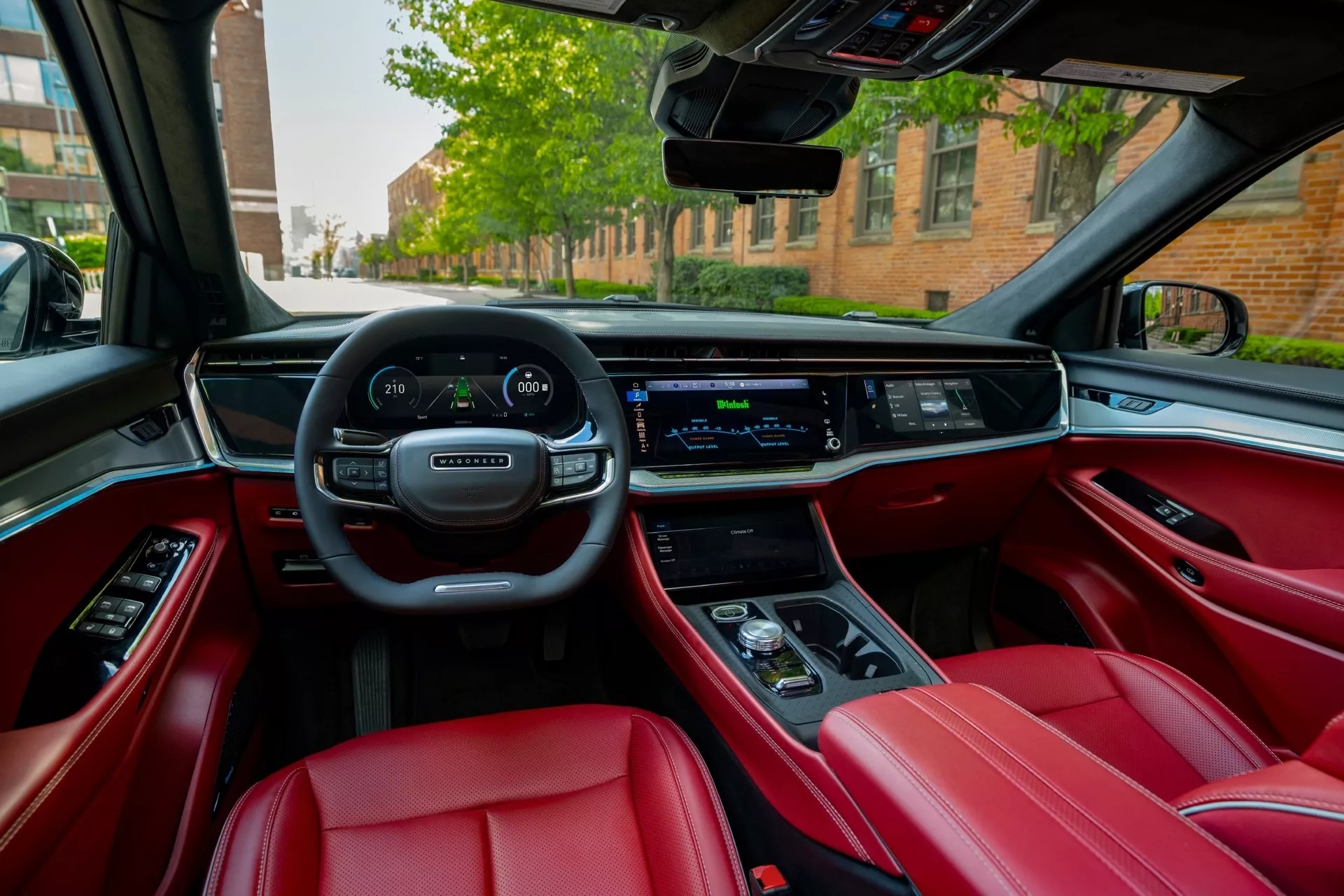
Over 20,000 EVs were just recalled due to blank instrument clusters.
Affected models include the Jeep Wagoneer S and Dodge Charger Daytona.
The issue could hide critical warnings like brake, ESC, and tire pressure alerts.
The shift to more screens in cars was supposed to be the wave of the future. We could customize them, enjoy cute little animations, and pack more info into them than anyone could dream of doing with an analog gauge cluster. Of course, an old-school mechanical cluster can’t disappear for no obvious reason during a drive. Over 20,000 Stellantis vehicles with a digital cluster might have just that happen, so the automaker is issuing a new recall.
According to documents put together by Stellantis and filed with the NHTSA, the issue potentially exists in 100 percent of the 20,271 affected vehicles built from March of 2024 through November 2025. 11,743 are Jeep Wagoneer S EVs, and the other 8,528 are Dodge Charger Daytonas.
Stellantis says it met internally about the issue on March 10, 2026 and worked with its FCA engineering team to understand what was happening through the end of that month and into April. On April 16, it decided to issue the recall but not simply because the gauge cluster was going dark. No, instead, it’s doing this because when the cluster goes dark it can no longer alert the driver to certain information.
Federal Motor Vehicle Safety Standards require that a car can alert a driver to issues with systems like the ABS, TPMS, ESC, and more. When the panel in a Jeep Wagoneer S or Dodge Charger Daytona takes a nap, it can’t tell the driver if there are issues with these key systems. As a result, Stellantis must recall the cars and fix the issue.
Notably, the automaker stopped well short of describing exactly what causes the panel to blank out in the first place. It appears that it’s entirely software-related, as the ‘remedy’ is quoted as “software,” in the filing. Dealers will simply update the cluster software, and that should prevent them from taking a break while the driver is driving.
Chinese EVs are blocked from US sale but dominate American social feeds.
A third of US new-car shoppers now say they would buy a Chinese-built vehicle.
A Beijing platform called DCar is helping US influencers to test these EVs.
Chinese car brands can’t even sell their vehicles in the United States, yet they’re creating loyal fans across the country, largely thanks to targeted campaigns with the help of popular automotive content creators. If these brands ever do get the go-ahead to sell cars locally, established players will need to watch their backs.
If you follow any of these influencers, you’ve probably seen plenty of Chinese cars being tested on American roads, despite not being available here. Forrest Jones, who helped to pioneer short-form car reviews on TikTok, has reviewed a bunch of these over the past couple of years, generating tens of millions of views.
Speaking with Bloomberg, Jones says some of his highest engagement comes from his Chinese car content. Last year, tech YouTuber Marques Brownlee tested the popular Xiaomi SU7 in the US, and that video alone, with 10 million views, reportedly generated $1.2 million in unpaid brand exposure for the company.
The Chinese Are Taking Over
Data from Sprout reveals that, thanks to Brownlee’s video and others, Xiaomi’s TikTok following jumped 20 percent in 2025. Remarkably, roughly half of these 7.8 million followers are from the United States. Videos like Brownlee’s also lead to spikes in inquiries from Americans.
According to China EV Marketplace, a popular e-commerce platform that exports Chinese EVs overseas, it received more than 1,000 price-quote requests from the US after Brownlee released his video, with most seemingly unaware that EVs like the SU7 can’t be legally insured and titled in the US.
A Chinese automotive content platform called Beijing Dongchedi Technology Co., or DCar, is helping give Chinese cars exposure in the US. Spun out of ByteDance, the company behind TikTok, in 2023, DCar has been “courting American influencers to create content for its mobile app and showcase Chinese tech,” Bloomberg writes, with 10 million daily active users in China.
Bloomberg reports that in early 2025, DCar funded a trip to Alaska for YouTubers including Richard Benoit, better known as Rich Rebuilds, presenting him with a catalog of electric models such as the BYD Fangchengbao and Wuling Bingo before shipping the cars stateside. DCar covered Benoit’s travel and paid him a fee equal to “the price of a cheap Chinese EV” for his coverage, he told Bloomberg.
The company told the outlet it purchased or rented all the models itself, with no participation from the carmakers, to maintain “objectivity and veracity.” In return, DCar gets a barrage of slickly produced influencer posts introducing it to a wider audience.
For what it’s worth, Chinese brands like BYD and Xiaomi insist they have no immediate plans to start selling passenger cars in the United States. However, with loopholes potentially opening, you can be assured they’ll be lobbying hard to loosen regulations so they can gain access to the American market.
Kia has built a police version of the electric PV5 for South Korean officers.
A roof-mounted drone launches automatically when the van reaches a scene.
Thermal imaging and a 90x zoom camera handle aerial suspect tracking.
The humble delivery van has come a long way. Kia’s PV5, until recently best known as a versatile electric workhorse, has been seconded into law enforcement. The company has signed on with the Korean National Police Agency to build a high-tech, AI-equipped patrol vehicle that also happens to carry a drone.
Visually, the PV5 already looks the part with its futuristic LEDs and sleek surfacing. For its new role, it wears a police livery with blue and yellow graphics over its black and white bodywork. The biggest party trick, though, is the roof extension housing an integrated drone station.
When the PV5 pulls up to a scene, a section of the roof opens and an automated AI police drone takes flight. It handles aerial patrol in tight alleys and hazardous areas, the sort of places where the van itself, and indeed the officers, cannot or should not go.
The drone carries thermal imaging and a 90x zoom camera, useful kit for tracking suspects or finding missing persons. Once the job is done, it flies back to its dock and recharges using the van’s V2L system. As for the PV5 itself, no changes have been reported to the battery or electric powertrain.
The roof structure also carries three AI-powered cameras providing 360-degree coverage with no blind spots. The software is clever enough to identify suspects by clothing or accessories, working through a crowd in real time and flagging up potential matches.
The AI can also detect specific threats like weapon-carrying individuals or injured citizens who may have fallen on the ground. It even includes crowd density monitoring to alert authorities for potential overcapacity risks in public spaces.
The police-prepped Kia PV5 is scheduled to begin pilot operations in June 2026. It will be part of the Metropolitan Preventive Patrol Unit of the South Korean police force, focused on crime prevention and rapid response.
While this particular AI patrol vehicle is exclusive to Korea, it will be interesting to see whether the PV5 will serve as a base for police conversions in other parts of the world.
Range Rover has introduced the new range-topping SV Ultra.
World-first electrostatic audio system pairs with a haptic floor.
It offers the choice between V8, PHEV, and BEV powertrains.
Few vehicles wear the word flagship as comfortably as a long-wheelbase Range Rover. That, apparently, was not enough for JLR, which has now introduced the Ultra. Positioned as the most technologically advanced and finely finished interpretation of the flagship SUV to date, the SV Ultra brings world-first audio engineering to the cabin, along with exterior and interior treatments reserved for this version alone.
The headline act is the SV Electrostatic Sound system, which aims to recast the cabin as a concert hall with every occupant placed centre stage. It is the most sophisticated audio setup ever fitted to a Range Rover, available as an option on every SV trim, the new Ultra included.
There are 21 lightweight thin-film transducers in total, woven into the headrests, seatbacks, and headlining. Each membrane measures one millimetre thick, responds up to 1,000 times faster than a conventional speaker, and draws 90 percent less power than a traditional setup.
To make sure passengers feel the music as well as hear it, the system pairs with the Body and Soul Seats (BASS) and a Sensory Haptic Floor. Transducers sit inside the seats and beneath the footwell mats, generating AI-tuned pulsations. Beyond entertainment, these can be used for six wellness modes, ranging from “Calm” to “Invigorating”.
Understated Luxury
The SV Ultra is, predictably, built on the long-wheelbase four-seater Range Rover. The body wears an exclusive Titan Silver finish, mixed with aluminium flakes and a process intended to chase a liquid-metal effect.
The new color is combined with Silver Chrome inserts on the front end, and Satin Platinum Atlas accents on the grille, side gills, and tailgate garnish. Finally, the SUV rides on 23-inch alloy wheels with a bi-tone finish matching the exterior.
Inside, the SV Ultra goes leather-free, trimmed instead in Orchid White and Cinder Grey Ultrafabrics. The seats carry a laser-crafted mosaic pattern, with fine perforations that conceal the audio hardware buried within.
Another cool touch is the new rattan palm veneer. Utilizing a patented process that preserves its natural open-pore texture, the veneer is finished with an Orchid White tint and extends from the dashboard to the electrically-deployable club tables in the rear.
Powertrain Options
The SV Ultra offers a choice between traditional V8 power and electrified efficiency. The P540 powertrain utilizes the BMW-sourced twin-turbo 4.4-liter V8 producing 533 hp (397 kW / 540 PS).
The P550e plug-in hybrid delivers a combined 542 hp (405 kW / 550 PS) and offers an EV-only range of 74 miles (119 km) on the WLTP cycle. Finally, a fully-electric Range Rover SV Ultra is confirmed to follow later this year.
Pricing and Availability
The 2027 Range Rover SV Ultra is on sale in selected markets, though access varies. In the UK, it is invitation-only. In Australia, the SUV starts at AU$472,400 (US$337,000) plus on-road costs, making it one of the most expensive Range Rovers ever offered.
The Nissan Primera will return in the form of a large electric sedan.
A listing on the Department of Energy Philippines reveals more details.
The technical specifications confirm it will be a rebadged Nissan N7.
Nearly two decades after the last one rolled off the line, the Nissan Primera looks set for another act. While the company itself has yet to confirm the news, the nameplate has surfaced in a filing with the Philippines’ Department of Energy (DOE), and the document points to a very specific electric sedan.
The DOE paperwork suggests the new Primera will run purely on electrons. It also lays out the dimensions: 4,930 mm (194.1 inches) long, riding on a 2,915 mm (114.8-inch) wheelbase, which is enough to outstretch a Toyota Camry. Those numbers tally with months of speculation that the car would be a rebadged Dongfeng Nissan N7 from China.
According to Top Gear Philippines, working from the DOE-certified specs, the Primera will use a single electric motor good for 215 hp (160 kW / 218 PS) and 305 Nm (225 lb-ft) of torque. Those figures match the entry-level N7 exactly. The 60 kWh battery is calibrated a touch differently and promises 500 km (311 miles) of range.
Judging from the shared footprint, we don’t expect any styling changes compared to the Nissan N7 besides a new Primera script on the tailgate. The interior will most likely be carried over as well, including the 15.6-inch infotainment display on the minimalist dashboard.
Nissan is staying quiet on dates, but the company has already confirmed that the N7 is bound for export markets. The model is produced at the Dongfeng Nissan Huadu plant in Guangzhou, alongside the smaller N6 and the NX8 SUV.
The DOE filing suggests that the Primera’s revival is imminent in the Philippines. It will be interesting to see whether the same name will be used in other export markets, something that makes sense as it is far more recognizable than the N7.
A Short History Lesson
The Nissan Primera debuted in 1990 as a mid-size sedan for Japan and Europe, spanning three generations until its discontinuation in 2007. Available in sedan, liftback, and wagon forms, the model built a motorsport reputation by winning the BTCC championship in 1998 and 1999.
While primarily a Japanese and European affair, the first two generations of the Primera were also sold in North America as the Infiniti G20 until 2002. In later years, the Altima assumed the Primera’s role in certain markets. The nameplate remains a familiar part of Nissan’s history in Europe and Asia, which helps explain the decision to bring it back.

 Login
Login