Reading view

There are new articles available, click to refresh the page.

Ford’s CEO Applauds Trump’s CAFE Rollback, Says They Were Forced Into EVs
  • Farley says tougher fuel rules made low cost cars harder to build.
  • Ford expects lower prices as new standards cut compliance costs.
  • The CEO says the reset lets customers choose their preferred models.

Ford CEO Jim Farley has joined several of his American counterparts in supporting the Trump administration’s decision to reset federal fuel-economy standards.

The move, Farley says, gives automakers the breathing room to produce more affordable vehicles in the United States without walking away from electric innovation or efficiency goals.

Farley’s core argument seems to be that regulations were so strict that they effectively squeezed automakers out of the low-cost segments so many buyers still rely on.

Read: Trump Admin Pushes Fuel Economy Shakeup And The Impact Could Be Huge

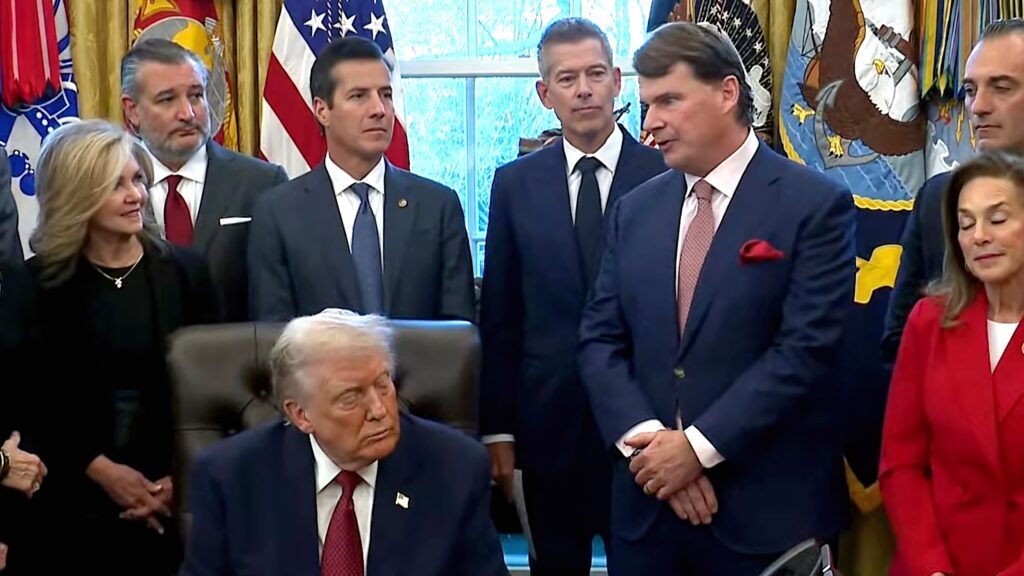
Speaking at a press conference with President Donald J. Trump on Thursday, Farley called the update “a victory for affordability and common sense,” adding that Ford will now be able to offer cheaper versions of its most popular models and launch new price-focused products.

“We believe that people should be able to make a choice, as you said, Mr. President,” Farley said. “And we will invest more in affordable vehicles. This allows us to invest in affordable vehicles made in the U.S., which we will take the lead on and will allow us to make vehicles more affordable.”

Trump, sitting beside him, said, “People were brainwashed. This is a ‘green new scam.’ And people were paying too much for a car that didn’t work as well. And now they’re gonna have a great car that’s gonna be environmentally friendly, but it’s gonna cost you a lot less and it’s gonna work great. All of the nonsense is being taken out of the cars.”

Political Theater or Market Reality?

Farley stopped short of framing the move as an ideological shift, instead focusing on the economics. He argued that the tightened CAFE standards under the previous administration imposed costs that made entry-level vehicles much harder to justify.

That pressure, he said, pushed automakers toward higher-margin EVs and hybrids simply to meet fleet targets.

“What you should know is that this is a victory for affordability and common sense. As the president said, we will be able to offer more affordability on our popular models, and we’ll be able to launch new vehicles built in America that are more affordable because of this rule change,” Farley said later in an interview on “Fox & Friends” Thursday.

Farley added that the earlier fuel-economy system “was totally out of touch with market reality.” Automakers, he said, were forced to sell EVs and other vehicles to stay compliant, even when customer demand wasn’t there.

“We were forced to sell EVs and other vehicles. We’re not going back to gas-guzzlers,” he continued. “We have a lot of EVs and a lot of hybrids at Ford, but now customers get a chance to choose what they want, not by what we force on them.”

Balancing Choice and Compliance

 Ford’s CEO Applauds Trump’s CAFE Rollback, Says They Were Forced Into EVs

Ford’s CEO also clarified that the company isn’t returning to inefficient gas models, noting it already sells a wide range of EVs and hybrids. GM’s CEO Mary Barra recently made similar comments.

Also: GM’s Mary Barra Promises Cleaner Engines, But Looser Rules Fuel More Gas Guzzlers

The reset rolls back the steep increases introduced under the Biden administration, which raised fuel-economy requirements by 8% for 2024 and 2025 and 10% for 2026. Federal officials previously estimated those rules would add nearly $1,000 to the average new-car price.

By contrast, the new standard lowers compliance costs and, according to the White House, will save American families a combined $109 billion. Now, the market waits to see if automakers really do deliver on their promises of rolling out more affordable models.

Photo Whitehouse/YouTube

GM’s Mary Barra Promises Cleaner Engines, But Looser Rules Fuel More Gas Guzzlers

  • GM vows to keep improving engine efficiency as federal standards weaken.
  • Looser rules may push automakers toward more profitable trucks and SUVs.
  • Barra says GM’s EV commitment stands despite lower sales after credits ended.

This year has been a strange one for automakers, but many of them just caught a break. The EPA effectively wiped out penalties for missing fuel-economy targets, a move that could easily trigger another surge in high-margin full-size trucks and SUVs.

More: Trump Admin Pushes Fuel Economy Shakeup And The Impact Could Be Huge

With less regulatory pressure, engines don’t have to get cleaner or more efficient, yet GM CEO Mary Barra insists the company will keep pushing them in that direction anyway.

She maintains that GM will improve every combustion engine it invests in, no matter what the rulebook says. Whether that commitment holds once the market leans even harder toward big, profitable gas-guzzlers is another matter entirely.

How Long Will Progress Last?

Innovation is no doubt key for all automakers, so the promise of continued development is promising on paper. That’s what Barra provided at the New York Time’s DealBook Summit on Wednesday, saying, “Every engine we invest in, we work to have a significant improvement.”

It seems clear that tougher fuel economy standards have led to huge costs for automakers. A recent report indicates that many of the larger recalls from the past two years can be linked to those standards.

Whether or not GM and other automakers will continue to push fuel economy as hard as they have is a worthy consideration.

What’s the Incentive Now?

For decades, automakers have intentionally steered consumers toward larger SUVs and trucks because they offer the largest profits and require the least stringent fuel economy standards.

Read: GM’s Cheapest American EV Starts With A Chinese Shortcut

It’s unclear why that strategy would change now that the penalties are gone altogether. Still, something positive could come from new regulations in Barra’s eyes.

 GM’s Mary Barra Promises Cleaner Engines, But Looser Rules Fuel More Gas Guzzlers

Barra also supported Trump’s move to strip California of tougher clean-air authority, pushing instead for one national standard that doesn’t “get in front of the consumer.” However, automakers helped create today’s SUV-heavy demand, so that argument only goes so far.

Looser rules also ease pressure on EVs, a convenient shift for GM as sales dip after tax credits expired and its electric lineup remains unprofitable. Barra insists the company is still committed.

She was more positive on tariffs, calling recent policies “a more level playing field” after years of uneven barriers. GM may keep refining engines, but with weaker rules and a market built around giant SUVs, it’s hard to imagine Detroit walking away from its biggest profit margins.

 GM’s Mary Barra Promises Cleaner Engines, But Looser Rules Fuel More Gas Guzzlers

Plug-In Hybrid And EV Drivers Face Pay-Per-Mile Tax In The UK

  • EVs to be taxed 3p per mile in the UK starting April 2028.
  • PHEV owners to pay 1.5p per mile to offset lost fuel taxes.
  • Grants extended to 2030, with the £50k luxury threshold raised.

The UK government has just detonated a policy bomb under Britain’s electric-car market. Hidden inside the Chancellor’s Budget announcement is confirmation that both EVs and hybrids will face a new per-mile road charge, marking the first time electric motoring will stop being a tax-free ride.

After years of looking for a replacement for fuel duty as petrol and diesel sales decline, the Treasury has finally shown its hand.

Related: Your Green Plug-in Hybrid Is An Eco Sham, Study Finds

Britain is officially preparing to tax EVs for every mile they travel, shifting them into the same revenue-raising category as combustion cars even as it still claims to support the transition to cleaner transport.

How Will It Work?

Drivers of fully-electric cars will pay 3 p ($0.40) per mile and plug-in drivers are to be stung with a 1.5 p ($0.20) charge.

A driver covering up to 8,500 miles (13,700 km) will end up with a bill of around £255 ($336), the BBC reports, which is still roughly half of what a combustion-car driver would pay in fuel duty to drive the same distance.

The Office for Budget Responsibility (OBR) estimates the plan would bring in £1.1 billion ($1.45 billion) in its first year, a figure which could virtually double two years later, depending on how EV sales go. The trouble is, their take-up is expected to be hit by the introduction of this very scheme.

When and How?

 Plug-In Hybrid And EV Drivers Face Pay-Per-Mile Tax In The UK

The Budget didn’t include all the fine print. Important details such as how the number of miles driven will be accurately logged, comes later. But mileage-based charging is definitely coming, scheduled to kick in from April 2028.

Some US states, including Oregon, already have mileage-based charging schemes, as does New Zealand.

To soften the blow and keep drivers interested in EVs, the UK government is simultaneously raising the price threshold for the “expensive car supplement” on its VED from £40,000 to £50,000 ($53-66k) starting April 2026. That means a Tesla Model Y or Kia EV6 owner won’t be hit by punitive road-tax surcharges quite as quickly as before.

In other words: here’s a little carrot before we get to the pay-per-mile stick. Ministers will also extend the EV grant scheme – which offers subsidies of up to £3,750 ($4,950) – all the way to 2029-30, costing it around £300 million ($395 million) per year.

 Plug-In Hybrid And EV Drivers Face Pay-Per-Mile Tax In The UK

Detroit 3 CEOs And Tesla Exec To Face Congress Over Soaring Car Prices

  • Ford GM and Stellantis CEOs to testify before Congress in January.
  • Hearing focuses on pricing, regulations, EV policy, and trade talks.
  • Senator Ted Cruz calls it a reality check on affordability rules.

For the first time in nearly twenty years, the CEOs of Ford, General Motors, and Stellantis may once again share a table before Congress. The Senate Commerce Committee has called on Ford’s Jim Farley, GM’s Mary Barra, and Stellantis’ Antonio Filosa to testify on January 14 in a high-profile hearing exploring the auto industry’s outlook on federal transportation policy and vehicle affordability.

The session will also delve into the uneasy transition toward electrification, a subject that continues to divide policymakers and automakers alike. Tesla’s VP of Vehicle Engineering, Lars Moravy, has been invited to join the discussion, adding an electric perspective to the mix.

More: Lawmakers Demand Answers From Hertz On AI Rental Damages System

The last time all three Detroit bosses appeared together on Capitol Hill was late 2008 during the financial crisis, bailout negotiations, and a moment when the industry’s future looked genuinely uncertain. This time, the pressure points are different but no less significant.

Why Bring Them Together Now?

Senator Ted Cruz, who’s spearheading the hearing, has titled it “Pedal to the Policy: The Views of the American Auto Industry on the Upcoming Surface Transportation Reauthorization.”

Based on reporting from the Union-Bulletin, the sessions will probe fuel economy and emissions mandates, tariffs, federal EV policy, new-vehicle pricing, and how automakers plan to navigate the next decade. Cruz frames the meeting as a long-overdue reality check on affordability.

“The average price of a car has more than doubled in the past decade,” said Cruz, blaming “onerous government-mandated technologies and radical environmental regulations.”

What’s Driving Up Costs?

 Detroit 3 CEOs And Tesla Exec To Face Congress Over Soaring Car Prices

No doubt, the average transaction price (ATP) of a new car is quite high these days. Data from Cox Automotive shows that it surpassed $50,000 in September.

A decade ago, that figure was in the low $30,000s. Notably, analysts think the shift is due to several factors, including, but not limited to, regulation. Inflation, tariffs, higher-end trims, and the introduction of more EVs all have a part to play.

Also: EVs Now Sell Faster Than Gas Cars In The Used Market

Republicans say policy changes earlier this year, including repealing federal EV mandates and CAFE targets under the One Big Beautiful Bill Act, are steps toward lowering prices. However, Cruz argues lawmakers need to go further. This is all happening at a critical point in the U.S. automotive industry too.

The debate comes at a pivotal moment for the U.S. auto sector. The United States-Mexico-Canada Agreement (USMCA) faces renewal or renegotiation by July 1. If it lapses, the fallout alone could drive vehicle costs higher, regardless of any new legislation.

 Detroit 3 CEOs And Tesla Exec To Face Congress Over Soaring Car Prices

Source: Union-Bulletin

Scout Motors Says Over 80% Of Buyers Picked A Surprising Powertrain

  • Scout offers both battery-electric and range-extended variants.
  • EREV models provide 500 miles using a generator and a battery.
  • Production begins in 2027 at Scout’s new South Carolina factory.

Scout Motors’ upcoming Terra pickup and Traveler SUV aren’t in production yet, but the company already has a strong sense of who its buyers are. Interest is running high, and the early numbers hint at what might define the brand’s first chapter.

Read: Scout Is Scouting Laid Off Rivian Employees

According to CEO Scott Keogh, the vast majority of reservations are for the range-extended electric powertrain. As EV infrastructure aims to improve, these type of powertrains could prove supreme for the time being.

What Are Buyers Choosing?

“Look, the market has spoken,” Keogh told Bloomberg. “Over 80% of the reservations are for the range extender.”

That figure translates to at least 104,000 of the 130,000 customers who placed a reservation choosing the version that combines electric drive with a small gasoline engine functioning as a generator, suggesting that many Americans continue to favor long-distance flexibility over all-electric purity.

 Scout Motors Says Over 80% Of Buyers Picked A Surprising Powertrain

Both vehicles share a modular architecture capable of supporting either an all-electric powertrain or an EREV setup. The pure electric version will utilize a nickel-manganese-cobalt (NMC) battery with a capacity of approximately 120 kWh, offering an estimated range of 350 miles (563 km).

How the Systems Differ

The range-extended models, on the other hand, use a smaller lithium-iron-phosphate (LFP) pack with about half that capacity for roughly 150 miles (241 km) of battery-only driving.

When the charge runs low on the EREV, a small gas-powered on-board generator will kick in and provide power to the battery. As such, the EREV will offer around 500 miles of range.

 Scout Motors Says Over 80% Of Buyers Picked A Surprising Powertrain

Keogh hinted that Scout could prioritize the EREV at launch due to its high demand: “In general, in life, you like to meet the market… we would probably lean with the EREV, but nothing we’ve announced yet.”

Both versions will roll off the line at Scout’s new $2.3 billion factory in Blythewood, South Carolina, that’s set to begin production in late 2027. Interestingly, Keogh thinks EVs will still end up being the future.

“The world is still heading electric,” he said. “The technology is there, the innovation is there. We want to make sure Scout is prepared for the next 100 years. We’re not building a two-year brand.”

It will be worth watching how advances between now and 2027 shape Scout’s approach, and whether early demand for flexibility gives way to full electrification once the infrastructure finally keeps pace.

 Scout Motors Says Over 80% Of Buyers Picked A Surprising Powertrain

(STN Podcast E280) Nuts and Bolts: Transportation Director of the Year Talks Data-Focused Oregon Ops

After a year of being STN’s Transportation Director of the Year, Craig Beaver of Beaverton School District in Oregon joins us to discuss the ins and outs of running a large mixed-fleet school bus operation, pushing the limits with technology and data, navigating current federal changes, and looking to the future of the industry.

Read more about operations.

This episode is brought to you by Transfinder.


Message from School Bus Safety Co.


Message from Ride
.


Stream, subscribe and download the School Transportation Nation podcast on Apple Podcasts, Deezer, Google Podcasts, iHeartRadio, RadioPublic, Spotify, Stitcher and YouTube.

The post (STN Podcast E280) Nuts and Bolts: Transportation Director of the Year Talks Data-Focused Oregon Ops appeared first on School Transportation News.

Webinar Discusses Impact of Propane School Buses on Costs, Health and Maintenance

A webinar hosted by the Propane Education & Research Council outlined the benefits of propane-fueled school buses with transportation professionals that are currently using them in their fleets.

“Blue Bird loves to make buses, and we love to make options,” said Steve Whaley, alternative fuels manager at Blue Bird during the Wednesday webinar. He discussed a comparison with propane to other fuels in terms of cost differential, as he said perception of alternative fuels is that they tend to be more expensive.

With over 20,000 propane buses on the road, Whaley said that savings are significant with average fuel and maintenance costs of about $3,700 per year per bus. As opposed to other clean fuel options and even when compared to diesel, the infrastructure costs are the lowest of any other fuels because propane evaporates leading to fewer regulations from the EPA. Since so much propane is sourced in the U.S., Whaley said transportation departments can avoid the cost instability that comes with outsourcing fuel from outside the country.

Whaley quoted Mike Bullman, director of transportation for the South Carolina Department of Education, as saying, “We don’t need funding for propane, those things pay for themselves.”

To discuss the health benefits of propane, Bailey Arnold from the American Lung Association presented statistics on the high rates of lung cancer in the U.S. As the director of healthy air solutions, Arnold said the organization is committed to fighting the high rates of lung cancer that lead to nearly 125,000 lives lost every year.

He noted that implementing propane is one of the things society can do to combat these mortality rates and health issues as well as high CO2 emissions, explaining that while emissions are commonly measured and analyzed on a yearly basis, “they stack up and have a cumulative effect.”

He said that he would encourage school districts to consider propane now as it will only get more difficult to reduce overall emissions. Arnold referenced a recent NREL study that found that using propane would save 147 tons of carbon emissions in three years, while renewable propane would save 360 tons over the same period.

Amy Rosa, director of safety and transportation at Wa-Nee Community Schools in northern Indiana, is currently running 25 Blue Bird propane buses out of the 56 buses in her fleet that transports 3,000 students. She said losing two parents to lung disease in recent years spurred her passion for cleaner fuels. Meanwhile, the Volkswagen mitigation trust grant funding contributed a lower cost of implementation for the new propane buses. She said her district is always looking to save money to benefit the students and taxpayers, and that propane buses helped do that.

She said the transition was seamless, and that partnerships with the suppliers were supportive. Mechanics and drivers were on board. She said that the drivers appreciate the quieter engines, which “reduces tension with students and drivers” and that these quiet, clean, warm buses are improving student behavioral student issues. In a cold state, she said the quick heating ability of propane buses with no need for auxiliary heaters has been a benefit, and that her drivers have told her, “I love knowing my bus will start no matter how cold it gets.”

Whaley noted that Diane Mikelski, the recently retired director of transportation at Illinois’ Township High School District 211, will be speaking about her experience with propane buses at the upcoming Transporting Students with Disabilities and Special Needs (TSD) Conference in November on the benefits of a quieter bus on student behavior.

Sam Corson, the bus and automotive maintenance manager at Newport News Community Schools in Virginia, said he has seen immediate positive results from using propane buses. He said with wide city borders, which requires school bus drivers to often log 100 to 200 miles a day, long-range buses are necessary. He said Newport News has had no issues with propane buses doing around 340 miles on one tank.

Corson said that about 80 percent of district routes are covered by the 180 propane buses out of 306 total in the fleet,. Cost savings are evident, with diesel buses costing 38 cents per mile to operate compared to 29 cents on propane.

“I noticed all the things [a propane bus] does not have that I was continuously fixing on a daily basis,” he shared, and continued that he has seen a reduction in bus breakdowns.

Learning maintenance was simple for his team, he said, noting that the local Blue Bird dealership led training for all the mechanics to make sure they were comfortable with the new buses. Corson said that due fewer regulations and overall positive reactions to propane buses, the district decided to not decommission and replace the fuel tank.

Both Rosa and Corson praised the ROUSH CleanTech fueling software that allows them to keep track of fuel levels and that suppliers have been consistent. They also noted that they did not have to invest in new additions for their maintenance facilities when implementing propane.

When asked what she would tell another director who is considering buying propane buses, Rosa said, “No hesitation…the choice is a no-brainer for kids and for your mechanics, for bus drivers. It’s just a really good choice all around. I couldn’t think of any reason why you wouldn’t.”

Corson said his advice is to “jump in 100 percent.”

“I couldn’t see myself buying [another] diesel unless I was forced to,” he continued, adding that maintenance is much simpler on propane buses and any issues that do come up are usually easy fixes.

Watch the webinar on demand.


Related: Ride and Drive, Technology Product Demos Return to Texas in November
Related: Propane Best Immediate Option For Greening Fleet, Says Rural Missouri School District
Related: Students, Staff at Illinois District Approve of Propane School Buses

The post Webinar Discusses Impact of Propane School Buses on Costs, Health and Maintenance appeared first on School Transportation News.

(Free Webinar) Driving the Future of Healthy, Cost-Effective Student Transportation with Propane Autogas

By: STN

Join us for an engaging discussion on how propane autogas is transforming student transportation by creating healthier, cleaner, and more affordable school bus fleets. This webinar brings together experts and on-the-ground voices to share insights into the benefits of propane-powered school buses for both students and staff.

In this information-packed session, you’ll hear from:

  • American Lung Association: How propane buses reduce harmful emissions and improve respiratory health in school communities.
  • Blue Bird: A leading manufacturer of propane school buses about the latest innovations driving propane autogas adoption across the country.
  • School District Leadership: A school district transportation director and maintenance supervisor will share their real-world experiences with propane buses, from cost savings and reliability to driver and technician feedback.

Register today to explore practical strategies and proven results that can help your district move toward a cleaner, more cost-effective transportation future.

Brought to you by the Propane Education & Research Council

REGISTER BELOW:

The post (Free Webinar) Driving the Future of Healthy, Cost-Effective Student Transportation with Propane Autogas appeared first on School Transportation News.

B.R. Williams Furthers its Fiscal and Environmental Initiatives with the Launch of the DEMINeuFuel School Bus Platform

By: STN

WOODSTOWN, N.J. – B.R. Williams Inc., a leading school bus contractor in New Jersey, announced today that it is the first school bus contractor in the state to pilot the DEMINeuFuel school bus platform (aka the “CowFartBus”) to run on a blend of renewable natural gas (RNG) and diesel. This initiative marks a significant step for the company towards utilizing nearzero carbon fuel in student transportation.

The DEMI-NeuFuel system, made possible through a partnership between American CNG® and Ingevity®, allows operators to convert existing diesel school buses to run on a blend of diesel and RNG. Ultimately, it provides a cost-effective way for school bus contractors and districts to reduce fuel costs with the use of natural gas and a low-cost and small footprint fueling appliance. And,unlike other alternative fuel options, the DEMI-NeuFuel system’s dual-fuel capabilities eliminate the range anxiety that many drivers experience.

“We are excited to be the first school bus operator in New Jersey to implement the DEMI-NeuFuel platform,” said Chloe Williams, President at B.R. Williams Inc. “This technology offers a cost-effective and environmentally responsible solution for reducing our carbon footprint on our existing diesel vehicles.”

Through the use of the DEMI-NeuFuel technology and RNG, B.R. Williams can reduce its annual fuel costs by over 60% on the displaced diesel, eliminating approximately 1,945* gallons of diesel per year, and reducing greenhouse gas (GHG) emissions by approximately 20 metric tons per year, which is the equivalent of 10,800 miles driven by a diesel school bus, further protecting New Jersey’s air quality.

B.R. Williams joins a growing number of school bus contractors and districts nationwide that are working toward reducing emissions and improving air quality for students and communities. The use of the DEMI-NeuFuel system is part of a broader effort by B.R. Williams to maximize its environmental stewardship while also enhancing its fiscal responsibility with the use of cleaner, more cost-effective fuel solutions for student transportation.

“Ingevity is proud to support B.R. Williams and school districts around the country on their sustainability journeys,” said Dante Marini, Product Engineer at Ingevity. “Our DEMI-NeuFuel technology offers the flexibility school bus fleet operators need to meet their operational requirements without compromising performance or efficiency. We are excited to continue advancing clean energy solutions for school transportation.”

The post B.R. Williams Furthers its Fiscal and Environmental Initiatives with the Launch of the DEMINeuFuel School Bus Platform appeared first on School Transportation News.

EPA Provides Update on Clean School Bus Program

After what felt like the end of the road for the Clean School Bus Program, the U.S. Environmental Protection Agency provided an update overview, including the anticipation of additional information regarding the 2024 rebate program.

In an email Monday, the EPA reminded awardees of next steps for the rebate and grant programs, provided program oversight and compliance, and shared resources and news.

For the 2022 CSB Rebate, EPA said it completed review of most school bus projects and Close Out Forms, or COF, submitted by rebate recipients. EPA also said it is actively working with selectees to ensure accuracy and completeness. For those who have not completed their COF, the EPA is working with those selectees to ensure it is submitted in an expedited fashion.

Additionally, EPA said it is performing site visits with all 2022 CSB rebate recipients.

Meanwhile, about 50 percent of the awarded funding under the 2023 CSB rebate program has been disbursed. The EPA is encouraging all selectees to submit their payment request forms (PRF) for those projects. If the PRF has not been submitted, selectees must either submit the form as soon as possible or request an extension via the online portal.

Upon completing the PRF, rebate selectees will receive an official funds disbursement email from the EPA, with the money typically available within seven to 10 days. Once selectees receive the funds they must “email the EPA’s Office of the Chief Financial Officer (EPA-CSB-FinancialReporting@epa.gov) within 10-business days of spending their funds on eligible expenses or passing the rebate funds to a third-party to complete the purchase for eligible expenses,” the EPA stated.


Related: EPA CSBP Payment Request Deadline This Month
Related: Report Highlights Shift in Federal Policy from EVs to Conventional Fuels
Related: The State of Green School Buses
Related: Big Questions Vexing Student Transporters


When school buses are deployed and replaced, and infrastructure is installed, the EPA stated that selectees will need to submit their 2023 COF.

EPA also reminded Clean School Bus Program grant recipients of the July 30 deadline for filing semi-annual reports, which cover January through June 2025. The EPA asked that all selectees submit their progress reports to the EPA project officer.

Additional information regarding the 2024 rebate program is forthcoming, EPA said.

The EPA is also hosting various webinars through its Office of Grants and Departments that could be of interest to grant awardees as well as webinars through the Automated Standard Application for Payments.

The post EPA Provides Update on Clean School Bus Program appeared first on School Transportation News.

Fueling the Future: Unlocking Low-Cost Green Hydrogen

By: newenergy

Current methods used to process hydrogen into a usable fuel are cost-prohibitive, but several new innovations are promising to open the door to cost-competitive green hydrogen. Hydrogen is well positioned to be the fuel of the future. However, a commercially viable transition to green hydrogen – the environmentally friendly version of the fuel – seems …

The post Fueling the Future: Unlocking Low-Cost Green Hydrogen appeared first on Alternative Energy HQ.

❌