Normal view

There are new articles available, click to refresh the page.
Yesterday — 27 February 2026Main stream

China’s Rolling Out Solid-State Batteries This Year And The Range Claim Is Wild

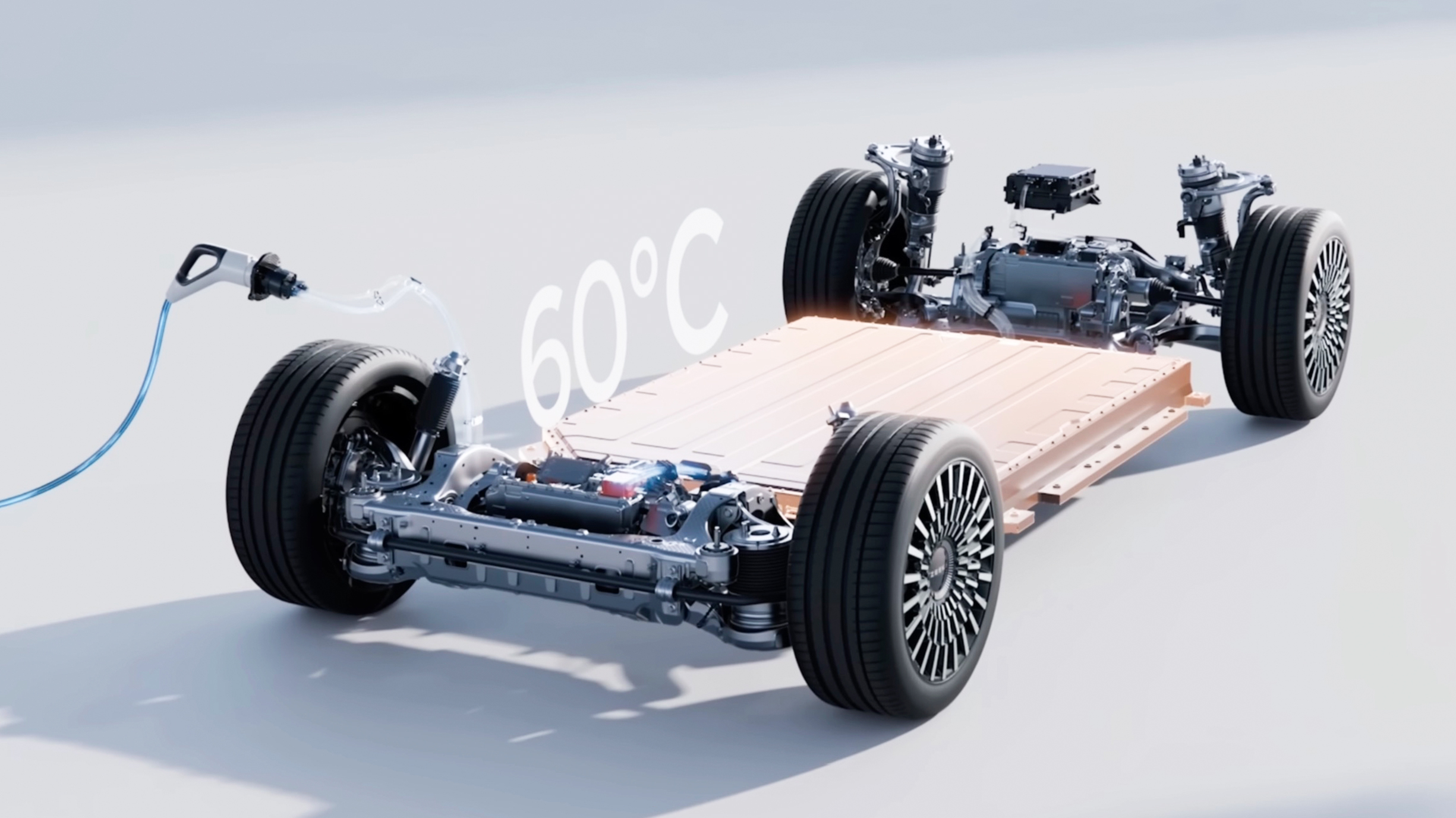
  • The new battery delivers 400 Wh/kg energy density.
  • Mass production is planned to begin next year.
  • BYD, SAIC, GAC, and CATL are developing similar packs.

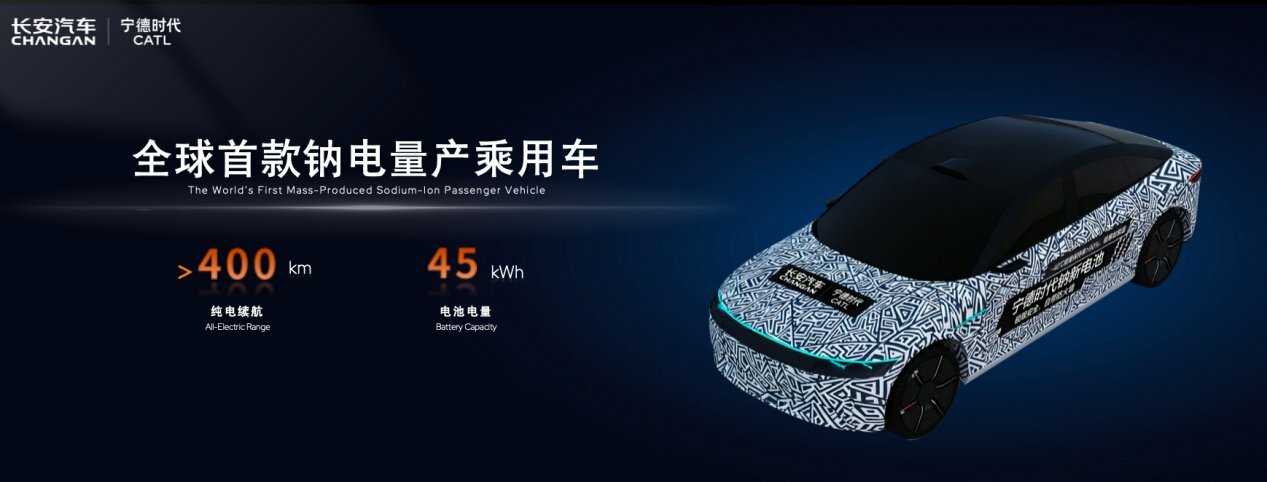
Solid-state batteries have been “just around the corner” for what feels like an entire EV generation. Now, they might actually be arriving. In the third quarter of this year, China’s Changan will begin fitting its new solid-state packs to robots and EVs, with full mass production slated for 2027.

According to Chinese media, Changan claims its new solid-state battery has an energy density of 400 Wh/kg, and EVs using it will be able to travel upwards of 932 miles (1,500 km) on a single charge. While you could argue that this much range borders on excessive, it would make future Changan models far better suited to long road trips through remote areas where charging infrastructure remains sparse.

Breakthrough Energy Density
 China’s Rolling Out Solid-State Batteries This Year And The Range Claim Is Wild

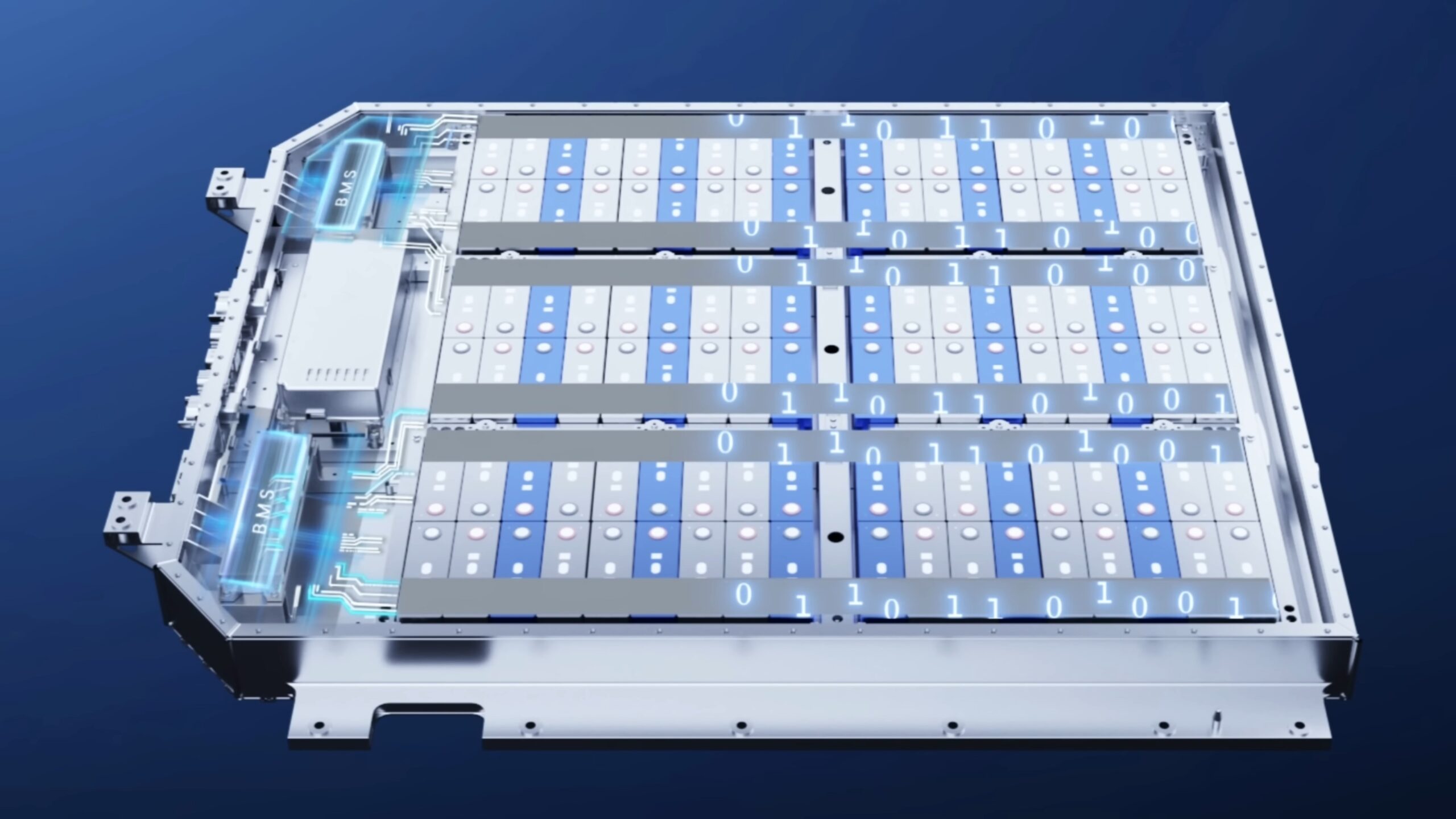
The pack is called the Golden Bell. Aside from being very energy-dense, it is said to be 70 percent safer than a conventional EV battery and, because this is 2026, it also uses artificial intelligence for remote diagnostics. Smarter batteries, apparently, are part of the plan.

Read: Avatr Just Extended The 06 In More Ways Than One

Changan will build these units under its new Jingzhongzhao solid-state battery brand. The company intends to manufacture fully solid-state packs while also producing liquid and semi-solid-state batteries that rely on a liquid electrolyte.
 China’s Rolling Out Solid-State Batteries This Year And The Range Claim Is Wild

China’s Solid-State Push

It is not alone. Other Chinese brands are also edging closer to making solid-state batteries mainstream. Earlier this year, Dongfeng Motor began testing its own solid-state battery in extreme cold weather. It has an energy density of 350 Wh/kg and a claimed range exceeding 620 miles (1,000 km). It also plans to roll them out in production cars this year, aiming for September.

BYD, Chery, SAIC, GAC, and CATL are all chasing similar breakthroughs. So are legacy names such as Mercedes-Benz, VW, BMW, Toyota, Nissan, Hyundai, and Honda. After years of promising headlines and laboratory milestones, solid-state batteries may finally be edging toward something tangible. If they deliver on even half of these promises, combustion engines will have one more reason to feel nervous.
 China’s Rolling Out Solid-State Batteries This Year And The Range Claim Is Wild

Sources: Changan, Carnewschina

Before yesterdayMain stream

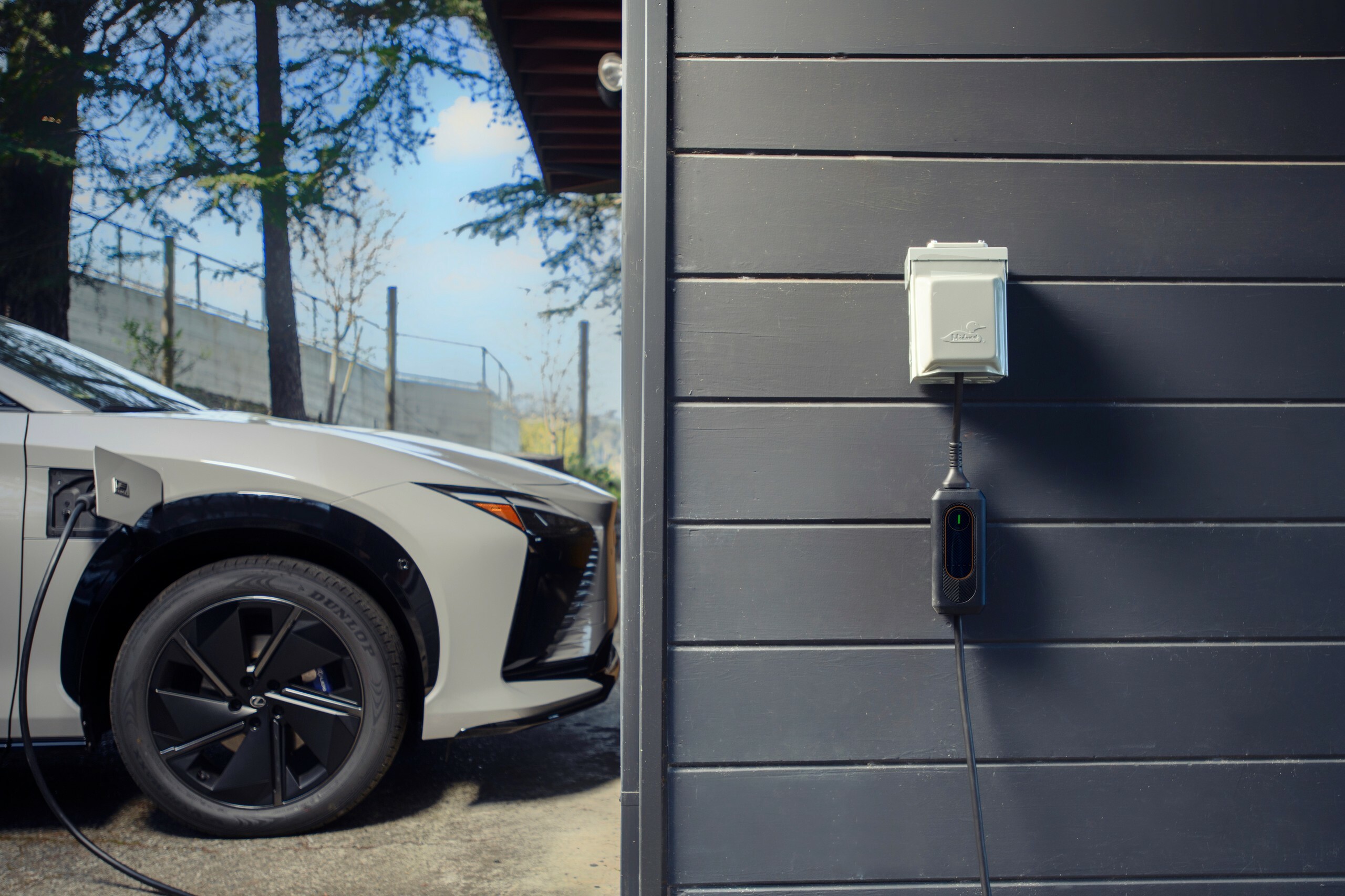
Toyota Wants To Fix Your Home Charger Install Headache In 48 Hours

  • Toyota and Lexus teamed up with Treehouse to simplify home charging.
  • Every 2026 and newer model includes a Level 1 and Level 2 charger.
  • Buyers can spend $524 on a stronger ChargePoint Level 2 unit.

Electric vehicles make plenty of sense if you are not clocking up cross-country miles every week and you have somewhere at home to plug in. The complication usually starts after you sign the paperwork, when you realize installing a home charger involves quotes, site visits, and more emails than expected. Toyota thinks it has found a way to smooth that part out.

Toyota’s North American division has partnered with Treehouse, an EV charging infrastructure company, to simplify the process of getting a Level 2 AC home charger installed and operational.

Read: Toyota Slashes Thousands Off Its Newest EV Just Weeks After Launch

Thanks to Treehouse, owners only need to upload a few photos and complete a short survey. From there, the company promises a quote within 48 hours and can then send technicians out to install the charger.

Traditionally, home charger installs can involve multiple visits, especially when someone needs to assess the right mounting location and electrical setup in person. This approach is meant to cut that step out entirely.

Treehouse says it relies on proprietary technology, along with the homeowner’s photos, to determine exactly what the installation requires. If upgrades are necessary, licensed electricians will step in to update or install any electrical systems needed to support home EV charging.

Standard Equipment On 2026 Models

 Toyota Wants To Fix Your Home Charger Install Headache In 48 Hours

From 2026 onward, every Toyota and Lexus battery-electric vehicle and PHEV sold in the US will include a dual-voltage 120V/240V AC home charger. It supports both Level 1 and Level 2 charging, so you can plug into a standard outlet or step up to a quicker setup. In typical conditions, that is enough to take a battery from about 10 percent to full overnight, which should cover most daily routines.

If that still feels too leisurely, there is an upgrade. Owners can opt for a hardwired ChargePoint Home Flex Level 2 charger, installed by Treehouse, which Toyota says trims charging times by roughly 30 percent. The unit costs $524, assuming your electrical panel is feeling cooperative.

“We’re thrilled to work with Toyota to enhance the electrified vehicle and home charging experience for Toyota and Lexus customers,” Treehouse co-founder and chief executive Eric Owski said. “By bringing seamless, end-to-end home charging solutions into the EV ownership journey, this collaboration with Toyota reflects our shared commitment to making electrification easy and accessible for consumers.”

\\\\

Donut Lab Claims It Verified A 7-Minute Solid-State EV Battery Charge

  • Donut Lab’s solid-state battery may be a breakthrough.
  • It charges from zero to 80 percent in just 4.5 minutes.
  • The company claims an energy density of 400 Wh/kg.

The battery world is hardly lacking in ambition, but it remains controlled by a tight circle of Chinese and Korean heavyweights. When Finnish startup Donut Lab claimed earlier this year that it had developed the world’s first all-solid-state battery for vehicles, it was never going to land quietly.

Donut Lab says it has built what many consider the holy grail of batteries. It claims the pack can charge faster than anything else on the market, delivers 400 Wh/kg of energy density, and is good for 100,000 cycles. Predictably, that raised questions.

Industry experts pushed back hard, which led Donut Lab to team up with Finland’s VTT Technical Research Center to demonstrate just how quickly its battery can actually charge.

Read: Verge Fixed The Two Biggest Electric Motorcycle Problems At Once

In a newly released video, Donut Lab sets out to show the charging speed and thermal stability of its latest battery. The headline figure is a claimed charge rate of up to 11C (286A), which, if sustainable, would put it in rare company.

Cooling Reality Check

In the 11C charging test, the battery cell charged from 0 to 80 percent in just 4.5 minutes when equipped with two heatsinks. A full charge at 11C took just over 7 minutes. During this test, the battery temperature reached 63°C (145°F). In a separate test with just one aluminum heat sink, the temperature rose to 90°C (194°F), prompting a pause for 4 minutes while the battery cooled.

As noted by Electrek, Donut Lab claimed its battery required no active cooling to safely achieve its extraordinary charging speeds. However, this test suggests that some level of thermal management is necessary. Even so, the charging speeds are impressive, particularly for a company of this size.

\\\\\\\\

According to Donut Lab chief executive Vile Piippo, “unlike other solid-state batteries requiring high compressive pressures and undergoing volume changes of up to 15-20 per cent during recharging cycles, the Donut Battery does not require special compression or more extensive cooling.”

Hitting Back At Critics

The company published the results of its fast-charging test on a new website, dubbed “iDonutBelieve,” in a thinly veiled swipe at those who said the firm was exaggerating its claims. It is promising that the results of another test will be released next week, with the aim of proving the pack’s energy density and 100,000-cycle claim.

The first vehicle to use the Donut Lab solid-state battery is an all-electric motorcycle from Verge. Dubbed the TS Pro, it’s set to arrive in the first quarter and will be offered with 20.2 and 33.3 kWh packs.

\\\\\\\\\\\\\\\\\

New Toyota Highlander Goes All-Electric, But Its Door Handles Don’t Fully Trust Electricity

  • Highlander EV uses an electronic popper with hidden manual release.
  • A small tab inside the handle serves as a built-in mechanical backup.
  • The setup reflects growing focus on EV safety and everyday usability.

Spend five minutes around a modern car, especially an electric one, and you will notice something curious. Door handles have morphed into design statements, tech showcases, and sometimes awkward little puzzle games that feel one step away from becoming a liability.

Some pop out theatrically, some sit flush until summoned, others attempt both, and an increasing number rely entirely on electronic latches that only function when the car has full power. Toyota’s new Highlander appears ready to break new ground with a hidden feature few will notice at first.

More: China Officially Bans Pop-Out Door Handles, And The World May Follow
During our time up close and personal with the SUV, one small feature stood out. The main exterior handle leverages a small pad to activate an electric door latch. That’s not groundbreaking, but what’s next to it might be.

Did You Notice The Tiny Tab?

\\\\\

Photos Stephen Rivers/Carscoops

Inside of the stationary recessed door handle lies a tiny tab. Roughly the size of a postage stamp, it’s designed to be pulled independently by someone outside the car, including, knock on wood, emergency crews. Unlike the main handle, the tiny piece has a clear pictogram suggesting it’s a manual release.

Read: The New 2027 Toyota Highlander Drops Gas And Goes All-Electric

Next to it is a removable section for a keyhole. Getting into this electric SUV, should it ever lose power, is as easy as inserting a key, engaging the manual latch, and pulling on it. Notably, the pull tab did nothing for us when we were in person and tinkering around with it.

\\\\\\\\\\\

Photos Stephen Rivers/Carscoops

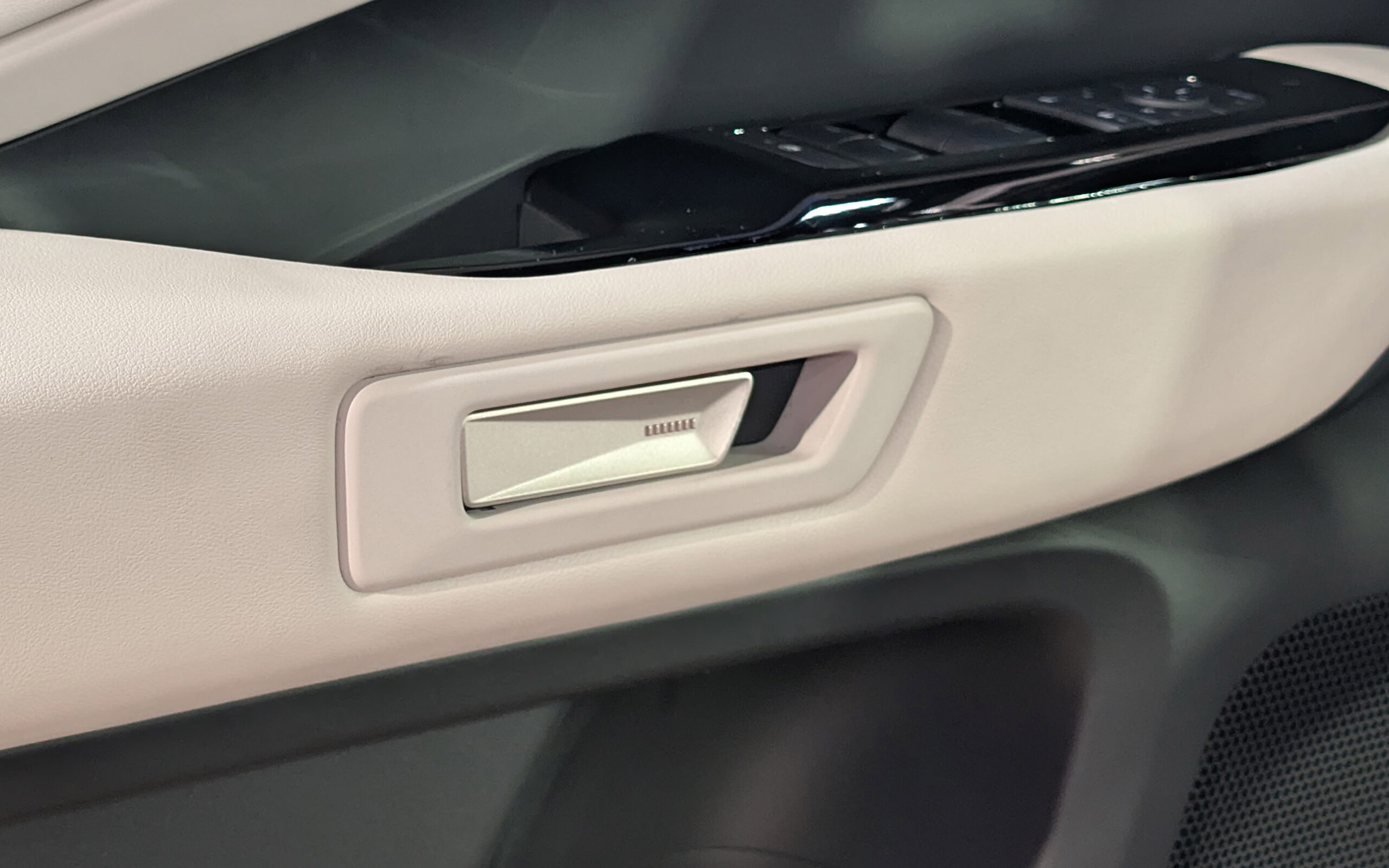
Toyota clarified to Carscoops that the prototypes didn’t have functional versions of the handle. The production car will work via a two-step process. Pull once, and the tab will unlock the door. Pull twice, and it’ll manually open the door. That’s clever, and it’s worth noting that it’s not just the exterior handles that have this sort of feature.

Manual Backups Built In

 New Toyota Highlander Goes All-Electric, But Its Door Handles Don’t Fully Trust Electricity
Stephen Rivers/Carscoops

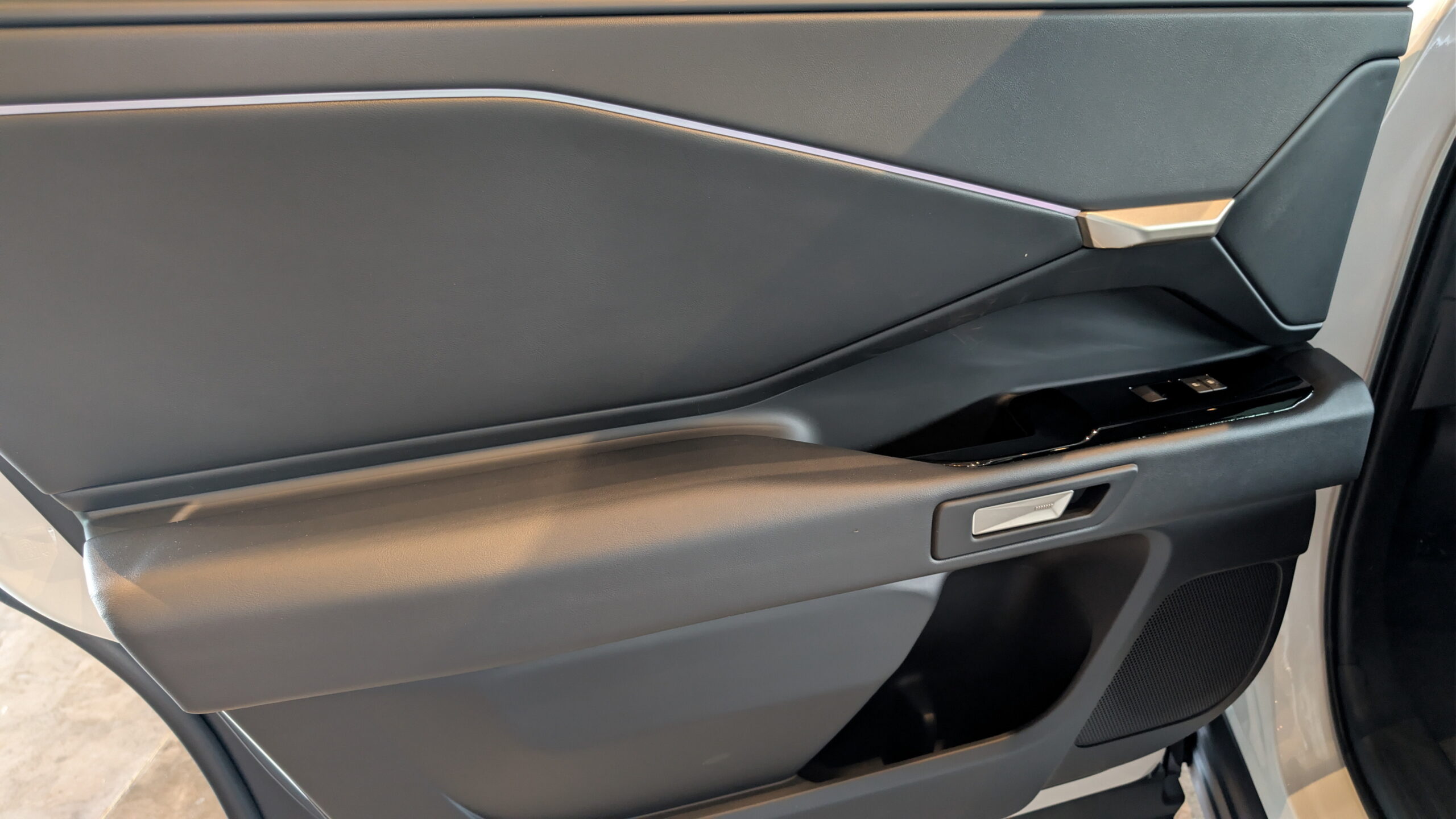
The inside handles are similar to the ones we’ve seen on Lexus vehicles for some time. Users can push the door button for the electric latch to release, or they can pull it to manually open the latch. That’s just one more piece of safety baked into the all-new Highlander.

More: Trapped Tesla Owner Couldn’t Find The Door Release And Now Feds Want Answers

In a world where even door handles have gone digital, a simple mechanical fallback feels less like nostalgia and more like common sense. Toyota’s solution is not flashy, and it does not need to be. As cars pile on electronics for even the most basic tasks, a simple physical solution may turn out to be the smartest feature of all.

 New Toyota Highlander Goes All-Electric, But Its Door Handles Don’t Fully Trust Electricity
Stephen Rivers/Carscoops

Tesla Avoids A Massive California Ban By Junking Its Most Famous Feature

  • Tesla drops Autopilot term in California to avoid license suspension.
  • Brand’s new models now only come with cruise control as standard.
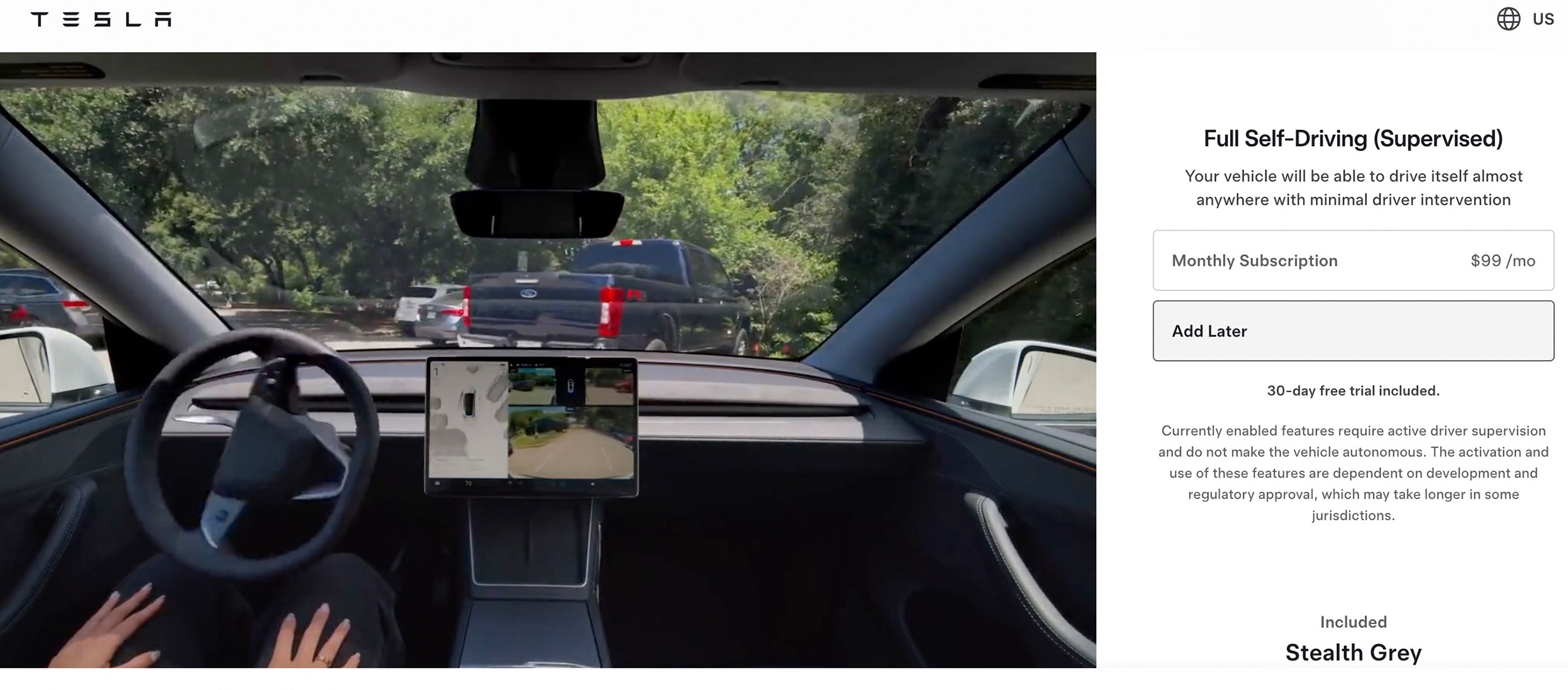
  • EV buyers are being pushed towards $99 FSD subscriptions instead.

After years of sparring with California regulators, Tesla has agreed to stop using its famous Autopilot term in the state, neatly sidestepping a 30-day suspension that would have frozen sales in its biggest US market with nearly 180,000 deliveries last year.

More: Tesla Quietly Kills Standard Autopilot, Now Wants $99 A Month To Give It Back

The California Department of Motor Vehicles (DMV) wasn’t amused by Tesla’s marketing language, arguing that phrases like “Autopilot” and “Full Self Driving Capability”, later softened to “Full Self-Driving (Supervised)”, gave buyers the impression their cars could drive themselves. The DMV pointed out that they can’t now, and never could, operate as autonomous vehicles.

The formal accusations were filed in 2023, though regulators traced the issue back to marketing language used as early as May 2021. At the time, Tesla described its system as capable of handling short and long-distance trips with no action required by the person in the driver’s seat, a claim the DMV said crossed a legal line.

60 Days To Find A Fix

A judge agreed and proposed suspending Tesla’s dealer and manufacturer licenses for a month. That would have been awkward timing for a company trying to convince the world that robotaxis are just around the corner. The DMV offered Tesla 60 days to fix the issue before the suspension started, and instead of digging in, Tesla wisely took corrective action.

“The DMV is committed to safety throughout all California’s roadways and communities,” said DMV Director Steve Gordon. “The department is pleased that Tesla took the required action to remain in compliance with the State of California’s consumer protections.”

So Autopilot, as a marketing term, is now gone in California (though you’ll still find it on the brand’s EVs elsewhere in the world). The company had already softened Full Self Driving into Full Self Driving Supervised to make it crystal clear that, no, the car is not fully autonomous. By complying with the deadline, Tesla avoided the suspension and kept the revenue rolling in.

 Tesla Avoids A Massive California Ban By Junking Its Most Famous Feature

Autopilot Feature Phased Out

This is not just a word swap, though. We reported last month that Tesla had already begun phasing out the previously standard Autopilot system on its cars, replacing it with Traffic Aware Cruise Control and pushing buyers toward a $99 per month Full Self Driving subscription.

Lane centering that rivals include as standard now lives behind a paywall, and CEO Elon Musk has hinted that the subscription price could rise over time. From a business perspective, it’s clever, but from a branding perspective, it looks like a climbdown.

Autopilot was one of Tesla’s most recognizable terms, though it was also one due to be left behind in the coming years as the far more sophisticated FSD improves to the point where it really can deliver full self-driving.

 Tesla Avoids A Massive California Ban By Junking Its Most Famous Feature
Tesla

Rivian’s R2 Still Doesn’t Fix A Critical Flaw That Matters When Seconds Count

  • A handful of tech YouTubers recently got hands-on with the Rivian R2.
  • Like many other new EVs, Rivian is using electronic door handles.
  • Prices for the new mid-size R2 are expected to start at around $45,000.

After a string of high-profile crashes in the US and overseas, automakers are facing increased scrutiny over something as basic as door handle design. Once a simple mechanical feature, door handles have become unnecessarily complicated with the rise of electronic systems.

Companies like Tesla and Rivian are facing significant criticism for where they’ve located the emergency interior mechanical door releases if electronic issues prevent the buttons from working. Rivian’s solution for second-row passengers is particularly bad in the R1T and R1S, as they need to remove a large black plastic panel and then reach in to pull a cable to release the door.

Read: Rivian’s New $45,000 EV Is Coming By June

Is the upcoming Rivian R2 any better? Not really. A handful of tech YouTubers recently had the chance to check out pre-production versions of the R2, and JerryRigEverything has provided us with our first look at the R2’s mechanical latches.

Trouble In The Second Row

 Rivian’s R2 Still Doesn’t Fix A Critical Flaw That Matters When Seconds Count
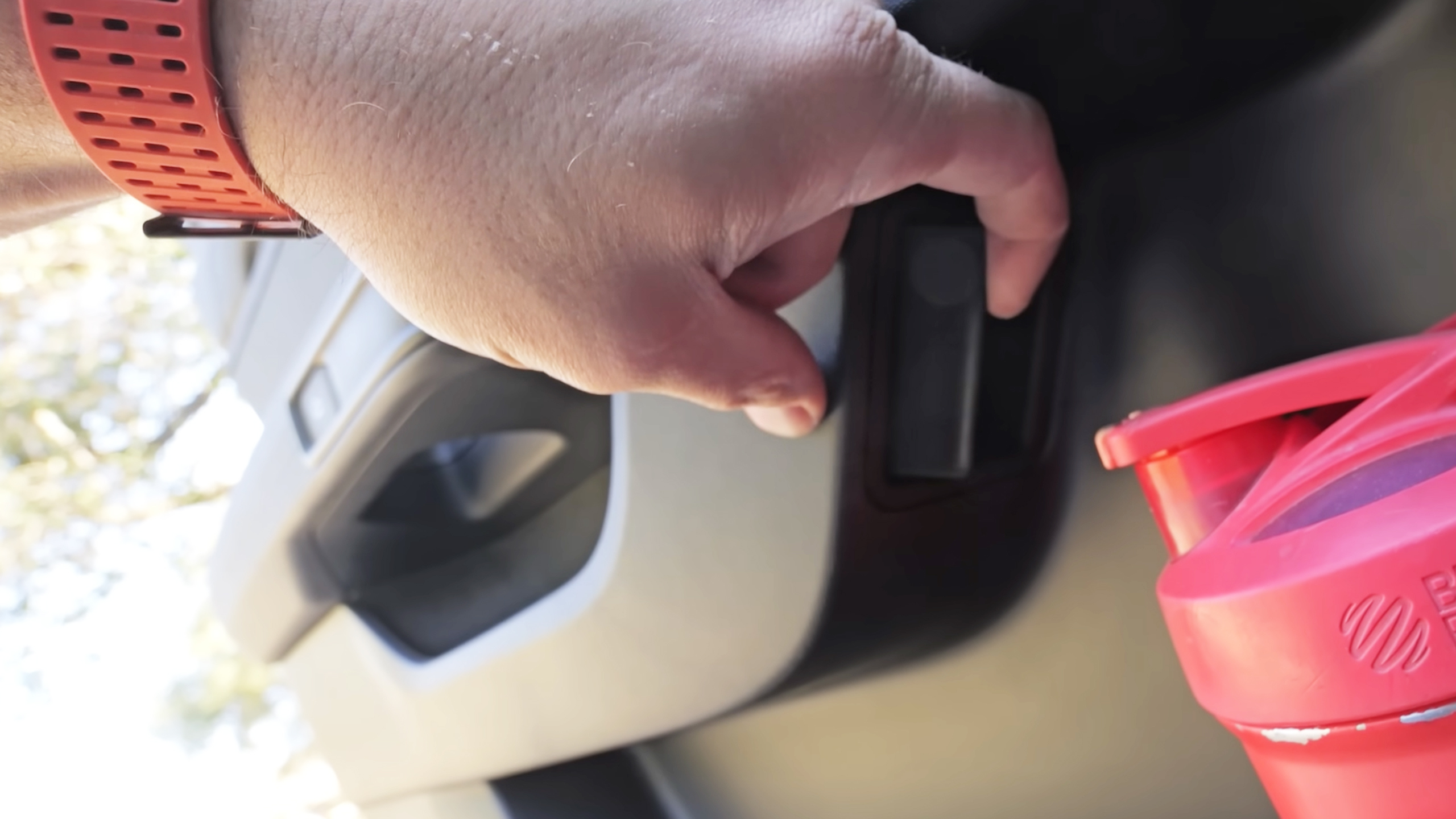
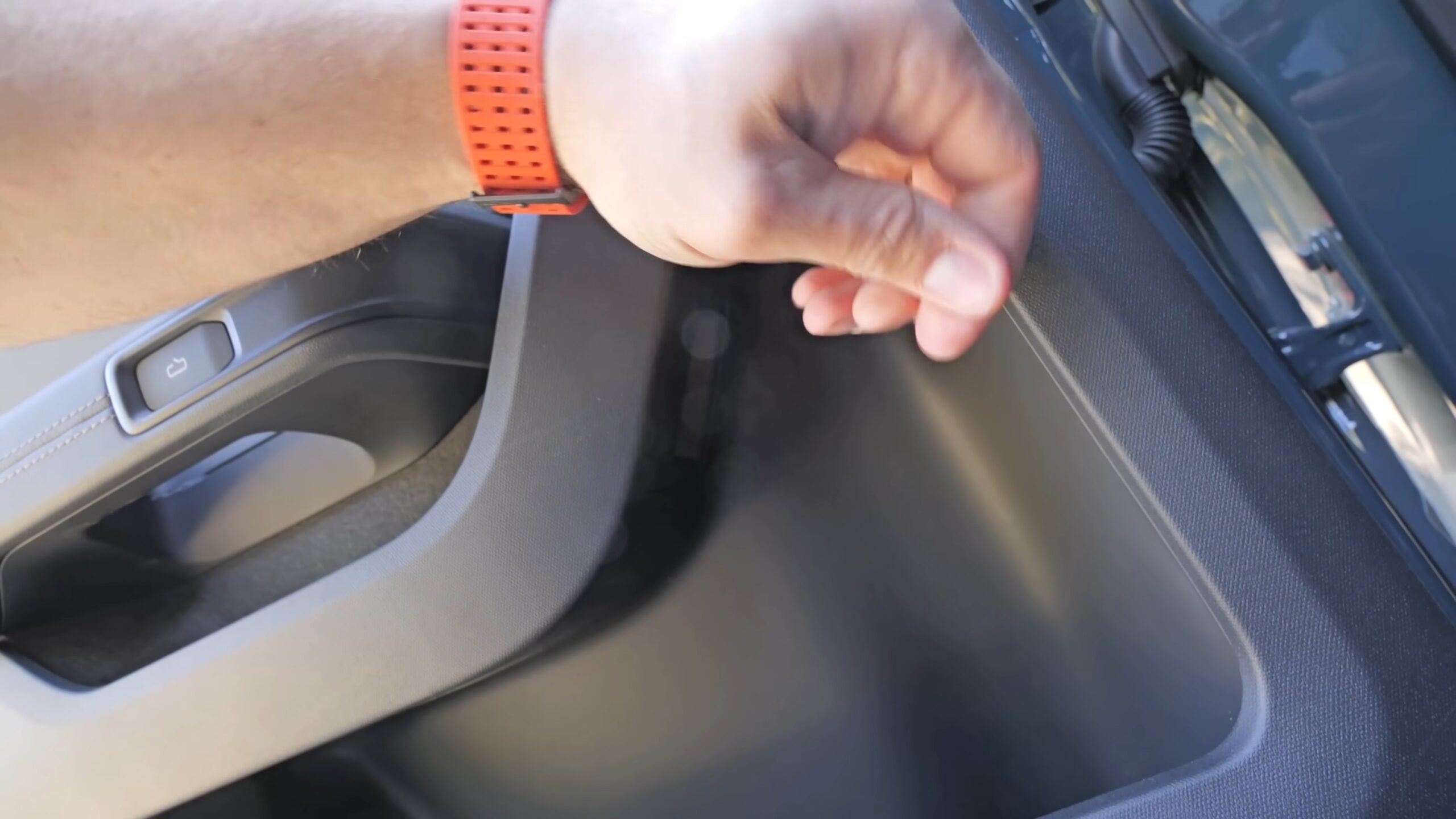
The front emergency manual latch (above) is much simpler than the concealed rear one (below).
 Rivian’s R2 Still Doesn’t Fix A Critical Flaw That Matters When Seconds Count
Screenshots JerryRigEverything/YouTube

The latch in the front row is quite simple. Positioned on the underside of the floating storage compartment is a little black plastic handle used to open the doors in emergencies. It’s similar to what’s found in the R1T and R1S, although the emergency releases on those models are larger and easier to identify.

Then there’s the rear. The release is in the same position as the one up front, but bizarrely, passengers have to remove a small plastic cover and then pull a cord, just like they do in the R1 models. The only upside is that the placement has changed slightly for the better.

If you have to give your backseat passengers a tutorial on something as basic as opening the doors in an emergency, the design isn’t clever, it’s flawed. Why Rivian didn’t just carry over the simpler front-door setup is anyone’s guess, but it comes across as needless complexity at best, or cost-cutting by reusing the same flawed design at worst.

Is An Update Happening?

There had been some talk of changes. Rivian was reportedly reworking the R2’s emergency releases in response to incidents involving drivers trapped in burning Teslas. But based on this early look, it doesn’t seem like any major improvement has been made compared to the R1 models.

Although, as this example was a pre-production model, it’s possible that things will be changed for production. Or at least, that’s what we hope.

More: China Officially Bans Pop-Out Door Handles, And The World May Follow
Rivian isn’t alone here. Beyond Tesla, unsurprisingly the poster child for controversial design choices, even Ford has run into trouble with the Mustang Mach-E’s door latches.

And it’s not just the inside of the car that’s raising concerns. Exterior pop-out door handles have created so much controversy that China has decided to ban them on all electric vehicles starting in 2027.
\\\\\\\\

The Man Who Popularized Touch Screens Says Touch Controls Don’t Belong In Cars

  • The Luce’s interior is dominated by aluminum switches and toggles.
  • Even the screens of Ferrari’s EV are analog-inspired with physical controls.
  • Jony Ive says carmakers have made a mistake pursuing touchscreens.

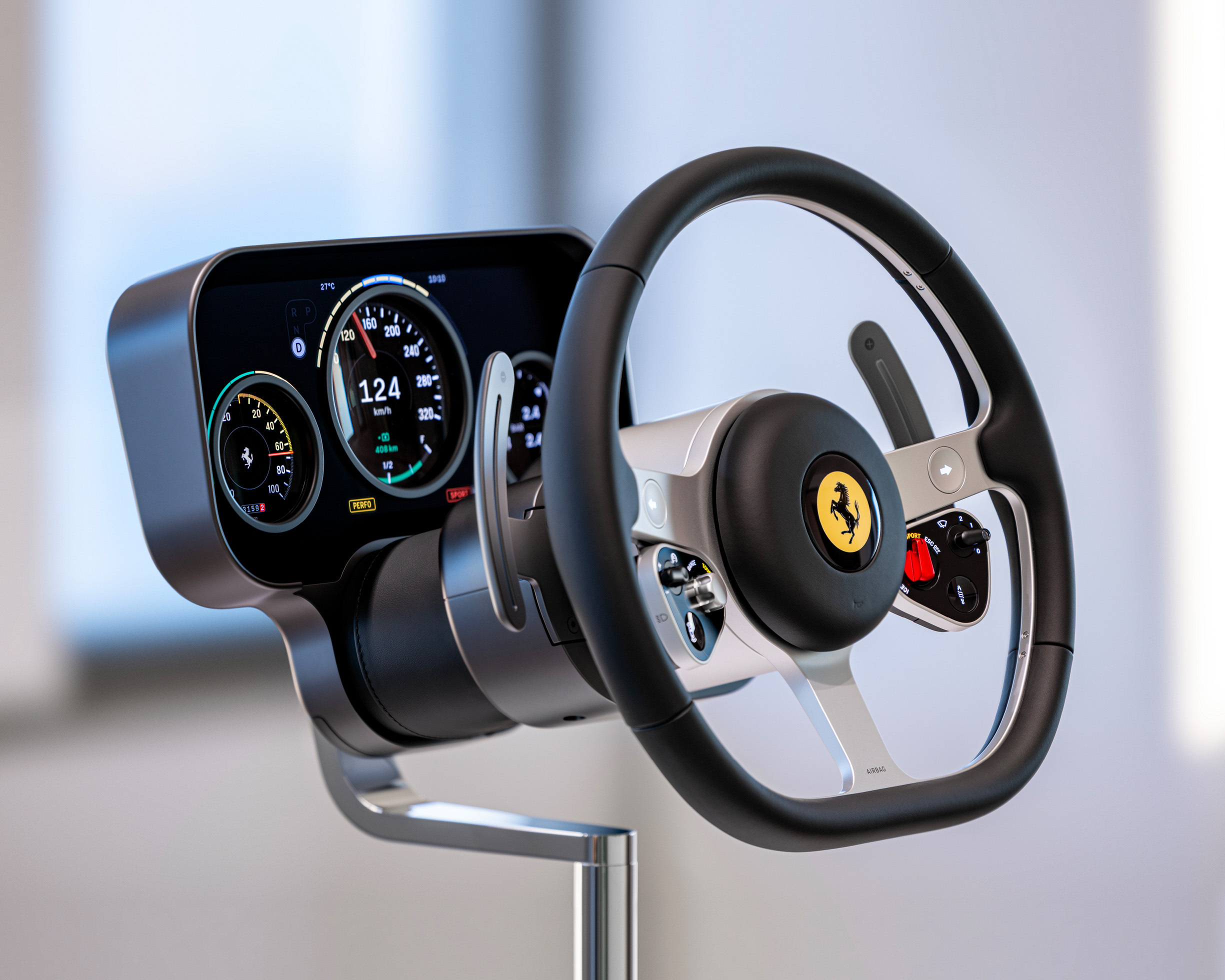
Ferrari unveiled the interior of its first-ever EV this week, the Luce, created in collaboration with Jony Ive, former Apple design chief and the creative force behind the iPhone, iPad, and MacBook. It’s a retro-themed bonanza with plenty of physical buttons, switches, and toggles, representing a radical departure from the screen-focused and minimalist designs of most electric cars.

Read: Ferrari’s Luce EV Has A Glass Key And Buttons That Click Like A Rifle Bolt

The approach may seem counterintuitive at first, especially given Ive’s legacy at Apple, where he helped usher in the age of touchscreens. But the British-American designer’s reasoning is rooted in practicality rather than nostalgia. As it turns out, he never believed touch interfaces belonged in cars in the first place.

Touch Isn’t Always The Answer

“The reason we developed touch [for the iPhone] was that we were developing an idea to solve a problem,” he told Autocar. “The big idea was to develop a general-purpose interface that could be a calculator, could be a typewriter, could be a camera, rather than having physical buttons. I never would have used touch in a car [for the main controls].”

“It is something I would never have dreamed of doing because it requires you to look [away from the road],” Ive added. “So that’s just the wrong technology to be the primary interface.”

\\\\\\\

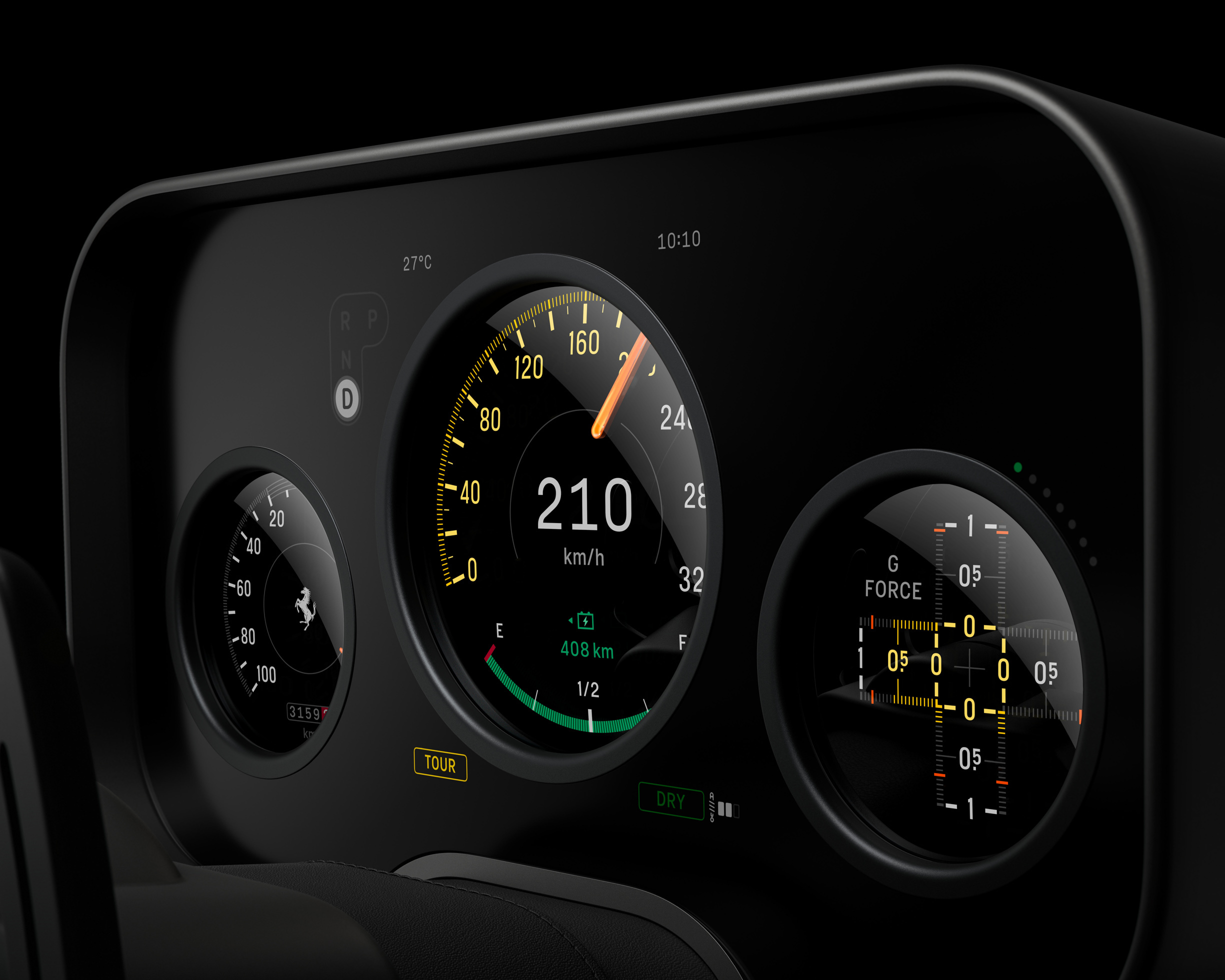
This isn’t to say the Ferrari Luce is completely devoid of screens. The gauge cluster features OLED panels from Samsung, designed to mimic the look of classic analog dials. The needle, though, is a physical piece made from anodised aluminium and backlit by 15 LEDs. In the center of the dash sits a touchscreen, angled slightly toward the driver.

Feel Your Way Around

Yet nearly every essential function, including climate controls, drive settings, even audio, can be adjusted through metal toggles or rotary knobs. Ive notes that “every single switch feels different, so you don’t need to look.”

When asked what sets the Luce’s screen apart from others, Ive said, “So much of what we did was so that you could use it intuitively, enjoy it and use it safely.”

In addition to real switches beneath the center touchscreen, the Luce features tactical dials and buttons on the steering wheel and center console, and even an airplane-inspired panel in the headliner. It looks like a welcome reprieve for the haptic controls of many recent Ferrari models, like the SF90.

“I think what happened was touch was seen almost like fashion,” Ivy explained. “It was the most current technology, so [companies thought] ‘we need a bit of touch’, then the next year ‘we’re going to have an even bigger one’, and it will get bigger and bigger.”

He added, “I think the way that we design [car interiors] isn’t that we’re trying to solve problems [like we did with the iPhone].” That, in his view, is where much of modern automotive UX design goes astray.

\\\\\\\\\

Waymo’s Robotaxis Sometimes Receive Guidance By Some Guy In The Philippines

  • Lawmakers criticized Waymo’s growing reliance on Chinese suppliers.
  • Some robotaxi operations are remotely managed from the Philippines.
  • Senators raised national security concerns over foreign involvement.

Waymo chief safety officer Mauricio Peña fronted US lawmakers at a tense Senate hearing last week, where the self-driving tech company was accused of getting “in bed with China,” as it rolls out more of its robotaxis. The hearing also offered a reminder that beneath the polished image of AI, there’s still a reliance on human labor, often lower paid, sourced from abroad, and largely out of sight.

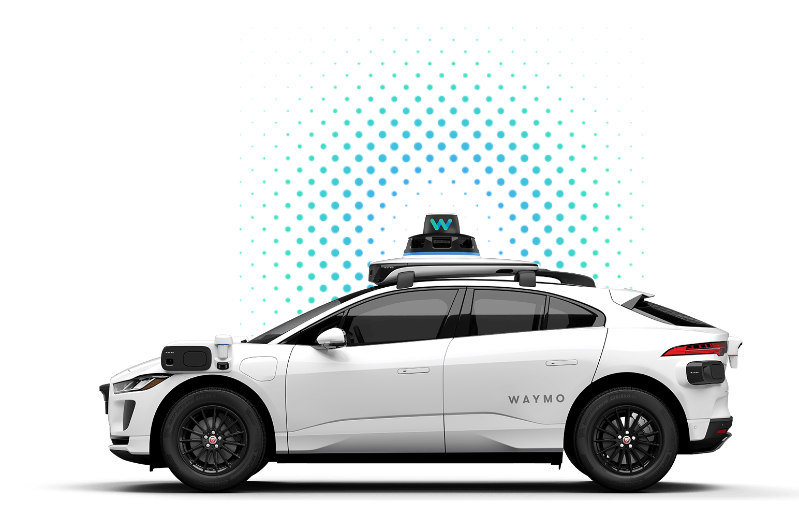
For years, the Google Alphabet-owned company has relied on the Jaguar I-Pace for its fleet, but Waymo is now preparing to roll out a next-generation, minivan-style robotaxi developed in partnership with Zeekr, a subsidiary of China’s Geely Group.

During the hearing, Peña told lawmakers that the United States is “locked in a race with Chinese companies for the future of autonomous vehicles.”

Read: Waymo’s Ready For One Of Europe’s Busiest Cities, But Is The City Ready?

He also warned that without a clear national framework, the industry could end up facing a fragmented patchwork of state regulations that slows investment and limits progress.

Lawmaker Questions Zeekr Partnership

 Waymo’s Robotaxis Sometimes Receive Guidance By Some Guy In The Philippines

Sen. Bernie Moreno from Ohio didn’t let the irony of Waymo using a Chinese vehicle for its fleet go unnoticed. “You said in your testimony that we’re locked in a race with China, but it seems like you’re getting in bed with China,” he retorted during the hearing.

“Giving a natural market to a Chinese company to ship us cars is making us better and creating more jobs for Americans? That’s completely ridiculous,” Moreno added.

According to Business Insider, Moreno went on to suggest that Waymo could be sidestepping US laws designed to curb Chinese involvement in sensitive vehicle technologies. He speculated that the company might be using a “backdoor” to avoid complying with the federal connected vehicle rule, which was finalized last year but has not yet been fully implemented.

Peña rejected that characterization. He maintained that the Zeekr vehicles have “no connectivity” and that all of the autonomous systems are installed in the United States. He also argued that leveraging a global supply chain gives Waymo the flexibility to grow faster and build in operational safeguards.

Overseas Operators Raise Flags

Still, the issue of oversight didn’t stop at the hardware. During the hearing, Waymo revealed that in addition to using remote operators in the US, it also has some working overseas.

When asked for a breakdown of operator locations, Peña said he didn’t have exact figures but confirmed that while some are based in the US, others are much farther away, including in the Philippines, Futurism reports.

“They provide guidance,” he argued. “They do not remotely drive the vehicles. Waymo asks for guidance in certain situations and gets an input, but the Waymo vehicle is always in charge of the dynamic driving tasks, so that is just one additional input.”

According to Senator Ed Markey of Massachusetts, “having people overseas influencing American vehicles is a safety issue,” adding that these are the jobs that Americans should have. He called the use of remote human operators outside the US “completely unacceptable,” according to Business Insider.

In a statement to Carscoops, Waymo emphasized that no remote employees drive the vehicles.

“Waymo’s fleet response teams are located in the U.S. and abroad. As we scale globally – including to London and Tokyo – we need some Fleet Response functions outside of the U.S. It is very important to note, however, their role is never to drive the vehicle remotely. Our technology, the Waymo Driver, is in control of the dynamic driving task, even when it is receiving guidance from remote assistance”, the spokesperson said.

Tesla Joins the Conversation

The vice president of vehicle engineering at Tesla, Lars Moravy, was also in attendance at the Senate hearing. He said that the US needs to “modernize regulations that inhibit the industry’s ability to innovate,” or risk losing the autonomous vehicle race.

“Federal regulations for vehicles have not kept up with the pace of the rapid evolution of technology,” Moravy said. He added that many safety standards still in place were designed decades ago and no longer account for today’s technical realities.

Update: We’ve added quotes from Mauricio Peña and a statement from Waymo.

 Waymo’s Robotaxis Sometimes Receive Guidance By Some Guy In The Philippines

Ferrari’s Luce EV Has A Glass Key And Buttons That Click Like A Rifle Bolt

  • Ferrari’s first EV named Luce, pairs retro tactility with futuristic digital tech.
  • Exposed aluminum and innovative layered displays are like nothing else.
  • Nardi-style steering wheel features power and chassis manettinos toggles.

If you thought Ferrari’s first EV would feel like an iPad on wheels, think again. The new cabin designed by former Apple man Jonny Ive is a gorgeous fusion of digital tech, tactile physical controls, and some retro styling cues guaranteed to make even a trip to the corner store feel like a Mille Miglia run.

Meet the Ferrari Luce, a name that means light and quietly hints that electrons can still have a pulse. Before we even see the bodywork in May, the Italians have pulled back the curtain on the interior to prove to us that maybe an electric Ferrari isn’t the devil’s work after all.

Related: Ferrari Found A Way To Make Fake EV Noise Sound Honest

That design energy comes courtesy of LoveFrom, the creative outfit founded by Jony Ive and Marc Newson. Ive is famous for his work on touchscreen tech juggernauts like the iPhone and iPad, but for this project, he was adamant that the Luce needed plenty of real switches.

\\\\\\\\\\\

Toggles Are Back

So the Luce doubles down on physicality. Real buttons. Real toggles. Real rotary controls that click with satisfying precision. Ferrari says test drivers went through more than 20 rounds just to perfect the feel and sound of each switch. It is basically ASMR for your fingertips, especially the launch control switch, which is located above your head, aircraft-style.

 Ferrari’s Luce EV Has A Glass Key And Buttons That Click Like A Rifle Bolt

Front and center is a steering wheel that looks like it time-traveled from the 1960s. Three slim spokes, exposed aluminum, and a layout inspired by classic Formula One cars. Nineteen CNC-machined parts make it lighter than a typical Ferrari wheel, yet it’s packed with finger controls so you can adjust things without playing touchscreen whack-a-mole.

Real Or Virtual?

 Ferrari’s Luce EV Has A Glass Key And Buttons That Click Like A Rifle Bolt

Behind it sits a wild instrument binnacle developed with help from Samsung Display. Two wafer-thin OLED panels overlap to create deep, layered dials that look almost analog at a glance. There’s even a physical needle sweeping across digital graphics because apparently pixels alone weren’t dramatic enough.

According to Ferrari, the Luce’s digital displays were “inspired by both historic automotive cues and the purposeful, clear graphics found in aviation, particularly helicopters and aircraft.” The influence is easy to spot. The layout and typography are unmistakably automotive, a modern tribute to the Veglia and Jaeger instruments from classic Ferraris.

Start-Up Buzz

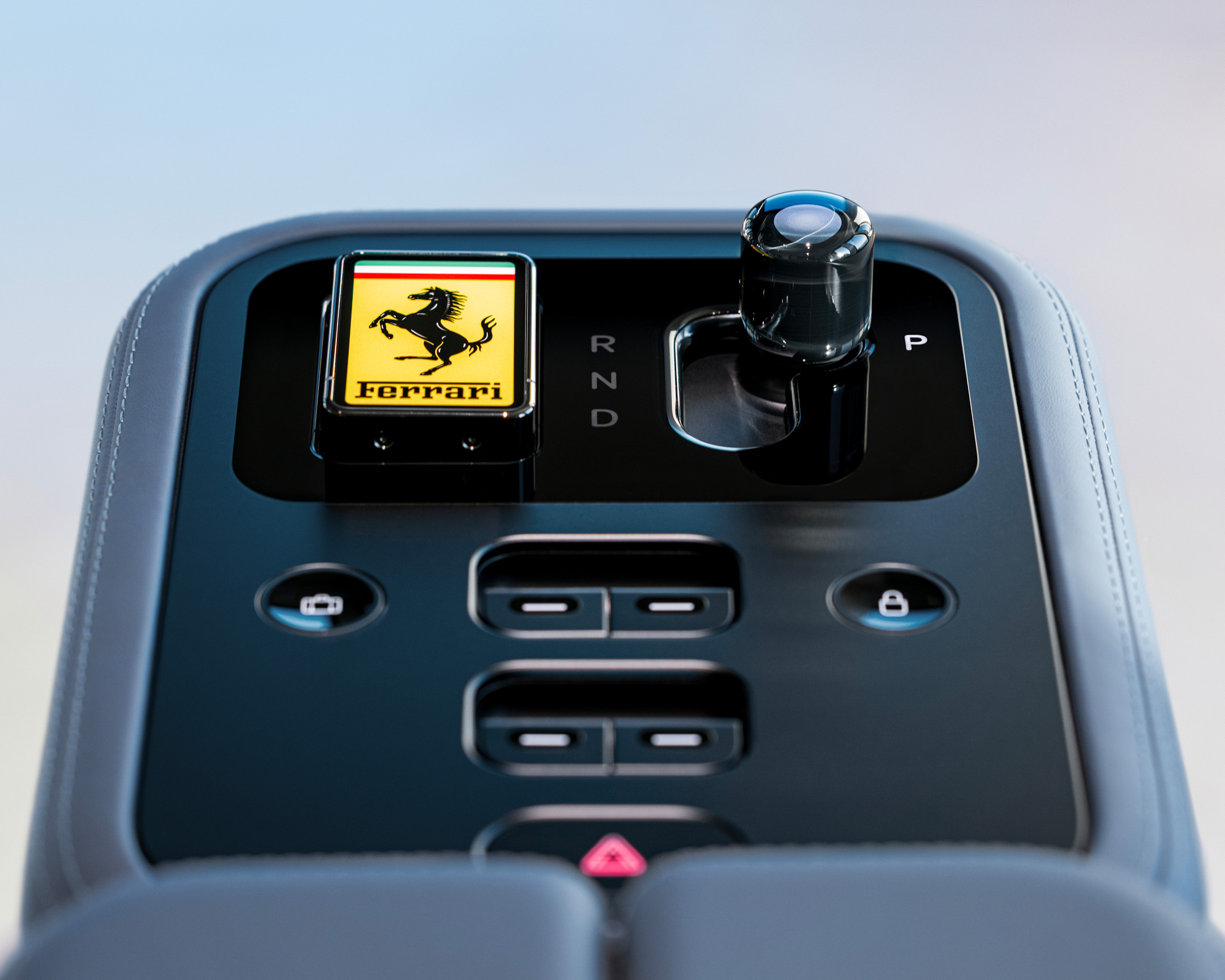
Ferrari messed up with the SF90, putting a nasty touch-sensitive start button on the steering wheel that killed much of the buzz you normally get from firing up a Maranello car. But it has redressed the balance with the Luce’s startup ritual. First, you insert a chunky glass key into a dock on the console. Its color shifts, then the drive selector wakes up in a coordinated light show.

 Ferrari’s Luce EV Has A Glass Key And Buttons That Click Like A Rifle Bolt

We’ll have to wait until May to see the Luce’s exterior, though it’s likely we’ll learn more about the powertrain and chassis package between now and then.

Many of us thought we’d find it hard to get excited about an electric Ferrari, no matter how quickly it laps Fiorano, but if the rest of the car is as thoughtful and original as this cockpit there’s going to be plenty to love, even if it doesn’t have gas in its veins.

\\\\\\\\\\\\

This New Battery Could Outlive You, Never Mind Your Car

  • CATL says its new 5C battery lasts far longer than rivals.
  • Delivers 1.1M miles with repeated fast charging at 20 C.
  • Withstands 60 C heat and still offers over 500,000 miles.

New EVs come with long battery warranties, but used EV buyers picking one up years later don’t get that same safety net. And the thought that a car spent its early life tethered to a fast charger is a major worry. But according to one major Chinese battery supplier, that may not be the case for much longer.

CATL claims its latest 5C lithium ion pack can retain 80 percent of its original capacity after 3,000 full charge cycles when hooked up to a fast charger under ideal 20 degrees C (68 F) conditions. Do the math and that works out to roughly 1.1 million miles (1.8 million km). That’s taxi driver territory, not school run use.

Related: Tesla’s Battery Upgrade Costs Twice What The Whole Car Is Worth

Even when things get toasty, the numbers still look wild. CATL says that at 60 C (140 F), which it compares to a Dubai summer, the battery still holds 80 percent capacity after 1,400 cycles. That equates to around 520,000 miles (840,000 km), which is still more than many cars ever see.

Charge In 12 Minutes

 This New Battery Could Outlive You, Never Mind Your Car

The 5C label refers to charge rate in fills per hour. In simple terms, this battery can theoretically be charged from empty in about 12 minutes. Ultra fast charging like that normally hammers battery longevity, but CATL says clever chemistry and thermal management keep degradation in check.

According to the company, the secret sauce includes a more uniform cathode coating to reduce structural damage, a special additive in the electrolyte that helps repair tiny cracks, and a temperature responsive layer on the separator that slows ion movement if things start getting too hot. The battery management system can also target cooling to specific hot spots inside the pack.

Don’t Fear Fast Charging

 This New Battery Could Outlive You, Never Mind Your Car
CATL

All of this is aimed at making fast charging routine rather than something owners try to avoid. That could be a game changer for high mileage users like taxis, ride hailing drivers and delivery fleets, where downtime really is money.

Of course, this is all on paper for now. CATL hasn’t said when mass production will start or which cars will get these long-life packs first. Real world results often look less glamorous than lab numbers.

Still, if even half these claims hold up, the idea that an EV battery might outlast the car wrapped around it suddenly sounds a lot less like science fiction and a lot more like your next used car bargain.

H/t to Inside EVs

Karma’s New Hypercar Could Leapfrog Rivals With This Battery Deal

  • New Kaveya will use a U.S.-made solid-state battery pack.
  • Factorial’s battery tech also works with existing EV factories.
  • Karma delayed the hypercar to improve driving range and feel.

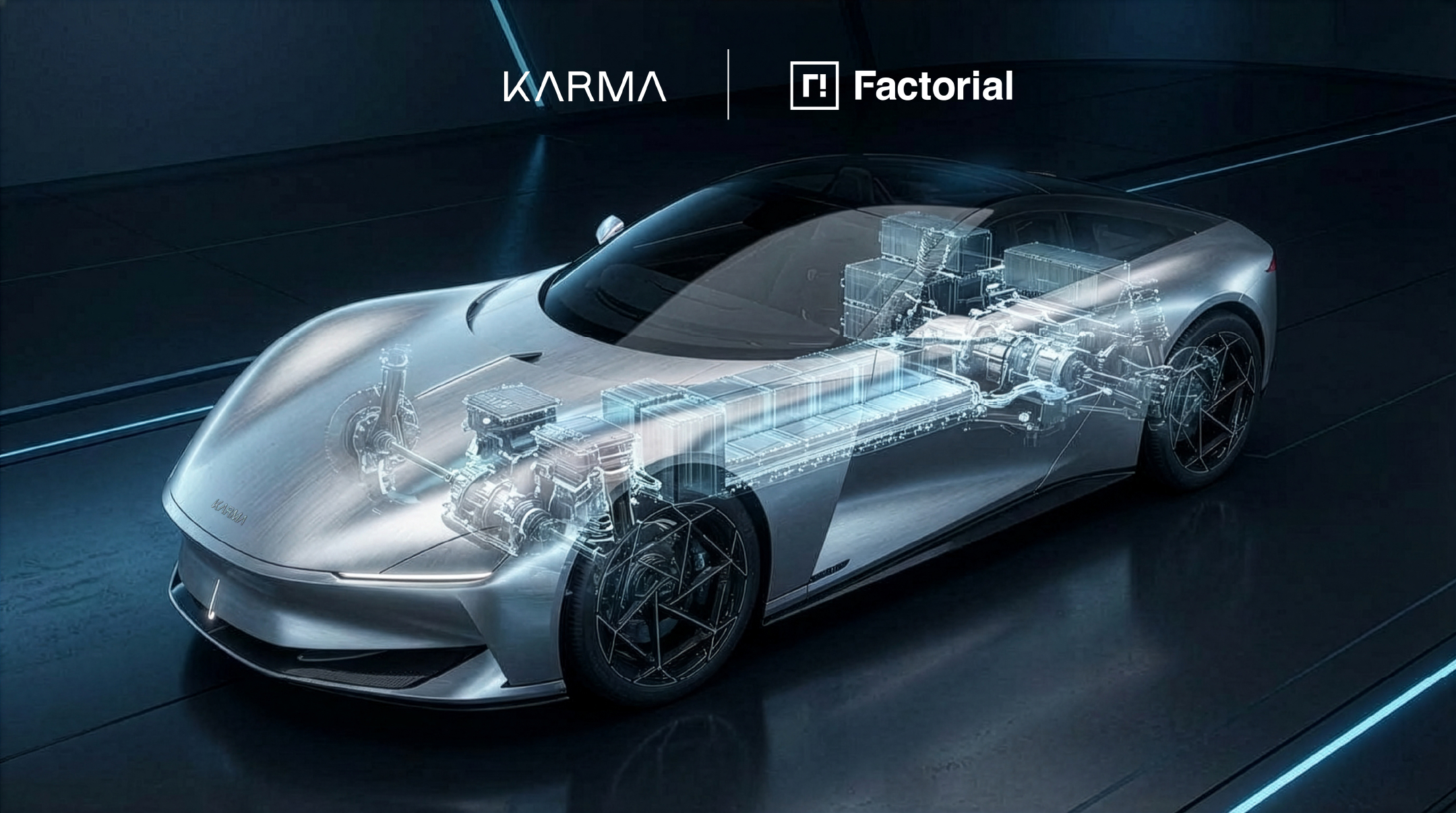
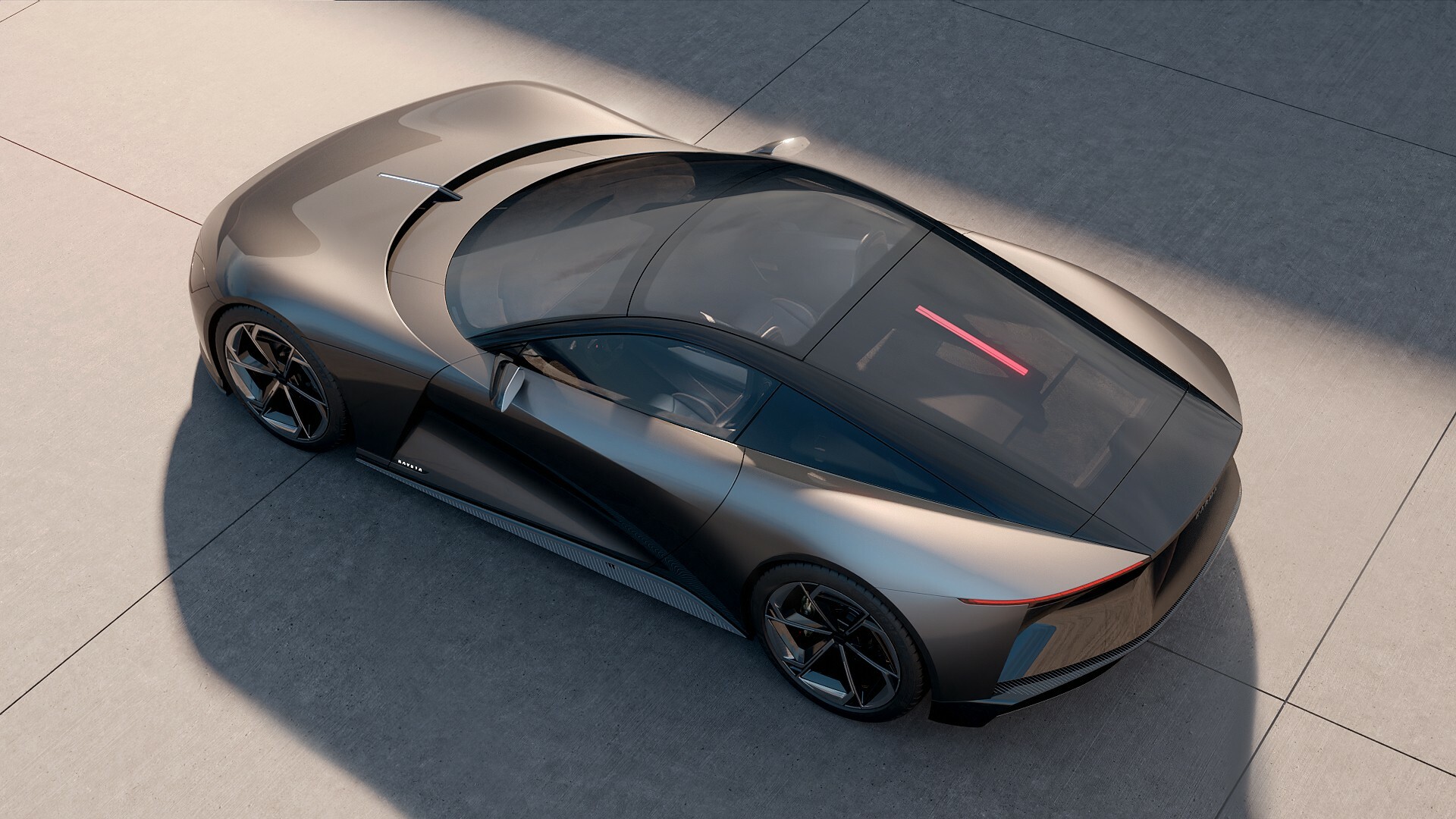
Karma Automotive, which emerged from the remnants of Fisker Automotive, recently ended production of its range-extender Revero and is now turning its attention to a far more ambitious project. In late 2023, the American brand previewed the Kaveya, a hypercar-rivaling electric coupe, and to bring it to life, it’s teaming up with a local solid-state battery manufacturer.

That partner is Factorial, a solid-state battery company with close ties to several global OEMs, including Mercedes-Benz, Hyundai, Kia, and Stellantis. Its technology will form the foundation of Karma’s upcoming electric platform, which will debut in the Kaveya.

Read: Karma Is Moving On Up, Sets Sights On McLaren And Ferrari

Technical specifications for the battery pack are not yet known, but Factorial’s proprietary FEST (Factorial Electrolyte System Technology) solid-state design is engineered for compatibility with current lithium-ion manufacturing lines.

 Karma’s New Hypercar Could Leapfrog Rivals With This Battery Deal

Up to 80 percent of the same production equipment can be reused, which could dramatically cut costs and speed up deployment. For a low-volume manufacturer like Karma, that’s a critical advantage.

Waiting Until the Tech Could Catch Up

Karma president and chief executive Marques McCammon says Karma delayed the launch of the Kaveya last year as it “did not yet see a clear path to fully delivering the uncompromising driving experience that should be expected from an American ultra-luxury vehicle company.”

Thanks to its partnership with Factorial, the company’s solid-state battery will offer better efficiency and a longer driving range compared with traditional lithium-ion batteries. When the Kaveya was first previewed, it was going to use a 120 kWh pack with over 250 miles (402 km) of range. In all likelihood, the new solid-state pack will be smaller and offer more range.

 Karma’s New Hypercar Could Leapfrog Rivals With This Battery Deal

“Launching our first U.S. passenger-vehicle program with Karma is a meaningful milestone for Factorial,” said CEO Siyu Huang. “FEST was built to scale, and this milestone not only highlights the energy and performance solid-state technology can deliver but also underscores the global leadership of U.S. technology innovators. High-performance luxury vehicles require cutting-edge innovation, and this collaboration showcases what’s possible when performance leads.”

Hypercar Performance

Karma has already outlined some of the performance targets for the Kaveya. Dual electric motors will combine for a total output of 1,180 hp and 1,270 lb-ft (1,720 Nm) of torque. That should be enough to get the car from zero to 60 mph (96 km/h) in under 3 seconds, with a projected top speed north of 180 mph (290 km/h)

\\\\\\\\\\\\

Big Tech wants Wisconsinites to pay for their data centers. We need to speak up. 

6 February 2026 at 11:00

In Port Washington, Wisconsin, many residents oppose a $15 billion data center campus that’s currently under construction for end-users Oracle and OpenAI. (No Data Centers in Ozaukee County Facebook group)

Big Tech is here in Wisconsin, looking to make Wisconsin families and small businesses pay for data centers. The Wisconsin Public Service Commission (PSC) is about to make a decision that will affect all of us: We Energies has proposed a new rate structure on data centers that, as drafted, favors profits and protections for Big Tech companies and We Energies executives themselves, but putting Wisconsinites at risk to subsidize the costs. Here’s what’s going on and how you can do something about it. 

What’s at stake?

We Energies, the largest and most profitable utility in the state, is preparing to spend $19.3 billion on electric generation due to data center proposals from Microsoft, Oracle, Vantage, and OpenAI.4. This is largely to build new gas plants in order to power the massive energy needs of Big Tech’s data centers. Here’s the problem: If sufficient protections aren’t in place now, the costs of these expensive gas plants may be forced onto families and small businesses, driving up people’s bills to keep the lights on and heat their homes in the winter.

We Energies’ proposals put us at risk for higher utility bills without fully ensuring that Big Tech is paying their fair share. As it currently stands, more expensive data centers likely means higher costs for all of us. Tech companies should be responsible for covering the cost of service needed to power their data centers, including the cost of building out power to service these high energy demands.

In addition to their problematic proposal, We Energies is proposing to add huge volumes of natural gas plants to feed these power-hungry data centers, which are expensive to build and take decades to pay off. These so-called “stranded assets” end up costing us more money for many years down the line, at times even when they are no longer in service. With rapidly changing AI technology, there is a very real risk that Big Tech does not move forward with planned data centers because they’re no longer profitable or needed. In short, data centers create short-term gains for Big Tech and We Energies with long-term consequences for Wisconsinites. 

What’s going on behind Big Tech’s closed doors?

We Energies’ proposal encourages Big Tech to make decisions behind closed doors, without considering Wisconsinites or how their decisions will impact Wisconsin lands, waters and natural resources. We should all be suspicious of this. What’s happening in these meetings that We Energies and Big Tech don’t want us to know about? If Big Tech builds data centers in Wisconsin communities, Wisconsin communities deserve to know what deals are being made with the utilities. 

Transparency and accountability are crucial. Big Tech and utilities like We Energies must make their data center reporting, planning and financials publicly available, so that regulators like the PSC can implement protections and ensure Wisconsinites aren’t being taken advantage of. We deserve to always know how and why our electric and gas bills are being affected.

The time to take action is now.

If We Energies builds new gas plants to power Big Tech’s data centers, all of us will live with greater risks of rising gas and electricity prices as well as environmental impacts to our communities. If Big Tech wants to come into our state and use our state resources, they shouldn’t be putting us in jeopardy, they should be the ones taking on the risks. 

As we prepare for the PSC to make a decision on data centers, we need to make our voices heard to decision makers: Big Tech and We Energies don’t get to decide what’s best for Wisconsin. You have a role to play in shaping the policies that affect you. Attend the virtual public hearing on Feb. 10 or by submitting a comment by Feb. 17.

GET THE MORNING HEADLINES.

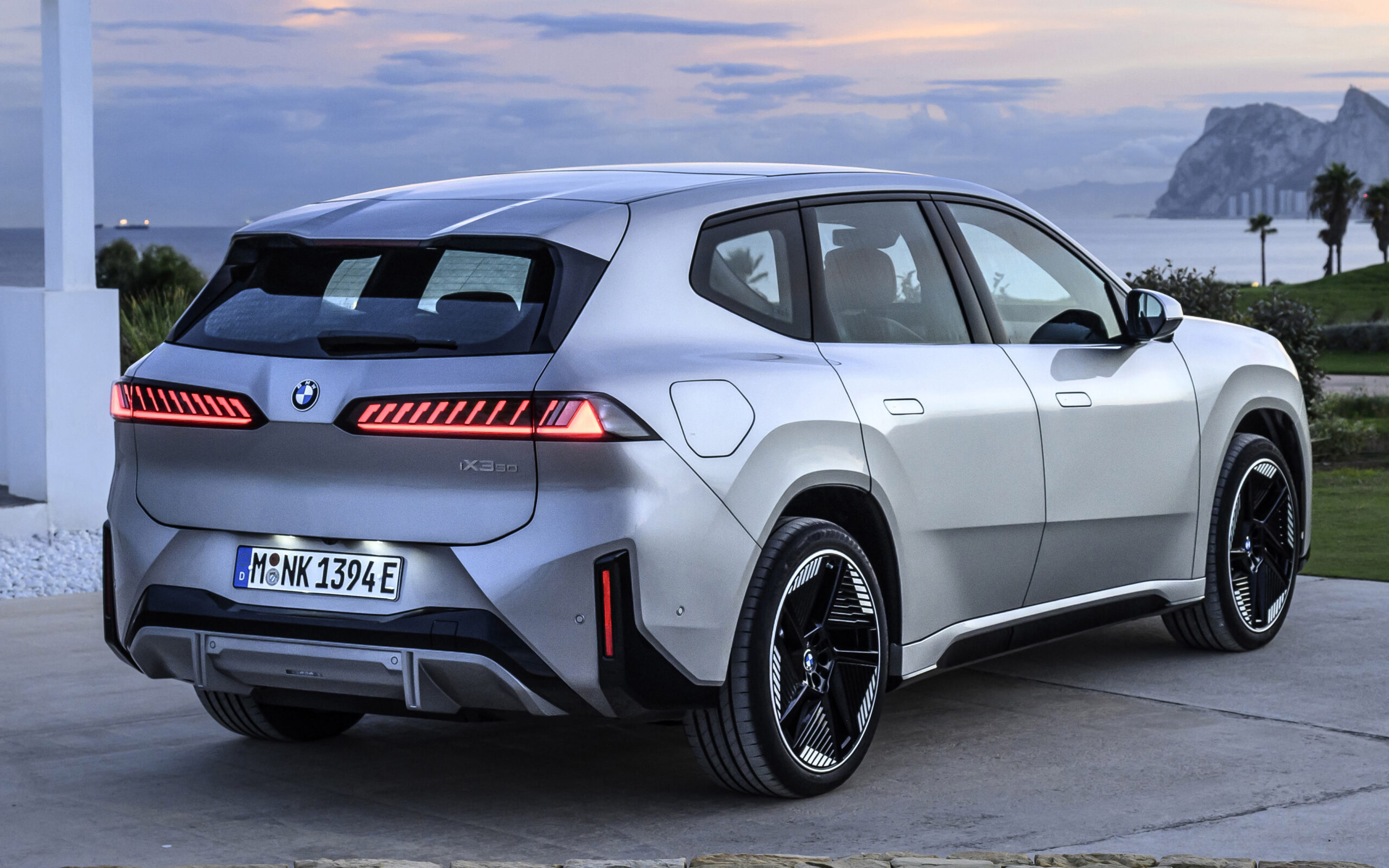
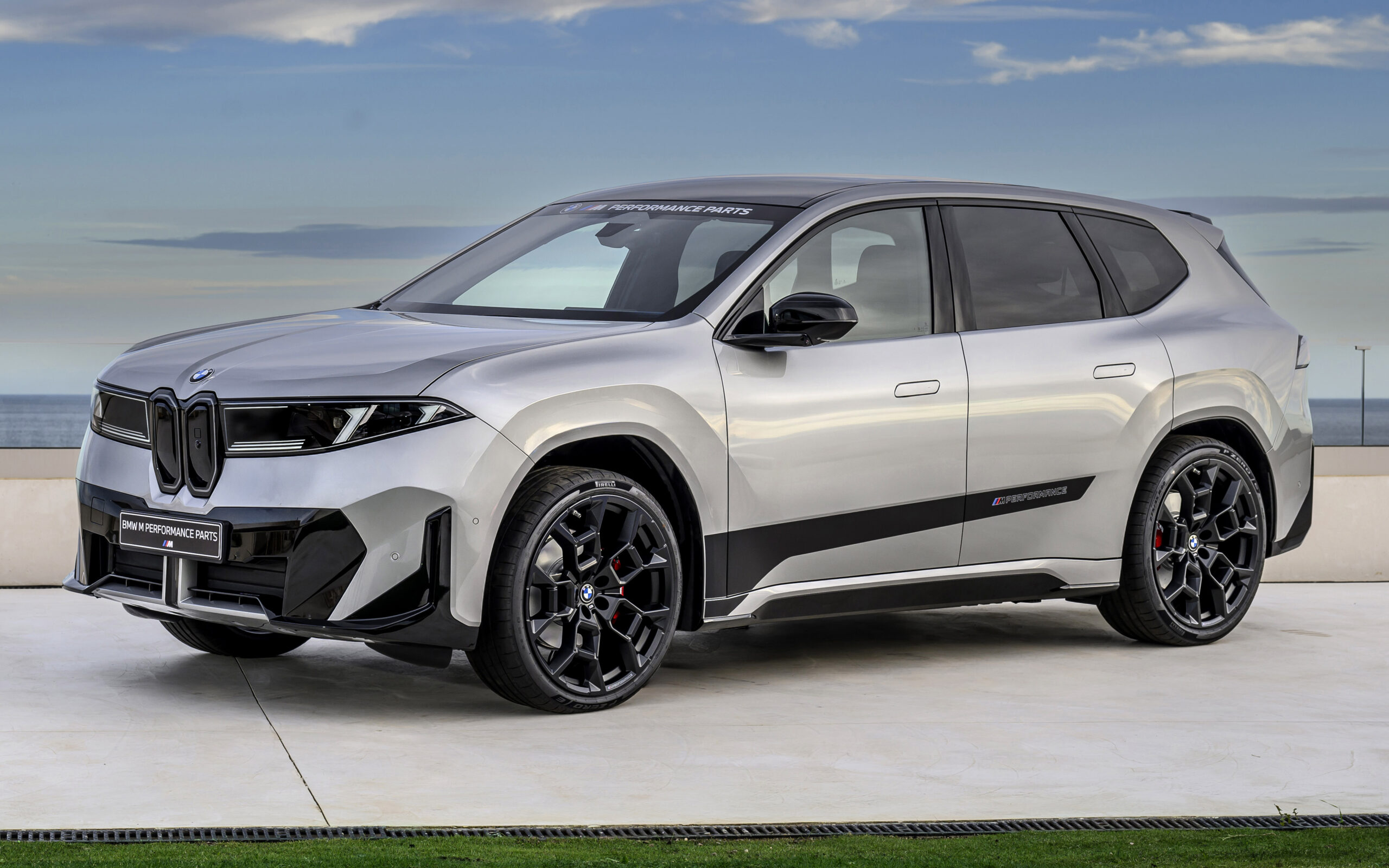
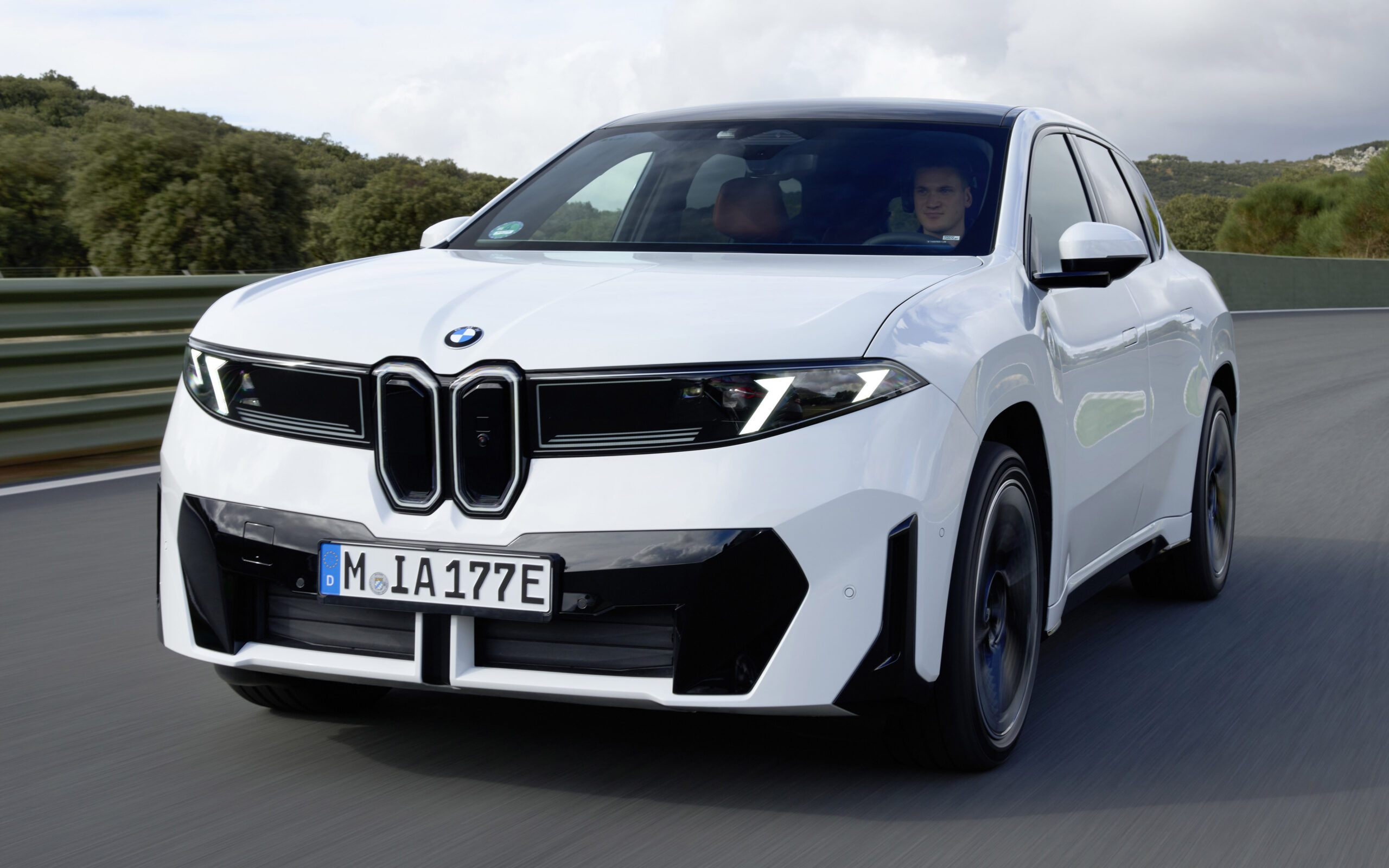
BMW iX3 Has A 360 Camera, But You’ll Pay Monthly To Use It

  • BMW iX3 needs a subscription to use its 360-degree camera.
  • Driving Assist Pro also requires a monthly subscription.
  • Company admits heated seat subscriptions were a mistake.

BMW learned a hard lesson in 2022 when it tried to charge a subscription fee for heated seats, prompting swift and widespread backlash. While the company walked that decision back within a year, it’s still firmly committed to the broader idea of subscription-based features.

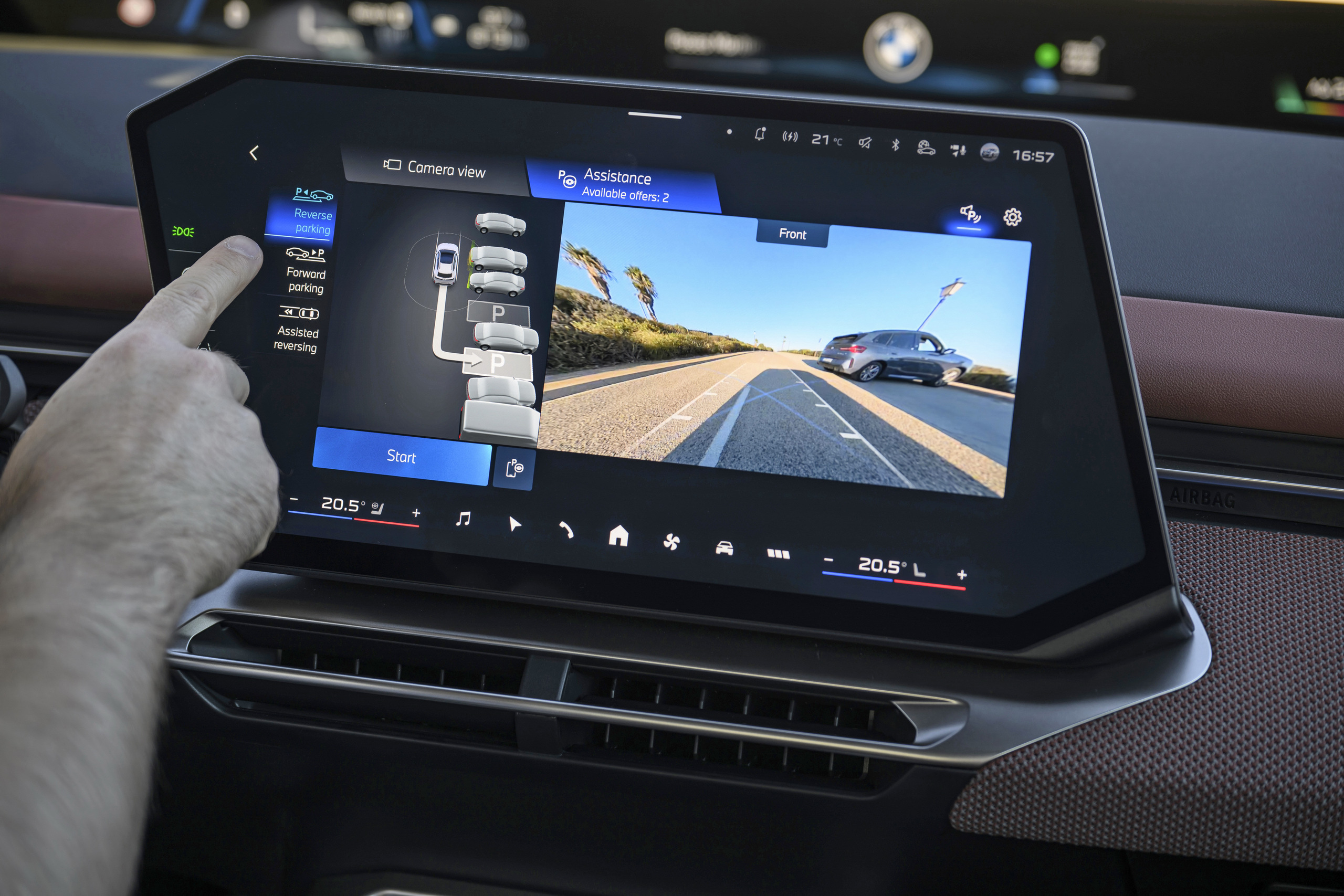
In the case of the all-new iX3, BMW will ask its customers to subscribe to features such as the 360-degree camera and the Driving Assistant Pro package, which includes hands-free driving on highways and semi-autonomous features for urban settings, much like Tesla’s approach with its own systems nowadays.

Read: BMW iX3 M Coming As A Quad Motor Performance EV

This comes even as BMW concedes that offering heated seats as a subscription option was a mistake, and the fact that all new iX3s will have the hardware for advanced-driving assistance systems and the 360-degree camera.

 BMW iX3 Has A 360 Camera, But You’ll Pay Monthly To Use It

Other features, such as real-time traffic updates and adaptive suspension, are also sold as subscriptions depending on the market. In Australia, adaptive suspension can be activated after purchase for A$29 (US$20) per month, with a one-month free trial to get drivers acquainted.

Why BMW Still Believes in Subscriptions

“The criticism we got was from the seat heating, so this was probably not the best way to start with it,” BMW head of product communications Alexandra Landers told Australia’s Drive. “However, we decided for the technology, everything is on board, but for the additional other systems, we also have costs for running. You have cloud use, and that is cost.”

\\\\\\\\\\

“If you use it, we have to pay for it. It’s not everything important [to every customer], but the technology is important [to have in all vehicles], and we still believe in the option offer structure that you do not have to decide from the start if you want this ADAS [safety] system.”

Landers added that having subscriptions can be useful for owners who may change their mind about having a certain feature during their ownership. “For example, if they’re sitting in a traffic jam, and think ‘Oh, maybe I should have bought [ADAS] two years ago’. And then they can, you know, add it online.”

 BMW iX3 Has A 360 Camera, But You’ll Pay Monthly To Use It

BMW will tie downloadable over-the-air software updates to its subscriptions. For example, as ADAS systems are improved, updates could be introduced to paying subscribers.

Some features, however, will reach certain regions before others. BMW confirmed that semi-autonomous driving functions will first roll out in Germany before expanding to other markets.

Performance Stays Unlocked

 BMW iX3 Has A 360 Camera, But You’ll Pay Monthly To Use It

That said, BMW has ruled out certain types of paid upgrades entirely. Customers won’t be able to unlock more power or battery range through remote updates, as the automaker believes base vehicles should deliver full performance from the start.

“Because this is the thing we say, you buy a car with maximum power, and we are not a tuner. You just felt that 345 kilowatt (463hp), so why restrict it and then have [customers] pay [more] for it? That didn’t make sense for us as an offer strategy.”

Will Buyers Push Back?

It remains to be seen how customers will respond to the subscription offerings for the latest BMW models, particularly the new iX3. While locking the advanced semi-autonomous driving system behind a paywall isn’t unique in the industry, as Tesla does with its supervised Full-Self Driving suite, requiring a subscription for features like a 360-degree camera, is bound to be controversial.

 BMW iX3 Has A 360 Camera, But You’ll Pay Monthly To Use It

Another European Country Fears These Cars Might Be Spying On Its Military

  • Chinese car cameras and sensors spark security fears.
  • Poland may join others banning them from military areas.
  • Ban could cover any car using Chinese sensors or tech.

Concerns over data security are prompting fresh scrutiny of Chinese-made electric vehicles in Europe, and Poland appears to be the latest country preparing to act. Officials there are looking to prohibit these cars from entering sensitive military areas, citing fears they could be used for surveillance.

The move would follow the UK’s recent decision to restrict Chinese EVs from military zones, part of a wider effort to prevent potential access to sensitive information gathered by modern automotive tech like cameras, radars and sensors that are now common on new cars.

Are Vehicles Becoming Spy Tools?

Cars from China, particularly EVs, are becoming an increasingly common sight on European roads, including in Poland. A recent study in the country referred to these vehicles as ‘Smartphones on Wheels,’ noting that onboard technologies enable environmental scanning and can capture sensitive geolocation data, among other capabilities, which can pose a serious safety risk.

Read: Chinese EVs Banned From UK Military Sites Amid Fears They’re Watching Every Move

“Smart cars have enormous data collection capabilities through high-resolution cameras, sensors, and LiDAR systems, which use active 3D mapping technology,” said Paulina Uznańska, author of the study, in comments reported by the Polish news agency PAP. “This creates a very high potential for the use of such vehicles for intelligence analysis purposes.”

 Another European Country Fears These Cars Might Be Spying On Its Military

Responding to the findings, General Wiesław Kukuła, Chief of the General Staff of the Polish Army, is expected to issue a formal directive soon that would ban Chinese-made vehicles from all military installations across the country. This would also include adjacent parking areas.

The Ministry of National Defense confirmed to national news agency PAP that it is currently drafting a policy to that effect.

Security Policy Tightens

UK lawmakers noted last year that the Chinese government holds legal rights to access data collected by the cameras, sensors, and radar systems in vehicles built with Chinese technology.

Following a similar approach, Poland’s ban is expected to apply not only to models from brands like BYD, MG, Nio, Xpeng, and Aiways, but also to any vehicles equipped with Chinese-made software or sensor components.

Beyond military installations, there is speculation that similar measures could reach other sectors. One industry expert has floated the possibility of extending the restrictions to key infrastructure hubs like airports. That said, such a policy would have to be carefully structured to comply with European competition laws and avoid regulatory backlash

 Another European Country Fears These Cars Might Be Spying On Its Military

After More Than A Century (Or Two) Of Cars, What Was The Biggest Innovation Ever?

  • Carl Benz patented his three wheeled motor car in January 1886.
  • Modern cars are faster, safer, and easier to drive than today.
  • Autonomous tech may mark the biggest shift in car history so far.

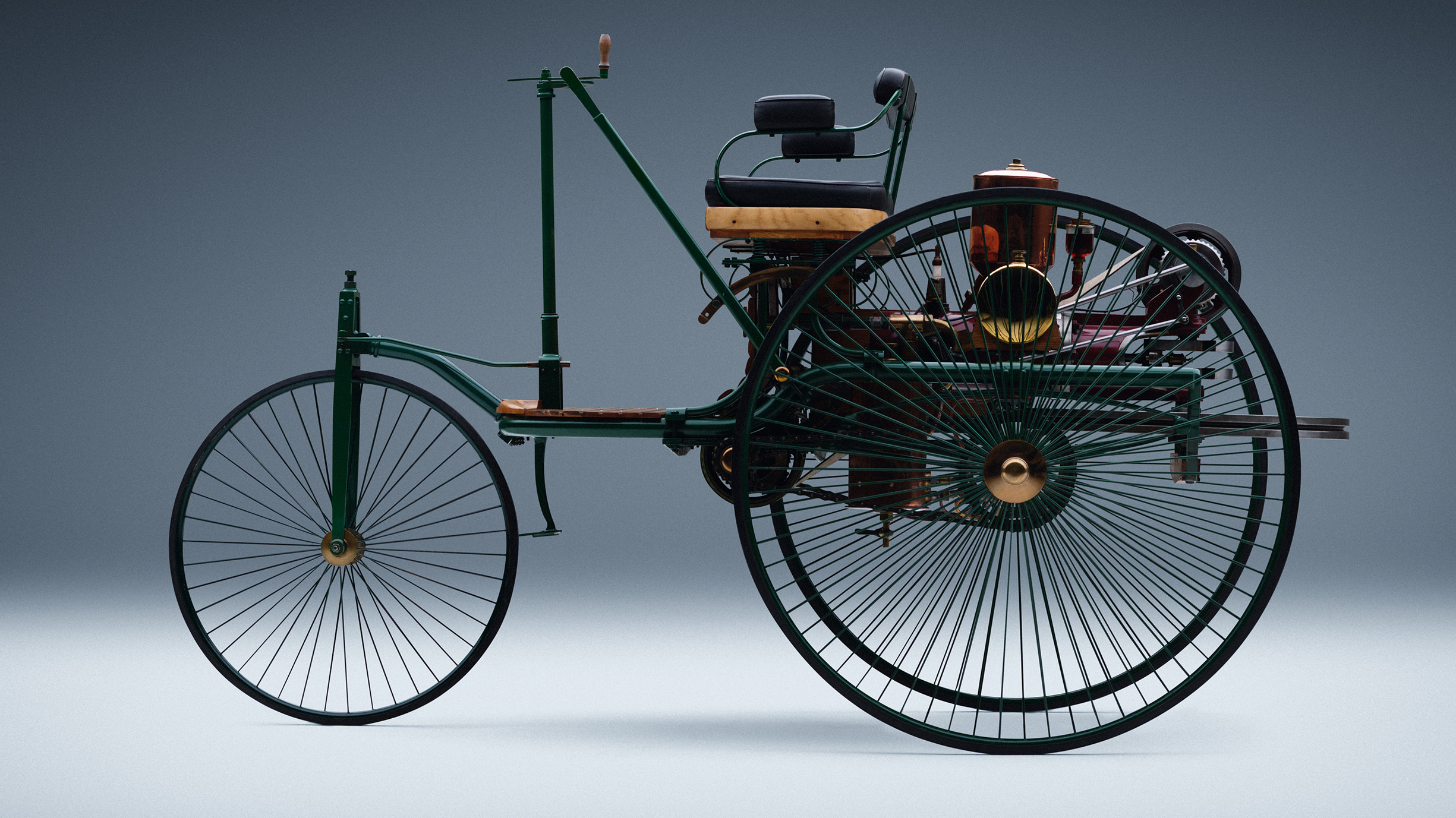
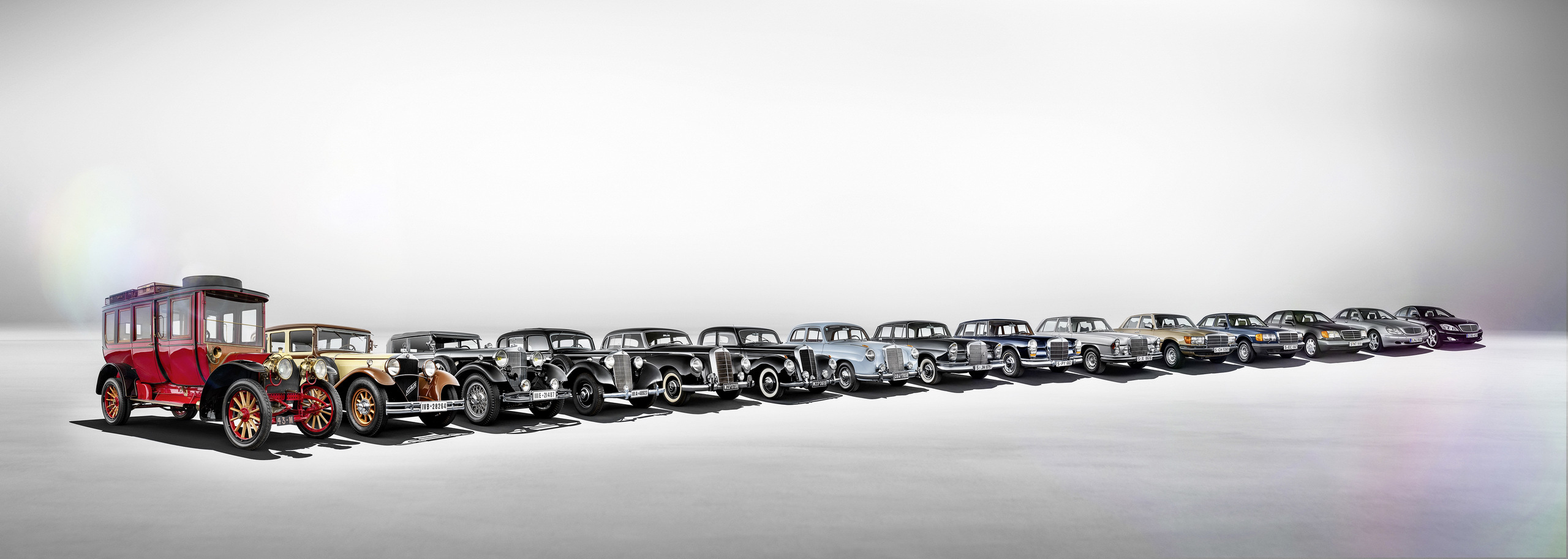
The story of the automobile is never just about a single moment, even when a neat anniversary tempts us to frame it that way. Mercedes is marking 140 years since Carl Benz first putt-putted down the road in his Patent-Motorwagen, often described by the brand as the “world’s first automobile”.

Read: New S-Class Uses 50,000 LEDs To Light Nearly Six Football Fields Ahead

That claim, however, has long been debated in enthusiast circles, including at The Autopian, where Jason Torchinsky recently revisited the subject in detail. Even Mercedes itself acknowledges the history is more nuanced.

The Origins Are Messier Than You Think

On its own website, the company concedes that the automobile did not simply appear in 1886. It recognizes that numerous forerunners existed well before Carl Benz. These range from steam-powered road vehicles to earlier experimental self-moving machines, including Frenchman Nicolas Joseph Cugnot’s three wheeled steam cart from 1769, or possibly 1770, depending on who you ask.

Innovation In Retrospect

Looking at Mercedes’ car no. 1 now, with its huge, spindly wheels, puts that layered history into perspective. It is a vivid reminder of how far the automobile has evolved since Benz’s first outing in 1886, but it also invites a more fundamental question.

Read: Americans Embrace AI Tech In Their Cars But Some Features Drive Them Crazy

With so many ideas, inventions, and refinements accumulating across more than a century of experimentation, which single innovation truly transformed driving the most?

 After More Than A Century (Or Two) Of Cars, What Was The Biggest Innovation Ever?
Volvo

Early breakthroughs were about simply making cars usable. Four wheels brought stability. Steering wheels replaced awkward tillers. Then came the electric starter, which saved drivers from wrestling engines by hand and occasionally breaking bones, transmissions with synchromesh or fully automatic operation. Suddenly cars weren’t just for the brave and mechanically gifted, but for everyone.

Related: Mercedes’ CLE Gets A Facelift, But The Big News Is Under The Hood

Design took its own leap forward as cars stopped looking like horse carriages and started slicing through air. Windshields, enclosed bodies and integrated fenders all radically changed how automobiles looked, even before wind tunnels started to have a major say in the styling process.

From 10 mph to 300 mph

 After More Than A Century (Or Two) Of Cars, What Was The Biggest Innovation Ever?
Bugatti

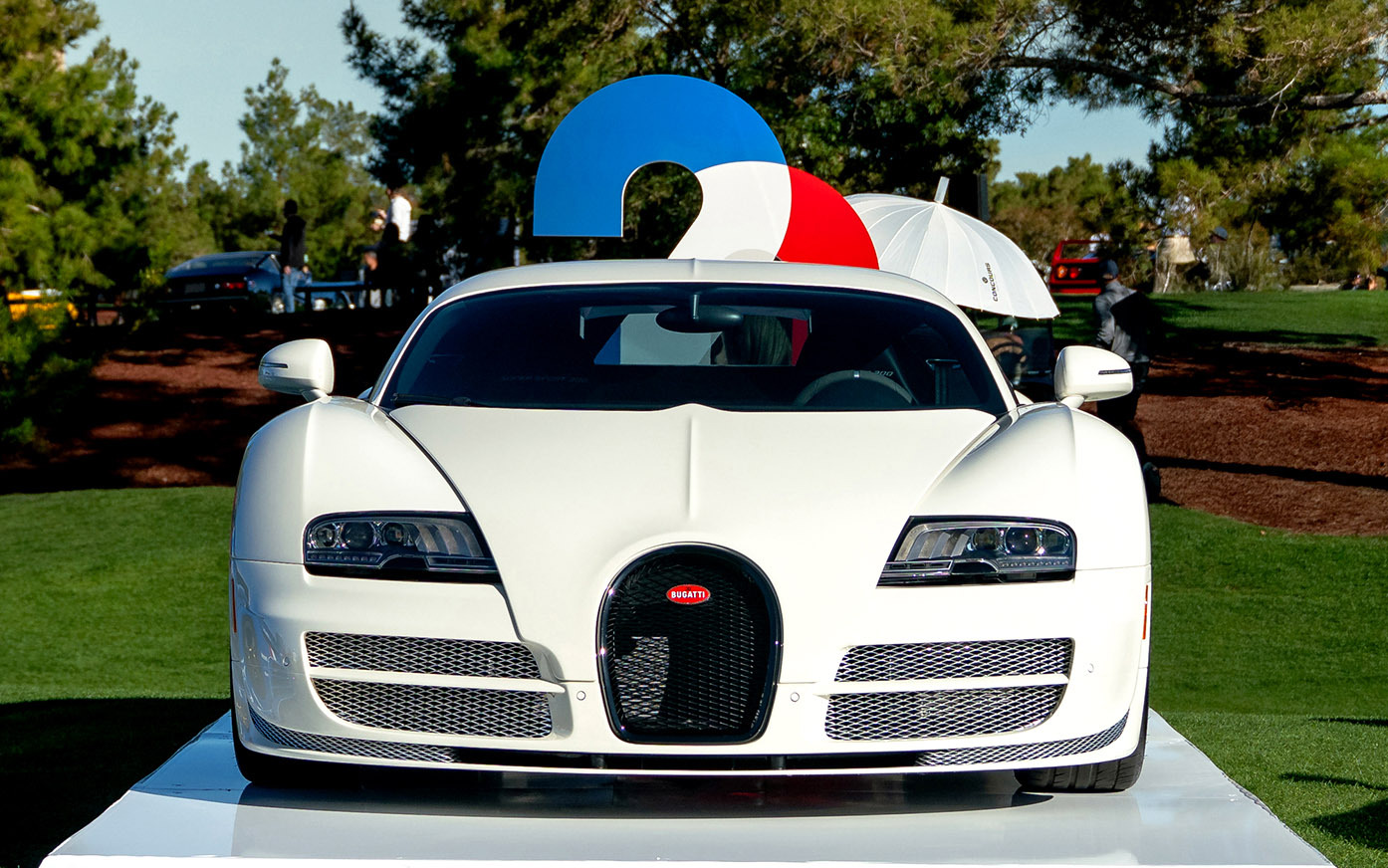
And let’s not forget power and speed. That first car in 1886 had less than 1 hp (1 PS) and was all out of puff at 10 mph (16 kmh). Today, even the most ordinary subcompact makes 100 times as much grunt and is 10 times as fast, while hypercars now punch out 2,000 hp (2,023 PS) and in some cases can top 300 mph (483 kmh).

Those feats would be terrifying with the kind of safety equipment Benz’s Motorwagen had on board. The 1886 original had solid rubber tires and no braking system on any of its three wheels, the only way to slow it down being to tug on a simple hand-operated lever that created friction on the drive belt.

 After More Than A Century (Or Two) Of Cars, What Was The Biggest Innovation Ever?
Mercedes

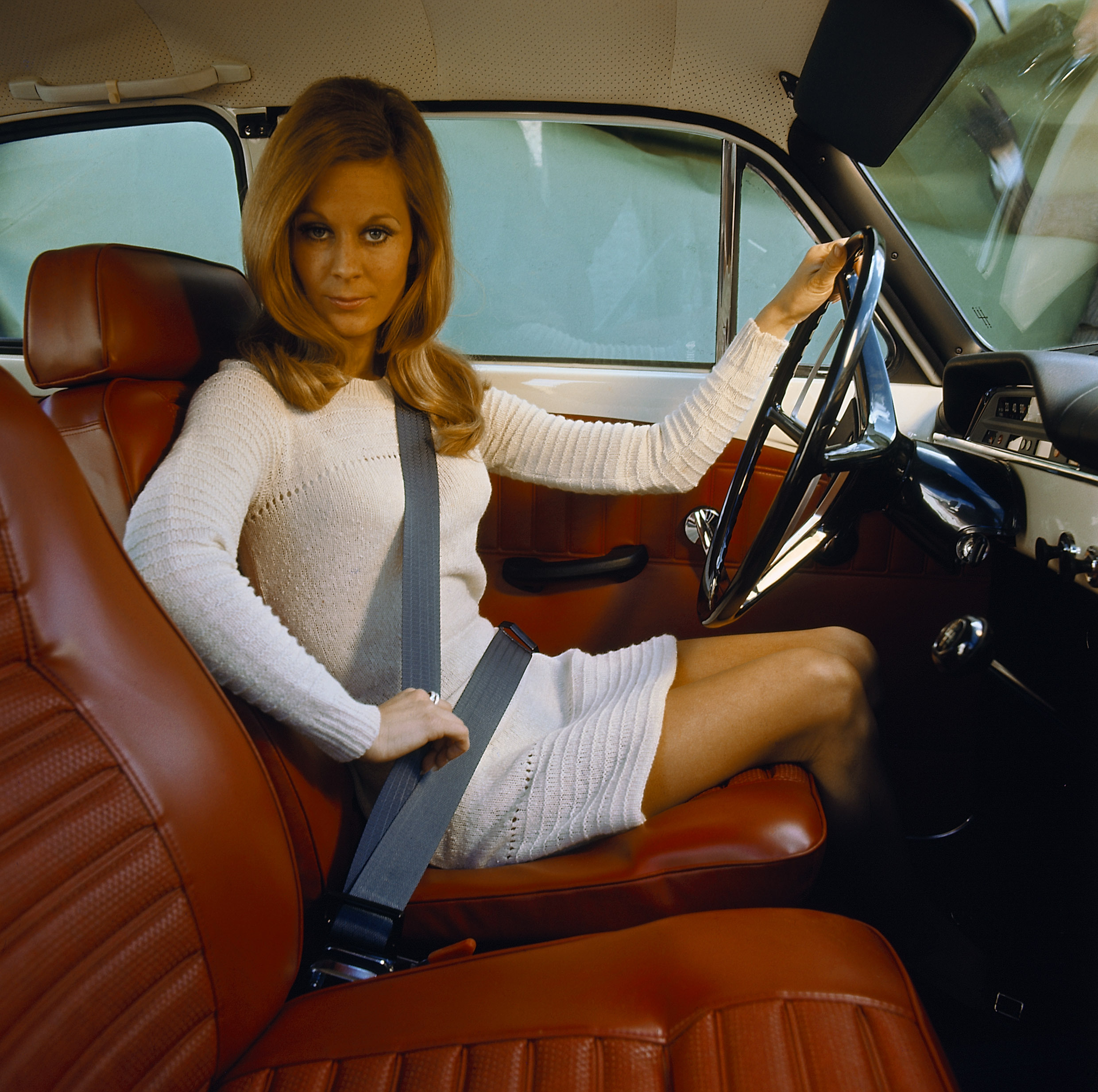
Safety improved relatively quickly, but the major advances in that department have come in the second half of the car’s 140-year life. Seatbelts, crumple zones, airbags, and anti lock brakes quietly saved millions of lives, while air conditioning, power steering, satellite navigation and in-car hifi made those lives behind the wheel more bearable.

Biggest Changes Still to Come

Now we’re living through another turning point. Hybrids, EVs, driver assistance systems, and cars that can steer, brake, and park themselves are redefining what it even means to drive. Mercedes is, appropriately, at the forefront of that change, and will offer Level 4 self-driving on the new S-Class that debuts this year.

Some people see freedom in that kind of tech. Others see the end of real driving. Either way, the car is changing again.

So what gets your vote as the biggest advance to emerge from the car’s long evolution, the one innovation without which modern driving would feel impossible? And which car helped all cars make the biggest leap forward? Jump into the comments and make your case.

 After More Than A Century (Or Two) Of Cars, What Was The Biggest Innovation Ever?
Bugatti

Tesla’s Robotaxi Crash Rate Is Way Worse Than We First Thought

  • Tesla’s Robotaxis crash every 55,000 miles, far more than humans.
  • Human-driven crash estimates are around once every 200,000 miles.
  • Robotaxis operate only in Austin, despite Musk’s 2025 nationwide claim.

As many probably expected, Tesla’s Robotaxi service hasn’t grown the way Elon Musk predicted, and it’s not running as smoothly as the company might have hoped. New data shows that the autonomous cars Tesla is operating in Austin, Texas, are crashing far more often than human drivers.

Read: Tesla’s Model Y Robotaxis Can Squirt Now, But Yours Still Can’t

According to figures submitted to the National Highway Traffic Safety Administration, Tesla’s Robotaxis were involved in nine crashes between July and November of last year. During that period, the fleet logged about 500,000 miles, which works out to an incident roughly every 55,000 miles.

The Numbers Behind the Crashes

 Tesla’s Robotaxi Crash Rate Is Way Worse Than We First Thought

That rate might not seem disastrous at first glance. But NHTSA data shows that human drivers report one police-notified crash about every 500,000 miles. Factoring in unreported incidents, estimates suggest a more realistic figure of one crash every 200,000 miles.

Even by that more forgiving measure, humans are still significantly outperforming Tesla’s current autonomous system. Electrek reported this disparity, pointing out the shortfall in Tesla’s safety metrics.

What makes this more concerning is that each robotaxi has a safety monitor riding in the front passenger seat. Even with a human on board to intervene, the vehicles are still getting into more accidents per mile than human drivers typically do alone.

What Isn’t Tesla Saying?

 Tesla’s Robotaxi Crash Rate Is Way Worse Than We First Thought

Tesla doesn’t appear to be exactly transparent about these crashes, either. The reports submitted to the NHTSA are heavily redacted, leaving only limited details available.

In one case from September 2025, a robotaxi reportedly “hit an animal at 27 mph,” but there’s no information on how or why it happened. That same month, another vehicle was involved in a collision with a cyclist, though again, the specifics are missing.

Overall, Tesla reported nine crashes involving its Robotaxi fleet in Austin, between July and November 2025, according to incident data uncovered by Electrek in NHTSA’s Standing General Order crash reports:

  • November 2025: Right turn collision
  • October 2025: Incident at 18 mph
  • September 2025: Hit an animal at 27 mph
  • September 2025: Collision with cyclist
  • September 2025: Rear collision while backing (6 mph)
  • September 2025: Hit a fixed object in parking lot
  • July 2025: Collision with SUV in construction zone
  • July 2025: Hit fixed object, causing minor injury (8 mph)
  • July 2025: Right turn collision with SUV

Robotaxi’s Slow Expansion

In July of last year, Musk made the rather absurd claim that Tesla’s Robotaxi service would reach “half of the population of the US” by the end of 2025. It’s now 2026, and the service is still limited to just one city: Austin, Texas.

Tesla has expanded its service to the San Francisco Bay Area in California, but because it doesn’t have a permit to operate fully autonomous vehicles in the state, each Model Y is equipped with a human driver. It’s hardly a Robotaxi service then, but rather simply a ride-hailing taxi service.

That said, Tesla isn’t giving up on the idea. During its Q4 earnings call this week, the company confirmed plans to expand the program into seven new cities, including Dallas, Houston, Phoenix, Miami, Orlando, Tampa, and Las Vegas, all within the first half of the year.

McLaren Wants To Take That Famous Hyundai Sound To A New Level

  • McLaren patent reveals a sound-based EV feedback system.
  • Sounds shift left, right, front, and rear with power delivery.
  • Drivers would hear torque vectoring as audible stereo feedback.

Electric cars make a lot of sense for most people. They’re smooth, quiet, and easy to live with, which is great for getting from A to B without any drama. But if you’re someone who actually enjoys driving, chances are most EVs feel a bit flat. They do the job, sure, but outside of the instant acceleration, there’s not much to get the pulse racing.

Read: The Most Powerful McLaren Yet Shows Its True Colors

Hyundai challenged that norm with the launch of the Ioniq 5 N a couple of years ago, proving that electric power doesn’t have to mean a lifeless drive. Now, other manufacturers are paying attention. Porsche and Lamborghini are among those working on dynamic EV soundtracks designed to inject some drama into the otherwise silent experience.

It turns out McLaren is exploring a similar path, but with its own spin. A recently filed patent hints at a more complex approach to EV acoustics.

EV Sound Gets Smarter

 McLaren Wants To Take That Famous Hyundai Sound To A New Level

Submitted to the United States Patent and Trademark Office, the filling outlines a system that modulates artificial sound depending on traction and power distribution.

In practice, if the left-side wheels lose grip, the car could direct more torque to the right and, at the same time, shift more sound output to the speakers on that side. The goal seems to be enhancing driver perception by linking sound with how the car is behaving underneath you.

The patent, unearthed by CarBuzz, also describes a setup where sounds can move between the front and rear depending on where power is being delivered. It doesn’t specify what those sounds would actually be, but McLaren could take inspiration from Hyundai’s approach and recreate tones similar to its own combustion models.

Is This Just A Patent Placeholder?

 McLaren Wants To Take That Famous Hyundai Sound To A New Level

Of course, as with any technology patent, there’s no guarantee McLaren will actually use such a system in any of its future vehicles.

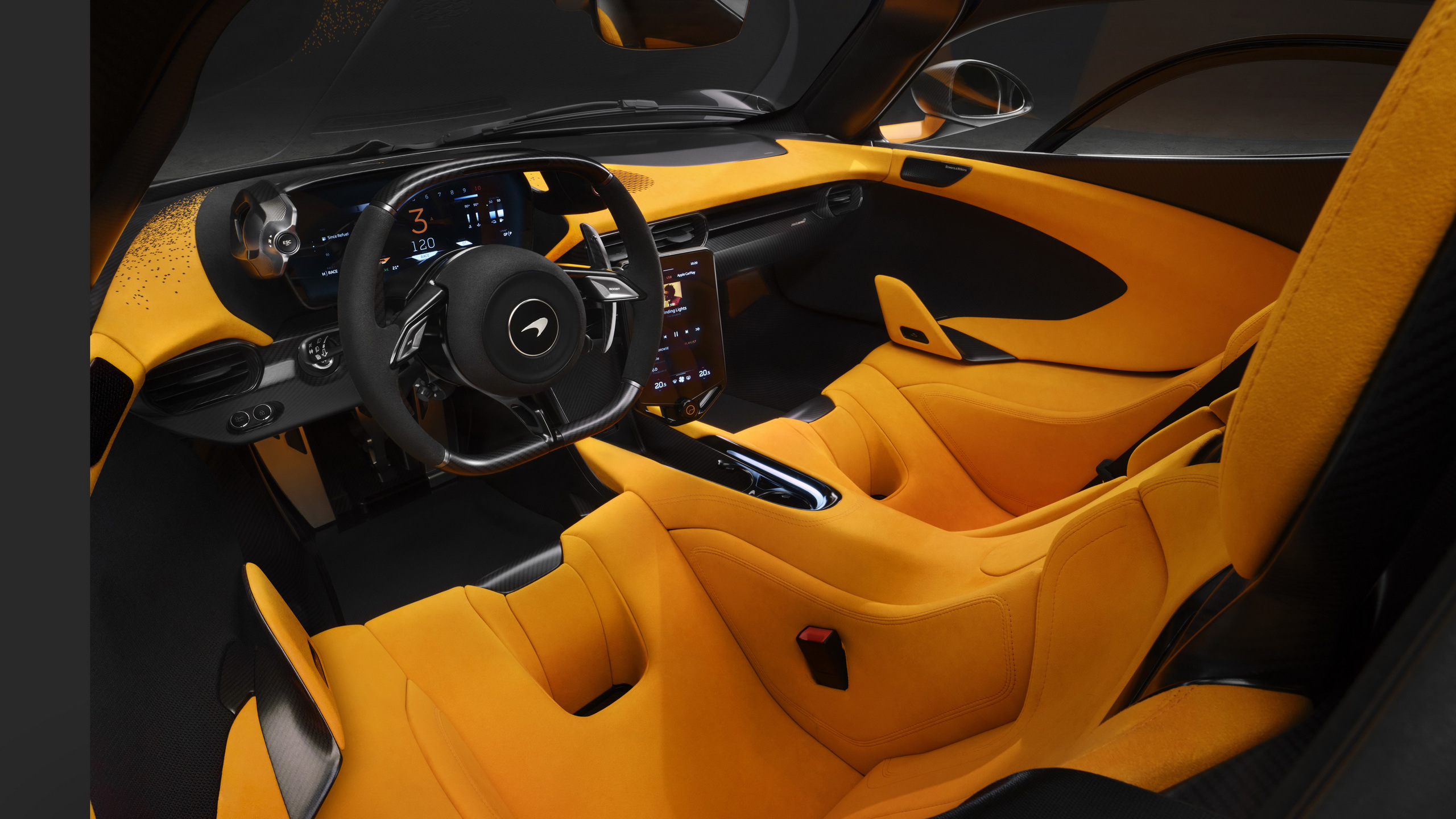
McLaren’s overall EV plans also remain a little murky. For now, the brand has made it clear that combustion engines and hybrid setups are still a priority. The 4.0-liter twin-turbo V8 will be staying in the lineup for the foreseeable future.p CYVN Holdings, a major stakeholder in Nio.

Nick Collins, McLaren’s head of product, shared last year that any future EV would likely target a specific market, China being the most likely candidate. That car could incorporate tech from an existing Chinese EV brand.

It’s worth pointing out here that McLaren is now under the wing of CYVN Holdings, an Abu Dhabi-based investment firm that also holds a significant stake in Nio

\\\\\\\\\\\

Waymo’s Ready For One Of Europe’s Busiest Cities, But Is The City Ready?

  • Waymo plans to launch paid UK robotaxi service as soon as September.
  • Mapping London streets now using Jaguar I-Pace vehicles with drivers.
  • Cars equipped with radar, lidar, and cameras to capture road data.

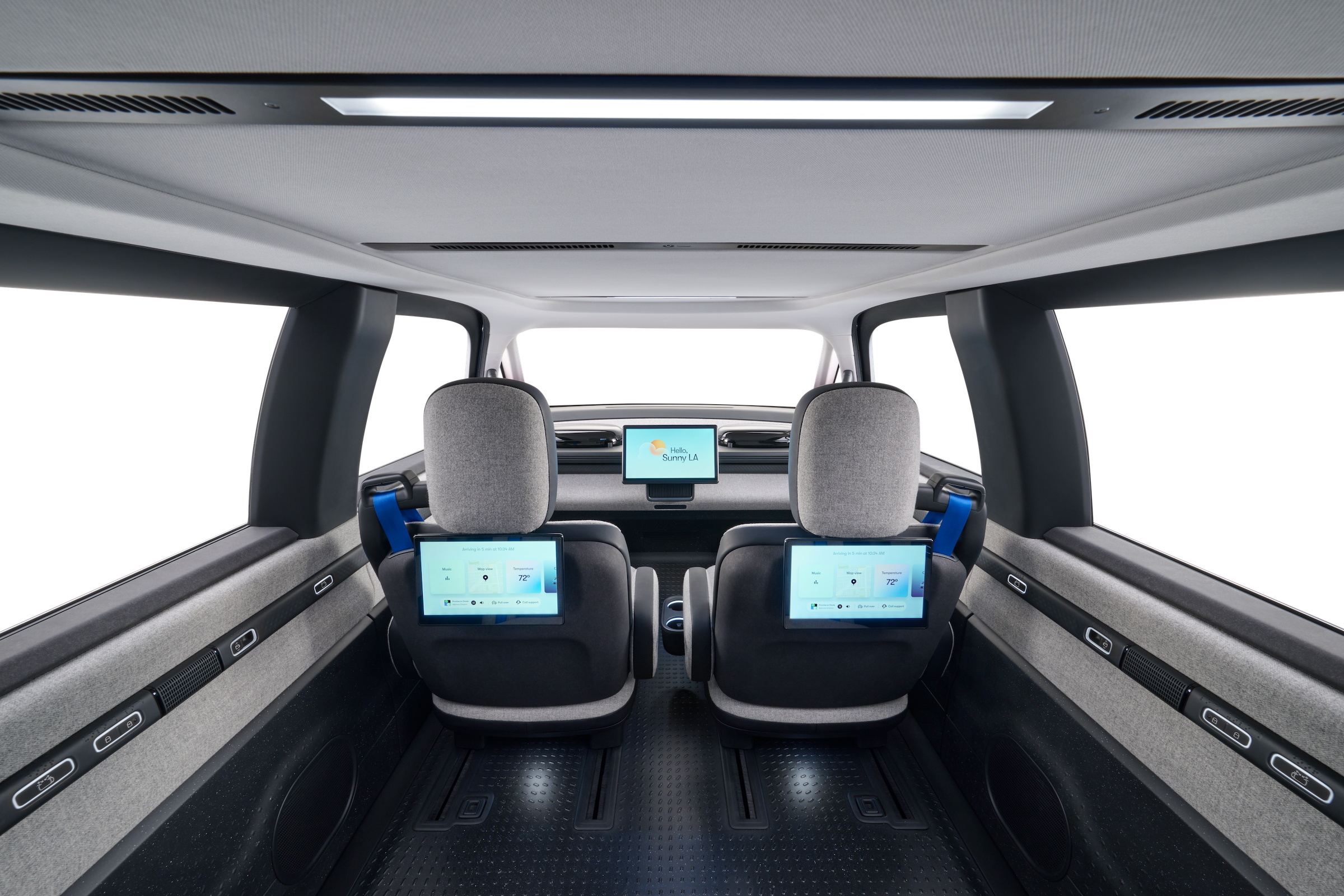
Londoners may soon find themselves riding in the front seat of the future, as Waymo prepares to bring its fully autonomous robotaxis to the streets of the UK. The self-driving tech firm has announced plans to launch in London, taking advantage of new regulations that will permit robotaxis to operate in the city starting in the second half of this year.

Waymo’s UK rollout comes even as scrutiny builds back home. This week, the NHTSA opened an investigation after one of the company’s robotaxis struck a child near an elementary school in Santa Monica, California, during drop-off hours.

Read: People Get Paid $24 Just To Walk Up And Shut A Robotaxi Door

London’s Local Transport Minister Lilian Greenwood has confirmed that Waymo, which is owned by Google-parent Alphabet, will launch a pilot service in April, before launching in full as early as September.

 Waymo’s Ready For One Of Europe’s Busiest Cities, But Is The City Ready?

To ensure the robotaxis can handle the intricacies of London’s roads, several of its vehicles are already being tested with a safety driver behind the wheel, helping map the city’s streets.

These test vehicles typically operate 24 hours a day, 7 days a week, and are driven in select London boroughs, including Camden, Hackney, Hammersmith and Fulham, Lewisham, Newham, and the City of Westminster.

Data Collection Meets Cybersecurity Requirements

Waymo says it’s currently gathering data across the widest possible range of London streets, using the advanced cameras, lidar, and radar fitted to the Jaguar I-Pace models.

Read: Waymo’s New “Ojaj” Robotaxi Crashed Into Parked Cars, But It Wasn’t Driving Itself

In a statement to the BBC, Minister Greenwood emphasized that all Waymo robotaxis will be subject to strict safety criteria before they’re allowed on the road. This includes resilience against cyber attacks and secure software protocols to protect against hacking.

 Waymo’s Ready For One Of Europe’s Busiest Cities, But Is The City Ready?

Once the vehicles have sufficiently mapped London’s roads and meet all regulatory standards, users will be able to request a ride through the Waymo app. The service is expected to carry a “premium” price point, with fares adjusted upward during periods of high demand, though exact pricing has not yet been announced.

Growing Competition

Waymo isn’t the only company eyeing the capital. Both Uber and Lyft have expressed interest in launching robotaxi services in London once the legal framework allows. With regulators clearing a path for autonomous vehicles, the city is shaping up to be a key battleground for the next phase of ride-hailing innovation.

 Waymo’s Ready For One Of Europe’s Busiest Cities, But Is The City Ready?

Tesla’s Chinese Nemesis May Supply Ford With Batteries

  • Ford is reportedly in early talks to source batteries from BYD.
  • Move follows Ford canceling projects and taking a $19.5B charge.
  • BYD has rapidly expanded battery production beyond China.

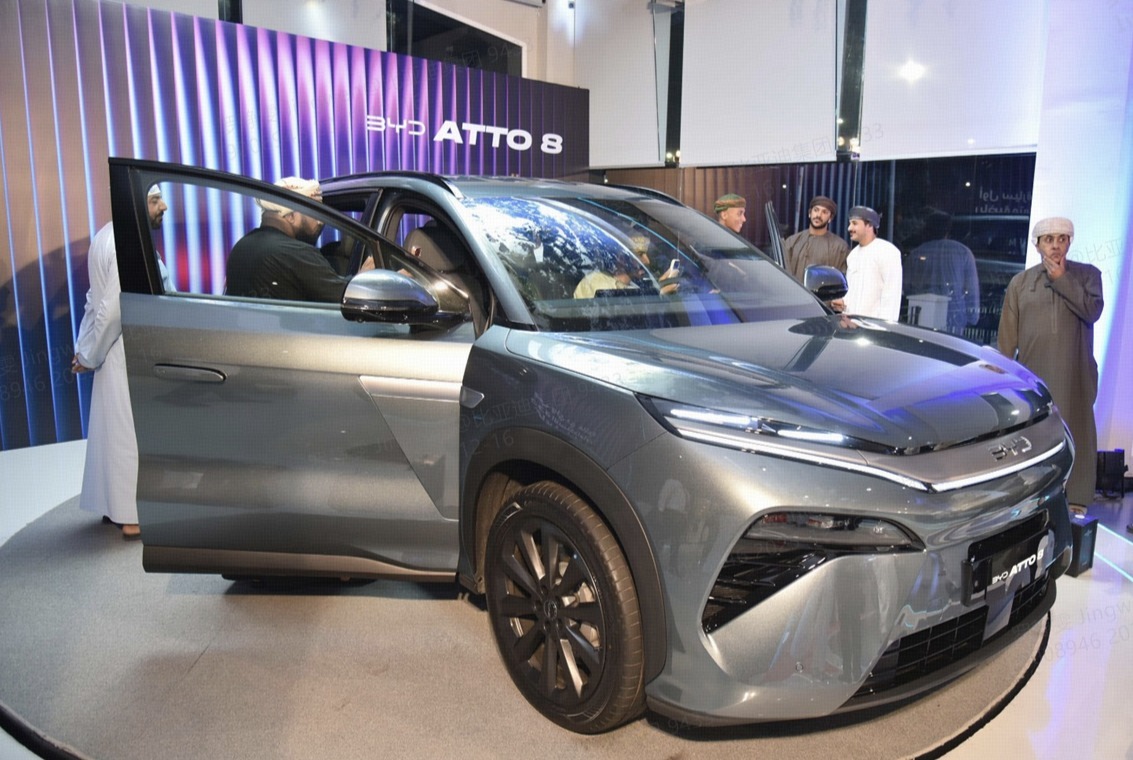
Ford may be pulling back on its EV spending, but it isn’t walking away from electrification. Instead, the company may be taking a different approach, and that path could lead through China. Specifically, Ford is reportedly in early talks with BYD, the Chinese automaker that recently overtook Tesla as the world’s top EV producer, to source batteries for its next hybrid models.

According to a report from the Wall Street Journal citing sources familiar with the discussions, nothing is finalized, and a deal may not materialize. But if it does, one idea under consideration is for Ford to begin importing BYD batteries for use in its factories outside the United States.

Read: Hold Your Horses, Ford Might Be Working On A Hybrid Pony Car

In response to the report, Ford didn’t confirm or deny the potential partnership. “We talk to lots of companies about many things,” the company told the newspaper. That kind of non-denial tends to say a lot without saying much at all.

BYD, while primarily known for its battery manufacturing in China, has been expanding its footprint globally, building production capacity in Brazil, Europe, and Southeast Asia.

Why BYD Might Be the Answer

 Tesla’s Chinese Nemesis May Supply Ford With Batteries

The timing of these talks aligns with a major pivot inside Ford. The company recently took a $19.5 billion write-down after scaling back several electric vehicle initiatives, including high-profile battery joint ventures with South Korean firms SK On and LG Energy Solution. Alongside a renewed emphasis on internal combustion models, Ford plans to grow its hybrid lineup, an area where BYD already excels.

The Chinese company is one of the world’s largest producers of hybrid vehicles and battery packs for cars. Instead of launching new factories or reviving shelved partnerships, Ford might simply buy batteries directly, streamlining its supply chain as it targets a goal of having hybrids, plug-in hybrids, and EVs make up half of its global sales by 2030.

Will Washington Push Back on a BYD Deal?

 Tesla’s Chinese Nemesis May Supply Ford With Batteries

Any such deal is unlikely to go over well with the Trump administration. Shortly after reports surfaced that Ford was speaking with BYD, top Trump trade advisor Peter Navarro hit out at the plan.

“So Ford wants to simultaneously prop up a Chinese competitor’s supply chain and make it more vulnerable to that same supply chain extortion?,” he wrote on X. “What could go wrong here?”

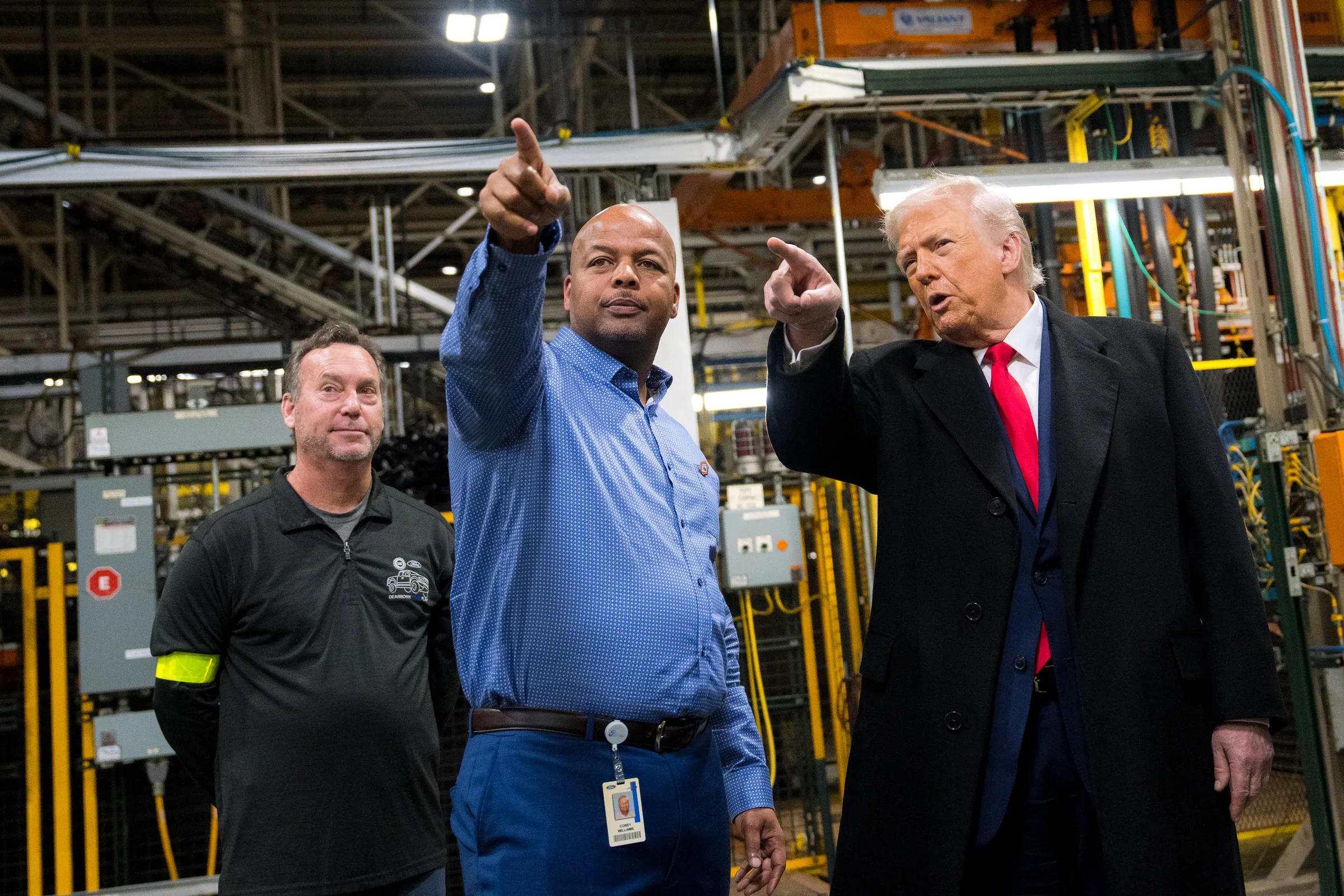
Meanwhile, Donald Trump took a different tack. Speaking to reporters in Detroit, the president said he welcomed foreign firms, including those from China and Japan, setting up shop in the States, as long as they employed American workers.

“You know, those tariffs are keeping the foreign autoworkers. Now, if they want to come in and build the plant and hire you and hire your friends and your neighbors, that’s great. I love that,” said Trump. ” Let China come in. Let Japan come in. They are. And they’ll be building plants, but they’re using our labor.

 Tesla’s Chinese Nemesis May Supply Ford With Batteries

The New EX60 Is The First Volvo To Talk Back At You

  • Volvo’s new EX60 SUV can add 211 miles of range in 10 minutes.
  • One teaser image appears to show a third row of seats folded down.
  • The BMW iX3-rivalling EX60 will be revealed in full on January 21.

Update: Volvo continues to tease the upcoming EX60, releasing new photos that include our first, albeit obstructed, view of the interior, along with fresh details about the tech it will carry. Chief among them is the integration of Google’s Gemini AI assistant.

Taking center stage in what appears to be a clean, minimalist dashboard is a tall portrait-style infotainment screen. Below it, there’s what seems to be a physical scroll knob, possibly flanked by tactile controls on the lower console, though the blurred image makes it hard to say for sure.

AI That Talks Back

\\\\\

However, Volvo says the interface won’t rely solely on taps and swipes. The EX60 will be its first model to launch with Gemini, which lets drivers speak naturally, without needing to memorize set phrases or divert attention to screens.

“Drivers can ask Gemini to find a hotel booking address in their email, check if a recently bought item fits in their EX60 trunk, or brainstorm ideas for an upcoming road trip,” Volvo says.

Also: VW Brings Back Physical Buttons After Admitting Touchscreens Are A Disaster

Gemini is directly integrated into Volvo’s newly named HuginCore system, an in-house platform combining proprietary software with technologies from Google, NVIDIA, and Qualcomm.

Powering it all is next-generation hardware, including Qualcomm’s Snapdragon Cockpit and Auto Connectivity platforms, along with NVIDIA’s DRIVE AGX Orin chip, giving the EX60 the highest processing capacity of any Volvo to date.

And, as with most modern cars, Volvo says the EX60 will continue to evolve long after it leaves the showroom, thanks to over-the-air updates and ongoing Gemini development.

 The New EX60 Is The First Volvo To Talk Back At You

Original story continues below.

Volvo’s about to drop a crucial new electric car, and it looks like it’s bringing receipts. The EX60 launches later this month but a teaser this week revealed range figures that none of its BMW, Mercedes and Tesla rivals can match, and a hint that it might come with seating for seven.

We’ll have to wait until the debut on January 21 to get the full breakdown of what’s under the EX60’s skin, but the fact that the EX90’s little brother is rated at 503 WLTP miles (810 km) of electric range is enough to generate headlines.

Related: He Built The Volvo You Remember, Now He Has To Fix What It Became

For context, BMW’s brand new iX3 has up to 500-miles (805 km) rating, and the GLC 400 with EQ Technology that debuted at the same Munich Auto Show last September is only good for 443 miles (713 km), Mercedes says. Tesla’s most touring-focused Model Y can’t even crack 400 miles (644 km).

Fast Charging

Volvo also says you won’t have to spend too much time hanging around charging stations when you do eventually need a top-up. Thanks to its 800-volt electrics the EX60 can add 211 miles (340 km) of range in as little as 10 minutes. You also get a 10-year warranty on the battery.

 The New EX60 Is The First Volvo To Talk Back At You

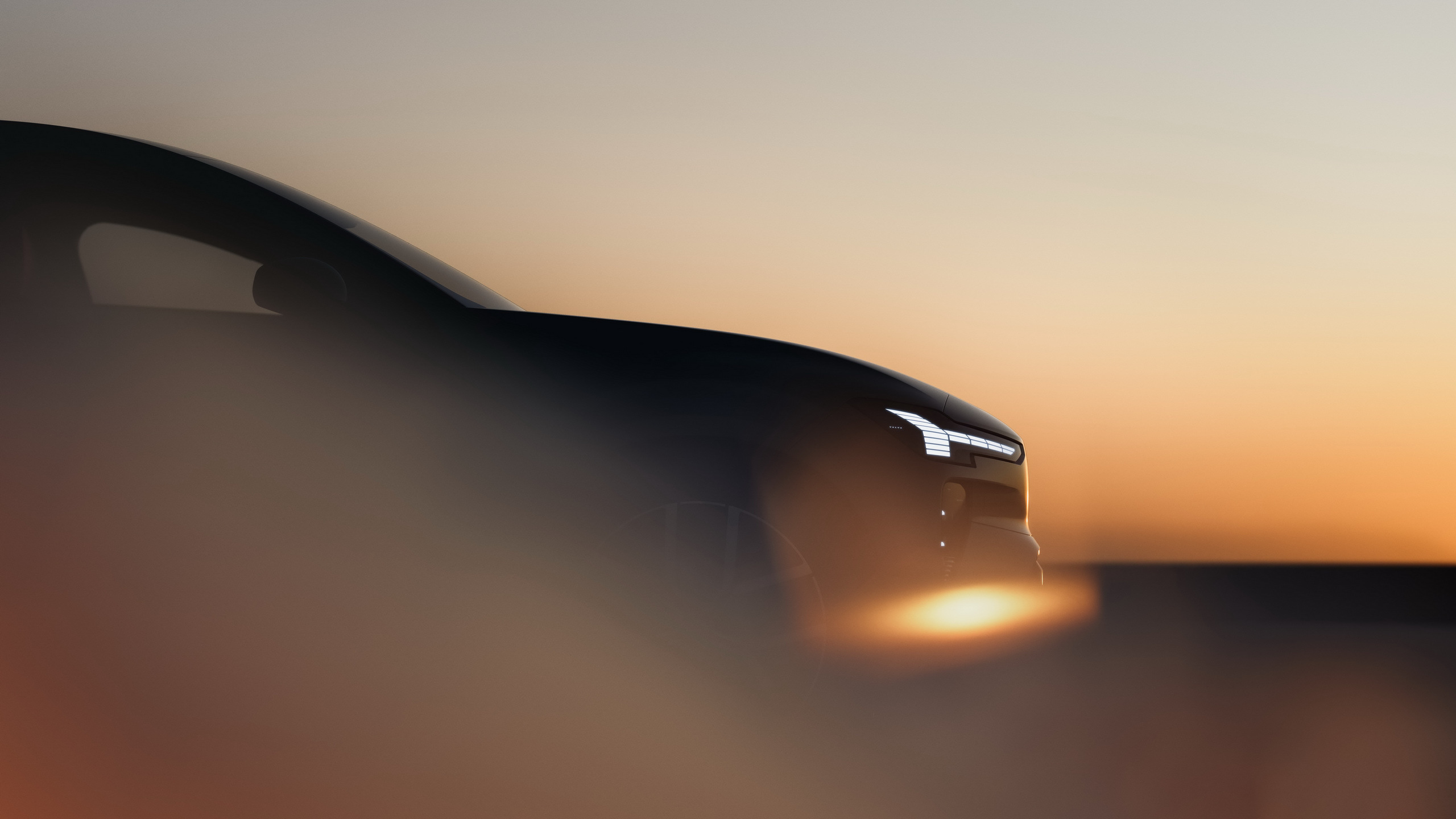
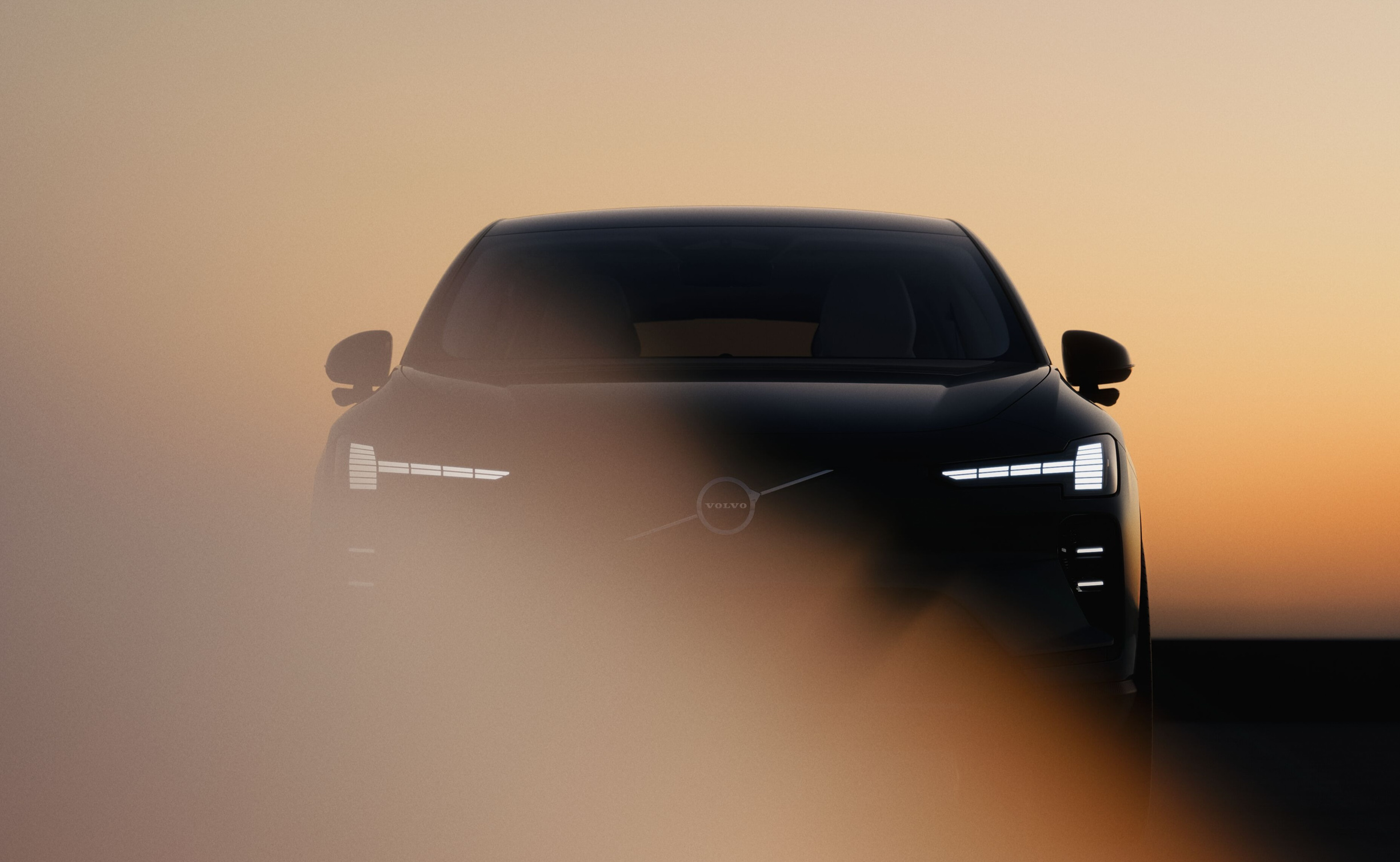
We’ve already had a sneak look at the rear and profile of the EX60 in previous teasers, and along with revealing the electric range, Volvo has now given us a look at the front. The brand’s trademark Thor hammer DRLs are present, made up of segmented LEDs, and we can also make up a pair of ADAS sensors mounted below each door mirror.

Reinventing the Seatbelt

The EX60 is the first Volvo to ride on the company’s SPA3 platform, an upgrade of the earlier SPA2 architecture that underpins models like the EX90. It’ll also be the first of the brand’s cars to get Volvo’s new adaptive seatbelt, which uses sensors to work out the height, weight and shape of a passenger before deciding how much belt force they need in a crash.

Seating for Seven

 The New EX60 Is The First Volvo To Talk Back At You
Volvo

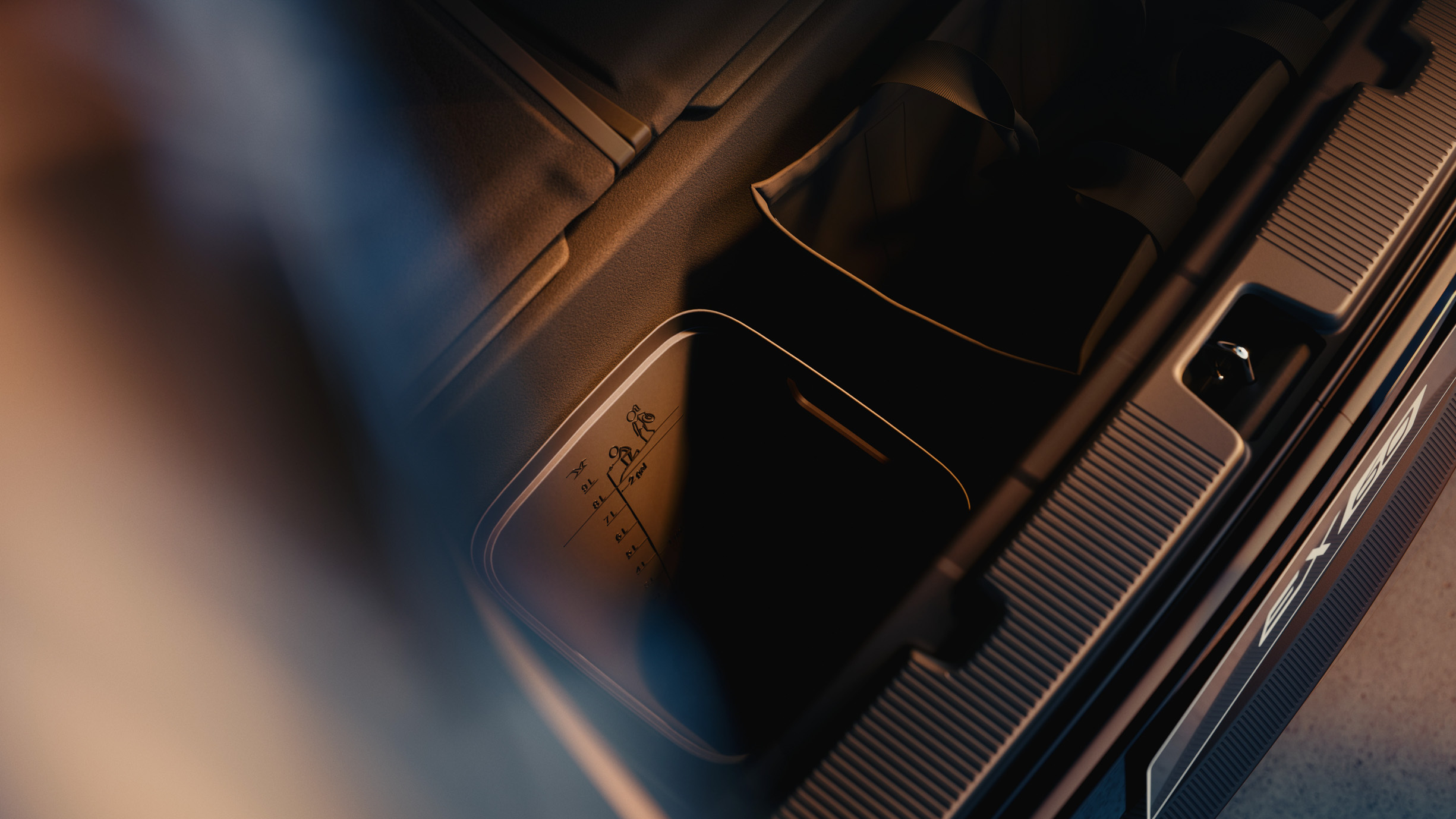
And unlike its BMW iX3 and Mercedes GLC rivals, which are strictly two-row affairs, it looks like the EX60 could have a small third row of seats stashed under the trunk floor. Though Volvo hasn’t mentioned anything about seven seats, in the image of the trunk it definitely looks like there are two seats folded away.

The picture of the body-in-white also shows mountings for a 50:50 split third-row, and the impression we get is there would still be enough space for a few shopping bags even if the seats were in use. We’ll find out more on January 21.

\\\\\\

Volvo

❌
❌