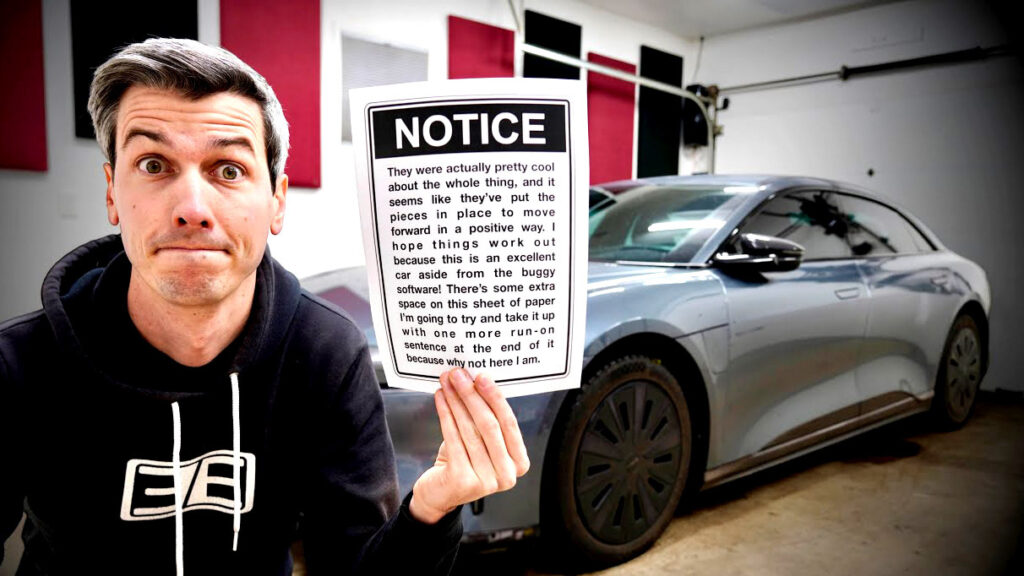
Jason Fenske’s Lucid Air critique triggered direct engineer talks.
Lucid outlined software fixes and upcoming UX 3.0 overhaul plans.
This isn’t typical service, but Lucid’s response stands out.
Negative YouTube reviews of cars have earned a certain reputation over the years. Some are so brutal they’re blamed, rightly or not, for helping to sink entire automakers, like the high-profile case of Fisker about a year ago. This time, though, a critical video sparked something different. A public takedown led not to fallout, but to potential fixes, and not just for one frustrated owner.
Jason Fenske of Engineering Explained leased a Lucid Air, ended up having issues with it, and has now been in direct contact with the brand. The result is going to benefit countless Lucid owners in the future.
A Critical Eye Meets a Willing Ear
When Jason Fenske published a blunt video detailing his disappointment with a newly leased Lucid Air Touring, it wasn’t a rage-bait takedown or a viral stunt. It was a long, technical breakdown of how a mechanically brilliant EV was being kneecapped by frustrating software, clumsy UX decisions, and some puzzling hardware quirks.
Rather than simply ignoring it and continuing on with its plans, the EV maker reached out. According to Fenske, what followed was a constructive discussion with engineers and even the SVP of engineering, Imad Dlala.
Evidently, the team at Lucid provided insider details and previews of upcoming changes. That’s where this story really takes its biggest turn. Lucid owners have a lot to look forward to if Fenske’s information proves reliable.
Lucid Plots a UX Overhaul
The biggest news is software. Lucid confirmed it’s actively improving phone-as-key reliability, door handle behavior, mirror positioning in reverse, percentage-versus-miles range inconsistencies, and Tesla Supercharger Plug & Charge support.
More significantly, a full UX 3.0 overhaul is planned for early fall 2026, bringing multitasking, faster profile switching, improved CarPlay stability, better voice commands, and a more intuitive interface. Owners with newer hardware, or those willing to pay to upgrade, will get access.
Lucid also confirmed vehicle-to-home power capability is coming in the first half of 2026, promising up to 17 kW peak output without requiring a separate home inverter, an area where Lucid’s hardware advantages could genuinely shine.
Fenske estimates that his Lucid could power his home for four days if they lost power, and that’s without changing any of the behavior his family is accustomed to.
Not All Feedback Gets a Reply
At the same time, he remains cautious, and rightly so. Promises aren’t fixes, and the Lucid Air still struggles with daily usability today. But admitting problems, engaging with informed criticism, and outlining concrete changes is more than many automakers manage.
In addition, this isn’t how most customers get treated. Fenske runs Engineering Explained, has a massive audience, and speaks the same technical language as Lucid’s engineering team. That context matters. Still, what Lucid outlined is meaningful. Especially for current and future owners.
The U.S. Postal Service adopted a rule effective Dec. 24 clarifying that some mail is not postmarked when it is first received – at a post office, for example – but rather on a later date, during processing.
The rule doesn’t change practices, but instead is “intended to improve public understanding of postmarks and their relationship to the date of mailing.”
Postmarking can affect whether local officials accept election ballots.
Fourteen states, including Illinois, accept a mailed ballot if it is received after Election Day, as long as it is postmarked on or before Election Day.
Thirty-six states, including Wisconsin, require absentee ballots, including those cast by mail, to be received by the local election office by Election Day. They aren’t affected by the rule change.
Local experts say – and national data supports – that winter brings a broad set of safety risks, including risks that disproportionately affect older adults and young children.
Dangers include hypothermia and frostbite, falls inside and outside the home and carbon monoxide poisoning.
Here are more details about those dangers and how to prevent or minimize them.
Slips and falls
Children and older adults face higher risks for falls and injuries. (Milwaukee Neighborhood News Service file photo)
In 2024, emergency medical personnel in Wisconsin responded to more than 140,000 fall-related calls, accounting for about 21% of all 911-related ambulance runs statewide, according to DHS data.
Older adults are disproportionately affected.
According to the National Institute on Aging, older adults face a higher risk of falling due to chronic medical conditions that can limit circulation, balance or mobility, including arthritis, Parkinson’s disease and diabetes.
The Milwaukee Health Department urges residents to prepare for icy conditions as temperatures fall and to clear snow and ice from walkways to help prevent falls.
The National Institute on Aging recommends using ice melt products or sand on walkways, using railings on stairs and walkways, avoiding shoveling snow yourself when possible and wearing rubber-soled, low-heeled footwear.
Christine Westrich, emergency response planning director for the Milwaukee Health Department, said social isolation adds another layer of risk for older adults.
“Either their friends or relatives have passed away, and they have over time socially isolated themselves,” Westrich said.
The onset of hearing loss and dementia are risk factors for increased isolation, she added.
Hypothermia and frostbite
Two people walk down North 27th Street in Milwaukee. (Jonathan Aguilar / Milwaukee Neighborhood News Service / CatchLight Local)
Age can affect how the body handles cold exposure.
This winter, there have already been roughly 10 fatalities where cold temperatures may have played a factor, said Michael Simley, a medicolegal death investigator manager for the Milwaukee County Medical Examiner’s Office.
Extreme temperatures can also worsen existing medical emergencies, Simley added.
A heart attack, for example, is serious under any circumstances, he said. But, he added, it becomes even more dangerous when it happens in a hostile environment like when it is very cold.
Carbon monoxide poisoning
With colder temperatures comes increased use of furnaces and other heating systems – and with that, a higher risk of carbon monoxide poisoning.
Increased use of appliances and other items that burn fuels and other chemicals, such as furnaces, portable generators, stoves and chimneys, helps account for the higher risk, according to the CDC.
Carbon monoxide is odorless and invisible, and symptoms such as headache, dizziness and nausea may be overlooked or mistaken for other illnesses.
“We’ve recently had two outbreaks with families of four (members) or greater,” Westrich said. “In one case, they didn’t have working heat and brought a charcoal grill inside. … In another, it was a malfunctioning furnace.”
In both situations, she said, there were no working carbon monoxide detectors.
DHS says carbon monoxide detectors should be installed on every level of the home.
Renters should be especially vigilant, Westrich said.
“Oftentimes, what might get overlooked in the lease, it’ll say the renter is responsible for the battery replacement in those devices,” she said. “Sometimes tenants aren’t aware of that, or it’s hanging high in the ceiling – you forget it’s even there.”
Resources
The Milwaukee Health Department maintains cold weather guidance with general information and tips.
For non-emergencies that are not crimes, the Milwaukee Police Department says residents have a number of options, a spokesperson for the department said in an email.
Residents can request a welfare check by calling 414-933-4444.
People seeking shelter, warming centers or other basic needs can call 211.
Those experiencing emotional distress or mental health struggles can call or text 988, the national Suicide and Crisis Lifeline.
Westrich and Simley both emphasized the same core message about being mindful of the people in your community.
Jonathan Aguilar is a visual journalist at Milwaukee Neighborhood News Service who is supported through a partnership between CatchLight Local and Report for America.
The Social Development Commission spent 2025 trying to restore services and funding in the face of legal challenges, board friction and government audits and reviews.
Commonly known as the SDC, the organization has a long history of providing services for low-income residents in Milwaukee County, including tax help, job training and rental assistance.
Since it stopped running its programs in April 2024, SDC has been trying to create a path to resume its anti-poverty work.
Here are some of this year’s major stories on the SDC.
March/April
State holds public hearing
In March, the Wisconsin Department of Children and Families scheduled a public hearing on SDC’s status as a community action agency.
The community action agency designation allows SDC to receive a federal block grant to support its anti-poverty work.
Jorge Franco, interim CEO and chair of the SDC board, said at the board’s next meeting he felt the department had not been transparent with SDC about its concerns on SDC’s ability to restart services and meet other requirements while they had been meeting and providing documents over past months.
In early April, the Department of Children and Families held a hearing in Milwaukee on SDC’s community action status to get public comments from members of the community, who spoke in favor of SDC.
Attendees listen to a speaker at a public hearing on the Social Development Commission on April 4 at the Milwaukee State Office Building, 819 N. 6th St. (PrincessSafiya Byers / Milwaukee Neighborhood News Service)
May/June
State files wage claims lawsuit
The Wisconsin Department of Justice, on behalf of the Department of Workforce Development, filed a lawsuit in May that alleges the SDC failed to pay $360,000 in wages and benefits owed to former employees, according to court records.
William Sulton, SDC’s attorney at the time, acknowledged SDC owes workers wages, butsaid the lawsuit would not be the most effective way to get them paid.
Franco has said SDC is committed to repaying employees for wages and benefits.
State’s community action decision held for review
After reviewing materials from the public hearing, Secretary Jeff Pertl of the Department of Children and Families decided in May that it would remove SDC’s community action status in July.
However, SDC leaders said they had concerns that the state did not follow the proper decision process, so they requested a review from the U.S. Department of Health and Human Services in June.
The department agreed to take up the review, which suspended the state’s decision.
September
Weatherization vendors win lawsuit
Three vendors filed a money judgment lawsuit against SDC in an effort to collect reimbursements for weatherization work completed for the agency. In September, a judge granted atotal judgment of $186,500 plus statutory costs and accrued interest.
October
Credit facility proposed
The SDC board received a letter of intent from Wings Credit Union indicating it is interested in providing the SDC with a credit facility, or a type of loan, of up to $15 million. In SDC’s case, the credit facility would be used to cover upfront expenses for government-funded programs that are paid through reimbursements.
Foreclosure decision
In March, Forward Community Investments Inc. filed a foreclosure lawsuit against SD Properties Inc., which owns SDC’s buildings, alleging it defaulted on mortgage payments for the main office and warehouse buildings on North Avenue.
The warehouse used by the Social Development Commission, 1810 W. North Ave, is also in foreclosure. (Jonathan Aguilar / Milwaukee Neighborhood News Service / CatchLight Local
At an October hearing, a judge ordered a judgment of foreclosure against the North Avenue buildingsand ruled that Forward Community Investments was entitled to a money judgment of approximately $3.1 million.
SDC moved out of the buildings and started a three-month redemption period.
Sulton resigns
Sulton, SDC’s attorney and legal counsel since late 2022, resigned from his volunteer position in mid-October.
Sulton represented SDC in lawsuits, served as a spokesperson and advised the board.
November
Board members make failed attempt to remove Franco
Some members of the board attempted to call an emergency meeting to vote on removing Franco as the board chair and interim CEO, but they ultimately did not vote on anything because of a disagreement on meeting procedure. Franco opposed the meeting and called it “out of order.”
State releases community action decision
The Department of Children and Familiesnotified SDC on Nov. 21 that it believes the federal review period ended as of Nov. 18 and would be moving forward with removing SDC’s community action status. It selected UMOS to be an interim provider of block grant-funded services.
SDC commissioners raised questions about the timeline of the federal review at a board planning session in November.
December
Federal office releases letter
The director of a division in the federal Office of Community Services found that the Wisconsin Department of Children and Families’ process of removing SDC’s community action status was compliant with federal law, according to a letter it sent to the department on Dec. 5.
SDC is seeking further clarity from senior leadership at the Department of Health and Human Services, Franco said in a statement.
What happens next
Building sale or foreclosure auction
The three-month redemption period for the North Avenue buildings expires on Jan. 6, according to SDC, although they technically can be redeemed up until there is a hearing to confirm the sale of the properties at auction.
Ongoing legal cases
Lawsuits filed against SDC from TriShulla, an information technology company, and the Department of Workforce Development are still ongoing.
Meredith Melland is the neighborhoods reporter for the Milwaukee Neighborhood News Service and a corps member of Report for America, a national service program that places journalists in local newsrooms to report on under-covered issues and communities. Report for America plays no role in editorial decisions in the NNS newsroom.
Jonathan Aguilar is a visual journalist at Milwaukee Neighborhood News Service who is supported through a partnership between CatchLight Local and Report for America.
A U.S. Postal Service employee sorts packages inside the Los Angeles Mail Processing & Distribution Center in December. A new USPS rule on postmarks took effect on Dec. 24 that says mail might not be postmarked on the day it’s dropped off. (Photo by Mario Tama/Getty Images)
The U.S. Postal Service has adopted a new rule that could create doubt about whether some ballots mailed by voters by Election Day will receive postmarks in time to be counted.
A USPS rule that took effect on Dec. 24 says mail might not receive a postmark on the same day the agency takes possession of it. The postal service says it isn’t changing its existing postmark practices and is merely clarifying its policy, but some election officials have looked to postmarks as a guarantee that mail ballots were cast before polls closed.
The new rule holds implications for 14 states and Washington, D.C., that count ballots arriving after Election Day if they are postmarked on or before that day — commonly called a “ballot grace period.” In these states, ballots placed in the mail by voters before the deadline may not be counted if the postal service applies a postmark after Election Day.
The USPS rule says that “the postmark date does not necessarily indicate the first day that the Postal Service had possession of the mailpiece.”
The USPS rule comes as the U.S. Supreme Court prepares to consider a case that could eliminate ballot grace periods nationwide. The court’s decision, expected late this spring or next summer, could render the issues raised by the postmark rule moot.
Mail-in voting surged in 2020’s general election amid the COVID-19 pandemic, when 43% of voters cast their votes by mail. The percentage of voters mailing their ballots has fallen from that peak but remains above pre-pandemic levels. About 30% of voters cast mail ballots in 2024, according to data gathered by the U.S. Election Assistance Commission.
While the vast majority of mail ballots were successfully cast last year, hundreds of thousands weren’t counted. During the 2024 election, 584,463 mail ballots returned by voters were rejected by election officials — 1.2% of returned mail ballots. About 18% of those ballots were rejected because they didn’t arrive on time.
The USPS defended the change in a lengthy response to criticisms published in the Federal Register. The agency emphasized that it does not administer elections and doesn’t advocate for or against voting by mail.
The postal service repeated its advice that voters mail their completed ballots at least a week before Election Day. And it noted that voters may request a manual postmark at their local post office free of charge.
“If customers are aware that the postmark date may not align with the date on which the Postal Service first accepted possession of a mailpiece, they will be better equipped to adjust their plans accordingly,” the response reads.
“And if policymakers or other entities that create rules utilizing the postmark date are aware of what the postmark date signifies, they are better equipped to determine whether their rules adequately serve their purposes.”
Stateline reporter Jonathan Shorman can be reached at jshorman@stateline.org.
This story was originally produced by Stateline, which is part of States Newsroom, a nonprofit news network which includes Wisconsin Examiner, and is supported by grants and a coalition of donors as a 501c(3) public charity.
Angel Shelton never imagined herself holding a leadership position as she spent her teen years in the foster care system in Milwaukee. Now, at 20, she’s the new vice president of Wisconsin’s Youth Advisory Council, hoping to advocate for the needs of foster youths.
The Wisconsin Youth Advisory Council began in 2005 and consists of current and former youths in foster care who work with government officials to advocate for foster youths in the state.
“I wasn’t planning on running for this position,” Shelton said. “I guess God had other plans for me.”
Issues she plans to highlight as vice president include the need for improved transportation, more social workers, increased support and expectations for foster parents and more mental health resources.
She became acutely aware of foster youths’ needs before and during her time in foster care.
“When we do get a little support, we have to put our foot on the gas to get it fully,” Shelton said.
Entering a life-changing program
At 16, Shelton met Christine Woods, independent living supervisor at Wellpoint Care Network, who placed her in supervised independent living at 17.
“Ms. Woods was like an angel that walked up to me and opened all the doors to my journey,” Shelton said.
Woods later encouraged her to participate in Youth Transitioning to Adulthood, a program that supports youths aging out of foster care by assisting with education, employment, housing, health and care connections.
While in the program, Woods made Shelton feel secure and introduced her to new opportunities, like becoming a secretary and vice president of the program.
Woods said she admired Shelton’s vulnerability and acceptance of constructive feedback and encouraged her to become a member of the Wisconsin Youth Advisory Council.
“In the beginning, Angel was shy, and now she’s just out there, and I think it’s because she knows people are listening,” Woods said.
After a year of serving as vice president of the local Youth Advisory Council and filling other roles, Shelton delivered an impromptu speech for a seat on the Wisconsin Youth Advisory Council and won all the votes to become vice president.
“Her speech was a standing ovation,” Woods said.
Becoming vice president marked Shelton’s latest step in leading efforts to improve the lives of youths in foster care.
Providing better transportation services
As a leader on the Wisconsin Youth Advisory Council, Shelton is prioritizing transportation services.
She remembers being late for school each day and knows there are many foster youths with mental health challenges or disabilities that struggle with transportation.
Also, in a conversation with a peer, she was made aware that some youths aren’t given enough funds to take public transportation.
A call for social workers
Although Shelton had a supportive social worker before aging out, she knows all foster children don’t have the same experience.
She hopes to push for more compassionate social workers who will spend more time with the youths.
“They need to understand that we don’t have parents to call on, so we need more social workers who will be present and hands-on,” she said.
Shelton wants social workers to check in with children weekly and in person, instead of once a month.
“I see both ends of the stick between young people and other people of authority like social workers and the system, but I want them to understand how we feel,” she said.
Improving support for foster parents
Another goal of Shelton’s is for foster parents to participate in workshops that provide proper training and expectations for their role, like providing youths with hygiene products, laundry bags and more.
“I want this to be a mandatory workshop where they’re held accountable,” she said.
Shelton hopes the workshop reminds individuals that youths should be treated with dignity.
“With some foster parents, once you transition out of their house, they are going to put your things in bags and out,” Shelton said.
While living in a group home for two weeks, Shelton noticed a lack of hygiene products as well.
“I ended up telling somebody that I couldn’t live like this, and that’s when I was switched over to my own place,” she said.
Supporting mental health
Losing a friend to suicide motivated Shelton to open up about proper care for mental health.
Her goal is to provide more mental health services for at-risk individuals who are 12 to 19.
“Certain feelings are so normalized now, that some don’t even realize they’re battling something,” Shelton said.
Woods says Shelton can utilize Wellpoint Care Network’s mental health services to link individuals to different forms of therapy like art, music, games and other outlets.
To ensure every voice can be heard, Shelton said the council will be creating a TikTok account that posts every day in 2026.
The posts will feature videos from foster youths, parents, staff and professionals asking questions, and the council responding with answers.
“I wanted to create a different system nationwide for everybody, not just (Youth Transitioning to Adulthood),” Shelton said.
Angel Shelton, middle left, and Christine Woods, middle right, sit with Wellpoint Care Network’s 2025 former foster youth panel. (Courtesy of Rachel Frye)
Watching her sister shine
Seeing Shelton in a leadership role didn’t surprise her oldest sister, Desirae Shelton, but hearing she won vice president brought her to tears.
“She is living proof that where you come from doesn’t define where you will go,” Desirae Shelton said.
She admired how her sister carried pain but turned it into purpose as she grew more confident and willing to speak up for herself and others.
“I just want Angel to make youth feel seen and supported,” she said. “I hope she brings attention to what kids go through emotionally.”
Plans for the future
In May, during Foster Care Awareness Month, Shelton will lead an annual mental health panel for the council, professionals, foster parents and relatives to discuss their lived experiences, needs and other topics.
An Avenues West resident and nursing student at the Milwaukee Area Technical College, Shelton plans to become a nurse practitioner or a professional in the mental health field.
In the next few years, she also wants to start a nonprofit that provides mental health services and a group home for at-risk teens.
“Whether I’m helping people in foster care or the juvenile system, mental health is at stake for both,” she said.
For more information
You can learn more about the work of the Wisconsin Youth Advisory Council by attending its monthly meeting. They’re held every second Thursday from 5 p.m. to 7 p.m. at Wellpoint Care Network, 8901 W. Capitol Drive in Milwaukee.
Individuals who are interested in becoming a part of Youth Transitioning to Adulthood can click here to register for its monthly mandatory orientation.
The former site of the We Energies Power Plant on Nov. 13, 2025, in Pleasant Prairie, Wis. (Photo by Joe Timmerman/Wisconsin Watch)
By some measures, the Pleasant Prairie Power Plant, once regarded locally as an “iconic industrial landmark,” had a good run.
Opened in 1980 near Lake Michigan in Kenosha County, it became Wisconsin’s largest generating plant, burning enough Wyoming coal, some 13,000 tons a day, to provide electricity for up to 1 million homes.
But over time, the plant became too expensive to operate. The owner, We Energies, shut it down after 38 years, in 2018.
We Energies customers, however, are still on the hook.
A portion of their monthly bills will continue to pay for Pleasant Prairie until 2039 — 21 years after the plant stopped producing electricity.
In fact, residential and business utility customers throughout Wisconsin owe nearly $1 billion on “stranded assets” — power plants like Pleasant Prairie that have been or will soon be shut down, a Wisconsin Watch investigation found.
That total will likely grow over the next five years with additional coal plants scheduled to cease operations.
Customers must pay not only for the debt taken on to build and upgrade the plants themselves, but also an essentially guaranteed rate of return for their utility company owners, long after the plants stop generating revenue themselves.
“We really have a hard time with utilities profiting off of dead power plants for decades,” said Todd Stuart, executive director of the Wisconsin Industrial Energy Group.
The $1 billion tab looms as Wisconsin utility companies aim to generate unprecedented amounts of electricity for at least seven major high-tech data centers that are proposed, approved or under construction. By one estimate, just two of the data centers, which are being built to support the growth of artificial intelligence, would use more electricity than all Wisconsin homes combined.
All of which raises an important question in Wisconsin, where electricity rates have exceeded the Midwest average for 20 years.
What happens to residents and other ratepayers if AI and data centers don’t pan out as planned, creating a new generation of stranded assets?
How much do Wisconsin ratepayers owe on stranded assets?
Of the five major investor-owned utilities operating in Wisconsin, two — We Energies and Wisconsin Public Service Corp. — have stranded assets on the books. Both companies are subsidiaries of Milwaukee-based WEC Energy Group.
As of December 2024, when the company released its most recent annual report, We Energies estimated a remaining value of more than $700 million across three power plants with recently retired units: Pleasant Prairie, Oak Creek and Presque Isle, a plant on Michigan’s Upper Peninsula.
Wisconsin Public Service Corp.’s December 2024 report listed roughly $30 million in remaining value on recently retired units at two power plants.
In total, utilities owned by WEC Energy Group will likely have over $1 billion in recently retired assets by the end of 2026.
The company also noted a remaining value of just under $250 million for its share of units at Columbia Generating Station slated to retire in 2029, alongside a remaining value of roughly $650 million for units at Oak Creek scheduled to retire next year.
Its customers will pay off that total, plus a rate of return, for years to come.
The company estimates that closing the Pleasant Prairie plant alone saved $2.5 billion, largely by avoiding future operating and maintenance costs and additional capital investments.
Both Wisconsin Power and Light and Madison Gas and Electric also own portions of the Columbia Energy Center, and Wisconsin Power and Light also operates a unit at the Edgewater Generating Station scheduled for retirement before the end of the decade. Neither company provided estimates of the values of those facilities at time of retirement. Andrew Stoddard, a spokesman for Alliant Energy, Wisconsin Power and Light’s parent company, argued against treating plants scheduled for retirement with value on the books as future stranded assets.
How stranded assets occurred: overcommitting to coal
In 1907, Wisconsin became one of the first states to regulate public utilities. The idea was that having competing companies installing separate gas or electric lines was inefficient, but giving companies regional monopolies would require regulation.
Utility companies get permission to build or expand power plants and to raise rates from the three-member state Public Service Commission. The commissioners, appointed by the governor, are charged with protecting ratepayers as well as utility company investors.
A demolition sign is posted at the former site of the We Energies Power Plant on Nov. 13, 2025, in Pleasant Prairie, Wis. (Photo by Joe Timmerman/Wisconsin Watch)
Stranded assets have occurred across the nation, partly because of the cost of complying with pollution control regulations. But another factor is that, while other utilities around the country moved to alternative sources of energy, Wisconsin utilities and, in turn, the PSC overbet on how long coal-fired plants would operate efficiently:
In the years before We Energies pulled the plug on Pleasant Prairie, the plant had mostly gone dark in spring and fall. Not only had coal become more expensive than natural gas and renewables, but energy consumption stayed flat. By 2016, two years before Pleasant Prairie’s closure, natural gas eclipsed coal for electricity generation nationally.
In 2011, We Energies invested nearly $1 billion into its coal-fired Oak Creek plant south of Milwaukee to keep it running for 30 more years. The plant, which began operating in 1965 and later became one of the largest in the country, is now scheduled to completely retire in 2026 — with $650 million on the books still owed. That will cost individual ratepayers nearly $30 per year for the next 17 years, according to RMI, a think tank specializing in clean energy policy. The majority of the debt tied to those units stems from “environmental controls we were required to install to meet federal and state rules,” WEC Energy Group spokesperson Brendan Conway said.
In 2013, to settle pollution violations, Alliant Energy announced an investment of more than $800 million in the Columbia Energy Center plant in Portage, north of Madison. But by 2021, Alliant announced plans to begin closing the plant, though now it is expected to operate until at least 2029.
Various factors encourage construction and upgrades of power plants.
Building a plant can create upwards of 1,000 construction jobs, popular with politicians. Moreover, the Public Service Commission, being a quasi-judicial body, is governed by precedent. For example, if the PSC determined it was prudent to allow construction of a utility plant, that finding would argue in favor of approving a later expansion of that plant.
The PSC allowed utility companies “to overbuild the system,” said Tom Content, executive director of the Wisconsin Citizens Utility Board, a nonprofit advocate for utility customers. “I think the mistake was that we allowed so much investment, and continuing to double down on coal when it was becoming less economic.”
Utilities “profit off of everything they build or acquire,” Stuart said, “and so there is a strong motivation to put steel in the ground and perhaps to even overbuild.”
Conway, the WEC Energy Group spokesperson, argued that the utilities’ plans to retire plants amount to a net positive for customers.
“We began our power generation reshaping plan about a decade ago,” he wrote in an email. “That includes closing older, less-efficient power plants and building new renewable energy facilities and clean, efficient natural gas plants. This plan reduces emissions and is expected to provide customers significant savings — hundreds of millions of dollars — over the life of the plan.”
Guaranteed profits add to ratepayer burden
The built-in profits that utility companies enjoy, typically 9.8%, add to the stranded assets tab.
When the Public Service Commission approves construction of a new power plant, it allows the utility company to levy electricity rates high enough to recover its investment plus the specified rate of return — even after a plant becomes a stranded asset.
The former site of the We Energies Power Plant on Nov. 13, 2025, in Pleasant Prairie, Wis. (Photo by Joe Timmerman/Wisconsin Watch)
“We give them this license to have a monopoly, but the challenge is there’s no incentive for them to do the least-cost option,” Content said. “So, in terms of building new plants, there’s an incentive to build more … and there’s incentive to build too much.”
When the Pleasant Prairie plant was shut down in 2018, the PSC ruled that ratepayers would continue to pay We Energies to cover the cost of the plant itself, plus the nearly 10% profit. The plant’s remaining value, initially pegged at nearly $1 billion, remained at roughly $500 million as of December 2024.
Eliminating profits on closed plants would save ratepayers $300 million on debt payments due to be made into the early 2040s, according to Content’s group.
New ‘stranded assets’ threat: data centers
As artificial intelligence pervades society, it’s hard to fathom how much more electricity will have to be generated to power all of the data centers under construction or being proposed in Wisconsin.
We Energies alone wants to add enough energy to power more than 2 million homes. That effort is largely to serve one Microsoft data center under construction in Mount Pleasant, between Milwaukee and Racine, and a data center approved north of Milwaukee in Port Washington to serve OpenAI and Oracle AI programs. Microsoft calls the Mount Pleasant facility “the world’s most powerful data center.”
Data centers are also proposed for Beaver Dam, Dane County, Janesville, Kenosha and Menomonie.
The energy demand raises the risk of more stranded assets, should the data centers turn out to be a bubble rather than boom.
“The great fear is, you build all these power plants and transmission lines and then one of these data centers only is there for a couple years, or isn’t as big as promised, and then everybody’s left holding the bag,” Stuart said.
The sun sets as construction continues at Microsoft’s data center project on Nov. 13, 2025, in Mount Pleasant, Wis. (Photo by Joe Timmerman/Wisconsin Watch)
In an October Marquette Law School poll, 55% of those surveyed said the costs of data centers outweigh the benefits. Environmental groups have called for a pause on all data center approvals. Democratic and Republican leaders are calling for data centers to pay their own way and not rely on utility ratepayers or taxpayers to pay for their electricity needs.
Opposition in one community led nearly 10,000 people to become members of the Stop the Menomonie Data Center group on Facebook. In Janesville, voters are trying to require referendums for data centers. In Port Washington, opposition to the data center there led to three arrests during a city council meeting.
Utilities are scheduled in early 2026 to request permission from the Public Service Commission to build new power plants or expand existing plants to accommodate data centers.
Some states, such as Minnesota, have adopted laws prohibiting the costs of stranded assets from data centers being passed onto ratepayers.
Wisconsin has no such laws.
Shifting cost burden to utility companies
Currently, ratepayers are on the hook for paying off the full debt of stranded assets — unless a financial tool called securitization reduces the burden on ratepayers.
Securitization is similar to refinancing a mortgage. With the state’s permission, utilities can convert a stranded asset — which isn’t typically a tradeable financial product — into a specialized bond.
Utility customers must still pay back the bond. But the interest rate on the bond is lower than the utility’s standard profit margin, meaning customers save money.
A 2024 National Association of Regulatory Utility Commissioners report noted that utilities’ shareholders may prefer a “status quo” scenario in which customers pay stranded asset debts and the standard rate of return. Persuading utilities to agree to securitization can require incentives from regulators or lawmakers, the report added.
In some states, utilities can securitize the remaining value of an entire power plant. Michigan utility Consumers Energy, for instance, securitized two coal generating units retired in 2023, saving its customers more than $120 million.
In Wisconsin, however, utilities can securitize only the cost of pollution control equipment on power plants — added to older coal plants during the Obama administration, when utilities opted to retrofit existing plants rather than switching to new power sources.
The Oak Creek Power Plant and Elm Road Generating Station, seen here on April 25, 2019, in Oak Creek, Wis., near Milwaukee, are coal-fired electrical power stations. (Photo by Coburn Dukehart/Wisconsin Watch)
In 2023, two Republican state senators, Robert Cowles of Green Bay and Duey Stroebel of Saukville, introduced legislation to allow the Public Service Commission to order securitization and allow securitization to be used to refinance all debt on stranded assets. The bill attracted some Democratic cosponsors, but was opposed by the Wisconsin Utilities Association and did not get a hearing.
Democratic Gov. Tony Evers proposed additional securitization in his 2025-27 budget, but the Legislature’s Republican-controlled Joint Finance Committee later scrapped the provision.
Even Wisconsin’s narrow approach to securitization is optional, however, and most utilities have chosen not to use it.
We Energies was the first Wisconsin utility to do so, opting in 2020 to securitize the costs of pollution control equipment at the Pleasant Prairie plant. Wisconsin’s Public Service Commission approved the request, saving an estimated $40 million. “We will continue to explore that option in the future,” Conway said.
But the PSC expressed “disappointment” in 2024 when We Energies “was not willing to pursue securitization” to save customers $117.5 million on its soon-to-retire Oak Creek coal plant. The utility noted state law doesn’t require securitization.
Stuart said that if utilities won’t agree to more securitization, they should accept a lower profit rate once an asset becomes stranded.
“It would be nice to ease that burden,” he said. “Just to say, hey, consumers got to suck it up and deal with it, that doesn’t sound right. The issue of stranded assets, like cost overruns, is certainly ripe for investigation.”
Comprehensive planning required elsewhere — but not Wisconsin
Avoiding future stranded assets could require a level of planning impossible under Wisconsin’s current regulatory structure.
When the state’s utilities propose new power plants, PSC rules require the commission to consider each new plant alone, rather than in the context of other proposed new plants and the state’s future energy needs. Operating without what is known as an integrated resource plan, or IRP, opened the PSC to overbuilding and creating more stranded assets. IRPs are touted as an orderly way to plan for future energy needs.
“There’s no real comprehensive look in Wisconsin,” Stuart said. “We’re one of the few regulated states that really doesn’t have a comprehensive plan for our utilities.
”We’ve been doing some of these projects kind of piecemeal, without looking at the bigger picture.”
Protesters speak against a proposed natural gas power plant in Oak Creek, Wis., on March 25, 2025. (Photo by Julius Shieh/Milwaukee Neighborhood News Service)
Structured planning tools like IRPs date back to the 1980s, when concerns about cost overruns, fuel price volatility and overbuilding prompted regulators to step in. Minnesota and Michigan require utilities to file IRPs, as do a majority of states nationwide.
Evers proposed IRPs in his 2025-27 state budget, but Republican lawmakers removed that provision because it was a nonfiscal policy issue.
Northern States Power Company, which operates in Wisconsin and four other Midwestern states, is required by both Michigan and Minnesota to develop IRPs. “Because of these rules, we create a multi-state IRP every few years,” said Chris Ouellette, a spokesperson for Xcel Energy, the utility’s parent company.
Madison Gas and Electric, which only operates in Wisconsin, argued that its current planning process is superior to the IRP requirements in neighboring states. “A formal IRP mandate would add process without improving outcomes,” spokesperson Steve Schultz said. “Wisconsin’s current framework allows us to move quickly, maintain industry-leading reliability and protect customer costs during a period of rapid change.”
How to influence decisions relating to stranded assets
The devil will be in the details on whether the Public Service Commission adopts strong policies to prevent the expected wave of new power plant capacity from becoming stranded assets, consumer advocates say.
The current members, all appointed by Evers, are: chairperson Summer Strand, Kristy Nieto and Marcus Hawkins.
The public can comment on pending cases before the PSC via its website, by mail or at a public hearing. The commission posts notices of its public hearings, which can be streamed via YouTube.
Barbed wire fence surrounds the former site of the We Energies Power Plant on Nov. 13, 2025, in Pleasant Prairie, Wis. (Photo by Joe Timmerman/Wisconsin Watch)
Among the upcoming hearings on requests by utilities to generate more electricity for data centers:
Feb. 12: We Energies’ request to service data centers in Mount Pleasant and Port Washington. We Energies says the fees it proposes, known as tariffs, will prevent costs from being shifted from the data centers to other customers. The “party” hearing is not for public comment, but for interaction between PSC staff and parties in the case, such as We Energies and public interest groups.
Feb. 26: Another party hearing for a case in which Alliant Energy also said its proposed tariffs won’t benefit the data center in Beaver Dam at the expense of other customers.
To keep abreast of case developments, the PSC offers email notifications for document filings and meetings of the commission.
The PSC would not provide an official to be interviewed for this article. It issued a statement noting that utilities can opt to do securitization to ease the financial burden on ratepayers, adding:
“Beyond that, the commission has a limited set of tools provided under state law to protect customers from costs that arise from early power plant retirements. It would be up to the state Legislature to make changes to state law that would provide the commission with additional tools.”
On Nov. 6, state Sen. Jodi Habush Sinykin, D-Whitefish Bay, and Rep. Angela Stroud, D-Ashland, announced wide-ranging data center legislation. One provision of their proposal aims to ensure that data centers don’t push electricity costs onto other ratepayers.
A wolf makes its way across a road in Yellowstone National Park. (Jacob W. Frank/Courtesy of the U.S. National Park Service)
The U.S. House on Thursday passed, 211-204, a bill to remove Endangered Species Act protections for the gray wolf outside Alaska.
The bill, sponsored by Colorado Republican Lauren Boebert, would direct the Interior secretary to reissue a 2020 rule removing ESA protections that delisted wolves other than the Mexican wolf in the lower 48 states, while stipulating it could not be challenged in court.
The rule from President Donald Trump’s first administration was struck down by a federal court in 2022.
Five Democrats voted for the bill and four Republicans voted against it. The measure was considered during the chamber’s last vote series before a two-week break, and 18 members did not vote.
Sen. Ron Johnson, a Wisconsin Republican, has sponsored a companion bill in that chamber. The measure faces an uphill road in the Senate, where passage of partisan bills is rarer due to the 60-vote threshold for most legislation.
The bill would remove gray wolves from the ESA list, even though they have not reached population figures that the Fish and Wildlife Service has said would indicate full recovery.
Rep. Donald S. Beyer, a Democrat from Virginia, said it would be reasonable to adjust population thresholds, but that congressionally mandated delisting was unwise and illegal.
“This bill fails to recognize the status of gray wolves today, taking us back to an outdated rulemaking that didn’t hold up in court,” Beyer said on the House floor Thursday.
House Natural Resources Committee ranking Democrat Jared Huffman of California said the bill set a “troubling” precedent by blocking judicial review.
“It tells the American people they no longer have the right to challenge unlawful government actions,” he said. “The ESA is simple and effective. It ensures decisions are grounded in science — that’s the heart of it — and this bill throws that principle out the window.”
Several Republicans on the Natural Resources Committee spoke in favor of the bill, saying it would delegate wolf management to states.
In a statement, Natural Resources Chairman Bruce Westerman, an Arkansas Republican, said the gray wolf has been “fully recovered” for two decades.
“States are more than capable of managing thriving wolf populations. This legislation restores a common-sense, science-based approach to wolf management, returning decision-making to states,” he said.
Republicans also argued the bill would protect livestock and humans.
Rep. Pete Stauber showed a photo from his district in Ely, Minnesota, of a wolf in a school parking lot.
“Because of the gray wolf’s listing status, nothing could be done to protect the lives of the students there,” the Republican said. “The broken ESA is putting my constituents’ lives at risk.”
A trunk spill caused limp mode, warning lights, and left the Air stuck.
Warranty coverage was denied, and insurance may reject the repair bill.
It follows a similar Ioniq 5 incident where a water spill cost nearly $12k.
Doctors and health influencers are always telling us that drinking tons of water is the secret to clearer skin, sharper minds, strain-free poops and longer lives. But if there’s one group that absolutely should not stay hydrated, it’s modern electric vehicles, because a few drops could leave them with a massive medical bill.
Just ask Reddit user u/raging_onyx who leased a Lucid Air and saw his Thanksgiving week turn into a $15,000 lesson in why electric cars and water should never meet.
What Happened?
The disaster started with a perfectly innocent trip to a grocery store to refill a water container. But a pothole encountered on the way back tipped that container over, causing a catalog of faults that eventually rendered the vehicle completely immobile.
Within seconds of the spill happening the dash lit up like Times Square, the EV jumped into limp mode, regen braking tapped out, and the driver got a warning to pull over. When he found a local residential area to stop and tried to reboot the system, the Air wouldn’t shift out of Park.
A Very Expensive Lesson
Lucid customer support, in an impressive display of holiday cheer, suggested two things: call insurance, and brace for the possibility the car was totaled. Happy Thanksgiving!
There was more bad news when the first tow truck driver arrived and said he couldn’t move the sedan, since the Air wouldn’t shift into neutral. Fortunately, by the next day, neutral was found and a second truck was able to tow the stranded car.
Finally, the EV reached a service center, where the advisor initially estimated the repair at under $1,000. Bearable, right? This turned out to be off by roughly the price of a used Corolla.
The real number, the rep later confirmed, was about $15,000, and it wouldn’t be covered by warranty, because the spill was technically the driver’s fault.
As of the Reddit post, the driver was still waiting to find out whether his insurance would step in to cover the costs. You’d think the answer would be yes, but that’s not always how these things always play out.
Just last month, we reported on a similar incident involving a Hyundai Ioniq 5. A small water spill in the rear footwell damaged the car’s wiring, and neither the manufacturer nor the insurance company was willing to cover the $11,882 repair bill.
U.S. Immigration and Customs Enforcement will move its Milwaukee processing operations from a downtown building owned by the Milwaukee School of Engineering to a site on the Northwest Side, an ICE spokesperson said in an email to NNS.
A spokesperson for the General Services Administration, the real estate arm of the federal government, said the GSA “remains focused on supporting this administration’s goal of optimizing the federal footprint, and providing the best workplaces for our federal agencies to meet their mission,” the spokesperson wrote in a statement to NNS.
Students and others protest in front of the U.S. Immigration and Customs Enforcement building leased from the Milwaukee School of Engineering on Oct. 31, 2025. The protests have taken place every Friday at 9 a.m. (Jonathan Aguilar / Milwaukee Neighborhood News Service / CatchLight Local)
Demonstrators have been calling on the university to cut ties with the agency.
MSOE officials say the university inherited the federal lease when it purchased the building in 2023 and does not have the legal authority to remove ICE.
Alan Madry, professor emeritus at Marquette University Law School, said there is no question the federal government has eminent domain authority in such situations.
The federal government has the legal power to take or use property for public purposes even if a private landowner or local government objects.
A ‘phased’ transition
In a statement to NNS, ICE said the transition “will follow a phased approach to ensure a smooth and efficient process” and that the agency “remains committed to maintaining continuity of operations as the office becomes fully operational.”
Processing centers are typically used to conduct interviews and sometimes hold people for the short term rather than overnight detention.
The ICE spokesperson did not provide a timeline for the move, but said the new location at 11925 W. Lake Park Drive will operate as a processing center, not a detention facility.
In a statement, Jeremy McGovern, spokesperson for the Milwaukee Department of Neighborhood Services, said the city has no additional inspections scheduled for the Lake Park Drive site and that the certificate of occupancy is already in place.
Because the federal government is not subject to local zoning and permit requirements, McGovern said, the city cannot determine when the site becomes active and has limited knowledge about the federal timeline.
Protests continue
Noah Dinan, left, and Steve Szymanski protest in front of the building used by U.S. Immigration and Customs Enforcement on Oct. 31, 2025. (Jonathan Aguilar / Milwaukee Neighborhood News Service / CatchLight Local)
The university says it intends to use the Knapp Street building for academic purposes once ICE leaves. But Noah Dinan, a sophomore studying software engineering at the school, said the lack of clarity about the move raises troubling possibilities.
The transition could take years, or ICE could expand its Milwaukee operations rather than relocate, said Dinan, who is a member of the university’s chapter of the Young Democratic Socialists of America.
The organization has circulated petitions, contacted alumni and joined the weekly Friday protests.
Dinan also pointed to the financial incentives of leasing to ICE.
According to the General Services Administration’s September 2025 lease inventory, the federal government is paying the university about $2.1 million per year to occupy the Knapp Street site through April 2028.
Despite the news that ICE has plans to transition from Knapp Street to its new property, Dinan said he and other students plan to continue protesting.
“Our campaign is one of sanctuary,” Dinan said.
Jonathan Aguilar is a visual journalist at Milwaukee Neighborhood News Service who is supported through a partnership between CatchLight Local and Report for America.
As red sand filled the cracks along the sidewalks in front of the Electa Quinney Institute for American Indian Education on the University of Wisconsin-Milwaukee campus, community members stood in quiet solidarity as drums beat.
The pouring of red sand marked another year of remembrance and healing for missing and murdered Indigenous women and relatives, referred to as MMIWR.
The symbolic act of pouring sand was part of the HIR Wellness Institute’s ninth annual Community Activated Medicine & Red Sand Events on Nov. 14.
HIR Wellness, located at 3136 W. Kilbourn Ave., was founded in 2017 by Leah Denny, who serves as CEO. The organization provides a range of free mental health, wellness services and additional programming for the Indigenous community. The Electa Quinney Institute, where the event was held, was founded in 2010 to support the Native American community on campus at the University of Wisconsin-Milwaukee.
Started in 2017, the event has provided a sacred space for community grief and collective healing in honor of MMIWR through art, storytelling and community care.
Each year, the HIR Wellness Institute collaborates with the Red Sand Project to host the event. The Red Sand Project was designed to raise public awareness about human trafficking and modern slavery, using the red sand to represent those who have fallen through systemic cracks.
A person walks down a path in between posters that have statistics about missing and murdered Indigenous women. One poster stated that 45.6% of American Indians/Alaska Native women in Wisconsin have experienced sexual violence.
Analia Ninham, a member of Daughters of Tradition, an Indigenous youth group at the HIR Wellness Institute, offers attendees a cleansing sage.
Malia Chow blows into a conch shell in all four cardinal directions as part of a Native Hawaiian tradition.
The RedNationBoyz, a Milwaukee-based youth and community drum group, performs.
Marla Mahkimetas, a Menominee water educator and artist, speaks about losing her daughter-in-law to human trafficking and her family’s healing journey since.
“Trauma is not a life sentence.”
Marla Mahkimetas
Dr. Jeneile Luebke, an assistant professor at the University of Wisconsin-Madison School of Nursing, speaks to attendees about her research on gender-based violence in the Indigenous community.
“We got to cry and say her name.”
Malia Chow
Malia Chow, community healer with the HIR Wellness Institute, speaks about losing her twin sister to violence.
Shanna Hickman and her daughter, Ziraya Sunn, listen to a woman tell the story of how their sister was killed due to domestic violence.Hanna Jennings, an intern with the HIR Wellness Institute, hands out a bag containing red sand, tissues and community resources.The RedNationBoyz, led by one of the founders, Isiah Nahwahquaw (second from left), performs.
Monique Valentine writes the name Anacaona, a ruler of Jaragua (modern day Haiti), who was executed by the Spanish in 1503 and has become a symbol of Indigenous resistance.
Flower Harms pours red sand from the Red Sand Project, which was started by Molly Gochman in 2014 to bring awareness to human trafficking and modern slavery.
Red sand fills a crack during the ninth annual Community Activated Medicine & Red Sands Event.Rachel Fernandez, co-chair of the Wisconsin Missing and Murdered Indigenous Women & Relatives Task Force, pours red sand along a crack in the sidewalk.
Jonathan Aguilar is a visual journalist at Milwaukee Neighborhood News Service who is supported through a partnership between CatchLight Local and Report for America.
Tim Scott was shocked when he was laid off in May as the executive director of Nearby Nature, an organization that works to reconnect Black people to nature by offering nature education classes and introducing residents to new outdoor experiences.
Instead of letting the sudden change deter him, he doubled down on his commitment to help Milwaukee residents experience the outdoors.
Scott is opening Urban Nature Connection, a community-based nonprofit dedicated to reconnecting Black and Brown communities with nature.
The organization’s mission is to promote the physical, spiritual and mental health of outdoor activities such as birding, gardening, biking, hiking and fishing.
Finding a new purpose
According to Scott’s wife, Theresa Scott, he has always been an outdoorsman.
“He has always enjoyed walking or spending time in the park or outdoors,” Theresa Scott said.
Tim Scott spent most of his career in construction work.
He’s also done some coaching and marriage counseling but said he found a new purpose when he took the role at Nearby Nature.
“This is my passion, this is my healer, I owe nature my life to tell you the truth,” Scott said.
His wife agrees.
“I think this is a great second career for him,” she said. “It’s better for his mind and his body.”
Scott said he now knows the importance of pushing nature as a healing mechanism, especially for those who don’t have access to mental health services.
“We all experience trauma in different ways,” Scott said. “But we don’t all have access to the same mental health services. Being out in nature really saved me when I was experiencing my own crisis.”
By connecting people with nature, Scott hopes to help others find their own healing.
In addition to outdoor activities, the organization will focus on indoor gardening, programming and advocacy of green space.
Over the next few months, the focus will be on getting people outside even during the colder months.
“A lot of our work will be advocacy,” he said. “So, we will center advocacy through every season.”
Scott says he plans to partner with other agencies to host wellness events, community discussions and group walks.
To keep up with Urban Nature Connection, you can follow its Facebook page here.
“What he wants to do here is truly a movement,” Theresa Scott said.
Jonathan Aguilar is a visual journalist at Milwaukee Neighborhood News Service who is supported through a partnership between CatchLight Local and Report for America.
This honor, presented as part of National Philanthropy Day, recognizes leaders whose work advances Inclusion, Diversity, Equity, and Accessibility (IDEA) in the philanthropic and nonprofit community.
NNS was celebrated alongside other changemakers on Nov. 20 during a special event that spotlighted individuals whose generosity, leadership and commitment are shaping a stronger, more connected southeastern Wisconsin.
In the nomination, the writers highlighted NNS’s mission-driven journalism that amplifies underrepresented voices, deepens public understanding and builds bridges across Milwaukee’s most diverse neighborhoods.
NNS has continued to model what equitable, community-centered journalism looks like in practice: reporting that listens first, collaborates deeply and informs with heart and integrity.
Smith, the executive director of NNS, is an award-winning journalist who served as the managing editor for news at USA TODAY before returning to Milwaukee.
Smith also worked as the deputy managing editor for daily news and production at the Milwaukee Journal Sentinel, where he oversaw the breaking news hub and production desks and was the key point person for print story selections and workflow.
A Rivian R1T owner faced a massive bill after a low-speed parking incident.
Insurance estimated $1.7K but later refused to pay the certified shop’s bill.
Owner paid out of pocket, fought insurance, and recovered only part of it.
Rivian owners take on a risk that many may not fully appreciate when they buy one of these trucks. It’s not just about the company being young, or its future still being written. Those are expected gambles.
The real hidden concern and surprise comes when something goes wrong, and not mechanically, but physically. Damage that would be a quick fix on a Ford, a Toyota or most other legacy carmakers can turn into a financial nightmare with a Rivian, sometimes severe enough to write off the vehicle altogether.
It’s becoming an increasingly common problem, and the ordeal one owner continues to face shows just how complicated it can get.
When Simple Damage Isn’t Simple
Back in May of this year, the employee of a Rivian R1T owner backed into his electric truck. The damage appeared quite straightforward in the rear quarter panel. However, this is a Rivian R1T, so “straightforward” doesn’t really apply in this case.
The rear quarter panel is part of one giant piece that actually includes the roof. In other words, fixing a dent in it, especially a large one, isn’t a simple job. We’ve seen instances of paintless dent repair (PDR) being a savior in some cases. This isn’t one of them.
The owner of the R1T says that his employee’s insurance company initially quoted just $1,700 for the repair. Considering that many of these situations end up in the five-figure range, he knew that was potentially problematic. To that end, he contacted Rivian, and things only got worse from there.
The True Cost of Rivian Repairs
The automaker explained that there was only one certified repair shop within 300 miles (about 480 km), and their estimate came in at a whopping $16,000. Given the huge gap, the owner started asking PDR shops for help, but none would touch the R1T.
That said, the owner decided to go ahead and go with the certified repair shop, hoping that the final bill would come in lower than the estimate. Instead, the shop found additional damage once the truck was in the building.
The total came to $22,000 after a seven-week repair process. The ordeal wasn’t even over after all that because insurance refused to pay that amount.
Instead, it offered $13,000 and said that the certified repair shop’s rates were excessive. Faced with either paying the $9k himself or entering arbitration that would delay pickup indefinitely, the owner paid the difference, retrieved the truck, and launched an appeal.
His letters were ignored. A second, more forceful letter outlining what he considered an unfair settlement? Also ignored. Only after filing a complaint with his state’s Secretary of State did the insurer finally respond, this time offering an additional $5,100 to make the issue go away.
The state recommended accepting the offer, and the owner did. “I really enjoy this truck, but this is bonkers,” he says. “I hope Rivian improves design to allow for less expensive repair costs for common dings.”
No doubt, plenty of other Rivian owners hope the same thing.
One in five cars in Germany failed annual roadworthiness inspection.
VW’s Golf, Touareg, and T-Roc dominated rankings across segments.
Mercedes led long-term quality with lowest defects among older cars.
Germany’s car-check watchdog has crunched the reliability numbers and once again, Tesla finds itself parked at the very bottom of the heap. The 2026 TÜV-Report, covering annual roadworthiness inspections of approximately 9.5 million vehicles between July 2024 and June 2025, found that Tesla EVs occupied the two bottom spots in the league table.
The Model 3, which was the worst-ranked car for the two previous years was found to have a defect rate of 13.1 percent, meaning one in every 7.6 cars in the two-to-three-year-old ages group failed the Hauptuntersuchung safety check.
Why Is The Model Y So Troubled?
But the Model Y was even worse. It had a defect rate of 17.3 percent, versus 3.5 percent for a Mini Cooper SE, making it the worst TÜV has seen in this age group in a decade. The biggest defect culprits were the axle assembly, suspension, brakes and lighting.
Pulling back to look at the bigger picture covering cars of all ages reveals that 21.5 percent, or one in five cars failed the inspection due to a “significant” or “dangerous” defect, an increase of 0.9 percent on last year, ADAC reported. And the proportion with minor defects rose 0.8 percent to 12.3 percent.
Other reliability villains include the BMW 5-series and 6-series in both the 4-5-year-old and 8-9-year-old age groups, the Dacia Duster in the 6-7 and 10-11 age groups and the Renault Clio among 12-13-year-old cars.
But with every list of losers there has to be a list of winners, and for cars that have passed their fourth birthday, this one is headed by Volkswagen.
The VW Golf wagon and T-Roc scored well in the 4-7-year-old categories and the automaker’s Touareg was top of the oldies. The Mazda CX-3 and Mercedes B-Class were also commended.
Looking at the 2-3-year-old group, Fiat’s 500e toped the small car category, proving to Tesla that EVs can be reliable, the Mazda 2 and BMW 1-series were the top-rated small car and compact, and the C-class took the mid-range award (if you’re reading from the US, those classifications will look kinda messed up).
The T-Roc popped up again to take best SUV, and the B-class bagged most reliable nearly-new minivan.
One big change in this year’s study is the introduction of an award for long-term quality, handed out to brands whose vehicles, aged 10+ exhibit the lowest average defect rate for safety-related faults and stand for quality, durability, and good service.
Mercedes took gold with an 18.5 percent defect rate – almost matching that of a 2-3-year-old Model Y – Audi was second with 19.2 percent and Toyota snuck onto the podium’s last step with a 22 percent defect rate.
Ioniq 5 and 5 N need official software to replace rear pads safely.
Hyundai defends the system, citing safety and secure service access.
Right-to-repair advocates say it limits owners’ maintenance rights.
Maintaining your own car has long been a badge of pride for some and a financial necessity for many others. Swapping fluids, filters, or brake pads is part of the standard weekend maintenance ritual for countless drivers.
But for one Hyundai Ioniq 5 N owner, that sense of self-reliance recently hit a wall, or more precisely, a brake caliper. He discovered that replacing the rear pads on his EV wasn’t as simple as it used to be. Now, Hyundai has responded.
It might seem odd that someone has already burned through their rear pads, especially on an EV, but it happened because the owner drove this car the way Hyundai wants owners to: hard and on the track.
When he tried to replace these pads, he learned that he needed to retract the electronic parking brake. That’s where this easy DIY job took a scary turn.
One way to retract the brake is to use Hyundai’s Global Dynamic System (GDS). That software and the hardware that goes with it can cost almost $6,000, as we’ve seen online. Don’t worry, though, there’s another option called the J2534 Diagnostic Tool, which Hyundai supports, as seen in an official document discovered by TheDrive.
According to the owner, Redditor u/SoultronicPear, the software costs $60 a week (or less on average for longer time periods) and requires the use of a J2534 adapter that can be found for around $2,000.
Hyundai currently approves only three options for this tool: the CarDAQ Plus 3, Bosch’s MTS 6531 and DG Technologies’ d-briDGe PRO, adding that, “under no circumstances do we recommend the use of a non-approved J2534 device”. So be warned.
Credentials Required
More importantly, beyond that, using the tool requires special National Automotive Service Task Force (NASTF) authentication and a constant internet connection.
But here’s the kicker. Only certified repair shops or repair businesses are supposed to get access to that software. NASTF told the owner that “NASTF credentials are for use by qualified technicians, mechanics or locksmiths working in businesses providing repair or replacement services.”
Hyundai Speaks Up
Before publishing our first coverage of this issue, we reached out to Hyundai for comment. After the story went live, the automaker responded with the following statement to Carscoops:
“Hyundai is committed to supporting both our dealer network and independent repair facilities with safe, secure, and accessible service solutions. For vehicles equipped with electronic parking brakes, including the Ioniq 5 and Ioniq 5 N, the official repair procedure requires placing the rear calipers in service mode using either our Global Diagnostic System (GDS) or the J2534 application.
This ensures proper functionality and customer safety. Hyundai recently expanded access through an update to our J2534 application, enabling aftermarket users to perform functions previously restricted by the GDS secure gateway.
While authentication through NASTF is required for sensitive operations, this step helps maintain security and accountability. Our official dealer tool (GDS) is also available for purchase by anyone. Hyundai is actively exploring ways to make routine maintenance easier for all customers while upholding safety standards.
We appreciate the interest in DIY repairs and will continue working toward solutions that balance convenience with security.”
Seeking more detail, we pushed Hyundai to clarify whether a skilled owner could realistically do the job at home. The company followed up with this explanation:
“DIYers can replace brake pads on the Hyundai Ioniq 5 and Ioniq 5 N, but it requires specific steps and tools. Because these vehicles use electronic parking brakes, the rear calipers must be placed in service mode using either Hyundai’s Global Diagnostic System (GDS) or the J2534 application with a compatible pass-through device.
Both tools are publicly available, though GDS is more expensive and J2534 requires NASTF authentication for secure functions. Without these tools, the job cannot be done safely, as manual retraction could damage components.
Hyundai is not restricting DIY repairs, in fact, recent updates have expanded access, and we continue to explore ways to make routine maintenance easier while maintaining safety and security.”
So, yes, it can be done. But unless you already own the specialized tools or have deep pockets, the process can cost about as much as a tired old hatchback from the classifieds.
For now, at least until a cheaper workaround surfaces (we’re looking into it, so stay tuned), the Ioniq 5 N’s rear brakes may remain one of those maintenance jobs probably best left to the professionals.
In a classroom turned barbershop on the third floor at Milwaukee’s Rufus King International High School, students sit for a haircut and talk about academics, sports and the latest trends with English teachers Cameron LeFlore and Emmanuel Johnson.
They’re the latest clients of The Shop in 310, a free on-campus barbershop club for Rufus King students. LeFlore said the cuts help young men feel more confident.
“Then they don’t need a hat or hoodie,” he said. “They can just walk with their head held high.”
The idea for the shop started when LeFlore brought his clippers to the school, hoping students would want a haircut.
Johnson, who was recently hired at the school, decided to collaborate with LeFlore once he learned they both had an interest in barbering.
Checking out the new club
The Shop in 310 opens daily at 3:30 p.m. except Thursdays. Among the regulars at The Shop in 310 are Rufus King juniors Elijah Ramirez and Demontrey Cochran.
Ramirez, 17, moved from Chicago to Milwaukee three months ago and was nervous about trying out a new barber for the first time in 10 years.
“I was scared at first, but then I gained confidence and trust in Mr. LeFlore,” Ramirez said.
He was pleased with the results of his first mid-taper cut.
“It came out better than I expected,” he said.
Since then, he’s gained opportunities with photographers and notices how his cut stands out.
Cochran, 16, is a student in LeFlore’s class and was excited to support the club.
“I really wanted to see how this would turn out,” Cochran said.
Ramirez and Cochran each encourage their peers to give it a try.
“Every man can vouch that after they get a haircut, they are going to feel good and that they can conquer the world because of their haircut and confidence from it,” Cochran said.
Clippers used at The Shop in 310 sit on a desk at Rufus King High School. (Jonathan Aguilar / Milwaukee Neighborhood News Service / CatchLight Local)
Financial relief for families
The Shop in 310 initially charged $10 per cut, but after being approved by the Office of Administration at Rufus King as an official club, the trims became free.
“If your child starts off as a freshman coming here, you’d be saving thousands by the time they’re a senior,” LeFlore said.
Before joining Rufus King, Johnson offered free cuts to students at Marshall High School, where he taught previously, and felt glad to do it.
“Back then, cuts were $25 to $30. Now barbers are charging $40 and up,” he said.
Cochran typically spends $35 for a mid-taper cut at his barber. Since coming to The Shop in 310, he’s been able to save money and also values how accessible it has been for his peers.
“There’s a lot of people I know who don’t even have barbershops near them, so it takes them a long time to finally get a cut,” he said.
LeFlore and Johnson use the club’s Instagram to post haircut tutorials for students interested in learning how to cut their own hair at home.
“I try to take a holistic approach and think back to what I would’ve wanted when I was in high school,” LeFlore said.
Demontrey Cochran, 16, gets a haircut from English teacher Emmanuel Johnson at Rufus King High School. (Jonathan Aguilar / Milwaukee Neighborhood News Service / CatchLight Local)
Visiting The Shop in 310 is more than just receiving a haircut for Ramirez and Cochran. It’s a place to feel welcomed.
“At first I saw them as just English teachers,” Ramirez said. “I like their communication and ability to understand what I’m specifically asking for.”
Beyond the sounds of clippers, Cochran sees the barbershop as peaceful, chill and liberating.
“As long as everything is appropriate this is a non-judgment zone,” he said.
Practice leads to improvement
LeFlore and Johnson are self-taught barbers who learned the skills on their own before bringing clippers into the classroom.
Johnson started off cutting his youngest brother’s hair as a favor while receiving feedback from his mentor Thomas Mclern, a barber with more than 30 years’ experience.
“While cutting my brother’s hair I realized that cutting hair was one of the best ways for me to serve the community,” he said. “Cutting hair is now an art for me.”
LeFlore’s path to barbering began after watching a friend cut his own hair, inspiring him to do the same.
“I told my friend to send me all the products I needed, then I went and brought everything,” he said.
LeFlore said it used to take an hour and a half to complete a haircut, now it’s only 20 minutes.
Tapping into diverse hair types
As their skills improved by cutting five to 10 heads a week, Johnson and LeFlore became more versatile.
Having already worked with diverse hair types at Marshall High School, Johnson was able to adjust to the needs of Rufus King students.
“At Marshall, I was exposed to different hair types and hair thinness, so at Rufus King, I learned quickly and had no problem,” Johnson said. “Every now and then when I get a hair type that’s not my own, it’s still a learning experience.”
Though LeFlore was nervous about cutting different hair textures, he practiced on his dad, whose hair is straighter, and watched YouTube videos to become better.
“I took my time and it turned out OK, but it wasn’t as good as I wanted it to be,” he said. “I learned that straighter hair is easier, you just have to be more precise.”
Cochran said he has interest in cutting his own hair after graduating high school.
“I want to purchase my own barber kit eventually, and that should save me at least $100 a month,” he said.
Johnson and LeFlore want people to know that whether it’s cutting hair or something different, practice is key.
“Whatever they’re looking to pursue, they need to find like-minded people who do the same things and practice together,” Johnson said.
Jonathan Aguilar is a visual journalist at Milwaukee Neighborhood News Service who is supported through a partnership between CatchLight Local and Report for America.
Ioniq 5 N owner says Hyundai’s software blocks brake pad changes.
Access reportedly requires costly tools, a business login, and more.
The story raises new concerns about Right to Repair in modern EVs.
Automotive enthusiasts aren’t the only ones who enjoy getting their hands dirty. Many regular drivers tackle oil changes, swap air filters, or fit new brake pads without a second thought. These are the sorts of jobs that make you feel connected to your car, a small ritual of maintenance and pride.
But every so often, a manufacturer decides to make things harder than they need to be. I once had to drop an entire subframe on my BMW just to replace oxygen sensors, an experience that left me wondering whether the engineers had ever tried it themselves.
It’s rare to see a mainstream brand like Hyundai put similar hurdles on its customers when it comes to repairs. However, according to one owner, the brand isn’t just making a simple fix hard; it’s straight up declaring war on his (and your) right to repair his own car.
Is Hyundai Denying Right to Repair?
Two recent posts on Reddit’s r/Ioniq5Ncommunity have ignited a fierce debate. There, an owner claims Hyundai has drawn the battle lines. He’d set out to replace his rear brake pads, something he says he’s done countless times before on other vehicles, but soon discovered the automaker’s diagnostic tools had other plans.
According to the post, Hyundai’s digital systems effectively lock out anyone who isn’t a certified technician from performing even basic maintenance.
The rear brake pads are affected by the electric parking brake. To replace them, one must disengage the brake and get it to retract completely, otherwise, the new pads won’t fit. In addition, the car needs a diagnostic tool to recalibrate the motor on how far to move with the new pads in place.
In other words, even if you could manually disengage the parking brake, the car would still need calibration to work properly.
The only way to accomplish this is allegedly to use Hyundai’s J2534 Diagnostic Tool, a Windows-based application available only through the automaker’s tech info portal.
The owner says the software requires a $60 weekly subscription, a $2,000+ approved hardware adapter, and a constant internet connection for authentication. Even then, it reportedly doesn’t work properly on newer models like the 2025 Ioniq 5 N.
No DIYers, Please – Only Pros
“I broke down and bought the subscription and special adapter,” the owner wrote. “Guess what? It didn’t work.” Only later did they find out why. “My blood is boiling at the moment. NASTF has blocked my account, saying “DIYers are not permitted access.”
They included a photo of a message from NASTF that says in part, “Please provide your business name and 9-digit Federal Employer Identification Number. DIYers are not permitted access.”
The irony, the poster points out, is that Hyundai dealers don’t even use this Windows tool. They reportedly have access to an entirely different Android-based software suite that works seamlessly.
While this all sounds like a bureaucratic mess, the underlying issue raises serious questions about Right to Repair access in the EV era. For decades, enthusiasts and independent mechanics have fought for access to diagnostic tools and repair data that manufacturers often guard tightly.
But when basic wear items like brake pads require proprietary authentication, the argument takes on a new urgency.
Has Hyundai Gone Too Far?
Nothing about this setup sounds reasonable. Replacing brake pads is as fundamental as car maintenance gets, yet Hyundai’s system allegedly makes it feel like breaking into Fort Knox.
If that’s true, the automaker has some serious rethinking to do because locking out the people who care most about maintaining their vehicles isn’t a good long-term strategy.
I have personally considered buying an Ioniq 5 and a Kia EV6, but will avoid both until this sort of thing is doable for folks like me. Hyundai tells us that it’s looking into the situation and will report back once it has more information.
Milwaukee residents still facing recovery challenges from the August flood have until Wednesday, Nov. 12, to apply for aid from the Federal Emergency Management Agency and Small Business Administration physical disaster loans.
To begin the process, you must apply online at DisasterAssistance.gov or call 800-621-3362.
Ald. DiAndre Jackson sent an email on Thursday informing residents that they need to apply for FEMA assistance separately even if damage was previously reported to 211, the Milwaukee Metropolitan Sewage District or a damage assessment team in late August. Disaster Survivor Assistance teams will also be present at pop-up locations in Milwaukee’s affected communities to help survivors with the FEMA process and provide updates.
Residents can visit any location, and no appointments are required. Click here to view the Milwaukee County Disaster Survivor Assistance location calendar.
Submitting documentation to FEMA
While applying, you must provide the following:
Contact information
Social Security number
A general list of damage and losses
Annual household income
Insurance information
Bank account information for direct deposit
Your address at the time of disaster and where you’re currently residing.
Important reminders
Before applying for FEMA, you must file an insurance claim.
According to the Milwaukee County executive, FEMA will not pay for things that your insurance already covers. However, if your insurance doesn’t cover all your essential needs or is delayed, you can ask FEMA for extra help.
The City of Milwaukee Office of Emergency Management also reminds residents that FEMA provides funds for mold removal as part of disaster aid.
Through FEMA’s Clean and Sanitize program, residents can make a one-time payment of $300 for mold removal, too.
Mold will keep growing until steps are taken to eliminate the source of moisture.
Click here for more information and guides to mold remediation.
Applying for the Small Business Administration loans
Homeowners can get up to $500,000 to fix or rebuild their primary home, and renters can borrow up to $100,000 to repair or replace personal property.
This loan is not for second homes or vacation houses, but if you are a rental property owner you may qualify.
Businesses and nonprofits can apply for a physical disaster loan to borrow up to $2 million for repairs to property or real estate. The deadline to apply is also Nov. 12.
For help on the application process, you can walk in or schedule an appointment at the Business Recovery Center-Summit Place, 6737 W. Washington St., Milwaukee.
Hours are from 8 a.m. to 4:30 p.m. Monday through Friday and 9 a.m. to 1 p.m. on Saturdays.
As uncertainty surrounds Wisconsin’s SNAP program, also known as FoodShare, some community members are finding ways to support others in their time of need.
Wisconsin’s FoodShare program serves more than 700,000 Wisconsin residents. FoodShare is funded through the federal Supplemental Nutrition Assistance Program, or SNAP. SNAP benefits across the country are at risk during the government shutdown.
After the Trump administration said it planned to to freeze payments to SNAP on Nov. 1, two federal judges on Friday ruled the administration must draw from contingency funds to keep aid flowing during the shutdown.
But those rulings may be appealed and benefits may be delayed.
Here are some things you can do if you live in Milwaukee and want to support anyone who might become impacted by FoodShare delays.
What you should know
The Hunger Task Force of Milwaukee is in a position to provide resources to those impacted, according to Reno Wright, advocacy director for the nonprofit.
“We do know that November payments are going to be delayed, but that eventually they will have access to those November benefits,” he said.
People can go to HungerTaskForce.org and access the “Get Help” page, and from there they will be able to find the nearest meal site or food pantry to them and their families, Wright said.
You can also follow the Wisconsin Department of Health Services’ FoodShare update page.
What’s being done
Food drive
The city of Milwaukee, Milwaukee County, Milwaukee Public Schools and other partners launched a citywide food drive to help residents impacted by the federal shutdown and a pause of FoodShare benefits.
Collaboration to support food pantries
Feeding America of Eastern Wisconsin and Nourish MKE are collaborating with the groups to collect nonperishable food and monetary donations to support Milwaukee food pantries.
Metcalfe Park Community Bridges has been organizing around food needs and access through advocacy and opening community fridges.
To keep up with or support Metcalfe Park Community Bridges, you can follow the group’s Facebook page.
Advocacy efforts
The Hunger Task Force’s Voices Against Hunger is encouraging people to urge the U.S. Department of Agriculture, or USDA, into helping.
“The U.S. Department of Agriculture has the authority and the resources to prevent an interruption in benefits by using SNAP contingency funds, transferring funds from other departments and issuing clear guidance to state agencies. The tools to make sure families do not go hungry during this holiday season are available, and what is needed now is immediate administrative action and political will,” an email blast from the group stated.
Wright said the Hunger Task Force’s Voices Against Hunger is a statewide platform where information is sent out to let people know about things that are going on at the state and federal level, including federal nutrition programs like FoodShare.
“We are all deeply concerned about the millions of families who will be impacted by the possible delays in SNAP benefits,” she said. “In times like these, community becomes crucial.”
Sisson’s tips on how you can help your neighbors:
Reach out to your local food bank to see if it is accepting donations of time, food or money. All are going to be crucial.
Share your favorite low-cost meal plans and recipes.
Share a simple list of free hot meal sites, pantry hours and community fridges in your city. Keep it updated and easy to reshare.
Stock and restock community fridges and neighborhood pantry boxes.
If you own or manage a business, create a pantry shelf or offer shift meals and grocery stipends.
Others advocates said you can:
Keep up with your neighbors and help where you can.
Offer rides to pick up food for those in need.
Volunteer at your neighborhood food pantries.
Jonathan Aguilar is a visual journalist at Milwaukee Neighborhood News Service who is supported through a partnership between CatchLight Local and Report for America.

 Login
Login