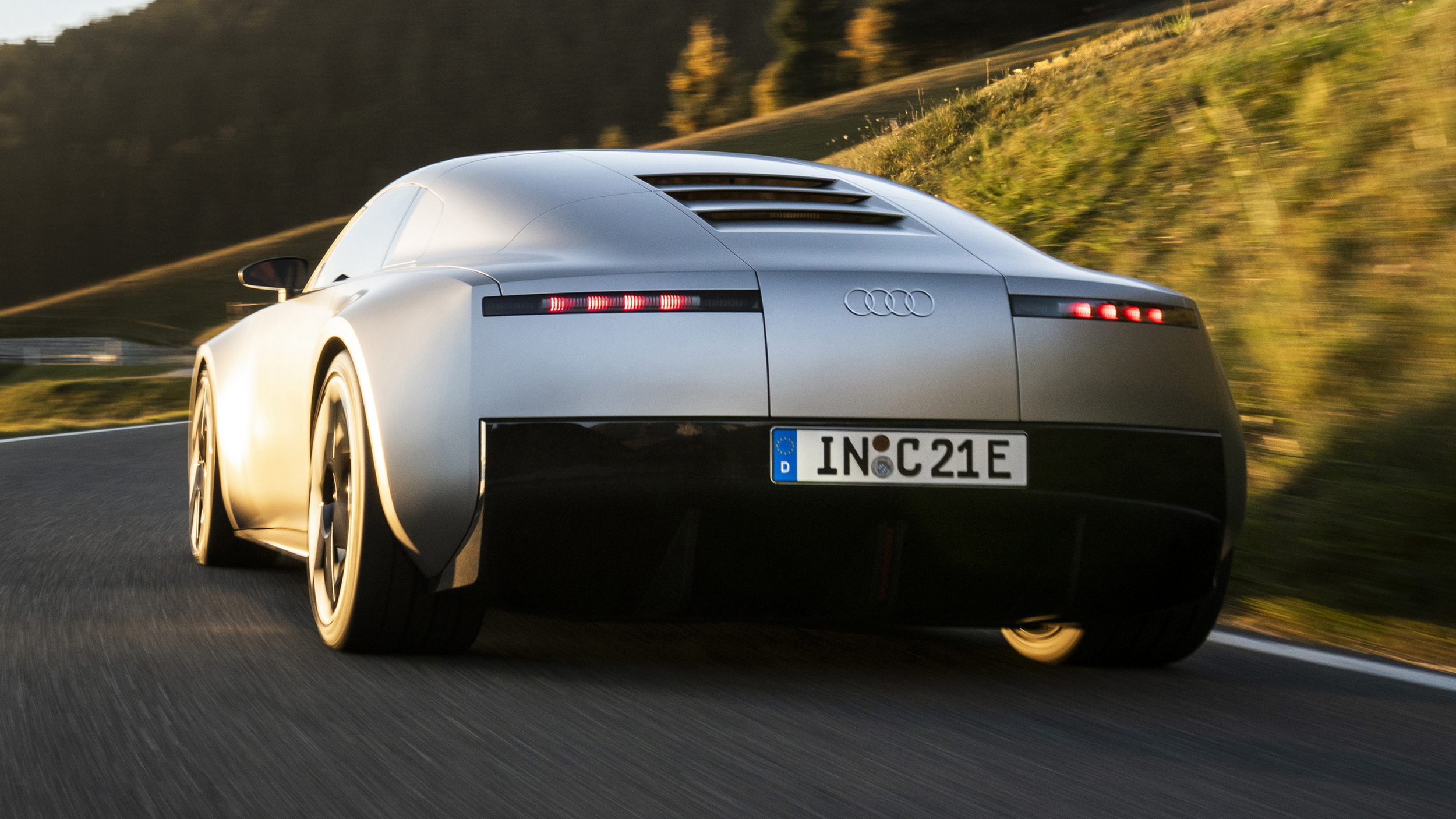
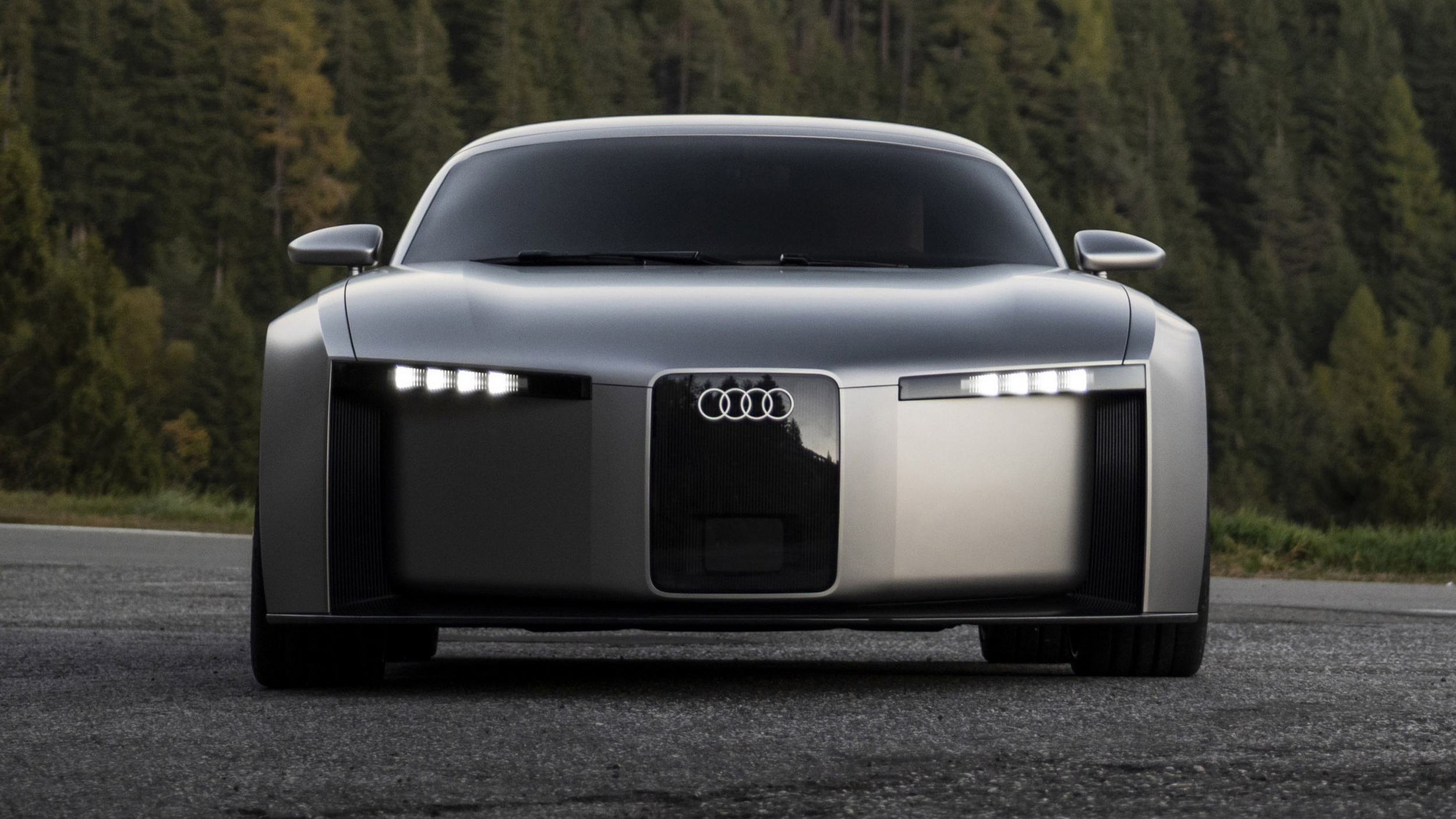
Underpinning the road-going Concept C will be the PPE platform.
It’ll be just three years from the Concept C’s inception to production.
The batteries will be arranged to mimic the layout of a mid-engined car.
The recent Audi Concept C doesn’t just preview the brand’s new design philosophy, but it will also spawn a production model to replace the TT. It’ll also hit the market incredibly quickly, within just two years, as the German firm leans into ‘China speed’ development.
Following the cancellation of the TT, as well as the mid-engined R8, Audi no longer has a two-door sports car in its line-up, which makes the Concept C all the more important. From the time it was sketched out as an initial idea to when it hits production it will have been just three years, representing a much quicker development cycle than traditional Audi models.
“Whenever we present a new concept, that will always be a serious product,” Audi chief executive Gernot Döllner told GoAuto at the recent launch of the new RS5. “The first proof point to our strategy is the Concept C. We presented that last September, and within two years, we will have it in the market.”
Porsche Underpinnings
Audi will build the road-going model on an updated version of the VW Group’s Premium Platform Electric (PPE) architecture, which will also be used by the next-generation 718 Cayman and 718 Boxster.
There have been some questions about the future of the electric 718s, with a recent report indicating they could be axed entirely. However, according to Car Sales, Dollner told Audi staff in an internal letter that “the delivery of the platform by Porsche is not in doubt,” adding that work on the Concept C is proceeding “in good collaboration between Team Porsche and Team Audi.”
Details about the Concept C’s powertrain are limited, but it will be an EV. All signs point towards it having battery cells split between the cabin and the rear axle, allowing Audi to mimic the handling dynamics of a traditional mid-engined sports car.
China Speed
Helping to bring the car to life is the company’s new ‘China speed’ philosophy. It is ditching layered committees in favor of ‘project houses,’ encompassing design, engineering, manufacturing, procurement, supplier relations, quality, and validation staff under a single roof with one leader and direct access to the board.
“We (have) completely adapted that to our processes in Germany,” Dollner revealed. “Not so far in the future, we will prove that we are able to react as fast as we do in China – but in European programs.”
“Project houses are absolutely necessary if we want to be this fast,” he added. “You cut out committees. You have this speedy decision process with very fast involvement with the board. I am having spontaneous project meetings every week. The key to fast projects is in the early phase – the alignment between design, engineering and testing teams… to set up a stable project that can be validated in a very short timeframe.”
About 31.5 percent of tested chargers fell outside limits.
Some units delivered far less energy than shown.
Public charging costs and taxes add to driver concerns.
Refueling is something most drivers don’t think about too much. They plug in or insert a fuel nozzle, press go, and wait to see how bad the bank account damage is in the end. Now, EV drivers in the UK might be thinking twice before they plug in at a public charging station. A new study found that almost one in three mis-calculated the energy provided during a session.
According to independent inspection provider EVCI Global, 31.5 percent of the chargers it reviewed either overestimated or underestimated the energy transferred to vehicles. In roughly 15 percent of cases, errors exceeded five percent, with a small number showing what the company described as “materially larger deviations.”
EVCI says this effectively leaves EV drivers carrying more financial risk than petrol car owners, who enjoy far tighter oversight every time they pull up to a pump.
The study, first reported by The Telegraph, highlights how different standards are for EV chargers when compared to gas or diesel fuel pumps. Fuel dispensers are subject to strict statutory verification and typically must operate within a tolerance of -0.5 to +1 percent.
By contrast, most public EV charge point meters are allowed a margin of error of up to +2 percent. Even so, EVCI says nearly a third of the units it tested fell outside that permitted window.
The company argues that public chargers should be brought under a formal verification regime similar to fuel pumps. It has also raised the issue with relevant government departments, pushing for clearer oversight and enforcement.
Extreme Cases And Industry Response
In one extreme case cited by CEO Craig Marsden, a charger was found to be delivering 37 percent less electricity than the figure displayed on-screen. Importantly, there were also cases where the chargers actually under-valued the amount of juice they provided, so drivers paid less. The findings have been presented to the Transport Select Committee.
“People with EVs need to know that they’re getting what they’re paying for, the same way that they do at petrol pumps,” Marsden said.
EVCI argues that this situation creates a two-tiered situation where EV owners are at greater risk of losing money. That’s especially true for those who don’t have access to off-street parking and home charging networks. Such individuals rely heavily on public charging infrastructure and could end up paying more than their fair share. A long charging session can exceed £70, and annual costs may approach £2,000. That’s without the errors included.
Industry Response To Accuracy Claims
Industry body ChargeUK has pushed back on the report, saying that the inaccuracies are isolated cases. It also pointed out that measuring electricity transfer is more complex than measuring liquid fuel.
A spokesperson for the Department for Transport told the newspaper that public EV charge points are expected to measure and supply exactly the electricity they claim to deliver. They added that meters at most public chargers are regulated to ensure accuracy within 2 percent.
That said, EV drivers will no doubt want to see a dramatic improvement in the next EVCI report. Otherwise, adoption rates could take a hit.
Dealers are slashing prices of the electric Dodge Charger.
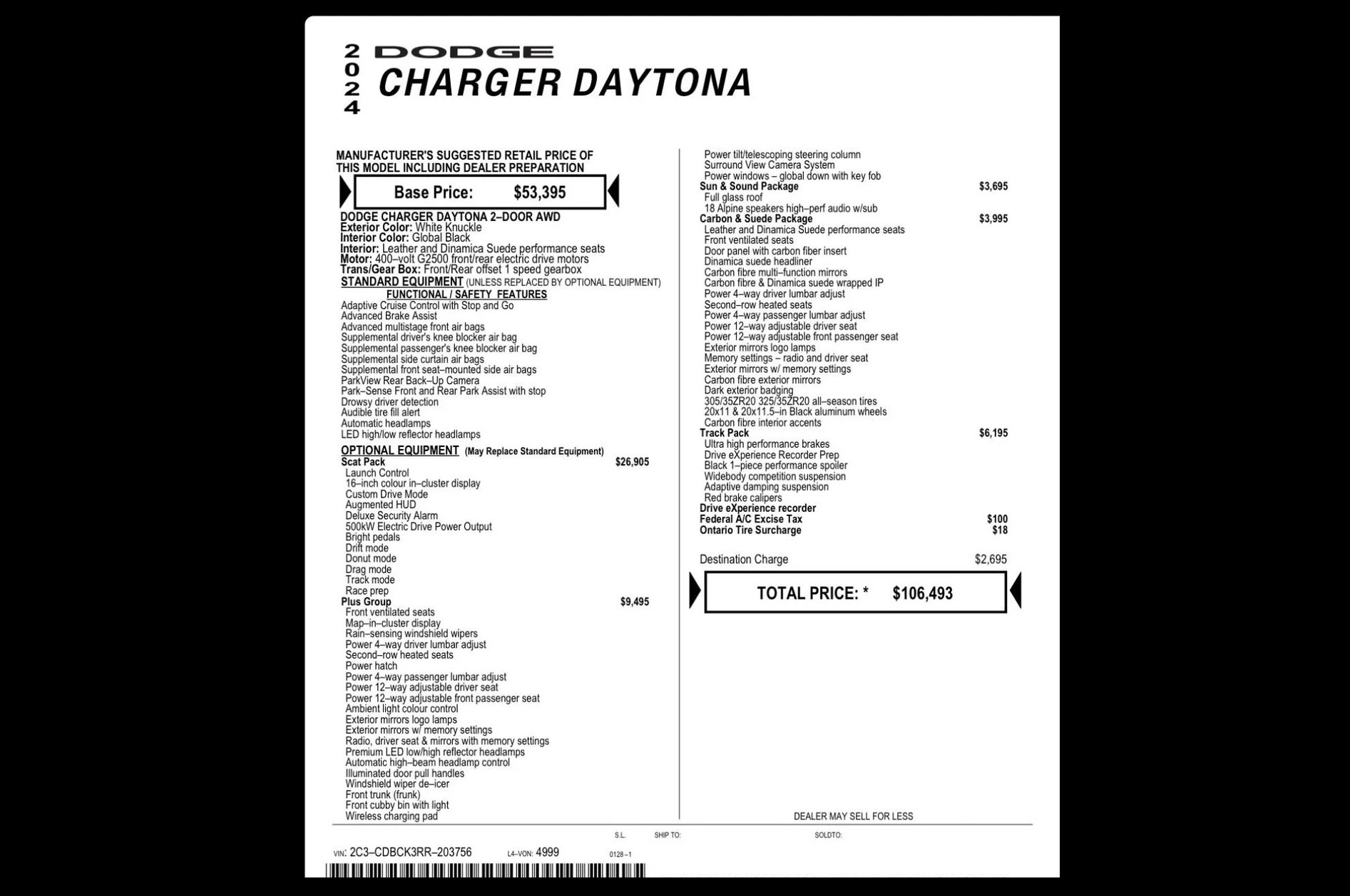
This 2024 example originally stickered at CA$106,493.
The Scat Pack version puts out 670 hp and 627 lb-ft.
The all-electric Dodge Charger Daytona is big and heavy, and according to some owners, reportedly riddled with issues. In Canada, it can also be configured with tens of thousands of dollars in options, yet much of that added cost appears to evaporate the moment the car hits the market.
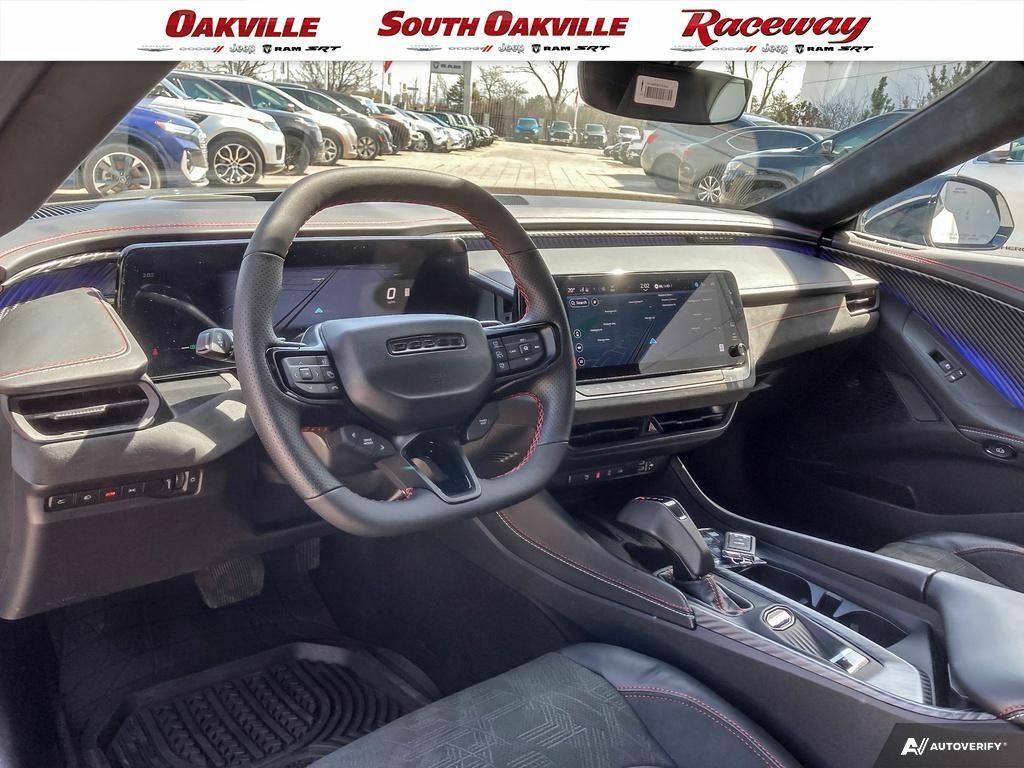
This white 2024 Charger Daytona has been listed for sale by Oakville Chrysler Dodge Jeep Ram in Ontario for CA$58,400 (US$42,700). On paper, that does not sound outrageous. Then you glance at the original window sticker and pause. With options included, this car started life at CA$106,493 (US$77,900). Let that sink for a moment.
Sticker Shock And Rapid Depreciation
Ready? Good, let’s carry on. In Canada, the most basic Charger Daytona opens at CA$53,995 (US$39,500). This one is the Scat Pack, which adds CA$26,905 (US$19,700) and pushes the total to CA$80,300 (US$59,200). In return, you get twin motors delivering 670 hp and 627 lb-ft (850 Nm), plus launch control, a head-up display, dedicated drive modes, and a 16-inch digital cluster to keep tabs on it all.
Next up, this Dodge was specified with the CA$9,495 (US$6,900) Plus Group. That buys you ventilated seats, power lumbar adjustment for both front occupants, ambient lighting, and a wireless smartphone charging pad. Comfort, in other words, does not come cheap.
There is also the CA$3,696 (US$2,700) Sun & Sound package, pairing a fixed glass roof with an 18-speaker Alpine audio system. On top of that sits the CA$6,195 (US$4,500) Track Pack, which brings high-performance brakes, a one-piece black spoiler, revised adaptive suspension tuning, and red brake calipers.
Rounding out the list of options is the CA$3,995 (US$2,900) Carbon & Suede package. As the name suggests, it adds carbon and suede accents, but you also get 20-inch black wheels wrapped in 305/25 front and 325/35 rear all-season tires.
It’s hard to see what Dodge was expecting here. Asking this sort of money for an electric Charger was always going to be a stretch. For similar cash, you could slide into a Lucid Air. Or, for CA$80,990 (US$59,200), you could drive away in a brand new Hyundai Ioniq 5 N and still have change left for the charging cable you will inevitably forget at home.
We hate to think about just how much more value this Charger could lose. It has already shed nearly CA$50,000 in under two years, despite covering just 275 km (171 miles). Even at CA$58,400 (US$42,700), you would not bet the house on it flying off the lot anytime soon.
Then again, something tells us that the dealer might be open to trimming that figure a little further just to move it along. You can check out the listing here.
Subaru says STI is alive and working on new models.
Electric Performance-E STI looks closer to production.
Trailseeker is the brand’s fastest production car ever.
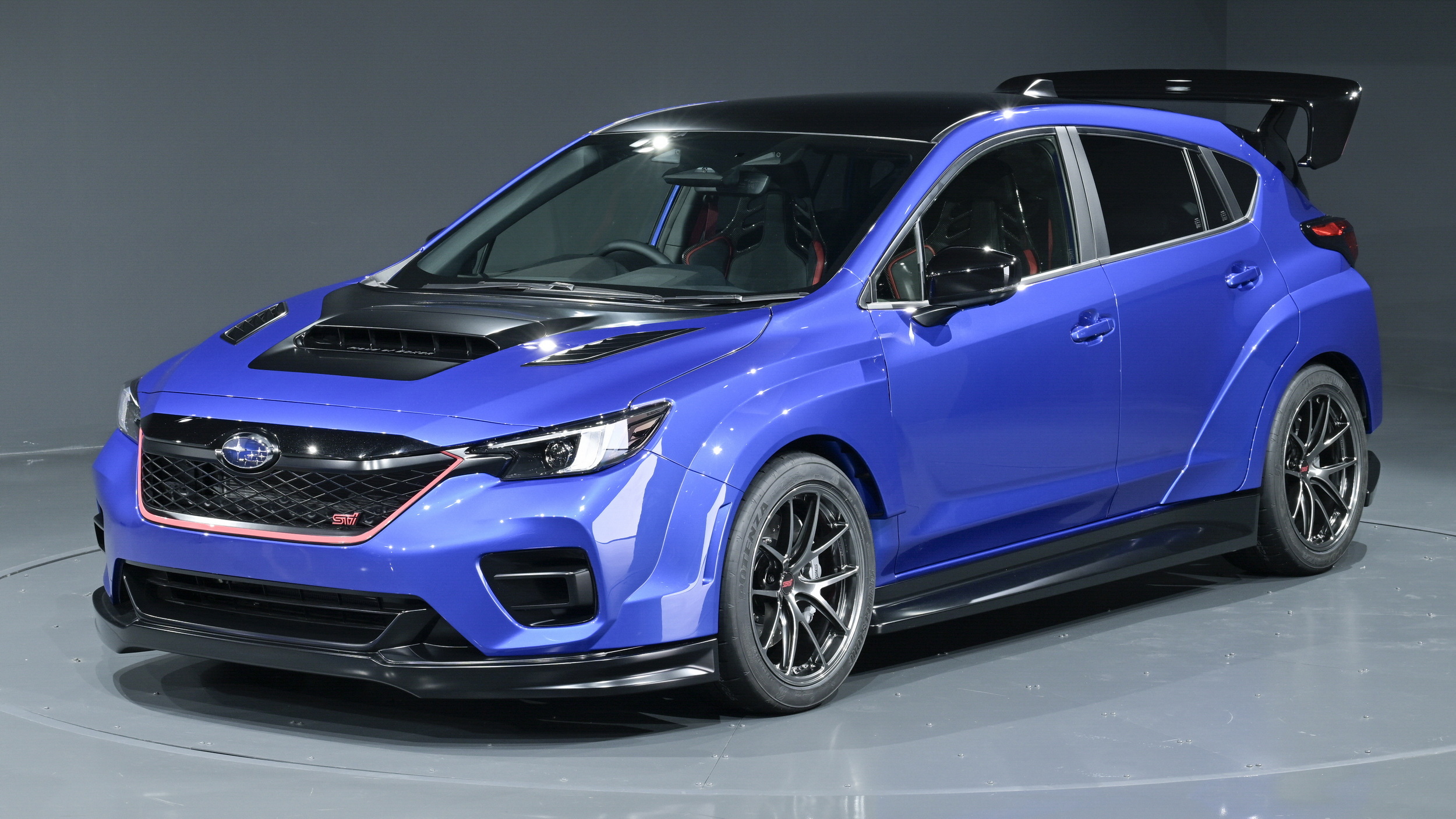
The last proper Subaru WRX STI bowed out in 2021, and it left a crater in the brand’s performance lineup. Since then, Subaru Tecnica International loyalists have been clinging to hope for something new. According to company officials, that hope is not misplaced. The high-performance division is “not dead,” and there is apparently plenty going on behind closed doors.
Over the past few years, Japanese buyers have had to settle for STI Sport editions of the WRX, Levorg, and Forester. Nice cars, certainly. But the real headline-grabbers were the two STI concepts unveiled at the 2025 Tokyo Motor Show.
Scott Lawrence, General Manager of Subaru Australia, spoke to Drive.com.auabout those concepts and the broader direction of the STI sub-brand:
“There has been a significant volume of feedback,” he said. “The tempo of news and activity out of STI publicly is picking up. It has the most vocal followers of the Subaru camp, put it that way. As those concepts proved, lots of work in that space – STI isn’t dead.”
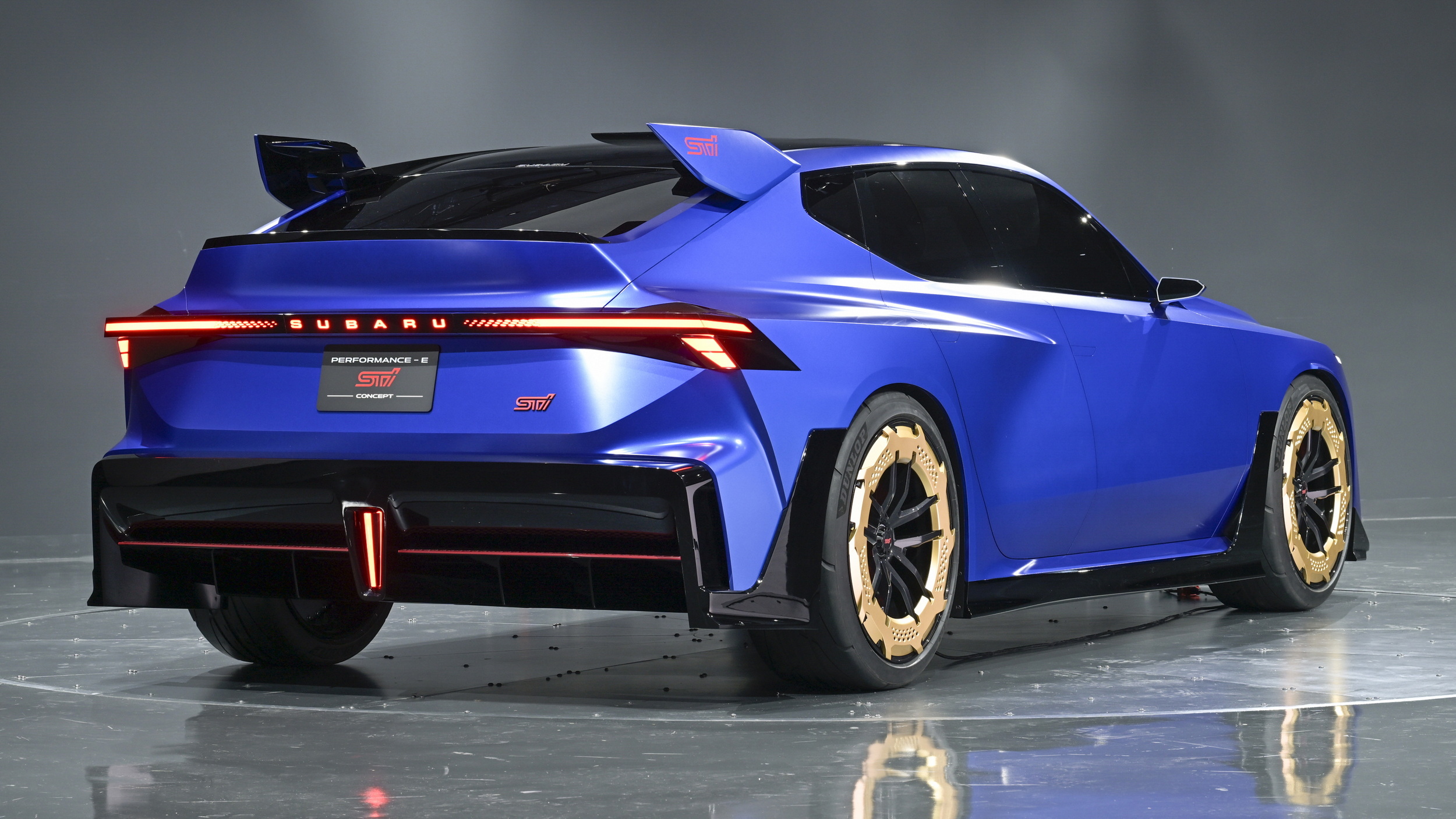
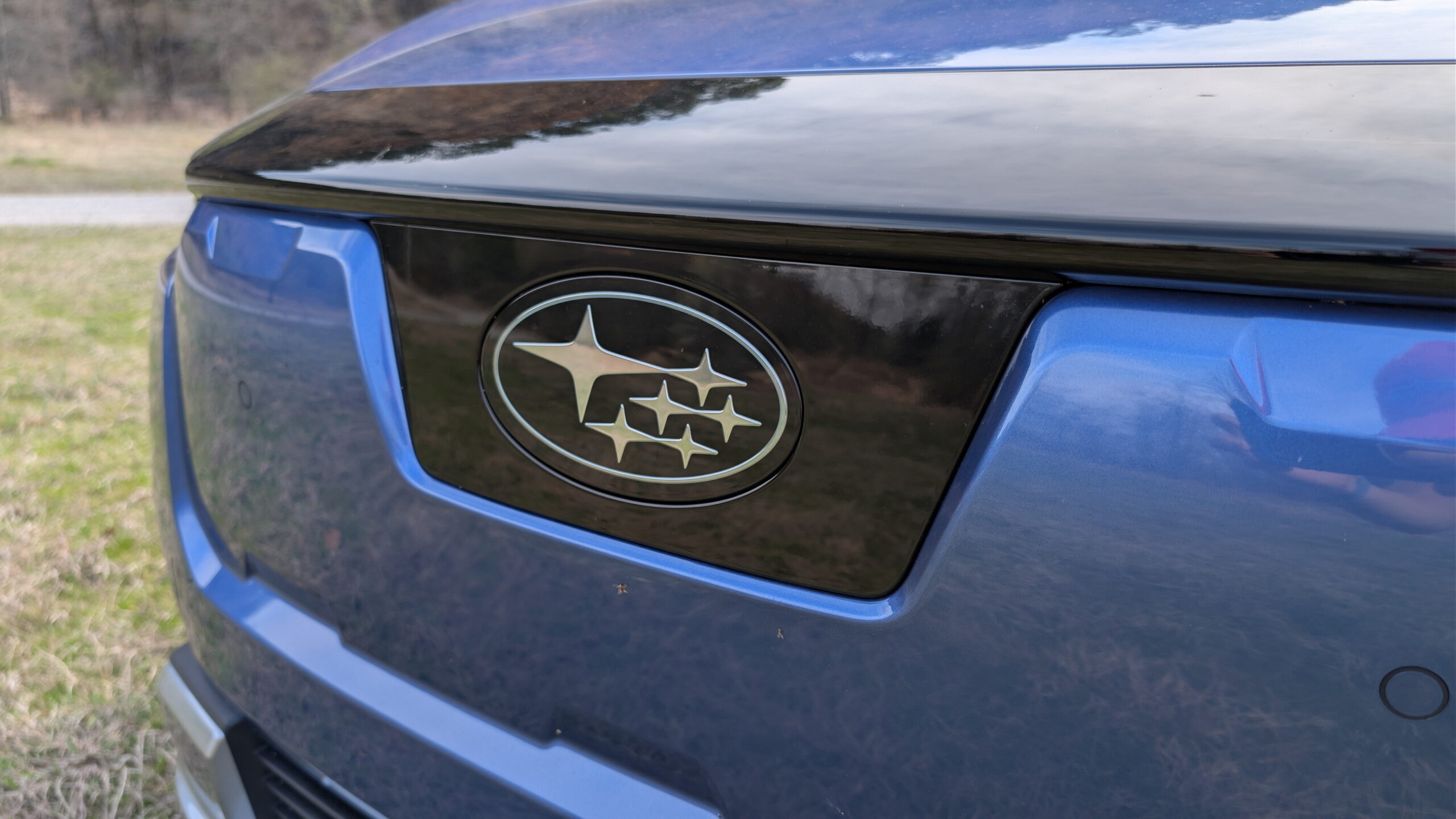
Subaru is using its latest STI concepts to measure enthusiast appetite and, more importantly, to justify the next halo car. The fully electric Performance-E STI looks like nothing else in the current lineup. At the same time, the gasoline-powered Performance-B STI is essentially a heavily reworked Impreza hatchback with a serious gym habit.
Initially, Subaru implied that fans would help decide which concept makes it to production. That democratic spirit now appears to have limits. The EV seems to have the inside track. According tothe report, Subaru has confirmed the Performance-B will remain a concept, while staying carefully noncommittal about the Performance-E’s future.
While we wait for a proper STI to reappear, the Trailseeker, Subaru’s electric alternative to the Outback, has become the quickest thing in the showroom. Not exactly the plot twist purists were hoping for. Its dual-motor setup delivers a combined 375 hp (280 kW), good for a 0-60 mph sprint in 4.4 seconds, although in our testing the crossover wagon managed to dip even lower.
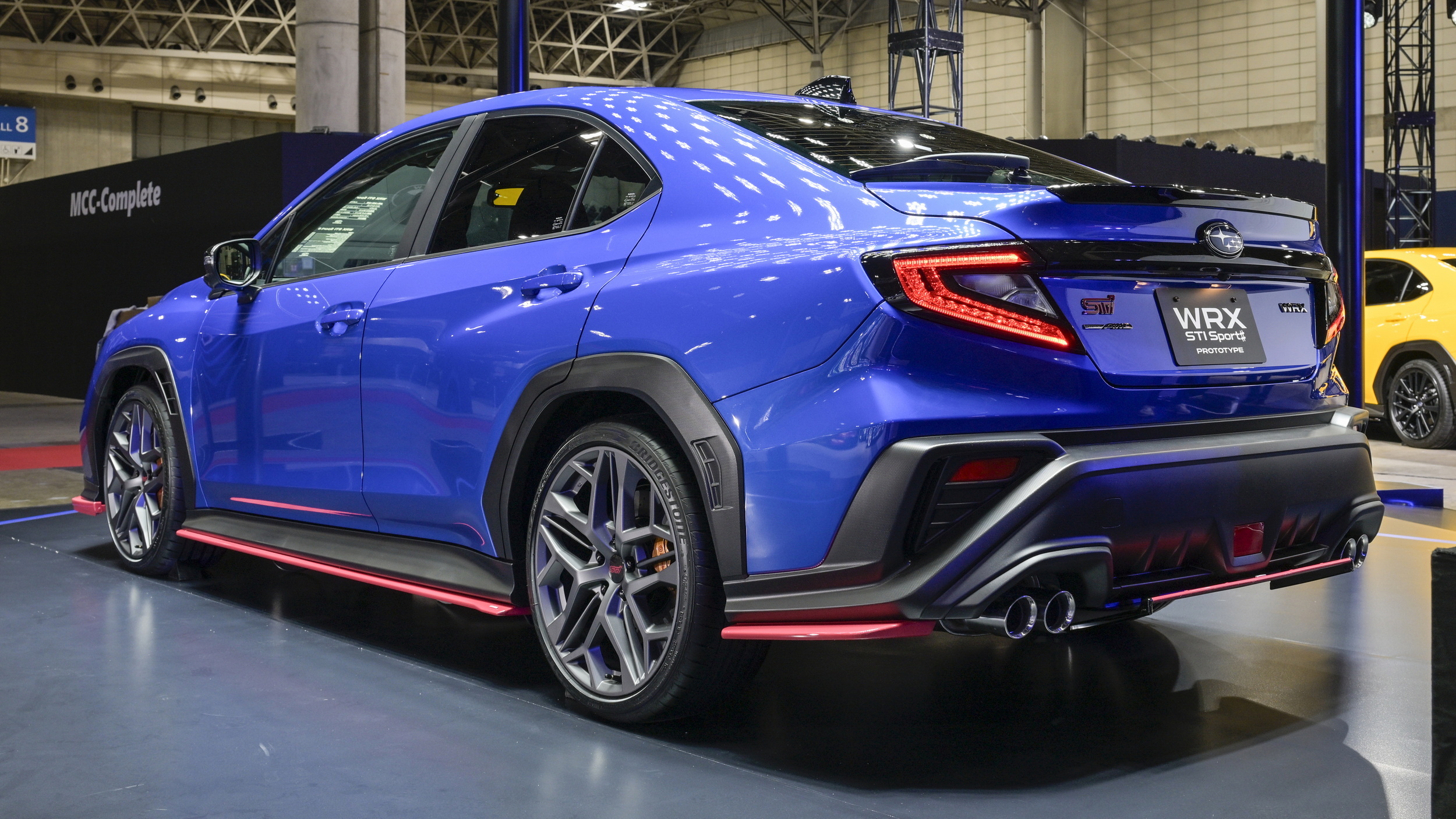
If you still prefer your performance with a sedan shape, the coolest kids on the block are the limited production S210 from last year, and the current STI Sport#, both based on the WRX. The latter debuted earlier this year with a six-speed manual gearbox, STI-tuned electronically controlled dampers by ZF, Brembo brakes with gold calipers, and 271 hp (202 kW) from the standard 2.4-liter boxer engine.
Subaru is clearly feeling its way toward whatever comes next for the STI sub-brand. Hybrid, fully electric, or something in between is still undecided. What seems less negotiable is the badge itself. It is sticking around, even if the boxer engine eventually is not.
Canada is preparing to reopen its doors, at least partially, to Chinese-built electric vehicles. In the coming months, it will begin issuing permits at a sharply reduced tariff rate. However, locals should not expect the market to be immediately flooded with new and innovative EVs, as has happened in parts of Europe and Australia.
Under Canada’s new trade agreement with China, up to 49,000 EVs built in China can be imported at the reduced 6.1 percent tariff, down from the 106.1 percent rate imposed in 2024.
Global Affairs Canada said in an import-control notice published on February 26 that, from March 1 through August 31, the first 24,500 permits will be handed out on a simple first-come, first-served basis.
Given that it has only been six weeks since the reduced tariff was announced, automakers looking to enter the Canadian market for the first time are unlikely to secure a significant share of these initial permits.
Which Companies Stand To Gain Most?
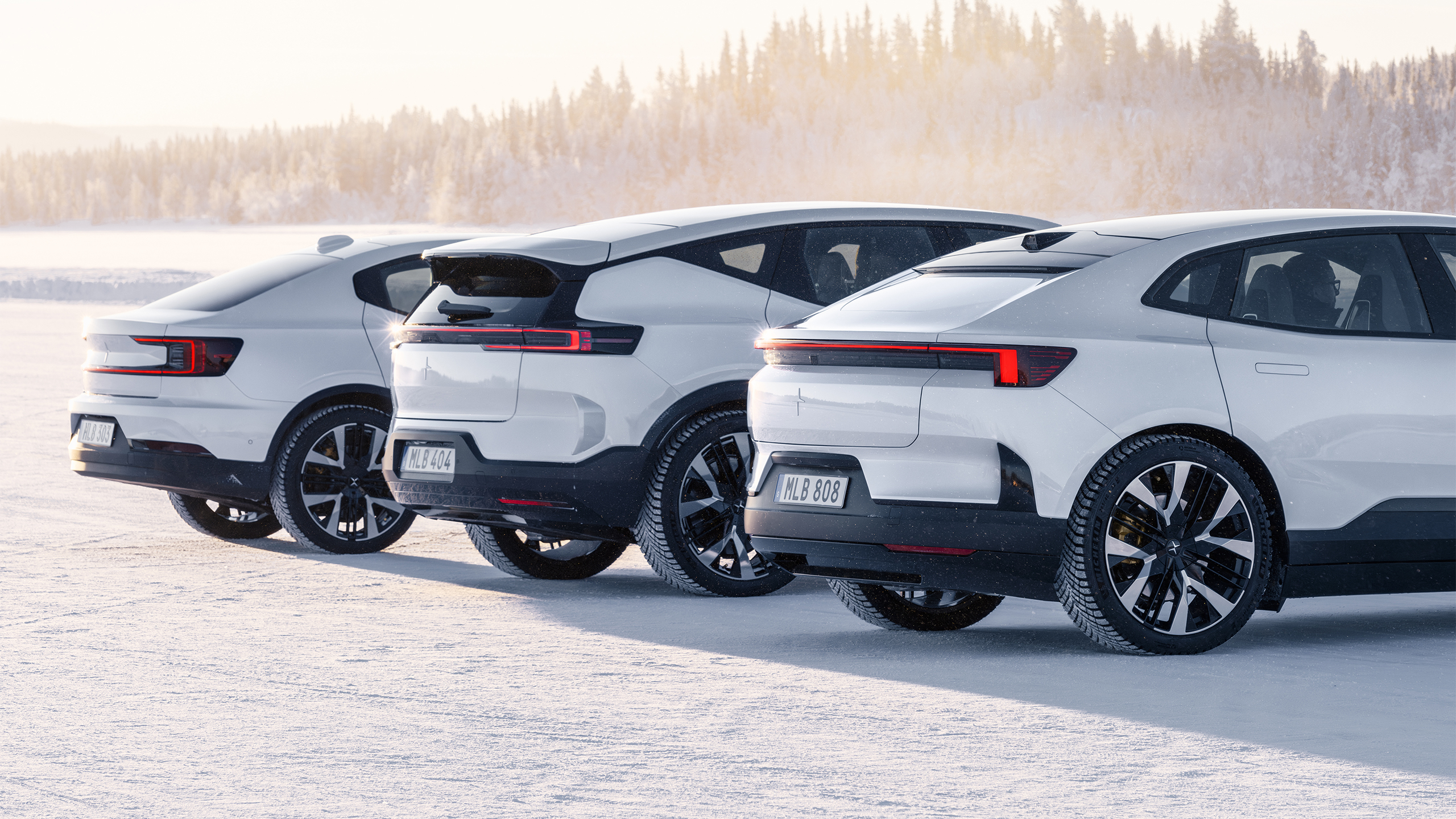
Instead, established firms are expected to benefit first. Volvo and Polestar, for example, had been exporting EVs from China to Canada prior to the 2024 tariff hike and likely retain the production flexibility to resume shipments for the Canadian market. Tesla also built China-made EVs for Canada before the tariffs took effect and is considered a frontrunner for the early permits.
Speaking to Auto News, Global Affairs spokesperson Samantha Lafleur said there is no predetermined limit on the number of permits each automaker may receive, although temporary limits could be introduced during the initial six months. Lafleur added that the department “will monitor the application and issuance of import permits for the purpose of providing equitable access to the quota to eligible applicants.”
Second Phase Of The Import Quota
The second quota of 24,500 permits will open on September 1, 2026, and run through February 28, 2027. Any permits unused during the first six months will be added to this second allocation period.
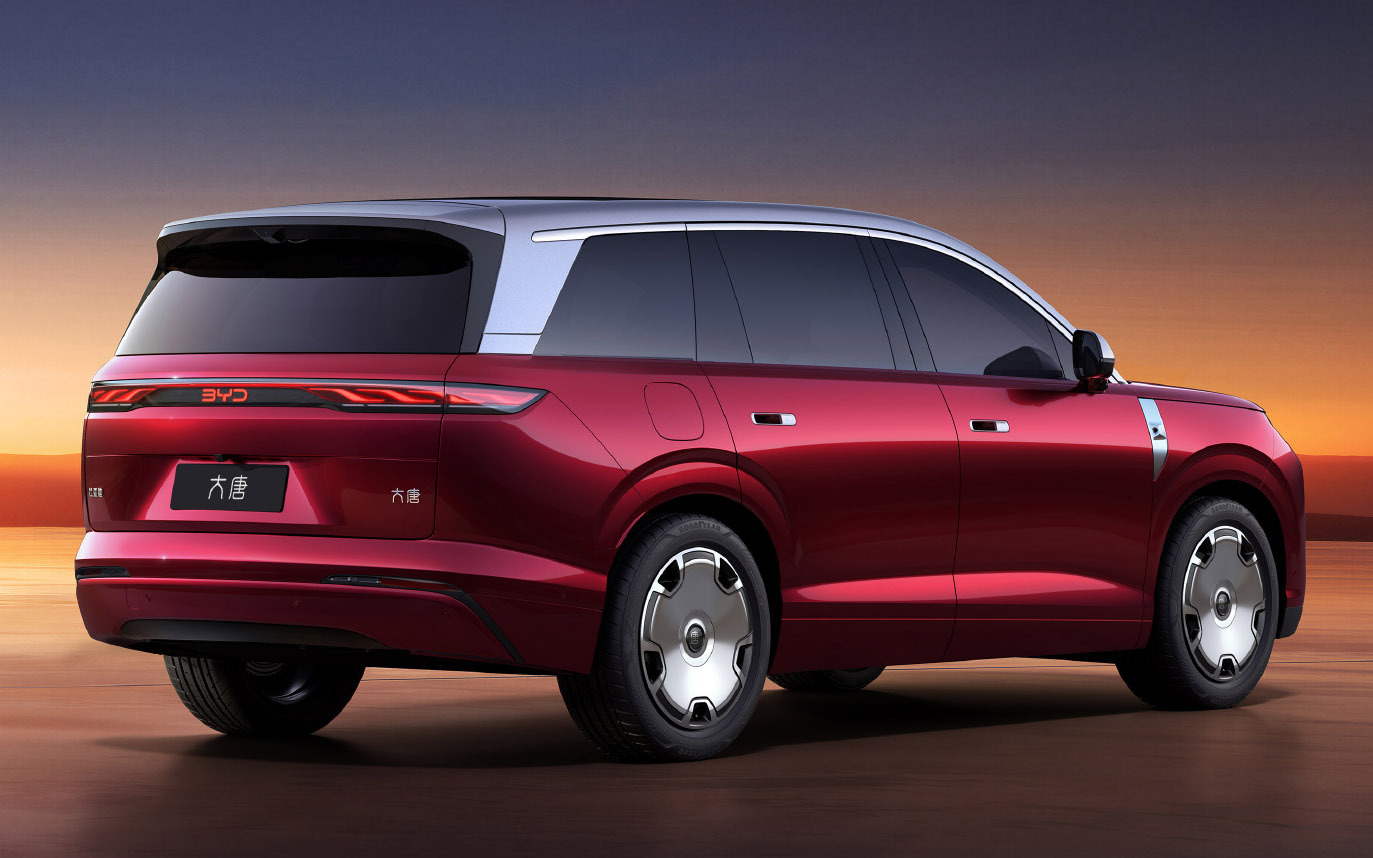
Canadians waiting for the most competitive offerings from China will be watching closely for the potential arrival of BYD and Geely, the country’s two largest automakers. As reported by Auto News, BYD has acknowledged it is evaluating sales in Canada. Geely, meanwhile, could expand its footprint beyond Volvo and Polestar by introducing additional brands such as its namesake marque and Zeekr, among others.
PROS ›› Lots of utility, genuinely quick, NACS charging CONS ›› Odd shifter, questionable styling, sub-330-mile range
Subaru’s first EV, the Solterra, didn’t exactly set the world alight. Lukewarm demand and an awkward early recall made it feel more like a cautious toe-dip into electrification than a confident leap.
The 2026 Trailseeker is the opposite. It’s bigger, quicker, and more capable. And somehow, almost by accident, it has become the most powerful and fastest production Subaru ever built.
That alone would make it worth a look. But here’s where it gets interesting. We didn’t test the loaded Touring trim dripping in features. We didn’t even grab the mid-tier Limited. Instead, we spent a full week with the Trailseeker Premium, which, despite the name, is actually the base model. Yes, “Premium” is doing some heavy lifting here. This is the $39,995 version most buyers will realistically consider.
Quick Facts
› Model:
2026 Subaru Trailseeker Premium
› Starting Price:
$39,995 (excluding destination)
› Dimensions:
190.8 L x 73.2 W x 65.9 in H (4,846 x 1,860 x 1,674 mm)
› Wheelbase:
112.2 in (2,850 mm)
› Curb Weight:
4,376–4,453 pounds (1,985–2,020 kg)
› Powertrain:
Dual electric motors / 74.7 kWh battery
› Output:
375 hp (280 kW)
› 0-60 mph:
3.9 seconds (GPS verified)
› Transmission:
Single speed
› Range:
280 miles (452 km)
› On Sale:
First-half of 2026
SWIPE
On paper, it reads like a greatest-hits list for Subaru loyalists. Standard Symmetrical AWD, 8.5 inches (216 mm) of ground clearance, 3,500 pounds of towing, and 375 horsepower (280 kW). That’s not exactly timid. Subaru claims 0-60 mph in 4.4 seconds. We tested it. It’s quicker than that. And after a proper stretch behind the wheel, we’re fairly convinced this so-called base model might be the smartest pick in the entire lineup.
Does It Look The Part?
Photos Stephen Rivers / Carscoops
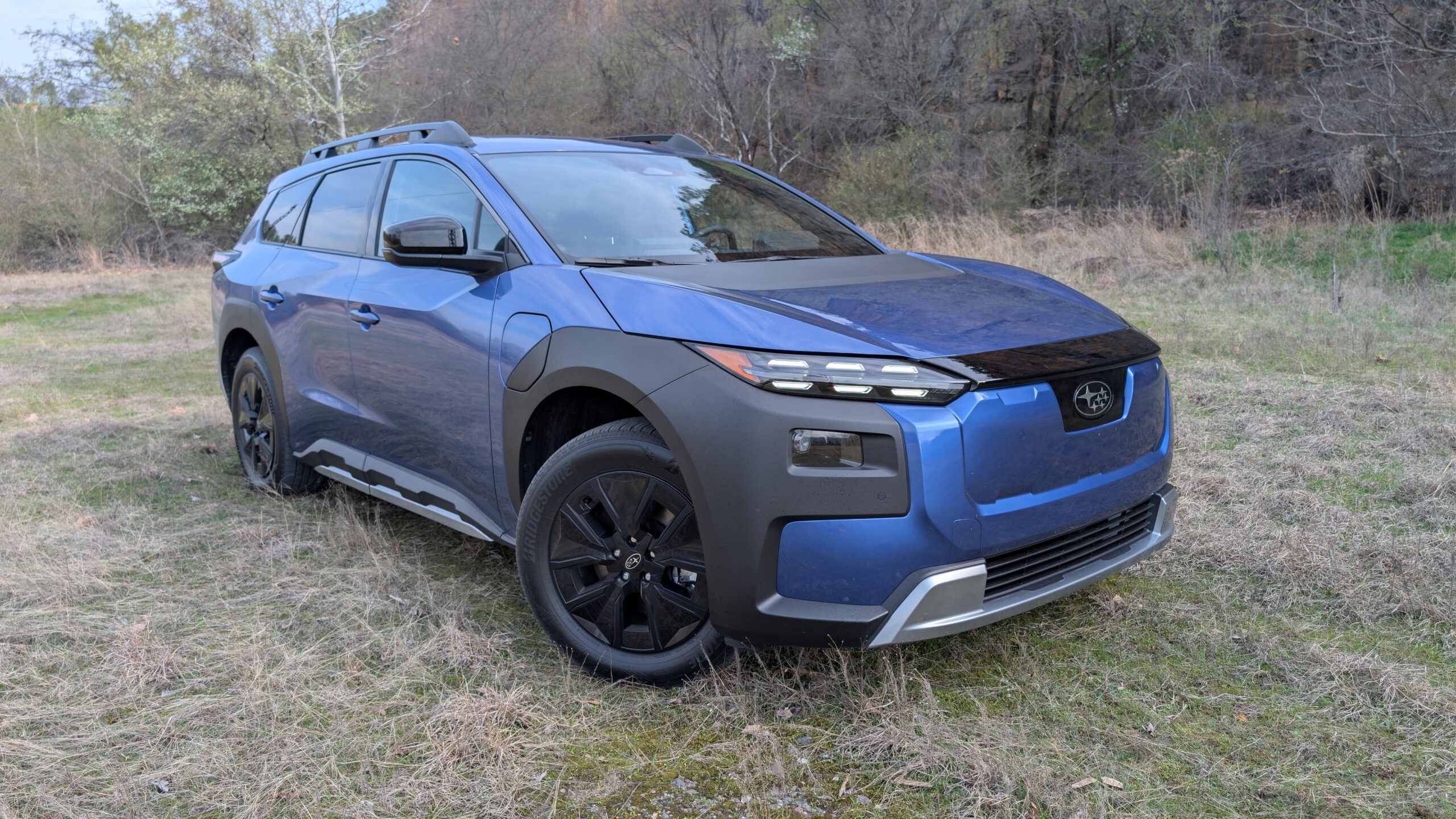
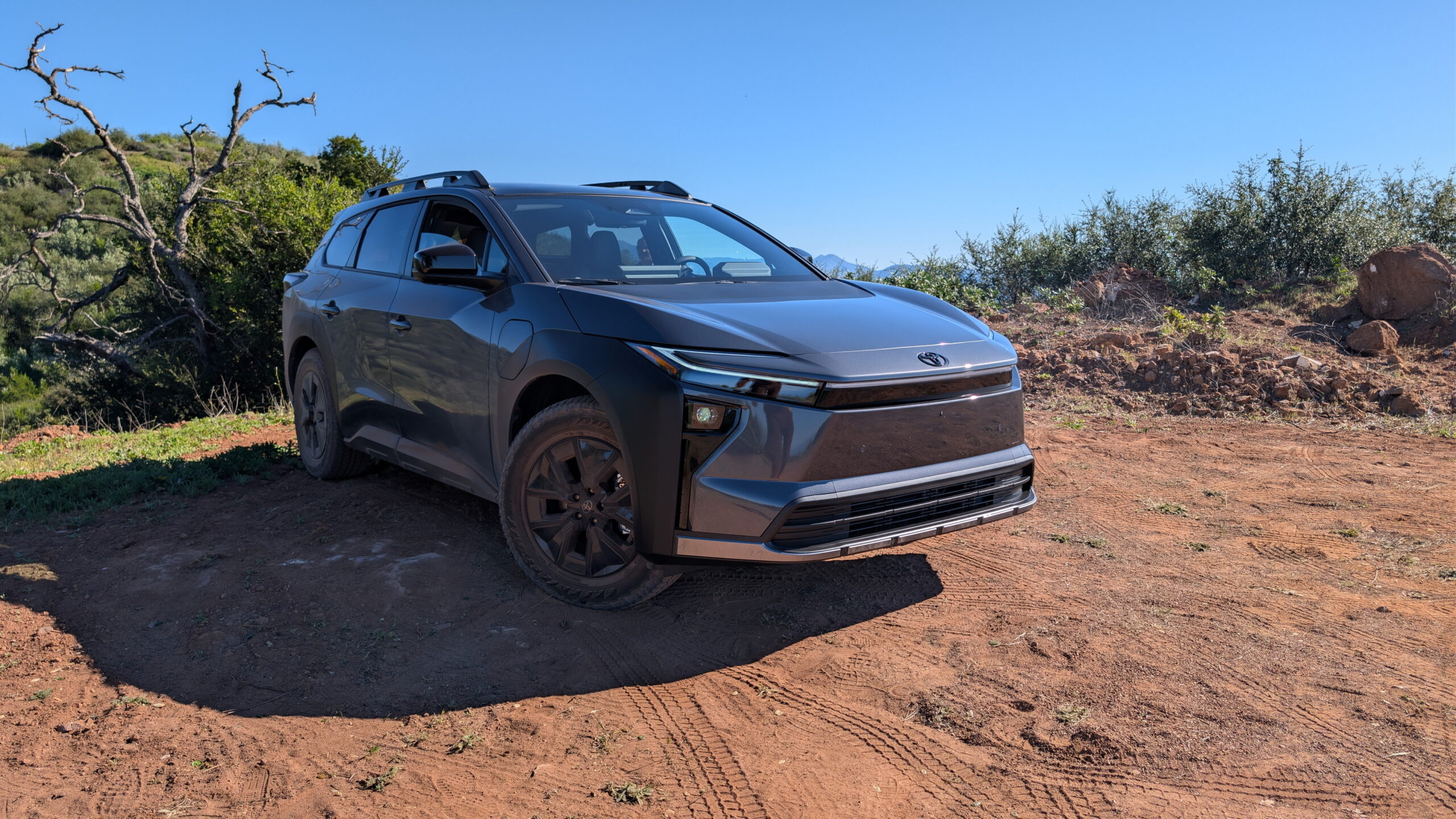
The Trailseeker looks like it belongs on a trailhead, not outside a charging station. Black lower cladding, ladder-style roof rails, squared-off proportions, and a clean light bar give it a tougher presence than the Solterra. It measures 190.8 inches (4,846 mm) long on a 112.2-inch (2,850 mm) wheelbase, stands 65.9 inches (1,674 mm) tall, and rides with best-in-class 8.5 inches (216 mm) of clearance.
That clearance number matters. It puts the Trailseeker Premium ahead of rivals like the VW ID.4, Hyundai Ioniq 5 XRT, and Chevy Blazer EV AWD in pure ride height. That’s something Subaru emphasized heavily in its capability comparison charts. For buyers, it means worrying less when going over deeply rutted paths or rocky roads.
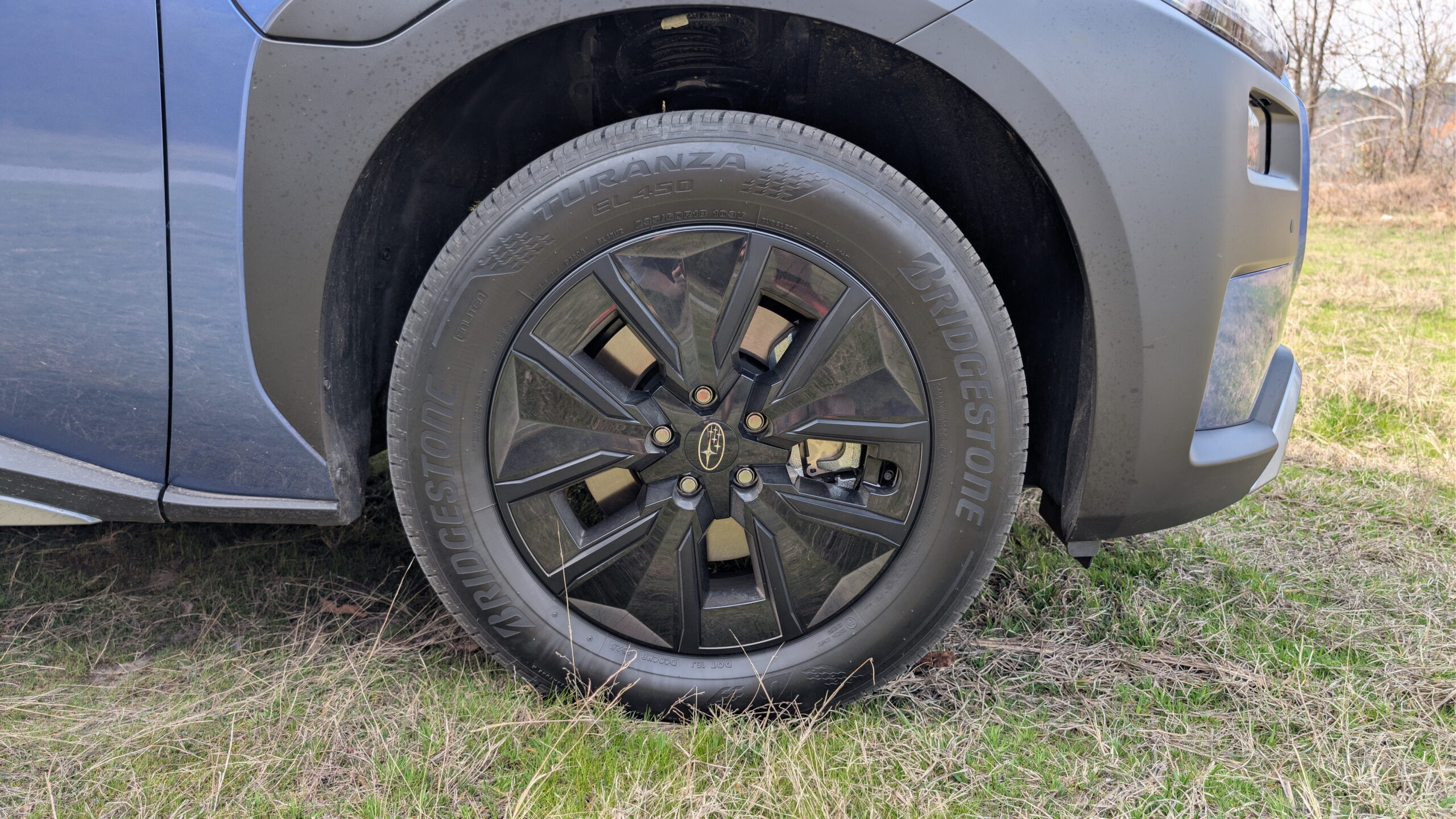
Even on 18-inch wheels with aerodynamic covers (Premium trim), it doesn’t look cheap. If anything, the smaller wheels add sidewall and reinforce the rugged vibe. Having now driven both this and the bZ Woodland, the Subaru appears a bit more cohesive in person. I’m still not sold on all of the plastic cladding, but I’d rather be seen in this than the Toyota personally.
Tell Me About The Interior
Photos Stephen Rivers / Carscoops
This base Trailseeker had me searching for decontenting because it starts at $39,995. As we’ve covered, that’s thousands less than the base bZ Woodland. Despite my efforts, I never found anything that felt like a big letdown compared to the Toyota I tested a few weeks ago. Sure, we don’t have ventilated seats, heated outboard rear seats, or a panoramic sunroof, but honestly, those are luxuries, and what’s already here is pretty great for the money.
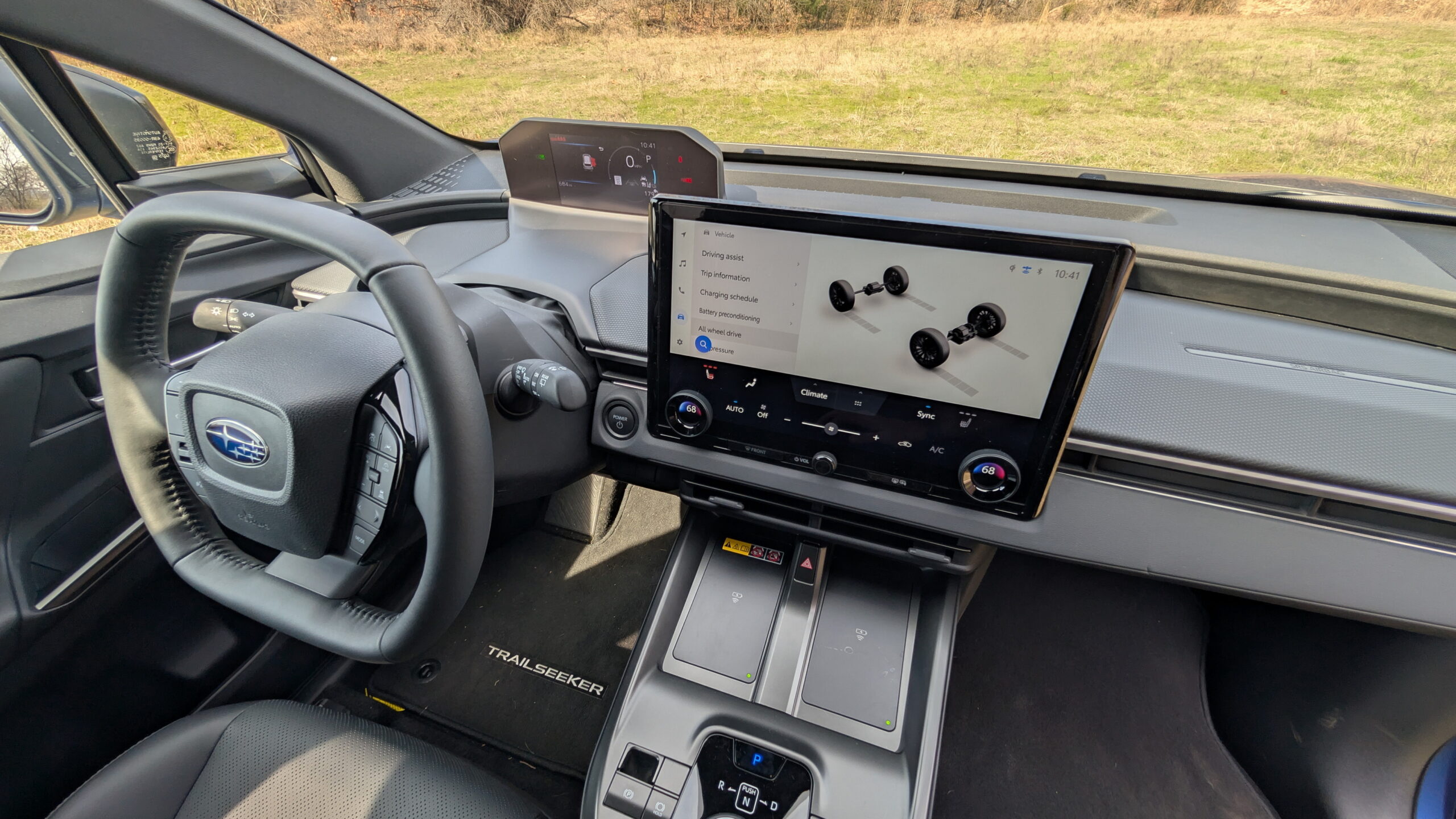
The dash has nice texturing, the steering wheel feels like it’s from the future, and the 14-inch infotainment screen is a massive leap forward for Subaru (thanks, Toyota!). The menu is intuitive and easy to navigate. Physical buttons exist for the volume, media on/off, defrost, hazards, and climate temperature. Fan speed, air flow direction, and heated seat settings are all in the touchscreen itself. It’s not as nice as having physical controls for everything, but it’s better than having none at all.
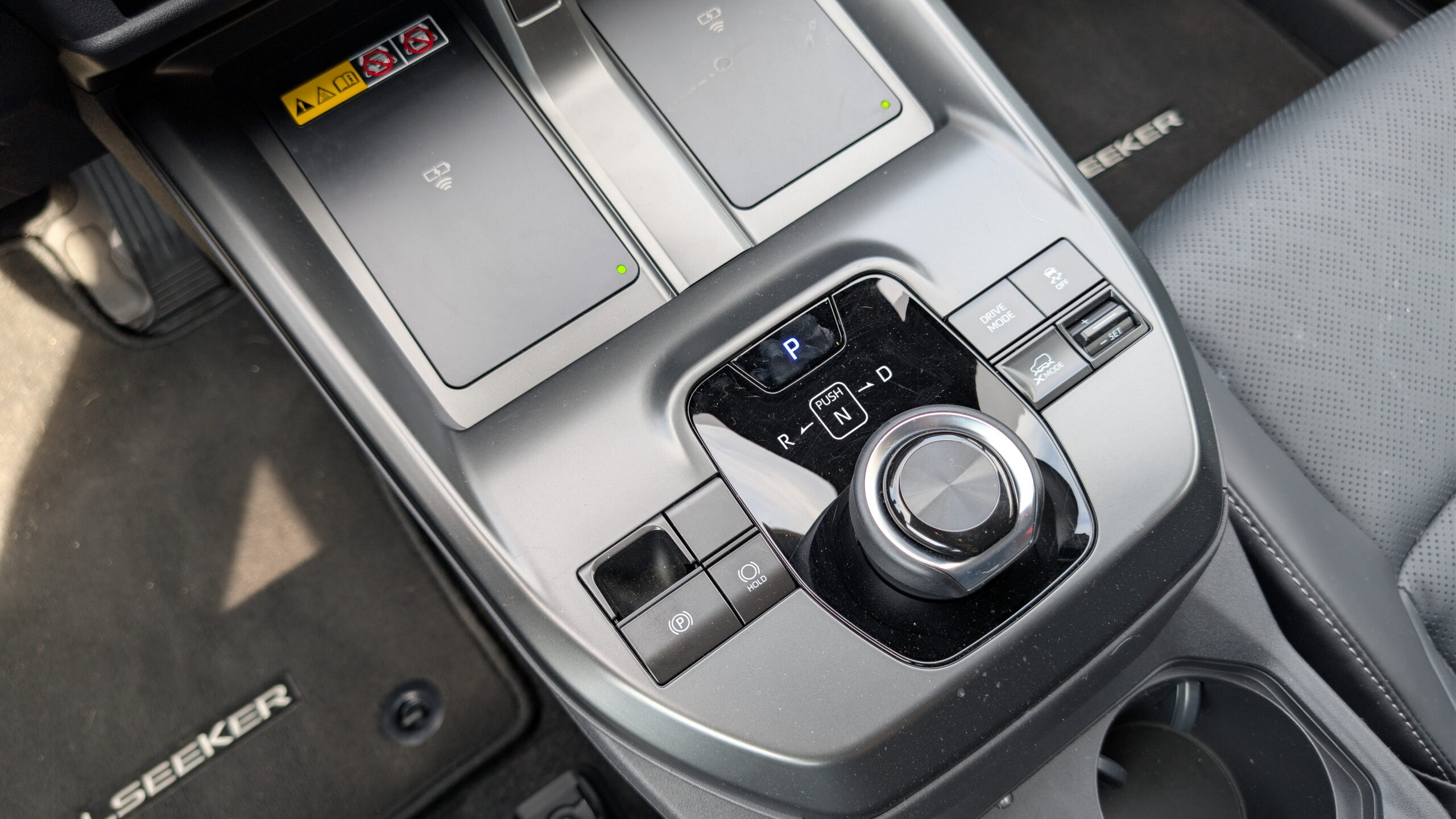
There are dual 15w wireless chargers under the screen, along with a parcel shelf underneath that. It’s key because there’s no glove box, so expect to store things differently in this car than in most others. A small ‘magic’ storage console sits behind the shifter and allows both front seat passengers to open it from their side, which is great. It doesn’t flip over like the one we tested in the latest Toyota RAV4. Speaking of that shifter, it’s one of the weirdest and perhaps least positive parts of this car.
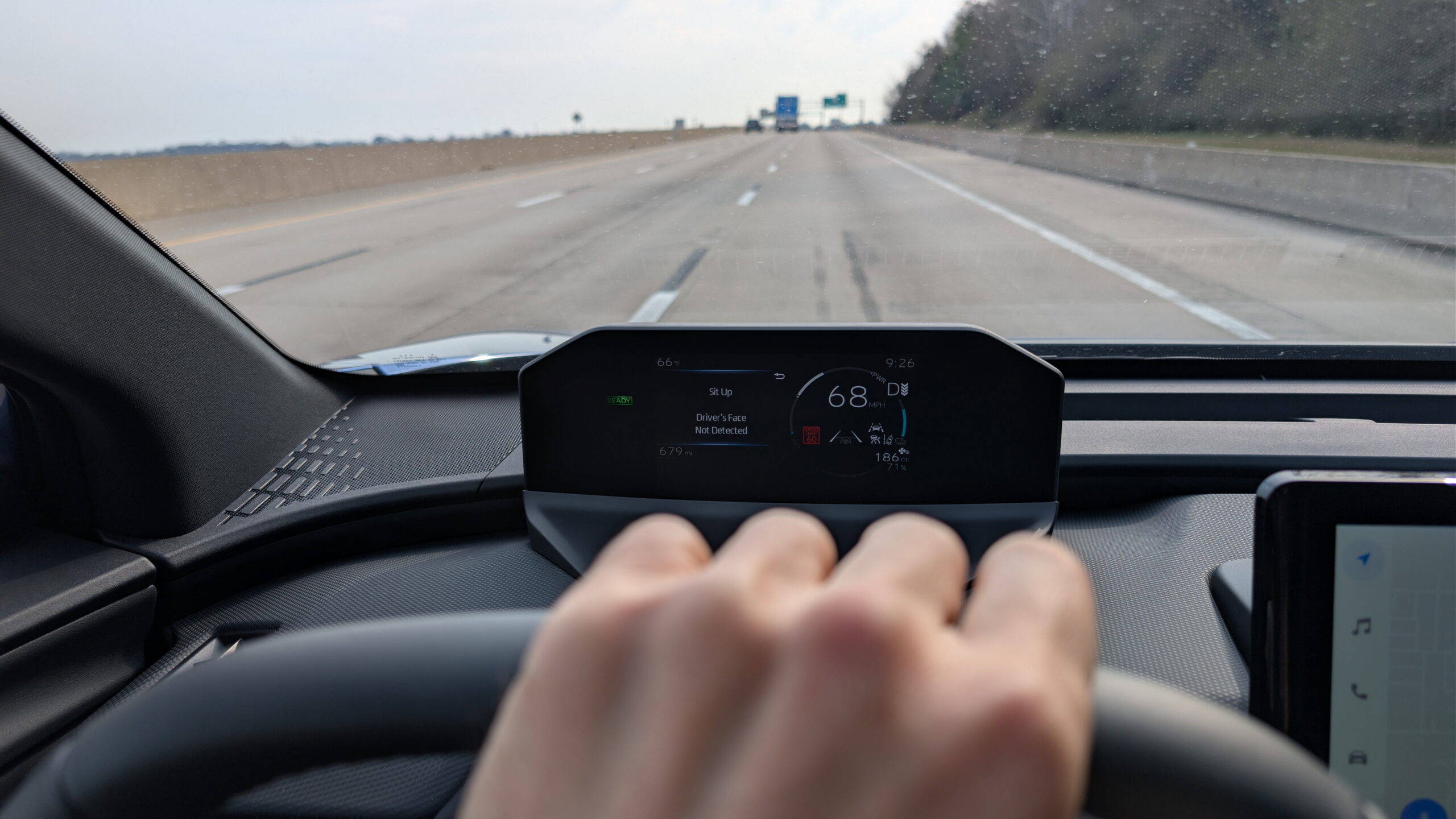
To use it, the driver pushes a ring down and then twists it left or right. Once you’re used to it it’s no big deal, but it does take getting used to. Everyone I handed the keys to needed a quick tutorial. Subaru places driving modes, of which there are three, normal, eco, and power, to the right of the shifter, along with X-Mode, a low-speed cruise control built for off-roading.
The seating is supportive and comfortable, but lacks the deep adjustability found in more expensive vehicles. That said, I’m happy to report that the Trailseeker can easily accommodate four adults who are above average height. The rear seats have just enough headroom for me at 6’6 to comfortably sit behind my own driving position in front. That’s impressive, though we should note that adding the panoramic sunroof detracts a bit of headroom.
Photos Stephen Rivers / Carscoops
Speaking of space, there are over 30 cubic feet to use in the back of the Trailseeker. That’s a strong figure and reminds us why wagons are so practical in a world full of oversized SUVs. Fold the seats down, and cargo space more than doubles to over 70 cubic feet. That’s not half bad, though we wish Subaru had included a front truck to make that figure even bigger. Those who need even more space can tow up to 3,500 pounds.
Shockingly Quick In Practice
Leave it to Subaru to cook up what it has in the Trailseeker from a driver’s perspective because it’s on two very different ends of the spectrum at the same time. For everyday pilots of this vehicle, it’ll feel totally normal, totally placid, and at times… it just seems to lack much character. Somehow, Subaru also just happened to make this the most powerful and quickest production car that it’s ever built.
The steering is quick and communicative, the accelerator and brakes offer good linear feedback, and the chassis handles directional changes with composure and high aptitude. It even manages bad road conditions, gravel roads, rock-filled trails, and some off-road trails with ease and comfort.
There aren’t even any STI badges to show that performance envelope off. Every Trailseeker gets a dual AC synchronous motor setup with a combined 375 horsepower (280 kW). It leverages a 74.7 kWh battery pack, and Subaru says this wagon will rocket from 0-60 mph in just 4.4 seconds. It’s wrong about that, and we have the data to prove it.
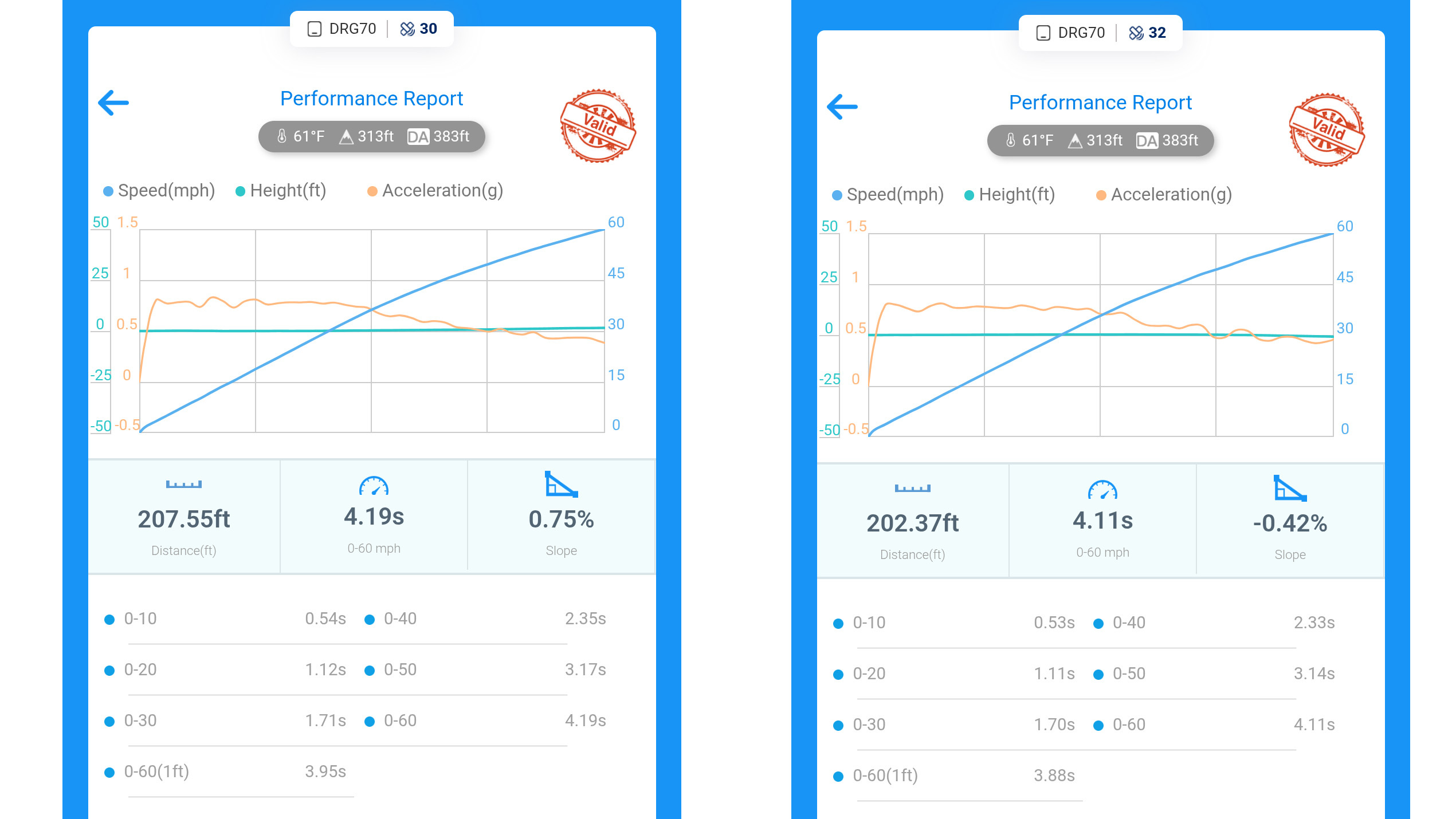
In the real world, we strapped a Dragy GPS tracker to ours and recorded multiple launches. With one foot of rollout, the quickest run came in at 3.88 seconds. Without rollout, it ran 4.11 seconds. You can read the full breakdown of our testing methodology and slope corrections in our separate acceleration analysis.
That’s properly quick. Not “quick for a Subaru.” Just quick. In fact, it’s the fastest production Subaru we’ve ever tested.
More importantly, the updated AWD logic gives it a stable, confidence-inspiring feel. It uses independent front and rear motors with variable power distribution, plus X-Mode with Snow/Dirt and Deep Snow/Mud settings. Grip is immediate and predictable, even when you provoke it.
Braking is handled by 12.9-inch front rotors and 12.5-inch rears, and regenerative braking offers multiple levels via paddles. It’s not WRX-level fun, but it’s far more engaging than most mid-size electric crossovers.
EPA-estimated range is 281 miles (452 km) for the Premium, slightly higher than the 274 miles quoted for Limited and Touring trims. Charging from 10–80 percent takes as little as 28 minutes at up to 150 kW, and it uses a standard NACS port for Supercharger access. We achieved a maximum estimated range of 239 miles as we achieved 3.2 miles per kW, but that’s with our 0-60 testing included. Drive like an adult, and the Trailseeker will almost certainly hit its 280-mile range.
Plenty Of Competition
Subaru benchmarks the Trailseeker against the Kia EV6, Volkswagen ID.4, and Honda Prologue, but the reality is broader than that.
Tesla Model Y is the most obvious rival. In Long Range form, it offers more range and arguably better software. It also matches the Trailseeker’s 3,500-pound towing capacity and adds a usable frunk, something the Subaru notably lacks.
But the Model Y rides lower, lacks meaningful ground clearance, and doesn’t pretend to be trail-capable. If you want tech and efficiency first, Tesla wins. If you want capability baked into the chassis, Subaru has the edge.
Kia’s EV6 leans sportier. It feels lower, sharper, and more road-focused. In GT-Line or GT form, it’s quicker in a straight line, but it sacrifices ride height and off-road pretense. It’s the enthusiast’s EV crossover. The Trailseeker is the practical adventurer.
The Hyundai Ioniq 5 XRT gets closer philosophically. It adds rugged styling and a slight lift, but it still can’t match the Subaru’s 8.5 inches of clearance or 3,500-pound tow rating. Hyundai wins on interior tech polish and charging speed consistency. Subaru counters with real-world trail confidence.
The Toyota bZ Woodland is mechanically nearly identical. Same bones. Same dual-motor layout. Same basic mission. But in person, the Subaru feels more cohesive and slightly better resolved. And crucially, it undercuts the Toyota on price in base form. That matters.
The Trailseeker doesn’t dominate on range. It doesn’t dominate in outright interior luxury. What it does is combine quick acceleration, meaningful ground clearance, real towing capacity, and sub-$40,000 pricing in a way very few EVs currently do. That niche may be small, but it’s distinctly Subaru.
Final Thoughts
Here’s the surprising part: I’m not convinced you need to step up to the Limited or Touring. The Premium delivers the full 375-hp experience, the full AWD system, the full ground clearance, the same fast charging, and nearly identical range. The features it lacks feel like luxuries, not necessities.
That’s rare in today’s trim-walk world. If Subaru’s goal was to make its second EV feel unapologetically like a Subaru, capable, practical, quick, and ready for something more than commuting, it nailed it. And the base model might just be the smartest version in the lineup.
For those with just $5,000 extra to spend, they have their pick of the lineup… and the fastest production Subaru in history without giving up a shred of practicality.
It’s slated to arrive next year in two configurations.
The range-topping variant should have 463 hp.
BMW introduced the redesigned iX3 last year, and it’s about to be followed by an iX4 crossover coupe. Spy photographers recently caught up with a prototype and it will closely echo its more conventional counterpart.
While the front end will be instantly recognizable, that’s where the similarities end as the iX4 adopts a rakish windscreen that flows into a gently curved roof. This results in a significantly smaller greenhouse as well as a second row that could be short on headroom.
Cargo space will also be in short supply as there’s an angular rear window that meets a pronounced spoiler. The model also has an upright rear end, which should largely echo the iX3.
The déjà vu design should continue inside with a 17.9-inch infotainment system as well as a pillar-to-pillar Panoramic iDrive display. We can also expect a minimalist dashboard, a futuristic steering wheel, a 3D head-up display, and an intelligent personal assistant.
SHProshots
A recent leak revealed that the 2027 iX4 will be offered in 40 xDrive and 50 xDrive guise in the United States. The latter version should mirror the iX3 50 xDrive, which has a 108.7 kWh battery pack that feeds a dual-motor all-wheel drive system developing 463 hp (345 kW / 469 PS) and 476 lb-ft (645 Nm) of torque. This enables the model to accelerate from 0-60 mph (0-96 km/h) in 4.7 seconds, hit a top speed of 130 mph (210 km/h), and have a WLTP range of up to 500 miles (805 km).
The iX4 40 xDrive is more mysterious, but a recent report suggested it could have a smaller 82.6 kWh battery pack. We can also expect less powerful electric motors, although we’ll get a better idea when the iX3 variant debuts later this year.
He argues EVs are simpler, cleaner, more efficient by design.
CEO warns traditional brands risk extinction if they stall.
There’s no denying it. For all Elon Musk’s foibles, he and Tesla have played an instrumental role in accelerating the car industry’s shift towards electrification and autonomy. Love him or loathe him, the trajectory has shifted on his watch. Now, the controversial CEO says any legacy automaker that refuses to follow Tesla’s lead risks going the way of the dinosaurs.
Last week, the world’s richest man sat down with André Thierig, head of Tesla’s Gigafactory Berlin, for a deep dive into where Tesla is heading and where the wider industry should be going. In Musk’s telling, it has been obvious for more than 20 years that the endgame is fully electric, fully autonomous transport. The surprise, at least to him, is that some rivals still appear reluctant to accept it.
“The automotive industry has strongly rejected electrification,” Musk said during the interview. “They’ve dragged their feet, and they’ve had to be pushed there by the government, and whenever they have any opportunity to reduce the production of electric vehicles, they’ve done so. This is not a good strategic…like it doesn’t make sense.”
He went on to argue that the need for the car industry to shift to electrification would be true even “without environmental concerns.” Musk believes that “an electric vehicle is a fundamentally better architecture than a gasoline or combustion vehicle. It is much simpler, it is more efficient, it’s quieter, there’s no pollution in cities, so really all ground transport should be electric.”
“The future does not contain combustion vehicles, and there will be very few vehicles that are not autonomous. If the automotive industry does not move in that direction, they will be left out,” Musk added.
Carmakers Aren’t Doing Enough, Musk Says
When Thierig asked whether Tesla could learn anything from legacy automakers, or whether it should simply keep its head down and focus on its own path, Musk conceded, “You can always learn something from some competitors.” Still, he quickly returned to familiar territory. “Strategically, they’re heading in the direction of the dinosaurs, so they’re not heading in a good place. Dinosaurs are not around anymore.”
As for the risk of traditional brands copying Tesla’s ideas, he dismissed it, arguing that you cannot simply force a good idea onto companies that are not ready to embrace it.
None of this is especially new. Musk has long criticized established carmakers for moving too slowly, and with Tesla’s business tied so closely to EVs and autonomous driving systems, he has every reason to underline the advantages of both. It also does not hurt when that message reinforces confidence in Tesla’s long-term prospects.
Perhaps more intriguing is Tesla’s evolving self-image. The company no longer presents itself purely as an EV manufacturer, and some observers believe it may not even be building cars in a decade, shifting instead toward robotics.
BYD is testing its 1,500 kW megawatt flash charging network.
The demo site looks more like a gas forecourt than an EV hub.
Fast chargers could transform the appeal and usability of EVs.
BYD isn’t just building electric cars at a frightening pace, it’s now building chargers that make today’s versions look about as powerful as your car’s 12-volt accessory plug. The company has been spotted testing a 1,500 kW flash charging network in Shenzhen, China, and the layout looks suspiciously like a traditional gas station’s.
Instead of the usual lonely bank of DC chargers around a load of parking bays arranged like a regular parking lot, the demo site features liquid-cooled charging guns and T-shaped gantries lined up like fuel pumps so that drivers can pull up, fill up, and pull out without hanging about.
Leaked intel suggests peak outputs of up to 1,500 kW running on a 1,000 V architecture that could potentially add 249 miles (400 km) of range in just 5 minutes. For context, the quickest public chargers in the US and Europe top out around 350 kW, though most push out a lot less, and the majority of EVs can’t even sustain that anyway.
BYD-Use Only, For Now
Access during testing appears limited to select BYD models wearing a Flash Charge badge, including upcoming Tang, Song, Seal, and Denza variants, Car News China says. Charging reportedly starts within about 10 seconds of plugging in, no QR codes or smartphone gymnastics required.
Pricing at the demo site was shown at 1.3 yuan per kWh, roughly $0.18, which will come as a shock to Western EV drivers. Plug in to a 360 kW Gridserve charger in the UK, and you’ll be stung for up to £0.89 per kWh. That’s $1.20. Even a feeble 22 kW jolt costs £0.49 ($0.66) per kWh. Buyers of compatible cars are rumored to get 1,000 kWh of free electricity annually, according to the story out of China, though final policy details haven’t been confirmed.
Drive It Like A Gas Car
The real story isn’t just the headline charging speed. It’s what that speed could mean. If you can genuinely add hundreds of miles in minutes, you don’t need a massive 450-mile battery pack. Smaller batteries mean lighter, more affordable cars with better efficiency and sharper performance. And faster charging could make EV ownership feel less like planning a military operation and more relaxed, encouraging drivers to embark on spontaneous journeys.
BYD is said to be targeting more than 4,000 self-operated flash charging stations in China, with partner networks potentially pushing that number far higher. For now, it’s all still internal testing, but it offers a glimpse into how EV ownership might look only a few years from now, not just in China, but around the world.
Opel’s Corsa GSE has been spied ahead of a debut later this year.
It’s expected to get a single 278 hp motor with limited-slip diff.
Visually and mechanically it shares much with Mokka GSE SUV.
Opel’s famous hot hatch badge is back on a GTI-type subcompact, and this time it doesn’t need a turbocharger or fancy ICE breathing to make trouble. Fresh spy shots confirm the Corsa GSE is on the way, giving the long retired Opel OPC and British Vauxhall VXR bloodline a fully electric reboot with considerably more zap than before.
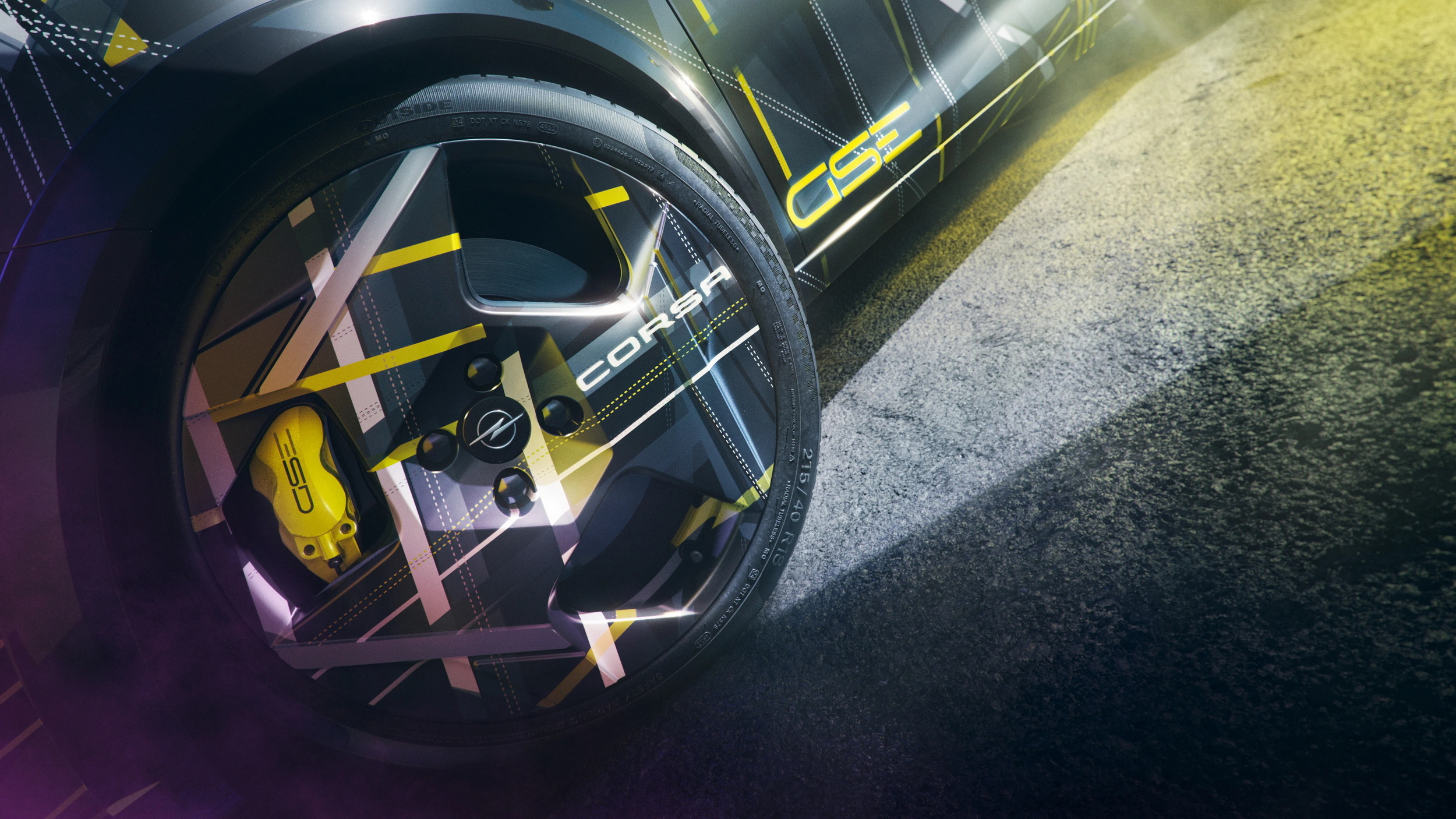
We already saw a teaser last week, zoomed in tight on a wheel like it was hiding state secrets. Now the prototypes are out stretching their legs, wearing camo but not bothering to disguise the yellow brake callipers and chunky wheels that scream performance model.
Visually, expect something close to the Mokka GSE SUV that debuted last year. That means dynamic-looking wheel rims, plenty of moody black detailing and a lower stance resulting from uprated springs and dampers. The body panels appear largely unchanged from the facelifted Corsa, but sharper bumpers and extra cladding should help it stand apart from lesser trims in supermarket car parks.
Close To 280 hp
Baldauf
Under the skin, the smart money says it’ll also mirror the Mokka GSE and its Stellantis cousins. Expect a front-mounted electric motor pushing out around 278 hp (281 PS / 207 kW) and 255 lb-ft (345 Nm) of torque, plus a Torsen limited slip differential and stiffer suspension are expected to keep torque steer tantrums in check.
Opel claims a 5.9-second zero to 62 mph (100 kmh) time for the Mokka, so the lighter Corsa should knock a couple of tenths off that, matching the 5.7 seconds Peugeot quotes for the Corsa GSE’s French brother, the 208 GTI.
Baldauf
Power will likely come from the familiar 54 kWh battery pack fitted to both the Mokka and 208. But the driving range will come in closer to the 208’s 217 miles (350 km) than the 201 miles (324 km) Opel says the taller, heavier Mokka can deliver between charges.
Competition Hotting Up
The 208 GTI marks the first time Peugeot has dropped a GTI badge on an EV, but it won’t the £35-40k Corsa GSE’s only competition. Alpine and Mini already have hot hatch EVs on sale and VW launches its first electric GTI this year, the ID. Polo GTI.
From what we’ve seen the Polo is going to have the upper hand when it comes to design, both inside and out, but with only 223 hp (226 hp / 166 kW), it’s not going to have the firepower of the Stellantis duo.
Stronger Leapmotor ties could sharpen its VW, Renault fight.
A US ban on Chinese tech cars still poses a real hurdle.
Stellantis booked $26.1 billion in EV strategy write-downs.
Stellantis is deepening its ties with China’s fast-moving EV sector as it searches for a more efficient path through the electric transition. In 2023, the group inked a deal with Chinese EV startup Leapmotor, purchasing a 20 percent stake in the firm for $1.1 billion. The agreement made Stellantis the exclusive distributor of Leapmotor models in Western markets.
Now, it appears the relationship could extend beyond distribution, with Stellantis potentially tapping into its partner’s EV technology for brands such as Fiat, Opel, and Peugeot.
According to Autonews, unnamed sources say Stellantis wants access to Leapmotor’s battery and EV powertrain technologies. It’s understood that discussions are in their early stages, but using Leapmotor’s systems would help Stellantis save billions of dollars in development costs, and allow it to more quickly roll out rivals to vehicles from Chinese competitors like BYD and MG, in addition to legacy brands including the VW Group and Renault.
However, actually using Leapmotor’s battery and EV technologies could prove challenging. For example, vehicles using connected systems linked to China will be banned from importation and sale in the US from 2027.
What’s Next for the Partnership?
While speaking about the collaboration between the two companies, Stellantis chief executive Antonio Filosa said the “technical partnership… will help us in getting to higher level of competitiveness especially with electric cars and it is very important for Europe.”
He added the partnership will also “improve our collaboration also on new tech development,” noting that “2025 was a year of strategic implementation for the partnership, setting the stage for deeper integration”, according to Autonews.
EV Write-Downs And Reset
Earlier this month, Stellantis announced write-downs and charges of €22.2 billion ($26.1 billion) as it scaled down its EV strategy. However, it knows it can’t back away from EVs entirely, hence why it’s interested in deepening its ties with Leapmotor.
Through the Leapmotor International joint venture, Stellantis has helped the Chinese brand launch several of its models, like the C10 and B10, in markets including Europe and Australia. For a brief period, it was also building the small T03 in Poland, but this ended last year amid fluctuations in international trade policies. This year, Stellantis plans to start building Leapmotor vehicles at its Zaragoza plant in Spain.
Xiaomi unveiled its Vision Gran Turismo concept at MWC 2026.
Like the Aston Martin Valkyrie, it uses huge venturi tunnels.
The cocoon-like cockpit makes just enough space for two.
Chinese smartphone and consumer electronics giant Xiaomi, now very much a car manufacturer too, has become the first Chinese brand to unveil its own Vision Gran Turismo concept. Presented at the Mobile World Congress 2026 in Barcelona, Spain, the car is bold and offers a glimpse of what a legitimate hypercar from the tech juggernaut might look like if it ever reached production.
Underpinning the Vision GT is the company’s 900-volt Silicon Carbide platform. While no performance specifications have been released, it could deliver upwards of 1,900 hp from its electric powertrain. Most of the details shared by Xiaomi focus on the car’s design and aerodynamic intent.
According to Xiaomi’s head of automotive design, Li Tianyuan, the Vision GT concept posts a drag coefficient of 0.29 and has effectively been sculpted by the wind.
Like track-obsessed machines such as the Aston Martin Valkyrie and Red Bull RB17, the Vision GT runs vast venturi tunnels beneath its bodywork. They channel air through the underfloor and eject it at the rear, creating a dramatic tail section that works to pin the car to the tarmac at speed.
There’s no word on how much downforce it could have, but it’d inevitably be enough to warp your face while going around corners. The front-end includes a motorsport-inspired carbon fiber splitter and unobtrusive LED headlights. As mentioned, the rear is dominated by the huge venturi tunnels, but the LED taillight wrapping around the entire back of the car is also very striking.
Xiaomi has also imagined the Vision GT with a set of very intriguing wheels. Sitting over a set of carbon-ceramic brakes, the concept has a set of turbine fan rims with a floating cover over them, making it appear as though the wheels aren’t moving when the car is driving.
A Cabin From Another World
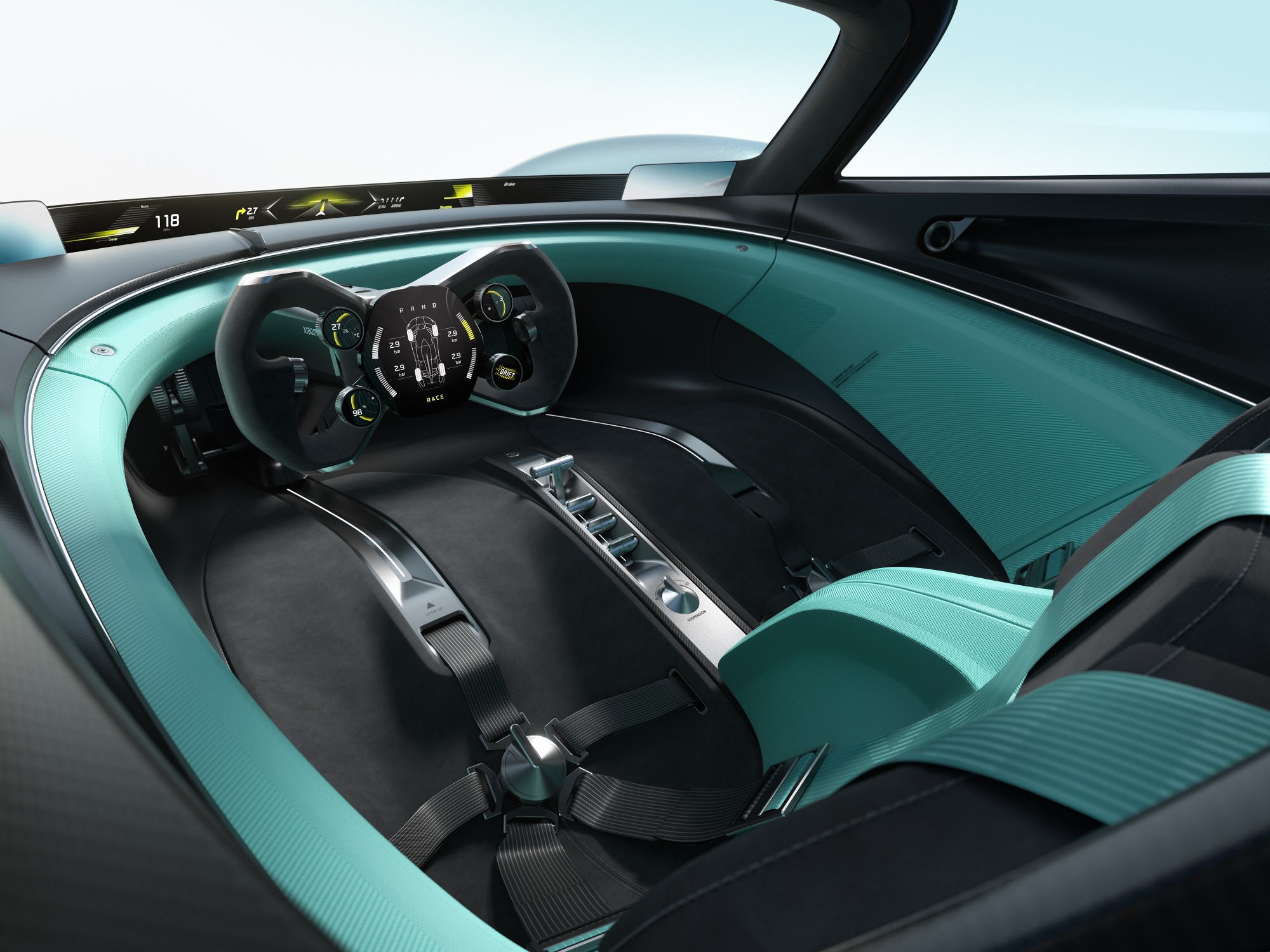
The cabin looks tight, but futuristic. Occupants sit in a pair of seats stuffed into the carbon fiber monocoque. There’s a panoramic head-up display similar to the new BMW iX3, as well as a steering wheel straight out of racing with five large circular screens, including a toggle for a drift mode.
There’s no word on when the car will be added to Gran Turismo, but it should be made available in the coming weeks. Will it influence a future road-going supercar from Xiaomi? Not likely, at least in that extreme form, but only time will tell.
Before yesterdayElectric Vehicles - Latest News | Carscoops
U.S. consumers are sharply divided on Chinese vehicle brands.
Dealers show strong resistance despite notable shopper curiosity.
Price incentives could sway buyers, but trust remains critical.
If you spend any time in automotive comment sections, you’ve seen it. Someone inevitably points to a cutting-edge EV from China and declares it superior to whatever U.S.-market model is under discussion. There’s a huge catch, though: that vehicle doesn’t actually exist in the American marketplace.
It’s not federally certified, not sold through U.S. dealers, not supported by a domestic service network, and not priced with tariffs factored in. It’s a theoretical alternative, not a real one, and new research helps explain why this dynamic exists. Americans are forming opinions about Chinese automakers before most have ever seen one in person.
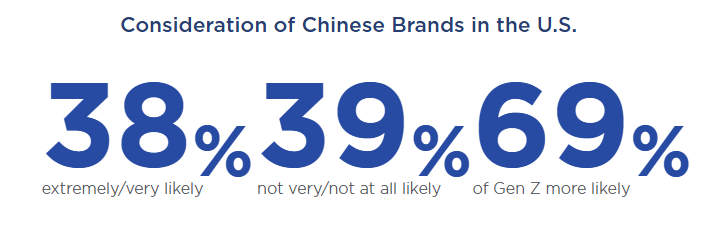
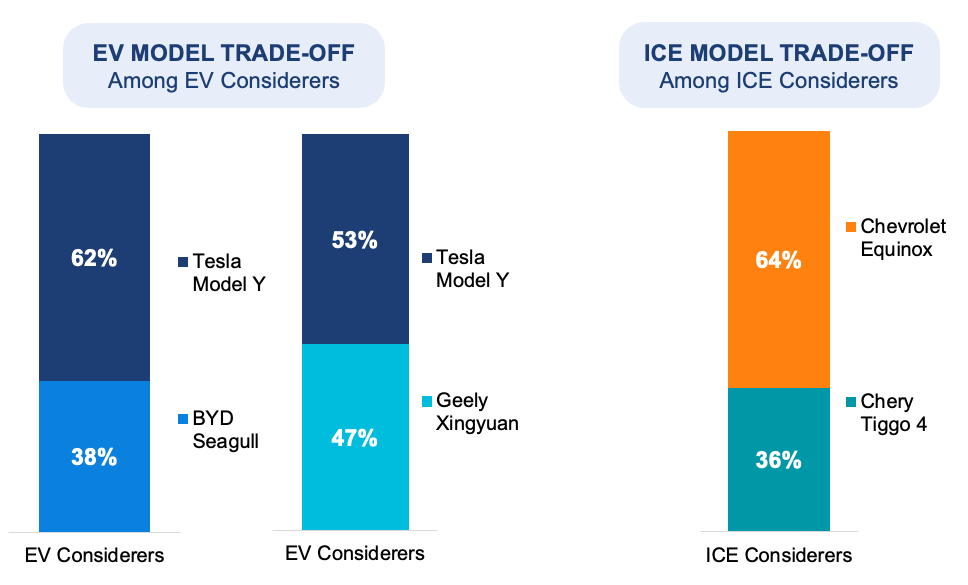
According to a study from Cox Automotive, consumers are heavily divided. Around 38 percent of shoppers say that they’re extremely or very likely to consider a Chinese brand. Another 39 percent says the opposite, that they’re extremely unlikely to do so. Among Gen Z buyers, the openness jumps to a whopping 69 percent, so if this ever does happen, expect the marketing to skew toward younger folks.
That split implies any early traction would likely be concentrated within specific demographics rather than spread across the broader market, creating both opportunity and risk for established players.
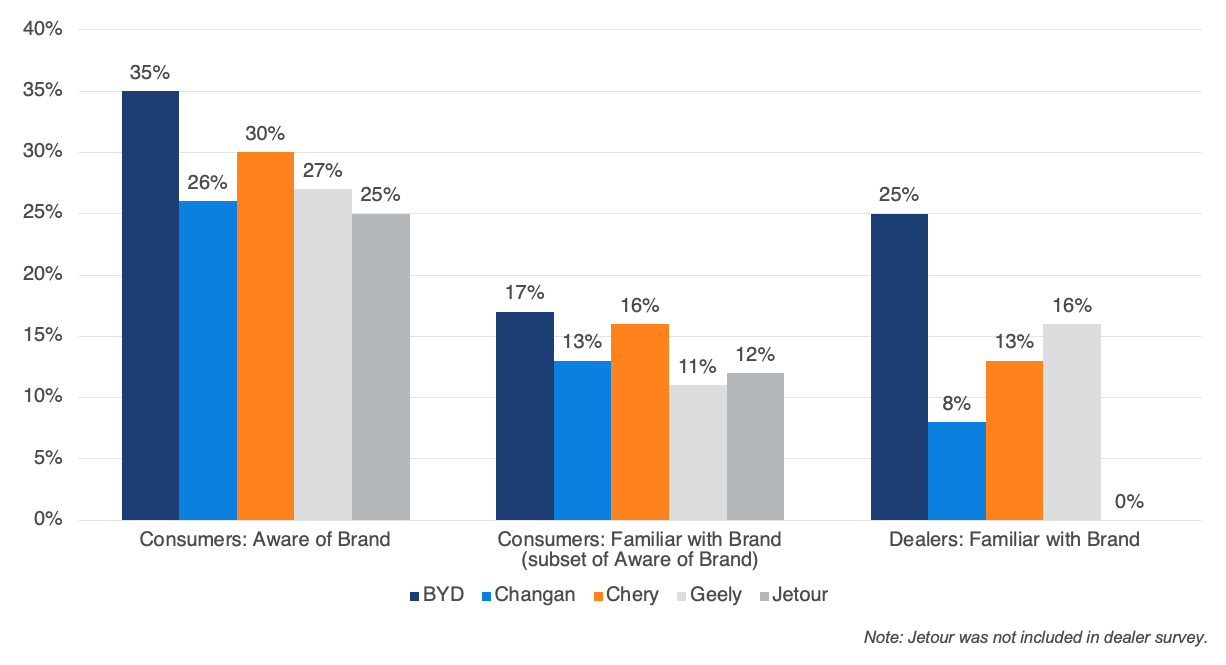
That said, actual awareness is thin. Nearly half of those surveyed said they were familiar with Chinese brands, but actual brand knowledge falls off a cliff quickly. BYD is the brand most are familiar with and that made up just over one-third of respondents. In total, only 17 percent said they had a deeper awareness of it. That’s a pretty big insight gap.
Dealer familiarity lags even further behind, with only about a quarter reporting any awareness of BYD, a reminder of how preliminary this conversation still is at the retail level.
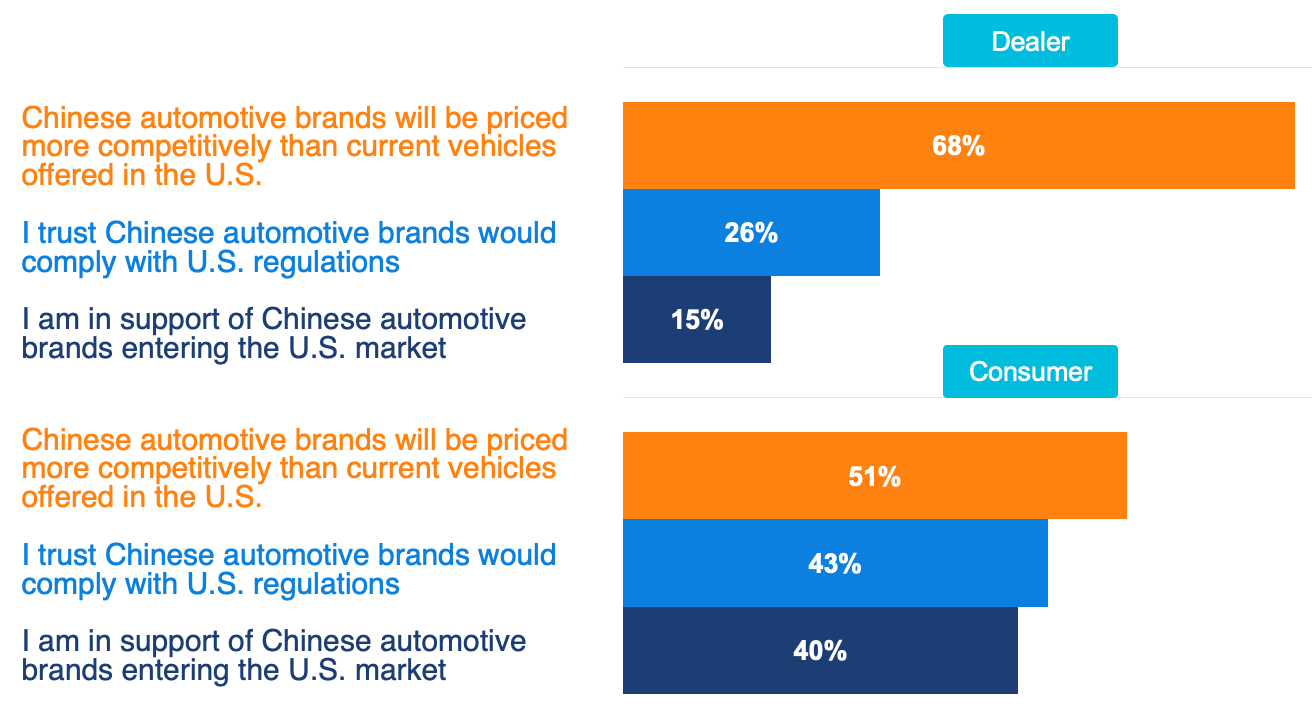
While around 40 percent of consumers say that they’re interested in Chinese brands coming to America, dealers, the ones with the real power, aren’t so hot on it. Only 15 percent said they’d like these brands in the USA. In fact, 92 percent of dealers reported concerns about selling Chinese vehicles. They cited everything from reliability to safety to long-term viability. That hesitation matters even more than the fact that some 60 percent of buyers aren’t interested.
The research also found that roughly 70 percent of dealers would adjust their business strategies if Chinese brands entered the market, suggesting preparation may follow skepticism.
Partnerships could shift the equation, though. When consumers were asked to consider a Chinese automaker aligned with an established U.S. brand, purchase consideration rose sharply to 76 percent, indicating that brand pairing may influence acceptance as much as pricing or product.
The Attraction
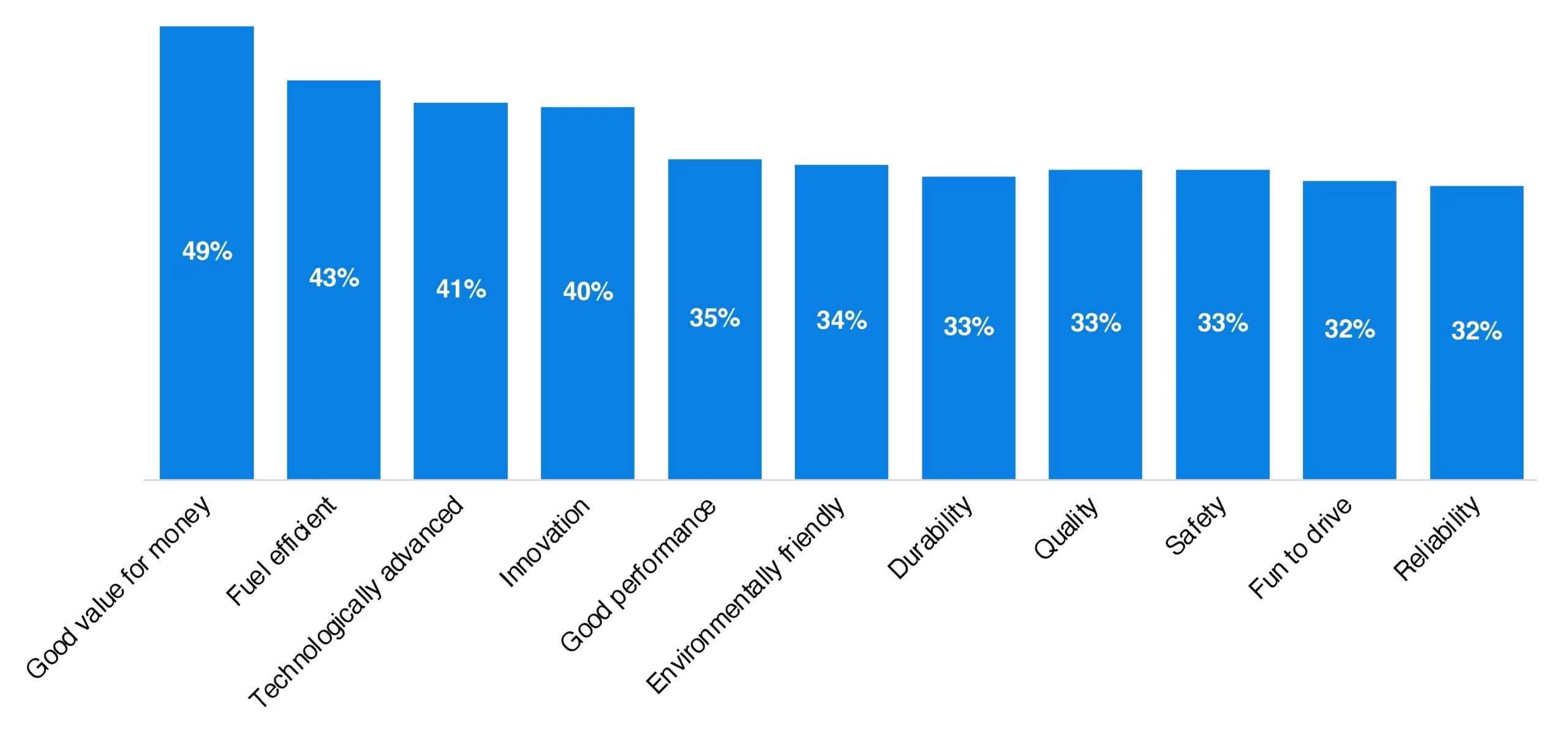
Interest does not appear to hinge on technology, styling, or practicality. It comes down to price. Nearly half of consumers rate them positively for affordability, and 35 percent give strong marks for performance. No doubt, we’ve seen pricing for Chinese automobiles undercut just about every other brand. But durability, safety, quality, and reliability fall short, and those are precisely the fundamentals that drive mainstream purchase decisions.
When consumers directly compared specific models, Tesla’s Model Y maintained a clear edge among EV shoppers, and the Chevrolet Equinox led among ICE vehicles, reinforcing the staying power of established nameplates.
However, when steep price discounts were introduced into side-by-side comparisons, a meaningful share of buyers indicated they would switch, particularly among lower-income and more price-sensitive groups.
Dealer and Consumer Comparisons (Strongly or Somewhat Agree)
Established U.S. brands still hold the advantage, buoyed by trust and familiarity. Price can narrow that gap, especially among more cost-sensitive buyers, but it doesn’t erase it. And it’s why those folks in the comment section suggesting that readers get a BYD Dolphin instead of whatever is actually available might have to wait a while longer before that comment makes any sense.
Consumers Rate Chinese Brands Lower on Buying Criteria (Durability, Quality, Safety and Reliability)
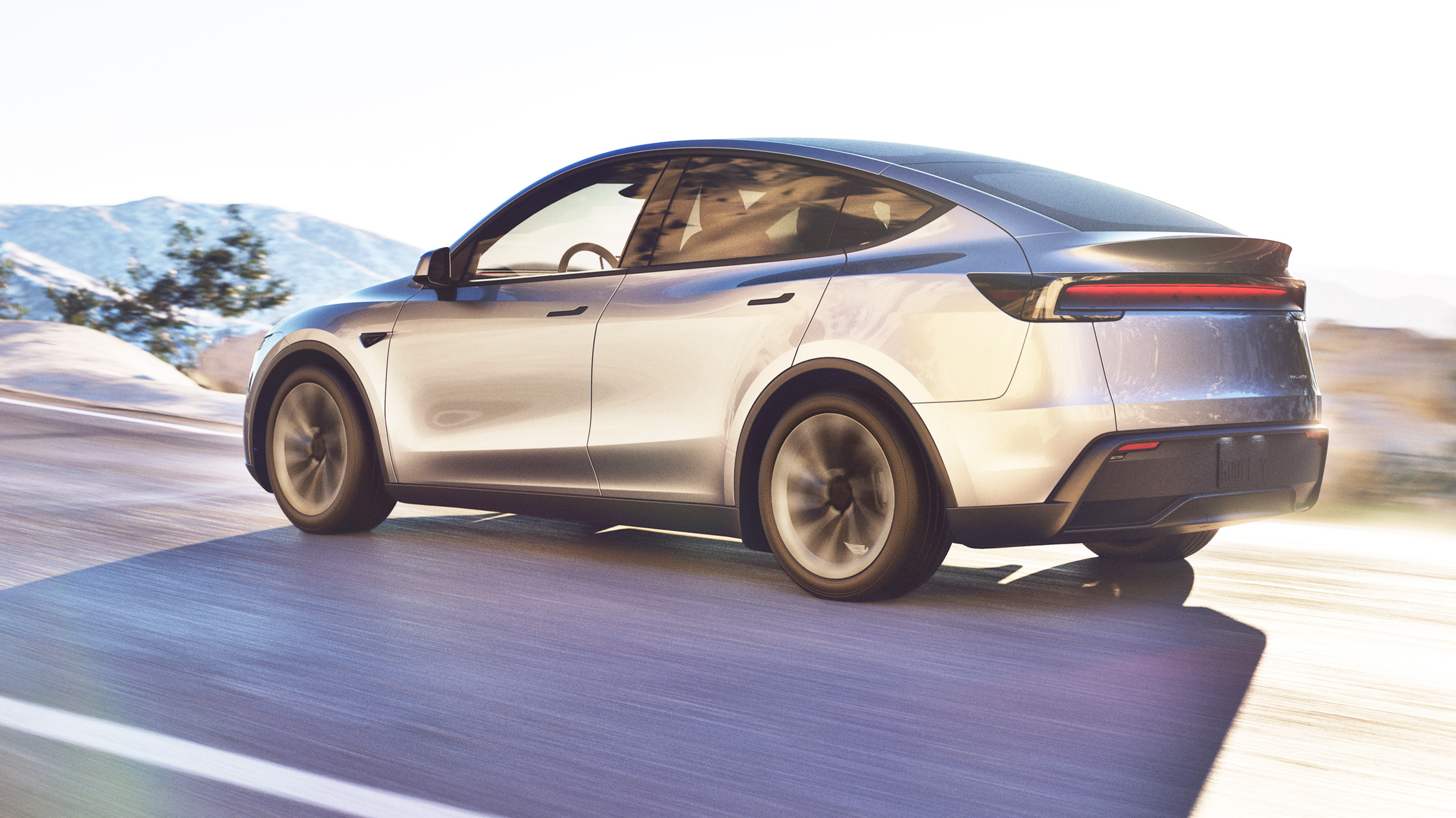
Murphy PD in Texas now runs the 2026 Model Y Juniper.
Each unit saves $4,100 to $12,000 a year in fuel and upkeep.
Its electric drivetrain could double the car’s service life.
The Murphy Police Department in North Texas has become the first agency to roll out the refreshed 2026 Tesla Model Y Patrol, upgraded by Unplugged Performance. Instead of committing to a full fleet replacement, the department is running the EV in real-world conditions to see how it holds up to daily patrol duty.
Officials say the more persuasive case is financial. Each cruiser is projected to deliver measurable savings compared to a traditional ICE-powered patrol vehicle.
According to data from the City of Murphy, projected annual savings per vehicle range from $4,100 for single-officer units to as much as $12,000 for shared-shift cars clocking more than 140 hours per week. The bulk of that comes from eliminating fuel purchases, though the department will still incur electricity costs, along with a 75% reduction in maintenance compared to gasoline vehicles such as the Chevrolet Tahoe and Ford Explorer.
No Idling Wear
The savings story does not stop at fuel and oil changes. EVs do not suffer engine wear from constant idling, which accounts for roughly 60% of a patrol car’s working life. As a result, they are expected to remain in service for up to twice as long as an ICE-powered equivalent.
Given that every hour spent idling is effectively equal to 33-35 miles (53-56 km) of driving wear, that difference adds up quickly. Without a combustion engine ticking away under the hood, the Model Y can sit on scene running lights, laptops, and climate control off its battery, without quietly shortening its lifespan.
Juniper Patrol Cars
On the hardware front, the facelifted Tesla Model Y Juniper has been converted into a patrol unit by UP.FIT, the specialized fleet division of Unplugged Performance. Compared to the road-going version, it gains a front push bar, additional LEDs at the front and sides, a roof-mounted siren, and 18-inch forged aluminum wheels wrapped in pursuit-rated tires.
The police car is offered in RWD and AWD configurations, using the standard electric powertrains and delivering between 321-357 miles (517-574 km) of range per charge. That is more than enough for routine duty. And because police work occasionally involves pursuits, braking performance has been upgraded with six-piston calipers, stainless steel brake lines, specialized fluids, thermally upgraded components, and uprated rotors.
Inside, officers get ventilated seats and improved sound insulation. Each vehicle is retrofitted with a customizable center console, a laptop mount, two weapon mounts, upgraded interior lighting, and a single rear prisoner partition.
Optional extras include ballistic protection for the front doors and custom reflective graphics.
UP.FIT has not disclosed the final MSRP for the Murphy units, though it insists the total cost of ownership undercuts everything else in the segment. Beyond the Model Y crossover, the company also offers police-ready conversions for the Cybertruck, Model S/X, and Model 3, in case your local department prefers its patrol cars in a different shape.
If the Bentayga proved anything, it is that Bentley buyers have no issue with a luxury SUV wearing a winged badge. So a second one was never really in doubt. That follow-up is now deep into development, and it has just been spotted winter testing for the first time.
For now, it is referred to as the Urban SUV, though that name is almost certainly temporary. It will sit below the Bentayga in the range and, more significantly, it will be fully electric. Yes, the EV market has cooled slightly, but Bentley appears confident that its customers are still ready for a battery-powered SUV with the right badge on the nose.
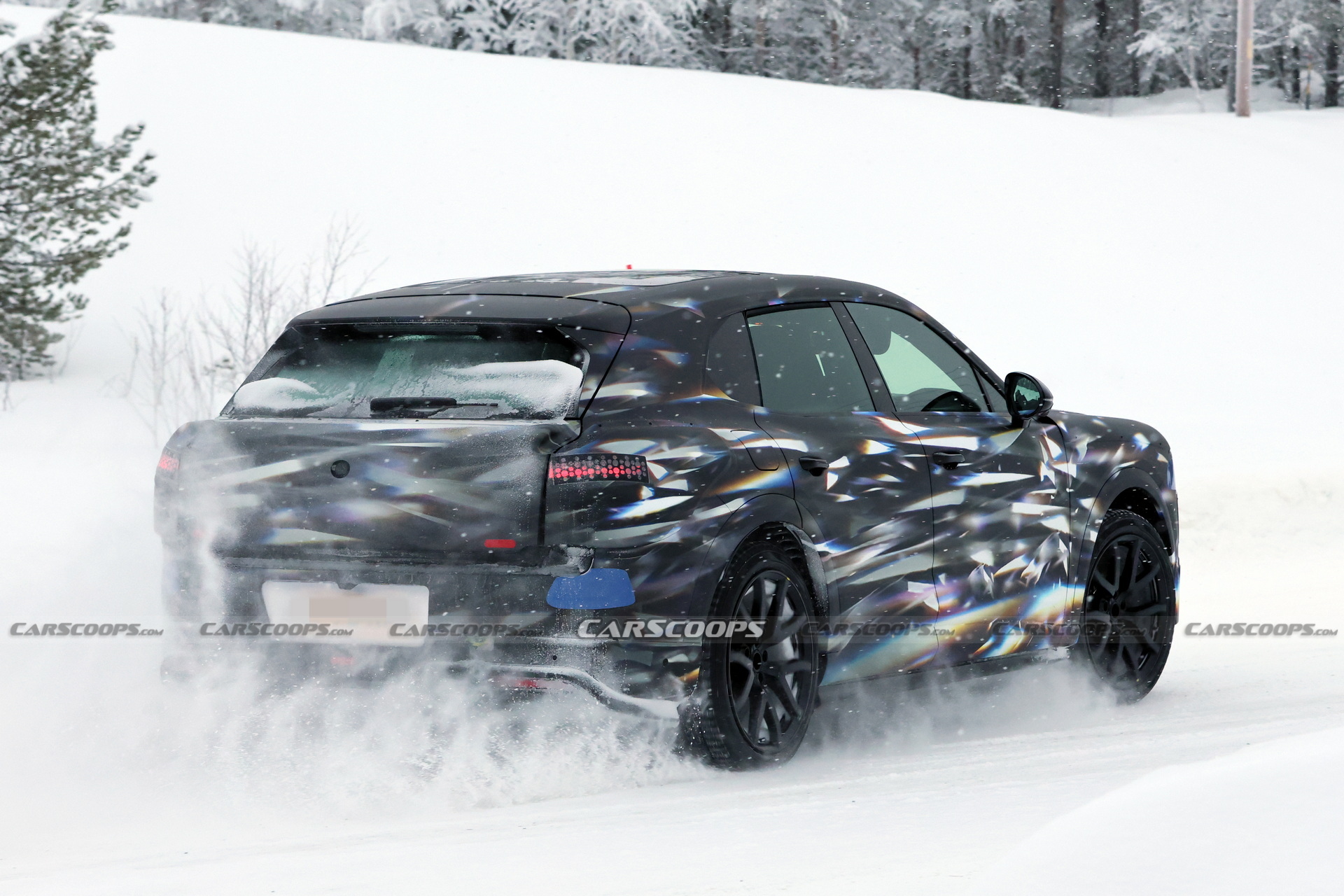
Several prototypes have been seen out on the road in recent months, but this is the first time one has appeared wearing this darker, more dramatic camouflage scheme. It’s been adorned with a large LED light bar at the front, ensuring the engineers testing it can still see after the sun sets in the depths of Europe’s winter.
SH Proshots
Most of the Urban SUV’s shape is still carefully disguised, but a few details are slipping through. Up front, the headlights feature four distinct lighting elements, giving it a signature that sets it apart from today’s Bentleys. Around the back, temporary cladding does its best to obscure the view, though slim LED taillights are clearly visible beneath the camouflage.
A Porsche Powertrain
Bentley is building its second SUV on the same Premium Platform Electric architecture as the new Porsche Cayenne Electric. That strongly suggests plenty of shared hardware with its German cousin, potentially including battery packs and motor configurations.
As it stands, the entry-level Cayenne Electric delivers 402 hp and tops out at 1,039 hp in the extraordinary Turbo variant. Our hunch is that the base Bentley will deliver around 600 hp. Whether or not it receives a flagship version with a four-digit horsepower figure remains uncertain.
One figure Bentley does seem keen to emphasize is charging speed. The SUV is expected to support ultra-fast DC charging, with the promise of adding 100 miles (160 km) of range in just seven minutes.
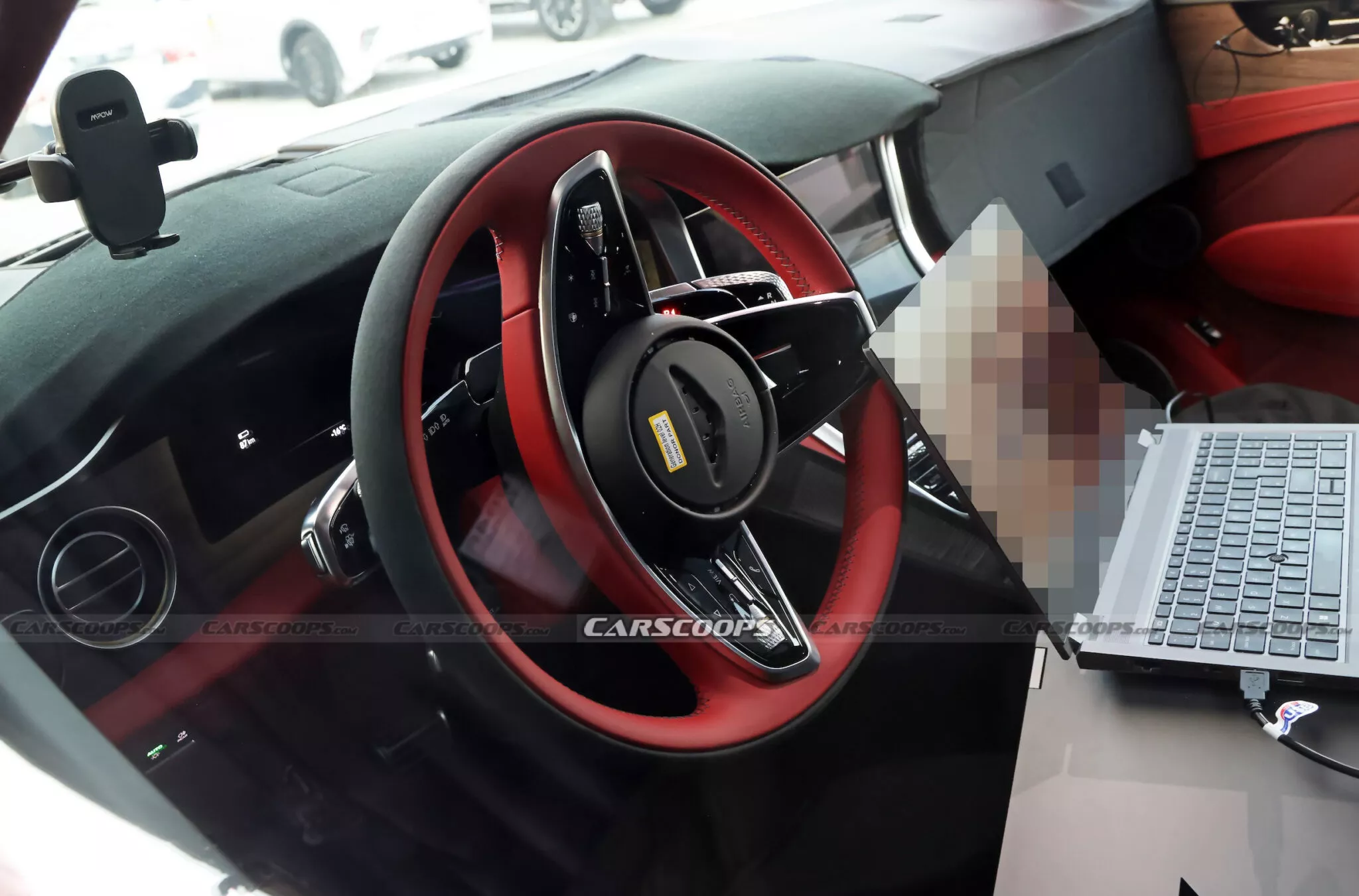
Late last year, our spy photographers finally caught the cabin in clear view. The images show a curved central infotainment screen that looks very close to the setup in the Cayenne Electric, paired with a separate digital instrument cluster ahead of the driver. It is familiar architecture, even if the surrounding materials will inevitably be pure Bentley.
There is more evidence of parts sharing lower down the steering column. Bentley’s compact electric SUV appears to use the same multi-function stalk arrangement as the new Audi Q3. Indicators, wipers, and headlight controls are grouped on the left stalk, while the right is dedicated solely to the shifter.
As for timing, Bentley could give us our first proper look at the production-ready model later this year. Customer deliveries of the Urban SUV are expected to begin in 2027, which gives Crewe a little time to perfect the details and, presumably, settle on a name that is not “Urban SUV.”
The Rivian Adventure Department has made its official debut.
It’s a skunkworks team that pushes boundaries to improve vehicles.
Has already paved the way for the RAD Tuner and new drive modes.
Rivian has used the FAT Ice Race in Montana to introduce the Rivian Adventure Department, or RAD for short. It’s being billed as a skunkworks team of designers, engineers, and enthusiasts “who spend their days and nights exploring the limits of what a Rivian can do.”
The company said a lot without saying much of anything, but the team is focused on unlocking the next level of capability and performance. They aren’t limited to cubicles either as they’ve “learned there’s no substitute for real-world experience.”
This has already seen the company enter and win the 2023 Rebelle Rally as well as set records for a production electric truck at Pikes Peak in 2023 and 2024. Learnings from these experiences is then fed back into road-going models.
While win on Sunday and sell on Monday is hardly a new idea, Rivian said their off-road adventures directly resulted in the Desert Rally drive mode as well as the RAD Tuner. The latter debuted on the second-generation R1 Quad lineup and enables owners to customize their driving experience.
While a number of automakers offer a personalization setting, most only let you adjust a few things. Rivian, on the other hand, allows drivers to tweak acceleration and regeneration as well as damping, ride height, brake assist, steering, wheel slip, and torque bias – among other things. In effect, it enables you to fine-tune the vehicle’s characteristics exactly to your liking and the situation at hand.
Will RAD Become Rivian’s AMG?
The Rivian Adventure Department has been around for awhile, but now it’s out in the open. As Chief Design Officer Jeff Hammoud explained, “RAD represents the living, breathing expression of the passion that defines Rivian. That impulse to explore, to push limits, and to embrace the adventure is not confined to one team—it is the very DNA of our entire company, from the designers and engineers to our community of owners.”
The big question is what happens next. Does RAD remain a relatively low-key team focused on improving existing products or do they transform into Rivian’s version of BMW M, Cadillac V, and Mercedes AMG? Only time will tell, but it feels like little more than marketing at this point.
Volkswagen has delivered its 2 millionth EV, an ID. 3 hatch.
It only celebrated the 1 millionth electric car in April 2025.
New affordable models like ID. Polo and ID. Cross coming.
Volkswagen has just handed over its 2 millionth fully electric vehicle, and the pace is what really grabs you. It took 12 years to reach the first million. The 2 millionth car showed up just 10 months later.
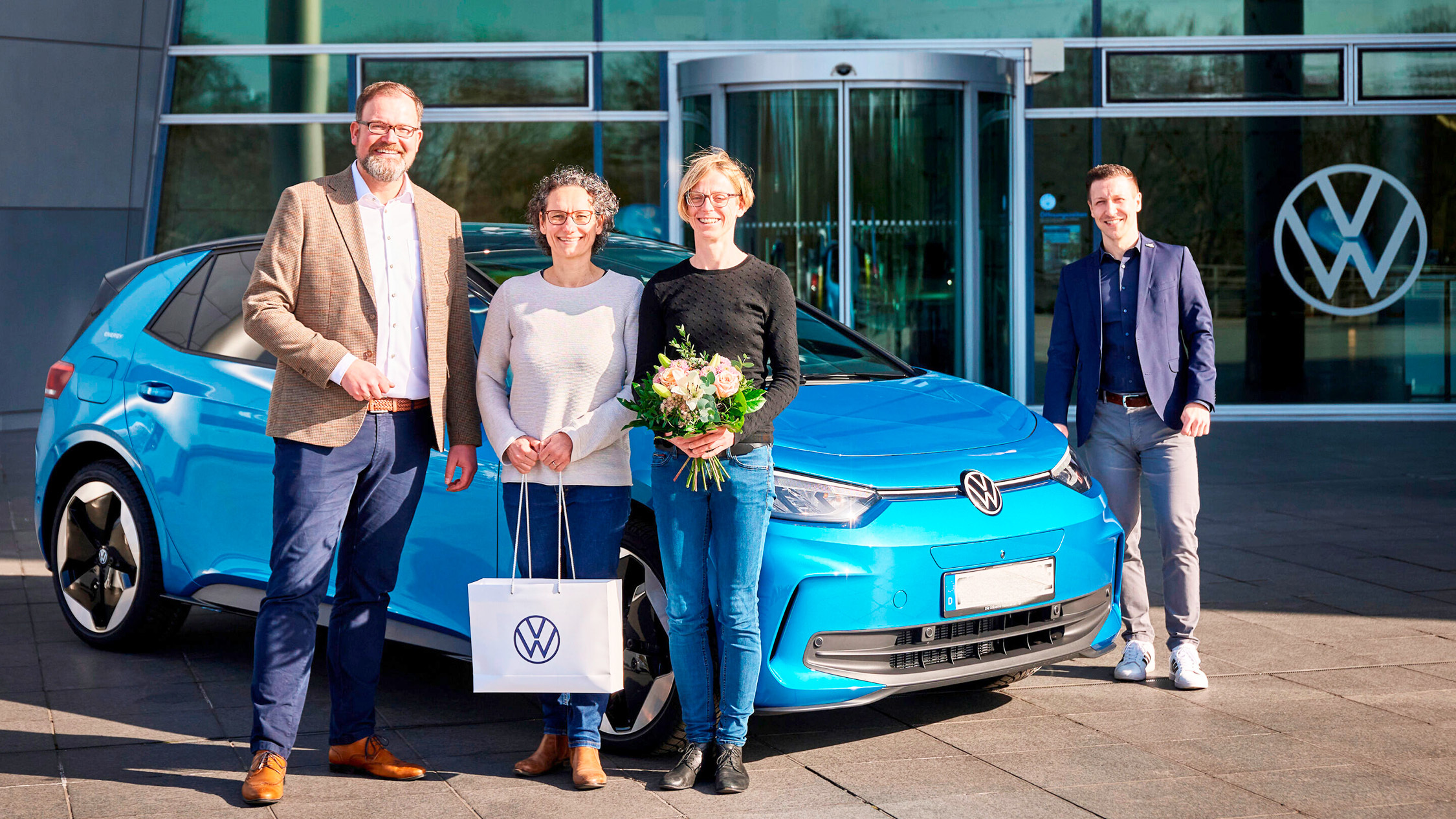
The anniversary car is an ID. 3 hatch, built in Zwickau, Germany, and delivered to a customer at the Transparent Factory in Dresden. The ID. 3 kicked off VW’s large-scale MEB era back in 2020, though the modern electric journey really began with the e-up in 2013 and the company experimented with a small number of electric Golfs as far back as the 1980s.
Volkswagen only celebrated its 1 millionth EV, an ID.3 GTX, last April. That means the brand effectively doubled its lifetime electric output in less time than it takes some automakers to add a new paint color to mark a model-year changeover.
ID. 4 Led The Charge
The heavy lifter in that sales charge is the ID. 4 SUV, which together with its ID. 5 fastback brother clocked up roughly 901,000 deliveries worldwide, proving SUVs still rule even in the electric age. The ID. 3, whose sales potential is restricted by the fact that it’s not available in North America, follows with around 628,000 units, while the larger and more premium ID. 7 has added another 132,000 to the tally.
Europe is the engine behind much of that growth. Roughly one in five cars sold there is now electric, and Volkswagen has carved out a leading role in the region. The US market has definitely cooled, but globally, the trajectory is still pointing upward.
More EVs On The Way
And VW isn’t slowing down. A refreshed ID. 4 badged as the ID. Tiguan is on the way this year, and the new ID. Polo (seen below) and first ever electric GTI, the ID. Polo GTI, will take the fight into the affordable small car segment.
An ID. Cross SUV spinoff follows soon after and an electric ID. Golf is also looming on the horizon. At this pace, don’t be surprised if we’re talking about 3 million before your summer tan has faded.
The new battery delivers 400 Wh/kg energy density.
Mass production is planned to begin next year.
BYD, SAIC, GAC, and CATL are developing similar packs.
Solid-state batteries have been “just around the corner” for what feels like an entire EV generation. Now, they might actually be arriving. In the third quarter of this year, China’s Changan will begin fitting its new solid-state packs to robots and EVs, with full mass production slated for 2027.
According to Chinese media, Changan claims its new solid-state battery has an energy density of 400 Wh/kg, and EVs using it will be able to travel upwards of 932 miles (1,500 km) on a single charge. While you could argue that this much range borders on excessive, it would make future Changan models far better suited to long road trips through remote areas where charging infrastructure remains sparse.
Breakthrough Energy Density
The pack is called the Golden Bell. Aside from being very energy-dense, it is said to be 70 percent safer than a conventional EV battery and, because this is 2026, it also uses artificial intelligence for remote diagnostics. Smarter batteries, apparently, are part of the plan.
Changan will build these units under its new Jingzhongzhao solid-state battery brand. The company intends to manufacture fully solid-state packs while also producing liquid and semi-solid-state batteries that rely on a liquid electrolyte.
China’s Solid-State Push
It is not alone. Other Chinese brands are also edging closer to making solid-state batteries mainstream. Earlier this year, Dongfeng Motor began testing its own solid-state battery in extreme cold weather. It has an energy density of 350 Wh/kg and a claimed range exceeding 620 miles (1,000 km). It also plans to roll them out in production cars this year, aiming for September.
BYD, Chery, SAIC, GAC, and CATL are all chasing similar breakthroughs. So are legacy names such as Mercedes-Benz, VW, BMW, Toyota, Nissan, Hyundai, and Honda. After years of promising headlines and laboratory milestones, solid-state batteries may finally be edging toward something tangible. If they deliver on even half of these promises, combustion engines will have one more reason to feel nervous.
Cupra Born facelift teased with sharper triangular lights.
Already great interior quality set to get another boost.
Growing brand’s new-look EV makes its debut March 5.
Cupra is at it again, reminding us why its versions of big-name Volkswagens are almost always superior to the real thing. This time, the Spanish brand has teased an updated Born, its sportier take on the VW ID.3, and we’ll get to see the full makeover on March 5.
The biggest change is visual, and it seems like it’ll be hard to miss. The updated Born adopts Cupra’s latest design DNA, complete with triangular Matrix LED headlights and a matching triangular lighting graphic at the rear. There’s also an illuminated rear badge because lit logos are the car design world’s new LED light bar.
We’ve spied disguised prototypes of the facelift Born testing a couple of times, and those images suggest redesigned bumpers and a taller lower grille augmented by vertical outer vents that make the EV look tougher and wider.
Tech Upgrade
The Born’s cabin already makes the ID.3s look cheap and dull (though VW did improve the materials a couple of years ago), and Cupra says we should expect even better quality and more technology in the refreshed car. But it’s not like the brand has a ton to do in this area, having already upgraded the Born to VW’s much-improved 12.9-inch touchscreen in 2024.
Few Below-Surface Changes
Under the skin, things are more mysterious, and we’re guessing that’s because it’s all carried across from the current hatch. Cupra hasn’t confirmed any technical changes, and the current Born is already competitive for electric range and performance in its class. So this update could be more about feel and flair than extra kilowatts. Still, a little surprise boost wouldn’t hurt.
As of today, Cupra skips the low-tune motor options offered in entry-level VW ID.3s and jumps straight to a 228 hp (231 PS / 170 kW) single-motor setup with a choice of 59 or 79 kWh batteries, giving up to 354 miles (570 km ) between fills. Hot hatch fans can upgrade to Cupra’s version of the ID.3 GTX, the Born VZ, which comes with a 322 hp (326 PS / 240 kW) motor, again driving the rear wheels only.
Rescuers couldn’t open SU7’s electric door releases as it burned.
Eyewitnesses tried desperately to smash the driver’s side window.
China will ban electric door releases like the SU7’s from 2027.
An official investigation into the death of a man who crashed his Xiaomi SU7 in China last year has confirmed details previously reported by local media. The findings underscore how critical basic mechanical access can become in seconds. Authorities concluded that the 31-year-old died after being unable to open the electrically operated doors once the electric sedan caught fire.
While this case involves a Xiaomi, concerns about electronically actuated door systems have been debated across the industry and in global markets for years. This isn’t just a Tesla issue.
The crash occurred at approximately 3:15 a.m. on October 13, 2025, in Chengdu, reports Carnewschina. The Xiaomi driver, identified simply as Deng, was allegedly driving under the influence of alcohol at the time and slammed into another vehicle on Tianfu Avenue South before jumping over the central divider and bursting into flames.
Timeline Of The Crash
According to forensic findings cited by the Chinese magazine Caixin, the SU7 reached 203 km/h (126 mph) just three seconds before the crash. It then slowed to 167 km/h (104 mph) after striking the other car and was traveling 138 km/h (86 mph) when it hit the divider.
Harrowing footage captured in the immediate aftermath showed bystanders attempting to smash the driver’s side window and open the door in an effort to save him, but without success.
Why The Doors Wouldn’t Open
Investigators concluded that the doors could not be opened from the outside because the fire caused the low-voltage system to shut down, disabling the door handle release function. The report added that the SU7 has no mechanical latches accessible from the outside and relies solely on electric release buttons.
Xiaomi shares plunged nearly 9% after a fatal crash involving its SU7 electric car, Bloomberg reports
According to the outlet, a 31-year-old driver in China collided with another vehicle, crossed into the opposite lane, and the car caught fire. Witnesses tried to pull the man… pic.twitter.com/yPQ70FoKXN
The Xiaomi also uses electric release buttons inside the cabin. Although it is equipped with mechanical emergency releases, locating and operating them while disoriented after a crash would not be straightforward.
Regulatory Response In China
This fatal crash, along with others, has prompted regulators in China to ban electronic door handles on EVs. The new rule will take effect on January 1, 2027. It will require exterior handles that provide a handhold of at least 60 mm by 20 mm (2.36 inches x 0.79 inches), ensuring they can be used by rescuers in an emergency. In addition, mechanical releases inside the vehicle must include clear signage explaining how to open them during an emergency.

 Login
Login