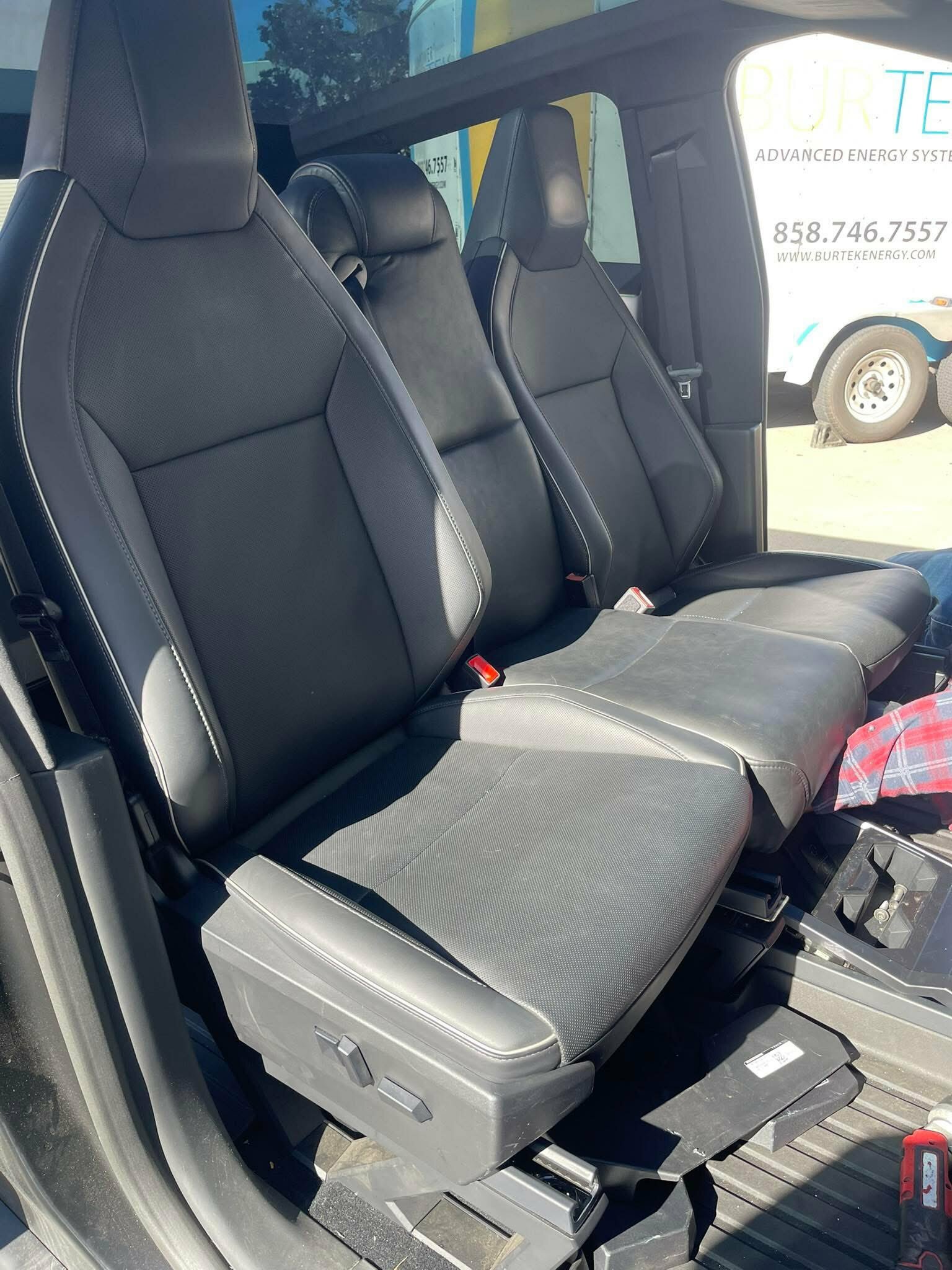
Cybertruck owner added a center seat to carry four kids up front.
Tesla showed this layout in 2019 but never offered it to buyers.
Custom seat has no visible airbags, which may affect crash safety.
Tesla owners aren’t strangers to modifying their vehicles. Sometimes, that action comes out of a desire for additional safety. Other times, it’s because Tesla itself didn’t deliver on a previous promise. And occasionally, those two aspects of design come into fierce opposition. That’s what happened here.
A father of four needed space for his entire family, and when it became clear that Tesla wouldn’t offer a six-seat Cybertruck, he took matters into his own hands. He commissioned a custom version and later shared the results in a Tesla group on Facebook.
The custom setup removes the center console of the truck and replaces it with a narrow upright seat wedged between the original pair. It comes complete with a seatbelt, but that might be where safety ends. We’ll come back to that, though. Let’s focus first on the design itself.
It’s a far cry from the angular unit Tesla once teased, but at least the upholstery matches. Some folks might not even realize that it’s an aftermarket addition because of that.
What Killed Tesla’s Center Seat Plans?
At the same time, it’s tough to call this a big win for now. While Tesla originally showed renders of a similar setup, it never came to pass. Many believe that’s because of safety regulations regarding the center seat.
Some observers have noted that the truck includes a driver’s side inboard airbag, which could strike anyone seated in the center. There’s also no airbag directly in front of that position. And beyond the lack of protection, there’s always a chance the seat may not be anchored to mounting points strong enough to hold up in a crash.
To be clear, this isn’t a knock on the owner’s intentions. Wanting to carry your entire family with you is obviously normal and easy to understand. But it does highlight a recurring Tesla theme. The brand and CEO often make bold promises, offer flashy renderings, and then production vehicles quietly walk things back a bit.
Tesla once showed a front bench. That version never reached production, and now an owner has stepped in to fill the gap with a custom modification. In doing so, he’s taking on a level of risk that some might find concerning in a six-figure vehicle. Maybe the solution here is to just get the Model X since it actually has room for the whole family.
Malachi James, 14, died in a Christmas crash with a Cybertruck.
Family wants Cybertruck banned for weight and safety concerns.
Their concerns are the same many have about trucks in general.
On Christmas night, the driver of a Tesla Cybertruck allegedly piloted their vehicle into oncoming traffic and hit a Toyota Corolla. Inside that car was 14-year-old Malachi James, who died as a result. Now, his family is raising questions about whether or not the U.S. should follow Europe’s lead and keep the Cybertruck off public roads.
“We are going to do our best to look at some ways to see if we can get them removed from the streets,” said Royael Saez, Malachi’s aunt, to WTNH.
“We don’t believe in something like this; this is a tank.” The family argues the Cybertruck is simply too big and too fast to safely share the road with normal traffic. “From our understanding, it’s already banned all over Paris, so obviously they know something like this shouldn’t be on the road,” Saez added.
While the vehicle meets U.S. safety standards and boasts a five-star rating from the National Highway Traffic Safety Administration, experts note its size and weight remain significant factors in crash severity. We’ll circle back to those factors, though.
Trucks Are Growing, and So Are the Risks
Dr. Eric Jackson from the Connecticut Transportation Institute explained, “They are very large vehicles, they are very heavy vehicles…a unibody structure, so it’s one solid frame throughout.”
He added that the Cybertruck is equipped with 11 cameras that record sensor data during collisions, helping investigators analyze accidents. The lightest Cybertruck model weighs 6,634 pounds, according to Tesla’s website.
While the James family’s concerns have focused on Tesla’s futuristic truck, it’s worth noting that the Cybertruck is far from unique in its size or weight. The Rivian R1T weighs roughly 6,800 pounds. Standard-sized pickups from Ford, GM, and Stellantis can all weigh as much, if not more.
Heavy-duty trucks like the Ford F-350, GMC Sierra 3500 HD, and RAM 3500 can weigh over 7,000 pounds and are considerably larger than any Cybertruck.
Regardless of powertrain or shape, heavier cars are worse at just about every important metric on public roads. Braking, handling, and visibility all suffer when compared to everyday commuter vehicles.
Critics are quick to call out the angular nature of the Cybertruck, but the reality is that all trucks probably deserve a lot more scrutiny than they receive.
As for the case that has broken the hearts of the James family, police now have their suspect in custody. He has 11 pending cases preceding this one, including one for reckless driving. Video from the scene appears to show him speeding and overtaking cars in the oncoming lane moments before the fatal crash. That type of behavior is dangerous in any car, not just a big angular pickup.
Tesla’s sales dropped 8.6 percent compared to 2024 totals.
Cybertruck and other models fell 50.8 percent year-over-year.
BYD outsold Tesla and claimed the global EV sales lead.
Sales data continues rolling in and the latest numbers are from Tesla. They leave a lot to be desired as deliveries slumped in the fourth quarter and fell for the year.
Jumping right into the numbers, Tesla delivered 418,227 vehicles in the fourth quarter of 2025. That compares to 495,570 units a year ago and this represents a 15.6 percent drop.
Interestingly, sales of “Other Models” – including the Model S, X, and Cybertruck – plummeted from 23,640 to 11,642. That’s a decline of 50.8 percent and it shows the company’s wedge-shaped pickup continues to be a flop.
For the full year, Tesla delivered 1,636,129 vehicles. That’s down from 1,789,226 in 2024, marking an 8.6 percent decrease overall.
Tesla Q4 2025 Sales
Production
Deliveries
Model 3/Y
422,652
406,585
Other Models
11,706
11,642
Total
434,358
418,227
SWIPE
Tesla didn’t have much to say about the disappointing numbers, but the company will reveal their full financial results on January 28. However, the Q4 numbers were worse than the original estimate of 422,850 vehicles. This also meant the full year sales total fell below projections.
While the numbers weren’t too far off, projections for Other Models was laughably wrong as they indicated the company would sell 34,848 units in the fourth quarter. However, they only managed to move 11,642, which means those estimates were off by nearly 300 percent.
Tesla 2025 Sales
Production
Deliveries
Model 3/Y
1,600,767
1,585,279
Other Models
53,900
50,850
Total
1,654,667
1,636,129
SWIPE
On the bright side, the automaker did reveal one positive development and that was a record deployment of 14.2 GWh worth of energy storage products in the fourth quarter. That brought their full year number to 46.7 GWh, which is a substantial increase from the 31.4 GWh deployed in 2024.
While Tesla didn’t delve into specifics, the company’s problems are well-known. Outspoken CEO Elon Musk alienated a number of his customers by joining the Trump Administration and slashing the federal workforce in a sometimes haphazard fashion. The company also had to deal with increased competition and the elimination of federal tax credits, which caused sales to slump at Rivian.
BYD Outsells Tesla
Tesla’s disappointing showing means they’re no longer the best-selling electric vehicle brand in the world. As BBC News reported, BYD sold 2,256,714 EVs last year, which put them 620,585 units ahead of Tesla.
However, this shouldn’t come as much of a surprise as Tesla was barely hanging onto the title. The company’s 1,789,226 sales in 2024 was just ahead of BYD’s total of 1,777,965.
It’s also worth noting BYD had combines sales of 4,537,356 units in 2025, which includes sales of things like plug-in hybrids and buses.
Tesla signed a $2.67B Cybertruck battery deal in 2023.
The deal has been slashed to just $6,776 after poor sales.
Cybertruck was expected to sell 250K yearly, hit under 20K.
Several years ago, Elon Musk proudly proclaimed that Tesla would be moving as many as 250,000 Cybertrucks annually. The electric pickup was billed as a disruptive force, set to shake up the truck market. In reality, it hasn’t come anywhere near those targets. This year, Tesla is expected to sell fewer than 20,000 Cybertrucks, less than 10 percent of that overly ambitious goal.
While you’ll never hear Tesla head honcho Elon Musk describe the Cybertruck as anything other than a raging success, lower-than-expected sales are hurting suppliers.
One notable casualty is L&F Co., a South Korean battery material supplier, which recently disclosed that its supply contract with Tesla had been cut by 99 percent, a shift attributed in part to sluggish demand for the truck.
A Contract Cut to the Bone
Back in February 2023, L&F had secured a sizable deal worth 3.83 trillion won (roughly $2.67 billion) to provide Tesla with high-nickel cathode material intended for the Cybertruck’s batteries. But that agreement has now been trimmed down to a token 9.73 million won, or about $6,776 at current exchange rates.
The original contract was tied to Tesla’s 4680 battery cells, which were first revealed in 2020. At the time, Tesla presented them as a major leap forward, central to its plan to rapidly expand production and eventually launch a $25,000 EV. That model has yet to materialize, and so far, the 4680 cells are used primarily in the Cybertruck.
According to an unnamed source with knowledge of the supply contract, L&F only needed to supply contract with small amounts of material as the development of the Cybertruck was repeatedly postponed. Bloomberg reports that policy and economic issues also affected the contract, including the elimination of subsidies through the Inflation Reduction Act.
SpaceX to the Rescue?
As Tesla continues to struggle with sluggish Cybertruck sales, a familiar buyer has entered the picture. According to a recent report, SpaceX has already purchased more than 1,000 Cybertrucks from Tesla, and that number could eventually climb to 2,000.
SpaceX hasn’t said why it’s buying so many Cybertrucks, but it likely has more to do with surplus stock than necessity. Either way, the move points to just how closely Musk’s companies operate, and hints that Tesla may be offloading inventory through its own back door.
Cybertruck’s 4-foot wiper has frustrated owners since launch.
Owners say wiper contact is weak, reducing cleaning ability.
Tesla confirms wiper performance is under investigation now.
It’s been two years since Tesla began delivering the Cybertruck to customers, yet the company is still wrestling with one of the vehicle’s most persistent design headaches. We’re talking about its massive single windshield wiper.
Despite earlier attempts to fix it through mechanical and software updates, Tesla is now believed to be working on a third version of the wiper system to finally address lingering faults.
A recent case in the US highlights the problem. When a Cybertruck owner brought their vehicle in for service, Tesla’s response revealed that “wiper performance is under active Engineering investigation,” according to a message from the company’s service department.
What’s Wrong With the Blade?
Complaints from owners began as soon as deliveries started. The wiper’s 4-foot blade is the largest fitted to any production vehicle, but users have flagged multiple problems. These include poor blade contact at the middle and top of the stroke, improper stowing at highway speeds, and washer fluid issues.
Performance drops further in cold weather, where salt, slush, and snow can overwhelm the system. Some owners have also noted that the wiper occasionally fails to clear the area in front of the forward-facing FSD cameras.
One post on X captured the frustration:
Love the Cybertruck. Hate the wiper system. Tesla needs to issue a voluntary service providing a free upgraded/redesigned wiper arm and sprayer. This is not a one-time event. Happens every time we hit salt/slush and snow. It’shighly unsafe. There were a few times today on I-70… pic.twitter.com/ajy2BYFQDA
Tesla recalled the wiper motors in June 2024 and has also updated the software, aiming to improve the blade’s movement and how it sits when not in use. A revised V2 blade has also been installed on many trucks, but that version appears to have its own reliability concerns.
The full scope of Tesla’s engineering investigation, initially reported by Not a Tesla App, hasn’t been made public. It’s unclear how long the company has been working on a fix or when an update might be introduced.
There’s speculation that a more substantial redesign could be underway. NotebookCheck notes that the original self-driving Cybercab concept featured a single wiper blade, similar to the Cybertruck. But a newer prototype, believed to be close to production, was recently spotted with a more conventional twin-wiper setup. That’s fueled suggestions that the Cybertruck might adopt the same configuration.
Tesla crashes where doors won’t open are drawing new scrutiny.
At least 15 deaths cited doors as a possible contributing factor.
More than half of those deaths occurred within the last year.
A new report has put the spotlight on a troubling pattern of fatal crashes in the US involving Teslas, where passengers were unable to open the doors, trapping them inside. As the brand’s EVs grow more common on American roads, so too does scrutiny over their safety features, or in this case, the lack of physical fail-safes in the event of a crash.
The investigation zeroes in on Tesla’s electronic door handles, a signature design feature that has since been adopted by several other automakers, raising concerns about an industry-wide trend toward software-dependent safety mechanisms.
During an ongoing investigation into safety concerns about these door handles, Bloomberg found evidence that at least 15 people have died in the past decade in incidents involving Teslas where locked or inoperable doors were cited as a potential factor in the victims’ inability to escape.
More than half of those deaths occurred within the past year, suggesting the issue may be becoming more common, or at least more visible, as awareness grows.
Behind the Numbers
The report acknowledges a critical limitation. There is no publicly maintained federal database that tracks fatalities specifically linked to electronic door handle malfunctions. As a result, the findings aren’t meant to represent a definitive or exhaustive total.
Instead, Bloomberg built its list by reviewing every known fatal electric vehicle crash involving fire in the US, then analyzing whether evidence suggested that the doors could not be opened either by occupants or emergency responders.
In each of the 15 cases they flagged, nonfunctional door handles were cited as having “impeded either the occupants’ efforts to escape or rescuers’ attempts to save those inside the vehicle.”
One such incident happened in Virginia, where a Tesla Model 3 skidded off a snowy highway, hit a tree, and caught fire. Footage from inside the patrol car shows that the officer was unable to open the Model 3’s door, forcing him to bash open one of the windows and pull out the driver.
Audio from the Wreckage
One fatal crash occurred in Wisconsin last year, killing five people inside a Tesla Model S. Audio from three 911 calls was later obtained, including one placed automatically by an occupant’s Apple Watch.
At least two of the occupants can be heard screaming and crying for help in the recordings, with one clearly saying, “I’m stuck” as the fire spread through the vehicle, ultimately claiming their lives. It remains unclear whether the other three victims survived the initial impact before the blaze took over.
Tesla Responds to Design Concerns
Tesla, for its part, appears to have quietly acknowledged the concerns in part. In September, reports surfaced that the company was exploring revisions to its door handle system. Future models may include a combination of electronic and manual release mechanisms, something already standard in brands like Audi and Lexus.
Perhaps eager to reassure shoppers about the safety of its vehicles, Tesla recently launched a new page on its website focused purely on safety. There, the company explains that its vehicles are designed to automatically activate hazard lights and unlock doors in the event of a serious collision. It also notes that the vehicle can contact emergency services autonomously.
However, Tesla also includes a key disclaimer: these features “may not be available in all regions or for all vehicles based on build date.”
While Tesla appears to be making some moves to address the issue in the future, questions still remain, not just about the company’s design choices, but also about the regulatory landscape and the lack of clear oversight. The analysis doesn’t claim that electronic door handles are inherently unsafe, but it does point to the need for more reliable fail-safes in situations where delays can be deadly.
Cybertruck donated to Kemah police by Enterprise Leasing.
Officers will test if it works for daily patrol operations.
Some Texans doubt the Cybertruck’s battery can keep up.
Authorities in Kemah, a small city just southeast of Houston, will soon be cruising the streets in an American-made pickup truck, though it’s not the kind most Texans are used to seeing.
Rather than another lifted, gas-hungry behemoth, the Kemah Police Department has added a Tesla Cybertruck to its fleet. The move didn’t exactly spark hometown pride. Judging by the comments on the department’s Facebook post, locals are having a field day with the decision.
A growing number of police forces across the United States have started to add Cybertrucks to their fleets. Just a couple of months ago, police in Texas took delivery of ten highly-modified Cybertruck police cruisers built by Unplugged Performance.
By comparison, the Cybertruck delivered to cops in Kemah looks completely standard, except for the police livery. They say that the truck was donated by Enterprise Leasing and that it will be used for testing to see if the Tesla works as a patrol vehicle.
Importantly, the police say they didn’t spend any taxpayer money on the acquisition. That hasn’t stopped residents from weighing in, many of them voicing strong opinions in the comments section of the department’s Facebook post.
What Do Texans Think?
“Lmaooo imagine the battery dying tryna chase someone,” wrote one commentor, while another posted “Y’all ain’t catching anyone in that.” There’s no word on what specify Cybertruck variant this is, but even if it’s the base model, we’re willing to bet it could easily be used to catch most motorists in Texas.
One Facebook user left this gem of a comment: “Hey guys, if anyone’s missing their refrigerator I found it, it’s having an identity crisis and is now trying to identify as a cop car.” Another wrote, “Flood waters, here we don’t come!”
One comment summed up the skepticism in classic internet style: “If that thing is chasing me, ain’t no way I’m stopping for a garbage can.”
Whether or not the Cybertruck proves practical for police work in Texas remains to be seen. The vehicle does offer notable performance and strong safety credentials, both potentially valuable in patrol scenarios. The biggest question may be around charging logistics, especially for a force built around the consistency and familiarity of combustion engines.
Video shows a Cybertruck rolling onto its side during a left-hand turn.
The truck is widely believed to be the only Cybertruck in Uganda.
No official details on the owner, cause, or injuries have been released.
It’s always a shame when something rare goes up in smoke. That’s evidently what just happened in Uganda. According to circulating reports, a Tesla Cybertruck rolled while tearing around a local dirt race track, leaving it in a mangled state with little hope for recovery.
If the accounts are accurate, this electric pickup isn’t just rare in the African nation. It was the country’s only Cybertruck, privately imported and likely the pride of its owner until now.
Footage of the incident popped up on social media late last week, and while details are sparse, we can see the crash and the aftermath.
The video shows the truck approaching a left-hand turn, possibly cutting the corner a little too hard. Whether it was a berm on the inner side of the bend or just the weight of a huge vehicle trying to navigate a tight turn at high speed, the result is the same.
The Cybertruck rolls hard to the right, onto its side, then onto its roof, and finally it comes to rest on the driver’s side. So far, no confirmed details about the owner have been released.
Previous reports suggest the truck was privately imported by a wealthy individual, but no local authorities, event organizers, or the owner themselves have stepped forward publicly.
Based on photos and videos of the aftermath, it’s clear that the truck will need significant repairs if it’s ever going to get back on the road. Just about every piece of glass is broken. The roof is crumpled to a degree and plenty of the plastic bits are damaged beyond repair.
Since Uganda doesn’t have any Tesla dealers, it’ll be interesting to see if there’s any route to salvaging the truck. It might end up being cheaper to just import another one.
The site of the crash, Garuga Race Track, located near Lake Victoria, is often used for casual motorsport events and recreational driving rather than professional racing. While most photos available of the track online show motorcycles, it’s clear that some vehicles, mostly rally-focused ones, have used the course.
Surface conditions, speed, and driver inputs remain unknown, and there has been no official statement explaining exactly what caused the rollover. Hopefully, everyone walked away without significant injury.
Average transaction price hovers near $50K with no slowdown.
Affordable cars fade as luxury trucks and SUVs dominate sales.
EV prices soften slightly but rely heavily on rising incentives.
If you were hoping falling interest rates, bigger incentives, or sheer consumer exhaustion might finally drag new-car prices back to Earth, number-crunching industry experts have some bad news.
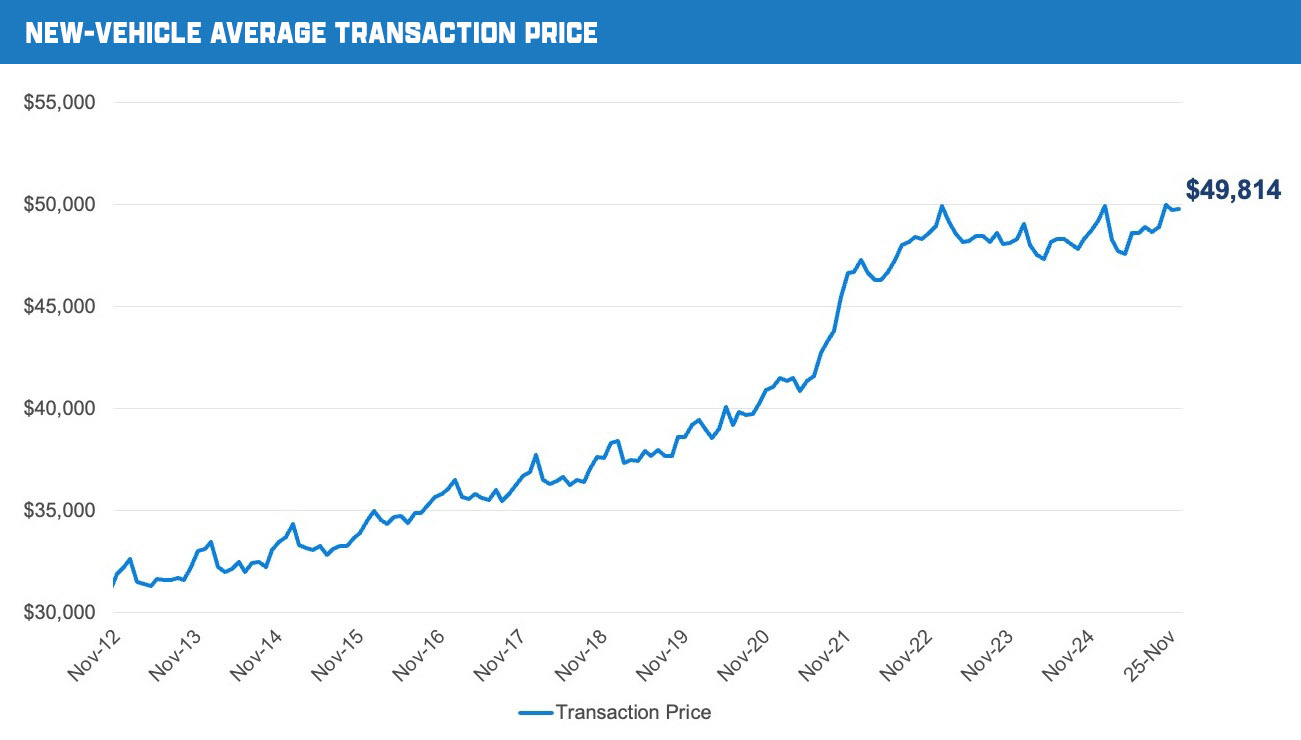
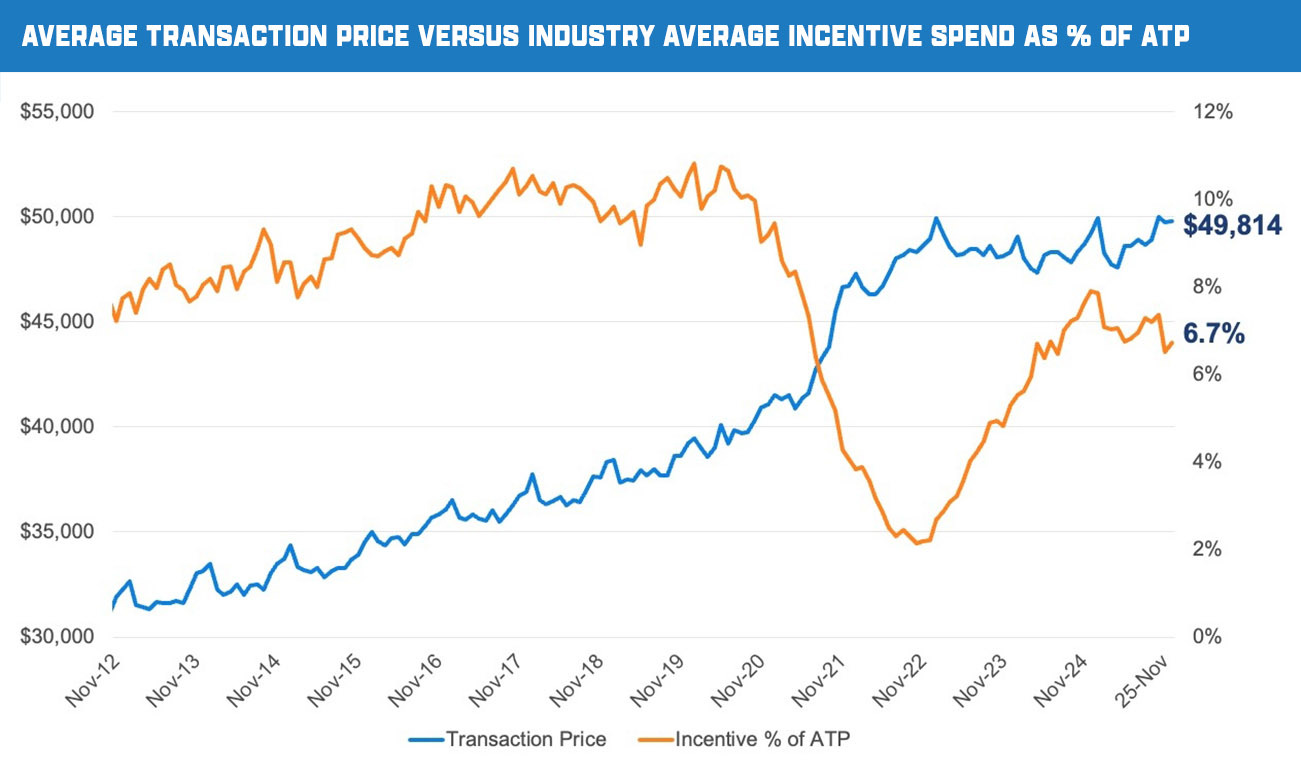
According to the latest Kelley Blue Book data, the average transaction price of a new vehicle in the US hit $49,814 in November, and it’s showing no real sign of dropping.
That figure is up 1.3 percent year over year and effectively unchanged from October, suggesting the industry has settled into a comfortable rhythm where fifty grand is the new normal.
Cox Automotive says prices usually peak in December, meaning the holiday season could push things even higher as buyers gravitate toward well-optioned trucks, luxury SUVs, and vehicles that require six figures of income and very little financial anxiety.
Fewer Incentives
Incentives are still around, but they are not doing the heavy lifting they once did. In November, incentives averaged 6.7 percent of average transaction prices, down from nearly 8 percent a year ago.
Automakers simply do not need to discount aggressively when buyers keep selecting expensive trims with panoramic roofs, giant screens, and fancy wheels.
The data makes one thing clear. Cheap cars are disappearing from the sales mix. Vehicles with MSRPs under $30,000 accounted for just 7.5 percent of November sales, down sharply from 10.3 percent a year earlier.
Meanwhile, more than one in 10 vehicles sold cost over $75,000. The most popular sub-$30K survivors remain familiar names like the Toyota Corolla, Chevrolet Trax, and Hyundai Elantra, clinging on like endangered species.
While transaction prices may have leveled off for now, average MSRPs, commonly known as the asking price, are still inching upward, reaching $51,986 in November. That marks a 1.7 percent increase over last year.
Blame Pricey Trucks
Trucks continue to be a major contributor to price inflation. Full-size pickups now average more than $70,000 for the third month in a row and accounted for over 14 percent of all sales in November, with nearly 183,000 units delivered. That helps explain why the industry average keeps floating upward even when compact and midsize segments remain relatively stable.
Electric vehicles add another twist. The average EV transaction price fell slightly month over month to $58,638, but remains up 3.7 percent year over year. Incentives jumped to over 13 percent of prices as sales softened again, dropping more than 40 percent compared with last year.
Tesla’s average transaction price rose to $54,310 in November, even as sales fell 22.7% year over year, largely due to sharp declines in Model 3 demand. Prices for the Model Y, the best-selling EV in the U.S., edged up slightly. Cybertruck sales fell to 1,194 units, their lowest monthly total of 2025, though its average price rose to $94,254.
Who’s Really to Blame?
According to Cox Automotive Executive Analyst Erin Keating, today’s prices aren’t just the result of inflation or supply hangovers, but they reflect what consumers are choosing to buy.
“It’s important to remember that the KBB ATP reflects what consumers choose to buy, not what’s available,” she explained.
“Many new-car buyers today are in their peak earning years and are less price-sensitive, opting for vehicles at the higher end of the market to get the features and experiences they value most. In November, sales of vehicles priced above $75,000 outpaced those below $30,000, underscoring this preference for premium products” Keating added.
The takeaway is simple. Prices are high because buyers keep buying high. Until that changes, the average US driveway will continue to look alarmingly expensive.
We just have to hope the trend doesn’t discourage automakers from developing and building the more affordable models that less affluent Americans still need.
Each forged wheel has a 3,196 lbs load capacity rating.
A curb-protecting aluminum ring can be replaced easily.
The wheel matches Tesla’s Core wheel in aerodynamics.
Unplugged Performance has never been shy about making bold claims, but this one caught attention even by their standards: earlier this year, the company declared its Road Warrior wheels for the Tesla Model 3 and Model Y to be the “world’s first indestructible wheel.”
Now, it’s aiming even higher with an even stronger version of the same concept, this time developed specifically for the Tesla Cybertruck.
While the original Road Warrior was already beefy, the updated Cybertruck-ready Forged UP-RW wheel steps things up with a significantly higher load rating. The Model 3 and Y variant of the wheel is rated at 950 kg (2,094 lbs), but this Cybertruck version is engineered to handle up to 1,450 kg (3,196 lbs)
According to Unplugged Performance, this wheel offers better resistance to “bending, cracking, and fatigue” than the current wheel, although it doesn’t make the same “indestructible” claim as it did earlier this year.
The design of the wheel may not be to everyone’s liking, but it does have a feature that we’re sure many will appreciate. Each wheel features a replaceable aluminum curb-guard ring designed to take any damage from parking mishaps.
Even better, that guard can be swapped out without removing the tire. So if you do scrape it, there’s no need to pay for a full wheel repair or replacement. For anyone who’s wrestled a low-profile tire off a rim, that convenience alone might be reason enough to consider the upgrade.
The California-based tuner also says its Road Warrior wheel for the Cybertruck is on par with Tesla’s available Core wheel when it comes to aerodynamics, performs better than the standard Cyberwheel, and is designed to fit the standard 20-inch Cybertruck tires.
For any Cybertruck owners out there who take their electric pickup off-roading, or simply those looking for something to help their Tesla stand out, these wheels may suit.
That said, the options list is short. The Road Warrior is currently only available in one finish: black spokes with a gray curb guard. Whether that works for you will depend on taste, but some buyers will surely wish for more variety.
As for the price, it’s not exactly a budget choice. A full set of 20-inch wheels will cost $3,195. Still, in the context of forged wheels, particularly those rated for a 1,450-kg load, it falls within expected territory. For some, the mix of utility, design, and spec could be worth it.
Tesla is offering special financing on the Model Y Standard.
Buyers need a 720+ credit score to qualify for the top deal.
The stripped-down Model Y starts at a base price of $39,990.
As the end of the year draws closer, Tesla has rolled out a set of last-minute offers designed to nudge buyers off the fence, something we’ve come to expect from the automaker in the final stretch of the calendar.
Arguably the most notable of these is a new financing deal for the entry-level Model Y Standard, now available with 0 percent APR on a 72-month term. That’s six years of interest-free payments, for anyone keeping count.
The back-to-basics Model Y Standard was introduced a couple of months ago and prices start at $39,990 before destination and taxes. It’s based on the regular Model Y, but lacks many of its key selling points, including the panoramic glass roof and the front light bar. It also has a simpler interior.
Evidently, Tesla was eager to save as much money as possible when designing the car.
Zero Percent, But Not for All
When first launched, the Model Y Standard wasn’t included in Tesla’s promotional financing, but things have changed. It’s now available at 0 percent APR. However, this financing deal is only available if you’re willing to put down at least $2,069 at signing.
Additionally, you’ll need an excellent credit rating of 720 or above to get the deal. If your credit rating is between 680 and 720, the APR rises to 0.99 percent, or 1.99 percent with a 640-679 credit rating, and 2.99 percent with a sub-640 credit rating.
Tesla is offering the 0 percent financing deal for its 36-, 48-, 60-, and 72-month terms, but not its longest 84-month term.
Extras On the House
But wait, there’s more. Tesla is also tossing in a few extra incentives for EV buyers choosing from existing inventory. Depending on the car, some models are now being offered with one complimentary upgrade. A quick scroll through Tesla’s site shows examples with larger wheels, premium paint finishes, or the optional white interior included at no additional cost.
Whether this last-minute round of offers will give Tesla the year-end bump it’s chasing remains to be seen.
Biden excluded Tesla from the 2021 White House EV summit.
GM was wrongly credited for leading the EV transformation.
Mary Barra privately told Biden Tesla deserved more credit.
In 2021, a high-profile EV summit at the White House brought together some of the biggest names in the auto industry. Hosted by then-President Joe Biden, the event was pitched as a landmark moment for the nation’s transition to electric vehicles. Executives from GM, Ford, and Stellantis were all present.
But conspicuously absent? Elon Musk, or anyone from Tesla, for that matter. That absence didn’t go unnoticed, especially when Biden publicly credited GM with leading the EV revolution.
As history has shown, Musk likes to hold a grudge. And while it may have seemed like a fleeting political oversight at the time, the snub may have had consequences that extended far beyond the Beltway.
What Was Behind the Snub?
Little has been said publicly about the summit in the years since, but during an interview at the 2025 New York Times DealBook Summit, GM president Mary Barra shed new light on what happened behind the scenes. According to Barra, she spoke privately with President Biden at the event to redirect some of the praise being sent her way.
“He was crediting me and I said, ‘Actually, I think a lot of that credit goes to Elon and Tesla,’” Barra told the audience. “You know me, Andrew. I don’t want to take credit for things.”
The snub was thought to have been done in part to throw the White House’s support behind the United Auto Workers and GM, Ford, and Stellantis, all of which have unionized labor. Tesla, on the other hand, doesn’t. Musk has been openly critical of labor unions for years, a stance that’s often put him at odds with Democratic policymakers.
The Fallout That Followed
The story didn’t end there. As reported by the Business Insider, in her recent memoir, then-Vice President Kamala Harris acknowledged that leaving Musk off the invite list was, in hindsight, a misstep.
“If you are convening the nation’s manufacturers of electric vehicles and the biggest player in the field is not there, it simply doesn’t make sense,” she wrote. “Musk never forgave it.”
Speaking in a separate interview, Harris reflected further: “So, I thought that was a mistake, and I don’t know Elon Musk, but I have to assume that that was something that hit him hard and had an impact on his perspective,” she said, according to Fox News.
It’s hard to quantify exactly how much the snub shaped Musk’s political outlook, but for years, the Tesla CEO had aligned himself with Democratic candidates, casting votes for figures like Barack Obama and Hillary Clinton.
But around 2022, Musk’s political leanings began shifting to the right, and he would go on to play a significant role in helping elect Donald Trump to a second term. Whether things might have turned out differently if Biden had acknowledged him is anyone’s guess.
Let’s not forget the White House giving Tesla the cold shoulder, excluding us from the EV summit and crediting GM with “leading the electric car revolution” in the same quarter that they delivered 26 electric cars (not a typo) and Tesla delivered 300 thousand.
Tesla has introduced a cut-price, less luxurious Model 3 Standard to Europe.
Std grade cars take 1 second longer to reach 62 mph, lose 134 miles of range.
The Model Y Standard has already been available in the EU since October.
Tesla has added a no-frills Model 3 Standard to its revamped European lineup in a bid to boost flagging sales, months after the stripped-down EV made its US debut. But the EU versions of the entry-level 3 come with one piece of retro kit denied US buyers – who might not even notice it’s missing.
We’re talking about an FM radio, equipment that hasn’t been worth bragging about since Gerald Ford was in the White House.
In the US, only Model 3 Premiums and up get the radio, a decision rooted more in cost saving than any lingering notion that a radio is a luxury item. Neither gets an AM radio, by the way, and only the EU version has a digital radio.
According to a 2023 study, cutting the radio unit could save Tesla around $50–70 per car, since it no longer needs to shield radio waves from interference created by the electric motors.
In other respects, the EU-spec Model 3 Standard (€36,990 in Germany) follows the US car’s lead. It gets a smaller battery versus the €44,990 Premium that cuts the WLTP range from 466 miles (750 km) to 332 miles (534 km), and the trip to 62 mph (100 kmh) takes 6.2 seconds instead of 5.2 seconds.
Bye-bye, rear touchscreen
Alloy wheels are replaced with 18-inch steelies and plastic hub caps, and the ambient lighting, rear touchscreen, electrically adjustable steering column, and heated rear seats are gone. You also get simple cloth on the chairs and a hi-fi downgrade from nine to seven speakers.
And there’s one other significant change that you won’t spot until you drive down the road for the first time. The Standard Tesla makes do with basic passive shock absorbers, whereas the Premium gets slightly more sophisticated frequency-dependent shocks that deliver a smoother ride.
But as with the US Standard, the EU base trim retains its panoramic glass roof. The Model Y Standard also keeps its glass roof, but mean old Tesla covers it over from the inside to remind you that you were too tight to pay for the Premium.
The base Y, which also loses its front and rear light bars and alloy wheels, is now on sale in the UK (for £41,990), as well as the EU. But so far, the Model 3 Standard is not available in Britain.
Tesla shatters Norway’s all-time yearly sales record, with a month still left.
Model Y leads a 34.6% YTD surge as buyers sprint to beat a new tax hike.
Tesla’s global sales are expected to drop 7 percent by the end of this year.
Tesla may be battling slumping sales across the US, Europe, and China this year, but there’s one corner of the world where Elon Musk can still hang the “Mission Accomplished” banner without irony.
In Norway, the EV-obsessed Nordic nation, Tesla has secured its most impressive bragging right of 2025 with a near 35 percent sales lift year-to-date.
Tesla Broke a Long-Standing Record
The US electric vehicle brand is pulling in buyers so hard that it has sold more cars in the first 11 months of this year than any automaker has ever managed in an entire 12-month period in Norwegian history.
According to fresh registration data from OFV, the country’s official vehicle registry, Tesla moved 28,606 cars from January through November, blowing past Volkswagen’s long-standing record of 26,575 set back in 2016.
November alone saw a stunning 6,215 new Teslas hit the road, nearly triple last year’s tally, as Norwegians rushed to dealerships ahead of a scheduled EV tax hike landing on January 1.
Norway at one time exempted all EVs from tax in an effort to boost take-up, and even after a circa-$50k cap was introduced, most low- and mid-ranking Model 3s and Ys were below the threshold and still avoided the duty. But that limit is set to be lowered again next year and will scoop up Tesla’s most popular EVs.
The most popular of those in Norway right now is the Model Y, which remains the country’s favorite crossover even after a brief sales dip early in the year. Once the long-awaited refresh arrived in Q2, the Y rebounded strongly.
But even drivers who are turned off by CEO Elon Musk and the Tesla brand are still loving electric power. An incredible 98.3 percent of all new cars sold last month were fully electric, Reuters reports, keeping Norway on track for its goal of ending new combustion-engine sales entirely in 2025.
VW grew its sales by almost 50 percent YTD and Kia by an incredible 153 percent, but neither gets close to Tesla’s market share.
And yet, Norway’s Tesla boom stands in stark contrast to the company’s global reputation for 2025. Worldwide deliveries are expected to fall 7 percent, consultancy Visible Alpha says, and US sales dropped 24 percent in October, having enjoyed a brief 18 percent rise in September as buyers tried to get into an EV before the federal tax credit program ended.
Chinese automakers now hold 6.8% of total European new car sales.
BYD’s European sales jumped 206.8% in October compared to 2024.
Tesla’s sales plunged 48.5% in October to just 6,964 vehicles.
Chinese carmakers continue to accelerate their presence across Europe, steadily carving out a larger slice of the market. Once regarded as niche entrants, they now account for a 6.8 percent share of total European sales in October, with powerhouses like SAIC and BYD leading the charge while Tesla’s momentum falters.
Chinese Brands Gain Ground
In that month alone, around 75,000 vehicles from Chinese brands were sold across the European Union, the UK, and EFTA nations, which include Iceland, Liechtenstein, Norway, and Switzerland.
SAIC enjoyed a particularly strong month, with sales soaring from 17,552 in October last year to 23,860 this October. Across the January-October period, its sales have also risen 26.6 percent from 197,686 to 250,250 units.
BYD is also enjoying a surge in demand and has almost triple Tesla’s sales. In October, the company sold a total of 17,470 vehicles across the region, a 206.8 percent rise from 5,695 last October. Year-to-date, its sales have increased by a monumental 285 percent, from 35,949 to 138,390 units.
Tesla’s Bloodbath
Things are not looking so pretty for Tesla. In October, its European sales slipped 48.5 percent from 13,519 units in the same month last year to just 6,964 in 2025. That means it fell even behind Porsche, which itself recorded a 26 percent sales decline but still usurped Tesla with 7,653 sales. Through the first ten months of the year, the American brand’s local sales have fallen 29.6 percent to 180,688.
Of the new cars sold by Chinese brands across the region in October, 36 percent were battery-electric vehicles. Of these, the small BYD Dolphin was the best-seller.
EU + EFTA + UK New Car Sales
Europe Sales Rise
Across Europe, new car registrations have edged up 1.4 percent, with battery-electric vehicles now holding a 16.4 percent share.
In the first ten months of 2025, 1,473,447 new battery-electric cars were registered across the EU. This growth owes much to the four largest markets, including Germany (+39.4%), Belgium (+10.6%), the Netherlands (+6.6%), and France (+5.3%), which together make up 62 percent of the total. In October alone, year-on-year battery-electric registrations rose by 38.6 percent.
Hybrid-electric cars continue to dominate as the most popular powertrain, holding a 34.6 percent share of the market. Between January and October 2025, registrations reached 3,109,362 units, led by Spain (+27.1%), France (+26.3%), Germany (+10.3%), and Italy (+8.9%).
Plug-in hybrids are also on the upswing, totaling 819,201 registrations, a 43.2 percent increase over last year. Demand has been especially strong in Spain (+109.6%), Italy (+76.5%), and Germany (+63.4%). Plug-in hybrids now represent 9.1 percent of all EU registrations, up from 7 percent a year ago.
Petrol-powered cars still hold 27.4 percent of the market, though their share has dropped from 34 percent last year as combustion sales continue to contract. Through October, petrol registrations fell 18.3 percent across major markets, with France down 32.3 percent, Germany 22.5 percent, Italy 16.9 percent, and Spain 13.7 percent.
Diesel continues its downward trend too, shrinking by 24.5 percent to a 9.2 percent market share.
Lawsuit claims Model 3 doors failed to open after a fiery crash.
Witnesses tried rescuing the couple but couldn’t open the doors.
Complaint says Tesla sold cars with faulty door handle designs.
Another day brings another legal challenge for Tesla, this time centered on a tragic crash that once again raises questions about the company’s design choices.
The latest lawsuit claims that the electrically operated door handles of a 2018 Model 3 failed to function after a collision and subsequent fire, trapping one of the occupants inside and leading to her death.
It marks yet another serious concern for Tesla, one that could prove costly and push the automaker to reexamine how its vehicles handle emergency situations, particularly when power is lost.
Door Handles Under Scrutiny
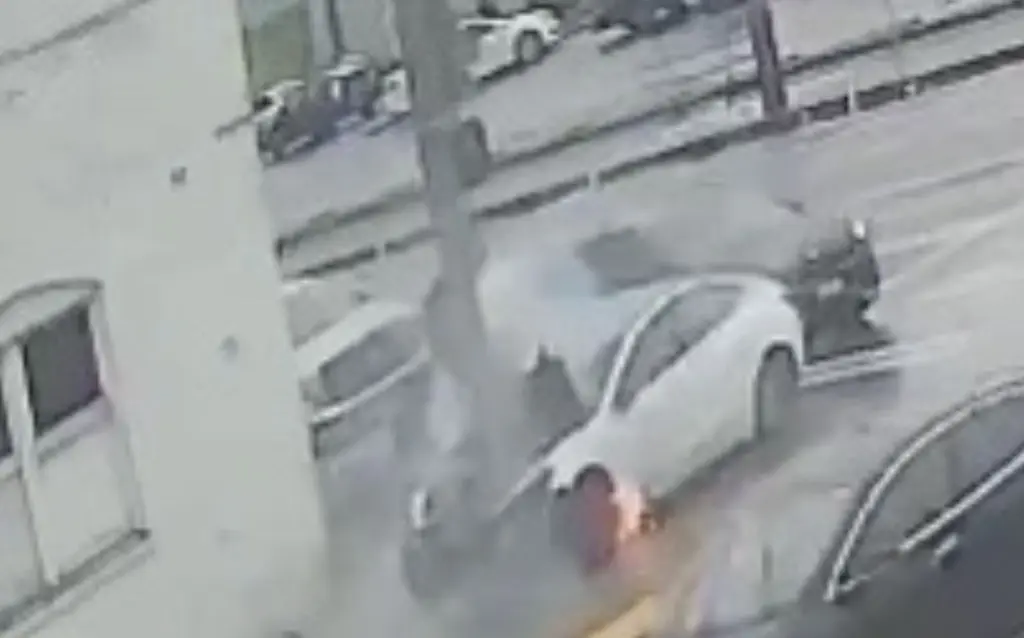
Filed last week in the U.S. District Court for the Western District of Washington, the complaint outlines a sequence of events. On January 7, 2023, Jeffrey Dennis was driving his Tesla Model 3 with his wife in Tacoma, Washington, when the car reportedly accelerated suddenly and struck a utility pole at the corner of South 56th and South Washington Streets.
Shortly after impact, the EV caught fire. It’s alleged that several witnesses tried to open the Tesla’s doors to rescue the couple, but were unable to do so because they failed to operate without battery power. The lawsuit says that some witnesses even tried to break the Model 3’s windows with a baseball bat, but it also failed.
First responders eventually managed to extract the pair, though Wendy Dennis succumbed to her injuries at the scene. Jeffrey Dennis suffered severe burns to his legs.
The complaint says the Model 3 has a “unique and defective door handle design” that prevented rescuers from freeing the couple. It is also alleged that Tesla knew about the defect with the door handle but failed to address it, and continued to market and sell the popular EV.
The lawsuit doesn’t stop at the door handles. It also claims that Tesla’s Automatic Emergency Braking system failed to activate as the vehicle sped toward the utility pole. In addition, it accuses the company of using “a highly explosive battery chemistry” despite the existence of safer, more practical, and less costly alternatives.
Jeffrey Dennis is seeking financial relief for the wrongful death of his wife and his long-term injuries, as well as compensatory damages and punitive damages under California law.
RDW denies Tesla’s claim it committed to approving FSD by February.
Tesla urged fans to contact the regulator, sparking a backlash online.
Experts warn such tactics risk undermining regulatory independence.
Tesla took to X over the weekend to announce that Dutch automotive safety regulator RDW had committed to approving its Full Self-Driving (Supervised) system in February 2026. As it turns out, Elon Musk’s company jumped the gun, and the agency made no such commitment.
The claim sparked quick clarification from the regulator and a flurry of online chatter about Tesla’s ongoing bid to expand FSD beyond American roads.
While Tesla has been offering its Full Self-Driving system in the United States for years, it hasn’t been able to do the same in Europe.
Europe’s Roadblock
According to the carmaker, it has already provided FSD demonstrations “to regulators of almost every EU country” and believes the most effective path to rolling out the system across the continent is through the RDW, with the goal of securing an exemption for the feature.
In its X post, Tesla Europe & Middle East proclaimed that “RDW has committed to granting Netherlands National approval in February 2026.” The company even urged followers to contact the regulator directly to “express your excitement & thank them for making this happen as soon as possible.”
However, the regulator quickly pushed back. In a statement published on its website, the regulator explained that it expects Tesla to demonstrate FSD next February, but it denied making any commitment to approval.
Tesla has been working hard toward shipping Full Self-Driving (Supervised) in Europe for over 12 months now. We have given FSD demos to regulators of almost every EU country. We have requested early access, pilot release programs or exemptions where possible.
“We do not share details about ongoing applications from manufacturers, as this concerns commercially sensitive information,” it wrote. “Both RDW and Tesla are aware of the efforts needed to reach a decision on this matter in February. Whether this timeline will be met is yet to be determined in the coming period.”
Regulator Grows Tired of Tesla Fans’ Calls
The regulatory agency also asked Tesla’s fans to stop contacting it about FSD, noting that “it takes up unnecessary time for our customer service,” adding “this will have no impact whatsoever on whether or not the schedule will be met.”
Recently, Tesla boss Elon Musk said, “pressure from our customers in Europe to push the regulators to approve would be appreciated.”
Speaking with Bloomberg, the head of safe autonomy at the University of Warwick, Siddartha Khastgir, said it’s unusual to see a carmaker attempting to pressure the RDW.
“An approval process of an automated driving system is a deeply technical one to ensure the safety of the public,” he explained. “The sanctity of any such approvals is ensured by its independence and rigor, not force. While public sentiment is important for all authorities, this shouldn’t undermine the rigor of the approval process.”
One in five cars in Germany failed annual roadworthiness inspection.
VW’s Golf, Touareg, and T-Roc dominated rankings across segments.
Mercedes led long-term quality with lowest defects among older cars.
Germany’s car-check watchdog has crunched the reliability numbers and once again, Tesla finds itself parked at the very bottom of the heap. The 2026 TÜV-Report, covering annual roadworthiness inspections of approximately 9.5 million vehicles between July 2024 and June 2025, found that Tesla EVs occupied the two bottom spots in the league table.
The Model 3, which was the worst-ranked car for the two previous years was found to have a defect rate of 13.1 percent, meaning one in every 7.6 cars in the two-to-three-year-old ages group failed the Hauptuntersuchung safety check.
Why Is The Model Y So Troubled?
But the Model Y was even worse. It had a defect rate of 17.3 percent, versus 3.5 percent for a Mini Cooper SE, making it the worst TÜV has seen in this age group in a decade. The biggest defect culprits were the axle assembly, suspension, brakes and lighting.
Pulling back to look at the bigger picture covering cars of all ages reveals that 21.5 percent, or one in five cars failed the inspection due to a “significant” or “dangerous” defect, an increase of 0.9 percent on last year, ADAC reported. And the proportion with minor defects rose 0.8 percent to 12.3 percent.
Other reliability villains include the BMW 5-series and 6-series in both the 4-5-year-old and 8-9-year-old age groups, the Dacia Duster in the 6-7 and 10-11 age groups and the Renault Clio among 12-13-year-old cars.
But with every list of losers there has to be a list of winners, and for cars that have passed their fourth birthday, this one is headed by Volkswagen.
The VW Golf wagon and T-Roc scored well in the 4-7-year-old categories and the automaker’s Touareg was top of the oldies. The Mazda CX-3 and Mercedes B-Class were also commended.
Looking at the 2-3-year-old group, Fiat’s 500e toped the small car category, proving to Tesla that EVs can be reliable, the Mazda 2 and BMW 1-series were the top-rated small car and compact, and the C-class took the mid-range award (if you’re reading from the US, those classifications will look kinda messed up).
The T-Roc popped up again to take best SUV, and the B-class bagged most reliable nearly-new minivan.
One big change in this year’s study is the introduction of an award for long-term quality, handed out to brands whose vehicles, aged 10+ exhibit the lowest average defect rate for safety-related faults and stand for quality, durability, and good service.
Mercedes took gold with an 18.5 percent defect rate – almost matching that of a 2-3-year-old Model Y – Audi was second with 19.2 percent and Toyota snuck onto the podium’s last step with a 22 percent defect rate.
Tesla will attach the Cybertruck’s light bar using bolts instead of adhesive.
Over 6,000 Cybertrucks were recalled due to light bars detaching on the road.
Owners will be notified by December 26, with repairs expected in early 2026.
Sometimes, the fix really is the obvious one, especially when the original solution involved little more than strong glue and wishful thinking. Tesla has outlined how it intends to keep the Cybertruck’s optional off-road lightbar from slipping away.
Instead of relying on adhesive, which has not aged well in practice, the company now plans to fasten the light bar to the roof with actual bolts.
Last month, Tesla announced that it was recalling 6,197 Cybertrucks because the optional LED light bar was being held on solely with strong adhesive.
Not surprisingly, several light bars failed to stay attached, separating from vehicles while driving. The issue stemmed from problems with the adhesive primers used during installation. So far, Tesla has logged 619 warranty claims related to the light bar coming loose.
Bolts Sure Are Better Than Adhesive
Well, at least now Tesla has come up with a solution that should, in practice, work. The company has developed a new steel bracket that affixes to both sides of the light bar.
The bracket then slides between the stainless steel window frames of the Cybertruck and includes a small attachment that is bolted directly into the vehicle’s roof.
Although Tesla has now developed the fix, it’s not yet ready to start repairing customer cars. According to the original recall bulletin, owners won’t be formally notified until December 26. That means service center appointments likely won’t begin until early 2026.
So, if you own a Cybertruck with the light bar held on exclusively with adhesive, it might be wise to limit your drive. Or, if you must drive it before you’re able to book in an appointment at your local Tesla service center, it wouldn’t be a bad idea to get some duct tape to try and better secure the light bar, if only temporarily.
A Long-Standing Issue
The off-road light bar has been a sore point for owners ever since the Cybertruck arrived in late 2023. Owners who paid extra for the Foundation Series version of the electric pickup were supposed to receive the light bar as standard, yet most trucks showed up without it because Tesla was still finalizing the accessory.
Tesla made the 2026 Model X lighter through gradual updates.
Weight savings came from motors, battery packs, and panels.
The Model X now weighs less than BMW’s iX, despite being larger.
The Tesla Model X of today might appear almost unchanged from the version that debuted back in 2015, yet beneath that familiar silhouette lies a machine that has been subtly reworked over time. Its interior is more refined, and in flagship Plaid form, it delivers enough pace to frighten a supercar.
However, what most people don’t realize is that the latest Model X also weighs significantly less than the original, even though the two look virtually identical.
Weight Loss, Electric Style
In an era when every new car seems to gain weight, the Model X has quietly gone the other way. Added safety tech, larger batteries, and ever-expanding lists of standard features typically push curb weights upward. Yet a 2026 Model X is almost 400 pounds (181 kilograms) lighter than its 2016 counterpart.
Sounds like witchcraft, right? It’s not. Instead, Tesla has gradually refined the Model X over the years.
Speaking with Car and Driver, which recently weighed a Model X at 5,219 lbs (2,367 kg), Tesla’s vice president of vehicle engineering Lars Moravy, noted that the original model had a heavy induction-type motor at the rear wheels. Now, it sports a lighter permanent-magnet motor and new half-shafts, an improvement that has saved roughly 100 lbs (45 kg).
Additionally, Tesla changed the Model X’s battery pack in 2021 to include more energy-dense cells, allowing it to ditch 300 cells. Alongside improvements to the pack’s structure, this allowed the Model X with its fancy Falcon wing doors to shed a further 90 lbs (41 kg). Further weight-saving measures were adopted for the Model X’s most recent 2026 update.
Every Ounce Matters
Roughly 80 pounds (36 kilograms) have been trimmed from the EV’s interior. Moravy explained that Tesla now uses thinner materials throughout the cabin and has integrated airbag components directly into the headliner.
The five-seat version sheds another 50 lbs (22 kg) thanks to the removal of the trunk pedestal mounting. Tesla also tweaked the seatbelt mounting and structure to save 6 lbs (2.7 kg) and cut 44 lbs (19.9 kg) worth of high-voltage wiring. Moreover, the Plaid features fewer radiators, saving an extra 30 lbs (13.6 kg).
Large aluminum megacastings in the Model X’s body construction account for a further 20-pound (9-kilogram) reduction while improving overall rigidity. Even the front and rear fascias have been slimmed by 0.6 millimeters, a small change that removes another 10 pounds (4.5 kilograms).
Did Anything Get Heavier?
Admittedly, not every change went in the same direction. Heavier wheels, hubs, and improved sound insulation added some bulk back, yet the 2026 Model X remains light for an electric SUV.
At roughly 500 pounds (227 kilograms) lighter than a BMW iX xDrive50., it stands as proof that careful engineering and incremental refinement can still trim weight without compromise.

 Login
Login