Normal view

There are new articles available, click to refresh the page.
Today — 13 May 2026Main stream

AMG’s New Electric GT Fakes Its V8 Noises Better Than Dodge’s Charger Daytona

  • AMG has given us our first taste of the GT 4-Door Coupe’s electric powertrain in action.
  • In-car video footage reveals a synthesized V8 soundtrack as it runs through fake gears.
  • The new Porsche Taycan rival uses lightweight axial flux motors from Benz-owned Yasa.

Mercedes-AMG has already shown us the inside of the upcoming 4-Door Coupe, but this week, we got a much better idea of what it’ll be like to really get behind the wheel. Why? Because today we heard the EV powertrain do its best V8 impression, fake gears and all.

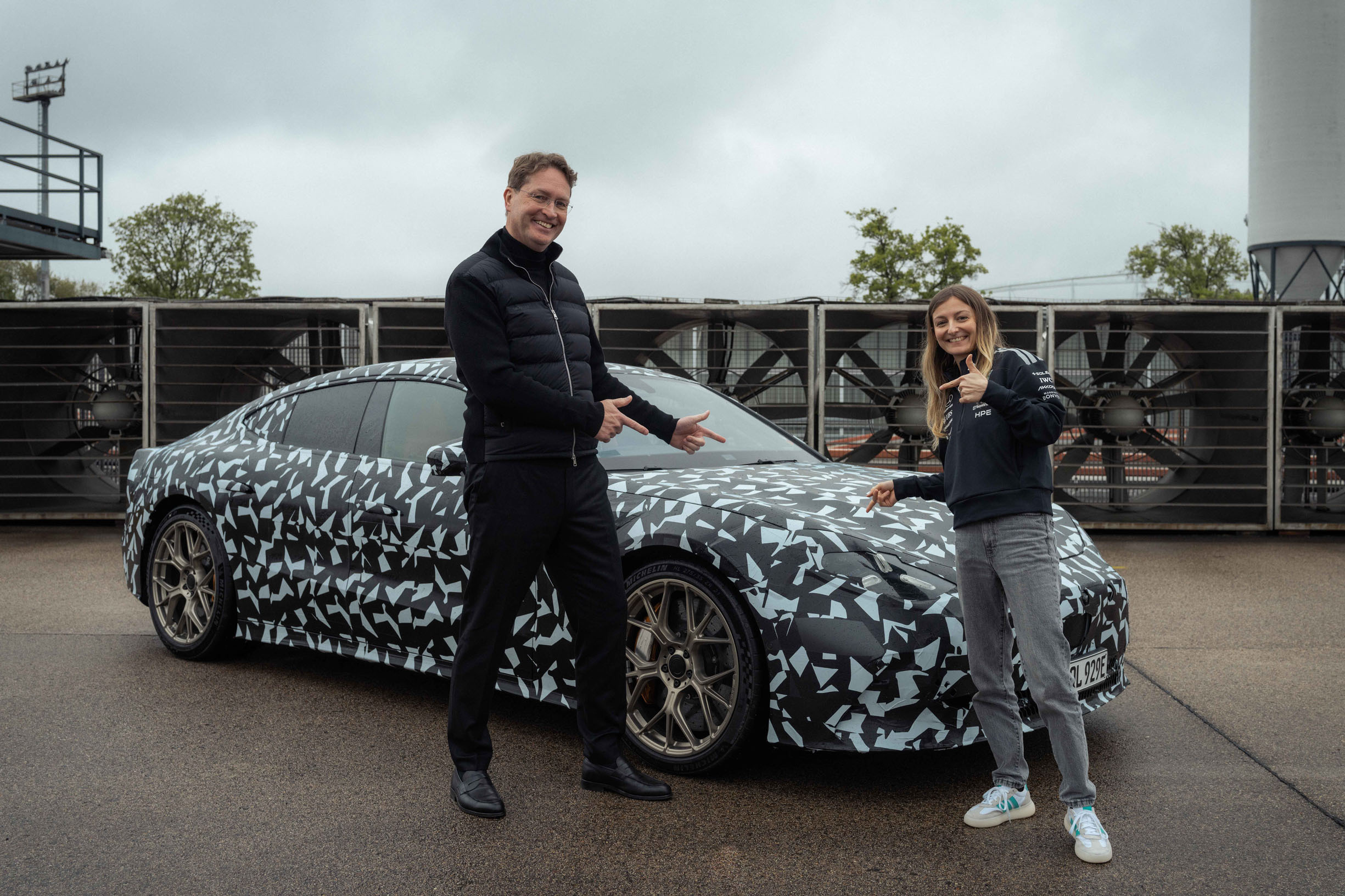
The reveal takes place inside one of those cheesy promo videos Mercedes trots out every time it’s about ready to debut a new car. CEO Ola Källenius goes for a spin in a camouflaged prototype, and together with a co-host runs through some supposed “challenges” that don’t really prove anything at all.

Related: Mercedes-AMG Is Bringing Back The Noise, The Drama, And The V8

But there’s usually something interesting hidden in the fluff, and this GT video is no different. Most importantly, we get to hear the synthesized V8 noises the car makes when Mercedes-AMG F1 development driver Doriane Pin engages Sport+ mode and guns the four-door coupe hard from a dead stop.

Obviously, it’s hard to know from just watching a video how realistic those noises sound when you’re in the car, but they sound pretty good from here. Better than a Dodge Charger Daytona, that’s for sure.

Transmission Tips From Ioniq 5 N

And because AMG has worked in some fake shift points, we get to hear it barrp, barrp, barrp its way up to a pretend redline as it runs through some imaginary gears, just like a real combustion-powered GT 4 would. Skip to 4:30 on the video to jump straight to the key moment.

You might reasonably argue that if you want an AMG that sounds like a V8 so bad, then you should just get one, but that’s ignoring the fact that there are some massive tax advantages in some countries for going the EV route. And if you have to have an EV, you might as well have one with a sense of fun.

Slimline Motors
 AMG’s New Electric GT Fakes Its V8 Noises Better Than Dodge’s Charger Daytona

Besides, this new GT is much smarter than your average EV because it’s fitted with incredibly light axial flux motors from Yasa, the company that supplies electrical tech to the Mercedes-AMG Petronas F1 team, and which Mercedes bought in 2021.

We don’t yet know exactly what kind of power the GT’s tri-motor setup produces, but the GT XX concept that previewed it made 1,341 hp (1,000 kW / 1,360 PS). Porsche’s top Taycan is already pushing out 1,034 hp (1,048 PS / 770 kW), and Xiaomi’s SU7 Ultra generates 1,526 hp (1,548 PS / 1,138 kW), so the AMG is going to need to summon as many horses as it can when it debuts, probably this summer.

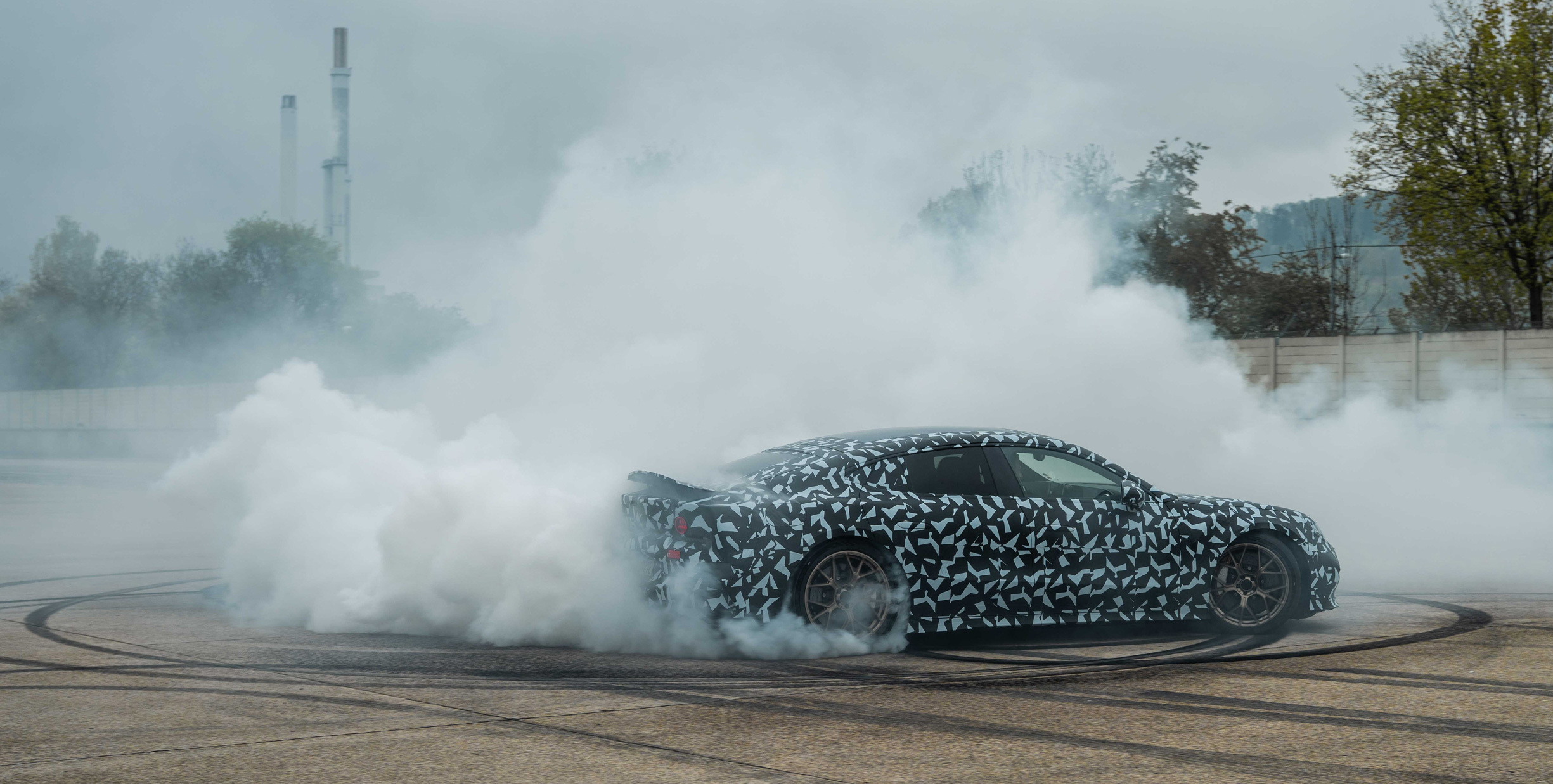
The video also shows the GT pulling off some donuts, proving that the first car to use the AMG.EA electric platform can send its power exclusively to the rear tires if the driver wants, much like a V8 GT.
 AMG’s New Electric GT Fakes Its V8 Noises Better Than Dodge’s Charger Daytona

Mercedes-AMG

Yesterday — 12 May 2026Main stream

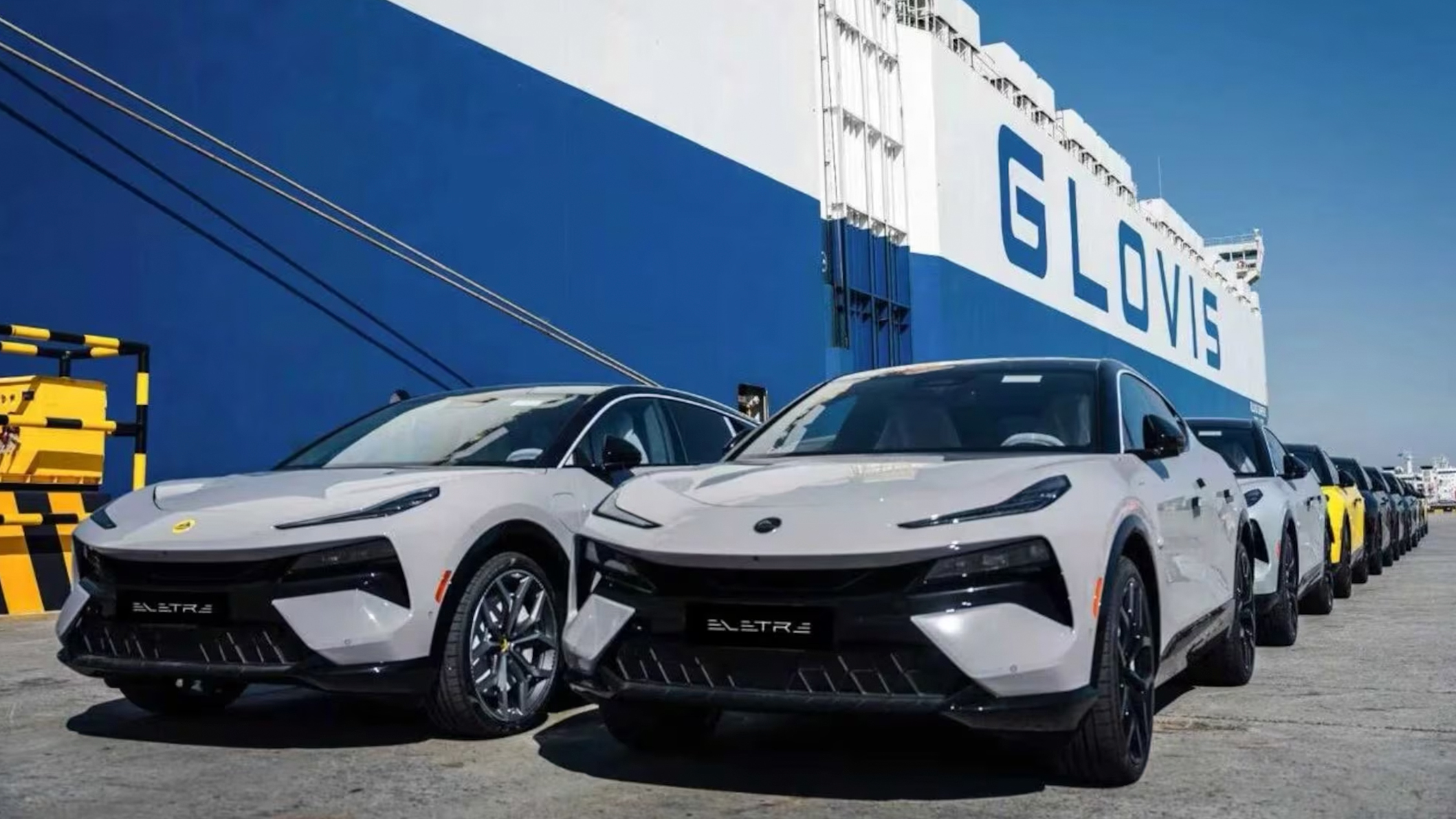
Canada’s China Deal Promised Affordable EVs, But $100,000 SUVs Are First Off The Boat

  • Canada is preparing to accept the first of 49,000 Chinese EVs heading there this year.
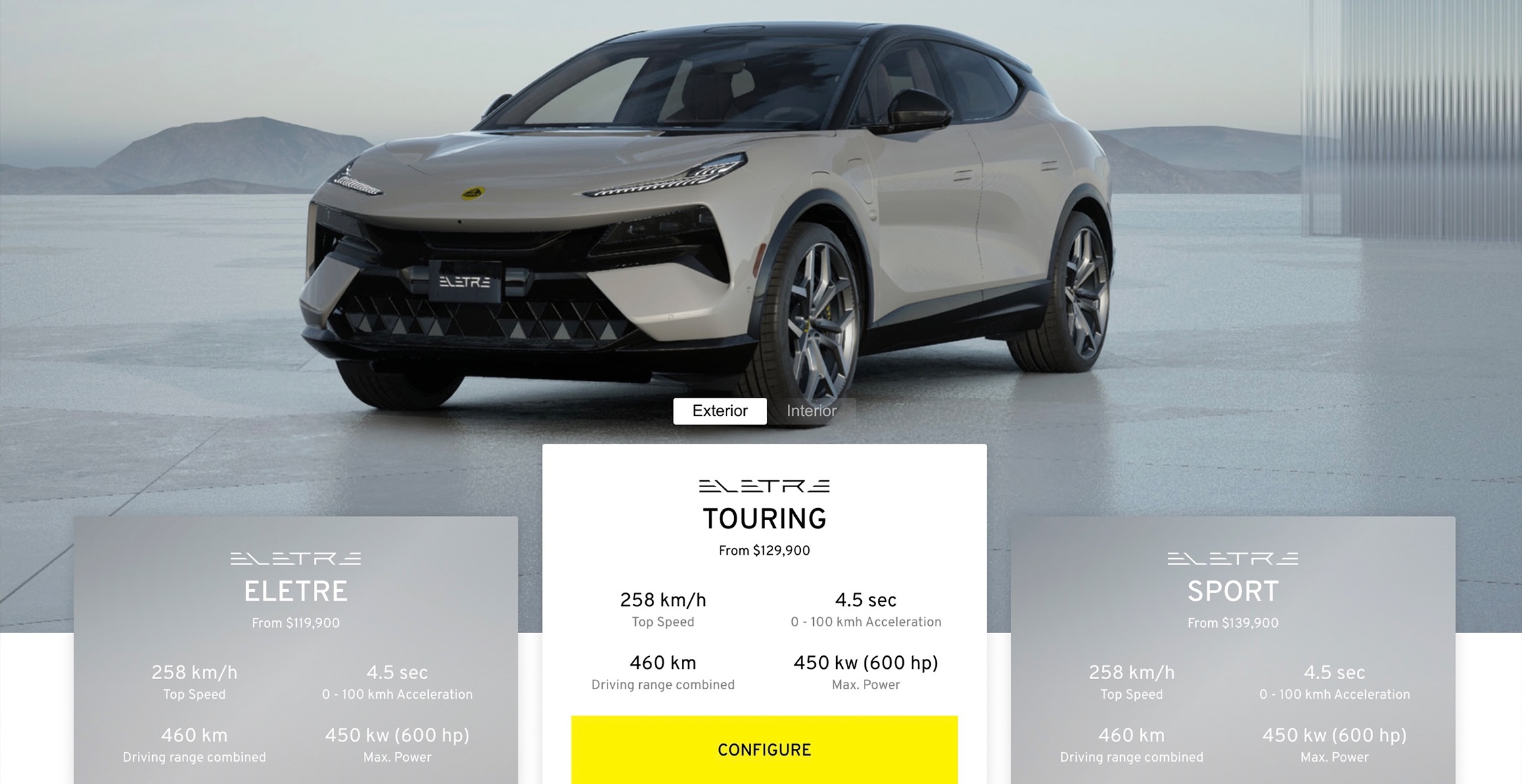
  • Lotus waved off 18 Canada-bound, Cayenne-sized Eletre SUVs from Wuhan on May 6.
  • Under a deal between Canada and China, EV import tariffs were cut from 106.1% to 6.1%.

Geely is officially heading to Canada, though don’t bother looking for the brand name at a car dealership strip north of the border just yet. The Chinese brand’s access to the Canadian market comes through its Lotus subsidiary, which sent 18 Eletre SUVs to North America on May 7.

This isn’t the first time China-built Lotus cars, or China-built cars of any brand, have been offered in Canada. Polestar, Lotus, and others previously sold vehicles that originated in the Asian country. But the 18 Eletres will be the first to hit Canada’s roads since a trade deal between the two countries was struck at the beginning of the year.

More: Chinese EV Brands Are On A Hiring Spree In Canada As They Set Up Shop

Imports from China effectively ceased after 2024 when then prime minister Justin Trudeau followed US president Joe Biden’s lead by slapping a 100 percent tariff on Chinese EVs, and that was on top of the 6.1 percent levy previously applied.

In retaliation, China applied tariffs on canola that brought Canada’s agricultural industry to its knees. Canola brings billions of dollars into the Canadian economy every year, so it’s no surprise that new prime minister Mark Carney was motivated to strike a deal, even as North America’s domestic automakers – which also form a large part of Canada’s economy – begged him not to.

Small Import Numbers for Now

 Canada’s China Deal Promised Affordable EVs, But $100,000 SUVs Are First Off The Boat

Under the terms of the new trade deal, Canada will allow just 49,000 EVs in from China with a tariff rate of 6.1 percent in year one, rising to 70,000 in year five. In return, and in addition to relaxing tariffs on canola, China agrees to ease duties on Canadian steel and aluminum. But the trade truce also opens the door to Chinese brands building cars in Canada.

Lotus hasn’t revealed the exact mix of Eletre specs currently heading across the Pacific, but the brand’s Canada retail site currently only lists three trims based around the same 603 hp (611 PS / 450 kW) powertrain and priced between $119,900 CAD ($87,600 USD) and $139,900 CAD ($102,200 USD). Other countries also get a 905 hp (918 PS / 675 kW) version.

Hybrid Is A Recent Addition

 Canada’s China Deal Promised Affordable EVs, But $100,000 SUVs Are First Off The Boat

Both are purely electric, though Lotus has reacted to a less-than-buoyant luxury EV market (and a really terrible North American one) by revealing a new Eletre hybrid. Powered by a 2.0-liter petrol engine and two electric motors making a combined 933 hp (946 PS / 696 kW), it was unveiled in China at the beginning of 2026, and is expected to be rolled out to Western markets later this year.

Lotus isn’t the only company rushing to take advantage of the new trade terms, which Canada’s government originally touted as a way to bring more affordable EVs to the country and help the nation meet its climate goals. Geely is making noises about bringing its own brand, as well as others, such as Zeekr, to Canada. BYD and Chery’s cars have been spied on North American roads, and Tesla is preparing its first batch of Chinese-built Model 3s for Canadian drivers, Drive Tesla Canada reports.

\\\\\\\

Lotus

Hyundai’s Ioniq V Might Look Like A Lambo, But It Makes Less Power Than An Elantra

  • Hyundai’s Ioniq V electric hatch comes with a choice of 188- or 225-hp motors.
  • The V was revealed at last month’s Beijing Auto Show and is designed for China.
  • It’s one of 20 new models Hyundai will launch in China over the next five years.

Hyundai’s sharp-edged, China-only Ioniq V unveiled in Beijing last month looks so different from the Ioniqs we get in the West that it’s only natural that we’re fascinated to find out more about it. And now, thanks to some homologation paperwork logged with Chinese authorities, a few more details have come to light.

The most obvious new bit of information concerns the powertrains. Ministry of Industry and Information Technology (MIIT) filings show the Ioniq V will launch with a choice of two single-motor configurations producing either 188 hp (190 PS / 140 kW) or 225 hp (228 PS / 168 kW).

Review: More Porsche Than Hyundai, The Ioniq 6 N Is A Masterstroke

The punchier of those motors is familiar from our own Ioniq 5, but you won’t find the lower-tune version in an American or European 5. Even Hyundai’s own humble US-market Elantra outguns it with 201 hp (204 PS / 150 kW) in N Line spec. Range extender hybrid and dual-motor versions should follow, according to Hyundai’s plan, and though there’s no mention of a truly hot version, an N makeover could give this EV Lamborghini Temerario-style pace to match its me-too design.

\\

For now, supercar speeds are definitely not on the agenda. A listed top whack of 103 mph (165 km/h) isn’t going to set any records, but the 800-volt charging architecture should at least mean the CATL lithium iron phosphate battery packs can fill rapidly. We still don’t know battery sizes, but the bigger of the two available packs claims more than 600 km (373 miles) on the optimistic CLTC cycle.

Close To An Ionq 6 In Size, Not Style

\\

The Ioniq V measures 4,900 mm (192.9 inches) long and rides on a 2,900 mm (114.2 inches) wheelbase, giving it dimensions similar to the Ioniq 6 we can buy in the West. But visually, this thing heads in a very different direction. The low-slung body combines a coupe-like roofline with chunky surfacing, split headlights, frameless doors, and dramatic V-shaped wheels.

Hopefully, the badly misaligned liftgate seen in the rear shot of the white car isn’t representative of production models. That’s certainly fixable, though it’s probably too late to do anything about the weird shelving system that passes for a rear diffuser.

27-Inches Of Infotainment

 Hyundai’s Ioniq V Might Look Like A Lambo, But It Makes Less Power Than An Elantra

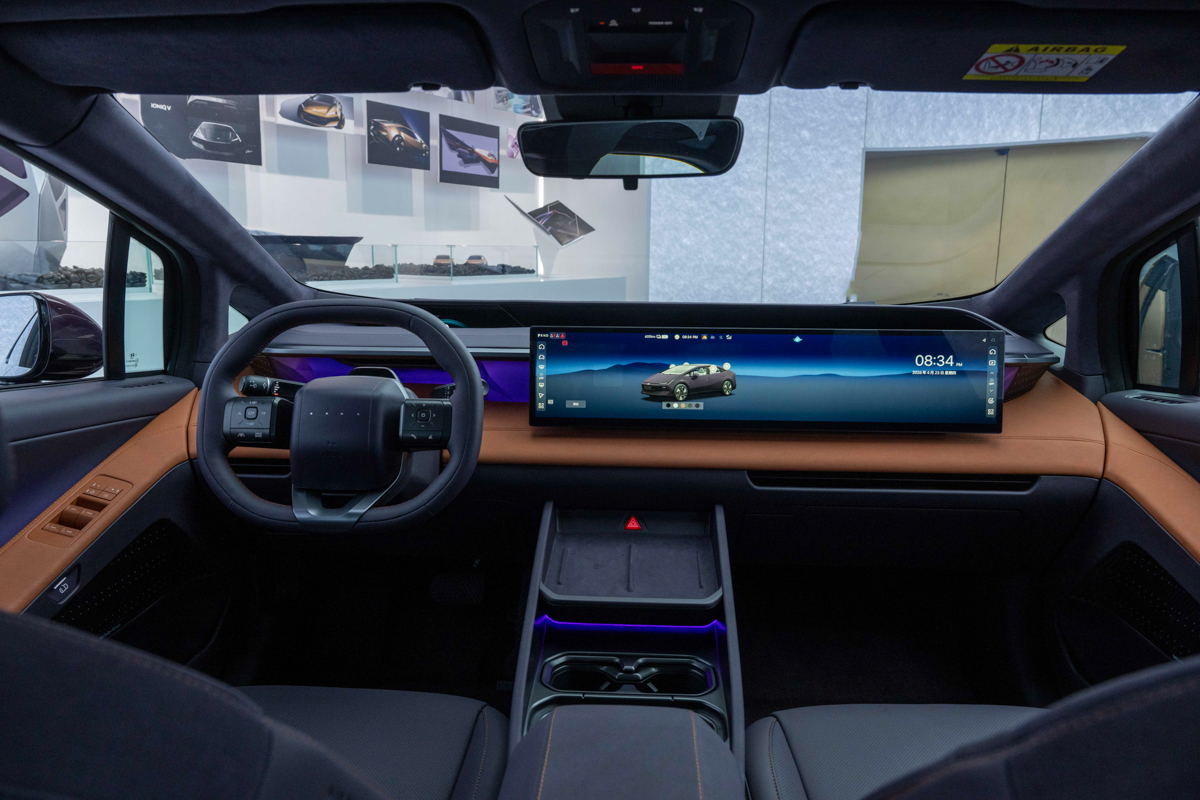
The cabin looks rather better. Hyundai’s China team developed the car around a huge 27-inch ultra-thin 4K display paired with a Cyber Eye head-up display and ambient lighting inspired by nebula imagery. The system also integrates Qualcomm’s Snapdragon 8295 cockpit chip together with AI features powered by Baidu and Volcano Engine technologies, Autohome reports.

Another major addition is Momenta-assisted Level 2-plus driving capability, something rapidly becoming essential for competing in China’s brutally competitive EV market.

Unfortunately for American buyers, the Ioniq V is almost certainly staying overseas. Hyundai developed it specifically for China under its new “global quality plus Chinese wisdom” strategy. That plan will see 20 new Hyundais of different powertrain types being unleashed in China over the next five years as the brand tries to shore up flagging sales.

\\\\\

Hyundai, MIIT

BMW And Mercedes Dropped LiDAR Over Cost, China Puts It On A $10K Hatch

  • BYD has rolled out a revised version of the little Seagull hatch in China.
  • The tiny EV starts at $10,300, or $13,400 with BYD’s DiPilot 300 ADAS.
  • DiPilot 300 isn’t fully autonomous, but can handle city streets, stoplights.

Though camera-loving Tesla swears otherwise, most experts agree that Lidar is the gold standard of driver assistance sensing technology. It’s better at judging distances and detecting unlit objects than cameras, and sees in more detail than radars. But it’s also expensive, or at least it is in Europe and America, where it’s restricted to $100k+ luxury cars. In China, though, you can now get it on a $10,000 micro EV.

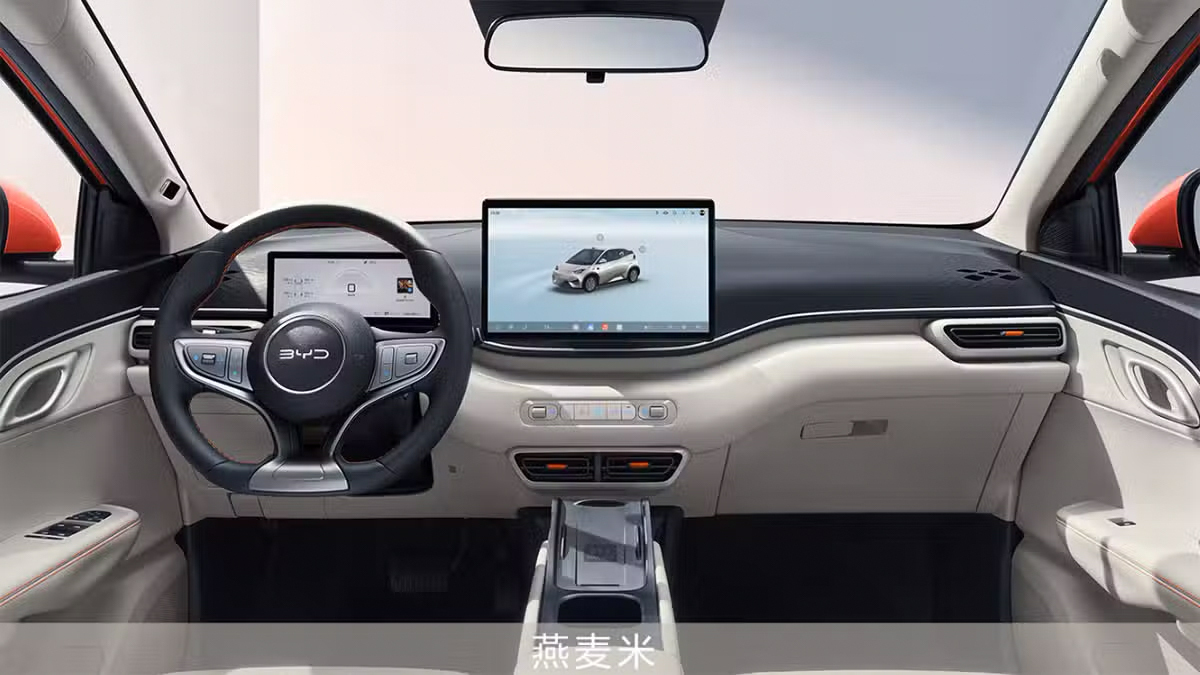
BYD has just refreshed its Seagull subcompact for its domestic market. The Seagull is the tiny 3,780 mm (148.8 inches) electric hatch sold as the Dolphin Surf in Europe. For MY26 there are a couple of new colors, Mango Orange and Mint Green, fresh 16-inch Starlight wheels and new LED taillights, though the 74 hp (75 PS / 55 kW) powertrain is carried over.

Related: BMW Removes Level 3 Self-Driving Tech From New 7-Series

But the big news is the availability of a driver assistance system that combines a Lidar sensor with more commonly available radar and camera-type sensors. The Lidar tech comes as part of the optional DiPilot 300, an ADAS system that’s the mid-point of three BYD “God’s Eye” assistance packages. You can tell if the Seagull you’re looking at has DiPilot 300 because it looks like someone’s grafted on the roof snorkel from a McLaren 675LT.

A base Seagull Vitality Edition with the smaller 30.1 kWh battery and 190-mile (305 km) range costs ¥69,900 ($10,300), Car News China reports, while the poshest Flying Edition with a bigger 38.9 kWh power pack and 252-mile (405 km) range runs to ¥85,900 ($12,600). But add on the DiPilot 300 option and those prices jump significantly to ¥90,900 ($13,400) and ¥97,900 yuan ($14,400).

Lidar Works, But At A Price

 BMW And Mercedes Dropped LiDAR Over Cost, China Puts It On A $10K Hatch

A $3,100 option on a $10,300 car is kind of crazy, but then Lidar is expensive. That’s why BMW and Mercedes, who both previously offered the technology as part of their hands-off Level 3 assistance packages on their 7-Series and S-Class flagships, have dropped the circa-$7k options from the newest version of those cars.

Instead, both German brands are switching their attention to Level 2 systems that still require drivers to look at the road, but unlike the Level 3 systems – which were restricted to freeways – can operate hands-free in urban environments. Both brands will return to L3 tech at a later date.

Despite the presence of a Lidar sensor, the Seagull’s DiPilot 300 is also an advanced Level 2 system, not Level 3. But BYD is talking about L3 as a future development for some of its cars, and you wouldn’t want to bet against even the humblest models like the Seagull getting it in a few years.

\\\\\

BYD

Before yesterdayMain stream

Renault’s 4 E-Tech Just Borrowed Another Trick From The ’60s Original, And It’s Not Deckchair Seats

  • Renault adds huge folding canvas roof to electric 4 E-Tech crossover for £1,500 premium.
  • 4 Plein Sud, which translates as due south, cost from £27,445 including UK’s £3750 grant.
  • Like all 4 E-Techs it comes with 147 hp, a 52 kWh battery and up to 242 range miles.

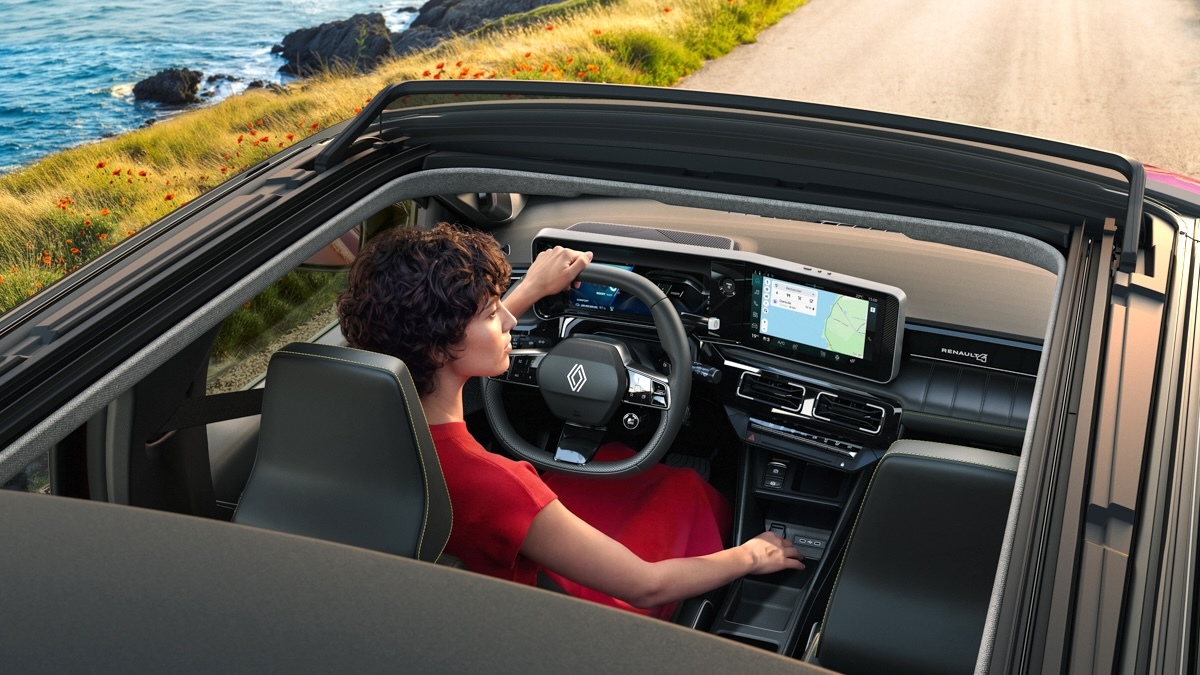
Renault’s retro-flavored 4 E-Tech has already borrowed plenty of design ideas from the original Renault 4, but now it’s reviving one of the old car’s coolest features too. Meet the new Plein Sud version, which swaps the standard roof for a giant electrically operated folding canvas setup.

The fabric opening stretches 800 by 920 mm (31.5 x 36.2 inches) and folds back electrically in multiple stages, giving both front and rear passengers a proper open-air feel. Renault says it’s the only fully electric B-segment SUV currently offering this kind of setup.

Related: Radical Espace Reboot Leads Renault’s 36-Car Plan To Fight China’s Threat

The roof itself is a pretty clear nod to the original Renault 4’s simple manually retractable fabric roof from the 1960s. But this one is a whole lot smarter. Not only is it fully electric, but you can open it by asking the Reno voice assistant if you’re feeling too lazy to press a button.

Underneath, nothing about the Renault 5 E-Tech‘s SUV brother changes mechanically. Buyers still get the familiar 148 hp (150 PS / 110 kW) front-mounted motor and 52 kWh battery pack delivering up to 242 miles (389 km) of WLTP range. That’s only slightly lower than the fixed-roof version, which manages up to 249 miles (400 km), proving the folding roof’s hasn’t hurt efficiency too badly.

Cheaper Than A Beach Holiday

 Renault’s 4 E-Tech Just Borrowed Another Trick From The ’60s Original, And It’s Not Deckchair Seats

The Plein Sud arrives in mid-spec Techno+ and top of the line Iconic+ trims, and costs £1,500 ($2,000) more than equivalent fixed-roof models. Prices start at £27,445 ($37,412) in the UK after applying the government’s £3,750 ($5,111) Electric Car Grant. In France, prices start at €31,110 ($36,684) after incentives.

Early access ordering opens immediately for Renault’s R Pass holders, basically customers who previously paid for priority reservation access to skip ahead in the queue. Everyone else can place orders from May 14.

Aside from the roof, Renault’s also rolled out updated safety tech across the 4 E-Tech range to comply with Europe’s latest regulations. New systems include driver fatigue monitoring and an emergency stop function capable of safely slowing the vehicle if the driver becomes unresponsive.

\\\\\\\\\\\\

Renault

Renault’s 4 E-Tech Just Borrowed Another Feature From The 1960s Original, And It’s Not Deckchair Seats

  • Renault adds huge folding canvas roof to electric 4 E-Tech crossover for £1,500 premium.
  • 4 Plein Sud, which translates as due south, cost from £27,445 including UK’s £3750 grant.
  • Like all 4 E-Techs it comes with 147 hp, a 52 kWh battery and up to 242 range miles.

Renault’s retro-flavored 4 E-Tech has already borrowed plenty of design ideas from the original Renault 4, but now it’s reviving one of the old car’s coolest features too. Meet the new Plein Sud version, which swaps the standard roof for a giant electrically operated folding canvas setup.

The fabric opening stretches 800 by 920 mm (31.5 x 36.2 inches) and folds back electrically in multiple stages, giving both front and rear passengers a proper open-air feel. Renault says it’s the only fully electric B-segment SUV currently offering this kind of setup.

Related: Radical Espace Reboot Leads Renault’s 36-Car Plan To Fight China’s Threat

The roof itself is a pretty clear nod to the original Renault 4’s simple manually retractable fabric roof from the 1960s. But this one is a whole lot smarter. Not only is it fully electric, but you can open it by asking the Reno voice assistant if you’re feeling too lazy to press a button.

Underneath, nothing about the Renault 5 E-Tech‘s SUV brother changes mechanically. Buyers still get the familiar 148 hp (150 PS / 110 kW) front-mounted motor and 52 kWh battery pack delivering up to 242 miles (389 km) of WLTP range. That’s only slightly lower than the fixed-roof version, which manages up to 249 miles (400 km), proving the folding roof’s hasn’t hurt efficiency too badly.

Cheaper Than A Beach Holiday

 Renault’s 4 E-Tech Just Borrowed Another Feature From The 1960s Original, And It’s Not Deckchair Seats

The Plein Sud arrives in mid-spec Techno+ and top of the line Iconic+ trims, and costs £1,500 ($2,000) more than equivalent fixed-roof models. Prices start at £27,445 ($37,412) in the UK after applying the government’s £3,750 ($5,111) Electric Car Grant. In France, prices start at €31,110 ($36,684) after incentives.

Early access ordering opens immediately for Renault’s R Pass holders, basically customers who previously paid for priority reservation access to skip ahead in the queue. Everyone else can place orders from May 14.

Aside from the roof, Renault’s also rolled out updated safety tech across the 4 E-Tech range to comply with Europe’s latest regulations. New systems include driver fatigue monitoring and an emergency stop function capable of safely slowing the vehicle if the driver becomes unresponsive.

\\\\\\\\\\\\

Renault

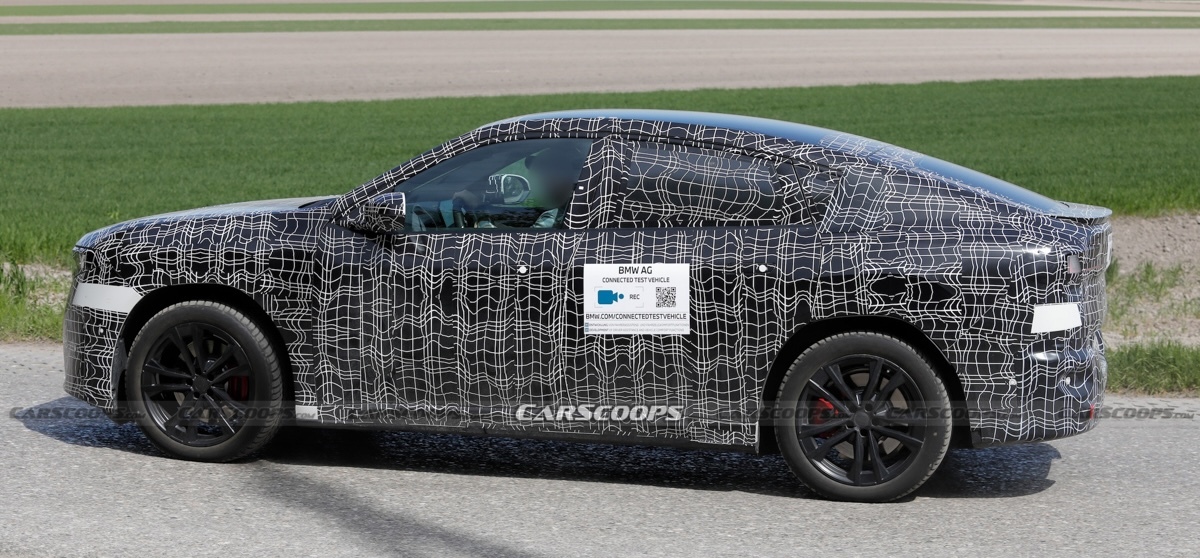
BMW’s iX3 Beat The Gas X3 M50, The iX4 Could Beat The iX3

  • BMW’s upcoming iX4 electric coupe SUV has been spied testing.
  • Neue Klasse crossover shares platform, powertrains with new iX3.
  • iX4 50 xDrive should offer same 463 hp as iX3, cost around $67k.

BMW’s Neue Klasse offensive is picking up pace, and having this week been impressed by the price and EPA range of the iX3, we’re now getting a closer, though unofficial look at its coupe brother, which could stretch a full charge even further.

Like its boxier sibling, the iX4 adopts BMW’s new visor-style face that’s becoming a defining Neue Klasse trait. The same design language is also heading to the upcoming electric i3 sedan, helping tie the next generation of BMW cars together visually.

More: BMW’s New iX3 50 Is Cheaper And More Powerful Than Its Own Gas X3 M50

But beyond the nose, the iX4 starts doing its own thing. The roofline drops lower and flows into a fastback rear end, giving the crossover a sleeker silhouette than the standard iX3. It definitely looks sportier, though very tall rear passengers might not be celebrating the compromised headroom or smaller trunk.

\\\\\\\\\\

The latest spy shots also reveal colored brake calipers hiding behind the wheels, strongly hinting this prototype wears M Sport trim, or is an M Performance variant. The basic M Sport package of interior and exterior trim is $2,500 on the new iX3 that arrives in US showrooms this fall, but upping the spend to $4,000 gets you the Professional version that adds colored M brakes and the Iconic Glow illuminated grille.

Inside, expect the same tech-heavy minimalist cabin already previewed by the iX3 and since rolled out to the facelifted 7-Series. That means a big 17.9-inch infotainment display, BMW’s pillar-to-pillar Panoramic iDrive setup, a futuristic four-spoke steering wheel, and an updated head-up display system.

40 And 50 Powertrains Planned

 BMW’s iX3 Beat The Gas X3 M50, The iX4 Could Beat The iX3

Underneath, the iX4 should mirror the iX3 lineup almost exactly. Earlier leaks tied to BMW’s accidentally published US product plans suggested America will get both 40 and 50 variants of the iX3 in rear and all-wheel drive configurations. It’d make little sense for BMW not to offer matching iX4 versions, though it looks like BMW will restrict the electric coupe to all-wheel drive.

That means entry-level models could use the European-spec iX3 40 setup featuring an 82.6 kWh battery and a 316 hp (235 kW / 320 PS) motor. Higher-end 50 xDrive versions should pack dual motors producing 463 hp (345 kW / 469 PS). Both versions will be capable of charging at 400 kW.

BMW recently confirmed the iX3 50 xDrive for America with a surprisingly low $62,850 starting price (including $1,350 destination) and an impressive EPA-rated 434 miles (699 km) of range. Since the iX4 slices through the air more cleanly, it could potentially travel even farther between charges, though expect pricing to climb past the $65,000 mark.

\\\\\\\\\

Edmunds Lost $47,000 On The Charger Daytona, And That Was The Good News

  • A year of ownership wiped nearly 60 percent off the Daytona’s value.
  • The electric Charger covered under 7,000 miles before its value collapsed.
  • Staff complaints ranged from fake exhaust sounds to glitchy software.

Buying a new car is almost always a terrible financial decision. But losing nearly $50,000 in a single year after just a few thousand miles takes things to an entirely different level of painful. Unfortunately for Edmunds, that’s exactly what happened with its 2024 Charger Daytona Scat Pack.

Unlike many magazines and websites, that simply borrow their long-term test cars from automakers, Edmunds buys them with real cash. True, it got a small discount from Dodge on the as-tested price of $85,965, but it still paid a hefty $82,000 to get behind the wheel of Detroit’s first electric muscle car.

Related: The Last Dodge Challengers Were Supposed To Age Into Money, Not Lose $14,000 With Delivery Mileage

But 12 months later when it came time to move the car on, Edmunds was shocked to find its Daytona was worth just $35,000. That’s almost a 60 percent hit, and not because the road test team had put a lifetime’s worth of miles on the EV. It had covered less than 7,000 miles (11,300 km), which is the kind of distance some drivers do in six months.

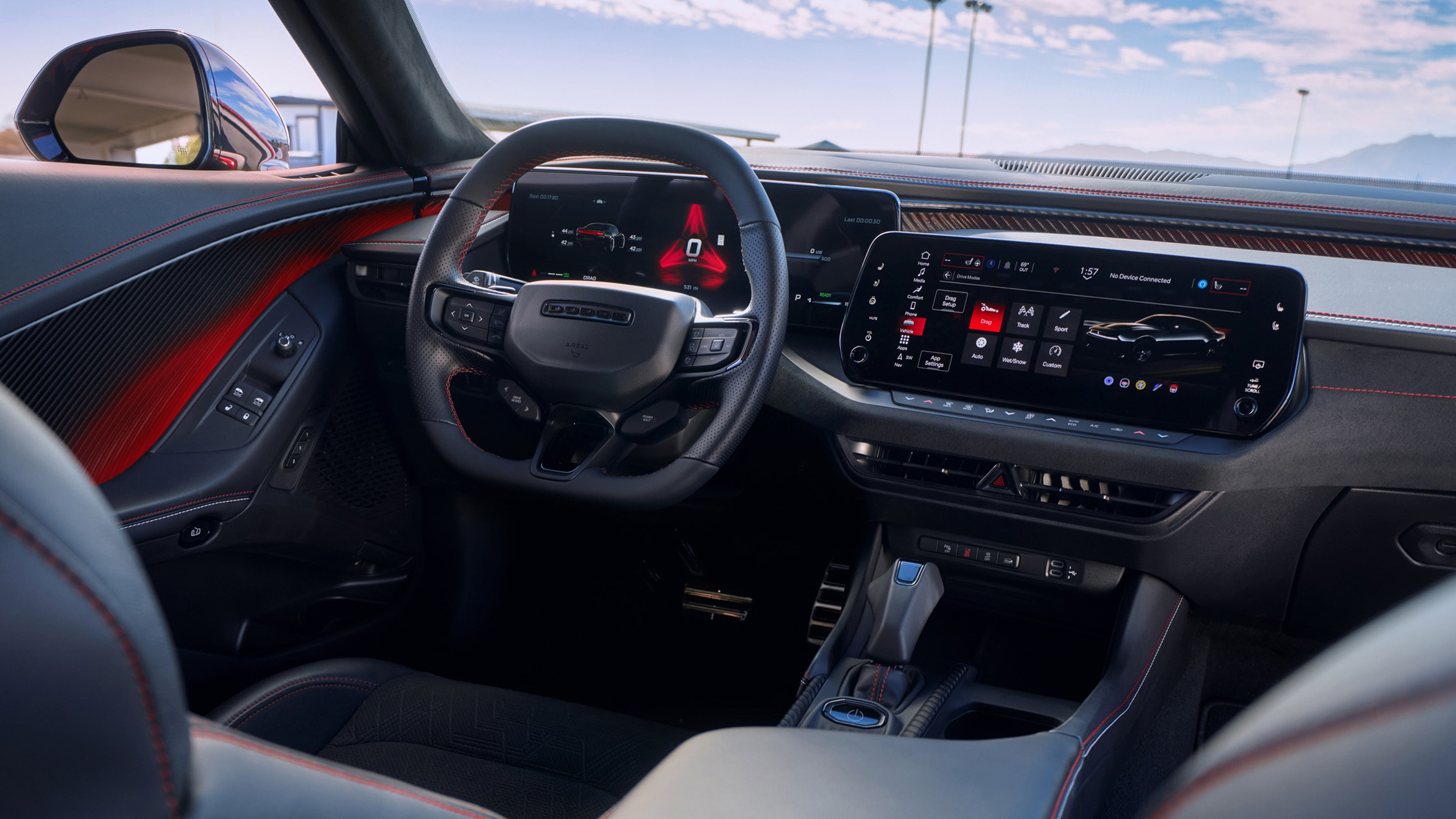
Even worse, the massive financial hit came after most of the Edmunds staff spent a year actively disliking the thing. Reading through their long-term test notes would be enough to send anyone wavering over which pony car to buy straight into the arms of a V8-powered Ford Mustang Dark Horse.

Digital Headaches

 Edmunds Lost $47,000 On The Charger Daytona, And That Was The Good News

Complaints ranged from glitchy infotainment and strange drivetrain clunks to awkward ergonomics and bizarre software behavior. One editor described the fake Fratzonic exhaust sound as “an insult to V8s everywhere,” while another said the car was simply “boring,” which is probably the most brutal criticism you can level at something wearing a Charger badge.

Others hated the turning circle, massive dimensions, inconsistent regen braking, and handling that apparently couldn’t back up the car’s straight-line punch. But the year didn’t pass without the Charger getting some praise. Several staffers liked the styling, roomy hatchback practicality and surprisingly good range. The 670 hp (679 PS /500 kW) Daytona managed 255 miles (410 km) in real world use, comfortably beating its pathetic official EPA estimate of 216 miles (348 km).

“The Charger was a big, expensive disappointment,” the outlet said, summing up the year-long experience. “We won’t miss having this thing in our fleet.”

\\\\\\

Dodge

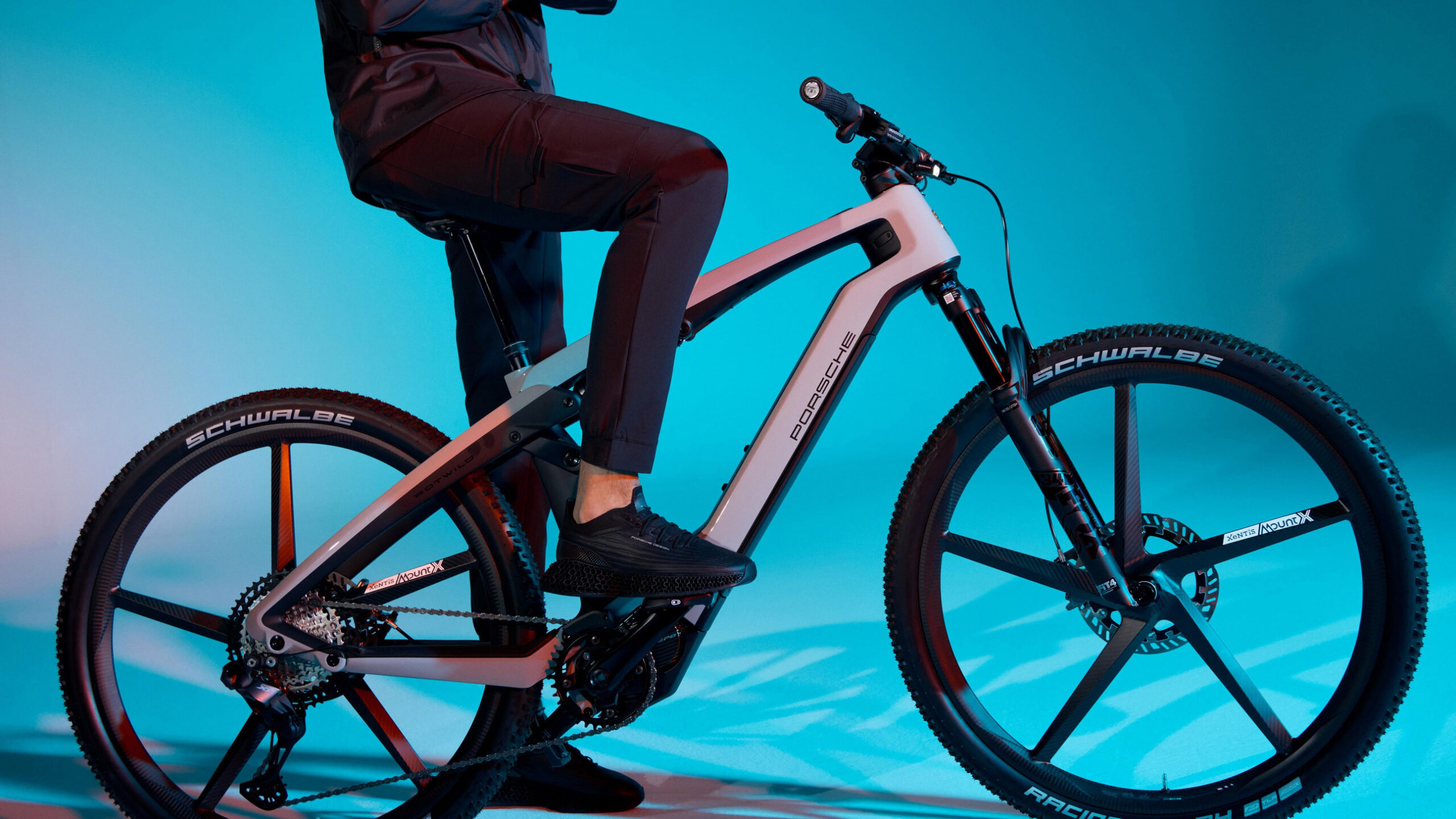
Porsche’s EV Gamble Is Going So Well It’s Even Closing Its Ebike Arm And 500 Jobs

  • Porsche plans major reset after weakening demand, tariff costs and pricey electric strategy u-turn.
  • Several Porsche subsidiaries, including ebike and battery divisions, face closure, with loss of 500 jobs.
  • Difficult years lie ahead while Porsche waits for new ICE Macan SUV it thought it would never need.

Porsche spent years telling us the future would be mostly electric. Now it’s scrambling to rebuild parts of the combustion lineup it already started phasing out, while simultaneously slashing jobs, shutting divisions, and reshuffling management to steady the ship and improve profits.

Having last month sold its stake in Bugatti and Rimac, the company this week confirmed plans to eliminate more than 500 jobs while discontinuing several electric-focused subsidiaries as part of a broader restructuring effort. Porsche is shutting down Cellforce Group, Porsche eBike Performance, and Cetitec as it narrows its focus back toward its main automotive business.

More: Porsche’s Profits Fell 93%, So It’s Selling Bugatti And Rimac

Cellforce was Porsche’s battery technology venture focused on developing high-performance lithium-ion cells for future EVs and motorsport applications. It “no longer has a sufficiently viable long-term perspective” and closes with the loss of 50 jobs, the company says.

Porsche eBike Performance, as its name suggests, handled electric bike drive systems and related hardware, but “fundamentally changed market conditions for e‑bike drive systems” means it gets the chop, and so do 360 workers. Cetitec, meanwhile, specialized in engineering and technical consulting services for automotive development programs. Sixty people in Germany are now looking for a new paycheck as a result of it being shuttered, along with a further 30 in Croatia.

Getting Back To Cars

 Porsche’s EV Gamble Is Going So Well It’s Even Closing Its Ebike Arm And 500 Jobs

“Porsche must refocus on its core business,” CEO Michael Leiters said, announcing the reset. “This is the indispensable foundation for a successful strategic realignment [and] forces us to make painful cuts — including our subsidiaries.”

The €1.4 Million Dashboard

At the same time, Porsche is also restructuring its executive board and folding the standalone Car-IT division into the wider research and development department led by Michael Steiner.

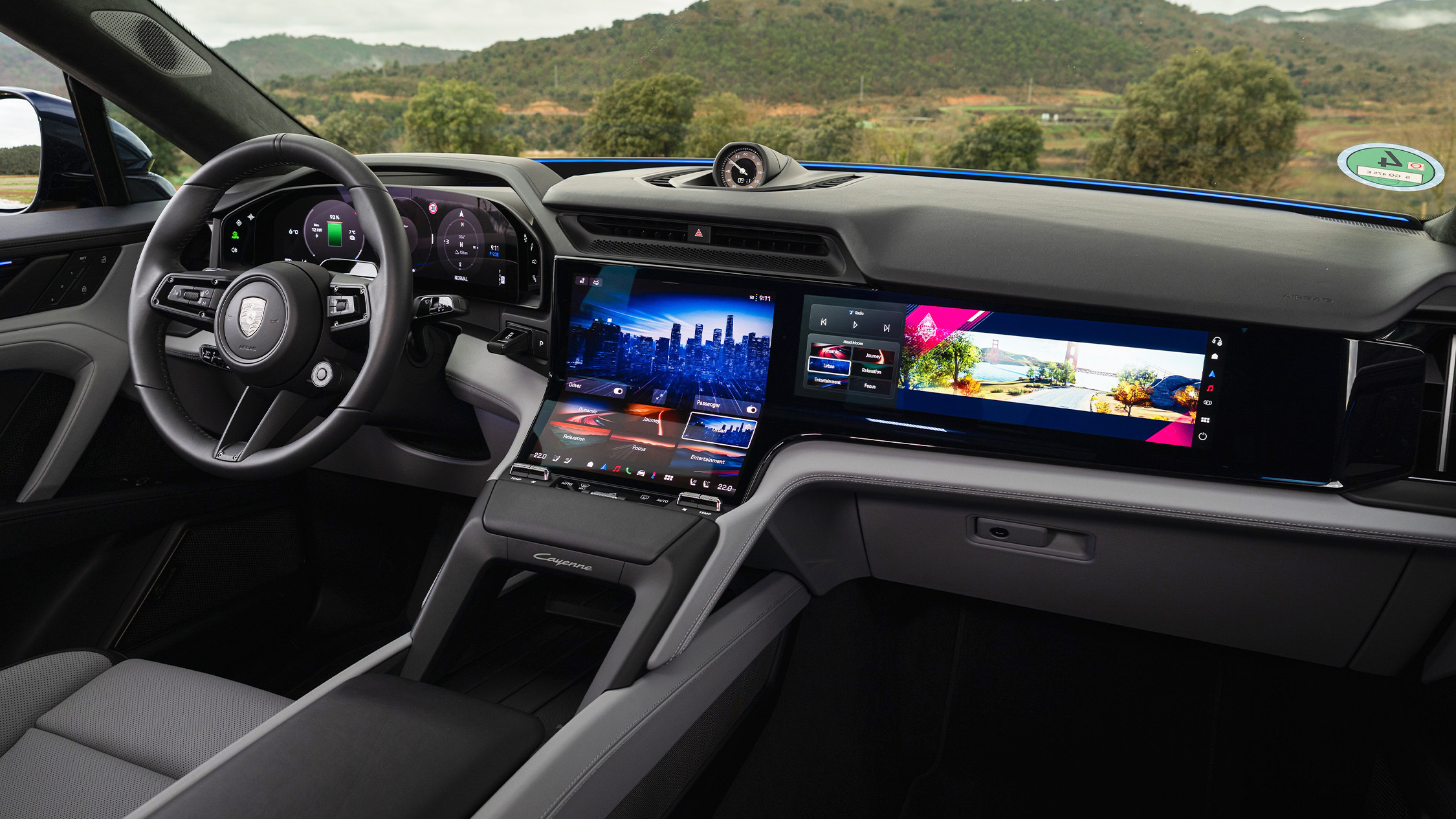
That’s a notable reversal because Porsche created the dedicated software-focused board role a few years ago specifically to recruit Sajjad Khan away from Mercedes-Benz, Automobilwoche reports. Khan had been tasked with modernizing Porsche’s infotainment and digital experience, and his influence is already visible in the electric Cayenne’s redesigned cockpit and connected features. That influence came at a price, though. Last year, Kahn reportedly earned €1.4 million ($1.65 m).

 Porsche’s EV Gamble Is Going So Well It’s Even Closing Its Ebike Arm And 500 Jobs
Porsche

A bigger issue, though, is Porsche’s increasingly awkward product strategy. The company is preparing to kill the combustion Macan this summer despite demand for the gas-powered SUV still massively outweighing interest in the electric replacement in several markets, especially the US.

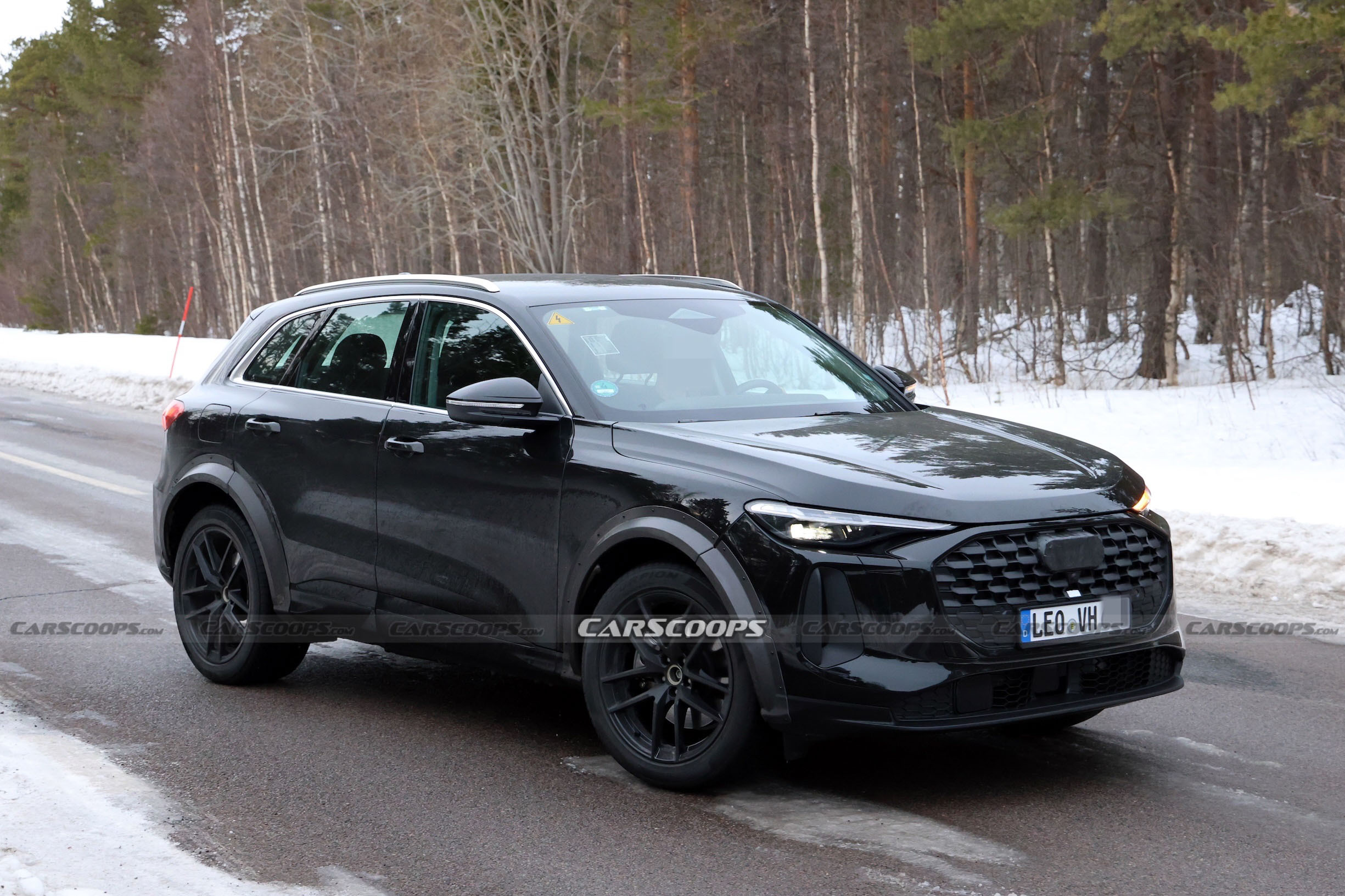
Porsche reportedly won’t have a new combustion or hybrid Macan (seen below testing in Audi Q5 mule form) ready until around 2028, leaving a painful gap in one of its most important model lines. Meanwhile, Chinese sales continue sliding as local EV brands offer cheaper alternatives loaded with flashy technology. It’s good that Porsche is grasping the nettle, but the pain isn’t going to disappear overnight.

 Porsche’s EV Gamble Is Going So Well It’s Even Closing Its Ebike Arm And 500 Jobs

VW Said No Fake Shifts On A GTI, The Clubsport Could Borrow Hyundai N’s Trick Anyway

  • VW’s ID. Polo GTI Clubsport could fake shifts for extra fun.
  • The hotter EV hatch may jump from 223 hp to nearly 282 hp.
  • Mini and Stellantis rivals already push as much as 276 hp..

Volkswagen hasn’t even officially launched the electric ID. Polo GTI yet, and already there’s talk of an even hotter Clubsport version lurking in development. Better still, it might come with fake gearshifts and simulated combustion-style power delivery and sounds designed to make EV hot hatch feel less, well, EV-ish.

According to Autocar, VW engineers are exploring a more extreme ID. Polo GTI Clubsport packing roughly 282 hp (286 PS / 210 kW), up substantially from the regular car’s expected 223 hp (226 PS / 166 kW) output. That would immediately put it closer to the upper end of the growing electric hot hatch class.

Related: VW’s New ID. Polo Starts Under $30K And Comes With Massage Seats

While the standard ID. Polo GTI should comfortably match the 215 hp (218 hp / 160 kW) Alpine A290 GTS and its mechanically related 223 hp Cupra Raval sibling, several rivals already bring considerably more firepower. The electric Mini JCW produces 255 hp (259 PS / 190 kW), while Stellantis has gone properly aggressive with the 276 hp (280 PS / 206 kW) Peugeot e-208 GTI and Opel Corsa GSE.

The Opel, unveiled this week, sets a serious benchmark, sprinting to 62 mph in just 5.5 seconds. Current expectations suggest the regular VW GTI might need around a second longer than that, though the Clubsport should give the Opel a real fight.

Performance upgrades reportedly won’t stop at extra power. Autocar says VW’s also considering replacing the current electronically controlled BorgWarner limited-slip differential with a fully mechanical setup for sharper front axle behavior.

Hyundai N-Style Shifts

\\\\\\\\

But arguably the most interesting part is the fake shifting system, something that appeared on the GTI concept back in 2023, but which VW then said would not appear on a production GTI. Of course nobody asked about a GTI Clubsport.

VW dynamics boss Florian Umbach said the company is working on “a similar kind of paddleshift power delivery that the [electric] Hyundai N cars have.” Like the Ioniq 5 N, the setup would use software-controlled power delivery to imitate a combustion engine and transmission.

“It’s all about motor control and an audio soundtrack to match,” Umbach told the magazine, suggesting fake sounds – also featured on the 2023 VW GTI concept – will also be part of the Clubsport package.

Purists will absolutely argue about whether fake shifts belong in a GTI, but the reality is many drivers miss the interaction traditional hot hatches delivered and VW clearly knows engagement matters just as much as raw acceleration numbers.

Images shown below are of the 2023 GTI concept.

\\\\\\\\\\\\

VW

Honda’s $11 Billion Canadian EV Plant Just Got Shelved Because America Wants Hybrids

  • Honda has put a hold on plans to develop a new EV plant in Ontario.
  • Plans were announced in 2024, but then delayed by two years in 2025.
  • Honda recently scrapped three new EVs due to launch in North America.

Honda’s electric future in North America just took its second major hit in as many months. The company is now hitting pause on plans for a massive EV and battery plant in Canada, and it might not restart anytime soon.

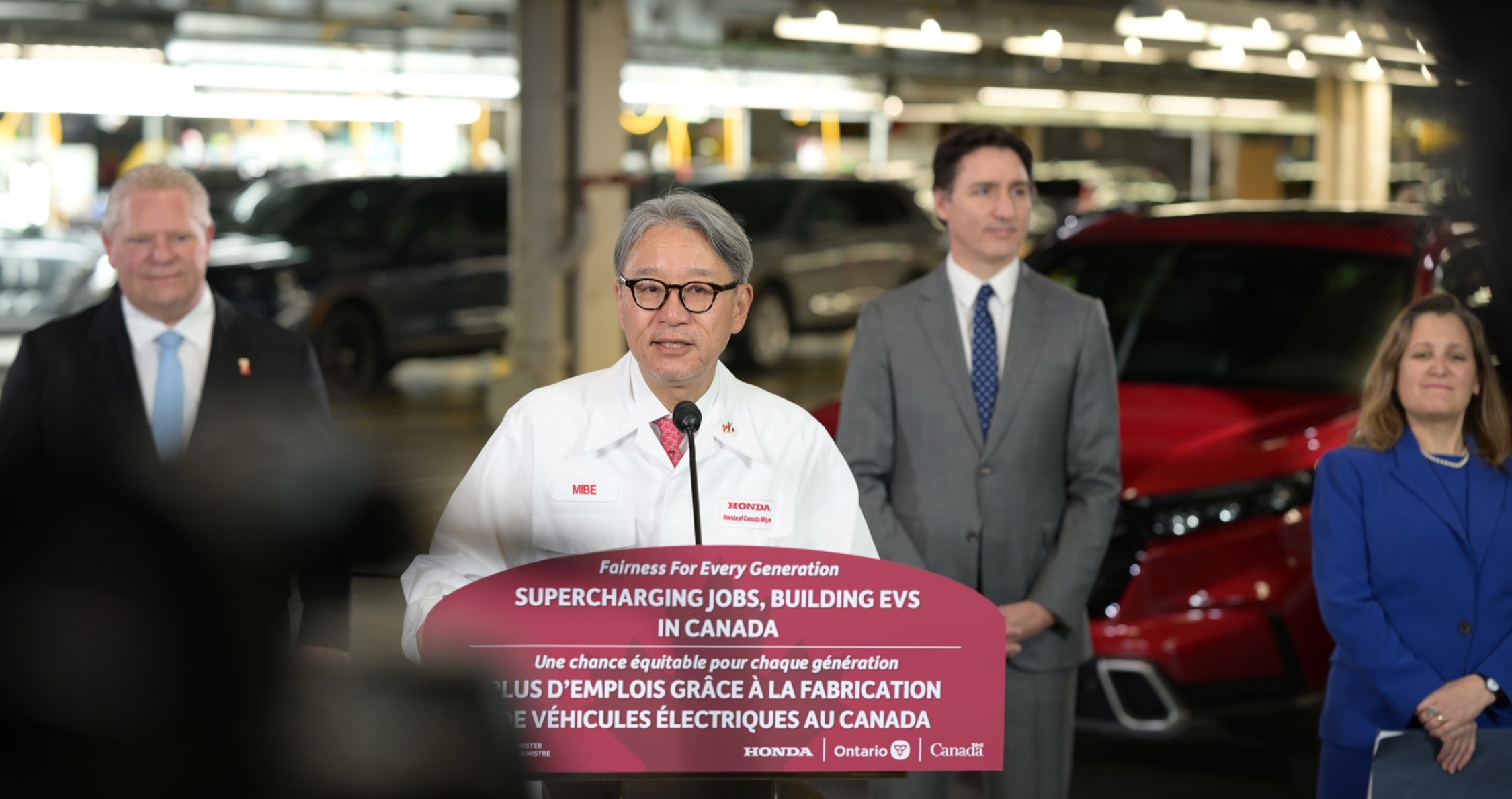
The project, originally announced in 2024, was going to be huge, with $15 billion CAD ($11 bn USD) earmarked for a new factory in Alliston, Ontario. But Honda has decided to shelve the plan indefinitely while it reassesses the market, Nikkei Asia reports.

Related: Honda’s $15.9 Billion EV Disaster Just Delayed The Next Accord, Odyssey, And MDX

It’s not hard to see why the plans collapsed. EV demand in the US isn’t where Honda expected it to be, and that’s forcing a rethink. Instead of going all in on electric, the company is doubling down on hybrids, which are selling strongly right now.

Policy changes haven’t helped either. The removal of federal EV incentives in the US has made electric cars more expensive overnight, while relaxed efficiency rules have reduced the urgency for automakers to push EVs hard. There’s also the issue of tariffs and trade uncertainty between the US and Canada, which adds another layer of risk to any long-term investment.

“American tariffs and changes to US domestic policies are creating real pressures for automakers, prompting some to delay or scale back investments in electric vehicle and battery projects,” Industry Minister Melanie Joly told Canada’s CTV News.

Already Delayed

 Honda’s $11 Billion Canadian EV Plant Just Got Shelved Because America Wants Hybrids

Honda had already delayed the Alliston EV project once, pushing the timeline for the car plant and related battery plant back by two years in May of 2025, despite having already acquired the land and locked in financial help from Canada. Now it’s taking things further by putting everything on ice while it watches how the market evolves, though it will still build the Civic and CR-V at its existing Alliston plant that was opened in 1986.

Multiple Future EVs Scrapped

The shift in powertrain philosophy is already showing up in Honda’s new EV product plans. The company is winding down the Prologue EV, which it co-developed with GM, and earlier this year scrapped three exciting new Honda and Acura electric cars and SUVs destined for North American roads, even though they were in the final stages of development. Not long after that, Honda and Sony confirmed they were abandoning their plans to launch EVs under the Afeela brand.

Instead of EVs, Honda will focus on hybrids in North America, which are gaining popularity with buyers, and extend the life of existing models to save cash. That doesn’t mean Honda is abandoning EVs completely. It still has flexible production lines in Ohio that can build gas, hybrid, or electric models depending on demand, having spent $1 billion to upgrade the site. But for a while at least, fully electric models won’t be part of Honda’s future in the US or Canada.

\\\\\\\\\\\\\

Honda

BMW’s New iX3 50 Is Cheaper Than Its Own Gas X3 M50. Its Range Embarrasses The Model Y

  • BMW’s first Neue Klasse SUV in America starts at $61,500 plus fees.
  • The 483 hp xDrive 50 posts 434 miles, leaving Tesla’s Model Y behind.
  • BMW charges $4,000 for the M Sport pack with glow grille upgrades.

BMW of North America has dropped two crucial numbers for its new iX3 electric SUV, and they couldn’t have come at a more important time. Up to 434 miles (699 km) of EPA range isn’t just impressive, it might be exactly what the sagging US EV market needs right now. As is the price, which makes the electric X3 SUV cheaper than a less powerful combustion X3.

That headline range figure, which is even better then the 400 miles (644 km) originally estimated by BMW stateside, puts it ahead of most rivals, though it does come with an asterisk. It only applies to cars equipped with the no-cost-option 20-inch summer tires. Stick with the default all-seasons 20-inchers and it drops to 383 miles (616 km).

Related: BMW iX3 Beats Its Official Range By Over 120 Miles In Real-World Test

Here’s where it gets really weird, though. BMW reckons you’ll get 399 miles (642 km) if you upsize to the $600 21-inch wheels and all-season rubber, which actually give you 1 mile (1.6 km) more range than the 21-inch summer tires offer. It sounds all wrong but BMW says the strange numbers are the result of averaging range figures across various tire brands.

You can check out the full range-to-tire stats in the table below, but whichever combo you pick, you’re going to be going further between fills than any other electric SUV in the sector. Tesla quotes 294 miles (473 km) for the base AWD Model Y, 327 miles (526 km) for the Premium AWD, and 306 miles (492 km) for the Performance variant. While we’re still waiting on official figures for the Mercedes GLC 400 4Matic, based on the difference between it and the iX3 in the European WLTP numbers, we’d expect its EPA range to be around 380 miles (612 km) at best.

2027 iX3 Electric Range Vs Tires
Wheel & Tire PackageMPGe CombinedRange (mi)
20″ Summer Tires (No-cost option)118434
20″ All-Season Tires (Standard)102383
21″ Summer Tires105398
21″ All-Season Tires105399
22″ Summer Tires104392
SWIPE

It Undercuts The ICE X3 On Price

But range, and an ability to charge at 400 kW, adding 185 miles (298 km) in 10 minutes, isn’t the only thing the iX3 has on its side. It’s also competitively priced. The iX3 50 xDrive costs $62,850 including a $1,350 destination charge, which means it costs less than the brand’s own gas-powered $67,850 X3 M50 xDrive.

It also gives you 463 hp (469 PS) and 476 lb-ft (645 Nm) to the ICE SUV’s 393 hp (399 PS) and 428 lb-ft (580 Nm), and though the six-cylinder SUV gets to 60 mph (97 kmh) a touch quicker (4.4 plays 4.7 seconds) than the EV, we bet it’s the iX3 that feels the more urgent when you jump on the right pedal for a passing maneuver.

That kind of pricing is designed to hook in American drivers who’ve lost interest in EVs lately. BMW’s electric sales sank 16.7 percent last year and cratered by 45.5 percent in the fourth quarter after the Trump administration axed the $7,500 federal tax credit program. Mercedes will now be feeling the heat to price its GLC EV as close to $60k as possible.

M Sport Trim A $2,500 Option

Naturally there are plenty of opportunities to add to the iX3’s $62,850 base price. Standard kit includes BMW’s Panoramic Vision pillar-to-pillar digital display, Perforated Veganza Upholstery, smartphone charger, Digital Key Plus (which uses your phone as a key) and umpteen safety aids. But plenty of buyers will want to add the $1,500 Comfort Package (heated steering wheel, panoramic glass sunroof and multifunction seats), or $1,900 Technology Package (BMW Iconic Glow illuminted kidney grille, 3D head-up display, Harman/Kardon hifi). Or maybe even both.

\\\\\\\\\\\\\

And the M Sport package is sure to be a big draw. The base version of the package costs $2,500 and nets you BMW M interior and exterior trim, 20-inch M Aero V-Spoke wheels and a sports steering wheel, while the $4,000 Professional version adds the Iconic Glow light-up grille, a proper M sport wheel and M Sport brakes with red and blue calipers. That’s as near as you’ll get to an iX3 M this year, though we expect to see one of those before long.

More Affordable iX3 40 Arrives Later

And if even an options-free iX3 50 is too pricey for your pocket, there may be a solution arriving shortly. Though BMW hasn’t yet confirmed it’s coming to US roads, information that mistakenly appeared briefly on the brand’s website earlier this year before being taken down, suggested the 50 xDrive would be joined by a rear-wheel drive 40 sDrive and all-wheel drive 40 xDrive.

Related: BMW’s Entry-Level iX3 Saves You Over $7K, But There’s A Real Trade-Off

BMW has already debuted the single-motor 40 in Europe in March, revealing that it makes 316 hp (320 PS / 235 kW) and downgrades to a 82.6 kWh battery. The new base model needs 5.9 seconds to reach 62 mph (100 kmh) and going by the 395 miles (636 km) WLTP range, will probably get an EPA rating of around 340 miles (547 km).

You can configure your iX3 50 now and reserve it for $1,000. Get in early and you should get yours when deliveries kick off in September.

\\\\\\\\\\\\

BMW

Opel’s New Corsa GSE Beats Peugeot’s GTI Using Peugeot’s Own Powertrain

  • New Corsa GSE delivers 276 hp and 0-62 mph in 5.5 seconds.
  • FWD chassis gets a limited-slip diff and performance brakes.
  • Plaid bucket seats tip a hat to classic hot hatches from the ’80s.

Opel and its badged-engineered British sister brand Vauxhall are rediscovering their hot hatch roots, but with a charging cable this time. The pair dropped their Corsa GSE today, along with a zero to 62 mph (100 kmh) time that says it’s faster than any rival electric hot hatch on the market.

That includes fellow Stellantis company Peugeot’s e-208 GTI whose platform, powertrain and basic chassis setup the GSE shares. Under the skin is a single electric motor that sends 276 hp (281 PS / 207 kW) and 254 lb-ft (345 Nm) of torque to the front wheels through a limited-slip differential, though only in Sport mode. In Normal you make do with 228 hp (231 PS / 170 kW).

Related: Stellantis Just Decided Which Four Brands Actually Matter And Opel Isn’t One

Zero to 62 mph (100 kmh) takes 5.5 seconds in Sport, versus 5.7 seconds for the e-208 and 5.9 seconds for the 1,550 kg (3,420 lbs) Corsa’s mechanically identical, but 47 kg (104 lbs) heavier crossover brother, the Mokka GSE. That’s pretty damn swift for a small, front-wheel drive hatch, and also makes the Corsa GSE significantly quicker than its key non-Stellantis electric rivals like the Alpine A290 and Mini Cooper JCW, which need 6.4 and 5.9 seconds respectively to hit the 60 mph mark.

Stiffer, lower suspension and uprated brakes with four-pot calipers are part of the chassis package, Opel claiming that both the steering and pedal responses are massively improved over what you experience from the regular EV. Rolling stock is Michelin Pilot Sport 4S 215/40 R18 rubber wrapped around alloy rims whose three-spoke design is there to evoke memories of the 1980s Opel Corsa GSE, which traded blows with the Peugeot 205 GTI almost 40 years ago.

Plaid Buckets? Check!

\\\\

Climb inside and you’ll find the sports seats have plaid centers to carry on the 1980s hot hatch theme. Other GSE interior details on the 2027 car include Alcantara trim, aluminum pedals, and strong yellow accents, plus a performance data display showing acceleration stats and G-force readings. On the outside, in addition to those three-spoke rims you get a black roof, rear spoiler and sportier bumpers.

As for range, we don’t have numbers yet, but we do know that the GSE uses the same 51 kWh (usable) battery as other Corsas and other Stellantis cars built on the same CMP platform. So we’d expect the GSE to roughly equal the e-208 GTI’s 217-mile (349 km) range, which will be fine for blasting around town, but not so good on longer trips.

VW’s ID. Polo GTI debuts any day, and should deliver more than 260 miles (418 km) of range, though with only 223 hp (226 PS / 166 kW) it won’t trouble the GSE in a race to 62 mph. Which one gets your vote?

\\\\\\\\\\\\\\\\\\\

Opel/Vauxhall

BMW’s First Million EVs Took 11 Years. The Second Took Two

  • BMW Group hits two million EVs just two years after first million.
  • More important EVs coming through include i3 electric 3-Series.
  • Europe leads growth but US, China slowdown hurts momentum.

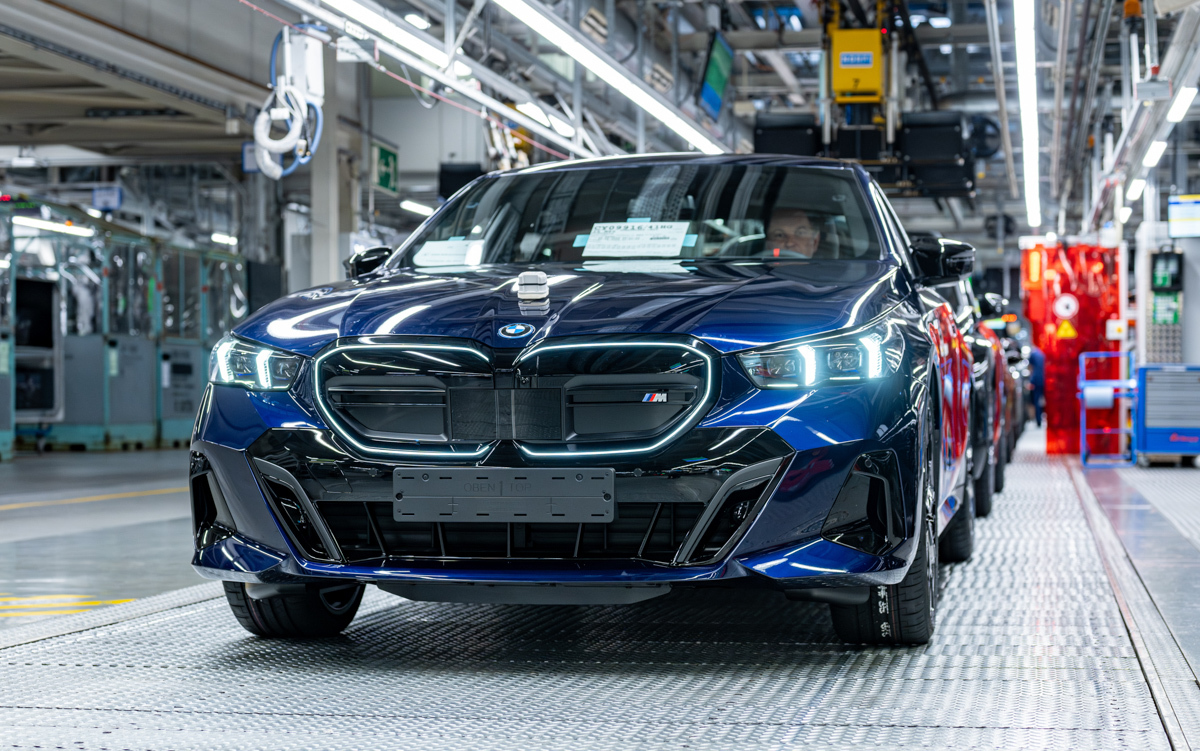
The BMW Group has just built its two millionth fully electric car, and the speed of that climb is impressive. It took almost 11 years after the first i3 hatch rolled off the line in 2013 to reach the first million, then only about two more to double it.

The milestone car is a BMW i5 M60 xDrive, built in Germany and heading to a buyer in Spain. That destination says a lot, because Europe is leading the way when it comes to EV demand right now. Sales of fully electric cars in the region jumped 28 percent in 2025, and one in every five cars sold in the EU is now an EV.

Related: BMW’s China-Only EVs Solve A Problem Tesla Owners Keep Running Into

Production is ramping fast to accommodate that growth. BMW now builds EVs at all its German plants and mixes them with combustion cars on the same lines. That flexibility lets it react as demand shifts, and lately, demand has been shifting quite a bit, because Europe’s love for EVs isn’t mirrored in other regions.

Globally, BMW delivered 442,072 EVs in 2025, a modest increase that shows growth is still happening, just not at the same pace as before. Because in the United States, BMW’s EV momentum has clearly cooled. Battery electric sales fell to 42,484 units in 2025, down 16.7 percent year over year.

The drop was even sharper late in the year, with fourth quarter EV sales plunging 45.5 percent after federal EV tax credits were axed. At the same time, plug-in hybrids surged more than 30 percent, showing where buyers are heading. China isn’t helping either. Sales there dropped significantly, with the region down double digits overall, dragging on global performance.

Hot New Electric Metal Inbound

 BMW’s First Million EVs Took 11 Years. The Second Took Two

But on the plus side, BMW has just begun to roll out fresh EV product with cutting-edge design and technology. The iX3, the first of BMW’s Neue Klasse cars, is already in showrooms, and the i3 electric 3-Series that debuted this spring won’t be far behind. And it’ll be followed by the first-ever electric X5, while Rolls-Royce has its own electric SUV on the way, although the sales numbers will obviously be modest.

That lineup should help keep BMW Group’s EV registrations growing, but it might struggle to keep pace with another big German automaker. VW recently announced it had made its 2 millionth EV only 10 months after rolling out its millionth, and with the ID.3 now much improved and the ID. Polo arriving at dealers soon, its next million could come even quicker.

\\\\\\\\

BMW

A 1,000 HP Electric M3 And A 552 HP Gas M3 Will Have The Same Price Tag

  • BMW plans EV and ICE M3 pricing parity despite massive performance gap.
  • Electric version could hit 800-1,000 hp, gas model will make less than 600.
  • Manual gearbox and RWD options may disappear from combustion M3.

BMW is about to do something unusual with its most famous sports sedan. When the next-generation M3 arrives, buyers will get two very different machines wearing essentially the same badge and, crucially, roughly the same price.

According to a new report, BMW intends to sell the electric and combustion M3 side by side in the same price bracket. That might sound straightforward, but it gets interesting once you look at what each version actually delivers.

Related: BMW’s Electric M3 Tries To Simulate Everything It Just Replaced

The electric M3 could deliver close to 1,000 hp (1,014 PS) from its quad-motor setup, though base models are likely to deliver 700-800 hp (710-811 PS) at launch. Meanwhile, the combustion model will stick with an evolved twin-turbo straight-six boosted by mild hybrid tech to somewhere around 552 hp (560 PS).

Visually, the two cars won’t stray far from each other either. BMW wants them to feel like siblings, not alternatives from different worlds. Expect shared design cues inspired by the Neue Klasse look, even though they’re based on entirely different platforms, the combustion car sticking with an updated version of today’s M3’s CLAR platform.

Panoramic iDrive

Inside, both should follow the same minimalist, screen-heavy direction. That means fewer physical buttons and a more digital-first cabin, incorporating BMW’s Panoramic iDrive tech, which may divide opinion just as much as the powertrain choices.

Combustion M3
\\\\\\\\\\\\

Sylvia Neubauer, BMW M’s sales boss, is adamant that both cars will deliver what buyers expect. “It’s not only about acceleration and power, it’s about drivability, manoeuvrability and that level of trust and connection between the driver, car and road,” she told Autocar.

She also made it clear BMW knows not everyone will jump ship to electric overnight. “Obviously we will not convince 100 percent out of the petrolhead target group to buy an all electric BMW M3,” she admitted. “But out of 100 people that try it, we will be able to convince some.”

That explains why the combustion version isn’t going anywhere just yet, though some elements of it might be. Reports suggest the manual gearbox option, currently only available on the non-Competition version of the M3, might be retired. If that happens, even the petrol M3 edges further away from its analog roots.

Electric M3
\\\\\\\\\\\\\

Lead image BMW

Lotus Wants $189K For Its 905-HP Taycan Rival, UK Dealers Will Take $121K

  • UK Lotus dealers have slashed the prices of new all-electric Taycan rival.
  • One dealer’s unregistered EV has been priced down from £140k to £90k.
  • Lotus will launch hybrid versions of Emeya and Eletra to fight slow sales.

Around the world carmakers are u-turning on their plans to go big – or even all-in – on EVs, and Lotus is no different. The Geely-owned brand is developing hybrid versions of its Emeya sedan and Eletre SUV, but until they arrive, dealers have to focus on finding homes for the electric versions. And they’re offering huge discounts.

The UK’s Autotrader website currently has 15 brand new, unregistered examples of Lotus’s Porsche Taycan rival up for sale at prices that’ll bring tears to the eyes of anyone who paid full price for one of the EVs when they first became available in 2024.

Related: The Rarest Emira Coming To America Has A Name From The Dark Side

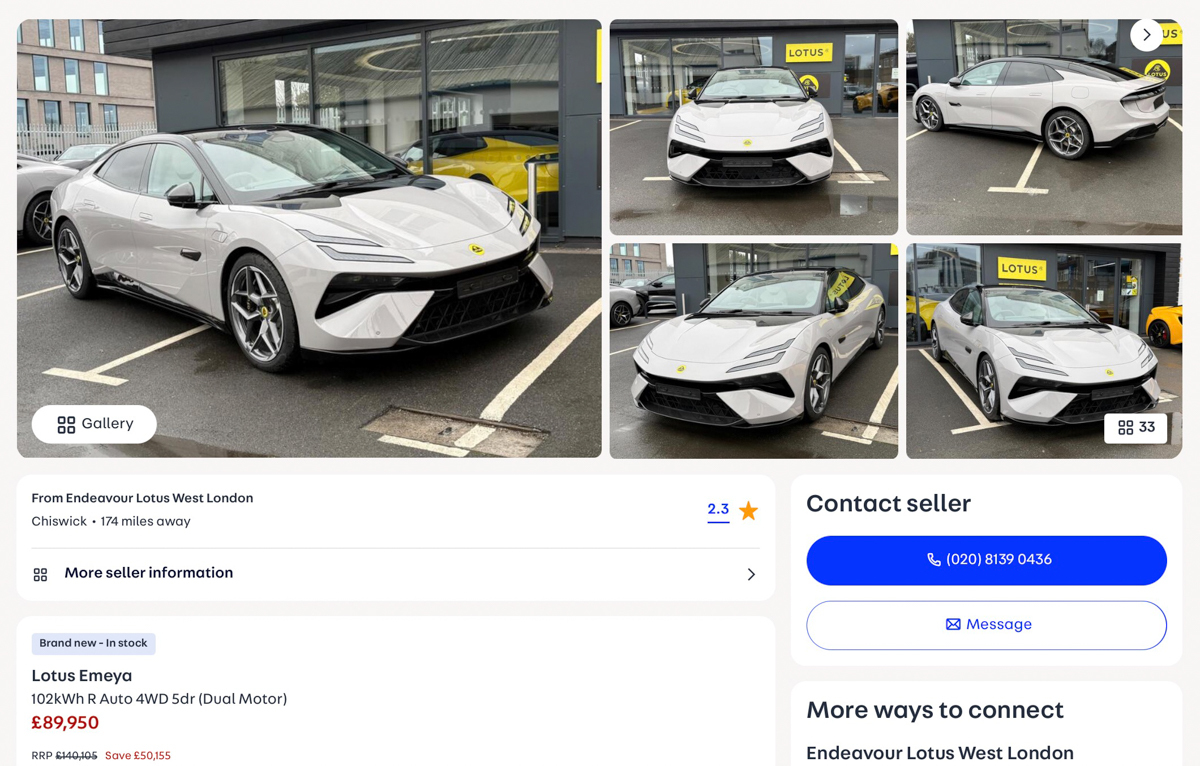
Most of the really crazy deals are on the flagship Emeya R, whose 905 hp (918 PS / 675 kW) bi-motor setup gets the emissions-free sedan to 62 mph (100 km/h) in less than 2.8 seconds. The biggest saving we could find was on a Kaimi Grey car at Endeavour Lotus West London. Originally priced at £140,105 ($189,330), it’s now up for £89,950 ($121,550). That’s a 40 percent (£50,155 /$67,900) haircut.

Not far away in Hatfield, another dealer has two new Rs price well below list, one of them promising a £43,755 ($59,130) saving. And a couple of hours away to the north east of the capital, Endeavour Lotus Colchester has a cut the price of another four Emeya Rs by similar amounts.

New Car, But An Old Badge

Technically, the R is an obsolete model, Lotus having now switched up its base, S, R grade structure for 600 and 900 names that reference the power outputs. But the powertrains themselves are carried over unchanged, so these heavily discounted Rs we’ve found look great value next to a new £129,990 ($175,660) 900 Sport or £139,990 ($189,180) 900 Carbon.

 Lotus Wants $189K For Its 905-HP Taycan Rival, UK Dealers Will Take $121K

And if you’re determined to have your Emeya in the current trim, dealers are offering some healthy savings on those too, including £15,000 ($20,300) off a brand new 603 hp (612 PS / 450 kW) Emeya 600 GT, which should cost £95,000 ($128,400) with options.

Hybrids This Year

Lotus is working on a hybrid Emeya, which is expected to match the spec of the bizarrely-named Lotus For Me, the new Chinese-market petrol-electric version of Lotus’s new Eletre SUV. Combining a 2.0-liter combustion engine, twin-motor 900-volt electrical system and a 70 kWh battery, the Eletre hybrid makes 939 hp (952 PS / 700 kW), and should arrive in Western markets – minus the silly name – this year. the Emeya hybrid shouldn’t ber far behind.

Would these big savings tempt you into an Emeya, would you rather wait for the hybrid, or skip the Anglo-Chinese Taycan rival altogether?

\\\\\\\\\\\\\\\\\\\\\

Endeavour Lotus/Autotrader UK

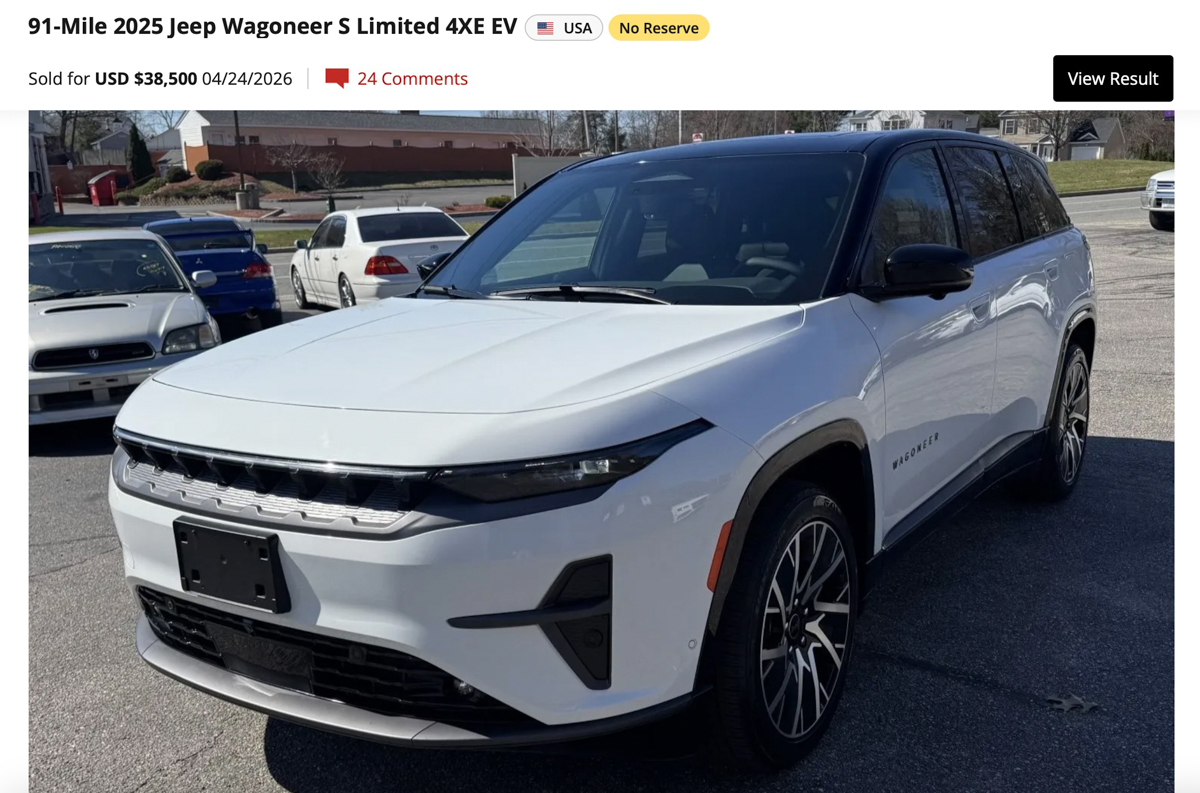
A New Jeep Wagoneer S Lost Nearly Half Its Value After Just 91 Miles

  • Nearly new Wagoneer S changed hands for huge discount.
  • 500 hp SUV sold for the price of a base, RWD Tesla Model Y.
  • Jeep’s maiden EV skips MY26, returns in 2027 with upgrades.

We knew Jeep’s first American EV was having a tough time, but this is something else. A nearly new Wagoneer S Limited 4xe just sold on Bring a Trailer for $38,500 after covering only 91 miles (147 km). That’s roughly $30,000 below its original sticker, and a sharp reminder that EV depreciation can be brutal.

On paper, the deal looks fantastic. The Wagoneer S packs dual motors, all-wheel drive, and a factory-rated output of 500 hp (507 PS) and 524 lb-ft (710 Nm) of torque. The quoted 294-mile (473 km) range from the 100 kWh battery isn’t amazing, but it’s tolerable, and the tailpipe-free Wagoneer is roomy enough for family duty and loaded with kit, making the auction result look like bargain-hunter gold.

Related: Wagoneer S Lost 93% Of Its Buyers, And Gas Charger Outsold Its Electric Twin 7 To 1

This example was a Limited trim finished in white with Jeep’s Dark Appearance package. The Limited stickered at $67,195 including destination and before options, and this one came with a panoramic roof, heated front seats, heated steering wheel, surround-view cameras, adaptive cruise control, wireless smartphone mirroring, a 12.3-inch touchscreen, and an Alpine nine-speaker audio system.

So it’s not exactly a stripped rental special, even if it is a rung below the 600 hp (608 PS), $72,195 Launch Edition.

\\\\\\\\\\\\\

So why the huge value crash? Because the Wagoneer S has struggled badly since launch. It arrived when automakers believed premium EV demand in America would keep climbing. Instead, the market cooled, incentives changed, and shoppers became more selective about price, charging access, and brand trust.

No More Tax Credits

The biggest blow came when the $7,500 federal EV tax credit disappeared last September. Before that, Jeep reportedly moved more than 10,000 Wagoneer S models across three quarters with the help of some big discounts. In the two quarters after the credit ended, sales fell to just 613 units.

 A New Jeep Wagoneer S Lost Nearly Half Its Value After Just 91 Miles

Jeep’s response has been telling. The brand won’t build a 2026 Wagoneer S at all, instead skipping straight to a 2027 model. Stellantis says the pause will allow upgrades to battery performance, software, capability, and interior quality. It’ll also gain a NACS charging port for easier access to Tesla’s growing Supercharger network.

A better Wagoneer S is coming, but we still think whoever bought this one got an absolute bargain. If he can live with uncertain resale and a model facing reboot status, $38,500 bought him a barely driven 500-hp electric SUV with lots of equipment. That’s hard to ignore, even if the first owner probably wishes they had.

\\\\\\\\\\\\\\\

Bring a Trailer

Nissan Promised Mississippi A $500 Million EV Plant, Now It’s Building Gas Pickups Instead

  • Nissan cancels Mississippi EV production plans after demand weakens.
  • Massive Canton plant will pivot to pickups and electrified SUVs instead.
  • Automaker joins rivals in slowing EV push and focusing on hybrids for now.

Nissan is backing away from its big electric vehicle ambitions in Mississippi, scrapping plans to build battery-powered models at its Canton plant as the US market cools faster than expected.

The decision follows a broader rethink inside the troubled company as EV demand softens and government incentives disappear. Nissan had once positioned the Mississippi factory as a key pillar of its electric future, with multiple models planned before the end of the decade.

Related: Nissan’s New Skyline Is Coming To America As The Q50, And It May Bring Back The Manual

Those timelines had already slipped, having been pushed back by nine months last year, and now the entire program has been shelved. Nissan made the U-turn to “better align with market conditions, customer demand and Nissan’s updated strategic direction,” a brand spokesperson told Auto News.

Instead of building EVs, the automaker is pivoting toward more traditional vehicles, including pickups and SUVs built on a rugged body-on-frame setup. A new generation of products is in the works, starting with a revived Xterra expected later in the decade. More models will follow, all sharing a common architecture designed to cut costs and boost efficiency.

Five New ICE Models

The new ladder chassis will spawn at least five trucks and SUVs, Auto News says, its sources revealing that those vehicles will have 70 percent parts commonality and be identical from the front seats forward.

That shift reflects changing buyer preferences. Gas-powered vehicles and hybrids are proving more resilient, while fully electric models have struggled with concerns over charging infrastructure, range, and upfront cost now that federal tax credits are no longer available. EV sales actually fell last year in the US, even as they continued to rapidly gain ground in Europe.

EV Investment Scrapped

The Canton plant that we were told five years ago was getting $500 million of investment so it could pump out thousands of EVs per year, will remain central to Nissan’s North American plans, just with a different focus. It already produces models like the Frontier pickup and Altima sedan, and the new strategy aims to build on that foundation with larger, more profitable vehicles tailored to US tastes.

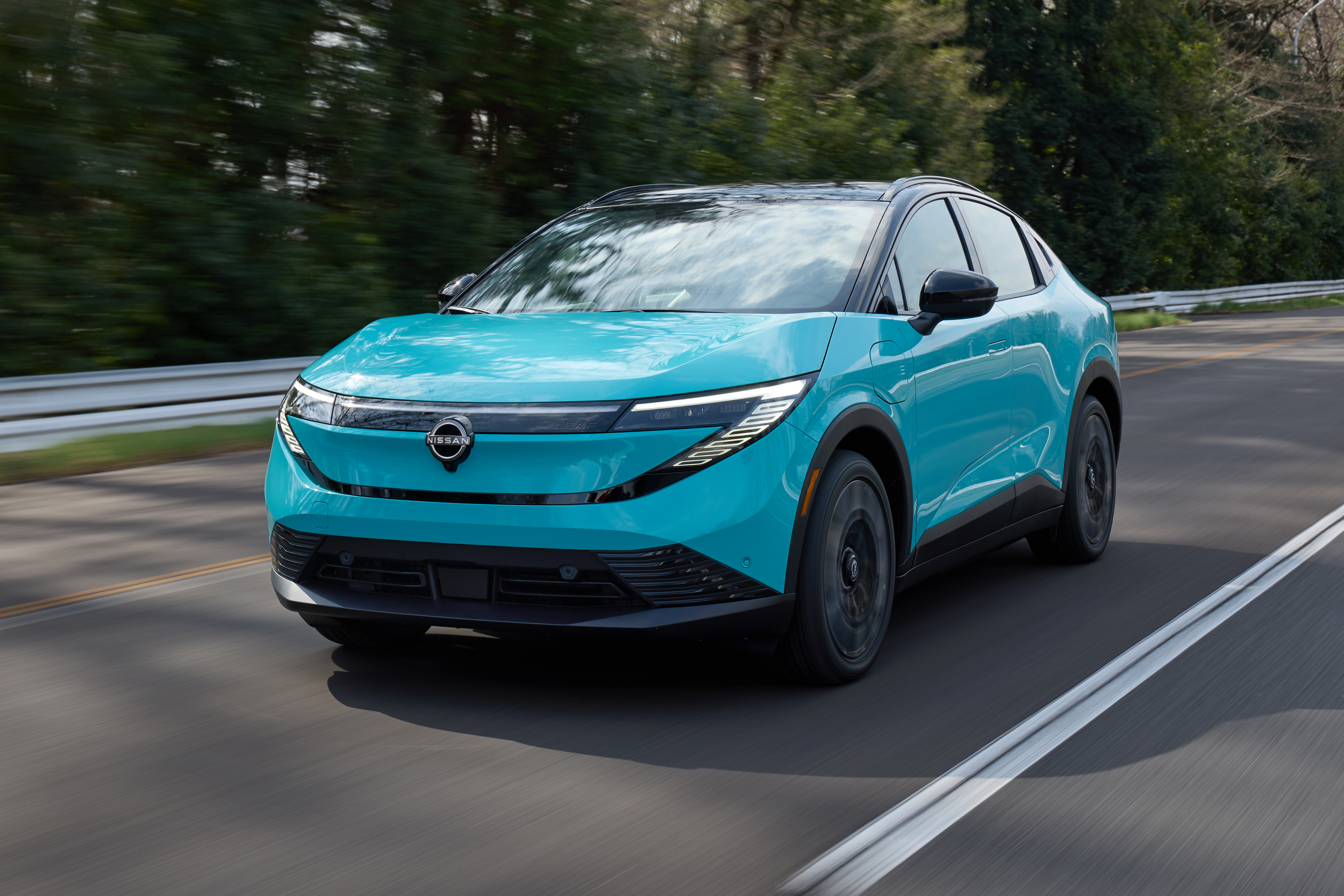
And Nissan isn’t abandoning electric vehicles entirely. It will continue selling existing models like the Leaf (shown below) in the US, but its future lineup will definitely concentrate more on hybrid technology as a stepping stone.

 Nissan Promised Mississippi A $500 Million EV Plant, Now It’s Building Gas Pickups Instead

Nissan

VW’s New ID. Polo Starts Under $30K And Comes With Massage Seats

  • Pre-sales of the VW ID. Polo EV kick off this week starting at €24,995.
  • Three power outputs and two batteries offer up to 283 miles of range.
  • Interior features retro-style digital display and pneumatic seat massagers.

Over 20 million Polos have found homes since the nameplate launched more than 50 years ago. Now Volkswagen’s rebooting the whole thing as the ID. Polo, a fully electric seventh-generation hatch built on the new MEB+ EV platform with front-wheel drive, up to 283 miles (455 km) of range and a starting price that keeps it firmly in affordable territory.

More: VW’s 2026 ID. Buzz Adds 335 HP And Real Buttons, America Gets Neither

Pre-sales are already live in Germany, where the entry-level Trend trim kicks off at €24,995 ($29,300). That’s the headline number Volkswagen‘s been keen to shout about, though if you want one right now, the only available order is the mid-spec Life trim, which starts at €33,795 ($39,600). More variants follow in the summer.

\\\\\\\

There are three power outputs at launch. The 114 hp (116 PS / 85 kW) and 133 hp (135 PS / 99 kW) versions come with a 37 kWh lithium iron phosphate battery offering up to 204 miles (329 km) of range and DC fast charging at up to 90 kW, with a 10-to-80 charge taking around 27 minutes.

The 208 hp (211 PS / 155 kW) variant steps up to a 52 kWh nickel-manganese-cobalt pack, pushing range to a provisional 283 miles (455 km) and accepting up to 105 kW DC charging, shaving that charge window down to roughly 24 minutes. A GTI variant with 223 hp (226 PS / 166 kW) is coming in 2027.

New Front-Wheel Drive Platform

The switch to the front-wheel drive MEB+ platform pays dividends in terms of space because unlike the bigger ID.3 Neo, there’s no motor stashed under the cargo bay floor. Luggage volume jumps 25 percent over the combustion Polo, from 351 to 441 liters, and with the rear seats folded you’re looking at 1,243 liters. The interior also gains 19 mm of extra space that passengers will actually notice, particularly those in the back.

VW’s tape measure says the Polo comes in at 4,053 mm (159.6 inches) long, 1,816 mm (71.5 inches) wide and 1,530 mm tall on a 2,600 mm (102.4 inches) wheelbase. That makes 131 mm (5.2 inches) shorter and 42 mm (1.7 inches) narrower than its most obvious rival, the Renault 5 E-Tech, but as good as identical in size to the Cupra Raval, which like the Skoda Epiq, shares the Polo’s platform and running gear.

On the outside the handsomely chiselled ID. Polo looks almost identical to the 2023 ID.2all concept, right down to its fat five-spoke wheels and blue paint. The rear door handles are hidden near the C-pillar to clean up the lines, and a wide transverse light bar at the tail is crowned with an illuminated red VW roundel to finish what the white lit logo at the front started.

Retro-Digital Interior

\\\\\\\\\\\\\\\\\

Inside, Volkswagen’s “Pure Positive” design language makes its production debut. Chief Designer Andreas Mindt says he wanted the cabin to feel like a familiar friend, and the approach blends a 10-inch digital cockpit with a 13-inch infotainment center touchscreen.

Physical buttons handle climate control, there’s a rotary audio dial between the front seats, and a “retro display” mode transforms the instruments into something that looks straight out of a post-facelift Mk1 Golf, complete with a classic speedo and a power gauge standing in for the rev counter. Nice touch.

Three trim levels cover the range. The Trend gets LED headlights, Side Assist, Lane Assist and a standard 90 kW DC charging capability. Life adds Adaptive Cruise Control, a rear camera, CarPlay, Android Auto and wireless phone charging. Style goes further with IQ.LIGHT LED matrix headlights, 3D tail lights, an illuminated VW logo front and rear, sport comfort seats, two-zone climate and the upgraded ID. Light strip that now runs into the door panels.

Massage Seats

\\\\\\\\\\\

Optional tech potentially worth splashing for includes a 425-watt Harman Kardon sound system, a panoramic glass roof and something genuinely unusual for this class: a pneumatic massage function for the electrically adjustable 12-way front seats, with three programs to choose from. That’s a premium-saloon feature in a sub-€25,000 hatchback.

Also: VW Spent Years Removing Knobs From Its Cars, The ID.3 Neo Puts Them Back

The ID. Polo also supports Vehicle-to-Load as standard, meaning it’ll push up to 3.6 kW out through a Schuko adapter to charge e-bikes or run outdoor kit. Depending on spec, it can tow up to 1,200 kg too.

Cut-Price Charging

\\\\\\\\\\\\\\\\\\

On the charging side, Volkswagen’s subsidiary Elli is launching a new city tariff at €0.39 per kWh for public AC charging across more than a million European charge points, aiming to make street charging as predictable and affordable as a home wallbox. A dynamic home tariff called Naturstrom Flex can cut home charging costs by up to 30 percent by automatically charging when electricity prices are lowest.

Aside from next year’s GTI, shown below in disguised form, the ID. Polo lineup feels pretty complete for a launch. It’s practical, it’s priced right, and that retro display alone might sell a few cars.

\\\\\\\\

VW

The ID. Polo Is VW Back To Its Best

  • Pre-sales of the VW ID. Polo EV kick off this week starting at €24,995.
  • Three power outputs and two batteries offer up to 283 miles of range.
  • Interior features retro-style digital display and pneumatic seat massagers.

Over 20 million Polos have found homes since the nameplate launched more than 50 years ago. Now Volkswagen’s rebooting the whole thing as the ID. Polo, a fully electric seventh-generation hatch built on the new MEB+ EV platform with front-wheel drive, up to 283 miles (455 km) of range and a starting price that keeps it firmly in affordable territory.

Pre-sales are already live in Germany, where the entry-level Trend trim kicks off at €24,995. That’s the headline number Volkswagen‘s been keen to shout about, though if you want one right now, the only available order is the mid-spec Life trim, which starts at €33,795. More variants follow in the summer.

Related: VW’s 2026 ID. Buzz Adds 335 HP And Real Buttons, America Gets Neither

There are three power outputs at launch. The 114 hp (116 PS / 85 kW) and 133 hp (135 PS / 99 kW) versions come with a 37 kWh lithium iron phosphate battery offering up to 204 miles (329 km) of range and DC fast charging at up to 90 kW, with a 10-to-80 charge taking around 27 minutes.

The 208 hp (211 PS / 155 kW) variant steps up to a 52 kWh nickel-manganese-cobalt pack, pushing range to a provisional 283 miles (455 km) and accepting up to 105 kW DC charging, shaving that charge window down to roughly 24 minutes. A GTI variant with 223 hp (226 PS / 166 kW) is coming in 2027.

New Front-Wheel Drive Platform

The switch to the front-wheel drive MEB+ platform pays dividends in terms of space because unlike the bigger ID.3 Neo, there’s no motor stashed under the cargo bay floor. Luggage volume jumps 25 percent over the combustion Polo, from 351 to 441 liters, and with the rear seats folded you’re looking at 1,243 liters. The interior also gains 19 mm of extra space that passengers will actually notice, particularly those in the back.

VW’s tape measure says the Polo comes in at 4,053 mm (159.6 inches) long, 1,816 mm (71.5 inches) wide and 1,530 mm tall on a 2,600 mm (102.4 inches) wheelbase. That makes 131 mm (5.2 inches) shorter and 42 mm (1.7 inches) narrower than its most obvious rival, the Renault 5 E-Tech, but as good as identical in size to the Cupra Raval, which like the Skoda Epiq, shares the Polo’s platform and running gear.

On the outside the handsomely chiselled ID. Polo looks almost identical to the 2023 ID.2all concept, right down to its fat five-spoke wheels and blue paint. The rear door handles are hidden near the C-pillar to clean up the lines, and a wide transverse light bar at the tail is crowned with an illuminated red VW roundel to finish what the white lit logo at the front started.

Retro-Digital Interior

\\\\\\\\\\\\\\\\\

Inside, Volkswagen’s “Pure Positive” design language makes its production debut. Chief Designer Andreas Mindt says he wanted the cabin to feel like a familiar friend, and the approach blends a 10-inch digital cockpit with a 13-inch infotainment center touchscreen.

Physical buttons handle climate control, there’s a rotary audio dial between the front seats, and a “retro display” mode transforms the instruments into something that looks straight out of a post-facelift Mk1 Golf, complete with a classic speedo and a power gauge standing in for the rev counter. Nice touch.

Three trim levels cover the range. The Trend gets LED headlights, Side Assist, Lane Assist and a standard 90 kW DC charging capability. Life adds Adaptive Cruise Control, a rear camera, CarPlay, Android Auto and wireless phone charging. Style goes further with IQ.LIGHT LED matrix headlights, 3D tail lights, an illuminated VW logo front and rear, sport comfort seats, two-zone climate and the upgraded ID. Light strip that now runs into the door panels.

Massage Seats

\\\\\\\\\\\\\\\\\\

Related: VW Spent Years Removing Knobs From Its Cars, The ID.3 Neo Puts Them Back

Optional tech potentially worth splashing for includes a 425-watt Harman Kardon sound system, a panoramic glass roof and something genuinely unusual for this class: a pneumatic massage function for the electrically adjustable 12-way front seats, with three programs to choose from. That’s a premium-saloon feature in a sub-€25,000 hatchback.

The ID. Polo also supports Vehicle-to-Load as standard, meaning it’ll push up to 3.6 kW out through a Schuko adapter to charge e-bikes or run outdoor kit. Depending on spec, it can tow up to 1,200 kg too.

Cut-Price Charging

\\\\\\\\\\\\\\\\\\

On the charging side, Volkswagen’s subsidiary Elli is launching a new city tariff at €0.39 per kWh for public AC charging across more than a million European charge points, aiming to make street charging as predictable and affordable as a home wallbox. A dynamic home tariff called Naturstrom Flex can cut home charging costs by up to 30 percent by automatically charging when electricity prices are lowest.

Aside from next year’s GTI, shown below in disguised form, the ID. Polo lineup feels pretty complete for a launch. It’s practical, it’s priced right, and that retro display alone might sell a few cars.

\\\\\\\\

VW

❌
❌