Reading view

There are new articles available, click to refresh the page.

Renault’s 4 E-Tech Just Borrowed Another Feature From The 1960s Original, And It’s Not Deckchair Seats
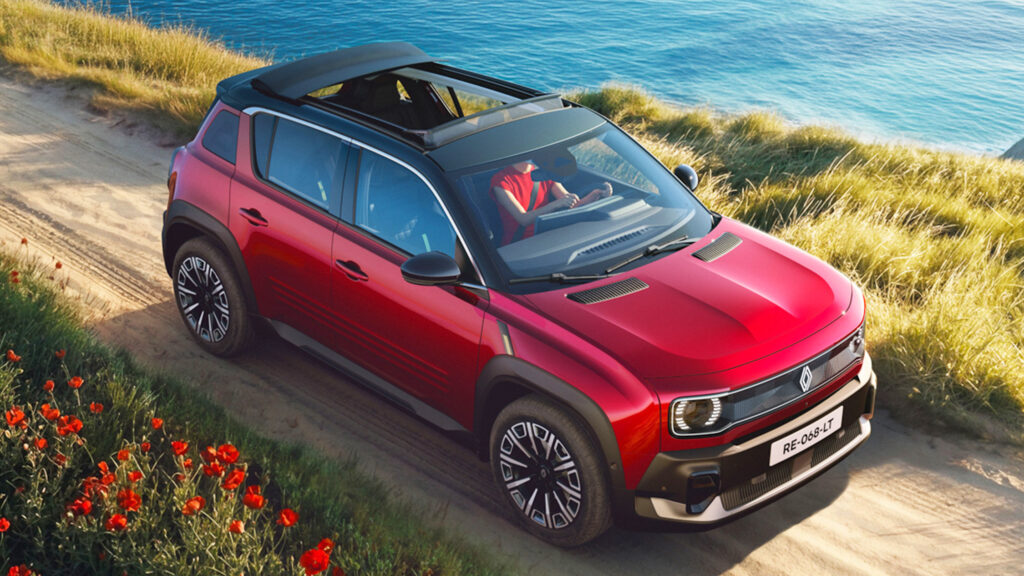
  • Renault adds huge folding canvas roof to electric 4 E-Tech crossover for £1,500 premium.
  • 4 Plein Sud, which translates as due south, cost from £27,445 including UK’s £3750 grant.
  • Like all 4 E-Techs it comes with 147 hp, a 52 kWh battery and up to 242 range miles.

Renault’s retro-flavored 4 E-Tech has already borrowed plenty of design ideas from the original Renault 4, but now it’s reviving one of the old car’s coolest features too. Meet the new Plein Sud version, which swaps the standard roof for a giant electrically operated folding canvas setup.

The fabric opening stretches 800 by 920 mm (31.5 x 36.2 inches) and folds back electrically in multiple stages, giving both front and rear passengers a proper open-air feel. Renault says it’s the only fully electric B-segment SUV currently offering this kind of setup.

Related: Radical Espace Reboot Leads Renault’s 36-Car Plan To Fight China’s Threat

The roof itself is a pretty clear nod to the original Renault 4’s simple manually retractable fabric roof from the 1960s. But this one is a whole lot smarter. Not only is it fully electric, but you can open it by asking the Reno voice assistant if you’re feeling too lazy to press a button.

Underneath, nothing about the Renault 5 E-Tech‘s SUV brother changes mechanically. Buyers still get the familiar 148 hp (150 PS / 110 kW) front-mounted motor and 52 kWh battery pack delivering up to 242 miles (389 km) of WLTP range. That’s only slightly lower than the fixed-roof version, which manages up to 249 miles (400 km), proving the folding roof’s hasn’t hurt efficiency too badly.

Cheaper Than A Beach Holiday
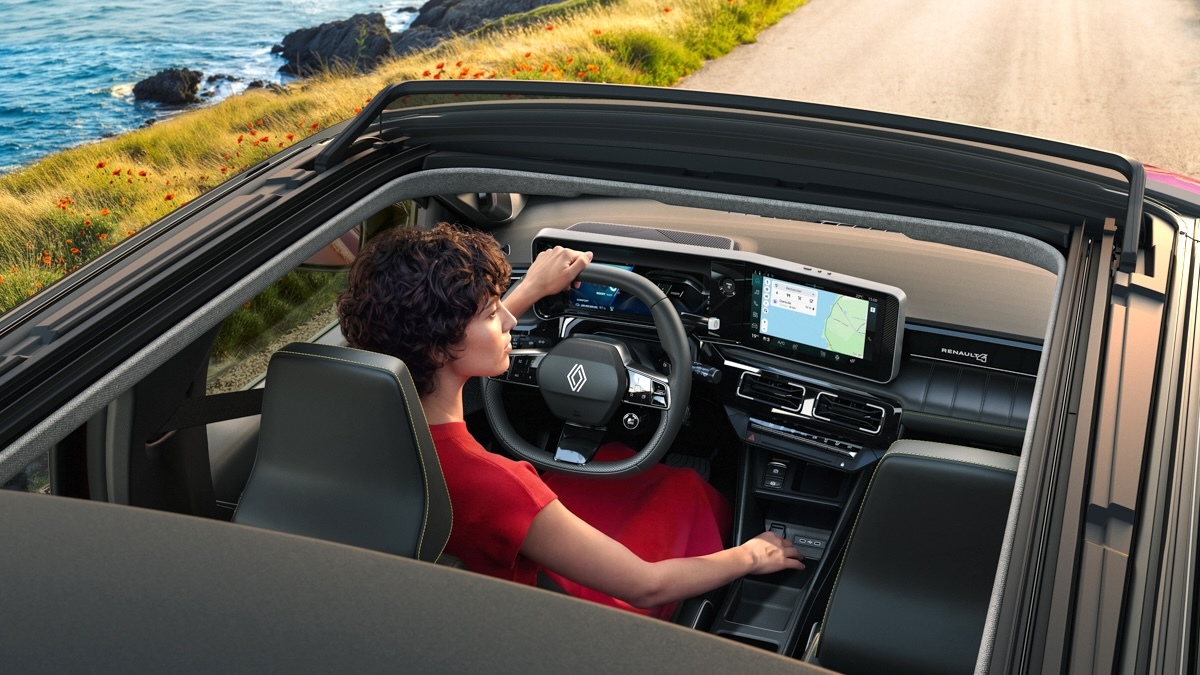
 Renault’s 4 E-Tech Just Borrowed Another Feature From The 1960s Original, And It’s Not Deckchair Seats

The Plein Sud arrives in mid-spec Techno+ and top of the line Iconic+ trims, and costs £1,500 ($2,000) more than equivalent fixed-roof models. Prices start at £27,445 ($37,412) in the UK after applying the government’s £3,750 ($5,111) Electric Car Grant. In France, prices start at €31,110 ($36,684) after incentives.

Early access ordering opens immediately for Renault’s R Pass holders, basically customers who previously paid for priority reservation access to skip ahead in the queue. Everyone else can place orders from May 14.

Aside from the roof, Renault’s also rolled out updated safety tech across the 4 E-Tech range to comply with Europe’s latest regulations. New systems include driver fatigue monitoring and an emergency stop function capable of safely slowing the vehicle if the driver becomes unresponsive.
\\\\\\\\\\\\

Renault

BMW’s iX3 Beat The Gas X3 M50, The iX4 Could Beat The iX3

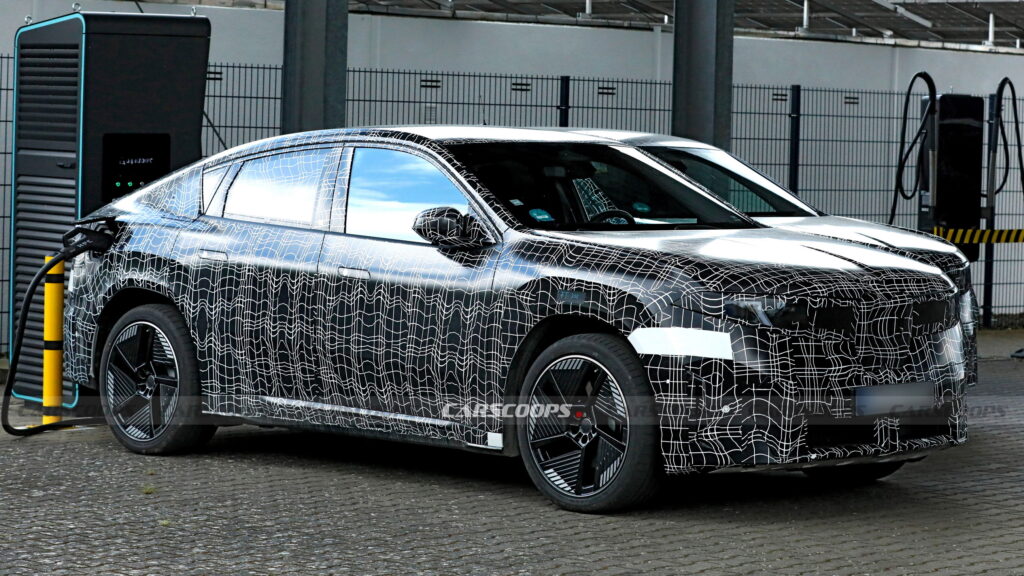
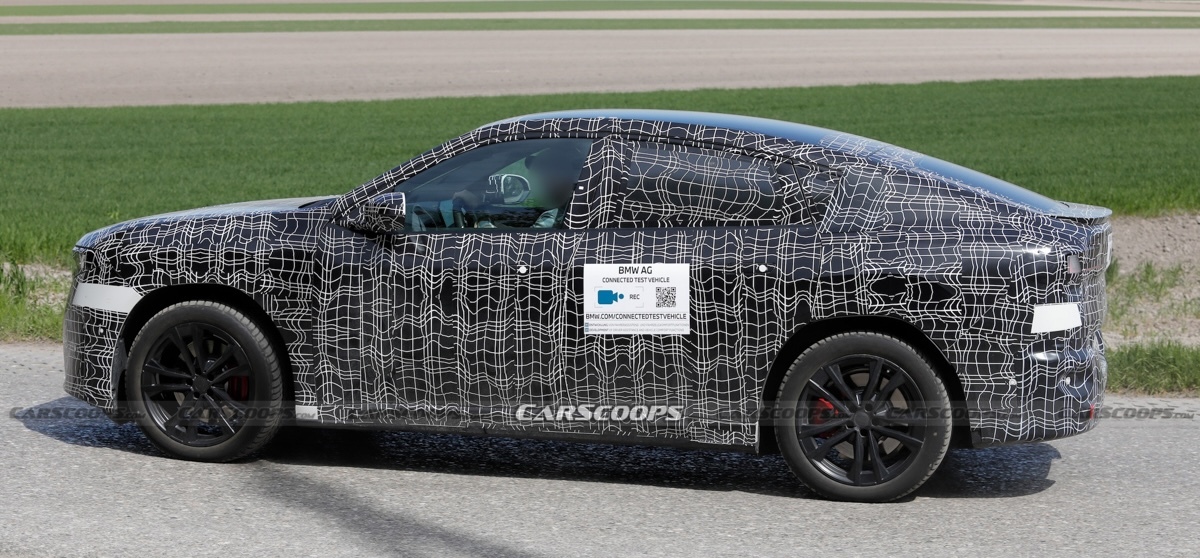
  • BMW’s upcoming iX4 electric coupe SUV has been spied testing.
  • Neue Klasse crossover shares platform, powertrains with new iX3.
  • iX4 50 xDrive should offer same 463 hp as iX3, cost around $67k.

BMW’s Neue Klasse offensive is picking up pace, and having this week been impressed by the price and EPA range of the iX3, we’re now getting a closer, though unofficial look at its coupe brother, which could stretch a full charge even further.

Like its boxier sibling, the iX4 adopts BMW’s new visor-style face that’s becoming a defining Neue Klasse trait. The same design language is also heading to the upcoming electric i3 sedan, helping tie the next generation of BMW cars together visually.

More: BMW’s New iX3 50 Is Cheaper And More Powerful Than Its Own Gas X3 M50

But beyond the nose, the iX4 starts doing its own thing. The roofline drops lower and flows into a fastback rear end, giving the crossover a sleeker silhouette than the standard iX3. It definitely looks sportier, though very tall rear passengers might not be celebrating the compromised headroom or smaller trunk.

\\\\\\\\\\

The latest spy shots also reveal colored brake calipers hiding behind the wheels, strongly hinting this prototype wears M Sport trim, or is an M Performance variant. The basic M Sport package of interior and exterior trim is $2,500 on the new iX3 that arrives in US showrooms this fall, but upping the spend to $4,000 gets you the Professional version that adds colored M brakes and the Iconic Glow illuminated grille.

Inside, expect the same tech-heavy minimalist cabin already previewed by the iX3 and since rolled out to the facelifted 7-Series. That means a big 17.9-inch infotainment display, BMW’s pillar-to-pillar Panoramic iDrive setup, a futuristic four-spoke steering wheel, and an updated head-up display system.

40 And 50 Powertrains Planned

 BMW’s iX3 Beat The Gas X3 M50, The iX4 Could Beat The iX3

Underneath, the iX4 should mirror the iX3 lineup almost exactly. Earlier leaks tied to BMW’s accidentally published US product plans suggested America will get both 40 and 50 variants of the iX3 in rear and all-wheel drive configurations. It’d make little sense for BMW not to offer matching iX4 versions, though it looks like BMW will restrict the electric coupe to all-wheel drive.

That means entry-level models could use the European-spec iX3 40 setup featuring an 82.6 kWh battery and a 316 hp (235 kW / 320 PS) motor. Higher-end 50 xDrive versions should pack dual motors producing 463 hp (345 kW / 469 PS). Both versions will be capable of charging at 400 kW.

BMW recently confirmed the iX3 50 xDrive for America with a surprisingly low $62,850 starting price (including $1,350 destination) and an impressive EPA-rated 434 miles (699 km) of range. Since the iX4 slices through the air more cleanly, it could potentially travel even farther between charges, though expect pricing to climb past the $65,000 mark.

\\\\\\\\\

Edmunds Lost $47,000 On The Charger Daytona, And That Was The Good News

  • A year of ownership wiped nearly 60 percent off the Daytona’s value.
  • The electric Charger covered under 7,000 miles before its value collapsed.
  • Staff complaints ranged from fake exhaust sounds to glitchy software.

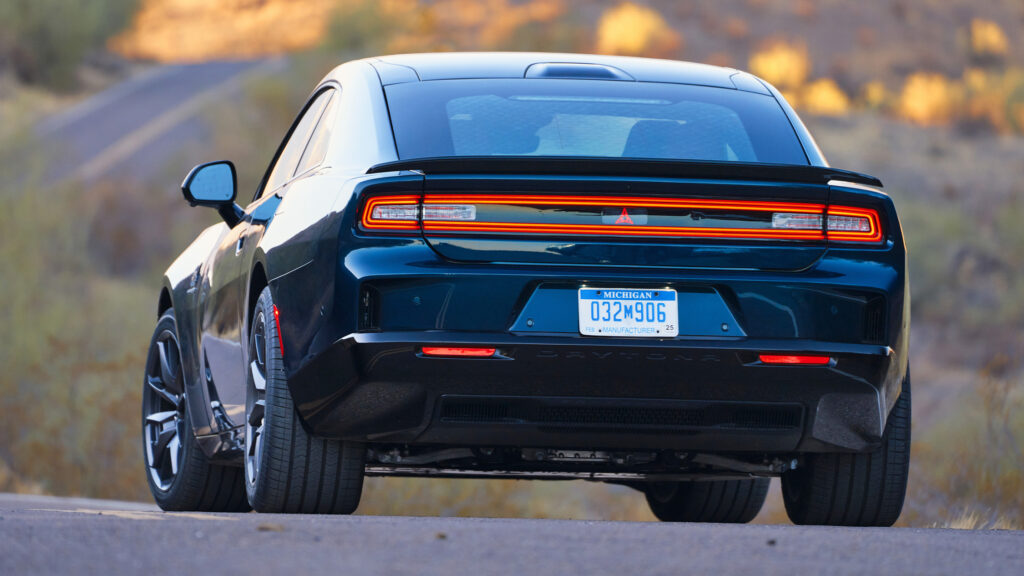
Buying a new car is almost always a terrible financial decision. But losing nearly $50,000 in a single year after just a few thousand miles takes things to an entirely different level of painful. Unfortunately for Edmunds, that’s exactly what happened with its 2024 Charger Daytona Scat Pack.

Unlike many magazines and websites, that simply borrow their long-term test cars from automakers, Edmunds buys them with real cash. True, it got a small discount from Dodge on the as-tested price of $85,965, but it still paid a hefty $82,000 to get behind the wheel of Detroit’s first electric muscle car.

Related: The Last Dodge Challengers Were Supposed To Age Into Money, Not Lose $14,000 With Delivery Mileage

But 12 months later when it came time to move the car on, Edmunds was shocked to find its Daytona was worth just $35,000. That’s almost a 60 percent hit, and not because the road test team had put a lifetime’s worth of miles on the EV. It had covered less than 7,000 miles (11,300 km), which is the kind of distance some drivers do in six months.

Even worse, the massive financial hit came after most of the Edmunds staff spent a year actively disliking the thing. Reading through their long-term test notes would be enough to send anyone wavering over which pony car to buy straight into the arms of a V8-powered Ford Mustang Dark Horse.

Digital Headaches

 Edmunds Lost $47,000 On The Charger Daytona, And That Was The Good News

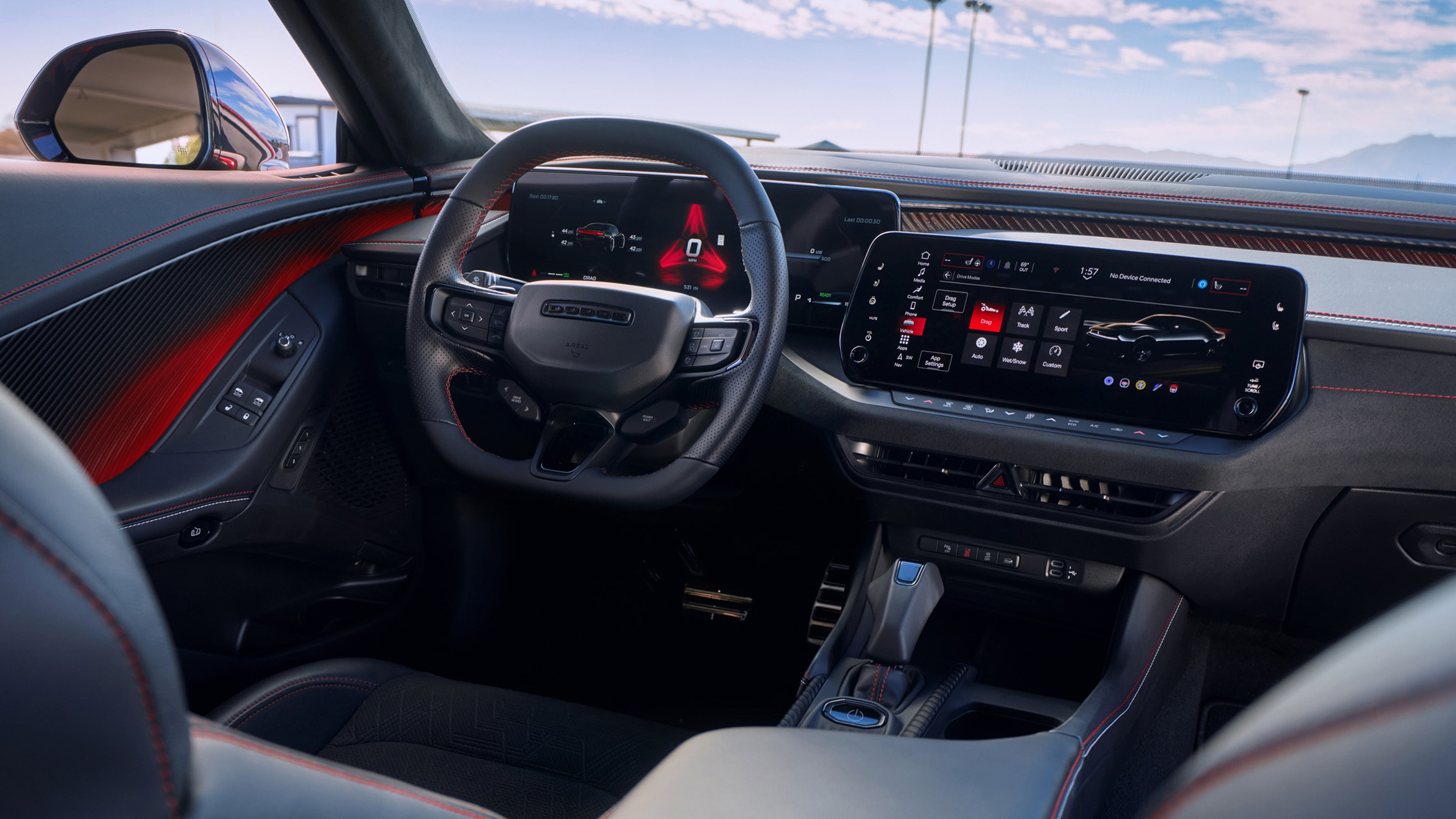
Complaints ranged from glitchy infotainment and strange drivetrain clunks to awkward ergonomics and bizarre software behavior. One editor described the fake Fratzonic exhaust sound as “an insult to V8s everywhere,” while another said the car was simply “boring,” which is probably the most brutal criticism you can level at something wearing a Charger badge.

Others hated the turning circle, massive dimensions, inconsistent regen braking, and handling that apparently couldn’t back up the car’s straight-line punch. But the year didn’t pass without the Charger getting some praise. Several staffers liked the styling, roomy hatchback practicality and surprisingly good range. The 670 hp (679 PS /500 kW) Daytona managed 255 miles (410 km) in real world use, comfortably beating its pathetic official EPA estimate of 216 miles (348 km).

“The Charger was a big, expensive disappointment,” the outlet said, summing up the year-long experience. “We won’t miss having this thing in our fleet.”

\\\\\\

Dodge

Hertz Wanted $65K For Its Shelby Mach-Es, Now It Will Take Almost Anything

  • Hertz has cut prices on its Shelby Mach-Es again, and the drop is steep.
  • Mileage across the cars on offer ranges from just 3,275 to over 15,000 miles.
  • Shelby’s tuning package adds looks and sound, but no real performance.

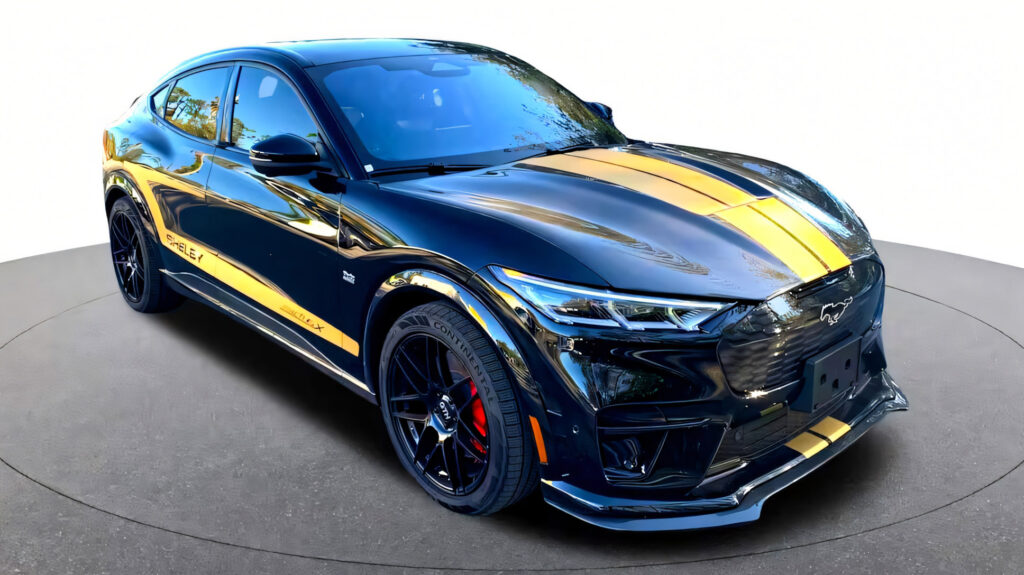
Hertz has a long history of renting out modified cars from Shelby to its customers, and often these vehicles become prized collector’s items. That does not appear to be the case with the Shelby-tuned Ford Mustang Mach-Es that it had in its fleet.

Read: Hertz Slashes Prices On Shelby Mustang Mach-E, Some With Just 3K Miles

The rental giant started offloading a bunch of these special black-and-gold Mustang Mach-Es back in late 2024, asking around $65,000 for most of them. Fast forward just a couple of months to January 2025, and the prices were slashed to around $60,000. Hertz, clearly desperate to offload its remaining inventory, has reduced prices by a further $20,000. Could this be a deal too good to pass up?

\\\\\\\\\\\\

Photos Hertz

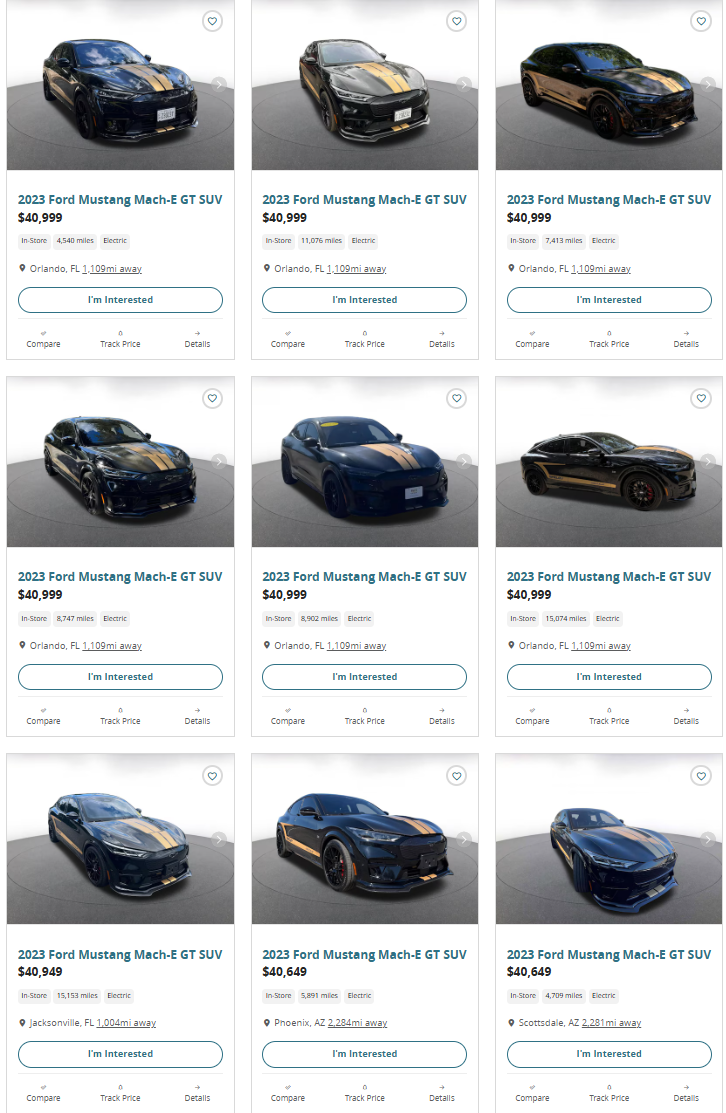
A scan of Hertz’s current inventory across the States turns up 31 Shelby Mach-Es, with prices spanning a narrow $40,085 to $40,999 and mileage stretching from 3,275 to just over 15,000. The cheapest examples sit in California, while a Scottsdale car claims the lowest mileage of the lot at 3,275 for $40,649. One in New Orleans splits the difference at 8,215 miles for $40,436. A new Mach-E GT, the donor car for the Shelby treatment, stickers at $53,395.

A Performance Bargain?

It shouldn’t come as much of a surprise that Hertz has slashed prices of these cars so significantly. After all, they are EVs, and current electric cars tend to depreciate very quickly. We suspect the designs of the Shelby models also turn off many prospective buyers, particularly because of the go-fast gold racing stripes and carbon fiber parts, including the hood.

 Hertz Wanted $65K For Its Shelby Mach-Es, Now It Will Take Almost Anything

Shelby is believed to have built just 100 examples of the Hertz-exclusive Ford Mustang Mach-E GT, so it does have exclusivity going for it. In addition to the gold stripes and the carbon parts, Shelby added custom black wheels and sourced an exhaust sound system from Borla, aiming to replicate the sound of an internal combustion engine. Sadly, no real performance upgrades were made that could justify the price.

There is also the usual caveat that comes with any ex-rental: someone else got the keys first, and they probably did not treat them gently.

\\\\\\\\\\\\

With Gas Prices Over $4.50, Even The Cozy Coupe Is Getting An EV Charger

  • Little Tikes offers an EV charger as an optional accessory.
  • It works with the Cozy Coupe and has lights and sounds.
  • Priced at $32.99, it is more expensive than the gas pump.

The Little Tikes Cozy Coupe is one of the most widely recognized vehicles on the planet, with an estimated 25 million sold since 1979. The toy car is actually leg powered, but it spent decades pretending to run on gasoline, which, with pump prices now north of $4.50 a gallon, is starting to feel like a uniquely cruel bit of make-believe. Now, Kids who’d rather go green can grab the charging station accessory and do their part for the EV transition.
More: World’s Skinniest Jeep Wrangler Is A Real-Life Little Tikes Cozy Coupe For Grown-Ups

The Cozy E-Charging Station is designed to bring zero-emission infrastructure to backyards and playrooms, mirroring the real-world shift toward electric cars. The accessory first appeared in late 2022 as part of a UK campaign before graduating to a permanent fixture in the brand’s global lineup, now with a cleaner, more modern look.

 With Gas Prices Over $4.50, Even The Cozy Coupe Is Getting An EV Charger
Those who find the Cozy Pumper (left) outdated can switch to the Cozy E-Charging Station (right).

The unit functions as an interactive charger, featuring a cable and a plug designed to slot into the fuel ports of all the existing Cozy Coupe models. Pressing the power button activates a sequence of light-up effects and electronic charging sounds, simulating a high-voltage top-up. The charger is powered by batteries making it suitable for outdoor play.

More: It’s Cute, It’s Short, And It Could Absolutely Kill You

The Cozy E-Charging Station is about the same size with the old Cozy Pumper, measuring 17.50 inches (44.45 cm) tall and weighing about 3 lbs (1.36 kg). It is fitting for toddlers and kids aged from 18 months to 5 years, allowing them to “plug in and charge their car just like mom and dad“.

It retails for $32.99, a small premium over the $29.99 Cozy Pumper. Unlike their parents, however, toddlers do not need to buy a new vehicle to make the switch, since the charger is compatible with the existing fleet. They are also spared range anxiety, because the Flintstones-spec drivetrain of the Cozy Coupe will keep going as long as the driver is well rested and well fed.

\\\\\\

Bentley’s Second SUV Could Borrow A 1,156 HP Trick From Porsche

  • Bentley’s second SUV will sit below the Bentayga and skip combustion entirely.
  • The rumored Barnato name would pay tribute to one of the original Bentley Boys.
  • Crewe’s newest electric SUV shares its bones with the Porsche Cayenne Electric.

Bentley’s customers cannot seem to get enough of the Bentayga, so the company in Crewe is expanding its SUV lineup with a second model. Expected to wear the Barnato name, in tribute to Woolf Barnato of Bentley Boys fame, the new model will slot in below the Bentayga and ditch combustion entirely.

While it remains to be seen how much demand Bentley will see for the new model in markets like the US, where EV sales have stagnated, it will certainly appeal to those seeking the most serene and comfortable driving experience. The use of electric power will also help Bentley lower its overall fleet emissions. Bentley is expected to reveal the new EV later this year, with customer deliveries reportedly beginning in 2027.


Read: Bentley Just Told Us What The Barnato SUV Will Cost, Sort Of

Spied here doing the rounds at the Nurburgring, this prototype is wearing the same camouflage we’ve seen on others. As such, key areas of the vehicle’s design remain hidden, though we can see the blacked-out lower grille.

Concept Looks

\\\\\\\\

SHProshots

Earlier test cars used lighting designed to resemble the twin-headlamp setup of the Flying Spur and Bentayga, but this prototype is closer in style to the single-unit design of the Bentley Batur. The clusters also feature four separate LEDs, similar to the arrangement found on the Porsche Macan and Cayenne Electric.

It’s hard to say exactly what the grille will look like, though we expect it to be body-colored and used largely for visual effect rather than cooling duties. The design could take inspiration from last year’s EXP 15 concept. Cooling is instead handled by functional air intakes in the lower front bumper, while a radar sensor sits at the center of the fascia.

Porsche Power

 Bentley’s Second SUV Could Borrow A 1,156 HP Trick From Porsche

We know the Barnato uses the Premium Platform Electric (PPE) architecture, as do other VW Group models, including the Cayenne Electric. Carscoops understands it’ll come equipped with a sizeable 113 kWh battery pack that supports DC fast charging, adding 100 miles (160 km) of range in under seven minutes.

Bentley is also expected to lean on the Porsche parts bin for its electric motors, with the Cayenne Electric the most likely donor. Output in the Porsche ranges from 402 hp at the entry point to 1,156 hp at the top, and the Crewe interpretation is tipped to offer more than 1,100 horsepower in its flagship forms.

The similarities to the Cayenne Electric will continue with the in-car technology. While these spy shots captured only a small portion of the interior, previous prototypes have shown that several tech components will be shared with Porsche, including a curved OLED central display running Android Automotive OS. Bentley is expected to give the cabin its own identity through more extensive use of leather, wood, and metal trim throughout.

\\\\\\\

SHProshots

Bentley’s New Electric SUV Gets Its Road Manners Honed Around The ‘Ring

  • The new Bentley will share its EV platform with the Porsche Cayenne Electric.
  • While key design elements remain hidden, the SUV will look similar to the EXP 15.
  • Driving the Barnato is expected to be a sizeable 113 kWh battery pack.

It seems luxury car buyers can’t get enough of the Bentley Bentayga, so the British brand is working on a second SUV for its range. Tipped to be dubbed the Barnato, the new model will be smaller than its older sibling but, more importantly, all-electric.

While it remains to be seen how much demand Bentley will see for the new model in markets like the US, where EV sales have stagnated, it will certainly appeal to those seeking the most serene and comfortable driving experience. The use of electric power will also help Bentley lower its overall fleet emissions.

Read: Bentley Just Told Us What The Barnato SUV Will Cost, Sort Of

Spied here doing the rounds at the Nurburgring for the very first time, this prototype is adorned with all of the same camouflage that we’ve seen on others. As such, key areas of the vehicle’s design remain hidden, though we can see the blacked-out lower grille.

Concept Looks

\\\\\\\\

SHProshots

The headlights look to be temporary, although the upper LED strip is expected to be retained for the production model. It’s hard to say what the grille will look like, but we expect it to be body-colored and mostly used for decorative purposes, not for actually cooling the SUV. The grille could resemble that of last year’s EXP 15 concept.

Other important elements visible in this prototype include a large panoramic glass roof and a roofline sitting noticeably lower than the Bentayga.

Porsche Power

 Bentley’s New Electric SUV Gets Its Road Manners Honed Around The ‘Ring

We know the Barnato uses the Premium Platform Electric (PPE) architecture, as do other VW Group models, including the Cayenne Electric. Carscoops understands it’ll come equipped with a sizeable 113 kWh battery pack that supports DC fast charging, adding 100 miles (160 km) of range in under seven minutes.

It’s likely Bentley’s electric motors will also be borrowed from the Cayenne Electric. Power in the Porsche ranges from 402 hp to 1,156 hp, and the British alternative may offer similar figures.

The similarities to the Cayenne Electric will continue in the cabin. While these spy shots only captured a small part of the SUV’s cabin, previous ones have shown that many parts will be lifted from the Porsche, including the curved OLED central display running Android Automotive OS.

\\\\\\\

SHProshots

The New MG 07 Flagship’s Looks Say Porsche Taycan, Its Price Says Corolla

  • MG has revealed the exterior design of their new 07 flagship.
  • The Porsche Taycan knockoff will cost less than $29,410.
  • Offers autonomous tech as well as PHEV and electric options.

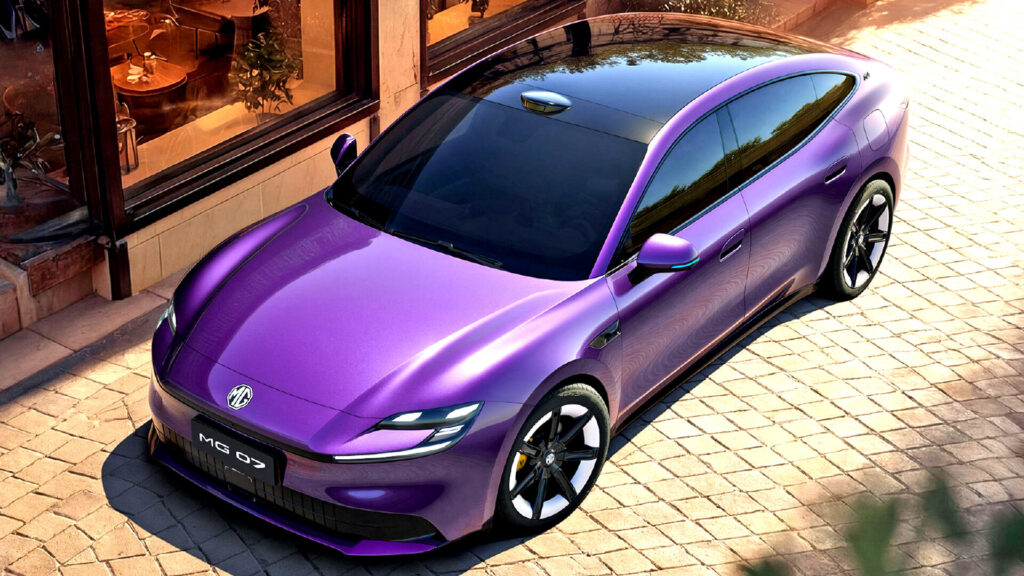
Following a teaser in March, SAIC MG has revealed the upcoming 07. It’s a flagship that has been “engineered to be the ultimate choice in the new energy coupe segment.”

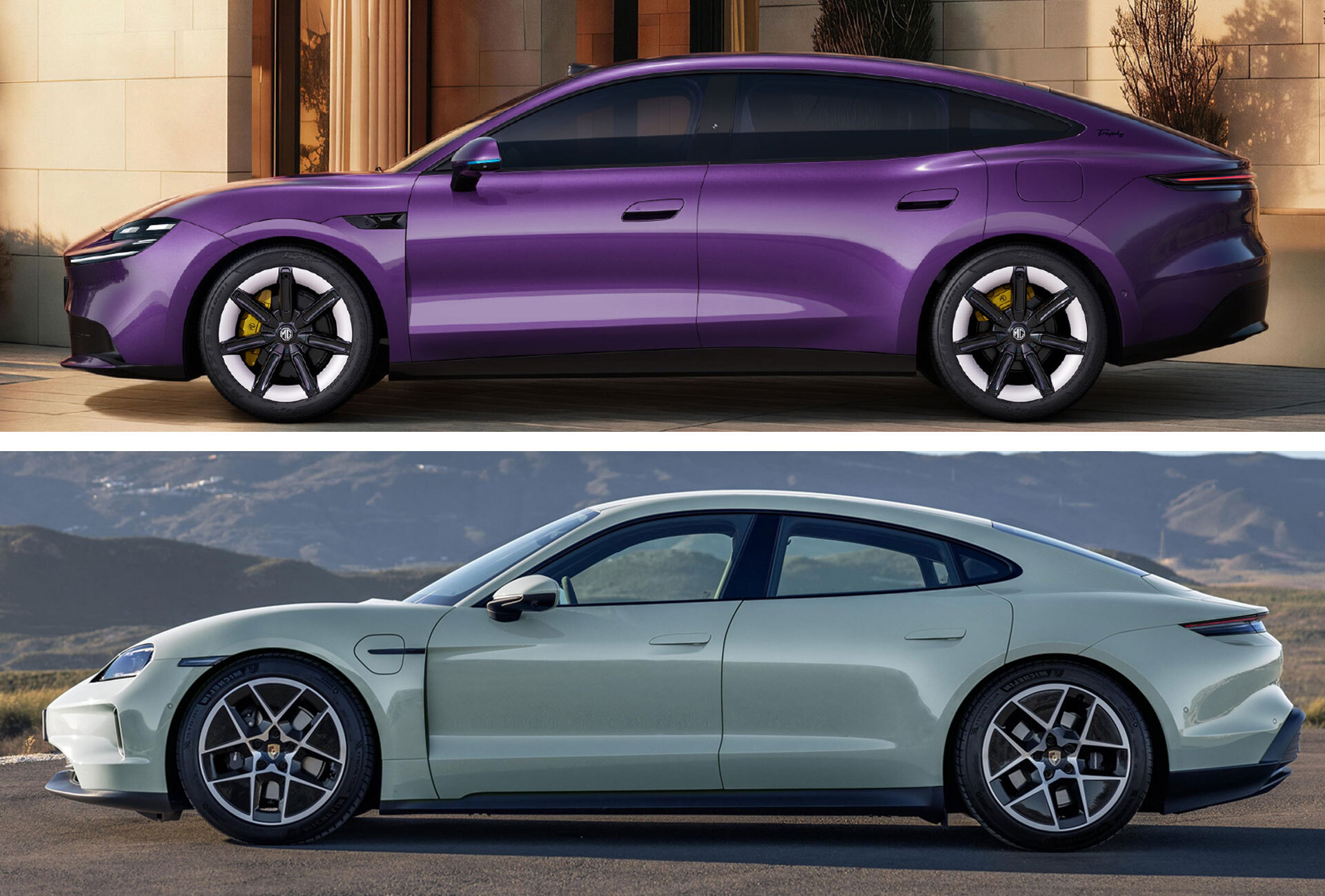
Sporting a design that rivals “luxury coupes in the ¥700,000 ($102,930) class,” the 07 will offer “top-tier styling” for less than ¥200,000 ($29,410). That’s a not so subtle reference to the Porsche Taycan, which begins at ¥918,000 or $134,985 in China.

More: China Isn’t Buying Porsches, But It Sure Loves Making Cars That Look Like Them

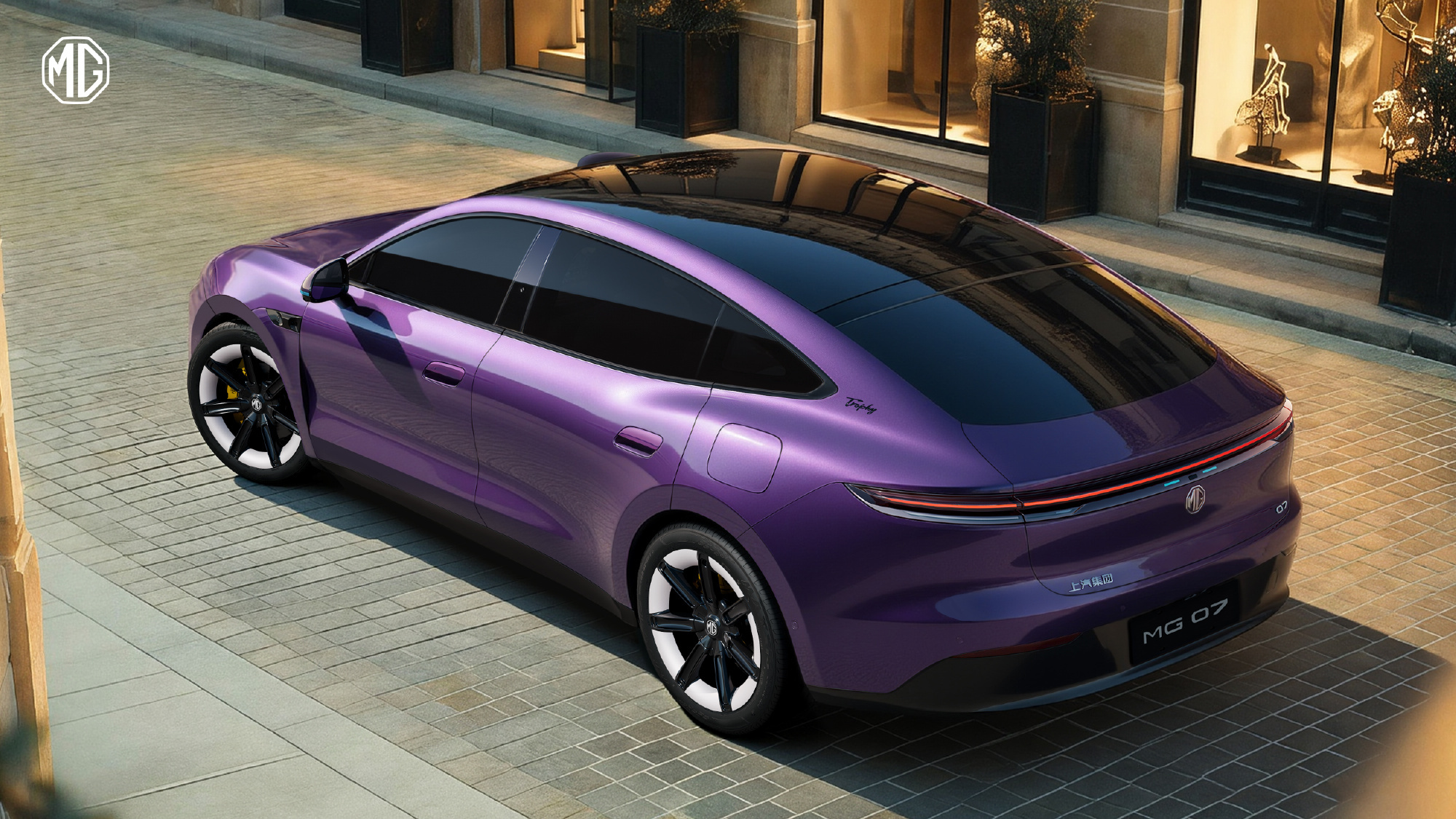
The similarities are readily apparent as the 07 looks like a pudgy Taycan. However, something has been lost in translation as it doesn’t seem quite right.

\\\\\\\\\

That being said, the model looks fairly good and sports C-shaped lighting units as well as a bulging hood. They’re joined by a wide lower intake that appears to have an active shutter grille and a prominent sensor.

Moving down the side, there’s a rakish windscreen that flows into a long curved roof. The latter is notable for having a lidar sensor mounted above the windscreen. Other highlights include Taycan-style front fender vents and door handles as well as a similar rear end. However, the MG’s booty could use some time at the gym.

MG has been coy on specifics, but they used Auto China to reveal the 07 rides on SAIC’s next-generation NEV platform. It will be offered with both electric and plug-in hybrid powertrains.

 The New MG 07 Flagship’s Looks Say Porsche Taycan, Its Price Says Corolla

The automaker also announced higher-end variants – that cost around ¥300,000 ($44,112) – will use the Momenta R7 autonomous driving system. It promises to provide Urban Navigate on Autopilot as well as a “seamless parking-space-to-parking-space driving experience.”

MG went on to say the system doesn’t simply imitate human driving as it also “possesses physical scene understanding and predictive reasoning similar to an experienced driver.” This reportedly enables proactive defensive maneuvers to increase safety.

We’ll likely learn more in the coming weeks, but the car will apparently show turquoise lights when being driven autonomously.

 The New MG 07 Flagship’s Looks Say Porsche Taycan, Its Price Says Corolla

EVs Might Hate The Cold, But Hybrids Hate The Heat

  • AAA tested electric vehicles and hybrids in controlled climate conditions.
  • Cold weather had a much larger impact on EV driving range than heat.
  • Hybrids also lost efficiency in extreme temperatures during testing.

Got your hands on a shiny new EV or hybrid, and wondering why its range isn’t quite as much as quoted? Well, some of that discrepancy can be down to the controlled nature of official range tests, plus a healthy bit of marketing fluff.

But there’s another reason as to why that 300-mile EV or 800-mile plug-in hybrid isn’t quite making those headline numbers. It simply doesn’t like to run when it’s too hot or too cold outside. So what are the specifics, then? You can thank AAA for expanding and updating this line of research, which they began in 2019.

A Climate-Controlled Treadmill Test For Cars

 EVs Might Hate The Cold, But Hybrids Hate The Heat
Photos AAA

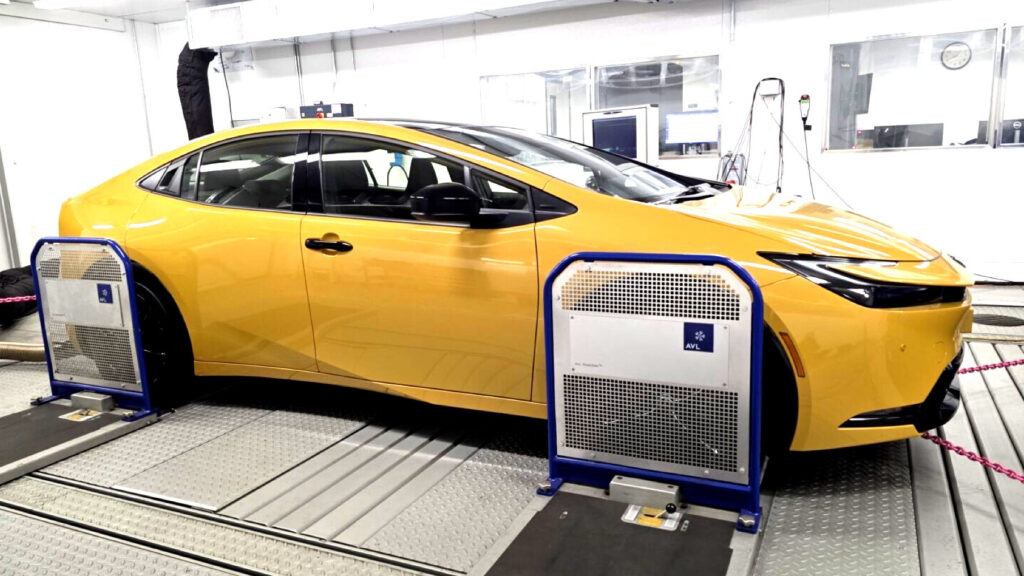
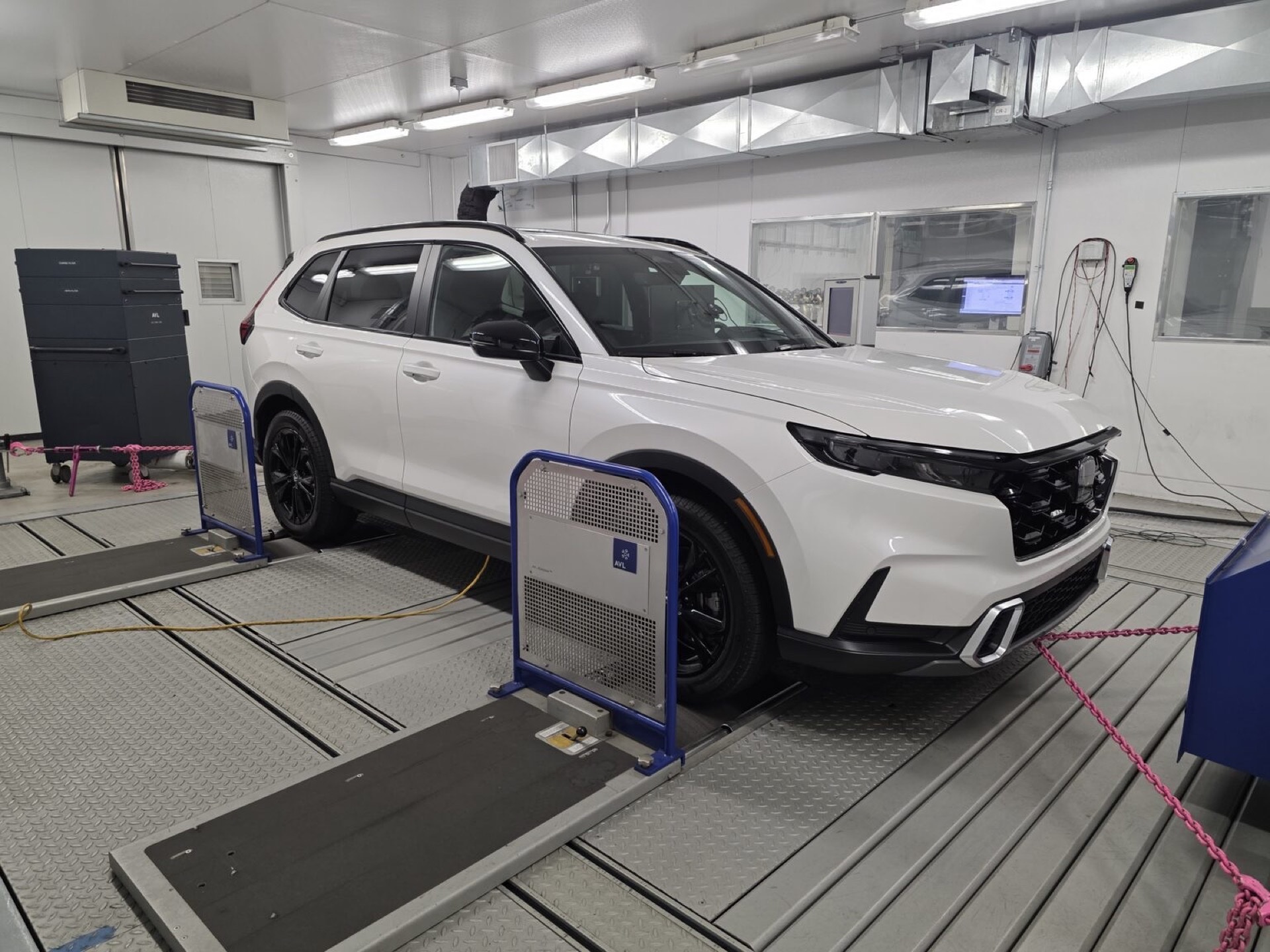
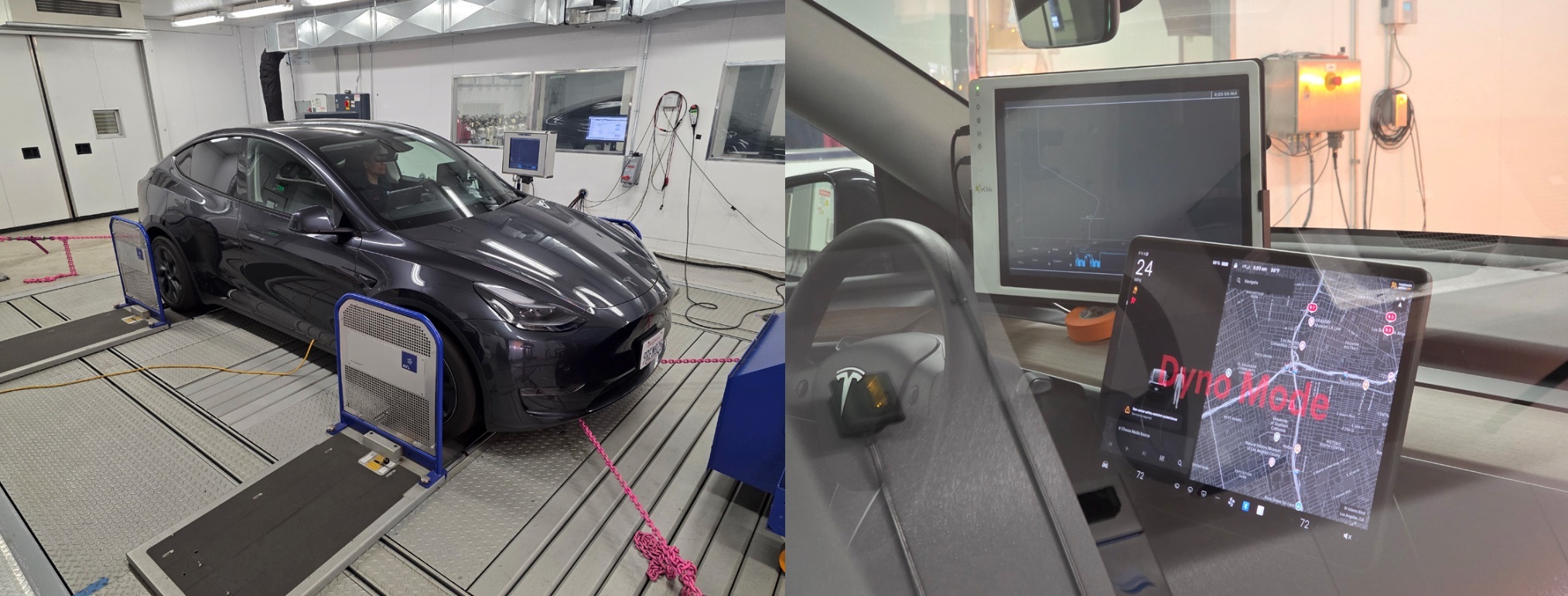
How they did this kind of testing is no less cool. They took three hybrids and three EVs and placed them in a laboratory test cell that included a dyno. In other words, it was the equivalent of running on a treadmill in a temperature-controlled room. Then, they set the vehicle’s air conditioning and heating systems to a comfortable 72F. Meanwhile, the test cell’s temperature was varied. Engineers at AAA settled on three temperature values – namely 20F / -6.7C (a cold winter), 75F / 23.9C (your average day), and 95F / 35C (a hot summer’s day). And they drove.

Read: EV Range Claims Still Sound Great, Until Freezing Temps Hit

Taking 75F / 23.9C as the baseline, AAA found that at 95F / 35C, the electric vehicles lost an average of 8.5% in driving range, corresponding to a 10.4% efficiency reduction. Hybrids fared worse, with a 12% decrease in fuel efficiency (miles per gallon). These values are noticeable, but unlikely to create a noticeable impact unless you tend to push the range envelope before recharging or refueling. This also means that your wallet will take a mild hit in terms of cost per mile.

Cold weather tests were rather more concerning. At 20F, the EVs saw a whopping 35.6% efficiency drop, resulting in an average range reduction of 39%. Hybrids also took a noticeable hit, with a 22.8% drop in fuel efficiency.

The Bottom Line

 EVs Might Hate The Cold, But Hybrids Hate The Heat
Photos AAA

If you live in a part of the world where winters and summers are mild, and the temperature generally hovers around 75F or thereabouts, congratulations, you don’t need to worry too much. If you live in a place where summers are hot, you’ll need to account for some extra range when purchasing your EV if you plan (or if your commute dictates) to run it down to 20% before every charge.

But if you live in a place where the winters are harsh, you may want to evaluate your options. As Greg Brannon, Director of Automotive Engineering and Research at AAA, said, “EVs are efficient in moderate temperatures but lose significant range in the cold. We expected this from our previous research, but were surprised by the 23% reduction in fuel economy for the hybrids in cold temperatures. Drivers should consider climate, energy costs, and driving patterns when choosing a vehicle that best fits their lifestyle.”

 EVs Might Hate The Cold, But Hybrids Hate The Heat
 EVs Might Hate The Cold, But Hybrids Hate The Heat

Toyota’s Record Sales Year Couldn’t Outrun Trump’s $8.8 Billion Tariff Bill

  • Toyota announced the FY2026 results, including a record ¥50.68 trillion revenue.
  • US tariffs dealt a ¥1.38 trillion blow, pushing North American operations into the red.
  • Company expects a further 20% profit dip in FY2027 due to Middle East instability.

Toyota released its financial results for the previous fiscal year, revealing a bittersweet reality: while consumers are buying their cars in record numbers, global but trade wars and geopolitical chaos are taking a serious bite out of the bottom line.

For fiscal year 2026, which ran from April 1 through March 31, Toyota Motor Corporation booked record revenue of 50.68 trillion yen ($323.42 billion), up 5.5 percent year over year. Operating income, however, dropped by roughly 1 trillion yen ($6.4 billion) to 3.77 trillion yen ($24 billion).

More: Toyota’s Next Corolla Cross Is Growing Up, And The RAV4 Should Be Worried

The single biggest culprit was a 1.38 trillion yen ($8.8 billion) hit from US tariffs. That alone was enough to drag Toyota’s North American division into a rare operating loss of 298.6 billion yen ($1.9 billion) excluding swaps, even though regional vehicle sales actually grew 8.5 percent. Selling more cars and losing money doing it is not the equation Toyota wants to be solving.

 Toyota’s Record Sales Year Couldn’t Outrun Trump’s $8.8 Billion Tariff Bill
Toyota RAV4

To combat these trade frictions, Toyota will begin exporting US-built models to Japan starting this year, including the Camry sedan, the Highlander SUV, and the Tundra pickup. This move is less about covering local demand and more of a strategic effort to balance trade relations with the US.

More: A Texas-Built Full-Size Pickup Is Now On Sale In The Country That Invented The Kei Car

The 2026 results were quite positive for global sales of electrified vehicles, which reached 5.04 million units, making up 48.1% of total volume (11,283 million). These include 4.62 million HEVs, 175,000 PHEVs, and 243,000 BEVs, with the latter surging by 68.4% compared to last year. For FY2027, Toyota expects to more than double its BEV sales to 598,000 units.

What’s Next For Toyota?

 Toyota’s Record Sales Year Couldn’t Outrun Trump’s $8.8 Billion Tariff Bill
Toyota Highlander EV

The overall forecast for FY2027 is rather cautious. Toyota expects sales volume to hold roughly steady, but operating income is forecast to fall 20.3 percent to around 3 trillion yen ($19.1 billion). The company is bracing for an additional 670 billion yen ($4.27 billion) in costs tied to economic and logistical disruptions over the coming year.3

More: The Toyota Van That Refused To Change For 22 Years Is Being Replaced, And It’ll Look Nothing Like Before

Toyota specifically called out the “destabilization” of the Middle East and the ongoing war there, which are pushing materials and energy costs higher. Combined with ongoing tariff pressures and a massive 1.8 trillion yen ($11.48 billion) investment in R&D, Toyota is signaling to investors that the next 12 months will be a period of defensive maneuvering.

 Toyota’s Record Sales Year Couldn’t Outrun Trump’s $8.8 Billion Tariff Bill
Toyota bZ

Shareholders aren’t being left empty-handed. Toyota declared a full-year FY2026 dividend of 95 yen ($0.61) per share and plans to bump it to 100 yen ($0.64) for FY2027. Toyota stock currently trades at 2,913 yen ($18.58), down 14 percent since the start of the year.

More: Toyota’s Most Powerful Land Cruiser Ever Is A $112K Hybrid Americans Can’t Buy

Toyota’s newly appointed President, Kenta Kon, said: “I feel there is still significant room for improvement in our management and administrative operations. Those of us in such positions, by further examining where our abilities truly lie, can move beyond simply managing the front lines and instead get directly involved to support operations.”

Below you can watch the entire presentation that was streamed earlier today from Japan.

Porsche’s EV Gamble Is Going So Well It’s Even Closing Its Ebike Arm And 500 Jobs

  • Porsche plans major reset after weakening demand, tariff costs and pricey electric strategy u-turn.
  • Several Porsche subsidiaries, including ebike and battery divisions, face closure, with loss of 500 jobs.
  • Difficult years lie ahead while Porsche waits for new ICE Macan SUV it thought it would never need.

Porsche spent years telling us the future would be mostly electric. Now it’s scrambling to rebuild parts of the combustion lineup it already started phasing out, while simultaneously slashing jobs, shutting divisions, and reshuffling management to steady the ship and improve profits.

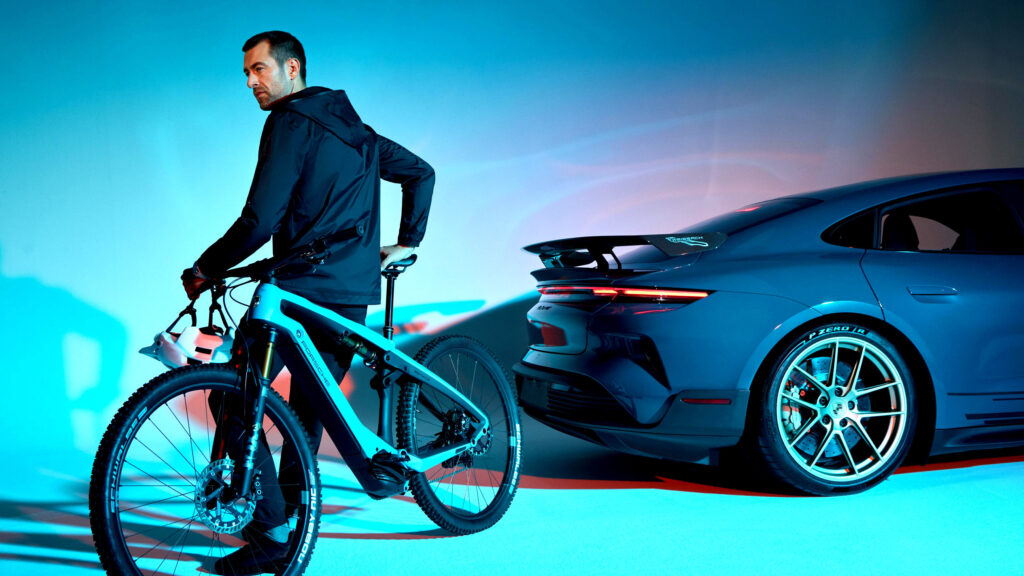
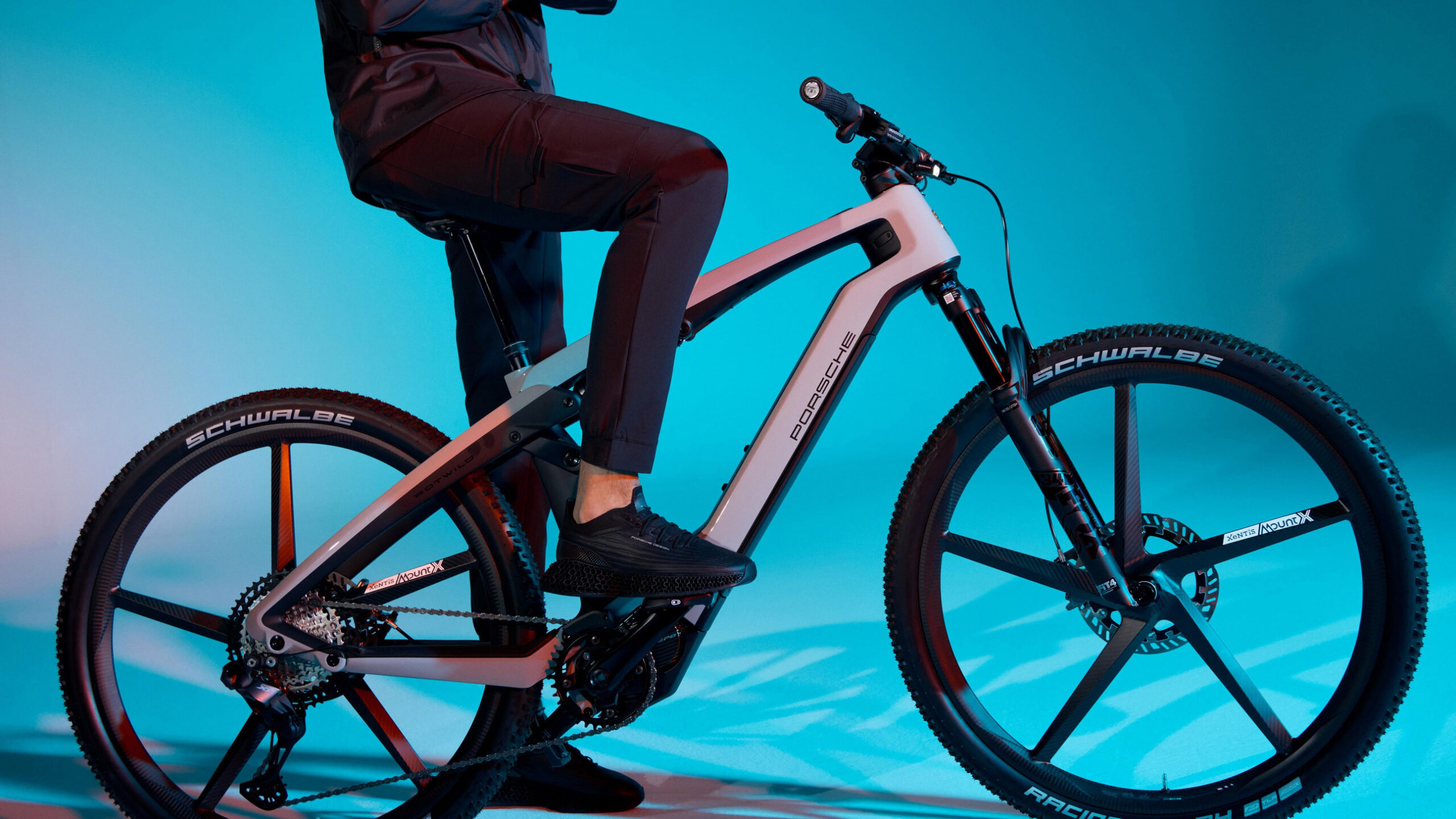
Having last month sold its stake in Bugatti and Rimac, the company this week confirmed plans to eliminate more than 500 jobs while discontinuing several electric-focused subsidiaries as part of a broader restructuring effort. Porsche is shutting down Cellforce Group, Porsche eBike Performance, and Cetitec as it narrows its focus back toward its main automotive business.

More: Porsche’s Profits Fell 93%, So It’s Selling Bugatti And Rimac

Cellforce was Porsche’s battery technology venture focused on developing high-performance lithium-ion cells for future EVs and motorsport applications. It “no longer has a sufficiently viable long-term perspective” and closes with the loss of 50 jobs, the company says.

Porsche eBike Performance, as its name suggests, handled electric bike drive systems and related hardware, but “fundamentally changed market conditions for e‑bike drive systems” means it gets the chop, and so do 360 workers. Cetitec, meanwhile, specialized in engineering and technical consulting services for automotive development programs. Sixty people in Germany are now looking for a new paycheck as a result of it being shuttered, along with a further 30 in Croatia.

Getting Back To Cars

 Porsche’s EV Gamble Is Going So Well It’s Even Closing Its Ebike Arm And 500 Jobs

“Porsche must refocus on its core business,” CEO Michael Leiters said, announcing the reset. “This is the indispensable foundation for a successful strategic realignment [and] forces us to make painful cuts — including our subsidiaries.”

The €1.4 Million Dashboard

At the same time, Porsche is also restructuring its executive board and folding the standalone Car-IT division into the wider research and development department led by Michael Steiner.

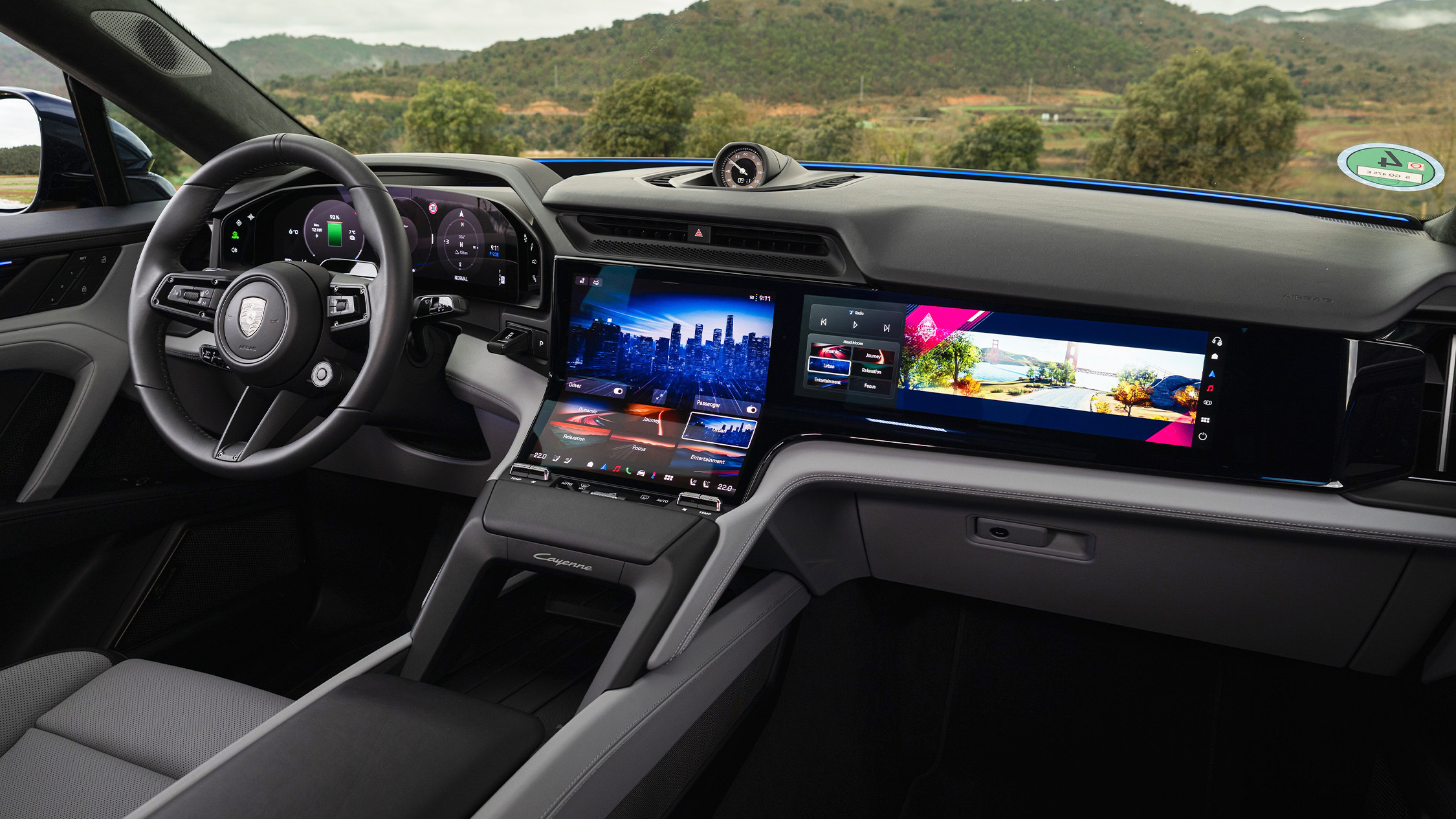
That’s a notable reversal because Porsche created the dedicated software-focused board role a few years ago specifically to recruit Sajjad Khan away from Mercedes-Benz, Automobilwoche reports. Khan had been tasked with modernizing Porsche’s infotainment and digital experience, and his influence is already visible in the electric Cayenne’s redesigned cockpit and connected features. That influence came at a price, though. Last year, Kahn reportedly earned €1.4 million ($1.65 m).

 Porsche’s EV Gamble Is Going So Well It’s Even Closing Its Ebike Arm And 500 Jobs
Porsche

A bigger issue, though, is Porsche’s increasingly awkward product strategy. The company is preparing to kill the combustion Macan this summer despite demand for the gas-powered SUV still massively outweighing interest in the electric replacement in several markets, especially the US.

Porsche reportedly won’t have a new combustion or hybrid Macan (seen below testing in Audi Q5 mule form) ready until around 2028, leaving a painful gap in one of its most important model lines. Meanwhile, Chinese sales continue sliding as local EV brands offer cheaper alternatives loaded with flashy technology. It’s good that Porsche is grasping the nettle, but the pain isn’t going to disappear overnight.

 Porsche’s EV Gamble Is Going So Well It’s Even Closing Its Ebike Arm And 500 Jobs

Canada’s New Chinese EV Quota Has A Tesla-Sized Problem Already

  • Up to 49,000 Chinese EVs yearly qualify for lower Canadian tariffs.
  • The first 24,500 reduced-tariff permits stay open through August 31.
  • Chery, Geely, and BYD are lining up new EV launches for Canada.

Worried that automakers like Tesla could vacuum up the bulk of its low-tariff Chinese EV quota in one gulp, the Canadian government is reportedly rethinking how to dole out the import permits before they all end up in one company’s hands.

Under Canada’s new trade arrangement with China, up to 49,000 China-built EVs can be imported each year at a slashed 6.1 percent tariff, a steep drop from the punishing 100 percent duty. The first batch of 24,500 permits has been on the table since late March and is supposed to stay available through August 31, handed out on a first-come, first-served basis.

Read: Chinese EV Brands Are On A Hiring Spree In Canada As They Set Up Shop

According to Bloomberg, not a single permit has actually been issued yet. That window is about to get crowded, though, because Tesla just confirmed it will start selling a Chinese-built Model 3 in Canada at a sharply lower price. The new entry point is CA$39,490 before destination, roughly US$29,007, which guts the old floor set by the Model 3 Long Range AWD at CA$79,990, or about US$58,700.

Canada Wants Equitable Access For All Chinese Brands

 Canada’s New Chinese EV Quota Has A Tesla-Sized Problem Already

In addition to Tesla, through its Volvo and Polestar brands already operating in Canada, may also be positioned to secure part of the initial allocation. Once the second half of the 49,000 permits becomes available after August 31, officials may revise the system and assign specific reduced-tariff allocations to individual automakers, giving more brands access to the program.

These brands could include newcomers to the Canadian market, such as BYD and Chery. According to unnamed officials, the quota system may eventually expand to favor companies that establish operations in Canada, including local assembly facilities.

News of these potential changes comes just after it was revealed firms including BYD, Cheyr, and the Geely-owned Zeekr brand have launched a hiring spree across Canada, eager to quickly set up shop and start selling their vehicles locally.

 Canada’s New Chinese EV Quota Has A Tesla-Sized Problem Already

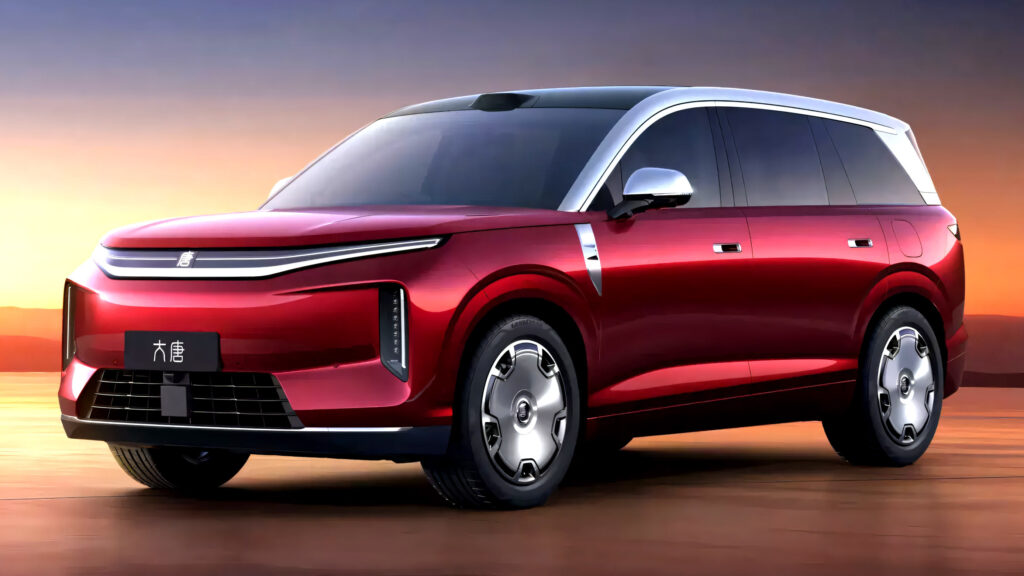
BYD Booked 100,000 Orders For A $37K EV Bigger Than An Ioniq 9, Sight Unseen

  • More than 30,000 reservations arrived within the SUV’s first day.
  • BYD’s second-gen Blade battery and 1,000-volt tech are featured.
  • The most potent Great Tang delivers 784 hp through twin motors.

After several years of unimpeded growth, Chinese juggernaut BYD recently posted its eighth straight month of year-over-year sales declines, even with a barrage of new model launches trying to stem the bleeding. The Chinese giant clearly has growing pains, but one of its newest products is bucking the trend in spectacular fashion.

The company’s new, full-size, all-electric Great Tang SUV was presented earlier this year and showcased at the Beijing Auto Show two weeks ago. As the show opened, so did pre-sales for the EV, and in just two weeks, BYD has locked in more than 100,000 pre-sale orders for the Great Tang.

Read: BYD’s New Flagship Great Tang Charges From 10 To 97% In 9 Minutes

Of these, over 30,000 pre-sale orders were placed in the first 24 hours. These are extraordinary figures for a vehicle that’s even larger than the Hyundai Ioniq 9 and Kia EV9 sold in the West. Clearly, the Chinese still have the appetite to buy luxurious SUVs when they’re priced right.

The entry-level Great Tang starts at 250,000 yuan or $36,700, a shockingly low figure given that it uses BYD’s new Super e platform, includes its second-generation Blade battery, and has a 1,000-volt electrical architecture. This model uses a single, rear-mounted electric motor with 496 hp, and can travel up to 590 miles (950 km) on a charge under China’s optimistic CLTC cycle.

Comfort For Seven

\\\\

The flagship version is priced at 320,000 yuan ($47,000) and delivers 784 hp, laughing in the face of the most powerful versions of the Ioniq 9 and EV9.

Not only do buyers get plenty of power and advanced battery tech, which means the Great Tang can charge from 10 to 97 percent in just nine minutes, but they also get a cabin loaded with features. As standard, the latest BYD is sold in a 2+2+3 configuration and includes three front screens and a display that folds out from the headliner for rear passengers.

\\\\\\\\\\\\\\\

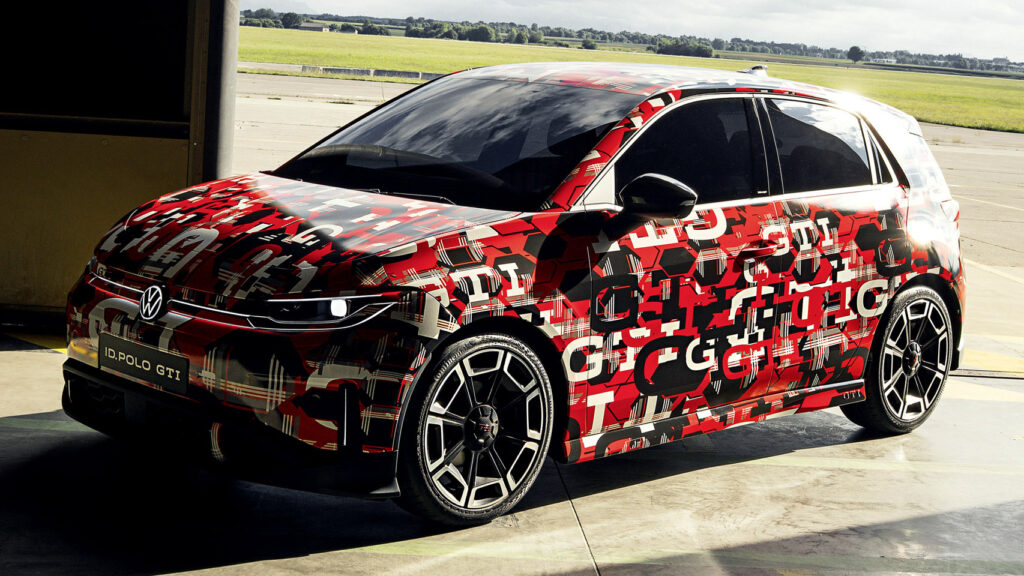
VW Said No Fake Shifts On A GTI, The Clubsport Could Borrow Hyundai N’s Trick Anyway

  • VW’s ID. Polo GTI Clubsport could fake shifts for extra fun.
  • The hotter EV hatch may jump from 223 hp to nearly 282 hp.
  • Mini and Stellantis rivals already push as much as 276 hp..

Volkswagen hasn’t even officially launched the electric ID. Polo GTI yet, and already there’s talk of an even hotter Clubsport version lurking in development. Better still, it might come with fake gearshifts and simulated combustion-style power delivery and sounds designed to make EV hot hatch feel less, well, EV-ish.

According to Autocar, VW engineers are exploring a more extreme ID. Polo GTI Clubsport packing roughly 282 hp (286 PS / 210 kW), up substantially from the regular car’s expected 223 hp (226 PS / 166 kW) output. That would immediately put it closer to the upper end of the growing electric hot hatch class.

Related: VW’s New ID. Polo Starts Under $30K And Comes With Massage Seats

While the standard ID. Polo GTI should comfortably match the 215 hp (218 hp / 160 kW) Alpine A290 GTS and its mechanically related 223 hp Cupra Raval sibling, several rivals already bring considerably more firepower. The electric Mini JCW produces 255 hp (259 PS / 190 kW), while Stellantis has gone properly aggressive with the 276 hp (280 PS / 206 kW) Peugeot e-208 GTI and Opel Corsa GSE.

The Opel, unveiled this week, sets a serious benchmark, sprinting to 62 mph in just 5.5 seconds. Current expectations suggest the regular VW GTI might need around a second longer than that, though the Clubsport should give the Opel a real fight.

Performance upgrades reportedly won’t stop at extra power. Autocar says VW’s also considering replacing the current electronically controlled BorgWarner limited-slip differential with a fully mechanical setup for sharper front axle behavior.

Hyundai N-Style Shifts

\\\\\\\\

But arguably the most interesting part is the fake shifting system, something that appeared on the GTI concept back in 2023, but which VW then said would not appear on a production GTI. Of course nobody asked about a GTI Clubsport.

VW dynamics boss Florian Umbach said the company is working on “a similar kind of paddleshift power delivery that the [electric] Hyundai N cars have.” Like the Ioniq 5 N, the setup would use software-controlled power delivery to imitate a combustion engine and transmission.

“It’s all about motor control and an audio soundtrack to match,” Umbach told the magazine, suggesting fake sounds – also featured on the 2023 VW GTI concept – will also be part of the Clubsport package.

Purists will absolutely argue about whether fake shifts belong in a GTI, but the reality is many drivers miss the interaction traditional hot hatches delivered and VW clearly knows engagement matters just as much as raw acceleration numbers.

Images shown below are of the 2023 GTI concept.

\\\\\\\\\\\\

VW

Stellantis Cuts 650 Opel Engineers In Germany, Then Hands Its Next EV To China

  • A new Opel C-SUV will launch by 2028 using Leapmotor’s architecture.
  • Production is set for Zaragoza, Spain, alongside the Leapmotor B10.
  • Engineering cuts in Germany signal a shift toward Chinese-led R&D.

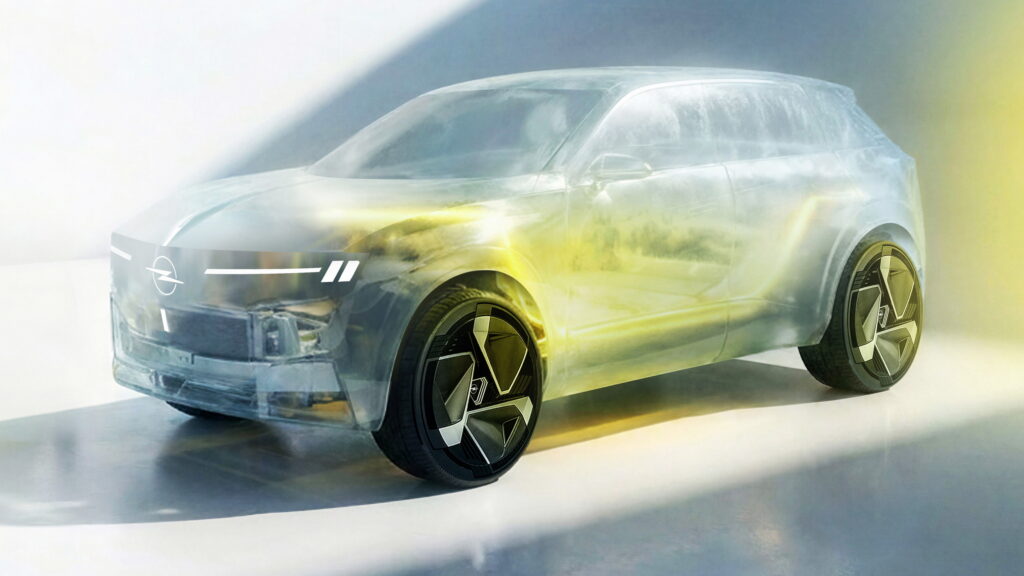
Stellantis has figured out a new way to squeeze value out of its Leapmotor partnership, and Opel is the brand getting the keys. The German automaker has confirmed plans for a new electric compact SUV built on underpinnings from the Chinese EV maker, validating reports that surfaced earlier this year.

The yet-unnamed crossover is targeted for a 2028 launch, with development running under two years from start to showroom. Styling work is being handled by Opel’s design team in Russelsheim and will lean on the brand’s current visual language. The first teaser shows a sporty SUV with large wheels, tight overhangs, and the now-familiar Opel Vizor face with integrated LED lighting.

More: Opel’s New Corsa GSE Beats Peugeot’s GTI Using Peugeot’s Own Powertrain

According to Opel CEO Florian Huettl, the new SUV will be “developed by international teams located in Germany and China”. It will use “core components of the latest Leapmotor electric architecture and battery technology”, with Opel’s input being limited to design, chassis engineering, lightning and seating technology.

Production of the upcoming EV will take place at the Figueruelas plant in Zaragoza, Spain, starting in 2028. The same facilities are the home of production for the Opel Corsa, Peugeot e-208, Lancia Ypsilon, and Leapmotor B10.

Another Opel SUV?

 Stellantis Cuts 650 Opel Engineers In Germany, Then Hands Its Next EV To China

The new offering will expand Opel’s SUV lineup next to the Mokka, Frontera, and Grandland, targeting the highly competitive C-SUV segment in Europe.

While Stellantis didn’t get into details about its specifications, the new Opel will most likely be based on the Leapmotor B10. The electric SUV measures 4,515 mm (177.8 inches) long, slotting right in between the Frontera and the Grandland in terms of footprint.

More: Stellantis’ Cheapest New EV Is Chinese, Made In Europe, And $15K Under Its Own Peugeot

The Leapmotor B10 is fitted with a single electric motor producing 215 hp (160 kW / 218 PS) and offers two battery sizes of 56.2 kWh and 67.1 kWh, offering a range of up to 434 km (270 miles). It will also be available with a range-extender powertrain offering a total range of up to 900 km (559 miles).

\\\\\\\\\\\\\\

Leapmotor B10

Stellantis has stated that the Leapmotor B10 has been “rigorously tested” at the Balocco proving ground in Italy, meaning there could be differences to the setup of the EU-spec version compared to the model sold in China.

More: Stellantis To Sell Europeans A $10K Chinese SUV For Nearly Triple, And Still Undercut VW

More importantly, the Leapmotor B10 is priced from €29,900 ($35,100) in markets like Germany, France, and Spain, undercutting the rival Skoda Elroq by €4,000 ($4,700). While it is too early to talk about pricing for the Opel version, the company promises it will be an “accessible” electric vehicle, adding that the use of Leapmotor-sourced components would “significantly enhance affordability for European customers”.

The Ugly Truth

 Stellantis Cuts 650 Opel Engineers In Germany, Then Hands Its Next EV To China
Our speculative rendering for a Leapmotor-based Opel.

Stellantis has recently announced plans of cutting 650 engineering jobs at Opel’s historic headquarters in Russelsheim, reducing the remaining technical staff to around 1,000 people.

The site employed over 7,700 engineers back in 2017, undertaking important R&D projects for the PSA Group. Now, it has narrowed down its scope to areas like AI, software, ADAS, battery tech, and digital lighting systems. While unrelated, with the job cuts, the Leapmotor deal allows Stellantis to significantly reduce R&D expenses and the time needed to bring a new product to the market.

More: Opel And Alfa Romeo’s Next EVs May Be Built Around Chinese Tech, Not German Or Italian

Crucially, the upcoming electric SUV won’t be the only Leapmotor-based product from a Stellantis brand. According to the company “the new vehicle is intended to serve as a blueprint for efficient global collaboration” meaning it could pave the way for other similar projects in the future.

The Story Of The Joint Venture

Stellantis acquired a 21% stake in Leapmotor in October 2023, becoming the largest shareholder of the Chinese brand. The LPMI (Leapmotor International) joint venture is 51% owned by Stellantis, which has the exclusive rights of selling and producing Leapmotor products outside China.

The European rollout has been quite successful, with Leapmotor delivering 40,000 units in 2025 and kicking off 2026 with a first quarter of 24,751 registrations. Besides the Old Continent, the LPMI joint venture has expanded its activities to South America, Mexico, Asia-Pacific, Middle East, and Africa.

 Stellantis Cuts 650 Opel Engineers In Germany, Then Hands Its Next EV To China
The Leapmotor stand at the recent Beijing Auto Show in China.

Skoda’s Affordable Electric Crossover Finally Shows Its Interior

  • The Skoda Epiq has been spied inside and out, ahead of its debut.
  • Model arrives later this month with three different powertrains.
  • Pricing is expected to start around €26,000 ($30,490).

Skoda is gearing up to introduce the all-new Epiq on May 19 and they’re rushing to cross all the t’s and dot all the i’s. As a result, spy photographers recently caught two prototypes undergoing last minute testing on the Nürburgring.

They were intrigued by the one seen below as they believed it could be a Sportline or RS variant, because it has steering wheel-mounted paddle shifters. However, these are common on Skoda EVs as they’re used for regenerative braking. That being said, we wouldn’t necessarily rule out a Sportline version as we can see a sporty steering wheel with a dimpled rim.

More: Skoda’s Smallest EV Has One Big-Car Surprise

The interior image doesn’t reveal much else, but it gives us our first proper glimpse at the crossover’s 13-inch infotainment system. It will be joined by a 5.3-inch digital instrument cluster, slender air vents, and a wireless smartphone charger. Buyers will also find ambient lighting, sustainable materials, and a cargo compartment that can hold up to 47.5 cubic feet (1,344 liters) of gear.

 Skoda’s Affordable Electric Crossover Finally Shows Its Interior

SH Proshots

The front fascia and rear bumper are disguised, making it hard to determine if this is indeed a sporty variant. However, testers might have given us a subtle hint in the form of front fender vent stickers. Of course, we probably shouldn’t read too much into that.

Regardless of what the prototype is hiding, Skoda has already announced three different variants known as the Epiq 35, 45, and 55. The first combines a 38.5 kWh battery pack with a front-mounted motor producing 114 hp (85 kW / 116 PS) and 197 lb-ft (267 Nm) of torque. This enables the crossover to run from 0-62 mph (0-100 km/h) in 11 seconds and have a range of 196 miles (315 km).

\\\\\\

SH Proshots

The mid-level model pares the aforementioned battery with a beefier 133 hp (99 kW / 135 PS) motor. This lowers the 0-62 mph (100 km/h) time to 9.8 seconds without having an impact on range.

The range-topper sports a larger 55 kWh battery as well as a motor developing 208 hp (155 kW / 211 PS) and 214 lb-ft (290 Nm) of torque. This is the most interesting of the group as it accelerates from 0-62 mph (100 km/h) in 7.4 seconds and has a range of up to 267 miles.

While we’re skeptical this is a performance variant, it’s not hard to imagine one on the horizon as Volkswagen has already confirmed plans for an ID. Polo GTI with 223 hp (166 kW / 226 PS) in 2027.

\\\\\\\

SH Proshots

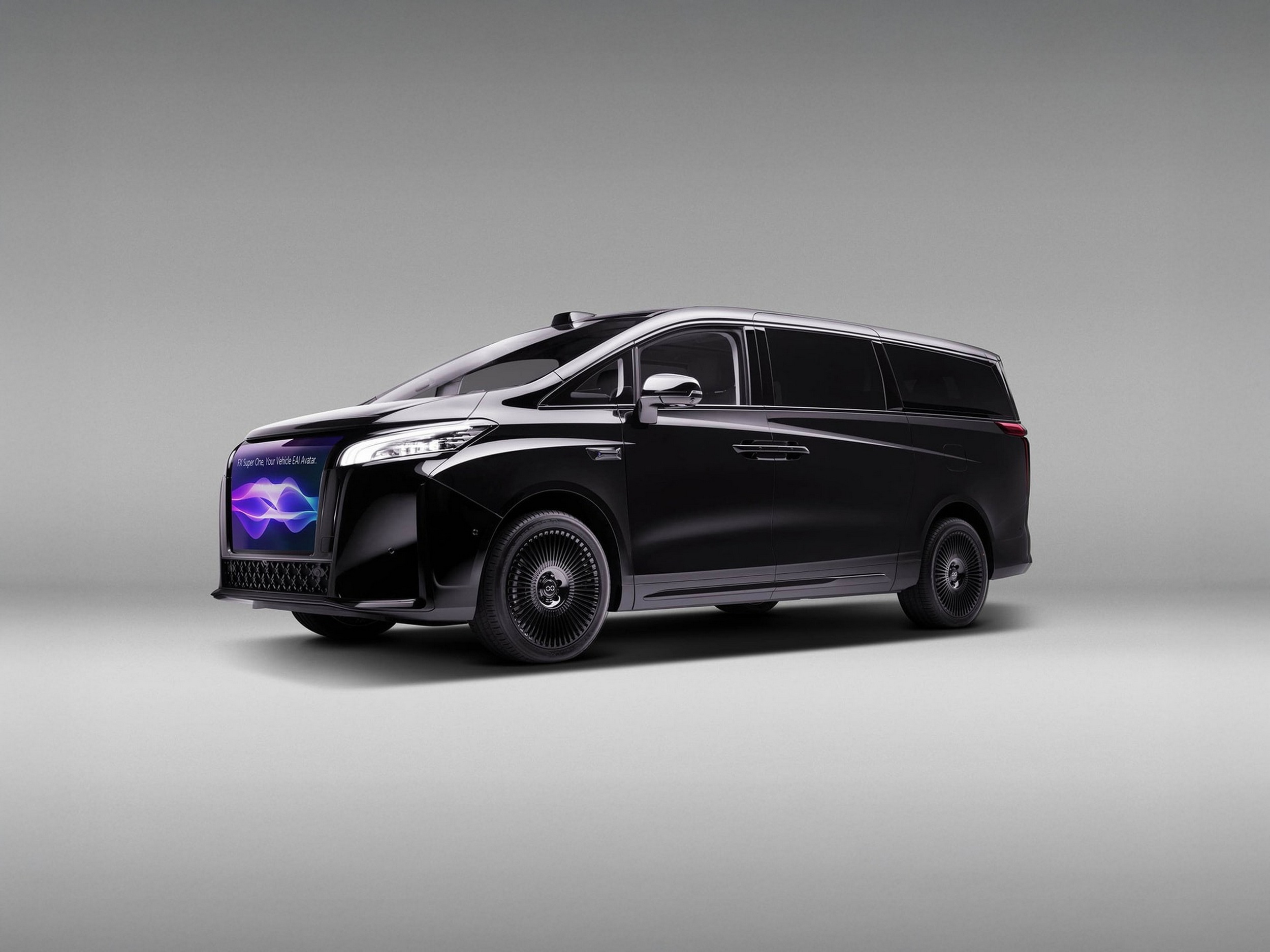
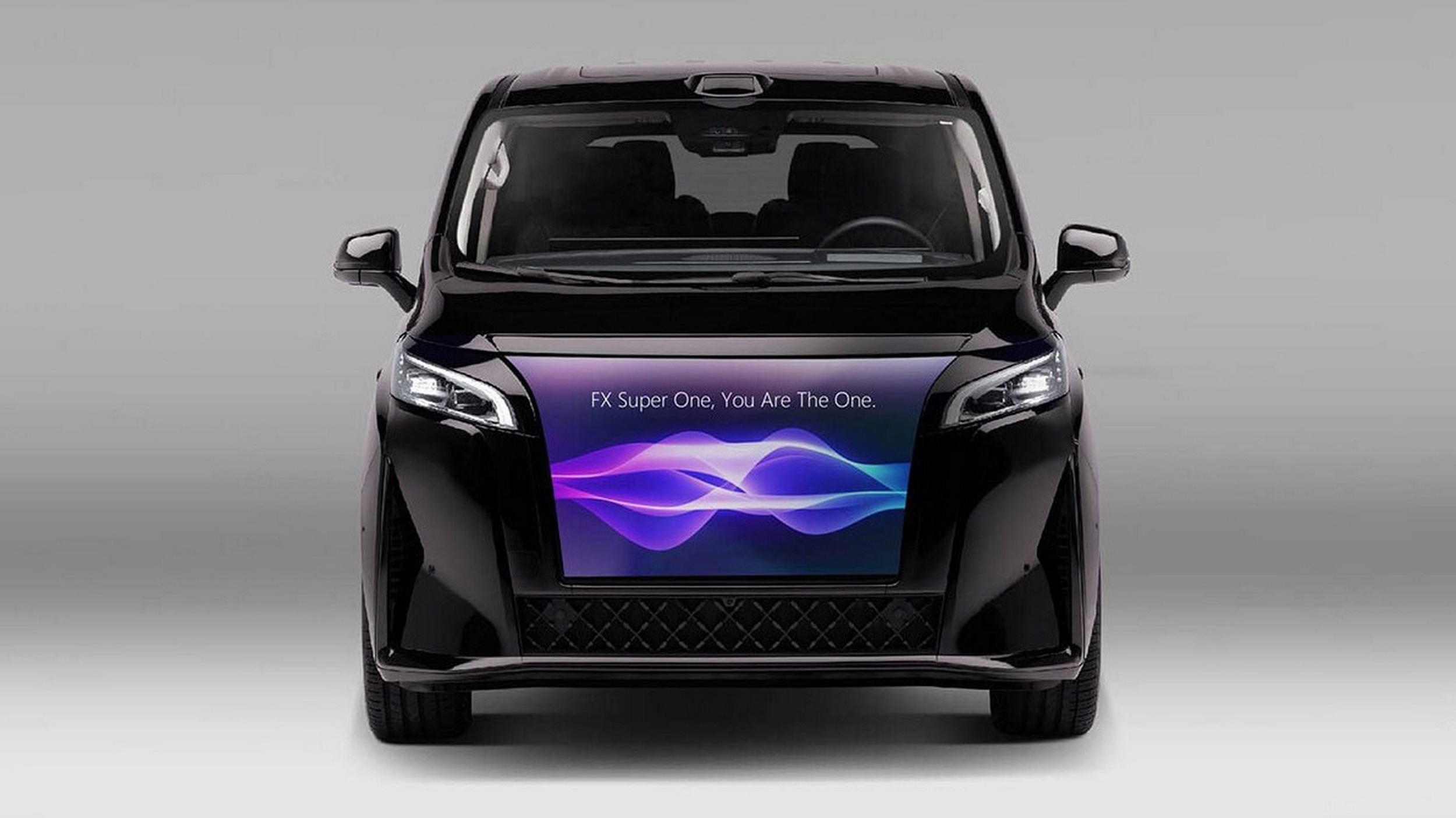
Faraday Future’s Super One Minivan Is Already In Trouble

  • Faraday Future is pausing their FX Super One minivan project.
  • Company now eyes 800V architecture or range-extended powertrain.
  • Minivan’s mass production is now subject to securing financing.

Less than a year after introducing the FX Super One minivan, Faraday Future is hitting pause. The floundering automaker blamed the move on the vehicle’s 400V architecture, which they deemed uncompetitive.

As for what the future holds, the company isn’t exactly sure. However, they want to pivot to either an 800V architecture or a range-extended powertrain. They said the change would provide “users with stronger product competitiveness and greater value.”

More: Faraday Turned A Chinese Minivan Into A Rolling Mansion With A Talking Grille

The firm added an 800V architecture would deliver “longer range, faster charging speeds, and superior powertrain efficiency.” Likewise, they praised range-extended vehicles for being “well-suited to extreme-cold winter regions such as the U.S. East Coast.”

A number of EVs have made the transition from 400V to 800V architectures recently including the Mercedes EQS, Polestar 3, and Volvo EX90. However, these are established automakers, while Faraday Future is a penny stock that claims to be an “embodied AI ecosystem company.”

 Faraday Future’s Super One Minivan Is Already In Trouble

While the FX Super One project is now paused, the company hopes to begin mass production of the updated model in the future. However, this appears to be “subject to securing financing from strategic or medium-to-long-term investors.”

Despite needing funding and not knowing which way they’re going to go, Faraday laid out two delivery timelines. The updated 800V FX Super One would reportedly be faster to arrive as the company expects its “first phase of delivery within 6 to 9 months, second phase of delivery within 12 to 15 months, and third phase of delivery within 21 to 24 months.”

 Faraday Future’s Super One Minivan Is Already In Trouble

The company didn’t elaborate on these different phases, but said going the range-extended route would take longer as the first phase of delivery would be within 9 to 12 months, while the second would be within 21 to 24 months. The third phase would then come within 24 to 28 months, according to their projections – which have been far off in the past.

Despite sounding like a major failure, Faraday Future tried to spin it as a positive as they said the move enables them to concentrate on their new robotics business during its “critical ramp-up period.” The company added they shipped a total of 68 robots through the end of April.

 Faraday Future’s Super One Minivan Is Already In Trouble

Jaguar’s Most Polarizing Car In A Generation Is Finally Getting A New Name

  • Jaguar will finally reveal the production name for the radical Type 00 EV on May 12.
  • Four-door electric GT is expected to pack more than 1,000 hp and 700 km of range.
  • It marks the first production Jaguar born from the brand’s controversial EV-only reboot.

Jaguar’s reboot is about to get a lot more real. After months of teasers, heated debate, and one of the most polarizing relaunches in recent memory, the British brand is reportedly preparing to reveal the actual production name of the EV currently known as the Jaguar Type 00. The wait has been long, and it’s not over anytime soon, as production hasn’t started, but a lot is riding on this nameplate.

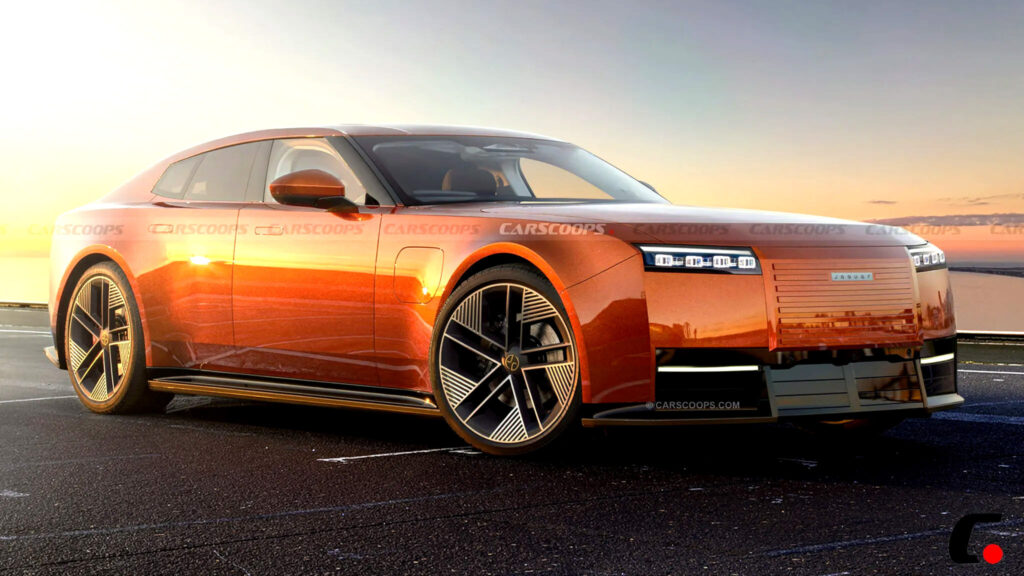
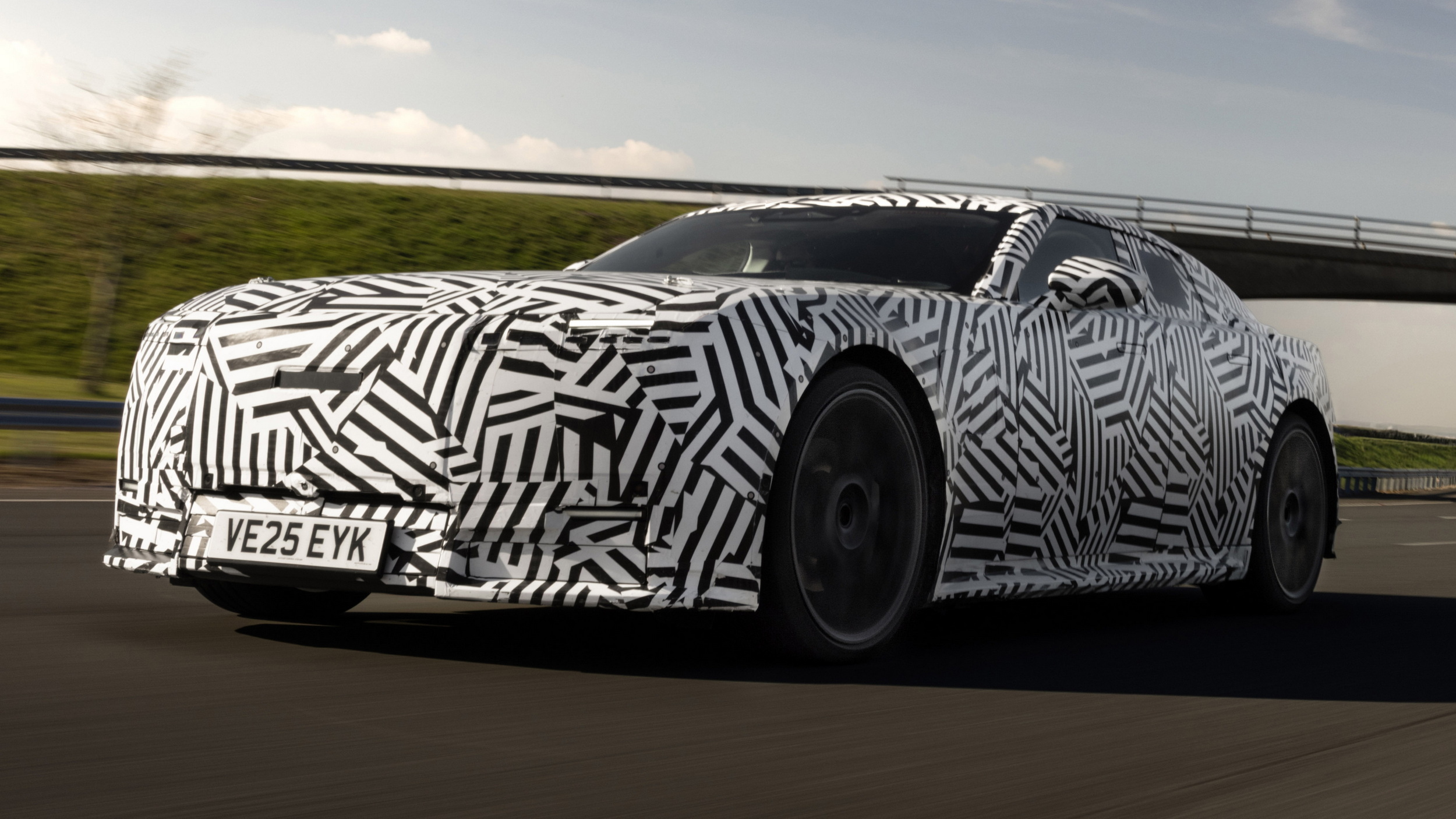
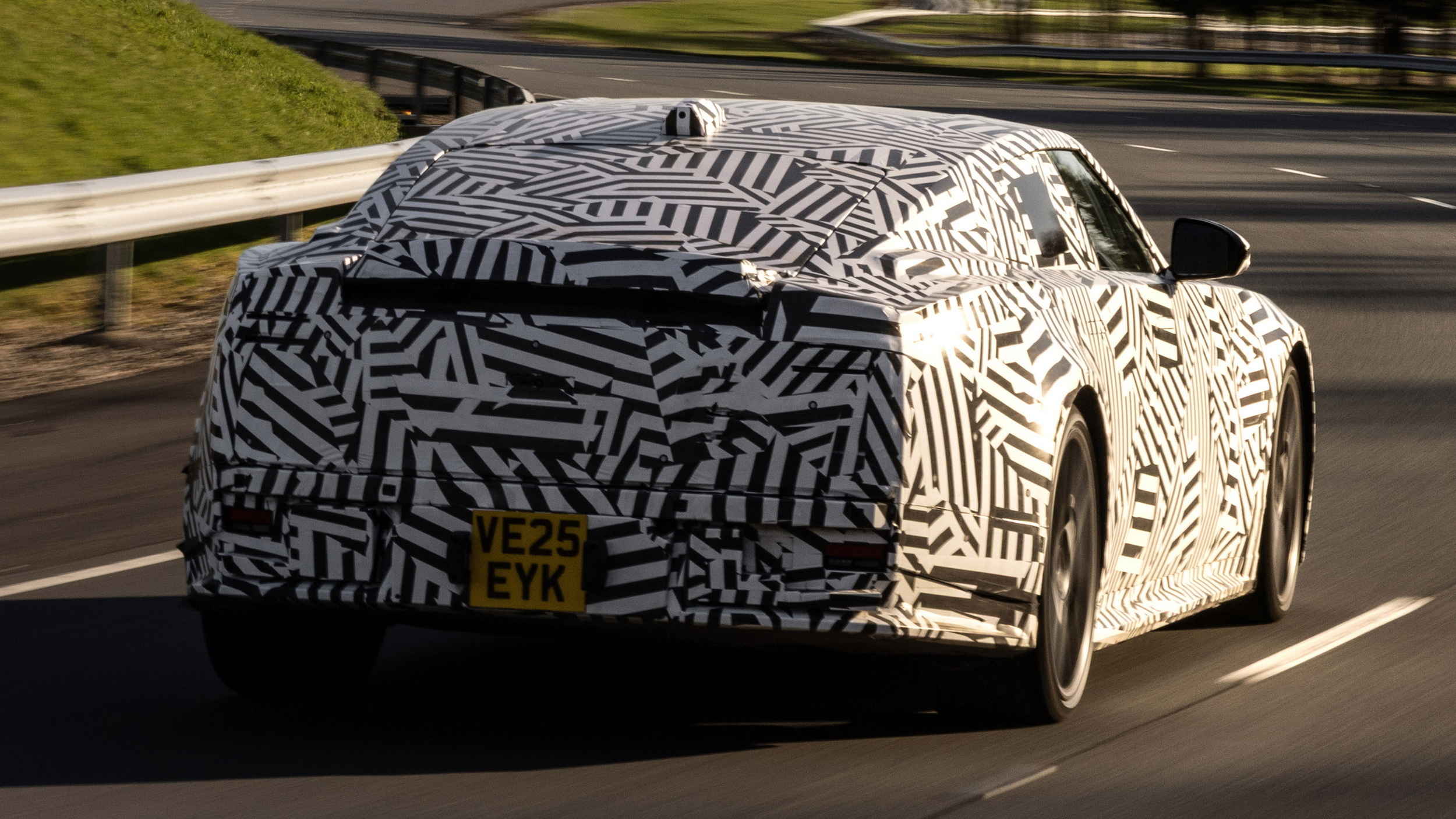
Known internally as the X900, the concept and production mules have been all over the planet. It’s a long, low-slung four-door electric grand tourer that is supposed to reset the bar for what a Jaguar is. Now, according to a report from Autocar India, we’ll find out what Jaguar will call it on May 12. Then, in September, the brand will reveal the production-spec version, and if all goes according to plan, deliveries will start sometime in 2027.

More: Jaguar’s 1,000-HP Answer To Bentley Looks Nothing Like The Jaguar You Knew

Underneath the long hood and fastback roofline sits Jaguar’s new dedicated EV platform, dubbed JEA, short for Jaguar Electric Architecture. The company says the car will use a tri-motor setup with one motor up front and two at the rear, producing over 1,000 hp (746 kW) and roughly 959 lb-ft (1,300 Nm) of torque in the launch edition. That would immediately make it the most powerful Jaguar road car ever built.

 Jaguar’s Most Polarizing Car In A Generation Is Finally Getting A New Name
A prototype of the new 1,000 hp Jaguar luxury sedan.
 Jaguar’s Most Polarizing Car In A Generation Is Finally Getting A New Name

Jaguar is also targeting around 700 km (435 miles) of WLTP range from a battery pack measuring about 120 kWh. The automaker claims the car can recover approximately 321 km (200 miles) of range in just 15 minutes of fast charging.

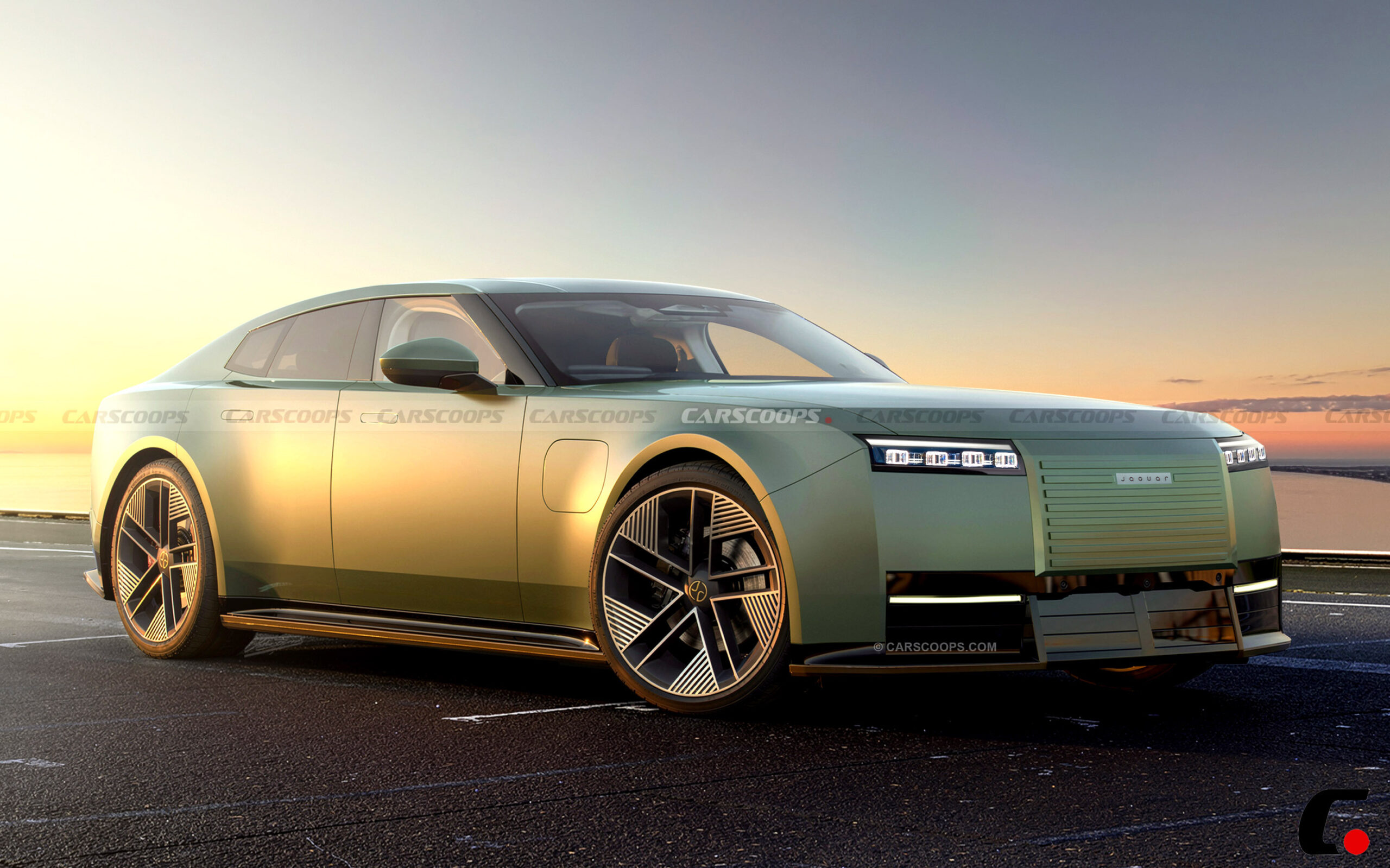
Despite the outlandish concept styling, spy shots suggest the production car stays remarkably faithful to the original design previewed by the concept. It keeps the exaggerated proportions, long front end, slab-sided surfacing, and sleek roofline, though the production version swaps the concept’s two-door layout for a more practical four-door GT configuration. Jaguar needs a win here. Hopefully, it has an appropriately grand name for this new grand tourer.

 Jaguar’s Most Polarizing Car In A Generation Is Finally Getting A New Name
Illustrations Josh Byrnes / Carscoops

Porsche Built The Macan EV For The World, GAC Built A Bigger One For China

  • The Hyptec S600 is offered in all-electric and range-extender forms.
  • GAC’s latest SUV is larger than the Macan Electric and Zeekr 7X.
  • Key features include a 22-speaker audio system and metal accents.

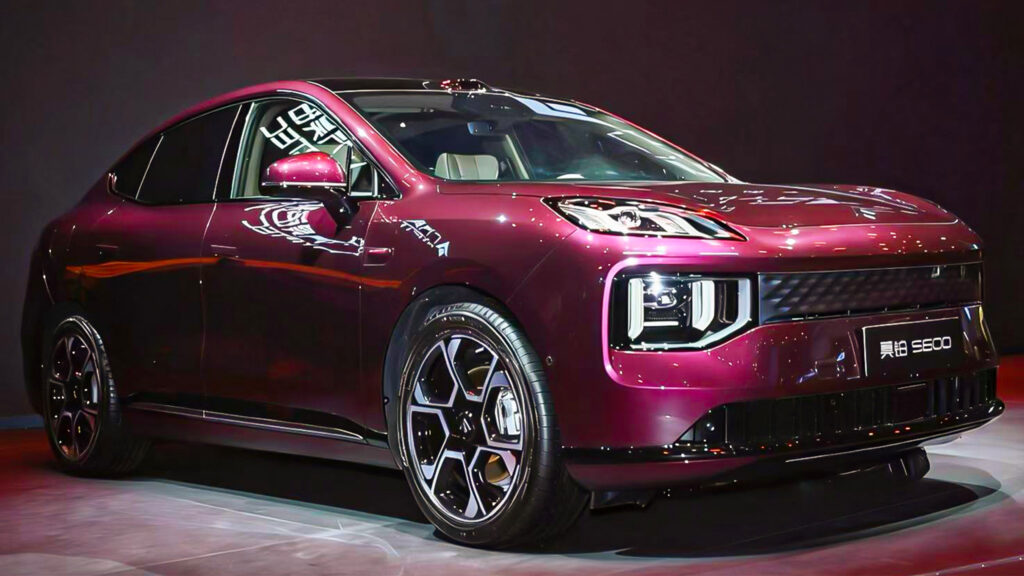
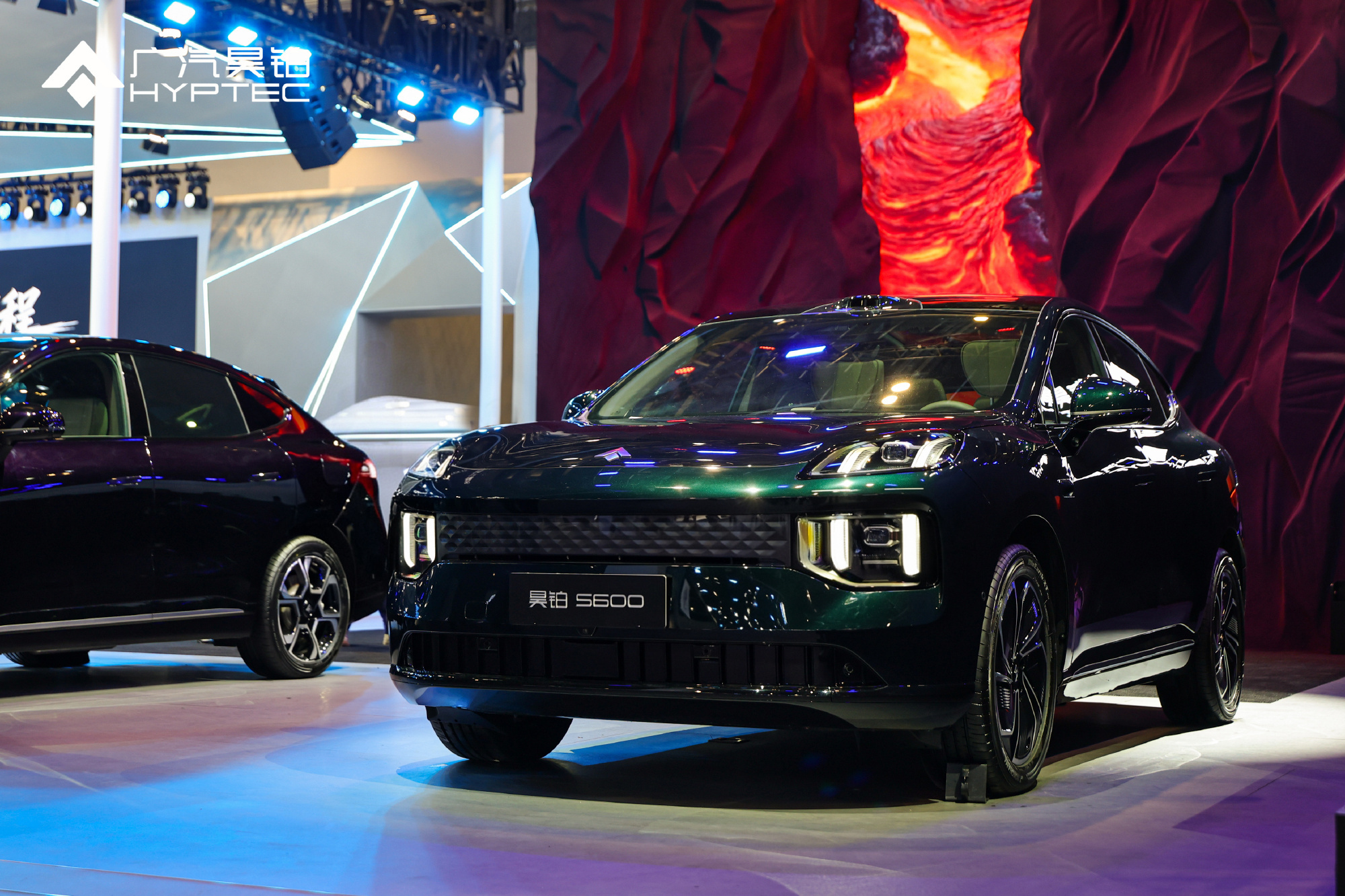
China’s GAC has expanded its EV lineup yet again, this time launching an electric SUV under its premium Hyptec sub-brand. It’s called the S600, and while the name won’t win any creative writing awards, the styling does some talking on its own. The crossover borrows more than a few cues from the Porsche Macan Electric, and pre-orders are already open.

Most modern SUVs trip over each other in the design department, and the S600 isn’t entirely innocent of that either. The upper sections of the headlights bear a clear resemblance to a certain Stuttgart silhouette. That said, the overall execution is genuinely clean.

Read: European Automakers Won’t Like What GAC And Magna Are Doing

GAC’s designers were clearly willing to sacrifice a bit of rear headroom and cargo space for a sleeker coupe-style roofline. The payoff is a particularly sharp tail section, anchored by intricate LED taillights and a configurable light bar that stretches the full width of the body.

Prioritizing Luxury

\\\\\\\\\\\\\\\\\\\

The new Hyptec model measures 5,015 mm (197.4 inches) long, 1,933 mm (76.1 inches) wide, 1,700 mm (66.9 inches) tall, and rides on a 2,936 mm (115.5-inch) wheelbase. That makes it noticeably larger than something like the Zeekr 7X, which is 4,787 mm (188.4 inches) long with a 2,900 mm (114.1-inch) wheelbase. Unsurprisingly, the S600’s cabin looks ready to swallow a family and all their luggage without much complaint.

A large central touchscreen is found in the center of the dash, while there’s also a separate digital gauge cluster. High-end metallic finishes are visible around the air vents and on the door panels, as well as around the center console, which houses a wireless phone charger. A large head-up display is also featured.

 Porsche Built The Macan EV For The World, GAC Built A Bigger One For China

The rear of the cabin looks equally plush, with seatbacks that recline up to 143 degrees and deployable footrests. A 22-speaker audio system also comes standard.

GAC will sell both all-electric and range-extended versions of the S600. The pure electric version will be offered with lithium iron phosphate and ternary lithium batteries. While we don’t yet know their capacities, the driving range should range from 410 miles (660 km) to 497 miles (800 km). Power will be supplied to a single 335 hp (250 kW) electric motor.

The range-extended model will also feature a 1.5-liter turbocharged engine, increasing total driving range but limiting EV-only range to 143 miles (230 km).

\\\\\\\\\\\\\\\\\\

Ford’s Cheapest EV Yet Is Coming Out Of California, Not Detroit

  • Ford admits its first electric vehicles fell short of changing the industry.
  • A 350-person team in Long Beach is rebuilding how Ford makes EVs.
  • The new $30,000 mid-size electric pickup is expected to arrive next year.

Ford knows its first swing at EVs missed. The Mustang Mach-E and F-150 Lightning sold in respectable numbers but never delivered the volume, margins, or cultural impact the company was chasing, and both have since been overtaken by leaner, cheaper competition. The Blue Oval’s answer is a ground-up reset, and the headline product is a mid-size electric pickup priced at $30,000.

We’ve known about this model for quite some time, developed by Ford’s small skunkworks lab. The brand has now shed new light on the Ford Electric Vehicle Design Center, which houses its ace team of engineers, and provided select members of the automotive press with a quick preview of the new truck.

Read: Ford’s Biggest Product Push In Years Will See 80% Of Its American Lineup Refreshed By 2029

The campus now houses 350 people, including company veterans and new arrivals from startups and the consumer electronics industries. Situated in Long Beach, California, the site is rethinking how Ford should build EVs, making them simpler and cheaper. At the core of this is the new Universal EV Platform.

This platform consists of three large cast elements joined together and then topped by the cab of the pickup, or both body styles, which will follow. While Ford didn’t unveil the electric truck in full, Car and Driver caught a glimpse of a camouflaged mule, noting that it has a traditional pickup truck shape and appears similar in size to the current Maverick, albeit with higher sides on the bed.

\\\\\\\\\\\\\\

In addition, it seems the EV will have a short nose, allowing Ford to expand the cabin size. According to Ford, the truck will have more interior space than a Toyota RAV4.

Easy To Repair

An important aspect of the new platform will be its repairability. After all, there’s no point in selling an affordable car if it has to be scrapped after even the most minor of collisions. According to the chief engineer of Ford’s advanced vehicle structure architecture, the three large platform castings will each include cutlines, where damaged sections can be cut out and replaced with new ones.

48-Volt Tech

Another key area of development is the EV’s wiring. Vehicles using the new platform will rely primarily on 48-volt electrical systems for most components, other than the lights, electric windows, and other parts that will still run at 12 volts. Ford has significantly reduced the amount of wiring used in the vehicle and notes that 48-volt components are also much lighter and smaller.  

In total, the truck will have 20 percent fewer parts and 50 percent fewer cooling hoses and connections than previous Ford EVs, meaning it can be assembled 15 percent faster. Ford says the new pickup will be ready by next year.

\\\\\\\\\\\\\\\\\
❌