Reading view

There are new articles available, click to refresh the page.

EV Repair Costs Are Starting To Drop, But The Real Bill Is Hiding Elsewhere
  • Repairable EV collision claims rose sharply in 2025.
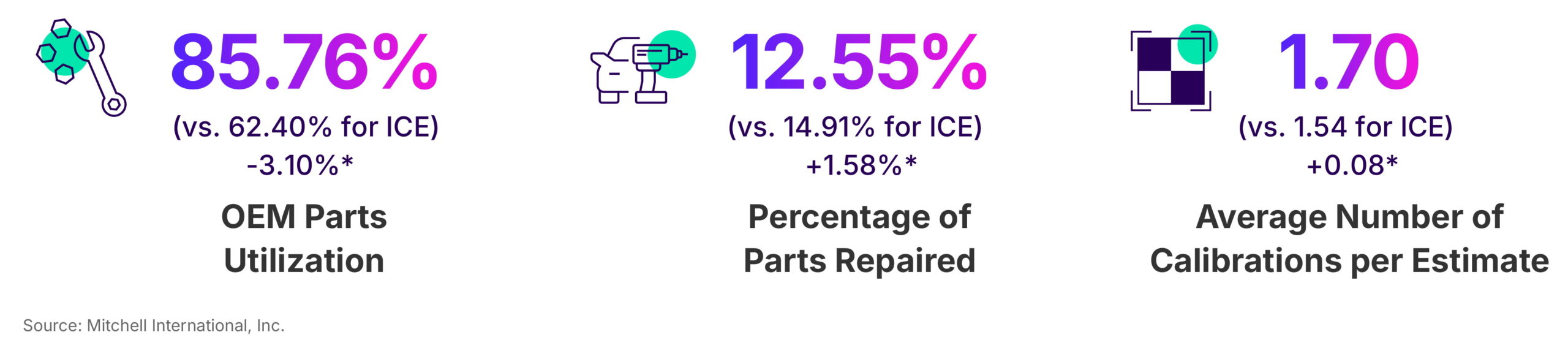
  • EVs required an average of 1.70 calibrations per estimate.
  • US EV total loss values fell 6% due to depreciation.

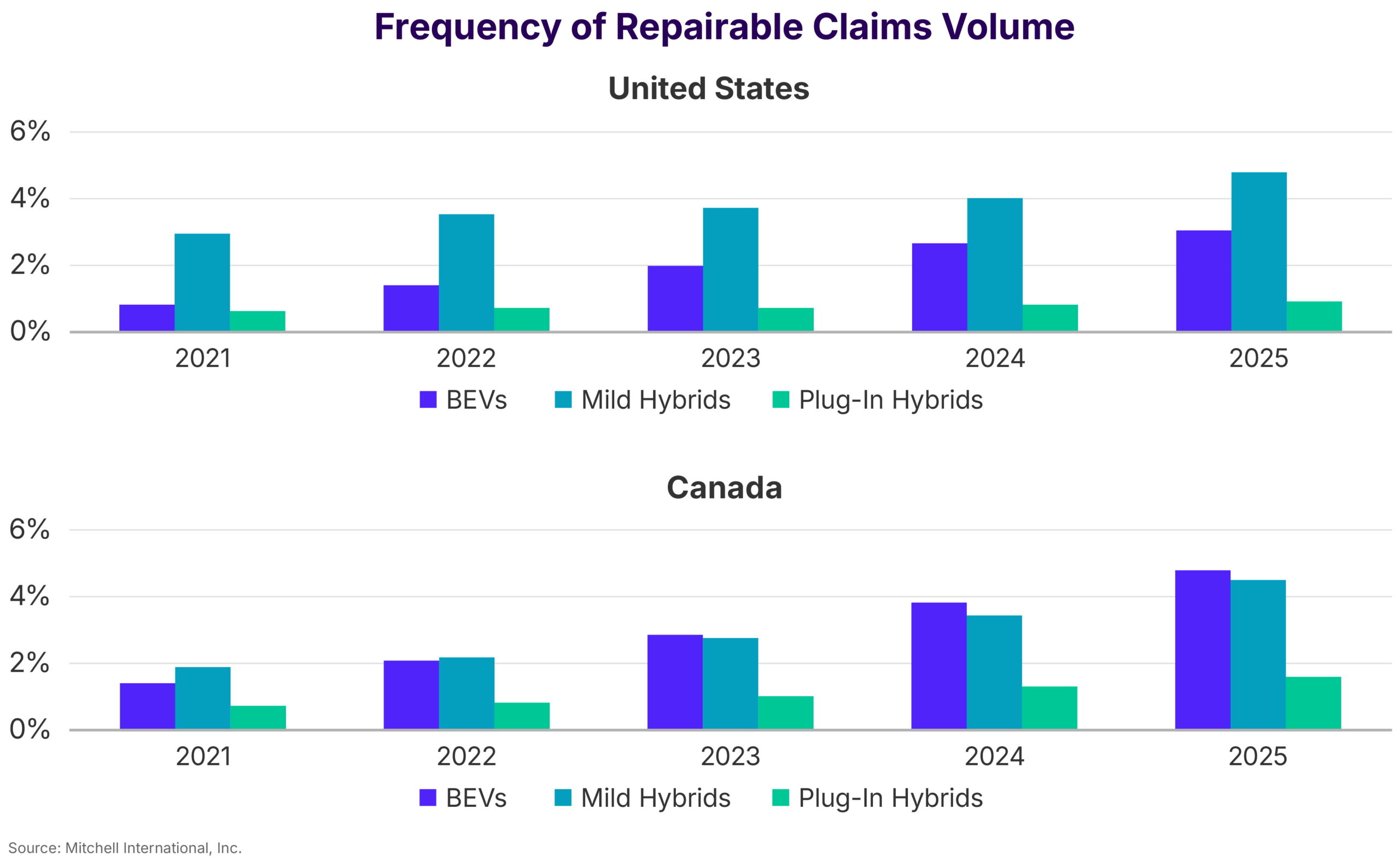
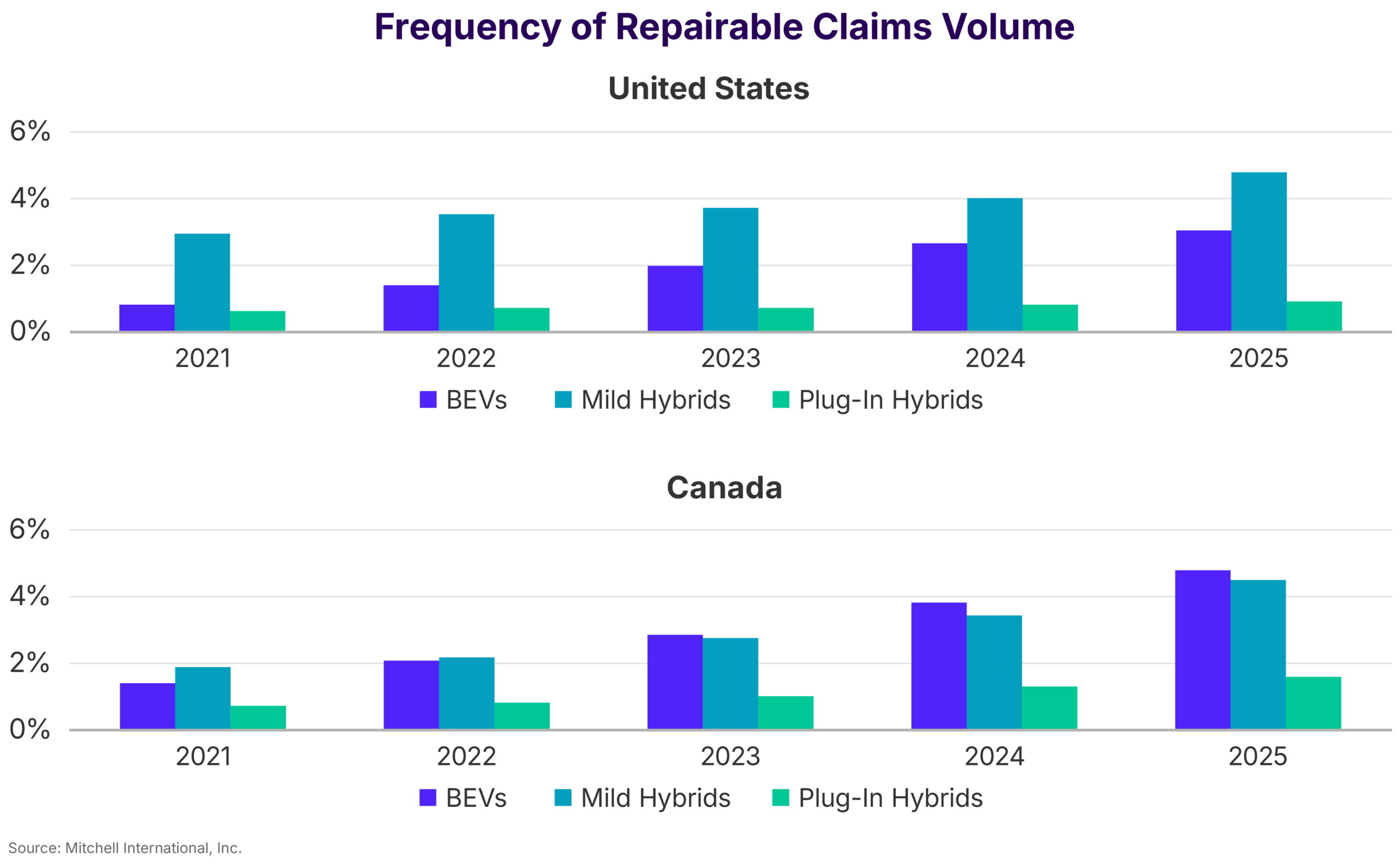
Electric vehicles are turning into a proper migraine for the insurance industry. According to the latest report from collision management software provider Mitchell, repairable collision claims for EVs jumped 14% in the US and 24% in Canada during 2025.

What makes these numbers particularly jarring is the fact that EV sales growth slowed down in 2025 as government tax incentives expired and consumer interest shifted to hybrids. Cox Automotive estimates that new EV sales dropped approximately 2% in the US, with S&P Global Mobility reporting a 0.4% decline in new EV registrations.

More: Car Repair Costs Are Exploding And It’s Not Just About Tariffs

Even Tesla’s grip on the market loosened slightly, with its US market share slipping to 46.2% from 48.7% in 2024 as more competitors gained ground.

Rising Repair Complexity

Even so, the existing EV fleet is aging into more accidents, and the complexity of repairing them is becoming a logistical and financial hurdle for the repair industry.

Ryan Mandell, Mitchell’s vice president of strategy and market intelligence, explained: “Due to their dense electrical architectures, software-driven systems and interconnected, sensor-heavy designs, these vehicles require additional diagnostic and calibration operations when damaged that can add cost, complexity and cycle time to each repair.”
 EV Repair Costs Are Starting To Drop, But The Real Bill Is Hiding Elsewhere

The “Plugged-In: EV Collision Insights” report also examined other electrified vehicles. Repairable claims for PHEVs increased 6% in the US and 26% in Canada in 2025. Mild-hybrid models (MHEV) recorded increases of 20% in the US and 29% in Canada. It is worth noting, however, that MHEV sales in the US surged 28% in 2025.

Also: Why Even The Smallest Accident Is Designed To Destroy Your Wallet

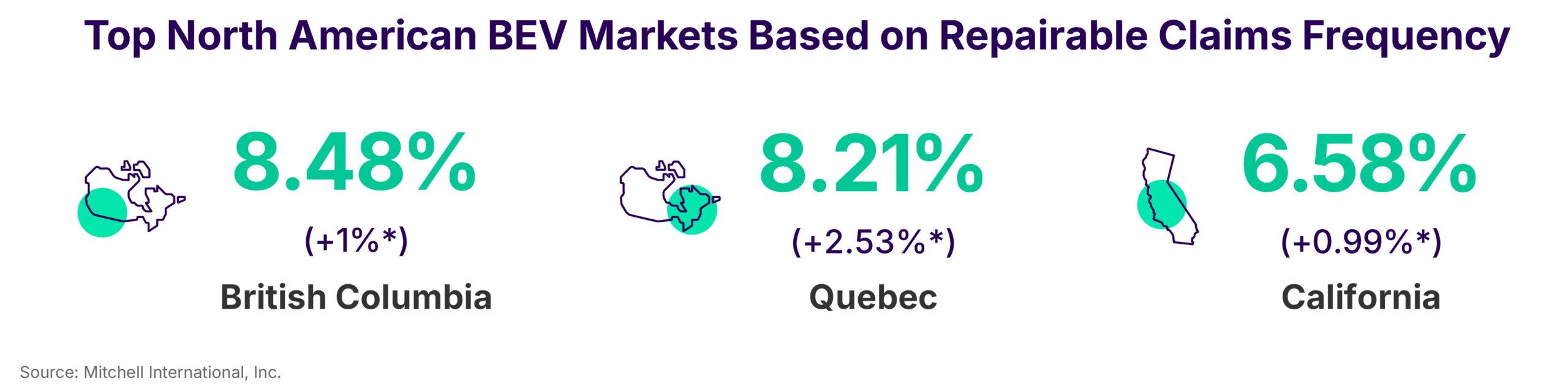
Across North America, British Columbia recorded the highest EV repair demand at 8.48%, followed by Quebec at 8.21% and California at 6.58%.

Which Models Top The Claims List?

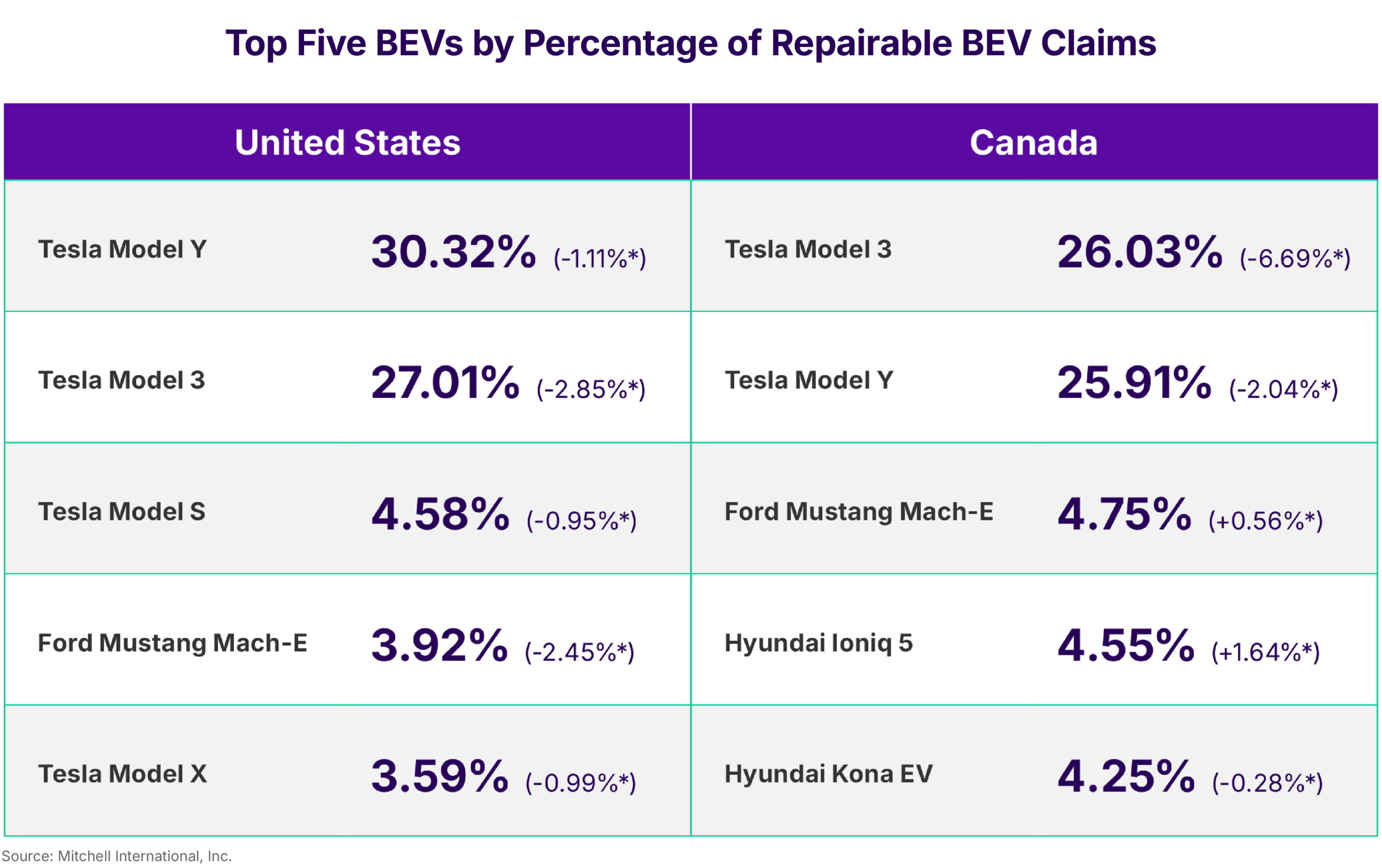
Looking at individual models, Tesla continues to dominate claims volume. In the US, the Model Y accounts for 30.32% of repairable BEV claims, followed by the Model 3 at 27.01%, meaning the two together represent more than half of all such claims. The pattern is similar in Canada, although the positions are reversed, with the Model 3 at 26.03% slightly ahead of the Model Y at 25.91%.
 EV Repair Costs Are Starting To Drop, But The Real Bill Is Hiding Elsewhere
*Difference between 2025 and 2024.

The Economics Of Fixing An EV

There is at least one sliver of good news. On the repair side, the average cost to fix an EV fell 5% in the US, from US$ 6,707 to US$ 6,395, and declined 2% in Canada in 2025. ICE-powered vehicles and PHEVs remained largely flat in the US, while MHEVs saw their average claim cost rise 4%, from $4,865 to $5,054.

Nevertheless, the higher repair complexity of electrified vehicles is reflected in their “calibrations per estimate” rating, which tracks how often sensors and systems must be recalibrated after repairs. In 2025, the average number of revisions was 1.70 for EVs and 1.63 for hybrids, compared to 1.54 for ICE-powered vehicles.

Mitchell’s data also shows that 86% of EV parts dollars go toward OEM components, with only 13% of parts deemed repairable rather than replaceable. For ICE-powered vehicles, 62% of parts dollars go to OEMs, and 15% of components are considered repairable.
 EV Repair Costs Are Starting To Drop, But The Real Bill Is Hiding Elsewhere
 EV Repair Costs Are Starting To Drop, But The Real Bill Is Hiding Elsewhere

The Depreciation Trap

Mitchell also reported that total loss market values declined across most powertrain types in 2025, with EVs seeing the sharpest drops. In the US, EV values fell 6%, from US$ 30,126 in 2024 to US$ 28,185 in 2025. In Canada, they dropped 13%, from CA$ 41,775 to CA$ 36,504.

More: China’s EV Boom Is Cooling, And The Big Names Are Feeling It

By comparison, ICE vehicle values declined 2.55% in the US, from $14,241 to $13,887, and 6.12% in Canada, from $17,049 to $16,005. Hybrids presented a more mixed picture, with US values rising 4.18%, from $18,453 to $19,225, while Canadian values fell 4.40%, from $30,268 to $28,938.

Analysts attribute the steeper EV declines to accelerated depreciation, the arrival of more budget-friendly models, and shifts in consumer sentiment.
 EV Repair Costs Are Starting To Drop, But The Real Bill Is Hiding Elsewhere

Updated: Blue Bird to Acquire Full Ownership of Micro Bird, Expand Market Share

By: Ryan Gray

Blue Bird Corporation announced its pending acquisition of the remaining 50-percent equity interest in Micro Bird, a joint venture with Canadian bus manufacturer Girardin Minibus. ​The $198.2 million deal, which values Micro Bird at $429.6 million, is expected to close by the end of the second quarter, pending regulatory approval and customary closing conditions. ​

The OEM confirmed Micro Bird President Eric Boule and his current management team continue to oversee day-to-day operations.

The Micro Bird brand originated in the mid-1970s, when Blue Bird introduced its first Type A school bus built on a cutaway van chassis. Blue Bird entered a supply agreement with Girardin Minibus in 1992 to build the Micro Bird in Quebec. The most recent joint venture between Blue Bird and Girardin was signed in 2009, which created Micro Bird, Inc.

The transaction announced Tuesday is funded through a combination of 70-percent stock and 30-percent cash. It includes the $16.5 million purchase of Micro Bird’s new manufacturing facility in Plattsburgh, New York and the transfer of its OEM service parts inventory for $400,000, according to a company presentation on the deal strategy and structure. ​Blue Bird said it plans to issue 2.7 million shares to fund the stock portion and use $154.2 million in cash for the remainder. ​

Blue Bird said the acquisition is expected to enhance the company’s market share in the K-12 student transportation industry by expanding its product portfolio to include a comprehensive lineup of Type A, C and D buses powered by diesel, gas, propane, and electric powertrains. ​The deal will also double Micro Bird’s addressable market in the U.S., thanks to its compliance with Buy America requirements, and strengthen Blue Bird’s presence in Canada. ​

The transaction is projected to be immediately accretive to earnings, with an estimated 8.2 percent increase in earnings per share in fiscal year 2026. ​Blue Bird’s pro forma revenue is expected to grow from $1.5 billion to $1.9 billion, while adjusted EBITDA is forecasted to increase from $225 million to $250 million. The company said it anticipates long-term revenue growth to reach $2.5 billion by 2030, with an EBITDA margin exceeding 15 percent. ​

Micro Bird, known for its high-quality school, commercial and electric buses, is well-positioned for long-term growth. ​Blue Bird said the acquisition will enable it to leverage Micro Bird’s expertise in electric vehicle technology, streamline development and expand into adjacent markets such as commercial and specialty vehicles as well as drive engineering efficiencies, enhance market share, and deliver value to shareholders through profitable growth and stock buybacks. ​

This article is developing.


Related: NASDPTS Sunsets School Bus Manufacturers Technical Council, Announces Updates
Related: School Bus Manufacturers Stay the Course Despite Regulatory, Funding Uncertainty
Related: Engine, Truck Manufacturers Support EPA Easing Derate of SCR Diesel Emissions Controls

The post Updated: Blue Bird to Acquire Full Ownership of Micro Bird, Expand Market Share appeared first on School Transportation News.

GreenPower Regains Compliance with Nasdaq’s Equity Requirement

By: STN

VANCOUVER, Canada,  – GreenPower Motor Company Inc. (Nasdaq: GP) (“GreenPower” and the “Company”), a leading manufacturer and distributor of all-electric, purpose-built, zero-emission medium and heavy-duty vehicles serving the cargo and delivery market, shuttle and transit space and school bus sector, today announced that the Company has received formal notice from The Nasdaq Stock Market LLC (“Nasdaq”) confirming that the Company has regained compliance with Nasdaq Listing Rule 5550(b)(1), the “Equity Rule,” and otherwise satisfies all applicable criteria for continued listing on The Nasdaq Capital Market.

“Over the past few months GreenPower has completed a series of transactions including raising new capital with an equity offering of Series A Convertible Preferred Shares for up to $18 million, term loans of $5 million and a new banking relationship with CIBC including a line of credit and term loan. In addition, the Company exchanged $7 million of related party loans for convertible debentures and $3 million of related party loans for Series B Convertible Preferred Shares,” said Fraser Atkinson, CEO of GreenPower. “These transactions have helped the Company regain full compliance with the Nasdaq listing criteria as well as with the execution of our strategic goals.”

Notwithstanding the Nasdaq compliance determination, the Company will remain subject to a Panel monitor for one year. If, within that one-year monitoring period, Staff finds the Company again out of compliance with the Equity Rule that was the subject of the hearing, the Company will be subject to a delisting determination and will not have the opportunity to present a compliance plan for the Staff’s consideration. However, the Company will be afforded the opportunity to request a hearing before the Hearings Panel, and the hearing request will automatically stay any suspension or delisting action pending the conclusion of the hearings process and the expiration of any additional extension period granted by the Panel following the hearing.

The Company’s common stock will continue to trade on Nasdaq under the ticker symbol “GP.”

About GreenPower Motor Company Inc.
GreenPower designs, builds and distributes a full suite of high-floor and low-floor all-electric medium and heavy-duty vehicles, including transit buses, school buses, shuttles, cargo van and a cab and chassis. GreenPower employs a clean-sheet design to manufacture all-electric vehicles that are purpose built to be battery powered with zero emissions while integrating global suppliers for key components. This OEM platform allows GreenPower to meet the specifications of various operators while providing standard parts for ease of maintenance and accessibility for warranty requirements. For further information go to www.greenpowermotor.com

The post GreenPower Regains Compliance with Nasdaq’s Equity Requirement appeared first on School Transportation News.

GreenPower Reports Revenue of $8.5 million and Net Income of $4.2 million for Third Quarter

By: STN

VANCOUVER, Canada  – GreenPower Motor Company Inc. (Nasdaq: GP) (“GreenPower” and the “Company”), a leading manufacturer and distributor of all-electric, purpose-built, zero-emission medium and heavy-duty vehicles serving the cargo and delivery market, shuttle and transit space and school bus sector, today reported revenue of $8.5 million and net income of $4.2 million as a part of its financial results for the period ended December 31, 2025.

“Despite significant headwinds in the EV sector in general, GreenPower has made substantial strides with its transition from building EVs on spec., to a production strategy driven by building EVs to customer orders.” said Fraser Atkinson, GreenPower Chairman and CEO. “This transition has required recapitalization of the Company, retooling our manufacturing, managing inventory, and obtaining sources of production funding.”

“GreenPower is very excited about the excellent progress in the deployment of all-electric, purpose-built school buses during the last quarter in New Mexico; Continuing to perform on the state sponsored, two-year, zero emissions school bus pilot project.” said Brendan Riley, President of GreenPower. “This project uses the compelling West Virginia pilot project as its model but is focussed on the specific needs of New Mexico school districts where there will be challenges on deploying in both city and rural settings, challenges with charging infrastructure and operating the school buses in extreme cold weather at high elevations.”

Third Quarter 2026 Highlights
Generated revenues of $8.5 million in the third quarter of the 2026 fiscal year compared to $7.2 million for the third quarter in the previous year. Revenue was generated from the sale of vehicles, parts, leases and deferred income. Gross profit on the sale of vehicles was approximately 28%.

Total sales, general and administrative costs of $2.4 million in the third quarter compared to $5.2 million for the third quarter in the previous year representing a significant reduction in the Company’s recurring expenses. Excluding non-cash items, the sales, general and administrative costs in the current quarter were less than $2 million.

Working capital of more than $5 million and increased cash from the beginning of the fiscal year.

During the quarter the Company undertook the management of the New Mexico All-Electric, Purpose-Built, Zero-Emission School Bus Pilot Program. The contract with the state of New Mexico provides funding of more than $5 million for the deployment of GreenPower’s all-electric Type A Nano BEAST, Type A Nano BEAST Access, Type D BEAST and Type D Mega BEAST school buses, charging infrastructure and management of a pilot project in the state.

During the quarter the Company raised gross proceeds of $1,120,050 from the issuance of Series A convertible preferred shares (the “Series A shares”) with a stated value of $1,179,000. The initial tranche was comprised of 754 Series A shares issued pursuant to an effective shelf registration statement and 425 Series A Shares issued in a concurrent private placement. The Company and investor agreed that a follow-on tranche of 926 Series A Shares with a stated value of $926,000 and purchase price of $879,700 will be issued at a later date. The institutional investor has the right to acquire and the Company has the right to issue additional Series A Shares in tranches of up to $2 million, subject to certain terms and conditions, to a total of up to US$16 million
Subsequent to the end of the quarter GreenPower completed several transactions to recapitalize the Company. The Company closed on two term loans for a total of $5 million, closed on the new banking relationship with CIBC including a line of credit and Term Loan, paid out the existing bank line of credit, exchanged $7 million of related party loans for convertible debentures and exchanged $3 million of related party loans for Series B Convertible Preferred Shares.

For additional information on the results of operations for the period ended December 31, 2025 with the financial statements and related reports posted on GreenPower’s website as well as on SEDAR Plus or on EDGAR.

About GreenPower Motor Company Inc.
GreenPower designs, builds and distributes a full suite of high-floor and low-floor all-electric medium and heavy-duty vehicles, including transit buses, school buses, shuttles, cargo van and a cab and chassis. GreenPower employs a clean-sheet design to manufacture all-electric vehicles that are purpose built to be battery powered with zero emissions while integrating global suppliers for key components. This OEM platform allows GreenPower to meet the specifications of various operators while providing standard parts for ease of maintenance and accessibility for warranty requirements. For further information go to www.greenpowermotor.com

The post GreenPower Reports Revenue of $8.5 million and Net Income of $4.2 million for Third Quarter appeared first on School Transportation News.

Canadians, What’s The One Chinese EV You’d Absolutely Buy?

  • Canada cut Chinese EV tariffs from 100% to 6.1% in new deal.
  • Initial cap set at 49,000 vehicles, with future growth to 70,000.
  • Nearly half of new EVs expected to cost under $35k CAD to start.

A new trade agreement has cracked the door open for electric vehicles from China to officially re-enter the Canadian market. In exchange, the People’s Republic is easing up on tariffs for Canadian agricultural exports, especially canola. Yes, your future EV might be indirectly powered by salad oil diplomacy.

Cheap, tech-packed, and improving at a scary pace, Chinese EVs are terrifying North American automakers and fascinating savvy car buyers, and they haven’t even landed yet, kept out by tariffs and political caution.

Related: China Is Ready To Start Building Cars In Canada

This new agreement changes the vibe. Canada gets more affordable EV options because the tariff rate is being cut from 100 percent to 6.1 percent.

The initial annual import cap is set at 49,000 vehicles, or one third of the car market, but could grow to 70,000 annually five years from now. And crucially, around half of the volume is expected to cost less than $35k CAD ($25k).

Compact Contenders and Budget Picks

 Canadians, What’s The One Chinese EV You’d Absolutely Buy?
BYD Seagull

But what would you buy? If price is king, the tiny BYD Seagull, sold in some markets as the Dolphin Surf, could be the ultimate city runabout. Sure, it looks about the size of a carry on suitcase with headlights, and Canadian winters are not exactly minicar friendly.

QOTD: What Car Repair Made You Wonder If Engineers Ever Touch The Cars They Design?

However, if the goal is getting more people into affordable EVs, this little hatch and its bigger Dolphin brother could be game changers for urban commuters.

 Canadians, What’s The One Chinese EV You’d Absolutely Buy?
Xpeng

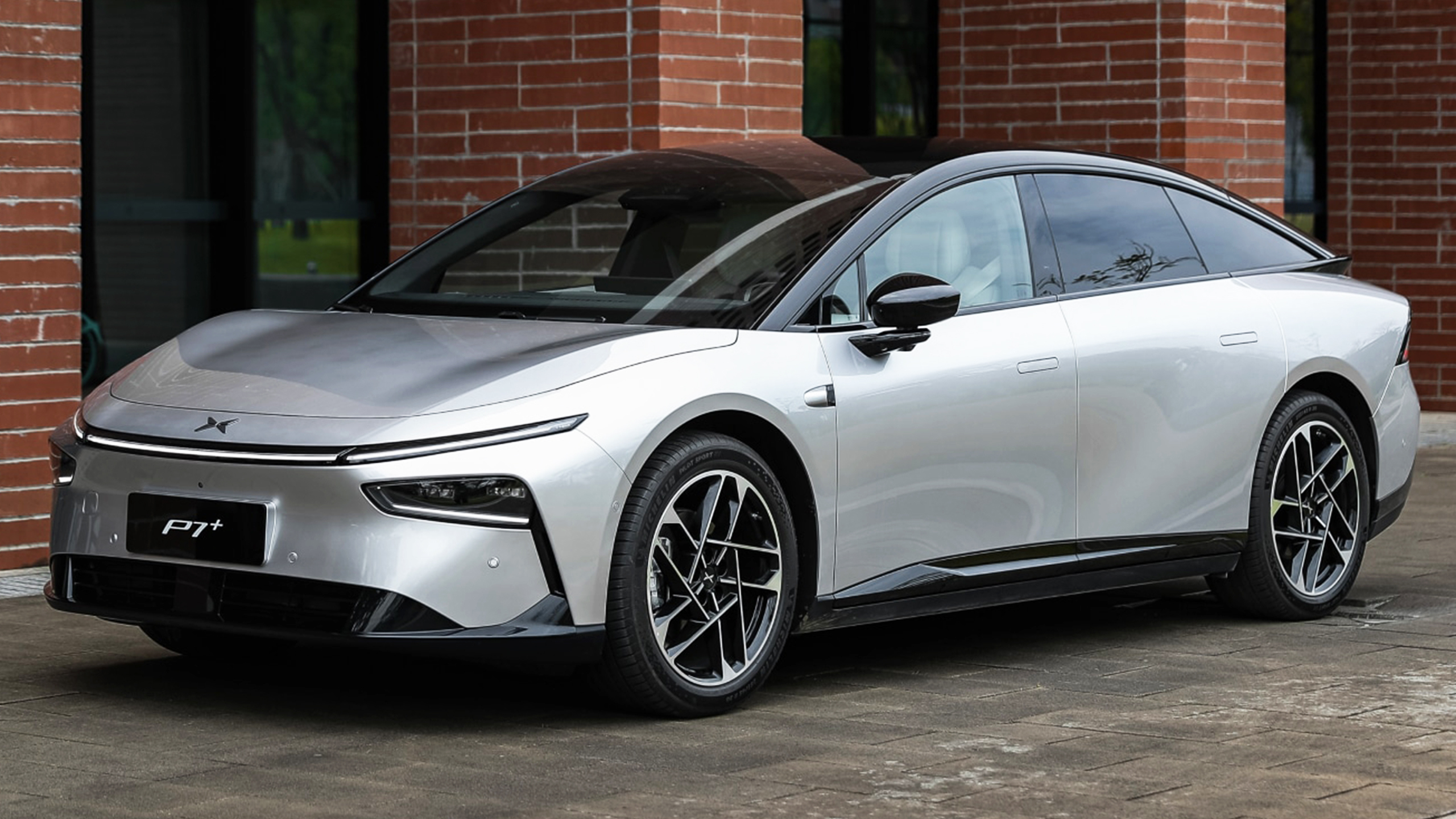
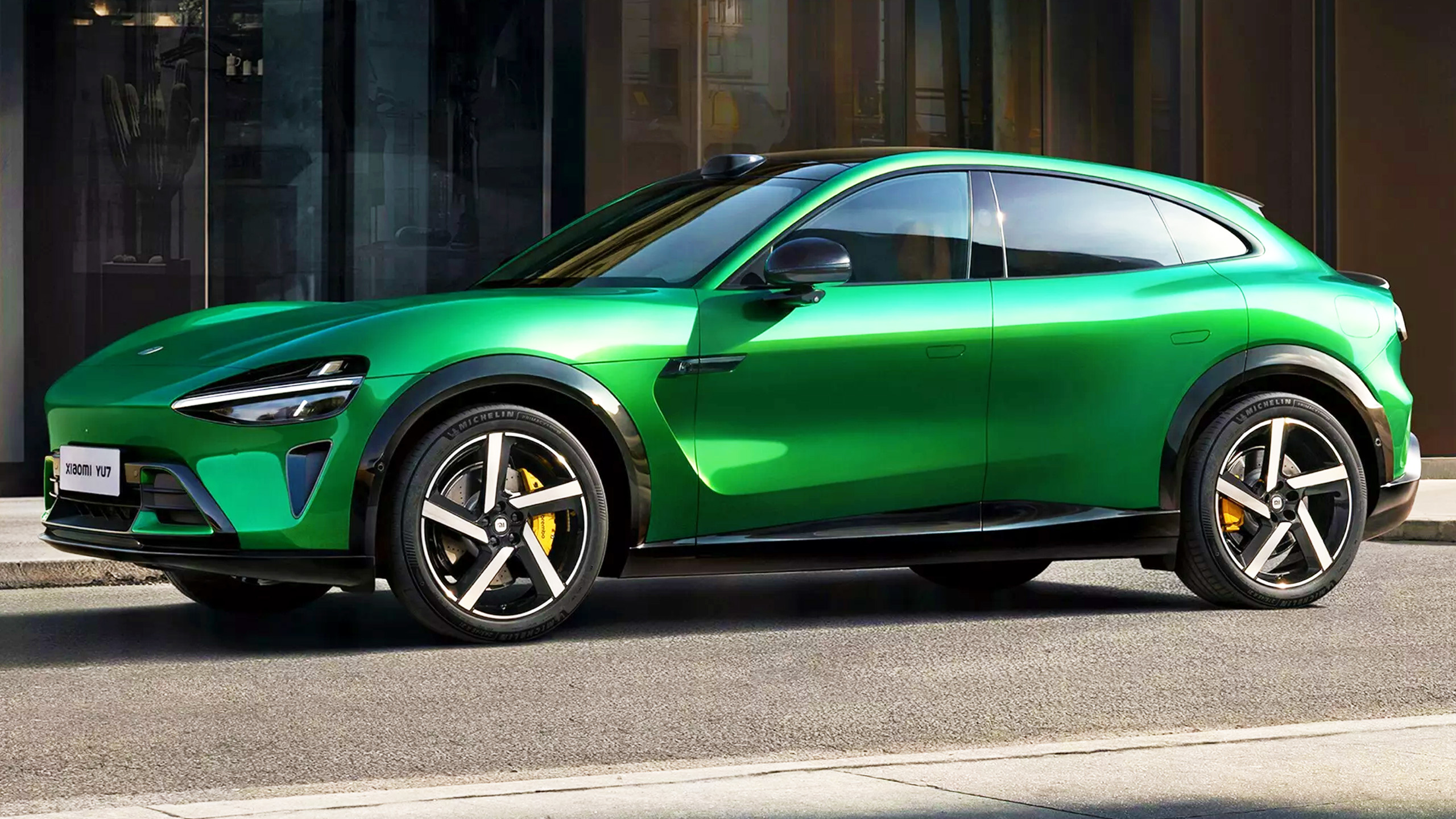
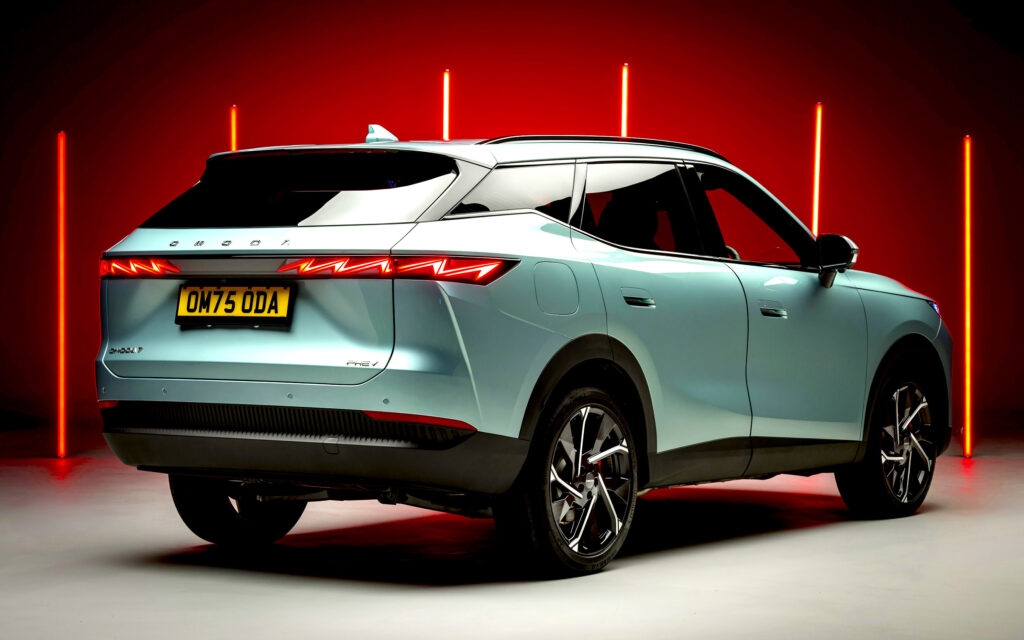
Sedan fans looking for some style, will be hoping Xpeng’s P7+ (seen above) gets an invite, but if you’re determined to blow past that $35k budget you’ve surely got to be rooting for the Xiaomi SU7 sedan and YU7 SUV.

These are the cars that make traditional brands nervous and car nerds very curious. Ford CEO Jim Farley daily-drove an SU7 specially imported for him and his team in 2024 and described it as “fantastic,” telling an interviewer “I don’t want to give it up.”

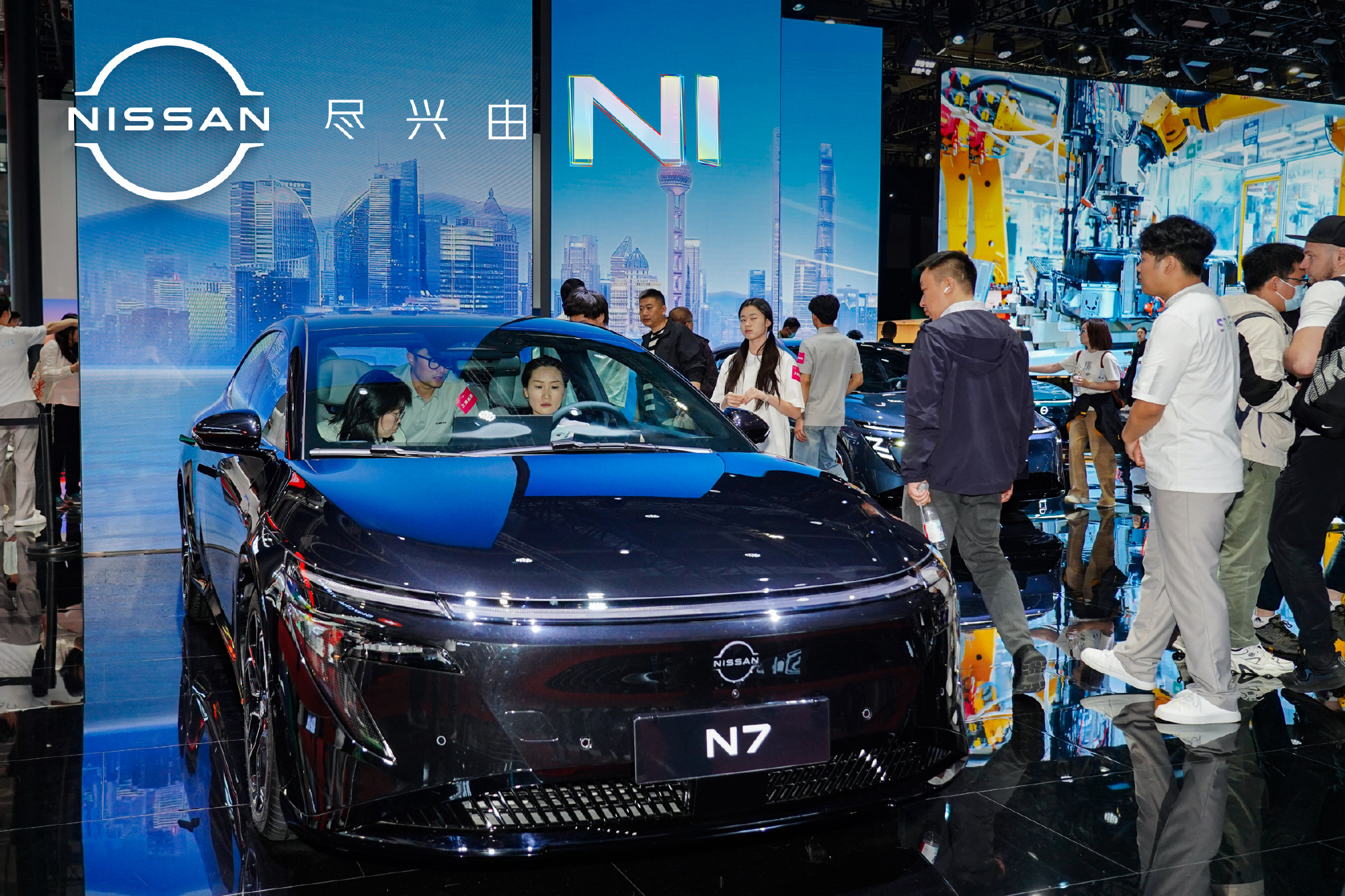
Another possibility? Western brands already building China-only models, like Mazda’s EZ-6 sedan that’s priced from around $20,000 in China, the Toyota bZ7 sedan, or Nissan’s NX8 crossover. If the import gate opens wide enough, these could sneak through too.

Answers Needed

 Canadians, What’s The One Chinese EV You’d Absolutely Buy?
Nissan N7

Of course, there will be questions about service networks, long term reliability, and how these brands fit into Canada’s market. But purely from a car geek perspective, the idea of suddenly having access to this whole new wave of EVs is kind of exciting.

So Canadians, if these cars start showing up in showrooms, which one are you signing for? And if you are reading from elsewhere, play along. If you did live in Canada, what Chinese EV would be on your driveway?

 Canadians, What’s The One Chinese EV You’d Absolutely Buy?
Xiaomi

A European Firm Is Racing To Save This GM Canadian Plant

  • GM shut down BrightDrop van production in Ontario last year.
  • Dumarey Group may buy the plant and restart van production.
  • The vans could be exported to Europe if the deal proceeds.

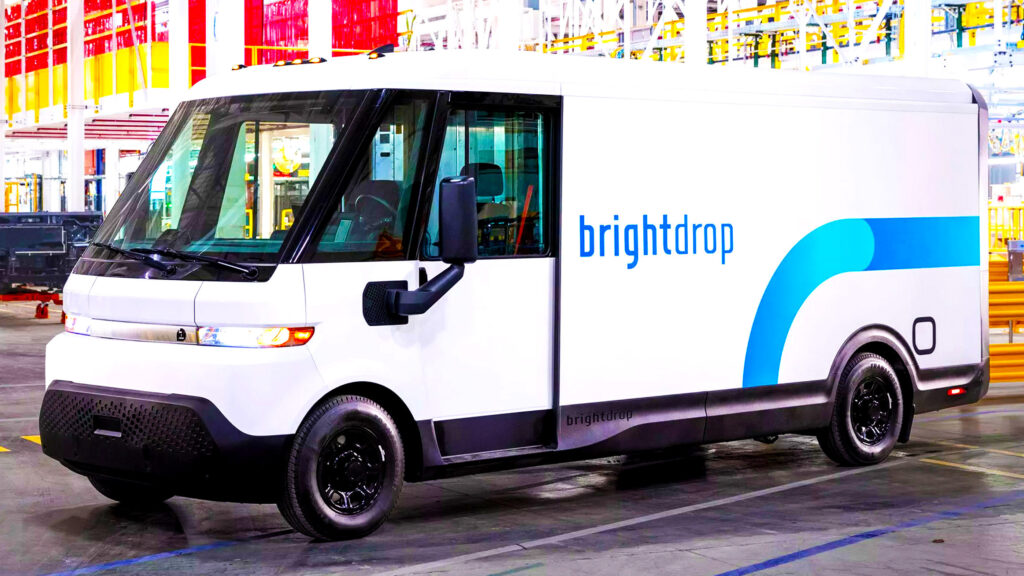
GM’s BrightDrop electric vans may not be done just yet. After nearly four months of uncertainty, an unexpected lifeline may be taking shape. GM had announced it would end production of the vans at its Ontario plant in Canada, effectively shutting down one of its more high-profile EV ventures. Now, a European engineering firm has reportedly shown interest in buying the facility and restarting production.

The company in question is Dumarey Group, a Belgium-based engineering and manufacturing firm. In 2020, Dumarey acquired GM’s propulsion engineering center in Turin, Italy, and now appears poised to deepen its relationship with the American automaker.

Read: GM And Stellantis Got The Cash, Now Canada Wants A Refund

According to a recent report, the group aims to build BrightDrop vans in Canada, then ship them across the Atlantic to European markets.

Limited details about the potential deal are known, but GM Authority reports the firm’s chief executive and founder, Guido Dumarey, plans to tour the Ingersoll plant soon.

A Fragile Hope for CAMI Employees

 A European Firm Is Racing To Save This GM Canadian Plant

This could be great news for workers at the plant, many of whom have been facing an uncertain future since GM announced it would stop production. However, a significant number of the laid-off employees remain on GM’s callback list in case production resumes on a new vehicle at the CAMI facility. That means Dumarey would likely need to negotiate with GM to bring those workers on board.

Speaking with CTV News, Brendan Sweeney, managing director of a London-based non-profit agency, said Dumarey could be a good fit. However, he suspects it may only need a few hundred workers to handle production, meaning it’s unlikely the plant will return to the 3,000-strong workforce it had when it was building the Chevrolet Equinox and GMC Terrain.

 A European Firm Is Racing To Save This GM Canadian Plant

“[Dumarey are] diversified,” Sweeney said. “They engage with a number of different technologies, including fuel cells, which is a really interesting play for Canada that, you know, might get a bit more gain more steam.”

The CAMI assembly plant began producing BrightDrop electric vans in 2022. Despite GM’s hopes, the program struggled to maintain momentum. Even after BrightDrop was folded into Chevrolet to bolster visibility and sales, the vans failed to establish a solid foothold in the EV delivery space.

\\\\\\

Canada Scraps EV Mandate And Loses Faith In America

  • Canada is scrapping its EV sales mandate and changing course.
  • The 2035 target shifts from 100% EVs down to just 75% now.
  • Clean car incentives return as Canada distances from the U.S.

Canadian Prime Minister Mark Carney has introduced a new automotive strategy that “rewards the production of made-in-Canada vehicles and harnesses our world-class capabilities in artificial intelligence and technology expertise to build the cars of the future.”

As part of this effort, the country is revamping its electric vehicle mandate once again. The goal is to “rationalize emissions reduction policies” and put Canada on a path that will see 75% of sales come from EVs by 2035. That would then climb to 90% by 2040. This is a notable shift as the country was previously looking at reaching 100% by 2035.

More: Canada Walks Back EV Mandate Amid US Trade War

Furthermore, Canada is repealing the Electric Vehicle Availability Standard and increasing emissions standards. The government said this will “allow manufacturers to use a wide array of technologies to meet the [new] standards and respond to consumer preferences in the near-term, while driving EV adoption over time.”

New Incentives For Canadians To Go Green

While the country is tapping the brakes on the electric vehicle transition, they’ll encourage Canadians to buy EVs with a new five-year program that will provide individuals and businesses with incentives to go green. Electric and fuel cell vehicles will be eligible for up to $5,000 CAD (3,658 USD), while plug-in hybrids can get up to $2,500 CAD ($1,829 USD).

Canada’s auto industry is facing huge pressures, leaving workers and businesses in a state of uncertainty. So we’re taking control — and launching a new strategy that will transform the industry to be a global leader in electric vehicles.

We’ll reward the production of…

— Mark Carney (@MarkJCarney) February 5, 2026

There’s a $50,000 CAD ($36,574 USD) limit on the final transaction price for vehicles made in countries Canada has a free-trade agreement with, but Canadian-made EVs and PHEVs have no price cap at all.

To further encourage adoption, Canada will invest $1.5 billion CAD ($1.1 billion USD) to improve their charging infrastructure. This aims to make it “easier and more convenient for drivers to charge their EVs across the country.”

Incentives For Businesses As Well

 Canada Scraps EV Mandate And Loses Faith In America

The government is setting aside up to $3.1 billion CAD ($2.3 billion USD) to “help the auto industry adapt, grow, and diversify to new markets.” There will also be tax incentives to encourage companies to invest in electric vehicles as well as clean technologies.

On top of that, the country aims to strengthen the competitiveness of their auto sector by rewarding companies that produce and invest in Canada. They’ll also maintain counter-tariffs on automotive imports from the United States and look to grow automotive imports from elsewhere.

China is front and center as vehicles will be imported from there in the near future. Ultimately, Canada hopes Chinese automakers will setup shop in the country and build vehicles locally. This could help fill the void left by American automakers, who have moved some production stateside.

Support For Autoworkers

 Canada Scraps EV Mandate And Loses Faith In America

Canada announced a handful of measures designed to protect autoworkers in an era of trade wars and electrification. In particular, there will be a new Work-Sharing grant that aims to support worker retention and prevent layoffs.

The country will also provide employment assistance and reskilling support for up to 66,000 people including displaced auto workers. This will be made possible by a $570 million CAD ($417 million USD) investment.

American Tariffs Push Canada To Embrace Other Countries

 Canada Scraps EV Mandate And Loses Faith In America

The government noted over 90% of Canadian-made vehicles and 60% of Canadian-made parts are exported to the United States. This is a huge problem as Canadian-made vehicles have faced a 25% tariff in America (on non-US content) since April.

The country said the tariff is “threatening Canada’s automotive manufacturing industry and the 125,000 direct jobs it supports.” Given this, the country is looking to develop a more independent economy and one that can ship Canadian-made vehicles to new export markets.

In a statement, Carney said “Canada’s new government is fundamentally transforming our economy – from one reliant on a single trade partner, to one that is stronger, more independent, and more resilient to global shocks. We are making strategic decisions and generational investments to build a strong Canadian auto sector, where Canadian workers build the cars of the future.”

Unifor welcomes elements of the new federal auto policy, while calling for bold steps to protect Canadian auto jobs and secure a future for workers at idled plants in Brampton and Ingersoll. #canlabhttps://t.co/r8CXSmPp0S

— Unifor (@UniforTheUnion) February 5, 2026

Nearly Two In Three Canadians Want Chinese EVs, Despite The Risks

  • Poll shows 61 percent of Canadians back more Chinese EVs.
  • Canada will import 49,000 Chinese EVs yearly at lower duties.
  • Some have raised concerns about data security and privacy.

As electric vehicles become a bigger part of the global conversation, Canada’s latest trade move has stirred plenty of debate at home. The government’s new agreement with China, which slashes tariffs on a limited number of EVs from 100 percent to just 6.1 percent, has sparked plenty of controversy. Still, a new poll suggests that most Canadians support bringing more Chinese-made electric vehicles into the market.

A recent poll conducted by Leger reveals that most Canadians are not only aware of the deal but also largely supportive of increased access to Chinese EVs.

Read: China Is Ready To Start Building Cars In Canada

According to the results, 70 percent of respondents said they were familiar with the agreement, and 62 percent expressed some level of support for allowing more Chinese electric cars into the market. Of those, 24 percent strongly backed the policy while 38 percent indicated moderate support.

Support Varies, But the Appeal Is Clear

 Nearly Two In Three Canadians Want Chinese EVs, Despite The Risks

The Canadian Press that shared the results highlighted that support was particularly strong in Quebec, where 72 percent of respondents favored the policy. That figure outpaces the national average and suggests regional dynamics may be at play when it comes to openness toward foreign electric vehicle brands.

The survey, conducted online between Jan. 30 and Feb. 2 among 1,570 respondents, found awareness of the agreement was notably higher among men and Canadians aged 55 and over.

It’s easy to see why many Canadians are in favor. Chinese manufacturers such as BYD, Chery, and Geely have made a name for themselves by delivering well-equipped EVs at competitive prices. Their cars have found traction in several overseas markets and are increasingly seen as value leaders in a segment often criticized for high costs.

Australia offers a telling example. There, Chinese EVs have become a regular sight, with many models priced comparably to traditional gasoline vehicles. Their arrival has not only expanded consumer choice but also pressured legacy automakers to trim prices to stay in the game. The same kind of market shake-up could easily play out in Canada.

Concerns Remain

 Nearly Two In Three Canadians Want Chinese EVs, Despite The Risks

Despite the support, Canadians do have their concerns about Chinese electric cars. For example, the poll shows many respondents are worried about vehicle quality and durability.

Three quarters of those surveyed reported at least one concern related to Chinese EVs, with additional worries tied to potential effects on Canada’s domestic auto industry, vehicle safety standards, and broader geopolitical tensions.

They also have concerns about data security and privacy. Shortly after the trade deal was announced, Ontario Premier Doug Ford suggested the vehicles could be used to spy on Canadians.

The tie-up between Canada and China will not result in local roads being overrun by Chinese cars. As part of the agreement, a cap will initially limit imports at the reduced tariff rate to 49,000 vehicles per year, with half of these priced below CA$35,000 (roughly $25,000). The 49,000-vehicle cap matches the number of Chinese-made EVs already imported into Canada in 2023.

 Nearly Two In Three Canadians Want Chinese EVs, Despite The Risks

After Letting China In, Canada Hopes Korea Comes Too

  • Hyundai is bidding to build 12 submarines for Canada.
  • Canada may link the deal to local Korean car production.
  • Korea accounts for 12 percent of car sales in the country.

Just two weeks after announcing a major trade deal with China that sharply reduced tariffs on EV imports, Canada is exploring another pivotal agreement, this time with South Korea, that could open the door to more car production on Canadian soil.

Although the two countries have had a free trade agreement since 2015, removing tariffs on most goods, this new Memorandum of Understanding (MoU) points to a growing interest in deeper cooperation.

Both countries are responding to the unpredictability of U.S. trade policy under the Trump administration by diversifying their economic alliances. Still, for all the optics, neither has the capacity to replace the United States as a primary economic pillar.

More: Trump Hits Korea With New Tariffs, Hyundai And Kia Are About To Pay The Price

The current priority is to strengthen South Korea’s automotive presence in Canada. That could include domestic manufacturing of Korean-branded vehicles as well as increased production of electric vehicle components and battery technologies.

“This agreement will grow our auto sector, create good jobs and reinforce Canada’s position as a global leader in future-ready vehicle manufacturing,” said Industry Minister Mélanie Joly in a statement on Thursday.

Ties Between Auto and Defence

 After Letting China In, Canada Hopes Korea Comes Too

Canada appears to be courting major Korean automakers such as Hyundai, especially in light of South Korea’s bid to replace Canada’s current submarine fleet.

According to CTV News, both Hyundai and defence contractor Hanwha are involved in a proposal to build and maintain 12 submarines for the Royal Canadian Navy. If selected, the deal could be worth up to $100 billion over the next 30 to 40 years.

More: 1,200 Canadians To Lose Their Jobs After GM Moves Trucks Back To The US

Hanwha, a sprawling South Korean industrial group, has already laid groundwork by signing five separate MoUs with Canadian companies to incorporate their technologies and products into its submarine offerings. Among those agreements is a $275 million commitment toward a new structural steel beam mill in Ontario.

South Korea’s Growing Footprint in Canada’s Auto Market

 After Letting China In, Canada Hopes Korea Comes Too

In 2024, South Korean vehicles made up 12 percent of all cars sold in Canada, amounting to 228,257 units. In a statement, the Canadian government emphasized its aim to strengthen the domestic battery supply chain by encouraging investment and collaboration in battery manufacturing, materials processing, and the refinement, processing, and recycling of Canadian critical minerals.

Read: China Is Ready To Start Building Cars In Canada

Flavio Volpe, president of the Automotive Parts Manufacturers’ Association, believes the timing aligns well for Canada to boost its domestic auto sector by leveraging upcoming defence investments.

“Today the business case is there to build a plant here in Canada, perhaps making electric vehicles… and to build where they sell,” he said. “Canada is interested in buying submarines and there are two healthy bidders. And both of those healthy bidders have automakers that sell a lot of cars here and sell batteries here.”

 After Letting China In, Canada Hopes Korea Comes Too

China Is Ready To Start Building Cars In Canada

  • Canada cut tariffs on Chinese EVs from 100 percent to 6.1.
  • Trump threatened 100 percent tariffs in response to deal.
  • China now wants to build EVs in Canada with local partners.

Canada’s recent trade deal with China was bound to cause controversy. The agreement slashes tariffs on Chinese EVs from 100 percent down to just 6.1 percent, prompting U.S. President Donald Trump to threaten 100 percent tariffs on Canada if the deal proceeds. Still, China insists the arrangement is meant to benefit both countries and isn’t a zero-sum game.

Under the new deal, up to 49,000 EVs from China can be imported to Canada at a reduced 6.1 percent tariff rate, though at least half of them must cost $35,000 or less by 2030.

Read: Canada Just Invited China’s Biggest EV Makers To Build Cars On America’s Border

Unifor labor union president Lana Payne argues the deal opens the door for China to quickly capture critical market share. Ontario Premier Doug Ford has voiced similar concerns, warning that Canada could be inundated with low-cost EVs, without any firm commitment from China to invest in the local economy.

Beijing Signals Willingness to Build in Canada

Despite those concerns, Chinese Ambassador to Canada Wang Di says China’s fast-growing automakers are being urged to invest directly in Canada and produce vehicles domestically.

“All these projects will be beneficial to the development of the Canadian EV industry, and will be helpful for job growth in Canada, and will help Canadian consumers to be able to buy higher quality and more affordable cars,” Wang told CTV News. “The character of China-Canada practical co-operation is complementarity and mutual benefit.”

 China Is Ready To Start Building Cars In Canada

“China encourages and supports Chinese companies to make investments and start-up companies here in Canada, on the basis of the market rules,” he continued. “At the same time, we hope that the Canadian side will provide a fair, non-discriminatory, and predictable business environment for the Chinese companies that come here.”

According to Wang, that is what Beijing ultimately wants to see, if companies choose to take up the opportunity.

“If Chinese companies will come to Canada to work with Canadian partners for investment, for opening factories or for joint ventures, all of these projects will be win-win,” he said.

Is This a Message to Washington?

 China Is Ready To Start Building Cars In Canada
Youtube/ Whitehouse

Perhaps in a thinly veiled swipe at the Trump administration, Wang added that “unlike some other countries, China will not only take into consideration of its selfish interest, we don’t want ‘only we win and others lose.’”

The head of the Canada-China Energy and Environment Forum, Wenran Jiang, would like to see Canadian juggernaut Magna International partner with a Chinese car manufacturer to build EVs in Canada. Recently, it was confirmed that Magna would partner with GAC to build the Aion V, but it’ll be built at the parts giant’s factory in Graz, Austria.

“If they can do that, we can do it certainly here in Ontario,” Jiang said, adding that such cooperation could help bridge regional divides over China policy. “We could do probably better if we leverage our regional advantages and work together as a team.”

 China Is Ready To Start Building Cars In Canada

Doug Ford Says Canada Sold Out Auto Workers For Cheap Chinese EVs

  • Canada cut Chinese EV tariffs from 100 percent to 6.1 percent.
  • Doug Ford slammed the move, warning it risks local auto jobs.
  • Premier wants Canadians to boycott imported Chinese EV models.

Just days after Canada and China finalized a trade agreement slashing tariffs on Chinese electric vehicles from 100 percent to 6.1 percent, Ontario Premier Doug Ford has gone on the offensive.

Warning that the move could deliver a serious blow to Canada’s domestic auto industry, Ford is urging Canadians to steer clear of Chinese EVs altogether and “boycott” them, arguing the deal risks local jobs and undermines the country’s manufacturing base.

Read: Canada Just Invited China’s Biggest EV Makers To Build Cars On America’s Border

Ford didn’t wait for the details to land before voicing his concerns. Long before the tariff change was confirmed, he was already firmly against any auto-related trade agreement with China. According to the Ontario Premier, Prime Minister Mark Carney pushed the deal through without proper consultation.

Ford Sounds the Alarm on Local Jobs

 Doug Ford Says Canada Sold Out Auto Workers For Cheap Chinese EVs

“Maybe a few people might buy them, and I just discourage anyone from buying a Chinese vehicle,” Ford said at a press conference.

“But if they decide to do that, at what cost is it? Is it at the cost of your neighbor down the street that’s working in the auto sector that he’s not going to have, or she’s not going to have a job? Boycott the Chinese EV vehicles. Support companies that are building vehicles here. This is a team Canada approach. We gotta stick together.”

Who Really Benefits From the Deal

 Doug Ford Says Canada Sold Out Auto Workers For Cheap Chinese EVs

In announcing the dramatic tariff reduction, Carney stated that several Chinese carmakers have shown interest in building affordable electric vehicles on Canadian soil. Under the new deal, 49,000 EVs from China can be imported to Canada at the lower 6.1 percent tariff. Although Carney would welcome Chinese brands building cars locally, Ford isn’t convinced by the idea.

“The numbers just don’t add up,” he said. “Even if they do start assembling, how about the supply chain? They come, and they assemble, but they bring all Chinese parts in; that means nothing. We want to make sure we produce Canadian cars by Canadians, with the R and D and the specs and everything, and the steel, and the aluminum from Canada. It’s as simple as that.”

Are EV Incentives Needed?

 Doug Ford Says Canada Sold Out Auto Workers For Cheap Chinese EVs

Ontario Green Party Leader Mike Schreiner, speaking to CTV News, said the province should be looking at practical steps to build demand for Canadian-made EVs instead of clearing the way for imports.

“The federal government’s deal with China threatens Ontario’s automotive industry,” he claimed. “This is even more reason for the premier to take bold action to bring forward a complete plan to protect Ontario workers by going all-in on incentives to create demand for Ontario-made EVs.”

 Doug Ford Says Canada Sold Out Auto Workers For Cheap Chinese EVs

Lotus Might Slash Eletre’s Price In Half In Canada

  • Lotus could slash Eletre prices in Canada by nearly 50 percent.
  • Eletre currently costs more than a Lamborghini Urus SE in Canada.
  • EV tariff deal lets some Chinese imports face lower 6.1 percent tax.

The Lotus Eletre might soon become a far more accessible proposition in Canada, thanks to a new trade agreement with China that could take a wrecking ball to the electric SUV’s bloated sticker price. What is now priced well into super-luxury territory may soon fall within reach for a much broader group of buyers.

Read: We Drove Lotus’ Electric SUV To See If It Can Silence Its Haters

As in the United States, 100 percent tariffs have pushed the Eletre’s price in Canada into the stratosphere, starting at a jaw-tightening CA$313,500 (about US$226,000 at current exchange rates). That puts it in the same league as a mid-spec Bentley Bentayga and even pricier than the Lamborghini Urus E. In the U.S., things aren’t much better, with a starting price of US$229,000 before delivery.

Tariff Relief

 Lotus Might Slash Eletre’s Price In Half In Canada

With the new policy in effect, the first 49,000 Chinese EVs imported into Canada each year will now face a reduced 6.1 percent tariff. Lotus claims this will cause the Eletre’s price to “fall sharply by about 50 percent.”

However, it’s worth noting that under the terms of the agreement, half of those 49,000 vehicles are required to start below CA$35,000 (US$25,000), which the Eletre most definitely does not.

Lotus announced the change on Chinese social media, although it stopped short of confirming a new starting price for the Eletre. If it does indeed drop by 50 percent, it could start from around CA$156,000 ($112,500), significantly undercutting the Urus and positioning it closer to the Porsche Cayenne GTS, which starts at CA$134,800 ($97,200).

\\\\\\\\\

“Canada has always been an important market with great strategic significance in the global territory of Lotus sports cars,” Lotus Group chief executive Feng Qingfeng wrote in a social media posting. “Users here have a high appreciation for high performance and driving pleasure. We warmly welcome the new tariff optimization policy, which has created a more open and fair market environment for international car brands.”

More: Canada Just Invited China’s Biggest EV Makers To Build Cars On America’s Border

Lotus currently operates six dealerships across Canada and will no doubt be eager to ramp up sales of the Eletre. The flagship model features a pair of electric motors that combine to produce 905 hp, allowing a 0-100 km/h (62 mph) in a blistering 2.95 seconds and reach a 265 km/h (164 mph) top speed. It also has a quoted WLTP range of 280 miles.

A Hybrid Eletre Is in the Works Too

 Lotus Might Slash Eletre’s Price In Half In Canada
The upcoming hybrid Lotus Eletre For-Me

Lotus isn’t stopping with just the all-electric Eletre. A hybrid version is also in the works, offering an alternative path for buyers who aren’t quite ready to go fully electric. Official documents out of China confirm that this variant, called the Eletre For-Me, retains the SUV’s shape and layout but adds a turbocharged four-cylinder engine to the mix.

Read: Lotus Dropped A Gas Engine Into The Eletre SUV

It’s Lotus’s first step back from its earlier pledge to go EV-only, and while the full specs haven’t been disclosed, early reports point to a combined output of 952 hp, slightly more than the current top-spec Eletre R.

We had a chance to review the all-electric Eletre last year and were pleasantly surprised. It’s quick, feels well-built, and has a beautiful interior that suits the category. Will those qualities be enough to convince Canadians to buy it if the price drops by half?

 Lotus Might Slash Eletre’s Price In Half In Canada

Canada Just Invited China’s Biggest EV Makers To Build Cars On America’s Border

  • Canada will cut EV tariffs from 100 percent to just 6.1 percent.
  • New trade deal caps Chinese EV imports to 49,000 per year.
  • Ford warns deal risks job losses and US market retaliation.

Canadian Prime Minister Mark Carney says several Chinese carmakers are showing interest in building affordable electric vehicles on Canadian soil, just days after the country signed a new trade agreement with the world’s largest EV manufacturing nation.

Read: Canada Just Let Cheap Chinese EVs Back In

Carney met with Chinese President Xi Jinping in Beijing late last week, where the two leaders finalized a deal that will sharply cut tariffs on Chinese EVs entering Canada, dropping them from 100 percent to 6.1 percent. As part of the agreement, a cap will initially limit imports to 49,000 vehicles per year, with half of those required to start below CA$35,000 (roughly $25,000 USD).

Framing the cap as a measured opening rather than a floodgate, Carney pointed out that 49,000 vehicles matches the number of Chinese-made EVs imported into Canada in 2023.

A Cautious Green Light

 Canada Just Invited China’s Biggest EV Makers To Build Cars On America’s Border

“We’ve had direct conversations directly from the Chinese companies…and collectively are the world’s leaders in this space, with explicit interest and intention to partner with Canadian companies,” Carney said.

He described the deal as a phased rollout designed to encourage collaboration between Chinese automakers and local firms. “This is an opportunity for Ontario. It’s an opportunity for Ontario workers, an opportunity for Canada, done in a controlled way with a modest start,” he added.

Any Chinese car manufacturer that intends to build EVs in Canada will need to meet the nation’s labor standards, Carney said, and reiterated that he wants to see Canada remain competitive in the auto market well into the future.

“We don’t want to be competitive in the market of 2000, 2010,” he said. “We want to become competitive in the market in the future.”

A Small Slice of the Market. For Now

 Canada Just Invited China’s Biggest EV Makers To Build Cars On America’s Border

To address concerns about disruption, Carney pointed out that the import cap amounts to less than three percent of Canada’s annual new car sales, which hover around 1.8 million vehicles. He called the agreement a “modest” first step, noting that a review is built into the deal after three years to gauge market impact.

Perhaps surprisingly, US President Donald Trump said the trade deal was a good one, despite US Trade Representative Jamieson Greer deriding it as “problematic for Canada.” According to Trump, “Well, it’s okay. That’s what he [Carney] should be doing. If you can get a deal with China, you should do that.”

Premier Hits Out

Not everyone is a fan of seeing Canada reduce tariffs on Chinese EVs. Ontario Premier Doug Ford has criticized the deal, claiming it will hurt the local economy.

“By lowering tariffs on Chinese electric vehicles, this lopsided deal risks closing the door on Canadian automakers to the American market, our largest export destination, which would hurt our economy and lead to job losses,” he said, according to CP24.

Unifor National President Lana Payne also voiced concern. “Providing a foothold to cheap Chinese EVs, backed by massive state subsidies [and] overproduction…puts Canadian auto jobs at risk while rewarding labour violations and unfair trade practices,” she said.

 Canada Just Invited China’s Biggest EV Makers To Build Cars On America’s Border

GreenPower Announces US$10 Million Financing and US$2.95 Million in Standby Letter of Credit Facilities

By: STN

VANCOUVER, Canada, – GreenPower Motor Company Inc. (Nasdaq: GP) (“GreenPower” or the “Company”), a leading manufacturer and distributor of all-electric, purpose-built, zero-emission medium and heavy-duty vehicles serving the cargo and delivery market, shuttle and transit space and school bus sector, today announced that it has received credit approval from CIBC for $5 million in financing facilities, comprised of a $3 million revolving line of credit and a $2 million term loan with a three year term. Additionally, the Company has received credit approval from CIBC to enter into a letter of credit of $450,000, secured by cash collateral, and a letter of credit facility of up to $2.5 million, which is subject to approval from another financial institution. GreenPower’s transaction with CIBC is subject to finalizing documentation, as well as satisfaction of all closing conditions, and all parties are actively working towards a timely completion. In addition, GreenPower has announced that it has closed $5 million in term loans from two family offices, which have provided personal joint and several guarantees in support of these credit facilities. A portion of the net proceeds from the financings will be used to repay and close the Company’s existing operating line of credit, with the remainder used for general corporate purposes. These transactions represent an important step in the recapitalization of the Company and will allow GreenPower to accelerate production of all-electric vehicles to fulfil existing customer orders.

The Company has agreed to issue 3,205,128 non-transferable share purchase warrants (each, a “Loan Bonus Warrant”) to one of the family offices. Each Loan Bonus Warrant entitles the holder to purchase one common share of the Company (each, a “Share”) at an exercise price of US$0.78 per Share for a period of thirty-six (36) months from the closing date of the Loan. In addition, the Company has agreed to issue to one of the family offices an aggregate of 641,025 Shares (each a “Loan Bonus Share”). The family offices are each considered to be a “related party” within the meaning of Multilateral Instrument 61-101 Protection of Minority Security Holders in Special Transactions (“MI 61-101”) and each of the loans with the family offices and issuance of Loan Bonus Warrants and Loan Bonus Shares, as applicable, is considered to be a “related party transaction” within the meaning of MI 61-101 but each is exempt from the formal valuation requirement and minority approval requirements of MI 61-101 by virtue of the exemptions contained in Sections 5.5(g) and 5.7(e) of MI 61-101.

All securities issued in connection with the loans with the family offices will be subject to a statutory hold period of four months plus a day from the closing of the loan in accordance with applicable securities legislation.

About GreenPower Motor Company Inc.
GreenPower designs, builds and distributes a full suite of high-floor and low-floor all-electric medium and heavy-duty vehicles, including transit buses, school buses, shuttles, cargo van and a cab and chassis. GreenPower employs a clean-sheet design to manufacture all-electric vehicles that are purpose built to be battery powered with zero emissions while integrating global suppliers for key components. This OEM platform allows GreenPower to meet the specifications of various operators while providing standard parts for ease of maintenance and accessibility for warranty requirements. For further information go to www.greenpowermotor.com

The post GreenPower Announces US$10 Million Financing and US$2.95 Million in Standby Letter of Credit Facilities appeared first on School Transportation News.

Lion Electric School Buses Return to Quebec Roads After HVAC Fires

The Lion Bus electric school buses pulled from service in Quebec two weeks ago have reportedly all returned to the road after repairs were made to faulty HVAC fuses.

The Quebec Ministry of Education had ordered LionC electric school bus models to be taken out of service after a fire in Montreal Sept. 9, leading to school disruptions across the province and a renewed scrutiny of electric school bus safety. Lion360 diesel school buses, which Lion manufactured prior to only producing electric vehicles in 2017, were also affected by the issue. Lion Bus issued an inspection bulletin detailing the four-hour repair.

“We have identified some potential anomalies in a sub-component of the HVAC system that Lion obtains from a third-party supplier,” the bulletin states. “In the interest of safety above all else, we request that Lion bus operators perform the following inspections and modifications: [M]andatory inspection of several low-voltage electrical connections, replacement of certain electrical connectors, replace fan fuses with less powerful ones, adding a fuse to an HVAC control panel circuit. This inspection and modification procedure must be carried out on all Lion360 (diesel) and LionC 3rd generation and earlier buses (Gen3, Gen2 and Gen1).”

Lion Bus, the new name of the former Lion Electric based in Saint-Jérôme, Quebec, has become the centerpiece of Canada’s electric school bus transition. The manufacturer has delivered more than 1,200 all-electric buses across North America, with the majority operating in Quebec. But at the same time, the company recently emerged from Canada’s version of bankruptcy protection and was acquired by a Quebec real estate magnate. Per terms of the deal, all warranties outside of Quebec became null and void.

The Sept. 9 fire occurred while the English Montreal School Board bus, operated by contractor Transco, was parked and unoccupied. No injuries resulted. Transport Canada confirmed it was investigating three total reports of LionC fires, the Montreal incident and two earlier fires, with the focus was on the low-voltage heating system. The agency, Canada’s version of the U.S. National Highway Traffic Safety Administration, said its investigation has yet to identify a safety defect “due to the extent of fire damage in affected buses.”

Transport Canada recommended fleet owners immediately inspect their LionCs “in accordance with the manufacturer’s inspection bulletin.” For school bus drivers who see any smoke or smell anything burning, Transport Canada advises them to stop the bus, evacuate all passengers and, if safe, turn off the high-voltage and 12-volt power supplies.

CBC reported that three similar fires and a smoke-filled school bus have occurred since last November. It took the Sept. 9 incident for Transport Canada to investigate, according to the article.

But reports from local firefighters indicate the fire did not spread to the lithium-ion battery pack, added nonprofit climate advocate Green Communities Canada.

“It’s important to remember that data consistently shows gas-powered vehicles are six- to eight-times more likely to catch fire than electric vehicles,” added Leif Einarson, communications manager for Green Communities Canada. “One incident should not derail the momentum we’ve built in transitioning to cleaner, safer student transportation.”

Lion Bus said in a statement on Sept. 12 that it was working with Transport Canada to determine the exact cause but confirmed “neither the electric battery nor the propulsion system was involved.”

That same day, Lion said Société de l’assurance automobile du Québec approved its plan to return LionC electric school buses to service.

The English Montreal School Board confirmed in an Instagram post Sept. 20 that Transco received the missing parts needed for its electric buses. Two days later, Sunday, Sept. 22, the school posted that all buses had been repaired, inspected and cleared for operation Monday. In all, 76 school buses were grounded, cancelling 68 routes.

First Student owns Transco in Quebec. But the largest contractor in North America, First Student also operates more Lion ESBs than any fleet, including in the U.S.

“Our maintenance and engineering teams are following the Lion Inspection Bulletin to guide all inspections and replacements. As part of this [Lion] bulletin, we are conducting a multi-step inspection focused on electrical safety and system integrity,” company spokeswoman Brenna Rudisill told School Transportation News. “This includes replacing the HVAC control panel for wiring damage and foreign objects, replacing specific fuses to optimize fan performance, checking electrical panels and starter solenoid connections for proper torque and alignment, and verifying bulkhead terminal tightness.”

Rudisill added First Student technicians replaced any faulty components found and upgraded connectors. The issue had been receiving the parts. She said the contractor advises school districts across Canada and the U.S. to “continue to follow Lion’s inspection bulletin.”

Valérie Tremblay, coordinator for the Canadian Electric School Bus Alliance (CESBA), said the inspections brought an unexpected upside.

“The good thing is it pushed school districts, operators and Transport Canada to thoroughly inspect all electric school buses,” she explained.


Related: Report: Inequities in Canadian Electric School Bus Transition Threaten At-risk Populations
Related: Green Bus Summit Commences with Discussion on Future-Proofing Electric Buses
Related: Canada Becomes First Country to Mandate External School Bus Surveillance Feeds
Related: Arkansas School District Thanks Driver for Quick Response During Bus Fire

The post Lion Electric School Buses Return to Quebec Roads After HVAC Fires appeared first on School Transportation News.

Micro Bird Officially Opens U.S. Manufacturing, School Bus Production Already Underway

By: Ryan Gray

The new U.S.-based manufacturing of the Micro Bird joint venture between Blue Bird and Girardin Minibus of Quebec is underway, with the plant in Plattsburgh, New York, officially opening this past week.

The formation of Micro Bird USA LLC was announced last November with the factory, formerly a Nova Bus plant, acquired in December with a $38 million investment. The first U.S. manufactured Micro Birds in 15 years began rolling off the production line in July

Micro Bird said the 156,000-square-foot plant currently employs 225 workers with a goal of growing the number to 350 when it reaches full production capacity. The project is supported by the Empire State Development with nearly $10 million in performance-based Excelsior Jobs Program tax credits and a $2.5 million capital grant from the North Country Regional Economic Development Council.

New York Gov. Kathy Hochul was on hand Wednesday for the ribbon cutting ceremony.

“Today’s grand opening celebration marks a new chapter for Plattsburgh,” she said. “We are proud to welcome Micro Bird to the North Country, where the company is tapping into our skilled workforce, thriving transportation cluster, and major regional investments. This new facility strengthens the local economy, creates good jobs, and builds a brighter future for the region and all of New York.”

The current Micro Bird joint venture dates to Sept. 14, 2009, when Blue Bird and Quebec-based school bus manufacturer and dealer A. Girardin Inc. entered a 50-50 partnership agreement to create Micro Bird, Inc. and jointly market the Type A school bus branded as Micro Bird by Girardin. Girardin provided all body design, manufacturing and assembly.

Blue Bird and Girardin also entered a supply marketing agreement in 1991 to sell the Type A vehicles through Blue Bird’s sales network. The school bus was mostly assembled at Girardin’s Brantford, Ontario, plant but also at Blue Bird’s Fort Valley, Georgia, plant from 2006-2010, said Steve Girardin, the executive chairman of Micro Bird, Inc. He also noted that Girardin designed the very first Micro Bird for Blue Bird in the 1970s.

The Plattsburgh plant opening returns a significant portion of Micro Bird production to the U.S. to supplement ongoing manufacturing in Quebec but with a much larger footprint. Micro Bird USA said last year it expects the new facility will double the company’s Type A production. NBC5 reported Micro Bird USA expects the plant will help increase daily production to 15 buses a day from its current five a day.

The new plant is also fully compliant with the Buy America Act.

“This grand opening is a proud moment for the entire team,” said Eric Boulé, president and CEO of Micro Bird. “With our new facility, we are doubling our production capacity and increasing our ability to deliver high-quality, long-lasting small and mid-size buses to our customers.”

Boule added Micro Bird had been planning expansion “for some years.”

“Plattsburgh was the perfect choice for us, the availability of a highly skilled workforce, proximity to major markets, and within a community with a strong manufacturing ecosystem,” he continued.


Related: Longer-Range Micro Bird Electric School Bus to Hit Road in Early 2025
Related:Some Type A School Buses Fall Under Latest EPA Pollution Reduction Rule
Related:
Type A School Bus Market Consolidates with Acquisition of Trans Tech Bus

The post Micro Bird Officially Opens U.S. Manufacturing, School Bus Production Already Underway appeared first on School Transportation News.

Electric School Bus Catches Fire in Montreal, No Injuries Reported

An electric school bus caught fire in Montreal’s Côte-des-Neiges neighborhood. Fortunately, all five children aboard, along with the driver, were unharmed, reported CBC News.

The incident reportedly occurred Sept. 9 near, sparking concern among parents and local authorities.

The Centre de services scolaire de Montréal (CSSDM) stated via the article that the children were being transported to one of the city’s schools when the driver noticed an unusual odor coming from the bus. Realizing something was wrong, the driver quickly parked the vehicle, evacuated the children, and called for help. A separate bus arrived shortly afterward to pick up the students.

The cause of the fire remains under investigation, with no official conclusions drawn yet. However, a Montreal Fire Department spokesperson confirmed via the news report that the fire began after the driver turned off the bus’ heating system and noticed smoke rising from the vents. The fire spread rapidly but did not damage the vehicle’s battery system. Firefighters were able to put out the flames with four crew members on the scene.

According to the news report, a statement from CSSDM assured parents that the transportation company’s vehicles undergo rigorous mechanical checks, which had recently been completed.

“As per our contracts, the transportation company’s vehicles are subject to strict mechanical verification requirements, and those verifications are recent,” the statement said via the article. The school service center has been in close contact with the company to determine the cause of the fire.

The bus was reportedly manufactured by Lion Electric, now known as LION Bus after being acquired out of bankruptcy earlier this year. In a statement via the article, LION confirmed it is conducting an internal analysis to better understand the circumstances surrounding the fire. However, as STN has reported, LION has ceased all operations in the U.S. after being purchased by a private company in Canada. The bus involved in the fire was owned by First Studen. In a statement, First Student commended the school bus driver for acting swiftly and praised the local fire department for their prompt response.

“The bus driver responded swiftly and appropriately, ensuring the safety of everyone on board. We also want to thank the local fire department for their prompt and professional response,” the company said via the article.

According to the news report, this incident is similar to one occurring last November, when another electric school bus caught fire in Ascot Corner, Quebec. In that case, the fire also started in the vehicle’s heating system but, like Tuesday’s incident, did not affect the battery. The driver in that case was the only one on board and escaped unharmed.

Parents of students on board the bus were informed of the incident, and while there was some delay in getting the children home, the quick response from the driver and emergency services ensured the situation was handled without injury.


Related: Missouri Students Learn School Bus, Fire Safety During Back-to-School Bash
Related: Arkansas School District Thanks Driver for Quick Response During Bus Fire
Related: WATCH: South Carolina Bus Driver and Monitor Save Children from House Fire
Related: STN EXPO East Sessions Focus on Fire Safety, Partnerships with First Responders

The post Electric School Bus Catches Fire in Montreal, No Injuries Reported appeared first on School Transportation News.

Report: Inequities in Canadian Electric School Bus Transition Threaten At-risk Populations

By: Ryan Gray

With 2.2 million Canadian students back in school via the yellow school bus, a new report by the Canadian Electric School Bus Alliance (CESBA) highlights the need for equity of access and funding to make the transition to electric school buses a successful one. ​

Fewer than 4 percent of Canada’s 51,000 school buses, about 2,000 vehicles, are currently electric. But 70 percent of school buses on the road are set to be replaced in the next two to seven years, the report emphasizes.

Embedding Equity in Canada’s Transition to Electric School Buses calls on federal and provincial policymakers to ensure no one is left behind during the country’s move toward zero-emissions school buses. It identifies challenges faced by indigenous communities, students with disabilities and under-resourced areas in accessing ESBs. Adoption remains “significantly lower” in indigenous and remote communities nationwide, due primarily to cost barriers. ​

“We want to make sure that provinces roll out some financial incentive for electric school buses because right now just for the deployment there are absolutely no guidelines that force school bus operators or school districts to prioritize electric school buses in communities where there is more pollution and where they’re actually underserved,” lead author Valerie Tremblay of Green Communities Canada, a co-coordinator of CESBA, told School Transportation News.

The paper notes most ESBs range from $400,000 to $600,000 per bus compared to $125,000 for a diesel model — and related infrastructure, which proves especially challenging for indigenous and remote communities that already have higher transportation costs and barriers to funding. For example, transporting a student in northern Alberta costs $1,279 compared to $363 in urban areas, according to a report on education transportation needs prepared for the Assembly of First Nations, an advocacy group for indigenous people across Canada. ​

School bus contractor Switzer-Carty is a CESBA member company and currently operates two, 2018 model-year, Type C ESBs from the former Lion Electric. Those buses transport general education students, said Rich Bagdonas, vice president of business development for Switzer-Carty. But funding is also at issue.

The federal government targets 35 percent of medium- and heavy-duty vehicles sales to be zero emissions by 2030 and 100 percent by 2040. The Zero Emissions Transit Fund (ZETF) covers capital and planning costs, while the Zero Emissions Vehicle Infrastructure Program funds chargers.

But Bagdonas pointed out that Ontario, where Switzer-Carty mainly operates, does not currently offer provincial funding programs or incentives though the company is exploring other local options.

Tremblay added ESB funding and deployment has so far focused on Montreal and Quebec, where 80 percent or about 1,600 ESBs operate, and other urban cities. Quebec also mandates nearly two-thirds of school bus fleets be electrified by 2030. British Columbia operates about 150 ESBs and also offers incentives, noted Bagdonas, as the province also aligns with California’s mandate that all trucks and buses be electrified by 2036.

Further illustrating the challenge, the report shares that Prince Edward’s Island also has no funding program currently in place despite targeting 100 percent ESBs province-wide by 2030. It had been relying on funding from the Canada Infrastructure Bank Zero-Emissions Bus Initiative, but those funds are now exhausted.

The report recommends revising provincial and federal budgets to cover higher upfront ESB costs and better support small fleet operators.

Tremblay and associate Nicole Roach note that procurement guidelines and safety standards also need updating to ensure universal bus design and a wider range of school bus models that provide accessibility and inclusivity for all. For example, they call for standard wheelchair lifts for students with disabilities.

Tremblay and Roach write that Type A school buses now offer increased range, the prior lack of which had posed “significant challenges,” but supply remains constrained with only a few models available in Canada. The availability of Type C school buses equipped with wheelchair lifts “has the potential to ease some of the equity concerns tied to ESB adoption, especially for smaller operators or school districts,” they write.

Then, there is the obvious reduction in exposure to diesel emissions, which not only improves health but also provides better academic outcomes and school attendance. The report cites findings from the American Journal of Respiratory and Critical Care Medicine and the National Bureau of Economic Research in Massachusetts.

The report also considers the entire lifecycle of electric school buses, from resource extraction to manufacturing, adoption and use to disposal, and calls for intentional planning to ensure the transition benefits all communities, especially those on indigenous lands. Canada is a leading global producer of many critical minerals essential for ESB production, with mining predominantly located in Ontario, Quebec, British Columbia and Alberta.

Meanwhile, the report also notes the need for improved working conditions by increasing wages and operational funding for school transportation staff, “as electric buses provide cleaner and quieter environments but may limit extra income opportunities due to range constraints.” This includes workforce development to expand ESB maintenance training programs that address skill gaps and job losses in the transition. ​

In addition to newly manufactured ESBs, the report recommends funding pilot projects to convert diesel buses to electric, preventing the export of decommissioned buses to countries with weaker safety standards, policies for adopting safe recycling of electric vehicle batteries and strengthening protections in mining practices to respect the rights of indigenous people and address human rights abuses linked to Canadian mining companies. ​


Related: WRI Research Highlights Monetary Health Benefits of Electric School Buses
Related: Previous Lion Electric School Bus Warranties Voided by Company Sale
Related: Report Finds Challenges to California Vehicle Electrification Plans

The post Report: Inequities in Canadian Electric School Bus Transition Threaten At-risk Populations appeared first on School Transportation News.

Support for Electric Vehicles

By: newenergy

New Poll: American Voters Support Federal Investments in Electric Vehicles Broad, Bipartisan Support for EV Investments and Incentives that Lower Costs, Expand Access, and Help the U.S. Beat China in the Race for Auto Manufacturing WASHINGTON, D.C. – A new bipartisan national poll conducted by Meeting Street Insights and Hart Research finds broad public support …

The post Support for Electric Vehicles appeared first on Alternative Energy HQ.

❌