Reading view

There are new articles available, click to refresh the page.

Lucid’s Elevator CEO Gets A $1.5M Salary, Two Company Cars, And A $1M Moving Allowance

  • Lucid Motors has named Silvio Napoli as their new CEO.
  • Company also announced $750 million worth of investments.
  • Uber is increasing their Lucid order by at least 15,000 units.

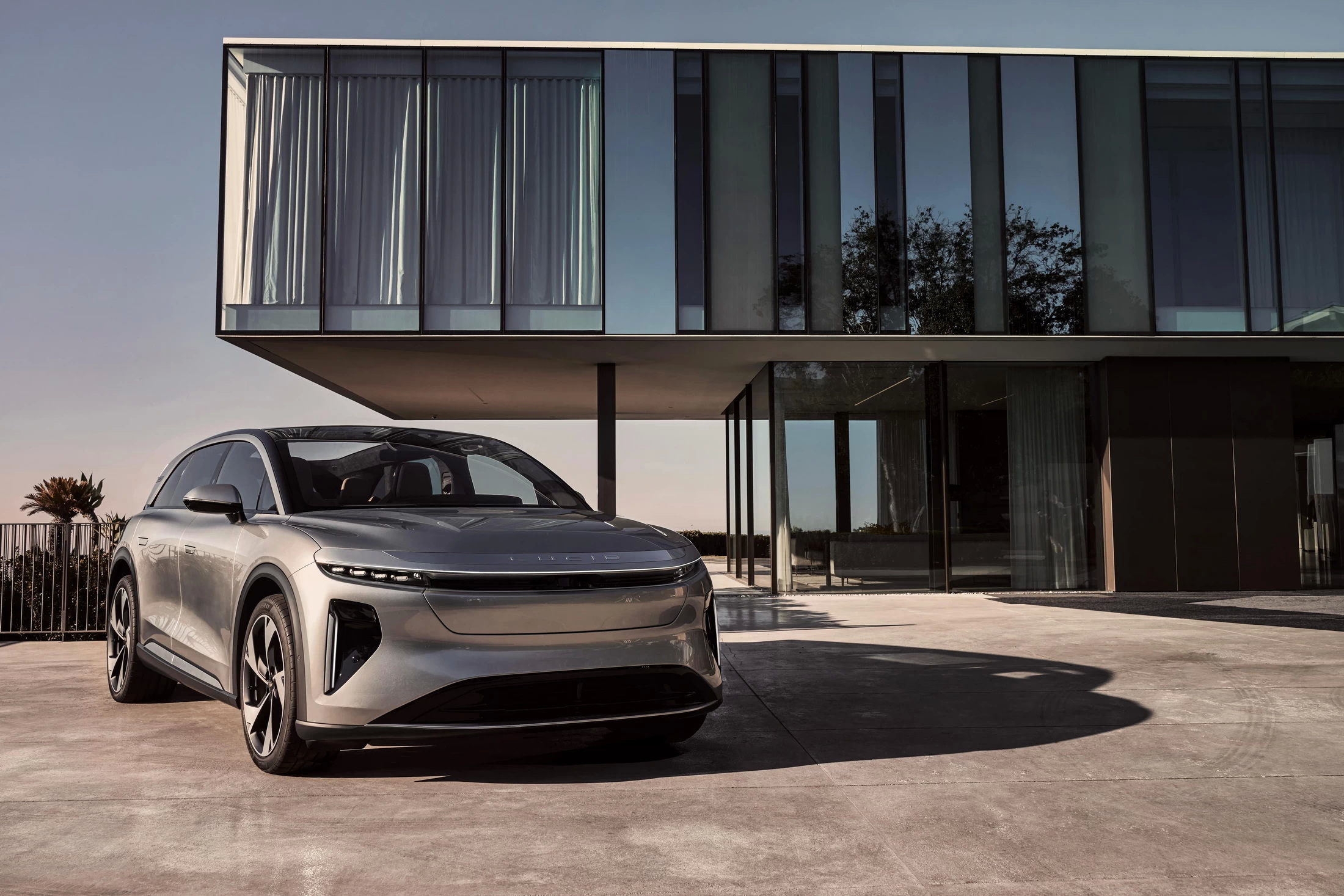
Lucid Motors should be doing great as they finally added a much-needed crossover to their lineup in the form of the Gravity. The model was recently named World Luxury Car, but it hasn’t reversed the company’s fortunes.

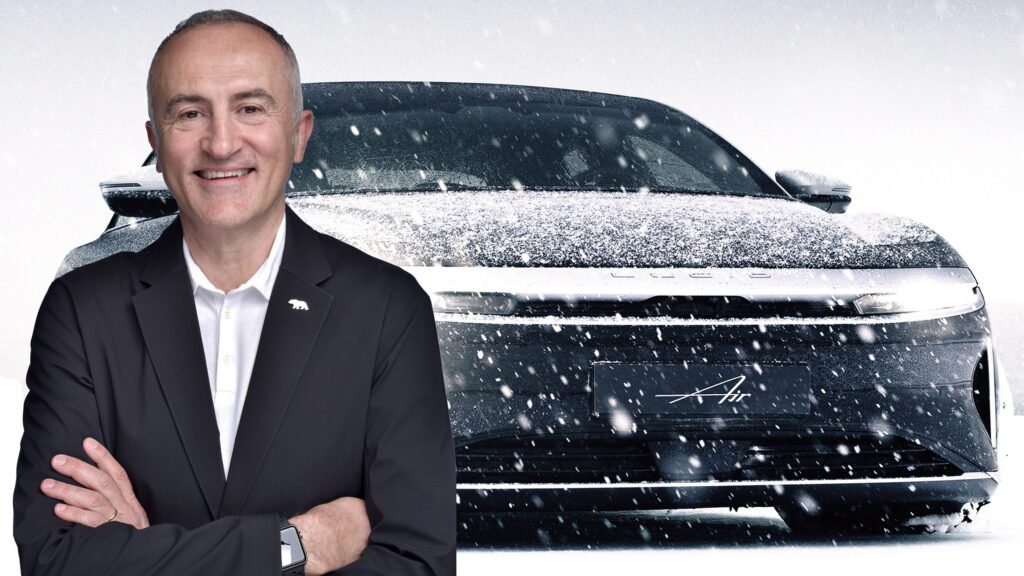
Given this, the automaker has announced a series of developments including the appointment of a new CEO. Silvio Napoli has been tapped for the top spot and he’ll replace interim CEO Marc Winterhoff, who will be transitioning to COO.

More: Uber And Lucid Partner For Thousands Of Robotaxis

While Napoli isn’t a household name, he was previously CEO of Switzerland’s Schindler Group, which makes elevators, escalators, and moving walks. That’s not exactly automotive experience, but Lucid praised his “deep operational expertise, financial discipline, and track record of leadership in innovation.”

 Lucid’s Elevator CEO Gets A $1.5M Salary, Two Company Cars, And A $1M Moving Allowance

In a Form 8-K filing, Lucid revealed Napoli will have a base salary of $1,500,000 and the potential to make $4,500,000 if certain performance targets are hit. He’s also getting up to $25,000 per month in temporary housing expenses for half a year as well as a “lump sum payment of $1,000,000 to cover any expenses in connection with moving to the US.”

Napoli will also get two company cars, security, as well as tax and financial planning support. If that wasn’t enough, the company also mentioned a “long-term incentive grant” with a target value of $9,500,000.

Bigger Uber Order And New Investments

 Lucid’s Elevator CEO Gets A $1.5M Salary, Two Company Cars, And A $1M Moving Allowance

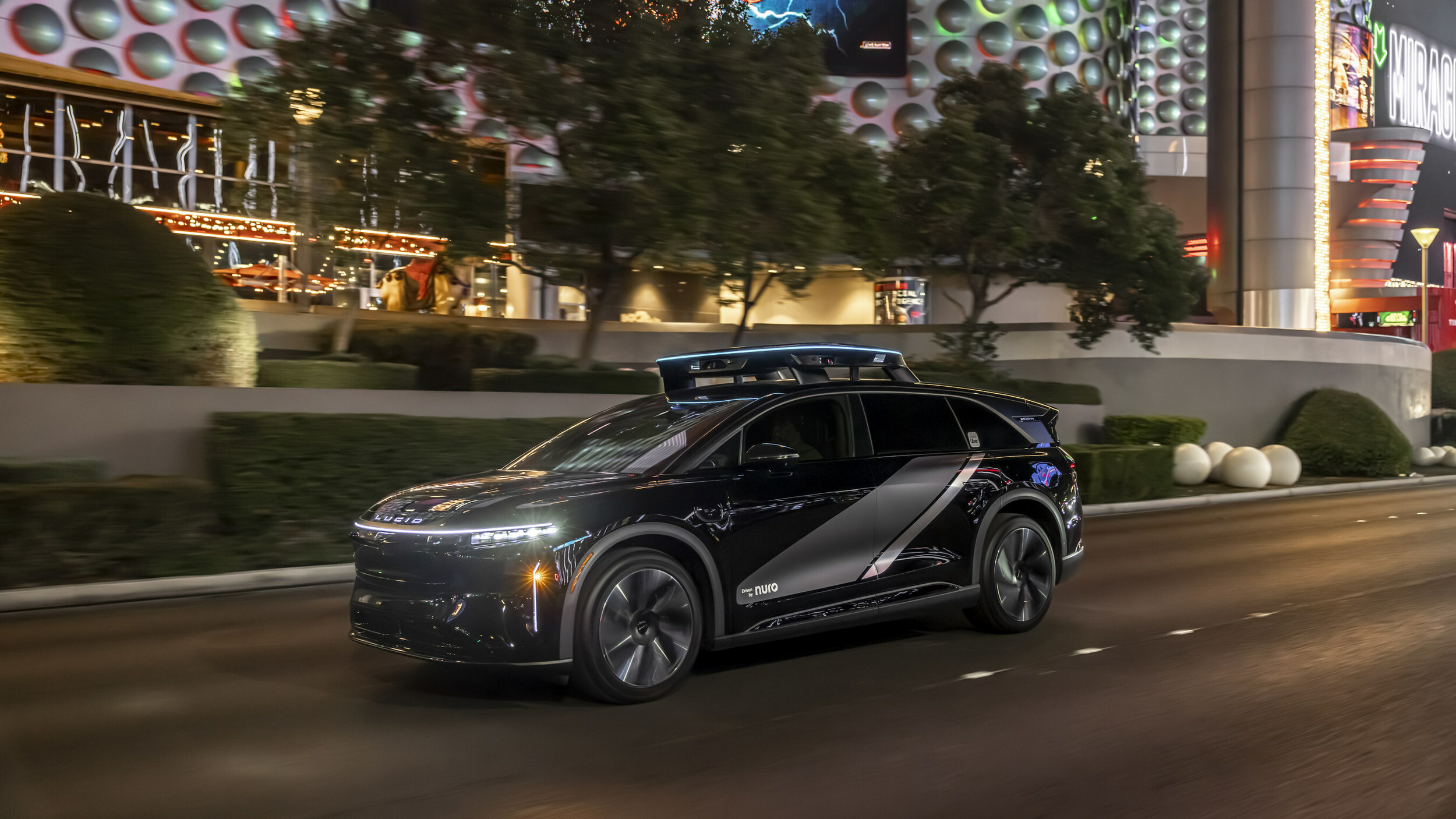
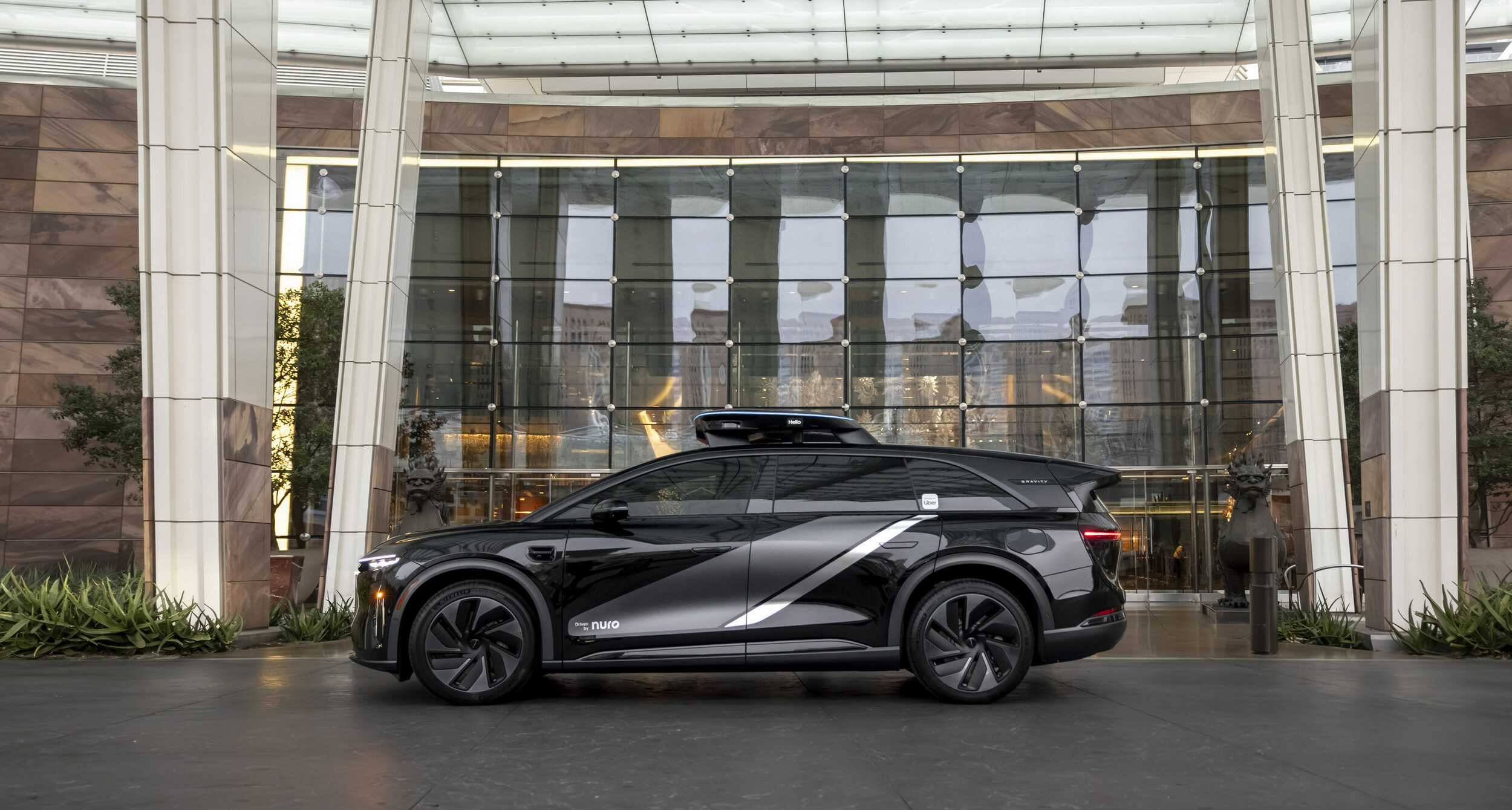
Besides announcing a new CEO, Lucid revealed Uber is increasing their previously announced order of at least 20,000 Gravity SUVs to be used as robotaxis as part of a three-way tie up with Nuro. The service is scheduled to launch this year in the San Francisco Bay area and eventually spread to dozens of markets around the world.

The order has now been expanded to at least 35,000 vehicles and the ride-hailing giant has also promised to invest an additional $200 million into Lucid. This will raise their total investment into the firm to $500 million.

 Lucid’s Elevator CEO Gets A $1.5M Salary, Two Company Cars, And A $1M Moving Allowance

Uber isn’t the only one forking over the dough as the Ayar Third Investment Company is pumping $550 million into Lucid. They’re an affiliate of Saudi Arabia’s Public Investment Fund, which is a major backer of the automaker.

Winterhoff said “Today’s announcement demonstrates the growing strength of our relationship with Uber, our continued partnership with the PIF, and the benefits our software-defined EV platforms bring to next-generation mobility networks.” He added, “This is yet another milestone in our partnership with Uber and Nuro, and we look forward to building on our momentum together in the years to come.”

 Lucid’s Elevator CEO Gets A $1.5M Salary, Two Company Cars, And A $1M Moving Allowance

Tesla’s Signature Edition Buyers Face A $50,000 Resale Ban Tesla Already Failed To Enforce Once

  • Tesla’s final Signature Edition Models come with a one-year no-resale clause.
  • Flip one earlier than that, and Tesla could demand at least $50,000.
  • Lifetime FSD, free Supercharging, and connectivity die with the first owner.

Production of the Tesla Model S and Model X is ending with 350 Signature Edition cars. Each one gets a ton of perks and a premium price tag. On top of that, buyers have to agree not to sell for at least one year from delivery. Tesla has tried and failed to enforce this type of thing before. This time, it might have figured out the right levers to pull.

Buyers of the last-ever Signature Edition versions of the Model S Plaid and Model X Plaid will reportedly have to sign a strict no-resale agreement before taking delivery. According to the order documents spotted by Not A Tesla App, owners agree not to sell or even attempt to sell the vehicle within the first year after delivery. Breaking the agreement evidently makes owners subject to liquidated damages of $50,000 or however much profit they make, whichever is greater.

More: You’d Have To Be High To Pay $159,420 For Tesla’s Signature Editions

The move is clearly aimed at keeping speculators from immediately flipping the final 350 Signature Editions for huge profits. Tesla is only building 250 examples of the Model S and 100 of the Model X, each finished in exclusive Garnet Red paint with gold badging and unique trim. Tesla tried this with the Cybertruck and the entire scheme fell apart, aside from the brand allegedly blacklisting some customers.

The policy was met with immediate backlash. Owners argued Tesla was trying to control something they had already paid for, while others simply ignored the clause and listed their trucks anyway. Within months, Tesla quietly dropped the restriction as Cybertruck supply increased and the market cooled. This time around, there are some key differences.

Signature Edition Model S/X orders contain a No Resale Agreement.

Here is the document.

Additionally, here is the resale clause which states the Luxe Package does not transfer (this is not new) pic.twitter.com/CGB5QBJIL6

— The Cybertruck Guy (@cybrtrkguy) April 12, 2026

The new agreement is cleaner and potentially easier to enforce. Unlike the Cybertruck contract, which relied on vague “unforeseen reason” language, the Signature Edition version flatly says owners cannot “sell or otherwise attempt to sell” the car within a year.

Tesla also has a stronger case because these are truly limited: just 350 cars total, versus thousands of Cybertrucks. Most importantly, Tesla made the biggest perks like FSD, free Supercharging, and Premium Connectivity non-transferable. That means even after a year, the car is worth less to a second owner, reducing the incentive to flip it in the first place. Will that stop every buyer from selling within 12 months? We doubt it.

NEWS: Tesla has announced a Signature Edition Model S and Model X as a final goodbye for these two vehicles.

• Price: $159,420
• Only 250 Model S & 100 Model X Signature Editions will be built. All Plaid variants.
• Garnet Red exterior paint
• Matching Garnet Red Door… https://t.co/3FYGlbKEa2 pic.twitter.com/VA8NZN8Mht

— Sawyer Merritt (@SawyerMerritt) April 11, 2026

BMW’s iX Couldn’t Survive Its Own Numbers In The USA

  • BMW is discontinuing sales of the iX in the United States.
  • The company is instead turning its attention to the new iX3.
  • iX will continue to be sold in other global markets for now.

BMW iX sales fell 50.7% in the United States during the first quarter as dealers only managed to move 1,788 units. It appears this was the last straw as the electric crossover is being dropped in America.

In a statement to BMW Blog, a spokesperson said “Our success in the U.S. is driven by a broad and flexible powertrain portfolio that allows us to navigate a dynamic environment, while continuing to evolve our lineup. As part of this progression, we are concluding U.S. allocation of the BMW iX as we prepare for the next-generation of our fully electric vehicles.”

More: BMW’s Entry-Level iX3 Saves You Thousands, But There’s A Range Cut

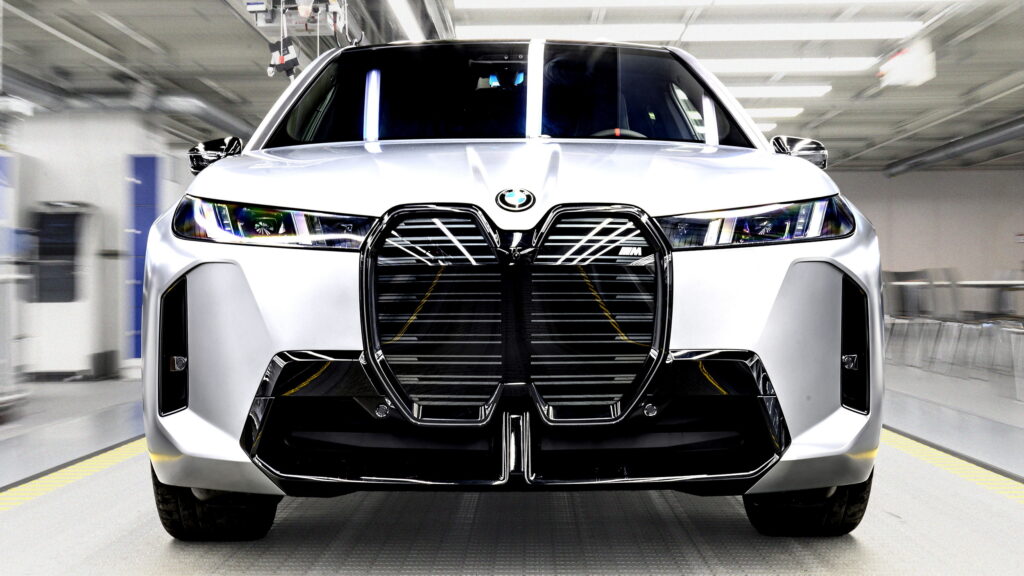
The spokesperson went on to say, “We are proud of what we have accomplished with the BMW iX” as it was a “technological showcase” that pushed the “boundaries of design, manufacturing, sustainability, and circularity.” Despite the iX’s demise, the company said they’re fully committed to electrification in America and they’re turning their attention to Neue Klasse models.

The effort will begin with the iX3, which was introduced last fall. The crossover will come stateside during the middle of the year and the company has previously said the iX3 50 xDrive will start around $60,000.

\\\\\\\\\

It features a 112.2 kWh battery pack as well as a dual-motor all-wheel drive system developing 463 hp (345 kW / 469 PS) and 476 lb-ft (645 Nm) of torque. This enables the model to accelerate from 0-60 mph (0-96 km/h) in approximately 4.7 seconds and have an EPA-estimated range of 400 miles (644 km). When the battery is low, a 400 kW DC fast charger will be able to provide 175 miles (282 km) of range in as little as ten minutes.

Those numbers easily beat the iX, which was launched in 2021. As a refresher, the entry-level variant starts at $75,150 and has a 94.8 kWh battery pack as well as a combined output of 402 hp (300 kW / 408 PS) and 516 lb-ft (699 Nm).

This enables the iX xDrive45 to hit 60 mph (96 km/h) in 4.9 seconds, before topping out at 124 mph (200 km/h). The model also has a range of up to 312 miles (502 km) as well as a 175 kW DC fast charging capability that delivers a mere 78 miles (126 km) of range in ten minutes.

\\\\\\\\\\

Audi’s New RS Q6 Is Essentially A Porsche With Different Badges

  • The Audi RS Q6 Sportback e-tron was spied testing at the Nürburgring.
  • The electric coupe gets a sharper face, fender vents, and a new diffuser.
  • It will likely use dual motors and all-wheel drive with around 600 hp.

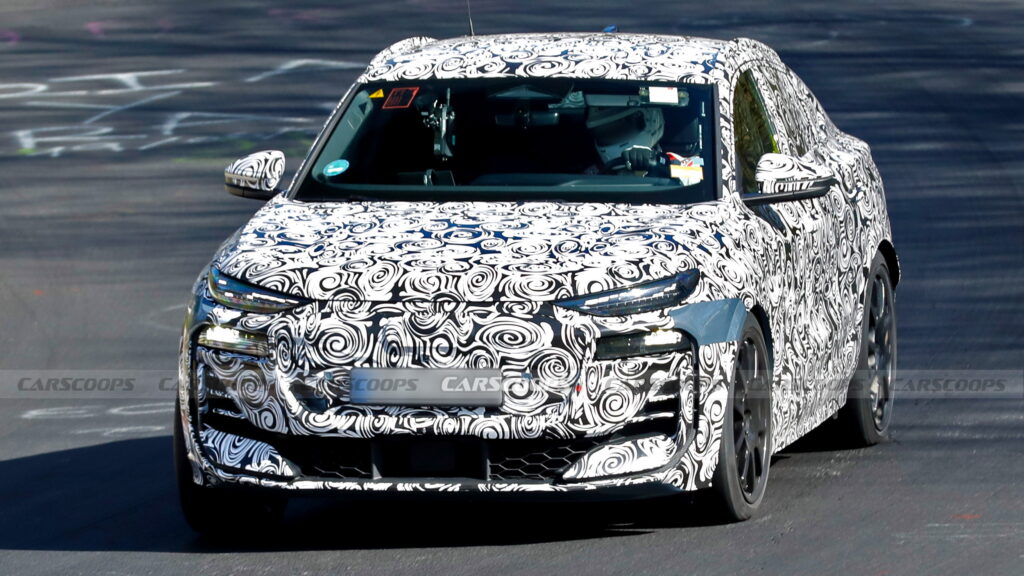
It’s been nearly two years since spy photographers last spotted the Audi RS Q6 Sportback e-tron, but it’s back on the Nürburgring and gearing up for a possible debut later this year.

Designed to slot above the SQ6 Sportback, the high-performance variant features a unique front fascia with a more aggressive lower intake. It features angular accents, honeycomb mesh inserts, and triangular elements with horizontal bars. We can also see a special surround, which recalls the look of AUDI models in China and features vertical air curtains at the outside edges.

More: Audi RS Q6 Sportback E-Tron Spied, Could Pack A 600+ HP Punch

A number of the vents likely channel air to the beefier front braking system, which appears to have significantly larger calipers. On the topic of air flow, the model has subtle front fender vents that are tall and skinny. We can also expect the crossover to ride on model-specific lightweight wheels.

The rear end largely carries over, but the RS Q6 has been equipped with a new bumper and sportier diffuser. The latter features a prominent central channel as well as protruding elements where a four-tailpipe exhaust system would typically reside. We can also see a familiar spoiler and rear light bar.

\\\\\\\\\\\\

Baldauf

There isn’t much to see inside, but the model should have an 11.9-inch digital instrument cluster, a 14.5-inch infotainment system, and a 10.9-inch front passenger display. They should be joined by sport seats, carbon fiber trim, and plenty of RS badging.

Powertrain details are more mysterious, but the model should echo the SQ6 which has a 100 kWh battery pack and a dual-motor all-wheel drive system developing up to 510 hp (380 kW / 517 PS) with launch control. However, the RS variant will be significantly more powerful and likely take a page from the Porsche Macan Turbo Electric.

The Audi’s PPE platform mate has a combined output of up to 630 hp (470 kW / 639 PS) and 833 lb-ft (1,129 Nm) of torque. This enables the Macan to rocket from 0-60 mph (0-96 km/h) in 3.1 seconds, run the quarter mile in 11.4 seconds, and eventually top out at 162 mph (261 km/h).

\\\\\\\\\\

Baldauf

America’s EV Sales Fell By Nearly A Third, But Toyota Jumped 79%

  • Just a handful of brands have reported increased EV sales in the USA.
  • Companies performing well include Toyota, Rivian, Lucid, and Cadillac.
  • Audi’s EV sales collapsed by 89.6 percent in Q1, and BMW’s by 63.3 percent.

It was inevitable that sales of new EVs would slide in the US after the Trump administration axed the long-standing $7,500 federal tax credit at the end of September. New data shows that sales fell off a cliff in the final quarter of last year, but they’ve since started to somewhat stabilize, indicating we may have hit a new normal.

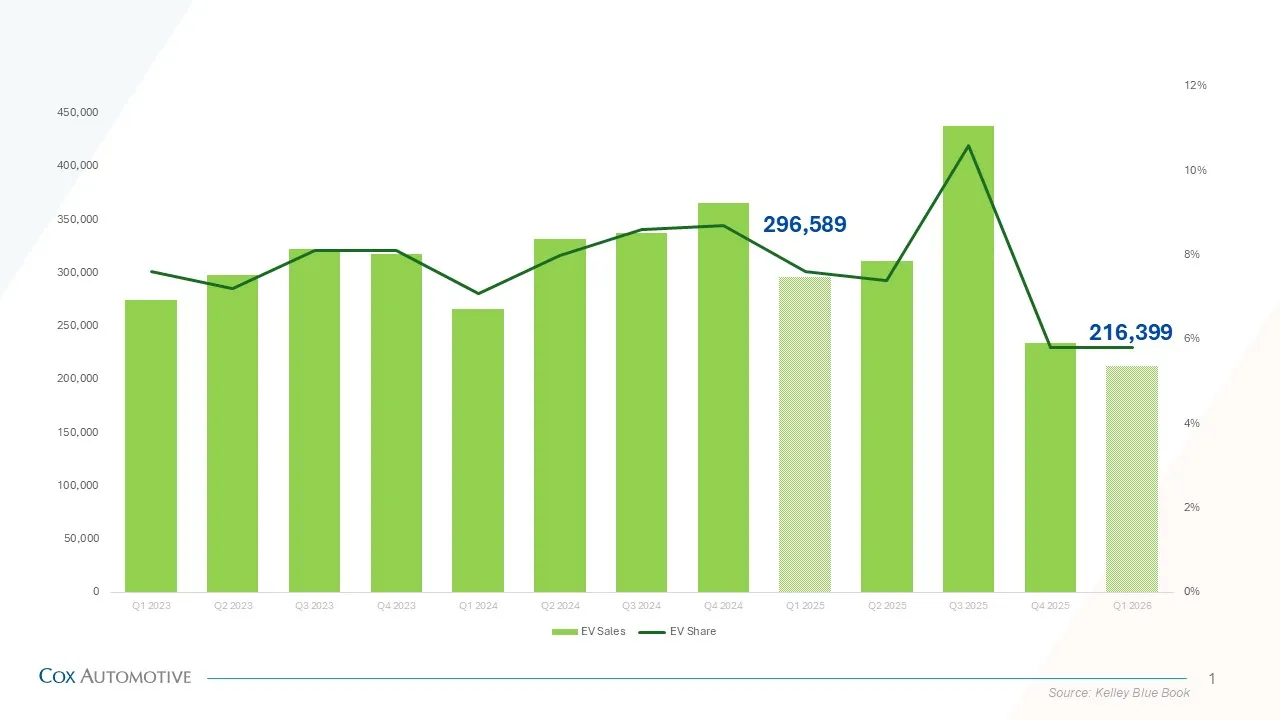
During the first three months of this year, 216,399 new EVs are estimated to have been sold nationwide. This is down 27 percent from the first quarter of 2025 and is also down 7.8 percent from Q4 2025.

Read: EV Prices Are Falling, But Automakers Are Eating Nearly $8,000 Per Sale To Pull It Off

While this decline is noteworthy, it was as significant as the drop-off seen in Q4 last year, when sales plunged 36 percent year-over-year and 46 percent from the previous quarter, which was the last quarter before the tax credit was axed.

 America’s EV Sales Fell By Nearly A Third, But Toyota Jumped 79%
Cox Automotive

“The U.S. EV market has clearly entered a new phase,” director of insights at Cox Automotive, Stephanie Valdez Streaty noted. “With federal incentives gone, the first quarter reflected a necessary reset – sales slowed and market share shifted. What comes next will be driven less by policy and more by fundamentals: more affordable products, smarter pricing strategies, and continued investment in infrastructure. Those longer-term fundamentals continue to support EV growth. The timeline has shifted, but the direction hasn’t.” 

The Losers And The Winners

Most brands saw their EV sales slip significantly last quarter compared to the same period in 2025. For example, Audi’s EV sales were down 89.6 percent, BMW’s by 63.3 percent, Dodge’s by 87.7 percent, Genesis’ by 89 percent, and Honda’s were down 65.3 percent. However, there were a few exceptions to this general trend.

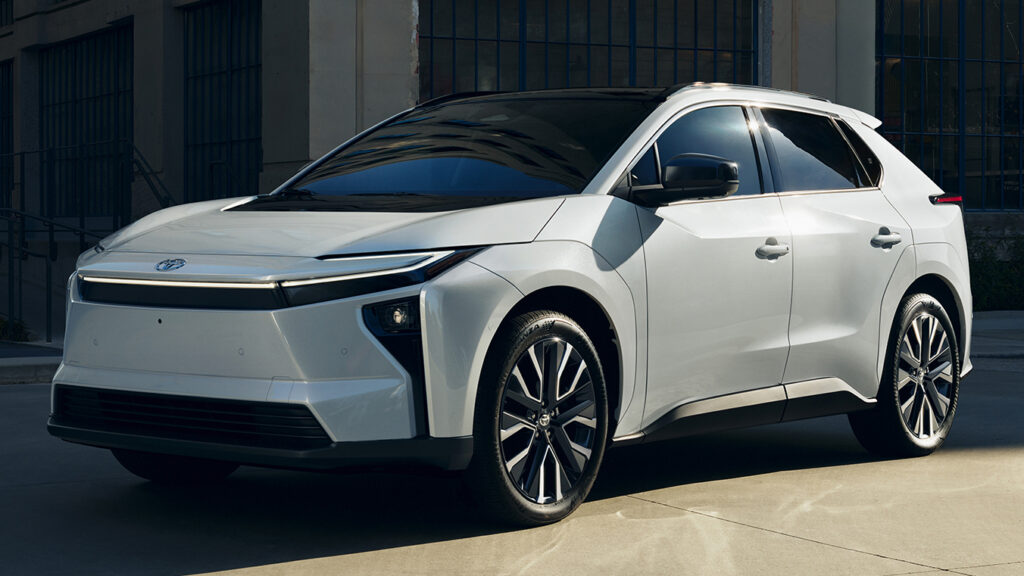
For example, Lexus EVs rose 206.7 percent to 4,456 units, Rivian by 21.2 percent to 10,365, Cadillac’s by 19.8 percent, Lucid’s by 3.5 percent, and Toyota’s EV sales climbed 79 percent to 10,042, thanks to strong demand for the updated BZ.

USA EV Sales
BrandQ1-26Q1-25Diff.
Acura734,813-98.5%
Audi6355,905-89.6%
BMW4,96313,538-63.3%
Cadillac9,5517,97219.8%
Chevrolet13,35919,186-30.4%
Dodge2401,947-87.7%
Fiat68448-84.8%
Ford6,86022,550-69.6%
Genesis1641,496-89.0%
GMC2,9414,728-37.8%
Honda3,3199,561-65.3%
Hyundai12,66212,851-1.5%
Jeep1932,595-92.6%
Kia5,2798,695-39.3%
Lexus4,4561,454206.7%
Lucid2,5512,4643.5%
Mercedes1,1123,570-68.9%
Mini202669-69.8%
Nissan7246,471-88.8%
Porsche1,2804,358-70.6%
Ram223
Rivian10,3658,55321.2%
Subaru3,0413,131-2.9%
Tesla117,300128,100-8.4%
Toyota10,0425,61079.0%
Volvo2,3433,026-22.6%
VW1,1779,564-87.7%
Other Brands1,2763,334-61.7%
Total (Estimates)216,399296,589-27.0%
SWIPE

Rolls-Royce Calls The Nightingale Its Most Accessible Coachbuild. It Starts At $9.5 Million

  • Rolls-Royce’s Nightingale is a fully electric, two-seat coachbuild.
  • At 226.8 inches, it matches the Phantom sedan in overall length.
  • The cabin ceiling uses 10,500 stars patterned on a nightingale’s song.

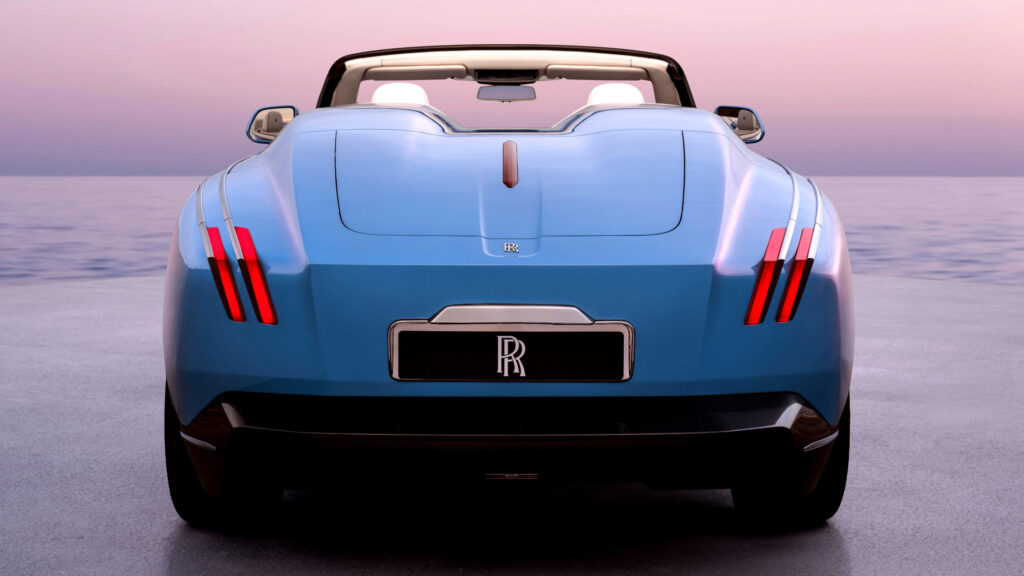
While several automakers quietly scale back their EV projects, Rolls-Royce is doing the opposite, and doing it in typical fashion. The Project Nightingale arrives as an exclusive two-door convertible, marking the first entry in the company’s Coachbuild Collection with bespoke styling and a strictly limited run of 100 units

With a length of 5.76 meters (226.8 inches), the Nightingale closely mirrors the Phantom sedan in sheer presence. It adopts a raked windscreen, a two-seat cabin, a long, tapering tail, and a set of 24-inch directional wheels styled to echo yacht propellers.

More: Rolls-Royce’s Electric SUV Revives A Long-Forgotten Hood Design

The front is dominated by the Pantheon Grille, carved from a solid block of stainless steel, and flanked by ultra-slim vertical LED headlights. Those are connected to the split LED taillights through polished stainless-steel bands that run across the entire length of the car. Furthermore, a sophisticated diffuser manages airflow without the need for a spoiler, a feat made possible by the absence of exhaust pipes.
\\\\\\\\\\\\\

The pictured model is painted in Cote d’Azur Blue infused with subtle red flakes, combined with silver accents and a matching soft top. This pale blue shade is inspired by the experimental Rolls-Royce 17EX from 1928.

Two-Seater Cabin

Inside, the dashboard looks familiar, but the cabin only has two seats, framed by horseshoe-shaped forms. The saddle-like armrest glides rearwards to reveal the Spirit of Ecstasy controller, which is one of the five rotary controls.

More: This Exclusive Rolls-Royce Was 100 Years In The Making

Another highlight is the “Starlight Breeze” with 10,500 individual fiber-optic stars that wrap around the occupants. In typical Rolls-Royce fashion, these are not arranged in a random order, but with a special pattern derived from the sound-wave analysis of a nightingale’s song

\\\\\\\\\

For the launch vehicle, designers chose a combination of Charles Blue with Grace White, joined by Deep Navy details, Peony Pink accents, and Openpore Blackwood inserts.

More: When A Tech Billionaire Says Game On, Rolls-Royce Unlocks A Secret Level

To maintain the romance of open-top driving, the roof uses a composite blend of cashmere and high-performance fabrics, specifically tuned to let the sound of raindrops through while blocking mechanical noise.

Shared Underpinnings

Naturally, the Nightingale shares the “Architecture of Luxury” aluminum spaceframe chassis with the rest of the Rolls-Royce lineup. It also uses the same fully electric powertrain, currently employed by the Spectre.

Specifications remain under wraps, but the company promised to unveil more details as the vehicle “progresses through its global testing and development program”.

Rolls-Royce Decides Who Will Buy It

The Nightingale is significantly less exclusive than coachbuilt specials from the recent past like the Sweptail, Boat Tail, and Drop Tail. More specifically, the model will be manufactured in 100 units, with owners hand-picked from the firm. Deliveries are scheduled to begin in 2028.

As reported by Autocar, the starting price is approximately £7 million ($9.5 million), although the final cost is expected to climb following extensive personalization options. Besides the vehicle itself, the Coachbuild Collection program includes behind-the-scenes access to design and testing, plus global curated events.

\\\\\\\\\\\\\\\\\\\\\
\\\\\

Nissan’s Strangest-Looking SUV Just Got Stranger, And It’s Going Electric To Prove It

  • The new Juke goes on sale in early 2027 as a pure electric crossover.
  • Its platform is shared with the Renault Scenic E-Tech and the Alpine A390.
  • Nissan will keep the second-gen hybrid model on sale alongside the new EV.

The Nissan Juke has always stood out from the crowd, sporting a unique shape that’s allowed it to remain a solid option despite competition in its segment always increasing. At its Vision event in Japan, Nissan has unveiled the third-generation Juke, and it’s even more striking than we could have predicted.

The new Juke will be sold exclusively as an EV and will be built at the brand’s British site in Sunderland, alongside the Leaf. It’s based on the CMF-EV or AmpR Medium platform used by the likes of the Renault Scenic E-Tech, Alpine A390, and Nissan Ariya, and is scheduled to launch globally in the spring of next year.

Read: Nissan’s New Rogue Wants To Take The RAV4’s Hybrid Crown

Nissan has yet to release final specifications for the Juke, nor has it released any photos of the crossover’s interior. However, it has unveiled the full exterior design, and it looks unlike any other model Nissan sells. In fact, the design is striking enough that it looks more like a concept car than one that’ll be sold to the public.

Concept Looks

 Nissan’s Strangest-Looking SUV Just Got Stranger, And It’s Going Electric To Prove It

The design is dominated by sharp and jagged lines, starting at the front with a large blacked-out grille and intriguing headlights. It’s also been showcased with angular black wheel arches, while much of the body is finished in a bright shade of green. This color really helps to highlight the profile of the Juke, particularly the wild door skins.

As with the outgoing Juke, the handles for the rear doors remain on the C-pillars. Like the front, the rear is bold with intricate LED taillights and a distinctive tailgate.

Like the current Leaf, the new Nissan Leaf EV will support vehicle-to-grid technology. The battery packs will likely mimic those of the Nissan Leaf, meaning it could be offered with 52 kWh and 75 kWh packs. Interestingly, the existing second-generation Juke isn’t going anywhere.

Despite originally planning to replace the old model with this new one, the second and third-gen versions will instead be sold alongside each other. It’s understood that Nissan will update the design of the old model to mimic the new EV.

\\\\\

Mercedes Gave The 2027 EQS Up To 575 Miles Of Range, And The Yoke’s On You

  • Mercedes moves the EQS to 800V setup, lifting peak charging to 350kW.
  • A modest 3% battery increase results in a 13% real-world range gain.
  • Steer-by-wire replaces the steering with a yoke and a 270-degree lock.

Mercedes-Benz has already decided the EQS won’t get a second generation. Instead, the next S-Class will carry the load, offered in both combustion and all-electric forms. Even so, the EQS isn’t done just yet. The brand has rolled out a comprehensive second facelift, packing in a slew of new technologies that might finally persuade a few more buyers to give the polarizing blob a chance.

Four versions have been confirmed at this stage, known as the EQS 400, EQS 450+, EQS 500 4Matic, and EQS 580 4Matic, the latter three of which are all equipped with 800-volt electrical architectures and 122 kWh battery packs that promise improved energy density. The news EQS 400 has a smaller 112 kW pack.

Read: Mercedes Is Betting On A Yoke To Save The Disastrous EQS

Mercedes has also improved the charging abilities of the EV, as it now supports DC charging of up to 350 kW, meaning 199 miles (320 km) of range can be added in 10 minutes. This has been achieved by implementing software that virtually divides the battery pack into two parts, charging each with 400 volts at up to 175 kW.

 Mercedes Gave The 2027 EQS Up To 575 Miles Of Range, And The Yoke’s On You

In addition to the new battery, Mercedes has incorporated new electric motors for all versions. The base EQS 400 delivers 362 hp (270 kW), while the EQS 500 4Matic ups this to 469 hp (350 kW), and the EQS 580 4Matic delivers 577 hp (430 kW) and 590 lb-ft (800 Nm).

Range figures haven’t been announced for all models, but we know the EQS 450+ has a WLTP-rated range of 575 miles (926 km) with claimed energy consumption of between 15.4 kWh/100 km and 19.3 kWh/100 km. All models are also equipped with a two-speed transmission with the first gear focused on providing quick acceleration and the second kicking in at high speeds to boost efficiency.

Perhaps the most significant change made is the implementation of steer-by-wire technology, as pioneered by Lexus and Tesla. The steering ratio has been set at 4:1 at low speeds, allowing drivers to make low-speed maneuvers without needing to repeatedly cross their hands over the steering wheel.

Even More Tech-Focused Than Before

\\

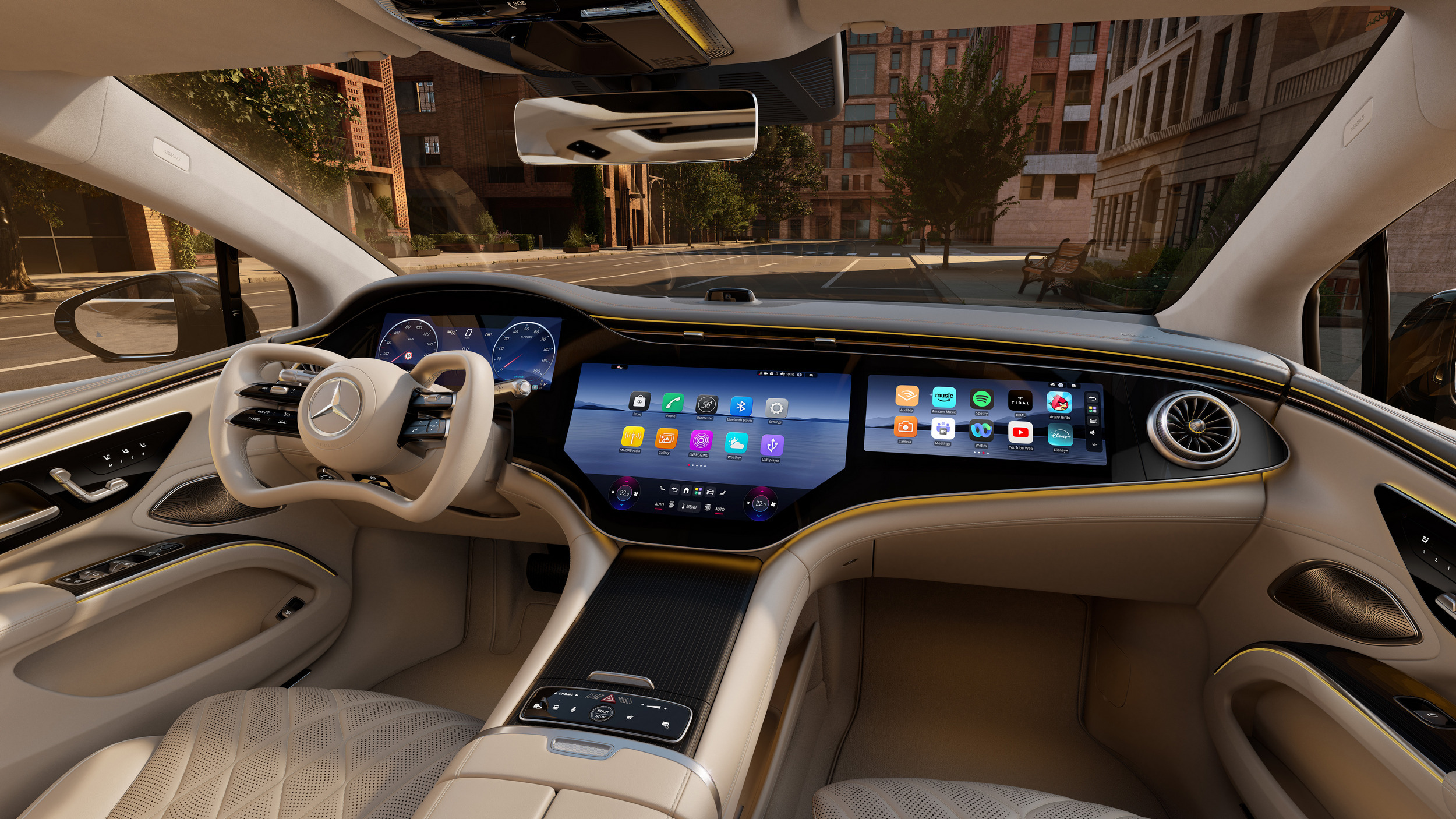
Speaking of the steering wheel, it has morphed into a Tesla-like yoke – which is bound to be controversial. Crucially, Mercedes will continue offering it with a more traditional wheel and electro-mechanical steering, rather than the fancy steer-by-wire system. In addition to the new system, Mercedes has further developed its air suspension system to improve comfort even further.

Visually, the updated EQS is distinguished from the old model thanks to a revised front fascia with a new blacked-out grille complete with dozens of three-pointed stars, and new headlights with star-shaped DRLs.

\\\\\\\\\

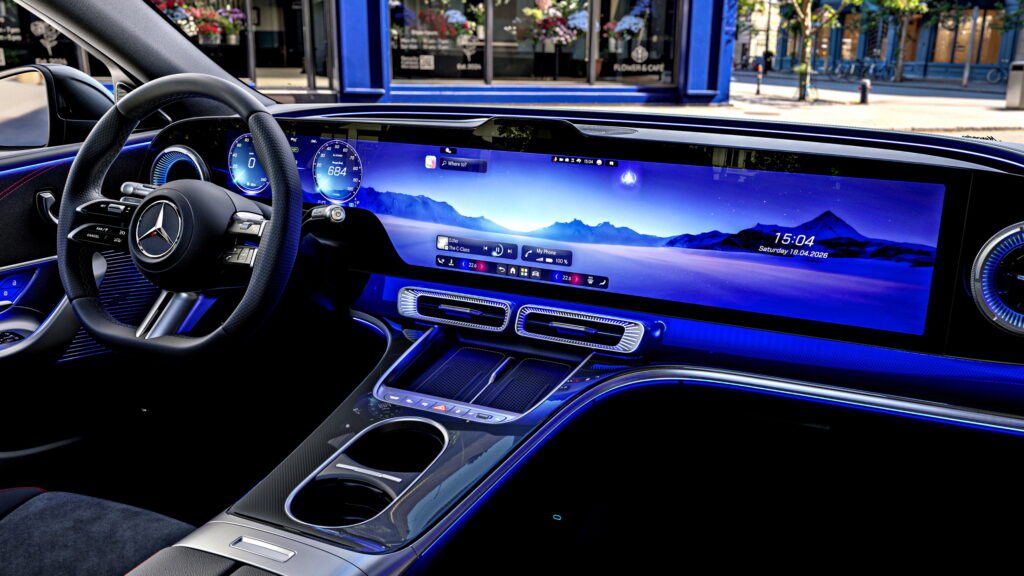
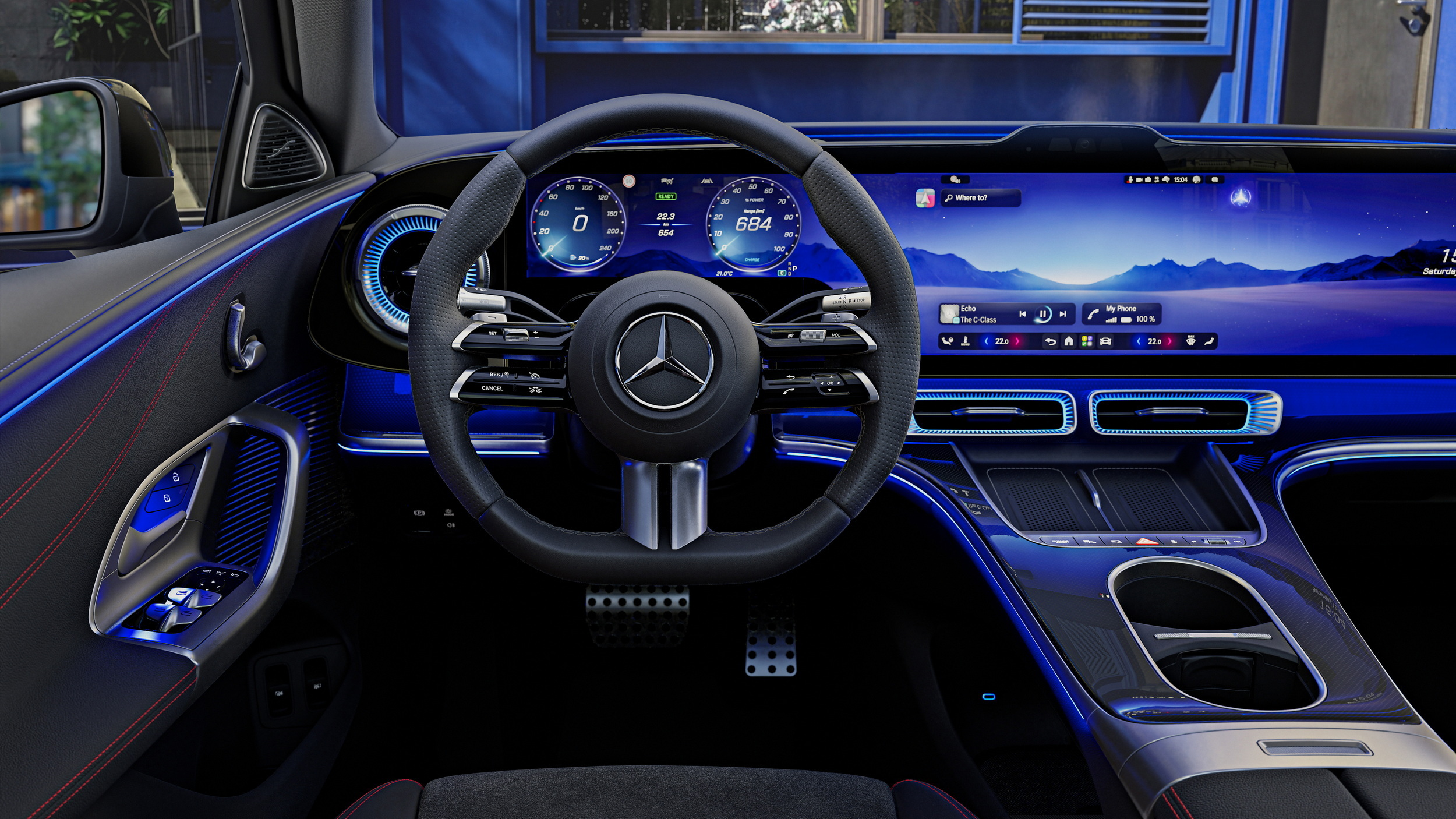
With the exception of the yoke wheel, the interior is mostly familiar. With that being said, there’s now Mercedes-Benz’s latest Operating System (MB.OS) and the new MBUX Virtual Assistant. The massive Hyperscreen remains, while found in the new 13.1-inch entertainment screens are found in the second row.

US pricing has yet to be announced, but in Europe, we know prices kick off from €94,403 ($111,000) for the EQS 400, €108,635 ($127,700) for the EQS 450+, €123,285 ($145,000) for the EQS 500 4Matic, and €134,732 ($158,500) for the EQS 580 4Matic.

\\\\

Nissan’s New Juke EV Looks More Concept Than Reality

  • The Juke EV shares its platform with the Nissan Ariya and Renault Megane E-Tech.
  • Nissan will continue selling the outgoing hybrid model alongside this new EV.
  • The new electric crossover will hit the market in the spring of 2027.

The Nissan Juke has always stood out from the crowd, sporting a unique shape that’s allowed it to remain a solid option despite competition in its segment always increasing. At its Vision event in Japan, Nissan has unveiled the third-generation Juke, and it’s even more striking than we could have predicted.

The new Juke will be sold exclusively as an EV and will be built at the brand’s British site in Sunderland, alongside the Leaf. It’s based on the CMF-EV or AmpR Medium platform used by the likes of the Renault Scenic E-Tech, Alpine A390, and Nissan Ariya, and is scheduled to launch globally in the spring of next year.

Read: Nissan’s New Rogue Wants To Take The RAV4’s Hybrid Crown

Nissan has yet to release final specifications for the Juke, nor has it released any photos of the crossover’s interior. However, it has unveiled the full exterior design, and it looks unlike any other model Nissan sells. In fact, the design is striking enough that it looks more like a concept car than one that’ll be sold to the public.

Concept Looks

 Nissan’s New Juke EV Looks More Concept Than Reality

The design is dominated by sharp and jagged lines, starting at the front with a large blacked-out grille and intriguing headlights. It’s also been showcased with angular black wheel arches, while much of the body is finished in a bright shade of green. This color really helps to highlight the profile of the Juke, particularly the wild door skins.

As with the outgoing Juke, the handles for the rear doors remain on the C-pillars. Like the front, the rear is bold with intricate LED taillights and a distinctive tailgate.

Like the current Leaf, the new Nissan Leaf EV will support vehicle-to-grid technology. The battery packs will likely mimic those of the Nissan Leaf, meaning it could be offered with 52 kWh and 75 kWh packs. Interestingly, the existing second-generation Juke isn’t going anywhere.

Despite originally planning to replace the old model with this new one, the second and third-gen versions will instead be sold alongside each other. It’s understood that Nissan will update the design of the old model to mimic the new EV.

\\\\\

With A Yoke And More Range, The Failed Mercedes EQS Steps Into The Future

  • Mercedes has made some important technical upgrades to the EQS.
  • Most versions have a larger 122 kWh battery pack with up to 575 miles of range.
  • Just like Tesla and Lexus, the EQS has been updated with steer-by-wire tech.

Mercedes-Benz isn’t planning a second generation of the EQS, and instead, will sell the future S-Class in both combustion and all-electric guises. Despite this, the brand has just introduced a comprehensive second facelift for the EQS, bringing with it a host of new technologies that may finally convince a small number of shoppers to actually buy the blob.

Four versions have been confirmed at this stage, known as the EQS 400, EQS 450+, EQS 500 4Matic, and EQS 580 4Matic, the latter three of which are all equipped with 800-volt electrical architectures and 122 kWh battery packs that promise improved energy density. The news EQS 400 has a smaller 112 kW pack.

Read: Mercedes Is Betting On A Yoke To Save The Disastrous EQS

Mercedes has also improved the charging abilities of the EV, as it now supports DC charging of up to 350 kW, meaning 199 miles (320 km) of range can be added in 10 minutes. This has been achieved by implementing software that virtually divides the battery pack into two parts, charging each with 400 volts at up to 175 kW.

In addition to the new battery, Mercedes has incorporated new electric motors for all versions. The base EQS 400 delivers 362 hp (270 kW), while the EQS 500 4Matic ups this to 469 hp (350 kW), and the EQS 580 4Matic delivers 577 hp (430 kW) and 590 lb-ft (800 Nm).

 With A Yoke And More Range, The Failed Mercedes EQS Steps Into The Future

Range figures haven’t been announced for all models, but we know the EQS 450+ has a WLTP-rated range of 575 miles (926 km) with claimed energy consumption of between 15.4 kWh/100 km and 19.3 kWh/100 km. All models are also equipped with a two-speed transmission with the first gear focused on providing quick acceleration and the second kicking in at high speeds to boost efficiency.

Perhaps the most significant change made is the implementation of steer-by-wire technology, as pioneered by Lexus and Tesla. The steering ratio has been set at 4:1 at low speeds, allowing drivers to make low-speed maneuvers without needing to repeatedly cross their hands over the steering wheel.

Even More Tech-Focused Than Before

 With A Yoke And More Range, The Failed Mercedes EQS Steps Into The Future

Speaking of the steering wheel, it has morphed into a Tesla-like yoke – which is bound to be controversial. Crucially, Mercedes will continue offering it with a more traditional wheel and electro-mechanical steering, rather than the fancy steer-by-wire system. In addition to the new system, Mercedes has further developed its air suspension system to improve comfort even further.

Visually, the updated EQS is distinguished from the old model thanks to a revised front fascia with a new blacked-out grille complete with dozens of three-pointed stars, and new headlights with star-shaped DRLs.

With the exception of the yoke wheel, the interior is mostly familiar. With that being said, there’s now Mercedes-Benz’s latest Operating System (MB.OS) and the new MBUX Virtual Assistant. The massive Hyperscreen remains, while found in the new 13.1-inch entertainment screens are found in the second row.

US pricing has yet to be announced, but in Europe, we know prices kick off from €94,403 ($111,000) for the EQS 400, €108,635 ($127,700) for the EQS 450+, €123,285 ($145,000) for the EQS 500 4Matic, and €134,732 ($158,500) for the EQS 580 4Matic.

\\\\\\\\\\\\\\\

Stellantis Turns A Tiny Chinese Hatch Into A Delivery Van That’s Light On The Van Part

  • The Leapmotor T03 urban EV transforms into a pint-sized van.
  • It offers a 657-liter cargo area and 220 kg payload capacity.
  • The model will hit dealers this summer, starting at €14,590.

Stellantis is broadening its lineup with a slightly left-field addition, rolling out a last-mile delivery vehicle for Europe through its Leapmotor joint venture, based on the tiny T03. Its compact footprint makes it well suited to the cramped streets of Europe’s city centers, backed by a zero-emission powertrain and pricing pitched to keep fleet buyers interested.

As with most LCV conversions of existing models, the T03 has been reworked into a two-seat van. The rear bench is gone, replaced by a 657 lt (23.2 cubic feet) cargo area. Access comes via the tailgate and rear doors, though the openings are predictably tight.

More: This Leapmotor Packs Lamborghini Huracan Power Into A $38K Family SUV

Payload is less convincing. It is rated at just 220 kg (485 lbs), which limits what it can realistically carry. Then again, this is more about parcels and city drops than shifting bags of cement, so for its intended job, it may be enough.

\\\\\\\\\\\

Inside, it’s better equipped than you’d expect from something pitched at delivery duty. You get an 8-inch digital instrument cluster, a 10.1-inch infotainment touchscreen, and a full suite of ADAS features.

More: Opel And Alfa Romeo’s Next EVs May Be Built Around Chinese Tech, Not German Or Italian

On the outside, the five-door hatchback is unchanged from the standard Leapmotor T03, measuring 3,620 mm (142.5 inches) long. The LCV version sets itself apart with 15-inch steel wheels finished in black, while the color choices are limited to Caribbean Blue, Light White, and Canopy Grey.

Power comes from a single electric motor producing 95 hp (70 kW) and 158 Nm (116.5 lb-ft) of torque, identical to the passenger model. A 37.3 kWh battery delivers up to 256 km (159 miles) of WLTP range, with support for 45 kW DC fast charging.

\\\\\\

According to Stellantis, “production finalization” for European markets will take place at the Mirafiori plant in Turin. In reality, that likely means the LCV conversion is handled there, as the Leapmotor T03 itself continues to be built in Jinhua, China, after plans for production at the Tychy plant in Poland were quietly dropped.

More: Stellantis’ Plan For Canada Looks Less Like A Car Factory And More Like A Chinese IKEA, Says Official

Orders for the Leapmotor T03 LCV will open in select EU markets later this month, with the first deliveries expected to land this summer.

Pricing starts at €14,590 ($17,100) excluding VAT, putting it among the most affordable commercial vehicles on sale in Europe. Stellantis is not new to the small EV game either, already offering an LCV version of the even smaller Citroen Ami heavy quadricycle.

 Stellantis Turns A Tiny Chinese Hatch Into A Delivery Van That’s Light On The Van Part
The standard Leapmotor T03.

Cadillac Lyriq Lawsuit Says EVs Can Suddenly Brick Without Warning

  • Owners say SUVs can suddenly stop charging, starting, or driving.
  • Lawsuit claims GM knew about the defects before selling the Lyriq.
  • Plaintiffs allege some vehicles spent weeks or months at dealerships.

For something as expensive and high-tech as the Cadillac Lyriq, buyers probably expect a few software bugs here and there. Maybe a glitchy screen, a frozen app, or a charger that occasionally needs a second try. According to a new lawsuit against General Motors, some owners are dealing with something much worse: SUVs that suddenly become completely unusable.

A proposed class-action lawsuit filed in federal court in Washington claims the Cadillac Lyriq suffers from widespread electrical, software, and battery-management issues that can leave the electric SUV unable to start, charge, or drive. In other words, the lawsuit alleges that some Lyriqs effectively become very expensive driveway ornaments, or, in tech terms, bricks. We doubt owners find much comfort in that, regardless of whatever styling drew them in.

More: Thousands Of Cadillac EVs Recalled Over A Feature Meant To Impress

According to the lawsuit seen by Carcomplaints, Washington resident Wendy Cochran and Florida resident Charlene Riddle both say their Lyriqs suffered what’s described as “catastrophic electrical system failure.” Riddle claims GM told her a software fix was required, but that no fix was available at the time. Cochran, meanwhile, says her SUV became unusable, leaving her with lost time, added costs, and a vehicle now worth less than she paid.

 Cadillac Lyriq Lawsuit Says EVs Can Suddenly Brick Without Warning

Importantly, the filling calls into question failures with the Lyriq’s electrical architecture, battery-management modules, software systems, and vehicle control networks. All of those systems have to constantly work with one another. The plaintiffs point out that if one fails, it can cascade throughout the rest of the system and effectively brick the car.
One important piece of the puzzle is that the lawsuit claims that GM was aware about this issue and put the cars on the market anyway. The lawsuit alleges that the company had access to pre-production testing, engineering reports, warranty claims, dealership repair records, and consumer complaints, all of which pointed to the same issue. Even so, GM allegedly continued marketing the Lyriq as a premium, reliable luxury EV.

At this point, the ball is in GM’s court. It can respond by denying the allegations or, more likely, it could ask the judge to dismiss the case altogether. Generally, the next move comes within three weeks of the initial filing so we should have more news on the case soon.

 Cadillac Lyriq Lawsuit Says EVs Can Suddenly Brick Without Warning
GM

Ford’s F-150 Starts At $87,000 In Australia, And BYD Thinks That’s An Opportunity

  • BYD is developing a rival to the Ford F-150, Ram 1500, and Chevy Silverado.
  • The “super-sized” truck is a response to strong customer demand in Australia.
  • Company is also reportedly considering an EV counterpart to the Shark 6.

BYD isn’t content with just taking on the Ford Ranger. China’s most successful automaker is already looking to move up a weight class to challenge the Ford F-150. That next step won’t involve the US market, though, as this larger model is being developed with Australia in mind.

BYD’s first pickup in Australia, the Shark 6, arrived in late 2024 wearing a face that looked more than a little inspired by the F-150. At 5,457 mm (214.8 inches) long, it sits just beyond the typical midsize footprint and comes equipped with a plug-in hybrid powertrain.

More: Jim Farley Said Chinese Pickups Couldn’t Tow Like A Ranger. BYD Just Proved Him Wrong

The Shark 6 was a runaway success, becoming Australia’s best-selling PHEV truck in 2025 with 18,073 deliveries. For 2026, BYD has doubled down, introducing a Performance trim with a more potent powertrain along with a chassis-cab bodystyle driven by customer demand.

Moving Up to the Heavyweights

However, Australians have been asking for something even bigger. Liu Xueliang, managing director of BYD Asia Pacific, said: “Some customers have requested a full-size Shark 6, similar in size to the Ford F-150. We are on our way to try to get there.”

 Ford’s F-150 Starts At $87,000 In Australia, And BYD Thinks That’s An Opportunity
BYD Shark 6

Word of the program first slipped out in early 2025, when David Smitherman, then CEO of EVDirect, said a full-size BYD pickup was “absolutely in development.” Since then, things have gone quiet on timing, but the working expectation points to a 2027 arrival if everything stays on track.

More: BYD Just Landed On Brazil’s Dirty List, And It Wasn’t For Its Cars

According to CarExpert, the real pressure isn’t coming from private buyers chasing something bigger. It’s fleet operators, particularly mining companies, that are pushing for a larger, more capable truck with electrification baked in from the start.

In Australia, the full-size segment currently includes the Ford F-150, Ram 1500, Chevrolet Silverado, and Toyota Tundra. With a combined sales of 8,763 units in 2025, full-size trucks are a niche compared to the midsize segment, as the Ford Ranger alone sold 56,555 units becoming Australia’s best-selling vehicle overall for the third consecutive year. Still, the profit margins are significantly higher, which explains BYD’s interest.
 Ford’s F-150 Starts At $87,000 In Australia, And BYD Thinks That’s An Opportunity
Australian-spec Ford F-150

Factory right-hand-drive conversions for full-size trucks don’t come cheap, and in Australia they can easily push past AU$150,000 (US$105,800). The F-150 starts from a little over AU$122,000 (US$87,000) in XLT trim climbing to over AU$152,000 (US$108,000) for the Lariat, both with the 3.5L engine. BYD sees an opening here. Build the truck properly from the start in right-hand drive, price it more sensibly, add a tech-heavy cabin and an electrified powertrain, and suddenly those inflated conversion costs start to look like yesterday’s problem.

More BYD Trucks On The Horizon

That move upmarket isn’t happening in isolation. Liu Xueliang has already suggested a fully electric counterpart to the Shark 6 is in development, aimed squarely at industries that no longer want diesel on site. Mining is the obvious target. If it lands as expected, it will go head-to-head with the electric workhorses now lining up, including the Toyota Hilux BEV, the upcoming Isuzu D-Max BEV, and the LDV eTerron 9.

More: Toyota’s Electric Hilux Costs $20K More Than The Diesel, And That’s Not Even The Worst Part

At the other end of the scale, BYD is also sketching out something smaller. A compact pickup is in the works, expected to ride on a unibody platform and use a plug-in hybrid setup. This one isn’t chasing job sites. It’s aimed at buyers who want the look and versatility of a pickup without committing to something oversized or overly serious.
 Ford’s F-150 Starts At $87,000 In Australia, And BYD Thinks That’s An Opportunity
BYD Shark 6 Cab-Chassis

VW’s ID. Lineup Looked Like The Future, Turns Out People Wanted The Past

  • VW admits ID. models missed mark on design, usability and emotional appeal.
  • New leadership focuses on customers not egos to reshape future EV lineup.
  • Return of buttons, names and identity aims to reconnect brand with buyers

VW rebounded from the dieselgate scandal determined to do better, but the German brand’s boss has admitted that some of those early efforts landed wide of the mark. Now he’s on a mission to right some ID. wrongs and win back the crowd it drifted away from.

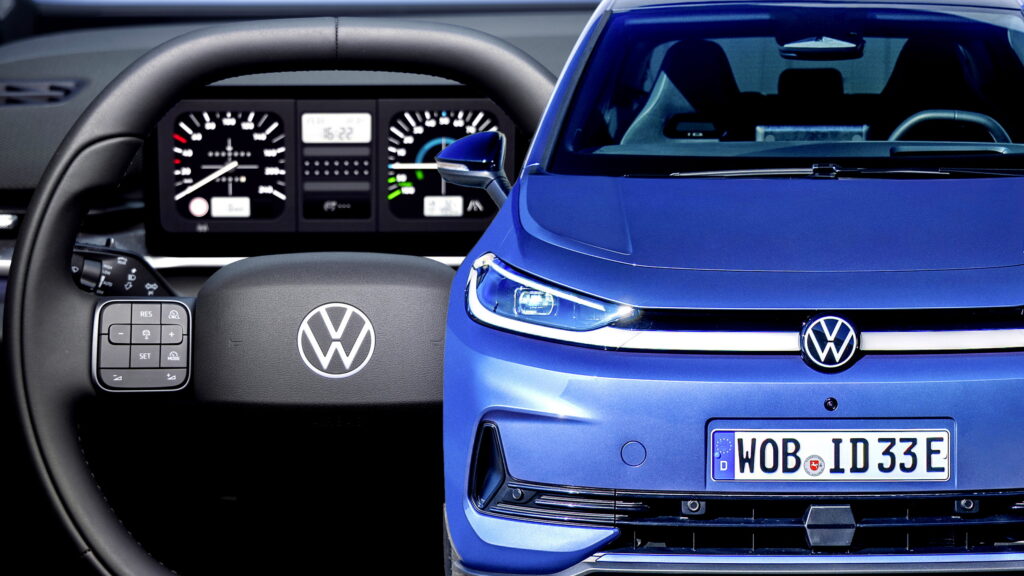
“It was clear to me that we were actually losing our core,” CEO Thomas Schäfer told journalists at the presentation of the heavily facelifted ID.3 Neo. The former Skoda chief, who bagged the top Wolfsburg job in 2022, says the brand had drifted from the VW people knew and loved.

Related: VW ID.4’s Death Could Lead To Birth Of An American Pickup

The problems were everywhere once you started looking. Styling that didn’t quite feel right, confusing touch controls, and a naming strategy that ditched familiar badges in favor of cold tech-speak. Turns out customers didn’t love slider controls for basic functions, and they definitely missed the clarity of names like Golf and Tiguan.

 VW’s ID. Lineup Looked Like The Future, Turns Out People Wanted The Past
The new ID. Polo’s interior.

Schäfer didn’t just tweak things around the edges. He gathered hundreds of managers, threw every issue on the table, and asked for brutal honesty. “We had to change ourselves, we had to create a new mindset,” Auto Express reports the CEO saying. He recalled how his wider team reacted with relief rather than resistance when he laid out the new plan.

Ask The Customer

Engineering boss Kai Grünitz says the reset goes deeper than pretty design. “We are doing customer clinics a lot,” he explained, signalling a shift away from gut feeling toward actual feedback. That means features get tested by real people before making production, not just approved in boardrooms because the CEO has decided he likes something and engineers don’t feel able to push back.

\\\\\\

Exterior styling is getting a rethink, too, following the Schäfer-assisted exodus of Klaus Bischoff, architect of the mostly bland first-generation ID. cars. New creative boss Andy Mindt, who came from Bentley, has pushed for simpler, more timeless shapes, plus interiors that don’t require a tutorial. Physical buttons are coming back, and even door handles are being reconsidered so they actually work when your hands are full.

“We sell emotions, we sell memories,” Grünitz said, summing up the new direction, which is really just about getting back to the old direction. If VW can pull that off again with the help of cars like the new ID. Polo (below), maybe the people’s car maker really can find its groove.

\\\\\\\\

You’d Have To Be High To Pay $159,420 For Tesla’s Signature Editions

  • Tesla ends Model S and X run with Signature Edition farewell specials.
  • Limited versions go to invited buyers only, each priced at $159,420.
  • They stand out with Garnet Red paint paired with gold accents.

Tesla is preparing to phase out the two EVs that defined its early success, but not without giving them one last push into the spotlight. Just days after reports emerged that remaining Model S and Model X inventory had been hit with $15,000 price hikes, there is a new sting for anyone who paid up. Both models are being sent off with a final, tightly capped Signature Edition, reserved for a small group of buyers who received email invites.

The Model S sedan and Model X SUV have been around since 2012 and 2015, respectively. After a final update in mid-2025, Tesla confirmed in January 2026 that both would leave production later this year, clearing space at the Fremont plant in California for humanoid robot assembly.

More: Tesla’s Replacing Half Its Lineup With Something That Doesn’t Even Have Wheels

While Tesla has not formally announced the send-off, the news surfaced on X through Ryan McCaffrey, host of the Ride the Lightning podcast. Invitations have already gone out, with a private launch event reportedly set for May.

\\\\\\

Tesla will build 250 units of the Model S and just 100 units of the Model X Signature Editions. Both are priced at $159,420. Yes, the last three digits are a wink to Musk’s well-known favorite number, a reference rooted in cannabis culture. And yes, it is a ridiculously steep jump, with premiums of $59,430 for the sedan and $54,430 for the SUV over the standard Plaid versions. For what is essentially a farewell package, that is serious money, even by Tesla standards.

Signature Edition Visual Identity

Both models wear an exclusive Garnet Red finish, inspired by the original Model S launch color. It is paired with gold emblems, giving the cars a celebratory tone. Inside, there is a white Alcantara interior, a yoke steering wheel, and Signature branding throughout.

 You’d Have To Be High To Pay $159,420 For Tesla’s Signature Editions

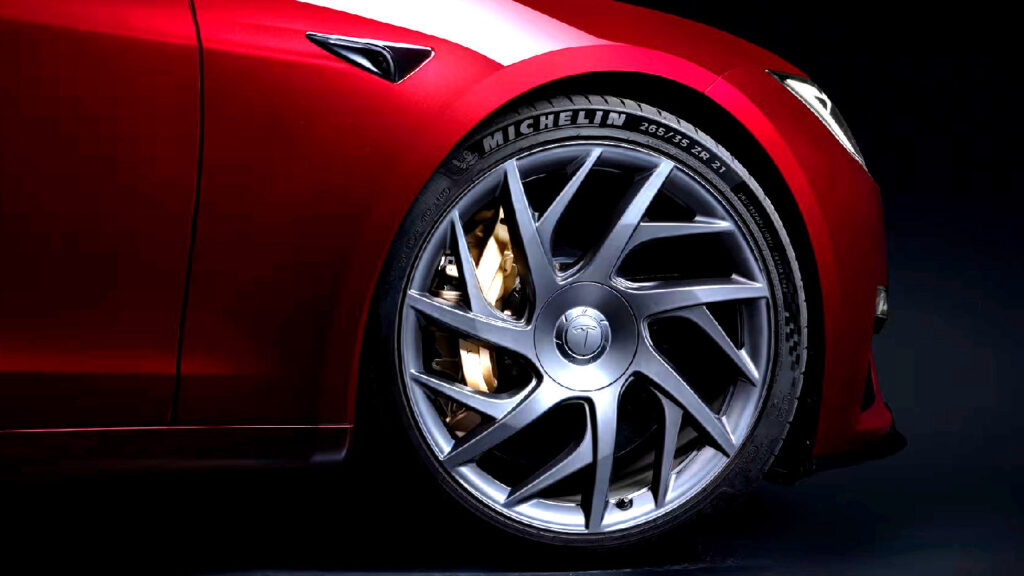
The Model S sits on 21-inch Velarium wheels with gold brake calipers over carbon ceramic brakes. The Model X gets 22-inch Machina wheels.

More: Tesla’s FSD Was Branded Controversial, But Dutch Safety Regulators Called It The Safest System In The Test

Tesla has also added a numbered plate on the dashboard, special key fobs, and Plaid puddle lights. Finally, the EVs come standard with a Luxe Package including free lifetime access to Tesla Superchargers and the Full Self-Driving (FSD) system.

Underneath, nothing changes mechanically. Both cars retain the tri-motor Plaid setup, delivering 1,020 hp (760 kW / 1,034 PS) and 1,420 Nm (1,047 lb-ft) of torque. Still absurdly quick, still more than enough, if you can stomach that $60K pill.

\\\\

Screenshots: Tesla via Teslarati

Renault’s Struggling Electric Crossover Is Getting A Second Chance

  • Renault has been caught testing a facelifted Megane E-Tech due next year.
  • New LED headlights and revised taillights are visible on the prototype.
  • The current model’s 60 kWh battery pack lags behind Renault’s own Scenic.

It’s been four years since Renault made the controversial decision to launch an electric SUV with the Megane nameplate. While the Megane E-Tech has failed to trouble the market’s most popular electric SUVs, Renault isn’t willing to throw in the towel just yet and is readying an update for it.

Pictured here for the first time is a facelifted version of the Megane E-Tech, expected to hit the market next year. Since the launch of the current model, Renault has introduced several other new SUVs, including the Symbioz and Scenic E-Tech, and tweaks to the Megane could make it look a little more like those models.

Read: Renault’s Compact EV Will Get A Refresh Following Its Nissan Cousin

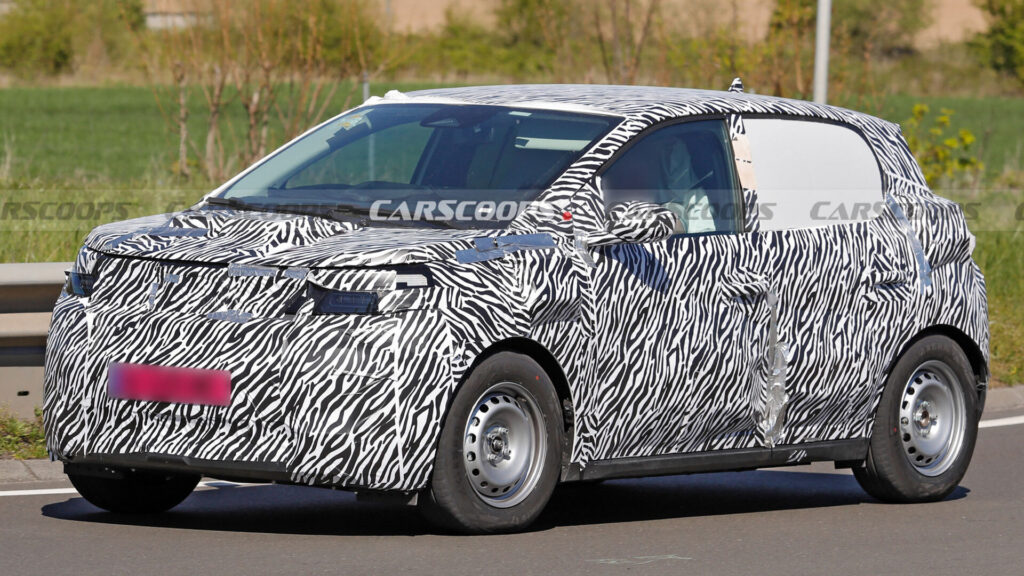
This heavily camouflaged prototype retains the same overall shape as the existing model, and we can clearly see some changes have been made to the headlights. While the shape of the main headlamps looks familiar, the LED daytime running lights are clearly different, even though we can only see small parts of them.

Updates have also been made to the rear of the Megane E-Tech with new LED taillights visible and what appears to be a tweaked bumper.

New Batteries?

\\\\\\

Baldauf

It’s unclear what changes will be made under the skin of the updated Megane E-Tech. Currently, the SUV is offered with 40 kWh and 60 kWh battery packs, both of which are quite small for a vehicle of this size. By comparison, the admittedly-bigger Scenic E-Tech offers a much larger 87 kWh pack, which is more in line with what we’d expect from an SUV like the Megane.

Like the Scenic, the Megane E-Tech is based on the company’s AmpR Medium architecture, also used by vehicles like the Nissan Ariya and Nissan Leaf, which offer 90 kWh and 75 kWh battery packs, respectively.

Given the shared platform, Renault might have the scope to increase the size of the Megane’s battery pack. Recent reports have suggested it could source new batteries from AESC and produced in France. This should help to boost the EV’s driving range, which currently tops out at 454 km (282 miles).

\\\\\\

Baldauf

Maserati’s Facelifted Grecale Is Shooting For Porsche’s Open Goal

  • Maserati is testing facelifted prototypes of its Grecale SUV.
  • Both ICE and Folgore EV versions of the Macan rival spotted.
  • New bumpers seen in photos but rear, interior look unchanged.

Maserati is having a rough old time, its sales sinking from 51,500 cars in 2017 to a pitiful 7,900 last year across all of its model lines. Porsche was down too, in 2025, but to 279,449 vehicles, and the Macan alone accounted for over 84,000 of them.

But now Porsche has goofed, giving Maserati a chance to boost its own performance with a refreshed version of its Grecale, the Italian firm’s Macan rival. Fresh spy shots show Maserati is working on updates for both the combustion and the Folgore electric variants of its smallest SUV that are likely to be MY27 cars.

Related: Porsche Sold More Cars In 11 Days Than Maserati Did The Entire Year

So what exactly is this open goal Porsche has gifted Maserati? It’s the end of combustion Macan production. The SUV is already off-sale in mainland Europe due to its failure to comply with European cybersecurity regulations, and though it’s still available in other markets for the time being, production ends this summer.

The Macan Electric EV, which Porsche conceived as taking over from the ICE version altogether, will still be available, but that’s not the one most buyers want. In the first quarter of this year Porsche sold 18,209 Macans of all powertrain types, but only 8,079 of them were EVs. The Stuttgart crew already knows it made a mistake killing off one of its most popular models, and has greenlit a new combustion Macan it never expected to make, but it’s going to be 2028 before its available.

Maserati Needs To Capitalize On Porsche’s Mistake

\\\\\\\\\

That presents Maserati – presuming parent company Stellantis doesn’t decide to cut its losses – with a small opportunity to pick up sales for the Grecale, which is still available in both ICE and EV form.

The camouflage on the nose of both the white combustion prototype and gray Folgore EV (above) suggests we can expect some very mild front-end changes, and it looks like the lower bumper shape has changed. We can’t see any tweaks to the headlights or anything at the undisguised rear, but we might see some mods on later prototypes as we closer to the launch.

 Maserati’s Facelifted Grecale Is Shooting For Porsche’s Open Goal

One shot showing the interior tells us Maserati hasn’t got any big updates planned for the dashboard, whose upper navigation screen and lower climate one are separated by a bank of transmission buttons. We’ve tried the current Grecale and came away impressed with the handling balance and quality, but less enamoured with the lack of physical switches, brake pedal feel and four-cylinder engine noise.

Grecale Already Updated For 2026

We don’t know yet what Maserati has planned under the hood of the facelifted cars, but we wouldn’t be surprised to see improvements to the Folgore’s 550 hp (558 PS / 410 kW) power output. The 275 mile (443 km) EPA range stats could also be bumped though they were already upped by 30 miles (48 km) for 2026 thanks to a new all-wheel drive disconnect function.

Also for 2026 Maserati junked the unloved 2.0-liter four-cylinder from entry-level and mid-spec US-market cars, replacing them with a version of the brand’s 3.0-liter twin-turbo Nettuno V6 making 385 hp (390 PS). The Trofeo halo model has a 523 hp (530 PS) take on the same powertrain.

The Macan’s absence isn’t going to dramatically change Maserati’s fortunes, but if the brand really is to survive it needs to leverage the hell out of the advantage Porsche has given it.

\\\\\\\\\

SH Proshots

This Chinese SUV Is Like A Cut-Price Xiaomi YU7, Except For What’s Under The Hood

  • The Nevo Q06 will be sold as an EV and as a range extender.
  • Changan’s EREV version will use a 1.5-liter four-cylinder with 97 hp.
  • Sleek headlights and taillights help the new SUV catch the eye.

China’s EV scene isn’t short on low, sleek SUVs, and here’s another one sliding into the mix. Called the Changan Nevo Q06, it lands in roughly the same size and shape territory as the Xiaomi SU7, though this one looks set to come in at a lower price point, with less emphasis on outright performance.

Images published by China’s Ministry of Industry and Information Technology (MIIT) show the SUV shares obvious design similarities to the Nevo A06 sedan. With that in mind, it has a pair of split headlights with a full-width light bar, in addition to a black lower grille section and black air intakes.

Read: The Funky Changan Qiyuan E07 Is Part SUV, Part Truck, And All Electric

Changan has also equipped it with gloss black wheel arches, a roof-mounted LiDAR, and door handles sitting flush with the bodywork. The side profile looks particularly sleek, especially thanks to the flowing shoulder line and bulging rear quarter panels. Found at the rear is a light bar and a color-matched diffuser.

Early details also reveal the Nevo Q06 will come with 14 different wheel designs, a two-tone rear spoiler, optional privacy glass, and a panoramic glass door. The SUV is 4,837 mm (190.4 inches) long, 1,970 mm (77.5 inches) wide, and stands 1,670 mm (65.7 inches) tall with a 2,940 mm (115.7-inch) wheelbase.

A Powertrain For Everyone

\\\\

Unlike the YU7, which is sold exclusively as an EV, the Nevo Q06 will offer all-electric and range-extender powertrains. Two rear-driven electric models will be available, delivering 282 hp and 302 hp, respectively. Those seeking additional power can opt for a 444 hp dual-motor model that raises the top speed from 200 km/h (124 mph) to 230 km/h (143 mph).

There’s no word on the capacity of the available battery packs, but we know they will be LFP batteries sourced through Changan’s partnership with CATL.

Changan will also sell the Nevo Q06 as a range extender. This model will use a 1.5-liter naturally aspirated four-cylinder engine producing 97 hp, already used by several Deepal models, alongside a pair of electric motors at the rear axle. Details of the battery aren’t known, but it may get an innovative sodium-ion pack like the A06 sedan.

\\\\\

Tesla’s FSD Was Branded Controversial, But Dutch Safety Regulators Called It The Safest System In The Test

  • Owners in the Netherlands will soon be able to use Tesla’s FSD system.
  • The Dutch safety agency will now submit FSD for EU-wide approval.
  • Tesla’s FSD system was found to outperform other driver assistance systems.

Tesla’s controversial Full Self-Driving system has received the green light for use in the Netherlands, and this could just be the start of its expansion across Europe. The decision comes after more than 18 months of tests and analysis by the RDW, the Dutch vehicle authority.

The most recent version of Tesla’s supervised FSD system “makes a positive contribution to road safety,” the RDW said. Now that it has the agency’s approval, Tesla says it will soon start rolling out the technology across the Netherlands, allowing owners to experience hands-free driving in both urban and highway settings.

Read: Feds Expand Tesla FSD Investigation After Visibility Failures

Even more important than the system’s approval for use in the Netherlands is that the RDW’s approval means it can be introduced across all European Union member states at a later date.

Before this happens, however, RDW must submit the application for authentication across the entire region, and all member states must vote on it. A majority vote is needed for the system to be approved EU-wide, and even if a majority is not achieved, individual countries can still decide to approve the system, Reuters notes.

Tackling The Country’s Most Difficult Roads

Smooth https://t.co/zJdymUNkcm

— Elon Musk (@elonmusk) April 12, 2026

Since the approval, Tesla has flooded its X account with videos of the FSD Supervised system being tested in the Netherlands. Importantly, the RDW noted that “a vehicle with FSD Supervised is not self-driving,” pointing out that “the driver remains responsible and must always maintain control.”

“The Tesla driver assistance system supports the driver more than other systems because it takes over multiple driving tasks when it is switched on,” the agency said in a statement. It added that “due to the continuous strict monitoring of the driver in the vehicle, the system is safer than other driver assistance systems,” noting it was tested both on test tracks and on public roads.

If a driver is consistently found to be not fully alert while behind the wheel, the system will trigger various signals to catch their attention. In extreme cases, the system can shut down and temporarily be prevented from switching back on.

Passed the 🇳🇱 wife test @aelluswamy ! pic.twitter.com/zpZqTR1DkD

— Sander Smit (@Sandersmit83) April 12, 2026

Ford’s New Electric Van Looks Exactly Like An Undercover Cop Car

  • Ford has morphed the Explorer EV into a commercial vehicle in Europe.
  • A fixed bulkhead has been added behind the front seats to boost space.
  • The Explorer Van is equipped with black steelies sporting yellow lug nuts.

This may look just like a base-level Ford Explorer EV, but thanks to some modifications, the all-electric SUV is now considered a commercial vehicle in Europe and has been rebadged the Explorer Van. While it may look like an undercover police car in America, it’s designed to carry things around, just like a Transit, albeit on a much smaller scale.

What starts out as a regular Explorer EV has been modified by Ford Pro’s Dagenham Conversion Centre in the UK and has been equipped with a permanent bulkhead behind the front seats, meaning it’s now considered a commercial vehicle rather than a passenger car. This offers purchasers important tax advantages and could prove popular among fleet buyers.

Read: Ford’s Electric Explorer Fixes Two Of Its Biggest Early Weaknesses

\\\\

Beyond the inclusion of a new bulkhead, the Ford Explorer Van features a flat floor to maximize storage capacity, with several hooks and adjustable dividers. Those seeking even more practicality can order the EV with a Utility Pack, adding frunk storage, a roof rack, seat covers, and rear window mesh.

Ford also offers the stripped-down Explorer Van with a Commercial Pack that includes an amber lightbar, a tailgate work camp, and tailgate beacons, as well as a Welfare Pack with a fire aid kit and an eye washing and hand sanitizer station.

\\\

Without a doubt, the most intriguing element of the EV is the simple, blacked-out steel wheels with bright yellow lug nuts. Add some blue and red lights and upgraded bumpers, and you’d have the perfect undercover SUV.

Two different powertrains are on offer. The base model is equipped with a rear-mounted electric motor delivering 282 hp and capable of towing up to 2,204 lbs (1,000 kg). An all-wheel drive version is also offered, complete with 335 hp and an improved 2,645 lbs (1,200 kg) towing rating. The rear-motor version can drive up to 374 miles (602 km) on a single charge, but no range figure has been announced for the dual-motor version just yet.

\\\\\\
❌