Tesla is offering special financing on the Model Y Standard.
Buyers need a 720+ credit score to qualify for the top deal.
The stripped-down Model Y starts at a base price of $39,990.
As the end of the year draws closer, Tesla has rolled out a set of last-minute offers designed to nudge buyers off the fence, something we’ve come to expect from the automaker in the final stretch of the calendar.
Arguably the most notable of these is a new financing deal for the entry-level Model Y Standard, now available with 0 percent APR on a 72-month term. That’s six years of interest-free payments, for anyone keeping count.
The back-to-basics Model Y Standard was introduced a couple of months ago and prices start at $39,990 before destination and taxes. It’s based on the regular Model Y, but lacks many of its key selling points, including the panoramic glass roof and the front light bar. It also has a simpler interior.
Evidently, Tesla was eager to save as much money as possible when designing the car.
Zero Percent, But Not for All
When first launched, the Model Y Standard wasn’t included in Tesla’s promotional financing, but things have changed. It’s now available at 0 percent APR. However, this financing deal is only available if you’re willing to put down at least $2,069 at signing.
Additionally, you’ll need an excellent credit rating of 720 or above to get the deal. If your credit rating is between 680 and 720, the APR rises to 0.99 percent, or 1.99 percent with a 640-679 credit rating, and 2.99 percent with a sub-640 credit rating.
Tesla is offering the 0 percent financing deal for its 36-, 48-, 60-, and 72-month terms, but not its longest 84-month term.
Extras On the House
But wait, there’s more. Tesla is also tossing in a few extra incentives for EV buyers choosing from existing inventory. Depending on the car, some models are now being offered with one complimentary upgrade. A quick scroll through Tesla’s site shows examples with larger wheels, premium paint finishes, or the optional white interior included at no additional cost.
Whether this last-minute round of offers will give Tesla the year-end bump it’s chasing remains to be seen.
Fiat confirmed the Topolino is coming to the United States.
It will apparently arrive next year and slot beneath the 500e.
Euro version makes 8 hp and tops out at 28 miles per hour.
Stellantis dealers are struggling to sell the Fiat 500X years after its demise, but they’re getting some much needed relief as the Italian brand has announced the Topolino is coming to the USA.
Technically, you could fit a couple of them in the same space as a single 500X, so inventory headaches might be minimal. But sarcasm aside, Fiat really has announced it’s bringing the bite-sized model to the States.
The company will share more details next year, but the Topolino is a small two-seat electric vehicle that has a front-mounted motor developing 8 hp (6 kW / 8 PS) and 32 lb-ft (44 Nm) of torque. It’s powered by a 5.4 kWh battery pack, which provides a range of 46 miles (75 km) under the World Motorcycle Test Cycle.
The European model has a top speed of 28 mph (45 km/h) and it can accelerate to that number in ten seconds flat. This would make it ideal for use in neighborhoods, where golf carts have exploded in popularity.
We’ll learn more about the US-spec model in the coming months, but the European Topolino rides on 14-inch wheels. The ultra-compact EV is also sold in Europe as the Citroen Ami and Opel Rocks, though those variants won’t be making their way here. Unless Dodge or Jeep get any weird ideas.
If you thought Japan’s Kei cars were small, just wait until Fiat’s Topolino starts showing up on American roads. The tiny two-seater measures 99.8 inches (2,535 mm) long with a wheelbase that spans 68.1 inches (1,730 mm).
That’s 43.1 inches (1,096 mm) shorter than the slow-selling 500e, which starts at $30,500 before a hefty $1,995 destination fee. Just imagine this thing next to an Escalade or an F-150.
Fiat Unveils Topolino Art Car
The announcement was accompanied by the unveiling of an art car at Miami Art Week. The one-off model was created in collaboration with Romero Britto, who is known for his “vibrant, colorful style that blends elements of cubism, pop art and graffiti.”
Dubbed the Brittolino, the model features a colorful exterior with multiple sections that each has its own unique design. We can also see a contrasting blue roof and doors that have been replaced by ropes. They’re joined by Britto-branded wheels and silver bumpers.
Fiat CEO Olivier Francois said the Topolino “is now everywhere in Europe” and has made several appearances in the United States over the past year, where it has generated “tremendous excitement among consumers.” He added it has been such a hit that “I’m happy to share that we’ll be bringing the Fiat Topolino to the US.”
VW increased ID Buzz incentives, offering up to $10,000 off.
Many dealers list new ID Buzz Pro S models well below MSRP.
Some Colorado stores advertise ID Buzz units in the $30,000s.
2,469 cars. That’s the number of ID. Buzz EVs Volkswagen moved in the first nine months of the year, a figure that makes it the weakest seller in its American lineup, unless you separate out the Golf R and Golf GTI, which, realistically, you shouldn’t.
Given that, it’s no real surprise that VW dealers continue to sweeten the pot on the electric van as the year winds down and they look to clear inventory ahead of the new model year.
What’s VW Offering Now?
If you’ve had your eye on the ID.Buzz, now might be the time to move. Just before the end of November, VW bumped up its Retail Customer Bonus on the ID. Buzz from $2,500 to a way more generous $7,500. While the promotion was introduced as part of Black Friday, it’s sticking around well into January. And that’s not the only offer on the table either.
The ID. Buzz is also eligible for a separate $2,500 Dealer Bonus. That brings potential savings to $10,000, at least in theory. As noted by Cars Direct, the dealer incentive isn’t guaranteed to make it into the buyer’s column. Dealers are within their rights to retain the $2,500 themselves.
So if you’re serious about landing a deal, expect to negotiate. Whether or not that bonus is passed along may come down to how convincingly you make your case.
Both bonuses appear to apply across all trims. The ID. Buzz starts at $59,995 for the Pro S variant, not including the $1,550 destination and delivery fee. Subtract the incentives, and the starting figure can dip to $51,545.
It’s Worth Shopping Around
That’s a solid cut, but as we discovered on Autotrader ourselves, shop around and you’ll find even more aggressive pricing. Several VW dealerships across the country are listing base ID. Buzz Pro S models well under MSRP.
For example, Tynan’s Volkswagen in Aurora, Colorado, has three 2025 Pro S models in its inventory, all with asking prices of just $36,695, a massive $25,500 off the $62,195 stickler. All three have 15 miles or fewer on their odometers.
These aren’t the only cheap ID.Buzz Pro S models available. Karen Radley Volkswagen in Woodbridge, Virginia, has two listed for sale through Autotrader, both available for $45,195 and with a total of zero miles on the clock, for a substantial $17,000 discount from the original $62,195 MSRP.
There are dozens of other Pro S models available across the US for less than $48,000, so if you’re hunting for a deal, there are plenty of good options.
Nissan NX8 debuted in China ahead of its 2026 market launch.
Electric and hybrid versions are powered by CATL battery tech.
The electric NX8 makes up to 335 hp from a single electric motor.
Nissan has introduced a new midsize SUV developed in partnership with Dongfeng in China, marking the latest addition to its growing, budget-conscious N-series lineup. Named the NX8, the model joins the existing N6 and N7 sedans and will be offered with a selection of electrified powertrains.
The SUV’s exterior design follows the same styling language as its sedan counterparts, with clean surfacing and a grille-free front fascia. A full-width daytime running light runs across the split headlights and wraps around the front fenders, while OLED tail lights extend across the rear.
The overall shape leans toward conventional SUV proportions, marked by flush-fitting door handles and pronounced shoulders.
How Big Is It?
The NX8 measures 4,870 mm (191.7 inches) in length, 1,920 mm (75.6 inches) in width, and 1,680 mm (66.1 inches) in height, with a wheelbase of 2,917 mm (114.8 inches).
That makes it 222 mm (8.7 inches) longer than the Rogue (X-Trail) and 152 mm (6 inches) shorter than the Pathfinder. Interestingly, its wheelbase is 17 mm (0.7 inches) longer than the Pathfinder’s, which should translate to slightly better interior space.
Images reveal a suite of sensors along with a roof-mounted lidar unit, hinting at advanced driver assistance tech. Nissan hasn’t revealed the interior yet, but it’s expected to mirror the cabin layout of the N6 and N7, likely featuring a prominent touchscreen and soft-touch materials throughout. The company says the NX8 will offer a spacious five-seat configuration.
What Powers It?
Nissan has confirmed the NX8 will be classified as a NEV (New Energy Vehicle), with specifications recently published by China’s Ministry of Industry and Information Technology.
The fully electric variants will be available with either a single motor producing 288 hp (215 kW / 292 PS) or a more powerful version at 335 hp (250 kW / 340 PS).
A plug-in hybrid or range-extender version will also be offered, pairing a 1.5-liter turbocharged engine making 146 hp (109 kW / 148 PS) with an electric motor rated at 262 hp (195 kW / 265 PS).
All variants will use the latest lithium iron phosphate battery packs supplied by CATL. While range figures and battery capacities have not yet been disclosed, the packs are said to support ultra-fast charging.
The market launch of the Nissan NX8 in China is scheduled for the first half of 2026 with pricing set to be announced closer to that date. As with the N6 and N7 sedans, the SUV will reportedly be exported to other markets in the near future.
When and Where Can You Buy One?
Nissan plans to launch the NX8 in China during the first half of 2026, with pricing to be confirmed closer to its market debut. As with the N6 and N7 sedans, the NX8 is expected to be exported to additional markets after its initial rollout. Whether that will include Western regions like Europe and Australia, however, remains to be seen.
As for pricing, we’ll have to wait for official figures, but if the N6 and N7 are any indication, it’s likely to stay within a very competitive range. The N7, for example, is priced between 119,900 and 149,900 yuan, or roughly $17,000 to $21,200 at current exchange rates.
Mercedes GLB replaces EQB and launches with electric-only options.
85 kWh battery enables 392 miles in single-motor, 382 in dual-motor.
Next year, an entry-level EV will be introduced, as will several hybrids.
A new generation of the Mercedes-Benz GLB has arrived, and while the silhouette remains true to the blocky, upright form of the original, there’s quite a bit going on beneath the surface.
Offered in both 5- and 7-seat configurations, the 2026 GLB debuts as an all-electric model and, for now, serves as a replacement for the EQB in everything but name. Hybrid versions will follow later, but the first wave is electric-only.
Two versions of the new generation GLB are launching out of the gate. The first, labeled GLB 250+ with EQ Technology, features an 85 kWh lithium-ion battery and adopts an 800-volt electric architecture.
It powers a single rear-mounted motor rated at 268 hp and 247 lb-ft of continuous torque, with a short-term boost up to 335 lb-ft. Acceleration from 0–62 mph (100 km/h) takes 7.4 seconds, and range is quoted at 392 miles (630 km) on a full charge, olid figures for a compact SUV in this category.
Sitting above the 250+ is the 350 4Matic with EQ Technology. The name might not stick in your memory, but the numbers probably will. This dual-motor variant adds a front axle motor for all-wheel drive, producing a combined 349 hp and 380 lb-ft of torque.
Range takes a slight dip to 382 miles (615 km), but the extra grunt cuts the 0–62 mph time down to 5.5 seconds.
Mercedes has also confirmed a more affordable electric entry-level version will join the lineup next year, followed by a hybrid variant using 48-volt architecture. Three power levels will be available across front- and all-wheel drive formats.
Starry Eyed
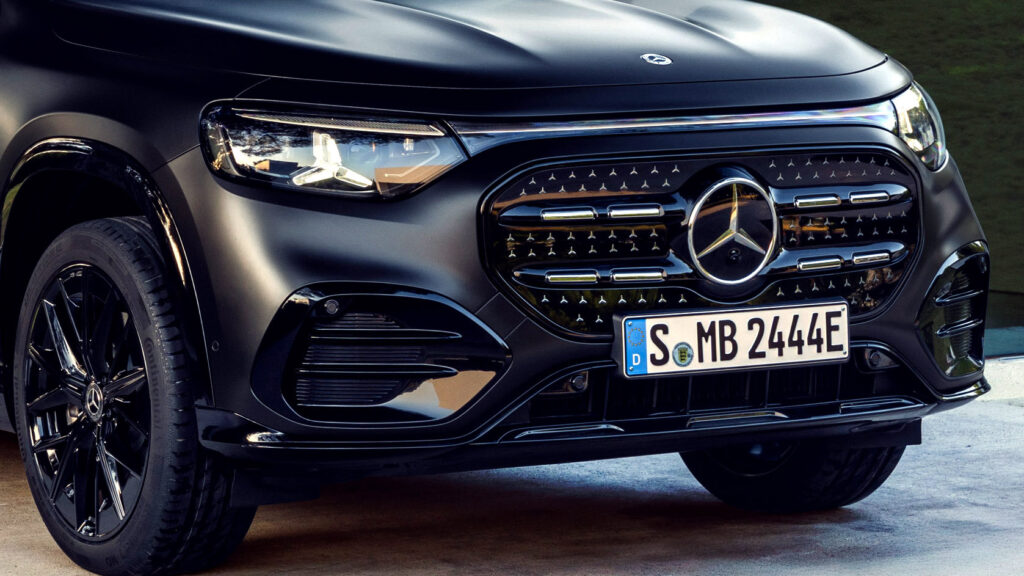
Like other new-generation Mercedes models (think CLA and GLC EQ), the GLB adopts a more expressive front end. A large grille dominates the nose, flanked by redesigned headlights with intricate star-shaped DRLs and a full-width light bar. It’s not a particularly handsome looking SUV, but neither is the outgoing model.
The rear-end is perhaps the most controversial angle of the 2026 GLB. The taillight treatment leans into the styling language seen on the brand’s EQXX Concept from a few years back, with vertically oriented clusters connected by a slim light bar. The signature star pattern makes another appearance here.
How Much Bigger Is It?
The new electric GLB has grown in nearly every direction compared to both the previous EQB and the combustion-powered GLB it effectively replaces in this segment. At 4,732 mm (186.3 inches) in length, it’s 48 mm (1.9 inches) longer than the EQB and a full 98 mm (3.9 inches) longer than the earlier GLB. Width is up as well, now measuring 1,861 mm (73.3 inches), 27 mm (1.1 inches) wider than both predecessors.
Interestingly, height has gone the other way, dropping slightly to 1,687 mm (66.4 inches), which makes it 14 mm (0.6 inches) lower than the previous models.
The wheelbase sees the most notable stretch, now sitting at 2,889 mm (113.7 inches), a 60 mm (2.4 inches) increase over earlier versions. That extra length between the axles should improve interior space, particularly in the second row.
One small trade-off comes in maneuverability: the turning circle has grown marginally, from 11.7 m (38.4 feet) in the old GLB to 11.9 m (39.0 feet) in the new electric version. Boot capacity is also up, with 667 liters (23.6 cubic feet) available in the rear and 127 liters at the front (frunk).
An All-New Cabin
A big step into the future has also been made with the GLB’s interior. Like the CLA, it can be optioned with the Mercedes Superscreen, consisting of a 10.25-inch driver display, a 14-inch infotainment screen, and a 14-inch display for the passenger.
As with other new Mercedes-Benz interiors, the dash of the GLB is almost completely flat, largely free of any interesting design details.
It runs on the fourth-generation MBUX system that includes Microsoft and Google artificial intelligence. The screen runs on the Unity Game Engine and includes the MBUX Virtual Assistant, based on ChatGPT4o. Clearly, Mercedes was eager to make the GLB as tech-focused as possible.
At this point, pricing is confirmed only for Germany. The GLB 250+ with EQ Technology starts at €59,048 ($68,700), while the 350 4Matic comes in at €62,178 ($72,400). US pricing hasn’t been announced yet, but expect a similar spread when it arrives in other markets next year.
LFA Concept shares its aluminum chassis with Toyota’s new GR GT.
The concept skips Toyota’s twin turbo V8, even though it could fit.
Styling evolves the earlier Sport Concept with clear refinements.
This is the Lexus LFA Concept, and it’s quite unlike the V10-powered weapon that preceded it. For years, enthusiasts assumed the next LFA would be little more than a Lexus-badged take on Toyota’s new GR GT. Instead, what’s emerged is something very different. It’s electric. Yes, really.
The concept made its debut in Japan this evening alongside the twin-turbo V8 Toyota and was first teased months ago under the name Lexus Sport Concept. That early study has now morphed into the more production-ready LFA Concept, carrying a fully electric powertrain.
According to Lexus, the ‘LFA’ name is “not bound to vehicles powered by internal combustion engines,” but instead symbolizes a vehicle that “embodies the technologies that engineers of its time should preserve and pass on to the next generation.”
Toyota Underpinnings
While Toyota has already shared a trove of details about its new halo performance car, Lexus is staying quiet on the finer points of its electric sibling. The company has yet to release any figures for the LFA Concept’s powertrain, leaving its performance potential open to speculation.
Whatever its output, it’s safe to say no amount of kilowatts will replicate the unmistakable howl of the original LFA’s V10, or even the sound of the Toyota’s new V8.
Interestingly, the LFA Concept is based on the same all-aluminum platform as the Toyota GR GT and GR GT3. That presumably means Lexus had the option of using the same V8 as its parent company, but opted against it.
While the choice of powertrain seems odd, particularly given poor demand for high-performance electric sports and super cars, there’s no denying the LFA Concept looks beautiful, which isn’t a word we’d use for the Toyota. The interior is also wildly different than the Toyota, although this isn’t a surprise given the LFA is still a concept.
When Will it Launch?
What does the future hold for the LFA Concept? We know it’s headed for production, and the renaming of the Sport Concept to the LFA Concept suggests it will indeed be sold as the second-generation Lexus LFA.
When it will reach public roads remains uncertain, but if we had to place a bet, it’s likely to arrive around the same time, or perhaps a little later, than the Toyota GR GT, which is expected in 2027.
Borealis purple debuts as a $3,000 option for R1S and R1T buyers.
Rivian has also announced a special Lease Bonus for both models.
Some R1S and R1T trims qualify for lower monthly payments now.
It seems to be that time of year for Rivian again. Fresh off unveiling its limited-run Miami Edition, the company has decided it’s time for a new splash of color, one that might actually be its best yet. Called Borealis, it’s a deep, moody shade of purple inspired by the Northern Lights, offered on the Tri and Quad variants of the brand’s EVs.
Purple tones aren’t as popular as some other colors in the car industry, but when done right, they can look superb. We’ll reserve full judgment on Borealis until we see it under natural light, but based on early images, it flatters the R1S slightly more than the R1T, whose pickup shape doesn’t highlight the color in quite the same way.
Like every Rivian finish beyond the standard LA Silver, Borealis comes at a premium, $3,000, to be exact. That puts it in line with other paid options such as Red Canyon, Rivian Blue, and Storm Blue.
The company hasn’t confirmed whether Borealis will filter down to the more affordable Dual Standard and Dual trims, though it’s easy to imagine that decision hinging on how buyers respond to the initial rollout.
Rivian’s new purple looks especially nice when accented against its available 20- and 22-inch burnished bronze wheels. Paired with a set of bright blue brake calipers, shoppers can get a Rivian that really stands out.
A New Lease Deal
The addition of a new color isn’t the only thing that prospective Rivian owners can get excited about. The company has announced that several 2026 R1T and R1S models are eligible for a $5,000 Lease Bonus if customers take delivery by December 31.
Models eligible for the deal include the 2026 R1S and R1T Tri, R1S and R1T Dual Standard, and both the R1S and R1T Dual with the Large battery and Performance Upgrade. Importantly, Rivian notes this deal is only available while supplies last.
Even with that bonus, leasing an R1T or R1S remains a costly proposition. For example, the R1T Dual Standard, priced at $72,990, still comes to $709 per month over 36 months, with $8,604 due at signing, an effective monthly rate of $948 before adding the $1,895 destination fee and state taxes.
For those willing to sacrifice a little cargo space for a lower payment, the R1S Dual Standard presents a slightly better deal. Its lease terms come in at $699 per month with $3,594 due at signing, translating to an effective monthly rate of $798, plus destination.
Rivian is putting its Miami-inspired R1S one-off into limited production.
Only 10 examples of the R1S Quad Miami Edition will be available.
At $134,990 the Miami is $13k more than a regular quad-motor R1S.
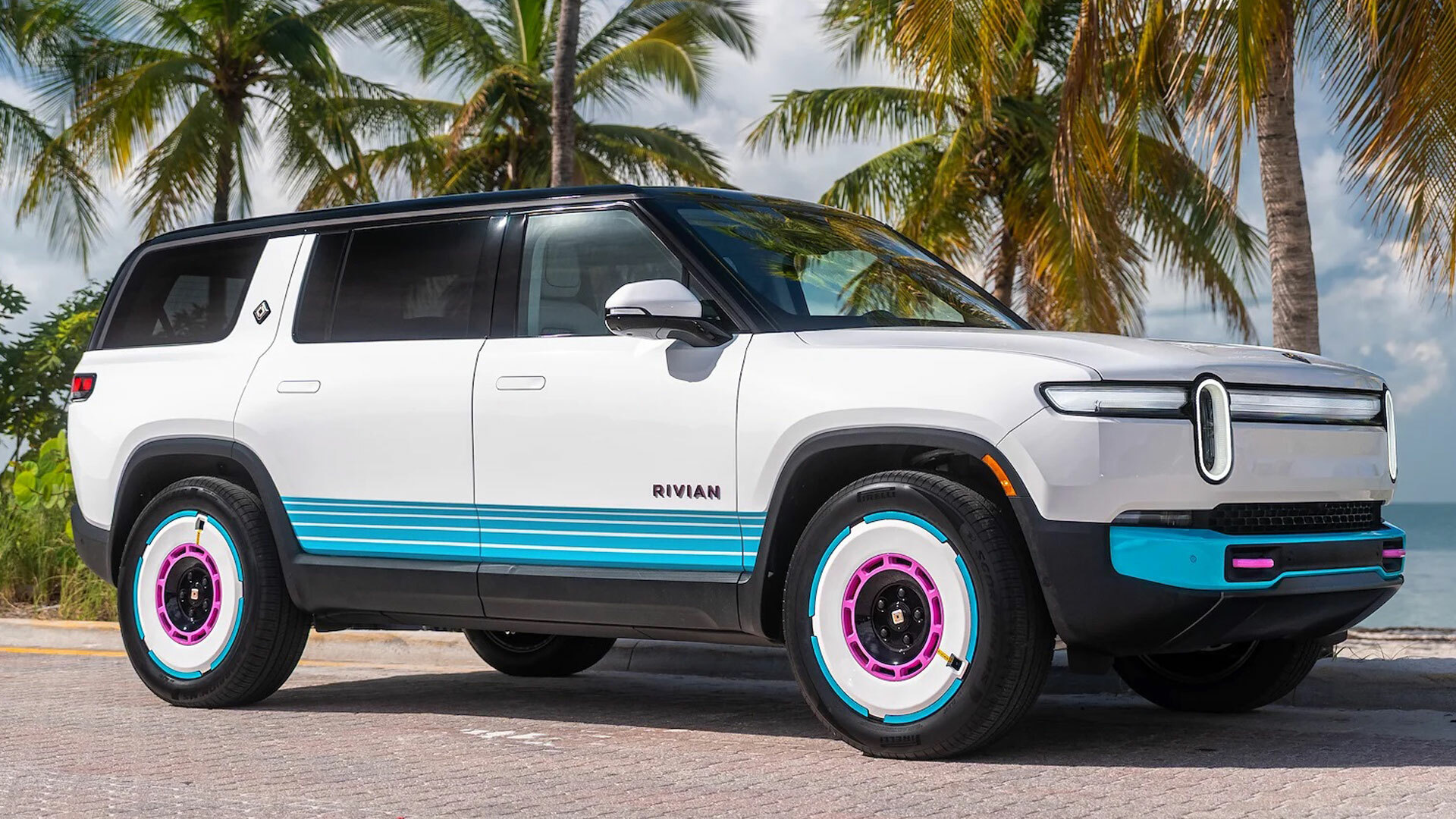
Cast your mind back to September and you might recall Rivian’s designers having a bit of fun with an R1S to celebrate the opening of a new store in South Florida. The automaker created a one-off concept SUV with a 1980s Miami-inspired paint scheme that made it look like the EV had jumped right out of Grand Theft Auto: Vice City.
But that tropical fantasy is no longer a one-off. Rivian has confirmed it will build a limited run of purchasable replicas. Naturally, there’s a cost attached to owning one of these beach-party specials.
What Makes it Special?
Called the R1S Quad Miami Edition, the colorful SUV is, as the name suggests, based on the top-spec, Corvette-scaring quad motor R1S, whereas the original concept was built around a three Motor R1S Tri model. But there are no changes to the life’s-a-beach visuals that you’ll either love or hate.
Only 10 examples will be built, each featuring the same Glacier White body accented by splashes of aqua and pink on the doors, 22-inch Miami Edition wheels and front bumper. While the doors stick to aqua blue stripes, the wheels get both colors, as does the nose, where a pink towing eye pokes from a blue bumper.
Even the interior doesn’t escape the Miami makeover, though if we’re honest we think Rivian seemed to lose interest once it got to the cabin. The sole flourishes appear to be a stripe of pink on the headrest and some floormats that look like they’re made from the same material as straw beach mats (hopefully they’re more substantial).
Having four electric motors rather than three means the Miami Edition gets 1,025 hp (1,039 PS / 764 kW) instead of 850 hp (862 PS / 634 kW), dropping the zero to 60 mph (97 kmh) time from 2.9 to 2.6 seconds. Not that you’d get much opportunity to feel the difference when you’re cruising South Beach.
The Price of Standing Out
But the fun graphics will definitely turn more heads than any stock R1S Tri or Quad, and you’d hope they do given the pricing markup.
Rivian is asking $134,990 for the Miami Edition, which is $13,000 more than you’d pay for a regular R1S Quad. It’s only building 10, so it’ll probably have no trouble selling them, but do you think it’s a good deal?
Malaysia’s first locally developed EV starts from $19,400.
Buyers must lease the 52.5-kWh battery for nine years.
Electric motor makes 201 hp with 277 miles of range.
Malaysian automaker Perodua has taken its first serious step into electrification with the launch of the QV-E, short for Quest for Visionary Electric Vehicle.
This subcompact crossover marks the brand’s first zero-emission model and comes with a subscription-based battery plan that trims the headline price, though it’s a hollow saving since you can’t drive an electric car without the very component you’re leasing.
The QV-E also holds a unique distinction as Malaysia’s first domestically developed electric car. Rival Proton’s e.MAS 7 SUV and e.MAS 5 hatchback are rebadged versions of Geely models, while Perodua has invested heavily in building something original. Development began in 2023, with research and engineering work totaling 800 million ringgit (around $194 million).
Everything started with a scale model of the EMO (Electric Motion Online) concept in May 2023, followed by the EMO-I hatchback mule a year later and the EMO-II crossover concept that surfaced in December 2024. By May 2025, the design had matured into a running prototype, giving the public its first clear look at what would eventually become the production QV-E.
Compact Footprint, Coupe-SUV Looks
Perodua
At 4,170 mm (164.2 inches) long and sitting on a 2,680 mm (105.5-inch) wheelbase, the QV-E blends compact dimensions with a sport-leaning stance. Its front end features sharp split LED headlights, a contoured hood, and muscular fenders.
The silhouette bears some resemblance to the previous-generation Toyota C-HR and the current Nissan Juke, particularly around the windowline. The front door handles are flush with the bodywork, while the rear ones are hidden on the C-pillars.
Moving to the rear, the sloping roof meets a full-width light bar and integrated diffuser. The crossover rolls on 18-inch alloy wheels and comes in only two shades for now: Ice Blue and Caviar Gray.
Plain Interior
Inside, the dashboard plays it safe, leaning more toward functional than inspiring. A pair of 10.25-inch screens, one for infotainment, the other for instruments, cover the basics without breaking new ground.
The floating center console, ambient lighting, and aluminum-look trim do their best to lift the mood, though the overall impression still feels more cost-conscious than cutting-edge. Safety is well covered with six airbags and a full ADAS suite.
A Single Powertrain Option
The Perodua QV-E sits on a modular platform developed with assistance from Magna Steyr. Power comes from a single electric motor rated at 201 hp (150 kW / 204 PS) and 285 Nm (210 lb-ft) of torque, driving the front wheels for a 0–100 km/h (0–62 mph) time of 7.5 seconds.
The lithium iron phosphate battery, supplied by China’s CATL, has a capacity of 52.5 kWh and claims up to 445 km (276 miles) of range under the optimistic NEDC cycle. The catch, of course, is that this essential piece of hardware isn’t actually included in the car’s price.
Buy The Car, Lease The Battery
The Perodua QV-E starts from 80,000 ringgit (equal to $19,400 at current exchange rates), but owners will have to pay an additional 275 ringgit ($67) per month for the battery as part of a nine-year lease contract.
Perodua CEO Zainal Abidin Ahmad says the Battery-as-a-Service (BaaS) model ensures “a lifetime guarantee on the battery for our customers’ peace of mind,” calling it a way to reduce ownership anxiety often tied to electric vehicles.
Production is set to take place locally in Malaysia, starting with 500 units per month before ramping up to 3,000 by the third quarter of 2026. Bloomberg reports that Perodua aims for 50 percent local parts content by early 2026, rising to 70 percent by 2030.
Electric vehicle adoption in Malaysia continues to gather pace, with the government targeting EVs to make up 15 percent of new car sales by the end of the decade.
The Rivian R1T Quad Motor Max Pack hits 60 mph in 2.6 seconds.
It is faster than a Cybertruck, Raptor R, and Porsche 911 GT3 RS.
This is a 7,000-lb truck that embarrasses sports cars on the strip.
It’s been clear for years that electric vehicles aren’t just efficient, they’re mind-blowing fast. Now, Rivian is proving it all over again with a truck that weighs over 7,000 pounds (3,175 kg) once the driver jumps in.
Results from a fresh independent test make it hard to argue otherwise: the R1T Quad Motor Max Pack is astonishingly fast. So fast, in fact, that it can line up against the 655 hp Corvette E-Ray hybrid in a drag race and come away even. Just think about that for a second.
How Fast Is It Really?
The folks over at Car and Driver just managed to sprint from 0-60 mph (97 km/h) in the R1T in just 2.6 seconds. That’s the exact same time that the Tesla Cybertruck managed, but past 60 mph, the Rivian leaves the angular Tesla for dead.
By 70 mph (113 km/h), the R1T is already ahead of the Cybertruck, and by 100 mph (161 km/h), it’s 0.9 seconds out in front. When the Rivian crosses the quarter mile, the Tesla is still 0.6 seconds behind despite weighing less.
In the end, the Rivian covers the standard quarter mile in just 10.6 seconds, crossing the line at 128 mph (206 km/h). Yes, that’s a ten-second truck, and it’s as wild as it sounds. That figure represents a huge leap forward, at a full 1.1-second and 17-mph improvement over the previous-generation quad-motor version.
The fact that the automotive world now produces something like this shows just how far things have come since the Fast and Furious era first imagined it.
This level of performance comes from a massive 1,025 horsepower (764 kW) and 1,198 lb-ft (1,625 Nm) of torque. By comparison, America’s everyday supercar in hybrid form, the Corvette E-Ray, pairs a 6.2-liter V8 with an electric motor for a combined 655 hp (488 kW) and 594 lb-ft (806 Nm).
Today, the R1T Quad Motor Max Pack is quick compared to just about everything. The Corvette E-Ray, initially touted as the quickest of its kind, can do 0-60 in 2.5 seconds. By the time it gets to the end of the quarter mile, the Rivian has actually caught it and tied it exactly down to the trap speed.
Few Gas Cars Can Follow
If we get away from electrified sports cars and look at gas-only options, very few cars in the world come even close to keeping up. The Ford F-150 Raptor R needs 3.6 seconds to get to 60 mph. The standard Corvette Stingray needs 2.8. A Porsche 911 GT3 RS needs 2.7.
Put simply, the R1T can do what just about every other car on earth can do, short of tow things a long long way without refueling or, you know, escape a simple fender bender without being a write off.
Ford F-Line E debuts as an all-electric heavy-duty truck in Europe.
Top-spec 6×2 version packs four 98 kWh batteries and 523 hp.
Smaller 4×2 variant uses three packs with a 315 hp electric motor.
While Ford has walked back some of its more ambitious electric vehicle goals lately, the company is still pushing forward with notable investment and new product launches.
The Ford Truck division’s first-ever, production battery-powered creation, however, isn’t something customers will find parked at their local dealership. Instead, it’s a dedicated all-electric rig called the F-Line E.
Ford Trucks operates as the heavy-commercial arm of Ford Otosan, the long-running joint venture between Ford and Turkey’s Koç Holding. The partnership oversees the design, engineering, and production of tractors, construction vehicles, and heavy-duty haulers serving markets across Europe, the Middle East, and Asia.
Production of the F-Line E will take place under Ford Otosan, with the model making its first appearance at the Solutrans fair in France, displayed in both 4×2 and 6×2 configurations.
The largest of the available models has no fewer than four 98 kWh nickel manganese cobalt batteries, making for a combined 392 kWh or a usable 314 kWh. Ford says this is enough to give the F-Line a driving range of up to 186 miles (300 km).
Power is provided by a single electric motor at the rear wheels with 415 hp and 1,010 lb-ft (1,370 Nm) of torque during regular driving, but capable of producing up to 523 hp and 1,821 lb-ft (2,470 Nm). The 6×2 model also supports peak charging speeds of up to 285 kW.
By comparison, the smaller 4×2 version has three battery packs and a combined capacity of 294 kWh or 235 kWh usable. It also relies on a less powerful motor with 315 hp and a peak of up to 389 hp.
Ford says this version can travel up to 155 miles (250 km) on a single charge. Peak charging speeds on the 4×2 are capped at 213 kW. Both the 4×2 and 6×2 models are capped at 56 miles (90 km/h).
Built for Work
Ford Trucks positions the F-Line E as a flexible platform suitable for delivery fleets, municipal operations, and various vocational applications, including garbage collection. The truck’s modular design allows operators to tailor it for specific roles without major reconfiguration.
Alongside the F-Line E, Ford also revealed the updated F-Max at the same event. Significantly larger and powered by a revised 12.7-liter engine for 2025, the F-Max promises to trim fuel costs by 11 percent, showing that Ford’s commercial lineup isn’t going all-in on electrification just yet.
Audi is preparing a host of upgrades for the 2026 model year, covering the A5, A6, Q5, A6 e-tron, and Q6 e-tron. It’s not just a set of software tweaks or safety updates either. The brand says these revisions are designed to make some of its most popular models more enjoyable behind the wheel.
However, Audi hasn’t yet said whether these updates will cross the Atlantic for American buyers, leaving the U.S. lineup unchanged for now.
What’s Changing Inside?
The biggest transformations happen inside. Like Volkswagen, Audi has come to appreciate that customers never really warmed to capacitive steering-wheel buttons. So from 2026 onward, all affected models will adopt a redesigned wheel fitted with two physical scroll controls, restoring the tactile precision that many drivers missed.
One of the upgrades that’s bound to be enjoyed by S5 and S6 e-tron customers will be the addition of a Dynamic Plus driving mode. Audi says that this will maximize the dynamics of both models, allowing for controlled oversteer despite their advanced quattro all-wheel drive systems and brake torque vectoring.
For all models built on the Premium Platform Electric (PPE), the regenerative braking system receives further refinement. Drivers will be able to use true one-pedal operation, bringing the car smoothly to a halt without engaging the friction brakes.
Smarter Tech
Audi is also introducing a more advanced version of its driver-assistance system across its PPE and PPC models. From next year, these cars will include an autonomous lane-change function where the driver simply needs to toggle the turn signal, and the car will automatically change lane.
Following BMW’s lead, Audi will introduce a trained parking feature capable of autonomously navigating up to 200 meters on private property, retracing a saved route to or from a parking space.
Moreover, starting next year, the new A6 will come equipped with digital matrix LED headlights and digital OLED taillights that include configurable light signatures.
Select models will gain the option of an integrated dashcam mounted at the base of the rear-view mirror. The 4K camera records both driving and parking footage, offering a built-in alternative to aftermarket systems.
Audi has also introduced several mood scenarios, or what it calls ‘experience worlds,’ into the cabin, which adjust the interior lighting, sound, climate control settings, and massage functions. Updates have also been made to the onboard gaming system, meaning controllers can now be paired over Bluetooth.
Opel reveals facelifted Astra hatchback and Sports Tourer.
Sharper design gains illuminated grille and sportier bumper.
Powertrain options include diesel, hybrid, PHEV, and electric.
Update: We’ve added official images and technical details for the facelifted Astra and Astra Sports Tourer, just released by Opel.
SUVs may dominate sales charts across Europe, yet compact hatchbacks still hold a quiet appeal that refuses to fade. Following the facelift of the Peugeot 308, Stellantis is turning its attention to the updated Opel Astra, a sibling in spirit and a direct contender for the VW Golf’s enduring territory.
The sixth-generation Astra (L), launched in 2021, marked a clean break from its GM past, adopting Stellantis architecture for the first time. Four years on, it’s due for a mid-lifecycle update designed to keep it relevant in buyers’ minds and strengthen its position against Opel’s steadily expanding SUV range.
The model remains instantly recognisable, with changes focused on the front end. The Opel Vizor grille now incorporates broader LED elements framing the illuminated Opel Blitz badge. Together, these create what the company refers to as the Opel Compass, a design signature that will appear across the lineup.
The Astra has also gained a redesigned bumper with glossy black trim between the intakes. The profile and rear end remain largely unchanged, but the new 17 and 18-inch alloy wheels add a fresh note.
Besides the traditional five-door hatchback, Opel has applied the facelift to the Astra Sports Tourer. Other wagons in the compact segment include the Peugeot 308 SW, Toyota Corolla Touring Sports, Hyundai i30 Wagon, VW Golf Variant, Seat Leon ST, and Skoda Octavia Combi.
The interior is basically the same, but the ergonomically designed Intelli-Seats that were previously limited to high-spec trims are now standard across the range offering greater comfort. The seats are upholstered in a recycled and recyclable material called ReNewKnit, and are available with multi-stage heating, electro-pneumatic lumbar support, massage, and memory functions.
While the Astra retains the dual 10-inch displays, Opel says that the cockpit and user interface of the infotainment have been made “clearer and more intuitive”.
Powertrain Parity
Opel didn’t get into details about the powertrain lineup, which is expected to mirror the facelifted Peugeot 308. That range includes a 1.5-liter turbodiesel producing 129 hp (96 kW / 130 PS), a mild-hybrid 1.2-liter turbo petrol with 143 hp (107 kW / 145 PS), a 1.6-liter plug-in hybrid delivering a combined 192 hp (143 kW / 195 PS), and a fully electric version rated at 154 hp (115 kW / 156 PS).
The Astra Electric benefits from a larger 58 kWh battery that increases the WLTP range by 34 km (21 miles) to a more respectable 454 km (282 miles) and supports V2L (Vehicle to Load) functions for charging external devices.
The facelifted Astra will make its public debut at the Brussels Motor Show in January 9 ahead of its market launch in European markets. Details on pricing and availability will be announced soon.
The compact model faces a competitive field still led by the VW Golf and the related Peugeot 308, while also contending with the Toyota Corolla and Hyundai i30, as traditional players like the Ford Focus and the Renault Megane have recently abandoned the segment.
Sierra returns to India with a design flair worthy of a Land Rover.
Production model keeps the concept’s styling and tech-filled cab
Launches with gas and diesel engines, with EV and hybrid to follow.
Tata has re-entered the Indian SUV segment with the comeback of the Sierra, reviving a nameplate that has been absent for more than two decades. The reborn Sierra arrives with near concept-car styling, modern technology, and a price tag that feels shockingly affordable for what it offers.
The new Sierra first appeared as a concept in 2023, and the production version remains remarkably faithful to that design. Its squared-off silhouette and rugged stance lend it Land Rover vibes, a detail made all the more interesting given Tata’s ownership of JLR.
Premium Looks
The strong B-pillar and wraparound rear glass nod to the original three-door Sierra of 1991, which stayed in production until 2003. Those retro cues meet contemporary details like glossy black cladding, aluminum-effect skid plates, sculpted rear haunches, and an upright tail capped with full-width LEDs.
Base models sit on 17-inch steel wheels, while top trims roll on 19-inch alloys with a more polished look. The overall design wouldn’t feel out of place alongside a modern-day Freelander or even a compact Defender.
Tata has also given us a glimpse of the upcoming Sierra EV that stands out thanks to a Tesla-like full-width LED bar and a grille-less look for the redesigned front bumper.
The Sierra measures 4,340 mm in length, 1,841 mm in width, and 1,715 mm in height, with a 2,730 mm wheelbase and 205 mm of ground clearance. That footprint plants it squarely among rivals such as the Hyundai Creta, Kia Seltos, Honda Elevate, Suzuki Grand Vitara / Victoris, Toyota Urban Cruiser Hyryder, Skoda Kushaq, and VW Taigun.
High-Tech Interior
Step inside and the Sierra greets you with a triple-screen setup: a 10.25-inch digital cluster, a 12.3-inch infotainment screen, and a matching 12.3-inch passenger display.
The options list runs deep, including a 12-speaker JBL system with a dashboard sound bar, ambient lighting, dual-zone climate control, wireless charging, ventilated seats, and what Tata calls the largest panoramic sunroof in its class.
Tata promises a roomy and comfortable five-seat cabin, finished with soft-touch materials and offering a 622-litre (22-cubic-foot) boot. The company has also placed strong emphasis on safety, even showcasing a crash test that recreated a vehicle-to-vehicle impact. Standard equipment includes six airbags and an ADAS suite with Level 2+ autonomous features.
Flexible Underpinnings
The Sierra rides on Tata’s new ARGOS platform (All-Terrain Ready, Omni-Energy, and Geometry Scalable architecture), designed to support multiple powertrain types.
At launch, the Sierra will be available with a naturally-aspirated 1.5-liter gasoline engine producing 105 hp (78 kW / 106 PS), a turbocharged 1.5-liter with 158 hp (118 kW / 160 PS), and a 1.5-liter turbodiesel with 116 hp (87 kW / 118 PS).
Transmission choices include a six-speed manual, a seven-speed dual-clutch, or a six-speed automatic. All versions are front-wheel drive for now, with selectable terrain modes, but all-wheel drive is planned. Later on, the lineup will expand to include fully electric, hybrid, and CNG options.
Priced To Sell
And that brings us to price, arguably the Sierra’s biggest talking point. Tata has announced a starting figure of ₹11.49 lakh (around $12,800 or about what you’d pay for a bespoke color at Range Rover), which positions it as strong value in its class.
Even so, it lands just above the Hyundai Creta, priced from ₹10.72 lakh ($12,100), which continues to dominate India’s SUV charts.
Orders for the Sierra open on December 16, with deliveries beginning January 16. For now, Tata says the model will be sold exclusively in India, with no export plans on the table.
2026 CLA EQ starts at $47,250 before destination charges.
Entry-level variant delivers 268 hp and 374 miles of range.
All-wheel drive model offers 349 hp and 312 miles of range.
Mercedes’ electric vehicle push has been an unmitigated disaster and things aren’t looking up as the company has announced the 2026 CLA EQ will start at $47,250 before a $1,250 destination fee. That’s $4,500 more than the outgoing gas-powered model and just $2,400 less than the C-Class.
That’s pretty pricey, but the CLA 250+ with EQ Technology features an 85 kWh battery pack as well as a rear-mounted motor producing 268 hp (200 kW / 272 PS) and 247 lb-ft (335 Nm) of torque.
This enables the sedan to accelerate from 0-60 mph (0-96 km/h) in approximately 6.6 seconds, before hitting a limited top speed of 130 mph (209 km/h).
More importantly, the model has an impressive EPA range of up to 374 miles (602 km). The car also has a 320 kW DC fast charging capability, which enables the battery to go from a 10% to 80% charge in as little as 22 minutes.
Customers seeking better performance can upgrade to the $49,800 CLA 350 4Matic with EQ Technology. It has a dual-motor all-wheel drive system producing a combined output of 349 hp (260 kW / 354 PS) and 380 lb-ft (515 Nm) of torque.
Thanks to the extra oomph, the 0-60 mph (0-96 km/h) time falls to 4.8 seconds. However, this comes at a price as the range plummets to 312 miles (502 km).
Comes Nicely Equipped
Putting powertrains aside, the CLA 250+ comes equipped with LED lighting units and an illuminated grille that features 142 individual stars. They’re joined by rain-sensing wipers, a panoramic glass roof, and 17-inch wheels.
The interior comes nicely equipped with a 10.25-inch digital instrument cluster, a 14-inch infotainment system, and heated power front seats wrapped in MB-Tex upholstery.
The compact sedan also has “smoky silver trim,” an auto-dimming rearview mirror, and an automatic climate control system. They’re accompanied by facial recognition technology and a selfie/video camera.
A host of driver assistance systems come standard including Distance Assist Distronic, Active Lane Keeping Assist, and Blind Spot Assist Plus. They’re joined by Evasive Steering Assist, Exit Warning Assist, Rear Cross-Traffic Assist, Active Emergency Stop Assist, and Car-to-X communications technology.
Want More?
Upgrading to the Exclusive trim adds flush-mounted door handles and Keyless-Go. Bigger changes occur inside thanks to a wireless smartphone charger, a dual-zone automatic climate control system, and a 64-color ambient lighting system. The trim also adds a rear center armrest with cup holders as well as MB.Drive Parking Assist.
The range-topping Pinnacle trim comes standard with the MBUX Superscreen, which adds a 14-inch front passenger display. It’s joined by fancier LED headlights, a head-up display, a hands-free power trunk, and illuminated door sills. The model also has digital key technology and MB.Drive Parking Assist 360.
A dizzying array of options will be available including AMG Line and Night Packages as well as 18- to 19-inch wheels. Customers can also get leather seats, stainless steel pedals, and aluminum or wood trim. Other niceties include a heated steering wheel and a 16-speaker Burmester premium audio system.
Ford’s new Bronco Basecamp starts at just over $32,000 in China.
The electric model delivers 445 hp and up to 404 miles of range.
A range-extended version offers 758 miles of total driving range.
Shortly after introducing range-extended and fully electric versions of the Bronco Basecamp in China, Ford opened the order books for its newest off-road offering. While most eyes may still be on the familiar Bronco lineup in the West, this China-market version makes a strong case of its own.
As we’ve come to expect from pretty much all new cars sold in China, the electrified Bronco is affordable by Western standards and is bound to make some US buyers feel stewing.
Although it bears more than a passing resemblance to a scaled-up and refreshed Bronco Sport, the Basecamp wasn’t drawn from the same blueprint. Instead, it was developed through Ford’s joint venture with Jiangling Motors Corporation (JMC), which has increasingly become the brand’s partner of choice for locally tailored models.
Ford’s foothold in China has eroded significantly over the past decade, with annual sales dropping from over 1.2 million units in 2014 to fewer than 200,000 last year. A model like this, combining familiar design cues with drivetrain options built to local tastes, might just help reverse that disastrous slide.
What Do You Get For The Money?
Ford has confirmed the new Bronco Basecamp will start at 229,800 yuan ($32,300), topping out at 282,800 yuan ($39,800). That pricing roughly mirrors the smaller Bronco Sport sold in the US, which starts at $31,695 and tops out at $40,115 before delivery charges and taxes. But in China, buyers get significantly more than just a roomier body.
Where the American Bronco Sport comes with either a 1.5-liter turbo three-cylinder or a 2.0-liter turbo four, the Basecamp goes fully electric with a 105.4 kWh battery and twin motors generating 445 hp. On a full charge, it’s rated for up to 404 miles (650 km).
Then there’s the range-extender version. This alternative setup pairs a 1.5-liter turbocharged engine with dual electric motors and a 43.7 kWh battery pack. The result is 416 hp and a claimed 137 miles (220 km) of electric-only range. Thanks to the engine topping up the battery as needed, total driving range stretches to 758 miles (1,220 km) on China’s optimistic CLTC cycle.
Longer, Wider, Better?
The new SUV shares its 116.1-inch (2,950 mm) wheelbase with the full-size four-door Bronco sold in the US, offering a noticeably longer body than America’s more compact Bronco Sport, which measures just 105.1 inches (2,670 mm) between the axles.
At 197.8 inches (5,025 mm) in overall length, it also outstretches both of its siblings, eclipsing the standard Bronco by over eight inches and the Bronco Sport by more than two feet.
This Chinese model is also laden with other important features. This includes a roof-mounted LiDAR as part of a suite of more than 30 sensors and cameras, enabling advanced driver assistance functions.
The cabin is also a far cry from the American Bronco and Bronco Sport and includes a 15.6-inch infotainment display, a digital gauge cluster, and a 70-inch head-up display.
It might not wear the Bronco badge in quite the same spirit as the American original, but for China’s EV-hungry buyers, that may not matter much. For now, Ford has no plans to export the Bronco Basecamp, and even if that changes, North America almost certainly won’t be on the list.
New Porsche Cayenne Turbo Electric tips the scales at 5,831 pounds.
Flagship electric SUV even outweighs the mighty Ford F-150 Raptor.
Compared to the Rivian R1S Quad Motor, the Cayenne seems light.
While we’re not convinced there were many Porsche customers clamoring for a high-powered electric SUV, there’s no denying that the new Cayenne Electric boasts some impressive figures, chief among them, the fact that it’s the most powerful series production model ever built in Zuffenhausen.
In Turbo guise, the Cayenne Electric produces a staggering 1,139 horsepower and sprints from 0 to 62 mph (100 km/h) in just 2.5 seconds.
That puts it squarely in hypercar territory, yet this is a full-size luxury SUV, complete with every comfort you could possibly need or not need. Porsche also claims it can cover up to 488 miles (785 km) on a single charge when driven in urban conditions.
Still, like many high-performance EVs, the Cayenne Electric’s greatest strength is matched by a significant drawback. Weight remains the elephant in the room, and in this case, it’s a glaringly heavy one.
How Heavy Is Too Heavy?
A look at the technical breakdown for the Cayenne Turbo Electric shows a curb weight of 5,831 lbs (2,645 kg) according to the DIN standard, or 5,997 lbs (2,720 kg) under the latest EU Directive, which factors in a 165-lb (75-kg) driver.
That makes this the heaviest road-going Porsche ever produced. Unless the engineers in Stuttgart have performed some kind of chassis sorcery, hiding that mass will be a serious challenge.
For context, consider the new hybrid BMW M5, a car already heavily criticized, even mocked, for its bulk. The sedan tips the scales at 5,390 lbs (2,444 kg), while the M5 Touring version edges up to 5,530 lbs (2,508 kg). The Cayenne Turbo Electric surpasses both with room to spare.
It also outweighs the Ford F-150 Raptor, which comes in at 5,710 lbs (2,590 kg), and is not far behind the Raptor R at 5,950 lbs (2,698 kg). Even standard versions of the F-150, such as the V8-powered Regular Cab at 4,948 lbs (2,245 kg) and the SuperCrew at 5,038 lbs (2,285 kg), appear relatively light in comparison.
The new all-electric Cayenne is also roughly on par with the Hyundai Ioniq 9, which weighs between 5,523 lbs (2,505 kg) and 5,908 lbs (2,680 kg) depending on the specification. However, it’s worth noting that the Ioniq 9 is a three-row SUV and is longer and wider than the Porsche.
Heavy, But Not the Heaviest
That said, the Cayenne isn’t quite as weighty as the Rivian R1S Quad Motor, which reaches an astonishing 6,824 lbs (3,169 kg). Despite that, the Rivian’s 1,025 horsepower still falls short of the Porsche’s output.
The launch of the Cayenne Electric comes at an interesting time for the Porsche brand. Not too long ago, it had been planning to only sell the future Cayman and Boxster models with electric powertrains and had been planning a flagship seven-seat SUV, codenamed the K1, to be also sold exclusively as an EV.
Those plans have now shifted. Porsche has confirmed that all of these future models will be re-engineered to accommodate combustion power as well.
The Elantra N TCR Edition is coming to America early next year.
It features a carbon fiber rear wing and interior upgrades.
Hyundai also showed off the US-spec Ioniq 6 N, which has 641 hp.
The Los Angeles Auto Show continues and Hyundai has used the event to introduce the US-spec Ioniq 6 N and Elantra N TCR Edition. The former originally debuted over a year ago, while the latter was introduced this summer.
Starting with the high-performance Ioniq 6 N EV, it features an 84 kWh battery pack and a dual-motor all-wheel drive system producing a combined output of 601 hp (448 kW / 609 PS). However, a boost function increases that number to 641 hp (478 kW / 650 PS).
This setup enables the car to accelerate from 0-60 mph (0-96 km/h) in approximately 3.2 seconds when using Launch Control. Drivers can also expect to hit a top speed of up to 160 mph (257 km).
Hyundai declined to reveal the car’s range, but noted the model has a 350 kW DC fast charging capability. This will enable the battery to go from a 10% to 80% charge in as little as 18 minutes.
Other highlights include a sport-tuned suspension with electronically controlled dampers and N e-Shift technology. They’re joined by N Launch Control, N Drift Optimizer, N Grin Boost, N Torque Distribution, and an N Active Sound + system.
Since we’ve already seen the model numerous times before, we’ll briefly note the car features black and red accents as well as 20-inch forged wheels. They’re joined by sportier bumpers and a rear spoiler.
Hyundai hasn’t released full details, but said the car will have a Black interior with Performance Blue accents. Buyers will also find sporty seats with Alcantara upholstery as well as leatherette bolsters. Other highlights include a unique steering wheel as well as additional physical switchgear for more intuitive operation.
The Ioniq 6 N will arrive next year and be offered in “limited quantities.” There’s no word on pricing, but the 2025 Ioniq 5 N starts at $66,200.
Elantra N TCR Edition
Speaking of yesterday’s news, Hyundai introduced the Elantra N TCR Edition. Designed for boy racers on a budget, the car has a massive carbon fiber rear wing that tells everyone you’re compensating for something. It’s joined by special badging as well as gloss black 19-inch forged wheels that are backed up by a four-piston front braking system.
The interior sports an Alcantara-wrapped steering wheel, shifter, and handbrake. They’re accompanied by Performance Blue seat belts, aluminum door sill plates, and unique door puddle lamps.
Hyundai didn’t mention pricing or specifications, but the model should have a turbocharged 2.0-liter four-cylinder engine pumping out 276 hp (206 kW / 280 PS) and 289 lb-ft (391 Nm) of torque. It can be connected to either a six-speed manual or an optional eight-speed dual-clutch transmission.
The Hyundai Elantra N TCR Edition will arrive in the first quarter of 2026 as a “limited production run.” There’s no word on how many will be offered stateside, but expect it to cost more than the regular model, which begins at $35,100.
Ford has introduced the 2026 Transit and E-Transit.
They sport minor styling tweaks and updated technology.
Pricing soars as the electric cargo van costs an extra $2,260.
The Ford Transit remains America’s best-selling commercial van, and for 2026, it’s rolling out a host of updates designed to keep it ahead of the pack. As part of the makeover, it’s been given a “digital refresh” as well as a few styling tweaks.
Starting outside, there’s new badging and updated taillights that now offer integrated blind spot sensors. Fleet customers will also find a new Wild Green Metallic paint job.
While the exterior styling changes are easy to overlook, the 2026 Transit has an all-new electrical architecture. Ford said it “enables new digital capabilities, over-the-air software updates, and future scalability.”
There’s also an updated 8-inch digital instrument cluster as well as a newly standard 12-inch SYNC 4 infotainment system. The model also gains a 5G modem and a keyless push button ignition.
Updated Tech Suite
All Transits come equipped with Ford Co-Pilot360, which now includes a Forward Sensing System as well as a Reverse Sensing System on Cargo and Passenger variants. Customers can also upgrade to the optional Co-Pilot360 2.0 suite, which provides additional capabilities.
Given the Transit is a commercial vehicle, there are a number of fleet-friendly upgrades. This includes Ford Pro Telematics, which enables managers to keep track of their vehicles and how they’re being used. The van also has a newly standard Vehicle Maintenance Monitor, which helps customers stay up-to-date on maintenance to prevent downtime.
Additional changes are limited, but the E-Transit gains a vapor injection heat pump that promises to increase efficiency. The E-Transit Chassis Cab and Cutaway also gain a new variant with a 156-inch (3,962 mm) wheelbase.
What Else Is New?
Rounding out the highlights are several new and updated options including a Connectivity Package, which includes a year of unlimited Wi-Fi, audio and video streaming, Alexa Built-in, and available Connected Navigation.
The Delivery Package for Cargo Van and Cutaway variants also gains Delivery Assist, which automatically activates the hazard lights and closes all open windows when the vehicle is put in park. It also locks the doors when the driver exits the vehicle.
While that’s just a brief overview of the changes, the Transit offers a 3.5-liter V6 with 275 hp (205 kW / 279 PS) and 260 lb-ft (352 Nm) of torque. Customers can also get a 3.5-liter EcoBoost V6 developing 300 hp (224 kW / 304 PS) and 400 lb-ft (542 Nm).
If your company wants to go green, there’s the E-Transit. It features an 89 kWh battery pack as well as a rear-mounted motor producing 266 hp (198 kW / 269 PS).
Pricing starts at $44,890, while the E-Transit begins at $48,150. The latter is a huge price hike as the 2025 E-Transit Cutaway began at $45,700. Likewise, the E-Transit Cargo Van has gone from $51,000 to $53,260.
Porsche reveals ’26 Cayenne Electric and Cayenne Turbo Electric.
Base car makes up to 435 hp, Turbo kicks out a massive 1,139 hp.
Adaptive air suspension is standard, inductive charging optional.
The original Cayenne supercharged Porsche’s sales, and 23 years later, the third-generation car is still the brand’s best-seller. But now the nameplate is heading into new territory with the launch of the 2026 Cayenne Electric, a battery-powered twist on the formula using lessons learned from the smaller Macan EV.
This isn’t just an electrified version of the familiar Cayenne. The new electric models ride on an entirely different platform, a version of the PPE architecture used in the Macan Electric, but stretched 5.1 inches (130 mm) to give a 119-inch (3,020 mm) wheelbase.
That wheelbase is also longer than the combustion Cayenne’s by the same amount, resulting in a healthy increase in rear legroom for passengers.
But enough about what the ruler says. Does the Cayenne Electric rule over its ICE brother when the light turns green? Damn right, it does.
There are two flavors at launch: the Cayenne Electric and the mighty Cayenne Turbo Electric. Both are all-wheel-drive, both are loaded with tech, and both are clearly designed to make you question why you ever cared about cylinders.
Most Powerful Porsche Ever
Let’s start with the showstopper. The $163,000 (plus $2,350 dest) Cayenne Turbo Electric’s dual-motor powertrain generates 844 hp (857 PS / 630 kW) in normal driving, but the Push-to-Pass boost, activated by a button on the steering wheel, throws in an additional 173 hp (177 PS / 130 kW) for 10 seconds at a time.
And the madness doesn’t end there, because with Launch Control activated, you can unleash up to 850 kW, which translates to 1,139 hp (1,155 PS) and 1,106 lb-ft (1,500 Nm) of torque.
Porsche says its most powerful production car ever goes zero to 60 mph (97 kmh) in 2.4 seconds – versus 3.1 seconds for the fastest combustion Cayenne, the Turbo GT – and gobbles up the standing quarter-mile in 9.9 seconds. Top speed? An ample 162 mph (260 km/h). Welcome to Porsche’s new performance reality.
The ‘regular’ $109,000 Cayenne Electric is plenty slower, but hardly tame. It produces 402 hp (408 PS / 300 kW) in normal driving and up to 435 hp (441 PS / 324 kW) when Launch Control is engaged. That output, and the 615 lb-ft (834 Nm) that goes with it, delivers you to 60 mph in 4.5 seconds and a top speed of 143 mph (230 km/h).
Brakes Optional
Both trims also deliver serious energy recuperation, with braking that can feed up to 600 kW back into the battery. Porsche claims that about 97 percent of routine braking situations never need to involve the physical brakes, though you can still opt for PCCB carbon rotors if you feel inclined.
Adaptive air suspension with Porsche Active Suspension Management is standard, and the Turbo adds a torque-vectoring rear differential. Both variants can be optioned with rear-axle steering and Porsche Active Ride, using active anti-roll bars, as on the Taycan, is also available.
The new 113 kWh battery pack is the heart of both models and is 13 kWh bigger than the one in the Macan Electric. Thanks to 800-volt architecture and improved cooling, the Cayenne Electric can charge at up to 400 kW under ideal conditions. A jump from 10 to 80 percent takes less than 16 minutes.
Porsche is also introducing optional inductive charging, becoming the first automaker to offer the tech on an EV in the US. Pull into your garage, park over the floor pad, and the SUV starts charging by itself at up to 11 kW.
Like A Scaled-Up Macan Electric
On the styling front, Porsche resisted the temptation to reinvent the Cayenne silhouette too radically. Instead, it sharpened it, bringing in some tricks from the Macan EV. The bonnet sits lower, the headlights are slimmer, the body lines crisper, and the doors feature frameless glass.
Out back, a 3D-effect light bar and illuminated Porsche lettering add nighttime pizzazz. Turbo Electric models get extra contrasting bits in a color called Turbonite, which sounds like something a Marvel villain would wear.
The Cayenne Electric’s new shape isn’t just for show. A drag coefficient of 0.25 makes it one of the most slippery SUVs in its class. Hidden aero flaps, a smart roof spoiler, and trick aero blades help it slice through the air and squeeze out more range. Porsche says the system constantly adjusts to changing speeds and loads, adding grip when needed and cutting drag when it’s not.
And if you’re more interested in cutting through rock trails than cutting through the air, an Off-Road Design package brings different front and rear bumpers to improve the approach and departure angles.
Inside, rear passengers get more legroom and electric seat adjustment as standard, interior surface heating, and a panoramic roof that uses liquid-crystal tech to alter its opacity.
Then there’s the digital experience. The new Flow Display stretches across the dash with two large OLED screens for gauge cluster and infotainment duties. A 14.9-inch passenger display is optional.
There’s also an epic 87-inch head-up display with augmented reality guidance available, a new AI-driven Voice Pilot, and an upgraded app system with streaming and gaming baked in. That’s a lot of tech, but at least Porsche kept physical buttons for things like climate and volume.
A Long Wait
US deliveries of the 2026 Cayenne Electric start in late summer 2026, by which time we’ll be able to fill in blanks that include those all-important EPA range figures and maybe confirmation of the rumored mid-ranking Cayenne S with around 592 hp (600 PS / 441 kW), designed to bridge the gap between the two launch models. We’re also expecting to see the GTS badge appear at some point, as it has recently on the Macan Electric.
But don’t worry, if you’re a committed ICE fan, the combustion and plug-in hybrid versions of the Cayenne aren’t going anywhere, as they will live on well into the 2030s.
All the pictures above show the Cayenne Turbo Electric. The images in the gallery below are of the regular Cayenne Electric.

 Login
Login