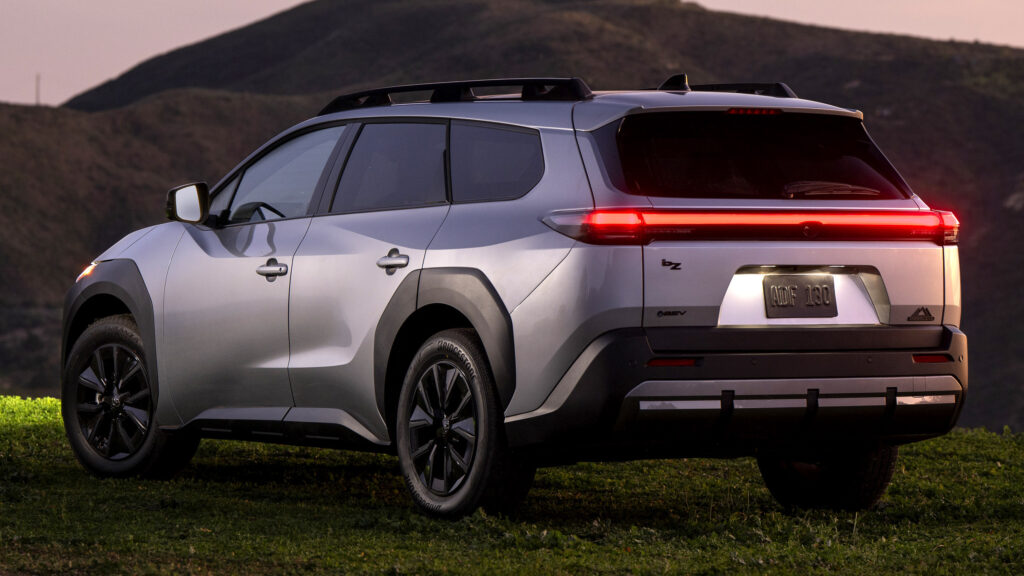
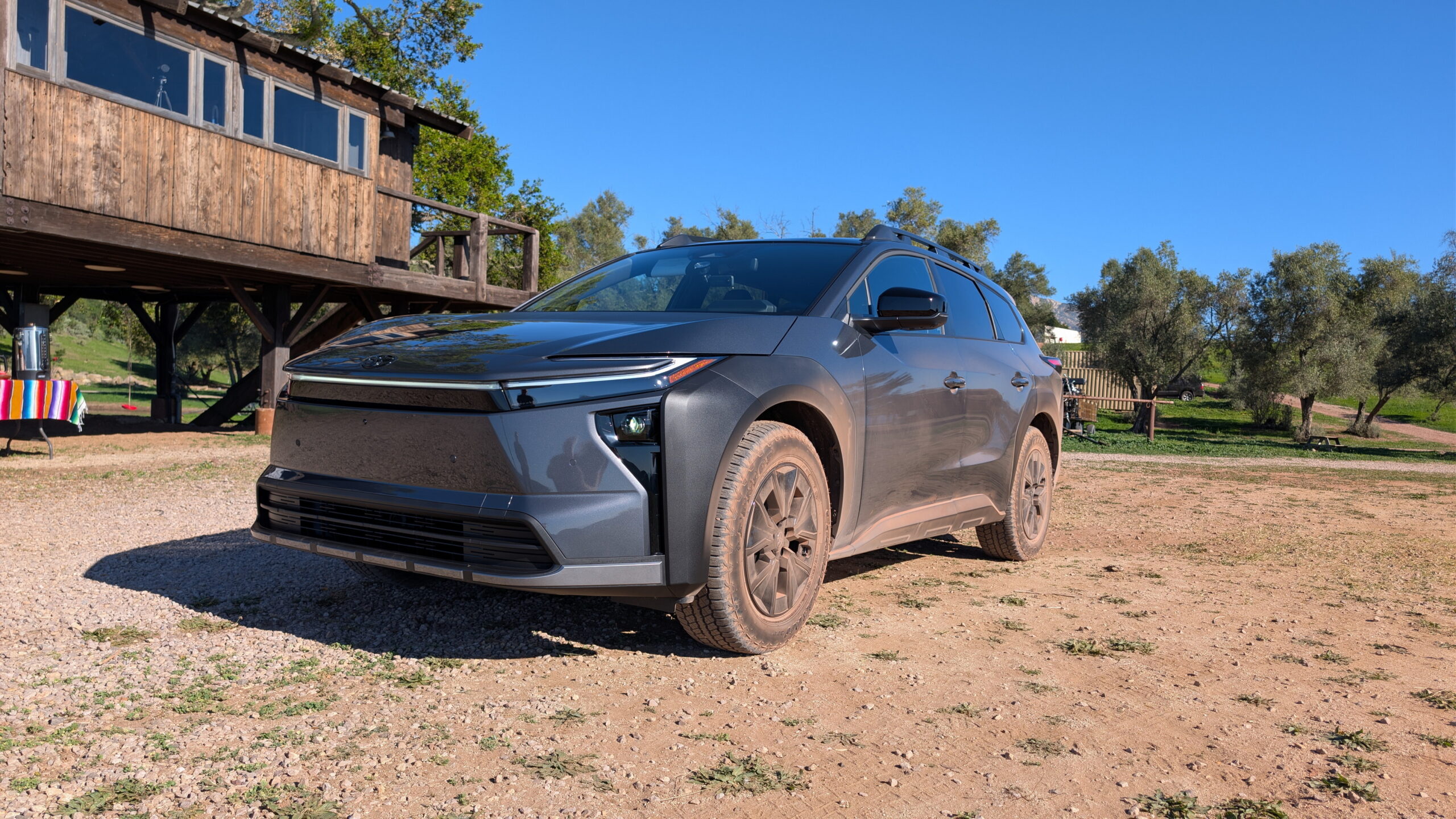
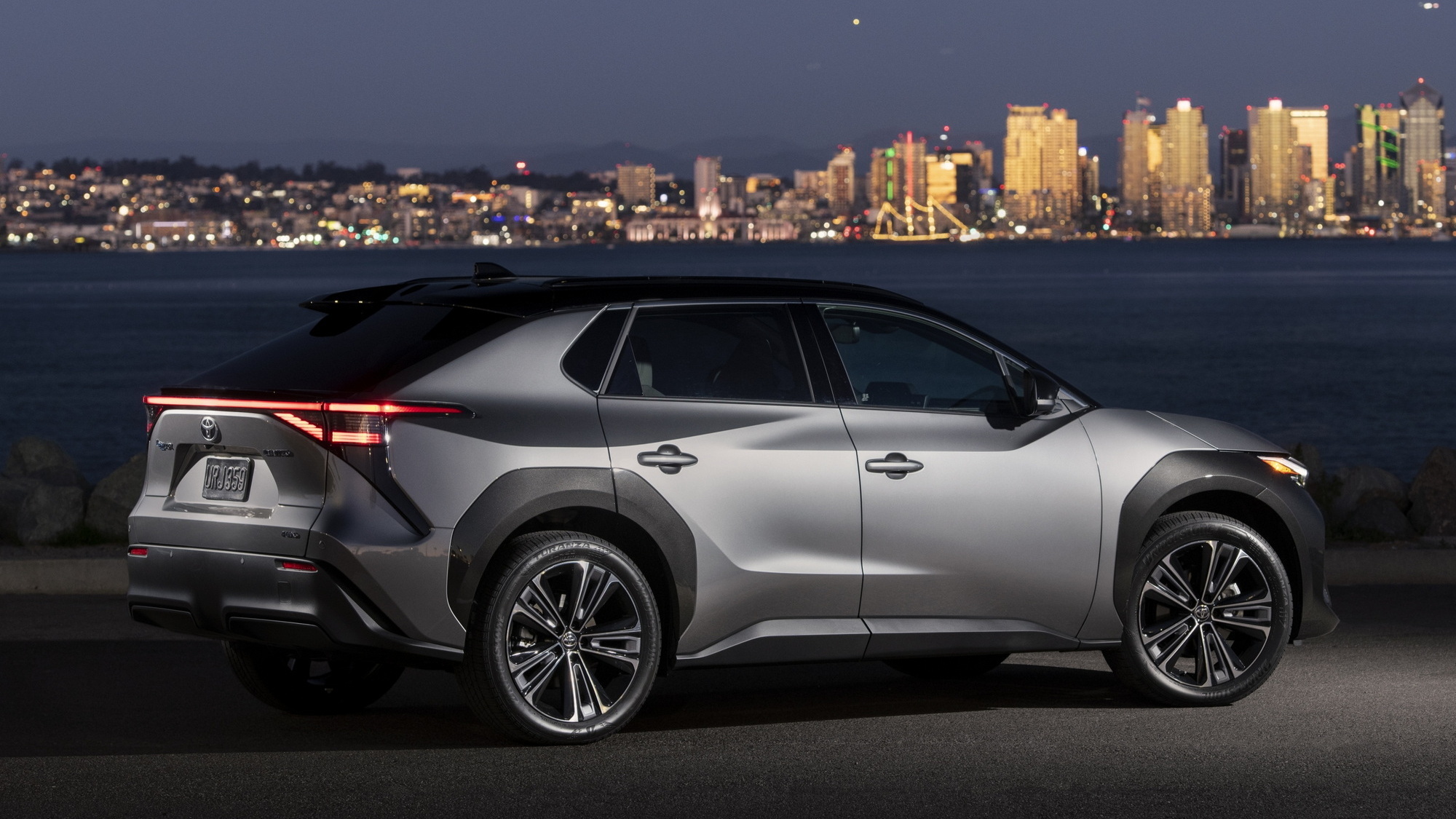
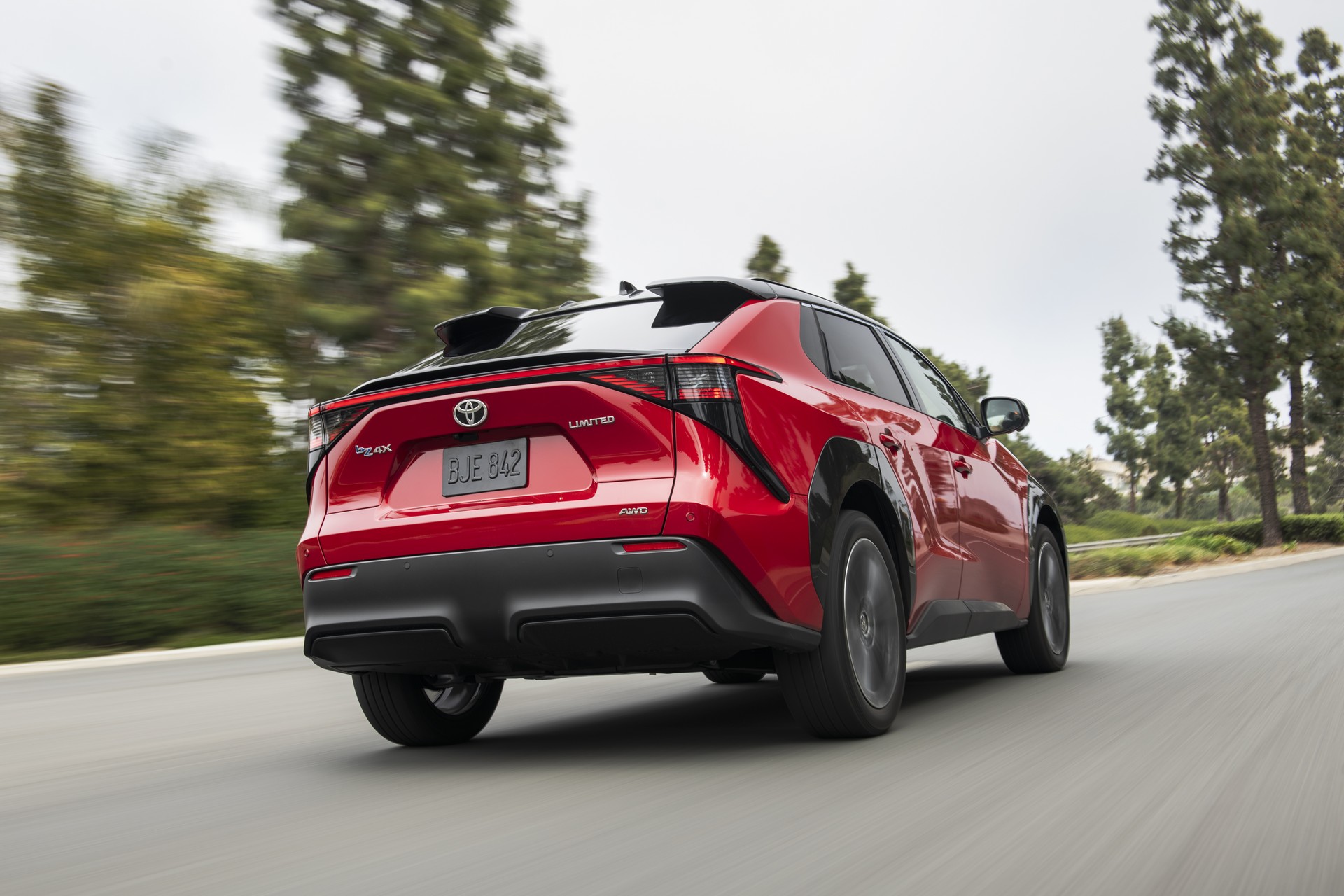
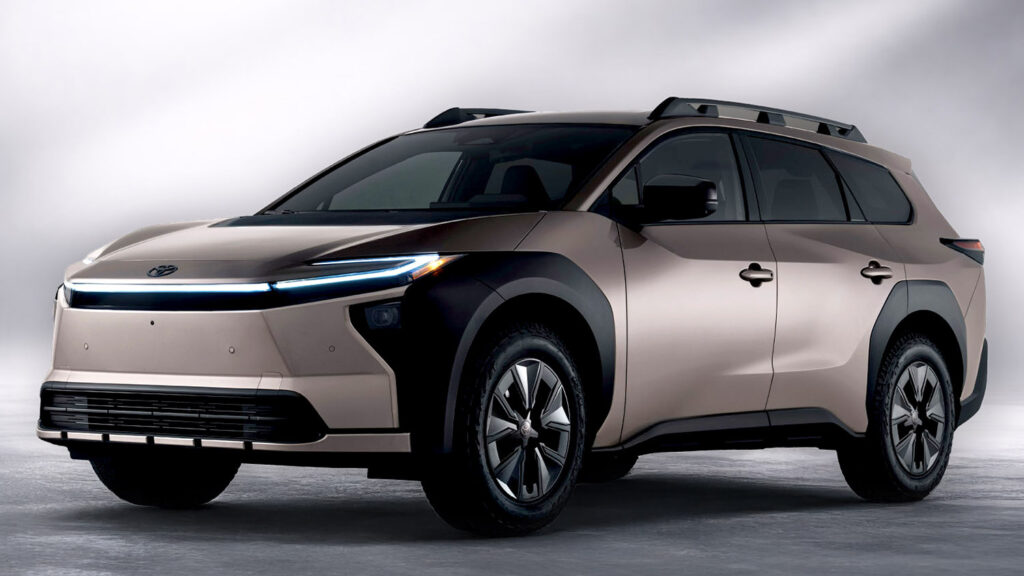
Toyota offers up to $6,500 in incentives on the new bZ Woodland.
Buyers can choose $5,000 cash or 0% financing with bonus cash.
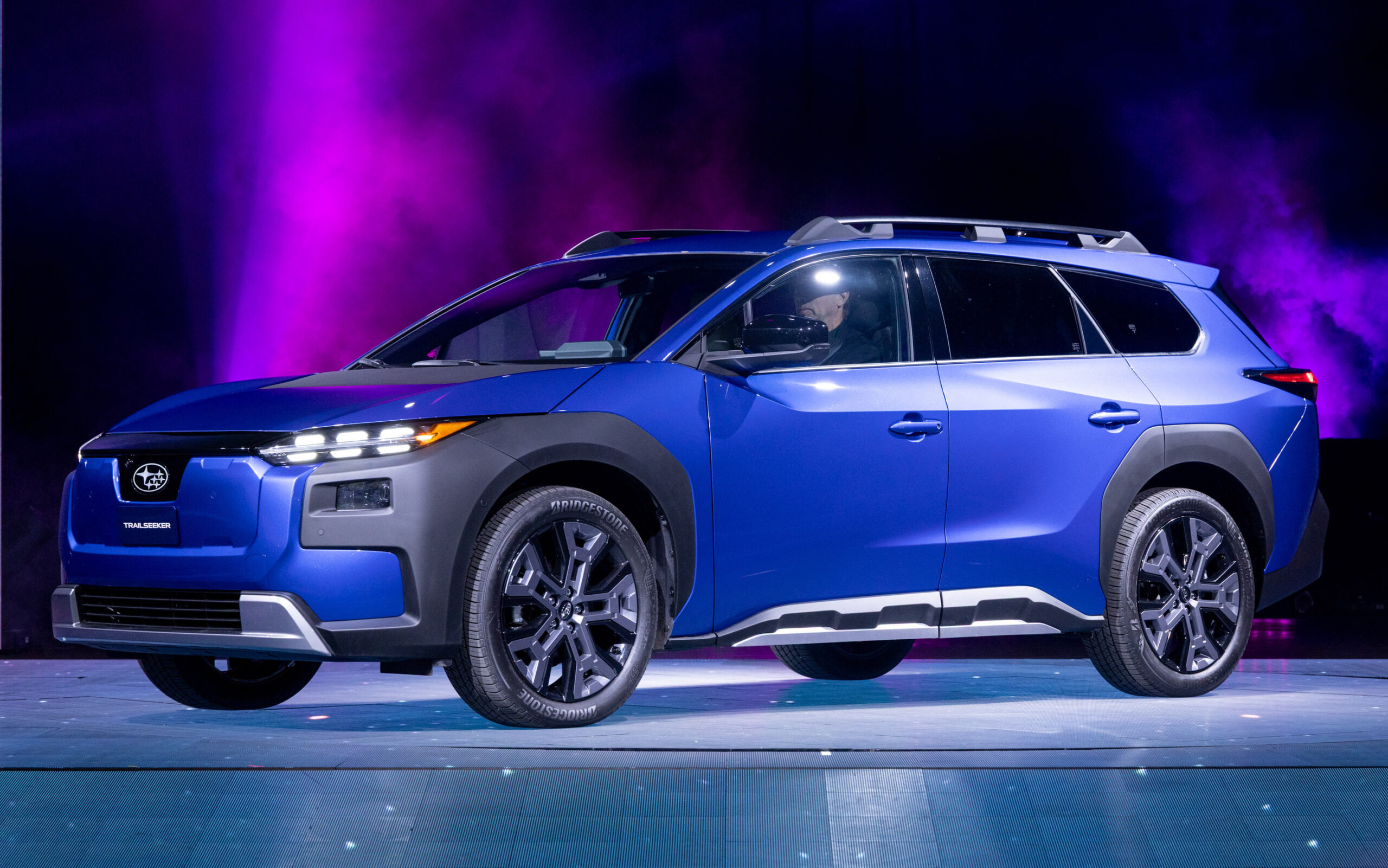
Subaru’s Trailseeker remains cheaper despite Toyota’s early discounts.
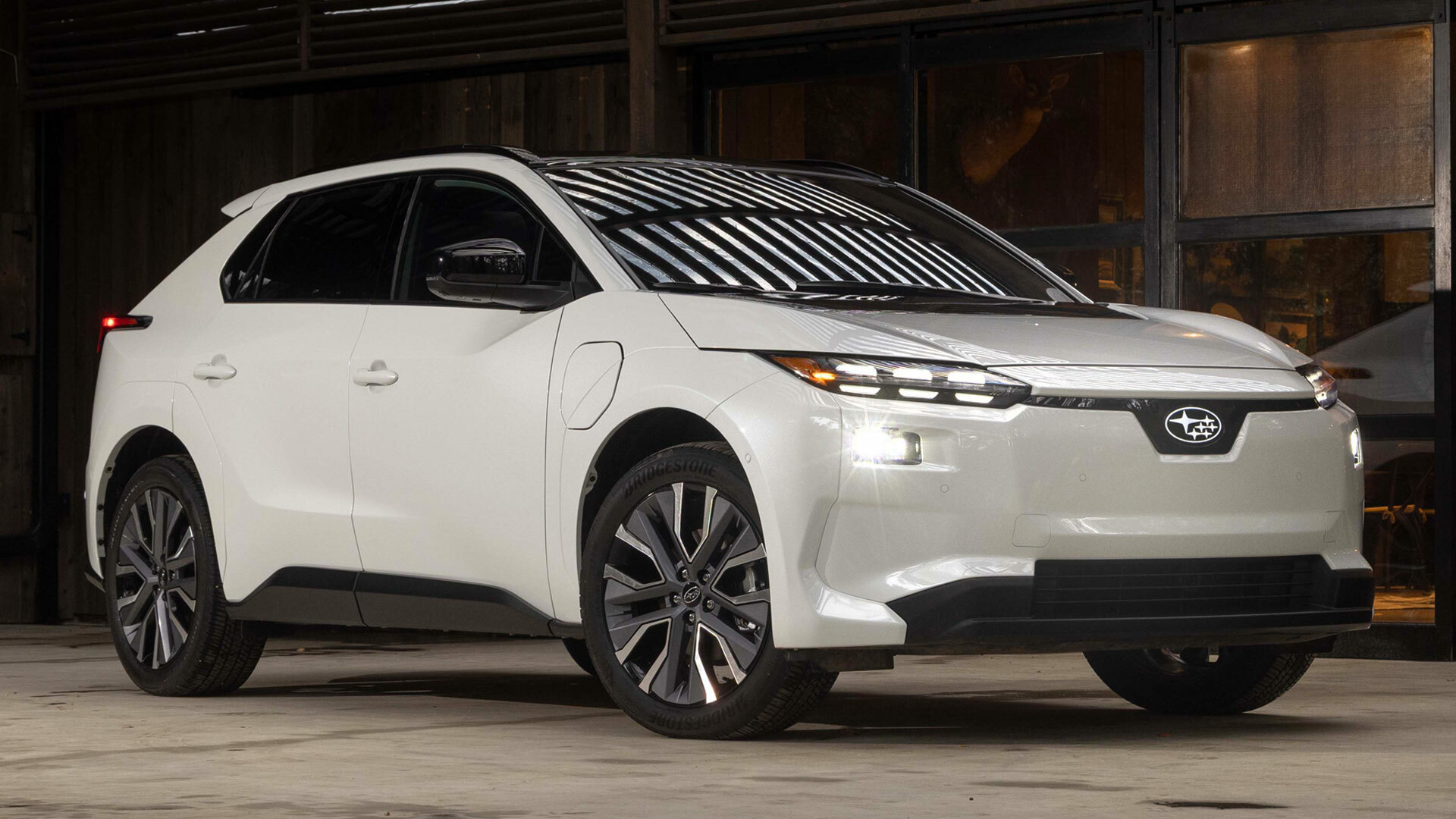
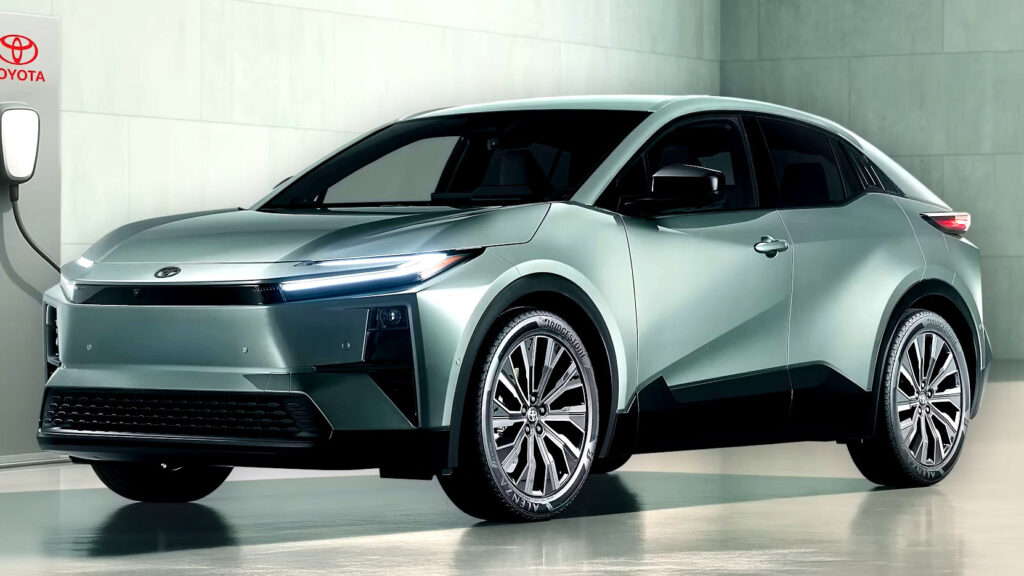
The new Toyota bZ Woodland arrives at a complicated moment for electric SUVs. Conceptualized and likely sent into a production cycle with federal tax credits in mind, the electric crossover is here without those credits to rely on. On top of that, its near identical Subaru twin, the Trailseeker, costs thousands less. Now, Toyota is putting discounts of up to $6,500 on its brand-new electric model to sweeten the deal.
According to Cars.com, the deals aren’t exactly hidden or subtle, either. Buyers can score $5,000 in customer cash, lessees get $6,500 in lease cash, and those with pristine credit can opt for 0% APR for 72 months plus $3,500 cash back. Not bad for a model that effectively just arrived on dealer lots.
Here’s how it breaks down. The $5,000 customer cash incentive functions like a rebate and lowers the price or amount financed. The $6,500 lease cash deal reduces the capitalized cost of the lease, which means lower monthly payments. The $3,500 cash back deal with 0 percent APR is exactly what it sounds like. A discount on the price and no interest on payments for six years. All deals expire on March 2nd.
With pricing starting at $46,750 (including $1,450 destination) and climbing to $48,850 for the Premium, Toyota clearly felt some pressure to keep this wagon-like EV competitive in a cooling segment. These deals should help, considering that the bZ Woodland seems incredibly similar to Subaru’s Trailseeker.
Pricing Pressure From Subaru
For its part, the Trailseeker starts at $39,995 before destination, and that’s without discounts. So even with $5,000 on the hood, the Toyota still plays in a higher price bracket. That means the Woodland’s biggest advantage may come down to brand loyalty, dealer networks, and whether buyers prefer Toyota’s design and packaging.
Again, Toyota probably cooked up this car when it thought the $7,500 federal EV subsidies would still exist at launch. With that in mind, this feels like an almost necessary move to keep the car moving off dealer lots.
Highlander EV uses an electronic popper with hidden manual release.
A small tab inside the handle serves as a built-in mechanical backup.
The setup reflects growing focus on EV safety and everyday usability.
Spend five minutes around a modern car, especially an electric one, and you will notice something curious. Door handles have morphed into design statements, tech showcases, and sometimes awkward little puzzle games that feel one step away from becoming a liability.
Some pop out theatrically, some sit flush until summoned, others attempt both, and an increasing number rely entirely on electronic latches that only function when the car has full power. Toyota’s new Highlander appears ready to break new ground with a hidden feature few will notice at first.
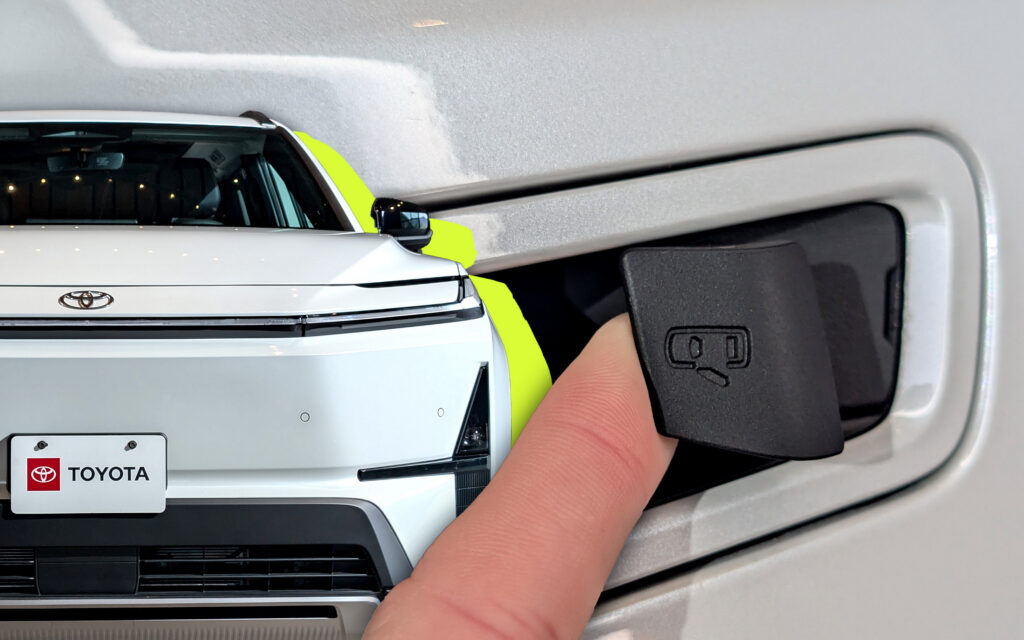
During our time up close and personal with the SUV, one small feature stood out. The main exterior handle leverages a small pad to activate an electric door latch. That’s not groundbreaking, but what’s next to it might be.
Did You Notice The Tiny Tab?
Photos Stephen Rivers/Carscoops
Inside of the stationary recessed door handle lies a tiny tab. Roughly the size of a postage stamp, it’s designed to be pulled independently by someone outside the car, including, knock on wood, emergency crews. Unlike the main handle, the tiny piece has a clear pictogram suggesting it’s a manual release.
Next to it is a removable section for a keyhole. Getting into this electric SUV, should it ever lose power, is as easy as inserting a key, engaging the manual latch, and pulling on it. Notably, the pull tab did nothing for us when we were in person and tinkering around with it.
Photos Stephen Rivers/Carscoops
Toyota clarified to Carscoops that the prototypes didn’t have functional versions of the handle. The production car will work via a two-step process. Pull once, and the tab will unlock the door. Pull twice, and it’ll manually open the door. That’s clever, and it’s worth noting that it’s not just the exterior handles that have this sort of feature.
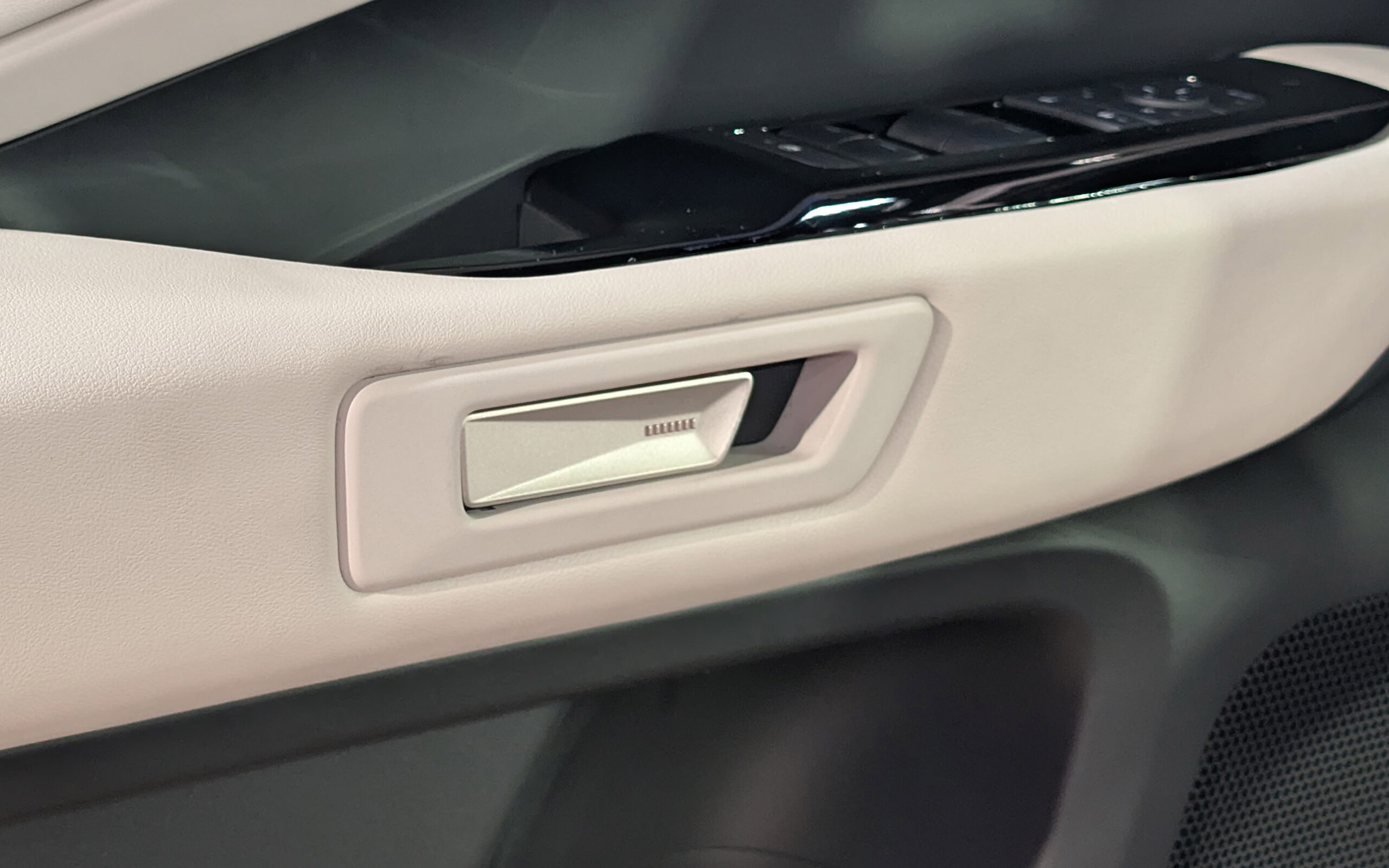
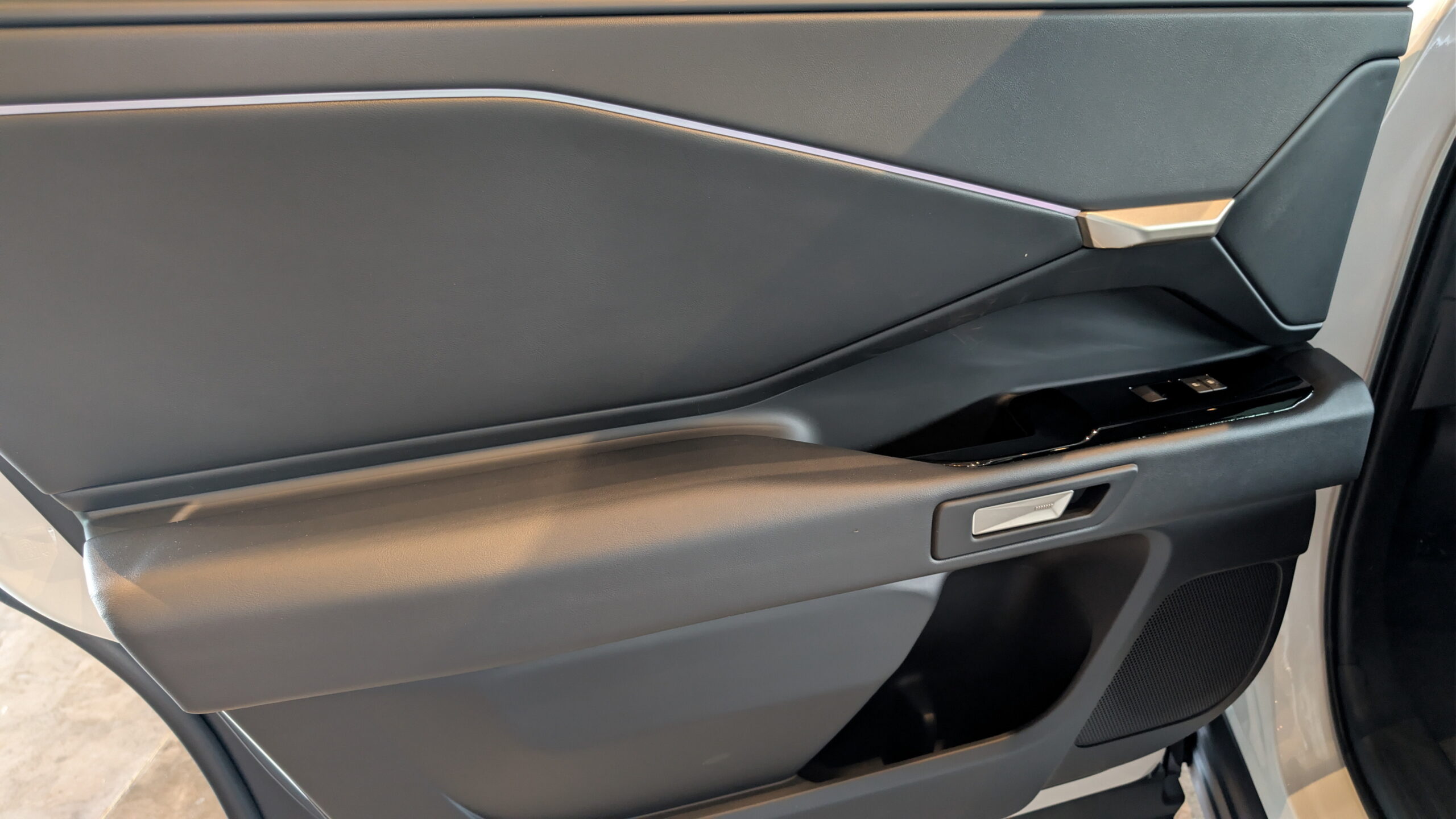
The inside handles are similar to the ones we’ve seen on Lexus vehicles for some time. Users can push the door button for the electric latch to release, or they can pull it to manually open the latch. That’s just one more piece of safety baked into the all-new Highlander.
In a world where even door handles have gone digital, a simple mechanical fallback feels less like nostalgia and more like common sense. Toyota’s solution is not flashy, and it does not need to be. As cars pile on electronics for even the most basic tasks, a simple physical solution may turn out to be the smartest feature of all.
PROS ›› Genuinely quick, nimble handling, faithful design features CONS ›› Tight rear seating, Uncharted undercuts it, limited cargo space
A quick look around the automotive industry would have most thinking that EV adoption is slowing down. Whether that perception holds true or not, Toyota is moving ahead full steam with not one, but three new electric vehicles, and the C-HR might be the most playful of the bunch. Yesterday, we talked about how the bZ Woodland is a great improvement on the old bZ4x.
Today, the focus shifts to the C-HR, a revived nameplate that now returns exclusively as an EV. It’s a huge deal beyond just the fact that it’s going electric. It’s the first formerly gas-powered Toyota nameplate to go fully electric. Sure, it only beat the new Highlander by a few months, but that’s more than enough. Both will have a big impact on Toyota moving forward.
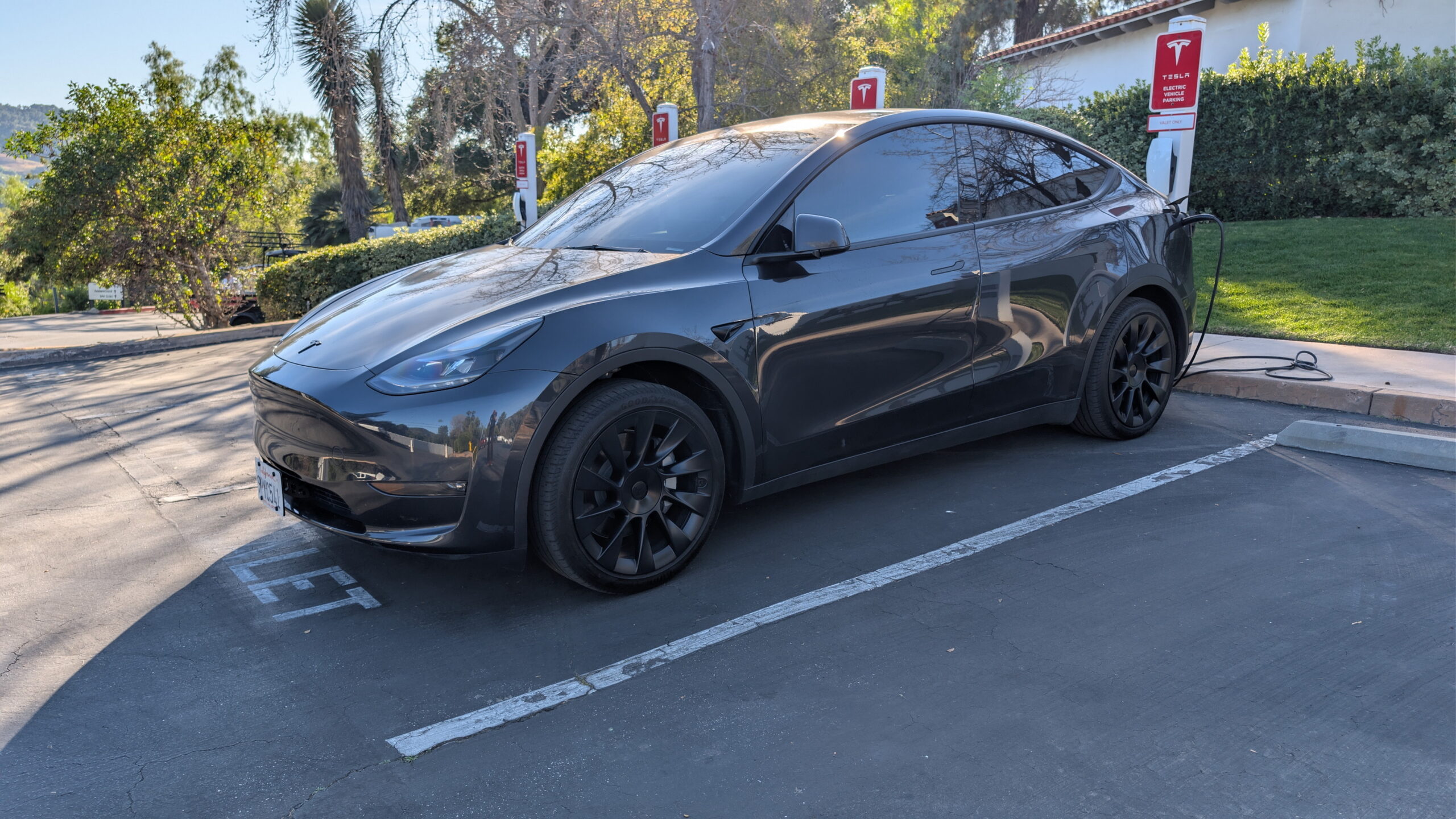
While we don’t know what the Highlander will end up selling for, the C-HR is clearly aimed at a different demographic. With a starting price shy of $38,000 before destination and handling, it’s aimed at Tesla Model Y buyers wanting something a touch smaller. Packing standard all-wheel drive, 338 hp (252 kW), and almost 300 miles of range, it’s a new face in the segment that will no doubt blow up one day.
Quick Facts
› Model:
2026 Toyota C-HR
› Starting Price:
$37,000 (excluding destination)
› Dimensions:
177.9 L x 73.6 W x 63.8 in H (4,519 x 1,870 x 1,621 mm)
› Wheelbase:
108.3 in (2,751 mm)
› Curb Weight:
4,322 lbs (1,960 kg)
› Powertrain:
Dual electric motors / 74.7 kWh battery
› Output:
338 hp (252 kW)
› 0-60 mph
4.9 seconds
› Transmission:
Single speed
› Range:
Up to 287 Miles
› On Sale:
First-half of 2026
SWIPE
Now, all that’s left is to figure out if it’s good enough that it’ll gain a foothold for a long ride, or if it’s still a battery cell or two away from a fully-formed EV. Thankfully, a week of testing it in hilly Ojai, California, helped us figure out the good from the bad.
Styling
Photos Stephen Rivers/Carscoops
Let’s not play coy. While the C-HR’s nomenclature has always invited comparisons to Honda’s HR-V, the exterior designs couldn’t have been much more different when it first arrived. We’re happy to report that the same playful attitude carries over to this new electric version of the crossover.
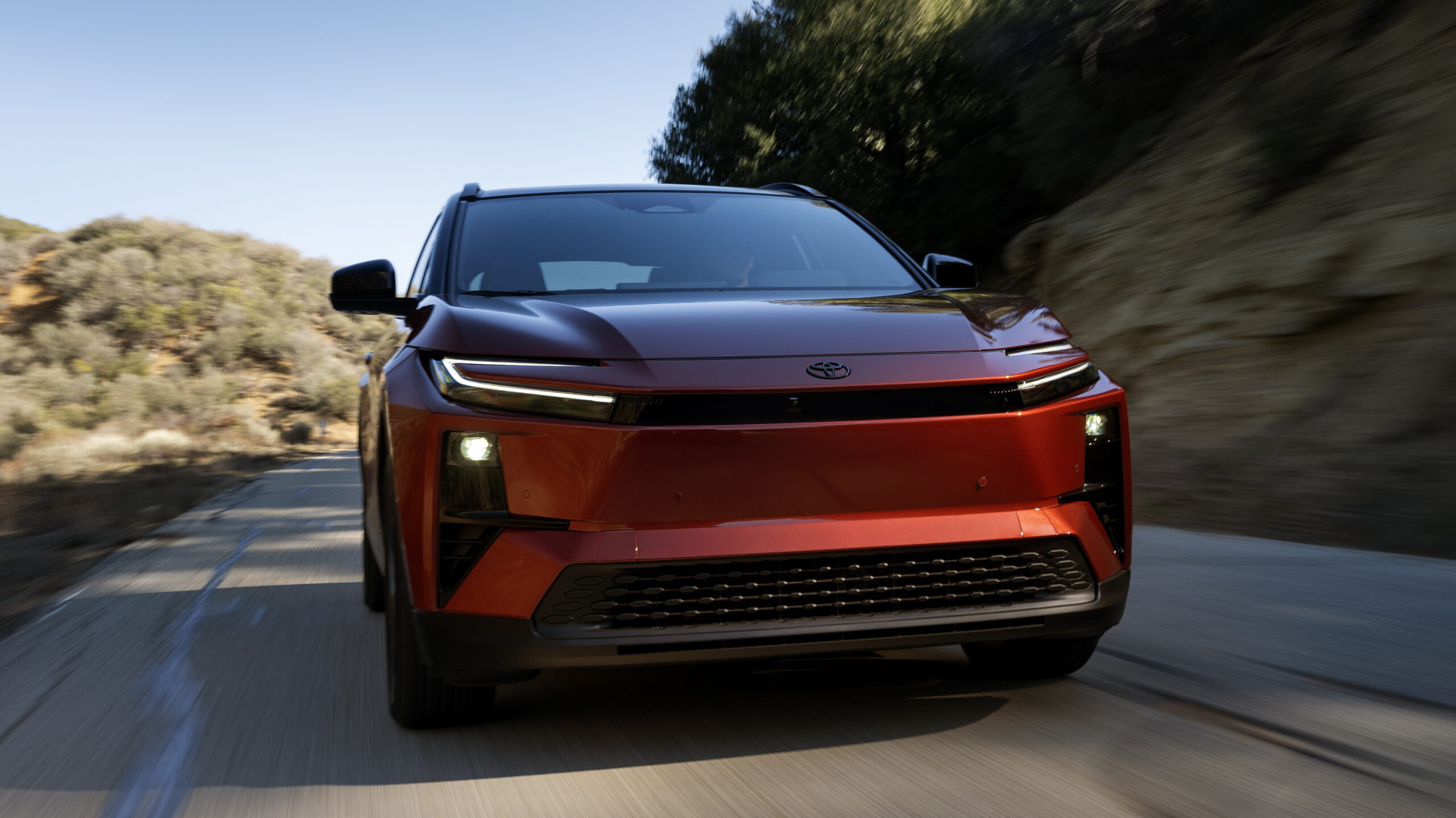
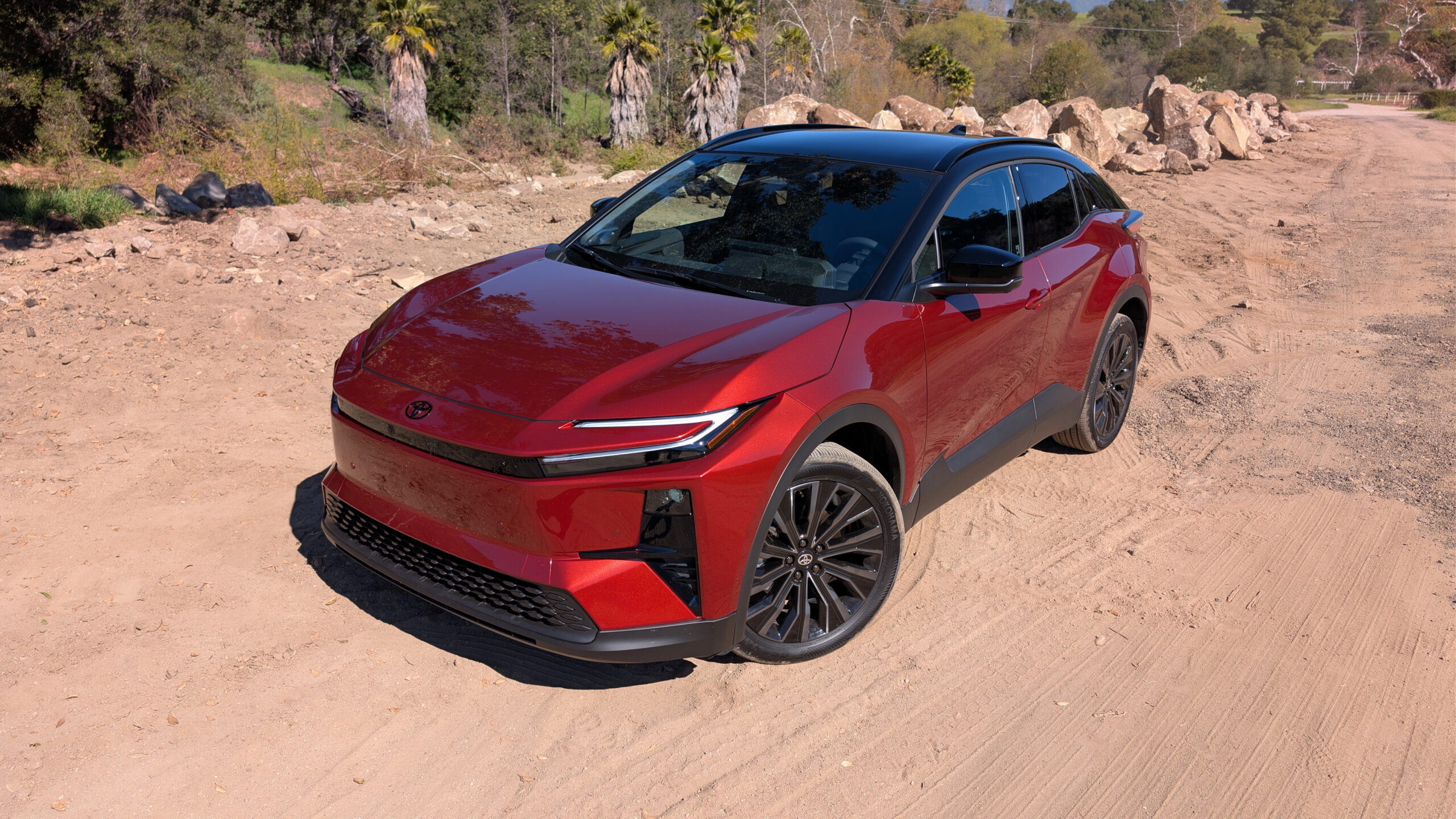
The front end adopts Toyota’s newer hammerhead design language, with a low, aggressive nose and slim lights that visually widen the car. The coupe-like roofline flows cleanly into the rear, and from certain angles, the C-HR almost looks more hatchback than crossover, which works in its favor. It feels athletic despite being clearly compromised on that front.
Compared to the bZ Woodland, the C-HR looks tighter and more urban. It’s clearly aimed at buyers who want something sporty and expressive rather than rugged or adventurous. The wheel options help sell that image, too, with 18-inch alloys on the SE and aggressive 20-inch wheels on higher trims.
If the old C-HR was bold but polarizing, this one is more mature. It’s still stylish, but it’s less desperate for attention and more apt to provide an experience worthy of an offbeat appearance.
Cabin Space
Photos Stephen Rivers/Carscoops
Toyota told us early on that we’d see a lot of crossover between this and the bZ Woodland, and it was right. It leverages supportive front seats, an intuitive infotainment setup, a steering wheel that feels good in your hands, and visibility that’s better than the sloping roofline suggests. The driver’s position feels good, though; we’d love a little more adjustability from the steering wheel.
Photos Stephen Rivers/Carscoops
The 14-inch touchscreen dominates the dashboard and comes standard across the lineup. It’s responsive, cleanly laid out, and avoids the over-complicated UI issues that plague some competitors. Dual wireless charging pads and practical storage touches reinforce that Toyota still knows how to design for daily life.
Material quality is a step up from Toyota’s earlier EV efforts, too. Soft-touch surfaces and ambient lighting keep things modern without crossing into gimmicky territory. And then you climb into the rear seats. Things go from perfectly livable to suddenly only for the smallest around us.
How Tight Is Too Tight?
I get that as a taller-than-average guy, I won’t fit everywhere, but I was sincerely shocked at just how tight the back seats of the C-HR are. This is a compact crossover, and that’s clear as soon as we compare it to another new crossover in the form of the Mazda CX-5.
The Mazda has a wheelbase that is just 2.5 inches (63 mm) longer. Despite that, the CX-5 offers 7.7 inches (195 mm) of additional legroom, up to 2.8 inches of headroom, and in total over 10 cubic feet of extra space in the rear seats. Put simply, rear-seat occupants won’t be happy in the C-HR unless they’re relatively small. That said, they’ll fit kids just fine.
Cargo space fares better, with 25.3 cubic feet behind the rear seats and nearly 60 cubic feet with them folded. That’s perfectly usable for daily life, but the passenger packaging tells you clearly where Toyota’s priorities were.
Driving Impressions
Here’s where the plot thickens, in the best way possible. EVs are well-known for their instant torque, but that doesn’t automatically make one good to drive. The way the C-HR moves about the world is with more authority than one might expect. It’s sharp. The short wheelbase helps it manage bends with confidence. And the steering is more communicative than in the larger bZ Woodland.
Toyota claims 0-60 mph in 4.9 seconds, and it absolutely feels believable. This thing moves… not with the aggressive chaos of a GR Corolla, but with the smooth, relentless urgency only an EV can deliver. In fact, this might be the quickest pseudo-practical car in Toyota’s lineup right now. It’s not trying to be a sports car, yet it’s faster in a straight line than many cars that are.
The low battery placement keeps the center of gravity down, and the chassis feels planted through corners. Steering is light but accurate enough that you want to push a little harder than you probably expected. There’s a maturity to the tuning. It’s composed, predictable, and easy to trust. The brakes are excellent, too.
The regenerative braking paddles let you adjust deceleration on the fly, which adds a layer of driver involvement often missing from mainstream EVs. It’s not revolutionary, but it does make the driving experience feel more interactive.
Ride quality strikes a nice balance, too. It’s firm enough to feel sporty without punishing you over rough pavement. The C-HR doesn’t feel like a small SUV pretending to be sporty. It just feels like a well-sorted EV with some genuine personality. No, it’s a far cry from a Hyundai Ioniq 5 N or a Tesla Model Y Performance, but it’s the EV I’d pick from Toyota’s lineup if driving feel was all that mattered.
From a more practical standpoint, range tops out at 287 miles on the SE trim, dropping slightly with the larger wheels. Charging speeds max out at 150 kW DC fast charging. That’s enough to go from 10–80 percent in roughly 30 minutes under ideal conditions. As we’ve seen in the past, ideal conditions can be rare, but the inclusion of Tesla’s NACS port should help.
The C-HR lands in an increasingly crowded space, but its personality gives it, like the bZ Woodland, a unique angle. The Tesla Model Y remains the benchmark for space and usability. It’s roomier, more versatile, and easier to live with if rear-seat comfort matters. The Model 3, while technically a sedan, also beats the C-HR for rear-seat comfort despite looking smaller.
Frankly, comparing it on paper to most cars in the segment makes the C-HR look like a middling choice at best. Even pairing it against its badge-engineered sibling, the Subaru Uncharted, it costs more and isn’t available with front-wheel drive, which unlocks more range. That said, I’m not about to start complaining that we need more front-wheel drive cars.
Where the C-HR stands out is key, though. All-wheel drive is something that plenty of folks want and or need where they live. Second, it’s probably the easiest car in the segment to park, thanks to great sightlines and one of the shortest wheelbases here. That matters.
No, it’s not the quickest, cheapest, or most spacious. Instead, it’s leaning into the vibe of a compact, economical electric vehicle to the best of its ability in its current form. And that form just so happens to be quite attractive and fun.
The Verdict
Toyota just launched the new Highlander in all-electric form, which is a huge deal in itself, but let’s not forget that this new C-HR is the first formerly gas-powered Toyota to go all-EV in America. That’s also a big deal, and it makes this little commuter car an important inflection point in history.
To that end, it’s great to see that Toyota didn’t hold back here regarding performance. The C-HR is properly quick, genuinely fun to pilot, and even fun to look at. The front seats, infotainment, and overall driving position are all excellent, and on the road, it feels composed, lively, and far more engaging than many electric crossovers in its segment.
That said, it’s not without compromise. Rear-seat space is tight enough to be a real consideration, especially if you regularly carry adults. This is a crossover that prioritizes style and driving feel over maximum practicality. And honestly, that might be exactly the point. Here, the fun comes first, and the practicality, while important, comes in second place. Will it be a mix that sells well? Only time will tell.
PROS ›› Lots of utility, genuinely quick, quiet cabin CONS ›› Tight rear space, Trailseeker is cheaper, divisive styling
Toyota is one of the few brands that still seems intent on giving enthusiasts something to get excited about. Vehicles like the Land Cruiser, GR Corolla, and GR Supra make that clear. But what about the eco-conscious buyer with a family? Until now, that same energy hasn’t really carried over to its EV lineup. The bZ Woodland is meant to change that.
It would be easy to look at it and assume this is just another trim level dressed up with black plastic cladding and a roof rack meant to suggest capability more than deliver it. After all, Toyota is still a long way from securing a serious foothold in the all-electric space. This SUV, which actually looks more like a wagon on stilts, not dissimilar to older Subaru Outbacks, pushes the brand more squarely into the conversation.
190.2 L x 73.2 W x 63.8 in H (4,830 x 1,860 x 1,620 mm)
› Wheelbase:
112.2 in (2,850 mm)
› Curb Weight:
4,376–4,453 pounds (1,985–2,020 kg)
› Powertrain:
Dual electric motors / 74.7 kWh battery
› Output:
375 hp (280 kW)
› 0-60 mph:
4.4 seconds (97 kmh)
› Transmission:
Single speed
› Efficiency:
21.0 kWh/100 km as tested
› On Sale:
First-half of 2026
SWIPE
On paper, this could be the vehicle to move Toyota’s EV aspirations higher. It’s a family hauler. It sounds like it’ll be reasonably capable off-road. Clearly, on-road performance is something the automaker considered as well. Does it all actually pay off in the real world, though? That’s what we went all the way to California to find out.
Rugged Cues With Familiar DNA
Photos Stephen Rivers/Carscoops
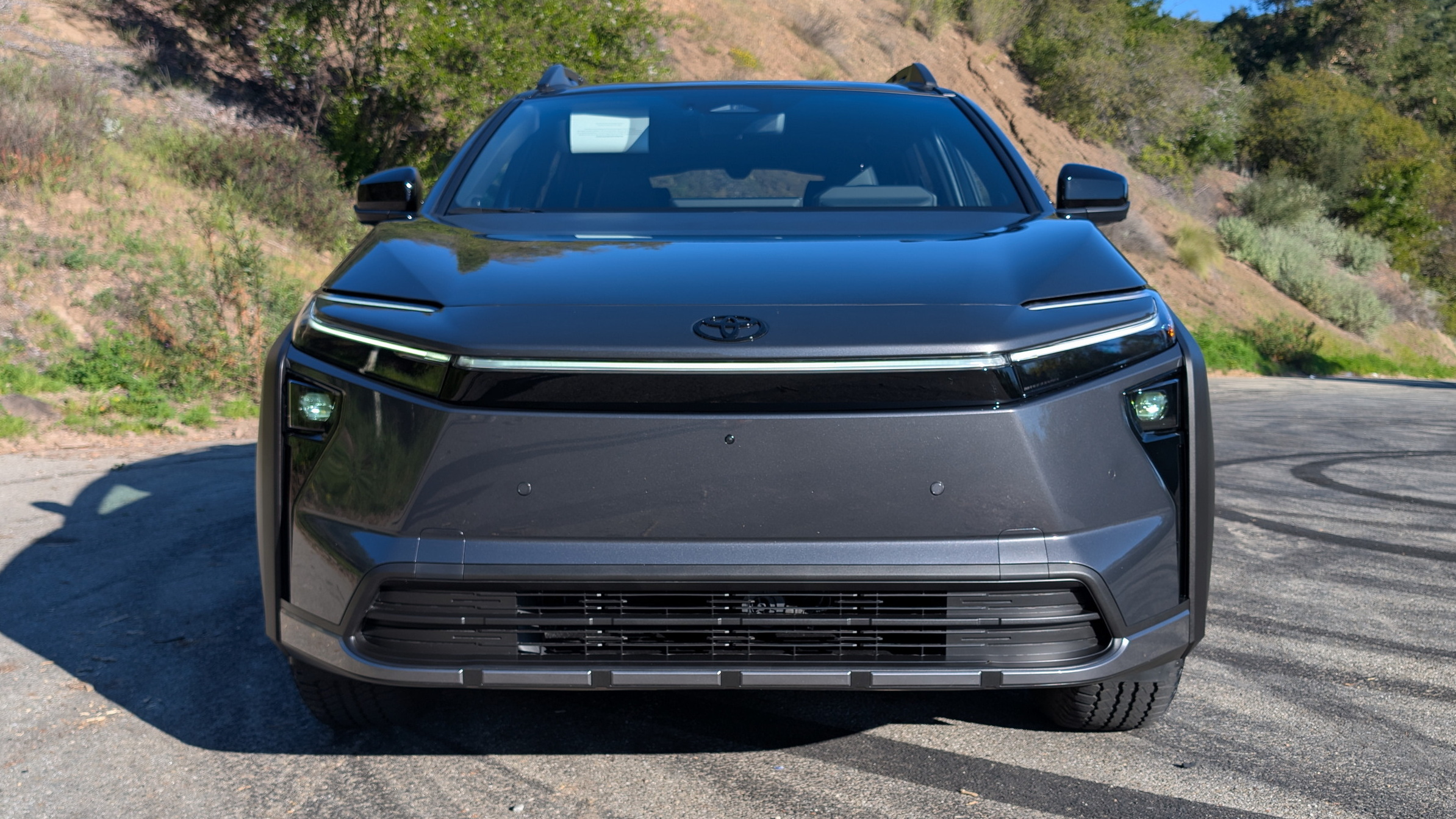
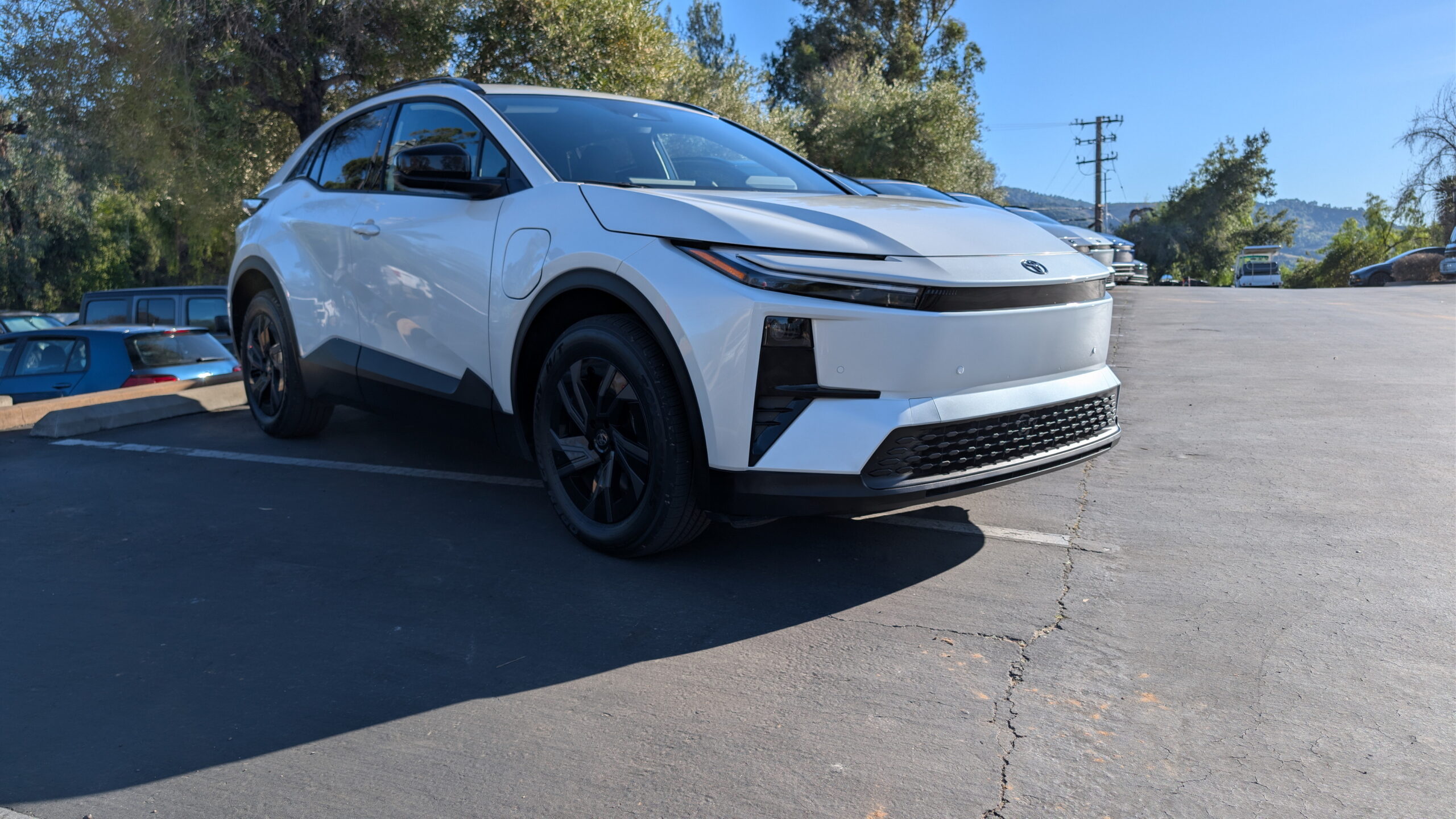
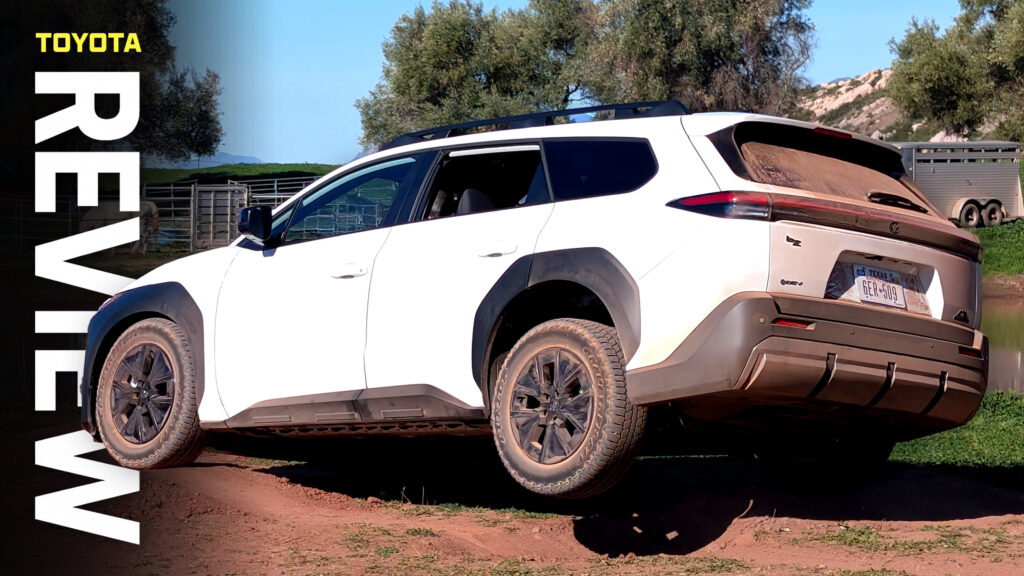
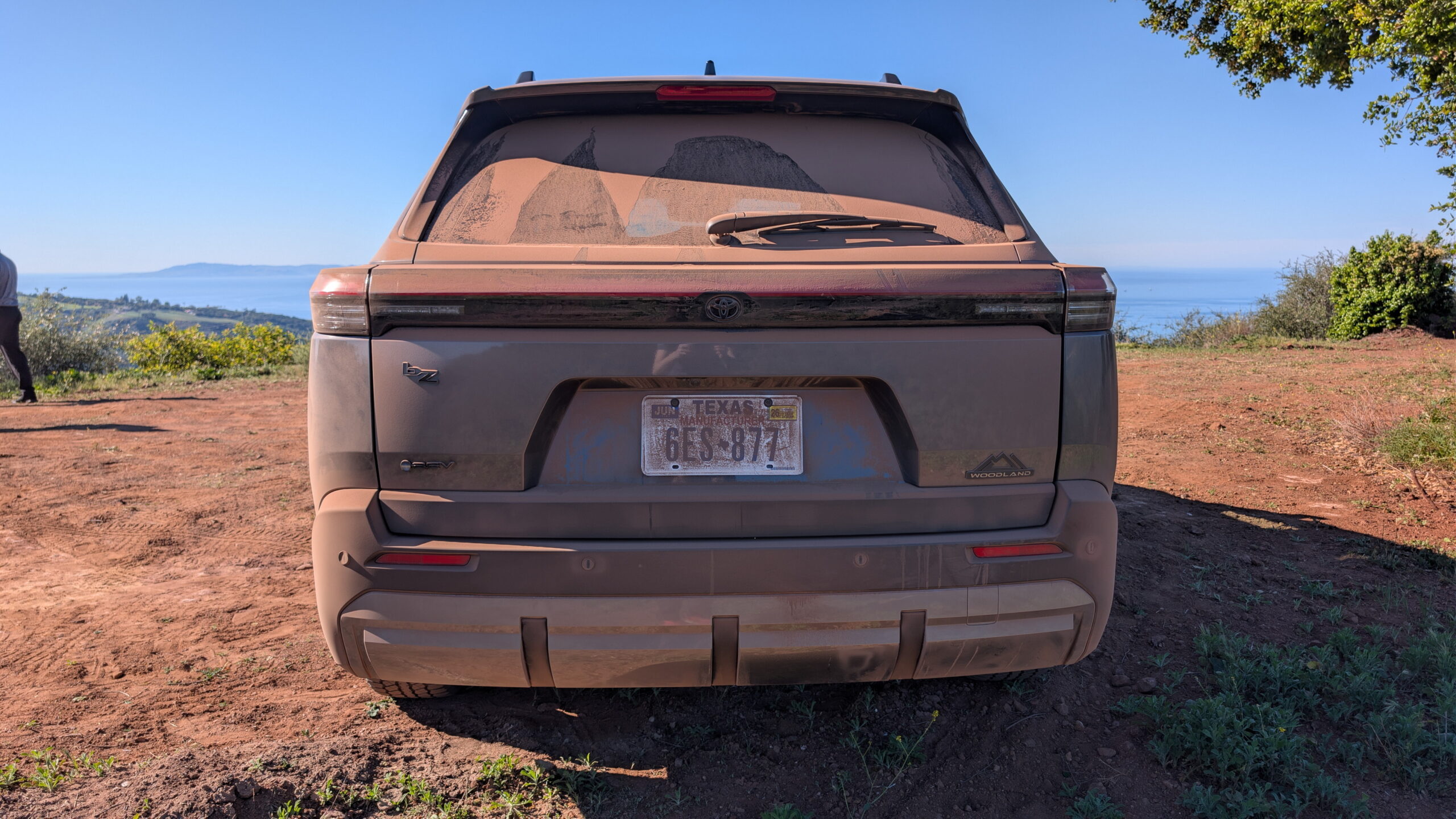
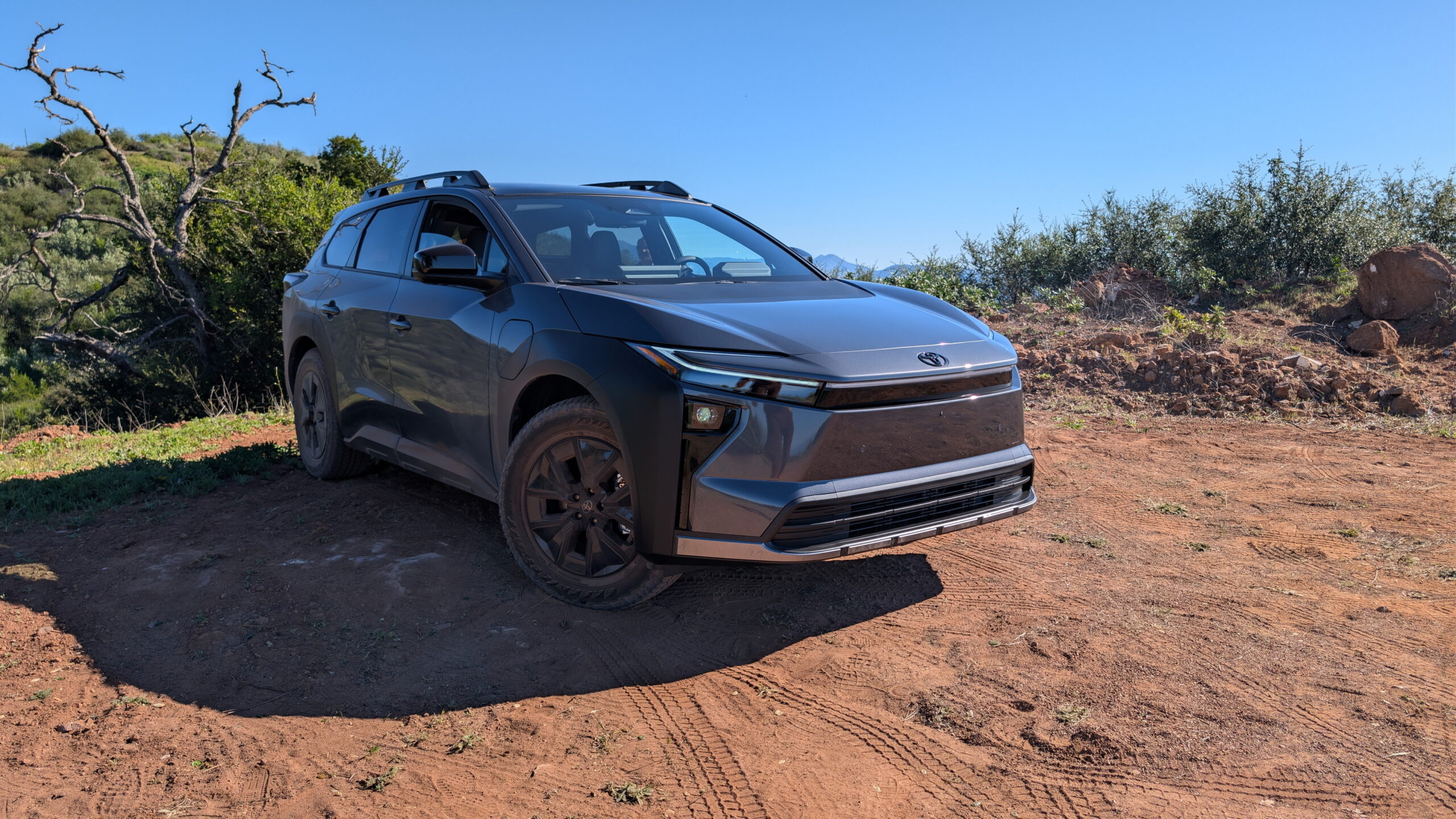
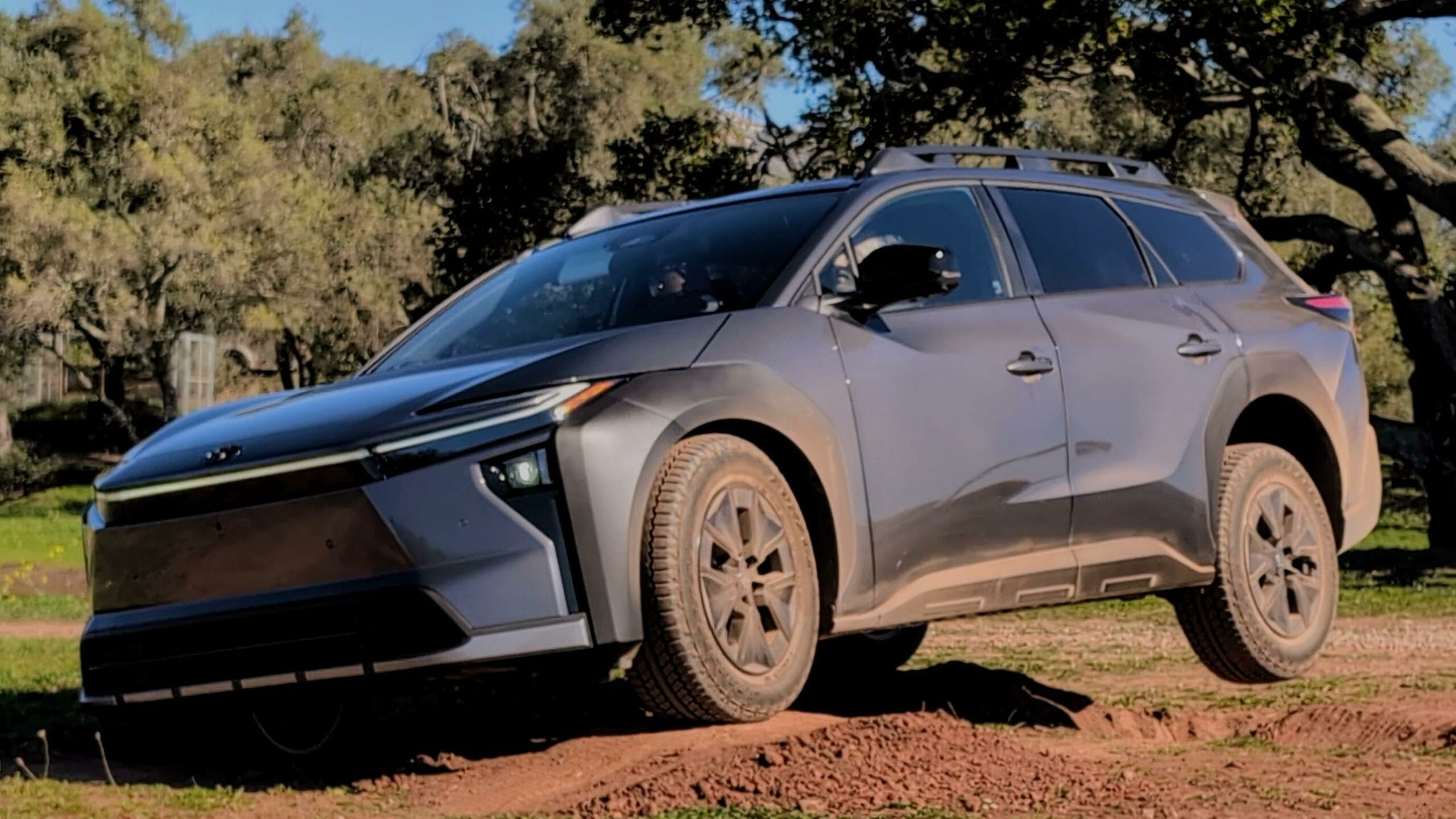
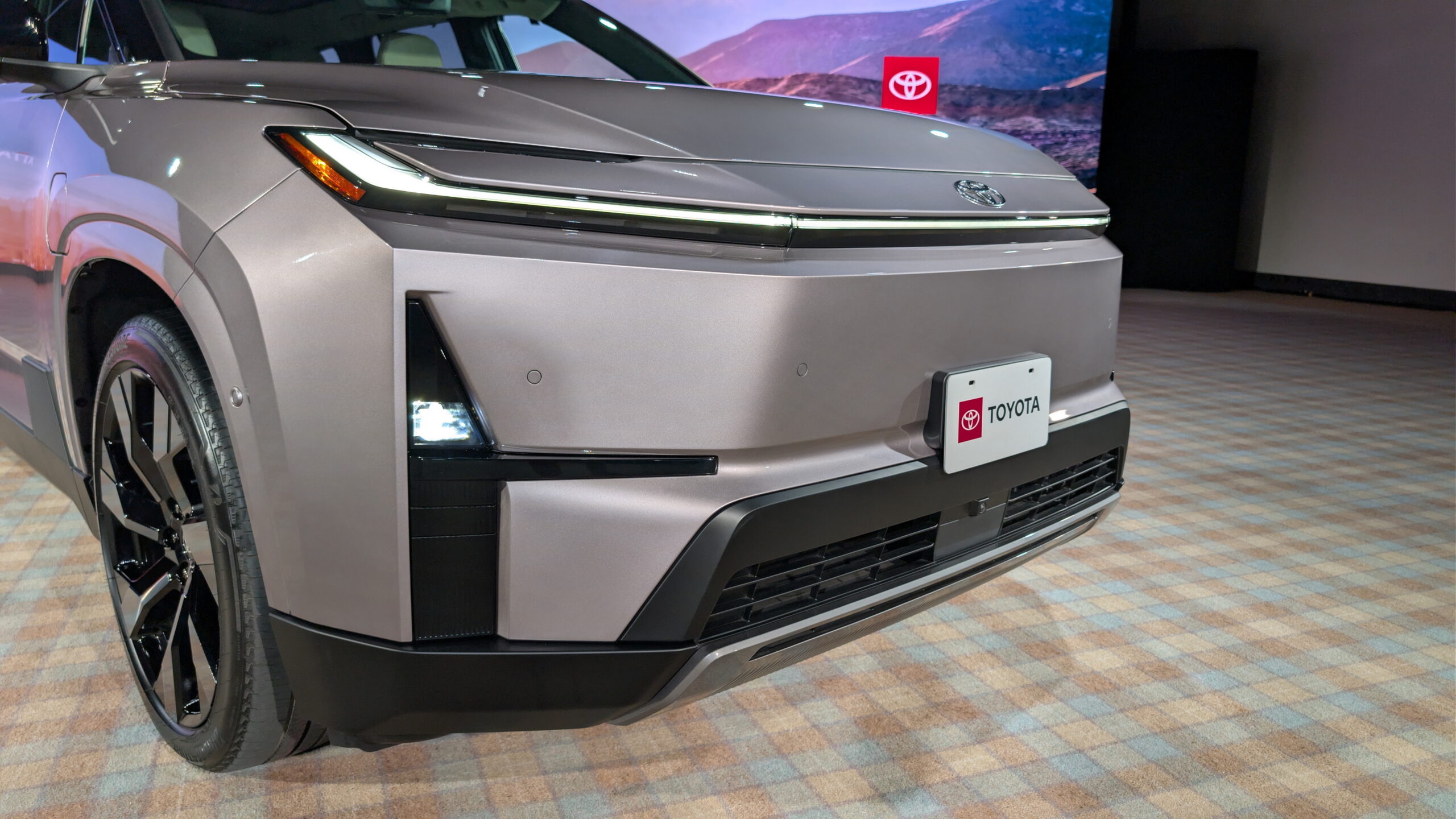
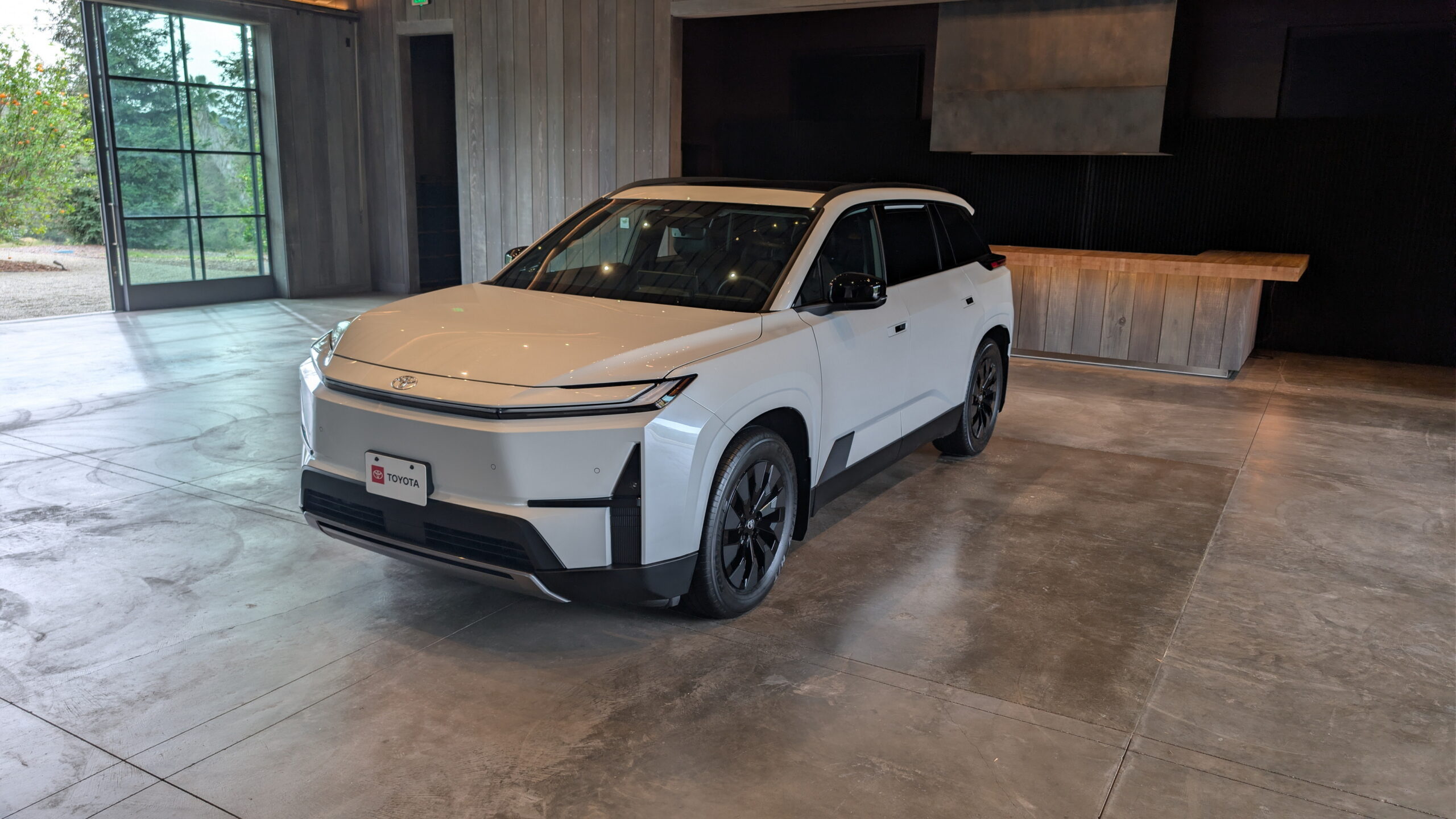
From afar, the bZ Woodland looks like it’s gone out into the world in a monotone plaid shirt. It’s trying to stand out and appear rugged, but not shouting for others to look at it. Some will love it and appreciate the understatedness, and others will think it’s trying too hard and is a bit overdone. Personally, I’m not sure the black plastic cladding is doing much good, but once it has some dirt on it, the overall package does appear appropriate.
That said, it’s far from a departure from Toyota’s previous design efforts. The hammerhead nose, first introduced on the widely-loved new Prius design, is here and is complemented by a full-width LED lightbar and DRLs. The sideskirts and rear of the car offer more cladding and even a faux diffuser treatment below another full-width LED lightbar.
Photos Stephen Rivers/Carscoops
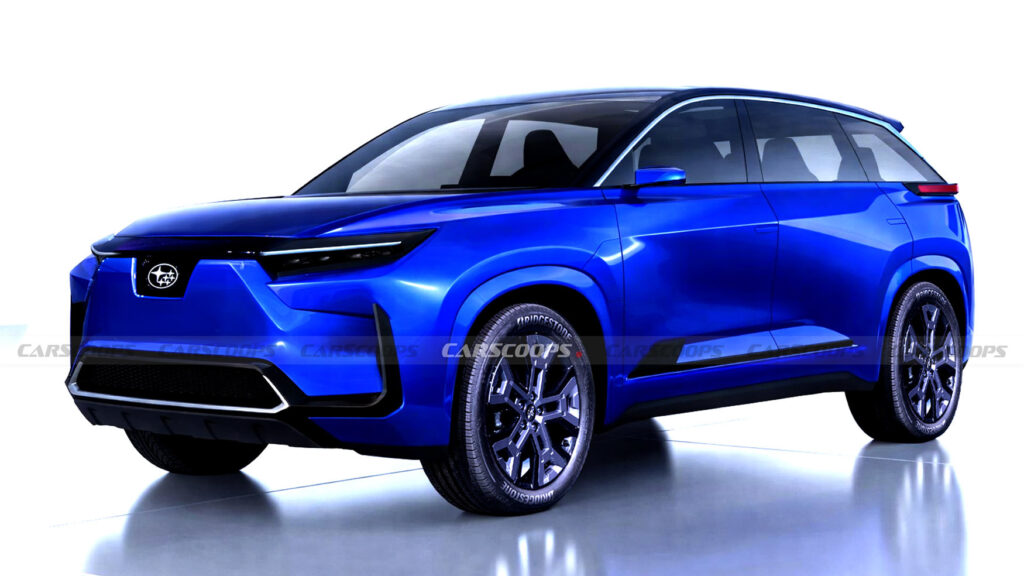
If you’re getting Subaru vibes from the shape, don’t feel bad. This SUV rolls off a Subaru production line with that brand’s Trailseeker SUV. The two share just about everything under the skin, but compare them side to side, and to my eye, it’s the Toyota that seems to have a more cohesive design overall.
Cabin Design And Layout
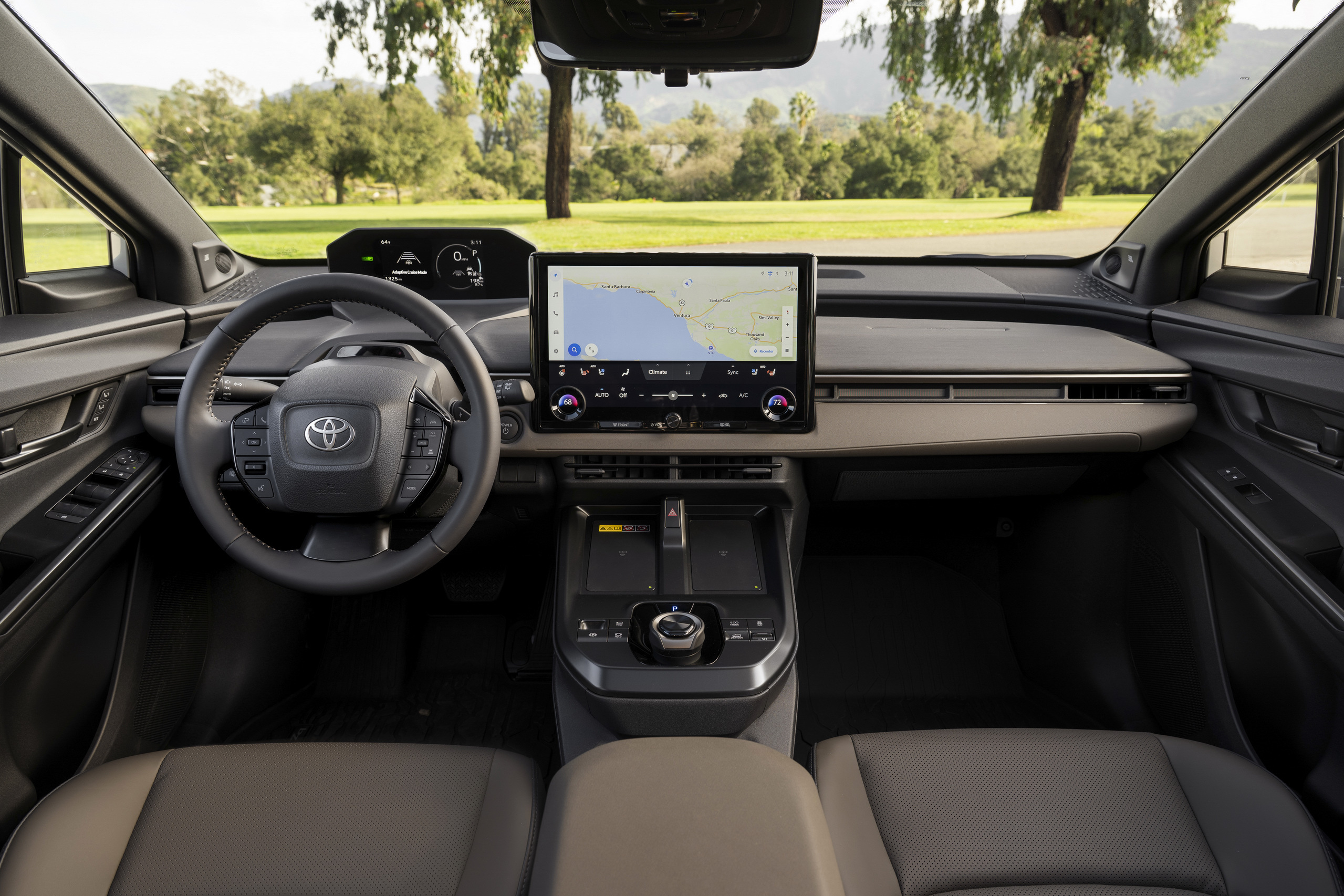
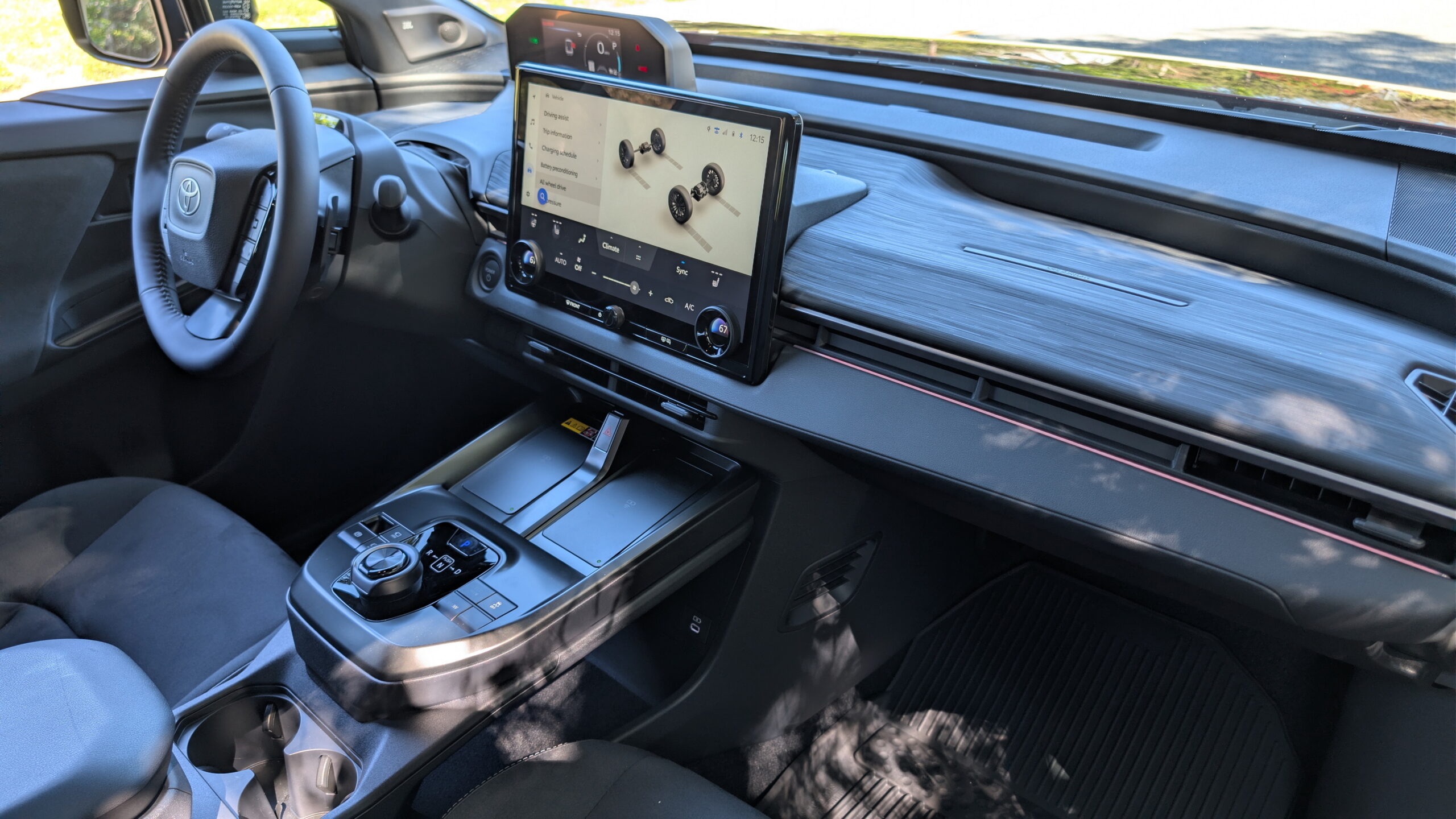
In the cabin, this crossover walks a fine line between rugged and refined. The materials feel good overall. They’re not luxurious or even what I’d call premium necessarily, but there’s a lot of thoughtful little touches to enjoy. Take, for example, the visual texturizing of the dashboard edges and upper door cards.
It elevates what could otherwise be a very plain space. That said, it’s all monotone. Black and more black, unless you opt for Stone Brown. I wish there were a little more visual drama inside, but from a business standpoint, Toyota probably made the smart call.
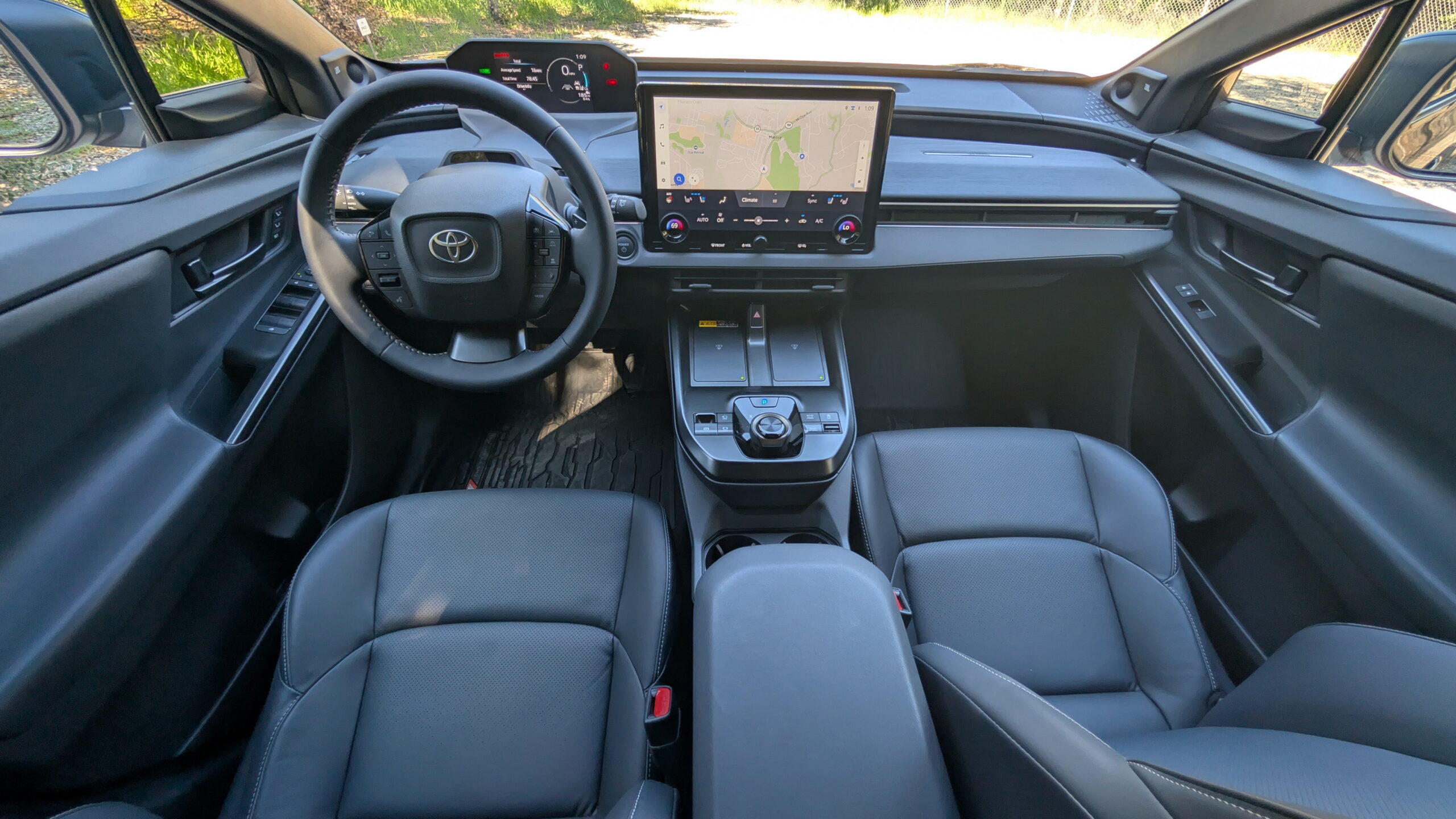
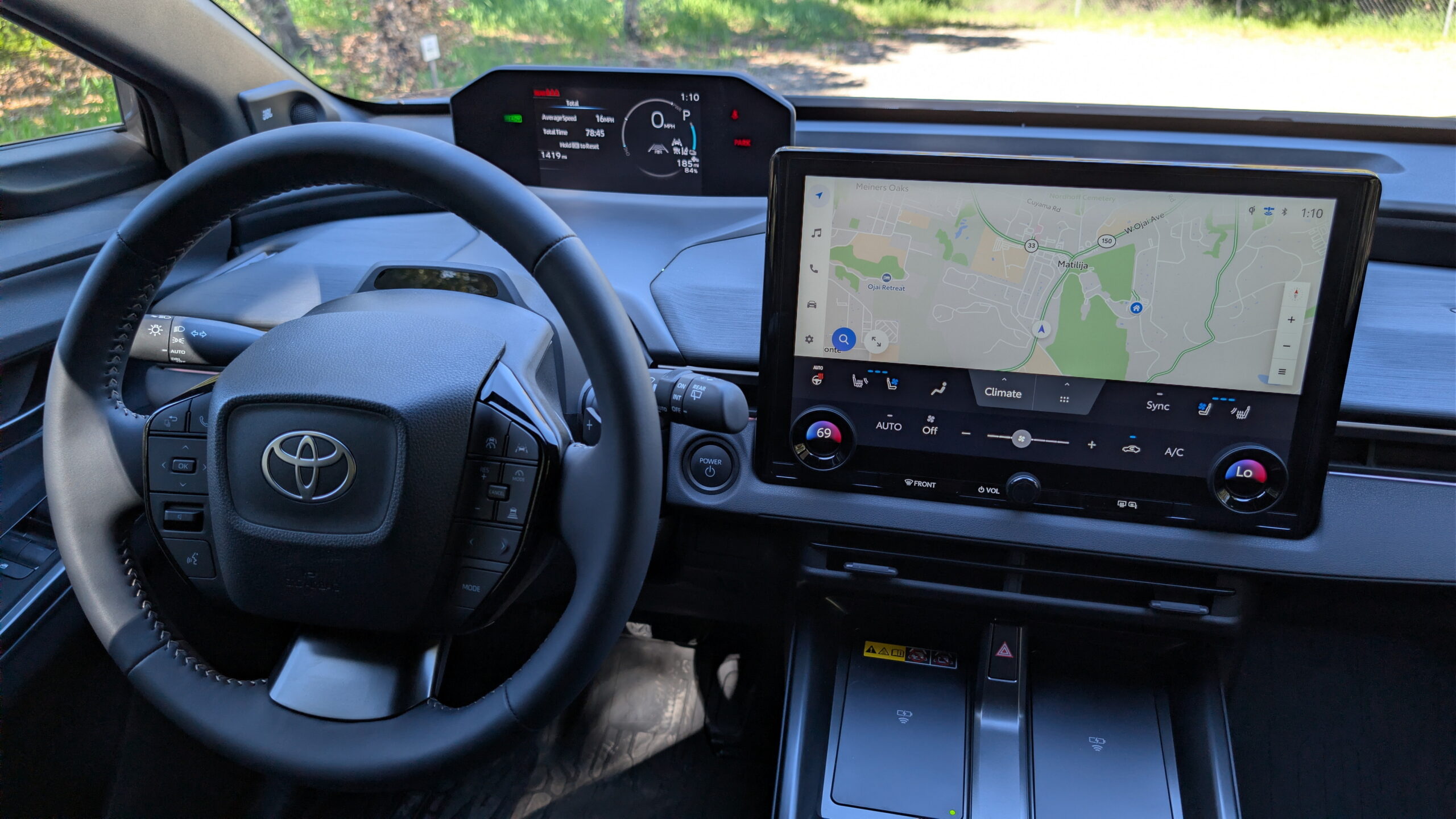
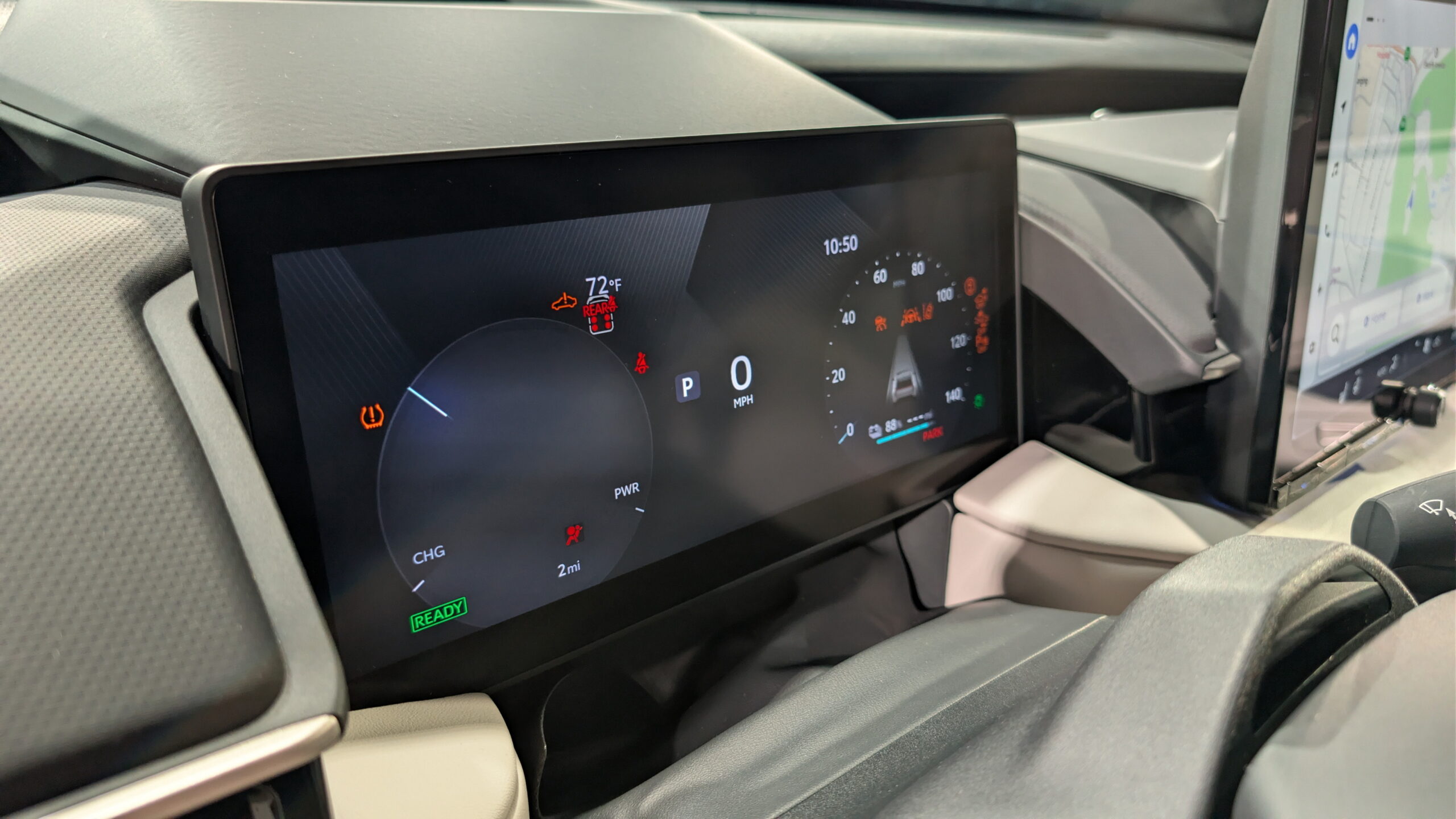
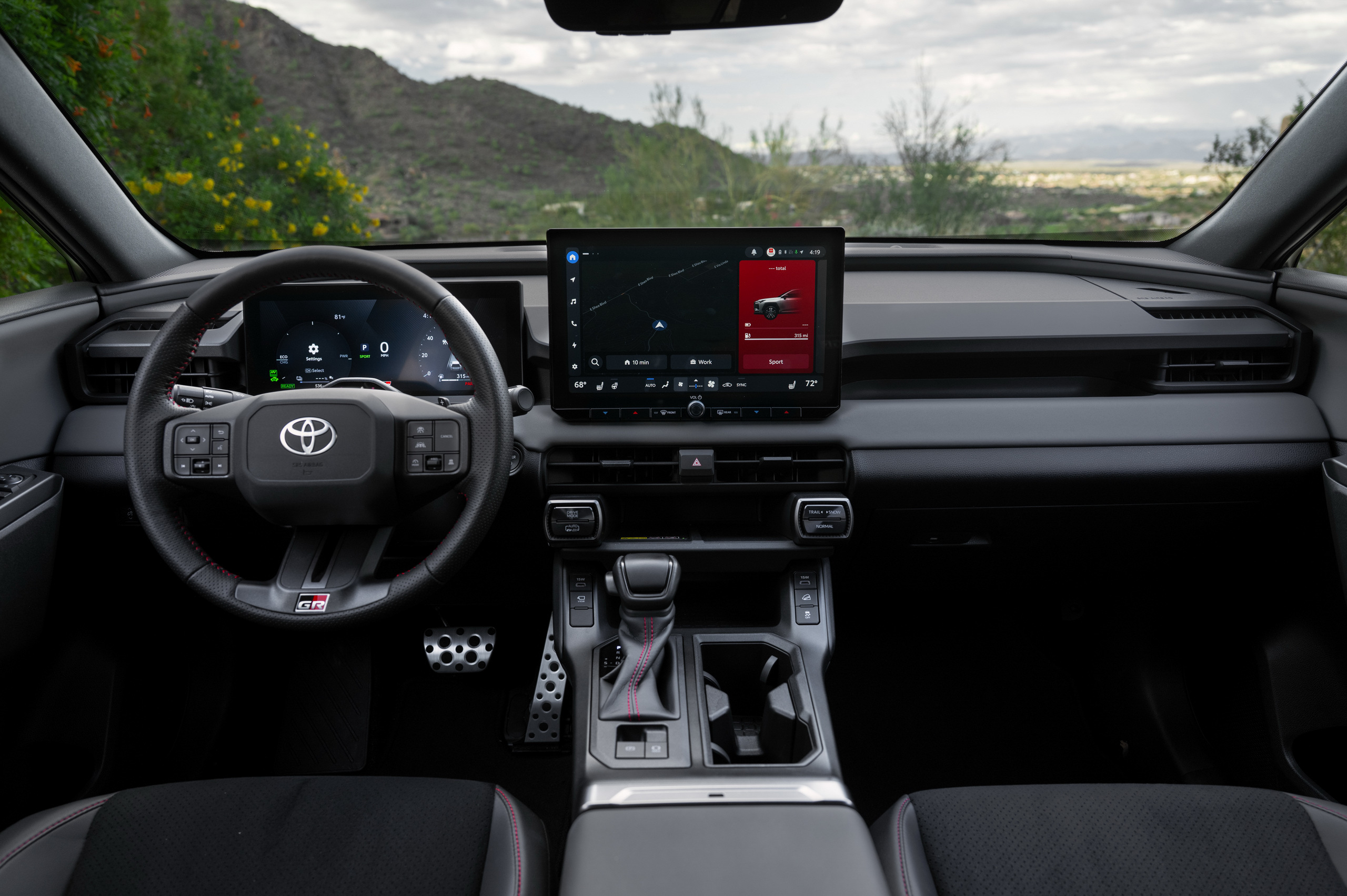
The cabin layout is straightforward to the point of being almost clinical. The 14-inch infotainment screen dominates the dash. It’s fast, intuitive, and thankfully backed up by integrated physical controls for key functions. The steering wheel feels tech-forward, with buttons for lane centering, voice commands, regenerative braking adjustments, and more. It’s busy, but logical.
Ergonomics And Everyday Usability
Photos Stephen Rivers/Carscoops
One potential issue, especially for shorter drivers, is that the steering wheel doesn’t have much in the way of maneuverability. My drive partner, Jason Torchinsky from our friends over at The Autopian, specifically remarked on how shorter drivers will struggle to see the entire gauge cluster without having the wheel block a significant portion of it.
In other words, shorter drivers might have to pick between seeing the whole road or seeing the whole gauge cluster because doing both at once might be impossible.
Another strange choice is the shifter knob. You have to press down on a ring and then rotate it in the direction you want. It’s not terrible. But it’s not intuitive, either. And it doesn’t feel like it adds anything meaningful. That space could’ve been used more creatively. Ahead of it, dual wireless chargers are a genuinely nice touch. It’s the kind of small usability win that makes daily life easier.
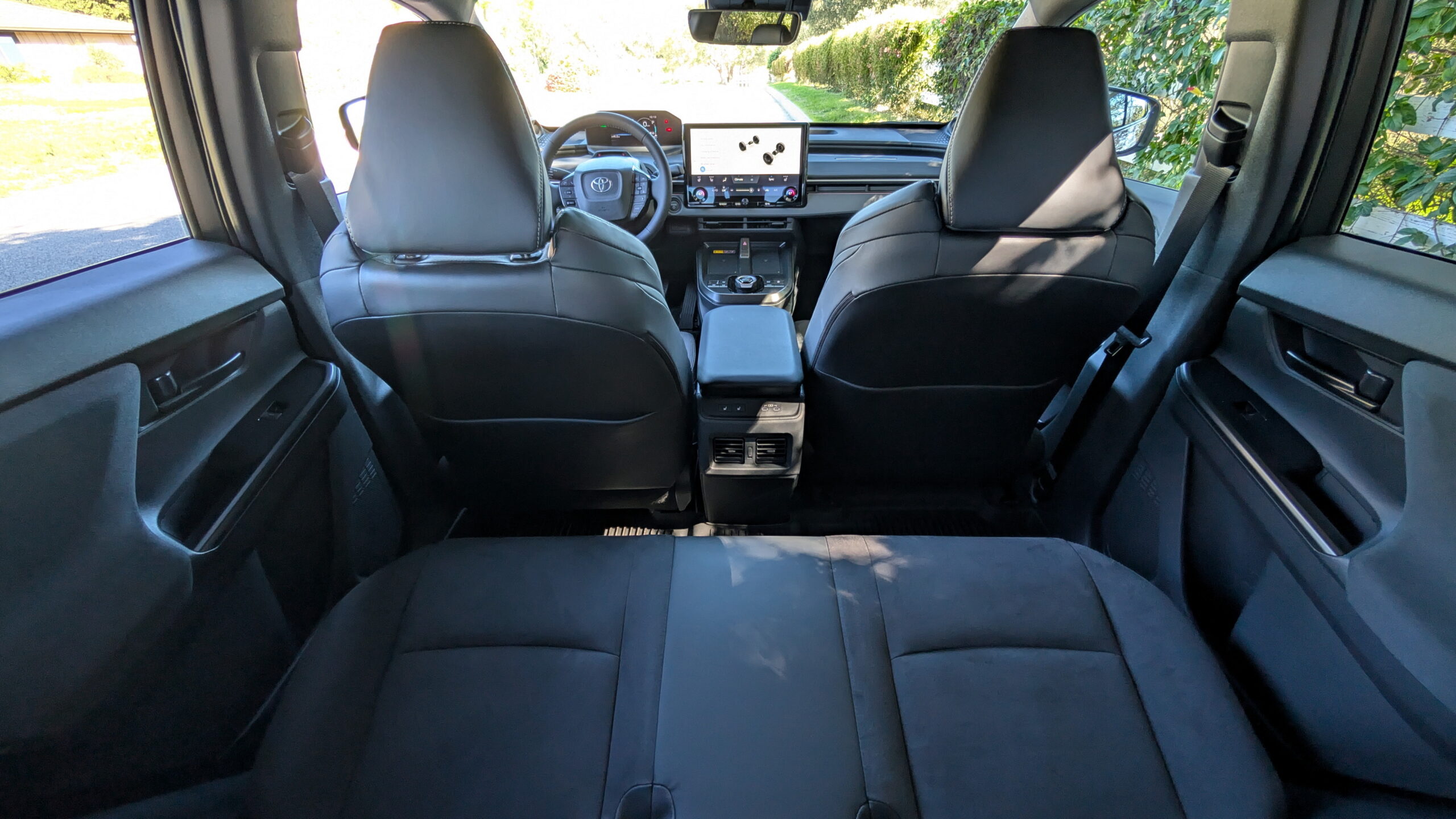
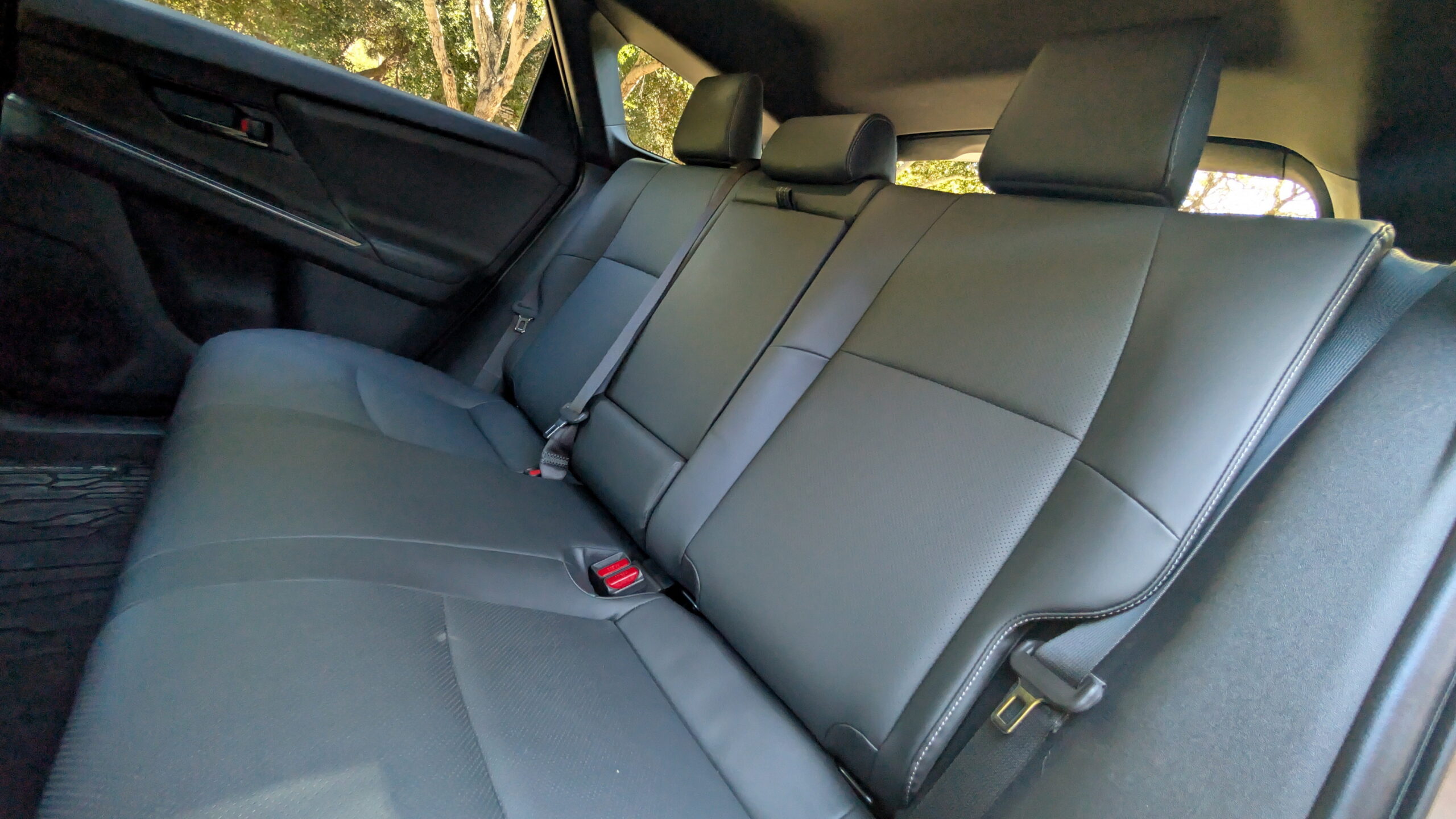
Rear seat space is where reality sets in. For a relatively large crossover, comparable in footprint to something like a Crown Signia, it’s tight back there. At 6’6″, I’ve endured my share of cramped rear benches, but I wasn’t expecting to have to slouch this much. Average-sized adults will be fine. Taller passengers should absolutely call shotgun.
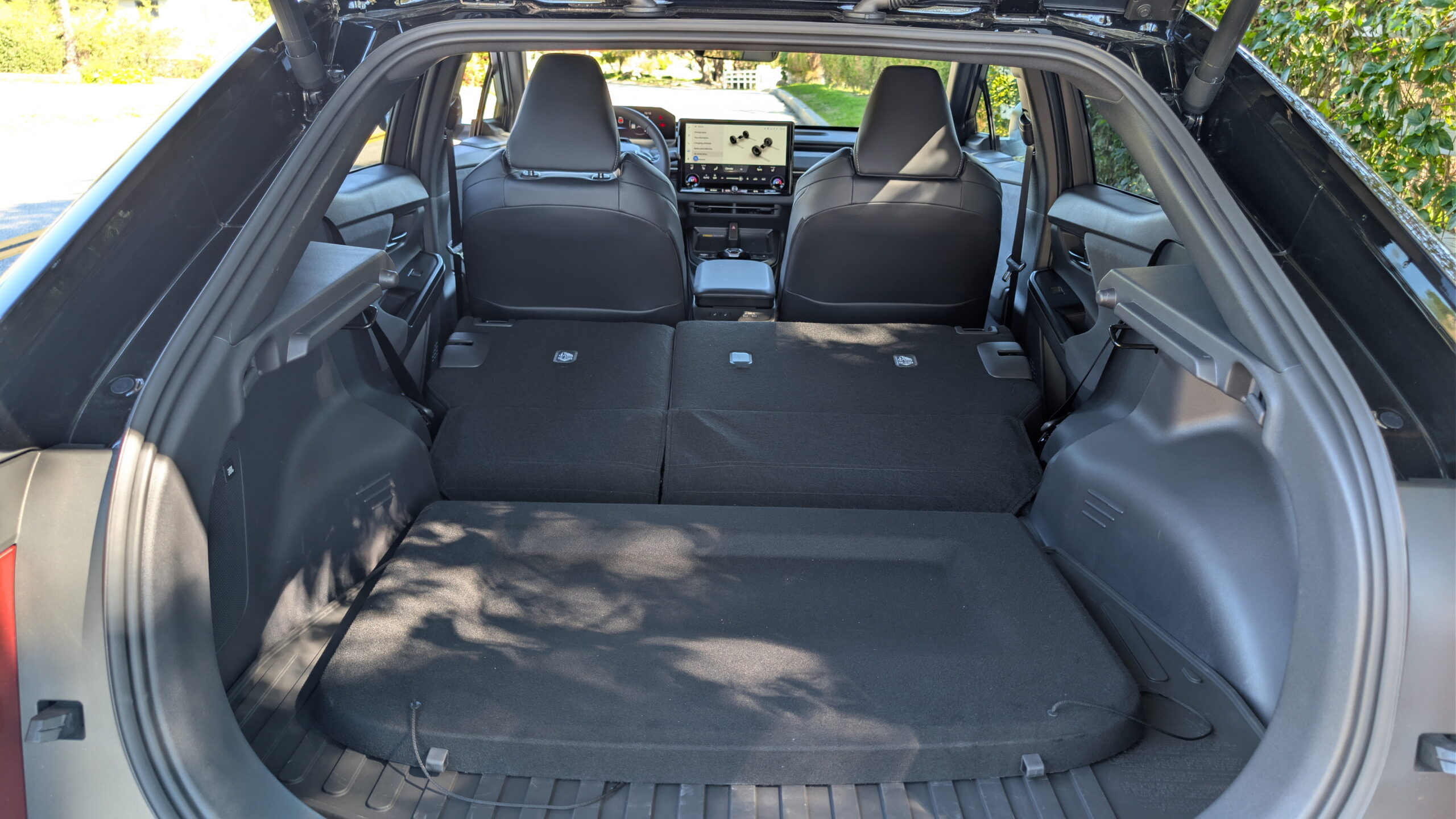
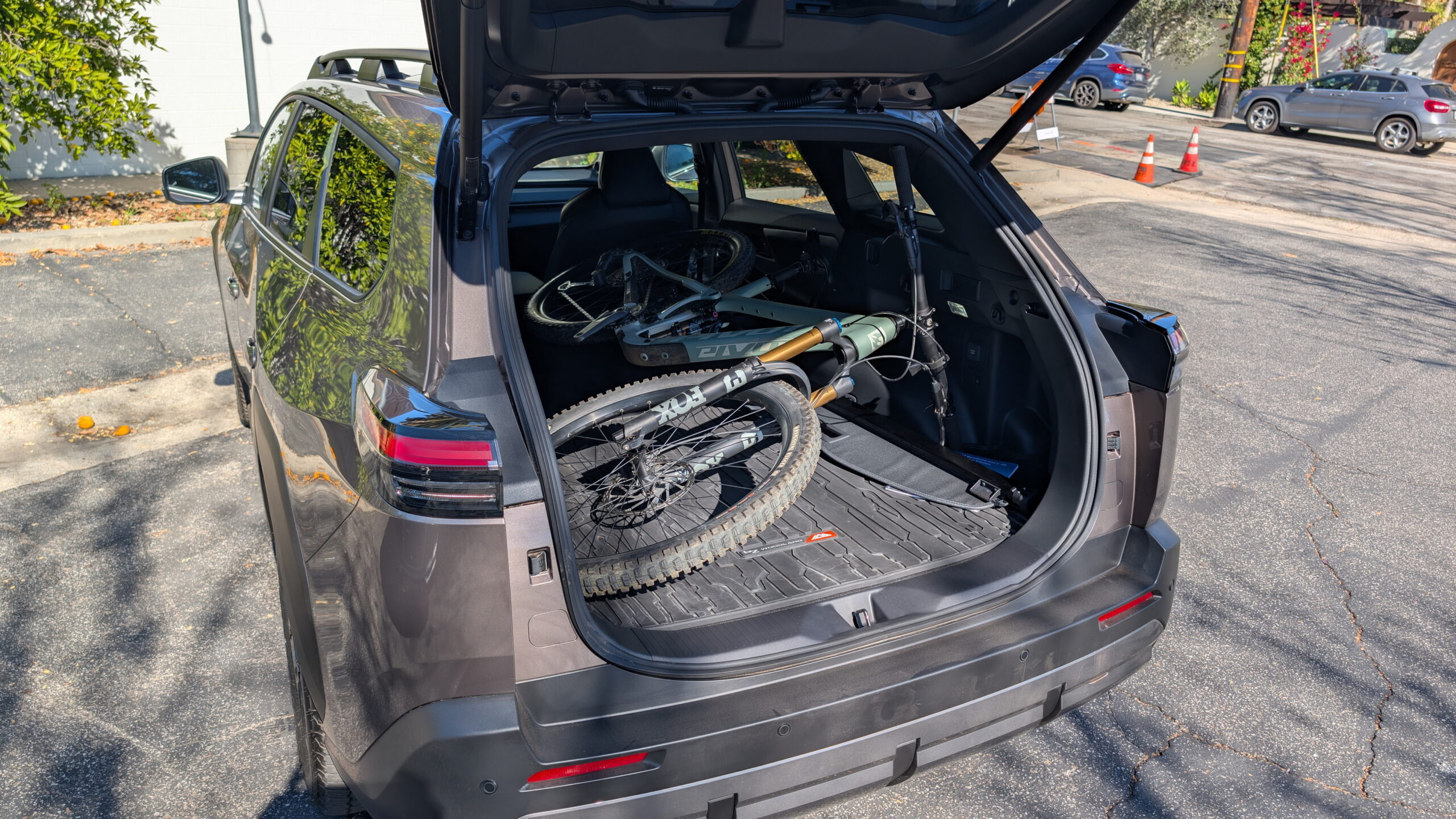
Cargo space makes up for it. With 74.9 cubic feet available with the seats folded, it’s genuinely cavernous. I fit a full-size, full-suspension mountain bike in the back, thanks to The Mob Shop, without removing the front wheel. That’s impressive.
It speaks not only to total volume but to how large and usable the rear opening is. If it swallows a modern mountain bike that I could ride whole, it’ll handle just about anything else you throw at it. If that’s not enough, it can also tow up to 3,500 pounds (1,588 kg).
Technology And Charging
Toyota loads the Woodland well. The 14-inch touchscreen runs Toyota’s latest multimedia software with wireless Apple CarPlay and Android Auto. The system is quick and easy to navigate. Dual Bluetooth pairing, Wi-Fi hotspot capability, and available JBL audio round things out nicely.
Charging is handled via a North American Charging Standard (NACS) port, giving access to a broad network of fast chargers. Under ideal conditions, Toyota says it’ll go from 10% to 80% in around 30 minutes. There’s also battery preconditioning and Plug & Charge capability to simplify public charging. That alone is a huge step in the right direction.
Steering-wheel-mounted paddles allow you to adjust regenerative braking intensity on the fly. It’s a useful way to fine-tune the driving experience depending on terrain or traffic. Toyota Safety Sense 3.0 comes standard, along with features like Blind Spot Monitoring, Rear Cross-Traffic Alert, Panoramic View Monitor with Multi-Terrain Monitor, and Safe Exit Alert.
It’s a comprehensive package that just about all buyers will benefit from.
Drive Impressions
Here’s where things take another unexpected turn, and this time, it’s decidedly for the better. Testing crossovers often means evaluating a vehicle that starts out compromised by design. What you don’t expect is something that does so many things at an above-average level, but that’s exactly where the bZ Woodland lands from a driver’s perspective.
Within 60 seconds of the opening presentation surrounding this vehicle, Toyota was proudly boasting that it has a 0-60 time of just 4.4 seconds. That’s unusual both in how it’s positioned and in terms of outright quickness.
For context, that’s quick enough to leave a GR Corolla (4.8 seconds) for dead and to almost keep up with a GR Supra manual (4.2 seconds). It actually beats the older four-cylinder version of the Supra (5.0 seconds). That said, this car isn’t really about outright speed. It’s about well-rounded capability.
Photos Stephen Rivers/Carscoops
What matters is how broad its competence is. On steep dirt roads, even with minimal momentum, the Woodland climbed confidently. On an off-road course with deep ruts that frequently lifted a wheel into the air, it slowly and methodically found traction and worked its way forward.
Grip Control functions like a low-speed cruise control for rough terrain, maintaining a steady crawl (roughly 3–5 mph or 5–8 km/h)) without constant throttle or brake input. In my testing, it wasn’t strictly necessary, but I can see it being useful on tight trails where steering precision matters more than pedal modulation.
On pavement, it’s exactly what most buyers want. Quiet. Smooth. Stable. Even on the optional all-terrain tires, road noise is impressively subdued.
Is it engaging? Not really. It’s more forgettable than fun. But it’s also sharp enough and consistent enough that you won’t complain. Visibility is good. Controls are balanced. Feedback is predictable. It’s faster than most people need, more capable off-road than most buyers will ever test, and more comfortable in daily driving than you’d expect from something with this much performance on tap. That’s a pretty compelling blend.
Range And Real World Efficiency
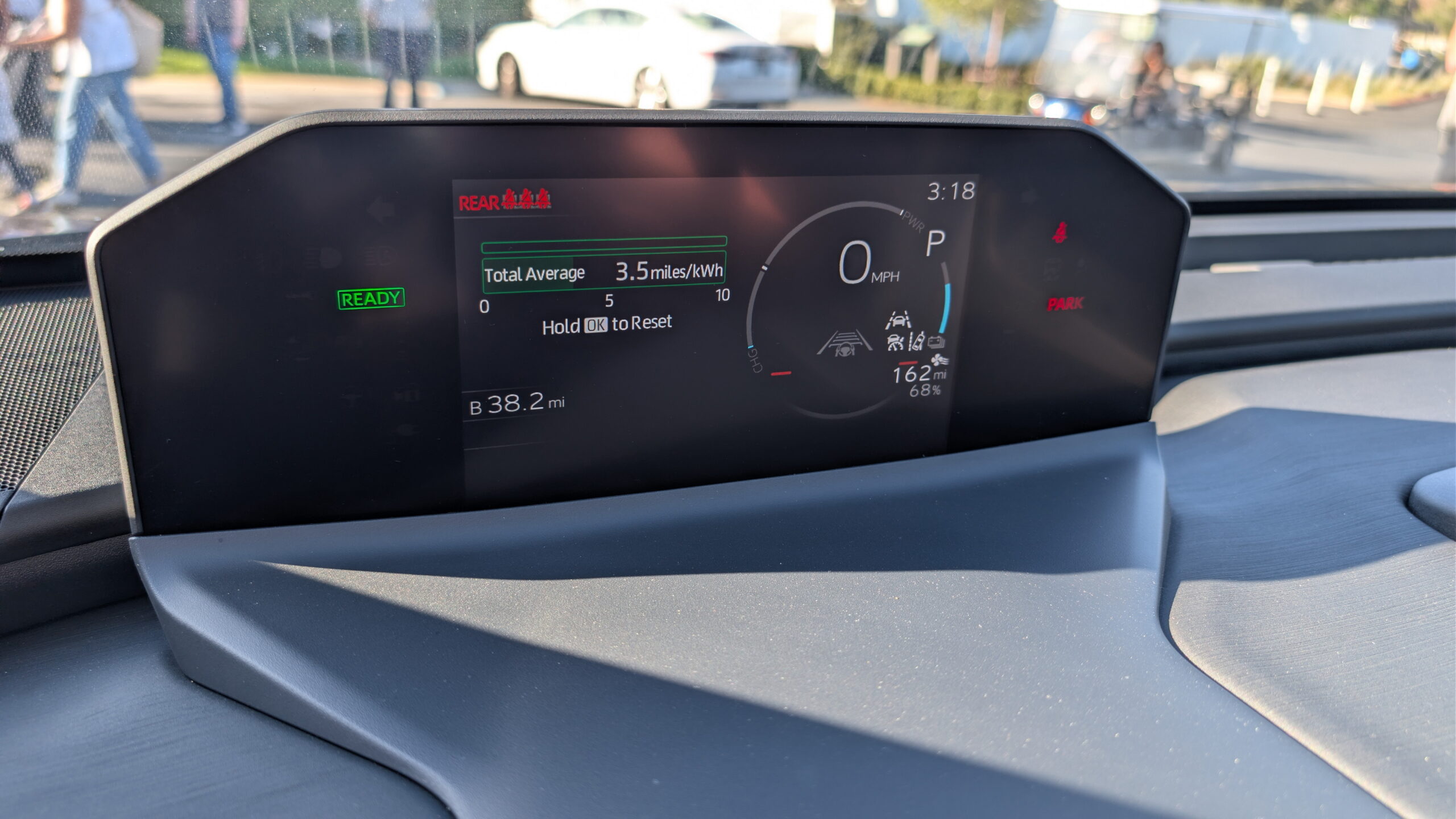
Toyota says the bZ Woodland will get up to 281 miles of range or 260 with its $0 optional all-terrain rubber. We drove different versions to different degrees of accelerator pedal excess, but managed one key finding in the end. During one restrained trip on a car equipped with all-terrain tires, we managed 3.5 miles per kWh.
Considering the 74.7 kWh battery pack under the floor, that works out to a potential 261 miles (420 km) on a single charge, assuming conditions stayed consistent. It’s difficult to view that as anything but a win, especially given that this wasn’t a tightly controlled test facility but real-world driving in Ojai, California, where the roads are rarely flat or straight.
Sure, we’d love even more range, but for now, we’ll take just barely beating an EPA estimate. After all, few folks will use up 260 miles of range in a day anyway.
Market Rivals And Positioning
Unquestionably, the biggest competition for the bZ Woodland will be from the Subaru Trailseeker. Positioned as an electric version of the well-loved Outback, the Trailseeker starts at around $5,000 less ($39,995) than the bZ Woodland ($45,300) and features the same underpinnings, battery, and AWD system. We haven’t sat in one, but based on photos, the cabin looks very similar. We expect the two to drive and handle almost identically as well.
Beyond the Subaru, there aren’t many EVs in this same niche. Rivian’s upcoming $45,000 R2 is likely the closest as it attempts to pair off-road capability with a premium cabin and on-road performance. Even so, it lacks the brand loyalty and recognition Toyota commands, along with the broader availability and ownership advantages, including a vast dealership network and established service infrastructure, that come with choosing a legacy automaker rather than a startup still finding its footing.
Other automakers like Tesla, Ford, Chevrolet, and Honda all have two-row crossovers or SUVs that could go up against the bZ Woodland on the road. None of them really has the same off-road capability angle to their game, though. Some, like Tesla, can’t come close to matching Toyota’s 3,500-lb towing capacity either. We expect that it’ll help Toyota capture a portion of the market that these others simply can’t touch.
Final Thoughts
The bZ Woodland reminds me of something like the Ford F-150. It’s very capable, but very few folks will ever use it to eight tenths of its performance envelope, much less ten tenths. That said, it’s hard to ignore just how much of Toyota’s DNA and ethos managed to find its way into this crossover. The original bZ4x never really felt all that akin to the brand from an identity standpoint.
Toyota’s newest EV offers serious practicality, objective soft-roading capability, and even a bit of serious performance on paved roads. Yes, the rear seat is tight for tall passengers. Yes, the shifter is odd. And yes, the interior could use a little more visual excitement.
But taken as a whole, the bZ Woodland is a genuinely well-rounded electric crossover that does more things well than it does poorly. And for a first serious swing at an adventurous, all-electric Toyota SUV, that’s a strong place to start.
Chinese tech giant sold 37,869 YU7s in the first month of the year.
Geely placed two strong sellers in the national top five chart.
VW posted several top sellers despite the wider market slowdown.
January tested the resilience of China’s auto market, exposing fault lines for some brands while spotlighting the rare breakout success. Many domestic manufacturers reported sales declines, with BYD among the most notable names to feel the squeeze. Yet even in a cooling climate, certain models found remarkable momentum. None more so than the Xiaomi YU7.
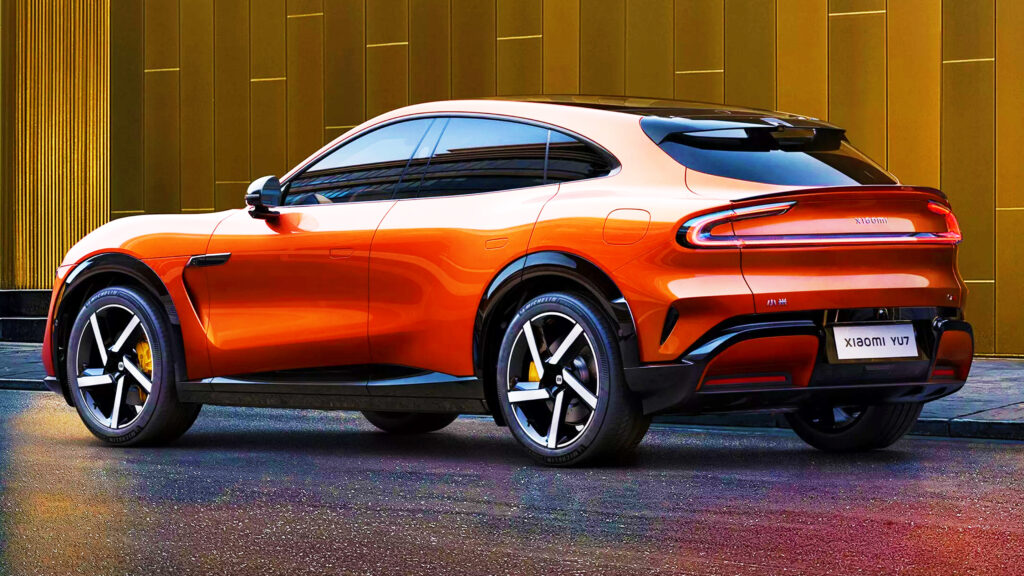
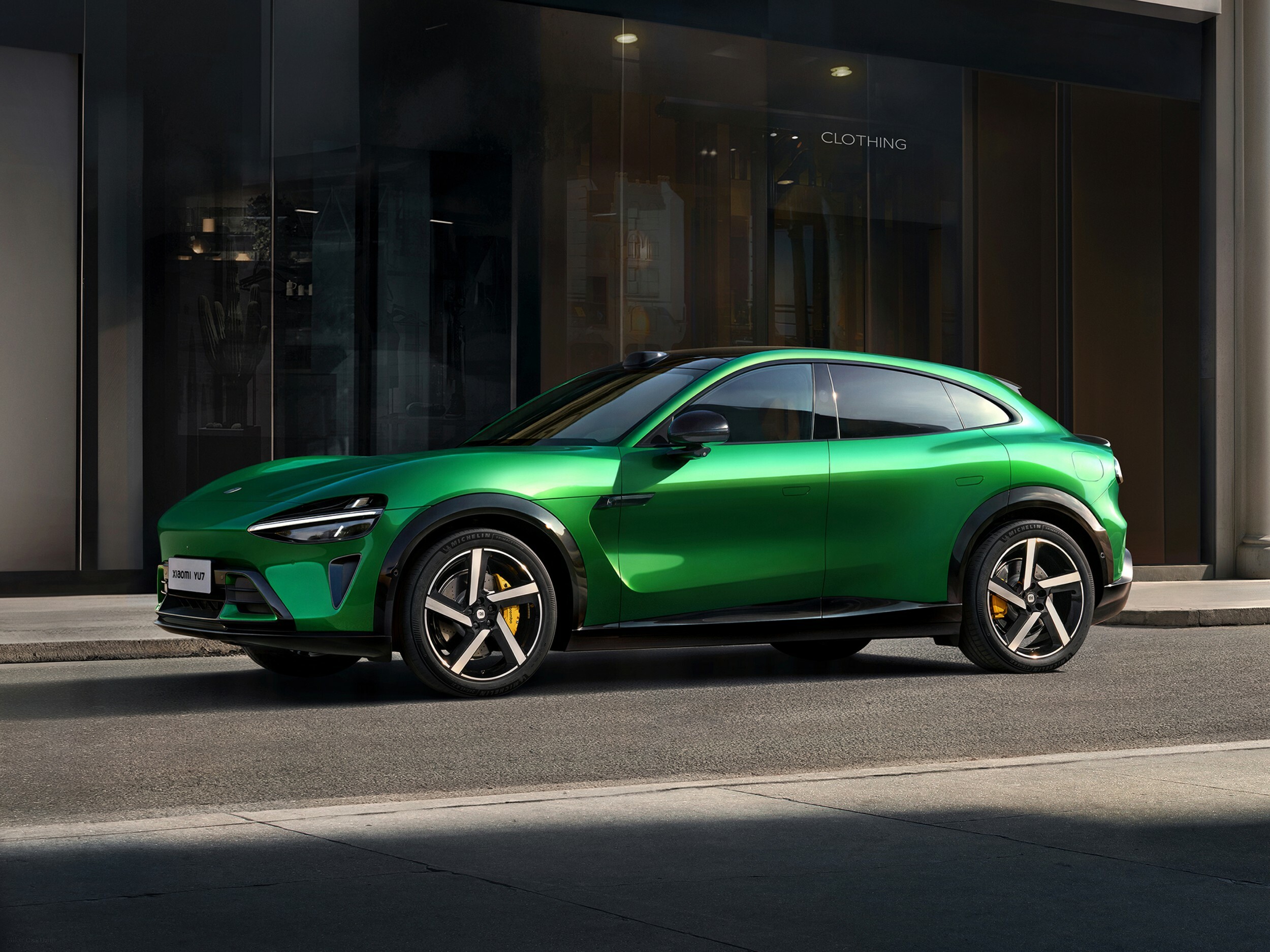
The all electric SUV, positioned as a rival to the Tesla Model Y and styled with more than a passing resemblance to the Ferrari Purosangue, was the best-selling new vehicle in China last month.
According to figures shared by Autohome, it moved 37,869 units, comfortably ahead of the Geely Boyue L in second place with 34,176 sales. The Geely Geome Xingyuan followed with 29,007, while the Aito M7 secured fourth with 26,454 units.
The presence of two Geely models in the top 5 best-sellers reflects a strong month for the group, with sales up 1 percent year-on-year to more than 270,000 units. The M7 from Aito, backed by Huawei and Seres, also surged in popularity, as did other models from the brand, helping it deliver more than 40,000 vehicles, a surge of over 80 percent from January 2025.
Sales of the YU7 in China have remained strong in recent months. December saw 39,089 units sold, making it the third best selling new car in China at the time. That figure represented a clear rise from November’s 33,729 and October’s 33,662.
It has also moved decisively ahead of the Tesla Model Y, selling more than twice as many units. The Model Y ranked only 20th last month, with 16,845 sales, a result that would have seemed unlikely not long ago. In fact, it was China’s best-selling model in December.
Perhaps the biggest surprises came from Volkswagen. It ranked fifth in China’s top 20 best-selling cars last month, led by the Sagitar with 25,316 units sold. VW also sold 23,481 Lavidas, 21,330 Tiguan Ls, 20,799 Passats, and 19,306 Magotans. In addition, the Nissan Slyphy sold 24,209 units, indicating that not all hope is lost for legacy carmakers in the country.
Things weren’t so rosy for BYD. It sold 205,518 vehicles in China last month across its brands, a significant decline from the 300,538 in January 2025. Only one of its models entered the top 20, the Fang Cheng Bao Ti7, which ranked 18th with 17,116 units sold.
Toyota’s 2027 Highlander is electric only with no gas option.
Two trims launch later this year with up to 320 miles range.
New platform brings larger dimensions and improved packaging.
For over twenty years, the Toyota Highlander has quietly been a heavy hitter. It’s never been wildly flashy, it’s never pretended to be an off-road giant, and yet, it’s been one of Toyota’s most important family haulers. Even with the arrival of the larger Grand Highlander that siphoned off some spotlight (and a fair share of sales), the original has held steady as a central figure in the lineup.
Now, for 2027, the brand is tearing up what seemed like a tried and true formula for something much bigger and far bolder than ever before. This all-new Highlander is an EV aimed squarely at the heart of the mid-sized market.
QUICK FACTS
Output
XLE FWD: 221 hp / 198 lb-ft
XLE AWD: 338 hp / 323 lb-ft
Limited AWD: 338 hp / 323 lb-ft
Overall Length
198.8 in (5,050 mm)
Overall Width
78.3 in (1,989 mm)
Overall Height
67.3 in (1,709 mm)
Wheelbase
120.1 in (3,050 mm)
Cargo Volume
45.6 ft³ (1,292 L) with 3rd row folded
15.9 ft³ (450 L) with 3rd row up
Range (Est.)
XLE FWD (77 kWh): 287 miles
XLE FWD (77 kWh): 270 miles
XLE AWD & Limited (95.8 kWh): 320 miles
SWIPE
Again, this isn’t just a new generation of the Highlander. It’s like a train switching tracks altogether. Buyers can’t get a gas-powered version, no matter how much they pay. That alone makes this a huge shift but Toyota didn’t stop there. This new SUV arrives with a new platform, larger proportions (color us shocked), and more technology than ever before.
Bigger And Bolder
Photos Stephen Rivers/Carscoops
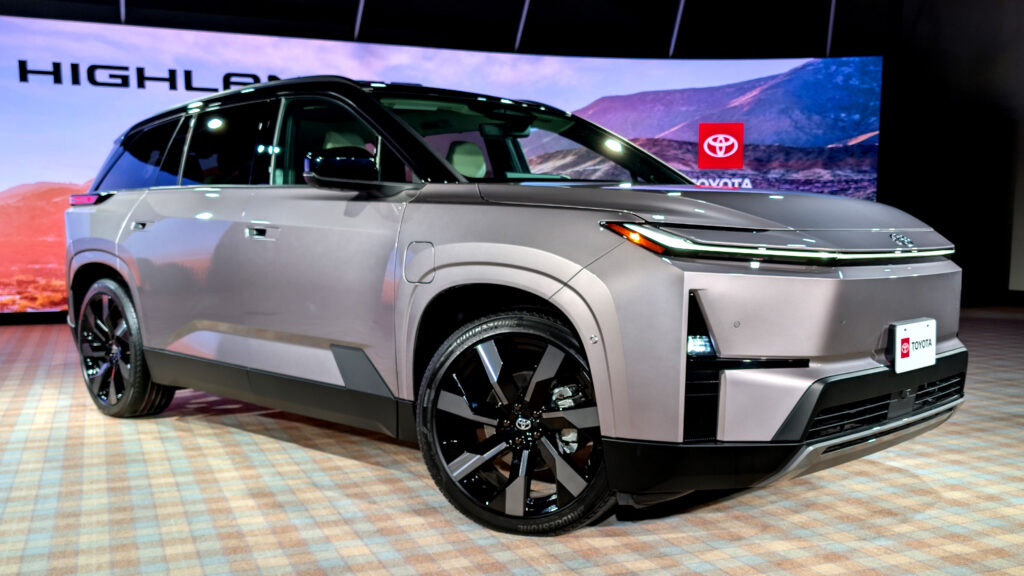
Visually, the new Highlander leans heavily into the new styling that we’ve seen from the brand in recent years. Who would’ve guessed that the Prius would spark a styling revolution? Nevertheless, that’s what’s happened, and the hammerhead front-end has slowly moved from Toyota’s most famous hybrid to the BZ line and now to the Highlander. In this case, that equates to an aerodynamically slippery front end, slim LED DRLs, flush door handles, and broad fenders.
It’s also considerably larger than the last-gen Highlander. Overall length jumps to 198.8 inches (+3.9 in.), width to 78.3 inches (+2.3 in.), and height to 67.3 inches (-0.8 in.). More importantly, the wheelbase now stretches to 120.1 inches (+7.9 in.). Don’t forget that the very first Highlander had a wheelbase of 106.9 inches (2,716 mm).
Photos Stephen Rivers/Carscoops
The two share little more than a name at this point. That said, the roofline is lower than the outgoing version. Combining that lower roof with a longer and wider body provides a planted stance.
Toyota says those revised proportions weren’t just about aesthetics. The longer wheelbase allows for a roomier cabin, easier third-row access, and better overall packaging for the battery underneath. Ultimately, it’s all about how the car shuttles passengers, so let’s dive into that interior space.
Cabin Acoutrement
From the front seats, what stands out most is that this Highlander feels more elegant and straightforward. Everything is centered around a 14-inch infotainment system and a 12.3-inch digital gauge cluster. Thankfully, Toyota includes physical buttons and switches for vital functions like climate controls.
Both trims come standard with SofTex upholstery, heated front seats, customizable ambient lighting with 64 colors, and Toyota’s latest multimedia system. A panoramic glass roof is available on the base XLE trim and standard on the Limited. It’s the largest ever fitted to a Toyota.
Photos Stephen Rivers/Carscoops
In the second row, things are pretty stellar as well. Captain’s chairs are standard. Buyers of the XLE AWD can choose an optional bench to increase seating from six to seven. Perhaps the boldest claim from Toyota is that the third row can comfortably fit adults.
After sitting in it myself, I can say that short adults might find it perfectly livable. No question, it has some nice features like USB-C ports, climate vents, and the flexibility to recline the backrest a little. That said, please don’t try to carry around taller folks back there for very long.
Photos Stephen Rivers/Carscoops
Toyota lists cargo space at 45.6 cubic feet (1,292 liters) with the third row folded and 15.9 cubic feet (450 liters) with it upright. For comparison, the gas-powered Grand Highlander offers over 57 cubic feet behind the second row and just above 20 cubic feet behind the third. So while the new EV Highlander is spacious, it’s not quite as roomy as its larger sibling.
Power And Range
While all 2027 Highlanders use an electric powertrain, buyers do have a few options on that front. Toyota will offer a front-wheel drive XLE with a 77.0 kWh battery and 287 miles of range as the base model. It offers just 221 horsepower and 198 lb-ft of torque.
Above that is an AWD XLE with the same battery and 270 miles of range, but buyers can also spec a larger 95.8 kWh battery to acquire up to 320 miles of range. Those who opt for the Limited trim get both the larger battery and AWD standard, along with the same 320-mile range.
Performance varies by configuration. AWD models deliver up to 338 horsepower and 323 lb-ft of torque, while FWD versions make 221 hp and 198 lb-ft. Paddle shifters control regenerative braking, and AWD models add features like Multi-Terrain Select and Crawl Control—yes, even on an EV.
Charging hardware includes a standard NACS port for DC fast charging, with Toyota estimating a 10–80 percent charge in about 30 minutes under ideal conditions (which is a very important qualifier). A dual-voltage home charging cable is included, along with battery preconditioning and Plug & Charge capability.
Tech And Safety
Toyota has long led the way with regard to standard safety tech, and the Highlander gets to continue that legacy. It’s the debut vehicle for Safety Sense 4.0. It bundles updated driver aids, including pre-collision braking, adaptive cruise control, lane-tracing assist, and proactive driving assist. The Limited adds Traffic Jam Assist, Advanced Park, a panoramic view monitor, and lane change assist.
Of all the big new tech features, vehicle-to-load might be the most likely to fly under the radar. It allows the car to power external devices, such as power tools at a job site, or to act as a backup power source during an outage. That’s a really beneficial feature for a family SUV trying to stand out.
What’s Left?
Toyota still hasn’t allowed us to drive it, though we have good reason to believe it’ll be a positive experience. More on that in the next couple of weeks. For now, we know that sales begin late this year, but we still don’t have pricing.
Normally, we’d make pricing the biggest key to success here, and no doubt, it’ll be vital. That said, the EV market in America is cooling off. Federal tax incentives are gone, and plenty of brands are backtracking or ditching EV goals altogether. For Toyota, putting this big a name on this EV says that it has a lot of confidence in how it’ll sell.
It certainly helps that production will take place in the U.S. at Toyota’s Kentucky facility, with the battery sourced from North Carolina. That should eliminate much of the concern over tariffs and help to keep prices low. That said, it would be shocking to see this thing start at under $50,000.
Is a price above that figure attractive enough in this market? Only time will tell. If it’s lower than that, it’ll probably sell well despite the market thanks to one of the most recognizable names in the segment.
Subaru’s next electric SUV will feature three-row seating.
It’s based on Toyota’s new all-electric Highlander platform.
Production was delayed but Subaru says it’s coming in 2026.
Subaru is preparing to expand its EV lineup with something larger and more family-focused. Soon, the company’s range will welcome a three-row electric SUV designed to compete with newer offerings in the segment. Like the compact Solterra before it, this won’t be a ground-up Subaru product but a rebadged version of Toyota’s upcoming all-electric three-row Highlander.
We’ve known about Subaru’s plans to have its own version of the latest Toyota for several years now. In fact, Toyota and Subaru confirmed in 2023 that both brands would receive the new model, anticipating that production would start in 2025. While that date has come and gone, Subaru of Americas chief operating officer Jeff Walters recently confirmed it’s still happening.
Speaking with Auto News, Walters said that Subaru’s version of the three-row EV is scheduled to arrive later this year. He added that the model is being targeted at two-car households with home charging capabilities. It will join the electric Solterra, as well as the similarly Toyota-derived Uncharted and Trailseeker, in Subaru’s growing U.S. EV portfolio.
2027 Toyota Highlander teaser.
Will Subaru Add Its Own Edge?
What we haven’t seen yet is how closely Subaru’s new entry will mirror Toyota’s new electric Highlander. Given past collaborations, it’s reasonable to expect minimal differentiation beyond some badging and minor design tweaks on the front and rear ends, along with unique side trimmings. Still, there’s a chance Subaru could roughen things up a bit, as it did with the Uncharted, which shares its bones with Toyota’s C-HR
Toyota’s new three-row electric SUV will look virtually identical to the bZ Large prototype previewed a few years ago, closely resembling the smaller Toyota bZ. This new model has been a long time coming and will give Toyota a legitimate rival to the electric Kia EV9 and Hyundai Ioniq 9.
A Lexus Too?
There’s also a possibility Subaru won’t be the only one getting a version of Toyota’s latest EV. According to previous reports, Lexus is working on a premium variant as well. This model could go by the name TZ and serve as an electric counterpart to the gas-powered TX, further spreading Toyota’s electric SUV platform across its portfolio
Toyota confirmed the Highlander is returning in a new form.
Launches as 2027MY as a battery-electric three-row SUV.
Teasers show AWD and BEV badges, confirming key specs.
The next chapter of Toyota’s SUV lineup is about to begin and it’s all-electric. Meet the all-new 2027 Highlander. As we suspected, the latest teaser confirms that Toyota will indeed use the Highlander name for its new three-row SUV.
While the full reveal lands on Tuesday, there’s already plenty to unpack from what we’ve seen so far. Here’s what we know, and what we’re watching for. Full launch coverage will follow as soon as the wraps come off.
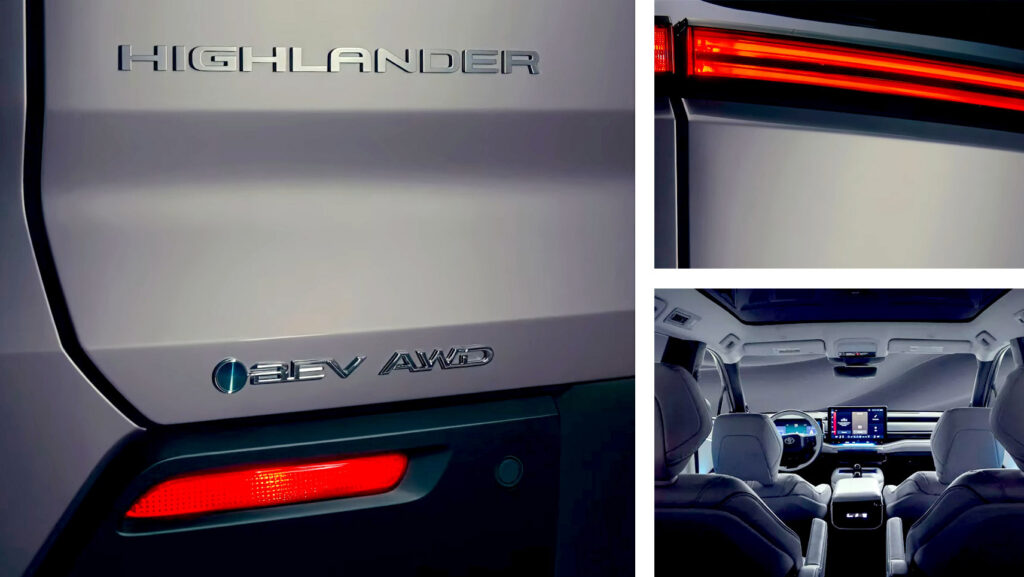
The new video goes a bit further than the previous two. While we don’t get a full look at the vehicle in question, we get something far more concrete: badges. During a short 11-second clip, we see the Highlander wordmark along with two other logos.
The first is Toyota’s BEV badge, indicating that what we’re looking at is an EV. Second, it’s the brand’s AWD logo, so we can expect that it’ll be a dual-motor SUV. In previous teasers, we saw the general shape of the rear of the Highlander and then a shot from the third row looking forward. Both pointed to what we’ve learned today about what Toyota decided to name this SUV.
In the past, we’d seen a concept named the bZ5x. Based on new renderings of what we think the Highlander will look like, the two seem to be one and the same. To that end, it’s worth noting the abandonment of the bZ and BZ nomenclature.
That’s a trend we’ve seen from other brands lately as well, including Volkswagen, which is bringing back familiar names like Polo and Tiguan for its upcoming EVs.
After a less-than-stellar launch of the bZ4X, Toyota revamped the branding to just BZ. It then reused that same name on the upcoming BZ Woodland. Why it ditched the BZ name in favor of Highlander alone probably just comes down to branding and the pull of name recognition.
In the end, it’s a lot easier to sell people on something they’re already familiar with, like the Highlander name, than to build interest around a brand-new one, even if the product itself has little, if anything, to do with the original.
You can be sure that we’ll dig around on that front, though, because as you’re reading this, we’re preparing to see the new Highlander up close and in person at the launch site.
It’ll get unveiled tomorrow at 9:30 p.m. EST. When it does, we’ll have full coverage with photos, video, and hopefully some insider tidbits on one of Toyota’s biggest new SUVs in years.
Toyota teased the exterior and interior of a new three-row SUV.
Production rumored for Kentucky using U.S.-sourced batteries.
The model will be fully revealed on Tuesday, February 10.
A big reveal is just around the corner for Toyota, and it’s shaping up to be one of the brand’s most important new models of the year. Teased earlier this week and set to debut on February 10, the automaker is about to introduce a new three-row SUV, and there’s a strong chance it will be fully electric.
We’ve speculated that this new model could step in as a successor to the aging Highlander SUV, though it’s unclear whether Toyota will stick with that name, adapt it to something like “bZ Highlander,” or go in a different direction altogether.
This model has been a long time coming. Toyota first offered a glimpse of its planned seven-seat SUV back in late 2021, referring to it then as the bZ Large Concept. The latest teasers strongly suggest the production version is finally here, giving us a much clearer idea of what to expect.
Design Echoes the bZ Family
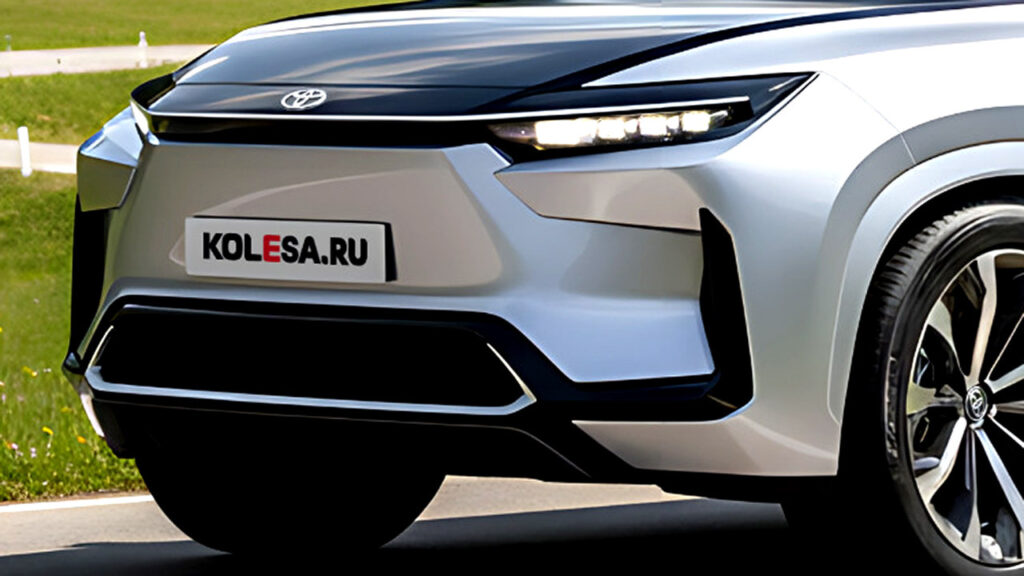
Illustrations Nikita Chuyko/Kolesa
As shown in these renderings, created by Nikita Chuyko for Kolesa and based on the original concept, the new SUV appears to follow the same design language as Toyota’s existing bZ models. The front end features headlights reminiscent of the original bZ, formerly known as the bZ4X, along with a blacked-out lower grille and prominent vertical air curtains.
The side profile isn’t particularly striking, but these renders do show the new SUV with very thin A-, B-, and C-pillars, just like the original concept. This should greatly improve visibility and help give the cabin a light, airy feel.
It has also been designed with both pop-out and traditional door handles. If Toyota is thinking ahead, it’ll stick with them, especially since China has now banned retractable versions and other countries could soon follow.
Illustrations Nikita Chuyko/Kolesa
These renderings also depict the new model with standard wing mirrors and rear-facing cameras in place of the mirrors. Given that no other Toyota has digital wing mirrors, we’d be surprised if this one does, but it’s not beyond the realm of possibility.
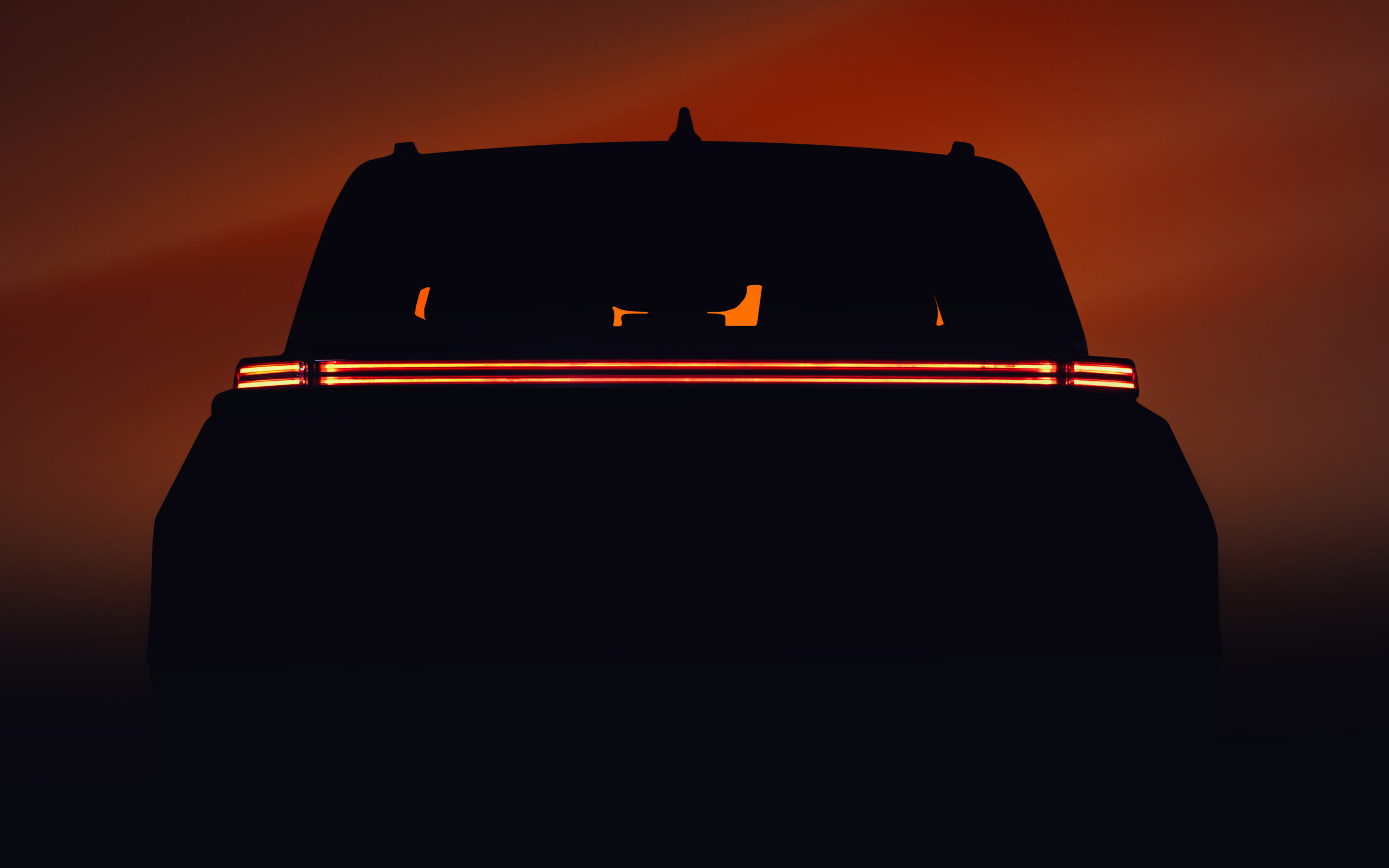
At the back, the design includes a full-width LED light bar connecting two taillight units, echoing styling trends across the industry.
Inside the Three-Row Cabin
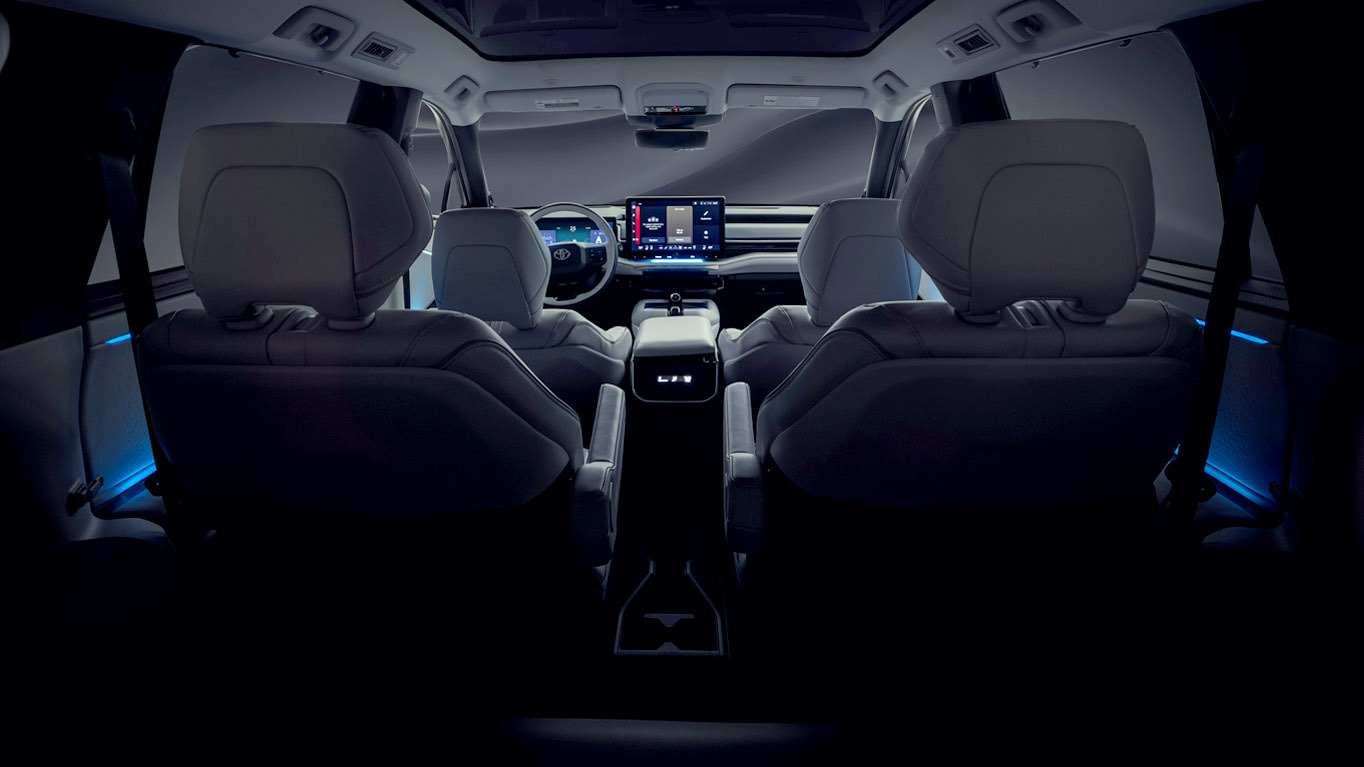
After previewing the exterior, Toyota followed up with an interior teaser confirming the vehicle’s three-row layout. In the version shown, it appears to adopt either a 2+2+3 or 2+2+2 configuration with second-row captain’s chairs. Still, Toyota may offer an option with a bench seat in the second row, potentially increasing total capacity by one.
Front and center on the dash is a wide, horizontally oriented touchscreen perched above a row of physical buttons, possibly for climate control, volume, and other secondary functions. The driver has a separate, large digital gauge cluster. Second-row passengers, meanwhile, have access to their own climate controls housed within a dedicated center console.
Other visible elements include ambient lighting integrated into the door panels and a panoramic glass roof that appears to extend at least to the second row.
Toyota is expected to sell this new model in several different markets, with a particular focus on the US, where it will be sold alongside the current ICE Grand Highlander.
While official confirmation is still pending, this vehicle is believed to be the electric three-row SUV that Toyota has already announced for production at its Kentucky facility, powered by batteries sourced from North Carolina. As for timing, it’s rumored to launch sometime later this year.
Toyota has quietly confirmed that the new 2026 C-HR will carry a starting price of $37,000, excluding a $1,450 destination fee. That makes the new electric crossover $2,100 more expensive than Toyota’s larger bZ model.
While paying more for less is typically a bad thing, the C-HR rides on the e-TNGA platform and comes standard with a dual-motor all-wheel drive system producing a combined output of 338 hp (252 kW / 343 PS). The bZ, on the other hand, comes standard with front-wheel drive and an all-wheel drive variant will set you back at least $39,900.
So what does $37,000 get you? A 0-60 mph (0-96 km/h) time of approximately five seconds and a 74.7 kWh battery that provides a range of up to 290 miles (467 km). Buyers will also find an NACS charging port as well as a fast charging capability that can take the battery from 10-80% in roughly 30 minutes.
On the styling front, the crossover coupe has C-shaped lighting units and 18-inch alloy wheels. The model also comes standard with rain-sensing wipers, roof rails, and a power liftgate.
Despite its entry-level status, the C-HR SE comes nicely equipped with a digital instrument cluster and a 14-inch Toyota Audio Multimedia system. They’re joined by a heated steering wheel as well as heated front seats with fabric and SofTex upholstery.
Other niceties include an 8-way power driver’s seat, dual wireless smartphone chargers, and a six-speaker audio system. The model also has steering wheel-mounted paddle shifters that can apply the regenerative braking system.
The Toyota Safety Sense 3.0 suite comes standard and includes Full-Speed Range Dynamic Radar Cruise Control, Lane Departure Alert with Steering Assist, and a Pre-Collision System with Pedestrian Detection.
They’re joined by Lane Tracing Assist, Road Sign Assist, Proactive Driving Assist, and Automatic High Beams. Buyers will also find Safe Exit Alert, a Blind Spot Monitor, and Front/Rear Parking Assist with Automatic Braking.
The range-topping C-HR XSE will set you back $39,000 and it’s distinguished by larger 20-inch wheels with a gun metal finish. Buyers will also find an upgraded interior with SofTex and synthetic suede seats sporting 8-way power adjustment on both sides. Rounding out the highlights are a driver’s seat memory function, Traffic Jam Assist, Lane Change Assist, and a Panoramic View Monitor.
While Toyota hasn’t released full details, the company has previously mentioned a handful of options. These include a two-tone paint job and a panoramic glass roof.
Toyota and Daihatsu launch electric kei vans in Japan.
Powertrain delivers 63 hp and up to 160 miles of range.
Prices are nearly triple those of gasoline equivalents.
After years of delays and development setbacks, Japan’s long-awaited electric kei vans from Toyota, Daihatsu, and Suzuki have officially made the leap from concept to production.
The three brands have confirmed the market launch of their collaborative battery-powered van lineup: the Toyota Pixis Van BEV, the Daihatsu e-Hijet Cargo, and the Daihatsu e-Atrai RS. Suzuki’s equivalent, the nearly identical e-Every, is also on the way. These production models arrive almost three years after the original trio debuted in prototype form back in 2023.
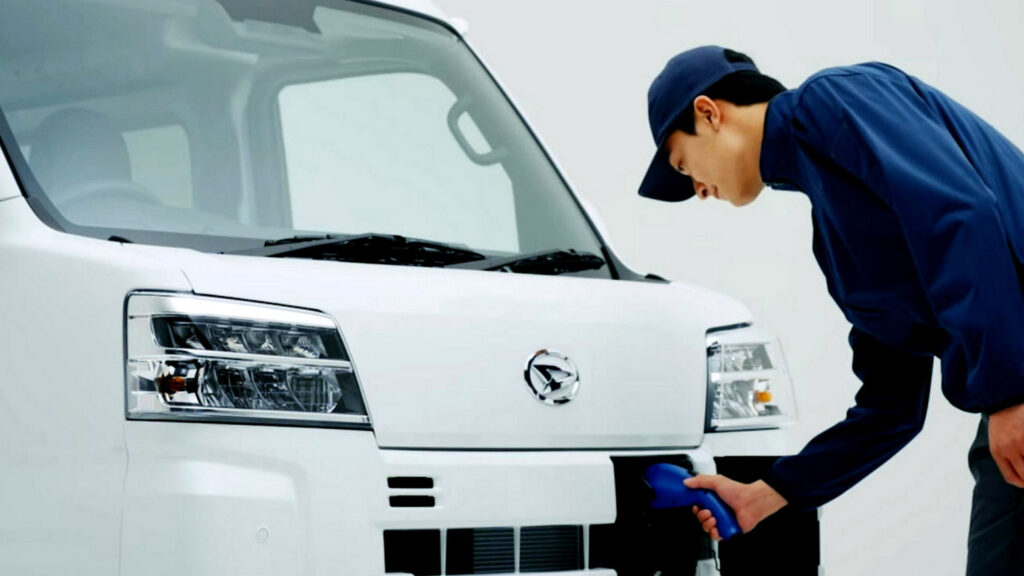
On the outside, these new zero-emission vans mirror their combustion-engine siblings, which have been on sale since 2021. The main visual clue is the addition of a charging port on the front bumper.
Between the Toyota and Daihatsu versions, the only visible difference lies in the badges. The e-Atrai RS, Daihatsu’s more passenger-friendly variant, is sold exclusively in a single RS trim. It features black steel wheels, color-matched accents, chrome detailing, and power sliding doors on both sides.
Inside, the highlight is the new shifter, sourced from other Toyota models such as the Prius. Equipment includes heated front seats and auto A/C for greater efficiency, a USB port, an AC 100V outlet for powering external devices, and an enhanced preventing safety system called Smart Assist.
Practicality remains central, with an overhead compartment and smart storage solutions integrated throughout the cabin. More importantly, the move to electric power leaves both the cargo space and the 350 kg (772 lb) maximum load capacity untouched.
Fully Electric Powertrain
The kei vans are identical under the skin, riding on the Daihatsu New Global Architecture (DNGA) platform with a new powertrain developed jointly by Suzuki, Daihatsu and Toyota.
A single rear-mounted electric motor (e-axle) produces 63 hp (47 kW / 64 PS) and 126 Nm (93 lb-ft) of torque. That matches the output of the turbocharged 660cc three-cylinder gasoline engine, with an added 35 Nm (26 lb-ft) of torque.
The floor-mounted lithium-ion battery pack has a capacity of 36.6 kWh, allowing a WLTC range of 160 miles (257 km) between charges. This is 36 miles (57 km) more than the targeted figure during development, and should be enough for urban deliveries. It is also slightly better than the 152 mile (245 km) range of the Honda N-Van e: which is their main competitor.
A full charge is completed in around 6 hours from a standard 6 kW outlet, while a 50 kW fast charger will take it to 80% in 50 minutes. Finally, the EVs are compatible with Vehicle-to-Home (V2H) technology.
Engineers have also applied BEV-specific structural reinforcements to the chassis, promising better handling thanks to the lower center of gravity, and improved ride comfort thanks to the new trailing-link rigid-axle rear suspension and the optimised spring rates.
A Premium for Zero Emissions
The jump to electric doesn’t come cheap. Both the Toyota Pixis Van BEV and Daihatsu e-Hijet Cargo start at ¥3,146,000 (about $20,300 at current exchange rates) in Japan, nearly three times the cost of their entry-level gasoline counterparts, which begin at ¥1,100,000 (roughly $7,100). The Daihatsu e-Atrai RS comes in higher still, starting from ¥3,465,000 ($22,400).
Production will take place at Daihatsu’s plant in Nakatsu, Japan. Toyota is targeting 50 sales per month, while Daihatsu expects to move around 300 units monthly.
Toyota bZ4X recall stems from incorrect taillights being sold.
Korea-spec lights lack the side marker lamp required in US.
Catalog wrongly listed Korea lights as suitable for US vehicles.
Even the most reliable brands can slip up now and then, and this time, it’s Toyota turn in the spotlight. While known for its solid track record in quality control, the automaker has nonetheless found itself navigating a rather awkward parts mishap involving the bZ4X.
Several units will now face a recall in the United States, all due to a mix-up with replacement taillights. So, what exactly went wrong?
Confused Parts Cross Borders
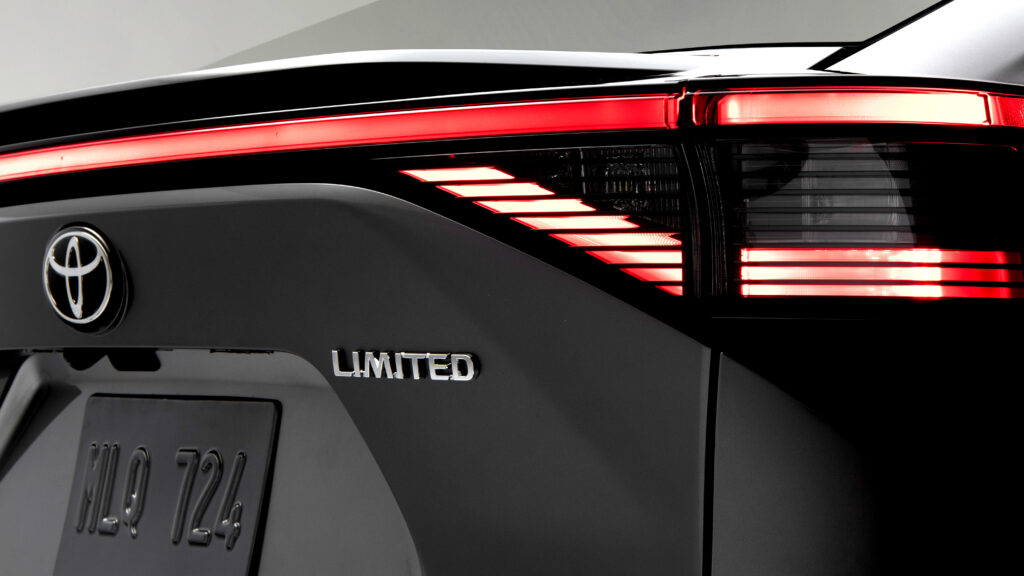
A recall notice issued by the National Highway Traffic Safety Administration (NHTSA) reveals that taillights originally intended for service replacements in South Korea were accidentally distributed in the U.S. Some of those may have ended up installed on American-market bZ4X models.
Due to differences in automotive lighting regulations between the two countries, the South Korean-spec taillights don’t meet American standards. The key issue lies in the side marker, as the Korean units include a side marker reflector, but U.S. regulations require a side marker lamp to comply with Federal Motor Vehicle Safety Standards.
Toyota first caught wind of the problem in October, when a parts order came through from Canada requesting a Korea-spec left-hand taillight assembly for the bZ4X. That raised a red flag, prompting the company to dig deeper.
The investigation revealed a potential cause of the mix-up. Both U.S. and Korean versions of the replacement parts had been listed in the catalog, but the Korean version also displayed the term “USA” in its description, likely confusing some who purchased a replacement light.
Toyota believes that a total of 79 right-hand and left-hand replacement taillight assemblies designed for South Korea could have ended up in the United States, although it hasn’t specified how many have been fitted to customer cars.
What Happens Now?
Owners who’ve had a taillight replaced on their bZ4X will be notified via mail. Toyota dealers will inspect the installed parts to determine whether the correct U.S.-spec lights were used. If any Korean-spec units are found, Toyota will replace them at no cost.
The 2026 Toyota bZ Woodland arrives soon for $45,300.
It costs thousands more than the similar Subaru Trailseeker.
Crossover has 375 hp and an estimated range of 260 miles.
Toyota has quietly announced pricing for the 2026 bZ Woodland will start at $45,300 before a $1,450 destination fee. That makes the model $10,400 more expensive than the smaller bZ and a whopping $5,305 pricier than the similar Subaru Trailseeker.
That’s a sizable difference, but the company is only offering the crossover-ified wagon in one well-equipped trim. However, customers can order an optional Premium Package. This stands in contrast to Subaru, which will offer the Trailseeker in three separate trims named Premium, Limited, and Touring.
Toyota hasn’t published full specs yet, but the bZ Woodland will come equipped with LED lighting units and 18-inch alloy wheels. Buyers will also find a six-speaker audio system, a 14-inch infotainment system, and a wireless smartphone charger. Other highlights include ambient lighting and heated power fronts seats wrapped in SofTex upholstery.
They’re joined by the Toyota Safety Sense 3.0 suite of driver assistance systems. It includes a Pre-Collision System with Pedestrian Detection, Full-Speed Range Dynamic Radar Cruise Control, and Lane Tracing Assist. These features are accompanied by Automatic High Beams, Road Sign Assist, Proactive Driving Assist, and Lane Departure Alert with Steering Assist. Other safety systems include a Blind Spot Monitor with Rear Cross-Traffic Alert, a Panoramic View / Multi-Terrain Monitor, and Safe Exit Alert.
The bZ Woodland with the Premium Package costs $47,400 and adds a panoramic moonroof as well as a nine-speaker JBL premium audio system. Buyers will also find front radiant heaters as well as heated and ventilated front seats with a memory function on the driver’s side.
The Trailseeker Looks Like A Far Better Deal
While we’re waiting for Toyota to share more details, the Trailseeker looks like a far better deal as the base model has much of the same equipment as the bZ Woodland. Furthermore, the $43,995 Trailseeker Limited seems to be better equipped as it has a hands-free power liftgate and larger 20-inch wheels. It also sports heated rear seats and a Harman Kardon premium audio system.
The $46,555 Trailseeker Touring compares favorably to the $47,400 bZ Woodland Premium as well as both have a panoramic glass roof, ventilated front seats, and radiant leg warmers. Subaru also throws in a gloss black hood decal and a digital rearview mirror.
A Shared Powertrain With 375 HP
Both models ride on the e-TNGA platform and have a 74.7 kWh battery pack. The latter feeds a dual-motor all-wheel drive system developing a combined output of 375 hp (280 kW / 380 PS).
Toyota originally quoted a range of up to 260 miles (418 km), but Subaru pegs it at around 280 miles (451 km). The latter company also noted the Trailseeker accelerates from 0-60 mph (0-96 km/h) in 4.4 seconds, has a NACS port, and can get an 80% charge in as little as 28 minutes.
Toyota will double down on hybrids and ICE in key regions.
China will remain Toyota’s electric-first market going forward.
GR GT V8 hybrid proves Toyota’s engine push isn’t just talk.
Saying the automotive world is in a bit of limbo may be an understatement. On one hand, you have the world’s largest market, China, accepting EVs and plug-in hybrids in even greater numbers than ever before. Meanwhile, in Europe, manufacturers are pulling back on their EV manifestos as the European Union provides some respite in the face of slower-than-predicted adoption.
Toyota, by contrast, has always been pro-ICE. For years, the company has questioned its competitors and governments, who have been advocating exclusively for electric vehicles. And while the company has shown off various plans for EVs, they’ve maintained a more balanced approach.
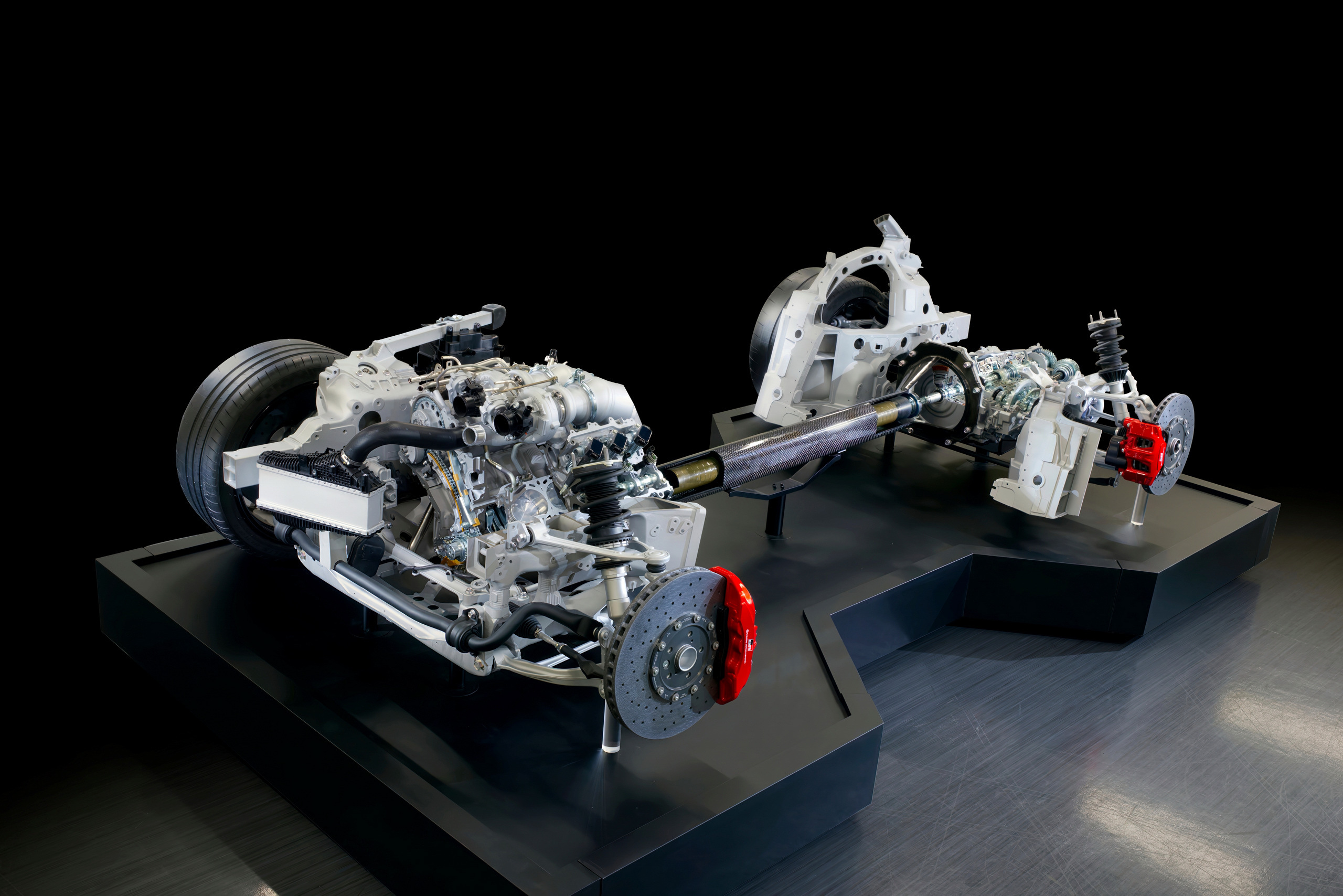
Now, it may be clear that Toyota wasn’t going to say goodbye to combustion without a fight, but we imagine not many would have predicted the unveiling of the GR GT: a production-slated halo supercar with a ferocious twin-turbocharged 4.0-liter hybridized V8 engine.
The Fight for Identity
In an era of tightening emissions regulations and downsized powertrains, the decision to green-light a V8 may seem almost rebellious. But for Toyota, the GR GT isn’t about volume or compliance alone. It’s about identity.
Nikkei Asia notes that the GR GT has been built without the assistance of Yamaha, unlike its spiritual forefathers, the 2000GT and Lexus LFA. “Automobiles, as an industrial product, are in danger of becoming commoditized,” says Toyota Chairman Akio Toyoda. “The engine still has a role to play,” underscoring the importance of the in-house powerplant.
The reality is that Toyota’s focus on keeping engines around will permeate throughout its lineup for the foreseeable future. In June 2025, Toyota convened suppliers at an internal combustion engine rally, where executives outlined plans to develop new engines, including high-output units, while maintaining overall engine production volumes through 2030.
It was a clear signal that Toyota sees a long runway for combustion, even as the market fragments.
However, Toyota is still hedging its bets with EVs, especially when it comes to China. Over there, the car-buying population continues to march towards an all-electric future.
Toyota, like all foreign manufacturers, is feeling the pinch against local rivals. At a supplier event in Shanghai last summer, a Toyota executive drew rare applause by declaring, “In China, we will focus not on cars for the global market, but on cars made specifically for China.”
He added pointedly that if Japan’s headquarters hesitated on investment, he would “explain things to them directly.”
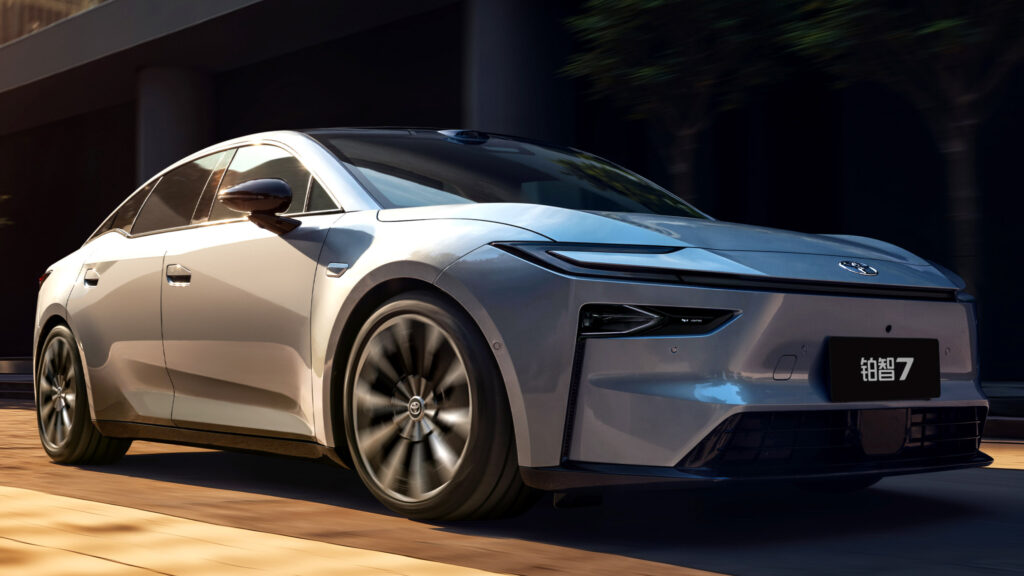
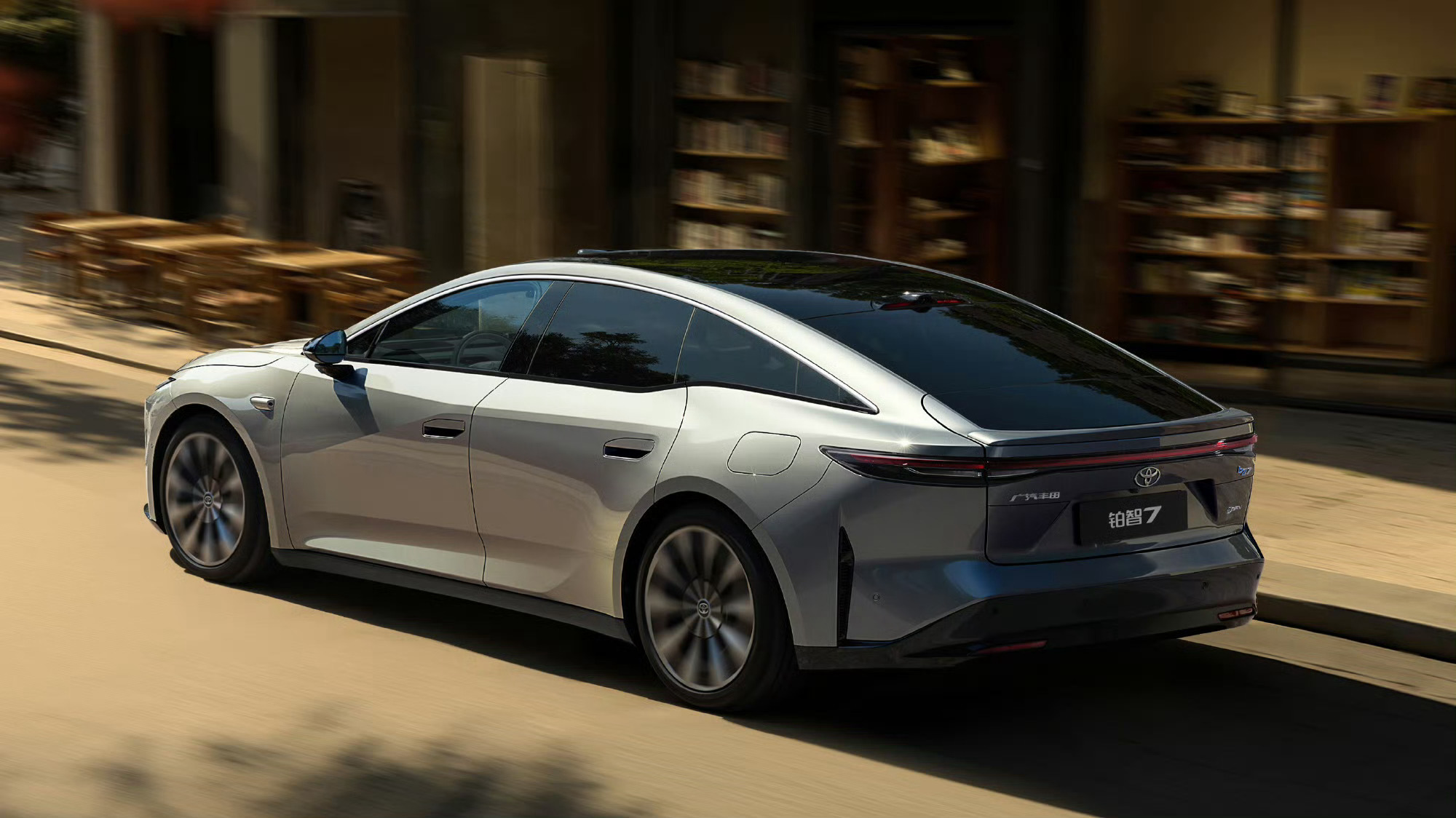
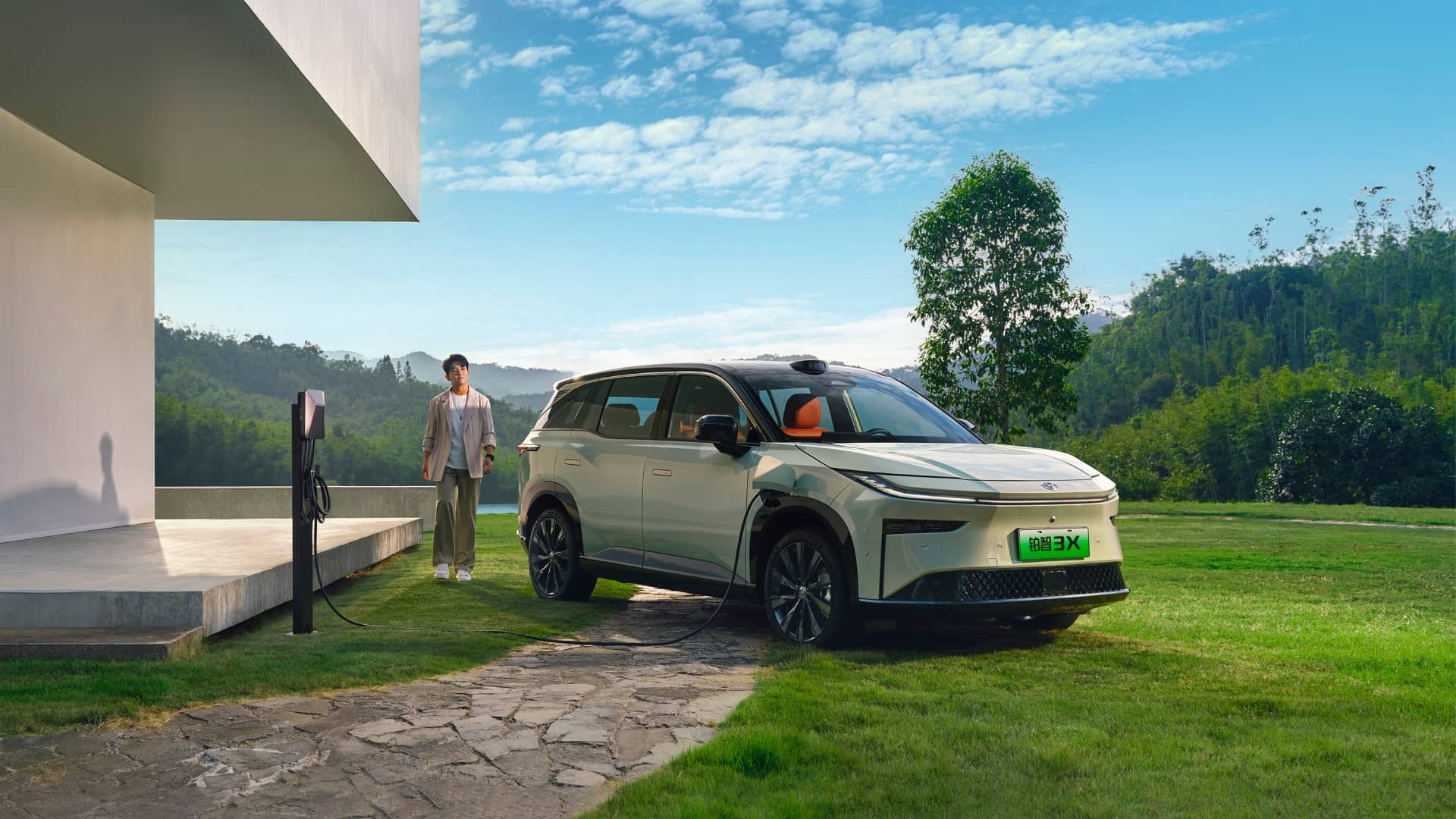
That shift is already visible in the product lineup. The bZ3X electric SUV, launched in March 2025 through GAC Toyota, was co-developed with Guangzhou Automobile Group and uses cost-effective lithium iron phosphate batteries. Priced from 109,800 yuan or about $15,300, it surpassed 10,000 units in monthly sales by November. A bZ7 electric sedan is set to follow.
Hybrid Momentum in America
Back in the US, where EV adoption is not as clear-cut, Toyota is investing in hybrid production. The move is driven by strong demand as hybrids accounted for roughly 13 percent of new-vehicle sales in the U.S. during the third quarter of 2025.
Toyota opened its new battery plant in North Carolina on November 12. Toyota Motor North America President Tetsuo Ogawa called it “a pivotal moment in our company’s history.”
On the same day, Toyota announced plans to invest up to $10 billion over five years to expand U.S. production of hybrids and related components, boosting output at five American plants and reducing reliance on Japanese imports.
Of course, building cars powered by everything from V8 hybrids to LFP-battery EVs is expensive. Toyota spent ¥1.3 trillion on R&D in the year ending March 2025, which is roughly on par with BYD, and well ahead of many rivals.
To manage the burden, Toyota has begun leaning more openly into partnerships, including work with NTT on AI-based crash prevention and a collaboration with Waymo on autonomous driving.
In a market increasingly obsessed with picking a single technological winner, Toyota’s refusal to do so may look risky. But if the global auto future really is plural rather than uniform, betting on engines, rather than shunning them, may yet prove to be the company’s most calculated move of all.
Consumers ‘Bang the Gong’ to celebrate the arrival of their new Toyota at Smart Toyota Madison WI.
Since early 2020, American consumers have had to come to terms with a new kind of normal. Products and services are not as plentiful as we’ve grown accustomed to. Covid-19 and the occasional freak weather patterns have wreaked havoc on a number of industries in many ways, especially in terms of shortages. The restaurant industry is struggling to hire viable and reliable employees. Grocery stores are out of products, specifically goods originating from meat-packing plants. And we all know how paper products like toilet paper were hard to come by for many months. Nearly all industries are having some growing pains adapting to the unavoidable changes taking place, including automobile manufacturers.
Madisonians have noticed the dearth of new vehicles for the past several months when they pass by Smart Toyota on Odana Road. What has been a car lot brimming with options for decades has suddenly become a sort of ghost town with only a handful or so of vehicles on the lot.
“It’s a very noticeable difference,” says Smart Toyota’s sales director Justin Jackson. “We normally have 400 or more new vehicles on the lot, but since mid-April 2021 we’ve seen a steady decline in the number of New Toyotas we have on the lot. Now we only have maybe 5 to 10 new vehicles physically at the store.”
Justin Jackson Sales Director Smart Toyota – Madison, WI
Jackson says the pandemic is partially to blame for the shortage because modern vehicles rely on computer chips which became scarce due to manufacturers reallocating them to industries other than automotive. Then, early in 2021 the issue in new vehicle manufacturing were winter storms that crippled Texas-based businesses that are critical in the manufacturing of foam for seats.
“If it’s not one thing it’s another,” says Jackson. “We’ve got the chips, but because of the power issues Texas faced in the Spring of 2021, we didn’t have enough foam padding for the seats, and today, as production ramps up, it’s supply chain and logistical issues.”
It’s Not All Doom and Gloom
Those looking to purchase a new vehicle seem to understand the slow-down in global manufacturing, Jackson says. Instead of getting upset they can’t drive off the lot with a vehicle they think is “good enough,” consumers are now more apt to customize and pre-order a vehicle specifically made to their specifications.
“It’s kind of cool how people have adapted,” says Jackson. “They might not get that prior sense of immediate gratification of new car ownership, but they get to experience something else: personalization.”
Jackson explains the process of pre-ordering has been well-received for a few reasons, one of which is the compassion the consumer feels about simple logistics as they relate to inventory issues in this day and age.
Vehicle Customization increases satisfaction
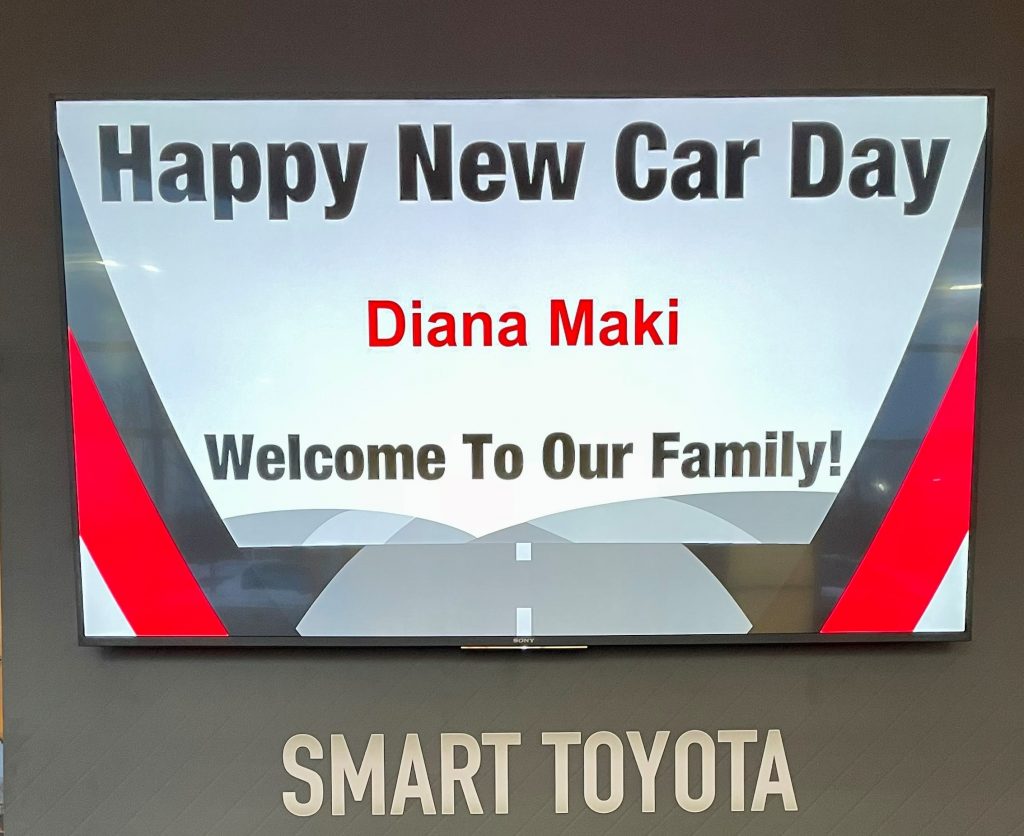
“They also really like the fact we can get them exactly what they want; from safety features and amenities, to color preference,” says Jackson. “And when their customized vehicle comes in – usually in about 45 days – they are over the moon when they see the Happy New Car Day sign bearing their name saying the car was made specifically for them. It takes ‘ownership’ to a whole new level.”
Custom Pre-Orders on the Rise
Jackson says about five percent of Smart’s new vehicle sales used to be custom ordered. Today the percentage has skyrocketed to about 50 percent of the dealership’s monthly new car sales. And, Jackson notes, when a consumer has all the customizable options at his or her disposal, no one opts for a base model in order to save a buck or two.
“Often times, though, it’s not options that are the most appealing aspect of pre-ordering,” says Jackson. “Instead, currently, there has been a surge in hybrid vehicle sales. And now in winter, AWD (all-wheel drive) vehicles will see a spike in popularity.”
If you know you are going to order a customized vehicle, Jackson says it might be best to do a little homework prior to meeting with a sales consultant.
“People take a lot of amenities for granted, but if you’re customizing, you should consider some of the following options,” he says.
Custom Pre-Order Checklist
Entertainment & Communications: think about your stereo system. Do you still need a CD player? How about satellite radio capability? Hands-free phone control? A video system? Navigation?
Comfort & Convenience: this includes upholstery, heated/cooled seats, power door locks, keyless entry, dual climate control, etc.
Safety: the simple rule of thumb is the more you can install, the more secure you’ll feel. If you can, opt for dual air bags, anti-lock brakes, traction control, cruise control, and parking assist systems.
Appearance: the most enjoyable aspect of customizing is picking out your paint, trim, and wheels.
Performance: what do you need to get from point A to point B in your daily life? A larger engine? Sport suspension? 4-wheel drive? Automatic transmission or stick?
Jackson says while customers are not complaining right now about having to customize and then wait for their new ride, he anticipates their patience won’t last forever. However, he also doesn’t see new vehicle inventory returning to “normal” in the immediate future, and with customer satisfaction currently at such a high level he’s not overly anxious about it.
“At this point, we do not see ‘ground stock’ (vehicles physically on the lot) back to our previously average levels before the end of the year,” he says. “That could change, but we really don’t see it happening until late 2022.”

 Login
Login