It’s slated to arrive next year in two configurations.
The range-topping variant should have 463 hp.
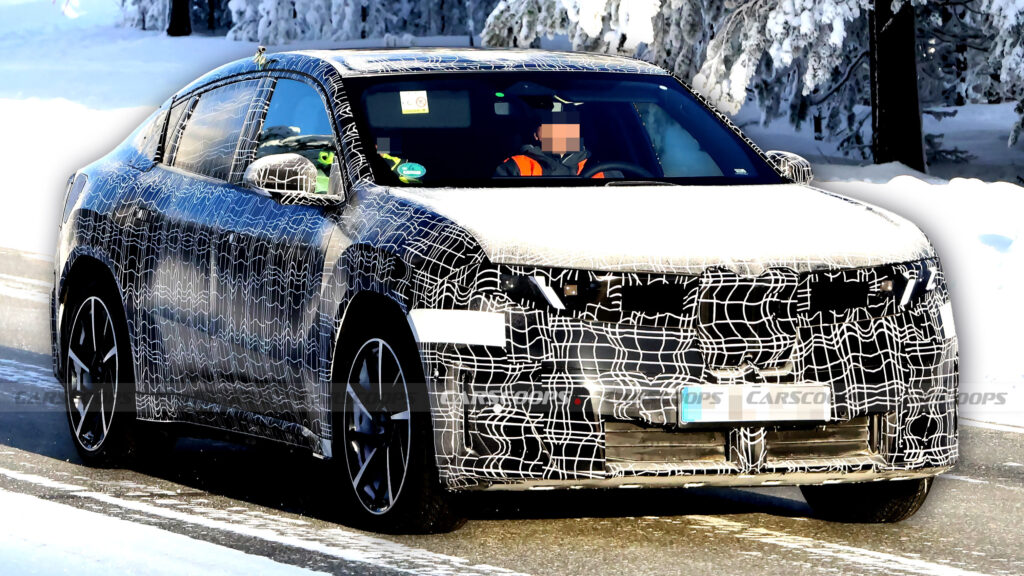
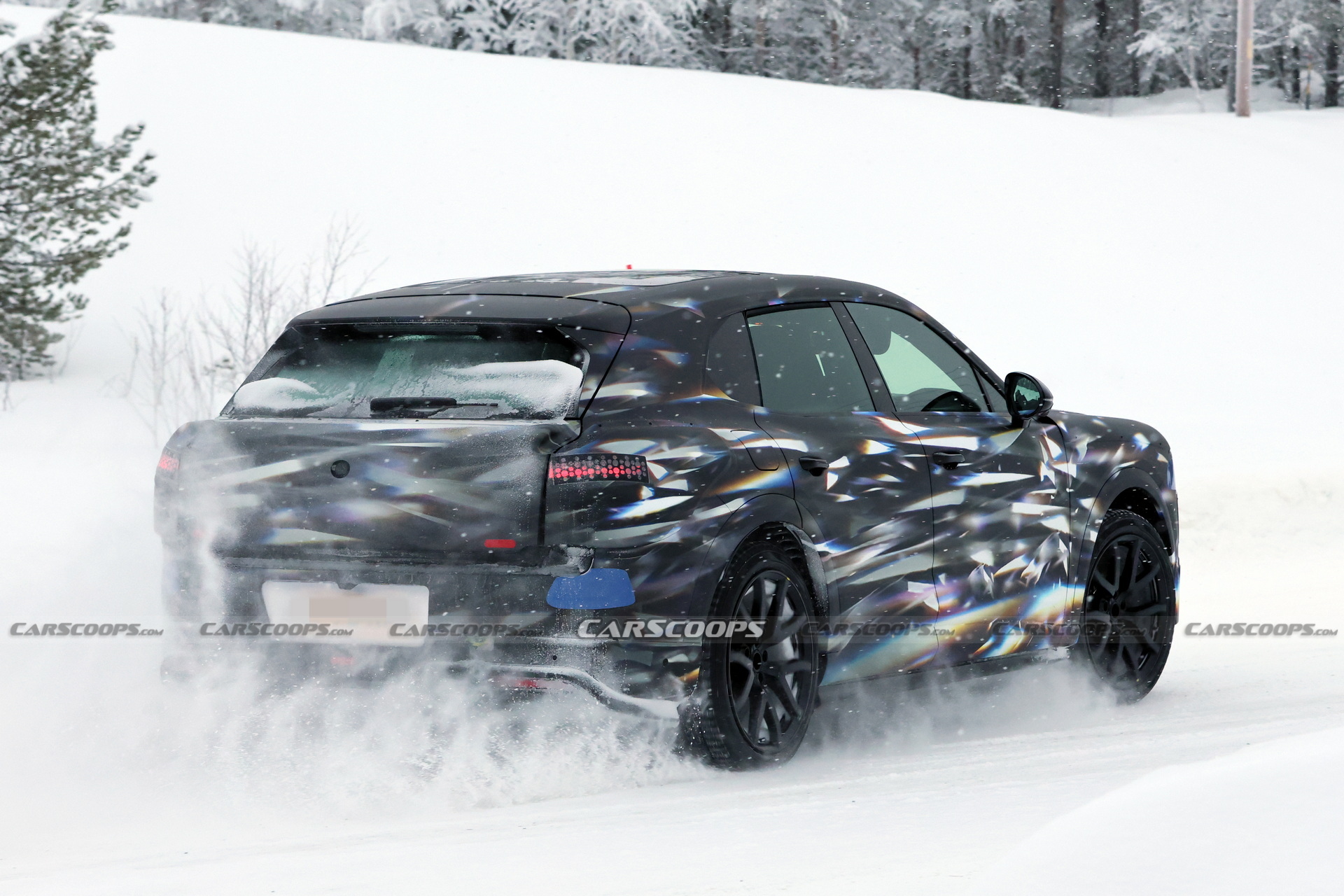
BMW introduced the redesigned iX3 last year, and it’s about to be followed by an iX4 crossover coupe. Spy photographers recently caught up with a prototype and it will closely echo its more conventional counterpart.
While the front end will be instantly recognizable, that’s where the similarities end as the iX4 adopts a rakish windscreen that flows into a gently curved roof. This results in a significantly smaller greenhouse as well as a second row that could be short on headroom.
Cargo space will also be in short supply as there’s an angular rear window that meets a pronounced spoiler. The model also has an upright rear end, which should largely echo the iX3.
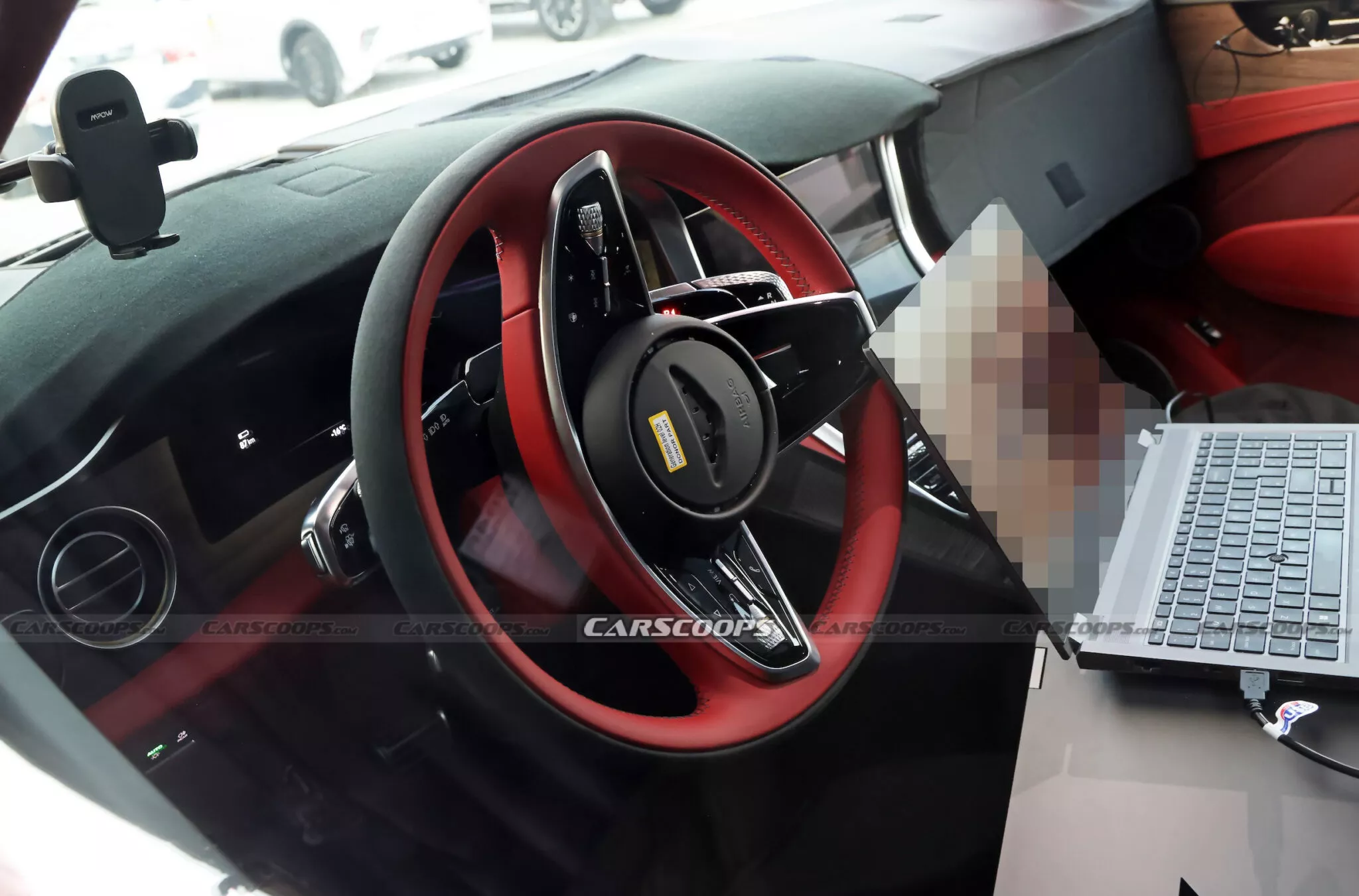
The déjà vu design should continue inside with a 17.9-inch infotainment system as well as a pillar-to-pillar Panoramic iDrive display. We can also expect a minimalist dashboard, a futuristic steering wheel, a 3D head-up display, and an intelligent personal assistant.
SHProshots
A recent leak revealed that the 2027 iX4 will be offered in 40 xDrive and 50 xDrive guise in the United States. The latter version should mirror the iX3 50 xDrive, which has a 108.7 kWh battery pack that feeds a dual-motor all-wheel drive system developing 463 hp (345 kW / 469 PS) and 476 lb-ft (645 Nm) of torque. This enables the model to accelerate from 0-60 mph (0-96 km/h) in 4.7 seconds, hit a top speed of 130 mph (210 km/h), and have a WLTP range of up to 500 miles (805 km).
The iX4 40 xDrive is more mysterious, but a recent report suggested it could have a smaller 82.6 kWh battery pack. We can also expect less powerful electric motors, although we’ll get a better idea when the iX3 variant debuts later this year.
He argues EVs are simpler, cleaner, more efficient by design.
CEO warns traditional brands risk extinction if they stall.
There’s no denying it. For all Elon Musk’s foibles, he and Tesla have played an instrumental role in accelerating the car industry’s shift towards electrification and autonomy. Love him or loathe him, the trajectory has shifted on his watch. Now, the controversial CEO says any legacy automaker that refuses to follow Tesla’s lead risks going the way of the dinosaurs.
Last week, the world’s richest man sat down with André Thierig, head of Tesla’s Gigafactory Berlin, for a deep dive into where Tesla is heading and where the wider industry should be going. In Musk’s telling, it has been obvious for more than 20 years that the endgame is fully electric, fully autonomous transport. The surprise, at least to him, is that some rivals still appear reluctant to accept it.
“The automotive industry has strongly rejected electrification,” Musk said during the interview. “They’ve dragged their feet, and they’ve had to be pushed there by the government, and whenever they have any opportunity to reduce the production of electric vehicles, they’ve done so. This is not a good strategic…like it doesn’t make sense.”
He went on to argue that the need for the car industry to shift to electrification would be true even “without environmental concerns.” Musk believes that “an electric vehicle is a fundamentally better architecture than a gasoline or combustion vehicle. It is much simpler, it is more efficient, it’s quieter, there’s no pollution in cities, so really all ground transport should be electric.”
“The future does not contain combustion vehicles, and there will be very few vehicles that are not autonomous. If the automotive industry does not move in that direction, they will be left out,” Musk added.
Carmakers Aren’t Doing Enough, Musk Says
When Thierig asked whether Tesla could learn anything from legacy automakers, or whether it should simply keep its head down and focus on its own path, Musk conceded, “You can always learn something from some competitors.” Still, he quickly returned to familiar territory. “Strategically, they’re heading in the direction of the dinosaurs, so they’re not heading in a good place. Dinosaurs are not around anymore.”
As for the risk of traditional brands copying Tesla’s ideas, he dismissed it, arguing that you cannot simply force a good idea onto companies that are not ready to embrace it.
None of this is especially new. Musk has long criticized established carmakers for moving too slowly, and with Tesla’s business tied so closely to EVs and autonomous driving systems, he has every reason to underline the advantages of both. It also does not hurt when that message reinforces confidence in Tesla’s long-term prospects.
Perhaps more intriguing is Tesla’s evolving self-image. The company no longer presents itself purely as an EV manufacturer, and some observers believe it may not even be building cars in a decade, shifting instead toward robotics.
BYD is testing its 1,500 kW megawatt flash charging network.
The demo site looks more like a gas forecourt than an EV hub.
Fast chargers could transform the appeal and usability of EVs.
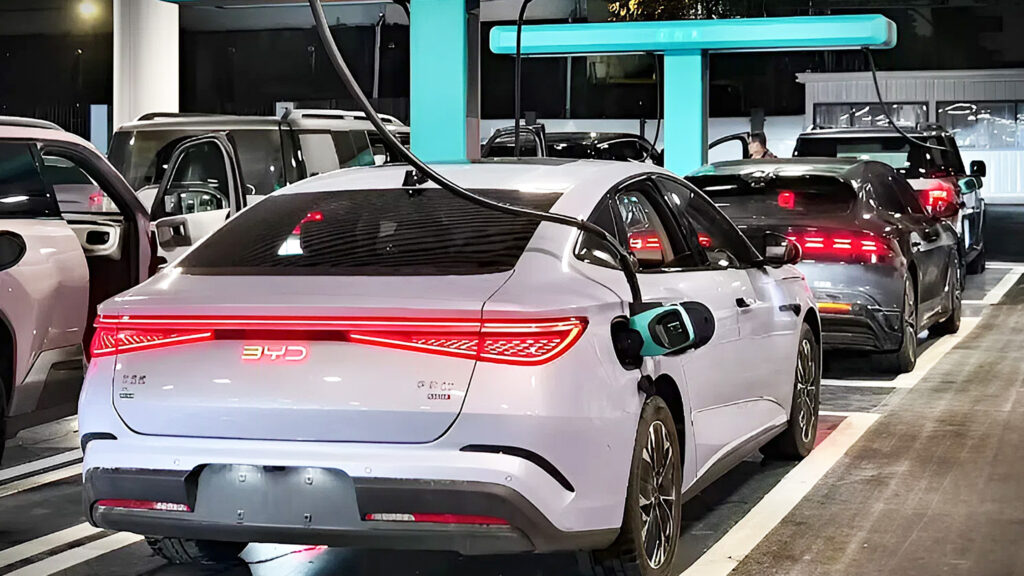
BYD isn’t just building electric cars at a frightening pace, it’s now building chargers that make today’s versions look about as powerful as your car’s 12-volt accessory plug. The company has been spotted testing a 1,500 kW flash charging network in Shenzhen, China, and the layout looks suspiciously like a traditional gas station’s.
Instead of the usual lonely bank of DC chargers around a load of parking bays arranged like a regular parking lot, the demo site features liquid-cooled charging guns and T-shaped gantries lined up like fuel pumps so that drivers can pull up, fill up, and pull out without hanging about.
Leaked intel suggests peak outputs of up to 1,500 kW running on a 1,000 V architecture that could potentially add 249 miles (400 km) of range in just 5 minutes. For context, the quickest public chargers in the US and Europe top out around 350 kW, though most push out a lot less, and the majority of EVs can’t even sustain that anyway.
BYD-Use Only, For Now
Access during testing appears limited to select BYD models wearing a Flash Charge badge, including upcoming Tang, Song, Seal, and Denza variants, Car News China says. Charging reportedly starts within about 10 seconds of plugging in, no QR codes or smartphone gymnastics required.
Pricing at the demo site was shown at 1.3 yuan per kWh, roughly $0.18, which will come as a shock to Western EV drivers. Plug in to a 360 kW Gridserve charger in the UK, and you’ll be stung for up to £0.89 per kWh. That’s $1.20. Even a feeble 22 kW jolt costs £0.49 ($0.66) per kWh. Buyers of compatible cars are rumored to get 1,000 kWh of free electricity annually, according to the story out of China, though final policy details haven’t been confirmed.
Drive It Like A Gas Car
The real story isn’t just the headline charging speed. It’s what that speed could mean. If you can genuinely add hundreds of miles in minutes, you don’t need a massive 450-mile battery pack. Smaller batteries mean lighter, more affordable cars with better efficiency and sharper performance. And faster charging could make EV ownership feel less like planning a military operation and more relaxed, encouraging drivers to embark on spontaneous journeys.
BYD is said to be targeting more than 4,000 self-operated flash charging stations in China, with partner networks potentially pushing that number far higher. For now, it’s all still internal testing, but it offers a glimpse into how EV ownership might look only a few years from now, not just in China, but around the world.
Opel’s Corsa GSE has been spied ahead of a debut later this year.
It’s expected to get a single 278 hp motor with limited-slip diff.
Visually and mechanically it shares much with Mokka GSE SUV.
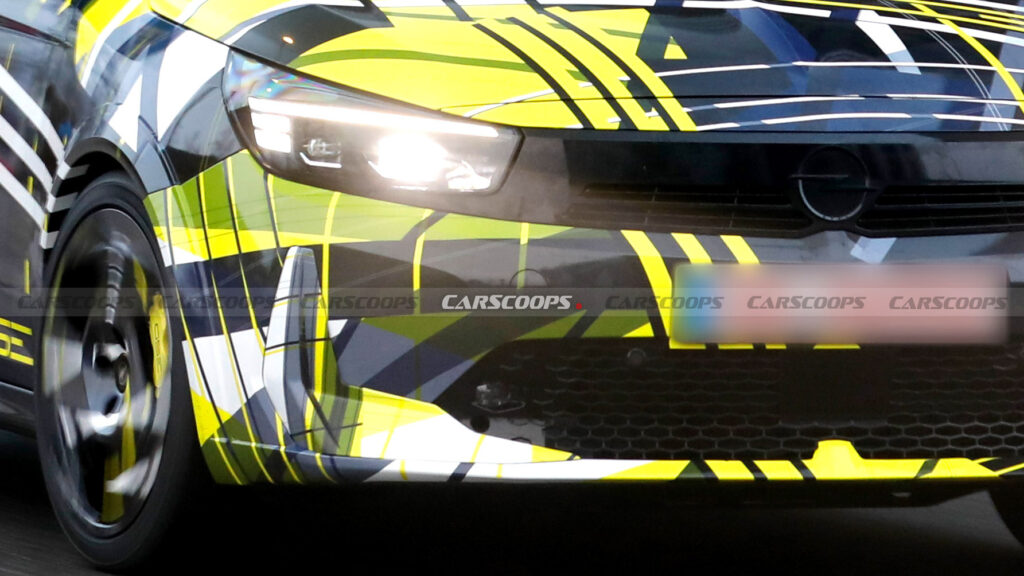
Opel’s famous hot hatch badge is back on a GTI-type subcompact, and this time it doesn’t need a turbocharger or fancy ICE breathing to make trouble. Fresh spy shots confirm the Corsa GSE is on the way, giving the long retired Opel OPC and British Vauxhall VXR bloodline a fully electric reboot with considerably more zap than before.
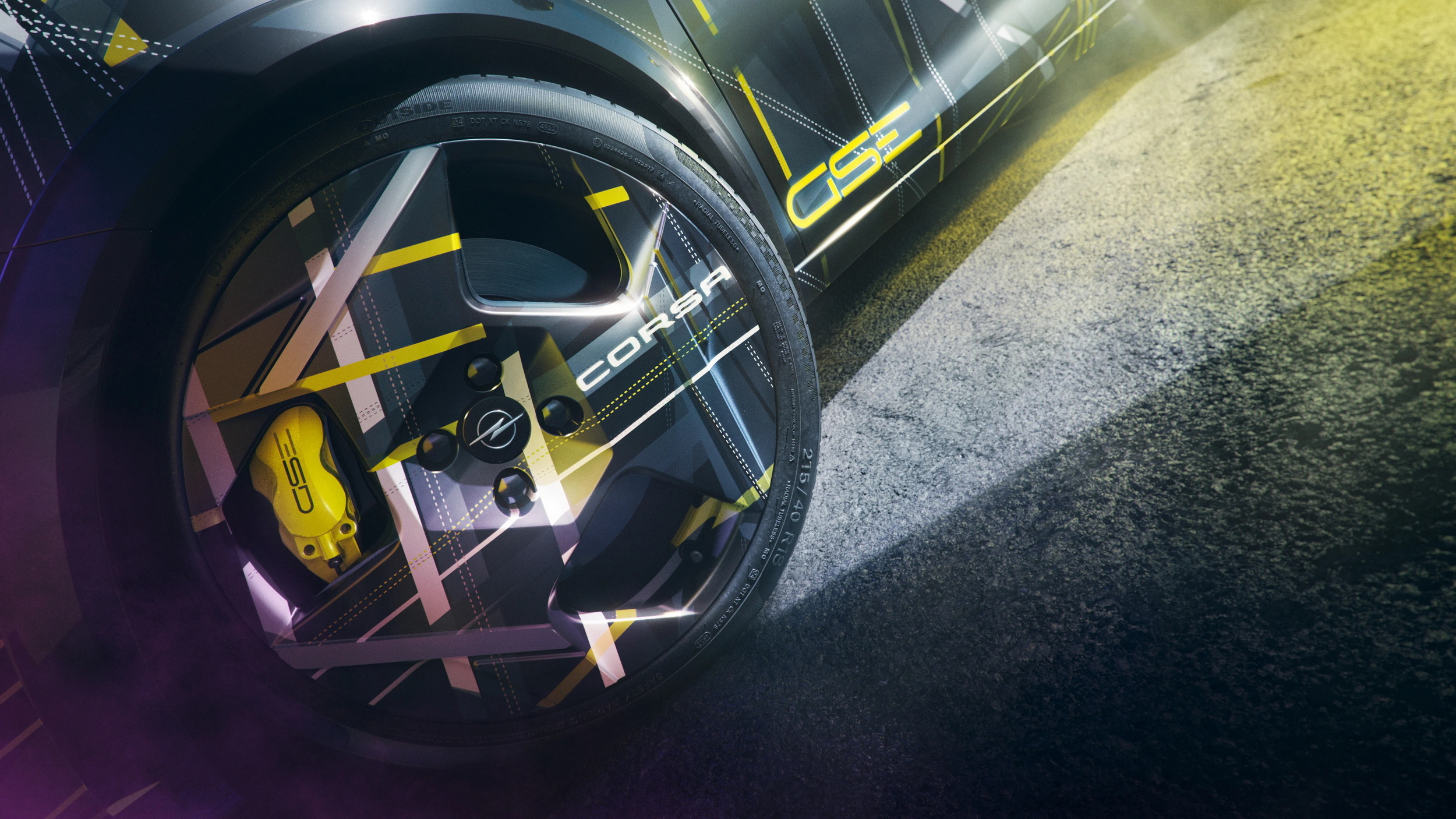
We already saw a teaser last week, zoomed in tight on a wheel like it was hiding state secrets. Now the prototypes are out stretching their legs, wearing camo but not bothering to disguise the yellow brake callipers and chunky wheels that scream performance model.
Visually, expect something close to the Mokka GSE SUV that debuted last year. That means dynamic-looking wheel rims, plenty of moody black detailing and a lower stance resulting from uprated springs and dampers. The body panels appear largely unchanged from the facelifted Corsa, but sharper bumpers and extra cladding should help it stand apart from lesser trims in supermarket car parks.
Close To 280 hp
Baldauf
Under the skin, the smart money says it’ll also mirror the Mokka GSE and its Stellantis cousins. Expect a front-mounted electric motor pushing out around 278 hp (281 PS / 207 kW) and 255 lb-ft (345 Nm) of torque, plus a Torsen limited slip differential and stiffer suspension are expected to keep torque steer tantrums in check.
Opel claims a 5.9-second zero to 62 mph (100 kmh) time for the Mokka, so the lighter Corsa should knock a couple of tenths off that, matching the 5.7 seconds Peugeot quotes for the Corsa GSE’s French brother, the 208 GTI.
Baldauf
Power will likely come from the familiar 54 kWh battery pack fitted to both the Mokka and 208. But the driving range will come in closer to the 208’s 217 miles (350 km) than the 201 miles (324 km) Opel says the taller, heavier Mokka can deliver between charges.
Competition Hotting Up
The 208 GTI marks the first time Peugeot has dropped a GTI badge on an EV, but it won’t the £35-40k Corsa GSE’s only competition. Alpine and Mini already have hot hatch EVs on sale and VW launches its first electric GTI this year, the ID. Polo GTI.
From what we’ve seen the Polo is going to have the upper hand when it comes to design, both inside and out, but with only 223 hp (226 hp / 166 kW), it’s not going to have the firepower of the Stellantis duo.
Stronger Leapmotor ties could sharpen its VW, Renault fight.
A US ban on Chinese tech cars still poses a real hurdle.
Stellantis booked $26.1 billion in EV strategy write-downs.
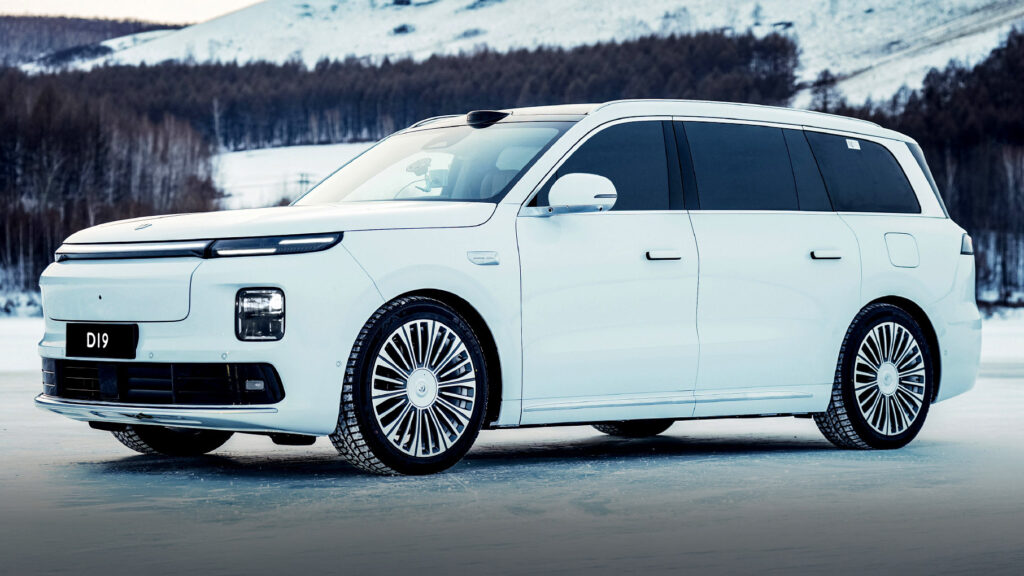
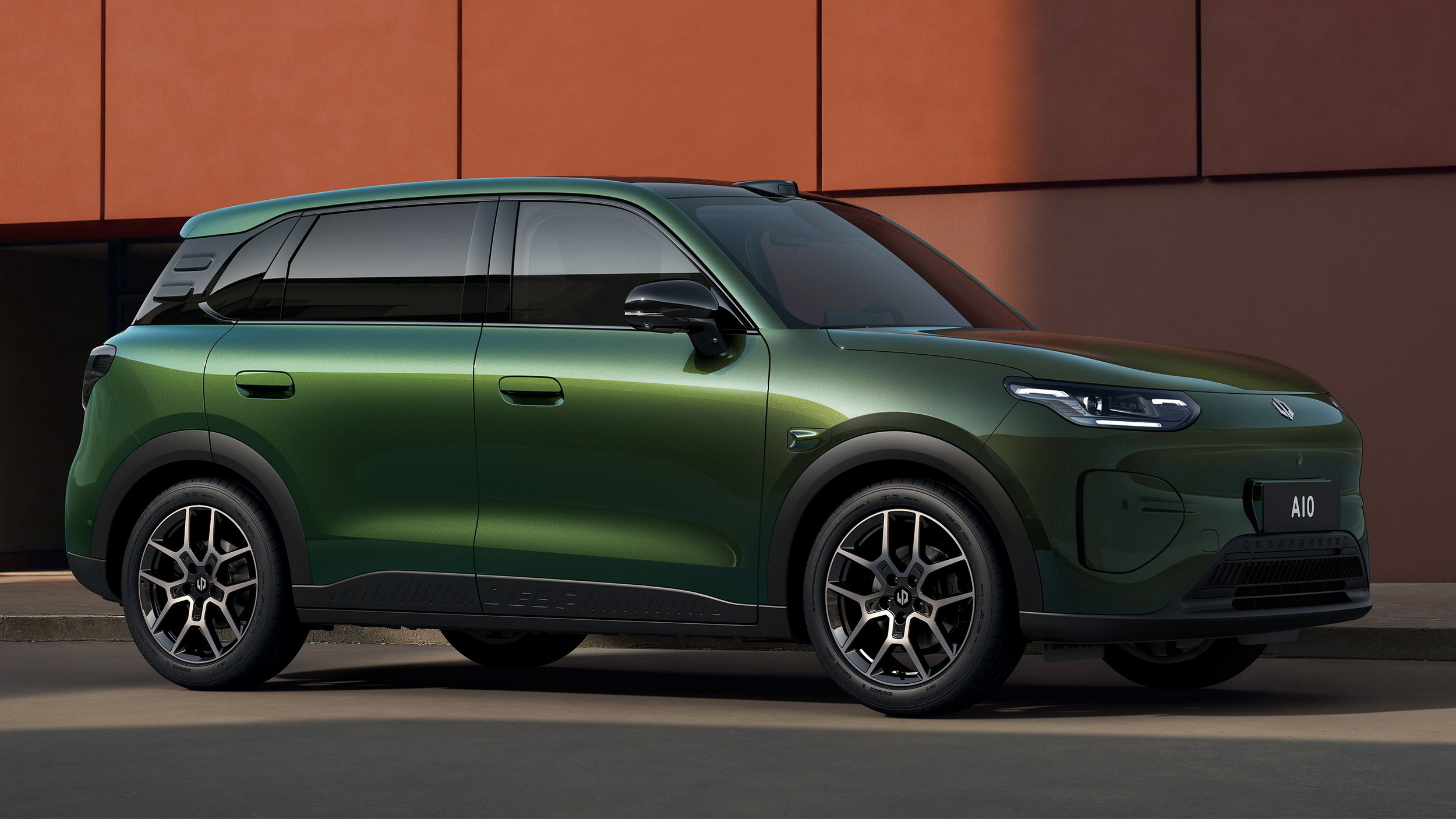
Stellantis is deepening its ties with China’s fast-moving EV sector as it searches for a more efficient path through the electric transition. In 2023, the group inked a deal with Chinese EV startup Leapmotor, purchasing a 20 percent stake in the firm for $1.1 billion. The agreement made Stellantis the exclusive distributor of Leapmotor models in Western markets.
Now, it appears the relationship could extend beyond distribution, with Stellantis potentially tapping into its partner’s EV technology for brands such as Fiat, Opel, and Peugeot.
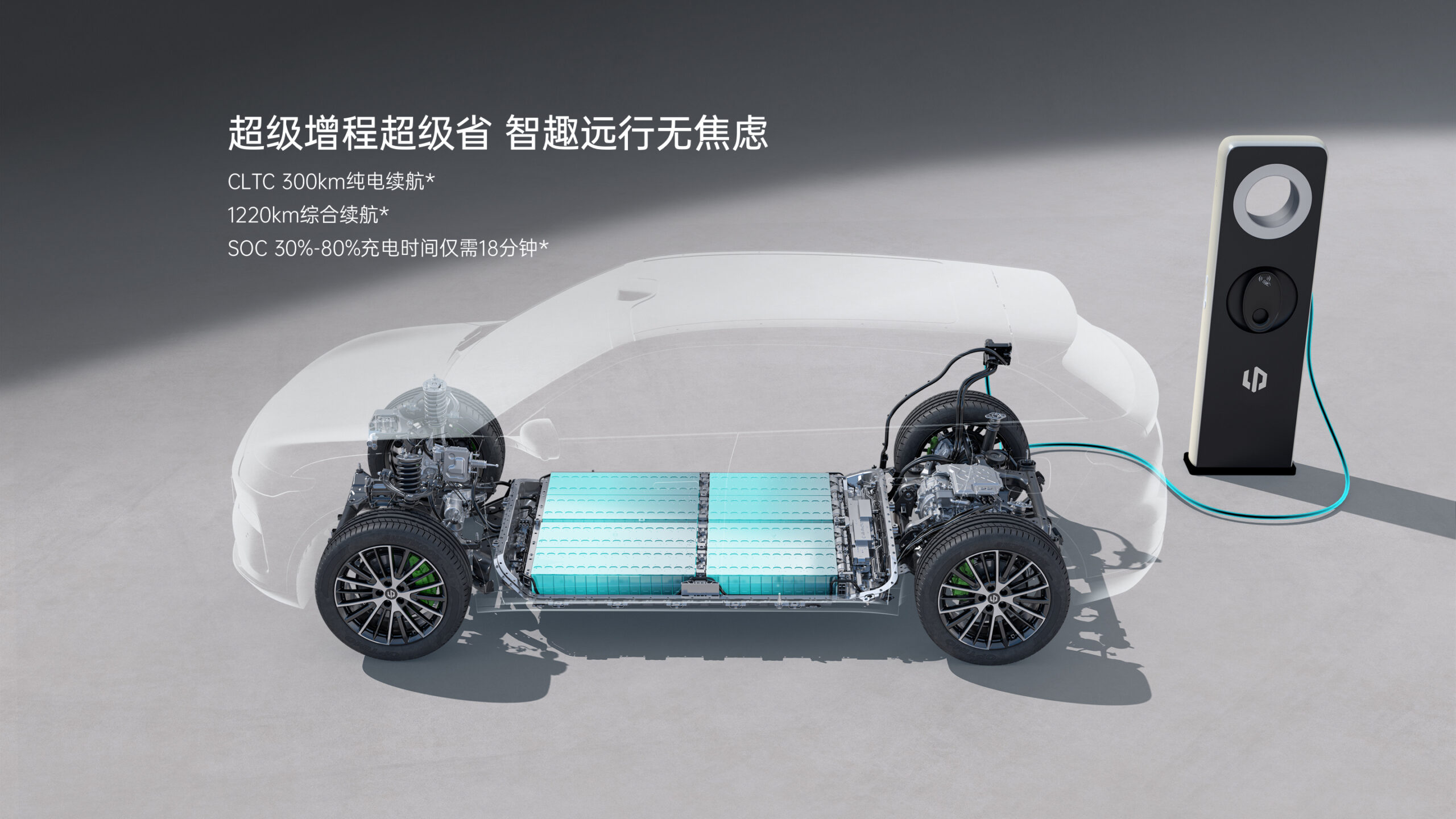
According to Autonews, unnamed sources say Stellantis wants access to Leapmotor’s battery and EV powertrain technologies. It’s understood that discussions are in their early stages, but using Leapmotor’s systems would help Stellantis save billions of dollars in development costs, and allow it to more quickly roll out rivals to vehicles from Chinese competitors like BYD and MG, in addition to legacy brands including the VW Group and Renault.
However, actually using Leapmotor’s battery and EV technologies could prove challenging. For example, vehicles using connected systems linked to China will be banned from importation and sale in the US from 2027.
What’s Next for the Partnership?
While speaking about the collaboration between the two companies, Stellantis chief executive Antonio Filosa said the “technical partnership… will help us in getting to higher level of competitiveness especially with electric cars and it is very important for Europe.”
He added the partnership will also “improve our collaboration also on new tech development,” noting that “2025 was a year of strategic implementation for the partnership, setting the stage for deeper integration”, according to Autonews.
EV Write-Downs And Reset
Earlier this month, Stellantis announced write-downs and charges of €22.2 billion ($26.1 billion) as it scaled down its EV strategy. However, it knows it can’t back away from EVs entirely, hence why it’s interested in deepening its ties with Leapmotor.
Through the Leapmotor International joint venture, Stellantis has helped the Chinese brand launch several of its models, like the C10 and B10, in markets including Europe and Australia. For a brief period, it was also building the small T03 in Poland, but this ended last year amid fluctuations in international trade policies. This year, Stellantis plans to start building Leapmotor vehicles at its Zaragoza plant in Spain.
Xiaomi unveiled its Vision Gran Turismo concept at MWC 2026.
Like the Aston Martin Valkyrie, it uses huge venturi tunnels.
The cocoon-like cockpit makes just enough space for two.
Chinese smartphone and consumer electronics giant Xiaomi, now very much a car manufacturer too, has become the first Chinese brand to unveil its own Vision Gran Turismo concept. Presented at the Mobile World Congress 2026 in Barcelona, Spain, the car is bold and offers a glimpse of what a legitimate hypercar from the tech juggernaut might look like if it ever reached production.
Underpinning the Vision GT is the company’s 900-volt Silicon Carbide platform. While no performance specifications have been released, it could deliver upwards of 1,900 hp from its electric powertrain. Most of the details shared by Xiaomi focus on the car’s design and aerodynamic intent.
According to Xiaomi’s head of automotive design, Li Tianyuan, the Vision GT concept posts a drag coefficient of 0.29 and has effectively been sculpted by the wind.
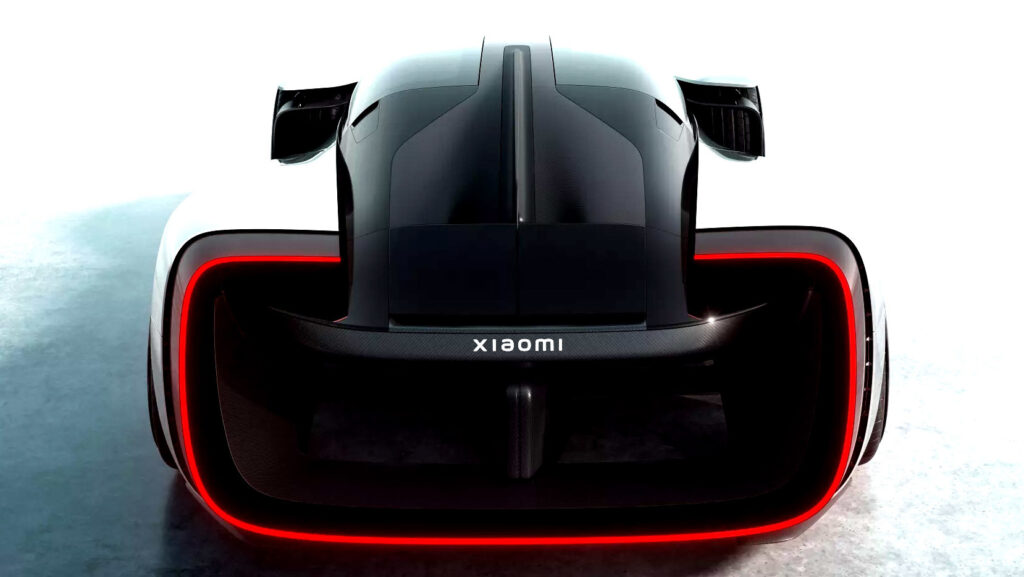
Like track-obsessed machines such as the Aston Martin Valkyrie and Red Bull RB17, the Vision GT runs vast venturi tunnels beneath its bodywork. They channel air through the underfloor and eject it at the rear, creating a dramatic tail section that works to pin the car to the tarmac at speed.
There’s no word on how much downforce it could have, but it’d inevitably be enough to warp your face while going around corners. The front-end includes a motorsport-inspired carbon fiber splitter and unobtrusive LED headlights. As mentioned, the rear is dominated by the huge venturi tunnels, but the LED taillight wrapping around the entire back of the car is also very striking.
Xiaomi has also imagined the Vision GT with a set of very intriguing wheels. Sitting over a set of carbon-ceramic brakes, the concept has a set of turbine fan rims with a floating cover over them, making it appear as though the wheels aren’t moving when the car is driving.
A Cabin From Another World
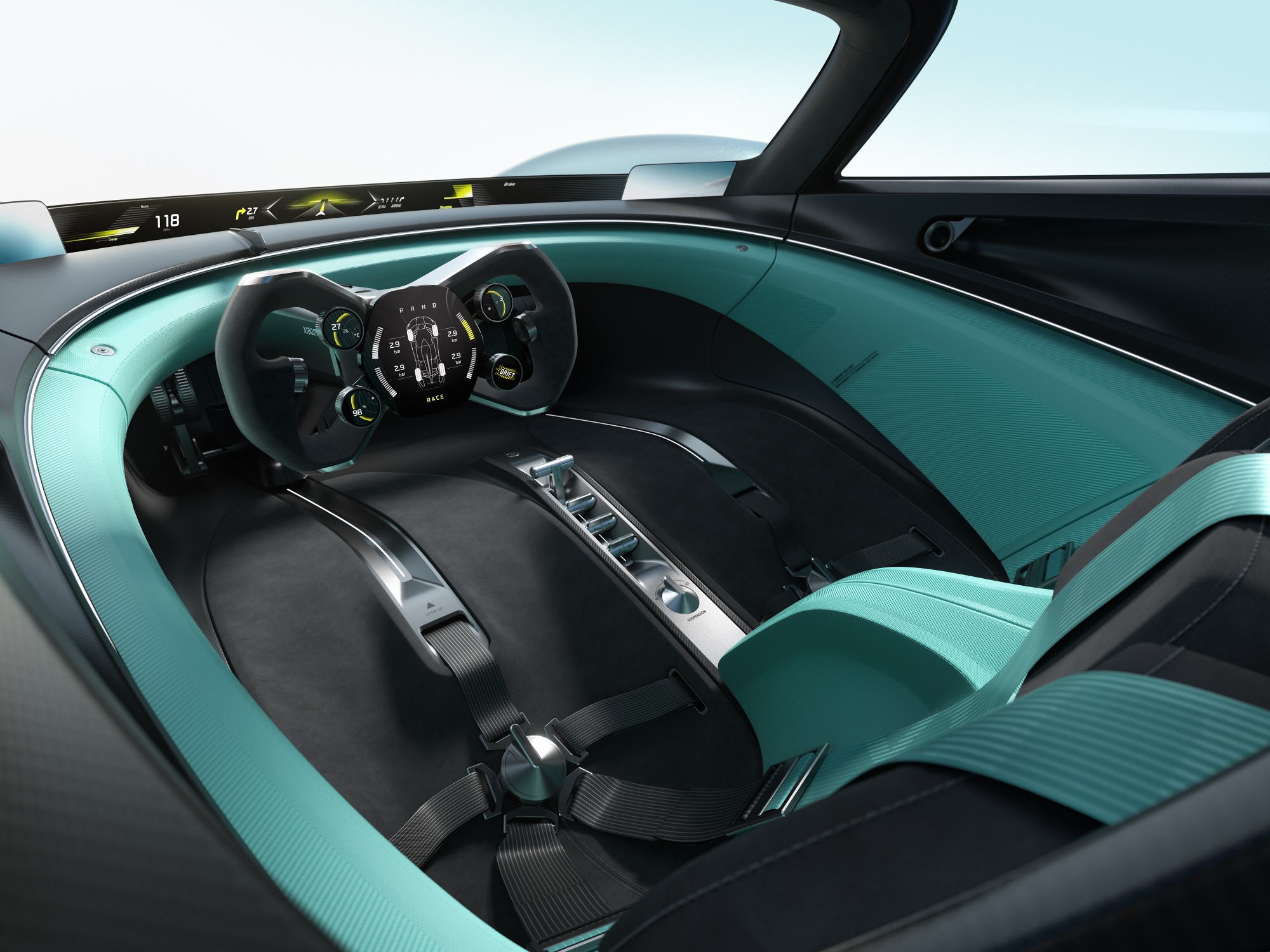
The cabin looks tight, but futuristic. Occupants sit in a pair of seats stuffed into the carbon fiber monocoque. There’s a panoramic head-up display similar to the new BMW iX3, as well as a steering wheel straight out of racing with five large circular screens, including a toggle for a drift mode.
There’s no word on when the car will be added to Gran Turismo, but it should be made available in the coming weeks. Will it influence a future road-going supercar from Xiaomi? Not likely, at least in that extreme form, but only time will tell.
U.S. consumers are sharply divided on Chinese vehicle brands.
Dealers show strong resistance despite notable shopper curiosity.
Price incentives could sway buyers, but trust remains critical.
If you spend any time in automotive comment sections, you’ve seen it. Someone inevitably points to a cutting-edge EV from China and declares it superior to whatever U.S.-market model is under discussion. There’s a huge catch, though: that vehicle doesn’t actually exist in the American marketplace.
It’s not federally certified, not sold through U.S. dealers, not supported by a domestic service network, and not priced with tariffs factored in. It’s a theoretical alternative, not a real one, and new research helps explain why this dynamic exists. Americans are forming opinions about Chinese automakers before most have ever seen one in person.
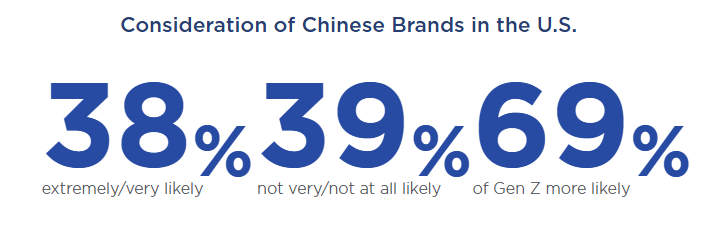
According to a study from Cox Automotive, consumers are heavily divided. Around 38 percent of shoppers say that they’re extremely or very likely to consider a Chinese brand. Another 39 percent says the opposite, that they’re extremely unlikely to do so. Among Gen Z buyers, the openness jumps to a whopping 69 percent, so if this ever does happen, expect the marketing to skew toward younger folks.
That split implies any early traction would likely be concentrated within specific demographics rather than spread across the broader market, creating both opportunity and risk for established players.
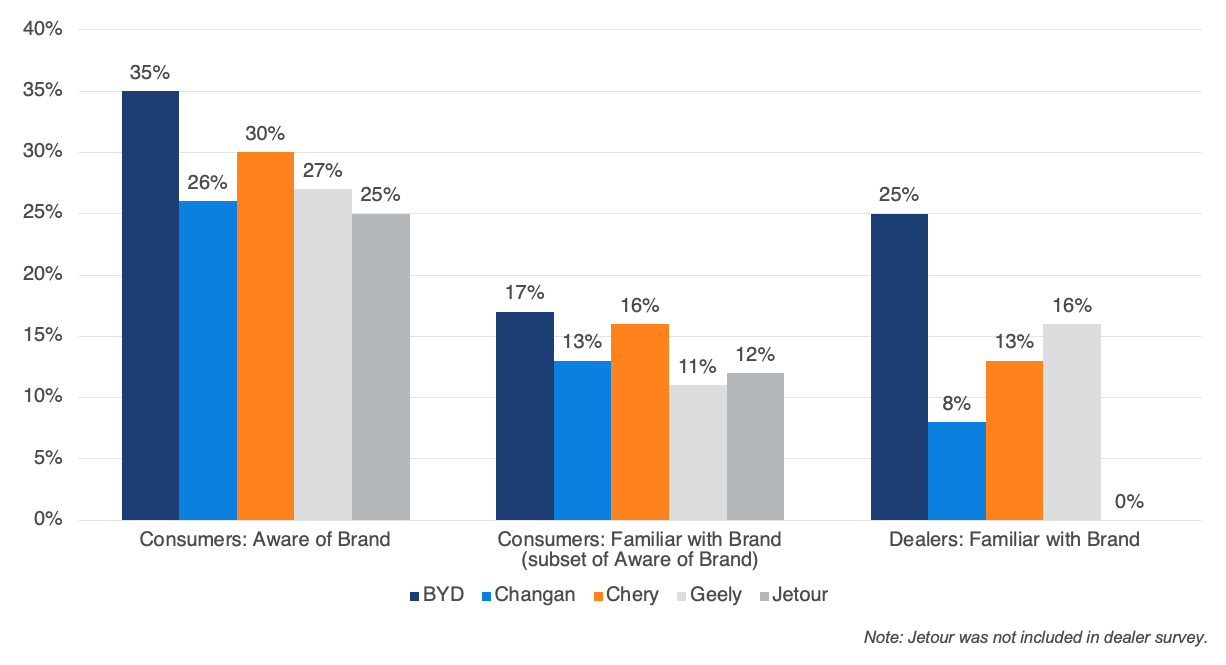
That said, actual awareness is thin. Nearly half of those surveyed said they were familiar with Chinese brands, but actual brand knowledge falls off a cliff quickly. BYD is the brand most are familiar with and that made up just over one-third of respondents. In total, only 17 percent said they had a deeper awareness of it. That’s a pretty big insight gap.
Dealer familiarity lags even further behind, with only about a quarter reporting any awareness of BYD, a reminder of how preliminary this conversation still is at the retail level.
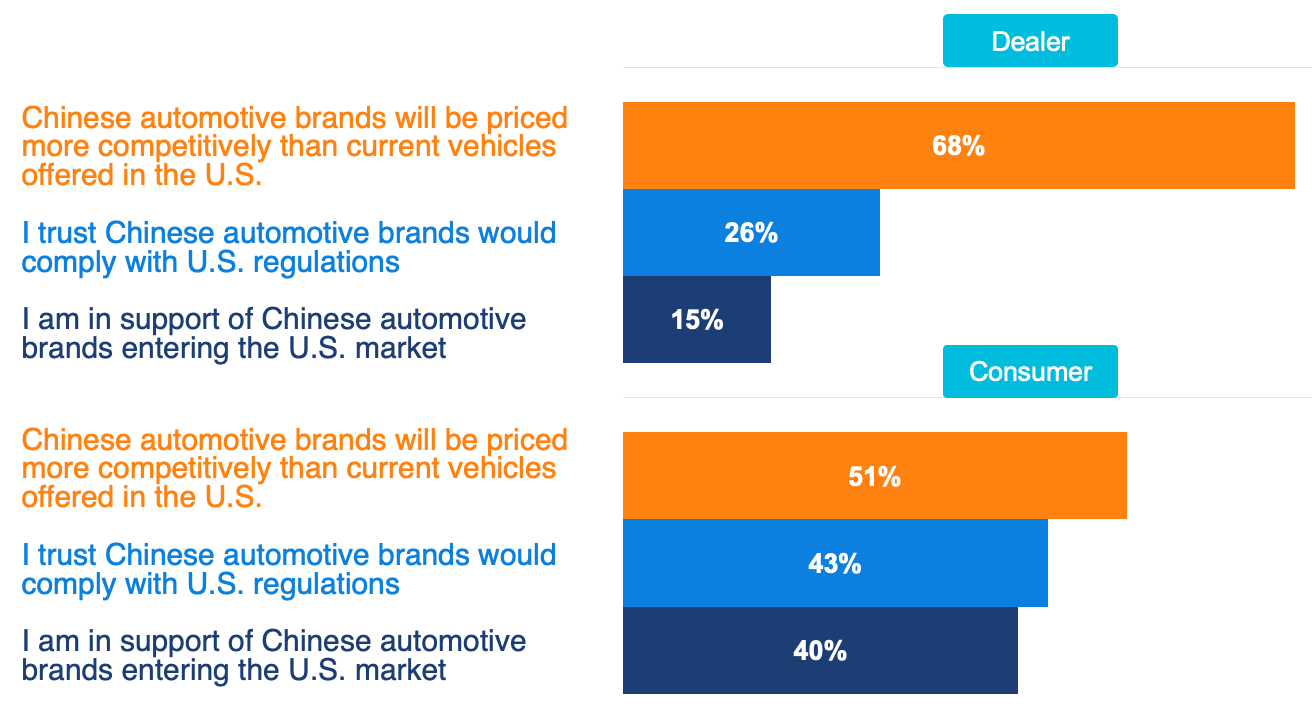
While around 40 percent of consumers say that they’re interested in Chinese brands coming to America, dealers, the ones with the real power, aren’t so hot on it. Only 15 percent said they’d like these brands in the USA. In fact, 92 percent of dealers reported concerns about selling Chinese vehicles. They cited everything from reliability to safety to long-term viability. That hesitation matters even more than the fact that some 60 percent of buyers aren’t interested.
The research also found that roughly 70 percent of dealers would adjust their business strategies if Chinese brands entered the market, suggesting preparation may follow skepticism.
Partnerships could shift the equation, though. When consumers were asked to consider a Chinese automaker aligned with an established U.S. brand, purchase consideration rose sharply to 76 percent, indicating that brand pairing may influence acceptance as much as pricing or product.
The Attraction
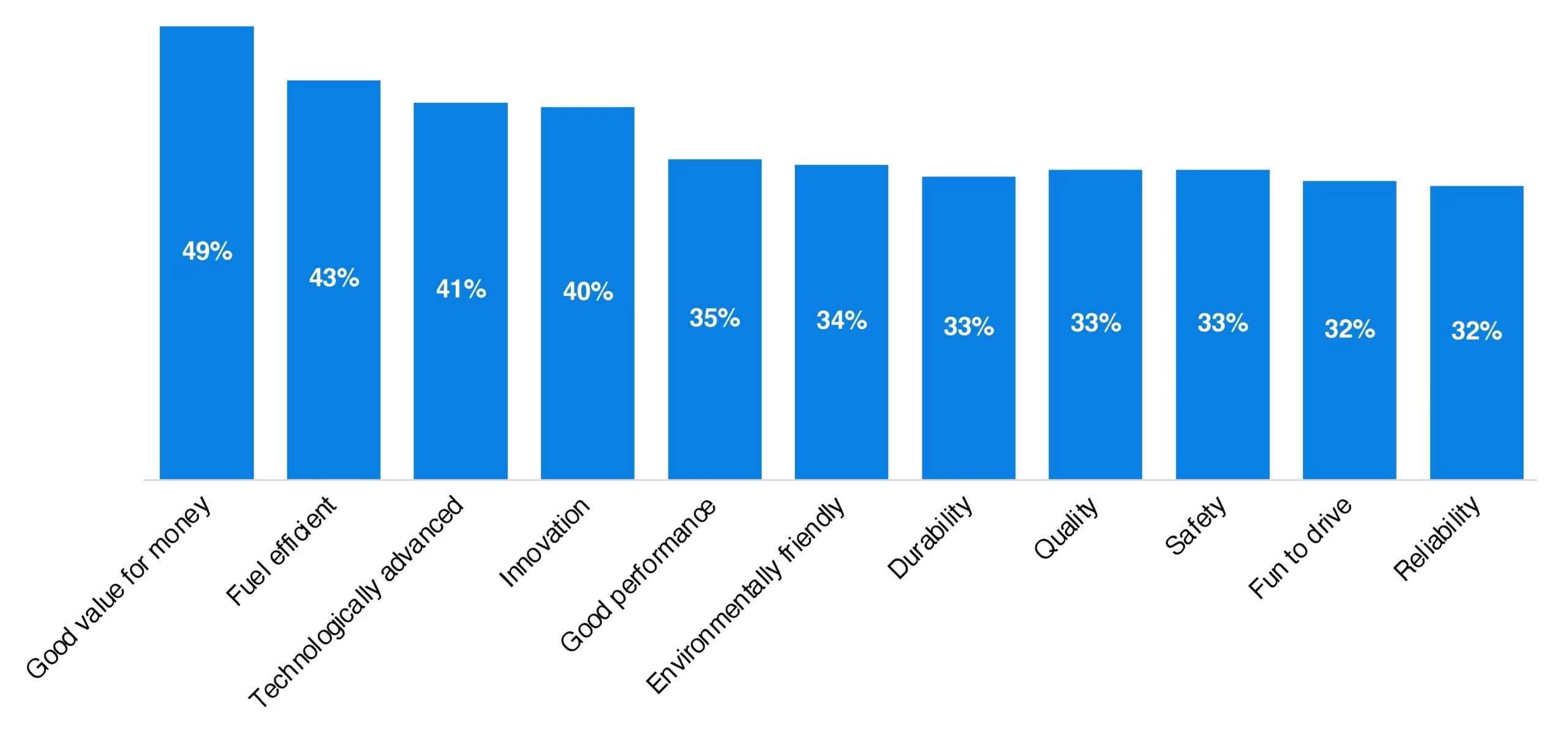
Interest does not appear to hinge on technology, styling, or practicality. It comes down to price. Nearly half of consumers rate them positively for affordability, and 35 percent give strong marks for performance. No doubt, we’ve seen pricing for Chinese automobiles undercut just about every other brand. But durability, safety, quality, and reliability fall short, and those are precisely the fundamentals that drive mainstream purchase decisions.
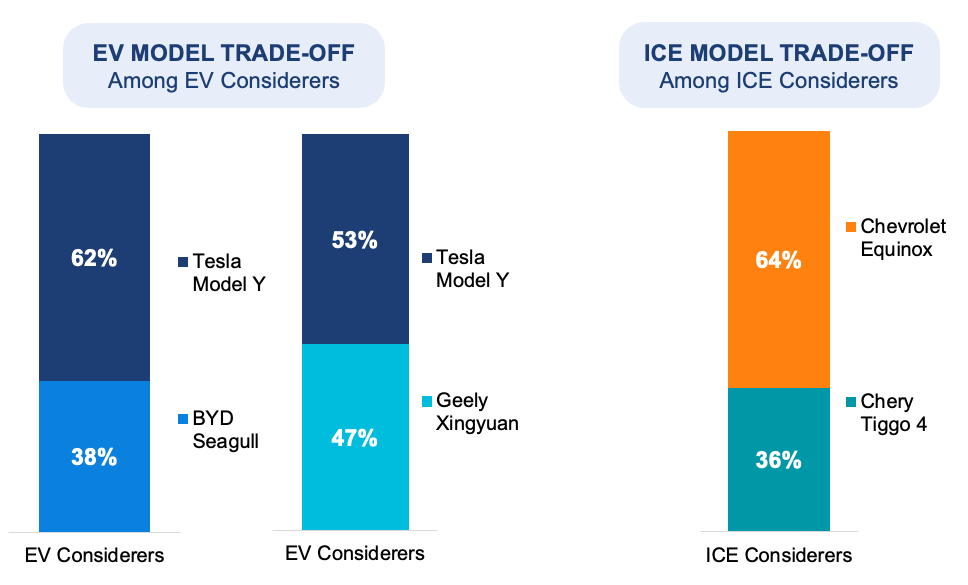
When consumers directly compared specific models, Tesla’s Model Y maintained a clear edge among EV shoppers, and the Chevrolet Equinox led among ICE vehicles, reinforcing the staying power of established nameplates.
However, when steep price discounts were introduced into side-by-side comparisons, a meaningful share of buyers indicated they would switch, particularly among lower-income and more price-sensitive groups.
Dealer and Consumer Comparisons (Strongly or Somewhat Agree)
Established U.S. brands still hold the advantage, buoyed by trust and familiarity. Price can narrow that gap, especially among more cost-sensitive buyers, but it doesn’t erase it. And it’s why those folks in the comment section suggesting that readers get a BYD Dolphin instead of whatever is actually available might have to wait a while longer before that comment makes any sense.
Consumers Rate Chinese Brands Lower on Buying Criteria (Durability, Quality, Safety and Reliability)
Murphy PD in Texas now runs the 2026 Model Y Juniper.
Each unit saves $4,100 to $12,000 a year in fuel and upkeep.
Its electric drivetrain could double the car’s service life.
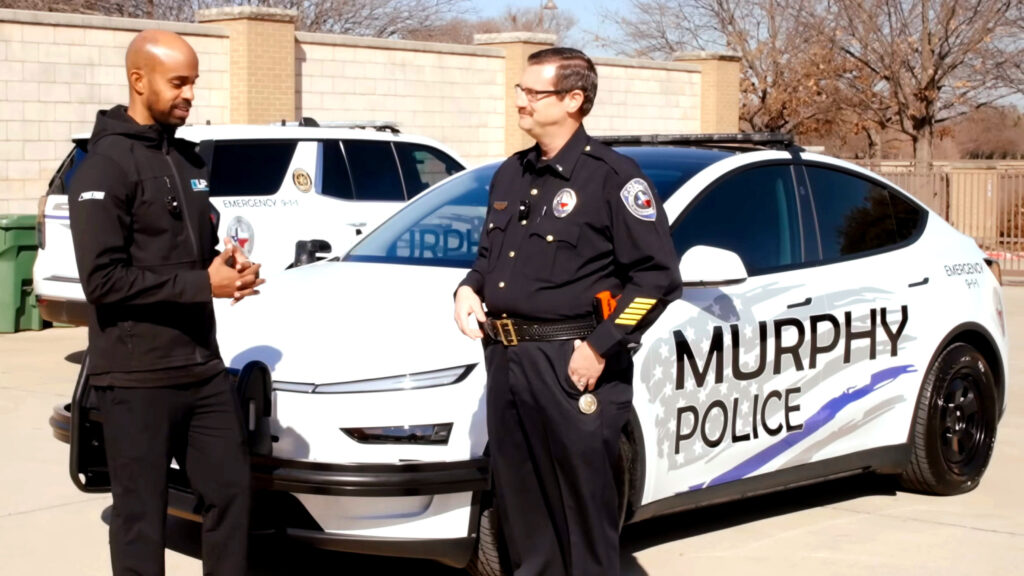
The Murphy Police Department in North Texas has become the first agency to roll out the refreshed 2026 Tesla Model Y Patrol, upgraded by Unplugged Performance. Instead of committing to a full fleet replacement, the department is running the EV in real-world conditions to see how it holds up to daily patrol duty.
Officials say the more persuasive case is financial. Each cruiser is projected to deliver measurable savings compared to a traditional ICE-powered patrol vehicle.
According to data from the City of Murphy, projected annual savings per vehicle range from $4,100 for single-officer units to as much as $12,000 for shared-shift cars clocking more than 140 hours per week. The bulk of that comes from eliminating fuel purchases, though the department will still incur electricity costs, along with a 75% reduction in maintenance compared to gasoline vehicles such as the Chevrolet Tahoe and Ford Explorer.
No Idling Wear
The savings story does not stop at fuel and oil changes. EVs do not suffer engine wear from constant idling, which accounts for roughly 60% of a patrol car’s working life. As a result, they are expected to remain in service for up to twice as long as an ICE-powered equivalent.
Given that every hour spent idling is effectively equal to 33-35 miles (53-56 km) of driving wear, that difference adds up quickly. Without a combustion engine ticking away under the hood, the Model Y can sit on scene running lights, laptops, and climate control off its battery, without quietly shortening its lifespan.
Juniper Patrol Cars
On the hardware front, the facelifted Tesla Model Y Juniper has been converted into a patrol unit by UP.FIT, the specialized fleet division of Unplugged Performance. Compared to the road-going version, it gains a front push bar, additional LEDs at the front and sides, a roof-mounted siren, and 18-inch forged aluminum wheels wrapped in pursuit-rated tires.
The police car is offered in RWD and AWD configurations, using the standard electric powertrains and delivering between 321-357 miles (517-574 km) of range per charge. That is more than enough for routine duty. And because police work occasionally involves pursuits, braking performance has been upgraded with six-piston calipers, stainless steel brake lines, specialized fluids, thermally upgraded components, and uprated rotors.
Inside, officers get ventilated seats and improved sound insulation. Each vehicle is retrofitted with a customizable center console, a laptop mount, two weapon mounts, upgraded interior lighting, and a single rear prisoner partition.
Optional extras include ballistic protection for the front doors and custom reflective graphics.
UP.FIT has not disclosed the final MSRP for the Murphy units, though it insists the total cost of ownership undercuts everything else in the segment. Beyond the Model Y crossover, the company also offers police-ready conversions for the Cybertruck, Model S/X, and Model 3, in case your local department prefers its patrol cars in a different shape.
If the Bentayga proved anything, it is that Bentley buyers have no issue with a luxury SUV wearing a winged badge. So a second one was never really in doubt. That follow-up is now deep into development, and it has just been spotted winter testing for the first time.
For now, it is referred to as the Urban SUV, though that name is almost certainly temporary. It will sit below the Bentayga in the range and, more significantly, it will be fully electric. Yes, the EV market has cooled slightly, but Bentley appears confident that its customers are still ready for a battery-powered SUV with the right badge on the nose.
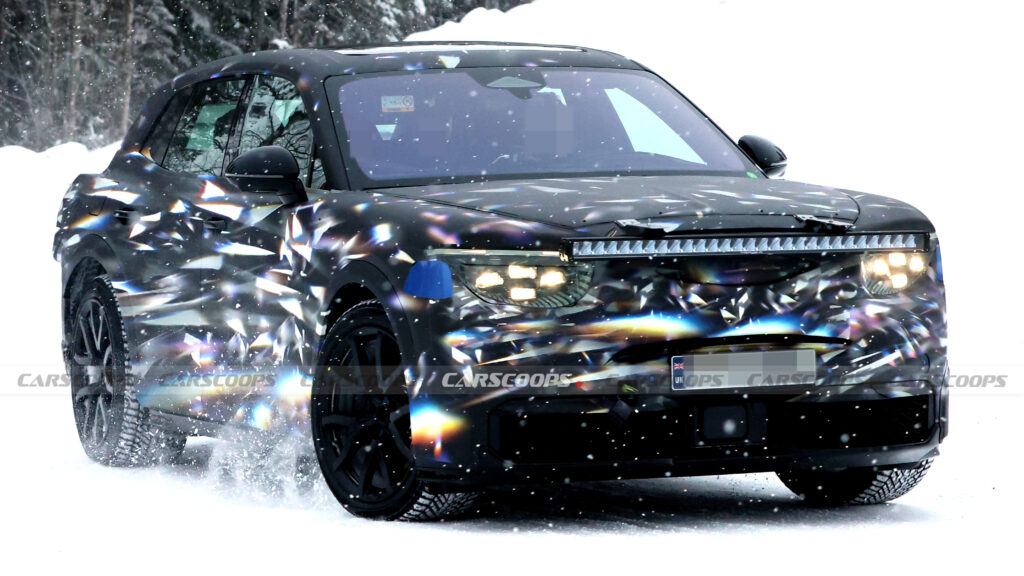
Several prototypes have been seen out on the road in recent months, but this is the first time one has appeared wearing this darker, more dramatic camouflage scheme. It’s been adorned with a large LED light bar at the front, ensuring the engineers testing it can still see after the sun sets in the depths of Europe’s winter.
SH Proshots
Most of the Urban SUV’s shape is still carefully disguised, but a few details are slipping through. Up front, the headlights feature four distinct lighting elements, giving it a signature that sets it apart from today’s Bentleys. Around the back, temporary cladding does its best to obscure the view, though slim LED taillights are clearly visible beneath the camouflage.
A Porsche Powertrain
Bentley is building its second SUV on the same Premium Platform Electric architecture as the new Porsche Cayenne Electric. That strongly suggests plenty of shared hardware with its German cousin, potentially including battery packs and motor configurations.
As it stands, the entry-level Cayenne Electric delivers 402 hp and tops out at 1,039 hp in the extraordinary Turbo variant. Our hunch is that the base Bentley will deliver around 600 hp. Whether or not it receives a flagship version with a four-digit horsepower figure remains uncertain.
One figure Bentley does seem keen to emphasize is charging speed. The SUV is expected to support ultra-fast DC charging, with the promise of adding 100 miles (160 km) of range in just seven minutes.
Late last year, our spy photographers finally caught the cabin in clear view. The images show a curved central infotainment screen that looks very close to the setup in the Cayenne Electric, paired with a separate digital instrument cluster ahead of the driver. It is familiar architecture, even if the surrounding materials will inevitably be pure Bentley.
There is more evidence of parts sharing lower down the steering column. Bentley’s compact electric SUV appears to use the same multi-function stalk arrangement as the new Audi Q3. Indicators, wipers, and headlight controls are grouped on the left stalk, while the right is dedicated solely to the shifter.
As for timing, Bentley could give us our first proper look at the production-ready model later this year. Customer deliveries of the Urban SUV are expected to begin in 2027, which gives Crewe a little time to perfect the details and, presumably, settle on a name that is not “Urban SUV.”
The Rivian Adventure Department has made its official debut.
It’s a skunkworks team that pushes boundaries to improve vehicles.
Has already paved the way for the RAD Tuner and new drive modes.
Rivian has used the FAT Ice Race in Montana to introduce the Rivian Adventure Department, or RAD for short. It’s being billed as a skunkworks team of designers, engineers, and enthusiasts “who spend their days and nights exploring the limits of what a Rivian can do.”
The company said a lot without saying much of anything, but the team is focused on unlocking the next level of capability and performance. They aren’t limited to cubicles either as they’ve “learned there’s no substitute for real-world experience.”
This has already seen the company enter and win the 2023 Rebelle Rally as well as set records for a production electric truck at Pikes Peak in 2023 and 2024. Learnings from these experiences is then fed back into road-going models.
While win on Sunday and sell on Monday is hardly a new idea, Rivian said their off-road adventures directly resulted in the Desert Rally drive mode as well as the RAD Tuner. The latter debuted on the second-generation R1 Quad lineup and enables owners to customize their driving experience.
While a number of automakers offer a personalization setting, most only let you adjust a few things. Rivian, on the other hand, allows drivers to tweak acceleration and regeneration as well as damping, ride height, brake assist, steering, wheel slip, and torque bias – among other things. In effect, it enables you to fine-tune the vehicle’s characteristics exactly to your liking and the situation at hand.
Will RAD Become Rivian’s AMG?
The Rivian Adventure Department has been around for awhile, but now it’s out in the open. As Chief Design Officer Jeff Hammoud explained, “RAD represents the living, breathing expression of the passion that defines Rivian. That impulse to explore, to push limits, and to embrace the adventure is not confined to one team—it is the very DNA of our entire company, from the designers and engineers to our community of owners.”
The big question is what happens next. Does RAD remain a relatively low-key team focused on improving existing products or do they transform into Rivian’s version of BMW M, Cadillac V, and Mercedes AMG? Only time will tell, but it feels like little more than marketing at this point.
Volkswagen has delivered its 2 millionth EV, an ID. 3 hatch.
It only celebrated the 1 millionth electric car in April 2025.
New affordable models like ID. Polo and ID. Cross coming.
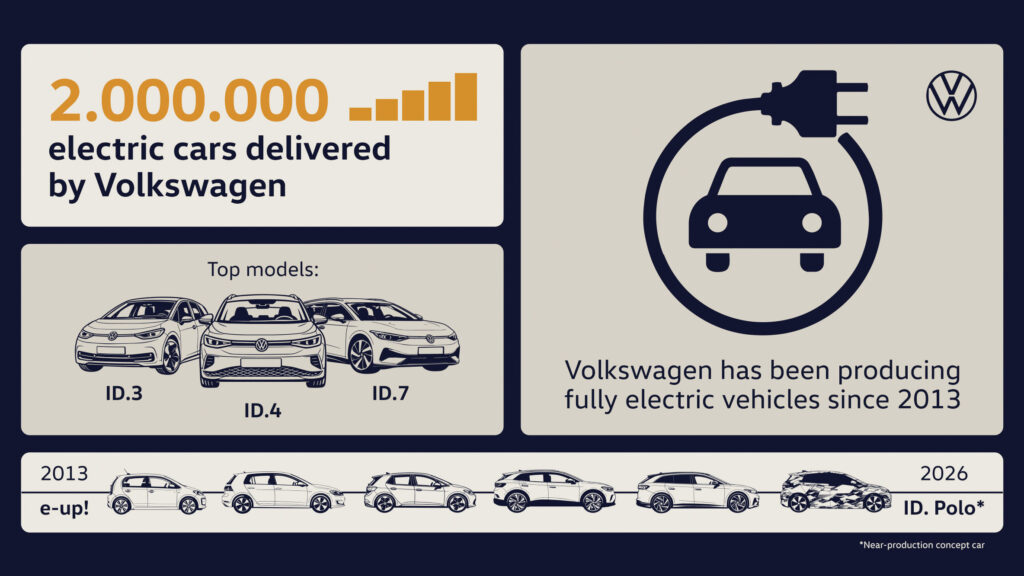
Volkswagen has just handed over its 2 millionth fully electric vehicle, and the pace is what really grabs you. It took 12 years to reach the first million. The 2 millionth car showed up just 10 months later.
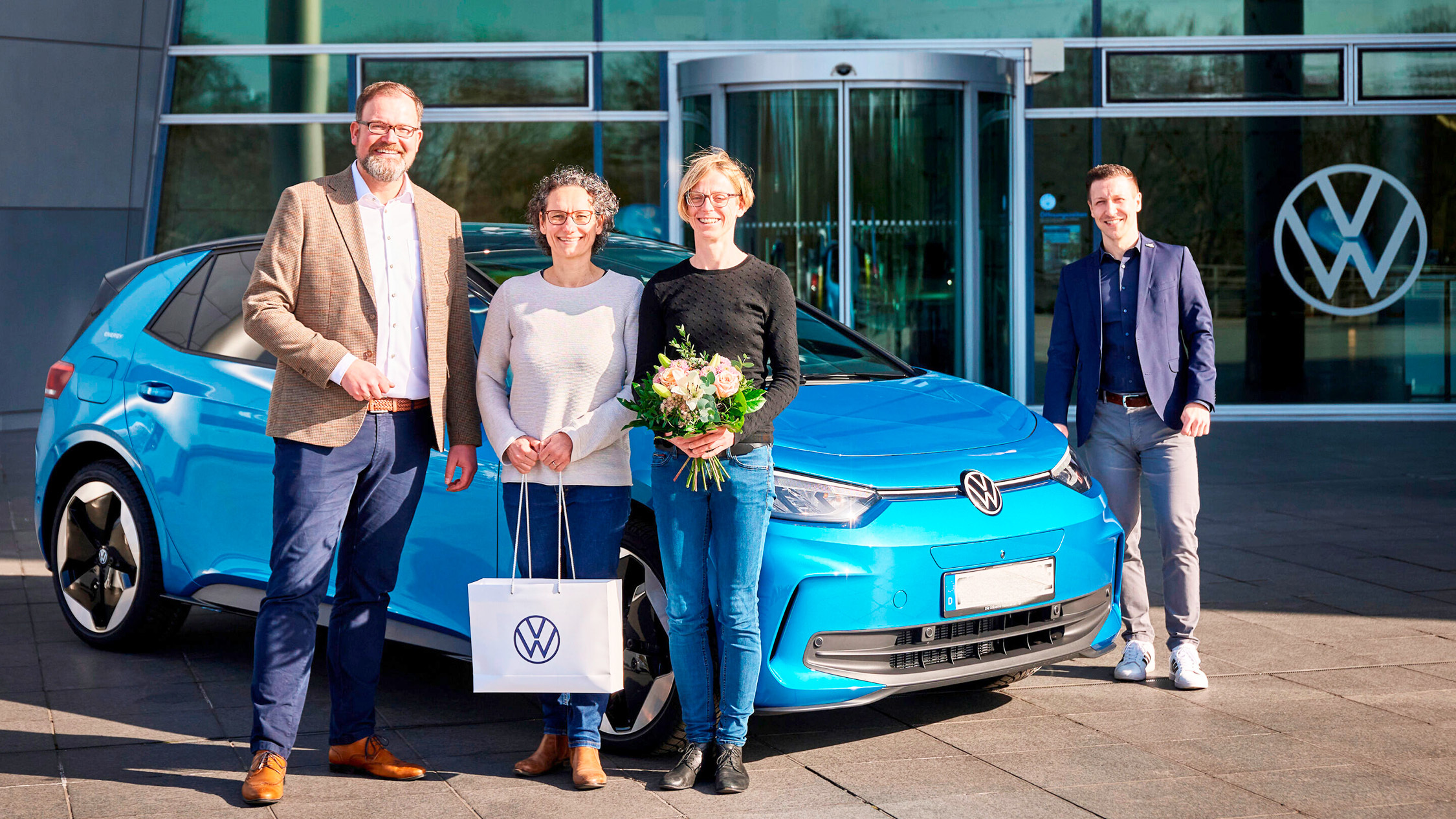
The anniversary car is an ID. 3 hatch, built in Zwickau, Germany, and delivered to a customer at the Transparent Factory in Dresden. The ID. 3 kicked off VW’s large-scale MEB era back in 2020, though the modern electric journey really began with the e-up in 2013 and the company experimented with a small number of electric Golfs as far back as the 1980s.
Volkswagen only celebrated its 1 millionth EV, an ID.3 GTX, last April. That means the brand effectively doubled its lifetime electric output in less time than it takes some automakers to add a new paint color to mark a model-year changeover.
ID. 4 Led The Charge
The heavy lifter in that sales charge is the ID. 4 SUV, which together with its ID. 5 fastback brother clocked up roughly 901,000 deliveries worldwide, proving SUVs still rule even in the electric age. The ID. 3, whose sales potential is restricted by the fact that it’s not available in North America, follows with around 628,000 units, while the larger and more premium ID. 7 has added another 132,000 to the tally.
Europe is the engine behind much of that growth. Roughly one in five cars sold there is now electric, and Volkswagen has carved out a leading role in the region. The US market has definitely cooled, but globally, the trajectory is still pointing upward.
More EVs On The Way
And VW isn’t slowing down. A refreshed ID. 4 badged as the ID. Tiguan is on the way this year, and the new ID. Polo (seen below) and first ever electric GTI, the ID. Polo GTI, will take the fight into the affordable small car segment.
An ID. Cross SUV spinoff follows soon after and an electric ID. Golf is also looming on the horizon. At this pace, don’t be surprised if we’re talking about 3 million before your summer tan has faded.
The new battery delivers 400 Wh/kg energy density.
Mass production is planned to begin next year.
BYD, SAIC, GAC, and CATL are developing similar packs.
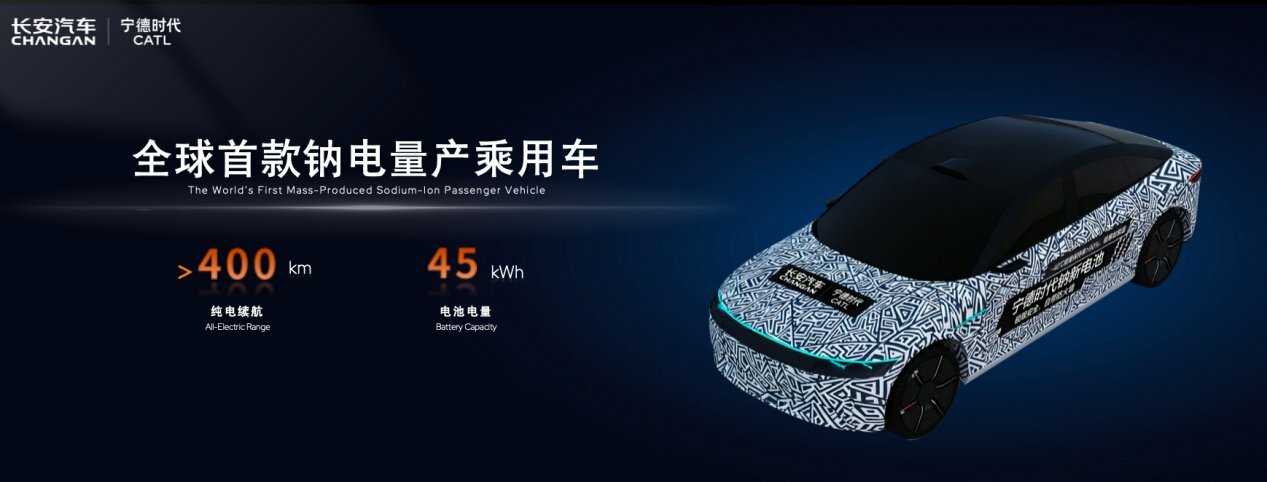
Solid-state batteries have been “just around the corner” for what feels like an entire EV generation. Now, they might actually be arriving. In the third quarter of this year, China’s Changan will begin fitting its new solid-state packs to robots and EVs, with full mass production slated for 2027.
According to Chinese media, Changan claims its new solid-state battery has an energy density of 400 Wh/kg, and EVs using it will be able to travel upwards of 932 miles (1,500 km) on a single charge. While you could argue that this much range borders on excessive, it would make future Changan models far better suited to long road trips through remote areas where charging infrastructure remains sparse.
Breakthrough Energy Density
The pack is called the Golden Bell. Aside from being very energy-dense, it is said to be 70 percent safer than a conventional EV battery and, because this is 2026, it also uses artificial intelligence for remote diagnostics. Smarter batteries, apparently, are part of the plan.
Changan will build these units under its new Jingzhongzhao solid-state battery brand. The company intends to manufacture fully solid-state packs while also producing liquid and semi-solid-state batteries that rely on a liquid electrolyte.
China’s Solid-State Push
It is not alone. Other Chinese brands are also edging closer to making solid-state batteries mainstream. Earlier this year, Dongfeng Motor began testing its own solid-state battery in extreme cold weather. It has an energy density of 350 Wh/kg and a claimed range exceeding 620 miles (1,000 km). It also plans to roll them out in production cars this year, aiming for September.
BYD, Chery, SAIC, GAC, and CATL are all chasing similar breakthroughs. So are legacy names such as Mercedes-Benz, VW, BMW, Toyota, Nissan, Hyundai, and Honda. After years of promising headlines and laboratory milestones, solid-state batteries may finally be edging toward something tangible. If they deliver on even half of these promises, combustion engines will have one more reason to feel nervous.
Cupra Born facelift teased with sharper triangular lights.
Already great interior quality set to get another boost.
Growing brand’s new-look EV makes its debut March 5.
Cupra is at it again, reminding us why its versions of big-name Volkswagens are almost always superior to the real thing. This time, the Spanish brand has teased an updated Born, its sportier take on the VW ID.3, and we’ll get to see the full makeover on March 5.
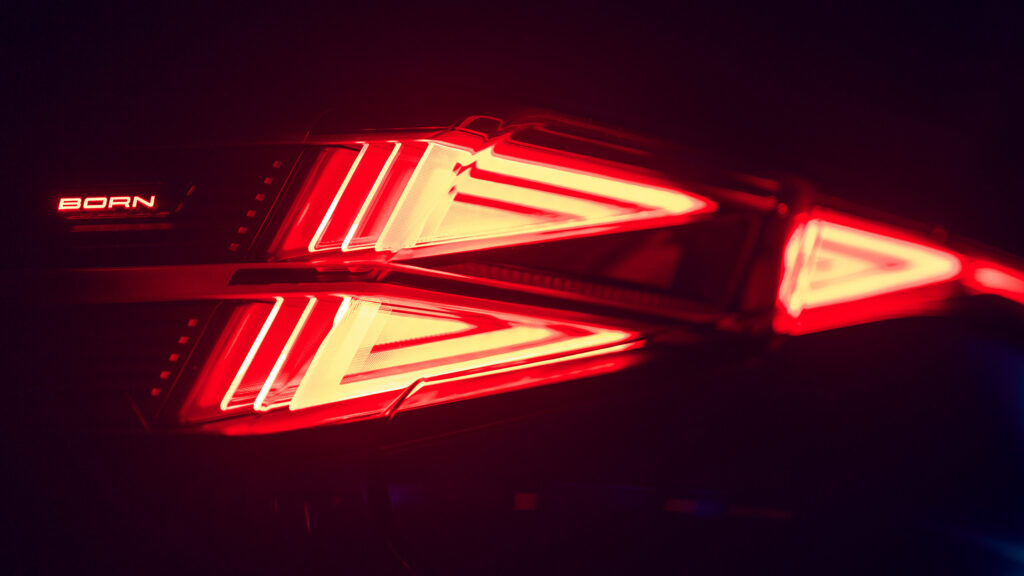
The biggest change is visual, and it seems like it’ll be hard to miss. The updated Born adopts Cupra’s latest design DNA, complete with triangular Matrix LED headlights and a matching triangular lighting graphic at the rear. There’s also an illuminated rear badge because lit logos are the car design world’s new LED light bar.
We’ve spied disguised prototypes of the facelift Born testing a couple of times, and those images suggest redesigned bumpers and a taller lower grille augmented by vertical outer vents that make the EV look tougher and wider.
Tech Upgrade
The Born’s cabin already makes the ID.3s look cheap and dull (though VW did improve the materials a couple of years ago), and Cupra says we should expect even better quality and more technology in the refreshed car. But it’s not like the brand has a ton to do in this area, having already upgraded the Born to VW’s much-improved 12.9-inch touchscreen in 2024.
Few Below-Surface Changes
Under the skin, things are more mysterious, and we’re guessing that’s because it’s all carried across from the current hatch. Cupra hasn’t confirmed any technical changes, and the current Born is already competitive for electric range and performance in its class. So this update could be more about feel and flair than extra kilowatts. Still, a little surprise boost wouldn’t hurt.
As of today, Cupra skips the low-tune motor options offered in entry-level VW ID.3s and jumps straight to a 228 hp (231 PS / 170 kW) single-motor setup with a choice of 59 or 79 kWh batteries, giving up to 354 miles (570 km ) between fills. Hot hatch fans can upgrade to Cupra’s version of the ID.3 GTX, the Born VZ, which comes with a 322 hp (326 PS / 240 kW) motor, again driving the rear wheels only.
Rescuers couldn’t open SU7’s electric door releases as it burned.
Eyewitnesses tried desperately to smash the driver’s side window.
China will ban electric door releases like the SU7’s from 2027.
An official investigation into the death of a man who crashed his Xiaomi SU7 in China last year has confirmed details previously reported by local media. The findings underscore how critical basic mechanical access can become in seconds. Authorities concluded that the 31-year-old died after being unable to open the electrically operated doors once the electric sedan caught fire.
While this case involves a Xiaomi, concerns about electronically actuated door systems have been debated across the industry and in global markets for years. This isn’t just a Tesla issue.
The crash occurred at approximately 3:15 a.m. on October 13, 2025, in Chengdu, reports Carnewschina. The Xiaomi driver, identified simply as Deng, was allegedly driving under the influence of alcohol at the time and slammed into another vehicle on Tianfu Avenue South before jumping over the central divider and bursting into flames.
Timeline Of The Crash
According to forensic findings cited by the Chinese magazine Caixin, the SU7 reached 203 km/h (126 mph) just three seconds before the crash. It then slowed to 167 km/h (104 mph) after striking the other car and was traveling 138 km/h (86 mph) when it hit the divider.
Harrowing footage captured in the immediate aftermath showed bystanders attempting to smash the driver’s side window and open the door in an effort to save him, but without success.
Why The Doors Wouldn’t Open
Investigators concluded that the doors could not be opened from the outside because the fire caused the low-voltage system to shut down, disabling the door handle release function. The report added that the SU7 has no mechanical latches accessible from the outside and relies solely on electric release buttons.
Xiaomi shares plunged nearly 9% after a fatal crash involving its SU7 electric car, Bloomberg reports
According to the outlet, a 31-year-old driver in China collided with another vehicle, crossed into the opposite lane, and the car caught fire. Witnesses tried to pull the man… pic.twitter.com/yPQ70FoKXN
The Xiaomi also uses electric release buttons inside the cabin. Although it is equipped with mechanical emergency releases, locating and operating them while disoriented after a crash would not be straightforward.
Regulatory Response In China
This fatal crash, along with others, has prompted regulators in China to ban electronic door handles on EVs. The new rule will take effect on January 1, 2027. It will require exterior handles that provide a handhold of at least 60 mm by 20 mm (2.36 inches x 0.79 inches), ensuring they can be used by rescuers in an emergency. In addition, mechanical releases inside the vehicle must include clear signage explaining how to open them during an emergency.
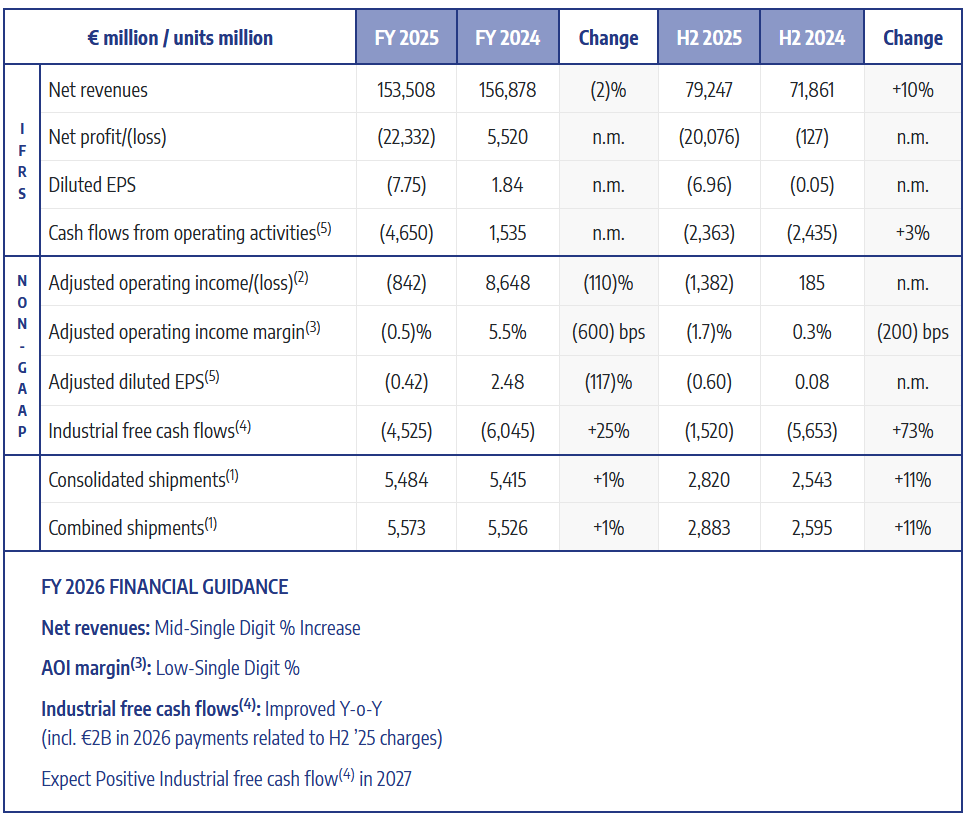
Stellantis has published its 2025 financial results, and they make for sobering reading. The headline figure is a €22.3 billion deficit, equal to $26.3 billion at current rates, marking the group’s first-ever annual loss. That swing looks even worse when set against 2024’s €5.5 billion ($5.8 billion) profit, which was already down 70% compared to 2023. In the span of two years, the company has gone from profitable to deep in the red.
The group, which owns 14 brands including Abarth, Alfa Romeo, Chrysler, Citroen, Dodge, DS Automobiles, Fiat, Jeep, Lancia, Maserati, Opel, Peugeot, Ram, and Vauxhall, attributes the damage to €25.4 billion ($30 billion) in “unusual charges,” largely tied to what it calls a “profound strategic shift to meet customer preferences.” In plain terms, Stellantis overestimated how quickly the market would pivot toward electric mobility and is now paying to recalibrate.
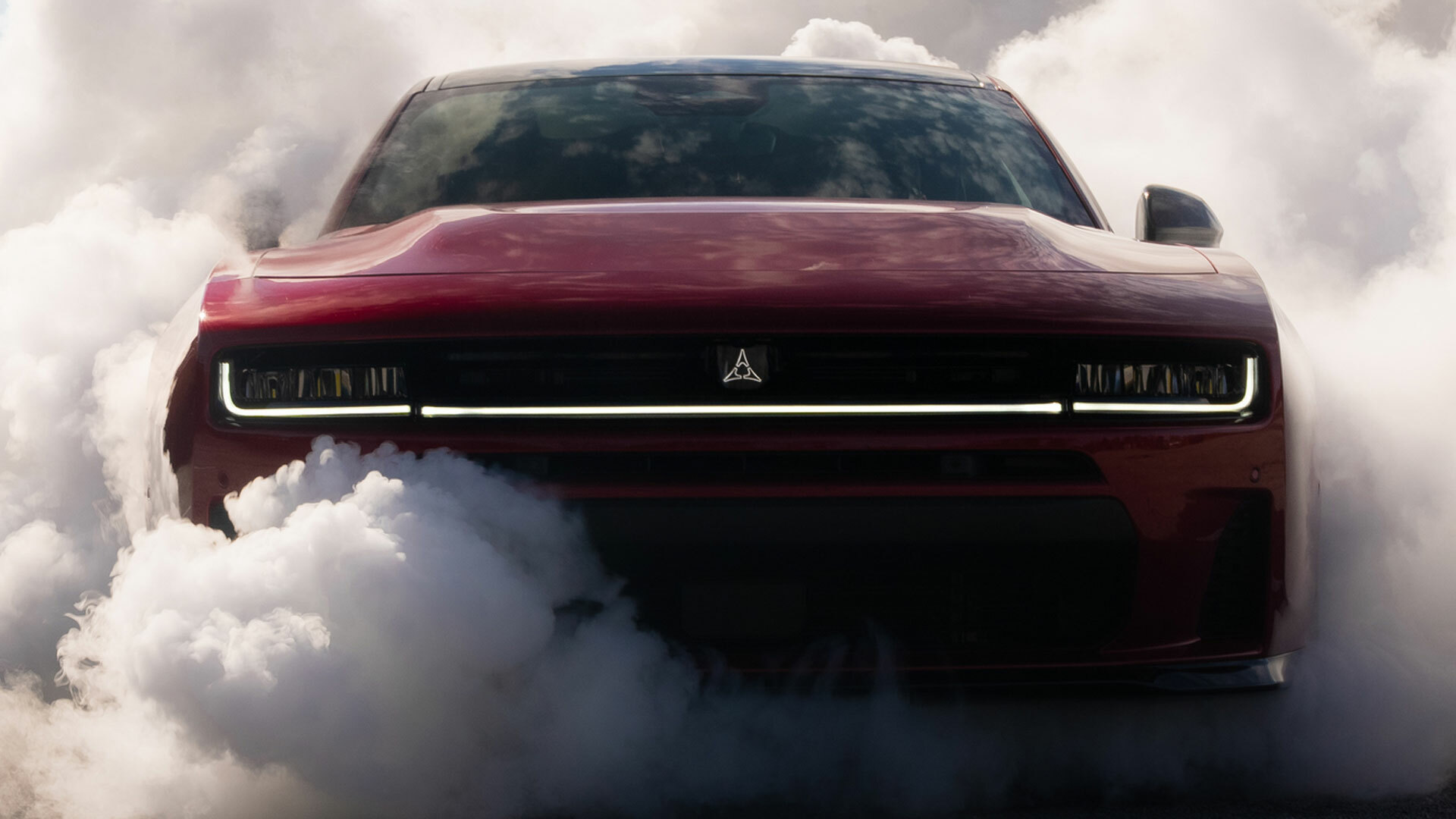
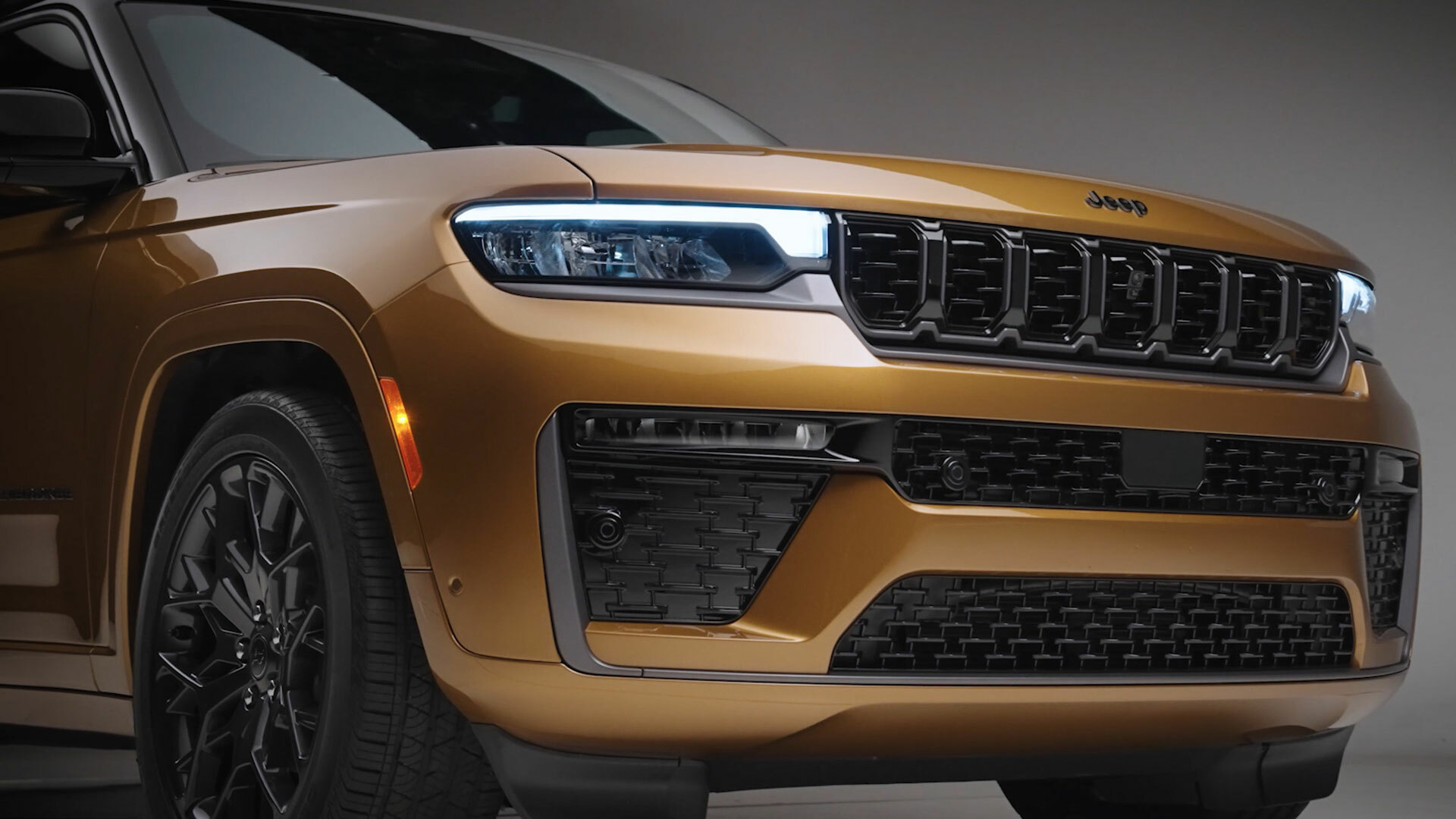
That is only part of the story. It wasn’t just a matter of customers being slow to embrace EVs. Several of Stellantis’ electric efforts, particularly in the US, struggled on their own terms. Models such as the Dodge Charger Daytona EV and the Jeep Wagoneer S were priced at the upper end of their segments yet struggled to justify that positioning against established rivals.
Rethinking Its EV Strategy
Regardless, that recalibration means canceling several electric models that were in development, mainly for the US market, and putting new emphasis on high-margin combustion engines. The return of the HEMI V8 in North America is the obvious attention grabber.
In Europe, diesel and mild-hybrid gasoline options are being folded back into the lineup across several current and upcoming models, including the now-delayed Alfa Romeo Stelvio and Giulia replacements.
“Our 2025 full year results reflect the cost of over-estimating the pace of the energy transition and of the need to reset our business around our customers’ freedom to choose from the full range of electric, hybrid and internal combustion technologies,” said Stellantis CEO Antonio Filosa.
“In the second half of the year we began to see initial, positive signs of progress with the early results of our drive to improve quality, strong execution of the launches of our new product wave and a return to top line growth. In 2026 our focus will be on continuing to close the execution gaps of the past, adding further momentum to our return to profitable growth.”
How Does Stellantis Plug The Gap?
The financial strain has prompted the board to suspend the 2026 dividend and authorize up to €5 billion ($5.9 billion) in hybrid bonds to shore up liquidity. Industrial free cash flow remained firmly negative at €4.5 billion ($5.3 billion), although that represents a 25% improvement on the previous year.
Net revenue totaled €153.5 billion ($181.1 billion), down 2% year-on-year. The decline is attributed to exchange rate headwinds and net pricing drops in the first quarter of 2025, neither of which tends to flatter the bottom line.
The group posted an adjusted operating loss of €842 million ($993.5 million). Still, the second half of the year showed signs of stabilization. Revenues rose 10% and shipments climbed 11% as inventories normalized. Stellantis also highlighted that H2 2025 marked the first six months under its renewed leadership team, a detail clearly intended to signal that the worst may already be in the rearview mirror.
Shipments Went Up But Shares Go Down
Combined shipments for 2025 reached 5.573 million vehicles, up 1% year-on-year. That keeps Stellantis in fifth place globally by volume, behind Toyota (11.3 million), Volkswagen Group (8.98 million), Hyundai Motor Group (7.27 million), and General Motors (6.11 million).
Momentum was stronger in the second half, with 2.883 million shipments, up 11% over H2 2024. North America did most of the heavy lifting, posting a 39% H2 increase as inventories returned to more normal levels and demand improved.
Investors, however, appear less convinced. Reuters reports that Stellantis shares have fallen by more than 30% this year, sliding to their lowest level since the PSA-FCA merger in 2021.
PROS ›› Good tech, comfortable ride, better than EV5 CONS ›› Poor ADAS, pricey, inefficient, slow-charging
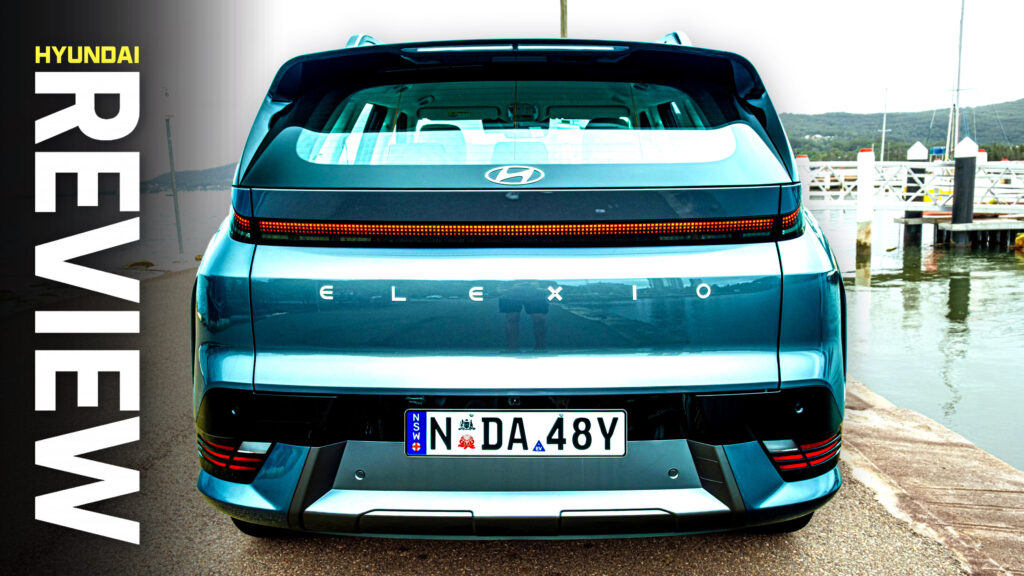
Electric vehicles make up just over 8 percent of new car sales in Australia, so they are hardly dominant. Yet the competitive noise has increased dramatically in recent years, thanks largely to a surge of new Chinese brands. Hyundai’s counterpunch is the Elexio, its latest EV and one aimed squarely at that fast-growing crowd.
The Elexio is unlike any other electric Hyundai so far. Crucially, it was not developed entirely in-house, but rather brought to life through its joint venture partnership with BAIC Motors.
This means it is built in China, tapping into the country’s vast manufacturing scale and efficiency, paired with the engineering experience and brand weight of a legacy player like Hyundai. When it was revealed last year, it looked set to remain a China-only model. Instead, it has now landed in Australia, and we were among the first to get behind the wheel earlier this month.
QUICK FACTS
› Model:
2026 Hyundai Elexio Elite
› Starting Price:
AU$61,990 ($44,000) as tested
› Dimensions:
181.6 L x 73.8 W x 65.8 in H (4,615 x 1,875 x 1,673 mm)
› Wheelbase:
108.2 in (2,750 mm)
› Curb Weight:
2,105 kg (4,640 lbs)
› Powertrain:
Single electric motor / 88.1 kWh battery
› Output:
215 hp (160 kW) / 236 lb-ft (320 Nm)
› 0-62 mph
~8.0 seconds
› Transmission:
Single-speed
› Efficiency:
19.5 kWh/100 km as tested
› On Sale:
Now
SWIPE
According to Hyundai, the Elexio has been designed to neatly slot between the Kona EV and Ioniq 5 in its line-up, serving as an all-electric alternative to the Hyundai Tucson. It’s Hyundai’s answer to popular competitors like the Tesla Model Y, Kia EV5, BYD Sealion 7, and Xpeng G6, and this is reflected in the price.
Can It Compete On Price?
Hyundai Australia
Two versions will be offered: the base Elexio and the flagship Elexio Elite. Prices for the base version will start at AU$58,990 (US$41,900) before on-road costs, while the Elite will be priced from AU$61,990 (US$44,000). However, the Elite will be available for AU$59,990 (US$42,600), including all on-road costs, in a limited-time deal running until the end of March.
Hyundai is predicting big things for the Elexio and expects it to be its best-selling EV in Australia. Achieving this won’t be easy. The Kia EV6 undercuts the Elexio at AU$56,770 (US$40,300), the Tesla Model Y Premium is available from AU$58,900 (US$41,800), and the BYD Sealion 7 Premium is available from AU$54,990 (US$39,000). The superb Zeekr 7X also undercuts it at AU$57,900 (US$41,100).
Big Battery, Modest Charging Speeds
So, what do you get for your money in the world of the Elexio? Like Hyundai’s Ioniq models, and unlike the Kia EV5, the Chinese-built Elexio uses the familiar E-GMP platform. However, it doesn’t have an 800-volt architecture like the Ioniqs, instead using a 400-volt system.
With this in mind, charging the battery pack 10-80 percent on a 150 kW charger, with peak speeds in the mid-120s, will take 38 minutes. This is slightly slower than the Kia EV5, which takes 36 minutes, but whereas it has a compact 64.2 kWh battery, the Hyundai has a much larger and more practical 88.1 kWh unit.
This battery powers a front-mounted electric motor with 160 kW (215 hp) and 310 Nm (236 lb-ft). Hyundai quotes a combined efficiency of 18.2 kWh/100 km, which is okay, but certainly not class-leading.
A Digital-First Cabin
Photos Brad Anderson/Carscoops
We only sampled the Elexio in flagship Elite trim, so first impressions came fully loaded. Stepping into the cabin for the first time, it is immediately clear this is not your typical Hyundai interior.
Dominating the interior is a massive widescreen 27-inch display, encompassing both the central infotainment display and a display for the passenger. This screen houses Hyundai’s new Connect-C infotainment system and runs on Android Automotive with a powerful Snapdragon 8295 processor and Unreal 3D graphics engine.
While there are several cars on sale in China with a similar passenger and infotainment screen, this is one of the first implementations of a display like this in a Western market. It looks great, providing excellent colors, clarity, and response. However, it’s not particularly practical to use, especially when you’re driving.
Photos Brad Anderson/Carscoops
I am quite tall with long arms, yet adjusting the climate controls or digging into vehicle settings on the move meant leaning forward and stretching almost to the limit. It should not feel like a light workout just to change the temperature. The more traditional screens in other current Hyundai models are much easier to reach, as are the tablet-like displays found in many of the Elexio’s rivals.
On the plus side, the new Connect-C system is good and is far more modern than Hyundai’s outgoing software. It has a much smartphone-like layout with convenient shortcuts on the driver’s side.
In a Hyundai first, a traditional gauge cluster has been replaced by a head-up display. In photos, it doesn’t look like a HUD at all, but rather a physical cluster positioned at the base of the windshield. In reality, it is a true head-up display, albeit it projects onto a small black area of the windshield, providing better contrast than HUDs that project onto normal glass.
The obvious downside of this is that if you chip or crack the windshield, you probably won’t be able to buy a generic HUD-compatible replacement, but rather need one from Hyundai with this black element.
Quality And Space
The rest of the cabin is quite minimal, as many EVs are today. In terms of fit and finish, it feels on par with some Chinese rivals, like the BYD Sealion 7, and is certainly more premium than the Kia EV5. There’s soft-touch suede on the dashboard and door panels, as well as heated and ventilated front seats, and plenty of leather. Dual wireless chargers are also standard on the Elite.
Overall, space and comfort are good, whether that be in the front row or the second-row. While the Elexio only has a wheelbase of 2,750 mm (108.2 inches), 5 mm (0.1 inches) less than the Tucson and 250 mm (9.8 inches) less than the Ioniq 5, there’s still plenty of legroom for rear passengers, and that includes adults. Cargo space is decent, rated at 506 liters (17.8 cubic-feet) or 1,540 liters (54.3 cubic-feet) with the rear seats folded 60/40 flat.
Disappointingly, neither Elexio model has a panoramic glass roof, which is common in electric SUVs at this price point, nor a frunk, even though there’s plenty of space for one.
How Does It Drive?
Photos Brad Anderson/Carscoops
Driving the Elexio revealed that it is a solid performer, and it does some things well. However, it fails to stand out from the competition and could benefit from some tweaks to lift it to a new level.
As any EV should, the Elexio’s powertrain is smooth and quiet, providing more than enough grunt for everyday driving duties, whether that be in urban settings or on the highway.
With 160 kW (215 hp) and 310 Nm (236 lb-ft), the Elexio has exactly the same power as the front-wheel drive Kia EV5. Crucially, it doesn’t suffer from the same horrible torque steer that the EV5 does. In fact, there’s no torque steer whatsoever, which is a great thing. However, like the EV5, the Elexio does love to spin up its inside front wheel should you get greedy with the throttle and play around with the traction control.
Efficiency is not so good. After several stints behind the wheel of the Elexio, we averaged 19.5 kWh/100 km, which is quite poor, particularly given that we averaged 20.5 kWh/100 km in the Sealion 7 Performance, and it has an extra 230 kW (308 hp) and 380 Nm (280 lb-ft) of torque.
Like other Hyundai and Kia EVs, the Elexio has paddle shifters behind the steering wheel to adjust the level of brake regeneration, which is something every EV should have. I spent most of my time in the one pedal i-Pedal mode, with it bringing the SUV to a smooth and predictable stop every time. The transition between the mechanical brakes and the regen is also imperceptible, so kudos to Hyundai for that.
The brand says that, like most of the cars it sells in Australia, the Elexio has been specifically tuned for local roads by teams of engineers from South Korea. I was pleasantly surprised with the Elexio’s ride, finding it to be comfortable and softer than many other EVs, which can be too firm and harsh over bumps.
Software Still Finding Its Feet
Photos Brad Anderson/Carscoops
In addition to tweaking the suspension for Australia, Hyundai insinuated during a press briefing that the Elexio’s advanced driver assistance system have also been set up for local conditions. Despite this, further refinements are needed.
During long highway jaunts, there were several instances when the lane-keeping assist and lane-centering functions failed to recognize clearly-marked lines, causing it to slowly drift into adjacent lanes. In addition, I experienced some slow ping-ponging between lane markings. This is odd as the dozens of other Hyundai and Kia models I’ve tested in recent years all have great lane-keeping systems, keeping you locked in the center of the lane on well-marked highways.
In addition, there was an instance where I had the adaptive cruise control enabled on a 100 km/h (62 mph) country road when suddenly, the Elexio suddenly braked to 75 km/h (47 mph) despite there being no object or car in front of me. I suspect the large semi-truck traveling in the opposite direction in the lane next to me fooled the system.
Like so many other new cars built in China, the Hyundai Elexio’s driver monitoring system is overactive, ringing the moment you yawn or take your eyes off the road. Additionally, turning it offer requires multiple steps through the menu, which is frustrating.
Verdict
Photos Brad Anderson/Carscoops
The Hyundai Elexio is definitely better than the Kia EV5, which has quickly gained popularity in Australia and is the best-selling EV from a legacy brand in the local market. With this in mind, there’s a good chance that the Elexio should also sell well for Hyundai, and it’ll likely attract many shoppers who were previously interested in the Kona EV or Ioniq 5.
However, it may be prudent for buyers to exercise some patience before getting an Elexio. Earlier this year, Hyundai slashed prices of the Inster by AU$7,288 ($5,200), and reduced the Kona Electric by more than AU$13,000 ($9,200). If internal sales targets are missed, similar price adjustments for the Elexio would hardly be surprising.
Just as importantly, Hyundai’s latest EV still needs a few software refinements, particularly to its ADAS, before it feels like the clear choice in an increasingly crowded segment.
It sports special graphics and a revamped interior.
Americans will only get the JCW variant with 228 hp.
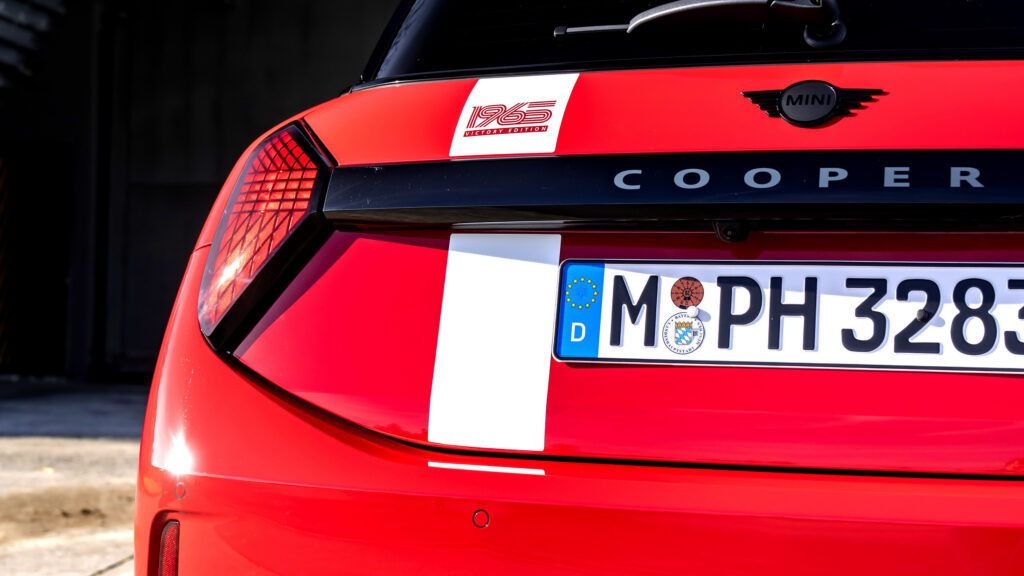
Anniversary editions are popular with consumers and automakers, but they typically follow a predictable pattern. However, Mini is mixing things up by honoring the 61st anniversary of their win at the 1965 Monte Carlo Rally.
That’s a weird anniversary to celebrate, but the company is marking the occasion by unveiling the new 1965 Victory Edition. Based on the Cooper, the model features a Chili Red exterior with a full-length white body stripe and a white “52” graphic on both sides of the vehicle.
They’re joined by a Glaced or panoramic glass roof and a “1965” sticker on the C-pillar. The model also sports 18-inch alloy wheels in either a black or two-tone design.
The upgrades extend to the cabin, which has been adorned with special door sill plates and a sport steering wheel featuring 1965 badging. Elsewhere, there’s two-tone accents, 52 graphics, and a special storage box in the center console. Buyers will also find a ‘hidden’ door sticker noting Timo Mäkinen’s win at the 1965 Monte Carlo Rally in a Cooper S.
Multiple Engine Options
Three different powertrains are available as the Cooper S 1965 Victory Edition has a turbocharged 2.0-liter four-cylinder pumping out 201 hp (150 kW / 204 PS) and 221 lb-ft (300 Nm) of torque. It enables the model to accelerate from 0-62 mph (0-100 km/h) in 6.6 seconds.
Customers can also get a JCW variant, which has an upgraded 2.0-liter turbo producing 228 hp (170 kW / 231 PS) and 280 lb-ft (380 Nm) of torque. This lowers the dash to 62 mph (100 km/h) to 6.1 seconds.
If that’s too slow, the John Cooper Works Electric hits 62 mph (100 km/h) in 5.9 seconds thanks to a beefy motor producing 255 hp (190 kW / 258 PS). The model is also notable for having a 49.2 kWh battery pack and a range of 226-250 miles (364-402 km) in the United Kingdom.
The special edition will be launched later this year and offered in an assortment of different markets. However, Americans will only get the JCW variant and it’ll cost $46,220 before a $1,175 destination fee.
Europe gets a new base EX30 with 148 hp and 211 miles of range.
It adds updated UX and V2L, both coming via OTA updates.
Production moves from China to Europe to avoid EU tariffs.
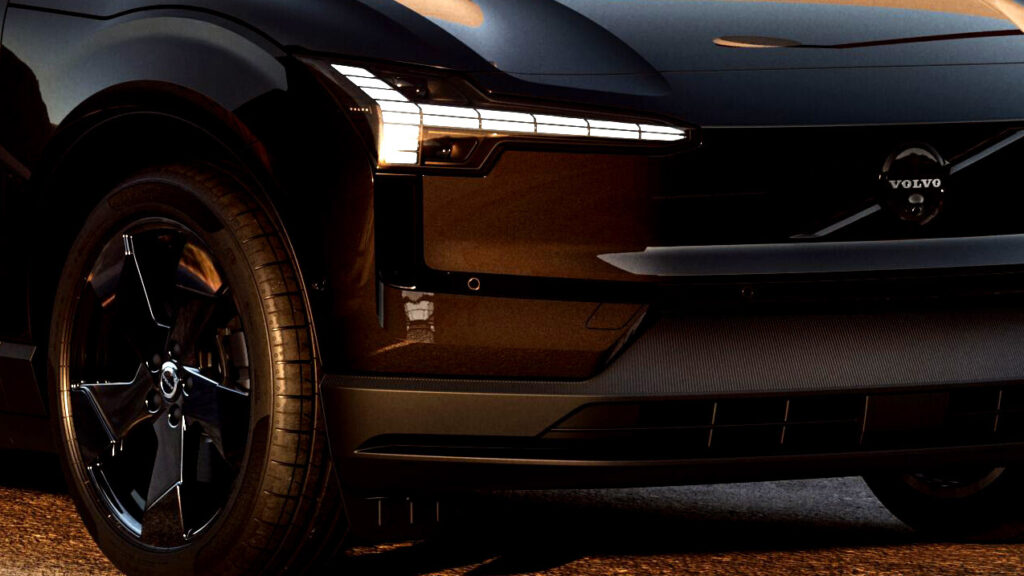
The Volvo EX30 has been updated in Europe for 2026, mirroring changes already introduced on the US-spec model. The range now gains a new entry-level powertrain, refreshed infotainment, new Vehicle-to-Load capability, and a Europe-exclusive Black Edition.
For European buyers, the headline is a lower entry point into the Volvo EV range. The EX30 now comes with a less potent electric motor producing 148 hp (110 kW / 150 PS), positioned as a more affordable alternative to the existing single-motor 268 hp (272 PS) and dual-motor 422 hp (428 PS) versions.
This new variant, not available in North America, can be paired with a 51 kWh battery pack delivering 339 km (211 miles) of WLTP range. Step up to the 69 kWh battery and the range increases to 476 km (296 miles). More miles, same compact footprint, and a little more choice at the showroom.
Turn Your Volvo Into A Power Bank
Volvo says the EX30 is now hardware-compatible with Vehicle-to-Load (V2L), though the feature will initially roll out in selected markets. With an optional adapter, the battery can power external kit such as electric bicycles, sound systems, or your increasingly elaborate camping setup.
There is also an infotainment update, bringing what Volvo calls a completely redesigned settings and controls system, plus a customizable content bar. Crucially, existing EX30 owners are not being left behind. The new user experience and V2L functionality will arrive via over-the-air updates scheduled for this summer.
The EX30 Black Edition
The EX30 only arrived in 2023, so there was no pressing need for a mid-cycle nip and tuck for either the standard model or the chunkier Cross Country. Instead, Volvo has opted for a wardrobe change. Enter the new Black Edition, now extended to its smallest SUV in line with the rest of the range.
Despite the name, you are not limited to one shade of noir. The Black Edition can be specified in Onyx Black, Vapour Grey, or Crystal White. Whichever you choose, the chrome has been quietly retired in favor of a high-gloss black finish. That treatment covers the 19-inch alloy wheels, the Volvo badge up front, and the lettering across the tailgate.
Inside, there is Nordico upholstery with contrasting stitching and dark flax decor to complete the theme.
If you like the darker cabin but not the full blackout look, the Black interior specification is also available across the broader EX30 lineup. There is also a new option called Harvest. Inspired by late Scandinavian summer evenings, it brings light-colored, woven recycled textile upholstery for the seats and door inserts, paired with a Nordico dashboard, dark flax decor, and a black headliner.
Pricing for the updated range will be confirmed at a later date. European-market EX30s are now built in Belgium, after Volvo shifted production from China to sidestep import tariffs.
Lancia’s flagship crossover was spotted in winter tests.
New Gamma will offer electric, mild-hybrid, and PHEV options.
It will be built in Melfi, Italy, alongside the DS No8.
Stellantis’ grand Lancia revival, or as they called it, ‘Renaissance’, has not exactly burst out of the gates. The new Ypsilon subcompact hatchback has struggled to gain momentum, which is not quite a surprise. Still, phase two is already taking shape, and it brings with it a familiar name. The Lancia Gamma is coming back.
This time, it arrives as an electrified crossover, and our spies have spotted a prototype for the first time during winter testing. The test car reveals enough to give us a better sense of what to expect ahead of its official debut later this year.
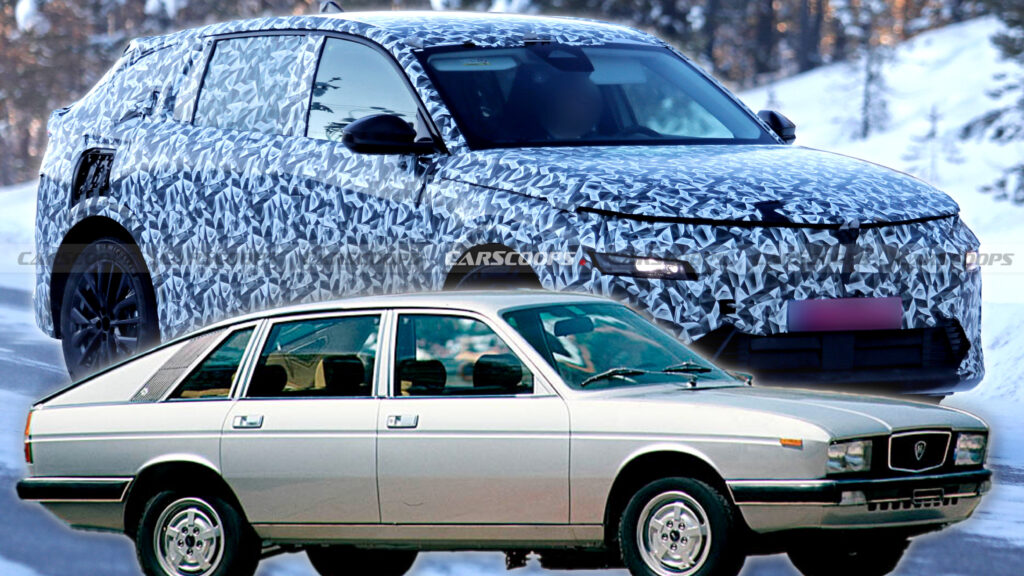
Unlike the original Gamma, which was offered from 1976 through 1984 as a fastback saloon and coupe, the new model takes a very different route. It is now a crossover, effectively the Italian sibling to France’s DS No8. From the spy shots, the Gamma appears more upright than the DS, leaning closer to coupe-SUV territory than to a traditional crossover.
Design Direction Takes Shape
Baldauf
At the front, expect familiar cues borrowed from the smaller Ypsilon. The split LED headlight layout looks set to return, joined by an illuminated T-shaped grille that, intentionally or not, brings to mind a Mandalorian helmet. Down below, the lower bumper intake has a clean, contemporary design and seems to incorporate active shutters flanking an ADAS sensor.
Down the sides, the surfacing closely mirrors the DS, right down to the door handles and mirror caps, though the Gamma appears to get slightly larger windows. The wheels look modest in size, which is usually a giveaway that this is not the upcoming HF performance version.
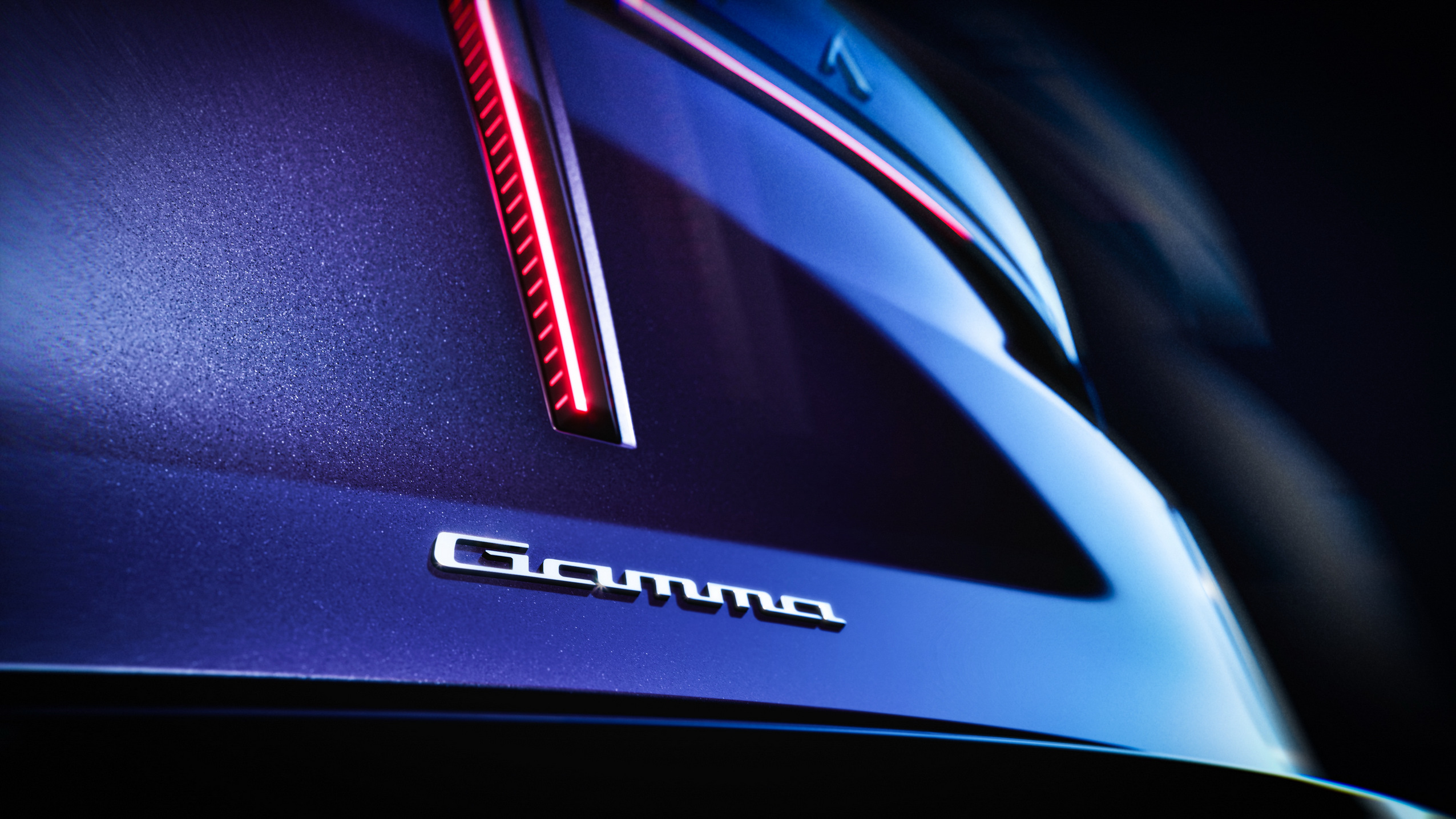
At the rear, heavy camouflage does its best to hide the details, but you can still make out the coupe-style rear glass flowing into what seems to be an integrated spoiler. An official teaser released in late 2024 indicates that the full-width LED taillights will adopt a T-shaped lighting signature, directing your eye toward the Gamma lettering across the sculpted tailgate. There are no visible tailpipes beneath the diffuser, reinforcing the likelihood that this particular prototype is fully electric.
Inside, expect a mix of premium and sustainable materials, along with Lancia’s signature “tavolino,” a mini round coffee-table integrated into the center console. The digital setup should include a 10.25-inch instrument cluster paired with a 16-inch infotainment display running the Lancia SALA system.
A Broader Powertrain Mix
Like the DS No8, the Lancia Gamma will sit on Stellantis’ STLA Medium platform and roll out of the Melfi plant in Italy. Both models were originally pitched as fully electric, but Stellantis has since recalibrated. Mild-hybrid and plug-in hybrid options are now part of the plan.
Looking at what Stellantis already has on the shelf, we can speculate on the powertrain lineup. The entry-level Gamma is expected to be powered by a turbocharged 1.2-liter mild-hybrid unit generating 143 hp (107 kW / 145 PS). At the opposite end, the Gamma HF could pack dual electric motors delivering up to 370 hp (276 kW / 375 PS), complete with AWD.
In terms of range, the larger 97 kWh battery pack could allow the Gamma to cover up to 435 miles (700 km) between charging stops.
Lancia has confirmed the new Gamma will arrive in 2026, so expect a steady drip of details over the coming months. It will later be joined by a new Lancia Delta in 2028, rounding out a three-model lineup for the revived Italian brand.
Ford claims most Mach-E owners barely use the frunk.
Several standard features have been dropped for 2026.
The EV also gains new physical door handles at the rear.
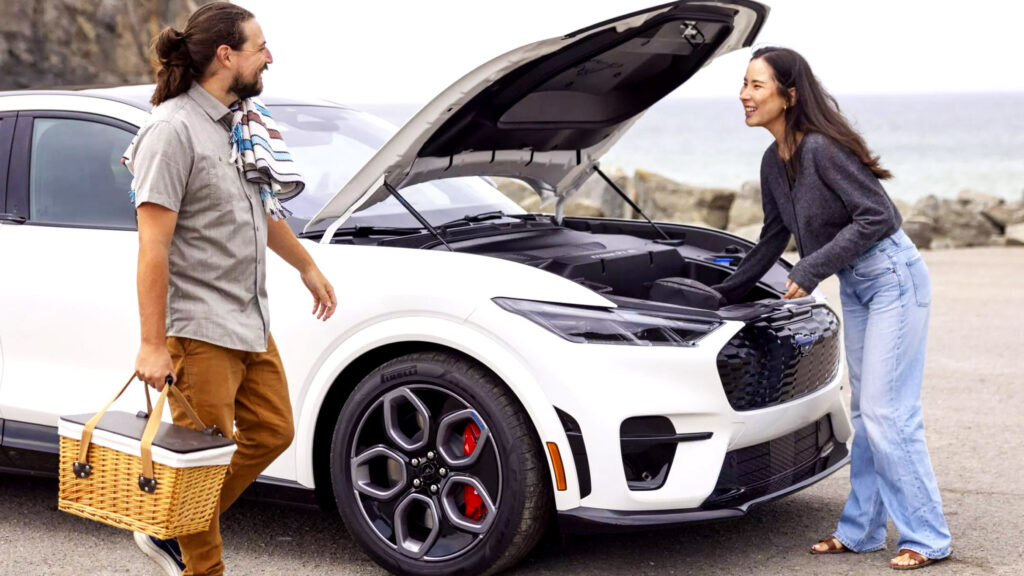
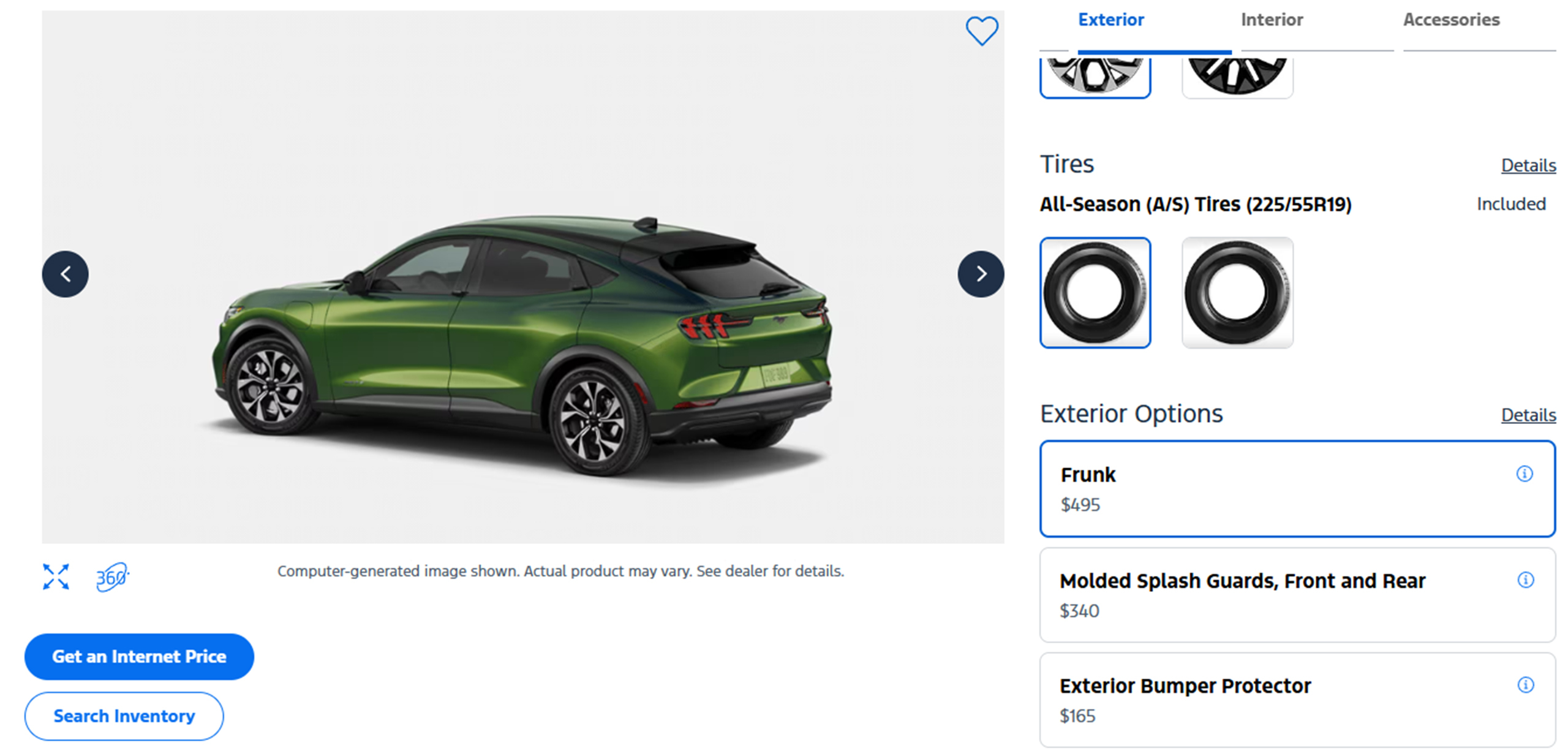
Ford has given the Mustang Mach-E a light reshuffle for 2026, and one change jumps out immediately. The front trunk is no longer standard kit. If you want a frunk now, you will have to tick a box and pay for the privilege. And it’s a pretty expensive one at that.
First noticed by Ford Authority, the updated online configurator reveals that the frunk is now a $495 option across the entire model line-up. While there are plenty of EVs out there that don’t have a frunk at all, this is the first time we’ve heard of one being offered as an optional extra. It may also be the first instance of a once-standard frunk becoming a paid add-on.
Ford says the decision was driven by customer behavior. Not many owners were using the frunk in the first place, or so the company claims. Removing it as standard helps cut costs, and the company insists those savings are being passed on.
To be fair, as we reported back in December, the Mach-E GT is almost $1,000 cheaper for 2026 than it was last year. The entry-level car, however, still starts at $37,795, which suggests the savings have not been distributed equally.
What Else Is Missing?
There are a few more trims to the lineup for 2026. For example, the front-seat map pockets have quietly disappeared, presumably in the name of saving a few pennies per car. The Mach-E Rally also parts ways with its standard rear spoiler and graphics, both now shuffled onto the options sheet. And if you were fond of the Bronze Appearance Package, it has been shown the door as well.
It is not all subtraction, though. Ford has made one practical addition at the back, fitting the rear doors with the same small grab handles used up front. You still have to press a button to pop the door open, because this is 2026, but at least there is now something physical to grab once it releases.
However, given how much bad press electronic door handles had over the past year, as well as regulatory changes in other markets, it’s possible Ford may eventually have to revert to more traditional door handles. We will see how long the current setup lasts.

 Login
Login