Login
LoginThe 2027 Lexus TZ Borrows The Highlander’s Bones And The LFA’s V10 Voice
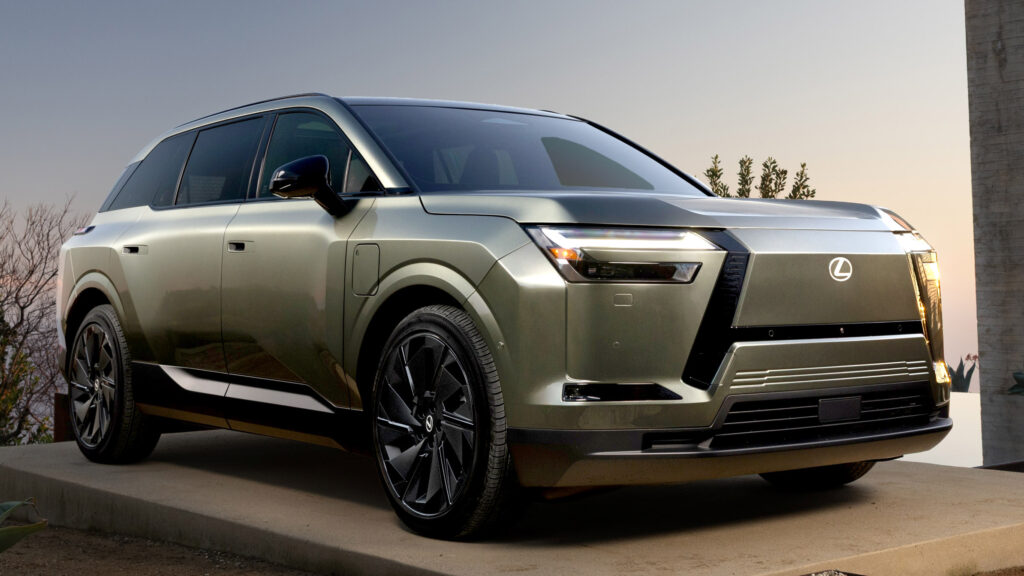
- The Lexus TZ arrives as a new three-row EV for global buyers.
- Upscale cabin adds roomy seating plus synthetic driving sounds.
- An AWD setup with 402 hp targets roughly 300 miles of range.
Lexus has pulled the wraps off the TZ, a fully electric three-row, six-seat SUV that gives the brand a proper family-hauling EV to slot above the RZ. It rides on the same architecture as the Toyota bZ Highlander but gets a reworked body, a more upscale cabin, and a stronger all-wheel-drive powertrain to justify the badge on the hood.
At 5,100 mm (200.8 in) long, the TZ stretches 50 mm (2 inches) beyond its Toyota sibling, though both share an identical 3,050 mm (120.1-inch) wheelbase and the same general proportions. From there, the styling diverges sharply.
More: The First Electric Lexus ES Actually Costs Less Than The Hybrid
The front end leads with a closed-off spindle grille flanked by stacked, two-story LED headlights, and the squared-off hood borrows visual cues from the tougher Lexus GX. The sides are heavily sculpted around the wheel arches, drawing the eye to the standard 22-inch alloys, with 20s available for buyers who want to soften the ride and (likely) improve their driving range.
The semi-flush door handles and the pillars appear to be carried over from the Toyota, but the roofline drops towards the back leading to a slightly longer rear overhang. The rear end has a large roof spoiler, full-width LED taillights and vertical L-shaped indicators.
Quietest Lexus SUV Yet, With An LFA Soundtrack On Tap
Inside, Lexus is pitching the TZ as a “relaxing lounge experience” for every occupant, with six seats spread across three rows. The brand has thrown serious effort at sound insulation and NVH tuning, to the point that it claims the TZ will be the quietest cabin in their SUV lineup, flagship LX included.
More: Lexus’ $100,000 Luxury Minivan Picks Up A Few Strange New Tricks
The TZ doesn’t have to whisper at all times, though. An Active Sound Control system pipes in synthesized soundscapes tied to throttle inputs, including what Lexus describes as “musical chord sequences” and, more interestingly, a mode that mimics the howl of the LFA’s V10. Whether anyone shopping a three-row family EV actually wants their grocery runs scored by a fake supercar soundtrack is a separate question, but the option is there.
Three Rows Of Lounge Seating And Hidden Touch Controls
The front and second row seats offer ventilation and power leg rests, while even the third-row seats promise “sofa-like cushioning”. The second and third rows have a one-touch fold-down feature for expanding the cargo space. Passengers will also find various storage compartments including a removable rear console.
The dashboard is dominated by the large touchscreen with a new generation infotainment, joined by a digital instrument cluster. Unlike the Toyota that has a row of physical switches under the touchscreen, the Lexus opts for touch buttons that remain hidden on the dashboard trim and steering wheel trim when not in use, in combination with a textured volume cylinder.
The rest of the spec sheet reads like a Lexus showroom brochure: panoramic roof, soft-close doors, configurable ambient lighting, and a 21-speaker Mark Levinson audio system. Trim materials lean into the brand’s sustainability push, with forged bamboo inserts and bio-based UltraSuede upholstery throughout. The latest Lexus Safety System+ 4.0 ADAS suite comes standard.
Standard AWD And A 300-mile range
The SUV rides on a reinforced version of the TNGA architecture and will be exclusively available as an EV. Dual electric motors produce a combined 402 hp (300 kW / 408 PS) and up to 369 lb-ft (500 Nm) of torque, surpassing the most potent version of its Toyota sibling.
More: Toyota’s Next Corolla Cross Is Growing Up, And The RAV4 Should Be Worried
Power is transmitted to all four wheels via the standard Direct4 AWD system. The driver has access to a Dynamic Rear Steering system, five selectable drive modes (Normal, Sport, Eco, Range, Rear Comfort), and five levels of regenerative braking.
According to Lexus, the 0-62 mph (0-100 km/h) acceleration is completed in 5.4 seconds and the towing capacity is rated at 3,500 lbs (1,588 kg).
Buyers have a choice between two lithium-ion battery packs with capacities of 76.96 kWh and 95.82 kWh. The larger battery targets an EPA range of 300 miles (483 km), which is actually 20 miles (32 km) lower than the maximum range of the Highlander, most likely due to the extra power.
For global markets the WLTP rating is 530 km (329 miles), the WLTC range is 620 km (385 miles) and the more optimistic CLTC figure is 640 km (398 miles).
More: Toyota’s Most Powerful Land Cruiser Ever Is A $112K Hybrid Americans Can’t Buy
The North American TZ comes with a NACS port making it compatible with Tesla Superchargers. On the other hand, the global-spec model sticks with the CCS2 port. Both support up to 150 kW DC fast charging, meaning that a 10-80% charge can be completed in 35 minutes.
Production And Availability
The new Lexus EV will roll off two assembly lines. North American units will be built at the Georgetown facility in Kentucky alongside the Toyota Highlander, while Europe and Asia will be supplied by the Miyata plant in Japan.
The 2027 Lexus TZ is expected to reach North American dealers at the end of 2026, with Europe, Japan, China, and other international markets following in early 2027. Detailed pricing and trim structure will be announced later this year.