Newsom proposes $200M to replace canceled federal EV tax credits.
Plan targets point-of-sale rebates for new zero-emission vehicles.
Rebate follows pressure from automakers and environmental groups.
California California is moving to jumpstart electric vehicle momentum in the wake of the now-vanished $7,500 federal tax credit, and it’s bringing serious money to the table. To keep buyers engaged and support EV adoption, the state plans to introduce a new point-of-sale incentive designed to lower the upfront cost of electric vehicles right at the dealership.
The centerpiece of Governor Gavin Newsom’s newly unveiled $348.9 billion state budget proposal includes a one-time $200 million allocation for a point-of-sale rebate program targeting light-duty zero-emissions vehicles. Specifics are still under development, including how many rebates will be offered and which vehicles will qualify.
Next Phase of the EV Push
“Despite federal interference, the governor maintains his commitment to protecting public health and achieving California’s world-leading climate agenda,” California Air Resources Board spokesperson Lindsay Buckley said. “This incentive program will help continue the state’s ZEV momentum, especially with the federal administration eliminating the federal EV tax credit and carpool lane access.”
Car buyers in California rushed to snag new EVs in the third quarter of last year before the tax credit expired. Indeed, a record number of 124,700 zero-emission vehicles and plug-in hybrids were purchased across the state between July and September, the highest number on record. Predictably, sales tapered off in the fourth quarter once the credit was gone.
It’s not just consumers who will be pleased to hear California has incentives up its sleeve. Back in September, a group of automakers including Honda, Hyundai, VW, Audi, and Rivian sent a letter to Governor Newsom, urging the state to create a $5,000 EV rebate to offset the loss of the federal incentive previously scrapped under the Trump administration.
An incentive program won’t just benefit the hip pockets of locals. As reported by the LA Times, transportation is the largest source of climate and air pollution in California, so the more zero-emissions vehicles that can be sold there, the cleaner the air will become.
Governor Newsom added that the state “refuse[s] to be bystanders” as China and other countries lead the industry’s shift to EVs.
“We must continue our prudent fiscal management, funding our reserves, and continuing the investments Californians rely on, from education to public safety, all while preparing for Trump’s volatility outside our control,” he said. “This is what responsible governance looks like.”
Uncertainty with transportation funding, policies and federal changes can make the future seem foreboding for the student transportation industry. Security consultant Bret Brooks plans to outline ways to manage stress without being overwhelmed by today’s challenges.
The opening general session “How to Care Less Without Being Careless: Modern Stress Management,” is scheduled for Friday, March 27 at STN EXPO East. Brooks will explain the “Law of Reversed Effort” that reveals the impact of lowering anxiety to increase openness, creativity and problem-solving abilities.
Through a combination of real-life examples and interactive exercises, attendees will learn how to evaluate their triggers and stressors, and manage stress by realigning priorities. Brooks plans to show attendees how to see through the noise and identify “What’s Important Now,” through contemporary methods such as the Care-O-Meter, the 30,000-foot perspective and the recommendations of Stephen Covey, author of “The 7 Habits of Highly Effective People.”
This dynamic session will not only provide educational instruction but equip attendees with the steps to remove avoidable stress and focus their energies in a targeted and efficient way. Attendees will not only be able to reflect on their personal and professional challenges but discover the secrets to reducing stress and living a healthy, balanced life.
Brooks’ military and law enforcement background — he is a major in the U.S. Army and a retired member of the Missouri State Highway Patrol — provides a unique take on stress management as someone with decades of experience in high-stress situations. He is the chief operating officer for Gray Ram Tactical, LLC, a Missouri-based international training and consulting firm specializing in transportation safety and security issues, as well as an author of books and articles.
STN EXPO East will be held March 26- 31, 2026 at Embassy Suites by Hilton Charlotte Concord Golf Resort & Spa. The Early Bird Savings Deadline is Feb. 13, register today at stnexpo.com/east.
Porsche admits its EV-only Macan strategy was a misstep.
New gas-powered SUV will arrive before end of 2028.
Future 718s will offer gas, hybrid, and electric options.
Plenty of automakers are rethinking their electric vehicle strategies. Some names make it easy to shrug and say, well, they probably bit off more than they could chew. Stellantis, for instance, has struggled to steer its EV plans with any consistency. But it’s not just the usual suspects pulling U-turns.
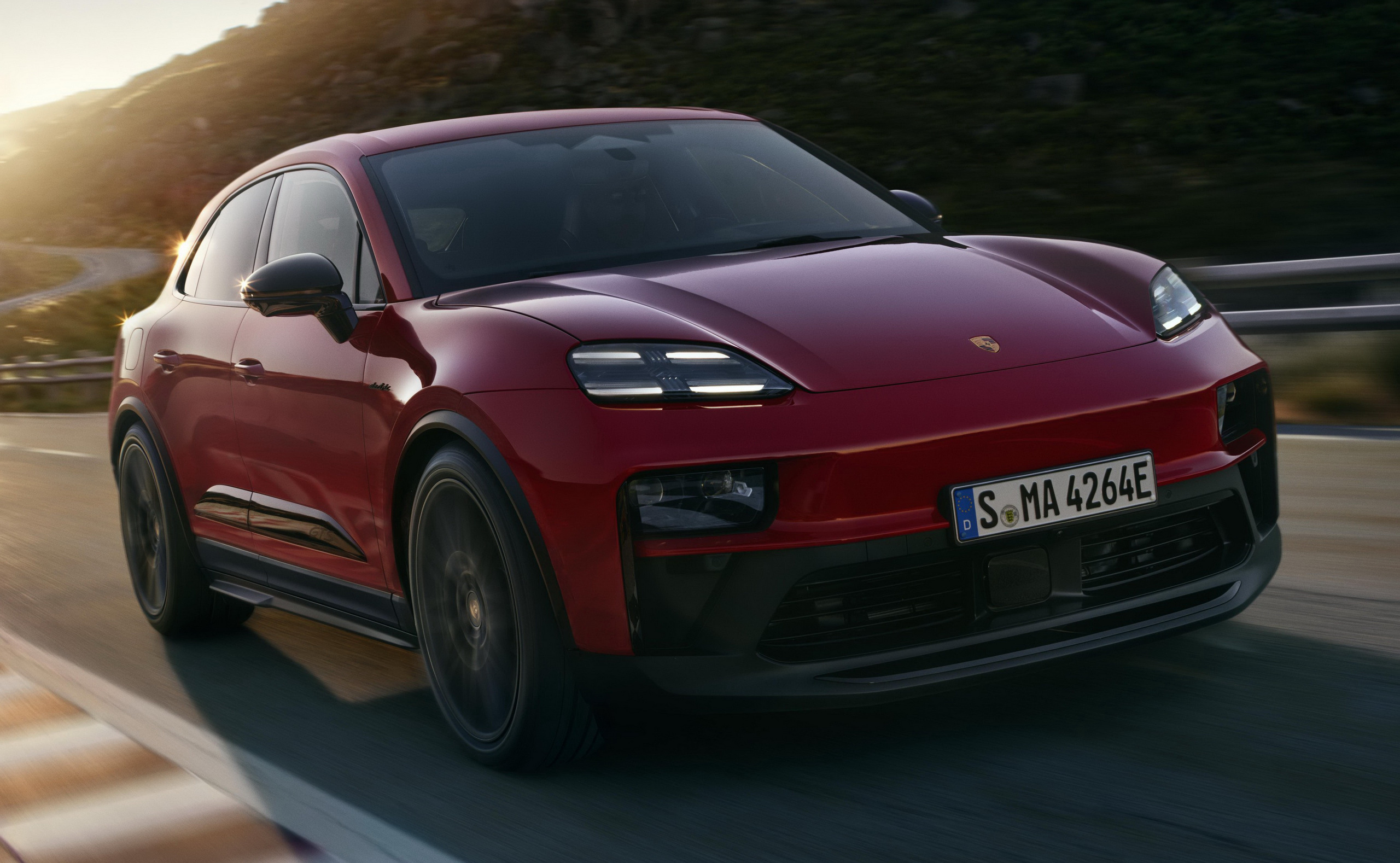
On the other side of that coin, you’ll find Porsche, which, like Stellantis and other mainstream brands, is now backtracking hard on its EV plans. The brand’s former CEO just openly admitted that making the Macan an EV-only model was a mistake. Porsche has plans to fix its foible, too.
A Misstep in the Macan Playbook
Former CEO Oliver Blume, who stepped down at the start of 2026, revealed that making the next-generation Macan electric-only was a mistake. Speaking with Frankfurter Allgemeine Zeitung, Blume said, “We were wrong about the Macan,” reflecting on Porsche’s 2019 decision to retire the gas-powered Macan in favor of a fully electric model.
We were there when the EV launched in early 2024. While purists didn’t love it, plenty of folks figured that most Macan buyers cared more about the badge than the engine. But cooling demand for pricey luxury EVs and regulatory hurdles made the all-electric Macan a tougher sell than some expected. Blume acknowledged that hindsight is 20/20.
“Based on the data at the time, we would have made the same decision,” Blume said, “but the situation today is different. We are responding by adding combustion engines and hybrids.” Porsche now plans to reintroduce a gas-powered compact crossover but it won’t be called the Macan.
The Macan misstep isn’t the only one the brand is handling. Porsche also confirmed that future 718 sports cars, initially slated to go EV-only, will offer combustion and hybrid options.
It turns out that even one of the world’s most famous and focused brands can misread the market and industry to an almost embarrassing degree. In the end, we all just end up with more Porsches in more flavors and I can’t say I’m sad about that.
Localization will help Chinese carmakers boost global vehicle sales.
VW and Toyota’s market share could fall sharply in key segments.
Analysts expect Tesla’s share to rise from 2 to 8 percent globally.
In just a few years, Chinese automakers may do more than disrupt the global car industry. As they scale up overseas and lean into their strengths in electrification and cost control, the shift looks less like a disruption and more like a permanent redrawing of the map. If the current pace holds, they could control a third of the global market within five years.
Analysts at UBS, the Swiss investment bank and financial services company, point out that while China’s domestic car market continues to grow, it’s the overseas expansion that’s becoming increasingly important for them. According to their latest estimates, foreign markets now represent about 20 percent of industry sales for Chinese carmakers, and in some cases, up to 50 percent of their profits.
The Global Impact of Expansion
UBS says its forecast remains unchanged from two years ago, even as Chinese manufacturers scale up production in Europe and some legacy automakers begin stepping back from their EV plans, citing uncertain returns and cooling demand.
“The main drag was due to Europe’s slowdown of EV adoption, and tariffs and protectionism against Chinese EVs,” said Paul Gong, UBS’s lead analyst for Chinese EVs. “I think 2024 progress was slower than expected, but recent signs have shown some catch-up.”
The South China Morning Post (SCMP) reports that China’s long-term bets on electric vehicles, vertical integration, and aggressive supply chain development appear to be paying off. These moves haven’t just given Chinese brands a cost advantage, they’ve made it easier to scale production and respond quickly to market shifts.
Chinese Carmakers Gain Speed as Global Rivals Lose Ground
Frank Diana, a managing partner at Tata Consultancy Services, says China’s edge is not just about scale but about speed. “The fact that [China] has been learning aggressively means that they’re going to have a dominant position and market share,” he explained. “But they’re not alone … you will see the rise of other players in the space.”
UBS forecasts that the rise of Chinese brands will cut deep into the dominance of current global leaders. Combined, Volkswagen and Toyota now hold 81 percent of the market share in key segments. By 2030, that number could drop to just 58 percent. Meanwhile, Tesla’s global share, currently sitting at around 2 percent, could grow to as much as 8 percent by the same year.
Also helping Chinese brands expand internationally is a move to localized production. In Thailand, automakers such as SAIC Motor, Great Wall, BYD, GAC, Changan Automobile, and Chery already operate assembly plants. Great Wall and BYD have also established manufacturing in Brazil, with BYD developing a large-scale facility in Hungary to support its growing footprint in Europe.
India Eyes a Bigger Role
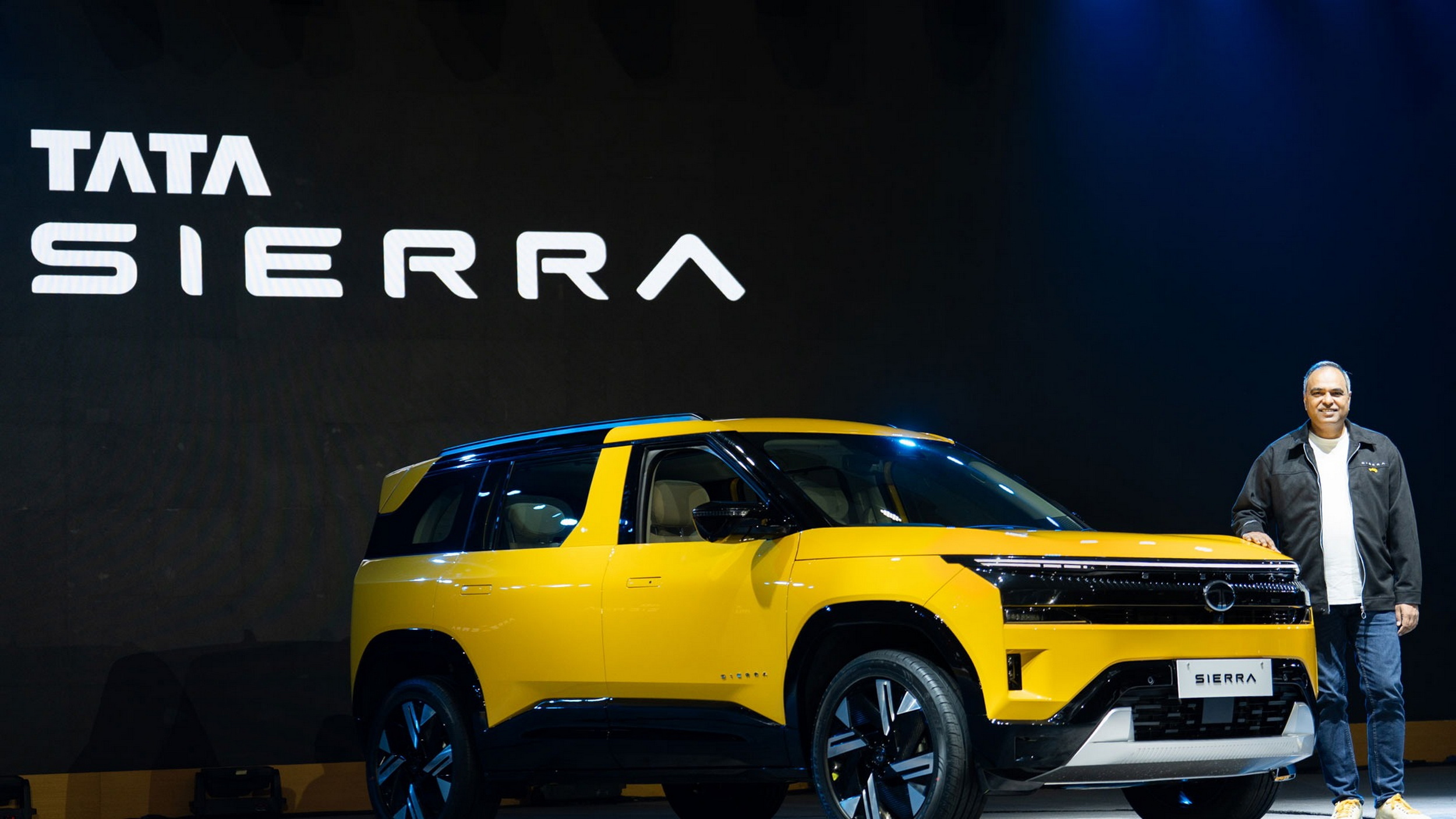
China isn’t the only nation that could see its car industry expand rapidly by 2030. India, too, is positioning itself for growth. Domestic automakers like Tata and Mahindra are increasing their share in the local market and looking outward.
However, they face stiff competition, not only from dominant player Maruti Suzuki, but also from Chinese-owned MG Motor, which has introduced several new models to Indian buyers. BYD has also begun to establish a presence, and both Chery and Great Wall have plans to enter the market, reports SCMP.
Still, analysts suggest that China’s early investments gave it a lasting edge. The ability to learn quickly, build tightly controlled supply chains, and manage costs efficiently has kept its companies ahead.
“The EV supply chain is dominated by Chinese companies,” said analyst Ramakrishnan. “The India EV supply chain, including electronics, is imported from China.”
Fewer Players, Bigger Stakes in the Next Phase of EVs
In Diana’s view, the current market is heading toward consolidation. China’s early lead puts it in a strong position as the EV space matures into a more concentrated field of major players.
“So there will be consolidation even at the EV market level, and you end up with 10 to 15 platform orchestrators made up of [original equipment manufacturers and] big technology companies,” he said.
EV registration fees now scale with a vehicle’s original MSRP.
F-150 Lightning buyers could pay over $300 in registration fees.
Plug-in hybrids now face a new $75 minimum yearly surcharge.
Owning an electric vehicle or plug-in hybrid in Minnesota just became a pricier proposition. New legislation rolling out this month increases registration fees across the board, meaning drivers of EVs and PHEVs will see their annual costs jump, some significantly so, depending on the vehicle.
Up until now, electric vehicle owners in the state have paid a flat $75 annual surcharge in lieu of gas taxes, which are traditionally used to fund local road maintenance.
Under the updated rules that went into effect on January 1, 2026, that surcharge has doubled to a minimum of $150 for all EVs. Plug-in hybrid drivers, previously exempt due to their partial reliance on gasoline, are now included as well, with a new minimum fee of $75 added to their registration.
How Value Shapes the Surcharge
The updated surcharge isn’t flat. It scales based on the vehicle’s original sticker price and age. In the first year of registration, fully electric vehicles will be assessed an additional fee equal to 0.5 percent of the manufacturer’s suggested retail price (MSRP). For plug-in hybrids, the rate is set at 0.25 percent.
As vehicles age, the surcharge is reduced each year according to a sliding scale. By the second year, the calculation uses 95 percent of the original MSRP. That figure drops to 90 percent in year three, 80 percent in year four, and continues to decline by 10 percent increments. Once a vehicle is more than ten years old, the fee is based on just 10 percent of its original MSRP.
What Does It Mean for Popular Models?
For those considering an electric pickup like the Ford F-150 Lightning, the first-year fee could run as high as $325. By year two, that drops slightly to $309, and by year three it falls to around $253. Drivers of a Tesla Model 3, one of the state’s most common EVs, would be looking at $221 in the first year, followed by $210 in year two and $172 in year three.
As reported by Kare11, lawmakers have framed the new system as a way to ensure road infrastructure funding keeps pace with the shift away from internal combustion engines. Still, the move has raised concerns that it could dampen enthusiasm for EVs and plug-in hybrids at a time when adoption is just beginning to gain momentum.
The registration fee increases are not the only policy changes on the horizon. Beginning July 1, 2027, all public charging stations in the state that operate at 50 kW or higher will face a new tax of five cents per kilowatt-hour delivered. While relatively modest, the fee adds another layer of cost for EV drivers using fast charging options.
Only a few Chinese EV brands have reached profitability.
Up to 50 struggling EV firms may slash operations in 2026.
China’s EV tax perks are ending or being sharply reduced.
Chinese electric vehicles are spreading fast across global markets, fueled by booming demand and strong backing from Beijing. In November alone, China’s EV exports jumped 87 percent compared to the same month last year. Yet even with this rapid growth, cracks are starting to show.
The year 2026 is shaping up to be a major turning point for China’s EV sector, with a looming shakeout expected to hit dozens of struggling manufacturers.
Deliveries of new vehicles in China are expected to slip by as much as 5 percent next year, the largest contraction since 2020, due in part to lowered government support and the industry’s history of overcapacity.
Industry at a Crossroads
And this isn’t speculation from outsiders either, but comes from the South China Morning Post (SCMP), a Hong Kong-based English-language newspaper owned by Alibaba Group. The SCMP reports that around 50 of China’s money-losing EV makers may be forced to either downsize or shut down entirely in 2026.
“Time is against those players whose cars cannot impress young drivers,” said Qian Kang, who runs a factory producing automotive printed circuit boards. “For most of the unprofitable EV assemblers, next year’s performance will be critical.”
Policy Shifts and Market Pressure
Much hinges on an upcoming policy decision. In January, Beijing is expected to determine whether the 20,000 yuan (roughly US$2,900) EV trade-in subsidy will be extended. Meanwhile, the current 10 percent purchase tax exemption is set to expire at the end of this year. A reduced 5 percent rate will apply starting in January and remain in place until the full tax returns in 2028.
While the price war among Chinese firms has brought affordable EVs within reach of millions of car buyers, it has eroded many companies’ ability to turn a profit. Combined with significant investments into research and development, as well as urgency among brands to establish large portfolios of models, it’s hardly a surprise that very few carmakers have become profitable.
“The fundraising bonanza surrounding China’s EV makers and key car component suppliers is history now,” angel investor Yin Ran said. “So it will be a game of survival, with profitable carmakers becoming the winners, while unprofitable players face running out of funds soon.”
Few companies have weathered the storm. Profitable big players such as BYD, Seres, and Li Auto stand out as rare exceptions. These firms are expected to intensify their overseas efforts as they look for new growth opportunities. Research from AlixPartners suggests that only about 10 percent of China’s EV brands will be profitable in the coming years.
Leapmotor Gets Cash Injection
Among the handful of companies securing new support, Stellantis-backed Leapmotor has landed a major investment. The state-owned FAW Group has announced it will acquire a 5 percent stake in the Chinese carmaker for 3.74 billion yuan, or $534 million. This makes Leapmotor the first of the nation’s car manufacturers to receive investment from a state-owned group and will help with its planned expansion.
Leapmotor is aiming to deliver 1 million vehicles in 2026. If it achieves this figure, it would be China’s third-largest EV maker, trailing only BYD and Geely. Through the first 11 months of 2025, Leapmotor delivered 536,132 vehicles.
“Leapmotor aims to achieve annual deliveries of 4 million units a year in 10 years’ time,” Leapmotor found and chief executive Zhu Jiangming revealed in an interview. “Leapmotor will strengthen our value through the fine-tuning of our production, while offering customers best [driving] experiences.”
Tesla signed a $2.67B Cybertruck battery deal in 2023.
The deal has been slashed to just $6,776 after poor sales.
Cybertruck was expected to sell 250K yearly, hit under 20K.
Several years ago, Elon Musk proudly proclaimed that Tesla would be moving as many as 250,000 Cybertrucks annually. The electric pickup was billed as a disruptive force, set to shake up the truck market. In reality, it hasn’t come anywhere near those targets. This year, Tesla is expected to sell fewer than 20,000 Cybertrucks, less than 10 percent of that overly ambitious goal.
While you’ll never hear Tesla head honcho Elon Musk describe the Cybertruck as anything other than a raging success, lower-than-expected sales are hurting suppliers.
One notable casualty is L&F Co., a South Korean battery material supplier, which recently disclosed that its supply contract with Tesla had been cut by 99 percent, a shift attributed in part to sluggish demand for the truck.
A Contract Cut to the Bone
Back in February 2023, L&F had secured a sizable deal worth 3.83 trillion won (roughly $2.67 billion) to provide Tesla with high-nickel cathode material intended for the Cybertruck’s batteries. But that agreement has now been trimmed down to a token 9.73 million won, or about $6,776 at current exchange rates.
The original contract was tied to Tesla’s 4680 battery cells, which were first revealed in 2020. At the time, Tesla presented them as a major leap forward, central to its plan to rapidly expand production and eventually launch a $25,000 EV. That model has yet to materialize, and so far, the 4680 cells are used primarily in the Cybertruck.
According to an unnamed source with knowledge of the supply contract, L&F only needed to supply contract with small amounts of material as the development of the Cybertruck was repeatedly postponed. Bloomberg reports that policy and economic issues also affected the contract, including the elimination of subsidies through the Inflation Reduction Act.
SpaceX to the Rescue?
As Tesla continues to struggle with sluggish Cybertruck sales, a familiar buyer has entered the picture. According to a recent report, SpaceX has already purchased more than 1,000 Cybertrucks from Tesla, and that number could eventually climb to 2,000.
SpaceX hasn’t said why it’s buying so many Cybertrucks, but it likely has more to do with surplus stock than necessity. Either way, the move points to just how closely Musk’s companies operate, and hints that Tesla may be offloading inventory through its own back door.
The health of the school bus industry was strong and stable in 2025. I predict more of the same in 2026. There is renewed EPA funding optimism, as more funds are set to be dispersed, yet the exact dollar figure remains unknown.The remaining $2 billion in the Clean School Bus program could soon be released to support propane and electric school bus acquisition.
States like New York and California continue to push for more stringent regulations while other states follow the federal mandate of more relaxed emission standards. Keep in mind, a proposed rule to amend the 2027 Greenhouse Gas Emissions (GHG) Phase 3 regulations for heavy-duty vehicles looms.
Regardless of government regulations, engine OEMs have already done the work to get heavy-duty low NOx and CO2 emissions baked into future powertrain solutions. This will likely drive engine prices higher in 2026 and beyond.
As we ended 2025, inflation appeared to have leveled off but still remained too high as are interest rates, despite the Fed’s latest cut. There are hopes of more rate cuts in the future. I see the increased costs being reflected on labor, manufacturing and raw materials
from industry suppliers. Tariff discussions will continue to take center stage as costs on components and goods can change quickly. Those sudden increases are already being passed on to the end user.
School busing should be deemed an essential service, like during COVID, and receive a tariff waiver. It will take a lot of loud and convincing voices to influence policy makers in Washington, D.C. No easy task but worth it.
A benchmark for industry health is new OEM school bus manufacturing data. As reported starting on page 13, the numbers reported are up about 7 percent to 40,345 school buses produced. Clean diesel school bus volumes spiked as the top buying choice for fleets with an overall increase of 3,699 units to 26,677 units. Alternative fuel school bus purchasing was modest relative to the previous year. The green bus market share leader remained electric school buses with 2,906 units manufactured, which was slightly down from the previous year. School bus OEMs have continued to expand school bus electrification offerings across all model types.
Propane-powered school bus volume was down slightly at 1,617 units, and CNG school buses saw a 91-unit decrease compared to last year with a scant 6 units produced. Gasoline school buses were down 515 units to 10,326 units over the previous year’s data. I see the potential for more gasoline adoption in 2026 as school bus OEMs offer the Cummins B6.7 Octane engine. Type A school bus chassis demand and predictability is good. Chassis allocations for school transportation OEMs have remained steady from GM and Ford in 2025.
According to industry insiders, that trend should remain similar for 2026, but tariffs are causing some hesitation in the marketplace.
I am seeing a significant increase in van conversions and van dealers o”ering multi-passenger vehicle (MPV) options to end users. More companies are exhibiting at STN EXPO and TSD Conference than ever before. I expect that market to continue to expand in 2026. Growing budget pressures seem to have accelerated the adoption of alternative student transportation services. This has given school districts another option on a supplemental basis to support growing demand of servicing students with disabilities, special needs or who are experiencing homelessness.
According to a recent STN readership study, over 667 subscribers identified products that they were interested in purchasing over the coming year. The top 2026 buying trends are new Type C and D school buses, new diesel buses/engines/components, wheels/tires, brakes, lighting and LEDs, and cellular radio communications systems. (See the full list on page 16.)
Be sure to utilize this ultimate resource guide for contacts and data, to discover new products and the companies that sell them. I also invite you to participate in the professional development training and networking opportunities we have to o”er at the STN EXPO and the TSD Conference. Learn more at stnexpo.com.
As I look to 2026 and beyond, I see school transportation being future-ready mobility for every student. The yellow school bus of tomorrow is already on the road. The question is no longer whether the industry will transform, but which school districts, suppliers and communities will lead the way.
Editor’s Note: As reprinted from the School Transportation News Buyer’s Guide.
A version of this story was originally published by the Door County Knock, an independent, nonprofit news organization covering Door County, Wisconsin. Subscribe to its newsletters here.
The 143-foot tug boat Donny S. sits aground in a few feet of water on the northeast side of Baileys Harbor. One cannot miss it, whether buying smoked fish from Baileys Harbor Fish Company, renting a waterfront cottage, hiking at Toft Point State Natural Area or watching a sunset from the Baileys Harbor Yacht Club.
Depending on who you talk to, the forsaken tugboat is a hazard, an eyesore or a curiosity. No matter what folks think about it, there is no question the Donny S. is something of a local celebrity. Hundreds of social media posts have been made about the vessel on what William Stephan, the chief engineer of another tug, calls “boat nerd” sites.
Attempts to move it have failed. Municipal, county, state and federal agencies have received complaints and inquiries about it. State representatives have gotten involved. The Wisconsin Department of Natural Resources has convened four working group meetings and issued citations and fines to the boat’s owner, Jeremy Schultz.
But the Donny S. remains mired on the lakebed, its status and fate uncertain.
The curious second life of the Donny S.
Before it came to rest in Baileys Harbor, the tugboat had a long and industrious life. Built in 1950 and named the G.W. Coddrington, it eventually wound up as the Donny S. in Sturgeon Bay. Owned by Selvick, and then Sarter Marine, the tug broke up ice for the winter fleet at Fincantieri Bay Shipbuilding and performed other commercial tugboat operations.
The boat was decommissioned in 2020 and sold to private owner, Jeremy Schultz, after it was unable to meet regulatory requirements laid out by Subchapter M. The rule, issued by the U.S. Coast Guard in 2016, established new protocols and standards for commercial tugboats and marine towing companies.
Schultz moved the Donny S. to Baileys Harbor in 2021, with the intention of eventually taking it to Manitowoc to be scrapped, according to Mike Cole. Cole owns Ironworks Construction in Baileys Harbor. He also owns the dock the Donny S. was tied to when it arrived in Baileys Harbor.
The 143 foot Donny S. tugboat, stranded in Baileys Harbor, Wis., as seen from shore. (Gordon Hodges)
Sometime after August 2021, Schultz began preparing the tug to be moved to Manitowoc, Cole said. Preparation included “de-ballasting” the tug – removing the water from ballast tanks that keep the heavy vessel from moving around in wind and damaging the dock. Schultz also got the boat moved farther away from the dock and “pointed in the right direction,” Cole said. In order to do so, the Donny S. had to be untied, but at least one line was kept between the tug and the dock once it was situated where Schultz wanted it, he added.
All of the ballast water had been pumped out of the vessel, a float plan was approved, and the tug was ready to go, Cole said. Then the Coast Guard received a complaint about possible contaminants on board, he said, and moving it was delayed.
It was just enough time for weather conditions to go from ideal to difficult. Autumn storms pushed the Donny S. aground, according to Cole. It has not moved since.
Not for lack of trying, according to William Stephan. Stephan is the chief engineer on the Cheyenne, a tugboat owned by Five Lakes Marine Towing in Sturgeon Bay. Schultz worked on the Cheyenne and had arranged to have it tow the Donny S. to Manitowoc, according to Stephan.
The DNR issued its first citation to Schultz for obstruction of navigable waters in October 2022. On Dec. 22, the Cheyenne tried to move the Donny S. Stephan was on board.
It was a zero-degree day, with a cold fog settled over Lake Michigan, he remembered. When the Cheyenne got to Baileys Harbor, the Donny S. was “high and dry,” he said, which was a surprise to him and the rest of the crew, as they thought it was ready to be moved. Instead, the 500 ton Donny S. was grounded firmly on the bottom of the lake and surrounded by ice chunks.
The Cheyenne tried a few maneuvers anyway, Stephan said, but it could not get close enough. The water around the Donny S. was too shallow and the Cheyenne did not have enough line to reach it from deeper water.
“It was a wasted trip,” Stephan said. The Cheyenne’s crew had volunteered their time in exchange for getting a cut of the salvage from the Donny S., he said.
“(Schultz) still owes me a port light,” he quipped.
On Dec. 22, 2022, it was well below freezing and the lake was covered in fog, according to chief engineer on the Cheyenne, William Stephan. The Cheyenne made an unsuccessful attempt to move the tug. (Courtesy of William Stephan)
Tug condition, knowns and unknowns
Reports and observations vary regarding the condition of the Donny S. and what exactly is on board. There have not been any formal state or federal assessments made of the tugboat recently, and that is part of the reason nothing is being done about it, according to Mike Kahr.
Kahr is a Baileys Harbor resident and civil engineer who owned Death’s Door Design and Development, a marine construction firm, for 35 years.
“I believe it’s sitting on solid rock now with soft sediment around it,” he said, “and I believe if it starts moving in the storm, it’s going to pop a hole in it, and the oil in the bilge is just going to end up on the beach. I firmly, firmly believe that it’s not a question of if, but when.”
Kahr became concerned about the tugboat when it first went aground in Baileys Harbor, he said. He has since contacted the Coast Guard, the DNR, the Town of Baileys Harbor and the Door County government, alleging it is an environmental hazard. Kahr is also part of a working group convened by the DNR in August 2025 to address the stranded vessel.
In August, Kahr boarded the Donny S. and took photos, soundings and measurements that he claimed prove the boat is an environmental threat. There is upwards of 3 feet of “oily liquid” in the bilge and about 112 different fuel tanks present on board, he noted. The engines are still in the boat as well, though the transmission has been removed, he said.
Kahr also took hull measurements with an ultrasound meter and the steel hull is pitted with rust and is ½ inch thick, he said.
It was the Coast Guard’s understanding that all potential pollutants like fuel had been removed from the Donny S. prior to attempts to remove it from the harbor, according to a phone conversation with Lt. Nathan Herring on Dec. 5.
The engine room of the Donny S. in August 2025. The transmission was removed but the engines remain. (Courtesy of Mike Kahr)
A schematic of the Donny S., found in the vessels engine room, showing locations of fuel tanks and where the oily liquid is located. (Courtesy of Mike Kahr)
Oily liquid about 1 foot below the floor of the Donny S. was observed by Mike Kahr, who boarded the boat in August 2025. There is a foot or more of the oily liquid, he says. (Courtesy of Mike Kahr)
The hull of the Donny S. is about ½ inch thick and pitted with rust. (Courtesy of Mike Kahr)
Herring is the commander of the Coast Guard’s Marine Safety Unit in Sturgeon Bay, the office responsible for inspecting commercial vessels, waterway safety and pollution response. He attended the first DNR working group meeting on Aug. 28 and heard about Kahr’s findings for the first time.
“That was, I think, new news to everybody in the meeting,” Herring said.
A current inspection and evaluation of the boat’s environmental condition and contents, by an authorized entity, is crucial for any progress toward removing the Donny S., according to Tressie Kamp, assistant director at the Center for Water Policy at UW-Milwaukee.
The organization is an interdisciplinary research center housed in the School of Freshwater Sciences, and it works with scientists, academics and technical experts inside and outside the UW system to review policy related to state waterways.
The center published a policy brief in September regarding abandoned vessels in Wisconsin waters.
“Government actors need to go on the boat and understand what the conditions are years after the last Coast Guard inspection,” Kamp said. Anyone who wants to do something about the tug, whether government or private actors, cannot know what efforts will consist of, or how much it will cost, until that happens, she added.
Hazard, eyesore or curiosity?
The Donny S. has been drawing interest, and ire, ever since it’s been grounded.
Mike Kahr is not the only one worried about the potential environmental fallout of the tug. Baileys Harbor Fish Company owner Todd Stuth has also been concerned about the Donny S. since it arrived in Baileys Harbor. It’s easy to keep it in mind, he said, because the tug is right in front of his business.
“We get questions (from customers) every day,” Stuth said.
From directly overhead the Donny S., the open deck and exposed access to the vertical space above the engine room, called a fiddley, can be clearly seen. (Sebastian Williams)
As a commercial fisherman, Stuth has years of experience in the boating world, and he speculated that there is lead paint on the hull of the Donny S. Red lead paint was widely used as hull coating in the 1950s, when the tug was built, he said, which means specific abatement processes need to be followed in order to cut the boat apart for salvage.
Stuth is also certain that the Donny S. will leak at some point, spilling the contents of the bilge into Baileys Harbor waters, which would be a disaster for the watershed, he said. Toft Point State Natural Area and the Ridges Sanctuary are nearby.
“I’m a little miffed that the state and county haven’t made a stronger push to have it removed,” he said. “We can put a man on the moon … but we can’t get a tugboat out of a harbor.”
Cole with Ironworks Construction asserted there are no contaminants on board the vessel, and everything potentially harmful has been removed, during a phone conversation on Dec. 8. In order to move it from Sturgeon Bay to Baileys Harbor, a float plan and inspection needed to be approved by the Coast Guard, he said. That was done and all potential hazards were removed at the time, he added.
Captain Lynn Brunsen does not think the Donny S. is an imminent environmental threat either, he said. He works for Shoreline Boat Tours, operating out of Baileys Harbor, and said tourists are always intrigued by the tugboat.
“I get within one hundred feet of it every time we do a tour,” Brunsen said. “There’s no evidence of oil, no slick or sheen in the water, no smell.” He does agree that eventually a hole will rust or break through the hull and whatever is in the bilge could spill out, he said.
Brunsen also does not consider the tug a navigational hazard, he said, as it is sitting in about two feet of water. Nothing much bigger than a kayak can get next to it, he added.
He is concerned about the tug as a safety hazard however, and has observed people climbing aboard the vessel via knotted ropes hanging down the side,“like something you would see on a pirate ship,” Brunsen said.
Earlier this summer, someone lit what appeared to be smoke bombs or fireworks on board as well, he added.
Whether a hazard or not, Stuth said, the Donny S. needs to go.
“The entire shoreline community in Baileys Harbor is pretty perturbed and wants it gone,” he said.
Accountability in limbo
Whose responsibility is it to remove the Donny S.? The tug’s owner, Jeremy Schultz, is the obvious answer, according to municipal, county, state and federal agencies. The DNR has issued over a dozen citations for “unlawful obstruction of navigable waters” to Schultz from October 2022 to February 2024. Fines levied were upwards of $20,000.
According to court records, Schultz’s fines were paid in June 2025. No fines or citations have been issued since. Notes obtained from the DNR’s working group meetings this fall stated that the owner does not have the means to remove the vessel.
Schultz could not be reached for comment.
The Donny S. is sitting on the rocky lakebed, with sand around it. (Sebastian Williams)
“What people want to see happen is it is boarded and inspected by an official authority. We want to understand what’s on the boat and for someone to take responsibility for it,” Baileys Harbor town chairman David Eliot said in a phone call Dec. 3. (Disclosure: Knock editor-in-chief Andrew Phillips previously worked for a company owned in part by Eliot. Phillips was not involved in editing this story.)
The town sent a letter to the DNR in March 2025, and will be sending another, Eliot said. According to the letter, the town has received “many inquiries and complaints” from the community and considers the tug an eyesore and a hazard.
Baileys Harbor was informed by the DNR that the Donny S. is not under the town’s jurisdiction, according to Eliot.
The Door County government has a similar position, Corporation Counsel Sean Donohue said. They would like to see the tug removed, but do not have jurisdiction or funds to do it themselves. Both town and county representatives have attended DNR working group meetings.
The state authority is the DNR, and they have fined the owner and convened four stakeholder meetings since August to try to address the problem, but have taken no other action. The agency did not respond to inquiries in time for publication.
From a federal standpoint, the Coast Guard’s involvement is only triggered if there is active pollution or a navigational hazard posed by the vessel, according to Lt. Herring. The Coast Guard does not deem either of those things a concern at this time, with the Donny S.
“The first step in taking action would be if there’s an active pollutant coming from the vessel into a waterway,” Herring said. “We would be able to federalize that case, or that vessel, to where we can remove those contaminants from it. But as far as removing the vessel itself, there’s nothing that the Coast Guard would do at the onset.”
Any costs incurred by Coast Guard removal or pollution cleanup would be forwarded to the owner of the tug, he added, and additional civil penalties and fines would be levied.
One of the reasons cited by municipal, county and state authorities for abdicating responsibility for the tug is that the Donny S. is privately owned. There is no explicit definition of an abandoned vessel under Wisconsin law, according to the National Oceanic and Atmospheric Administration. The state statute regarding abandoned property may suffice, but there is also no formal process for dealing with abandoned vessels, according to an administrative policy review in 2015 by NOAA’s Marine Debris Program.
“The state is still wrestling with the Baileys Harbor case,” Kamp at the Center for Water Policy said, but the courts can make a determination as to whether the Donny S. is abandoned. Even if it is not abandoned, a government entity could seek an inspection warrant to board the vessel, she said.
A lack of any clear mandate for government action further complicates the problem of removal, Kamp said. A number of government entities have authority to remove the tug, including municipal, county, state and federal agencies, she explained, but nothing that compels them to do so.
The situation is “a perfect storm” for creating confusion and questions on the part of government entities, she added, as indicated by the town and county government believing the situation is outside of their jurisdiction.
An expensive problem
Even if the jurisdictional and enforcement waters were not murky, removing the tug is no small undertaking, according to those who have already tried and members of the DNR working group. Notes from the group indicate initial estimates from salvage companies are upwards of $1 million.
Those estimates are ridiculous, according to dock and Ironworks’ owner Cole, and he said he thinks he would be able to remove the tug for much less.
“No one has asked me though,” he said.
If the Donny S. does indeed contain lead paint, tanks with residual fuel, and contaminants in the bilge, that makes for a complicated removal, according to commercial fisherman Stuth. In order to scrap it properly in that case, it would need to be cut up on the water, requiring a crane, a barge and mitigation around the vessel to block anything leaching into the water, he speculated.
Unclear authority over the tug, as well as its uncertain abandonment and hazard status means “no salvage company wants to touch it,” he added.
The Donny S. sits in less than 8 feet of water near shore. (Emily Small / Door County Knock)
Door County Corporation Counsel Donohue also indicated that even if it turns out various authorities have jurisdiction over the tug, or are found legally allowed to remove it, the funding to do so is simply not there.
There are grants available for marine debris and abandoned or derelict vessel removal. The DNR provided information to Schultz about available grants and indicated he would need municipal or county government cooperation in applying for them, according to notes from the working group meetings. Neither town nor county officials have been contacted by Schultz regarding grant funding at this time.
Removing stranded vessels should be covered by a statute requiring penalties of the vessel’s owner and compelling them to act, according to Kamp. If the owner is insolvent or there is no appetite for government enforcement, she said, there are other potential funding sources.
Existing environmental funding streams, like grants, are used up very quickly in Wisconsin, she said. The Center’s policy brief advises giving the legislature authority to create a designated funding program for abandoned vessels, based on what some other states have done.
However, the Center advises Wisconsin “emphasize ways to not put the taxpayers on the hook for addressing these things,” Kamp said. “Keep the responsible entities (the owners) on the hook.”
Abandoned vessels statewide
The Donny S. is not the only recently grounded vessel in Wisconsin, but it is by far the largest. The Deep Thought, a Chris-Craft Roamer,becamegrounded near Bradford Beach in Milwaukee in 2024, after the owners ran out of fuel. The boat was beached for several months, becoming a popular local attraction. In May 2025, Milwaukee County ended up paying for its removal.
In the summer of 2024 another boat, this time a motor yacht named the Sweet Destiny, beached in the St. Croix River, near Hudson, Wis. After months of complaints and fines, the boat was removed through volunteer efforts and donations.
The 33-foot and the 54-foot pleasure boatswere newer and much smaller than the Donny S., with fewer potential environmental issues.
These cases illustrate gaps in Wisconsin law when it comes to abandoned vessels. The DNR is the lead agency responsible for administering the patchwork of laws that address abandoned vessels, public nuisances and waterway obstruction, according to information from NOAA’s Marine Debris Program.
Though the Center for Water Policy did not do a broad survey or count of abandoned vessels in the Great Lakes, Kamp said, “the fact we have these examples, and mechanisms to deal with them in other states indicates this is not a one-off problem.”
Fourteen other states have state-level programs concerning abandoned vessels, including designated funds. Wisconsin lawmakers introduced a bipartisan bill earlier this year that would clearly define abandonment of a vessel, and threaten owners of such vessels with up to nine months of jail time and a fine of $10,000 if they do not remove it within 30 days.
An anonymous letter sent to local media and the DNR called out State Sen. Andre Jacque and Rep. Joel Kitchens for their perceived lack of response to the Donny S. A hand-painted banner reading “Jacque and Kitchens are fine with this” hung on the tugboat at one point this fall.
According to local legislators themselves, they are aware of the issue and have had some involvement. Jacque sent a staffer to the first DNR working group meeting, and his office has researched options for removal and funding.
An anonymous person sent this photo and a letter of complaint about the Donny S. to the DNR and local media outlets. The banner reads “Jacque and Kitchens think this is fine.” The handpainted banner hung on the tug sometime this fall.
Kitchens was invited to the first meeting in August, but did not attend, as it conflicted with a hearing for Northern Sky Theater’s tax status, he said.
“We write laws but have no enforcement,” Kitchens said in a phone call on Dec. 3, “We have the least ability to do anything.”
If there are contaminants on board, Kitchens said it is “certainly up to the DNR to take steps.”
Ultimately, it is the owner’s responsibility though, he added.
Sen. Tammy Baldwin is also aware of the situation, according to Alanna Conley, Baldwin’s deputy communications director.
“At this point, according to public statements from the Coast Guard and folks on the ground, this feels like an issue we would support funding for,” Conley said. “The Town of Baileys Harbor could apply for a debris removal grant. Baldwin’s office supports funding.”
While legislators legislate, officials meet and discuss, shoreline property owners complain, tourists take photos, and everyone waits for someone else to act, the Donny S. remains mired in the lakebed and a gray area of accountability.
The DNR and Coast Guard did not respond to open record requests in time for publication.
GM product chief Sterling Anderson is seen as a possible future CEO.
His success depends on fixing GM software, autonomy, and EV profits.
Mary Barra and Mark Reuss stay in charge with no succession timeline.
General Motors is looking to the future and planning ahead. Some of its biggest targets surround software innovation, EV profitability, and autonomy. To help make those goals a reality, it has brought in Sterling Anderson, a former Tesla executive and Aurora co-founder with a strong track record in exactly those areas.
If he manages to lead GM to success in those targets, he could very well be the next CEO of the entire brand.
Anderson officially joined the team in June of 2025, and according to people familiar with the matter, he did so with the CEO’s chair in mind. That’s according to Bloomberg, which also received official comment from GM stating that no succession plan is currently in place.
Anderson himself also declined to engage in CEO chatter, saying his focus remains squarely on his current responsibilities. “My focus is on what I’m doing. I’ve got plenty work to do where I am,” he said.
Succession Speculation Inside GM
Current GM CEO, Mary Barra, turns 64 soon and is under no obligation to hang it up. GM President Mark Reuss, 62, is also very much in the mix, underscoring that Anderson’s potential rise, if it happens at all, is likely years away.
That all said, Anderson could make all the sense in the world if he really does manage to successfully help GM achieve EV profitability while pushing its software and autonomy far ahead of where they stand today.
Anderson is 42 and before GM, he was chief product officer at Aurora Innovation, where he helped steer the company away from robotaxis toward fully autonomous freight trucks now operating in Texas. Before that, he led development of Tesla’s Model X and played a major role in the early Autopilot system.
From Tesla to Trucks
He ultimately left Tesla following disagreements over how Autopilot was being developed and deployed, a technology that has since drawn scrutiny from federal safety regulators. So far, his strategy at GM has been to listen first and change later.
As he put it, “You simply cannot afford to break a company and hope to pull the pieces back together. What you want to do, and what I told Mark was my intent, is understand how it works and then start to surgically make changes across the company to where they needed to be made. And that’s been the attack, that’s been the approach.”
Expect several changes over time, including more software subscriptions, SuperCruise-style autonomy taking on urban environments, and changes to EV supply chains and materials. If those changes lead to success over time, he could be the next person at the top of one of the nation’s largest automakers.
Artwork for cover and divider pages created by Kimber Horne using generative A.I. in Adobe Firefly.
Find the latest vehicle production data and budget reports, industry trends, and contact information for state, national and federal agencies, manufacturers, dealers, and suppliers.
Newsom says California will defend the Constitution in court.
Arizona Delaware Maryland Illinois Michigan and New York sued.
More than a dozen U.S. states are taking legal action against the federal government over what they argue is an unlawful freeze of funding for the national electric vehicle charging network.
At stake is billions of dollars already approved by Congress to expand EV infrastructure across the country, now stalled under the current administration.
The lawsuit, led by California Attorney General Rob Bonta and California Governor Gavin Newsom, includes 15 other states and the District of Columbia.
It alleges that the U.S. Department of Transportation, under the Trump administration, “has quietly refused to approve any new funding under two electric vehicle charging infrastructure programs,” in direct contradiction of federal law.
The Infrastructure Investment and Jobs Act, passed by Congress in 2022, was designed to deploy thousands of EV charging stations nationwide. But as of this spring, distribution of that funding has slowed to a halt.
In California alone, the program earmarked $59.3 million for medium- and heavy-duty EV freight corridors, $55.9 million for zero-emission freight transport routes, and $63.1 million for repairing and replacing out-of-service chargers.
What’s Being Contested?
The lawsuit argues that the administration’s failure to release these funds violates both the separation of powers and the Administrative Procedure Act, which governs how federal agencies implement laws passed by Congress.
Who Else Is on Board?
Backing California’s legal challenge are attorneys general from Arizona, Delaware, the District of Columbia, Illinois, Maryland, Massachusetts, Michigan, New Jersey, New York, Oregon, Rhode Island, Vermont, Wisconsin, and Pennsylvania. Their shared position is that the federal government can’t simply decline to carry out programs that were funded and mandated by law.
“The Trump Administration is unlawfully withholding funds from the Bipartisan Infrastructure Law — investments Congress approved to build America’s EV charging network, reduce pollution, and create thousands of good-paying jobs. We won’t stand for it,” Governor Gavin Newsom said.
“California will defend the Constitution, our communities, and the future we’re building. With 2.4 million zero-emission vehicles on our roads and critical projects ready to move forward, we’re taking this to court.”
Attorney General Bonta added to the criticism, calling the funding freeze a threat to public health and environmental progress. “This is just another reckless attempt that will stall the fight against air pollution and climate change, slow innovation, thwart green job creation, and leave communities without access to clean, affordable transportation.”
The Vernon County farm owned by Wisconsin Farmer's Union President Darin Von Ruden. (Henry Redman | Wisconsin Examiner)
Wisconsin lawmakers at the state and federal level have proposed a flurry of policies to support Wisconsin farmers after the first year of the second Trump administration brought increased uncertainty, the whiplash of trade wars and the fear of increased immigration enforcement against migrant workers.
Last week, the Trump administration announced it would be providing $12 billion in bridge payments to American farmers to help them manage the economic fallout of Trump’s tariffs. The tariffs have increased the costs of inputs such as machinery and fertilizer while limiting international markets for U.S. farm products.
After the bailout was announced, Wisconsin farm advocates said the money was needed to help make ends meet this year, but called for more permanent solutions so farmers can make a living from what they grow.
“This relief will help many Wisconsin farm families get through a tough stretch, and we recognize the need for that kind of support in a crisis,” Wisconsin Farmers Union President Darin Von Ruden said in a statement. “But farmers in our state don’t want to rely on emergency payments year after year — we want a fair shot at making a living from the work we do. It’s time for long-term solutions that bring stability back to our markets, tackle consolidation, and ensure rural communities across Wisconsin can thrive.”
Wisconsin’s soybean farmers have been among the hardest hit by the Trump trade wars because China was a massive market for the crop.
Dr. Success Okafor, policy fellow at the Michael Fields Agricultural Institute, told the Wisconsin Examiner that the Trump administration needs to help farmers of commodity crops such as corn and soybeans and specialty crops such as vegetables. The U.S. Department of Agriculture program has set aside $11 billion for commodity producers and $1 billion for specialty crops.
“For many Wisconsin farmers, especially those already under financial pressure, the relief is important, but the key issue is not whether the relief exists, but it is whether it is accessible and aligned with long-term resilience,” Okafor said. “Soybean farmers in Wisconsin have been hit particularly hard by the trade disruptions, and targeted relief for those losses is absolutely warranted. But the question is not whether soybean producers should receive support, but how this relief can be structured so it does not unintentionally exclude other farmers who are also economically vulnerable.”
Okafor said key elements of an equitable government relief program for farmers would include transparency in how losses are calculated, flexibility in program design and making sure access is not limited by short deadlines or complex paperwork.
Bipartisan bill to help for organic farms
Last week, Democratic U.S. Sen. Tammy Baldwin and Republican Rep. Derrick Van Orden joined a bipartisan effort to support organic farmers. The Domestic Organic Investment Act would extend a UDA grant program to help organic farmers find markets for their products.
A number of Democratic state legislators also introduced legislation aimed at helping Wisconsin’s farmers find markets for their products. The bills are unlikely to move forward under the Republican-controlled Legislature, but the package of agriculture bills is among the proposals Democrats have made throughout the year to signal their agenda if they win a state legislative majority next year.
The proposal includes grants to support specialty products that are sold locally, providing healthy food to federal food assistance recipients and expanding the state’s farmland preservation program.
“The federal government has failed our farmers and our agricultural economy,” Sen. Mark Spreitzer (D-Beloit) said at a news conference last week. “We would not need a $12 billion bailout for our farmers if the Trump administration was doing right by them in the first place. We are now trying to play catch up, and here in Wisconsin, we are trying to fill in those gaps and support our farmers in these difficult times as the Trump administration fails.”
At its annual conference in Wisconsin Dells last week, the Farmers Union set its 2026 priorities, which include managing the continued consolidation of the agricultural industry, protecting the rights of immigrant workers, supporting family dairy farms and ensuring access to quality health care.
At the local level across Wisconsin, debates are raging over the best use of the state’s agricultural land. A number of communities had heated arguments over proposals to construct massive data centers on existing farmland while others have continued yearslong efforts to oppose the expansion of massive factory farms.
Despite pressure from industry groups and business lobbyists, towns across western Wisconsin have enacted local ordinances limiting the ability of farms to expand without local approval. Last week, the town of Gilman became the third Pierce County community to pass a local CAFO ordinance. Gilman officials said their goal was protecting local resources while trying to encourage a local agricultural industry that can support smaller family farms.
The new ordinance, Gilman town board chair Phil Verges said, puts in place minimum standards to address community concerns.
“We have legitimate concerns and this is the best option we have to protect ourselves from the seemingly unlimited growth of these factory farms,” Verges said. “We can’t sit by and do nothing.”
EU reportedly plans to soften its 2035 combustion engine ban.
Lawmakers may allow green fuels beyond the 2035 deadline.
New regulations are expected to be announced later this week.
After years of policy wrangling and behind-the-scenes bargaining, the European Union appears poised to walk back one of its most ambitious climate mandates.
The bloc is reportedly scaling down its planned 2035 ban on combustion-powered petrol and diesel cars, a move that follows persistent pressure from industry leaders, particularly in Germany and Italy, and comes despite objections from brands like Volvo and Polestar that had supported the original plan.
Following reports last week that lawmakers were softening their stance on the ban, the leader of the European People’s Party, Manfred Weber, told German newspaper Bild that the bloc has agreed to ease its mandate from a full ban on internal combustion engine (ICE) vehicles by 2035 to a 90 percent reduction instead.
Weber also stated that a full ICE ban wouldn’t be coming by 2040 either, though he didn’t clarify whether a new target year is under consideration.
While speaking at a press conference in Germany late last week, Weber said that the European Commission will present its revised proposal on Tuesday.
Plug-Ins Get a Lifeline Too
“The technology ban on combustion engines is off the table,” he told Bild. “All engines currently manufactured in Germany can therefore continue to be produced and sold.” Weber added that the EU can now pave the way for the continued sale of plug-in hybrid models, including those with longer driving ranges.
German Chancellor Friedrich Merz, also present at the press conference, endorsed the decision, saying it now offers the automotive sector “real planning security.”
Earlier in December, Merz had written directly to European Commission President Ursula von der Leyen, urging the body to allow continued production and sale of ICE-powered vehicles past the 2035 deadline.
That letter, according to European Commissioner for Sustainable Transport and Tourism Apostolos Tzitzikostas, was “very well received in Brussels.”
Although the Commission’s revised legislation has not yet been made public, Tzitzikostas recently hinted that alternative fuels may feature more prominently in the new framework, citing “zero- and low-emission fuels, and advanced biofuels” as possible avenues for compliance.
A billboard advertises an artificial intelligence company in San Francisco in September. California is among the states leading the way on AI regulations, but an executive order signed by President Donald Trump seeks to override state laws on the technology. (Photo by Justin Sullivan/Getty Images)
State lawmakers of both parties said they plan to keep passing laws regulating artificial intelligence despite President Donald Trump’s efforts to stop them.
Trump signed an executive order Thursday evening that aims to override state artificial intelligence laws. He said his administration must work with Congress to develop a national AI policy, but that in the meantime, it will crack down on state laws.
The order comes after several other Trump administration efforts to rein in state AI laws and loosen restrictions for developers and technology companies.
But despite those moves, state lawmakers are continuing to prefile legislation related to artificial intelligence in preparation for their 2026 legislative sessions. Opponents are also skeptical about — and likely to sue over — Trump’s proposed national framework and his ability to restrict states from passing legislation.
“I agree on not overregulating, but I don’t believe the federal government has the right to take away my right to protect my constituents if there’s an issue with AI,” said South Carolina Republican state Rep. Brandon Guffey, who penned a letter to Congress opposing legislation that would curtail state AI laws.
The letter, signed by 280 state lawmakers from across the country, shows that state legislators from both parties want to retain their ability to craft their own AI legislation, said South Dakota Democratic state Sen. Liz Larson, who co-wrote the letter.
Earlier this year, South Dakota Republican Gov. Larry Rhoden signed the state’s first artificial intelligence law, authored by Larson, prohibiting the use of a deepfake — a digitally altered photo or video that can make someone appear to be doing just about anything — to influence an election.
South Dakota and other states with more comprehensive AI laws, such as California and Colorado, would see their efforts overruled by Trump’s order, Larson said.
“To take away all of this work in a heartbeat and then prevent states from learning those lessons, without providing any alternative framework at the federal level, is just irresponsible,” she said. “It takes power away from the states.”
Trump’s efforts
Thursday’s executive order will establish an AI Litigation Task Force to bring court challenges against states with AI-related laws, with exceptions for a few issues such as child safety protections and data center infrastructure.
The order also directs the secretary of commerce to notify states that they could lose certain funds under the Broadband Equity, Access, and Deployment Program if their laws conflict with national AI policy priorities.
Trump said the order would help the United States beat China in dominating the burgeoning AI industry, adding that Chinese President Xi Jinping did not have similar restraints.
“This will not be successful unless they have one source of approval or disapproval,” he said. “It’s got to be one source. They can’t go to 50 different sources.”
In July, the Trump administration released the AI Action Plan, an initiative aimed at reducing regulatory barriers and accelerating the growth of AI infrastructure, including data centers. Trump also has revoked Biden-era AI safety and anti-discrimination policies.
The tech industry had lobbied for Trump’s order.
“This executive order is an important step towards ensuring that smart, unified federal policy — not bureaucratic red tape — secures America’s AI dominance for generations to come,” said Amy Bos, vice president of government affairs for NetChoice, a technology trade association, in a statement to Stateline.
As the administration looks to address increasing threats to national defense and cybersecurity, a centralized, national approach to AI policy is best, said Paul Lekas, the executive vice president for global public policy and government affairs at the Software & Information Industry Association.
“The White House is very motivated to ensure that there aren’t barriers to innovation and that we can continue to move forward,” he said. “And the White House is concerned that there is state legislation that may be purporting to regulate interstate commerce. We would be creating a patchwork that would be very hard for innovation.”
Congressional Republicans tried twice this year to pass moratoriums on state AI laws, but both efforts failed.
In the absence of a comprehensive federal artificial intelligence policy, state lawmakers have worked to regulate the rapid development of AI systems and protect consumers from potential harms.
Trump’s executive order could cause concern among lawmakers who fear possible blowback from the administration for their efforts, said Travis Hall, the director for state engagement at the Center for Democracy & Technology, a nonprofit that advocates for digital rights and freedom of expression.
“I can’t imagine that state legislators aren’t going to continue to try to engage with these technologies in order to help protect and respond to the concerns of their constituents,” Hall said. “However, there’s no doubt that the intent of this executive order is to chill any actual oversight, accountability or regulation.”
State rules
This year, 38 states adopted or enacted measures related to artificial intelligence, according to a National Conference of State Legislatures database. Numerous state lawmakers have also prefiled legislation for 2026.
It doesn't hold any water and it doesn't have any teeth because the president doesn't have the authority to supersede state law.
– Colorado Democratic state Rep. Brianna Titone
In 2024, Colorado Democratic Gov. Jared Polis signed the nation’s first comprehensive artificial intelligence framework into law. Under the law, developers of AI systems will be required to protect consumers from potential algorithmic discrimination.
But implementation of the law was postponed a few months until June 2026 after negotiations stalled during a special legislative session this summer aiming to ensure the law did not hinder technological innovation. And a spokesperson for Polis told Bloomberg in May that the governor supported a U.S. House GOP proposal that would impose a moratorium on state AI laws.
Trump’s executive order, which mentions the Colorado law as an example of legislation the administration may challenge, has caused uncertainty among some state lawmakers focused on regulating AI. But Colorado state Rep. Brianna Titone and state Sen. Robert Rodriguez, Democratic sponsors of the law, said they will continue their work.
Unless Congress passes legislation to restrict states from passing AI laws, Trump’s executive order can easily be challenged and overturned in court, she said.
“This is just a bunch of hot air,” Titone said. “It doesn’t hold any water and it doesn’t have any teeth because the president doesn’t have the authority to supersede state law. We will continue to do what we need to do for the people in our state, just like we always have, unless there is an actual preemption in federal law.”
California and Illinois also have been at the forefront of artificial intelligence legislation over the past few years. In September, California Democratic Gov. Gavin Newsom signed the nation’s first law establishing a comprehensive legal framework for developers of the most advanced, large-scale artificial intelligence models, known as frontier artificial intelligence models. Those efforts are aimed at preventing AI models from causing catastrophic harm involving dozens of casualties or billion-dollar damages.
California officials have said they are considering a legal challenge over Trump’s order, and other states and groups are likely to sue as well.
Republican officials and GOP-led states, including some Trump allies, also are pushing forward with AI regulations. Efforts to protect consumers from AI harms are being proposed in Missouri, Ohio, Oklahoma, South Carolina, Texas and Utah.
In South Carolina, Guffey said he plans to introduce a bill in January that would place rules on AI chatbots. Chatbots that use artificial intelligence are able to simulate conversations with users, but raise privacy and safety concerns.
Artificial intelligence is developing fast, Guffey noted. State lawmakers have been working on making sure the technology is safe to use — and they’ll keep doing that to protect their constituents, he said.
“The problem is that it’s not treated like a product — it’s treated like a service,” Guffey said. “If it was treated like a product, we have consumer protection laws where things could be recalled and adjusted and then put back out there once they’re safe. But that is not the case with any of this technology.”
This story was originally produced by Stateline, which is part of States Newsroom, a nonprofit news network which includes Wisconsin Examiner, and is supported by grants and a coalition of donors as a 501c(3) public charity.
Average transaction price hovers near $50K with no slowdown.
Affordable cars fade as luxury trucks and SUVs dominate sales.
EV prices soften slightly but rely heavily on rising incentives.
If you were hoping falling interest rates, bigger incentives, or sheer consumer exhaustion might finally drag new-car prices back to Earth, number-crunching industry experts have some bad news.
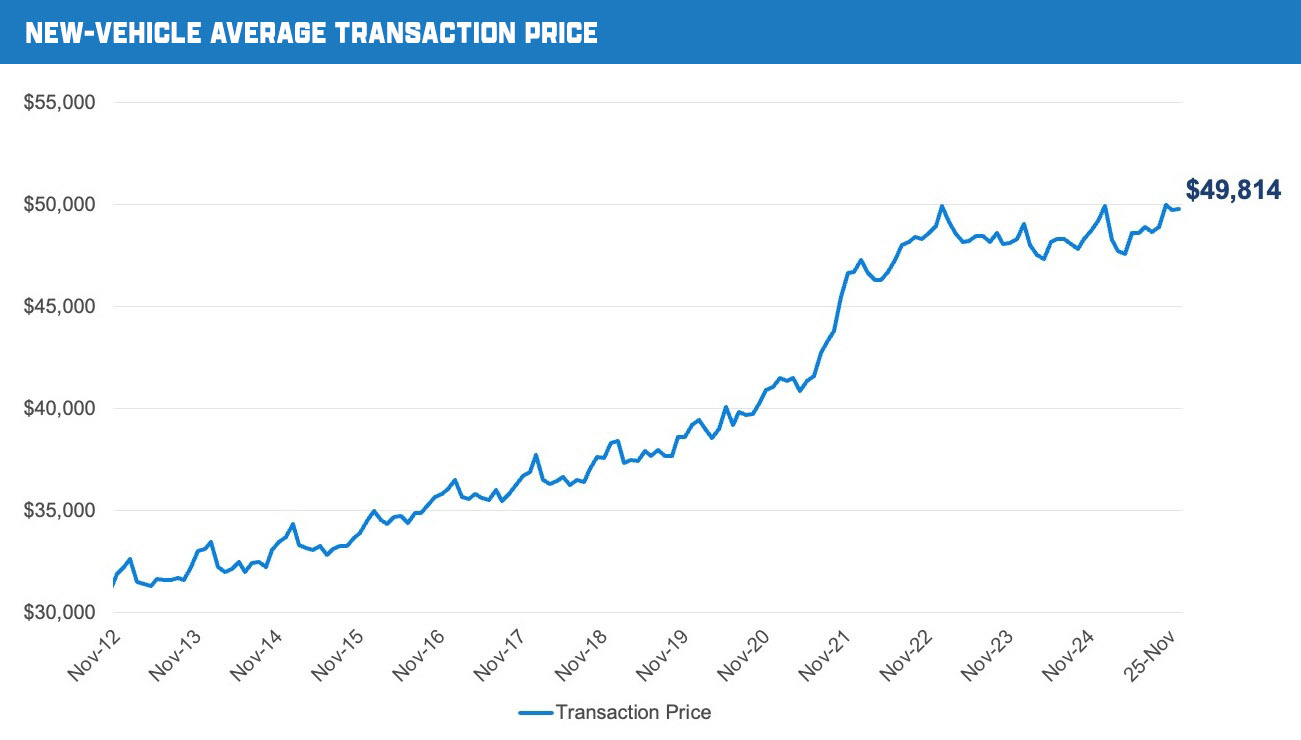
According to the latest Kelley Blue Book data, the average transaction price of a new vehicle in the US hit $49,814 in November, and it’s showing no real sign of dropping.
That figure is up 1.3 percent year over year and effectively unchanged from October, suggesting the industry has settled into a comfortable rhythm where fifty grand is the new normal.
Cox Automotive says prices usually peak in December, meaning the holiday season could push things even higher as buyers gravitate toward well-optioned trucks, luxury SUVs, and vehicles that require six figures of income and very little financial anxiety.
Fewer Incentives
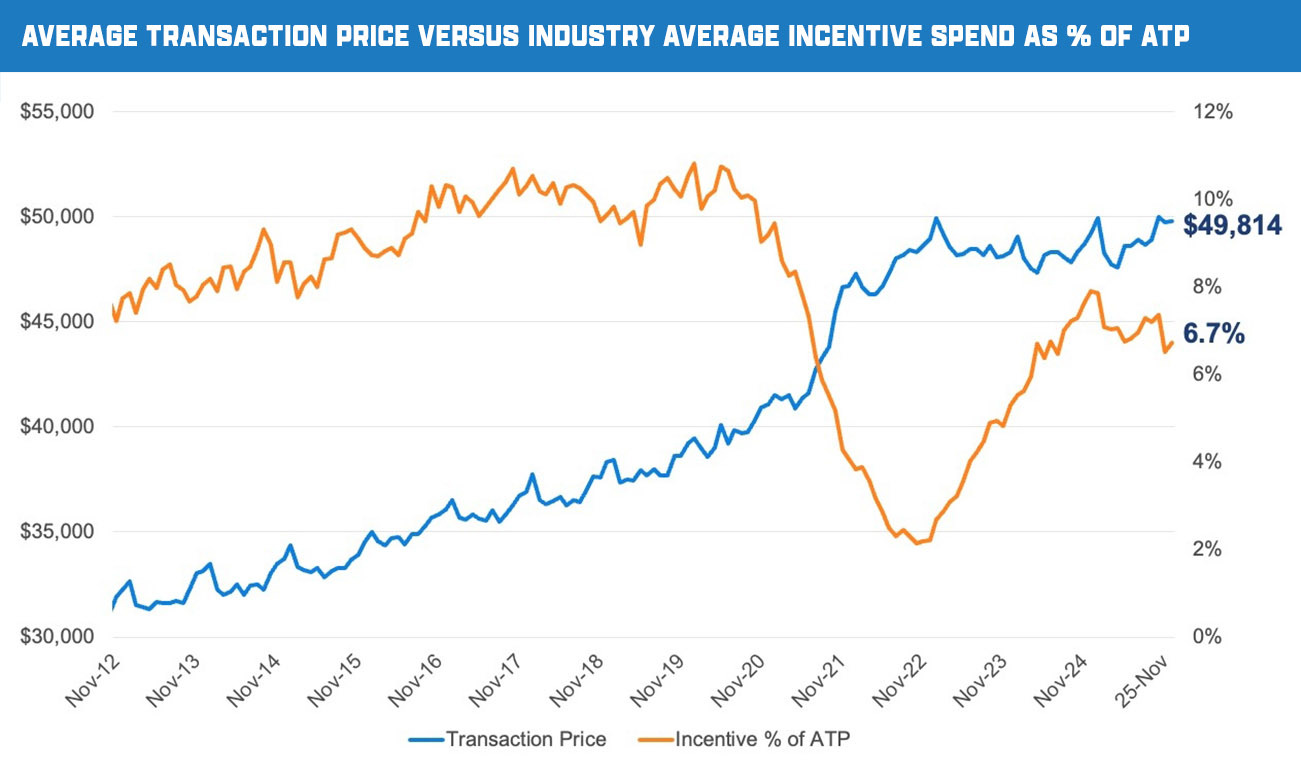
Incentives are still around, but they are not doing the heavy lifting they once did. In November, incentives averaged 6.7 percent of average transaction prices, down from nearly 8 percent a year ago.
Automakers simply do not need to discount aggressively when buyers keep selecting expensive trims with panoramic roofs, giant screens, and fancy wheels.
The data makes one thing clear. Cheap cars are disappearing from the sales mix. Vehicles with MSRPs under $30,000 accounted for just 7.5 percent of November sales, down sharply from 10.3 percent a year earlier.
Meanwhile, more than one in 10 vehicles sold cost over $75,000. The most popular sub-$30K survivors remain familiar names like the Toyota Corolla, Chevrolet Trax, and Hyundai Elantra, clinging on like endangered species.
While transaction prices may have leveled off for now, average MSRPs, commonly known as the asking price, are still inching upward, reaching $51,986 in November. That marks a 1.7 percent increase over last year.
Blame Pricey Trucks
Trucks continue to be a major contributor to price inflation. Full-size pickups now average more than $70,000 for the third month in a row and accounted for over 14 percent of all sales in November, with nearly 183,000 units delivered. That helps explain why the industry average keeps floating upward even when compact and midsize segments remain relatively stable.
Electric vehicles add another twist. The average EV transaction price fell slightly month over month to $58,638, but remains up 3.7 percent year over year. Incentives jumped to over 13 percent of prices as sales softened again, dropping more than 40 percent compared with last year.
Tesla’s average transaction price rose to $54,310 in November, even as sales fell 22.7% year over year, largely due to sharp declines in Model 3 demand. Prices for the Model Y, the best-selling EV in the U.S., edged up slightly. Cybertruck sales fell to 1,194 units, their lowest monthly total of 2025, though its average price rose to $94,254.
Who’s Really to Blame?
According to Cox Automotive Executive Analyst Erin Keating, today’s prices aren’t just the result of inflation or supply hangovers, but they reflect what consumers are choosing to buy.
“It’s important to remember that the KBB ATP reflects what consumers choose to buy, not what’s available,” she explained.
“Many new-car buyers today are in their peak earning years and are less price-sensitive, opting for vehicles at the higher end of the market to get the features and experiences they value most. In November, sales of vehicles priced above $75,000 outpaced those below $30,000, underscoring this preference for premium products” Keating added.
The takeaway is simple. Prices are high because buyers keep buying high. Until that changes, the average US driveway will continue to look alarmingly expensive.
We just have to hope the trend doesn’t discourage automakers from developing and building the more affordable models that less affluent Americans still need.
SK On takes over Tennessee plant as Ford gets two in Kentucky.
Trump administration will cut a loan up to $9.6 billion total.
Ford CEO says U.S. EV sales could fall by as much as 50 percent.
In 2021, Ford and South Korean battery manufacturer SK On committed to a massive $11.4 billion investment aimed at building several joint-venture electric vehicle battery plants across the United States. It was a huge business decision that showed Ford’s commitment to the EV market.
That was then. As 2025 winds down, the two companies are pulling the plug on the battery partnership altogether, a sharp turn that underscores how turbulent the EV landscape has become.
The move follows two key developments. First, the rollback of the federal EV tax credit, which has hit sales across the board. Second, the U.S. administration’s recent decision to revise fuel economy standards, a move expected to favor gasoline-powered vehicles over electric ones.
Disruption in the Battery Game
Through the high-profile breakup, SK On will take over the joint venture factory that’s already been established in Tennessee, known as the BlueOval plant. Ford will then take control of two factories in Kentucky located next to each other.
SK On was the one to formally dissolve the partnership, although the company maintains that it intends to continue working with Ford around the Tennessee facility.
It believes that ending the joint venture will allow it to enhance productivity and improve operational flexibility. Additionally, it notes the split will allow it to accelerate its North American energy storage system business.
One of the more immediate consequences of the split is a reassessment of a government loan approved near the end of the Biden administration. Originally pegged at up to $9.6 billion for the joint venture, the loan will now be reduced under the Trump administration’s oversight.
Exactly how much it will be cut remains to be seen. According to Bloomberg, the loan will be restructured to “reduce exposure to taxpayers and ensure its prompt repayment.”
It’s understood that Ford is working voluntarily with the Energy Department to repay the loan more quickly than originally planned.
Bleak Outlook for EV Sales
In the background, Ford’s local EV sales are falling, and chief executive Jim Farley expects further carnage. He recently said that because of the Trump administration, EV sales could fall by as much as 50 percent in the US.
Ford also lost $5.1 billion before interest and taxes on its EV business in 2024 and expects to lose even more this year.
“We believe the writing was on the wall this partnership was not going to work moving forward,” WedBush securities managing director Dan Ives told the Detroit Free Press.
“Ford has to make some difficult moves and this was a smart strategic one to rip the band-aid off. The EV market is dramatically scaled down for Ford now and they have to adjust accordingly.”
BMW M’s next generation will lean heavily into electrification.
Dirk Hacker retires after 37 years as BMW M’s development boss.
The brand’s future lineup includes an all-electric version of the M3.
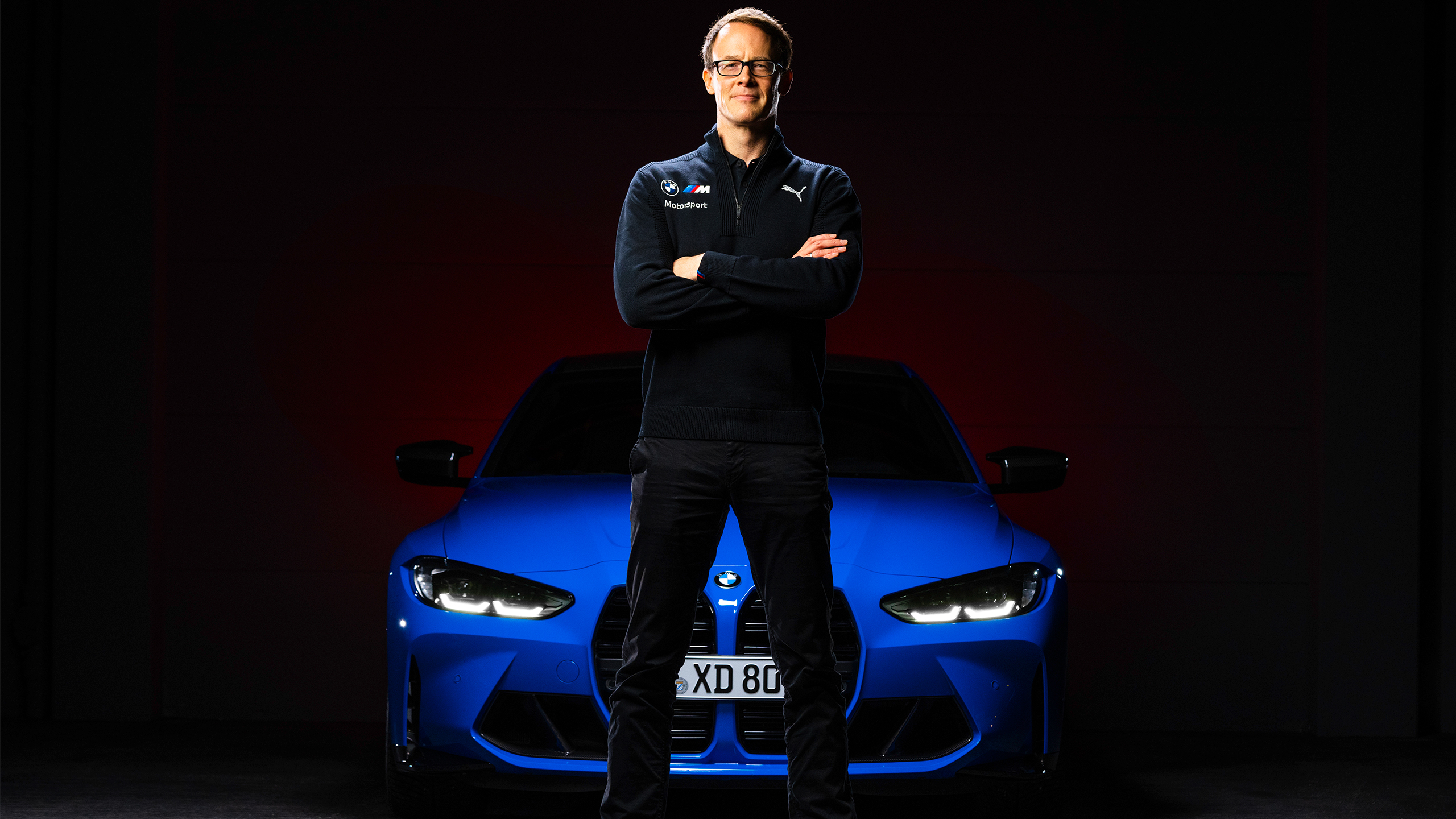
As BMW prepares for a significant leadership change at the very top of the pyramid, a key shift is also happening within its high-performance division. Just days after the company confirmed that Milan Nedeljkovic will succeed Oliver Zipse as CEO next year, BMW M has named a new head of development.
Stepping into the role is Alexander Karajlovic, best known for overseeing one of M’s most polarizing recent projects, the BMW XM SUV.
Karajlovic’s track record within BMW includes a range of roles that place him squarely in the performance and SUV space. Between November 2017 and 2020, he led development for BMW’s X derivatives and served as project manager for the XM, the M division’s first standalone model since the M1 in 1978, and arguably one of its most divisive to date.
He also served as vice president for the BMW M Product Line for two years, before heading back to the broader BMW group and worked in the areas of Requirements, Concepts, and Driving Experience Integration.
He now steps in for Dirk Hacker, a veteran who’s been with the BMW Group for 37 years and spent the last 11 of those at BMW M. Hacker has led development since 2015, a tenure that included not only technical oversight but hands-on involvement as a driving instructor with BMW’s Driving Experience program. The last model launched under his direction was the new M5 Touring.
“Dirk Hacker’s departure sees the long-term Head of Development at BMW M GmbH bow out to start his well-earned retirement,” BMW M chief executive Franciscus van Meel said. “His name is inextricably linked with an unprecedented product offensive, superior product quality and yearly sales records at BMW M.”
BMW M’s Future Plans
Karajlovic takes over at a time of transition, as the M brand begins laying groundwork for its next-generation lineup. Among the most closely watched projects is the upcoming M3, which is being developed in both all-electric and twin-turbo six-cylinder versions.
The fully electric model, a major technical shift for the badge, is expected to feature four electric motors and deliver upwards of 700 hp, a configuration that will likely spark no shortage of conversation among fans and skeptics alike.
BMW names Milan Nedeljkovic as its next CEO replacing Oliver Zipse.
Nedeljkovic joined BMW in 1993 and leads production operations.
Zipse will remain CEO until the 2026 Annual General Meeting.
BMW has named its next chief executive officer, confirming that Milan Nedeljkovic, the brand’s current head of production, will take the reins next year. His appointment comes at a pivotal moment for the company, as it pushes deeper into electrification and prepares to usher in its Neue Klasse generation of vehicles.
Nedeljkovic won’t be stepping into the role immediately, though. Incumbent CEO Oliver Zipse will continue leading the company until BMW’s Annual General Meeting on May 13, 2026. After that, Nedeljkovic is set to begin his term, with a contract that runs through 2031.
Zipse has been at the helm for seven years, steering BMW through an unusually turbulent stretch. His time in charge included the COVID-19 pandemic, widespread supply chain disruption, and a bevy of product rollouts that ranks among the most intensive in the company’s history.
“Oliver Zipse has always prioritized BMW’s success,” chairman of the supervisory board of BMW AG, Dr. Nicholas Peter described. “He consistently took a clear stance—even in the face of great external headwinds—and thus kept the company on track during turbulent times.”
Nedeljkovic, meanwhile, is a BMW veteran. He joined the company in 1993 as a trainee and has since held senior roles at its Oxford, Leipzig, and Munich facilities. According to Dr. Martin Kimmich, deputy chairman of the supervisory board and chair of the Global Works Council, he’s built strong relationships inside the company.
“He is held in high regard by and enjoys the trust of BMW’s workforce,” Kimmich said. “Together with him, we look forward to continuing the long tradition of cooperative collaboration between the Works Council and corporate management as a foundation for our BMW success story.”
The Future of BMW
The next five years will be hugely important for the BMW brand. It plans to launch more than 40 new or updated models by the end of 2027, all of which will use the same computing systems as the new iX3.
That includes a full facelift of the company’s vehicle range, unified under the design direction set by the second-generation iX3. Many of those models will also adopt the iX3’s new Panoramic iDrive system, marking a significant update to both interface and in-cabin tech.
Eric Bach sues Lucid alleging wrongful firing and discrimination.
He says an HR executive called him a “German Nazi” internally.
Lucid rejects his claims as absurd amid ongoing executive exits.
Lucid Motors has plenty on its plate already. Cash burn, slow production ramps, a delayed Gravity SUV launch, and media stories about drivers being shafted with huge repair costs. Now it can add one more thing to the list: a high-profile lawsuit from its former chief engineer that claims a serious lack of harmony at the Newark, CA, HQ.
Eric Bach, who spent a decade at Lucid and rose to become Senior Vice President of Product and Chief Engineer, has filed a federal lawsuit alleging wrongful termination, discrimination, and retaliation.
What Sparked the Fallout?
At the center of the complaint is a claim that a senior HR executive referred to him as a “German Nazi” during an internal investigation into workplace culture. Bach was born and raised in Germany and says the remark was deeply offensive and discriminatory.
According to the lawsuit, Bach learned about the comment in mid-2025, months after the start of an HR-led culture probe Bach claims was already “tainted by racist beliefs.”
During that investigation, he says he was stripped of key responsibilities, including oversight of Lucid’s electric powertrain division, and excluded from board meetings.
After encouraging a colleague to report the remark through internal channels, Bach claims Lucid confirmed the comment was made, yet failed to act meaningfully.
Pushed Out
Things escalated from there. Bach says the company began pressuring him to resign in October 2025 before firing him outright on November 5. Lucid’s public statement at the time merely said he had “departed,” offering no hint of the brewing conflict behind the scenes.
Lucid, for its part, is having none of it. The automaker issued a blunt response calling Bach’s legal claims “absurd” and says it is confident the facts will show legitimate reasons for his termination.
Company sources have pointed to long-running product delays, quality issues, and execution problems, arguing that leadership restructuring was overdue.
Bach’s responsibilities were partially handed to Emad Dlala, who was promoted to Senior Vice President of Engineering and Digital after Bach’s exit.
Tricky Timing
The lawsuit lands at an awkward moment for Lucid. The company is still trying to ramp production of the Gravity SUV while developing a more affordable midsize EV due in late 2026.
Executive turnover has been relentless, with former CEO Peter Rawlinson resigning earlier this year and multiple vice presidents exiting across different strands of the business.
Bach’s complaint paints a very different picture of his standing, citing praise from board members and repeated salary increases, and even suggestions that he was being groomed for a future CTO role.
He’s now requesting damages and a very public jury trial. For a company built on calm luxury, Lucid’s latest saga is anything but serene.

 Login
Login