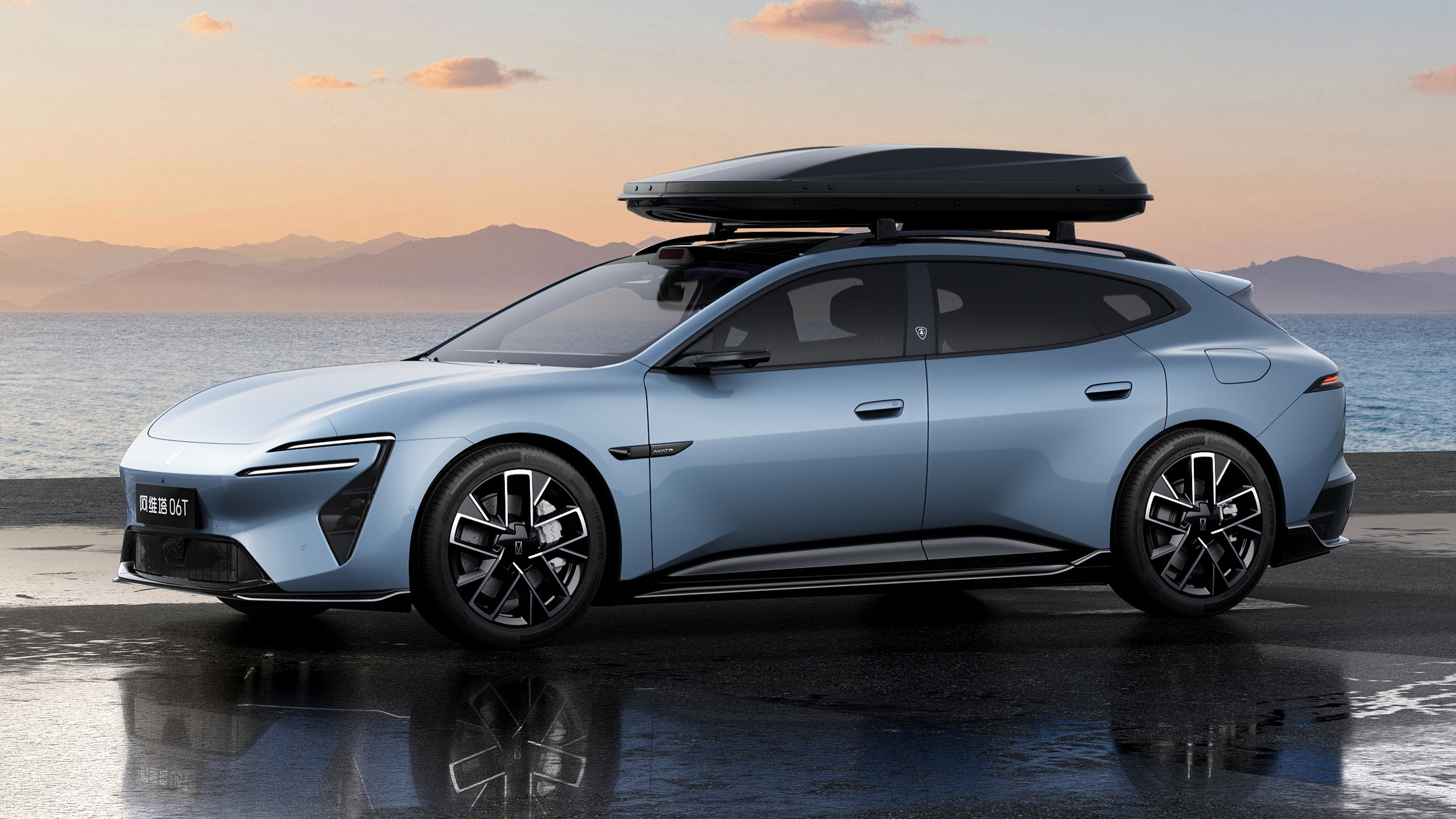
The brand’s impending launch was announced at the Paris Motor Show. It’s working to establish sales, service and partner networks across Norway and Spain, and has confirmed the 06T and 07L will be among the first models it launches. The 06T takes the form of a sleek estate while the 07L is a luxurious SUV, and they will ultimately be joined by six other models over the coming three years.
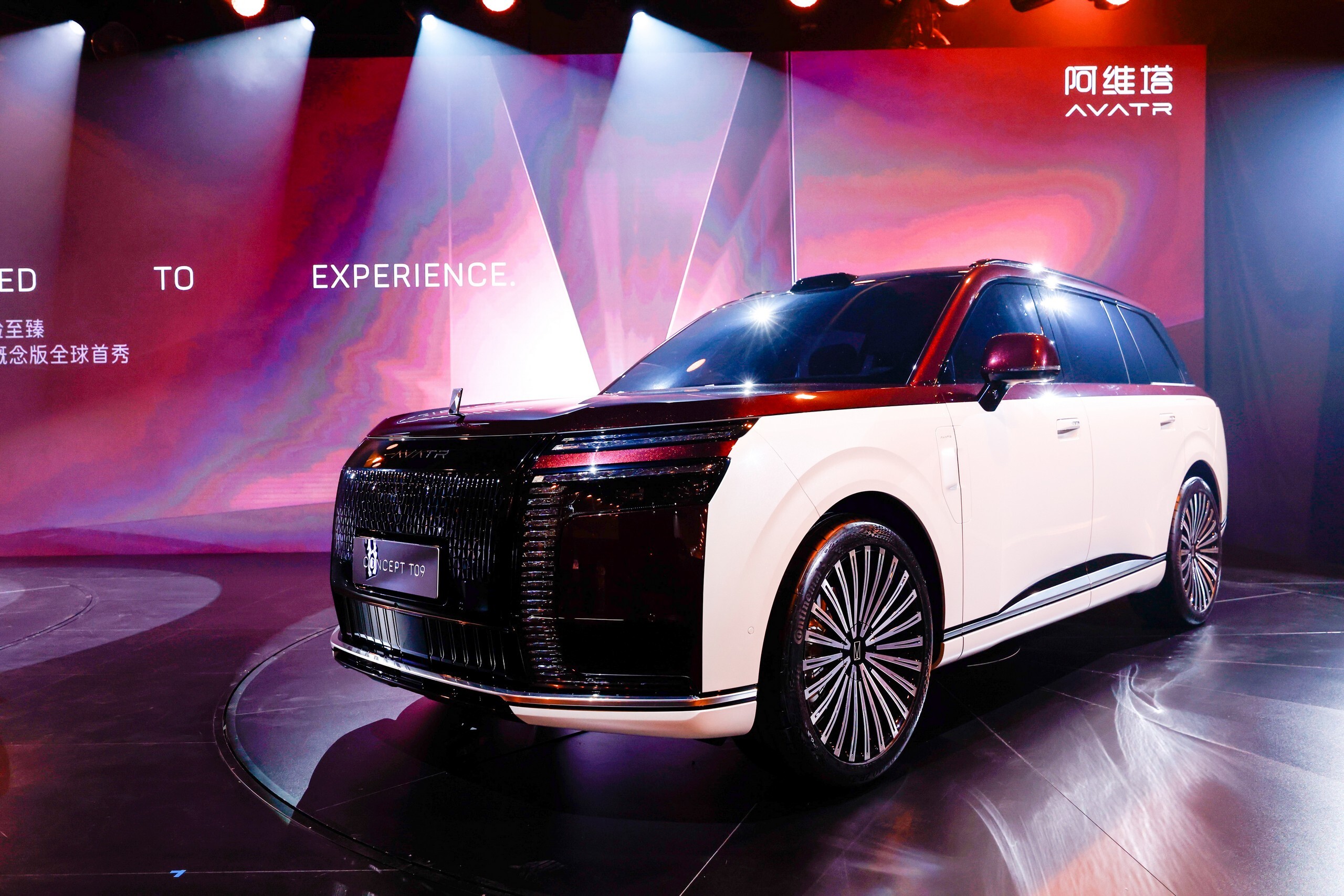
One of these new models will be the Avatr T09. Previewed in Paris with the T09 Concept. It will be a flagship, full-sized SUV designed to rival vehicles like the Li Auto L9, Aito M9, Zeekr 9X, and even models like the Mercedes-Maybach GLS and Rolls-Royce Cullinan.
Recent filings made in China have already revealed many key details about the production model. It will be sold as a range-extender EV with options for either a turbocharged 1.5-liter inline-four with 141 horsepower (105 kW), a front motor with 241 hp (180 kW), and electric motors at the rear with 415 hp (310 kW). A turbo 2.0-liter four-cylinder with 201 hp (150 kW), a 241 hp (180 kW) front motor, and a pair of 302 hp (225 kW) rear motors will also be offered. Both versions will launch in China with a 71.24 kWh battery. It’s unclear if the European model will have the same specifications.
While Avatr is only now expanding into Europe, it already has a presence in more than 70 countries and regions and plans to expand to 110 countries by 2030. So far, the Chinese brand has sold more than 280,000 vehicles. Interestingly, Avatr’s global design center is based in Munich, Germany, and designers there work with those at its Shanghai design center to craft models that should appeal to global buyers.
Avatr Overseas Business head Justin Li spoke at an event in Paris, and he said: “Avatr has been a global brand from the very beginning. Over the next three years, six models will be launched in Europe spanning mid‑size SUVs, large SUVs and shooting‑brake body styles. In 2027, Norway and Spain will serve as AVATR’s European launch markets, where the AVATR 06T and 07L will make their European debut, officially embarking on a new journey for AVATR in Europe.”
Avatr will work with local dealers and service partners across Europe and provide full-lifecycle support to local buyers thanks to a European spare-parts logistics system and roadside assistance.
PROS ›› The best self-parking tech we’ve experienced, solid build quality, looks unique, CONS ›› Firm ride, tech overload, model tested was not quick
Avatr is likely a brand you’ve never heard of. And yet, it’s the kind of car company that is likely to shake you out of your slumber when you realize just how quickly China is developing its top-flight tech powerhouses. The Avatr 07 is another feather in the company’s cap. And while the 11 that we tested last year had its drawbacks, the 07 — which should be the 11’s smaller brother — outclasses it in many respects. It does so, seemingly by virtue of just, well, being newer.
But that’s the kind of progress a brand needs to display in what is a ruthless Chinese home market. Model cycles are short, and designers and engineers are constantly pushing to out-niche the competition with weird and wonderful features that can differentiate their products in what has to be the most crowded market for cars.
That said, the Avatr 07 doesn’t attempt to win you over with gimmicks, although it does have a few. As a refresher, Avatr is a joint venture between state-owned automaker Changan, tech giant Huawei, and China’s largest battery manufacturer, CATL. Unlike the many copycats, who invariably deploy some kind of take on a Defender or Bronco in their lineup, Avatr has decided to take design seriously.
QUICK FACTS
› Model:
2026 Avatr 07
› Dimensions:
4,825 mm (189.9 inches) Length
1,980 mm (77.9 inches) Width
1,605 mm (63.2 inches) Height
2,940 mm (115.7 in) Wheelbase
› Curb Weight:
2,225 kg / 4,905 lbs
› Powertrain:
Rear-wheel drive with 82.16 kWh battery
› Output:
99 kW (132 hp / 134 PS) and 365 Nm (273 lb-ft) of torque
› Transmission:
Single Speed
› Performance:
0-100 kmh (62 mph) in 13 sec, 180 kmh (112 mph) top speed
› Range:
575 km / 357 miles (NEDC)
› On Sale:
Now
SWIPE
A Closer Look At That Exterior
Avatr has invested in a design studio in Munich and has reportedly attracted top talent to their stable. Their chief designer is Nader Faghihzadeh. He’s the guy who penned the BMW i8. And the fact that the 07 genuinely isn’t a mish-mash of existing rival styling cues earns the 07 some brownie points in my book.
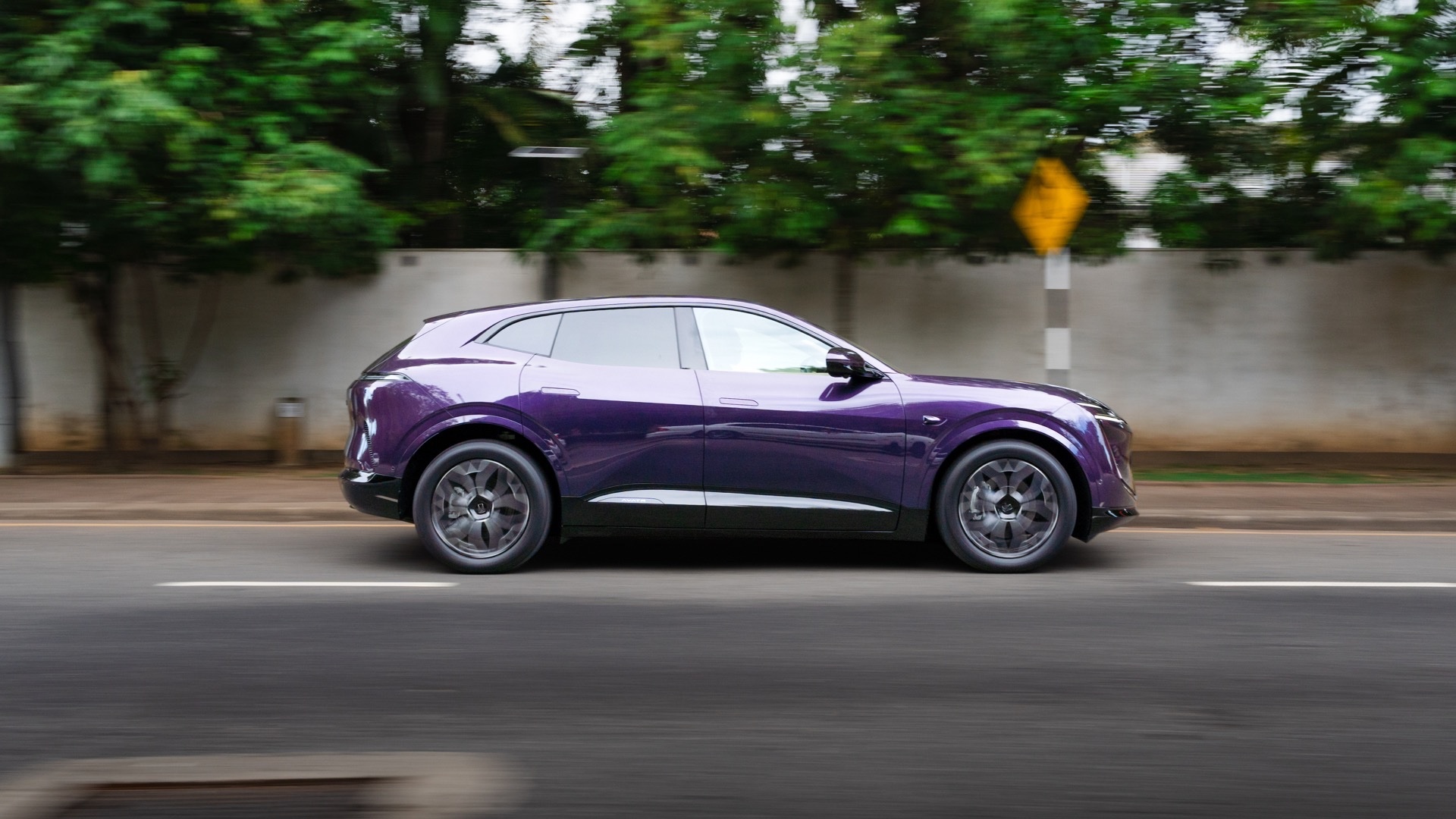
However, it’s not quite as imposing in person as the larger 11 was, even if it is just a smidgen smaller (4,825 mm / 190 inches vs 4,880 mm / 192.1 inches long). The styling is very much a continuation of the precedent set by the 11, but with a lower waistline, and an overall more rounded hatchback rear, vaguely reminiscent of the U.S. Honda HR-V in outline alone. Or, to put it another way, it’s the 11’s CliffsNotes, toned down for a broader audience. Kill Bill without so much of the Kill, if you will.
But that’s okay, because the 07 is meant to attract a larger audience to the brand, while staying somewhat stylish. The overall design, with its large arches and differently surfaced panels down the side, do make the car look a bit underwheeled in the spec we tested, with the predominantly black 20-inch wheels not standing out against the purple bodywork.
Step into the Avatr 07 and its hard not to be impressed by the sheer quality of it all. We’re talking Nappa leather seats, real Dinamica microfiber suede on the roof, and an overall air of quality that will genuinely have the German big three scratching their heads. There are no shiny or creaky plastics (we can’t say the same about some Mercedes of late), and there’s an attention to detail that showcases that thought has been put into the design − even the lower B-pillar trim panel is wrapped in leather.
Ahead of the driver, at the base of the windscreen, is a cabin-wide thin strip of screen. This 35.4-inch display incorporates the use of widgets to add an extra layer of seriously useful customisation to the experience. Here you can select a number of things to display, including tire pressure, temperatures, power, and multimedia. In a world of pointlessly expanding screen real estate, it was more than refreshing to be able to glance at some of those excessive pixels and have it tell you something relevant to your drive.
The driver and passenger seats both feature heating, ventilation, and massage functionality, and a zero gravity mode (fancy word for saying the seat goes into a theatre-style recline mode) can come in handy when recharging the 07 at a public charger. The relaxation features are coupled with several scenario modes, which you can select through the display. Want to experience a pretty poor recreation of a roaring fireplace? Select the mode, and the screen will flicker a warm light, the heating will turn on, and you’ll hear the faint crackle of a wood fire piped through the audio. Of more use, though, is the Tesla-esque pet mode, which allows you to keep the cabin at a constant temperature, with a prominent message letting passersby know your furry friend is comfortable.
Spend a little more time inside though, and some issues start to creep to the surface. The AC vents, for instance, are designed to be invisible. It’s a nice concept that grabs the minimalism-to-the-max concept by the horns, but in practice it’s impractical. Want to change the direction of the airflow, and instead of quickly making a minor adjustment to a vent, you have to delve into a menu via the touchscreen and drag to where you want the airflow blowing.
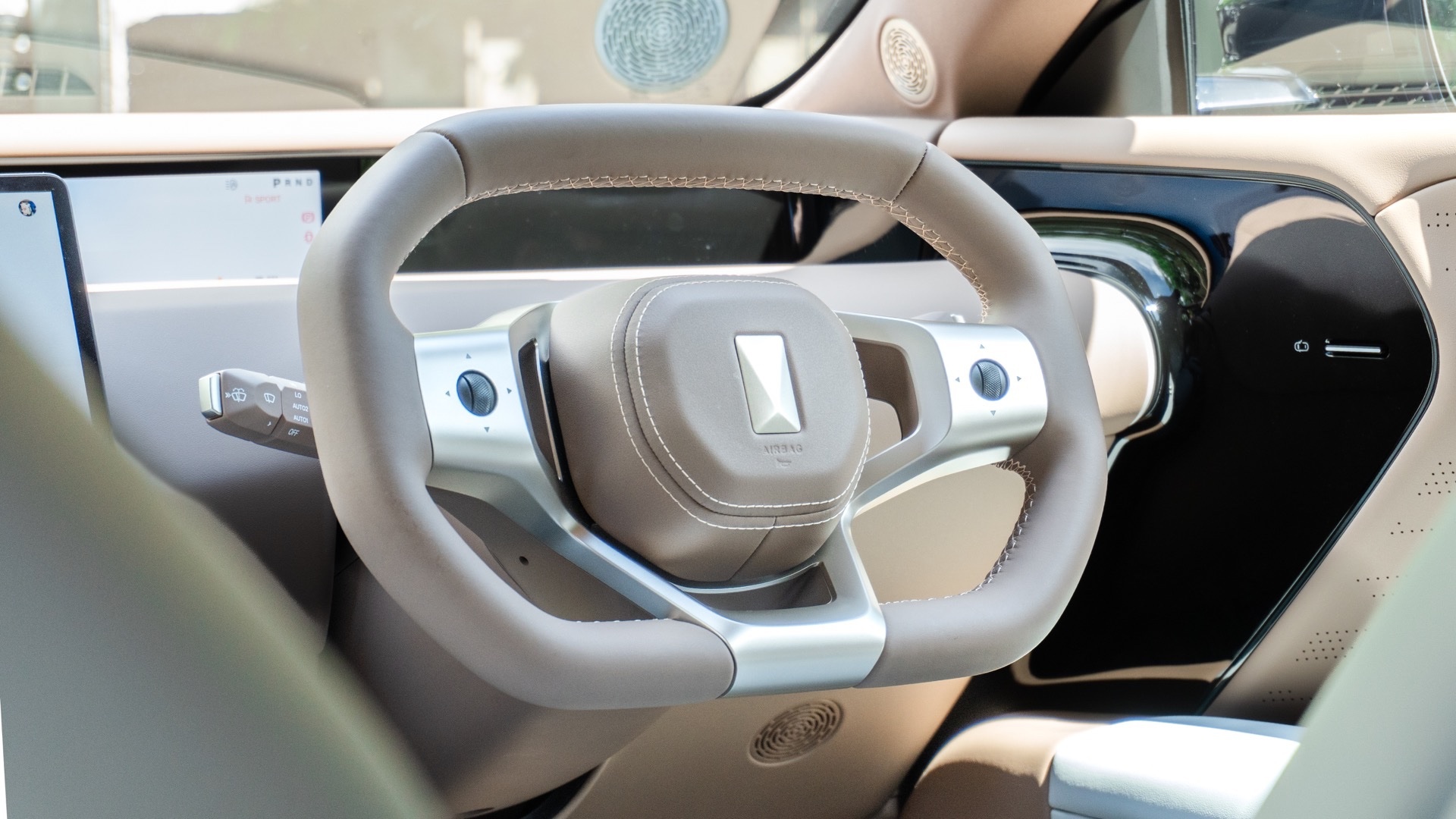
There’s the steering wheel, too. Arguably inspired by Tesla, the yoke is just not a great experience. F1 cars have them because your steering inputs are limited to a small range of motion. But in real road cars, as soon as you need to park (more on that later) and you have to do several lock-to-lock maneuvers, it just becomes a chore. Shuffling the wheel is impossible, and instead you have to half-palm it.
Another frustration is that the steering wheel and mirror adjustments need to be accessed through the screen too. We understand that this isn’t the first car, and it won’t be the last, to hide everything behind a screen, but for those of us who like to make minor corrections to our seating position, having an extra step to navigate is just an annoyance. And if we’re nitpicking, replacing the interior door pulls with push buttons seems like an exercise in frivolity.
Of course, none of that will be of concern if you opt to spend your time in the back. Now, for the Chinese market, rear space is a serious consideration, so much so that there are many long-wheelbase versions of various cars over there. There’s even a 07L, confined to China. But even in the standard 07, the legroom is seriously impressive. If the front-seat occupants are six-footers, there’s more than enough space to stretch out in the rear. If you require further legroom, then flip down the armrest, and you’ll find a set of touch-sensitive controls which allow you to move the front passenger seat forward. You can also electrically recline each outboard rear seat back, control the seat heating (but no ventilation), and open or close the moonroof sunshade, which spans the entire length of the passenger compartment.
The rear row can be folded to expand the 735-liter trunk space to 1,645 liters. There’s also a 90-liter frunk up front, providing another useful way of storing things.
Behind The Yoke
Our tested car was supplied in Sri Lanka, which receives a much smaller motor variant. This is due to punitive taxes on cars, similar to Singapore. So, what you get is a rear-mounted 99kW motor, which works out to 130 hp in old money. Despite the smaller motor, the cost of the car is still an astronomical $107,000 (LKR 35,500,000) in Sri Lanka. For perspective, in its home market of China, the 305 kW RWD version of the 07 retails for a much more palatable $34,300 (¥229,900), which makes it Toyota RAV4 money.
There’s also a tri-motor all-wheel-drive version with an insane 712 kW and 996 Nm of torque that’ll do the 0-62 mph (0-100 km/h) sprint in just 3.7 seconds. The price for that? It works out to around $41,755 (¥279,900 in China). No wonder the industry is sounding the alarm over their cars.
But back to our test unit. That limited motor output and the rather pudgy curb weight of 2,360 kg means that our Avatr 07 is not fast. Correction: It’s downright slow. It gets to 62 mph (100 km/h) in 13 seconds. That’s slower than the Mitsubishi Mirage, which, up until it was retired, held the unenviable title of the slowest-accelerating car on sale in the US, at 12.8 seconds.
The weird thing is though, that behind the wheel of the 07. It doesn’t feel as slow as it is. Whereas that 1.2-liter Mirage had access to just 74 lb-ft (100 Nm) of torque, the Avatr 07 still boasts an impressive 270 lb-ft (365 Nm). In practice, it means this heavy EV doesn’t run out of grunt and even manages to feel unstressed. And of course, being an EV, having access to all of that torque at once helps with the sensation of progress too, even if it’s just that: a sensation.
One sensation you’ll find hard to shake, though, is the ride. With an interior as luxuriously appointed as this, you’d expect the Avatr’s ride to be as cushioned as possible. Not so. The Avatr 07 handles well, thanks to its double wishbone suspension, but the lack of body roll quickly translates into an unsettling approach to potholes and smaller road imperfections.
Again, in other markets, the 07 is offered with the option of air suspension and continuous damping control. Not so here, and perhaps the engineers spent significantly less time on the coil-sprung version of the car. And while I wouldn’t call the 07 uncomfortable per se, the firm experience is less in line with the high expectations that the rest of the car’s build and tech have set.
The Party Trick
The real party piece with the Avatr 07, though, is its suite of connected systems. Unlike Tesla, Avatr chooses not to rely solely on cameras for its semi-autonomous tech and employs millimeter-wave radar as well. Combined with Huawei’s advanced processors and related tech, the 07 manages to impress on multiple safety fronts.
What the 07 can’t do in this region is self-drive like FSD can. It can, however, self-park. Now auto-parking in itself isn’t a massive boon. But the car’s walk-away parking is. Here, you’re given the option of parking the car centered within a space, or to the left or right side — ideal if you’re parking next to a wall for example and you could do with the extra room to squeeze out the door. You also get walk-away parking, which allows you to exit the car and let it park itself completely unsupervised. Similarly, you can summon it from said parking space, via the connected app.
More than the concepts themselves, there’s a marked improvement in these operations from the now 4-year-old 11. When tested around pedestrians and busy traffic, the 07 was able to handle itself without freaking out at all, not needing the same kind of wide berth that its larger sibling did.
The Verdict
While it’s not perfect, the Avatr 07 stands as proof of just how quickly the tides are changing. The 11 we drove last year, already a car that was midway through its lifecycle at the time, was an impressive statement. The 07, even if it isn’t as flashy, manages to present itself as an almopst generational shift. There are no departures in design, materials, or even the basics behind the technology.
However, the experience of everything else — the design of the interior, the hushed ride, and the focus on premium materials — they all come together to paint the picture of a product that is very mature. It’s no longer experimental, like the 11, with its waterfall-inspired center speaker, electric doors, and gimmicky passenger screen, was. The 07 is a genuinely compelling car because it’s an excellent package.
I suspect not everyone will be happy about that. But the truth is, China’s home market is the most cutthroat we’ve seen. Manufacturers have to move the needle if they’re to survive. The benefit is we get to see that real-time shift. And yet something tells me, the best is still yet to come.
Demand for EVs in Russia has driven up prices and depleted inventory.
It comes as fuel stocks run low in the country after Ukrainian attacks, and lower-grade fuel has caused issues.
Russia’s EV demand has come suddenly, and charging infrastructure is still lacking.
Russian car buyers are driving up demand for EVs as Ukrainian attacks on fuel facilities increase. It’s a jarring adoption process for many, as cheap fuel has helped stave off the development of electric vehicle charging infrastructure, leading to a bizarre cyclical effect for some drivers who have switched a fuel queue for a charger queue.
The number of new EVs on Russian roads has jumped this year. In 2025, between January and August, the number of electric and hybrid cars sold amounted to 43,000. Figures from the Russian Ministry of Industry and Trade indicate that for the same period this year, that number has nearly doubled, with 83,000 electric and hybrid cars sold. EVs have jumped in popularity so much that the adoption rate is almost as high as in the U.S.
The shift towards EVs in Russia has been heavily influenced by Ukraine’s attacks on oil refineries, making both petrol and diesel scarce. Last Friday, The New York Times reported that only 46% of gas stations had stocks to sell, with just half of the stations in the capital city able to dispense petrol. In other major cities, that figure is reported as low as just 27%.
The Russian government has reacted to the mounting queues for gas by allowing lower-quality gasoline and diesel to be sold in the market. However, the side effect of this is that some cars have reacted badly to the fuel and are breaking down. More modern machines can’t handle the lower grade of gas.
When most of the world’s legacy automakers exited the Russian market due to pressure from the West over Russia’s invasion of Ukraine, thousands of dealerships and local assembly plants were left bare. Capitalizing on this drastic reduction in competition and sudden upturn in manufacturing capacity, Chinese manufacturers have since swooped in to fill the void.
Sergei Tselikov, a Russian auto industry expert, told The New York Times that he quickly bought a GWMOra 03 GT after he saw drivers having to queue for hours to get fuel. But even though he acted quickly, the sudden demand for EVs meant that the price had already increased by $2,000.
Now, many EV dealerships have been cleared out of their inventory, while second-hand EV listings are few and far between. The other resultant effect that the EV boom has had has, perhaps ironically, been an increase in wait times at public EV chargers. The very buyers who wanted to avoid waiting in long lines for fuel may now be caught in similar (albeit shorter) queues waiting to recharge.
In addition to fuel, which has been relatively plentiful and cheap up until now, another reason why Russia’s EV network is lacking is down to the geography of the country. Large cities lie many miles from each other, and the demand just wasn’t there to set up a proper charging network. The story is slightly different in the Capital, which has seen the number of EV chargers rise from 1,5000 in 2022 to 8,000 today, thanks to government incentives.
But the demand for Russian EVs will likely continue and follow similar trends around the world thanks to a different conflict: the Iran war. Sales of electric cars in more than 90 countries have risen this year and, globally, EVs are on track to account for a record 29 percent of all new car purchases in 2026.
The UK could tariff cars from China to avoid EU retaliation.
Chinese car sales have surged in the UK, in particular for the Jaecoo 7.
Last month, Jaecoo’s ‘Temu Range Rover’ was the nation’s best-seller.
Demand for Chinese electric vehicles continues to surge across the UK, but this near-unrelenting growth could soon slow to a crawl. According to a new report, the UK may follow in the footsteps of the European Union and impose tariffs on EVs from China.
The push for tariffs is being led by the EU. Officials have reportedly told British ministers that unless the country hits Chinese vehicles with tariffs, then the UK could be cut out from the ‘Made in Europe’ scheme. If this were to happen, it would make it much more expensive for British car manufacturers to sell vehicles into the EU.
The Sunday Times reports that UK business secretary Jonathan Reynolds has started drafting a package for tariffs in the lead-up to a summit being held between the UK and EU next month. Up until this point, the country has been reluctant to impose tariffs, but as sales of Chinese vehicles have surged, it appears they are now getting ready to act.
A look at recent sales data shows just how much demand there is for Chinese cars in the UK. In September, almost a quarter of all new cars sold in the UK came from China. The nation’s best-seller was the Jaecoo 7 with an extraordinary 10,812 sold last month, allowing it to even outsell the Tesla Model 3.
The Jaecoo 7, often referred to as a ‘Temu Range Rover,’ is sold in the UK with a 1.6-liter turbocharged petrol engine and a 1.5-liter plug-in hybrid. September was the second month this year that it has been a best-seller in the UK. It’s unclear if the UK is weighing up tariffs against combustion-powered models from China, but it’d be wise to do so if it really wants to stop brands like Chery, BYD, and others from taking over local roads.
In the EU, EVs from China face tariffs of as much as 45 percent. Chinese brands quickly shifted their focus from EVs to plug-in hybrids after these tariffs were instated. Lawmakers in the bloc are now said to be weighing up the possibility of extending the tariffs to also include hybrids.
It appears British lawmakers are taking threats from the EU seriously. Last week, the Society of Motor Manufacturers and Traders indicated the Made in Europe rules threaten British car production. If this latest report is true, it seems the UK is about to choose sides, and in siding with Europe, it may turn its back on China.
Pakistan’s Nora EV reveals the Metro, a small Toyota-styled MPV.
It combines Alphard and Vellfire design with a tiny 5 hp motor.
Available in EV and EREV versions, it will start from under $11k
The Toyota Alphard and Vellfire are the best selling full-size minivans in the Japanese market, but their popularity expands to other regions. Pakistani automaker Nora EV has unveiled a new zero-emission model with Toyota-inspired styling and a subcompact footprint.
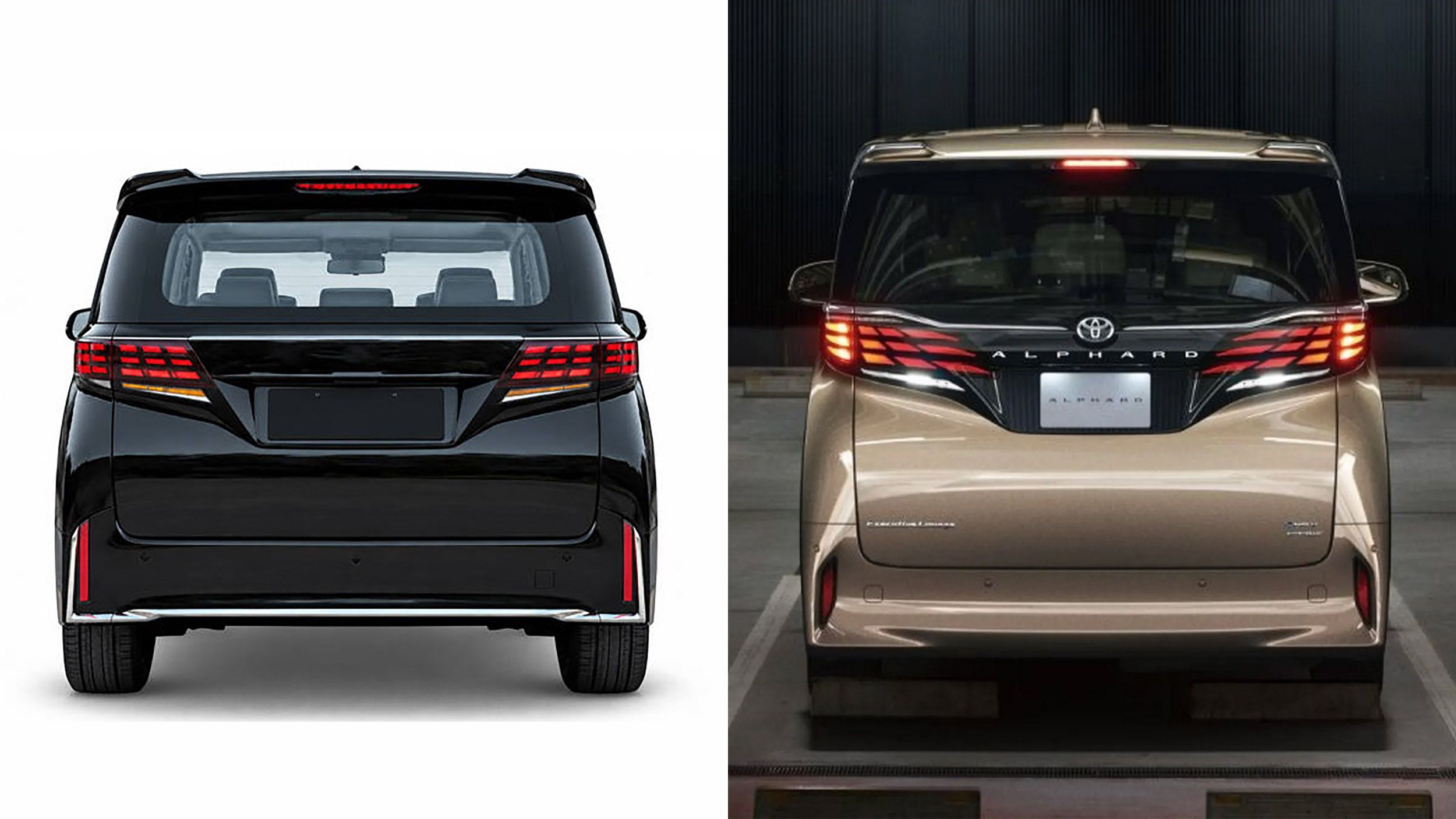
The Nora EV Metro might not bear the Toyota emblem, but it incorporates a mixture of Alphard and Vellfire styling cues. At the front, the headlights might be simpler, but the massive grille and vertical intakes with chrome accents send strong Toyota vibes.
The same applies to the surfacing on the profile and the rear end with a vertical tailgate, a roof spoiler, and triangular taillights. However, unlike the Alphard and Vellfire which rely on power-sliding side doors, the Metro uses conventional hinged doors for rear-seat access.
The Nora EV Metro (left) compared to the Toyota Alphard (right).
Despite the similarities with the Japanese full-size minivans, Metro’s proportions are far more modest. The vehicle measures 3,900 mm (153.5 inches) long, which makes it shorter than European subcompact hatchbacks. It also rides on 14-inch alloy wheels that would be more suitable for a kei car.
Inside, the Metro tries hard to hide its budget-friendly nature. The five-seater cabin adopts styling cues and color combinations inspired by premium vehicles. The dashboard might look like a Mercedes Hyperscreen, but is actually a big piece of plastic with a modest infotainment display in the center. Equipment includes Bluetooth connectivity, a USB port, push-button start, AC, power windows, and a reverse camera.
Surprises continue under the skin. The underlying chassis originates from China, but the company claims it has been re-engineered to better suit the road conditions of South Asia and improve ergonomics for taller passengers.
Nora EV Metro
Power comes from a single rear-mounted electric motor producing 4,000 Watts, which translates to a mere 5 hp (4 kW). The company offers various options for the lithium iron phosphate (LFP) battery pack with capacities of 9 kWh, 15 kWh, and 23.1 kWh. The larger battery promises a driving range between 250-300 km (155-186 miles).
For those with range anxiety issues who don’t like to wait for charging, Nora EV plans to roll out a network of battery swapping stations in Pakistan. More importantly, the Metro will be optionally available with a range-extender setup featuring a 3 lt (0.8 gallon) gasoline tank and a small generator which is said to add an extra 150-180 km (93-112 miles) of range.
Other Models And Pricing
Nora EV was founded in 2025 by Nousheen Azhar and Ali Raza. Unlike other firms that assemble imported knockdown kits, the Pakistani company is establishing local manufacturing for bodywork stampings, lighting assemblies etc.
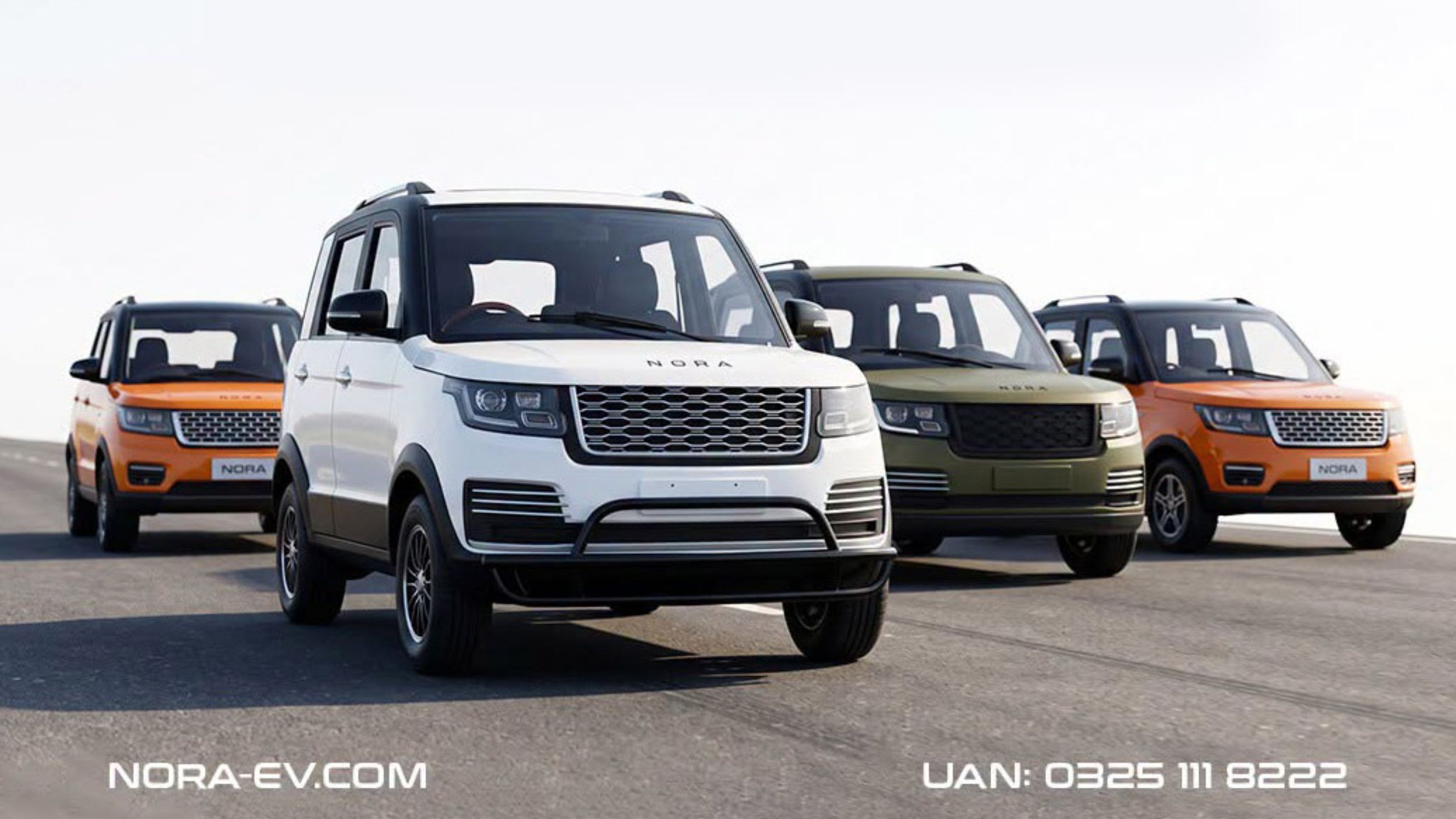
Besides the Toyota minivan impersonator, the automaker also offers the Nora E30 small electric SUV copying the design of the previous-gen Range Rover, and the Nora Neo urban hatchback. The only one currently on sale is the baby Range Rover, priced from 1,889,000 Pakistani Rupee ($6,800) before GST. The brand has promised that the upcoming Metro will launch soon with a starting price under 3,000,000 Pakistani Rupee ($10,800).
Model 3 sedans sold in China now come with a bigger 16-inch infotainment screen.
It’s the same media display already fitted to Tesla’s Model Y SUV around the world.
China’s 3 also brings 2.2 kW V2L charging, a feature not offered in US or Europe.
Tesla pioneered the use of the big infotainment screens that now dominate every car’s dashboard, and now the Model 3 is getting an even bigger one. The electric sedan is switching from a 15.4-inch display to a 16-inch unit, but there’s a catch. So far the upgrade, and several others, are restricted to Model 3s sold in China.
The automaker announced the spec enhancement on China’s social media platform Weibo, claiming the new screen offers more than just extra digital real estate. It also promises a higher resolution and improved refresh rate, which could be useful for owners who like to watch movies or play video games. This bigger screen is already fitted to Model Ys in China, the US and Europe.
We checked Tesla’s European and US sites and in each case the Model 3 is still listed as having a 15.4-inch screen, though it’s very likely China’s display will be rolled out across the globe later this year. Tesla has a habit of treating Chinese customers to the new stuff before giving it to the rest of us. The Model Y “Juniper” facelift and long wheelbase Model Y L both appeared first in Chia.
White Too Bright?
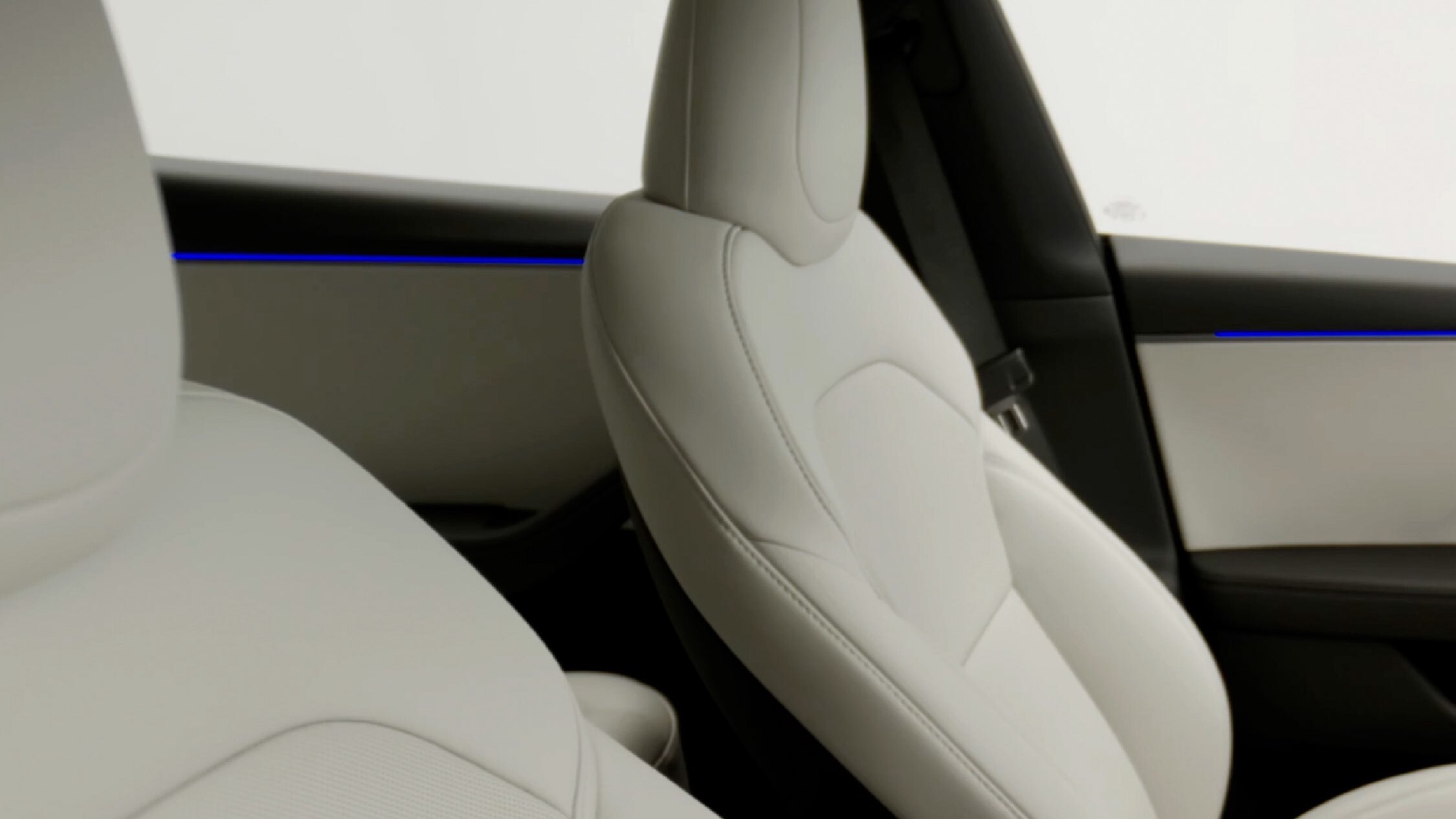
Another Model 3 change is the option of a light gray premium interior as an alternative to the default black. Both choices are paired with a black headliner. We’ve seen that combination before, again on the Model Y, so there’s a clear pattern here of new features appearing on the SUV before trickling down to the more affordable sedan.
Camping, Chinese-Style
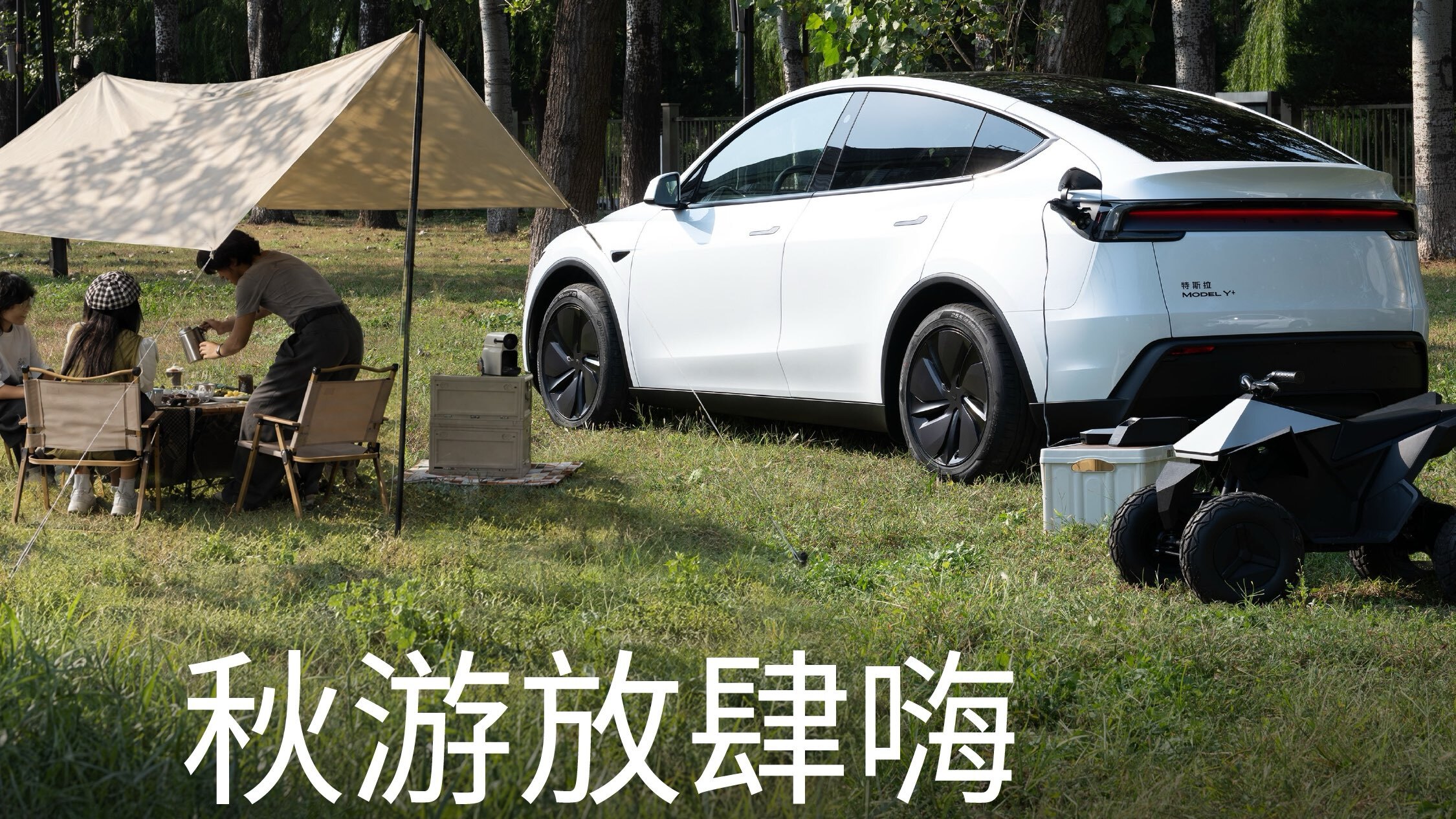
One new feature not available until now on the 3 in any Tesla market is V2L vehicle-to-load capability, though the Model Y and Cybertruck do offer it in the US. One of multiple promotional slides on Tesla’s Weibo account confirmed that all Model 3 and Model Y variants are now capable of delivering up to 2.2 kW of AC power.
That output is enough to run a portable rice cooker, a kettle and another cooking device at the same time, Tesla claims, though the small print says you’ll need a special Tesla AC external power adapter for most cars, which is sold separately. The exception is the Model Y L. The three-row SUV is ready to juice up your camping accessories right out of the box, no adapter required.
And if some useful new tech isn’t enough to lure Chinese EV buyers into their local Tesla showroom, some big financial incentives might be. Stick an order in for a Model 3 by the end of October and you get 5000 yuan ($740) from the total bill. Other sweeteners include 5 years of zero percent financing and credits towards paint upgrades and charging costs.
The German brand wants to capitalize on demand for its SUVs in the US.
An X8 could serve as the perfect flagship SUV for the BMW brand.
BMW has also confirmed a high-volume EV will launch in Europe in 2028.
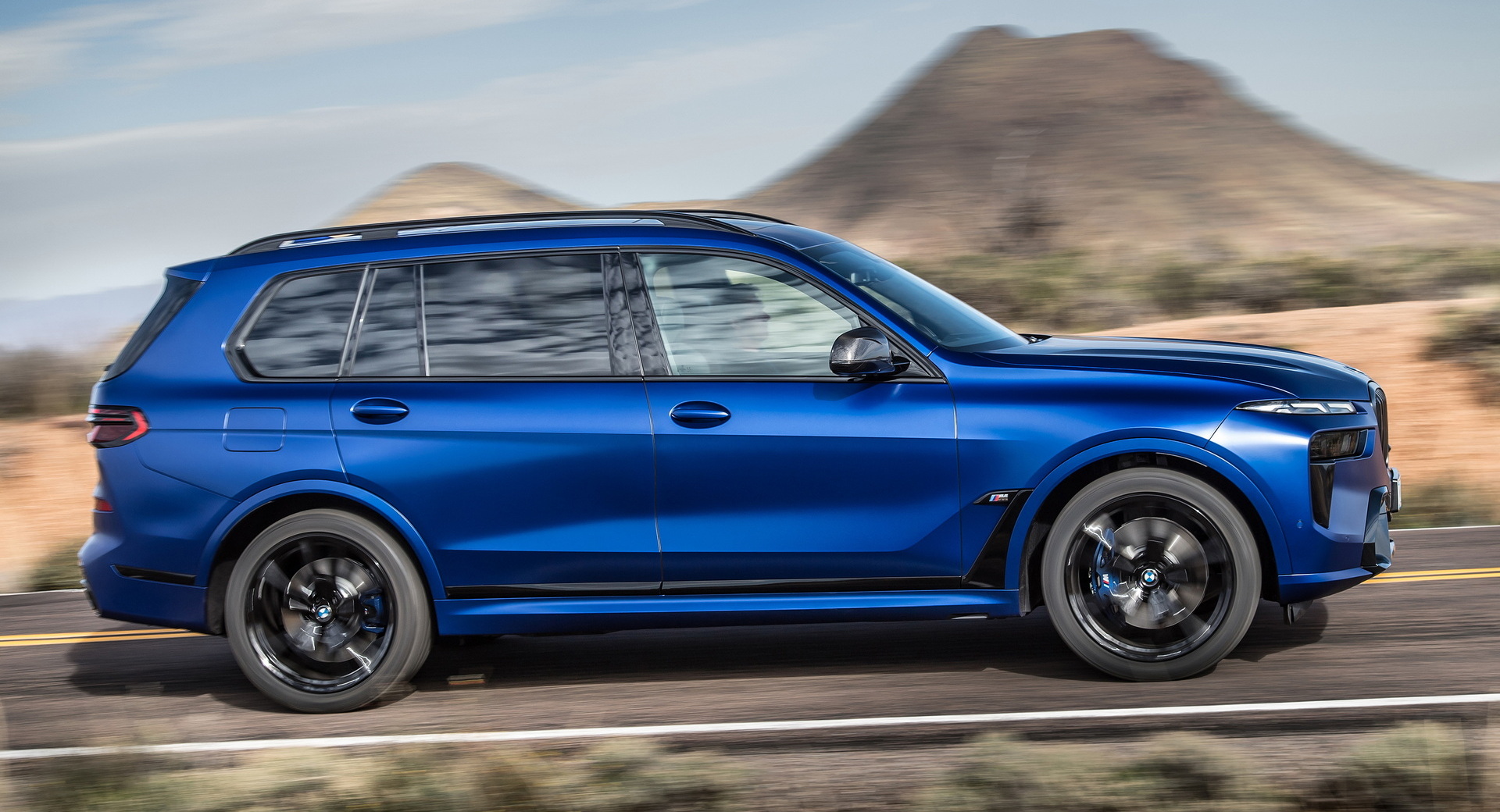
BMW sold a record 388,897 vehicles in the United States last year, a solid 4.7 percent increase from the previous year and the third consecutive record year. Not willing to rest on its laurels and bathe in the glory of its sales success, BMW has confirmed it’s considering launching a new flagship model.
As part of a company-wide update issued this week, BMW announced it is “considering” a new model to sit above the X7 in its line-up of SUVs, or as BMW calls them, Sports Activity Vehicles (SAV).
BMW provided precious few details about this model, other than stating it will “be closely tailored to the needs of the US market.” Presumably that means an X8, a vehicle which has been talked about for almost a decade, but has so far yet to see the light of day.
Earlier this year, Audi finally launched the Q9, its long-awaited rival to the BMW X7 and Mercedes-Benz GLS. While it now seems possible BMW may release a model even larger than its X7 and punching beyond the Q9, the press release doesn’t specifically state this will be the case, simply noting the new model could sit “above the current top-end model, the BMW X7,” without expressly stating it will be larger. That leaves a lot open to interpretation, including the possibility of perhaps a BMW X7 Coupe, or simply a more luxurious and exclusive variant, perhaps akin to the Mercedes-Maybach GLS.
BMW says it’s considering the new model because of strong demand for its existing SUVs. It says Plant Spartanburg in North Carolina is already operating at full capacity, and the brand is looking for ways to grow global production.
A New Alpina And A New EV For Europe
A new flagship SUV isn’t the only thing that BMW is working on. In the same announcement, it revealed a new streamlined portfolio plan for China with features that local customers are calling for. By 2030, BMW says it wants 95 percent of the vehicles it sells in China to be built locally.
The first all-new model from the Alpina brand since the BMW takeover is set to launch in the coming year. Few details have been confirmed, other than the fact that it will be based on the 7-Series and designed to slot between regular BMW models and those from Rolls-Royce.
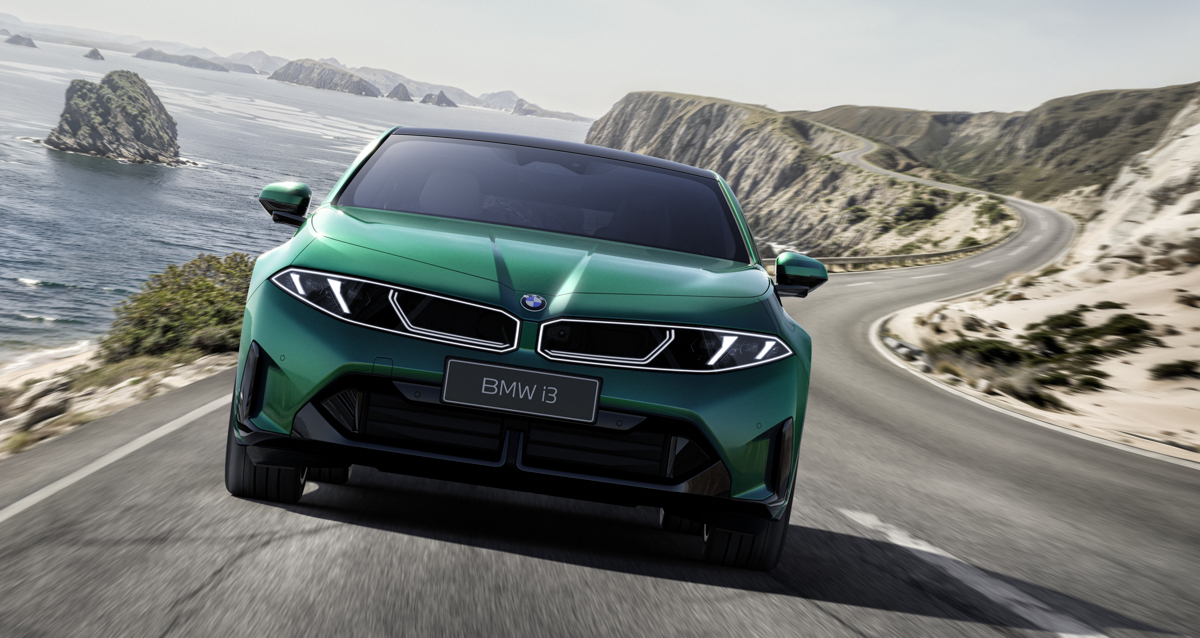
Europe is also going to receive an all-new EV. This model, set to arrive in 2028 and competing in the high-volume entry segment, will serve as the latest model in BMW’s Neue Klasse family, using many of the same technologies as the others. BMW also says that the 2-Series Active Tourer will be phased out and will not be replaced.
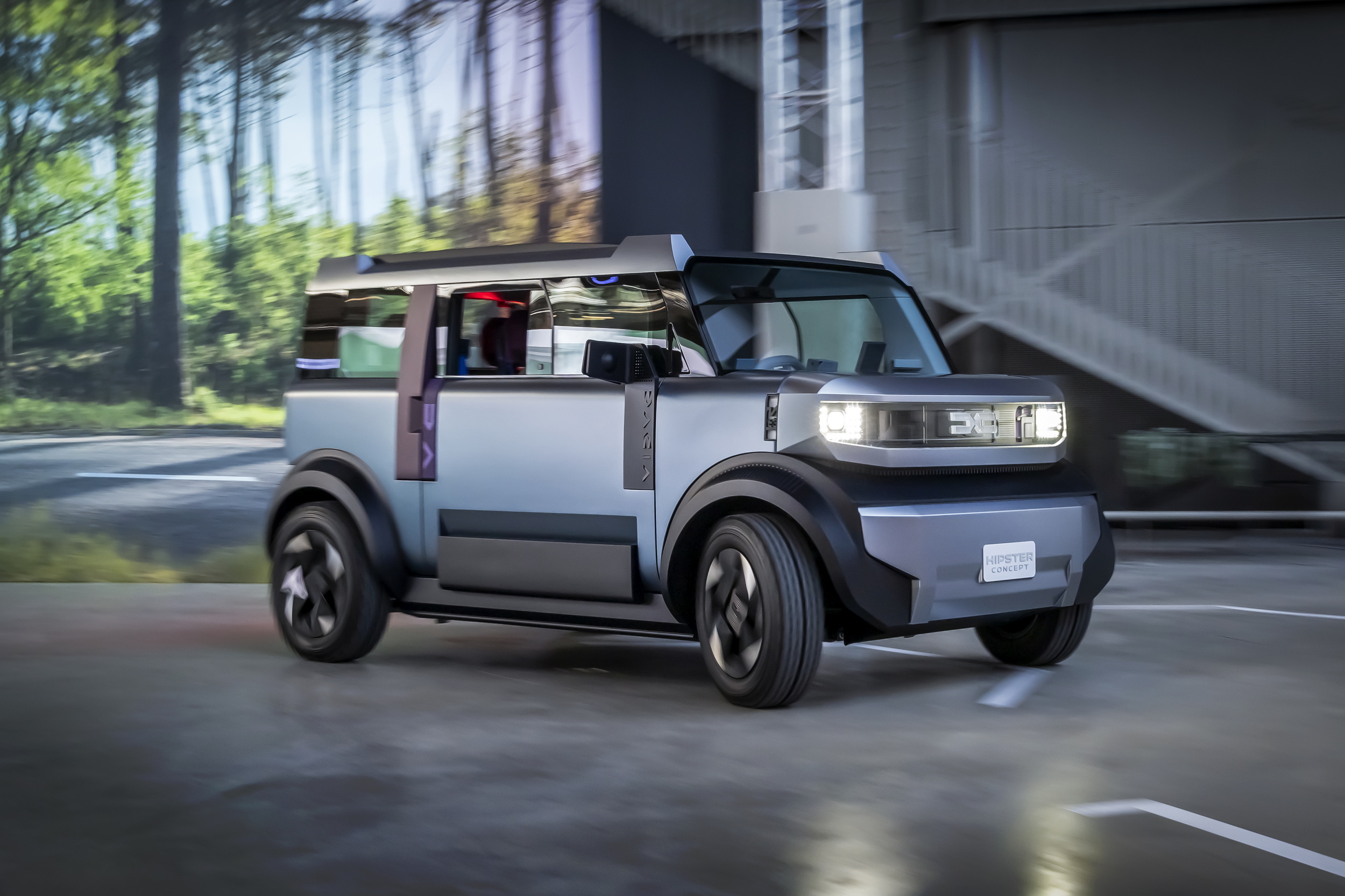
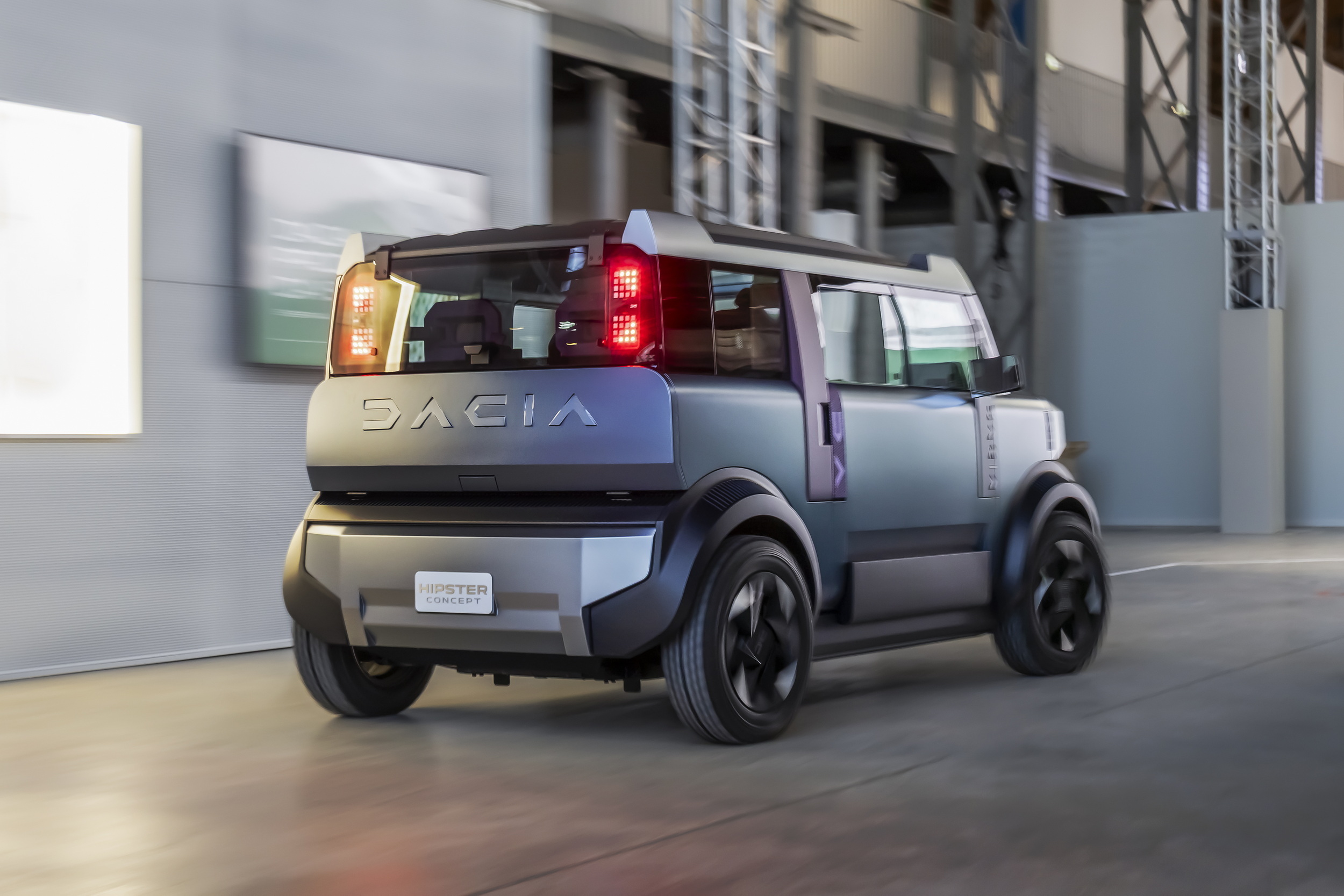
The Dacia Hipster will comply with L7e quadricycle regulations in Europe.
Patent images suggest the production model will look just like the concept.
The same Chinese plant that built the old Dacia Spring will handle production.
Dacia already sells an eclectic mix of vehicles, and soon, it will add perhaps its most striking and intriguing vehicle to date. Starting next year, Dacia is expected to start manufacturing a production version of its wild Hipster concept in China.
This new model, which could be priced in Europe at less than €11,500, or under $13,000 at current exchange rates, will slot below the all-new Spring in Dacia’s line-up. The same Chinese facility that built the previous-generation Spring will handle production of the Hipster. As for the new Spring, it will be built in Slovenia.
Dacia unveiled the dramatic Hipster concept 12 months ago. It is incredibly basic and extremely compact, measuring just 118.1 inches (3 meters) long, standing 60.6 inches (1.54 meters) tall, and just 61 inches (1.55 meters) wide. It’s not just the concept’s compact footprint that turns heads, but also its blocky exterior design and the small areas of color, contrasting with the matte grey paint found across most of the Hipster’s body.
Small And Light
The Hipster has been designed to comply with L7e quadricycle regulations in Europe and, as such, it cannot weigh more than 992 lbs (450 kg), excluding the battery, putting into perspective just how compact it is. A final decision on the Hipster’s battery and its chemistry is still pending, but it will reportedly be around 15 kWh.
Autocar understands the Shiyan, China, plant that built the old Spring has been sitting idle since July. Beyond the Hipster’s production being penciled in for this site, engineers at the plant will also aid in the development of the new EV.
Patent images Autoweek uncovered earlier this year show the production version will look almost identical to the concept. Changes include a slightly simpler front bumper and grille, as well as a tiny windshield wiper not featured on the concept. The doors are also slightly different, and there’s a small horizontal bar running across the side windows. Tweaks have also been made to the shape of the rear window, tailgate, and bumper.
China automakers will set up Mexico factories within three years, Nissan America’s Chairman predicts.
Christian Meunier says Nissan is cutting costs, plans to send China-built cars to Mexico to meet the push.
China brands will sell in US eventually, but not for at least five years, Meunier suggested to Auto News.
America rolled out the red carpet for China president Xi Jinping last week, though Chinese cars on US roads remains a firm red line. But a senior Nissan executive is warning that Chinese automakers will start building cars on the continent in as little as two years despite US senators’ determination to keep them at bay.
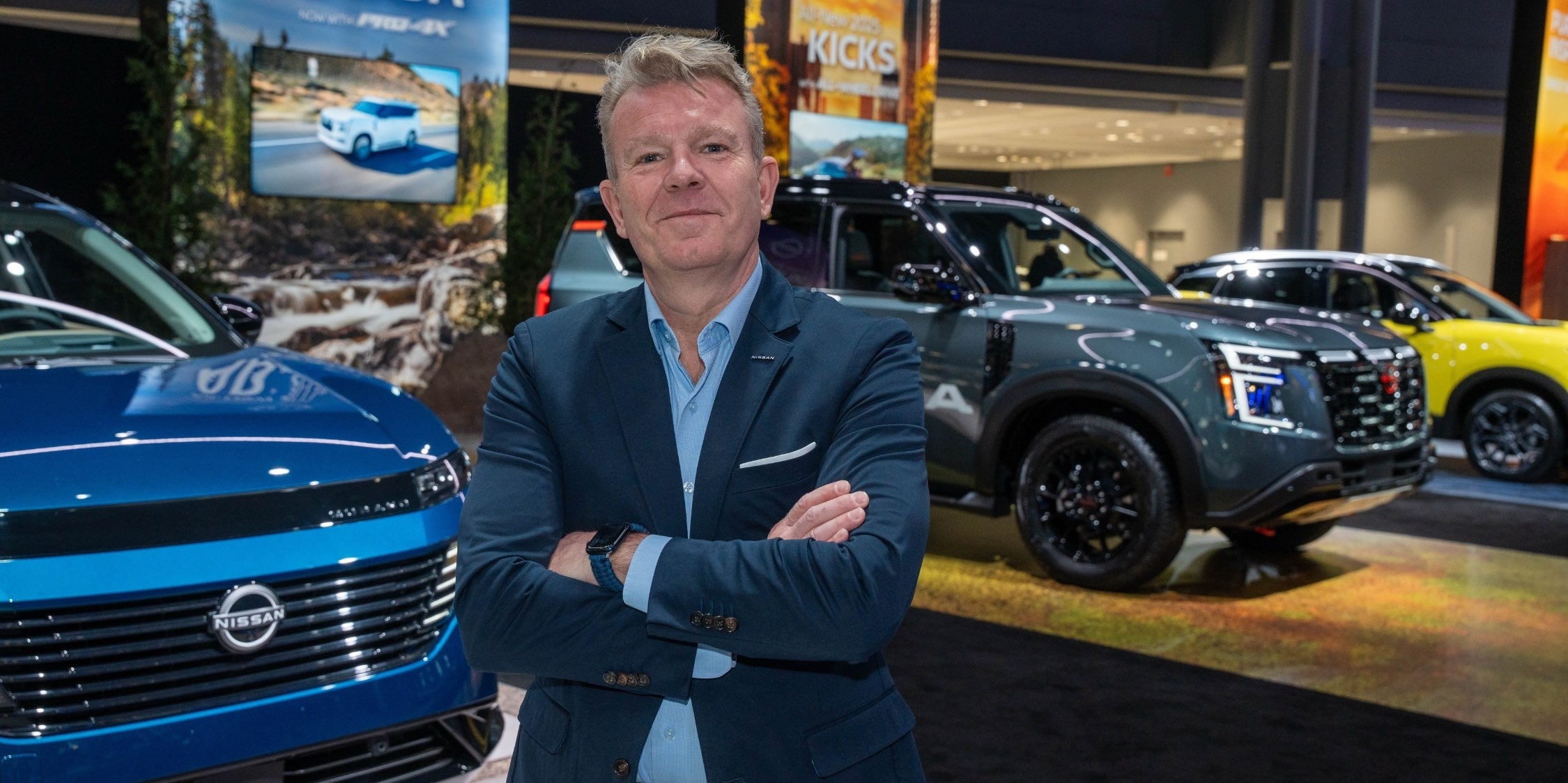
Nissan America’s Chairman Christian Meunier predicts that Chinese automakers will be building cars in Mexico, just hours from the US border, within three years.
“We have a very aggressive plan in Mexico, especially to get the cost down for us to be able to compete with the Chinese when they get localized,” Meunier told guests at Nissan’s HQ in Yokohama, Japan. “It will happen probably in the next two to three years, so we need to be ready,” Auto News reports him saying.
Like Bill Ford and Ford’s CEO, Jim Farley, Meunier is convinced that Chinese brands will eventually find their way onto US streets. He thinks that won’t happen for at least five years though, which gives existing US brands a little time to prepare for a battle on home turf.
Build Local To Escape Tariffs
But most of those brands also operate south of the border, where Chinese cars are already sold, albeit hampered by a 50 percent tariff. The Mexican market is going to be even tougher once cars are built locally, and prices are pushed even lower without tariffs in place. Legacy brands are going to have to push theirs down to compete.
“Cost competitiveness is going to be the rule of the game in the next five years,” Meunier said, claiming that Western and Japanese brands haven’t worked hard enough in recent years to reduce costs. He described Nissan’s current supply and cost setup as being “not good enough to compete head to head with the BYDs of this world.”
Fight Fire With Fire
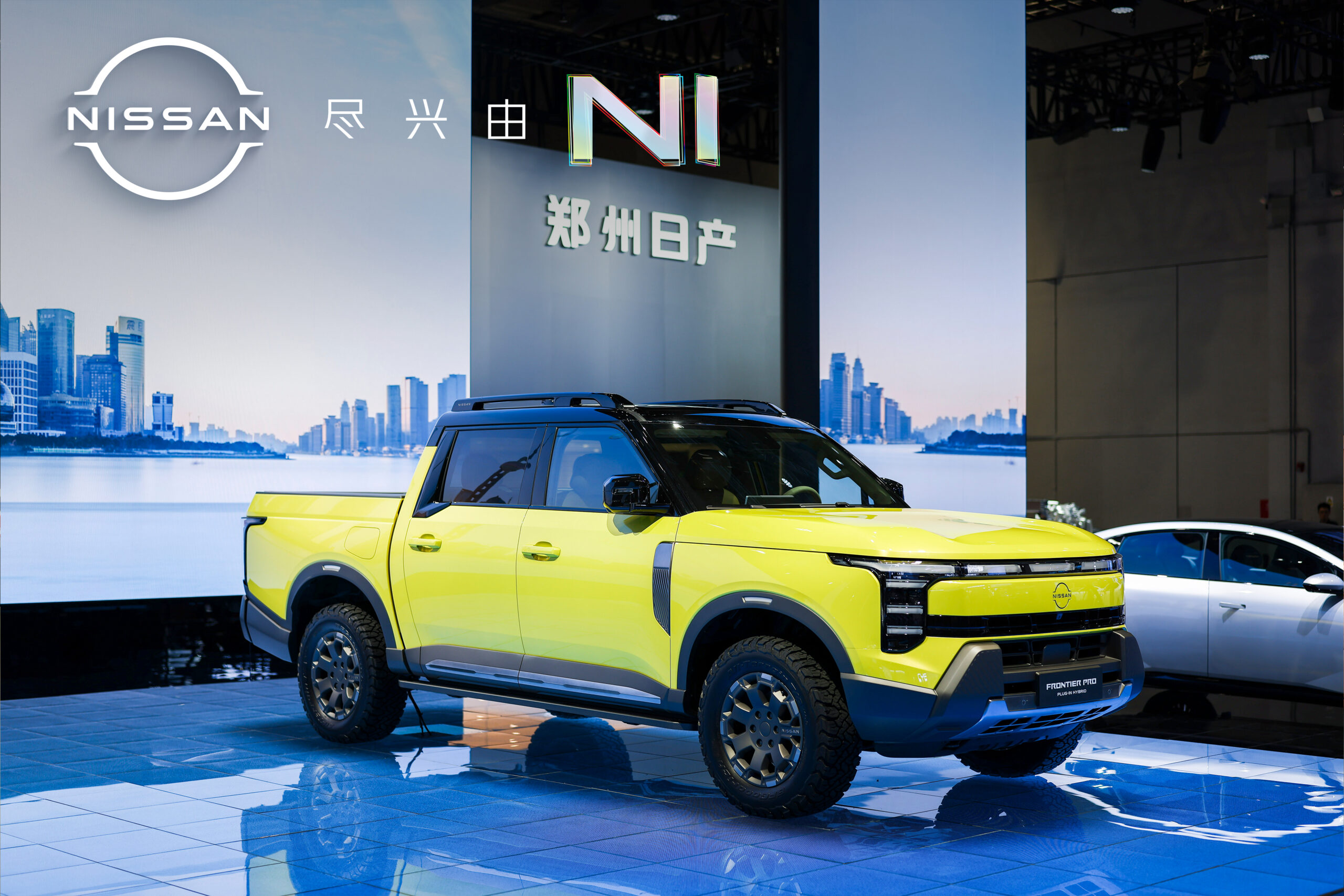
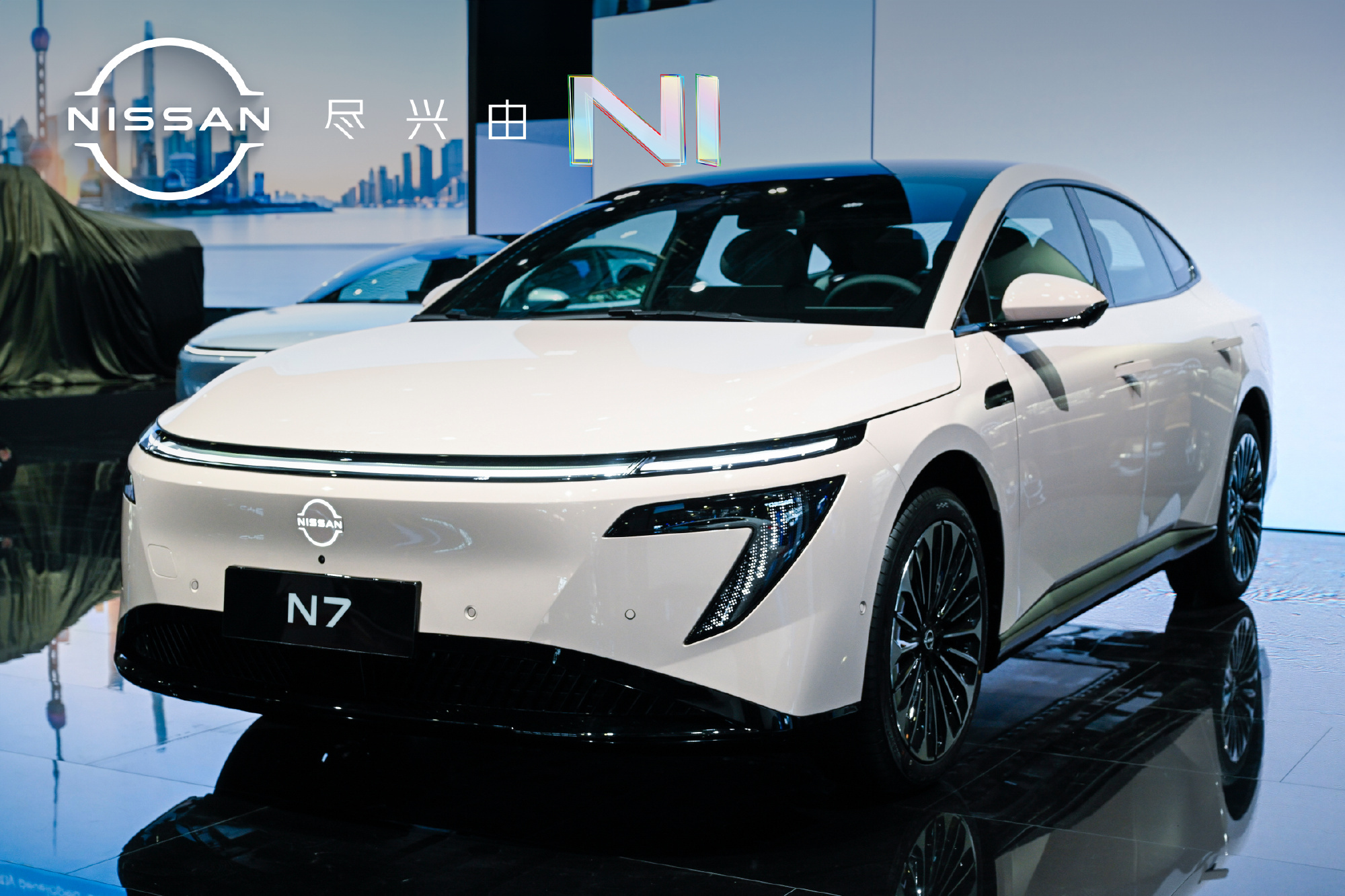
But Meunier says Nissan has another weapon in its arsenal besides simply trimming fat, one that will help it keep pace with the Chinese. It plans to give China’s automakers a taste of their own medicine by selling China-built models in Mexico. The Frontier Pro pickup (above) is now being launched in the country, and availability will expand to Latin America this year, Auto News reports. The N7 electric sedan (bottom pic) will also soon land in the region from China to tap into a boom in EV sales.
“We’re taking advantage of the opportunity to have a Chinese developed product compete with Chinese manufacturers in Latin America, because it’s clearly a big, fast invasion that is happening,” Meunier said.
Europe Shows What Could Happen
Meunier’s warning comes less than two weeks after Hyundai CEO Jose Munoz raised the alarm over the prospect of Chinese cars disrupting the US market. Munoz said that without safeguards in place, the US could end up like the UK or Europe, where one in every 10 cars sold is Chinese, a share that is only growing.
Big tariffs on Chinese cars currently keep them out of the US, but senators are currently trying to introduce legislation to permanently ban them. At the same time, President Trump has said he is open to the idea of Chinese brands opening car plants inside US borders.
Mazda has introduced an updated EZ-60 in China, one year after its launch.
The SUV gains a LiDAR sensor and more advanced autonomous capabilities.
It retains the EV and EREV powertrain options, starting at ¥113,900 ($17,000).
The Mazda EZ-60 – known as the CX-6e in export markets – has been on sale in China for only one year, but that didn’t stop the Changan Mazda joint venture from giving it an early technological update. The SUV, which is available with range-extender and fully electric powertrains, gains upgraded sensors enabling more advanced semi-autonomous capabilities.
The highlight of the refreshed EZ-60 is the addition of a roof-mounted LiDAR. This is combined with three millimeter-wave radars, 12 ultrasonic sensors, and 11 high-definition cameras, continuously monitoring the surrounding environment. The impressive setup allows Navigation-on-Autopilot (NOA) driving on highways when travelling at speeds of up to 130 km/h (81 mph), and in urban traffic at speeds of up to 80 km/h (50 mph).
According to Mazda, the model can now handle roundabouts and highway ramps, perform automated lane changes, U-turns, and features autonomous parking with upgraded memory. The systems are classified as Level 2+ and have been tested in hazardous scenarios including nighttime driving under heavy rain conditions and navigating narrow mountain passes with tree branches encroaching into the travel lane.
Changan Mazda / Weibo
Setting aside the LiDAR pod on the roof on certain trims, the exterior design of the 4,850 mm (190.9 in) long SUV remains unchanged.
The same applies to the interior with the carry-over 26.45-inch infotainment display stretching on the passenger side of the dashboard and nine airbags fitted as standard. High-spec trims are equipped with a 50-inch augmented reality head-up display (optionally upgraded to 100-inch projection), and dual front zero-gravity seats with eight-point massage function that can recline by 120 degrees transforming into beds.
Changan Mazda / Weibo
Under the skin, the EZ-60 retains Changan’s EPA1 architecture with carry-over EREV and BEV powertrain options. Both employ a rear-mounted electric motor producing 255 hp (190 kW / 258 PS). The BEV has a 77.94 kWh battery offering a CLTC range of up to 373 miles (600 km).
The EREV adds a 1.5-liter gasoline engine producing 97 hp (72 kW / 98 PS) which acts purely as a generator for the 31.73 kWh battery pack. This allows an alleged combined range of up to 808 miles (1,301 km) between charging and refueling stops.
Changan Mazda / Weibo
The 2027 Mazda EZ-60 is already available to order in China. Pricing starts at ¥113,900 ($17,000) for the base EREV 200 Air trim but the LiDAR-equipped range begins with the EREV 200 Pro LiDAR at ¥145,900 ($21,700) and tops out at ¥166,900 ($24,900) for the flagship EV 600 Max LiDAR.
It remains to be seen whether the aforementioned updates will find their way into the Mazda CX-6e in the near future. The model landed in the Old Continent and in Australia earlier this year, so Mazda might wait before introducing any new features to export markets.
YangWang’s new all-electric model will include coach doors like a Rolls-Royce.
It’s possible the new sedan will be BYD’s first car with solid-state batteries.
The model features advanced LiDAR sensor and BYD’s latest autonomous driving system.
BYD’s luxury-focused Yangwang brand is about to welcome a new model, and it’s poised to push the brand even further upmarket. Evidently, BYD is no longer satisfied with taking over the mass market, snatching sales from legacy rivals like Toyota, Honda, Mazda, Ford, and others, but it now also wants to convince Rolls-Royce, Bentley, and Mercedes-Maybach shoppers to buy Chinese.
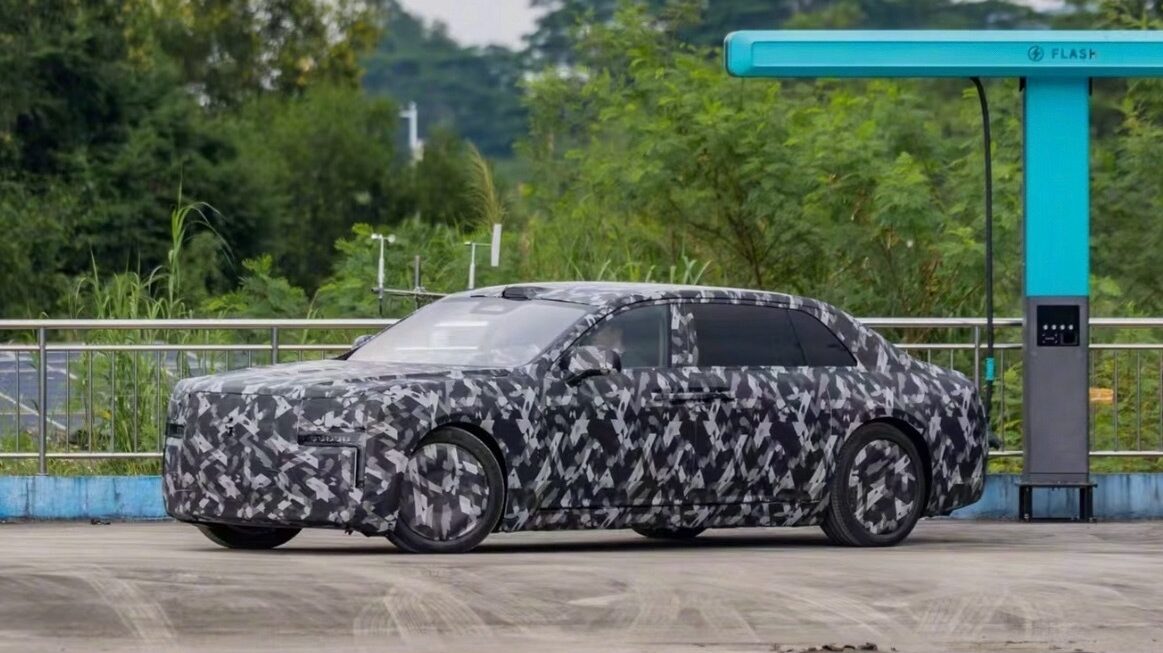
The new uber-luxury sedan has been previewed through images of a heavily disguised prototype at a mystery testing facility. Much like a Rolls-Royce Phantom, the new YangWang model is big and imposing, giving it an air of exclusivity most Chinese car manufacturers have so far failed to achieve.
Despite the camouflage, we can see the front end will feature a large upright grille and headlights similar in shape to YangWang’s current U8 SUV. Set within these headlights are cubed-shaped crystals, hinting at just how serious the brand is about making this sedan feel special, even by European standards.
Viewed from the side, the car’s wheelbase appears absolutely massive, although it’s hard to say if it’ll be as long as the extended-wheelbase Rolls-Royce Phantom. Nevertheless, we can see it rocks one obvious Rolls-Royce-inspired feature, namely coach doors at the rear. It also features large windows behind the C-pillars, suggesting it will focus heavily on maximizing comfort and luxury in the second row.
The new YangWang also rocks a LiDAR sensor above the windshield and is expected to use the company’s advanced DiPilot 600 semi-autonomous driving system.
Unlike a Rolls-Royce Phantom, YangWang’s next luxury sedan is tipped to be sold exclusively as an EV. According to CarNewsChina, it could be one of the most advanced EVs on the market, potentially launching as BYD’s first model with solid-state batteries.
In September, BYD executive vice president Stella Li confirmed the brand would launch its first solid-state-battery-powered EV in 2027. Given that the technology has yet to be commercialized at scale and will therefore be quite expensive, debuting it in a flagship luxury model like this one makes perfect sense.
Geely’s Smart Charging provides peak speeds of up to 2,250 kW.
New charging technology works alongside in-house AI tech.
System can predict battery temperatures and adjust charging speeds.
Chinese automotive giant BYD put the electric vehicle market on notice earlier this year by unveiling its Flash Charging technology, featuring peak charging speeds of up to 1,500 kW. Not willing to be outdone by its fiercest competitor, Geely Auto Group has unveiled its answer, the Geely Smart Charging.
The new technology, which combines an advanced AI model co-developed by Geely and StepFun with the fifth-generation Geely Smart Charging Station, delivers peak charging speeds of up to 2,250 kW. According to Geely, tests of the Lynk & Co 01 and Zeekr 001 show the cars can charge from 10-70% in just four minutes and 30 seconds, as well as from 10-97% in eight minutes and 40 seconds.
These numbers conveniently eclipse those promised by BYD’s Flash Charging 1,500-kW system, which claims a charge from 10-70% in five minutes and a 10-97% charge in nine minutes.
AI Keeps Temperatures Down
As you can imagine, pumping energy into a battery pack at such an extraordinary pace has its challenges, which is where artificial intelligence comes into play. Geely claims its system uses advanced algorithms to anticipate battery temperatures ahead of time. As such, the charging rate can be instantly adjusted as needed. Geely says the AI aims to keep the battery temperature during charging steady at below 55°C (131°F).
In addition to their advanced ultra-quick charging solution, Geely has presented the latest-generation Ultra Short Blade Battery, which it says can cut charging temperatures by 10 percent.
Although Geely Smart Charging may have beaten BYD when it comes to outright power, it has a lot of catching up to do elsewhere. In the six months since BYD unveiled its Flash Charging tech, they have already installed more than 10,000 stations across China. By the end of this year, BYD aims to have 20,000 stations in operation across its home country and is committed to expanding internationally to establish 6,000 by April next year. Target locations include Europe, the United Kingdom, the Middle East, Africa, Canada, Australia, and New Zealand.
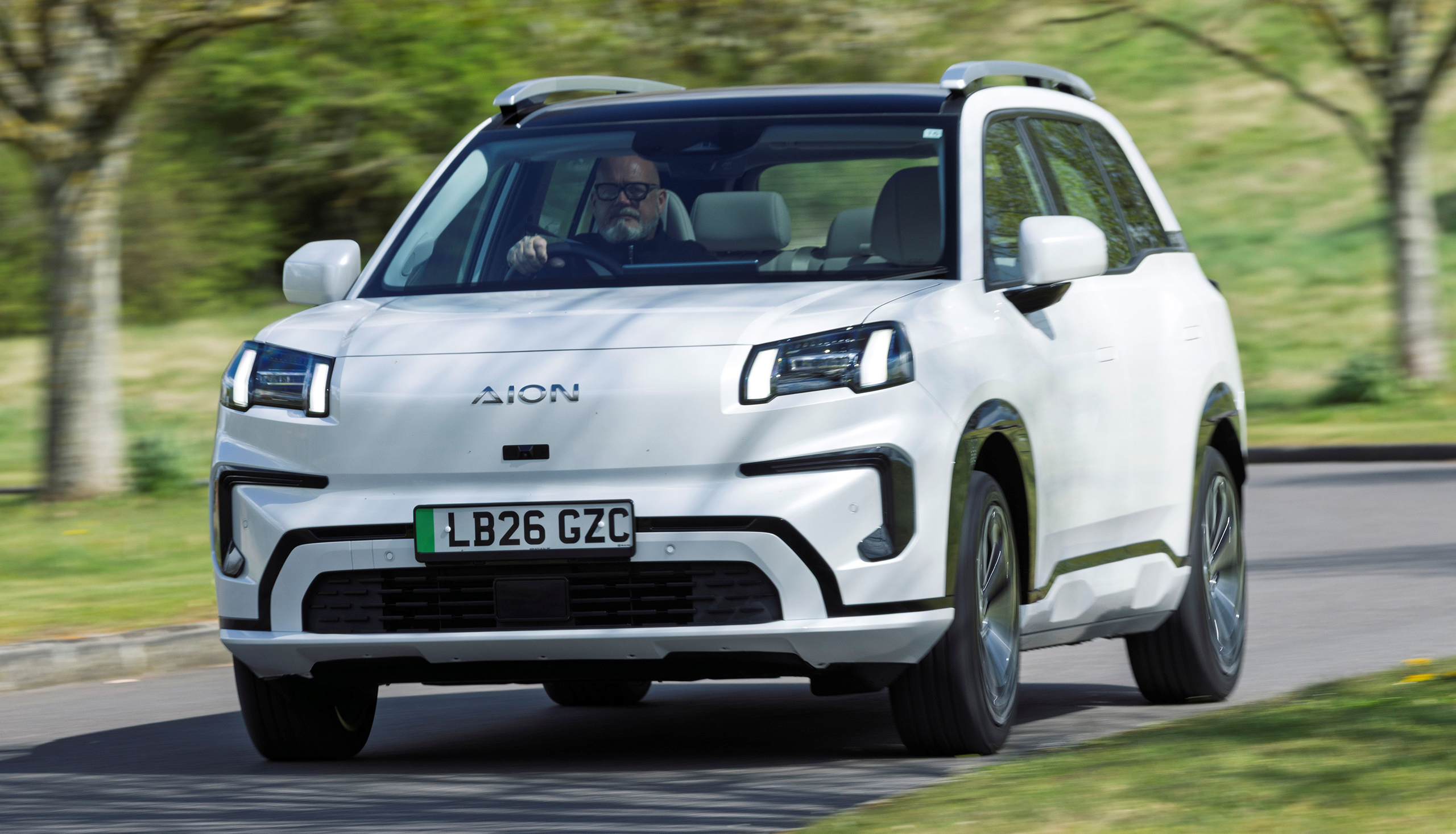
GAC has just introduced its Aion V and Aion UT to France.
The company will expand its lineup, offering French comsumers 12 new cars by 2030.
To support this, GAC is actively looking at expanding their European production capacity.
China’s state-owned GAC (Guangzhou Automobile Group) has announced ambitious plans to expand its presence in Europe, which includes offering 12 new models in France before the decade is out. To do so, Cedric Lacour, GAC France Deputy CEO, revealed that the company is looking at ramping up European production capacity.
GAC is already present in Europe, with the company’s cars being available in the UK, Finland, Greece, Poland, Spain and Portugal. Currently GAC produces the Aion V and Aion UT in knock-down form at the Magna Steyr plant in Graz, Austria.
Knock-down assembly means that, although manufacturing of the car’s components continues in China, the parts and assemblies are shipped before final assembly in Europe. The decision to move assembly of the V crossover-SUV and UT hatchback was seen as a way of side-stepping existing EU tariffs on Chinese vehicles, with Xpeng, another Chinese manufacturer, also employing the expertise of Magna for its G6 and G9 models.
Now, GAC is looking at adding to its European capacity. According to Lacour, those plans may include Magna Steyr or other investors completely. “We really want to establish a long-term presence here (in Europe), which automatically means we need production capacity,” said Lacour, speaking to Reuters.
12 New Models By 2030
Brad Anderson/Carscoops
GAC’s ambitions go beyond just ramping up European manufacturing. At the French launch of the all-electric Aion UT and Aion V, Lacour revealed that the two new introductions are just the tip of the iceberg. By 2030, the brand intends to have 12 electric and hybrid offerings for the French market.
In addition to manufacturing, GAC also has a dedicated European research and development center, situated in Milan. In the first half of this year, GAC reported that export sales recorded a 35.69 percent increase, year-on-year, with 346,000 units sold. While the growth was mainly fueled by strong performances the Americas and Southeast Asia, the brand also ranked second amongst Chinese EV brands in Greece.
French Ambitions
In a bid to ramp up its French presence, the automaker also plans to have 200 dealerships across France in the next four years, with 50 planned for this year alone. However, GAC trails some of its competitors. For context, BYD, established their French footprint back in 2024, and, according to Automobile Magazine, aims to have 250 outlets by the end of next year,
But when asked whether GAC was late to the party, Lacour disputed that. “Our goal is to take a brand from launch to scaling up in just four years.” He went on to say that the brand was entering the market “at just the right time.”
Xpeng already supplies its advanced technologies to Volkswagen in China.
Systems from the car manufacturer could also be used by robotaxis.
The first EV co-developed by VW and Xpeng was launched after just 24 months.
Not satisfied with simply producing a slew of impressive new-energy vehicles in China, Xpeng wants to see foreign automakers use its advanced technologies, serving as an important new revenue stream for the company.
Xpeng already works closely with Volkswagen in China, collaborating on vehicle development and a joint architecture that is already starting to bear fruit. Moving forward, unnamed sources state Xpeng is eager to see other automakers, as well as automobile suppliers and foreign software developments use its electrical and electronic architecture, in addition to its cockpit systems, advanced-driver assistance software, and Turing AI chips.
While Xpeng is one of China’s most noteworthy electric vehicle startups established over the past couple of decades, the company is yet to reach profitability. Revenue from the sales of its vehicles remained relatively steady through the second quarter, while revenue from services and its other business ventures almost doubled, Reuters reports. It’s little wonder, then, why the company is eager to start offering its important new technologies to other firms.
It’s not just selling technologies that could help Xpeng become profitable. The company recently commenced small-scale production of its IRON humanoid robot this month and will begin mass production before the end of the year. According to Xpeng chief executive He Xiaopeng, class-leading humanoid robots may generate higher margins than the company’s vehicles.
In addition to Xpeng potentially licensing its technologies to car manufacturers and suppliers, it could also license tech to robotaxi and robotics firms.
VW started production of its first vehicle co-developed alongside Xpeng in March of this year. The ID. Unyx 08 looks vastly different than any VW sold in the West and is underpinned by an 800-volt electrical architecture available with 85 kWh and 92 kWh battery packs. Rather than using VW’s own driver-assistance system, it instead uses Xpeng’s Level 2 system.
Volvo’s new product offensive includes 13 new model launches in 4 years.
Seven models will reach Western markets, and six will be reserved for China.
Lineup to include hybrid and EV powertrains across different bodystyles.
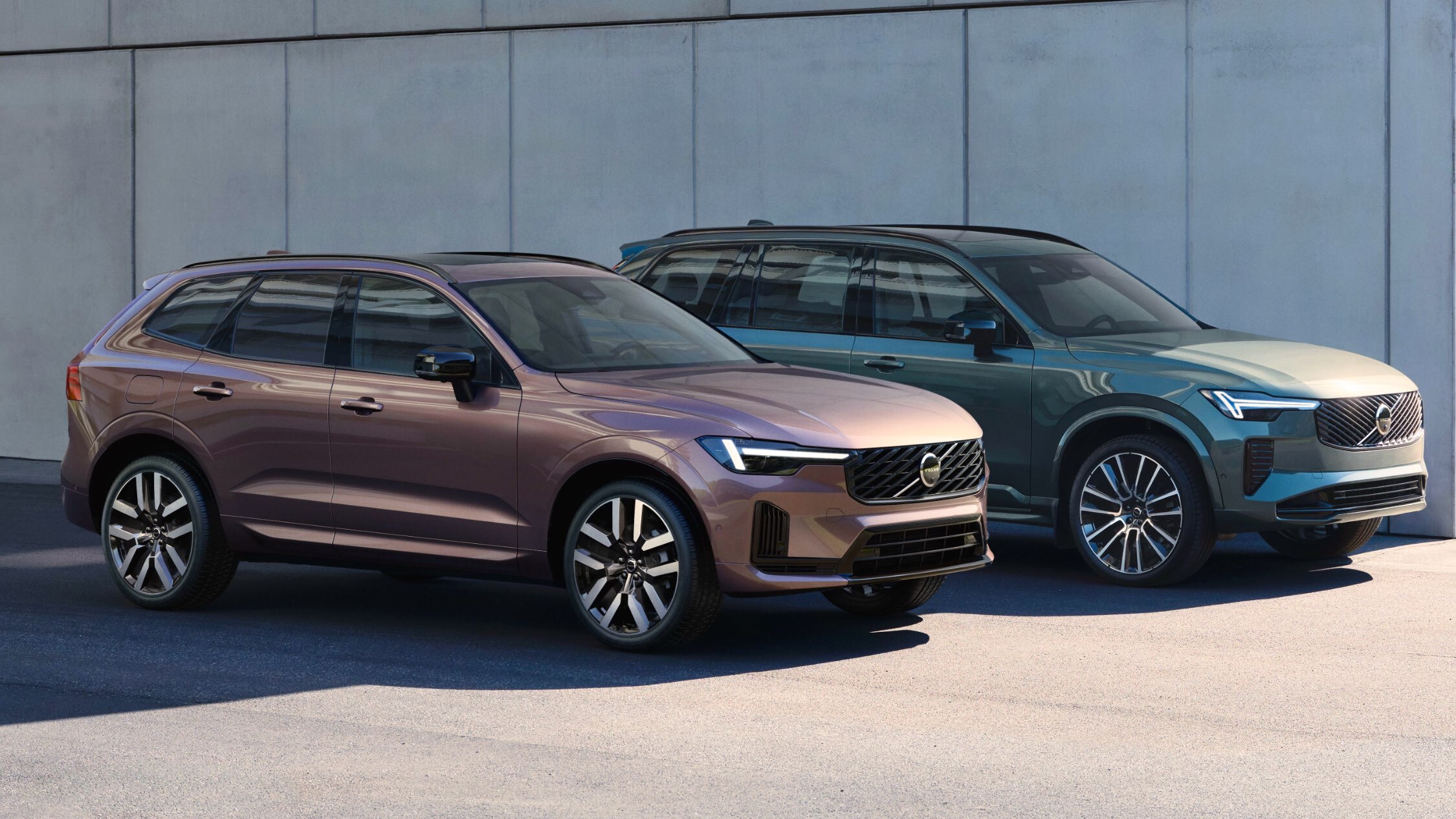
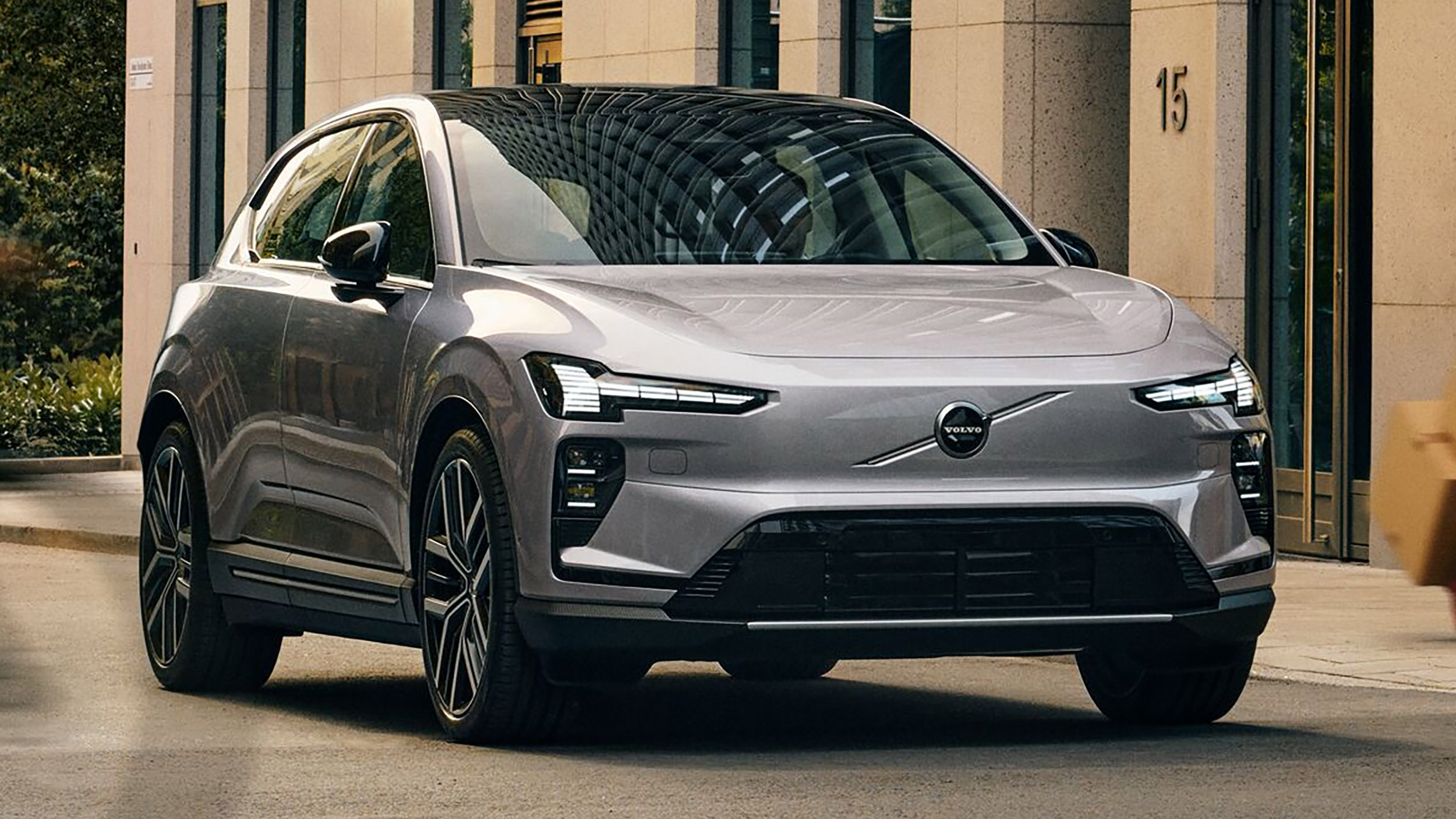
Volvo has presented what it calls “the largest and most ambitious global product push in its 99-year history”, in an effort to improve profitability and double its market share. The automaker will launch 13 new models by the end of 2030, including hybrids and EVs.
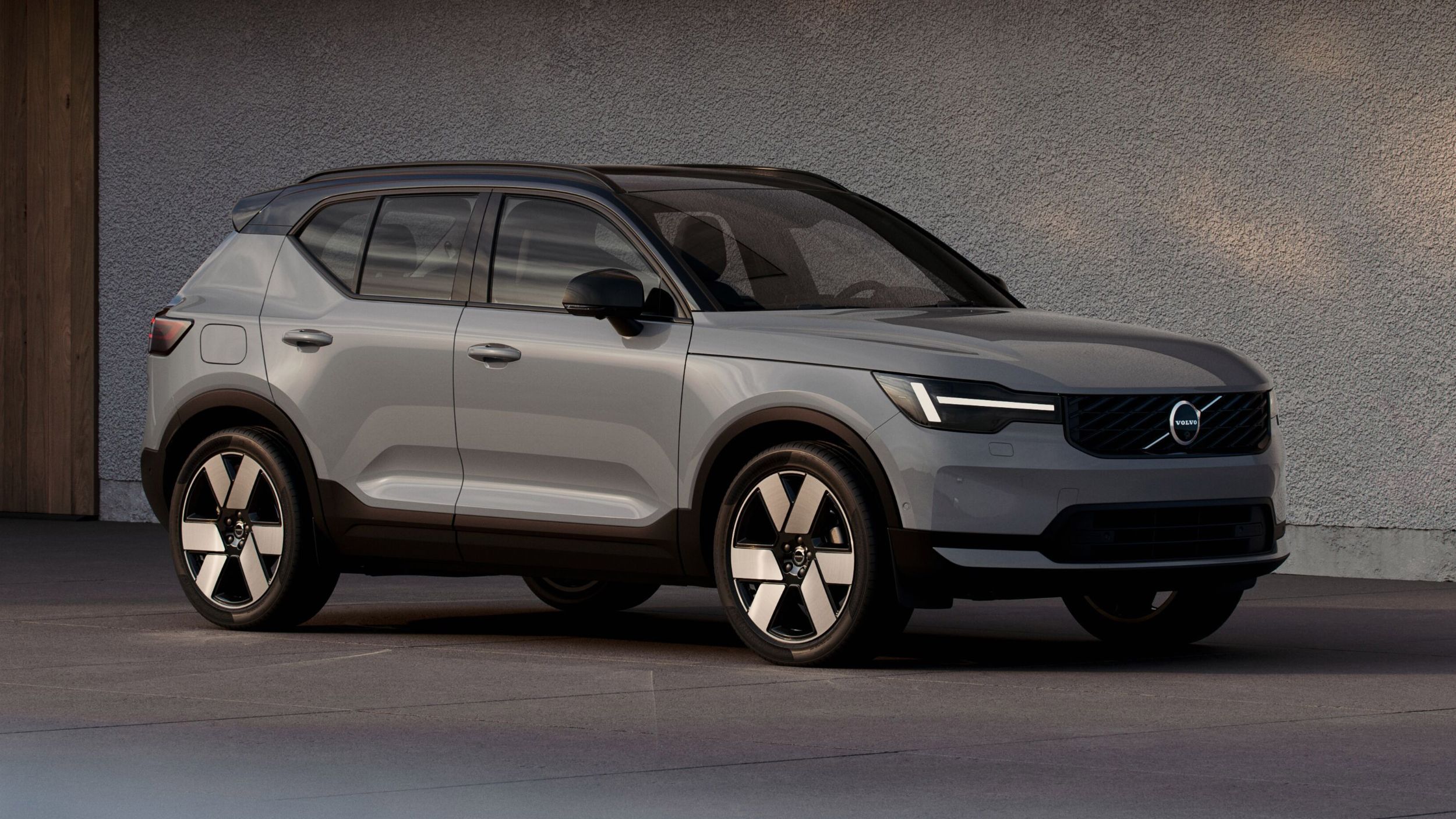
The announcement comes shortly after Volvo introduced updated versions of the XC40, EX40, EC40, and XC60, alongside a new plug-in hybrid powertrain for the XC60 and XC90 with up to 124 miles (200 km) of EV-only range.
Unlike the aforementioned extensive facelifts, the 13 announced models will be all-new. Seven are destined for Western markets including Europe and North America, while the other six will be heading to China.
More importantly, Volvo has confirmed that its future lineup will include cars in new segments, so expect a few surprises, and a potential return to wagons.
The company will preview an evolution of its styling language with a new concept car in 2027. This will be penned under the direction of Thomas Ingenlath, who returns as Volvo’s Chief Design Officer after a seven-year stint as the Polestar CEO.
The new models destined for Western markets will ride on the SPA2 (EX90, ES90) and SPA3 (EX60) architectures, using the HuginCore computing platform. The Chinese models will use shared platforms and a market-specific tech stack developed in collaboration with parent brand Geely. The goal is to increase component commonality across Geely Group vehicles from the current 10 percent to as much as 30 percent by 2030.
Hakan Samuelsson, Volvo president and CEO, said: “Our showrooms will look very different in 2030”, adding that they want to become “the leading premium car brand”. The CEO outlined the four pillars behind the new product offensive as “regionalized product offerings, leadership in electrification, unique synergies with Geely, and complete customer offers that goes beyond the car alone”.
Overall, Volvo wants to double its market share by introducing more EVs alongside third-generation hybrids for those not ready to make the switch. The company promised to treat its customers with regular over-the-air software updates, and make buying a new Volvo easier and more transparent with special offers and fast-delivery model variants.
GM is working alongside a Denver firm for energy storage system batteries.
Low-cost sodium-ion batteries will help GM establish a large local supply chain.
GM believes it can leapfrog some of the battery technologies in China.
Days after the Trump administration slammed Ford for cozying up to Chinese companies, including battery manufacturer CATL, crosstown rival General Motors says it’s working to ensure its next generation of battery cells are backed by a strong domestic supply chain, rather than one that relies on overseas sources.
A key area of GM’s local battery focus is on cells that’ll be used for energy storage systems, including data centers, other businesses, and homes. According to vice president of battery and sustainability at GM, Kurt Kelty, “We’re developing a supply chain such that, two years from now, three years from now, it will be domestic.”
A company spokesperson added to CNBC that GM will prioritize local production of battery cells for its forthcoming electric vehicles.
The federal government has criticized Ford for licensing battery technology from CATL, which it will use for energy storage systems. By comparison, GM is working with Denver firm Peak Energy on advanced sodium-ion battery cells for energy storage.
CNBC notes this deal will let GM reduce its reliance on China for materials including lithium and ferrous sulfate, instead sourcing materials more prevalent in the US, including sodium derived from soda ash. These new battery cells created with Peak Energy could be deployed as soon as 2029.
“It’s a really good story, because you’ve got the resources [in the U.S.] that you can keep it totally domestic,” Kelty said. “It’s going to take some time to build this industry up, but the potential for sodium-ion is just much greater than LFP.”
Kelty is so optimistic about the future of sodium-ion battery cells that he believes pursuing them can allow GM to leapfrog some of the most advanced battery technologies coming out of China.
Xiaomi brings its EVs to Europe next year, starting in Germany.
Sales will run through dealers, not Xiaomi’s own direct model.
A China EV tariff of up to 45.3 percent could bite hard.
After conquering its home market of China with several exciting EVs, Xiaomi will soon start selling its cars internationally. Things will kick off in Europe next year, including in Germany, with the signing of several memorandums of understanding with dealership groups to make it happen.
Xiaomi already operates a large research and development center in Munich, Germany, and will work alongside groups including LUEG Mobility GmbH, a Mercedes-Benz dealer, and Emil Frey Germany, one of the nation’s largest automotive dealership groups. Working with experienced partners will allow Xiaomi to hit the ground running with dealers that have already established trust with customers across Germany and have extensive experience in new-car sales.
In addition, working with dealerships rather than selling vehicles directly to consumers will give prospective buyers the chance to touch and feel Xiaomi products in the flesh before handing over any of their hard-earned cash.
Xiaomi’s models in Europe will be more expensive than the ones it sells in China. The EU imposes hefty tariffs on EVs imported from China, significantly increasing their prices. Xiaomi had yet to launch its first EV, the SU7 sedan, when the European Commission launched its investigation into Chinese EVs in 2023, and as a result, the technology company didn’t participate in the probe. As noted by the South China Morning Post, this means it could be hit with the highest possible duty of 45.3 percent.
Xiaomi’s Skynomad
Since it started selling vehicles, Xiaomi has delivered more than 700,000 units in China, a remarkable achievement given how new it is to this ultra-competitive industry. However, in China, Xiaomi is a well-established consumer product brand, often viewed as the ‘Apple of China.’ This gave it a huge competitive advantage over other new-vehicle brands as it’s already a trusted name.
Although Xiaomi products are also available in several overseas markets, they remain a relatively small player in regions like Europe and won’t be able to rely on familiarity to win over customers. Instead, it will need to convince shoppers with great features and competitive pricing, which is a tall task indeed, especially in the hotly contested markets of the Old Continent.
Lexus is gearing up to launch a next-gen EV in China.
Will use gigacasting to save weight and increase range.
Crossover could play a big role in growing Chinese sales.
After a slow start, Toyota and Lexus have significantly expanded their electric lineups. However, one of their most important models will reportedly go into production in the fall of 2027.
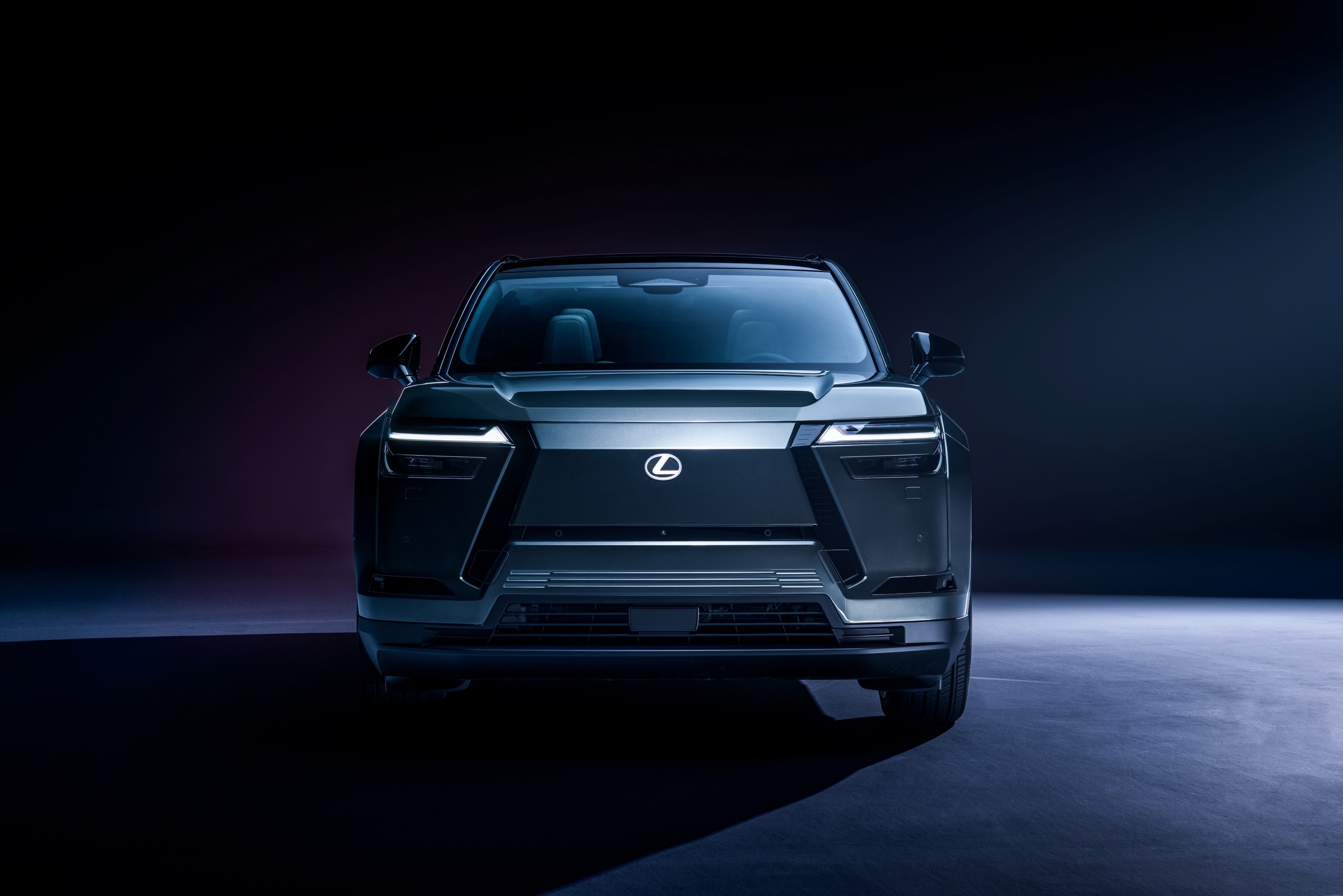
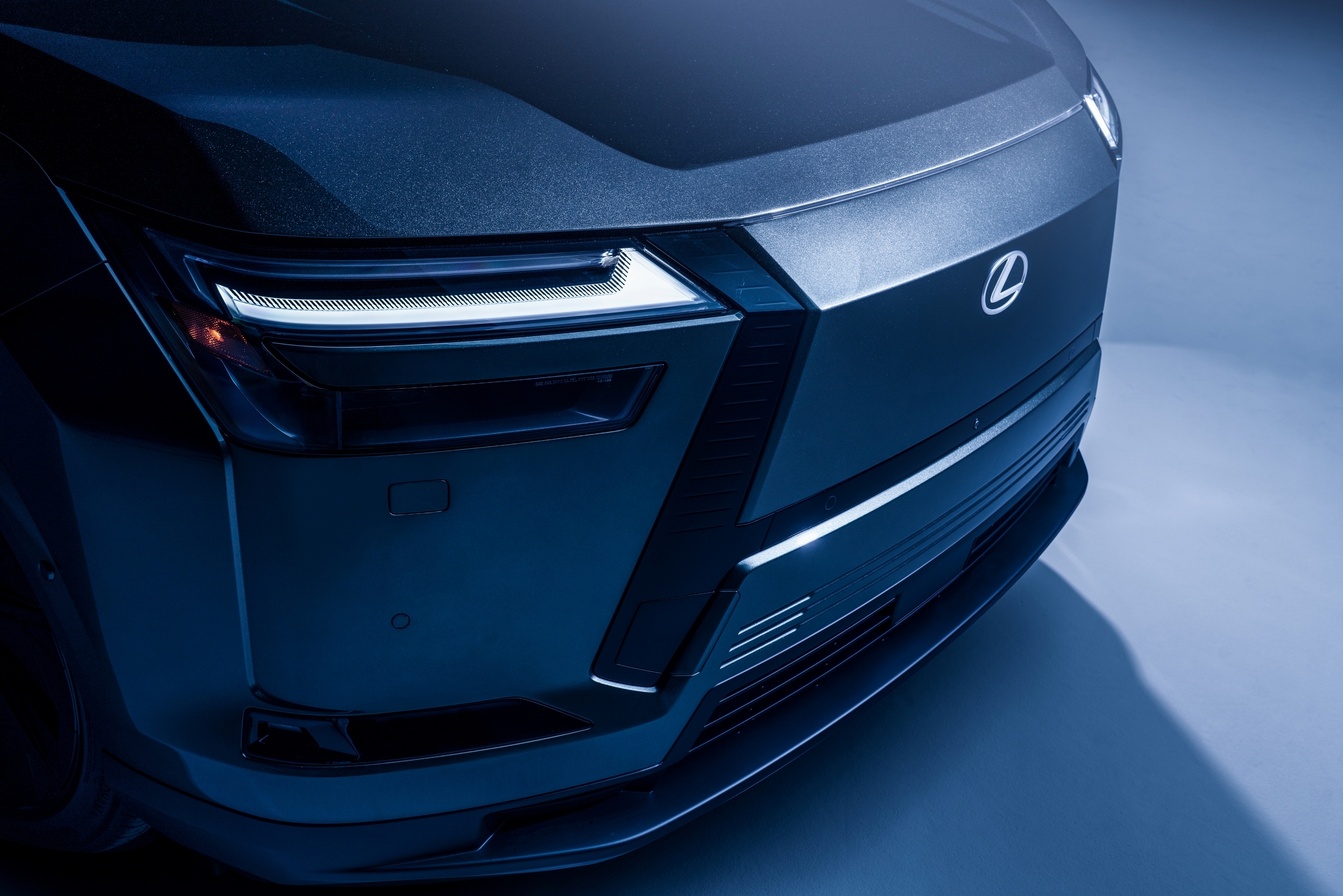
According to Nikkei Asia, Lexus will build a next-generation electric vehicle at a new plant in Shanghai. Little is known about the model at this point, but it’s reportedly a crossover that will be “made with leading-edge technology, including gigacasting to mold multiple aluminum body parts together as a single large piece.”
The use of gigacasting was pioneered by Tesla and has been slowly spreading across the auto industry. It will be used on the upcoming Ford Fathom and it promises significant weight savings. In the case of the Lexus EV, this could increase the crossover’s range by “several percent.”
While Toyota usually reserves its most advanced production techniques for Japan or the United States, the Lexus is being billed as the “rare exception.” Electric vehicles dominate in China and the company has struggled there as they only sold 182,458 vehicles in 2025. For comparison, the luxury brand moved 370,260 units in the United States that same year.
Lexus is reportedly planning to build around 1,000 units per month in the model’s first year. However, production is slated to ramp up to “tens of thousands” of units annually.
The model appears to be a Chinese-exclusive, which would be a bit of a change for the automaker. A quick look at the company’s current lineup reveals an assortment of familiar models including the NX, RX, GX, and LX. They’re joined by the ES, LS, LM, and RZ. The latter is the brand’s sole electric vehicle in a market that practically demands them.
The Yangwang U7 makes 1,287 hp from motors on both axles.
BYD says the test car was pulled at random from a showroom floor.
Daily temperatures during the run topped 97 degrees Fahrenheit.
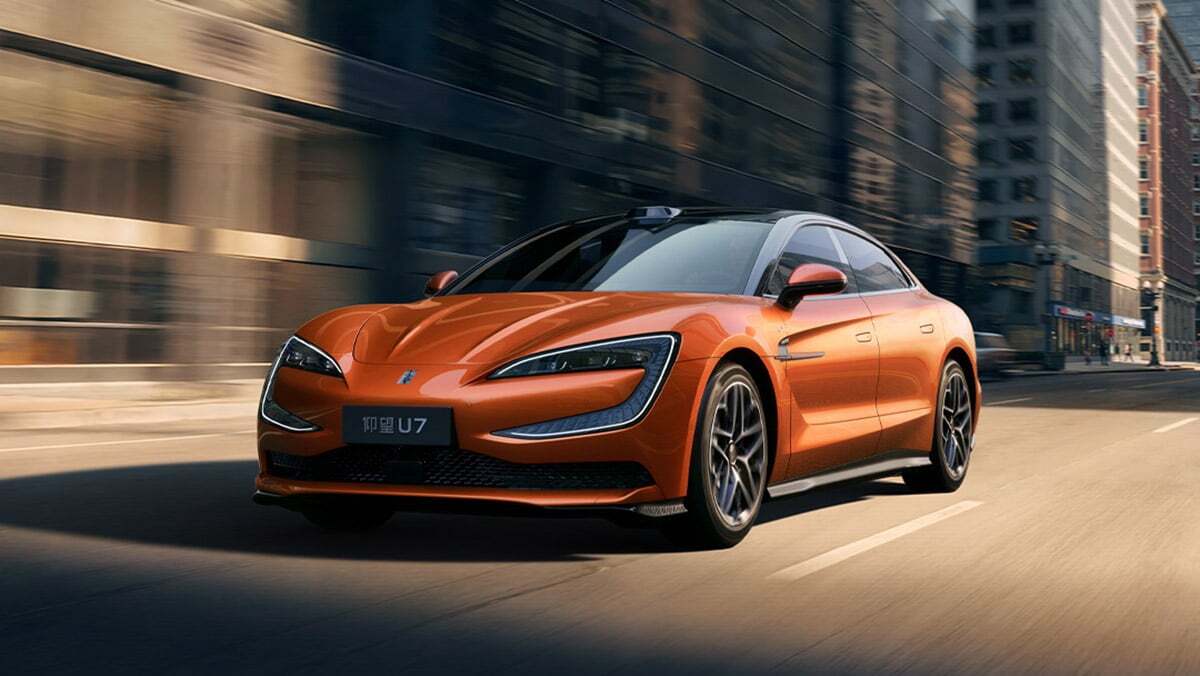
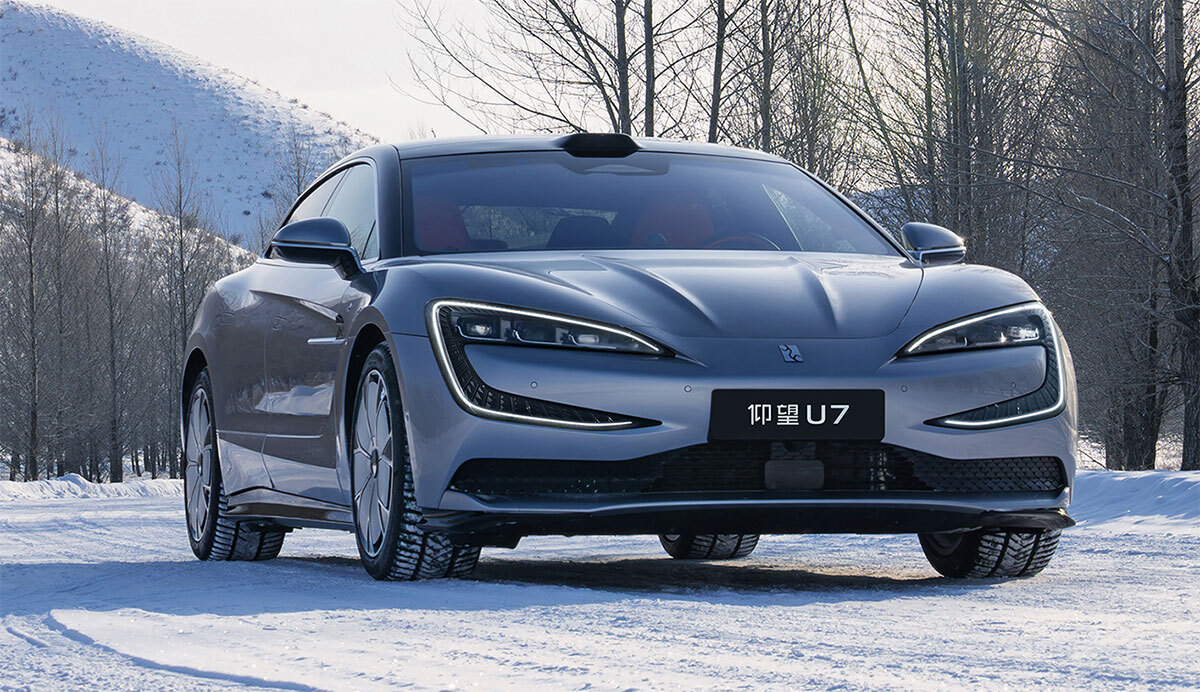
The ultra-luxurious U7 sedan from Yangwang has already been updated, barely a year after its market launch, and BYD is boasting about how comprehensive its testing regime has been and how well the new Blade Battery 2.0 performs.
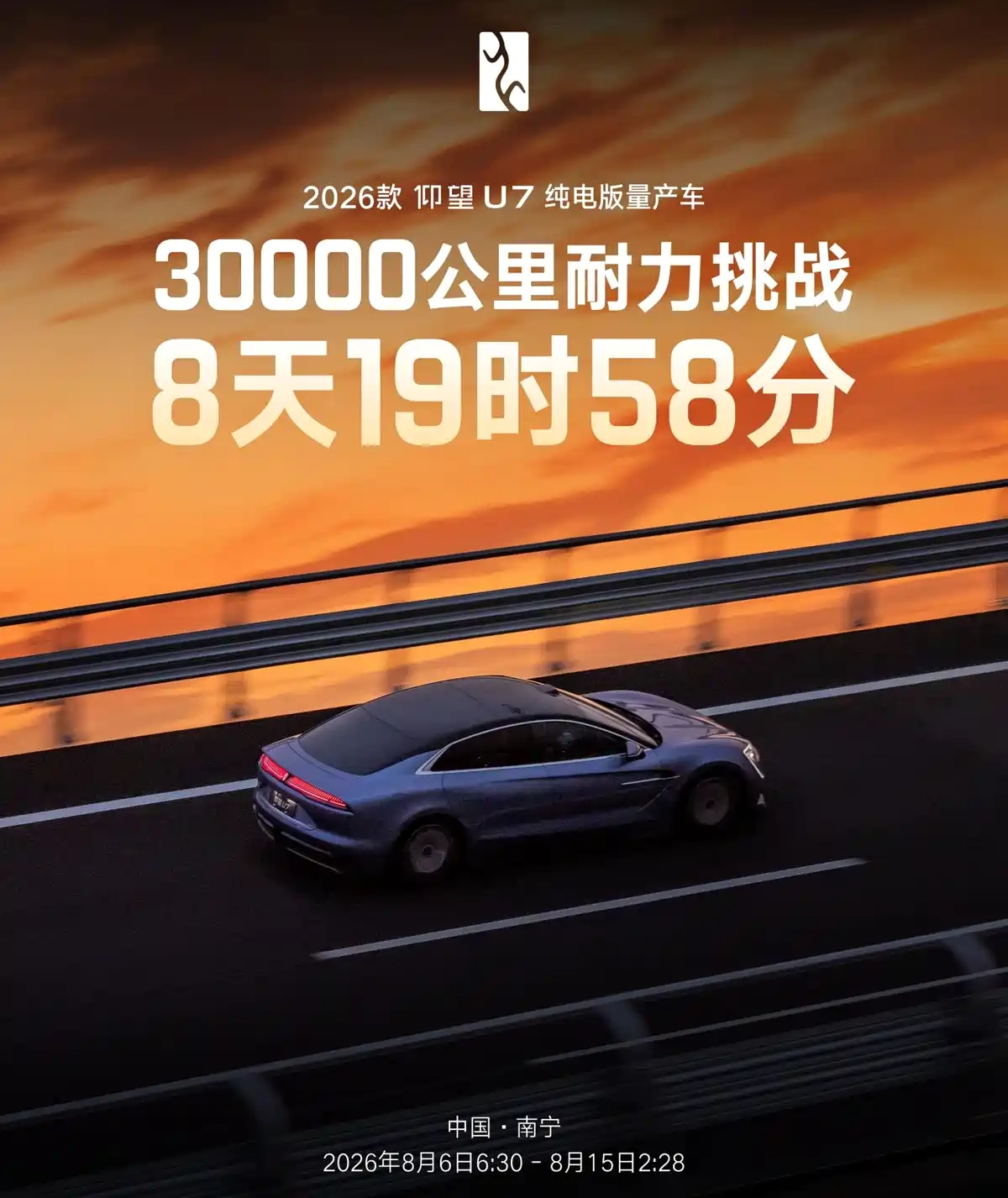
To wrap up testing of the Yangwang U7, which has a starting price of around $95,400 in China, BYD says it randomly selected a U7 from one of its stores and spent 8 days, 19 hours, and 58 minutes driving it 18,600 miles (30,000 km), cruising at an eye-watering average speed of 149 mph (240 km/h). This test isn’t dissimilar to the tests Mercedes-AMG performed last year with its GT XX Concept. In that case, the German EV was driven 24,901 miles (40,075 km) in 7 days, 13 hours, and 24 minutes.
BYD conducted the test in Nanning, where average daily temperatures exceeded 36°C (97°F) and relative humidity reached as high as 80 percent. The air conditioning was also set to 24°C (75°F) throughout the endurance run.
Beyond the test demonstrating how well the U7 can perform at high speeds and over long distances, BYD also wanted to ensure the battery would hold up. It says the U7 used was flash-charged more than 350 times. At the end of the test, the battery had retained 98.7 percent of its capacity.
This was far from the only test Yangwang conducted for the updated U7. It says it has been testing 758 vehicles across the country, cumulatively covering more than 6.5 million miles (10.49 million kilometers).
The Yangwang U7 was first unveiled in early 2024 and hit the Chinese market roughly 12 months ago. Less than six months after the first deliveries started, it was revealed that Yangwang was preparing to update it, equipping it with new 135.5 kWh and 150 kWh battery packs.
Both versions of the electric U7 have 644 hp electric motors at the front and rear axles, combining to deliver 1,287 hp. The 135.5 kWh version has a CLTC driving range of 497 miles (800 km), while the 150 kWh model can travel up to 625 miles (1,006 km) on a charge. A plug-in hybrid version with a 52.4 kWh battery and 1,341 hp is also available.
Hyundai is launching more than 100 products by 2030.
58 launches in North America including 22 from Genesis.
Europe is getting five new EVs including a D-segment SUV.
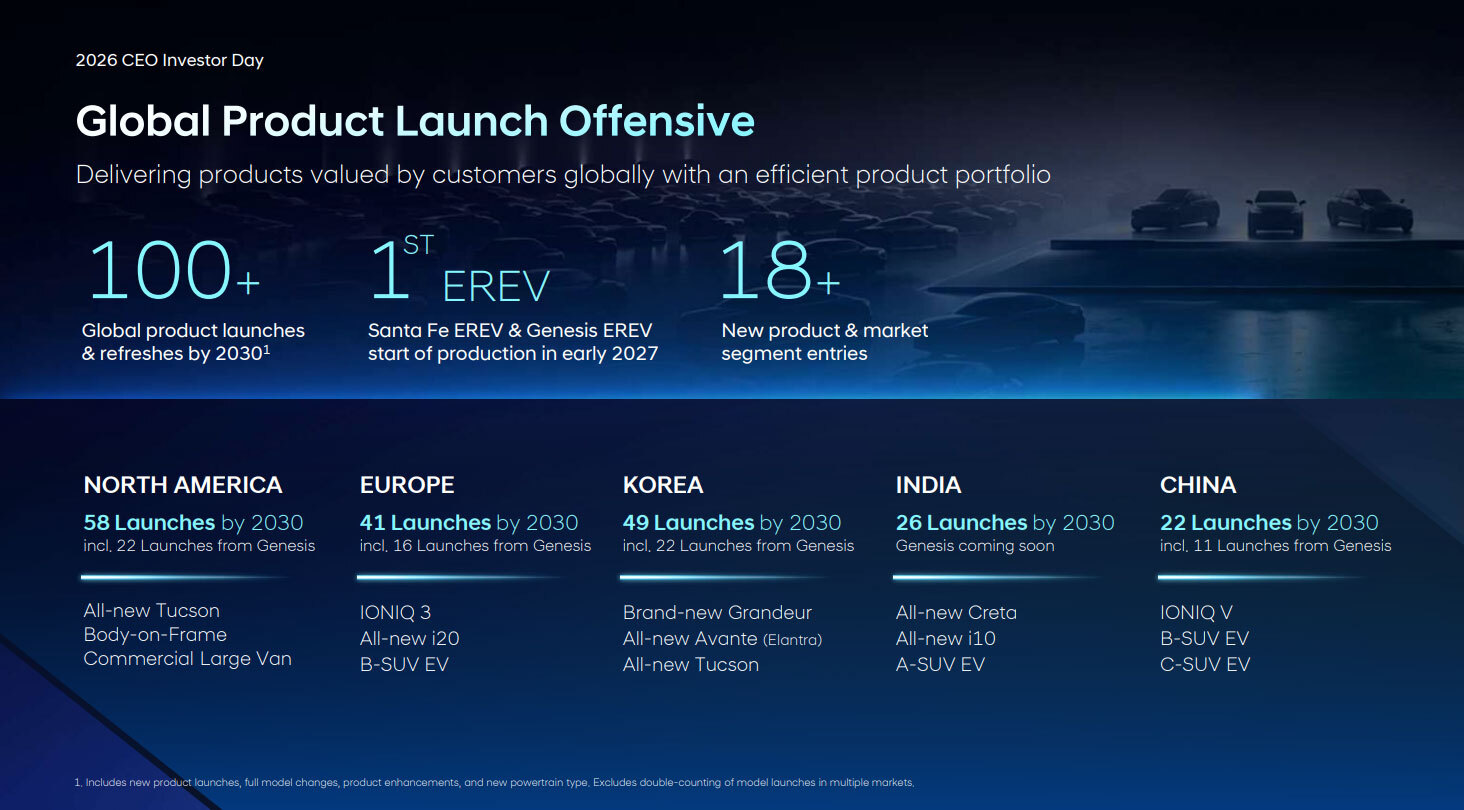
Hyundai has announced plans to introduce more than 100 new or refreshed models by 2030. Seven new vehicles are coming in the next eight months and the automaker promises there will be more than 18 different entries into “new products and market segments.”
While there’s a lot to cover, the company used their 2026 CEO Investor Day to announce a major product offensive. It’s a global effort as there will be “58 launches in North America, 49 in Korea, 41 in Europe, 26 in India, and 22 in China.” We’ve already seen a number of these as Hyundai said they include the new Elantra, Tucson, and Ioniq 3.
They’ll be joined by a range-extended Santa Fe as well as an all-new global B-segment SUV. Europe will get a second B-segment model, while India will get an even smaller A-segment electric crossover.
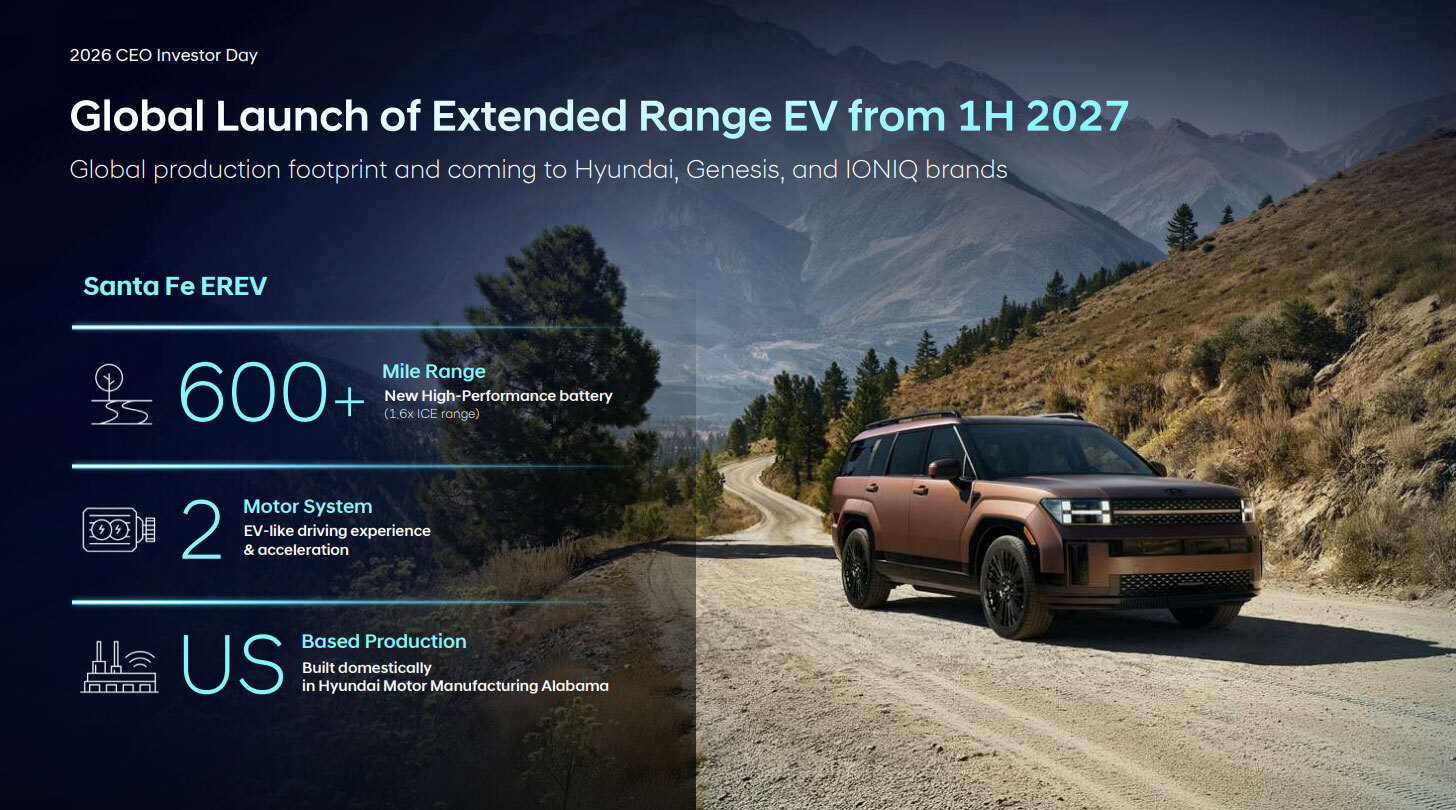
The Santa Fe EREV arrives in the first half of 2027 and it’s expected to have a combined range of more than 600 miles (966 km). It will be built at Hyundai Motor Manufacturing Alabama and deliver an EV-like driving experience, but without “range and charging anxiety.”
Europe Is Getting Five New EVs
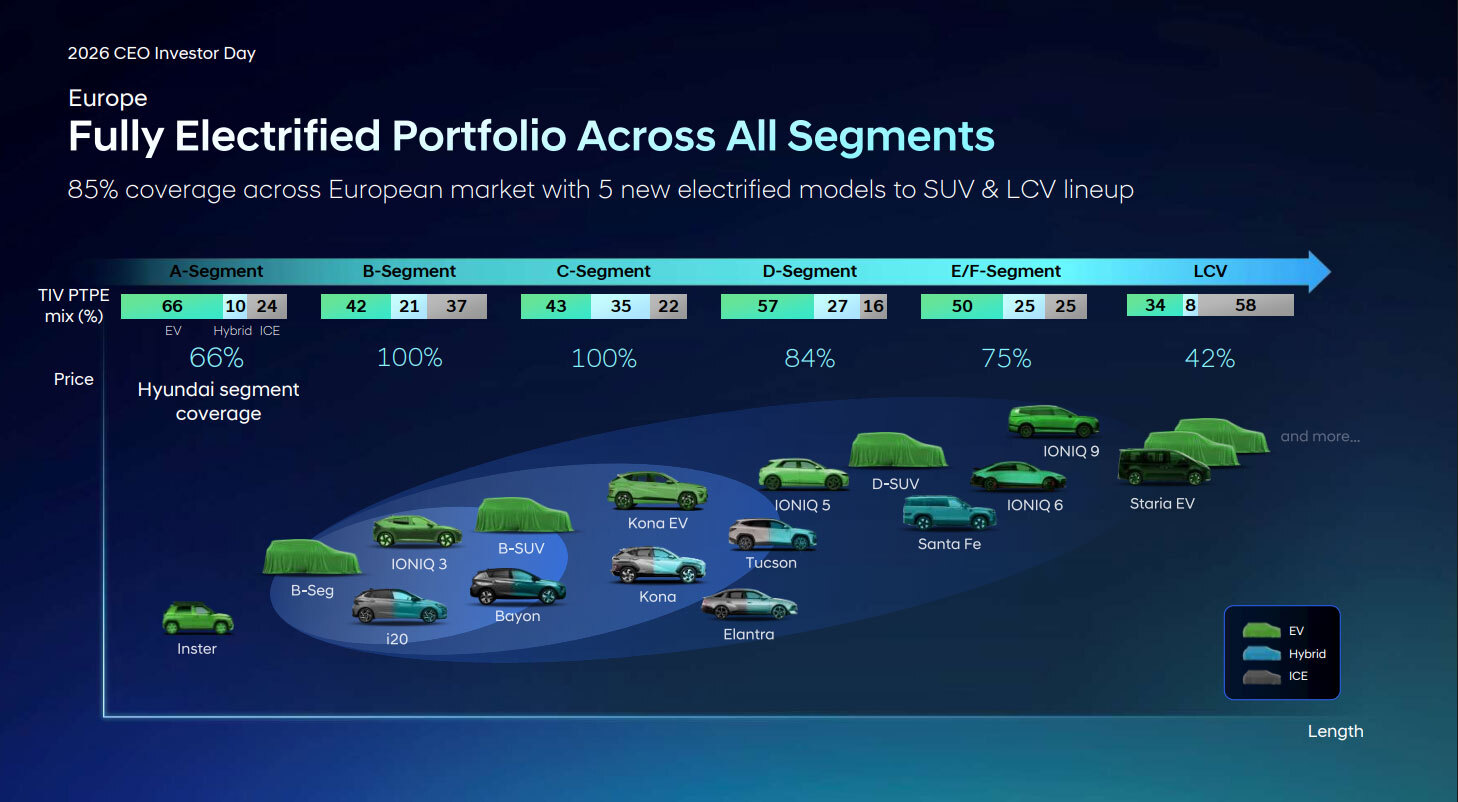
The company was largely coy on additional nameplates, but confirmed Europe will have a “fully electrified portfolio” that includes five all-new crossovers and light commercial vehicles. Hyundai hopes this will increase European EV sales from 116,000 units in 2025 to more than 420,000 units by 2030.
While Hyundai didn’t say much, they quietly revealed the two upcoming B-segment vehicles will be fully electric. They’ll be joined by a large D-segment electric crossover as well as two electric vans.
In India, a new electric crossover arrives in the fourth quarter with a next-generation infotainment system as well as a Level 2 semi-autonomous driving system. It will be followed by an ICE-powered mid-size SUV in the future.
A Chinese Turnaround With Fresh Product
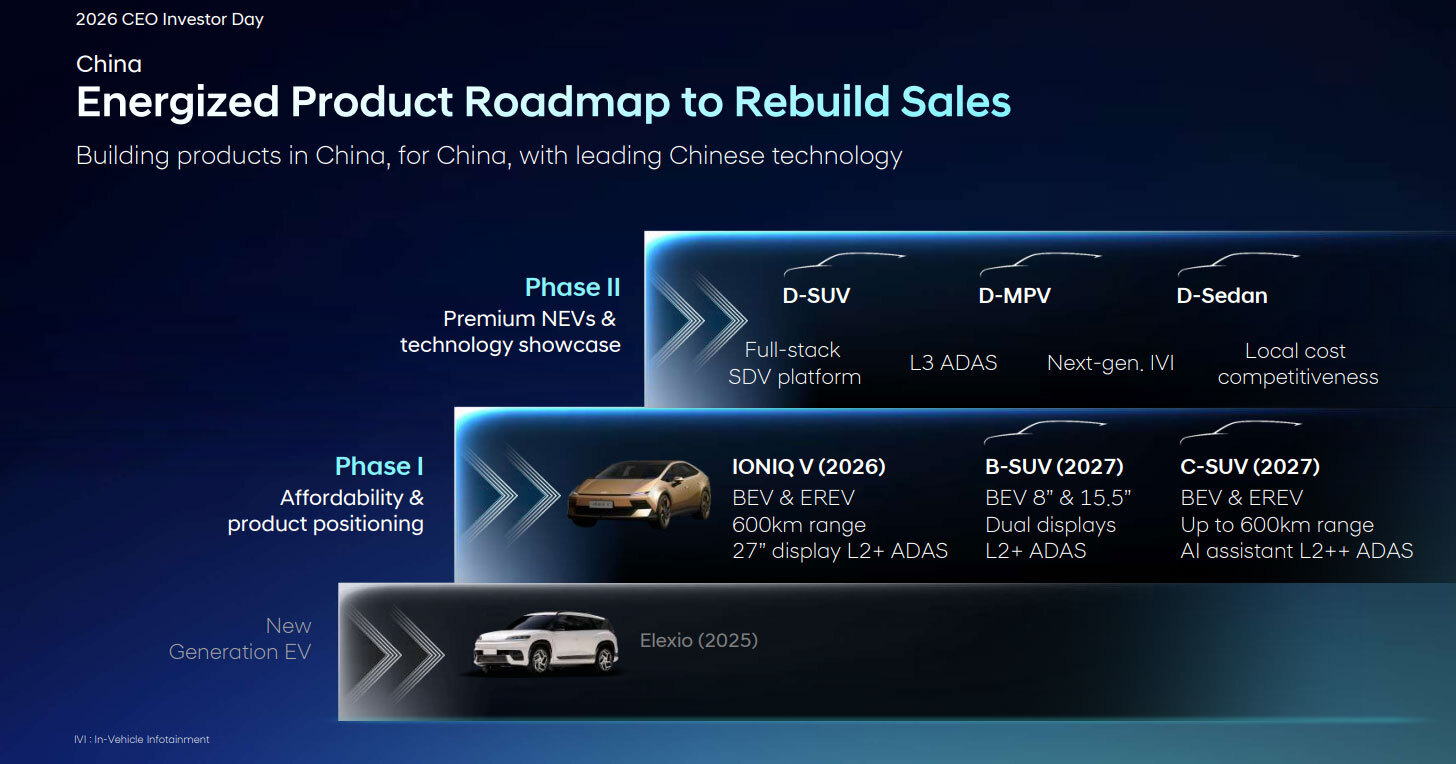
Hyundai is “pursuing a turnaround” in China, which will be spearheaded by the Ioniq V. The model will be followed by electric and range-extended vehicles in 2027.
The B-SUV will be fully electric, while the C-SUV will offer electric and range-extended powertrains. The latter will provide up to 373 miles (600 km) of range overall.
They’ll eventually be followed by three D-segment vehicles including a sedan, crossover, and MPV. These will have Level 3 autonomous driving technology as well as what sounds like a next-generation powertrain.
Genesis Looks For Growth
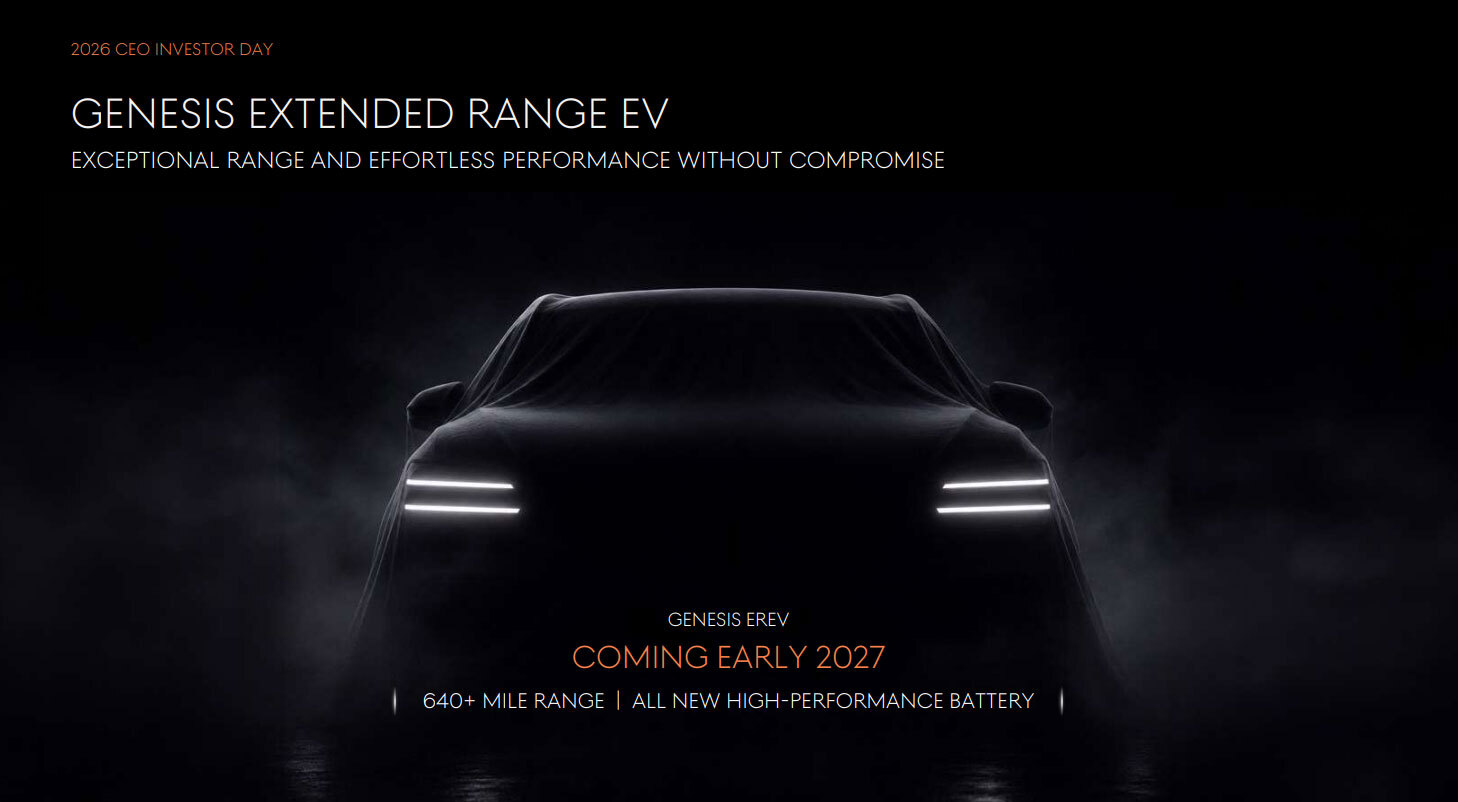
Genesis’ revamp is being led by the new GV90 as well as the GV80 Hybrid. The company also confirmed plans for a range-extended SUV in 2027, which will deliver more than 640 miles (1,030 km) of range.
While Genesis was coy on specifics, a slide mentioned 22 launches from the luxury brand in North America alone. That’s nearly a third of the models coming to the continent, but the figure undoubtedly includes variants.
The luxury brand will also enter new markets including India and the Asia Pacific region in the near future. If everything goes according to plan, they’ll be in more than 40 countries by 2030 and have annual sales of 350,000. To put that number into perspective, Lexus sold 370,260 vehicles in the United States last year.
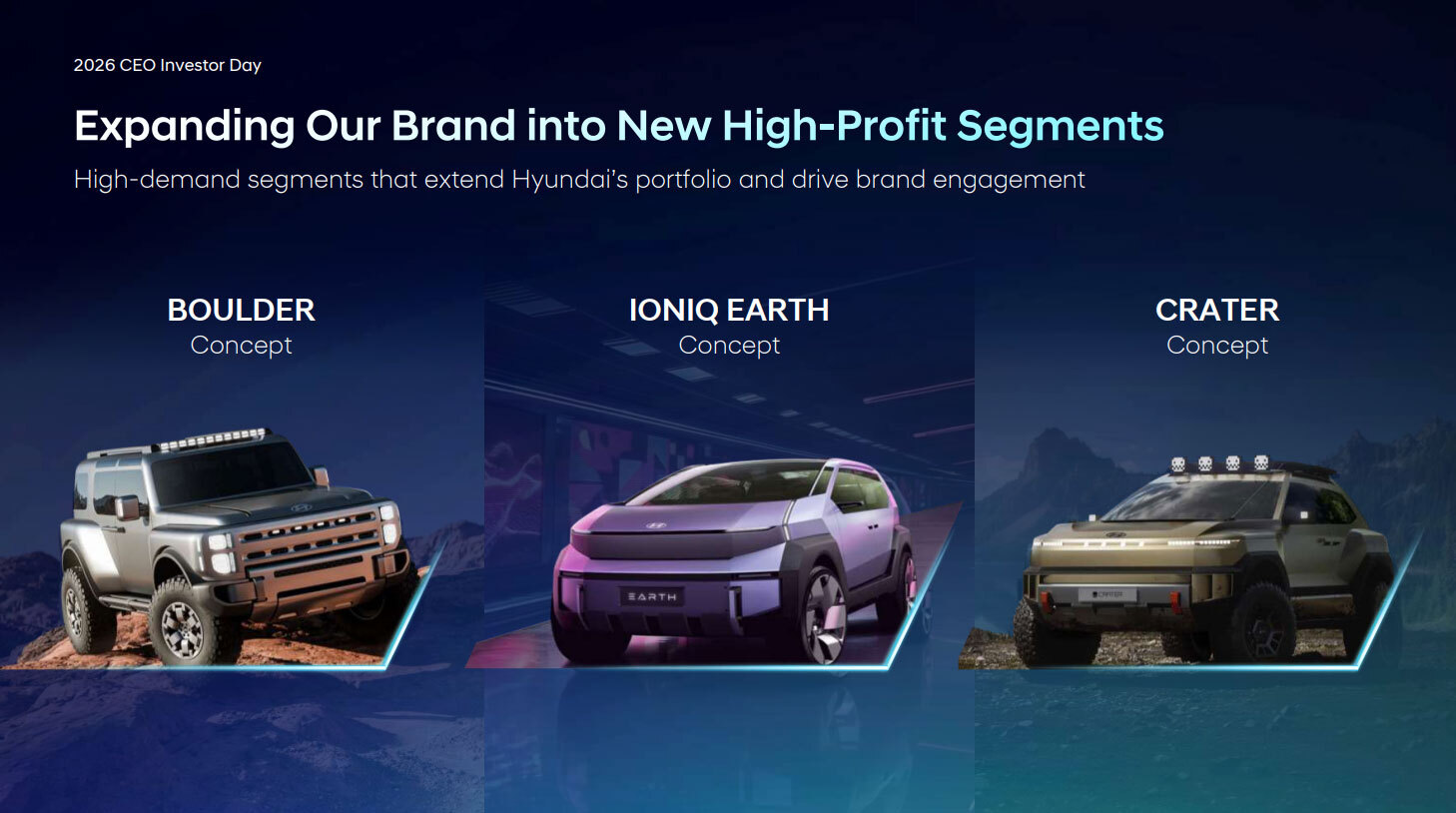
Getting back to Hyundai, the company will expand the N lineup and try to increase sales to 100,000 units annually by 2030. The automaker is also targeting so-called ‘white spaces,’ where they don’t have much of a presence and there’s “significant opportunities for growth.” To fill these voids, the company will launch body-on-frame vehicles including a midsize pickup.

 Login