Normal view

There are new articles available, click to refresh the page.
Today — 5 December 2025Electric Vehicles - Latest News | Carscoops

The Lexus LFA Returns But As An EV With No V10 In Sight

  • The LFA Concept is based on the same aluminum chassis as the Toyota GR GT and GR GT3.
  • Curiously, Lexus has decided not to use the same twin-turbocharged hybrid V8 as the Toyota.
  • The design of the car was previewed several months ago with the stunning Lexus Sport Concept.

This is the Lexus LFA Concept and it’s quite unlike the iconic V10-powered weapon that came before it. Long expected to simply be a Lexus-branded version of the new Toyota GR GT, the LFA Concept is instead something else entirely. It’s electric. Yes, you read that right.

The concept, unveiled alongside the twin-turbo V8 Toyota in Japan this evening, was previewed a few months ago as the Lexus Sport Concept. Its since morphed into the LFA Concept and been presented with an electric powertrain. According to Lexus, the ‘LFA’ name is “not bound to vehicles powered by internal combustion engines,” but instead symbolizes a vehicle that “embodies the technologies that engineers of its time should preserve and pass on to the next generation.”

Read: Toyota’s GR GT Drops With TT V8 Hybrid And At Least 641 HP

Toyota Underpinnings

Whereas Toyota revealed a slew of details about its new halo performance car, Lexus has remained tight-lipped about many of the LFA Concept’s important details. It hasn’t provided any details about the electric powertrain that drives it, but regardless of how special it is, or how much grunt it may have, it certainly won’t be able to match the roar of the Toyota.

Interestingly, the LFA Concept is based on the same all-aluminum platform as the Toyota GR GT and GR GT3. That presumably means Lexus had the option of using the same V8 as its parent company, but opted against it.

\\\\\\\

While the choice of powertrain seems odd, particularly given poor demand for high-performance EVs, there’s no denying the LFA Concept looks beautiful, which isn’t a word we’d use for the Toyota. The interior is also wildly different than the Toyota, although this isn’t a surprise given the LFA is still a concept.

When Will it Launch?

What does the future hold for the LFA Concept? We know it will spawn a production model, and the renaming of the Sport Concept to the LFA Concept, indicates that it will indeed be sold as the second-generation Lexus LFA. Just when it will hit a road near you remains unclear.

\\\\\\\\
Lexus Sport Concept
\\\\\\\\\\\\\\\\\\\\\\

Mercedes Says Its New EV Tech Might Make Rear Brakes Pointless

  • New Mercedes-AMG EVs will use advanced axial flux electric motors.
  • Engineers say rear brakes may shrink dramatically or even disappear.
  • New in-wheel motor pairs with a compact 15 kg dual inverter unit.

Just over a month ago, Mercedes-owned brand Yasa unveiled a record-breaking electric motor that weighs just 12.7 kg (28 lbs) and has the ability to produce up to 1,006 hp (750 kW). The company has now revealed that this axial flux motor will be used as an in-wheel unit for its next-generation EV powertrains and could even replace traditional rear wheel braking systems.

While in-wheel electric motors are nothing new, they haven’t been widely adopted in the EV market, in part because they’re heavy and generally aren’t particularly powerful. Yasa’s new motor set an unofficial electric motor power density record of 59 kW (79 hp) per kilogram, or 35 hp per pound.

Read: Mercedes’ Axial Flux Motor Weighs Less Than A Toddler And Makes Over 1,000 HP

While the motor can deliver a peak of up to 1,006 hp, the firm notes that its continuous power output ranges between 469 hp and 536 hp. It can then be paired with a 15 kg (33 lbs) dual inverter that Yasa has also developed in-house, and could prove perfect for high-powered hypercars and other performance EV applications.

Then there’s the matter of braking. Yasa says its in-wheel motor offers such “incredible regenerative performance” that the system could potentially negate the need to use traditional rear brakes.

This could allow carmakers to not only ditch important brake componentry, but also rear driveshafts, potentially saving up to 200 kg (441 lbs) from current models and as much as 500 kg (1,100 lbs) on new models developed from the ground-up.

\\\\\\

“Thanks to its exceptional regenerative capability, this system has the potential to dramatically downsize rear brakes on an EV – or even remove them entirely in certain architectures,” Yasa chief of New Technology, Simon Odling, said.“And by capturing a much greater proportion of regenerative braking energy, this technology can also deliver a significant increase in EV range.”

“What’s more, our new in-wheel motor powertrain not only enables significantly lighter, more efficient and higher performance EVs, but also dramatically creates space within the architecture of an EV too, giving car makers unprecedented freedom to redesign and optimize the packaging, aerodynamics and kinematics of their next-generation vehicles,” he added.

Yasa’s axial flux motors will be used in the new all-electric Mercedes-AMG GT 4-Door sedan and SUV. However, these models are not expected to use these motors as an in-wheel application, and will instead have one motor at the front axle and two at the rear.

\\\\\\\\\\\\\\\\\\\

Guido ten Brink/SB-Medien – Stefan Baldauf

Subaru’s New Trailseeker Costs $5,000 More Than The Outback

  • The 2026 Subaru Trailseeker arrives early next year for $39,995.
  • Electric crossover has 375 hp and around 280 miles of range.
  • It comes equipped with heated front seats and a 14-inch display.

Subaru introduced the 2026 Trailseeker earlier this year and now the company has announced the wagon-like crossover will start at $39,995. That’s $5,000 more than the redesigned Outback, but the Trailseeker is far more attractive.

Kicking things off is the entry-level Premium trim, which features a fully enclosed grille that is flanked by LED headlights. Buyers will also find automatic windshield wipers, a power liftgate, and 18-inch alloy wheels with aerodynamic covers.

The model is also notable for having 8.3 inches (211 mm) of ground clearance, which is more than the redesigned Jeep Cherokee.

More: Toyota Made An Electric Subaru Outback As Powerful As A Supra

The minimalist interior comes nicely equipped with a 7-inch digital instrument cluster and a 14-inch infotainment system with Android Auto and Apple CarPlay. They’re joined by heated front seats that are wrapped in StarTex upholstery and have 10-way power adjustment on the driver’s side.

Other highlights include an automatic climate control system, ambient lighting, and a dual wireless smartphone charger.

The EyeSight Driver Assistance suite comes standard and provides Adaptive Cruise Control, Lane Tracing Assist, and Traffic Jam Assist. The model also has Front/Rear Cross-Traffic Alert, Pre-Collision Braking, Active Lane Change Assist, and Lane Departure Prevention. Rounding out the highlights are Safe Exit Assist and a Blind Spot Monitor.

Trailseeker Limited

\\\\\\

Moving up the trim ladder is the $43,995 Trailseeker Limited. It features a lightly revised exterior with 20-inch wheels and a hands-free power liftgate.

Bigger changes occur inside as the cabin is more luxurious thanks to a heated leather steering wheel and heated rear seats. Buyers will also find a power passenger seat and a Harman Kardon premium audio system.

The upgrades don’t end there as the Limited features digital key technology and a 1500 watt AC power outlet in the rear cargo area. They’re joined by parking assist and a panoramic view monitor.

Trailseeker Touring

 Subaru’s New Trailseeker Costs $5,000 More Than The Outback

Sitting at the top of the lineup is the $46,555 Trailseeker Touring. It’s distinguished by a panoramic glass roof and a gloss black accent on the hood. Customers can also get a unique two-tone paint job for $795.

Interior changes are minor, but the range-topping variant has a digital rearview mirror, ventilated front seats, and radiant leg warmers. Customers can also shell out $300 to get black and blue leather seats.

The Fastest Subie In America

\\\\\

Regardless of which trim is selected, all Trailseekers have a 74.7 kWh battery pack that feeds a dual-motor all-wheel drive system. The latter produces a combined output of 375 hp (280 kW / 380 PS) and it enables the model to accelerate from 0-60 mph (0-96 km/h) in 4.4 seconds.

Besides being the fastest Subaru ever sold in America, the model is expected to have a range of approximately 280 miles (451 km). When the battery is low, the 150 kW DC fast charging capability can deliver an 80% charge in as little as 28 minutes. It’s also worth noting the model has an NACS charging port.

2026 Subaru Trailseeker Pricing
ModelMSRP
Trailseeker Premium$39,995
Trailseeker Limited$43,995
Trailseeker Touring$46,555
SWIPE

Prices exclude a destination fee of $1,450 to $1,600

Hyundai’s Latest Robots May Be Eyeing Your Job

  • Hyundai launched two MobED versions with distinct capabilities and uses.
  • The Pro model adds full autonomy while the Basic relies on remote input.
  • Cameras, LiDAR, and AI let the robot navigate tight and crowded places.

Four years after first showing its Mobile Eccentric Droid (MobED) concept, Hyundai’s Robotics LAB has now revealed the production version in Tokyo, Japan. The debut marks an important step in the company’s expansion into advanced robotics.

The compact platform has been engineered to be fully autonomous and uses advanced artificial intelligence that allows it to cruise over different surfaces and provide incredible adaptability for different use cases.

How Does It Move?

Central to MobED’s capability is its Eccentric Control Mechanism, a clever system that lets the robot adjust its posture and each wheel individually. The result is an uncanny steadiness, even when crossing inclined or uneven terrain.

Read: Like All Eccentrics, Hyundai’s New Mobile Eccentric Droid May Be Going Into The Film Business

For spatial awareness, Hyundai equipped the platform with a suite of advanced cameras and LiDAR sensors. An AI-driven obstacle detection system adds another layer of awareness, helping the robot navigate confined or crowded spaces without missing a beat.

Hyundai envisions it taking on various roles, from last-mile deliveries to logistics support, with minimal human intervention.

Two Flavors Of Droid

 Hyundai’s Latest Robots May Be Eyeing Your Job

Hyundai has revealed two versions of the robot: the Basic and the Pro. The Basic measures 1,150 mm (45.2 inches) in length, 750 mm (29.5 inches) in width, and 430 mm (16.9 inches) in height. It weighs 78 kg (172 lbs) and can carry up to 57 kg (125 lbs).

The Pro variant stands a little taller at 650 mm (25.5 inches) and heavier at 88 kg (194 lbs), though its payload capacity drops slightly to 47 kg (104 lbs).

Where they diverge most is autonomy. The Pro comes equipped with Hyundai’s full self-driving system, while the Basic relies on manual operation via remote control.

What Keeps It Rolling?

\\\\\\

Powering both versions is a small 1.47 kWh battery that provides up to 4 hours of operating time. However, compared to some of Hyundai’s EVs, the MobED charges slowly, needing 2.5 hours to juice up the battery from 10 to 90 percent.

Each robot also features universal mounting rails that make it easy to attach a variety of tools and modules. In the future, they could perform a range of important tasks in factories and warehouses, as well as crucial functions at production facilities, reducing the need for human labor.

Commercial sales of the MobED are expected to begin in the first half of 2026. Hyundai has yet to announce pricing, though it’s clear the company sees the robot as more than a novelty.

Ford’s CEO Applauds Trump’s CAFE Rollback, Says They Were Forced Into EVs

  • Farley says tougher fuel rules made low cost cars harder to build.
  • Ford expects lower prices as new standards cut compliance costs.
  • The CEO says the reset lets customers choose their preferred models.

Ford CEO Jim Farley has joined several of his American counterparts in supporting the Trump administration’s decision to reset federal fuel-economy standards.

The move, Farley says, gives automakers the breathing room to produce more affordable vehicles in the United States without walking away from electric innovation or efficiency goals.

Farley’s core argument seems to be that regulations were so strict that they effectively squeezed automakers out of the low-cost segments so many buyers still rely on.

Read: Trump Admin Pushes Fuel Economy Shakeup And The Impact Could Be Huge

Speaking at a press conference with President Donald J. Trump on Thursday, Farley called the update “a victory for affordability and common sense,” adding that Ford will now be able to offer cheaper versions of its most popular models and launch new price-focused products.

“We believe that people should be able to make a choice, as you said, Mr. President,” Farley said. “And we will invest more in affordable vehicles. This allows us to invest in affordable vehicles made in the U.S., which we will take the lead on and will allow us to make vehicles more affordable.”

Trump, sitting beside him, said, “People were brainwashed. This is a ‘green new scam.’ And people were paying too much for a car that didn’t work as well. And now they’re gonna have a great car that’s gonna be environmentally friendly, but it’s gonna cost you a lot less and it’s gonna work great. All of the nonsense is being taken out of the cars.”

Political Theater or Market Reality?

Farley stopped short of framing the move as an ideological shift, instead focusing on the economics. He argued that the tightened CAFE standards under the previous administration imposed costs that made entry-level vehicles much harder to justify.

That pressure, he said, pushed automakers toward higher-margin EVs and hybrids simply to meet fleet targets.

“What you should know is that this is a victory for affordability and common sense. As the president said, we will be able to offer more affordability on our popular models, and we’ll be able to launch new vehicles built in America that are more affordable because of this rule change,” Farley said later in an interview on “Fox & Friends” Thursday.

Farley added that the earlier fuel-economy system “was totally out of touch with market reality.” Automakers, he said, were forced to sell EVs and other vehicles to stay compliant, even when customer demand wasn’t there.

“We were forced to sell EVs and other vehicles. We’re not going back to gas-guzzlers,” he continued. “We have a lot of EVs and a lot of hybrids at Ford, but now customers get a chance to choose what they want, not by what we force on them.”

Balancing Choice and Compliance

 Ford’s CEO Applauds Trump’s CAFE Rollback, Says They Were Forced Into EVs

Ford’s CEO also clarified that the company isn’t returning to inefficient gas models, noting it already sells a wide range of EVs and hybrids. GM’s CEO Mary Barra recently made similar comments.

Also: GM’s Mary Barra Promises Cleaner Engines, But Looser Rules Fuel More Gas Guzzlers

The reset rolls back the steep increases introduced under the Biden administration, which raised fuel-economy requirements by 8% for 2024 and 2025 and 10% for 2026. Federal officials previously estimated those rules would add nearly $1,000 to the average new-car price.

By contrast, the new standard lowers compliance costs and, according to the White House, will save American families a combined $109 billion. Now, the market waits to see if automakers really do deliver on their promises of rolling out more affordable models.

Photo Whitehouse/YouTube

Something Big Is Changing Inside Audi’s Electric SUVs And It’s Not Just The Battery

  • Audi is testing facelifted Q4 e-tron and Q4 Sportback e-tron.
  • Both debut in 2026 with updated styling and powertrains.
  • Prototypes reveal a redesigned interior with a curved display.

Our spy photographers have already snapped prototypes of the 2027 Audi Q4 e-tron and Q4 Sportback e-tron during testing. Now, however, they’ve gotten a glimpse inside, where we can see some pretty significant changes.

While the current model has a 10.25-inch digital instrument cluster and an 11.6-inch infotainment system, the facelifted prototype has an all-new dashboard with a freestanding curved display that appears to echo the one found in newer models such as the A5 and A6 as well as the Q3 and Q5.

More: Audi Q4 E-Tron Glow Up Takes Aim At Tesla’s Model Y

This likely means it will consist of an 11.9-inch digital instrument cluster and a 14.5-inch infotainment system. We also wouldn’t be surprised to find an optional 10.9-inch front passenger display.

We can’t see much else, but the production model could benefit from additional changes including a new steering wheel and revamped switchgear. Updated trim, upholstery, and equipment may also be on the cards.

 Something Big Is Changing Inside Audi’s Electric SUVs And It’s Not Just The Battery

Moving outside, we can see a lightly revised front end with skinnier air curtains that feature a horizontal accent. The grille is covered by camouflage, but it’s expected to be refreshed and could adopt an illuminated four ring logo.

Also: Audi Fixes One Of Its Most Hated Interior Features For 2026

The evolutionary styling continues at the rear as the Sportback has a lightly revised bumper with slender vents that’s joined by a modified diffuser and taillights that look the same but could sport updated graphics in the production-ready model.

\\\\\\\\\\\

shproshots

Some of the biggest changes are expected to occur beneath the skin as electric vehicle technology has come a long way since the Q4 e-tron was introduced in 2021. This likely means we can expect more efficient motors, improved batteries, and upgraded charging technology.

The current model offers an assortment of powertrains, including a rear-mounted motor producing 282 hp (210 kW / 286 PS). Buyers can also get an all-wheel drive variant with 335 hp (250 kW / 340 PS) and an EPA-estimated range of 258 miles (349 km).

\\\\\\\\\\

shproshots

Bentley Is Going To Release A Smaller SUV Few Are Asking For

  • Bentley’s second SUV will share its electric powertrain with the Cayenne.
  • New model is smaller than the Bentayga and launches exclusively as an EV.
  • Company plans to reveal its new electric SUV sometime in mid 2026.

Believe it or not, it’s been a decade since Bentley introduced the Bentayga SUV, and it’s proven to be the brand’s best-selling model during this time. It’s perhaps a surprise then that it’s taken them ten years to start work on a second SUV, designed to slot below the Bentayga.

This new model is currently known as the Urban SUV, but expect a fancier name once production is near. Unlike the Bentayga, it will be sold exclusively as an EV, a decision that, given the current uncertainty surrounding Western markets, might not prove Bentley’s most strategic choice.

Read: This Is Bentley’s First EV And It’s Built To Haul More Than Just Your Ego

Hindsight, of course, is 2020, but it’s reasonable to assume Bentley also had China in mind, where electric vehicles now dominate the premium segment. Either way, with fellow VW-owned brand Porsche already having two electric SUVs of its own, it was only a matter of time before Bentley followed suit.

What’s Hiding Under There?

\\\\\\\\\

Baldauf

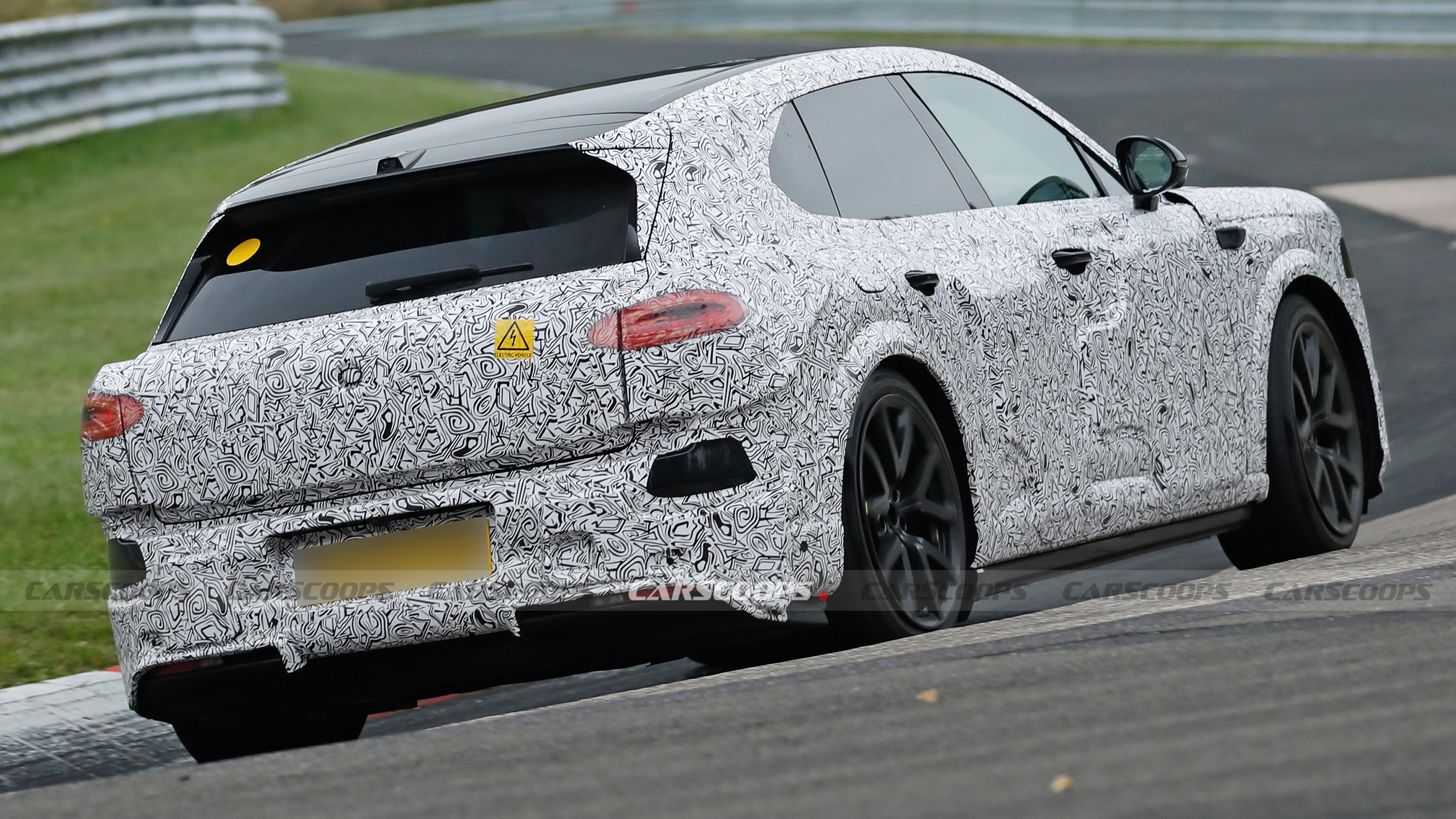
Pictured here for the first time during testing at Germany’s Nürburgring Nordschleife, the Urban SUV is hiding under camouflage and body cladding, keeping most of its design details a secret. Included as part of the disguise are four fake circular headlights, similar in shape to those of the current Bentayga.

A few months ago, Bentley unveiled the wild EXP15 concept, complete with vertical headlights. However, the headlight clusters we can see don’t look like the concept’s.

As with the headlights, it is difficult to discern the shape of the grille, as it too has been hidden from view. What we can see is that this new model is smaller than the Bentayga and has a lower roofline. This isn’t to say it’s small, however. It’ll likely be about the same size as the new Porsche Cayenne Electric.

Our spy photographer was able to catch a glimpse of the SUV’s interior, although it’s difficult to pinpoint any highlights. What we can say with certainty is that it won’t follow the current trend of many EVs that feature tacky tablet-like displays for the gauge cluster and then giant infotainment screens on the dash.

Cayenne Electric Power?

 Bentley Is Going To Release A Smaller SUV Few Are Asking For
Baldauf

Powertrain details have not been confirmed, but the Bentley is widely expected to share many components with the Cayenne Electric.

This could include the same 113 kWh battery pack and 800-volt electrical architecture, ensuring the Bentley will have decent range and support fast-charging. In the case of the Cayenne, Porsche says it needs just 16 minutes to charge from 10-80 percent.

Two versions of the Cayenne Electric have been confirmed, one with 402 hp as standard or 435 hp with launch control enabled, and the flagship Turbo that boasts 844 hp during normal driving and 1,139 hp and 1,106 lb-ft at launch control. It’s safe to assume the Bentley’s power figures could slot somewhere between the two Cayenne models.

Bentley is expected to unveil the Urban SUV in mid-2026, with first deliveries planned for 2027.

\\\\\\\\\

Baldauf

GM’s Mary Barra Promises Cleaner Engines, But Looser Rules Fuel More Gas Guzzlers

  • GM vows to keep improving engine efficiency as federal standards weaken.
  • Looser rules may push automakers toward more profitable trucks and SUVs.
  • Barra says GM’s EV commitment stands despite lower sales after credits ended.

This year has been a strange one for automakers, but many of them just caught a break. The EPA effectively wiped out penalties for missing fuel-economy targets, a move that could easily trigger another surge in high-margin full-size trucks and SUVs.

More: Trump Admin Pushes Fuel Economy Shakeup And The Impact Could Be Huge

With less regulatory pressure, engines don’t have to get cleaner or more efficient, yet GM CEO Mary Barra insists the company will keep pushing them in that direction anyway.

She maintains that GM will improve every combustion engine it invests in, no matter what the rulebook says. Whether that commitment holds once the market leans even harder toward big, profitable gas-guzzlers is another matter entirely.

How Long Will Progress Last?

Innovation is no doubt key for all automakers, so the promise of continued development is promising on paper. That’s what Barra provided at the New York Time’s DealBook Summit on Wednesday, saying, “Every engine we invest in, we work to have a significant improvement.”

It seems clear that tougher fuel economy standards have led to huge costs for automakers. A recent report indicates that many of the larger recalls from the past two years can be linked to those standards.

Whether or not GM and other automakers will continue to push fuel economy as hard as they have is a worthy consideration.

What’s the Incentive Now?

For decades, automakers have intentionally steered consumers toward larger SUVs and trucks because they offer the largest profits and require the least stringent fuel economy standards.

Read: GM’s Cheapest American EV Starts With A Chinese Shortcut

It’s unclear why that strategy would change now that the penalties are gone altogether. Still, something positive could come from new regulations in Barra’s eyes.

 GM’s Mary Barra Promises Cleaner Engines, But Looser Rules Fuel More Gas Guzzlers

Barra also supported Trump’s move to strip California of tougher clean-air authority, pushing instead for one national standard that doesn’t “get in front of the consumer.” However, automakers helped create today’s SUV-heavy demand, so that argument only goes so far.

Looser rules also ease pressure on EVs, a convenient shift for GM as sales dip after tax credits expired and its electric lineup remains unprofitable. Barra insists the company is still committed.

She was more positive on tariffs, calling recent policies “a more level playing field” after years of uneven barriers. GM may keep refining engines, but with weaker rules and a market built around giant SUVs, it’s hard to imagine Detroit walking away from its biggest profit margins.

 GM’s Mary Barra Promises Cleaner Engines, But Looser Rules Fuel More Gas Guzzlers

Rivian Goes Plum Crazy With A New Color And Something Extra

  • Borealis purple debuts as a $3,000 option for R1S and R1T buyers.
  • Rivian has also announced a special Lease Bonus for both models.
  • Some R1S and R1T trims qualify for lower monthly payments now.

It seems to be that time of year for Rivian again. Fresh off unveiling its limited-run Miami Edition, the company has decided it’s time for a new splash of color, one that might actually be its best yet. Called Borealis, it’s a deep, moody shade of purple inspired by the Northern Lights, offered on the Tri and Quad variants of the brand’s EVs.

Purple tones aren’t as popular as some other colors in the car industry, but when done right, they can look superb. We’ll reserve full judgment on Borealis until we see it under natural light, but based on early images, it flatters the R1S slightly more than the R1T, whose pickup shape doesn’t highlight the color in quite the same way.

Read: Rivian Turns One-Off Miami Showpiece Into A Very Pricey Limited Run

Like every Rivian finish beyond the standard LA Silver, Borealis comes at a premium, $3,000, to be exact. That puts it in line with other paid options such as Red Canyon, Rivian Blue, and Storm Blue.

The company hasn’t confirmed whether Borealis will filter down to the more affordable Dual Standard and Dual trims, though it’s easy to imagine that decision hinging on how buyers respond to the initial rollout.

\\\\\\\\

Rivian’s new purple looks especially nice when accented against its available 20- and 22-inch burnished bronze wheels. Paired with a set of bright blue brake calipers, shoppers can get a Rivian that really stands out.

A New Lease Deal

The addition of a new color isn’t the only thing that prospective Rivian owners can get excited about. The company has announced that several 2026 R1T and R1S models are eligible for a $5,000 Lease Bonus if customers take delivery by December 31.

Models eligible for the deal include the 2026 R1S and R1T Tri, R1S and R1T Dual Standard, and both the R1S and R1T Dual with the Large battery and Performance Upgrade. Importantly, Rivian notes this deal is only available while supplies last.

 Rivian Goes Plum Crazy With A New Color And Something Extra

Even with that bonus, leasing an R1T or R1S remains a costly proposition. For example, the R1T Dual Standard, priced at $72,990, still comes to $709 per month over 36 months, with $8,604 due at signing, an effective monthly rate of $948 before adding the $1,895 destination fee and state taxes.

For those willing to sacrifice a little cargo space for a lower payment, the R1S Dual Standard presents a slightly better deal. Its lease terms come in at $699 per month with $3,594 due at signing, translating to an effective monthly rate of $798, plus destination.

\\\\\\\\\

Jaguar Rolls Out Its Future In A New Color Right After Firing The Man Behind It

  • Jaguar’s Type 00 concept returns in London finished in matte red paint.
  • British brand will unveil a dramatic four-door production EV next year.
  • The production EV promises 430 miles of range and ultra-fast charging.

This time last year, Jaguar revealed the wild Type 00 concept, the first look at its all-electric future and a statement of intent to compete with Bentley and Rolls-Royce.

As development of the production version continues, a matte red example of the concept has been spotted on London’s streets, marking the marque’s 90th anniversary and coinciding with the unexpected departure of its longtime design chief, the figure behind the brand’s polarizing rebrand.

The Type 00 was originally shown in Miami Pink and London Blue during the official launch. Earlier this year, the model was dressed in a French Ultramarine livery and made a surprise appearance during the Paris Fashion Week.

Read: Jaguar’s Future GT Has No Rear Window And No Patience For Cargo

The company has now unveiled a fourth color variation, London Red with a matte finish, as the concept makes its arrival in the UK capital. The new shade draws inspiration from the redbrick Victorian architecture of Kensington, one of London’s most recognizable neighborhoods.

\\\\\

Jaguar

The freshly repainted concept was photographed alongside a classic 1935 Jaguar SS outside the Chancery Rosewood Hotel.

For those wondering, no other changes have been made to the concept’s exterior. It still rides on the same 23-inch alloy wheels, while the minimalist cabin remains finished in white and gray upholstery accented by ambient lighting.

Photos shared by Jaguar UK Director Santino Pietrosanti on LinkedIn show the Type 00 parked alongside some exotic company, including a Bugatti Chiron, Rolls-Royce Cullinan Black Badge, Ferrari F8 Tributo, and Lamborghini Aventador SVJ.

\\\\\\

Santino Pietrosanti / LinkedIn

The brand’s rebrand has been met with mixed reactions. Its ad campaign, oddly enough, featured no cars at all, leaving many scratching their heads. It was also rather odd that it initially showcased the Type 00 in a bright shade of pink, which didn’t do the car any favors.

Still, under London’s gray winter light, the matte red finish lends the concept a sense of gravitas. Out in the open, it naturally draws attention, albeit that’s not really surprising for a concept car. Much like the Tesla Cybertruck, its unconventional form challenges expectations so completely that people can’t decide whether they admire it or despise it. There seems to be little middle ground.

The Road Car

 Jaguar Rolls Out Its Future In A New Color Right After Firing The Man Behind It

Prototypes of the production version suggest Jaguar plans to stay faithful to the concept’s striking proportions. The roadgoing model will, however, take a more practical shape with four doors and a longer wheelbase, built on the company’s new Jaguar Electrical Architecture platform.

More: Jaguar’s Future GT Has No Rear Window And No Patience For Cargo

As per recent reports, the EV should have a driving range of up to 430 miles (692 km) and support fast charging, adding 200 miles (322 km) of range in just 15 minutes.

Only time will tell if those who would ordinarily shop for a Bentley or Rolls-Royce will be willing to spend their money on a vehicle that looks as controversial as this.

JLR Design Chief Axed

In separate news, it has been confirmed that Jaguar Land Rover design boss Gerry McGovern has departed from the brand. No official reason has been given for this high-profile departure, but it comes shortly after former chief financial officer at Tata, PB Balaji, was named as JLR’s new chief executive.

Citing insider sources, Autocar India reports that McGovern was “escorted out of the office” on Monday, with his contract being terminated with immediate effect. The man behind Jaguar’s relaunch has spend over two decades at JLR, being responsible for successful models including the new Land Rover Defender.

According to business economics professor at the University of Birmingham, David Bailey, McGovern’s exit marks a “symbolic end of an era.” He told The Guardian that it may also be a sign that Tata wants to exert more control over the British company.

Thanos Pappas contributed to this story.

Yesterday — 4 December 2025Electric Vehicles - Latest News | Carscoops

Trump Admin Pushes Fuel Economy Shakeup And The Impact Could Be Huge

  • Trump administration plans to significantly reduce fuel economy standards.
  • New proposal targets an average of 34.5 mpg by the 2031 model year.
  • EV credits would be removed and crossovers reclassified as passenger cars.

President Trump has announced plans to reset the “costly and unlawful Corporate Average Fuel Economy (CAFE) standards” enacted by the previous administration.

A fact sheet put out by the White House was light on specifics, but said Trump was “returning CAFE standards to levels that can actually be met with conventional gasoline and diesel vehicles.”

They said this stands in contrast to the “unrealistic fuel economy targets” that the Biden Administration had approved, which would have “effectively resulted in an electric vehicle mandate.”

More: 50.4 MPG Is The Magic Number As New Fuel Economy Standards Announced

The White House went on to claim the previous standards were impossible to meet with available technologies for gas cars and would have “compelled widespread shifts to EVs that American consumers did not ask for, accompanied by significant cost-of-living increases.”

They went on to say the average cost of a new car would have risen by nearly $1,000 when compared to the standards announced today.

Speaking of savings, the government said the move will save Americans $109 billion over the next five years. The White House also suggested that by enabling more people to buy newer and safer vehicles, the “reset is projected to save more than 1,500 lives and prevent nearly a quarter-million serious injuries through 2050.”

Big Changes, Less Efficiency

 Trump Admin Pushes Fuel Economy Shakeup And The Impact Could Be Huge

The Department of Transportation was more forthcoming as they revealed the Freedom Means Affordable Cars proposal. It calls for resetting CAFE standards for model years 2022-2031.

The new standards would be “developed without consideration of electric vehicles and credit trading,” and would call for a modest fuel economy increase.

For passenger vehicles, the proposal calls for an increase of 0.5% annually for model years 2023 through 2026. It would then dip to a 0.35% increase for the 2027 model year and a 0.25% increase for the 2029 to 2031 model years.

For light trucks, the National Highway Traffic Safety Administration is proposing a 0.5% increase for the 2023-2026 model years. It would be followed by a 0.7% increase for 2027, and then a lower 0.25% improvement for the 2029 to 2031 model years.

 Trump Admin Pushes Fuel Economy Shakeup And The Impact Could Be Huge

What the New Math Means

While it’s hard to wrap fuel economy figures around percentages, the Department of Transportation said the proposal would result in a fleet average fuel economy rating of 34.5 mpg by the 2031 model year. CAFE credit trading would also be eliminated in the 2028 model year, significantly hurting EV companies such as Tesla.

Furthermore, the proposal would “reclassify crossovers and small SUVs as passenger automobiles instead of light trucks.” In essence, it’ll be like making vehicles on ‘easy mode.’

Once the proposal is published in the Federal Register, it will kick off a 45-day public comment period. The move will likely prove divisive, but it has become increasingly clear that Americans aren’t ready to go fully electric and the transition will be far more gradual than many proponents hoped for.

 Trump Admin Pushes Fuel Economy Shakeup And The Impact Could Be Huge

Robotaxi Rolls Through LAPD Crime Scene As Suspect Is Held At Gunpoint

  • A Waymo robotaxi rolled into an LAPD arrest as officers yelled.
  • LAPD said the incident ended quickly without disrupting the arrest.
  • Waymo called it a learning moment as its testing expands nationwide.

Autonomous driving may have come a long way in the last decade but, apparently, there’s room for improvement. Waymo, one of the leaders in the space, still has some bugs to work out – and one of them is how to handle active crime scenes.

Video from just a few days ago shows one of the firms’ robotaxis casually rolling through an intersection as police with guns drawn attempt to make a felony arrest. 

Footage of the incident popped up via content creator Alex Choi. In the video, we see the car turning left at an intersection. Just off the road in the oncoming lane is a parked truck with the driver’s door open. Just to the left of the truck, a suspect is face down on the ground with officers holding him at gunpoint. 

More: Waymo Robotaxis Racked Up 589 Parking Tickets In A Year

Strangely, the robotaxi actually slows down and appears to pause as it passes the suspect. Keep in mind that the car itself was in the line of fire at this point. The video ends after the car has left the scene, while the police move in for the arrest.

Police told NBC that the incident happened around 3:40 a.m. and that officers’ tactics were unchanged by the robotaxi’s interference. 

For its part, the company responded that the entire situation lasted just 15 seconds. “Safety is our highest priority at Waymo, both for people who choose to ride with us and with whom we share the streets,” a spokesperson said.

“When we encounter unusual events like this one, we learn from them as we continue improving road safety and operating in dynamic cities.”

The company has logged more than 100 million miles of autonomous driving as of mid-2025 and boasts a strong safety record, but it hasn’t been immune from oddities and public-relations headaches.

Earlier this year, pranksters redirected 50 Waymos to the same San Francisco intersection, gridlocking traffic. In a separate incident, five Waymo vehicles were set ablaze during protests in Los Angeles.

The plan? At dusk, 50 people went to San Francisco's longest dead-end street and all ordered a Waymo at the same time.

The world's first: WAYMO DDOS pic.twitter.com/DEDH0tdMKP

— Riley Walz (@rtwlz) October 12, 2025

Credit: Alex Choi

The Fake Sounds In Scout’s EVs Come Straight From Real American Machines

  • Scout is creating over 40 unique sounds sourced from real environments.
  • Engineers recorded a vintage Scout and grain silo for authentic audio.
  • Terra truck and Traveler SUV production begins in South Carolina in 2027.

Scout Motors is getting closer to production every day, and it’s planning to launch with a curated soundscape. Forget generic beeps, the revived American off-road brand is sending sound engineers across the country on what sounds like an audio-archeology road trip.

More: Scout Motors Says Over 80% Of Buyers Picked A Surprising Powertrain

If everything goes according to plan, the Traveler SUV and Terra pickup won’t just be made in the United States, they’ll sound like it, too.

What Does America Sound Like?

Scout Chief Design Officer, Chris Benjamin, says the brand’s UX team has been collecting natural mechanical noises and atmospheric tones to create more than 40 bespoke sounds for locks, turn signals, warning chimes, and startup sequences. 

“All of the sounds inside the vehicle, we want them to feel authentic to us and unique,” Benjamin told Autonews at the L.A. Auto Show, adding that Scout isn’t aiming for an utterly quiet, library-like cabin.

Obviously, recorded sounds are quite different from the real thing, but it’s clear that the Scout team wants to do the best it can with the modern technology on hand.

 The Fake Sounds In Scout’s EVs Come Straight From Real American Machines

The team even brought a vintage International Harvester Scout, complete with a V8, into an anechoic chamber and recorded sounds in isolation. 

The same raw mechanical noises found on that model, from the door latches to the locks to the V8 itself, will make it into the new offerings from Scout.

In a nod to the brand’s agricultural heritage, the team also visited Adairville, Kentucky. There, they found a farm and recorded industrial farming equipment inside a grain silo. Other audio layers in the car come from an acoustic guitar.

“You have a little bit of industry, a little bit of agriculture, a little bit of the original Scout in each one of the sounds,” Benjamin said.

 The Fake Sounds In Scout’s EVs Come Straight From Real American Machines

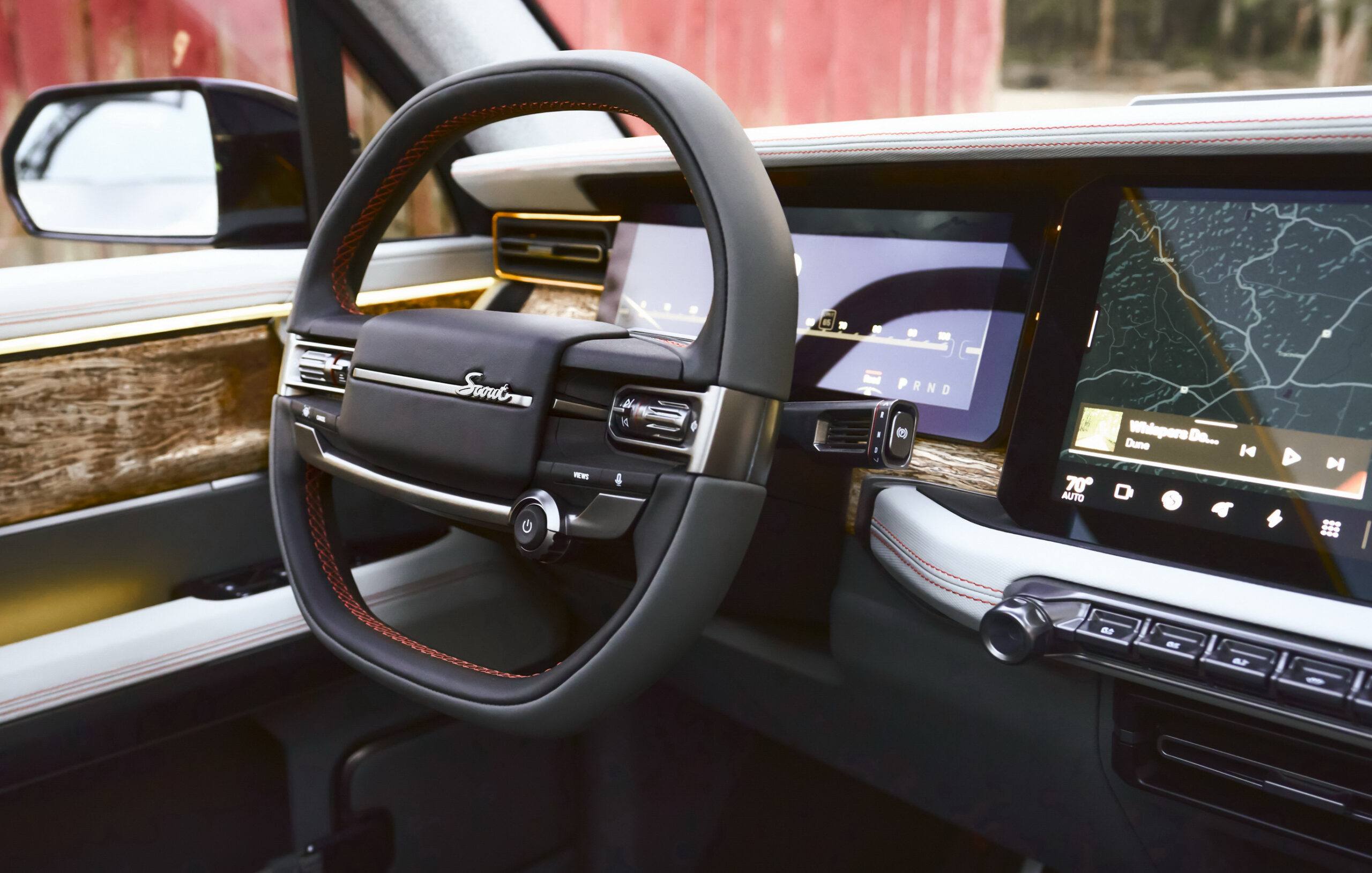
Scout says its EVs won’t chase sterile, ultra-minimalist, sci-fi EV interior cues. Yes, there’s a digital gauge cluster and a large center screen, but there will also be real knobs, real switches, and real buttons.

The tactile nature of the cabin connects to the brand’s rugged DNA, and the carefully curated sounds will reinforce it.

“We’re not creating spaceships,” Benjamin said. “We’re creating hearty, wholesome vehicles that people will love, and we want the sounds to reflect that.”

Production of the Terra and Traveler begins in South Carolina in late 2027, after a run of pilot builds in 2026. 

 The Fake Sounds In Scout’s EVs Come Straight From Real American Machines

Kia Slashed $10,000 Off Its EVs. Buyers Still Walked Away

  • Kia is on track to set another all-time sales record this year.
  • EV6 sales fell sharply from 1,887 last Nov to only 603 units.
  • Key model gains like the K5 and Sportage helped lift sales.

Car manufacturers across the US are scrambling to rekindle interest in their electric vehicles as the federal tax credit of up to $7,500 fades into the rearview mirror. The loss of that incentive has left many brands looking for new ways to attract buyers, and Kia’s approach is simple enough: slash prices.

Read: Who Needs $7,500 Tax Credit When Kia Slashes EV Prices By $10,000

The company is offering discounts worth as much as $10,000 across several models, though the numbers suggest it’s not quite having the desired effect. At least not yet.

Kia announced last month that the 2025 Niro EV, 2025 EV6, and 2026 EV9 would all be available with $10,000 in customer cash. For the Niro EV, that amounts to roughly a 24 percent markdown on the base model. Yet despite the aggressive pricing, sales remain far below the levels seen when the tax credit was still in play.

Discounts Without Traction

Last month, Kia shifted 918 examples of the three-row EV9, almost triple the number of Hyundai Ioniq 9s sold over the same period, but down significantly from the 2,155 sold in November 2024. Year-to-date deliveries are also down 30 percent from 20,066 to just 14,032.

It’s a comparable story with the EV6. Despite receiving a comprehensive facelift, sales have dropped sharply from 1,887 in November 2024 to only 603 this year. Total sales for 2025 now stand at 12,188, down 38 percent from 19,604 over the same stretch in 2024.

Kia US Sales November 2025
ModelNov 25Nov 24Diff.YTD-25YTD-24Diff.
EV99182,155-57%14,03220,066-30%
EV66031,887-68%12,18819,604-38%
K4/Forte9,32111,005-15%126,919127,867-1%
K56,4306,3781%66,64240,67264%
Soul3,2804,031-19%47,67948,747-2%
Niro5,2301,624222%28,03728,302-1%
Seltos6,2863,77866%51,97356,221-8%
Sportage15,79514,05112%165,954146,49013%
Sorento6,7238,705-23%87,43385,7222%
Telluride10,05411,568-13%111,123103,0168%
Carnival7,3624,92549%65,17244,56146%
Total72,00270,1073%777,152723,1857%
SWIPE

Kia does not break down powertrain sales of the Niro, which is sold in ICE, hybrid, and EV guises in the US. What we do know is that overall Niro sales increased dramatically from 1,624 in November 2024 to 5,230 last month.

On Track For a Sales Record

Despite the underwhelming performance of its electric lineup, Kia’s overall sales tell a different story. November saw 72,002 vehicles delivered, up three percent from 70,107 a year earlier.

The brand has now sold 777,152 vehicles in 2025 and is on course to notch its third consecutive all-time annual sales record. The gains have been driven in part by a 64 percent jump in K5 sales, a 13 percent rise in Sportage deliveries, and an 8 percent boost for the Telluride.

\\\\\\

Nio EV Splits Open Like A Can Of Tuna In A Strange Crash

  • Nio EC6 hit a concrete barrier in Shanghai and split through the rear.
  • Driver and passenger escaped without injuries after the violent impact.
  • Battery pack survived the crash and avoided any fire or thermal issues.

All too often, we read about EVs catching fire after relatively minor accidents, and in some cases, occupants were trapped inside. This story is a little different though, as a Nio EC6 was recently destroyed in a crash in China, but remarkably didn’t catch fire despite almost completely splitting in two.

This incident happened in Shanghai on Monday. It’s understood that the light pink-colored EC6 hit a concrete crash barrier side-on after cutting in front of another vehicle, causing it to clip the rear of the Nio.

Local reports suggest that the top edge of the barrow, approximately 120 mm (4.7 inches) wide, applied an extraordinary amount of pressure on the C-pillar and the area of the floor.

Read: Nio’s Mass-Market Onvo Drops Its First 3-Row SUV With More Power Than An EV9 GT

This force caused a split through the rear of the car. Remarkably, the driver and passenger of the Nio were not injured in the crash. Additionally, the battery pack wasn’t severely damaged and did not catch fire.

According to a statement released by Nio, immediately after the crash, the vehicle’s onboard safety systems reported the accident. Nio staff were alerted to the impact and quickly responded to the scene, helping the occupants receive medical treatment.

Perhaps in a thinly-veiled dig at Tesla, Nio says that the EV’s doors immediately unlocked after the collision, allowing the driver and passenger to free themselves.

\\\\

Weibo

The car manufacturer also confirmed that the EC6’s driving assistance system was not enabled at the time.

The Nio EC6 was first unveiled in late 2019 before being thoroughly updated in February 2023. The example involved in this crash was one of the facelifted models.

It’s available with either a 75 kWh or 100 kWh battery pack and sold exclusively in dual-motor guise, producing a combined 483 hp and 516 lb-ft (700 Nm) of torque.

Sources: Weibo, Nio, CarNewsChina

As EV Sales Crash Badly, Hyundai Gets Its Lifeline From Elsewhere

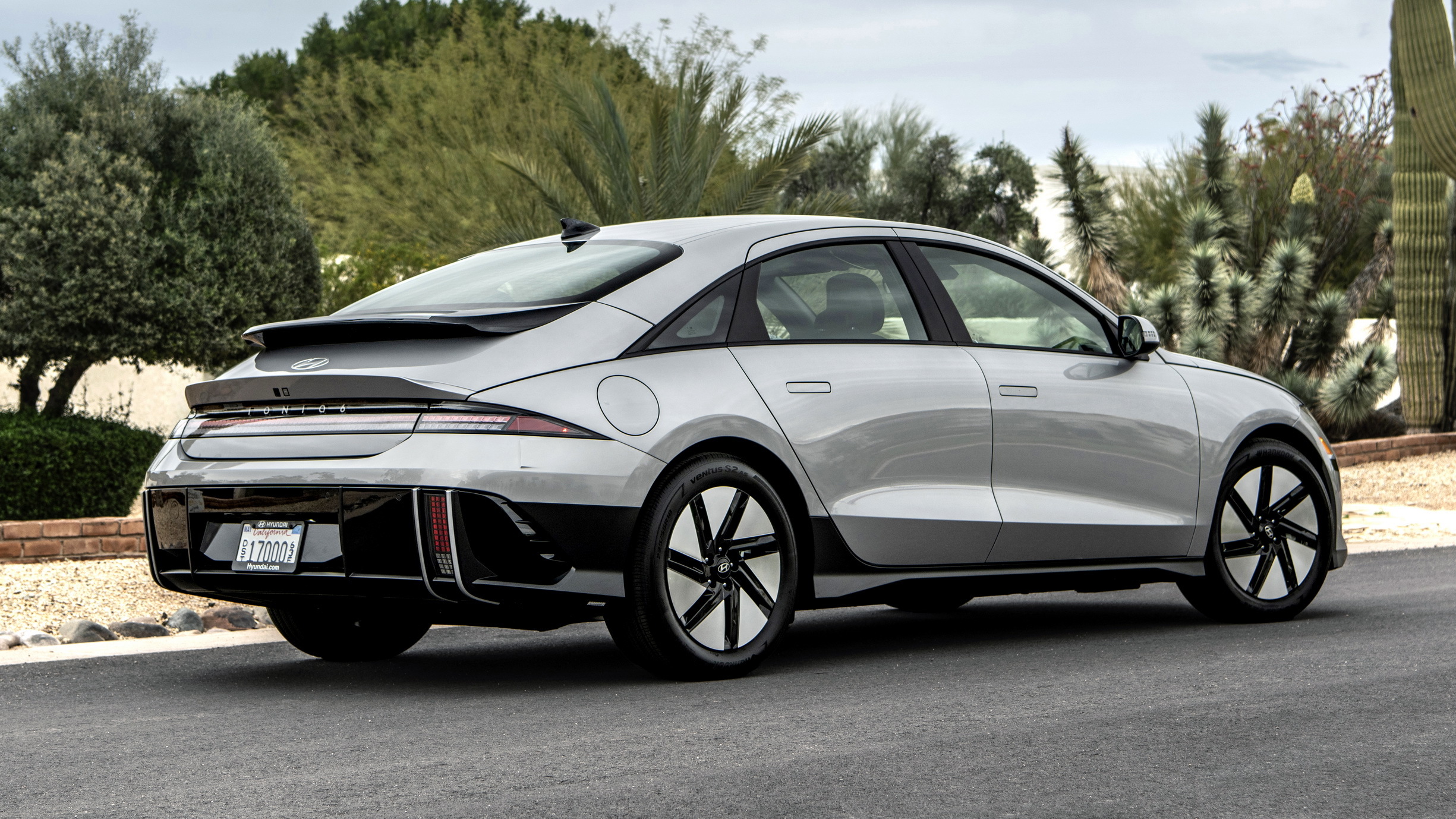
  • Hyundai Ioniq 5 sales fell sharply after federal tax credits ended.
  • Ioniq 6 demand also dropped significantly with sales hitting new lows.
  • Hybrids surged strongly marking their best monthly performance yet.

Hyundai is selling more hybrids in the United States than ever, a result that surely has executives reaching for the champagne. The mood, however, is muted by a sharp downturn in the company’s electric vehicle fortunes. Since the federal EV tax credit expired on September 30, demand has plunged, leaving Hyundai’s battery-powered lineup scrambling to regain its footing

How Low Can It Go?

The Ioniq 5 remains Hyundai’s best-selling EV in the US, though November brought little reason to celebrate. Only 2,027 units found buyers across the country, a steep 59 percent drop from the 4,989 sold in November last year.

 As EV Sales Crash Badly, Hyundai Gets Its Lifeline From Elsewhere

There was some consolation in the fact that this figure edged up slightly from October’s 1,642 sales, but the wider picture is still uneven. Year-to-date results show a modest 12 percent improvement over 2024, totaling 44,760 cars sold.

Read: Hyundai And Kia EV Sales Collapse After Tax Credits Vanish Overnight

Things have been equally as bad for the Ioniq 6, with just 489 being sold this November, a decline of 56 percent. Cumulative sales have also slipped, from 11,055 cars in 2024 to 10,019 so far this year, marking a 9 percent decline.

The seven-seat, three-row Ioniq 9 wasn’t available last year, but it remains a relatively slow seller. A total of 315 found new homes last month, down slightly from the 317 sold in October. Year-to-date, 4,809 have been sold.

Hyundai Sales November 2025
VehicleNov-25Nov-24% Chg2025 YTD2024 YTD% Chg
Elantra10,38911,344-8%136,825125,113+9%
Ioniq 52,0274,989-59%44,76039,805+12%
Ioniq 64891,121-56%10,01911,055-9%
Ioniq 931504,8090
Kona5,7836,133-6%68,03076,326-11%
Nexo000%593-95%
Palisade9,9068,982+10%112,23799,757+13%
Santa Cruz1,5372,393-36%23,88929,991-20%
Santa Fe14,00412,376+13%127,964105,701+21%
Sonata4,0186,971-42%54,23861,701-12%
Tucson23,76220,178+18%212,037185,954+14%
Venue2,0591,521+35%27,94322,808+23%
Total Sales74,28976,008-2%822,756758,304+8%
SWIPE

Hyundai’s total November sales have fallen 2 percent from November last year to 74,289 units. So for this year, it still remains in the green, shifting 822,756 vehicles, an 8 percent rise from the 758,304 sold during the first 11 months of 2024.

Hybrids to the Rescue

The big story, though, is hybrids. Sales of electrified models jumped 42 percent, making November Hyundai’s strongest hybrid month on record. That surge has been critical in offsetting the EV slump and maintaining overall growth through the final quarter.

Among individual models, several performed particularly well. In November, The Palisade rose 10 percent to 9,906 units, Santa Fe gained 13 percent to 14,004, and Tucson continued its strong run with an 18 percent increase to 23,762. Even the pint-sized Venue grew 35 percent to 2,059 units.

The Sonata, meanwhile, took a noticeable hit in November, dropping 42 percent year-over-year to 4,018 sales, bringing its year-to-date total to 54,238, down 12 percent from the same period in 2024.

For now, Hyundai’s U.S. lineup shows a clear divide between hybrid gains and weakening EV demand. The next few months will show whether that hybrid momentum can do enough to steady the company’s position in a softening electric market.

 As EV Sales Crash Badly, Hyundai Gets Its Lifeline From Elsewhere

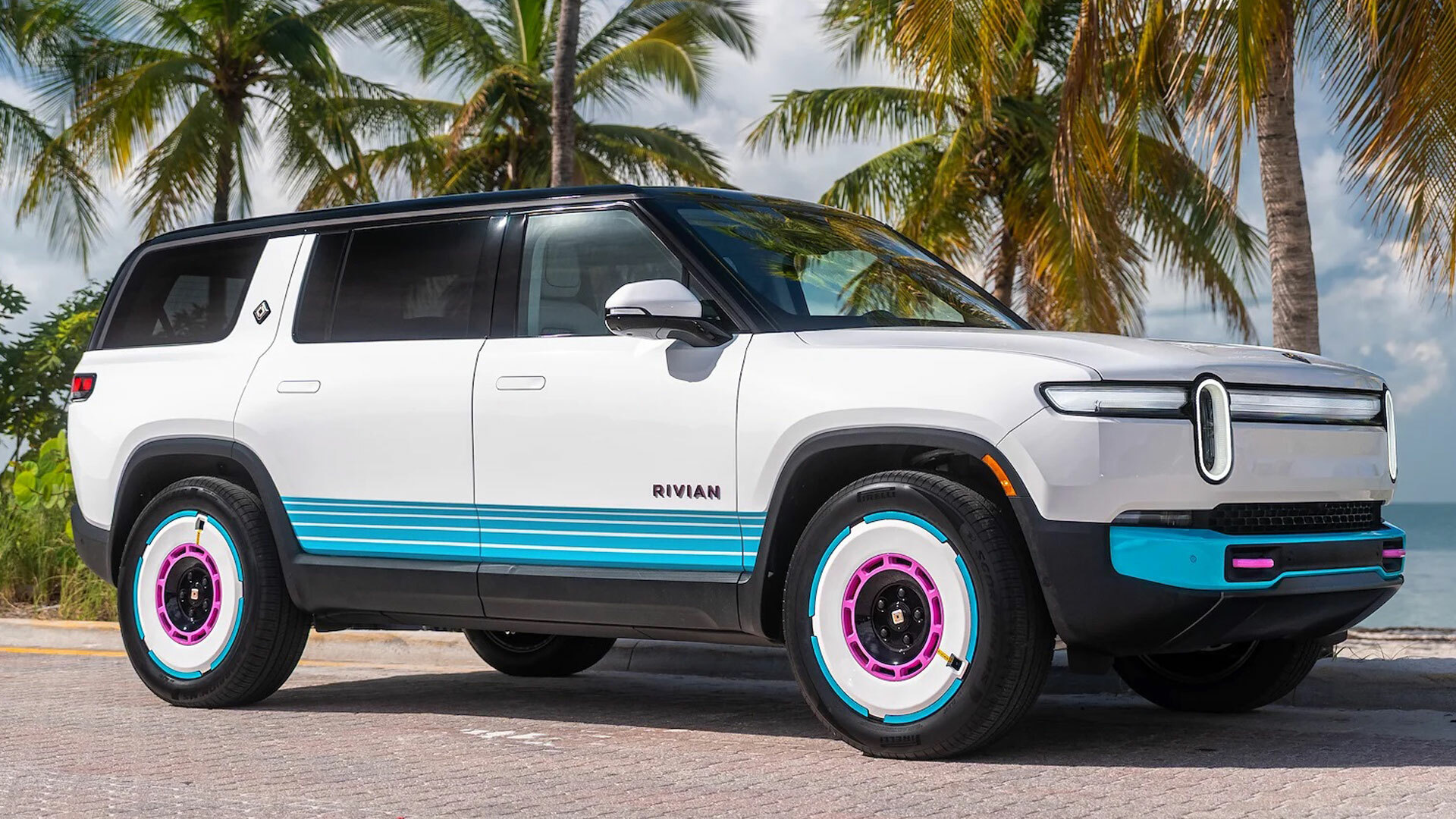
Rivian Turns One-Off Miami Showpiece Into A Very Pricey Limited Run

  • Rivian is putting its Miami-inspired R1S one-off into limited production.
  • Only 10 examples of the R1S Quad Miami Edition will be available.
  • At $134,990 the Miami is $13k more than a regular quad-motor R1S.

Cast your mind back to September and you might recall Rivian’s designers having a bit of fun with an R1S to celebrate the opening of a new store in South Florida. The automaker created a one-off concept SUV with a 1980s Miami-inspired paint scheme that made it look like the EV had jumped right out of Grand Theft Auto: Vice City.

Also: Insurance Offered $1,700 For This R1T Mishap, Rivian Wanted A Fortune

But that tropical fantasy is no longer a one-off. Rivian has confirmed it will build a limited run of purchasable replicas. Naturally, there’s a cost attached to owning one of these beach-party specials.

What Makes it Special?

\\\\\\\\\\

Called the R1S Quad Miami Edition, the colorful SUV is, as the name suggests, based on the top-spec, Corvette-scaring quad motor R1S, whereas the original concept was built around a three Motor R1S Tri model. But there are no changes to the life’s-a-beach visuals that you’ll either love or hate.

Only 10 examples will be built, each featuring the same Glacier White body accented by splashes of aqua and pink on the doors, 22-inch Miami Edition wheels and front bumper. While the doors stick to aqua blue stripes, the wheels get both colors, as does the nose, where a pink towing eye pokes from a blue bumper.

Even the interior doesn’t escape the Miami makeover, though if we’re honest we think Rivian seemed to lose interest once it got to the cabin. The sole flourishes appear to be a stripe of pink on the headrest and some floormats that look like they’re made from the same material as straw beach mats (hopefully they’re more substantial).

\\\\

Having four electric motors rather than three means the Miami Edition gets 1,025 hp (1,039 PS / 764 kW) instead of 850 hp (862 PS / 634 kW), dropping the zero to 60 mph (97 kmh) time from 2.9 to 2.6 seconds. Not that you’d get much opportunity to feel the difference when you’re cruising South Beach.

The Price of Standing Out

But the fun graphics will definitely turn more heads than any stock R1S Tri or Quad, and you’d hope they do given the pricing markup.

Rivian is asking $134,990 for the Miami Edition, which is $13,000 more than you’d pay for a regular R1S Quad. It’s only building 10, so it’ll probably have no trouble selling them, but do you think it’s a good deal?

 Rivian Turns One-Off Miami Showpiece Into A Very Pricey Limited Run
Rivian
Before yesterdayElectric Vehicles - Latest News | Carscoops

BMW Teases A Mystery Model Arriving On Christmas Eve

  • BMW slips a mysterious EV silhouette into its latest holiday video.
  • The teaser links to current electric models mentioned in the clip.
  • The shape suggests a crossover possibly related to the new iX3.

The holiday season is upon us and that means automakers have rolled out an assortment of Christmas-themed campaigns such as Lexus’ December to Remember. These are easy to overlook, so it’s surprising that BMW decided to sneak a teaser in one of them.

The video begins with an advent calendar opening to reveal an assortment of models including the 7-Series. It then zooms in on December 24 and the box opens as question marks shoot out.

More: The iX3 Is BMW’s Neue Klasse Future Now With A Surprising Price Tag

We’re then shown a darkened silhouette of a mysterious vehicle. It’s hard to tell what’s being displayed, but the accompanying text gives us some clues. In particular, it notes the video shows the iX1 xDrive30, iX2 xDrive30, i4 M50 xDrive, i5 M60 xDrive Touring, and i7 xDrive60.

All five of them are electric, so it’s safe to assume the mystery model is as well. The vehicle also appears to be a crossover that recalls the new iX3.

We’re not sure what BMW has up their sleeve, but spy photographers have already snapped pictures of the iX3 M60. It’s expected to have a sport-tuned suspension and beefier brakes. We can also expect styling tweaks inside and out.

Another possibility is the new i3. BMW has been teasing the car for months and the automaker could use Christmas Eve to share more details.

Another outside possibility is a glimpse at the upcoming iX5. It’s expected to debut next year and prototypes have already been spied on numerous occasions.

Still, the safest bet remains a new take on the iX3. In fact, when BMW introduced the iX3 50 xDrive in September, they said “further fully electric variants will follow, including a single-motor rear-wheel drive model.” The holiday clip may be the brand’s quiet way of saying that time is near.

 BMW Teases A Mystery Model Arriving On Christmas Eve

H/T to BMW Blog

New Mercedes GLC EQ Isn’t Stopping At Two Rows Anymore

  • Mercedes is testing a larger, three-row version of the GLC EQ.
  • The prototype shows a flatter roofline and extended rear doors.
  • Expect a similar interior with MBUX Superscreen and Hyperscreen.

Mercedes unveiled the GLC EQ at the Munich Motor Show this fall, but that’s not the end of the story. Quite the opposite as spy photographers have now snapped the first pictures of what appears to be a new three-row variant.

Spied parked alongside the regular model, the seven-seat crossover has a familiar design that closely echoes its smaller counterpart. However, we can see a flatter roof, updated rear doors, and a unique rear end.

More: Star-Stricken Mercedes GLC EV Has A Grille Big Enough To Swallow A BMW iX3

The latter has been extended and features a more upright rear window. The camouflage also suggests larger third-quarter glass and a reimagined D-pillar.

Besides the special touches, the model has starry headlights and plastic body cladding. We can also see a familiar grille and rear light bar with circular elements.

 New Mercedes GLC EQ Isn’t Stopping At Two Rows Anymore

Spy photographers didn’t get a look inside, but the model should have a 10.25-inch digital instrument cluster and a 14-inch infotainment system.

Buyers will also likely have the option to upgrade to the MBUX Superscreen, which adds a 14-inch front passenger display. If that isn’t enough screens, the available MBUX Hyperscreen features a 39.1-inch display that spans the width of the dashboard.

We can also expect a familiar powertrain that consists of a 94 kWh battery pack as well as a dual-motor all-wheel drive system developing 483 hp (360 kW / 490 PS) and 590 lb-ft (800 Nm) of torque.

This enables the regular model to accelerate from 0-62 mph (0-100 km/h) in 4.3 seconds, hit a top speed of 130 mph (210 km/h), and have a WLTP range of 418 miles (673 km).

The three-row crossover is believed to be designed for China. However, that’s not entirely certain as the model would make sense in a number of markets.

\\\\\\\\\

Baldauf

California EV Owners Now Risk A $490 Fine Under New Driving Rules

  • California ends solo EV access to carpool lanes after 25 years.
  • Drivers risk getting a ticket starting Dec 1 for using HOV lanes.
  • Enforcement started after a 60-day grace period for local drivers.

California has long been America’s champion of electric mobility, a place where environmental ideals and car culture somehow coexist on the same sun-baked freeway. For years, the state has rolled out incentives to get drivers into EVs, from tax credits to special lane privileges.

Chief among them was the right to glide past gridlock in carpool lanes, solo and smugly efficient. But that era has now come to a halt.

Read: California Won’t Replace $7,500 EV Tax Credit as Newsom Accuses GM of Selling Out

For more than 25 years, states have been free to decide whether EV drivers could use carpool lanes, spaces meant for vehicles carrying at least one passenger. California made its stance clear early on.

It offered qualifying motorists distinctive Clean Air Vehicle stickers, granting them unrestricted access to these faster lanes even when driving alone.

From Exemption to Enforcement

That all changed when the Trump administration declined to renew the federal authorization that supported the state’s exemption. The cutoff date was October 1, and once that law expired, so did the automatic right for solo EVs to cruise in carpool lanes.

The California Highway Patrol then gave motorists a 60-day grace period to adjust their driving habits and exit the carpool lanes. Starting from December 1, police can now issue a $490 fine.

 California EV Owners Now Risk A $490 Fine Under New Driving Rules

That’s not great news for local EV owners. Some suspect that by pulling EV drivers out of carpool lanes, which often sit empty during peak morning and afternoon hours, traffic on some of California’s highways may get even worse.

“It’s a huge, huge bummer for EV enthusiasts,” the president of the Tesla Owners of Silicon Valley club, John Stringer told The Press Democrat. “It has been one of the things we’ve been able to enjoy for years. It was one of the reasons why I bought my first EV.”

Stringer estimates that his carpool access saved him about 20 minutes each way on his daily commute, time that now returns to the general traffic pool.

In September, Rep. Mark DeSaulnier revealed that he had been lobbying in Washington, D.C., on behalf of EV drivers, trying to extend the carpool privilege for another six years through a House Resolution. Despite the effort, the proposal stalled before reaching a vote.

 California EV Owners Now Risk A $490 Fine Under New Driving Rules
Google Maps
❌
❌