Peugeot has detailed the new e‑208 GTi, which costs €42,900 ($49,646).
Model features a 54 kWh battery and a motor developing 277 hp.
It hits 62 mph in 5.5 seconds and can travel up to 233 miles on a charge.
Following a preview earlier this month, Peugeot has unveiled the e‑208 GTi. The hot hatch packs a surprising punch and is the brand’s first fully electric performance variant.
Starting with the powertrain, the model has an M4+ motor developing 277 hp (207 kW / 281 PS) and 254 lb-ft (345 Nm) of torque. It enables the car to accelerate from 0-62 mph (0-100 km/h) in 5.5 seconds, before hitting a limited top speed of 112 mph (180 km/h).
The motor is powered by a 54 kWh battery pack, which gives the vehicle a combined WLTP range of up to 233 miles (375 km). However, on the standard Michelin Pilot Sport 4S performance tires, the range drops to 219 miles (352 km). Other highlights include a best in class power‑to‑weight ratio and a 100 kW DC fast charging capability, which enables the battery to go from 20–80% in less than 30 minutes.
Sticking with the performance theme, the e‑208 GTi has been lowered by 1-inch (25 mm) and features a wider track. The model also sports unique springs and dampers, a mechanical limited‑slip differential, and an additional anti‑roll bar. The latter resides out back and joins the front anti‑roll bar found on the regular model.
Since we’ve already seen the car before, we’ll briefly mention it features a unique front lip and a revised gloss black diffuser with an F1-inspired rear fog light. They’re joined by red accents, extended wheel arches, “perforated” 18-inch wheels, and 208 GTi badging on the C-pillars.
The red theme continues inside as there are red carpets, floor mats, seatbelts, and stitching. They’re accompanied by special sport seats that pay tribute to the 205 GTi 1.9 and feature a “central red insert and red mesh detail” evocative of the 205 GTi 1.6.
Elsewhere, there’s a leather and Alcantara steering wheel, red‑themed displays, and red ambient lighting – although seven other colors are also available. Peugeot also mentioned a “sound ambience” system, which is linked to your speed and can be deactivated.
The company is currently accepting orders and pricing starts at €42,900 ($49,646) in France including taxes. That undercuts the 600 Abarth, which begins at €46,900 ($54,280).
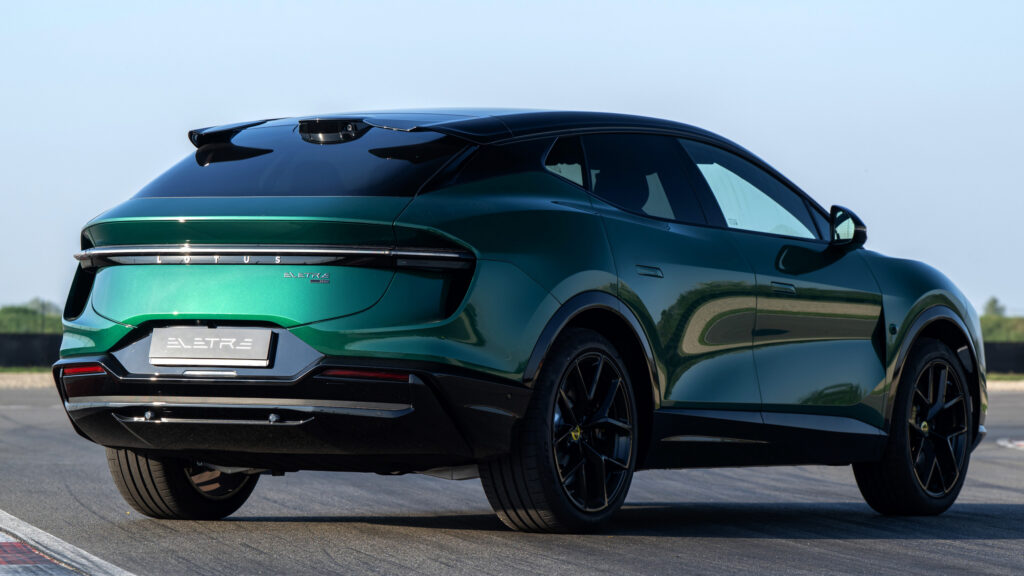
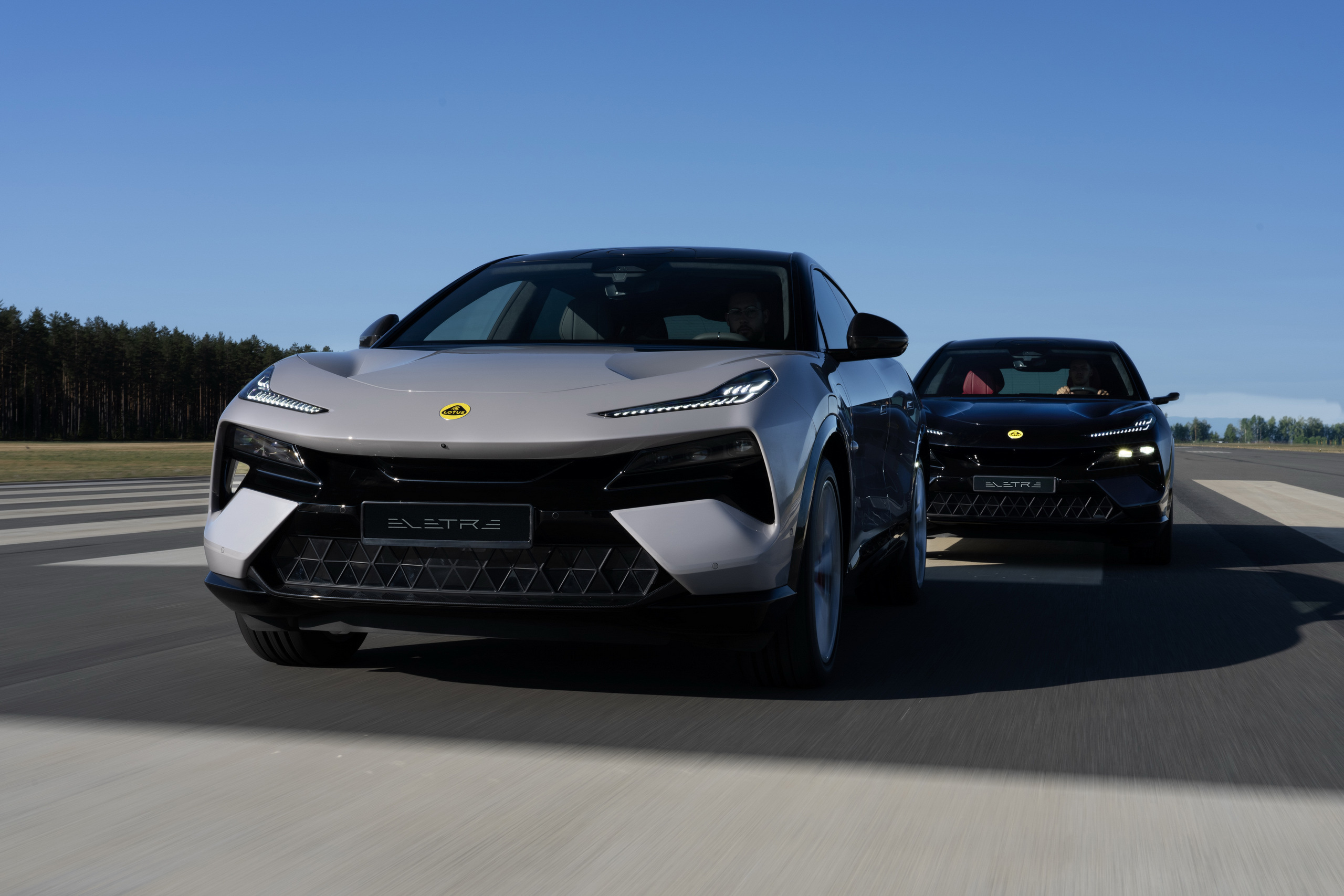
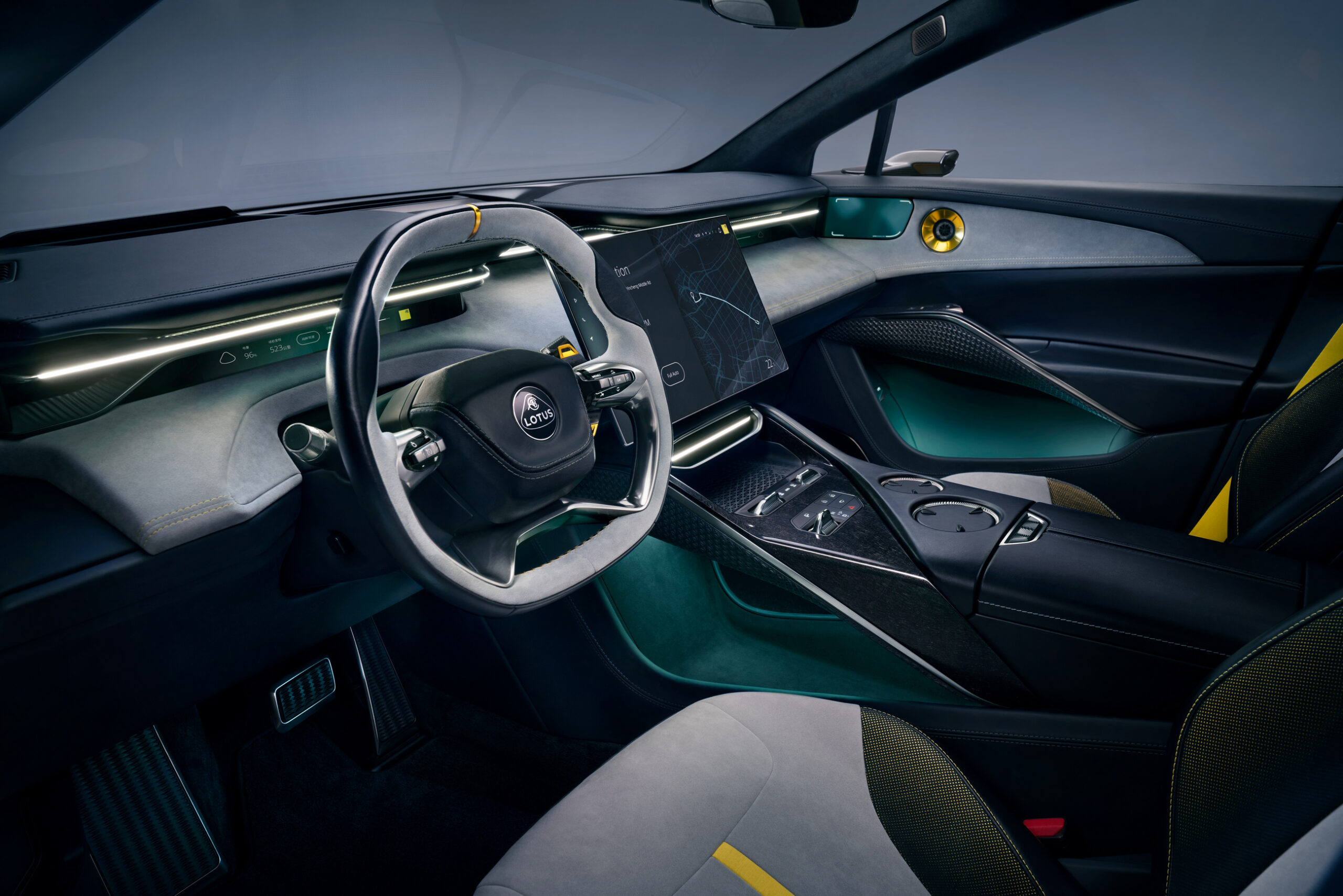
Lotus will sell two versions of the hybrid Lotus Eletre across key European markets.
The flagship H1000 variant delivers 939 hp and 690 lb-ft (935 Nm) of torque.
The Eletre X plug-in hybrid has a combined driving range of over 745 miles.
As impressive as the all-electric Lotus Eletre is, it’s never been very popular, in part because of its price, but also because few people are willing to pay a premium for an electric SUV like it. This prompted Lotus to launch a hybrid version in China earlier this year, and it’s now touched down in Europe.
Known as the Eletre X, the plug-in hybrid model is arguably what the Eletre should have always been. It uses a 2.0-liter turbocharged four-cylinder engine, two electric motors, a 70 kWh battery pack, and has a 900-volt architecture, resulting in a combined 939 hp and 690 lb-ft (935 Nm) of torque. This gives it 34 more ponies than the all-electric Eletre R, although it is down on that model’s 985 lb-ft (1,335 Nm).
Lotus says the Eletre X can hit 62 mph (100 km/h) in 3.3 seconds and power from 50-99 mph (80-160 km/h) in just 3.88 seconds. Perhaps more important than the straight-line performance is that, thanks to the generous battery pack and the 52-liter fuel tank, the plug-in hybrid Lotus can travel more than 745 miles (1,200 km) between stops. All-electric range also sits at a solid 217 miles (350 km). What’s more, it takes just 9 minutes to charge the 70 kWh pack from 20-80 percent at a 350 kW DC charger.
Two Versions On Offer
Two different versions of the Eletre X plug-in hybrid will be offered. The figures of 939 hp and 690 lb-ft (935 Nm) are reserved for the H1000 model, but an H550 entry-level version will also be offered. This model is capped at 542 hp but retains the same 690 lb-ft (935 Nm) of torque. It can hit 62 mph in 4.9 seconds and tops out at 130 mph (210 km/h), whereas the H1000 is good for 143 mph (230 km/h). The H550 includes the same 70-kWh pack, 900-volt system, and driving range.
Among the key features retained from the electric version are a 48-volt active anti-roll control system, dual-chamber air suspension, dual-valve adaptive dampers, front double-wishbone suspension, and huge Brembo brakes.
Then there’s the all-important pricing. In Germany, the base all-electric Eletre starts at €95,990 ($111,600), while the new Eletre X H550 starts at €96,990. Importantly, the H1000 starts at €119,990 ($112,800), whereas the flagship electric version is much pricier at a touch over €150,000 ($174,400), so the H1000 seems like quite a good deal.
The 2027 Dodge Charger gets 25 new personalization options.
The Charger Daytona now comes with a native NACS port.
Model starts at $49,995, but the EV gets a $12,500 price hike.
Dodge announced a handful of changes to the 2027 Charger Daytona Scat Pack last winter and now the company has revealed more information about the larger Charger lineup. Highlights include 25 new customization options and a NACS port for the EV.
Starting outside, ICE-powered models can be equipped with a new Satin Black painted hood. Buyers will also find new dual stripes – in Satin White, Satin Black, and Gloss Red – as well as expanded graphic choices. The latter include “Charger” blade stripes and strobe stripes in the aforementioned colors.
Rounding out the exterior highlights is a new Mopar accessory glass roof sunshade. Buyers will also find a Brembo braking system that now offers orange and black calipers.
One of the coolest updates resides inside Scat Pack models. For 2027, they can be equipped with new Petrol Blue leather sport seats that feature “Digital Slash” perforation and red contrast stitching. They’re a nice departure from the usual black or red.
Last but not least, all Chargers can be equipped with new Demonic Red seat belts. They help to add an extra splash of color to the cabin.
Pricing for the 2027 Charger starts at $49,995, which is the same as last year’s model. However, the electric Charger Daytona Scat Pack soars to $72,495, which is an increase of $12,500. As we’ve previously noted, Dodge appears to be actively discouraging sales of the slow-selling EV with the massive price hike.
As a refresher, the Charger R/T has a twin-turbo 3.0-liter Hurricane inline-six developing 420 hp (313 kW / 426 PS) and 468 lb-ft (634 Nm) of torque. It enables the model to accelerate from 0-60 mph (0-96 km/h) in 4.6 seconds and run the quarter-mile in 12.9 seconds.
Upgrading to the Scat Pack rewards buyers with a high output engine developing 550 hp (410 kW / 558 PS) and 531 lb-ft (719 Nm). Thanks to the extra power, the dash to 60 mph (96 km/h) falls to 3.9 seconds while the quarter-mile comes in 12.2 seconds.
The Charger Daytona Scat Pack is the performance champ as it sports a dual-motor all-wheel drive system with 670 hp (500 kW / 679 PS) and 627 lb-ft (849 Nm) of torque. 60 mph (96 km/h) comes in 3.3 seconds, while the quarter-mile blows past in 11.5 seconds. However, you’ll have to keep trips short as the model only has 267 miles (430 km) of range.
Dodge is currently accepting orders for the 2027 Charger and cars will begin arriving at dealerships in the third quarter.
EV trade-in rates rose from 67.1% to 72.1% between January and April.
Used EV wholesale values jumped 11% this year and beat ICE prices for weeks.
Analysts urge caution, citing high rates and more expensive gasoline.
Data from Edmunds suggests the shift from gas to electric is gaining momentum at the dealership level. In January of this year, 67.1% of new EV purchasers at dealerships traded in a gas car. In April of this year, that figure had jumped to 72.1%. And it’s not just a first-time fad. Repeat EV purchase data also show an increase.
Numbers for January 2026 show that 26.2% of buyers traded in an old EV for a brand-new one. That figure leaped to 35.4% in April. Worth noting: this uptick comes despite the removal of the federal $7,500 EV tax credit and several state-level incentives. So, is this a definitive trend, then?
Speaking to CNBC, Ivan Drury, Senior Director of Insights at Edmunds, says it’s too early to draw a concrete conclusion, or to say whether it’s just the effect of the Middle East War and its resulting runaway fuel prices. “Oil and gas prices started rising after the U.S. and Israel attacked Iran on Feb. 28. About three more months of high gas prices and elevated EV trade-in numbers will give a better indication of whether customers feel pinched enough at the pump to consider a switch…” says Drury.
Car Prices Are Rising, But Especially EVs
With auto prices rising across the board, whether you buy a brand-new car or a used one, the chances are you’ll be paying more for it now than you would have six months ago, and much more than in 2020.
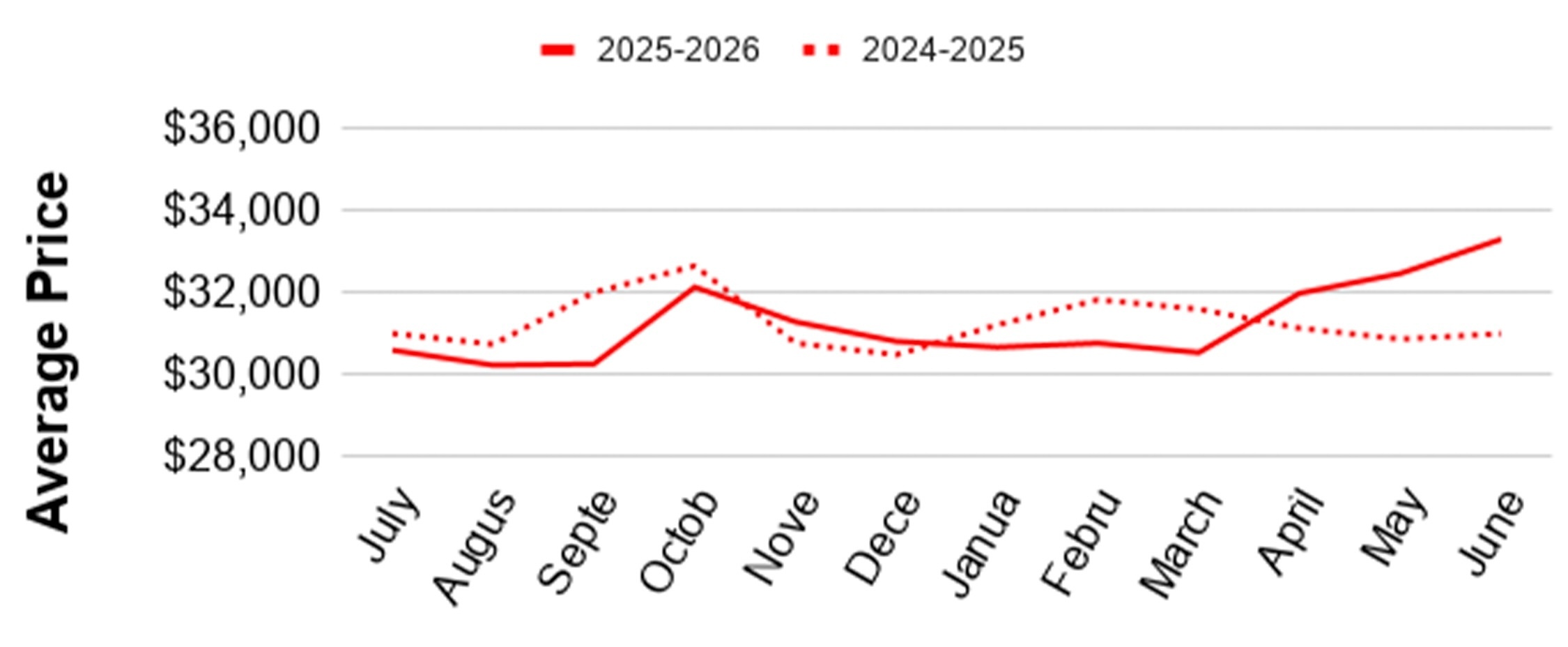
According to Cox Automotive, their Manheim Used Vehicle Value Index is approximately 4% higher than at the same time last year. And they’ve seen EVs leading the charge, with price increases notably higher than regular gas-powered vehicles.
“Additionally, we continue to see EV prices rising faster and holding higher than non-EVs. Three-year-old EV prices have outpaced non-EVs for six weeks in a row and are 11% higher than they were at the start of the year. The longer gas prices remain elevated, the more we expect consumers to turn to fuel-efficient vehicles.
“As EV lease maturities continue to increase throughout the summer, it will be critical to follow EV price trends—especially if the Middle East conflict remains unresolved.” says Jeremy Robb, Chief Economist at Cox Automotive. So, it seems that buyers are willing to pay more upfront if it means lower running costs, which EVs have offered for quite some time now.
Unsurprisingly, ICE SUVs Have Appreciated Least
It’s no surprise to see that out of all the categories analyzed by Cox Automotive, used gas-powered SUVs and CUVs have appreciated by just 0.3% on average since last year. Given their gas-guzzling tendency and resultant tugging at pocket strings, it’s to be expected.
Equally unsurprising is the fact that compact cars, a relatively fuel-efficient segment in the internal combustion engine class, saw the second-highest increase, at 7.6%. As Drury would likely agree, the data points in an interesting direction — but it’s still too early to call it a structural shift rather than a gas-price reaction.
Chinese EVs are depreciating rapidly in Europe, a new study reveals.
Weak residual values in Germany are concerning to lease companies.
Private buyers are also feeling the pain when it comes time to sell.
Chinese automakers have spent the last few years steamrolling into Europe with bargain prices, generous equipment, and monthly lease deals looking almost too good to ignore. But there’s a growing catch buyers are starting to notice. Those bargain EVs can lose value frighteningly quickly once they leave the showroom.
Fresh figures from Germany’s DAT vehicle valuation group show Chinese EVs and plug-in hybrids are depreciating twice as fast as the industry average. And the rate of depreciation is only getting worse.
That creates headaches for almost everyone involved. Owners face painful trade-in figures, manufacturers risk swallowing losses through guaranteed buyback schemes, and leasing companies suddenly discover the cars returning are worth far less than expected.
Martin Weiss from DAT told Autonews Europe that “it is not enough to launch a good product.” Brands also need strong support systems behind the scenes if they want used buyers to remain confident years later. Part of the problem is uncertainty. Plenty of European buyers wonder whether some Chinese brands will actually stick around long term. Concerns about servicing, replacement parts, and dealer networks continue making cautious used buyers think twice.
Not Just Chinese EVs Suffering
But it’s not only Chinese brands feeling the pressure. Britain’s EV market is also watching residual values tumble across the board, in part due to the influx of cars from China, the Financial Times reported recently. Quoting figures from Indicata, it claimed the average three-year-old EV as of last month was worth 38 percent of its original value, compared with 46 percent in Germany, France and Spain. In contrast, a same-age petrol car in the UK retained 45 percent of its value, and a hybrid, 51 percent.
Carmakers are under huge pressure to increase EV sales, so many are throwing massive discounts at new models to hit UK government targets. That’s pushed a Chinese car, the Jaecoo 7, to the top of the UK sales chart for the first time ever, but it leaves nearly-new EVs looking overpriced beside heavily incentivized factory-fresh cars.
Ironically, rapid technological progress is also hurting values. Chinese brands especially release updates at breakneck speed, meaning today’s cutting-edge EV can suddenly feel old-fashioned months later. Great for innovation perhaps, but brutal if you’re trying to protect resale values.
Rivian has revived its Forest Edge cabin for the R1S and R1T after dropping it.
A green vegan leather treatment now covers seats, doors, pillars, and headliner.
Brown Ash Wood trim keeps the heavy green from overwhelming the whole cabin.
The Rivian R1S and R1T have always been aimed at a particular type of buyer, one who hikes, camps, and treats the outdoors as a destination rather than a backdrop. Or, more honestly, one who wants to look like they do. Given that, it’s a little surprising Rivian has taken this long to revive one of the better interior options it ever offered, the one that turns the cabin into something resembling a private forest.
The cabin, aptly named Forest Edge, was offered a few years ago before quietly disappearing from the R1 family. It’s now back in both the R1S and R1T, but only for a limited time. Rivian hasn’t said exactly how long the window will stay open, though it should find plenty of takers.
A rich shade of green vegan leather covers most of the cabin’s key surfaces, including the seats, door panels, and center console lid. It also climbs up the pillars and across the headliner. To keep the look from tipping into the overbearing, Rivian has paired it with Brown Ash Wood trim on the doors and dashboard, along with plenty of black faux-leather panels and a few subtle yellow accents tying everything together.
What Else Is Included?
Shoppers who want a Forest Edge interior will only be offered the chance to pair it with three exterior paints: Glacier White, Half Moon Grey, or Forest Green. In addition, models with the Forest Green configuration include the Darkout Package with 22-inch Sport Dark wheels as standard, but also available with optional 20-inch All-Terrain Dark wheels. The Sound + Vision package also comes pre-equipped, adding Rivian’s Dynamic Glass Roof and premium audio system.
Perhaps the most notable downside about the Forest Green option is that it’s only available on Dual-Motor with Max Pack configurations, which, as standard, start at $83,990 for the R1S and $79,999 for the R1T. The Forest Edge Package adds $9,000 to the price tags of both, lifting their MSRPs to $92,990 for the R1S and $88,990 for the R1T.
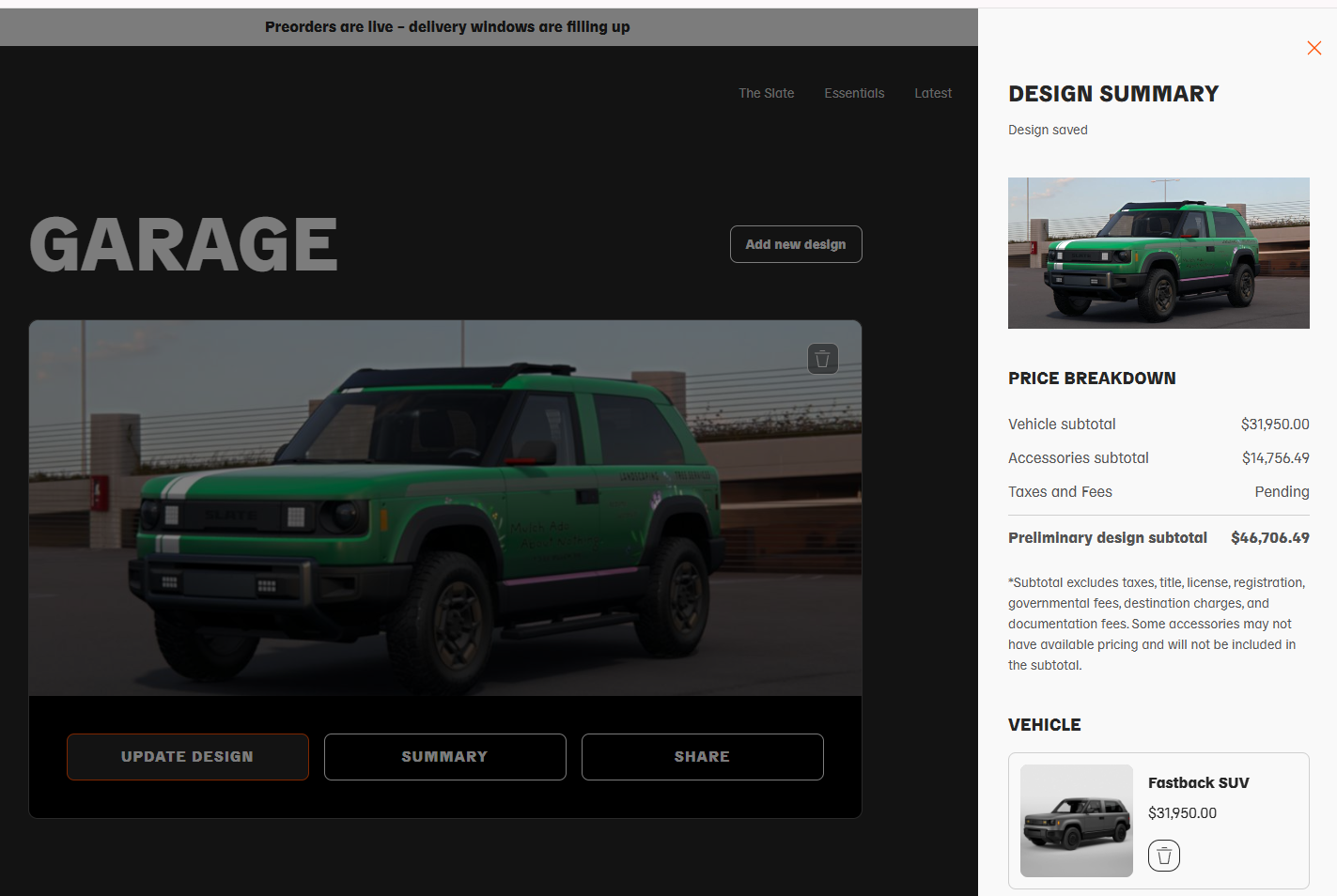
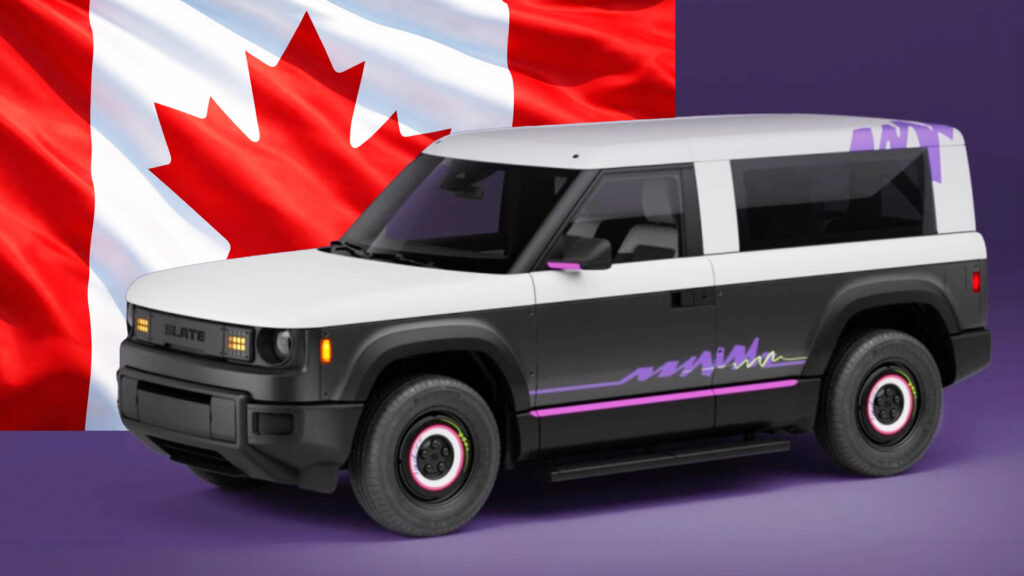
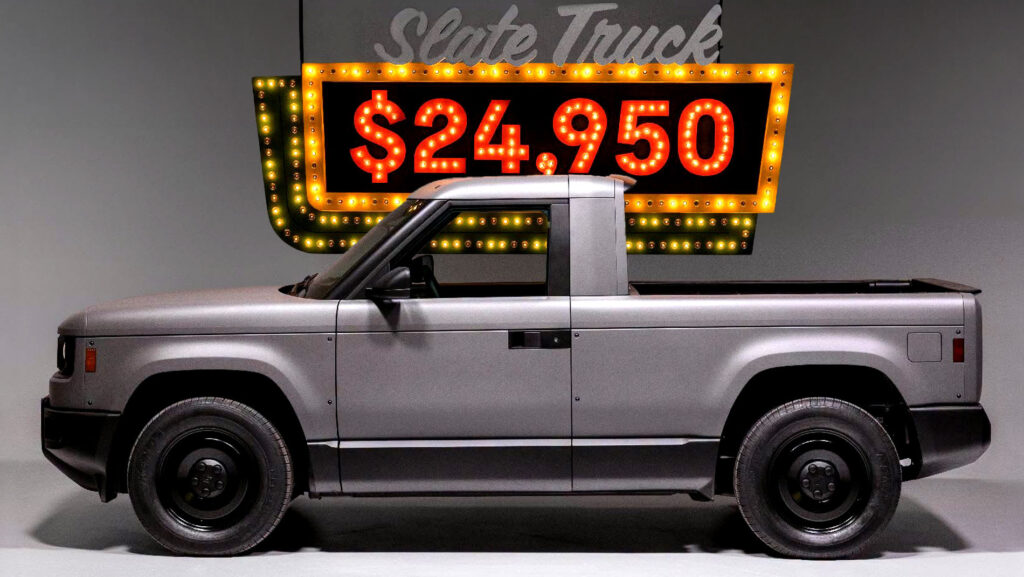
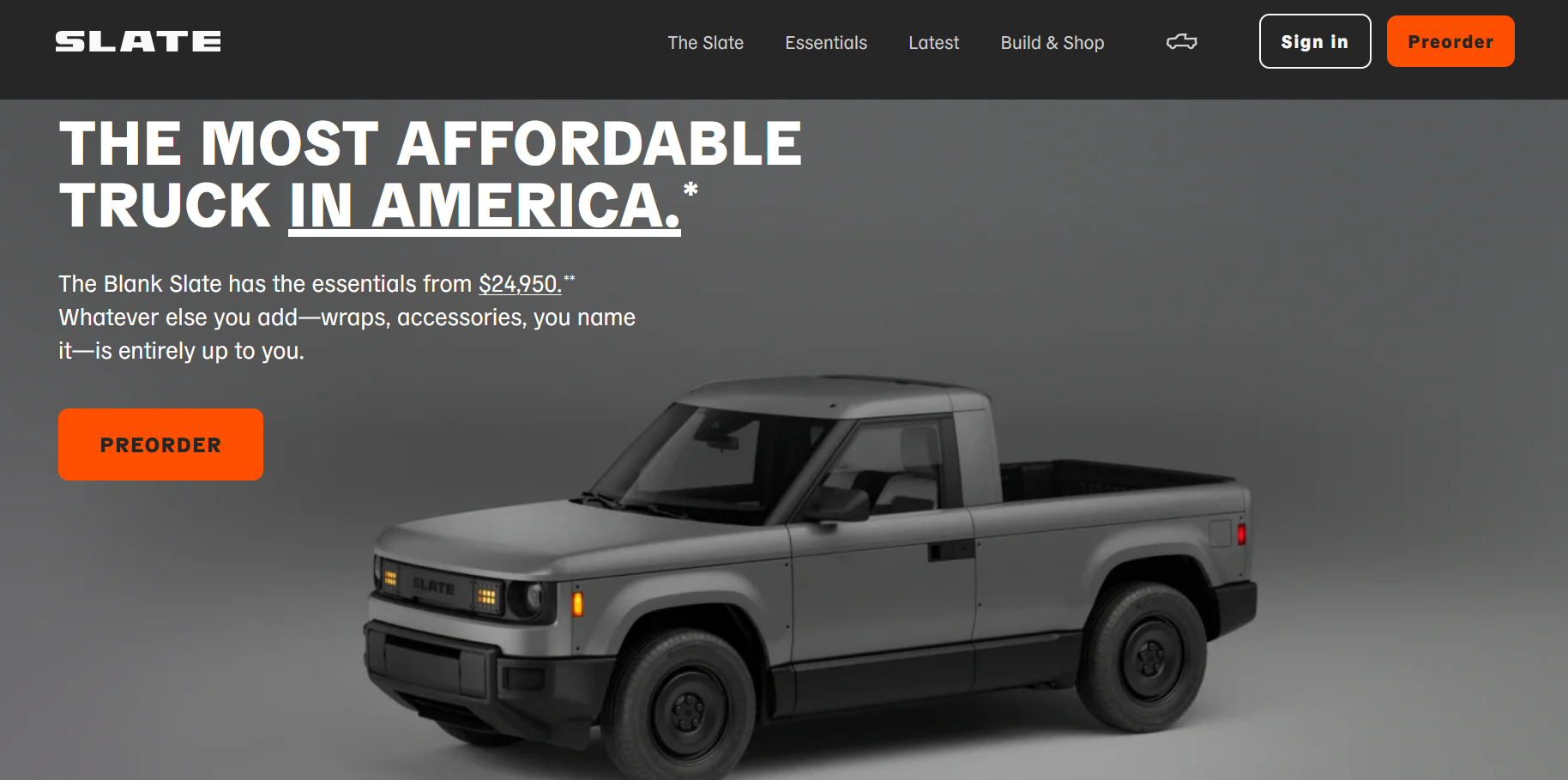
Slate Auto will begin taking orders for its budget-focused EV on June 24.
Startup still hasn’t revealed final pricing after losing the federal EV tax credit.
More than 160,000 people have already placed refundable reservations.
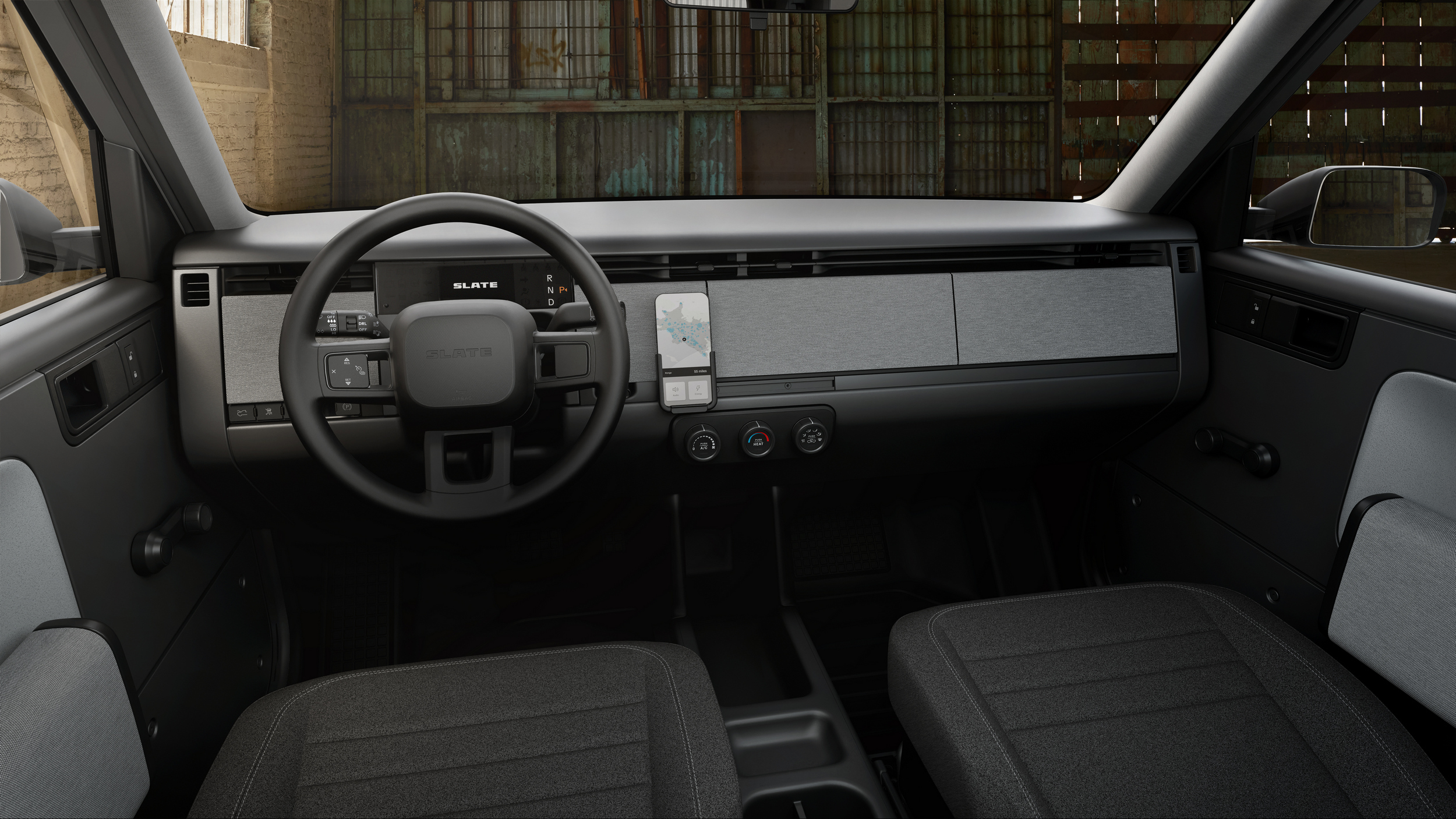
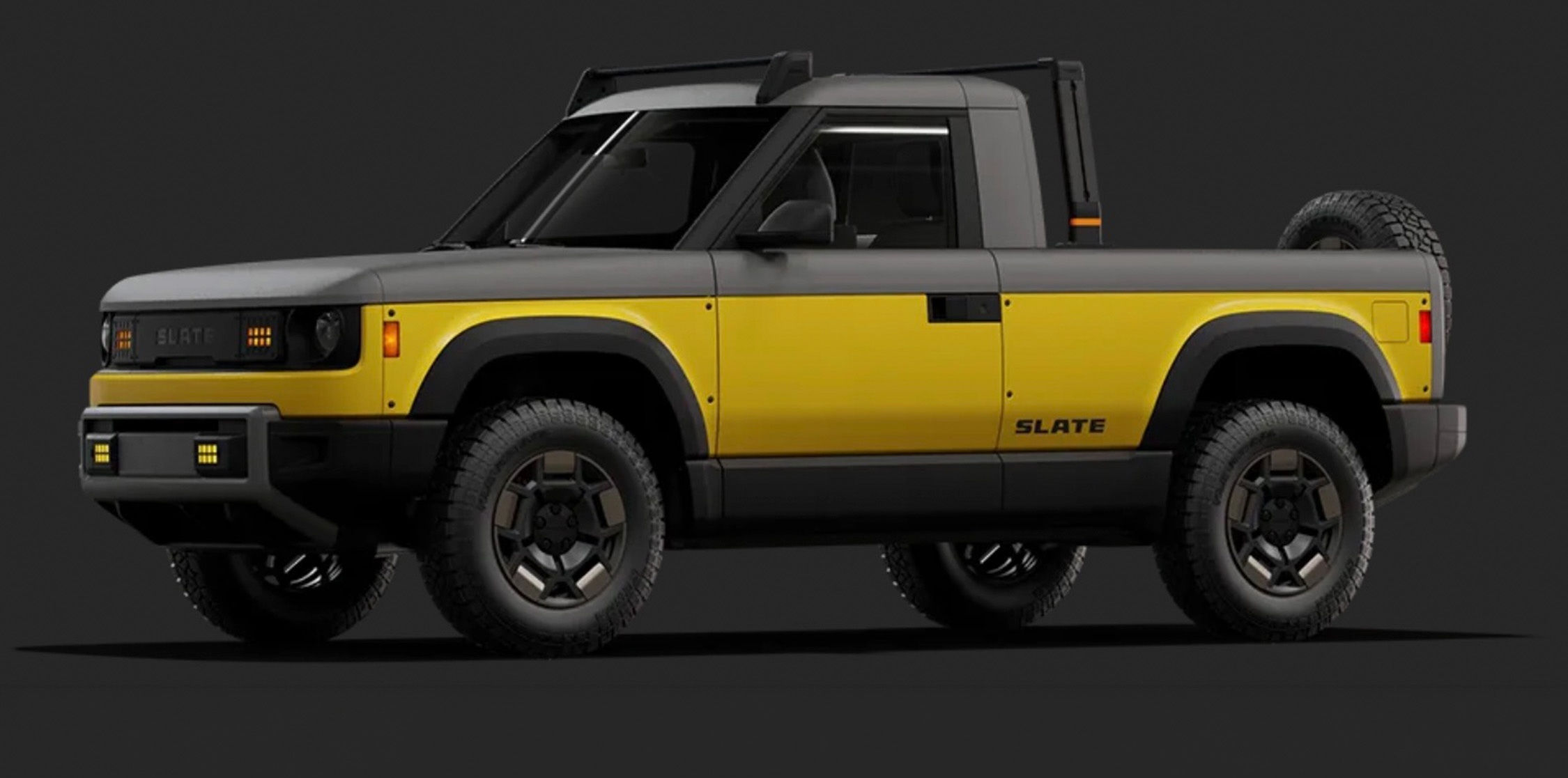
For Slate Auto, it’s been a wild ride since its inception four years ago. Initially, it planned to bring an EV to market for less than $20,000. Then Donald Trump cancelled the $7,500 tax credit that made such a price feasible. Now, the company is about to open up order books on June 24, but there’s still something missing… the price buyers will have to actually pay.
Today, the electric vehicle startup backed by Amazon’s Jeff Bezos sent an email to prospective buyers saying that preorders will begin in June. Specifically, they’ll open on June 24, and those who jump on board early will evidently get a “delivery window before non-reservers.”
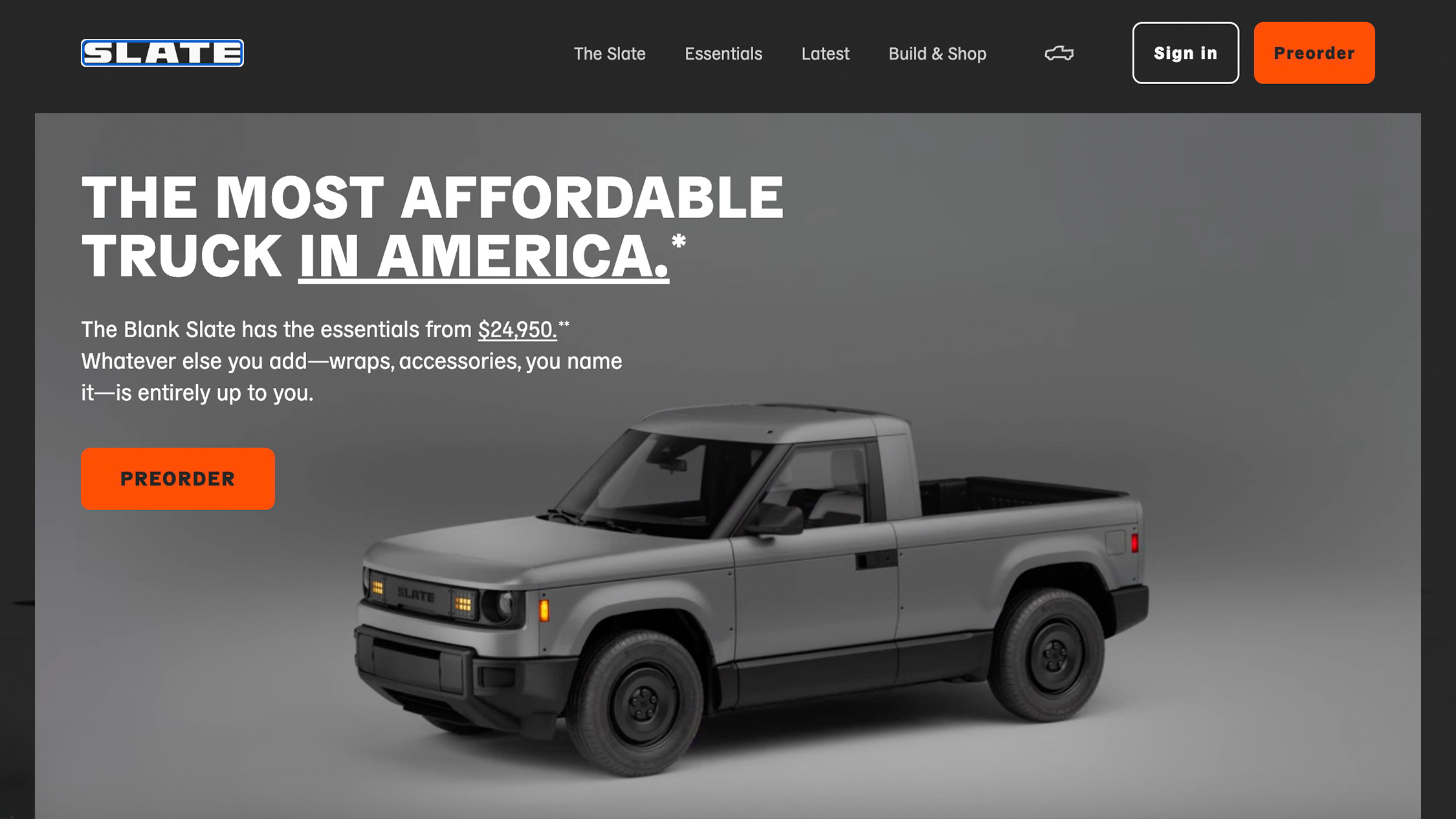
That date is about a month away as of this writing, and there’s still no official base price for the small electric pickup truck. The number is apparently dropping the same day orders open. For now, Slate only says the truck will start somewhere in the “mid-$20,000” range.
If not knowing the price was one hurdle for hand-raisers, the preordering and reservation process might be another. According to a post on Slateforums, on June 24, those with an existing reservation will have an assigned delivery window and a link to finish their preorder.
Customers will need to pay a $300 non-refundable deposit (minus their $50 reservation fee if they have one already). Those with a reservation have 30 days starting on the 24th to submit their deposit. Slate evidently has over 160,000 reservation holders.
Photos Slate
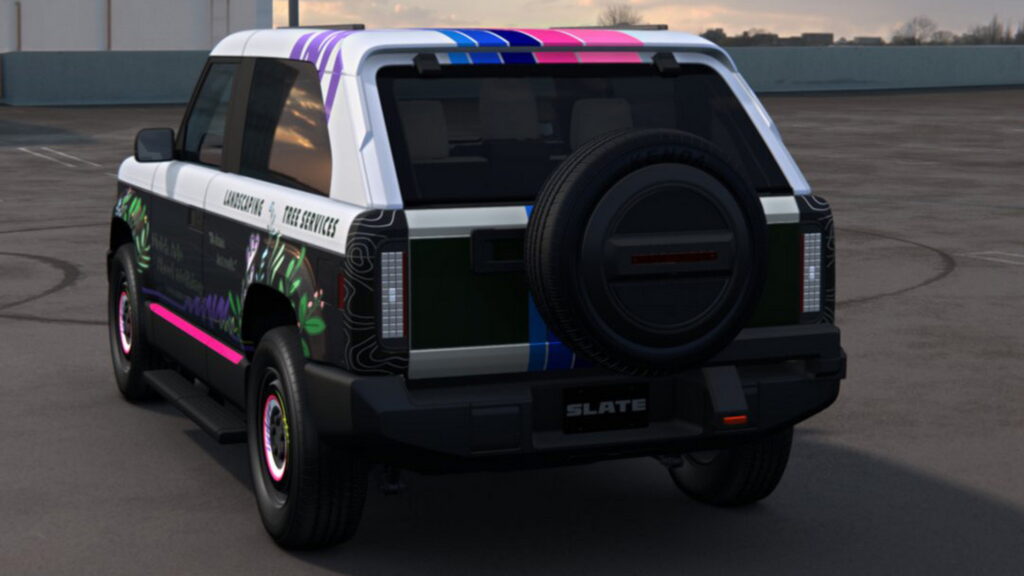
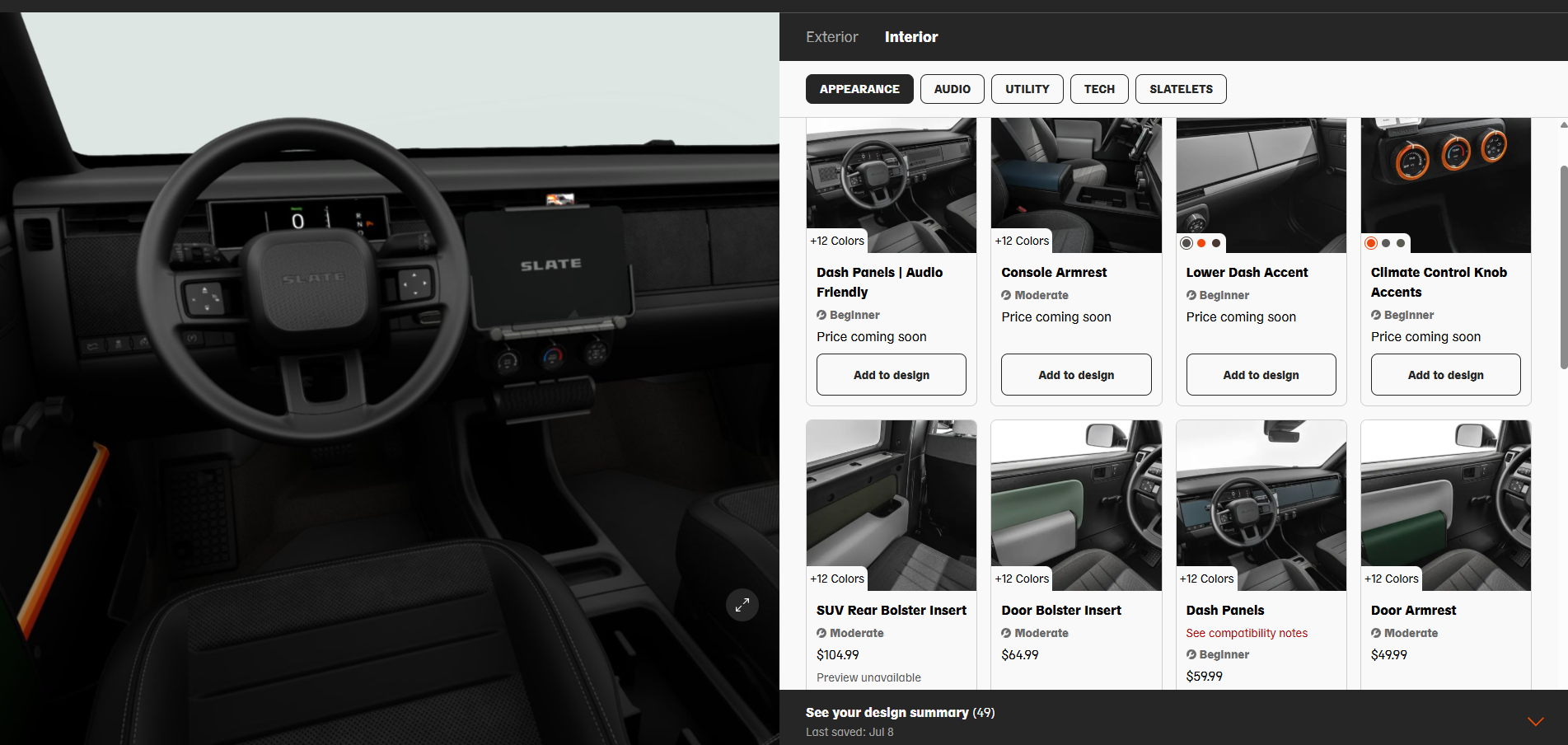
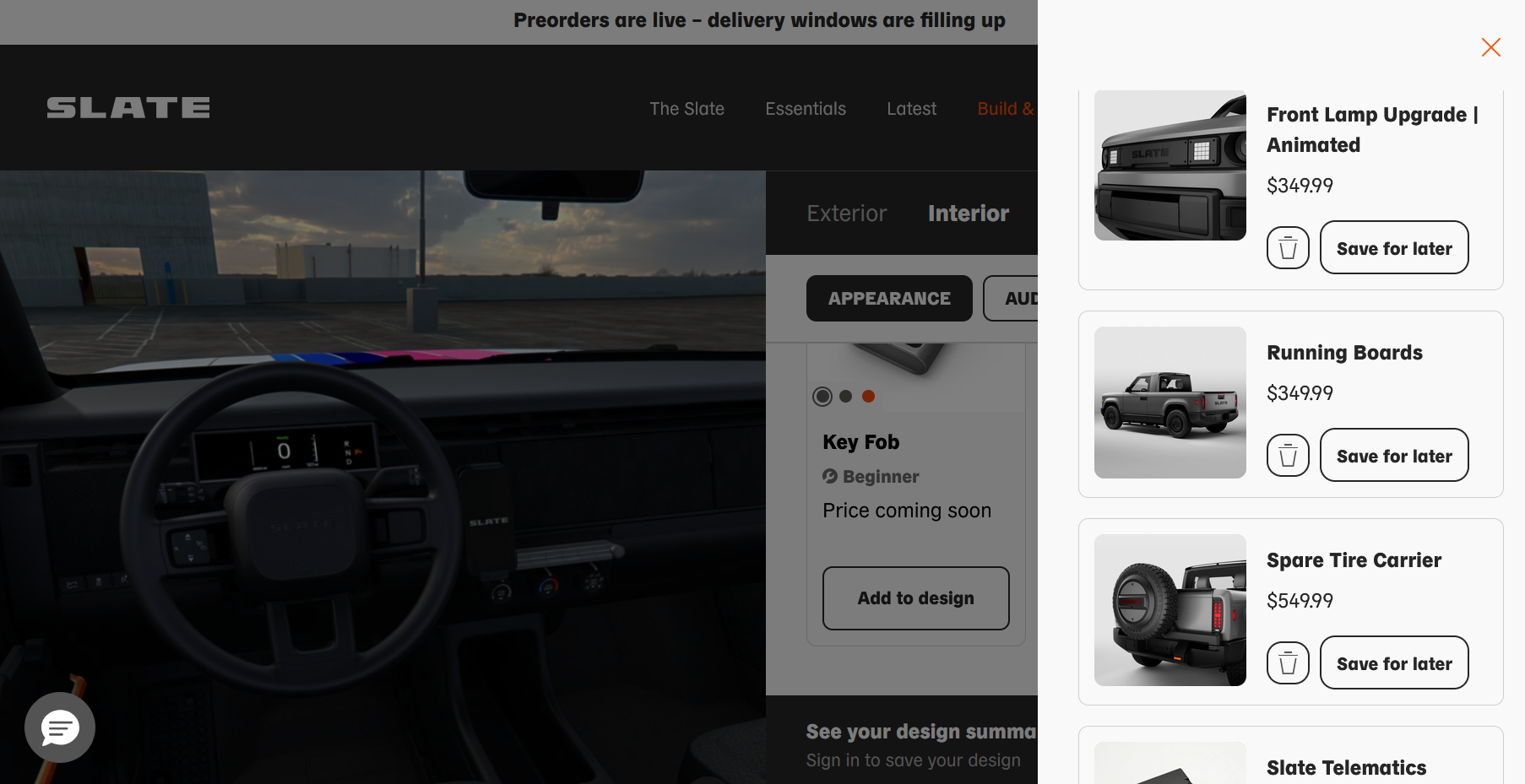
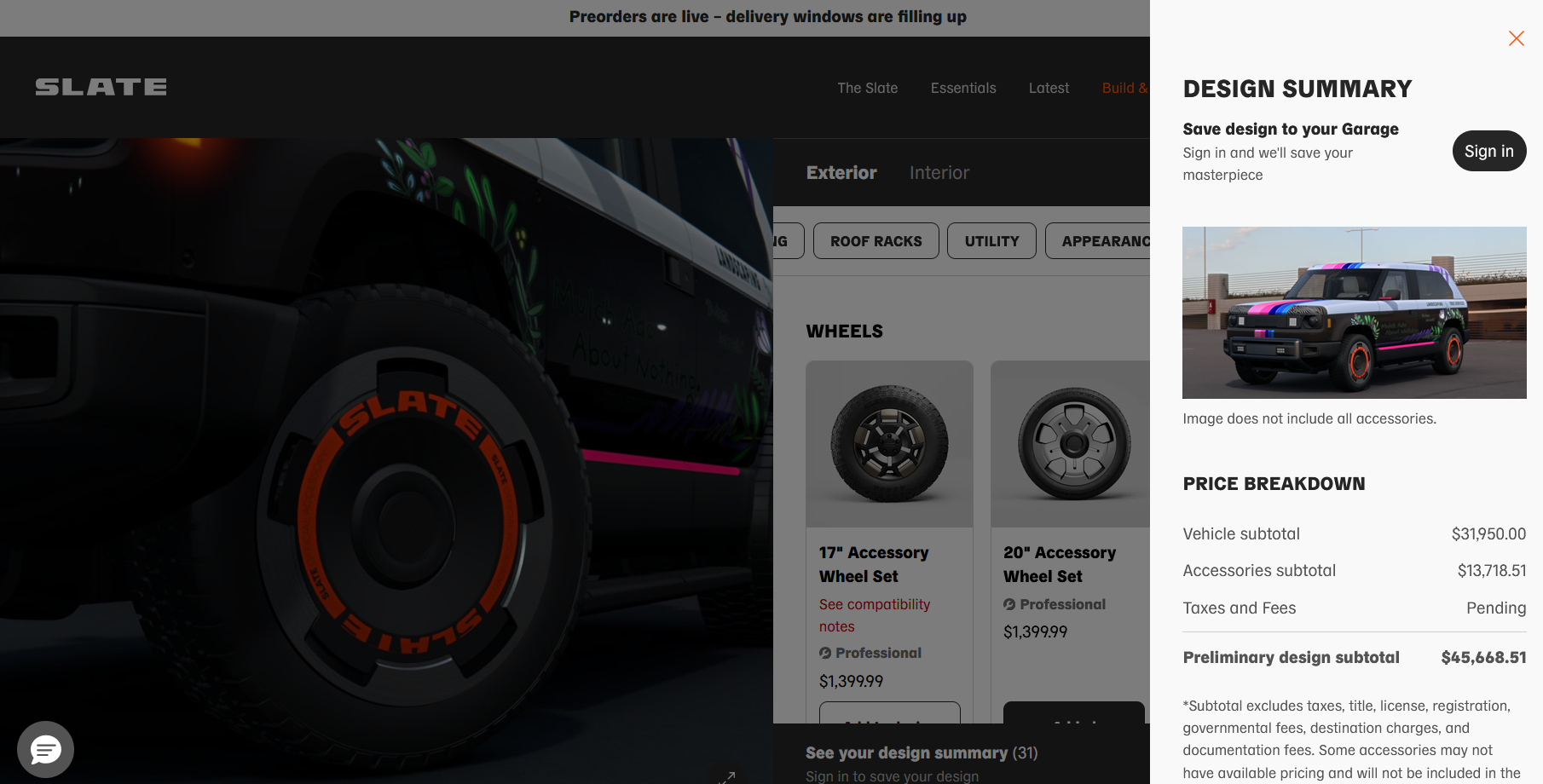
If those 30 days pass, they can still preorder, but their delivery window will shift further back in the queue. Importantly, the deposit will go toward the final price of the vehicle. The email to customers claims that in the fall of this year, they’ll have the option to pick their wrap and accessories, select financing, finalize the purchase, and then choose how they’d like to take delivery of their Slate.
Keep in mind that even for those who do make a reservation and follow through on the preorder, they’ll have to wait to get delivery until mid-2027. Between now and then, Slate says it’ll offer customers the chance to see the vehicle up close, but there’s no word on exactly how that’ll take place or where those locations will be. Hopefully, the preorder rollout answers the bevvy of questions piling up.
The all-electric Nio ES9 has dual electric motors delivering 697 hp.
All models feature the same CATL-sourced 102 kWh battery pack.
Key features include foot massagers and a 47-speaker audio system.
A few months after the first photos and details about the Nio ES9 emerged, the huge SUV has been officially launched and priced in China. It’s the automaker’s most luxurious model built to date and could be enough to make local shoppers forget about European alternatives.
All versions of the ES9 use an advanced 900-volt electrical architecture and come standard with a 102 kWh battery sourced from CATL. Power is provided by a pair of electric motors that combine to deliver 697 hp, allowing the ES9 to hit 100 km/h (62 mph) in just 4.3 seconds. The driving range will vary from 580 km (360 miles) to 600 km (373 miles) and 620 km (385 miles), depending on the trim level.
Importantly, the ES9 has been designed to support Nio’s battery-swapping technology, meaning the 102 kWh pack can be replaced in just 3 minutes at one of the company’s swapping stations. Buyers can opt for Nio’s battery-as-a-service rental program to reduce the ES9’s starting price to 390,000 yuan ($57,500). Those who opt to own the ES9 and its battery pack outright will need to pay a minimum of 498,000 yuan ($73,500). Either way, it’s pretty cheap for what you get.
The ES9 is massive, measuring 5,365 mm (211.2 inches) long, 2,029 mm (79.8 inches) wide, and 1,870 mm (73.6 inches) tall, with a 3,250 mm (127.9-inch) wheelbase. Given its size, it is perhaps no surprise that it sits on large 23-inch wheels. In general, the SUV’s design is quite homogeneous with other Nio models, meaning it includes a set of rather simple split headlights, simple body lines and creases, and a light bar at the rear.
A Cabin For Ultimate Comfort
It’s in the cabin where most of the exciting stuff is found. The dashboard has a large central 15.6-inch infotainment display and a 48-inch screen stretching across the dash. There’s also a large head-up display and loads of premium materials. As with other premium SUVs, those in the second row get treated to a true first-class experience.
Not only are there a pair of captain’s chairs, but there are also large entertainment screens and a 42-point massage system, including massaging footrests that fold down from the rear of the front seats. Nio has also added a panoramic glass roof and a 47-speaker audio system.
This Z9 GT adds violet amethyst stones and freshly trimmed leather inside.
Chopard also created matching rose-gold watches exclusively for the EV.
Three electric motors work together to produce a massive 1,150 hp.
New electric vehicles from China have become synonymous with their incredibly low price tags, but this particular Denza Z9 GT broke from the script. Presented at the recent Cannes Film Festival, it sold at a charity auction for an eye-watering €700,000 ($814,200), nearly five times the going rate for a standard Z9 GT in Europe.
So why is this Denza worth so much more? Well, the car is a one-off, built by BYD in partnership with Swiss jeweler and watchmaker Chopard. The powertrain was left alone, but the rest of the vehicle received a generous dose of bespoke detail intended to push it well past the standard model.
Found throughout the cabin are violet-colored amethyst stones, including around the central infotainment screen and used as toggles on the center console and the seat controls.
The Z9 GT’s interior also includes a combination of high-grade leather and wooden accents, as well as a 20-speaker audio system from Devialet. Chopard’s logo has been incorporated into the headrests, the carpets, and the wireless phone charging pad. The Swiss brand also handcrafted two custom timepieces to match the car, including the 36 mm Happy Sport in 18-carat gold with diamonds, as well as the 41 mm Alpine Eagle in rose gold.
Hypercar Power For Your Next Roadtrip
A custom set of luggage was also handcrafted by Shiro for the car. As for the exterior, it stands out from other Z9 GT models you’ll see thanks to gold accents running along the sides and used on the wheels and brake calipers.
The bespoke Chopard model is based on the flagship Denza Z9 GT, which uses three electric motors that combine to produce 1,150 hp. The EV also uses BYD’s Blade Battery 2.0 and supports Flash Charging, meaning the battery can be charged from 10 percent to 97 percent in just nine minutes.
This one-off marked the European launch of the Z9 GT, which in standard form opens at €117,500, or $136,700 at current exchange rates, in Germany. That figure sits well above its Chinese prices of between 269,800 yuan and , around $39,800 today, yet still a relative bargain compared to what it offers as well as the competition like the Porsche Panamera.
The Epiq will be sold with compact 37 kWh and 52 kWh battery packs.
All versions have front-wheel drive, with the flagship model delivering 208 hp.
In Europe, prices will start at €25,900 for the entry-level Epiq Essence 35.
Skoda has just unveiled its long-awaited, entry-level electric Epiq SUV, some two years after it was first showcased to the world. With the potential to outsell other popular Skoda EVs, including the Enyaq and Elroq, the new Epiq looks fun, has solid specs, and most importantly, is affordable.
Underpinning the Skoda Epiq is the VW Group’s familiar MEB+ platform. Depending on the market, three versions will be offered: 30, 40, and 55. The two base models use a 37 kWh lithium-ion phosphate battery and can be configured with either a 114 hp or a 133 hp motor, both driving the front wheels exclusively. By comparison, both the base Enyaq and Elroq are rear-wheel drive.
Driving range for the Epiq 35 and 40 models is capped at roughly 190 miles (306 km). The main difference between the two is that the 35’s charging speeds are limited to 50 kW at a DC charger, while the 40 boosts this to 90 kW.
Sitting at the top of the range is the Epiq 55. It uses a larger 52 kWh NMC battery supporting a driving range of 272 miles (438 km) and peak DC charging speeds of 105 kW, allowing the battery to be charged from 10-80 percent in around 25 minutes. The Epiq 55 also sports a more powerful front-mounted motor with 208 hp.
One common complaint among Skoda’s current electric SUVs is that they don’t offer a one-pedal driving mode. This has been solved with the Epiq. The SUV has also been designed to be reasonably aerodynamically efficient, with a drag coefficient of 0.275.
Cute And Fun Looks
Visually, the Epiq immediately stands out from other existing Skoda models and looks all the better for it. It features a sharp front fascia with a blacked-out lower grille and aggressive headlights and DRLs. Black body cladding extends across the wheel arches, down the sides, and fills the rear bumper. Skoda will offer six different paint options for the Epiq.
A Normal Skoda Cabin
As for the cabin, it shares a lot in common with the Enyaq, Elroq, and other Skoda models. There’s a familiar 13-inch infotainment display on the dashboard, as well as a two-spoke steering wheel. While physical controls are few and far between, there are some physical toggles positioned below the central air vents for important vehicle patrols. As with other Skodas, umbrellas are also hidden in the door panels, like a Rolls-Royce.
What About Prices?
Then there’s the all-important price. In Europe, the Epiq will start at €25,900 ($30,000) for the base Epiq Essence 35, bringing it to price parity with the similarly-sized combustion-powered Kamiq. In the UK, prices start at £24,950 ($33,400) for the Epiq SE L 40, as the base 35 model won’t be sold there. Prices increase to £27,700 ($37,100) for the SE L 55 and Edition 40, then to £30,450 ($40,800) for the Edition 55, and finally to £31,450 ($42,100) for the First Edition 55.
Prices for three versions of the Model Y have increased in the US.
Premium RWD, Premium AWD, and Performance trims are now pricier.
A stretched six-seat Model Y may soon arrive in American showrooms.
The Model Y still sits at the top of the American EV charts by a margin that borders on embarrassing for the rest of the industry. More than 357,000 found buyers last year, north of five times the volume of the Chevy Equinox EV, which finished 2025 as the best-selling non-Tesla EV. However, there’s some unwelcome news for those shopping for a new Model Y.
While the price hikes are relatively small, they may be enough to convince some to look elsewhere for their next EV. The entry-level Model Y RWD and AWD trims continue to start at $39,990 and $41,990 respectively, but the mid-range Premium RWD climbs $1,000 to $45,990, an increase of 2.2 percent.
Tesla has applied the same $1,000 walk to the Premium AWD, which now lists at $48,990, while also bumping up the MSRP of the Model Y Performance from $57,490 to $57,990. All prices exclude delivery fees and local state taxes.
Getting Ready To Launch The Six-Seat Model Y L?
In typical Tesla fashion, the company has offered no explanation for the increases, and they have not been paired with the kind of model-year refresh other automakers usually point to when they tap the price tag. This is the first Model Y hike since 2024, which leaves the increases comfortably below the current 3.8 percent annual inflation rate.
The Model Y line-up may soon grow in the United States with the launch of the three-row Model Y L, first introduced in China and since added to the line-up in several other markets, including the UK and Australia. A prototype of the six-seat Model Y was recently spotted being tested on US roads, perhaps indicating that a local launch is imminent. If it does indeed land locally, prices will likely start just north of $50,000.
Volvo has announced that the 2027 EX60 starts at $58,400.
Entry-level model has 369 hp and 307 miles of range.
Range-topper arrives later with 670 hp and a 400-mile battery.
Following its unveiling in January, the 2027 Volvo EX60 celebrated its North American debut in New York City. The automaker has also begun accepting orders, and pricing starts at $58,400 before a $1,395 destination fee. That’s nearly $20,000 less than the EX90 and $3,100 cheaper than the BMW iX3.
Kicking things off is the EX60 P6 Plus, which features a streamlined design and a minimalist interior. The latter sports an 11.4-inch digital instrument cluster and a 15-inch infotainment system with Gemini as well as Google built-in. Buyers will also find a 21-speaker Bose audio system, Pilot Assist, and a Safe Space technology suite.
The EX60 P6 Ultra begins at $65,000 and has an upgraded interior with ventilated Nappa leather upholstery as well as a heated second row featuring integrated booster seats. They’re joined by an electrochromic panoramic roof and a 28-speaker Bowers & Wilkins premium audio system.
From 369 HP To 503 HP, And Up To 322 Miles Of Range
Both models are equipped with a rear-mounted motor producing 369 hp (275 kW / 374 PS) and 354 lb-ft (479 Nm) of torque. It enables the crossover to accelerate from 0-60 mph (0-96 km/h) in 5.7 seconds, before hitting a top speed of 112 mph (180 km/h).
The motor is powered by an 83 kWh battery pack, providing a range of up to 307 miles (494 km). When the battery is low, owners will be thankful for the 800V architecture and 320 kW DC fast-charging capability, which enables the P6 variants to get 155 miles (249 km) of range in as little as 10 minutes. The battery can also go from 10-80% in a mere 16 minutes. It’s also worth noting that the EX60 has a native NACS port for easy access to the Tesla Supercharger network.
Moving up the trim ladder is the EX60 P10 AWD Plus and Ultra. They retail for $60,750 and $67,350, respectively.
As the name suggests, the P10 features a dual-motor all-wheel drive system. It produces 503 hp (375 kW / 510 PS) and 524 lb-ft (710 Nm) of torque, which enables the EV to hit 60 mph (96 km/h) in 4.4 seconds and a top speed of 112 mph (180 km/h).
Upgrades extend beyond the motors as the P10 has a beefier 95 kWh battery that increases the range up to 322 miles (518 km). Buyers will also find an improved DC fast-charging capability of 370 kW, which provides up to 165 miles (266 km) of range in as little as ten minutes. The EV can also go from 10-80% charge in around 16 minutes.
The EX60 P12 AWD will arrive later with a 117 kWh battery and a dual-motor all-wheel-drive system pumping out 670 hp (500 kW / 680 PS) and 583 lb-ft (790 Nm) of torque. This will give the crossover a range of up to 400 miles (644 km) and a 0-60 mph (0-96 km/h) time of 3.8 seconds.
With all that being said, you can configure your EX60 and order it here.
Tesla has dropped Deep Blue Metallic and introduced Marine Blue.
Frost Blue Metallic from the Model S is now available for the 3 and Y.
Sadly, Frost Blue Metallic is only offered for the Performance models.
Tesla has never been known for offering particularly exciting or flamboyant paint schemes, generally opting for subtlety over pizzazz. However, the Model 3 and Model Y have just been updated with two new shades of blue in the United States, and both look superb.
The first new color is dubbed Marine Blue, and it’s available for the Premium Rear-Wheel Drive and Premium All-Wheel Drive versions of the Model 3 and Model Y. Marine Blue is a deep shade that replaces Deep Blue Metallic, which was brighter and a little more eye-catching.
As before, those shopping on a budget and looking to buy the entry-level Rear-Wheel Drive or All-Wheel Drive versions of the Model 3 or Model Y don’t get this new color and still only have Stealth Grey, Pearl White Multi-Coat, and Diamond Black to choose from.
In the US, Marine Blue adds $1,000 to the price of applicable Model 3s and Model Ys. In Canada, it costs CA$1,300 (US$940).
Exclusive Performance Color
The second new color introduced by Tesla is Frost Blue Metallic. It’s exclusive to the Model 3 Performance and Model Y Performance. This isn’t the first time this color has been offered by Tesla, as it was previously available on the Model S and Model X before those models were discontinued. Of all the colors that Tesla offers, Frost Blue Metallic might be our favorite, alongside Ultra Red.
What’s more, Frost Blue Metallic is a no-cost option in the US. It’s also been launched for the Model 3 Performance in Canada, though it’s not yet clear whether it will be added to the Model Y Performance locally.
The entry-level E7X has 402 hp and starts at just 289,900 yuan.
AUDI offers the all-electric SUV with 100 kWh and 109 kWh packs.
The flagship model starts at $55,900 and has 670 hp.
Prices have finally been confirmed for AUDI’s all-electric E7X in China. As we’ve come to expect, it’s incredibly cheap given how large it is and all the technologies crammed into it. If only the car manufacturer could build and sell something like this in Western markets.
The base E7X has been priced from 289,900 yuan ($42,600) and is known as the Pioneer. It comes with a 100 kWh battery pack and a 900-volt electrical architecture, providing it with 705 km (438 miles) of driving range on the CLTC cycle. It can also hit 100 km/h (62 mph) in 5.82 seconds. Power comes from a rear-mounted electric motor with 402 hp (300 kW) and 369 lb-ft (500 Nm) of torque.
Positioned above this model is the Pioneer Pro, which comes equipped with more features, including air suspension. It is priced from 319,800 yuan ($47,000) and has the same 5.82-second sprint time to 100 km/h, but a slightly longer range of 691 km (429 miles).
A longer-range version of the RWD model has also been confirmed, priced from 349,800 yuan ($51,400) and featuring a larger 109 kWh pack. This boosts the driving range to 751 km (476 miles), although the heavier battery means the 0-100 km/h time has swelled to 6.25 seconds.
Cheap And Big
Two all-wheel-drive versions of the AUDI E7X will also be offered. The first uses the 100 kWh pack and produces a combined 670 hp, slashing the 0-100 km/h to just 3.9 seconds. Priced from 349,800 yuan ($51,400), this model has a 636 km (395 miles) driving range. Sitting at the top of the range is a 670 hp version with the 109 kWh pack and a 660 km (410 miles) range, priced from 379,800 yuan ($55,800).
To put these prices into perspective, a new 2026 Audi Q3 in the United States starts at $43,700 and uses a 2.0-liter turbocharged four-cylinder engine with 255 hp and 273 lb-ft (370 Nm) of torque. The largest electric SUV that Audi sells in the US is the Q6 e-tron priced from $64,500, but it’s significantly smaller than the E7X.
A year of ownership wiped nearly 60 percent off the Daytona’s value.
The electric Charger covered under 7,000 miles before its value collapsed.
Staff complaints ranged from fake exhaust sounds to glitchy software.
Buying a new car is almost always a terrible financial decision. But losing nearly $50,000 in a single year after just a few thousand miles takes things to an entirely different level of painful. Unfortunately for Edmunds, that’s exactly what happened with its 2024 Charger Daytona Scat Pack.
Unlike many magazines and websites, that simply borrow their long-term test cars from automakers, Edmunds buys them with real cash. True, it got a small discount from Dodge on the as-tested price of $85,965, but it still paid a hefty $82,000 to get behind the wheel of Detroit’s first electric muscle car.
But 12 months later when it came time to move the car on, Edmunds was shocked to find its Daytona was worth just $35,000. That’s almost a 60 percent hit, and not because the road test team had put a lifetime’s worth of miles on the EV. It had covered less than 7,000 miles (11,300 km), which is the kind of distance some drivers do in six months.
Even worse, the massive financial hit came after most of the Edmunds staff spent a year actively disliking the thing. Reading through their long-term test notes would be enough to send anyone wavering over which pony car to buy straight into the arms of a V8-powered Ford Mustang Dark Horse.
Digital Headaches
Complaints ranged from glitchy infotainment and strange drivetrain clunks to awkward ergonomics and bizarre software behavior. One editor described the fake Fratzonic exhaust sound as “an insult to V8s everywhere,” while another said the car was simply “boring,” which is probably the most brutal criticism you can level at something wearing a Charger badge.
Others hated the turning circle, massive dimensions, inconsistent regen braking, and handling that apparently couldn’t back up the car’s straight-line punch. But the year didn’t pass without the Charger getting some praise. Several staffers liked the styling, roomy hatchback practicality and surprisingly good range. The 670 hp (679 PS /500 kW) Daytona managed 255 miles (410 km) in real world use, comfortably beating its pathetic official EPA estimate of 216 miles (348 km).
“The Charger was a big, expensive disappointment,” the outlet said, summing up the year-long experience. “We won’t miss having this thing in our fleet.”
Hertz has cut prices on its Shelby Mach-Es again, and the drop is steep.
Mileage across the cars on offer ranges from just 3,275 to over 15,000 miles.
Shelby’s tuning package adds looks and sound, but no real performance.
Hertz has a long history of renting out modified cars from Shelby to its customers, and often these vehicles become prized collector’s items. That does not appear to be the case with the Shelby-tuned Ford Mustang Mach-Es that it had in its fleet.
The rental giant started offloading a bunch of these special black-and-gold Mustang Mach-Es back in late 2024, asking around $65,000 for most of them. Fast forward just a couple of months to January 2025, and the prices were slashed to around $60,000. Hertz, clearly desperate to offload its remaining inventory, has reduced prices by a further $20,000. Could this be a deal too good to pass up?
Photos Hertz
A scan of Hertz’s current inventory across the States turns up 31 Shelby Mach-Es, with prices spanning a narrow $40,085 to $40,999 and mileage stretching from 3,275 to just over 15,000. The cheapest examples sit in California, while a Scottsdale car claims the lowest mileage of the lot at 3,275 for $40,649. One in New Orleans splits the difference at 8,215 miles for $40,436. A new Mach-E GT, the donor car for the Shelby treatment, stickers at $53,395.
A Performance Bargain?
It shouldn’t come as much of a surprise that Hertz has slashed prices of these cars so significantly. After all, they are EVs, and current electric cars tend to depreciate very quickly. We suspect the designs of the Shelby models also turn off many prospective buyers, particularly because of the go-fast gold racing stripes and carbon fiber parts, including the hood.
Shelby is believed to have built just 100 examples of the Hertz-exclusive Ford Mustang Mach-E GT, so it does have exclusivity going for it. In addition to the gold stripes and the carbon parts, Shelby added custom black wheels and sourced an exhaust sound system from Borla, aiming to replicate the sound of an internal combustion engine. Sadly, no real performance upgrades were made that could justify the price.
There is also the usual caveat that comes with any ex-rental: someone else got the keys first, and they probably did not treat them gently.
More than 30,000 reservations arrived within the SUV’s first day.
BYD’s second-gen Blade battery and 1,000-volt tech are featured.
The most potent Great Tang delivers 784 hp through twin motors.
After several years of unimpeded growth, Chinese juggernaut BYD recently posted its eighth straight month of year-over-year sales declines, even with a barrage of new model launches trying to stem the bleeding. The Chinese giant clearly has growing pains, but one of its newest products is bucking the trend in spectacular fashion.
The company’s new, full-size, all-electric Great Tang SUV was presented earlier this year and showcased at the Beijing Auto Show two weeks ago. As the show opened, so did pre-sales for the EV, and in just two weeks, BYD has locked in more than 100,000 pre-sale orders for the Great Tang.
Of these, over 30,000 pre-sale orders were placed in the first 24 hours. These are extraordinary figures for a vehicle that’s even larger than the Hyundai Ioniq 9 and Kia EV9 sold in the West. Clearly, the Chinese still have the appetite to buy luxurious SUVs when they’re priced right.
The entry-level Great Tang starts at 250,000 yuan or $36,700, a shockingly low figure given that it uses BYD’s new Super e platform, includes its second-generation Blade battery, and has a 1,000-volt electrical architecture. This model uses a single, rear-mounted electric motor with 496 hp, and can travel up to 590 miles (950 km) on a charge under China’s optimistic CLTC cycle.
Comfort For Seven
The flagship version is priced at 320,000 yuan ($47,000) and delivers 784 hp, laughing in the face of the most powerful versions of the Ioniq 9 and EV9.
Not only do buyers get plenty of power and advanced battery tech, which means the Great Tang can charge from 10 to 97 percent in just nine minutes, but they also get a cabin loaded with features. As standard, the latest BYD is sold in a 2+2+3 configuration and includes three front screens and a display that folds out from the headliner for rear passengers.
Thanks to dismal sales, there are huge discounts on the electric van.
If you know where to look, you can get more than $20,000 off MSRP.
VW already confirmed it is skipping the 2026 model year entirely.
Volkswagen ID. Buzz sales plummeted 35.2% in the first quarter as dealers only moved 1,232 units. The disappointing result came roughly three months after the automaker confirmed they’ve made the “strategic decision” to skip the 2026 model year following a “careful assessment of current EV market conditions.”
They added a 2027 ID. Buzz would arrive later this year, once dealers clear out the existing inventory of 2025 models. That work continues and it appears the company only has about a month and a half supply of vehicles remaining.
While that sounds like good news, some dealers are slapping on huge discounts to move inventory. Ken Ganley Volkswagen of Bedford, Ohio has a new 2025 ID. Buzz Pro S listed for $42,000. That’s $20,737 below the original MSRP of $62,737 and it undercuts the $42,795 Honda Odyssey.
Outside of the Buckeye state, Nalley Volkswagen in Georgia has an electric van priced at $44,695. That’s significantly cheaper than the original sticker price of $62,195, thanks to a $10,000 dealer discount and a $7,500 incentive from Volkswagen.
Even dealers in EV-friendly California are offering sizable savings as New Century Volkswagen in Glendale has a $62,318 ID. Buzz on sale for $49,810. The $12,508 reduction was made possible thanks to the aforementioned $7,500 incentive as well as a dealer discount of $5,008.
Those are just a few examples, but dealers are even discounting the ID. Buzz 1st Edition. Missouri’s Volkswagen of Kirkwood has a $12,000 discount on their van, which lowers the price to $60,570 before a $599 “admin fee.”
That’s still ridiculously expensive for a minivan, but it’s a far cry from the days when dealers were applying markups of between $5,000 and $35,000. It’s hard to say how much blame greedy dealers deserve for the ID. Buzz’s failure, but there’s plenty to go around.
BMW’s first Neue Klasse SUV in America starts at $61,500 plus fees.
The 483 hp xDrive 50 posts 434 miles, leaving Tesla’s Model Y behind.
BMW charges $4,000 for the M Sport pack with glow grille upgrades.
BMW of North America has dropped two crucial numbers for its new iX3 electric SUV, and they couldn’t have come at a more important time. Up to 434 miles (699 km) of EPA range isn’t just impressive, it might be exactly what the sagging US EV market needs right now. As is the price, which makes the electric X3 SUV cheaper than a less powerful combustion X3.
That headline range figure, which is even better then the 400 miles (644 km) originally estimated by BMW stateside, puts it ahead of most rivals, though it does come with an asterisk. It only applies to cars equipped with the no-cost-option 20-inch summer tires. Stick with the default all-seasons 20-inchers and it drops to 383 miles (616 km).
Here’s where it gets really weird, though. BMW reckons you’ll get 399 miles (642 km) if you upsize to the $600 21-inch wheels and all-season rubber, which actually give you 1 mile (1.6 km) more range than the 21-inch summer tires offer. It sounds all wrong but BMW says the strange numbers are the result of averaging range figures across various tire brands.
You can check out the full range-to-tire stats in the table below, but whichever combo you pick, you’re going to be going further between fills than any other electric SUV in the sector. Tesla quotes 294 miles (473 km) for the base AWD Model Y, 327 miles (526 km) for the Premium AWD, and 306 miles (492 km) for the Performance variant. While we’re still waiting on official figures for the Mercedes GLC 400 4Matic, based on the difference between it and the iX3 in the European WLTP numbers, we’d expect its EPA range to be around 380 miles (612 km) at best.
2027 iX3 Electric Range Vs Tires
Wheel & Tire Package
MPGe Combined
Range (mi)
20″ Summer Tires (No-cost option)
118
434
20″ All-Season Tires (Standard)
102
383
21″ Summer Tires
105
398
21″ All-Season Tires
105
399
22″ Summer Tires
104
392
SWIPE
It Undercuts The ICE X3 On Price
But range, and an ability to charge at 400 kW, adding 185 miles (298 km) in 10 minutes, isn’t the only thing the iX3 has on its side. It’s also competitively priced. The iX3 50 xDrive costs $62,850 including a $1,350 destination charge, which means it costs less than the brand’s own gas-powered $67,850 X3 M50 xDrive.
It also gives you 463 hp (469 PS) and 476 lb-ft (645 Nm) to the ICE SUV’s 393 hp (399 PS) and 428 lb-ft (580 Nm), and though the six-cylinder SUV gets to 60 mph (97 kmh) a touch quicker (4.4 plays 4.7 seconds) than the EV, we bet it’s the iX3 that feels the more urgent when you jump on the right pedal for a passing maneuver.
That kind of pricing is designed to hook in American drivers who’ve lost interest in EVs lately. BMW’s electric sales sank 16.7 percent last year and cratered by 45.5 percent in the fourth quarter after the Trump administration axed the $7,500 federal tax credit program. Mercedes will now be feeling the heat to price its GLC EV as close to $60k as possible.
M Sport Trim A $2,500 Option
Naturally there are plenty of opportunities to add to the iX3’s $62,850 base price. Standard kit includes BMW’s Panoramic Vision pillar-to-pillar digital display, Perforated Veganza Upholstery, smartphone charger, Digital Key Plus (which uses your phone as a key) and umpteen safety aids. But plenty of buyers will want to add the $1,500 Comfort Package (heated steering wheel, panoramic glass sunroof and multifunction seats), or $1,900 Technology Package (BMW Iconic Glow illuminted kidney grille, 3D head-up display, Harman/Kardon hifi). Or maybe even both.
And the M Sport package is sure to be a big draw. The base version of the package costs $2,500 and nets you BMW M interior and exterior trim, 20-inch M Aero V-Spoke wheels and a sports steering wheel, while the $4,000 Professional version adds the Iconic Glow light-up grille, a proper M sport wheel and M Sport brakes with red and blue calipers. That’s as near as you’ll get to an iX3 M this year, though we expect to see one of those before long.
More Affordable iX3 40 Arrives Later
And if even an options-free iX3 50 is too pricey for your pocket, there may be a solution arriving shortly. Though BMW hasn’t yet confirmed it’s coming to US roads, information that mistakenly appeared briefly on the brand’s website earlier this year before being taken down, suggested the 50 xDrive would be joined by a rear-wheel drive 40 sDrive and all-wheel drive 40 xDrive.
BMW has already debuted the single-motor 40 in Europe in March, revealing that it makes 316 hp (320 PS / 235 kW) and downgrades to a 82.6 kWh battery. The new base model needs 5.9 seconds to reach 62 mph (100 kmh) and going by the 395 miles (636 km) WLTP range, will probably get an EPA rating of around 340 miles (547 km).
You can configure your iX3 50 now and reserve it for $1,000. Get in early and you should get yours when deliveries kick off in September.
Tesla is making the most out of reduced tariffs on Chinese-built EVs.
Up to 49,000 EVs built in China can be imported to Canada annually.
Base Model 3 RWD hits 62 mph in 5.2 seconds and has a 288-mile range.
As expected, Tesla has become the first EV maker to begin selling Chinese-made models in Canada after the two countries finalized a major trade deal earlier this year. It’s good news for Canadian car buyers, who now get access to Tesla models priced well below their American counterparts. In fact, it’s the cheapest Tesla EV ever sold in North America.
Thanks to the new trade deal, up to 49,000 EVs built in China can be imported into Canada at a reduced tariff rate of 6.1 percent, down from the 100 percent tariff imposed in 2024. Canadian officials began issuing permits for the first 24,500 vehicles in March, and Tesla moved quickly to capitalize.
By importing from China, Tesla has reintroduced the entry-level Model 3 Premium RWD to Canada. It is priced from just CA$39,490 before delivery, or around US$29,007 at current exchange rates, undercutting the most affordable Model 3 in the US, the standard RWD model that starts at US$36,990 before taxes and delivery fees. The Shanghai-spec Model 3 has a quoted driving range of 463 km (288 miles) and can go from 0 to 100 km/h (62 mph) in 5.2 seconds.
Before the deal took effect, the most affordable Model 3 available in Canada was the Long Range AWD shipped up from Fremont, California, with a starting price of CA$79,990 (US$58,700). It isn’t a spec-for-spec comparison, but Tesla has effectively cut its Canadian entry point in half overnight.
Performance Gets A Price Cut
Canadian buyers can also order the Model 3 in Performance guise, now priced from CA$74,990 (US$55,050). That marks a 17 percent drop from CA$89,990 (US$66,070), bringing the Canadian price roughly in line with the US$54,490 sticker American buyers pay for the same trim. Tesla has not confirmed where it will source Model 3 Performance models for the Canadian market, though reports suggest Fremont remains the likely origin.
The only downside of Tesla now importing some Model 3s from China is that these models do not qualify for Canada’s Electric Vehicle Affordability Program (EVAP) rebate, valued at $5,000, according to Drive Tesla.
It remains unclear how many of the initial 24,500 permits Tesla will lock down, though Canadian officials have confirmed they’re being issued on a first-come, first-served basis. Unless rivals like Volvo and Polestar move quickly to get their own Chinese-built EVs across the Pacific, Tesla looks poised to walk away with the lion’s share.