Reading view

There are new articles available, click to refresh the page.

Someone Already Wrecked A 2027 Rivian R2 After Just 110 Miles
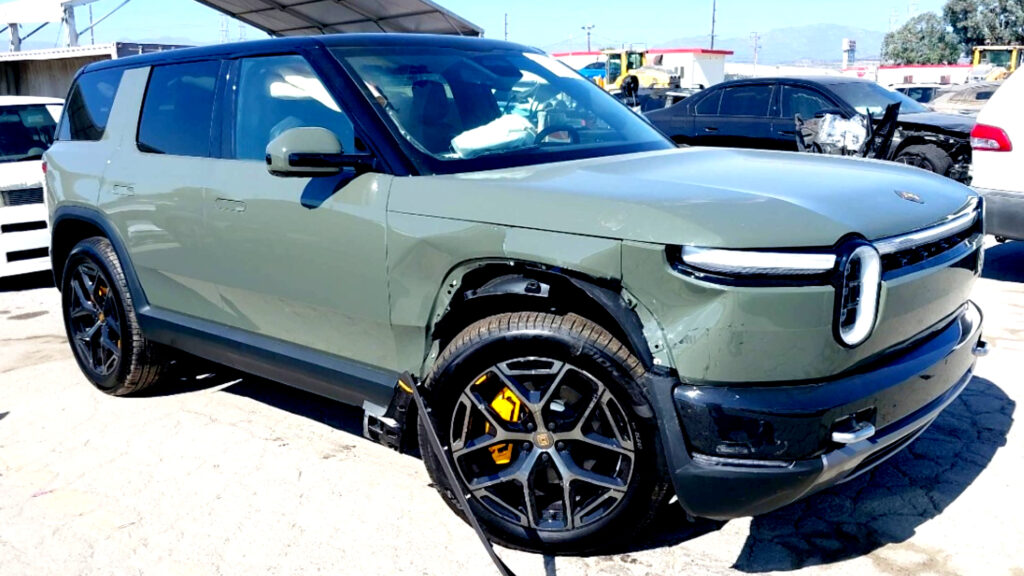
  • Rivian R2 Performance Launch Package landed in a salvage auction after only 110 miles.
  • Exterior damage looks modest, but the listing flags need for airbags and suspension.
  • A brave, practical buyer could potentially skip Rivian’s lengthy R2 waiting list entirely.

Some cars spend their first 110 miles (177 km) gently running errands and getting photographed by their excited new owners. This Rivian R2 took a rather different path. Barely out of the wrapper, the electric SUV has already been crashed and is now waiting for a new home through a salvage auction.

Rivian only opened the R2 configurator on its retail site at the end of May, and strong demand means anyone joining the queue for a new one today won’t receive it until 2027. But somehow this R2 has already been delivered, driven, bent and left in a dusty lot while it waits for a second owner to rescue it.

Related: Bad News Rivian Flippers, A Day One Holder’s R2 Cleared Sticker By Just $2,015

The Launch Green SUV’s passenger-side front fender has taken the obvious hit. It’s crumpled inward, exposing a cracked fender liner, while the outer wheel arch trim has detached and is dangling rather sadly on the ground next to the 21-inch wheel.

\\\\

IAA

At first glance, it doesn’t look catastrophic. The damage appears concentrated around the fender rather than extending into the passenger door, potentially making this seem like an easy repair and a sneaky way into an R2 without joining the backlog. Unfortunately, there are a couple of reasons not to start celebrating just yet.

First, the IAA auction listing identifies suspension damage as a secondary issue, suggesting there’s more going on underneath than the photos immediately reveal. And the photos show multiple airbags have deployed. Second, experience with the larger R1S has shown that damaged Rivians can generate repair bills rather more intimidating than you might expect from similarly bruised mainstream Ford or Chevy SUVs.

656 HP And AWD

\\\\\

IAA

But it could still be worth the effort. This must be an R2 Performance Launch Package, currently the only version Rivian is delivering. It starts at $57,990, with slower, more affordable variants coming later this year and then in 2027.

That $58k gets you dual-motor all-wheel drive developing 656 hp (489 kW / 665 PS) and 609 lb-ft (825 Nm) of torque. Rivian says it’ll rocket from 0–60 mph (96 km/h) in 3.6 seconds while delivering 330 miles (531 km) of range. We just hope the owner (presuming this wasn’t a demo car) got to experience that punch at least once before they wrecked it. Although you have to consider that maybe trying that 656 hp out is why it now looks like it does.
\\\\

IAA

Mercedes-AMG’s Cheapest GT 4-Door Loses 625 HP, Gains Fake 6-Cylinder Soundtrack

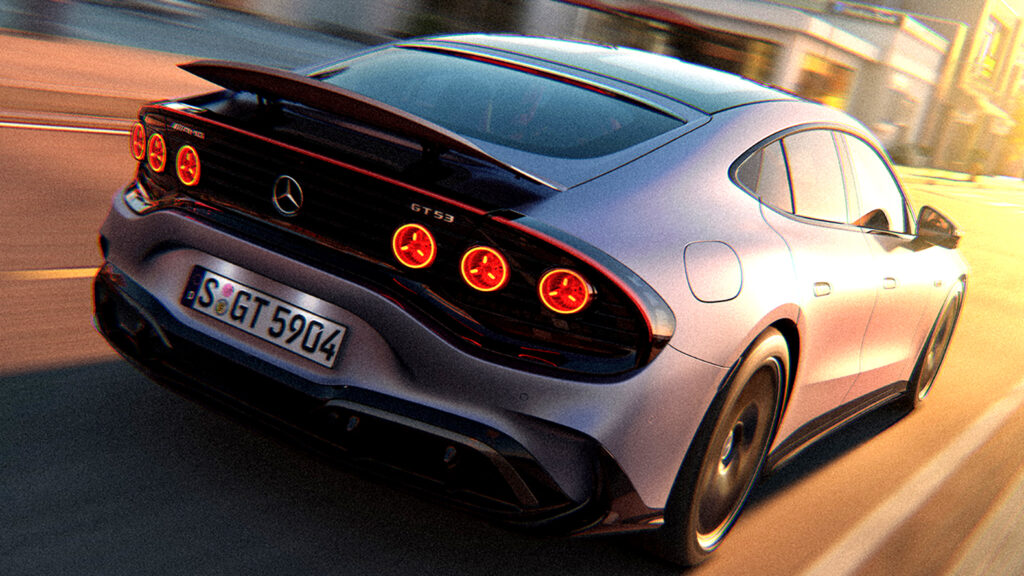
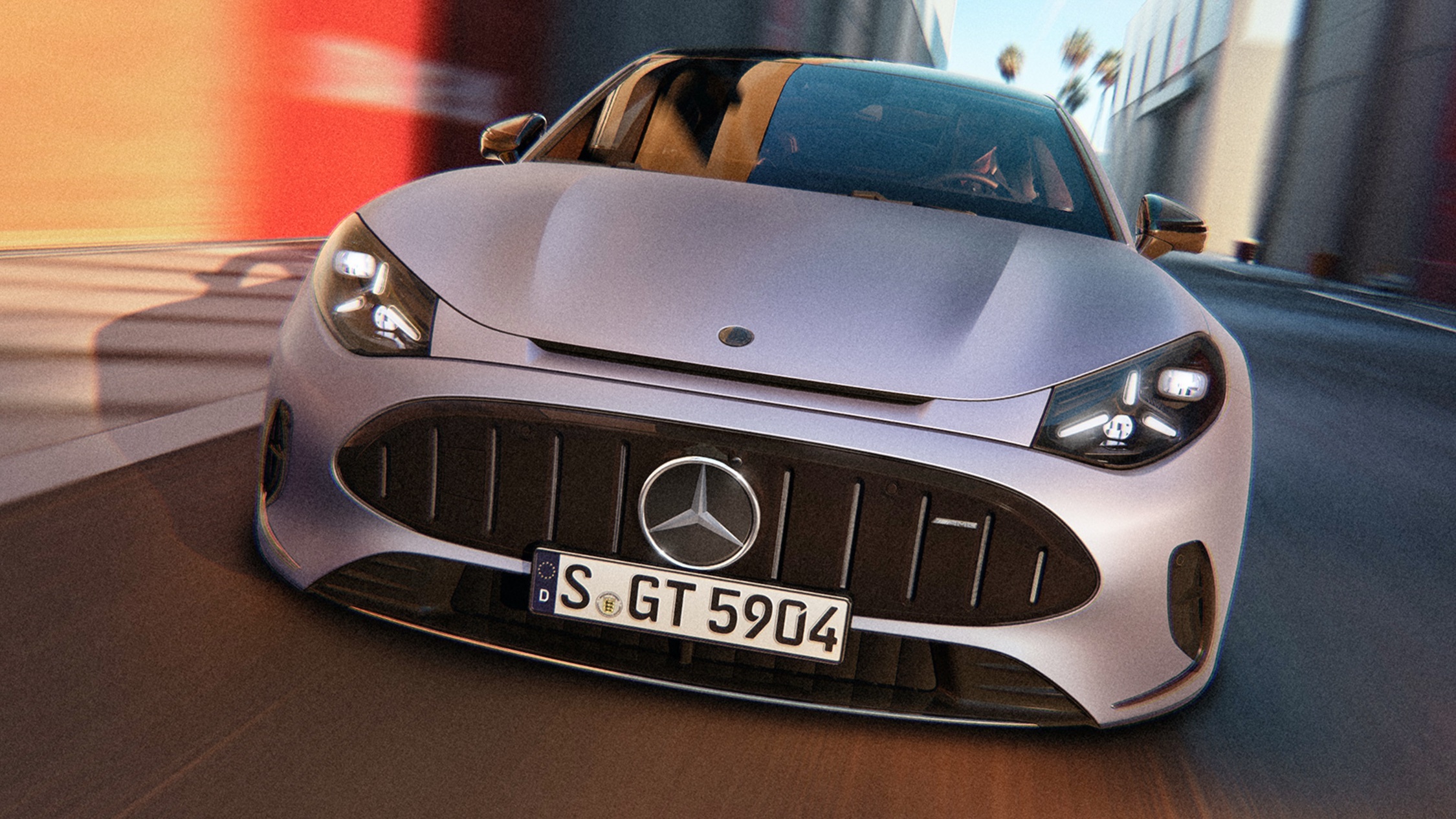
  • Mercedes-AMG introduces an entry-level GT 53 4-dr with 536 hp.
  • All-wheel drive is standard but with only two Yasa axial flux motors.
  • Fake straight six soundtrack replaces simulated V8 on 55 and 63.

Love the look of Mercedes-AMG’s new electric GT sedan, but can’t live with the expected $170-220k price and don’t need a supercar-grade power output? Someone at Affalterbach must have been snooping on those prayers because a new entry-level GT sedan just rocked up and it costs 40 percent less than the flagship.

The new Mercedes AMG GT 53 4-Door Coupe slots beneath the wild triple-motor GT 55 and 63 models, trading one electric motor for a friendlier price and a healthier driving range. While the 805 hp (816 PS / 600 kW) 55 and 1,153 hp (1,169 PS / 860 kW) 63 square up against top-spec Porsche Taycan Turbos, the milder, twin-motor 53 is targeting the less-bonkers Taycan 4S.

Related: 1,153 HP Not Enough? Mercedes-AMG Is Working On An Even Hotter GT 4-Door

Peak output falls to a Taycan-replicating 536 hp (544 hp / 400 kW) and a slightly superior 590 lb ft (800 Nm) of torque. Enough for a 0 to 62 mph (100 kmh) sprint in 3.9 seconds, or 3.5 seconds with 1ft of rollout. So it’s hardly slow in real terms, even if it looks it next to the 63’s 2.4-seconds (2.1 with rollout) stats.

Although the GT 53 makes do with two motors instead of its hardcore brothers’ three, it still gets all-wheel drive, torque vectoring, and the same adaptive air suspension as its bigger brother. Top speed is a modest 143 mph (230 km), but that can be lifted to 155 mph (250 kmh) with an optional AMG Driver’s Package.

Over 500 Miles Of Range

 Mercedes-AMG’s Cheapest GT 4-Door Loses 625 HP, Gains Fake 6-Cylinder Soundtrack

Mercedes hasn’t changed the battery either. The GT 53 carries over the 106 kWh usable pack and 800 volt architecture, but deleting the third motor pays dividends in efficiency. Official WLTP range climbs to 503 miles (809 km) from the 55 and 63’s 435-ish miles (700 km), while DC charging peaks at a mighty 600 kW. Under ideal conditions, and presuming you can actually find a speedy-enough charger, Mercedes says that’s enough to add more than 331 miles (534 km) of range in only 10 minutes. Yes, you read that right.

The other big change is one you hear rather than feel. Instead of borrowing the GT 63’s simulated V8 soundtrack, the GT 53 mimics the character of AMG’s old turbocharged inline six. Mercedes says it recorded the real engine in painstaking detail before recreating its sound digitally. Simulated gearshifts also remain, complete with paddle operated manual changes for drivers who still miss combustion engines.

Doesn’t Skimp On Luxury

 Mercedes-AMG’s Cheapest GT 4-Door Loses 625 HP, Gains Fake 6-Cylinder Soundtrack

Inside, little changes from the GT 55 and 63. You get a 14 inch central display, optional passenger screen, sporty seating, and AMG’s Response Control system that lets you tailor the powertrain’s responses independently of the selected driving mode.

The GT 63 remains the headline grabber, but at €196,350 (£159,870 in UK; US prices still TBC) it’s huge money, and the lower-ranking €154,700 (£120,095) still requires seriously deep pockets. At €115,430 the new entry-level GT 53 delivers much of the same style and enough performance for most sane folks, and for a whole lot less cash than its big brothers. It also undercuts the €122,000 Taycan 4S. Which would you pick?

\\\\\

Mercedes-AMG

Nissan’s New Electric Camper Pulls A Trick No ICE Van Can

  • Nissan’s electric Interstar-e camper uses its 87 kWh battery to heat your off-grid adventures.
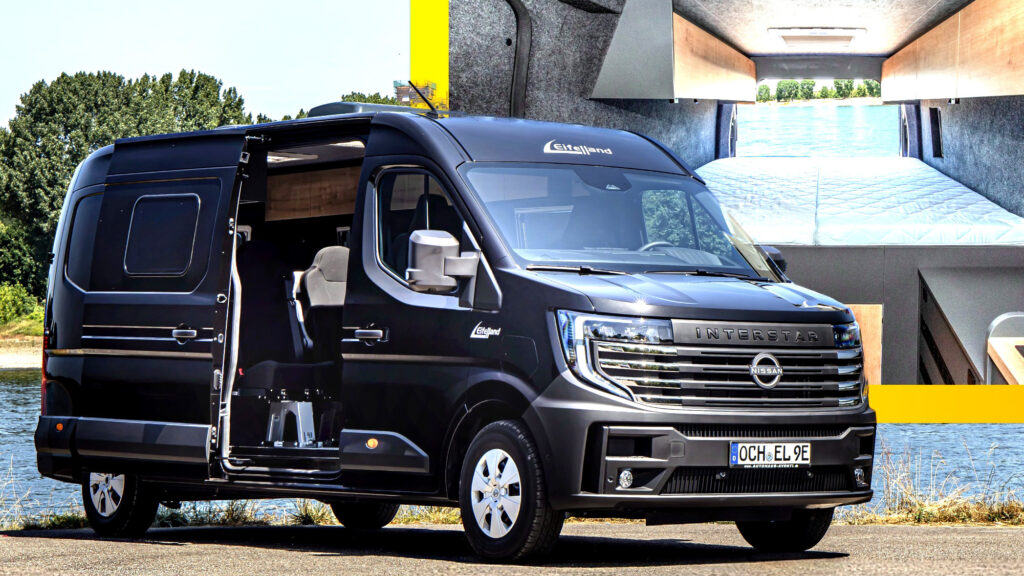
  • Eifelland-converted van packs up to four seats, a huge bed and a well-equipped kitchen.
  • An 87 kWh battery promises 255 range miles, but the single motor makes a modest 141 hp.

There’s nothing like off-grid camping for getting you back to nature. But the din of a diesel generator (or van engine) keeping your auxiliary batteries topped up and your heater running kind of spoils the ambience. Nissan and German camper specialist Eifelland reckon they’ve cracked that problem.

More: VW’s $3K ID.Buzz Camping Kit Adds A Bed And Runs The A/C For Two Full Days

Together they’ve created the new Interstar-e Relax, which can use its high-voltage battery to power the heater when you’re camping off-grid. The Relax will make its public debut at the Caravan Salon in Düsseldorf later this month, combining Nissan’s electric Interstar-e panel van with a conversion designed for everything from conventional camping trips to surfing and other outdoorsy pursuits.

Skip The Campsite Plug

\\\\

The €89,900 ($102,000) camper’s neatest trick comes courtesy of the Interstar-e’s vehicle-to-load functionality. Instead of requiring an external electrical hookup, the standard Truma Eezy parking heater can draw power directly from the Nissan’s high-voltage battery.

That sounds like a battery-draining recipe for being stranded in the wilderness, but Eifelland says the heater’s consumption is low enough that keeping the cabin comfortable shouldn’t significantly dent driving range. Sure, diesel campers can run fuel-burning heaters without plugging into the grid, but this setup does the job without burning anything locally, while tapping a battery that’s already along for the ride.

Up To 255 Miles Of Range

\\\\\

And it’s a pretty big battery, if not huge given the van’s footprint. The Interstar-e uses an 87 kWh pack, giving the unconverted base van a WLTP rating of up to 255 miles (410 km). That’s for an unladen van, mind you, and presumes you’re not indulging in too much V2L when you park up. DC charging peaks at 130 kW, while a useful 22 kW AC onboard charger is standard.

A single electric motor sends 141 hp (143 hp / 105 kW) and 221 lb-ft (300 Nm) of torque to the wheels, which should be perfectly adequate when your destination is a campsite rather than the Nürburgring. So it’s not punchy, but at least you won’t have to worry about things flying around in the back every time you leave a stoplight.

Permanent Bed, Removable Seats

\\\\\\\\\\\

Inside, there’s a fixed 1.90 x1.60 m (6.2 x 5.4 ft) bed, 90-liter (3.2 cu-ft) refrigerator, induction cooktop and sink, plus real wood trim and almost 2.6 cubic meters (92 cu-ft) of storage. A portable toilet handles the less glamorous but inescapable side of camper life, and taking out two of the four regular thrones creates additional living space.

\\\\\\\\\

Electric campervans are still relatively rare, though Netherlands-based Tonke creates them by converting the Mercedes EQV and VW. ID Buzz, both of which are much smaller than the Nissan. VW and Mercedes themselves haven’t yet gotten around to giving their electric vans the full Marco Polo and California treatment (though VW does now offer a basic Buzz camping kit), but you can be sure they’re working on them. Looks like campsites are about to get a lot more peaceful.

\\\\

Photos Nissan

The Base 2027 Mercedes GLA Reminds You Of Your Cheapness One Star At A Time

  • Mercedes’ electric GLA looks less spectacular without its optional passenger touchscreen.
  • Every GLA EV from the base 200 to the top-spec 350 makes Superscreen upgrade an option.
  • Tempting €1,160 Superscreen display really costs €4,183 once mandatory extras are added.

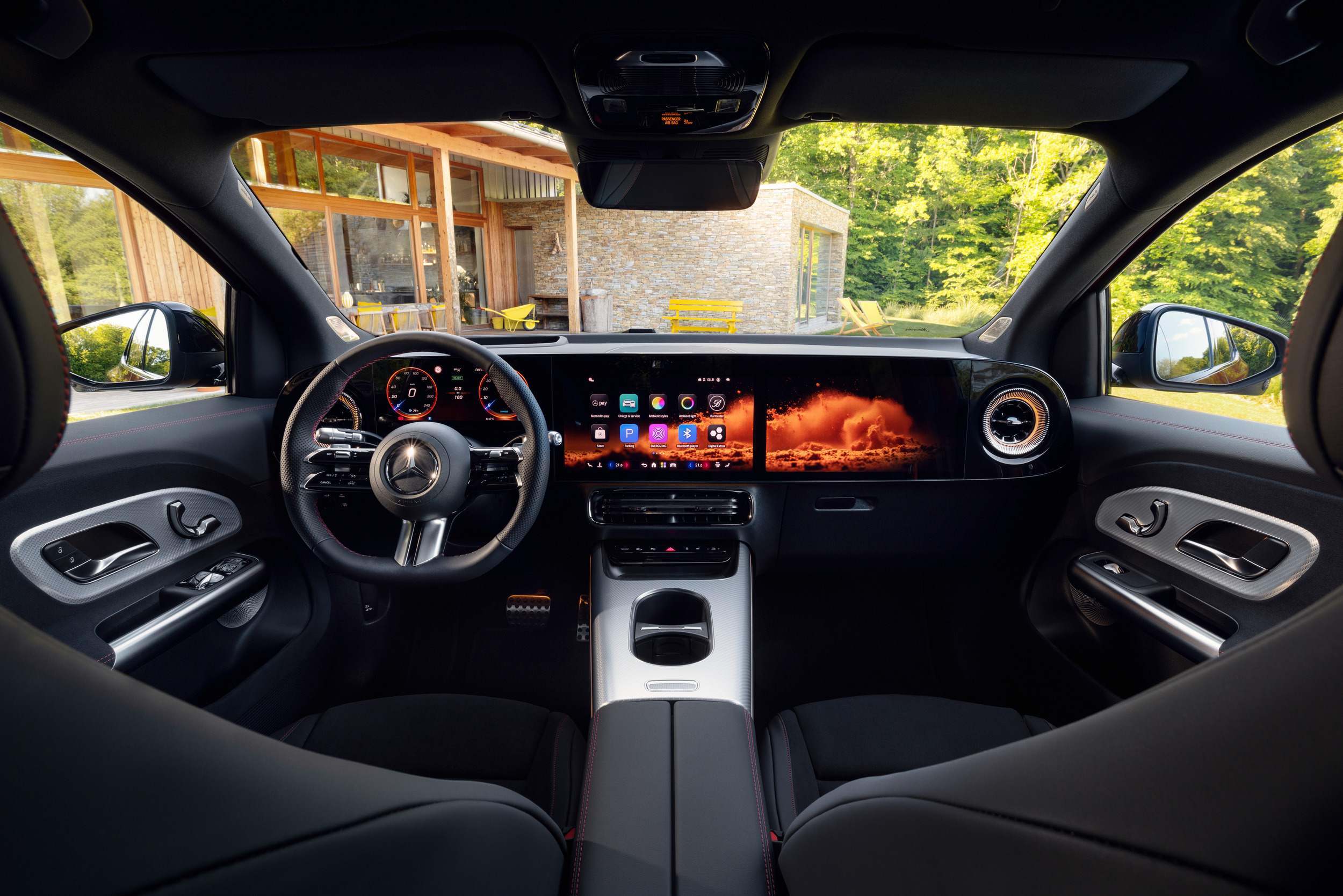
Mercedes unveiled its all-new electric and hybrid GLA yesterday with a cabin dominated by a spectacular wall of screens. But head over to the German configurator with €48,599.60 ($55,640) and dreams of ordering a basic GLA 200, and Mercedes has a little reminder that you didn’t spend enough.

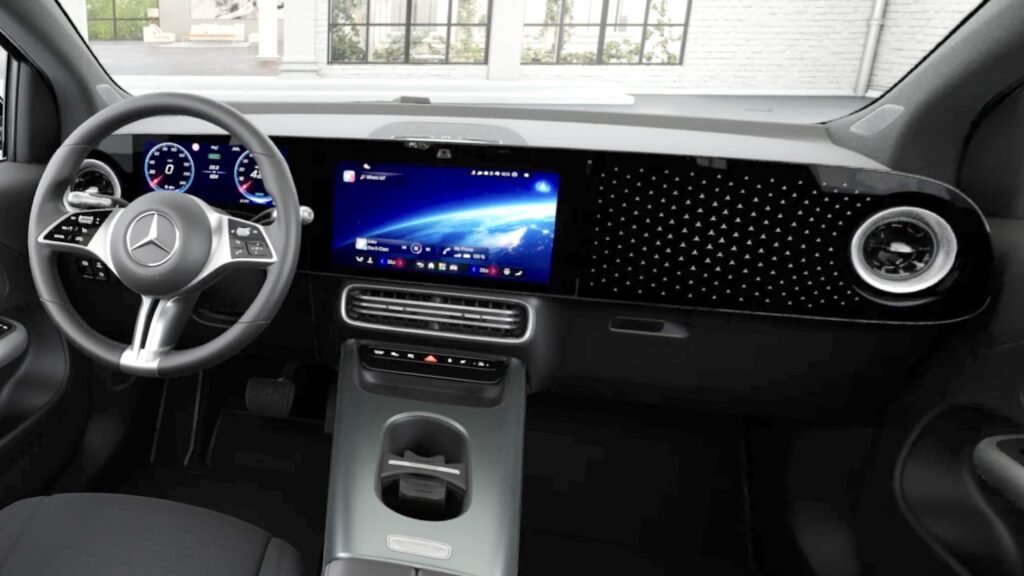
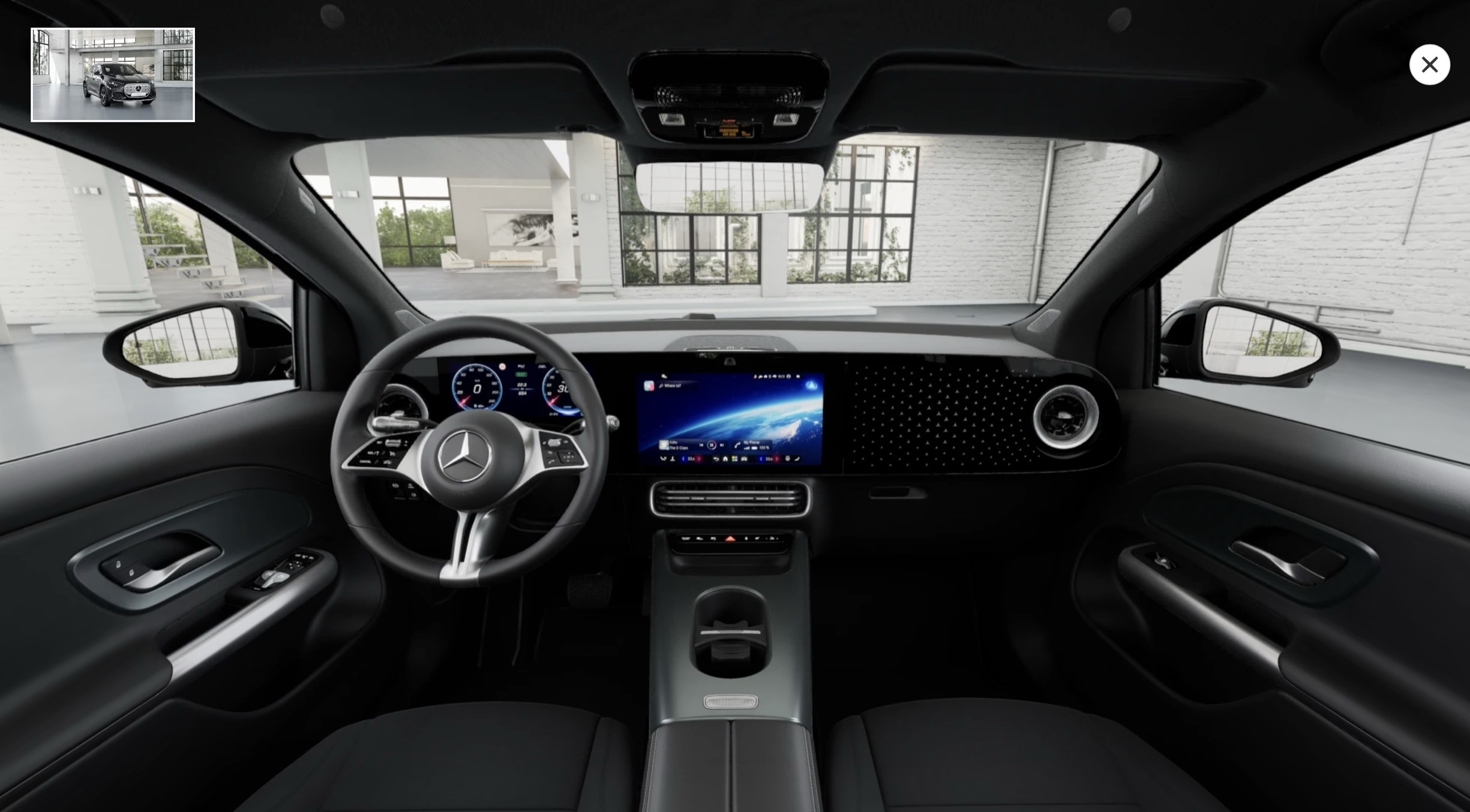
What looks like one enormous pillar-to-pillar display is actually three separate screens housed behind a continuous glass panel. The digital instrument cluster and central touchscreen are standard, but the passenger display above the glovebox isn’t.

Related: Mercedes-AMG Is Killing Its Best 4-Cylinder Hot Hatch And Charging $90,500 For The Goodbye

Leave the third-screen option unticked and Mercedes fills the resulting void with a glossy black panel illuminated by dozens of three-pointed stars. It actually looks pretty smart, though being confronted by a constellation of Mercedes badges every time you climb aboard will always remind you that you didn’t spring for the full setup.

And the 221 hp (224 PS / 165 kW) GLA 200 isn’t alone in making you feel like a skinflint. The 268 hp (272 PS / 200 kW) GLA 250 and even the 349 hp (354 PS / 260 kW) GLA 350 also miss out on the passenger display as standard. It’s possible however, that a top-dog AMG 45 version coming later and using the new 671 hp (680 PS / 500 kW) CLA 45’s triple-motor powertrain, might get it for free.

Superscreen Bait And Switch

 The Base 2027 Mercedes GLA Reminds You Of Your Cheapness One Star At A Time

The MBUX Superscreen option is listed at €1,160.25 ($1,330) on the German GLA configurator, and you can have it on every model including the lowly GLA 200. It’s not cheap, but also not likely to make too much of a difference to your monthly payment, so we can imagine a few buses being tempted. Click to add it, though, and the configurator demands you also add the €226.10 ($259) three-year Digital Entertainment package plus the €2,796.50 ($3,200) Advanced Plus Package with Digital Extras.

The latter adds more tangible luxuries including flush door handles, heated seats, four-way lumbar adjustment, ambient lighting and wireless smartphone charging. Add all three packages together and your supposedly €1,160.25 Superscreen has actually relieved you of €4,182.85 ($4,789).

Zero Benefit For Drivers

 The Base 2027 Mercedes GLA Reminds You Of Your Cheapness One Star At A Time

The third infotainment display can stream video, with audio routed through headphones or the GLA’s speakers. But Mercedes prevents drivers from enjoying an unauthorized movie night behind the wheel. If the car detects the driver looking at video playing on the passenger screen for more than two seconds, it blanks the image. When the passenger seat is empty, drivers can choose from various backgrounds to stop that expensive display sitting there doing nothing.

\\\\\\\\

Mercedes

We’re guessing most buyers won’t spec the third screen, and it won’t be the end of the world. Those illuminated stars arguably look better than a boring plain black panel, and probably better than an unused screen covered in greasy finger marks. But Mercedes’ glamorous launch images certainly aren’t showing you what €48,599.60 really buys.

\\\\\\\\\\

Mazda’s CEO Confirms Next MX-5 Goes Electric And Gas, Wants A Halo Sports Car Above It

  • Mazda confirms next MX-5 is being engineered to accommodate electric power.
  • Engineers are targeting 1,000-1,200 kg despite EV batteries joining the party.
  • CEO Masahiro Moro also wants an exclusive halo sports car to sit above MX-5.

Mazda has spent decades proving sports cars don’t need enormous muscle to be fun. They just need to be light, and that means EV power is out. Now one of those rules is about to change. CEO Masahiro Moro has confirmed the next MX-5, codenamed NE, is being prepared for electric power, and somehow Mazda thinks it can keep the little roadster seriously light.

Related: Mazda’s New Sports Car Patents Show Butterfly Doors And No Rotary

Speaking with Auto Motor und Sport only weeks after an Aussie Mazda exec said the next MX-5 could be the last to run a combustion motor, Moro said the MX-5’s replacement must be prepared for a future where combustion power is no longer viable at all due to regulatory roadblocks.

 Mazda’s CEO Confirms Next MX-5 Goes Electric And Gas, Wants A Halo Sports Car Above It
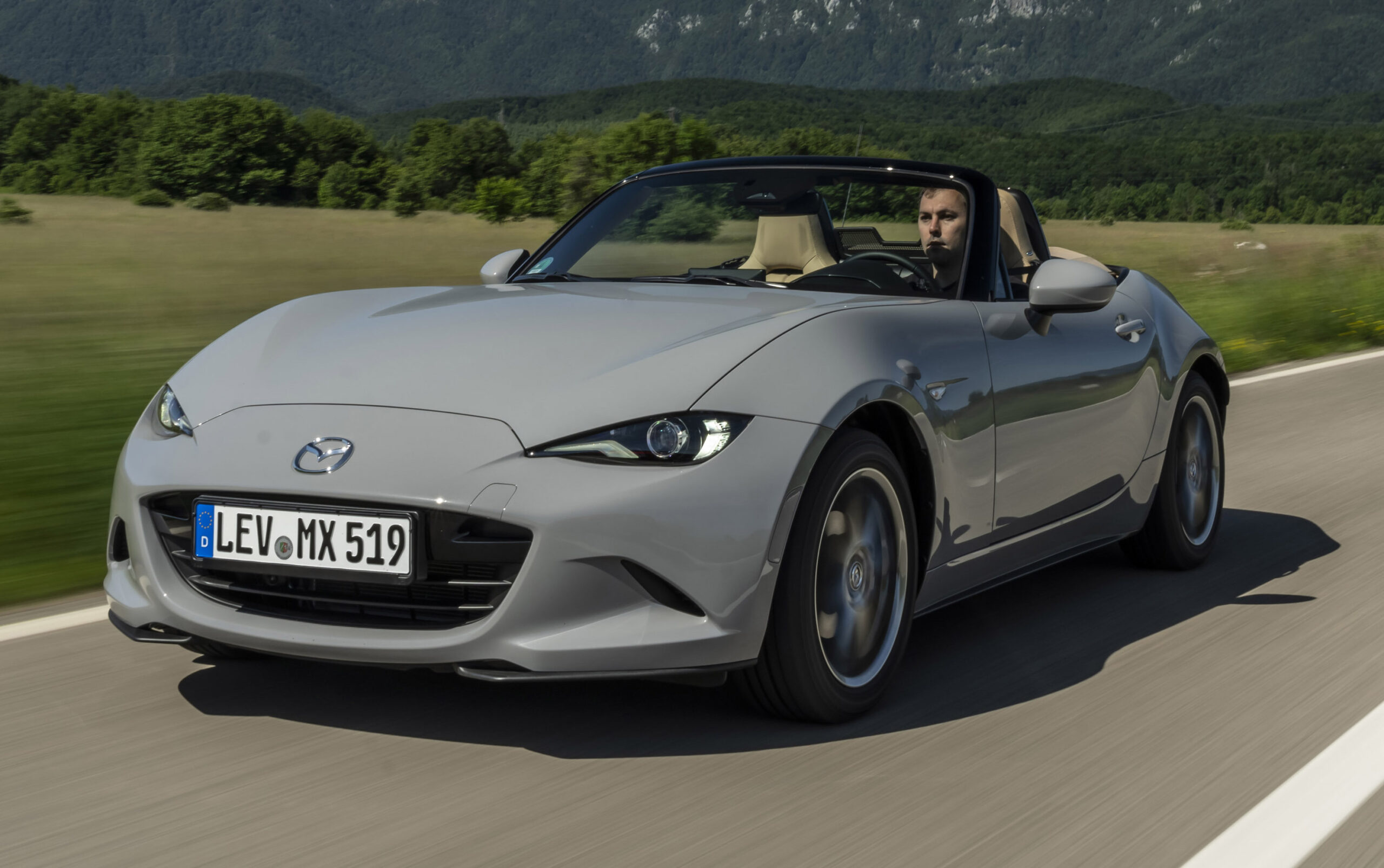
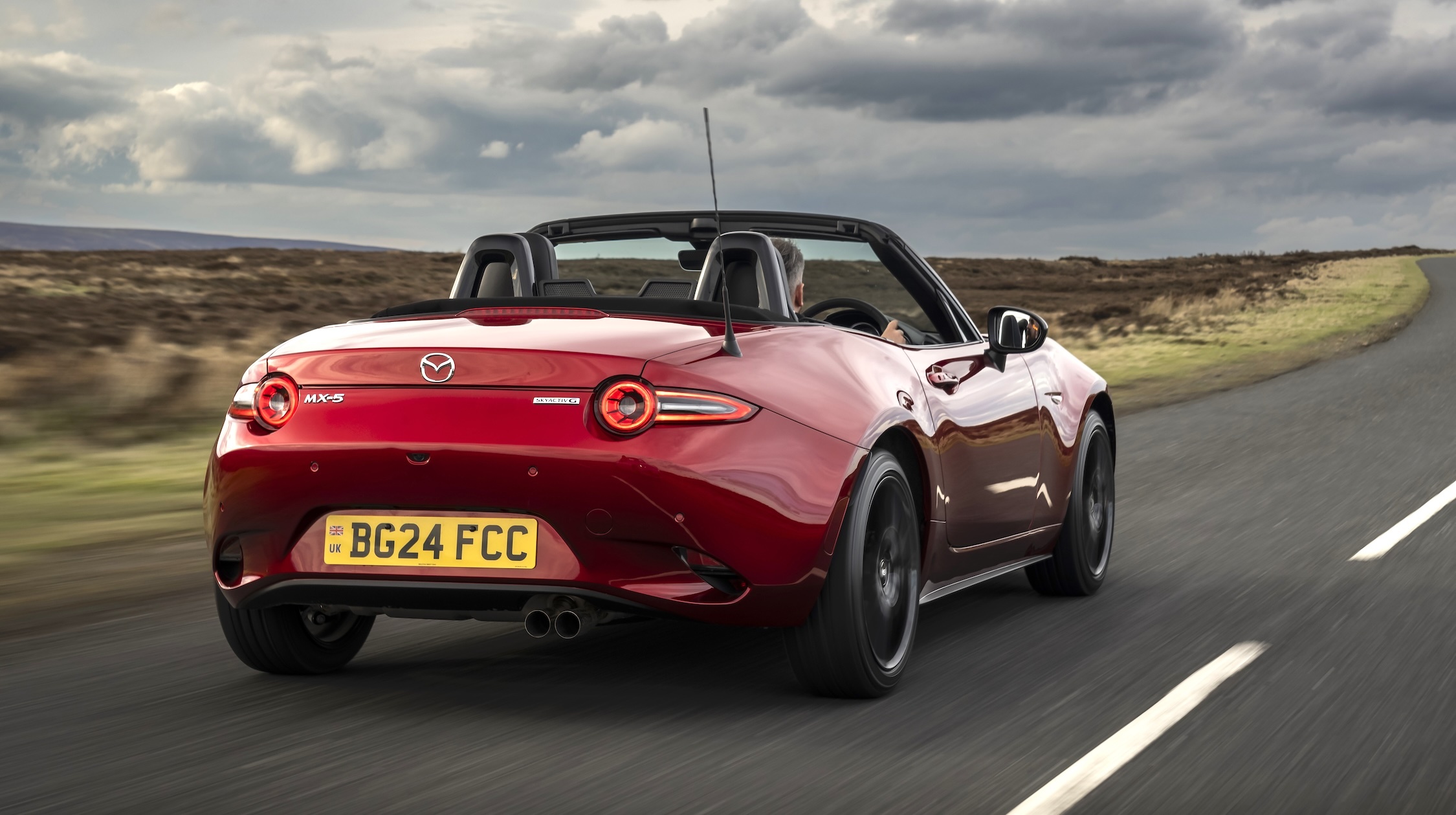
The current 2027 Mazda MX-5 (ND).

“The successor must also be ready for a scenario without a combustion engine,” Moro told the German title. “The challenge for us is to make the basic structure lighter without using exotic materials like carbon fiber.”

Instead of resorting to pricey composites, engineers are being challenged to make the underlying structure lighter using more conventional materials. And Mazda’s target sounds ambitious. Moro says developers are shooting for somewhere between “just under 1,000 kg and 1,200 kg (2,205-2,645 lbs)”, adding, “And I believe we can achieve that.”

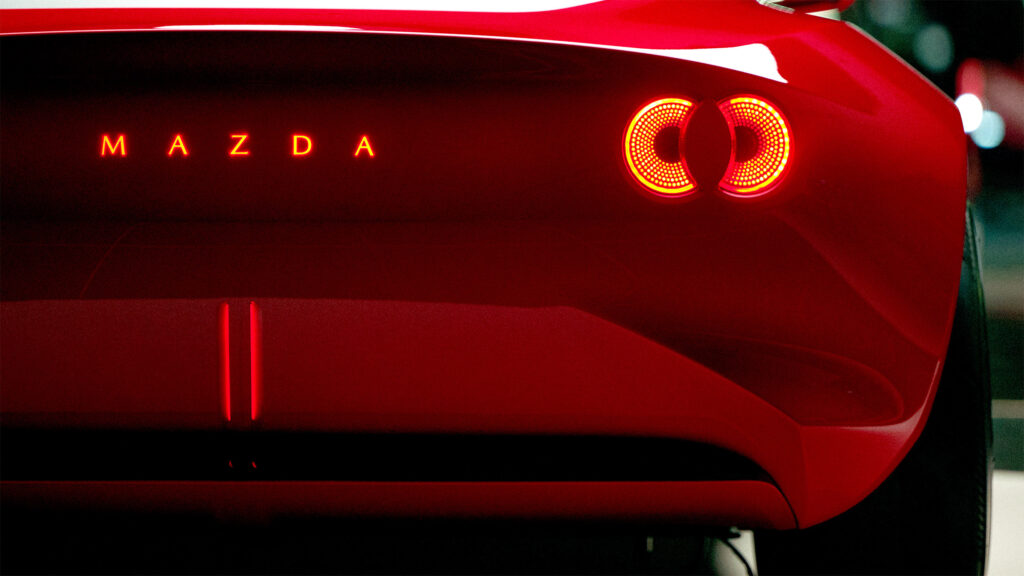
If they can, an electric MX-5, most likely wearing a design inspired by the Iconic SP concept (below), could weigh roughly the same as today’s combustion models, or just a smidge higher. The MY26 roadster comes in at 1,003 kg (2,211 lbs) without a driver in Euro trim.

Electric Not The Only Answer

\\\\\\\\\\\\\\

Mazda’s Icon SP concept from 2024.

Fortunately for piston fans, electric isn’t the only future Mazda is planning. The next MX-5 is also expected to use the company’s new 2.5-liter Skyactiv-Z four-cylinder. Some form of hybridization remains possible too, provided it doesn’t undermine the lightweight formula, in which case power could reach 220 hp (223 PS). Today’s hottest US Miata makes 181 hp (184 PS) and even Japan’s hardcore 12R model can’t top 197 hp (200 PS).

We’ll have to wait to see how Mazda makes all those options coexist, because the next-generation MX-5 isn’t expected before 2028 at the earliest. By then, the current ND will have enjoyed an impressively long innings stretching back to 2015.

Mazda Wants A Flagship Sports Car

 Mazda’s CEO Confirms Next MX-5 Goes Electric And Gas, Wants A Halo Sports Car Above It

But new Miata isn’t all we’ve got to look forward to. Moro has another sports-car itch he wants scratched.

“I want a ‘hero car’ for Mazda, a true flagship model that perfectly embodies our brand values,” he told Auto Motor und Sport.

Moro says the MX-5 will continue serving enthusiasts seeking accessible fun, but believes Mazda is missing something special at the opposite end of the showroom. He doesn’t expect this mystery machine to chase big sales numbers and even suggests it could be built largely by hand.

 Mazda’s CEO Confirms Next MX-5 Goes Electric And Gas, Wants A Halo Sports Car Above It
Mazda

BMW Is Building The Electric Convertible Everyone Else Gave Up On

  • BMW’s electric i4 Convertible has made its spy debut ahead of a 2028 launch.
  • Neue Klasse bones could deliver over 400 EPA range miles in 463-hp i4 50 trim.
  • Coupe and electric M4 versions are coming too, alongside six-cylinder M models.

Electric convertibles are still about as common as affordable apartments in Monaco, but BMW wants to change that. These fresh spy shots give us our first look at the new i4 Convertible, a two-door, soft-top relative of the recently revealed i3 sedan that’s headed for showrooms around 2028.

Known internally as NA3, the i4 Convertible will be sold alongside a visually similar combustion drop-top 4-series, featuring a classic-style folding cloth soft top. BMW moved away from the retractable hardtop trend in 2020 to cut weight and improve trunk room, and a soft top makes even more sense when you’re already hauling a large battery around underneath the floor.

Related: BMW’s Electric i3 Wagon Just Got Caught, And Its Roofline Hides A Trick

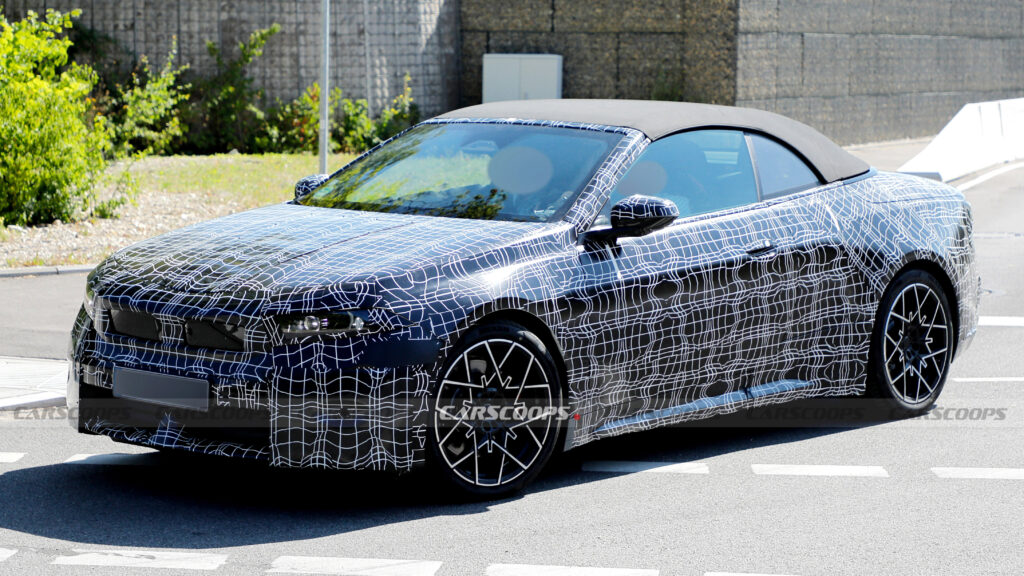
The prototype spotted on test in Germany is still covered in BMW’s usual wrap, which looks like the result of a seismograph trying to scribe the earth’s movements after it was T-boned by another planet. But we can see that it retains almost all of the Neue Klasse design cues already seen on the i3 sedan launched earlier this year.

Shorter Wheelbase, Bigger Questions

\\\\\\

SH Proshots, Baldauf

What it doesn’t retain, judging by these pictures, is the sedan’s 2,898 mm (114.1 inches) wheelbase. The current 3-series sedan and 4-series coupe and convertible ride on identical wheelbases, but this i4 has noticeably less metal between the axles than the i3 sedan, making us wonder if it really is a genuine four-seater, or whether BMW has shrunk it to a 2+2 to help mask the gap in its lineup that axing the Z4 has left.

The i4 also won’t be as structurally stiff as the sedan. Convertibles normally compensate with extra reinforcement underneath. Trouble is, that’s precisely where an EV carries its battery. Keeping the body stiff without turning the i4 into a Bavarian cruise ship could be one of BMW’s trickier engineering challenges.

More Than 400 Range Miles Possible

\\\\\\\\\\\\\\\\\

SH Proshots, Baldauf

Powertrain details haven’t surfaced yet, but the i3 provides a useful preview. Its 50 xDrive pairs two electric motors for 463 hp (469 PS / 345 kW) and uses a 108.7 kWh battery, 800-volt architecture, and charging at up to 400 kW for 440 EPA range miles (708 km) and 559 miles (900 km) on the WLTP Euro cycle.

This prototype’s wheels and brake calipers tell us it’s an i4 50 xDrive, but a cheaper i4 40 could borrow the iX3 40’s 316 hp (235 kW / 320 PS) rear motor and smaller 82.6 kWh battery pack. BMW might not even be able to fit the 50’s full 108.7 kWh battery given how much shorter the wheelbase seems.

iDrive Goes Panoramic

 BMW Is Building The Electric Convertible Everyone Else Gave Up On

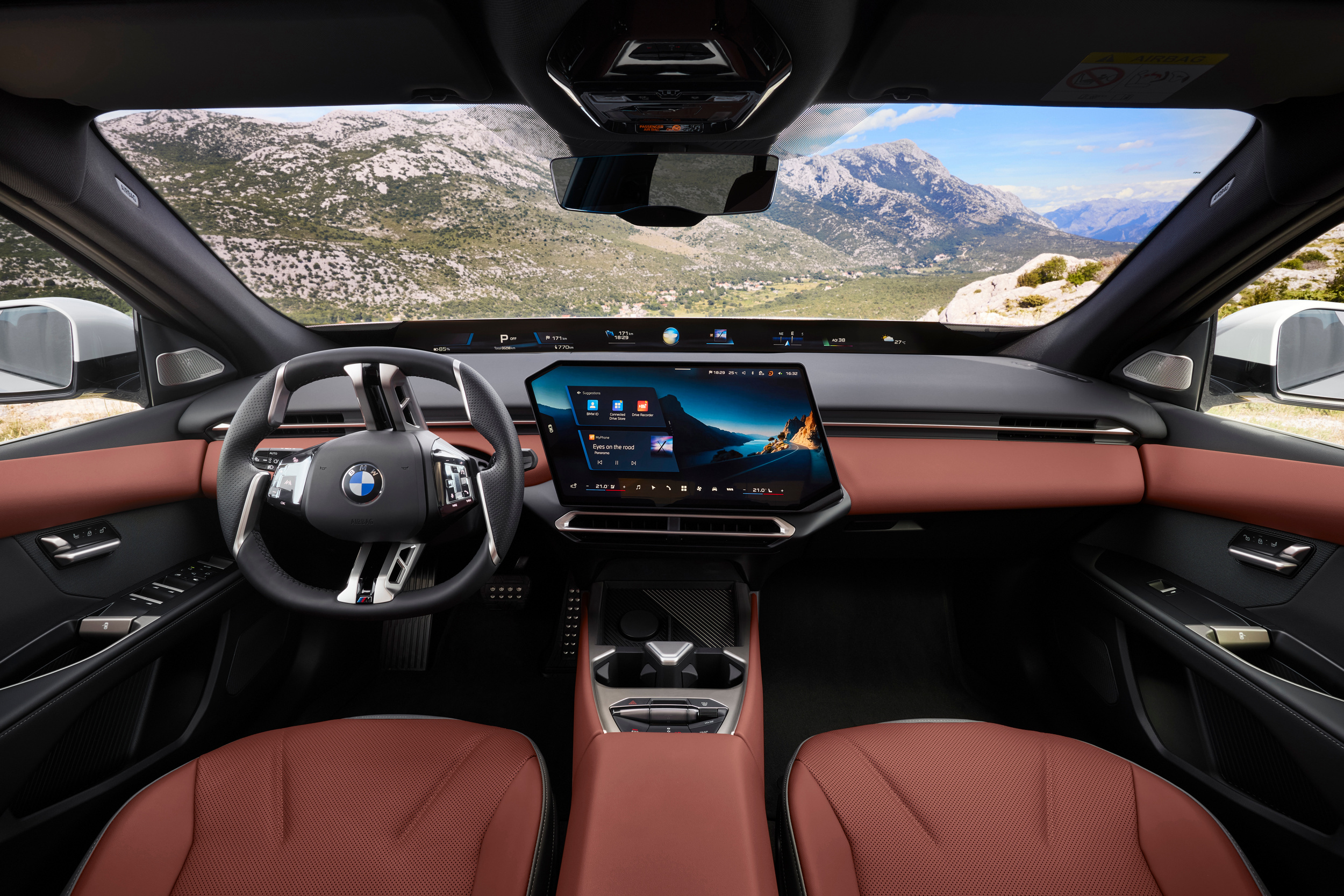
Inside, expect BMW’s Panoramic iDrive setup, combining a display stretching across the base of the windshield with a huge 17.9-inch touchscreen, plus an available 3D head-up display. This infotainment setup made its debut on the iX3, but is now being rolled out to BMW’s other new and facelifted models, including the i3 sedan (shown in image above).

And the convertible won’t be lonely. A fixed-roof i4 Coupe is also coming, as well as visually similar combustion-powered i4s in both open and closed-roof forms. BMW is also developing electric M4 Coupe and Convertible models with styling influenced by the M Concept Neue Klasse. Six-cylinder M4s will survive alongside them too.

That means BMW’s future 4-series lineup should have something for almost everyone. And if you want electric power, sunshine and (just about) four seats, this i4 might have remarkably little competition.

\\\\\\\

SH Proshots, Baldauf

Used Porsche 911 Prices Drop $14,000 As Used EVs Get More Expensive

  • Used EV prices rose sharply in the US while overall used market softened.
  • Tesla models dominated price increases but 911 values dropped by 10 %.
  • Higher fuel costs due to Iran war may have pushed shoppers back to EVs.

For the past few years, buying a used EV has been a waiting game, with would-be buyers often waiting for prices to fall a little further. That strategy may no longer be paying off. Used electric vehicle prices are climbing rapidly while the rest of the used car market continues to drift in the opposite direction, making dream cars like the Porsche 911 more affordable.

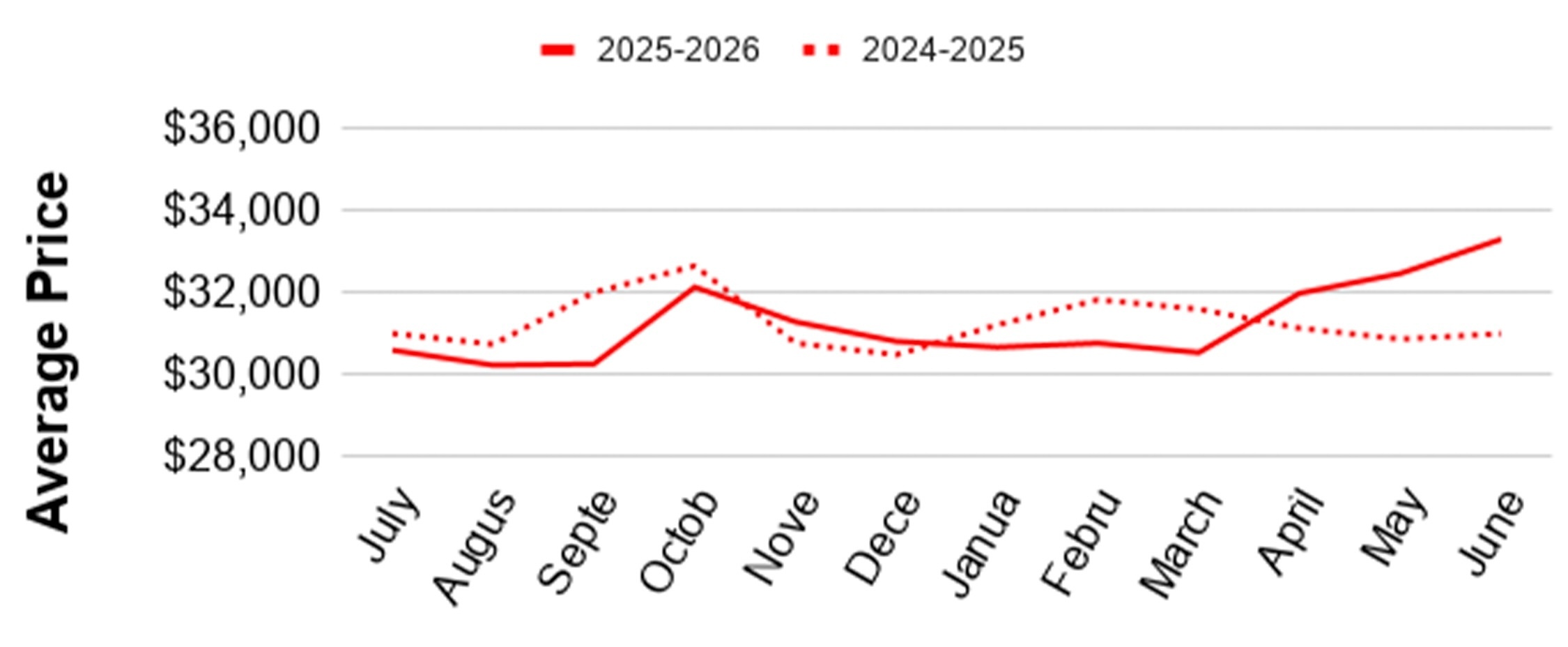
New data from iSeeCars suggests the turnaround isn’t a one-month anomaly, either. Used EV prices have now posted three straight months of year-over-year gains, moving from a 2.7 percent increase in April to 5.2 percent in May before reaching 7.4 percent in June.

Related: This Is How Much A 17K-Mile EV From A Dead Brand Sells For After 3 Years

That pushed the average price of a one- to five-year-old used EV to $33,305 in June. Compared with the same month last year, that’s an increase of $2,308. Meanwhile, the average used vehicle price fell by 1.3 percent year over year, highlighting just how differently the EV segment is behaving.

Rising fuel costs may have helped trigger the shift, iSeeCars Executive Analyst Karl Brauer logically suggests. Gasoline prices rose sharply during the Iran conflict earlier this year, but it took several weeks before buyers adjusted their shopping habits and begin gravitating back toward EVs.

Average 1-5 YO EV Prices
 Used Porsche 911 Prices Drop $14,000 As Used EVs Get More Expensive

Tesla was the biggest beneficiary of the trend. All four of the brand’s core models landed among the 10 used vehicles with the largest year-over-year price increases. The Model X led the entire market, jumping 17.5 percent to an average price of $60,950.

The Model 3 wasn’t far behind with a 13.5 percent increase, while the Model S climbed 13.1 percent and the Model Y gained 12.0 percent. “Tesla makes up nearly half of the top 10 used models with the highest price increase,” Brauer noted.

Perhaps just as telling is what didn’t appear in the rankings. Not a single EV showed up among the 20 used vehicles with the steepest price declines. Instead, that list was populated by a mix of luxury vehicles, pickups, SUVs, hybrids, and conventional gasoline-powered models. The Lincoln Corsair posted the biggest percentage value drop (-14.7 %), but the Porsche 911 was right behind it (-10.6 %), and reminds us that there’s a silver lining to every cloud.

Used Cars With The Biggest Price Increases
 Used Porsche 911 Prices Drop $14,000 As Used EVs Get More Expensive
RankModelAvg Price$ Diff YoY% Diff YoY
1Tesla Model X$60,950$9,06617.5%
2BMW X2$33,956$5,03517.4%
3MINI Countryman$30,535$4,23116.1%
4Ford Mustang (convertible)$32,524$4,02514.1%
5Tesla Model 3$28,520$3,38813.5%
6Alfa Romeo Giulia$30,320$3,59113.4%
7Tesla Model S$52,787$6,11613.1%
8Honda Pilot$37,301$4,17212.6%
9Tesla Model Y$32,916$3,52912.0%
10Lexus ES 300h$43,057$4,36511.3%
11INFINITI QX80$48,756$4,87111.1%
12Lexus ES 350$41,289$4,10211.0%
13Hyundai Santa Fe Hybrid$33,619$3,25510.7%
14Cadillac CT5$36,613$3,47910.5%
15MINI Hardtop 2 Door$27,428$2,58710.4%
16Acura TLX$35,470$2,9299.0%
17Porsche Taycan$85,147$6,9478.9%
18Nissan Murano$27,917$2,2128.6%
19Nissan Armada$40,513$3,1578.5%
20Lexus IS 300$36,421$2,7468.2%
OverallAverage$32,395-$412-1.3%
SWIPE

Used Cars With The Biggest Price Drops
 Used Porsche 911 Prices Drop $14,000 As Used EVs Get More Expensive
RankModelAvg Price$ Diff YoY% Diff YoY
1Lincoln Corsair (hybrid)$37,312-$6,454-14.7%
2Porsche 911$118,025-$14,063-10.6%
3Audi Q5 (hybrid)$36,890-$3,012-7.5%
4Mercedes-Benz G-Class$127,727-$9,927-7.2%
5Audi A5 Sportback$33,495-$2,495-6.9%
6Ford Bronco$45,341-$2,763-5.7%
7Buick Encore GX$21,038-$1,116-5.0%
8Ford F-150 (hybrid)$46,201-$2,299-4.7%
9GMC Sierra 1500$45,426-$2,222-4.7%
10Nissan Rogue$22,401-$1,093-4.7%
11Audi A6$34,872-$1,700-4.6%
12Genesis GV80$44,892-$1,990-4.2%
13Mercedes-Benz GLB$30,863-$1,355-4.2%
14Jeep Wrangler$36,067-$1,479-3.9%
15Volkswagen Atlas$30,149-$1,044-3.3%
16Audi Q5 Sportback$37,189-$1,276-3.3%
17Chevrolet Blazer$26,706-$878-3.2%
18Ford Explorer Hybrid$29,979-$981-3.2%
19Chevrolet Malibu$18,619-$590-3.1%
20Mercedes-Benz S-Class$77,349-$2,371-3.0%
OverallAverage$32,395-$412-1.3%
SWIPE

iSeeCars

Mercedes’ New GLA Breaks Cover July 29, But Spy Shots Got There First

  • New spy photos reveal production GLA bodywork beneath reduced camouflage.
  • Electric crossover shares platform, cabin technology, hardware with CLA sedan.
  • GLA will also be available with hybrid power and potentially as a 671 hp AMG EV.

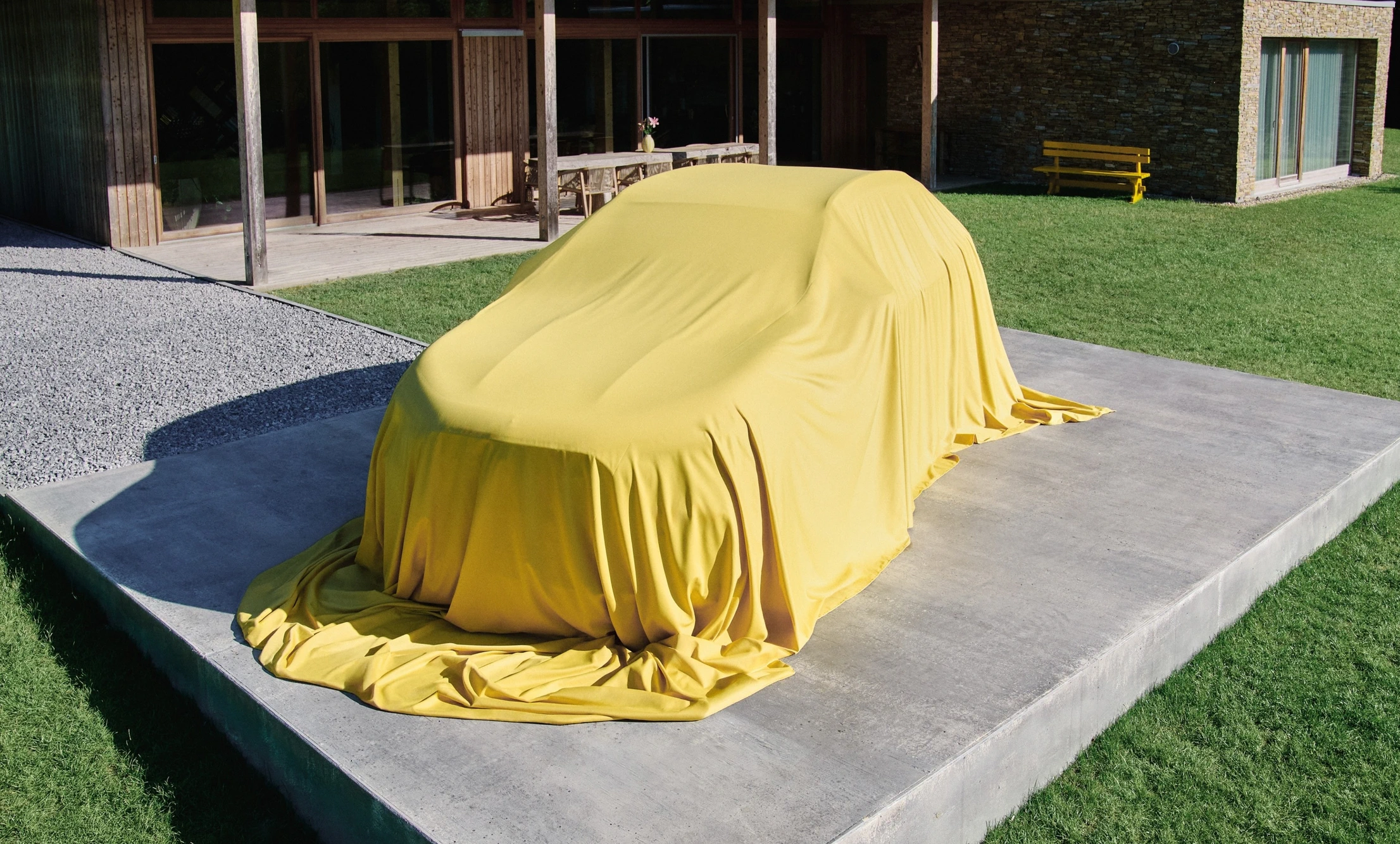
Mercedes has been gradually peeling back the layers on its next-generation GLA, and now it’s put a date on the full unveiling. . The company has confirmed the small crossover will break cover on July 29, releasing a teaser of the sheet-draped car to mark the occasion. The lineup follows the same multi-fuel approach as the new GLB: combustion versions keep the GLA name, while an electric model called the GLA Electric takes over from the outgoing EQA.

 Mercedes’ New GLA Breaks Cover July 29, But Spy Shots Got There First
Mercedes-Benz GLA teaser before July 29 reveal.

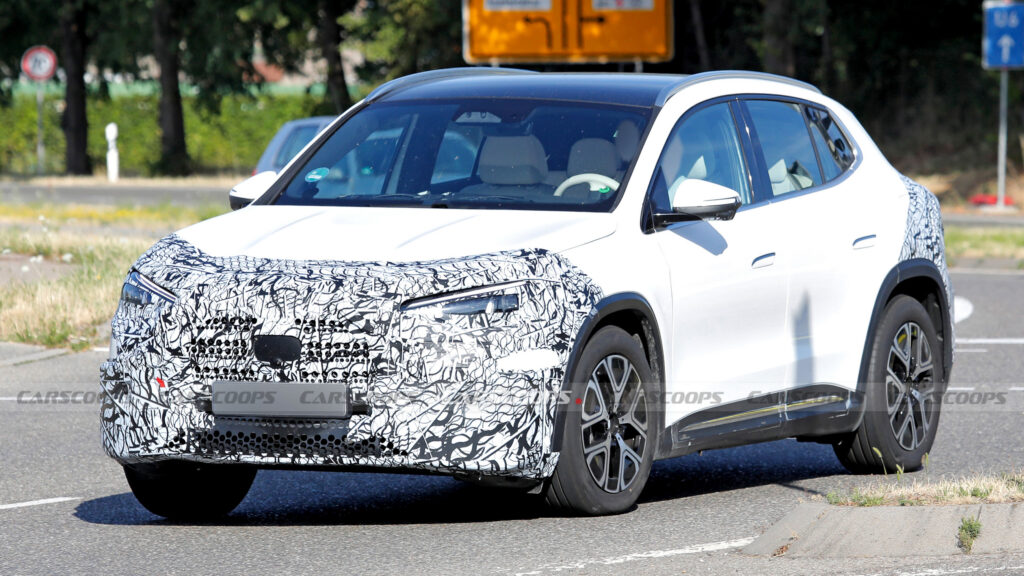
These latest spy shots, meanwhile, finally give us a much clearer look at its shape. While the front and rear remain disguised, the sides have largely stepped out of witness protection.

Related: Mercedes EV Sales Jumped 28% While The Rest Of The Brand Shrank

Compared with the heavily camouflaged prototypes we spotted earlier this year, this latest tester reveals its doors, glasshouse, and much of its body surfacing. The result is a cleaner and more sophisticated design that looks noticeably more aerodynamic than today’s GLA.

\\\\\

Baldauf

The newly exposed profile confirms several styling details we could previously only guess at. Flush-mounted door handles are present, helping to reduce drag, while a rising window line injects a little visual drama into an otherwise smooth-sided body. Combined with the gently sloping roofline, the overall effect is once again more sleek crossover than upright SUV. If it’s boxy you want, you need the new GLB that’s already on sale.

The GLA’s nose remains hidden behind camouflage, but Mercedes has already shown us the direction it’s heading. Expect a scaled-down interpretation of the retro-futuristic grille treatment introduced on the larger GLC EQ.

Stars-Shaped DRLs

\\\\\

Baldauf

The rear end is similarly concealed, though there are still clues hiding beneath the camouflage. Look closely and you can just make out the signature star-shaped lighting graphics that Mercedes has been rolling out across its latest EVs. Expect those illuminated three-pointed stars to feature prominently at both ends of the production GLA.

Up To Three Screens Available

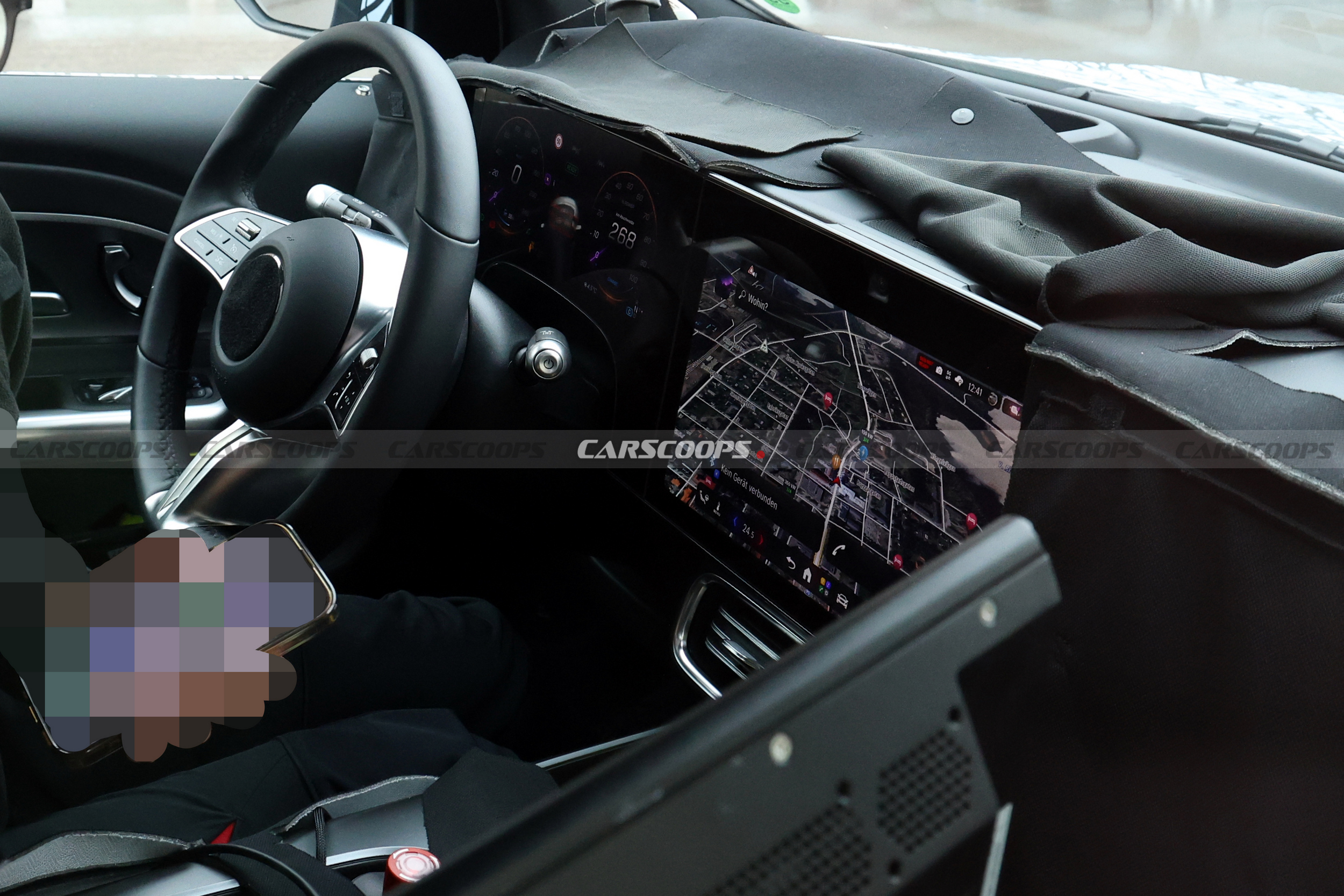
Unfortunately, these photos don’t provide a fresh look inside, but that’s not a huge problem because we’ve already seen the goodies in a previous spy shot haul (below). Like the CLA and GLB, the GLA EQ should offer an optional MBUX Superscreen setup combining a 10.25-inch digital cluster with dual 14-inch displays stretching across the dashboard.

 Mercedes’ New GLA Breaks Cover July 29, But Spy Shots Got There First

Underneath, the newcomer shares its platform and powertrains with its compact Mercedes brothers. That likely means a rear-drive version producing 268 hp (272 PS / 200 kW) and an all-wheel-drive model generating 349 hp (354 PS / 260 kW). Both should draw energy from an 85 kWh battery and benefit from an 800-volt electrical architecture capable of ultra-fast charging.

And for anyone worried the GLA EQ might be too sensible, don’t forget we’ve already caught an electric AMG version testing. If it borrows the hardware from the upcoming AMG CLA, this compact crossover could eventually pack as much as 671 hp (680 PS /500 kW).

Of course not everyone wants an EV, so Mercedes has ICE fans covered too, or it will have. The EV arrives this fall but combustion versions of the new GLA fitted with 1.5-litre hybrid engines will follow in spring 2027.

\\\\\\

Baldauf

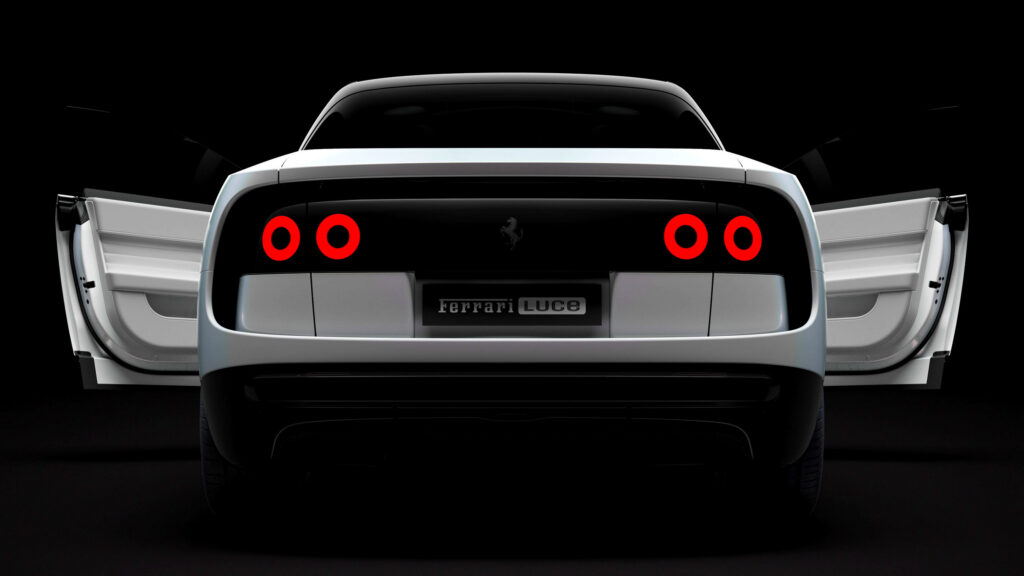
Ferrari’s $640K Luce EV Just Got A $1.1 Million Twin

  • First production Ferrari Luce EV heads to auction during Monterey Car Week.
  • Unique Tailor Made specification could push bidding well beyond $1.1 million.
  • All proceeds from Luce sale support Ferrari Foundation educational initiatives.

Ferrari’s first electric car has already divided opinion long before most customers have even seen one in person. Now the Italian automaker is turning that controversy into a fundraising opportunity by auctioning off the very first production example of the Luce.

The car, identified as “Chassis 0,” will cross the block at RM Sotheby’s Monterey Car Week sale in August. Ferrari says the sale represents a unique chance to acquire the first production chassis from the Luce program, and all proceeds will go toward educational initiatives supported by The Ferrari Foundation.

Related: Ferrari Boss Was Thrilled When Fans Trashed The $640K Luce

That charitable angle could help push bidding well beyond the car’s already substantial value. RM Sotheby’s estimates the one-off EV is worth more than $1.1 million, a significant premium over the standard Luce, which costs $640,000.

\\\\\\

RM Sotheby’s

What buyers will get in return is a Luce that’s been curated by Ferrari’s Tailor Made personalization division. The entire concept revolves around light and the way it changes the appearance of surfaces, with a color and materials package developed specifically for this example.

The exterior wears a bespoke Madreperla Semi-Gloss finish that Ferrari says incorporates a dedicated Tailor Made pigment. Depending on lighting conditions and viewing angle, the paint is designed to produce shifting reflections that move between green and violet tones. Ferrari also claims that the complexity of the finishing process means every application develops its own character.

Metallic Leather Upholstery

\\\\\

Inside, the cabin continues the theme with Perla Le Mans metallic leather paired with Grigio Corvara secondary trim pieces. Ferrari says the metallic leather was developed exclusively for the Tailor Made program and was selected for both its appearance and its ability to enhance the cabin’s sense of brightness. Whatever you do, don’t eat in there.

This particular Luce also receives color-coded wheels in a conventional five-spoke design, rather than the ugly disc wheels seen in some Luce launch images, and bespoke brake calipers. And there’s a unique plaque identifying it as the first production chassis of the Luce program.

\\\\

Whether you view the electric Luce as a bold step into the future or an unwelcome departure from tradition, its place in Ferrari history is already secure. And the controversy could mean that for once the biggest auction price shock at Monterey isn’t how much someone paid for a vintage V12-powered 250 GT SWB or California Spider, but how much money changed hands for a modern Ferrari with no engine at all.

\\\\\\\\

RM Sotheby’s

Cybertruck Ripped In Two After Runaway Truck Triggers 10-Car Pileup

  • Runaway truck reportedly triggered chain-reaction crash in Silver Spring, MD.
  • Tesla Cybertruck was torn apart, separating the bed from the truck’s cab area.
  • 10 people suffered minor injuries and were hospitalised, including three children.

We’ve seen Tesla Cybertrucks in all kinds of trouble, from minor fender benders to getting beached or rolling over on trails. One even drove into an empty swimming pool. But a Cybertruck being split cleanly into two pieces after a multi-vehicle crash is probably the most visually extreme Cyber-related accident we’ve come across so far.

The incident unfolded Saturday afternoon in Silver Spring, Maryland, where a moving truck reportedly lost control and plowed into a line of traffic. By the time emergency crews reached the scene, numerous vehicles had been damaged and one Cybertruck had been transformed into something that looked less like a pickup and more like a cutaway auto show display.

Related: Family Wants Cybertruck Off The Roads After Teen Killed In Crash

According to Montgomery County authorities, the crash involved at least 10 vehicles. Firefighters responding to the scene reportedly had to rescue multiple occupants who were trapped inside damaged cars, WTOP News reports. Images from the aftermath show debris scattered across the roadway and vehicles positioned at all kinds of angles following the impact.

One black SUV can be seen lying on its side behind the Nation Capital Movers truck, and another is directly in front of the same truck, looking like its been T-boned and pushed along the road.

But it’s the Cybertruck that has attracted the most attention. Tesla’s stainless steel pickup has been a divisive vehicle ever since it debuted. People generally seem to either love the futuristic wedge-shaped truck or absolutely hate it. Following this crash, though, it’s no longer merely divisive in a figurative sense. It became divisive in a very literal one, with the cab half of the truck entirely separated from the rear end, and high-voltage cables left to dangle in mid-air.

Three Children Injured

Silver Spring, MD – Aerial of a reported crash involving entrapment in the area of Columbia Pike/Fairland Rd. @mcfrsPIO @HHFireProds @ArmisteadIsaac @mcfrs #mcfrs @MoCoFireWire @Lawzfirephotos @command11b @MCFRSNews @DavidPazos15 @mcpnews #mcpd pic.twitter.com/O0lPtgqMu3

— MyDrone.Pro (@MyDronePro) July 18, 2026

Police later provided an update on X, saying, “10 people transported to area hospitals with minor injuries. 3 pediatric patients.”

The department added that “the initial report is that a moving truck lost control and collided with at least 10 vehicles.”

Thankfully, the outcome appears far less severe than the wreckage might suggest. Given the extent of the damage visible in photographs from the scene, things could have been much worse.

Investigators are still working to establish exactly what happened before the moving truck lost control. Officials haven’t yet released additional information regarding potential contributing factors, and the investigation remains ongoing.

\\

Montgomery County Police Dept, MyDrone.Pro

BMW’s New Electric M3 Proves The Concept Wasn’t Kidding

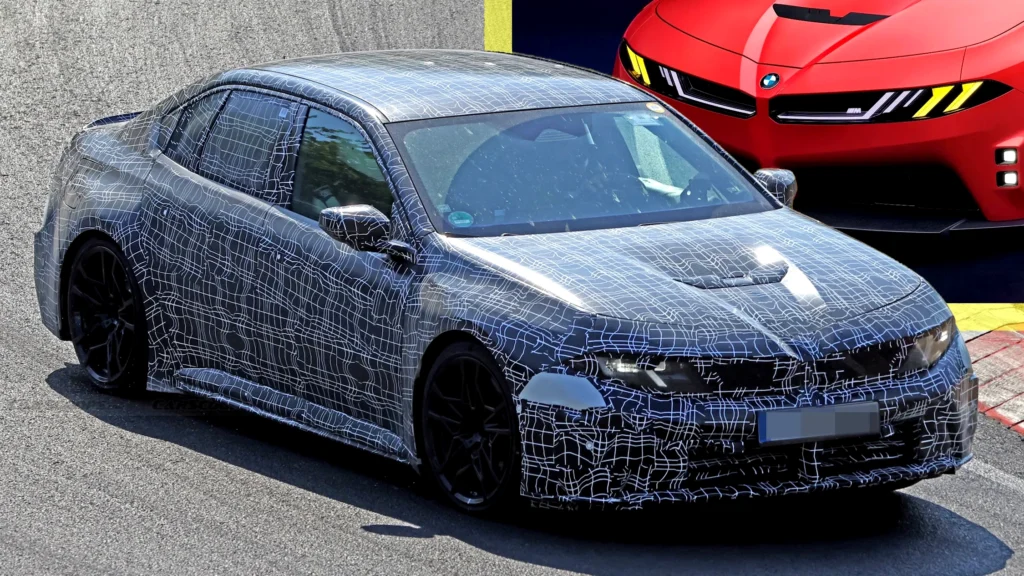
  • Spy shots show prototype electric M3 with the M Concept Neue Klasse’s hood vent.
  • Quad-motor powertrain could deliver over 700 hp and advanced torque vectoring.
  • BMW will sell visually similar electric and gasoline M3 models alongside each other.

BMW‘s electric M3 is gradually stepping out of the shadows. The naming question is already settled, with M boss Frank van Meel confirming at Goodwood that the car drops the i prefix and simply carries the M3 badge. Now fresh spy shots from the Nürburgring show the high-performance EV wearing less camouflage than before, giving a clearer look at the production model BMW hopes will convince enthusiasts that an M car doesn’t need exhausts to be exhilarating.

Also: BMW’s New Gas M3 Loses Its Grille But Keeps Its Six, And Maybe The Clutch Too

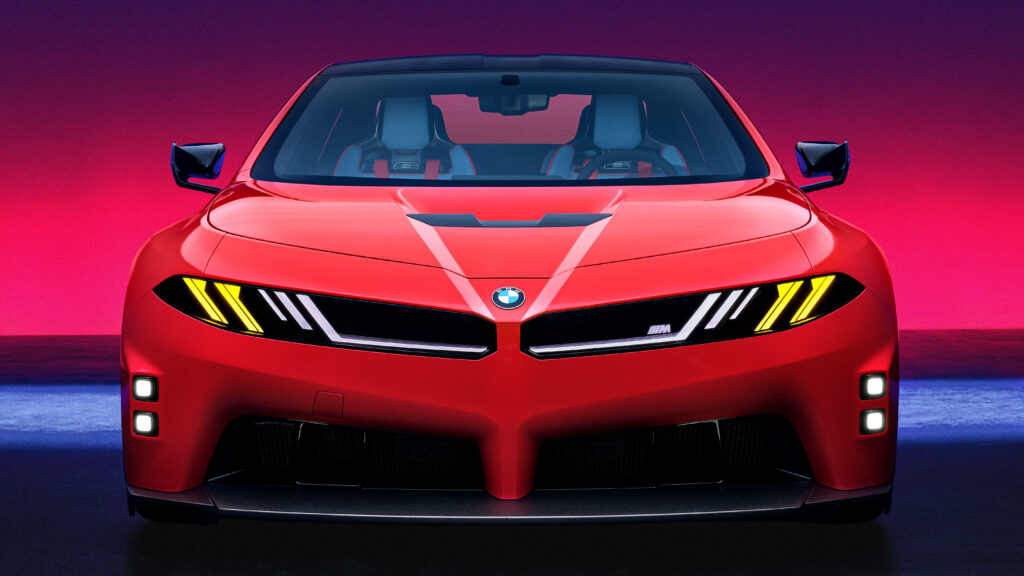
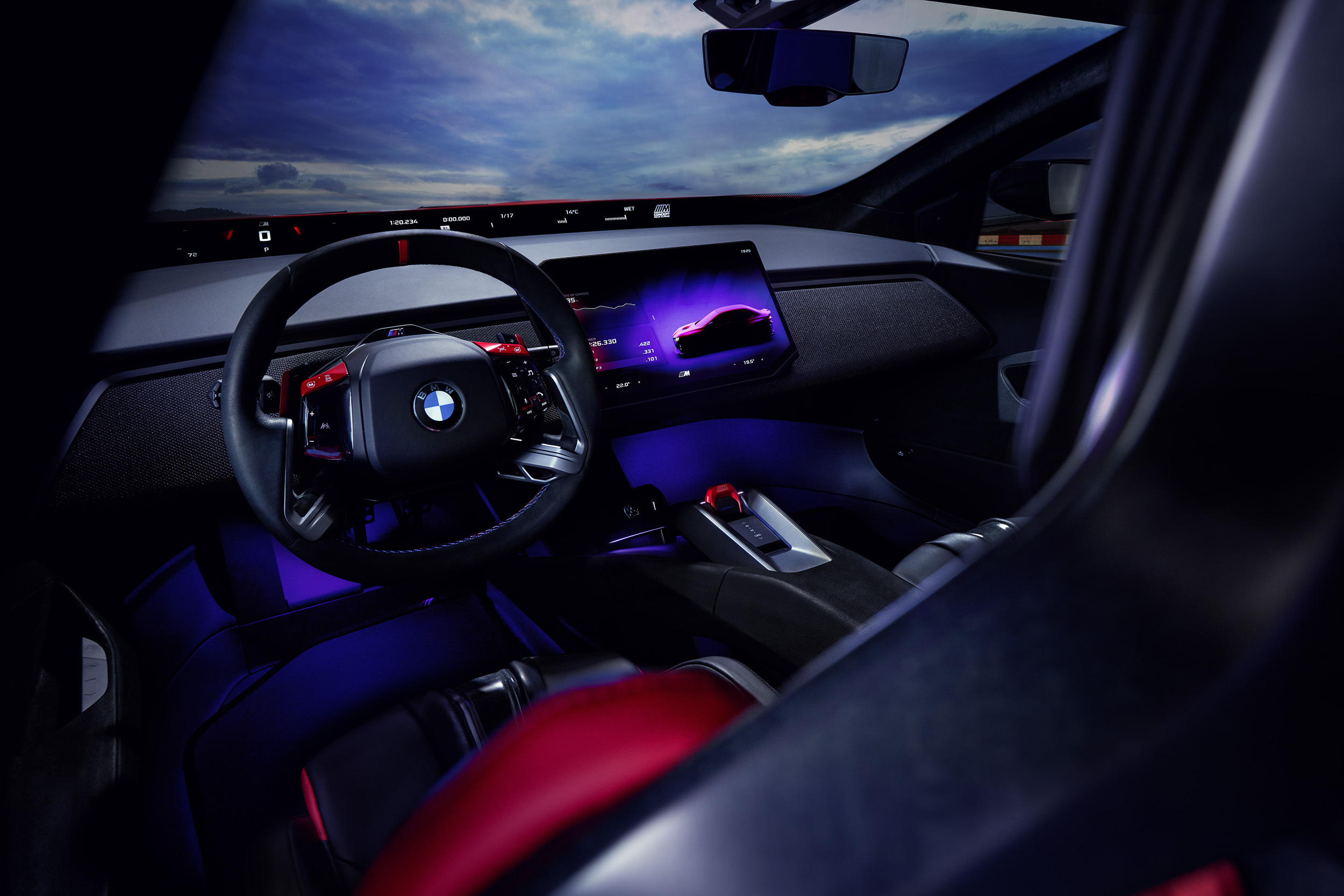
The latest prototype appears heavily influenced by the recently revealed M Concept Neue Klasse, which BMW showcased at Le Mans as a preview of its future electric performance models. While there’s still some disguise covering key details, the overall shape and many of the styling cues now look very close to what buyers can expect when the car finally reaches showrooms.

\\\\\\

SH Proshots

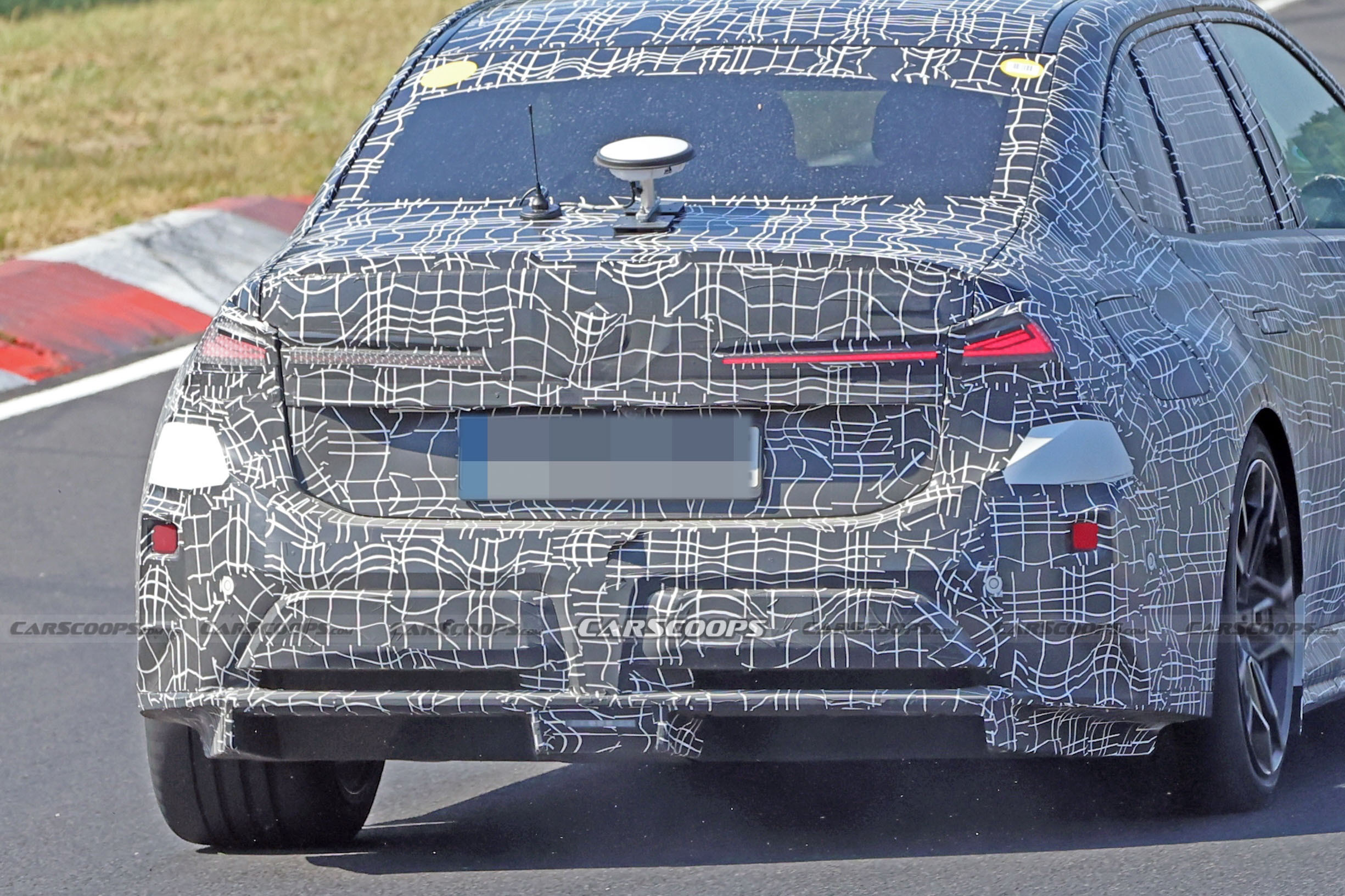
Compared to a regular i3 sedan, this prototype looks considerably more aggressive. The swollen wheel arches remain one of the most obvious giveaways, while the car also appears to feature a wider track, rear diffuser and trunk lid spoiler, and a hood vent that wasn’t visible on previous prototypes, but did appear on the concept.

Under the skin, BMW is expected to fit a quad-motor powertrain with one electric motor driving each wheel. While the company hasn’t confirmed output figures, reports continue to suggest the electric M3 could produce more than 700 hp (710 PS), with up to 1,000 hp (1,014 PS) possible on hardcore models later.

 BMW’s New Electric M3 Proves The Concept Wasn’t Kidding

The real challenge, however, isn’t straight-line speed. Plenty of EVs can deliver shocking acceleration. What BMW’s engineers need to prove is that this car can deliver the balance, precision and adjustability that have defined generations of M3s. That’s where the four-motor setup could become a genuine advantage, allowing far more precise torque distribution than a conventional all-wheel-drive system.

More Power Than Its Combustion M3 Brother

Fortunately for traditionalists, the electric model won’t replace the combustion-powered M3. BMW is expected to offer both cars simultaneously, with the gasoline version continuing to fly the flag for six-cylinder performance while the EV pushes the brand into new territory. It’s unlikely that the visually similar petrol M3 will make anywhere near as much power as the electric one, though.

\\\\\\\\

SH Proshots

With camouflage steadily disappearing and testing activity ramping up, it looks increasingly likely that we’ll see the finished product sooner rather than later. Whether diehard M fans embrace it is another matter entirely.

Related: The 10-Foot-Wide M3 Isn’t Photoshopped, But It Isn’t A BMW Either

Check out the gallery below showing the M Concept Neue Klasse to see how the production M3 EV could look when the swirly camo comes off.

\\\\\\\\\\\\\\\\

BMW

The Next Cadillac Might Be Based On Platform From Shanghai, Not Detroit

  • Next Cadillac Optiq SUV could adopt platform developed primarily in China.
  • New architecture is already used by the fast-selling Chinese-market Buick Electra E7.
  • GM’s Chinese cars are now developed without Detroit oversight, Reuters report says.

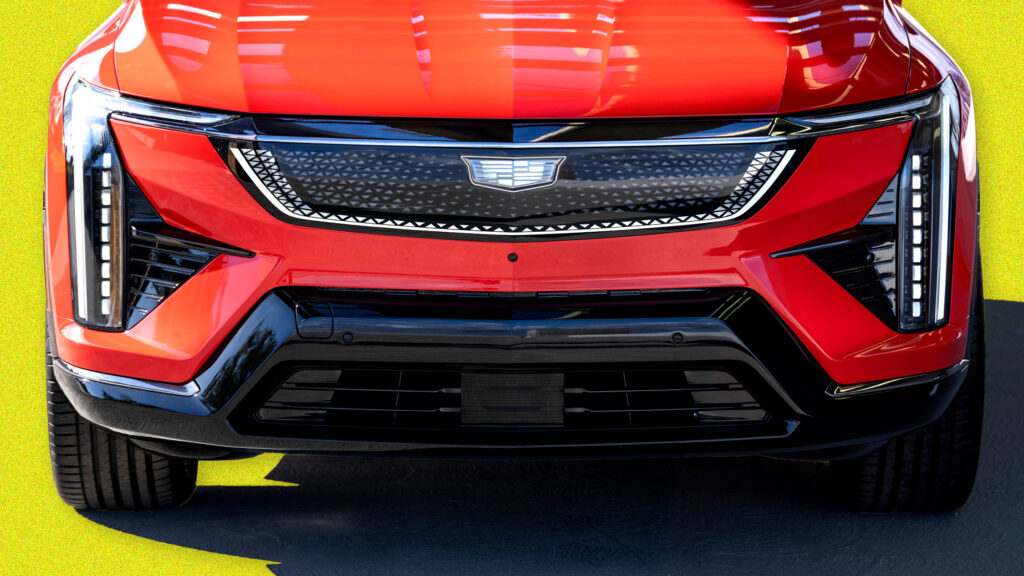
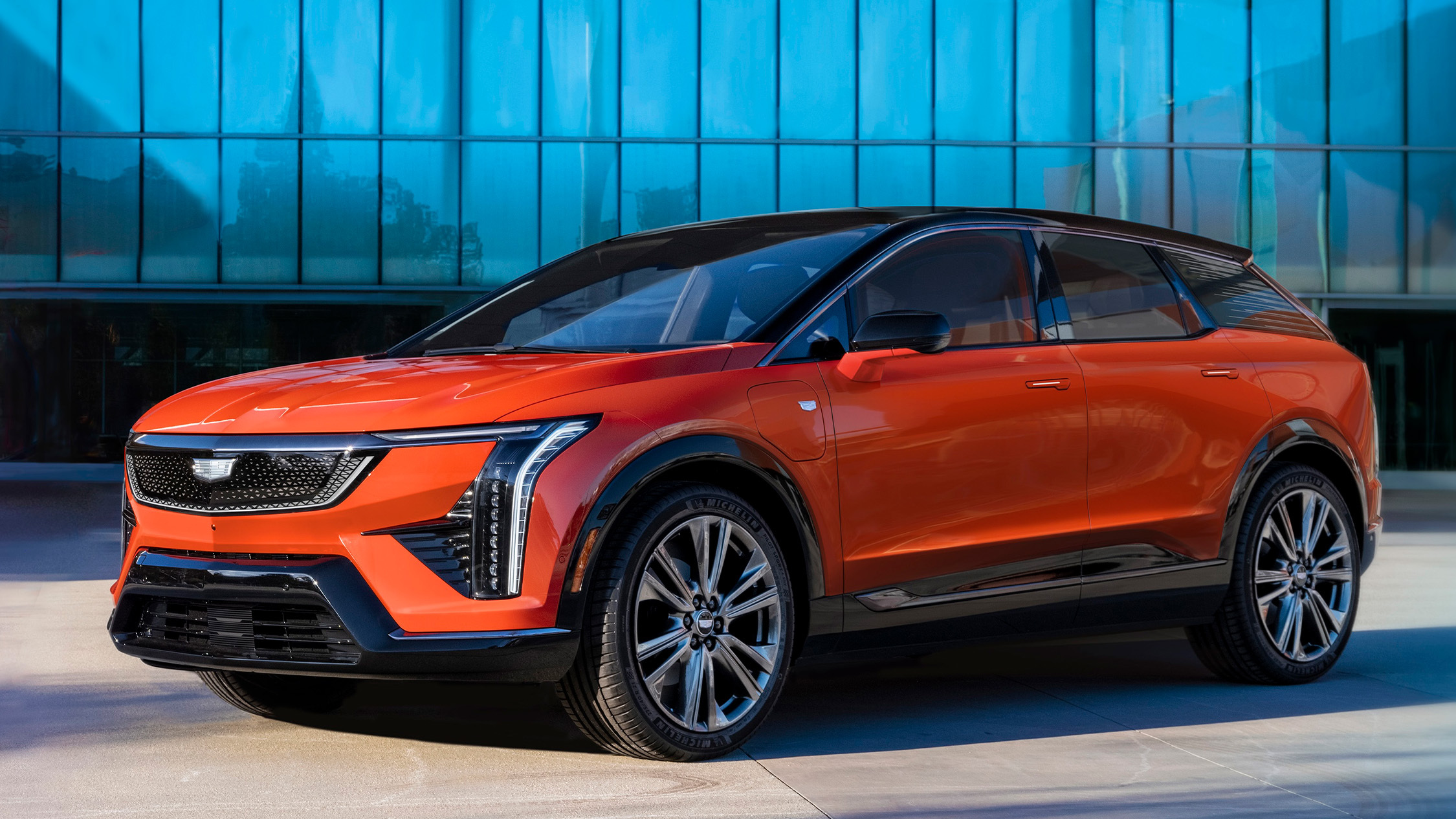
The next Cadillac Optiq could owe far more to Shanghai than Detroit if new intel out of Asia proves accurate. According to Reuters, General Motors is considering using a platform developed in China for the next generation of its entry-level electrified luxury crossover.

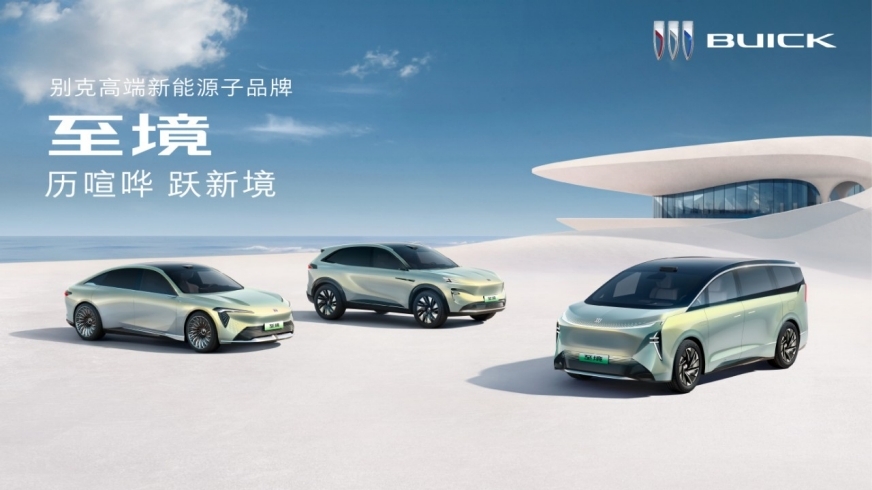
More: Buick’s New $23K Plug-In SUV Pulls 10,000 Orders In 90 Minutes, None From America

The platform in question is called Xiao Yao and was created by engineers at GM’s Pan Asia Technical Automotive Centre in Shanghai, a joint operation with long-time Chinese partner SAIC. It’s already in use on the Buick Electra E7 plug-in hybrid and has proved a much bigger hit with local buyers than Buick’s previous cars built around GM’s US-developed Ultium technology. The same platform is also found in the L7 sedan that comes as either a hybrid or EV.

 The Next Cadillac Might Be Based On Platform From Shanghai, Not Detroit
Buick E7

Although there’s no suggestion that Buick will bring the E7 (pictured above) to the US, Reuters says its component set could underpin a future Optiq that is bound for America, replacing the Ultium-based foundation used by the current model. At this point we should say that when asked about this by InsideEVs, GM in North America first told the website that the Xiao Yao platform definitely wouldn’t be coming to the US, before later calling the Reuters report “speculative.”

The current Optiq is based on GM’s Ultium tech and launched in China in 2023 before arriving in the US two years later. America only gets a dual-motor, all-wheel drive version, but Chinese buyers can also choose Optiqs with front wheel drive, just one motor and a smaller battery. The most US-compatible Electra E7 powertrain combines a 154 hp (156 PS) 1.5-liter, turbocharged combustion engine and 221 hp (224 PS / 166 kW) electric motor, and delivers almost 100 miles of real electric range.

China Is Leading Car Development

 The Next Cadillac Might Be Based On Platform From Shanghai, Not Detroit

For decades, China largely served as a manufacturing base for products conceived elsewhere. Increasingly, however, major automakers are turning to Chinese engineering teams to create vehicles and technologies that can be exported around the world. The Xiao Yao architecture supports technology that isn’t currently available on GM’s American-developed electric platforms, including a 900-volt electrical system and ultra-fast charging capability.

The alleged Optiq plans are part of a broader industry trend, picked up in Reuters’ story. Volkswagen, Renault, Hyundai and others are giving Chinese engineering centers more autonomy as they chase faster development cycles and stronger EV technology. It’s thanks to Chinese know-how, for instance, that Renault managed to develop the new Twingo in less than two years – half the time it normally takes a European brand. But it’s European drivers who are reaping the benefits, since the Twingo isn’t even sold in China.

 The Next Cadillac Might Be Based On Platform From Shanghai, Not Detroit

GM, SAIC

BMW’s Electric i3 Wagon Just Got Caught, And Its Roofline Hides A Trick

  • BMW’s electric i3 Touring wagon has been snapped for the first time.
  • Sleek styling disguises practical shape that preserves cargo space.
  • Single, dual-motor setups will mirror sedan’s; M3 EV Touring possible.

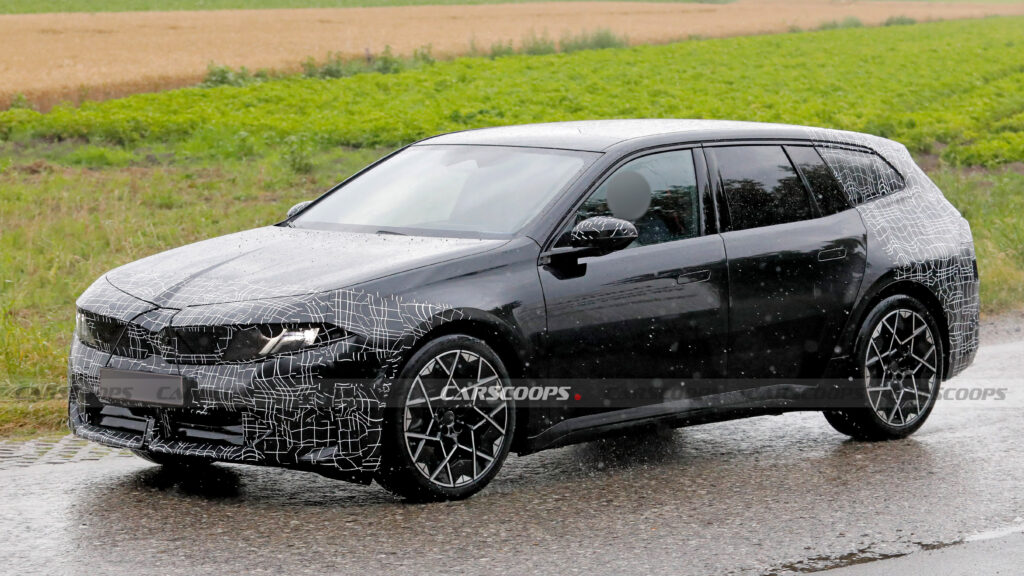
We knew it was coming, and finally BMW’s next-generation electric wagon has been caught out in the open. Fresh spy shots give us our first proper look at the i3 Touring, the longroof companion to this year’s electric 3-Series sedan, and it looks like practicality won’t come at the expense of style.

BMW briefly teased the wagon during the reveal of the i3 sedan earlier this year, but these prototype images offer a much clearer picture. Even beneath camouflage, the Touring appears sharp and modern, with crisp surfacing, flush door handles, and proportions that feel noticeably more athletic than those on today’s petrol-powered 3-Series Touring.

Related: BMW Opens i3 Orders With New 463-HP First Edition

The shoulder line rises from around the rear door toward the D-pillar, visually shrinking the rear side windows and creating the impression of a lower, sleeker roof. In reality, the roof remains relatively flat, which should help preserve the cargo space buyers expect from a BMW wagon.

Shared Design, Split Foundations

\\\\\

Baldauf

Like the i3 sedan, the Touring sits on BMW’s dedicated Neue Klasse electric architecture. A combustion-powered Touring is also in development, though it’ll ride on an updated version of the CLAR platform that underpins the current 3-Series. Different foundations, near-identical results, since both are expected to wear almost the same exterior styling once you set aside the proportions, and both get BMW’s new Panoramic iDrive cabin with its wide digital display running along the base of the windshield.

 BMW’s Electric i3 Wagon Just Got Caught, And Its Roofline Hides A Trick
The i3 Touring will share the sedan’s cabin.

When it comes to powertrains, expect the wagon to again closely mirror the sedan. The only confirmed version so far is the dual-motor i3 50 xDrive, which produces 463 hp (470 PS / 345 kW), but based on what we know of the related iX3 SUV, an i3 40 with a single 316 hp (320 PS / 235 kW) electric motor driving the rear wheels should follow.

520+ Miles Of Electric Range

\\\\\

Baldauf

BMW is sure to claim some impressive range figures thanks to its sixth-generation eDrive technology, 800-volt electrical architecture, new cylindrical battery cells and a generous 108.7 kWh battery capacity. The Touring’s extra size and weight will likely shave a few miles from the sedan’s incredible 559-mile WLTP (900 km) numbers, but it should still be the longest-legged electric wagon around by a wide margin.

And for anyone already wondering about performance versions, BMW has thought about that too. An M Performance model is inevitable, while given the cult success of the ICE-powered M3 wagon, a fully fledged four-motor electric M3 Touring borrowing heavily from the recent M Concept Neue Klasse sedan could eventually join the lineup.

\\\\\

Baldauf

BMW Finally Reveals What It’s Calling The Electric M3

  • Electric M3 keeps iconic name, M boss Frank van Meel revealed.
  • It could have been called iM3 if it followed BMW’s current EV logic.
  • Quad-motor M3 EV will sell alongside visually similar inline-six sedan.

BMW has finally settled one of the biggest questions surrounding its upcoming electric performance sedan. Contrary to some speculation, the brand’s first battery-powered M3 won’t wear an iM3 badge. Instead, it’ll simply be called M3.

The decision was confirmed by BMW M boss Frank van Meel during the Goodwood Festival of Speed, according to Auto Express. By keeping the legendary nameplate, BMW is signaling that its electric performance sedan isn’t being positioned as a separate branch of the family. Instead, it’ll sit alongside the next-generation combustion-powered M3 as an equal successor to the badge’s long history.

Related: BMW’s New M350 Wears i3 Looks Over A Straight-Six That Could Clear 400 HP

EVs often arrive with distinct names to help separate them from their combustion counterparts. And if the electric M3 adopted the naming logic applied to electric versions of the non-M 3-series, 5-series and countless other BMWs, it could have been called iM3.

\\\\\\\\\\

BMW, however, appears confident that what defines an M3 goes beyond its power source. The electric model is expected to be the most powerful M3 ever produced. BMW’s new four-motor drivetrain architecture can in theory support outputs approaching 1,341 hp (1,360 PS / 1 MW), though production versions are expected to generate considerably less. But even a modest output like 700 hp (710 PS / 522 kW) for the base car would see it still comfortably eclipse every previous M3.

Not Just About The Power

 BMW Finally Reveals What It’s Calling The Electric M3

The M engineers appear focused on more than headline figures, anyway. Christian Karg, head of vehicle dynamics for BMW Group, told Auto Express that “It’s not about the horsepower. That’s a part of the game, but the preciseness of M cars, that’s what’s unique.”

The upcoming sedan’s styling has already been previewed by the dramatic M Concept Neue Klasse (see gallery above), that debuted at Le Mans in June, and was wheeled out again this month for an appearance at the Goodwood Festival of Speed.

Yellow DRLs An M Telltale?

The concept builds on the chiselled look of the stock i3 sedan revealed last year and on sale this fall. It’s lower than the i3, has much wider fenders, a hood vent that has also been spied on M3 prototypes (see below), yellow DRLs that could become an M hallmark, and a split rear trunk-lid spoiler and huge diffuser.

While production details will inevitably be toned down, the show car offers a strong indication of where BMW M3 design is heading, for both the electric and combustion cars. Because the good news for traditionalists is that a new gasoline-slurping M3 powered by a mild-hybrid six-cylinder engine is also in development. Though the ICE car will use an updated CLAR platform and the EV rides on BMW’s Neue Klasse architecture, they will look almost identical.

\\\\\\\\\\\\

BMW, SH Proshots

VW’s New ID. Cross Is Cheaper Than It Looks

  • New ID. Cross is ID. Polo’s SUV brother and starts at €28,000 this fall.
  • 37 kWh and 52 kWh batteries available, biggest gives 271-mile range.
  • Single-motor outputs span 114-208 hp; cabin has plenty of real buttons.

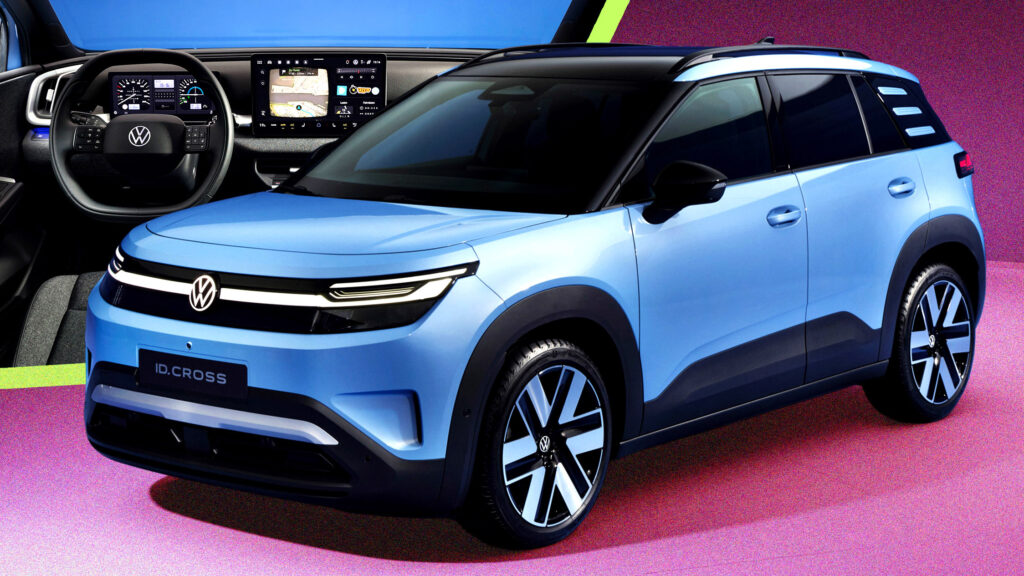
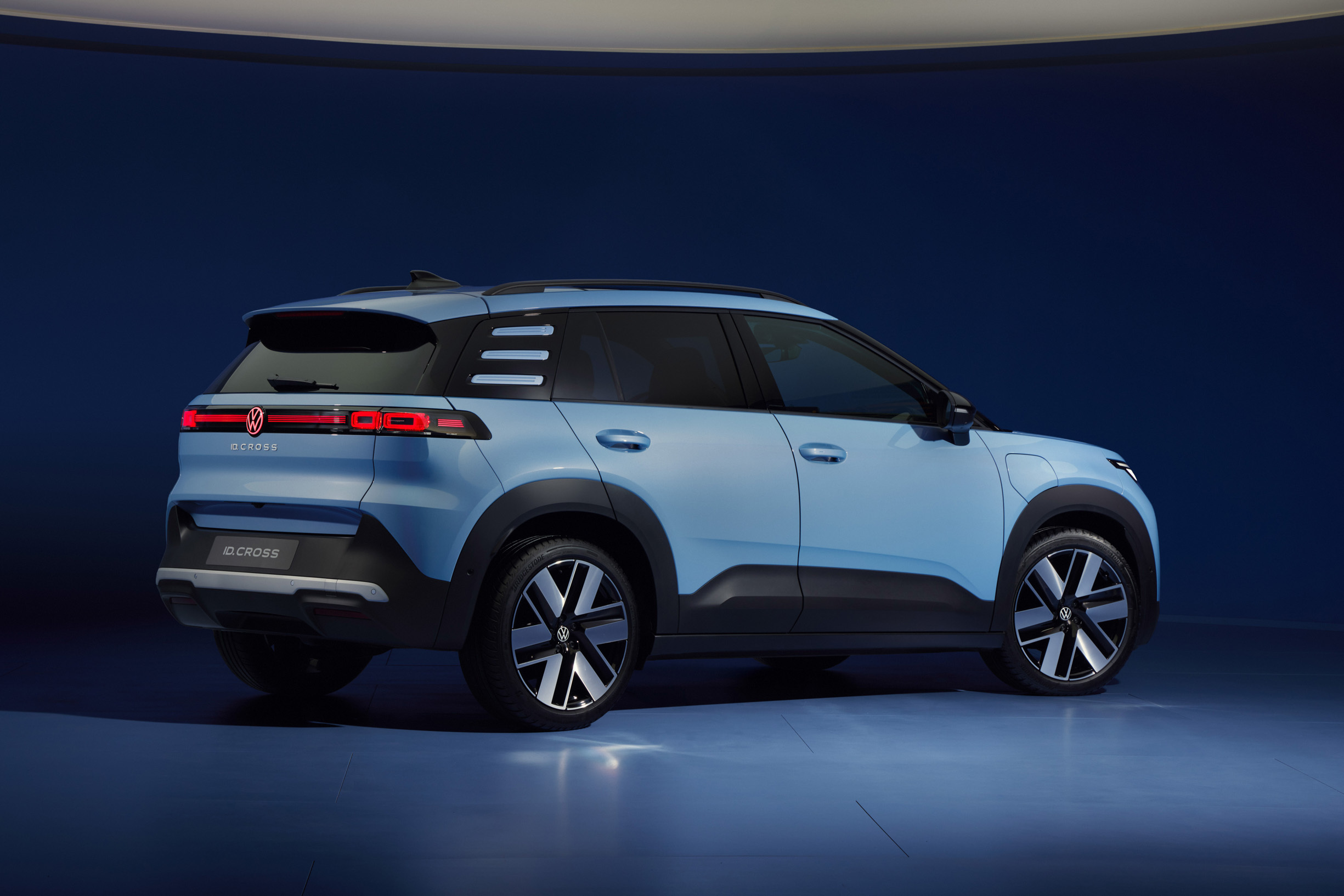
Affordable electric SUVs are arriving thick and fast, but the new VW ID. Cross thinks it has something many rivals don’t. The production version of last year’s almost identical ID. Cross Concept promises premium features and VW’s confident new design language, while keeping the starting price at a tempting €28,000 (£24k/$32k).

More: VW Group Is Killing Half Its Cars By 2030, And Some Big Names Are At Risk

The little five-seat SUV brother to the ID.Polo revealed earlier this year will arrive in Europe during autumn 2026. At just over 4,150 mm (163.4 mm) from nose to tail and riding on a 2,601 mm (102.4 inches) wheelbase, the ID. Cross is a rival for SUVs like the Kia EV2 and Renault 4.

 VW’s New ID. Cross Is Cheaper Than It Looks

Given those dimensions and rivals you’d probably not expect tons of space, but VW claims smart packaging allows the ID. Cross to squeeze out more passenger room and cargo space than its competitors. There’s 475 liters (16.8 cu-ft) of cargo room behind the rear seats plus a handy 25-liter (0.9 cu-ft) frunk for charging cables, a combination which throws shade on the EV2, Renault 4 and even VW’s bigger, combustion T-Roc.

Buyers can choose between two battery packs and three power outputs, all delivered from a single-motor setup driving the front wheels. The entry-level version pairs an 114 hp (116 PS / 85 kW) electric motor with a 37 kWh battery, while higher trims offer either a 133 hp (136 PS / 99 kW) motor using the same battery, or a 208 hp (211 PS / 155 kW) version coupled to a larger 52 kWh pack.

From 196 To 271 Miles Of Range

The flagship combination delivers a projected WLTP driving range of up to 436 km, or 271 miles, compared with 281 miles (452 km) for an EV2 and just 247 miles (398 km) for a Renault 4. Stick with the VW‘s base 37 kWh pack and the range drops to 196 miles (316 km), which again splits the difference between its rivals: Kia, 197 miles (317 km); Renault, 190 miles (306 km). That 196-mile figure is also predictably a little down on the 204 miles (328 km) the brand quotes for the lower and 27 kg (60 lbs) lighter ID. Polo with the same 37 kWh battery.

As with the ID. Polo, charging figures are respectable rather than groundbreaking. The smaller battery supports DC charging at up to 90 kW, while the larger pack increases that to 105 kW. Either way, VW says a 10 to 80 percent recharge should take around 24 minutes under ideal conditions, meaning drivers will be unplugging a few minutes before the Renault 4 and Kia EV2s on the adjacent chargers. Vehicle-to-load functionality is also included, allowing owners to power external devices from the battery pack.

Big Screen, But Plenty Of Real Buttons

\\\\\\\\\\\\\\\\\\\

Also borrowed from the ID. Polo, which shares the same MEB+ platform, along with the Cupra Raval and Skoda Epiq, is a cabin that tries hard to undo some of the mistakes of VW’s recent past. Premium-looking cloth covers most of the dash surfaces, and there are genuine clickable physical buttons both on the steering wheel and lined up on the console below the 12.9-inch infotainment screen.

And buyers can build on that premium feel with some fairly premium features including optional 12-way power-adjustable front seats with built-in massage programs. Depending on trim, buyers can also spec matrix LED headlights, a panoramic glass roof, adaptive cruise control, and a Harman Kardon audio system with 10 speakers.

Looks Expensive, But Isn’t

\\\\\\\\

Sticking with the luxury theme, the designers clearly wanted the ID. Cross to look expensive, in the way the Mk4 Golf did almost 30 years ago. Slim lighting, clean body surfacing and a modern silhouette give it plenty of showroom appeal. It might not have the quirky character of a Renault 4, but the result is a handsome SUV that looks like it costs more than it really does.
More: VW’s Sportiest Sedan Packs 496 HP And Makes The ID.7 Look Half-Asleep

At €28,000, the base 37 kWh, 114 hp ID. Cross matches the Renault 4 on price, but beats it on range and comes up only a few horsepower short. Likely to cause a bigger headache for VW is the Kia EV2, which starts at €26,600 in Europe, squeezes a few more miles from every top-up and comes with a 144 hp (147 PS / 108 kW) motor as standard. Which would you pick?

\\\\\\\\\\\\\\\\\

VW

The Priciest Repair On A Used EV Isn’t The Battery

  • Smaller electrical faults top repair requests for EVs in new Warrantywise study.
  • On-board chargers proved priciest common repair, some fixes costing thousands.
  • Main underfloor high-voltage batteries don’t figure in the list of top five EV faults.

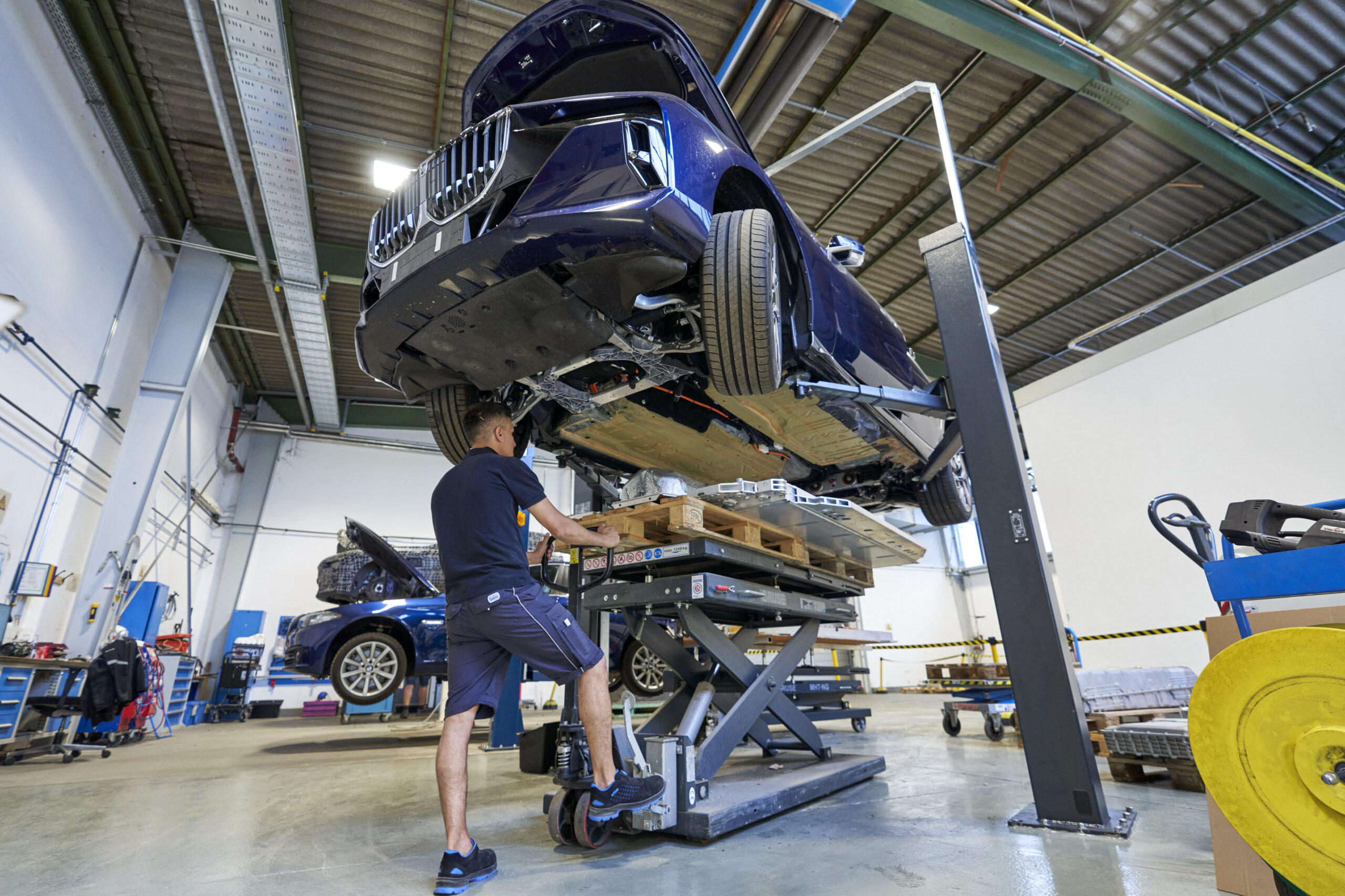
If you’re shopping for a used EV, chances are the health and longevity of the high-voltage battery, the big slab of cells under the floor, is the thing keeping you awake at night. But according to a new analysis of warranty repair requests, it’s far from the problem owners encounter most often.

The study, based on repair request data collected by Warrantywise in the UK, found that the biggest EV reliability headaches are largely the same kinds of issues drivers have dealt with for years on cars running more conventional combustion powertrains. Electrical gremlins, suspension wear, and even the humble 12-volt battery appear far more frequently than failures involving the high-voltage battery pack.

 The Priciest Repair On A Used EV Isn’t The Battery

Leading the list were general electrical faults, including sensors and central locking systems. Those repairs averaged around £810-900 ($1,085-1,205), although some individual claims climbed well beyond £3,000 ($4,020) and even topped £4,000 ($5,350) depending on the fault.

Also: An American EV Was Germany’s Most Defective Vehicle

Suspension components, particularly wishbones, also featured prominently. Average repair requests exceeded £1,200 ($1,600), with the largest individual claim passing £4,100 ($5,490). That’s a reminder that even without an engine or gearbox, an EV still has plenty of conventional hardware that wears over time – and with more weight to bear, suspension takes an even bigger beating in an EV.

Top 5 EV Faults
Failure AreaFailure PartAvg Repair
Cost
Most Expensive
Repair Cost
1Electrical systemSensors£810 ($1,085)£3,270 ($4,380)
2Electrical systemCentral locking mechanism£900 ($1,205)£4,060 ($5,435)
3EVOn-board charger£2,160 ($2,890)£10,455 ($14,000)
4SuspensionWishbones£1,230 ($1,650)£4,120 ($5,515)
5Electrical systemAuxiliary battery (12V battery)£535 ($716)£990 ($1,325)
SWIPE

The only genuinely EV specific component to crack the top five was the on-board charger. While the average repair request for one of those came in at £2,160 ($2,890), the largest single claim reached a hefty £10,455 ($14,000), showing that although these failures aren’t everyday occurrences, they can become scarily expensive.

Battery Problems Overblown

What about the high-voltage traction battery everyone worries about? It didn’t make the top five at all. That doesn’t mean battery failures never happen, only that they were comparatively rare in the warranty data, quite possibly because EV batteries are more robust than many people think, and they tend to have longer factory warranty cover than the rest of the car. When problems did occur, though, repair requests averaged more than £6,400 ($8,570).

 The Priciest Repair On A Used EV Isn’t The Battery
BMW

The figures also showed average EV repair request values increased by 10.7 percent between 2024 and 2025. That rise isn’t necessarily down to worsening reliability, with inflation, labour costs, and parts prices all likely contributing to higher bills.

Also: Huge Study Shows EVs More Reliable Than ICE Cars With One Surprising Common Issue

As with any warranty dataset, the results only reflect vehicles covered under those policies rather than every EV on the road. Even so, it points to the expensive battery that dominates so many buying conversations as not being the scary bill-in-waiting it’s made out to be.

 The Priciest Repair On A Used EV Isn’t The Battery
Nissan

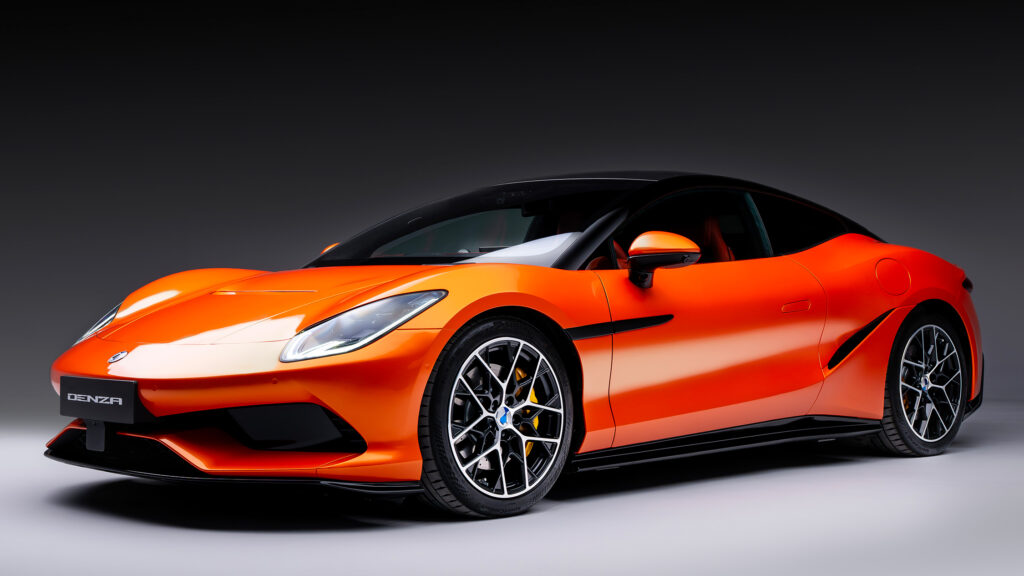
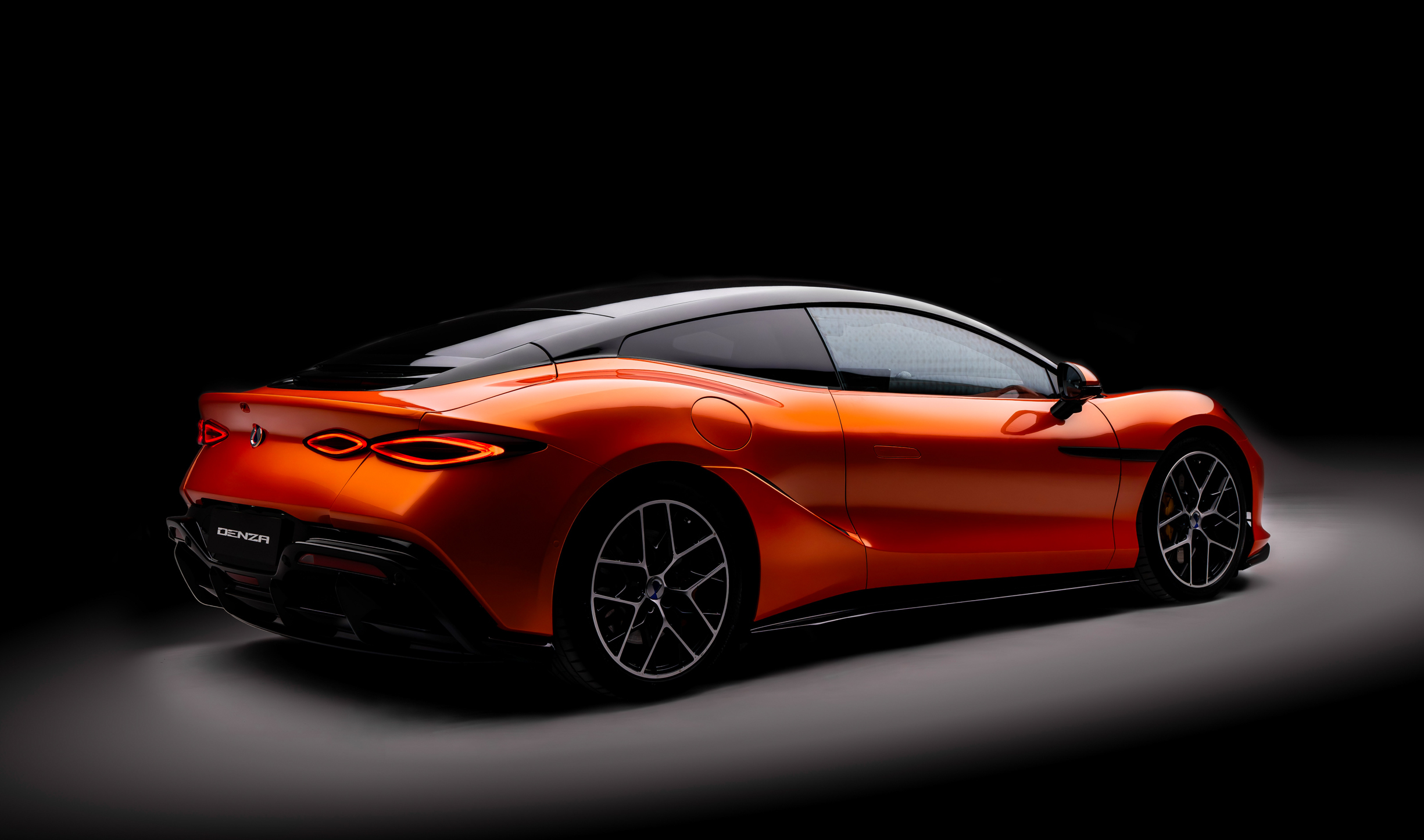
BYD’s New Denza Z More Than Doubles A 911 Turbo S’s Power For Less Than GTS Money

  • Denza reveals tri-motor, four-seat Z supercar at 2026 Goodwood Festival of Speed.
  • 1,582 hp output gets it to 62 mph in 1.96 seconds, battery fills 10-97% in just 9 mins.
  • Denza confirms Spider, Coupe, Racing trims with a 1,973+ hp hardcore version to come.

Electric supercars have a habit of producing ridiculous power and acceleration numbers, but are usually accompanied by a ridiculous price. Denza wants to change that with the Z, which outsprints a 911 Turbo S to 62 mph (100 kmh) and makes double the power, while costing less than a mid-range GTS.

Unveiled today at the Goodwood Festival of Speed, BYD-owned Denza’s Z costs from £142,900 (about €167,400 / $191,400 at current rates) in coupe form in the UK, where a 911 Carrera 4 GTS costs £145,900 (€170,900 / $195,400). The open-top Spider starts at £159,900 (€187,300 / $214,100), and the track-focused Racing version costs £172,900 (€202,500 / $231,500), which compares with £199,500 (€233,700 / $267,100) for the new 911 Turbo S.

Denza hasn’t confirmed home-market numbers, but local estimates put Chinese pricing at around ¥400,000 to ¥500,000 ($58,600-73,200), a fraction of the British ask and a sign of what shipping, tariffs, and selling far from Shenzhen do to the sticker.

Three Motors, One Platform

 BYD’s New Denza Z More Than Doubles A 911 Turbo S’s Power For Less Than GTS Money

All three versions of the Z ride on Denza’s new e3 Sports Car Platform and use the same triple-motor setup. One motor drives the front axle while two independently power the rear wheels, producing a combined 1,582 hp (1,604 PS / 1,180 kW) and 915 lb-ft (1,240 Nm) of torque.

More: Denza’s 1,139-HP Wagon Will Now Drift Any Shape You Draw On The Screen

The Coupe reaches 62 mph in 2.25 seconds (Porsche claims 2.5 seconds for the 701 hp / 711 PS Turbo S), while the Racing cuts that to just 1.96 seconds with optional semi-slick tyres and boosts the top speed from 186 mph (300 km/h) to 217 mph (350 km/h).

Building Up To An EV Record Attempt

\\\

A fourth model, the Z Special Edition, which Denza says is a Nurburgring natural, makes over 1,973 hp (2,000 PS / 1,471 kW), and hits 62 mph in less than 1.7 seconds. But the automaker is saving more details about that one for later, presumably when it takes a crack at the Ring EV record.

Every Z packs a 76 kWh second-generation Blade Battery that supports BYD Group’s latest FLASH Charging technology. On BYD’s new 1,500 kW chargers, Denza claims the battery can jump from 10 to 70 percent in just five minutes, or reach 97 percent in only nine. That’s close to petrol tank-filling territory, though it’ll be a while before those chargers are commonplace outside China, even if their rollout has been confirmed for Europe.

Range varies from 236 WLTP miles (380 km) for the Racing to 254 miles (409 km) for the basic Coupe, which at 2,230 kg (4,916 lbs) is actually 20 kg (44 lbs) lighter. The 2,300 kg (5,070 lbs) Spider claims 248 miles (399 km) between fills.

 BYD’s New Denza Z More Than Doubles A 911 Turbo S’s Power For Less Than GTS Money

Denza didn’t leave the chassis out of the fun, adding magnetorheological dampers, carbon-ceramic brakes, torque vectoring and even a compass turn function that lets the car pivot around its front axle. And the long 2,780 mm (109.5 inches) wheelbase (a 911’s is 2,450 mm / 96.5 inches) means that while it looks like a traditional supercar, it’s actually got space for four, though the rears do look tiny.

Supercar With Massage Seats

\\\\

The cabin sounds lavish in typical tech-heavy Chinese EV fashion, with massage seats, a Devialet audio system, ambient lighting, a 12.8-inch Google-equipped infotainment system, and a digital rear-view mirror all fitted as standard. There’s also a configurable virtual engine soundtrack plus dedicated Boost and Track modes.
On paper, it all sounds great, but as Porsche and Rimac know, Western buyers of luxury and high-end performance machinery generally aren’t interested in electric cars. They tend to want combustion power, which is why Porsche recently asserted that it no longer had plans to make an electric 911. But this package looks strong enough to persuade a few to at least take a look at what’s on offer.
\\\\\

Denza

MG’s Go! Concept Wants You To Forget About The Mini And Renault 5 In 2027

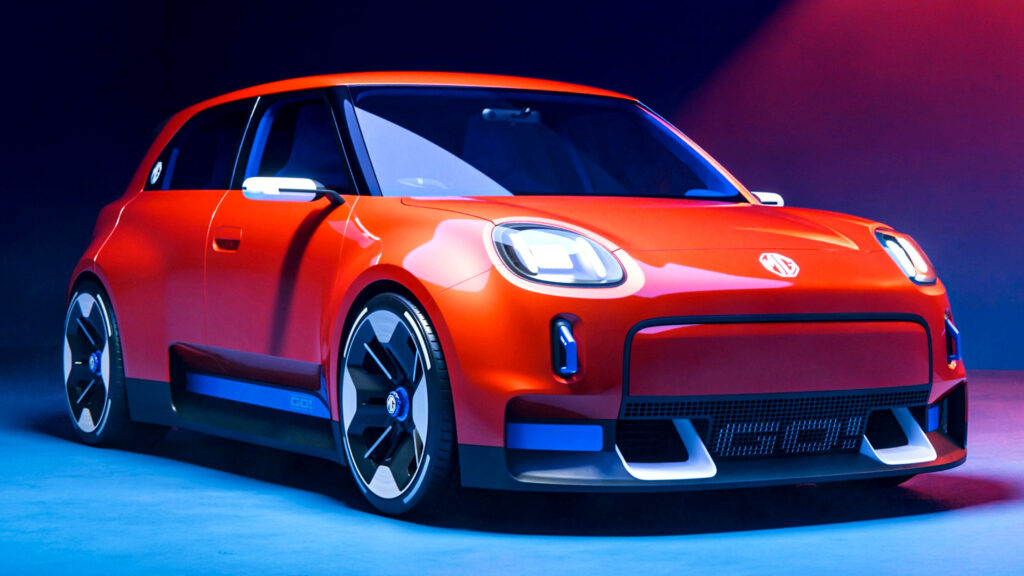
  • MG’s Go! concept takes inspiration from past MGs like the B GT, 6R4, Metro Turbo and ZR.
  • Fat-arched electric hatch previews the production MG2 electric subcompact coming 2027.
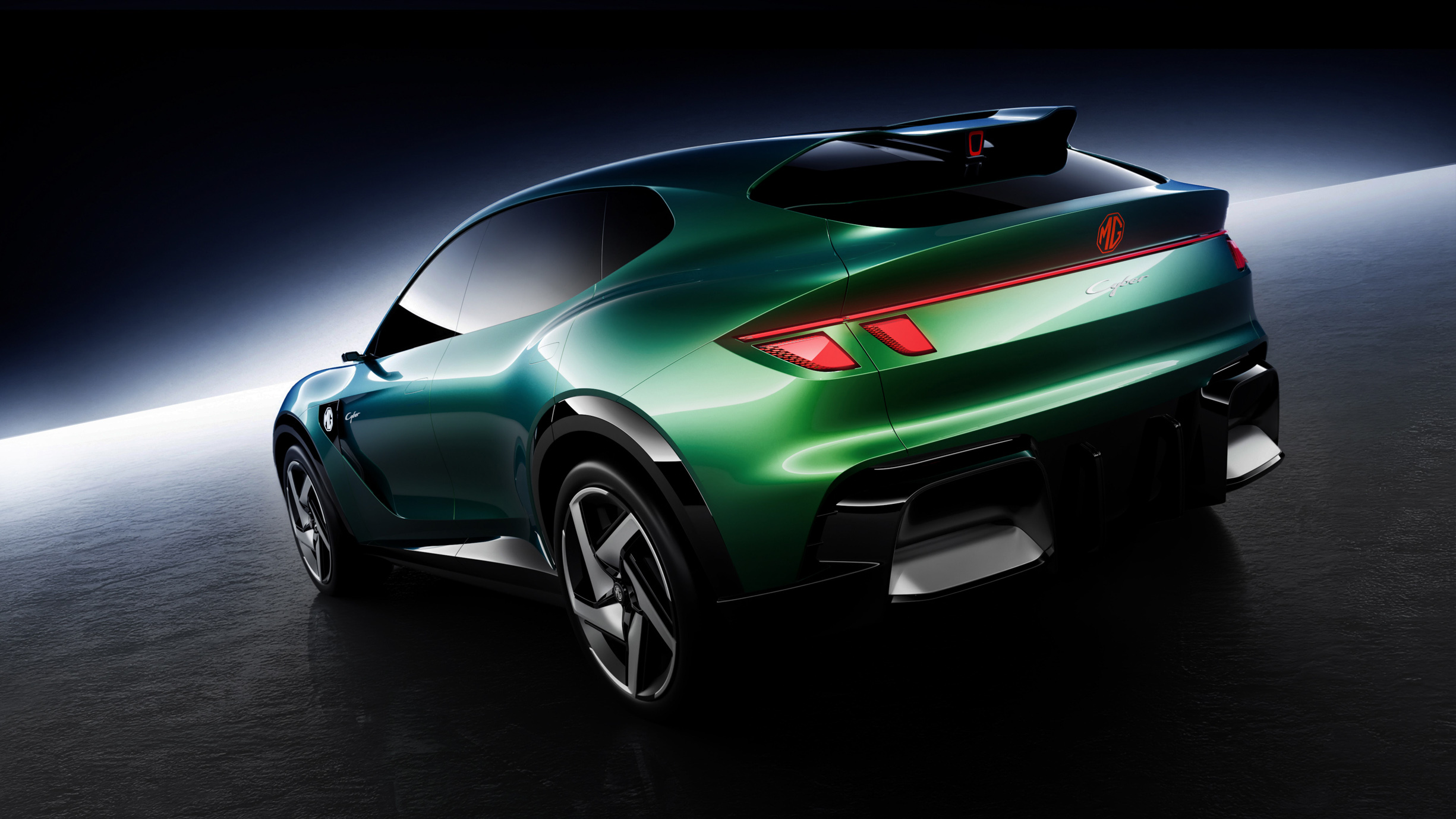
  • Cyber Concept is a sporty-looking flagship SUV that’s less production-ready than the Go!

The Car of the Year-winning Renault 5 and its Mini Cooper E rival have proved that affordable EVs can actually have personality, and now MG wants in on the action. The British-born, but Chinese-owned brand is coming to the 2026 Goodwood Festival of Speed with two concept cars, one of which previews a Renault 5 rival called the MG2 on sale in 2027.

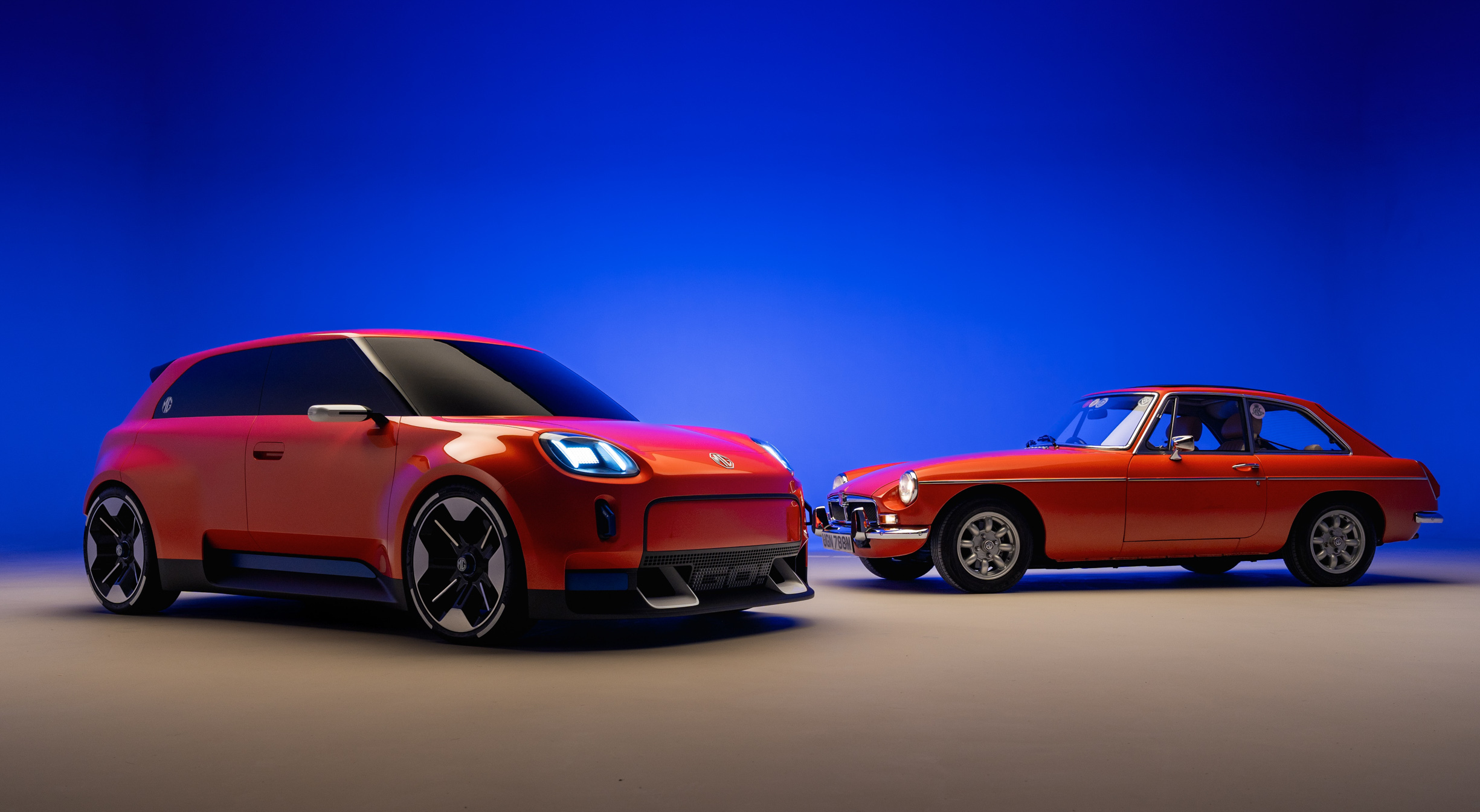
Called the MG Go!, it’s a compact electric hatchback that takes inspiration from a diverse collection of past MGs, including the MGB GT and MG 6R4 Group B rally car. Another less famous but notable car MG’s press bumf namechecks is the 2000s ZR, which was massively popular with young drivers thanks to its fun chassis, tough styling and low insurance and running costs. No doubt the brand is hoping the 2 will do the same 25 years later.

 MG’s Go! Concept Wants You To Forget About The Mini And Renault 5 In 2027

Related: MG Boss Forced To Abort Livestream After Porsche Copycat Claims

MG says the goal wasn’t to recreate the past but to borrow from it to build something with emotional appeal today. So while you can clearly see nods to the MGB GT in the face created by the grille outline and headlights, plus the shape of the C pillar, and the swollen fenders subtly tip a hat to the 6R4, the overall look is very modern, and hugely appealing.

\\\\\

The second MG concept coming to Goodwood heads in almost the opposite direction. The Cyber Concept imagines a large electric performance SUV flagship that’s definitely not aimed at young, cost-conscious drivers.

Ferrari SUV Vibes

 MG’s Go! Concept Wants You To Forget About The Mini And Renault 5 In 2027

It’s supposedly inspired partly by MG’s record-breaking EX181 streamliner from the late 1950s, although thankfully it doesn’t resemble an enormous silver torpedo. Instead, the swoopy, muscular Cyber Concept bears more than a passing resemblance to a Ferrari Purosangue, while the taillights might look familiar to Hyundai Tucson owners.

While the Go! is primed to return as a production model in two years, it sounds like the Cyber is much further away from the showroom, lacking even an interior at this stage. And even if it does translate to the street, an MG spokesman told Autocar it might not be offered in the UK.

\\

MG

Stellantis Brings China’s Leapmotors To North America, But You Won’t See One In The US

  • Leapmotor officially enters Mexico with Stellantis and Mopar support.
  • Range-extended B10 SUV claims nearly 620 miles between fuel stops.
  • 100% tariffs and anti-Chinese software regs currently prevent US entry. 

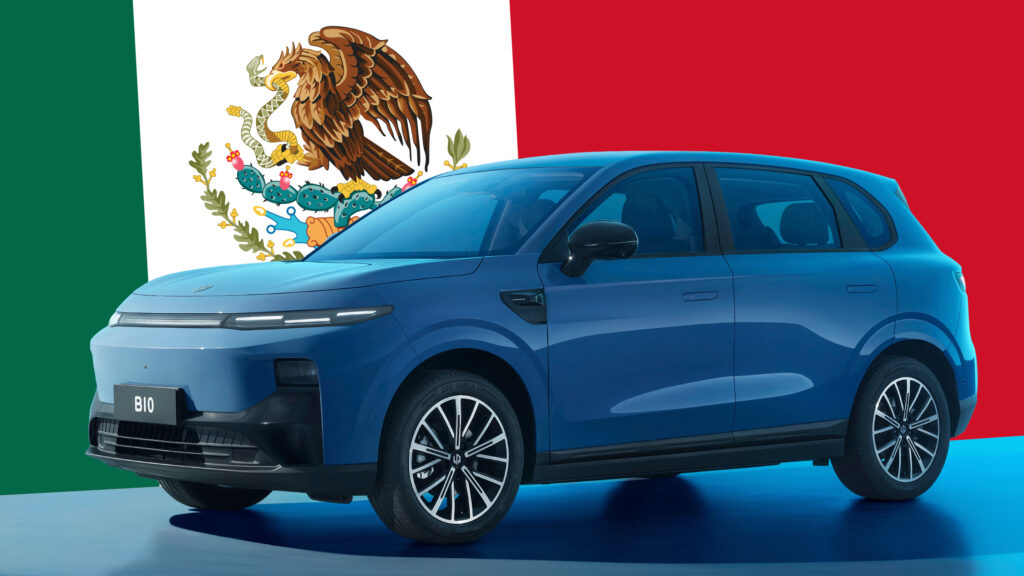
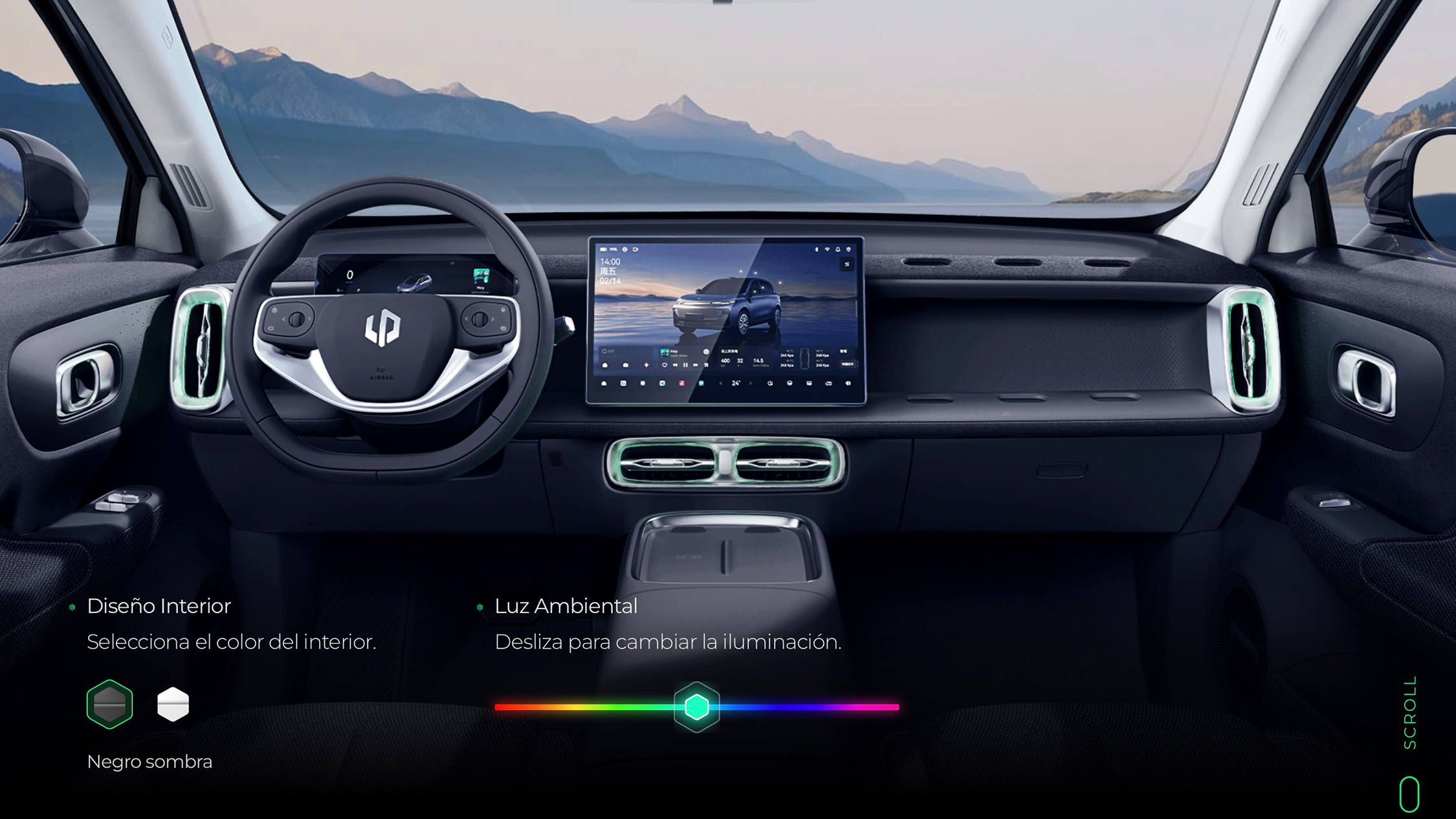
Chinese automakers have spent the past few years expanding almost everywhere they can. Now Leapmotor has finally reached North America, although not quite in the way some expected. Its first stop isn’t Canada but Mexico, where the Stellantis-backed brand has officially launched the B10 SUV.

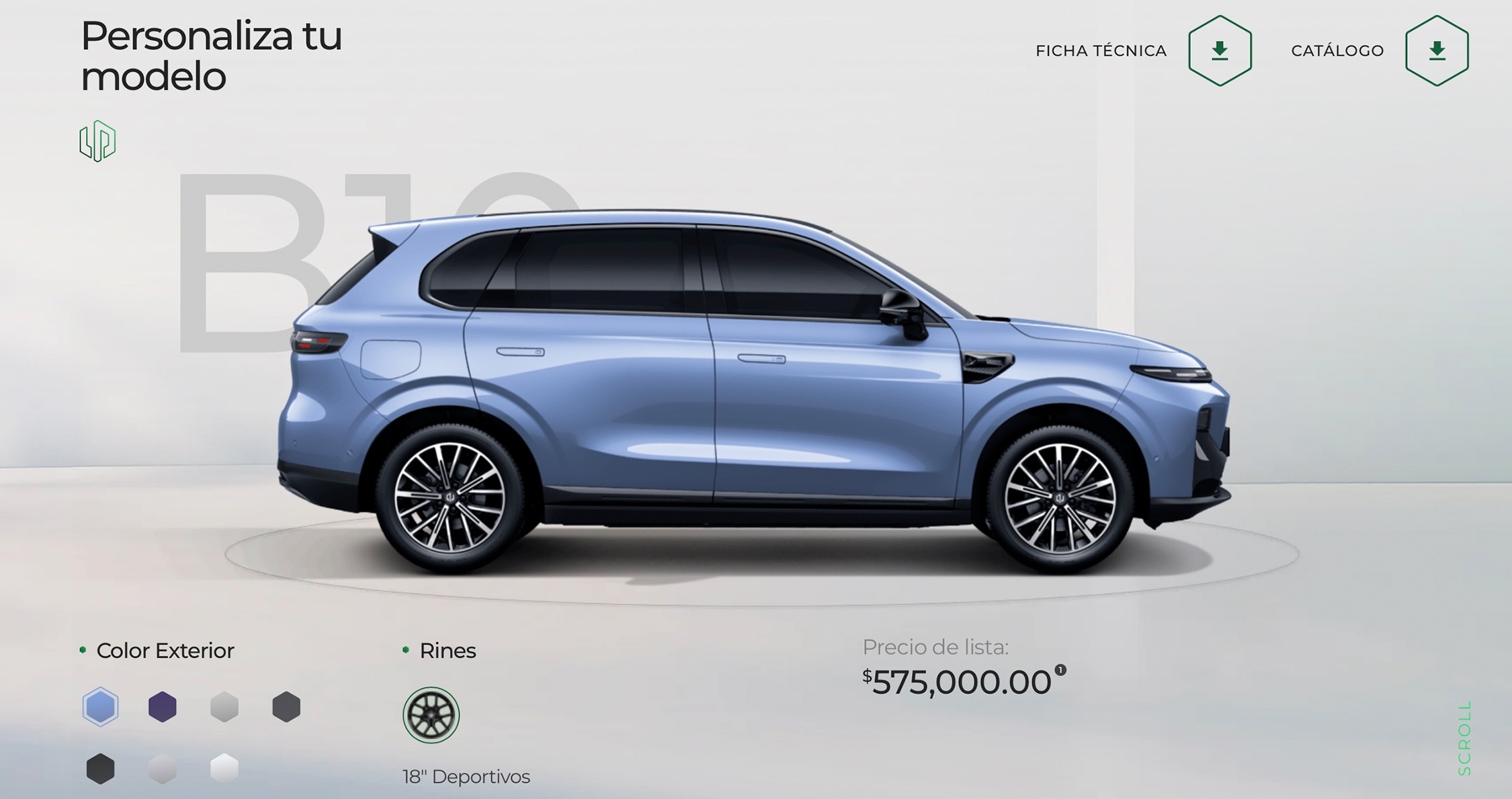
The B10 has spent more than a year being adapted for local conditions before reaching showrooms, where it’s priced at MX$575,000 (US$33,000). Engineers fine tuned it to cope with everything from high altitude roads to desert heat and tropical humidity, while also completing the certification process required for the Mexican market. More models, including the larger C10 and C16 SUVs, are expected to arrive later.

Related: The Plant That Built Dodge’s Last Hellcat Muscle Cars Could Make Chinese EVs Next

Mexico doesn’t get the fully electric B10s sold in Europe, instead focusing only on the range-extender powertrain. A 1.5-liter combustion engine never drives the wheels directly, but acts as a generator for an 18.8 kWh battery that feeds a 215 hp (218 PS / 160 kW) electric motor. Leapmotor claims a combined driving range of up to 615 miles (990 km) before you’ll need to refuel and recharge.

The rollout has been made possible by Stellantis, which owns roughly 20 percent of Leapmotor and controls the international joint venture responsible for selling the brand outside China. Rather than starting from scratch, Leapmotor is using Stellantis dealerships, with more than 40 sales outlets already open in Mexico. Service and parts support come through Mopar’s existing nationwide network.

First Mexico, Then Canada

 Stellantis Brings China’s Leapmotors To North America, But You Won’t See One In The US

Canada, which recently agreed to take up to 49,000 Chinese cars each year in exchange for lower tariffs on its canola exports, could eventually become the next piece of the puzzle, particularly as Stellantis considers future manufacturing options there. Stellantis CEO Antonio Filosa has previously said there’s room for the brand in Mexico and possibly Canada, but “no space” in the United States for now, Automotive World reports.

Between steep tariffs on Chinese built EVs and restrictions surrounding connected vehicle technology which recently forced Polestar out of the US, the American market remains effectively closed. But for now, Mexico marks an important milestone for Leapmotor as it pushes toward an ambitious target of delivering one million vehicles worldwide this year.

 Stellantis Brings China’s Leapmotors To North America, But You Won’t See One In The US

Leapmotor/Stellantis/Wikimedia Commons

Bentley Just Named Its First EV, And It Isn’t Barnato

  • Bentley’s first production EV is called Torcal, named after a limestone landscape in Spain.
  • Sub-Bentayga-sized Torcal shares platform and hardware with Porsche Cayenne Electric.
  • Design expected to borrow heavily from last year’s radical EXP 15 fastback SUV concept.

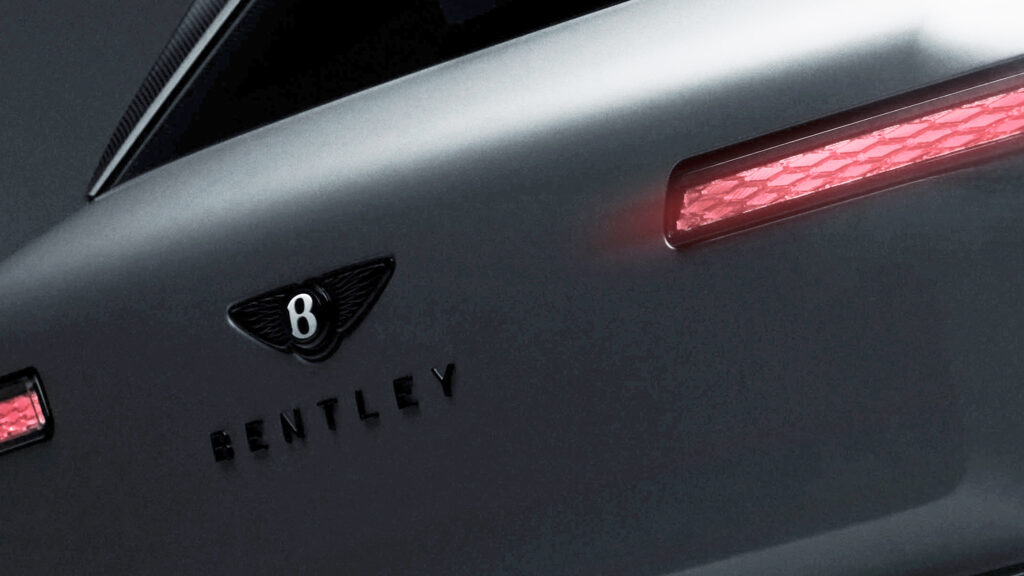
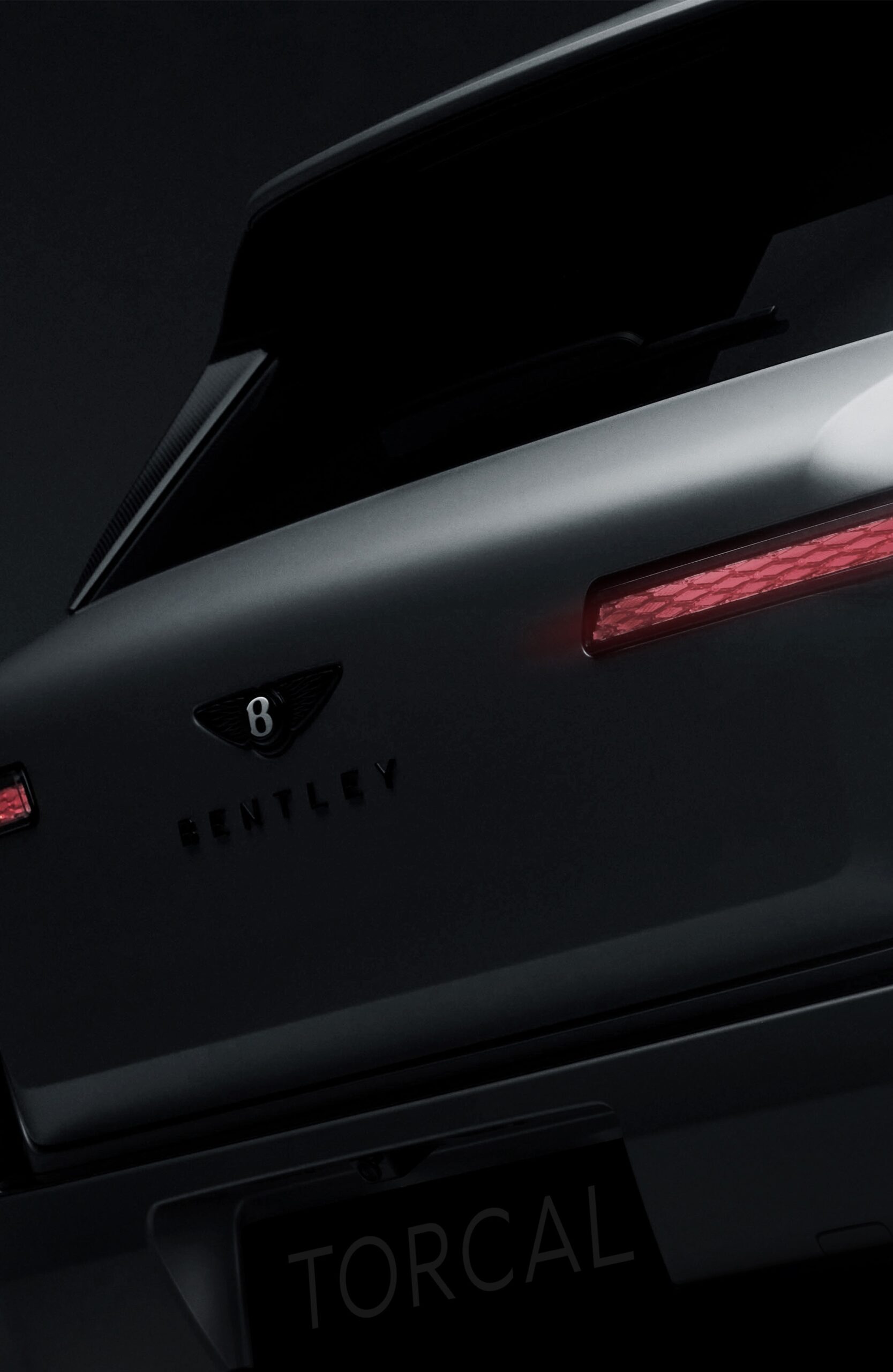
After years of concepts, spy shots and shifting electrification plans, Bentley has finally put a name to its first production EV. Meet the Torcal, a new electric luxury SUV that will make its public debut in London on September 23 and will open an entirely new chapter for the British luxury brand.

Like the Bentayga, Bacalar and Batur, the Torcal – not Barnato, as some had predicted – gets its name from a famous natural landmark. In this case, it’s El Torcal de Antequera in southern Spain, a landscape known for its dramatic limestone formations. Bentley also points out that the name traces back to the Latin word torquere, linking it to the modern word torque.

Related: Mansory Charges Bentley Owners To Do This, Bentley Now Does It In-House

What’s more important than the name, though, is what the Torcal represents. It’s Bentley’s fourth standalone model line, joining the Continental GT, Flying Spur and Bentayga, and its only fully electric offering.

Company boss Frank Steffen Walliser claims it “sets extraordinary benchmarks in every area that matters” and “may just be the most considered car in our history,” though he could just mean he considered axing it every time he saw tumbling EV sales figures for the US market.

Last Year’s EXP 15 Dropped Big Clues

\\\\\\\\\\\\\\\\

Bentley is still keeping most of the important details under wraps, but a confirmed length of under 5 m (197 inches) means it sits below the Bentayga in the lineup in terms of size. We also know it will feature Bentley’s next design language, which debuted on last year’s EXP 15 fastback SUV concept (seen above) and introduced a monolithic look and a return to upright grilles. And the interior will mix traditional Bentley luxury with unusual curved displays and an Audi multifunction column stalk.

Under the skin, it shares its hardware and platform with the Porsche Cayenne Electric. That means an 800 volt architecture that can add 100 miles (160 km) of range in seven minutes, and probably 108 kWh net of battery capacity. Design boss Robin Paige told Autocar to expect 300-350 miles (483-563 km) of range.

Could Have Up To 1,139 HP

\\\\\\\\\\\\\\\

Bentley hasn’t revealed power outputs yet – it says we’ll find out more in the weeks ahead – but we can be sure that dual motors and all-wheel drive will be standard. If it lifts its motors directly from the Cayenne Electric, the Torcal could start with 402 hp (408 PS / 300 kW) and top out at 1,139 hp (1,156 PS / 850 kW).

The Torcal won’t replace the Bentayga, but will be sold alongside it. Bentley has already confirmed the gasoline SUV will live on with another generation later this decade as the company embraces a slower transition toward electrification. Instead, the Torcal is designed to broaden the lineup, giving the brand’s SUV buyers another choice rather than forcing them into an EV.

 Bentley Just Named Its First EV, And It Isn’t Barnato

Bentley

❌