Normal view

There are new articles available, click to refresh the page.
Today — 31 March 2026Vehicles

Toyota’s Electric Hilux Costs $20K More Than The Diesel, And That’s Not Even The Worst Part

  • The Hilux BEV enters Australia as the most expensive variant in the local lineup.
  • Electric pricing carries a significant premium over both diesel and hybrid versions.
  • Dual motors provide AWD capability with modest output and limited driving range..

The latest generation of the Toyota Hilux has entered a new era. For the first time in its history, the nameplate offers a fully electric variant alongside existing gasoline, diesel, and mild-hybrid options. In Australia, the zero-emission truck is now available to order, sitting at the top of the local Hilux lineup as its most expensive model.

Jumping straight to the numbers, the entry-level Hilux BEV SR double-cab chassis starts at a hefty AU$74,990 (equal to US$51,400). That’s AU$20,000 (US$13,700) more than the equivalent diesel version with a manual gearbox. Move over to the electric SR double-cab pickup, and the price climbs to AU$76,490 (US$ 52,500), which still leaves it AU$ 17,000 (US$ 11,700) above its mild-hybrid diesel automatic counterpart.

More: Toyota’s $15,800 Pickup Went To Bangkok And Came Back Looking Like A Brabus

The SR5 sits at the top of the electric Hilux range, largely by default, as the Rogue and Rugged X trims skip electrification altogether. Priced at AU$82,990 (US$56,900), it now stands as the most expensive Hilux you can buy in Australia.

Put that into perspective, and the electric SR5 carries a AU$19,000 (US$13,000) premium over the diesel SR5, while also undercutting expectations by coming in AU$11,000 (US$7,500) above the former range-topping mild-hybrid diesel Rugged X. More tellingly, it lands right on top of the starting price of the new Ford Ranger Super Duty, which says plenty about where Toyota is positioning its first electric truck.

Technical Specifications
 Toyota’s Electric Hilux Costs $20K More Than The Diesel, And That’s Not Even The Worst Part
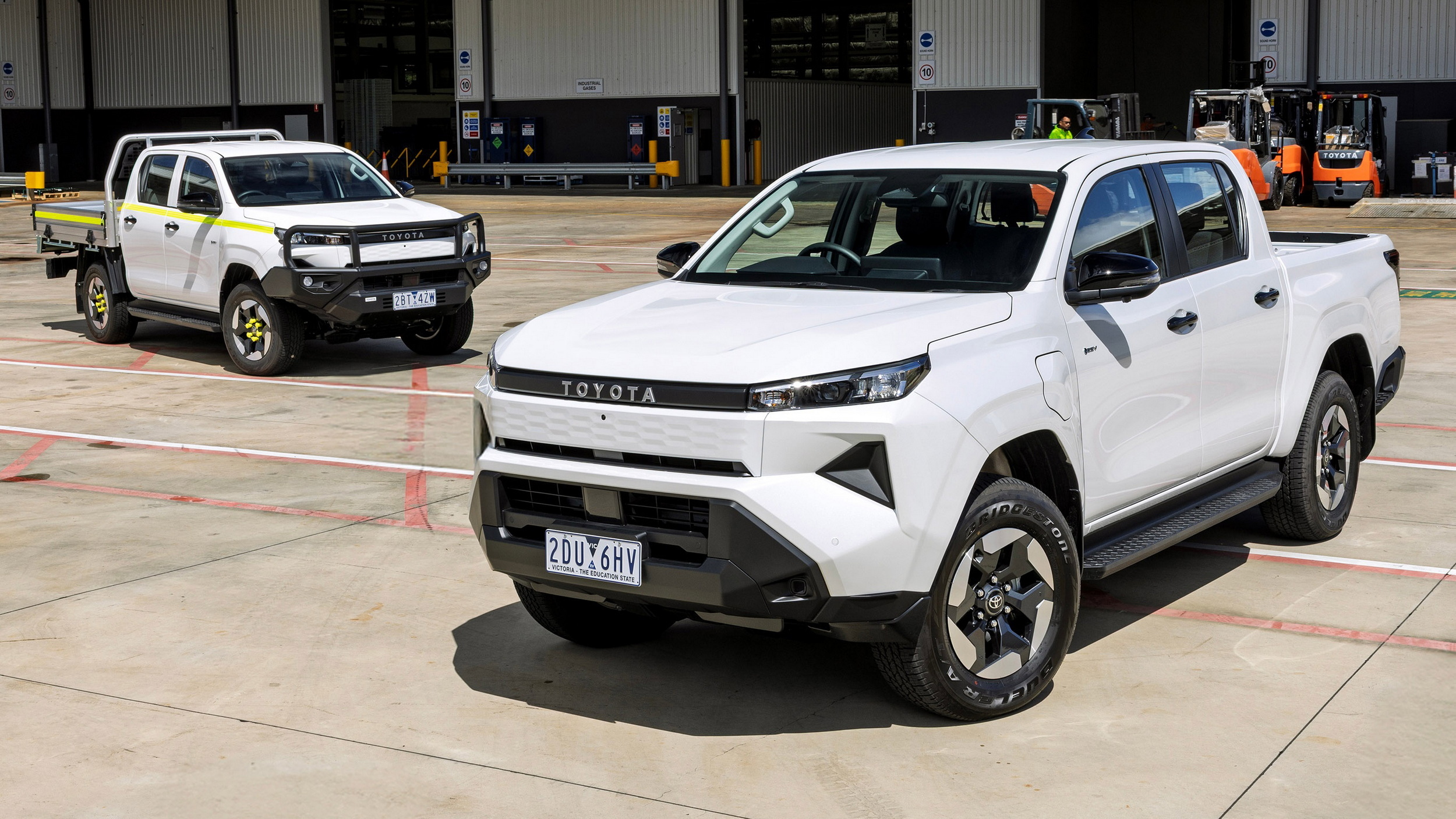
The Hilux BEV SR double-cab chassis (left) and the SR5 double-cab pickup (right).

But what do you actually get for the money? The Hilux BEV runs a dual-motor setup delivering a combined 193 hp (144 kW / 196 PS) and 468 Nm (345 lb-ft) of torque. It comes with full-time AWD and six selectable drive modes via the Multi-Terrain Select system, so it’s not short on off-road intent.

More: Toyota Turns The New Hilux Into A Rugged Three-Row SUV

Power comes from a 59.2 kWh battery, good for a claimed 245–315 km (152–196 miles) of range on the NEDC cycle, depending on spec. That’s hardly ideal for long hauls across the vast Australian outback, though a 10–80% charge takes around 30 minutes. There’s also a practical touch, as a 1,500 W inverter in the center console lets it double as a mobile power source when needed.

Underneath, the ladder-frame chassis gets a bespoke De Dion rear suspension with leaf springs, plus additional reinforcements to cope with the battery weight. Towing is capped at 2,000 kg (4,409 lbs), well short of the diesel’s 3,500 kg (7,716 lbs) figure.

Design And Features
 Toyota’s Electric Hilux Costs $20K More Than The Diesel, And That’s Not Even The Worst Part

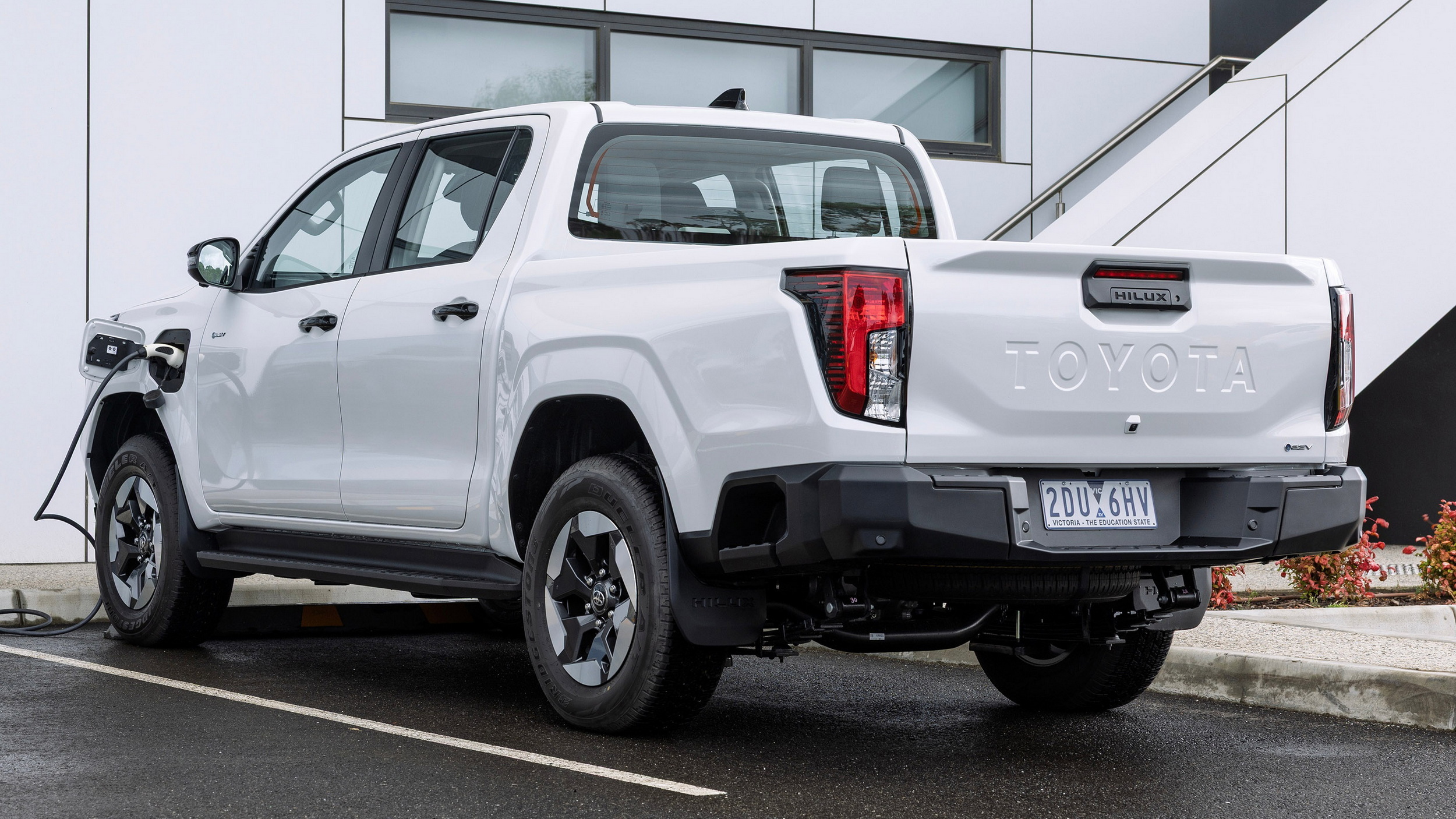
Visually, the Hilux BEV sets itself apart with a closed-off grille and a set of distinct 17-inch alloy wheels shaped for improved aerodynamics. Color choices are kept tight, as they’re limited to Glacier White, Frosted White, and Ash Slate, reinforcing its fleet-focused brief, even if private buyers are still free to place an order.

More: Toyota Says The New Hilux’s Design Is Just “Fine”

As for equipment, the SR trim comes well stocked. LED headlights, body-colored bumpers, side steps, fabric upholstery, and all-weather floor mats are all standard. So are dual-zone climate control, a pair of 12.3-inch displays with built-in navigation, eight airbags, and the full Toyota Safety Sense ADAS suite.

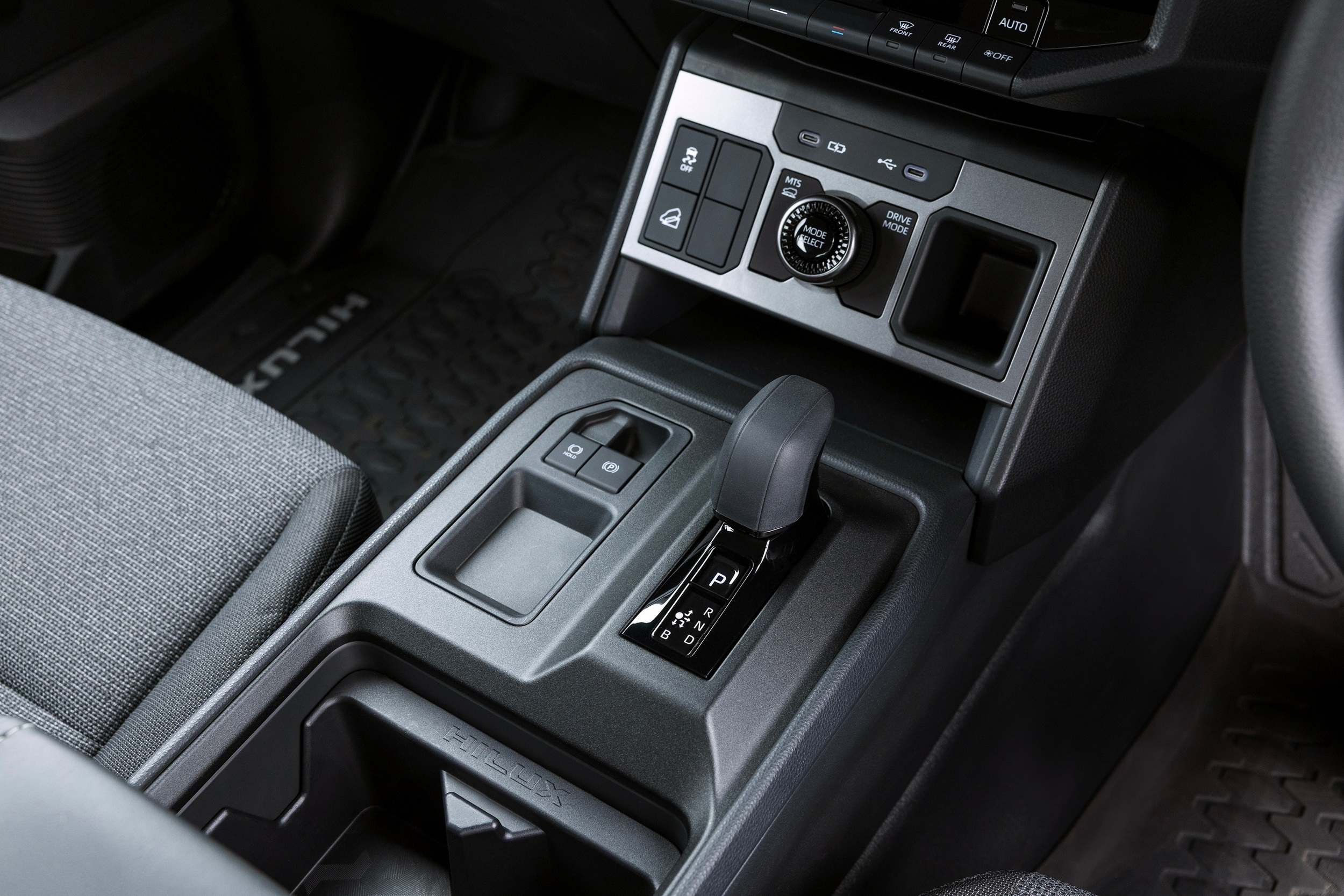
The SR5 adds auto-leveling headlights, LED tech for the footlights and taillights, retractable and heated mirrors, privacy glass, leather upholstery, heated seats and steering wheel, an eight-speaker audio system, a wireless charging pad and more. Thanks to the shared design, the BEV is compatible with most of the optional accessories already available for the diesel, including the pictured bull bar.
 Toyota’s Electric Hilux Costs $20K More Than The Diesel, And That’s Not Even The Worst Part

Modest Sales Target

Given its pricing and rather underwhelming driving range, Toyota keeping expectations in check with just 500 units for Australia’s first year doesn’t come as much of a shock. Most are likely headed straight for mining and construction fleets, where outright range matters less than predictable daily use. To help make that case, the company says the HiLux BEV has already been pushed through extensive testing in remote outback conditions, working closely with mining operators.

Australia won’t be the only market in play. The electric HiLux is also headed for Europe, Japan, South Africa, and several Southeast Asian countries.

For now, Thailand is the first place where buyers can actually place an order, fittingly as the truck’s production hub. There, the Hilux Travo-e starts at ฿1,491,000 ($45,300), undercutting expectations slightly but still landing ฿165,000 ($5,000) above a comparable diesel automatic Hilux Travo 4TREX.
\\\\\\\\\

Toyota Australia

Japan Just Dealt BYD A Massive EV Blow

  • Japan cut subsidies for the Chinese EV maker to just 150,000 yen.
  • New rules now favor EVs using locally produced battery packs.
  • Toyota and Nissan models still qualify for far higher incentives.

Electric vehicles make up less than 2 percent of new car sales in Japan, yet that didn’t stop Chinese EV giant BYD from unveiling an all-electric Kei car last year, aiming to make inroads into the local market. However, the company has just been dealt a serious blow.

It has been revealed that the Japanese government has slashed subsidies for BYD by more than half, reducing them to just 150,000 yen, or about $936. Previously, incentives for BYD models ranged between 350,000 yen ($2,000) and 400,000 yen ($2,500).

Read: BYD Surprises Japan With A Tiny EV Ready To Take On The Kei Giants

The reason is quite simple. Japan is revising its EV subsidy scheme to benefit vehicles that use locally manufactured battery packs. Obviously, BYD’s cars use Chinese-made batteries. Thus, it seems more like a measure to protect the Japanese car industry from the burgeoning Chinese brand, which was the world’s sixth-largest car manufacturer last year.

Japanese EVs Get A Big Boost

\\\\\

BYD Racco

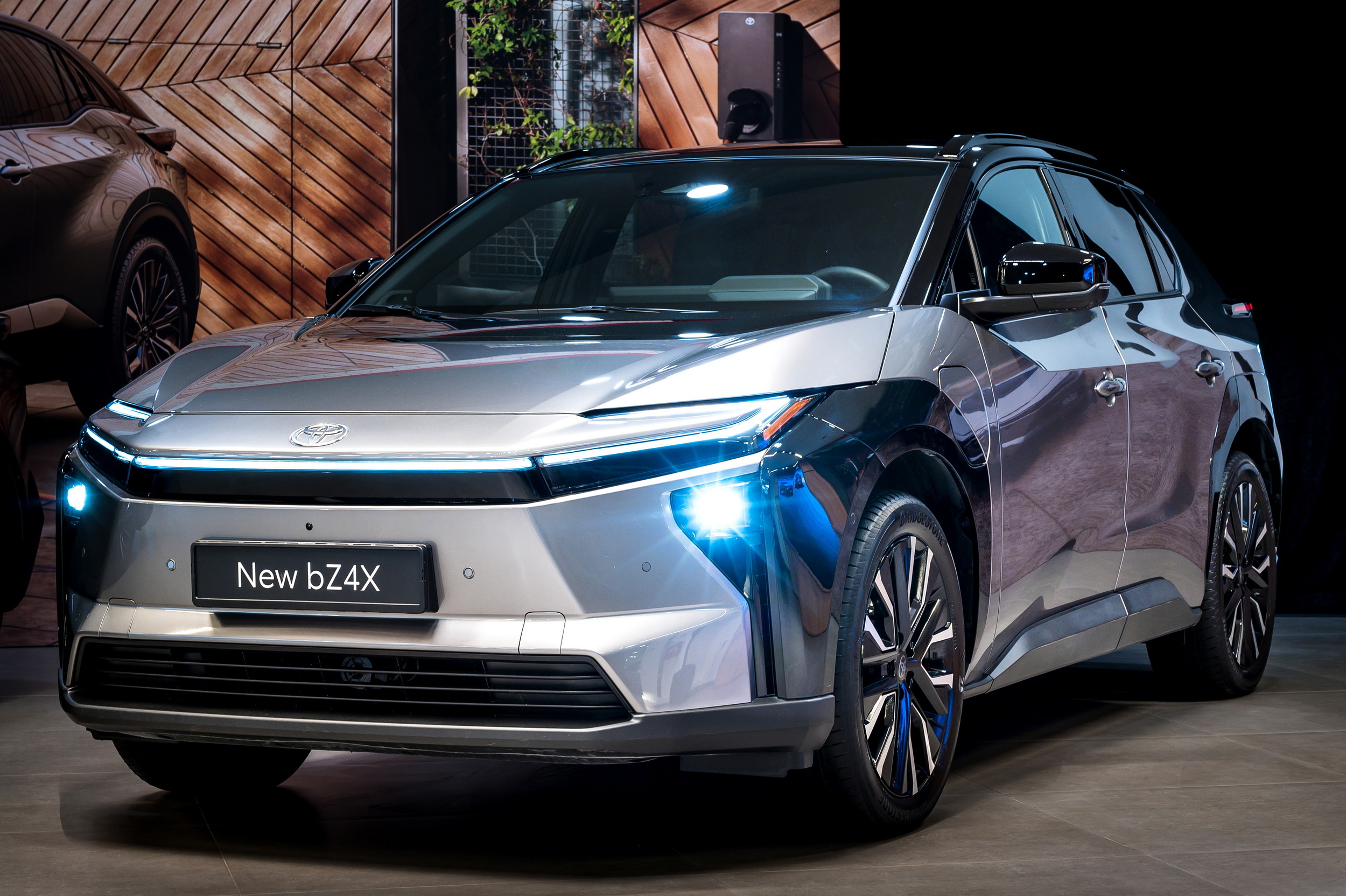
As part of a change to the subsidy program, the Toyota bZ4X will continue to be offered with the highest possible subsidy of 1.3 million yen ($8,100). The Nissan Ariya had been available with a 1.29 million yen ($8,075) subsidy, although this will be cut to 1 million yen ($6,200) in 2027.

Interestingly, it’s not just Japanese brands that get generous government assistance. Earlier this month, Tesla’s subsidies were increased by 400,000 to 1.27 million yen ($7,900), likely due to the fact that it uses Panasonic batteries. Audi also saw a recent increase of 320,000 yen ($2,000) up to just over 1 million yen ($6,200) for its EVs. Similarly, subsidies for some of Hyundai’s EVs have been boosted this month.

 Japan Just Dealt BYD A Massive EV Blow

As noted by Nikkei Asia, not all of these subsidy increases will remain in effect. From next January, subsidies for brands including Audi and Hyundai will be cut, although their extent remains unclear. Prior to the most recent round of cuts, BYD said it was already at a disadvantage.

“We’re at an overwhelming disadvantage,” the boss of its Japan unit, Atsuki Tofukuji said. “The gap [with companies like Toyota Motor] has grown to up to nearly 1 million yen. We can’t compete with 350,000 yen.”

 Japan Just Dealt BYD A Massive EV Blow

Stellantis Is Building Something The ID. Polo GTI Crowd Will Want To Know About

  • Opel confirmed the GSE will be its most powerful production Corsa to date.
  • Nürburgring testing focused on chassis tuning, steering, and ESC calibration.
  • Hatch is expected to borrow its 278-hp electric powertrain from the Mokka GSE.

Opel announced plans for a Corsa GSE earlier this year and the automaker recently took the hot hatch to the Nürburgring for testing. Unsurprisingly, the brand’s answer to the upcoming Volkswagen ID. Polo GTI was spotted not only by spy photographers, but also by the company’s own cameras.

We’ll get to the details in a moment, but Opel said testing was primarily focused on fine-tuning the chassis. They went on to say the upcoming model will “be the most powerful series Corsa ever built” and have “specific throttle, steering, and ESC tuning.”

More: New VW ID. Polo And ID. Polo GT Leaked Ahead Of Their Debut

While the company is keeping details under wraps, we can see a lightly revised front end with triangular air curtain accents. They’re joined by extended fender flares and aerodynamically optimized wheels, which are backed up by yellow brake calipers with GSE badging.

The changes largely fly under the radar, but the production model could be hiding a few tricks up its sleeve. That remains to be seen, but we can expect to learn more as we approach the car’s unveiling at the Paris Motor Show in October.

\\\\\\\

Opel

One thing that isn’t much of a mystery is the powertrain as the hatchback is expected to borrow heavily from the Mokka GSE. This means we can likely expect a 54 kWh battery that powers a front-mounted motor developing 278 hp (207 kW / 281 PS) and 254 lb-ft (345 Nm) of torque. It enables the crossover to accelerate from 0-62 mph (0-100 km/h) in 5.9 seconds, before hitting a top speed of 124 mph (200 km/h).

More: Stellantis Outguns Polo GTI With New Corsa GSE

The upgrades should extend beyond the powertrain as the Corsa GSE will likely be equipped with a limited-slip differential, unique axles, and a sport-tuned suspension with special shock absorbers.

\\\\\\\\\\\\\\\\\\\\\\\\\\\\\\\\\\\\\\\\\\\\\\\\\\\\\\\\

Baldauf

GM’s Cheapest EV Just Got Its Fifth Generation In Six Years

  • The fifth-gen Wuling Hongguang Mini EV has launched in China.
  • The EV has a 40 hp motor and offers up to 187 miles of range.
  • It brings a redesigned exterior and interior, starting at $6,200.

The Wuling Hongguang Mini EV has been around since 2020, yet it has already cycled into what’s being called its fifth generation. If that feels excessive, you’re not alone. In reality, these aren’t clean-sheet overhauls so much as heavy facelifts, which says plenty about the pace at which China’s car industry moves. Even so, racking up so many redesigns in just six years is an impressive feat.

This latest iteration leans into a redesigned exterior with a soft, almost sugar-cube look, while also stepping up inside with improved tech and a more polished cabin. Range has increased too.

Built by the SAIC-GM-Wuling partnership, the micro EV has quietly become a runaway success in China, with cumulative sales surpassing 1.9 million units by the end of 2025. This version continues to widen its appeal with a more practical five-door layout, a bodystyle first introduced late in 2024 on the outgoing model.

More: A $9,500 Hatch Stole Tesla’s Best-Seller Crown In China

Visually, the highlight is the new face with a more upright nose giving the car a friendlier, almost toy-like expression. Round LED headlights and taillights are linked by a chrome strip. The overall silhouette remains familiar, but every panel has been reworked and paired with a brighter, more playful color palette.

It’s Small, Really Small

\\\\\\\\\

The five-door Hongguang Mini measures 3,268 mm (128.7 inches) in length, just 12 mm (0.5 inch) longer than before, while keeping the same 2,190 mm (86.2 inches) wheelbase. The two-door version remains the more compact option, coming in at 3,064 mm (120.6 inches) long with a 2,010 mm (79.1 inches) wheelbase.

More: GM’s New SUV Is Bigger Than An Equinox And Starts Under $8,600

The interior looks familiar, but the dashboard has been redesigned with a larger 10.1-inch infotainment touchscreen and slimmer climate vents. Furthermore, the physical climate controls have been removed entirely, and a column-mounted gear selector opens up extra space between the front seats.

Cargo space stands at 170 liters (6 cu ft) with the seats up, expanding to 838 liters (29.6 cu ft) when the rear bench is folded. The company also claims 20 separate storage compartments throughout the cabin, which should help offset the Mini’s modest footprint in everyday use.

\\\\\\

40 HP, But Range Does The Talking

Every version sticks with a rear-mounted electric motor, delivering just 40 hp (30 kW / 41 PS) and 85 Nm (63 lb-ft) of torque, identical to the outgoing model. Performance remains modest, as expected, with top speed capped at 101 km/h (62 mph).

More: GM’s China Sales Are Down 75%, And The Clock Running Out Isn’t One It Controls

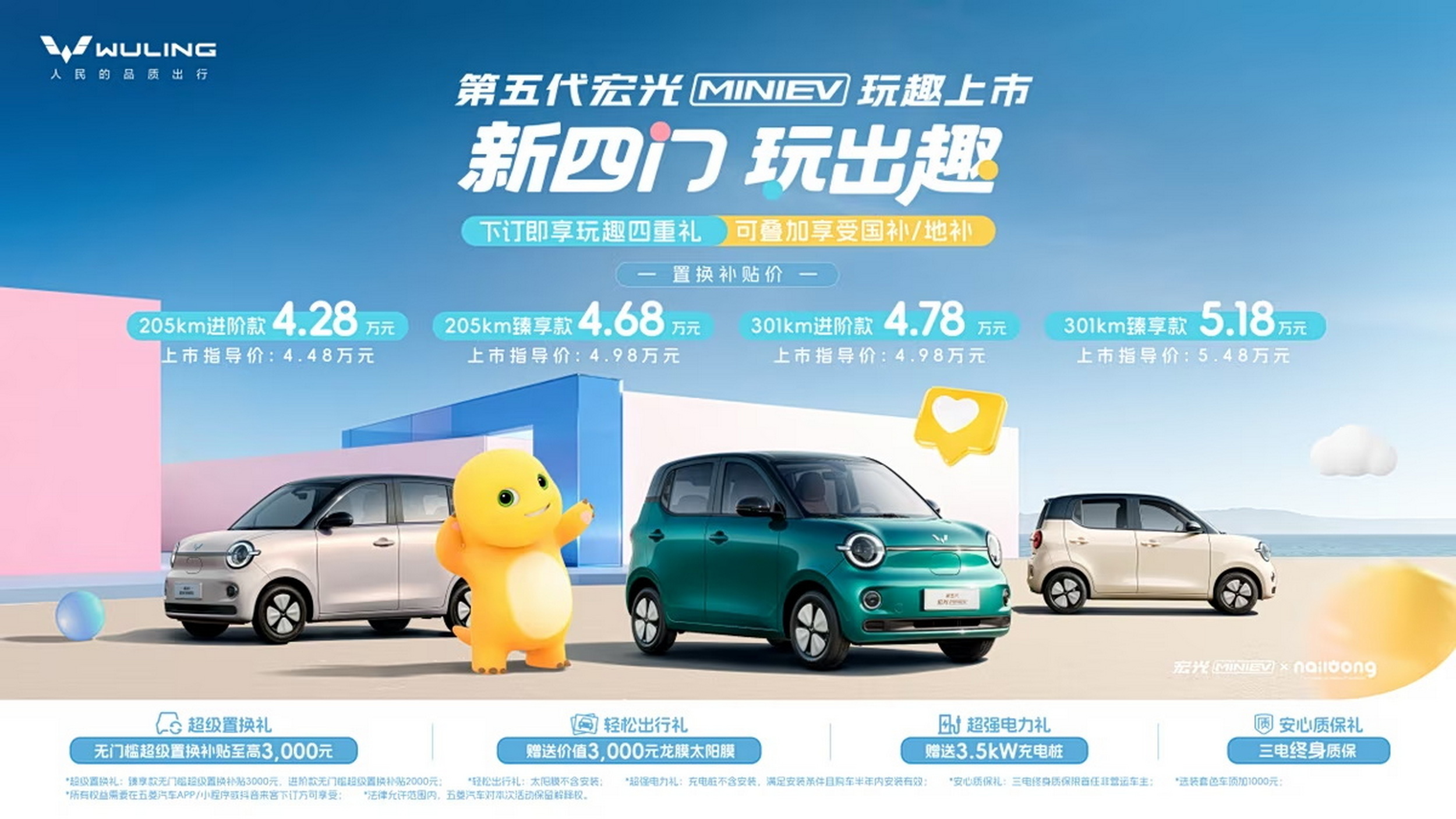
Buyers get a choice of two battery packs. The entry-level model runs a 16.2 kWh unit, good for 205 km (127 miles) of CLTC range. Step up to the 25.1 kWh battery, and that figure climbs to 301 km (187 miles). In both cases, charging from 30% to 80% takes around 35 minutes, which keeps downtime relatively short for a city-focused EV.

How Much Does It Cost?

The five-door 2026 Wuling Hongguang Mini EV is already on sale in China, with pricing starting at ¥44,800 ($6,500) and rising to ¥55,800 ($8,100) for the range-topping version with the larger battery. Factor in current trade-in subsidies, and the entry point drops slightly further to ¥42,800 ($6,200), reinforcing its position as one of the most accessible EVs on the market.

 GM’s Cheapest EV Just Got Its Fifth Generation In Six Years

Rivian Won Direct Sales In Washington With A Threat That’s Coming For Dealers Everywhere

  • Rivian wins direct sales rights in Washington after dealer resistance collapses.
  • Nearly 70 percent of buyers support skipping dealerships and buying directly.
  • Other states may follow as pressure builds against traditional franchise laws.

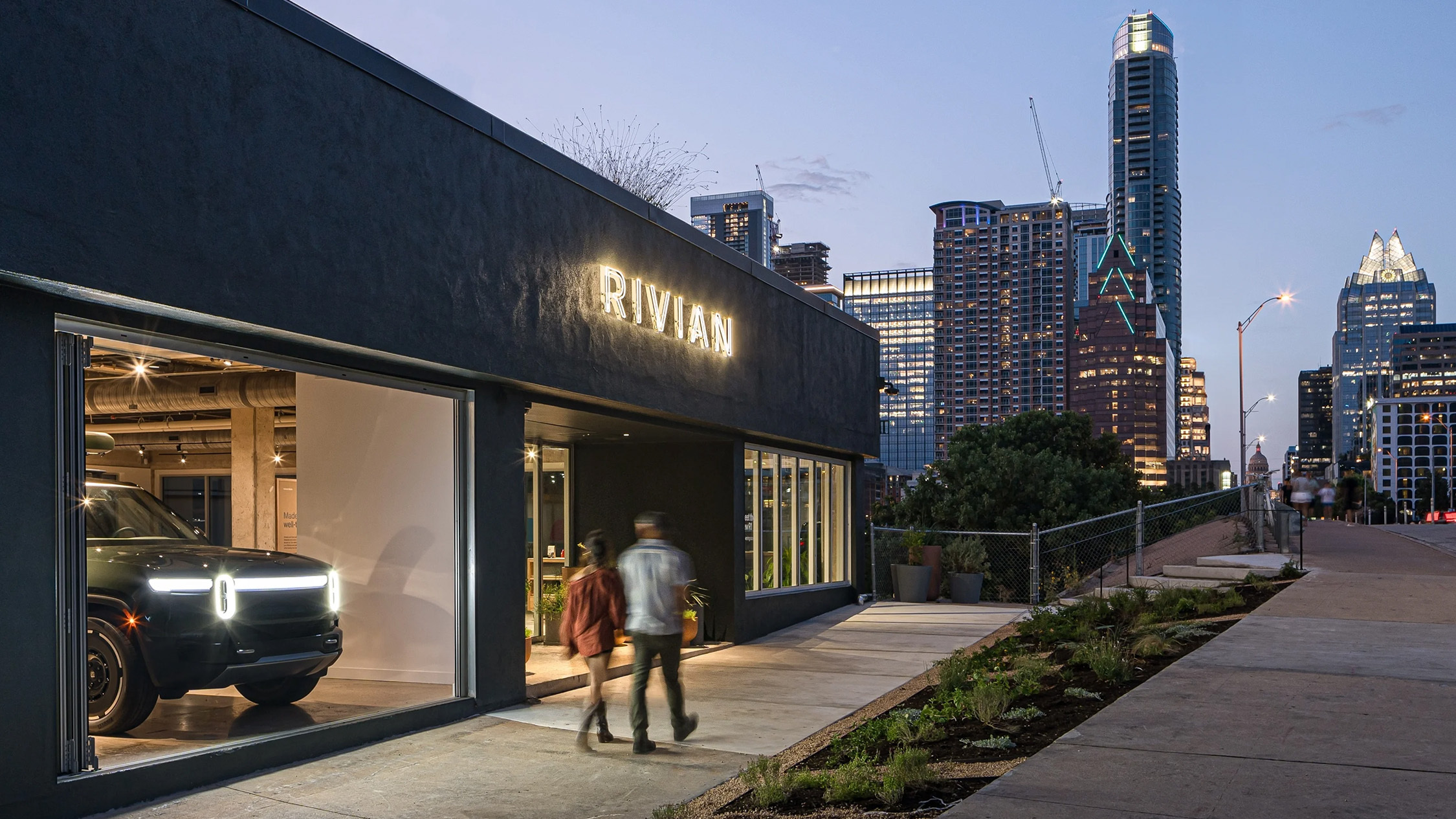
Rivian didn’t just win a fight in Washington this week when it was granted the right to sell cars directly to consumers. It might have started a war that will leave dealer groups across America far less powerful and profitable 10 or 15 years from now.

After years of getting blocked by dealer laws in Washington state, the EV startup pushed hard enough that the opposition simply stepped aside. The turning point came when Rivian threatened to take the issue to voters, a gamble that could have cost it up to $30 million. Faced with an expensive ballot battle, dealer groups backed off and supported a narrow law letting Rivian and Lucid – but no other brands – sell directly.

Related: More VW Dealers Sue, Say Scout Is A Shell Company Built To Cut Them Out

“The writing was on the wall,” said lawmaker Andrew Barkis to The Wall Street Journal. Once the resistance faded, the bill sailed through.

It’s a big moment in a long-running tug of war over how Americans buy cars. For decades, laws in most states have forced automakers to sell through independent dealers. That system isn’t going quietly, but Rivian just proved it can be bent, something Tesla already does, and VW is also trying to do with its new Scout brand.

Buyers Backed The Move

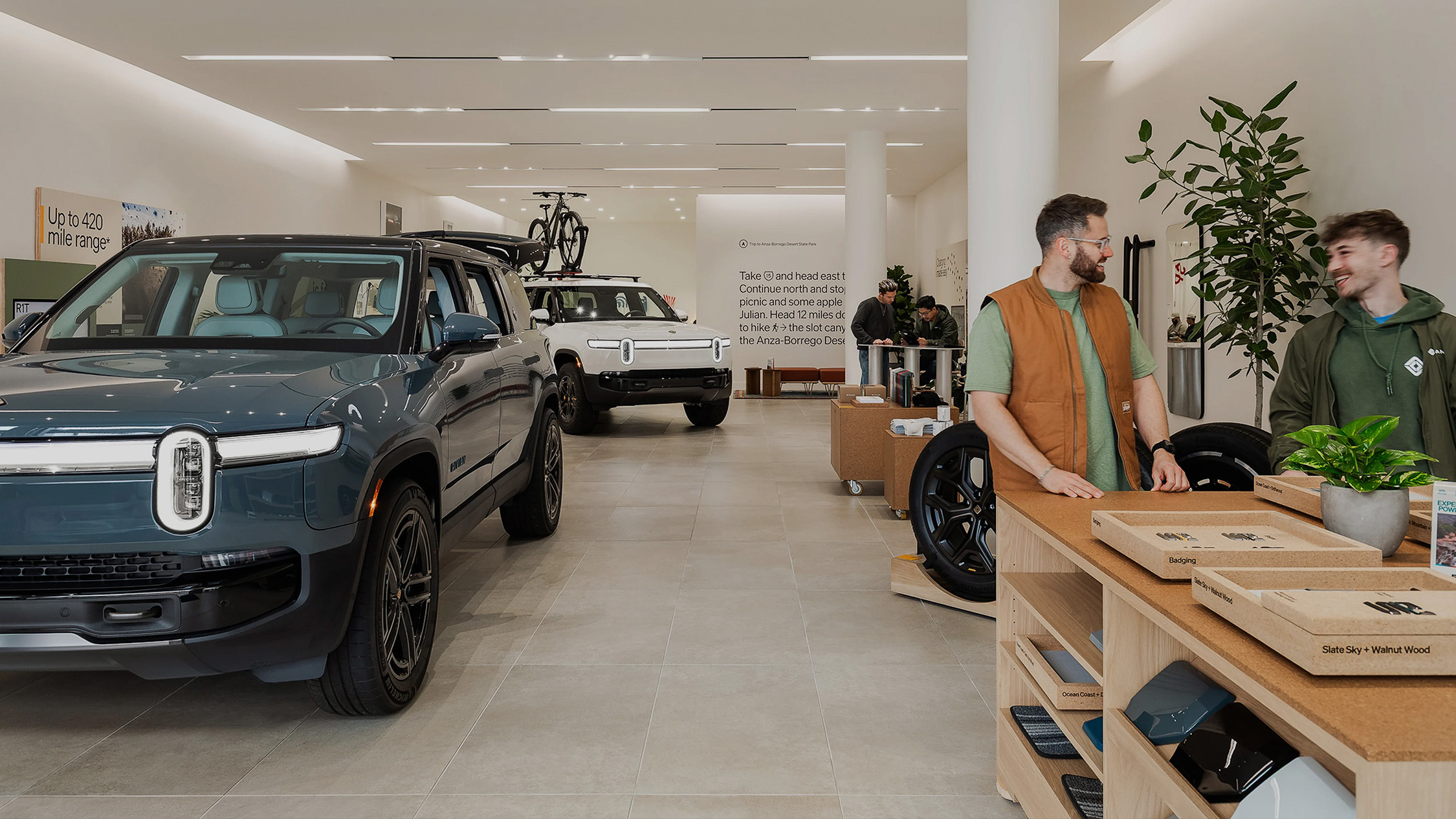
And the reason is simple. Buyers don’t love dealerships as much as the system assumes. Rivian’s own polling showed nearly 70 percent of people support direct sales in the same way that they like to get their sneakers from the Nike store or their new iPhone from an Apple outlet.

 Rivian Won Direct Sales In Washington With A Threat That’s Coming For Dealers Everywhere

Rivian CEO RJ Scaringe says selling direct means more control, better margins, and a cleaner customer experience. But not everyone’s thrilled. Traditional automakers and dealer groups argue this creates an uneven playing field. They say franchise networks keep prices competitive and provide essential services like repairs and financing.

Limited Freedom

“The franchise model continues to be the ideal system,” Vicki Giles Fabré of the Washington State Auto Dealers Association told the WSJ in a statement. Still, even dealers seem to recognize the tide is turning. The Washington compromise is tightly limited, applying only to Rivian and Lucid, but it cracks the door open.

Now Rivian is eyeing other states where voters can be brought into the fight. Places like Ohio and Oklahoma could be next, and if this strategy keeps working, the patchwork of sales laws might start to unravel.

 Rivian Won Direct Sales In Washington With A Threat That’s Coming For Dealers Everywhere

Rivian

Google Maps Now Plans EV Charging Stops Automatically, But Not For Every Car

  • Google Maps is rolling out new trip planning features for EVs.
  • Users can now see how much battery usage trips will take.
  • Drivers will also see recommended charging stops along the way.

Electric vehicle owners are in for a treat as Google Maps is bringing new trip planning features to more than 350 vehicles with Android Auto. This promises to make long-distance trips less stressful as drivers won’t have to worry about running out of juice or bouncing between multiple apps to find a charging station.

To use the new features, owners need to add their vehicle to Google Maps. This can be done by opening the app, selecting your profile, scrolling down to Settings, and tapping Your Vehicles. They can then select Electric and add their make and model of EV.

More: Google Maps Biggest Update In A Decade Looks Great And Can Even Plan Trips

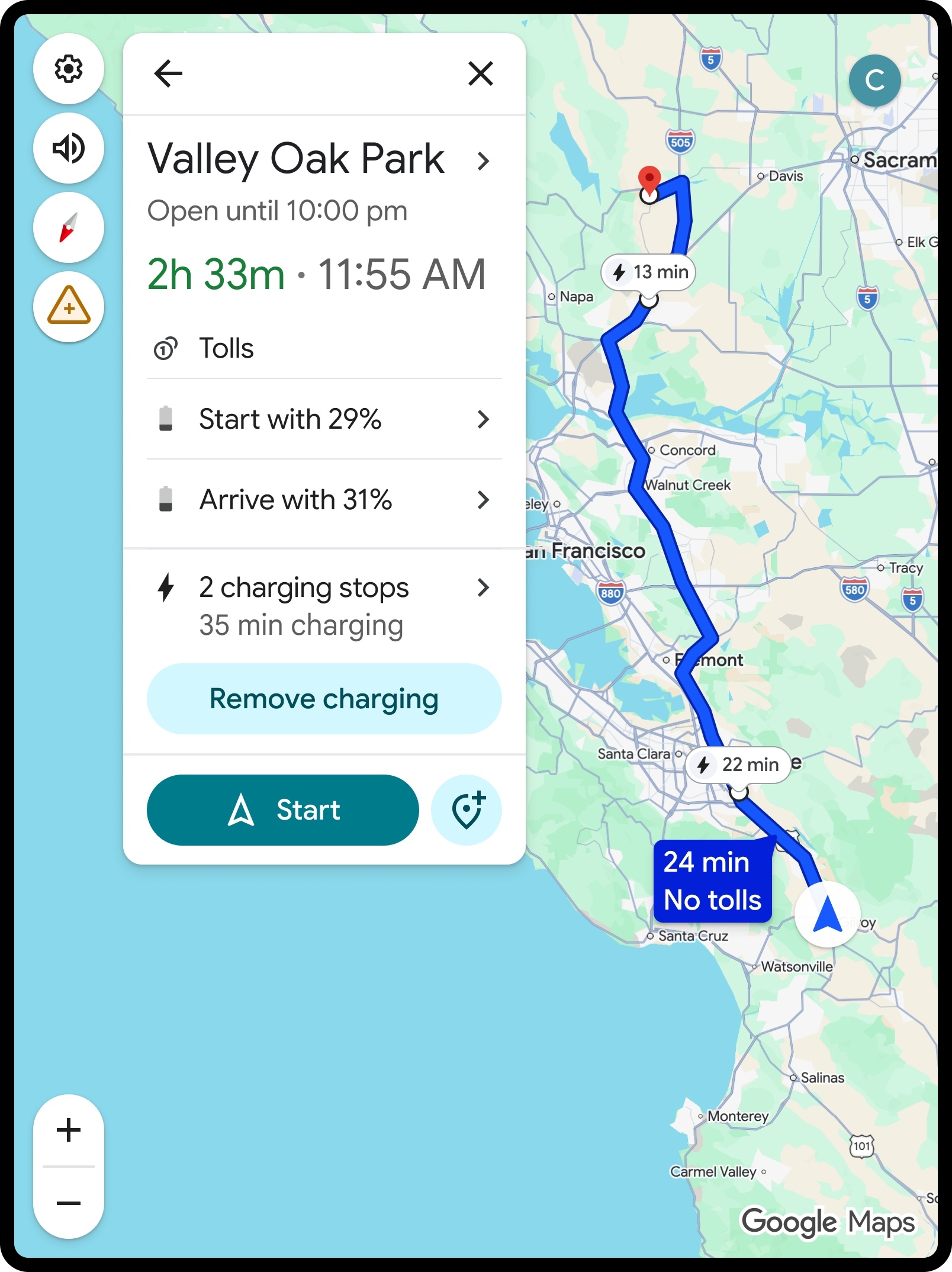
With this information in hand, Google Maps can use vehicle information to calculate several important details. For example, when you set a destination, the app will estimate battery usage for the trip.

Users can add their current battery level to unlock more features, including recommended charging stops, estimated arrival battery level, and an updated ETA based on charging time. There’s even an option that allows you to select how much battery charge you want left when you arrive at your destination, so you’re not immediately forced to recharge.

 Google Maps Now Plans EV Charging Stops Automatically, But Not For Every Car

This sounds like a pretty handy update, and the tech giant said the predictions are made possible by a combination of AI and “advanced energy models that analyze vehicle details, like weight and battery size, alongside Maps’ real-time information about traffic, road elevation, and weather.” All of this means drivers will be well-informed and won’t have to worry about planning routes or charging stops ahead of time.

The new features are rolling out today in the United States and will support 16 brands, with additional companies coming in the future. As of now, that list includes Audi, BMW, Chevrolet, Fiat, Genesis, Hyundai, Jaguar, Kia, Lexus, Lucid, Mercedes, Nissan, Porsche, Subaru, Toyota, and Volkswagen.

\\\\

BMW Gives China’s Stretched iX3 Door Handles The Rest Of The World Can’t Have

  • BMW’s iX3 LWB adds 108 mm (4.25 inches) of wheelbase for Chinese buyers.
  • China-specific software includes Huawei, Alibaba, Deepseek, and Amap navigation.
  • Longer rear doors and new semi-enclosed handles meet local safety regulations.

BMW is kicking off its Neue Klasse rollout in China with a version built specifically for the market, and the new iX3 LWB makes that clear from the outset. This all-electric SUV stretches its wheelbase to free up more rear-seat space, while also packing in tech and safety systems tuned to local expectations.

More: BMW’s Most Traditional Sedan Becomes Its Most Futuristic Yet With New i3

While the official debut of the BMW iX3 LWB is scheduled for the 2026 Beijing Auto Show in April, the company has already shared photos on its social media accounts, following the camouflaged prototypes they showed us last January.

Different Handles For Different Rules

 BMW Gives China’s Stretched iX3 Door Handles The Rest Of The World Can’t Have
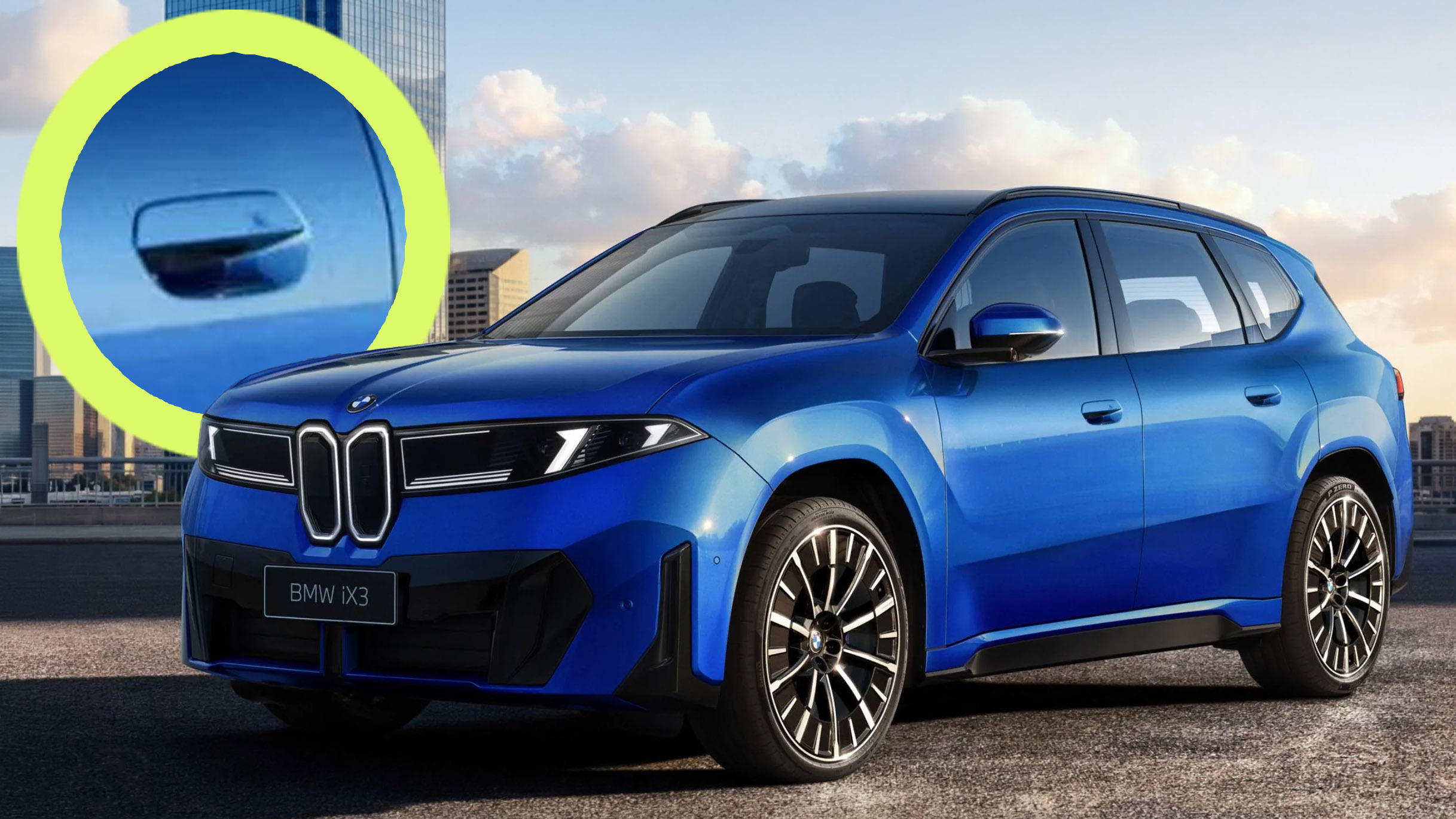
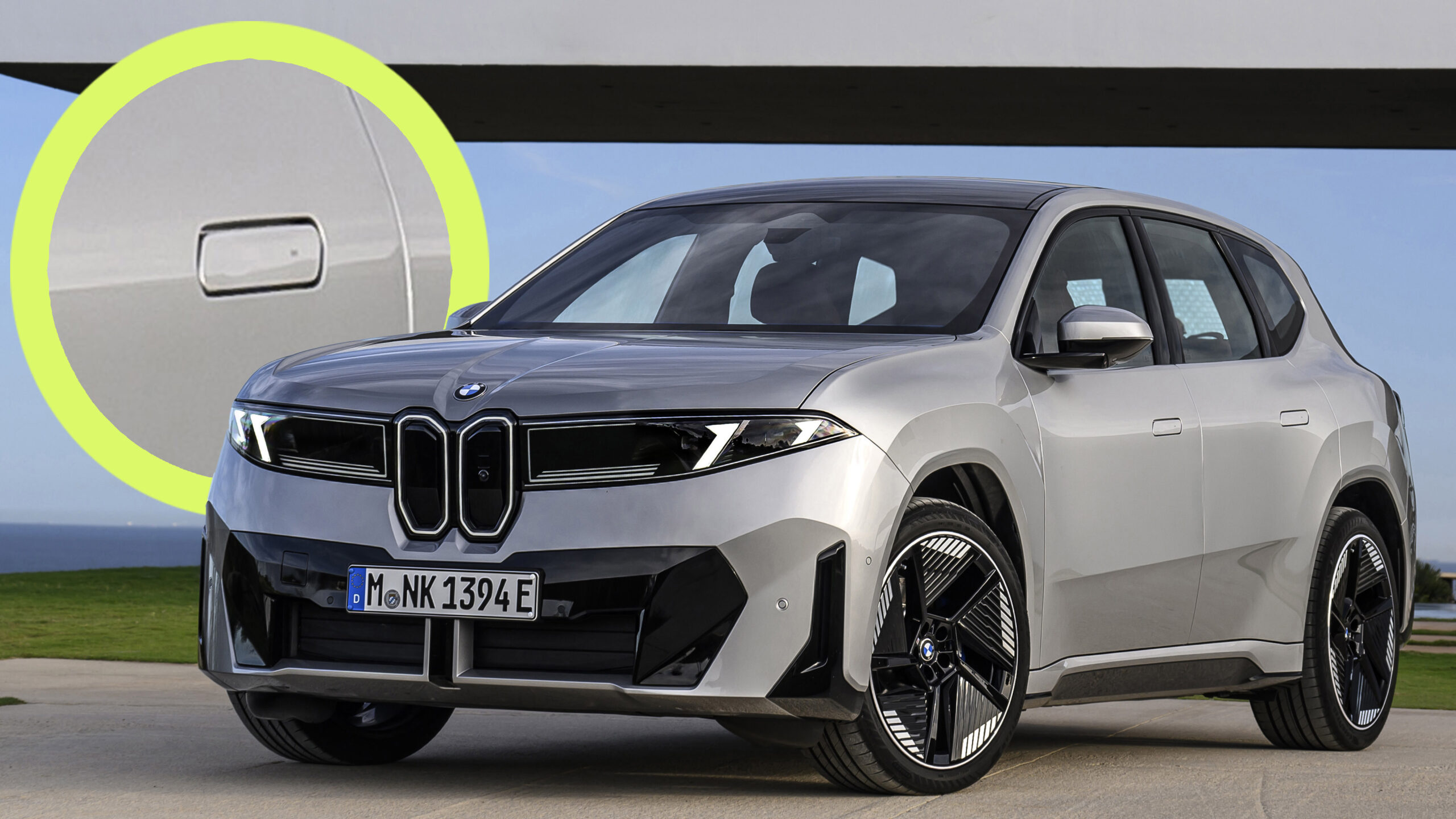
BMW’s China-market iX3 LWB gets different door handles than the global iX3 pictured below.
 BMW Gives China’s Stretched iX3 Door Handles The Rest Of The World Can’t Have

On the surface, the iX3 LWB closely mirrors the standard model, but the details start to separate it. The rear doors are slightly stretched, a result of the longer wheelbase, and the door handles now use a semi-enclosed design. That change is not just aesthetic, it aligns with Chinese regulations that restrict electronically controlled handles. It may also mark one of the first instances of a Western manufacturer developing two distinct door-handle solutions to comply with differing regional rules.

There are a couple of other small but telling tweaks. A new camera sensor sits on the roof spoiler, and the tailgate carries Chinese lettering, reinforcing that this version is very much market-specific.

\\\\\\\\\

The headline change is the extra 108 mm (4.25 inches) added to the wheelbase, bringing it to 3,005 mm (118.3 inches). That is actually 30 mm longer than the ICE-powered X3 LWB and puts it right in line with the current X5’s footprint between the axles.

More: The BMW iM3 May Have Just Shown Its Face For The First Time

Assuming the overhangs stay the same, overall length should land around 4,890 mm (192.5 inches). That places it slightly ahead of the X3 LWB, yet still just shy of an X5, which is an interesting bit of positioning.

Localized Software

Inside, BMW has yet to show the cabin, though expectations are that it will largely carry over from the standard iX3. The bigger story is software. The new BMW Operating System X is expected to integrate Huawei HarmonyOS Next, along with AI models from Alibaba and DeepSeek, plus navigation from Amap with 3D mapping.

BMW is also rolling out a “China-exclusive all-scenario driver assistance system” developed in collaboration with Momenta. This promises to be “deeply customized for Chinese users” providing sophisticated ADAS for China’s “complex urban environments, highways, and long-distance travel”.

Finally, BMW engineers have tweaked the chassis, electronics, and suspension of the Neue Klasse architecture for the Chinese market, targeting “an elegant balance of comfort and stability in diverse driving scenarios.”

Same Power, Big Numbers

\\\\\\\\\

As for the powertrain, the iX3 50L xDrive mirrors its standard iX3 counterpart. It runs a dual-motor setup producing a combined 463 hp (345 kW / 469 PS) and 645 Nm (476 lb-ft) of torque, paired with a 108.7 kWh battery pack. That battery is rated for more than 900 km (559 miles) of range on the CLTC cycle and supports DC fast charging at up to 400 kW.

Built In China, For China

This version of the iX3 will be exclusive to China, built locally through the BMW Brilliance partnership at its Shenyang plant. Pricing remains under wraps for now, though that will come into focus closer to launch.

More: BMW Focuses On SUVs And Sedans, But China Might Want This Instead

Josef Borrell, CEO of BMW Brilliance, framed it as more than just another variant, positioning the long-wheelbase iX3 as a key step in blending BMW’s global tech with locally developed innovation.

“The new generation BMW iX3 long wheelbase represents a significant milestone for us in integrating innovation, driving pleasure, and digital intelligence for the Chinese market,” he said. “The new generation of technologies driven by our Chinese R&D team is gradually becoming an important part of BMW’s global technology landscape and brand DNA.”

 BMW Gives China’s Stretched iX3 Door Handles The Rest Of The World Can’t Have

Toyota Is Selling A New EV For Less Than A 15-Year-Old Used Corolla

  • GAC and FAW Toyota have slashed pricing for their bZ3X SUV and bZ3 sedan.
  • bZ3X was the top-selling joint-venture EV in China for five consecutive months.
  • Both EVs use batteries with enough capacity to cover between 321 and 383 miles.

Toyota has just made two of its cheap EVs in China even cheaper. They’re so affordable that, depending on where you live, you may consider selling your house, packing up your belongings, and immediately moving to China.

Just kidding, but when a brand new vehicle costs less than what you pay in the States for a 15-year-old used Corolla (around $14,000), then something has gone genuinely, wonderfully wrong with our understanding of what a car is supposed to cost.

Read: China Is Snapping Up This $15K EV Faster Than Toyota Can Build It

Perhaps the most interesting of the pair is the bZ3X SUV, launched in China in early 2025 through the GAC Toyota joint venture. It typically starts at 109,800 yuan, or about $15,800, which already feels like a steal. Now, to celebrate GAC Toyota shifting 80,000 vehicles in its first year, the entry price has dropped to just 99,800 yuan, roughly $14,400.

 Toyota Is Selling A New EV For Less Than A 15-Year-Old Used Corolla

You get a heck of a lot of features for the money. The base model is powered by a 50 kWh battery, and while that’s small, it’s good enough for 267 miles (430 km) of driving on the generous CLTC cycle. It powers a single electric motor producing 221 hp. Step up to the 58 kWh or 68 kWh battery options, and range stretches to as much as 379 miles (610 km).

Unsurprisingly, it’s been flying out of showrooms. The bZ3X topped joint venture EV sales for five consecutive months starting in September. Given the starting price, it’s hardly a surprise why.

The Sedan Is Even Cheaper

\\\\\\\\\\\\

Too expensive? Well, good news, as the price cuts don’t stop with the SUV. FAW Toyota has also trimmed the cost of the bZ3 sedan, another strong seller. The refreshed version arrived just a few months ago and, like the SUV, originally carried a 109,800 yuan ($15,800) starting price. Now, that entry point has dropped to 93,800 yuan, or about $13,500.

Underneath, the electric sedan uses BYD’s Blade battery tech and comes with either a 49.9 kWh or 65.3 kWh pack. Depending on configuration, that translates to between 321 miles (517 km) and 383 miles (616 km) of claimed range.

Of course, you’re not just paying for the powertrain, but a slew of other technologies. For example, there’s a new 15.6-inch infotainment display, a digital gauge cluster, panoramic sunroof, dual wireless smartphone charging pads, a roof-mounted LiDAR, and Level 2 semi-autonomous driving functionalities. Not bad for $13,500, right?

\\\\\\\\\\\\\\\\

Skoda’s Most Dramatic Concept Just Became Its Most Sensible Production Car

  • Skoda’s Peaq is a fully electric three-row SUV stretching 192 inches long.
  • The flagship 90x trim offers 295 hp, AWD, and over 373 miles of claimed range.
  • European sales begin in mid-2026, with production set for the Czech Republic.

Skoda is lifting the veil a little further on its upcoming flagship, previewing the Peaq with fresh details and a camouflaged prototype. Sitting at the very top of the lineup, this large, fully electric SUV brings three rows of seating and is scheduled to hit European roads in mid-2026.

Size is a big part of the story. At 4,874 mm (191.9 inches) long, it stretches 116 mm (4.6 inches) beyond the ICE-powered Kodiaq. More telling is the 2,965 mm (116.7 inches) wheelbase, which outgrows the Kodiaq by 174 mm (6.9 inches) and even eclipses the Superb by 124 mm (4.9 inches), putting it right alongside the Chinese-spec VW ID.6 in footprint.

More: A VW Group Brand Lost 96% of Its China Sales, And Now It’s Game Over

Despite the heavy camouflage, the near-production prototype already hints at a softer, more restrained look than the Vision 7S concept from 2022. The so-called “Tech-Deck Face” remains, pairing slim full LED Matrix headlights with a covered grille, much like the Epiq, Elroq, and Enyaq. The Peaq sets itself apart up front, though, with a more distinct bumper design featuring diagonal intakes that give it a sharper edge.

\\\\\\\\\\\\\\\\\\\\\\\\\\\\\\

Skoda will offer a Sportline trim featuring black accents and optional 21-inch alloy wheels. The side profile is defined by large doors with flush handles, while the upright rear design hints at a spacious and practical cabin.

A Family-Focused Interior

The flagship SUV will be available in both five-seat and seven-seat configurations. The former offers a substantial 1,010 liters (35.7 cu-ft) of cargo space, while the latter provides 299 liters (10.6 cu-ft) with all seats in place. Both versions include a 37-liter (1.3 cu-ft) frunk.

More: The Fabia RS Exists, You Just Can’t Buy It For The Road

Inside, highlights include a new 13.6-inch infotainment touchscreen, an optional augmented-reality head-up display, and the largest panoramic roof ever fitted to a Skoda. This roof features electrochromic technology called Dynamic Shade Control. For added comfort, the “Relax Package” brings ergonomic massage seats with leg rests, a wellness app, and a high-end Sonos audio system.

Skoda says more than 50 kg (110 lbs) of recycled materials have been used throughout the cabin, alongside both animal-free and genuine leather upholstery options. The Peaq also introduces a fresh set of “Simply Clever” features aimed at improving everyday usability.

Powertrain Options Breakdown

\\\\\\\\\\\\\\\\\

Under the skin, the EV ides on the VW Group’s familiar MEB architecture. It will be offered with two battery sizes and three powertrain configurations. The entry-level 60 variant features a rear-mounted motor producing 201 hp (150 kW / 204 PS), paired with a 63 kWh battery delivering over 460 km (286 miles) of range.

More: Skoda’s Flagship Plugs Into Sleeper Mode, But The Stopwatch Has Other Ideas

The 90 and 90x variants use a larger 91 kWh battery, enabling over 600 km (373 miles) of range and 10-80% charging in under 28 minutes. The 90 remains rear-wheel drive with 282 hp (210 kW / 286 PS), while the 90x adds a dual-motor all-wheel-drive setup producing 295 hp (220 kW / 300 PS), good for 0-100 km/h (0-62 mph) in 6.7 seconds.

Production will take place at Skoda’s Mlada Boleslav plant in the Czech Republic. When it arrives in mid-2026, the Peaq will go up against rivals such as the Kia EV9, Hyundai Ioniq 9, Peugeot E-5008, and Volvo EX90.

\\\\\\\\\

Skoda

Culture That Rocks: Turning Everyday Moments into Unforgettable Experiences

31 March 2026 at 05:14

CONCORD, N.C. — Jim Knight started his keynote address at STN EXPO East like a concert, highlighting that culture isn’t something you talk about. It’s something people feel. And attendees felt that energy as they walked into the room and heard the music playing over the speakers.

His message Monday was clear: If you want a culture that rocks, you have to create experiences people won’t forget. A feeling of culture starts with moments.

Knight, the former head of global training and development for Hard Rock International’s hotels, casinos, dining and entertainment, quickly moved past traditional definitions of culture. Instead, he grounded the concept in something far more tangible: human behavior.

“Fantastic, awesome, world-beating cultures—they only exist because of human behaviors,” he said.

To illustrate, he shared a story about witnessing a fast-food employee near Disneyworld in Orlando, Florida, interact with a young girl dressed as a princess. Rather than simply take her order, the employee bowed and declared, “All hail the princess,” prompting the entire staff to follow suit.

The moment lasted seconds but its impact, Knight said, is probably something the girl’s family still talks about. “That’s culture,” he said, adding that culture is not heritage, legacy or the past. “Culture is what’s happening right now.”

The ride to and from school may be routine. The interaction is not. “The student experience has to rock,” he continued. “And that starts with the relationship. How the driver made me feel, that’s what matters.”

At its core, he defined culture simply as “a collection of people,” each bringing their own behaviors into the organization. That definition carries weight in an industry facing persistent driver shortages and turnover.

Side Bar: Jim Knights’ 10 Takeaways


1. Fantastic cultures only exist because of human behaviors

2. Celebrate heritage (past), but focus on the present (people)

3. Be Like U2 – Everyone signing off the same sheet of music

4. To avoid four-letter words, don’t provide/endorse mediocrity

5. People crave differentiation – deliver personalized experiences

6. In a world of darkness, be a bright light in each student’s day

7. Treat each person special – Like it’s your first day of work

8. Authentic student obsession creates lifelong raving fans

a. Create generational fans (you have the parents & the kids on your bus)

9. The true path to cultural Nirvana’s through 3C rock stars – YOU ARE THE AMPLIFIER
10. Change your mindset from transportation to creating experiences

BONUS: Position the Job to be Tattoo-Worthy

“Every time somebody joins or leaves [an organization], culture changes,” Knight said, adding that the student transportation industry faces a retention challenge. “If you could hold on to the right people, you’d have exactly what you want.”

Knight used a simple exercise. He asked attendees to close their eyes and point in the direction of true north, to demonstrate how easily organizations drift without alignment. “If everybody’s guessing, you get confusion,” he said. “If everybody’s aligned, you get productivity.”

He compared it to a band, using U2 as an example. While Bono and The Edge may draw the spotlight as lead singer and lead guitarist, respectively, the rhythm section of drummer Adam Clayton and bassist Larry Mullins, Jr., keep the band on the same page.

“Everybody has a role to play,” Knight said. “But you’ve got to be singing off the same sheet of music.”

In transportation, that means consistent communication from leaders to the school bus drivers. Everyone needs to be in tune about expectations, priorities and purpose.

“If you don’t share it, people will make it up,” he added.

One of Knight’s most pointed observations centered on what he called “acceptable mediocrity,” and four-letter words that he hates. Words like “fine,” “good” and “okay” may sound harmless, but he argued they signal something deeper.

“They scream mediocrity,” he said, adding that over time, organizations begin to accept these outcomes as success.

Differentiation Happens One Interaction at a Time

Knight emphasized that creating a standout culture doesn’t require sweeping changes. It starts with small, intentional actions.

“Read the person. Seize the moment. Personalize the experience,” he said, recalling his time at Hard Rock, where he made it a point to engage each guest in a unique way—whether through humor, conversation or simple recognition.

“You do that, you create loyalty,” he said. “You create stories.”

The same principle applies to student transportation. “People crave differentiation,” Knight said. “Deliver personalized experiences, and you build comfort, safety and trust.”

He played a video each Chick-Fil-A location shows to all new employees. The video highlights different people eating at the chain fast-fodd restaurant, with captions about what’s each person has going on in their lives. Everyone is dealing or navigating something. Every life has a story if we bother to read it, he said.

As a result, Chick-Fil-A immediately communicates the culture of caring they want from their employees.

“In a world of darkness, be a bright light in each student’s day,” Knight continued.

For many students, the bus ride is more than transportation. It’s a transition point, and sometimes the first interaction students have of the day. It puts drivers in a uniquely influential position.


Related: Security Expert Shares Key Indicators of Violence for School Transportation Safety
Related: Transportation Directors Receive Rock Star Training on Driver Retention
Related: Multi-Modal Transportation Gains Momentum as Districts Seek Flexible, Cost-Effective Solutions
Related: Gallery: STN EXPO East Tech Demos and Ride & Drive at Charlotte Motor Speedway


Jim Ellis, director of transportation at Henrico County Public Schools in Virginia, noted that culture and the driver shortage tie hand and hand. “If you don’t want to be here, then I really don’t want you,” he said, underscoring the importance of cultural fit in a role that involves transporting children. He pointed to the driver shortage as a complicating factor, making it harder to be selective, but stressed that long-term success depends on building a team committed to more than just driving.

“You’ve got to be the one that fits that culture… making sure that you are that first thing they see.”

Britton Overton, director of transportation for Pender County School District in North Carolina, added that staffing challenges also impact morale, which in turn shapes culture. “It definitely affects culture, but also morale—and morale helps to build that culture or tear it down,” he said, noting that supporting drivers and maintaining positivity are critical to sustaining both.

Knight also challenged attendees to reflect on their own mindset. Think back to the first day on the job, he said, a time when employees arrived early, paid attention and took pride in every detail.

“Somewhere along the way, we lose that,” he said, adding that employees start cutting corners by focusing on their own gain the longer they stay in an organization.

Reclaiming that “day one attitude” is essential to sustaining culture over time, he commented.

Tisha Hergert, transportation director for Onsted Community Schools in Michigan, said Knight was very enthusiastic. “Everything that he mentioned to us, it was so easy to break down and will be very easy to implement. When I go back to my district, I feel like I can fire my crew up.”

Ultimately, Knight reinforced that culture is amplified, or diminished, by the people delivering the experience. He outlined what he called the “three C’s” of high-performing teams: Competence, Character and Culture fit.

“The true path to cultural nirvana is through 3C rock stars,” he said, adding that in student transportation, those rock stars are the drivers.

Beth Allison, safety and training instructor for Prince William County Public Schools in Virginia, poses with Jim Knight after his keynote at STN EXPO East March 30, 2026.

Knight closed with a mindset shift that tied the session together. “Stop thinking about transportation,” he said. “Start thinking about creating experiences.”

Because while routes, schedules and safety protocols are essential, they are only part of the equation. What students and families remember and what defines culture, is the human interaction.

“Don’t just think about this stuff,” Knight said in his final remarks. “Act on it.”

Overton told School Transportation News that Knight’s keynote was “very inspirational.” He noted that culture has become “a big word in discussion nowadays,” adding that Knight offered practical takeaways that he plans to implement back home. “

“[Knight] gave me some good insight and broadened my thinking of how I can make our transportation better in our district,” Overton added, emphasizing that sessions like the Monday keynote are about learning what works and adapting it locally.

The post Culture That Rocks: Turning Everyday Moments into Unforgettable Experiences appeared first on School Transportation News.

How Technology Powers Daily Student Transportation Operations

31 March 2026 at 05:13

CONCORD, N.C. – An STN EXPO East panel of student transporters shared how utilizing Transfinder’s technology suite has made their school bus operations safer and more efficient.

Improving Efficiency

Edgar Franco, assistant transportation director for Modesto City Schools in California, stated that technology has assisted with internal digitization, timeliness and streamlining communication between schools and the transportation department.

Christopher Faust, transportation director for Sangamon Valley Community Unit School District #9 in Illinois, noted that a district does not need to use Transfinder’s entire product suite since the Routefinder Plus routing software alone is powerful and convenient to also rapidly send parents relevant messages, as an example.

Kathleen Guarini, transportation coordinator for Loudoun County Public Schools in Virginia, and Elizabeth Cannata, supervisor of transportation for Haverhill Public Schools in Massachusetts, both agreed that a tech portal also eases the difficulties of driver shortages and substitutions. Guarini advised rolling out a tech stack slowly, so staff does not get overwhelmed and become averse to future integrations.

Enhancing Safety, Accountability

“In an emergency situation, you need fast access to the data at your fingertips, and that’s what having an all-in-one platform is going to allow you to do,” stated panel facilitator and Transfinder Sales Engineer Shea Marstaller.

Cannata utilizes student RFID cards, which she said have been able to prevent lost-child debacles involving police and helicopters.

To help parents adopt the Stopfinder parent app, Franco advised “building a community, getting it out there and showing them [its] value.”

Guarini said Stopfinder has “been hugely impactful” especially during the first few weeks of school startup. She noted her eight dispatchers were spared having to field calls from parents of the 60,000-strong student population.

She also shared how the driver app Wayfinder provides directions via tablets which is much safer than drivers “searching for a piece of paper or dropping it, tucking it under [their] thigh while [they’re] trying to make the turns, so [they] can use two hands on the wheel.”

Leveraging Data, Statistics

Cannata noted a key performance indicator of the software is that it can show gaps in driver schedules, so one who is free can pick up a student who missed the bus and get them to school.

Guarini said that Transfinder’s team was able to find additional efficiencies when her district went from a three-tiered bell system to a five-tiered bell system. Additionally, she said she uses Formfinder for a special needs application that has saved her staff the workload of transferring 400 columns of data nightly for 3,000 students.

Franco stressed the importance of bringing in clean data to avoid messy problems down the road.

Cannata added that the technology assists with special needs routes.

“We have to separate who requires specialized transportation and what that specialized transportation is — be it a wheelchair, a 1-to-1 monitor, and anything like that,” she explained. “We have to have that inside of our end of year report and I’m able to simply filter, edit and I can get it within minutes. Pull my end of year report. It’s saved me from hours of going through each route individually to check.”

Rick Walterscheid, who spent 25 years as a transportation director and is now a sales executive with Transfinder, said using ServiceFinder in his district operations gave him actionable data for bus repairs and replacement cycles.

“What this enabled me to do was to put evidence into what I already knew because I kept the records,” he stated.


Related: Technology Webinar Takes Detailed Dive into School Bus Efficiency
Related: (STN Podcast E296) Technology Has Blossomed: School Bus Mirrors & Student Safety
Related: School Bus Adaptive Technology: Safer Rides, Stronger Teams, Better Access
Related: (STN Podcast E286) End of Year Review: Safety & Technology Trends of 2025
Related: Ohio Announces School Bus Safety Grant Recipients for Technology Enhancements


Implementing Technology

Since school bus drivers on the roads everyday may have suggestions on route improvements, Franco said he layers planned routes and bus GPS data to compare them and determine if there is a way to optimize that route. Digitization has helped simplify things when drivers bring in notes on how their routes could be better, Guarini concurred.

With older drivers who may be hesitant to adopt new tech, Cannata advised providing copious training and having tech-savvy drivers assist if possible.

Franco agreed that identifying and empowering tech-forward leaders among drivers and technicians is crucial. He also confirmed that Transfinder’s tablet system is easy and intuitive for those less tech-friendly drivers.

While Transfinder offers multiple products, Faust advised student transporters to “take what works for you.”

“I love all of the features that Transfinder offers, but I feel like you need to identify which are the most important, which are the immediate needs for your division and start chipping away as you can manage,” agreed Guarini.

Looking Forward to the Future

Faust said he looks forward to AI integrations which can save time by answering conversationally spoken questions rather than requiring staff to manually seek out information.

Franco praised Servicefinder’s assistance in keeping track of white fleet vehicles that need repairs and getting that information to technicians in a timely manner.

“We’re all being asked to do more with less, right?” Marstaller commented.

“Being in a small district, we have to be as efficient as possible,” Faust agreed.

“Everybody’s afraid to change from what you know,” Guarini said. “The benefit of doing that, though, gives you a fresh mindset.”

Appreciating Customer Service

Cannata and Franco praised the clear and streamlined customer service Transfinder provides.

“Instantly, like within like an hour – not even, sometimes – it’s instantly quick, but we have an answer. We got it fixed,” Cannata declared.

“We all feel supported by Transfinder with anything we need help with,” Guarini confirmed.

Faust noted that having one vendor for the whole tech stack makes troubleshooting much easier.

All four panelists said they used the Transfinder Community feature through which their peers and fellow users help them better utilize the technology.

The post How Technology Powers Daily Student Transportation Operations appeared first on School Transportation News.

Gallery: Trade Show at STN EXPO East 2026

31 March 2026 at 01:44

CONCORD, N.C. – Student transporters took part in a Trade Show + Networking Pit Stop Reception on Monday evening, where the thrill of NASCAR met the excitement of connection. They engaged with eighty vendor companies, informative exhibits and dynamic networking opportunities on the Trade Show floor while enjoying Southern comfort food and drinks.

1 of 20

The post Gallery: Trade Show at STN EXPO East 2026 appeared first on School Transportation News.

Student Shot Near School Bus Stop in Houston, Suspect in Custody

30 March 2026 at 19:44

A high school student shot by a classmate was after getting off a school bus in northwest Houston at the time of the incident, reported Click 2 Houston.

The student, who attends Scarborough High School, was taken to a hospital with a gunshot wound to the leg on March 20, according to the news report. The shooting occurred after the bus stopped near Langwood Park and Benbrook Elementary School, the article noted.

Investigators believe an altercation began on the school bus and continued after the students exited.

“What we believe happened is there was a fight on a school bus here,” said Lt. Larry Crowson of the Houston Police Department. “The fight continued off the school bus into the intersection where you had one student shoot another student.”

A nearby resident who witnessed the shooting said she heard three gunshots and called 911 while rushing to help the injured student.

“I was trying to put a tourniquet on his foot since there was a lot of blood,” the woman told local news reporters. “One person put a sweater on top, and another man put a belt around his leg so he wouldn’t lose too much blood.”

The witness also said the shooting happened near areas where children frequently gather, including a park and nearby school, raising concerns among residents.

Authorities added that a nearby elementary school where an after-school program was being held was placed on lockdown during the investigation. The suspected shooter, also a student, was later located at a nearby home and taken into custody, police said. Authorities have not released additional details about potential charges. The condition of the student shot has not been publicly released.

The investigation remains ongoing.


Related: Minnesota Man Accused of Pointing Gun at School Bus
Related: Two Students Killed in Georgia School Shooting
Related: 15-year-old Shot, Killed at Virginia School Bus Stop
Related: North Carolina Student Arrested for Shooting Gun on School Bus

The post Student Shot Near School Bus Stop in Houston, Suspect in Custody appeared first on School Transportation News.

Ignite Your Leadership

30 March 2026 at 18:59

As we navigate through 2026, school transportation professionals face an evolving landscape marked by staffing shortages, the accelerated shift toward zero-emission fleets, heightened student safety challenges, and increasingly complex demands from parents, local government and school executives.

Attending industry conferences has never been more essential. These state, regional and national events bring together dedicated peers to exchange innovative ideas, forge lasting networks, reconnect with trusted partners and colleagues, and commit to meaningful professional growth. The practical, actionable insights shared by expert presenters, panelists and fellow attendees translate directly into safer routes, more efficient operations and improved experiences for the students we serve every day.

“The chance to gain inspiration, motivation and network with other successful school transportation operators is a big factor in why I attend conferences like STN EXPO,” said Brooke Millar, president at 4 Seasons Transportation. Her words resonate deeply in an industry where burnout and rapid change can challenge even the most committed leaders.

“Professional development at conferences provides a nice break from daily routines to focus on my personal growth, fostering innovation and identifying knowledge gaps,” she added.

Attending industry conferences can deliver profound, multifaceted benefits. Participants draw fresh inspiration and renewed motivation from accomplished leaders who have overcome similar obstacles. They sharpen critical skills through in-depth educational sessions exploring emerging trends, regulatory updates and proven best practices. Powerful keynote presentations and interactive workshops help cultivate a resilient growth mindset, boosting confidence in tackling ambitious goals.

Beyond the classroom sessions, networking opportunities enable professionals to crowdsource real-time solutions to pressing challenges, spark collaborations across districts and states and open doors to new career advancements or operational efficiencies. The expansive trade shows connect attendees directly with cutting-edge technology, vehicles and products designed to address core priorities such as fleet optimization, advanced safety systems, driver retention strategies, procurement, and specialized transportation for students with disabilities and special needs.

Events like STN EXPO stand out for their comprehensive educational programming, including specialized deep dives into niche topics. The Transportation Director Summit offers exclusive leadership training, while creating opportunities to connect with peers, key business partners and OEMs. The Bus Technology Summit offers the opportunity to experience live technology demonstrations and to compare solutions from business partners. The Green Bus Summit delivers compelling success stories and conversations from fleet decision makers that have invested in a sustainable future. These targeted tracks provide focused education, hands-on skill development and invaluable connections with like-minded professionals.

Meanwhile, the trade show floor and evening networking receptions create an energetic environment for exploring innovative solutions, testing new equipment and building potential vendor partnerships that can transform district operations.

Our most recent attendee surveys continue to highlight professional development and networking as the primary reasons professionals invest their time in these gatherings.

Engaging peers, industry experts, suppliers, school bus dealers, and OEMs provides a unique forum for market research, product comparisons and honest discussions about what truly works in the field. Whether you’re seeking solutions for sustainable fleets, enhanced security measures, comprehensive driver training programs, or inclusive special needs transportation, the trade show serves as a one-stop resource for discovering partners that align with your district’s specific needs and budget.

In an era of tight budgets and high stakes, investing time in these events yields measurable, lasting returns: Enhanced knowledge that informs better decisions, stronger professional networks that provide ongoing support, renewed motivation to lead through challenges, and direct access to innovations that elevate safety and efficiency. Look for hands-on workshops, certifications and powerful keynotes from leaders with a focus on leadership, technology and green fleets.

Conferences are a catalyst for excellence and truly time well spent. I personally invite you to experience STN EXPO East March 26–31 and STN EXPO West July 9–15 firsthand and see the impact for yourself. Registration is open now at stnexpo.com.

It’s time to invest in leadership for you and your team. I look forward to seeing you soon and hearing about the ideas you’ll bring back to drive success.

Editor’s Note: As reprinted from the March 2026 issue of School Transportation News.


Related: Transportation Director Summit Provides Exclusive Leadership, Networking
Related: Giving Birth to Proper Leadership
Related: Leadership Starts From the Top Down
Related: (STN Podcast E289) 2026 Kicks Off: Winter Weather, the World Stage & Rock ‘n Roll Leadership

The post Ignite Your Leadership appeared first on School Transportation News.

Yesterday — 30 March 2026Vehicles

Bentley Hasn’t Shown The Barnato SUV’s Face Yet, So We Did It For Them

  • New Barnato will sit below the Bentayga as Bentley’s first fully-electric SUV.
  • Output could reach up to 1,140 hp, pointing to serious performance potential.
  • Its sleek styling draws from the EXP 15 concept with crisp, sharp, modern details.

Bentley is getting ready to widen its SUV lineup with a second high-riding model, one that will slot in below the Bentayga. This time, though, the formula changes. Instead of another combustion-powered offering, the new arrival is set to be fully electric.

Early reports pointed to the name ‘Mayon,’ which appeared in a trademark filing with the European Union Intellectual Property Office last year. However, more recent intel points to the ‘Barnato’ name being used; after all, it carries more heritage honoring Le Mans winner and Bentley owner Woolf Barnato. 

Future Cars: The Luxurious Hyundai Flagship We Never Got Is About To Change

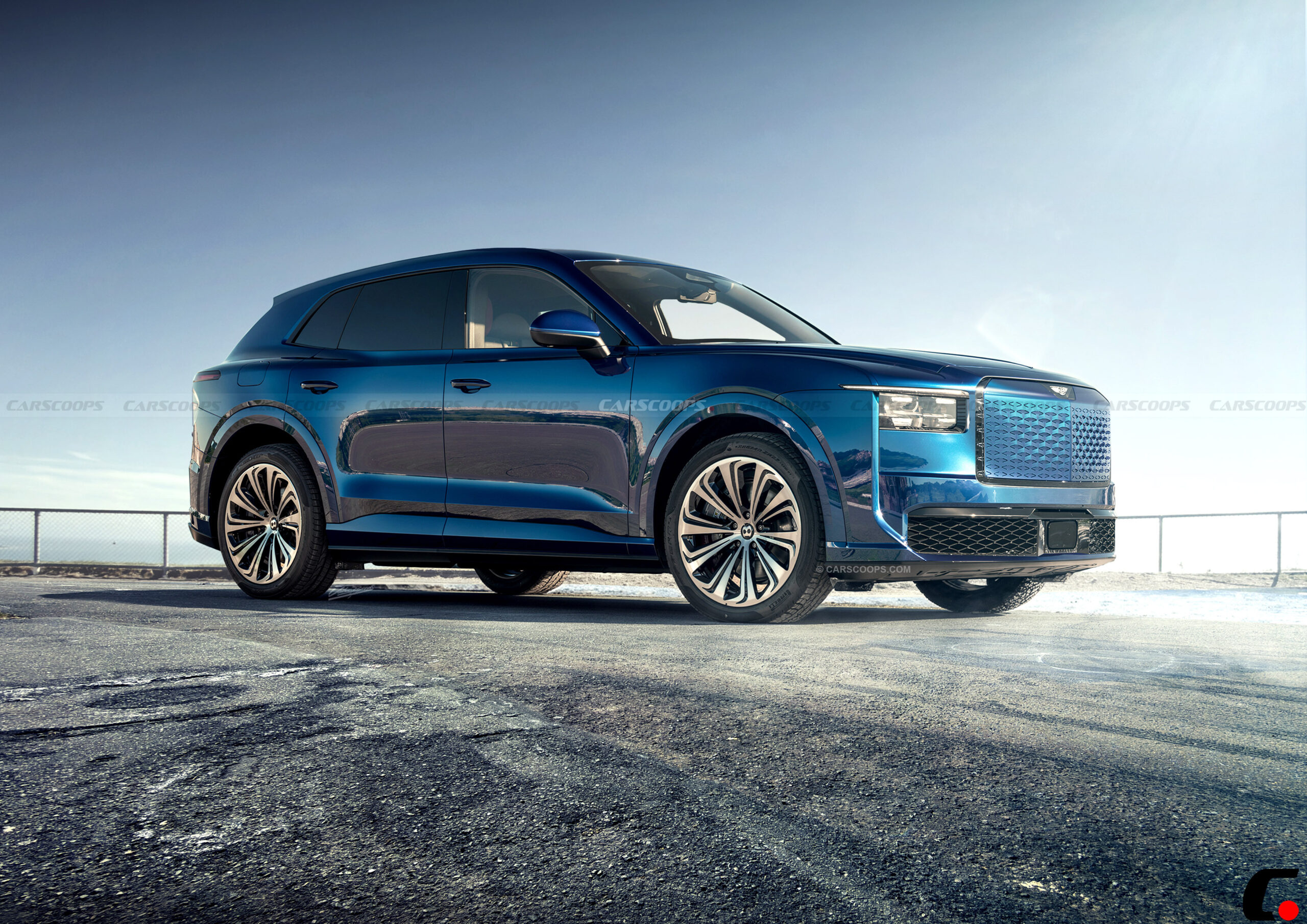
Our sleuths behind the lens have already captured heavily camouflaged prototypes testing in winter conditions, yet we’ve gone one step further by digitally decoding its design and exploring everything else we know ahead of its expected debut.

Sleeker Than The Bentayga

 Bentley Hasn’t Shown The Barnato SUV’s Face Yet, So We Did It For Them
Illustrations Josh Byrnes / Carscoops

Unlike the much-criticised Bentayga, the Barnato is a sleeker affair that draws part inspiration from the brand’s futuristic EXP 15 concept.

At the front, the fascia evolves Bentley’s familiar matrix grille theme into a closed-off interpretation that hints at its electrified powertrain. The headlights adopt four distinct lighting elements, accompanied by a horizontal DRL strip that spears into the front fenders, and lower down, a wide lattice-detailed intake aids cooling and aerodynamic efficiency.

From the side, it appears shorter and more athletic than the Bentayga, with pronounced muscular haunches and frameless windows adding a sportier character. A scalloped shoulder line emphasises stately dynamism, while at the rear, the SUV features slim, jewel-like LED taillights, and a  Taycan-style rear diffuser profile aids airflow.

Digital Cabin Experience

\\\\

SH Proshots

Inside, Bentley is mixing old-school craftsmanship with a very modern digital backbone. Front and center sits a sweeping curved OLED display that cascades into the center console, echoing the layout seen in the latest Porsche Cayenne Electric. It runs on Android Automotive OS, backed by quicker processors, sharper AI voice control, and access to downloadable apps. There’s even a 3D digital model of the Barnato embedded in the system, letting occupants manage various functions directly through the interface.

Also: Bentley Rewrites Its Future With A New Flying Spur Sedan That Breaks All The Rules

Other goodies will include an OLED instrument cluster with 3D overlays, an augmented-reality head-up display, and digital key functionality. A new three-spoke steering wheel features physical buttons and knurled scroll wheels, and we can expect seating configurations to include four- and five-seat layouts.

There’s also a curious bit of hardware carried over from the wider VW Group playbook. A multi-function left-hand column stalk, first seen on the Audi Q3, joins a right-hand stalk that doubles as the transmission selector, similar to the setup in the Volkswagen ID.4. Even so, the materials and finish leave no doubt about where this sits in the hierarchy. It still feels unmistakably Bentley.

Platform And Powertrain

\\\\\\\\\\\\

The Barnato rides on the VW Group’s Premium Platform Electric (PPE) architecture shared with the upcoming Cayenne Electric. Battery capacity is expected to reach 113 kWh, enabling high-performance and long-distance touring. Bentley claims 100 miles (160 km) of range can be recovered in less than seven minutes.

Using the electron-equipped Porsche as a reference point, power levels could range from 402 hp (300 kW/408 PS) to over 1140 hp (850 kW) in flagship variants. All models will likely feature dual-motor all-wheel drive as standard, with the rear motor featuring direct oil cooling to manage heat during sustained performance driving.

Rivals And Reveal

 Bentley Hasn’t Shown The Barnato SUV’s Face Yet, So We Did It For Them

The Barnato is being lined up for the top tier of performance SUVs, going head to head with heavy hitters like the Mercedes-Maybach EQS SUV, Rolls-Royce Cullinan, Lotus Eletre, Lamborghini Urus, Aston Martin DBXFerrari Purosangue and Luce, and the flagship Range Rover SV. Serious company, then.

Expect electrified offerings from Porsche to act as the technical yardstick here, setting the pace in areas like performance, software, and charging capability.

 Bentley Hasn’t Shown The Barnato SUV’s Face Yet, So We Did It For Them
Illustrations Josh Byrnes / Carscoops

Battery costs have declined by 99% in the last three decades, making electrified transport a reality

30 March 2026 at 00:00
Batteries have become much cheaper, making energy storage far more affordable.<br><br><a href="https://ourworldindata.org/battery-price-decline"><img src="https://ourworldindata.org/cdn-cgi/imagedelivery/qLq-8BTgXU8yG0N6HnOy8g/b0c1ea71-b663-4741-6574-67ffa449fe00/w=1024"/></a>

Security Expert Shares Key Indicators of Violence for School Transportation Safety

By: Ryan Gray
30 March 2026 at 02:05

CONCORD, N.C.— School bus drivers play a critical role in preventing violence and ensuring student safety, and a seasoned law enforcement veteran is on a mission to equip them with the skills to recognize and respond to warning signs of aggression.

Speaking at the STN EXPO East conferece Friday, security expert Bret Brooks of Gray Ram Tactical emphasized the importance of training drivers to identify behavioral and verbal cues that signal potential violence, empowering them to take proactive steps to de-escalate situations and protect lives.

He shared actionable insights to help bus drivers and school staff recognize warning signs of aggression and prevent violent incidents.

“Every single human being has the potential for violence,” said Brooks, a retired Missouri law enforcement officer with 23 years of experience. “Violence is simply a way of handling a situation. If we can understand the biology behind violence, then we can start to recognize it before it happens and take steps to de-escalate.”

Brooks emphasized that violence is a biological process triggered by seven universal factors: Family, order, restraint, resources, mate, insult, and life or limb. He explained that these triggers, which have evolved over thousands of years, are deeply ingrained in human behavior and can be activated in high-stress situations.

He likened violence prevention training to CPR certification, stressing the need for regular refreshers and hands-on practice. Just as CPR training requires participants to practice chest compressions on a mannequin, he explained, violence prevention training should involve real-world scenarios to prepare bus drivers for high-stress situations. Without such practice, he warned, drivers may not be equipped to respond effectively when faced with a crisis.

The importance of training bus drivers to recognize concealed weapons was another key point in Brooks’ presentation. He noted a troubling trend in which active shooters are increasingly arriving at schools via school buses.

“That means kids with guns, knives, or other weapons are boarding buses, and our bus drivers are unknowingly delivering the murderer to the victims,” he said.

Brooks shared a chilling anecdote about a school bus driver who recentlly and successfully identified a student carrying a gun and planning to harm his girlfriend.

“We just saved somebody’s life because the bus driver could see what was going on, took action and prevented the active shooter,” he said. “That’s what gives me the motivation to keep moving forward.”
Throughout his presentation, Brooks outlined key nonverbal and verbal cues that can signal potential violence. He stressed the importance of observing clusters of behaviors rather than relying on a single indicator.

For example, excessive staring or avoiding eye contact, dropping the chin to protect the airway, rapid or deep breathing, flared nostrils, wringing hands, shedding clothing, standing with feet shoulder-width apart, and shifting weight can all signal aggression. Similarly, verbal cues such as strained speech, increased pitch, parroting or echoing words, repetitive word usage, nervous laughter, forced air exhalation, mass statements, indifference in conversation, and escalating profanity can indicate a loss of self-control and a potential for violence.

Proactive De-escalation

Brooks emphasized the critical role of de-escalation in preventing violence. He explained that when someone’s triggers are activated, it is essential to act immediately to prevent the situation from escalating further. He shared a real-life example of a school bus driver who failed to de-escalate a situation with a student for over 15 minutes, leading to a physical altercation.

“The driver never asked the student why she wanted off the bus. What if she had said, ‘Because I’m being molested in the back.’ That would have changed everything,” Brooks said.

An attendee commented that her school district uitlizes crises prevention training and encouraged her peers to do the same.

Meanwhile, Brooks suggested that bus drivers play the “what-if” game to prepare for potential scenarios.

“Don’t wait for the bad thing to happen. Have a plan ahead of time,” the security expert said. “If you see the train wreck coming, you need to act.”


Related: ‘Care Less Without Being Careless’ Urges Security Expert to Student Transporters
Related: School Violence Grant Provides Opportunity for Threat Assessment Training
Related: Times Are Changing … What Is Your Response to School Bus Violence?
Related: Q&A: Cybersecurity in Student Transportation: Why It Matters, Where It’s Headed


Brooks also acknowledged that the indicators of violence and de-escalation techniques for special needs students differ from those for the general population

“It’s imperative that we do special needs training,” he said. “Special needs drivers should be consistently trained to understand the unique triggers and indicators for these students.”

In closing, Brooks urged school transportation professionals to take violence prevention seriously and to recognize the importance of their role in ensuring safety. “This happens in every other school district, not just yours,” he said. “We have to be open enough to see things for what they are and act to prevent violence.”

By understanding the biological triggers of violence, recognizing key indicators and employing effective de-escalation techniques, school bus drivers and transportation staff can play a vital role in keeping students, staff and themselves safe.

Article written with the assistance of AI.

The post Security Expert Shares Key Indicators of Violence for School Transportation Safety appeared first on School Transportation News.

Gallery: STN EXPO East Tech Demos and Ride & Drive at Charlotte Motor Speedway

30 March 2026 at 01:45

CONCORD, N.C. – After a day of Bus Technology Summit and Green Bus Summit sessions, Sunday was capped off with a high-energy, racing-inspired Technology Demonstrations and Ride & Drive + Reception held in the NASCAR Cup Series Garage and the Quarter-Mile Oval Track at the Charlotte Motor Speedway. Attendees enjoyed a lively networking reception featuring dinner, drinks and entertainment.

Photos by STN staff. 

The post Gallery: STN EXPO East Tech Demos and Ride & Drive at Charlotte Motor Speedway appeared first on School Transportation News.

❌
❌