Normal view

There are new articles available, click to refresh the page.
Today — 9 June 2026Main stream

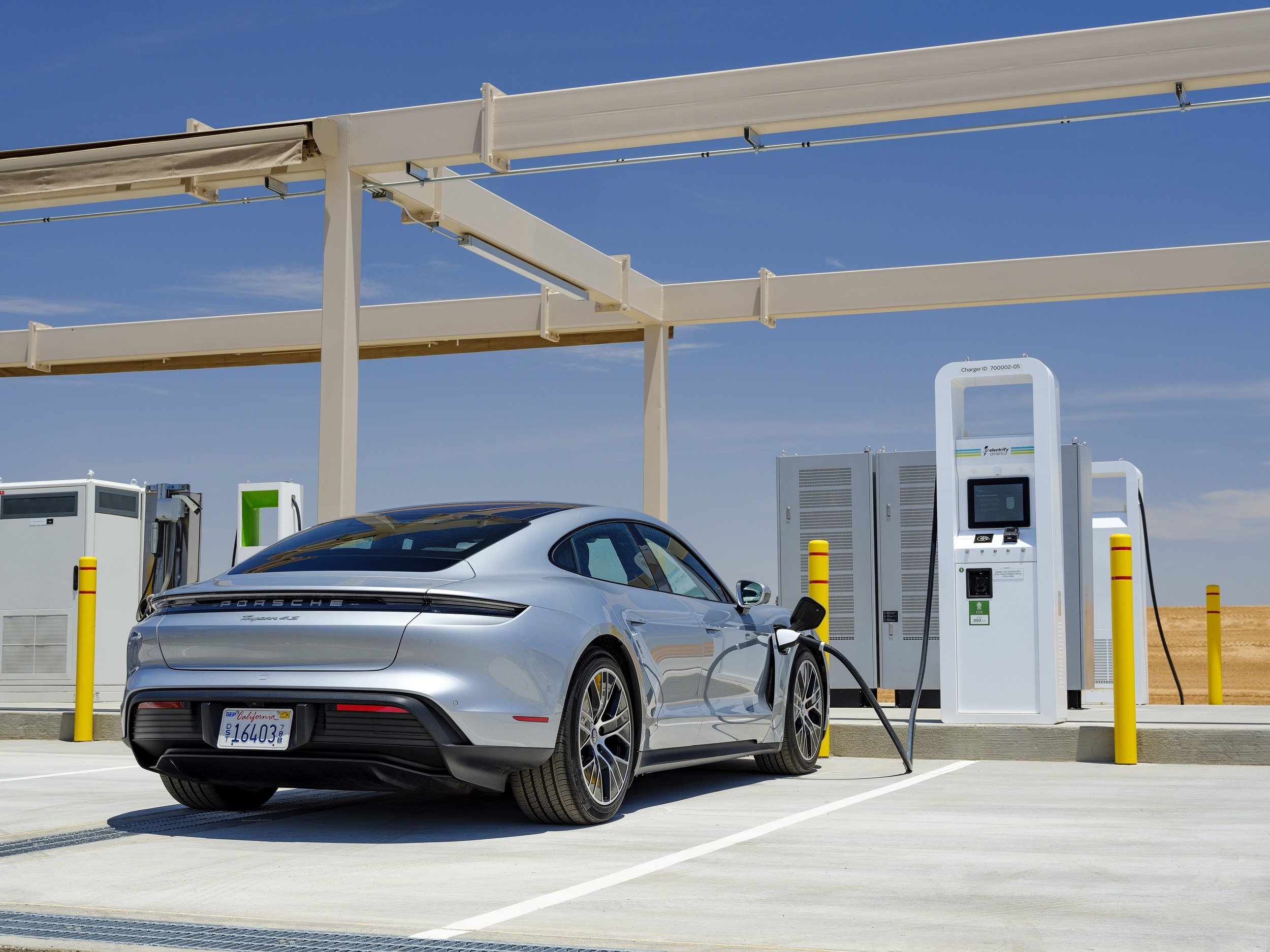
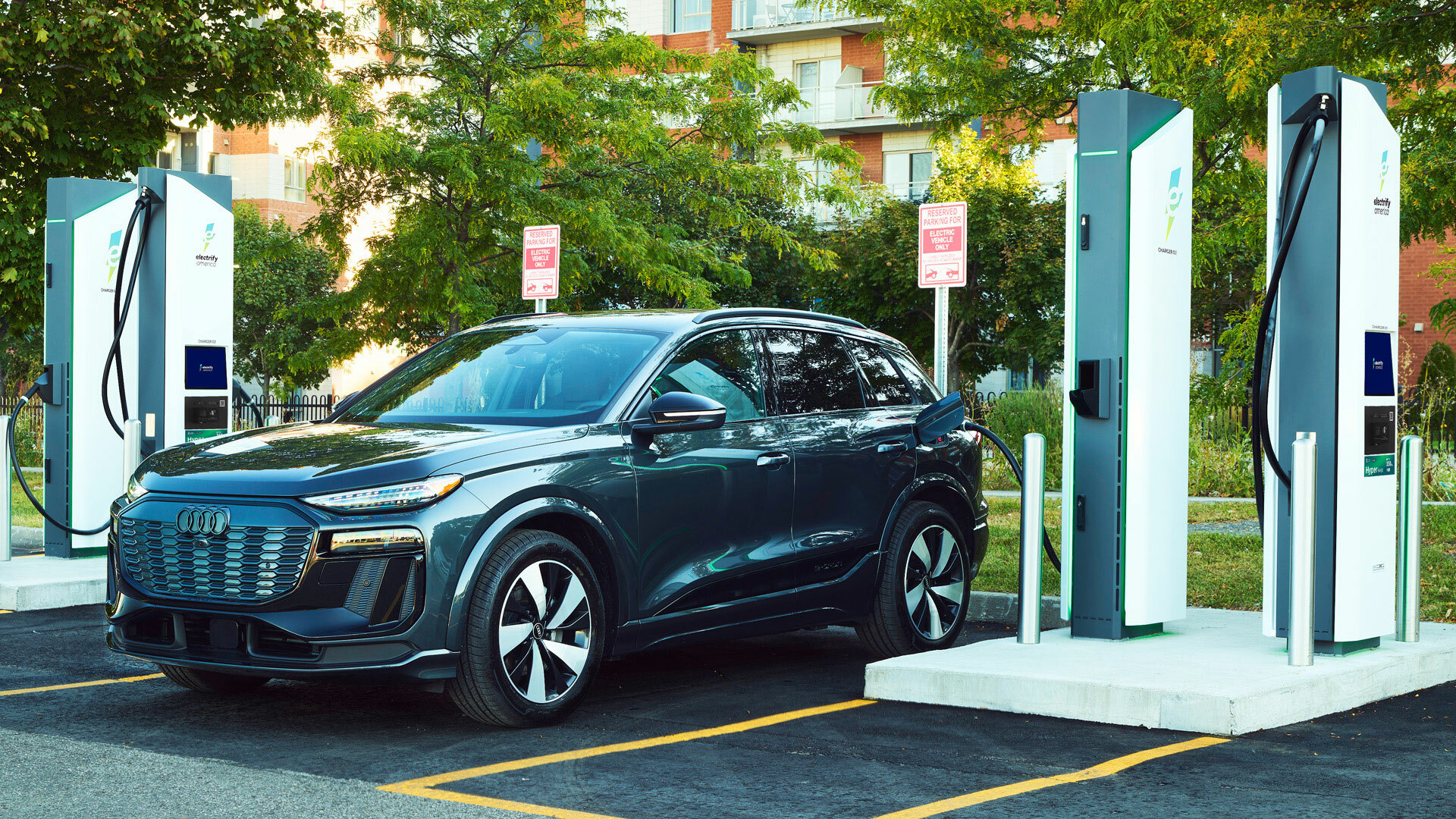
Massachusetts Got $64M In EV Station Funding, But There’s Not A Charger In Sight

  • The state has been moving at a snail’s pace to establish new charging sites.
  • Two vendors have been selected to construct charging locations in the state.
  • Several other US states have received funds but haven’t built new charging stations.

Nearly four years ago, Massachusetts landed $64 million from the Biden administration’s National Electric Vehicle Infrastructure Program, the massive $5 billion national push to seed thousands of new charging stations across the country. It is now mid-2026, and the state has yet to turn any of that money into a single working charger.

Two years ago, the state selected three vendors to identify possible locations for the new charging stations. Only two of them, Applegreen and Global Partners, have signed contracts, and both companies, along with the state Department of Transportation, have stayed conspicuously tight-lipped about what’s actually happened since.

Read: Sixteen States Say Trump’s Admin Is Illegally Holding EV Money Hostage

The Commonwealth Beacon reports that Applegreen and Global Partners have spent roughly $4 million between them on engineering, permitting, and procurement. There are finally signs of progress, but MassDOT isn’t saying why things have crawled along this slowly.

According to MassDOT spokesperson Marshall Hook, Applegreen recently placed an order for EV charging equipment for sites in Greenfield and Newburyport, with construction expected to begin in July. Global Partners, meanwhile, has ordered the equipment needed to set up stations in Lancaster, Raynham, and Wrentham.

Too Slow For The EV Transition

\\\\

“The slowness of adoption here is mystifying,” former state transportation secretary Jim Aloisi said. “If your approach to transportation sector decarbonization is largely about the transition to EVs, then you should be spending a fair amount of effort accelerating the process of getting people to adopt EVs, and one way to do that is obviously to roll out the NEVI initiative. That’s the disconnect.”

Massachusetts is hardly the only state dragging its feet on getting these federally funded chargers running. A website tracking the NEVI program shows that plenty of states have received tens of millions of dollars without building a single station, including Florida, Iowa, Louisiana, North Dakota, Oregon, Alabama, Arizona, and, surprisingly, even California.

On the flip side, some states have put the money to work. Texas, for one, already has several NEVI-funded charging stations in operation, with many more at various stages of construction.
 Massachusetts Got $64M In EV Station Funding, But There’s Not A Charger In Sight
Before yesterdayMain stream

The Lucid Air Can Lose Power Mid-Drive, But The Fix Only Comes After It Does

  • Lucid is recalling a total of 2,039 vehicles built over 14 months.
  • The Gen 4 inverter used in the Air Pure RWD can trigger a loss of power.
  • The issues were first prevalent across Air models used by a fleet operator.

Lucid has been in the news for all the wrong reasons in recent weeks. Not only has it been forced to buy back an Air from popular YouTuber Jason Fenske due to a dizzying array of faults, but it was also recently forced to recall vehicles with half-shaft bolts that may not have been properly secured. It’s now been prompted to issue yet another recall, once again for the Air.

As with April’s recall, this one is also limited to the Air Pure RWD models. The electric car manufacturer says these vehicles have its Gen 4 inverters, which may experience signal interruptions and module failures due to damage from friction between internal connectors.

Read: Lucid’s Fix For Losing Drive Power Is A Notification That You’re About To Lose Drive Power

If the connectors sustain damage, it could cause a complete loss of power, as it’ll prevent the inverter from converting DC power into the AC power needed to operate the motor. This is obviously a safety issue, particularly if the failure occurs while driving.

A total of 2,039 vehicles are involved in this recall. All of them were manufactured between September 13, 2023, and December 12, 2024.

OTA Update Before Replacements

 The Lucid Air Can Lose Power Mid-Drive, But The Fix Only Comes After It Does

Lucid first noticed inverter failures in March 2025, in cars run by a US fleet operator. The early assumption was that fleet use explained it, since those vehicles pile on miles far quicker than privately owned ones. That theory did not hold. Failures soon turned up in non-fleet Air Pure RWD cars too, and by March 2026, the company had logged 55 of them.

Rather than immediately replacing all inverters, Lucid will roll out an over-the-air software update that detects potential failures and triggers a warning on the instrument cluster, which must be cleared by a dealer. Vehicles that receive this warning will be eligible for inverter replacement. Owners of vehicles who don’t receive this warning won’t be eligible for a replacement.

 The Lucid Air Can Lose Power Mid-Drive, But The Fix Only Comes After It Does

72% Of New EV Buyers Just Traded In A Gas Car, Even After Losing The $7,500 Credit

  • EV trade-in rates rose from 67.1% to 72.1% between January and April.
  • Used EV wholesale values jumped 11% this year and beat ICE prices for weeks.
  • Analysts urge caution, citing high rates and more expensive gasoline.

Data from Edmunds suggests the shift from gas to electric is gaining momentum at the dealership level. In January of this year, 67.1% of new EV purchasers at dealerships traded in a gas car. In April of this year, that figure had jumped to 72.1%. And it’s not just a first-time fad. Repeat EV purchase data also show an increase.

Numbers for January 2026 show that 26.2% of buyers traded in an old EV for a brand-new one. That figure leaped to 35.4% in April. Worth noting: this uptick comes despite the removal of the federal $7,500 EV tax credit and several state-level incentives. So, is this a definitive trend, then?

Read: America’s Used EV Market Is Heating Up For One Simple Reason

Speaking to CNBC, Ivan Drury, Senior Director of Insights at Edmunds, says it’s too early to draw a concrete conclusion, or to say whether it’s just the effect of the Middle East War and its resulting runaway fuel prices. “Oil and gas prices started rising after the U.S. and Israel attacked Iran on Feb. 28. About three more months of high gas prices and elevated EV trade-in numbers will give a better indication of whether customers feel pinched enough at the pump to consider a switch…” says Drury.

Car Prices Are Rising, But Especially EVs

With auto prices rising across the board, whether you buy a brand-new car or a used one, the chances are you’ll be paying more for it now than you would have six months ago, and much more than in 2020.

 72% Of New EV Buyers Just Traded In A Gas Car, Even After Losing The $7,500 Credit
Cox Automotive

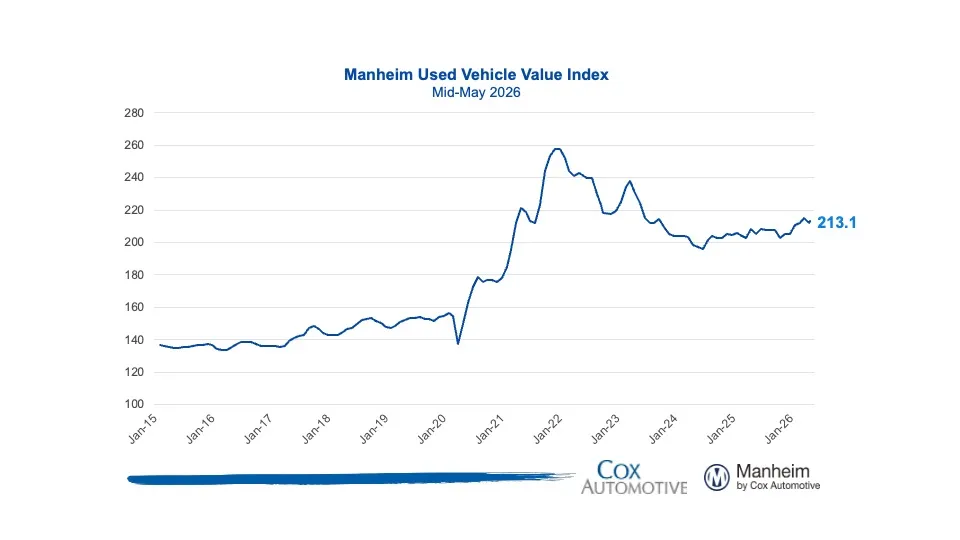
According to Cox Automotive, their Manheim Used Vehicle Value Index is approximately 4% higher than at the same time last year. And they’ve seen EVs leading the charge, with price increases notably higher than regular gas-powered vehicles.

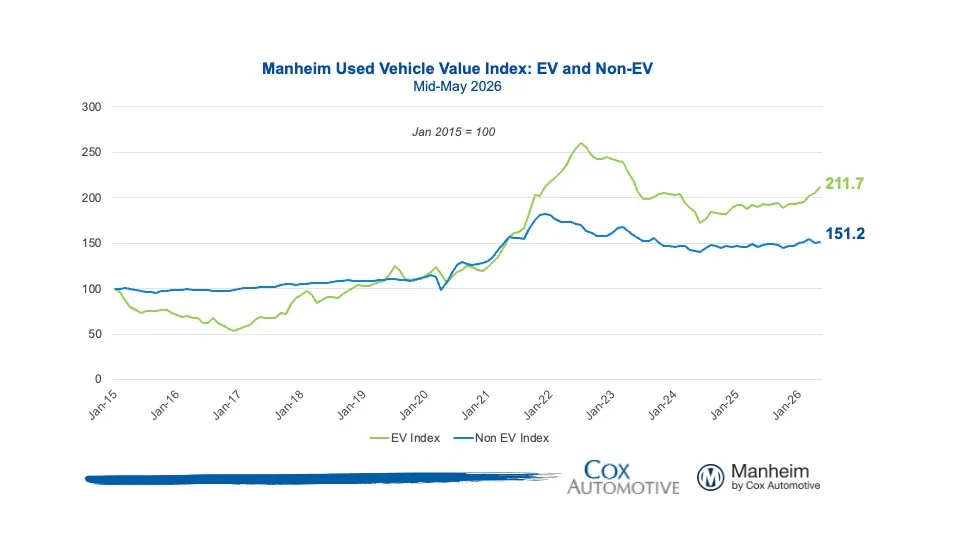
“Additionally, we continue to see EV prices rising faster and holding higher than non-EVs. Three-year-old EV prices have outpaced non-EVs for six weeks in a row and are 11% higher than they were at the start of the year. The longer gas prices remain elevated, the more we expect consumers to turn to fuel-efficient vehicles.

“As EV lease maturities continue to increase throughout the summer, it will be critical to follow EV price trends—especially if the Middle East conflict remains unresolved.” says Jeremy Robb, Chief Economist at Cox Automotive. So, it seems that buyers are willing to pay more upfront if it means lower running costs, which EVs have offered for quite some time now.

Unsurprisingly, ICE SUVs Have Appreciated Least

It’s no surprise to see that out of all the categories analyzed by Cox Automotive, used gas-powered SUVs and CUVs have appreciated by just 0.3% on average since last year. Given their gas-guzzling tendency and resultant tugging at pocket strings, it’s to be expected.

 72% Of New EV Buyers Just Traded In A Gas Car, Even After Losing The $7,500 Credit
Cox Automotive

Equally unsurprising is the fact that compact cars, a relatively fuel-efficient segment in the internal combustion engine class, saw the second-highest increase, at 7.6%. As Drury would likely agree, the data points in an interesting direction — but it’s still too early to call it a structural shift rather than a gas-price reaction.

 72% Of New EV Buyers Just Traded In A Gas Car, Even After Losing The $7,500 Credit
Chevrolet

DC Turns Streetlights Into EV Chargers, And Dirty Diesel Foots The Bill

  • Washington, D.C. is funding new curbside EV charging projects across the city.
  • Voltpost will retrofit existing streetlights and utility poles into Level 2 chargers.
  • Officials hope easier charging access will encourage more residents to switch to EVs.

There’s no doubt that the biggest issue facing electric vehicle adoption relates to range. Specifically, how fast and how easy it is to go from a low battery to a full one. While it’s easy to own an EV if you can charge at home overnight, it’s a totally different story for everyone else who doesn’t have that cheap daily access to power. Now, a company is trying to provide a solution, and it’s using existing street-side infrastructure to do it.

Rather than digging up sidewalks and installing entirely new charging stations, Washington, D.C., is helping fund a project that converts existing streetlights and utility poles into EV chargers. According to WJLA, the District’s Department of Energy and Environment (DOEE) recently awarded $609,500 in grants to three EV charging companies. One of the biggest winners is Voltpost, a startup that specializes in retrofitting existing poles with Level 2 charging equipment.

Read: Charging An EV Cost $11 More This Year, Filling A Sequoia Cost $1,623 More

According to the company, its chargers can be installed in just a few hours by leveraging existing electrical infrastructure. That means no major construction work, no trenching, and potentially tens of thousands of dollars in savings compared to traditional charging installations. The company says it plans to deploy up to 16 chargers around the city, though exact locations are still being determined in coordination with local agencies and utility provider Pepco.

Funded By Dieselgate, Not Taxpayers

 DC Turns Streetlights Into EV Chargers, And Dirty Diesel Foots The Bill
Photos Voltpost

Voltpost wasn’t the only recipient. PowerUp America received funding to expand its charging footprint, while curbside charging specialist ‘It’s Electric’ also secured grant money. Together, the three companies are expected to significantly increase public charging access across the District. Importantly, none of the funding comes from local taxpayers. The cash actually comes from the money allocated to D.C. from Volkswagen’s emissions-cheating settlement with the EPA.

If this approach proves successful, it could help build a guideline for how urban areas nationwide could add relatively inexpensive public charging without major infrastructural changes. That alone could make EV adoption that much easier for those who can’t charge where they live otherwise.

 DC Turns Streetlights Into EV Chargers, And Dirty Diesel Foots The Bill

Photos Voltpost

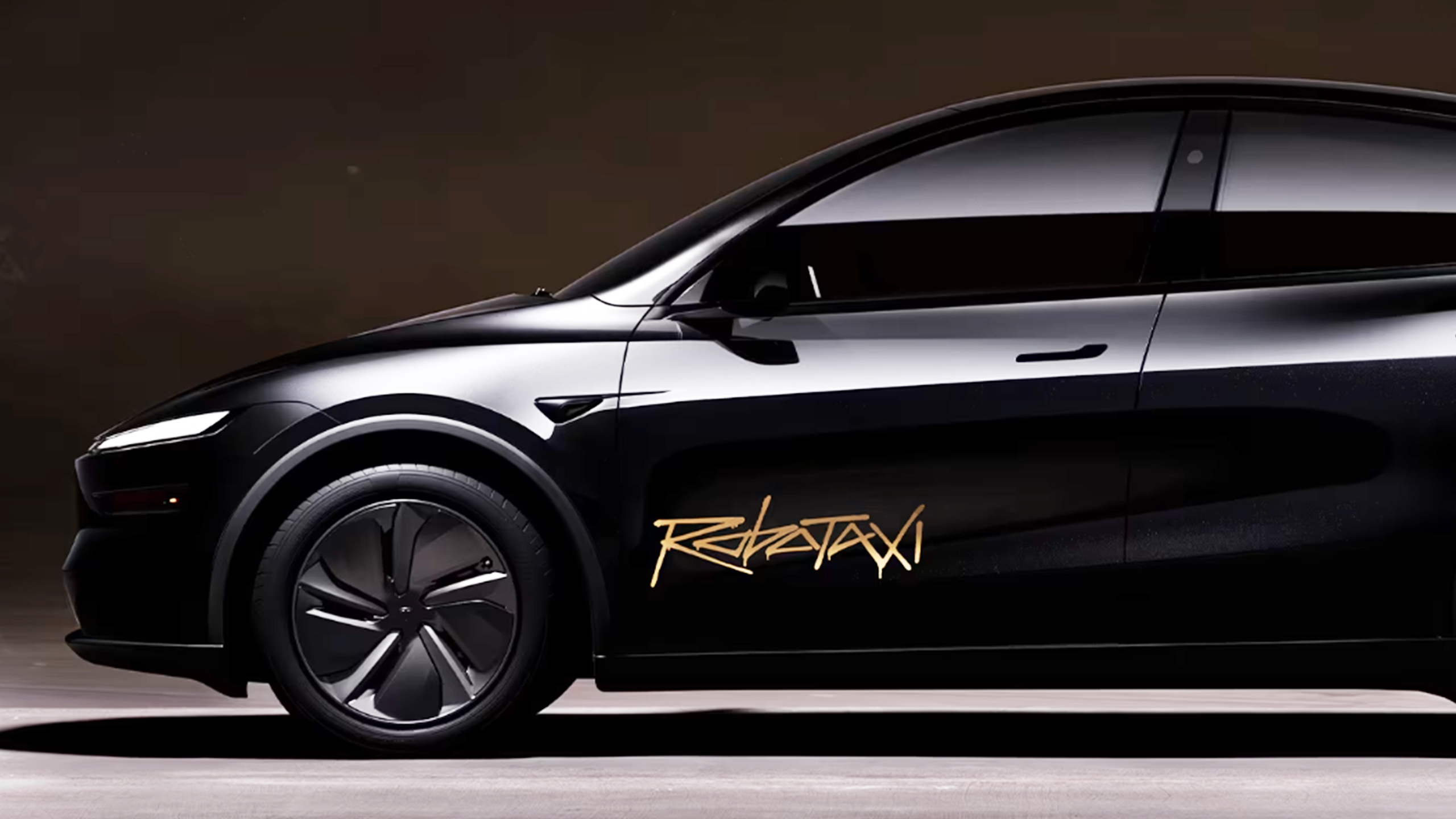
In 2020, Tesla Was Supposed To Have 1 Million Robotaxis. It Currently Has 20

  • Tesla’s current unsupervised fleet across the entire US is just 20 cars.
  • California regulators still block Tesla from running any unsupervised cars.
  • In the past 30 days, just 92 vehicles have been used in the robotaxi fleet.

Back in October 2019, Tesla chief executive Elon Musk told investors the company would have more than a million robotaxis on the road within a year. Six years on, Tesla has not only missed that deadline by an embarrassing margin, the US fleet it actually runs is getting smaller.

The long-promised robotaxi service finally launched in Texas last year, starting in a fenced-off corner of Austin with safety drivers riding shotgun. It has since spread to Dallas, Houston, and the Bay Area in California, but the scale remains a rounding error next to Waymo, the company that has quietly built the lead Tesla keeps talking about.

Watch: Tesla Robotaxi Driver Caught Asleep Proves Humans Are Still The Weakest Link

Data from the Robotaxi Tracker service reveals that across the four regions, Tesla has had just 20 unsupervised vehicles in use during the past seven days. Of these, 14 are operating in Austin, 3 are in Dallas, and 3 are in Houston. Crucially, California regulations continue to prevent Tesla from operating a single unsupervised robotaxi in the state. It’s not as if there are loads of human-driven Tesla robotaxis in the Bay Area, either.

The total fleet peaked around December 2025 and January 2026 and has been in steady decline ever since.

A Shrinking Fleet

 In 2020, Tesla Was Supposed To Have 1 Million Robotaxis. It Currently Has 20

Electrek reports that over the past week, the total number of cars operating in Tesla’s total robotaxi fleet, including supervised and unsupervised cars, was just 34 vehicles. In April, there were 107 vehicles operating in the Bay Area fleet, but currently there are just 9. Those Bay Area cars were never true robotaxis to begin with, operating with safety drivers under California’s Transportation Charter-Party permit.

An analysis of activity over the past 30 days shows that just 92 vehicles in total were used by the robotaxi service across the country, of which 33 were operating unsupervised. Most of these, 52 to be precise, are in use across the Bay Area. It’s worth reiterating, however, that these vehicles in California are driven by people, just like a normal ride-hailing service.

Tesla hasn’t explained why its robotaxi fleet is shrinking, but it’s likely related to safety issues that the company is experiencing. As we revealed in January, vehicles operating in Tesla’s robotaxi fleet were involved in an incident every 55,000 miles, roughly four times the average number of miles driven by people.  

 In 2020, Tesla Was Supposed To Have 1 Million Robotaxis. It Currently Has 20

Tesla’s Robot Eyes Missed 14,575 Stickers, Sending Every Owner Back To The Dealer

  • Tesla is worried owners may overload their Model Ys due to a missing label.
  • The safety concern has been blamed on issues with a vision-scanning tool.
  • Impacted Model Y owners will be alerted to the recall from July 17.

Recalls usually come dressed up in regulatory language that hides how mundane the underlying problem is. This one is refreshingly honest about it. More than 14,000 examples of the 2025 and 2026 Tesla Model Y are being recalled in the United States, and unlike most Tesla recalls, an over-the-air update will not fix it.

The recall says Tesla noticed a vehicle with a missing certification label during a routine audit of its Fremont factory last month. It was soon discovered that an automated vision-scanning tool, which verifies the presence of a properly affixed certification label, wasn’t performing as it should have.

Read: Tesla’s First Model Y Price Hike In Two Years Skips The Cheapest Version

The certification label lists the vehicle’s weight specifications, the numbers owners check before loading cargo or hitching a trailer. Without it, drivers can exceed those limits without realizing it, and an overloaded Model Y brakes, handles, and crashes differently than the one Tesla engineered.

What’s The Fix?

 Tesla’s Robot Eyes Missed 14,575 Stickers, Sending Every Owner Back To The Dealer

A total of 14,575 vehicles are caught up in the recall. The list includes 2,697 Model Ys built between November 17, 2024, and February 24, 2025, covering the 2025 model year, plus another 11,878 examples produced from February 25, 2025, through April 21, 2026. It is a large pool of cars, but Tesla says it is not aware of any collisions, injuries, or fatalities tied to the missing sticker, which is about what you would expect from a label-related defect.

Tesla says it repaired the automated scanning tool on April 17 at its Fremont, California, factory and also began performing manual checks to ensure newly produced models have the correct certification label. In addition, the scanning tool at Tesla’s Gigafactory in Texas was also fixed on May 7.

Owners of impacted Model Ys will be alerted to the recall from July 17, and Tesla will inspect affected vehicles and attach the certification label as required.

 Tesla’s Robot Eyes Missed 14,575 Stickers, Sending Every Owner Back To The Dealer

The 1,600 Jobs And $3.5 Billion Plant GM Promised Indiana Are Now On Hold

  • GM’s battery plant with Samsung was supposed to house 1,600 employees.
  • The plant would initially have 30 GWh of capacity for up to 300,000 EVs.
  • Site may switch from nickel-rich batteries to lithium iron phosphate batteries.

Another U.S. electric vehicle battery plant is on shaky ground as local EV demand keeps sliding. This one is the massive facility GM and Samsung have been building near New Carlisle, Indiana, and its future is now anything but certain.

The $3.5 billion plant was announced three years ago with initial plans for it to produce nickel-rich prismatic batteries. GM anticipated the site would initially have 30 GWh of capacity, meaning it could produce battery packs for up to 300,000 EVs annually. Capacity was then supposed to ramp up to 36 GWh.

Read: GM’s EV Dream Plant Is Now A Gas Powerhouse In The Making

The problem is what’s happened to the market since. With the Trump administration killing off the $7,500 federal EV tax credit, U.S. demand has cratered, and it’s getting harder for automakers and tech firms to justify writing checks this big for plants of this size.

GM has confirmed that construction of the plant will be paused. In a statement to Detroit News, GM spokesperson Kevin Kelly said: “Construction of the battery cell plant in New Carlisle, Indiana will be paused to align production capacity with current demand. GM and Samsung SDI will communicate plans for the site at a future date.”

The plan, for now, is to finish the building’s exterior as quickly as possible. However, after that, the future of the site remains unclear.

GM’s EV Mistakes

 The 1,600 Jobs And $3.5 Billion Plant GM Promised Indiana Are Now On Hold

It’s possible the car manufacturer could completely withdraw from its joint venture with Samsung, which is exactly what it did in late 2024 when it pulled out of its partnership with LG Energy Solution on a Michigan battery plant. GM reportedly sold its stake to LG for $1 billion.

An alternative is for GM and Samsung to remain partners and instead manufacture more common lithium-iron phosphate batteries at the site.

If GM pulls out of its joint venture with Samsung, it’ll come at a cost. The company has already revealed it took up to $8.7 billion in EV-related charges and write-downs in 2025, and the money invested in the Indiana plant could be yet another misstep in its EV strategy. The site was supposed to employ up to 1,600 workers and initially set to set producing battery cells this year, although this was later delayed to 2027 a couple of years ago.

 The 1,600 Jobs And $3.5 Billion Plant GM Promised Indiana Are Now On Hold

Waymo’s Self-Driving Cars Can’t Stop Diving Into Floods, So It Paused 5 Cities

  • Waymo has suspended robotaxi service across five major US cities this week.
  • The pause follows a recent recall covering nearly 3,800 autonomous vehicles.
  • One Waymo sat stranded in Atlanta floodwaters until a human stepped in.

For a company built on the premise that machines see the road better than humans do, getting repeatedly outsmarted by puddles is not a great look. The Alphabet-owned firm has suspended operations in five U.S. cities while it works out why its robotaxis keep mistaking flooded streets for drivable ones.

Read: Waymo Recalls Thousands Of Robotaxis After One Got Washed Away In A Flood

The flooded-road problem first surfaced earlier this month, when a Waymo robotaxi drove onto a submerged road in San Antonio, Texas, on April 20 and was swept into a creek. No one was on board, which is the only saving grace. The incident pushed Waymo to recall close to 3,800 robotaxis to fix how they handle these conditions.

The Atlanta Incident

While the company continues working on a fix, another one of its vehicles got stranded in floodwaters after heavy rain in Atlanta, Georgia, earlier this week. 10News reports the EV was stuck for roughly an hour before the floodwaters receded, at which point a human driver was able to jump behind the wheel.

Following the Texas incident, Waymo paused service in San Antonio, and the suspension now extends to Austin, Atlanta, Dallas, and Houston, partly in response to the severe weather sweeping across Texas this week.

Speaking with TechCrunch, Waymo says it uses National Weather Service alerts to prepare its vehicles for difficult weather conditions. However, in the case of the flash flood in Atlanta, it says a storm produced so much rainfall in such a short period that the robotaxi got stuck before any alert was issued.

As part of the recall issued last week, Waymo said it was rolling out operational restrictions in areas with an elevated risk of flooded, higher-speed roads, and added that work on a “final remedy” is still underway.

 Waymo’s Self-Driving Cars Can’t Stop Diving Into Floods, So It Paused 5 Cities

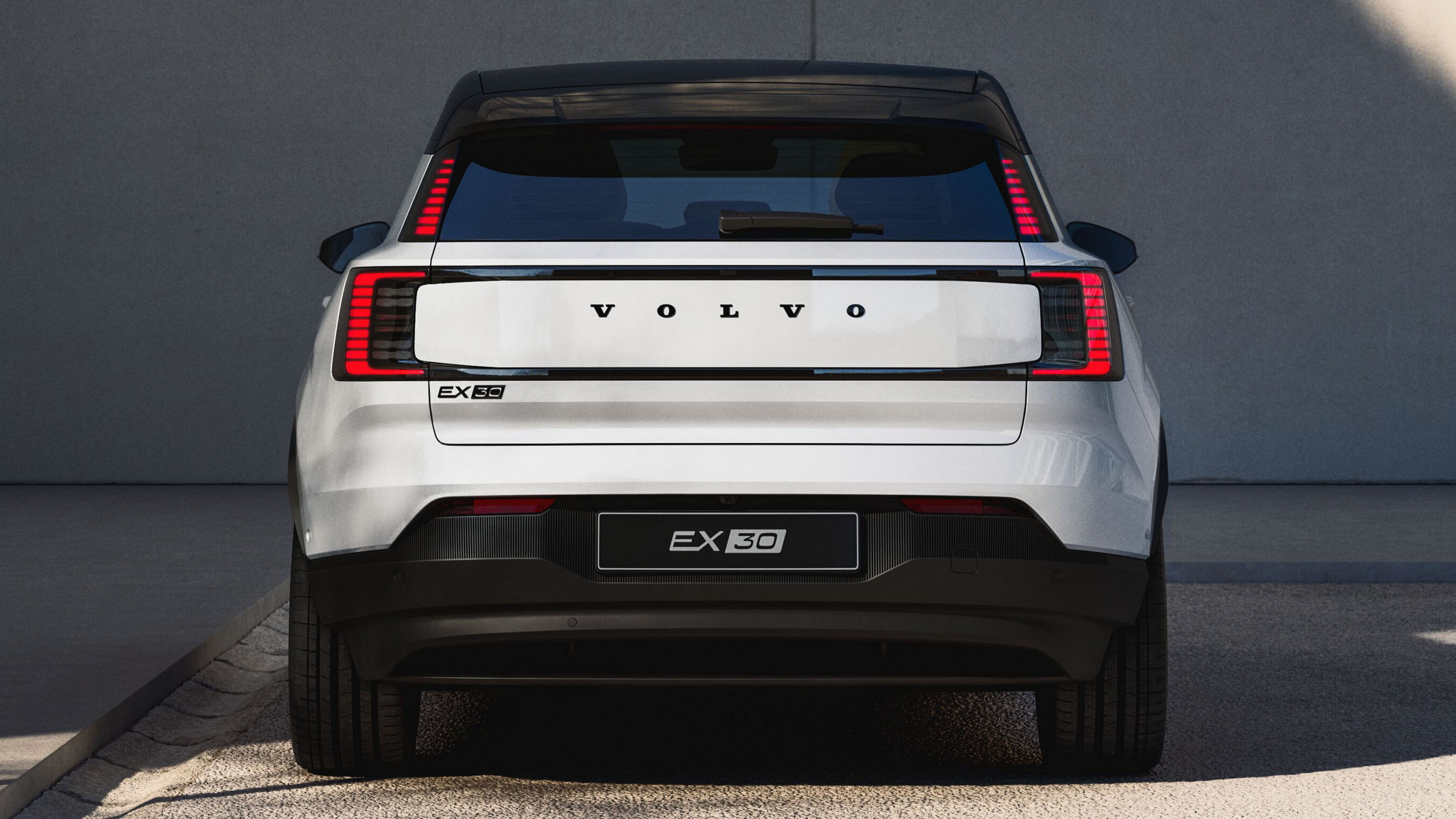
The EX30 Is Dead, But Volvo’s Next Cheap EV Is Already On The Way To America

  • Volvo confirmed a replacement for the EX30 is already in development.
  • The new electric SUV will arrive in North America sometime next year.
  • America boss Luis Rezende says the price will be very similar to the EX30.

That didn’t take long. Just a couple of months after Volvo confirmed it was pulling the EX30 from the US after the 2026 model year, the Swedish automaker has said it is already working on a replacement for its most affordable electric model.

Volvo Cars America president Luis Rezende dropped the news to reporters at the US launch of the larger EX60. While he stopped short of giving real specifics, he did confirm the new model will be priced in the same territory as the EX30. That matters, because the EX30 was originally meant to start at $34,950 before tariffs forced Volvo to add roughly $10,000 to the sticker.

Read: After Just Two Years, Volvo Drops Its Cheapest EV From America

“Very similar, I would say,” Rezende said when asked how the new model would compare to the EX30 on price, though it is not clear whether he meant the pre-tariff figure or the post-tariff one. “It’s going to be an EV that will deliver a lot of good things in a bigger space, but it will also be fun to drive, I can promise you.”

That last bit is the interesting part. The Verge reports that Rezende did not name the model, but evidence points to the next-generation EX40, which is already in development and will ride on the SPA3 platform shared with the EX60. The promise of “a bigger space” also lines up with what we know about the next EX40, which is set to grow over the outgoing car.

What Will It Cost?

 The EX30 Is Dead, But Volvo’s Next Cheap EV Is Already On The Way To America

Pricing will be key. The current EX40 starts at around $56,000, which barely undercuts the brand-new EX60 at $58,400 before destination. Volvo will have to slash costs significantly if it wants the future EX40 or whatever else it names it to be priced around the same mark as the EX30. Either that, or it’ll have to be a stripped-out, back-to-basics model like the base versions of the Tesla Model 3 and Model Y. Alternatively, it could be an all-new model that we don’t yet know about.

Either way, Rezende confirmed that the new model will launch in the US next year, so its development must have been underway for quite some time. Volvo is not going to leave the slot empty for long if it can help it.

\\\\\\\\\\

Tesla’s First Model Y Price Hike In Two Years Skips The Cheapest Version

  • Prices for three versions of the Model Y have increased in the US.
  • Premium RWD, Premium AWD, and Performance trims are now pricier.
  • A stretched six-seat Model Y may soon arrive in American showrooms.

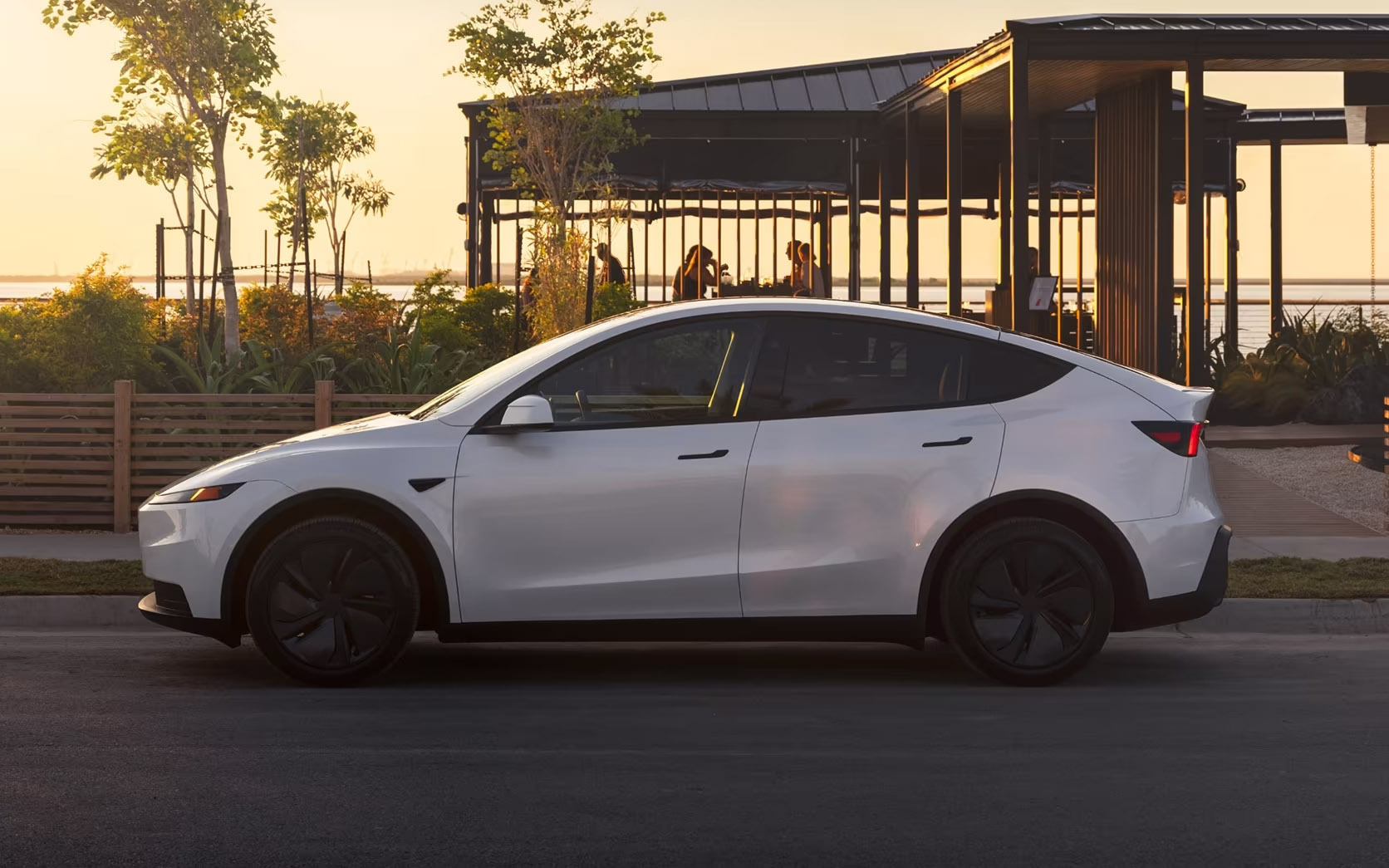
The Model Y still sits at the top of the American EV charts by a margin that borders on embarrassing for the rest of the industry. More than 357,000 found buyers last year, north of five times the volume of the Chevy Equinox EV, which finished 2025 as the best-selling non-Tesla EV. However, there’s some unwelcome news for those shopping for a new Model Y.

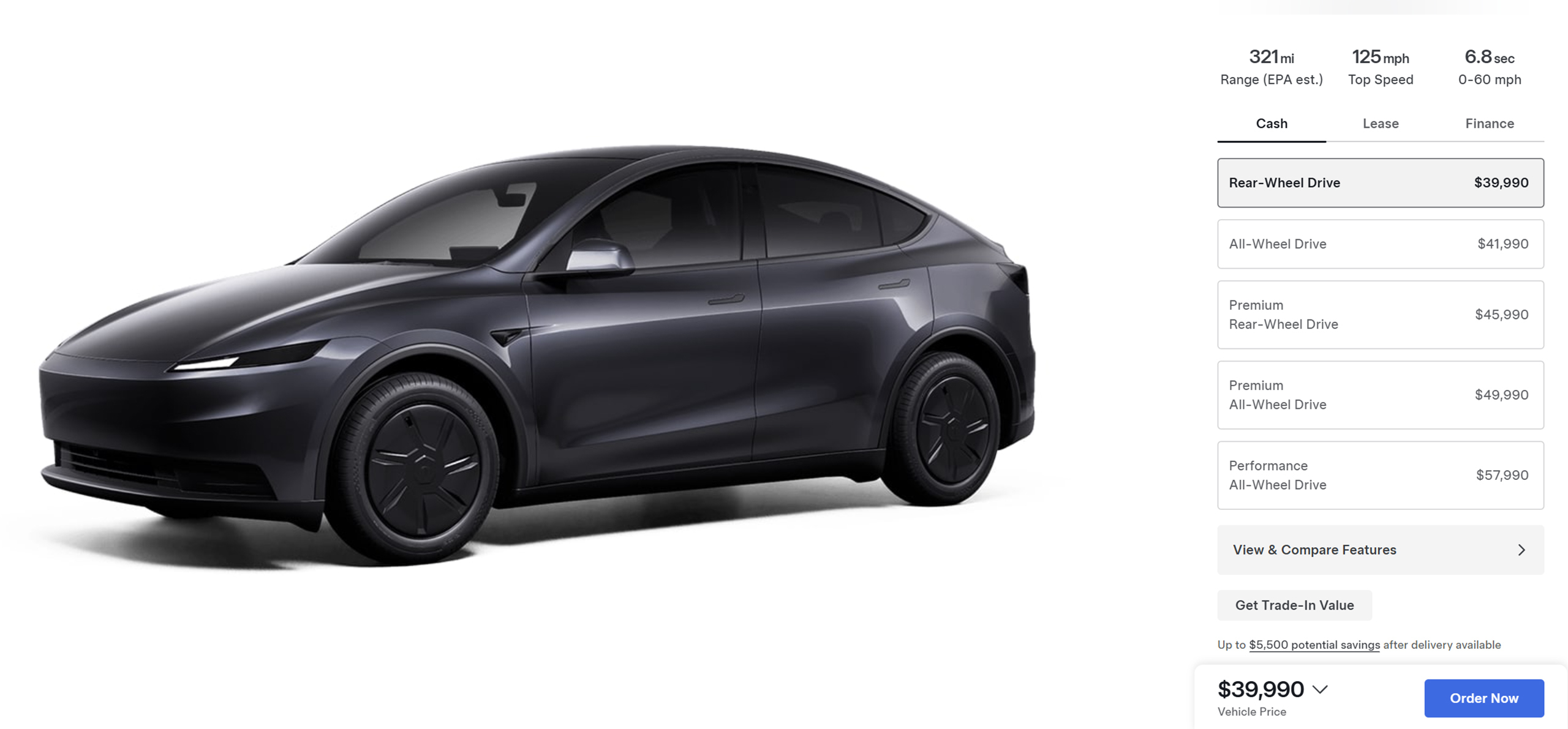
While the price hikes are relatively small, they may be enough to convince some to look elsewhere for their next EV. The entry-level Model Y RWD and AWD trims continue to start at $39,990 and $41,990 respectively, but the mid-range Premium RWD climbs $1,000 to $45,990, an increase of 2.2 percent.

Read: Tesla’s Model Y Just Became The First Vehicle To Pass America’s New Safety Tests

Tesla has applied the same $1,000 walk to the Premium AWD, which now lists at $48,990, while also bumping up the MSRP of the Model Y Performance from $57,490 to $57,990. All prices exclude delivery fees and local state taxes.

Getting Ready To Launch The Six-Seat Model Y L?

 Tesla’s First Model Y Price Hike In Two Years Skips The Cheapest Version

In typical Tesla fashion, the company has offered no explanation for the increases, and they have not been paired with the kind of model-year refresh other automakers usually point to when they tap the price tag. This is the first Model Y hike since 2024, which leaves the increases comfortably below the current 3.8 percent annual inflation rate.

The Model Y line-up may soon grow in the United States with the launch of the three-row Model Y L, first introduced in China and since added to the line-up in several other markets, including the UK and Australia. A prototype of the six-seat Model Y was recently spotted being tested on US roads, perhaps indicating that a local launch is imminent. If it does indeed land locally, prices will likely start just north of $50,000.

\\\\\\\

EVs Owners Could Be Hit With New $130 Annual Fee

  • EVs and plug-in hybrids could be hit by new fees from the US government.
  • Under a new proposal, EV owners would have to pay $130 annually.
  • Fee would then increase $5 every two years, before maxing out at $150.

Common ground is anything but common in Washington DC, but two key members of the United States House Committee on Transportation and Infrastructure have unveiled a new bipartisan, surface transportation reauthorization bill. It would last five years and see the country invest in America’s “roads, bridges, transit, rail transportation, and highway and motor carrier safety programs.”

The bill was unveiled by Sam Graves (R-MO) and Rick Larsen (D-WA), and is known as the BUILD (Building Unrivaled Infrastructure and Long-term Development) America 250 Act. The proposed piece of legislation is over 1,000 pages long and “focuses on proven surface transportation infrastructure programs.” It also promises the “largest ever investment in America’s bridges” as well as the “first-ever autonomous commercial motor vehicle framework.”

More: Congress Wants EV Owners To Pay New Fees As Gas Taxes Stay Frozen

While there’s a ton of things in the proposal, it calls on the Federal Highway Administration to impose new fees on eco-friendly vehicles. Electric vehicles would be charged $130 annually, while plug-in hybrids would get hit with a $35 tax. The fees would be collected by states and then passed onto the federal government.

Starting in 2029, the fees would increase by $5 every two years. However, they would be capped at $150 for EVs and $50 for plug-in hybrids. States can also keep up to 1% of the money collected for “administrative expenses.”

 EVs Owners Could Be Hit With New $130 Annual Fee

The new fees aim to ensure all motorists pay for repairs and upkeep as the government currently relies on a federal gas tax, which has been frozen for over three decades. It’s 18.4 cents per gallon of gasoline and 24.4 cents per gallon of diesel.

While that’s just one very small section of the BUILD America 250 Act, there are other interesting sections. As Reuters pointed out, one would require human safety drivers on autonomous school buses.

It’s buried on page 664 and says “The safety standard established under subsection (a)(1) shall require a human operator to be located within the vehicle during the operation of any ADS-equipped commercial motor vehicle transporting” hazardous materials or “primarily minors.” The latter, obviously, includes school buses.

 EVs Owners Could Be Hit With New $130 Annual Fee

Global EV And PHEV Sales Rise, But North America Lost Over A Quarter Of Its Buyers

  • Global EV and PHEV sales rose 6 percent year over year in April.
  • Europe carried the gains as Italy, France, and Germany surged.
  • China’s domestic market shrank 17 percent year to date in 2026.

The global plug-in market keeps tilting in odd directions. Demand for battery-electric and plug-in hybrid cars is up worldwide, almost entirely on the back of Europe, while the two markets that used to lead the charge are losing altitude.

According to data released by Benchmark Mineral Intelligence (BMI), roughly 1.6 million EVs and PHEVs were sold globally in April. That works out to a 6 percent year-over-year gain, though it represents a 9 percent step down from March, when subsidy expirations and climbing fuel prices pulled buyers forward. Europe is doing most of the lifting.

Read: Global EV Sales Just Fell 11%, But Carmakers Found A Surprising Backup Plan

European plug-in sales slipped 24 percent from March but jumped 27 percent against April last year, with just over 400,000 units moved. Italy nearly doubled its volume, while France climbed 36 percent, and Germany rose 33 percent. The war in Iran has fed into the trend as well, with EV and PHEV sales running up 19 percent year-on-year in January and February before the conflict, then accelerating to 30 percent growth across March and April.

A growing number of vehicles from Chinese brands across the region have also contributed to strong demand. This year, 22 percent of all plug-in cars sold in Europe were produced in China, despite being subjected to tariffs.

North America Falls

Things are very different in North America. Total EV and PHEV sales have slipped 25 percent year-to-date, while in Mexico they’re down 50 percent. In total, an estimated 120,000 EVs and PHEVs were sold in North America in April, down 28 percent from last year. Through the first four months of 2026, total sales sat at roughly 450,000 units. The introduction of the Electric Vehicle Affordability Program in Canada may help to boost sales throughout the rest of this year.

Global EV And PHEV Sales
RegionApr-26Y-o-YM-o-MYTDYTD-26 vs YTD-25
China850,000-8%-1.0%2.8 million-17%
Europe400,00027%-24.0%1.6 million26%
North America120,000-28%-9.0%450,000-25%
RoW240,000110%-4.0%840,00089%
Global1.6 million6%-9.0%6 Million-0.20%
SWIPE

Sales have also dropped in China. Year-to-date, they’re down 17 percent to around 2.8 million, with the decline largely concentrated in the smaller vehicle segments due to subsidy adjustments introduced earlier this year. In total, roughly 850,000 EV and PHEV models were sold in China in April, down 8 percent from last year.

Chinese automakers have made up for the domestic shortfall by shipping abroad. Between January and April, 1.4 million EVs and PHEVs left the country for export markets, more than double the same period in 2025. The cars are still being built. They are just increasingly being driven somewhere else.

 Global EV And PHEV Sales Rise, But North America Lost Over A Quarter Of Its Buyers

Honda Previews New Fastback Sedan And Next Acura RDX, And Neither Is An EV

  • Honda will roll out 15 hybrid models worldwide by the end of 2029.
  • Two new prototypes appear to preview the next Accord or Civic, and RDX.
  • A $9.9 billion EV write-down forced Honda’s full strategic reset.

Honda has overhauled its product strategy and put hybrid technology at the center of the global lineup, a course correction triggered by the costly cancellation of several high-profile EV projects. The automaker pulled the wraps off two prototypes that appear to telegraph the next Accord sedan and Acura RDX SUV, alongside a commitment to launch 15 hybrid models by 2029

The Honda Hybrid Sedan Prototype and the Acura Hybrid SUV Prototype will both reach production within two years. Honda has not named either car or even confirmed a segment, but the proportions tell their own story. The fastback-style sedan looks like the next Accord, though the Civic can’t be completely ruled out, while the SUV is unmistakably the RDX successor.

More: Honda’s $15.9 Billion EV Disaster Just Delayed The Next Accord, Odyssey, And MDX

The sedan wears a five-door fastback profile, sharp surfacing, slim LED lighting, and a small amount of black cladding. The boxy nose recalls the Civic development mule Honda showed last year.

\\\\\\

Honda Hybrid Sedan Prototype

On the other hand, the Acura SUV has a more sculpted body with aggressive front bumper intakes, toned shoulders, and V-shaped taillights. Its silhouette matches the official teaser from January 2026, leaving little doubt this is indeed a successor to the discontinued RDX.

More: Acura’s Losing Its RDX For Two Years, And Dealers Know What Happens Next

Both vehicles sit on a next-generation hybrid architecture due in 2027. Honda is targeting a 30 percent reduction in production costs and a fuel-economy improvement of more than 10 percent over 2023 levels. A new electric all-wheel drive unit is part of the package, alongside what Honda promises will be sharper driving dynamics. The next-gen ADAS suite follows in 2028.

Honda said that North America will be one of the “key focus regions” of the hybrid rollout. In 2029, the company will debut large hybrid models in the D-Segment and above, tailored to the needs of the region.

\\\\\

Acura Hybrid SUV Prototype

In order to support the rollout, Honda will “reallocate all excess capacity” at the Ohio plant to production of vehicles with gasoline and hybrid powertrains. Furthermore, all US plants will be converted to support production of hybrids.

Finally, the the joint venture between Honda and LG Energy Solution will switch part of the EV battery production to hybrid batteries while increasing local components by more than four times the current level to fight supply shortage and tariffs.

Other Markets

The Japanese automaker is doubling down on market-specific needs to stabilize its business foundation following a period of strategic realignment. In its home market, the focus shifts toward electrified kei cars, led by the upcoming N-Box EV scheduled for a 2028 debut. The next-gen hybrid and ADAS tech will be introduced in the updated Vezel, while the lineup will expand with Sport Line and Trail Line trim levels.

More: Honda Went To China, Saw The Future, And Reached Back To The 1960s

In India, the play is compact and midsize cars due in 2028, along with continued investment in the motorcycle business to expand local production. China is more complicated. Honda plans to use locally standardized components and roll out new electrified vehicles built on platforms supplied by Chinese partners.
Investing In Hybrids Over EVs

 Honda Previews New Fastback Sedan And Next Acura RDX, And Neither Is An EV

Honda is going through a challenging financial period, reporting its first annual net loss since 1957. The loss totaled ¥423.9 billion ($2.68 billion), largely driven by a massive ¥1.57 trillion ($9.94 billion) write-down following the restructuring and cancellation of EV projects.

Honda is still publicly optimistic about the recovery, targeting a record operating profit above ¥1.4 trillion ($8.86 billion) for the fiscal year ending March 2029.

More: Honda’s $11 Billion Canadian EV Plant Just Got Shelved Because America Wants Hybrids

The investment plan tells you everything you need to know about where Honda thinks the next decade is going. Of the ¥6.2 trillion ($39.25 billion) earmarked through 2029, ¥4.4 trillion ($27.85 billion) goes to gasoline and hybrid powertrains, with another ¥1 trillion ($6.3 billion) for software.

Spending on pure EVs has been trimmed to ¥0.8 trillion ($5.06 billion). Anything beyond that gets decided after 2030, and Honda has made clear it would rather partner with someone else than build its next EV platform alone.

\\\\\

Honda

Tesla’s Best Color Returns From The Model S Grave, Free On One Trim Only

  • Tesla has dropped Deep Blue Metallic and introduced Marine Blue.
  • Frost Blue Metallic from the Model S is now available for the 3 and Y.
  • Sadly, Frost Blue Metallic is only offered for the Performance models.

Tesla has never been known for offering particularly exciting or flamboyant paint schemes, generally opting for subtlety over pizzazz. However, the Model 3 and Model Y have just been updated with two new shades of blue in the United States, and both look superb.

The first new color is dubbed Marine Blue, and it’s available for the Premium Rear-Wheel Drive and Premium All-Wheel Drive versions of the Model 3 and Model Y. Marine Blue is a deep shade that replaces Deep Blue Metallic, which was brighter and a little more eye-catching.

Read: Americans Pay $37K For The Cheapest Tesla, Canada Got A Chinese One For $29K

As before, those shopping on a budget and looking to buy the entry-level Rear-Wheel Drive or All-Wheel Drive versions of the Model 3 or Model Y don’t get this new color and still only have Stealth Grey, Pearl White Multi-Coat, and Diamond Black to choose from.

In the US, Marine Blue adds $1,000 to the price of applicable Model 3s and Model Ys. In Canada, it costs CA$1,300 (US$940).

Exclusive Performance Color

\\\\\\

The second new color introduced by Tesla is Frost Blue Metallic. It’s exclusive to the Model 3 Performance and Model Y Performance. This isn’t the first time this color has been offered by Tesla, as it was previously available on the Model S and Model X before those models were discontinued. Of all the colors that Tesla offers, Frost Blue Metallic might be our favorite, alongside Ultra Red.

What’s more, Frost Blue Metallic is a no-cost option in the US. It’s also been launched for the Model 3 Performance in Canada, though it’s not yet clear whether it will be added to the Model Y Performance locally.

\\\\\\\

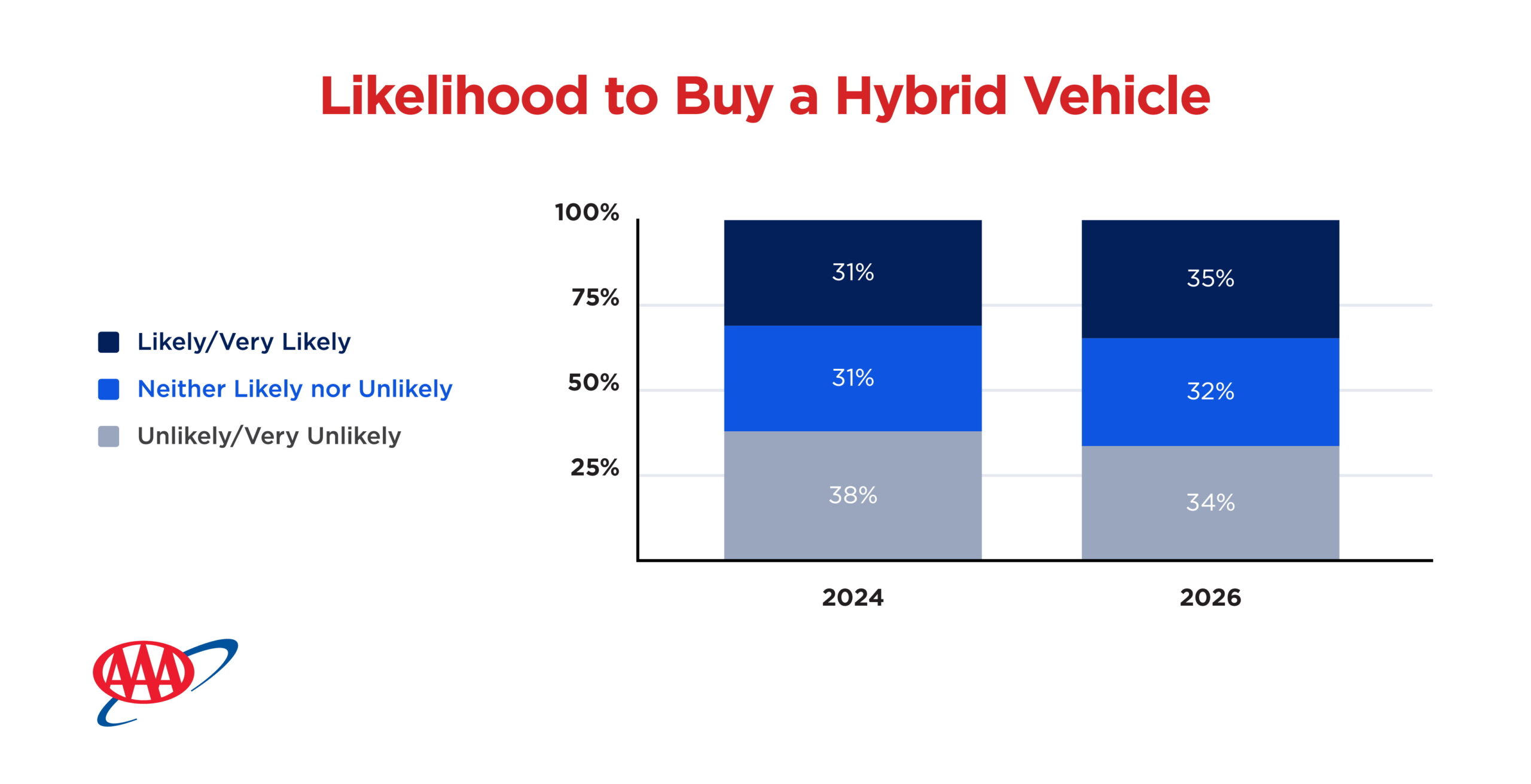
EVs Might Hate The Cold, But Hybrids Hate The Heat

  • AAA tested electric vehicles and hybrids in controlled climate conditions.
  • Cold weather had a much larger impact on EV driving range than heat.
  • Hybrids also lost efficiency in extreme temperatures during testing.

Got your hands on a shiny new EV or hybrid, and wondering why its range isn’t quite as much as quoted? Well, some of that discrepancy can be down to the controlled nature of official range tests, plus a healthy bit of marketing fluff.

But there’s another reason as to why that 300-mile EV or 800-mile plug-in hybrid isn’t quite making those headline numbers. It simply doesn’t like to run when it’s too hot or too cold outside. So what are the specifics, then? You can thank AAA for expanding and updating this line of research, which they began in 2019.

A Climate-Controlled Treadmill Test For Cars

 EVs Might Hate The Cold, But Hybrids Hate The Heat
Photos AAA

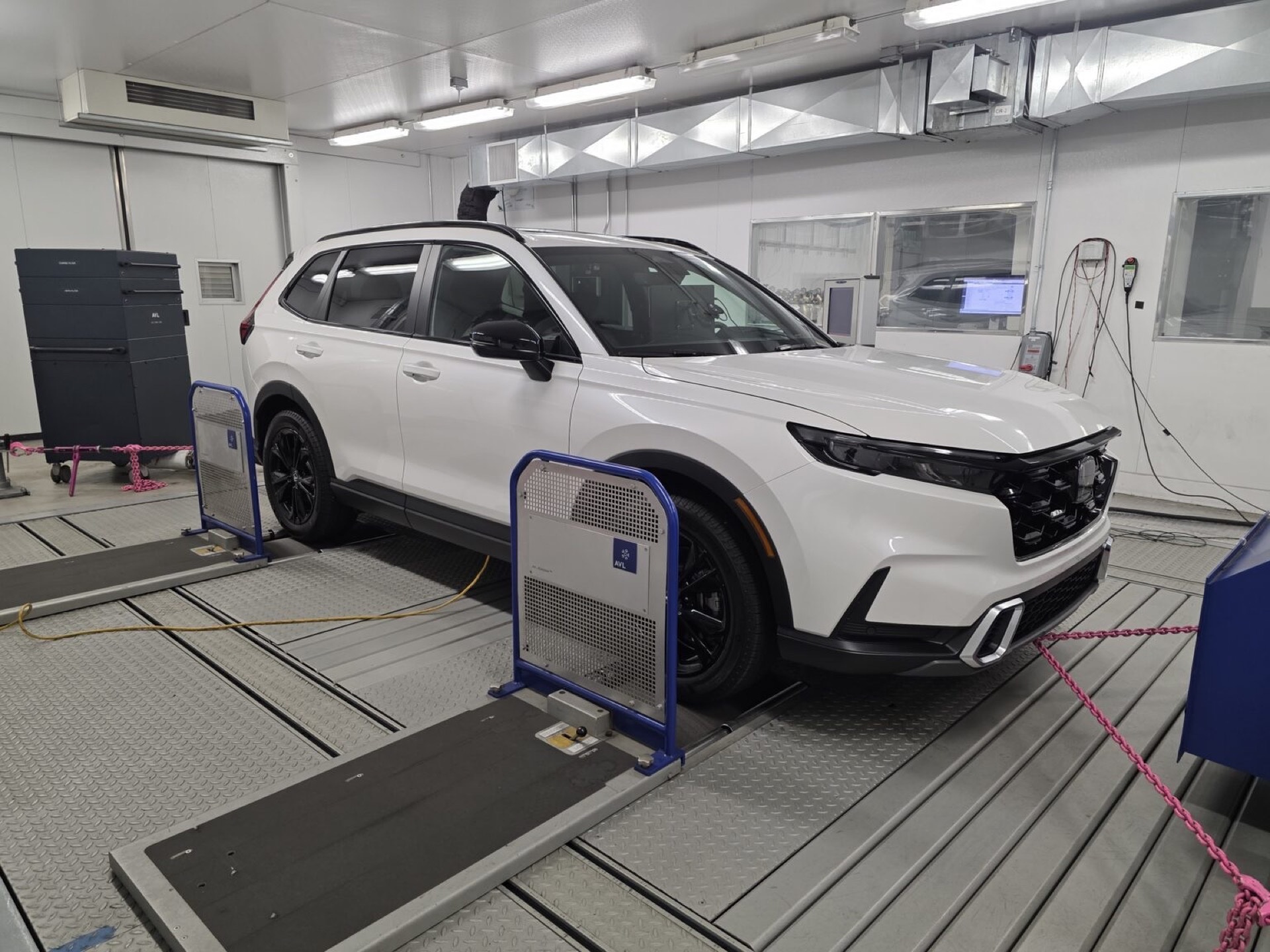
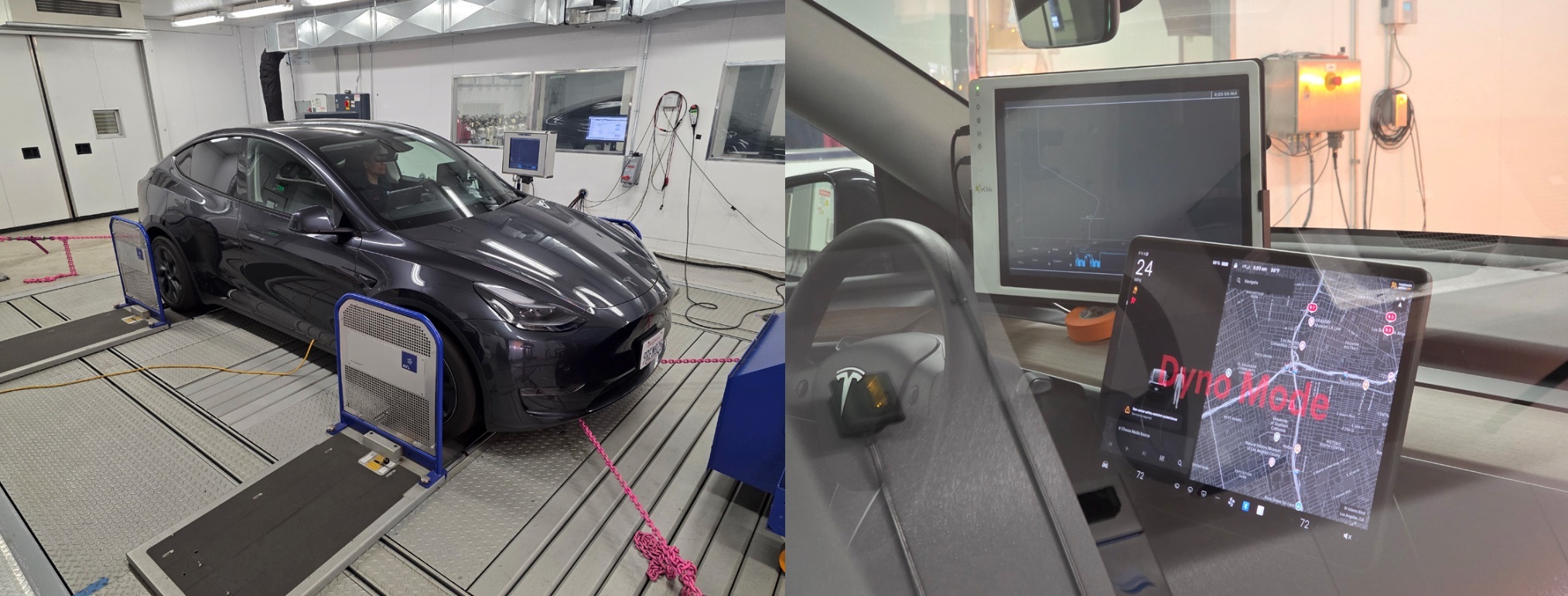
How they did this kind of testing is no less cool. They took three hybrids and three EVs and placed them in a laboratory test cell that included a dyno. In other words, it was the equivalent of running on a treadmill in a temperature-controlled room. Then, they set the vehicle’s air conditioning and heating systems to a comfortable 72F. Meanwhile, the test cell’s temperature was varied. Engineers at AAA settled on three temperature values – namely 20F / -6.7C (a cold winter), 75F / 23.9C (your average day), and 95F / 35C (a hot summer’s day). And they drove.

Read: EV Range Claims Still Sound Great, Until Freezing Temps Hit

Taking 75F / 23.9C as the baseline, AAA found that at 95F / 35C, the electric vehicles lost an average of 8.5% in driving range, corresponding to a 10.4% efficiency reduction. Hybrids fared worse, with a 12% decrease in fuel efficiency (miles per gallon). These values are noticeable, but unlikely to create a noticeable impact unless you tend to push the range envelope before recharging or refueling. This also means that your wallet will take a mild hit in terms of cost per mile.

Cold weather tests were rather more concerning. At 20F, the EVs saw a whopping 35.6% efficiency drop, resulting in an average range reduction of 39%. Hybrids also took a noticeable hit, with a 22.8% drop in fuel efficiency.

The Bottom Line

 EVs Might Hate The Cold, But Hybrids Hate The Heat
Photos AAA

If you live in a part of the world where winters and summers are mild, and the temperature generally hovers around 75F or thereabouts, congratulations, you don’t need to worry too much. If you live in a place where summers are hot, you’ll need to account for some extra range when purchasing your EV if you plan (or if your commute dictates) to run it down to 20% before every charge.

But if you live in a place where the winters are harsh, you may want to evaluate your options. As Greg Brannon, Director of Automotive Engineering and Research at AAA, said, “EVs are efficient in moderate temperatures but lose significant range in the cold. We expected this from our previous research, but were surprised by the 23% reduction in fuel economy for the hybrids in cold temperatures. Drivers should consider climate, energy costs, and driving patterns when choosing a vehicle that best fits their lifestyle.”

 EVs Might Hate The Cold, But Hybrids Hate The Heat
 EVs Might Hate The Cold, But Hybrids Hate The Heat

BMW’s New iX3 50 Is Cheaper Than Its Own Gas X3 M50. Its Range Embarrasses The Model Y

  • BMW’s first Neue Klasse SUV in America starts at $61,500 plus fees.
  • The 483 hp xDrive 50 posts 434 miles, leaving Tesla’s Model Y behind.
  • BMW charges $4,000 for the M Sport pack with glow grille upgrades.

BMW of North America has dropped two crucial numbers for its new iX3 electric SUV, and they couldn’t have come at a more important time. Up to 434 miles (699 km) of EPA range isn’t just impressive, it might be exactly what the sagging US EV market needs right now. As is the price, which makes the electric X3 SUV cheaper than a less powerful combustion X3.

That headline range figure, which is even better then the 400 miles (644 km) originally estimated by BMW stateside, puts it ahead of most rivals, though it does come with an asterisk. It only applies to cars equipped with the no-cost-option 20-inch summer tires. Stick with the default all-seasons 20-inchers and it drops to 383 miles (616 km).

Related: BMW iX3 Beats Its Official Range By Over 120 Miles In Real-World Test

Here’s where it gets really weird, though. BMW reckons you’ll get 399 miles (642 km) if you upsize to the $600 21-inch wheels and all-season rubber, which actually give you 1 mile (1.6 km) more range than the 21-inch summer tires offer. It sounds all wrong but BMW says the strange numbers are the result of averaging range figures across various tire brands.

You can check out the full range-to-tire stats in the table below, but whichever combo you pick, you’re going to be going further between fills than any other electric SUV in the sector. Tesla quotes 294 miles (473 km) for the base AWD Model Y, 327 miles (526 km) for the Premium AWD, and 306 miles (492 km) for the Performance variant. While we’re still waiting on official figures for the Mercedes GLC 400 4Matic, based on the difference between it and the iX3 in the European WLTP numbers, we’d expect its EPA range to be around 380 miles (612 km) at best.

2027 iX3 Electric Range Vs Tires
Wheel & Tire PackageMPGe CombinedRange (mi)
20″ Summer Tires (No-cost option)118434
20″ All-Season Tires (Standard)102383
21″ Summer Tires105398
21″ All-Season Tires105399
22″ Summer Tires104392
SWIPE

It Undercuts The ICE X3 On Price

But range, and an ability to charge at 400 kW, adding 185 miles (298 km) in 10 minutes, isn’t the only thing the iX3 has on its side. It’s also competitively priced. The iX3 50 xDrive costs $62,850 including a $1,350 destination charge, which means it costs less than the brand’s own gas-powered $67,850 X3 M50 xDrive.

It also gives you 463 hp (469 PS) and 476 lb-ft (645 Nm) to the ICE SUV’s 393 hp (399 PS) and 428 lb-ft (580 Nm), and though the six-cylinder SUV gets to 60 mph (97 kmh) a touch quicker (4.4 plays 4.7 seconds) than the EV, we bet it’s the iX3 that feels the more urgent when you jump on the right pedal for a passing maneuver.

That kind of pricing is designed to hook in American drivers who’ve lost interest in EVs lately. BMW’s electric sales sank 16.7 percent last year and cratered by 45.5 percent in the fourth quarter after the Trump administration axed the $7,500 federal tax credit program. Mercedes will now be feeling the heat to price its GLC EV as close to $60k as possible.

M Sport Trim A $2,500 Option

Naturally there are plenty of opportunities to add to the iX3’s $62,850 base price. Standard kit includes BMW’s Panoramic Vision pillar-to-pillar digital display, Perforated Veganza Upholstery, smartphone charger, Digital Key Plus (which uses your phone as a key) and umpteen safety aids. But plenty of buyers will want to add the $1,500 Comfort Package (heated steering wheel, panoramic glass sunroof and multifunction seats), or $1,900 Technology Package (BMW Iconic Glow illuminted kidney grille, 3D head-up display, Harman/Kardon hifi). Or maybe even both.

\\\\\\\\\\\\\

And the M Sport package is sure to be a big draw. The base version of the package costs $2,500 and nets you BMW M interior and exterior trim, 20-inch M Aero V-Spoke wheels and a sports steering wheel, while the $4,000 Professional version adds the Iconic Glow light-up grille, a proper M sport wheel and M Sport brakes with red and blue calipers. That’s as near as you’ll get to an iX3 M this year, though we expect to see one of those before long.

More Affordable iX3 40 Arrives Later

And if even an options-free iX3 50 is too pricey for your pocket, there may be a solution arriving shortly. Though BMW hasn’t yet confirmed it’s coming to US roads, information that mistakenly appeared briefly on the brand’s website earlier this year before being taken down, suggested the 50 xDrive would be joined by a rear-wheel drive 40 sDrive and all-wheel drive 40 xDrive.

Related: BMW’s Entry-Level iX3 Saves You Over $7K, But There’s A Real Trade-Off

BMW has already debuted the single-motor 40 in Europe in March, revealing that it makes 316 hp (320 PS / 235 kW) and downgrades to a 82.6 kWh battery. The new base model needs 5.9 seconds to reach 62 mph (100 kmh) and going by the 395 miles (636 km) WLTP range, will probably get an EPA rating of around 340 miles (547 km).

You can configure your iX3 50 now and reserve it for $1,000. Get in early and you should get yours when deliveries kick off in September.

\\\\\\\\\\\\

BMW

Hyundai Says Beating Chinese EVs Is Impossible, Ford’s $30K EV Is Betting Otherwise

  • Ford’s secret EV team is rewriting how the company builds vehicles from scratch.
  • A $30,000 electric pickup aims to rival Chinese automakers and Tesla by 2027.
  • Radical manufacturing changes could determine if Ford’s EV future survives.

Ford hangs its hat on the creation of the assembly line. Now, it’s literally tearing one apart in the middle of the night. That’s a part of the brand’s new strategy to win over more buyers. If it’s successful, the work it’s doing now will allow it to not just beat domestic automakers in the U.S., but to compete against China worldwide with a cheap but robust electric car.

More: Ford’s $30K Pickup Wants To Beat Cybertruck At Its Own Game

The “skunk works” project has been underway for quite some time now. Led by former Tesla and Apple employees, the team is aiming for something unheard of. It involves the confirmed $30,000 EV pickup truck (which can end up leading to several forms of cars) that offers some 300 miles of range and Mustang-like performance. That’s the kind of car that doesn’t exist in America, but it does exist elsewhere, namely China.

 Hyundai Says Beating Chinese EVs Is Impossible, Ford’s $30K EV Is Betting Otherwise

Ford’s CEO Jim Farley has tested Chinese cars in his everyday life. He’s also had a front row seat to the billions that his brand has burned through in building out its own EV platforms. According to the Wall Street Journal, that’s included too many parts, too much complexity, and old-school processes that don’t translate well to the EV space. So the team is cutting everything it can as aggressively as it can.

The manufacturing process itself is being flipped on its head. Instead of traditional step-by-step assembly, Ford is moving toward a modular system with large cast sections and fewer touchpoints. Put another way, it’s how Tesla and Chinese automakers build EVs today. According to Jolanta Coffey, the vehicle program director, “We’ve never blown the whole thing up before and just started over. If and when we build this, we will rewire Ford.”

 Hyundai Says Beating Chinese EVs Is Impossible, Ford’s $30K EV Is Betting Otherwise
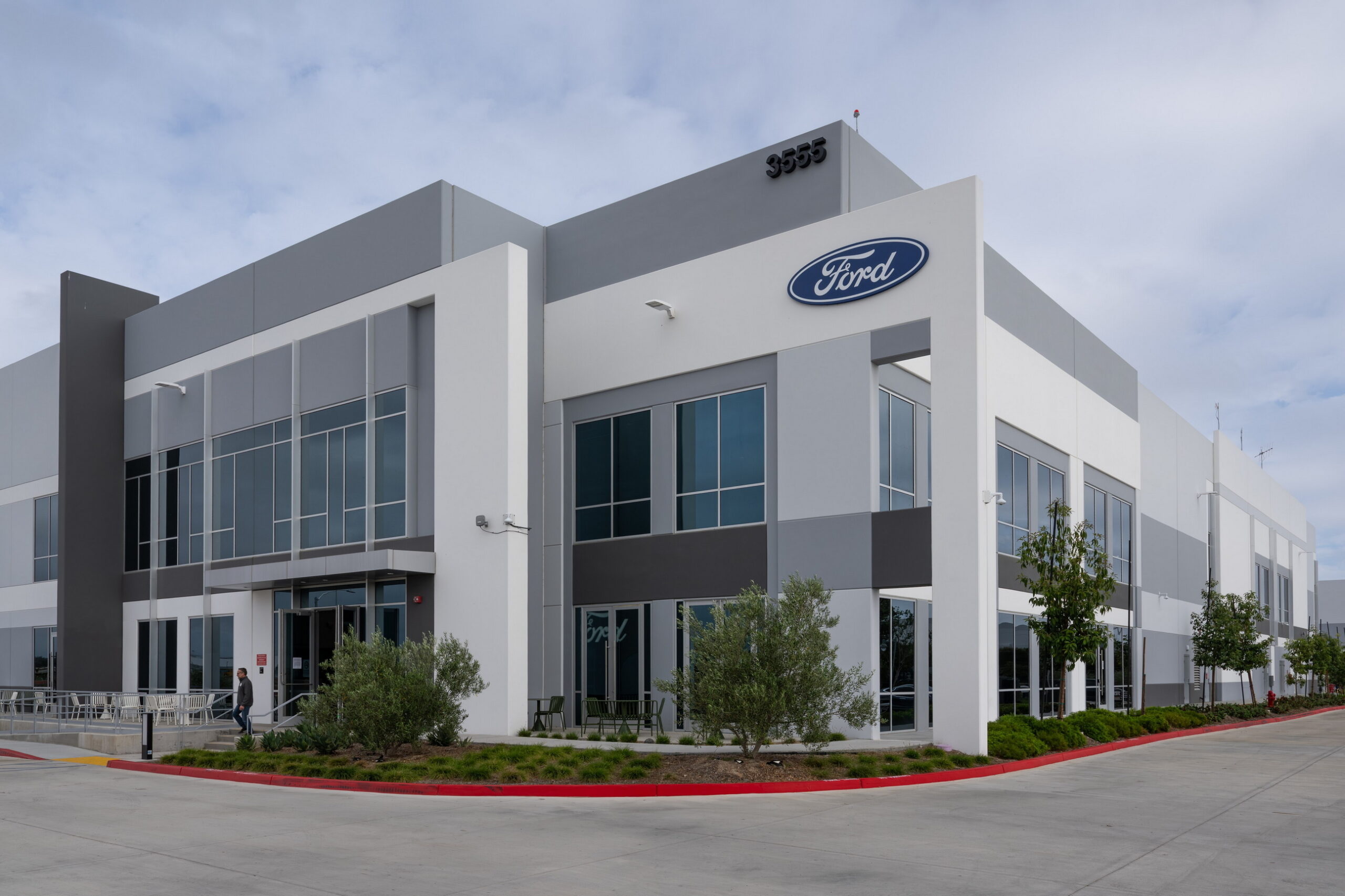
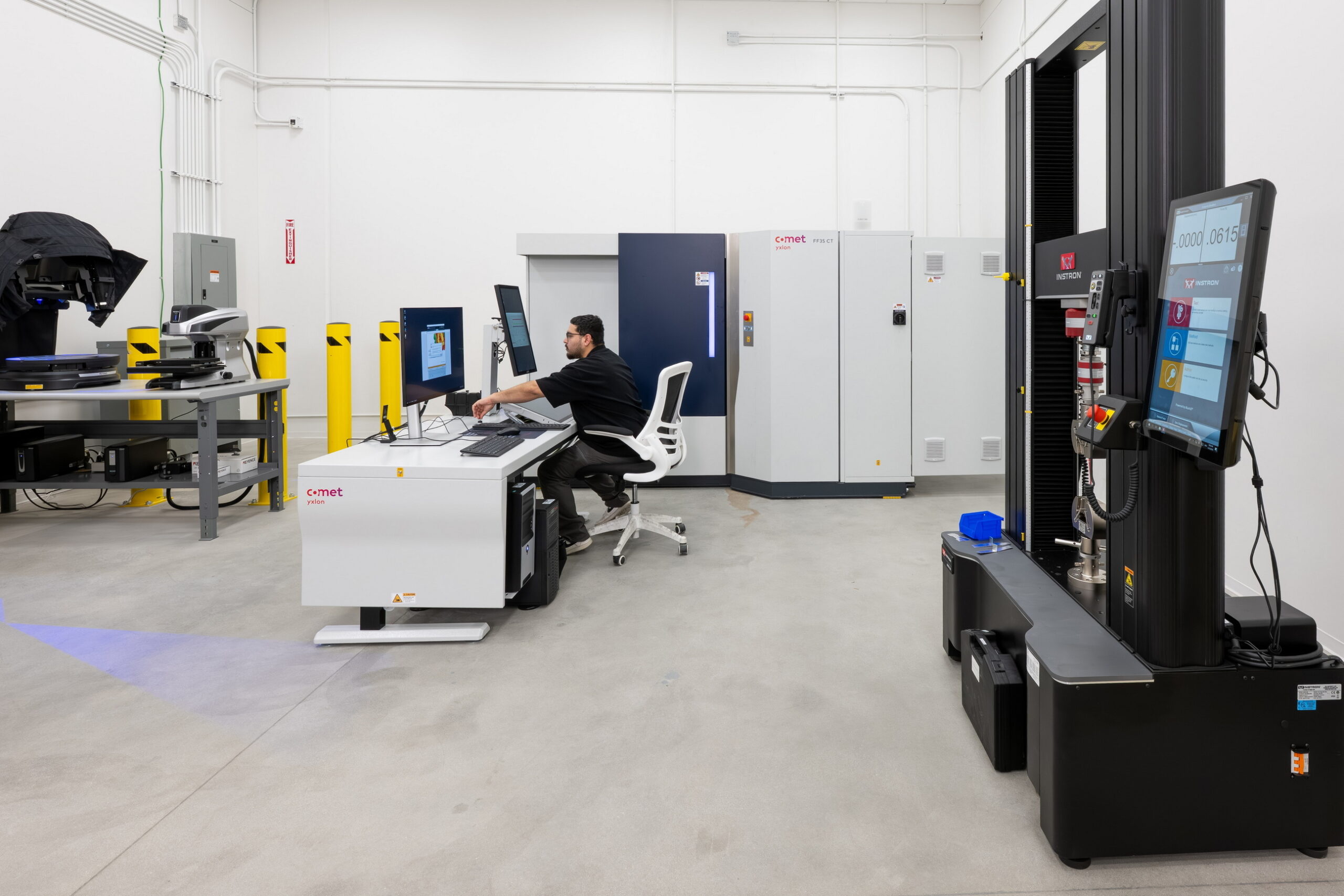
Ford’s electric vehicle development center

All of this comes at a turning point for much of the industry. Automakers abroad are continuing their push toward electrification while domestic automakers rethink the near future. Hyundai Motor CEO José Muñoz, recently said of competing with Chinese EVs, “It is impossible… Unless they are subsidized by the government.” Ford’s betting he’s wrong. We all get to see who ends up being right as Ford is aiming for a 2027 launch.

 Hyundai Says Beating Chinese EVs Is Impossible, Ford’s $30K EV Is Betting Otherwise
Photos Ford

Waymo’s Robotaxi Made It To San Jose, His Luggage Made It To San Francisco

  • The tech giant initially said it wouldn’t pay to ship the rider’s luggage back.
  • Waymo offered Di Jin two free rides to pick up his luggage from a depot.
  • As it turns out, there are some advantages to using human-driven taxis.

Taking a trip in one of Waymo’s robotaxis should be a smooth and stress-free experience, particularly since there’s no pressure to have an awkward conversation with a driver. However, for one Waymo user in California, taking a robotaxi to the airport left him without luggage for a business trip.

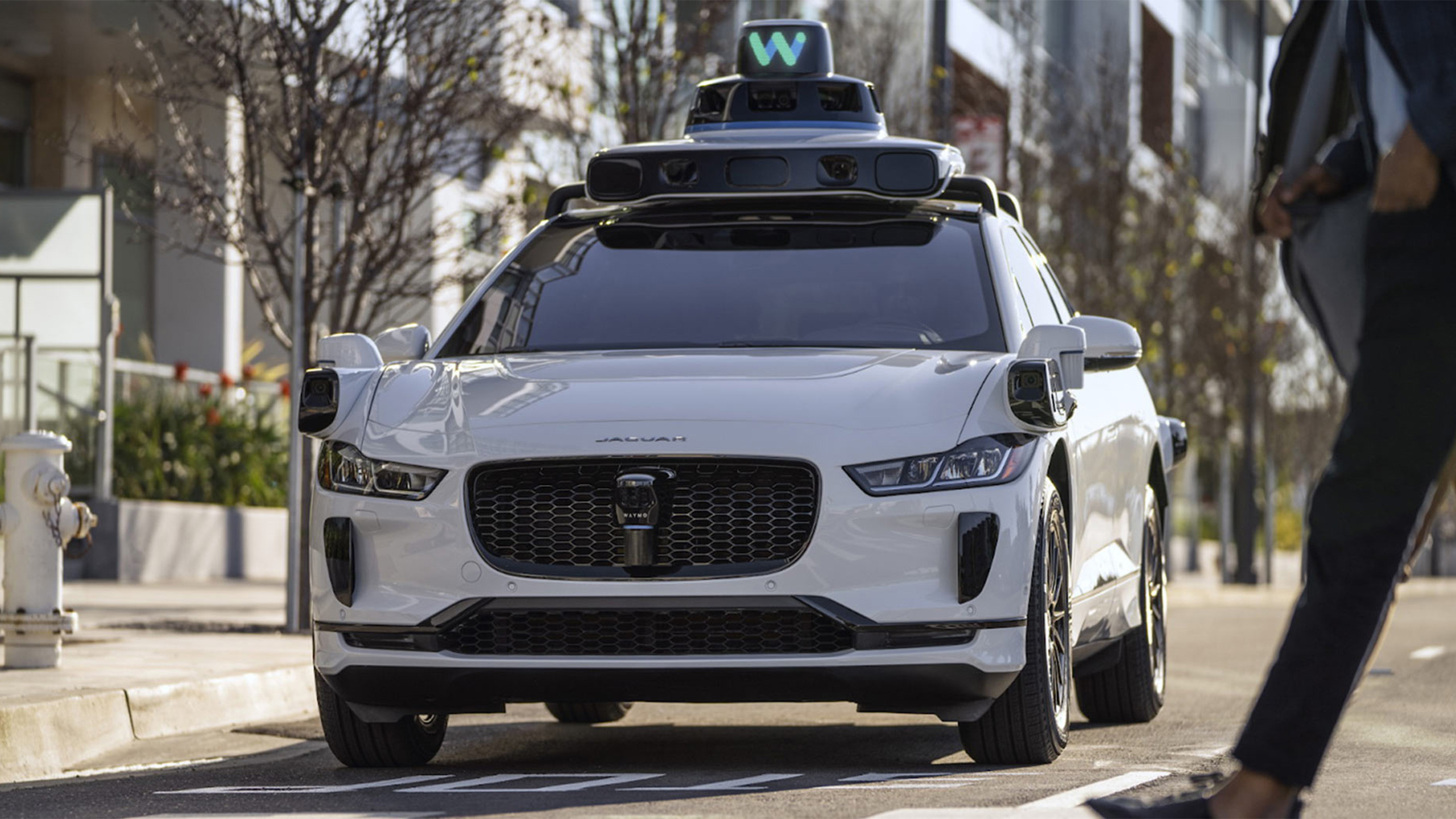
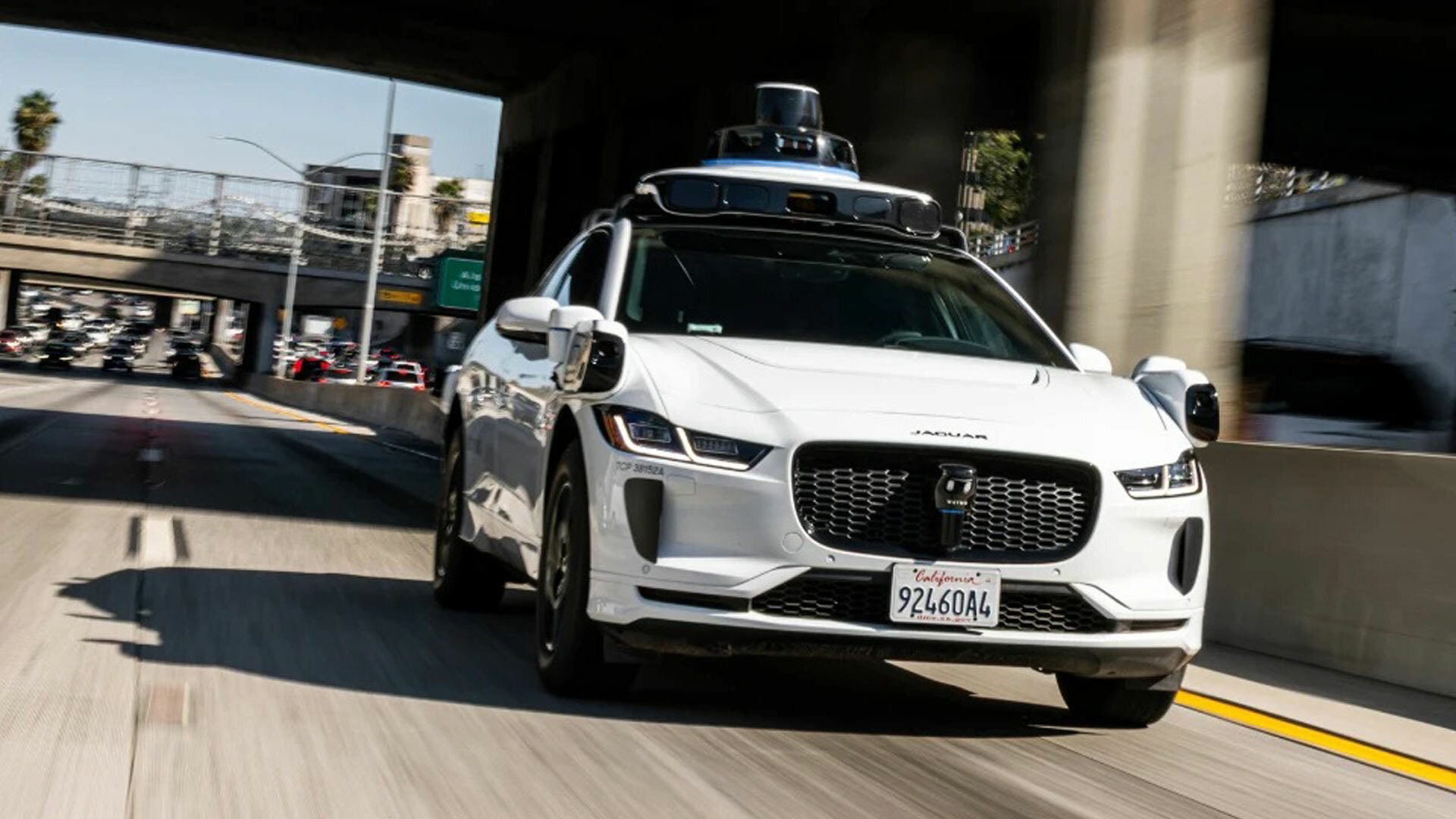
In late April, Di Jin took his first ride in one of Waymo’s robotaxis, traveling from Sunnyvale to San Jose Mineta Airport. The self-driving Jaguar I-Pace took him to the airport without issues, but when Jin got out of the car and attempted to open the trunk to get his luggage, the button did nothing. Moments later, the vehicle drove off, still carrying his luggage.

Read: Waymo’s Robotaxis Sometimes Receive Guidance By Some Guy In The Philippines

Speaking with NBC, Jin said he frantically contacted Waymo customer service but was told the robotaxi couldn’t be turned around and was heading to the depot. He was then forced to board his flight without any of his luggage.

The Californian man was informed later in the day that Waymo had retrieved his luggage at the depot. The only problem is that the depot is in San Francisco, and the company refused to pay shipping costs to get it back to Jin. If Jin didn’t want to pay for shipping, Waymo offered him two free rides to and from the depot to pick up his luggage.

Waymo Finally Steps Up

However, time is money, and Jin didn’t like the idea of wasting two hours getting his luggage. Waymo ultimately relented, confirming that it would pay to deliver his luggage after all.

Waymo notes that riders can open the trunk of one of its vehicles by pressing the physical trunk release button on the outside of the vehicle, or by tapping the ‘open trunk’ button in the Waymo app. For this rider, the trunk release apparently didn’t work, and with no human driver behind the wheel, he had no way of immediately notifying the car that he couldn’t retrieve his luggage. Perhaps human-operated taxis aren’t so bad after all.

 Waymo’s Robotaxi Made It To San Jose, His Luggage Made It To San Francisco
Photos Waymo

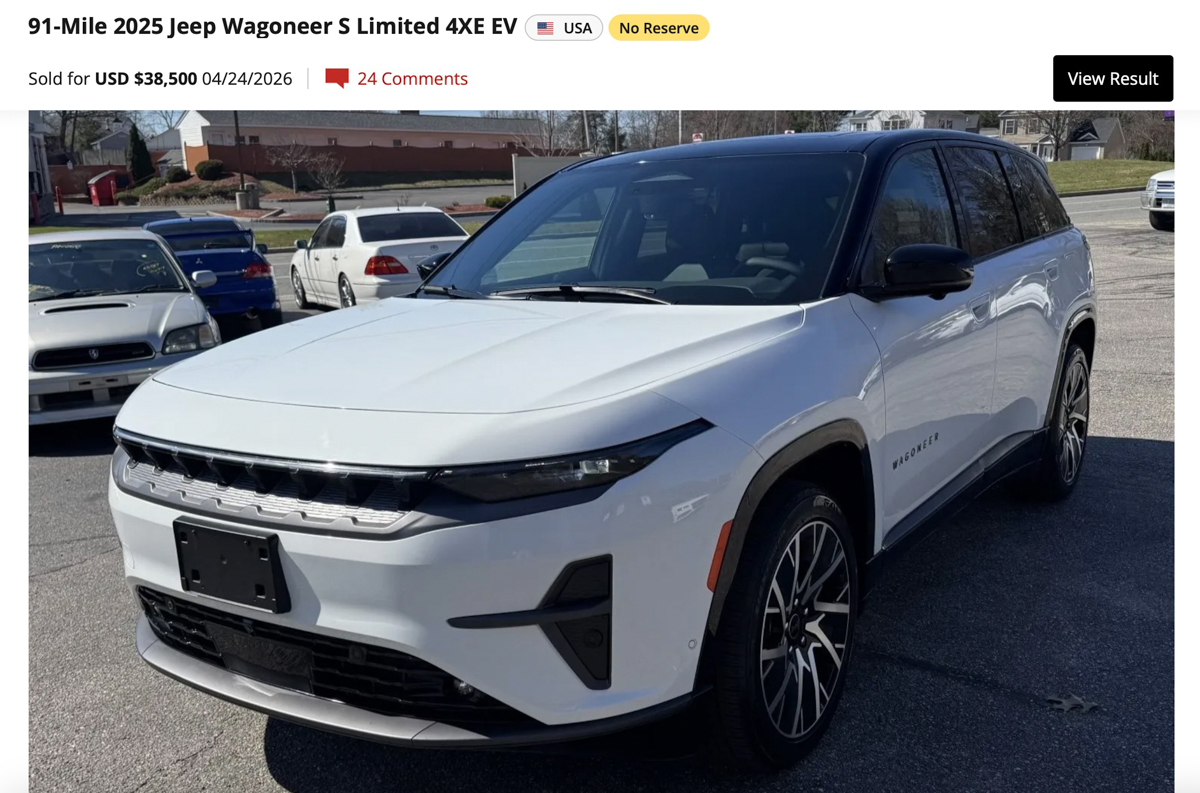
A New Jeep Wagoneer S Lost Nearly Half Its Value After Just 91 Miles

  • Nearly new Wagoneer S changed hands for huge discount.
  • 500 hp SUV sold for the price of a base, RWD Tesla Model Y.
  • Jeep’s maiden EV skips MY26, returns in 2027 with upgrades.

We knew Jeep’s first American EV was having a tough time, but this is something else. A nearly new Wagoneer S Limited 4xe just sold on Bring a Trailer for $38,500 after covering only 91 miles (147 km). That’s roughly $30,000 below its original sticker, and a sharp reminder that EV depreciation can be brutal.

On paper, the deal looks fantastic. The Wagoneer S packs dual motors, all-wheel drive, and a factory-rated output of 500 hp (507 PS) and 524 lb-ft (710 Nm) of torque. The quoted 294-mile (473 km) range from the 100 kWh battery isn’t amazing, but it’s tolerable, and the tailpipe-free Wagoneer is roomy enough for family duty and loaded with kit, making the auction result look like bargain-hunter gold.

Related: Wagoneer S Lost 93% Of Its Buyers, And Gas Charger Outsold Its Electric Twin 7 To 1

This example was a Limited trim finished in white with Jeep’s Dark Appearance package. The Limited stickered at $67,195 including destination and before options, and this one came with a panoramic roof, heated front seats, heated steering wheel, surround-view cameras, adaptive cruise control, wireless smartphone mirroring, a 12.3-inch touchscreen, and an Alpine nine-speaker audio system.

So it’s not exactly a stripped rental special, even if it is a rung below the 600 hp (608 PS), $72,195 Launch Edition.

\\\\\\\\\\\\\

So why the huge value crash? Because the Wagoneer S has struggled badly since launch. It arrived when automakers believed premium EV demand in America would keep climbing. Instead, the market cooled, incentives changed, and shoppers became more selective about price, charging access, and brand trust.

No More Tax Credits

The biggest blow came when the $7,500 federal EV tax credit disappeared last September. Before that, Jeep reportedly moved more than 10,000 Wagoneer S models across three quarters with the help of some big discounts. In the two quarters after the credit ended, sales fell to just 613 units.

 A New Jeep Wagoneer S Lost Nearly Half Its Value After Just 91 Miles

Jeep’s response has been telling. The brand won’t build a 2026 Wagoneer S at all, instead skipping straight to a 2027 model. Stellantis says the pause will allow upgrades to battery performance, software, capability, and interior quality. It’ll also gain a NACS charging port for easier access to Tesla’s growing Supercharger network.

A better Wagoneer S is coming, but we still think whoever bought this one got an absolute bargain. If he can live with uncertain resale and a model facing reboot status, $38,500 bought him a barely driven 500-hp electric SUV with lots of equipment. That’s hard to ignore, even if the first owner probably wishes they had.

\\\\\\\\\\\\\\\

Bring a Trailer

Rivian Lost $416 Million Last Quarter And Just Bet Bigger On Georgia

  • Rivian has revamped plans for their new factory in Georgia.
  • Facility will now be able to build 300,000 units annually.
  • DOE loan has been cut from $6.6 billion to $4.5 billion.

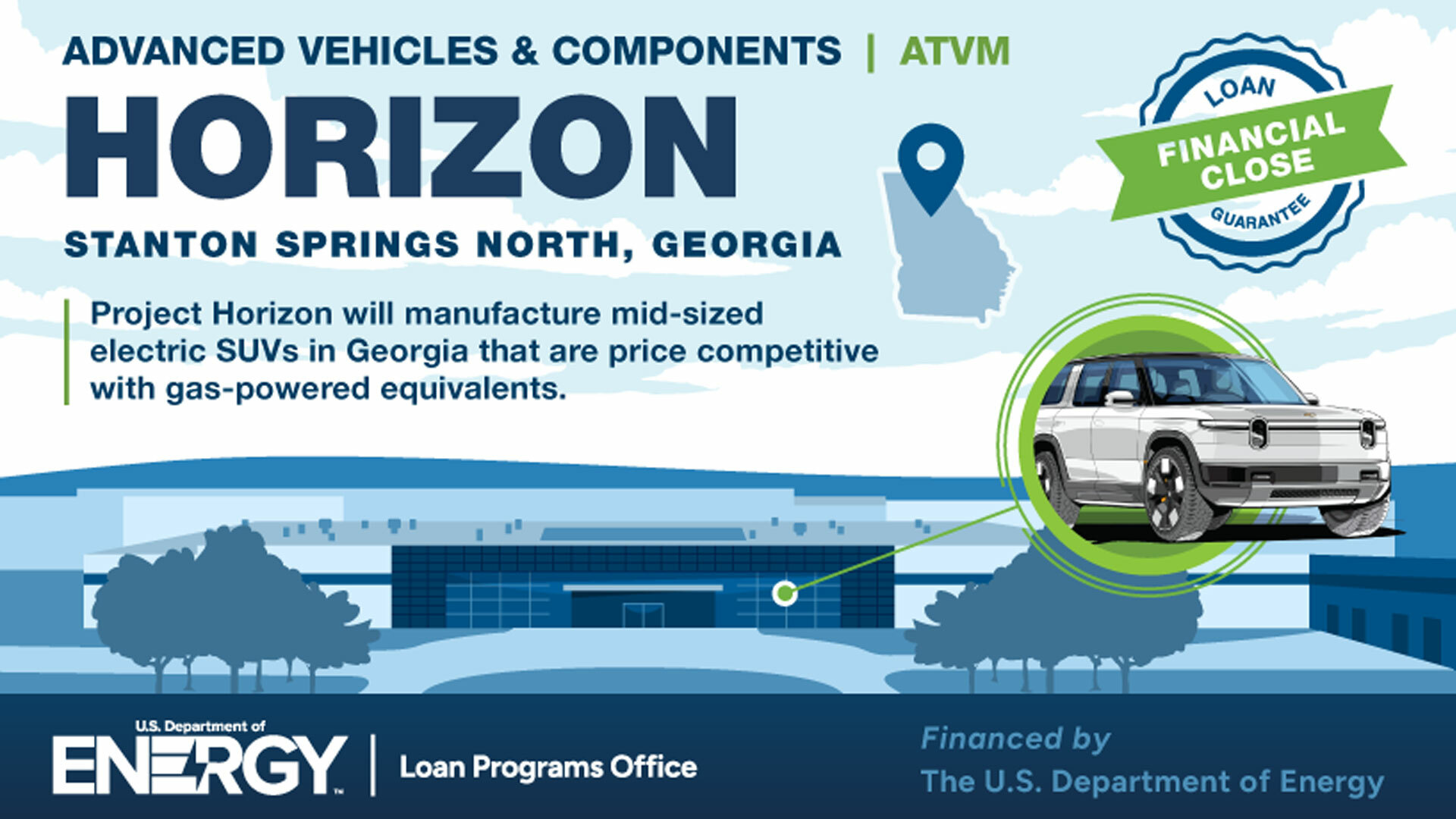
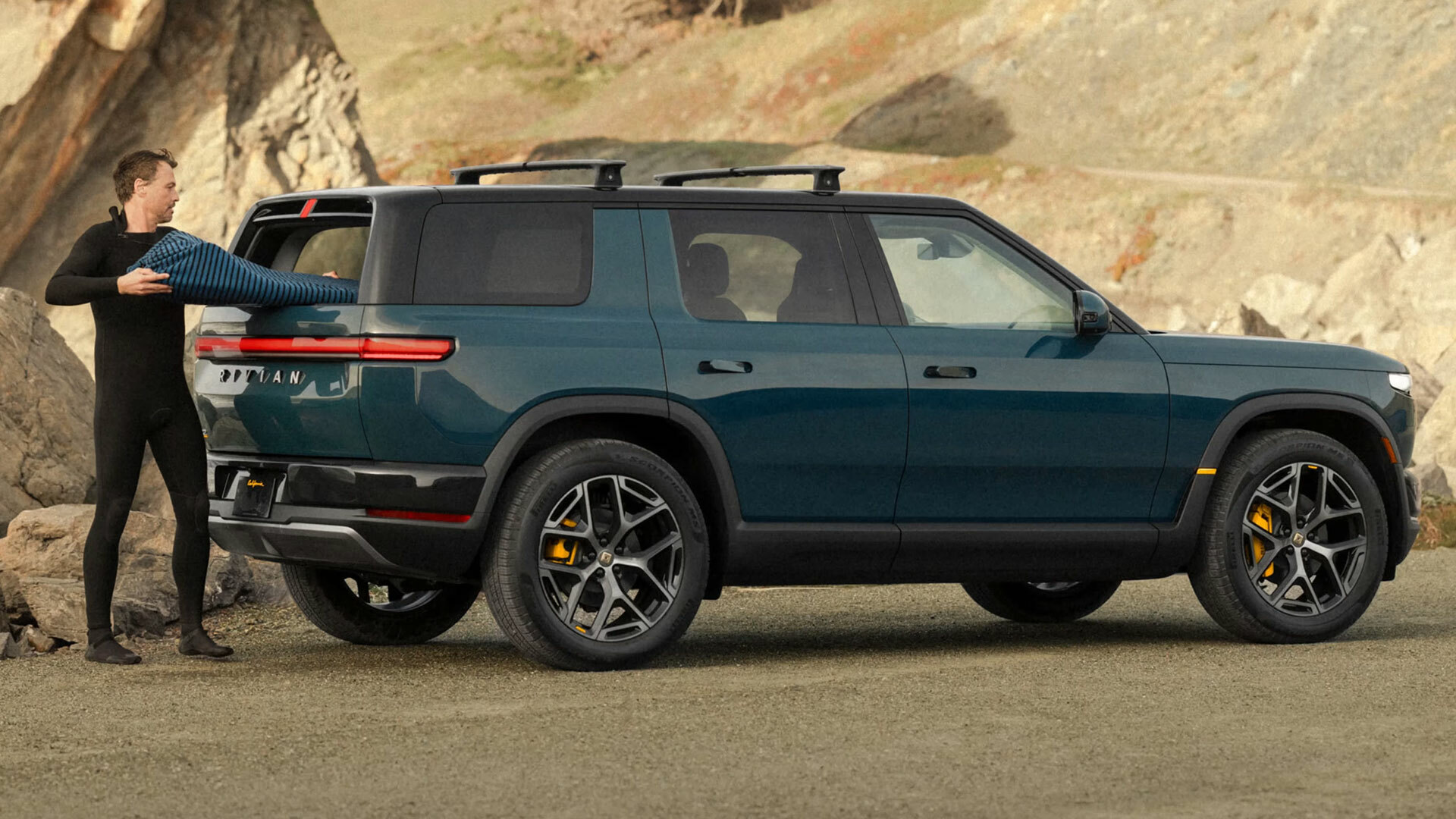
The R2 recently went into production in Normal, Illinois, and Rivian expects it to be a success. As a result, they’ve announced a new plan for their Stanton Springs North plant in Georgia.

Under the new strategy, the automaker is increasing the plant’s initial production capacity to 300,000 vehicles annually. That’s 100,000 units more than the original target and Rivian said the change will “facilitate a lower cost per unit, while also providing significant room for future expansion of capacity in later phases.”

More: Biden Admin Finalized Rivian’s $6.6 Billion Loan Before Trump Took Office

As part of the change, Rivian worked closely with the Department of Energy to update its original $6.6 billion loan. Its value has been reduced to $4.5 billion and is “aligned with the updated facility design and roadmap for the initial phase.”

 Rivian Lost $416 Million Last Quarter And Just Bet Bigger On Georgia

The devil is in the details, with CNBC reporting that the loan was originally structured for two phases of production and an annual capacity of 400,000 units. The new agreement reportedly just has one phase and enables Rivian to “draw on the loan sooner and have greater initial production.”

Rivian expects to start using those funds in 2027, and the plant is scheduled to begin production in late 2028. Vertical construction is set to begin this spring, and “preparations are underway for the development of the stamping press area, one of the most capital-intensive and technically demanding projects within the plant from a construction perspective.”

Q1 Results

 Rivian Lost $416 Million Last Quarter And Just Bet Bigger On Georgia

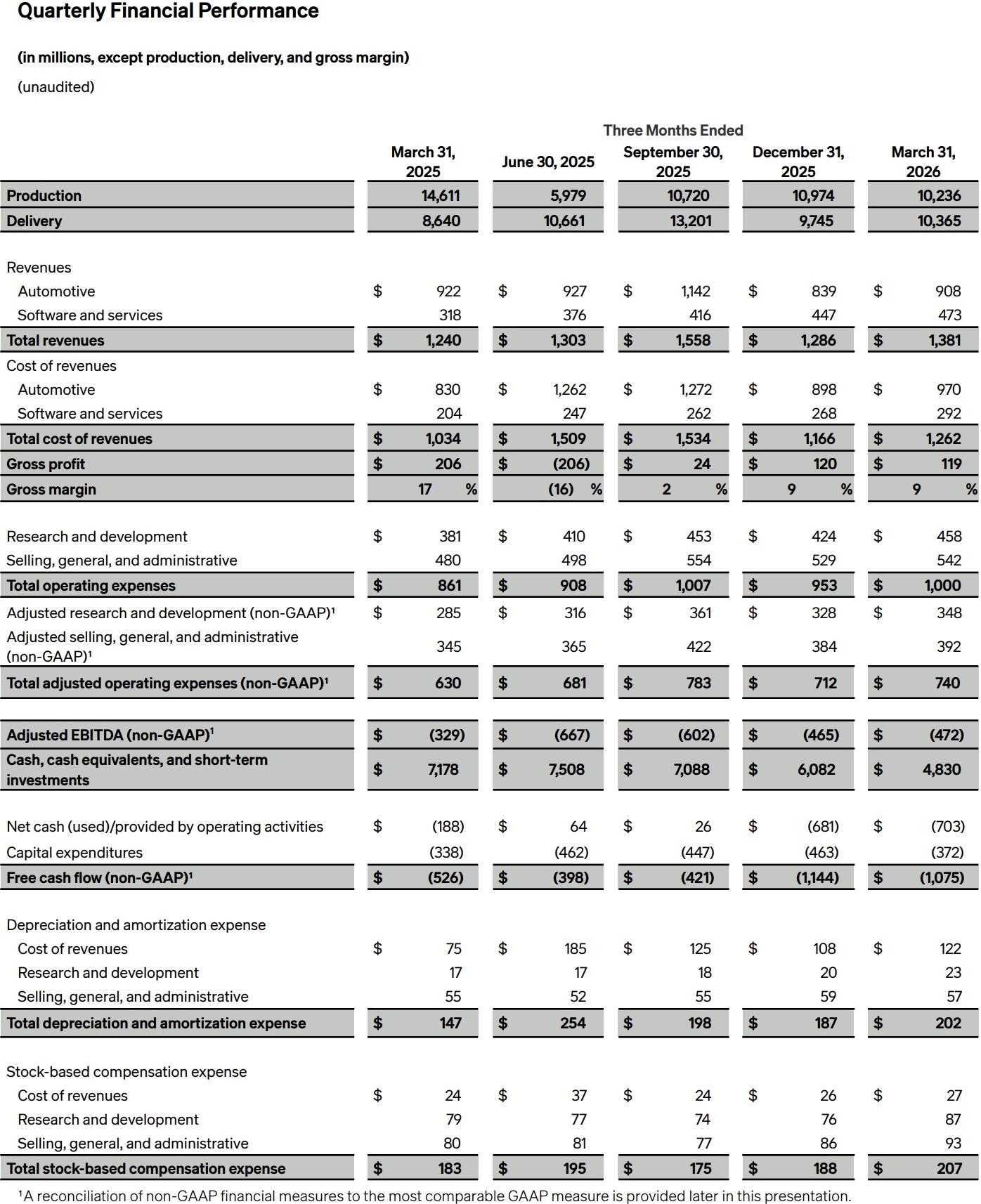
Besides the Georgia plant changes, Rivian announced its first-quarter results. The automaker built 10,236 vehicles and delivered 10,365 to customers.

Consolidated revenue increased 11% to $1.38 billion, and the company posted a $416 million net loss for the quarter. That’s down from a $541 loss in Q1 2025, but they “benefited from a $506 million gain in other income related to the Series A capital raise and related deconsolidation of Mind Robotics.”

Their outlook for 2026 isn’t stellar as they’re expecting to deliver between 62,000 and 67,000 vehicles. While those are decent numbers, their adjusted EBITDA is a $1.8 – $2.1 billion loss.

 Rivian Lost $416 Million Last Quarter And Just Bet Bigger On Georgia
❌
❌