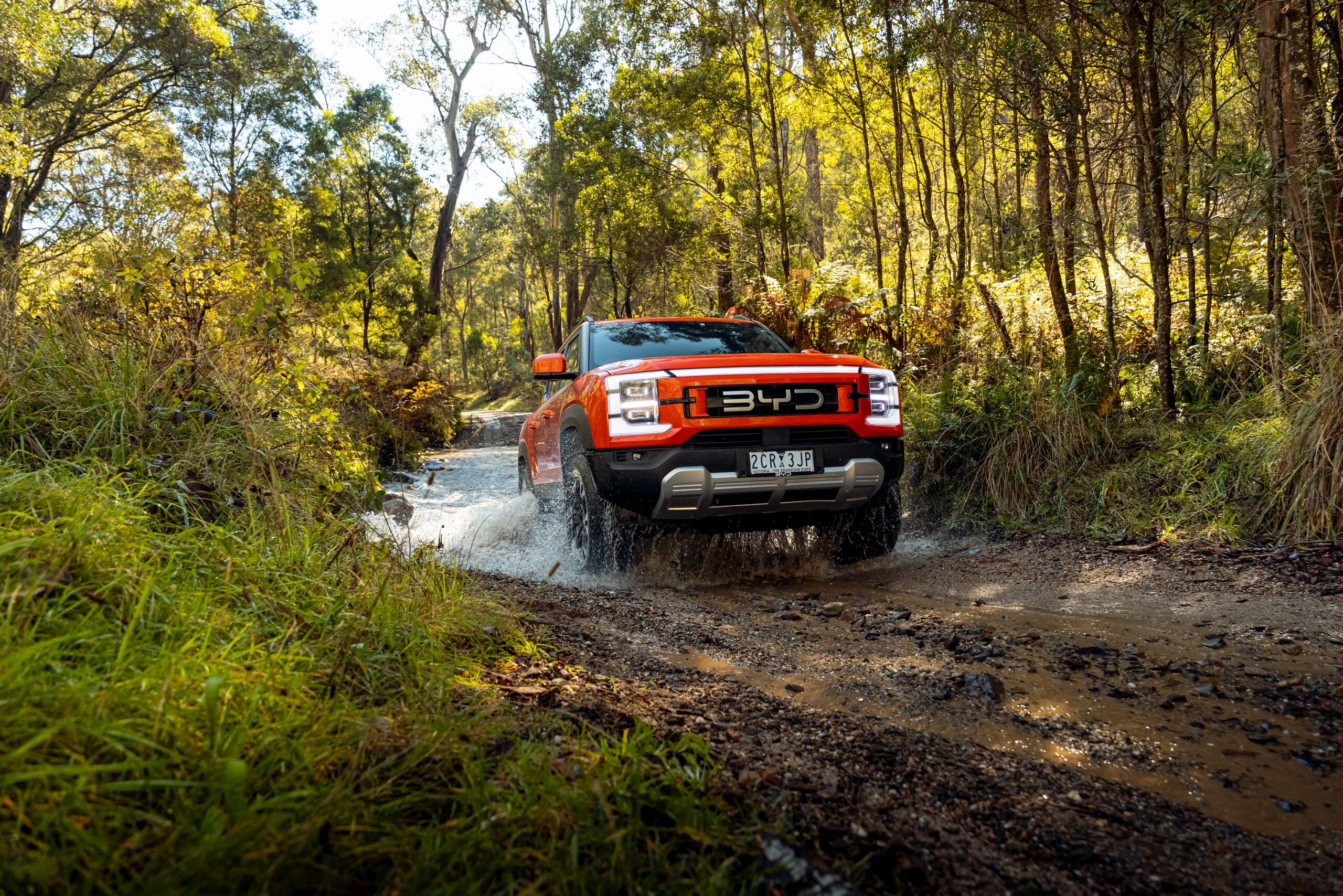
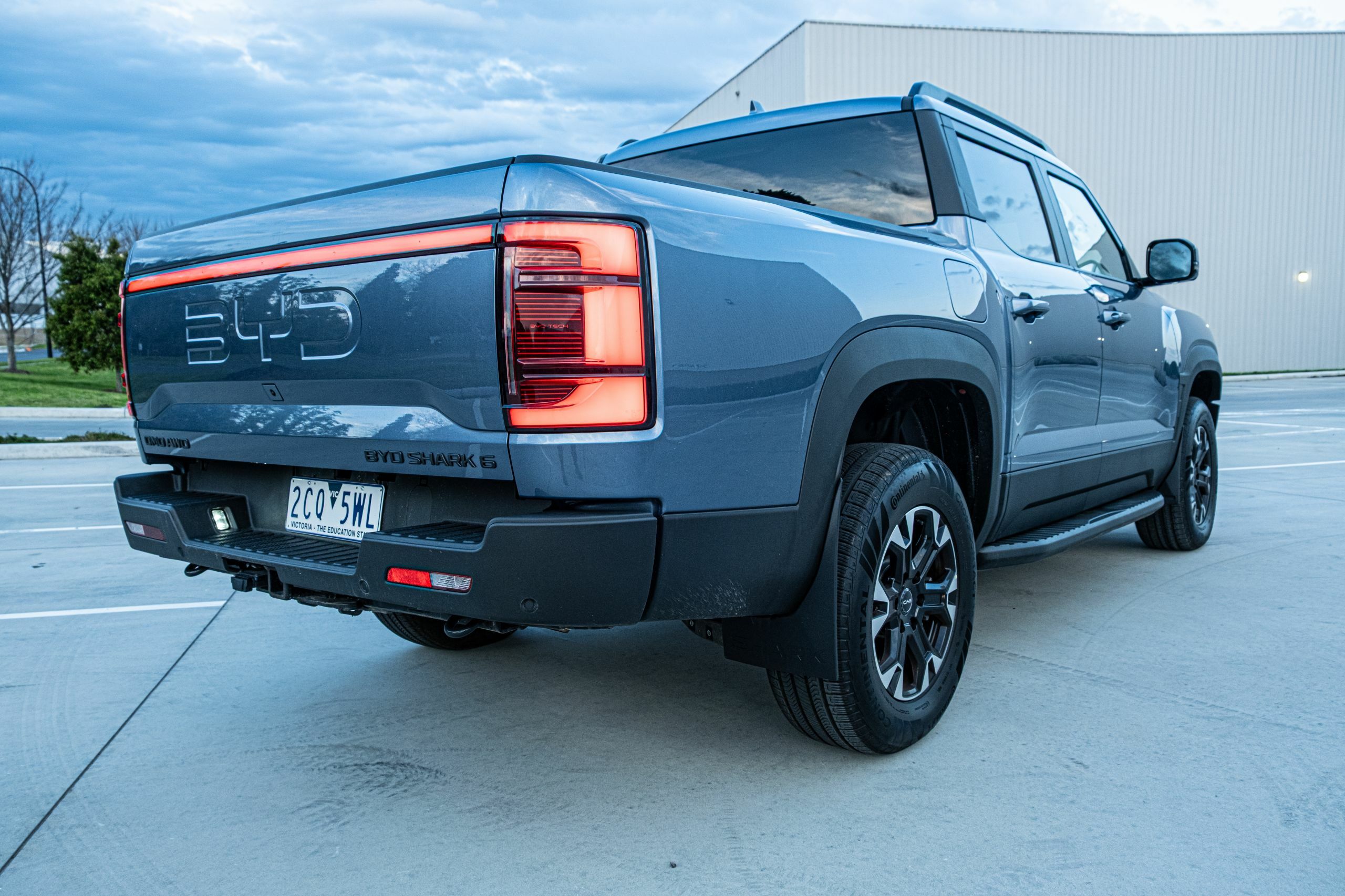
As it turns out, the documentary gave a “hacker” two weeks to work on a Shark 6.
BYD says he installed an untrusted third-party application into the infotainment system.
The documentary failed to acknowledge the security concerns about all new cars, not just BYDs.
BYD has quickly responded to cybersecurity concerns about the popular Shark 6 pickup truck following the release of an Australian documentary, which revealed how easily it could be hacked. The Chinese brand has also clarified how a hacker gained control of the plug-in hybrid’s headlights and windshield wipers.
As part of the ABC’s Four Corners program, cybersecurity expert Dan Hreszczuk was given a Shark 6 for two weeks and was able to listen in to the interior microphones, take control of the door locks, and mess with the Shark 6’s audio. To avoid giving any other hackers any bad ideas, details about how Hreszczuk hacked into the BYD weren’t disclosed.
BYD says it’s found out how he did it. To hack into the truck’s infotainment system, it says he breached the Android Debug Bridge (ADB) with a special tool and installed an untrusted third-party application. BYD was able to replicate this vulnerability in its own testing but says for a hacker to gain access to a vehicle’s location data and microphone, the driver must accept a permission prompt that will be displayed on the screen, something the documentary didn’t disclose.
To address this vulnerability, BYD says it’s working on an over-the-air software update that will remove the pathway used to enable the ADB, which is ordinarily disabled. It hasn’t said when this update will be ready, but says if similar vulnerabilities are found in its other models, they too will get the new software.
What The Documentary Didn’t Tell You
Then there’s the matter of the headlights and windshield wipers. In the Four Corners program, the hacker was shown remotely turning on the wipers and then turning off the headlights as the Shark 6 was being driven at night. According to BYD, gaining control of these functions required far more than installing some third-party software.
It says the hacker tapped into the vehicle’s wiring and accessed the internal CAN bus, which obviously isn’t something a hacker sitting behind a computer screen can do. Hreszczuk confirmed in a blog post that he spliced into the Shark 6’s wiring and installed a low-cost Raspberry Pi computer, something that could be replicated on plenty of other new cars.
To minimize the chance of any would-be hackers using an OBD device to gain access to critical vehicle functions, BYD says it has implemented new security measures for the OBD interface. Now, it will require physical isolation and device authentication.
The National Transportation Safety Board has opened a safety investigation into the fatal Oct. 5 school bus crash in Winter Haven, Florida, as local officials praised the bus driver’s response and provided new details about the victims and investigation.
The NTSB said it is coordinating with the Polk County Sheriff’s Office on the investigation into the multi-vehicle crash Monday morning involving a Polk County Public Schools bus.
Authorities identified the student who died as Adinaluz Prieto Oyola, a 10th-grader and cheerleader at Winter Haven High School. Deshawn Smith, 26, the driver of the Jeep struck by the bus, died at the scene, according to the Sheriff’s office.
Three students remain hospitalized but are expected to recover, authorities said.
Sheriff Grady Judd said school bus driver Jessica Dye, 34, was pinned inside the vehicle but pulled herself out and immediately began helping the children on board.
Polk County Public Schools Superintendent Frederick Heid praised Dye as a hero, citing her composure and continued focus on students throughout the crash’s aftermath.
Heid also recognized students and good Samaritans who helped. According to officials, video showed four students attempting to rescue Prieto Oyola from the bus.
Polk County Public Schools issued a new statement expressing condolences and thanking those who supported the community.
“Our hearts go out to the family and friends of Winter Haven High sophomore Adinaluz Prieto Oyola,” the district stated. “Thank you to the many people from our county and state who have reached out to show support. A special thanks to the first responders and hospital workers who provided aid yesterday — we truly appreciate you.”
Polk County Schools officials confirmed the school bus was equipped with seatbelts. The exact type were not specified but they are thought to be lap belts, which are often used across the state. State law enacted 25 years ago required seatbelts at all school bus rider positions but did not specify between two-point lap belts and three-point lap/shoulder belts. Regardless of the type, usage by students and drivers is required.
As previously reported by School Transportation News, the crash occurred around 6:15 a.m. Monday on Lucerne Park Road, while the bus was transporting students to Winter Haven High School. Three other vehicles were involved.
The bus carried 39 people: 37 students, Dye, and her 9-year-old daughter. ABC News reported 35 of the bus inhabitants were transported across four local hospitals.
Investigators said a white Chevrolet Malibu crossed the double yellow line and struck the left rear of the eastbound school bus. Judd said a preliminary review of the school bus video showed the bus was in its proper lane before the collision.
Video released by the Polk County Sheriff’s Office shows the collision. Viewer discretion is advised. The the video shows the impact and the inside of the bus.
The impact tore a tire from the bus and caused it to lose traction, sending it into the westbound lane, where it collided head-on with Smith’s Jeep, according to authorities.
Investigators identified the Malibu driver as Maria Jimenez, 23, who is reportedly a nursing student. They said she cooperated fully, provided her phone, and voluntarily submitted a blood sample.
Authorities said blood test results remained pending. Investigators reported seeing no signs of impairment but had not determined why the Malibu crossed the center line. Judd also reportedly said cell phone usage had already been ruled out as a cause of the crash. A NTSB preliminary investigation report is expected in the coming weeks.
Judd said Jimenez would likely receive traffic citations for crossing the center line. He said criminal charges were not expected unless new evidence emerged.
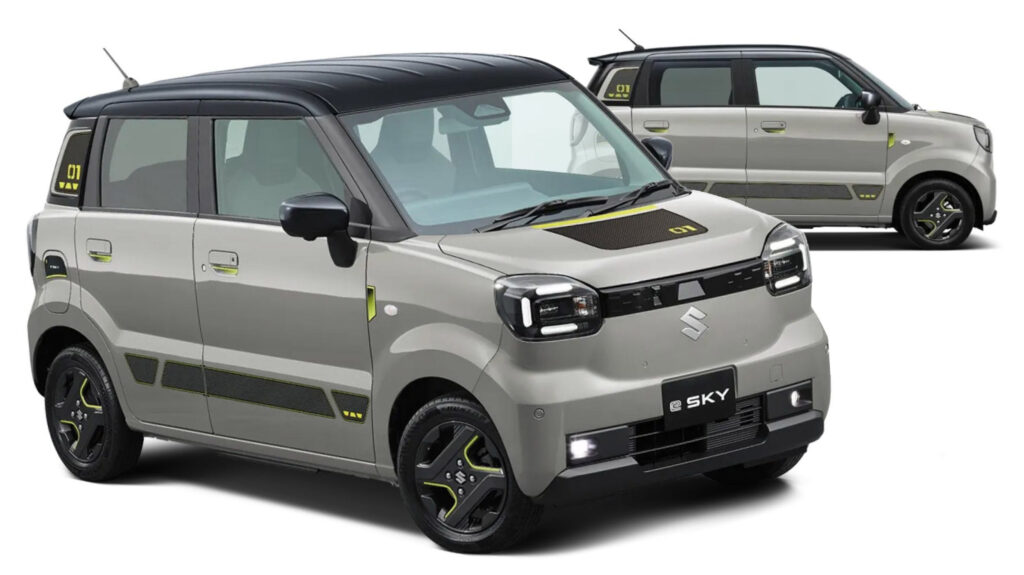
The Suzuki eSky debuts in Japan with factory styling packages.
It offers 193 miles (310 km) of range from a 26 kWh battery.
The EV starts at under $10k if you account for local subsidies.
Suzuki has introduced its first fully electric passenger kei car in Japan ahead of its market launch in Europe and the UK. The all-new Suzuki eSky brings an impressive range for the size of its battery, aided by its lightweight design and efficient e-Axle. More importantly local EV subsidies lower the starting price of the pint-sized hatchback to ¥1,552,000 ($9,800).
The eSky was revealed in August 2026 as an evolution of the Vision e-Sky from 2025. The kei car retains the five-door silhouette and compact footprint of the concept, but its lighting units and bumpers have been redesigned for production, as with the wheels, door handles, and mirror caps.
The four-seater cabin is focused on practicality with various storage solutions and a tray on the dashboard. The driver has access to a digital instrument cluster, a 10.1-inch infotainment on the flagship trim, and a separate panel for climate controls.
Suzuki eSky Mild Sporty Package
For owners who want to personalize the EV, Suzuki offers a range of optional accessories. The catalogue includes a pair of styling packages with colorful accents, a recyclable floor mat made entirely of polyester, and various charging items.
The Mild Sporty package adds pink, blue, and gray decals on the bodywork alongside white mirror caps, while the Neo Future package opts for a yellow and black theme. Both are combined with matching stickers for the dashboard and LED fog lights. Those who want something more subtle could get the quarter garnish in eight different colors. Suzuki is also offering three playful decals for the tailgate.
Suzuki eSky Neo Future Package
The eSky rides on the Heartect e platform and comes fitted with Suzuki’s new e-Axle (electric motor, inverter, and reduction unit) powering the front wheels. The electric motor is capable of producing 94 hp (70 kW / 95 PS) but the output of the Japanese-spec model will most likely be limited to 63 hp (47 kW / 64 PS) in order to comply with kei car regulations.
The floor-mounted 26 kWh lithium iron phosphate (LFP) battery pack promises a WLTC range of 193 miles (310 km), and has 50 kW DC charging capabilities.
Suzuki eSky
The Suzuki eSky will reach Japanese dealers on November 16 with the company setting a sales target of 1,000 units per month. The entry-level A trim starts at ¥2,120,000 ($13,400), while the flagship X grade climbs to ¥2,790,000 ($17,600). Still, buyers are eligible for a local government subsidy of up to ¥568,000 ($3,600), which lowers the entry point to ¥1,552,000 ($9,800).
As for the optional catalogue, the Mild Sporty styling kit costs ¥103,840 ($660), the Neo Future kit ¥116,160 ($730), and the eco-friendly floor mats are listed for ¥28,600 ($180).
Suzuki’s smallest EV yet will also be exported to Europe and the UK, starting in 2027. There it will join the eVitara, and compete with Europe’s A-Segment EVs such as the Renault Twingo, Dacia Spring EV, Nissan Pixo, Fiat 500, and VW ID. Up!.
Alpine teased the PS1 concept ahead of its Paris debut on Oct 12.
The Project Special 1 features retro-inspired pop-down headlights.
It could preview an A310 revival in the form of an electric 2+2 GT.
Alpine fans might be excited to see the sculpture of the next-gen A110 sportscar in Paris Motor Show, but the company has another ace up its sleeve. A new concept car dubbed PS1 will be unveiled at the same event, likely previewing a future production model.
The PS1 name has nothing to do with the legendary Playstation console, as it is short for Project Special 1. In other words, it will be the first example of the “special projects” pillar from Alpine’s future product strategy, likely positioned above the “Extraordinary Everyday” pillar including the A290 hot hatchback and A390 sport fastback volume sellers, and the “Icons” pillar spearheaded by the A110 sportscar.
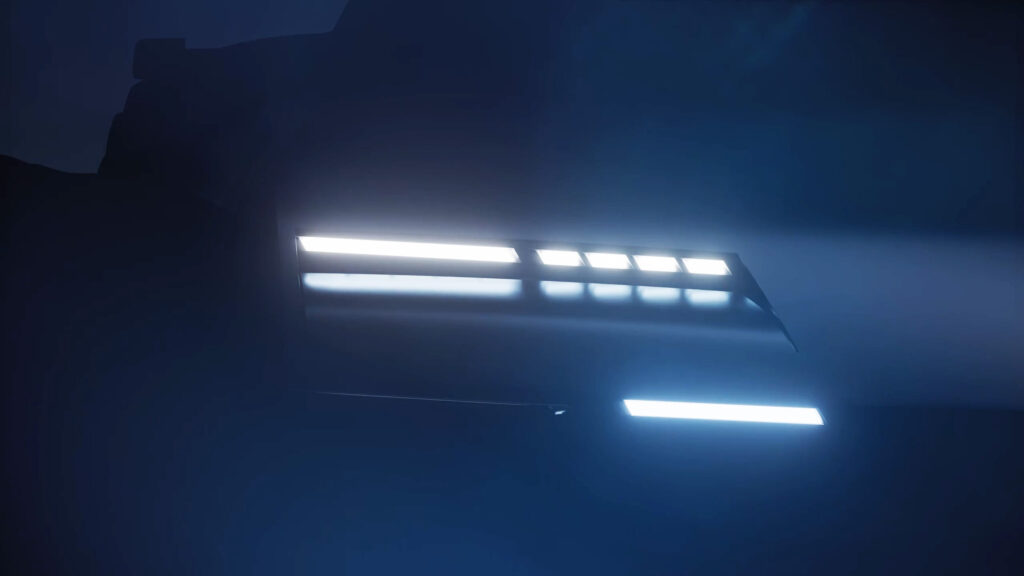
The official teaser is focused on the unconventional headlight design of the concept. When not in use, the lights remain hidden under a cover that sits flush with the flat hood. These covers recess into the bodywork, revealing slim LEDs with the colors of the French flag.
The pop-down headlight mechanism is similar to Eccentrica’s modernized version of the Lamborghini Diablo and sends retro-futuristic vibes. At the same time, this design would comply with safety regulations for production models, unlike the pop-up headlights that pose a threat to pedestrians in the case of an accident.
Alpine
The dark teaser doesn’t reveal the bodystyle of the PS1, but we can still see a portion of the its wide fenders and mirror-replacing cameras hinting at a low and aerodynamic stance.
The rectangular shape of the headlight clusters and the surfacing are reminiscent of the classic A310 produced between 1971 and 1984. In fact, Alpine is working on a new generation of the grand tourer with a 2+2 layout and a fully electric powertrain. This makes us believe that the concept could preview an upcoming zero-emission Porsche 911 rival, sharing its Alpine Performance Platform (APP) with the next A110.
Alpine said that this will be the only hint before the actual reveal which is scheduled for the press day of the Paris Motor Show on October 12. The PS1 will be showcased next to the new A110 Sculpture, and several examples of the A290 hot hatch and A390 sport fastback with new colors, trims and finishes by the Atelier Alpine personalization program.
Toyota UK recreated the crushed caravan stunt from Top Gear.
The victim was the electric version of the latest Toyota Hilux.
The truck drove away under its own power with body damage.
The Toyota Hilux is widely considered one of the most indestructible vehicles out there, with the famous Top Gear stunts from 2003 solidifying the legend. Fast forward to 2026, Toyota has recreated one of the grueling tests, to see whether the new Hilux BEV could still take a beating like its predecessor.
The UK arm of the Japanese automaker went on Reddit, asking users to pick a punishment for the zero-emission workhorse. Participants in the survey could choose between hitting the Hilux with a 1-tonne (2,205 lbs) wrecking ball, or subjecting it to a high-altitude caravan drop. The internet overwhelmingly chose the latter, and we can’t really blame them for doing so.
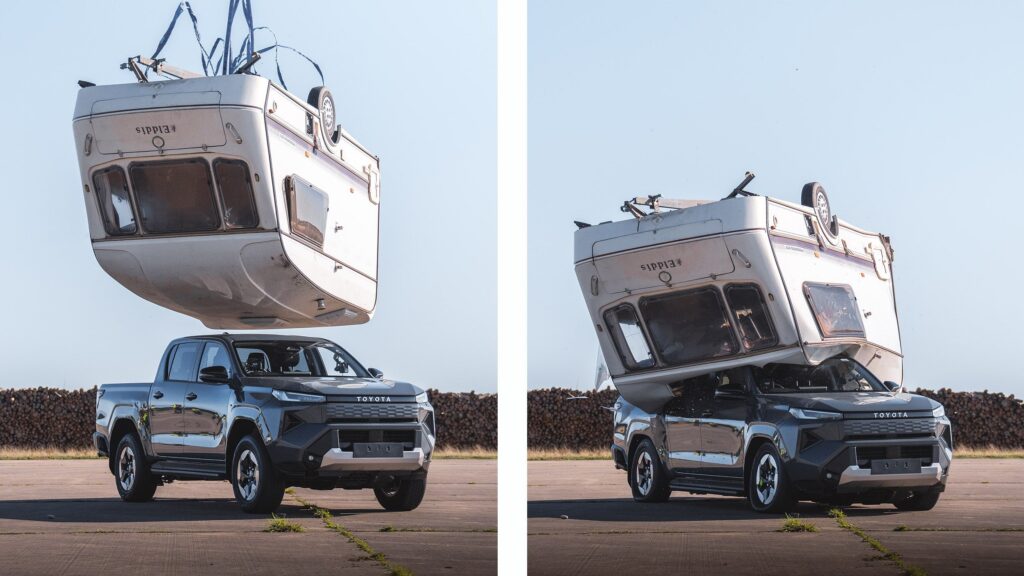
Keeping their promise, engineers hoisted a 760 kg (1,676 lbs) caravan roughly 30 feet (9.1 m) into the air using a big crane. Then they parked a brand-new Hilux BEV underneath and let gravity do what it does best.
Toyota UK
The camper smashed directly on the roof of the midsize truck, with its weak fiberglass and wood construction crumbling under the forces of the impact. For a more dramatic effect, Toyota captured the stunt with high-speed cameras, and even installed one inside the mobile home showing what it feels like to land on a Hilux while being upside down in your living room.
Despite taking a direct hit from a falling house on wheels, the Hilux BEV powered up immediately and drove away from the wreckage. Battle scars included a deformed roof, a cracked windshield, and a dent on the rear bed looking as if a baby Godzilla tried to climb on it.
The suspension appears to absorb the forces of the impact, briefly creating a street version of the truck. The battery which is mounted on the ladder frame chassis and the electric motors were unharmed, although the truck is likely a write-off due to the roof damage.
Toyota UK
Toyota warns viewers not to attempt to recreate or replicate any action shown in the video, as it could cause serious injury, death, or property damage. Furthermore, the company noted that all caravan debris was recovered from the Bentwaters Airfield in Suffolk, and sent to a recycling facility.
Interestingly, the caravan drop, filmed with the help of Very Nice Films and Bickers, was just the “warm-up” for the Hilux BEV. Toyota offered the truck to Top Gear’s YouTube channel, to continue the rough treatment. It will be interesting to watch the second round of Hilux torture, at least until WhistlinDiesel gets his hands on the latest generation of the midsize truck which is not available in North America.
The new Toyota Hilux is currently available in mild-hybrid diesel and fully electric powertrain options, with a hydrogen variant confirmed for 2028. Still, the diesel truck accounts for the vast majority of Hilux sales, due to the combination of a lower price, a more usable fuel type, as well as superior towing and payload ratings.
Alfa Romeo launches new Edizione Luna Rossa special editions.
They include the Junior, Tonale, Giulia, and Stelvio in Europe.
The models gain yacht-inspired colors and special touches inside.
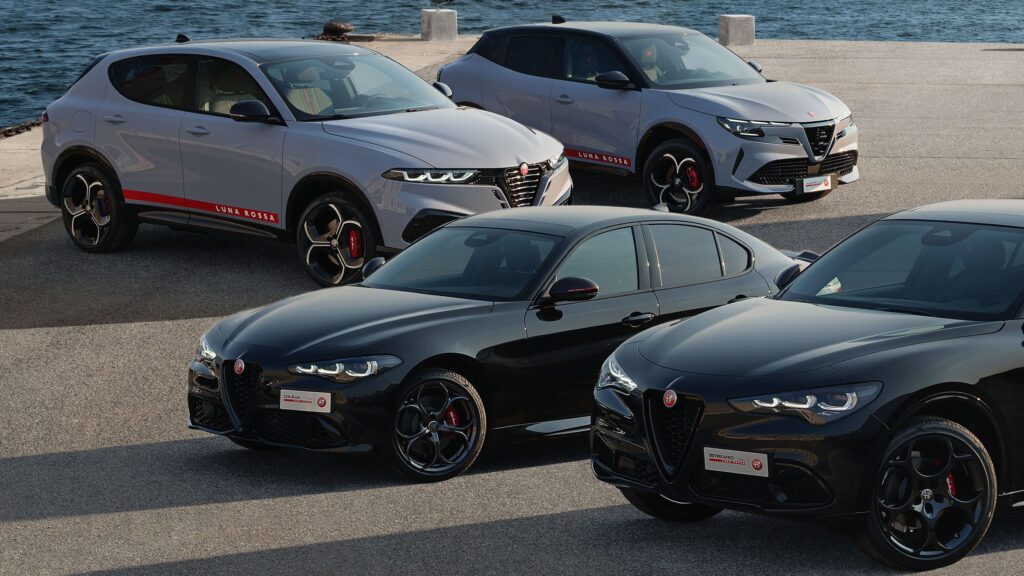
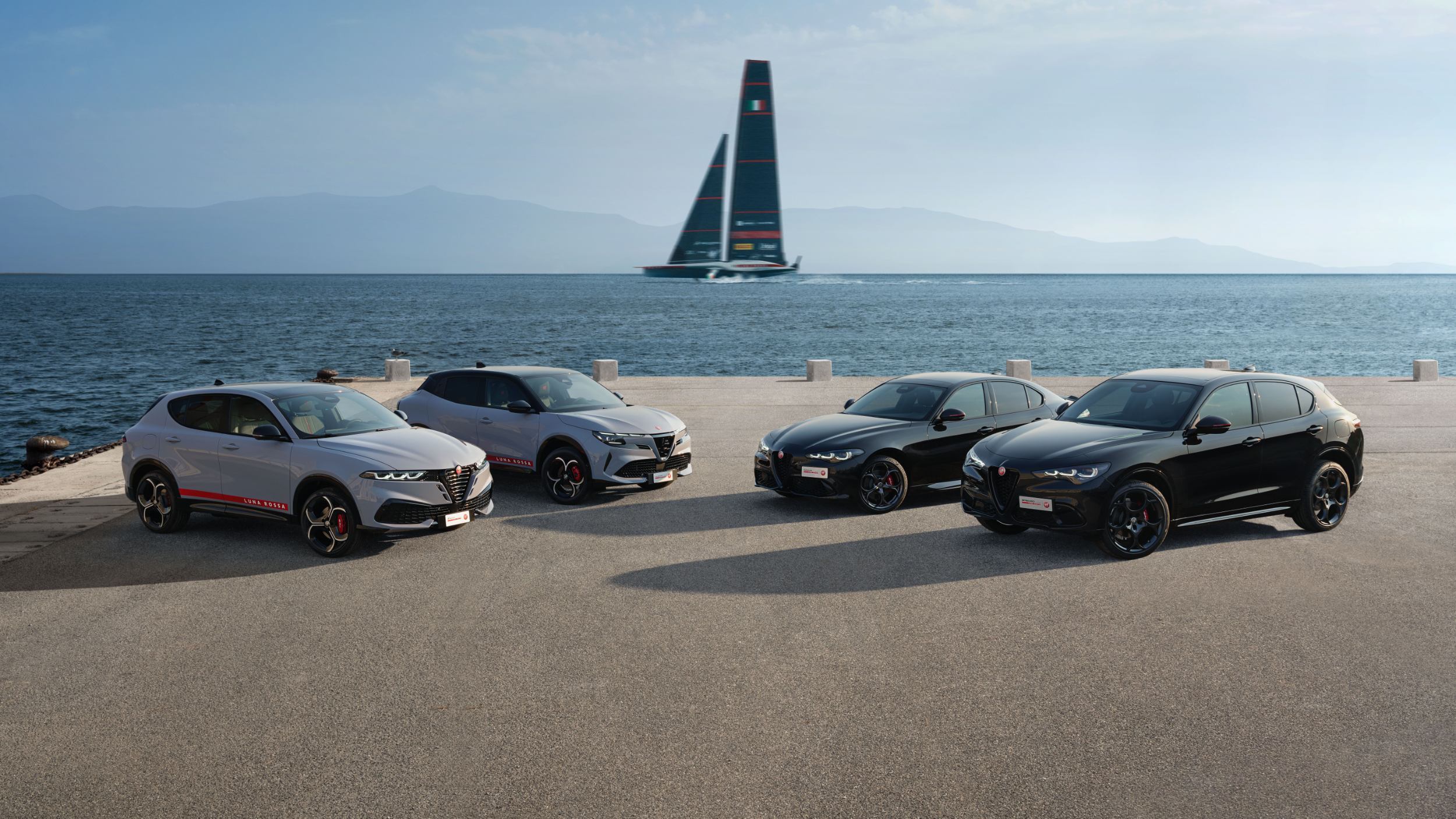
Alfa Romeo is gearing up for the debut of a mysterious concept at the Paris Motor Show next month, but before that happens they have a new special series in store. The Biscione brand has introduced Edizione Luna Rossa editions for its entire lineup, including the Junior, Tonale, Giulia and Stelvio.
Luna Rossa is an Italian yacht-racing team competing at the America’s Cup. Its collaboration with Alfa Romeo was inaugurated in June 2025, followed by the debut of the ultra-exclusive Giulia Quadrifoglio Luna Rossa in January 2026. While the first model was only produced in 10 units with custom colors and a unique aero package, the Edizione Luna Rossa models are available for everyone, serving as the flagships of their respective lineups.
The special editions feature boat-inspired colors, custom touches inside-out, and a dedicated Alfa Romeo emblem. However, not every model is the same, with the Junior and the Tonale getting a different treatment than the stealthier and more exclusive Giulia and Stelvio.
Alfa Romeo Junior Edizione Luna Rossa
Starting with the subcompact and compact SUVs, the Junior and the Tonale Edizione Luna Rossa feature a gray shade with Gloss Black accents and red stripes on the profile, although buyers can also choose black or white for the main color of the body.
The wheels measure 18 inches on the Junior and 20 inches on the Tonale, both featuring a gloss black diamond cut finish and three-spoke designs. Besides the larger wheels, the Tonale also gets Brembo brakes with red brake calipers.
Alfa Romeo Tonale Edizione Luna Rossa
Inside, we find black and gray upholstery, with 3D knit technology on the premium fabric, red stripes featuring Luna Rossa lettering, and red Alfa Romeo emblems. The SUVs also feature aluminum sports pedals and kick plate, new graphics for their digital cockpits, and ambient lighting.
Equipment is pretty generous, with the Edizione Luna Rossa being the highest-spec trims. In terms of powertrains, the Junior offers the option between hybrid and fully electric setups, while the Tonale is available with hybrid and PHEV options.
Alfa Romeo Stelvio Edizione Luna Rossa
Moving on to the midsize offerings, the aging Giulia and Stelvio take a different route, focusing more on exclusivity and sportiness. The mechanically-related models are pictured with a blacked-out configuration, but the color palette of the Edizione Luna Rossa editions also include white and Etna Red shades.
Independently of the color, the aging duo benefits from extensive use of carbon fiber on the exterior and the interior, red Alfa Romeo emblems, and the Luna Rossa logo on the mirror caps. The Giulia features Quadrifoglio-inspired side skirts and rear spoiler combined with Gloss Black 19-inch alloy wheels, with the Stelvio riding on 21-inch wheels.
Alfa Romeo Giulia Edizione Luna Rossa
The monochrome interior features a generous amount of carbon fiber on the dashboard, center console, and door cards, alongside leather and recycled Econyl fabric upholstery. Red stripes on the steering wheel and seatbacks break the monotony of black, alongside the matching Alfa Romeo emblems.
The Edizione Luna Rossa Giulia and Stelvio come standard with a Harman Kardon Hi-Fi system and the electronically controlled suspension. Finally, the electric sunroof is standard on the sedan and optional on the SUV.
As with the regular Giorgio-based models, the special editions are available with the 2.2-liter turbodiesel in two power outputs, while UK buyers also have access to the 2.0-liter gasoline engine that has been phased out in Europe. In other words, only the V6-powered Quadrifoglios escape the Luna Rossa treatment.
The Junior, Tonale, Giulia, and Stelvio Edizione Luna Rossa will gradually go on sale on European markets, positioned at the top of the lineup of each non-Quadrifoglio model. Pricing will be announced closer to the market launch.
According to Stellantis, the partnership between the two Italian brands goes deeper than colors, materials, and special emblems. More specifically, Alfa Romeo “has provided its expertise in simulation, dynamics and virtual analysis to Luna Rossa, while also collaborating on the development and fine-tuning of the control software for the systems that manage sail movement.”
Nissan revives the Pixo badge for an affordable urban EV.
It is a twin to the Renault Twingo with Nissan styling cues.
It makes 81 hp and offers a 161-mile (259 km) WLTP range.
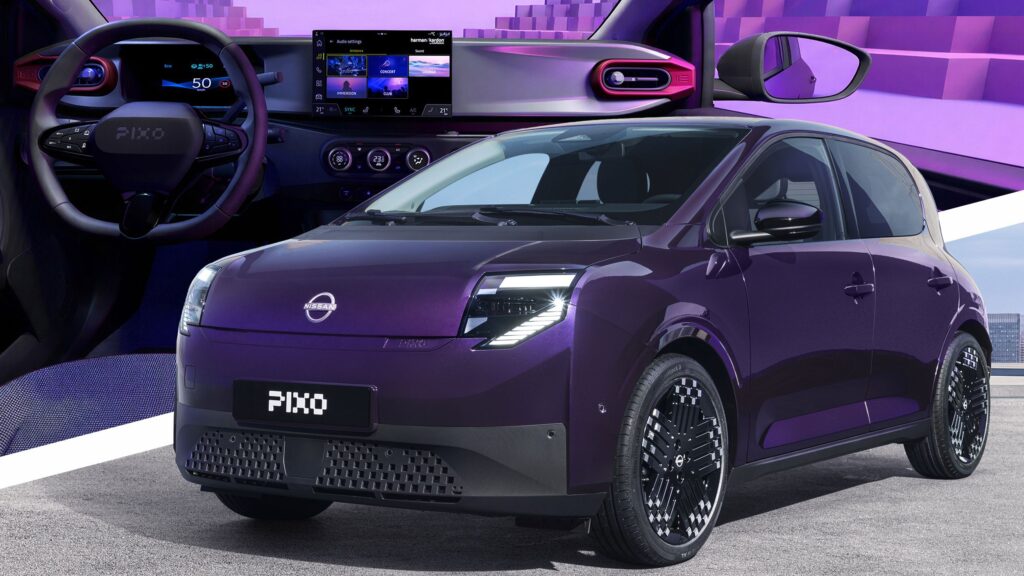
Nissan is dusting off an old nameplate for a new urban EV. The Nissan Pixo is a twin to the Renault Twingo E-Tech and a sibling to the Dacia Spring EV, featuring pixelated styling and modern technology. The model will be sold in Europe and the UK, serving as an entry point in the lineup positioned under the R5-based Nissan Micra.
Measuring 3,796 mm (149.4 in) long, the Nissan Pixo is only 7 mm (0.3 in) longer than the Renault Twingo, while sharing the 2,492 mm (98.1 in) wheelbase. The greenhouse, roof structure, and most of the profile are identical to the Renault, with Nissan designers focusing their efforts on the front and rear ends.
The Pixo swaps the curves and frog-style headlights of the Twingo for a boxier grille-less nose. The squared-off headlights with diagonal LED graphics are inspired by pixels, while the front bumper adopts clean surfacing with plastic cladding around the central intake.
Setting aside the front fenders and the futuristic alloy wheels, the profile doesn’t hide its Renault roots. However the rear end gains redesigned taillights and a simpler tailgate, which are slightly reminiscent of the Nissan Micra K12 from the ’00s. These are joined by Nissan-specific cladding on the rear bumper and Pixo lettering on the plastic trim around the rear windshield. Finally, the color palette gains the fresh Wonder Purple and Gear Blue shades.
Inside, the dashboard, the steering wheel, and the digital cockpit with Gemini integration are derived from the Renault twin. The same applies to the reclining and foldable rear seats adding practicality points to the urban EV. Nissan brags about the 356 lt (12.6 cubic feet) cargo capacity including the 50 lt (1.8 cubic feet) compartment for charging cables, and the extra 18 lt (0.6 cubic feet) of in-cabin storage. Furthermore there are 23 Easter eggs for owners to discover.
Under the skin, the Pixo is identical to the Renault Twingo and the Dacia Spring. A front-mounted electric motor is good for 81 hp (60 kW / 82 PS), while a 27.5 kWh Lithium Iron Phosphate (LFP) battery delivers a WLTP range of 161 miles (259 km). The EV is compatible with 50 kW DC charging, replenishing the battery from 15-80% in 28 minutes.
The Nissan Pixo will go on sale in Europe and the UK, with production taking place at the Novo Mesto factory in Slovenia alongside the closely-related Renault Twingo and Dacia Spring. Pricing and pre-order information will be announced from December 2026 onwards. However, judging from the Renault, the entry-level EV from Nissan will most likely start from under €20,000 ($22,800).
Hardcore Nissan fans might remember that the original Pixo which was sold in Europe between 2009 and 2013, was also a rebadged urban hatchback. However, this one was based on the Suzuki Alto and came fitted with a 1.0-liter gasoline engine.
VW’s Mission Efficiency has an exterior design very similar to the old XL1.
The car will embark on a record-setting journey from Wolfsburg to Vienna.
A teardrop-shaped design will help the Mission Efficiency cut through the air.
Between 2013 and 2016, VW built 250 diesel plug-in hybrid XL1s. Capable of traveling 62 miles (100 km) on a single liter of diesel, it came to life after more than a decade of development. VW is now about to unveil a spiritual successor to the XL1, dubbed the Mission Efficiency.
The new model, created as a battery-electric vehicle, has been teased ahead of a debut this week. Like the XL1 that came before it, the Mission Efficiency aims to go as far as possible while consuming very little energy.
VW will use the Mission Efficiency concept to travel from Wolfsburg to Vienna as part of what it calls a “record-setting journey.” Very little is known about what VW will do on this near-500-mile journey, but it’ll probably try to either make the trip on a single charge using a very small battery, or instead, set out to achieve a breathtaking efficiency rating.
A Modern XL1
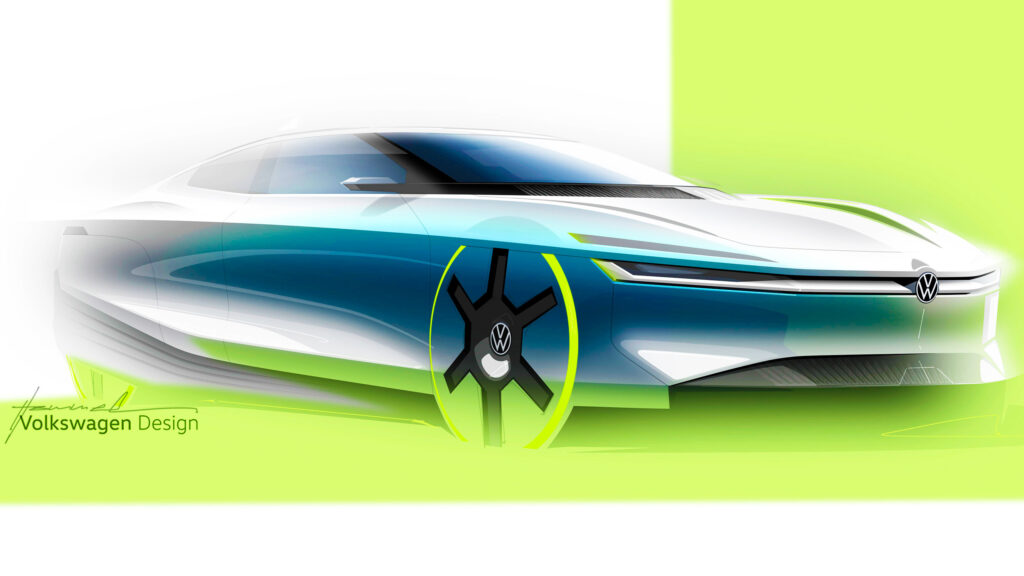
The concept car’s design clearly draws heavily on the XL1 from just over a decade ago. Like that car, this one has a sleek, teardrop shape that’ll let it slip through the air with as little disturbance as possible.
At the front of the concept is a full-width LED light bar, along with subtle daytime running lights and an illuminated VW emblem. Sketches of the sides reveal flowing panels and wheel covers at the rear. In addition, the rear end appears to be noticeably slimmer than the front, much like the XL1. The rear features a single light bar and a glowing badge.
In a statement, VW says the vehicle’s mission is “to explore the boundaries of what is possible with a fully functional everyday vehicle that is largely based on production technology.”
Volvo applies a second facelift to the XC40, extending its lifecycle.
It gains modern styling cues, a larger screen, and improved safety.
The fully electric EX40 and EC40 benefit from the same updates.
Volvo has announced substantial updates for the 40 series SUVs, including the evergreen XC40, its fully electric EX40 twin and the closely-related EC40 coupe-SUV. All three models receive a redesigned face, larger screens, AI tech, and improved safety features in a quest to stay relevant against younger rivals.
The XC40, in production since 2017, received a facelift in 2022, but the 2027 update is more substantial. The fully electric coupe-SUV variant debuted in 2021 as the C40 Recharge before being renamed to EC40 in 2024 and receiving its first facelift for 2027.
Visually, the first thing you notice is the reshaped headlights with the trademark Thor’s Hammer LED graphics, joined by a cleaner front bumper. The grille is wider than before, reaching out to the headlights, and adopts the body-colored finish of the zero-emission EX40 and EC40.
Volvo XC40
The sculpted profile is largely unchanged, but the diamond-cut alloy wheels measuring 18, 19 or 20 inches are new. The rear end benefits from sharper LED taillights in the XC40 and EX40, alongside fresh surfacing on the tailgate and the rear bumper. Volvo has also shown photos of the Black Edition variants combining a stealthy finish with a dark-themed cabin.
Inside, the centerpiece is the larger 11.2-inch central touchscreen (up from 9 inches), with its top end sticking out of the dashboard. The display runs Volvo’s latest infotainment software with Google Gemini integration. Other interior updates include a new wireless charging pad, “refined” ambient lighting, and new materials such as Arianne Cardamom leather, Brown Ash or Black Ash wood accents, and aluminum inserts.
Volvo EC40
On the safety front, the XC40 gets new hardware and software. Volvo threw in new radars, a new forward camera, and a total of 12 ultrasonic sensors. These enable a 3D view for the optional 360-degree camera system and make the optional Pilot Assist with lane change assist run more smoothly. The company has also added a Door Opening Alert and real-time hazard detection for the emergency braking and steering functions.
The XC40 continues to be powered by the familiar mild-hybrid turbo 2.0-liter four-cylinder engine, available with different outputs depending on the market.
The fully electric EX40 and EC40 also retain their existing single-motor and twin-motor configurations, delivering up to 584 km (363 miles) of WLTP range. Note that the PHEV powertrain option has been discontinued.
Volvo EX40
The updated Volvo 40 series is scheduled to enter production in Belgium later this fall. Depending on the market, deliveries are expected to start in early 2027 with pricing to be announced.
The main rivals of the Volvo 40 series in the premium compact SUV segment include the soon-to-be facelifted BMW X1 and X2, the brand new Mercedes-Benz GLA, and the Audi Q3 / Q3 Sportback.
The Ford Bronco Basecamp is coming to Australia and New Zealand.
Model arrives next year with a range-extended powertrain and pop-up roof.
Crossover could have a combined output of 416 hp and 442 lb-ft of torque.
Nearly a decade after wrapping up production in Australia, Ford has announced big plans for the land down under. As part of an event, the company announced plans to “double coverage of the Australian vehicle market to over 60% within three years.” The automaker is also aiming for “over 90% of its volume sold to be all-new or significantly refreshed by the end of 2030.”
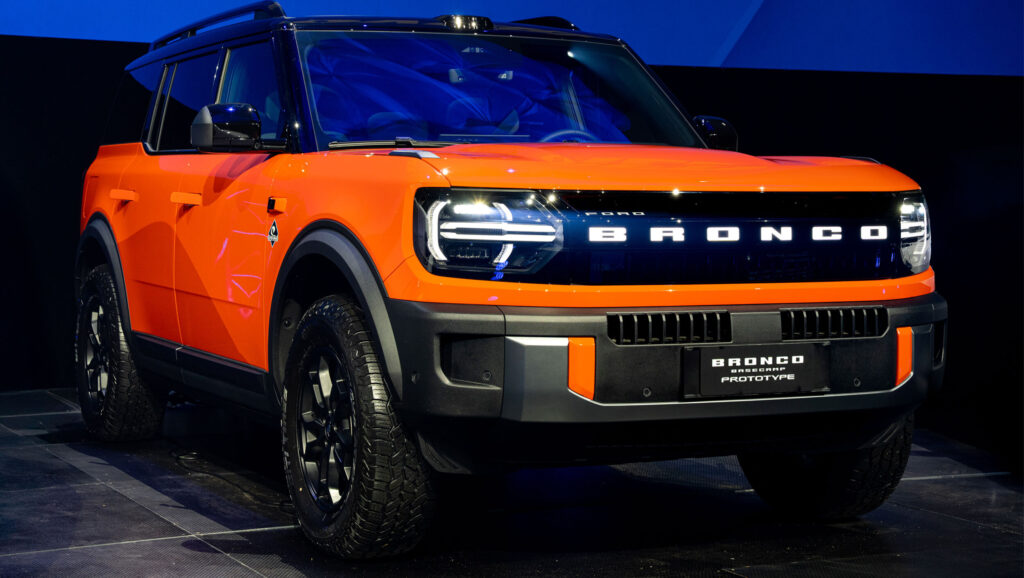
The centerpiece of this plan is to bring the Bronco Basecamp to Australia and New Zealand in the second half of 2027. The model launched in China last year and targets a “new breed of outdoor enthusiasts.”
Ford didn’t say much about the local variant, but confirmed it will have a “super hybrid extended-range electrified powertrain.” It consists of two electric motors, a 49 kWh battery pack, and a turbocharged 1.5-liter engine that acts exclusively as a generator.
The company said this will deliver the smooth and responsive driving dynamics of an electric vehicle, but with a range of 497 – 559 miles (800 – 900 km). It also goes without saying, you can simply fill up with gas and be back on your way.
Ford didn’t talk numbers, but the Bronco Basecamp starts at ¥229,800 ($34,245 USD / $47,565 AUD) in China and features a combined output of 416 hp (310 kW / 421 PS) and 442 lb-ft (600 Nm) of torque. The model also has a CLTC electric-only range of 137 miles (220 km).
While Ford didn’t say much about the vehicle, they noted it’s built for adventure and would make the perfect camping companion. When it’s time to go to sleep, all the seats fold down and an inflatable mattress can be placed on top of them to create a bed.
When morning comes, the rear swing gate has a “Wild Kitchen” with a fold-down table. The model even has Pro Power Onboard, which enables owners to access up to 6.6 kW of juice to power equipment such as coffee makers, cooktops, and lights.
The upscale Bronco Basecamp Outer Banks goes even further as it has an electric pop top that rises at the touch of a button to increase headroom, such as when camping. The Outer Banks also has a 7.5-liter center console compartment that can be warmed or chilled.
Besides the Bronco Basecamp, Ford announced the electric Transit City will arrive in November for $50,000 AUD ($36,100 USD). Around the same time, the Mustang Dark Horse T8-Spec will land at dealers. The automaker also announced the local launch of Ford Pro, which will be supported by a new seven-year, unlimited kilometer warranty for commercial customers who exclusively rely on Ford dealerships for servicing.
New Dacia Spring is a Euro-made budget-friendly urban EV.
It has a Renault platform, 80 hp and a 155-mile WLTP range.
The entire lineup will be priced under €20k before subsidies.
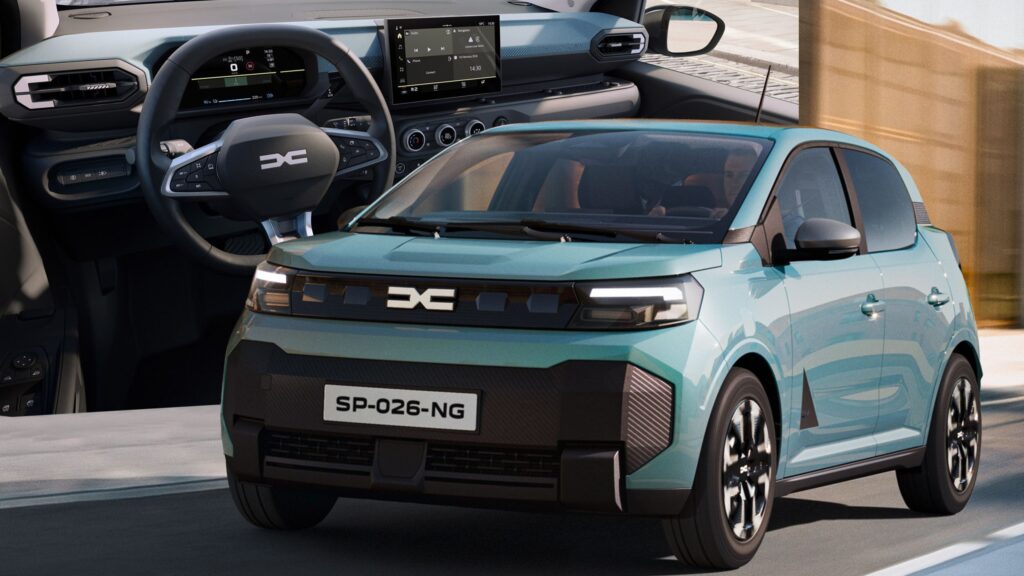
Dacia has unveiled a new generation of the Spring, marking a complete overhaul for one of Europe’s most affordable urban EVs. The small hatchback is built on Renault bones, promising a 155-mile range, clever design features and a sub-€20k ($23k) price tag. Unlike its Chinese-built predecessor, the new Spring will be manufactured in Slovenia, avoiding import tariffs in Europe.
The new model swaps the aging CMFA-EV platform of its predecessor for the new RG-EV architecture. This is another name for the AmpR Small platform, already underpinning the Renault Twingo E-Tech, Renault 5 E-Tech and Nissan Micra hatchbacks.
Power comes from a Twingo-sourced electric motor producing 80 hp (60 kW / 82 PS) and 175 Nm (129 lb-ft) of torque, sending power to the front wheels. The 0-100 km/h (0-62 mph) sprint is completed in 12.1 seconds and top speed is limited at 130 km/h (81 mph). Energy is stored in a small 27.5 kWh Lithium Iron Phosphate (LFP) battery pack, offering up to 250 km (155 miles) of WLTP range.
The battery needs 28 minutes to charge from 15-80% when connected to a 50 kW DC fast charger, or 2 hours and 55 minutes from a 7 kW wallbox using the standard AC charger.
The shift to the new platform gives the urban EV different proportions and a larger footprint while keeping weight low at 1,212 kg (2,672 lbs). The new Spring is 150 mm (5.9 in) longer and 180 mm (7.1 in) wider compared to its predecessor, stretching to 3,850 mm (151.6 in) long. It is also 61 mm (2.4 in) longer than the Renault Twingo E-Tech twin, while adopting a different styling language.
Unlike the Renault which is known for its frog-style headlights and soft curves, the Dacia looks less playful and more utilitarian. Designers gave it boxy LEDs, a generous amount of plastic cladding on the bumpers, conventional door handles and steel wheels measuring 15 or 16 inches in diameter.
Inside, the larger body translates to a more spacious cabin although the model retains the four-seater layout. The cargo space has a capacity of 337 liters (11.9 cubic feet) and grows to 1,283 liters (45.3 cu ft) when folding the 50/50 split rear bench. Dacia has also added a optional 18-liter (0.6 cubic feet) frunk, plenty of storage solutions around the cabin, and the modular YouClip accessory mounting system.
The dashboard appears to be covered in hard plastics with a large piece of colorful trim above the practical tray breaking the monotony of black. The standard 7-inch digital instrument cluster is joined by a 10.1-inch infotainment display on the flagship Journey trim, although the entry level Expression will be limited to a smartphone mount.
Occupants are treated with fabric seats and scratchy plastics on the door cards, designed to keep the costs low. Finally, the model has a familiar “My Safety” button allowing the driver to quickly disable or enable ADAS.
Production of the new Dacia Spring takes place at the Novo Mesto plant in Slovenia alongside the Renault Twingo E-Tech. The market launch is expected in late 2026, with the first deliveries scheduled for early 2027. Dacia has yet to announce detailed pricing but confirmed that all variants will cost under €20,000 ($23,000) before local EV subsidies.
This suggests that the new model will be more expensive compared to the outgoing Chinese-built Spring, which started from a heavily discounted €11,900 ($13,800) in Germany earlier this year. The latter will remain on sale alongside the new generation for a transitional period, serving as a cheaper alternative.
The new Spring is one of four new Dacia EVs set to debut by 2030 according to the official roadmap, including the upcoming Sandero EV with a slightly larger footprint.
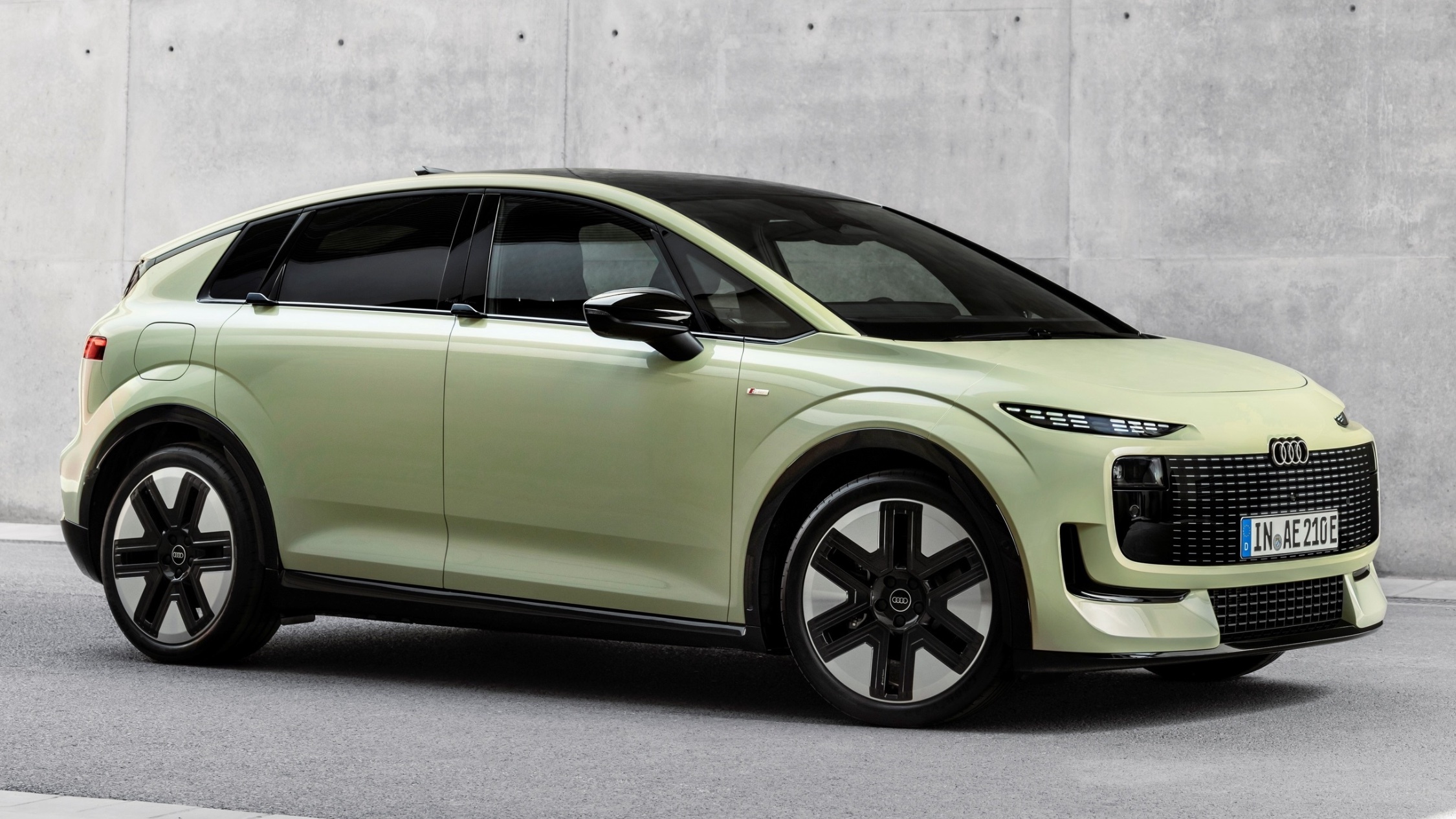
New A2 e-tron EV borrows design ideas from Audi’s innovative 1999 A2 hatch.
Biggest of three batteries delivers 401 range miles; smallest starts at £32,200.
Clever storage and one 167 hp motor comes standard; 322 hp hero tops lineup.
Being ahead of the curve sounds great unless nobody is ready for what you’re selling. Twenty-five years ago, Audi toyed with a radical vision of what a clever compact car could be: light, slippery, incredibly efficient and premium-feeling. Now that thinking and the A2 badge it wore is back, wrapped in a far more marketable electric crossover that might finally have arrived at exactly the right moment.
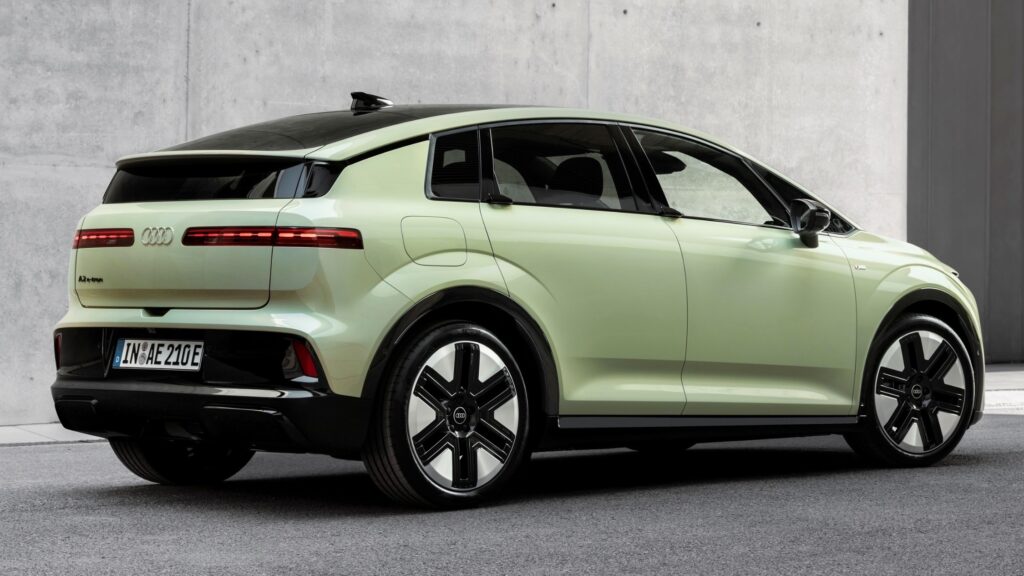
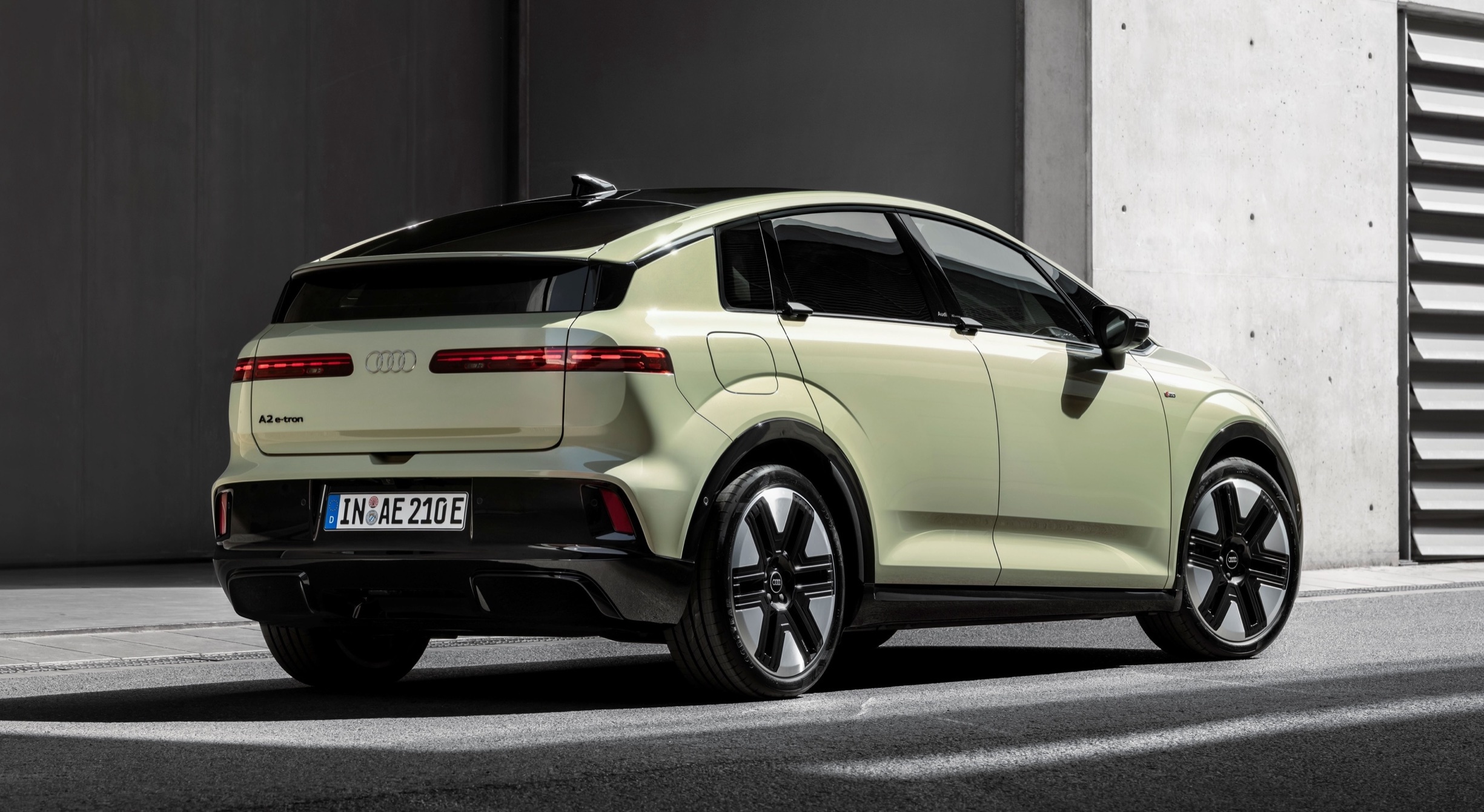
This is the new Audi A2 e-tron, and while another electric crossover might not sound like something worth cancelling dinner plans for, this one is worth your attention – even if you’re in the US, where the A2 was, and will continue to be, off limits. For a start, it takes some of the design cues of the original A2, the boxy, almost minivan-like body and split-glass rear window, and transplants them on a much wider car with a solid, four-square stance and the cheekiest grin we’ve seen an Audi wear.
The second reason to pay attention is Audi’s claim that the A2 e-tron is the most efficient production model in the brand’s history. Yes, even more efficient than the fuel-sipping, 78 US mpg A2 3L diesel, though we’re not sure how Audi calculated that. In the right configuration, the baby e-tron consumes just 12.8 kWh per 62 miles (100 km), while the real mile-muncher of the lineup manages up to 401 miles (645 km) on the European WLTP cycle.
And Ingolstadt’s engineers haven’t achieved that by simply throwing a battery the size of a studio apartment underneath their VW ID.3 and Volvo EX30 rival. Instead, Audi has gone hunting for wasted energy pretty much everywhere. The A2 has a drag coefficient of just 0.24, helped by an enclosed underbody, active cooling intake, aero wheels and clever little pieces around the wheel arches designed to calm turbulent air.
Even the door handles have joined the efficiency crusade. They’re wing-type handles at the base of the door pillars that use sensors rather than conventional mechanical hardware. Audi scrapped them in favor of conventional handles on the new Q9 luxury SUV but promised we’d see them on a future Euro product. Tug gently and the door opens electrically. There’s even backup energy storage in case the electrical system decides it’s having the day off.
There are three battery sizes, measuring 52, 61 and 84 kWh gross, so something to suit pretty much every kind of use-case scenario. Stick with the 52 kWh battery and you get a 168 hp (170 PS /125 kW) single motor that helps your A2 hit 62 mph (100 km/h) in 8.8 seconds and cover 262 miles (422 km) of range before needing to plug-in.
Quattro Notable By Its Absence
An optional 61 kWh pack comes with a 187 hp (190 PS / 140 kW) electric motor, dropping the stoplight sprint to 7.9 seconds and offering a handy range boost to 320 miles (515 km). Splash for the 228 hp (231 PS / 170 kW) A2 and you chop the 62 mph time to 7 seconds flat and unlock that 401-mile headline range figure we mentioned earlier, courtesy of an 84 kWh battery.
And if you’re prepped to swap some of that range for more zip, the 322 hp (326 PS / 240 kW) flagship delivers 5.7-second and 391-mile (629 km) stats. It’s also the only A2 capable of stretching its legs to 124 mph (200 km/h) instead of 99 mph.
In each case that power is settled to the rear wheels because the A2 is based on the MEB platform in use on cars like the Audi’s VW ID.3 rival and Audi Q4 e-tron SUV, not the newer front-drive MEB+ architecture found under the VW ID. Polo, Cupra Raval and Skoda Epiq. That means no Quattro tech or badges.
DC charging tops out at 183 kW on big battery cars, which require an unimpressive 29 minutes to fill from 10-80 percent. The two smaller batteries sound like they’re going to be even worse due to their feeble 100 kW charge rates, but they cut the fill time to 24 minutes by virtue of their tiny capacities. Like other VW MEB EVs, this one supports bi-directional charging.
Fidlock? What’s That?
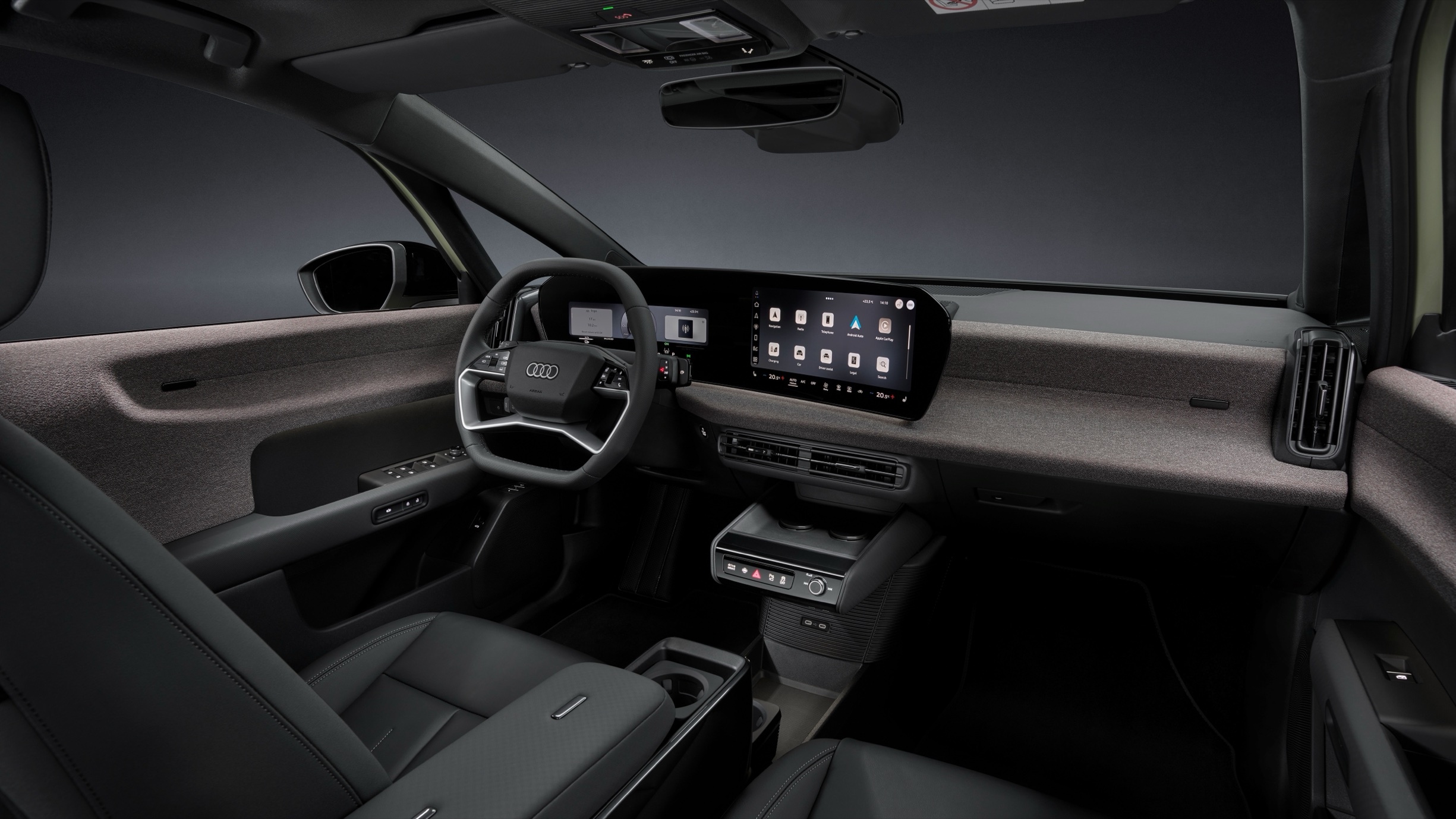
Inside, an 11.9-inch digital instrument display sits alongside a 12.8-inch curved touchscreen, while the gear selector has migrated to the steering column. That leaves more room in the center console for a Qi 2.2 charging pad that can juice two smartphones simultaneously at up to 25 watts. Useful, but hardly revolutionary. The Fidlock system, though, promises to be both.
Fidlock is actually a magnetic mounting system with a mechanical lock, allowing owners to click things like cupholders and charging cable bags into dedicated points around the cabin and trunk. If you’re an avid cyclist you might be familiar with them already, but Audi claims the tech makes its production car debut on the A2.
Ordinary Trunk, But At Least There’s A Frunk
But what about real practicality? It’s okay, but not class leading. The A2 rides on the same 2,770 mm (109 inches) wheelbase as its Q4 e-tron brother, so legroom should be good, but where the Q4 offers 520 litres of trunk space, the A2 can only muster 396 liters (14 cu-ft). It also loses out to the Renault Megane E-tech (440 liters), but beats the VW ID.3 (385 liters) and cramped Volvo EX30 (318 liters).
One of the original A2’s most innovative features was its aluminum construction, but that also made it expensive, contributing to its poor sales. So this time the A2 e-tron is mostly steel with some aluminum content. But what does feel advanced is the development timeline. It took Audi 20 years to reboot the A2 after the last was discontinued, but only 21 months to get it from drawing board to debut.
The original A2 was ahead of its time, but with a slick design, some clever interior touches, impressive efficiency, a genuinely affordable £32,200 starting price and European EV sales on fire right now, maybe this is finally the right time for the A2.
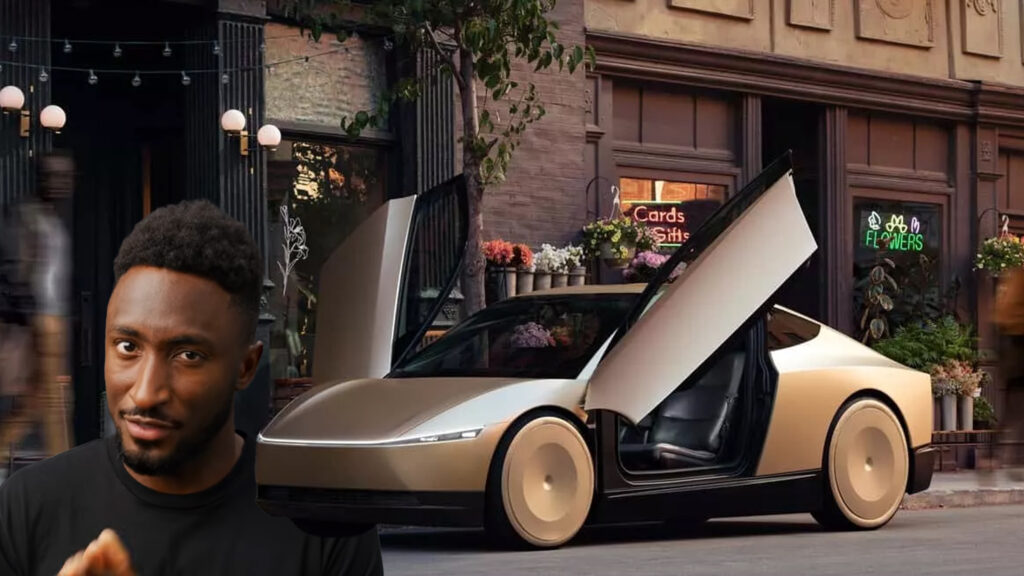
Tech Youtuber MKBHD cast doubt on Elon Musk’s Cybercab timeline.
With less than four months to go, it looks like the bet could be safe.
However, MKBHD concedes that Tesla is at the forefront of change.
Back in October 2024, Tesla’s “We, Robot” event introduced the world to Optimus, the Robovan, and the Cybercab. Drawing design inspiration from the Cybertruck, the Cybercab offered yet another look at the proposed driverless car future, this time sans a steering wheel and pedals.
But the biggest shocker was the Tesla CEO’s claim that not only did he expect the Cybercab to be offered to customers at under $30,000, but that it would also enter high-volume production before 2027. Granted, by his own admission, Elon Musk said at the time that he tends to be “a little optimistic with timeframes,” but it got tech creator Marcus Brownlee, aka MKBHD, thinking.
So confident was MKBHD that Tesla wouldn’t meet such a timeline, he made a bit of a one-sided bet: he offered to shave his head live on camera if they made good. To be specific, Brownlee said that Tesla wouldn’t sell a Cybercab to a customer for $30,000 before 2027.
Semantics aside, that moment triggered a bunch of AI videos and memes, particularly from fans of Tesla, with Elon Musk even replying to one such post on X, saying, “Gonna happen. 😂”
A Long Time Coming
Since the Cybercab reveal, we’ve seen more information about the car trickle out, including it would likely deliver around 300 miles (482 km) of range, use large castings to save costs, and still projected to cost $30,000 or less. In February, the team even appeared to be ahead of schedule, with the first Cybercab rolling off Tesla’s Texan production line.
Brownlee himself admitted he was a little nervous when it came to light that a new Cybercab event had been scheduled for the 3rd of September. But luckily for him (and his hair), the event had nothing to do with customer sales. Instead, it announced that the Cybercab would be added to the Tesla Robotaxi network within their existing geofenced areas.
But while it looks like his hair is safe for now, the Tech Tuber went on to say that although he thinks Tesla may be ahead of its time with the Cybercab, he expects self-driving cars to become more mainstream in the next 10 years. Oh, and regardless of whether he wins the “bet” or not, he’ll be donating to Cancer Research in January.
Ford’s CEO has released new teaser images of the Fathom.
Midsized electric truck follows in the footsteps of the Maverick.
Debuts next year and will start at $29,945 including destination.
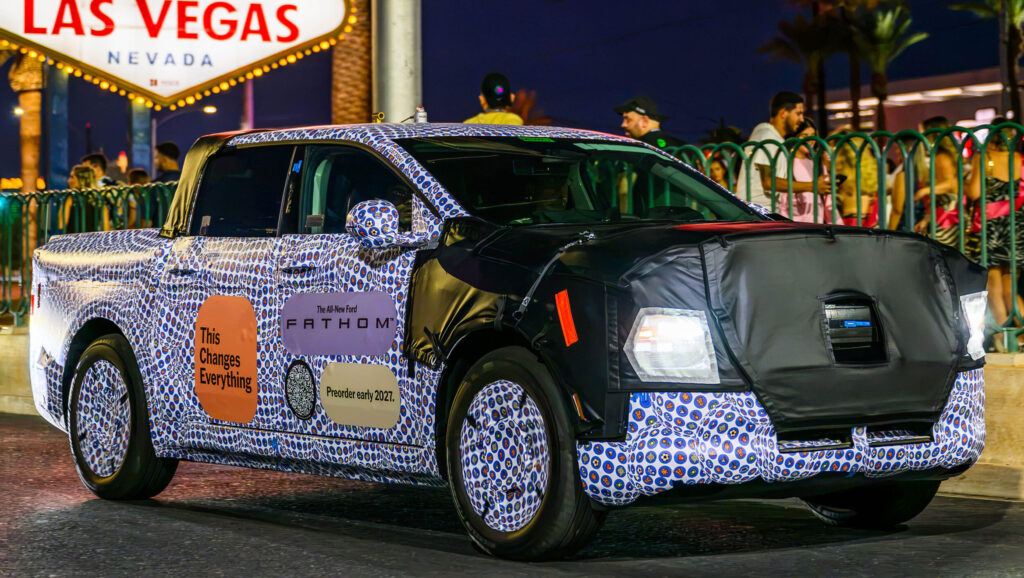
Getting a good look at the Fathom has been about as easy as capturing a real phantom on camera. However, Ford CEO Jim Farley recently took to social media to release high quality teaser images.
They show the midsized electric truck traveling past the iconic Las Vegas sign. Of course, we’re more interested in the pickup than the tourist trap.
Dressed in colorful camouflage, the Fathom follows in the footsteps of the Maverick as it has an upright front end with a wide lower intake. Bulky cladding hides the grille, but it’s flanked by mid-mounted headlights that have an angular accent toward the inside.
Photos Ford / Jim Farley
Further back, we can see streamlined bodywork and aerodynamically optimized wheels, which are also wrapped in disguise. They’re joined by traditional door handles as well as tiny mirrors. The latter don’t look particularly good, but Ford has previously said their 20% smaller size results in an extra 1.5 miles (2.4 km) of range.
Other notable highlights include rounded wheel arches and what appears to be an angular lip around the upper bed. Elsewhere, there are vertical taillights and a relatively plain rear bumper with an offset license plate.
A closer inspection reveals the cab is slightly smaller than it appears as the prototype has been equipped with a sizeable rear spoiler. This pushes out the black camouflage and undoubtedly contributes to the truck’s efficiency.
Photos Ford / Jim Farley
Despite being smaller than it appears, Ford has previously confirmed the Fathom has more passenger volume than the Toyota RAV4. This means we can expect more than 98.9 cubic feet (2,801 km) of space for occupants.
Additional details are limited, but Ford has said the truck will have a large touchscreen display with an easy-to-use navigation system powered by Apple Maps. It will also have Apple CarPlay and Android Auto compatibility, digital key technology, a bidirectional charging capability, and next-generation BlueCruise hands-free driving.
Specifications remain a mystery, but Ford has hinted at multiple battery packs. The base model comes with the “standard-range battery,” so that suggests there will also be a long-range variant.
Unfortunately, we still have a wait ahead of us as Ford won’t introduce the model until 2027. When pre-orders begin early next year, pricing will start at $28,350 before a $1,595 destination fee.
Flagship Range Rover gains its first zero-emission variant.
It produces 542 hp and has 372 miles of WLTP range.
UK pricing starts at £154,070, which translates to $208,200.
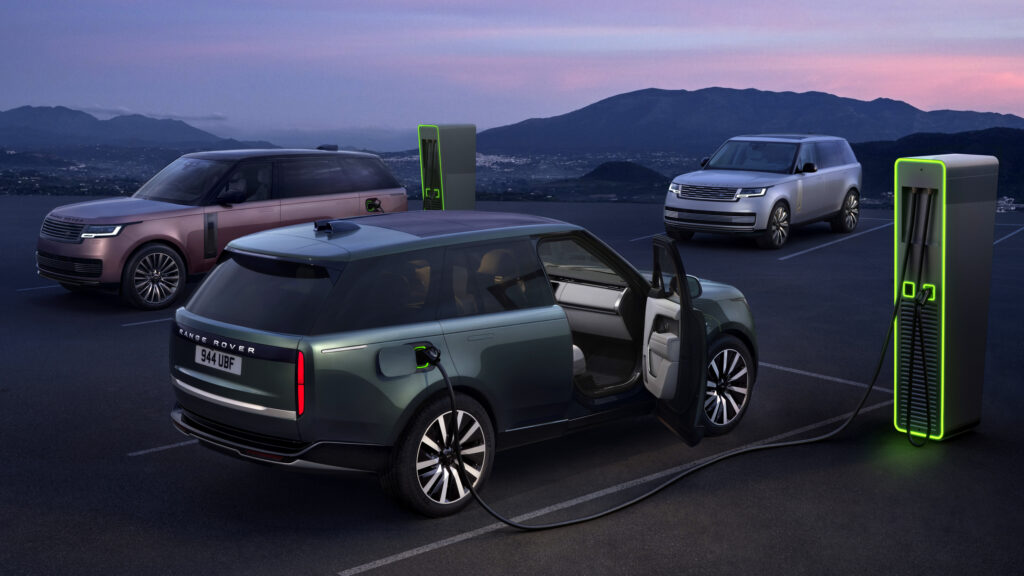
Land Rover has finally pulled the covers off the Range Rover Electric, giving its flagship SUV a battery-powered option after years of teasing. The pitch is V8-matching output from a silent dual-motor all-wheel-drive setup, the usual isolation from the outside world, and, according to Gaydon, no loss of off-road ability.
Look for visual drama and you won’t find any. The Electric is nearly indistinguishable from the fifth-generation combustion SUV that arrived in late 2021, with changes limited to a slipperier grille, new alloy wheels, and a reworked underbody. Together they trim the drag coefficient by 0.01 cd and add up to 10 miles (16 km) of highway range.
The SUV will be offered in standard- and long-wheelbase configurations across SE, HSE, Autobiography, SV, SV Ultra, and SV Black trim levels, alongside a curated First Edition launch model.
The interior is also carried over from the standard Range Rover, albeit with EV-specific graphics on the screens featuring AI-assisted range prediction and over-the-air updates for the battery. A lot of emphasis was given to acoustic refinement, with the electric model running 7 dBA quieter under full throttle compared to the V8-powered version.
Electric Power
Beneath the familiar aluminum body sits an electrified take on the Modular Longitudinal Architecture (MLA). Two electric motors, both engineered and built in-house, make 349 hp (260 kW / 354 PS) each, for a combined 542 hp (405 kW / 550 PS) and 627 lb-ft (850 Nm). That’s 12 hp (10 kW) and 74 lb-ft (100 Nm) up on the mild-hybrid twin-turbo 4.4-liter V8.
The instant power delivery from the electric motors makes the zero emission model quicker off the line, with a 0-60 mph (0-96 km/h) acceleration in 4.3 seconds compared to 4.5 seconds for the V8-powered equivalent.
Energy is stored in a double-stacked lithium-ion battery with a capacity of 118.5 kWh. The battery pack is housed within a high-strength aluminum case under the cabin floor. The WLTP range is up to 372 miles (600 km), while Land Rover’s own EPA estimate lands at 333 miles (535 km). Respectable, but far from class-leading among luxury electric SUVs, given that the 570 hp BMW iX5 60 AWD is quoting an EPA figure of 435 miles (700 km).
When connected to a 350 kW DC fast charger, the 800V battery charges from 10 to 80 percent in 22 minutes, and can add up to 137 miles (220 km) of range in 10 minutes.
Land Rover filed over 300 patent applications for the electric SUV. One of the highlights is the ThermAssist heat management system, which saves up to 40% on heating energy and adds up to 25 miles (40 km) of range in extreme weather conditions.
Chassis Setup
The Range Rover Electric adopts twin-valve active dampers sourced from the Range Rover Sport SV alongside dual-chamber air springs and rear-axle steering. Sensors automatically monitor water level, extending ride height and allowing an impressive wading depth rating of 35.4 inches (900 mm).
Thanks to a new Integrated Traction Management (ITM) system, the Range Rover Electric can tackle slippery terrain with ease. Furthermore, the Intelligent Driveline Dynamics (IDD) system allows it to handle inclines up to 33 degrees and steep climbs of up to 45 degrees, honoring the off-road credentials of its ancestors.
The electric SUV tips the scales at 6,360 lbs (2,885 kg), making it 165 lbs (75 kg) heavier than the plug-in hybrid (PHEV) variant, although the center of gravity is lower than the V8 version. Maximum towing capacity stands at 5,512 lbs (2.5 tons), which is down from the 7,716 lbs (3.5 tons) rating of combustion models and the 6,614 lbs (3 tons) of the PHEV.
What It’ll Cost You
Here in the States, the Range Rover Electric opens at $138,000 before the $2,450 destination and delivery charge, which brings the real number to $140,550. That’s nearly $25,000 more than a base gas Range Rover, which runs $113,300, or $115,750 delivered. The P550e plug-in hybrid makes the electric look reasonable by comparison: $128,900, or $131,350 delivered, a difference of just $9,200.
In the UK, it’s priced from £154,070 ($208,200) on-the-road. Production takes place at Land Rover’s Solihull facility in the UK alongside the mild-hybrid and plug-in hybrid variants.
MG launched the Hector Tomahawk EV three-row SUV in India.
It is a rebadged Wuling available with EV and PHEV powertrains.
Prices start at ₹13.99 lakh ($14,600) for the EV minus the battery.
Chinese automakers have put out an average of 3.6 new models per day across the past five months, a pace that guarantees a certain amount of overflow into markets beyond China. The new MG Hector Tomahawk is one of those exports, a three-row SUV that has just gone on sale in India with a choice of fully electric or plug-in hybrid power.
The name suggests a relationship that does not exist, because the Hector Tomahawk shares nothing with the ICE-powered Hector. What MG has actually done is rebadge the Wuling Starlight 560, a model that broke cover in late 2025 and reached Chinese showrooms in early 2026.
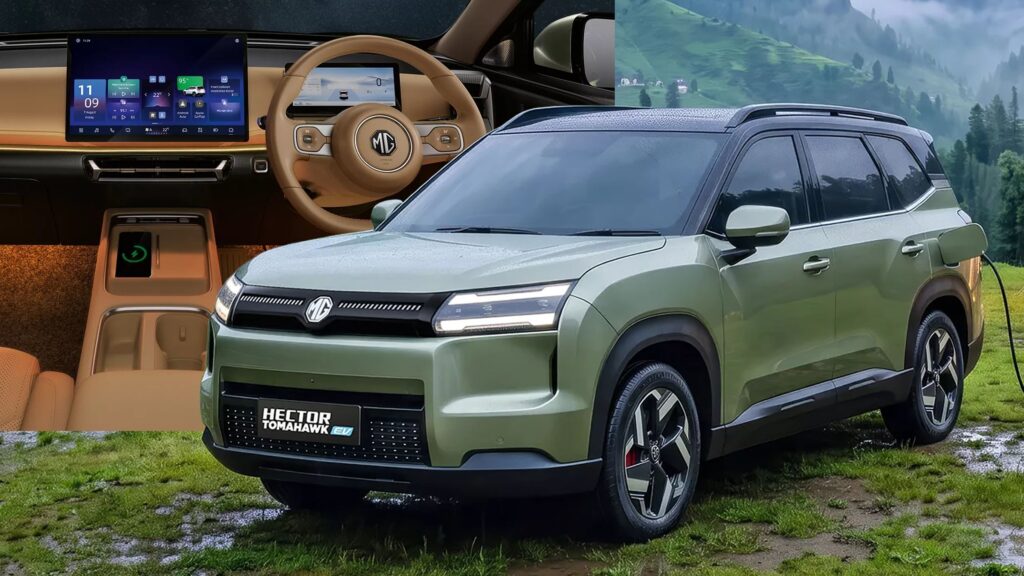
Visually, the BEV and the PHEV variants are distinguished by the different grille and front bumper, each introducing small differences compared to the equivalent models from Wuling. The PHEV has a body-colored nose, a larger cooling intake, loads of black cladding, and an aluminum-style skid plate. The EV adopts a simpler and boxier face looking nearly identical to its Wuling sibling.
Regardless of powertrain type, the SUV measures 4,745 mm (186.8 in) long, has a 2,810 mm (110.6 in) wheelbase and a ground clearance of 230 mm (9.1 in).
MG
The right-hand-drive cabin comes with two or three rows of seating. Cargo space is 610 liters (21.5 cubic feet) in five-seat form, dropping to 192 liters (6.8 cubic feet) once the third row is in place. The kit list runs to a 15.6-inch infotainment screen, an 8.8-inch digital gauge cluster, gesture controls for the touchscreen, a dual-pane panoramic sunroof, 256-color ambient lighting, and a 10-speaker stereo. The party piece is an AI-powered assistant with a karaoke mode and a library of more than 8,000 songs across multiple genres.
The Hector Tomahawk EV utilizes a single front-mounted electric motor producing 201 hp (150 kW / 204 PS), with a 69.2 kWh battery allowing over 500 km (311 miles) of range while supporting 90 kW DC fast charging and V2L/V2H functions.
On the other hand, the Hector Tomahawk PHEV pairs a naturally aspirated 1.5-liter engine/generator with a single electric motor and a smaller 20.5 kWh battery pack. The combined range is over 1,100 km (684 miles), including 115 km (71 miles) on EV power alone.
The Battery Rental Math
MG
The MG Hector Tomahawk EV costs between ₹19.49 lakh ($20,400) and ₹23.49 lakh ($24,500) in India. Buyers can also take it under the Battery-as-a-Service (BaaS) scheme, which drops the entry price to ₹13.99 lakh ($14,600) and then charges ₹4.90 ($0.05) per kilometer (₹7.89 or $0.08 per mile) for the privilege of using the battery.
Meanwhile, the MG Hector Tomahawk PHEV starts at ₹25.70 lakh ($26,900) outright, or ₹21.79 lakh ($22,800 / €19,600) under BaaS with a battery rental rate of ₹3.20 ($0.03) per kilometer. Deliveries for the EV begin in September, followed by the PHEV in November.
Tesla is still having issues with its robotaxis as it gears up to launch the Cybercab.
Footage shows a Model Y robotaxi making an illegal and dangerous right turn.
Later this month, the Cybercab will be added to Tesla’s robotaxi fleet in Texas.
Developing and building fully autonomous vehicles isn’t easy. Just ask Tesla, which has been working on the technology for more than a decade and has yet to perfect it. Based on a recent video of a Model Y currently being used by its robotaxi fleet in Austin, Texas, Tesla still has a long way to go.
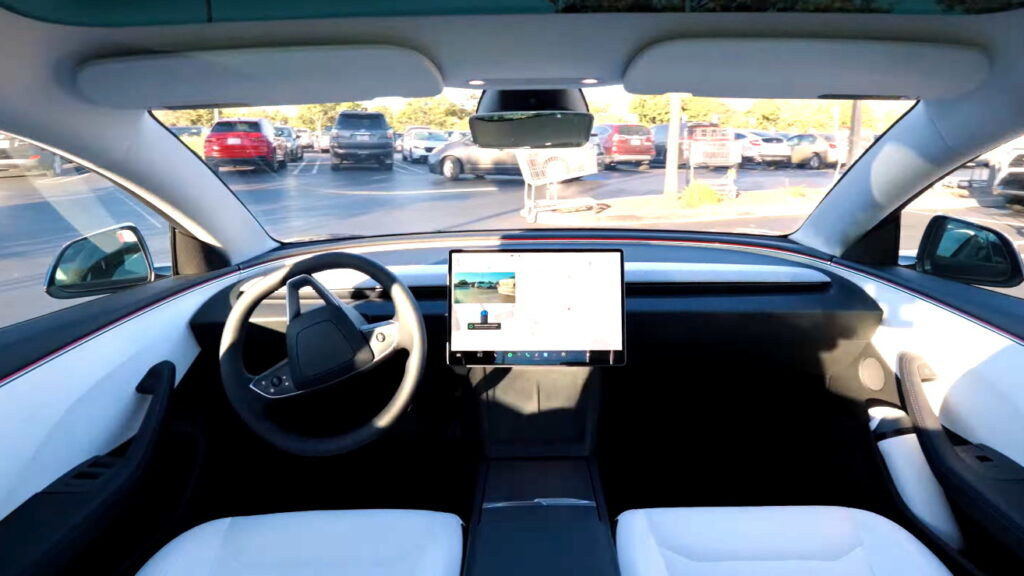
This clip was recently shared on Reddit by a frequent user of Tesla’s Austin robotaxi service, and it may make you think twice before trying it yourself. For whatever reason, the Model Y in question attempted to make a right turn at a large intersection, but failed to realize that the inside corner of the road was blocked off by bollards for pedestrian safety.
A human driver would have seen these bollards and realized you have to turn around them. Instead, the Tesla Model Y drove directly into the blocked-off area and sat there for several seconds, presumably because it realized it was now stuck. Unable to reverse out and correct its mistake, the robotaxi instead tried to thread its way through two of the bollards, hitting them in the process.
It didn’t take long for Redditors to identify the exact intersection where the incident took place, and a Google Street View search revealed the bollards had been there since at least February 2024.
Despite incidents like this, Tesla appears to be plowing ahead with plans to expand its robotaxi fleet in Austin. According to a recent report, it completed a local trial with the Cybercab and company employees on private roads and is now preparing to add the Cybercab to its fleet and make it available to the public.
It remains to be seen whether the Cybercab’s self-driving capabilities will be better than those of other Tesla models. We do know it’s equipped with more RAM and an upgraded AI4 Fully Self-Driving computer. Whether it actually performs any better than a Model Y like this remains to be seen, but as we’ve seen so often from Tesla in the past, members of the public will be used as test dummies.
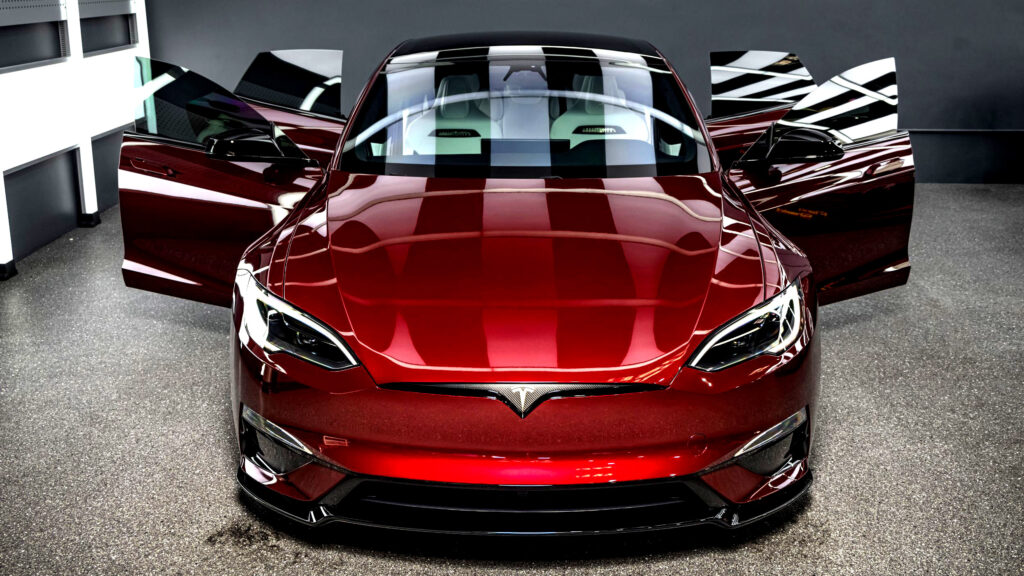
Franz von Holzhausen owns the Tesla Model S Plaid Signature #001.
The Tesla design chief took the special EV to Unplugged Performance.
The sedan received paint protection, ceramic coating, and window tints.
Franz von Holzhausen has run Tesla’s design studio since 2008, and most of what people picture when they see a Tesla came off his desk. The Model S is one of those cars, so it makes sense that he took delivery of the definitive version, the Plaid Signature Edition, chassis number #001, the one at the very front of the production line.
Before settling in with the car that closes out the Model S story, he drove it to Unplugged Performance in California. The tuner is better known for wheels, brakes, wraps and body kits, but detailing sits on the menu too, and that’s what he was there for. The bodywork he drew more than a decade ago stayed exactly as it left the factory. What he wanted was for it to stay that way.
Preserving His Own Handiwork
Unplugged Performance
While the car was brand-new, the first step was a thorough chemical decontamination wash to remove bonded fallout, iron particles, and transport residue picked up before delivery. Once prepared, the Auto Spa team disassembled parts of the exterior so the film could be applied without a visible seam anywhere.
According to Unplugged Performance, paint protection film acts as a physical barrier that absorbs stone chips, scratches, and minor wear, shielding the factory paint underneath. For Signature Edition #001, that was only the starting point.
Unplugged Performancean
Following careful inspection under dedicated lighting, technicians coated every panel and trim piece with a full ceramic treatment. The extra layer adds hydrophobic properties that repel dirt and make washing easier, while deepening the gloss of the paintwork.
Finally, the team covered all glass surfaces with a window film that blocks 99% of ultraviolet radiation and 98% of infrared heat. That keeps the interior out of the worst of the Californian sun, so it should still look new years from now.
The Tesla Model S Plaid Signature Edition arrived earlier this year as a farewell special for the long-running nameplate. Production is capped at 250 units, offered by invitation to select customers at $159,420 apiece.
As with the regular Plaid, the Signature Edition uses the tri-motor setup producing 1,020 hp (761 kW / 1,034 PS), with a handful of unique touches on top. Chief among them is the Garnet Red finish, paired with gold emblems, special badging, and 21-inch Velarium wheels with gold calipers over carbon-ceramic brakes. Inside there’s white Alcantara upholstery, a yoke steering wheel, and Signature branding.
This isn’t the first time von Holzhausen has handed a personal car to Unplugged Performance. Years earlier, he had his Model 3 fitted with coilover suspension, sway bars, adjustable suspension arms, and carbon-ceramic brakes, again leaving the bodywork alone.
The French brand is giving away caps, suitcases, and Monopoly sets.
Citroën’s new 2 CV will premiere as a concept and then launch in 2028.
Original 2 CV delivered just 9 hp, but the new one will have much more.
Citroën is reviving one of its most iconic nameplates for the modern age. After lying dormant for more than 35 years, the 2 CV returns as a small EV, set to premiere at the Paris Auto Show in October. To stir up interest ahead of that debut, Citroën has kicked off an interactive social media campaign complete with prizes.
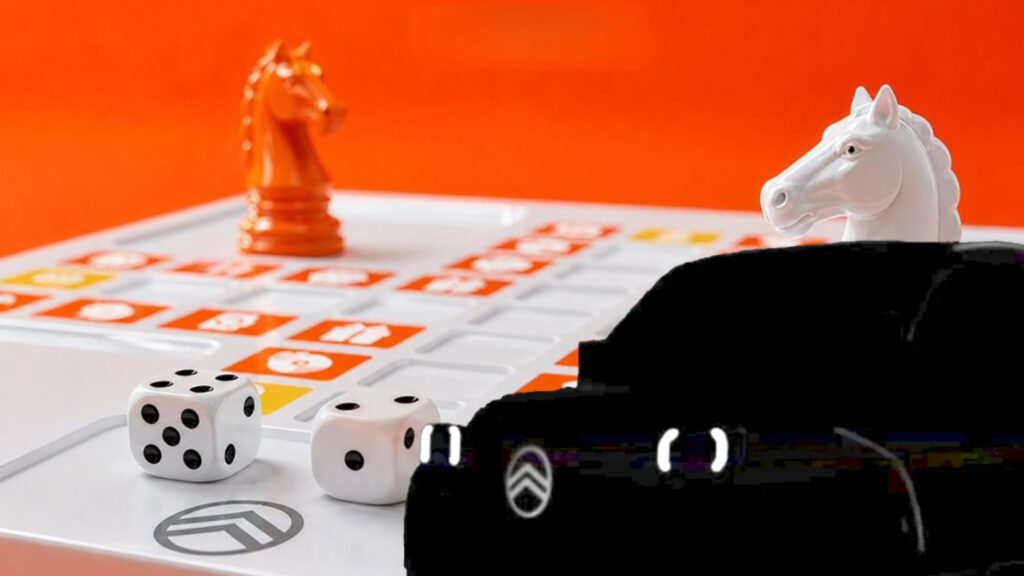
The new 2 CV campaign is inspired by a French board game, and five challenges will be launched on Instagram in the lead-up to the new car’s unveiling. The first of these games was shared a couple of weeks ago, simply asking followers how much horsepower the first 2 CV had. There were seven winners, each receiving a Citroën-branded version of Monopoly.
The second game was a little more challenging than the first, though it still seemed pretty easy for 2 CV enthusiasts. This time, Citroën played the sounds of four different vehicles online, and players had to guess which sound was the 2 CV. Once again, the French brand is selecting seven winners, each of whom will receive a 2 CV cap.
Among the other prizes previewed for future games are a carry-on suitcase, a portable Bluetooth speaker, and a bright red Citroën drink bottle.
As for the new 2 CV itself, a single teaser image has revealed it will have a small footprint just like the original, complete with a bulbous-looking roofline and pronounced front and rear fenders. It will also include LED headlights perched above the bumper and is shaping up to have quite a spacious cabin.
Technical specifications remain a mystery. It’s understood the car premiering at the Paris Auto Show will be a concept and that the production model will go on sale in 2028, priced at under €15,000 ($17,300).

 Login
Login