Normal view

There are new articles available, click to refresh the page.
Before yesterdayMain stream

EV Repair Costs Are Starting To Drop, But The Real Bill Is Hiding Elsewhere

  • Repairable EV collision claims rose sharply in 2025.
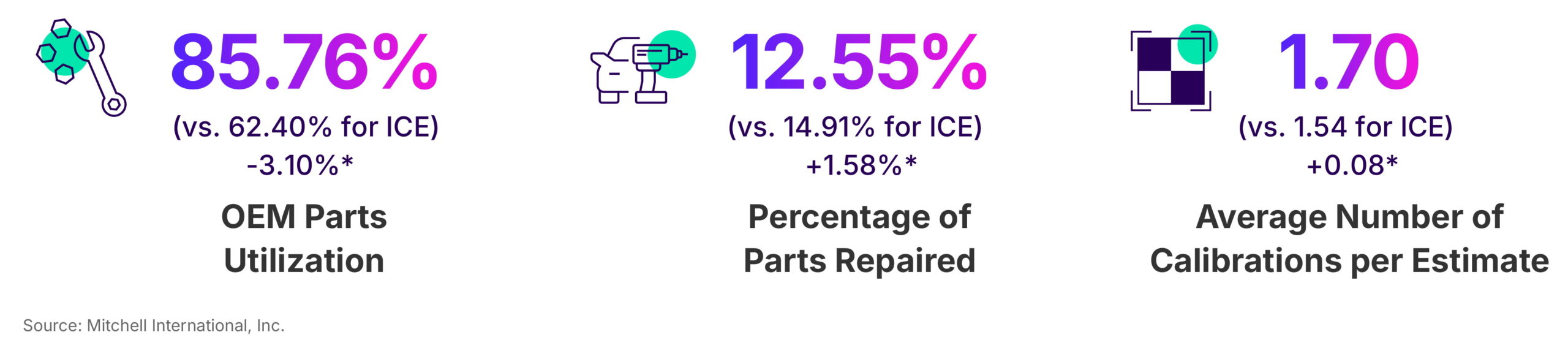
  • EVs required an average of 1.70 calibrations per estimate.
  • US EV total loss values fell 6% due to depreciation.

Electric vehicles are turning into a proper migraine for the insurance industry. According to the latest report from collision management software provider Mitchell, repairable collision claims for EVs jumped 14% in the US and 24% in Canada during 2025.

What makes these numbers particularly jarring is the fact that EV sales growth slowed down in 2025 as government tax incentives expired and consumer interest shifted to hybrids. Cox Automotive estimates that new EV sales dropped approximately 2% in the US, with S&P Global Mobility reporting a 0.4% decline in new EV registrations.

More: Car Repair Costs Are Exploding And It’s Not Just About Tariffs

Even Tesla’s grip on the market loosened slightly, with its US market share slipping to 46.2% from 48.7% in 2024 as more competitors gained ground.

Rising Repair Complexity

Even so, the existing EV fleet is aging into more accidents, and the complexity of repairing them is becoming a logistical and financial hurdle for the repair industry.

Ryan Mandell, Mitchell’s vice president of strategy and market intelligence, explained: “Due to their dense electrical architectures, software-driven systems and interconnected, sensor-heavy designs, these vehicles require additional diagnostic and calibration operations when damaged that can add cost, complexity and cycle time to each repair.”

 EV Repair Costs Are Starting To Drop, But The Real Bill Is Hiding Elsewhere

The “Plugged-In: EV Collision Insights” report also examined other electrified vehicles. Repairable claims for PHEVs increased 6% in the US and 26% in Canada in 2025. Mild-hybrid models (MHEV) recorded increases of 20% in the US and 29% in Canada. It is worth noting, however, that MHEV sales in the US surged 28% in 2025.

Also: Why Even The Smallest Accident Is Designed To Destroy Your Wallet

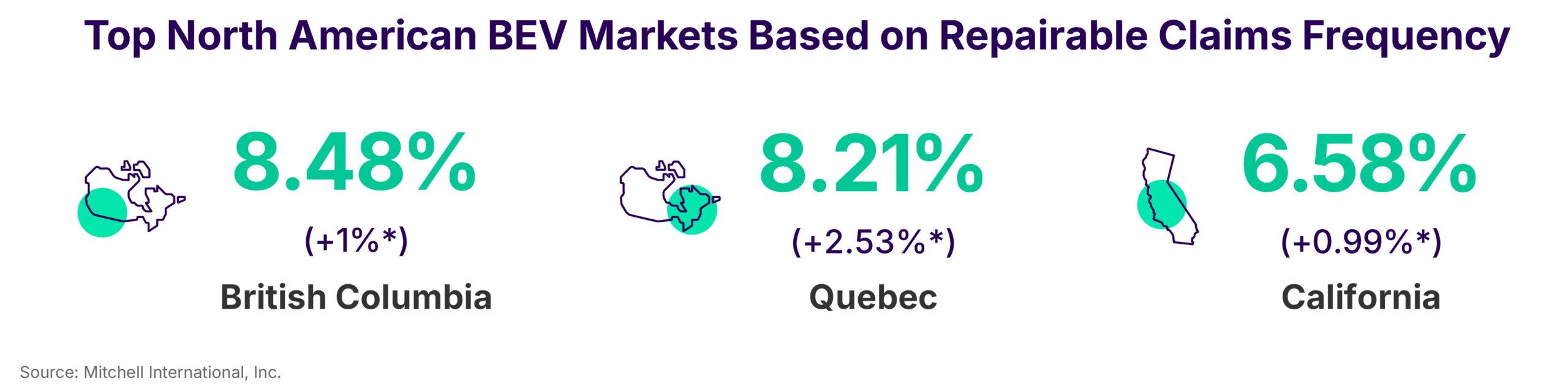
Across North America, British Columbia recorded the highest EV repair demand at 8.48%, followed by Quebec at 8.21% and California at 6.58%.

Which Models Top The Claims List?

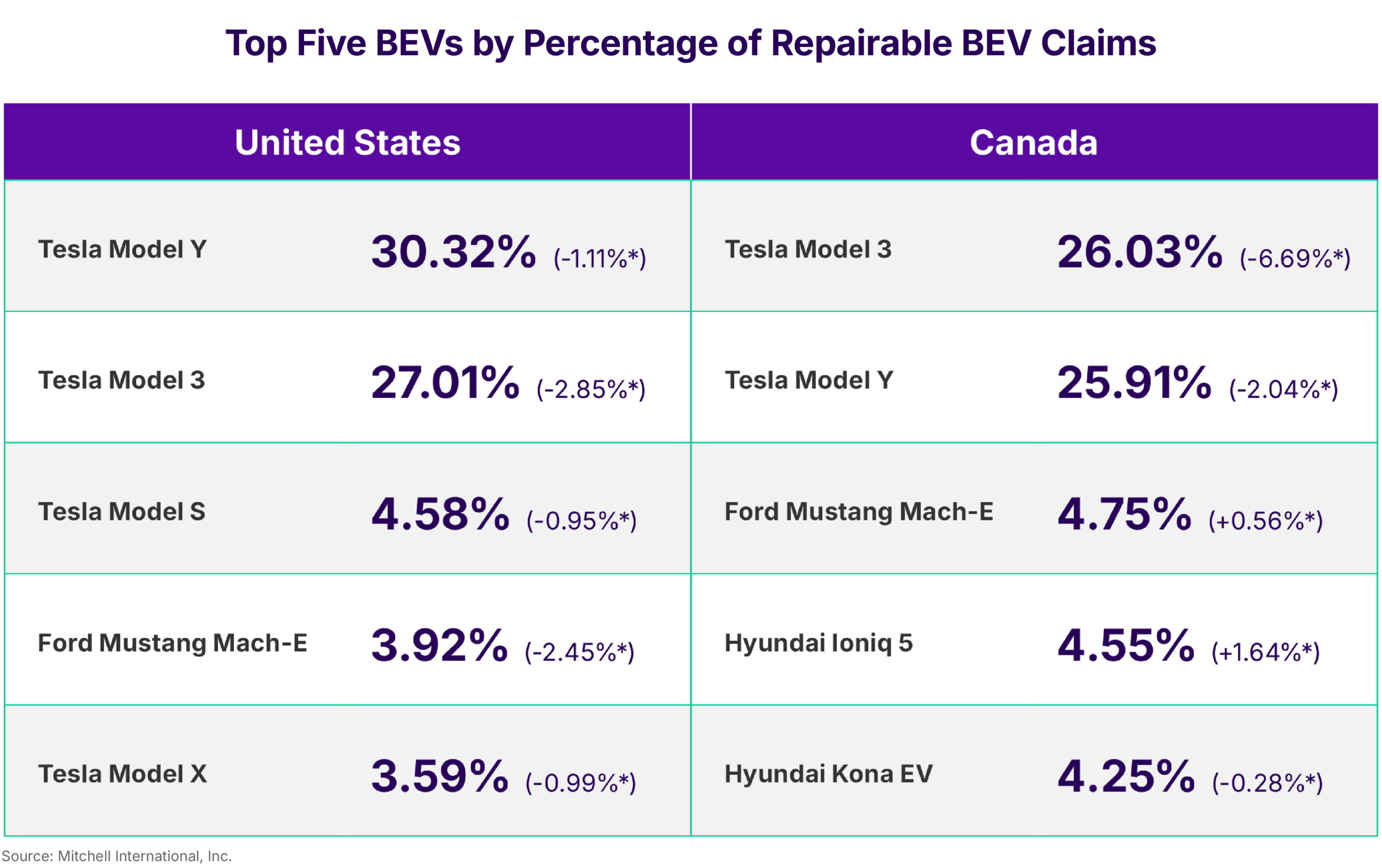
Looking at individual models, Tesla continues to dominate claims volume. In the US, the Model Y accounts for 30.32% of repairable BEV claims, followed by the Model 3 at 27.01%, meaning the two together represent more than half of all such claims. The pattern is similar in Canada, although the positions are reversed, with the Model 3 at 26.03% slightly ahead of the Model Y at 25.91%.

 EV Repair Costs Are Starting To Drop, But The Real Bill Is Hiding Elsewhere
*Difference between 2025 and 2024.

The Economics Of Fixing An EV

There is at least one sliver of good news. On the repair side, the average cost to fix an EV fell 5% in the US, from US$ 6,707 to US$ 6,395, and declined 2% in Canada in 2025. ICE-powered vehicles and PHEVs remained largely flat in the US, while MHEVs saw their average claim cost rise 4%, from $4,865 to $5,054.

Nevertheless, the higher repair complexity of electrified vehicles is reflected in their “calibrations per estimate” rating, which tracks how often sensors and systems must be recalibrated after repairs. In 2025, the average number of revisions was 1.70 for EVs and 1.63 for hybrids, compared to 1.54 for ICE-powered vehicles.

Mitchell’s data also shows that 86% of EV parts dollars go toward OEM components, with only 13% of parts deemed repairable rather than replaceable. For ICE-powered vehicles, 62% of parts dollars go to OEMs, and 15% of components are considered repairable.

 EV Repair Costs Are Starting To Drop, But The Real Bill Is Hiding Elsewhere
 EV Repair Costs Are Starting To Drop, But The Real Bill Is Hiding Elsewhere

The Depreciation Trap

Mitchell also reported that total loss market values declined across most powertrain types in 2025, with EVs seeing the sharpest drops. In the US, EV values fell 6%, from US$ 30,126 in 2024 to US$ 28,185 in 2025. In Canada, they dropped 13%, from CA$ 41,775 to CA$ 36,504.

More: China’s EV Boom Is Cooling, And The Big Names Are Feeling It

By comparison, ICE vehicle values declined 2.55% in the US, from $14,241 to $13,887, and 6.12% in Canada, from $17,049 to $16,005. Hybrids presented a more mixed picture, with US values rising 4.18%, from $18,453 to $19,225, while Canadian values fell 4.40%, from $30,268 to $28,938.

Analysts attribute the steeper EV declines to accelerated depreciation, the arrival of more budget-friendly models, and shifts in consumer sentiment.

 EV Repair Costs Are Starting To Drop, But The Real Bill Is Hiding Elsewhere

Investigation, Documentation Crucial to School Bus Crash Investigations

5 February 2026 at 22:36

What should a school transportation department expect in the wake of a serious or fatal school bus crash? In Tennessee, a painstakingly thorough post-crash investigation process begins by reviewing the bus driver’s training and the bus maintenance records, three of the state’s highway patrol troopers said.

In the immediate aftermath of a school bus crash, school staff should expect authorities to follow specific protocol, beginning with ensuring that everyone who’s injured receives the care they need. Next, they will take steps to preserve the crash scene, properly document physical evidence, take photos, and collect witness statements.

“That includes making sure that nothing’s being taken out before it’s documented and that everything that can be done at the scene is done before anyone starts moving stuff or letting people go,” said Sgt. Jena Eubanks of the Tennessee Highway Patrol. “We may put down paint where a vehicle comes to rest just so we can come out later and measure the scene if need be.”

Lt. Raymond Gaskill said the first steps when investigating a serious or fatal school bus crash include securing the bus driver’s information to determine the commercial driver’s license and training record.

“We’re going to verify that the bus has been inspected and that it was supposed to be operational,” Gaskill said. “Even if the crash is not investigated by the highway patrol, transportation directors know that our team of inspectors have to look at that bus before they put kids back on it.”

If an incident occurred while students were loading or unloading, authorities “want to make sure the eight-way lighting was on and the stop sign was out at the time of the crash so it can be documented,” Gaskill said. “Ninety percent of Tennessee buses have cameras nowadays, so we’ll make sure to get with those transportation directors and look at that video.”

Eubanks said post-crash inspections follow two paths.

“There’s what we do on the people side, and we’ll inspect the bus to see what damage, if there is any damage, occurred as a result of the crash,” she said. “The post-crash inspection is conducted by certified personnel … and it’s a very thorough investigation where we’re breaking down that vehicle mere seconds before the crash and building it back up to see, ‘Was there something wrong with the vehicle at the time that was a causing a factor in the crash?’ Those can take a week or a couple days or weeks more, depending on what we’re dealing with.”

Gaskill said the “people side” probe includes a look back at least 24 hours into the driver’s activities.

“Were they sick? Did they stay up all night? Did they get enough rest? What were they doing? You know, those types of things would all play a factor into the crashes,” he explained.

Authorities will also review on-board technology during a crash event reconstruction with the recognition that systems may not be calibrated or accurate.

“We may use the GPS, but we’d have to look at other factors. My calculations as a reconstructionist tell me their minimum speed was this. The GPS says they were going that fast. That would help your case, but we don’t just take GPS at its word,” Gaskill said.

Distraction the Most Prevalent Cause of Crashes

The most common factors in minor and serious school bus crashes involve hitting mirrors on other vehicles due to being too close to the center line and tail swing when the rear of a bus crosses the center line, according to Gaskill. But, he added, “You would be amazed at how many people rear end a school bus, and you can’t train for that.”

Eubanks said most crashes she sees are caused by “some type of distraction.”

“Whether it’s on the driver of the bus or the driver of the other vehicle because most crashes can be prevented, but I would say most of them are distractions,” Eubanks said.

Capt. Allen England said Gaskill’s and Eubanks’ observations can be covered under one umbrella: Human error.

“Whether it’s distraction or tail swing or something else, that’s human error in the operation of the vehicle. Whether it be loading or unloading children or a child getting caught in a door and dragged, it’s the people factor, human error,” he said. “Rarely do we ever see, maybe two out of 100 times, a mechanical defect that may have contributed to a crash. But that’s human error, too.”

The best crashes, though, are the ones that never happen, thanks to foresight and preparation. The Tennessee Highway Patrol’s focus on preventing crashes begins by inspecting 147 school districts’ roughly 9,800 buses.

“We inspect every school bus in the state at least once per year, some twice or more per year. We train every driver at least one time per year, maybe more. We notify transportation directors of downgrades or anything that alters that driver’s license that they need to know about or they may need to take a driver out of a school bus,” England said. “We have a very robust program, and we have committed individuals to the program to help kids safe.”

The four hours of mandated driver training address common safety issues, Gaskill said. “We look at the crashes that come in across the state throughout the year, and that’s what we train next year,” he added. “If we have a lot of tail swing incidents, we make sure to put in training about tail swing. … Student management is always a big one.”


Related: This is Bad
Related: NTSB Investigating Fatal School Bus Dragging in Maine
Related: Waymo Driverless Vehicles Continue to Illegally Pass School Buses


As long as transportation departments are performing proper bus maintenance and conducting effective training, England said, his best advice for fleet managers to prevent accidents is “first and foremost, know your driver.

“The driver is typically the largest factor in the crash. So, they need to understand the driver and what’s going on with them. If the driver is going through something horrendous in his personal life, is that going to affect his ability to safely operate that bus?” he continued. “Know your driver and engage with those drivers as frequently as you can.”

Eubanks agreed. In addition to extending England’s advice to the shop foreperson and mechanics, she encouraged fleet managers to conduct video reviews of bus drivers and follow up on complaints about erratic or unsafe driving.

“Also make sure your drivers are doing what they’re supposed to do regarding pre-trips and post-trips. Pre-trip and post-trip (inspections) are required by federal mandate and by our state regulations,” Eubanks said. “Make sure that driver is taking that time in the morning and in the afternoon to walk around their bus make sure everything’s good to go on it, and notating anything that’s wrong and ensuring that that bus is getting fixed properly.”

The post Investigation, Documentation Crucial to School Bus Crash Investigations appeared first on School Transportation News.

Questar Predictive Total Fleet Health Management Now Available in the Geotab Marketplace

By: STN
3 February 2026 at 21:52

DETROIT, Mich. – Questar Auto Technologies’ predictive Total Fleet Health Management solution is now available on the Geotab Marketplace,a network of fleet-focused solutions for companies looking to increase productivity and compliance while lowering operating costs.

Questar’s AI-driven Total Fleet Health Management solution helps fleet operators to detect vehicle issues earlier, plan repairs proactively, and reduce unplanned downtime through predictive and prescriptive health insights.

Questar is one of the only fleet health solutions that shows the estimated cost of early intervention along with the estimated downstream cost of inaction; thereby helping fleets make confident, economics-driven maintenance decisions.

From easy implementation to higher revenues

Through a cloud-to-cloud integration with Geotab – which means there is no additional hardware to contend with — Questar analyzes vehicle telemetry, engine fault data, maintenance history, and environmental context to identify emerging issues before they become failures.

The Questar platform provides early-warning alerts (up to 30 days in advance), repair recommendations, and actionable insights tailored to each vehicle.

By combining Geotab high-quality data with Questar’s advanced analytics and industry-specific, patented AI Foundation models, fleet operators gain a proactive, data-driven approach to maintenance that drives measurable operational and financial impact. Vehicles stay on the road longer, generating more revenue.

“Fleets are looking for solutions that fit naturally into their existing technology environments,” says Aaron Howell, Vice President of Sales for Questar North America. “Through the Geotab Marketplace, fleets across North America can now access Questar’s advanced features.”

About Questar Auto Technologies:
Questar is a pioneer in vehicle health management, offering a comprehensive solution that includes both predictive and prescriptive VHM. Questar enables Tier 1 suppliers, OEMs, leasing companies, service providers and enterprise fleets to cut downtime, reduce maintenance costs, and maximize revenue through advanced AI-driven analytics. https://questarauto.com

The post Questar Predictive Total Fleet Health Management Now Available in the Geotab Marketplace appeared first on School Transportation News.

Tesla’s Battery Upgrade Costs Twice What The Whole Car Is Worth

  • Tesla Model S battery replacement can exceed the car’s value.
  • Third-party battery options exist but still may not be worth it.
  • Used Model S values range between $10K and $15K today.

Electric vehicles come with some obvious perks, from impressive acceleration and near-silent driving to charging costs that are typically, though not always, lower than fueling up with gas. But there’s a flipside when things go wrong. Battery replacement isn’t just expensive, it can easily eclipse the value of the car itself.

Just ask the owner of this 2013 Tesla Model S, for example, now staring down a quote that’s far from reasonable.

Watch: Tesla Model S Cruises Past 430,000 Miles On Original Battery

This particular owner recently visited a Tesla service center in Madison, Wisconsin, to get estimates on a battery replacement. According to a post they shared on Reddit, they inquired about swapping out the existing 60 kWh pack for either the same model or a larger 90 kWh version. Both options came back with steep price tags that likely outstrip the resale value of the vehicle.

Battery Pricing Hits Hard

 Tesla’s Battery Upgrade Costs Twice What The Whole Car Is Worth

A replacement 60 kWh pack would cost $13,830. That includes $580.50 for labor, based on a 2.58-hour installation time. The rest, a hefty $13,250, covers just the battery itself. Not exactly light on the wallet for what is now Tesla’s smallest available battery on offer.

The price jumps significantly for the larger 90 kWh pack. The pack alone costs $18,000, with an additional $4,500 required to unlock its full capacity. Factor in installation and necessary replacement parts, and the total comes to $23,262.

That’s well beyond what most used Model S vehicles from the same year are currently worth. We found they typically range from $10,000 to $15,000, depending on trim and condition. From a financial standpoint, the upgrade cost doesn’t pencil out.

\\\

Reddit u/sirromnek

Reddit user u/sirromnek shared the experience, sparking discussion among other Tesla owners. While many have logged hundreds of thousands of miles on their original packs without issue, battery degradation isn’t unheard of. For some, the only path forward is a costly replacement.

While going directly to Tesla is an option, new batteries can also be purchased from third-party suppliers, often at a much lower price than Tesla offers. However, given that decade-old Tesla Model S sedans are barely fetching over $12,000, buying a replacement pack probably isn’t worth it.

 Tesla’s Battery Upgrade Costs Twice What The Whole Car Is Worth

Nominations Open for 2026 STN Awards

8 January 2026 at 16:01

School Transportation News is currently accepting applications for its 2026 awards: Garage Stars, Rising Stars, Innovator of the Year and the Peter J. Grandolfo Memorial Award of Excellence.

STN gathers annual nominations from across the country and historically has chosen 10 Garage Star finalists to be featured in the August magazine edition. Last summer, STN selected seven individuals and three maintenance teams. STN also features 10 Rising SuperStar finalists in the November issue.

Garage and Rising Star finalists receive STN conference registration scholarships, to be used at an STN EXPO or TSD conference of their choice the following year.

The application window for Garage Stars will close on May 16. Rising Stars will remain open until July 31.

The Grandolfo Award, sponsored by Q’Straint, is its 18th year. Named after Peter Grandolfo, the late Chicago Public Schools transportation director and NAPT board member, the award is presented at STN EXPO West. The Grandolfo award recognizes a school transportation professional who exhibits exemplary service on behalf of the nation’s school children, especially those with disabilities. The application deadline is May 22.


Related: Garage Star, Rising Star Finalists to Receive Conference Registration Scholarships
Related: Michigan’s Morris Presented with 2025 Grandolfo Award at STN EXPO
Related: Innovator Award Seeks Nominations of Trailblazing School Bus Contractors


Meanwhile, the fifth annual Innovator of the Year award features a private school bus contractor employee who exemplifies the adoption of cutting-edge technology and programs.

STN presents Innovator of the Year in partnership with the National School Transportation Association. Readers may submit an online nomination through May 1.

Qualifications include making “significant, tangible contributions” to the school transportation industry within the past 12 months. Innovations could include technology implementation, operations, safety initiatives and green energy adoption.

The post Nominations Open for 2026 STN Awards appeared first on School Transportation News.

2025 STN Magazine Top Articles

22 December 2025 at 20:31

The most read School Transportation News magazine articles in 2025 explored AI and other emerging technology, leadership, workforce development and evolving student transportation models.

Specific topics included illegal school bus passing prevention, routing optimization, artificial intelligence and future-focused fleet technology, to reflect a transportation industry actively adapting to new challenges and opportunities. At the same time, human-centered stories, highlighting leadership, recognition and professional growth continued to resonate strongly with readers.

Together, these articles underscore the industry’s dual focus on innovation and culture as transportation departments prepare for the future.

STN reports below on the top-viewed article from each monthly magazine issue in 2025, organized by publication month.

January – Atypical Student Transportation

This article examined nontraditional student transportation scenarios that fall outside standard home-to-school routes on school buses. It explored how districts are adapting to serve students with disabilities and special needs who need alternative schedules and specialized programs. The piece emphasized flexibility, collaboration and policy considerations required to safely and effectively manage atypical transportation models.

February – Combatting Illegal Passing with Awareness, Technology
Focusing on one of the most persistent safety threats in pupil transportation, this article addresses strategies to reduce illegal passing of stopped school buses. It highlighted the role of public awareness campaigns, stop-arm cameras, and enforcement partnerships, reinforcing the importance of both education and technology in protecting students at bus stops.

March – On the Block

Procurement and decision-making challenges faced by transportation departments, particularly as districts evaluate new vehicles, services and technologies, underscore the importance of planning, transparency and stakeholder input when making large-scale transportation investments.


April – Seeing Into the Future

One of the most-read magazine articles of the year looked at emerging AI trends shaping student transportation. Topics include predictive maintenance technologies, data-driven operations and forward-thinking approaches to safety and efficiency. The article encouraged readers to view innovation as a proactive tool rather than a reactive solution.

May – Q&A: Wyskiel Steers Blue Bird Toward Its Second Century

This Q&A featured leadership insights from Blue Bird President and CEO John Wyskiel, focusing on the company’s vision as it moves into its second century. The discussion touched on innovation, electrification, manufacturing priorities and the evolving needs of school districts.

June – Peeling Back the Routing Layers

Routing remains one of the most complex aspects of school transportation, and this article took a deep dive into the many variables that influence route design. From staffing shortages to bell times to special needs transportation, the piece highlighted how layered decision-making and technology tools can help districts improve efficiency and service reliability.

July – Leadership Perspectives on the Future of AI


This article examines how AI may shape the future of student transportation. Industry leaders share perspectives on potential applications, from routing and predictive maintenance to training and operations, while also addressing concerns around implementation, data, and workforce readiness.

August – 10 Years: Garage Stars

Celebrating a decade of recognizing excellence, this article highlights the critical role maintenance professionals play in student transportation. It honored the dedication, expertise and behind-the-scenes work of garage staff who keep fleets safe, reliable and road-ready every day.


September – Future-Focused Technology

This article explores technology solutions designed to support long-term transportation goals rather than short-term fixes. Topics included vehicle systems, software integration and tools that improve safety, accountability, and operational visibility for transportation departments.


October – Transportation Director Salaries by U.S. Region


Providing data-driven insight into compensation trends, this top-viewed article breaks down transportation director salaries by region across the contiguous U.S. It offers valuable benchmarking information amid ongoing workforce recruitment and retention challenges.


November – Rising Superstars

The most-viewed magazine article of 2025 spotlighted emerging leaders in the student transportation industry. By recognizing rising professionals making meaningful contributions, the article reflects the industry’s focus on mentorship, succession planning and cultivating the next generation of transportation leadership.


Related: (STN Podcast E240) 2024 in Review: Top STN Magazine Articles
Related: (STN Podcast E241) 2024 in Review: Top STN Online News Articles
Related: Top 10 Most Popular STN Web Articles of 2024
Related: 2024 STN Magazine Top Articles

The post 2025 STN Magazine Top Articles appeared first on School Transportation News.

Elections commission denies U.S. DOJ demand for voter personal information

12 December 2025 at 11:30

Voters at the Wilmar Neighborhood Center on Madison's East Side cast their ballots. (Henry Redman | Wisconsin Examiner)

The Wisconsin Elections Commission on Thursday denied a demand from the U.S. Department of Justice for the state’s full voter registration list, including personally identifiable information such as dates of birth, driver’s licenses and Social Security numbers. 

At a special meeting Thursday afternoon and in a letter sent in response to the DOJ demand, WEC stated that Wisconsin law explicitly prevents the commission from sharing the personal information of voters. 

“The U.S. DOJ is simply asking the commission to do something the commission is explicitly forbidden by Wisconsin law to do,” commissioner Don Millis said. 

This is the second time this year the DOJ has requested Wisconsin’s voter database. Both times, the department has been informed that Wisconsin state law requires that the commission charge a fee to obtain the list. 

Since the summer, the DOJ has requested the voter databases of several states — raising concerns over why the department is seeking massive amounts of voter data, especially as President Donald Trump has remained fixated on conspiracy theories that his 2020 election loss was rigged. 

In its demand for the data, sent Dec. 2 as a “confidential memorandum of understanding” the department said it was seeking the data to check if Wisconsin is properly complying with the National Voter Registration Act and the Help America Vote Act.

VRLData Sharing Agreement DOJ-WI

“The Justice Department is requesting your state’s [Voter Registration List] to test, analyze, and assess states’ VRLs for proper list maintenance and compliance with federal law,” the memo states. 

However the WEC response questions the authority with which DOJ is asserting its right to the records. For one, Wisconsin is exempt from the NVRA because it offers same-day voter registration at polling places. Also, WEC wrote in its response letter that HAVA does not grant the DOJ access to confidential voter data. 

Compliance with HAVA and the thoroughness of states’ compliance with voter list maintenance requirements have become regular talking points among Republicans who say they’re concerned that there are thousands of people who have active voter registrations when they should be ineligible to vote because they’ve moved, died or otherwise are unable to cast a ballot. 

The sources of those complaints include the Wisconsin Institute for Law & Liberty, a right-wing law firm that in October sent a letter to the DOJ asking for the department to assess Wisconsin’s compliance with HAVA. 

WEC has said repeatedly that the commission and Wisconsin’s municipal election clerks are properly maintaining the voter rolls. They’ve also noted that the concerns are often overstated because even if a voter is ineligible and their file is deactivated in the database, their name will still appear in the system.

WEC Letter – Resp to 12.2.25 DOJ Correspondence

“The joint effort between state and local election officials enhances the integrity of the system by ensuring responsibilities are distributed across thousands of officials in every city, village, and town, rather than concentrated among a small handful of state employees in the Capitol,” the WEC response letter states. “The vast majority of list maintenance work consists of routine updates, and the processes also serve to identify attempts at wrongdoing. Each year, Wisconsin election officials at all levels of government identify and refer to criminal prosecution: felons attempting to vote, double voters, non-citizens, and others trying to circumvent election law.” 

In the WEC decision to deny DOJ’s request as well as to release the DOJ memo and the response letter, Republican commissioner Bob Spindell was the lone vote against. Spindell pointed to a provision of state law that allows WEC to share restricted information in the voter database with law enforcement agencies. Spindell has often used his role on the commission to indulge conspiracy theories and cast doubt on the security of the election system. 

“This is a highly, highly controversial issue throughout the country at this point in time, and my point of view is that this information can be released,” Spindell said. “I believe that through the HAVA Act, the federal government has the appropriate ability to see if we’re doing everything that’s correct and OK. I’ve talked forever about we need to have, in the state of Wisconsin, an independent audit, or whatever, of the registration list to satisfy the many individuals and groups and so forth that question it. And all HAVA is doing here, the federal government is asking for a chance to take a look at us.” 

But commissioner Mark Thomsen said there is no way that a provision meant to help law enforcement find information about suspects in criminal investigations could be interpreted to mean WEC can give the personal information of every Wisconsin voter to the federal government. 

“Our rights as commissioners are limited by the Fourth Amendment, by state law itself,” Thomsen said. “Mr. Spindel is just flat out wrong that this one provision that he relies on would allow us to legally give Wisconsin citizens’ private information off to someone for some unknown reason. It’s not just a person that’s suspected of a crime, it’s everybody, and Wisconsin has never stood for the proposition that any government is entitled to all this data anytime someone asked. So I think Bob, you’re just making up the law there.”

GET THE MORNING HEADLINES.

Durham School Services and Petermann Bus Elevate Maintenance Expertise Through Thomas Built Institute Training

By: STN
13 November 2025 at 00:41

GREENSBORO, N.C. – In continued efforts to be the best of the best in their field, maintenance team members from Durham School Services and Petermann Bus participated in the Thomas Built Institute’s three-day advanced training session. At the advanced training sessions, participants received hands-on training focused on advanced diagnostics on different engine platforms, advanced electronics, and other bus components for both standard and electric school buses.

Durham and its sister brands have participated in Thomas Built Institute trainings annually for the past few years. The training event includes nine classes, specialized bus model sessions, and a factory tour.

Training topics included, but were not limited to:

Electrical Systems
C2 Training
Braun Lift
MCC Troubleshooting
Diagnostic Link 8 Training
EV (Electric Vehicle) Class
Cummins Insite/Software & Emissions
TBB Portal, Access Freightliner, Drawing Lookup
Charging and Starting Systems
Factory Tour of the Revamped Saf-T-Liner

“As a company, we are proud to be able to provide our team members with opportunities to further develop their skills and support their professional ambitions,” said Regis Rock, Senior Manager of Talent Development, Durham School Services. “Our team members pride themselves in their commitment to becoming masters of their craft and even greater experts in their field. Hands-on training sessions such as the ones offered by Thomas Built Buses are great avenues that support their professional success and career goals. Further, these trainings ensure that they are equipped with the necessary experience and knowledge to safely and proficiently perform their duties and maintain our fleets.”

About Durham School Services: As an industry-leading student transportation provider, Durham School Services and its sister brands, Stock Transportation and Petermann Bus, are dedicated to the safety of our students and People. Collectively, for more than 100 years, we have been committed to Excellence and upholding our mission of getting students to school safely, on time, and ready to learn. Through this mission and a grassroots approach to our operations, Durham School Services and its sister brands have earned recognition as a trusted transportation provider among our Customers and the Communities they serve.

About Petermann Bus: Petermann Bus provides safe and reliable transportation to students in Ohio and Pennsylvania. Since 1921, we have been committed to Excellence and upholding our mission of getting students to school safely, on time, and ready to learn. Through this mission and a grassroots approach to our operations, Petermann Bus has earned recognition as a trusted transportation provider among our Customers and the Communities we serve.

The post Durham School Services and Petermann Bus Elevate Maintenance Expertise Through Thomas Built Institute Training appeared first on School Transportation News.

Applications Open for Grant Program Equipping Students with In-Demand Propane Autogas Skills

By: STN
5 November 2025 at 20:06

RICHMOND, Va.– As fleets continue to shift away from diesel and toward cleaner, reliable energy sources, a new generation of skilled automotive service technicians is needed to maintain alternative fuel vehicles, like those running on propane autogas. The Propane Autogas Vehicle Inspection Grant Program, offered by the Propane Education & Research Council (PERC), is providing schools across the country with valuable training and resources needed to prepare students to work on propane autogas buses, trucks, vans, and more.

This innovative grant program provides U.S. educational institutions with up to $7,500 in funding to integrate propane-specific curriculum and equipment into their existing automotive training programs. The goal is to equip students with real-world experience maintaining and servicing vehicles powered by propane autogas. These skills are increasingly in demand as more fleets turn to propane autogas to reduce emissions and costs while maintaining operational efficiency.

“The Propane Autogas Vehicle Inspection Grant Program gives students an opportunity to learn these technologies in-depth, preparing them for successful careers after graduation supporting fleets that are increasingly turning to propane autogas,” said Joel Stutheit, senior manager of autogas business development at PERC. “This program also supports fleet owners by building a pipeline of talented and qualified technicians who can keep propane autogas trucks, vans, and buses on the road for years to come.”

Now in its second year, the grant program has already supported 24 schools in 16 states, training hundreds of students to inspect, service, and maintain propane autogas engine systems. Each participating school receives propane-specific curriculum, as well as funding to purchase propane autogas training equipment and to send an instructor to a “Train the Trainer” course. Eligible institutions must already offer an automotive program.

Today, more than 60,000 propane autogas vehicles are in operation across the United States, providing dependable service to transit agencies, delivery companies, emergency response fleets, utility crews, and more. Propane autogas is not only reliable but also clean, producing up to 96 percent fewer nitrogen oxide (NOx) emissions than diesel. It offers lower fuel and maintenance costs, supports better air quality, and contributes to more consistent uptime.

“Enhanced curricula made possible by the Propane Autogas Vehicle Inspection Grant Program have given both students and schools a leg up,” Stutheit said. “Schools are able to expand their course offerings without increasing costs to students, while students gain new, valuable skill sets that position them for long-term success in a rapidly changing transportation industry.”

The application window is open through December 19. To learn more about the grant program or to apply, visit propane.com/autogasgrantprogram.

About PERC: The Propane Education & Research Council is a nonprofit that provides leading propane safety and training programs and invests in research and development of new propane-powered technologies. PERC is operated and funded by the propane industry. For more information, visit Propane.com.

The post Applications Open for Grant Program Equipping Students with In-Demand Propane Autogas Skills appeared first on School Transportation News.

November 2025

By: STN
1 November 2025 at 07:00
Keba Baldwin doesn’t shy away from parental or media scrutiny at Prince George’s County Public Schools, the second largest district in Maryland. Photo by Taylor Ekbatani. Cover design by Kimber Horne.
Keba Baldwin doesn’t shy away from parental or media scrutiny at Prince George’s County Public Schools, the second largest district in Maryland.
Photo by Taylor Ekbatani.
Cover design by Kimber Horne.

Meet the 2025 Transportation Director of the Year Keba Baldwin, director of transportation at Prince George’s County Public Schools in Maryland. Baldwin shares his leadership journey, communication strategies to enhance transparency and how he successfully manages transportation operations at the second-largest district in the state. Read the stories of the 2025 Rising Superstars as they share the stories of what led them to this award and what they love about this industry. Find articles about tablets onboard buses, the big three maintenance considerations of school bus garages, NCST delegates thoughts on LEDs, the responsibility of furthering school bus safety and more!

The STN EXPO conferences dates for 2026 have been announced, find more information about STN EXPO East in North Carolina and STN EXPO West in Nevada in the magazine.

Read the full November 2025 issue.

Cover Story

The Cornerstone of Effective Leadership
The 2025 Transportation Director of the Year, Keba Baldwin of Prince George’s County Public Schools in Maryland, knows how powerful communication and transparency are when responsible for safely transporting over 100,000 students daily.

Features

Finger on the Pulse
Tablets are closing the divide between dispatch, drivers and parents.

Back to Basics
School bus maintenance comes down to these big three equipment items. Vendor selection, driver behavior and maintenance cycles all play critical roles.

Rising Superstars
This year’s Rising Superstars demonstrate what it means to be a leader for their operations.

Special Reports

Lighting the Way?
While LEDs are the latest lighting technology for school buses, some say there could be better, future options—the reason National Congress on School Transportation delegates did not approve a new standard.

Feedback
Online
Ad Index

Editor’s Take by Ryan Gray
Paradise Lost, Paradise Gained

Thought Leader by Gilbert Rosas
Staying Focused on the Right Thing: Transportation (Success) Leads the Way to Sustainability

Publisher’s Corner by Tony Corpin
Is Safety Everyone’s Responsibility?

The post November 2025 appeared first on School Transportation News.

(Free White Paper) The Essential Guide to School Bus Maintenance: Maximizing Safety and Uptime

By: STN
3 October 2025 at 17:04

The safety and reliability of school buses are critical for secure student transportation, yet transportation departments must navigate a complex web of maintenance challenges, especially where budget constraints collide with ever-increasing safety standards.

Relying on reactive repairs or fixed schedules often results in unexpected breakdowns, disrupted schedules, and inefficient resource use. This essential guide explores why a proactive, technology-enabled strategy is absolutely critical for modern school bus fleet maintenance.

You will learn how to make the crucial shift from reactive to data-driven fleet management, leveraging real-time telematics data to gain unprecedented insights into your vehicles’ actual condition and performance.

This approach enables predictive maintenance, allowing you to identify and address potential issues before they escalate into major, expensive repairs. The results include dramatically reduced vehicle downtime, lower repair costs, and enhanced student safety. Additionally, these strategies help extend the lifespan of your aging fleet, maximizing the return on investment for each bus.

Discover how Geotab’s platform, with tools like Fault Code Enrichment, provides the actionable insights needed to prioritize critical maintenance, streamline operations, and keep your fleet route-ready.

Download the ebook to get the tools to revolutionize your maintenance practices and optimize the safety and efficiency of every school bus in your fleet.

Learn:

  • Why a proactive, technology-enabled strategy is critical for school bus fleet maintenance programs.
  • How to drive savings and safety through predictive maintenance, reducing vehicle downtime and lowering repair costs.
  • How data helps extend the lifespan of your aging school bus fleet and maximize return on investment.
  • How Geotab’s solutions, including Fault Code Enrichment, provide actionable, real-time insights to keep your buses safe and reliable.

Fill out the form below and then check your email for the white paper download link.

The post (Free White Paper) The Essential Guide to School Bus Maintenance: Maximizing Safety and Uptime appeared first on School Transportation News.

School Bus Maintenance Process Recommendations Influenced by Technology

29 September 2025 at 17:49

Six decades ago, I started my career in maintenance by working on school buses at the Lancaster, New York, School District bus garage. Work began with a mix of Craftsman/Snap-on hand tools, a timing light, torque wrench, tire pressure gauge, dwell meter, and a set of feeler gauges. When a bus broke down, I had everything I needed to fix it. My procedure and process manual was a guy named Val, who had been doing school bus repair for 20 years.

Historically, school bus maintenance has relied on reactive, standard repair approaches rather than utilizing proactive or predictive maintenance strategies.Technicians typically used their experience and manual diagnostic tools to identify and fix issues, a process with printed procedures that can be time consuming. Within the past decade, the conventional approach to school bus maintenance has advanced with process modifications aided by technology.

The future school bus maintenance process will continue to evolve, resulting from the increased complexity of integrated modern school bus equipment as well as from new OEM’s and component suppliers, along with transportation departments and bus companies seeking improved efficiency, safety and cost management. Ongoing advancements in school bus equipment will require more regular updates to maintenance protocols, operational procedures, technician training and toolsets to maintain optimal safety standards and cost-effectiveness in bus operations.

As semi-autonomous systems, electric and clean fuel technologies rapidly advance in school buses, maintenance and repair methods of those systems must evolve. Advancements in training, diagnostic and repair processes are necessary to enhance technician productivity, reduce operational costs and promote safety.

Advanced maintenance technologies can enable more accurate diagnostics, timely maintenance and even predictive capabilities that alert operators to issues before they cause expensive failures. School bus maintenance centers should view the following innovative technologies as key tools to help technicians improve cost-efficiency, safety and reliability throughout fleet operations.

Telematics & GPS: Vehicle-to-Office
Integrating GPS and onboard diagnostics with transportation office data collection would provide real-time data on various parameters such as engine performance, fuel consumption and driver behavior. This continuous stream of real-time information allows school bus fleet managers to monitor their school bus fleet health. Real-time operating data provides fleet managers with insights into vehicle performance and driver behavior, enabling better decision-making and more efficient operations.

Predictive Maintenance
Telematics data combined with advanced analytics may be used to estimate timing component failures and assist in planning maintenance before equipment malfunctions occur. This approach stops small issues from becoming big problems. The benefits of telematics and predictive maintenance are significant, reducing demand maintenance, cost savings and enhanced fleet management.

Internet of Things-Assisted Diagnostic Systems
IoT-based systems can provide detailed data on school bus component conditions. These systems can continuously monitor various aspects of the vehicle, from engine health to tire pressure, and relay this information to a centralized system, allowing technicians to access and analyze data from anywhere. This feature lets technicians remotely diagnose problems and help with initial repairs.

Augmented Reality in Maintenance Process
OEM’s are embracing Augmented Reality (AR) as a valuable training tool in maintenance. AR can overlay digital information onto physical components, providing technicians with OEM step-by-step repair process and detailed diagrams as they work. This real-time assistance helps with performing complex repairs with greater accuracy and efficiency.

Virtual Reality for Technician Training
Virtual Reality (VR) is transforming technician training. VR simulations create immersive training environments, where technicians can practice repairs without the risks associated with real-world training. These simulations can replicate a wide range of scenarios, allowing technicians to gain experience and build confidence before working on the bus.

AI Data-Driven Advancements
Artificial Intelligence (AI) and machine learning are the next wave of technological advancements in school bus repairs. AI-driven diagnostics would analyze vast amounts of industry fleet data to identify patterns and predict issues. These systems will quickly sift through data from multiple sources to pinpoint potential problems with remarkable accuracy. It may not be long before we see AI robots performing repetitive tasks like tire changes and wheel torque checks, allowing technicians to focus on more complex repairs. As AI technology advances, the possibility of partially automated repair shops becomes more realistic.

This is Our Future
Telematics and predictive maintenance are helping to lower costs while advanced diagnostic tools and IoT are improving repair times and accuracy. AR and VR are enhancing maintenance processes, technician training and retention. AI will be driving the next wave of innovation with predictive diagnostics and automated repairs. The integration of these technological advancements will contribute to greater reliability and performance within the school bus fleet, while also significantly elevating safety standards across the school bus industry. Emerging technologies are set to transform the school bus repair function significantly.

Final Suggestion
Stay current by reviewing School Transportation News magazine advertisements and research those found offering modern school bus management aides in the STN publications, online seminars, blogs and trade shows. Seek out school bus OEM’s and component representatives to help you become more familiar with what technology would aid your transportation center. If possible, become involved in peer group discussions that discuss this topic.

Editor’s Note: As reprinted from the September 2025 issue of School Transportation News.


Related: A Jolt to School Bus Maintenance
Related: Technology and Communication: Crucial for Bus Maintenance and Safety
Related: Arkansas District Uses Technology to Save Money and Time
Related: A New Age Dawns for School Bus Maintenance Training


Robert Pudlewski
Bob Pudlewski is STN’s technical editor and a member of the National School Transportation Association Hall of Fame in recognition of his 40-plus-year career as a school bus maintenance, technology and procurement expert.

The post School Bus Maintenance Process Recommendations Influenced by Technology appeared first on School Transportation News.

Parts Standardization Provides Cost-Saving, Efficiencies

8 September 2025 at 17:56

Every maintenance professional has their own unique way of going about their craft, and every bus garage has its own feel. But when experts discuss approaches to parts purchasing and inventory management, certain best practices rise to the top.

For starters, fleet uniformity goes a long way toward achieving reduced downtime, mechanic familiarity with equipment, effective inventory management, and cost containment, explained a group of fleet directors and lead mechanics, some having earned the designation of School Transportation News Garage Stars in recent years.

“The last 15 years weve been buying Blue Birds,” said Chad Eaton, fleet manager with the Eagle County School District in Colorado. “It just simplifies everything: inventory, repairs, training. If you’ve seen an issue once on a Blue Bird, the next time it comes up, you know exactly what to do. It might take you 10 minutes instead of a half hour.”

Ryan Waters, head bus garage technician with the Lake Shore Central School District in Angola, New York and a 2024 Garage Star, agreed that “standardization” is a foundational best practice. “That helps us the most. If we run the same lights, the same tires on everything, we have to keep less parts in stock,” he explained.

Tim Dooley, bus mechanic supervisor at the North Kansas City School District in Missouri, added his district runs all Thomas Built Buses. “It might not always be the cheapest [solution] up front, but standardizing the fleet saves us a lot in the long run, when it comes to stocking parts and training mechanics,” Dooley said. “Keeping one manufacturer simplifies inventory and service. We looked at other brands, but the potential savings didn’t outweigh the added complexity.”

Andrew DeBolt, fleet management coordinator with Californa’s San Jose Unified School District, purchases original equipment manufacturer parts for consistency with service manuals and wear indicators. “Using OEM parts means the wear indicators match the service procedures,” he said. “It keeps everything consistent.”

San Jose also operates with an all-Thomas Built Buses fleet, necessitating fewer parts to stock, a simpler diagnostics process, easier training for mechanics and better pattern-failure predictability.

DeBolt, a 2020 Garage Star, said he operates a hybrid inventory management system that consists of stocking high-use items like tires, mirrors and other common parts while relying on local vendors for just-in-time delivery of infrequent items. He noted the system is streamlined yet responsive to the department’s needs.

“When I started, we had parts for buses we hadn’t owned in 15 years. Now we keep it tight. If we only use it once or twice a year, we don’t stock it,” he said. Proactive maintenance is another must-do, according to the garage experts. “We try to be proactive. If we see it’s close now, let’s just do it,” DeBolt commented. “Don’t wait until it becomes a bigger issue.”

Dooley said an important aspect of maintenance North Kansas manages is inspecting the brakes every time a bus is in the shop. “I keep a spreadsheet to monitor wear, and once a set drops to 30 percent, we schedule the replacement,” he said. “If the bus is already in the shop, we take care of it right then. No sense pulling it twice.” DeBolt applied that strategy to brakes and tires, acknowledging “there is a tradeoff.

“If you’re purely focused on trying to get every last penny out of that tire, you would run it down till it was at its minimum spec and then swap it out at that point, but you run the risk of a collateral issue (such as) a tire coming apart, taking out mud flaps and doing body damage,” he said. “Even if they have 8/32ths of tread left, we say, ‘They’re 10 years old and they’re coming off the bus.’ We sacrifice a little bit of service life on a brake pad or a tire, but we’re saving two weeks of shop time by the time we cut the mangled metal back, weld it and get it undercoated.

San Jose Unified, which buys tires through California’s state school bus tire program to secure better pricing, opts for recaps on rear axles to stretch tire life and save dollars. But DeBolt noted the COVID-19 pandemic, which kept students at home and buses off the road for an extended period, skewed maintenance cycles and caused some tires to age out before wearing out.

“We save 50 percent with recaps, but only if the tire’s being consumed in three or four years. Now we’re seeing 10-year-old tires,” he said. “All these tires that we had been using for recap on the rear axle, now they’re so old they’re failing. It kind of caught up to us.”

Waters’ department in Lake Shore, which maintains 57 buses and another 20 to 30 district vehicles, does use retread tires but does not keep casings longer than five years. When buying new tires, he opts for higher-end Goodyear options that he said improve longevity and cost effectiveness. “Even if you’re buying a tire that’s twice as expensive, if it lasts twice as long it’s less maintenance work for us to do, so it’s worth it in the long run,” he noted.

Waters said he initially tried multiple vendors before settling on one that consistently meets the district’s expectations. A requirement to secure at least three bids and the practice of conducting ongoing price checks with competitors maintains accountability. Decision-making is based on best value and service, not just price. “Sometimes paying a little bit more for a part will get us the better service. Value really does figure into it. It’s just not low bid,” he said.

While the COVID pandemic didn’t significantly disrupt tire deliveries, it did cause major price hikes. Those sharp price increases have largely remained in place. While a simmering global trade war has threatened to increase prices on bus parts from other countries, DeBolt said the uncertainty hasn’t influenced his approach to tire purchases, prioritizing U.S. manufactured brands.

“In the past, we’ve used other brands and had varying levels of success, but we’ve had the best success with Bridgestones, specifically the Bridgestones made in the U.S. And then Goodyears. Their stuff is all made in the U.S., too. The rubber quality is better. The build quality is better.” Does a commitment to purchase quality parts at a higher price fall into the best-practices category? Absolutely,” DeBolt insisted.

Eaton, who has 26 years of experience with Eagle County under his belt, shared a similar philosophy. The district runs only Michelin XZE2s on its bus steer axles and Michelin XDN2s on drive axles. “We’ve been buying these same tires for as long as I’ve been here. The tires are expensive up front, but they last. We tend to age them out before we wear them out,” he said. “It’s about value, not price. We’ve been doing it this way for so long because it works.”

The North Kansas City district contracts its tire work to a company that’s a trusted partner. “They handle most of our tire changes unless it’s something urgent in the morning like a flat. Having that partnership in place really saves us time and keeps our fleet moving,” Dooley said. “We’ve used Goodyear, Continental, BF Goodrich, whatever is available. We don’t have a strong brand preference, but I do feel that Continental and Goodyear wear better than the Michelins that come standard.”

The school district does not run retreads on any of its buses. “Every tire that we put on is new,” he said. “That’s an investment in safety and reliability that pays off in the long run.”

Meanwhile, Eaton said he believes in investing in premium tires for long-term value and buying the same brand and types of tires. “We only need to stock the two kinds of tires steer and drive which really helps us manage inventory efficiently,” he added. Of course, even the top pros have their own approaches to their craft.

When it comes to purchasing, Dooley said he doesn’t spend a lot of time shopping for different prices. “I’d rather work with vendors I trust, who can get me what I need quickly and keep our fleet on the road,” he said. “Midwest Bus Sales knows our fleet, and they’ve talked about going back to a consignment setup, where they stock the shelves and bill us as we use parts. For a district with two garages like ours, that kind of support would be a big help.”

All four districts have made the transition to LED lighting for reliability and reduced maintenance times. Eaton said all of the Eagle County district’s new bus orders come pre-equipped with LED lighting and First Light illuminated stop arm systems and front and back school bus signs.

“We’re even retrofitting our older buses with First Light’s stop arms and school bus signs,” he said. “We’ve had great experience with their products. They’re bright, reliable and add visibility.”

It’s also important to take unique local conditions intoconsideration when purchasing parts and managing inventory.

“Living up here in the mountains in Colorado, we’re required to have drive-line retarders…and we have the exhaust brakes through the Cummins engines we run, so we’re very fortunate that having those two secondary braking systems on our buses means we don’t go through a lot of brakes,” Eaton said.

On the other hand, Dooley noted that North Kansas City goes through brake shoes fast. “About 20 boxes every two weeks,” he estimated. “So, I buy drums and shoes by the pallet. It’s more efficient and more cost-effective to stay ahead of demand like that.”

DeBolt recommended developing and maintaining open, honest and ongoing relationships with the district fiscal department as a budgeting best practice. He avoids “crying wolf” so that his budget requests are trusted and taken seriously.

“When I go to them and ask for money, they know it’s legitimate. That trust makes a huge difference,” he suggested. “We don’t guess with variable costs like fuel. We agree on a number, but we all understand it may need to be adjusted later.”

When possible, Waters makes a point of purchasing from vendors that offer longer warranties and then keeping track of warranties on specific parts. “One company might have a three-year warranty, another one might have a five-year warranty,” he explained.

He said he prefers paperless inspections and maintenance, using a system that automatically generates work orders and alerts based on input. “We don’t have paper in our buses. We have tablets,” he said. “If drivers have an issue, they put it in the tablet. It sends me an email and creates a work order. I can go on there, look at the codes of everything.”

Eaton said investing in training, whenever possible and practical, is another value-added best practice. “We definitely try to get into any training that’s available to keep them up to snuff with standards. But any time you can stay on top of your game in ever-changing industry, that helps cut down on your downtime, too,” he said.

Best practices shouldn’t be shaped by how many or few vehicles a district operates, DeBolt noted. “We’re all driving the same equipment big or small fleet. The best practices don’t change that much,” he said.

Two keys to success above all, DeBolt insisted, are the ability to gather crucial information and roll with the punches. When it comes to the former, he said a search for better fuel economy led to the use of low rolling resistance tires and other cost savings. As to the latter, DeBolt underscored the value of honesty: “Our mantra is, we can deal with anything as long as we know what we’re dealing with.”

Editor’s Note: As reprinted from the August 2025 issue of School Transportation News.


Related: A Jolt to School Bus Maintenance
Related: Technology and Communication: Crucial for Bus Maintenance and Safety
Related: Study: Electric School Bus Reliability, Cost-Effectiveness Stand Up in Montana Extreme Cold
Related: 2025 Garage Stars Announced: Relying on Training

The post Parts Standardization Provides Cost-Saving, Efficiencies appeared first on School Transportation News.

Pro-Vision Launches FleetGuard School Bus Fleet Maintenance Plan

5 September 2025 at 19:17

BYRON CENTER, Michigan – Pro-Vision, a leader in mobile video solutions, is announcing the launch of its annual service offering: the FleetGuard Maintenance Plan. FleetGuard is a proactive support and maintenance program engineered to maximize uptime and deliver peace of mind for school transportation fleets.

Exclusively available to school transportation customers at launch, the FleetGuard plan reflects Pro-Vision’s commitment to safer, smarter, and more reliable fleet operations. With a focus on reducing downtime and extending the life of essential video equipment, FleetGuard™ is designed to ensure every fleet runs efficiently.

Key Features of FleetGuard include:

    • Annual Equipment Inspection
      Certified technicians conduct thorough, on-site evaluations and preventative maintenance of all installed Pro-Vision systems.
    • Immediate Replacement
      Technicians arrive with commonly needed parts, enabling fast on-site swaps and minimizing operational disruption.
    • Waived Trip Charges
      Any new installs or service requests made during the annual inspection are trip-charge free.
    • Firmware Update Assistance
      Expert technicians assist with updates to get the latest features and improvements.
    • Dedicated Remote Support Technician
      Year-round access to a named support specialist for prompt and personalized service.
    • Priority Warranty Pre-Replacement
      Critical components are shipped in advance for replacement with no need to wait for a return to be processed.

“FleetGuard is more than just a maintenance plan—it’s peace of mind,” said Corey Mathews, director of sales for the Transit Division. “We’ve listened to the needs of school transportation leaders and created a service model that proactively keeps their fleets running safely and efficiently.”

FleetGuard is available now to qualified school transportation fleets. For more information or to enroll, contact us.

About Pro-Vision:
Founded in 2003, Pro-Vision is a global leader in mobile video technology, delivering innovative solutions that enhance safety, improve efficiency, and protect vital assets. The company’s comprehensive suite of products includes vehicle video recording systems, body-worn cameras, data management tools, and cloud-based storage solutions. Trusted by partners in transit, public safety, and commercial industries, Pro-Vision’s technology helps organizations operate more securely and effectively.

The post Pro-Vision Launches FleetGuard School Bus Fleet Maintenance Plan appeared first on School Transportation News.

Durham School Services and Sister Brand Technicians Elevate Maintenance Skills with IC Bus Training for School Start-Up

By: STN
4 September 2025 at 16:02

TULSA, Okla. – Over the summer, as part of school start-up preparation and training, fourteen maintenance team members from Durham School Services and its sister brands, Petermann Bus and Stock Transportation, participated in IC Bus University’s annual three-day training sessions. The training sessions taught participants how to service various types of engines, transmissions, and a number of other vital bus components from different manufacturers and vendors. Representatives from each manufacturer led their respective trainings for each bus component.

Training topics included, but were not limited to:

Allison transmissions
Bendix Intellipark/Stability
Braun Ability wheelchair lift
Cummins diesel engines
Electric Buses
New DLB/SDS software training
Next Gen updates
Service Portal navigation

In addition to the training sessions, participants were also given the opportunity to tour IC Bus’s assembly plants for both their standard and electric school buses.

“It is important for our Company to ensure our team members are provided with opportunities to fine tune and enhance their skills. The annual IC Bus University Training is one example and timing-wise is a great segue and supplement to our own school start-up preparation,” said Regis Rock, Senior Manager of Talent Development, Durham School Services. “And most importantly, these training and development opportunities ensure that our technicians are continuously being equipped with the utmost knowledge and skills to keep our buses in top condition to transport students safely year-round. We are lucky that we have some of the most committed, ambitious team members who are constantly searching for training opportunities to refine and advance their skills and are glad to be able to support their development.”

About Durham School Services: As an industry-leading student transportation provider, Durham School Services and its sister brands, Stock Transportation and Petermann Bus, are dedicated to the safety of our students and People. Collectively, for more than 100 years, we have been committed to Excellence and upholding our mission of getting students to school safely, on time, and ready to learn. Through this mission and a grassroots approach to our operations, Durham School Services and its sister brands have earned recognition as a trusted transportation provider among our Customers and the Communities they serve

The post Durham School Services and Sister Brand Technicians Elevate Maintenance Skills with IC Bus Training for School Start-Up appeared first on School Transportation News.

September 2025

By: STN
1 September 2025 at 07:00
Brendan Boyd and her transportation team at Holland Public Schools in Michigan turn to technology to get the job done. Photo by Tyler Technologies Cover Design by Kimber Horne
Brendan Boyd and her transportation team at Holland Public Schools in Michigan turn to technology to get the job done.
Photo by Tyler Technologies
Cover Design by Kimber Horne

This month’s issue features the 2025 Technology Superusers, transportation directors that are embracing technology to not only address today’s needs at their operations but also the future. Read articles about efficient routing, data security, student ridership verification, how new technology is going to affect school bus maintenance and AI usage, safety risks during the back to school season and more.

Check out the magazine for more details on the upcoming Transporting Students with Disabilities and Special Needs (TSD) Conference, coming to Texas on Nov. 6-11.

Read the full September 2025 issue.

Cover Story

Future-Focused Technology
Transportation directors this month discuss why they embrace technology that helps their district not only address today’s needs but also tomorrow’s.

Features

Routing for Results
Besides getting students from Point A to Point B, experts share that creating efficient routes saves time as well as money.

Under Surveillance
No one wants to experience a data breach. Student transporters and industry vendors share the secrets to keeping data secure and accessed properly.

Special Reports

Transforming Student Ridership
Regardless of how districts choose to implement student ridership technology— RFID card, QR code, or barcodes—many agree that streamlining the process can improve student safety.

Feedback
Online
Ad Index

Editor’s Take by Ryan Gray
Feeling Super About Technology?

Thought Leader by Robert Pudlewski
School Bus Maintenance Process Recommendations Influenced by Technology

Thought Leader by Gaurav Sharda
Why AI in School Transportation Must Start with Empathy, Not Efficiency

Publisher’s Corner by Tony Corpin
School Zone: Safety Risks Surge

The post September 2025 appeared first on School Transportation News.

Under the Hood: School Bus ‘Smart’ Telematics Driving Fleet Improvements

By: Jim Romeo
29 August 2025 at 14:45

Bibb County School District in central Georgia transports more than 10,000 students and maintains a fleet of 200 school buses. Every one of them is equipped with GPS hardware and onboard tablets that track vehicle location and metrics used to improve driver safety, engine idle time and on-time performance.

Telematics communicates data remotely to monitor and manage school bus assets. School bus fleet operators, like those at Bibb County, have been using telematics to manage vehicle locations, arrival and departure data, route optimization, student accountability and other important metrics and data. Increasingly, it is also measuring driver performance and school bus operational performance.

Mike Grandy is a solutions consultant manager with Plano, Texas based Tyler Technologies, a provider of integrated software and technology services for school buses, including those in Bibb County.

“Maintenance software does more than just track what’s going wrong. It helps you get ahead of problems before they cost you time and money,” said Grandy. “By pulling data from your fleet’s onboard systems, it can recommend exactly what needs attention and when.”

Grandy explained that telematics watch for engine fault codes in real time like overheating, misfires or diesel exhaust fluid (DEF) issues. When something serious pops up, it flags it right away so technicians can fix it before it leads to a breakdown or inspection failure. He explained Tyler’s system is not time-driven maintenance, but rather condition-based. Instead of relying on the calendar, the software looks at how much each vehicle is being driven and how it’s being used. It then recommends things like oil changes, brake service, or filter replacements based on real wear, not guesswork.

For example, by watching voltage levels and how the battery performs during startups, the system can spot signs of trouble early. If it sees that a battery isn’t holding a charge, it’ll send an alert before a driver gets stuck with a dead one, explained Grandy.


Related: Read fleet management and maintenance articles in the August edition of School Transportation News magazine.


Charles Kriete, president and CEO of Zonar Systems, commented that the most frequent issues diagnostics tracked on school buses are emissions system faults, battery and electrical faults, cooling system alerts, fuel system faults and transmission faults.

“By surfacing these issues as they happen, we give maintenance teams the ability to address problems before they lead to roadside breakdowns or missed routes,” he said, adding one large school district reduced its road breakdowns by 27 percent in one year with Zonar FaultIQ.

Samsara’s platform is used for both condition-based maintenance and time-directed maintenance, said Mayank Nayar, the company’s principal product manager.

“Condition-based maintenance is where telematics truly excels,” he added. “However, we also see fleets using time-based maintenance for maintenance items like washing vehicles. Our platform helps manage schedules, send automated reminders and generate work orders, ensuring all routine checks are completed. This combined approach provides school bus fleets with a comprehensive maintenance strategy.”

Traditional and legacy means of maintenance management often entailed laborious documentation – on paper or entered manually. This demands time and effort to write everything and risks having critical information misread or mislabeled.

“Data shows that maintenance teams spend more than half of their time on paperwork and other manual tasks—not on the essential ‘wrench time’ needed to keep fleets healthy,” said Nayar. “The two most important elements of asset maintenance and repairs are preventative maintenance and visibility. With Samsara, school bus fleets have access to a variety of AI-powered preventative maintenance tools to keep their vehicles safe and in-service.”

Samsara recently released a new feature for drivers that helps simplify the vehicle inspection process by automatically converting inspection notes from voice to text. In turn, Nayar said managers can ensure reports are properly completed by viewing drivers walking around the buses and documenting the duration of the inspection and quality of the report photos.

It also flags diagnostic fault codes enriched with AI, alerting maintenance teams to potential issues like an engine or sensor problem often before a driver even notices. This allows for proactive fixes, avoiding disruptive roadside breakdowns and financial penalties.


Related: GPS Trackit Acquires Zonar in ‘Significant Step Forward’ for Fleet Management
Related: Bandwidth Can Play Critical Role at School Bus Charging Infrastructure Locations
Related: Mobile to Spike Telematics Market By 2022, Study Says
Related: Telematics Firm Continental Acquires Majority Stake in Zonar


Integrating with Route Planning and GPS Metrics

CalAmp provides connected intelligence solutions for school bus fleet operators, primarily focusing on tracking, monitoring and protecting mobile assets. Adam Ortlieb, the company’s senior product marketing manager, said many telematics customers use are maintenance management capabilities in conjunction with other functions such as routing and route planning.

“Typical use cases include performing vehicle inspections, generating and managing work orders, and capturing engine diagnostics information, malfunction indicator light alerts, and related data,” explained Ortlieb. “Typical recommendations generally center around likely malfunctions and steps drivers, and maintenance staff can take to manage current state, as well as performance related issues, potential safety issues and preventative maintenance.”

Meanwhile, Zach Moren, the sales engineering lead at Transfinder, noted that about 22 percent of their clients who use Transfinder routing software also use the company’s maintenance software. However, he noted that well below 50 percent of school districts are using fleet maintenance in general.

He noted that in terms of route planning, which reduces miles, the separate benefits of fleet maintenance are the cost differences between having a breakdown on a road versus inspections that catch issues and maintaining upkept vehicles.

He added that with the integration of AI, Transfinder is compiling data from each of its customers on students and ridership as well as vehicle mileage and age. “The two benefits of that is creating more efficient routes, but on the fleet side, it’s helping fleet managers move to predictive maintenance.

“Could your system say, hey, for the month of September, this is how many inspections we expect you to do. Vehicles are going to come in 27 times. You have the right parts, you have the right staff, things like that on hand, that could start to help you and give you a heads up,” he said of use cases, adding that already the technology helps with telematics such as temperature readings, parts and labor usage and time requirements. “And there’s a lot of information that we could start recommending on. These are how many parts you’re going to use this year.”

He continued, noting that with tariffs, costs are going to go up. “If I know about how many parts I need to use for the entire year, and I could buy it today rather than six months from now, it could be really, really beneficial,” he said.

Predictive maintenance could also help with inventory, as fleet managers might not want to keep a ton of supply on hand.

How fast could school bus operators move to predictive maintenance? Zonar’s Kriete said a five- to seven-year timeline is realistic for widespread adoption. Success, he added, depends on high-quality ECM data from a majority of the fleet.

“We’re already piloting predictive analytics in mixed-fleet environments, but industry-wide use will require consistent data capture across bus models and years,” he added.

Preventive maintenance measures remain a key attribute of the telematics software with CalAmp. But another use of the telematic software is to track driver performance and behavior to determine if driving behavior is out of order or having an influence on maintenance, safety and bus performance issues.

“Managing driver behavior is a crucial proactive step in preventative maintenance that can be overlooked,” said Ortlieb. “The CalAmp K-12 system, for example, automatically captures and consolidates speeding, aggressive driving, and idling data, and presents it in a scoring framework that simplifies coaching and supports reward systems. The direct result is helping transportation departments to minimize unnecessary wear-and-tear on tires and brakes and bypassing expensive repairs, downtime, accidents, and other potential safety issues.”

By consolidating accurate details such as odometer, engine hours, fault codes, lamp status, and battery data, Orlieb said the transportation management system streamlines manual data collection, eliminates human error and better informs planning and troubleshooting.
Grandy at Tyler added that an integrated fleet maintenance system provides many practical advantages, especially when trying to keep things running smoothly across a busy operation.

“It ties directly into your routing, GPS and vehicle data. You get a full picture of how each vehicle is being used and what it needs, all in one place,” he continued. “You can set up automated maintenance schedules based on real mileage or engine hours, not just guesswork. Plus, you can easily track work orders, parts and labor costs without juggling spreadsheets or paper logs. (Technicians) spend less time reacting and more time planning. Scheduling services and inspections becomes a lot more efficient, which helps reduce downtime and keeps your vehicles on the road.”

The beauty of integration with different telemetric parameters such as routing and vehicle maintenance is that each vehicle has a complete service history right at maintenance professionals’ fingertips, simplifying compliance, reporting and budgeting.

Grandy said that advanced fleet software should be comprehensive and “helps you stay ahead, cut out the chaos and keep your fleet running at its best.”

Taylor Ekbatani and Ryan Gray contributed to this report. 

The post Under the Hood: School Bus ‘Smart’ Telematics Driving Fleet Improvements appeared first on School Transportation News.

Updated: Fatal Motorcoach Crash During Band Trip Raises School Bus Safety Lessons

27 August 2025 at 23:59

Editor’s note — This article has been updated from an original version that failed to detail the federal and state requirements for motorcoach inspections.

A motorcoach crash near Wawayanda, New York, that killed two adults and injured dozens of students two years ago underscores the critical importance of tire inspection and preventive maintenance.

The National Transportation Safety Board (NTSB) released its final report this summer, concluding that a catastrophic failure of the left-front steer tire on a 2014 Prevost motorcoach caused the Sept. 21, 2023 crash. Investigators determined the failure resulted from prolonged tire under-inflation, prior impact damage, and eventual tread-and-belt separation. The bus veered sharply, breached a cable barrier and rolled into a ravine.

The motorcoach was carrying 40 high school students, three adult chaperones, and a 59-year-old driver en route to a band camp. Two chaperones were ejected and killed, the driver was seriously injured, 14 passengers sustained serious injuries, and 27 others were treated for minor injuries.

The Farmingdale Union Free School District, which chartered the motorcoach for its marching band trip, said the loss continues to reverberate across the community. Superintendent Paul Defendini described the tragedy as “unimaginable” for students, families and faculty, noting the emotional scars remain long after the wreckage was cleared.

While the crash involved a commercial motorcoach, the findings carry urgent lessons for school transportation.

Comparing School Buses & Motoroaches


School buses meet strict construction standards for crashworthiness regulated by the National Highway Traffic Safety Administration and undergo stringent inspections required by the Federal Motor Carrier Safety Administration and each state Department of Transportation — daily driver walk-arounds, preventive maintenance cycles, and recurring school district, bus company and state inspections.


School buses are largely exempted from most other FMCSA regulations though school bus drivers are held to the same drug and alcohol testing and medical review requirements.


But FMCSA requires motorcoaches not only have annual inspections but also that companies perform pre- and post-trip inspections and state and federal law enforcement officials performing en-route, destination and random inspections. Many states also include motorcoaches in commercial vehicle inspections, and school districts may subject contracted motorcoach companies to their own vehicle and driver inspection, noted Ken Presley, vice president of legislative affairs, industry relations, and the chief operating officer for the United Motorcoach Association.


While federal and varying state rules also focus on motorcoach driver hours-of-service and electronic data logging requirements, the vehicles don’t have to meet the same federal construction and crashworthiness standards as school buses, though they do meet federal roof-crush standards, have advanced glazing to remain intact and prevent intrusion in a crash, and must be equipped emergency exits and with lap/shoulder seatbelts. And motorcoach drivers don’t need the school bus “S” endorsement.

“This case underscores why school administrators and contractors should be paying attention to motorcoach inspection protocols, not just their yellow bus fleets,” said Bob Pudlewski, a longtime maintenance consultant and STN’s technical editor. “When a district hires a motorcoach for a trip, it’s still their students on board. Tire safety, driver checks and maintenance records all matter.”

NTSB has repeatedly flagged tire safety risks over the past decade, issuing recommendations to strengthen preventive maintenance across the passenger carrier industry. In past cases, under-inflation, aging tires and improper load ratings have contributed to deadly crashes.

In the case of Wawayanda, New York, investigators stressed that under-inflated and damaged tires are at high risk of sudden failure. The agency urged operators to adopt Tire Pressure Monitoring Systems (TPMS) or at minimum establish rigorous manual gauge checks to supplement visual inspections. It also reiterated the lifesaving value of lap/shoulder belts, noting that ejection remains a leading cause of death in rollovers.

“Tires that are inadequate or damaged pose an immediate risk to passengers and everyone else on the road,” Pudlewski said.

A Patchwork of State Requirements

Motorcoach oversight varies widely across states. Some jurisdictions mandate annual safety inspections, while others require semiannual checks or rely heavily on operator self-reporting. Federal regulations compel motor carriers to maintain preventive maintenance logs, but enforcement depends on state and local agencies, which may not always keep pace with operating cycles.

“Periodic regulatory agency inspections are not frequent enough to keep up with real-world operating cycles,” Pudlewski explained. “That’s why agencies require preventive maintenance checks conducted by owners, along with condition reports from drivers. Tires that are inadequate or damaged pose an immediate risk to passengers and everyone else on the road.”

Tires remain the single point of contact between a heavy vehicle and the road. A failure — whether from under-inflation, aging, or improper installation — can instantly compromise steering and stability. Pudlewski emphasized that operators must take ownership of this responsibility, outlining the following best practices for both school buses and motorcoaches:

  • Check air pressure: Over- or under-inflated tires affect performance and safety. Consider TPMS or implement a scheduled tire inspection program using calibrated gauges.
  • Measure tread depth: Document during every preventive maintenance cycle. Minimum: 4/32 inch on steer tires and 2/32 inch on rear tires.
  • Rotate tires: Every 5,000 miles to even out wear.
  • Torque wheel lugs: Follow OEM torque guidelines and sequences.
  • Maintain alignment: Improper alignment accelerates wear and stresses tires as though under constant cornering.

Liability for School Districts

The Farmingdale tragedy also raises questions of liability for school districts when contracting with outside carriers. While federal law requires motorcoach operators to meet safety and insurance standards, parents may still hold districts accountable if oversight is perceived as lacking.

Legal experts warn that failure to vet an operator’s maintenance records or safety ratings could expose districts to criticism or even liability. Transparency, safety audits and clear documentation may help build trust with parents and mitigate risk.

“The school bus industry has long led the way in preventive safety,” Pudlewski said. “Extending that same culture of vigilance to motorcoach trips is essential. At the end of the day, parents don’t distinguish between bus types—they just expect their children to get home safely.”

In the wake of the crash, New York lawmakers passed Assembly Bill A8557, requiring seatbelts on all charter buses and mandating their use. The law, which took effect in April, also increases penalties for noncompliance. State leaders say the measure is aimed at reducing fatalities and serious injuries in future crashes. Meanwhile, New York has required “seat safety belts” on school buses since 1987. The law does not specify if those seatbelts should be the two-point lap belt or three-point lap/shoulder belt variety.

The NTSB’s report shows how a single under-inflated tire can cascade into tragedy. For school leaders, maintenance directors, and contractors alike, diligence is not optional, concluded Pudlewski.

“Tires are the sole point of contact between a vehicle and the road,” Pudlewski added. “Their proper care isn’t optional—it’s essential for student safety.”


Related: FMCSA Recommends Seat Belt Use on Motorcoaches
Related: NHTSA Announces Final Rule Requiring Seat Belts on Motorcoaches
Related: NASDPTS Posts Motorcoach Safety Resources on Website

The post Updated: Fatal Motorcoach Crash During Band Trip Raises School Bus Safety Lessons appeared first on School Transportation News.

A Jolt to School Bus Maintenance

By: Ryan Gray
25 August 2025 at 17:44

Reno, Nevada is a dichotomy in July, where the sunbaked desert meets the lush Truckee Meadows, and fir and pine trees lead the way to the foothills of the Sierra Nevada. Temperatures easily reach triple digits, but strong afternoon winds rolling down the mountainside make evenings pleasant. It is also the scene of the annual STN EXPO West, which last month celebrated its 32nd year, and it has hosted many events and training activities over that span. This year, it brought a new element to the conference.

The National School Bus Inspection Training Program included a high-voltage electric school bus overview that identified key safety components when working on these vehicles. Thanks to Washoe County School District Transportation Director Scott Lee and his staff, Derek Bryant of Automotive Service Excellence utilized an electric Type D Blue Bird to show and discuss with 30 participants the intricacies of electric school bus maintenance and safety inspections. Bryant was joined by Jannet Malig of the Long Beach, California chapter of Clean Cities and the head of California’s Community College program that trains school districts on electric school bus maintenance.

The high-voltage training started the Saturday portion of the hands-on training at Washoe’s South transportation facility after a day of classroom exercises and a written exam. Providing an overview of ASE’s new accreditation for high-voltage safety, Bryant took participants through an electrical journey across the entire school bus, which was elevated on a mobile lift. The overview was about an hour and a half long, and thankfully the Reno heat cooperated as the aforementioned breeze came early.

High-voltage safety training is a must for school bus maintenance technicians nationwide, not only in nearby California, where electric school bus adoption is accelerated. This fact was hammered home several days after the EXPO concluded, when the new owner of Lion Bus formally notified U.S. customers their warranties are now void. This means some 2,000 electric school buses officially have no support. Any owner of a Lion electric bus will tell you that that service has been lacking for some time.

Earlier this year, STN reported some options available to U.S. school districts. More recently, the World Resources Institute’s Electric School Bus Initiative and CALSTART announced they are working to provide more resources to Lion customers.

The situation highlights a legitimate concern about new entrants into the electric school bus segment, whether that be the vehicle itself, chargers and infrastructure, or service. Already, several companies have fallen by the wayside. With the exit of Lion from the U.S. market, student transportation leaders must ensure the provider they select will be there tomorrow. Certainly, Blue Bird, IC Bus and Thomas Built Buses are in for the long haul. BYD spinoff Ride has a legacy that goes back to 2013, about the same as Lion, but BYD holds the distinction of being the largest electric vehicles manufacturer in the world.

Meanwhile, the feeding frenzy on $5 billion from the EPA Clean School Bus Program appears to have subsided, though EPA finally broke its silence last month with an update on the rebate process as well as promising more information on future funding. There will likely be changes, such as more money for propane school buses. Still, with over 5,200 electric school buses on the road—and another 14,000 in the pipeline, according to the World Resource Institute’s Electric School Bus Initiative—maintenance professionals must receive training and assistance. That includes warranty work.

Electric school buses aren’t going anywhere. All the OEMs have spent considerable time and money in developing their low- and zero-emissions products. No amount of uncertainty from Washington, D.C., changes that. I believe electric school buses, will ultimately be successful in specific areas and on routes where the vehicles make the most sense—and other fuels will be necessary for years to come to make up the difference. And technicians in these school districts will need to provide maintenance.

With electric school buses, there are no oil changes, no fuel filter replacements and in many cases no transmission work. But as highlighted by ASE’s high-voltage accreditation, and the work being done elsewhere, it is critical school districts and bus companies have well trained professionals on staff able to take an educated approach to maintaining them. There is nothing contradictory about that.

Editor’s Note: As reprinted from the August 2025 issue of School Transportation News.


Related: (Recorded Webinar) Cut Costs, Not Corners: The Future of School Bus Maintenance
Related: Safety Concerns of the Electric Grid?
Related: City of Shelton Launches School Bus Safety Program with BusPatrol to Protect Children on the Road
Related: Funding, Data and Resiliency Needed for Electric School Bus Success

The post A Jolt to School Bus Maintenance appeared first on School Transportation News.

❌
❌