SK On could build solid-state batteries at its current lithium-ion factories.
Advanced solid-state batteries have the chance of reinventing the EV industry.
Mercedes, Stellantis, and Karma are already testing Factorial’s tech.
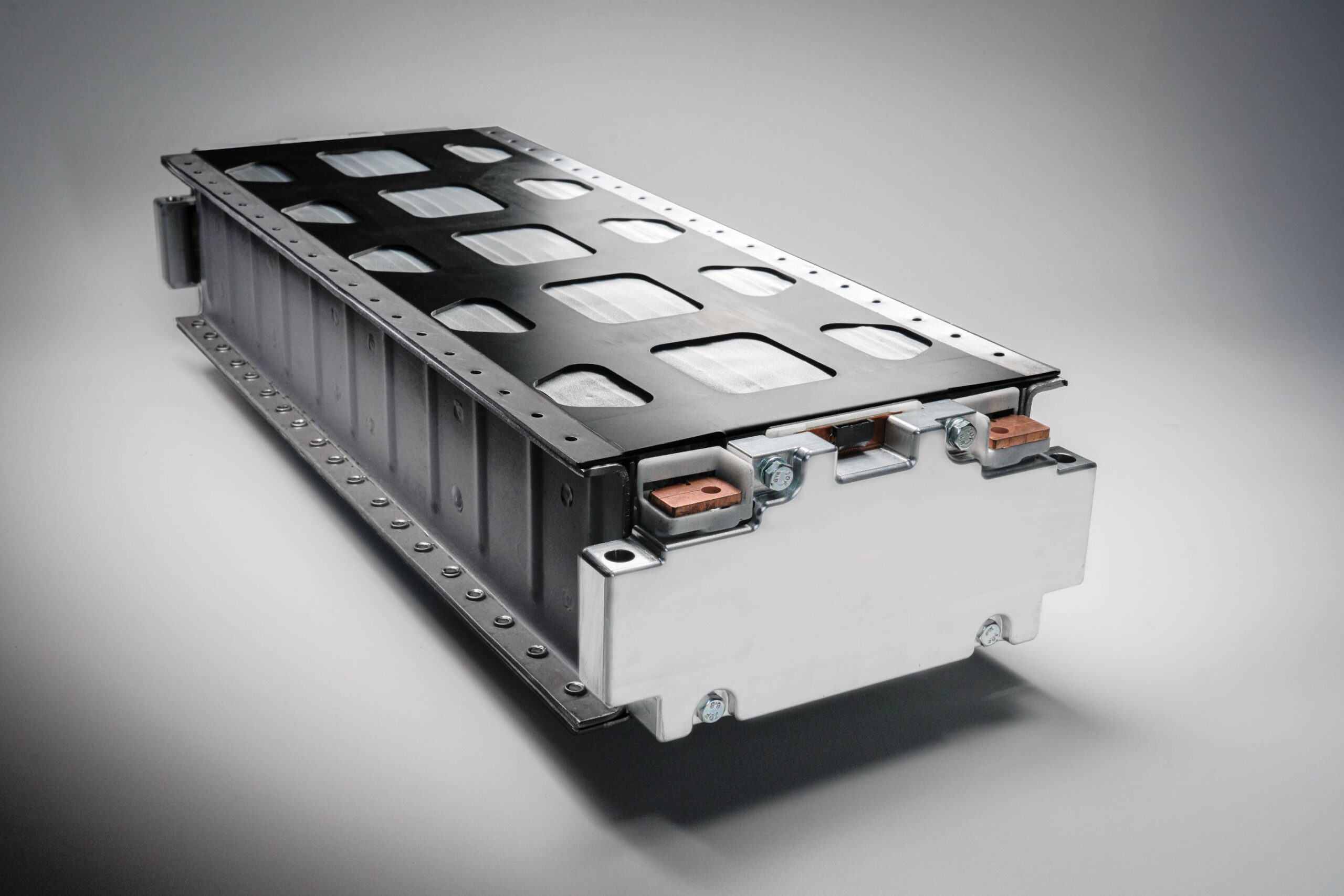
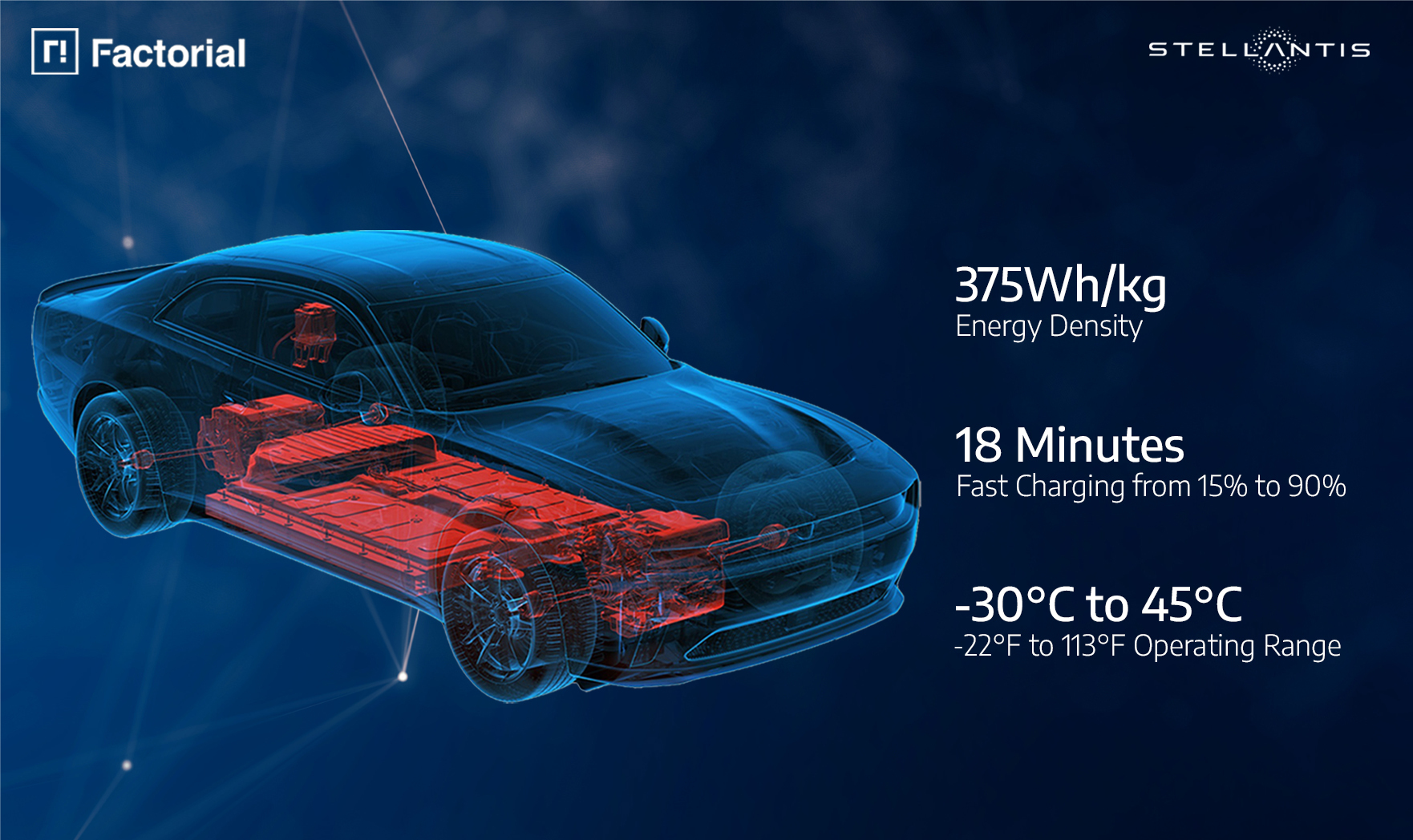
Factorial Energy, one of the most promising battery companies in the United States, has signed a Memorandum of Understanding (MoU) with South Korean battery leader SK On to explore large-scale production of advanced new solid-state batteries. As the EV industry pushes forward, deals like this have the potential to change the market.
Through the MoU, the companies will explore the technical feasibility and manufacturing considerations for Factorial’s FEST solid-state batteries. Although the company may not be as well-known as some other battery firms, like CATL, it’s the firm behind the solid-state batteries being tested by Mercedes-Benz, Stellantis, Karma, and others.
While solid-state battery technology has come a long way in recent years, it has yet to be commercialized at scale. SK On already operates a massive manufacturing footprint for lithium-ion batteries and could be the perfect partner for Factorial, helping its cells reach the mass market.
“A battery breakthrough only matters if it can be manufactured at scale,” Factorial chief executive Siyu Huang said. “That is what makes this partnership with SK On so significant. Their manufacturing footprint spans some of the world’s most advanced battery facilities, and their expertise will be critical in shaping how solid-state battery technology integrates into global production ecosystems.”
The Solid-State Future
Factorial notes that it has never been focused on manufacturing its solid-state batteries alone, or at dedicated facilities. Instead, it’s all about developing new battery technologies that can leverage existing manufacturing infrastructure. In addition to working on solid-state batteries for cars, it’s also looking to work with SK On to use these batteries in the mobility and high-performance markets, as well as energy storage.
Many view solid-state batteries as the next frontier in automotive technologies. Several car manufacturers in China are getting close to producing solid-state cells at scale, as are Japanese firms, including Toyota.
PROS ›› Bold looks, great power, engaging drive, good sounds CONS ›› Pricey, in-efficient, heavy
Genesis is growing up fast. Hyundai’s luxury arm has walked back its previous commitment to building only EVs, with hybrids and range-extenders now in development, and it officially launched the Magma brand in late 2024 to head up the performance side of things.
What exactly is Magma? You could think of Magma as the company’s equivalent to Hyundai’s N division or BMW M, committed to building vehicles that deliver immense power combined with exceptional control, without ruining the luxury experience buyers expect from a Genesis.
Not only is Magma focused on delivering performance cars for the streets, but also at the racetrack. It recently made its 24 Hours of Le Mans debut with the GMR-001 hypercar, and is toying with the idea of GT3 racing, too.
Its first global production model is the GV60 Magma, and we recently had the opportunity to experience it first-hand. As a glimpse into the brand’s future, it’s a very exciting time.
QUICK FACTS
› Model:
2027 Genesis GV60 Magma
› Starting Price:
AU$130,000 (US$90,300), plus on-road costs
› Dimensions:
182.4 x 76.3 W x 61.4 in H (4,635 x 1,940 x 1,560 mm)
› Wheelbase:
114.1 in (2,900 mm)
› Curb Weight:
2,270 kg (5,004 lbs)
› Powertrain:
84 kWh battery | dual electric motors
› Output:
641 hp (478 kW) / 582 lb-ft (790 Nm)
› 0-62 mph
3.4 seconds
› Transmission:
Single speed
› Efficiency:
26.5 kWh/100 km as tested
› On Sale:
Now
SWIPE
Photos Credits Hyundai Australia
In Australia, Genesis has launched the GV60 alongside the new rear-wheel drive GV60 Advanced. This high-powered, performance model has been a long time coming, launching more than two years after the related Hyundai Ioniq 5 N. Priced from AU$130,000 (US$90,300) before on-road costs, making it roughly AU$20,000 (US$13,800) more expensive than the Hyundai.
Genesis has also confirmed US pricing for the 2027 GV60 Magma, and the number is a lot friendlier than the Australian figure suggests. It starts at US$69,950 before a US$1,545 destination fee, which is US$17,425 more than the base 2026 GV60 and US$10,050 more than the Hyundai Ioniq 5 N it shares so much with.
The performance version of the GV60 has been a long time coming. It follows a familiar recipe to the Ioniq 5 N and Ioniq 6 N, rocking twin electric motors that combine to deliver a peak 478 kW (641 hp) and 790 Nm (582 lb-ft) of torque. It’s the first model launched by Magma and is a sign of things to come with other performance cars. Crucially, Magma should not be considered in the same vein as Hyundai N, as it has a different philosophy: it’s eager to retain the luxury and refinement it’s known for, while adding some extra thrills.
Like Hyundai N’s two high-powered EVs, the GV60 Magma also has plenty of party tricks, but more on those later.
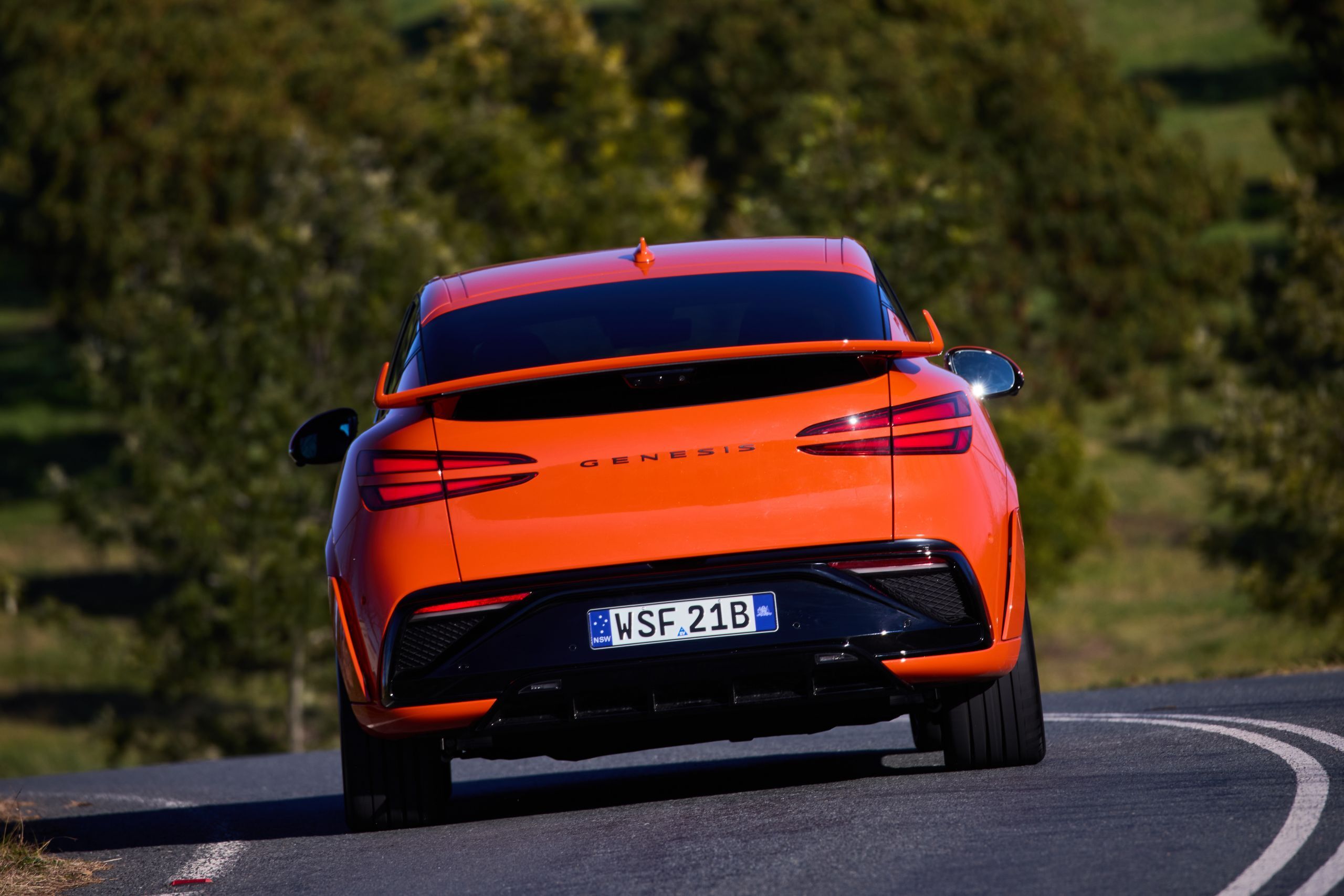
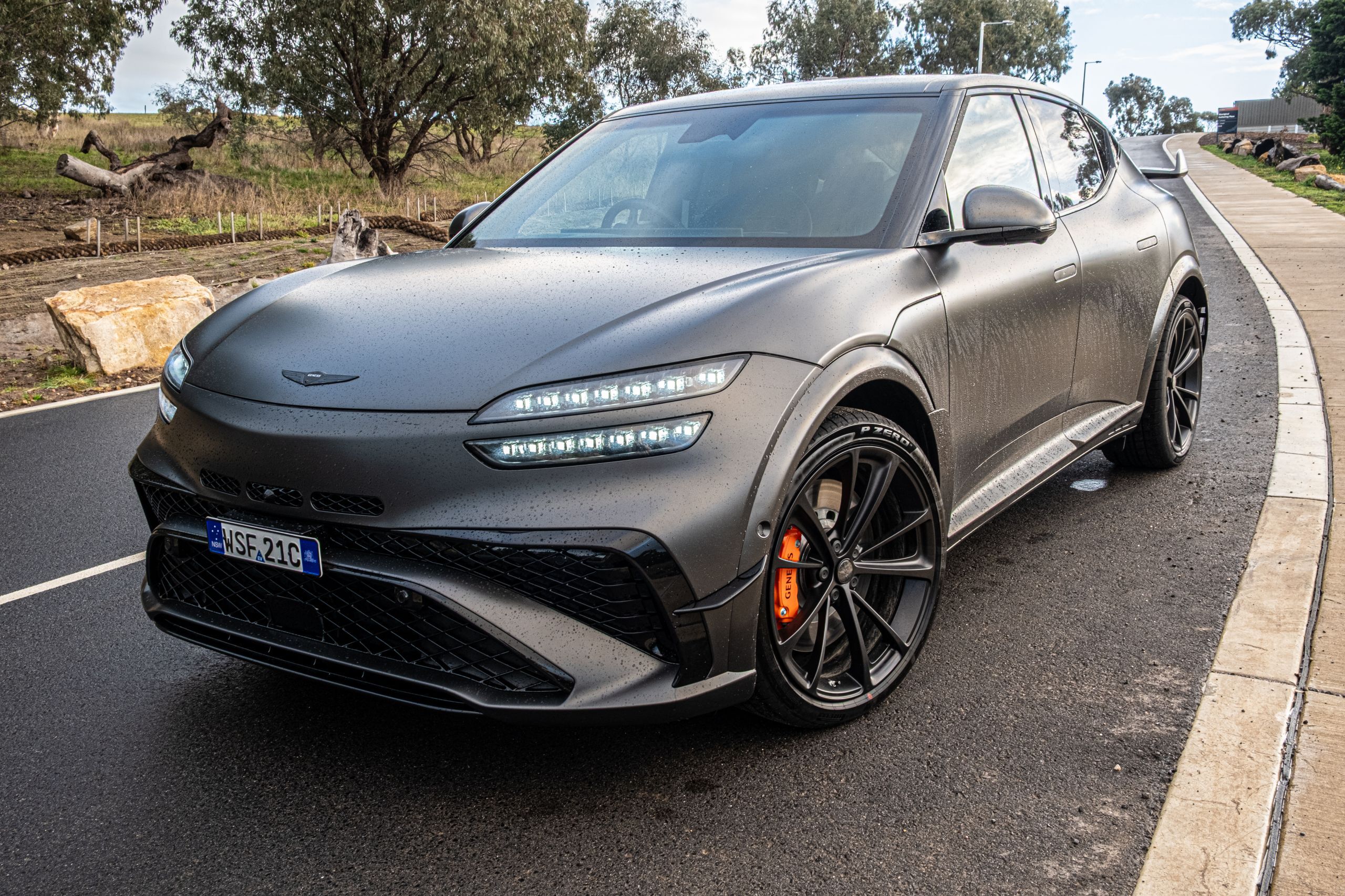
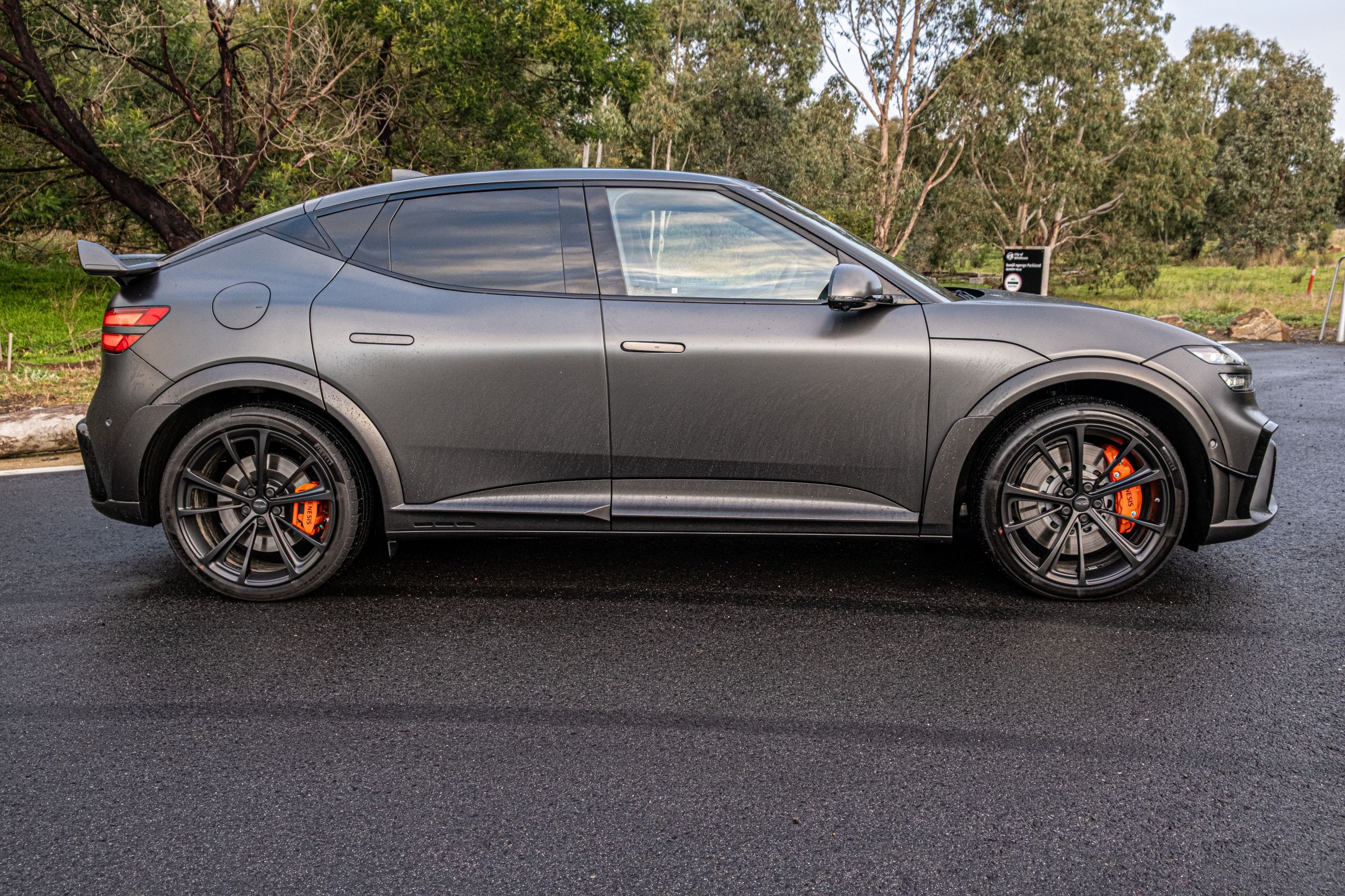
It looks like a proper performance car, too. It’s wider than the standard version, sits lower, has distinctive bumpers, forged 21-inch alloy wheels, and a mean-looking spoiler at the rear.
A Properly Sporty Cabin
Photos Hyundai Australia
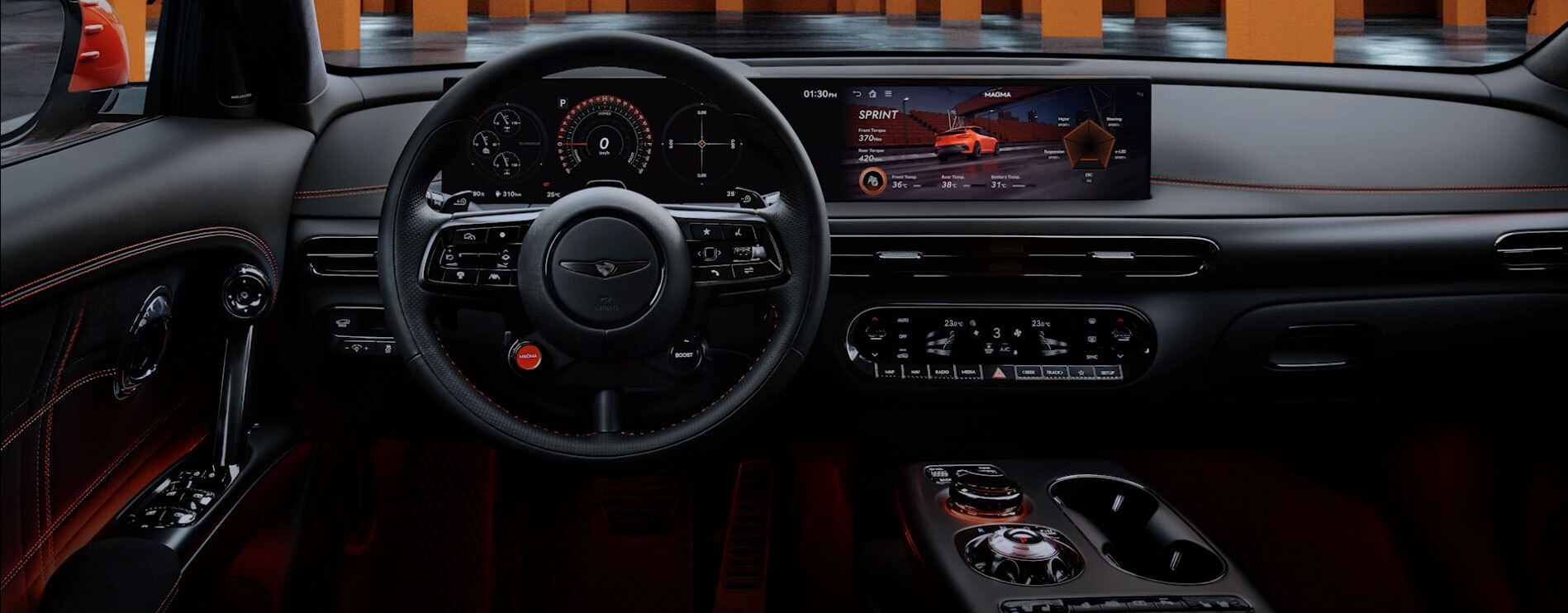
The GV60 Magma has launched alongside the regular, facelifted model, and as such, benefits from all the same updates. These include a new, single 27-inch-wide screen housing the instrument cluster and the infotainment display. Crucially, Genesis has made it feel much more special than a run-of-the-mill GV60.
Among the key features are 10-way adjustable sports bucket seats, distinctive white contrast stitching and piping, and a unique steering wheel, complete with a bright orange Magma dial and a Boost button. Adding to the premium feel is brushed black aluminum trim. Sadly, there’s no white interior option like the standard model.
Boosting the premium feel of the Magma’s cabin is black suede-like Chamude material on the door panels, seats, and headliner. All in all, it feels like a genuine premium place to sit and, perhaps most importantly, has bucketloads of character, which isn’t something that can be said about most EVs.
Photos Hyundai Australia
Dive into the menu, and there’s a dedicated Magma section to play with all the extra settings and to view live performance metrics. It’s far less complex than the system used by the Ioniq 5 N and Ioniq 6 N, offering fewer areas of adjustability and not having all the same track-focused settings. Standard driving modes available include Range, Comfort, Sport, and the configurable My Drive Mode, as well as two models should you want to have ramp-up fun.
Genesis has stressed that the GV60 Magma is not supposed to be as extreme or as focused as something like the Hyundai Ioniq 5 N or Ioniq 6 N. As such, it includes a special GT model, which can be engaged with either the virtual gear shifts or without, and amps up the powertrain and steering systems. Similarly, the ‘active sound design’ system can be easily toggled on and off. If that’s not enough, there’s also a Sprint mode which puts everything into the most aggressive setting, as well as a Drift mode and battery conditioning settings for drag racing and long stints on a racetrack.
Photos Hyundai Australia
Compared to the Ioniq 5 N and Ioniq 6 N, the GV60 Magma does not have the same number of dizzying, performance and track-focused menus. It’s also not quite as configurable, which, again, is no bad thing, and underscores the EV’s slightly more poised and refined focus. Whereas the N products have more of that boy racer edge, the GV60 Magma will be better suited to the distinguished gentleman or CEO who wants something that makes a statement, is fun to drive, but doesn’t have the same hard edge.
So, How Does It Drive?
As you’d imagine from the headline figures, the GV60 Magma is a truly ferocious performer and yet somehow manages to retain most of the standard model’s levels of refinement.
Grip is tenacious. Sitting on bespoke Pirelli P Zero Elect rubber, the GV60 Magma hides its weight extraordinarily well, and thanks to the shorter wheelbase than the Ioniq 5 N, feels more compact on twisty roads.
Crucially, the Magma is an enjoyable car to drive at speed, while still remaining comfortable. With that being said, the ride is quite firm, even in Comfort mode, but it’s certainly comfortable enough for everyday driving. Genesis has fitted similar stroke-sensing electronically controlled suspension as is found in the Ioniq 6 N. If you want a GV60 that prioritizes a pillowy ride, well then the standard model will be better suited.
Photo Brad Anderson/Carscoops
The soundtrack is not quite as dramatic as the N products, but it’s still way better than any other EV out there trying to replicate the sound of an ICE. Compared to the new 6 N, for example, the faux exhaust backfires are nowhere near as loud, although they still sound surprisingly authentic, even though they are slightly muffled by the speakers. However, the soundtrack can have an annoying drone if left in its loudest setting and while cruising.
Magma has also made the note a little different than the Hyundais, aiming to replicate a six-cylinder rather than a turbocharged four-cylinder. It also ‘revs’ to 9,000 rpm and includes exterior speakers, so those around you can hear it too. For those who want their EV to sound like an EV, therefore remaining completely silent, the sounds can easily be switched off in the menu.
Another area of the driving experience that Genesis has nailed, just as well as engineering teams from Hyundai’s N division, is the simulated gear shifts. As with the Ioniq 6 N, which includes eight gears, the GV60 Magma is the same. They deliver the same kick through the chassis while shifting between the different ratios, really boosting the experience.
Given the performance figures, it is suitably ferocious in a straight line. Genesis quotes a 0-100 km/h (62 mph) time of 3.4 seconds, and that’s exactly how quick it feels. We tested it in the wet, and recorded a time of 3.7 seconds with a GPS timer, so the claim will definitely be achievable in the dry.
If you’re seeking maximum acceleration, the Boost button on the steering wheel adds an extra 30 kW (40 hp) and 50 Nm (37 lb-ft) of torque for 15-second bursts. While those gains may not seem all that significant on paper, you can really feel the extra punch while behind the wheel. In Sprint mode, Boost kicks in automatically once you press the throttle beyond 90 percent. It’s also used with Launch Control.
Photo Credits Brad Anderson/Carscoops
As with other EVs with similar power levels, extracting the Magma’s performance credentials on the road is difficult, and would really only be something that’s achievable on a track. It’s an all-round phenomenal performer, delivering driving thrills that most other EV makers can only dream of achieving.
The brakes are also tremendous. It rocks huge 400 mm (15.7-inch) discs at the front with four-piston calipers, while positioned at the rear are 360 mm (14.1-inch) discs with single-piston calipers. These mechanical brakes work alongside the regenerative braking system, allowing the Magma to pull up from 100 km/h (62 mph) in just 33.8 meters.
What About The Normal EV Stuff?
A high-performance EV like this also offers a duality which is hard to replicate with similarly powerful combustion-powered vehicles. Shift out of GT, Sprint, or Sport mode, and engage Range or Comfort, and the GV60 Magma goes silent, gliding over the tarmac as well as any other luxury crossover.
When not using the paddle shifters to change gears, they’re tasked with adjusting the regenerative braking. As in the standard GV60, the Magma includes three levels of regen, in addition to a full one-pedal driving mode. It also offers an automatic mode that tweaks the regen depending on navigation information, map data, and traffic flow.
The downside of all the performance is efficiency, or lack thereof. Genesis quotes a combined efficiency rating of 21.5 kWh/100 km, giving the GV60 Magma a driving range of 425 km (264 miles). However, during our time with it, which included the single-day launch event and several days post-event living with one, that figure was closer to 27 kWh/100 km, reducing the driving range to just over 300 km (186 miles), which is poor.
On the plus side, the Hyundai group’s E-GMP, 800-volt electrical architecture does allow the Magma to charge quickly. Plugged into a 350 kW DC charger, where it can peak at 265 kW, a charge from 10-80 percent takes just 18 minutes.
Verdict
Photos Hyundai Australia
Genesis has a difficult task ahead of it. By automotive standards, it remains a relatively young player and has a lot of work to do before the average punter will view it in the same regard as BMW, Mercedes, Audi, or even Lexus. One could argue it’s launched the Magma brand a little too early and may have too much on its plate.
However, setting these challenges aside, there’s no denying the GV60 Magma is excellent. It will not be a high-volume seller, nor will the updated 2027 GV60 either, but it does a brilliant job walking the fine line between performance and poise. It feels more grown-up than the Ioniq 5 N and yet is just as enjoyable to drive. The future of the Magma brand is shaping up nicely.
Photos Hyundai Australia/Brad Anderson for Carscoops
The 2027 GV60 Magma arrives in America in the coming weeks.
Starts at $69,950, which is $17,425 more than the base 2026 GV60.
Crossover will only be offered in California, New York, and New Jersey.
Genesis has announced pricing for the 2027 GV60 Magma will begin at $69,950 before a $1,545 destination fee. That means the model costs $10,050 more than the 2026 Hyundai Ioniq 5 N, but costs $55 less to be delivered. That’s a pretty sizable difference, but Genesis is a luxury brand and there was little doubt it’d carry a hefty premium.
Despite its luxury roots, the GV60 Magma is focused on performance and has an 84 kWh battery pack, which feeds a dual-motor all-wheel drive system producing up to 641 hp (478 kW / 650 PS) and 583 lb-ft (790 Nm) of torque. This enables the model to accelerate from 0-60 mph (0-96 km/h) in 3.4 seconds.
Set to arrive at select dealers in California, New York, and New Jersey in the coming weeks, the hot GV60 has launch control, virtual gear shifts, and an electronic limited slip differential. They’re joined by an e-Active Sound Design Plus system, which “simulates engine sounds through two external speakers.”
Genesis said surprisingly little about the model, but noted the glorified hatchback has an aggressive front bumper, canards, and exclusive 21-inch forged wheels. They’re joined by a sizable rear wing and a color palette that includes Magma Orange, Uyuni White, Vik Black, and Makalu Gray Matte.
The interior largely carries over, but the Magma comes equipped with performance seats that have heating and ventilation. They’re wrapped in Obsidian Black suede and feature orange contrast stitching.
Drivers will also find a sport steering wheel with dedicated Boost and Magma Mode buttons. They’re accompanied by alloy pedals and unique displays for the 27-inch OLED screen. Genesis also noted the car comes standard with a Bang & Olufsen premium audio system.
Mercedes has introduced the new GLA, which offers electric and hybrid power.
The EVs arrive first and the range-topper has 349 hp and 400 miles of range.
Crossover sports a more upscale design and a screen laden interior.
Mercedes styling is pretty hit or miss these days, but the company scored a solid double with the redesigned GLA. It goes up for order tomorrow in Europe, while a US launch is scheduled for the second half of 2027.
Looking far more stylish and upscale than its predecessor, the crossover adopts the company’s new “iconic grille.” It’s larger than before an offers optional illumination.
The grille is flanked by standard LED headlights that feature a chrome-plated star design. On models equipped with the optional Multibeam LED headlights, the daytime running lights are shaped like a star.
Moving further back, there’s streamlined bodywork, flush-mounted door handles, and pronounced cladding. They’re joined by muscular rear haunches and 18- to 20-inch wheels.
The sportier styling continues at the rear end, where the license plate recess has moved from the liftgate to the bumper. The model also sports squared off taillights that are connected by a slender bar.
The exact look varies and there will be AMG Line, AMG Line Plus, and Night Edition packages. The latter has a Cosmos Black Magno exterior with high-gloss black accents and black 20-inch wheels. They’re joined by two-tone sport seats, illuminated door sill plates, and Dark Shadow flourishes.
In terms of size, the redesigned GLA measures 179.7 inches (4,565 mm) long, 73.7 inches (1,873 mm) wide, and 63.1 inches (1,604 mm) tall with a wheelbase that spans 109.8 inches (2,790 mm). This means the model is 6.1 inches (155 mm) longer and has an extra 2.4 inches (61 mm) between the wheels.
An Interior Dominated By Screens
The cabin largely carries over from the CLA and this means buyers will find a 10.25-inch digital instrument cluster, a 14-inch infotainment system, and a big blank section with star graphics.
The latter serves as a permanent reminder of your cheapness and nudges customers to buy the optional MBUX Superscreen. It adds a 14-inch front passenger display that provides access to more than 40 apps including Disney+ and YouTube.
On the topic of options, Mercedes offers a Sky Control panoramic roof that can go from transparent to opaque in a matter of milliseconds. Customers can also get a 16-speaker Burmester 3D surround sound system – among other things.
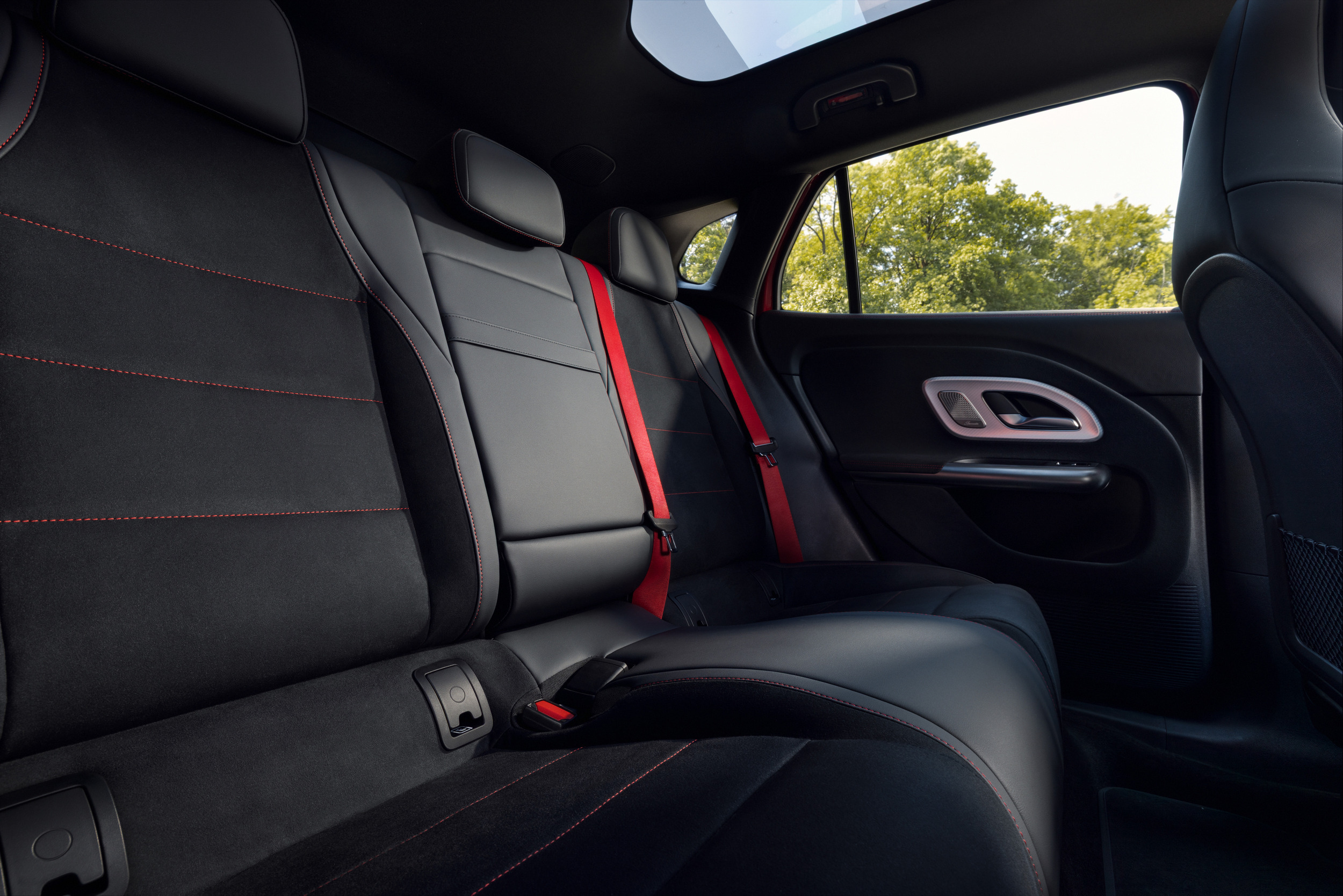
Thanks to the increased dimensions, occupants will find a roomier cabin. There’s an additional 0.3 inches (7 mm) of legroom up front, while the back seat adds up to 1.5 inches (38 mm). Mercedes also noted there’s an extra 0.9 inches (24 mm) of rear seat headroom as well.
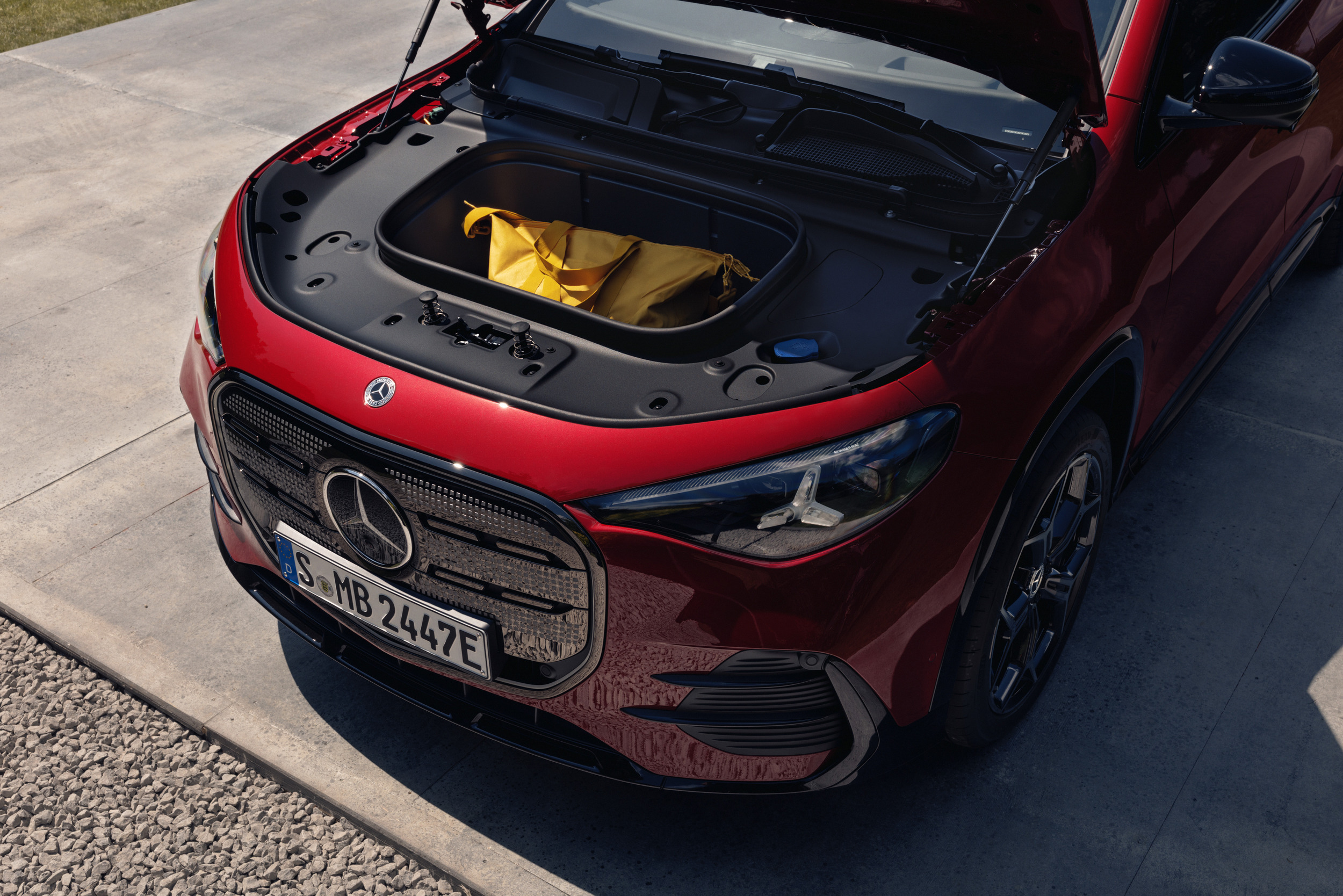
On the topic of space, the boot now holds 14.5 cubic feet (410 liters) of luggage and that’s an increase of 2.5 cubic feet (70 liters). It can be expanded to 49.4 cubic feet (1,400 liters) by folding the rear seats down and there’s a 3.8 liter (107 liter) frunk on electric variants.
Electric Powertrains
The GLA will be offered with a bewildering number of powertrains and kicking things off is the GLA 200 Electric. It features a 58 kWh LFP battery as well as a rear-mounted motor producing 221 hp (165 kW / 224 PS) and 247 lb-ft (335 Nm) of torque.
This enables the crossover to accelerate from 0-62 mph (0-100 km/h) in 8.1 seconds, before topping out at 130 mph (210 km/h). Buyers can also expect a WLTP range of 245 – 278 miles (394 – 447 km).
When the battery is low, a 200 kW DC fast charging capability can take it from 10-80% in as little as 20 minutes. If that’s too long, a ten minute charge can deliver 103 miles (165 km) of range.
The mid-level GLA 250+ Electric has a beefier motor producing 268 hp (200 kW / 272 PS) and 247 lb-ft (335 Nm) of torque. Thanks to the extra oomph, the crossover hits 62 mph (100 km/h) in 7.3 seconds, but the top speed is unchanged at 130 mph (210 km/h).
Buyers will also find a beefier 85 kWh NMC battery, which delivers 359 – 408 miles (577 – 657 km) of range. The model also has an upgraded 320 kW DC fast charging capability, which delivers 168 miles (270 km) of range in ten minutes.
Sitting at the top of the electric lineup is the GLA 350 4MATIC Electric. It has a dual-motor all-wheel drive system producing a combined output of 349 hp (260 kW / 354 PS) and 380 lb-ft (515 Nm) of torque. 62 mph (100 km/h) comes in just 5.4 seconds, while the top speed remains 130 mph (210 km/h). Range also takes a slight hit as it drops to 345 – 400 miles (555 – 643 km).
The United States will only be getting the 250+ and 350 4MATIC variants. However, Mercedes also announced a fourth variant is coming in 2027 with a 71 kWh NMC battery.
Hybrid Power Arrives Next Year
Besides the EVs, Mercedes confirmed plans for hybrid variants with front- and all-wheel drive. The company didn’t say much about them, but noted they’ll have a turbocharged 1.5-liter four-cylinder, a 1.3 kWh battery pack, and a 30 hp (22 kW / 30 PS) electric motor integrated into an eight-speed dual-clutch transmission.
While Mercedes is playing coy, the powertrains should carryover from the CLA. This means there could be a GLA 200 with a combined maximum output of 190 hp (142 kW / 193 PS) as well as a GLA 220 with 217 hp (162 kW / 220 PS).
It’s also worth noting the GLA will be offered with the new MB.Drive Assist system that provides a “state-of-the-art” Level 2 semi-autonomous driving experience.
Mini is developing an off-road version of its latest Countryman.
Higher clearance and all-terrain tires set it apart from the standard car.
The rugged version of the compact SUV will be unveiled in October.
Mini is preparing to expand its lineup with a new, off-road-focused version of the Countryman. The compact SUV is currently going through the last stages of testing and validation on US soil ahead of its premiere which is scheduled for October 2026.
After years of rumors and off-road packages from independent tuners, a rugged Countryman is finally happening. Mini released photos of a camouflaged prototype picking its way across gravel tracks and rocky terrain in Colorado’s Rocky Mountains.
Mini
The prototype sits higher than the standard Countryman and rides on black alloy wheels wrapped in all-terrain tires. Unlike the X-Raid build from Delta4x4 and Mini’s own Vagabund concepts from earlier this year, though, this one skips the wide fender extensions that would give it a meaner stance. The bumpers look untouched too.
Besides the new shoes, the highlight of the exterior is the large roof top tent communicating the adventurous character of the build. Mini has been offering similar tents as an option for its other models so the camping treatment doesn’t take us by surprise.
Mini
Mini has not yet disclosed if this rugged package will be offered with combustion or electric powertrains. However, we expect it to be paired with the AWD-capable variants. At the moment, the only trims available with the ALL4 badge are the Countryman S, the flagship JCW and the electric SE.
After its public reveal in October, the model will take on the 2026 Rebelle Rally. The grueling all-women navigation event runs more than 2,500 km (1,553 miles) across remote wilderness, with no modern GPS to lean on.
Jean-Philippe Parain, Head of Mini, said: “Mini has always been about turning every journey into an adventure. That spirit guided this project from the very beginning. We are incredibly excited to be just one step away from introducing this new, rugged addition to the Mini Countryman family. True to the Mini spirit, it combines capability with character and will open up even more opportunities for unforgettable adventures”.
Shaq had West Coast Customs build a one-off Lucid Air coupe.
Now the bespoke Lucid has surfaced crashed on a salvage lot.
Its rear half escaped clean, which should ease repair costs.
Back in late 2024, basketball legend Shaquille O’Neal commissioned West Coast Customs to build him a one-off Lucid Air Coupe roomy enough for his 7’1″ frame. Eighteen months on, Shaq’s bespoke EV has landed in a salvage lot after a crash. If you back your own skills with a wrench, you could buy it, fix it up, and own a unique Lucid.
Just how far the modifications go isn’t fully clear, and nobody’s confirmed whether the wheelbase was stretched. According to Road & Track, West Coast Customs pushed the front seats back for extra legroom. The second-row seats survived the redesign, so the Air still seats five, or maybe four with Shaq at the wheel.
Visually, the car also looks a little different, most notably thanks to the fact that it’s a two-door and sits on a set of aftermarket, tightly-spoked black wheels. Sadly, Shaq’s ride is now in desperate need of some repairs.
There’s no word on how the unique Lucid was crashed or whether Shaq was behind the wheel at the time, but with some TLC, the EV might be able to return to the roads. The front bumper has been removed, and one of the radiators is busted and will need to be replaced.
A Big Lucid For A Big Man
Copart
In addition, the headlights are missing, and the hood has been damaged, so it will need to be replaced as well. If there’s a shred of good news, it’s that the rear half of the EV appears unscathed, which should help to minimize repair costs.
As for what specific Lucid Air variant the car is based on, well, that isn’t known. What the Copart listing does confirm is that it’s an all-wheel-drive model. It’s also been driven just 2,898 miles (4,663 km), so it’d be a shame if someone didn’t try to repair it.
Mazda confirms next MX-5 is being engineered to accommodate electric power.
Engineers are targeting 1,000-1,200 kg despite EV batteries joining the party.
CEO Masahiro Moro also wants an exclusive halo sports car to sit above MX-5.
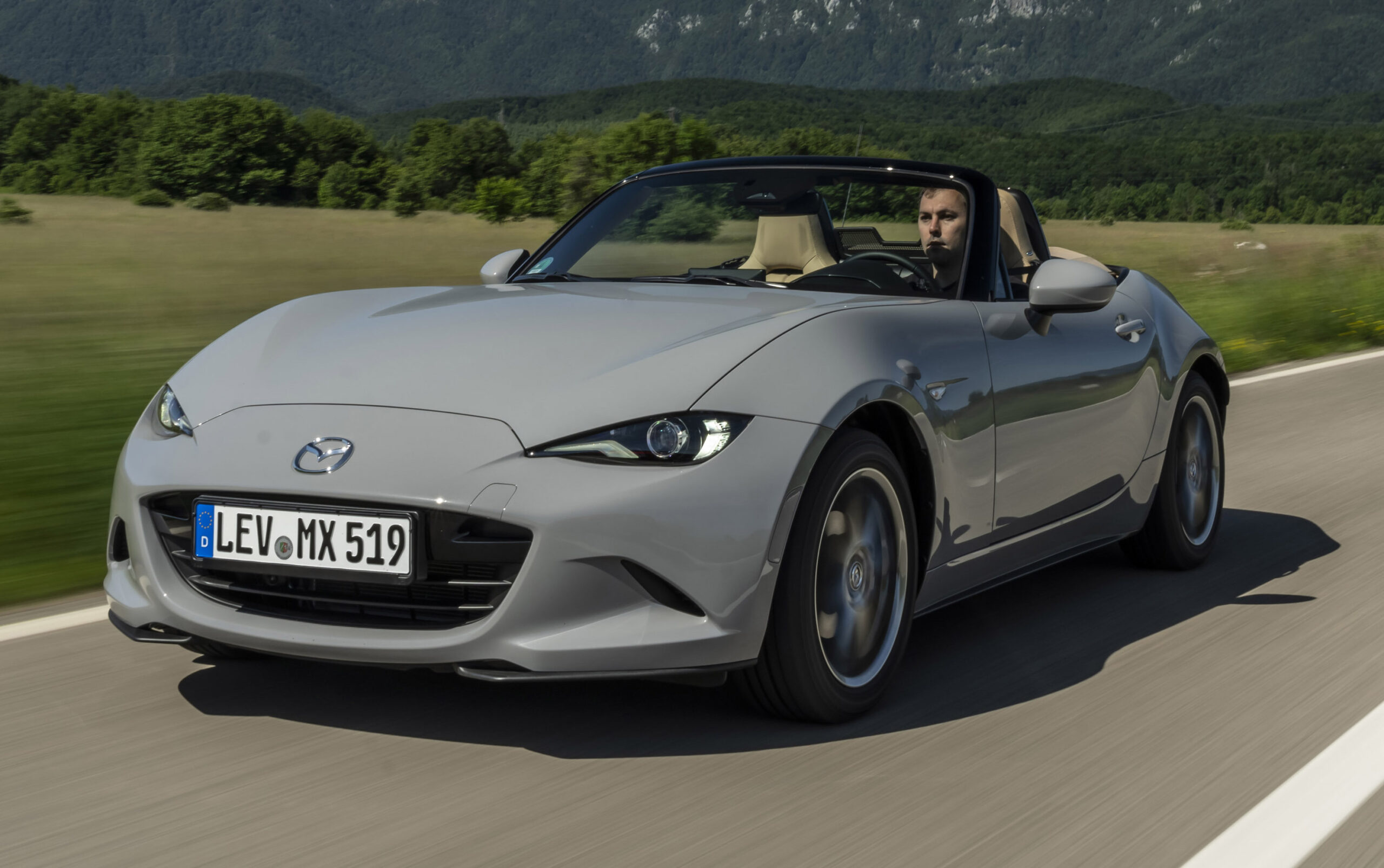
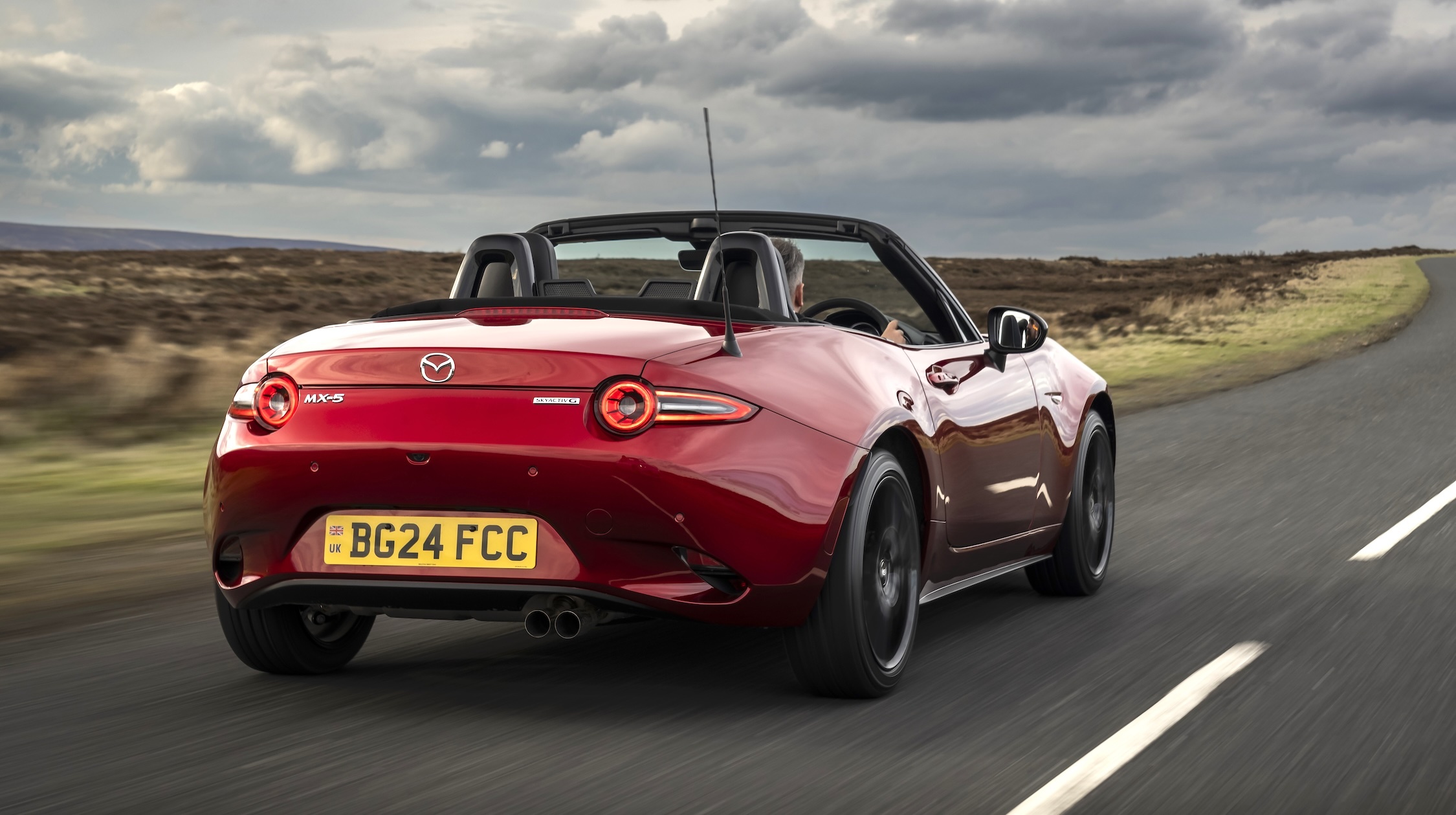
Mazda has spent decades proving sports cars don’t need enormous muscle to be fun. They just need to be light, and that means EV power is out. Now one of those rules is about to change. CEO Masahiro Moro has confirmed the next MX-5, codenamed NE, is being prepared for electric power, and somehow Mazda thinks it can keep the little roadster seriously light.
Speaking with Auto Motor und Sport only weeks after an Aussie Mazda exec said the next MX-5 could be the last to run a combustion motor, Moro said the MX-5’s replacement must be prepared for a future where combustion power is no longer viable at all due to regulatory roadblocks.
“The successor must also be ready for a scenario without a combustion engine,” Moro told the German title. “The challenge for us is to make the basic structure lighter without using exotic materials like carbon fiber.”
Instead of resorting to pricey composites, engineers are being challenged to make the underlying structure lighter using more conventional materials. And Mazda’s target sounds ambitious. Moro says developers are shooting for somewhere between “just under 1,000 kg and 1,200 kg (2,205-2,645 lbs)”, adding, “And I believe we can achieve that.”
If they can, an electric MX-5, most likely wearing a design inspired by the Iconic SP concept (below), could weigh roughly the same as today’s combustion models, or just a smidge higher. The MY26 roadster comes in at 1,003 kg (2,211 lbs) without a driver in Euro trim.
Electric Not The Only Answer
Mazda’s Icon SP concept from 2024.
Fortunately for piston fans, electric isn’t the only future Mazda is planning. The next MX-5 is also expected to use the company’s new 2.5-liter Skyactiv-Z four-cylinder. Some form of hybridization remains possible too, provided it doesn’t undermine the lightweight formula, in which case power could reach 220 hp (223 PS). Today’s hottest US Miata makes 181 hp (184 PS) and even Japan’s hardcore 12R model can’t top 197 hp (200 PS).
We’ll have to wait to see how Mazda makes all those options coexist, because the next-generation MX-5 isn’t expected before 2028 at the earliest. By then, the current ND will have enjoyed an impressively long innings stretching back to 2015.
Mazda Wants A Flagship Sports Car
But new Miata isn’t all we’ve got to look forward to. Moro has another sports-car itch he wants scratched.
“I want a ‘hero car’ for Mazda, a true flagship model that perfectly embodies our brand values,” he told Auto Motor und Sport.
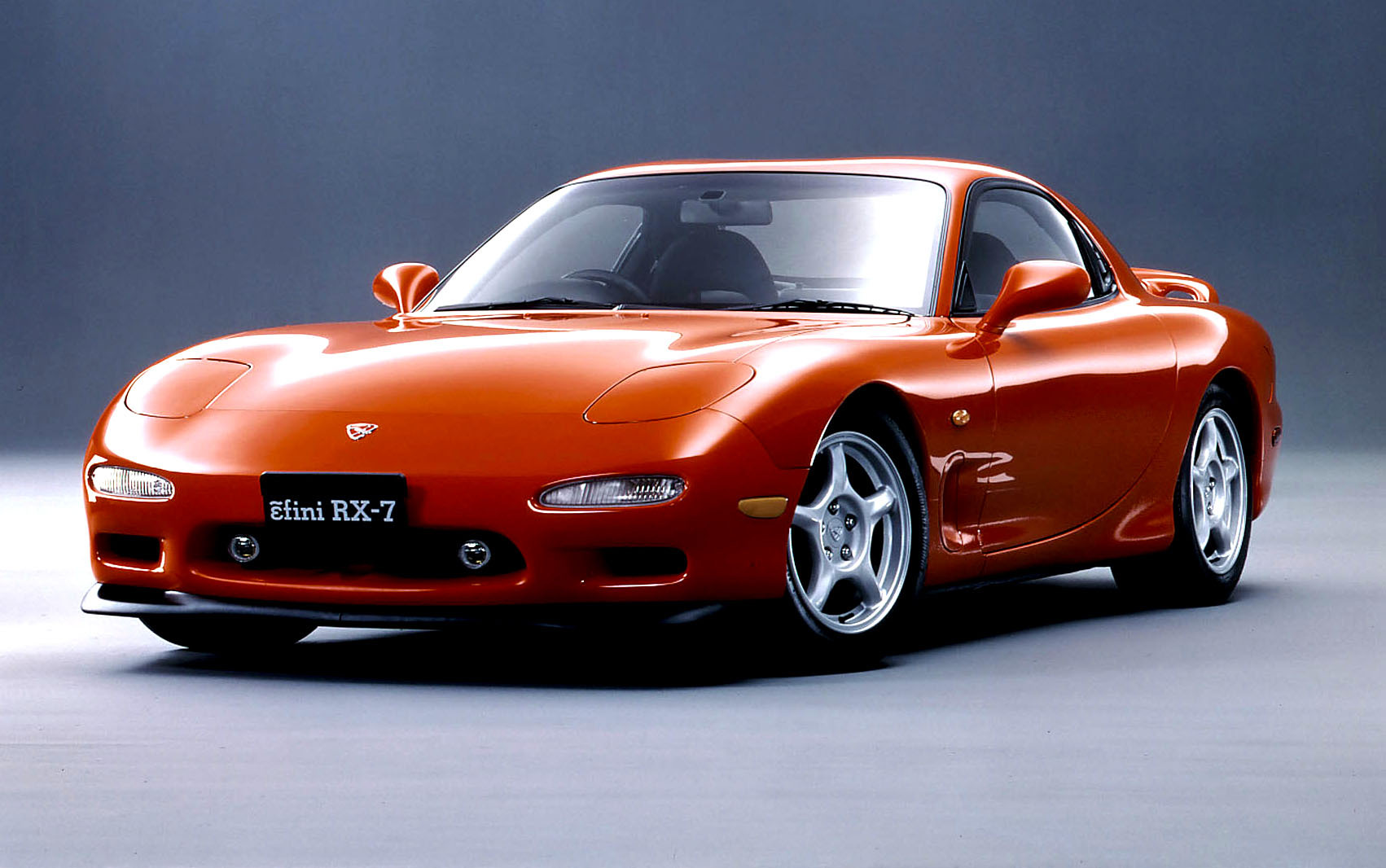
Moro says the MX-5 will continue serving enthusiasts seeking accessible fun, but believes Mazda is missing something special at the opposite end of the showroom. He doesn’t expect this mystery machine to chase big sales numbers and even suggests it could be built largely by hand.
This Lucid Gravity Grand Touring took a massive hit in the used market.
It has more than $7k in options, including the Dynamic Handling Pack.
Lucid recently announced competitive financing and leasing deals.
The Lucid Gravity impresses on plenty of fronts, but it shares one weakness with a long list of other premium electric vehicles: it hemorrhages value. For some buyers that’s a dealbreaker, for others it’s the price of admission. Either way, the numbers are brutal.
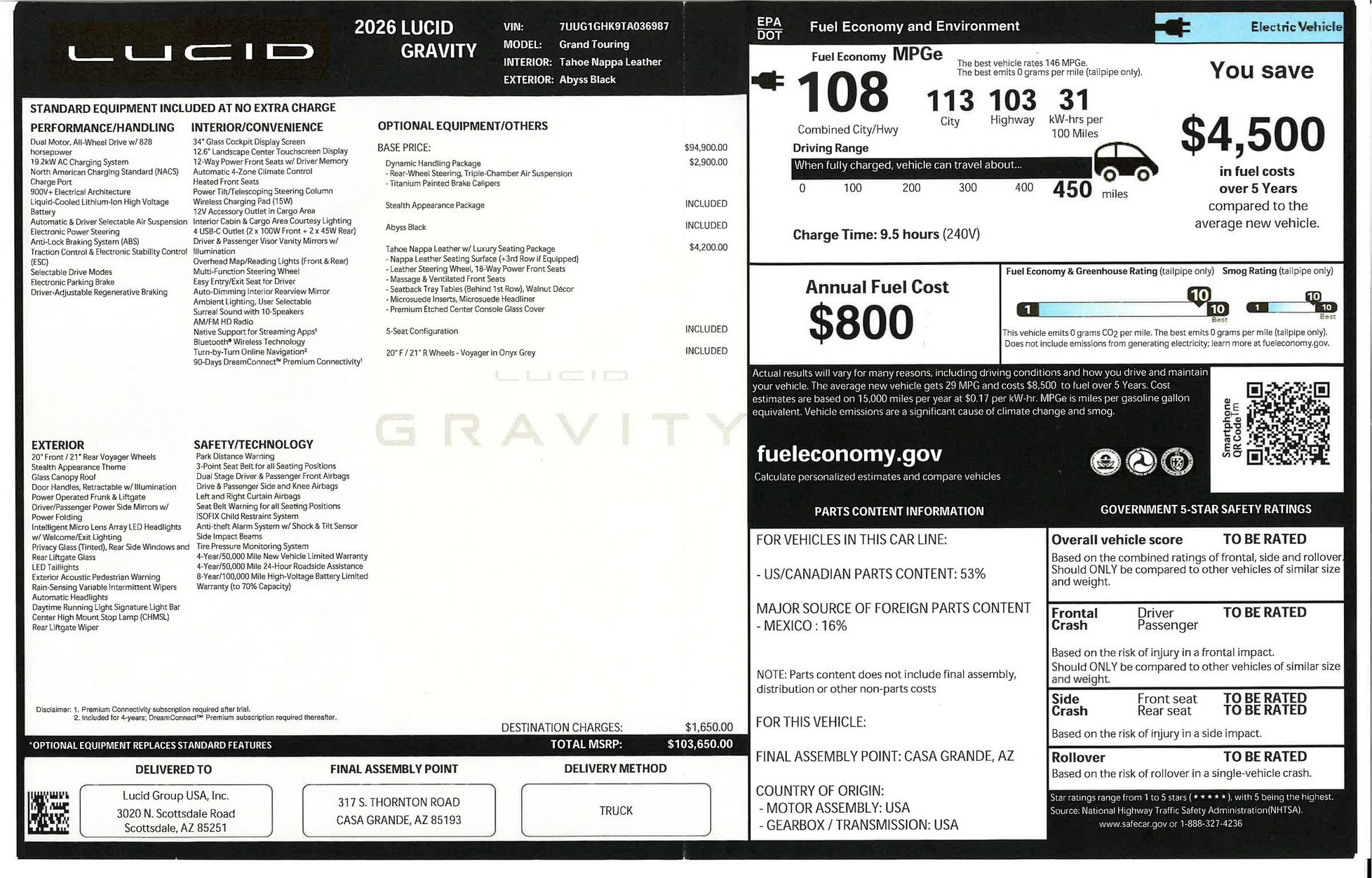
Earlier this month, a 2026 Lucid Gravity Grand Touring went up for auction on Cars & Bids. Less than a year old, with an original sticker of $103,650, it sold for just $73,000. That’s less than a new entry-level Gravity, and this one happens to be the current range-topper.
A look at the window sticker reveals this Gravity was optioned with the $2,900 Dynamic Handling Package, which adds titanium-painted brake calipers alongside rear-wheel steering and triple-chamber air suspension. It also rocks the Stealth Appearance Package and the $4,200 Tahoe Nappa Leather with Luxury Seating Package, adding plush upholstery, 18-way adjustable front seats with massage and ventilation functions, and seatback tray tables.
Cars&Bids
Almost new on paper, the Gravity has 12,100 miles (19,473 km) on the odometer. It’s also had a surprising number of parts replaced since delivery, including a new center console tray, hood struts, a left front wheel speed sensor, and a wheel bearing. Not the record you want to see on a nearly new premium SUV.
A Performance Beast
Cars&Bids
The Gravity’s resale value is shaky and probably has further to fall, but the SUV isn’t without its merits, chiefly performance and efficiency. A 123 kWh lithium-ion battery and a pair of electric motors send 828 hp and 828 lb-ft (1,122 Nm) of torque to the wheels. That’s enough to hit 60 mph (96 km/h) in about 3.4 seconds, and it still manages up to 450 miles (724 km) on a single charge.
Part of what’s eating into values on used Gravity models like this one may be the aggressive incentives Lucid recently rolled out on new cars. This month the company said outgoing 2026 models could be financed over 84 months at $681 a month with a $20,000 down payment. Lease deals carrying a $10,000 discount run through July 31, alongside a $3,000 loyalty credit and a $3,000 trade-in allowance from rival vehicles.
BYD launches the Racco in Japan as its first electric kei car.
It has sliding doors and up to 199 miles of EV range.
It’s priced from ¥2,145,000 ($13,100) before local subsidies.
BYD has officially launched the Racco EV in Japan, becoming the first automaker from outside Japan to build a kei car. It arrives with aggressive pricing, segment-leading range, a strong warranty, and a long list of standard tech and safety kit.
The car first surfaced back in December 2025 as a near-production prototype. Now the Chinese giant has priced the full lineup and confirmed specifications across every grade.
The headline is that starting price: ¥2,145,000 ($13,100) before local subsidies. The recently facelifted Nissan Sakura EV and Mitsubishi eK X EV, by comparison, list at ¥2,448,600 and ¥2,446,400, or roughly $14,900 at today’s exchange rates.
Local Rivals Still Have An Advantage
The Chinese newcomer has the lower sticker price, but it’s at a disadvantage compared to its Japanese rivals. Under Japan’s Ministry of Economy, Trade and Industry (METI) rules, subsidies come down to a scoring system that weighs local manufacturing, battery sourcing, domestic charging network investment, and disaster support capabilities.
That system lets zero-emission kei cars from local brands qualify for the maximum subsidy cap of ¥580,000 ($3,500), while Chinese imports like the BYD can only tap the basic ¥150,000 ($900) grant.
Because local municipal subsidies stack on top of the national one, a Tokyo resident can buy a Racco for as little as ¥1,545,000 ($9,400). That same buyer can pick up a Nissan Sakura EV or Mitsubishi eK X EV for ¥1,298,600 and ¥1,296,400 (around $7,900), leaving both cheaper on the road.
Here’s Where The BYD Racco Wins
It isn’t the cheapest electric kei car on the road once subsidies settle out, but the BYD Racco takes the upper hand on specifications and standard equipment, which makes for a compelling case.
The entry-level Racco 200 runs a 22.40 kWh battery pack good for a WLTC range of 210 km (130 miles), already ahead of its rivals. The Racco 300 Plus and 300 Premium step up to a 35.84 kWh battery, stretching range to 320 km (199 miles). The car also handles faster charging of up to 6 kW AC and 50 kW DC, with battery pre-heating for winter, plus V2H and V2L capability.
Every grade runs a front-mounted electric motor making 63 hp (47 kW / 64 PS) and 160 Nm (118 lb-ft) of torque, the ceiling for kei cars. BYD says a remarkable 90 percent of the Racco’s components, batteries and electric motors included, were built in-house.
The Racco is based on an adaptation of BYD’s e-Platform 3.0 utilizing Cell-to-Body (CTB) structural LFP Blade battery tech and the “X-PACK” module, which integrates the drive battery, control unit, DC/OBC, and climate control electronics into a single assembly for enhanced crash energy absorption. It also gets a custom suspension system specifically designed for Japanese roads, and four wheel disc brakes, which is uncommon for the segment.
In terms of styling, it adopts a familiar wagon stance and a boxy silhouette designed to offer the maximum interior space while complying with the strict footprint regulations for kei cars measuring 3,395 mm (133.7 inches) long. Among the elements that distinguish the BYD Racco from rivals are the modern LEDs, the practical sliding doors, and the slightly taller stance.
Class-Leading Space And Equipment
Inside, the base model comes standard with an 8-inch digital instrument cluster and a 10.1-inch infotainment display, while higher grades upgrade to a larger 12.3-inch touchscreen. Note that most kei cars come without a screen in their basic configuration. The entire lineup supports over-the-air (OTA) updates and comes with six airbags.
The flagship BYD Racco 300 Premium features umbrella holders, a Child Presence Detection system, hands-free sliding doors with light guide projection, Black and Beige synthetic leather upholstery, and a heated cup holder. As for practicality, BYD promises class-leading interior length, width, and height, alongside ample storage compartments. The cargo space of 280 lt (9.9 cubic feet) expands to 1,372 lt (48.5 cubic feet) when the seats are folded.
Available Now
The Racco is already up for order in Japan across BYD’s 70 dealerships, backed by an 8-year / 99,500-mile battery warranty that stretches to 10 years / 124,300 miles. Pricing opens at ¥2,145,000 ($13,100) for the base 200 and climbs to ¥2,497,000 ($15,200) for the flagship 300 Premium, before subsidies. BYD says a five-year plan with no money down on the cheapest Racco starts at ¥19,300 ($120) a month.
Beyond the electric kei cars, the Racco also squares up against ICE-powered kei wagons like the Honda N-Box, Suzuki Spacia, Daihatsu Tanto, Nissan Roox, Mitsubishi Delica Mini, and eK Space. Whether Japanese buyers go for the BYD’s value and high-tech features over the more established names is the open question.
RENO, Nev. — School districts nationwide are opening the new school year with less money for student transportation, and three sessions at STN EXPO West challenged directors to change how and to whom they make their case for resources.
Ryan Hahn of Strategic School Consultants presented back-to-back sessions, “Budgeting in Uncertain Times: Navigating the Fiscal Cliff Without Losing Ground” on July 12 and “Advocating for Resources: How to Get a Seat at the Table Before the Cuts Are Already Made” on July 13. Another session presented later during STN EXPO West on July 14 by Tim Purvis focused on using AI to help with budgeting decisions.
Hahn started as a school bus driver in college 26 years ago and went on to direct transportation, maintenance and operations for districts in Washington state and Oregon. He earned a chief business official certification through California’s Fiscal Crisis and Management Assistance Team (FCMAT), served as chief financial officer of a 25,000-student Washington district, and now owns Strategic School Consultants.
Federal pandemic relief is spent, Hahn said, and districts that used that one-time money to fund recurring positions are paying for it now. Add inflation, fuel volatility and liability costs — he said insurance at his former district rose 150 percent in 10 years — and operations departments are absorbing across-the-board reduction targets.
“Every operational unit is going to have to cut 10 percent of their budget,” Hahn said, describing a conversation he said is playing out across the country. “You cannot defer a bus ride.”
His central argument was that transportation directors lose budget fights before the budget is built. Most, he said, live entirely in an operational network — covering routes, filling trips, solving problems — and never develop the personal and strategic networks that determine who and what gets funded.
“Your value as the leader of the unit dictates what you get in your unit, every single time,” he said.
That means lateral and vertical relationships with principals, executive directors and the superintendent, not just the CFO. It also means translating requests into the language cabinet members already use. Hahn told attendees to find their board’s adopted strategic goals and tie every ask to one of them.
He urged directors to request a copy of their district’s position control, the roster of every funded position with wages, steps and employer-paid benefits. Staffing consumes 86 percent to 90 percent of a transportation budget, he said, yet many directors have never seen the document. Districts resist adding lines to position control because it shifts staffing ratios districtwide, he said, so directors who need to pilot a new function should ask instead for substitute dollars or contracted services, which are treated as temporary expenses.
Hahn also warned that efficiency can be punished in reimbursement states. After cutting roughly $1 million in overtime at an Oregon district, he said, his CFO called him into a meeting but not to thank him. The savings reduced the following year’s reimbursement. He was told to spend the money on purchasing new buses.
Funding models differ sharply, he noted. Oregon reimburses roughly 70 cents on the dollar. California reimburses about 60 percent of eligible operating costs but excludes capital purchases such as school buses. Washington funds based on ridership, routes and destinations and maintains a vehicle replacement fund, though the legislature recently extended the replacement cycle from 13 years to 15.
On electric school buses, Hahn advised directors to follow board priorities but to be candid about range and infrastructure limits. Remaining grant money, he added, generally requires an older diesel bus as a trade-in. He cautioned against buying every technology product from a single vendor.
“It costs a lot to get divorced and remarried to another product,” he added.
Deferred maintenance was a recurring theme. Directors should cost out preventive maintenance cycles, track fuel economy and failures by brand, and bring trend data, not feelings, to the business office. Hahn told the room not to volunteer training and conference dollars when cuts are demanded.
For advocacy beyond the district, he recommended working through state school business and transportation associations rather than lobbying independently and aligning with the National Association for Pupil Transportation where interests match.
Consultant Ryan Hahn discusses the necessary budget language student transporters must know to become better negotiators with district administrators on July 12, 2026 at STN EXPO West in Reno, Nevada. (Photo by Ryan Gray)
In a separate session, Purvis, principal and founder of consultancy Pupil Transportation Information and a former California director of transportation with four decades in the industry as well as a California FMCAT member, walked attendees through using artificial intelligence in budget decision-making. His message: AI is a tool, not a decision maker, and its value depends almost entirely on the prompt and the data behind it. And, of course, verify the result.
Purvis demonstrated a case study built from an actual client — 58 approved driver positions with 12 vacancies, 20 general education routes, 30 special education routes, an aging fleet and rising overtime. His actual prompt ran more than two pages. The output flagged driver vacancies as the leading cost driver, projected expenditures rising from $4.8 million to $5.8 million over four years, and recommended stabilizing labor before expanding the fleet. It also provided bell schedule optimization, which Purvis called one of the largest budget levers after labor, without being prompted.
The three-year projection, he said, is what secured the school district with a fully funded vehicle replacement schedule.
He cautioned against uploading a proposed budget that has not been adjusted midyear, said inaccurate data should be left out entirely, and warned that student identifiers routinely appear in routing exports sent outside the district. Once uploaded to an AI system, he said, it cannot be recalled.
“Verify all calculations,” Purvis said. “We’re human, we make mistakes.”
Article written with the assistance of AI and session transcripts.
One Chinese-built ship carried a record 7,738 vehicles in a single voyage.
Every car aboard was a Tesla Model 3 or Model Y bound for Europe.
Shanghai’s export port sits barely six miles from Tesla’s Gigafactory.
China keeps tightening its grip as the world’s largest new car exporter, and a big part of meeting the extraordinary global appetite for its vehicles comes down to the enormous car-carrying ships now being built on home soil. One of the newest of them, the Glovis Nova, swallows enough cars to cover 9.5 football fields.
On Sunday, the Malta-flagged vessel was loaded with 7,738 electric vehicles at Shanghai’s South Port Terminal and set off for Zeebrugge in Belgium, where the cars will be distributed across Europe. The trip set a new Chinese record for the number of electric vehicles shipped from a domestic port on a single ship.
A Tesla-Only Cargo
Instead of hauling a mix of EVs and plug-in hybrids from several brands, the Glovis Nova carried nothing but Tesla Model 3s and Model Ys built in Shanghai. Sticking to passenger cars also squeezed the most out of its capacity, since bulkier loads like buses and engineering equipment eat up far more deck space.
A report from the South China Morning Post notes that the Glovis Nova can carry up to 10,800 vehicles at once and runs on a liquefied natural gas dual-fuel power system. It left port at the same time as the Panama-flagged Glovis Leader, another Chinese-built carrier with the same enormous capacity, which was bound for Busan, South Korea. Both came out of Guangzhou Shipyard International, a subsidiary of China State Shipbuilding Corporation and one of the largest shipbuilding groups on the planet.
The record haul owed a lot to the Glovis Nova’s optimized deck layout. Lined up bumper to bumper, those 7,738 cars would stretch about 36km (22 miles) and cover roughly 67,600 square meters.
Why Tesla?
Tesla’s factory in Shanghai is perfectly positioned to make use of these new ships. The South Port Terminal in Shanghai, located just 6 miles away, serves as a roll-on, roll-off vehicle export hub, and it’s possible for newly built vehicles to leave Tesla’s factories and arrive on ships in just a matter of hours.
Of course, it’s not just Tesla that is benefiting from China’s expertise in building massive cargo ships. BYD operates its own fleet of car carriers, introducing the first of them, known as the Explorer No. 1, in early 2024. It has since added seven other ships to its fleet, allowing it to send thousands of its electrified vehicles to markets around the world.
In early June, almost 5,000 plug-in hybrid and electric vehicles were exported from China to Australia on the BYD Zhengzhou ship thanks to a surge in demand for the brand’s models in part due to the war in Iran and surging oil prices.
Leapmotor has launched the A05 electric hatchback in China.
It offers up to 510 km (317 miles) of range and optional LiDAR.
Global B03 version is headed to international markets soon.
Leapmotor has a new electric subcompact hatch, the A05, and it’s going straight after the BYD Dolphin. The Stellantis-backed Chinese brand isn’t keeping this one at home, either. Europe and other export markets will get it as the Leapmotor B03.
The A05 / B03 is the hatchback version of the A10 / B03X subcompact SUV, and it certainly looks like it. The two share the same design language, with similar LEDs, bumper graphics, and soft curves around the bodywork. The hatch sets itself apart with a more aerodynamic windshield, a lower stance, and none of the plastic cladding that covers its SUV sibling.
Stellantis says the A05 / B03 measures 4,175 mm (164.4 inches) long, 1,790 mm (70.5 inches) wide, and 1,560 mm (61.4 inches) tall, with a 2,605 mm (102.6 inches) wheelbase. That slots it between the smaller VW ID. Polo and the larger ID.3 Neo on length, though the wheelbase lines up closely with the Polo’s.
One standout for the class is the optional roof-mounted LiDAR sensor. Leapmotor claims the A05 is the only hatchback in the segment to offer LiDAR-backed, parking-space-to-parking-space navigation-assisted driving (NAP), plus memory parking and highway pilot assist.
Inside, the dashboard looks to be lifted from the A10 / B03x SUV. The kit list runs to an 8.88-inch digital instrument cluster and a 14.6-inch floating infotainment touchscreen running Qualcomm’s flagship Snapdragon 8295 processor. There’s also a two-spoke steering wheel, a wireless charging pad, customizable ambient lighting, and a two-tone theme.
Like its crossover sibling, the hatch comes with a choice of two outputs, 94 hp (70 kW / 95 PS) and 121 hp (90 kW / 123 PS), and two battery sizes, 40 kWh and 53 kWh. Leapmotor puts CLTC range at 405 km (252 miles) and 510 km (317 miles) respectively, 5 km (3 miles) more than the A10 / B03x manages.
Pricing and Availability
Leapmotor hasn’t released pricing for the A05 yet, though Chinese buyers can lock in a reservation for a deposit of just ¥99 yuan ($15). Local media peg the starting price at around ¥50,000 yuan ($7,400), undercutting the A10 crossover, which currently runs between ¥65,800 and ¥86,800 ($9,700-12,800).
After its official Chinese launch later this summer, the B03-badged global model should widen Leapmotor’s overseas reach through its joint-venture distribution network with Stellantis. Going by the European pricing of the B03x crossover, the EU-spec B03 hatch will likely start under €24,900 ($28,400), close to the VW ID. Polo and Renault 5 E-Tech.
BMW has built the 50,000 second-gen iX3 in just nine months.
Company is on track to receive more than 100,000 orders.
Strong demand pushed automaker to add a second-shift early.
The second-generation BMW iX3 debuted less than a year ago, but the electric crossover is already a hit. More than 10,000 units were sold in Europe within a matter of months and the company has seen an influx of orders.
Speaking of the latter, the automaker recently announced they’re on track to hit 100,000 orders relatively soon. To meet the “high demand,” BMW has been ramping up production in Debrecen, Hungary.
Production began last fall and the influx of orders pushed BMW to add a second shift in February 2026. The company noted that was “well ahead of schedule.”
Thanks to the rapid ramp up, BMW has already built the 50,000 iX3. This came just nine months after production began and BMW’s Raymond Wittmann said, “Never before have we built so many vehicles so quickly at a new plant.”
Those sentiments were echoed by Debrecen plant president Hans-Peter Kemser, who said “The production of the 50,000th BMW iX3 reflects the dedication and expertise of our team. As the home of the first series-produced Neue Klasse model, Plant Debrecen is helping shape the future of the BMW Group’s global production network.”
BMW has a lot riding on the iX3 as 40 new or updated models will incorporate Neue Klasse designs and technologies by the end of 2027.
As a refresher, the crossover launched in iX3 50 xDrive guise, featuring a 108.7 kWh battery pack and a dual-motor all-wheel drive system with a combined output of 463 hp (345 kW / 469 PS) and 476 lb-ft (645 Nm) of torque. It enabled the model to have a WLTP range of up to 500 miles (805 km).
More recently, the automaker introduced a cheaper iX3 40. It features a smaller 82.6 kWh battery as well as a rear-mounted motor developing 316 hp (235 kW / 320 PS) and 369 lb-ft (500 Nm) of torque. This enables the crossover to accelerate from 0-62 mph (0-100 km/h) in 5.9 seconds, hit a top speed of 124 mph (200 km/h), and have a WLTP range of up to 395 miles (636 km).
BMW’s electric i4 Convertible has made its spy debut ahead of a 2028 launch.
Neue Klasse bones could deliver over 400 EPA range miles in 463-hp i4 50 trim.
Coupe and electric M4 versions are coming too, alongside six-cylinder M models.
Electric convertibles are still about as common as affordable apartments in Monaco, but BMW wants to change that. These fresh spy shots give us our first look at the new i4 Convertible, a two-door, soft-top relative of the recently revealed i3 sedan that’s headed for showrooms around 2028.
Known internally as NA3, the i4 Convertible will be sold alongside a visually similar combustion drop-top 4-series, featuring a classic-style folding cloth soft top. BMW moved away from the retractable hardtop trend in 2020 to cut weight and improve trunk room, and a soft top makes even more sense when you’re already hauling a large battery around underneath the floor.
The prototype spotted on test in Germany is still covered in BMW’s usual wrap, which looks like the result of a seismograph trying to scribe the earth’s movements after it was T-boned by another planet. But we can see that it retains almost all of the Neue Klasse design cues already seen on the i3 sedan launched earlier this year.
Shorter Wheelbase, Bigger Questions
SH Proshots, Baldauf
What it doesn’t retain, judging by these pictures, is the sedan’s 2,898 mm (114.1 inches) wheelbase. The current 3-series sedan and 4-series coupe and convertible ride on identical wheelbases, but this i4 has noticeably less metal between the axles than the i3 sedan, making us wonder if it really is a genuine four-seater, or whether BMW has shrunk it to a 2+2 to help mask the gap in its lineup that axing the Z4 has left.
The i4 also won’t be as structurally stiff as the sedan. Convertibles normally compensate with extra reinforcement underneath. Trouble is, that’s precisely where an EV carries its battery. Keeping the body stiff without turning the i4 into a Bavarian cruise ship could be one of BMW’s trickier engineering challenges.
More Than 400 Range Miles Possible
SH Proshots, Baldauf
Powertrain details haven’t surfaced yet, but the i3 provides a useful preview. Its 50 xDrive pairs two electric motors for 463 hp (469 PS / 345 kW) and uses a 108.7 kWh battery, 800-volt architecture, and charging at up to 400 kW for 440 EPA range miles (708 km) and 559 miles (900 km) on the WLTP Euro cycle.
This prototype’s wheels and brake calipers tell us it’s an i4 50 xDrive, but a cheaper i4 40 could borrow the iX3 40’s 316 hp (235 kW / 320 PS) rear motor and smaller 82.6 kWh battery pack. BMW might not even be able to fit the 50’s full 108.7 kWh battery given how much shorter the wheelbase seems.
iDrive Goes Panoramic
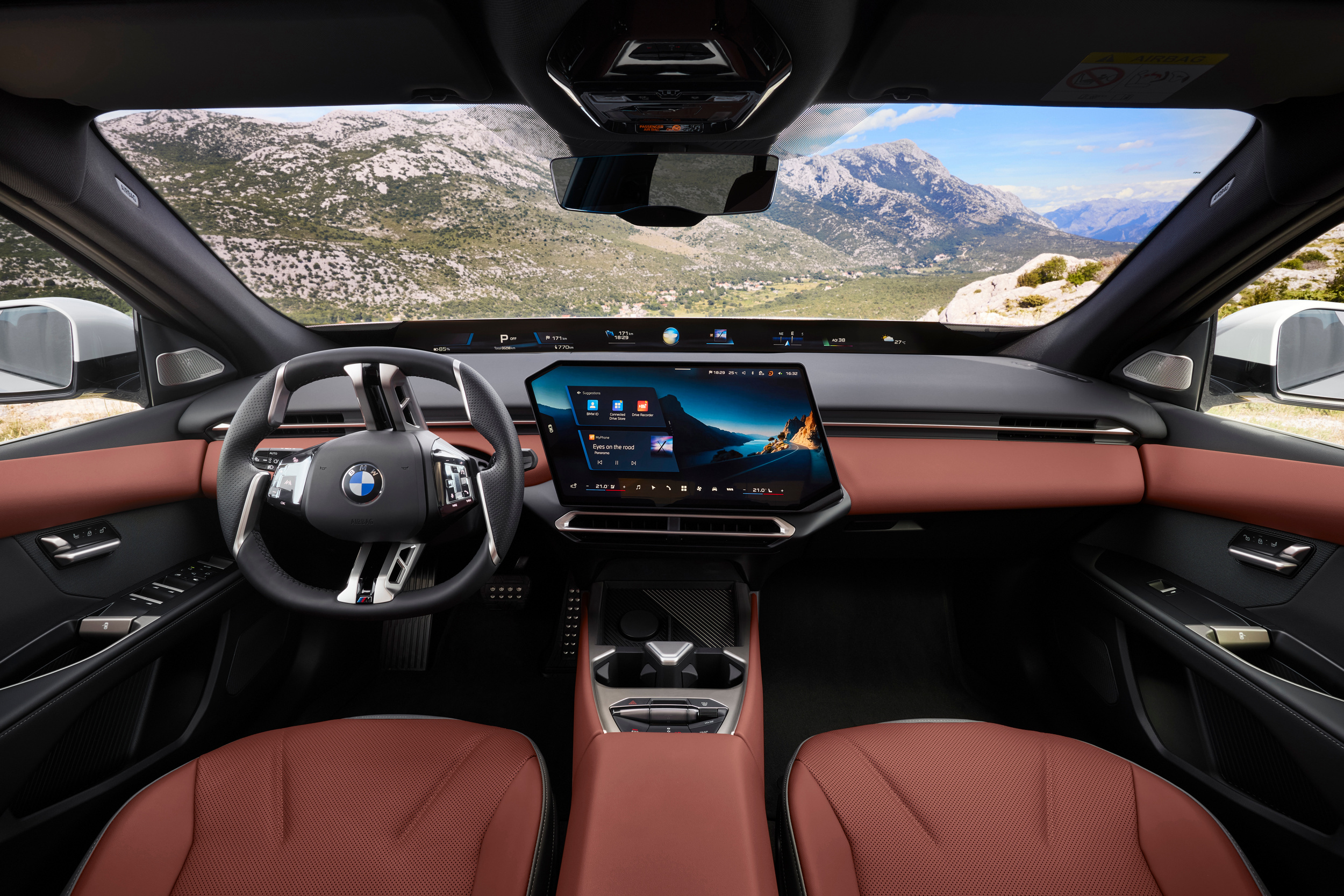
Inside, expect BMW’s Panoramic iDrive setup, combining a display stretching across the base of the windshield with a huge 17.9-inch touchscreen, plus an available 3D head-up display. This infotainment setup made its debut on the iX3, but is now being rolled out to BMW’s other new and facelifted models, including the i3 sedan (shown in image above).
And the convertible won’t be lonely. A fixed-roof i4 Coupe is also coming, as well as visually similar combustion-powered i4s in both open and closed-roof forms. BMW is also developing electric M4 Coupe and Convertible models with styling influenced by the M Concept Neue Klasse. Six-cylinder M4s will survive alongside them too.
That means BMW’s future 4-series lineup should have something for almost everyone. And if you want electric power, sunshine and (just about) four seats, this i4 might have remarkably little competition.
A Gwinnett County school bus driver in Georgia was sentenced to five years in prison and lifelong registration as a sex offender after being convicted of masturbating on board his bus while students were present.
Steven Edward Wilkins, 67, was found guilty of six counts of child molestation and four counts of public indecency. He had worked as a school bus driver for students with special needs in the Gwinnett County School System.
The investigation reportedly began Feb. 9, 2023, after a parent walking her child to the bus reported seeing Wilkins behaving suspiciously.
Prosecutors said investigators reviewed footage from cameras installed on the bus. The video showed Wilkins using a tablet sexually stimulating himself while the bus was parked in the bus lane at Suwanee Elementary School.
The conduct occurred on at least four days between Jan. 31 and Feb. 9, prosecutors said. At least one student was on board the bus during each incident. Officials did not release the ages of the students or provided additional information about them.
The Gwinnett County District Attorney’s Office also noted that Wilkins portrays Santa Claus each Christmas at a local church.
A judge sentenced Wilkins to 20 years of close supervision by law enforcement authorities, including five years in prison. Following his release, Wilkins will be required to register as a sex offender for life and will be prohibited from having contact with minors.
“This is absolutely reprehensible behavior and will not be taken lightly,” Gwinnett County District Attorney Patsy Austin-Gatson told local reporters. “We are committed to protecting all victims, particularly those who are most vulnerable. This defendant will be monitored closely for the next 20 years and held accountable for the rest of his life.”
Officials did not provide information about when Wilkins stopped working for the school district. The district’s response to the conviction was not immediately available. No other details about the court proceedings were immediately released.
BYD’s Da Han slots above the Han as the brand’s flagship sedan.
Every electric version uses the same 102-kWh battery pack.
A plug-in hybrid variant will also be offered, with up to 422 hp.
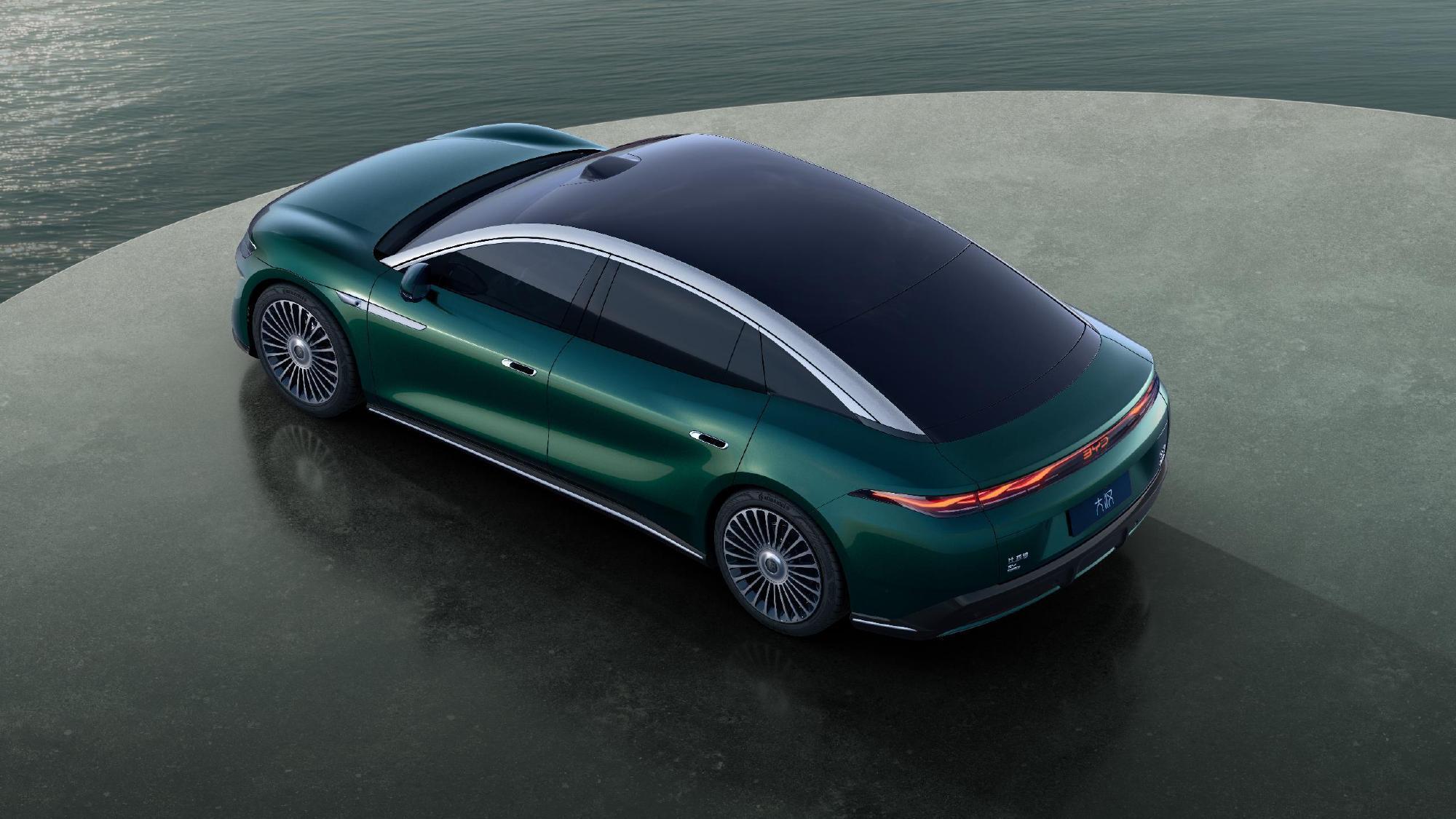
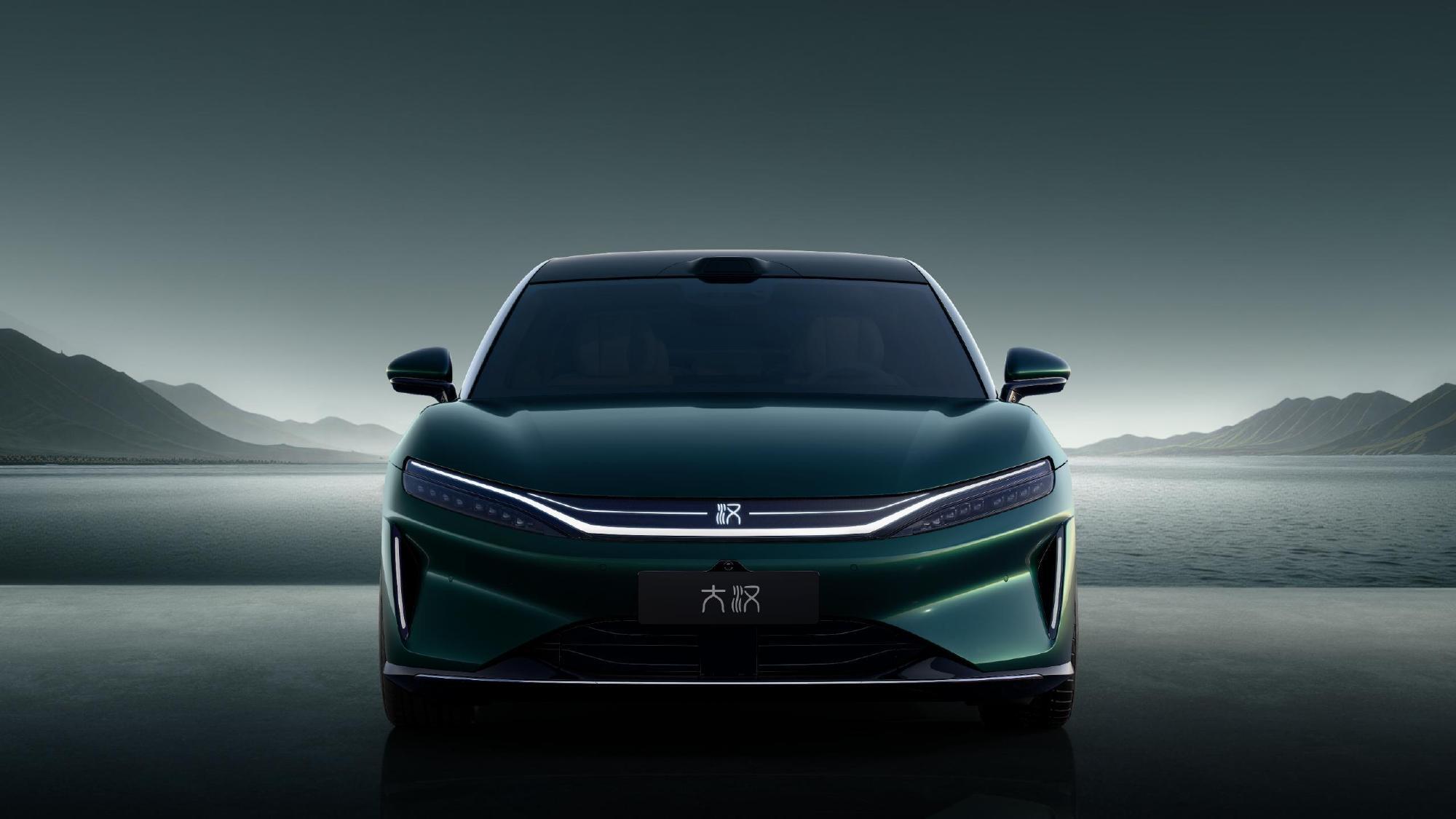
BYD has a new flagship sedan, and it’s called the Da Han. Get past the name and you’ve got a big electric four-door that stretches longer than an S-Class, cracks 760 hp in its hottest form, and claims north of 600 miles between charges.
The Da Han joins BYD’s Dynasty line-up and sits above the Han in the range. Previously referred to as the Great Han, it measures 207 inches (5,256 mm) long, 78.7 inches (1,999 mm) wide, and 59.4 inches (1,510 mm) tall, riding on a generous 123.2-inch (3,130 mm) wheelbase. That’s longer than a standard Mercedes S-Class, which runs 203.9 inches (5,179 mm) on a 122.2-inch (3,106 mm) wheelbase.
The first official photos show the car in dark green, a shade that plays up the aerodynamic bodywork. The nose sits low, with tapered LED headlights, a light bar, and a black lower grille. It looks especially clean from the side, helped by contrasting silver roof rails and black B-pillars that blend into the side glass.
For as striking as the Da Han is to look at, it’s the specifications are what land. An all-electric version leads the charge, but a plug-in hybrid will also be available, ensuring it caters to as many new car buyers as possible.
All-electric versions of the Da Han share the same 102 kWh battery pack. This hefty pack, apparently weighing in at 1,600 lbs (725.9 kg), drives a rear-mounted electric motor in the entry-level version, producing 496 hp (370 kW) and giving it a driving range of either 603 miles (970 km) or 626 miles (1,008 km), depending on the configuration.
Dual-Motor Power
Shoppers after more performance can step up to an all-wheel-drive version that keeps the same battery and rear-mounted motor but adds a front one, lifting combined output to 764 hp (570 kW). Range on the AWD models varies between 509 miles (820 km), 528 miles (850 km), and 547 miles (880 km). Impressive as those figures are, China’s CLTC cycle runs notoriously optimistic, so real-world numbers will come in lower.
As for the plug-in hybrid model, it will use a 1.5-liter turbocharged engine working alongside a 54.4 kWh battery and a single electric motor, resulting in a combined 422 hp. The electric driving range of this version will be a solid 292 miles (470 km).
Bentley has teased the interior of the upcoming Torcal EV.
Model sports curved displays and diamond-shaped accents.
Crossover will have a unique “floating diamond grille.”
The teaser campaign for the Bentley Torcal is kicking into high gear as the company has released a new clip that showcases the interior. The ultra-luxury brand has also released a few new details about their first electric vehicle.
Starting outside, the automaker said the crossover will have a “jewel-like floating diamond grille” that “transforms a functional necessity into a captivating design statement – one that is unmistakably Bentley and unlike anything else on the road.” The video doesn’t give us a very good look at it, but the grille is expected to echo the one found on the EXP 15 concept.
Bentley also provided a peek at the three dimensional taillights, which have a diamond pattern. The pointy shape is a bit of a theme for the Torcal and the company noted the historical design feature has been “reinterpreted for a new era.”
The automaker went on to say they teamed up with Cumbria Crystal to commission “bespoke hand-cut crystal objects designed specifically for the project.” Details are limited, but the company suggested the crystals will be illuminated to create a “distinctive visual signature rich in depth, movement and texture.”
Putting marketing hyperbole aside, we can see the crossover will have sculpted door panels with an interesting ridge-like pattern. Elsewhere, there are knurled climate controls and a rotary dial with a start/stop button. They’re joined by physical buttons as well as dedicated Sport and Comfort modes.
The latest pictures also give us another look at the crossover’s curved infotainment system. It features a portrait orientation as well as a lower bar that shows climate and seat information.
While there isn’t much else to see, previous spy photos have shown the model will have a three-spoke steering wheel with wing-like stalks similar to the Audi Q3. The right side has a shifter, while the left side has an assortment of light and wiper controls.
Well-heeled customers will also find a curved digital instrument cluster and circular air vents. They’ll be joined by real metal accents and a wide swath of wood trim on the passenger side dashboard.
Performance specifications remain mysterious, but the Torcal will ride on the PPE platform that underpins an assortment of models including the Porsche Cayenne Electric. It sports a 113 kWh battery pack, a 390 kW DC fast charging capability, and outputs of 435 hp (324 kW / 441 PS), 657 hp (490 kW / 666 PS), and 1,139 hp (849 kW / 1,155 PS). The Bentley will likely fall somewhere in between the latter two numbers and the company has already confirmed the model will be capable of getting 100 miles (161 km) of range in as little as seven minutes.
A debut is scheduled for September 23 and the model will arrive in the United States in the third quarter of 2027. When it does, it’s expected to start around $200,000 to $250,000.
Porsche chased Roc, the plane with the widest wingspan on Earth.
The stunt unfolded at California’s Mojave Air and Space Port.
Roc’s six engines combine for 340,500 pounds of thrust.
Eager to launch the all-new Porsche Cayenne Electric with the right amount of fanfare, the German brand went looking for a very special stunt, and it settled on one involving the largest aircraft in the world. While we’re not sure it’s as impressive as the time VW used a Touareg V10 TDI to tow a Boeing 747 two decades ago, it’s a decent effort all the same.
The whole thing took place at the Mojave Air and Space Port and involved Roc, the plane with the largest wingspan on Earth. The thing is so enormous it has two fuselages and can take off fully loaded at up to 1.3 million pounds (589,670 kg).
In the past, we’ve seen plenty of supercars racing fighter jets off the line, but extracting maximum acceleration from the Cayenne Electric to outpace Roc wasn’t the objective here. Instead, Porsche wanted to trail behind Roc as it sped down the runway before taking off, in what it describes as a “test of precision, stability and power.”
To keep the Cayenne, and driver Patrick Long, safe, the SUV had to be positioned perfectly in between the plane’s two fuselages. If positioned too far back, it’d be hit by the jet blast from the plane’s six powerful engines that combine to deliver 340,500 lbs (154,448 kg) of thrust, enough to throw the Porsche into the air. Too far forward and Long could have been at risk of hitting the landing gear.
As Roc accelerated down the runway, Long had to push the Cayenne Electric through to 167 mph (269 km/h) and then got the perfect view of the massive plane taking off mere feet away from him.
“It was probably one of the most focused and intense moments of my life,” Long said. “We believed in the data, and I knew I could rely on the Cayenne and the pilots of Roc – we had a good team. Operating with a fully charged battery, we started slow – I was using minimal power and holding the car exactly where it needed to be, and I knew I had the performance to maintain my position no matter what.”
The new Cayenne Electric was the obvious weapon of choice for this stunt. The current flagship Cayenne Turbo Electric uses a pair of electric motors delivering up to 1,138 hp and 1,106 lb-ft (1,500 Nm) of torque, and whereas a lighter vehicle may have been tossed around by the jet blast, the Porsche remained rock solid. Indeed, it weighs in at a hefty 5,831 lbs (2,645 kg).
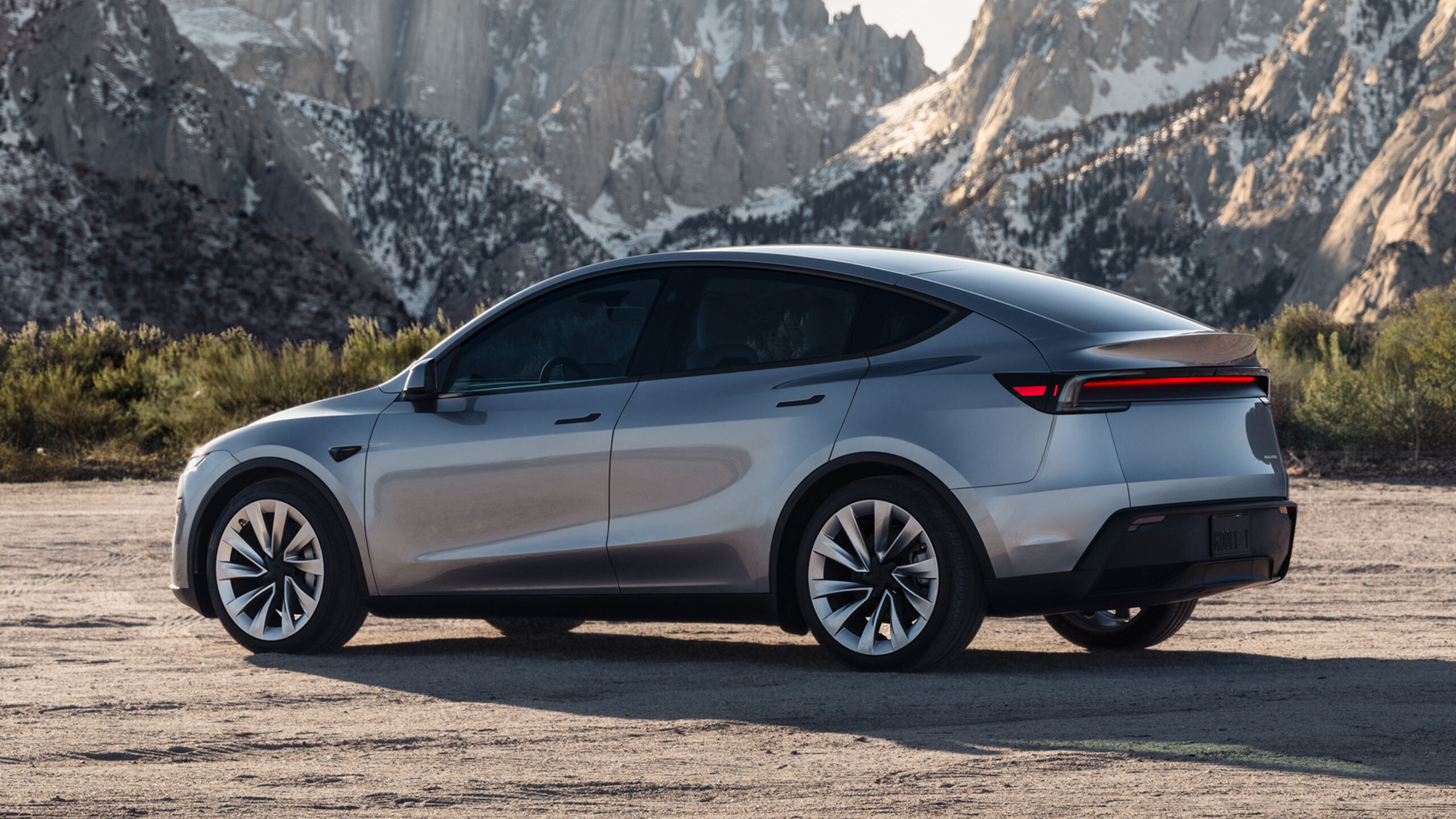
The cheapest Model 3 lease now works out to $418 per month in the US.
The Performance version comes to $731 monthly over 36 months.
Lease prices across the lineup have climbed by as much as 12 percent.
Leasing a Tesla Model 3 in the US has just gotten more expensive, so anyone hoping to get behind the wheel of a new one may find that paying cash makes more sense than signing a lease, at least in some cases.
Lease prices have crept up quietly across the entire Model 3 family, and the increases start with the base Rear-Wheel Drive model, which now runs $379 per month over 36 months with an annual mileage cap of 10,000 miles. That figure looks reasonable enough on its own, but it leaves out the $4,075 due at delivery, a sum made up of a $3,000 down payment, the first monthly payment, and an acquisition fee.
After factoring this in, you get an effective rate of $481 per month, which is roughly 12 percent higher than earlier this year. As recently as last week, the EV was offered at $329 per month with a lower $4,024 fee due at signing.
Lease prices have also increased for other Model 3 variants. For example, the Premium Rear-Wheel Drive commands $399 per month over 36 months, excluding the $4,094 fee that’s due up front. Add that into the equation, and you’re looking at an effective rate of $501. The Premium All-Wheel Drive is more expensive at $479 per month with a higher fee of $4,174, meaning it works out to $581 per month over the life of the lease.
Then there’s the Model 3 Performance. It has a monthly lease of $629 plus the $4,324, which is due at delivery. Do the math, and it works out to $731 per month for 36 months.
While this is roughly 4.3 percent higher than previously, it’s not necessarily a bad deal. Earlier this year, Hyundai was offering the Ioniq 5 N for $699 per month over 36 months with $3,999 due at signing, working out to $810 per month.
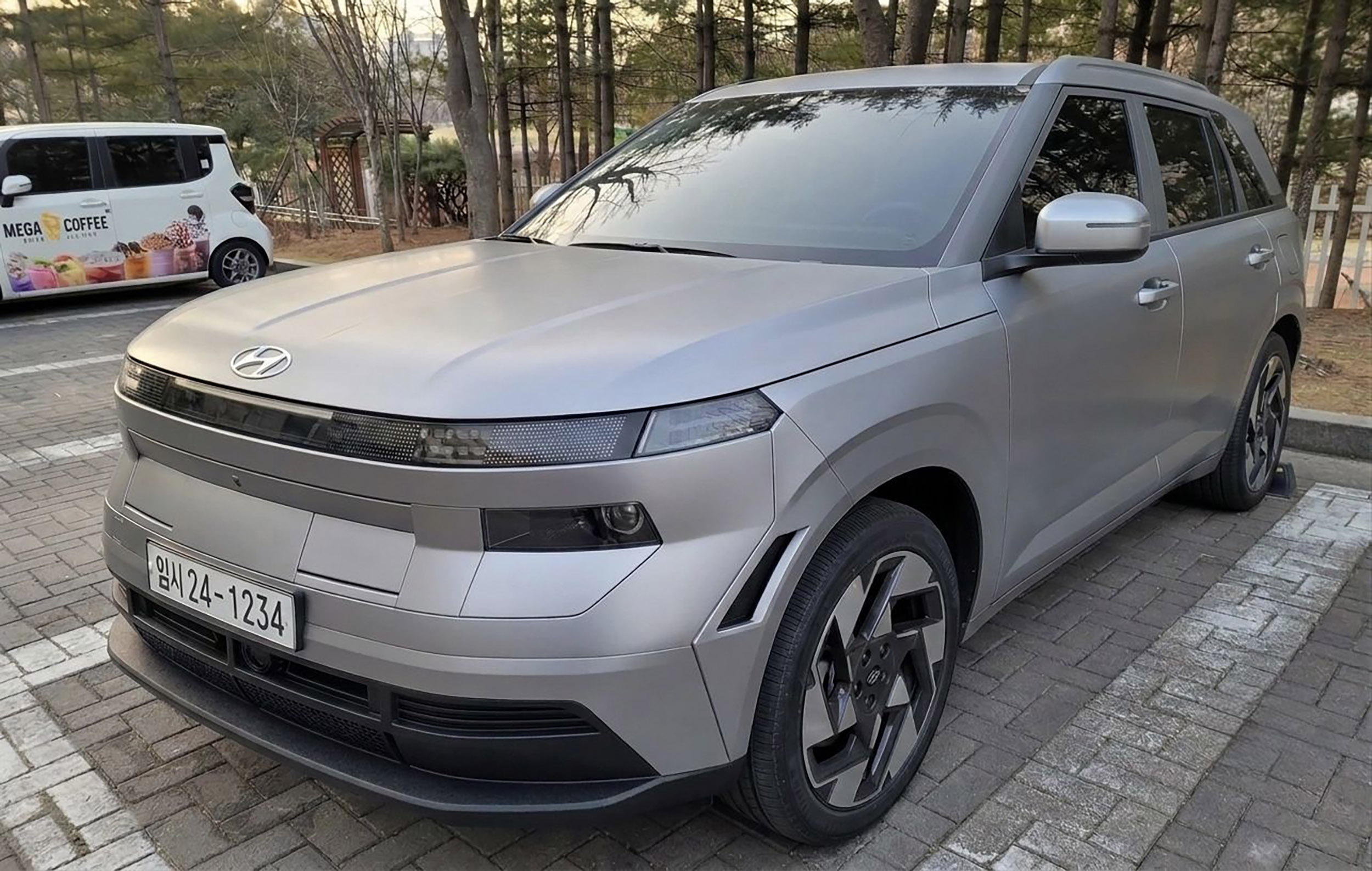
The next-generation Hyundai Kona was caught completely undisguised.
It will bring a boxier and more mature styling alongside advanced tech.
The SUV could merge with the Creta and underpin a new GM crossover.
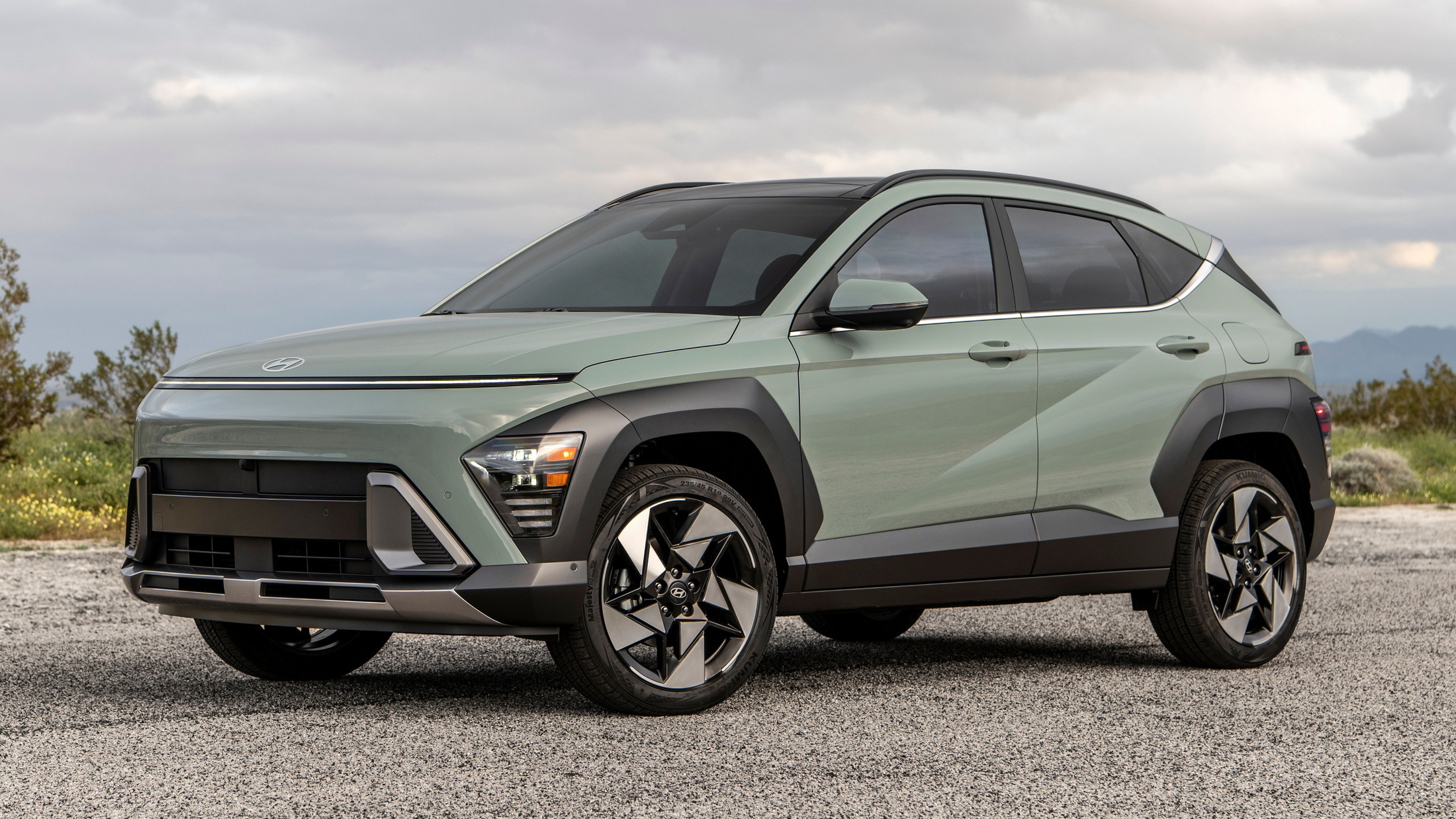
Hyundai pulled the wraps off the second-generation Kona in December 2022, but rather than settle for a mid-cycle nip and tuck, the automaker is preparing a more thorough redesign for 2027. After earlier runs of camouflaged prototypes, the new Kona has now turned up completely undisguised in Korea, and the exposed sheetmetal reveals a taller, more upright stance than the car it replaces.
The styling is only part of the story here, as reports suggest Hyundai wants to fold the Kona and Creta lines into a single global model, a logical move given their size and where each sits in the market. There’s also talk that the SUV’s underpinnings could be shared with the next Chevrolet Tracker, the product of an agreement struck with General Motors.
The photos making the rounds on social media, including a set posted by @EWVexillary, point to a Kona that borrows the rugged cues from the Crater concept. At the same time, the cleaner surfacing pulls it visually closer to the Ioniq EV family, splitting the difference between off-road attitude and electric-era modernity.
The front end keeps the split-headlight arrangement of the previous generations, though the main units are much smaller now and the full-LED bar runs thicker than before. Below sits a sculpted bumper with smaller intakes and what looks like a covered grille.
The profile is defined by what’s gone, namely the unpainted plastic cladding, which lends the car a more modern stance. A subtle two-tone treatment reinforces the effect, pairing gray pillars against matte silver bodywork. The flanks trade the diagonal creases of the outgoing model for cleaner surfacing, and the greenhouse is entirely new, its straight belt line running back to a more upright tail.
Dimensions haven’t been confirmed, but the SUV could grow, following the lead of the mechanically related Kia Seltos, which stretches to 4,430 mm (174.4 inches) long. By comparison, the current Hyundai Creta measures 4,330 mm (170.5 in), and the Kona is slightly longer at 4,350 mm (171.3 in).
— Elvis Will Vexillary 🔋 (@EWVexillary) July 21, 2026
A further increase in size could help the Kona cement its position between the subcompact and compact SUV segments in Europe, bridging the gap between the smaller Bayon and the larger Tucson. Rivals will include the likes of the VW T-Roc, the Toyota C-HR, the Honda HR-V, and the Mazda CX-30.
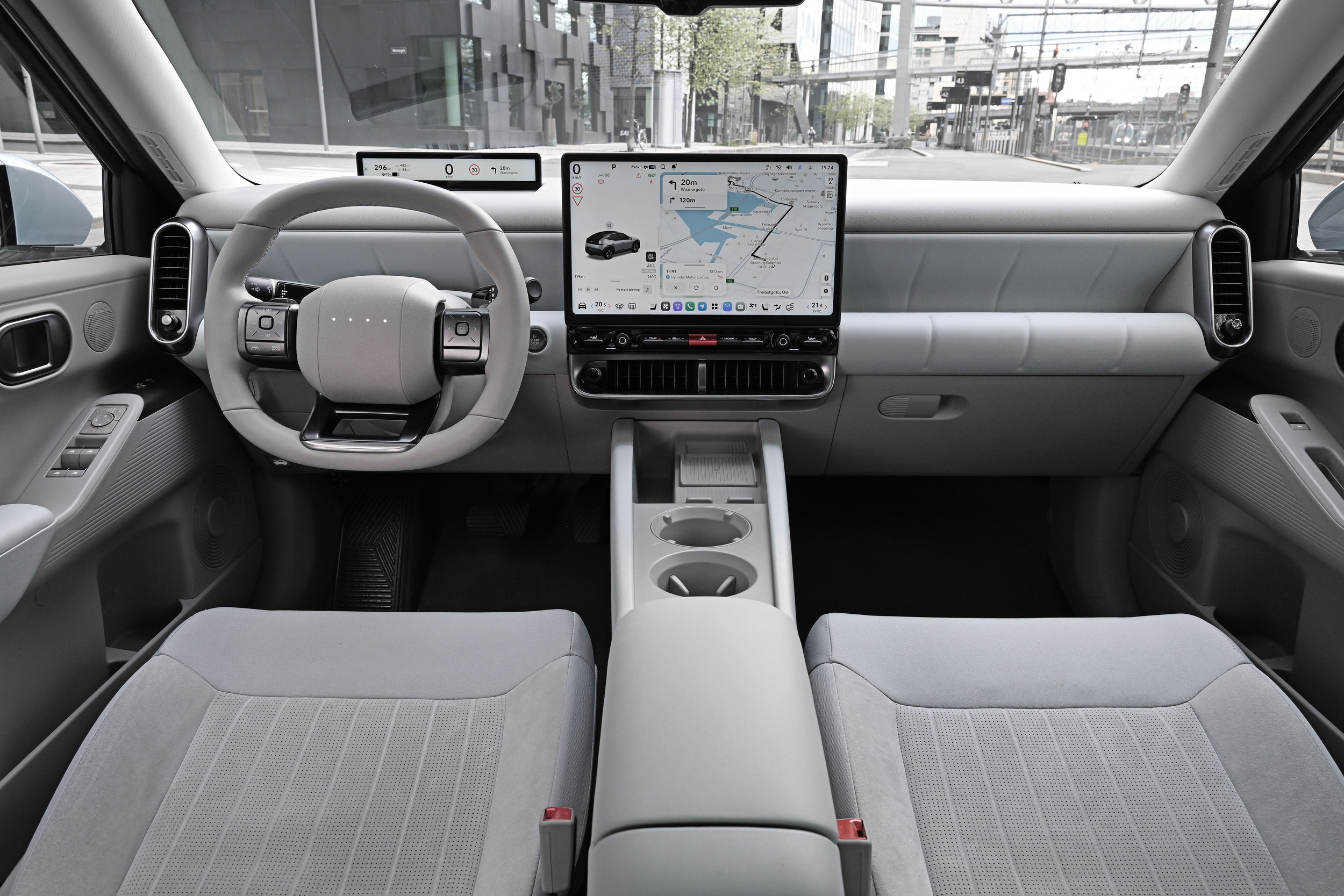
Inside, the crossover will most likely gain a digital cockpit with larger screens, following the lead of the Ioniq 3. Those run on the new Hyundai Pleos Connect infotainment, built on Google’s Android. Hyundai isn’t ditching buttons either, keeping physical controls for the functions that matter. Practicality should improve too, with a slightly larger footprint freeing up more room for passengers and their bags.
Depending on the market, the powertrain range may include a naturally aspirated 2.0-liter, a turbocharged 1.6-liter, and a self-charging hybrid 1.6-liter in FWD and AWD forms. Hyundai might also keep the fully electric variant around and potentially add a range-extender setup.
The unified third-generation Kona and Creta is expected to make its formal global debut within the next few months, likely as a 2027 model.

 Login
Login