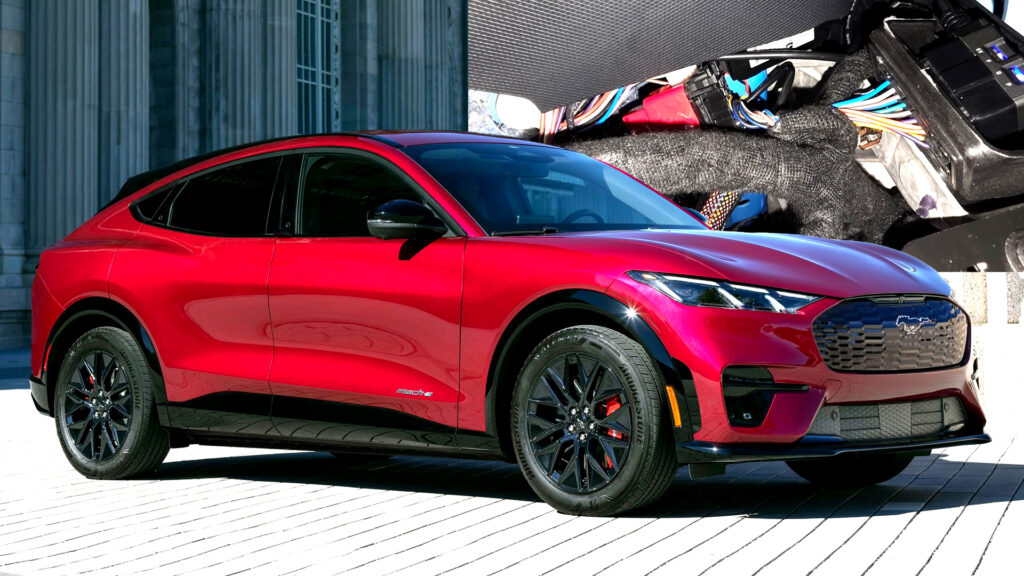
A Mach-E owner discovered a hidden tracking module beneath his dashboard.
The device appears linked to a recently disclosed security vulnerability.
Most owners face little real-world hacking risk despite the alarming headlines.
Car hacking is becoming a more alarming issue every day, it seems. Just this week, security researchers announced that they’d found another major vulnerability that could affect any car from any brand built in the last few decades. After watching a video about the hack, one Ford owner found exactly that same type of device in his own car. Here’s why you might want to take a peek in your own vehicle and why the threat in this case isn’t as scary as it may seem.
The Reddit user said the idea came after watching a recent Wired video detailing security researchers’ discovery of vulnerabilities in the KARR Security System. That’s an aftermarket alarm and tracking device frequently installed by dealerships. We’ve covered similar products in the past. In this case, the owner was simply curious, so he pulled a panel out from under his dash and, sure enough, found the module.
How To Find One In Your Own Car
These devices are often plugged into the OBDII port via a splitter, so they’re hard to spot initially. Some can route directly to or from the battery as well. The owner wasted little time removing the module, which appears to have been installed using a plug-and-play T-harness beneath the dashboard. With that simple action, he disconnected himself from the vulnerability. If you have a similar device hidden in your vehicle, removal is often that simple.
Researchers at the University of California San Diego recently disclosed a Bluetooth vulnerability affecting certain KARR Security System modules, estimating that more than two million vehicles could have the devices installed. According to the researchers, the flaw could allow someone within Bluetooth range to unlock a vehicle, trigger its alarm, or disable its ignition until the owner installs a firmware update. Importantly, they cannot start the car with this hack. The company behind the system has since released a patch.
Why You Probably Shouldn’t Panic
That said, this isn’t a reason for owners to panic. While the researchers successfully demonstrated the vulnerability in controlled testing, exploiting it requires specialized software and close proximity to the vehicle. Moreover, while two million cars is an objectively big number, it also accounts for less than one percent of cars on the road in America. With that in mind, the chances of someone targeting your car this way remain extremely low.
Instead, the bigger takeaway may be that many owners have no idea aftermarket electronics are tucked behind their dashboards in the first place. Dealers often install them for theft prevention, inventory management, or as part of an optional security package. In this case, our Mustang Mach-E owner says his purchase paperwork never mentioned it. Thankfully, a little insight into its possible existence was enough for him to find and delete it.
ILLINOIS – BusGates, the makers of LED stop arm extensions, is expressing support for the school bus safety provisions included in the BUILD America 250 Act, a federal transportation package that advances new national efforts focused on roadway safety, enforcement, and public awareness.
The legislation includes provisions aimed at reducing illegal school bus passing through expanded public safety messaging, strengthened enforcement initiatives, and increased coordination between federal, state, and local transportation safety stakeholders.
“Illegal school bus passing is a preventable safety issue,” said Trevor Clatfelter, CoFounder at BusGates. “The reality is that improving visibility around the bus is one of the most practical ways to address it. We support federal efforts that elevate this issue and move us toward solutions that actually change driver behavior when kids are getting on and off the bus.”
Despite longstanding state laws requiring motorists to stop for school buses as they load and unload children, illegal passing remains a significant national safety concern. The National Association of State Directors of Pupil Transportation Services (NASDPTS) estimates there are more than 43 million illegal school bus passings annually, placing children at risk during routine pickup and drop-off.
The dangers associated with illegal school bus passing are well known among transportation professionals. Cindy Morris, a veteran driver for the Ball-Chatham School District in Illinois featured in a recent video campaign, shared firsthand concerns about motorists routinely disregarding traditional school bus warning signals during loading and unloading operations.
BusGates is a mission-driven school bus safety technology company focused on reducing illegal school bus passing by enhancing the visibility of the current stop arm on buses. The system uses bright, flashing LED light extensions that easily retrofit onto current stop arms, helping to improve driver awareness during student pickup and drop-off. This new technology helps deter illegal passing behavior at the point of risk and supports safer student transportation.
The BUILD America 250 Act also reflects broader federal priorities around roadway safety and transportation innovation, including expanded safety programs and new frameworks for emerging vehicle technologies.
“From our perspective, effective student transportation safety requires a layered approach,” said Dan Thompson, CoFounder at BusGates®. “Enforcement and public awareness are important, but they have to be paired with tools that work to help prevent dangerous situations before they happen.”
BusGates continues to engage with transportation stakeholders at the federal and state level as policymakers advance initiatives aimed at improving school transportation safety outcomes.
BusGates LED Stop Arm Extensions are being used by school districts in 26 states including: Arizona, Arkansas, Colorado, Georgia, Idaho, Illinois, Iowa, Kansas, Kentucky, Louisiana, Maine, Minnesota, Missouri, Montana, New Mexico, New Jersey, New York, North Carolina, North Dakota, Ohio, Oklahoma, Texas, Utah, Virginia, Washington, West Virginia, as well as in Canada.
About BusGates:www.busgates.com BusGates is on a mission to reduce vehicle “drive-arounds” at bus stops across America and make getting to and from school safer for students. BusGates stop-arm extensions are a simple, cost-effective solution to a major problem – cars ignoring stopped school bus warnings putting students at risk. BusGates stop-arm extensions easily retro fit to the existing school bus stop signs. They offer additional visibility and stick out further from the bus to make drivers more aware and reduce illegal “drive-arounds” by up to 95%.
DENVER, Colo. – John Elliott Jr., Senior Vice President of Customer Operations at Summit School Services, has been awarded the Golden Merit Award by the National School Transportation Association (NSTA) for his exceptional dedication to service excellence in the student transportation industry.
The Golden Merit Award was introduced in 1969 to recognize school bus professionals who have demonstrated excellence and dedication in service and safety in student transportation. Award recipients are also selected based on their contributions to the industry and their exemplification of outstanding leadership, innovation, and decision-making throughout their careers.
John, along with other award recipients, were recognized and presented with their awards at the NSTA Awards and Installation Dinner on July 21, 2026, and were joined by family, fellow team members, and industry professionals. The award presentation was held as part of NSTA’s 2026 Annual Meeting and Convention.
John Elliott Jr. began his career with Summit School Services in 2015 as Vice President of Operations. Following his proven success in fostering positive customer relationships and contributing to business growth, John advanced into his current role as Senior Vice President of Customer Operations a few years later in 2019.
“John has led our company to many great successes over the years. Through his integrity, industry expertise, and innate ability to connect with customers, he has built trusted, long-lasting partnerships by listening to their needs and responding with decisive action and genuine care,” said Tim Wertner, CEO, Summit School Services. “This award is a tremendous testament to both who he is as a person and the amazing career he has built in the school bus industry. Congratulations, John, on this incredible recognition, and thank you for your unwavering commitment to safety and excellence.”
“I have had the pleasure in working with John since he joined Summit and can say with full confidence that this award is very much deserved,” said Carina Noble, Senior Vice President of Communications and External Affairs, Summit School Services. “John is personable, talented, and highly experienced in effectively navigating customer relationships and operations. He is incredibly skilled in both regards, and as a fellow colleague, I have immense respect for John and have learned a great deal from him and his expansive knowledge. Congrats, John, on this fittingly esteemed award.”
About Summit School Services
Summit School Services sets the standard for safe, reliable student transportation across North America. As the parent organization to trusted local operators including Durham School Services, Stock Transportation, and Petermann Bus, Summit supports over 360 school districts. Driven by our five values: Safety, Care, Transparency, Communities, and Culture, we deliver transportation that works consistently, reliably, and without disruption.
Protesters burst into a Thursday news conference about the police shooting of a homeless man in Madison, taking the microphone from the police chief and arguing with some attendees who said they wanted to hear more about the investigation.
The group of roughly 20 protesters burst into the room at the Madison police station, shortly after Mayor Satya Rhodes-Conway and Common Council President Sabrina Madison identified the man killed by police as Corey Durell Ruiz, a homeless resident.
Ruiz, 38, was shot and killed Wednesday after police said he resisted arrest and injured an officer with a knife.
Police Chief John Patterson stepped away from the microphone when the protesters were shouting, and one man in the group took his spot at the podium. The event quickly devolved into a shouting match.
A vigil for Corey Ruiz was held Thursday at the intersection of Williamson Street and South Baldwin Street in Madison, where Ruiz was fatally shot by a Madison police officer. We spoke to several Madison residents about the fatal shooting. Madison Police Department’s police chief, John Patterson, said Ruiz’s death will be investigated as a homicide during a press conference shortly before the vigil. The Wisconsin Department of Justice’s Division of Criminal Investigation is investigating the shooting. #wisconsinwatch#coreyruiz#mpd#madisonshooting#madison
One protester held a sign saying “Corrupt cops deserve to die too!!!”
Moments earlier, the mayor said the shooting will be “rigorously investigated.”
“It does not matter who you are or what your past is, you should not lose your life as a result of an encounter with law enforcement,” Satya Rhodes-Conway said.
Madison, for her part, said “Corey could have been my brother because my brother is homeless and he often rides a bike.”
Court records show Ruiz had been in and out of jail over the past decade on charges including failing to pay child support, driving a vehicle without consent, jumping bail, threatening authorities, taking a vehicle without consent, possessing drug paraphernalia, resisting an officer and retail theft.
“He’s a human being. He had a family. He has parents who loved him who brought him home, who cared for him,” Madison said, adding that she’s struggling to understand what she’s seen in videos of the shooting that have circulated on social media.
“My first thought is, when the officer’s walking away, why isn’t he walking away in cuffs,” Madison said. “I’m angry, there’s no way around it.”
Once the protesters quieted down, the chief resumed his presentation, promising his department’s full cooperation with the state investigation.
Police have released few details
The shooting has roiled Wisconsin’s capital city, with Gov. Tony Evers calling for “transparency and accountability” and Madison community members gathering Thursday at a growing memorial.
Protesters march after a Madison police officer shot and killed a man, July 22, 2026, in Madison, Wis. (Kayla Wolf / Associated Press)
None of the four officers who were detaining the man wore body cameras, but passersby recorded the confrontation on video, and accused the officers of overreacting.
“I thought, ‘Holy cow — what could have warranted that?’ It looked to me like they had him under control,” David Ortiz-Whittingham, who saw officers swarming and heard the gunshots, said Thursday. “Even now, knowing about the knife, did he have to die for it? Could this have been de-escalated without him losing his life?”
The police chief released few details Thursday, saying the investigation into the officer-involved shooting must run its course.
Earlier Thursday, Madison’s independent police monitor, Aeiramique Glass, said police have not yet shared evidence or the officer’s identity with her office, which will review the case and can recommend to the district attorney that charges be filed if warranted. She said the department and city are “obstructing what the community and the public” want.
“Let me do my job,” she said.
Patterson said the police were committed to cooperating with Glass as the independent monitor’s investigation is carried out, at the same time as the state’s probe.
The chief urged people not to draw conclusions
Patterson has urged caution in reading too much from the cellphone videos. He said none show the perspective of the officers, and additional video that hasn’t been released is being reviewed.
The officer who fired his weapon is a veteran of the force, the chief said. He and the three other responding officers will be placed on administrative leave pending an independent investigation by the Wisconsin Department of Criminal Investigation, as required under state law.
Patterson said police were responding to calls that someone was attempting to enter parked vehicles, and the suspect fled on a bike before the officers surrounded him. One deployed a taser, but Patterson said he didn’t know if the taser worked. Those efforts failed to control the man, Patterson said.
In the videos circulating online, the man can be seen standing before he’s brought to his knees as the officers struggle to force him into a prone position. Then he falls quickly to the pavement after what sounds like three gunshots and seems motionless as the officers handcuff him behind his back. Arriving officers then escort one of the officers a short distance away.
Patterson said he did not know the extent of the injuries sustained by the officer who was injured by the knife.
“This situation was clearly dangerous,” Patterson said. He later continued, “I am incredibly saddened by the loss of life.”
A neighborhood now accustomed to police shootings
The shooting happened in the middle of an intersection in the popular Marquette neighborhood, which is lined with restaurants, bars, shops and homes less than 2 miles (3.2 kilometers) from the state Capitol. The bystander videos show numerous cars at the scene, with people watching and commenting as it unfolded.
A man crouches to light candles at a memorial site as mourners gather during a vigil at the site where Corey Ruiz was fatally shot by Madison police, July 22, 2026, in Madison, Wis. (Wes Hogg for Wisconsin Watch)
“I saw everything! I saw everything! You did not need to kill him! … We watched it all!” a woman yelled in the video recorded by Ortiz-Whittingham. Three loud shots could be heard among the sirens, followed by screams.
Residents who dealt with two other police killings within the same few blocks expressed their frustration on Thursday.
In 2015, a white police officer shot and killed Tony Robinson, who was biracial, on the same street. Large protests followed, but the district attorney filed no charges, determining the officer was justified. In 2012, Paul Heenan, a white musician, was fatally shot after he had been drinking and mistakenly entered his neighbor’s house. That officer was exonerated as well.
The chief acknowledged that the neighborhood “has experienced a lot of trauma” and urged people to support one another.
“I want transparency, I want accountability,” Patterson said.
A man addresses a crowd as marchers and mourners converge at a vigil for Corey Ruiz, who was fatally shot by a Madison police officer, on July 22, 2026, in Madison, Wis. (Wes Hogg for Wisconsin Watch)
Questions about race and technology emerge
The race of the officer who fired his gun on Wednesday and that of the man he killed were not released by police.
But Black advocacy groups, protesters and politicians spoke out against the crime and said they believe the man was Black.
The shooting also focused attention on the Madison Police Department’s lack of body-worn cameras. The force of around 500 is among the largest in the Midwest that doesn’t use the devices.
Common Council President Sabrina Madison said Thursday that she expects a police request for $400,000 to be approved, enabling the cameras to be phased in over the next three years. Others lamented that cameras aren’t already being used.
Attendees gesture during a candlelight vigil where a Madison police officer shot and killed a man Wednesday, July 22, 2026, in Madison, Wis. (Kayla Wolf / Associated Press)
“Nobody can agree on anything,” said Katey Nelson, a member of the police civilian oversight board and operations director at YWCA Madison, a racial justice group. “Now we’re here, looking at another police shooting where we don’t have what we need to make sure the officers are held accountable.”
The mayor said her budget, which has not yet been released, will include funding for body-worn cameras. Rhodes-Conway said the city needs to put together a policy for the use of the cameras, and said that will be completed before the budget takes effect in January.
And now it’s a talking point in the governor’s race
Wisconsin State Rep. Francesca Hong, a Democrat running for governor, embraces a woman at a vigil for Corey Ruiz, hours after a Madison police officer fatally shot Ruiz, on July 22, 2026, in Madison, Wis. (Wes Hogg for Wisconsin Watch)
Madison, home to the University of Wisconsin, has a long history of organized protest dating back to the 1960s. More than 100,000 people marched on the state Capitol in 2011 in favor of union rights. There were large demonstrations that turned violent after the death of George Floyd in 2020.
And so the shooting quickly infused itself into the race to succeed Evers as governor, with voting already underway in the Aug. 11 primary.
“This state sanctioned violence was an execution,” posted Francesca Hong, a democratic socialist candidate who appeared with a bullhorn at the scene just a few blocks from her campaign office. She has called for defunding the police.
Another Democrat in the race, Milwaukee County Executive David Crowley, said while the details must become public, “these reports are painfully reminiscent of the tragedies we have witnessed in Kenosha, Minneapolis, and far too many communities across our country.”
Republican U.S. Rep. Tom Tiffany called on his rivals to let the state investigation “establish the facts without politicians rushing to judgment or stoking division” in a statement that also said he would “work to end revolving-door criminal justice policies.”
Associated Press writers Ed White in Detroit and Jake Offenhartz in New York contributed to this report.
Editor’s note: The Associated Press erroneously reported George Floyd was shot and killed by police. An officer in Minneapolis murdered Floyd by pinning him to the pavement and putting a knee to his neck. This story has been updated to reflect the correction.
A Madison police officer shot and killed a man after that man produced a knife, Madison Police Chief John Patterson said.
The same officer who fired the shots was injured by the man’s knife, according to Patterson.
The incident happened at about 1:30 p.m. on Wednesday, according to an incident report posted by the Madison Police Department that afternoon. Multiple streets in the area were blocked off Wednesday afternoon — and crowds gathered in protest.
Patterson said officials had notified the deceased man’s family about his death. However, Patterson declined to disclose the man’s race or name during a news conference just before 5 p.m. Wednesday. He said the man was in his 30s.
Patterson said one officer fired shots, although a total of four officers were involved in the incident and have been placed on leave. The Division of Criminal Investigation at Wisconsin’s Department of Justice is investigating the incident.
Patterson said police initially responded to a call about a man who was checking cars in Madison’s Marquette neighborhood. When officers arrived, Patterson said the man fled on his bike.
The chief said the man produced a knife while officers were trying to arrest him.
“This is not a small folding knife,” Patterson told reporters. “It’s a large fixed blade knife that was there and present.”
During the incident, Patterson said, police used a stun weapon on the man.
“A less lethal device, a Taser, was deployed,” Patterson said. “Unfortunately, it was unsuccessful.”
During the incident, Patterson said a second officer was injured, but police do not believe that officer was injured by the man’s knife.
“It’s not clear how that occurred,” Patterson said.
A video posted to social media on Wednesday shows police cruisers arriving at an intersection with sirens on. A person can be seen riding into the intersection and then falling off a bike onto the pavement, before multiple officers are on top of the person. The video shows the person trying to get away. Then, an officer appears to fire multiple shots at the person.
Madison Police officers block the intersection of Williamson Street and S. Baldwin Street in Madison, Wis., after police shot and killed a man on July 22, 2026. (Alyssa Allemand / WPR)
The video was posted by Richard Hegwood, who lives at the intersection and witnessed the shooting. He told a reporter he began recording when he saw police chasing a man on a bike.
“They catch the dude, they have him on the ground. He’s struggling, he’s struggling to get up, and that’s when they shot him. They shot him three times,” Hegwood said. “I never saw a weapon. He never brandished a weapon.”
Hegwood said three officers had been struggling with the person before the shots were fired.
A second video from a closer vantage point was taken by resident Michael Doubek, who said he saw an officer knock the man from a bike.
“He was on the ground, he had nearly been handcuffed, he had already been tased,” Doubek said. “One of the officers says he has a knife, after which one of the officers pulls a taser, yells, ‘Taser taser taser,’ tases him. Then all three, all of them sort of all fall on the ground together, after which one of the cops stands up kind of on one knee and shoots him three times in the head point blank while he is on the ground.”
Doubek said he does not know the details of what led to the confrontation. “But from where I was standing 10 feet away, that looked an awful lot like an execution to me,” he said.
After the shooting, the area was closed off by police tape. The person’s bicycle remained on the ground.
Advocates for Madison’s Black community said the man killed was Black.
“Another Black man is dead on a Madison street, and our community watched him die before we even knew his name,” said Brandi Grayson, the head of the Madison-based Black community advocacy group Urban Triage. “That is the cruelty of state violence.”
Hundreds of protesters gathered near the scene Wednesday evening before marching together to the state Capitol where a Concerts on the Square event was underway.
Protesters chanted and held signs with slogans, including “no justice, no peace” and “Madison police executed a human today.” Some concertgoers showed support by clapping and raising fists.
The concert was eventually canceled by organizers.
Protesters gather at the Wisconsin Capitol during Concerts on the Square on July 22, 2026. The demonstration followed the fatal shooting of a man by a police officer on Madison’s east side earlier that day. (Angela Major / WPR)
During Wednesday’s news conference earlier in the afternoon, Patterson asked Madisonians to “please take a moment to to reflect and offer some support to one another.”
He referenced the man who died, and added, “I want to take a moment to honestly and sincerely offer my my heartfelt sympathies to his family for this loss.”
Wednesday’s shooting took place in the same neighborhood where a Madison police officer fatally shot Tony Robinson, a 19-year-old Black man, inside an apartment building in 2015.
Robinson was unarmed. The Dane County district attorney did not issue charges against that police officer, after determining the officer had reason to fear for his life after concluding that Robinson had physically assaulted the officer at the top of the stairs within the building.
“I want to start with an acknowledgement that today involves a very traumatic incident,” Patterson said, referencing the Robinson shooting during Wednesday’s news conference. “A traumatic incident that has occurred in a neighborhood that has experienced a lot of trauma in the past.”
In an update sent just before 2:45 p.m. Wednesday, District 6 Madison Ald. Davy Mayer said he was “aware of an officer-involved shooting on Williamson and Baldwin Street earlier this afternoon.”
“My priority is to make sure the community remains safe and that the public receives full details about what happened as soon as possible,” Mayer wrote in the blog post.
DENVER, Colo. — Despite a decline in the number of illegal passers, the National Association of State Directors of Pupil Transportation Services (NASDPTS) said the problem is far from resolved.
In the most recent one-day count of illegal passers, announced Tuesday at the National School Transportation Association Annual Meeting and Convention, NASDPTS Executive Director Ronna Weber said 101,334 participating school bus drivers, accounting for 26.2 percent of the nation’s school bus drivers throughout 39 states and the District of Columbia, reported that 56,024 vehicles passed their buses illegally on a single day during the 2025-2026 school year.
Adjusting for 100 percent of the school bus drivers in the U.S., NASDPTS extrapolated just over 213,800 illegal passings each day. Projected across a 180-day school year, the agency noted that these sample results point to more than 38.4 million violations per year among the motoring public.
“As the projected violations for the 2024-2025 school year were 39.3 million, and the projected violations for the 2023-2024 school year were 45.2 million violations, we are noticing a trend in the reduction of the number of illegal passings,” NASDPTS said via a press release. “The problem of illegal passings, however, is far from resolved.”
NASDPTS President Mike Stier of the Illinois State Board of Education noted that while the state directors are pleased to see another reduction in the number of illegal passings, “38.4 million illegal passings is still entirely too many.”
He added that NASDPTS “continues to encourage each state to raise awareness on this important safety issue and to do everything possible to ensure motorists put the safety of school children first.”
When looking at the data, on average, the survey recorded about one violation for every two bus drivers participating in the voluntary survey. Afternoon routes accounted for the largest share of violations, with 28,596 illegal passes reported, representing 51 percent of the total. Morning routes accounted for 25,707 violations, or nearly 46 percent. Midday routes represented just over 3 percent with 1,721 incidents.
Most violations involved motorists approaching from the opposite direction. Plus, nearly 64 percent of illegal passes occurred from the front of the school bus, compared with about 36 percent from the rear.
Florida reported the highest overall number of violations, followed by California, Georgia and Texas. Together, those four states accounted for roughly 60 percent of all reported incidents. However, state-by-state comparisons should be viewed cautiously because participation levels varied and the survey did not account for route mileage, traffic volume, number of stops or roadway type.
The 11th annual survey began in 2014 and since has only missed 2020 and 2021 due to COVID-19 and the resulting school closures across the country.
“In recent years, several states have increased penalties for violations, authorized the use of photo evidence for issuing citations, or enacted other measures designed to deter this dangerous practice,” NASDPTS said.
At STN EXPO West last week, Michael Hout, Ph.D., the associate dean for research at New Mexico State University in Las Cruces, New Mexico, delivered a comprehensive scientific perspective on the persistent problem of illegal school bus stop arm passing. Collaborating with Ward Leber and the Child Safety Network, Hout drew on his expertise in psychology and kinesiology, focusing on visual attention, perception, memory, decision making, and the phenomenon of “look but fail to see errors.”
During his session he emphasized the limitations of violation counts, advocating for more comprehensive data that include legal stops, routes, communities, time of day, and baseline denominators. He referenced the NASDPTS one-day survey, noting that while it’s a start, it’s not a full representation of the problem. Because drivers are counting these instances themselves, he added, there is a margin of error.
He recommended supplementing human observation with video cameras and other assistive tools. Behaviors such as reaction times, fixations, braking, steering, and eye movement control are where recording errors can occur, he noted.
Tony, Ryan and Taylor go over the highlights from STN EXPO West last week which focused on not only skills, technology and training but also teambuilding, workplace culture and making emotional connections.
Highlights included focused inspection and special needs trainings, a musical keynote, Great Gatsby and Alice in Wonderland themed networking events, multiple awards given, a Mr. Bus Driver appearance, a military leadership panel, the Green Bus Summit and Bus Technology Summit, an AI track, and the Pete & Dick Show.
RENO, Nev. — School transportation departments may not be legally required to comply with Occupational Safety and Health Administration (OSHA) standards but ignoring them is a risk few districts can afford to take, explaiend school transportation safety expert Jeff Cassell.
Speaking Monday at STN EXPO West, Cassell urged transportation leaders to voluntarily adopt OSHA safety practices for maintenance facilities, technicians and even drivers, arguing that the true measure of safety is not regulatory compliance but systematically removing risk before it leads to injury, litigation or loss of life.
“The loss that costs the least is the one that was prevented,” Cassell told conference attendees.
For school district transportation departments facing staffing shortages, aging facilities and evolving vehicle technology, Cassell said implementing OSHA-based procedures is one of the most effective ways to reduce operational risk while protecting employees and students.
Drawing on his experience as former vice president and corporate risk manager for Laidlaw, where he oversaw insurance, claims and safety programs across roughly 480 locations in North America, Cassell recounted how a mechanic’s death beneath a collapsing school bus exposed widespread deficiencies in shop safety.
Following the fatality, OSHA inspections resulted in significant fines, but Cassell said the larger lesson was that many maintenance facilities simply lacked consistent safety procedures.
“We asked who was OSHA compliant, and at least half argued it didn’t apply because they were exempt,” he said. “Legally, many school districts may be exempt. That doesn’t mean it’s the right way to operate.”
Unlike private school bus contractors and other businesses, government-operated transportation departments generally are not subject to federal OSHA enforcement, though some states have their own workplace safety requirements. Cassell emphasized that districts should view OSHA not as a regulatory burden but as a proven framework for preventing injuries.
The Definition of Safety
Central to his presentation was a simple definition that shaped the remainder of the session.
“Safety means freedom from risk,” he said. “If you reduce risk, you’re safer. If you remove risk, you’re safe.”
That philosophy shifts attention away from simply reacting to accidents and toward identifying the conditions that create them.
Cassell argued that risk typically stems from two sources: Unsafe equipment and unsafe behaviors.
Faulty jacks, damaged lifting equipment, unsecured ladders, worn electrical cords and improperly stored chemicals all create unnecessary hazards, he said. But he estimated that most workplace risk results from what he called “conscious and deliberate unsafe behaviors,” including skipping procedures to save time, working beneath unsupported vehicles, failing to use spotters when backing buses, or ignoring lockout/tagout requirements.
“The rewards for taking risks are minimal and short-term,” he said. “The consequences can be permanent and catastrophic.”
Throughout the presentation, Cassell reinforced his message with real-world incidents, including mechanics killed beneath buses, propane explosions that severely burned employees, tire explosions that permanently disabled technicians, and injuries caused by high-pressure grease equipment.
He said each case, including one that occurred earlier this month in Pennsylvania when a bus rolled over a mechanic reportedly working on the brake line, shares a common thread: Established safety procedures either were absent or ignored.
Additionally, maintenance shops remain among the highest-risk environments in pupil transportation.
Rather than focusing on blame after an incident, Cassell encouraged transportation leaders to build systems that prevent errors before they occur.
That includes documented policies, annual refresher training, leadership accountability and regular facility inspections covering everything from housekeeping and fire prevention to hazardous materials, electrical systems, personal protective equipment and emergency response planning.
Photo of a slide in Jeff Cassell’s July 13, 2026 presentation at STN EXPO West on the importance of following OSHA regulations to increase safety in school bus maintenance facilities.
Cassell outlined 26 OSHA subject areas applicable to maintenance personnel and three additional topics for drivers. He said the material can be effectively delivered through approximately four hours of annual training broken into manageable sessions.
Equally important, he added, is documenting that training.
“If something goes wrong, you can show you made the best effort to stop it happening in the first place,” Cassell said.
Leadership ultimately determines whether safety becomes part of an organization’s culture, he added.
“If it matters to the boss, it matters to you,” Cassell said, encouraging managers to establish clear expectations, enforce policies consistently and never allow unsafe shortcuts simply because operations are busy.
For transportation departments balancing budget pressures and operational demands, Cassell acknowledged that implementing comprehensive safety programs requires commitment. But he argued the investment is small compared with the financial and human costs of workplace injuries.
Whether OSHA enforcement applies or not, he concluded, the goal should remain the same.
“I’m a great believer in it,” Cassell said. “Whether it’s the law or not the law, you should be doing it.”
Written with the assistance of AI from a session transcript.
A scam operation targeting Spanish-speaking injured workers is laying traps in Wisconsinites’ email inboxes.
Wisconsin’s Department of Workforce Development issued an alert this week about a possible “multi-state fraud scheme” that lures targets into fake worker’s compensation hearings to collect fees under false pretenses.
DWD spokesperson Haley McCoy told Wisconsin Watch that 10 Wisconsin workers reported receiving emails instructing them to attend “online workers’ compensation hearing(s)” via video call. The emails’ senders generally use “.org” addresses and bill themselves as government agencies like the “Workers’ Compensation Board.”
Workers who joined the calls via Zoom, WhatsApp, Teams and other video conferencing platforms sat through elaborate staged hearings complete with judges, bailiffs and attorneys, ending in a verdict in the workers’ favor. The fraudsters then told the injured workers that they could collect their compensation payout only after paying a fee to “finalize” the case. In some cases, victims also shared their Social Security numbers.
At least four Wisconsin workers have lost money to the scam since January, McCoy said, paying a combined $30,000 in sham legal fees.
McCoy also emphasized that attorneys involved in Wisconsin worker’s compensation cases must be licensed to practice law in the state. “Any ‘attorney’ not licensed in Wisconsin may be a fraudster,” she wrote in an email on Monday.
The DWD exclusively communicates with injured workers, employers and insurance carriers via mail, and telephone numbers on DWD correspondence will have Wisconsin area codes.
A June alert from the nonprofit National Insurance Crime Bureau cited other examples of the same fraud scheme targeting injured workers — primarily Spanish speakers — in Illinois, Indiana and Oregon.
Neither the bureau nor Wisconsin’s DWD has determined how the scam’s organizers obtained the email addresses of injured workers.
People who believe they’ve been victims of identity theft should contact the agency’s Consumer Protection Hotline at 800-422-7128 or DATCPHotline@wisconsin.gov, the agency said.
Wisconsin Watch is a nonprofit, nonpartisan newsroom. Subscribe to our newsletters for original stories and our Friday news roundup.
Runaway truck reportedly triggered chain-reaction crash in Silver Spring, MD.
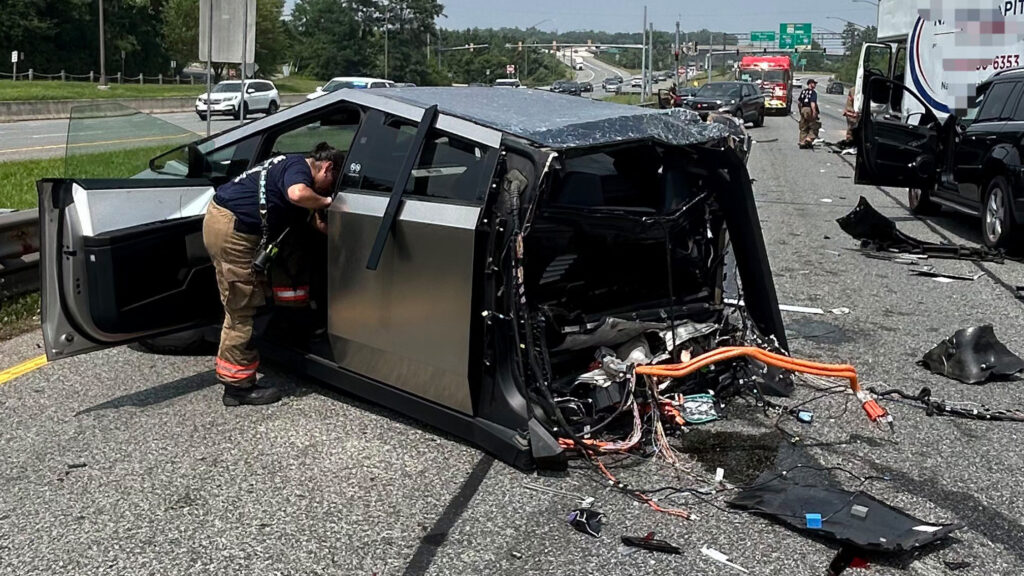
Tesla Cybertruck was torn apart, separating the bed from the truck’s cab area.
10 people suffered minor injuries and were hospitalised, including three children.
We’ve seen Tesla Cybertrucks in all kinds of trouble, from minor fender benders to getting beached or rolling over on trails. One even drove into an empty swimming pool. But a Cybertruck being split cleanly into two pieces after a multi-vehicle crash is probably the most visually extreme Cyber-related accident we’ve come across so far.
The incident unfolded Saturday afternoon in Silver Spring, Maryland, where a moving truck reportedly lost control and plowed into a line of traffic. By the time emergency crews reached the scene, numerous vehicles had been damaged and one Cybertruck had been transformed into something that looked less like a pickup and more like a cutaway auto show display.
According to Montgomery County authorities, the crash involved at least 10 vehicles. Firefighters responding to the scene reportedly had to rescue multiple occupants who were trapped inside damaged cars, WTOP News reports. Images from the aftermath show debris scattered across the roadway and vehicles positioned at all kinds of angles following the impact.
One black SUV can be seen lying on its side behind the Nation Capital Movers truck, and another is directly in front of the same truck, looking like its been T-boned and pushed along the road.
But it’s the Cybertruck that has attracted the most attention. Tesla’s stainless steel pickup has been a divisive vehicle ever since it debuted. People generally seem to either love the futuristic wedge-shaped truck or absolutely hate it. Following this crash, though, it’s no longer merely divisive in a figurative sense. It became divisive in a very literal one, with the cab half of the truck entirely separated from the rear end, and high-voltage cables left to dangle in mid-air.
Police later provided an update on X, saying, “10 people transported to area hospitals with minor injuries. 3 pediatric patients.”
The department added that “the initial report is that a moving truck lost control and collided with at least 10 vehicles.”
Thankfully, the outcome appears far less severe than the wreckage might suggest. Given the extent of the damage visible in photographs from the scene, things could have been much worse.
Investigators are still working to establish exactly what happened before the moving truck lost control. Officials haven’t yet released additional information regarding potential contributing factors, and the investigation remains ongoing.
Progress is possible, and Milwaukee’s decline in violent crime in recent years suggest it’s happening.
Advocates and violence prevention workers say keeping crime trending down depends on investment in the trusted relationships that make violence less likely.
Examples of investments that can create tangible alternatives to violence, they said, are mentorship instead of isolation, employment instead of boredom and community instead of retaliation.
At the center of it all is trust, said Reggie Moore, director of community safety, policy and engagement for the Comprehensive Injury Center at the Medical College of Wisconsin.
“Trust is universal,” Moore said. “Trust is the door opener.”
Mayor Cavalier Johnson discusses crime trends for the first half of 2026 during a press conference on July 7, 2026, at the Milwaukee Police Administration Building, 951 N. James Lovell St. Behind him, from left, are Milwaukee County District Attorney Kent Lovern, Milwaukee County Sheriff Denita Ball, Milwaukee Police Chief Jeffrey Norman and Karin Tyler, director of the Milwaukee Department of Community Wellness and Safety. (Devin Blake / Milwaukee Neighborhood News Service)
City and county leaders highlighted declines in violent crime on July 7 as they presented data for the first half of 2026.
Compared with the first half of 2025, homicides fell 30%, nonfatal shootings fell 27%, and carjackings fell 34%.
“Milwaukee is a safer community,” Milwaukee Mayor Cavalier Johnson said. “This continues a multiyear trend that is very positive news.”
Karin Tyler, director of the city Department of Community Wellness and Safety, said the progress reflects years of collaboration among law enforcement, violence prevention organizations, community groups and residents.
“Milwaukee is making progress, and that progress belongs to all of us,” Tyler said.
Aziz Abdullah, far right, stands next to Common Council President Jose Perez as he speaks to teens during a pop-up anti-violence event on Milwaukee’s South Side on July 8, 2026. (Edgar Mendez / Milwaukee Neighborhood News Service)
Aziz Abdullah, co-founder of INPOWER Solutions, said he doesn’t want to gloss over the progress or take it for granted.
“Lives are being protected, and that should not be overlooked,” Abdullah said.
Moore pointed to reductions in retaliatory shootings, group-based gun violence and youth-related gun violence as signs of progress.
He said programs such as 414LIFE intentionally focus on the people and neighborhoods at highest risk of gun violence.
‘We don’t shoot up stuff’
Vaun Mayes, a community organizer and violence interrupter with the city’s Department of Community Wellness and Safety, said he sees these interventions firsthand every day.
“We also get to see the changes in some of the key players who are even doing a bit of self-control and self-policing,” Mayes said.
He described one instance at a block party where two groups were in conflict and one group was armed.
Mayes said he heard one of the young men say, “Aye, we don’t shoot up stuff where it’s kids at.”
Community violence intervention workers de-escalated the conflict, and the result, Mayes said, was that no one was shot.
“That’s one of maybe over a dozen incidents in the past two months I can give you,” he said.
Looking forward
Teens gather in a parking lot on Milwaukee’s South Side on July 8, 2026, as part of a pop-up anti-violence event. (Edgar Mendez / Milwaukee Neighborhood News Service)
Violence prevention workers and local leaders said the local efforts are by no means complete.
“We still have work to do,” Tyler said.
Milwaukee Police Chief Jeffrey Norman pointed to violence on the Fourth of July weekend as an example.
Moore said what’s needed is more employment and educational opportunities and helping people develop the skills to resolve conflicts without violence.
Bridget Whitaker, executive director of Safe & Sound, said residents continue to express concerns about reckless driving, youth conflicts, neighborhood safety and other quality-of-life issues.
“Ultimately, the goal isn’t simply fewer crimes on a dashboard,” Whitaker said in an email. “It’s creating neighborhoods where people feel comfortable sitting on their front porch, children can safely walk to the park, businesses can thrive and neighbors know and look out for one another.”
Nicole Wheeldon, North American general manager of buses for Cummins, and Matt McGinn, senior director of e-mobility sales for Accelera by Cummins, examine exciting product innovations and meeting customer needs amid school bus energy options, rising costs and tightened budgets.
Enterprise Account Manager Chase Cloyd shares how Netradyne’s AI-driven cameras and technology take a proactive approach to school bus driver coaching, safety around the bus and incident review.
Co-founder Michael Tinter reviews how the universal, easily installed Magnetic Mic radio mounts, which got their start in law enforcement applications, can help reduce school bus driver distractions and equipment damage while increasing student safety.
Multiple industry studies reveal that driver shortages and student behavior are top concerns for student transporters. Sam Freshner, dean of transportation for North Clackamas School District in Oregon, explains how a unique pilot program supports effective student discipline and enhances school bus driver retention.
Barbed wire and fences surround the Charles H. Hickey Jr. School, a juvenile detention center in Maryland. The state’s recent changes to its juvenile justice laws aim to reduce the number of young people entering the adult criminal justice system while expanding rehabilitative services. (Photo by Amanda Watford/Stateline)
A teenager charged with the same crime can face dramatically different consequences depending on where they live.
In one state, a young person accused of a serious offense may be sent to a juvenile facility focused on treatment and rehabilitation. In another, they could face adult criminal proceedings, a permanent record and the possibility of an adult prison sentence.
This year, more than half a dozen states, including Colorado, Hawaii, Kansas, Maryland, Mississippi, Missouri and Utah, have passed new laws reshaping their juvenile legal systems. While some have adopted measures designed to divert more young people from incarceration, others have sought to impose stiffer penalties and expand prosecutors’ authority to pursue adult charges.
The opposite tacks underscore an increasingly fractured approach to juvenile justice nationwide.
The new laws also come as states grapple with how to respond to serious crimes committed by children while weighing decades of research suggesting adolescents are more capable of rehabilitation than adults.
Videos of youth-involved assaults, carjackings and large gatherings sometimes called “teen takeovers” frequently spread online, fueling renewed debate over whether tougher punishments or expanded diversion programs are the better path to improving public safety.
In Hawaii, for example, a new law signed in June by Democratic Gov. Josh Green requires judges to consider a child’s history of trauma before deciding whether to transfer a juvenile case to adult court. The law, which took effect immediately upon Green’s signature, also prohibits minors who are victims of sex trafficking or sexual assault from being prosecuted as adults for crimes committed as a result of their exploitation.
Research suggests that incarcerating children and teens in adult prisons, where they may face lengthy sentences and restrictive conditions, can increase the risk of reoffending.
“It wasn’t a question of whether kids had been traumatized, but actually how many traumas they’d experienced,” said Sara Thomas, a research assistant professor of psychiatry and behavioral sciences at Northwestern University, referring to research that found young people held at the Cook County Juvenile Temporary Detention Center in Chicago had experienced a median of six traumatic events.
Colorado Democratic Gov. Jared Polis signed into law in March a measure that, when it takes effect in August, will overhaul parts of the state’s youthful offender system by requiring trauma-informed care, individualized treatment plans, therapy and reentry-focused programming.
A new law in Minnesota, which also takes effect in August, will raise the minimum age at which a child can enter the juvenile justice system for an offense from 10 to 13. The change stems from legislation passed in 2024.
Once it takes effect, Minnesota will become one of only three states with a minimum age of delinquency set at 13, joining Maryland and New Hampshire, according to the National Youth Justice Network, an advocacy and research organization.
Other states are moving in the opposite direction, giving prosecutors and courts more authority to pursue adult penalties in serious cases and arguing that violent offenses require stronger consequences, regardless of a defendant’s age.
In Missouri, a new law will give prosecutors more authority to seek adult charges against young people. Previously, only a juvenile officer or court could request a hearing to transfer a case to adult court. The law also narrows the offenses eligible for adult prosecution to Class A and Class B felonies, such as homicide, first-degree burglary and certain sex offenses, while requiring juvenile records and fingerprints to be added to the state’s criminal history database.
“Missouri must address the revolving door for repeat violent offenders –– and that includes juveniles,” Republican Gov. Mike Kehoe said in a news release.
Mississippi also expanded the circumstances under which young people can face adult charges. A new law effective this month requires 13-year-olds to automatically be tried in adult court for most violent crimes committed while possessing a firearm, even if the firearm was not used. The law prohibits children younger than 13 from being held responsible in adult court for misdemeanors or felonies, though parents or guardians may face civil liability.
A changing landscape
Beginning in the 1990s, amid concerns over violent youth crime, many states expanded laws that allowed more juveniles to be prosecuted as adults.
But as juvenile crime declined over the following decades and research on adolescent brain development grew, many states began reconsidering those policies. Research suggests that the parts of the brain involved in impulse control, decision making and evaluating long-term consequences continue developing into early adulthood.
Maryland Gov. Wes Moore signed the Youth Charging Reform Act into law in May 2026, altering how the state handles juvenile jurisdiction, detention, and confinement. The law, which goes into effect in October, limits when children younger than 13 can be charged with crimes and establishes new reporting metrics to track youth outcomes.
The new law preserves automatic adult court jurisdiction for teens 16 and older accused of offenses punishable by life imprisonment, including homicide and rape. Judges will retain the authority to transfer 14- and 15-year-olds accused of those same life-punishable offenses to adult court under the state’s existing transfer procedures.
The law also tightens detention rules, requiring intake officers to authorize the detention of any child 16 or older accused of a handgun violation or violent crime. By October 2029, children will be barred from being held in adult correctional facilities.
Supporters said the changes recognize that young children who engage in delinquent behavior often have unmet mental health, educational or family needs that are better addressed through services than incarceration.
“This progress brings us closer to ensuring that hundreds of young people in Maryland are met with support and services in the juvenile system, rather than being routed into a process that leads to worse outcomes for both youth and public safety,” state Democratic Sen. Will Smith Jr., the bill’s primary sponsor, said in a news release.
The Maryland State’s Attorneys’ Association views the new law as a step backward, arguing that the state Department of Juvenile Services is not equipped to handle young people accused of violent and repeat offenses.
Baltimore City State’s Attorney Ivan Bates, the association’s president, also criticized the state’s juvenile legal system in a post on X (formerly Twitter), calling it “broken,” just weeks after a multi-jurisdictional crime ring investigation that led to charges against five teens. “We cannot continue sending children back into a broken system and expect them to be rehabilitated while also expecting our communities to remain safe,” Bates wrote.
Supporters of changes like Maryland’s new law argue that adult convictions can create long-term barriers to employment, housing and education, making it harder for young people to successfully transition into adulthood. Juvenile records are generally confidential.
“Transfer of youth to adult court is bad public policy,” said Mary Ann Scali, the executive director of The Gault Center, a national organization that trains and supports defense attorneys who represent young people in court. “It causes more harm and does not lead to better outcomes for young people or communities.”
Sarah Johnson, senior youth defense counsel with The Gault Center, said research does not support the argument that moving children into adult court improves public safety.
“Transfer does not increase public safety. Transfer increases recidivism. Transfer traumatizes young people because they’re now placed in an adult facility,” Johnson said, noting that children may face heightened risks of physical and sexual abuse from other incarcerated people and staff.
A 2007 review by the Community Preventive Services Task Force, a panel established by the U.S. Department of Health and Human Services to assess the effectiveness of community-based prevention programs and policies, found that transferring young people to adult court did not reduce reoffending and was associated with higher rates of recidivism.
From the peak in youth arrests in 1996 to 2024, the latest year with available data, youth arrests have declined by about 83%, according to federal data. While the number of estimated youth arrests increased between 2021 and 2023 during the COVID-19 pandemic, they fell again in 2024, which is lower than pre-pandemic levels.
In 2024, children and teens accounted for 6.8% of all arrests, according to the latest crime statistics maintained by the FBI. They made up about 10% of arrests for violent crimes and 9.5% of arrests for property crimes.
Quotation
I’m looking for any way possible to try and solve this issue of unruly juveniles.
– North Charleston, S.C., Police Chief Ron Camacho
Despite the long-term decline in youth arrests, states continue to debate how to handle the small percentage of young people involved in serious offenses — and what approaches are most effective at preventing future crime.
In Utah, lawmakers approved a measure allowing judges to send someone convicted of aggravated murder to adult prison if the person was 17 at the time of the offense and turns 18 before sentencing. The law also expands the state’s collection of recidivism data, including information on arrests and jail time.
Kansas, meanwhile, moved in the opposite direction this year, rolling back parts of a 2016 legislative package designed to reduce youth confinement. A new law, which was adopted in April, creates additional residential placements, expands detention requirements for some youth accused of firearm offenses and repeat offenses, and increases possible sentences for youth who use firearms during crimes.
Accountability and public safety
While some experts emphasize rehabilitation and keeping young people out of the adult system, others argue that accountability and public safety must remain central goals — particularly when young people commit serious violent offenses. They argue that rehabilitation should not come at the expense of accountability and that the justice system must address the harm caused to victims and communities.
In 2024, Louisiana and North Carolina both passed laws expanding the circumstances under which older teens can face adult criminal proceedings.
In Louisiana, a law pushed by Republican Gov. Jeff Landry rolled back the 2017 “Raise the Age” law that had moved most 17-year-olds into the juvenile justice system while allowing prosecutors to seek adult charges in individual cases. The new law requires all 17-year-olds accused of crimes to be processed through the adult criminal justice system, removing that case-by-case discretion.
As the state has embraced a more punitive approach, it has also seen the cost of its juvenile legal system rise — as well as the number of young people behind bars.
Louisiana also is expanding its youth prison capacity, with plans to open a new 56-bed juvenile facility in Vernon Parish and add 36 beds at the Jetson Center for Youth in East Baton Rouge Parish.
Some youth advocates say the expansion risks exposing more young people to the harms associated with incarceration.
“When you build a jail, you find a way to fill them,” said Alaina Bloodworth, the executive director of the Black Public Defender Association. Bloodworth previously served as a public defender in Baton Rouge for seven years. “We’re just really going backwards.”
In North Carolina, a 2024 law requires 16- and 17-year-olds charged with Class A through E felonies to begin their cases in adult criminal court rather than juvenile court, reversing a previous effort to raise the age of juvenile court jurisdiction. The change has contributed to a sharp increase in the share of youth in detention who are facing adult charges, rising from 39% in 2024 to 65% in 2025, according to the state’s annual report on juvenile justice.
The debate over how to balance accountability and rehabilitation has also been shaped by high-profile incidents involving young people that receive widespread attention online. Viral videos of youth assaults, carjackings and large gatherings have fueled public pressure for tougher approaches to youth crime.
In South Carolina, a Fourth of July city-permitted neighborhood block party in North Charleston drew national attention after videos of the incident spread online. Police said the gathering turned violent, with reports of fights, gunfire and fireworks being fired at vehicles. Officers recovered four firearms, including two automatic weapons, as well as a “makeshift spear,” according to local police.
Two female police officers were injured while attempting to break up fights, and seven people, including four teenagers, were arrested, according to local police.
“We need some help from the community because stuff like this is getting dangerous,” North Charleston police Chief Ron Camacho said during a news conference.
“I’m looking for any way possible to try and solve this issue of unruly juveniles.”
This story was originally produced by Stateline, which is part of States Newsroom, a nonprofit news network which includes Wisconsin Examiner, and is supported by grants and a coalition of donors as a 501c(3) public charity.
The NHTSA says it doesn’t make sense for robotaxis to have manual controls.
Tesla originally only ever intended to build the Cybercab without normal controls.
Recent Cybercab prototypes have been spied testing with a wheel and pedals.
If the current administrator of the National Highway Traffic Safety Administration gets his way, driverless cars sold in the United States could shed their steering wheels for good. A ruling like that would ripple through the robotaxi business, and Tesla, deep into developing and testing its Robocab, stands to gain more than almost anyone else.
Speaking with CNBC, NHTSA administrator Jonathan Morrison said that, “If you’re developing a vehicle that is designed never to be driven by a human operator, it doesn’t make any sense to require manual controls.” Evidently, he was referring to companies that have deployed or are developing fully autonomous robotaxis, including Waymo and Tesla.
The agency moved last month to rework existing federal safety standards, and part of that effort would strip away the rule forcing autonomous vehicles to carry manual brake pedals.
Tesla To Benefit
If these changes are implemented, Tesla will reap the rewards. Its Cybercab, unveiled in late 2024, was originally conceived without a steering wheel or pedals, aiming to be fully autonomous, all the time.
However, last year, Tesla board chair Robyn Denholm acknowledged that, given the regulatory landscape at the time, Tesla would equip the robotaxi with a steering wheel and pedals if necessary. Before long, it had been seen testing multiple Cybercabs with these traditional controls.
Even if the law eventually lets Tesla sell the Cybercab stripped of a wheel and pedals, building it both ways would be the smarter play. Fleet versions could go without, while private buyers might want to drive their own Cybercabs part of the time and then turn them loose as autonomous taxis to earn their keep. One car, two lives, depending on who is behind the glass.
There’s no word on whether Elon Musk, who contributed hundreds of millions of dollars to President Trump’s campaign, has had any sway on the NHTSA rushing to update its regulations.
RENO, Nev. — Longtime school transportation director and certified driver trainer Sandy Dillman was named the 2026 Peter J. Grandolfo Memorial Award of Excellence winner at STN EXPO West.
“It meant a lot to me. Linda and Peter meant a lot to me,” Dillman told School Transportation News after the award ceremony Monday morning. “I only had the pleasure of meeting Peter once, but safety is so important to me with students and the yellow school bus that is this award. I’ve had a rough year, and so, this award came at a perfect time for me. It’s humbling, but also an honor at the same time.”
The award, sponsored by Q’Straint/SureLok, was presented to Dillman during the day’s STN EXPO West opening session by Linda Grandolfo, Peter’s widow. Linda keeps Peter’s legacy alive by telling his story every year, enlightening newcomers and reminding frequent attendees of his impact on school transportation.
Linda Grandolfo described Dillman as a friend who has made amazing strides in the transportation of students with special needs. She is also someone who is very known in the industry for her work toward student safety.
“It was an incredible honor to give my dear friend Sandy Dillman the Peter J. Grandolfo Memorial Award for her many many years of hard work in the industry, her kindness and her dedication,” Linda Grandolfo said.
Dillman logged more than three decades at Apple Valley Unified School District in California, where she started as a substitute school bus driver in 1988. She became a state-certified driver instructor, a transportation manager and in 2001 the district’s director of transportation. Dillman retired in 2019 to move with her husband Greg to Texas so they could spend more time with their children and grandchildren.
Her retirement lasted seven months, when she began working for consultant TransPar Group, and filled the director role at a couple of local school districts. She worked as the full-time director of transportation for Tomball Independent School District until her resignation earlier this year to start her own consultant business.
Among Dillman’s most notable accomplishments was developing a long-term school bus replacement program at Apple Valley in California. After managing what was once reportedly the oldest fleet in California, Dillman replaced the entire fleet over five to six years and established a process for replacing three to five buses annually. She also secured grants for diesel particulate filters, electric school buses and charging infrastructure.
It was at Apple Valley that she also implemented an electronic child reminder system for post-trip inspections before the state mandated the technology.
She was active in the California Association of School Transportation Officials, served in various leadership roles including president, and received the organization’s Arnita Moon Memorial Service Above Self Award. She also advocated for California’s student-crossing procedures and spoke nationally about illegal passing and school bus safety.
In Texas, she continued to serve the industry, both through her district and with the Texas Association for Pupil Transportation as well as the National Association of Pupil Transportation. She continues to help with registration and speaks at the STN EXPO and TSD Conference.
Dillman added she was surprised to hear that the award was based on a nomination.
“The thought that somebody took the time and cared enough to address what I’ve done in this industry, that has been my whole life,” she said. “I started driving a bus in 1987, and still going strong in [the industry in] 2026, which is crazy to me.”
She added that both of her children rode school buses, and now her grandkids do.
“It makes me feel good when my grandsons and my granddaughter come home from field trips and say, ‘I wore a seatbelt on my bus,’ and they’re proud of it,” Dillman continued. “So, it means a lot, and the whole STN family is very important to me, and I’m glad to be a part of it,” she concluded.
This spring, I spoke with a newspaper reporter in Southern California regarding a case of students left on school buses. Those kinds of headlines always grab my attention as such incidents happen all too often nationwide. The most recent number is around 500 a year based on federal estimates, but no true count is recorded from state to state.
But all states have a regulation on not leaving students on school buses. California law requires school bus drivers to deactivate some kind of alarm system that acts as a reminder to perform a full post-trip sweep of the school bus, including looking on and below each seating position to check for sleeping students or those who otherwise did not exit at their respective stops.
The law resulted from a tragic 2015 death of a 16-year-old nonverbal boy with autism, who was left on his Southern California school bus for upwards of eight hours during a heat wave, while his driver hurried off to meet a co-worker for a tryst.
Referred to as The Paul Lee law, it has required various alarms or reminder systems in school buses since 2019. That did not stop two incidents from occurring earlier this year in the Oxnard, California area. Aside from the obvious safety concerns, it came as no surprise that the reporter asked me why the local school bus driver’s union was coming to the defense of the driver and opposing technology that could prevent such incidents. Granted, the recent Oxnard case has its complexities.
I often talk to directors of transportation about their frustration with some collective bargaining negotiations, and the media junkets that unions will embark on to try to influence those talks. The breakdown often comes when technology enters the picture. Video cameras, GPS, data tracking and tablets are well ingrained in society, where we can watch our pizza being made to being delivered, and all steps in between. But when it comes to the nation’s schoolchildren, technology detractors will raise privacy concerns and allege the solutions are being used to spy on school bus drivers. That is part of the story in Oxnard.
While technology stacks do corroborate what school bus drivers are doing—or not—behind the wheel, they also drive efficiencies, safety and accountability. The newspaper reporter I spoke with expressed shock that student tracking exists. I had to explain that many school districts have migrated to what is more accurately described as student ridership verification, to alleviate the call volume from parents asking where their children’s school buses are, and when and where their students board and exit. Student ridership verification is about safety and communication, not checking up on school bus drivers. These systems also work with child reminder systems to ensure students are accounted for at the conclusion of routes.
Camera systems provide another fail-safe, if footage is reviewed and flagged properly. They verify student activity during the route and can detect if children remain on the bus afterward. They also record traffic issues on the road and provide training insights for driver-trainers regarding school bus driver action or inaction. For example, cameras using AI-enhanced software increasingly are detecting drowsy or stressed school bus drivers, as we talk about more in this issue.
More so, I told the reporter, cameras and other technology are serving as proof of service, often exonerating school bus drivers from “he said, she said” accusations. Too often, students, other motorists or parents levy allegations against school bus drivers that are unfounded. While there are bad apples in every bunch, as seen by the focus on driving while under the influence, most school bus drivers are in this position for all the right reasons.
Editor’s Note: As reprinted from the July 2026 issue of School Transportation News.
RENO, Nev. — Branding expert Bruce Turkel ended and started his keynote presentation July 13 the same way. He pulled his harmonica from his pocket and played a tune.
The National Speaker Association Hall of Fame member and former ad agency executive as well as creative expert began his keynote at STN EXPO West by comparing composers Johann Sebastian Bach and blues musician Sonny Boy Williamson. Although their styles, backgrounds and eras were dramatically different, both created music using the same seven notes.
He connected that idea to student transportation, explaining that school districts, contractors and suppliers often use similar buses, technologies, spreadsheets and operational tools. Those tools are necessary, but they are not what make the organizations memorable.
“The people who are successful are not the people who know how to use the tools, but they are people who create value from the tools,” said Turkel, who is also a best-selling author, adding that successful operations know how to communicate their value by understanding what resonates with current as well as prospective customers.
Much like musicians distinguish and express themselves through the way they arrange notes in a key, transportation organizations stand out through the value and emotion they create. Turkel encouraged attendees to move beyond statistics about fleet size, routes and years of service and instead communicate the peace of mind, opportunity and confidence they provide to students, families and communities.
He related a story of a conference organizer asking him how long he and his wife had been married. Instead of providing a numeral value, he answered with the phrase “not long enough.” In that moment, he added value to his marriage and created value for the conference organizer and her husband. Instead of quoting a number or a fact, he verbalized the importance of his relationship with his wife.
“The facts don’t matter,” he said. “Feelings are what matters.”
Using pre-conference survey results from STN EXPO West conference attendees, he grouped individuals into what he called the five tribes: Protectors, problem-solvers, invisible heroes, culture builders and quiet professionals.
Protectors are driven by student safety, trust, compassion and the responsibility they feel toward children and parents. Problem solvers take pride in finding solutions despite limited resources, staffing challenges and other operational constraints. Invisible heroes work behind the scenes to ensure transportation systems function, often without recognition from the public. Culture builders view their organizations, employees and communities as families and emphasize purpose, relationships and belonging. Quiet professionals value reliability, consistency and calm execution, finding satisfaction in making sure the job is done correctly every day.
Turkel explained that these groups may approach their work differently, but all are motivated by the people they serve. Understanding which tribe best reflects an individual or organization can help transportation leaders communicate their purpose more clearly to employees, parents and community stakeholders.
You Had It in You All Along
Like Dorothy in the “Wizard of Oz,” who always had it in her the power to go home to Kansas, Turkel said transportation professionals already know what they do and why it matters. The challenge, he said, isn’t discovering your value. It’s communicating it. He said it’s not about becoming something different but letting one’s authentic purpose shine through in how they present themselves to the world.
At the conclusion of the presentation, Turkel distributed harmonicas to attendees. He taught the audience a simple sequence of notes before revealing that they were playing along with the famous Beatles’ song, “I Should Have Known Better.” The exercise revealed to the attendees that they did not need years of musical training to create something recognizable and meaningful. They simply needed clear direction, confidence and a willingness to participate.
The harmonica served as a metaphor for leadership and branding. Transportation professionals already have the necessary tools, experience and purpose. Their challenge is to arrange those elements in a way that resonates with the people they serve, he said.
Turkel concluded that good organizations make people feel good, while great organizations make people feel good about themselves. Like a memorable song, the strongest transportation brands are not defined only by their technical performance but by the feelings they create and the lives they influence.
RENO, Nev. – As a leader in school bus safety technology, BusPatrol CEO Karoon Monfared showcased the company’s stop arm enforcement program and track record of protecting over 2 million children on 40,000 buses across 27 states.
This is read by an automated voice.
Monfared’s presentation, part of the Bus Technology Summit series at STN EXPO West, blended personal anecdotes – such as a heartfelt birthday wish for his son Liam – with an engaging “10-star experience” experiment involving an audience member and her favorite restaurant, Black and Blue, to illustrate BusPatrol’s ethos of understanding, attention to detail, and caring.
BusPatrol’s community-first approach is shaped by listening to partners like Keba Baldwin, director of transportation at Prince George’s County Public Schools in Maryland and STN’s 2025 Transportation Director of the Year, as well as early collaborators in Pennsylvania, Virginia and New York. The company trains its field service technicians on every school bus make and model, and leverages data to identify illegal passing hotspots for safer route planning. Monfared emphasized the importance of continually asking partners questions about protecting every child and using data-driven insights, ensuring technology is purpose-built for school buses rather than adapted from other industries.
“The technology around us is evolving at unbelievable speed, but it hasn’t been built from the ground up,” he said. “Our video management solutions on the inside of the school bus have been built from the ground up with student transportation in mind.”
The session addressed the daily challenges student transportation teams face, including integrating technology into workflows, urgency in bus yards, and the manual, detective-like process of retrieving video footage. This involves finding buses, removing hard drives, cropping, clipping, and delivering footage, all of which can take hours or days and delay incident response. BusPatrol’s new Beyond Enforcement+ offering launching this fall, offers a modern incident management platform with privacy built into every step, secure sharing with school staff, and a connected, streamlined workflow. Since BusPatrol’s end-to-end technology ownership enables seamless integration with other systems and rapid improvements, it avoids patchwork solutions from multiple companies.
“We’ve reimagined every step of the entire process, from detection to delivery, so you can get your typical video in about three minutes,” Monfared explained. “That means faster decisions, faster communication and a faster safety response.”
He also highlighted the violator-funded enforcement model and the “BusPatrol difference” – a commitment to affordable innovation and purpose-built solutions for the industry’s “precious cargo” of children.
The audience of student transporters, often the first to arrive at work and last to leave, was recognized for their dedication, with millions of parents trusting them daily. Monfared confirmed that BusPatrol takes the privilege of partnership seriously, working “shoulder to shoulder” with student transporters to prevent illegal passing incidents and deliver fast, effective solutions for the next era of student safety.
Written with assistance of AI from a session transcript.
RENO, Nev. — Every decision a transportation leader makes reaches far beyond the issue at hand, explained Keba Baldwin, the transportation director for Prince George’s County Public Schools in Maryland.
Whether changing a bus route, implementing new technology or making a difficult staffing decision, leaders must consider how those choices affect employees, students, families, and district operations.
During his session Sunday at STN EXPO West conference, Baldwin, the reigning STN Transportation Director of the Year, encouraged transportation professionals to move beyond simply solving immediate problems and instead develop leadership habits that strengthen their organizations over the long term. Drawing on his experience leading one of the nation’s largest school transportation operations, Baldwin outlined several leadership traits that he believes can help directors navigate increasingly complex school transportation environments.
“Our goal for today is just to really understand the decisions that shape your daily operations and the long-term success that you’re looking for,” Baldwin told attendees on Sunday. “Leave out of here with a better understanding, a better playbook of how to do that.”
Baldwin oversees transportation for approximately 85,000 students at PGCPS, which serves roughly 130,000 students outside Washington, D.C. His department includes about 1,400 employees, a fleet of 1,200 school buses and approximately 800 support vehicles. He told attendees that working in transportation departments ranging from 60 buses to one of the nation’s largest fleets has reinforced one lesson throughout his career: Operational challenges rarely disappear as organizations grow. Instead, leaders must learn to adapt their decision-making to increasingly complex systems and larger teams.
“The issues are the same,” he said. “It’s basically how do you scale them up.”
Looking Beyond the Immediate Problem
One of Baldwin’s primary messages centered on what he called “system awareness,” or understanding the ripple effect every decision creates throughout a transportation department. A seemingly simple routing adjustment, he explained, can influence staffing levels, communications with families, training needs and overall public confidence in the transportation system.
“Every decision in your transportation department has a ripple effect,” Baldwin said. “A routing change touches staffing. Your staffing shortage becomes a communication problem. A procurement decision reshapes training. Your technology rollout moves a family’s confidence up or down.”
He cautioned that transportation leaders who focus only on solving the immediate issue are more likely to experience burnout and unintended consequences later.
“The director who only sees that first order is going to get burned out very quick. You have to be able to see it all the way through. You’ve got to play the second, third, fourth order,” he said.
Baldwin illustrated the concept using his school district’s summer transportation planning process. Extended School Year transportation depends on multiple departments meeting tight timelines, while route bidding, dry runs and parent communications all must occur within a condensed schedule. Delays in one department can quickly disrupt transportation’s ability to deliver services.
Baldwin said that same deliberate approach should apply to procurement decisions, which often involve transportation, finance and purchasing departments working together. Rather than rushing contracts or major purchases, he encouraged leaders to understand district procurement processes, carefully review contract language, and build relationships with purchasing and budget officials. Doing so, he said, can help departments avoid costly mistakes while positioning them to take advantage of funding opportunities when they arise.
Building Trust on the Front Lines
Beyond managing budgets and contracts, Baldwin said transportation leaders must remain connected to the people who keep their operations running.
He argued that many administrators describe drivers as “the backbone of the operation,” but said genuine appreciation is demonstrated by spending time alongside frontline employees rather than simply acknowledging their contributions.
Baldwin challenged attendees to consider how often they make themselves visible in the field. “How often are you at your bus depot? How often do you ride a bus?” he asked.
He said regularly riding routes and visiting bus depots allows transportation leaders to better understand the daily challenges drivers face while building trust throughout the department.
“How often do you just show up at a bus depot and get on a bus with a random driver and ride their route?” Baldwin said. “Do you know if you do that, how much clout you will gain? … They’ll see you not so much as a person that sits behind a desk, but rather than a person who understands what they go through.”
Baldwin added that leaders should focus on coaching employees rather than viewing every interaction as a disciplinary conversation, emphasizing the importance of treating staff members with respect while helping them improve.
Strategic Leadership and AI
Baldwin also emphasized the importance of establishing clear expectations throughout an organization.
He encouraged transportation departments to develop strategic plans, mission statements and operational goals that remain visible throughout the year rather than becoming documents that are referenced only during evaluations.
“You’ve got to have your mission, your vision and objectives,” Baldwin said. “People need to know what you’re about when they walk through the door.”
He said those expectations should become part of a department’s daily culture, giving employees a shared understanding of the organization’s priorities and creating accountability among coworkers rather than relying solely on supervisors.
For districts looking to improve efficiency, Baldwin encouraged transportation leaders to embrace artificial intelligence instead of avoiding it.
He said AI has become a valuable tool for drafting communications, analyzing transportation data, updating standard operating procedures, and identifying employee retention strategies.
“We’ve learned to embrace it,” Baldwin said. “Don’t shy away from it. Take it and use it to your advantage.”
In his department, AI has significantly reduced the time required to analyze operational data, allowing staff to produce reports for school board members and district leaders much more quickly than before.
Baldwin said the technology has also helped his team draft standard operating procedures, update employee handbooks and identify workforce trends that can guide recruitment and retention efforts. While AI can improve efficiency, he encouraged attendees to verify the information it produces before incorporating it into operational decisions.
As the session concluded, Baldwin encouraged attendees to continue learning from one another and strengthening the relationships they build across the profession, noting that collaboration is one of the industry’s greatest assets.
He reminded transportation professionals that the work they do carries tremendous responsibility and encouraged them to recognize the value of their contributions while supporting one another.
Communications came in #3 on procurement lists created by Transportation Director Summit attendees at STN EXPO West. Business Development Manager David Weber discusses how School Radio supports reliable communication for the professionals transporting precious cargo on school buses.
Joel Stutheit, former transportation director who now serves as senior manager of Autogas business development for the Propane Education & Research Council, shares why propane makes financial and operational sense for school districts, such as Oregon’s Beaverton School District which has seen great success with the fuel.
Matt Reich, who oversees growth and strategic partnerships for school bus stop-arm enforcement system provider Verra Mobility, speaks on the illegal passing epidemic, safety conversions at the Transportation Director Summit, and success in districts like Polk County Public Schools in Florida.
Wa-Nee Community Schools in Indiana just won the Top Transportation Teams award for the third straight time, and Hoover City Schools in Alabama won it for the second straight time. Matt Hostetter, transportation and school safety clerk for Wa-Nee, and Brad Hayn, director of transportation for Hoover City, are joined by John Daniels, vice president of marketing for award sponsor and technology provider Transfinder, to examine their secrets to success.

 Login
Login