Normal view

There are new articles available, click to refresh the page.
Today — 29 March 2026Vehicles

Kia’s $30K EV3 Keeps Creeping Closer To America Without Anyone Saying It’s Coming

  • Kia once targeted a late 2025 U.S. launch, but that window has now fully passed.
  • Built on E-GMP, it offers up to 372 miles of WLTP-rated range on a full charge.
  • Small crossover could become the brand’s most affordable EV in North America.

Kia is one of the fastest-moving brands in the business. Now, a keen-eyed reader believes they’ve spotted something new, a model we’ve already seen overseas showing up much closer to home. The Korean automaker has brought an EV3 prototype across the Atlantic for testing in Mexico.

It’s unclear why Kia would still wrap it in camouflage given that it’s already made its global launch, but the move could point to plans for bringing the sub-compact electric crossover to North America.

Kia EV3 Review: Everything We Love About The EV9 Made More Affordable 

Despite the thick camouflage covering nearly every body panel, it’s easy to match the EV3 that’s already on sale elsewhere, including Europe. The short overhangs, upright stance, and boxy rear section are all visible, along with a high roofline that suggests Kia is prioritizing interior space over sleek styling.

\\\\\\\\\\\\\\\

Photos Silvia García / Carscoops

The test vehicle also appears to ride on aero-optimized wheels similar to those seen on other Hyundai Motor Group EVs, while the front end is completely hidden under padded covers designed to conceal the final lighting signature. The reader who snapped these photos, Silvia Garcia, told us that the same vehicle has been around town for at least a few days.

Read: Kia Unveils Four New GT Models With Speed, Minus The Drama

Testing there is especially interesting, as the country already builds several Kia and Hyundai models for global markets. Running prototypes in Mexico could simply be part of evaluating local road conditions. That said, it also lines up with the idea that Kia may be eyeing Canada for the EV3.

\\\\\\\\\\\\\\\

European specification Kia EV3

Kia initially focused the EV3 on overseas markets, including Europe. When it debuted in 2024, though, the company did confirm plans for a U.S. launch, targeting late 2025 or early 2026 with a starting price in the in the low-to-mid $30,000s. That, as you may have noticed, hasn’t happened, and nobody at Kia has said much since.

A lot has changed in the meantime: the $7,500 federal tax credit is gone, the American EV market has cooled considerably, and tariffs are making the whole equation messier by the day. It would be entirely unsurprising if the EV3 never makes it stateside. The awkward part is that the appetite for affordable electric cars has never been stronger.

\\\\\\\\\\\\

The EV3 is built on Kia’s E-GMP platform and is currently offered with two battery options, a 58.3 kWh Standard Range and a larger 81.4 kWh Long Range pack, both driving a single front-mounted motor producing 201 hp (150 kW). Depending on the battery, WLTP range is rated at up to 372 miles (599 km), while fast charging allows a 10 to 80% top-up in roughly 30 minutes under ideal conditions.

Back in January, Kia also pulled the covers off a hotter EV3 GT, this time with a more serious edge. It uses the larger battery and bumps output to 282 hp (215 kW / 286 PS), enough to cut the 0–62 mph (100 km/h) sprint down to a claimed 5.7 seconds.

\\\\\\\\\\\\

Special thanks to Silvia García for the photos!

Gallery: Hands-on Specialized Training at STN EXPO East

29 March 2026 at 02:47

CONCORD, N.C. — Keynote speaker and best-selling author Jim Knight led the second day of the Transportation Director Summit at Topgolf Charlotte – Southwest, using the visceral backdrop of Rock ‘n Roll and several well-known brands, including Hard Rock International via his 21-year run with that brand as the head of Global Training & Development to discuss key strategies to transform any organization’s culture, regardless of the company’s cultural history or status.

Also offsite at Charlotte–Mecklenburg Schools, the National School Bus Inspection Training Program continued with hands-on identification of defects in the engine compartment, throughout the chassis, and inside the driver and passenger compartments, with participants able to compete for time and accuracy.

Transfinder led a special training on improving technician workflow and shop organization while Denise Donaldson taught on child safety restraint system use in school buses versus alternative transportation vehicles and Dave McDonald’s training covered proper mirror adjustment and distracted driving.

The post Gallery: Hands-on Specialized Training at STN EXPO East appeared first on School Transportation News.

Multi-Modal Transportation Gains Momentum as Districts Seek Flexible, Cost-Effective Solutions

29 March 2026 at 02:45

CONCORD, N.C. — As school districts nationwide confront tightening budgets, driver shortages and changing student needs, multi-modal transportation options are emerging as viable strategies to expand service while controlling costs.

During the first day of STN EXPO East Friday, transportation directors and an industry expert discussed how blending traditional yellow bus service with alternative modes — including public transit, walking programs and contracted services — can help districts adapt to a rapidly changing landscape.

The concept is increasingly being implemented in practice. “Multimodal is really about expanding that definition of who ‘we’ are,” said Tim Ammon, owner of Ammon Consulting Group, and the session moderator. “We might not be able to do everything ourselves anymore, so we need to think about how to integrate different providers into the system.”

Ammon, who also spoke earlier Friday on school transportation funding, said the growing interest in multi-modal transportation is closely tied to mounting fiscal pressures facing school districts, as flat federal funding, uncertain state and local revenues and rising operational costs force leaders to rethink how services are delivered. He noted that with costs outpacing available funding, districts must find ways to reduce expenses without significantly cutting service, making alternative transportation models an increasingly practical solution to maintain access for students while improving efficiency.


Related: Funding Uncertainty, Rising Costs Intensify Pressure on School Transportation Operations


Expanding Beyond the Yellow Bus

For decades, the yellow school bus has been the backbone of student transportation. While it remains the safest form of student transportation for its vehicle construction and driver training, transportation directors are now rethinking that model as financial pressures mount and operational complexity increases.

Ammon noted that rising costs and constrained funding are forcing transportation departments to evaluate alternatives that can complement, not replace, traditional service.

“If it costs us $1,000 a kid to transport and we can find somebody who can do it for $800, that’s a 20 percent reduction in cost,” he said. “We’ve got to start thinking about that as an equation if we want to continue serving the maximum number of students.”

Multi-modal systems can include partnerships with transit agencies, use of smaller vehicles for specialized routes, and coordination with private transportation providers. It can include working closely with Safe Routes to School programs that focus on walking and biking. The goal is to match the right mode to the right student’s needs.

Keba Baldwin, director of transportation for Prince George’s County Public Schools in Maryland.

Keba Baldwin, director of transportation for Prince George’s County Public Schools in Maryland, said the decision to explore alternative modes often begins when demand outpaces available resources.

“The demand for services is greater than my supply,” said Baldwin, the 2026 STN Transportation Director of the Year.

He continued that PGCPS faced a shortage of more than 200 drivers while managing over 1,000 routes.

Baldwin said factors such as increasing McKinney-Vento transportation needs for students experiencing homelessness, specialized programs and longer-distance routes require districts to expand beyond traditional service models.

“When you start thinking about when to discuss the multimodal mix, that’s when,” Baldwin said. “We want to be able to provide options … and not close ourselves in to just one path.”

Bernando Brown, executive director of transportation for DeKalb County School District in Georgia. (Photo by Vincent Rios Creative.)

Bernando Brown, executive director of transportation for DeKalb County School District in Georgia, echoed similar challenges. He emphasized the importance of acting before systems begin to fail.

“You don’t want to wait till the system breaks,” he said. “You basically act when you see the pressure building.”

Brown noted that his district has struggled to maintain driver staffing levels since the COVID-19 pandemic, forcing leaders to rethink how services are delivered. “We’re constantly hiring, but through attrition … we’re losing as well,” he said.

Communication and Stakeholder Buy-In Critical

Panelists emphasized that implementing multi-modal transportation requires more than operational changes and instead requires clear communication and stakeholder alignment.

Brown said districts must proactively address concerns from parents, staff and community members, particularly around safety and job security.

“Silence creates confusion. Communication builds trust,” he said, stressing the importance of transparency throughout the process.

He added that explaining the “why” behind changes is essential to gaining support.

“Most people may not always agree … but when people know the why, it’s easy for them to understand,” Brown said.

Baldwin noted that engaging stakeholders early, including unions, school boards and parent groups, helps control the narrative and prevent misinformation.

“We wanted to lead the narrative,” he said. “Anything related to our services … we’ve got to get ahead of that.”

As districts integrate multiple transportation modes, Brown and Baldwin said establishing clear systems for oversight and accountability is critical.


Related: ‘Care Less Without Being Careless’ Urges Security Expert to Student Transporters
Related: Gallery: Special Training, Focused Sessions at STN EXPO East


Brown noted that his district assigned a dedicated manager to oversee contracted services, ensuring consistency and clear communication. He also stressed the importance of detailed contracts and defined expectations when working with third-party providers.

“If it’s not written, it will not happen,” Brown said, emphasizing the need for clear safety and performance standards.

Baldwin added that districts must continuously evaluate and refine their approach, particularly when working with diverse providers and student populations.

Integrating Services, Not Replacing Them

Both panelists emphasized that multi-modal transportation is not intended to replace the yellow school bus but to supplement it.

“We don’t try to compete against one,” Baldwin said. “We just figure out what’s going to be the best usage for that student in terms of service delivery.”

Brown agreed, noting that districts must view alternative providers as part of the broader transportation team.

As districts continue to navigate staffing shortages, funding constraints and evolving student needs, transportation leaders said flexibility and strategic planning will be essential. Ultimately, the panelists agreed that multi-modal transportation represents a shift in mindset.

Written with assistance of AI.

The post Multi-Modal Transportation Gains Momentum as Districts Seek Flexible, Cost-Effective Solutions appeared first on School Transportation News.

Transportation Directors Receive Rock Star Training on Driver Retention

28 March 2026 at 22:21

CHARLOTTE, N.C. – “For district nirvana, crush both student and driver experiences,” advised Jim Knight, who spent over two decades as head of global training and development for Hard Rock International’s hotels, casinos, dining and entertainment. “From a leadership standpoint, you can always ramp it up.”

“What I want to be for you is a catalyst,” the best-selling Culture That Rocks author told the transportation directors and supplier partners gathered at Topgolf Charlotte Southwest Saturday morning for leadership advice. “I know a lot about getting the right people around you and then loving on them, so they won’t want to leave.”

Leaders in attendance for the Transportation Director Summit at STN EXPO East said their priorities included driver retention, on-time performance, low absenteeism and reduced accidents. They also identified integrity, empathy, vision and communication as the most important leadership qualities. This lines up with top qualities acknowledged by popular motivational trainers, Knight confirmed, with the overall goal of building trust.

Drawing from the idea of a curated concert setlist, Knight led attendees through an exercise to pare down their most time-consuming work activities and prioritize the essentials with the greatest immediate impact.

Recruitment, Retainment Strategies in a Changing World

Organizational environments are either virtuous or vicious depending on who leaders hire, Knight explained during his fast-paced “edu-tainment” training.

He expounded that the vicious cycle sees morale and work culture tainted by negative school bus drivers, which in turn disturbs student experiences and may lower ridership. Targets missed and staff leaving mean mounting pressure and poor decisions, such as supervisors having to drive routes or lowering standards to put any warm body behind the wheel. In contrast, a positive driver and student experience leads to rave reviews and organizational growth at what will become known as an attractive place to work. This virtuous environment births more rock star leaders, Knight established.

“Stop recruiting like you’re filling seats – you have to build a band.”

– Jim Knight

While today’s average age of a U.S. school bus driver is 56, Knight underscored that the next generation of Millennial and Generation Z workers values individuality, flexibility and work-life balance. They are tech-savvy and socially conscious. For better or worse, he said, he’s noticed they don’t tolerate bad bosses, readily job hop, are prone to litigiousness and desire enrichment. They are generally visual learners with shorter attention spans, so he prioritizes pictures in training manuals.

He encouraged attendees to embrace generational differences from Baby Boomer to Generation Z workers and to tap into these characteristics when hiring new talent. While colorful hair or facial piercings, for instance, may give managers pause, he noted that student riders appreciate seeing role models who resemble them.

Rather than complaining about a talent drought, Knight advised actively seeking out potential drivers in unconventional places. Attendees suggested searching among fast food restaurants, colleges and trade schools, social media, stay-at-home parents, veterans, retirees, job boards, aides and custodians.

Framing the job through flexibility, purpose, stability, community and student impact helps, as does tailoring the hiring message to the recipient.

“If you want rock stars, you have to think differently,” Knight stated. “Stop recruiting like you’re filling seats. You have to build a band.”

He suggested using eye-catching AI-generated recruitment posters with humorous sayings or rock music puns, with an attendee contributing the promotional slogan, “Yellow air-conditioned office with corner windows!”

Knight stressed the importance of valuing the often-overlooked workers who are the backbone of the school district, sharing the story of how Hard Rock Cafe once utilized premade food to save costs, to the chagrin of its customers. Reversing course, the restaurant chain reintroduced fresh-cooked food accompanied by a marketing campaign featuring a leather-clad, motorcycle-riding “rock star” who turned out to be a chef.

“Who are your rock stars?” he queried. Valued and celebrated student transporters are the show, he said, so make them feel appreciated.

Similar to how volunteers show up for the cause and not for money, Knight encouraged attendees to have such strong workplace culture that student transporters enthusiastically choose to stay.


Related: Transportation Leaders Share How to ‘Love the Bus,’ Why It Matters
Related: (STN Podcast E294) Boots to Buses: Military Formed Georgia Student Transportation Leader
Related: Leading with Purpose: Insights from STN EXPO West’s Transportation Supervisor Seminar
Related: (STN Podcast E280) Nuts and Bolts: Transportation Director of the Year Talks Data-Focused Oregon Ops
Related: Communication ‘Magic Words,’ Teamwork Tips Shared at Transportation Director Summit


Being A Good Boss

Team meetings, regular employee check-ins and open communication channels are a must, Knight emphasized. “If you want people to stay with you long term, you need growth and development,” he added.

White it may be tempting for a boss to zip straight to their office first thing in the morning, it’s more important for the team dynamic to take time for small talk and make employees feel loved, he said.

He reviewed a Gallup survey of over two million employees at 700 companies worldwide which found that a supervisor is the single most important influence in an employee’s decision to quit.

Additionally, Knight shared statistics from Heart-Centered Leadership by Susan Steinbrecher and Joel Bennett, Ph.D. showing that almost half of employees leave a company because they feel underappreciated. Almost 90 percent said they don’t receive acknowledgment for their work.

“People join companies. They leave individuals,” he noted.

He encouraged the leaders in the room to intentionally and authentically fill their employees’ “emotional bank accounts” to encourage them to stay. An attendee added that this is also an important concept when at home among families.

Just as every great musical group has a signature sound, every leader has a signature strength to offer their team, which Knight encouraged them to crank “up to 11” ala the music mockumentary This Is Spinal Tap. And like superfans don’t just love the music but also desire the connection of a backstage pass to meet the artists personally, Knight stated that leaders should ask intentional questions and get to know their workers on a deeper level.

“I can teach someone with a good heart to drive a bus, but I can’t teach someone to have a good heart.”

– Gerald Henry
Director of Transportation
Lexington 1 School District (S.C.)

He also advised leaving job positions open longer to hire the right person.

“I can teach someone with a good heart to drive a bus, but I can’t teach someone to have a good heart,” agreed Gerald Henry, director of transportation for Lexington 1 School District in South Carolina.

Quoting Bob Dylan’s quote “there is nothing so stable as change,” Knight encouraged attendees to refocus their thoughts and resources to only their “circle of influence” to maximize happiness and effectiveness.

He also advocated for supportive mentorship opportunities, such as the inaugural School Transportation News Peer-to-Peer Mentorship Program, which grouped STN EXPO East attendees based on years in the industry, district size, fleet makeup and areas of interest.

Knight provided famous music industry stories to demonstrate that success can be achieved through perseverance and resilience. He cited the examples of Phil Collins taking over the Genesis lead singer duties from Peter Gabriel, a street performer who went on to become Lady Gaga, or a drummer losing an arm and reinventing his playing style like Def Leppard’s Rick Allen.

While every concert has a slow song where the lighters (or the cellphone flashlights) come out, Knight noted that moment is not when the show ends. Instead, the energy always ramps back up with a faster paced song.

“Each of you has the power to light up or extinguish the cultural flame of the district, via your leadership,” he concluded. “Light it up!”

1 of 33
Speaker and author Jim Knight, left, smiles with STN Publisher & President Tony Corpin, right.

Jim Knight will present the keynote “Culture That Rocks: Set List on How to Amp Up the Company’s Culture (to Eleven) and Deliver Sustainable Results” on Monday, March 30, 2026, from 10:15 a.m. – 11:45 a.m.

Photos by Vince Rios Creative.

The post Transportation Directors Receive Rock Star Training on Driver Retention appeared first on School Transportation News.

Yesterday — 28 March 2026Vehicles

‘Care Less Without Being Careless’ Urges Security Expert to Student Transporters

By: Ryan Gray
28 March 2026 at 03:42

CONCORD, N.C. — Stress may be higher than ever for school transportation professionals, but it does not have to dictate performance or personal well-being. That was the central theme during an STN EXPO East conference opening general session, with a keynote that urged attendees to “care less without being careless” in both their professional and personal lives.

Bret E. Brooks, the chief operating officer and senior consultant with Gray Ram Tactical LLC, has worked in pupil transportation security training since 2007, drawing upon a 23-year career in law enforcement as well as 26 years and counting in the U.S. Army National Guard. His forthcoming book, “How to Care Less About Being Careless,” explores the new pressures many people deal with in addition to already demanding jobs.

Technology, 24/7 connectivity, staffing shortages, safety expectations and family responsibilities all collide, he said Friday at the Embassy Suites Charlotte-Concord.

“We are experiencing more stress today than at any point in the past,” he added. “But it is possible to care the right amount.”

Brooks distinguished sharply between being careless and caring less. The latter, he explained, means not giving sufficient attention to critical tasks such as planning for traffic or driving safely, which can result in missed flights, preventable crashes or lax safety practices. Caring less, by contrast, is a deliberate effort to let go of excessive anxiety and over-attachment to minor outcomes so that leaders can think clearly, remain open-minded and solve problems creatively.

He termed this phenomenon the “law of reverse effect,” in which trying too hard produces negative results. He pointed to student-athletes, like his own daughter, who false-started in her first race the day before because she was too obsessively focused on not false-starting. Similarly, motorists who constantly change lanes in heavy traffic find they only continue to fall behind by over-correcting.

A turning point in his own understanding of stress came during a deployment to the U.S. southern border with the National Guard. Brooks was unexpectedly placed in charge of the Joint Visitors Bureau, responsible for planning every VIP visit along 2,000 miles of border, including trips by vice presidents, generals, governors and members of Congress. He described working 20-hour days, seven days a week for six weeks, losing weight, sleeping little and watching his internal “carometer” ping into the red.

Eventually, his commander pulled him aside and told him to care less, but don’t be careless. Brooks said that simple phrase forced him to reconsider whether a mayor waiting 10 minutes for a vehicle or a general missing a helicopter tour was worth sacrificing his health and effectiveness. That mindset later shaped his training work with school districts and conference audiences nationwide.

Throughout Friday morning’s session, Brooks reminded attendees that many of their current stressors did not exist 25 years ago. Streaming subscriptions, smart devices and constant Internet access now occupy mental space that once did not exist, he noted, yet much of that stress is optional and can be reduced. To make the point concrete, he asked attendees to privately write down their top three stressors and, later, their top three life priorities. He then challenged them to compare the two lists.

When stressors and priorities do not match, he said, leaders may be pouring energy into issues that do not support their long-term goals, either at work or at home.

Brooks encouraged participants to look at their lives from a “30,000-foot view,” like the perspective from an airplane window, and to distinguish between “meat” and “gristle” on their plate, citing the famous “Old 96er” scene in the 1988 John Candy movie “The Great Outdoors,” where the late actor John Candy’s character thinks he has finished a 96-ounce steak at a restaurant only to find out he also needs to finish the gristle.

The meat on our collective plates, Brooks said, represents truly essential tasks and responsibilities. The gristle is made up of duties and expectations that can be delegated, rescheduled or removed entirely.

He shared a story about insisting his son clear his plate during a celebratory family dinner to illustrate how easy it is to lose sight of the bigger picture. The point of the outing, he acknowledged in hindsight, was not caloric intake but celebrating his son’s achievement. But focusing on the uneaten food, he left the restaurant with a sick stomach and an unhappy family.

Citing leadership and time-management thinkers Stephen R. Covey and Simon Sinek, Brooks urged transportation professionals to clarify their “why” for being in pupil transportation, to explicitly name their top priorities, and then to schedule those priorities before filling the calendar with routine tasks. He echoed Covey’s guidance that what people do reveals their real priorities more than what they say, stating, “Action expresses priorities.” A leader may claim that spending time with family or focusing on recruitment and retention is a top priority, he observed, but if those items never appear on the daily agenda, they are not true priorities in practice.

Brooks recommended that attendees adopt the “WIN” framework by asking, “What’s important now?” whenever priorities collide. He acknowledged the tension between professional obligations and family events by recounting his own decision to miss his daughter’s regular season track meet to open STN EXPO East. The conference, he said, takes place on a single day and offers a unique opportunity to share information with peers nationwide, while his daughter will have multiple meets later in the season. In other circumstances, such as a state championship or once-in-a-lifetime family event, the equation would change and tip heavily toward making his home life the priority. The WIN question, he said, helps leaders sequence their commitments without abandoning their deeply held values.

The keynote further explored Covey’s urgent-important matrix. Brooks warned against living in the “urgent and important” quadrant, where every day feels like a wrong-way driver bearing down on a school bus. Constant crisis mode, he said, will inevitably push the carometer into dangerous territory.

Instead, he urged participants to move as much of their work as possible into the “important but not urgent” quadrant. In practical terms for school transportation, that means planning back-to-school, in-service training months ahead, forecasting routing, staffing and fleet needs well before school starts, and addressing long-term safety and recruitment strategies before they become emergencies. By contrast, he described much of what appears on television or in sensational news coverage as either “not important and urgent” or “not important and not urgent,” both of which can waste time and attention.

Brooks also addressed conflict management, encouraging a “win-win” mindset with parents, staff, administrators and outside partners. Using simple examples such as a customer buying a Big Mac at McDonald’s, he demonstrated how both sides can walk away with value when solutions are constructed thoughtfully.

He cautioned against turning disagreements into “mutually assured destruction,” where both parties end up worse off, and noted that adversarial approaches in marital or workplace arguments often land in a lose-lose outcome rather than the win-lose or lose-win people imagine.


Related: Arizona Mom Trades Stressful Job for Career as School Bus Driver
Related: Healthy Reaction to Stress Requires Mindfulness, Expert Tells NASDPTS Webinar
Related: STN EXPO East to Feature Timely Discussion on Managing Stress


Regarding work-life balance, Brooks rejected the idea that people should strive for equal hours on each side of a scale. Instead, he said, the real challenge for school transportation professionals is to weigh events appropriately. A routine workday is roughly equivalent to a routine family day. A major training event or the first day of school, with new routes and new drivers, may outweigh a standard evening at home. On the other hand, a child’s state championship, a wedding, a birth or a funeral should outweigh almost any ordinary work commitment. The goal, he said, is not a perfectly level scale but to ensure it tips in the right direction at the right time and for the right reasons.

Brooks closed by underscoring Covey’s seventh habit of “sharpening the saw.” He shared a story from his family’s farm in Missouri, where he spent a full day cutting trees in an overgrown field without taking breaks. His brother, who arrived later, paused often to hydrate and sharpen his chainsaw, and ultimately felled more trees.

The incident, Brooks said, taught him that grinding nonstop without rest or renewal eventually leads to diminished returns. For transportation leaders, sharpening the saw means attending conferences like STN EXPO East, taking real vacations without working through them, scheduling regular getaways with a spouse or family, and respecting both their own downtime and that of their staff. Calling employees during vacation for non-critical issues, he added, undermines their ability to reset and return ready to perform.

“Life is not an eating contest where you have to finish everything on your plate,” Brooks told the audience. “You can push some things off. You can care less about the right things and still never be careless where it counts, especially when it comes to student safety.”

Article written with the assistance of AI.

The post ‘Care Less Without Being Careless’ Urges Security Expert to Student Transporters appeared first on School Transportation News.

Tennessee Crash Kills 2 Students During Field Trip

28 March 2026 at 02:41

A Clarksville-Montgomery County School System school bus traveling on a field trip crashed, resulting in at least two student fatalities.

STN received initial information about the Tennessee crash Friday, but details were limited at this report. Law enforcement officers are on scene in Carroll County, where the crash took place around noon Eastern Time.

“First and foremost, our hearts are with the families impacted by this devastating loss,” the Tennessee Highway Patrol released in a statement.

Twenty-four students and five adults were on board the school bus at the time. Individuals were transported to the hospital, some via life-flight, while others were taken by ambulance. Two students were pronounced dead at the scene.

The Tennessee Highway Patrol stated via a press conference that in a preliminary crash investigation, the school bus collided with a Tennessee Department of Transportation dump truck and a passenger vehicle.

Lap/shoulder seatbelts are believed not to have been installed on the school bus. Additional information on the nature of the crash remained unknown at this time.

The Clarksville-Montgomery County School System posted on its website that the community is “grieving the tragic loss of two young lives. Please continue to keep these families in your heart,” the statement reads. “We continue to pray for the students and employees injured and everyone who was affected by today’s accident. The Kenwood Middle community will need our continued support, and we will share opportunities to assist families as details are confirmed.”

Officials noted that counselors will be available to support anyone in our school community and across the district who may need someone to talk to in the days ahead and for as long as needed.

“From the bottom of our hearts, we thank the Carroll County Sheriff’s Office, Tennessee Highway Patrol, Montgomery County Sheriff’s Office, Carroll County School District, First Baptist Church of Huntingdon, TN, and the numerous other law enforcement, emergency medical, and community organizations and volunteers from across the state who have provided tremendous support during this tragedy,” the statement continued.

The article was updated to indicate the crash did not take place during Spring Break. It will continue to be updated as more information is available. 


Related: Tennessee School Bus Bursts Into Flames Moments After Children Evacuated
Related: Tennessee Bill Would Lower Minimum Age for School Bus Drivers to 21
Related: Tennessee School Bus Bursts Into Flames Moments After Children Evacuated

The post Tennessee Crash Kills 2 Students During Field Trip appeared first on School Transportation News.

Funding Uncertainty, Rising Costs Intensify Pressure on School Transportation Operations

28 March 2026 at 02:28

CONCORD, N.C. — School transportation leaders across the country are bracing for continued financial strain as flat federal funding, shifting state policies and rising operational costs converge to create what an industry expert described as a “fiscal cliff.”

During the first day of the STN EXPO East conference, Tim Ammon, owner of Ammon Consulting Group and a longtime industry insider, warned that school districts are entering a period where funding uncertainty and reductions are colliding with increasing expenses, which will impact transportation departments.

“Flatline funding associated with increasing cost is, in effect, a cut,” Ammon said, noting that federal education appropriations remaining steady year-over-year fail to keep pace with inflation and rising service demands.

While federal funding accounts for roughly 10 percent to 15 percent of school district budgets, the remainder comes from state and local sources — both of which are facing growing funding uncertainty. Meanwhile, transportation makes up around 10 percent or less of the overall district budget. Declining income tax revenues at the state level and widespread property tax reform efforts are expected to reduce or constrain funding streams that districts rely on.

COVIDE-era Funding Runs Out

At the same time, pandemic-era relief like federal Elementary and Secondary School Emergency Relief (ESSER) funds are expiring, removing a critical financial cushion many districts used for staffing and operations. Ammon emphasized that the combined effect is forcing school systems to reconsider how they deliver services.

“What we will be thinking about … is how do we have to manage services to reflect a set of cost increases that are outstripping the available funding that we’re getting?” he asked.

Transportation departments often operating on tight margins are particularly vulnerable. Rising fuel costs are also adding new volatility, with some districts already reporting budget concerns tied to the War on Iran’s impact on oil prices.

Compounding the issue are demographic trends. Declining student enrollment in many regions is reducing funding tied to the number of students while not necessarily lowering transportation costs. In fact, data Ammon presented showed that in districts with declining enrollment, 83 percent still experienced rising transportation expenses.

“Your job doesn’t get easier because there are fewer kids. It gets harder,” Ammon said, pointing to longer routes, dispersed populations and unchanged service requirements.

Policy changes are also reshaping the funding landscape. The expansion of school choice programs and private school vouchers means funding increasingly follows students out of traditional public school systems. This reduces district revenue while leaving many transportation obligations intact.

Additionally, mandated services such as special education transportation and McKinney-Vento services for homeless students continue to grow, further straining limited budgets.

Ammon described the current environment as a convergence of multiple pressures: Funding reductions, policy shifts and operational changes. Together, these factors are making long-term planning more difficult and increasing the likelihood of significant service adjustments.

Districts may soon face tough decisions, including reducing routes, consolidating stops, adjusting bell times or even eliminating buses. In more severe cases, school closures and major system redesigns could follow.


Related: Action Plan Puts National Spotlight on Hidden Toll of Illegal Passing
Related: Bus Stop Fight Claims Life of 12-year-old Georgia Girl
Related: Industry Veteran to Address Student Transportation Funding Uncertainty at STN EXPO East


“I hate to be the bearer of bad tidings, but it’s coming,” Ammon said. “Somebody [will be] coming down the hall and saying … ‘I need you to cut 10 buses next year because we’re going to get less funding.’”

Explore Alternative Funding

To prepare, transportation leaders are encouraged to better understand their funding sources, track enrollment trends and collaborate more closely with district planners. He also suggested exploring alternative service models and reevaluating traditional routing strategies to improve efficiency.

Ultimately, the message is clear: School transportation is entering a period of structural change. Those who proactively adapt to evolving financial realities may be better positioned to maintain service levels, while others risk being forced into reactive, and potentially disruptive, decisions.

As Ammon noted, the challenges are not isolated to specific regions or district sizes but represent a broader, systemic issue facing public education nationwide.

Article written with the assistance of AI.

The post Funding Uncertainty, Rising Costs Intensify Pressure on School Transportation Operations appeared first on School Transportation News.

Gallery: Special Training, Focused Sessions at STN EXPO East

28 March 2026 at 02:19

Friday at STN EXPO East began with the National School Bus Inspection Training Program, an intensive, full‑day course designed to train technicians on how to conduct regular vehicle inspections, above and beyond state or federal Department of Transportation guidance.

Security expert Bret Brooks presented two sessions, one on realignment and refocusing of priorities for managing stress and work-life balance, and the other on recognizing early signs of violent behavior. Other session topics Friday included navigating funding cuts and budget issues, and multi-modal transportation.

Transportation directors gathered in the late afternoon for a leadership discussion to kick off the two-day Transportation Director Summit (TD Summit). Led by Tony Corpin, STN president and publisher, the transportation director participants gathered with vendor partners to discuss current challenges and share solutions.

The TD Summit continues Saturday. The event requires prior selection based on completion of a survey and a review of job qualifications and experience.

1 of 41
Funding uncertainty
Tim Ammon of Ammon Consulting group address STN EXPO East discusses funding with attendees on March 27, 2026 Photo by Vincent Rios Creative.
A panel discussion at STN EXPO East March 27, 2026, focused on alternative transportation of students, and how multi-modal options are available. From Left to right: Tim Ammon, owner of Ammon Consulting Group, and the session moderator; Keba Baldwin, director of transportation for Prince George’s County Public Schools in Maryland; and Bernando Brown, executive director of transportation for DeKalb County School District in Georgia.

Photos by Vince Rios Creative and STN staff. 

The post Gallery: Special Training, Focused Sessions at STN EXPO East appeared first on School Transportation News.

Evacuated Family Grateful Georgia School Bus Driver Sees House Fire

27 March 2026 at 14:57

A Georgia school bus driver is being hailed as a hero after stopping her route to alert and safely evacuate a family from a house fire, reported FOX 5 Atlanta.

Marlene Davis, a Morgan County school bus driver, was on her morning route March 20 when she noticed smoke and flames coming from a home, according to the news report.

“I saw the big flame coming from inside the house,” Davis told local news reporters. “I just had to stop the bus and go to the door.”

Davis, who had one student on the school bus at the time, pulled over and rang the doorbell until someone answered, the report said.

A man inside, who had been asleep, answered the door and was unaware that the home was surrounded by flames. Davis helped him and others inside to evacuate safely. Everyone inside the house did not suffer any injuries, and the fire was later contained.

Davis said she later realized how serious the situation was after receiving a message from her supervisor indicating the residents had been asleep.

“It was the only thing that I could have done, and it was the right thing to do,” she said. “And I couldn’t just leave them.”

Later that day, the homeowner where the evacuated family lived flagged Davis down by flashing his vehicle headlights to give her a card and express his gratitude for her actions. Family members and loved ones also expressed gratitude for the driver’s quick thinking, which may have prevented serious injury or worse.

Officials have not released additional details about the cause of the fire. The investigation is ongoing.

Article written with the assistance of AI.


Related: California Farmworkers Hailed as Heroes After Rescuing 20 Children from Burning School Bus
Related: Minnesota School Bus Driver Hailed Hero for Avoiding Head-On Crash With Semi
Related: Colorado School Bus Driver Hailed Hero After Fire
Related: Florida School Bus Driver Hailed Hero for Protecting Hit-and-Run Victim

The post Evacuated Family Grateful Georgia School Bus Driver Sees House Fire appeared first on School Transportation News.

Three Million Teslas A Year By 2030 Is The Bet. Twenty-Three Firms Made It.

  • Analysts expect Tesla deliveries to more than double by 2030.
  • Q1 2026 delivery expectations sit around 420,000 vehicles.
  • Tesla’s early release hints at softer near-term expectations.

Analysts believe that Tesla is on track to double its global deliveries by the end of the decade. That’s a huge bet, and it relies on more factories, cheaper models, and a broader global footprint that can push annual volume into the millions. That said, there’s a bit of a disconnect. If that’s indeed what the future looks like, the same analysts’ Q1 2026 predictions aren’t exactly screaming momentum.

The automaker just compiled estimated reports from 23 big-time analyst firms, including UBS, Barclays, Wells Fargo, and more. Wall Street expects Tesla to deliver roughly 420,000 vehicles in Q1 2026. For a company evidently on the verge of explosive growth, that figure leaves some room for head-scratching because it’s nearly flat compared to 2025 levels.

More: This Might Be The Tesla Roadster’s Biggest Update Since 2017

That said, the professionals betting on the future clearly see a path ahead. Their consensus is that Tesla will deliver 1,689,691 cars this year. That’s actually just above the 1,636,129 figure it managed in 2025, with a a modest 3.3% increase year over year.

Starting in 2027, their estimates just go up, up, and away, though. Notably, 2027 is the latest year in which all 23 firms provided an estimate, in this case, of 1,880,496 deliveries.

Twenty of the firms predicted (on average) that Tesla will deliver 2,128,187 cars in 2028. Just 13 firms went as far as to provide a consensus for 2029 and 2030. Those figures hit 2,613,623 deliveries for 2029 and then 3,032,000 the following year.

Q4-2025Q1-202620262027202820292030
Model 3/Y deliveries406,585351,1791,623,6971,742,4981,867,2542,159,8742,426,452
All other models11,64213,94660,685131,509240,229423,599570,590
        
Total deliveries418,227365,6451,689,6911,880,4962,128,1872,613,6233,032,000
        
Median418,227363,3711,678,9001,866,2731,979,3482,384,6782,626,100
Standard deviation 25,94185,769203,762409,565656,881826,093
Number of estimates provided 232323201313
        
Energy Storage Deployments (GWh)14.214.465.288.1112.5139.1166.1
        
Median14.214.364.687.3114.1138.2169.1
Standard deviation 1.35.210.616.825.031.1
Number of estimates provided 181718161010
SWIPE

As is the case now, analysts believe the vast majority of the cars that Tesla does sell will be the Model 3 and Model Y by a factor of around eight to one overall. Notably, that mix diminishes to as low as four to one by 2030 in the consensus.

That’s important because it suggests that Tesla will need to continue to heavily invest in the growth and proliferation of both the Model Y and Model 3. Those two will largely bolster the car side of Tesla’s business if this consensus is correct.

What it doesn’t clarify is what falls under those “other models.” With the Tesla Model S and Tesla Model X out of the picture, the lineup narrows quickly. That leaves the Tesla Cybertruck as the only other vehicle currently in play, alongside plans for the Tesla Cybercab and, if Elon Musk is to be taken at his word, something he has teased as “way cooler than a minivan.

The decision to publish this consensus ahead of its Q1 report is also significant and Tesla has done this in the past. It could be that it’s hoping to anchor expectations if results end up lower than some hoped for.

 Three Million Teslas A Year By 2030 Is The Bet. Twenty-Three Firms Made It.

This $36,000 Used Tesla SUV Still Hits 0-60 in 2.9 Seconds

  • Used Model X offers more performance per dollar than a new Tesla.
  • A 2018 Model X P100D just sold for $36,000 with only 26,000 miles.
  • At that price, 680 hp and a 2.9-second 0-60 is an extraordinary deal.

Tesla has been chasing a $35,000 EV for the U.S. market since roughly 2015, when the Model 3’s unveiling promised to democratize electric motoring. It came close with the $36,990 Model 3 Rear-Wheel Drive launched last year, and the entry-level Model Y RWD at $39,990. But for buyers who want a genuinely affordable Tesla without the feel of a stripped-out special, the used market is where things get interesting.

Read: Tesla Quietly Kills Its Flagship EVs In Europe Just After Updating Them

Once-flagship versions of Tesla’s three-row Model X are now available for around $35,000 or so, and after eight years of depreciation, they represent a rather compelling proposition.

\\\\\\\\\\\\\\\\

Bring a Trailer

A 2018 Model X P100D recently sold for $36,000 on Bring a Trailer. Yes, it’s eight years old, which explains the price, but it has only covered 26,000 miles (41,800 km), which is remarkably low for its age. Barring anything catastrophic, the SUV should deliver tens of thousands of additional trouble-free miles, provided it has been routinely maintained and kept up to date with software updates.

Supercar Performance With SUV Practicality

Before Tesla’s Plaid models were a thing, the P100D-branded models represented the pinnacle of performance. In the Model X, a pair of electric motors produces a combined 680 hp, enough to send it to 60 mph (96 km/h) in just 2.9 seconds. Find an SUV buyer who claims they need something faster than that, and we’ll tell you they’re lying.

Tesla only recently announced it would stop building the Model X, hardly a surprise given how few have been sold in recent years. But when it was first launched, it was incredibly innovative.

\\\\\\\\\\\\\

Bring a Trailer

We’d argue the cabin of this original model is more appealing than newer models, which adopted Tesla’s landscape-oriented touchscreen, rather than a vertical one. There are also loads of carbon fiber throughout and plenty of plush black leather.

Three-row electric SUVs still have relatively limited appeal, but at this price point, with this mileage, and with this level of performance, there’s no denying that something like this offers good value for the money.

Before yesterdayVehicles

Durham School Services Provides Buses to Support Meridian and Garden City Police Department’s Rescue Training

By: STN
26 March 2026 at 22:10

MERIDIAN, Idaho – Durham School Services had the special opportunity to provide two school buses to support the Meridian and Garden City Police Department’s Bus Hostage Rescue training for their Special Tactics Group. The training involved learning about the configuration of school buses and identifying challenges that may occur during vehicle-based and confined-space emergency scenarios. The training also helped the group to fine-tune their training strategies to better ensure the safety of students and staff when emergency situations occur.

For the training, Durham provided two types of buses – a regular, standard sized bus and minibus/van. A Durham trainer was also on-site to offer insight into the operation, structure, and different components of the bus, as well as to answer questions. The training lasted approximately four hours and was a successful, productive session that resulted in valuable knowledge and key takeaways for the tactics group team members.

“It’s collaborations like these with our community partners such as Durham School Services that allow us and our team to provide the highest quality of service possible to the community,” said Sergeant Justin Rogers, Meridian and Garden City Police Department. “By being provided a realistic training environment and knowledgeable school bus professionals to answer questions, we are able to elevate our training and thus are better prepared to respond to these types of critical incidents. We are thankful for the opportunity and look forward to continuing these partnerships in the future.”

Durham began serving the Meridian community in 2024. As part of its Partners Beyond the Bus community outreach program, the team has supported Meridian and its community members through various events such as providing transportation for the Special Olympics Athletes’ Winter Regional Games and participating in and becoming a sponsor for the West Ada Education Foundation’s 36th Annual Linking Up FORE Kids Golf Tournament.

“As a Partner Beyond the Bus, when instances arise to lend support to community partners, we are more than happy to participate and help in any way we can,” said Eric Fedorco, Meridian General Manager, Durham School Services. “When the Meridian Police Department reached out for assistance with their training, there was no hesitation in my mind, especially since it was related to safety. My team and I have a strong sense of duty when it comes to the safety of our students and community, so we are glad to have played a vital role in enhancing safety measures that will protect their wellbeing when the least expected happens. It was a meaningful opportunity to safeguard our community, and we would be honored to assist again in the future.”

About Durham School Services: As an industry-leading student transportation provider, Durham School Services and its sister brands, Stock Transportation and Petermann Bus, are dedicated to the safety of our students and People. Collectively, for more than 100 years, we have been committed to Excellence and upholding our mission of getting students to school safely, on time, and ready to learn. Through this mission and a grassroots approach to our operations, Durham School Services and its sister brands have earned recognition as a trusted transportation provider among our Customers and the Communities they serve.

The post Durham School Services Provides Buses to Support Meridian and Garden City Police Department’s Rescue Training appeared first on School Transportation News.

VW’s Biggest, Most Powerful Electric SUV Yet Costs Less Than An ID.4

  • The ID. Unyx 08 is sold with 82 kWh and 95 kWh battery packs in China.
  • VW says the flagship model can drive up to 453 miles on a single charge.
  • Xpeng’s advanced Level 2 driving-assistance system is used in the SUV.

VW’s partnership with Xpeng in China has started to bear fruit. Less than two years after the two car manufacturers joined forces to develop new EVs, production of the full-size ID. Unyx 08 has just started. It’s been priced very reasonably, too.

Pre-sales have started to coincide with the production of the ID. Unyx 08, starting at 239,900 yuan ($34,700) and topping out at 299,900 yuan ($43,400). To put those prices into perspective, a new ID.4 starts at $45,095 in the US, yet the ID. Unyx 08 blows it out of the water in terms of performance and technology.

Read: VW’s First Electric SUV With Xpeng Has A Glowing Wolf Logo

The design of the new SUV is unlike any VW sold in the West, which is no bad thing. The front is sleek with intricate LED daytime running lights and black elements. Flowing sides taper off to a modern rear-end with an illuminated VW logo. All up, it is 5,000 mm (196.8 inches) long, 1,954 mm (76.9 inches) wide, and 1,672 mm (65.8 inches) tall, with a 3,030 mm (112.9-inch) wheelbase.

Efficiency And Power

\\\\\\\\\

Autohome

Importantly, the ID. Unyx 08 is underpinned by an 800-volt electrical architecture and offered with 82 kWh and 95 kWh battery packs, both sourced from CATL. Chinese buyers can order the SUV with either a 308 hp (230 kW) motor at the rear wheels, or in all-wheel drive configuration, which includes a 188 hp (140 kW) motor at the front wheels, making for a combined 496 hp (370 kW). This model can hit 62 mph (100 km/h) in 4.9 seconds.

\\\\\\\\\

VW has yet to release range estimates for all powertrain configurations, but we know versions with the 95 kWh pack will be able to drive up to 730 km on the CLTC cycle. The battery packs also support 315 kW DC fast charging, meaning the pack can be topped up from 10-80 percent in roughly 20 minutes.

The EV is also equipped with Xpeng’s Level 2 intelligent driving assistance system and has a modern interior that appears just as tech-focused as some Chinese competitors. Positioned behind the steering wheel is a relatively traditional digital instrument cluster, but the ID. Unyx 08 also includes two huge screens, consisting of one for the infotainment system and another for the passenger.

Other key features include massaging seats, an optional in-car fridge, an electrochromatic panoramic glass roof, and a 20-speaker audio system.

\\\\\\\\

Cupra Gave The Tavascan New Screens And Air Vents That Think For Themselves

  • Cupra has introduced the updated Tavascan.
  • It offers a new entry-level variant with 188 hp.
  • Crossover gains new displays and technology.

Cupra hit the brakes on their American road trip, but the company isn’t resting on their laurels. That’s clear today as the automaker has introduced an updated Tavascan.

Set to be launched this summer, the updated model has a new entry-level variant that features a 58 kWh battery pack as well as an electric motor producing 188 hp (140 kW / 190 PS). The company was coy on additional details, but said the model will deliver an “engaging driving experience” and have around 270 miles (435 km) of range.

More: Cupra Born Gets Born Again With Real Buttons And A New Face

There’s no word on pricing, but the entry-level variant should be significantly cheaper than the existing Endurance and VZ trims, which use a larger 77 kWh battery. Those models are also far more powerful as they’re rated at 282 hp (210 kW / 286 PS) and 335 hp (250 kW / 340 PS), respectively.

Speaking of the Endurance and VZ, they gain a new Launch Control function. All models also appear to have a new one pedal driving mode, which applies the regenerative brakes as soon as you lift off the accelerator.

Updated Interior With New Tech

 Cupra Gave The Tavascan New Screens And Air Vents That Think For Themselves

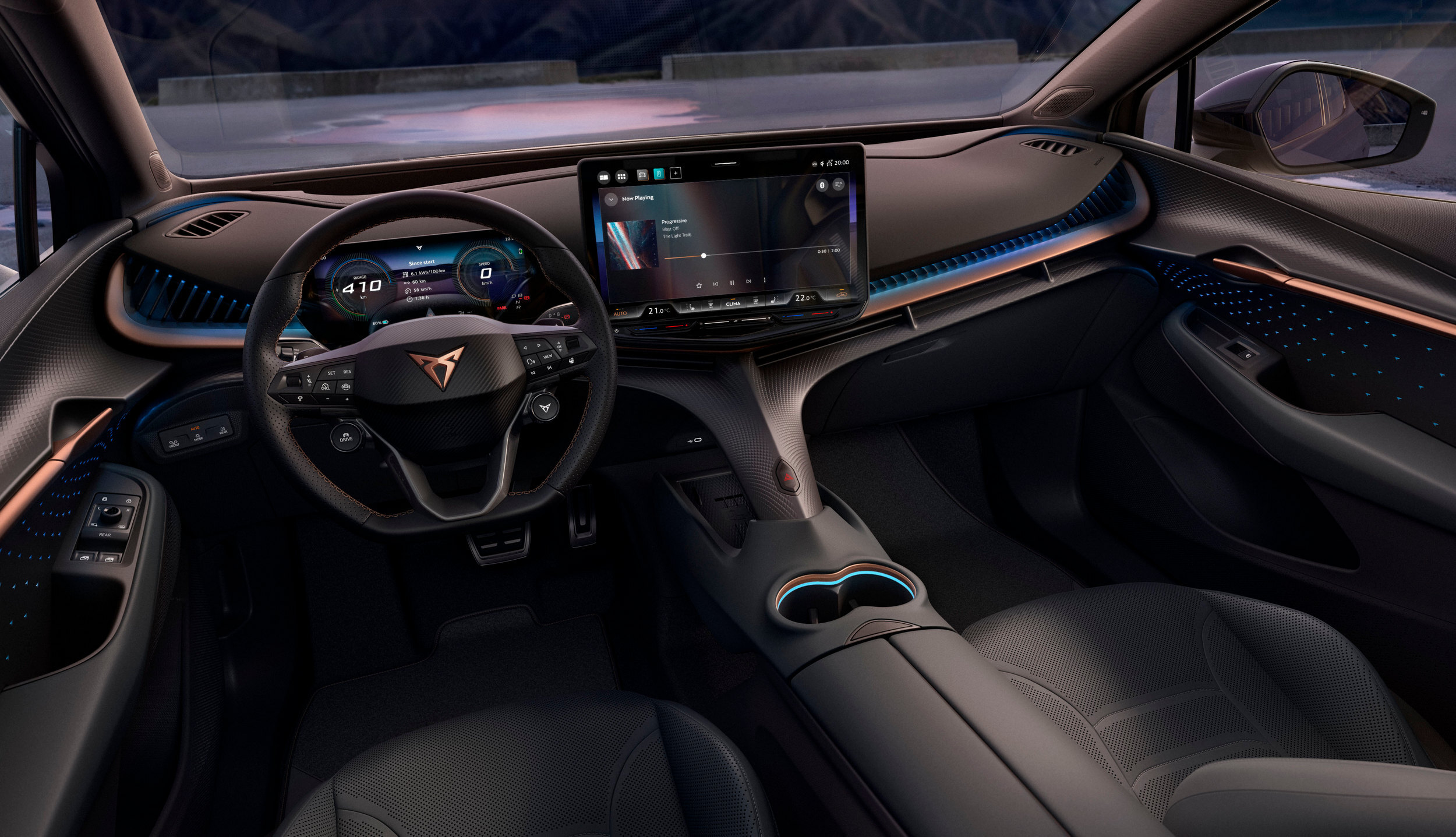
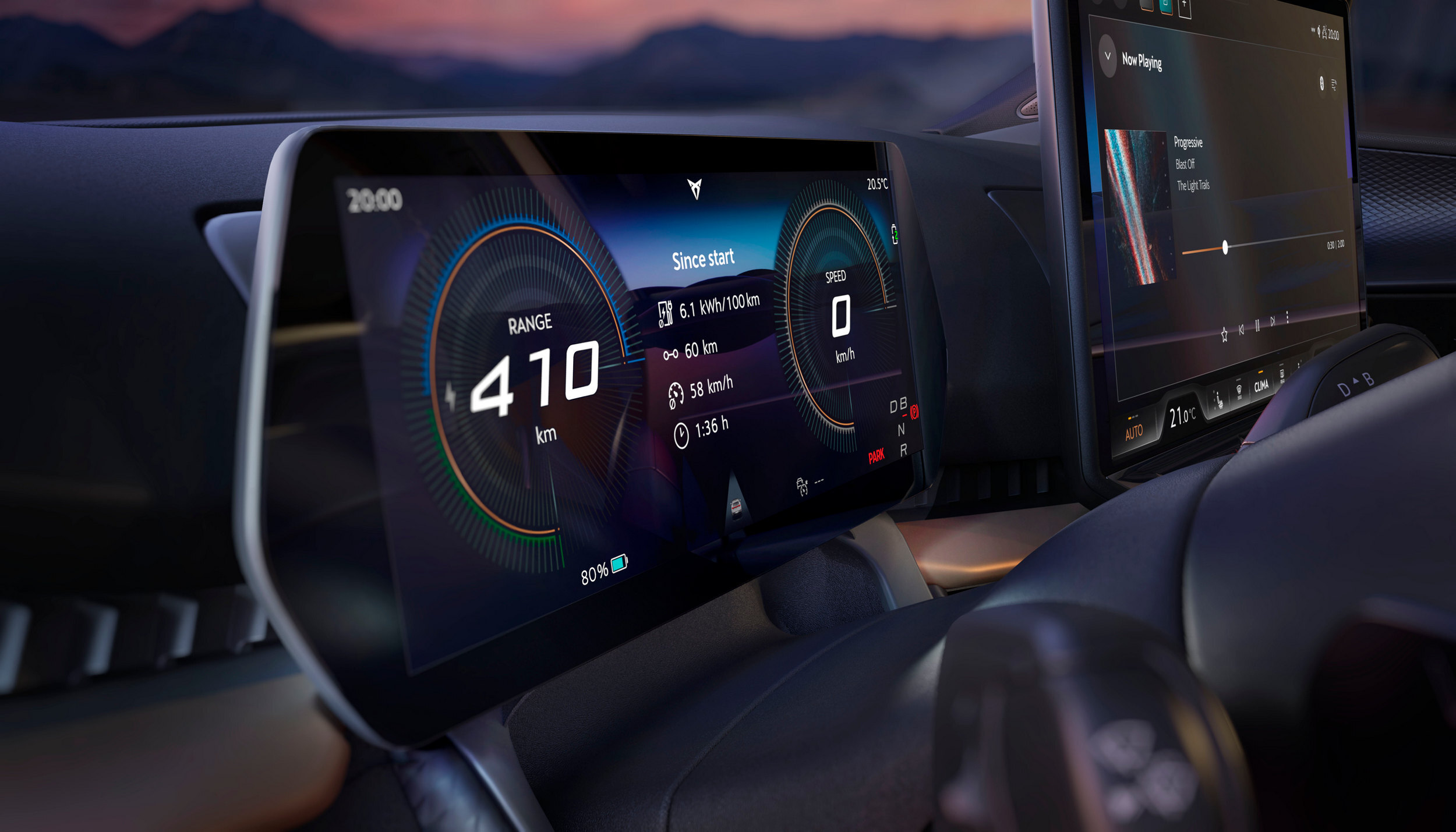
The changes continue inside as the Tavascan has been equipped with a larger 10.25-inch digital instrument cluster and a new infotainment system running Android OS. The latter promises a more intuitive user experience as well as access to an assortment of popular apps.

Despite the focus on technology, Cupra is rocking it old school with a new steering wheel that has physical buttons. That’s a welcome change, but the touch sliders remain.

On the subject of climate control, the crossover has “new electric air vents that activate even before the driver enters the cabin.” As Cupra explained, the system detects the key approaching the vehicle and begins to pre‑circulate air. Once people step inside, the vents apparently adjust direction based on where they’re sitting and the position of the sun. The vents can also be controlled by voice command for “added convenience.”

 Cupra Gave The Tavascan New Screens And Air Vents That Think For Themselves

Needlessly complicated air vents aside, the updated Tavascan has digital key technology that enables owners to unlock, start, and share access to the vehicle using a smartphone. One ‘key’ is reserved for the owner, while four others can be shared.

Buyers will also find a new premium audio system with Sennheiser Contrabass technology. It uses “psychoacoustic techniques to deliver deep, punchy low‑end frequencies” to deliver a “rich, enveloping soundscape.”

Other Minor Changes

\\\\\\

On the styling front, there isn’t much to report other than a new Dark Void paint job. The purple hue is described as a “deep and expressive new color that enhances the sculptural presence of the Tavascan and reinforces its progressive identity.

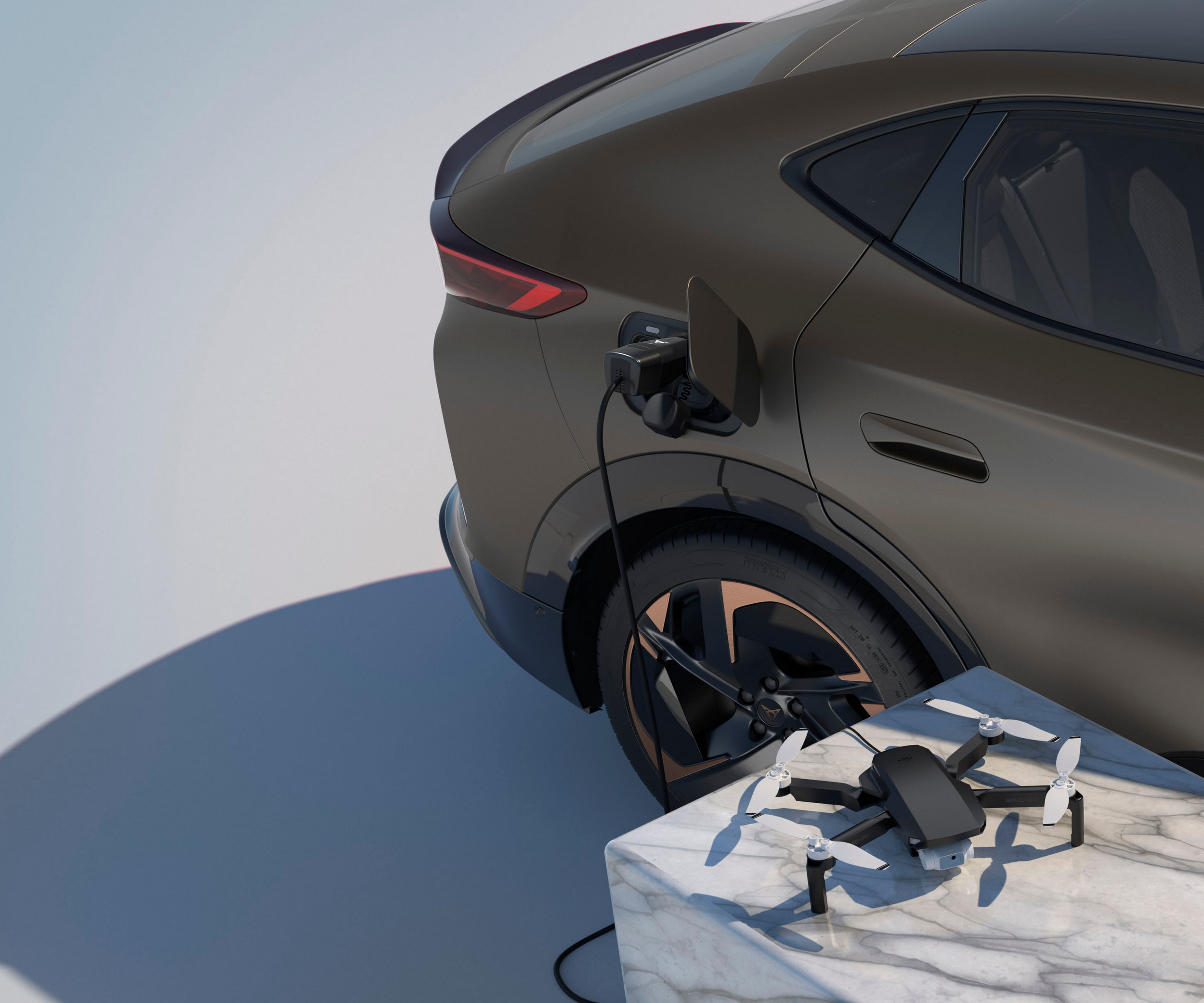
Last but not least is a new vehicle‑to‑load function, which is enabled via a dedicated adapter that plugs into the charging port. It effectively turns the crossover into a massive battery bank.

 Cupra Gave The Tavascan New Screens And Air Vents That Think For Themselves

Someone At Mercedes Decided The GLC Needed Over 900 HP And A Trick Spoiler

  • A tri-motor system could give the Mercedes-AMG GLC over 900 hp.
  • Spy shots show the tester with an active roof-mounted spoiler.
  • New battery cells could allow the SUV to charge at up to 400 kW.

Thanks to a new platform, more advanced batteries, and better electric motors, the all-new Mercedes-Benz GLC EQ is shaping up to be the firm’s most capable EV yet, at least based on early impressions. With a credible rival to the BMW iX3, along with increasing competition from Chinese EVs, Mercedes is clearly intent on expanding its electric GLC lineup.

Just a single version of the SUV has been unveiled so far, officially known as the GLC 400 4Matic with EQ Technology, producing 483 hp thanks to a pair of electric motors. In times gone by, that figure would have been enough for an AMG badge, but things have changed, and EV buyers now expect supercar-levels of performance.

Read: Can AMG Add Some Excitement To The Underwhelming GLC EV?

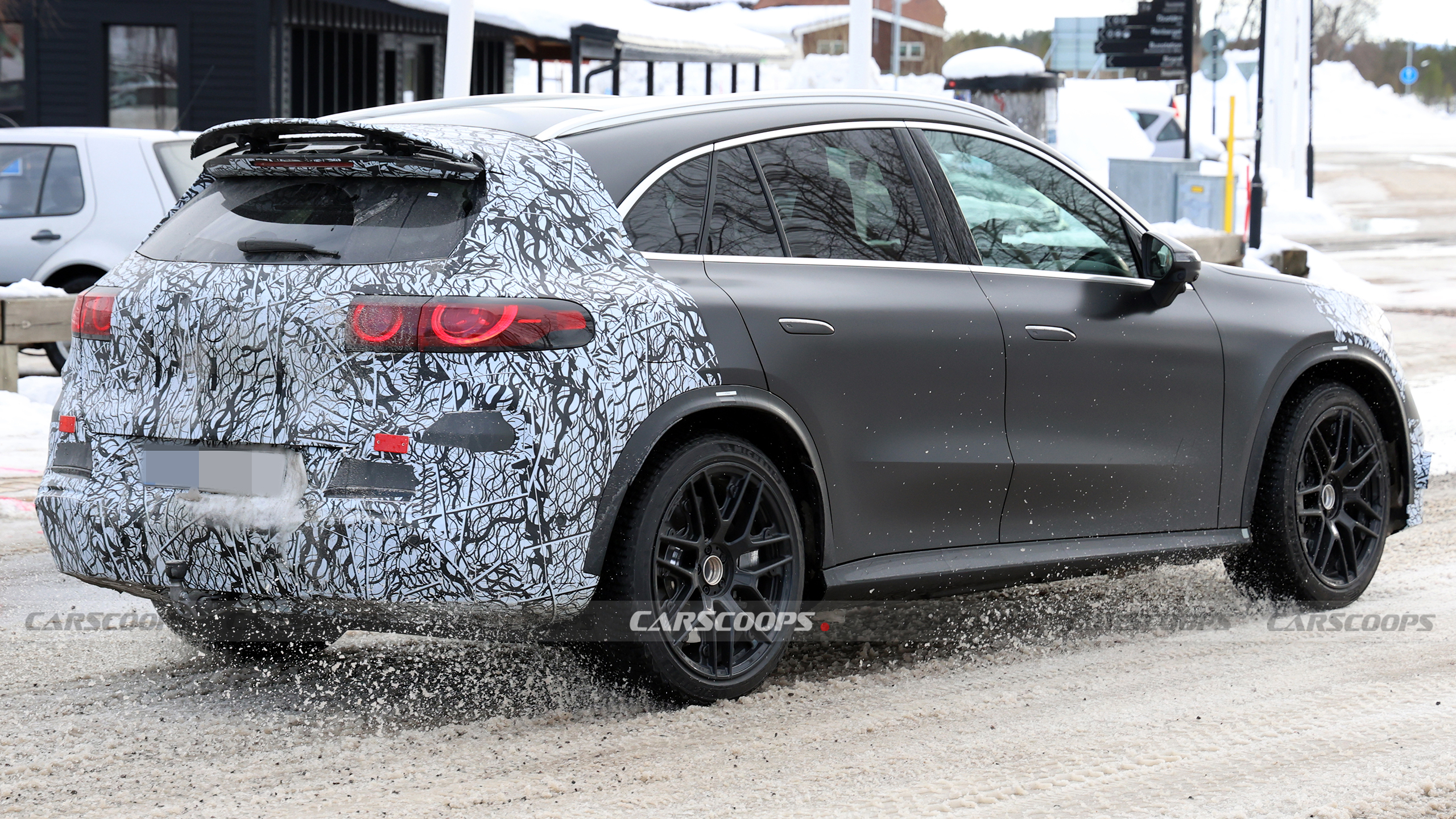
Mercedes’ solution will be a proper AMG version of the GLC EQ. Pictured in these spy shots, the SUV will combine more menacing looks with significant performance gains, pushing it into a whole new stratosphere.

Design Changes

\\\\\\\

SH Proshots

This prototype, pictured in a deep shade of matte black, has camouflage across its front and rear, hiding some of the changes being made. Chief among these will be a more aggressive front bumper, tweaked air intakes, and a new grille. You’ll also notice it is sitting on a set of new blacked-out wheels with upgraded cross-drilled brake rotors and beefed-up calipers.

Perhaps the most intriguing detail is at the rear, where an active spoiler appears to be part of the package. Normally it would sit flush when parked, but this prototype was caught with it fully raised, giving a clear look at what’s to come. With the kind of power it promises to offer, there will be no shortage of airflow for it to work with.

Further down, the taillights should carry over from the standard electric GLC, but a new rear bumper will tie the look together with the revised front end.

Supercar Power

 Someone At Mercedes Decided The GLC Needed Over 900 HP And A Trick Spoiler
SH Proshots

According to sources, the AMG version of the GLC will follow the same path as the GT 4-Door EV and the brand’s dedicated electric SUV, pairing three of YASA’s advanced axial-flux motors. The target is over 900 hp, which should be enough to reach 60 mph (96 km/h) in under three seconds.

Elsewhere, the AMG model could use new prismatic battery cells, rather than the cylindrical ones of the standard GLC, improving power density and thermal performance. These cells may also enable DC fast-charging speeds of up to 400 kW, an improvement over the standard SUV’s 330 kW, and matching the iX3.

As for when it will debut, there’s a good chance it breaks cover this fall at the Paris Motor Show in October, with sales likely to follow not long after.

\\\\\\\\\

SH Proshots

Here Are The New ID. Polo And Polo GTI Volkswagen Didn’t Want You To See Yet

  • Volkswagen ID. Polo has leaked ahead of its debut this spring.
  • Closely resembles a toned down version of the ID.2all concept.
  • New EV will offer outputs ranging from 114 hp to 223 hp.

Someone better check the plumbing as March has been full of leaks. The Rivian R2 snuck out shortly before its big debut, while images of the BMW 7-Series and X5 quickly followed.

Now, it’s Volkswagen turn as images of the ID. Polo and ID. Polo GTI have surfaced online. Their original source is unclear, but they were eventually posted to Instagram before being removed. However, the internet never forgets so they’re still floating around cyberspace.

More: VW’s New ID. Polo Hatchback Just Showed Up Nearly Undisguised

That being said, the images are hardly surprising as Volkswagen has been heavily promoting the models as part of an extensive teaser campaign. As you can see, the EV closely resembles the ID.2all concept, but features a more traditional grille and headlight treatment. They’re joined by larger door-mounted mirrors and less flamboyant bodywork.

The ID. Polo GTI closely echoes the regular model, but it’s distinguished by a unique front bumper with a sportier intake featuring a honeycomb mesh insert. The air curtains have also been replaced by vertical daytime running lights, while there’s a red stripe and “GTI” badging beneath the grille.

Volkswagen has already confirmed the model measures 59.6 inches (4,053 mm) long, 71.5 inches (1,816 mm) wide, and 60.2 inches (1,530 mm) tall with a wheelbase spanning 102.4 inches (2,600 mm). This is roughly the same size as the MQB-based Polo, but the interior is 0.7 inches (19 mm) longer and has additional headroom and rear seat legroom.

Buyers will also find a relatively spacious boot that holds 15.4 cubic feet (435 liters) of luggage, which can be expanded to 43.9 cubic feet (1,243 liters) by folding the rear seats down.

Speaking of the interior, Volkswagen has already revealed the cabin will have a 10.25-inch digital instrument cluster and a 13-inch infotainment system. The minimalist interior will also have a two-spoke steering wheel, physical switchgear, and a handful of metallic accents.

\\\\\\

The ID. Polo will ride on the MEB+ platform and be offered with front-mounted motors sporting outputs of 114 hp (85 kW / 116 PS), 133 hp (99 kW / 135 PS), and 208 hp (155 kW / 211 PS). The ID. Polo GTI will arrive one year later with 223 hp (166 kW / 226 PS).

The 114 hp (85 kW / 116 PS) and 133 hp (99 kW / 135 PS) variants will come equipped with a 37 kWh lithium iron phosphate battery and an underwhelming DC fast charging capacity of 90 kW. The other two variants embrace a larger 52 kWh nickel manganese cobalt battery, which promises to deliver up to 280 miles (450 km) of range. These versions also have a higher 130 kW DC fast charging capability.

The ID. Polo lineup will debut shortly and Volkswagen has previously said pricing will start around €25,000 ($28,810).

\\\\\\\\\\\\\\

Lexus Cures Europe’s EV Engagement Problem With Fake Gears And Half A Steering Wheel

  • Lexus brings its Interactive Manual Drive system to European RZ models this spring.
  • The setup simulates eight gears via paddles, complete with torque interruptions.
  • F Sport trims also gain steer-by-wire using a yoke with a 200-degree lock-to-lock ratio.

Lexus is bringing its Interactive Manual Drive system to Europe, following its debut in Japan. The technology simulates a manual gearshift feel in an electrified powertrain, giving drivers a sense of mechanical engagement the brand says was lost in the transition away of combustion.

The system comes standard on F Sport trims of the updated Lexus RZ, which was detailed in Europe exactly one year ago, with first deliveries scheduled to begin this spring. Earlier prototypes previewed in 2022 featured a physical clutch and gear lever, but the production version leans heavily on software, making it closer in feel to a simulated automatic than a real manual.

More: Lexus Quietly Killed Its Smallest EV, And Hardly Anyone Noticed

Using steering-wheel-mounted paddle shifters, drivers can cycle through eight virtual gears, with a digital tachometer indicating optimal shift points. They can also choose between three levels of synthetic engine sound, each synced to the simulated gear changes.

Similar to the Honda Prelude’s S+ Shift gear system, it goes further than just noise. The setup calculates virtual torque based on throttle input and vehicle speed, then feeds that back through the drivetrain. The result is an illusion of real shifts, complete with torque interruptions, engine braking, and even a hint of G-force nudging you along. At least, that’s the theory Lexus is selling.

 Lexus Cures Europe’s EV Engagement Problem With Fake Gears And Half A Steering Wheel

Lexus is not alone in attempting to bring a more engaging gear-changing experience to electrified models. Similar systems are already offered by other automakers, including Hyundai with the fully electric Ioniq 5 N.

Steer-By-Wire

Lexus is also introducing its steer-by-wire system in Europe after years of delays. Standard on F Sport models and optional on the rest of the lineup, it replaces the mechanical steering column with a yoke-style controller and a fully digital connection.

More: Yoke’s Over, Say Chinese Lawmakers

The futuristic steering setup features a tight 200-degree lock-to-lock ratio. In practice, that means no hand-over-hand turning during a U-turn, something that would otherwise be awkward with a yoke.

 Lexus Cures Europe’s EV Engagement Problem With Fake Gears And Half A Steering Wheel

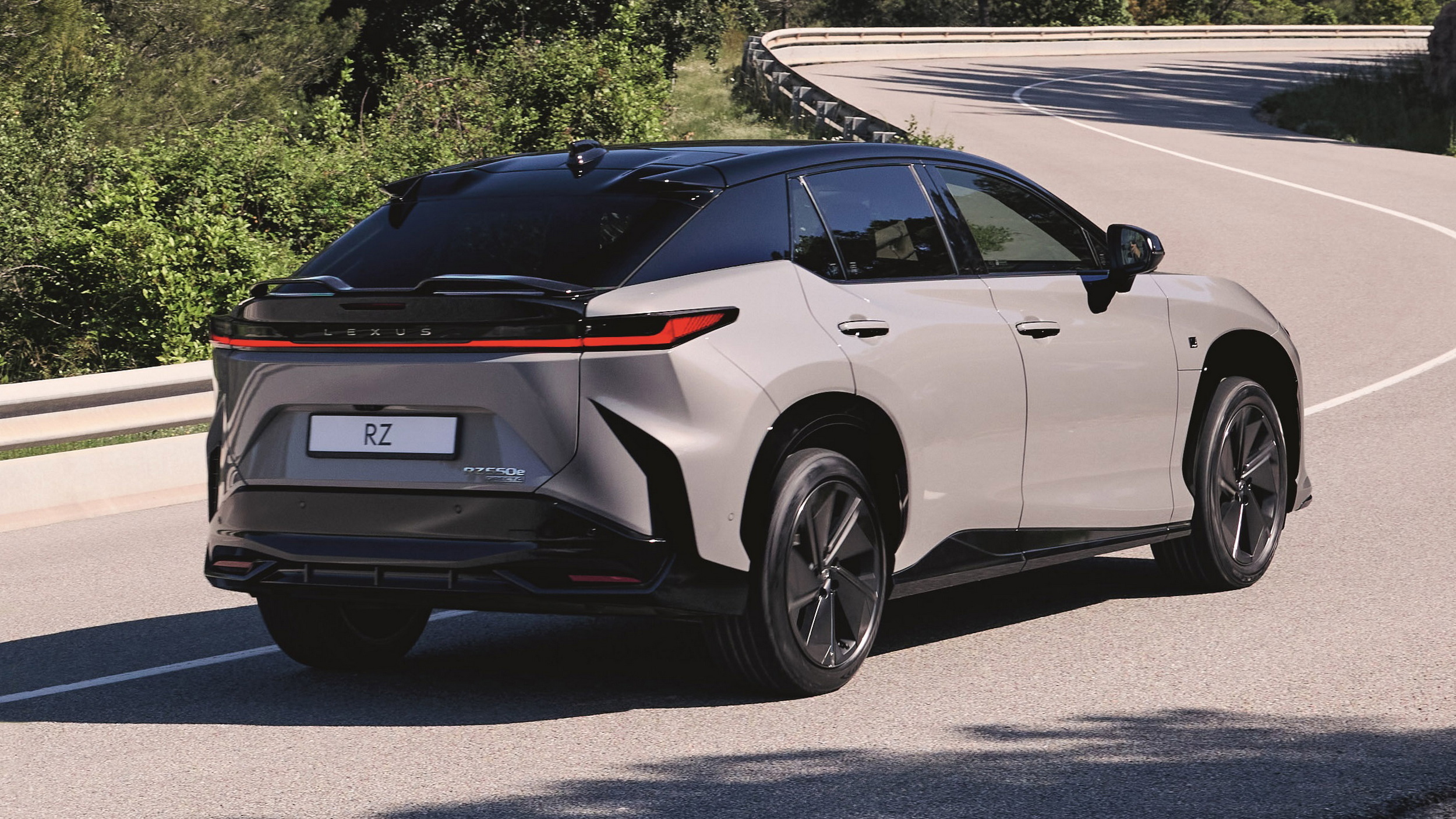
The most powerful version of Lexus’ electric crossover in Europe is the RZ 550e F Sport AWD, producing a combined 402 hp (300 kW / 408 PS). While this can’t match the 424 hp (313 kW / 426 PS) of the Japanes-spec RZ 600e Sport Performance, it is enough to offer a 0-100 km/h (0-62 mph) acceleration in a respectable 4.4 seconds.

More: The Next Lexus IS May Go In A Very Different Direction

The latest update to the RZ lineup introduced a larger 77 kWh battery pack, delivering a WLTP range of up to 568 km (353 miles) for the entry-level RZ 350e FWD. Additional updates include a battery preconditioning system and a standard 22 kW onboard AC charger.

What About The US?

The Interactive Manual Drive system is also included as standard equipment on the US-spec RZ 550e F Sport. However, the steer-by-wire setup with the yoke will not be offered in North America.

\\\\\\\\\\\\

Lexus RZ 550e F Sport AWD

Hyundai Is About To Flood The North American Market With 36 New Models

  • Hyundai will launch 36 vehicles in North America through 2030.
  • This includes new and updated models as well as derivatives.
  • There will be new XRT and N variants, and range-extended EVs.

Hyundai CEO José Muñoz used the company’s annual shareholders meeting to reveal an accelerated North American growth strategy. It calls for launching 36 all-new or “significantly enhanced” vehicles in Canada, Mexico, and the United States between 2026 and 2030.

The automaker didn’t go into many specifics, but confirmed we can expect commercial vehicles as well as cars, trucks, and SUVs. There will also be a mix of “core models and expanded trims” as well as new XRT and N variants.

More: Hyundai’s Best-Seller Is About To Get A Major Redesign

While Hyundai has bet heavily on EVs, they’re not putting all their eggs in one basket. Quite the opposite as they promised a “broad mix” of powertrains that will include gas and hybrid options as well as battery and range-extended EVs. This is designed to meet “evolving customer demands across the region,” which is codeword for slower than expected electric vehicle adoption.

\\\\

Muñoz alluded to this as he said, “By expanding our product portfolio and offering a wider range of powertrains in North America, we’re giving customers more choice while continuing to strengthen our long‑term investment in U.S. manufacturing, jobs, and the broader automotive ecosystem.”

Speaking of the latter, Hyundai aims to have more than 80% of vehicles sold in the United States assembled domestically by 2030. The automaker also wants to increase U.S. parts content from around 60% to 80% by the end of the decade.

What’s Coming?

\\\\\\\\\\\\\

The automaker was tight-lipped on what to expect, but spy photographers have already snapped an assortment of upcoming models including the redesigned Tucson and Elantra. The company is also working on a facelifted Santa Fe, while a larger truck is expected to replace the Santa Cruz.

On top of those models, Hyundai and General Motors have teamed up to jointly develop five new vehicles including an electric commercial van for North America.

\\\\\\\\

Ford’s New Electric Van Has A Chinese Secret

  • Ford debuts the EV-only Transit City van in Europe for last-mile urban delivery.
  • Payload ranges from 2,392 lbs. to 3,373 lbs. across three body configurations.
  • It is based on a Chinese platform and will be manufactured in China too.

Ford Pro’s van lineup is already sprawling, with models like the fully electric E-Transit Custom and E-Transit covering a lot of ground. Still, that hasn’t stopped Ford Pro from adding another name to the roster with the all-new Transit City. Built on an EV-focused platform developed by Jiangling Motors Corporation (JMC) and assembled in China, it will be offered in mainland Europe and the UK.

To further slash costs, Ford has pursued an aggressively simplified strategy. There’s just one trim, no options list, and very little room for personalization. It’s as pared back as it gets. The design follows suit. You get a straightforward look with modern LED lighting linked by a closed-off grille, clean body surfaces, black wheels, and unpainted plastic bumpers that make no attempt to hide their budget-friendly intent.

More: Volvo’s First Commercial Van Looks Familiar Because It Is

The Transit City is available in three body styles, including a standard panel van, a long-wheelbase high-roof variant, and a chassis cab version. The latter is designed to serve as a blank canvas for conversions by aftermarket specialists.

\\\\\\\\\\\

Payload capacity ranges between 1,085 kg (2,392 lbs) and 1,530 kg (3,373 lbs), depending on the specification. As for the available space at the back, the largest van can hold up to 8.5 cubic meters (300 cubic feet) of cargo and has a loading space length of 3,070 mm (120.9 inches).

More: VW’s ID. Buzz Picks Up A Feature No Minivan Has Any Business Offering

Despite its budget character and lack of options, the standard equipment is quite generous for the segment. The dashboard features a 12.3-inch touchscreen running Ford’s SYNC 4 infotainment system, a digital instrument cluster, and plenty of storage compartments.

Furthermore, the van comes standard with adaptive cruise control, lane-keeping assist, front and rear parking sensors, a rearview camera, and even a heated driver’s seat.

\\\\\\\\\\

A Dedicated EV

Unlike other models in Ford Pro’s commercial vehicle lineup, the Transit City is a dedicated battery-electric vehicle with no internal combustion or hybrid variants on the horizon. The company claims the electric powertrain will help reduce maintenance costs by up to 40% compared to a diesel van.

More: These Chinese Trucks Look Like Ford Rejects

It rides on a ladder-frame chassis developed by the JMC joint venture and is fitted with a front-mounted electric motor producing 148 hp (110 kW / 150 PS). Energy is stored in a 56 kWh Lithium Iron Phosphate (LFP) battery pack, allowing a WLTP range of up to 254 km (158 miles). While that might sound modest to some, Ford notes that typical users in this segment average less than 110 km (68 miles) per day.

Charging is handled via an 87 kW peak DC fast-charging rate, enabling 50 km (31 miles) of range to be added in 10 minutes, or a 10-80% top-up in approximately 33 minutes. Using the standard 11 kW AC charger, a full charge takes about five hours.

Focused On Affordability

Ford hasn’t put a price tag on it yet, but it has made confirmed that the Transit City will slot between the smaller E-Transit Custom and the full-size E-Transit. Right now, those models start at £43,630 ($58,300) and £49,545 ($66,200), respectively, which gives a fairly tight window for where this new addition is likely to land.

Tesla’s Next Model “Way Cooler Than A Minivan”, And That’s All Musk Will Say

  • Elon Musk teased a new Tesla model described as “cooler than a minivan”.
  • Tesla is discontinuing the Model S and Model X by the end of the year.
  • A Cybertruck-derived three-row SUV appeared as a clay model in 2025.

Elon Musk has confirmed that Tesla is working on a new model, and the internet has done what the internet does: immediately begun speculating. The leading theory involves a rugged, three-row SUV inspired by the Cybertruck.

Unless, of course, the big reveal turns out to be the three-row Model Y L recently spotted at Gigafactory Texas, in which case Musk’s gift for generating hype will have once again conjured a drum roll worthy of a stadium concert. Wouldn’t be the first time.

But we digress. On March 24, the Tesla CEO shared a post on X noting that the Cybertruck’s rear bench is large enough to fit three child seats or three adults. A follower then suggested he “make a minivan,” to which Musk replied: “Something way cooler than a minivan is coming.”

More: Tesla Roadster Delayed Again, Weeks Late But Years Behind

One credible scenario involves what has been dubbed by the internet, the CyberSUV. Back in September 2025, a clay model appeared in the background of an official Tesla video, suggesting a potential SUV sibling to the Cybertruck.

 Tesla’s Next Model “Way Cooler Than A Minivan”, And That’s All Musk Will Say
Our rendering of a Cybertruck-derived SUV (above) based on the clay model from last year (below).
 Tesla’s Next Model “Way Cooler Than A Minivan”, And That’s All Musk Will Say

The mockup featured a redesigned roofline and greenhouse, while the front-end design, full-width LED bar, and flat stainless steel surfacing appeared to carry over from the truck.

The timing matters, too, since Tesla is winding down production of the Model S and Model X this year, leaving a conspicuous gap in its production capacity.

More: Musk Lectures Legacy Brands On Cars, Even As Tesla Drifts Beyond Them

A CyberSUV would be larger and more spacious than the Model Y and Model X, positioning it against full-size SUVs such as the Cadillac Escalade.

Repurposing the Cybertruck platform for an SUV makes strategic sense. Sales of the electric truck are abysmal, given initial expectations, and an SUV twin could help Tesla increase production at Giga Texas while tapping a segment that American buyers never stopped loving. Keeping R&D costs down would be another advantage, particularly if the new model shared its underpinnings along with numerous exterior and interior components with the Cybertruck.

Could It Be A Longer Model Y?

Well this is interesting at Giga Texas today … what do YOU think this is? 🤔😎 pic.twitter.com/U9pLvqbf7L

— Joe Tegtmeyer 🚀 🤠🛸😎 (@JoeTegtmeyer) March 23, 2026

As we mentioned, another possibility is a stretched Model Y heading to North America. Last year, Musk stated that this model wouldn’t enter US production until late 2026, if at all. Footage from outside Gigafactory Texas, however, tells a somewhat different story.

More: Musk Said The U.S. Wouldn’t Get This Tesla. Texas Factory Footage Disagrees

Drone pilot Joe Tegtmeyer captured a large vehicle shell wrapped in blue plastic and sitting inside a wooden crate. Many believe the shell belongs to the Tesla Model Y L, already sold in China with extended bodywork and six-seat seating.

Whether the new Tesla will actually be cooler than a minivan remains to be seen. Hopefully, Tesla will clear up the mystery soon.

Something way cooler than a minivan is coming

— Elon Musk (@elonmusk) March 25, 2026
❌
❌