Normal view

There are new articles available, click to refresh the page.
Today — 1 April 2026Vehicles

BMW’s Entry-Level iX3 Saves You Over $7K, But There’s A Real Trade-Off

  • BMW has quietly introduced the entry-level iX3 40.
  • It features a smaller battery and rear-mounted motor.
  • Crossover has 316 hp and a WLTP range of 395 miles.

When BMW introduced the iX3 last fall, it was launched with a 108.7 kWh battery pack and a dual-motor all-wheel drive system producing a combined output of 463 hp (345 kW / 469 PS) and 476 lb-ft (645 Nm) of torque. The company promised further variants would follow including an entry-level model.

The automaker is now delivering on that by introducing the iX3 40. The crossover features a smaller 82.6 kWh battery as well as a rear-mounted motor developing 316 hp (235 kW / 320 PS) and 369 lb-ft (500 Nm) of torque. This enables the entry-level EV to accelerate from 0-62 mph (0-100 km/h) in 5.9 seconds, before hitting a top speed of 124 mph (200 km/h).

More: BMW iX3 Ushers In Neue Klasse Era With A Surprising Price Tag

Buyers can expect a WLTP range of up to 395 miles (636 km), which falls well below the iX3 50’s rating of up to 500 miles (805 km). On the bright side, a 300 kW DC fast charger can provide up to 186 miles (299 km) of range in as little as 10 minutes. The model also has a bidirectional charging capability and can go from a 10-80% charge in as few as 21 minutes.

 BMW’s Entry-Level iX3 Saves You Over $7K, But There’s A Real Trade-Off

The iX3 40 will arrive in the United Kingdom this summer, where pricing starts at £53,250 (approximately $70,450 at current exchange rates). That’s £5,505 (around $7,280) less than the iX3 50, which represents a considerable savings.

The automaker was coy on equipment details, but said “as with its exterior and interior design, standard specification for the new iX3 40 is identical to that of the iX3 50 xDrive.” However, that might not be the same for all markets and we wouldn’t be surprised if some regions got smaller wheels or other minor changes.

\\\\\\\

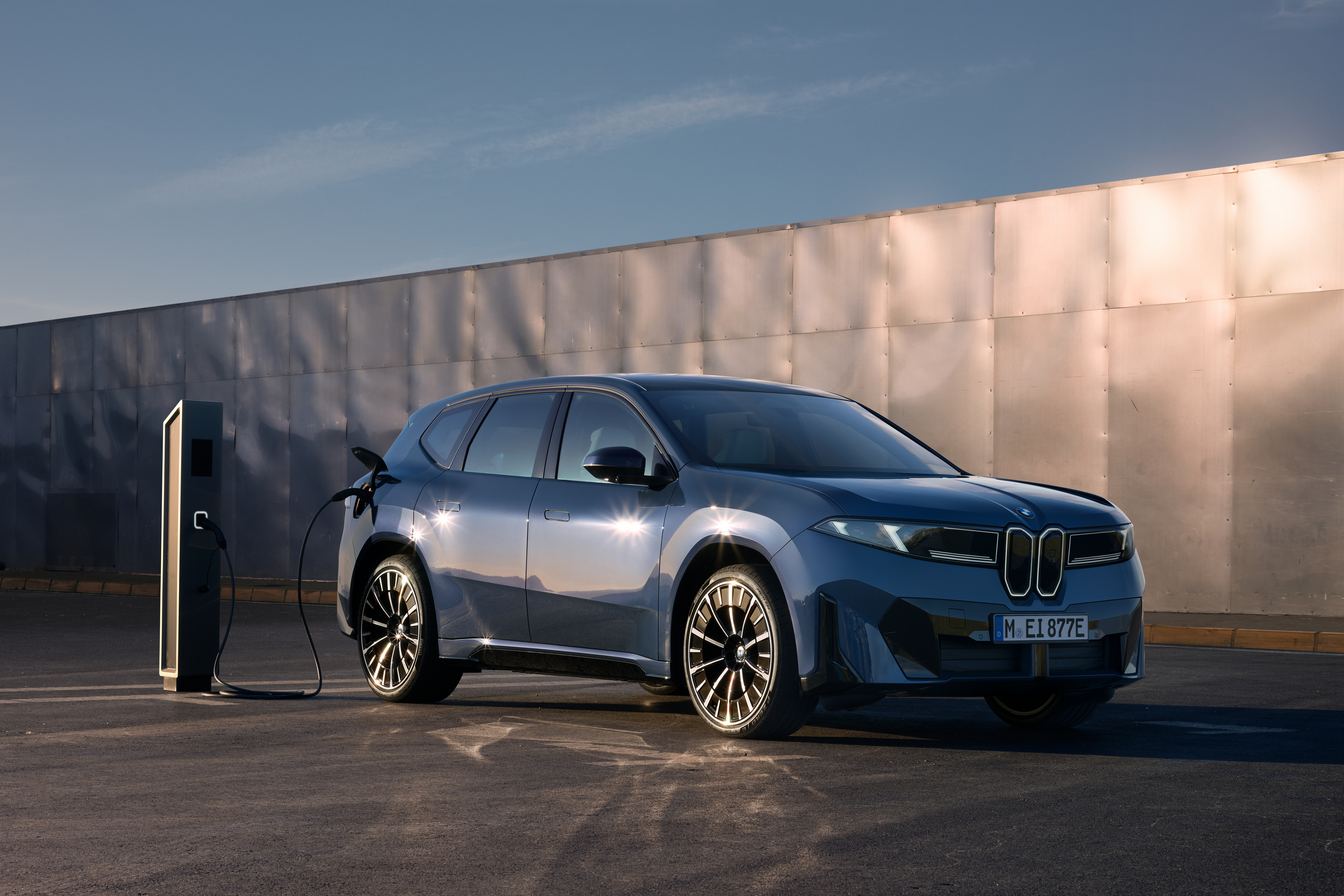
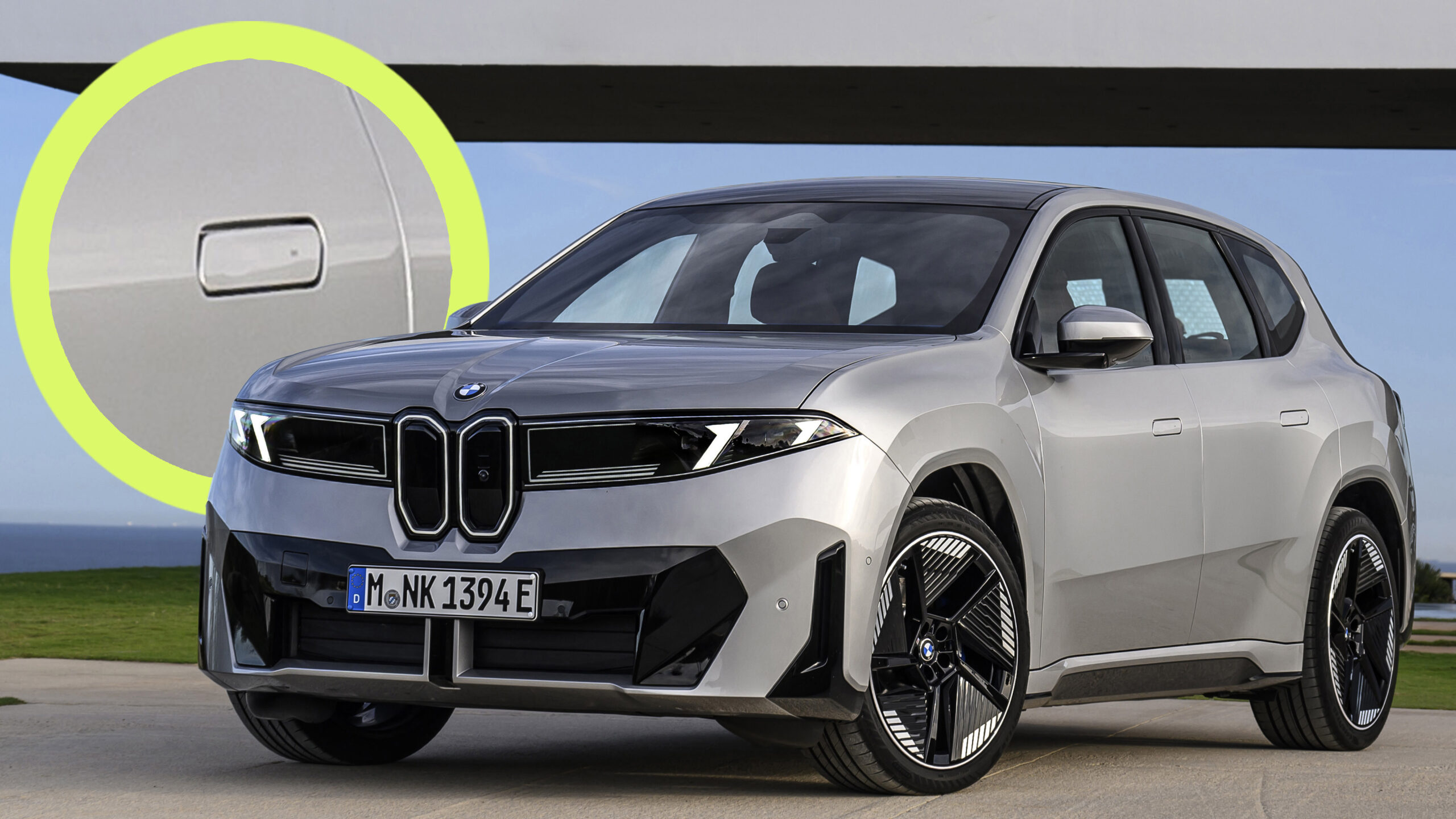
iX3 50 pictured

Land Rover Let The Freelander Go. China Brought It Back As An Electrified SUV

  • The Freelander name returns on a new electrified 4×4 developed jointly in China.
  • It rides on an 800-volt platform supporting EV, PHEV, and range-extender setups.
  • Export versions will be bespoke regional models, not adapted China-market cars

The Freelander name has been dormant since 2015, but Jaguar Land Rover’s Chinese joint venture with Chery has brought it back as something entirely new. Instead of a badge within Land Rover’s lineup, it now stands alone as its own brand, focused squarely on electrified off-roaders. The first look at that direction comes in the form of a concept rather than a production-ready model.

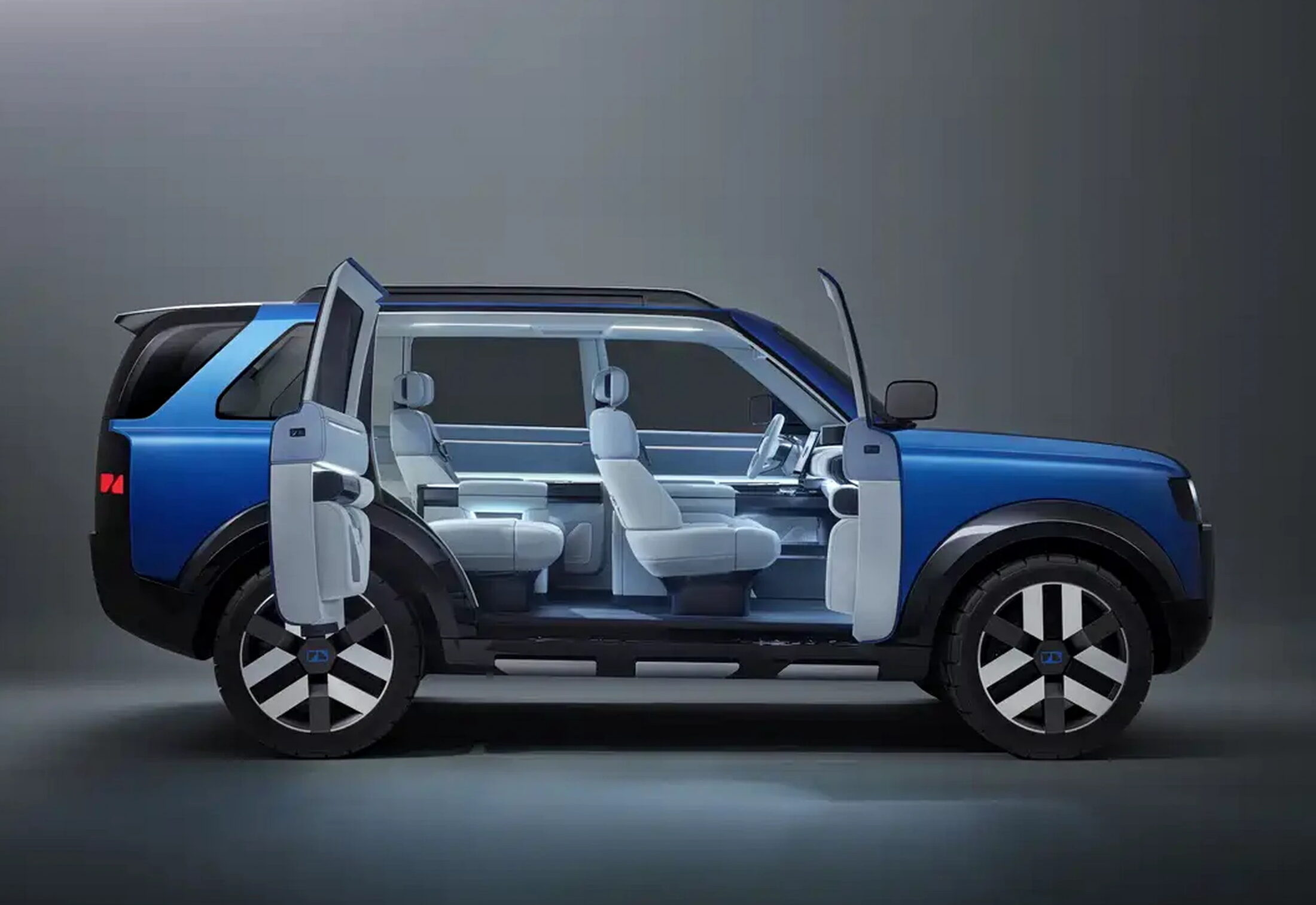
The Concept 97 takes its name from the Freelander’s original 1997 debut. While it wears no Land Rover badges, its design still leans heavily on the brand’s visual language, blending cues from the original Freelander with elements reminiscent of the modern Defender. The design is a product of collaboration between the teams at the UK and China.

More: The Freelander Is Coming Back, Just Not As A Land Rover

The company showed two cocnept models, finished in Glacier Blue and Thousand Mountain Green. Both feature black cladding paired with aluminum accents across the hood, grille, skid plate, and tailgate. The wheels and tires lean toward concept-car theatrics, and the suicide doors underline that this is still very much a showpiece. Expect those to give way to something more conventional in production, unless Land Rover decides to keep things interesting, at least with the doors.

Design Details Pull From Different Eras

\\\\\\\\\\\

Look closer and the references become more specific. The angled D-pillar is a clear callback to the three-door Freelander from 1997, including the era when it even offered a soft-top. Meanwhile, the black trim beneath the headlights and the pixel-style LED arrangement echo the facelifted model introduced in 2003.

More: Jaguar Land Rover’s Design Boss Is Out After Two Decades With No Successor Named

Around back, the taillights are tucked into a strip of black trim, contrasting against an upright aluminum-finished tailgate. The rear skid plate mirrors the front, and a sizeable roof spoiler caps things off with a slightly more modern flourish.

High-Tech Interior With Six Seats

\\\\\\\

The interior adopts a three-row six-seater configuration, with a rear bench that looks like a couch. A pillar-to-pillar display is mounted on the base of the windshield, joined by a large infotainment touchscreen. We can also see a pair of rotating dials and physical buttons on the steering wheel, alongside traditional stalks.

Second-row passengers have access to a drop-down screen, and a high-mounted center console similar to the one between the front seats. The SUV is also equipped with the latest Qualcomm Snapdragon 8397 chip, and Huawei’s Qiankun Intelligent Driving ADS 4.1 system featuring a 896-line LiDAR sensor.

Six Models Planned, But Not For Everyone

 Land Rover Let The Freelander Go. China Brought It Back As An Electrified SUV

This is not a one-off exercise. The company says six production models will arrive under the Freelander brand over the next five years. China comes first, with global expansion planned afterward, although that rollout carries a significant caveat.

Every model will be built at the CJLR plant in Changshu, effectively replacing the soon-to-be discontinued Land Rover Discovery Sport and Range Rover Evoque on the production line. With production rooted entirely in China, current US tariff conditions make an American launch highly unlikely. Canada, however, thanks to newly reduced tariffs, could still be in play.

More: Here’s The New Freelander Before You’re Supposed To See It

The SUVs are expected to ride on Chery underpinnings, supporting range-extender, plug-in hybrid, and fully electric powertrains. Based on earlier spy shots and leaked images, the first production Freelander of this new era will likely be a three-row, six-seat model, closely mirroring the Concept 97.

\\\\\\\\\\\\\\

Photos Chery Jaguar Land Rover, Weibo

Cupra’s Baby EV Looks Like It Was Designed By People Who Actually Drive

  • Cupra teases Raval rear with dramatic reflection, confirming April 9 reveal date.
  • Triple triangle LED lights and glowing Cupra badge hint at bold, sporty styling.
  • VZ version promises hotter performance with 233 hp and sharper chassis setup.

Cupra has confirmed the Raval will debut on April 9, and with just weeks to go, it’s dropped a teaser that gives us our first real taste of its smallest electric car yet. It’s only one image, but it’s enough to get us excited about a baby EV that should be both fun to drive and affordable.

The shot as provided by Cupra shows the rear end reflected in water, though flipping it reveals the details more clearly. The lighting signature is the standout feature. Triple triangle LED elements sit at each corner, connected by a full-width light bar with a textured, mesh-like look that feels suitably dramatic. An illuminated Cupra badge takes center stage, a detail we last saw on the facelifted Born.

Related: Cupra’s Smallest EV Just Drove Around Naked Hoping Nobody Would Notice

We can also make out a roof spoiler at the top of the hatch door and a set of black and bronze alloy wheels wrapped in chunky Bridgestone tires, hinting at a sportier edge than your average small EV, and probably telling us that we’re looking at the VZ hot hatch version.

The Raval rides on VW Group’s new front-wheel drive MEB+ platform and measures just over 4,000 mm (157.5 inches) long, placing it firmly in the subcompact class. It shares its underpinnings with the upcoming VW ID. Polo and Skoda Epiq, though Cupra has reportedly led chassis development.

The Driver’s Choice

That influence shows in the setup. Engineers have lowered the suspension by around 15 mm versus the VW and Skoda equivalents, even on the base cars, stiffened things up, and added progressive steering to give it a more engaging feel. It’s meant to be the enthusiast’s option in this trio.

\\\\\\\\\\\\

Cupra

Power options though, cover a broad range. Entry-level versions are expected to offer 114 hp (116 PS / 85 kW) or an optional 133 hp (135 PS / 99 kW), both paired with a 38.5 kWh battery. Step up and you get a single, front-mounted electric motor producing around 208 hp (211 PS / 155 kW) with a 55 kWh pack.

That mid-tier setup should deliver a 0 to 62 mph time of around 7.2 seconds and a WLTP range of up to 278 miles or 450 km. It’s a solid balance of performance and efficiency for everyday use.

VZ Equals GTI

But we’re naturally drawn towards the VZ, Cupra’s take on the ID. Polo GTI, the first electric VW to wear that legendary hot hatch badge. With 233 hp (226 PS 166 kW), an electronic differential, and a wider track, it promises sharper responses and more punch, even if range dips to around 249 miles (400 km).

With prices expected to start around €26,000 (£23,000) and a funkier, more youthful design than its VW and Skoda cousins, the Raval looks set to bring some real personality to the affordable EV space.

\\\\\\\\\\

Baldauf

Jaguar Benchmarked Its Electric GT Against One Classic Above All Others

  • Jaguar pits its future EV flagship against icons from its storied past.
  • A V12-powered XJ Coupe served as a key benchmark for the project.
  • The four-door GT arrives in September with more than 986 hp on tap.

Jaguar has begun sketching out what comes next, offering fresh details on the new four-door GT that will usher in its all-electric era. The production EV is set to debut in September, pitched as a modern tribute to the brand’s most celebrated grand tourers, even as it marks a clean break from them.

To show that the move to a zero-emission powertrain won’t dull the experience, the company went digging through its archives. Jaguar engineers ran what they call a “Spirit of Jaguar Drive” evaluation, benchmarking the new GT against the XK120, E-Type, XJS, and the XJ Series I.

More: Jaguar Cancelled Three New Cars In Development To Make Room For One EV

What stands out is the timeframe. Every benchmark model comes from between 1948 and 1975, with nothing from Jaguar’s more recent past making the cut, a telling choice about where the brand sees its identity, something that could just as easily apply to the as-yet unnamed EV.

Jaguar says the new GT’s character leans heavily on the V12-powered XJ Coupe, aiming to balance pace with refinement. Vehicle Engineering Director Matt Becker insists that familiar duality remains intact, describing a blend of performance and comfort that sits in what he calls “perfect harmony.”

Jaguar Drops The Curves And Starts Over

\\\\\\\\\\\

In terms of styling, the new Jag leans heavily on the Type 00 concept, now stretched into a four-door form. It marks a clean break from the past, ditching the brand’s familiar curves in favor of ultra-simple lines and flat, almost architectural surfacing. Even so, the long hood, low stance, oversized alloys, and sleek, aerodynamic roofline still give it the kind of proportions you’d expect from a proper rear-drive sedan.

More: Jaguar Land Rover’s Design Boss Is Out After Two Decades With No Successor Named

The company also confirmed that the GT’s “cosseting cabin” will follow a “shrink around the driver” philosophy, echoing the approach first seen in the XK120.

Electric Underpinnings

The new luxury sedan will ride on Jaguar’s new Electric Architecture. At its core sits a tri-motor powertrain producing more than 986 hp (735 kW / 1,000 PS) and a hefty 1,300 Nm (959 lb-ft) of torque. That kind of output demands more than brute force alone. To keep it all in check, Jaguar has developed its own in-house torque vectoring software, fine-tuning how power is distributed.

\\\\\\\\\

The GT will ride on a dynamic air suspension setup with twin-valve active dampers, engineered to keep its rumored 2,700 kg (5,952 lbs) mass in check. That’s no small ask, though it gives a sense of the kind of grand touring brief Jaguar is chasing here.

Power comes from a substantial 120 kWh battery pack, targeting roughly 700 km (435 miles) of WLTP range, or about 400 miles on the EPA cycle. Hook it up to a 350 kW fast charger, and the numbers start to look properly competitive, with 322 km (200 miles) of range added in under 15 minutes.

More: You Can Still Buy A New Gas Jaguar For $22K, But Not Here

Jaguar says it has put the car through its paces in extreme real-world conditions across the globe, alongside extensive digital testing. The company, which infamously halted production of its entire lineup to make room for a clean-sheet reset, hopes everything will be ready for the big launch in September 2026.

\\\\\\\\\\\\\\

Jaguar

Leadership Under Pressure

By: STN
1 April 2026 at 07:00

Findlay City Schools (OH) has faced its share of challenges in the past couple of years, from funding cuts to the tune of $6 million, key personnel departures in transportation and the ongoing driver shortage.

Superintendent Andy Hatton knew transportation would be one of the hardest areas to touch—and one of the most visible.

“We had to announce $6 million in cuts,” Dr. Hatton said. “Out of a budget of about $60 million to $65 million.”

Those reductions included roughly $820,000 from transportation alone, which led to significant alterations and hard choices.

“We eliminated high school busing,” he explained. “We went to a two-mile walk radius for all students, which is the state’s minimum requirement.”

For many superintendents, this would have been a crisis to survive. For Hatton, superintendent at the district for just under three years, it became a leadership test: How to protect families, support drivers, and still keep the system functional with fewer resources.

Turning to an Underutilized Partner: Transfinder

Findlay is a community of about 40,000 people located in the northwest of Columbus, about 40 miles south of Toledo. Its claim to fame is Marathon Petroleum, which traces its origins to the late 1880s, resulting in Findlay being a boomtown. Marathon Petroleum (NYSE: MPC) is still headquartered in Findlay today.

Findlay City Schools has 5,000 students attending two primary schools, three intermediate schools, two middle schools, and the high school. Also on the central office campus is the Career Center which serves 14 school districts across four counties.

As the district was learning of the funding shortfall it was facing, Hatton was also learning that the transportation department had a solution it wasn’t fully using: Routefinder PLUS.

“What we discovered was we were not leveraging this really powerful, amazing tool to help us route our district efficiently,” he said. “We found out that we had not updated our maps in 10 years.”

Hatton and Kelly Cheney, Findlay’s director of communications, are quoted saying in The Courier story how Transfinder’s solutions would play a role in helping the transportation navigate the challenges and get back on course. Cheney noted, before Transfinder, “our transportation department was hand-routing every single student who rode the bus, manually inputting the information for each student and then tweaking it as the year went on … again manually,” according to coverage in the local newspaper, The Courier. “Adjustments were not able to be made quickly for special circumstances, like construction, for example, so buses were delayed.”

Cheney said Transfinder’s technology was playing a key role in not just modernizing its transportation operation but solving critical issues and supporting drivers.

“This program will allow us to immediately message parents of any and all buses as soon as it is needed,” Cheney told The Courier. “Substitute drivers will have turn-by-turn directions to follow as they drive a new route, and student stop information will be updated daily.”

Hatton, in an interview with Transfinder following that meeting, said there were other challenges the transportation department was facing, such as losing key transportation staff.

“In early June, we realized we lost our router,” Hatton said. “She had been routing our district for like a decade.”

The combination of funding cuts, staff turnover, and a driver shortage could have pushed the department into chaos. But Hatton reframed the challenge as an opportunity to update the operation and increase efficiency.

“We had literally stacks of 500 pages of paper all over tables all summer long,” he said. “And then ‘sort of’ using Transfinder.” The district rebuilt its routing process inside Transfinder’s award-winning Routefinder PLUS routing software, cleaned up rider data, and upgraded GPS so routes were no longer guesswork.

He also reorganized leadership needs in the transportation department. Rather than refilling a high-cost director role, Hatton created a transportation manager position with deep system expertise.

“We decided not to replace our director of transportation position,” he said. “We went with a transportation manager and she’s been amazing.”

For Hatton, this wasn’t just about efficiency—it was about accountability to the community.

“We feel this responsibility to live up to the expectations that the community has with a high level of service,” he said. “One of the things that the Board of Education then put together for us was a set of goals that they would like to see implemented. I’m calling it our Path to Progress as we rebuild our district.”

How did Transfinder play a key role in meeting those goals? Continue reading the rest of the story below.

Not Just a Bird’s Eye View but a Windshield View

Hatton doesn’t want just a “bird’s eye view” of transportation but wants to see how things are really working. Last year, he said, “I jumped on a bus on the second to last day of school. It was Miss Tammy’s bus and she was showing me how she used the tablet.”

Hatton said the driver app installed on the tablet combined with the parent app Stopfinder has done wonders for the transportation operation.

“She’s one of those drivers who has incredible relationships with her kids,” Hatton said. “That was the first time I really got to see it and some of the potential that we have behind it.”

Transfinder technology and the support provided became a way to stabilize operations under pressure.

“When we had a really rough start to the year, we had this amazing client success manager who jumped on calls with us at the ready – like daily,” Hatton said. “He showed us little shortcuts and tweaks… and that will solve this issue.”

He said as the district looked route by route, often challenging a driver’s perspective of the best way to drive a route, efficiencies surfaced immediately.

For example, Hatton said, on Day 1 the driver would travel his or her usual route. “And then Day 2 we’d say, let’s run this route exactly the way Transfinder’s mapped it out.” The result?

“It actually saves three minutes here, two minutes there, a minute there,” Hatton said. “And then they (the drivers) start to believe, ‘Wow! This is actually going to be better!’”

Communication also changed for the better. Instead of broad, districtwide alerts, tools now allow precise updates.

“Almost instant communication is expected,” Hatton said. “If we’re not communicating with our families within five to 10 minutes of something happening on that bus… that’s just not acceptable in this day and age.”

Hatton’s approach resonates with other district leaders because it blends realism with vision. He does not promise quick fixes.

“I anticipate efficiencies in our routing,” he said. “I anticipate efficiencies with not having to hire as many drivers because I think we’re going to have fewer bus stops and we’re going to be much more efficient with our routes. … I think we’re going to see savings in the efficiencies of the routing.”

But he also ties technology to human impact.

“The power of what Transfinder can bring allows that driver to focus on the road,” Hatton said. “Take their anxiety and stress down and build those relationships with kids.”

For superintendents and business managers watching state dollars shrink, Hatton’s lesson is clear: leadership is not just about absorbing cuts—it is about using the right tools and people to keep services intact.

“We’re really proud of that,” he said.

In Findlay, funding cuts forced change. Leadership—and smart use of technology—made stability possible.

Hatton’s goal is to restore the service his community received prior to the funding cuts. He is approaching that goal methodically. Certain checkpoints have to be met before making major changes, such as increasing the number of drivers to cover routes.

“We’re just looking forward to maximizing the technology,” he said. Then, referencing the movie The Matrix, he added: “Never send a human to do a machine’s job. But also, never send a machine to do a human’s job. I firmly believe that even though we need to leverage AI and prepare children for their future, the classroom teacher is never going to be replaced and I think should never be replaced. The same with the bus driver. I think that relationship is so important.”

Transfinder technology is at the intersection.

“I think the power of what Transfinder and the resources it can bring to bear allows the driver to focus on the road, take their anxiety and stress down and build those relationships with kids,” Hatton said. “And then in terms of the parents, they feel safer. They can look at their phones and see exactly where the bus is.”

To learn more, visit transfinder.com/solutions, call 800-373-3609 or email solutions@transfinder.com.

Key Takeaways from Findlay’s Experience

  • Leverage technology fully before cutting service further. Findlay discovered it had powerful tools in place with Transfinder but wasn’t using them to their potential. Updating maps, data, and routing inside the system created immediate efficiencies when funding was reduced.
  • Use disruption as a catalyst to modernize. The loss of state funding and key staff forced the district to abandon paper-based processes and rebuild routing digitally, improving accuracy, visibility, and long-term sustainability.
  • Pair software with the right people. Leadership restructured transportation staffing around system expertise, ensuring the technology was supported by someone who could actively manage and optimize it.
  • Efficiency protects students and drivers. More precise routing reduced unnecessary stops and confusion, helping drivers focus on safety and relationships with students while maintaining service under tighter budgets.
  • Strong vendor partnership matters in crisis. Access to hands-on support and problem-solving from the Transfinder team helped stabilize operations quickly during a difficult transition period.

The views expressed are those of the content sponsor and do not reflect those of School Transportation News.

The post Leadership Under Pressure appeared first on School Transportation News.

(Free White Paper) 12 Ways to Do More Without Blowing Your Fleet’s Budget

By: STN
1 April 2026 at 07:00

According to our recent survey, 75% of student transportation teams cite driver shortages are the top operational bottleneck. Budget constraints and rising operational costs weren’t far behind.

This white paper outlines 12 practical, proven ways to improve efficiency, control expenses, strengthen compliance, and protect student riders.

Learn how to stretch your transportation budget with strategies that could pay for themselves in a year.

  • Right-size your fleet using actual utilization and ridership data.
  • Optimize routes, stops and fuel use to reduce operating costs.
  • Cut required vehicle inspection times while catching more defects.
  • Reduce idling and emissions for added overhead expense control.
  • Manage driving performance without adding administrative work.

Download the complimentary white paper to access all 12 strategies.

Fill out the form below and then check your email for the white paper download link.

The post (Free White Paper) 12 Ways to Do More Without Blowing Your Fleet’s Budget appeared first on School Transportation News.

April 2026

By: STN
1 April 2026 at 07:00
Superintendent Jennifer Collier poses in front of a school bus
Kansas City Public Schools Superintendent Jennifer Collier.
Cover design by Kimber Horne
Cover photo for Zum by
Alexis Cronk with Cronk & Co Collective.

This month’s issue features the leadership perspectives from superintendents on the importance of student transportation on educational access for students and how they’re navigating in the educational world. The other features look at school transportation mobility models and factors to consider when upgrading current school buses or purchasing new ones. Also, learn more about the intricacies of addressing safety issues, fresh ideas for staff recruitment and training with AI.

Read the full April 2026 issue.

Cover Story

What’s Trending?
Superintendents share how they’re navigating some of the challenges impacting not only education but also transportation operations.

Features

Something Old vs. Something New
Other factors besides cost are considered when districts decide to either upgrade their current school buses or purchase new ones.

How Do Your Kids Arrive at School?
A child can get to school in a variety of ways. Operations discuss how they are ensuring a safe route to school regardless of the mode.

Special Reports

Safety Upgrade Complexities
State laws are normally reactive to various safety related incidents, and Texas and Maine are no different. But experts say that solving one safety issue could create others when retrofitting a fleet.

Conversations
Trends
Ad Index

Editor’s Take by Ryan Gray
You Can’t Spell Training Without AI

Publisher’s Corner by Tony Corpin
Fresh Ideas: Recruitment, Retention

The post April 2026 appeared first on School Transportation News.

Using AI to Reclaim Time & Improve Safety

By: STN
1 April 2026 at 07:00

Transportation directors are responsible for one of the most complex and important operations in a school district. Every morning, hundreds of vehicles need to be tracked, dozens of alerts need to be reviewed, and any incident that happened the day before needs to be investigated and documented. If your team is doing most of that work manually, you’re not alone. But you may be spending more time managing data than acting on it.

Modern fleet management technology is changing what’s possible for school transportation operations. Especially platforms, like VisionCloud, that combine AI-powered analytics with integrated video and telematics. Here’s a look at three areas where the right tools can give your team meaningful time back, while also raising the safety bar.

1. Finding Footage Shouldn’t Take Half Your Morning

When an incident is reported, one of the first things an administrator needs is video. In many operations, that means manually retrieving and searching through separate server and device archives, toggling between different playback modes, and scrolling through hours of footage to find the relevant clip.

Advanced video management systems eliminate that hunt. A unified playback interface combines server-stored and device-stored footage in a single view, with color-coded timelines that immediately show where alarm events, high-definition clips, and standard footage are located. Smart date search calendars and searching by location display video availability at a glance, and screenshot preview navigation lets staff scan footage quickly without downloading full clips. What used to take 30 minutes can now take three.

2. Let AI Reveal the Risks You Don’t Have Time to Detect

Most operations generate far more safety data than any director has time to analyze. AI-powered event detection changes that. Rather than waiting for a complaint or a serious incident, systems that automatically detect and upload driver behavior give administrators a real-time picture of risk across the fleet.

Pairing an intelligent video management system with advanced AI hardware helps drivers respond to risks in real time while giving transportation directors the insight needed to improve training and reduce incidents. Solutions like the SafeDrive-AI 2 windshield DVR combine a road-facing ADAS camera with a 1080p driver-facing lens, using AI to detect lane departure, collision risks, fatigue, and distraction while issuing real-time alerts. When integrated with a platform like VisionCloud, these events are automatically uploaded and surfaced for review, providing immediate, actionable visibility without manual effort.

AI safety analysis modules go further by identifying patterns across the fleet: the most frequently triggered alarm types, the highest-risk vehicles, and the drivers who would benefit most from coaching. You’re not just collecting safety data, now you’re acting on it.

3. Reports That Deliver Themselves

Operational reporting is essential, but manually generating reports on driver mileage, vehicle idling, fuel consumption, fleet health, and driver attendance takes time that most transportation offices don’t have to spare.

Platforms with customized scheduled report delivery can push the right data to the right people automatically. Paired with a comprehensive dashboard that surfaces fleet-wide KPIs and rolling trend data at a glance, the result is a department that stays informed without being buried in data pulls.

Efficiency and Safety Are the Same Goal

When a transportation team spends less time on administrative tasks, they spend more time on what matters: making sure students get to school and back home safely. AI-powered fleet management platforms aren’t just productivity tools, they are safety infrastructure.

As fleets grow and staffing pressures continue, the operations best positioned to deliver consistent, safe service will be the ones that have built smarter systems that work as hard as the people running them.


Choosing the right technology can transform how your organization operates. Download Safety Vision’s free VisionCloud platform comparison report for a detailed, feature-by-feature guide built for transportation directors.

Get your Free Copy HERE. 

The post Using AI to Reclaim Time & Improve Safety appeared first on School Transportation News.

Challenging the Status Quo: How Kansas City Public Schools Paved the Way for Modern Student Mobility

By: STN
1 April 2026 at 07:00

Transforming Student Transportation

Kansas City Public Schools (KCPS), in Missouri, significantly improved their student experience and academic readiness by overhauling its transportation system, focusing on four crucial areas: student achievement, modern technology, driver experience, and stakeholder feedback. This transformation addressed long‑standing reliability issues and introduced technology‑driven, safety‑focused solutions that strengthened daily school operations and supported better student outcomes.

Executive Summary & Background

KCPS, which serves more than 15,000 students across a geographically diverse region and a complex service model—including neighborhood schools, magnet schools, overflow schools, and grandfathered ridership guidelines requiring cross-district travel—had faced decades-long challenges with student transportation.

The district struggled with uncovered routes, severe driver shortages, limited data visibility, rising operational costs, and growing frustration from families due to unreliable service and outdated routing systems.

Before modernization:

  • The previous contractor operated an aging fleet
  • Routing was performed with legacy software that required manual updates
  • Communication was limited, with no mobile app for families or administrators
  • Driver shortages created daily unpredictability including extremely delayed and frequently cancelled routes

By partnering with a technology-driven transportation provider and implementing a modern, data-enabled approach, KCPS achieved significant improvements in reliability, safety, and communication. Within one year, the district deployed modern technology, addressed major driver shortages, improved on-time performance, and strengthened community trust through greater transparency and consistent service.

The Challenge

KCPS’s transportation system was struggling to meet the needs of students and families. Key issues included:

  • 25% driver shortages: 30 driver shortages (of 120 total drivers needed), representing a 25% driver shortage that was compounded by high driver absences.
  • No reliable data tracking: No data management system to monitor on time performance.
  • Limited visibility and communication: Families and schools had no real time tracking or capability to contact support or give feedback effectively.
  • Instructional time lost: Transportation-related disruptions adversely impacted student time in the classroom.
  • Failing audit and compliance: Consistently failed to meet state reporting requirements.
  • Aging fleet: An aging fleet—prone to breakdowns and lacking air conditioning and modern technology—contributed to chronic absenteeism, family frustration, staff fatigue, and instability in district funding.

The Transformation

One year prior to a bid process, the district began collecting data and engaging all stakeholders for feedback to identify priorities and areas of concern related to transportation. Input was gathered from parents, teachers, building administrators, support staff, special education, students-in-transition, student support staff, central office administrators, bus drivers, transportation staff, athletics, community partners, and board members.

By November, the district launched a comprehensive bid process focused on solving its greatest operational gaps:

  • Transitioning to a technology‑enabled fleet with GPS, safety monitoring, and real‑time data
  • Implementing dynamic routing software to optimize routes and reduce ride times
  • Introducing a family app for real‑time bus tracking and communication
  • Deploying a continuous training and onboarding plan to drivers and monitors
  • Establishing a data dashboard for district leaders to monitor performance daily
  • Solving the long-standing driver shortage

The goal was simple: Identify and implement a technology-led, data-driven solution with measurable outcomes to create a safe, reliable, modern transportation system that bolsters student achievement.

Implementation Approach

By March, the district had identified a transportation partner and co-created an implementation strategy with clear timelines and key milestones. This was organized in three phases:

Phase 1: Planning & Data Audit

  • Fully assess staffing levels and fleet needs
  • Assess facilities & renovations
  • Conduct a full route analysis
  • Identify inefficiencies and equity gaps
  • Engage families, drivers, and school leaders

Phase 2: Technology Rollout

  • Prioritize partnership launch & hiring initiatives
  • Integrate technology with SIS system
  • Establish cadence of communication with key metrics
  • Introduce tech‑enabled buses
  • rain staff on new tracking apps & reporting
  • Launch the family communication app

Phase 3: Optimization & Continuous Improvement

  • Weekly performance reviews with transportation partner
  • Weekly staff training on bus app tracking and reporting
  • Fully engage leadership team on weekly feedback
  • 30-day stakeholder feedback on implementation/progress
  • Align district practices to transportation guidelines

Results & Impact: Quantitative Outcomes


Stakeholders Feedback

  • 97% of stakeholders rated overall service as reliable
  • 96% of stakeholders rated overall OTP as consistent
  • 91% of stakeholders rated modern technology as positive

Student-Centered Outcomes

The modernization directly improved student experience:

  • Transportation absences decreased by 86% (from 2024-2025) driven by modern, reliable transportation
  • The graduation rate reached a decade high of 88.6%
  • Student attendance increased by 2.5% district-wide
  • Student extracurricular competitive access increased 150+%

Transportation became a lever for access, strengthening students’ ability to fully participate in all program activities and significantly improving the overall student experience while meeting and/or exceeding district goals.

Stakeholder Perspectives: Superintendent

“Zum’s proven track record, along with its enhanced communication and equity-focused decision making, has greatly benefited our students, families, and drivers. In Kansas City, we appreciate their commitment to safety, efficiency, transparency, and student-centered, technology-led, and data-driven approach. It has been a game-changer for KCPS and our community.”

Dr. Jennifer Collier
Superintendent
Kansas City Public Schools

Learn more at www.ridezum.com.

The views expressed are those of the content sponsor and do not reflect those of School Transportation News.

The post Challenging the Status Quo: How Kansas City Public Schools Paved the Way for Modern Student Mobility appeared first on School Transportation News.

Labor Deal Averts Potential School Bus Strike, Easing Concerns for Parents

31 March 2026 at 19:17

Massachusetts parents are among those nationwide breathing easier after First Student and the Teamsters reached a tentative agreement, averting a nationwide school bus driver strike.

The labor deal was announced Tuesday ahead of a contract deadline and after two days of bargaining meetings.

Last week, union members voted to authorize a strike if negotiations completely broke down. The Teamsters represents more than 17,000 First Student school bus drivers nationwide, including those serving multiple districts in Massachusetts.

Union leaders said the agreement came after workers signaled they were prepared to walk off the job if necessary. The hang up had been benefits and time off. The tentative agreement is providing sronger retirement benefits, improved access to health care benefits, and robust contractual protections for all members, according to the Teamsters.

“First Student Teamsters were unified and prepared to take on this company nationwide,” Teamsters General President Sean O’Brien said in a statement. “Our solidarity forced real movement at the bargaining table, and we delivered a contract in the 11th hour that honors the critical work our members do every day.”

According to the union, the tentative labor deal establishes a national framework for wages and benefits, including stronger retirement plans, improved access to health care and enhanced contractual protections. Local unions will continue negotiating additional terms, and members are expected to vote on the agreement in the coming weeks.

“This tentative agreement is the direct result of members standing shoulder to shoulder and refusing to settle for less,” said Matt Taibi, director of the Teamsters Passenger Transportation Division. “Workers showed the company they were prepared to strike if necessary, and that solidarity made the difference at the bargaining table.”

First Student confirmed the agreement in a statement to STN, calling it “a tentative agreement on a new, fair National Master First Student Agreement.” The company said the proposal will now move through the union’s ratification process with the bargaining team’s full support.

“There has been no disruption to service, and we will continue to operate as normal,” a company spokesperson said. “We appreciate the professionalism and engagement of everyone involved in reaching this milestone.”

The agreement eases concerns for families who rely on school bus service. In Massachusetts, parents had expressed concern that a strike would create significant challenges for working households with limited transportation options.

Labor Deal Avoids Parental, School Disruptions

First Student provides transportation services for several school districts across the state, among the hundreds in 40 other states. Many communities depend heavily on the company’s drivers to maintain daily school bus and classroom operations. A disruption in service could have forced families to make last-minute arrangements or keep students at home.

School officials had also warned through local news reports that even the threat of a strike added strain to an already tight transportation system. In Wayland, Superintendent David Fleishman pointed to an ongoing shortage of drivers.

“It’s challenging when there is not a strike,” Fleishman said. “We are hopeful this will be settled since kids need to be in school and school needs to be open.”

Transportation shortages have affected some districts in recent years, with fewer drivers available to cover routes. Officials said a strike would have further complicated efforts to ensure students arrive safely and on time.


Related: School Bus Strike in Connecticut Ends
Related: Iowa Bus Driver Fighting for Improved Wages, Benefits
Related: Massachusetts School Bus Contractor Sued After Driver Accused of Striking Pedestrians
Related: Massachusetts Governor Calls in National Guard Troops as School Bus Drivers

The post Labor Deal Averts Potential School Bus Strike, Easing Concerns for Parents appeared first on School Transportation News.

$250K in Funds Awarded to Train New Pennsylvania School Bus Drivers

31 March 2026 at 16:33

Pennsylvania officials are investing nearly a quarter million dollars to train new school bus drivers as part of a new program aimed at improving student transportation safety across the state.

The Pennsylvania Department of Transportation said in a statement last month the funding will help seven school districts and transportation providers cover costs tied to training nearly 90 new drivers, including commercial driver’s license training, trainee wages, testing fees and permit costs.

Officials said the funding is part of Gov. Josh Shapiro’s newly established School Bus Safety Program, designed to expand the number of qualified drivers and strengthen safety measures for students traveling to and from school. The national school bus driver shortage remains one of the greatest challenges faced by school transportation.

“Ensuring enough drivers to safely get our students to school is another way we’re focusing on our children’s futures,” said PennDOT Secretary Mike Carroll in a statement.

He added that the funding will help schools and transportation providers make student transportation more reliable.

The funds awarded will support driver training programs across multiple counties. Recipients include the Chartiers Valley School District in Allegheny County, which received $17,256 to train 12 new drivers, and Fullington Auto Bus Company serving Centre and Clearfield counties, which received $42,500 to train 25 drivers.

Other recipients include contractor Krapf School Bus – GKJ Inc. serving Chester, Dauphin and York counties, which received $98,160 to train 32 drivers; Boyo Transportation Services in Dauphin County, which received $31,250 to train 10 drivers; the North East School District in Erie County, which received $8,160 to train eight drivers; the Laurel School District in Lawrence County, which received $1,000 for driver certification costs; and DMJ Transportation in Westmoreland County, which received $50,000 to train additional drivers.

Program award funds comes from fines collected through Pennsylvania’s automated school bus enforcement system. State law allows school buses to use camera systems to capture motorists who illegally pass buses with flashing red lights and extended stop arms.

Officials said $25 of each $300 fine issued through the enforcement system goes toward the School Bus Safety Grant Program. STN contacted the districts awarded but had not heard back at this writing.


Related: Ohio Announces School Bus Safety Grant Recipients for Technology Enhancements
Related: Iowa Launches Inaugural School Bus Safety Week Poster Contest
Related: The Importance of Streamlined Communication in School Bus Transportation for Safety and Efficiency
Related: (STN Podcast E296) Technology Has Blossomed: School Bus Mirrors & Student Safety

The post $250K in Funds Awarded to Train New Pennsylvania School Bus Drivers appeared first on School Transportation News.

(STN Podcast E300) Fuse Your Ideas: Connection & Innovation at STN EXPO East 2026

31 March 2026 at 14:30

Christopher Faust, transportation director for Sangamon Valley CUSD #9 in Illinois and John Daniels, vice president of marketing for Transfinder, discuss utilizing multiple “finder” technologies to assist in operational and procurement challenges at the district.

They also share how and why to participate in the Top Transportation Teams challenge, which is led by Transfinder and currently accepting signups.

Marty Savino, national account manager for School-Radio, explains communications upgrades that districts can make for increased safety and security during incidents like school shootings.

Michelle Summers, assistant director of transportation for Lamar Consolidated Independent School District in Texas, discusses the value of coming to conferences and participating in the inaugural STN Peer-to-Peer Mentorship Program, as well as superintendent relationships and technology upgrades.

Read more STN EXPO East coverage.

This episode is brought to you by Transfinder.


Conversation with School Radio.


Stream, subscribe and download the School Transportation Nation podcast on Apple Podcasts, DeezeriHeartRadioSpotify and YouTube.

The post (STN Podcast E300) Fuse Your Ideas: Connection & Innovation at STN EXPO East 2026 appeared first on School Transportation News.

Yesterday — 31 March 2026Vehicles

Toyota’s Electric Hilux Costs $20K More Than The Diesel, And That’s Not Even The Worst Part

  • The Hilux BEV enters Australia as the most expensive variant in the local lineup.
  • Electric pricing carries a significant premium over both diesel and hybrid versions.
  • Dual motors provide AWD capability with modest output and limited driving range.

The latest generation of the Toyota Hilux has entered a new era. For the first time in its history, the nameplate offers a fully electric variant alongside existing gasoline, diesel, and mild-hybrid options. In Australia, the zero-emission truck is now available to order, sitting at the top of the local Hilux lineup as its most expensive model.

Jumping straight to the numbers, the entry-level Hilux BEV SR double-cab chassis starts at a hefty AU$74,990 (equal to US$51,400). That’s AU$20,000 (US$13,700) more than the equivalent diesel version with a manual gearbox. Move over to the electric SR double-cab pickup, and the price climbs to AU$76,490 (US$ 52,500), which still leaves it AU$ 17,000 (US$ 11,700) above its mild-hybrid diesel automatic counterpart.

More: Toyota’s $15,800 Pickup Went To Bangkok And Came Back Looking Like A Brabus

The SR5 sits at the top of the electric Hilux range, largely by default, as the Rogue and Rugged X trims skip electrification altogether. Priced at AU$82,990 (US$56,900), it now stands as the most expensive Hilux you can buy in Australia.

Put that into perspective, and the electric SR5 carries a AU$19,000 (US$13,000) premium over the diesel SR5, while also undercutting expectations by coming in AU$11,000 (US$7,500) above the former range-topping mild-hybrid diesel Rugged X. More tellingly, it lands right on top of the starting price of the new Ford Ranger Super Duty, which says plenty about where Toyota is positioning its first electric truck.

Technical Specifications

 Toyota’s Electric Hilux Costs $20K More Than The Diesel, And That’s Not Even The Worst Part
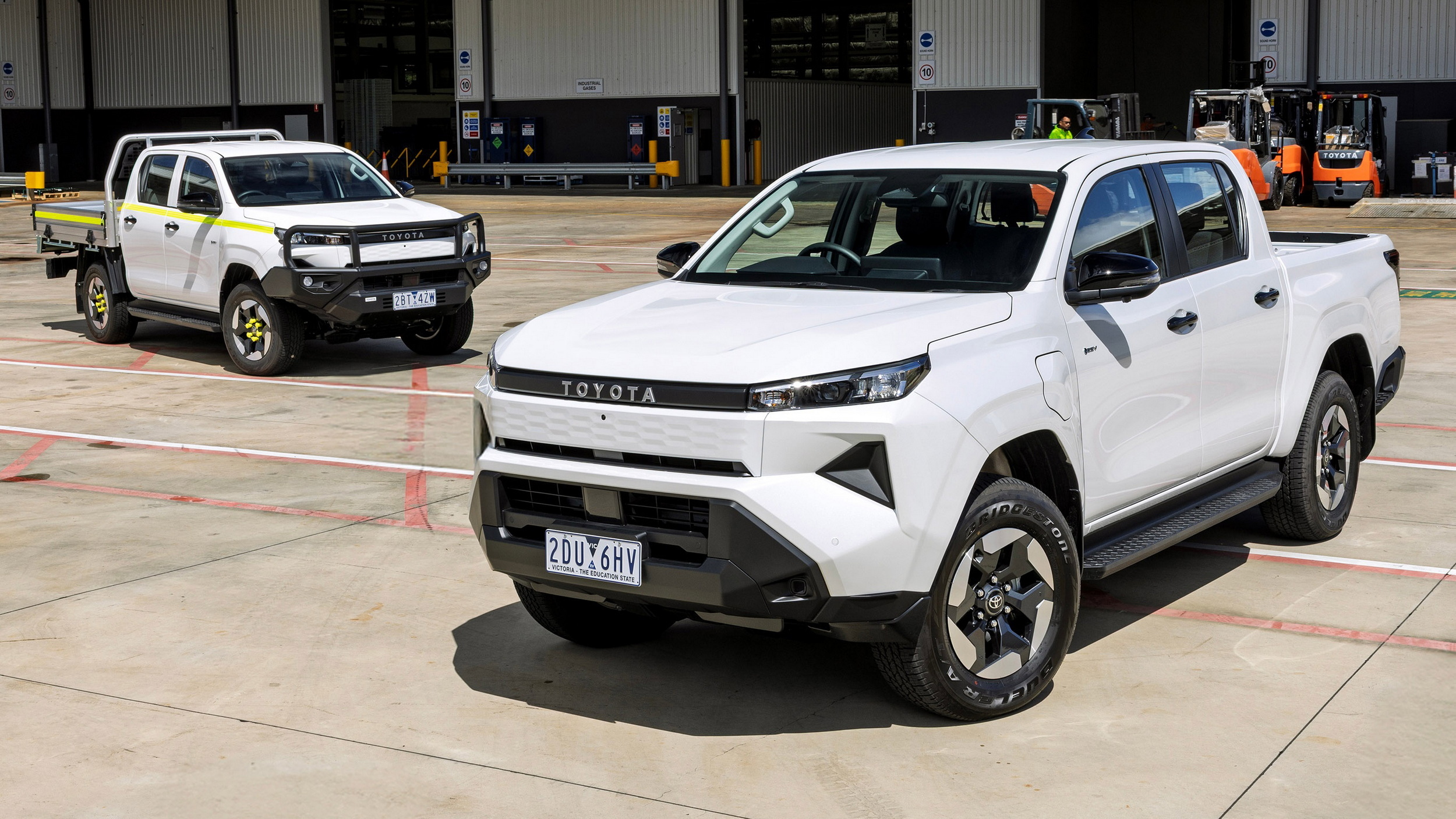
The Hilux BEV SR double-cab chassis (left) and the SR5 double-cab pickup (right).

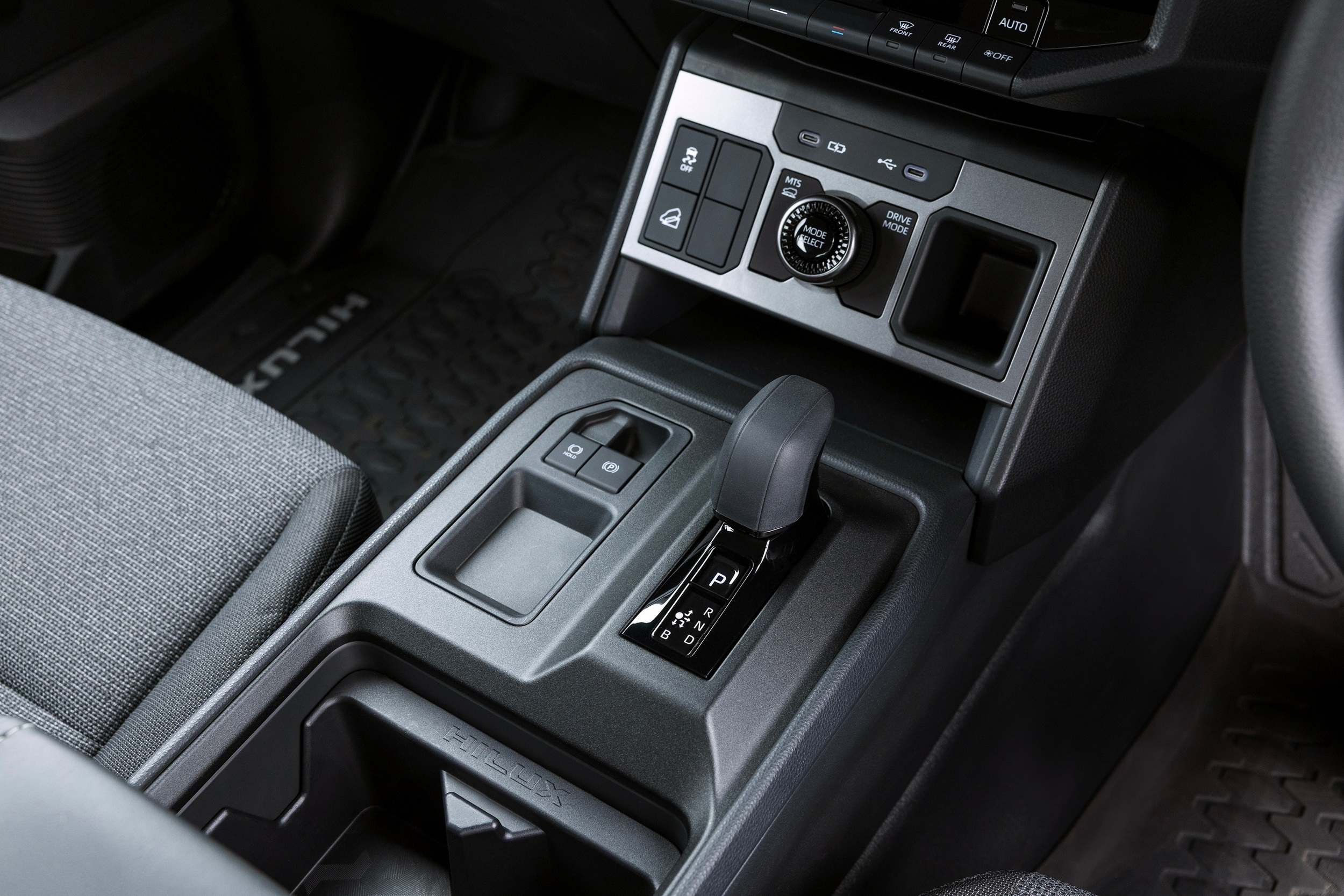
But what do you actually get for the money? The Hilux BEV runs a dual-motor setup delivering a combined 193 hp (144 kW / 196 PS) and 468 Nm (345 lb-ft) of torque. It comes with full-time AWD and six selectable drive modes via the Multi-Terrain Select system, so it’s not short on off-road intent.

More: Toyota Turns The New Hilux Into A Rugged Three-Row SUV

Power comes from a 59.2 kWh battery, good for a claimed 245–315 km (152–196 miles) of range on the NEDC cycle, depending on spec. That’s hardly ideal for long hauls across the vast Australian outback, though a 10–80% charge takes around 30 minutes. There’s also a practical touch, as a 1,500 W inverter in the center console lets it double as a mobile power source when needed.

Underneath, the ladder-frame chassis gets a bespoke De Dion rear suspension with leaf springs, plus additional reinforcements to cope with the battery weight. Towing is capped at 2,000 kg (4,409 lbs), well short of the diesel’s 3,500 kg (7,716 lbs) figure.

Design And Features

 Toyota’s Electric Hilux Costs $20K More Than The Diesel, And That’s Not Even The Worst Part

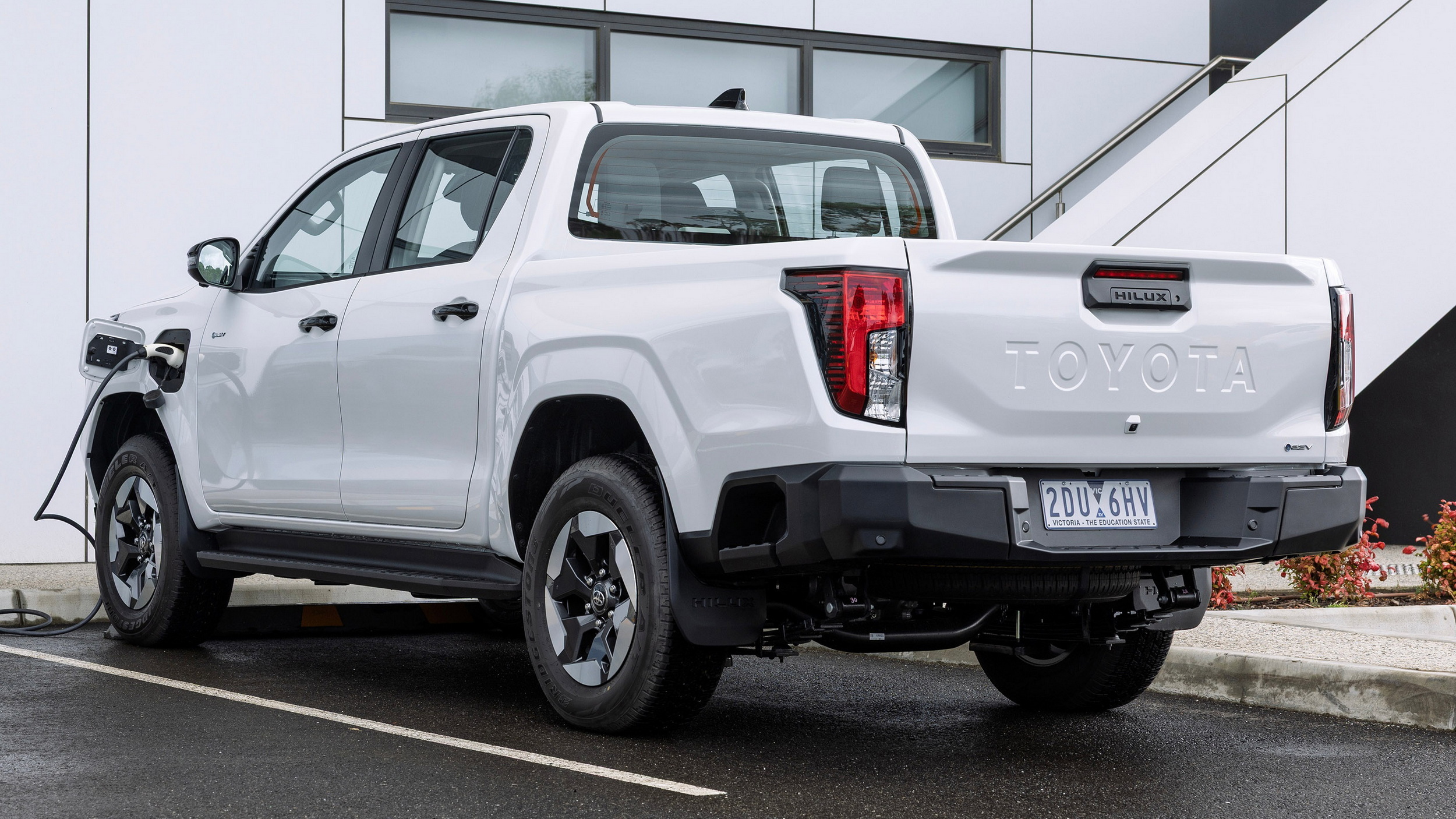
Visually, the Hilux BEV sets itself apart with a closed-off grille and a set of distinct 17-inch alloy wheels shaped for improved aerodynamics. Color choices are kept tight, as they’re limited to Glacier White, Frosted White, and Ash Slate, reinforcing its fleet-focused brief, even if private buyers are still free to place an order.

More: Toyota Says The New Hilux’s Design Is Just “Fine”

As for equipment, the SR trim comes well stocked. LED headlights, body-colored bumpers, side steps, fabric upholstery, and all-weather floor mats are all standard. So are dual-zone climate control, a pair of 12.3-inch displays with built-in navigation, eight airbags, and the full Toyota Safety Sense ADAS suite.

The SR5 adds auto-leveling headlights, LED tech for the footlights and taillights, retractable and heated mirrors, privacy glass, leather upholstery, heated seats and steering wheel, an eight-speaker audio system, a wireless charging pad and more. Thanks to the shared design, the BEV is compatible with most of the optional accessories already available for the diesel, including the pictured bull bar.

 Toyota’s Electric Hilux Costs $20K More Than The Diesel, And That’s Not Even The Worst Part

Modest Sales Target

Given its pricing and rather underwhelming driving range, Toyota keeping expectations in check with just 500 units for Australia’s first year doesn’t come as much of a shock. Most are likely headed straight for mining and construction fleets, where outright range matters less than predictable daily use. To help make that case, the company says the HiLux BEV has already been pushed through extensive testing in remote outback conditions, working closely with mining operators.

Australia won’t be the only market in play. The electric HiLux is also headed for Europe, Japan, South Africa, and several Southeast Asian countries.

For now, Thailand is the first place where buyers can actually place an order, fittingly as the truck’s production hub. There, the Hilux Travo-e starts at ฿1,491,000 ($45,300), undercutting expectations slightly but still landing ฿165,000 ($5,000) above a comparable diesel automatic Hilux Travo 4TREX.

\\\\\\\\\

Toyota Australia

Japan Just Dealt BYD A Massive EV Blow

  • Japan cut subsidies for the Chinese EV maker to just 150,000 yen.
  • New rules now favor EVs using locally produced battery packs.
  • Toyota and Nissan models still qualify for far higher incentives.

Electric vehicles make up less than 2 percent of new car sales in Japan, yet that didn’t stop Chinese EV giant BYD from unveiling an all-electric Kei car last year, aiming to make inroads into the local market. However, the company has just been dealt a serious blow.

It has been revealed that the Japanese government has slashed subsidies for BYD by more than half, reducing them to just 150,000 yen, or about $936. Previously, incentives for BYD models ranged between 350,000 yen ($2,000) and 400,000 yen ($2,500).

Read: BYD Surprises Japan With A Tiny EV Ready To Take On The Kei Giants

The reason is quite simple. Japan is revising its EV subsidy scheme to benefit vehicles that use locally manufactured battery packs. Obviously, BYD’s cars use Chinese-made batteries. Thus, it seems more like a measure to protect the Japanese car industry from the burgeoning Chinese brand, which was the world’s sixth-largest car manufacturer last year.

Japanese EVs Get A Big Boost

\\\\\

BYD Racco

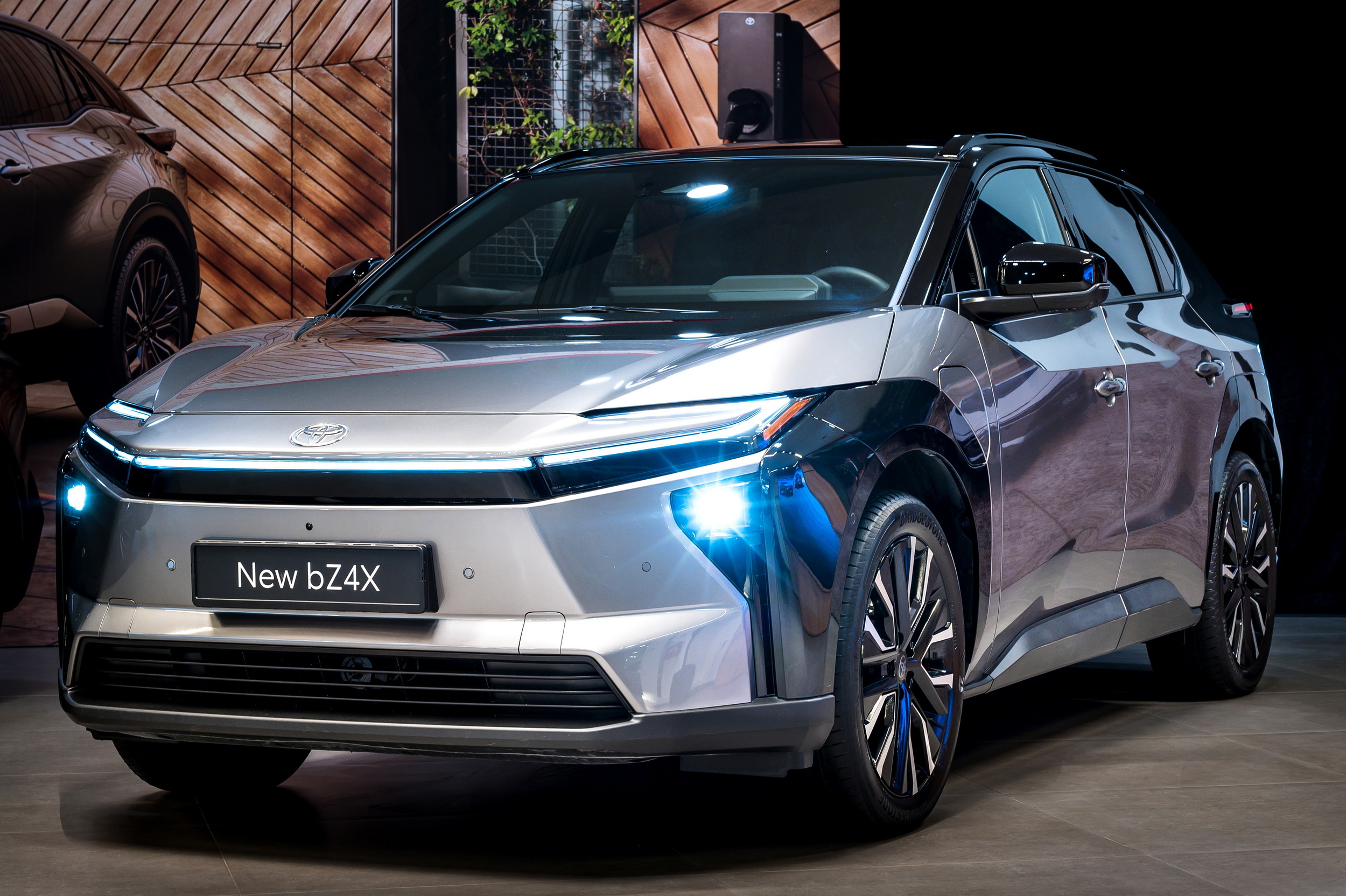
As part of a change to the subsidy program, the Toyota bZ4X will continue to be offered with the highest possible subsidy of 1.3 million yen ($8,100). The Nissan Ariya had been available with a 1.29 million yen ($8,075) subsidy, although this will be cut to 1 million yen ($6,200) in 2027.

Interestingly, it’s not just Japanese brands that get generous government assistance. Earlier this month, Tesla’s subsidies were increased by 400,000 to 1.27 million yen ($7,900), likely due to the fact that it uses Panasonic batteries. Audi also saw a recent increase of 320,000 yen ($2,000) up to just over 1 million yen ($6,200) for its EVs. Similarly, subsidies for some of Hyundai’s EVs have been boosted this month.

 Japan Just Dealt BYD A Massive EV Blow

As noted by Nikkei Asia, not all of these subsidy increases will remain in effect. From next January, subsidies for brands including Audi and Hyundai will be cut, although their extent remains unclear. Prior to the most recent round of cuts, BYD said it was already at a disadvantage.

“We’re at an overwhelming disadvantage,” the boss of its Japan unit, Atsuki Tofukuji said. “The gap [with companies like Toyota Motor] has grown to up to nearly 1 million yen. We can’t compete with 350,000 yen.”

 Japan Just Dealt BYD A Massive EV Blow

Stellantis Is Building Something The ID. Polo GTI Crowd Will Want To Know About

  • Opel confirmed the GSE will be its most powerful production Corsa to date.
  • Nürburgring testing focused on chassis tuning, steering, and ESC calibration.
  • Hatch is expected to borrow its 278-hp electric powertrain from the Mokka GSE.

Opel announced plans for a Corsa GSE earlier this year and the automaker recently took the hot hatch to the Nürburgring for testing. Unsurprisingly, the brand’s answer to the upcoming Volkswagen ID. Polo GTI was spotted not only by spy photographers, but also by the company’s own cameras.

We’ll get to the details in a moment, but Opel said testing was primarily focused on fine-tuning the chassis. They went on to say the upcoming model will “be the most powerful series Corsa ever built” and have “specific throttle, steering, and ESC tuning.”

More: New VW ID. Polo And ID. Polo GT Leaked Ahead Of Their Debut

While the company is keeping details under wraps, we can see a lightly revised front end with triangular air curtain accents. They’re joined by extended fender flares and aerodynamically optimized wheels, which are backed up by yellow brake calipers with GSE badging.

The changes largely fly under the radar, but the production model could be hiding a few tricks up its sleeve. That remains to be seen, but we can expect to learn more as we approach the car’s unveiling at the Paris Motor Show in October.

\\\\\\\

Opel

One thing that isn’t much of a mystery is the powertrain as the hatchback is expected to borrow heavily from the Mokka GSE. This means we can likely expect a 54 kWh battery that powers a front-mounted motor developing 278 hp (207 kW / 281 PS) and 254 lb-ft (345 Nm) of torque. It enables the crossover to accelerate from 0-62 mph (0-100 km/h) in 5.9 seconds, before hitting a top speed of 124 mph (200 km/h).

More: Stellantis Outguns Polo GTI With New Corsa GSE

The upgrades should extend beyond the powertrain as the Corsa GSE will likely be equipped with a limited-slip differential, unique axles, and a sport-tuned suspension with special shock absorbers.

\\\\\\\\\\\\\\\\\\\\\\\\\\\\\\\\\\\\\\\\\\\\\\\\\\\\\\\\

Baldauf

GM’s Cheapest EV Just Got Its Fifth Generation In Six Years

  • The fifth-gen Wuling Hongguang Mini EV has launched in China.
  • The EV has a 40 hp motor and offers up to 187 miles of range.
  • It brings a redesigned exterior and interior, starting at $6,200.

The Wuling Hongguang Mini EV has been around since 2020, yet it has already cycled into what’s being called its fifth generation. If that feels excessive, you’re not alone. In reality, these aren’t clean-sheet overhauls so much as heavy facelifts, which says plenty about the pace at which China’s car industry moves. Even so, racking up so many redesigns in just six years is an impressive feat.

This latest iteration leans into a redesigned exterior with a soft, almost sugar-cube look, while also stepping up inside with improved tech and a more polished cabin. Range has increased too.

Built by the SAIC-GM-Wuling partnership, the micro EV has quietly become a runaway success in China, with cumulative sales surpassing 1.9 million units by the end of 2025. This version continues to widen its appeal with a more practical five-door layout, a bodystyle first introduced late in 2024 on the outgoing model.

More: A $9,500 Hatch Stole Tesla’s Best-Seller Crown In China

Visually, the highlight is the new face with a more upright nose giving the car a friendlier, almost toy-like expression. Round LED headlights and taillights are linked by a chrome strip. The overall silhouette remains familiar, but every panel has been reworked and paired with a brighter, more playful color palette.

It’s Small, Really Small

\\\\\\\\\

The five-door Hongguang Mini measures 3,268 mm (128.7 inches) in length, just 12 mm (0.5 inch) longer than before, while keeping the same 2,190 mm (86.2 inches) wheelbase. The two-door version remains the more compact option, coming in at 3,064 mm (120.6 inches) long with a 2,010 mm (79.1 inches) wheelbase.

More: GM’s New SUV Is Bigger Than An Equinox And Starts Under $8,600

The interior looks familiar, but the dashboard has been redesigned with a larger 10.1-inch infotainment touchscreen and slimmer climate vents. Furthermore, the physical climate controls have been removed entirely, and a column-mounted gear selector opens up extra space between the front seats.

Cargo space stands at 170 liters (6 cu ft) with the seats up, expanding to 838 liters (29.6 cu ft) when the rear bench is folded. The company also claims 20 separate storage compartments throughout the cabin, which should help offset the Mini’s modest footprint in everyday use.

\\\\\\

40 HP, But Range Does The Talking

Every version sticks with a rear-mounted electric motor, delivering just 40 hp (30 kW / 41 PS) and 85 Nm (63 lb-ft) of torque, identical to the outgoing model. Performance remains modest, as expected, with top speed capped at 101 km/h (62 mph).

More: GM’s China Sales Are Down 75%, And The Clock Running Out Isn’t One It Controls

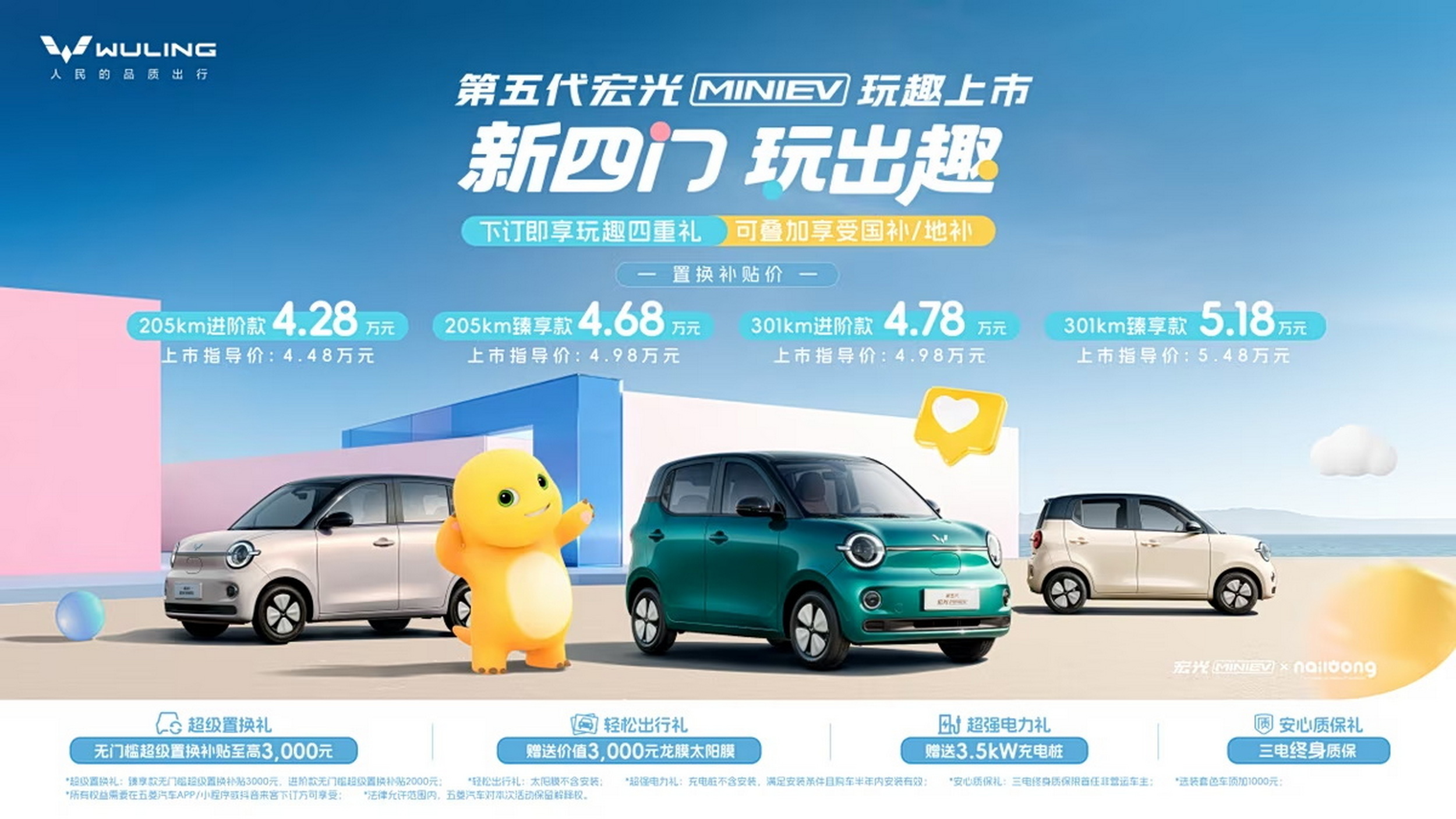
Buyers get a choice of two battery packs. The entry-level model runs a 16.2 kWh unit, good for 205 km (127 miles) of CLTC range. Step up to the 25.1 kWh battery, and that figure climbs to 301 km (187 miles). In both cases, charging from 30% to 80% takes around 35 minutes, which keeps downtime relatively short for a city-focused EV.

How Much Does It Cost?

The five-door 2026 Wuling Hongguang Mini EV is already on sale in China, with pricing starting at ¥44,800 ($6,500) and rising to ¥55,800 ($8,100) for the range-topping version with the larger battery. Factor in current trade-in subsidies, and the entry point drops slightly further to ¥42,800 ($6,200), reinforcing its position as one of the most accessible EVs on the market.

 GM’s Cheapest EV Just Got Its Fifth Generation In Six Years

Rivian Won Direct Sales In Washington With A Threat That’s Coming For Dealers Everywhere

  • Rivian wins direct sales rights in Washington after dealer resistance collapses.
  • Nearly 70 percent of buyers support skipping dealerships and buying directly.
  • Other states may follow as pressure builds against traditional franchise laws.

Rivian didn’t just win a fight in Washington this week when it was granted the right to sell cars directly to consumers. It might have started a war that will leave dealer groups across America far less powerful and profitable 10 or 15 years from now.

After years of getting blocked by dealer laws in Washington state, the EV startup pushed hard enough that the opposition simply stepped aside. The turning point came when Rivian threatened to take the issue to voters, a gamble that could have cost it up to $30 million. Faced with an expensive ballot battle, dealer groups backed off and supported a narrow law letting Rivian and Lucid – but no other brands – sell directly.

Related: More VW Dealers Sue, Say Scout Is A Shell Company Built To Cut Them Out

“The writing was on the wall,” said lawmaker Andrew Barkis to The Wall Street Journal. Once the resistance faded, the bill sailed through.

It’s a big moment in a long-running tug of war over how Americans buy cars. For decades, laws in most states have forced automakers to sell through independent dealers. That system isn’t going quietly, but Rivian just proved it can be bent, something Tesla already does, and VW is also trying to do with its new Scout brand.

Buyers Backed The Move

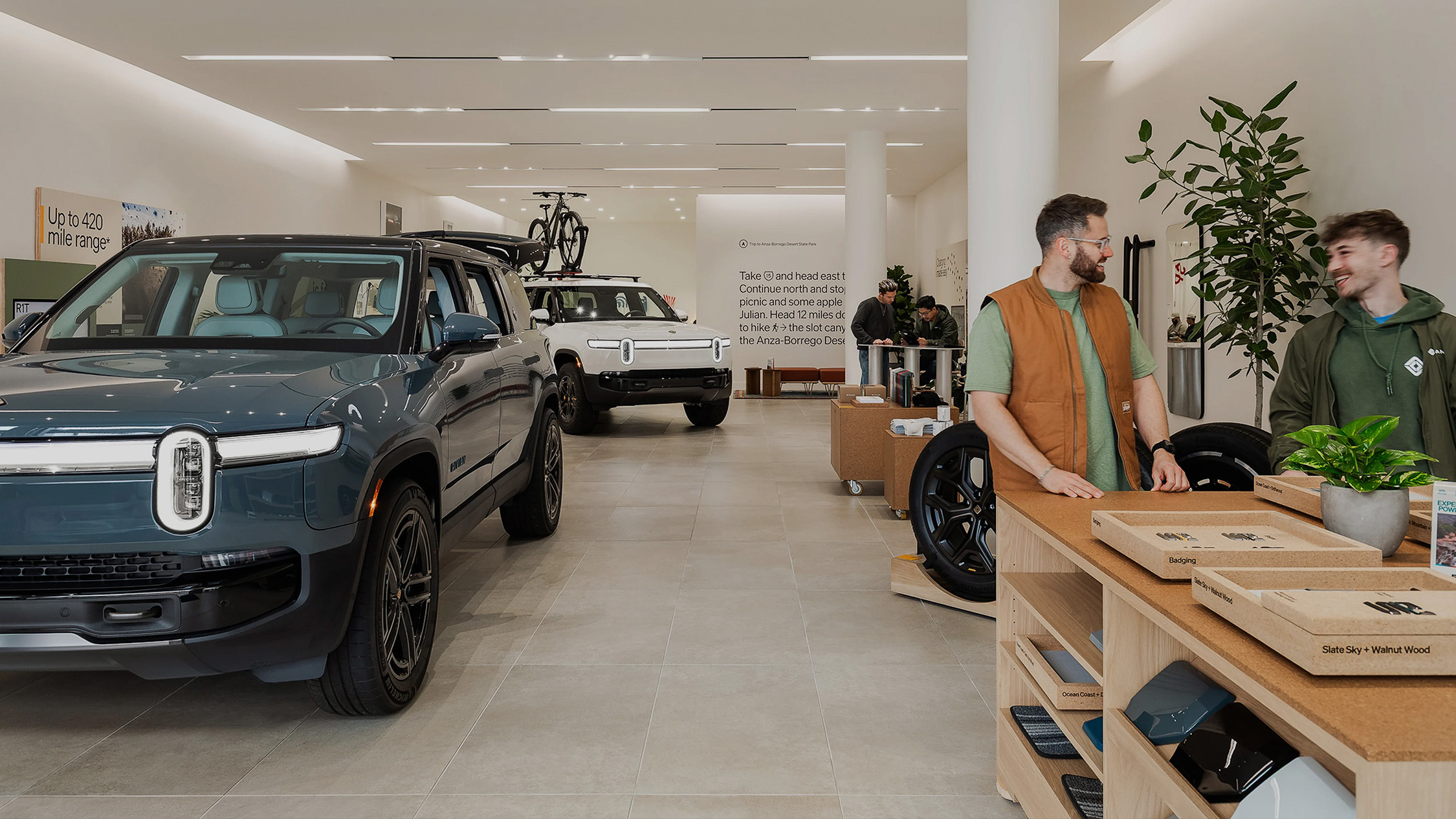
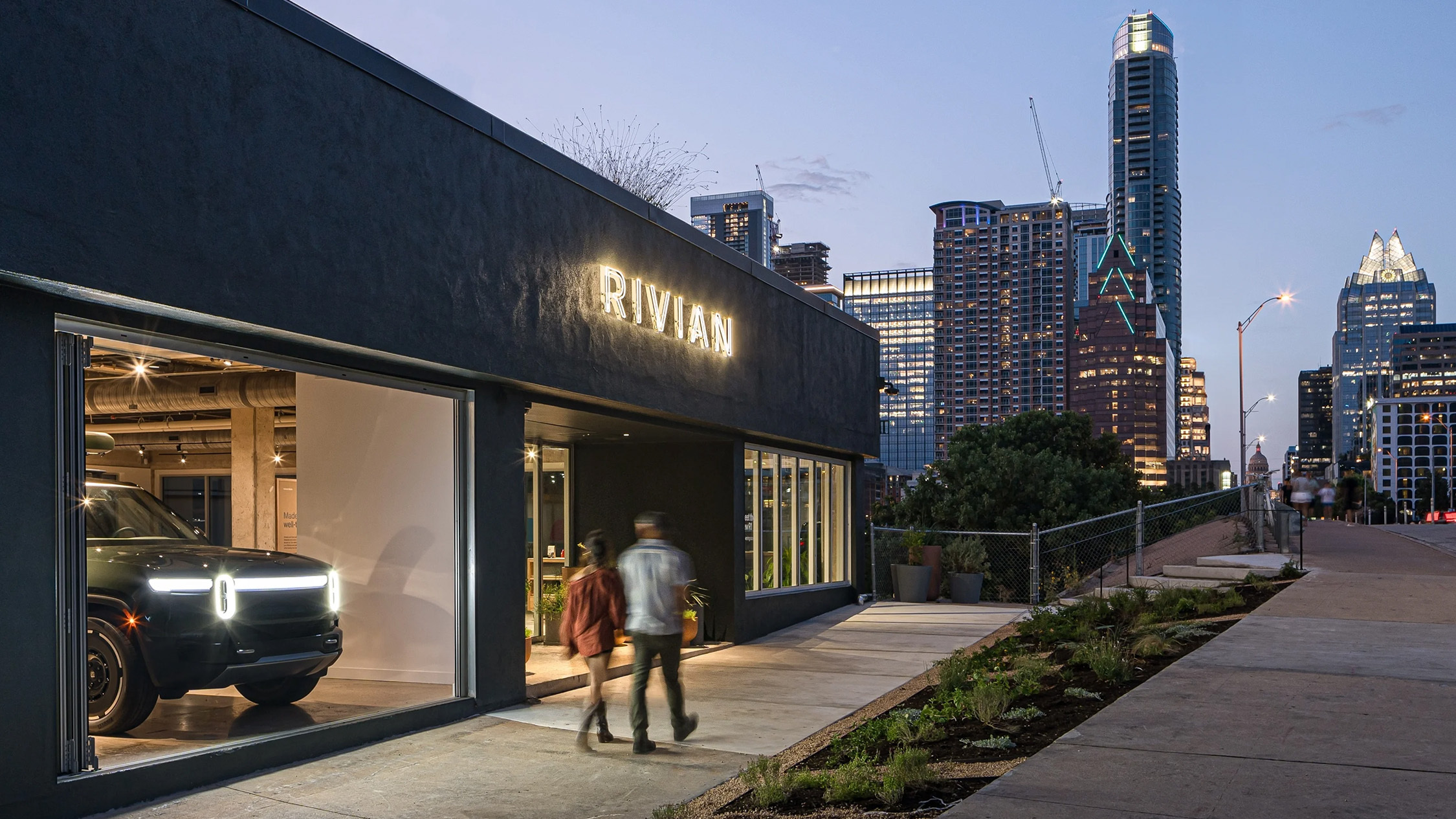
And the reason is simple. Buyers don’t love dealerships as much as the system assumes. Rivian’s own polling showed nearly 70 percent of people support direct sales in the same way that they like to get their sneakers from the Nike store or their new iPhone from an Apple outlet.

 Rivian Won Direct Sales In Washington With A Threat That’s Coming For Dealers Everywhere

Rivian CEO RJ Scaringe says selling direct means more control, better margins, and a cleaner customer experience. But not everyone’s thrilled. Traditional automakers and dealer groups argue this creates an uneven playing field. They say franchise networks keep prices competitive and provide essential services like repairs and financing.

Limited Freedom

“The franchise model continues to be the ideal system,” Vicki Giles Fabré of the Washington State Auto Dealers Association told the WSJ in a statement. Still, even dealers seem to recognize the tide is turning. The Washington compromise is tightly limited, applying only to Rivian and Lucid, but it cracks the door open.

Now Rivian is eyeing other states where voters can be brought into the fight. Places like Ohio and Oklahoma could be next, and if this strategy keeps working, the patchwork of sales laws might start to unravel.

 Rivian Won Direct Sales In Washington With A Threat That’s Coming For Dealers Everywhere

Rivian

Google Maps Now Plans EV Charging Stops Automatically, But Not For Every Car

  • Google Maps is rolling out new trip planning features for EVs.
  • Users can now see how much battery usage trips will take.
  • Drivers will also see recommended charging stops along the way.

Electric vehicle owners are in for a treat as Google Maps is bringing new trip planning features to more than 350 vehicles with Android Auto. This promises to make long-distance trips less stressful as drivers won’t have to worry about running out of juice or bouncing between multiple apps to find a charging station.

To use the new features, owners need to add their vehicle to Google Maps. This can be done by opening the app, selecting your profile, scrolling down to Settings, and tapping Your Vehicles. They can then select Electric and add their make and model of EV.

More: Google Maps Biggest Update In A Decade Looks Great And Can Even Plan Trips

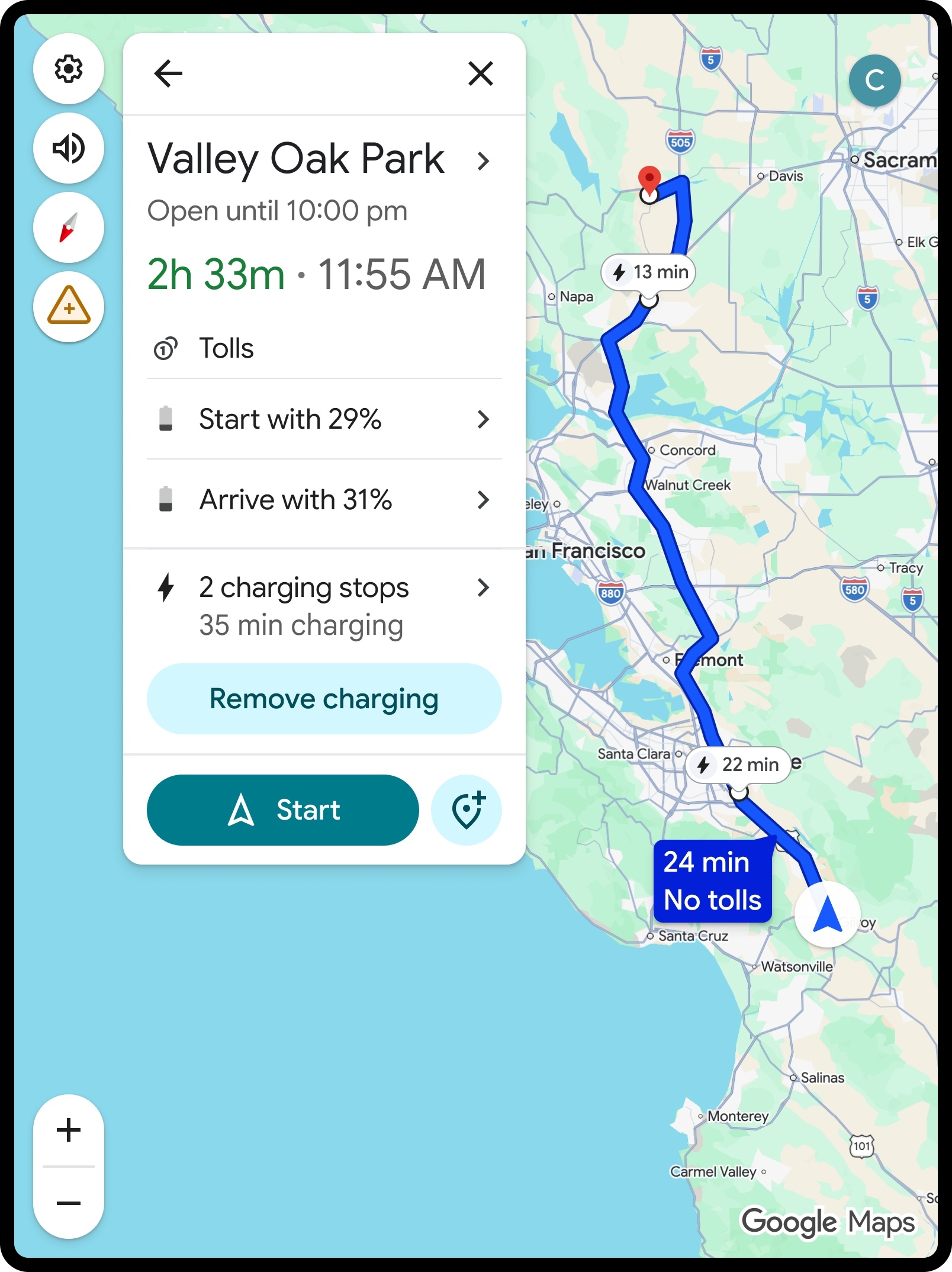
With this information in hand, Google Maps can use vehicle information to calculate several important details. For example, when you set a destination, the app will estimate battery usage for the trip.

Users can add their current battery level to unlock more features, including recommended charging stops, estimated arrival battery level, and an updated ETA based on charging time. There’s even an option that allows you to select how much battery charge you want left when you arrive at your destination, so you’re not immediately forced to recharge.

 Google Maps Now Plans EV Charging Stops Automatically, But Not For Every Car

This sounds like a pretty handy update, and the tech giant said the predictions are made possible by a combination of AI and “advanced energy models that analyze vehicle details, like weight and battery size, alongside Maps’ real-time information about traffic, road elevation, and weather.” All of this means drivers will be well-informed and won’t have to worry about planning routes or charging stops ahead of time.

The new features are rolling out today in the United States and will support 16 brands, with additional companies coming in the future. As of now, that list includes Audi, BMW, Chevrolet, Fiat, Genesis, Hyundai, Jaguar, Kia, Lexus, Lucid, Mercedes, Nissan, Porsche, Subaru, Toyota, and Volkswagen.

\\\\

BMW Gives China’s Stretched iX3 Door Handles The Rest Of The World Can’t Have

  • BMW’s iX3 LWB adds 108 mm (4.25 inches) of wheelbase for Chinese buyers.
  • China-specific software includes Huawei, Alibaba, Deepseek, and Amap navigation.
  • Longer rear doors and new semi-enclosed handles meet local safety regulations.

BMW is kicking off its Neue Klasse rollout in China with a version built specifically for the market, and the new iX3 LWB makes that clear from the outset. This all-electric SUV stretches its wheelbase to free up more rear-seat space, while also packing in tech and safety systems tuned to local expectations.

More: BMW’s Most Traditional Sedan Becomes Its Most Futuristic Yet With New i3

While the official debut of the BMW iX3 LWB is scheduled for the 2026 Beijing Auto Show in April, the company has already shared photos on its social media accounts, following the camouflaged prototypes they showed us last January.

Different Handles For Different Rules

 BMW Gives China’s Stretched iX3 Door Handles The Rest Of The World Can’t Have
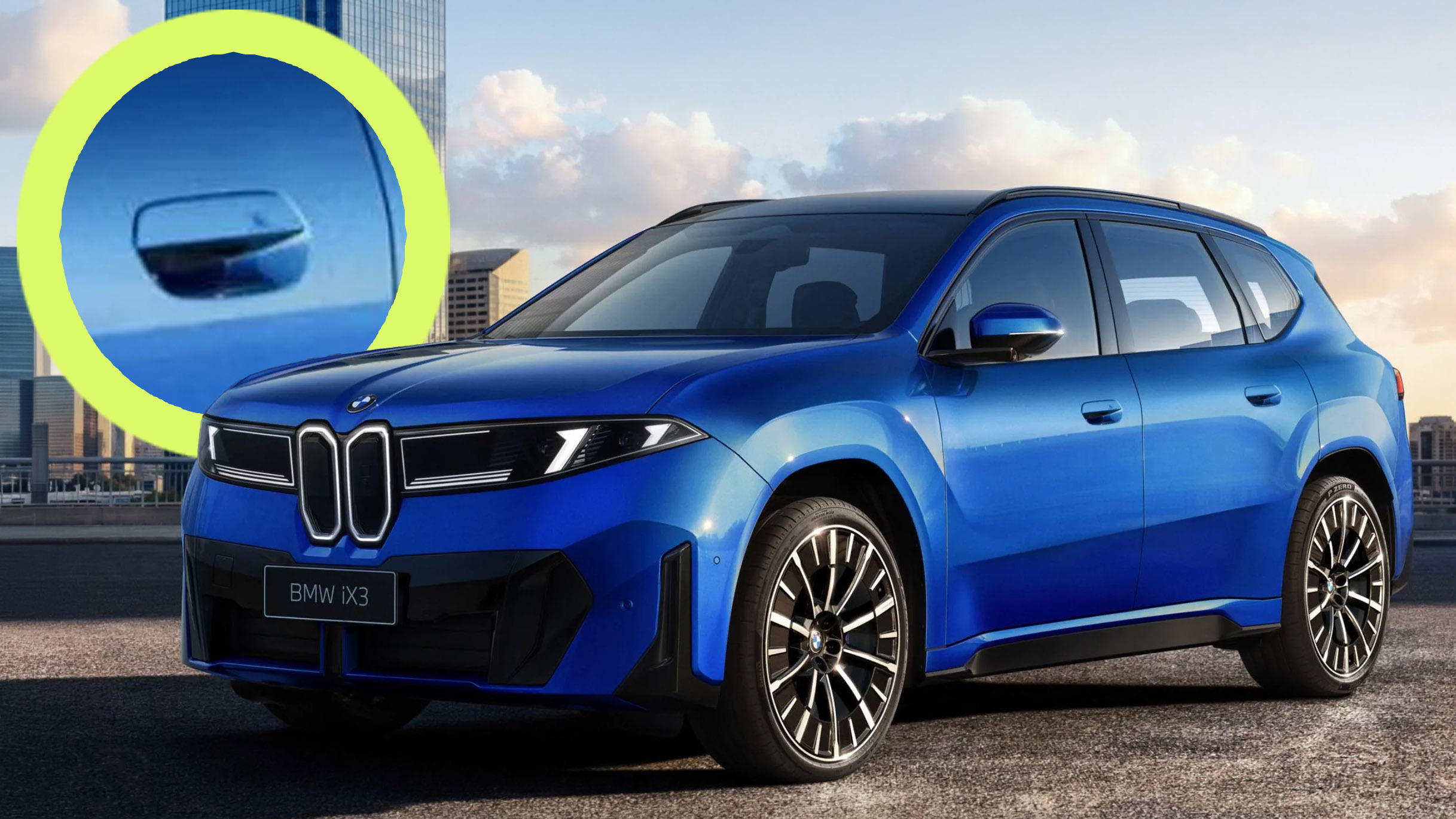
BMW’s China-market iX3 LWB gets different door handles than the global iX3 pictured below.
 BMW Gives China’s Stretched iX3 Door Handles The Rest Of The World Can’t Have

On the surface, the iX3 LWB closely mirrors the standard model, but the details start to separate it. The rear doors are slightly stretched, a result of the longer wheelbase, and the door handles now use a semi-enclosed design. That change is not just aesthetic, it aligns with Chinese regulations that restrict electronically controlled handles. It may also mark one of the first instances of a Western manufacturer developing two distinct door-handle solutions to comply with differing regional rules.

There are a couple of other small but telling tweaks. A new camera sensor sits on the roof spoiler, and the tailgate carries Chinese lettering, reinforcing that this version is very much market-specific.

\\\\\\\\\

The headline change is the extra 108 mm (4.25 inches) added to the wheelbase, bringing it to 3,005 mm (118.3 inches). That is actually 30 mm longer than the ICE-powered X3 LWB and puts it right in line with the current X5’s footprint between the axles.

More: The BMW iM3 May Have Just Shown Its Face For The First Time

Assuming the overhangs stay the same, overall length should land around 4,890 mm (192.5 inches). That places it slightly ahead of the X3 LWB, yet still just shy of an X5, which is an interesting bit of positioning.

Localized Software

Inside, BMW has yet to show the cabin, though expectations are that it will largely carry over from the standard iX3. The bigger story is software. The new BMW Operating System X is expected to integrate Huawei HarmonyOS Next, along with AI models from Alibaba and DeepSeek, plus navigation from Amap with 3D mapping.

BMW is also rolling out a “China-exclusive all-scenario driver assistance system” developed in collaboration with Momenta. This promises to be “deeply customized for Chinese users” providing sophisticated ADAS for China’s “complex urban environments, highways, and long-distance travel”.

Finally, BMW engineers have tweaked the chassis, electronics, and suspension of the Neue Klasse architecture for the Chinese market, targeting “an elegant balance of comfort and stability in diverse driving scenarios.”

Same Power, Big Numbers

\\\\\\\\\

As for the powertrain, the iX3 50L xDrive mirrors its standard iX3 counterpart. It runs a dual-motor setup producing a combined 463 hp (345 kW / 469 PS) and 645 Nm (476 lb-ft) of torque, paired with a 108.7 kWh battery pack. That battery is rated for more than 900 km (559 miles) of range on the CLTC cycle and supports DC fast charging at up to 400 kW.

Built In China, For China

This version of the iX3 will be exclusive to China, built locally through the BMW Brilliance partnership at its Shenyang plant. Pricing remains under wraps for now, though that will come into focus closer to launch.

More: BMW Focuses On SUVs And Sedans, But China Might Want This Instead

Josef Borrell, CEO of BMW Brilliance, framed it as more than just another variant, positioning the long-wheelbase iX3 as a key step in blending BMW’s global tech with locally developed innovation.

“The new generation BMW iX3 long wheelbase represents a significant milestone for us in integrating innovation, driving pleasure, and digital intelligence for the Chinese market,” he said. “The new generation of technologies driven by our Chinese R&D team is gradually becoming an important part of BMW’s global technology landscape and brand DNA.”

 BMW Gives China’s Stretched iX3 Door Handles The Rest Of The World Can’t Have

❌
❌