Tony and Ryan discuss takeaways from the ACT EXPO this past week in Las Vegas, which took a deep dive into clean fuel choices, autonomous vehicles, robotics in manufacturing, electrification interest and more.
Director of Transportation Anthony Jackson joins us to discuss the operational, cost and health benefits of propane usage at Bibb County School District in Georgia.
ELK GROVE VILLAGE, Ill.- Durham School Services, a premier student transportation provider, has been selected by the Community Consolidated School District 59 (CCSD59) as their new student transportation partner. Durham will begin serving the school district this summer through July 2029.
This latest joining of hands between Durham and CCSD59 comes off the heels of another recent partnership announcement made earlier this year with Glenbard Township High School District 87 – further marking significant advancement in Durham’s presence in Illinois. With the addition of CCSD59, Durham now proudly supports over 422 schools throughout Illinois.
Durham will run a total of 74 routes for the school district, which will include regular, special education, and summer routes with its fleet of 86 buses
Each bus will be outfitted with industry leading operational and safety technology such as Seon video surveillance cameras to boost safety monitoring of students, Zonar’s fleet management platform for real-time GPS tracking and pre and post trip safety inspections, Samsara’s AI enabled dash cameras to improve driver responsiveness and safety along each route, and BusZone bus tracking app to give parents and guardians full visibility into their student’s bus location, route changes, and arrival time.
“CCSD59 is excited to partner with Durham School Services. The safety of our students remains our top priority, and we are confident Durham shares this commitment to student well-being and care. We look forward to working together to provide safe, reliable, and on-time transportation service for our students and families, supported by clear and consistent communication,” said Dr. Brett Gallini, Superintendent of Schools, CCSD59. “Work is already underway to ensure a smooth and successful start to the new school year. We appreciate Durham’s proactive approach to staffing, including the hiring of current transportation employees, which will help support a seamless transition for our community. We are confident in this partnership and the positive impact it will have on our students and families.”
“Another incredible job by our team in successfully forging this new relationship with CCSD59 and proving our Company’s position once again as the premier student transportation leader that school districts choose to trust and rely on,” said Tim Wertner, CEO, Durham School Services. “Safety is a value embedded into every aspect of our Company’s operations and decision-making, just as it is for CCSD59. We understand the careful, thorough consideration and thought process that goes into choosing the right transportation provider who will unequivocally put safety and reliability first and are honored that CCSD59 has chosen our team to carry out such an important responsibility. Our team is confident in living up to and exceeding the district’s expectations in delivering both a successful start-up and school year. We look forward to serving CCSD59 students and the community with the utmost care, commitment to safety, and dependability they can count on each and every day.”
For those interested in becoming a local community hero by supporting their community and students, we encourage you to consider joining the Durham team and stopping by our upcoming hiring event, which will take place on Friday, May 15, 2026, from 8:30am – 2:30pm at 1000 Wellington Ave, Elk Grove Village, IL 60007. We offer paid CDL training, a sign-on bonus, ride-along program, health and dental insurance, and more. You can also learn more about other available opportunities on our careers page.
About Durham School Services
As a premier transportation provider, Durham School Services provides safe, reliable student transportation that communities trust and families depend on, backed by our operational discipline, local commitment, proven safety standards, and clear accountability. Our teams bring deep expertise and shared accountability to every route we operate. Driven by our five values: Safety, Care, Transparency, Communities, and Culture, we deliver transportation that works quietly, consistently, and without disruption.
The STN EXPO West conference is not only an educational experience, but the six-day conference features a variety of networking events that facilitate conversations and connections impacting the industry.
The conference opens Thursday, July 9 with a kickoff reception at the Peppermill Resort in Reno, Nevada. EverDriven will co-sponsor the event with School Transportation News as attendees enjoy appetizers and beverages. This event allows attendees to begin networking and set the stage for an impactful experience over the course of the week.
Saturday night features the Welcome Party at EDGE Nightclub, a dynamic and exciting evening. Geotab and Transfinder will be sponsoring a “Great Gatsby” themed event with food, drinks and live entertainment. Attendees can mingle with outdoor fireside discussions or enjoy signature beverages in an environment that sets the energy for an impactful conference.
The unique networking experiences continue Sunday night with the Ride and Drive/Live Technology Demonstration. The evening event blends summertime themes with an ideal setting for student transportation professionals to test the latest electric, propane and low-emission school bus models as well as connect with vendors showcasing technology solutions. Our title sponsor for the Ride and Drive the Bus Technology Summit and Green Bus Summit event is RIDE. A full sponsor list can be found on the conference website.
Day 1 of the Wonderland of Ideas Trade Show begins Monday, July 13 with the Trade Show Ribbon Cutting Ceremony, sponsored by Safety Vision. Attendees will be ushered onto a uniquely enchanting trade show floor providing the perfect atmosphere to unwind, network, and foster meaningful relationships with peers and industry contacts.
On Day 2, the conversations continue with a three-hour Trade Show event that will allow attendees to meet manufacturers, OEMs and suppliers with the products and technology options that can improve efficiency and safety at transportation operations. Lunch will be served on the trade show floor. Find the full list of exhibitors.
If you are looking to take your student transportation operations and professional development to the next level, you will not want to miss STN EXPO West.
The Early Bird Deadline ends on June 5, register now to save $100 on main conference registration. STN EXPO West will be held July 9-15 at the Peppermill Resort in Reno, Nevada. The conference will feature hands-on training classes, educational sessions, a dynamic keynote presentation and networking opportunities. Register now at stnexpo.com/west.
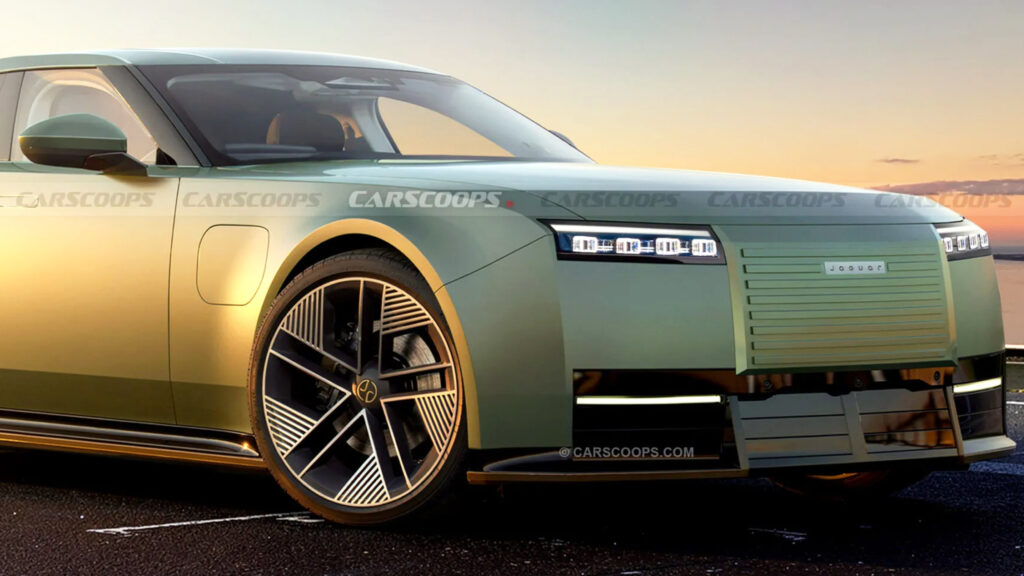
The Jaguar Type 01 will be underpinned by the company’s new EV platform.
Power is expected to come from a 120 kWh battery and three electric motors.
Jaguar will lift the veil on the all-new Type 01 in September before starting sales.
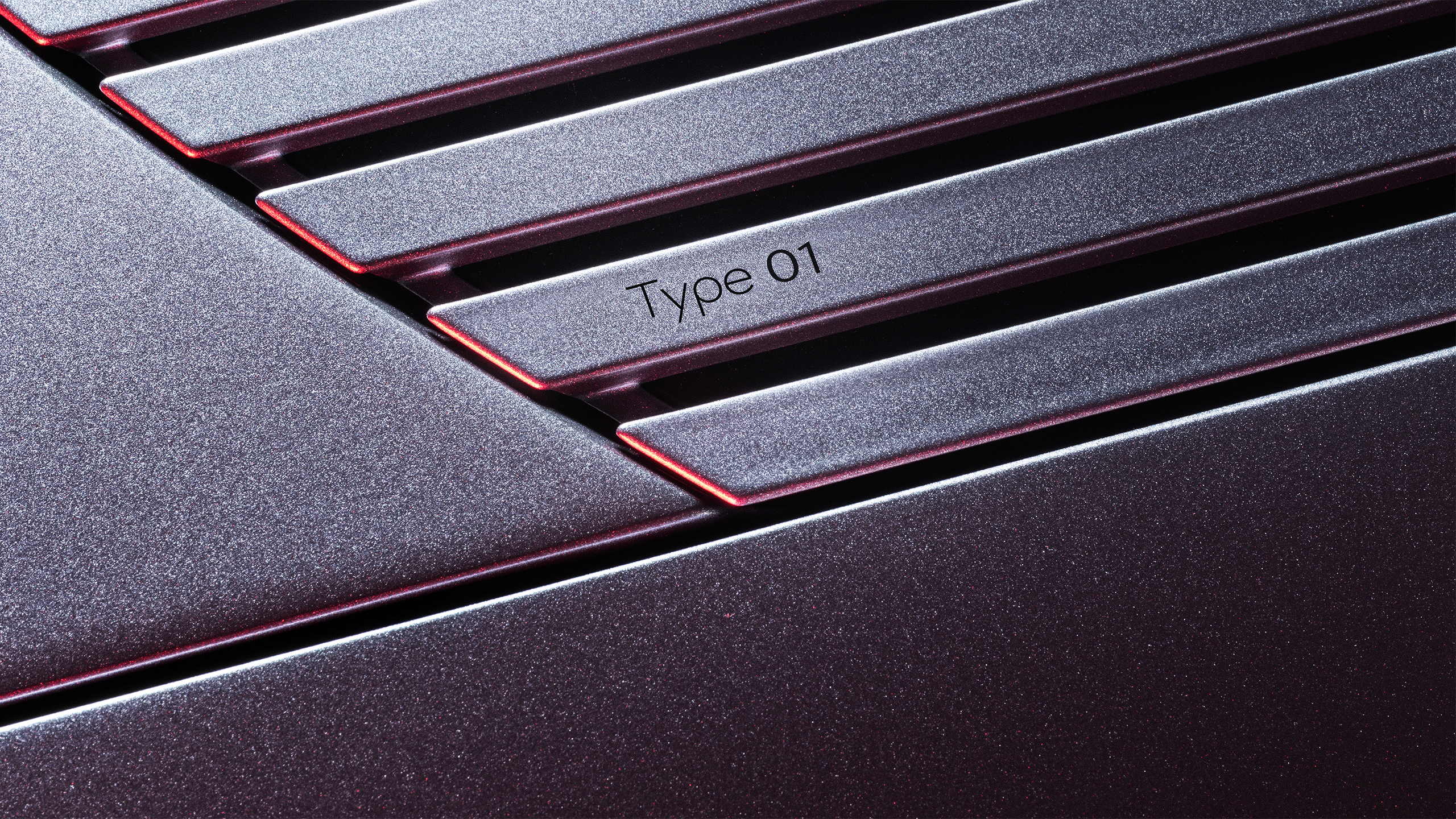
Jaguar’s all-electric sedan finally has a name, and it’s just a single digit away from the concept unveiled in 2024. Badged the Jaguar Type 01, the British company says the name “inaugurates a new era,” and joins an exclusive list of Jaguar models to use the ‘Type’ nameplate, including the D-Type, E-Type, and F-Type.
The Type 01 branding will be subtle, consisting of a motif at the base of the windshield. Jaguar says the ‘0’ refers to the vehicle’s electric powertrain and zero tailpipe emissions, while the ‘1’ signifies its status as the first Jaguar from its new, all-electric era. It’s certainly not the most evocative name, but it does roll off the tongue nicer than the Type 00 concept.
While the name of this new model is somewhat important, it will have very little impact on whether the electric sedan proves to be a success. While the covers have yet to be lifted on the vehicle’s completed design, spy shots have shown it will look very similar to the concept, although it has sprouted an extra pair of doors. It will stand out on the road, but the design will be controversial.
Three Motors And Over 1,000 HP
The powertrain will also be crucially important. We know the car will use Jaguar’s new dedicated EV platform, known as the Jaguar Electric Architecture, which includes an electric motor driving the front wheels, and two motors at the rear. All up, the car will deliver over 1,000 hp and around 959 lb-ft (1,300 Nm) of torque.
The EV’s battery pack will be around 120 kWh, although it’s not yet known where it will be sourced from. Jaguar’s last electric model, the I-Pace, won several awards when it was unveiled, but has been recalled numerous times due to dodgy battery packs from LG. Jaguar can’t afford to repeat these missteps.
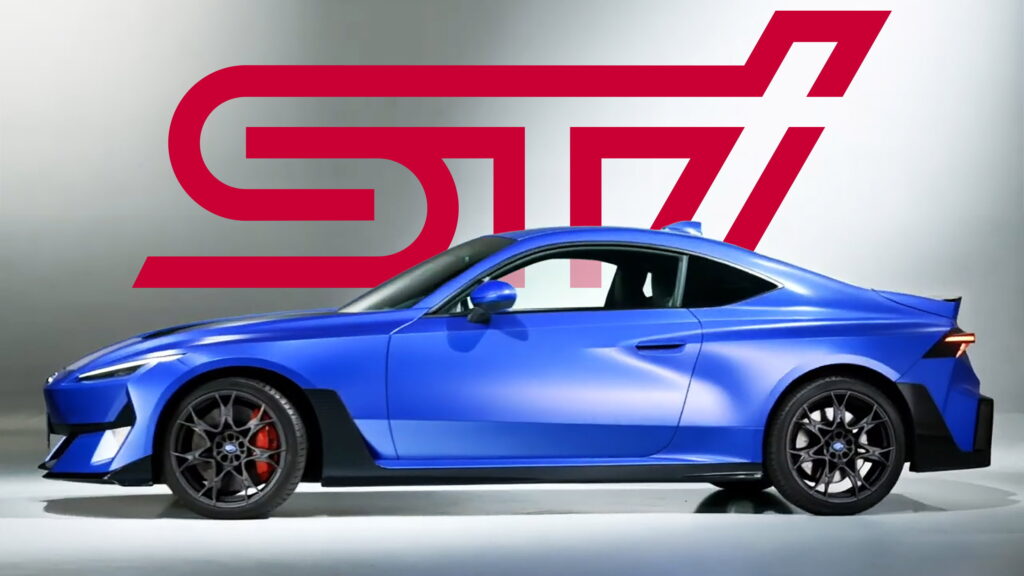
Subaru might be working on a new sports car with an STI version.
Recent ACX and ACX STI trademark filings point to an EV.
A combustion sports car could be based on the Toyota GR Celica.
The rumor mill around Subaru’s performance division has been working overtime lately. Fans of Subaru Tecnica International have spent months chasing reports of a returning WRX STI hot hatch, but the company may also be working on a new sports coupe with a proper STI variant attached.
The Trademarks
According to CarSales, Subaru has trademarked the ACX and ACX STI nameplates with IP Australia, a callback to the ACX-II concept car from 1985. The Australian outlet leans toward a gasoline-powered application, pointing to separate “Flat Shift” and “Rev Sync” filings as supporting evidence. However, trademarks lodged elsewhere in the world tell a different story.
The ACX, VPX, and ZPX names have already been trademarked in the US, Canada, and the UK alongside their respective STI variants. Each of those filings carries a specific description: “Automobiles and structural parts therefore electric cars.” That wording leaves little to the imagination.
Of the three new names, only VPX has been paired with a Wilderness designation, which points toward something taller and more utilitarian, whether a truck, a crossover, or an SUV. ACX and ZPX arrive without that context, leaving only earlier rumors and reports to go on. One plausible home for either name is the long-rumored successor to the BRZ.
Independent digital artist Theophilus Chin has imagined that successor as a fully electric sports car, pulling design language from the Performance-E STI Concept into a modernized two-door silhouette that still reads as a BRZ.
What About ICE?
Illustrations Theottle
The ACX paperwork tilts heavily toward a zero-emission powertrain, but the ongoing Subaru-Toyota partnership leaves room for a combustion sports car to exist alongside it.
Subaru recently launched a widebody BRZ-based rally car running a turbocharged engine and all-wheel drive, built to compete in the JRC. Toyota, meanwhile, is testing a still-unidentified WRC contender with a two-door coupe profile, widely believed to be the competition version of the upcoming GR Celica.
Subaru Boxer Rally Spec.Z
The two rally cars share nothing mechanically, but there is still a path for Subaru to field a sibling to the production Toyota GR Celica when that car arrives. Whether Toyota commits to a front-engined or mid-engined layout for the road car is still unresolved.
Toyota has confirmed a next-generation GR 86 is coming, but the Subaru side of that partnership may diverge, with the next BRZ potentially going fully electric and adopting the elevated stance previewed by the Sport Mobility Concept.
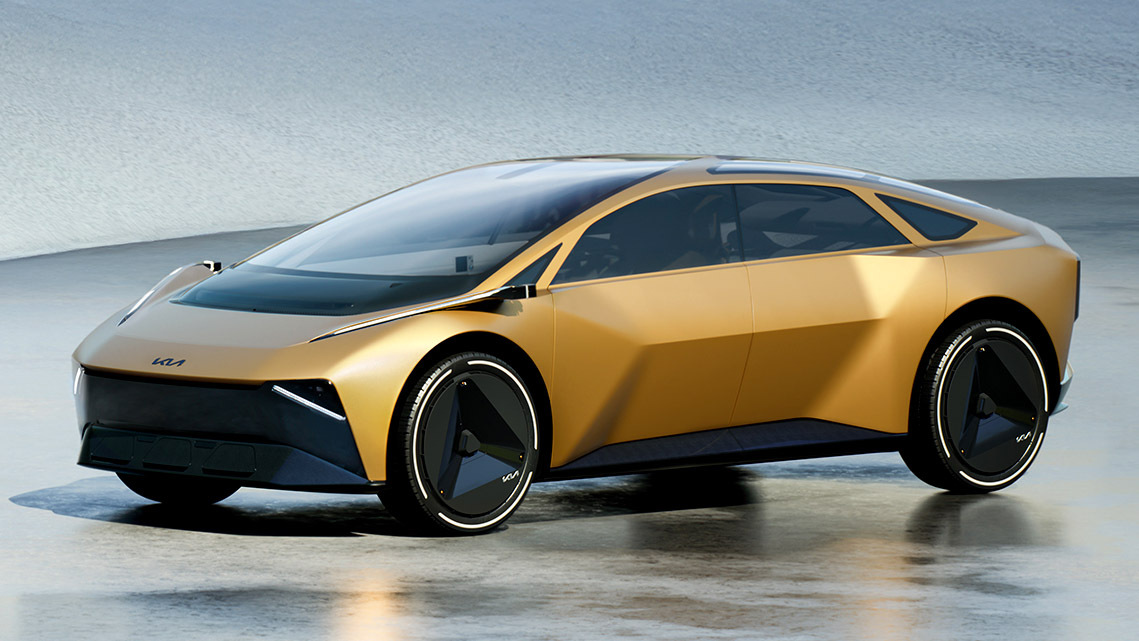
A new Stinger is in Kia’s plans, just not for the immediate future.
The Meta Turismo concept is the blueprint, and it runs on batteries.
Design boss Karim Habib blames performance EV pricing for the delay.
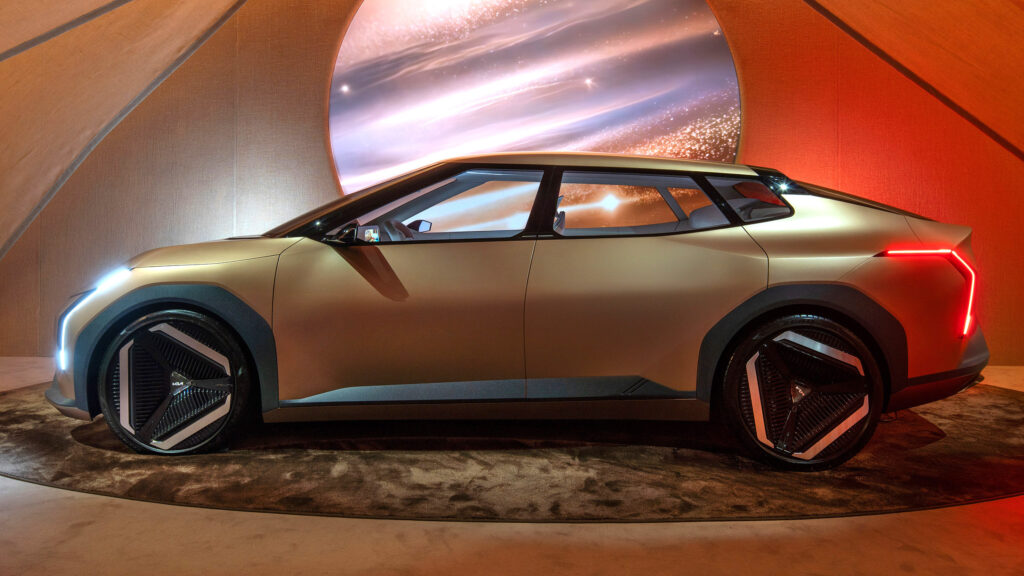
The Stinger never sold in the numbers Kia had hoped for, but it built something more valuable than volume: a small, loyal audience that still wants the brand to try again. The company is keen to make another sports sedan in the vein of the Stinger, only this one will run on electrons and could trace its bones to the recent Vision Meta Turismo concept.
The EV6 GT was supposed to fill the void. It hasn’t. The crossover stance and electric powertrain never landed with the enthusiast crowd the Stinger had cultivated, and the price walked well past where the Stinger ever lived. Design boss Karim Habib is betting that performance EVs will eventually get cheap enough to make the Meta Turismo a production reality and a real Stinger replacement.
“We have a small history of doing cars like the Stinger, and that’s something we don’t want to give up on,” Habib told Autocar. “The Meta Turismo is our idea of a sports sedan for the gamer generation. A few years ago, we started thinking about what could we do beyond SUVs? We do produce and sell a lot of SUVs, which is good, but we also believe that there’s more than that.”
Kia revealed the striking concept late last year as the latest evolution of its Opposites United design language. Like every recent Kia show car, it’s dramatic and has a design that the company says is supposed to be emotionally engaging. But it’s not yet ready for prime time.
“At this point, it is more strategic,” Karim said when asked by Autocar why Kia doesn’t start building it today. “It’s a pure EV, and the price of doing a high-performance EV is what is slowing us down. Hopefully, the upward movement of EVs keeps going. I think there will be more openness to this [type of] car. At least that’s what we’re betting on.”
Kia built the Stinger for just five and a half years before killing it off in 2023. It launched with a 2.0-liter turbo four and a 3.3-liter twin-turbo V6, picked up a 2.5-liter four at the facelift, and was briefly offered with a 2.2-liter turbo-diesel in some markets. While enthusiasts like ourselves would like Kia to capture some of the ICE magic in a successor, this doesn’t appear likely.
“We’re car people,” Kia head of interior design Jochen Paesen said. “We grew up on the side of a race track hearing V8s, but those are not the things that the younger generation care as much about. It actually doesn’t trigger them. It triggered us, but we’re living in a different age, so understanding what triggers the younger generation and gets them emotionally tied in and emotionally interested, that’s important.”
AMG has given us our first taste of the GT 4-Door Coupe’s electric powertrain in action.
In-car video footage reveals a synthesized V8 soundtrack as it runs through fake gears.
The new Porsche Taycan rival uses lightweight axial flux motors from Benz-owned Yasa.
Mercedes-AMG has already shown us the inside of the upcoming 4-Door Coupe, but this week, we got a much better idea of what it’ll be like to really get behind the wheel. Why? Because today we heard the EV powertrain do its best V8 impression, fake gears and all.
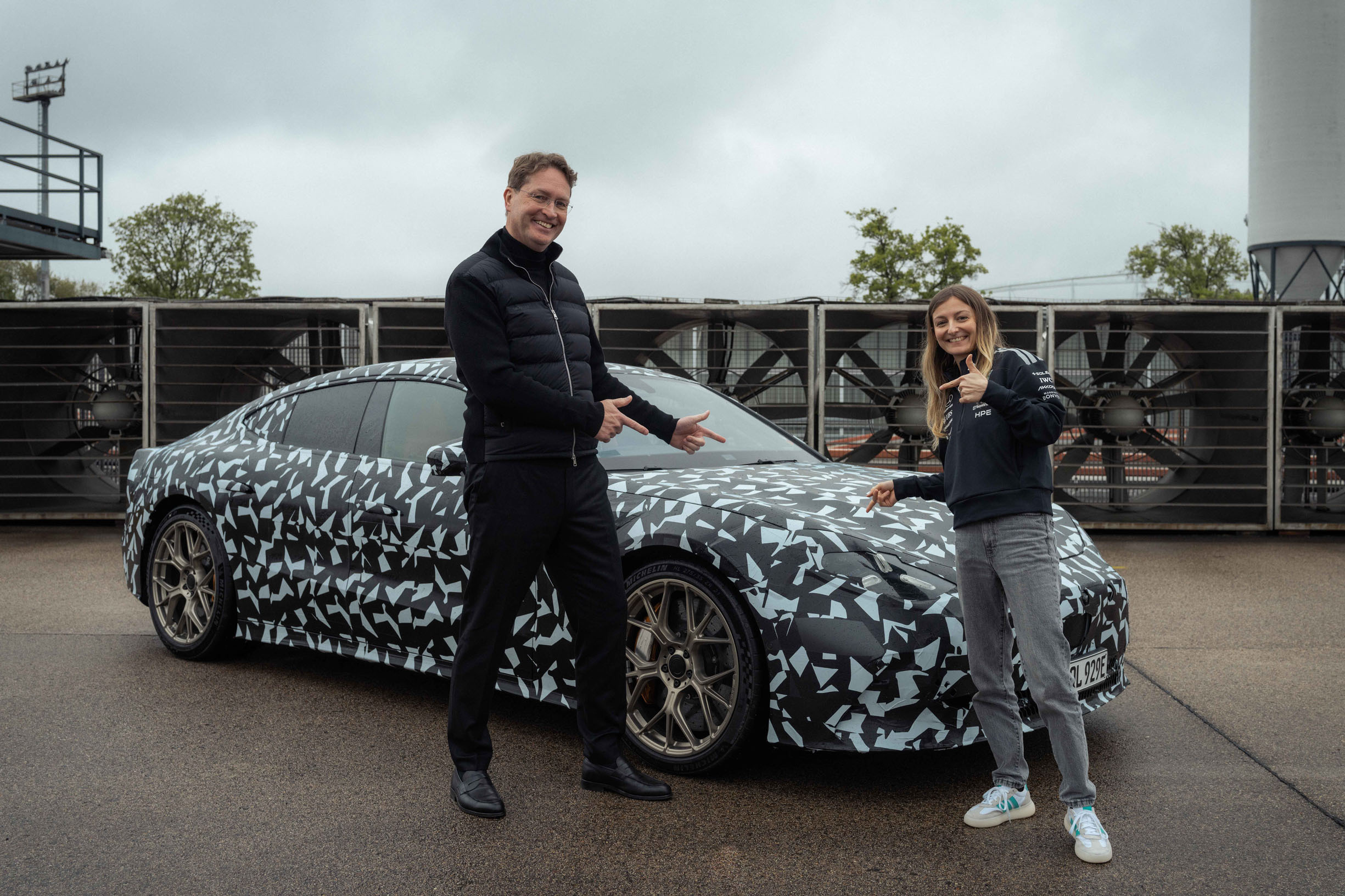
The reveal takes place inside one of those cheesy promo videos Mercedes trots out every time it’s about ready to debut a new car. CEO Ola Källenius goes for a spin in a camouflaged prototype, and together with a co-host runs through some supposed “challenges” that don’t really prove anything at all.
But there’s usually something interesting hidden in the fluff, and this GT video is no different. Most importantly, we get to hear the synthesized V8 noises the car makes when Mercedes-AMG F1 development driver Doriane Pin engages Sport+ mode and guns the four-door coupe hard from a dead stop.
Obviously, it’s hard to know from just watching a video how realistic those noises sound when you’re in the car, but they sound pretty good from here. Better than a Dodge Charger Daytona, that’s for sure.
Transmission Tips From Ioniq 5 N
And because AMG has worked in some fake shift points, we get to hear it barrp, barrp, barrp its way up to a pretend redline as it runs through some imaginary gears, just like a real combustion-powered GT 4 would. Skip to 4:30 on the video to jump straight to the key moment.
You might reasonably argue that if you want an AMG that sounds like a V8 so bad, then you should just get one, but that’s ignoring the fact that there are some massive tax advantages in some countries for going the EV route. And if you have to have an EV, you might as well have one with a sense of fun.
Slimline Motors
Besides, this new GT is much smarter than your average EV because it’s fitted with incredibly light axial flux motors from Yasa, the company that supplies electrical tech to the Mercedes-AMG Petronas F1 team, and which Mercedes bought in 2021.
We don’t yet know exactly what kind of power the GT’s tri-motor setup produces, but the GT XX concept that previewed it made 1,341 hp (1,000 kW / 1,360 PS). Porsche’s top Taycan is already pushing out 1,034 hp (1,048 PS / 770 kW), and Xiaomi’s SU7 Ultra generates 1,526 hp (1,548 PS / 1,138 kW), so the AMG is going to need to summon as many horses as it can when it debuts, probably this summer.
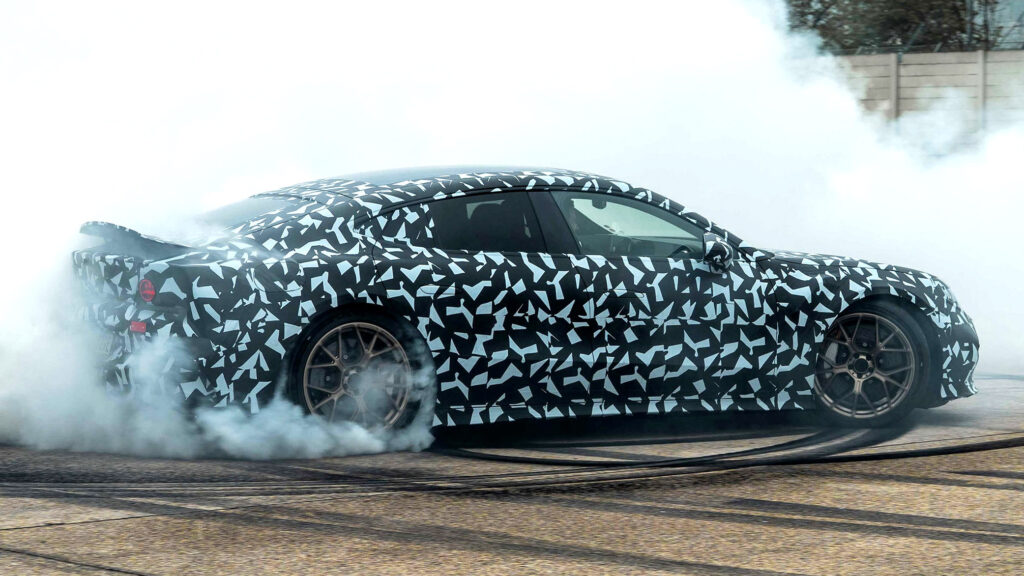
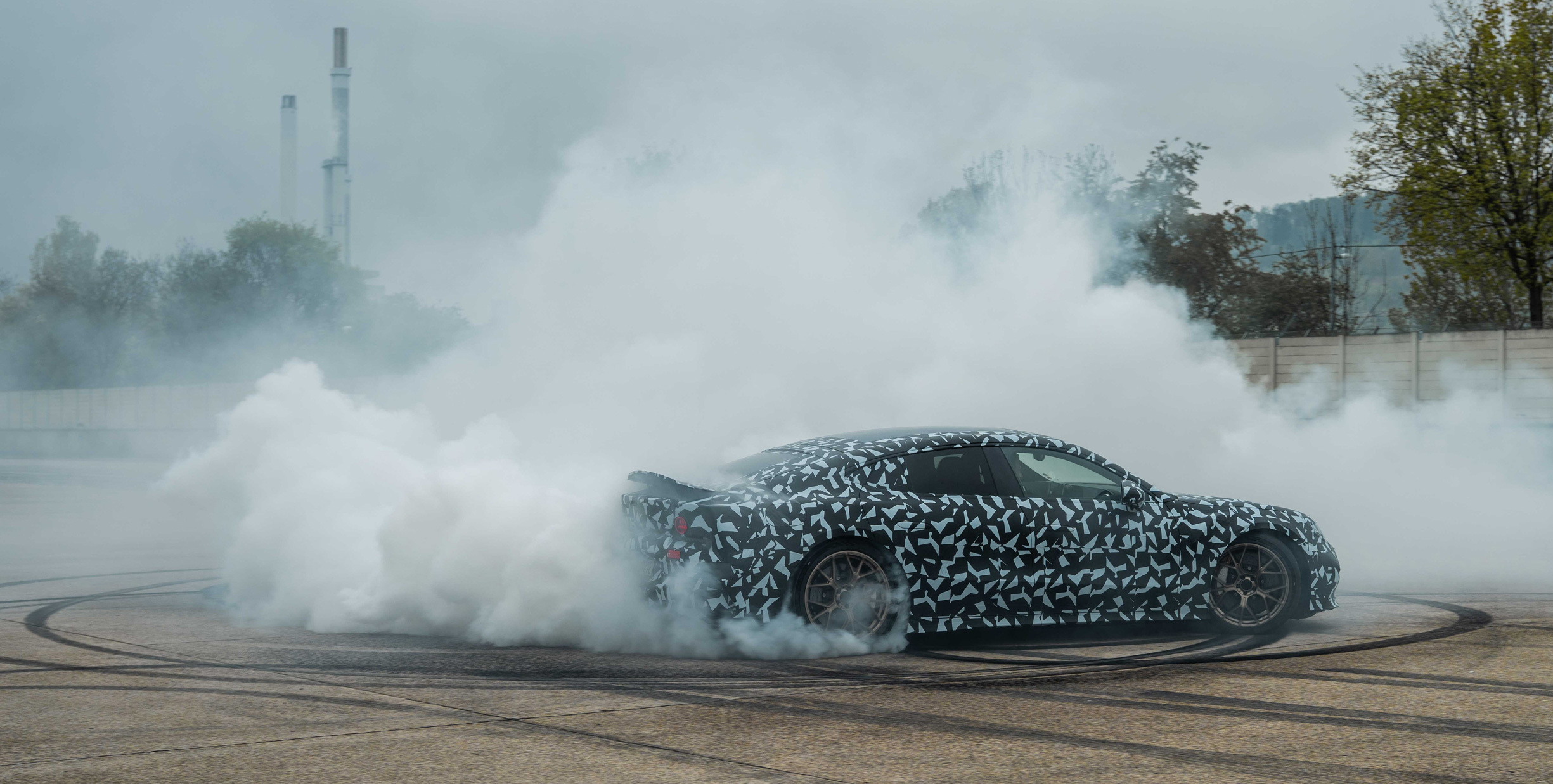
The video also shows the GT pulling off some donuts, proving that the first car to use the AMG.EA electric platform can send its power exclusively to the rear tires if the driver wants, much like a V8 GT.
The R4 JP4x4 Concept is inspired by beach buggies of the ’70s.
It gets a custom body, a lifted stance, and dual electric motors.
Renault has confirmed there are no plans for production.
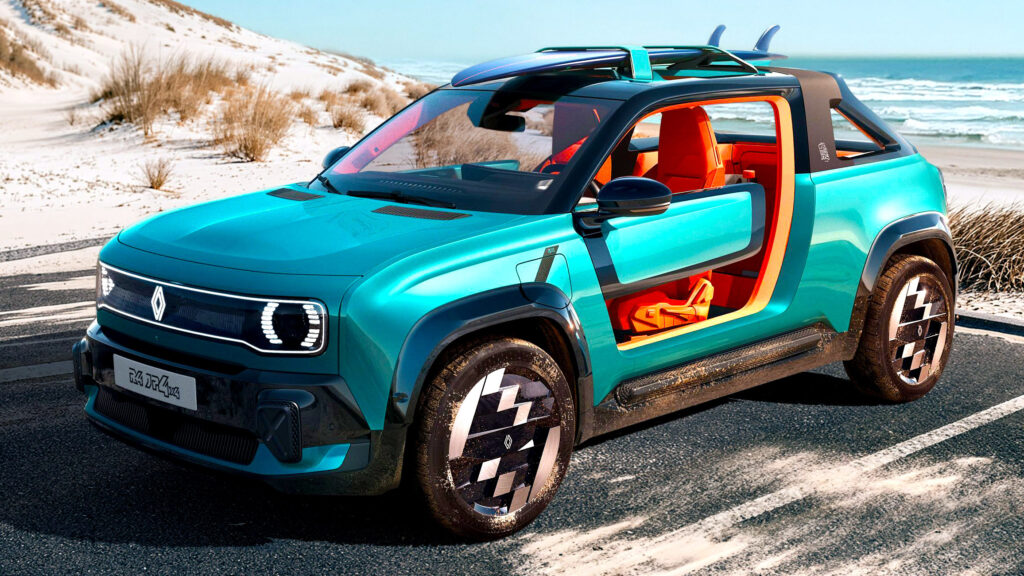
Renault has unveiled a new concept based on the R4 E-Tech, this one built around summer use. The R4 JP4x4 wears an open-air two-door body, a reworked two-seat cabin with an exposed cargo area, and an AWD powertrain for tackling whatever hypothetical sandy beach you have in mind.
The study borrows from two R4 variants of the past, the 1969 Plein Air and the 1981 JP4. Its name is short for Journée à la Plage, French for “a day at the beach.”
Visually, the highlight is the pair of half-doors that replace the production car’s five-door layout. They work with a redesigned roof structure built around an X-shaped element for carrying a surfboard. There are no side windows and no canvas top, which leaves the cabin permanently open to the elements.
The concept wears a custom Emerald Green finish that plays against a vibrant orange interior. Beyond its beach buggy identity, it also serves as a pickup with a drop-down tailgate for easy loading. The roof-mounted surfboard is joined by a pair of skateboards stowed in the cargo area.
Inside, the highlights include “Egyptian mummy” seats with integrated headrests and mixed-fabric upholstery. The dashboard and digital cockpit carry over from the production EV, though the concept adds a passenger-side grab handle and a floating center console.
As with last year’s R4 Savane 4×4 concept, the JP4x4 runs a dual-motor powertrain for AWD, a setup Renault still hasn’t offered on the production R4.
The concept rides 15 mm (0.6 inches) higher than the standard R4, with front and rear tracks widened by 10 mm (0.4 inches) per side. The 18-inch wheels carry a futuristic design and wear chunkier Goodyear UltraGrip Performance+ tires. Renault made no mention of changes to the EV’s 2,624 mm (103.3 inches) wheelbase.
No Plans For Production
Renault has been clear that the JP4x4 will stay a one-off, with no production plans on the table. The show car will be displayed at the Roland-Garros French Open alongside the R4, R5, and Twingo E-Tech production EVs.
For buyers who want an open-air R4 E-Tech, the automaker already sells the Plein Sud variant with an electric-powered canvas roof. That one went on sale earlier this month starting at €37,290 ($43,800).
RICHMOND, Va. – Nine schools across the country will soon add propane autogas curriculum to their automotive training through the Propane Autogas Vehicle Inspection Grant Program.
The schools incorporating the curriculum, Propane Autogas Vehicle Inspection: Introduction for Automobile Service Technicians, into their classrooms this fall are:
ACE Center at Virginia Randolph — Glen Allen, Virginia
Angelina College — Lufkin, Texas
Capital Region BOCES Career & Tech — Albany, New York
Cordova High School — Cordova, Tennessee
Florida State College at Jacksonville — Jacksonville, Florida
Future Ready Complex — Georgetown, Texas
Hudson High School — Hudson, Wisconsin
Iredell Statesville Schools — Troutman, North Carolina
Pierce County Skills Center — Puyallup, Washington
The grant program, offered by the Propane Education & Research Council, helps educational institutions and career centers expand existing automotive programs with propane-specific curriculum, hands-on resources, and instructor training. Each approved recipient receives up to $7,500 in grant support, including a propane autogas training aid valued at more than $5,000 and funds to support instructor participation in a Train the Trainer class and program marketing.
“Skilled automotive technicians are essential to keeping today’s fleets operating safely and efficiently,” said Elena Bennett, senior manager of industry training and education at PERC. “By bringing propane autogas curriculum into classrooms, these schools are giving students valuable exposure to proven alternative fuel technology and opening the door to more career opportunities in transportation, fleet service, and the propane industry.”
As part of the program, participating schools also identify a Propane Advisor to support instructors, answer propane-specific questions, and speak with students about propane’s role in their communities. They also assist the school in bridging the gap between schooling and a career and connecting them with the propane state association and OEMS for more specific engine training.
PERC extends its appreciation to the Propane Advisors and industry partners helping support these schools as they add the curriculum, including Blossman Gas, Inc.; Casella; Ferrellgas; Hillside Service & Repair; NEXIO Power, Inc.; Roush Cleantech; Superior Energy Services; and the Town of Mooresville.
About PERC: The Propane Education & Research Council is a nonprofit that provides leading propane safety and training programs and invests in research and development of new propane-powered technologies. PERC is operated and funded by the propane industry. For more information, visit Propane.com.
WOODRIDGE, Ill. – Hendrickson, a global leader in reliable ride solutions for the commercial transportation industry, is introducing ELECTRAAX, powered by Driventic, a high‑efficiency, lightweight electric drive axle engineered for Class 6–7 school bus and medium-duty truck applications.
Integrated, modular design for Electric Vehicle (EV) efficiency
ELECTRAAX features a fully integrated ePowertrain that combines the axle, single-speed gearbox, motor, and inverter into one system to maximize efficiency. This design helps deliver up to 94% system‑level efficiency, which can extend vehicle range and reduce energy requirements based on internal testing.
The fabricated, modular architecture is designed for ultimate flexibility, with a wide range of track width, gear train, suspension, and brake options to align with diverse chassis platforms and vehicle specifications. This integrated system design combined with a lightweight fabricated axle housing helps address EV weight and efficiency targets by reducing system mass, helping extend range, enabling potential battery reduction, and supporting lower total cost of ownership.
Key design advantages include:
Full motor torque regenerative braking, helping maximize energy recovery
Single-speed gearbox design, reducing friction and weight compared to multi-speed gearboxes
Ride quality, applications, and a new electric milestone
A single-speed gearbox provides a smooth ride without shift‑quality concerns for pickup‑and‑delivery duty cycles, while reducing component count to support increased long‑term reliability. Driventic’s electric drive system adds an efficient motor with a power‑dense inverter to deliver extended peak torque for sustained, consistent power during acceleration, hill climbs, and heavy hauling.
ELECTRAAX is purpose-built for Class 6–7 medium-duty commercial vehicles, focusing on school buses and pickup-and-delivery trucks (including food, beverage, and last-mile). This focus helps OEMs and fleets meet stringent battery and weight requirements, balance route performance and payload, and support more cost‑effective EV adoption by reducing weight and improving efficiency simultaneously.
Co‑engineered with Driventic (formerly Voith), ELECTRAAX combines Hendrickson’s 110+ years of ride solution innovation with Driventic’s 155 years of electric‑drive system expertise. With centuries of combined global engineering leadership, the partnership is delivering cutting‑edge EV technology and accelerating the shift to electrified mobility. ELECTRAAX gives OEMs and customers tangible validation of next‑generation electric drive suspension capability and reinforces Hendrickson’s position as an innovation leader in commercial vehicle systems. ELECTRAAX represents two milestones, one breakthrough: Hendrickson’s first drive axle and first electric axle, marking a new era in Hendrickson innovation for electric commercial vehicle systems.
Built on Hendrickson’s proven suspension heritage and aligned with its Reliable by Design philosophy, ELECTRAAX, powered by Driventic, is built to move what’s next for medium‑duty electrification.
About Hendrickson
Hendrickson, a Boler company, is a leading global manufacturer and supplier of medium- and heavy‑duty mechanical, elastomeric, and air suspensions; integrated and non‑integrated axle and brake systems; tire pressure control systems; auxiliary lift axle systems; parabolic and multi‑leaf springs; stabilizers; bumpers; and other components for the global commercial transportation industry. Based in Woodridge, IL, USA, Hendrickson has served the transportation industry for more than 100 years. Visit www.hendrickson-intl.com.
About Driventic
Driventic is the specialist for efficient drive technologies in commercial vehicles. Whether for use in used in e-mobility or conventional drives, Driventic’s complete systems and digital services are drivers of the mobility transition – because they enable manufacturers and operators alike to sustainably operate their trucks, buses and off-highway vehicles. The company’s 1,400 employees at 26 locations in 18 countries are dedicated to one mission: to combine ecology with technological progress in the service of efficiency. This is what Driventic understands by ‘Mobility beyond today’.
At this writing, the U.S. Environmental Protection Agency had yet to announce the final award round for the Clean School Bus Program. At the same time, could the school bus industry be bracing for the end of the Diesel Emissions Reduction Act?
Since 2008, DERA has been responsible for replacing over 8,500 older operating school buses with cleaner alternatives. The Trump administration last month released its fiscal year 2027 budget request and asked Congress to cut over 52 percent of EPA’s discretionary funding. Included is a call on Congress to cancel DERA, which for nearly two decades has funneled hundreds of millions of dollars to the school bus industry via national grants, rebates and Tribal government awards.
Any attempt to end DERA at least in the Oval Office is unlikely. Congress still must pass its own budget appropriations. And a bipartisan DERA reauthorization bill has been in the works for the past year, which would extend the program at $100 million a year through fiscal year 2029. But the attempt demonstrates ongoing scrutiny over fiscal spending and, more aptly, funding alternative energy.
The $5 billion Clean School Bus Program was going to sunset one way or another after this year. But placing DERA funding in the crosshairs is the last headwind the industry needs on school bus replacements, a consultant shared with me. Another consultant noted that about a decade ago at an industry conference he asked the audience how willing they would be to continue to buy electric school buses if DERA funding dried up. Not one hand raised.
The question remains a good one today, since the electric school bus cost discrepancy is still two or three times that of diesel school buses. It was never attractive to pay upwards of $475,000 for a large electric school bus, and that’s before factoring in the charging infrastructure. If the Clean School Bus Program and DERA both end, where is the incentive to go green outside of a handful of states?
The cost of everything has gone up. At STN EXPO East in North Carolina earlier this spring, an attendee told me new diesel school bus purchases were running over $150,000 each. That includes a surcharge of $12,000 to $20,000 to pay for the warranties on the 2027-compliant engines. (The EPA continues to re-evaluate and finalize a new proposed Phase 3 GHG rule, but OEMs have already completed all necessary R&D and manufacturing to comply with the low NOx emissions levels.)
The Iran war and blockage on the Strait of Hormuz have also created substantial uncertainty for district budgets. While locking in bulk diesel prices creates insulation from price volatility, a gallon was selling at 30-percent premium after the war began. Meanwhile, April’s national average at-the-pump price exceeded $5.40 per gallon. In California, it’s well over $7 a gallon.
We also learned at STN EXPO East that the price of propane also increased, but by about 20 cents per gallon, when the fuel was already a fraction of the cost of diesel. Despite that silver lining, the question remains, how many propane school buses can and will be made available to the market?
School districts and bus companies cannot take for granted federal funds to help them purchase new school buses. Instead, already-strapped local and state budgets will be relied upon. School transportation professionals and their leaders need to increasingly make the case with voters that new school buses are necessary to keep up with service levels.
At the same time, however, public school enrollments are falling. The Brookings Institute found that U.S. public schools lost 1.2 million students from 2019 to 2023, and they aren’t coming back. Parents are homeschooling their children. They are sending them to charter and private schools. And increasingly they as well as school districts are using non-school bus vehicles to do it.
How willing will voters be to approve millions of more dollars via bond measures and levies for school bus purchases? Student transportation leaders can make no assumptions.
Simply put, funding is not keeping pace with rising costs. In seeking to proactively understand and manage all these intersecting challenges, student transporters will need to lean heavily into optimizing and rethinking service models, routing and resource allocation to maintain service levels with fewer resources.
Editor’s Note: As reprinted from the May 2026 issue of School Transportation News.
The U.S. Environmental Protection Agency Office of Inspector General says lessons from the first Clean School Bus rebates and grant rounds should inform future funding, especially as $2.37 billion remains available.
EPA is expected to announce the next CSBP funding rounds later this month or in June.
Ask a transportation director what makes a clean school bus project successful, and the likely answer goes beyond the bus itself. Directors share the importance of coordinating with utilities, ensuring charging infrastructure is ready, managing vendor timelines, or tracking federal and state funds.
A new summary report from the EPA Office of Inspector General, released April 1, points to that same balancing act. The report stated that the EPA has made improvements to the CSBP since its first rebate round in 2022. Earlier weaknesses in application review, recipient verification and fund management should continue to inform how the agency awards future dollars.
The report reviewed five prior EPA Office of Inspector General reports related to the agency’s management of Infrastructure Investment and Jobs Act funding for the 2022 Clean School Bus Rebates program. It identified two overarching issues: The application and selection process, and the management of funds. The summary report does not include new recommendations, but the OIG said the findings could help guide EPA decision-making for future CSBP awards, especially as money is still on the table.
Congress provided $5 billion over five years through IIJA to replace older diesel school buses with cleaner models, including propane, compressed natural gas and zero-emission buses. EPA has described the program as a way to reduce emissions in buses, loading zones and the communities they serve.
Report Highlights Rebate, Grant Awards to Date
At the beginning of fiscal year 2026, the CSBP had $2.37 billion remaining. As of February, EPA said it intends to revamp the program and issued a Request for Information seeking input from fleet operators, manufacturers, school officials and energy producers. The comment period closed April 6. The 146 filed comments included those from all major OEMs, dozens of school districts and other concerned citizens.
As of last November, EPA had awarded $865 million through the 2022 rebate program to 368 school districts for 2,328 replacement buses. The 2023 grant program awarded $950 million to 65 recipients for 2,696 buses, while the 2023 rebate program awarded $815 million to 458 school districts for 3,241 buses. All awards leaning heavily toward electric school buses. Find the breakdown of fuel funding on STN’s Green Bus Resources page.
But the EPA Inspector General said the initial process lacked adequate controls to verify certain applicant and bus eligibility information. Prior reports found EPA did not require enough documentation to verify applicant identity or the accuracy of information submitted, and applicants were not required to directly attest to the truthfulness of their applications. The OIG also said the agency had not established verification protocols before awarding funds.
That matters for districts because federal clean bus projects often require coordination among multiple parties, including school systems, contractors, original equipment manufacturers, utilities and infrastructure providers. The OIG noted that some eligible contractors were allowed to apply or initiate applications on behalf of eligible entities without their knowledge.
Another concern centered on whether local conditions were adequately considered, particularly for zero-emission buses. Under the IIJA, EPA must consider factors such as route length and weather conditions when awarding clean school bus funds. The OIG said prior reports found EPA was not ensuring applicants seeking electric buses had suitable local conditions, and it also cited utility delays as a potential risk to timely deployment.
Fund management was another issue flagged by the OIG. The report said EPA did not adequately monitor bus deployment status or recipient use of 2022 rebate funds, despite previously committing to do so. It also found that 2022 guidance did not clearly indicated for recipients whether CSBP funds should be kept in separate accounts, whether interest could be earned on those funds, or how any interest could be used.
According to the OIG, some recipients kept CSBP awards in accounts that included other funds, which increased the risk that program money could be used for other purposes.
EPA has since made changes. For the 2023 rebate round, the agency required electric bus applicants to submit a Utility Partnership Agreement verifying that districts had notified their local utility. EPA also updated guidance to require recipients to manage funds so they would not accrue interest, keep funds in separate accounts and use them only for eligible expenses. In 2024, EPA added a School Board Awareness Certification requiring applicants to verify that school boards were notified of intended program participation.
The OIG said EPA has completed corrective actions addressing several prior recommendations and was still implementing others. The report states that the agency had completed, or was in the process of implementing, corrective actions for all 11 prior recommendations reviewed.
EPA also reported taking additional oversight steps beginning in February 2025, including site visits to rebate recipients, reviews of concerns related to use of funds and weekly project status reports to the chief financial officer.
A Long Island teenager and his mother are being praised after helping rescue a neighbor from a house fire while the boy waited for his school bus, reported People News.
The incident reportedly occurred March 31 when Jovani Moss, 15, heard “crackling” of flames coming from a house across the street from his family’s residence in Melville, New York.
“I didn’t notice the fire at first,” Moss told local news reporters. “But I heard the crackling of the fire, and I turned to look and called my mom.”
Moss said he immediately alerted his mother, Natechia Moss, and asked whether he should go to the house or call 911.
Natechia reportedly instructed her son to contact emergency responders while she rushed outside her house to warn the homeowner. She repeatedly rang the doorbell but got no response and thus began kicking the door until it partially opened. “I kept kicking the door,” she said via the article “Finally, I got it ajar a little bit, and all of a sudden, I saw her standing there and I grabbed her and said, ‘Your house is on fire!’”
The homeowner had reportedly attempted to re-enter the burning residence to retrieve her cat and jewelry before eventually escaping safely. Firefighters from the Melville Fire Department responded to the blaze. No injuries were reported.
Moss has since been hailed as a hero for reacting quickly, though the teen downplayed the attention. “A lot of people calling me a hero,” he said via the report. “I was like, ‘I’m not really a hero. I’m just being a good neighbor.”
He credited his mother with setting the example and teaching him to stay aware of his surroundings.
“Take out the ear pods. Keep your phone in your pocket until you get on that bus,” Natechia said of the advice she gives her son. “Always be aware.”
Melville Fire Chief Donald Barclay praised the family’s actions. “We are thankful no one was hurt and that Jovani did the right thing and helped his neighbor. The world needs more Jovani,” said Barclay via the article. He also commended the department’s volunteer firefighters, saying the incident reflected “the idea of helping your neighbor in multiple ways.”
Canada is preparing to accept the first of 49,000 Chinese EVs heading there this year.
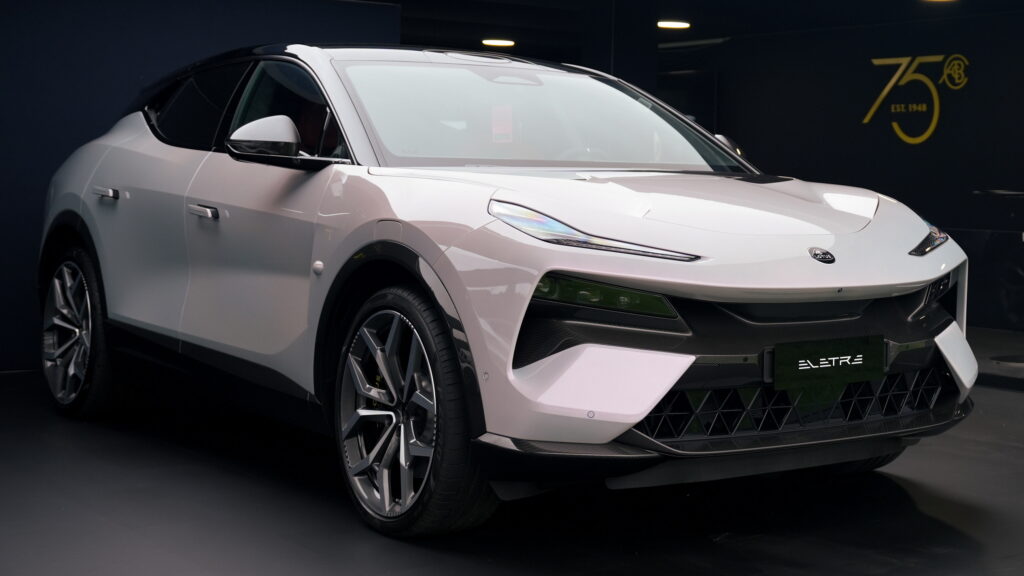
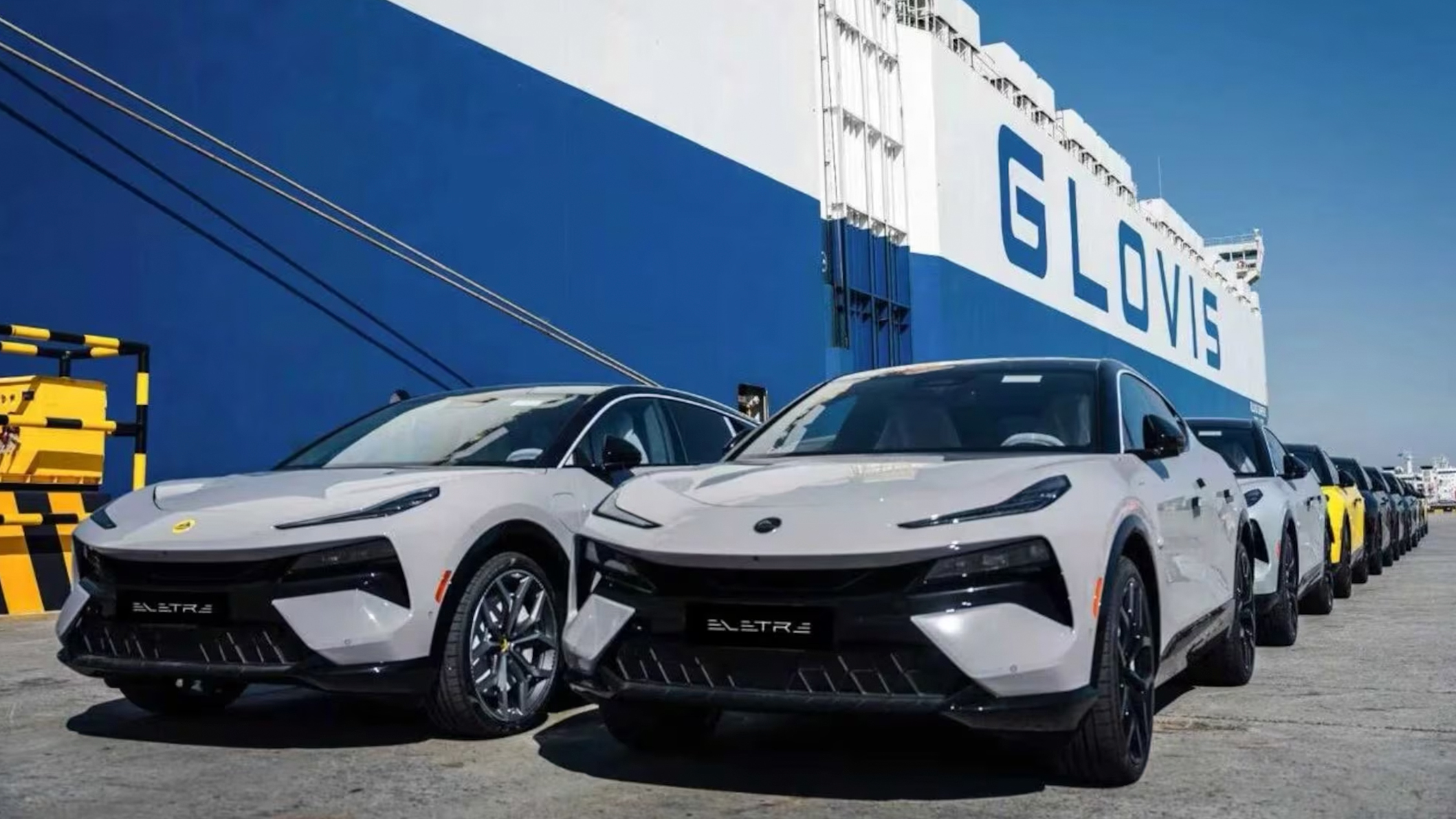
Lotus waved off 18 Canada-bound, Cayenne-sized Eletre SUVs from Wuhan on May 6.
Under a deal between Canada and China, EV import tariffs were cut from 106.1% to 6.1%.
Geely is officially heading to Canada, though don’t bother looking for the brand name at a car dealership strip north of the border just yet. The Chinese brand’s access to the Canadian market comes through its Lotus subsidiary, which sent 18 Eletre SUVs to North America on May 7.
This isn’t the first time China-built Lotus cars, or China-built cars of any brand, have been offered in Canada. Polestar, Lotus, and others previously sold vehicles that originated in the Asian country. But the 18 Eletres will be the first to hit Canada’s roads since a trade deal between the two countries was struck at the beginning of the year.
Imports from China effectively ceased after 2024 when then prime minister Justin Trudeau followed US president Joe Biden’s lead by slapping a 100 percent tariff on Chinese EVs, and that was on top of the 6.1 percent levy previously applied.
In retaliation, China applied tariffs on canola that brought Canada’s agricultural industry to its knees. Canola brings billions of dollars into the Canadian economy every year, so it’s no surprise that new prime minister Mark Carney was motivated to strike a deal, even as North America’s domestic automakers – which also form a large part of Canada’s economy – begged him not to.
Small Import Numbers for Now
Under the terms of the new trade deal, Canada will allow just 49,000 EVs in from China with a tariff rate of 6.1 percent in year one, rising to 70,000 in year five. In return, and in addition to relaxing tariffs on canola, China agrees to ease duties on Canadian steel and aluminum. But the trade truce also opens the door to Chinese brands building cars in Canada.
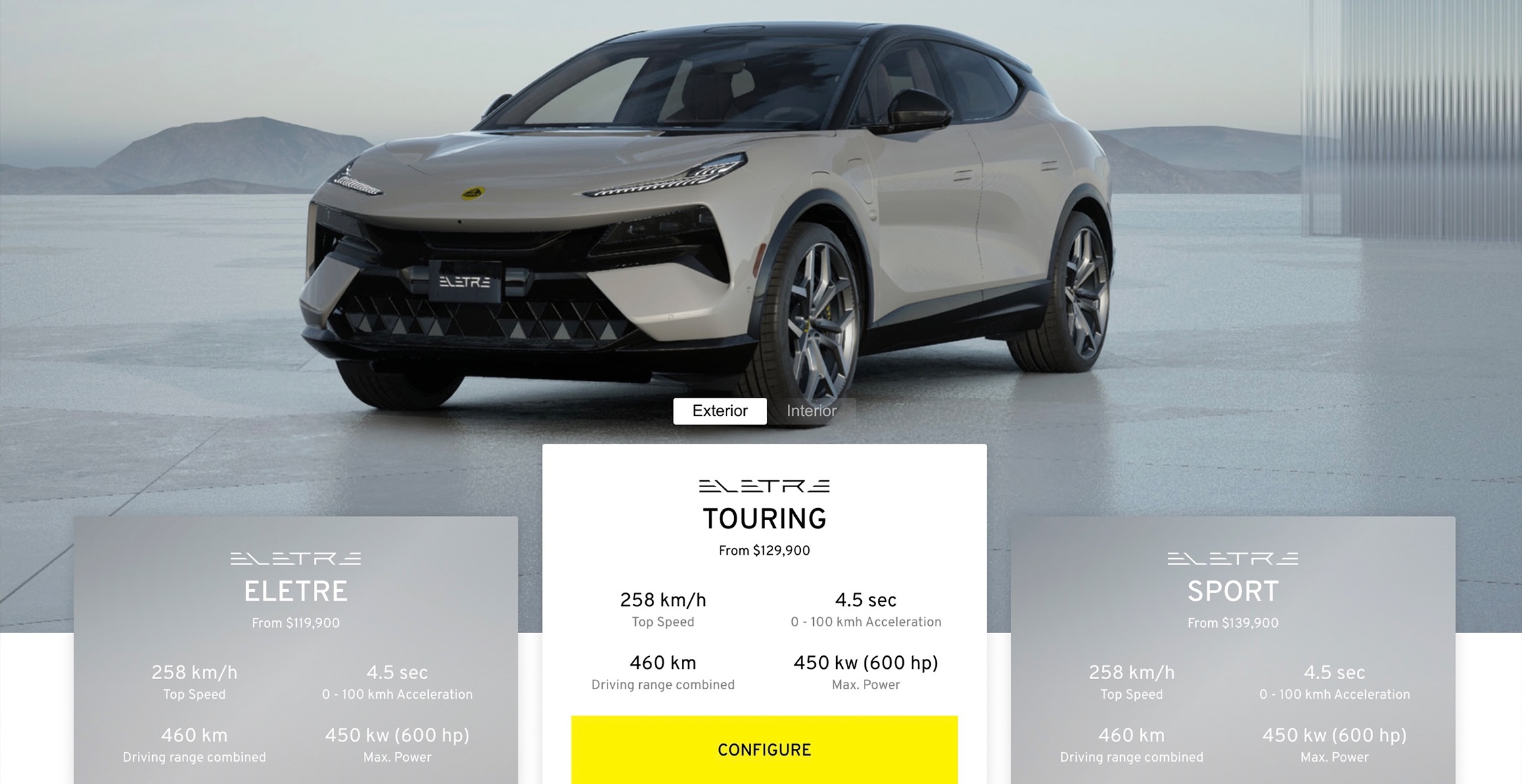
Lotus hasn’t revealed the exact mix of Eletre specs currently heading across the Pacific, but the brand’s Canada retail site currently only lists three trims based around the same 603 hp (611 PS / 450 kW) powertrain and priced between $119,900 CAD ($87,600 USD) and $139,900 CAD ($102,200 USD). Other countries also get a 905 hp (918 PS / 675 kW) version.
Hybrid Is A Recent Addition
Both are purely electric, though Lotus has reacted to a less-than-buoyant luxury EV market (and a really terrible North American one) by revealing a new Eletre hybrid. Powered by a 2.0-liter petrol engine and two electric motors making a combined 933 hp (946 PS / 696 kW), it was unveiled in China at the beginning of 2026, and is expected to be rolled out to Western markets later this year.
Lotus isn’t the only company rushing to take advantage of the new trade terms, which Canada’s government originally touted as a way to bring more affordable EVs to the country and help the nation meet its climate goals. Geely is making noises about bringing its own brand, as well as others, such as Zeekr, to Canada. BYD and Chery’s cars have been spied on North American roads, and Tesla is preparing its first batch of Chinese-built Model 3s for Canadian drivers, Drive Tesla Canada reports.
Hyundai’s Ioniq V electric hatch comes with a choice of 188- or 225-hp motors.
The V was revealed at last month’s Beijing Auto Show and is designed for China.
It’s one of 20 new models Hyundai will launch in China over the next five years.
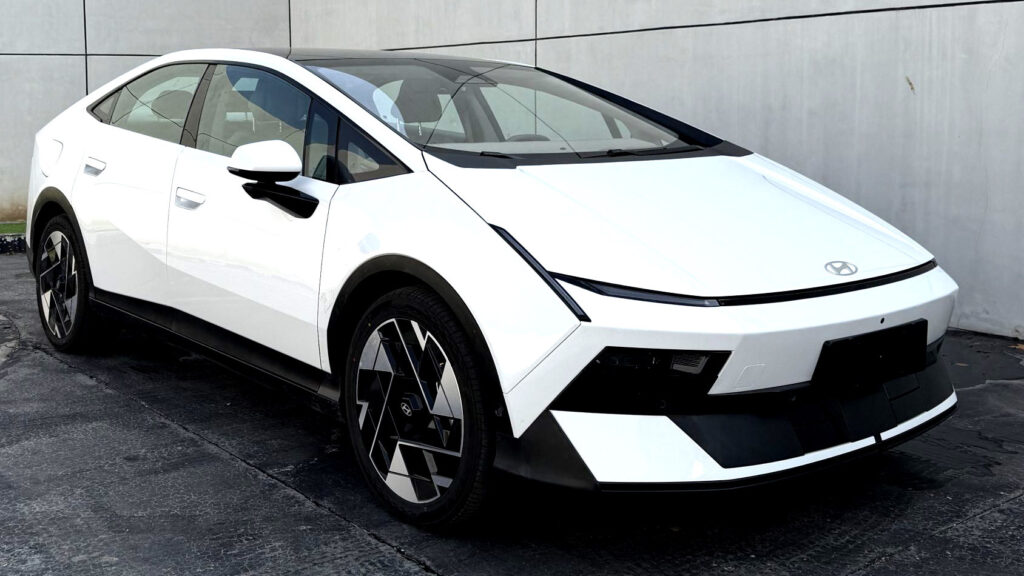
Hyundai’s sharp-edged, China-only Ioniq V unveiled in Beijing last month looks so different from the Ioniqs we get in the West that it’s only natural that we’re fascinated to find out more about it. And now, thanks to some homologation paperwork logged with Chinese authorities, a few more details have come to light.
The most obvious new bit of information concerns the powertrains. Ministry of Industry and Information Technology (MIIT) filings show the Ioniq V will launch with a choice of two single-motor configurations producing either 188 hp (190 PS / 140 kW) or 225 hp (228 PS / 168 kW).
The punchier of those motors is familiar from our own Ioniq 5, but you won’t find the lower-tune version in an American or European 5. Even Hyundai’s own humble US-market Elantra outguns it with 201 hp (204 PS / 150 kW) in N Line spec. Range extender hybrid and dual-motor versions should follow, according to Hyundai’s plan, and though there’s no mention of a truly hot version, an N makeover could give this EV Lamborghini Temerario-style pace to match its me-too design.
For now, supercar speeds are definitely not on the agenda. A listed top whack of 103 mph (165 km/h) isn’t going to set any records, but the 800-volt charging architecture should at least mean the CATL lithium iron phosphate battery packs can fill rapidly. We still don’t know battery sizes, but the bigger of the two available packs claims more than 600 km (373 miles) on the optimistic CLTC cycle.
Close To An Ionq 6 In Size, Not Style
The Ioniq V measures 4,900 mm (192.9 inches) long and rides on a 2,900 mm (114.2 inches) wheelbase, giving it dimensions similar to the Ioniq 6 we can buy in the West. But visually, this thing heads in a very different direction. The low-slung body combines a coupe-like roofline with chunky surfacing, split headlights, frameless doors, and dramatic V-shaped wheels.
Hopefully, the badly misaligned liftgate seen in the rear shot of the white car isn’t representative of production models. That’s certainly fixable, though it’s probably too late to do anything about the weird shelving system that passes for a rear diffuser.
27-Inches Of Infotainment
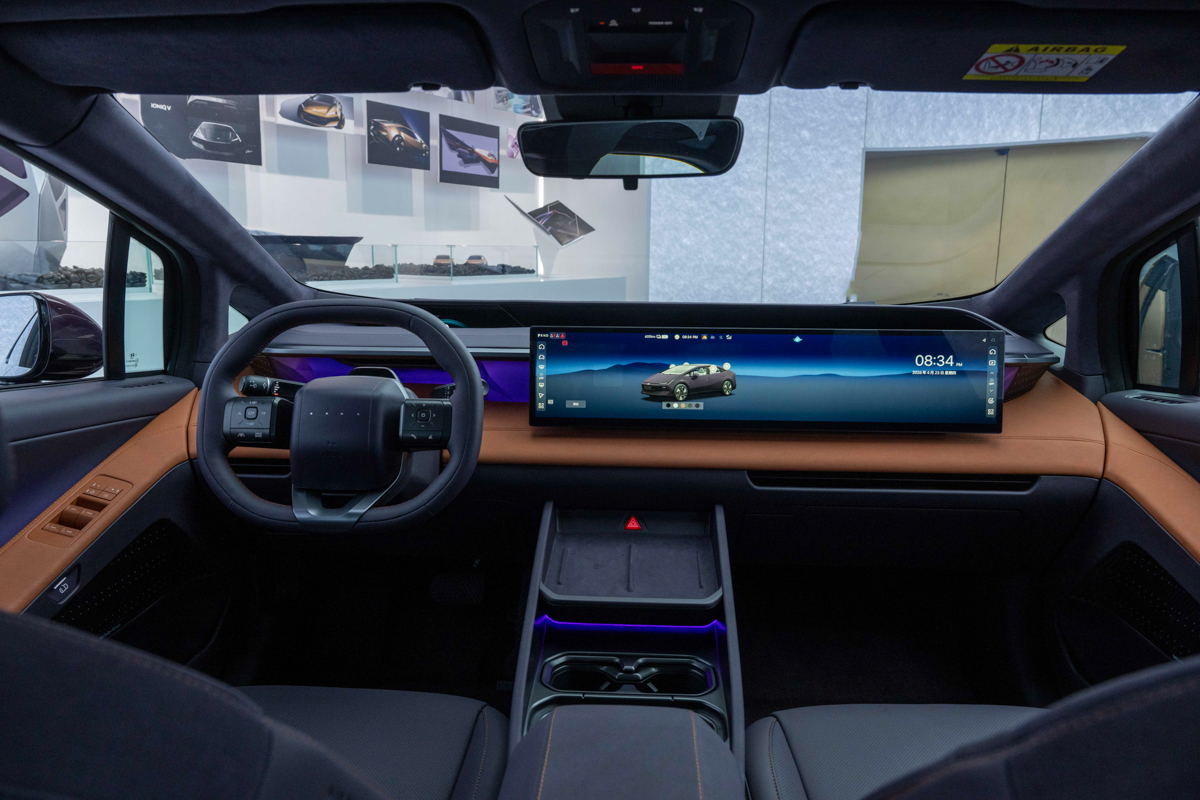
The cabin looks rather better. Hyundai’s China team developed the car around a huge 27-inch ultra-thin 4K display paired with a Cyber Eye head-up display and ambient lighting inspired by nebula imagery. The system also integrates Qualcomm’s Snapdragon 8295 cockpit chip together with AI features powered by Baidu and Volcano Engine technologies, Autohome reports.
Another major addition is Momenta-assisted Level 2-plus driving capability, something rapidly becoming essential for competing in China’s brutally competitive EV market.
Unfortunately for American buyers, the Ioniq V is almost certainly staying overseas. Hyundai developed it specifically for China under its new “global quality plus Chinese wisdom” strategy. That plan will see 20 new Hyundais of different powertrain types being unleashed in China over the next five years as the brand tries to shore up flagging sales.
Tesla has dropped Deep Blue Metallic and introduced Marine Blue.
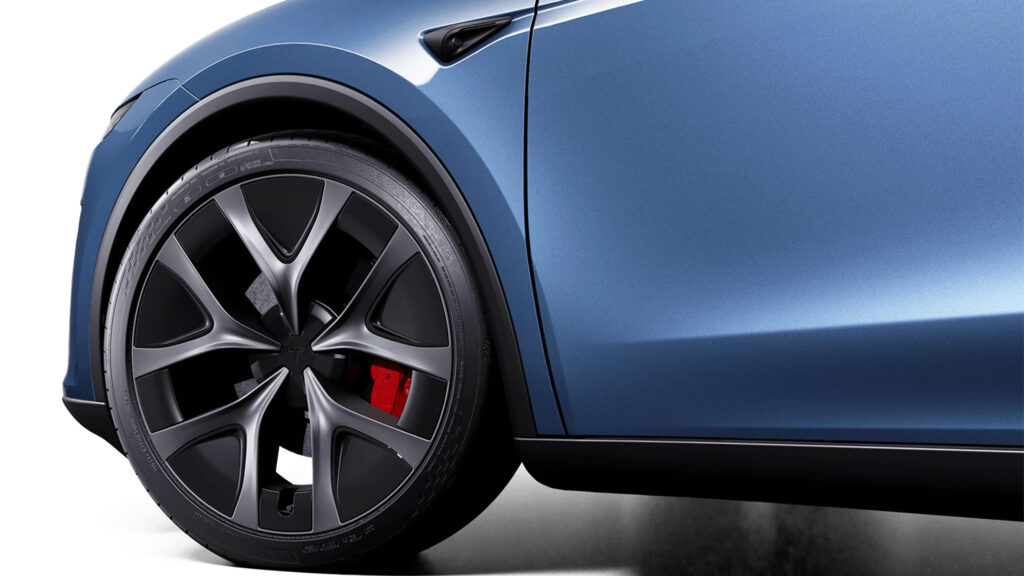
Frost Blue Metallic from the Model S is now available for the 3 and Y.
Sadly, Frost Blue Metallic is only offered for the Performance models.
Tesla has never been known for offering particularly exciting or flamboyant paint schemes, generally opting for subtlety over pizzazz. However, the Model 3 and Model Y have just been updated with two new shades of blue in the United States, and both look superb.
The first new color is dubbed Marine Blue, and it’s available for the Premium Rear-Wheel Drive and Premium All-Wheel Drive versions of the Model 3 and Model Y. Marine Blue is a deep shade that replaces Deep Blue Metallic, which was brighter and a little more eye-catching.
As before, those shopping on a budget and looking to buy the entry-level Rear-Wheel Drive or All-Wheel Drive versions of the Model 3 or Model Y don’t get this new color and still only have Stealth Grey, Pearl White Multi-Coat, and Diamond Black to choose from.
In the US, Marine Blue adds $1,000 to the price of applicable Model 3s and Model Ys. In Canada, it costs CA$1,300 (US$940).
Exclusive Performance Color
The second new color introduced by Tesla is Frost Blue Metallic. It’s exclusive to the Model 3 Performance and Model Y Performance. This isn’t the first time this color has been offered by Tesla, as it was previously available on the Model S and Model X before those models were discontinued. Of all the colors that Tesla offers, Frost Blue Metallic might be our favorite, alongside Ultra Red.
What’s more, Frost Blue Metallic is a no-cost option in the US. It’s also been launched for the Model 3 Performance in Canada, though it’s not yet clear whether it will be added to the Model Y Performance locally.
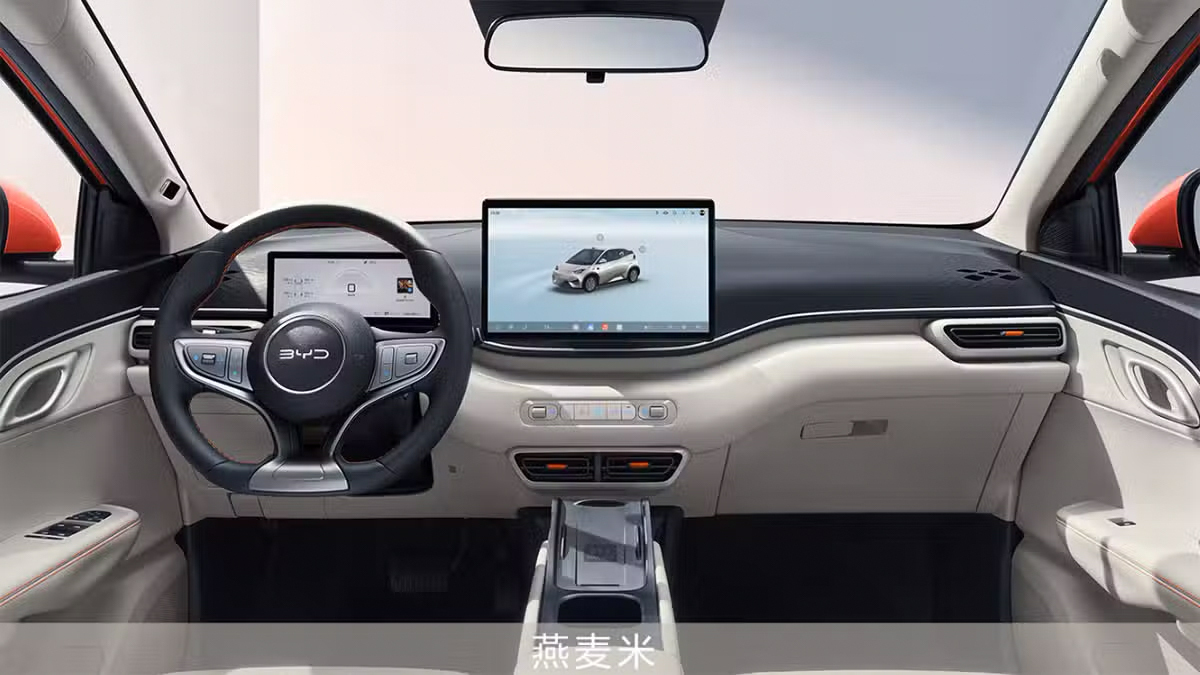
BYD has rolled out a revised version of the little Seagull hatch in China.
The tiny EV starts at $10,300, or $13,400 with BYD’s DiPilot 300 ADAS.
DiPilot 300 isn’t fully autonomous, but can handle city streets, stoplights.
Though camera-loving Tesla swears otherwise, most experts agree that Lidar is the gold standard of driver assistance sensing technology. It’s better at judging distances and detecting unlit objects than cameras, and sees in more detail than radars. But it’s also expensive, or at least it is in Europe and America, where it’s restricted to $100k+ luxury cars. In China, though, you can now get it on a $10,000 micro EV.
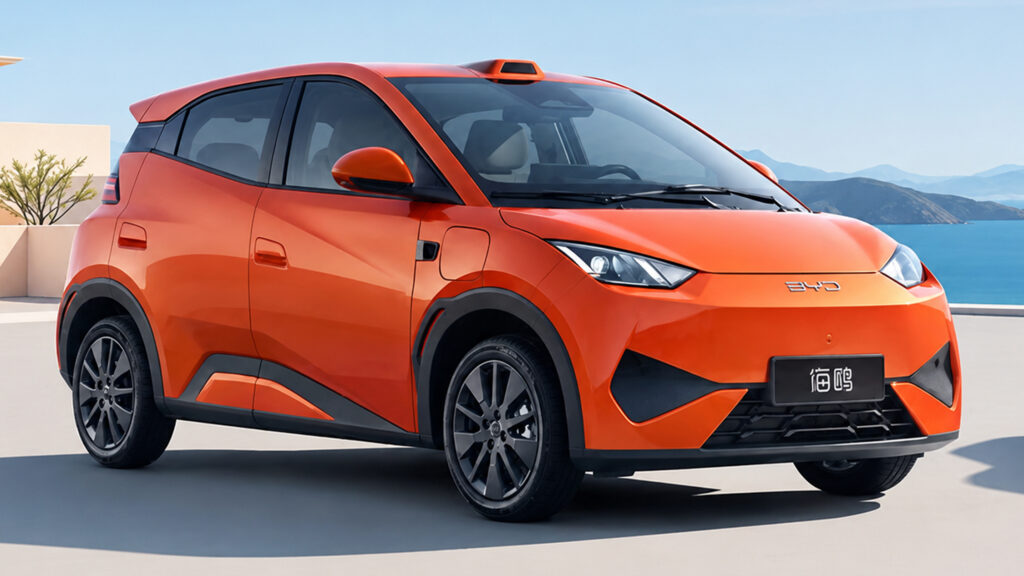
BYD has just refreshed its Seagull subcompact for its domestic market. The Seagull is the tiny 3,780 mm (148.8 inches) electric hatch sold as the Dolphin Surf in Europe. For MY26 there are a couple of new colors, Mango Orange and Mint Green, fresh 16-inch Starlight wheels and new LED taillights, though the 74 hp (75 PS / 55 kW) powertrain is carried over.
But the big news is the availability of a driver assistance system that combines a Lidar sensor with more commonly available radar and camera-type sensors. The Lidar tech comes as part of the optional DiPilot 300, an ADAS system that’s the mid-point of three BYD “God’s Eye” assistance packages. You can tell if the Seagull you’re looking at has DiPilot 300 because it looks like someone’s grafted on the roof snorkel from a McLaren 675LT.
A base Seagull Vitality Edition with the smaller 30.1 kWh battery and 190-mile (305 km) range costs ¥69,900 ($10,300), Car News China reports, while the poshest Flying Edition with a bigger 38.9 kWh power pack and 252-mile (405 km) range runs to ¥85,900 ($12,600). But add on the DiPilot 300 option and those prices jump significantly to ¥90,900 ($13,400) and ¥97,900 yuan ($14,400).
Lidar Works, But At A Price
A $3,100 option on a $10,300 car is kind of crazy, but then Lidar is expensive. That’s why BMW and Mercedes, who both previously offered the technology as part of their hands-off Level 3 assistance packages on their 7-Series and S-Class flagships, have dropped the circa-$7k options from the newest version of those cars.
Instead, both German brands are switching their attention to Level 2 systems that still require drivers to look at the road, but unlike the Level 3 systems – which were restricted to freeways – can operate hands-free in urban environments. Both brands will return to L3 tech at a later date.
Despite the presence of a Lidar sensor, the Seagull’s DiPilot 300 is also an advanced Level 2 system, not Level 3. But BYD is talking about L3 as a future development for some of its cars, and you wouldn’t want to bet against even the humblest models like the Seagull getting it in a few years.
Arizona farmers would be among the first affected by a new proposal to reduce water delivers from the Colorado River. They hope it leads to longer term stability.
Despite regional variability in climate, electricity sources, congestion, and the wide variation in individual driving patterns, electric vehicles generate less greenhouse gas emissions and do not cost more than comparable gas-powered vehicles for drivers and vehicle fleet owners in most parts of the United States, according to a new study by MIT researchers.
The team’s approach captures many key factors that contribute to regional and individual differences in the life-cycle emissions and ownership cost of electric vehicles, including meteorological data, the distance and duration of trips, and fuel prices.
To paint a fuller picture of emissions and costs than was previously available, the researchers sourced data from thousands of U.S. zip codes and drilled down to the level of individual drivers within those locations. Their study considers time-averaged fuel prices so as not to be overly influenced by fluctuations in prices at any one point in time. They finalized their analysis at the end of 2024 and early 2025.
Their results indicate that a person’s driving behaviors can matter as much as regional factors like the local electricity mix when it comes to the emissions savings of an electric vehicle, compared to a similar gas-powered vehicle. In most locations, a battery-electric vehicle reduces emissions between 40 and 60 percent, with larger impacts in urban areas.
They also found that colder climates do not reduce overall emission benefits as much as some media reports assume.
The researchers utilized this detailed analysis to update a public tool they previously developed, carboncounter.com, which enables individuals to compare the life-cycle emissions and total ownership costs of nearly any car on the market. A new version of carboncounter.com is also being released today.
“There are a lot of statements being thrown around, like that electric vehicles don’t reduce emissions very much in cool climates, and we wanted to analyze these factors systematically and evaluate these statements against one another simultaneously. Rather than simply asking, ‘Are EVs better?’, this paper helps answer ‘better for whom, and under what conditions?’” says Marco Miotti PhD ’20, a senior researcher at ETH Zurich who completed this research while a graduate student in the Institute for Data, Systems, and Society (IDSS) at MIT.
Many prior studies that compare emissions and costs of electric vehicles (EVs) to combustion-engine vehicles cover a few factors, like the amount of renewable energy in the grid and how gas prices impact affordability, Miotti says.
“To our knowledge, there have been few efforts so far that bring all these factors together. But if someone wants to buy a car and have a better understanding of the factors that affect emissions and costs, this holistic approach is important,” he adds.
The researchers focused on two types of EVs: battery-electric vehicles, which only operate on electricity, and plug-in hybrid electric vehicles, which also have a combustion engine that works in tandem with the battery to optimize fuel savings.
The team expanded and improved a set of previously developed vehicle cost and emissions models to incorporate a wider variety of factors and data types.
For instance, they refined an existing model that estimates energy use and gas mileage so it could capture more nuances of local climate variability.
“But the real effort was not just in extending these different models, but in bringing together all these different data and making them work with the models in a consistent manner,” Miotti says.
The team sourced data on a wide variety of factors for each U.S. zip code, such as typical drive cycles, the amount of traffic, local gas and electricity prices, makeup of the regional electricity mix, meteorological profiles, and more. They used statistical approaches to amalgamate different types of data.
For example, the team used a probabilistic matching technique to combine data on how often people drive, which was drawn from nationwide travel surveys, with more detailed GPS data that includes factors like drivers’ acceleration patterns and the distance they usually drive on each day of the week.
The researchers designed their analysis to focus on the spatial picture of emissions and costs, based on U.S. zip codes, while simultaneously considering the impact of the size and features of each specific vehicle model.
“At the end of the day, it’s the vehicle and fleet owners who make decisions about vehicle purchases. So, we wanted to make sure to consider their wide-ranging individual perspectives rather than simply performing a region-by-region comparison,” says Trancik.
Lower emissions, comparable costs
In the end, their modeling framework revealed that all factors they analyzed matter about equally in determining emissions-reduction potential of EVs compared to internal combustion vehicles.
EVs reduce emissions the most in areas with a cleaner electricity mix, denser traffic, higher annual travel distances, and a mild climate, in decreasing order of importance. In each area, emission reductions increase for drivers who drive more often, drive larger vehicles, and are more frequently stuck in traffic.
In a colder area like North Dakota, fuel economy of battery-electric vehicles might be reduced by as much as 50 percent on a particularly frigid night, but the effect on annual emission benefits is minimal.
“We even did a sensitivity study to see if the range is reduced in very cold climates, and we found that, even in the most unfavorable conditions, EVs still reduce emissions by a substantial amount,” Miotti says.
On the cost side, the models show that, in most places across the U.S., EVs are competitive with comparable combustion-engine vehicles in terms of lifetime ownership cost, even without clean vehicle tax credits. And in areas where electricity is relatively affordable, battery-electric vehicles tend to cost less than their plug-in hybrid or combustion-engine counterparts.
In the future, the researchers want to expand this analysis to include a temporal dimension, so the framework also considers how changes in vehicle, fuel, and electricity prices affect emissions and costs over time.
“While we found that the electricity mix is a big driver of the spatial variation in emissions savings of EVs, the electricity grid is decarbonizing everywhere. As that happens, emissions savings across space will become more homogenous for EVs, but the differences across one driver to another will remain,” Miotti says.
They could also use the framework to explore regions outside the United States or incorporate data on hybrid-electric vehicles that cannot be plugged in.
This work was funded, in part, by the MIT Martin Family Society of Fellows for Sustainability.
A new MIT study finds that despite regional differences in climate, electricity sources, traffic, and driving patterns, electric vehicles produce fewer greenhouse gas emissions — and cost no more to own — than comparable gas-powered cars for most U.S drivers.
What can countries with high stunting rates today learn from Japan’s experience of going from 70% to 5%?<br><br><a href="https://ourworldindata.org/childhood-stunting-fell-dramatically-over-the-20th-century"><img src="https://ourworldindata.org/cdn-cgi/imagedelivery/qLq-8BTgXU8yG0N6HnOy8g/c72d18f2-3c36-42d5-52da-02339ee93900/w=1024"/></a>

 Login
Login