School districts feel the pinch at the fuel pump, await news on Clean School Bus Program funding, and deal with extreme weather events threatening operations. Plus, the TSD Conference presents advice on leveraging AI as a tool.
Prosper Independent School District in Texas is hosting the hands-on evacuation training as well as The Roadeo Competition at the TSD Conference in a few weeks. Director of Transportation Teri Mapengo talks operational teamwork to better serve student with special needs, as well as meeting school bus fueling and staffing challenges.
School transportation professionals who need supervisor approval to attend the 2026 Transporting Students with Disabilities and Special Needs (TSD) Conference and Trade Show have a resource to help make their case: A downloadable, customizable supervisor-approval letter provided by School Transportation News.
The template is designed to help prospective attendees demonstrate how conference participation can benefit their transportation operations. It outlines the event’s educational and networking opportunities, highlights keynote presentations and includes an itemized cost estimate for registration, airfare, lodging, transportation and meals. TSD Conference begins Nov. 4 and 5 with the Transportation Director Summit, which requires separate approval to attend. The full conference runs from Nov. 6-10 at the Embassy Suites Dallas-Frisco Hotel & Convention Center in Frisco, Texas.
Users can personalize the letter with their supervisor’s name, specific conference sessions relevant to their responsibilities, and current organizational priorities. The template also emphasizes sharing newly acquired knowledge with colleagues afterward, extending the value of the investment beyond a single attendee.
Training is essential to the industry’s commitment to safety, efficiency and service, especially when transporting students with disabilities and preschoolers. These particularly vulnerable student populations require specialized knowledge, equipment, individualized planning and communication strategies that are not always addressed in general transportation training.
Few educational opportunities provide the depth and concentration of professional development found at the TSD Conference, where the entire program focuses on these students and the transportation professionals who serve them.
The full conference agenda addresses behavior management, legal compliance, Head Start transportation, emergency response, student independence and operational best practices. Keynote speakers include behavior specialist Patrick Mulick, special education attorney Julie Weatherly and former federal special education official Glenna Wright-Gallo.
Special training opportunities include the eight-hour, hands-on seminar on proper child passenger safety instruction, sponsored by the National Highway Traffic Safety Administration, as well as wheelchair and occupant securement certification, and hands-on emergency evacuation training. The Transportation Director Summit and Special Needs Roadeo offer additional leadership development and practical learning opportunities. Certain activities require separate registration, additional fees or both.
Professional networking is another important component. Attendees can connect during the Nov. 5 welcome reception at Topgolf The Colony and the Nov. 6 Ride & Drive + Technology Demonstration.
The Nov. 8 TSD Trade Show and Tailgate Reception, scheduled from 3:30 to 8:30 p.m., will feature approximately 70 exhibitors showcasing products, technology and services. Additional networking and trade show information is available online.
Prospective attendees are encouraged to download the supervisor-approval letter, identify relevant training opportunities and submit their requests while time remains.
Registration remains open online, and attendees also may register in person at the Embassy Suites Dallas-Frisco. Space in certain specialized training sessions is limited.
Long before GPS, onboard cameras and electric drivetrains, students climbed aboard horse-drawn wagons, wood-bodied buses and heavy-duty coaches built for routes that could be as demanding as the communities they served. Today, a small number of those vehicles survive in museums, company collections and private hands, offering a tangible record of how student transportation evolved.
The familiar yellow school bus did not arrive fully formed. In rural North America, getting children to school was once a local problem solved with whatever transportation was available. In the U.S., horse-drawn “kid hacks,” short for hackney carriages, and school wagons carried students before purpose-built motorized buses became common. Wayne Works developed a horse-drawn School Car in 1892 and a motorized version by 1914. By 1932, 63,000 school buses were operating in the U.S., according to the Smithsonian’s National Museum of American History.
Those buses were also changing education itself. Transportation made it possible for rural districts to close small one-room schools and move students to larger consolidated schools.
A similar transition occurred across Canada, and surviving vehicles at the Western Development Museum in Saskatchewan help tell that story.
Kaiti Hannah, curatorial associate for the Western Development Museum, told School Transportation News that the museum’s Saskatoon location includes a small display about the shift during the 1950s from one-room schoolhouses to busing students to larger urban schools.
Among the museum’s most evocative artifacts is the Conquest school bus, a horse-drawn vehicle displayed near a one-room schoolhouse. The museum also has an archival image of the bus dating to 1926. Hannah said the museum does not have extensive information about the vehicle’s early history, but it entered the collection in 1961.
Another early Saskatchewan bus, displayed at the museum’s North Battleford location, has a more detailed provenance. It was one of eight school buses purchased by the Viscount School Board in 1923 from William Landa’s Landa Carriage Works in Saskatoon. Each cost $350, and the buses served in the school district for about 20 years. The surviving example entered the Western Development Museum collection in 1949.
Hannah said she is not aware of any preserved early Canadian motorized school buses or private Canadian collectors specializing in historic pupil transportation vehicles, though she noted examples may exist elsewhere. That uncertainty is part of the preservation challenge. Unlike locomotives, automobiles or aircraft, school buses were working vehicles that often stayed in service until they were worn out, repurposed or disposed of.
Vehicles like those are reminders that “school bus” once described a much broader range of equipment than the standardized vehicles familiar today.
In the U.S., that standardization took a major step forward in 1939, when rural education specialist Frank W. Cyr organized a national conference at Teachers College, Columbia University. Delegates developed 44 standards covering such details as body dimensions, aisle widths and doors. They also selected the yellow-orange color that became the enduring visual identity of the American school bus.
Before 1939, buses could appear in a variety of colors and configurations. Cyr’s conference brought representatives together to establish greater consistency, with visibility and safety among the considerations. Yellow was gradually adopted across the country. What began as a standardization decision became one of the most recognizable symbols of public education.
Before that standardization, manufacturers were already experimenting with stronger bodies and purpose-built designs.
One of the most significant survivors is Blue Bird No. 1, completed by Albert L. Luce in 1927. Luce had previously mounted a purchased wood bus body on a Ford truck frame for a customer, only to see the body begin to shake apart on rough Georgia roads. He responded by reinforcing a later body with a steel framework beneath the wood. The Henry Ford Museum of American Innovation in Dearborn, Michigan, now identifies that 1927 vehicle as the oldest surviving school bus in America.
Julianne Barclay, a Blue Bird spokesperson, said the original bus was sold to a customer and placed into school bus service. Only later did it become known retroactively as Blue Bird “No. 1.”
The Luce family reacquired the bus in 1946 and restored it, placing the body on a Ford Model TT chassis, Barclay said. It was restored again in the 1970s and donated to The Henry Ford Museum in 2008. A replica is displayed at Blue Bird’s Fort Valley, Georgia, facility.
The preservation story is continuing as Blue Bird approaches its 100th anniversary in 2027. Barclay said the Luce family traditionally kept a bus approximately every 10 years, and a couple of those historic vehicles are being restored by Blue Bird dealers as part of the centennial. Blue Bird also plans to develop a more formal archive as the company looks toward its next century.
The 1927 bus captures an era when school bus construction was still evolving rapidly. Its wood and steel body seems far removed from a modern Type C or Type D bus, but the engineering problem behind it remains recognizable: Build a vehicle durable enough to carry students safely over the roads it will encounter every day.
A preserved 1940 Chevrolet school bus at the North Carolina Transportation Museum illustrates another important step in that evolution. The bus was built by the company then known as Perley A. Thomas Car Works. Perley A. Thomas had worked as chief engineer for Southern Car Company before establishing his own business in 1916 after the company closed. His operation initially focused on streetcars before moving into school bus manufacturing as automobiles and road transportation expanded. Thomas Built Buses began building school buses in 1936.
Matt Abbott, collections manager for the North Carolina Transportation Museum, said the museum’s 1940 Chevrolet Thomas Built Bus was used by Iredell County until it was retired around 1960. The county continued using it in parades after its regular service life ended.
Thomas Built Buses regained possession of the bus in 1995. It was restored in 2003 and donated to the museum in February 2007, Abbott said.
The bus is an especially striking contrast with today’s interiors. According to Thomas Built Buses, the all-steel vehicle has a six-cylinder gasoline engine and four long benches on which children sat facing each other rather than facing forward.
Meanwhile, International’s IC Bus traces its origins to a similar time, in 1936 with predecessor Ward Body Works’ first all-steel school bus.
That difference is more than cosmetic. School bus design increasingly became shaped by formal safety requirements. Federal school bus standards that took effect April 1, 1977, addressed rollover protection, body joint strength and passenger seating and crash protection. Federal Motor Vehicle Safety Standard 222 established the compartmentalization concept used in large school buses, including higher, stronger seat backs, additional padding and controlled seat spacing.
Preserved buses make those changes visible in a way a written timeline cannot. Walk from an early side-bench interior to a later high-back school bus seat, and decades of safety engineering are immediately apparent.
Keeping History on the Road
Not every preserved bus spends its retirement standing still.
At the Templeton Historical Museum in Templeton, California, a restored 1933 school bus remains licensed, insured and roadworthy. The bus was purchased new by the Templeton School District in 1933 and remained in student transportation service until 1949, according to the district’s history. Museum volunteers later spent five years restoring it.
This 1933 school bus sits in the Templeton Historical Museum located near Paso Robles, California. It is a regular entry in the local July 4 parade.
Steve Vize of the Templeton Historical Museum said the vehicle continued serving the district even after its days of transporting students ended.
“It was later used as a truck within the school district for various tasks,” Vice said, adding that auto shop students drove it during the 1970s.
The bus also developed a second life as a community fixture. Vice said it appeared in Templeton’s Fourth of July Parade in the 1970s. Restoration reporting from 2014 said the bus had not had a running engine since its last parade appearance in 1985, before volunteers returned it to operating conditions.
Today, history is moving again.
“It is licensed and insured, and we drive it in the July 4 parade every year,” Vice added. “It is always on display when we have community events.”
The bus offers a particularly literal example of living history. It does not simply show visitors what school transportation once looked like. It returns to the same community streets where generations have seen it work, parade and reappear.
Even darker periods in school bus history are preserved. The Brights Pioneer Museum near LeGrand, California houses the actual International Loadstar Chowchilla school bus that three armed men kidnapped with its school bus driver and 26 children on board on July 15, 1976. The museum is housed about 16 miles to the northwest of Chowchilla, California.
Ryan Hahn, a consultant who has worked in student transportation for 25 years, takes a similar approach with vintage Gillig buses that he still puts to work at industry-related events.
“One of the things that we do to preserve history and also to make it a point when we advertise is we use vintage school buses like this one,” Hahn said of his 1969 Gillig.
He purchased the bus from a church that had owned it for 35 years and kept it in a garage. As a result, Hahn said, the vehicle remains in “really, really excellent condition.”
Rather than treating the Gillig only as a display piece, Hahn uses it to carry people to local events, trade shows, dinners and functions for school business officials and superintendents. Industry professionals can experience the vehicle as a bus, not simply view it behind a barrier.
Gillig itself has roots reaching back to the 19th century and moved into school bus manufacturing in the 1930s. The manufacturer later became known on the West Coast for rugged school bus designs and introduced diesel power to its school bus line in the 1950s.
Hahn’s second vintage Gillig, a 1970 model, demonstrates just how specialized some of those buses became. The vehicle was owned by Shasta College in Redding, California, and transported college students to sporting events. Hahn said the college also operated routes that picked up students at hub locations during the 1960s and 1970s.
The bus uses a midship engine mounted on its side, commonly described as a “pancake” engine, rather than a rear-engine layout. It is also a tandem-axle vehicle with both rear axles driven.
“A lot of districts and school systems would buy these for heavy loads,” Hahn explained.
His bus seats 97 students and operated in snow country, where the driven tandem rear axles and locking differential could provide additional traction. The layout placed the engine beneath the floor near the center of the bus, creating a mechanical configuration that would look unusual to many technicians and drivers accustomed to current conventional or rear-engine school buses.
The capacity itself speaks to a particular chapter of school transportation history, when manufacturers developed extremely large buses to accommodate growing student populations and demanding routes.
Across the surviving buses, the details differ: Wood bodies, steel reinforcements, side-facing benches, midship diesels, tandem axles and capacities that would raise eyebrows today. But together they document the same long-running challenge: Finding dependable ways to connect students with education.
They also show how much of student transportation history can disappear when vehicles are scrapped after their useful service life. Museums can preserve examples, manufacturers can maintain corporate artifacts and private owners can restore buses. But the number of surviving vehicles becomes smaller with each generation.
That makes the preservation work taking place now especially valuable. Blue Bird’s approaching centennial celebration is prompting new attention to company archives and restorations. Museums in Saskatchewan, North Carolina and California are maintaining vehicles tied to local education and manufacturing history. And collectors such as Hahn are keeping old buses operational enough to let a new generation step aboard.
For an industry built around moving forward, these buses provide a reason to look back.
Long before telematics, alternative fuels and advanced driver-assistance systems, there were school wagons crossing rural communities, early bodies rattling over rough roads, all-steel buses replacing wood construction and massive diesel coaches engineered to move nearly 100 students at a time.
The technology has changed dramatically. The mission has not.
Analysis on safety conversations revived by a fatal Florida crash that killed a student and motorist, School Bus Safety Month, and discussion at the recent National Association for Pupil Transportation (NAPT) Conference & Trade Show.
Consultant Sue Shutrump is a retired occupational and physical therapy supervisor for Trumbull County ESC in Ohio, co-chair of NAPT’s Special Needs Advisory Committee, and member of the Transporting Students with Disabilities and Special Needs (TSD) Conference Tenured Faculty. She discusses her eventful career including receipt of the NAPT Distinguished Service Award, plus nuances of student safety and the importance of federal guidelines.
While the industry awaits information on the remaining $2.3 billion available through the EPA Clean School Bus Program, three U.S. representatives hope to extend the program through 2031, reauthorizing another $1 billion in funding annually for five more years.
To date, the CSBP has awarded $2.7 billion to replace more than 8,500 school buses, reaching nearly every U.S. state. More than 5,200 electric school buses funded through the program have already been delivered to schools. Ninety-one percent of the new school buses applied for were electric. The remaining 9 percent consisted mostly of propane with a small number of CNG also awarded. No new CNG-powered school bus models are being manufactured.
The Clean School Bus Reauthorization Act builds on the Clean School Bus Program funding included in the Infrastructure Investment and Jobs Act, signed into law in 2021. The program was expected to award $5 billion over five years, through competitive grants and rebates. However, following President Donald Trump’s return to office, the funding has reached a standstill. The last funding opportunity from the EPA was the 2024 Clean School Bus Rebate Program, which opened September 2024. However, the EPA canceled the rebate and no organizations received awarded funds. The last round of distributed funds was the 2023 rebate program.
The new legislation would amend the Energy Policy Act of 2005 by replacing the program’s current authorization period of fiscal years 2022 through 2026 with fiscal years 2027 through 2031. Under the existing statute, the program is authorized to receive $1 billion annually, totaling $5 billion. Rep. Jahana Hays, D-Conn., introduced the bill Oct. 9 and was joined by Reps. Greg Landsman, D-Ohio, and Buddy Carter, R-Ga.
“Since I came to Congress in 2019, I have advocated for clean school bus funding. As an educator with over a decade of classroom experience, I know how damaging diesel exhaust can be for student well-being and learning. The consequences of diesel emissions extend to our environment, exacerbating the effects of greenhouse gas emissions,” Hayes said in a statement. “The Clean School Bus Reauthorization Act will help to provide cleaner and healthier air for school children in Connecticut and across the country, support clean energy jobs, and protect our environment for decades to come.”
The legislation would maintain the existing funding structure, which allocates $500 million annually for clean and zero-emission school buses and another $500 million exclusively for zero-emission school buses. Funding supports the replacement of older school buses with cleaner alternatives.
It does not establish new grant requirements or change program eligibility. Rather, it extends the existing authorization for five additional years.
According to a press release, The Clean School Bus Reauthorization Act is endorsed by the American School Bus Industry Coalition which includes Blue Bird, First Student, Beacon Mobility, National Express, Highland, Greenpower Motor Company, National School Transportation, Student Transportation of America, and IC Bus. Additional endorsers include the American Bus Association, American Asthma and Allergy Foundation (AAFA), League of Conservation Voters, Moms Clean Air Force, Sierra Club, Union of Concerned Scientists, and World Resources Institute’s (WRI) Electric School Bus Initiative.
“As this bill shows, there’s real enthusiasm on both sides of the aisle to give children the clean ride to school they deserve,” she said. “This bipartisan support is no surprise, as 51 percent of school districts with electric school buses on the road or coming soon are in Congressional districts represented by Republicans.
“The Clean School Bus Program has been a game-changer, answering school districts’ call to replace aging diesel buses with clean, zero-emissions vehicles in rural, suburban and urban communities alike,” Gander continued. “Replacing diesel buses with electric buses protects children from the dangers of diesel exhaust pollution, which disproportionately impacts low-income and Black communities.”
She added that electric school buses are popular with school districts that use them, especially the drivers behind the wheel. The number of ESBs on the road today is 12 times higher than it was five years ago, she noted.
“With diesel prices at record highs, Congress has a chance to help school districts save big on fuel costs and improve children’s health at the same time,” she said.
Meanwhile, First Student posted on Facebook that it welcomes the bipartisan introduction of the legislation.
“As the program’s largest recipient of funding, First Student has seen firsthand its importance in helping bring zero-emission school buses to our customers students and communities we serve,” the post reads. “Continued bipartisan support for this program is important to helping school districts and communities access funding for cleaner school bus technologies, including electric school buses.”
The school bus contractor added that reauthorizing the program would help preserve a pathway for Congress to continue supporting ESBs.
Follow the adventures of Calvin, an anxious but dutiful bus driver, and his sentient and safety-conscious school bus named Christina. The short story follows Calvin’s route adventures while highlighting very real circumstances that drivers face and underscoring the importance of student transportation safety. Find group discussion prompts at the end of each article. The story advisor is Fredrick Tottenham, student safety specialist with Irving ISD in Texas.
“Alright, girl, I’m going to need your help with this one,” I whisper to the dash. My stomach twists. Why does confronting teenagers make me such a nervous wreck?
The students are all aboard, absorbed in social media feeds and the latest high school gossip—everyone except Thomas and Stephen, who can barely hold their heads up. I swallow the lump in my throat and ignore the curious stares as I make my way toward them.
“Hey, Mr. Calvin. See somethin’ you like?” Thomas slurs.
“With glasses that thick, I’m sure he does!” Stephen shouts.
The bus erupts in laughter, and suddenly I’m back in ninth-grade English, fourth period, with Ms. Fannin. She had called on me to read from the lesson, and for one brief, shining moment, I thought I was impressing the prom queen. Then Bentley—the class clown—snatched my glasses from my face, slipped them on, and joked that the lenses were as thick as a fishbowl. He earned detention and the laughter of the entire class. I earned a nickname: Cal the Clown Fish.
“Alright, guys,” I say, forcing confidence into my voice, “What’s going on? More importantly, have you been drinking anything you shouldn’t be drinking?”
The boys trade a quick glance, silently agreeing to keep up the act. Thomas drops his head into his hands while Stephen crosses his arms and turns toward the window. I give them one last chance to come clean. When neither responds, I warn them that my next step will be to contact the authorities. Still, neither one moves.
I return to the front of the bus, pick up the radio, and call Dispatch.
“Route 7568 to Dispatch.”
“Dispatch here. Go ahead, Route 7568.”
“I have a code 9-32.”
“10-4, 7568. Call Dispatch directly for further assistance.”
I call Dispatch directly, and Ms. Debbie answers.
“Hi, Mr. Calvin. I’m relieved Sasha is safe and the police have cleared the area. You reported an emergency over the radio. Is that correct?”
“Yes. Thank you, Ms. Debbie. And, uh, I have a problem on my bus.”
I rub the back of my neck and glance toward Thomas and Stephen while I explain what’s happening. Ms. Debbie listens carefully, then says she’ll contact an administrator at Townsend High and notify the authorities.
I sigh and glance back at the boys. They have no idea how much trouble they’re in.
Then Christina’s dash pings:
CANS
A moment later, it pings again:
BACKPACKS
How could Christina possibly know what was inside their bags? Then again, she seems to notice everything. Which is ridiculous, of course—Christina doesn’t have eyes. Or does she?
A sharp knock strikes the folding doors. An officer reaches for the exterior handle and pulls it hard. The doors fold outward with a screech, and two officers climb aboard, their boots thudding against the steps. Christina shifts beneath their weight as a wave of hot, humid air rolls through the doorway, carrying the scent of sunbaked pavement. Around me, the students’ chatter fades row by row until the bus falls silent.
“Hello, sir. I’m Officer Wilmer and this is my partner, Officer Hutchins. We were dispatched by request of Ervens ISD on a report of public intoxication of a student.”
I introduce myself to the officers and tell them that the students are hiding booze in their backpacks. When Thomas and Stephen hear this, they both aggressively object.
“You ain’t even looked in my bag, Mr. Calvin,” Stephen protests. “You don’t know what’s in there!”
“Is that right? Well, open your backpacks and let us look inside,” Officer Hutchins demands.
The officers motion for the boys to hand over their backpacks and then begin searching them. It doesn’t take long. From the bags, they pull a mix of empty and unopened beer cans. With the evidence in plain sight, the officers order Thomas and Stephen to stand and escort them off the bus.
With their heads hanging, the boys sober up to the reality of what they’ve done. They may face suspension from transportation, suspension from school, and whatever charges may result from their actions. I thank the officers and close the doors behind them while the rest of the students whisper and stare out the windows as Thomas and Stephen are led to the patrol vehicle.
“Alright, everyone, I think we’ve all learned a lesson here, haven’t we? Let’s take our seats and put on our seat belts,” I say, feeling a bit more confident.
I hear the students shuffle into their seats and hear their seat belts click into place.
Click.
Click.
Click.
The familiar sound echoes through Christina’s cabin. I glance into the student mirror, scanning the rows of seated students, and every belt I can see appears secure.
Satisfied, I turn forward, fasten my seat belt, and push in the parking brake, ready to put Christina in gear. Before I can pull away, Christina’s dash pings, as if she knows exactly what I’m thinking:
NOT SO FAST
I glance back into the student mirror, adjust it, and spot a student near the rear. She glares at me with her arms folded, her seat belt hanging at her side. I signal for her to fasten her seatbelt, but she only scoffs.
What a route.
In one afternoon, I’ve faced more than enough: The false but still terrifying alarm of an active shooter at Sasha’s workplace, my own near-miss in safety at the crosswalk, and two inebriated students being escorted off the bus by the authorities. Now, after all that, one student is refusing to fasten her seat belt. For her safety, I know I can’t move the bus. I run both hands through my hair, remove my glasses, and rub my eyes and face.
Some days, transporting students is simple. Other days, it feels impossibly complicated. Right now, I can’t tell if I’m driving a bus or clinging to the front seat of a roller coaster, bracing for every twist, turn, and unexpected drop.
Christina’s dash chirps once more:
BUCKLE UP.
Ask Your Team:
What signs might indicate that a student is under the influence of alcohol or another substance, and how would you work with Dispatch to keep all students safe?
Next Stop:
Episode 4
Click It or Risk It! – Seatbelt Safety: Ensure every student is buckled up before the bus moves.
The National Transportation Safety Board has opened an incident investigation into the fatal Oct. 5 school bus crash in Winter Haven, Florida, as local officials praised the bus driver’s response and provided new details about the victims and investigation.
Despite Polk County Sheriff Grady Judd initially telling reporters that the NTSB was not needed to investigate the multi-vehicle crash that occurred Monday morning, the agency said it is coordinating with his office. An NTSB spokesperson clarified for School Transportation News that it opened an incident investigation rather than a full safety investigation.
“There are no planned reports on this event, but the information we gather could be used to support other investigations and studies in the future,” the NTSB spokesperson explained.
Meanwhile, Polk County authorities identified the student who died as Adinaluz Prieto Oyola, a 16-year-old 10th-grader and cheerleader at Winter Haven High School. Deshawn Smith, 26, the driver of the Jeep struck by the bus, died at the scene, according to the Sheriff’s office. GoFundMe pages have been set up for both Prieto Oyola and Smith.
Three students remain hospitalized but are expected to recover, authorities said.
Sheriff Grady Judd said school bus driver Jessica Dye, 34, was pinned inside the vehicle but pulled herself out and immediately began helping the children on board.
Polk County Public Schools Superintendent Frederick Heid praised Dye as a hero, citing her composure and continued focus on students throughout the crash’s aftermath.
Heid also recognized students and good Samaritans who helped. According to officials, video showed four students attempting to rescue Prieto Oyola from the bus.
Polk County Public Schools issued a new statement expressing condolences and thanking those who supported the community.
“Our hearts go out to the family and friends of Winter Haven High sophomore Adinaluz Prieto Oyola,” the district stated. “Thank you to the many people from our county and state who have reached out to show support. A special thanks to the first responders and hospital workers who provided aid yesterday — we truly appreciate you.”
Polk County Schools officials confirmed the school bus was equipped with seatbelts. The exact type were not specified but they are thought to be lap belts, which are often used across the state. State law enacted 25 years ago required seatbelts at all school bus rider positions but did not specify between two-point lap belts and three-point lap/shoulder belts. Regardless of the type, usage by students and drivers is required.
As previously reported by School Transportation News, the crash occurred around 6:15 a.m. Monday on Lucerne Park Road, while the bus was transporting students to Winter Haven High School. Three other vehicles were involved.
The bus carried 39 people: 37 students, Dye, and her 9-year-old daughter. ABC News reported 35 of the bus inhabitants were transported across four local hospitals.
Investigators said a white Chevrolet Malibu crossed the double yellow line and struck the left rear of the eastbound school bus. Judd said a preliminary review of the school bus video showed the bus was in its proper lane before the collision.
Video released by the Polk County Sheriff’s Office shows the collision. Viewer discretion is advised. The the video shows the impact and the inside of the bus.
The impact tore a tire from the bus and caused it to lose traction, sending it into the westbound lane, where it collided head-on with Smith’s Jeep, according to authorities.
Investigators identified the Malibu driver as Maria Jimenez, 23, who is reportedly a nursing student. They said she cooperated fully, provided her phone, and voluntarily submitted a blood sample.
Authorities said blood test results remained pending. Investigators reported seeing no signs of impairment but had not determined why the Malibu crossed the center line. Judd also reportedly said cell phone usage had already been ruled out as a cause of the crash. A NTSB preliminary investigation report is expected in the coming weeks.
Judd said Jimenez would likely receive traffic citations for crossing the center line. He said criminal charges were not expected unless new evidence emerged.
We analyze safety and training lessons from the leadership-themed October issue of School Transportation News, the question of seatbelts in two scary school bus rollovers in Texas and Indiana, a child dragged by school bus loading doors in New York, and a driver and aide arrested for spraying disinfectant on a student with special needs.
In Texas, the summer heat is no joke, especially when transporting students. With routine temperatures of 100 degrees or higher, heat indexes that can reach 105 degrees and high humidity that can make it even hotter. Triple digit temperatures are very common. But how does this extreme heat affect school transportation?
It’s not only a summer concern. Temperatures along the Texas Gulf Coast were forecast for the high 80s and low 90s the first weekend of October. Similar temperatures extended east to Florida and north to New York. Fall heat also scorched most of California, especially the Los Angeles area.
Amy Scopac, director of transportation for Temple Independent School District in Central Texas, shedded some much-needed light, on a very hot and ongoing topic.
“During periods of extreme heat, even a properly operating school bus A/C system can be challenged by the conditions we operate in,” Scopac said. “A full passenger load, direct sunlight, frequent stops and repeatedly opening the service door all introduce additional heat into the bus.”
Traditionally, school bus air-conditioning is designed to provide around 30-degree temperature differential from the outside feel, however, with the additional conditions that Scopac noted, such as repeatedly opening the service door, can make the A/C’s job quite difficult. This leaves students and bus drivers having to face extreme heat conditions, even inside the bus.
For the students, this created a problem, particularly when exiting the bus. Scopac noted how parents expressed their concerns as their students got off the bus, covered in sweat and complaining about how hot it was. While most parents understood the situation and how the A/C was doing the best it could, it still led to numerous complaints and a noticeable increase in calls, especially during the first couple weeks of school, which started Aug. 13.
On a recent School Transportation Nation podcast, STN President and Publisher Tony Corpin addressed the climbing temperatures and related conversations between Facebook posters. While many noted there is not much school districts can do, others addressed how the school year in most areas no longer starts after Labor Day, leaving children to start school in the traditionally hottest months of August and even late July. School bus drivers also expressed this concern with many noting how the A/C can only do so much, leaving them and the students in a sweltering state.
“Starting the school year in August means that our students, drivers and buses are operating during one of the hottest periods of the year in Texas,” Scopac added. “From a transportation perspective, extreme heat in August is predictable, and is simply an operating condition we have to plan for.”
Temple ISD has not been the only school district in Texas dealing with the effects of extreme heat. Jennifer Gardella, director of transportation for Rockwall ISD located east of Dallas, shared with School Transportation News how the heat has taken a toll on the district’s buses, knocking out the A/C, one bus at a time.
“I had a brand new 2026 bus out there, and the AC went down,” Gardella said. “It just can’t keep up with the heat outside.”
She noted that the mobile classroom can sometimes feel like a sauna.
However, Temple ISD is doing its best to ensure students, parents and bus drivers understand the effects of extreme temperatures on school transportation. As part of those efforts, the district created an infographic highlighting school bus facts and A/C systems, which it shared on Facebook.
Scopac said the response to the infographic she posted has been positive. “There was a lot of enthusiasm for having something they could share with their communities,” she explained. “It gave them a simple way to help parents understand what a school bus A/C system is actually capable of and why cooling a school bus during extreme heat is very different from cooling a passenger vehicle.”
She also emphasized the importance of helping parents and community members understand how school buses operate in extreme heat. “When people understand how these systems work, the conditions they’re operating under and their practical limitations, they can have more realistic expectations,” Scopac said.
With the return of the Clean School Bus Program reportedly still one month away, the U.S. Environmental Protection Agency (EPA) is accepting applications for approximately $180 million through the 2026 Diesel Emissions Reduction Act (DERA) national grant competition.
Eligible projects include school bus replacements powered by battery-electric, diesel, gasoline and propane as well as after-treatment retrofits and engine upgrades. The DERA funding also covers other diesel vehicles and equipment.
EPA announced the national grants on Sept. 24. Applications are due through Grants.gov by 11:59 p.m. Eastern on Jan. 22, 2027. Selection notifications are anticipated in May, with awards expected in July.
According to the Notice of Funding Opportunity, the national competition combines approximately $65 million from fiscal 2024, $62 million from fiscal 2025, and $53 million from fiscal 2026. Final awards depend on funding availability, application quality and agency priorities. EPA said it expects to award 120 entities, with the maximum amount of each award set at $12 million. No minimum dollar amount was provided.
School Bus Eligibility and DERA Funding Limits
Eligible DERA applicants include public school districts responsible for student transportation that own or operate diesel fleets, other qualifying government agencies and certain nonprofits. For-profit school bus contractors cannot apply directly but may receive support through programs administered by eligible grant recipients, including rebates.
Diesel, alternative-fuel and electric school bus replacements are eligible, subject to program requirements. For selected school bus replacement projects, federal funding is limited to 25 percent, 35 percent or 45 percent of eligible vehicle costs, depending on certified nitrogen oxides emissions. Electric replacements fall under the 45 percent limit, but charging equipment including is ineligible. EPA said charging equipment includes chargers/EVSE, electrical panels or service upgrades, wiring and conduit, design and engineering, electricity, and stationary battery storage.
Existing school buses must be operational, have at least three years of remaining life, and have been owned and operated by the participating fleet owner during the two years before the upgrade. They generally must have accumulated at least 7,000 miles annually during those years.
Replacement projects generally require scrapping or permanently disabling the old bus within 90 days after the replacement becomes operational, with limited EPA-approved alternatives.
National program webinars are scheduled for Oct. 13, Oct. 28 and Nov. 12. Questions about the competition are due Nov. 24.
DERA State Funding and Oct. 1 Webinar
Separately, EPA said last week it anticipates approximately $27 million in DERA state funding for fiscal 2025 and another $27 million for fiscal 2026 — approximately $54 million combined, subject to appropriations.
That funding is allocated by formula rather than through the national competition. Participating states and territories will receive both fiscal years’ funding in one grant to support state-administered grants and rebates. School buses are eligible.
States that match their federal base allocation with qualifying nonfederal funding can receive an additional federal incentive equal to 50 percent of that base allocation.
EPA held an Oct. 1 webinar that provided an overview of the state program. State and territorial notices of intent to participate are due Oct. 8, with final allocations scheduled for Oct. 15. Application packages are due Nov. 19.
Those deadlines apply to participating states and territories, according to EPA. School districts seeking state-administered funding should follow their state agency’s grant or rebate process.
Article written with the assistance of AI and EPA documents.
The student transportation industry faces questions after a 7-year-old student rider in a wheelchair died on her bus. Additionally, rising fuel costs alongside declining enrollment complicate matters.
Gabrielle Marie Kelley aka “Gabie the Author,” former school bus dispatcher and current office manager for Irving Independent School District in Texas, takes us behind the scenes of the web series she has been sharing with STN readers titled “Calvin & Christina” following the adventures of Calvin, an anxious but dutiful bus driver, and his sentient and safety-conscious school bus named Christina.
Linda Bluth will bring her decades of expertise in special needs transportation to two sessions at the upcoming Transporting Students with Disabilities and Special Needs (TSD) National Conference in Frisco, Texas, examining how student transporters should respond when guidance is flawed or absent and what proposed federal changes could mean for Head Start transportation.
A TSD Conference Tenured Faculty member, Bluth has been associated with the training since its inception in 1992, when she delivered one of the inaugural conference’s keynote presentations. Her return continues a commitment to helping transportation professionals understand and meet the needs of students with disabilities and preschoolers.
Linda Bluth keynoted the first TSD Conference in 1992.
Bluth’s career spans six decades of work in special education and school transportation. She is a past president of the National Association for Pupil Transportation (NAPT), a former chair of its Special Needs Committee and an NAPT Hall of Fame member. Her work has included federal and state education policy, school administration, professional training and extensive writing on transporting students with disabilities.
She also serves as an expert witness in legal cases nationwide involving school transportation safety and compliance, bringing a perspective informed by both daily operational challenges and the consequences when services fall short.
On Friday, Nov. 6, Bluth will moderate the opening general session, “When Guidance is Incorrect or Missing.” Fellow TSD Conference Tenured Faculty members Alexandra Robinson, Launi Harden and Sue Shutrump will join her for the panel discussion.
The session draws from Bluth’s column in the October edition of School Transportation Newsmagazine. It will examine the importance of questioning direction from supervisors when that guidance conflicts with regulations, compliance obligations or best practices. Attendees will hear strategies for addressing these situations rather than simply accepting instructions that could compromise appropriate transportation services.
Bluth will also present “Head Start Transportation at a Crossroads” on Saturday, Nov. 7, addressing the potential implications of a federal notice of proposed rulemaking that would substantially reshape Head Start’s operating requirements.
The proposal, issued by the U.S. Department of Health and Human Services’ Administration for Children and Families, would rescind and replace the existing Head Start Program Performance Standards with a more limited federal framework. It would remove detailed requirements, including transportation provisions, while relying more heavily on state and local rules. The agency describes the proposal as an effort to reduce regulatory burdens and give programs greater flexibility while preserving statutory obligations.
Among the proposed transportation changes is eliminating the federal requirement for a bus monitor to be on board vehicles transporting Head Start children, leaving staffing decisions more dependent on local operating practices and applicable state or local requirements. The proposal is not a final rule.
For student transporters, those potential changes raise practical questions about how programs would establish and maintain consistent safety expectations for their youngest passengers. Bluth’s session will provide an opportunity to examine what the proposed shift could mean for Head Start transportation operations.
The TSD Conference takes place Nov. 4–10 at the Embassy Suites in Frisco, Texas.
Attendees can save $100 on Main Conference registration by registering before the Early Bird discount expires Friday, Oct. 2. The Early Bird rate is $499, compared with the $599 standard rate. Main Conference registration includes breakout, general and keynote sessions, networking events and the trade show. Certain special training courses require additional registration or fees. Registration is available through the TSD Conference website.
Entry-level variant has 308 hp and 253 miles of range.
Higher-end versions can travel up to 315 miles per charge.
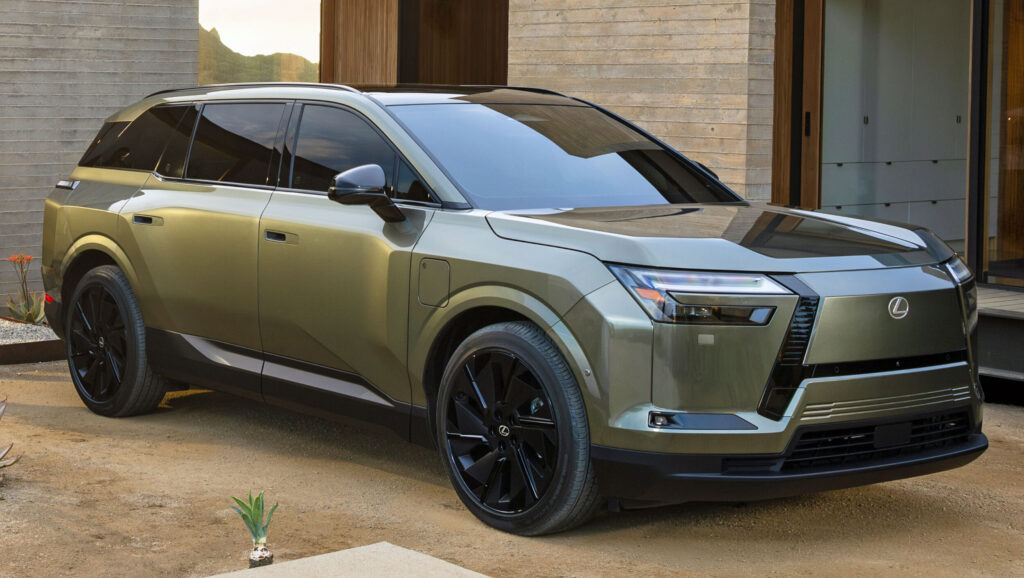
When Lexus introduced the 2027 TZ in May, the company was coy on specifications. However, the automaker has quietly updated their press kit with pricing and powertrain information.
Kicking things off is the TZ 450e Premium, which begins at $64,050 including a $1,550 destination fee. That’s cheaper than some versions of the Kia EV9 and it’s only $3,960 more than the gas-powered TX 350 AWD.
Since we’ve already seen the crossover before, we’ll briefly mention the entry-level variant comes equipped with an acoustic windshield and flush-mounted door handles. They’re joined by 20-inch wheels and an illuminated logo on the grille .
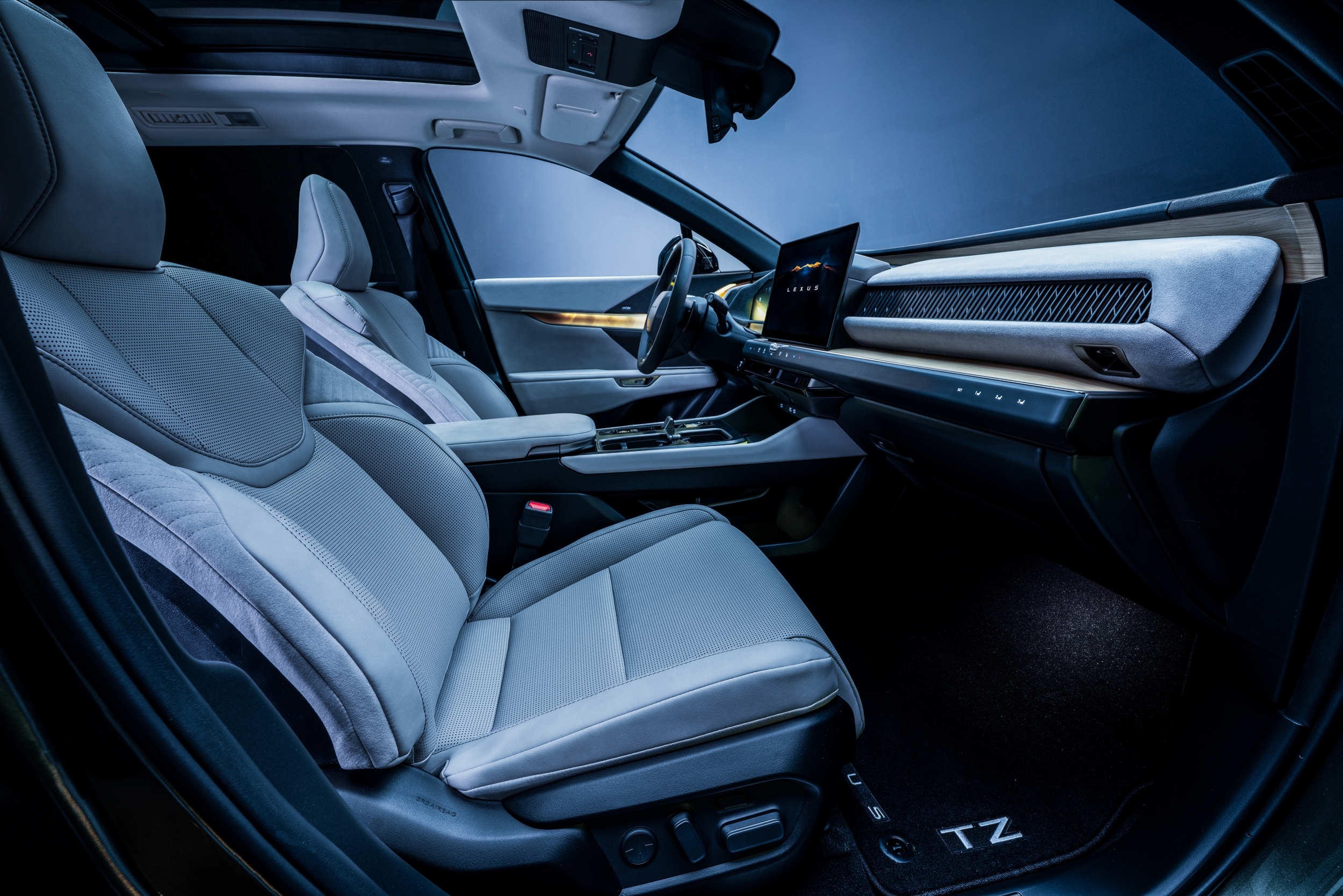
Stepping inside reveals a minimalist interior with a 12.3-inch digital instrument cluster, a 14-inch infotainment system, and a dual wireless smartphone charger. They’re joined by a panoramic glass roof, thematic ambient lighting, and a 12-speaker audio system.
The crossover has heated and ventilated front seats, second-row captain’s chairs with power recline, and a power-folding third-row. When the latter two rows are folded down, there’s 91.5 cubic feet (2,591 liters) of cargo space.
Motivation is provided by a dual-motor all-wheel drive system that produces a combined output of 308 hp (230 kW / 312 PS) and 323 lb-ft (437 Nm) of torque. It’s fed by a 77 kWh battery pack, which provides an EPA-estimated range of 253 miles (407 km).
The crossover can accelerate from 0-60 mph (0-96 km/h) in 6.2 seconds, before hitting a top speed of 112 mph (180 km/h). The Premium also has a NACS port, a bi-directional charging capability, and a towing capacity of 2,400 lbs (1,089 kg).
The TZ comes equipped with the Lexus Safety System+ 4.0 suite of driver assistance systems, which includes Full-Speed Dynamic Radar Cruise Control, Lane Tracing Assist, and a Pre-Collision System with Pedestrian Detection. There’s also Emergency Steer Assist, Intersection Turn Assist, and Lane Departure Alert with Steering Assist. Other functions include Road Sign Assist, Proactive Driving Assist, and Traffic Jam Assist.
TZ Premium Touring
The $72,050 Premium Touring ups the ante with a larger 96 kWh battery, which increases the range to 315 miles (507 km). However, the extra weight increases the 0-60 mph (0-96 km/h) time to 6.5 seconds. While that’s a bummer, the top speed remains unchanged and the towing capacity increases to 3,500 lbs (1,588 kg).
Lexus didn’t say much else about the mid-level variant, but it does come with additional features including rear steering and a “rear comfort drive mode.”
TZ Luxury
Lastly, there’s the $80,550 Luxury variant. It has the same powertrain as the Premium Touring, but the range drops to 279 miles (449 km).
This can largely be blamed on the use of 22-inch wheels. They’re backed up by a beefier braking system, which features six-piston front calipers that grab onto discs measuring 15.8 inches (401 mm). This stands in contrast to lesser variants, which have two-piston calipers and 13.4 inch (340 mm) discs.
Besides the larger wheels, the Luxury variant should have a quieter cabin thanks to acoustic glass on the windshield as well as the front and rear doors. Other highlights include a 21-speaker Mark Levinson premium audio system, a front radiant heater, and a unique “shimmering effect” for the ambient lighting system.
The upgrades don’t end there as the range-topping variant comes equipped with heated and ventilated second-row seats as well as a heated third-row. Lexus also mentioned an ottoman for the front passenger as well as the second-row captain’s chairs. People residing in the latter will also find manual sunshades.
If everything goes according to plan, the 2027 Lexus TZ should be launched late this year.
The Kia PV5 has a Chassis bodystyle variant next to the Cargo and Passenger.
The EV is available with a Long Range powertrain featuring a 71.2 kWh battery.
Various body conversions are scheduled to launch in the UK later this year.
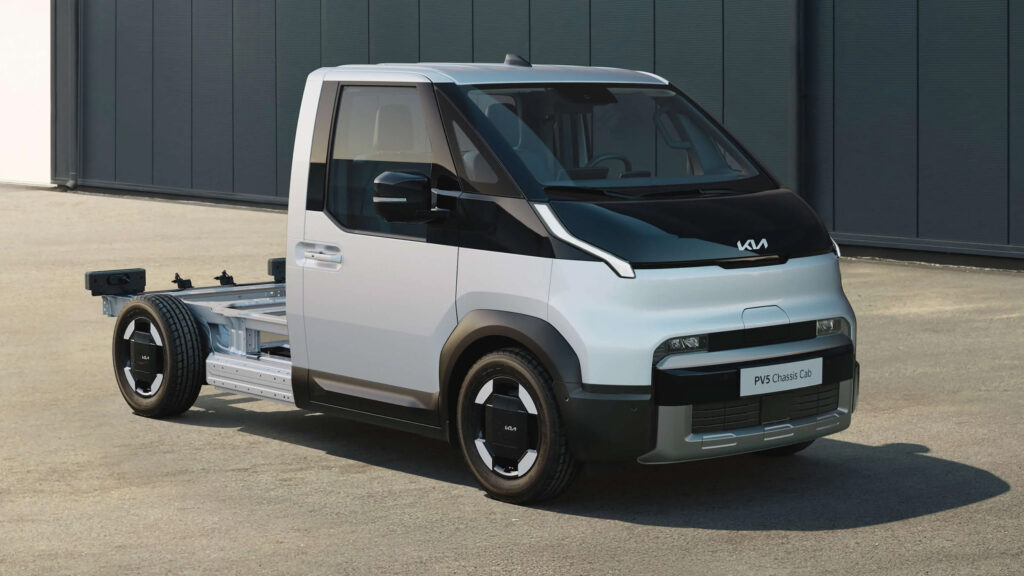
Kia has recently unveiled the new PV7 van ahead of its market launch in the second half of 2027, but until then, the smaller PV5 remains its core LCV. Besides the Cargo and Passenger variants with an enclosed body, the PV5 is also available in a Chassis bodystyle, serving as a blank canvas for all kinds of conversions.
The PV5 Chassis retains the futuristic front end of its siblings, but the rear has been chopped to reveal the bare chassis, turning it into a two-seater. The 4,610 mm (181.5 in) long LCV features a custom bulkhead with a rear windshield, and a pair of taillights mounted directly on the steel beams. As with the vans, it is available with 16-inch steelies and hubcaps or alloy wheels of the same size, retaining the same with a 2,995 mm (117.9 in) wheelbase.
The chassis bodystyle is the ideal base for aftermarket conversions. Examples include refrigerated vans, box vans, mobile workshops, dropside pickups, tippers, ambulances, service vans and compact campers. Kia has already exhibited a PV5 with an integrated kitchen turning it into a food truck. The automaker promised that more conversions will follow later this year in collaboration with its UK partner TGS Automotive Group.
Kia
Despite the utilitarian looks, the two-seater cabin of the PV5 Cargo retains the amenities of is van siblings including a 7.5-inch digital instrument cluster, a 12.9-inch infotainment display, heated seats and steering wheel, wireless charging, and a comprehensive ADAS suite.
Long Range Thrills
One and a half year after the debut of the Kia PV5 lineup in production form, Kia has launched the PV5 Chassis in the UK, exclusively available in the Long-Range configurator. This is fitted a a front-mounted electric motor generating 161 hp (120 kW / 163 PS) and a large 71.2 kWh battery pack, offering an estimated WLTP range of 259 miles (416 km) between charges.
Other markets get access to the Kia PV5 Chassis Mid-Range with the smaller 51.5 kWh battery and a less powerful electric motor producing 120 hp (89 kW / 122 PS). Both Long-Range and Mid-Range models have a maximum payload of 1,005 kg (2,216 pounds), closely matching most diesel-powered midsize pickups.
The Rivian R3 will be followed by an even cheaper model known as the R4.
Rivian’s boss believes tariffs are needed to protect the US industry from China.
The R3 will be sold with two battery options and three motor configurations.
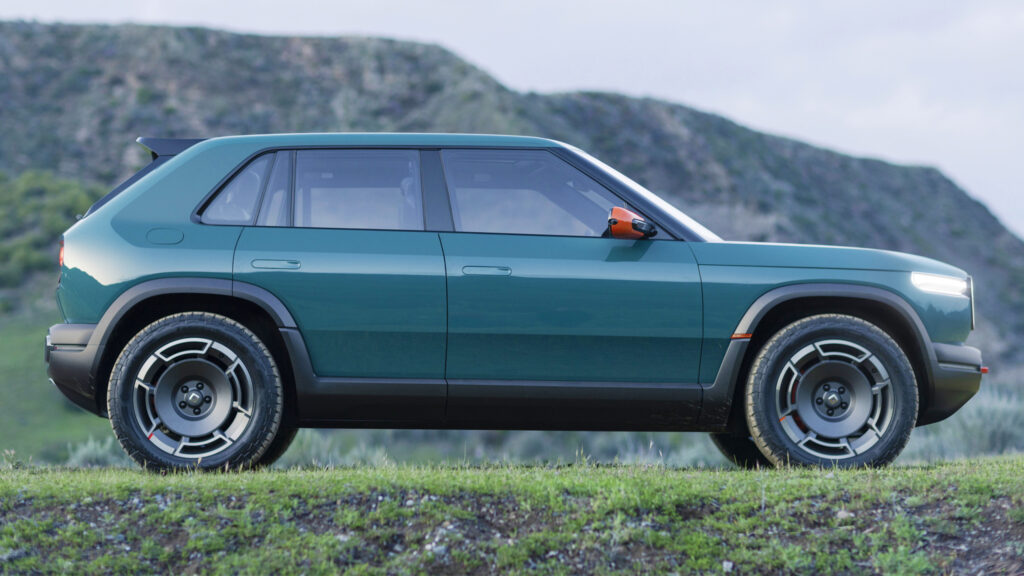
It’s been two and a half years since Rivian shocked the world when it unveiled not only its mid-size R2, but also the smaller R3 and R3X. While production and customer deliveries of the R2 have started, the R3 is still a little ways off, but when it does finally launch, it has the potential to be the brand’s highest-volume seller.
With prices starting at $45,000 and going up to $57,990, Rivian now has a legitimate rival to the best-selling Tesla Model Y in its line-up. Given how difficult it is for new car manufacturers to crack into the affordable, mass-market, no one could blame the brand for calling it a day with the R1 and R2 models, satisfied with selling a few hundred thousand vehicles a year.
That’s not how Rivian chief executive RJ Scaringe thinks. During a recent interview with The New York Times, the brand’s founder spoke about the R3 and how the US can remain competitive against new electric vehicles emerging out of China.
According to Scaringe, the R3 will be priced “materially lower” than the R2, although the company is not yet ready to announce pricing for it. It’s unlikely the compact SUV will be able to rival something like the $29,990 Nissan Leaf on price, but Rivian could have a winner on its hands if it prices it between $35,000 and $40,000.
Things won’t even stop with the R3, as Scaringe added there are also plans for an R4, “which again moves” the price point down lower.
When the R3 was first previewed, Rivian said it will be offered with two different battery packs and be sold in single-, dual-, and tri-motor configurations. The most range-focused model should be able to travel more than 300 miles (483 km) on a single charge, while the quickest should hit 60 mph (96 km/h) in less than 3 seconds.
Scaringe Says He Supports Tariffs On Chinese Cars
Moving forward, Scaringe added that America needs make proactive efforts to ensure local car manufacturers can remain competitive despite the threat from Chinese firms. He told the NYT that “we should assume that in the fullness of time, China will likely be able to sell here.” If that happens, more needs to be done to balance the different in input costs between the two countries.
In China, labor costs are much lower, as are capital costs. Important input costs like electricity and utilities also cost significantly less, enabling Chinese automakers to sell EVs at price points that Western brands have failed to match. To help level the playing field, Scaringe says tariffs are an important tool. Without them, “we have to be honest that a lot of manufacturing capacity is going to move to China.”
The rollover of a school bus north of Dallas, Texas, killed one student and resulted in minor injuries to the driver and three other students. The incident renews the scrutiny over a new Texas law expanding requirements for lap/shoulder seatbelts on school buses operated by or contracted for state districts.
According to the Texas Department of Public Safety (DPS), a Sanger Independent School District school bus was involved in a single-vehicle crash Thursday afternoon that resulted in the death of a 13-year-old student Julian Amador.
At approximately 4:55 p.m. Sept. 24, DPS troopers responded to the crash in unincorporated Denton County north of Dallas. Preliminary information indicates the school bus was traveling northbound. Editor’s note—Viewer discretion advised. Dashcam video obtained by local news station WFAA shows the school bus veer off the roadway, strike a culvert and begin to roll over. Initial DPS information corroborates that sequence of events.
Reasons for the school bus veering off the roadway have not been disclosed at this writing.
Amador, was transported by ambulance to a local hospital, where he later died from injuries sustained in the crash. The bus driver, 38-year-old Jesse Padgett of Sanger, Texas, and three students were treated at the scene for minor injuries.
Sanger ISD confirmed with School Transportation News that the bus driver and four students were on board the bus at the time of the accident. The district said it is working with law enforcement and emergency personnel and will share additional information when appropriate.
Texas has required three-point, lap/shoulder seatbelts on all new school buses and for students to wear them since 2007. A new law removes the previous blanket exemption for model-year 2017 and older buses and expands the three-point seat belt requirement to older buses still in service. Districts are not required to comply with the expanded requirement before Sept. 1, 2029, although the law retains exceptions based on district budget limitations and vehicle warranties.
It also directs ISDs to report to the Texas Education Agency the number of school buses with lap/shoulder seatbelts, with two-point lap belts, or no seatbelts at all. ISDs will also need to provide the estimated cost of equipping the school buses in their fleets that do not have lap/shoulder seatbelts, including how much it will cost to retrofit existing school buses to three-point belts or replace the buses with new models equipped with the seatbelts. Sanger ISD district website currently lists 35 total school buses in its fleet.
WFAA also reported Thursday evening that Sanger ISD said only 15 of its 29 school buses had the seatbelts as of earlier this year, with 10 of those buses having no seatbelts at all and four not having the type of seatbelts required. The local news station reported that Sanger ISD asked the state for an exception, as it would cost $500,000 to fully install the occupant restraints throughout the fleet. Local voters did not approve a district-wide bond that included $1 million for new school bus purchases.
STN asked Sanger ISD if seatbelts were installed on the school bus that rolled over, but the school district did not address that question. But CBS11 News reported that a student who rode the bus about a half hour before the crash said there were no seatbelts on board.
The investigation remains ongoing, and DPS said no additional information was available at this report. STN will provide updates as more details are released.
Bentley’s first EV offers up to 876 hp and 996 lb-ft.
The Torcal S hits 60 mph in just 2.8 seconds.
A 113-kWh battery delivers up to 375 miles of WLTP range.
After several years in the making, Bentley just unwrapped its very first EV for the world to see. Dubbed the Torcal, the new SUV packs up to 888 PS (876 hp / 653 kW), 996 lb-ft (1,350 Nm) of torque, and enough battery to travel as far as 375 miles (600 km) on the WLTP cycle. More importantly, this isn’t simply an electric Bentayga. The Torcal becomes Bentley’s fourth model line and introduces a new design language the company says will influence future models regardless of what’s under the hood. In other words, the Torcal signals a new chapter for Bentley.
The automaker will offer two versions at launch. The standard Torcal develops 821 PS (810 hp / 604 kW) and 881 lb-ft (1,194 Nm), enough to hit 60 mph (96 km/h) in 3.3 seconds before topping out at 155 mph (250 km/h). The Torcal S turns things up to 888 PS (875 hp) and 996 lb-ft when Launch Control is active.
That drops the 0-60 mph run to 2.8 seconds and raises top speed to 162 mph (260 km/h). Curiously, Bentley could have apparently pushed things even further but deliberately chose not to. Its engineers concluded that acceleration beyond this point becomes uncomfortable for most customers. Considering there’s a certain obsession with breathtaking EV acceleration figures, that’s an interesting line to draw. Having recently driven the Porsche Cayenne Electric, we can confirm that 0-60 in 2.4 seconds is potentially uncomfortable for some.
Both versions use a pair of permanent-magnet synchronous motors and an 800-volt electrical architecture. Between them sits a 113-kWh usable battery backed by a 10-year, 100,000-mile warranty. Bentley claims as much as 375 miles (600 km) of WLTP range. Find a sufficiently powerful DC charger, and the Torcal can accept up to 400 kW, taking the battery from 10 to 80 percent in under 20 minutes.
More impressively, Bentley says approximately 100 miles (161 km) can be added in seven minutes. Again, though, these figures require a charger that can achieve such speeds. That’s probably not a giant issue, given that most Torcal owners will charge almost exclusively at their mansion, or palace, or whatever building houses the car most nights.
Somehow, the Torcal is actually Bentley’s shortest four-door model despite measuring five meters (196.9 inches) long. There’s 460 liters (16.2 cu-ft) of cargo capacity out back and another 90 liters (3.2 cu-ft) beneath the hood. Visually, there’s little chance of mistaking it for anything else.
An enormous illuminated diamond grille dominates the nose, but the split headlights and razor-thin daytime running lights introduce a dramatically different face. The rear is cleaner, with slim horizontal lamps and vertical elements framing the tailgate. Bentley says it deliberately reduced the number of lines across the body, instead allowing its proportions, surfaces, and muscular rear haunches to do the talking. Ultimately, though, it’s the changes under the body that are most significant about this particular Bentley.
We discuss how non-domiciled CDL restrictions exacerbate the school bus driver shortage, new research on school zone and bus stop safety, reframing the student transportation conversation, and conference updates.
Consultant Launi Harden, who served as the former transportation director at Washington County School District in Utah and is the new executive director of the Florida Association of Pupil Transportation, analyzes transportation challenges driven by declining enrollment, funding and staff, the importance of bus attendants and alternative transportation, and essential hands-on emergency training she will help lead at the TSD Conference in November.
A 7-year-old Cincinnati Public Schools student with special needs died while riding a school bus, and her family is seeking answers about what occurred during the approximately 90-minute trip home.
Ngone Talla, a Roselawn Condon School student, was nonverbal with developmental disabilities and rode the school bus in a wheelchair. Her father, Abdoula Talla, told local media that Ngone appeared healthy and happy when she went to school Wednesday morning.
Cincinnati Public Schools confirmed in a statement provided to School Transportation News that Ngone died later that day while on her school bus.
“Our hearts remain with her family and everyone who knew and loved her,” the district stated. “This is an unimaginable loss for them and a heartbreaking time for the entire CPS community, and especially those at her school.”
Ngone’s family said the bus arrived late at their Northside home at approximately 5 p.m. Abdoula said home surveillance video showed the bus remaining outside for 10 to 15 minutes before its wheelchair ramp was lowered.
Ngone’s 12-year-old sister, Marema Talla, reportedly went outside after her mother told her the school bus had arrived. She said a bus employee eventually invited family members on board, where they found Ngone motionless in her wheelchair.
Marema told local media that Ngone’s lips appeared dry, cut and bleeding, and that she could not detect a pulse or breathing. She said an bus attendant told her something had been coming from Ngone’s mouth before she became still.
Authorities have not confirmed that account or said when during the ride Ngone became unresponsive.
Abdoula said his wife and children called him after discovering that Ngone was not breathing. He said he called 911 while rushing home. Ngone was transported to Cincinnati Children’s Hospital, where she was pronounced dead.
The family is questioning why emergency responders were not called before the bus reached their home. Investigators have not said if district transportation staff or other students on school bus knew Ngone was in distress during the route or whether earlier intervention could have affected the outcome.
Substitute Monitor Working the Day of Fatality
Abdoula said the school bus route typically had a driver and an attendant responsible for monitoring students. He said the attendant working Wednesday was not Ngone’s regular attendant.
First Student, which operated the bus, stated in an email to STN that it is cooperating with local authorities and the school district.
“We are deeply saddened by the death of a student in Cincinnati and are fully cooperating with local authorities and the school district on conducting a thorough investigation,” the company stated.
First Student declined to answer questions about when employees noticed Ngone was unresponsive, whether they contacted emergency services and whether the attendant was a substitute. The company cited the active investigation.
The Cincinnati Police Department also confirmed in an email to STN that it is conducting a death investigation but declined to release additional information because the investigation remains ongoing.
The Hamilton County Coroner’s Office has not publicly announced Ngone’s cause or manner of death.
Ngone’s family remembered her as funny, energetic and loving. Abdoula said he had communicated with her teacher earlier Wednesday and was told his daughter was having a good day.
“I just want to know the truth,” he said. “She’s a lovely baby, and I just want to know the truth.”
Cincinnati Public Schools said its Crisis Response Unit has been supporting students and employees at Roselawn Condon School and throughout the district.
A proposed overhaul of federal Head Start regulations could significantly change how transportation services are governed, and attendees at the Transporting Students with Disabilities & Special Needs (TSD) Conference this November will have an opportunity to examine what the changes could mean for daily operations.
A special conversation scheduled for Saturday, Nov. 7, will focus on the U.S. Department of Health and Human Services Notice of Proposed Rulemaking, Reducing Federal Burden for Head Start Programs. The session will provide attendees with an update on the status of the rulemaking as of the conference and bring the discussion directly to transportation professionals who serve Head Start children and families.
The Administration for Children and Families published the NPRM Aug. 7 and set an Oct. 6 deadline for public comments. It proposes to rescind and replace the Head Start Program Performance Standards most recently revised in 2024, including those for transportation. ACF said the changes are intended to reduce federal regulatory burden, eliminate requirements it considers duplicative of state and local rules, and return greater decision-making authority to Head Start agencies and families.
The NPRM proposes removing the detailed federal transportation requirements contained in 45 CFR 1303.70 through 1303.75. Those provisions currently address vehicle selection and operation, routing, safety procedures and transportation of children with disabilities. Under the proposal, Head Start programs would instead continue to follow applicable state and local licensing and transportation requirements, along with remaining federal statutory obligations.
One of the most closely watched provisions is the existing federal requirement for a bus monitor aboard vehicles transporting Head Start children. ACF proposes eliminating that mandate and allowing programs greater flexibility to determine transportation staffing based on local operations, safety practices and state or local regulations. The agency’s regulatory analysis states some programs could reduce staffing costs, while also acknowledging that programs may continue using monitors because of state or local requirements or their own safety practices.
That distinction is expected to be central to the TSD Conference conversation.
Rather than simply reviewing regulatory language, the Nov. 7 session will examine the operational questions the proposal raises for the people responsible for transporting young children. Among them: Would programs continue using monitors even if they are no longer federally required? How might requirements vary from state to state? What could changes to federal vehicle, routing and safety rules mean for training, staffing and equipment? And how could programs balance potential new flexibility with the unique transportation needs of preschool-age children and children with disabilities?
Those questions have surfaced repeatedly in interviews conducted by School Transportation News, which will report on the topic in the upcoming November edition of the magazine. Issues cited include the role monitors play in securing young children in child safety restraint systems, supervising students and assisting during loading, unloading and emergencies. Others pointed to transportation access as an especially important issue for rural families and programs already confronting driver shortages and increasing operating costs.
The discussion will also distinguish between what has been proposed and what programs are currently required to do. The NPRM itself does not change existing Head Start transportation requirements while the rulemaking process continues. The TSD Conference session will reflect whatever action, if any, HHS has taken following the close of the public-comment period.
The 2026 TSD Conference and Trade Show runs Nov. 4-10 at the Embassy Suites Dallas-Frisco Hotel & Convention Center in Frisco, Texas. The event brings together student transportation, special education, safety and industry professionals for general and breakout sessions, specialized training, hands-on activities, networking and a trade show focused on transportation for students with disabilities and special needs.
Early Bird main conference registration is $499 through Oct. 2, a savings of $100 off the $599 standard registration rate. Registration includes keynote, general and breakout educational sessions as well as the Welcome Party at Topgolf The Colony, the Ride & Drive + Technology Demonstration and the TSD Tailgate Trade Show Reception. Certain specialized training programs require separate registration and fees. Visit TSDConference.com to register and view the latest agenda.

 Login