Normal view
BraunAbility Says New Wheelchair Lift Addresses Customer Needs
Driving over 1,000 miles across multiple states and meeting with over a dozen customers, BraunAbility gathered feedback from operators, bus drivers, fleet managers and transportation directors in the public and school transport space on what they want to see in an updated lift.
The result was on display at the Transporting Students with Disabilities and Special Needs Conference in Frisco, Texas, Trade Show. BraunAbility’s Dual Parallel Arm Lift Refresh, available on Century and Millennium Series Lifts, updates a product that has seen changes since 2005.
Reed Christiansen, commercial product manager for the company, explained that in 2019 they conducted a survey to customers to understand exactly what they need.
“We tried to learn and understand their challenges and opportunities [were] to improve the lift,” Christiansen said, adding that while COVID-19 slowed down the process, they were able to learn and understand the updates needed to improve the passenger experience. These updates an auto-tite system to reduce drift and rattling, a new user-friendly hand pendant, an onboard diagnostics panel for obstruction alerts, new curved vertical channels and rounded parallel arm covers and a center line platform market to support easier and more symmetrical loading.
“This is a product that hadn’t changed in a long time,” Christiansen added. “It lasts a long time, and so that can also lead us to be not as urgent in updating the product, because from a life cycle perspective, it’s continuing to do very well, and customers are happy with it. We built a really good product in 2005 and designed a really good update then, but it was time to review that. We just want to continue to innovate and challenge ourselves and give the customers what they’re looking for.”
Colton Walle, the area sales manager for the company responsible for completing the customer survey, said after five or six customer visits he started to see a trend in features that were asked for.

Additionally, the company announced a new product that will be a standard feature on all Century and Millennium lifts. The Lift Sentinel is a guard that automatically deploys at the front of the lift to prevent someone from entering the open area when the lift is deployed. It bolts onto any model-year 2005 or newer lift.
“This is an enhanced security feature to make our operators and passengers more comfortable as they’re loading and unloading passengers,” Christiansen said.
The Lift Sentinel will be available for pre-orders in January, and the DPA Lift Refresh is expected to be available in the second quarter of next year.
Related: Legal Keynote Opens Attendees’ Eyes to Federal Special Needs Transportation Laws
Related: School District Directors Share Strategies for Transporting Students with Disabilities
Related: Parents Speak Out After Motorists Target Son with Disabilities at School Bus Stop
The post BraunAbility Says New Wheelchair Lift Addresses Customer Needs appeared first on School Transportation News.
-
School Transportation News
- South Carolina School Bus Driver Arrested, Charged with Solicitation of a Minor
South Carolina School Bus Driver Arrested, Charged with Solicitation of a Minor
A Moncks Corner school bus driver is behind bars after being arrested in connection with an Internet Crimes Against Children (ICAC) investigation, reported Live 5 News.
Allan Bladorn, 39, was reportedly taken into custody Nov. 20, after Berkeley County investigators identified him as a suspect during an undercover online operation. The Berkeley County Sheriff’s Office arrested Bladorn and placed a hold on him until he was transferred to Chesterfield County the following day.
According to the news report, authorities confirmed that Bladorn was employed as a public-school bus driver with the Berkeley County School District at the time of his arrest. Investigators seized his cellphone, which will undergo forensic analysis as part of the ongoing case.
Bladorn is currently being held at the Chesterfield County Detention Center, where he awaits a bond hearing. The sheriff’s office stated that the investigation remains active, and that additional charges may be filed as evidence continues to be reviewed.
Related: Missouri Parent Boards School Bus, Tells Child to Assault Another Student
Related: North Carolina School Bus Driver Charged with Sex Crimes Against Students
Related: Maryland School Bus Aid Charged with Sexual Assault
Related:South Carolina School Bus Driver Charged with DUI While Transporting Students
The post South Carolina School Bus Driver Arrested, Charged with Solicitation of a Minor appeared first on School Transportation News.
The Lexus LFA Returns But As An EV With No V10 In Sight
- The LFA Concept is based on the same aluminum chassis as the Toyota GR GT and GR GT3.
- Curiously, Lexus has decided not to use the same twin-turbocharged hybrid V8 as the Toyota.
- The design of the car was previewed several months ago with the stunning Lexus Sport Concept.
This is the Lexus LFA Concept and it’s quite unlike the iconic V10-powered weapon that came before it. Long expected to simply be a Lexus-branded version of the new Toyota GR GT, the LFA Concept is instead something else entirely. It’s electric. Yes, you read that right.
The concept, unveiled alongside the twin-turbo V8 Toyota in Japan this evening, was previewed a few months ago as the Lexus Sport Concept. Its since morphed into the LFA Concept and been presented with an electric powertrain. According to Lexus, the ‘LFA’ name is “not bound to vehicles powered by internal combustion engines,” but instead symbolizes a vehicle that “embodies the technologies that engineers of its time should preserve and pass on to the next generation.”
Read: Toyota’s GR GT Drops With TT V8 Hybrid And At Least 641 HP
Toyota Underpinnings
Whereas Toyota revealed a slew of details about its new halo performance car, Lexus has remained tight-lipped about many of the LFA Concept’s important details. It hasn’t provided any details about the electric powertrain that drives it, but regardless of how special it is, or how much grunt it may have, it certainly won’t be able to match the roar of the Toyota.
Interestingly, the LFA Concept is based on the same all-aluminum platform as the Toyota GR GT and GR GT3. That presumably means Lexus had the option of using the same V8 as its parent company, but opted against it.
While the choice of powertrain seems odd, particularly given poor demand for high-performance EVs, there’s no denying the LFA Concept looks beautiful, which isn’t a word we’d use for the Toyota. The interior is also wildly different than the Toyota, although this isn’t a surprise given the LFA is still a concept.
When Will it Launch?
What does the future hold for the LFA Concept? We know it will spawn a production model, and the renaming of the Sport Concept to the LFA Concept, indicates that it will indeed be sold as the second-generation Lexus LFA. Just when it will hit a road near you remains unclear.
Lexus Sport Concept
-
Electric Vehicles - Latest News | Carscoops
- Mercedes Says Its New EV Tech Might Make Rear Brakes Pointless
Mercedes Says Its New EV Tech Might Make Rear Brakes Pointless
- New Mercedes-AMG EVs will use advanced axial flux electric motors.
- Engineers say rear brakes may shrink dramatically or even disappear.
- New in-wheel motor pairs with a compact 15 kg dual inverter unit.
Just over a month ago, Mercedes-owned brand Yasa unveiled a record-breaking electric motor that weighs just 12.7 kg (28 lbs) and has the ability to produce up to 1,006 hp (750 kW). The company has now revealed that this axial flux motor will be used as an in-wheel unit for its next-generation EV powertrains and could even replace traditional rear wheel braking systems.
While in-wheel electric motors are nothing new, they haven’t been widely adopted in the EV market, in part because they’re heavy and generally aren’t particularly powerful. Yasa’s new motor set an unofficial electric motor power density record of 59 kW (79 hp) per kilogram, or 35 hp per pound.
Read: Mercedes’ Axial Flux Motor Weighs Less Than A Toddler And Makes Over 1,000 HP
While the motor can deliver a peak of up to 1,006 hp, the firm notes that its continuous power output ranges between 469 hp and 536 hp. It can then be paired with a 15 kg (33 lbs) dual inverter that Yasa has also developed in-house, and could prove perfect for high-powered hypercars and other performance EV applications.
Then there’s the matter of braking. Yasa says its in-wheel motor offers such “incredible regenerative performance” that the system could potentially negate the need to use traditional rear brakes.
This could allow carmakers to not only ditch important brake componentry, but also rear driveshafts, potentially saving up to 200 kg (441 lbs) from current models and as much as 500 kg (1,100 lbs) on new models developed from the ground-up.
“Thanks to its exceptional regenerative capability, this system has the potential to dramatically downsize rear brakes on an EV – or even remove them entirely in certain architectures,” Yasa chief of New Technology, Simon Odling, said.“And by capturing a much greater proportion of regenerative braking energy, this technology can also deliver a significant increase in EV range.”
“What’s more, our new in-wheel motor powertrain not only enables significantly lighter, more efficient and higher performance EVs, but also dramatically creates space within the architecture of an EV too, giving car makers unprecedented freedom to redesign and optimize the packaging, aerodynamics and kinematics of their next-generation vehicles,” he added.
Yasa’s axial flux motors will be used in the new all-electric Mercedes-AMG GT 4-Door sedan and SUV. However, these models are not expected to use these motors as an in-wheel application, and will instead have one motor at the front axle and two at the rear.
Guido ten Brink/SB-Medien – Stefan Baldauf
-
Electric Vehicles - Latest News | Carscoops
- Subaru’s New Trailseeker Costs $5,000 More Than The Outback
Subaru’s New Trailseeker Costs $5,000 More Than The Outback
- The 2026 Subaru Trailseeker arrives early next year for $39,995.
- Electric crossover has 375 hp and around 280 miles of range.
- It comes equipped with heated front seats and a 14-inch display.
Subaru introduced the 2026 Trailseeker earlier this year and now the company has announced the wagon-like crossover will start at $39,995. That’s $5,000 more than the redesigned Outback, but the Trailseeker is far more attractive.
Kicking things off is the entry-level Premium trim, which features a fully enclosed grille that is flanked by LED headlights. Buyers will also find automatic windshield wipers, a power liftgate, and 18-inch alloy wheels with aerodynamic covers.
The model is also notable for having 8.3 inches (211 mm) of ground clearance, which is more than the redesigned Jeep Cherokee.
More: Toyota Made An Electric Subaru Outback As Powerful As A Supra
The minimalist interior comes nicely equipped with a 7-inch digital instrument cluster and a 14-inch infotainment system with Android Auto and Apple CarPlay. They’re joined by heated front seats that are wrapped in StarTex upholstery and have 10-way power adjustment on the driver’s side.
Other highlights include an automatic climate control system, ambient lighting, and a dual wireless smartphone charger.
The EyeSight Driver Assistance suite comes standard and provides Adaptive Cruise Control, Lane Tracing Assist, and Traffic Jam Assist. The model also has Front/Rear Cross-Traffic Alert, Pre-Collision Braking, Active Lane Change Assist, and Lane Departure Prevention. Rounding out the highlights are Safe Exit Assist and a Blind Spot Monitor.
Trailseeker Limited
Moving up the trim ladder is the $43,995 Trailseeker Limited. It features a lightly revised exterior with 20-inch wheels and a hands-free power liftgate.
Bigger changes occur inside as the cabin is more luxurious thanks to a heated leather steering wheel and heated rear seats. Buyers will also find a power passenger seat and a Harman Kardon premium audio system.
The upgrades don’t end there as the Limited features digital key technology and a 1500 watt AC power outlet in the rear cargo area. They’re joined by parking assist and a panoramic view monitor.
Trailseeker Touring
Sitting at the top of the lineup is the $46,555 Trailseeker Touring. It’s distinguished by a panoramic glass roof and a gloss black accent on the hood. Customers can also get a unique two-tone paint job for $795.
Interior changes are minor, but the range-topping variant has a digital rearview mirror, ventilated front seats, and radiant leg warmers. Customers can also shell out $300 to get black and blue leather seats.
The Fastest Subie In America
Regardless of which trim is selected, all Trailseekers have a 74.7 kWh battery pack that feeds a dual-motor all-wheel drive system. The latter produces a combined output of 375 hp (280 kW / 380 PS) and it enables the model to accelerate from 0-60 mph (0-96 km/h) in 4.4 seconds.
Besides being the fastest Subaru ever sold in America, the model is expected to have a range of approximately 280 miles (451 km). When the battery is low, the 150 kW DC fast charging capability can deliver an 80% charge in as little as 28 minutes. It’s also worth noting the model has an NACS charging port.
2026 Subaru Trailseeker Pricing
| Model | MSRP |
| Trailseeker Premium | $39,995 |
| Trailseeker Limited | $43,995 |
| Trailseeker Touring | $46,555 |
Prices exclude a destination fee of $1,450 to $1,600
Hyundai’s Latest Robots May Be Eyeing Your Job
- Hyundai launched two MobED versions with distinct capabilities and uses.
- The Pro model adds full autonomy while the Basic relies on remote input.
- Cameras, LiDAR, and AI let the robot navigate tight and crowded places.
Four years after first showing its Mobile Eccentric Droid (MobED) concept, Hyundai’s Robotics LAB has now revealed the production version in Tokyo, Japan. The debut marks an important step in the company’s expansion into advanced robotics.
The compact platform has been engineered to be fully autonomous and uses advanced artificial intelligence that allows it to cruise over different surfaces and provide incredible adaptability for different use cases.
How Does It Move?
Central to MobED’s capability is its Eccentric Control Mechanism, a clever system that lets the robot adjust its posture and each wheel individually. The result is an uncanny steadiness, even when crossing inclined or uneven terrain.
Read: Like All Eccentrics, Hyundai’s New Mobile Eccentric Droid May Be Going Into The Film Business
For spatial awareness, Hyundai equipped the platform with a suite of advanced cameras and LiDAR sensors. An AI-driven obstacle detection system adds another layer of awareness, helping the robot navigate confined or crowded spaces without missing a beat.
Hyundai envisions it taking on various roles, from last-mile deliveries to logistics support, with minimal human intervention.
Two Flavors Of Droid
Hyundai has revealed two versions of the robot: the Basic and the Pro. The Basic measures 1,150 mm (45.2 inches) in length, 750 mm (29.5 inches) in width, and 430 mm (16.9 inches) in height. It weighs 78 kg (172 lbs) and can carry up to 57 kg (125 lbs).
The Pro variant stands a little taller at 650 mm (25.5 inches) and heavier at 88 kg (194 lbs), though its payload capacity drops slightly to 47 kg (104 lbs).
Where they diverge most is autonomy. The Pro comes equipped with Hyundai’s full self-driving system, while the Basic relies on manual operation via remote control.
What Keeps It Rolling?
Powering both versions is a small 1.47 kWh battery that provides up to 4 hours of operating time. However, compared to some of Hyundai’s EVs, the MobED charges slowly, needing 2.5 hours to juice up the battery from 10 to 90 percent.
Each robot also features universal mounting rails that make it easy to attach a variety of tools and modules. In the future, they could perform a range of important tasks in factories and warehouses, as well as crucial functions at production facilities, reducing the need for human labor.
Commercial sales of the MobED are expected to begin in the first half of 2026. Hyundai has yet to announce pricing, though it’s clear the company sees the robot as more than a novelty.
-
Electric Vehicles - Latest News | Carscoops
- Ford’s CEO Applauds Trump’s CAFE Rollback, Says They Were Forced Into EVs
Ford’s CEO Applauds Trump’s CAFE Rollback, Says They Were Forced Into EVs
- Farley says tougher fuel rules made low cost cars harder to build.
- Ford expects lower prices as new standards cut compliance costs.
- The CEO says the reset lets customers choose their preferred models.
Ford CEO Jim Farley has joined several of his American counterparts in supporting the Trump administration’s decision to reset federal fuel-economy standards.
The move, Farley says, gives automakers the breathing room to produce more affordable vehicles in the United States without walking away from electric innovation or efficiency goals.
Farley’s core argument seems to be that regulations were so strict that they effectively squeezed automakers out of the low-cost segments so many buyers still rely on.
Read: Trump Admin Pushes Fuel Economy Shakeup And The Impact Could Be Huge
Speaking at a press conference with President Donald J. Trump on Thursday, Farley called the update “a victory for affordability and common sense,” adding that Ford will now be able to offer cheaper versions of its most popular models and launch new price-focused products.
“We believe that people should be able to make a choice, as you said, Mr. President,” Farley said. “And we will invest more in affordable vehicles. This allows us to invest in affordable vehicles made in the U.S., which we will take the lead on and will allow us to make vehicles more affordable.”
Trump, sitting beside him, said, “People were brainwashed. This is a ‘green new scam.’ And people were paying too much for a car that didn’t work as well. And now they’re gonna have a great car that’s gonna be environmentally friendly, but it’s gonna cost you a lot less and it’s gonna work great. All of the nonsense is being taken out of the cars.”
Political Theater or Market Reality?
Farley stopped short of framing the move as an ideological shift, instead focusing on the economics. He argued that the tightened CAFE standards under the previous administration imposed costs that made entry-level vehicles much harder to justify.
That pressure, he said, pushed automakers toward higher-margin EVs and hybrids simply to meet fleet targets.
“What you should know is that this is a victory for affordability and common sense. As the president said, we will be able to offer more affordability on our popular models, and we’ll be able to launch new vehicles built in America that are more affordable because of this rule change,” Farley said later in an interview on “Fox & Friends” Thursday.
Farley added that the earlier fuel-economy system “was totally out of touch with market reality.” Automakers, he said, were forced to sell EVs and other vehicles to stay compliant, even when customer demand wasn’t there.
“We were forced to sell EVs and other vehicles. We’re not going back to gas-guzzlers,” he continued. “We have a lot of EVs and a lot of hybrids at Ford, but now customers get a chance to choose what they want, not by what we force on them.”
Balancing Choice and Compliance
Ford’s CEO also clarified that the company isn’t returning to inefficient gas models, noting it already sells a wide range of EVs and hybrids. GM’s CEO Mary Barra recently made similar comments.
Also: GM’s Mary Barra Promises Cleaner Engines, But Looser Rules Fuel More Gas Guzzlers
The reset rolls back the steep increases introduced under the Biden administration, which raised fuel-economy requirements by 8% for 2024 and 2025 and 10% for 2026. Federal officials previously estimated those rules would add nearly $1,000 to the average new-car price.
By contrast, the new standard lowers compliance costs and, according to the White House, will save American families a combined $109 billion. Now, the market waits to see if automakers really do deliver on their promises of rolling out more affordable models.
Photo Whitehouse/YouTube
-
Electric Vehicles - Latest News | Carscoops
- Something Big Is Changing Inside Audi’s Electric SUVs And It’s Not Just The Battery
Something Big Is Changing Inside Audi’s Electric SUVs And It’s Not Just The Battery
- Audi is testing facelifted Q4 e-tron and Q4 Sportback e-tron.
- Both debut in 2026 with updated styling and powertrains.
- Prototypes reveal a redesigned interior with a curved display.
Our spy photographers have already snapped prototypes of the 2027 Audi Q4 e-tron and Q4 Sportback e-tron during testing. Now, however, they’ve gotten a glimpse inside, where we can see some pretty significant changes.
While the current model has a 10.25-inch digital instrument cluster and an 11.6-inch infotainment system, the facelifted prototype has an all-new dashboard with a freestanding curved display that appears to echo the one found in newer models such as the A5 and A6 as well as the Q3 and Q5.
More: Audi Q4 E-Tron Glow Up Takes Aim At Tesla’s Model Y
This likely means it will consist of an 11.9-inch digital instrument cluster and a 14.5-inch infotainment system. We also wouldn’t be surprised to find an optional 10.9-inch front passenger display.
We can’t see much else, but the production model could benefit from additional changes including a new steering wheel and revamped switchgear. Updated trim, upholstery, and equipment may also be on the cards.
Moving outside, we can see a lightly revised front end with skinnier air curtains that feature a horizontal accent. The grille is covered by camouflage, but it’s expected to be refreshed and could adopt an illuminated four ring logo.
Also: Audi Fixes One Of Its Most Hated Interior Features For 2026
The evolutionary styling continues at the rear as the Sportback has a lightly revised bumper with slender vents that’s joined by a modified diffuser and taillights that look the same but could sport updated graphics in the production-ready model.
shproshots
Some of the biggest changes are expected to occur beneath the skin as electric vehicle technology has come a long way since the Q4 e-tron was introduced in 2021. This likely means we can expect more efficient motors, improved batteries, and upgraded charging technology.
The current model offers an assortment of powertrains, including a rear-mounted motor producing 282 hp (210 kW / 286 PS). Buyers can also get an all-wheel drive variant with 335 hp (250 kW / 340 PS) and an EPA-estimated range of 258 miles (349 km).
shproshots
-
Electric Vehicles - Latest News | Carscoops
- Bentley Is Going To Release A Smaller SUV Few Are Asking For
Bentley Is Going To Release A Smaller SUV Few Are Asking For
- Bentley’s second SUV will share its electric powertrain with the Cayenne.
- New model is smaller than the Bentayga and launches exclusively as an EV.
- Company plans to reveal its new electric SUV sometime in mid 2026.
Believe it or not, it’s been a decade since Bentley introduced the Bentayga SUV, and it’s proven to be the brand’s best-selling model during this time. It’s perhaps a surprise then that it’s taken them ten years to start work on a second SUV, designed to slot below the Bentayga.
This new model is currently known as the Urban SUV, but expect a fancier name once production is near. Unlike the Bentayga, it will be sold exclusively as an EV, a decision that, given the current uncertainty surrounding Western markets, might not prove Bentley’s most strategic choice.
Read: This Is Bentley’s First EV And It’s Built To Haul More Than Just Your Ego
Hindsight, of course, is 2020, but it’s reasonable to assume Bentley also had China in mind, where electric vehicles now dominate the premium segment. Either way, with fellow VW-owned brand Porsche already having two electric SUVs of its own, it was only a matter of time before Bentley followed suit.
What’s Hiding Under There?
Baldauf
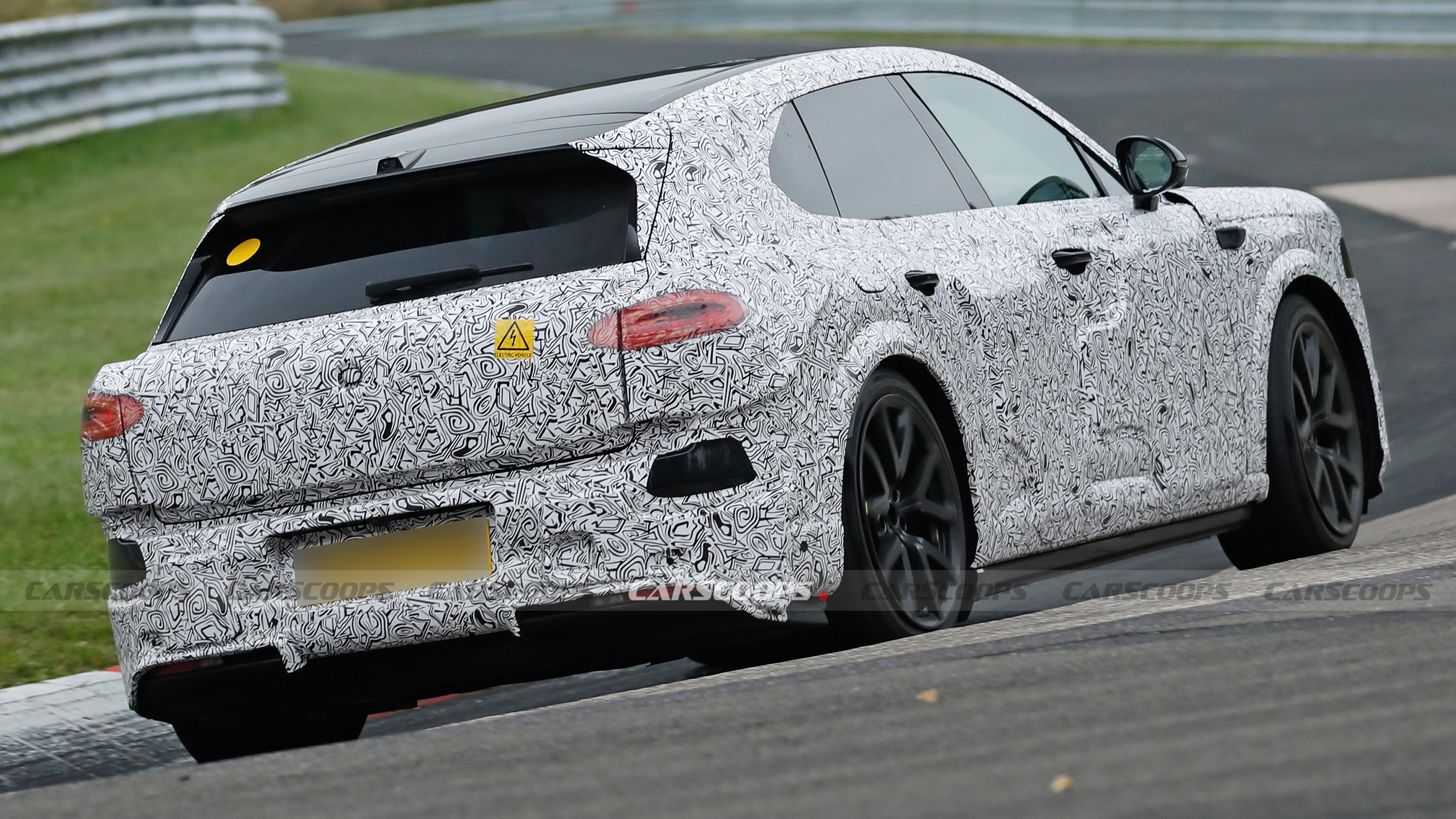
Pictured here for the first time during testing at Germany’s Nürburgring Nordschleife, the Urban SUV is hiding under camouflage and body cladding, keeping most of its design details a secret. Included as part of the disguise are four fake circular headlights, similar in shape to those of the current Bentayga.
A few months ago, Bentley unveiled the wild EXP15 concept, complete with vertical headlights. However, the headlight clusters we can see don’t look like the concept’s.
As with the headlights, it is difficult to discern the shape of the grille, as it too has been hidden from view. What we can see is that this new model is smaller than the Bentayga and has a lower roofline. This isn’t to say it’s small, however. It’ll likely be about the same size as the new Porsche Cayenne Electric.
Our spy photographer was able to catch a glimpse of the SUV’s interior, although it’s difficult to pinpoint any highlights. What we can say with certainty is that it won’t follow the current trend of many EVs that feature tacky tablet-like displays for the gauge cluster and then giant infotainment screens on the dash.
Cayenne Electric Power?
Powertrain details have not been confirmed, but the Bentley is widely expected to share many components with the Cayenne Electric.
This could include the same 113 kWh battery pack and 800-volt electrical architecture, ensuring the Bentley will have decent range and support fast-charging. In the case of the Cayenne, Porsche says it needs just 16 minutes to charge from 10-80 percent.
Two versions of the Cayenne Electric have been confirmed, one with 402 hp as standard or 435 hp with launch control enabled, and the flagship Turbo that boasts 844 hp during normal driving and 1,139 hp and 1,106 lb-ft at launch control. It’s safe to assume the Bentley’s power figures could slot somewhere between the two Cayenne models.
Bentley is expected to unveil the Urban SUV in mid-2026, with first deliveries planned for 2027.
Baldauf
-
Electric Vehicles - Latest News | Carscoops
- GM’s Mary Barra Promises Cleaner Engines, But Looser Rules Fuel More Gas Guzzlers
GM’s Mary Barra Promises Cleaner Engines, But Looser Rules Fuel More Gas Guzzlers
- GM vows to keep improving engine efficiency as federal standards weaken.
- Looser rules may push automakers toward more profitable trucks and SUVs.
- Barra says GM’s EV commitment stands despite lower sales after credits ended.
This year has been a strange one for automakers, but many of them just caught a break. The EPA effectively wiped out penalties for missing fuel-economy targets, a move that could easily trigger another surge in high-margin full-size trucks and SUVs.
More: Trump Admin Pushes Fuel Economy Shakeup And The Impact Could Be Huge
With less regulatory pressure, engines don’t have to get cleaner or more efficient, yet GM CEO Mary Barra insists the company will keep pushing them in that direction anyway.
She maintains that GM will improve every combustion engine it invests in, no matter what the rulebook says. Whether that commitment holds once the market leans even harder toward big, profitable gas-guzzlers is another matter entirely.
How Long Will Progress Last?
Innovation is no doubt key for all automakers, so the promise of continued development is promising on paper. That’s what Barra provided at the New York Time’s DealBook Summit on Wednesday, saying, “Every engine we invest in, we work to have a significant improvement.”
It seems clear that tougher fuel economy standards have led to huge costs for automakers. A recent report indicates that many of the larger recalls from the past two years can be linked to those standards.
Whether or not GM and other automakers will continue to push fuel economy as hard as they have is a worthy consideration.
What’s the Incentive Now?
For decades, automakers have intentionally steered consumers toward larger SUVs and trucks because they offer the largest profits and require the least stringent fuel economy standards.
Read: GM’s Cheapest American EV Starts With A Chinese Shortcut
It’s unclear why that strategy would change now that the penalties are gone altogether. Still, something positive could come from new regulations in Barra’s eyes.
Barra also supported Trump’s move to strip California of tougher clean-air authority, pushing instead for one national standard that doesn’t “get in front of the consumer.” However, automakers helped create today’s SUV-heavy demand, so that argument only goes so far.
Looser rules also ease pressure on EVs, a convenient shift for GM as sales dip after tax credits expired and its electric lineup remains unprofitable. Barra insists the company is still committed.
She was more positive on tariffs, calling recent policies “a more level playing field” after years of uneven barriers. GM may keep refining engines, but with weaker rules and a market built around giant SUVs, it’s hard to imagine Detroit walking away from its biggest profit margins.
-
Electric Vehicles - Latest News | Carscoops
- Rivian Goes Plum Crazy With A New Color And Something Extra
Rivian Goes Plum Crazy With A New Color And Something Extra
- Borealis purple debuts as a $3,000 option for R1S and R1T buyers.
- Rivian has also announced a special Lease Bonus for both models.
- Some R1S and R1T trims qualify for lower monthly payments now.
It seems to be that time of year for Rivian again. Fresh off unveiling its limited-run Miami Edition, the company has decided it’s time for a new splash of color, one that might actually be its best yet. Called Borealis, it’s a deep, moody shade of purple inspired by the Northern Lights, offered on the Tri and Quad variants of the brand’s EVs.
Purple tones aren’t as popular as some other colors in the car industry, but when done right, they can look superb. We’ll reserve full judgment on Borealis until we see it under natural light, but based on early images, it flatters the R1S slightly more than the R1T, whose pickup shape doesn’t highlight the color in quite the same way.
Read: Rivian Turns One-Off Miami Showpiece Into A Very Pricey Limited Run
Like every Rivian finish beyond the standard LA Silver, Borealis comes at a premium, $3,000, to be exact. That puts it in line with other paid options such as Red Canyon, Rivian Blue, and Storm Blue.
The company hasn’t confirmed whether Borealis will filter down to the more affordable Dual Standard and Dual trims, though it’s easy to imagine that decision hinging on how buyers respond to the initial rollout.
Rivian’s new purple looks especially nice when accented against its available 20- and 22-inch burnished bronze wheels. Paired with a set of bright blue brake calipers, shoppers can get a Rivian that really stands out.
A New Lease Deal
The addition of a new color isn’t the only thing that prospective Rivian owners can get excited about. The company has announced that several 2026 R1T and R1S models are eligible for a $5,000 Lease Bonus if customers take delivery by December 31.
Models eligible for the deal include the 2026 R1S and R1T Tri, R1S and R1T Dual Standard, and both the R1S and R1T Dual with the Large battery and Performance Upgrade. Importantly, Rivian notes this deal is only available while supplies last.
Even with that bonus, leasing an R1T or R1S remains a costly proposition. For example, the R1T Dual Standard, priced at $72,990, still comes to $709 per month over 36 months, with $8,604 due at signing, an effective monthly rate of $948 before adding the $1,895 destination fee and state taxes.
For those willing to sacrifice a little cargo space for a lower payment, the R1S Dual Standard presents a slightly better deal. Its lease terms come in at $699 per month with $3,594 due at signing, translating to an effective monthly rate of $798, plus destination.
-
Electric Vehicles - Latest News | Carscoops
- Jaguar Rolls Out Its Future In A New Color Right After Firing The Man Behind It
Jaguar Rolls Out Its Future In A New Color Right After Firing The Man Behind It
- Jaguar’s Type 00 concept returns in London finished in matte red paint.
- British brand will unveil a dramatic four-door production EV next year.
- The production EV promises 430 miles of range and ultra-fast charging.
This time last year, Jaguar revealed the wild Type 00 concept, the first look at its all-electric future and a statement of intent to compete with Bentley and Rolls-Royce.
As development of the production version continues, a matte red example of the concept has been spotted on London’s streets, marking the marque’s 90th anniversary and coinciding with the unexpected departure of its longtime design chief, the figure behind the brand’s polarizing rebrand.
The Type 00 was originally shown in Miami Pink and London Blue during the official launch. Earlier this year, the model was dressed in a French Ultramarine livery and made a surprise appearance during the Paris Fashion Week.
Read: Jaguar’s Future GT Has No Rear Window And No Patience For Cargo
The company has now unveiled a fourth color variation, London Red with a matte finish, as the concept makes its arrival in the UK capital. The new shade draws inspiration from the redbrick Victorian architecture of Kensington, one of London’s most recognizable neighborhoods.
Jaguar
The freshly repainted concept was photographed alongside a classic 1935 Jaguar SS outside the Chancery Rosewood Hotel.
For those wondering, no other changes have been made to the concept’s exterior. It still rides on the same 23-inch alloy wheels, while the minimalist cabin remains finished in white and gray upholstery accented by ambient lighting.
Photos shared by Jaguar UK Director Santino Pietrosanti on LinkedIn show the Type 00 parked alongside some exotic company, including a Bugatti Chiron, Rolls-Royce Cullinan Black Badge, Ferrari F8 Tributo, and Lamborghini Aventador SVJ.
Santino Pietrosanti / LinkedIn
The brand’s rebrand has been met with mixed reactions. Its ad campaign, oddly enough, featured no cars at all, leaving many scratching their heads. It was also rather odd that it initially showcased the Type 00 in a bright shade of pink, which didn’t do the car any favors.
Still, under London’s gray winter light, the matte red finish lends the concept a sense of gravitas. Out in the open, it naturally draws attention, albeit that’s not really surprising for a concept car. Much like the Tesla Cybertruck, its unconventional form challenges expectations so completely that people can’t decide whether they admire it or despise it. There seems to be little middle ground.
The Road Car
Prototypes of the production version suggest Jaguar plans to stay faithful to the concept’s striking proportions. The roadgoing model will, however, take a more practical shape with four doors and a longer wheelbase, built on the company’s new Jaguar Electrical Architecture platform.
More: Jaguar’s Future GT Has No Rear Window And No Patience For Cargo
As per recent reports, the EV should have a driving range of up to 430 miles (692 km) and support fast charging, adding 200 miles (322 km) of range in just 15 minutes.
Only time will tell if those who would ordinarily shop for a Bentley or Rolls-Royce will be willing to spend their money on a vehicle that looks as controversial as this.
JLR Design Chief Axed
In separate news, it has been confirmed that Jaguar Land Rover design boss Gerry McGovern has departed from the brand. No official reason has been given for this high-profile departure, but it comes shortly after former chief financial officer at Tata, PB Balaji, was named as JLR’s new chief executive.
Citing insider sources, Autocar India reports that McGovern was “escorted out of the office” on Monday, with his contract being terminated with immediate effect. The man behind Jaguar’s relaunch has spend over two decades at JLR, being responsible for successful models including the new Land Rover Defender.
According to business economics professor at the University of Birmingham, David Bailey, McGovern’s exit marks a “symbolic end of an era.” He told The Guardian that it may also be a sign that Tata wants to exert more control over the British company.
Thanos Pappas contributed to this story.
Redford Union School District to Deploy Five Electric School Buses
REDFORD, Mich. – Redford Union School District is taking a major step towards cleaner, quieter transportation with the planned deployment of five Type C zero-emission electric school buses and six Tellus chargers, at no expense to local taxpayers. The project is being delivered through a collaboration between Durham School Services, the district’s transportation provider, and Highland Electric Fleets, the leading provider of Electrification-as-a-Service (EaaS).
Redford Union is part of a growing number of school districts across Michigan introducing electric school buses to modernize their fleets and deliver long-term benefits to students and families. Electric school buses offer quieter rides, lower maintenance needs, and can help reduce fuel costs over time. The new electric buses are expected to arrive in the first quarter of 2026 and are primarily funded by the U.S. Environmental Protection Agency’s Clean School Bus Program (Round 2).
“Bringing zero-emission buses into our fleet is more than a transportation upgrade, it’s an investment in our students’ well-being and the long-term health of our community,” said Judy Nachman, Redford Union School District Interim Superintendent. “Cleaner rides mean fewer emissions, lower operating costs, and a modern system that reflects the values we want to pass on to our kids. We’re thankful to Durham School Services and Highland Electric Fleets for standing with us in this effort. Their support has been critical in moving our district toward a safer, healthier future.”
“We are excited to embark on this new EV journey with the Redford Union School District,” said John Juniker, Fleet Services Manager at Durham School Services. “This endeavor will bring about positive environmental and health benefits for the students and community and reaffirms both Durham and the school district’s commitment to being environmentally responsible leaders. Our team looks forward to working together with the school district and Highland on this EV project to build a safe, healthier future for everyone.”
Highland Electric Fleet is supporting this deployment by managing every step of the electrification process. While Highland’s contract is directly with Durham School Services, its work will ultimately benefit Redford Union’s students and the broader community. Highland is overseeing infrastructure upgrades, coordinating charger installation, and working closely with DTE Energy, the local utility provider, which is contributing make-ready funds to help power the new buses.
“Redford Union School District is making an important investment in its students and its community,” said Brian Buccella, Chief Commercial Officer at Highland Electric Fleets. “We’re proud to support the district alongside Durham School Services, helping deliver the benefits of electric transportation for students and families in Redford Union.”
By working together, Durham School Services and Highland are helping Redford Union School District modernize its fleet and provide students with a cleaner, quieter ride to school.
About Redford Union School District
Where students belong, Redford Union Schools is a public school district in Metro Detroit committed to providing excellence in a safe and challenging learning environment. The district transforms lives by offering an innovative, collaborative, tradition-rich and future-focused education to the students it serves.
About Durham School Services
As an industry-leading student transportation provider, Durham School Services and its sister brands, Stock Transportation and Petermann Bus, are dedicated to the safety of our students and People. Collectively, for more than 100 years, we have been committed to Excellence and upholding our mission of getting students to school safely, on time, and ready to learn. Through this mission and a grassroots approach to our operations, Durham School Services and its sister brands have earned recognition as a trusted transportation provider among our Customers and the Communities they serve.
About Highland Electric Fleets
Highland Electric Fleets is North America’s leading provider of Electrification-as-a-Service. Founded in 2019, Highland partners with school districts, municipalities, and fleet operators to make the transition to electric fleets simple and affordable. Highland proudly serves as the Official Electric School Bus Provider of the LA28 Olympic and Paralympic Games and Team USA. From pioneering vehicle-to-grid technology to managing some of the nation’s largest electric school bus fleets, Highland delivers reliable, cost-effective solutions that support local communities and drive the future of transportation. Learn more at www.highlandfleets.com.
The post Redford Union School District to Deploy Five Electric School Buses appeared first on School Transportation News.
-
School Transportation News
- Pupil Transportation Around the World: A Comparative Look at the U.S. and India
Pupil Transportation Around the World: A Comparative Look at the U.S. and India
In the U.S., pupil transportation is highly structured, professionalized and heavily regulated. The yellow school bus has become a global icon of education and with good reason. Every day, nearly 25 million American children ride them to and from school. In scale, the U.S. school bus network is the largest mass transportation system in the country — larger than all municipal transit systems combined.
Last month, Bret Brooks shared his experiences with pupil transportation in the United Kingdom as part of this ongoing series exploring how different nations move their most precious cargo: Children.
The emphasis is on safety and uniformity. School buses are designed with reinforced bodies, high-backed seats and flashing stop arms. Drivers undergo training that covers not only vehicle operation but also student management and emergency response. Transportation departments map routes with precision, ensuring children in rural areas, suburbs and congested cities alike can access education. In short, the American system reflects the resources of a nation that prioritizes regulation, logistics and consistency.
India, by contrast, presents a far more diverse and uneven picture. In major urban centers like Delhi, Mumbai and Bangalore, larger private schools often operate their own fleets of buses with professional drivers and attendants. These buses can resemble their western counterparts, and for middle- and upper-class families they provide reliable and relatively safe transportation. Yet this represents only a fraction of India’s pupil transportation reality.
In rural areas, where the majority of India’s population still lives, the journey to school is often difficult and sometimes dangerous. Many children walk long distances along narrow, unpaved roads. Others cycle, navigating crowded lanes where cars, buses, livestock and pedestrians all compete for space. In some regions, groups of children set off together for safety, with older siblings informally supervising younger ones. When school buses are available, they are often overcrowded and poorly maintained, with students packed into every available seat and standing in aisles.
Alternative transport methods are common. It’s not unusual to see motorcycles carrying three or four children in addition to the driver or auto-rickshaws crammed with a dozen students zigzagging through traffic. These solutions may raise serious safety concerns, but for many families they are the only affordable and practical means of getting children to school. In some remote areas, parents pool resources to hire small vans or jeeps, transforming them into improvised school shuttles.
The risks in India extend beyond traffic safety. Seasonal monsoons can flood roads, making routes treacherous. In certain rural districts, children face threats from wildlife or must cross rivers without bridges. The lack of consistent enforcement of regulations compounds the danger. Although rules for pupil transportation exist, compliance depends on local authorities and school budgets, leading to stark disparities between urban and rural systems.
Yet what stands out most to me in India is the resilience and determination of families and communities. Education is viewed as a vital pathway to opportunity, and parents will go to extraordinary lengths to ensure their children can attend school. I know of communities pooling funds to purchase a shared bus, parents rotating responsibility to escort groups of children on foot and entire villages organizing safe walking paths. This sense of collective responsibility and improvisation reflects the cultural emphasis on education as a shared priority, even when resources are scarce.
When comparing the two systems, the contrasts are sharp. The U.S. offers a regulated, resource-heavy model designed around prevention and consistency. Every component, from vehicle design to driver training, aims to reduce risk before it occurs. India’s model, however, is less a single system than a mosaic of solutions. Some children board modern school buses in cities, while others cling to the back of motorcycles or trek long distances through the countryside.
Both nations also reveal strengths. The U.S. demonstrates what is possible with planning, investment and regulation. India illustrates adaptability, community spirit and perseverance in the face of obstacles. The American system excels in uniform safety, while the Indian experience highlights resilience and the willingness to sacrifice for education.
Related: Paradise Lost, Paradise Gained
Related: Maine Student Struck by School Bus Dies from Injuries
Related: NHTSA Investigates Autonomous Waymo Rides After Illegal School Bus Passing
Despite the stark differences in execution, the underlying value is the same: Children must get to school safely. Parents in both countries share the same hopes of their children arriving ready to learn, protected along the way. Both also face the modern challenges of congestion, environmental concerns and the need for sustainable solutions.
In the U.S., conversations increasingly focus on electric school buses, emissions reduction, and the integration of technology. In India, the emphasis is on access, affordability and safety enforcement, particularly for rural and low-income families. Both nations are striving, in their own ways, to evolve pupil transportation systems that serve future generations.
Examining pupil transportation in the U.S. and India has deepened my appreciation for the many forms this work can take. America showcases the strength of regulation and logistics, while India reveals the determination of families and communities to overcome daily challenges.
In the end, whether it is a meticulously scheduled yellow school bus in Missouri or a child in rural India walking miles to class, the goal remains the same: Connecting students with education, and through that, with opportunity. That commitment to children’s futures unites both nations, even as their systems differ dramatically.
Next month, this series will turn to South America—specifically Colombia—where geography, safety, and social conditions shape pupil transportation in unique and challenging ways.
![]()
Bret E. Brooks is the chief operating officer for Gray Ram Tactical, LLC, a Missouri-based international training and consulting firm specializing in transportation safety and security issues. Bret is the author of several books and articles. He is also a keynote speaker and presents around the world. He can be reached directly at bretbrooks@grayramtacticaltraining.com.
The post Pupil Transportation Around the World: A Comparative Look at the U.S. and India appeared first on School Transportation News.

-
School Transportation News
- NASDPTS Sunsets School Bus Manufacturers Technical Council, Announces Updates
NASDPTS Sunsets School Bus Manufacturers Technical Council, Announces Updates
The National Association of State Directors of Pupil Transportation Services (NASDPTS) announced two bylaw updates, including a sunsetting of the School Bus Manufacturers Technical Council (SBMTC), “as it no longer adequately represents the Supplier Council membership.”
Formed as a subsidiary of the NASDPTS Supplier Council, SBMTC had two representatives on the National Congress on School Transportation steering committee. It was as a technical advisor on issues related to school bus manufacturing and safety and provided a forum for manufacturers to address technical and governmental relations issues concerning the production and acceptability of school bus chassis and bodies. SBMTC also contributed to national safety standards, such as those developed by NCST.
No timetable was given for its dissolution.
The other approved change to the bylaws was the prevention of the NASDPTS president or president-elect from also simultaneously serving as the National Congress on School Transportation Chair or Vice Chair. NASDPTS President Mike Stier said in a letter to state directors and Supplier Council members Tuesday that this is due “to the volume of work required by both leadership positions.”
NASDPTS also updated its Board of Directors, announcing that Wyoming state director Trenton Vonburg chose not to run for re-election as secretary this year. Instead, Fred Steward, the new Colorado state director, will take on that role.
Mike Bulman, the South Carolina State Director, was elected to his second term as Southern Region Representative. Chris Kath, the Indiana state director is also going on his second term as the Central Region Representative. And Dave Christopher, the New York Association of Pupil Transportation executive director, is serving his first term as State Transportation Associations Council chair.
Related: NHTSA Rulemaking at Heart of NCST Resolutions Focused on Safety
Related: National Congress Finishes Early After 10-Year Hiatus
Related: 6 Students Killed in Danger Zone, All by School Buses
Related: Circuit Court Orders Stay of FMCSA Rule on Non-Domiciled CDL Holders
Related: NHTSA Investigates Autonomous Waymo Rides After Illegal School Bus Passing
NASDPTS also announced the 2026 Annual Conference will be held Nov. 15-17 at the Ritz-Carlton Pentagon City in Arlington, Virginia.
“Holding the NASDPTS Conference in the Washington, D.C., area affords us the opportunity to hear first-hand from our federal agency partners, but also provides an excellent venue for us to come together, as an association, to get to know one another and to discuss the issues facing the school transportation industry every day,” said NASDPTS President-Elect and Conference Chair Tyler Bryan, of Delaware. “We thank our incredibly generous sponsors as this meeting is simply not possible without them.”
The post NASDPTS Sunsets School Bus Manufacturers Technical Council, Announces Updates appeared first on School Transportation News.
-
Electric Vehicles - Latest News | Carscoops
- Trump Admin Pushes Fuel Economy Shakeup And The Impact Could Be Huge
Trump Admin Pushes Fuel Economy Shakeup And The Impact Could Be Huge
- Trump administration plans to significantly reduce fuel economy standards.
- New proposal targets an average of 34.5 mpg by the 2031 model year.
- EV credits would be removed and crossovers reclassified as passenger cars.
President Trump has announced plans to reset the “costly and unlawful Corporate Average Fuel Economy (CAFE) standards” enacted by the previous administration.
A fact sheet put out by the White House was light on specifics, but said Trump was “returning CAFE standards to levels that can actually be met with conventional gasoline and diesel vehicles.”
They said this stands in contrast to the “unrealistic fuel economy targets” that the Biden Administration had approved, which would have “effectively resulted in an electric vehicle mandate.”
More: 50.4 MPG Is The Magic Number As New Fuel Economy Standards Announced
The White House went on to claim the previous standards were impossible to meet with available technologies for gas cars and would have “compelled widespread shifts to EVs that American consumers did not ask for, accompanied by significant cost-of-living increases.”
They went on to say the average cost of a new car would have risen by nearly $1,000 when compared to the standards announced today.
Speaking of savings, the government said the move will save Americans $109 billion over the next five years. The White House also suggested that by enabling more people to buy newer and safer vehicles, the “reset is projected to save more than 1,500 lives and prevent nearly a quarter-million serious injuries through 2050.”
Big Changes, Less Efficiency
The Department of Transportation was more forthcoming as they revealed the Freedom Means Affordable Cars proposal. It calls for resetting CAFE standards for model years 2022-2031.
The new standards would be “developed without consideration of electric vehicles and credit trading,” and would call for a modest fuel economy increase.
For passenger vehicles, the proposal calls for an increase of 0.5% annually for model years 2023 through 2026. It would then dip to a 0.35% increase for the 2027 model year and a 0.25% increase for the 2029 to 2031 model years.
For light trucks, the National Highway Traffic Safety Administration is proposing a 0.5% increase for the 2023-2026 model years. It would be followed by a 0.7% increase for 2027, and then a lower 0.25% improvement for the 2029 to 2031 model years.
What the New Math Means
While it’s hard to wrap fuel economy figures around percentages, the Department of Transportation said the proposal would result in a fleet average fuel economy rating of 34.5 mpg by the 2031 model year. CAFE credit trading would also be eliminated in the 2028 model year, significantly hurting EV companies such as Tesla.
Furthermore, the proposal would “reclassify crossovers and small SUVs as passenger automobiles instead of light trucks.” In essence, it’ll be like making vehicles on ‘easy mode.’
Once the proposal is published in the Federal Register, it will kick off a 45-day public comment period. The move will likely prove divisive, but it has become increasingly clear that Americans aren’t ready to go fully electric and the transition will be far more gradual than many proponents hoped for.
-
Electric Vehicles - Latest News | Carscoops
- Robotaxi Rolls Through LAPD Crime Scene As Suspect Is Held At Gunpoint
Robotaxi Rolls Through LAPD Crime Scene As Suspect Is Held At Gunpoint
- A Waymo robotaxi rolled into an LAPD arrest as officers yelled.
- LAPD said the incident ended quickly without disrupting the arrest.
- Waymo called it a learning moment as its testing expands nationwide.
Autonomous driving may have come a long way in the last decade but, apparently, there’s room for improvement. Waymo, one of the leaders in the space, still has some bugs to work out – and one of them is how to handle active crime scenes.
Video from just a few days ago shows one of the firms’ robotaxis casually rolling through an intersection as police with guns drawn attempt to make a felony arrest.
Footage of the incident popped up via content creator Alex Choi. In the video, we see the car turning left at an intersection. Just off the road in the oncoming lane is a parked truck with the driver’s door open. Just to the left of the truck, a suspect is face down on the ground with officers holding him at gunpoint.
More: Waymo Robotaxis Racked Up 589 Parking Tickets In A Year
Strangely, the robotaxi actually slows down and appears to pause as it passes the suspect. Keep in mind that the car itself was in the line of fire at this point. The video ends after the car has left the scene, while the police move in for the arrest.
Police told NBC that the incident happened around 3:40 a.m. and that officers’ tactics were unchanged by the robotaxi’s interference.
For its part, the company responded that the entire situation lasted just 15 seconds. “Safety is our highest priority at Waymo, both for people who choose to ride with us and with whom we share the streets,” a spokesperson said.
“When we encounter unusual events like this one, we learn from them as we continue improving road safety and operating in dynamic cities.”
The company has logged more than 100 million miles of autonomous driving as of mid-2025 and boasts a strong safety record, but it hasn’t been immune from oddities and public-relations headaches.
Earlier this year, pranksters redirected 50 Waymos to the same San Francisco intersection, gridlocking traffic. In a separate incident, five Waymo vehicles were set ablaze during protests in Los Angeles.
The plan? At dusk, 50 people went to San Francisco's longest dead-end street and all ordered a Waymo at the same time.
The world's first: WAYMO DDOS pic.twitter.com/DEDH0tdMKP— Riley Walz (@rtwlz) October 12, 2025
Credit: Alex Choi
-
Electric Vehicles - Latest News | Carscoops
- The Fake Sounds In Scout’s EVs Come Straight From Real American Machines
The Fake Sounds In Scout’s EVs Come Straight From Real American Machines
- Scout is creating over 40 unique sounds sourced from real environments.
- Engineers recorded a vintage Scout and grain silo for authentic audio.
- Terra truck and Traveler SUV production begins in South Carolina in 2027.
Scout Motors is getting closer to production every day, and it’s planning to launch with a curated soundscape. Forget generic beeps, the revived American off-road brand is sending sound engineers across the country on what sounds like an audio-archeology road trip.
More: Scout Motors Says Over 80% Of Buyers Picked A Surprising Powertrain
If everything goes according to plan, the Traveler SUV and Terra pickup won’t just be made in the United States, they’ll sound like it, too.
What Does America Sound Like?
Scout Chief Design Officer, Chris Benjamin, says the brand’s UX team has been collecting natural mechanical noises and atmospheric tones to create more than 40 bespoke sounds for locks, turn signals, warning chimes, and startup sequences.
“All of the sounds inside the vehicle, we want them to feel authentic to us and unique,” Benjamin told Autonews at the L.A. Auto Show, adding that Scout isn’t aiming for an utterly quiet, library-like cabin.
Obviously, recorded sounds are quite different from the real thing, but it’s clear that the Scout team wants to do the best it can with the modern technology on hand.
The team even brought a vintage International Harvester Scout, complete with a V8, into an anechoic chamber and recorded sounds in isolation.
The same raw mechanical noises found on that model, from the door latches to the locks to the V8 itself, will make it into the new offerings from Scout.
In a nod to the brand’s agricultural heritage, the team also visited Adairville, Kentucky. There, they found a farm and recorded industrial farming equipment inside a grain silo. Other audio layers in the car come from an acoustic guitar.
“You have a little bit of industry, a little bit of agriculture, a little bit of the original Scout in each one of the sounds,” Benjamin said.
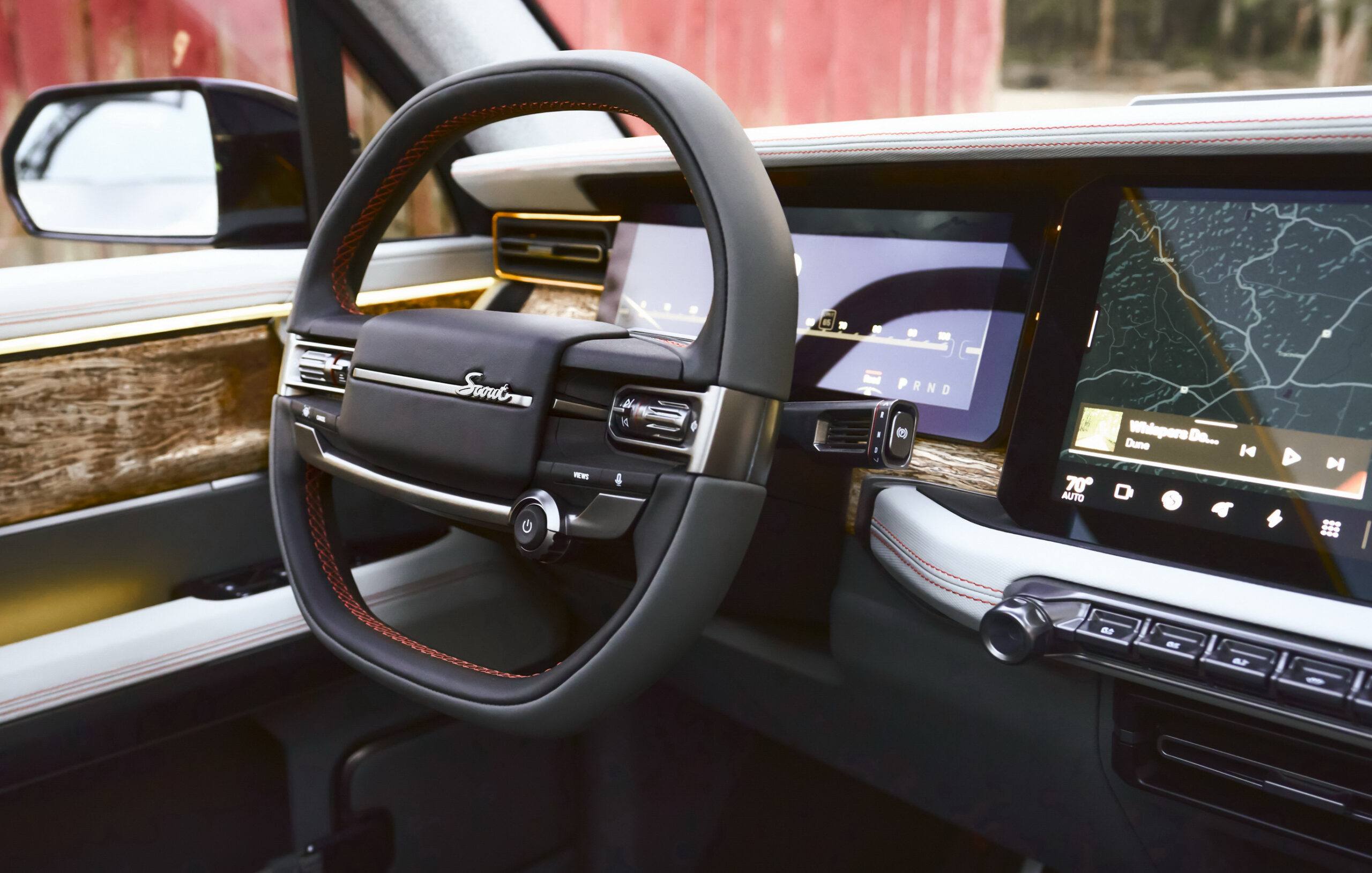
Scout says its EVs won’t chase sterile, ultra-minimalist, sci-fi EV interior cues. Yes, there’s a digital gauge cluster and a large center screen, but there will also be real knobs, real switches, and real buttons.
The tactile nature of the cabin connects to the brand’s rugged DNA, and the carefully curated sounds will reinforce it.
“We’re not creating spaceships,” Benjamin said. “We’re creating hearty, wholesome vehicles that people will love, and we want the sounds to reflect that.”
Production of the Terra and Traveler begins in South Carolina in late 2027, after a run of pilot builds in 2026.
-
Electric Vehicles - Latest News | Carscoops
- Kia Slashed $10,000 Off Its EVs. Buyers Still Walked Away
Kia Slashed $10,000 Off Its EVs. Buyers Still Walked Away
- Kia is on track to set another all-time sales record this year.
- EV6 sales fell sharply from 1,887 last Nov to only 603 units.
- Key model gains like the K5 and Sportage helped lift sales.
Car manufacturers across the US are scrambling to rekindle interest in their electric vehicles as the federal tax credit of up to $7,500 fades into the rearview mirror. The loss of that incentive has left many brands looking for new ways to attract buyers, and Kia’s approach is simple enough: slash prices.
Read: Who Needs $7,500 Tax Credit When Kia Slashes EV Prices By $10,000
The company is offering discounts worth as much as $10,000 across several models, though the numbers suggest it’s not quite having the desired effect. At least not yet.
Kia announced last month that the 2025 Niro EV, 2025 EV6, and 2026 EV9 would all be available with $10,000 in customer cash. For the Niro EV, that amounts to roughly a 24 percent markdown on the base model. Yet despite the aggressive pricing, sales remain far below the levels seen when the tax credit was still in play.
Discounts Without Traction
Last month, Kia shifted 918 examples of the three-row EV9, almost triple the number of Hyundai Ioniq 9s sold over the same period, but down significantly from the 2,155 sold in November 2024. Year-to-date deliveries are also down 30 percent from 20,066 to just 14,032.
It’s a comparable story with the EV6. Despite receiving a comprehensive facelift, sales have dropped sharply from 1,887 in November 2024 to only 603 this year. Total sales for 2025 now stand at 12,188, down 38 percent from 19,604 over the same stretch in 2024.
Kia US Sales November 2025
| Model | Nov 25 | Nov 24 | Diff. | YTD-25 | YTD-24 | Diff. |
| EV9 | 918 | 2,155 | -57% | 14,032 | 20,066 | -30% |
| EV6 | 603 | 1,887 | -68% | 12,188 | 19,604 | -38% |
| K4/Forte | 9,321 | 11,005 | -15% | 126,919 | 127,867 | -1% |
| K5 | 6,430 | 6,378 | 1% | 66,642 | 40,672 | 64% |
| Soul | 3,280 | 4,031 | -19% | 47,679 | 48,747 | -2% |
| Niro | 5,230 | 1,624 | 222% | 28,037 | 28,302 | -1% |
| Seltos | 6,286 | 3,778 | 66% | 51,973 | 56,221 | -8% |
| Sportage | 15,795 | 14,051 | 12% | 165,954 | 146,490 | 13% |
| Sorento | 6,723 | 8,705 | -23% | 87,433 | 85,722 | 2% |
| Telluride | 10,054 | 11,568 | -13% | 111,123 | 103,016 | 8% |
| Carnival | 7,362 | 4,925 | 49% | 65,172 | 44,561 | 46% |
| Total | 72,002 | 70,107 | 3% | 777,152 | 723,185 | 7% |
Kia does not break down powertrain sales of the Niro, which is sold in ICE, hybrid, and EV guises in the US. What we do know is that overall Niro sales increased dramatically from 1,624 in November 2024 to 5,230 last month.
On Track For a Sales Record
Despite the underwhelming performance of its electric lineup, Kia’s overall sales tell a different story. November saw 72,002 vehicles delivered, up three percent from 70,107 a year earlier.
The brand has now sold 777,152 vehicles in 2025 and is on course to notch its third consecutive all-time annual sales record. The gains have been driven in part by a 64 percent jump in K5 sales, a 13 percent rise in Sportage deliveries, and an 8 percent boost for the Telluride.